Place: North America
 The racist and utterly reactionary Republican legislative majorities that dominate the South are on an aggressive march this legislative session. From Texas to Florida, Arkansas to Virginia, and all the states in-between, they are employing cut-throat strategies and tactics to pass a package of regressive, exploitative and outright anti-human legislation drawn up by the likes of ALEC (the American Legislative Exchange Council)[1] and other right-wing think tanks. They are attacking the right to vote, Black voting districts, the right to education, access to housing, workers rights to organize themselves, wage protections, alternative energy plans, marriage equality, and the list goes on.
A while ago, I wrote a piece here that, among other things, argued that if Bernie Sanders were to lose the Democratic primary he should not, as he has promised several times to do, support Hillary Clinton for President. Many people on the Left, most recently Chris Hedges in an article for Truthdig, have argued that this promise makes Sanders a wolf-in-sheep’s clothing for the Left, and that he will inevitably betray the movement supporting him and the ideals he has campaigned on. For Hedges and others, this promise (along with running as a Democrat) is precisely why the Left should not be supporting Sanders and his campaign at all. While I disagree with Hedges that we should not support Sanders because of this promise, we should absolutely be wary of the likely possibility that he will keep this terrible promise; Sanders if anything has a tendency to keep his word. This is what he is known for, after all—being the rare honest politician.

The Sanders campaign has certainly sharpened the contradictions, hasn’t it? It’s been very clarifying to see Hillary Clinton and her surrogates running against single-payer and free college, with intellectual cover coming from Paul Krugman and Vox. Expectations, having been systematically beaten down for 35 years, must be beaten down further, whether it’s Hillary saying that to go to college one needs some “skin in the game,” or Rep. John Lewis reminding us that nothing is free in America. A challenge from the left has forced centrist Democrats to reveal themselves as proud capitalist tools.
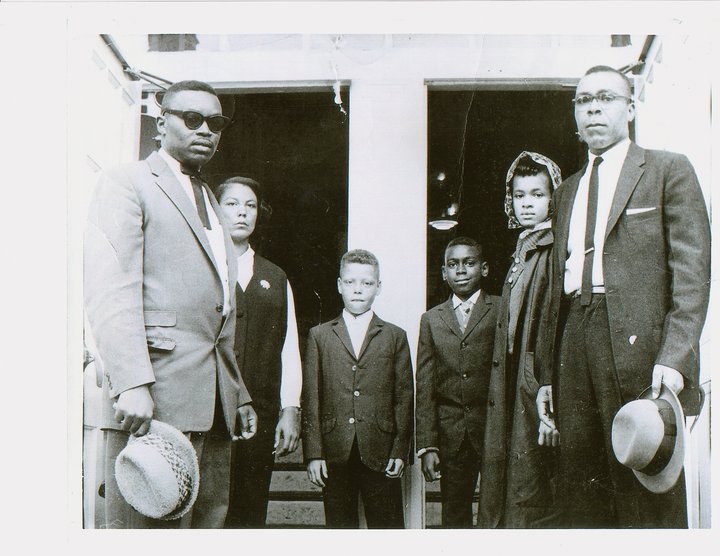
Representative Lewis,
Yesterday, you stated the following about Bernie Sanders’s record on fighting for civil rights in the 1960s:
“I never saw him. I never met him. I was chair of the Student Nonviolent Coordinating Committee for three years, from 1963 to 1966. I was involved with the sit-ins, the Freedom Rides, the March on Washington, the march from Selma to Montgomery and directed (the) voter education project for six years. But I met Hillary Clinton. I met President (Bill) Clinton.”
We are going to ignore the fact that Hillary Clinton was a Goldwater Girl, or that you once stated to a Clinton biographer that, “[t]he first time I ever heard of Bill Clinton was the 1970s,” or that it has already been well-established that Sanders worked with the Congress for Racial Equality (CORE) at the University of Chicago in the 1960s. We are also going to leave aside the fact that every mention of Bill Clinton in your book Walking With The Wind described an instance that he opposed some policy that you cherished.
Instead, we are going to talk about another person that you never saw or met.
First, full disclosure: I read most of Jack Ross’s The Socialist Party of America in draft. Although it is normally not good policy to then review the book, I felt I could express my respect for what Jack Ross is attempting and share my concerns in a way that could serve a useful purpose.
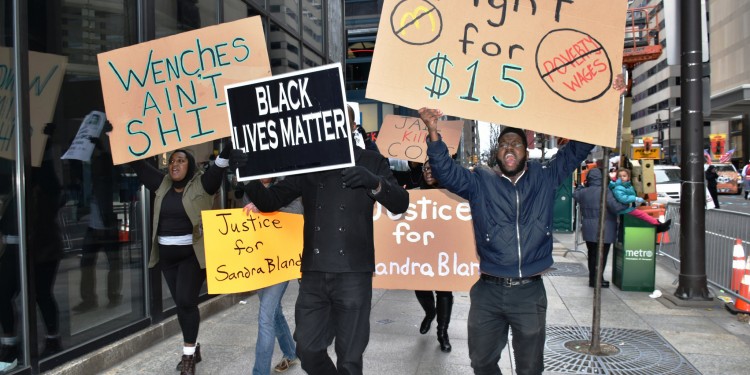
It may be that in 20 or 30 years we will look back to 2015 as the year that things really began to change in the U.S. This was the year we saw the intersection of the movement for higher wages and Black Lives Matter really begin to crystalize.

Bernie Sanders’s dropping the hammer on Clinton’s cozying up to the vile genocidaire Henry Kissinger was one of the fist pump moments of the campaign. That’s recognized by pretty much everyone now, so I don’t need to say much about it here.
The godfather of macro-level power structure research in the United States was the sociologist C. Wright Mills, author of The Power Elite (1956).
 Arthur Henry Young (1866-1943), known to the world as Art, was arguably the most widely recognized and beloved cartoonist in the history of American radicalism. A working cartoonist for sixty years, Art Young drew thousands of simple black-line drawings with biting captions that appeared in big-city newspapers, liberal magazines, and, most importantly, in the socialist, labor, and radical press of the early twentieth century.
The American Dream, that fantasy of growth that has long girded the ideology of entrepreneurship and a better future, is in crisis. Many haven’t felt the dream for decades, some never having experienced it at all. Robert Putnam, in his latest work, Our Kids, seeks to confront this stagnation in our economic dreams by interrogating the forces that have taken hold of communities across the United States.
 Now as usual, ten past nine; I certainly will not go on beyond ten past ten. And I would like to say at once that this is the task. It is so difficult that it is as well to say at the beginning that it can be done. Five hundred and eighty-three pages [Oliver Cox’s Caste, Class and Race: A Study in Social Dynamics].
In 1971 the Institute of the Black World (IBW) was at a crossroads. Founded in 1969 by historian Vincent Harding, literary scholar Stephen Henderson, and other scholars in the colleges that comprised the Atlanta University Center (AUC), as well as with the support of leading national researchers of the African American experience, the IBW served as the intellectual wing of the Martin Luther King Center.
 Americans today face a dual crisis: rising rents and increasingly unaffordable housing markets. The housing crisis, far from being over, has metastasized.
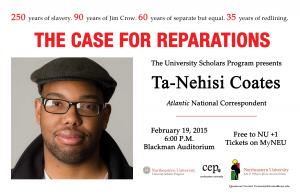
The following is a segment from Doug Henwood‘s Behind the News, January 21, 2016. Henwood is interviewing Adolph Reed. Audio link here.
DH: We’ve got Ta-Nehisi Coates citing the call for reparations and finding Sanders guilty of hostility towards reparations. What do you think of his critique?
AR: I read the thing in The Atlantic and it’s so utterly empty and beside the point, I can’t even characterize it.

The lead-poisoning disaster in Flint, Michigan is more than a shocking public health failure. It is an assault on human rights – a recognition that has been largely absent from most discussions of how and why this could have happened in the advanced industrial democracy of the United States. It is arguably the largest discrete violation of its type since the infamous and grossly unethical Tuskegee syphilis medical study of the last century. The water poisoning in Flint was finally forced into official recognition by a brave and stubborn pediatrician, Dr. Mona Hanna-Attisha, who documented what was really happening to Flint’s vulnerable children and other residents.
 Senator Bernie Sanders’ run for the Democratic Party nomination for president has certainly energized thousands. It has also rekindled an old debate on the American left that revolves around the question: Should the left join, endorse, support, or work for campaigns in the Democratic Party?
 Some months ago I responded to a piece that appeared on the New Politics blog by my longtime fellow NP editorial board member and friend Barry Finger.1 In my own blog, I argued that Barry had a better, more sophisticated understanding of the peculiarities of the Democratic Party and the U.S.
 Outside powers have had a long and shameful history of cynically supporting dictatorships in the Middle East because maintaining friendly autocratic states in the region suits their geopolitical objectives. And today those criminal policies are flagrantly on display.

The necessity of working-class internationalism must surely be one of the left’s most invoked truisms, providing the semblance of a solution to the problems facing embattled workers and governments of the left. But too often the concept is deployed in vague, even contentless ways. The global economic crisis has put the issue of ‘internationalism’ into greater focus – particularly, perhaps, in Europe, where political and monetary union is in question as never before.

Howard Brick and Christopher Phelps. Radicals in America: The U.S. Left Since the Second World War. New York: Cambridge University Press, 2015. 355 pp. Photos. Bibliography. Index.
Howard Brick’s and Christopher Phelps’ Radicals in America, covering the period from 1939 to 2014, is a masterful narrative history of the left of our time, an account that integrates the experience of the post-war left into American political, economic, and social history, with an eye to the cultural context as well.

Red Rosa: A Graphic Biography of Rosa Luxemburg, Kate Evans, Verso, 2015, paperback, $16.95
Capitalism and Climate Change: The Science and Politics of Global Warming, David Klein (author) and Stephanie McMillan (editor and illustrator), Amazon digital services, 2015, eBook, $2.95
Gene Basset’s Vietnam Sketchbook: A Cartoonist’s Wartime Perspective, Thom Rooke, Syracuse University Press, 2015, paperback, $24.95
My War, Szegedi Szüts, Dover, 2015, paperback, $12.95
The graphic lit juggernaut rolls on. Even as DC and Marvel crank out superhero comics at roughly the same pace they have for the past twenty or thirty years, trade publishers and university presses are issuing nonfiction narrative art on a scale that would have been unthinkable a decade ago. Back in the day, the four books under review would have represented a significant percentage of like-minded cartooning to appear in any given season. Now practically every publishing house under the sun boasts a new graphic novel line or at very least a fistful of titles aimed at the words-and-pictures market.
- « Newer Posts
- 1
- …
- 42
- 43
- 44
- 45
- 46
- 47
- 48
- …
- 73
- Older Posts »