Place: North America

Puerto Rico is undergoing a profound fiscal crisis. Our country is besieged by the big interests of Wall Street’s credit agencies and vulture funds, which as they’ve done in other parts of the world, such as Spain, Greece and Argentina, only seek an uncontrolled increase in their profits. These profits come at the cost of great sacrifices to working people, which include drastic cuts to social services that will have a special impact on education and health care.
In order to impose their inhumane demands, they use their powerful influence within government structures, in the courts and in the mass media to guarantee payment of the immoral and odious debt, with no concern for the deterioration of our quality of life and the elimination of hard-won labor rights. They establish, de facto, a dictatorship of oligarchic and monopoly capital over the whole of society, the working class majority stripped of the financial resources needed to insure a dignified subsistence.
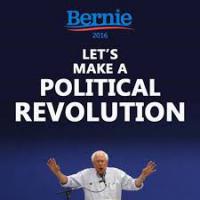
Even a somewhat cynical 71 year old socialist like me could be thrilled to see Bernie Sanders talking about the need for an American political revolution on MSNBC. To be honest, I’m not sure that I ever expected to see a leading presidential candidate say we need a revolution on prime time TV.
When Bernie Sanders says we need a political revolution, he’s mostly talking about turning many thousands of new people out to vote. That would obviously be a very good thing. It’s just not enough to win the meaningful social changes that would add up to a political revolution.
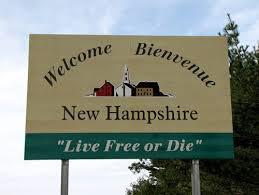
They don't put the slogan “Live Free or Die” on New Hampshire license plates for nothing!
There has been an inspiring statewide local union response to SEIU's predictably short-sighted headquarters embrace of Hillary Clinton. This Sanders endorsement comes from public workers who know Bernie well because they live and work just across the Connecticut River from Vermont–or, in some cases, are Vermonters themselves.
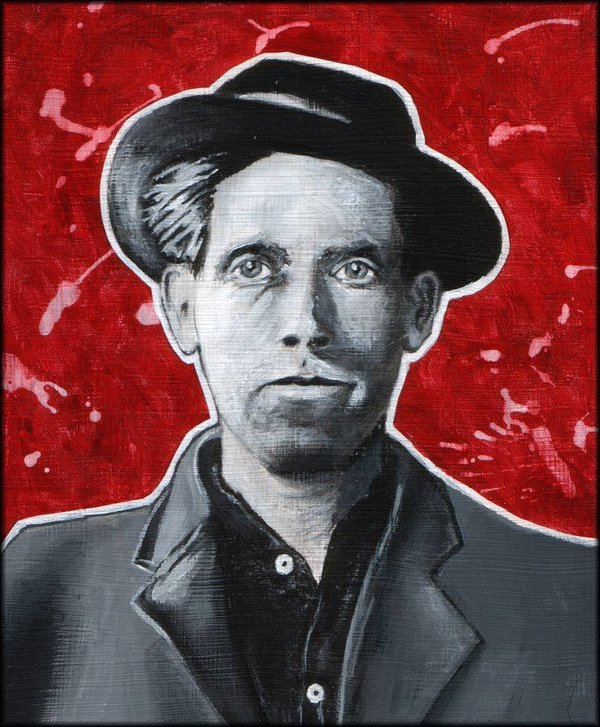
Almost a century ago, the socialist journalist John Reed wrote of the Industrial Workers of the World, popularly known as the Wobblies, “Remember, this is the only American working-class movement which sings. Tremble then at the IWW, for a singing movement is not to be beaten.” On the other hand, the sheriff of San Diego complained of his jails filled with Wobblies, “I do not know what to do. I cannot punish them. Listen to them singing all the time, and yelling and hollering, and telling the jailers to quit work and join the union.”

This story begins where all good stories do; I hit a bit of a rut with the second to last chapter of my dissertation, a dissertation which looks at the psychological aspects of capitalism that undermine arguments for global justice that are deeply entrenched in the liberal political-philosophical tradition. When I get stuck, I try to motivate myself by reminding myself how necessary this kind of demystifying critical scholarship is. Naturally, I usually turn to Fox News for such motivation. However, for whatever reason, I decided to look on Facebook for something that would piss me off and send me on a writing blitz.
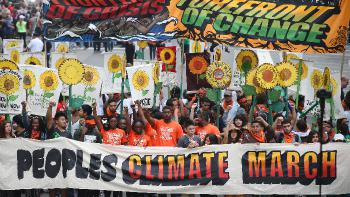
The last protest of the day of the New York City Climate Protests was at a Broadway theatre where Gov. Cuomo was scheduled to attend. It was a spirited demonstration complete with a little orchestra and playful costumes focused on persuading Cuomo to veto the Port Ambrose Liquefied Natural Gas (LNG) plant off the coast of Long Island right near JFK airport. Opponents argue that it is very dangerous security risk, terrible for the environment, and would kill the chance for a 700-megawatt wind farm that would create 17,000 local jobs.
Economic oppression remains ubiquitous. In the West we are moving towards, or are already at, a condition of corporate governance enforced by the state apparatus. This is not capitalism as it is commonly understood— allowing for the ostensibly free pursuit of capital, an open market economy— nor is it democracy, or even sovereign nation states. It is a new corporatocracy, in which powerfully entrenched (international) corporations reign supreme, and define policy and economic planning in perpetuity.
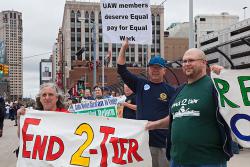
The United Auto Workers union (UAW) has reached a tentative agreement with Fiat Chrysler Automobiles (FCA) and is presenting the proposed contract to its members for a vote beginning this week. The contract affects some 40,000 unionized hourly workers.
At the beginning of the economic crisis in 2007 the UAW agreed to let Fiat Chrysler establish two tiers, that is, workers doing the same job would have different rates of pay, with newer workers sometimes working for $17 an hour while more senior workers might earn as much $28 an hour. Such a system had been introduced earlier in the auto parts plants.

Recently the local food movement seems to have sprung up from nowhere. Yuppies are flocking to farmer’s markets and community gardens across the nation to help the environment and local farmers. But this movement is not at all inclusive; urban agriculture has often been actively suppressed amongst low income populations. This is not always the case, however, especially in times of economic crisis. For example, in the seventies, urban agriculture was promoted in New York’s Lower East Side as a productive way to use land that served no other purpose. But when the gentrification of SoHo spread in the eighties as the economy improved, land prices shot up and gardens which had been tolerated previously were bulldozed with nary a thought to the people who relied on them for access to healthy food.
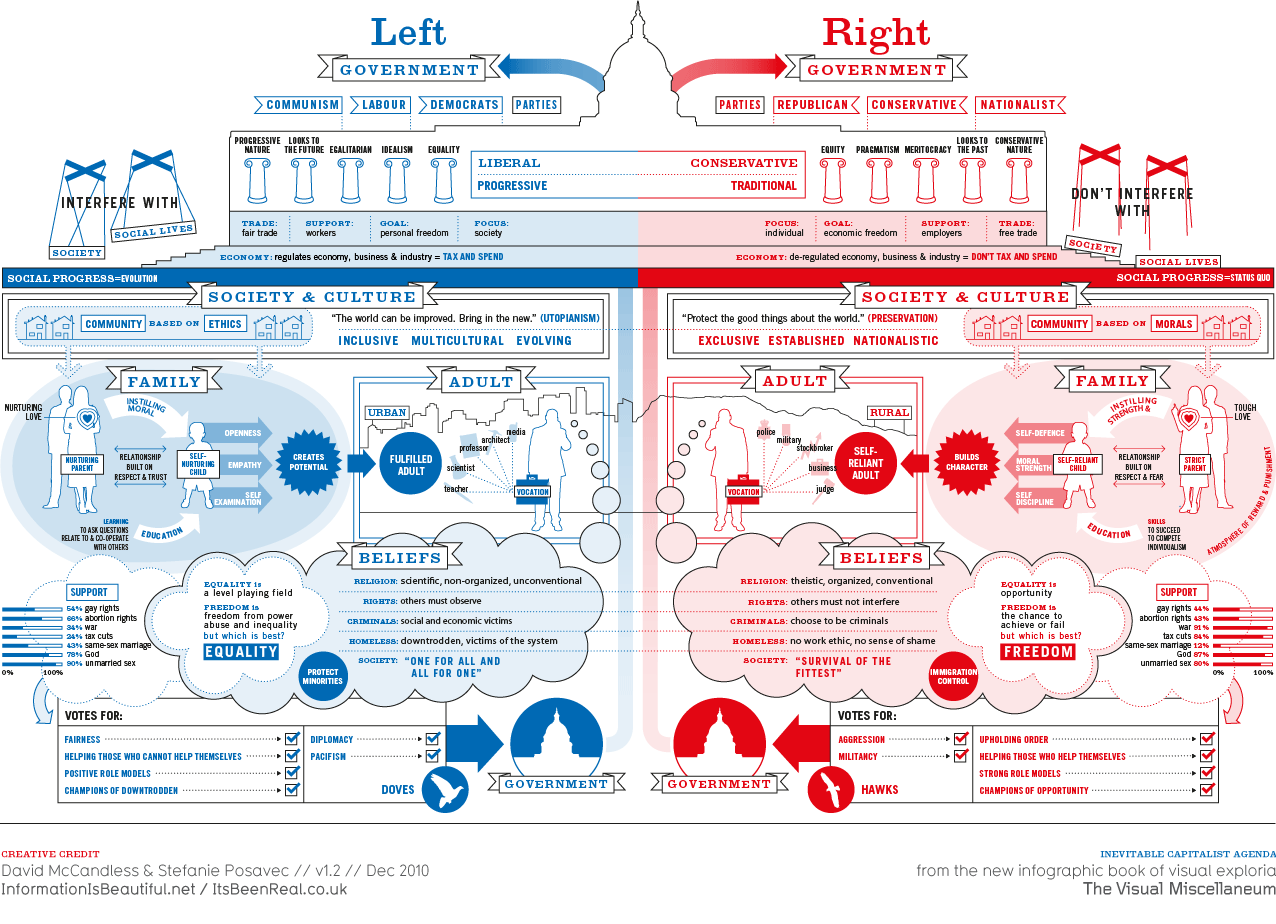 Jeremy Corbyn won the leadership of the UK Labour Party. As usually happens when the left scores an electoral victory, the center-left and others has made sure to inform Corbyn and his supporters that it is bad that he won and that he never should have tried to win. I am more familiar with this in the American context where every left-wing electoral effort is similarly cast as irresponsible. Given these attitudes, I am left to wonder what exactly people think the left is supposed to do electorally?

[The following item comes from the Jill Stein campaign for the Green Party presidential nomination.]
Now is the time to support a serious, independent, left candidate for Presidential in 2016. Jill Stein, Green Party candidate for President, is already garnering media attention, building support in social justice movements and frontline struggles and taking on the undemocratic Presidential Debate Commission.
Interview with Arun Gupta, journalist and a founding editor of New York City’s Indypendent newspaper, conducted by Scott Harris:
http://btlonline.org/2015/mp3/150918a-btl-gupta.mp3
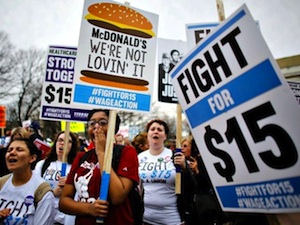
It’s been almost three years since the movement for a living wage burst into protest, first in New York City and then in dozens of other cities and towns across the U.S.

Review of Michael Gould-Wartofsky, The Occupiers. New York: Oxford University Press, 2015.
Occupy was the largest political mobilization of my lifetime. The explosion of energy it produced gave the feeling of perpetuity, with thousands of volunteers supporting each other through donations of food and standing together in solidarity against the police. But as the encampments became rooted, many had to check their excitement with a growing sense of disillusionment. It was clear that the Occupy strategy, and how it played out in practice, was rife with weaknesses that were ultimately exploited by those who sought to destroy Occupy and the discourse that it created.

In a recent New Politics essay, Dan La Botz argues that “the debate between” Democratic Party presidential candidate Bernie Sanders and the Black Lives Matter (#BLM) movement is “one of the most important discussions of our time.” It is “a great debate about the priorities and the program of the American people” that “could lead to the construction of a new analysis and lay the basis for a new and broad social movement” that helps us “find a new way forward against both capitalism and racism” – “a new movement that combines the fight for greater economic equality with demand for racial justice, perhaps a movement for socialism.”

I was sitting in a one-bedroom apartment watching the telethon for Hurricane Katrina when it happened. After a commercial break, Kanye West stood nervously looking like he was about to do something that would end his career. He was fidgety and sweating when he said it: “George Bush doesn’t care about Black people.” It was a transcendent moment for Black America.
May First/People Link is being attacked in a Denial of Service attack that is unprecedented in its length and viciousness. We have been fighting off this attack for over three weeks now.
We are convinced that the attack is political. We know how the attackers are targeting us, we know they are targeting the entire organization’s systems and we know that they are carefully monitoring our responses because they are quickly adapting to every move our technologists make to return us to service.
 The following is an email interview with Mimi Soltysik, a member of the Los Angeles chapter of the Party USA. He is currently seeking the Socialist Party's nomination for the 2016 US Presidential election. This interview was originally published by The Hampton Institute.
Tell us about yourself and your politics.
Here’s the statement I made when I announced my intent to run for the Socialist Party USA's POTUS nomination. I think it fairly well captures who I am and where I stand politically:
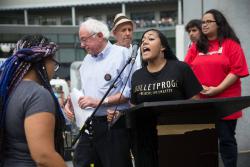
For the first time in decades a great debate about the priorities and the program of the American people is taking place not among small groups of leftists but in society at large. The debate between Sanders and Black Lives Matter—on social media, on TV and radio, in the newspapers, and on the street—is one of the most important discussions of our time and could if it is deepened help us all to find a way forward against both capitalism and racism. What appears to some only as conflict could lead to the construction of a new analysis and lay the basis for a new and broader social movement. We should all become involved in this debate and help to further it toward the common goal of a society of equality, democracy, and solidarity.
I don't support Bernie in the Democratic Party because I believe the key question in U.S. politics is building a political party that can defend the needs of the vast majority of the American people. As more and more people on the left agree, the Democratic Party is not and cannot be such a party; to my mind this constraint makes paramount the political independence of candidates, no matter how progressive their program.

I wanted to write and let you know why I support the doctors and clinic workers of Planned Parenthood who help people obtain abortions, often at great personal cost.
The current call to defund Planned Parenthood has been coordinated with attack videos that are highly edited in order to demonize the doctors who were filmed. As David Cohen and Krysten Connon document in their book, “Living in the Crosshairs,” the personal nature of political attacks on abortion in this country have led to harassment, stalking, and violence against providers and their families.
As those committed to social justice in St. Louis prepare to mark the August 9th killing of unarmed teen Michael Brown Jr. by Officer Darren Wilson in Ferguson, we know that many in the region would like us to just go away. Enough already, they say. Why commemorate something so sad and wrong, anyway? Let’s just move on. But we’re at the beginning, not the end of this struggle. It’s not time to move on, and this day calls for reflection.
- « Newer Posts
- 1
- …
- 43
- 44
- 45
- 46
- 47
- 48
- 49
- …
- 73
- Older Posts »