Place: North America
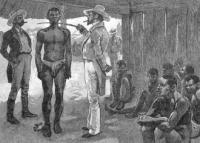
Edward E. Baptist, The Half Has Never Been Told: Slavery and the Making of American Capitalism. Basic Books, 2014. 528 pages. Paperback, $19.
“Changes that reshaped the entire world began on the auction block where enslaved migrants stood, or in the frontier cotton fields where they toiled…Enslaved African Americans built the modern United States, and indeed the entire modern world, in ways both obvious and hidden.”
— Edward Baptist, The Half Has Never Been Told
This vital and enthralling book reveals how U.S. capitalism was built on the torture of enslaved people. Edward Baptist quotes a Mississippi overseer telling his friends that “the whip was as important to making cotton grow as sunshine and rain.” The whip “might open deep gashes in the skin of its victim, make them 'tremble' or 'dance'…but it did not disable them.”
May First/People Link is the organization that hosts the New Politics website. But it is more than a hosting platform: it is a membership-based political community that tries to use the Internet to advance progressive causes. It has now come under attack by rightwing anti-abortion hackers because it hosts the National Network of Abortion Funds. We express our solidarity with May First/People Link and with the National Network of Abortion Funds. Below is the statement sent by May First/People Link to its members on August 4.
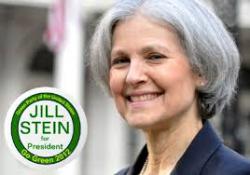
Jill Stein is campaigning as a Green Party candidate for the 2016 presidential race. She says we need real solutions for the economic, social and environmental crises we face. But the broken political system is only making things worse. It's time to build a people's movement to end unemployment and poverty; avert climate catastrophe; build a sustainable, just economy; and recognize the dignity and human rights of every person.
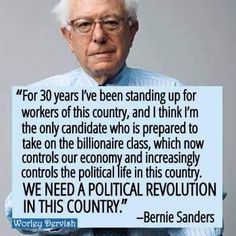
In the United States, even more so since the advent of twenty-four hour news channels, there is a consistent fetishization of political candidates. Who is viable? Who is trust-worthy? Whose ideas best fit with the prevailing public opinion polls on certain issues at a given time? Who has the most attractive haircut or family? Who has the right skin color, gender, or business experience to win over key demographics?
Though few of us are under any illusions that this country is or has ever been a genuine democracy, it seems that even those people who are not convinced by the patriotic rhetoric of the purity of American democracy too often acquiesce to the “all of our hopes rest in a single individual or political party” approach to politics. If socialism means anything beyond mass resistance to capitalism, it should be resistance to this mindset. When we fetishize the candidate we marginalize true democracy, the cornerstone of socialism.

Last night more than 100,000 people attended 3,500 meetings in all 50 states and the District of Columbia to watch a video-cast of Bernie Sanders and to begin to organize his on-the-ground campaign. Some of the meetings in various parts of the country had as many as 200 people in attendance. The meeting I attended in Crown Heights, Brooklyn was attended by 25 people, most in their 20s, with background working for social justice NGOs, in media, and in the arts, as well as a few graduate students.

United Auto Workers Local 2865 representing 13,000 teaching assistants and other student workers throughout the University of California system, called on the AFL-CIO to end its affiliation with the International Union of Police Associations (IUPA) in a resolution passed by its governing body on July 25. This is the union’s resolution passed by the union:
Statement:
We, UAW Local 2865, call on the American Federation of Labor and Congress of Industrial Organizations (AFL-CIO) to end their affiliation with the International Union of Police Associations.
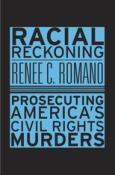 Jimmie Lee Jackson was shot by an Alabama State Trooper in Marion, Ala., on Feb. 26, 1965, following a civil rights march. He died two days later. This killing sparked the Selma marches depicted in the now-famous film (the Jackson shooting is shown with a slight change in locale).
 Wonder Woman was not the first female superhero, but she is the best known of the modern-day costumed heroines. Armed with indestructible bracelets, her Amazonian heritage, and a “magic lasso,” the character’s inaugural debut came in the pages of All Star Comics #8 in December 1941; a month later she was showcased on the cover of Sensation Comics #1.
As a strong supporter of Bernie Sanders, my first reaction to hearing about the Black Lives Matter protest at Netroots Nation was disappointment. This looks bad, I thought. Bad for Bernie, who is the only presidential candidate with any chance of challenging structural injustice. And bad for Black Lives Matter, who could easily be interpreted as shutting down progressive discussions about immigration and economic inequality to make people focus on their priorities. I’ve had my share of mistakes during protests, as have all the activists I respect most, so I certainly had some sympathy. But I thought their protest was just that: a mistake.
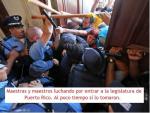 On Monday June 29, the Governor of Puerto Rico, Alejandro García Padilla, delivered a live message to the people of Puerto Rico stating that the government’s $73 billion debt is unpayable. The governor stated, “The public debt, considering the present level of economic activity, is unpayable”.

I awoke Saturday morning to rain on the roof. I am staying at my sister’s place in my hometown of Imperial Beach at the southwest end of San Diego County on the Pacific Ocean and the Mexican border. I could not at first identify the sound, the crackling of the rain on the awning of the patio just outside my bedroom window. Half asleep, I wondered at first if there might be a fire, then if some machine was running, finally I recognized that it was water and speculated that something might be leaking; perhaps there was a broken pipe. It never occurred to me that it could be raining because when I grew up here from the late 1950s until the late 1960s, it only rained in December and January. Now there is rain in July.
 Earlier this year, four leaders of Young Democratic Socialists (YDS), the youth section of Democratic Socialists of America (DSA), began to collaborate on a response to the New Politics prompt: What is the left we need today?
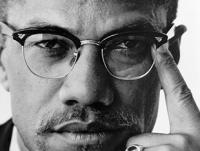 I attended an event for the 50th anniversary of Malcolm X’s assassination that was held in the same room where the visionary leader was murdered.
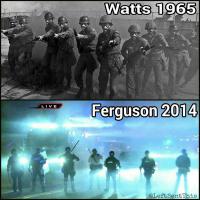 "Someone threw a rock, and like monkeys in a zoo, they all started throwing rocks.” This remark was not made in the wake of the Michael Brown grand jury verdict. It was the account of Chief William Parker, spoken decades before and 1,500 miles away, on the unrest of the 1965 Watts Riots.
 Anyone who has participated in direct action can tell you that your first time is going to be scary, but it comes more naturally after that.
 Raising the slogan of “Black Lives Matter,” protests have erupted across the United States. Behind this slogan is a proliferation of new organizations and networks composed of engaged millennial activists of color. On one level, it might appear that what is being constructed is an effort to address the lack of civil rights protections for African Americans.

In the summer of 1994, my partner and I happened to be on vacation in Stockholm for the Pride celebration, so we joined in. I remember it as a rather modest, subdued affair compared to the ebullient marches I remembered from New York and San Francisco. But what struck me most was the lesbian/gay federation’s emphasis on legal recognition for same-sex partnerships, at a time when Sweden banned sex in gay bathhouses. I thought these were upside-down priorities. Swedish same-sex couples would win in fact the right to register for partnership benefits in 1995, while the ban on bathhouse sex stayed on the books until 2004. What a curious country this is, I remember thinking.
 A review of The Bigot: Why Prejudice Persists, by Stephen Eric Bronner, Yale University Press, 2014.
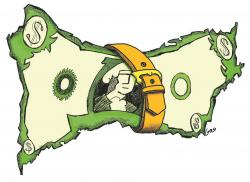
In this TeleSur interview with Rafael Bernabe, the spokesperson for the Puerto Rican Working Peoples Party advocates for a moratorium on the debt. Bernabe has written an extensive article in the current Summer 2015 issue of New Politics.
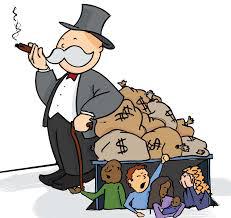
“Rich people are the fucking worst.” This is the premise and title of Sean Illing’s recent Salon.com article (June 22, 2015). While I agree with his sentiment, the argument that follows this provocative title leaves a lot—too much—to be desired. Illing is a self-professed progressive, and the purpose of his article was to discuss the various “new” ways the rich are expressing disgust for the poor or anyone who isn’t rich, in the context of the on-going drought in California. While I completely agree that “rich people are the fucking worst,” Illing misses the proper target of critique. Rich people do indeed suck. However, progressivism itself sucks, and here’s why: it misses the systemic root problem. The rich suck, because capitalism encourages them to suck.
I find it odd that my friend and fellow New Politics board member Riad Azar should center his criticism of Bernie Sanders’ foreign policy on Sanders’ supposed “irresponsible” “isolationism.”
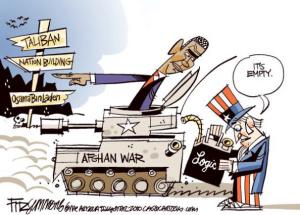
It seems to me that a critique of Bernie’s foreign policy should begin by criticizing him for voting for the Authorization for Use of Military Force resolution that paved the way for U.S. military intervention in Afghanistan, and for refusing to unequivocally condemn Israel’s shameful 2014 war on the people of Gaza. These positions might or might not be sufficient to preclude support for Bernie if he or someone like him ran as an independent — to my mind that would depend on the overall dynamic and trajectory of the campaign — but in any case they represent Bernie’s deep failure to consistently break with U.S. global imperialism and Israeli repression, and should form the central part of a critical assessment of his foreign policy stance.
- « Newer Posts
- 1
- …
- 44
- 45
- 46
- 47
- 48
- 49
- 50
- …
- 73
- Older Posts »