
Place: North America
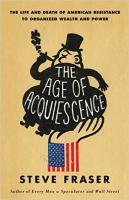
Steve Fraser, The Age of Acquiescence: The Life and Death of American Resistance to Organized Wealth and Power (New York: Little, Brown and Company, 2015)
All of us on the left are all too familiar with the capitalist offensive of the past forty years. Under the banner of “neo-liberalism” capital has rolled back almost every gain working people across the world have made since the 1930s. All sorts of public industries, services and institutions have been privatized, social welfare programs that protected workers from the worst insecurities of the labor-market have been rolled back or simply abolished and unions and working class political parties that had traditionally organized and represented working people have been severely weakened.
 The Partido del Pueblo Trabajador—the Party of the Working People (PPT)—is a political project of the Puerto Rican left addressed to working people in the context of the island’s deep economic crisis.
 Raven Rakia is a journalist based in New York City. Her work is usually focused on cities, police, and prisons, and she has been published in the Nation magazine, VICE, Gothamist, Truth-Out, Medium.com’s MATTER, and The New Inquiry. You can follow her work at @aintacrow. She was interviewed by email by Amber A'Lee Frost and Saulo Colón.
Kali Akuno served as the coordinator of special projects and external funding for Jackson Mississippi’s late Mayor Chokwe Lumumba. He is co-founder and director of Cooperation Jackson as well as an organizer with the Malcolm X Grassroots Movement. He was interviewed by email by Riad Azar and Saulo Colón, both members of the New Politics editorial board.
Each generation has a moment when its members share an instance of collective experience that is forever etched into their memory. For the Civil Rights and Black Power generation, it was unquestionably the open-casket funeral of Emmett Till. The disfigured remains of this fourteen-year-old boy became a mirror in which black youth witnessed their most vulnerable selves. The sight was so excruciating that it helped catalyze direct action protest from rural Alabama to the streets of Oakland for nearly a decade and a half.
 Regardless of one's views on whether or not the socialist left should support Bernie Sanders in his race for the White House, the momentum behind the self-described “democratic socialist” has been impressive. Beginning at 2% in April, his popularity grew to 14% in May and at last check was 32% in New Hampshire.
 How are we to assess the Bernie Sanders presidential campaign?
There are three reasons that one runs a candidate for president. One is the hope of winning, second is to influence other candidates to modify their views, and third is to use the campaign to build for the future, either educationally or organizationally.
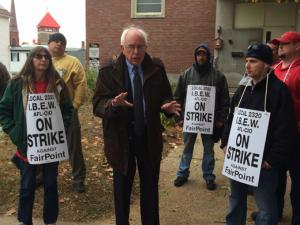
Grassroots labor initiative urges Democratic primary support for Sanders by AFL-CIO and national unions.
Over 1,000 union activists from around the country today kicked off Labor for Bernie 2016.
 Despite his relatively low poll numbers at the moment, Bernie Sanders’ bid for the Democratic presidential nomination is catching fire and will undoubtedly attract a great many more supporters in the months to come. For radicals, and especially for socialists in the “third camp” tradition (so called from the time of the Cold War, when our tendency stood for revolutionary opposition to both camps) this poses a challenge.
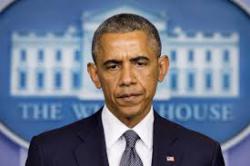
So why did things go so wrong under the leadership of President Barack Obama? David Bromwich has written an informative and important critical article on the Obama presidency, critical one might say from the progressive point of view, titled “What Went Wrong: Assessing Obama’s Legacy” which appears in the June issue of Harper’s. Fundamentally, Bromwich sees Obama as a weak president who has consistently pursued the “path of least resistance” rather than the “path of courageous resistance.” He was, says Bromwich, a president who mistook talk for action, who avoided political conflict and struggle, and who missed opportunities that presented themselves, moments when he might have advanced a progressive agenda.
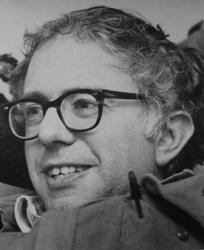
I haven’‘t had a chance yet to write up my own view of the Bernie Sanders campaign, but I want to give some background, going back to 1980, on what I know about the man.
In 1980 I was in Vermont trying to get on the ballot for the Presidential campaign – seeking the line of Liberty Union, a minor party which had hoped to become a ‘‘second party” in Vermont.
Liberty Union’s own history goes back to the late 1960’s when there was an effort in several states, at the height of the Vietnam War, to get alternative radical views on the ballot. The main base for this effort was in California, with the Peace and Freedom Party which, in 1968, nominated Eldridge Cleaver for President. (I ran for Congress in Lower Manhattan on that ticket that year, picking up the endorsement of the Village Voice and getting nearly 5% of the vote).

The following introduction is by the editors of SocialistWorker.org where this FAQ was originally published.
Bernie Sanders kicked off his campaign for the Democratic Party presidential nomination with a large and enthusiastic rally in Burlington, Vermont, on May 26.
Sanders’ candidacy has prompted discussion and debate among a left shaped by recent struggles such as Occupy Wall Street, the Chicago teachers strike, Fight for 15, Black Lives Matter and the climate justice movement. Many radicals, publications and organizations either support Sanders’ Democratic Party run outright or believe his campaign can be used to build the infrastructure for a stronger left. By contrast, SocialistWorker.org has argued Sanders’ campaign will serve to corral and co-opt the emerging left into supporting the Democratic Party–and make it harder, not easier, to build an independent, left-wing alternative.
Here, Ashley Smith and Alan Maass respond to some of the questions and disagreements posed by SocialistWorker.org readers during the course of the discussion so far.
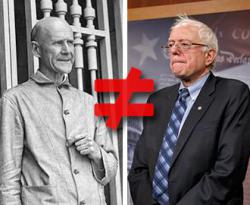
Bernie Sanders’ entry into the Democratic presidential primaries should be seen as his final decisive step away from the democratic socialism he professes to support. He will raise some progressive demands in the primaries and then endorse the corporate Democrat, Hillary Clinton. Nothing changes.
Sanders is violating the first principle of socialist politics: class independence. The socialist movement learned that principle long ago when the business classes sold out the workers in the democratic revolutions of 1848 that swept across Europe and parts of Latin America.

I appreciate the nonsectarian tone of the piece on Bernie Sanders’ presidential campaign by my longtime fellow New Politics editorial board member and friend Barry Finger. I think he has a better, more sophisticated understanding of the peculiarities of the Democratic Party (DP) and the U.S. electoral system than do many on the radical left that refuse to support any DP candidate regardless of that candidate’s personal political platform. However, I think that Barry still suffers from certain misunderstandings regarding just how different the big two U.S. political parties are from political parties that exist anywhere else in the world, and this means there are defects in his suggestions as to how left-wing socialists should relate to the Sanders campaign.

When I first met Brooklyn-born Bernie Sanders, he was a pretty marginal figure in his adopted state of Vermont. It was 1976 and he was running, unsuccessfully and for the fourth time, as a candidate of the Liberty Union Party (LUP).
Never heard of it? Well that’s understandable because only Vermonters are still afflicted with its enduring flakiness. Liberty Union (LUP) was a radical third party spearheaded by opponents of the Vietnam War who had, like Bernie, washed up in the Green Mountain State as “the Sixties” subsided.

As proponents of independent political action, we believe that the Democratic Party is a deathtrap for progressives and that history has demonstrated time and again that progressive movements immersed in the DP are stripped of their potential political power. Nevertheless, we cannot judge the potential of the Sanders’ movement solely by our attitude towards the Democratic Party, any more than we can evaluate the Democratic Party by the enormous potential contribution an unshackled Sanders movement may yet contribute to fundamental political change.

Dan La Botz’s description of the Future of the Left/Independent Politics Conference makes another introduction redundant. Instead, I’ll add my own observations. I come from the other side of this discussion: I hold with the `inside/outside’ approach to electoral politics, as pushed by the late Arthur Kinoy, a radical lawyer who led the National Committee for Independent Political Action in the 70s and 80s. Putting it simply, I supported left independent Barry Commoner for president in 1980, and Democrat Harold Washington for mayor of Chicago in 1983. This year, I support Kshama Sawant and Bernie Sanders. I see no contradiction – in fact I think it’s the only approach that makes sense.
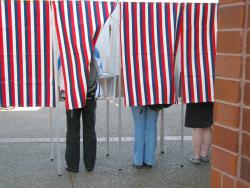
Any discussion of this subject needs to be based on the understanding that, at present, voting is carefully designed to, in Chomsky's words "reduce the population to apathy and obedience", putting us in a position where we are forced to demonstrate our fealty to the corporate state by actively endorsing one of its two anointed representatives.

This is the latest in a series of articles discusing the pros and cons of a Bernie Sanders campaign in the Democratic Party. Scroll down to find other articles. – Ed.
In the general election, the Democrats need the left to be silent about how bankrupt and corrupt the party is so it can gloss its rush to the right in a veneer of progressive rhetoric.
If you’re progressive or on the left, here’s your cheat sheet on how to participate in the 2016 presidential election, which is just 18 months away. If you live in one of the first states in the Democratic primary process, like Iowa, New Hampshire, or South Carolina, vote for Bernie Sanders. You can also sign an online petition for him, if you’re into that sort of thing. If you chance upon one of his campaign rallies and have nothing better to do, join the crowd.
But don’t do anything else. Don’t become a campaign volunteer, do phone banking, door knocking, get the vote, and certainly don’t send him a dime of your money.
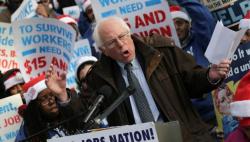
This is the latest in a series of articles discusing the pros and cons of a Bernie Sanders campaign in the Democratic Party. Scroll down to find other articles. – Ed.
Boldly calling for a “political revolution” against the “billionaires and oligarchs” who have hijacked the political system, Bernie Sanders has launched an insurgent campaign for President. The only self-described socialist in Congress, Sanders explained his decision to run to ABC News, saying “We need a political revolution in this country involving millions of people who are prepared to stand up and say ‘Enough is enough,’ and I want to help lead that effort.”

Voltaire wrote that “the best is the enemy of the good," but he cited it as a foible and not a redeeming practice. Within hours of Bernie Sanders announcing his candidacy for the Democratic Party presidential nod on April 30th, in some warrens of the radical left, the long corrective knives were already out for the only socialist in Congress. Why? Because Bernie is just not good enough, they said. Criticism ranged from his being a faux socialist, a stalking horse for Hillary Clinton whose backing by the left would be a practical waste of a year that could be better spent building a movement. Politicking for a candidate who can’t win the nomination and who would be destroyed by corporate America and an avalanche of corporate funding if somehow he did was seen as a mug's game.
They would be wrong.
- « Newer Posts
- 1
- …
- 45
- 46
- 47
- 48
- 49
- 50
- 51
- …
- 73
- Older Posts »