Place: North America

Jason Schulman is a member of the Democratic Socialists of America, co-editor of New Politics, and author of Neoliberal Labour Governments and the Union Response (Palgrave Macmillan, 2015).
He spoke to Workers’ Liberty about the challenges facing the left in America under Donald Trump's presidency.
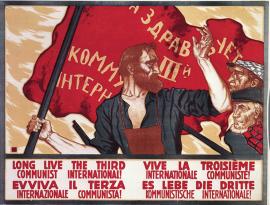
Book Review – John Riddell (editor and translator), To the Masses: Proceedings of the Third Congress of the Communist International, 1921 (Brill/Haymarket, 2016), £39.99.
To the Masses is the last volume of a hugely ambitious project to make the proceedings of the (four) congresses of the Communist International held during Lenin’s time available in English. It’s an extraordinary achievement for John Riddell, a Canadian revolutionary socialist historian and activist.

On the curious collaboration between the cultural left and the economic right, and how to overcome it.
For all the hideous acts of Trump’s administration over the past six weeks there’s something of a silver lining to our current political moment: we’re now witnessing the emergence of what may well prove to be the most energetic and popular protest movement since the 1960s. And yet it’s worth wondering what, broadly speaking, this dissent will stand for apart from spirited opposition to Trump and his administration.
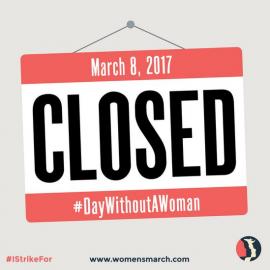
As millions of women around the world held meetings and conferences, rallied and marched to celebrate International Women’s Day on March 8, many also joined an International Women’s Strike, a Day Without a Woman, that in the United States had the character of an anti-Trump movement.
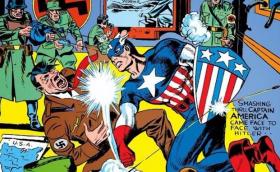
Over the past couple of weeks, social media has filled up with breathless accounts of far right leaders having gotten their comeuppance by being physically assaulted or, in a recent case, murdered in an act of domestic violence.
Public education is truly at a crossroads in the US, as are both the American Federation of Teachers (AFT) and the National Education Association (NEA).
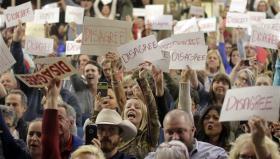 Thousands of people showed up at town halls meetings across the United States in February to challenge Republican congressional representatives and senators on their plans for the Affordable Care Act (Obamacare) as well as on issues from immigration, to the environment, to President Donald Trump’s relations with Russia. While this past week fewer protestors took to the streets where radicals have generally taken the initiative and established the tone of the Resistance, town halls swelled with more moderate but quite militant crowds who challenged Republicans and their politics.
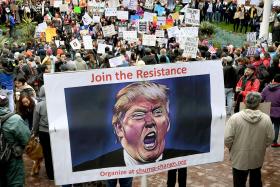
Protests against Trump continue even as new ones are being planned for the future, from the recent Not-My-President Day and Day without an Immigrant protests, to the International Women's Strike planned for March 8.
Thousands of protestors in New York, Chicago, Atlanta, Los Angeles, and some two dozen other cities marched on Monday, Feb. 20 in opposition to President Donald Trump and his policies on what is usually called “President’s Day” but on this occasion was marked by many as Not-My-President Day. On what was in the Midwest and the East a beautiful spring-like day—thanks to climate change—protestors marched to protest Trump’s environmental and immigration policies and just about everything else that the new president stands for.
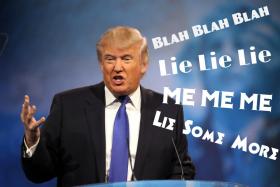 In the wake of the 2016 election, Oxford Dictionaries declared “post-truth” to be the 2016 international word of the year.[i] The viral spread of fake news stories (such as the infamous “Pizzagate”[ii] scandal alleging that Hillary Clinton’s campaign chair John Podesta secretly ran an illegal sex trafficking ring out of a Washington D.C. pizzeria) no doubt helped to install America’s lunatic POTUS and his clown car of white supremacist cabinet members into the Oval Office.

There is good news in the Boston Globe today for the managers, development directors, visionaries, political hacks and propaganda flacks who run “the Progressive Movement.” More easy-to-earn and easy-to-hide soft money, millions of dollars, will be flowing to them from super rich Democrats and business corporations. It will come clean, pressed and laundered through Organizing for Action, the latest incarnation of the Obama Money Machine which has recently morphed into a “nonpartisan non-profit corporation” that will ‘‘strengthen the progressive movement and train our next generation of leaders.’’

The author of The Price for Their Pound of Flesh is Daina Ramey Berry. Professor Berry is an associate professor of history and African and African diaspora studies and the George W. Littlefield Fellow in American History at the University of Texas at Austin. An award-winning historian, she is also a Distinguished Lecturer for the Organization of American Historians. Berry is a specialist in the history of gender and slavery in the United States with a particular emphasis on the social and economic history of the nineteenth century.
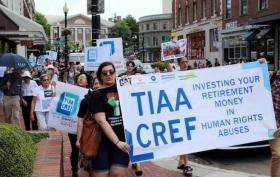
No one wants their retirement to be financed by companies involved in human rights violations and environmental destruction. But that is exactly what is happening to those of us with retirement funds invested in TIAA.

New Politics editorial board member, socialist activist, intellectual, and labor organizer Sam Bottone, 90, died in Portland, Oregon of multiple chronic illnesses on December 30, 2016.

Hundreds of Brooklyn area residents crowded the Brooklyn Museum auditorium on the freezing cold night of the February 9 blizzard—a storm that had closed the City University system, the public schools, and disrupted public transportation—to hear leading figures, principally from the Muslim wing of the immigration rights movement, analyze Trump’s immigration policy and propose measures to resist.

Donald Trump likes to think that he has not only won an election but “built a movement.” And to judge by his first week in the White House office, he has — just not in the way he thinks.

It’s been two weeks since Donald Trump’s inauguration sparked some of the largest rallies in American history. Each week since has also seen demonstrations, culminating in those that broke out at airports across the country at the end of January to protest the president’s new Muslim ban barring travel from seven predominantly Muslim countries. Mass protests are in large measure a bellwether of popular sentiment. They carry an implicit threat that politicians who defy the will of the people will be voted out, but that threat must be channeled strategically, or it will dissipate.
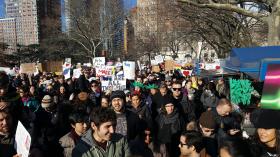 Opposition and resistance to Trump’s Muslim ban continued for a second day on Sunday, January 29 with more massive demonstrations in American cities, as some corporate CEOS as well as Republican and many Democratic politicians also spoke out against Trump’s Muslim ban. Democrats rushed to put themselves at the head of what have been many spontaneous demonstrations around the country. As Democrats race to make themselves the leaders and spokespersons for the movement, it is clear that the new movement will need to find its own voice.
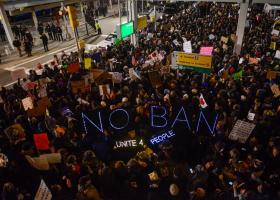
Thousands from New York City to Seattle went on January 28 to the nation’s major airports to protest President Donald’s Trump’s order banning for 120 days Muslim immigrants and refugees from seven nations, an order issued that same day. The protests, initiated by immigrant rights groups through social media, took place not only at the John F. Kennedy Airport in New York—where it grew to several thousand—but also at Dulles in Washington, D.C., O’Hare in Chicago, and at the Los Angeles and San Francisco airports.
Cet article est également disponible en français.
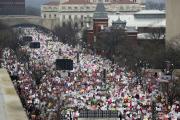 I came back when the Women’s March in D.C. exhausted but thrilled, convinced that we are seeing the birth of a new women’s movement. Hearing about all the other Women’s Marches around the world only confirmed that impression. The size, the inclusiveness, the defiant but good-humored spirit and the progressive politics make me very optimistic.
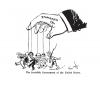
The Occupy movement and the Bernie Sanders campaign spotlighted once again the fact that a fairly small number of very rich people dominate the major economic and political institutions of the country.
- « Newer Posts
- 1
- …
- 36
- 37
- 38
- 39
- 40
- 41
- 42
- …
- 73
- Older Posts »