
Place: North America

A well-researched article by John Eligan in the Aug. 18 N.Y. Times goes beyond denouncing the symbolic racism of Charlotteville’s Confederate statues to expose the more pernicious structural racism embedded in the separate-but-unequal physical segregation of the city. (See “In Charlottesville, Some Say Statue Debate Obscures a Deep Racial Split.”) [1]
Ironically, this segregation was imposed, not during the rise of the KKK in the 1920s, but during the 1960s under the progressive guise of ‘urban renewal.” It was then that the vibrant, relatively prosperous, historical black neighborhoods like Charlotteville’s Vinegar Hill were deliberately razed, left long vacant, and ultimately replaced by soulless public housing and institutional projects.
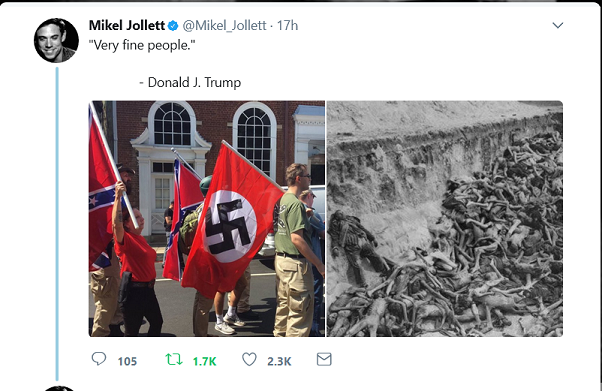 Amidst so much to read and digest about events in Charlottesville and Trump’s response to them, and what seems (but is not) a new, highly violent emergence of neo-Nazis, the KKK, and white supremacist organizations, this blog by Adam Shatz on the website of the London Review of Books seems to me one of the more eloquent, insightful analyses.

President Donald Trump’s failure for two days to condemn the violent Ku Klux Klan, neo-Nazis, and "alt-right" white supremacists, one of whom murdered a woman in Charlottesville, has led to a major development as sections of the capitalist class have begun to abandon him. While some top Republican leaders have taken a stronger stand against Trump in recent days, several major corporate leaders have deserted him. They have done in part because of his flirtation with fascism, but also because Trump and his administration—his embarrassing tweets, the constant circus, the Korea war scare, the Russian imbroglio—makes it impossible for the Republicans to advance their pro-business agenda. If the relationship between Trump and corporate leaders continues to unravel, this could lead to a more rapid collapse of the Trump presidency than had previously seemed possible.
In Staten Island, one union local is propelling a growing labor-community alliance deep in New York’s Republican recesses.
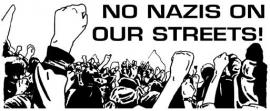
Thousands demonstrated in dozens of cities and universities across the United States to protest the “Unite the Right” racist march and rally in Charlottesville Virginia and the automobile terrorist attack on anti-fascists that took the life of Heather Heyer on Aug. 12.
The demonstrations took the form of vigils, rallies, and marches that took place on Aug. 13 and 14. In New York City, thousands demonstrated at Trump Tower as he returned from the golf links to New York. In Durham, North Carolina, anti-fascists pulled down a statue of a Confederate soldier. In some cities there were multiple events called by a variety of progressive and leftist organizations.
 The “Unite the Right” rally held in Charlottesville, Virginia this past weekend attracted several hundred white men from the "alt-right," the neo-Nazis, and the Ku Klux Klan who marched with torches through the University of Virginia chanting, “You will not replace us.” Nothing better explains the fear at the root of their racist movement than that chant. They fear, as their political ancestors feared, that they will be replaced by blacks. They have now come to fear also that they will be replaced by Latinos and by Asians. They fear too that they will be replaced by women, by gay men or lesbians or bisexuals. Or by trans people or the disabled. Above all, they fear.

After reaching 25,000 members, DSA held its largest bi-annual National Convention with the hopes of creating the political clout necessary to shift the country toward a socialist vision that exceeds that of social-democratic capitalism. The four days reenergized old chapters and allowed new chapters to recognize the potential of a national organization. Overall, DSA has effectively begun resurrecting the socialist movement in the United States. All DSA members should be proud of this achievement. We should, however, be cautious in overestimating the outcomes of the convention. For behind the great rejuvenation that occurred in Chicago there were also ideological and structural currents that may limit DSA in the long run.

On August 5 a Google employee named James Damore published a 3,500 word manifesto entitled “Google’s Ideological Echo Chamber,” in which he agued the biological inferiority of women, making them incapable of being equally talented computer engineers. First circulated internally among Google’s thousands of employees, the manifesto was posted in its entirety on the web by Gizmodo on August 5. Google fired Damore, the manifesto’s author, on August 7.
On August 5, Yonatan Zunger, a former Google employee who had only recently left the company, wrote a response to Damore, published by Medium, which we republish here. – DL
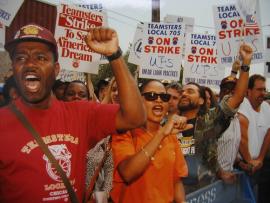
Twenty years ago this month the reform leadership of the Teamsters union, led by President Ron Carey, with the assistance of Teamsters for a Democratic Union (TDU), a reform caucus within the union, led a successful strike against United Parcel Service (UPS) that paralyzed the company, inspired labor unionists, and seemed to open up new opportunities for the workers movement. The UPS strike remains a model of strike strategy, organization, and tactics.
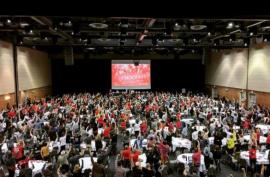
The socialist movement in the United States took a big step forward this past weekend as almost 700 delegates representing over 25,000 members of the Democratic Socialists of America (DSA) met at the organization’s biennial national convention in Chicago. This convention, the first since DSA more than tripled in size following last year’s election, brought together delegates from all of the country’s major cities and many towns large and small.

On the very off chance you haven’t heard, Angela Nagle has come out with her first book: Kill All Normies: Online Culture Wars from 4Chan and Tumblr to Trump and the Alt-Right. Best known for her essays, often on the alt-right, in outlets like Jacobin and The Baffler, the socialist left has been anxious to dive into what appears to be the first book on the alt-right written by one of us — myself included. Ms. Nagle first caught my attention last year with her incredibly insightful essay “The New Man of 4chan,” and I’ve been reading her regularly, and eagerly awaiting this book, ever since.

Author's note: "I was asked at a recent New York City Democratic Socialists of America meeting of the Immigration Justice Working Group to say a few words to put our work in historical context and then asked to write up my brief talk so that it might be useful to others."
Our sanctuary work is in a great national and global tradition of humanitarianism and it is consistent with our international socialist principles. Our work, while fighting for the reform of the immigration system, has as its goal the abolition of the capitalist system that causes involuntary mass migration. And while using existing law to defend immigrants and fighting for better laws, we stand opposed to the concept of the national state, which will never respect and defend immigrants as equals in our society.
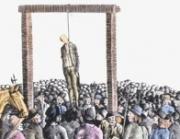
The videoed executions of Philando Castille, Eric Garner, Tamir Rice, and the many, many other heroes whose lives were ended by State violence and class war have resurrected an old ghost of capital punishment in the developed Western World: Public Executions.

Journalist Seymour Hersh was interviewed by Aaron Maté of the Real News Network on June 26 after he wrote an article called "Trump's Red Line."

The most radical and militant union in American history was the Industrial Workers of the World (IWW), colloquially known as the Wobblies. Its active years were from 1905 to 1919, or at best until mid-1920 when it led its last major struggles—a maritime workers strike in California and a miners strike in Colorado. Fierce government repression during and after World War I, along with vigilante violence and internal divisions, dealt the IWW blows from which it never recovered. The mass industrial union movement during the New Deal passed it by. Yet, the IWW continues to exist on a small scale to this day.
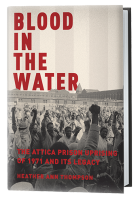
Heather Ann Thompson has written a magnificent history of the Attica Prison uprising, the deadliest prison rebellion in U.S. history.
 The following is an excerpt from a book about Trump, The Establishment, and the Resistance, that will be published in French by Syllepse early next year. – Dan La Botz
The Fourth of July celebrates the launching of the American Revolution and the founding of the nation. Americans have long prided themselves on having the most democratic country on earth, a model for the world. Yet, while American politicians and the media today frequently praise the “founding fathers” of the United States for establishing the country’s democratic institutions, the truth is that nothing could have been further from their minds.

Capitalism in the United States and across the world has gone through a series of mind-bending crises, spatial “fixes,” and continuous restructurings that have disoriented organized labor in most of the developed economies since the beginning of the neoliberal era in the late 1970s and early 1980s.
Democratic Socialists of America (DSA) is singular on the left as being both a broad radical socialist organization, encompassing left social democrats, Marxists and even a smattering of anarcho-syndicalists, combined with a strong face toward electoral politics. But an electoral orientation per se is not and cannot be the common denominator of our work. It is true that without an electoral face, any political organization is hamstrung and those on the left who argue that support for any Democrat anywhere is treasonous paint themselves into a corner. Electoral politics on the level it can be rationally conducted is worth doing. That, for me, is not in dispute. Its place in our work is what is problematic. Thinking in terms of power is about more than electioneering.

For the first time in the six-year Syrian war, the US shot down an Assadist warplane on June 18, in defence of its allies in the Syrian Democratic Forces (SDF), the US-backed military and political front dominated by the Kurdish-led People’s Protection Units (YPG). Assadist warplanes had carried out the highly unusual act of bombing the SDF in the town of Ja’Din, near Tabqa in Raqqa Province.

In 1996, at the height of the culture wars, Marvin Mandell joined the battle, writing a long essay, “Canon on the Left,” in which he argued that the left should not allow conservatives to claim the literary canon. While he of course supported the expansion of the canon to include all of the writers of color, as well as the women and all of the others who had been neglected and excluded, he refused to allow the right to claim the great tradition of European literature. He concluded the essay with these words:
- « Newer Posts
- 1
- …
- 34
- 35
- 36
- 37
- 38
- 39
- 40
- …
- 73
- Older Posts »