Category: Electoral Politics

[The following item comes from the Jill Stein campaign for the Green Party presidential nomination.]
Now is the time to support a serious, independent, left candidate for Presidential in 2016. Jill Stein, Green Party candidate for President, is already garnering media attention, building support in social justice movements and frontline struggles and taking on the undemocratic Presidential Debate Commission.
The Greek Drama of 2015: What Next?
a talk by Nicholas Levis (Nikos Evangelos)
The preliminary report of the parliamentary Truth Committee on Public Debt declared the entire Greek debt to be odious, unethical, unsustainable and illegal. Do they have a case?
Sunday, September 13, 2015
2:00 – 3:00pm
International Affairs Building, Room 409
Columbia University, Manhattan
Entrance at 118th Street and Amsterdam
A development which no one expected now appears inevitable. Barring either otherwordly intervention or old-fashioned political dirty tricks, Jeremy Corbyn, long on the left wing of the British Labour Party, is slated to become that party's new leader.
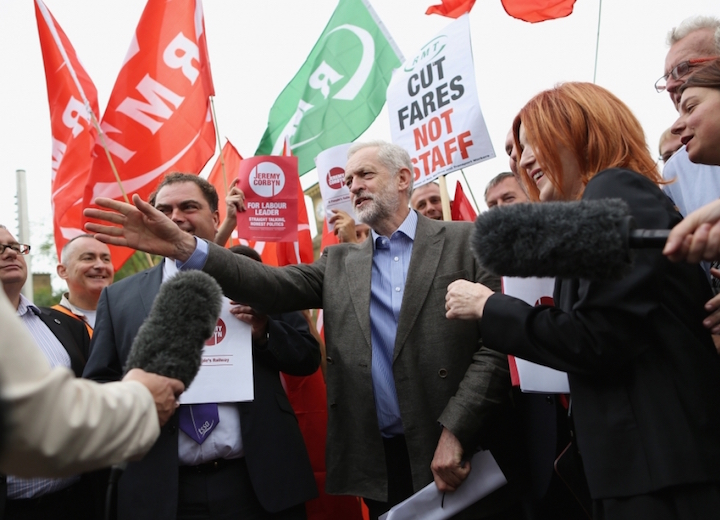
And the rabidly pro-capitalist heirs of long-gone "New Labour" leader Tony Blair, as well as the traditional right wing of the Labour Party, are absolutely apoplectic.

In a recent New Politics essay, Dan La Botz argues that “the debate between” Democratic Party presidential candidate Bernie Sanders and the Black Lives Matter (#BLM) movement is “one of the most important discussions of our time.” It is “a great debate about the priorities and the program of the American people” that “could lead to the construction of a new analysis and lay the basis for a new and broad social movement” that helps us “find a new way forward against both capitalism and racism” – “a new movement that combines the fight for greater economic equality with demand for racial justice, perhaps a movement for socialism.”
This is a video of a recent debate between Leo Panitch and Richard Fidler who discuss their differing socialist analyses of the politics of SYRIZA.
The debate was moderated by Susan Spronk.
The video is from Links: Journal for International Socialist Renewal but the debate was organized by the Socialist Project (Canada).
 The following is an email interview with Mimi Soltysik, a member of the Los Angeles chapter of the Party USA. He is currently seeking the Socialist Party's nomination for the 2016 US Presidential election. This interview was originally published by The Hampton Institute.
Tell us about yourself and your politics.
Here’s the statement I made when I announced my intent to run for the Socialist Party USA's POTUS nomination. I think it fairly well captures who I am and where I stand politically:
I don't support Bernie in the Democratic Party because I believe the key question in U.S. politics is building a political party that can defend the needs of the vast majority of the American people. As more and more people on the left agree, the Democratic Party is not and cannot be such a party; to my mind this constraint makes paramount the political independence of candidates, no matter how progressive their program.
Jill Stein is campaigning as a Green Party candidate for the 2016 presidential race. She says we need real solutions for the economic, social and environmental crises we face. But the broken political system is only making things worse. It's time to build a people's movement to end unemployment and poverty; avert climate catastrophe; build a sustainable, just economy; and recognize the dignity and human rights of every person.
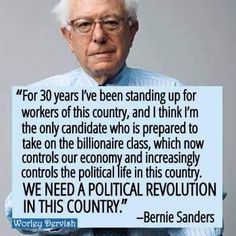
In the United States, even more so since the advent of twenty-four hour news channels, there is a consistent fetishization of political candidates. Who is viable? Who is trust-worthy? Whose ideas best fit with the prevailing public opinion polls on certain issues at a given time? Who has the most attractive haircut or family? Who has the right skin color, gender, or business experience to win over key demographics?
Though few of us are under any illusions that this country is or has ever been a genuine democracy, it seems that even those people who are not convinced by the patriotic rhetoric of the purity of American democracy too often acquiesce to the “all of our hopes rest in a single individual or political party” approach to politics. If socialism means anything beyond mass resistance to capitalism, it should be resistance to this mindset. When we fetishize the candidate we marginalize true democracy, the cornerstone of socialism.
 Shirley Chisholm: Catalyst for Change by Barbara Winslow brings back to our attention one of the most notable and esteemed African-American women of the 1960s and 1970s. Winslow reports that “a 1974 Gallup Poll listed her as one of the top-ten most admired women in America.” She was the first black woman elected to Congress.
 Both inside and outside Taiwan, the research on Taiwan’s democratization has been overwhelmingly dominated by Western liberal discourses.
While in Athens, I have gotten into the habit of ending the day by enjoying an iced coffee with cream in an outdoor cafe in a park about one mile from my hotel. It is there that I have been writing these dispatches. As I remarked in my first report, the park the cafe is in is filled with children, teenagers, young couples, the middle-aged, and old people until quite late. The cafe does not start to empty until after midnight.

As a strong supporter of Bernie Sanders, my first reaction to hearing about the Black Lives Matter protest at Netroots Nation was disappointment. This looks bad, I thought. Bad for Bernie, who is the only presidential candidate with any chance of challenging structural injustice. And bad for Black Lives Matter, who could easily be interpreted as shutting down progressive discussions about immigration and economic inequality to make people focus on their priorities. I’ve had my share of mistakes during protests, as have all the activists I respect most, so I certainly had some sympathy. But I thought their protest was just that: a mistake.
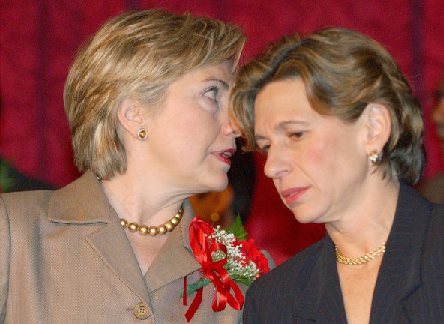 On July 11 the AFT announced its Executive Council “overwhelmingly” endorsed Hillary Clinton for the Democratic nomination for President. It did so, the official announcement reported, on the basis of interviews (not released to members) and the results of a poll.
 The Partido del Pueblo Trabajador—the Party of the Working People (PPT)—is a political project of the Puerto Rican left addressed to working people in the context of the island’s deep economic crisis.
 Regardless of one's views on whether or not the socialist left should support Bernie Sanders in his race for the White House, the momentum behind the self-described “democratic socialist” has been impressive. Beginning at 2% in April, his popularity grew to 14% in May and at last check was 32% in New Hampshire.
 How are we to assess the Bernie Sanders presidential campaign?
There are three reasons that one runs a candidate for president. One is the hope of winning, second is to influence other candidates to modify their views, and third is to use the campaign to build for the future, either educationally or organizationally.

Grassroots labor initiative urges Democratic primary support for Sanders by AFL-CIO and national unions.
Over 1,000 union activists from around the country today kicked off Labor for Bernie 2016.
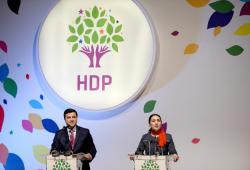
In the weeks leading up to the June 7 parliamentary election in Turkey communities across the country were gripped with a mixture of excitement, anxiety, and fear. Though President Tayyip Recep Erdoğan was supposed to be above the fray of party politics, the former two-term prime minister and co-founder of the Justice and Development Party (AKP) made no secret of his hopes for an AKP victory, as he rallied and spoke continuously in the weeks and months before the election. 367 seats in the 550-member parliament would make possible Erdoğan’s desire to change the Turkish government from a parliamentary to a presidential system, thereby enhancing executive, and Erdoğan’s, grip on political power.
[Introduction by Todd Chretien: In the run-up to Argentina's national elections in October, a scramble for power has divided the incumbent Peronista party into warring factions. Founded by Juan Perón in 1946, the Partido Justicialista ruled through sometimes radical nationalism, state intervention in the economy, clientelist patronage and control over trade unions, and the loyalty of sections of the bourgeoisie and an elite political class of bureaucrats.
Despite widespread d isillusionment with the political system, an organized attempt to prevent the election from taking place in a few states, and continuing economic doldrums, President Enrique Peña Nieto and his Institutional Revolutionary Party (PRI) were the big winners in the Mexican election, followed by the conservative National Action Party (PAN).
- « Newer Posts
- 1
- …
- 17
- 18
- 19
- 20
- 21
- 22
- 23
- …
- 28
- Older Posts »