Category: Electoral Politics
The idea of “voting with your pocketbook” is giving rise to a new global movement of ethical consumption. Industrial capitalism and its ills, it is thought, can be redeemed through personal consumer choices. “If only I bought the biodegradable bag of potato chips,” one may think to oneself watching a column of waste management vehicles pass on their way to the dump.
 [This article originally appeared in In These Times. See the reply by Michael Hirsch.]
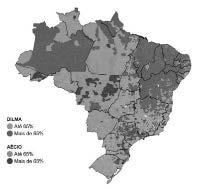 Election day came lazily in Santarém, a mid-sized city and trading entrepôt at the junction of the Amazon and Tapajós rivers, the halfway point between Amazônia’s primary metropolises of Manaus and Belém. The internet was out of service in this sleepy Amazonian town, as were two out of the four major cellphone carriers, and the streets were nearly empty.
 Dilma Rousseff of the Workers Party (PT) won Brazil’s presidential election on October 26, meaning that when her term ends her party will have held the nation’s top office for a remarkable 16 years, longer than any party in Brazilian history.
 “¿Qué Nueva, Qué Nueva, Qué Nueva Mayoría? ¡Si van a gobernar pa’ la misma minoría!” (“What New Majority? They’ll rule for the same old minority!”)
FEL student demonstrators

[Editors’ note: The Da’am Workers Party is an Israeli revolutionary socialist organization formed by Palestinian and Jewish activists in 1995. The party initiated the formation of the WAC-MANN trade union movement that aims to organize sectors and populations traditionally neglected by Israel’s mainstream union federation, the Histadrut, and does so based on an explicitly anti-corporate, anti-austerity platform. It opposed the Oslo accords, but supports a two state solution based on the 1967 borders and the dismantling of all settlements. In the last Knesset election, Da’am ran with a Palestinian feminist, Asma Aghbaria-Zahalka, at the head of its list. This article was published on the Da’am website on Dec. 20, 2014.]

“Vermont…is the only state with universal single-payer health coverage for its residents.”
–James Fallows in The Atlantic, April, 2014
If any group of United States citizens can claim a mandate in the midterm elections than it must be the millions of eligible voters who abstained from voting. It is a common excuse when discussing U.S. midterm elections to argue that voters do not participate in the numbers that accompany elections in a presidential election year. However, blaming the low 2014 election turn-out on a historical trend is incomplete and deceptive.
Dilma Rousseff of the Workers Party (PT) won Brazil’s presidential election on October 26, meaning that when her term ends her party will have held the nation’s top office for a remarkable sixteen years, longer than any party in Brazilian history. Rousseff began as part of an armed revolutionary guerrilla organization during the dictatorship from 1964-1985, then helped found the Democratic Workers Party (PDT), and only joined the PT in 2001.
The failure of President Barack Obama and the Democratic Party to lead a fight for many of the major social issues on which he had campaigned—jobs and wages, African Americans’ civil rights, immigration, labor union power, and the environment—led to a sweeping victory for the Republican Party and a crushing defeat for the Democrats in the midterm election.
Once again the Workers’ Party (PT) found itself in the difficult position of having to defend its government’s sorry record on issues such as the economy, corruption and energy policies, all while fending off right-wing opposition candidates. Fortunately for the PT and its incumbent president and presidential candidate Dilma Rousseff, their adversaries at the national level never managed to assemble a political program that differentiated itself from the PT’s.
 On September 18, 2014, the Scottish people had the opportunity to withdraw from the United Kingdom and become an independent country. The unity of Scotland and England has existed since 1707, so the vote could have broken with three hundred years of history. After a long and bitter campaign, the proposal to leave the UK was defeated by a margin of 55% to 45%.
The article by Scott Jay that follows was published on our website several days before the public learned that Karen Lewis was suffering from brain cancer. We are sorry to hear of her illness and offer our sympathy to her and to her family and friends. We leave the article on our website as a matter of public record and because the political issues that it raises remain important, even though she has now decided not to run for mayor. We wish Ms.Lewis a rapid and full recovery. – Editors
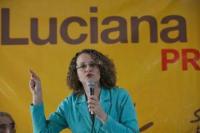
A little more than year ago, Brazil was paralyzed by the enormous popular protests of the June Days of 2013 as, according to a highly regarded poling agency IBOPE, some 8.5 million people joined demonstrations in 400 cities and 22 state capitals, first against high transportation costs and then against just about everything else that had to do with government policies. IBOPE found that 72 percent of the population approved of the demonstraitons and that 89 percent had no faith in the political parties.
Nina Potarskaya is one of the leading Ukrainian leftist feminists, founder of the feminist squadron at Maidan, and member of the Left Opposition, which helped organize three successive conferences of left forces in Kiev, in November 2013, March 2014, and September 2014. The most recent conference decided to build a new democratic Left party, which is the first electoral effort of its kind in Ukraine. She was interviewed in Geneva by Jean Batou, with the help of Kirill Buketov, for solidaritéS.

The likely candidacy of the president of the Chicago Teachers Union, which led one of the most important strikes in recent years in the USA, against the incumbent Democrat Rahm Emanuel, formerly the chief-of-staff of the White House and a champion of the privatization of the school system, is a major political event.
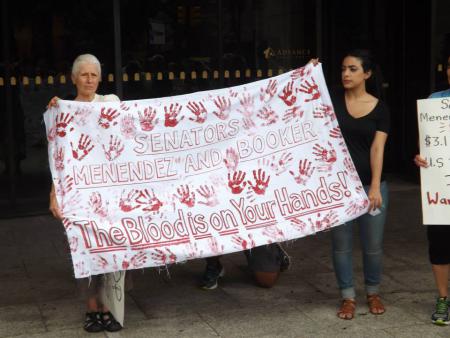
Outside the Gateway Center, where Menendez and Booker have offices. (Photo by Tom Bias.)
[This article was first published on Mondoweiss.]
In the past few weeks, New Politics has published two valuable commentaries on the role of socialists and the Left in local electoral campaigns, first a broad overview by Dan La Botz and then a response by David Judd specifically on Dan Siegel’s campaign for Mayor of Oakland.
Dan La Botz' article on the return of Left to electoral politics is generally insightful, and its survey of campaigns around the U.S. is a valuable contribution. However, the article's analysis of the Dan Siegel campaign for mayor of Oakland is off.
 Scholars have sometimes noted that Argentinian history seems unusually punctuated by periods of booming prosperity followed by dramatic collapse.
The labor- and third-party movements of the late nineteenth and early twentieth centuries have been studied and written about extensively by academics and writers on the left. Most readers of this journal are probably familiar with much of this material. This book, however, is of particular interest today for a couple of reasons. For one thing, the author concentrates on the South and emphasizes the biracial nature of the movement.
- « Newer Posts
- 1
- …
- 20
- 21
- 22
- 23
- 24
- 25
- 26
- …
- 28
- Older Posts »