Blog

  • Mexico’s AMLO Is No Leftist, as His Handling of Covid Demonstrates

    Mexico’s AMLO Is No Leftist, as His Handling of Covid Demonstrates

    Since he took office in December of 2018, some on the left have argued that Mexican President Andrés Manuel López Obrador is a leftist, even a socialist. Some like Kurt Hackbarth defend AMLO’s record, despite his alliance with the banks and big business, his political coalition with a rightwing party, his commitment to maintaining Mexico as a leading petroleum producing country, and his dedication to the Maya Train that threatens indigenous communities and the environment. They defend AMLO’s presidency despite the fact that he has overseen an increase in the country’s already extraordinarily high murder rate. In the first half of 2020, there were 17,439 murders, a 1.7% increase on the same period last year, as well as a 9.2 percent rise in femicide, the murder of women. And finally there is AMLO’s subservience to U.S. President Donald Trump, acting as his cop in policing Mexico’s border to keep migrants out of the United States.

    Maybe it is unfair to criticize AMLO for those things, as some say. Well, the coronavirus pandemic has given us yet another measure with which to judge AMLO’s government. Amnesty International recently reported that since the pandemic began over 7,000 health workers have died around the world, and that “at least 1,320 health workers are confirmed to have died in Mexico alone, the highest known figure for any country.” The United States is second, with 1,077 health worker deaths, but the U.S. has a population almost three times that of Mexico.

    There have been many articles in Mexico, the United States, and other countries criticizing AMLO for his handling of the pandemic in a way that resembles the terrible policies of Trump and Jair Bolsonaro. Much as in the United States the government did not act swiftly, it has not had a consistent policy, and there is not enough testing and not enough tracing. But there are other problems as well.

    The Lancet, the distinguished British medical journal decided to look more specifically at why Mexico should have such high numbers. First comes the lack of everything.

    Less than three weeks after Mexico recorded its first COVID-19 case, staff from a Mexican Social Security Institute (IMSS) hospital blocked a Mexico City road, demanding medical supplies and personal protective equipment (PPE). At least 70 protests have followed, according to a report by six former health secretaries, with medical staff decrying shortages of supplies and tests, along with a lack of hospital infrastructure and even proper training.

    While Mexico did finally get more supplies, health officials say they were often of poor quality.

    There are many factors affecting Mexican health care workers. “A lot of people in the health sector workforce are basically working on informal contracts,” Madeleine Penman of Amnesty told Lancet. “That affects a lot of things in terms of job security and access to sick leave.”

    Lancet also reported that Rafael Soto, an IMSS nurse and spokesperson for the National Union of Health Workers, said that unions representing health workers were keeping quiet on issues of workplace safety, preferring to please the government rather than address members’ demands. Some protest leaders, he said, have had their jobs terminated by their employers or have been sanctioned by their unions. Unfortunately, such behavior, kowtowing to the boss and punishing the members, is typical of many Mexican unions.

    While the unions play a role, government is most responsible. Mexico has several government health agencies that cover most workers and the pubic in general, but for decades the budgets for these programs have been cut, including by AMLO. Defunding the public health systems and the low pay of public health physicians led many of them to take private sector jobs in addition to their government positions, as well as teaching. So doctors have divided loyalties and work too many hours.

    Lancet also pointed out that many Mexican health workers suffer from some conditions common to the population at large, such as obesity and diabetes. These are conditions, present in the Mexican population only for the last 40 years, that a good public health system would work to eliminate.

    As president, AMLO has responsibility for what happens on his watch, but clearly he inherited a profoundly corrupt system that he has failed to reform. The neoliberal governments of the last 40 years, and AMLO’s government which is so proud of its austerity, have failed to maintain the health system. Mexican labor unions, in most cases creations of the state, fail to fight for workers. Not only is AMLO’s government not socialist, it is not democratic, it is not competent, and it is not socially responsible. AMLO is a populist with a leftist image and rightist policies.

    The Mexican people deserve better. Some of them are fighting to reform their unions and to organize forces to reform the government. We stand in solidarity not with AMLO’s government but with those like the health workers mentioned here who are fighting from below to change it.


  • Economics for the People

    Economics for the People

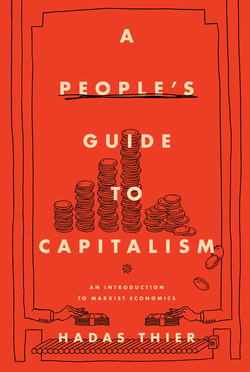
    Review of Hadas Thier, A People’s Guide to Capitalism: An Introduction to Marxist Economics (Haymarket Books, 2020)

    This is a well-written, accessible introduction, which is also stimulating even for those familiar with Marxist Economics. It covers the basics with extensive quotations from Capital and some  of Marx’s other writings and does an admirable job of covering the key features of Marx’s explanation of the inner workings of capitalism in a clear manner. The author uses current examples and explains that the fundamental principles Marx laid out in Capital still apply, while integrating the changes that have taken place since Marx’s time. The book also includes a very helpful glossary of Marxist economic terms at the end.

    This is not an abstract economics book. It is written by a socialist activist for other activists. It follows Lenin’s aphorism that “Without revolutionary theory there can be no revolutionary movement.” The purpose of the book is to arm activists with an understanding of the capitalist economy to help them overthrow it. The main points that the author wants to get across are summarized on page 234:

    • “These [the fundamental problems of capitalism] are not accidents. They are not isolated incidents of greed. They are simply the way the system works…”
    • “These same processes of accumulation necessarily lead to contradictions that threaten the very profits that the capitalists seek…”
    • “’The point however is to change it’ argued Marx… Better understanding the system, as Marx wrote ‘to reveal the economic law of motion of modern society’ is a critical first step.”

    For those already familiar with the basics of Marxist Economics, the most interesting sections of the book will be the  brief examination of various theories of capitalist crisis. In a section called “Why Mainstream Economists Get it Wrong” (150-55) the author skewers explanations of crisis found in bourgeois economics, including Say’s Law—the idea that every purchase is also a sale and that capitalism therefore tends toward equilibrium.

    Thier also takes on various Marxist explanations of crisis. She rejects the “underconsumptionist” explanation that crisis is caused by the inability of workers to buy all they produce, because “capitalists don’t just  produce commodities for workers to consume. They also produce luxury goods for the rich and more importantly raw materials and means of production for other productive capitalists” (158).

    Thier makes the important and often ignored distinction between underconsumption and overproduction. The former focuses on the chronic inability of workers to consume all they produce. She notes that this would result in a permanent crisis, since workers never receive the full value of what they produce.

    Overproduction, on the other hand, can be sporadic and is related to the fundamental drive of capitalists to increase profits. From page 163 on, Thier explains the boom-bust cycle of capitalism:

    “Businesses hustle to produce more, knowing  that it is likely that their goods will find buyers”(163), but “Alas, the fever pitch of expansion eventually oversaturates the market. Too many goods have been produced to be able to sell at the exaggerated prices produced by the boom, or even at their value. Profits begin to tumble.”(165)

    The disproportionalities between different industries exacerbate this process.

    Thier also notes that there is a debate on the significance of the “tendency of the rate of profit to decline,” which Marx noted was caused by the displacement of labor by machinery. Since labor is the source of surplus value, there is a downward pressure on profit rates.

    Some modern Marxists discount this. Others see it as the immediate source of every crisis. Thier takes an intermediate view. She says that it is important in the long run and is one of the most important contradictions of capitalism: over time, the drive for profit undermines the ability of the system to generate profit. She also argues that the downward pressure on the rate of profit increases competition and intensifies crises. However, she does not see the immediate cause of every recession or depression as the decline in profit rates.

    Thier also follows Marx in seeing economic crises as coming from dislocations and overproduction in the real economy. This is also controversial, since many economists see the source of crisis as financialization of the system. The author extensively addresses the growth of financial capital, examining the creation of new financial instruments and the growth of this sector. However, she sticks to the fundamental Marxist idea that profit comes from the direct exploitation of workers in production.

    A People’s Guide to Capitalism brings Marx’s analysis of private capitalism up to date with current examples. But there is one area that it does not develop in detail: Marx’s view of unproductive labor. For Marx “productive” labor creates surplus value and therefore profit. It is at the heart of the system.

    However, even in Marx’s time, there were many “ unproductive” workers—i.e., workers who did not directly produce surplus value and were not directly exploited. In Marx’s time, these included the domestic servants of the rich, who Marx said lived off the revenue that capitalists received from the surplus value created by the productive workers they employed.

    In modern times, “unproductive workers” would include, for example, public school teachers , public hospital nurses, etc. A direct profit is not made from their labor. However, these workers are also part of the working class. They are also necessary for the maintenance of the capitalist system. They too are paid comparable wages to productive workers. They have the power to shut down parts of the system and would benefit from a socialist transformation of society. The author mentions some of these workers as part of the working class but she does not theorize how they fit into her analysis of directly exploited workers.

    This omission aside, A People’s Guide to Capitalism is a tremendous contribution to the understanding of economics today, and more importantly how we can get rid of capitalism. It will be very useful both to veteran Marxists and people new to the subject. Everyone interested in this topic, and indeed anyone interested in fundamentally changing the world, should read this book.

  • Abortion Clinic Defense: A Testimony

    Abortion Clinic Defense: A Testimony

    I escort patients at an abortion clinic. My role is to be a friendly face, ready with an open umbrella when patients arrive, to escort them in and out past anti-abortion protesters. I do my best to bear the brunt of the abuse, shielding my patient both physically and emotionally. Some hide behind my umbrella, some walk defiantly inside while I smile proudly at them, some just seem bewildered— all have made the decision to come to the clinic. Here, I have seen firsthand how the patriarchy harms everyone.

    I have been doing this work for a long time, though I didn’t always know it. I was born and raised in the Evangelical Church, where purity doctrine is held as high as Jesus Himself: sex is only permitted within the confines of a legally binding marriage between one man and one woman. We girls were to keep ourselves pure for our husbands. Not only were we responsible for our own choices, we were responsible for not tempting the boys with how we dressed and behaved.

    One of the girls in my youth group got pregnant. She couldn’t bear the shame her extremely conservative family would heap upon her for being an unwed mother— held up as a disgraced example (for the rest of her life) to her siblings of what not to become, believing no one would ever want to marry her now that she was “damaged goods.” So she had an abortion and I covered for her. She never told anyone except me and the doctor.

    Many anti-abortion protesters come from a similar background. Those who’ve had abortions are placed front and center to wail and plead with patients about the psychological torture they’ll endure for life if they go through with it. Statistics show that less than ten percent of people regret their abortions, but these facts don’t matter when one believes they’re “saving babies.” Anti-abortion women refer to themselves as “post-abortive” and call out dire warnings to patients as they enter and exit the building. I often wonder if they’d still regret it if their families and churches hadn’t told them they should.

    There’s a very young woman who comes regularly with her infant. She told me, crying, “You’re a baby killer, would you kill my baby? He is no different. Go ahead, judge me for being a teen mom. Yeah, I’m unmarried. I got pregnant and chose life.”

    I wanted to tell her I support her. She’s not a slut and fuck them for making her feel ashamed. If a teenager wants to have a baby and needs a ride to her prenatal appointment, I got a car, hit me up. Wanna let me rock your baby while you hang out with your friends for a few hours? I love taking care of babies!

    But I can’t help her. I couldn’t talk to her or even give her an encouraging smile. I had to just stand there, stone faced, bearing witness to her attempt to shame other women. She has internalized the patriarchy, she does not recognize it and cannot see beyond it.

    In a way, she humanizes the need to liberate women as part of class struggle. But my compassion for these people only goes so far. I also wanted to tell her to put sunscreen on her very red baby and take him home, he’s overheated. And to quit crying at and pleading with my patients, she’s harassing them.

    Each individual has their own reason for seeking an abortion. As a clinic escort, that is not my concern. They’re there because they’re pregnant and don’t want to be. I help them gain access to the health care they need. But I know that women from vocally pro-life families can be driven to seek an abortion out of desperation to keep their sexual history a secret. I sometimes wonder if they might have made a different decision if their families had been willing to support them as an unwed parent. (I use the word “parent” because I have made inclusive language a habit. But the term “unwed” is most often applied to mothers, rarely fathers. She’s an unwed mother, a teen mom.)

    Many times, the reason is a complex one— poverty. Access to health care, prenatal and a continuum of care after birth until death, is a luxury for those who can afford it. Add to that a lack of affordable housing and education, and the prospect of raising a child under these conditions is daunting. The pro-life movement sneers at this as not a valid justification. “You got yourself into this, you did it to yourself, now accept the consequences of your actions.” But children are full human beings in their own right, they are not punishment for sex.

    Some protesters bring and weaponize their children. After one such instance, I felt compelled to write about it in my journal.

    Trigger Warning: child abuse

    Dear little boy,
    The image haunts me… two adults pointing down at you asking over and over, “Can we kill him? Can we murder him?” I saw your eyes widen. You looked scared and I was powerless to protect you. Later, I smiled at you and you smiled back at me… I’m worried I got you in trouble for that. I won’t make eye contact with you next time— not because I don’t like you anymore, but because I am afraid to endanger you.

    I reported everything I witnessed to Child Protective Services today. I’m trying to send someone to help you since I can’t do it myself. I don’t know your name but I love you. Hold on.

    He was six and a half years old, being used as a weapon against abortion. His guardian brought him the following week, and I never saw him again. His guardian still comes to the clinic but I don’t know what happened to him.

    Anti-abortion protesters are abusive towards male-presenting people who bring their partners for an abortion. Women who have an abortion are murderers but their partners are cowards. Men scream “real men protect women and children!” at these faithful, supportive partners. He is a coward for helping her— for not stopping her— you’re not a real man if you’re not controlling her body. The patriarchy and toxic masculinity is very much a part of the pro-life movement.

    If anti-abortion protesters truly cared about ending abortion, it would be far more effective to alleviate poverty. Living wages, affordable housing, free health care (medical, mental health, dental, vision, addiction treatment, etc.), affordable/free education beyond high school, all help to reduce abortion rates. Studies consistently prove that comprehensive sex education and access to contraception is the number one way to prevent teen pregnancy and abortion, but the same churches insist upon abstinence-only curriculum in the public schools and continually block legislation that might provide these things.

    Pro-lifers tear down women. All of us. Even their own. They call themselves pro-life, but they’re really just pro-control. They care nothing for quality of life outside the womb. They would rather stand between a person seeking health care and reproductive justice than stand between a bulldozer and a tent that is someone’s home. They would rather pray on the street corner for all to see than quietly do what they can to ease human suffering and end the cause.

    And in all of this, there is still my patient, who is just trying to get to the door for their appointment.

  • Joe Allen’s ‘Package King’ Delivers a Modern History of the Essential Worker

    Joe Allen’s ‘Package King’ Delivers a Modern History of the Essential Worker

    Joe Allen. The Package King. Chicago: Haymarket Books, 2020.

    On May 1, workers at Amazon, Instacart, Whole Foods, Walmart, Target and FedEx protested for better health and safety protections as they are forced to work during the coronavirus pandemic. While most of the job actions were small, they nonetheless were further signs on the traditional international workers’ holiday that old-fashioned class struggle is beginning to emerge inside some of the most powerful U.S. corporations. In The Package King, socialist historian and former UPS worker Joe Allen makes a compelling case that if these initial sparks become a powerful fire, one of the primary colors in that blaze will be the Pullman Brown worn by the 250,000 uniformed employees of UPS.

    The Teamsters have been home to the most-organized and long-term presence of both mobsters and socialists in the American labor movement.

    Long before the coronavirus pandemic gave them the official title, transportation and warehouse workers had become “essential” to the U.S. and global economy — and logistics industry giants like Amazon, Walmart and FedEx had become the engines of 21st-century capitalism the way that manufacturers like Ford and General Electric were in the 20th.UPS stands out among these modern behemoths as one of the only companies with a largely unionized workforce. In fact, UPS is the largest private-sector union employer in the country. UPS workers also make up the largest section of the Teamsters union, an incredibly polarized organization that has been home to the most-organized and long-term presence of both mobsters and socialists in the American labor movement. The Package King is subtitled A Rank-And-File History of UPS, and Allen centers his story on the century-long fight of UPS workers to wrest a livable job out of a company that treats them as machinery and to organize within a union that too often has treated them as a dues-paying cash machine. Package King is in part a business history or rather an anti-business one. Throughout the book, Allen uses Greg Niemann’s laudatory Big Brown: the Untold Story of UPS as a foil, turning Niemann’s narrative of a corporate success story on its head as a workers’ nightmare of ever-increasing micromanaging and exhaustion. Eschewing celebrity CEOs like Jeff Bezos, UPS promotes a corporate culture as bland as its uniforms, but under the radar, it has long been a leading corporate influencer in Washington, with a relentless focus on weakening the Occupational Safety and Health Administration, which received more worker complaints about UPS than any other company.The other side of the story told by Package King is that of the International Brotherhood of Teamsters (IBT), which began representing UPS workers when company founder Jim Casey went looking for a conservative, compliant union in the aftermath of the militant Seattle General Strike of 1919.For most of its history, the Teamsters have been led by autocrats like Dave Beck, who is said to have once asked, “Why should truck drivers and bottle washers be allowed to make decisions affecting [Teamster] policy? No corporation would allow it.” Current IBT president James Hoffa Jr., who in 2018 rammed through a concessionary contract with UPS even after a majority of voting members said no, is unfortunately cut from the same cloth.

    Package King shows how massive concessions by these and other union mis-leaders — especially the one-two punch of allowing a lower pay tier for part-time workers in 1982 and then establishing in 1987 that the growing air delivery business would be handled mostly by part-timers — helped facilitate UPS’s growth into a global behemoth.

    But the Teamsters are also a union with immense potential power that has been built by class struggle fighters, from the socialists whose 1934 general strike in Minneapolis laid the basis for Hoffa’s legendary father to organize the trucking industry, to former Queens UPS driver Ron Carey, who led multiple strikes against UPS — first in New York City’s Local 804 and then the historic national strike of 1997.

    Carey was subsequently driven out of the union by an unholy alliance of employers like UPS, anti-labor Republicans, and old guard Teamster leaders, but the fight for militancy and democracy is still carried on by Teamsters for a Democratic Union, the longest-running union reform movement in the country. Through the narrative lens of one company and one union, Package King tells an effective story about the rise, fall and hopeful return of the organized working class in the United States.

    In the introduction, Allen explains that the book is written in the tradition of The Flivver King, Upton Sinclair’s 1937 exposure of Ford Motor Company that the United Auto Workers sold for a quarter as part of its successful organizing drive at the company. There will be no similar campaign under the current IBT leadership, so get a copy of Allen’s book for yourself and then pass it on to a UPS driver the next time you get a delivery. She is part of the most organized section of what is possibly the most important industry in 21st-century capitalism, and the outcome of her story will have a lot to do with what our world looks like on the other side of this pandemic.

    This review was originally published in The Indypendent.

  • World Congress in Defense of Public Education, Sept 26-27

    World Congress in Defense of Public Education, Sept 26-27

    The following invitation to participate in the First World Congress in Defense of Public Education and Against Educational Neoliberalism was written by a broad coalition of educators in Latin America and Europe. Educators from all over the world are encouraged to register and take part. For more information about how to take part, email: congresomundialdeeducacion2020@gmail.com. First published in Spanish by Otras Voces en Educacíon, translated by No Borders News.

    —–

    The COVID-19 pandemic has generated an unprecedented global paralysis and exposed the deep inequalities of the neoliberal system. Big capital is using this crisis to deepen exclusion and domination in its own interest. Waves of privatizations of basic services and social rights over the last few decades mean that the pandemic has hit the impoverished and the working class the hardest.

    The paralysis on all levels generated by the pandemic has been intertwined with an economic crisis of capital that is expressing itself in a new global economic recession. In this context, we see the emergence of neo-conservative governments with fascist policies (for instance, Trump or Bolsonaro) who, by their denialist policies with respect to COVID-19’s health risks, have sent thousands of human beings to the hospital or to their deaths. Many governments, following the examples of Trump and Bolsonaro, have privileged profits over human life. This must be challenged by the world’s peoples and their social movement organizations and trade unions at the level of ideas, mobilization, and organization.

    The current situation is one of deep global capitalist crisis, a crisis that places the costs of this situation on workers’ shoulders. The COVID-19 pandemic has served as a pretext to advance the neoliberal agenda in the field of public education, concretized by new forms of educational privatization, associated with the lack of access to the internet and the necessary equipment for participating in virtual classes.

    The experiment of remote learning is being used to settle a conflict that hardly existed in February 2020, a controversy between face-to-face education at school versus virtual education at home. The capitalist system cannot rapidly stifle public schools with impunity, but it is creating a social imaginary that suggests that schools are obsolete. This initiative seeks to open up digital educational content to technology corporations and to the “educational market,” and it is accompanied by a sustained disinvestment in teacher training for digital contexts such as the current one.

    Despite this, the international teaching profession has assumed, on its own account and with the support of its unions, the task of preparing itself to face the current pedagogical challenges. The educators of the world have proven themselves worthy proponents of the right to education, even under increasingly adverse conditions. They have safeguarded the maintenance of pedagogical bonds with their students.

    But educators’ efforts cannot hide the emergence of new forms of privatization, those transferring the responsibilities of the world’s nation states to guarantee the minimum conditions for the education of a new generation onto our families, teachers, and students. It is now families, teachers, and students who must purchase or upgrade computers, pay for data plans for internet access, and even acquire private platforms to be able to teach or receive virtual classes. This privatization is hidden behind a thick governmental public relations smokescreen that speaks of the supposed educational successes achieved during the pandemic, with opportunistic phrases about teachers’ heroic mystique.

    Teachers have been overworked, stuck in their homes, left on their own to continue their students’ educational progress. This has been accomplished by the world’s teachers with little or no recognition from governments.

    In just months, millions of students across the world have been expelled from educational systems. Virtual, hybrid, and multimodal education proposals have left millions of students with no real possibility for continuing their studies. It is not young people who are leaving their studies, it is the capitalist system that is abandoning them, by disrupting schools’ role in creating greater equity.

    Some governments have irresponsibly called for a return to classes in the midst of rising infections, without a vaccine and without adequate health precautions, actions that clearly demonstrate that their greatest concerns lie in reactivating the capitalist economy, by putting the lives of children and education workers at risk.

    While capitalism today supports public schools as institutions to provide childcare and a place to transmit functional knowledge useful for the current mode of production, we defend schools as centers for critical thought, solidarity, human interaction, and a site for social transformation.

    The current crisis confirms old certainties while raising new challenges. For one, the certainty that education must be a face-to-face – so reviled by the neoliberal educational commodification – has reasserted its value for the practice of teaching. Having said this, the return to school and in-person learning must not be simply a naturalized return to the reality of inequalities that existed long before March 2020, inequalities that were dramatically highlighted during the pandemic.

    The challenge facing our generation of education workers is even greater: we must imagine and then construct responses that move beyond today’s crisis, responses capable of connecting the current resistance to a strategic horizon. This challenge flows from the need to develop pedagogical alternatives that can support new concepts of school.

    Taking on this challenge in the most consistent and responsible way implies going beyond national borders since what is at stake is precisely the overcoming of a crisis of globalized neoliberal education.

    Public universities have been pushed by capital towards models of privatization, a fact which demands a renewed commitment to their public character, a necessity that we must make central to our concerns.

    With this purpose in mind, and with the recognition, solidarity, and trust of those who are fighting in defense of public education, we have been building an international meeting space, one that is open, horizontal, plural, and inclusive. We call it the International Contact Group (GCI), its aim is to continue thinking about these and other educational challenges in a collaborative process.

    The International Contact Group has promoted debates, reflections, and analyses, regarding the characteristics of the current capitalist offensive against education during these five months of pandemic and we have decided there is an urgent need to convene a First World Congress in Defense of the Public Education and Against Educational Neoliberalism.

    The First World Education Congress 2020, which will be held online, raises the challenge of facing neoliberalism in all its forms; therefore, we will works towards the establishment of an International Coordinating Committee of Education Workers (CITE). This committee will form a permanent space for dialogue, gatherings, and organization for those fighting in defense of public education and against educational neoliberalism. We invite all organizations, unions, social movements, and individuals who share these ideas to join in the debates and deliberations on September 26 and 27, 2020.

    Signatories:
    Mercedes Martínez (Federación de Maestros y Maestras de Puerto Rico, FMPR), Pedro Hernández (CNTE, México), Luis Bonilla-Molina (Centro Internacional de Investigaciones Otras Voces en Educación), Alfredo Velásquez (SUTEP, Perú), Laura Isabel Vargas (UNE, Ecuador), Fernando Abrego (ASOPROF, Panamá), David Lobâo (SINASEFE, Brasil), Eduardo González (MUD, Chile), Luis Tiscornia (CONADU-H, Argentina), Denis Solís (APSE, Costa Rica), Eblin Farage (ANDES, Brasil), Jurjo Torres Santomé (A Coruña, España), Marc Casanova (USTEC, España), Vladimir Laura (CONMERB, Bolivia), Fernando Lázaro (CEIP-H, Argentina), Julieta Kusnir (EEUU), Nelva Reyes (CGTP, Panamá), Luis Bueno (CNSUESIC, México), Eliana Laport (FeNaPes, Uruguay), Sebastián Henríquez (SUTE, Mendoza, Argentina), Yesid González (La Roja, Colombia), Claudia Baigorria (CONADU-H, Argentina), José Cambra (ASOPROF, Panamá), Richard Araujo (APEOESP, Brasil), Luz Palomino (CII- OVE), Ángel Rodríguez (APPU, Puerto Rico), Carolina Jiménez (UN, Colombia), Cássio Sindserv Santos (Rede Pública Municipal, Brasil), Daniel Libreros (CADTM, Colombia), Diógenes Sánchez (Coalición Panameña por la Defensa del derecho a la Educación), Edgar Isch (Académico, Ecuador), Fernando Gómez (Rosario, Argentina), Hugo Aboites (Académico, México), Laura García Tuñón (ENDYEP, Argentina), Luis Sánchez (AEVE, Panamá), Marco Raúl Mejía (Planeta Paz, Colombia), Mauro Jarquín (Investigador, México), Rosa Cañadel (Cataluña, España), Sandra Lario (Colectivos de Educadores populares del Sur, Argentina), Rosemary Hernández (FOVEDE, Venezuela), Toninho Alves (FASUBRA, Brasil), Verónica del Cid (Red Mesoamericana Alforja), Lev Velásquez (profesor, equipo de la CNTE, Sección XVIII, México), (Zuleika Matamoros (Movimiento Pedagógico de Base, Venezuela), Estela Gramajo (Intergremial de Formación Docente, Uruguay), Jorge Adaro (Ademys, Argentina), Mariano Isla (Asociación de Pedagogos de Cuba), Albert Sansano (Foro Mundial de educación del Foro Social Mundial), Sheila Ceccon ( FME /Foro Social Mundial), Albert Croce (Argentina), Sirle Marciel (Consejo dde Directores de SINTEPS, Sao Paulo, Brasil), Vicent Mauri (Intersindical de Valencia, España), Leopoldo Muñera (MANPUP, Colombia), Andrés Felipe Mora (MANPUP, Colombia), Richard L ( SEPE, Rio de Janeiro, Brasil), Daniel Jorge (FERC CGT, Francia),Ezequiel Alfieri (Educador popular, Argentina), Teresa Garduño Rubio(Pedagoga y Educadora Popular, México), Angela Zambrano (Profesora universitaria, Ecuador), Lourdes Velásquez de Urbáez (Sociedad Venezolana de Educación Comparada), César Valdovinos (CINPECER, México), Miguel Ángel Hernández (SITIEMS, México), Raúl Gil (Uruguay),Claudio Katz (Economista y profesor universitario, Argentina), Eric Toussaint (Comité Mundial por la Abolición de las Deudas Externas, Bélgica), Tim Anderson (Profesor Universitario, Australia), Luis Hernández Navarro (periodista, México), Orlando García (ASOMOGRERP, Panamá), Allen Cordero (Profesor Universitario, Costa Rica). List of individual signatories to follow.

    For more information, please write to: congresomundialdeeduacion2020@gmail.com

    Reposted from No Border News.

  • Presidential Election Amidst Conflagration and Coronavirus

    Presidential Election Amidst Conflagration and Coronavirus

    This article was written for L’Anticapitaliste, the weekly newspaper of the New Anticapitalist Party (NPA) of France. 

    Bob Woodward, the famous journalist, has just published a book titled Rage based on 12 hours of interviews with Trump, that has confirmed what many of us believed. Trump told Woodward that from the beginning he knew that the virus was highly contagious and more deadly than the flu and admits that he didn’t tell the American people the truth because “he didn’t want to create a panic.”

    H. Holden Thorp, editor of the journal Science, said, “As he was playing down the virus to the public, Trump was not confused or inadequately briefed: he flat-out lied, repeatedly, about science to the American people. These lies demoralized the scientific community and cost countless lives in the United States.” Trump continues to claim that the virus is under control, though about 1,200 people are dying each day. The United States now has close to seven million confirmed cases and 200,000 coronavirus deaths.

    Trump has also been hurt by reports that he called American soldiers who fought in various wars “suckers” and “losers.” He also called America’s top military officers “war profiteers” who got the country into unnecessary wars. Several former military chiefs blasted Trump for both remarks. Remarkably polls show that Trump core supporters—about 40 percent of voters—have not been moved by either his handling of the coronavirus or his remarks about the military. Independent voters, however, may be turning from Trump.

    Fires in California, Oregon, and Washington, the result of high temperatures and powerful winds caused by climate change, have over the last three weeks claimed more than two million hectares, an area nearly equal to the island of Sicily. Q-Anon, the conspiratorial group that claims that “pedophiles control the deep state” in America and which supports Trump, blamed the fires on arsonists from Black Lives Matter and Antifa. That claim, spread rapidly on social media, leading some people to arm themselves and interfering with the emergency response, so that fire and police departments and the FBI had to refute the malicious rumors. President Trump, who denies climate change and has forbidden government agencies from discussing it, has ignored the fires, though he is now planning a trip to California where Democratic Party Governor Gavin Newsome has attributed the fires to climate change.

    The Republicans have done everything to make it hard for Democrats to win the election, passing state laws and creating regulations that for one or another technicality remove Black, poor, and student voters from the rolls. Trump and Postmaster General Louis DeJoy have also seen to the removal of postal machinery and street corner mailboxes, and have reduced the hours of postal workers, all to impede mail-in voting. On Election Day, as happened in the past, Republicans will use robocalls, social media, and leaflets to spread misinformation to confuse voters.

    There are other candidates. Trump and the Republicans are supporting the presidential campaign of Black rap singer Kanye West, hoping he will take Black votes away from Biden. Howie Hawkins, the Green Party candidate and a socialist, remains marginal in an election where votes for him might help reelect Trump. The Democratic Socialists of America and the rest of the left oppose Trump, but remain divided on the election between those, the majority, who will vote for Biden, some who will vote for Hawkins, and those who reject voting.

  • Lysenko Comes to the CDC: Exploring the Relationship Between Science and Politics

    Lysenko Comes to the CDC: Exploring the Relationship Between Science and Politics

    When I was a pre-med student in 1971, taking a course in genetics, the very first lecture was about Trofim Lysenko (1898-1976), the Soviet biologist who, in the 1930s and 1940s, had great influence during the years of Stalin’s rule, becoming the Director of the Soviet Union Lenin All-Union Academy of Agricultural Services. The point of the lecture was to show how politics can pervert science, contrasting Lysenko’s methods under Stalinist rule to the “scientific method” under Western democracies, which purportedly allows science to be free from political pressures.

    Who was Lysenko?

    Lysenko became famous for his rejection of Mendelian genetics and natural selection. He believed that environmental changes, acquired changes in an organism, could be passed on to its offspring.[1] Lysenko’s belief fit with the doctrine of Soviet historical materialism which viewed Marxism as a “science” of materialism, and which defined people (or plants in the case of Lysenko) as determined solely by their socio-economic environment. A change in material conditions would lead to a change in people. This “scientific socialism” provided the philosophic justification for Stalin’s totalitarian state. Lysenkoism and Stalinism had in common a deterministic and reductionist distortion of Marx’s notion of dialectic materialism, addressed further below.

    Lysenko’s theories of acquired changes led to his methods of subjecting crops to freezing water—this was supposed to force plants to sprout all year long, and to create future crop generations which would “remember” these acquired changes. The theory thus promised year round sustainable agricultural bounty, and was just what Stalin needed as he began instituting forced collectivization of Soviet agriculture.

    There were two major consequences of Lysenkoism. The first was that his methods led to mass failure of crops, and subsequent famine and starvation of tens of millions of people in the Soviet Union, in the 1930s, and in its ally, China, in the 1950s. The second was that it allowed no dissent–any scientist who disagreed with or questioned Lysenko’s theory and method was considered an “enemy”. During this time over 3,000 biologists were dismissed or imprisoned, and numerous scientists were executed.

    Lysenkoism and the current pandemic

    I thought of Lysenko when I read of the Center for Disease Control’s (CDC) recent revision of its coronavirus testing guidelines. These new guidelines, supported and promoted by the Trump administration, state that people with asymptomatic COVID-19 infection need not be tested, nor do people who have been in close contact with an infected person if that person is asymptomatic. It is clear that the new recommendations are consistent with Trump’s promotion of less testing, with the absurd argument that too much testing was driving COVID-19 case numbers up, reflecting poorly on his administration.

    The impetus for these revisions came from Brett Giroir, assistant HHS secretary who oversees testing. Giroir said that the revisions were supported by CDC Director Robert Redfield, as well as by all the physicians on the Coronavirus Task Force. This included Dr. Scott Atlas who is close to Trump and a frequent commentator on Fox News. Scott Atlas has also questioned the efficacy of mask wearing , and has stated that children do not transmit coronavirus. Both assertions have been proven untrue. Another doctor on the Task Force is Dr. Stephen Hahn, the current Commissioner of Food and Drugs, who agreed to the FDA’S precipitous emergency approval for the use of immune serum from recovered COVID19 patients as treatment for actively infected COVID-19 patients, without strong evidence that the treatment is effective. These are the new Lysenkos, doctors and other political appointees who promote methods and theories which support Trump’s administration. Giroir also claimed the support of Anthony Fauci. Fauci has subsequently distanced himself from the new recommendation stating that he was undergoing surgery at the time the decision for revised guidelines was made. He did not sign off on the new recommendations and has expressed “concern” about them. But he has not directly spoken out against them, even as the Infectious Disease Society of America has called for the “immediate reversal of the abrupt revision of the CDC Covid-19 testing guidelines.”

    These revisions of testing recommendations are exactly the wrong thing to do—they are counter to the clear evidence that asymptomatic individuals are significant transmitters of the virus. They hobble our ability to better understand and control transmission of the virus. The new revisions come at a time when cases in the US are at an all time high of nearly 6 million cases, with over180,000 deaths, and when contact tracing can be a significant method to reduce further spread. Testing and contact tracing are particularly important at a time when students and teachers may be returning to colleges and schools, and when even more “essential workers” are being called upon as businesses are clamoring for opening. These revised recommendations increase public confusion, and will likely increase the spread of Covid-19, with more deaths ensuing.

    During my career as an Infectious Disease physician, the CDC has been a respected source for investigating outbreaks and for making evidence based recommendations. It is tragic that this previously renowned agency has been pressured by Trumpian politics to promote policies at the expense of public well-being. Indeed, the specter of Lysenko is haunting the CDC and the entire Trump administration, revealing that the perversion of science is as likely in a capitalist democracy as it is in a Stalinist state, and always with dire consequences.

    The relation of science and politics

    The larger issues raised by contemporary Lysenkoism have to do with the relationship of science and politics (or ideology and religion). Clearly there are historical precedents for the control of science by those in power. The most well known example is that of Galileo (1564-1642), whose theory of heliocentrism (the earth and planets revolve around the sun), was investigated by the Inquisition and deemed heretical by the Catholic Church. Galileo was forced to recant.

    Of course, scientific investigation does not occur in a vacuum; it always occurs in a social and historical context. But if the scientist’s goal is to understand the world in which she lives, then the scientist must, as Thomas Kuhn has described:

    extend the precision and scope with which (the world) has been ordered. That commitment must, in turn, lead him (sic) to scrutinize, either for himself or for his colleagues, some aspect of nature in great empirical detail. And if that scrutiny leads to pockets of apparent disorder, then these must challenge him to a new refinement of his observational techniques…” (The Structure of Scientific Revolutions).

    The problem with Lysenko and contemporary Lysenkoism is first the denial of this basic methodology of conventional science, the use of precision and scope to understand the world, second, the obliviousness to the ever changing nature of science and research, and third, the willingness to disregard the safety and health of the earth and all its life forms.

    Lysenko accepted the most deterministic interpretation of Marx’s philosophy promulgated by the Stalinist Soviets, which to this day is still accepted by mainstream media. Lysenko’s theory of acquired change in crops as products of changed environment was consistent with Stalin’s version of historical materialism, in which human beings were merely the “products of circumstances.” For Stalin, historical materialism justified the totalitarian imposition of forced change upon people, rather than allowing change to be created by people. Marx himself was critical of this kind of historical materialism:

    The materialist doctrine that men are products of circumstances and upbringing, and that, therefore, changed men are products of changed circumstances and changed upbringing, forgets that it is men who change circumstances and that the educator must himself be educated. (Third Thesis on Feuerbach)

    For Marx, it was the element of human activity, the ability of human beings to alter their conditions, which gave life to his theory of dialectic materialism and made it a revolutionary philosophy.

    If this more humanistic and dialectic aspect of Marx’s theory is applied to scientific inquiry, it is not through the control of science, but rather through the possibility of a more profound basis for scientific inquiry—a method which allows the scientist more creative agency in approaching problems and in exploring the world.

    There have been many scientists, including Richard Levins, Richard Lewontin, Stephen Gould, and others, who have seen the value in applying a dialectical approach to scientific research. In The Dialectical Biologist, Levins and Lewontin point out that conventional science tackles a problem in a piecemeal fashion, looking only at a part of the problem, and therefore leading only to partial solutions. Conventional science often neglects the contradictions and complexities that exist beneath the superficial aspects of a problem. Conventional science, said Levins, was unsuccessful “at recognizing the shared biases of a whole scientific community, the beliefs that are so much a part of the community that that they are not even recognized as biases.” (Talking about Trees). Thus, he believed that looking at the natural world as a fixed entity, and in a piecemeal fashion, with perfectly adapted organisms, neglects ongoing evolutionary processes and the potential for ecologic crises that lie beneath the surface. This perspective bears resemblance to Lenin’s notion of dialectics—“Dialectics demands the all sided consideration of relationships in their concrete development and not pulling of a piece out of one thing and a piece out of another.” (Selected Works, Vol. 9)

    In my own field of infectious diseases, I have seen the contrast between conventional science and dialectical science. The whole history of infectious disease as a specialty has been based on the germ theory of infections, and has been devoted to eliminating infections by developing specific antibiotics for specific infections. This has led to an enormous armamentarium of ever new antibiotics, but has also led to the opposite of the intended outcome—rather than controlling infection, we have seen the proliferation of new infections due to increased bacterial resistance to these antibiotics. These new infections are often more virulent and difficult to treat and often associated with life-threatening adverse effects.

    A more dialectical approach would be to understand the many contradictions that lie beneath the surface of infectious diseases. Such an approach would explore the ecosystems in which particular bacteria survive, how antibiotics are prescribed and how they are over used. It would look at the role of pharmaceutical companies in developing new and more expensive antibiotics, and pharmaceutical marketing influences on doctors. It would look at the effects of hospital management of nursing quotas, of custodial staff, the effects of crowding patients in small rooms, inadequate ventilation systems, and the poor quality of care in long term care facilities. This approach would also look at the role of class and race, and the access to healthcare in outside communities, as well as issues of increased susceptibility of particular people to infection.

    Finally, the current pandemic of Coronavirus itself provides a striking example of the differences between a conventional approach and a more comprehensive dialectical approach. Conventional scientists, physicians and epidemiologists, knew that a pandemic such as we are experiencing was inevitable. But even without the recklessness and incompetency of the Trump administration and its contemporary Lysenko’s, the experts’ best preparations for and responses to this pandemic have proven inadequate. We find ourselves, in 2020, not much more advanced than in the 1300s with the Black Plague:

    The condition of the people was pitiable to behold. They sickened by the thousands daily, and died unattended and without help.” Giovanni Boccaccio, The Decameron, 1353

    In the absence of an “all-sided consideration” of the reasons this pandemic occurred, and neglecting the contradictions, those natural and human crises that exist beneath the surface of the pandemic, conventional experts have not been able to assure public safety. They have been unable to provide consistent messaging and education about, and implementation of, such basic measures as mask wearing physical distancing, and of enforced quarantines when necessary. The response has been reactive rather than proactive, with the focus on treatments and vaccines. This is not to deny the importance of treatments and vaccines, but to say that these alone cannot effectively control the current pandemic or prevent future pandemics. What has been ignored or underestimated occurs at both a national and global level, and includes multiple biologic, environmental, and social forces.

    At the national level, we have witnessed the inability to assure quality care for all due to the current private insurance system, allowing major disparities in care by class, race, and geographic location. We have witnessed the inability to provide a consistent strategy for prevention and response to such pandemics due to the absence of a fully funded, centralized public health agency with the authority and accountability to act in such situations. Rather we have a chaotic conglomerate of departments, agencies, services, each in their separate silos, and unable to provide leadership of a centralized strategy that could be rapidly implemented. Without the integration of universal health care combined with a strong national public healthy agency, there can be no consistent policy or messaging, no guarantee that treatment will be available to all, no coordination of protection for health care workers, for dissemination of necessary medical equipment and supplies, or for the availability of testing materials and contact tracing. Further, with a central public health agency, coordination with the efforts of other countries would become possible.[2] The pandemic is, after all, not just an American problem, but a global problem

    At the global level, a comprehensive and dialectic approach would address the intricacies of relationships between and among human beings, animals, and the changing environment. It would address climate change in general and in particular how climate change has led to massive shifts in human and animal populations, with increases in global poverty. It would explore the ways in which the effects of climate change impinge on ecosystems, creating conditions for the evolution of new pathogens, mostly viral, and new ways for these pathogens to multiply, and shift their transmission from animal hosts to human hosts. As Ed Yong wrote recently, “Humanity has squeezed the world’s wildlife in a crushing grip—and viruses have come bursting out.” (“How the Pandemic Defeated America,” Ed Yong, The Atlantic, Sept. 2020.) Today, any disease anywhere can spread within days to involve everyone.

    The coronavirus pandemic is not the result of “a perfect storm”, which implies forces of nature beyond human control. The pandemic is primarily the result of human activity, and the solution can only be the result of human activity. We will have to consider the myriad and complex forces leading to pandemics and understand what cripples our response to them. This requires a major shift in scientific perspective, a paradigm shift, to use Thomas Kuhn’s term, to a more dialectic science, a scientific revolution in which the scientific imagination is allowed to expand its approach to problems. It is time for our human activity to “change circumstances,” to become educated and learn the lessons that this pandemic, catastrophic as it is, can teach us.

    [1] It should also be noted that there has been a new interest in Lysenko in Russia, under Putin’s regime, partially due to the interest in the field of epigenetics. But Lysenko’s beliefs should not be confused with contemporary epigenetics. Epigenetic theory is based in an understanding of genes and DNA, and the issue of repressed and de-repressed genetic material. Lysenko did not believe in genes at all, and the description of DNA by Watson and Crick did not become known until 1953.

    [2] The United States is not alone in its neglect of public health. As Laurie Garrett points out in her book, Betrayal of Trust, the neglect and collapse of public health is also an international problem.

  • Living As If Another World Were Possible:  Goodbye, David Graeber!

    Living As If Another World Were Possible: Goodbye, David Graeber!

    Having grown up hearing his father recount experiences in Anarchist-run Barcelona as a Lincoln Brigade volunteer, David Graeber, a renowned anthropologist and organizer, lived according to a lifelong belief that a far fairer world was possible. His father and his mother, a garment worker who was briefly the lead singer in the union-produced Broadway musical Pins and Needles, were Jewish working-class bookworms who filled their shelves with books about radical possibilities. Graeber, born in 1961, recalled:

    “There were a lot of books around the house when I was growing up, but almost no books of critique. I mean I’m sure my parents had Capital, at least volume one, but very few books about how awful the world was. They had lots of science fiction, lots of history, and lots of anthropology. I think their attitude was ‘I spent my nine to five working, experiencing how this system sucks for myself; I don’t need to read about that; I want to read about what other ways of existing might be like.’”

    This is interesting, because as a public intellectual (who taught at Yale and London School of Economics), Graeber was probably most well known for his social critiques. Heavily influenced by the autonomist Marxist tradition, Graeber viewed neoliberalism as primarily a political project masquerading as an economic one, and he exposed the system’s convoluted methods of keeping people demoralized, resentful, and hopeless about building a better world. These instruments of hopelessness included debt (Debt: The First 5,000 Years), corporate bureaucracy (The Utopia of Rules) and pointless work (Bullshit Jobs: A Theory). Graeber aptly described that last book as “an arrow aimed at the heart of our civilization.” It argued that most of our working hours are not producing anything useful, and that the workweek could easily be reduced to fifteen or even twelve hours if it weren’t for capitalists’ drive to keep us perpetually busy. “The ruling class has figured out that a happy and productive population with free time on their hands is a mortal danger,” he wrote, “Think of what started to happen when this even began to be approximated in the sixties.”

    To me, however, Graeber’s more inspiring works focused on discovering and building alternatives. He had a keen eye for spotting utopia in seemingly unlikely places. During field work in highland Madagascar in 1989 to 1991, he found that the IMF-weakened state performed only nominal functions, and communities actually governed themselves with consensus decision-making on most matters. His study of the Iroquois League’s Constitution challenged notions that democracy, feminism, and anarchism are of exclusively European origin. And in contrast to the mass media’s dismissal of “incoherent” U.S. protesters, Graeber’s Direct Action: An Ethnography and The Democracy Project explained how the horizontal structure of the alter-globalization and Occupy Wall Street movements prefigured the world they sought to build. Over the last few years, Graeber championed the direct democracy experiments in Northen Syria (Rojava). And, with co-author David Wengrow, he dismantled the widespread assumption that early civilizations were uniformly hierarchal. To the contrary, “Egalitarian cities, even regional confederacies, are historically quite commonplace.”

    You can read in other obituaries how much of an intellectual giant he was. Within his field, Maurice Bloch called him “the best anthropologist of his generation” and his advisor Marshall Sahlins called him “the most creative student I ever had.” When Yale decided to end his contract in 2004, it was clearly due to his involvement in radical direct action, not the quality of his scholarship and teaching.

    As a deeply engaged activist, Graeber was famously pivotal in launching Occupy Wall Street in New York in 2011, and I remember seeing him there when I brought a group of Wesleyan University classmates to the first night of the encampment. He didn’t stick around very long, because he didn’t want to become a leader or figurehead. As my friend explained at the time, “He’s very good at being an anarchist.”

    Back on campus, I convened a meeting of student activists, many of them newly radicalized by Occupy, and we initiated a horizontally-run course on “Direct Action and Radical Social Theory” inspired by a course of that title that Graeber had taught at Yale in 2004. Thanks to the sponsorship of two hands-off professors, Wesleyan actually allowed dozens of students to take it for credit, and of course we were very welcoming to non-students who showed up to participate. We wrote to Graeber letting him know we were going to use his 2004 syllabus, and he wrote back humbly, “This sounds great, and I’m really rather flattered that you’re doing it. The syllabus must be quite out of date by now.” We took his advice and rewrote it democratically, using consensus to decide on readings on and by the Zapatistas, Argentinian autogestion, Black Panthers, Clamshell Alliance, Social Ecology, Ecofeminism, Earth Liberation Front, Situationists, and other movements. For one meeting, we read and discussed a debate between Graeber and Chris Hedges over black bloc tactics, and, unsurprisingly most of us were convinced by Graeber’s “Concerning the Violent Peace Police” which defended the black bloc. I surely was not alone in finding that course to be the most enlightening I’d ever taken. When I think of how common activist burnout is, it’s noteworthy that many, probably most, of my classmates are still involved in radical organizing projects even now almost a decade later.

    I think part of the reason we stayed involved is that we were infected, at least indirectly, with Graeber’s hopeful attitude that “Mass direct action — especially when organized on democratic lines — is incredibly effective.” He wrote this in 2007’s “The Shock of Victory,” which, like many of his best writings, was published not in an academic journal but in the radical press (in this case, the Anarchist journal Rolling Thunder). It argued that the United States’ two most recent examples of mass direct action, the anti-nuclear and alter-globalization movements, achieved their medium-term goals without anyone really noticing. Specifically, these movements were followed by a halt on new nuclear power plants, the derailing of ambitious “free trade” deals, and a weakening of the IMF and World Bank.

    Instead of joining the chorus asking why Occupy Wall Street failed, he asked, “Why did it work?” I sympathized with that question, because I remember my friends and I discussed on the first night how we’d probably be cleared out by police pretty rapidly without leaving much permanent impact. Instead, we spread and sparked deep shifts in the country’s common sense, paving the way for a fringe leftist Senator to become the country’s most popular politician and for ideas like anti-capitalism and the abolition of police to become acceptable dinner table conversation topics. Adopting Immanuel Wallerstein’s terminology, Graeber claimed Occupy and the Arab Spring jointly comprised a “world revolution of 2011” whose effects may one day be understood as comparable to 1848’s, 1917’s, or 1968’s.

    In contrast to more dogmatically “anti-imperialist” parts of the Left, Graeber held a nuanced, internationalist stance that prioritized the needs of democratic rebels worldwide. For example, he refused to accept the crude geopolitics that reduced Libya’s situation to solely a conflict between NATO and Gaddafi. In a 2011 comment that we at New Politics are happy to make once again publicly available, Graeber likened both statist powers to “Darth Vaders” and reserved his solidarity for the popular rebellion.

    In his last few years of life, Graeber’s politics were rapidly moving in exciting directions. Softening his earlier gradualist approach to social change, his writings on Rojava began championing “‘revolution’ in its classical sense, let’s say: the overthrow of an existing structure of power and the ruling class it supports by a popular uprising of some sort, and its replacement by new forms of bottom-up popular organization.” Although I sometimes disagreed with Graeber’s rosy portrayal of Rojava’s Democratic Union Party (PYD), I found myself eagerly watching his evolving views as the dire climate and ecological situations make revolution, whatever that might mean in our time, a matter of ever-increasing urgency.

    Beyond being an extraordinary anthropologist and organizer, Graeber was a brilliant philosopher, and his very best essay may be a little-known 2014 Baffler contribution titled “What’s the Point if We Can’t Have Fun?” Drawing on fields as diverse as animal studies, subatomic physics, and cosmology, it makes a surprisingly convincing case that the universe may be fundamentally conscious and playful. What a rebuke this is to the dominant view that we live in a “mindless, robotic universe” and its depressingly conservative and anthropocentric implications. Had he lived longer, Graeber might have penned an expanded treatise on reality that would be every bit as important to the Anarchist canon as Peter Kropotkin’s Mutual Aid and Murray Bookchin’s The Ecology of Freedom. And given Graeber’s engaging, fun writing style, I’m sure the book would be read far outside of activist circles.

    I never personally knew him, but I understand that he was generous and compassionate to those who did. His death last week came as a devastating surprise. He was only 59, and he had much more to contribute to the building of a world beyond capitalism and beyond hierarchy. Undoubtedly, he would want us all to keep building that world and to have fun doing so.

    As Graeber wrote in the preface to Direct Action: An Ethnography, “[T]o live as a rebel—in the constant awareness of the possibilities of revolutionary transformation, and amongst those who dream of it—is surely the best way one can live.” He genuinely lived by these words. No one was more skilled at finding possibilities and hope in unlikely places, and he lived according to his rational, radical convictions. Goodbye, David Graeber!

  • When NYC Jewish Organizations Enthusiastically Supported Boycotts

    When NYC Jewish Organizations Enthusiastically Supported Boycotts

    The Jewish establishment has condemned the NYC Democratic Socialists of America (DSA) for asking candidates if they would forgo plans to take trips to Israel as an act of solidarity with Palestinians. The Jewish Community Relations Council (JCRC), which arranges these trips for City Council members, expressed outrage and that group and a number of politicians raised a cry of “anti-Semitism”. Of course it’s a croc. It’s also hypocrisy.

    There were times when leaders of the Jewish community (very properly) embraced boycotts as necessary measures of self-defense. At the start of the 1900’s New York City banker Jacob Schiff led a bankers boycott of the intensely anti-Semitic Imperial Russia. In the 1920’s there was a successful boycott of the company owned by the then world’s most famous anti-Semite, Henry Ford. In 1927 he gave in, wrote a public letter of apology to Jews and sold his anti-Jewish paper, the Dearborn Independent.

    The most serious boycott, though, started in 1933 when Adolf Hitler became German Chancellor. In his book Mein Kampf he had outlined his murderous plans for Jews and his goons had beaten and harassed German Jews for years. Within weeks of Hitler’s appointment (January 30, 1933) calls sounded for a boycott of Germany.

    Its earliest proponent was the JWV (Jewish War Veterans), made up of men who had fought in the Great War. After hearing accounts of Nazi thugs in German cities rioting and calling for anti-Jewish boycotts, the JWV announced a boycott campaign on March 12. On the 23rd the JWV led thousands down New York City streets to City Hall where they presented Mayor John O’Brien with a resolution calling for a boycott of Germany.

    Four days later, on March 27, 1933, major Jewish organizations held a huge rally in Madison Square Garden. It was jammed full and tens of thousands were outside on the streets around it and in Columbus Circle. The New York Times account the next day was headlined, “55,000 Here Stage Protest on Hitler Attack on Jews”.

    A photo of Madison Square Garden of the rally shows the huge size of the crowd that evening. Up on the stage there’s one giant poster. It’s a picture of a man with some kind of tool ripping apart a swastika and above it the words “Boycott Nazi Germany”. Speakers denounced Hitler and Nazi attacks on Jews. Besides Jewish leaders, important non-Jews spoke, like the head of the American Federation of Labor and Senator Robert Wagner.

    The idea behind the anti-German boycott was to harm German manufacturing and get the owners of the big companies to pressure Hitler and his gang to stop its violence and discrimination against Jews. In many ways it had a very similar motive to the BDS campaign against the Israeli Apartheid of today.

    The Jewish War Veterans was the first group to go into the streets with boycott activities. They gave out flyers and picketed stores that sold German products.

    By the end of ’33 the main leader of the boycott was millionaire and NYC Tammany Hall politician Samuel Untermeyer. He raised hundreds of thousands of dollars for boycott offices, flyers, telephones, etc. Offices were set up all over the country.

    Another leader of the boycott was Rabbi Stephen Wise, a famous U.S. Zionist leader and head of a very important Manhattan synagogue. He was put in charge of boycott activities by the World Jewish Conference, an international group formed to fight Hitlerism.

    In May 1933 there was an immense march in New York City lead by Untermeyer, Wise and the American Jewish Congress. Former Congressman (and future mayor) Fiorello LaGuardia was one of the speakers before the march. Untermeyer spoke too and urged all Americans to ban all German products and services. Edwin Black describes the march dramatically in his book “The Transfer Agreement”. He writes, “Roars of applause and volcanic cheers greeted a hat-waving Stephen Wise at every corner. For hours, Wise, 100,000 behind him, marched south toward Battery Park.” Marchers were showered with ticker tape. On their way from Madison Square to Battery Park thousands of labor unionists joined the march. Mayor O’Brien sat on the reviewing stand and watched the march pass by for four hours.

    The boycott started in 1933 and went on until World War II. It obviously did not succeed in moderating Hitler, but few today would argue it was a wrong thing to do. Nor would anyone (but Nazis) argue that it was racist to be so “anti-German”.

    An Important Difference

    There is a big difference between the boycott of the 1930s and BDS today. BDS is led by a movement of Palestinian civil society organizations. (It was never advocated by the Palestinian Authority.) BDS is targeted against entities cooperating with or enriching themselves from oppression. The boycott of the 1930s was against all German goods.

    The BDS movement site explains, “the BDS movement is impactful when it focuses its consumer boycotts and campaigns on a number of companies that are most deeply involved in Israel’s occupation and apartheid.” As far as boycotts of Israeli colleges the site states, “The academic boycott is a boycott of complicit Israeli academic institutions not individuals.” In answer to the question about boycotts of artists, the site explains, “BDS does not target artists. It targets institutions based on their complicity in Israel’s violations of international law.”

    The boycott of the 1930s was not selective. It targeted all German goods from gloves to cheese products to medicines. For instance in Newark, NJ in 1935 squads of women went into Bamburger’s department store to make sure there were no German products.

    Neither boycott was racist. Both were attempts to use peaceful economic pressure to fight for human rights. Clearly though the Palestinians are going the extra mile to show their boycott is principled and not based on ethnic hatred.

    New York Jewish leaders had a proud role in the anti-Nazi boycott of the 1930s. The Rightists who control the big Jewish organizations today don’t measure up to them in the slightest. It’s sheer hypocrisy for them to criticize the Palestinian-led BDS movement struggling against modern-day apartheid and oppression.

    Footnote: Zionist Sabotaging of the Anti-Nazi Boycott

    In 1984 Lenni Brenner wrote about something that had been buried for decades, a deal bargained by Zionist leader of British Palestine and Nazi officials, the “Transfer Agreement”. Under the agreement German Jewish wealth was taken out of the Germany in the form of products and sold in Palestine. The refugees got a lot of the proceeds and Zionist organizations got a slice, too. Realize though that when Jews of the world were boycotting German goods, Palestinian Jews were selling German goods. Whatever it did for Zionism and refugees the Transfer Agreement, in the words of Zionist historian Edwin Black, “pierce[d] a stake through the heart of the Jewish-led anti-Nazi boycott “. I write about this in one section of my book, “Zionist Betrayal of Jews” (2019).


  • Presidential Candidates and Society Debate Protest and Violence

    Presidential Candidates and Society Debate Protest and Violence

    This article was written for L’Anticapitaliste, the weekly newspaper of the New Anticapitalist Party (NPA) of France. 

    Protest, sometimes with conflict between anti-racist and rightwing groups, continues in various U.S. cities—Portland, Louisville, and Rochester—over 100 days since the killing of George Floyd. America has not seen such street fighting between ordinary people since the days of the civil rights movement of the 1960s. The anti-racist protests have been driven by continued police killings of black men and women and the failure of mayors, prosecutors, and police chiefs to fire or indict the officers responsible. Armed rightwing counter-protestors have been showing up at demonstrations and three people have been killed in street battles so far.

    While the violence is limited to just a few cities it has become the central issue in the presidential election. After the police shot Jacob Blake in Kenosha, President Donald Trump went there to meet with the police, while Democratic Party candidate Joseph Biden met with Blake’s family. Trump claims that if Biden is elected, violence will spread across America and the mostly white suburbs will be destroyed, while Biden supports the protests but condemns violence and advocates reconciliation.

    Trump’s appeal to white voters afraid of Black protestors is quite clear. He suggests that Democrats want more public housing, (presumably filled with Black tenants) in the white suburbs. Sales of guns and ammunition, mostly to white buyers, have reached unprecedented levels of hundreds of millions of dollars. At the same time the unofficial armed militia groups are proliferating, growing, and becoming bolder.

    By focusing on ”law and order” Trump is trying to turn the campaign away from the disastrous health and economic situations. The United States is approaching 190,000 deaths and the virus is spreading, most recently rising in the plains states. With school, bars, restaurants, and gyms now reopening in many places, epidemiologists fear new outbreaks. It is also expected that winter weather and the flu will contribute to a second wave in the fall.

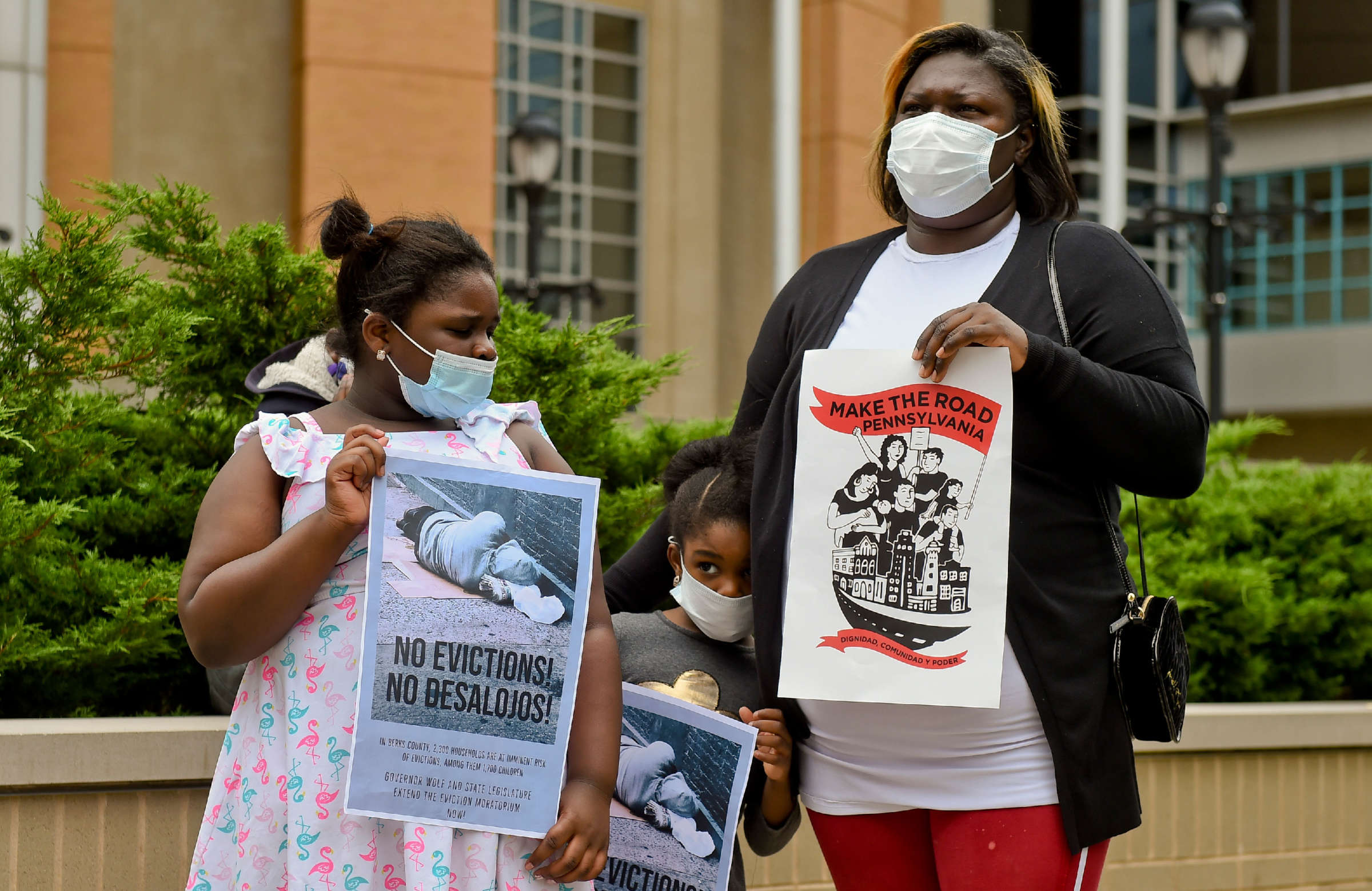
    Meanwhile the economic situation has improved only slightly; there are still about 30 million unemployed and the federal government supplement to state unemployment has fallen from $600 per week to $300. The Centers for Disease Control issued an order preventing landlords from evicting some 30 million people who face eviction for nonpayment of rent, though the process is complicated and renters will still owe back rent. As the election campaigns go on for the next two months the question is will voters reject Trump because of his handling of the virus and the economic crisis or will they embrace him because of his promise to defend them from violence?

    The left continues to support and to participate in protest in those few cities where they continue. The far left focuses on the fight against police racism and violence, while more moderate leftists emphasizes the election of Biden—even if they don’t like his politics—and the need to drive Trump from the White House. Some on the far left defend looting, though most emphasize peaceful protest. Socialists have become more active in attempts to organize workers, though our campaigns are still small and marginal to most of the labor movement. Until the election is over, a vaccine is available, the pandemic ends, and the economy revives we will all be waiting for the end of the terrible year 2020 and a return to a more vigorous fight for socialism.

  • Comment on “Popular Rebellion & Imperialist designs”

    Comment on “Popular Rebellion & Imperialist designs”

    [Editors’ note: In 2011, during the first year of the Arab Spring, long-time dictators in Tunisia and Egypt were driven from office by mass popular protests. In Libya, however, Muammar Qaddafi determined to hold on to power at all costs and unleashed severe violence against demonstrators, threatening worse. In August 2011, scholar-activist Gilbert Achcar gave an interview to Tom Mills of New Left Project explaining his view that, while the left should not have supported the NATO intervention in Libya under any circumstances, it should not have opposed it either in its initial phase, when there was serious danger of an imminent massacre and no alternative means to prevent it. David Graeber posted a comment on the interview, which unfortunately became unavailable when the New Left Project website folded, but we reprint it here as a testament to Graeber’s political commitments and acumen. For further elaboration of Achcar’s view, see here.]

    Comment on “Popular Rebellion & Imperialist designs,” by Gilbert Achcar

    David Graeber

    30 August 2011

    This is a wonderful piece, and I want to thank the author first of all. I have so far stayed out of this debate because it tends to evoke such violent passions but also, because the terms of the argument seemed so skewed away from any politics I would recognize that I wasn’t sure my own position would make any sense to people. I look at this situation as an anarchist. So any question of “supporting” NATO is out of the question from the start. On the other hand, it was perfectly evident from the start that those people I would consider friends, comrades, and fellow spirits in Libya would, certainly, be on the rebel side. (Other people I couldn’t stand would also be on the rebel side, but that’s inevitable in a broad coalition organized against a widely hated dictator. How could it be otherwise?)

    Arguing that no massacre would have taken place in Benghazi strikes me as the most extreme form of special pleading. Under what other circumstances would people on the Left end up insisting that, even though a dictator is loudly declaring he intends to carry out a massacre, he wouldn’t have really done it? This is the kind of argument you make only if you have already decided what you want to think and will say whatever it takes to justify it.

    I think Michael Krog though really gave the game away in the following quote:

    I’m not actually a supporter of Gaddafi or his regime, I’m actually more concerned about the quality of our democracy and the integrity of our politicians. If they can repeatedly get away with launching illegal wars of aggression against weak, but resource rich states, based on lies and propaganda, the more transparently absurd the better, where are we going as a democracy/”

    It is surely the case that politicians do launch illegal wars on the basis of lies, etc., but what Krog’s quote implies is that (a) he believes that it is possible to have a US or UK which would presumably still be world powers, but would not be imperialistic, would obey principles of international legality, would not make false statements, etc. etc. In other words, he is from my perspective a state utopian. For me this is absurd. NATO is an imperial power and the idea that it would act as anything else is bizarre. How could it? We’re dealing with Darth Vader here. It’s unreformable. However, note also, (b) the post implies that his concern to see if he can’t have hypothetical decent, freedom-loving, principled, socially-conscious people take over or at least have control over the apparatus of terror and violence that is the modern imperial state, and its extensions like NATO, is far more important to him than the fate of actual, real, concrete, non-hypothetical decent, freedom-loving, principled, socially-conscious people who happen to live in Libya. Since all such people are going to be inevitably on the side of the revolutionaries (again, not all revolutionaries would fit this description, but those people who do fit this description can be expected to have been with the revolutionaries). So what Krog is basically saying is that whether or not those (non-white, non-Western) concrete revolutionaries get raped, tortured, and murdered is really not his primary concern – the real issue for him is whether the apparatus of global violence is under the control of the right sort of  (white, Western) politicians.

    I imagine such people tell themselves their primary concern isn’t with the white power structure but its ability to attack non-white people but I think examples like this are telling.

    Me, since I think NATO is Darth Vader, the problem doesn’t come up. If Darth Vader wants to intervene against some other mini-Darth to save a bunch of revolutionaries, how can one react but to say, “cool! that’s pretty ironic but I’m really glad it happened.” Does that mean I “support” Darth Vader? Of course not. He’s an evil imperialist. Does that mean I’ll be out protesting what he did just because I know his ultimate motives are bound to be insidious? No, of course not either, because first of all, protest implies I think Darth _could_ be acting in a more principled fashion, and second of all – and this is critical – I’m not a political party or government that has to have a “line” on every world issue anyway. But like the author of this piece, I will certainly step in to make my opinion known once Darth actively starts to try to subvert the revolutionaries, as he inevitably will.

    I think the philosophical question is, when we see a conflict, who do we try to identify first? Do we try to identify who are the worst bad guys, and oppose them whatever they do? Or do we try to identify who are the closest to being the good guys, in the sense of, people who share our principles, values, dreams… and try to see how they assess the situation, and trust their instincts (since they’re there, and we’re not), and support them? I know that any anarchists in Libya right now are fighting on the revolutionary side (in fact I do know one Libyan anarchist, and he is), and I know they’d be happy Darth saved them from mass rape, torture, and killing, and if anything even more happy that they managed to outfox and outflank NATO’s determination to avoid a genuine insurrectionary situation. Good on them! 

    From that perspective, the fact that some European and American leftists were happy to sacrifice them to a horrific fate – all the while insisting we can’t absolutely prove that fate would necessarily totally have happened – because what’s important to them is the dream of moving towards a kinder, gentler imperial center… well, it speaks to a very strange set of priorities.

  • Subcomandante Marcos: The Last Global Ethical Hero?

    Subcomandante Marcos: The Last Global Ethical Hero?

    Book Review

    Nick Henck. Subcomandante Marcos: Global Rebel Icon. Montreal: Black Rose Books, 2019. 152 pages. Appendix. Bibliography. Notes.

    Nick Henck ends his latest book on Subcomandante Marcos, the leader of the Zapatista Army of National Liberation, with this remark, “…the Subcomandante may well be the sole surviving globally recognized (and recognizable) ethical hero of iconic stature.” Henck had explained to us earlier the Sub had recognized that a cult of personality had developed around him and that the Sub rejected it and that to fend it off Marcos had changed his name to Galeano. Undeterred, Henck continues to burn incense on the altar of the Marcos cult. And he seldom calls him Galeano.

    Nick Henck, a law professor at Keio University in Tokyo, Japan and the author of no fewer than four books and many articles on Subcomandante Marcos, the leader and spokesperson of the EZLN that in January 1994 lad an uprising in the southernmost state of Mexico. Henck’s first book on Marcos Subcommander Marcos: The Man and the Mask, a 500-page biography published in 2007. In 2017 he published Insurgent Marcos: The Political-Philosophical Formation of the Zapatista Subcommander, a study of the intellectual formation of Marcos and of his writing. Two years ago he published The Zapatistas’ Dignified Rage: Final Public Speeches of Subcommander Marcos, which is described in its title. And now we have the new book Subcomandante Marcos: Global Rebel Icon, a short updated biography.

    If you want a handy little book of just 100 pages that reads like a long Wikipedia article providing all the dates, names, and events, this is your book. If you want a discussion of Marcos’ ideas and his role in Mexican political life and in the global left, comparing and contrasting him and his politics with those of others, you will be disappointed.

    The new book—just 100 pages really—shares the same faults as the great big biography that he published and which I criticized thirteen years ago. Once again we have a book that is primarily a chronicle of the life and activities of Marcos, though not in the excruciating detail of the earlier biography. The same problems that I described earlier still exist. As I wrote then:

    Henck does not locate Marcos in the history of modern Mexico, nowhere discusses the significance of the Mexican revolution (1910-20) and its successes and failure, and never describes the politics of the Institutional Revolutionary Party, the National Action Party and the Party of the Democratic Revolution, all of which the Sub has had to contend with.

    Marcos and the Zapatistas are not put in the context of the guerrilla tradition in Mexico from Zapata to Lucio Cabañas, nor are they contrasted with Cardenismo from Lázaro Cárdenas to his son Cuauhtémoc. While the author constantly refers to Che Guevara, Guevara’s politics and their significance is never discussed.

    The one point that is mentioned several times, but never developed, is that Marcos gave up the orthodox Marxism-Leninism of most Latin American guerrillas for his supposed subordination to the will of the indigenous people, the Maya of Chiapas. Yet this book never discusses the history of the indigenous in Mexico, or the Mexican state’s official theory of indigenismo, nor the other existing, cooperating and competing indigenous trends.

    What does it mean to be part of an Indian movement? One might have made allusions to the indigenous movements of Bolivia and Ecuador by way of comparison to elucidate what is unique about zapatismo.

    As with the earlier biography, in this new one we never see Marcos in the political context. We still have no explanation of why Marcos during The Other Campaign in 2006 marched along with a political party that carried and displayed at rallies portraits of Joseph Stalin. Why would the EZLN—even if they did not support any of the political parties or candidates that year—not join with others to protest election fraud? We never see him and the EZLN in relationship to the old parties or to MORENA, the Movement for National Regeneration Party of President Andrés Manuel López Obrador.

    I’m afraid I have to write about this book what I wrote about the earlier biography: “Henck’s book is principally chronology and secondarily hagiography. The author is not simply an admirer of Marcos; he adulates him as a genius, an inspiration and the direction of the future.”

    Marcos certainly became a global hero when he led the Zapatista Army of National Liberation (EZLN) in the Chiapas Rebellion in 1994, and he remained renowned worldwide throughout the 1990s and into the 2000s. But is Subcomandante Marcos the last global ethical hero? What about Greta Thunberg, the 15-year old girl who in August of 2018 stood outside the Swedish parliament with a sign reading Skolstrejk för klimatet (School strike for climate) until gradually a movement assembled around her first in Europe and then in other countries around the world as students struck to protest climate change and demand system change.

    Or how about Li Wenliang, the Chinese doctor who tried to warn other physicians about the Chinese coronavirus outbreak and then died after contracting the virus while treating patients in Wuhan? Or what about the collective and often anonymous leaders of the Hong Kong pro-democracy protests? Or of the Yellow Vests movement in France? Or those leading the revolutionary movements in Algeria? Or in Sudan? Or of the pro-democracy protests in Belarus today? Perhaps Marcos is the last of a certain type of ethical leader, the guerrilla poet savior, but maybe today, 25 years since the EZLN Chiapas uprising, we need a new type.

  • Let Howie Debate!

    Let Howie Debate!

    WANT REAL CHANGE? OPEN THE DEBATES!

    Nearly 60% of Americans claim that they want a new major political party. With nearly 50% of voters not identifying as either Republican or Democrat, it’s time to get new voices on the national stage. 

    Sign the petition to get more candidates who actually represent you in on the debates!

    Every four years you hear the same “blah blah blah.” It’s on the TV, social media, newspapers, magazines, radio, and everywhere else you could possibly catch it. Every four years there’s new faces and the same old broken promises.

    Something has to change.

    It’s not for lack of trying that we never see any third parties in the debates. The Republicans and Democrats know that forcing voters to choose between two parties is the best way for them to stay in power without actually fixing anything.

    As the 2020 presidential candidate for the Green Party, Howie Hawkins believes that you deserve better than to have your livelihood played with by the two-party establishment.

    It’s time for real change that can only come from opening the debates!

    LET HOWIE DEBATE!

    The deck is stacked against third parties so it’s going to take all of us to put an end to this. With over half of voters saying that the US needs a third party, this is more than possible if everyone pitches in and does their part to open the debates to third parties.

    While we’re at it, we’re also demanding an even playing field for all candidates!

    We mean:

    • No more media blackouts! Give third parties screen time and representation in polls!
    • Restructuring the Commission on Debates to be a NON-PARTISAN organization!
    • A standard where ALL candidates included on enough ballots to have a chance at actually winning the presidency

    As it stands, Trump and Biden have both chosen to ignore Howie Hawkins’ challenges to a debate. Are they incapable of debating? Perhaps they’re too scared to debate someone who is actually keeping to the issues and not falling into their bread-and-circuses approach to politics?

    The few seconds that it takes to sign this petition can be the make-or-break difference between getting politicians who actually want to EARN your vote or another who-knows-how-many years of your rights and needs as an American being ignored.

    It’s up to you.

    Sign now!

  • Revolution Means Taking Care of the Future

    Revolution Means Taking Care of the Future

    Thinking a socialist future implies imagining what this future might look like, and then asking how we can get there. Utopia, as conceived by revolutionary theory, implies a pragmatic aspect relating to the question of transition. Transition is a challenge. History has shown that it is not linear: no direct path leading from one point to another exists. Instead, we need to consider transition as a process. Feminist body politics aimed at dismantling rigid norms of gender and sexuality show that revolutions take time. The temporal space created by this, however, opens up a field for exploration and experimentation, a terrain on which contradictory forces clash. Is it possible to walk such a transitional path without knowing where it will lead?

    The struggles now unfolding in Chile and across the globe against neoliberal privatization, the destruction of welfare provisions, and the progressive commodification of our lives stand in a largely inverse relation to such a revolutionary temporality. Their project is less future-orientated than it is invested in defending something lost or something perceived as under threat. These are struggles for the commons, struggles to confront ongoing dispossession, or demanding the return of stolen wealth: struggles showing that our utopias need foundations to turn into a reality. We need functioning structures of care and self-care to find the energy to fight in the first place.

    Should this lead us to conclude that these struggles are more conservative, or backward-looking than they are utopian? No. They entail a utopian thrust in their knowledge of the conditions from which they initiate transformation. For this reason, these are now decisive and indispensible struggles. Taking self-defence as a starting point, they spawn the possibility of something new; they bring to light something that has not existed. They found this political movement on a temporality that is not nostalgic or archaic, but directed toward producing the present. We can see that revolutionary desire requires a solid infrastructure to come to fruition.

    Rosa Luxemburg coined the concept of a revolutionary Realpolitik to grasp transition with greater precision, as a process in which day-to-day struggles for concrete improvements take place against the horizon of a radical reorganization of society, and in which struggles in the here and now, in grassroots politics, pave the way for the steps to follow. The teleology of an ultimate revolutionary “goal” shifts. Not because it no longer exists or loses importance, but because the temporal relation to everyday politics has changed. We can and must question every act, whether it is imbued with revolutionary dynamism or not.

    We Want to Change Everything!

    I consider this concept helpful for sharpening the revolutionary perspective of current feminisms. What are their goals? What utopian energies do they unleash? To what extent can we see them as a revolutionary realpolitik of the future even when they do not have a stable idea of what their goal is? In what way, do they revolutionize the present and create the conditions for a different future?

    In their determination and radical nature, contemporary feminisms are initiating radical breaks – in our bodies, on the streets, in bed, and in the household. The slogan of the feminist movement in Argentina sums them up: “We want to change everything!” With the most recent revolts in Chile, this claim has been further sharpened, with the feminist revolution positing that “We have a programme: We want everything!” There is no space, no social relations that remain untouched by this dynamic of rupture and revolt. The time of revolution lies in the here and now, its energized force linking it to the perspective of a liberated future.

    From its origins in Latin America, the energy of the transnational feminist strike has spread to over 50 countries. In Chile, the masses have taken up many of the slogans and practices of the feminist strike and have assumed even greater force as a plurinational general strike. The experience gained in various movements over recent years has made it possible to change even the way we struggle, the organizational forms, the political perspectives, and the historical alliances. In this context, two central mechanisms of domination are being attacked: the burden of debt being placed on subaltern subjects, and the expropriation this brings with it, both of which have rendered impossible a self-determined future for large parts of the population.

    Re-Appropriating Our Future

    As a financial obligation, debt colonizes our future. It chains us to exploitation with a tightly-knit dispositif of moralizing admonishment and individualization. Conservative neoliberalism has thoroughly recolonized Latin America financially. These are the conditions under which an indebted, and thus highly disciplined, younger generation has grown up, its lack of independence intensified by the centrality of the hetero-patriarchal family. The struggle against debt is about re-appropriating our future and making it our own, creatively shaping it on an individual and a collective level, and finding new subjectivities that can escape such a “debt relation.”

    The graffiti and slogans of the Chilean protests express this all. On the facades of banks in Chile, home of the Chicago Boys and the highest per capita debt in the entire region, it says: “They owe us a life.” This statement reverses the question of who owes what to whom. Considering surging living costs, or, to be more precise, counting the progressive extraction of value from daily practices of social reproduction, this slogan points to the possibility of financial disobedience – the #EvasionMasiva movement is a prime example.

    Current feminist movements go even further, formulating a concrete and pointed critique of the multiple and new forms of predatory exploitation by which capital reaches ever further into our lives. Bodies are fighting shoulder to shoulder on many fronts: those of household debt and precarization, neo-extractivism and the devastation and desertion of entire regions, militarization and the criminalization of borders, and scapegoating “internal enemies.”

    These are struggles that question the role of property. In doing so, the feminist revolution creates a site of political antagonism by fighting for means of producing life wherever neoliberal exploitation takes root. In this respect, feminism as a quotidian revolution is significant, because it poses the question of whether the sites at which the accumulation of capital is opposed might determine the direction of transformation.

    Today, even the bodies of young people are sites of contestation where capital is attempting to expand its value creation, to mould them into obedient workers who obediently accept precarization, debt, and the nuclear family – even if the latter is imploding and brimming with violence. In these bodies, the feminist revolution has planted the desire for revolution, the promise of a future not regulated by capital – opening up the concrete production of utopia.

    This article was first published in German by Zeitschrift LuXemburg. The English translation was published by The Bullet.

  • Anti-Racism and Class Struggle

    Anti-Racism and Class Struggle

    The sharp disagreement that arose earlier this summer, when the NYC Lower Manhattan branch of the Democratic Socialists of America’s (DSA) extended a speaking invitation to Adolph Reed, was both telling and politically significant. According to The New York Times, the Black academic was intending to argue that “the left’s intense focus on the disproportionate impact of the coronavirus on Black people undermined multiracial organizing, which he sees as key to health and economic justice.” In an article written in April, Reed had, indeed, challenged the “special focus on black Americans’ particular vulnerability to Covid-19, apparently based on a generic presumption that blacks are likely to have it (whatever it is) worse.” He linked what he described as the “blacks have it worse” argument’ to 19th Century pseudo-scientific “racial medicine.” He concluded that “a neoliberal politics of race relations engineering” must be put aside because “the shared danger of pandemic screams of the need for broad solidarity.”

    The DSA AfroSocialist and Socialists of Color Caucus issued a statement that challenged this ‘decision to organize an event that claims it is good socialist politics to ignore the deadly racist impact COVID 19 is having on Black, Indigenous and People of Color communities (BIPOC).’ Far from there being any effort ‘to silence Professor Reed,’ as the Times article on the cancellation of the talk suggests, the statement included the clear and, in my view, very reasonable demand that “the event be changed to a debate of Adolph Reed’s class reductionist analysis versus our intersectional socialist analysis.”

    Reed is, in any event, very far from being silenced. He remains an influential participant in the debate on the relationship between the fight for racial justice and the class struggle within capitalist society. This disagreement on the left is a longstanding one that the social upsurge following the racist police murder of George Floyd in Minneapolis has only sharpened. The discussion has been taken up here in Canada, where I have supported the view that the fight for racial justice is so vital that no serious class struggle politics can afford to downplay its significance.

    Let me say that an anti-capitalist approach differs considerably from what we might describe as a liberal politics of identity. Such a viewpoint sees only racial oppression and disregards the class based exploitation that this society rests upon. As such it is driven to seek solutions within the very system that created and that perpetuates racism. Some on the left, however, are so determined to keep the focus on class that they end up minimizing the role of racism in this society. I once attended a meeting in Toronto, in which a young Black woman detailed the experiences of her community at the hands of racist employers, landlords, officials and cops. A white trade union activist got up in the discussion that followed and informed her that, while he deplored the things she described, it was wrong to focus on racism. The real issue was that capitalists exploited all workers and a united working class movement would take care of the secondary problem of racism as a matter of course. He jarringly demonstrated “class reductionism” at its worst.

    White Privilege

    Whenever the respective importance of class and race are debated, it is likely to include a disagreement over the vexed question of “white privilege.” There are those who reject this concept and suggest it is an unhelpful or divisive term. In some ways, it seems curious that it should be such a contentious issue on the left. Both Canada and the US were created by way of the genocidal and thoroughly racist dispossession of Indigenous populations and have histories that drip with racism. The racist past, moreover, has given over to a racist present and it is impossible to deny that the two societies operate on the basis of racial hierarchies. A quick internet search would readily produce ample evidence of this. The record on levels of unemployment and poverty, income disparities, health outcomes, rates of incarceration and other key indicators, would all show that racialized people face disadvantage and white people enjoy relative privilege.

    However, it is also indisputable that this racial hierarchy exists alongside other forms of oppression. Advantage and disadvantage are also related to such considerations as gender, sexual orientation and disability. Above all else, they are linked to the question of social class and the working class is unquestionably multiracial. I’d be the first to agree that working class people have common interests that run counter to those of their exploiters and that unity among them is entirely necessary. However, I would also suggest that, in order to develop a political approach that corresponds to the realities of this society, we have to acknowledge that racial hierarchy and white privilege also exist within the working class.

    Pervasive racism ensures that racialized workers are disproportionately concentrated in the most exploitative forms of employment. The Law Commission of Ontario, for example, found that “Racialized workers also suffer a disproportionate degree of hardship in the labour market.” and that the jobs they have to accept are “much more likely to be insecure, temporary and low paying.” The impact of racism creates a massive additional level of oppression outside of the workplace as well. In Canada, as well as in the US, the temporary and partial halt to evictions that took place during the pandemic lockdown period is coming to an end and masses of tenants face the loss of their housing. Unsurprisingly, the shadow or racism hangs over this dire situation and deeply effects who is at risk of being put onto the streets. The threat to Black lives that racist policing in the US poses is now known throughout the world but it is not fundamentally different in Canada. In Toronto, Black people are twenty times more likely to be shot dead by the police than white people. Across Canada, Indigenous people are ten times as likely to die from police shootings.

    Those on the left who reject the concept of white privilege will often point out that many white people work for low wages, face poverty and experience homelessness. Based on this they ask, rhetorically, “Are they privileged?” Yet, even when we discuss those who face the highest levels of exploitation and the most egregious forms of oppression, the racial hierarchy doesn’t disappear. Racism exists within the low wage workplaces. The Law Commission report I mentioned previously doesn’t neglect to point out that “…racialized workers commonly experience attitudinal and systemic discrimination in the workplace.” Black and Indigenous people are massively overrepresented in the Canadian prison population but they also face tougher sentences, worse treatment while incarcerated and reduced prospects for being paroled. At every level, the racism of this society imposes an additional burden of oppression that white people don’t face and this can’t be considered as a “divisive” inconvenience by any serious left analysis.

    Working Class Unity

    There is, however, one vital difference in the matter of white privilege and how it impacts working class people. For the mainly white capitalist class, the racial hierarchy of the system they draw their profits from is entirely beneficial. It provides them with super exploited workers and weakens the capacity for working class resistance. For those on the other side of the class divide, however, that hierarchy is an enormous impediment. The privileges that white working class people enjoy are, at the same time, a means of furthering their exploitation. A working class united against both class based and racial oppression would be to the great advantage of all within its ranks. A 1980s study of wage disparities between Black and white workers in the US, showed that the wages of white workers were actually the lowest in places where the racial wage gap was greatest.

    In my view, far from adapting to liberal politics or introducing a divisive element, making anti-racism front and centre within a strategy of class based resistance corresponds to the realities of the capitalist societies we live in and to the particular features of the present period. As the pandemic struck us and unleashed (I should really say deepened) an economic crisis of huge proportions, George Floyd was murdered by a racist police force in Minneapolis. Who could have imagined the international impact this would have and the resistance it would bring onto the streets? As I write this, the horrible shooting of Jacob Blake in Kenosha has led to an explosion of rage. The resistance that is presently focused on racist police brutality can spread to other struggles by working class people and, in every one of them, the class issues are interwoven with racial oppression.

    In 1948, the Trinidadian socialist C.L.R. James, spoke of the great hatred for capitalism that lived within the Black population of the US: 

    “Let us not forget that in the Negro people, there sleep and are now awakening, passions of a violence exceeding perhaps, as far as these things can be compared, anything among the tremendous forces that capitalism has created…the hatred of bourgeois society and the readiness to destroy it when the opportunity should present itself, rests among them to a degree greater than in any other section of the population in the United States.”

    The class struggle must also be a fight against racism if it is to unite the working class and challenge capitalism. 

  • Pandemic as Portal? The Fight Around School Reopening

    Pandemic as Portal? The Fight Around School Reopening

    As teachers across the country prepare to return to school, the familiar apprehension that comes with starting a school new year feels drowned out by the uncertainty created by state and district leaders due to the Covid-19 pandemic crisis. The drive to reopen schools has left school districts and state governments scrambling to find ways to push teachers and students into as much in-person schooling as possible, despite the danger of spreading the virus throughout school buildings, putting vulnerable individuals and communities at risk.

    This is a situation with no easy solutions. We are told that we must choose between an ever-deepening economic crisis, on the one hand, or the uncontrolled spread of a deadly pandemic, on the other. However, we need to recognize that basis of the choices we’ve been presented with are rooted in the system that created the aspects of this crisis that it hasn’t simply made worse. 

    We need to reject this Sophie’s Choice, and demand that students and teachers not be sent into conditions that we know will cost some of them their lives. As we have seen in recent weeks, options that blend online and in-person learning to ensure social distancing, do not effectively control the spread, nor can they actually meet the needs of students. Fully online learning is the only way to ensure that we are not putting students and staff at risk. That means we need to demand funding to guarantee that all students have the support they need, including access to high speed internet. It also means that we need to fight to shut down the economy to control the spread of the virus, while doing what needs to be done to ensure that the human needs of families are met. 

    The Trump administration, as well as state and local leaders, frequently attempt to frame their insistence on getting students and teachers into some form of in-person schooling in terms of supporting students’ academic and emotional needs. Some even rightly point out that the move to online learning has a disproportionate negative impact on students of color and students from low-income households. However, while it is undeniable that our education system is fraught with unacceptable disparities based on race and class, we need to question the motives of those who champion these concerns, while at the same time slashing education budgets and gutting social programs and services that support our most vulnerable communities. 

    They may pay lip service to the needs of students, but government leaders’ push to get students back into some form of in-person schooling is really about economics. The pandemic has sent the US economy hurtling into a crisis on par with the stock market crash of 1929 and the financial crisis in 2008. In the second quarter of 2020, the United States’ GDP fell 9.5%, and unemployment in July was just over 10%. This crisis is set to deepen, with Congress having failed to extend the stimulus payments keeping many families afloat.

    Reopening schools in an online learning setting creates an impediment to the speedy recovery, albeit unlikely, that government leaders hope for. If students are learning from home, then parents will also need to stay home to look after them, thereby forcing families into a position where they must choose to care for their children at home, or go to work to ensure that they have food on the table. On the other hand, forcing schools to reopen in person guarantees that students will bring home the virus, in many cases, though disproportionately in families of color, to multigenerational homes, where they live with older relatives who are more vulnerable to the virus. This is not to mention the risks posed to school staff, many of whom are at high-risk, themselves.

    In addition to the obvious health risks associated with any form of in-person schooling, there are several other factors that make returning to school buildings infeasible. To begin with, while we can imagine a socially-distanced classroom with desks spaced six feet apart, anyone who has spent five minutes working in education knows that social distance and kids just don’t mix. Physical proximity is central to how children connect with each other, whether they are playing a game, working together, or just talking. Expecting them to stay six feet apart is simply unrealistic, and is honestly kind of cruel. 

    Proximity is also essential to caring for children. How do you comfort a crying child from six feet away? How do you distantly help with someone’s shoe laces, or a stuck zipper on a jacket? How do you have a private conversation about missing homework or a rough test score? Invariably these situations will come up, and just as invariably, educators will jump in to help the student, regardless of the risks to their own health. 

    In addition to social distancing, ensuring that students wear masks while at school has been suggested to help mitigate the risk of spreading the virus. It is absolutely true that consistent mask wearing is effective at preventing viral transmission, and that people should be wearing masks when out in public. However, we have to consider how this will actually play out in schools. Masks are, undeniably, a little uncomfortable, especially when you have to keep one on for long periods of time, like an entire school day. When a student refuses to put their mask back on, in many cases that will become a disciplinary issue, which will disproportionately harm students of color.

    However, even if we were able to ensure proper social distancing and mask wearing in schools, there are other factors that make any form of in-person learning unsafe in the context of a pandemic. Due to the chronic underfunding of public education at the hands of both Democratic and Republican governments, school districts around the country are deeply under-resourced and many school buildings are shamefully out of date. In some districts, there are no school buildings that have air management systems that can accommodate the filtration needed to prevent the virus from spreading from classroom to classroom. 

    Furthermore, schools do not have adequate staffing to split classes into small enough groups for adequate social distancing. As a result, it is likely that we will see Education Service Professionals (ESPs) being asked to take on roles that go far beyond their job description. ESPs are more likely to be people of color, and typically work for low wages. They will be told that they can either take on the extra duties, or lose their job. It is essential that, as teachers fight for a safe and equitable reopening, they take into account ESPs concerns and fight alongside them to ensure that they are taken care of, should online learning interrupt their employment. 

    The only way to ensure that students and school staff are safe this year is to move to fully online instruction, while protecting school staff and families that won’t be able to work as a result. However, doing so creates other challenges for students, particularly those that require specialized services or English language support, as well as families who rely on school for food support or who lack adequate access to reliable high-speed internet. Government leaders have tried to use these issues to drive a wedge between teachers fighting for a safe reopening, and families that need the services that schools provide. 

    Rather than implying that self-interested teachers don’t care about the needs of families, these problems actually expose the inadequacy of capitalism to meet human need, and the reality that the fight for a safe reopening necessitates a broader fight for a fundamental reversal of the priorities at the core of the system.

    Rather than wasting time trying to make some form of in-person learning work, when we know it won’t, we should be focusing on how to best meet the needs of students and families during a year of online learning. This means a massive influx of funding, firstly, to provide incomes to parents that cannot work, because they need to be home with their students, and also to provide schools with the resources to meet the needs of their community, including meal delivery, access to school health professionals and social workers, and safely providing support to students with disabilities. 

    This funding should not be seen as an emergency measure. The current crisis has been made far worse due to districts being required to run on a shoestring for decades. The pandemic has made clear the central role that schools play in the lives of families, from providing childcare and education, to meals and mental healthcare. We have a huge opening right now to shift the priorities around education in this country, and fight for better conditions for our students and ourselves. 

    Now is the time to fight for the schools our students deserve. However, the key to winning that fight is solidarity. In many states, governors have chosen to leave the decision around how schools will open to districts to decide, likewise individual private schools and charters. We need to build fight backs in every state that bring in non-unionized teachers at private schools and charters, transcend district boundaries, and bring separate educators’ unions together in struggle. We also need to build partnerships with families and community members, to ensure that their needs are at the center of what we’re fighting for. 

    We are going into a very uncertain year, and educators are anxiously looking at a list of bad options, with some even considering leaving the profession, in order to keep themselves and their families safe. However, during this time it is essential that we stick together to fight for a safe return to school, that meets the needs of our students and their families. At the beginning of the pandemic, the author Arundhati Roy said that the “pandemic is a portal,” that we will step through it either carrying with us the baggage of the past, or entering into a new world, with a new set of priorities. What public education looks like when all this is over is dependent on what we, as educators, fight for now, and how we fight for it.

  • Commercial Surrogacy: A Reply to Sara Lee

    Commercial Surrogacy: A Reply to Sara Lee

    Alexandra Holmstrom-Smith replies to Sara Lee’s “Commercial Surrogacy and Socialism from Below.” This is the final entry in a debate that began in our Summer 2020 issue, sparked by Holmstrom-Smith’s review of Sophie Lewis’ recent book Full Surrogacy Now: Feminism Against Family (Verso, 2019).

    In her reply, Sara accuses me of writing off the possibility of organizing workers in particularly precarious industries. However, in my piece I specifically stated, “Where workers are already doing a certain kind of commodified work – including commercial surrogacy — socialists should support their organizing for better wages and working conditions.” I absolutely agree that leftists should support workers organizing in every industry, even–or perhaps especially–the most oppressive. What I have proposed is that when it comes to economic policy, the left should oppose policies that will lead to job creation in highly exploitative or otherwise undesirable industries. I don’t think this should be a controversial position.

    Sara also says that by denying the legal status of workers to commercial surrogates, we would preclude the “possibility of workers taking the lead and making themselves fit to rule.” I agree with Sara that the path to liberation comes through workers’ struggles. However, to say that keeping commercial surrogacy illegal is preventing commercial surrogates from taking the lead in the class struggle is like saying that prohibitions on child labor are preventing working class children from becoming the leaders in the proletarian struggle. Does anyone think that is a problem? The labor movement demanded laws against child labor because they wanted their kids to go to school. Working-class demands don’t only come from just the workers on the shop floor, they also come from the experience of the working-class as a whole. Many of these demands are about gaining a better quality of life under capitalism, and this has often meant opposing the advance of commodification. My point is that the libertarian left should not abandon the working class in this struggle.

    Sara says it’s “absurd” that I think commercial surrogates shouldn’t be able to enforce their contracts for wages. As I explained in my piece, contracts are usually enforceable by both parties or by neither, so my argument was that making them unenforceable would prevent the greater harm of a surrogate losing custody of a child based on contract enforcement. I don’t think this is an absurd thing to be concerned about. Beyond that, I think that industries which are as legally complex and expensive as surrogacy simply will not function without enforceable contracts. Thus, making contracts unenforceable means no surrogacy industry in the first place. In my own research I have not been able to find any evidence that underground black-market surrogacy is happening with any regularity in places like New York State, where up until this year it was illegal. Thus, the concern for surrogates with unenforceable contracts being stiffed on their wages is purely hypothetical, and I don’t quite understand why Sara and others are so worried about it.

    Moreover, as an argument for legalization, this is like proposing to legalize organ-selling because we are worried that people who try to sell their organs on the black market could get stiffed by buyers. This is obviously an absurdly libertarian solution to the hypothetical problem of people getting cheated by organ buyers. I think there are other legal solutions we could come up with to try to get compensation for people who have been harmed by an illegal transaction without legalizing and therefore encouraging those transactions.

    Sara also argues that my proposal for the state to “foreclose certain avenues of making needed money” is oppressive and unlike other types of protective labor legislation. Yet an effective ban on organ selling is precisely an example of the state foreclosing an avenue for income. I don’t think anyone on the left would argue that opening up legal markets in organs would be good for the working-class people who might seek to sell theirs. Sara may quibble with my use of the phrase ‘self-exploit’ but the point is that labor law is meant to put a floor on the level of exploitation present in the market, even if it means limiting the (false) choices of individual workers. These policies do not end exploitation, but they limit it, and that is what we are fighting for right now. Now, we can agree or disagree about whether surrogacy is so exploitative that it should restricted in this way, but the left should never fall for the libertarian argument that the state has no right to make such restrictions.

    Regarding how such policy decisions are made, Sara suggests that I am somehow promoting “socialism from above” by being against legalizing commercial surrogacy. Yet in New York State, it was the bourgeoisie, through its executive council the state, which successfully pushed for legalization. This should surprise no one, since the bourgeoisie are the consumers of commercial surrogacy services. If you put the question of legalizing commercial surrogacy to a vote of the working-class tomorrow, I suspect that a large proportion of them – perhaps a majority – would vote no. I think many people would worry that the uterus-havers in their lives might be harmed by taking up this type of work. In any case, I was never proposing that the left should engage in some kind of backroom politics “from above” to achieve a surrogacy ban – as if socialists had that access anyway! My proposal is that the left engage in educational campaigns, as Sara rightly emphasized is our role.

    What would we say in such an educational campaign? Marxists, Black feminists and other theorists have articulated many reasons why commercial surrogacy is “not good for the world.” Angela Davis worried that “poor women—especially poor women of color—might be transformed into a special caste of hired pregnancy carriers.” She also argued that when employed in a patriarchal capitalist society, reproductive technology tended to put additional pressure upon women to try everything to become mothers and compounded the pain of infertility by promising that “motherhood lies just beyond the next technology.” Dorothy Roberts argued that the fertility industry reflected and promoted racist values, by “proclaim[ing] the unmistakable message that white children merit the spending of billions of dollars toward their creation.” The philosopher Elizabeth Anderson cautioned that “Commercial surrogacy substitutes market norms for some of the norms of parental love.”

    Feminists have rightly argued that norms of maternal love can be oppressive towards women, yet replacing the norm of maternal love with a mercenary attitude towards children as resources to exploit is hardly an improvement. From a legal perspective, commercial surrogacy reifies money and genetics at the expense of the labor of pregnancy by making the “intended parent” and not the surrogate the legal parent. In practice, this tends to elevate the power of cis men (the main genetic “inputs” of surrogacy) vis a vis their children, as Katha Pollitt wrote, “What [an intended father] wanted…was not just a perfect baby…He wanted a perfect baby with his genes and a medically vetted mother who would get out of his life forever immediately after giving birth. That’s a tall order, and one no other class of father–natural, step-, adoptive–even claims to be entitled to. Why should the law bend itself into a pretzel to gratify it?” Why indeed.


  • The Life of A Strategist: Adolfo Gilly’s Biography of Felipe Ángeles

    The Life of A Strategist: Adolfo Gilly’s Biography of Felipe Ángeles

    Book Review

    Adolfo Gilly. Felipe Ángeles, el estratega. Mexico: Ediciones Era, 2019. Notes, bibliography, index, map. 782 pages.

    I have loved reading the Argentine-Mexican writer Adolfo Gilly ever since I picked up his book La revolución interrumpida in June 1971 just as it appeared on the shelves of El Sótano bookstore in the basement of a building on the Alameda Central in Mexico City. That book, later published in English as The Mexican Revolution, is a brilliant Marxist analysis of that enormous and complex series of events that transformed Mexico in the 1910s.

    The other most important book on Mexico by Gilly is El sueño cardenista (we could translate it as The Dream of Lázaro Cárdenas), which offers his interpretation of the political role and views of the Mexican president Cárdenas in the 1930s, his notion of an alliance between the state and the peasantry to create a socialist society. But he has also written other books and many essays on Mexico, Central America, on political theory, as well as on contemporary events. I consider Gilly to be a brilliant thinker and often a marvelous writer, capable of allowing us to see things in a new light, even though I may and often do differ with his opinions.

    Gilly’s most recent book, Felipe Ángeles, el estratega, so far available only in Spanish, is a long (almost 800-page) book dealing with the life of a Mexican general who played a crucial role in the battles of Torreón and Zacatecas at a crucial stage in the Mexican Revolution, when he served under Francisco “Pancho” Villa. Winning those battles gave Ángeles his place in Mexican history, as others have recognized, but Gilly is interested—as a biographer should be—not only in the decisive events, but also in the character, the values, and the meaning of the life of his subject.

    Felipe Ángeles, who described himself as “indigenous,” was born in 1868 in the state of Hidalgo, the son of a provincial, middle class, farming family. His father had after fighting against the U.S. invasion of Mexico in the war of 1846-48 and against the French Intervention of 1861-68 risen to the rank of colonel in the Mexican Army. Felipe himself grew up in the Porfiriate, the period of the rule of president, then dictator Porfirio Díaz from 1876 to 1911. During that era, Felipe entered the Mexican Military Academy at the age of fourteen and through his diligence and study rose to the rank of lieutenant of engineers in 1892, captain of artillery in 1896, major in 1901, and full colonel in 1908.

    The Mexican Army sent him to Paris in 1901 to look into the purchase of heavy artillery and in 1904 to the United States to see about buying gunpowder, a deal he rejected. When the School of Military Candidates was established in 1908, he became professor of the Theory and Practice of Firing, teaching mathematics and artillery courses, but a conflict within the school became public and he was jailed for eight days, then sent off to France. Why was he jailed and sent away on a foreign assignment? It was in part because he was the author of a long critical article about Mexican military schooling that had the character of a political manifesto in favor of a more rigorous scientific education. There was also the fact that he had prevented corrupt deals with German ordnance manufacturers such as Krupp that involved pay offs to Mexican generals and politicians.

    Altogether, Ángeles spent five years between before 1910 as a Mexican officer in the French Army and when in 1910 the Mexican Revolution broke out, Ángeles was still in France where he served as Mexican Inspector General of Munitions at the Sharpshooting Academy in Mailly. For his service and his expertise, the French government made him a Knight of the Legion of Honor in May of 1911.

    During the period he was in France the great national debate continued over the Dreyfus affair. Alfred Dreyfus, another artillery officer, was accused by the French government of being a German spy, in a case based on falsehoods and tainted with anti-Semitism. The novelist Émile Zola wrote his famous J’accuse in Dreyfus’ defense and Jean Jaurès, the leader of the Socialist Party also rallied to his side. And it was in this same period that Jaurès wrote his book L’Armée Nouvelle, calling for the formation of a citizen’s militia. All of this political ferment, especially since it dealt with military afffairs, must have had an impact on Ángeles who was deeply concerned about such issues.

    When Ángeles attempted to return to Mexico in 1911, asking for a command, his commanders refused his request; the establishment viewed him as disloyal. If he had not been disloyal, he was becoming so. He was sympathetic to Francisco Madero, the northern landlord and mystic who had called for and set in motion the Mexican Revolution in November 1910. Yet Gilly emphasizes that, while French and Mexican political developments influenced Ángeles, it was his sense of truth and justice that stood at the center of his morality, which was his compass. Gilly sees his character as his destiny, and his destiny was to play a role in the Mexican Revolution’s second phase.

    Ángeles Joins Madero

    When Porfirio Díaz had fled to France and Madero had won one of the few legitimate elections in Mexican history, Ángeles returned to Mexico prepared to serve the new president. Madero had kept intact the Mexican state–its bureaucracy, its police, and its army–though he wanted to reform them, so he chose Ángeles to become the head of the Military School in January of 1912, being promoted from Colonel to Brigadier General. Madero also asked Ángeles to take charged of the education and training of the Municipal Guard. Madero and Ángeles became good friends, the general accompanying the president on his morning rides in Chapultepec Park or other parts of Mexico City. Still, as Gilly notes, the two men had very different outlooks, a result in part of their origins, Madero being a wealthy landlord and Gilly the son of a modest farmer.

    Díaz and the landlord class had over the thirty-five years of his rule, stolen the land from something like 90 percent of the Mexican peasants, so Madero’s election put the demands for a redistribution of land at the center of Mexican politics. But Madero, a landlord himself, was hesitant to confront the issue; he moved slowly, delayed, and resisted until under the leadership of Emiliano Zapata, a horse trainer in the state of Morelos, the peasants began to take the land themselves. Zapata and his followers directly challenged Madero and his government while at the same time Pascual Orozco led a rebellion in the north. In the summer of 1912, Madero chose general Victoriano Huerta to fight Orozco and sent Ángeles to attempt to deal with Zapata in the south. Ángeles could not successfully negotiate with Zapata as long as Madero failed to carry out an agrarian reform, and to the degree possible he wished to avoid fighting Zapata with whose position has sympathized. Rosa E. King, an American landlord in Morelos, described Ángeles as different than and a cut above the other Mexican generals, perhaps because he restrained his soldiers from carrying out the usual atrocities. In discussing the issues with reporters Ángeles implicitly criticized the increasingly conservative generals of Madero, which lead them to view him as an undesirable element.

    Meanwhile, the landlord class, the old generals of the Porfirian era, and the embassies of the Unite States, Great Britain, Germany and other foreign nations, had become impatient with Madero and his vacillations. In February of 1913, Bernardo Reyes and Félix Díaz led a military rebellion in Mexico City to overthrow the Madero government and for ten days artillery bombarded the neighborhoods of the capital. Throughout much of those events, Ángeles was with Madero who remained calm and did not seem to realize that he had lost control of the military to his chief military commander Huerta. Encouraged by U.S. Ambassador Henry Lane Wilson, Huerta went over to the rebels, overthrew the Madero government, assassinated Madero and vice- president Pino Suarez, and was quickly recognized by foreign governments as the new head of state.

    In the midst of all of fighting, Ángeles was imprisoned and as one of Madero’s favorites seemed sure to be assassinated, but somehow he survived and even kept his commission. Ángeles, still an officer in the Mexican Army, went to London to enroll his son in the university, then went on to Paris, supposedly to examine artillery, but finally, without permission, took a ship to the United States and from there went to the Mexican state of Sonora to join the rebel Constitutionalist Army that had risen up against Huerta. Venustiano Carranza, the Supreme Leader of the Constitutionalist forces, received Ángeles with ceremony and appointed him Secretary of War, though not long after Carranza thought better of it and took over those functions himself, reducing Ángeles to undersecretary, an administrative rather than a commanding position. Carranza may have done so because generals Álvaro Obregón and Benjamín Hill and other Constitutionalist military leaders objected to Ángeles’ commissions. The revolutionaries like Obregón and Hill, writes Gilly, feared that the leadership of the revolution was passing into the hands of men like Carranza and Ángeles, both of whom had been prominent figures in the Porfirian regime. In truth Carranza had dissolved the old Porfirian Federal Army and created a new one mostly commanded by the revolutionaries like Obregón.

    Gilly explains that Ángeles’ continued to have differences with both Carranza, who with no military training pontificated on military matters, as well as with the other generals, in part because of his reserved personality, his severe personal discipline, and his ethos. Ángeles rode, exercised, meditated and studied every day, he kept his own counsel despite the criticism that he suffered, and he refused—unlike the other generals—to shoot prisoners. He insisted to Carranza that he had not returned to Mexico to sit behind a desk and that he would rather have command of a small artillery unit in one of the great revolutionary armies.

    Ángeles Joins Villa

    In March of 1914, Ángeles got his opportunity. Luis Cabrera, the leading Constitutionalist intellectual, suggested to Carranza that he assign Ángeles to join the División del Norte (Division of the North) led by Francisco “Pancho” Villa, which was about to attempt to take the city of Torreón. Carranza did so, but when a little later he decided to countermand the order, it was too late. Ángeles had already left to join Villa. Patrick O’Hea in his Reminiscences left us a wonderful description of Villa and his generals: “…a fantastic collection of idealists, sadists, patriots, adventurers, heroes and ruffians who were the leader of the Revolution in the countryside.” Now this bizarre collection of armed civilians was joined by the general, professor of mathematics and artillery, director of the military academy, and misfit in the Revolution, Felipe Ángeles. It was the personality and military genius of Pancho Villa that brought order to this concatenation of men and ambitions and Villa who found a place for Ángeles as the Division’s trains and cavalry moved south.

    Now part of the general staff and responsible for artillery, Ángeles’ expertise played a key role in the battle of Torreón, one of the decisive battles of the second stage of the Revolution that led to the overthrow of Huerta. Studying his maps and riding from hill to hill Ángeles  personally supervised the artillery and his cannons insured Villa’s victory. Villa than proceeded to move to take Zacatecas, but Carranza ordered him to stop, wishing to prevent Villa from becoming in fact the most important revolutionary leader. Villa’s generals were frustrated, angry, and divided; some thought they should do as Carranza said, others were so angry that they felt they should go over to Huerta’s side, but Ángeles now a leader of Villa’s general staff personally intervened. To him neither Carranza, whose generals envied and hated him, nor Huerta, against whom he had rebelled, were alternatives. He wrote the letter to Carranza on behalf of Villa and the others in which he criticized Carranza’s “miserable morality, his envy, his lack of patriotism, his ambition, and his despotism.” And so Villa’s cavalry and Ángeles’ artillery took Zacatecas. Afterwards Ángeles wrote, “We are satisfied with our work; between Huerta and Carranza, we prefer Carranza.” As Gilly writes, this was the culmination of Ángeles career,

    Villa’s insubordination in taking Zacatecas—an act of disobedience in which Ángeles had played a central role—led to a break between Villa and Carranza.A Convention was called in Aguascalientes to attempt to reconcile the revolutionaries and bring peace, and Ángeles served as one of Villa’s representatives there. But reconciliation was impossible and the Revolution now entered its third stage that would go on for six more bloody years. The Convention, dominated by Villa and Zapata, now fought against Carranza and Obregón of the Constitutionalists, the latter gradually gaining the upper hand. Ángeles remained with Villa and in his first independent command took the city of Monterrey, but the great División del Norte was disintegrating, being reduced to guerrilla bands and Ángeles was forced to flee into exile in the United States. One small detail that I found fascinating was Gilly’s wonderful account of Ángeles in New York, in poverty, studying socialism, unable to find work, thinking of going to work in the coal mines of Pennsylvania. But in the end Ángeles decided to return to Mexico to work with Villa against Carranza, a decision that would decide his fate. One is reminded of Benito Juárez in New Orleans working as a waiter before returning to lead the great wars of the Reform and against the French Intervention. In December 1918 Ángeles returned to Mexico to join Pancho Villa, but he was captured by the Constitutionalists and in November 1919 executed.

    Who Was Ángeles?

    Adolfo Gilly is fascinated with, one might say obsessed with the Mexican Revolution, with its glory and its tragedy, and he is particularly intrigued by the key events that marked its course and by the individuals who led it. In addition to the books that I mentioned at the opening of this review, he had already in 2008 contributed an essay to a collection on Felipe Ángeles and in 2013 he wrote an entire book on the ten tragic days—Cada quien morirá a su lado: Una historia militar de la decena trágica, both of which are taken up again in this enormous, over-stuffed volume. Those who read Spanish but do not have the courage to climb this mountain of a book, where at times the terrain can get rough, the temperature cold, and the air thin, might consider going directly to the peak, the concluding Chapter 52 which provides both a summary of the book and Gilly’s considered thoughts on the life of Ángeles.

    What is it about Ángeles that fascinates Gilly? Gilly is intrigued by Ángeles character and its contradictions. Ángeles is a military man of the old regime, but he is attracted to the democrat Madero. Ángeles is from a humble farming family, but he rejects the radical agrarian program of Zapata. In France and in the United States, Gilly became influenced by the socialism of the sort of Jean Jaurès and Eduard Bernstein and the Fabians, but in Mexico he wants to return to the liberal Constitution of 1857 (the banner of the counter-revolution) and hopes to preserve the old Federal Army of the Porfiriate. Profoundly conservative in many ways, he puts himself under the command of Pancho Villa and the radical army of farmers and workers thrown up by the revolution which helps to win the battles that destroy the old army. Ángeles, was an admirer of U.S. President Woodrow Wilson and of American civilization, but also feared a U.S. invasion. He had as early as 1916 proposed that he and other generals return to Mexico and place themselves at the service of the Mexican government to resist the United States.

    Gilly notes, and one has to find it astonishing, that Ángeles never understood the importance of agrarian reform for the Mexican Revolution, the issue that virtually all historians of the Mexican Revolution and the participants in it recognized as by far the most important question. Andrés Molina Enríquez had already in 1909 in his book The Great National Problems recognized agrarian reform as the central question. Luis Cabrera, the great intellectual of the conservative wing of the revolution, recognized agrarian reform as the key issue in his essay “The reconstitution of the villages’ ejidos as a way of ending the slavery of the Mexican day-laborer” published in 1912. Zapata, of course, had made it the center of the revolutionary program in his 1911 Plan de Ayala, his call for “the land to those who work it,” and his practice of simply taking it. Ángeles was an admirer of Emiliano Zapata and his forces, but opposed the Zapatistas’ call for a national program of land reform. As Gilly notes, this is always the problem with Ángeles, “he is attracted toward the underdogs by his sympathies, but also attracted toward the elite with their education and refinement.” He sympathizes with the working people and the poor, but he cannot imagine changing the system of property and production that exploits them.

    Gilly explains that Ángeles in exile, already old at 50, didn’t want to die in peace and in exile, ashamed of himself and forgotten by others. So he returned to Mexico, Ángeles worked to elaborate a plan for Pancho Villa and his troops, now reduced to guerrilla warfare. But, “Neither the methods nor the goals of Ángeles and Villa coincided.” And Ángeles was completely dependent upon Villa, for he had no forces of his own, and Villa’s forces had been reduced form massive armies to small guerrilla bands where Ángeles’ skills were of little use. This material situation made it rather easy for Carranza’s agents to deceive and capture Ángeles. Carranza ordered his assassination as he had Zapata’s, both in 1919. Carranza, the bourgeois landlord and state builder, had no choice but to kill Ángeles who might otherwise have become an alternative pole for a political and military regroupment while the Supreme Leader’s government was entering into crisis.

    This book, still only in Spanish, is a tome for the professional historian or the real aficionado of the Mexican Revolution, and it is a tiring book. At 784 pages the book is too long. It is sometimes repetitive; it is full of excessively long extracts from contemporary primary sources such as autobiographies—quotations of a page, two, three, even four—which might have been reduced to a line or two. The author relishes minutiae of events like the ten tragic days, but his overly detailed account slows the telling of the story. And it is a great story, but it would have been a greater story in a book of 300 or 400 pages. Still, for some, the climb up the mountain will be worth it, not only because of the interesting things one finds along the path, but also for the view from the peak, even if that view is a little hazy.

  • Covid-19 and Resistance in Brazil: Life-Making, Memory, and Challenges in Seeding an Alternative Future

    Covid-19 and Resistance in Brazil: Life-Making, Memory, and Challenges in Seeding an Alternative Future

    When COVID-19 – a pandemic caused by a pathogen that sprouted from the very conditions through which our capitalist societies produce food and deal with nature – was announced as a reality in Rio de Janeiro on March 13th, our concerns were focused on growing police killings, lack of water in various working-class neighborhoods, and an increasing unemployment rate at a national level of 12.2% (around 12.9 million of people), this in a labor market where informal work comprises as much as 41% of all workers and where many of the unemployed are therefore not counted.

    Austerity politics were on track, putting forward a project of deeper privatization, financialization, income concentration, and social exclusion. State budgets for social expenses such as health and education have been frozen until 2036, according to a constitutional amendment approved in 2016. An escalating political crisis that involved all levels of state power was also part of this atmosphere.

    Very quickly, the political crisis – at the center of which was the battle between President Jair Bolsonaro and the Congress and the Supreme Court – turned also into an internal fight between the President and his own ministers, including the former Minister of Health. Whilst the latter was inclined to follow World Health Organization (WHO) directives, Bolsonaro insisted on denying the full existence of the virus while also calling public demonstrations against democracy. As I am writing this report, Brazil reached more than 50 thousand COVID deaths – second highest in the world – and, after several splits in the government, Bolsonaro has not even nominated ministers for education, culture, or health.

    Although the corporate mass media has been positioning itself on the side of “science,” highlighting a degree of concern for public health, unequal social realities have been more naturalized than really addressed. The media showed three main general concerns regarding virus contamination. First, came the virus’s quick pace as it spreads in favelas and peripheries, where it is far from uncommon for a whole family to share a one-room house, with a lack of sanitation, clean water and other infrastructure. Importantly, when the federal government offered an emergency aid of USD 112.96 per month for the poor – after proposing the ridiculous amount of USD 37.65 per month ending with a political battle with the left in Congress – it was 8 times less than the necessary salary calculated for the basic market basket, USD 868.94. This process also revealed the further extension of the reality of social marginalization, since many of those requesting the benefit faced real challenges in requesting it, such as no internet access or required documentation (basic citizen ID), not to mention the unreasonable delays in payments – issues which were once more naturalized.

    The second concern was Brazil’s prison system, containing the third biggest population in the world. Here, the scenario of general human rights violations and lack of infrastructure would create a dramatic effect that could go outside its walls. Importantly, the general concern on the part of the dominant media was not with human beings stuck there to die (even if 41,5% of them have no criminal convictions), but the fear that COVID could spread outside its walls, for which the measures taken – prohibition of family visits and no policy for guaranteeing their health or well-being – are illustrative.

    A third concern, less noticed and even less addressed, was Indigenous and Quilombola people’s vulnerability to contamination, including the more isolated communities that were already suffering constant invasions and attacks increasingly legitimized by the Bolsonaro administration. Again, much more was said than done, since no state policy was directed at them and the virus got there through the same roads opened by the invaders. Those invasions are part of a bigger complex scenario of conflicts and disputes over land, such as the looting of Amazon forest – another project driven by Bolsonaro.

    Although mainstream media, NGOs, and civil society – mostly rooted in the liberal-oriented, progressive middle classes – showed a degree of preoccupation with the so-called social question, far less was said when the first COVID death in Rio de Janeiro was a domestic worker, a Black woman residing in a peripherical area, who was infected after being forced to work in her employers’ house even after they had returned from Italy with symptoms. Considered to be essential workers and with few or no labor rights, domestic workers, such as maids, nannies and housekeepers kept working in precarious situations with no support and very little concern for them or their families’ health.

    II. Building survival strategies in trenches…

    When a Black man named George Floyd was brutally murdered in the U.S. by the Minneapolis Police Department on May 25th, we had already counted 23.522 COVID deaths in Brazil and at least 606 police murders in Rio de Janeiro State alone, of which 78% victims were Black. What is shocking is that even after a severe social isolation decree, police brutality against Black people continued to increase: In April 2020, there were 43% more such killings than at the same time last year. Meanwhile, during the months of April and May 2020, the state of Rio de Janeiro increased the volume of police operations, allegedly meant to crack down on drug trafficking, by 27.9%. This produced 53% more deaths than in the same period of the previous year. Floyd’s murder vocalized again a slogan that shows the worldwide working-class’s most recurrent feeling: WE CAN’T BREATHE.

    We cannot breathe because capitalism as a system is unbreathable. In regulating our access to the means of subsistence, thereby forging the specific kind of precarious, disciplined life that is necessary to maintain capital’s drive for profit, capitalism is a death-making system. What can we do when a system like that is revealed for the whole society? How not to let this historical opportunity opened by US popular revolt and the appearance of COVID-19 – a neoliberal pandemic – vanish into a re-naturalization of capitalist barbarism, i.e. “going back to normal”? More concretely, how to live and make a living in a world like that? At the current juncture, all our political work seems to be limited to harm-reduction actions, but it is our duty as Marxists to make sense of those contradictions and push them forward.

    For instance, just as U.S. antiracist demonstrations have a core anti-capitalist and antiimperialist potentiality – since they stand against a state that brings inside its territory the same kind of military occupation that is carried out by its troops abroad, with curfews, police brutality and so on – they also have double imperialist impacts on countries like Brazil. U.S. imperialism manifests itself in both violent and not always explicit forms, with a very marked cultural component that involves posing as a symbol of democracy and freedom while exporting militarization and forms of punitive discipline through its transnational industrial-military-prison complex.

    At this juncture, Brazilian white elites felt compelled to adopt an antiracist language and position – with our biggest TV broadcasters inviting Black journalists to speak on their main news programs – progressive sectors were divided between (1) those grasping the moment in less radical terms, from a rights/equality language perspective and wanting to reproduce U.S. political struggles and demonstrations in terms of expanding the politics of inclusion and diversity, and (2) those who understood the revolts in their anticapitalistic dimension and wanted to use the conjuncture to push forward a more radical project here in Brazil.

    The current institutional left generally held the first position, and during the electoral calendar for municipalities and senates, maintained an agenda of trying to advance Blacks, women, and LGBTQI+ people in power positions. This is the platform adopted by the left parties represented in Congress, with the support of progressive NGOs. Guiding its politics by the electoral contest with no real alternative project for transcending current social relations, the bigger socialist party (PSOL) called timidly for industrial reconversion, while focusing – equally timidly – on a call for Bolsonaro’s parliamentary impeachment. They left out any call for the taxation of big fortunes, for example.

    In the second, more radical position, we can find grassroots collectives and social movements from favelas and peripheral areas – mostly Black and Indigenous. But within a political and economic context like the one described above, they are also the ones who are carrying the burden of guaranteeing working class survival, especially in favelas, villages and peripheries. This sector, composed of several collectives, spontaneous mutual aid networks/actions, community-based organizations, and supported by few non-electoral/revolutionary socialist parties or anarchist organizations, are comrades who are planting the seeds for a possible alternative future.

    They do so at a high personal cost for their activists and their own organizing. Nevertheless, since the very beginning of social isolation, it is the Black favelas’ youth, organized in collectives, that are in the frontline of the fight against the virus and its social effects. They work to guarantee not only the basic means of subsistence to majority of poor families, but also information about the virus and how to prevent it. Many were spontaneous mutual aid initiatives, although this sector also comprised important collectives that have been confronting state violence in the frontline of antiracist struggles of the past years.

    In my view, we can classify the urban working-class mobilization during the pandemic, i.e., resistance through solidarity for survival, into two big groups: actions of political pedagogy (education, advocacy and mobilization) and actions aimed at guaranteeing the reproduction of life (life-making actions). In the first group, we can locate 1) the dissemination of information and fighting against widespread government fake news, 2) the work of popular communicators in informing people how to act in case of COVID-19 deaths and domestic violence, 3) collecting frontline workers reports and then helping to denounce and protest over issues like the lack of PPE’s, 4) institutional advocacy work regarding state’s accountability and to stop police violence, 5) mothers and parents of state violence victims demanding state accountability, 6) human rights protections and immediate liberation of imprisoned people, also putting forward a prison abolition movement, 7) online political organizing and education, with online classes and debates; and finally 8) organizing public street demonstrations.

    In the second sector we can locate actions like 1) getting individual and institutional donations in order to distribute food, clean water, hygiene kits, etc., 2) giving health and funeral support in favelas, villages and peripheries, where those state services do not reach, 3) guaranteeing survival in prisons and detention centers, including within the socio-educative system. The collectives also organized to sanitize the streets in favelas, since the state refuses to do so to the full extent that is needed in those communities. They also responded to the fact that most people in those areas had difficulties maintaining social isolation (recall that those are the neighborhoods where many of the essential workers live, e.g., cleaners and janitors, domestic workers, care givers, food makers, and transportation services).

    What can all those movements – and Brazilian reality – bring us in terms of conceptualizing/thinking revolution/social transformation? If/how does it connect to the US uprisings?

    Brazilian mutual aid actions maintain in their daily praxis a long tradition of popular solidarity and dual power in areas where the state historically has been present only through military/punitive force. Since colonial times, Blacks, Indigenous people and the working poor created and lived in autonomous territories. While they were more and more subsumed by capital, even today we have areas where the state does not penetrate very much, and self-organization is a general form.

    Key examples include many Indigenous and Quilombola communities and Black communitarian organizing, especially in favelas whose history often confuses itself with urban Quilombos (although in favelas, as organized crime more and more keeps close relations with the state, this has become rarer over the years). This has happened either by communities’ resistance and the possibility of keeping isolated or through the lack of a state presence as a social insecurity mediator in those communities. Right now, for example, there are self-organized Indigenous self-defense groups, such as Guardiões da Floresta (Forest Guardians), that are defending their territories in regions such as the Amazon from looting and deforestation by direct confrontation with invaders, as well as illegal hunters, lodges, gold miners, and so on.

    In general, Latin America has a lot of autonomist experiences, most notably the Zapatista movement, which furnish us with lessons about how to keep police and the state out of daily life-making. Many of those autonomist experiences recover, maintain and/or preserve Indigenous, African and Specific Latin American cosmogonies, which bring to the movements’ center another relationship between human beings and nature, and of the particular and the universal, where life-making is not driven by profit-making. Also present in some of those experiences is the understanding that police or state control is not only an objective institution, but also a relationship, an historical and ongoing process.

    I would also like to call attention to the fact that the kind of debates raised worldwide after George Floyd’s murder and the popular revolts that exploded in the US were already being addressed on a daily basis here, from defunding and abolishing the police to abolishing prisons and fighting against anti-Black genocide, to dual power experiences. Those kinds of debates are already an urgent issue, a key demand, and a part of a long-lasting reflection in the whole of Latin America. Riots with cars and buildings burning after a killing committed by the police are a recurrent reality for activists from Rio and São Paulo favelas, although almost never broadcast in the mass media, which is completely controlled by corporate or state interests.

    Nor are such issues supported by the middle classes. But while the U.S. uprisings show the limits of a Black politics of inclusion and diversity, pointing in a more radicalized, anti-capitalist direction, Brazil’s left strategy tends still to reinforce an old politics limited to inclusion/diversity. Can Brazil’s grassroots and spontaneous mutual aid movements not only point this out, but also put forward an alternative direction?

    It is not by coincidence that while the LA police department – one of the most lethal in the US – killed 601 people in the last 7 years, with just one criminal conviction, Rio de Janeiro police killed 606 people from last January to May 2020, with no convictions at all. Here, I do not bring Brazilian particularity to this debate in order to do an Othering, or simply to measure it quantitatively as worse or better than US reality. I bring it up because paying attention to the particularity of Brazil’s dependent capitalism helps us understand better the deeply racialized and gendered logic of global capitalism without reifying the US imperial character and role within it.

    As I mentioned earlier, police brutality and a genocidal public security policy made “staying at home” even more impossible for most residents of favelas, with constant shootings and police operations. On May 20, an 18-year-old Black man was killed during a food distribution action at Cidade de Deus. The group was stuck in the middle of the shooting and recorded everything. Jota Marques, a comrade from Frente Cidade de Deus, told a local newspaper that when they questioned the police who did not want to let them go during the shooting, a policeman shouted, “If they didn’t want to be shot down, they should not leave their homes without having a Bible on their hands”.

    Finally, on May 31 after the brutal murder of two more Black teenagers in Rio – inside their own houses – we had our first public demonstration: “Black and Favelas’ Lives Matter: stop killing us”. This demonstration was organized from the night into the day, when those favela activists decided that it was impossible to continue in the way they had been. The call for the demonstration stated: “We went to the streets because they came to kill us at home.” The demonstration took place in front of the governor’s palace, and although it was very peaceful and lasted only 1 hour – a decision of the movements that organized it in order to diminish COVID propagation and avoid confrontations with the police – the police still reacted with brutality, leaving one injured and another arrested. One week later, on June 7, we had another, bigger and more organized demonstration, this time in Rio’s downtown.

    This time the police were more organized. With horses and military tanks in the streets and with a ratio of 2-3 police per demonstrator, they tried to curtail the protest, threatening civilians with their display of force and military power, arresting 40 people for no legal reason (with the excuse that they had sanitizer in their possession), forbidding the use of megaphones, making unauthorized personal searches, and encircling the protest. With the mass media covering the whole demonstration and its taking place in broad daylight, no real confrontation happened, but the police nonetheless sent a message of intimidation.

    Even more concerning was the reaction of civil society to those brave and significant demonstrations. Many leftist intellectuals and activists, NGO members, artists, and digital influencers urged collectives in favelas to step back from organizing demonstrations. Their pressures included social media posts against the demonstrations. Their main argument was the possibility of those demonstrations giving Bolsonaro the excuse he needed to finally proceed with the expected military coup and formally close Congress and the Supreme Court. Others pointed to the fear that if we had more radical protests like in the U.S., we could have had a civil war, since this would give Bolsonaro reasons to fully liberate the right to carry guns in an already polarized civil society. Finally, a considerable part of the older generation of the Black movement warned that demonstrations could increase the spread of COVID in a scenario where we already have crowded hospitals and have not yet reached the peak of the pandemic, which would increase mortality within an already fragmented Black community.

    All those positions revealed an incorrect understanding of the workings of political formations and the meaning of power, since they grasp political power neither as a concentrated phenomenon nor as a social relation in an ongoing, historical process. Instead, they treat power as diffuse and “the coup” as an event in search of a cause. This is further evidence for the needed retheorization of capitalism and a work of rescuing radical concepts and the diffusion of revolutionary theory within Brazilian society.

    III. …but trying to think beyond capitalism: what alternative?

    How to think about policing as a social relation? In a similar vein, how to put forward a call for defunding the police and reinvesting in social welfare, in a dependent capitalist and deeply militarized country? Is it possible to apply the same calls for defunding the police and reinvesting in social programs to dependent capitalist states like Brazil, considering the ways imperialist countries export their social problems and feed their welfare systems with Global South resources, blood, and sweat? What about US imperialism and the global system of militarization?

    More concretely, how can we abolish the police without creating a situation where private militias and death squads – already a part of Brazilian history as the origin of the police institution itself and now as parallel organizations with deep connections with this same institution, and with the state and dominant classes in general – could proliferate, undermining even more possibilities for civil society to control and denounce abuses, thus aggravating Black and Indigenous genocide? Finally, how to understand anti-Black genocide both in Brazil and the U.S.? Do they have similar meanings and processes?

    In Brazil, as in other dependent economies, the super-exploitation of labor – the lengthening and intensification of the working day and the payment of wages below the normal value of the labor-power necessary for worker’s subsistence and reproduction – is systemic. This raises several questions about the character of Brazil’s citizenship model and to what extent racial structural inequalities cannot be diminished. Households, communities, and favelas serve as the main site that compensate for the lack of income necessary to guarantee daily subsistence. These communities thus become crucial sites of struggle for living standards and of resistance against capitalist exploitation. As a result, they also become the target of state violence. Gender and race relations thus help produce the devaluation of certain social groups and guarantee the reproduction of exploitation and expropriation.

    In this scenario, one of the most pressing needs for retheorization in light of the experience of Rio’s more radical social movements seems to be the relationship between anti-Black violence and capitalism (the capitalist quest for value). An understanding of capitalism as social totality can also help us avoid a reading of racism and anti-Black genocide that reproduces a dualistic framework, according to which it happens because Black people are completely disposable for capitalism, since we constitute “surplus” labor power. Predominant in contemporary literature, these readings are not only wrong, but mystify the very workings of capitalist society, by using a functionalist explanation – Black people’s so-called disposability under capitalist system – to explain anti-Black genocide. Against this, I argue: we are killed precisely because we are indispensable for this system’s functioning, and it is by producing differences in the access to means of subsistence and conditions of exploitation that capitalism produces the forms of life necessary for its own sociality.

    As I see it here, following social reproduction theorists, there is a contradictory relationship of dependency between the capitalist system and life’s production processes and institutions: the existence of capitalism depends as much on the production of a healthy and fit global working class as on the maximum exhaustion of the individual worker within a particular nation state. In the course of the process of an inherently expansionary accumulation of capital, the capitalist class seeks to stabilize the reproduction of the labor force at a low cost and with a minimum of reproductive labor.

    This means, concretely, the reproduction of human life in destructive conditions, so that capitalism builds the life it needs; it replaces bodily life, incarnated, with an alienated form of social life, through a process of abstraction such as that presented in the transformation of concrete labor into abstract labor. In this process, historically constituted along gendered and racialized lines, the level of access to resources for the reproduction of life determines the fate of the working class as a whole, also determining the specific forms of resistance of the different fractions that compose it.

    Now, although there is a tendency towards the total subsumption of human labor under capital, against this continuous tendency of compression and destruction of the means of production of life, the working class, “as a unified or fragmented force in sectors in competition, strives to conquer the best possible conditions for its renewal,” and thus subsumption is never total.

    In this sense, all capitalist societies produce and reproduce constantly their own “Negro” and that is why we cannot combat genocide with inclusion and diversity politics, as it generates nothing but the reorganization of a social hierarchy that will produce its own new “Negro” in the future. How to think about this in Brazil, where Black people are more than a half of the total population? Here, a discussion about dependent capitalism and the specifically Brazilian social formation can be very important and illustrative, but this is rarely carried out.

    I am not excluding the importance of the politics of inclusion, and even less am I suggesting that we return to a dualist debate, reviving old polemics around recognition vs. redistribution. For me it is clear that recognition is an integral part of class struggles/politics. What I am saying is that when we allow inclusion to become our only focus, guided by an idealistic U.S. civil rights model and without grasping the specific workings of capitalist social forms such as the State or Law, this politics turns quickly into its opposite. We cannot expect to combat a centuries-old ongoing genocide by idealizing a social or welfare state that never existed fully even in imperialist countries. Thus, the only way we can support, even critically, the fight for inclusion is as a tactic.

    But in posing the politics of inclusion and diversity as a tactical objective, we must protect and support the most radical movements within it. Making concessions, whether morally or discursively (against looting for example) is not only to help send our brothers and sisters to death but it also buries the concrete possibility of a better future for all. Such concessions are guided by a wrong interpretation of the State and the Law: as if we could change their own structural logic by just changing chess pieces. This ignores how the structures themselves are (only relatively) autonomous under capitalism to the extent they are reproduced “on the individual’s backs.” By crystalizing historical social praxis, incorporating them into the state’s own ideological and bureaucratic structures, these structures can easily limit even the most radical political leader or demand by individuals or groups, turning them into their opposite while adapting them to their own logic.

    The systemic challenges being faced, and the multiple forms of resistance (and survival) through solidarity found within the Brazilian working class during the COVID-19 pandemic, point toward the need for a retheorization not only of a broader antifascist and antiracist struggle, but also to the theorization of a real alternative to capitalism. The present seeds of unity between antifascist and antiracist struggles in Brazil have the potential to move us toward a deeper understanding of capitalism that can radicalize current democratic struggles.

    To be sure, we should keep to a formal democratic openness contra Bolsonaro, for it is fundamental to determining future modes/capacity of working-class organization. But our organizing to maintain democracy cannot be done in idealistic or narrow terms. It is not by chance that it is difficult to get the masses to support democracy when most of them have never really lived or experienced it. It’s most difficult to convince people of the need to restore funding to the state when the state means only violence and corruption to many. But is this the only possibility for resistance, or there are others that can push us forward in the direction of a real social change?

    As Peter Hudis points out, capitalism has already shown that all it “can offer the future of humanity are social and natural conditions that are bound to become worse than those afflicting us today.” As a Black Marxist-feminist, I believe that if there is a future, it depends on the immediate social reorganization of life and production. As a Marxist-Humanist, I understand that this is only possible through the transcendence of alienation and of the form of value/social-property relations.

    What can we do concretely right now towards the abolition of capitalism? I am arguing that in order to transcend alienation and the social division of labor, i.e., transcend value, what we actually need is a daily and permanent revolution. This can transpire only if we collectively raise our consciousness to the extent of being self-reflexive every second of our lives, in all of their aspects: moral, ethical, religious, questioning all our beliefs and the very way we treat people, all of this together.

    Given the totality of this system, how to be anti-racist? How to be anti-fascist? How to be anti-sexist? How to be anti-capitalist? Problematize everything, doubt, and question everything. Racialize and gender all discussions. Look for information. Hear and support those who are in the frontline of the struggles. Understand your history and your own experiences as integral to a broader class experience in its diversity, in light of a global capitalist system. But this cannot be merely a self-help program; it needs to be done at the level of political organization and be constitutive of multiple positionalities without losing sense of the totality they constitute in their diversity. The pandemic, the revelation of essential workers/life-making work and the solidarity chain it raises all across the world gives us a new condition of possibility in this direction.

    How can we begin to move current resistance actions further? First: we need to archive our praxis and make sense of our collective radically-built knowledge. In other words, we need to make sense of our history in a collective way, not only in a formal academic sense, but also transcending it through the voices and experiences of the “uncertified”, the mass of ordinary people whose stories and lives are uncounted (independent if they had access to formal education or not), as Choudry and Vally put it. I am referring here to the radical and revolutionary political experiences of Black people, Indigenous people and the working poor in the Brazilian social formation, more specifically to the experiences of spontaneous and “uncertified” sectors of the working-class.

    This must be an intra-class project, a project that, by making sense of all standpoints within the working class – through the recognition of the social totality involving all social relations of oppression and exploitation in which their form of appearance seems to be autonomous –, but with none as hegemonic, actually fights on a daily basis against attempts by the bourgeois standpoint make itself dominant, imposing already existing social forms. It cannot be intra-race, it cannot be intra-gender, but it must be intra-working-class, because although racism and sexism as forms of prejudice are deeply built into different fractions of the class, and thus of its consciousness, those oppressive relationships can be transcended only by concrete common struggle and political change over time.

    On the other hand, racism and sexism as differential forms of exploitation and expropriation – i.e., oppression that impede sectors of the working class’s access to their means of subsistence and production – are overdetermined by class differences that impede this common struggle itself. This is because, while the struggle ignores those deep class differences – concrete social-property relationships – the intra-race-only or intra-gender-only struggle necessarily move from common concerns to individual ones, just as property moved from common to individual, where capitalistic individual social-property relations tend to subsume the conditions of possibility of broader collective struggles for collective forms of social-property relations.

    The recent post-independence history of many African countries, for example, can illustrate how new Black and Indigenous dominant classes can be easily formed even when deeply political, anti-colonial struggles are taking place. Again, this is not to make a class-first claim but to recover the idea that classes exist only in concrete terms, i.e., in a racialized and gendered way and vice-versa, both in Brazilian or any other specific forms of capitalism.

    By the year 2020, we, proletarians of the whole world, have had enough working-class organizing experiences within the State and the Law to collectively make sense of this process and to advance. And for the first time, we are so closely connected that we can easily archive those experiences in a transnational way. Thus, we have no need, given all the technological advances and transnational connections we already have, to still conceiving narrow national solutions to global problems or to be constantly repeating formulas that went wrong everywhere else in the 1960s, 1970s, 1980s, 1990s, because “maybe they would fit since our reality is different.”

    On one hand, we need to find our own ways, by analyzing our own people and their challenges – which is, as Frantz Fanon tell us, a huge challenge to the colonized, because the first and very deep issue is to recognize ourselves: “Who am I?”. On the other, we need to connect and reflect those paths to a broad, transnational context, accounting for other specific paths to the same goal. Those questions can only be answered – and the solutions can only be found – by creating our future by facing the injustices of our global, common, past.

  • Commercial Surrogacy and Socialism from Below

    Commercial Surrogacy and Socialism from Below

    Sara Lee continues a debate with Alexandra Holmstrom-Smith on commercial surrogacy started in our Summer 2020 issue, sparked by Holmstrom-Smith’s review of Sophie Lewis’ recent book Full Surrogacy Now: Feminism Against Family (Verso, 2019).

    Some of Alex Holmstrom-Smith’s criticisms of my reply were, I think, fair. I agree that one shouldn’t ‘flatten out’ the distinctions between different types of work, and acknowledging these differences is an important part of organizing within a particular industry. In her original article, Alex had shed light on how commercial surrogates’ ability to go on strike is limited because it would entail mass abortions. But the question that I had wanted to pursue in my article was whether or not commercial surrogates should be allowed to enforce their contracts of ‘employment.’ That they are able to enforce their contracts constitutes an acknowledgement of their entitlements as workers and would make it easier for them to organise as a class.

    During the discussions within the DSA Socialist-Feminist Working Group on this issue, it was highlighted by comrades that bourgeois contract law upholds capitalist relations of production. I agree with this – I myself radicalized through the work of Soviet legal theorist Evgeny Pashukanis on “the legal form.” Yet, readers of Pashukanis will know that it is not the juridical equality that exists under capitalism that is oppressive – it is the fact that this juridical equality masks substantive inequality. You can respond to this in either one of two ways: you can either work to overthrow substantive inequality or you can merely denounce juridical equality as “bourgeois law”.

    Juridical equality is unique to capitalism. It did not exist under feudalism, where classes were juridically unequal. Much has been written about the historical usefulness of capitalism in giving us juridical equality, and how juridical equality is potentially a seed of capitalism’s own destruction by compelling workers to fight for actual equality. I won’t rehash those arguments here. I simply find absurd the suggestion that commercial surrogates should not be allowed to enforce their contracts at law because of the bourgeois nature of contract law. Commercial surrogates’ legal right to be paid for their labor is key to their status as workers and their ability to organze as workers.

    At several points in both her articles, Alex drew parallels to another line of precarious work – Uber. It is well-known that Uber drivers are precarious workers because of Uber’s reluctance to acknowledge their drivers as their employees. Her answer to this problem is that the left should try to prevent Uber from setting up in cities where they have not already set up. Some go a step further than Alex: not only should we prevent Uber from setting up shop, we should also campaign for a Universal Basic Income to benefit those who would lose their jobs. I take a different approach to the Uber question: I think Uber drivers should collectively demand to be recognized as employees of Uber, so as to bring an end to their precarity. Efforts to organize Deliveroo riders in the UK have been successful, despite the fact that their employment and immigration statuses are often precarious. Even in Singapore, where the freedom of speech and the right to unionise is heavily restricted, food couriers find ways to collectively express their grievances and make collective demands. We cannot prematurely discount workers’ ability to organize just because the jobs that they do are particularly oppressive.

    But Alex is right to draw parallels to the gig economy. The gig economy is a good example of how there is a tendency under capitalism for reproductive labour to be outsourced to the profit-making sector. Lise Vogel cites the growth of fast food, laundromats and fast fashion as examples of how reproductive labor in the household is removed to the profit-making sector. This creates new opportunities for capital accumulation. It also allows women – who traditionally perform reproductive labor – to undertake wage labor, creating even more surplus value for capital. It is not difficult to imagine that commercial surrogacy is yet another instance of reproductive labor being outsourced to the sphere of capitalist production. Alex suggests that the way for socialists to stem this never-ending drive for capital accumulation is to stop businesses from breaking into certain markets and industries. The left should resist ‘commodification’ – it should resist the setting up of a market for commercial surrogates as well as the setting up of Uber. Does this approach really help to stem the sustained drive – the attrition – of capitalist accumulation?

    It is striking to me that the words ‘short of a revolution’ or “short of overthrowing capitalism” appear three or four times in Alex’s article. In response to my point that commercial surrogacy already exists in the Global South, Alex argues that we should work “with workers in the Global South to improve their working conditions until similar regulations can be effectively implemented there (or until the revolution).” This bears a striking similarity to the time Kautsky famously wrote “we can quite safely leave the solution of the problems of the proletarian dictatorship of the future.” Kautsky himself lived in fear of that proletarian revolution, trying as hard as he could “to fight for a government willing to meet the proletariat halfway,” as Lenin put it. Alex shows herself to be sympathetic to this tendency when she writes “I think most on the left believe we should also take positions on state policies. For example, from 1992 up until this year, New York had a statute that directed courts not to enforce surrogacy contracts. As socialists, are we happy that this statute was repealed or not?” What a way of framing the issue! It limits us to the paucity of choices that the bourgeois state gives us. That is something we are seeing too much of now, with leftist apologists for Biden/Harris “trailing in the wake of the bourgeoisie.”

    Of course socialists take a stand on government laws and policies. But we do this with a view to educating, agitating and organizing the working class. We want workers to be the ones fighting for or against those laws and policies. In the process of winning concessions from the bourgeois state, we want the working class to gain confidence in their collective power. Ultimately, we want workers to smash the bourgeois state and to replace it with their own state. Yet, the possibility of workers taking the lead and making themselves fit to rule, is precluded when one argues that workers shouldn’t even be allowed to do the work that they do.

    I reject Alex’s suggestion that I am touting some version of the right-wing “right to work.’ The ‘right to work’ narrative is used to deflect working-class demands for greater social welfare, whereas I seek to broaden these demands to include precarious workers such as commercial surrogates. Alex suggests that commercial surrogates should not even be able to assert their juridical equality, let alone their substantive equality. She also argues that minimum wage laws are an example of how legal limits on the freedom of contract are good for the working class. There is a difference, however, between the state positively affirming workers’ rights to a living wage and the state merely “foreclosing a particular avenue of work.” Alex argues for the need to “foreclose people’s options to self-exploit.” I doubt that ‘self-exploitation’ is the way a socialist would talk about sex work, commercial surrogacy or any kind of wage labor. The sex worker does not “self-exploit.” The commercial surrogate does not ‘self-exploit’. Workers in general do not ‘self-exploit.’ Workers are exploited by capitalism, and their exploitation is not in resolved by foreclosing a “particular avenue of…making needed money.”

    Much of Alex’s argument is about ‘eliminating a certain industry that we agree is not good for the world.’ She argues that the left opposes the creation of less desirable jobs – such as jobs in fossil fuels industries. The left, she says, campaigns for socially useful production. I’m not sure why commercial surrogacy is necessarily “not good for the world.” But perhaps the more important question is: who determines what is good for the world and what isn’t? The workers do. In campaigning for a Green New Deal, we demand that the working class – who bear the brunt of climate change – should have control over what is produced, how it is produced and how much to produce. We can only achieve socially useful production through democratic control by the working class. This is because we know that the decisions made by the working class will be more rational than those made by the infinite logic of profit.

    “The surrogacy industry has always relied upon and promoted a culturally white, heteronormative, patriarchal, Neo-Eugenicist, genetically defined concept of family that is inimical to the inclusive, caring society that socialist feminism seeks to create.” What Alex neglects to mention is that this inclusive and caring world cannot be legislated into existence, least of all by the bourgeois state. Maybe it is true that commercial surrogacy is “not good for the world,” maybe it isn’t – in any case, that is not a question for a handful of parliamentarians in the New York state legislature to decide. It is bizarre to me that some in this debate have denigrated the oppressiveness of the bourgeois legal form while simultaneously looking to ‘state policies’ to reorganize society from above.

  • On the 80th Anniversary of Trotsky’s Assassination—What If He Had Lived?

    On the 80th Anniversary of Trotsky’s Assassination—What If He Had Lived?

    In my counter-historical novel Trotsky in Tijuanabeing published on the anniversary of his assassination eighty years ago, I attempt to understand Trotsky the man and the political leader by projecting his life into a future he did not live to see.

    Eighty years ago, on August 21, 1940, Ramón Mercader, an agent of the Soviet Union’s secret police attacked Leon Trotsky, a leader of the Russian Revolution of October 1917, in his home in exile in Coyoacán, a suburb of Mexico City. Trotsky died the following day.

    Why was Trotsky killed? Following the death of Vladimir Lenin, leader of the Bolshevik Party and head of the government of the Soviet Union, there was a succession battle between several of the party’s leaders: Lev Kamenev, Georgi Zinoviev, Nikolai Bukharin, Joseph Stalin, and Leon Trotsky. Stalin divided his opponents, won the upper hand, and had Trotsky expelled from the Communist Party, then driven him from the Soviet Union, first to Turkey, then France, Norway, and finally to Mexico, where Stalin had him killed. Trotsky, then sixty years old — he was known as the Old Man — was martyred for his cause, the struggle against Stalin and the construction of a Fourth International as an alternative to the Socialist and Communist internationals.

    While already famous for his role as a leader of the October Revolution, he was also known for a series of book — The New Course, The History of the Russian Revolution, The Revolution Betrayed, and his autobiography My Life — that bolstered his reputation as a thinker and writer. In addition, his articles on the rise of Nazism and the failure of the German Socialists and Communists to unite to stop Adolf Hitler from coming to power had proven him the most astute political analyst of his time. During the last several years of his life he dedicated himself to constructing the Fourth International, a worldwide revolutionary party. And then he was murdered and no doubt, beyond his political and intellectual achievements, his martyrdom contributed to the aura that surrounded him and to the fervor of his followers.

    Five years ago, on the seventy-fifth anniversary of his death, I discussed and criticized Trotsky and his legacy in this journal. Now in my new novel Trotsky in TijuanaI ask, what if his life had been saved on that day in August of 1940? I imagine that both to protect Trotsky and get him out of the way, President Lázaro Cárdenas had sent the Old Man to live in Tijuana, Mexico, then a small town on the U.S.-Mexico border that was virtually inaccessible from Mexico. There Trotsky, hiw wife Natalia, and their grandson Sieva together with his secretaries and bodyguards once again create a home and an office. After finishing my novel, I came across this interesting question:

    What might have happened had Trotsky lived through the Second World War, Hitler’s invasion of Russia, and observed the triumph of the Stalinist state, its solidification and expansion? We can only guess, since at one point he stated that if the proletariat did not take power in the war, it would force the question: Is it incapable of doing so, or was the Socialist perspective an unrealizable dream. — Albert Glotzer — Trotsky: Memoir & Critique, 1989.

    In my novel, I ask more particular questions both political and personal: What would have become of Trotsky if he had survived and lived in Tijuana for the next thirteen years? How would he have analyzed the Second World War and how would he have explained the Soviet Union’s victory over Hitler’s Germany? What would he have thought of the expansion of the Communist system to Eastern Europe? Seeing the stress he was under, might his wife Natalia have sought a Freudian, Reichian psychoanalyst to work with him? Might Trotsky have had another love affair like his earlier affair with the artist Frida Kahlo? What would have happened to his project, the creation of a Fourth International with its fractious national sections and strong-willed leaders? How would he deal with aging?

    Trotsky had predicted that World War II would, like the First World War, be followed by an era of economic depression and revolution in Europe and the United States. What would he have said when his predictions were unfulfilled? Trotsky foresaw in the aftermath of the war the overthrow of the Soviet bureaucracy that Stalin headed, either by workers’ socialist revolution or capitalist restoration, yet neither of those happened. How would he have reacted to the Soviet Union’s expansion in Eastern Europe, becoming a major world empire while the Communist model of society spread to China, Vietnam, and Korea? How would Trotsky have dealt with his erstwhile friend and sometime critic Victor Serge in the post-war period? What would he have thought of Jean-Paul Sartre and his new anti-capitalist but also anti-Communist organization? Might Senator Joseph McCarthy have called Trotsky to testify before his committee, as Congressman Martin Dies planned to do in 1939?

    Would Stalin eventually have assassinated him in Tijuana? And what if Trotsky’s favorite secretary, Jan van Heijenoort, had undertaken to assassinate Stalin? Could he have succeeded? And how was it that both Trotsky and Stalin died on the same day in March of 1953? Were they murdered?

    On the eightieth anniversary of his death I ask in my novel: Who was Leon Trotsky, the man and the political leader?