Blog

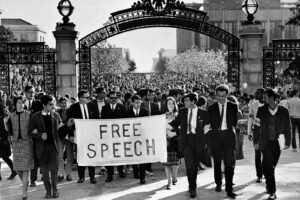
  • The Student Uprising That Ushered In the Radical Sixties: The Berkeley Free Speech Movement

    The Student Uprising That Ushered In the Radical Sixties: The Berkeley Free Speech Movement

    Book Review: Hal Draper, Berkeley, The New Student Revolt. Haymarket, 2020.

    Thomas Harrison

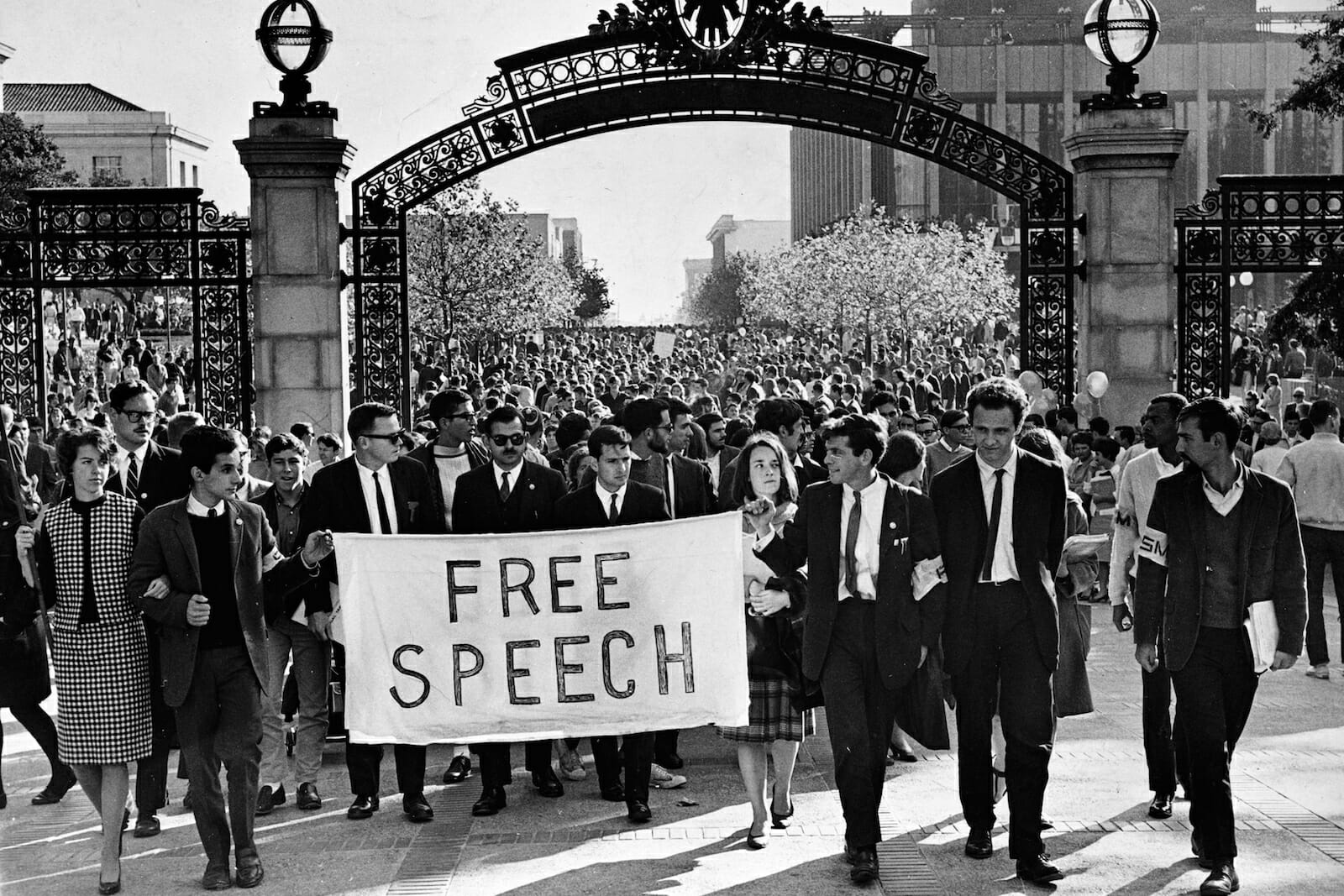
    The current mass upheaval has reached a scale not seen in this country since the 1960s. So it is timely that Haymarket Books has republished an account of one of the key revolts in that fabled decade – the 1964 Free Speech Movement (FSM) at the University of California at Berkeley. Originally issued by Grove Press in 1965 and published in a second edition in 2010 by the Center for Socialist History, Hal Draper’s book remains the most vivid narrative and incisive analysis of the FSM that I know. A Marxist scholar of immense learning and a veteran of the revolutionary socialist movement, he was also a deeply involved participant in the FSM itself. Indeed, Draper’s influence led UC President Clark Kerr to call him, hyperbolically, “the chief guru of the FSM.” Berkeley, The New Student Revolt recommends itself to all those interested in the history of protest and the left in this country, but especially, I think, to the young radicals and socialists who are today immersed in the great multiracial movement against racism and police violence and for fundamental social change.

    Draper became a Trotskyist in the 30s. He was part of the tendency led by Max Shachtman that split from the Trotskyists in 1940 in a dispute over the nature of the Soviet Union and formed the Workers Party. The group, which changed its name to the Independent Socialist League (ISL) in 1949, stood for what it called the Third Camp, in opposition to both capitalism and the “bureaucratic collectivism” of the Soviet Bloc and Communist China. For most of its history, Hal Draper edited, and contributed frequently to, the group’s weekly newspaper, Labor Action. Shachtman began to move away from revolutionary politics in the 50s, and in 1958 the ISL dissolved, its members entering the Socialist Party. Draper, however, was one of those, like the founding editors of New Politics, Julius and Phyllis Jacobson, who stuck to their principles, and he remained an outspoken revolutionary socialist. By the time the FSM erupted, he had settled in  Berkeley and was working in microfilm acquisitions at the UC library.

    I entered Berkeley only two years after the FSM, and I knew many of the participants, including Hal. In the 60s, attending UC Berkeley was itself a liberating experience. It was tuition-free to state residents, although there were “incidental fees” of $120 per semester, a bit less than $1,000 in today’s dollars. When I was enrolled in 1966-70, even with no financial assistance from my parents, I could, without too much difficulty, afford fees and living expenses thanks to a small scholarship, federally-subsidized National Defense loans and 15-hours-a-week Work-Study jobs, plus full-time work in the summers. Most students lived in apartments and houses, not dormitories, so they enjoyed a considerable amount of personal freedom.

    In Sproul Plaza, a broad square in front of the administration building, Sproul Hall, there were long rows of folding tables at which members of political (mostly leftwing) groups distributed leaflets, sold literature, buttons and bumper stickers and recruited. Every weekday, the tables were there, and people would hang around for hours talking about politics. And after the tables were taken down, they would move to The Terrace, behind Sproul Plaza, and continue discussing things over coffee for hours more. It was like the Agora in ancient Athens.

    Berkeley, both the university and the community, had been since the early 60s a magnet for left-leaning, bohemian young people. On Telegraph Avenue, just to the south of the campus, they could be seen patronizing the outstanding bookstores (Moe’s for used books, Cody’s for new) and coffee shops (especially the Mediterraneum—the “Med” – which claimed, dubiously, to have introduced café lattes to these shores). Both campus and community constituted a unique political and cultural world. To attend the three art-house cinemas – for which Pauline Kael wrote the program notes — was to receive a complete education in film history. Everybody, it seemed, listened to KPFA, the local listener-supported radio station founded by pacifists right after World War II, the flagship of the Pacifica network. KPFA featured jazz and classical music, poetry, political commentary (Hal Draper, along with his wife Anne Draper, had a monthly program throughout the 60s), and thorough on-the-ground reporting of protests and demonstrations on and off campus.

    The 50s had been, notoriously, a period of repression and conformism, of the “silent generation” of youth. In 1960, the sociologist Daniel Bell proclaimed in The End of Ideology: On the Exhaustion of Political Ideas in the Fifties that radicalism had petered out for good. In the United States, “the fundamental political problems have been solved,” he announced. Along with other theorists of “pluralism” — David Truman, Robert Dahl, William Kornhauser, Edward Shils – Bell redefined democracy as competition among the elite leaders of “groups,” for the passive support of the masses; as long as no one group acquired overweening power, freedom was safe. Freedom for the masses, moreover, was defined mainly in terms of consumer choice and leisure time, rather than political power. The responsibility of managing and maintaining social cohesion was the job of administrators, bureaucrats. As Mario Savio, the FSM’s foremost leader, put it: “The conception that bureaucrats have is that history has in fact come to an end. No events can occur now that the Second World War is over which can change American society substantially. We proceed by standard procedures as we are.”[1]

    The experience of Communism and Fascism, and especially McCarthyism – and, in many of their cases, disillusionment with the hopes of their own radical youth – instilled in the pluralists a deep fear of mass movements. They argued that the scale and complexity of “industrial society” made most Americans incapable of using “substantive reason” to grasp large-scale political issues; democracy in the traditional sense – self-government by ordinary informed citizens – was impossible. It was also undesirable. Mass movements were essentially passé, but should they nevertheless arise, they would produce totalitarianism. This was the school of thought that dominated university social science departments.

    In the very year in which Bell’s book had come out, however, the tide began to turn. In the late 50s, mass protest had already appeared in the South, most notably with the Montgomery Bus Boycott. Then in 1960 the Civil Rights Movement reached a new stage with the lunch counter sit-in by black students in Greensboro, NC. Following in rapid succession came the Freedom Rides, the Albany Movement, the Birmingham Campaign, and the March on Washington. Protest was becoming the order of the day, and it was spreading north.

    Already in those pre-1964 years, UC Berkeley had a small but vibrant culture of leftist politics. Several socialist clubs busily recruited students and played an especially important role in the Civil Rights Movement. A series of off-campus actions initiated by Berkeley-based socialists and other radicals planted the seeds of the FSM. In May 1960, hundreds of students went to San Francisco’s City Hall to protest hearings by the House Committee on Un-American Activities (HUAC). Police blasted the demonstrators with fire hoses and violently dragged them down the marble steps. By 1963, more than a half dozen leftist clubs, plus chapters of the Congress of Racial Equality (CORE) and the Student Nonviolent Coordinating Committee (SNCC), were active at UC. Indeed, it was from the ranks of civil rights activists that most of the FSM’s leading cadre came.

    Civil rights actions reached a crescendo in 1963-64. With Berkeley’s Campus CORE taking the lead, the movement focused on employment discrimination. Blacks were mostly barred from jobs in stores, supermarkets, banks, car dealerships – businesses where they would be dealing with white customers. So CORE launched a wave of militant protests: picketing merchants first in Berkeley and then farther afield, culminating in a mass picket in November 1963 of Mel’s Drive-In restaurants in the East Bay and San Francisco. There were sit-ins in the lobby of San Francisco’s Sheraton Palace Hotel and in the showrooms of Auto Row on Van Ness Avenue. Hundreds were arrested, including many Berkeley students. In September 1964 large numbers of Berkeley students went to picket the offices of the Oakland Tribune, a newspaper owned by William Knowland, a power in the California Republican Party and at that moment the state campaign manager for Barry Goldwater.[2]

    The president of the seven-campus University of California system was Clark Kerr. Kerr had a reputation as a pro-labor liberal. In his youth he had belonged to the social-democratic Student League for Industrial Democracy, much later the parent organization of Students for a Democratic Society (SDS). Kerr was named Berkeley’s first chancellor when that position was created in 1952. Three years earlier, the Regents had voted to require all UC employees to sign an oath swearing they did not belong to any group advocating violent revolution. Kerr signed the oath himself, but as chancellor he defended professors who refused to sign on principle. Then upon becoming president of the entire university system in 1957, he lifted a ban on Communist speakers. At the same time, though, he replaced the ban with a series of petty, harassing restrictions on outside speakers, including requiring the presence of tenured faculty members and a campus police officer, for which clubs had to pay but were not allowed to collect money for that purpose.

    Responding to pressure from Knowland and other members of the Bay Area establishment, the Berkeley administration moved to clamp down on campus organizing and advocacy – including raising money to support civil rights work in the South. In order not to be seen as anti-civil rights, however, Kerr and Berkeley’s chancellor, Edward Strong, imposed a ban on all campus-based political activity; there could be no “mounting of social and political action directed at the surrounding community,” only “informative” activity. (This was later amended to permit advocacy of candidates and propositions on the ballot.) In response, a United Front of 20 student organizations was formed, covering the political spectrum from revolutionary socialists and pro-Moscow Communists (the CP-controlled Du Bois Club) to the Young Republicans.

    In defiance of the ban, tables were set up in Sproul Plaza (previously tables had been permitted on a small strip of sidewalk at one of the campus entrances). When eight students were summoned to the Dean’s office for citations, hundreds went with them, declaring that they too had violated the rules. Draper notes that this technique would be followed throughout the FSM; when the administration tried to pick off a few leaders, supporters would show up en masse.

    Chancellor Strong announced that a penalty of “indefinite suspension” was being considered against the eight. Among them was Mario Savio, a 22-year-old junior and philosophy major who had emerged as the United Front’s chief spokesperson. Savio had recently returned from a stint as a SNCC voter registration worker in Mississippi during the summer. Then on Oct.1, two deans and a campus police officer approached the Campus CORE table, which was occupied by Jack Weinberg, a former grad student in mathematics who had dropped out to be a CORE organizer. As a non-student, Weinberg was ordered to remove the table and himself from campus, and when he refused, he was arrested, a police car was summoned, and Weinberg was dragged into it. Within minutes, an impromptu sit-in by hundreds of students surrounded the car. For the next 32 hours, the police with their captive were unable to move. The police car’s roof became a makeshift speakers’ platform as first Savio and then others climbed up (after politely removing their shoes) and delivered speeches. Among the speakers were faculty members who would become harsh critics of the FSM. Sociologist Seymour Martin Lipset declared that the police car blockade was anti-democratic and immoral and told the students that, by assuming the right to break any law they didn’t like, they were acting “like the Ku Klux Klan.” Civil disobedience, he maintained, was impermissible in a “democracy” — ignoring the fact that UC was anything but a democracy.

    While the sit-in was underway, a group of faculty persuaded Kerr to negotiate. An agreement was reached on Oct. 2 under which the United Front agreed to accept the decisions of a committee of administrators, faculty, and students, and the sit-in ended. Meanwhile, Kerr was under pressure to take a harder line, including from California’s Democratic governor Edmund “Pat” Brown (also known as a “liberal”), who could not understand why a massive police intervention had not been unleashed on Oct. 2.

    A week later, representatives of the United Front met and constituted the Free Speech Movement. The operations of the FSM, Draper explains, were a kind of “spontaneously ordered chaos.” “Things were accomplished because hundreds of students threw themselves into the work spontaneously and somehow did it in clots of organization, with a furious amount of talk but also with overweening energy and will. Anyone could become a ‘leader,’ and the process was very simple and very visible: you led, and if you seemed to be doing any good, others followed you with a will.” This was true for Mario Savio. Draper observes that while Savio was  “[n]ot a glib orator, retaining remnants of a stutter, rather tending to a certain shyness, he yet projected forcefulness and decision in action.”

    An important component of the FSM was the newly-formed Independent Socialist Club (ISC). Hal Draper was a founding member, along with a few other veterans of the ISL, but most were younger people who had been in the left wing of the Young People’s Socialist League (YPSL) and identified with the Workers Party-ISL tradition.  Although the ISC was never large, its leaflets and forums influenced a significant part of the campus; in the fall of 1964, and through the rest of the decade, a great many students looked to it for explanations and a Marxist political education. Within the FSM and the teaching assistants’ union, the ISC was the leading advocate of the strike tactic, as a way of involving broader layers in the movement, beyond those who were willing to take the risks of sit-ins, building occupations, and other illegal activities. Jack Weinberg and Mario Savio attended the ISC’s founding meeting. Savio never actually joined, but his speeches show the strong influence of a talk Draper gave at the ISC’s first public meeting on “Clark Kerr’s Vision of the University”; it was issued as an ISC pamphlet, “The Mind of Clark Kerr,” right after the police car blockade and is reprinted in this volume.

    Draper’s talk interpreted a series of lectures Kerr had delivered at Harvard in the previous year entitled “The Uses of the University,” as well as a book he had co-authored earlier,     Industrialism and Industrial Man: The Problem of Labor and Management in Economic Growth. In his lectures, Kerr coined the term “multiversity” to characterize the new form assumed by American universities in the postwar period, integrated with political, economic, and military power. The degeneration of higher education – the subordination of universities to business and government, the privileging of research over teaching, the big business of grantsmanship, vocationalization, etc. – was not explicitly celebrated by Kerr, but rather presented as inevitable.

    The multiversity comes to resemble any business that creates a product – in its case, knowledge. The knowledge factory’s staff, the professoriate, increasingly resemble entrepreneurs, especially in the social and natural sciences. The university president is no longer an old-fashioned autocrat, but “the Captain of a Benevolent Bureaucracy.” Behind all this was Kerr’s vision of a Brave New World (he uses this term), resulting from the convergence of an increasingly bureaucratic capitalism with a liberalized form of Communism, which he calls simply “Industrialism,” an administrative state of managers (benevolent, naturally) ruling over the docile, cooperative masses. With all the major social and economic problems solved, there will be no protest, except for insignificant outbursts provoked by “malcontents” among the intellectuals. Intellectuals, Kerr says, “are a particularly volatile element . . . by nature irresponsible, in the sense that they have no continuing commitment to any single institution or philosophical outlook and they are not fully answerable for consequences.” But they can be “a tool as well as a danger” if used effectively by the managers.

    While the FSM declared a moratorium on direct action, negotiations dragged on for weeks. Finally, on Nov. 9, the FSM, explaining that “we’ve been shuffled back and forth through the maze of the university’s bureaucracy” with no result, announced that it would once again start “exercising its constitutional rights.” This decision in favor of a return to civil disobedience was opposed by the moderates on the executive committee – mostly representatives of the Young Democrats, Young Republicans, and YPSL. Tables reappeared on Sproul Plaza, but the movement had clearly lost a good deal of its support and dynamism. Over the Thanksgiving break, however, an administration blunder managed to effect a complete turnaround. The FSM received news that Savio and three others were up for expulsion.

    At a massive noon rally on Dec. 2, Savio delivered his famous speech summoning the crowd to occupy Sproul Hall. In words that show the influence of Draper’s “The Mind of Clark Kerr,” he said, “if this is a firm, and if the Board of Regents are the Board of Directors, and if President Kerr in fact is the manager, then . . . the faculty are a bunch of employees and we’re the raw material. But we’re a bunch of raw materials that don’t mean to be . . . made into any product. Don’t mean . . . to end up being bought by some clients of the University. . . . We’re human beings.” Savio then appealed to a personally-based politics of moral commitment: “There’s a time when the operation of the machine becomes so odious, makes you so sick at heart that you can’t take part, you can’t even passively take part. And you’ve got to put your bodies upon the gears and upon the wheels, upon the levers, upon all the apparatus, and you’ve got to make it stop. And you’ve got to indicate to the people who run it, to the people who own it, that unless you’re free the machine will be prevented from working at all.”

    Led by Joan Baez and singing “We Shall Overcome,” 1,000-1,500 entered the administration building. Employees were sent home, and offices were used for classes, food distribution, folk singing, films (Charlie Chaplin, Laurel and Hardy), lectures on civil disobedience, and a Hanukkah service.

    At the urging of Alameda County deputy district attorney Edwin Meese[3] (and behind him, Knowland), Gov. Brown ordered the biggest mass arrest in U.S. history until that time. More than 600 police, highway patrolmen, and sheriff’s deputies converged on Sproul Hall.  Most of the sit-inners, following Civil Rights Movement protocol, went limp. The women were roughly thrown into elevators and taken to the basement for booking. Men, an observer reported, “were deliberately hauled down the stairs on their backs and tailbones, arms and wrists were twisted, hair and ears pulled—all to the immense amusement of the Oakland police.” After 12 hours, 800 had been arrested.

    Early that morning, while the arrests were still in process, a general strike of students and faculty began. An emergency faculty meeting was called, attended by 900 professors – twice as many as the usual Faculty Senate attendance. The meeting overwhelmingly adopted a resolution in favor of new, liberalized rules for on-campus political activity, dropping all pending actions against students, prohibiting prosecution of students by the University for off-campus civil disobedience, and prompt release of the arrestees. Support also came from the head of the state Building Services Union, which represented the university’s maintenance workers, the Longshoremen’s Union, and the central labor councils of San Francisco, Alameda, and Contra Costa counties.[4] Among the teaching assistants the strike was 90 percent effective in the humanities and social sciences; unsurprisingly it was weakest in engineering and business administration. By the third, and last, day of the strike it was supported by an estimated 80 percent of the student body, some 15,000 students.

    While the strike was underway, Kerr turned to one of his faculty allies, Robert Scalapino, chair of the political science department. Scalapino organized a meeting of department chairs, who tended to be more sympathetic to the administration than the average faculty member. By invoking the threat of an investigation by the State Legislature, he got the chairs to endorse a “settlement” that included only one concession to the FSM: a promise to drop disciplinary charges by the university, but not to press for withdrawal of the civil charges facing the 800 who had occupied Sproul Hall. Nor did the chairs’ proposal include lifting the restrictions on advocacy.  Meanwhile a dissident caucus of 200 professors put together a resolution for the upcoming Faculty Senate meeting which substantially supported all of the FSM’s demands, notably the removal of any distinction between advocating lawful and unlawful actions. This last demand was totally unacceptable to Kerr, so in an attempt to short-circuit the initiative of the 200, he announced a special convocation of the entire university community, at which the chairs’ decision would be presented

    The meeting, attended by close to 20,000, was held in the Greek Theater, a beautiful open-air amphitheater built into a hillside next to the campus. As befits the setting, a tragic drama ensued – but a tragedy for Kerr, not for the FSM. FSM leaders had asked for Savio to be included among the speakers so he could deliver a response and also announce a Sproul Plaza rally to follow the convocation. They were refused, but they had no intention accepting exclusion. With the department chairs ensconced in throne-like chairs on the stage, Kerr delivered a speech that utilized all his considerable skills to appear reasonable and statesmanlike, but was received with loud jeering.[5] Then, as the program ended, Savio strode to the microphone to make his announcement anyway. Just as he opened his mouth, two campus policemen rushed up; one put his arm around Mario’s throat, the other grabbed him in an arm-lock; he was dragged offstage. The audience was outraged, as were many of the department chairs. So after a few minutes Savio was allowed to return to the microphone, where he briefly announced the rally, concluding “Please leave here. Clear this disastrous scene, and get down to discussing the issues.”

    Draper captures the essence of the Greek Theater episode with a vivid tableau: “One moment, Kerr’s soothing phrases – about ‘the powers of persuasion against the use of force,’ ‘opposition to passion and hate,’ ‘decent means to decent ends’ – were lolling on the breeze; the next minute the armed men of the state had darted out from behind the scenery to show what ‘the powers of persuasion’ concealed and what the ‘passion and hate’ were opposed to. Coming in quick succession like that, the two pictures blurred together; and there was the face of the establishment.” This highly educational drama completely discredited the chairs’ committee and swung vast numbers of hitherto hostile or ambivalent students and especially faculty to the side of the FSM.

    At the subsequent rally, the FSM announced that the strike would end that night, so that the Academic Senate might meet the next day under more tranquil conditions. This conclave, attended by almost 1,000 professors, turned out to be an unqualified triumph for the FSM. The Academic Senate’s respected committee on academic freedom presented a resolution that incorporated virtually all the points advocated by the 200; it was adopted by a landslide vote of 824 to 115.

    Among those who voted against the resolution was a hard core of social scientists, most of them ex-radicals, who had bitterly opposed the FSM from the beginning. Prolific article writers, they produced hostile and influential pieces that were carried by some of the leading liberal journals. The most prominent members were three sociologists, Lipset, Nathan Glazer, and Lewis Feuer, and the political scientist, Paul Seabury. Glazer and Lipset had been socialists in their youth, Feuer a Communist Party fellow traveler. Later, they emerged as prominent neoconservatives. This “ex-left” is seen by Draper as “lashing out in fury at the tragedy of their own pasts. The hatred they unleash against the radical students is a self-hatred in the first place projected against the new generation which (they think) mirrors their sad youth.”

    Feuer was the most vitriolic of the group. In a series of articles in the New Leader, he denounced the FSM as a movement of “forlorn crackpots and rejected revolutionists,” “lumpen beatniks and lumpen agitators” promoting “a mélange of narcotics, sexual perversion, collegiate Castroism and campus Maoism.” Feuer was offended by the “acrid smell of the crowded, sweating, unbathed students.” Laying on a crude psychoanalytic analysis, he claimed protesting students were stuck in “a prolonged adolescence and repetitive reenactment of rebellion against their fathers.”[6] Later, in his 1969 book, The Conflict of Generations: The Character and Significance of Student Movements, Feuer deplored the New Left’s “positive advocacy of promiscuity” and “interracial sexuality.”

    Right after the Christmas break, Chancellor Strong, having lost the confidence of the faculty, resigned. He was replaced as acting chancellor by the much more likeable and conciliatory Martin Meyerson. Regulations on student political activity were significantly loosened; rallies were to be permitted on the Sproul Hall steps with loudspeakers provided by the university, and the ban on fundraising and recruiting at the tables was lifted. Virtually all the goals of the FSM had been won.

    But the FSM as an organized movement did not survive much longer. In March 1965 a young self-described poet, a nonstudent, came into town, stationed himself on the steps of the student union, and held up a sign inscribed with the word “FUCK.” He was arrested, and the next day a handful of students held a rally to protest the arrest and repeat the offending word. Nine were arrested, including one FSM leader, Art Goldberg.[7] Although the bulk of the FSM initially treated the controversy as trivial and a distraction, the press eagerly promoted the story that it had become a “filthy speech movement.” Then, when chancellor Meyerson banned a new campus countercultural literary magazine, Spider,[8] which had made a point of printing the “obscenity” in question, as well as many others, the FSM decided to take up what had become a genuine free speech issue and to defend the language in Spider as a legitimate form of cultural criticism. Very little support came from the student body, however, and the incident led to a serious breach with the liberal faculty, some of whom organized a noon rally of their own to denounce Spider and the FSM.

    In the midst of this contretemps, Kerr, to everyone’s shock, announced his intention to resign. Draper interprets this as a power-play. Kerr had earned the enmity of the hardline faction on the Board of Regents by “capitulating” to the FSM and refusing to expel the “filthy speech” students, thereby restoring some of his liberal luster. Knowing that his move would therefore generate a surge in support among the campus community as well as the more moderate Regents, Kerr expected that threatening to resign would put him back in control. Kerr’s coup, Draper argues, together with the obscenity issue and the split with liberal faculty, created so much confusion and demoralization, that the FSM was paralyzed. Then, in April, Mario Savio suddenly announced that he was withdrawing from campus activity. Savio insisted that he was doing this to avoid dominating the movement, but it was widely believed that he was burned out. Soon after, the FSM dissolved.

    The FSM was a major catalyst in the crystallization of a new, broadly based radicalism in the United States. The New Left had been coming together since 1959-60 in the form of organizations such as SDS and publications such as Studies on the Left, but in the Berkeley uprising it acquired for the first time a mass following. The radicalism of the FSM consisted not in its explicit program as much as its methods. Its goals, after all, were essentially liberal: freedom for speech and political organizing. But the FSM used disruption and civil disobedience to force the university to accede to its demands. By so doing, Draper argues, the FSM in effect rejected “permeation” in favor of “left opposition.”  “The former seeks to adapt to the ruling powers and infiltrate their centers of influence with the aim of . . . becoming part of the Establishment” and moving it to the left. “The latter wish to stand outside the Establishment as an open opposition, achieving even short-term changes by the pressure of a bold alternative, while seeking roads to fundamental transformations.” Even within the FSM, there was a divide between moderates and militants, with the former inclined to adapt to the administration’s intransigence and constantly working for a deal with Kerr, while the latter planned and prepared the mass of students for civil disobedience and strikes.

    “Permeation” versus “left opposition” – not peaceful methods versus violence, barricades, and so on — was and is the real essence of the distinction between reformist and revolutionary politics. In 1964-65 Draper had in mind as the leading permeationists on the left the proponents of “coalitionism” as a strategy for winning influence in the Democratic Party and the Johnson administration – Shachtman (by now a rightwing, pro-imperialist social-democrat), Bayard Rustin, Michael Harrington, Irving Howe. The coalitionists had called for a moratorium on militant civil rights actions during the summer and fall of 1964, in order to prevent a “white backlash” that would help the Republicans in the election. As the U.S. war on Vietnam escalated, they stood for critical support to Johnson’s deterrence policy, calling for negotiations rather than immediate withdrawal, a position that granted Washington the right to intervene in the first place, and would have allowed the war to continue until talks concluded (Shachtman actually became fully pro-war). Howe was initially friendly to the FSM, but as the New Left began emerging, he took to attacking it as a movement dominated by “kamikaze radicals and desperados.”[9] The FSM, Draper believed, exhibited the potential for the new radicals to resist cooptation by what Harrington called the “left wing of the possible” – that is, the left wing of the establishment.

    The issue of tactics and their political implications was at the core of a debate on Jan. 9 between Draper and Nathan Glazer, organized by the ISC.[10] Draper argued that a radical leadership and strategy were essential to the FSM’s success. Glazer responded by insisting that the use of disruption and force to bring about change is never justified in a “functioning democracy” – or in a university, which, while not a democracy, was led, at Berkeley, by liberal, rational men. Draper acknowledged that Kerr “is not the villain of the piece – he is the man in the middle, who is accomplishing the hatchet work of the Right now, because they are pressing him. . . . Therefore, the answer is: let us press him in the opposite direction. Let us fight as militantly, as forcefully, with as much energy and determination, to put pressure on the man-in-the-middle by our means and for our ends as the Right is doing.”

    Draper noted the new radicals’ “conscious avoidance of any radical ideology” – that is, a coherent, systematic, and democratic alternative to liberalism. New Leftists “are inclined to substitute a moral approach . . . for political analysis as much as possible.” Still, by “training and inspiring new cadres of idealistic youth with social goals so imbued with a new moral vision as to raise basic questions over the established order of society,” the New Left gave birth to one of the greatest oppositional movements in American history, the mass movement against the Vietnam War. This movement began to take shape in the winter and spring of 1965 with a national series of teach-ins on college campuses. The first took place in Ann Arbor, but Berkeley’s was by far the largest, with an attendance of 30,000. The Vietnam Day Committee organized efforts to block the troop trains that passed through the East Bay carrying soldiers to the ships bound for Vietnam. And soon came the immense antiwar marches throughout the country. FSM represented the first time radicals had led a large-scale challenge not to Southern racists or Northern reactionaries, like HUAC, but to liberals like Kerr and Brown. The New Left and the antiwar movement went on to confront Johnson, Humphrey, and the liberal Democratic Party establishment, which carried out the bloody aggression against Vietnam.

    And, of course, the FSM triggered a phenomenal global wave of student radicalism. During the second half of the sixties, student revolts broke out in Berlin, Paris, Prague, Milan, Turin, London, Madrid, Warsaw, Tokyo, Mexico City, as well as dozens of American universities. In Berkeley there were huge mobilizations around Stop the Draft Week at the Oakland Induction Center, in support of a Black Studies Department on campus, demanding the release of imprisoned Black Panther Party leader Huey Newton, in defense of People’s Park (during which Gov. Reagan ordered in the National Guard, which fired on the protestors with buckshot-filled guns, killing a bystander), and other causes. During my four years as a student, a strike or a mass civil disobedience event seemed to break out almost every semester. My first tear gassing occurred at a big street demonstration in solidarity with French students in May 1968.

    Such was the legacy of the FSM in the 60s.

    Until his death in 1990, Hal Draper continued to write prolifically on matters of Marxist theory, history, and contemporary political events. Many of his essays, some dating back to the 30s, and transcripts of his KPFA radio talks can be found in the Marxists Internet Archive (www. marxists.org). Before the FSM, Draper had written a groundbreaking essay, “The Two Souls of Socialism,” first published in the socialist student magazine, Anvil, in 1960, then in revised form in New Politics in 1966, which introduced the concepts of “socialism from above” and “socialism from below.” He later went on to write the five-volume Karl Marx’s Theory of Revolution, a brilliant and comprehensive treatment of Marx’s ideas and political activity. Draper also edited The Complete Poems of Heinrich Heine, the nineteenth century German poet, for which he provided new translations.

    For much of the period since about 1970, Berkeley, like most American universities, has been relatively quiescent politically. The campus has an FSM Café and the Mario Savio Steps, marked by a bronze plaque. Today, most people look back on the 60s with a nostalgia that has more to do with the counterculture than with radical politics. Nonetheless, it is worth remembering the last time before now that radicalism was a mass phenomenon.

    What can the contemporary left learn from the FSM experience?

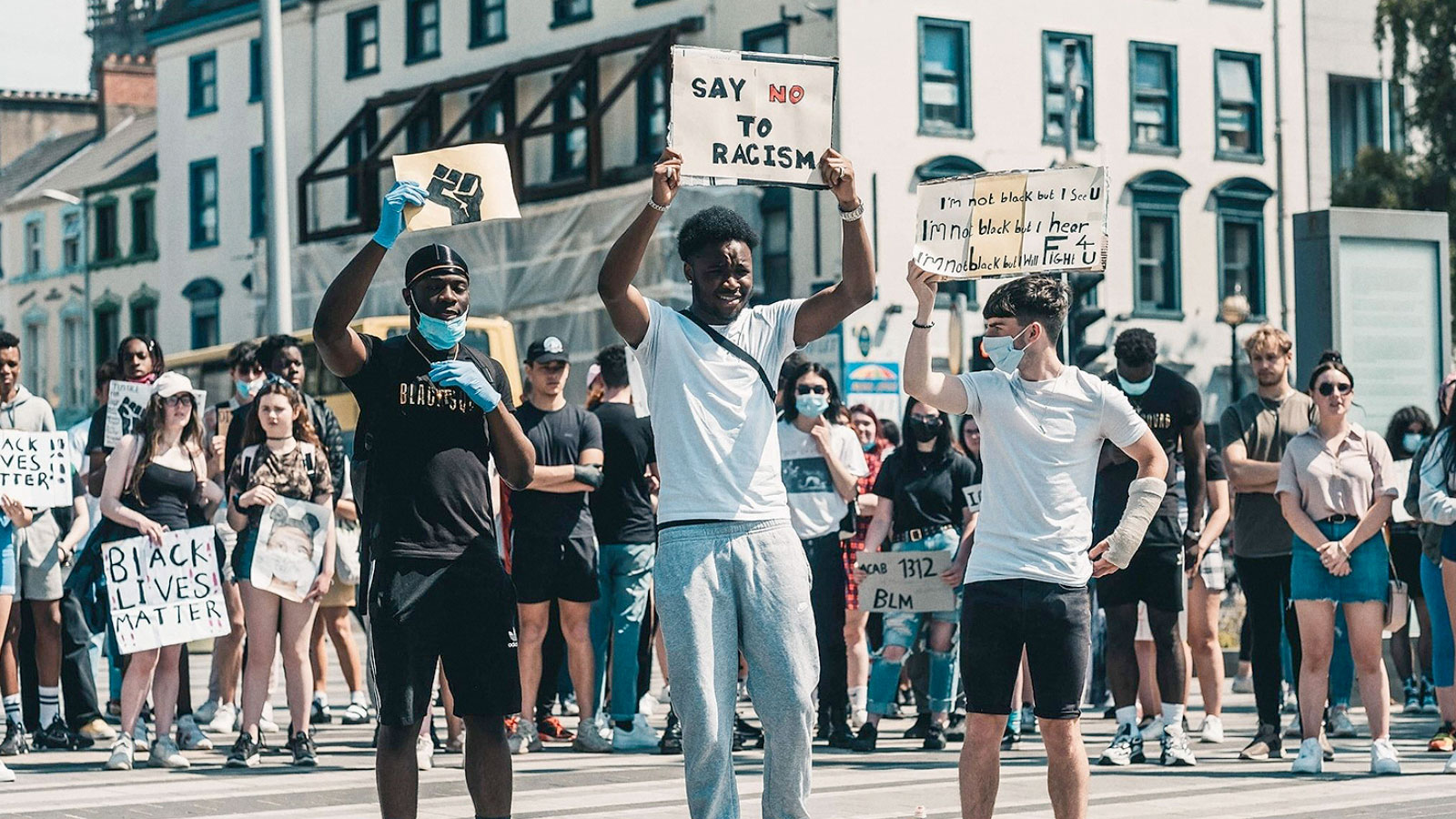
    There is a negative lesson, something to be avoided. The FSM, like the Berkeley student body in 1964, was overwhelmingly white. The New Left too was anything but racially diverse, despite its roots in the Civil Rights Movement and the alliances it formed with black, Latino, and Native-American radical groups – such as the Panthers, Brown Berets, Young Lords, and American Indian Movement — in the late 60s. While this problem does continue to afflict socialist organizations such as DSA, in the era of Black Lives Matter a multiracial mass movement has emerged that is unlike anything seen in the 60s.

    On the positive side, the FSM is a classic example of radicals successfully winning much larger numbers of political moderates and liberals to their cause through education, honesty, patient persuasion, and democratic activity. At every stage of the struggle, the FSM — by which I mean the militant majority on the executive committee – carefully explained and justified its tactics to the movement’s rank and file. At the mass trial of the Sproul Hall arrestees in July 1965, the judge, on the eve of passing sentences, asked the now-convicted defendants to submit statements explaining why they had joined the sit-in. Historian Robert Cohen writes: “Only 6 percent of those who wrote to the judge . . . articulated anything resembling a radical critique of capitalism or the university.”[11] Of course, these statements tell us what the sit-inners recalled they had been thinking seven months earlier; undoubtedly, a great many were radicalized by the arrests themselves and by subsequent events.

    Today’s radicals are once again presented with the choice between permeation and left opposition, to use Draper’s terms. It proved to be the tragedy of the New Left, and a major reason for its decline and political degeneration toward the end of the 60s, that it never succeeded in developing a broad, pro-working class, radical-democratic politics – and, crucially, an independent political party – that could appeal to wider layers of the population. Those who did not succumb to various versions of neo-Stalinism and terrorism, or drop out of politics, were reabsorbed, especially by the McGovern campaign, into Democratic Party liberalism. Now, decades later, however, the mass uprising against the police and systemic racism, urgent demands for Medicare for All and a Green New Deal all point to the potential for independent political action. The grave danger is that this potential will remain unrealized, as radicals in the Progressive Democrats and Our Revolution, and much of the DSA, pursue the fantasy of transforming the Democratic Party. This is the permeationism that Draper warned against. Yet, even more than in the 60s, the U.S. left today faces the possibility of a major breakthrough. Will it limit itself to forming a powerless left-wing fringe of a party that is overwhelmingly controlled by capitalists and their political servants, or will it constitute itself as a clear left opposition? That is the question.

    [1] “An End to History,” included in this volume.

    [2] A former Senator, Knowland’s relentless support for Chiang Kai-shek made him known as the “Senator from Formosa” (Taiwan). His rigidly rightwing politics led even President Eisenhower to confide in his diary: “In his case, there seems to be no final answer to the question, ‘How stupid can you get?’”

    [3] Meese later became Ronald Reagan’s closest advisor during both Reagan’s governorship of California and his presidency. Meese was implicated in the Iran-Contra affair and several other scandals in the 1980s.

    [4] This support from labor, though important, should not be mistaken for support from rank-and-file workers, most of whom probably remained skeptical, or hostile, towards campus protests throughout the decade – even though it is known that antiwar sentiment was actually more widespread among workers than in other groups.

    [5] Decades later Kerr revealed his belief that the jeering was an organized plot, coordinated by walkie-talkies.

    [6] Revealingly, Michael Harrington, in his autobiography, Fragments of the Century, defended Feuer as a man who “looked at political questions with the scrupulousness of a moralist,” and thus “discovered that he could not go along with some of the more extreme demands” (which of the FSM’s demands did Harrington consider “extreme,” one wonders?). “Then, in a rather typical and miserable fashion, the students began to berate him as a sellout, an agent of the administration.” Harrington saw in the persecution of poor Feuer an “important trend in the New Left, the beginning of the game of more-militant-than-thou which was to last for four years and drive some people to the ultimate proof of their ‘radicalism’ – armed terror.”

    [7] A moderate within FSM, Goldberg was also an ardent admirer of Communist China, earning him the sobriquet “Marshmallow Maoist.”

    [8] The title was an acronym for sex, politics, international Communism, drugs, extremism and rock n’ roll.

    [9] For a devastating takedown of one of Howe’s anti-New Left diatribes, see Draper’s “In Defense of the New Radicals,” New Politics, Summer 1965.

    [10] An ISC leader, Joanne Landy, later recalled that when she invited Glazer, who was well aware of Draper’s debating skills, to participate, he said, “’Joanne, I’m not suicidal. I’m not going to do this.’ . . . Eventually he said, ‘OK, but I’m going to regret this for the rest of my life.’ The debate finally happened, and of course he got slaughtered.” Kent Worcester, “The Third Camp in Theory and Practice: An Interview with Joanne Landy and Thomas Harrison,” Left History, Vol 21, No. 2, Fall/Winter 2017/18. https://newpol.org/third-camp-theory-and-practice-interview-joanne-landy-and-thomas-harrison.

    The text of the debate was published in New Politics, Winter 1965, “The FSM: Freedom Fighters or Misguided Rebels?”

    [11] Robert Cohen and Reginald E. Zelnik, eds, The Free Speech Movement: Reflections on Berkeley in the 1960s. Berkeley 2002.


  • Comrades and allies: An interview with Donna Murch

    Comrades and allies: An interview with Donna Murch

    Donna Murch talked with Sherry Wolf, author of Sexuality and Socialism, in July 2020, in the midst of the uprising against the police murder of George Floyd.

    Sherry Wolf: As a historian of the Black Panther Party (BPP) and a radical Black scholar and union militant, how do you characterize the current uprising?

    Donna Murch: I think that the urban rebellions we’re seeing are very important and very different from the 1960s. To compare and contrast, this period is really an extension of what we saw in 2009 starting with the killing of Oscar Grant by Johannes Mehserle in Oakland at the Fruitvale Station, through to the election of Trump. Non-stop movement organizing. This earlier period was the genesis for the political network, Black Lives Matter, always an umbrella for different grassroots organizing going on in different parts of the country. Some of the organizing in Florida that became visible in 2012 with the murder of Trayvon Martin came out of an earlier case of a young Black man who was literally exercised to death at one of these publicly-funded carceral boot camps in 2006. A lot of the Black students in Black colleges, HBCUs in Florida, organized around it. So we really have had continuous organizing, especially in the 21st century. What I see happening right now is the product of continuous movement.

    I think the election of Trump disoriented everyone, and it shifted the national focus from structural racism, state violence, and the Movement for Black Lives to Trump and his base, white supremacy, and right-wing ideology. I’m quite pleased by these urban rebellions. They are large and their geographic spread and their duration is remarkable. It’s still happening. I was just reading that a major highway was blocked in Philadelphia, for example. They’re very decentralized and all sorts of protests have been going on all over the country for over six weeks. So, in size and scope they’re larger than the urban rebellions of the 60s. I think it’s going to take us a while to figure out exactly what they mean.

    SW: What do you make of the large numbers of white and other non-Black people participating in these protests?

    DM: In the 1960s, the American economy was booming—that really matters—and African Americans were largely shut out of that prosperity, so the rebellions were overwhelmingly comprised of Black Americans. Both in 1992 in Los Angeles and today, we’ve seen multiracial protests. Many of the protests I’ve seen have been majority white. That requires a diagnosis about why that’s happening. I can’t say that I know for certain. I think it reflects the success of the kind of organizing we’ve seen over the last decade: that in some ways the vision for the society we want is a society that puts Black life at the center. And even though it’s focused on police killings, I see the uprising as a response to the escalation of state violence over the last 50 years and the birth of mass incarceration. The disproportionate criminalization of African Americans is not new. It goes back to the origins of the republic and before, but the sheer size and scale of the state apparatus really took off in the mid-1970s. I think that’s another important thing about this movement. It is focused on individual police killings, but it’s connected to prison abolition. There’s a larger pushback against institutionalized state violence.

    One of the things that’s complicated about these protests is that they’re happening while Trump is president. It also helps to explain the scale and the large white turnout. Trump is so explicitly and violently racist, he’s repudiated decades and decades of color-blind ideology, and his presidency comes in the context of this right-wing authoritarian surge in many parts of the world. So I think these protests are genuinely anti-racist, but they’re also protests against a cartoon villain. I think if Joe Biden were in the White House now, I don’t know if we’d see the same scale of protest. I’d like to hope that we would. There are different dynamics in different cities, but I think part of the multiracial nature of the protests has to do with the anger at Trump.

    We’ll see what happens when we have a Democrat in the White House. I think it’s very likely Joe Biden will be elected, but he’s about the worst possible candidate we could ever imagine for this moment—the Law-and-Order Democrat, closest to the Clinton administration, the advocate and co-sponsor of the crime bill. So I’m hopeful about ongoing mobilization, but I’m also cautious.

    Solidarity and allies

    SW: Over the last few years the dominant concept of white solidarity with people of color, Black people in particular, has been informed by the idea of allyship. Allyship includes some practices that are positive for white leftists—listening more, making space for others, centering Black people—in the leadership of movements and struggles and unions. But it’s a limited framework in which to organize. How do you view allyship?

    DM: One of the problems in the United States is that we still haven’t had a proper excavation of the post-World War II social movements. I’m part of a generation of historians who wrote the history of the Back Panther Party, Black Power, and Black radicalism, which is really a vibrant field of the university. Less has been written about white social movements. Susan Reverby’s recent book on Alan Berkman is an important exception. But we really need another accounting of what happened in the 1960s and 70s.

    One thing I’m really struck by is how a lot of the new socialist organizations hate the 1960s. Often they’ll jump back to earlier periods, what I call “Jack London socialism.” They go back to the World War I-era and the 1930s, but there’s a real discomfort with the kinds of protest of the New Left. I find that unfortunate because I think there were many wonderful things in the 1960s and 1970s that are extremely relevant today.

    One of the most important was the global anti-imperialist character of the Left. In a country as inward-looking as the United States, people were really focused on what was happening in Cuba and China, in Vietnam and West Africa, and especially in Congo. There was a deep and profound internationalism that was looking toward state socialism and anti-colonial struggle, much of it in the Global South. I think that for a younger generation of socialists – especially coming out of the democratic socialist tendency – there’s a tendency to skip over the anti-colonial struggles of the Cold War back to an earlier U.S. or European early twentieth-century socialism. We know that racism was a problem in those movements. To ask why that was happening I think goes back to the racism of American life that certain socialist movements were not, and are not, independent of. I think this skipping over is happening because we haven’t spent enough time valorizing the struggles of the 1960s and 70s.

    Donald Freed, a brilliant writer who was snitch-jacketed by the FBI, but who was an important white collaborator of the BPP, wrote a piece in the Black Panther newspaper called “Thoughts on White Suicide.” He was trying to explain why a segment of white people, especially among young people, identified so strongly with the Black movement. His argument was that it started with the assassination of Kennedy and the Vietnam War, and that there was a kind of disillusionment and breaking open of what life is. Essentially, it was this moment of lost ideals and displacement of identity. White students saw their own identity, their whiteness, dissolve, so he called this “white suicide.” To some extent, it’s the way that I think of it today.

    This failure to deal properly with the history of the 1960s—the militancy of that era, and the central role that African Americans, Latinx people, and struggles in the Global South played in reconceptualizing the Left—has led some to accept the right-wing account of the 60s. People like Daniel Bell at Columbia argued that these were white, upper-middle-class kids who were slumming. He called it adventurism, which I think is quite unfair. The truth is, if you look at a lot of the 60s social movements, certainly at a place like Berkeley, they tended to be led—like the Black movement—by more working-class kids who’d gotten access to the university. Mario Savio is an excellent example of this. People like Bell argued that this was almost like the lost generation of World War I. He says these were kids seeking a form of escapism, and I don’t think that’s true. I think the 60s are exciting because it was a fault line in the Cold War. The war came home and the level of fury against violence abroad was real. If there’s any usable past we have, this is especially important to us now. War has become so naturalized[,] and because of the difficulty in trying to fight U.S. foreign policy inside the country since the second Iraq War in 2003, the antiwar movement inside the U.S. has really fractured and it’s very difficult to use it as a means of mobilization. There’s been a focus instead on domestic issues of social democracy.

    So the current framing for U.S. racial politics is a result of not mining this social history. I would love to see people critically revisit not only the history of the SDS [Students for a Democratic Society], but the National Committee to Combat Fascism—a Panther ally group—the Peace and Freedom Party, the whole anti-imperialist Left. I’m concerned that this history is not being transmitted. It’s actually hard to get a job at a university doing scholarship on the white, or even multiracial, Left. I suspect that’s a reason why this has happened[,] and I’m concerned that the Right has in some ways won the culture war about how to understand the 1960s. The Black Left has reclaimed the Panthers, and today you can write and talk about things you just couldn’t 30 years ago. The country has shifted on that point, but there’s still a lot of amnesia about the 1960s and for me it’s a wonderful, important, and generative period that needs to be revisited again and again.

    Core Panther ideology was that they believed in all-Black organization, and they saw that as crucial in order to mobilize the community. But that was not the end-point, that was the starting point. From that all-Black organization, you built coalitions with people based on real-world politics. At the top of that list was fighting the anti-communist war machine, fighting imperialism. And the Panthers had an anti-colonial vision of domestic politics. They saw the violence against Black and Latino communities at home as an extension of the war machine abroad. They didn’t see those as separate theaters of struggle. They saw those as united—the anti-colonial struggles from within and without were united.

    Rather than allyship, the Panthers looked for shared political values. They’d choose their alliances based on a group’s position on the Cold War, imperialism, and domestic inequality. I really like that and think there’s a need to have a shared vision for change. You can have different ways to mobilize. You don’t have to have the “beloved community” of SNCC [Student Non-violent Coordinating Committee], or “Black and white, unite and fight.” Given the ways that racism works in the U.S., people creating organizations that serve the needs of a Black community and forming strong alliances can work. The Panthers were a powerful blending of all-Black organization and united front. I think we really need that united front right now, and to some extent, we’re seeing it in the urban rebellions. Their real task is to turn these exciting mobilizations against police, state violence, and the Confederate past and present into lasting organizational forms.

    Challenges for the Left

    SW: Ordinarily when we talk of a united front, we think of uniting organizations, groups, and parties rooted in communities and workplaces coming together to fight for common demands. Right now, we see mostly unorganized individuals hitting the streets and the organizational question sort of looms out there in the wings, largely unformed, with the largest socialist organization, DSA [Democratic Socialists of America], somewhat paralyzed as an organization by the upheaval. Individuals from DSA surely participate in the protests, but except for the extraordinary efforts of the small Afrosocialist caucus of DSA, they are organizationally absent so far. Some argue it’s a result of their class reductionism and electoral focus, but it also seems to me a reflection of a confusion among their largely white membership about how or whether white radicals should relate to a Black-led rebellion. Newly-developing, white socialists are questioning how to be in solidarity.

    DM: I’ve been sheltering in place and unable to participate directly in most of these protests, but it seems from accounts I’ve read there are many small socialist and anarchist groups involved in them here in Philly, and I suspect elsewhere throughout the country. I don’t think these actions are as spontaneous as they appear since there are these small groupings in lots of places.

    I don’t know a lot about DSA, though it appears to be a largely middle-class, white group. I’m happy to see the growth of socialism, it makes me very excited. But some of the politics playing out in Jacobin and the rude, “dirtbag left” humor of Chapo Trap House is the type of thing that has always damaged the Left. It’s an inability to understand and transcend the centrality of racism to capitalism as well as a failure to really grasp the true history of the United States.

    The United States is not going to be understood by looking at Scandinavia or Germany. The United States is understood by looking at other settler-colonies like Brazil or South Africa, where racial structures have been the core base of their economies. So whether it’s the institutions of racial capitalism or the mobilizations against it, it’s very hard to understand how to fight capitalism in the U.S. if you don’t put Black and Indigenous people at the center.

    There’s always been this longing for social democracy, and an idea that if only we read more about it or knew more about its workings, then we can have it here too. I just don’t think that’s true. It’s a historical misdiagnosis. The U.S. is a settler-colony. It’s only since 1965 that large sections of the country could even vote. I’m very interested in the history of Northern Ireland because the conditions in the occupied North have all these parallels with the United States. They were still using poll taxes in the 1980s and disenfranchising Irish Catholics. The state was also held together through mass incarceration of a political movement. So, there’s this willful misremembering of the history of modern democracy.

    If you want to tell a story about fighting capitalism primarily through the eyes of white workers and white organizations, you’re never going to create a mass movement inside the United States. In the last 50 years, the majority of union households have been voting for the right wing. That matters. What happened in California in 1966, when the majority of union households voted for Ronald Reagan, who wanted California to be a right-to-work state, can’t be explained without race. It’s not like you can strip off race and just talk about class here because a lot of workers didn’t vote in their class interest. It’s not false consciousness. It has to do with that interplay between race and class and other things. White workers also have significantly more wealth (and higher pay and home ownership) than their Black and Brown counterparts, so dismissing the political and economic structures that underwrite white entitlement is mistaken at best. I think we need a really robust anti-racist Socialism/Marxism that integrates questions of sexuality, gender identity, and gender variance. These are the nodes of true radicalism in the U.S.

    Exactly the thing that people talk about as being a weakness in the U.S. is its strength. Because of the nature of our history, you have these strong identity-based movements, and I think bringing them together in the socialist movement is a very powerful thing. And that’s the Left we want to be a part of, whether it’s in our faculty union at Rutgers, or the flight attendants, or the K-12 teachers’ unions that are largely female-led. Of course, the whole Movement for Black Lives is largely queer, female, and non-binary-led. This is part of the United States’ true vibrance. Figuring out how to bring these red threads together can be done through leadership and organizing.

    SW: Alicia Garza, one of Black Lives Matter’s founders, dismisses allyship and posits instead the notion of co-conspiracy. She says, “Co-conspiracy is about what we do in action, not just in language. It is about moving through guilt and shame, and recognizing that we did not create none of this stuff. And so what we are taking responsibility for is the power that we hold to transform our conditions.” I like this ‘cause it moves away from the interpersonal moral language of allyship to the joint responsibility for taking down structures. Do you think it’s possible to build multiracial organization with mutual respect for leadership, ideas, and strategy coming out of this current explosion? Do you think it’s desirable?

    DM: I don’t know. Black people for the most part want to be in Black organizations. It is hard to mobilize Black people in large numbers to participate in majority white organizations. Given the nature of U.S. demographics in which Black people are only 12%, if you’re going to have multiracial organization it can’t just be parity with the population. It has to be high numbers of Black people participating. I do see theoretically the value of multiracial organizations, but the problem is that so many organizations wind up being majority white given the demographics and the entrenched systems of white supremacy. There are some practical organizing problems that make me understand why the Panthers did the kind of work they did.

    Overall, racial structures of power and feeling make it very hard for Black people to enter mostly white spaces, because they often present many problems, at least in my experience, so I don’t know. It’s really hard for Black and white people to organize together because the sense of white entitlement is so strong. This is just real talk. I think it can be done, but only with sustained anti-racist organizing and the active promotion of Black, Brown, and Indigenous leadership.

    SW: Does the goal of an organization alter that dynamic? In a reform group like a union where every worker regardless of their ideas is covered under a contract and the collective goal is to better their situation under capitalism. By contrast, in a revolutionary group, membership is self-selecting and the goal is to upend capitalism. Do you think the revolutionary socialist goal and class composition make a difference to the prospect for multiracial unity?

    DM: That’s a really good question and I think my answer is yes, it makes a difference. It does historically. If you look at the role of the Communist Party, problematic though it was in other ways, the Communist Party was the primary Left organization prior to the 1960s that fought consistently against racism. Everything from demanding an anti-lynching provision to defending the Scottsboro Boys to fighting for Blacks’ right to unionize, it was the Communist Party that was so important to that—both white and Black communists. And I think the Panthers of the 1960s and 1970s are another incredibly important moment. These are radical anti-capitalist projects, so yes I think that’s absolutely true.

    I would like to be able to say that there are other opportunities because the problem with this kind of radical organizing in the U.S. is that the Left is so marginal compared to many of the social democratic countries that DSA, and especially younger new socialist groups, are focused on. So it puts us in sort of a strange quandary because I do think it’s the anti-capitalist Left and the communist Left—revolutionary socialists, depending on your tendency—that have the best racial politics, but they are also the most marginalized from power.

    I would like to say that increasingly, public sector unionism and organizing are important theaters for anti-racist struggle. Here I am especially thinking of contemporary left-led unions like the CTU, UTLA, and Rutgers. We are certainly working towards that in our own union. But I also see the challenges of dealing with white supremacy as an everyday practice: white people’s expectation that they are or should be the center, what they want and how they understand the world, it’s their voice that should speak and be heard. That’s very real. I think you need an active program of trying to figure out how to change this and to raise up other voices in the rank-and-file and leadership.

    We had a diversity counselor come to our union and so much of it descended into a psychological discussion that forced people to talk about themselves with guilt and shame. And I didn’t find that useful because what I think is most needed are ways to decenter white people and their own sense of entitlement. The best way to do that is to develop leadership of color. As Black and other people rise to leadership, the expectation and anger that it creates in largely white organizations is really off the charts. It manifests itself in deeply psychological ways, but I think you have to see non-white leadership and then you have to figure out praxis.

    One of the things that I think is really scary about the Trump era is that I live in a world where no one supports Trump. Right? I live in Philly and work at Rutgers; I’m part of the union and no one I know supports Trump. Nevertheless, what I have witnessed is increasing white entitlement from people who hate Trump. There is a real invigorated sense of white power, and that includes people who consciously oppose Trump and what he stands for. I see that Trump is in some ways larger than just the forms of politics that he espouses. He’s creating and fueling white resentment even among those who hate him. So, I think we’re faced with a real challenge right now.

    I worry sometimes about the way the issues are drawn in these protests. We have such clear villains: police murder and Donald Trump. But there’s an enormous continuum of white supremacy both in structural and economic practice, as well as as a lived experience of entitlement that comes from these long-term political and economic structures of racial dominance. It’s an enormous problem in the U.S. I’m more aware of it now than I’ve ever been.

    A vision for the future

    SW: I’ve been to a few of the protests in New York, like those at or around the City Hall occupation, and it’s been like Occupy Wall Street meets Black Lives Matter meets the pandemic-depression with so many political debates and discussions and a much larger Black and Brown presence than Occupy ever had. Centrally, the questions of leadership and organization come up over and over again. There’s a general desire for Black leadership and more organizing forms. What kind of leadership and organization is needed right now?

    DM: In terms of Black radical leadership, we need people directly involved in organizing. One of the things that’s difficult right now is how to channel massive social unrest into sustained formations. I think we need a leadership that is connected to grassroots struggles of different kinds—coming out of the labor movement, coming out of the fights over immigration, coming out of prison abolition, coming out of organized formations.

    I think we need more political organizing and less celebrity that’s social media-led and academic-led. We need people who are rising up out of social formations, be it unions or protest organizations. I think we’re in such a difficult moment because so much of the Left has been funded through foundations and through private donations. I don’t think we’re gonna move away from the not-for-profit Left. Unfortunately, that is the core of how the Left is organized now. As problematic as the battles can be in the unions, they are really important because they’re connecting to people’s everyday lives. There’s some movement between the problems that people face on a daily basis and a leadership that’s in touch with that, which is very different from the media-led, high-profile celebrity leadership. I think being connected to grassroots struggles is key. A leadership that is also connected to the manner in which the majority of Black people in the United States live. You know, Black people are also fractured by class, and the class divides in the U.S. right now are so strong for all different kinds of groups. Ideally, we need a leadership connected to the struggles that the majority of Black people face.

    Some of the most powerful leadership comes from the people who understand the real structures of disempowerment because they’ve experienced them themselves rather than simply articulating the grievances of others. I think having a Black leadership, just like any leadership, ideally comes from the people themselves.

    Capitalism is in a profound crisis right now. I think there’s a real opportunity for anti-capitalist organizing that I’ve never seen in my lifetime. It’s important that people really spend time and work out what anti-capitalism is and translate that into their organizational praxis and into ways they build a sense of community with one another. We do need a revived anti-war movement; we really need to take on the enormous imperial structures of the United States. We can never have domestic change if we don’t engage with where the majority of the money is being spent by the federal government: its own war machine. So that needs to be reinvigorated. And a real reckoning with what anti-capitalism is. Too often what I’ve observed is that people check that box, anti-capitalist, but without really deeply thinking through what that means.

    I often describe myself as a Cold War Leftist, which means I came of age at the tail end of the Cold War. I was really influenced by it, and my mentors were very much people who were connected to struggles outside the United States, in Grenada, in Cuba, in different parts of the world. So I have a sense that you could have, although imperfect, socialist states succeed. I saw that that could be possible. I knew people from Grenada; I knew people who’d been involved in these struggles outside the U.S., so in that sense it wasn’t a complete abstraction to me. As a result, capitalism and liberal democracy were not inevitable to me. That was really important.

    One of the problems post-1989 is that we see very few alternatives to the hegemony of capitalism we have in the United States. The political party for most people coming of age after 1989 is this archaic structure that is seen as filled with problems. But one of the advantages of the kind of party structure that I always saw, certainly in the Panthers and other Left organizations, is that it created a real force and a way to mobilize both political education and organizational structures. I think we need to return to that question of party-based organization. The Panthers could not have functioned as a not-for-profit. They were party-based with democratic centralism—this also includes domination of the leadership at the expense of the rank-and-file, with problems of real gender violence and gender hierarchy, the domination of Oakland over the rest of the country, so I’m not romanticizing it. There were a lot of problems with the party structure, but I don’t think we should throw out the baby with the bathwater. I think that we do need a form of organization that is largely volunteer, that is not funded from outside, and that figures out how to get things done.

    First published by Tempest.

  • Karl Marx: Promethean Visionary?

    Karl Marx: Promethean Visionary?

    Review of Eric Rahim, A Promethean Vision: The Formation of Karl Marx’s Worldview. Glasgow: Praxis Press, 2020, 122 pages.

    This small book is a very useful account of how Marx came to develop his materialist conception of history. His criticism of Hegel, his discussions with various Young Hegelians, his discovery and critique of political economy, his debt to Adam Smith – a very original and stimulating argument! – and finally, his elaboration of a new worldview are clearly explained. I’m afraid I cannot follow Rahim when he describes Hegel’s thought as “the philosophical expression of capitalism,” but his analysis of Marx’s critique of Hegel’s theory of the state (1843) is quite persuasive.

    Why did Rahim choose as a title “A Promethean Vision”? He doesn’t elaborate on it, but he quotes a well known passage from the foreword of Marx’s dissertation on Democritus and Epicurus (1841): Prometheus is “the most eminent saint and martyr in the philosophical calendar.” Obviously for Marx the mythological hero deserves admiration for daring to confront the Gods, and stealing fire from the Olympus in order to give it to mankind. Rahim also prints a lithograph from the 1840s representing the young Marx, then editor of the Rheinische Zeitung, as a new Prometheus being tormented by the Prussian censor…

    For many years now, ecologists of various tendencies have been criticizing Karl Marx for being a “Promethean” thinker, meaning by this the desire of unlimited human control and domination of nature. Now, this seems to me a serious misunderstanding, for various reasons:

    — The original myth does not present Prometheus as “dominating nature” : he just dares to bring fire to the humans.

    — The word “Promethean” is not defined in any English dictionary as referring to the domination of nature, but means “willing to take risks in order to create new things” (Cambridge Dictionary).

    — By describing “Prometheanism” as responsible for the ecological disasters, some ecologists replace the real culprit, modern capitalist industrial civilization, by a mythological image. The ecological crisis ceases to be a historical phenomenon, related to a specific mode of production, and becomes an immemorial human tendency, since Antiquity.

    — Although Marx speaks in some writings (e.g. The Communist Manifesto) about the “control of nature,” this approach is increasingly abandoned and replaced with the proposal to “control the relation between human societies and nature.”

    I believe therefore that Rahim is justified in speaking about Marx’s “Promethean vision”, in the original meaning of the word.

    My main criticism is that in the second part of the book, he ceases to keep a historical perspective and discusses Marx’s economic and philosophical ideas out of context, moving from The German Ideology (1846) to the 1859 “Introduction” to A Contribution to a Critique of Political Economy (1859) and back again to the early writings. In the first part the book, the movement of Marx’s ideas from his Young Hegelian perspective to a new worldview of an “activist materialism” (“Theses on Feuerbach,” 1845) is well documented. But the historical perspective is sacrificed in the second part to a kind of summary of historical materialism, reducing it to the well-known phrase from 1859: “No social order ever perishes before all productive forces for which there is room in it have developed ….”

    Well, I believe that this determinist argument can be easily abandoned, for two strong reasons:

    — Marx himself gave up this view, for instance when considering the possibility of a transition to socialism in “backward” Russia in his letter to Vera Zasulisch (1881), a text not discussed by Rahim.

    — From the viewpoint of the present ecological crisis, it would be foolish to wait until “all productive forces for which there is room” in capitalism are developed. Another 20 years of “development of productive forces” in the capitalist system, and climate change will become irreversible, with catastrophic consequences for humanity…

    I like very much Rahim’s conclusion: When speaking of the communist future, Marx thought that, as in ancient times, creating maximum wealth would cease to be the aim of society. Wealth itself would no longer be defined, as in bourgeois society, as an accumulation of more and more material goods, but conceived instead as a shared development of the needs, capacities, pleasures, and productive powers of individuals, freely associated.

  • Partisans or Workers? Figures of Belarusian Protest and Their Prospects

    Partisans or Workers? Figures of Belarusian Protest and Their Prospects

    This week’s protests in Belarus have clearly overcome their initial electoral focus and morphed into an expanding dissident movement of the urban middle class and workers. In a recent (August 4) article for Open Democracy platform on the presidential campaign in Belarus, I tried to explain why the opposition candidates from the ruling elite and the “creative class” attracted a record number of supporters, which led to mass demonstrations unseen in this country for decades. I argued that these were the culmination of a protest sentiment simmering in Belarusian society since the economic crisis of 2009, that found expression in 2017 in the form of grassroots populist protests challenging Lukashenka’s degrading populist rhetoric. Before the most recent elections, his main opponent, Sviatlana Tsikhanouskaya, began to articulate an anti-authoritarian populist discourse that appealed to a cross-class alliance of entrepreneurs, young professionals, and workers. In this article I reflect on the questions I asked two weeks ago, about the role of the leadership and the masses in the current protests, the forms of their organization and the reaction of the Belarusian state. My reflections are based on a six-day marathon of digesting shreds of information coming through the fog of censorship, Internet disruptions and propaganda, as well as from communications with my comrades in Belarus. I am also building on my fieldwork experience among Belarusian workers and trade union activists in 2015-2017, which I conducted as a social anthropologist.

    After a nervous election day on August 9, when observers reported numerous irregularities at polling stations, pro-government exit polls gave Lukashenka his traditional 80% of the vote, while his main rival Tsikhanovskaya was awarded almost 7%. This infuriated opposition supporters united under the slogan “I/We are the 97%”, with data drawn from their alternate count suggesting that Tsikhanouskaia got 45%. Both sides started preparing for a confrontation: the center of Minsk was cordoned off, Internet and mobile connections were disrupted, and paddy wagons and riot police appeared on the streets. Both Tsikhanovskaya and Lukashenka asked Belarusians to abide by the law and refrain from violence, although state TV channels accused the protesters of preparing provocations, while opposition Telegram channels called for resistance to the police.

    On election night people took to the streets not for Tsikhanovskaya, but against Lukashenka. The opposition leader was not in sync with her supporters: she did not call for protests, emphasizing instead legal and bureaucratic means of contesting the official outcome of the elections. After having voted, people began gathering in Minsk and other cities, even prior to the announcement of the alternate vote count. The official numbers meant that nothing had supposedly changed since Lukashenka’s first election in 1994, but by this point it was clear to everyone that much had changed indeed.

    Authorised mass gatherings are rare in Belarus, and on that night there definitely wasn’t going to be one. Thousands of people pouring from all corners of Minsk to the fortified city center were confronted with stun grenades, water cannons, and rubber bullets. Several uncoordinated groups attempted to build barricades. This was unprecedented repression for Minsk, accustomed instead to targeted arrests or rapid dispersal of compact crowds rather than to the flashes and explosions reminiscent of a military operation. Serious clashes also took place in many provincial cities and towns, some of which have not seen similar sights since WWII.

    Illustrating the socially diverse nature of the pre-election mobilization, the post-election uprising took on a wide geographic scope from the beginning – with hundreds of people taking to the streets in all regional centers, as well as in many other settlements, often for the first time in a generation. Another early sign: the crowd, which looked impressively large, on the order of hundreds of thousands in Minsk and many thousands in regional centers, moved chaotically around the city, while riot police tried to force people out of public spaces. Police violence, the lack of central ideological and strategic leadership among the protesters, and the decentralized nature of the protests will determine their further development.

    Minsk on the night of August 10 . Source: msvetov/Twitter

    Postmodern partisans?

    It seems that most of the protesters were participating in such events for the first time: analysts call the youth that hit the streets an ‘unbeaten generation.’ There were no visibly compact organized groups ready for serious tactical maneuvers, e.g. the seizure of administrative buildings, a ‘black bloc,’ disarming the police, the building of lasting barricades or tent camps, the use of improvised weapons, etc. This was in great contrast to previous electoral protests in Belarus in 2001, 2006 and 2010, which imitated the established pattern of ‘coloured revolutions’ in Serbia, Georgia and Ukraine. The state, in turn, demonstrated its ability to suppress the crowd by using Western-grade riot-control methods. Although Belarus is often referred to as a repressive state, the familiar ‘Parisian arsenal’ of tear gas canisters, water cannons, rubber bullets, and stun grenades was used here on a mass scale for the first time. Western technologies of violence were complemented by traditional post-Soviet police brutality: beating and detention of random people, torture, humiliation, and sometimes threats of rape in jail, the hunting down of journalists, etc.

    The state did not try to rely on softer methods to prove its legitimacy. State media were instead silent about the discontent of the masses, scattered results in some constituencies indicating Lukashenka’s defeat were ignored, and ritual statements about foreign interference continued. Lukashenka’s rare screen appearances have sparked rumors of his departure to Turkey or of health problems. His reaction to the protests was advice for the participants to “find a job in an amicable way” so that they do not “walk the streets and avenues”: a relapse into his earlier discourses against“social parasitism,” which only added insult to injury for the protestors. The recourse towards police terror became obvious in the ensuing hours and days. After August 10, Minsk plunged into a de facto state of siege: public places were blocked, central metro stations were closed, Internet access was limited (Lukashenka claimed that someone from abroad was responsible for the shutdown), and some companies in the center of the city were closed in the evening. Even though the protesters refused to imitate the Ukrainian ‘Maidan’ with its civil-war-like intensity in the last days of February 2014, the Belarusian state wanted them to believe they were not in Minsk but in Kyiv – attempting to evoke through the thunder and lightning of police weapons the regime’s claims that all protests will inevitably lead to the Ukrainian disaster. Given the lack of substance in the state’s official ideology, violence became its only remaining ideology.

    Demonstrative police brutality. Source: _tomato_hater/Twitter.

    As a result of the security force’s demonstrative violence and the disorientation of the protesters, the mobilization on the streets began to decline, even though the popular wave of discontent was growing. The police quickly learned from the open Telegram channels about the protesters and their movements, but the protesters did not change their strategy (i.e. they did not develop any strategy). None of the opposition leaders joined the crowd or made radical statements. The opposition movement turned out to be on the whole amorphous, without clear leadership at the top and any leaders from below. At the same time, the ruling elite showed no signs of a split, the security apparatus and the bureaucracy generally remained loyal, although there have been signs of hesitation at the lower and regional levels (with several state media journalists and police officers resigning).

    Throughout these five days the protest mobilizations on the streets of Belarusian cities have been as close as one gets to the decentralized, horizontal, leaderless networked resistance that postmodern anarchists envision. The opposition did not take part in the protests to begin with, while the Belarusian authorities escorted Tsikhanovskaya and her team coordinator to Lithuania

    Since Tsikhanovskaya’s husband and some members of her team have been arrested, she is restrained from making any radical statements. In her last video she looked scared and depressed; she said that “no life is worth losing for what is happening now,” and hinted at threats to her children. Not a single opposition leader remained at large or in the country. Tsikhanovskaya’s husband’s Telegram channel, which fuelled the electoral mobilizations before, does not provide clear directions or coordination, and lags behind other anonymous social networks in reporting events.

    There is no central coordination center of the protest, no local centers, no visible leaders on the street, no identifiable political groups. I believe that some already existing political groups are taking part in the protests, but they are not visible as separate ‘tactical units’: they are either disoriented, or deeply disguised, or participating as individuals.

    This is partly out of necessity, since anyone suspected of leading the protests would be immediately detained and any in-person gathering would be quickly dispersed. It is impossible to imagine anything like “Occupy” or Gezi Park in Minsk these days, because the main public places are blocked and controlled by the police. The barricades are short-lived, and there is no question of seizing administrative buildings.

    In part, however, this is a legacy of previous network mobilizations. Nearly two million subscribers, equal to the entire population of the capital, follow Nexta_live, a Telegram channel created two years ago by a Belarusian journalist from Poland. Despite its radical rhetoric, it relies on videos, photos and information provided by subscribers from various places across the country, but without much context. This is also the case for a dozen other protest channels that I’ve followed. The messages are often misleading, contradictory and unverified. It is reasonable to believe that some of these channels are being used by the special security services for instigating provocations and to obtain information about protesters’ plans.

    Many have already compared these protests to the glorious Belarusian partisan tradition of the Second World War. This is, of course, an exaggeration, since the partisans actually had a chain of command and actual strategic and ideological leadership. They could pool resources and concentrate them in a relatively safe space, develop tactical plans and carry them out while waiting for a regular army. Nothing of the sort is happening within this postmodern uprising. Faced with the increasing presence of militia and army units that are using ostentatiously brutal methods, the protesters have carried out some sporadic aggressive actions with firecrackers, sticks, a few Molotov cocktails and the setting up of some rickety barricades. The response has been the same: detentions, beatings, injuries, and one confirmed death.

    However, a decisive turn of events may come with the possible use of more traditional methods. As part of the protest campaign, a general strike was announced for August 11. The potential consequences are clear to anyone who knows about the April 1991 strikes in Belarus, the famous spectacle of a hundred thousand workers in front of the constructivist Government Building on Minsk’s Lenin Square. It was followed by a wave of strikes and mass demonstrations, which lasted a week and involved more than 80 enterprises in Minsk and throughout the country. This demoralized the Communist Party of Belarus and precipitated the collapse of the Soviet Union. But back in 1991 there were cells of anti-government workers’ organizations, which were joined by some official trade unions, as well as the example of successful miners’ strikes in Ukraine, Russia and Kazakhstan. The Communist Party was disoriented by the strife in Moscow, there was an opposition in parliament that claimed to represent workers, police were ordered not to intervene, and some enterprise directors supported their employees. Today the situation is clearly the opposite, so what can we expect?

    Minsk workers in Lenin Square on April 4, 1991. Source:
    Radio Free Europe/Radio Liberty

    Which side are the workers on?

    If you are skeptical about the working class, listen to the head of the Belarusian Mises Center: ”Protest activity will tend to zero until the proletariat joins.” As in the “good old” days, workers now have the most resources to gather peacefully in close quarters, without relying on the now precarious internet and without the fear of being arrested on the street. They are also the only class that can cause material damage to the state and challenge it ideologically. Belarusian industrial workers have an experience of cooperation and coordination, some kind of organizational structure, however bureaucratic, and a habit of formulating clear demands. My fieldwork among Belarusian workers and trade union activists in 2015-2017 taught me to be very careful not to overestimate the potential of organized labor in this country, but if there is a hope to resolve the impasse that the protest has entered in Belarus in a peaceful and progressive way, it can happen only thanks to an organized group of workers who understand, formulate and defend their interests.

    There are already many scattered reports about unrest at some Belarusian state-owned industrial enterprises, including Minsk Automobile Plant, the world’s leading dump truck producer BelAZ and the chemical plant Grodno Azot, which are key to the country’s economy. This is, however, far from a general strike, and I would be cautious as to the prospects of this ever materializing. The Belarusian working class is atomized and individually dependent on the bosses at all levels. There have been no large-scale strikes since the 1990s, trade unions that are not coopted by the state are few in number (only about 9000 members) and lack resources. The spontaneous strikes that happened before were quickly suppressed.

    A political strike is a great idea now, because the state still holds the commanding heights of the economy and employs 45% of the country’s workers. However, we are no longer in 1991, with its complex layering of conflicts within the ruling elite and with the relative autonomy of workers in factories. The current Belarusian labor regulation regime is worse for workers than during the late Soviet period, combining as it does the bureaucratic despotism of the Soviet past with the market despotism of the capitalist present.

    However, I hope and suspect that some form of spontaneous organization is taking place at shopfloor level, as can be seen from the videos and reports of hundreds of workers gathering to put forward their demands to their superiors and insist on their implementation. These demands are: a recounting of the votes, guarantees that those who participated in street protests will not be fired, the release of detainees, the restoration of Internet access; they also amount to an expression of distrust in official trade unions.

    These are ‘political’ demands brought from the streets, but more pressing economic demands can already be seen on the walls of the factories. A quote from a leaflet posted somewhere in a the Minsk Tractor Plant is illustrative:

    The plant is still alive thanks to its workers!

    No lathe knife? Go get it in Zhdanovichy [a village near Minsk, here:a place far away and difficult to get to]. Your boss didn’t give you working clothes? Fuck it, I’ll buy it on the market. Then the boss will ask you to stay after your shift finished because ‘you need to fulfill the plan.’ You get your paycheck and understand that you’ve been screwed. You complain to the trade union, but you already know the answer. You get an industrial injury and you register it as an off-the-job accident because ‘Well, you understand…’.

     Fucking tired of all this, right?

    The best way to influence the bosses is to go on strike. No need to go to the square and bang your helmet against the pavement. Just work to the rules […] Demand that each step of the technological process be performed according to the regulations. This is your right. As much as a decent wage and the fair elections are your rights that have been taken away from you.

    Want to join but afraid of being fired? Remember, no scumbag ideologist will take your spot on the machine.

    Lukashenka’s rule began with a bloody standoff with striking metro workers in 1995, who were ruthlessly dispersed, beaten, and fired. His rule tightened after he managed to split and subjugate the mammoth Federation of Trade Unions, whose chairman challenged him in the 2001 elections.

    The ‘Belarusian model’ was built on fragmenting, disciplining, bribing and depriving the proletariat of its identity. In exchange for being deprived of their class subjectivity, workers were offered job preservation, restrictions on the commercialization of the social sphere, low utility bills and a ritual promise of $500 wages. Borrowing a Gramscian phrase, I call this a Belarusian ‘passive revolution’: an authoritarian path of post-socialist transformation, spurred and mediated by the fear of spontaneous protests emerging from antagonistic social classes. Perhaps workers can change the direction of this process by regaining their subjectivity. It definitely won’t happen overnight or this week, but I can’t think of another optimistic utopia to resolve the current impasse.

    My conviction that organized labor, and not a decentralized network movement without leaders, is the only agent capable of formulating clear requirements and making the authorities listen, can be illustrated by a video of the meeting between workers of the BelAZ plant and the mayor of Zhodino, which took place on August 13. At lunchtime, several hundred workers gathered outside the factory gates and met with their director and later with the mayor. The conversation was tense but respectful. The mayor looked confused and timid. The workers demanded that their colleagues, relatives, and friends be released from the pre-trial detention center, that the special forces be sent out of the city (“Why do we need a salary if we are beaten?”), and their votes recounted. They insisted that their city was safe, and they were in control of the situation. The mayor, of course, could not make any clear promises, but agreed to meet with the workers outside the plant in the evening to discuss their demands. He was seen off with the words “Thank you!” and chants of “The Mayor with the people!” The plant hasn’t stopped working, but after watching the video, I’m less skeptical about the possibility of a real protracted strike. So far, this is the only channel through which the protesters can force the authorities into a kind of dialogue at the local level. If the central government cuts this opportunity, that will only be to its own detriment.

     BelAZ workers on August 13. Source: Tut.by.

    Later that day the mayor eventually met with a huge crowd of BelAZ workers and other townspeople. Instead of exploding stun grenades and the sounds of rubber bullets, a long and not very fruitful conversation took place about the falsification of elections, the violence of the riot police, and the need to release those detained in the local pre-trial detention center, many of whom were brought from Minsk.

    After uttering a variation on his favorite theme of “undress and work,” Lukashenka also “heard the opinion of labor collectives” and promised to “deal with” the police outrage, and the chief of police apologized for the excesses. The authorities began to back down, but the people were not completely satisfied and the situation continues to develop.

    As I finish this article, on August 14, the Minsk Tractor Plant has risen up. Workers were very hesitant and anxious the day before, they could not decide when and how to gather and what to do. But thousands of them nevertheless gathered in front of their factory gates and marched towards the city center, joined by various other demonstrators, the ‘postmodern partisans’ mentioned above. This was a calm day, the riot police stood on guard but did not disperse the crowd. The route was the same as in 1991: from the industrial Partizan district of Minsk to Independence Square, formerly known as Lenin Square…

    Source: Tut.by

    This is an updated and revised version of the article that first appeared in Russian in Commons: Journal of Social Critique and was then published in English in LeftEast.

  • Solidarity is the Key to Victory!

    Solidarity is the Key to Victory!

    As expected, the extremely dubious electoral procedure, misnamed “elections”, caused mass indignation among the citizens of the Republic of Belarus to which the authorities have responded with widespread violence and repression against many protesters.

    There is every reason to believe that the real results of the “elections” in Belarus are completely different from the officially announced figures. A clear proof of this, in particular, are the spontaneous strikes and actions taking place at numerous enterprises. The mass protest movement is caused not only by brazen falsification of the presidential election results by the authoritarian regime of Lukashenko who has been holding power for 26 years. Popular protests also reflect a widespread discontent with the antisocial policy of this regime hiding behind the populist demagoguery.

    We stand in solidarity with the position of the country’s independent trade union movement, the Belarusian Congress of Democratic Trade Unions, which has strongly condemned the repressive actions of the authorities and called on workers to fight for the lost rights and liberties. We support the demand of the academic community, scientists and teachers of the Republic of Belarus to put an end to the violence of the authorities against peaceful citizens and to free all political prisoners.

    In this situation the actions of the state “trade unions” of Belarus (FTUB) – whose leadership has taken a completely anti-people position, de facto supporting the repressions and violent crackdown on peaceful protests – are outrageous. The increasing degree of violence is on their conscience, too. We believe that in this situation the first action that every decent person in Belarus should take, irrespective of their political views, is to leave all these loyalist organisations that act as parasites on honest workers, and to join one of the democratic trade unions operating in their industry, or to create new ones where no such unions exist.

    We believe that the current leadership of the Republic of Belarus, who with full confidence can be considered as having illegally usurped power, bears entire responsibility for the situation. We are confident that the fraternal people of Belarus will be able to achieve justice and return the power in the country to their lawful representatives. We believe that the main tool in this struggle should be solidarity among all those who value the future of independent and free Belarus. We hope that the independent trade union movement will play an important role in this struggle. We are convinced that it is the actions of solidarity, including a general strike, that can pave the way for a democratic and socially just future.

    We wish our friends and colleagues good luck and fortitude in their struggle and are ready to help them in any way we can.

    We think it should be noted that the events in Belarus tragically resonate with events in Russia, in particular with the ongoing protests in Khabarovsk Krai, as well as with the recent demonstrations for free elections in Moscow and against the pension “reform”. Citizens’ aspirations for free elections and real representation of their social and political interests is a universal unifying force in the post-Soviet states today.

    We call on the international workers’ and trade union movement, especially the international trade union centres, to expel from their membership all “official”, authority- and employer-dependent organisations disguised as trade unions that have completely discredited themselves. We call for a boycott of all Belarusian organisations and institutions that have been tainted by supporting the anti-popular actions of the current government.

    Long live Belarus! Through struggle we will attain our rights!

    15 August 2020

    Executive Committee of the Central Council of the “University Solidarity” Trade Union

    Originally published at: University Solidarity Russia.

    In Russian here.

  • Why We Campaign to ‘Save the Middle Class’ and Shouldn’t

    Why We Campaign to ‘Save the Middle Class’ and Shouldn’t

    “By the late 1990s,” the organizer Jane McAlevey recalled, “I sat through numerous sessions where well-known national pollsters instructed labor leaders to replace the word working class with middle class.” Soon many labor leaders needed little reminding. Nevertheless, McAlevey’s point that the language of “saving the middle class” gained traction through electoral politics stands and her mention of the 90s nails the periodization. Earlier electoral appeals to the middle class had worked locally, mostly in the context of right-wing anti-tax and anti-integration initiatives, but it was the Bill Clinton victories during the 90s that made those appeals national and bipartisan. His pollster, Stanley Greenberg, famously made “middle class dreams” the key to progressive electioneering. The understanding of race and of class in political debates and among social movements has suffered for it.

    The logic for such emphases can seem compelling and few have picked a fight with appeals to the middle class. The case for such a focus originally centered on how middle class anger, anxiety, and decline had delivered many formerly Democratic voters into the ranks of Reaganism. The decline certainly occurred. Middle-class hours of work skyrocketed and incomes stagnated. If we define the middle class as those making between 2/3 and twice the median income, as some economists do, its share of national income declined from 61% in 1970 to 50% in 2015, with the 90s marking a midpoint of the descent.

    The three decades of emphasizing the salvation of the middle class included years when the approach could claim to be new and exciting and now have stretched long enough to seem merely inevitable. In 2012, candidates Barack Obama and Mitt Romney shared not only the belief that winning the middle class determined electoral success, but also a definition of that class. For both campaigns anyone below $250,000 in annual income counted as middle class. That included 96% of the population. Thus it was something of a truism that whoever won that demographic would prevail in the election. In this election cycle, Trump will campaign, one supposes, on his allegedly “middle class” tax cuts. Biden swears proudly that everyone calls him “Middle Class Joe,” though reporters have been unable to find those who do. His main challenger, Bernie Sanders, ran in 2016 with the book/campaign manifesto The Speech: On Corporate Greed and the Decline of Our Middle Class. Three Elizabeth Warren books include “middle class” in either the title or subtitle.

    For all we hear about “wasted” Green votes and the dangers of radicals not voting, those seeing themselves as on the left overwhelmingly end up supporting Democrats who promise to save the middle class over Republicans promising just the same. Again, there are reasons. In the coming election Trump looms as the main one. Holding out for a pro-working-class campaign can seem outmoded and utopian. Some assume that Middle Class Joe connotes man-of-the-people commitments, as is certainly the hope of marketers. Others note that big, though declining, numbers of workers identify as middle class.

    Some like to hear the word class without or without middle in front of it. Sprinklings of  “and working families” satisfy us. The term “middle class”—inflated to near universality— carries sufficient vagueness to seem harmless and has animated hopes that the 96% courted by Obama and Romney might magically become the 99% Occupy sought to unite. No substantial bloc of potential voters can feel left out. The great U.S. scholar of the middle class, C. Wright Mills, doubted 70 years ago that mobilizations of its members could ever be easy, finding not really a class but an agglomeration, one “contradictory in material interest” and even “dissimilar in ideological illusion.” But its very amorphousness now makes rhetorical appeals to the middle class the business of both major parties.

    Four liabilities of sloganeering regarding “saving the middle class”

    To step away from such a firm consensus wanting to save the middle class cannot be easy, especially since the there is so much misery from which to save those identifying as such. My new book, The Sinking Middle Class: A Political History announces that misery in its title and consolidates and updates the voluminous literature showing how the middle class is shrinking, falling, and failing. Nonetheless it argues that even those who support political campaigns fixed on saving the middle class should remain wary of that phrase. Middle-class people certainly need help. If we use the Romney/Obama yardstick, all poor and almost all working class people are “middle class.” But among those more traditionally seen as middle class by virtue of their education, income, wealth, and home ownership, there is also plenty of hurt, anxiety, debt, addiction, hunger, homelessness, and alienation. Four liabilities of sloganeering regarding “saving the middle class” deserve attention here: its participation in untruths about the U.S. as an exceptional and egalitarian nation; its sidelining and obscuring of questions of race, class, and poverty; its origination and continuing role as a rightward-moving political strategy; and its glossing over of the fact that middle-class life is often experienced as miserable and impossible by those who cling to that status.

    When myth-makers talk about the U.S. as an exceptional middle-class nation they often offer the poet Walt Whitman’s 1858 praise holding that “The most valuable class in any community is the middle class.” Less noted in the fact that Whitman knew that “middle class” remained so unfamiliar to U.S. readers that he immediately had to go on to provide a definition. The term rarely appeared in print in the nineteenth-century U.S. and, when it did, often referred to objects of curiosity in European societies. The U.S. was hardly a “middle-class society” in terms of its self-description. In 1911 the U.S.-based International Socialist Review featured a long, didactic article titled “Which Class Is Your Class?” It did not even bother to mention the middle class as a snare into which workers might fall in naming their class positions. The steep increases in the term’s usage occurred with the crisis of capitalism in the Great Depression. Then came the greatest spike, during the Cold War, when “middle class” was part of anti-Communist arguments emphasizing the American standard of life and absence of class conflict in the U.S.

    It might be objected, of course, that whatever the words used, the U.S. was a nation with an uncommonly big and prosperous middle class, one that imparted values making the nation. In both the nineteenth century and in the modern U.S., the groups sociologists have come to name as “middle class” bulked large. But they were completely different groups—family farmers and shopkeepers in the earlier period and white-collar and sales workers from the 1930s forward—with different values and social experiences. As Mills wrote, “The nineteenth century farmer and businessman were stalwart individuals—their own men.” The white-collar worker was “always somebody’s man.” To participate in middle-class nationalism places us within all sorts of masculinist, settler and Cold War fantasies. It leads straight to the cult of the entrepreneur that disfigures current politics.

    Nor should we imagine today’s U.S. as a nation comparatively generous to those in the middle. If measured as a mean, U.S. average wealth leads that of all other large developed nations because it is so buoyed by the holdings of the 1%. But if we consider median wealth—half above and half below—the U.S. languishes in the middle of the pack, trailing France, Italy, the United Kingdom, Spain, Germany, the Netherlands and many others.

    Doing U.S. capitalism’s dream work regarding nation and class in order to make saving the middle class a patriotic duty might not matter if the impact on political life were less dire. The liabilities are both structural and the result of planning by elites. With regard to the former, we might begin with words from the British historian E. P. Thompson, who held that class develops in relationships. “We cannot have love without lovers, nor deference without squires and laborers,” he held, nor a working class without workers and capitalists. What then of the middle class? Who is their other? Those in the middle can look up or down to find an adversary, or see themselves as perpetually ground between others. When political parties agree that the thriving of those at the top is key to a sound economy, saving the middle class channels complaints toward the supposed government largesse towards unionized workers, the poor, and especially the racialized poor. The long radical tradition of wariness regarding political forces cultivating middle-class support has been painfully aware of this tendency to direct anger downward.

    The aggrandizement, in terms of sympathetic ears not policy outcomes, of middle-class interests also coincides with the excising of the poor from public discourse. The Center on Applied Research at Georgetown University’s 2013 study compared language on social class used by the ten presidents before Trump in public statements and official communications. Lyndon Johnson spoke of poverty in 84% of such materials. He used middle class just 1% of the time. No president from late 1963 until early 1981 used middle class in more than 3% of such communications. Obama used “middle class” in over half of his statements on class, doubling the percentage of Clinton, the runner-up in using that language. Obama occupied last place in references to the “poor” and to “poverty” at 26%. Similarly, “middle class” proves an especially poor lens for viewing race and wealth. In 2013, the white family at the exact statistical middle of the white U.S. social population held wealth just above $95,000. The median Black household wealth reached just over $11,000.

    The centering of “saving the middle class” in presidential politics not only left open the possibility of direction of anger and misunderstanding towards the racialized poor, but encouraged it. Here the central figure was Greenberg, the most famous of the Democratic pollsters McAlevey would have had in mind. Paid in the 80s to figure out leakage of votes from ordinary whites from the party’s candidates, Greenberg used focus group polls in Macomb County, Michigan. That almost all-white suburban Detroit county, a stronghold of auto-worker unionism, had voted solidly Democratic until the early 1960s, but then fled to support George Wallace and Ronald Reagan. Greenberg documented what many would have intuited: that race mattered hugely in this switch of allegiances. Focus groups took place in all-white settings, bringing together property-owners and suburbanites outside of their more integrated workplaces and unions. Greenberg reported some responsiveness of those polled on class issues, but an overwhelming hatred for Black Detroit. Crucially, he defined Macomb County as the quintessential U.S. middle-class place, though at times—from the 80s till now–claiming that he was also teaching how to win the votes of a “white working class.” One of those polled told the original Macomb study that not being Black was what made a person middle class.

    In the 1992 campaign, Bill Clinton employed Greenberg in his against-all-odds victory, running the first national campaign successfully highlighting the “hard-working middle class” in its appeals. At a high-water mark of Jesse Jackson’s insurgent Rainbow Coalition, Clinton and Greenberg argued that recapturing some of the Reagan Democrats made Macomb County the bellwether for ending a period during which Republicans had held the White House for 20 of the preceding 24 years. With scant willingness to offer much that was pro-union or pro-fair trade to workers, it made particular sense to regard the Macomb County voters as middle class, with their whiteness assumed without even having to be specified. Catering to what they were said to want, helped to give us the Effective Death Penalty Act, half-hearted defenses of affirmative action, an end to “welfare as we know it,” and the 1994 Crime Bill. The last of these, as Biden said in boasting of authoring it, showed that Democrats could support “60 new death penalties,” “100,000 cops,” and “125,000 new state prison cells.” Segregated, the county nevertheless came to seem the key to Democratic successes as the party moved right.

    Since 1992, both parties have focused on Macomb County in their calculations. Trump’s brew of tax cuts and white nationalism carried it handily in 2016. For the center-right of the Democratic Party, the function of the county has remained largely pedagogical. What it has taught is that moving in social justice directions courts defeat, that white workers can expect sympathetic attention to their worst impulses but not to their union and economic demands. These are the political dangers of embarking on saving the middle class.

    Finally, any attempt to save the middle class suffers from the fact that those who claim membership in it—including many working-class people who at least situationally still do so–are often themselves miserable. The radical tradition, which has produced the most penetrating writing on the middle class from Siegfried Kracauer, to C.Wright Mills, to Barbara Ehrenreich, to Erik Olin Wright, has followed Marx in emphasizing that downward mobility focuses the fears and politics of the middle class. But at its best, especially in the early writings of the Frankfurt School, the left has also realized that “middle class” describes a plight and not simply a perch, an insight also very much apprehended by mainstream cultural critics until far into the Cold War. Not only in falling, but in everyday experience while getting by, the organization man, the salaried masses, the so-called blue collar middle class, and the professional managerial class, have appeared as singularly unable to feel and think.

    Saddled with middlebrow cultural tastes and trapped in constant spirals of overwork, compensatory consumption, and debt, the middle class became, Marxists argued, the grist for authoritarian politics. Appeals to the middle class fit most comfortably in service of reactionary movements.  “Capitalism needs a human being who has never yet existed,” Terry Eagleton wrote, “one who is prudently restrained in the office and wildly anarchic in the shopping mall.” It first produced such humans among those called “middle class.” That layer was united materially by the ability to acquire debt through personal and mortgage credit, by overwork (as many were exempt from overtime provisions in federal labor law), and by the need to engage in what the sociologist Reinhard Bendix called “personality salesmanship” to get ahead (or survive) in lower management, sales, and clerical positions.

    For Mills, the middle class carried especially the burden of impossible contradictions, fruitlessly trying to create through their purchases “holiday selves” that poorly substituted for all they had lost in seeing their personalities as well as their labor closely managed by employers. Seventy years after Mills, levels of debt, hours of work, and the spread of the mandate to perform happiness on the job are so much more taxing as to make the 1950s seem in retrospect something of a golden age. And yet we are drawn into campaigns to save people who urgently need–and often know that they need–social transformations instead.

  • “They are all implicated”: An Interview with Joey Ayoub on the Beirut Explosion

    “They are all implicated”: An Interview with Joey Ayoub on the Beirut Explosion

    On August 4th, an explosion of nearly 3,000 tons of ammonium nitrate at the port of Beirut, Lebanon, left more than 170 dead, thousands wounded, and hundreds of thousands homeless. “This was criminal incompetence, and they are all implicated,” says Lebanese writer and researcher Joey Ayoub who has participated in Beirut’s social movements in recent years. Ayoub is completing a PhD at the University of Zurich and is the founder of the blog Hummus for Thought and the podcast The Fire These Times. He was interviewed by New Politics editorial board member Daniel Fischer.

    If you’re willing to share, how has the August 4th explosion impacted your friends and family? What has been your personal reaction?

    Some of them got away with light bruises, while others had to be hospitalized. In terms of material damage, it ranged from a few broken glasses to the entire apartment blown away. My mother’s stained-glass workshop was badly affected and her multiple projects — mainly churches and museums — have been destroyed by the blast. We also have relatives whose survival was not certain, but thankfully as of now they seem stable.

    As for my personal reaction, it was primarily shock. Shock would then be replaced by anger and then shock again. A part of me still does not believe it, and I’ve been trying to emotionally deal with the consequences of what we saw, which is difficult to do.

    How has the explosion affected Beirut’s most marginalized residents including refugees and the migrant domestic workers in the kafala (sponsorship) system?

    Those affected that were already in vulnerable positions suddenly found themselves with a serious additional problem to deal with. Many migrant domestic workers have been trying to leave Lebanon for months now, but a combination of Covid-19 restrictions, Lebanese racist policies, and the corruption of the various implicated African and Asian countries has meant that they’re still stuck in the country.

    The kafala system that governs the lives of migrant workers in Lebanon traps them in abusive relationships of dependence with their Lebanese sponsors/employers. Their legal status is dependent on that of these employers. This means for example that if an Ethiopian woman leaves an abusive Lebanese household, she is automatically an illegal resident in Lebanon and becomes at the mercy of the country’s carceral and racist system.

    Are there any specific responses to current events by Lebanese artists, musicians, or protesters that you think should be more widely known?

    There are hundreds of initiatives designed to get immediate funds and aid to those who most need it. A friend posted a thread on Twitter [link here] listing the groups supporting the most vulnerable communities which people can donate to.

    What would you identify as the main social causes of August 4th’s explosions? To what extent is your analysis shared by Beirut’s protesters? How do the explosions connect to their overall grievances and their chant “all of them means all of them”?

    This was criminal incompetence, and they are all implicated. We know for a fact that all high-ranking politicians and intelligence services were aware of the presence of the ammonium nitrate, from the army to Hezbollah to the president to the prime minister.

    In terms of to what extent this is shared, I’d say fairly widely. Protesters have been repeating the “all of them means all of them” chant and demanding that the entire sectarian political elite resign. What the explosions symbolized most clearly is how there is no point in trying to debate which sectarian political party is less unacceptable as the very corruption of the system they depend on was what led to the explosion. One ends up debating which one of them has less blood on their hands, not whether they do or not. This is why they must all go.

    How would you characterize the class and ethnic composition, organizational structure, political orientation, and tactics of the uprising? Do they differ from when protests first broke out last October? How has the uprising been affected by major developments including Lebanon’s changes in government, COVID-19, and the recent explosion?

    The protest movement has been very diverse in terms of Lebanese sectarian communities. There have been major protests from Nabatieh in the south to Tripoli in the north, with traditional support bases that would otherwise go to the sectarian parties showing defiance to them. This threatened Hezbollah in particular in the first few weeks, which led Nasrallah to make the very unusual move of giving multiple speeches in that period, which he used to demonize protesters and call us foreign agents. Other sectarian parties followed suit with similar narratives.

    There’s no coherent political orientation other than anti-sectarianism. Protesters include everyone from liberals to leftists and a fair number of conservatives as well. Every single political party in power right now has a right-wing and sectarian platform, so we’re not really dealing with a political spectrum in the first place.

    Covid-19 slowed down the uprising and worsened the economic crisis. People were forced to deal with urgent matters, which just worsened even more dramatically with the explosion. In many ways, we are in emergency mode right now. This will inevitably affect the uprising as well. I don’t expect people on the streets every day, but I expect that on the days when protests do happen, they will get increasingly angrier.

    How did the people of Lebanon react when Prime Minister Hassan Diab’s cabinet resigned on Monday (August 10)? What do they hope will happen next, and what do you hope?

    I can only speak on my behalf here and say that I hope that both the president and the speaker of parliament are also forced to leave. The prime minister has been the weak link for a few years now, including during the Saad Hariri years. It is the other two that are more difficult to remove. Diab resigning alone doesn’t make much of a difference in my opinion.

    How are Hezbollah and other sectarian forces responding to the current crisis?

    By doubling down and ignoring its root causes, as they are all implicated in it. Hezbollah has in particular earned the title of most reactionary party as its obsession with maintaining the status quo at all costs, regardless of the suffering on the ground, has even shocked some of its traditional supporters. Hezbollah’s allies, the Free Patriotic Movement and Amal, have also reacted in a reactionary way.

    As for the sectarian parties currently viewing themselves as ‘the opposition,’ namely Said Hariri’s Future Movement, Samir Geagea’s Lebanese Forces, and Walid Jumblatt’s Progressive Socialist Party, they have been trying to ride the wave of the revolution rather unsuccessfully.

    A few in the Western Left are spreading theories that “Israel caused the massive explosion at the Beirut port” and that “the US is trying to carry out a ‘color revolution’ in Lebanon to remove Hezbollah from the government.” What do you think of these claims, and why are they being advanced?

    It’s the usual claims designed to dehumanize revolutionaries that come from countries that these leftists don’t want to think about. They’ve done the same from Hong Kong to Belarus, so there’s no real surprise there in my opinion. I view these groups as racists who are incapable or unwilling to view us as humans. I make no real difference between these so-called leftists and right-wingers, as their conclusions are the same.

    What are the main challenges that the uprising will need to overcome going forward?

    This sectarian political class, first and foremost. They have been ruling for decades now and are deeply entrenched in our society. Many Lebanese depend on them for their salaries, while others draw their identity from these parties’ founding myths.

    Besides that, fundamental problems in Lebanese society are still with us and present within the protest movement. Here I’m thinking especially of misogyny, racism, xenophobia, homophobia, transphobia, and so on. Sectarianism is of course still present even among anti-sectarian forces due to how institutionalized it has become. All of these are issues that we have to deal with to move forward.

    While much attention is focused on Beirut, how would you connect these events to trends in the rest of Lebanon and in the broader region?

    I’ve been looking at similarities and differences [link here] between Hong Kong and Lebanon which is leading to some interesting results. Besides that, I’d describe the protests in Lebanon as part of a global revolt against authoritarianism.

    What actions can people around the world take to support the people of Beirut?

    For the foreseeable future, our main concerns are both immediate aid, including medical equipment, and accountability. So on that note, I’d ask your readers to check the groups I listed that are receiving donations.

    Finally, we’ve been calling for an international investigation into the explosion, because we know that no domestic one will amount to anything. This is something that the so-called international community can actually do something about because the Lebanese government is heavily dependent on promised funds coming from multiple Western and Gulf countries.

  • A statement from left-wing collective Ta’amim al-Masaref in Lebanon: ‘It is time for rage’

    A statement from left-wing collective Ta’amim al-Masaref in Lebanon: ‘It is time for rage’

    We are trapped between the barbarism of capital accumulation and the subsequent nonchalant greed it enables.

    As our lives become more worthless by the hour, we are trapped between the military machine deployed to defend private property at all costs, and the ruling class it has vowed to uphold.

    We are trapped between the death cult that is capital accumulation and its tendency to accumulate, store, bargain for better deals, negotiate and accumulate further, even at its own risk. Especially at our expense.

    The August 4 blast is an immediate and irreversible ramification of the ruling class’ deliberate dispensability of the masses. The capitalist, neoliberal system was built at our expense, and always – without exception – seeks to serve the interests of the ruling class. It will never be more evident and salient than it is today the extent to which our lives are regarded as expendable and worthless.

    But the blast does not propagate evenly. It rips apart working-class neighbourhoods relentless and with impunity. Wave after wave, we can feel our precarity laid bare as our windows and doors shattered, and our buildings collapsed. The explosion both accelerates our condition and decelerates business as usual. It is in this spatio-temporal reality that we are trapped.

    Our livelihoods are closest to the epicentres of destruction. How could they not be, when our livelihoods depend on reproducing chaos, zombie capitalism, and our destitute condition? It slows uncovers their violence and their gentrifying displacement. As their interminable towers merely tremble, their children are kept safe by our comrades, domestic workers.

    This regime functions precisely as it was constructed to: to exploit us, displace us, crush us and kill us, unapologetically and without hesitation.

    They are untouchable even in defeat. They are indestructible even in catastrophe

    But they are unreachable no more.

    As thousands of families remain stranded and homeless, it is now our duty to occupy their luxurious homes. The ones purposefully kept empty as a form of class war, as an undying bourgeois sneer. We must occupy what they think is theirs. We must occupy what is, in fact, ours.

    As this catastrophe steadily becomes militarized, it is our duty to fight against the unfolding military coup that is going to be perpetually imposed on us.

    As we are living through famine, hunger, and poverty, it is our duty to supply for our comrades. To fight for food sovereignty. To divorce dependency from our bellies.

    We must demand justice for our dead. For our victims.

    We do not need any investigations. We know who the culprits are. Structurally, yes it is the ruling class, its third-party tradesmen, middle-men, technicians of doom, and trades of destruction.

    We must form neighbourhood committees, and workers must control their own destiny, both in the production and reproduction of wealth. We must rebuild our own homes. We must share them with our comrades.

    We must open public schools. Transform them into temporary hospitals for the wounded.

    We must honour our dead. Celebrate their lives. Continue their fight.

    We must not let them force us into normalisation. Nothing that we have lived through in our lifetimes, and in the last year, has been ‘normal’.

    As we look at Palestine and Syria, we know that our struggles are intertwined, as are our regimes. Millions of Syrians, Palestinians, Sudanese, Algerians and Arabs have fought their regimes in an open war of manoeuvre that has not said its last word. We are nothing if not a continuation of this war.

    We must gather the strength to emulate our comrades in 1982 who fought against the Israel onslaught of Beirut. We will fight capitalism at home as we have previously fought imperialism.

    We must be inspired by our Syrian comrades who have lived through thousands of the regime’s barrel bombs and Islamist occupation.

    We must draw inspiration from our Sudanese comrades in their organising and from our Algerian comrades in their perseverance.

    Comrades, the time has come for us to organise and obliterate capitalism and its enablers.

    It is now time for rage. For revenge. For justice. It is time to obliterate this regime, by any means necessary. We need to organise, and we need to organise now.

    And with that, death to the system that kills our comrades.

    Ta’amim al-Masaref in Lebanon

    Beirut, 11 August 2020

    Posted by the Alliance of MENA Socialists. They note: “This statement does not necessarily reflect the views of the Alliance of MENA Socialists.”

  • Protest Vote or Independent Political Action?

    Protest Vote or Independent Political Action?

    A bumper sticker displayed with increasing resonance these days reads: “2020, any responsible adult.” This is undoubtedly the mood of Democratic Party voters as was made abundantly clear by the abrupt collapse of the Sanders momentum. The U.S. is in free fall under a regime that represents an exceptional threat not only to democratic life but to human life itself. The need for an American socialist answer has rarely been so urgent. Yet, as an electoral force, we are simply a non-factor. Why?

    Michael Hirsch’s recent article disappoints for rehashing first principles — updating much of New Politics’ past approach, or at least one strand of that approach, to electoral politics, without charting any new course and without any fresh political self-assessment. It’s as if we are satisfied with our critique of electoral politics, with only the need to dust it off and double down in light of current realities and haul it out anew. And what’s worse, the analysis he offers is blind to the self-contradictory nature of his inside-outside perspective: vote for the socialist where it won’t affect the national outcome — even a clairvoyant cannot predict — vote for the DP where it will.

    To unravel this requires a deeper dive back into how the quest for independent politics was reshaped primarily by the anti-war campus experience that revived the New Left, and which went on to seize a national audience around that cause and from that platform.

    Its residue today is a modern American socialist movement no longer embedded in the working class. Crucially, it is as university centered today as it has been since it was first resurrected in the 1960s. That is both a curse and an opportunity. It can forge its radicalism without the social drag that arises from interaction and accountability with working-class conservativism, both Black and white. But it is also cloistered in the airy free-range coop of upper middle-class intellectuals, notorious for their short attention spans, and the trendy campus intersectionality movements that they have parented. These movements are often attracted to highly volatile, even apocalyptic, forms of radicalism.

    This middle class radicalism combines genuine idealism and lofty vision with the status discontents — as C. Wright Mills pointed out — of an intellectual stratum that enjoys a privileged economic position, but no real political power. For some, it’s a boutique bourgeois affectation. But even the more serious minded, those who are in it for the long haul, cannot, try as they may, constitute themselves as the basis of a truly independent socialist electoral vehicle. Middle-class radicalism, of which American socialism is a subset, can articulate grievances, but they do not have the social heft around which to reorganize society in answer to those grievances. They can be a necessary and vital element of a movement for a workers’ party. But they are equally prey to the allure of other class formations, bourgeois and bureaucratic collectivist, that can empower them as future power brokers.

    All of which is to say that the American socialist movement as it is presently composed can be a force for inspiration and a force for disruption, but not for cohesion and continuity. Because of this, middle class radicalism cannot truly be expected to cut its umbilical cord with the Democratic Party, a party grounded in the class realities of American capitalism, until an emboldened working-class movement offers them a focused alternative prospect.

    The Independent Socialists of Hal Draper’s time acknowledged the futility of projecting the Peace and Freedom Party as a real third party based on labor, radical intellectuals, and minorities. But they insisted, nevertheless, that P & F could become a conditioning experience for those who were drawn into it, educating them to the bankruptcy of Democratic Party politics, radicalizing them, and stimulating in them an appreciation for the necessity for independent political action. That is, they saw protest politics as the antechamber of independent politics.

    But, in retrospect, their hopes for the P & F party were based on an illusion. What they failed to factor in was that the allure of P & F was purely and simply as a protest vehicle; fundamentally motivated by despair that LBJ could not be replaced. This common thread of despair with the Democrats characterized not only the Stalinist-dominated Wallace New Dealers of the late 1940s that preceded P & F, but also of Barry Commoner’s Citizens Party of the 1980s that succeeded it. It is the draw, if there even is such a draw, of today’s Greens in the face of a neo-liberal Biden candidacy.

    Protest politics signals to the Democratic Party that this is a trial separation, an ultimatum perhaps, but not a divorce decree. Once the McCarthy and Kennedy movements offered hope for a DP alternative to LBJ, P & F was effectively de-fanged, the DP was no longer seen as irredeemable and socialist hopes for independent politics once again evaporated.

    The significance of what Draper’s comrades missed then is exactly what we continue to miss today: a failure to see the disjunction between protest politics and independent political action. Protest politics, and the movements that gravitate to protest politics, are not halfway formations along a continuum between the DP and independent action; they are the de facto “external faction” of the Democratic Party. Today they may vote for the Greens, but would have been even happier to vote for Sanders, and will bide their time tomorrow until they are welcomed back into the fold by means of a well placed concession or two.

    And — remarkably — this is precisely what Hirsch is advocating, in effect if not in words, by his half-in, half-out strategy. By all means, pressure the Democrats from the outside, as long as pressure from the left is strategically wielded not to endanger a Democratic victory in the fall. It embodies the very logic of lesser evil politics but by roundabout means. Don’t throw away the key that you may later need to crawl back through the Democratic door.

    We can attack McCarthy and Kennedy as sheep-dogging in 1968. But you cannot so effortlessly corral those who see another credible path. Middle-class radicals, no matter how revolutionary their rhetoric, have no power in social isolation. They instinctively understand their limitations and understand where they can maximize their leverage. The DP offers them a vehicle for a degree of elite influence that the wilderness of independent politics, in the absence of a countervailing independent working-class pole of attraction, does not.

    Again, even today, had the Sanders movement prevailed in the Democratic Party, all talk of protest politics would have shriveled and would have done so with the reluctant complicity of many of those with a credible history of devotion to the quest for independent politics.

    No such opportunities, illusory or not, can be had about the Hawkins-led Green Party, however. And Hirsch offers none. Hawkins’s politics are our politics. He has an enviable record as a class-struggle militant. But our politics are not yet embedded in mass working-class resistance, the indispensable prerequisite for independent politics. Hirsch’s perspective is at best a will-o-the wisp. Worse, it is a risk without an upside.

    The Greens, a party that lies dormant between presidential elections, can be a spoiler, but not a significant vehicle for anti-capitalist class education — having no presence in working-class life. Even less, therefore, can it act as a catalyst in key working-class communities hastening a break with capitalist politics.

    Socialists have often, perhaps uniquely, voted for such parties as a means of publicly registering “no confidence” in the system. Even so pallid a social democrat as Sidney Hook reputedly voted consistently for the De Leonist Socialist Labor Party — the emptiest of empty vessels — until casting his vote for Nixon in 1972. But we should not confuse socialist motivations with the convulsions of third-party enthusiasm that periodically erupt. They are voting for no confidence in the DP leadership and we commit an unpardonable mistake if we confuse our motivations with theirs.

    There is, in short, no detour around the class question. The 1948 Wallace Democrats, Peace and Freedom, the Citizens Party, the Greens were and are modest vessels that disaffected radical elements of likely Democratic voters periodically inflate, like the Goodyear blimp, to catch the attention of the DP establishment. We make a tragic error when we confuse what these votes are for what we wish them to be.

    Does that mean we should concentrate our work in the DP? Of course not. Socialists have a credible case against the Democratic Party as a political instrument for the defense of capitalism and as the ideological and organizational substitute for the socialist movement among the working class, social movements, and radical intellectuals who would otherwise constitute the potential elements of a socialist movement. As such, the DP acts as a barrier to that needed opening to the left, which prepares a more propitious opportunity for the development of a mass socialist movement.

    Even today, the never-Trump Republicans are being gleefully courted by the Democratic Party by its capitalist power brokers as a welcome counterbalance to the Bernie-crats.

    Still, there is no electoral path at present that can chip away, much less, extract society from its fundamental predicaments and redirect it along a socialist path. As such, there is no reason to agitate for the chimera of independent politics that protest voting represents. It outfits a performative act of independence and defiance with a dimension of substance that it simply does not have.

    Who we, an infinitesimal substrata of the American electorate, vote for — given the two-party monopoly — is a far different matter and far less important than what we work for. It should not come as a blinding revelation that the American public is not exactly looking to us for direction in its time of desperation. Democratic Party constituencies will do, despite our exhortations to the contrary, exactly what they habitually do: exert pressure through the existing channels of power to defend their interests. Protest voters will do what they habitually do: pry open a broader path into those existing channels through the threat of defection. Lesser-evilism is not a moral failing, it is reality without an escape valve.

    We have a message. We don’t have an audience. And until socialists re-establish our credibility with American workers we will not gain a hearing for our perspectives. I am not advocating “industrialization,” though neither do I oppose it. What I am suggesting is this. American workers are facing extraordinary challenges: for safe working conditions, for health care, for economic security, for food security, and for housing security against a pending wave of likely evictions. These cannot wait for “legislative fixes.” It will necessitate mass confrontation: with employers, landlords, commercial establishments, financial institutions, and state and local governments that will resonate upwards. We need to be active not only in rank-and-file union movements, but also in anticipating the need for unemployed councils and workers’ mutual aid societies in an economy that requires prolonged lockdown and is therefore beset by crises.

    If we wish to lay the predicate for independent political action, we need to be out and in the thick of things — as socialists, as reliable working-class allies and advocates. There is no shortcut. The road to independent politics is organic. Only a combative socialist movement with real roots in a working class in motion can raise the challenge that Draper once issued:

    You, who want to work in the Democratic Party: fight at least for what YOU believe in, since you disagree with our Labor Party views: and if you fight for it in the Democratic Party we will see whether you are right and can really get what you want; or whether your fight will merely open up a different and broader road leading to genuine labor politics, a labor party by breaking with this party.

    Perhaps, it’s time to return to basics.

  • No Justice, No Peace! Raising the Social Cost through Direct Action!

    No Justice, No Peace! Raising the Social Cost through Direct Action!

    In the late 1960’s, McGeorge Bundy, who had been the national security adviser to Presidents John Kennedy and Lyndon Johnson, in a debate at MIT, said he had turned against the Vietnam War. Bundy said he now favored U.S. withdrawal from Vietnam not because the U.S. war was immoral or wrong or not in U.S. “interests,” but rather because college students, especially at elite schools, were becoming radicalized. Rather than becoming government officials and administrators or corporate managers, they were rejecting these future possibilities and becoming revolutionaries who wanted to overthrow and transform the U.S. economic and social system. McGeorge Bundy, a faithful servant of the ruling class, was in essence admitting that the social costs of pursuing the Vietnam War had become too high because it was weakening the stability and reproduction of the U.S. empire and domestic rule.

    Bundy’s fear was that the Vietnam War was causing the growth of a radical and activist left in the United States whose commitment to ending the Vietnam War, to ending racism and capitalism by any means necessary was too high a social cost, greater than continuing the Vietnam War. This is the essence of the concept of raising the social cost and the belief by many from the 1960’s to the present in the value of militant actions, ones that go beyond what are legal and peaceful. The politics of “No Business as Usual” or interrupting the normal day-to-day functioning of capitalism is consistent with this idea of raising the social cost.

    Today in the Black-Lives-Matter-led Movement there are various examples of militant tactics. These include but are not limited to: fighting back against the police and right-wing militias, painting graffiti, taking down or destroying racist monuments, constructing barricades and occupying public spaces and streets, including freeways. Breaking windows of financial institutions and of major corporations and stores such as Starbucks and Amazon have also been frequent. The reasonable belief is that this will raise the social cost by increasingly legitimizing these actions, and increase the numbers of participants involved and lead to the growth of these actions throughout the United States and beyond. The hope is that others previously uninvolved will support and get involved in social movements and actions that go beyond asking for very limited reforms; that the boldness and commitment demonstrated will appeal to growing numbers, especially but not limited to young people. Growing numbers of individuals and growing social movements that have broken with the ideology that there is no alternative to neoliberalism (TINA) and acting on the belief that there is a liberatory alternative to racial capitalism is central to raising the social cost.

    Based on personal observation, this concept of raising the social cost has motivated, sometimes consciously and more often, less explicitly, some of the actions of the resistance from the Occupy Wall Street Movement of 2011 to the Black Lives Matter Movement today. This is often expressed by the slogan, “No Justice, No Peace.

    Raising the social cost is an important aspect of a strategy of building power from below and winning demands. One danger is that partly as a result of these more militant actions, increased government infiltration, and public support for “law and order” and for repression will result. An example of the ongoing federal government response is the recent sending by the Trump administration to Portland, Oregon, of Homeland Security and other para-military federal forces without name tags or identification of who they are. They have violently attacked Portland demonstrators with tear gas and rubber and pepper bullets causing a few serious injuries and they have snatched demonstrators off the streets and forced them into unmarked vans. So far this police state tactic has backfired as thousands of people of all ages joined these nightly protests in solidarity with those being attacked. Rather than being intimidated, people have taken a strong stand in the streets against this overtly authoritarian behavior of Trump. Gaining support from those less militant and those deeply concerned about civil liberties provides some protection and also raises the social cost to the government of repression and infiltration.

    Direct action that goes beyond what is legal is one — but only one — important part of a strategy in this period to win key demands such as demilitarizing, disarming and defunding the police, single payer health care for all, including for undocumented immigrants, abolishing ICE, a Green New Deal, reparations, releasing prisoners, affordable housing, free childcare, etc. Direct action is only part of a strategy. Popular education, rallies, demonstrations, building organizations, institutions, and ongoing campaigns are central to a many-pronged and multi-faceted strategy. We need more political economic analysis, more organization, and major wide-spread and ongoing campaigns around these demands. Although it varies from city to city, this has been somewhat lacking in most places.

    Actions that go beyond what is legal will always alienate some allies and even more those who are opposed to significant and positive changes in this system of racial capitalism. This cannot be avoided. However, if our actions are not clearly understandable to those who sincerely want major reforms and our targets do not seem to be complicit in major ways with the ongoing police violence, we do not raise the social cost and our well-intentioned actions can even be counterproductive.

    We should aim to minimize the disruption of the lives of people we are trying to win over and focus on disrupting the major institutions that uphold a racist capitalist society. For example, if roads are blocked in pursuit of preventing entry to a clear target such as a prison or an immigrant detention center or preventing transport of military weapons that is likely to raise the social cost. Similarly, if we are pursuing a general strike. On the other hand, closing a major freeway when people are returning home from work is less likely to build our social movement unless it is directly connected to an ongoing campaign and also that those in power are blamed rather than the protesters for causing delays in getting home. In this period, there is more public support for occupations of public space or blocking entry to a police station or a major corporation, or doing political art on businesses and public property, or wildcat strikes of essential workers than there is for damaging property such as by breaking windows of a bank or other corporations or city hall.

    In downtown, Olympia, WA, the city closed and fenced off the Artesian Well park, a place for the gathering of street people and the houseless, as part of a plan for gentrification. During a few of the recent actions that have been occurring daily in Olympia since the murder of George Floyd, people have cut these chains and fences, temporarily opening the Artesian Well. This action has been supported by many non-protestors and considered legitimate even though city property was damaged. Similarly, rocks thrown through the police station or city hall or major banks have often had similar reactions. Relevant graffiti is usually supported by the potential base. So are loud demonstrations at jails or immigrant detention centers, often called noise demonstrations, even if protesters are trespassing. On the other hand, breaking the windows of small businesses, even if they indirectly contribute to gentrification, legitimizes the police to many and does not help grow the movement to defund or abolish the police. These actions do not raise the social cost to those in power. Social cost is not the economic cost of replacing store windows; it is a mistake to understand it as the dollars and cents cost.

    There is no formula for deciding beforehand what tactics raise the social cost and which ones don’t. It is contextual and requires an in-depth knowledge of the political economic context and how our potential base is likely to interpret our actions. The more connected we are to people who are not active in the streets, the more likely we are to have the necessary ability to make educated guesses so we can change our tactics as we reflect on what we have been doing and how it is received.

    Although I disagree with the breaking of windows of most businesses at this moment, and am against the breaking of the windows of any and all small and local businesses, I oppose condemning protesters who are breaking a few windows. Many are young and angry, multiracial and of many genders, poor and working class. They are rebelling against racist police violence and an economic and social system where they see no future for themselves and their friends because of climate change and the limited possibilities of decent jobs. We should reach out and listen before we criticize some of their actions. We have a much better chance of being heard and our criticism being considered if we are in the streets together. If it is possible and sometimes it is not, some agreed upon guidelines that are not restrictive can be useful. These direct-action resisters have the potential to be or already are an important part of social movements and organizations that demand a better world.

    Some life-long friends have expressed concern that the militant actions that I have been analyzing and for the most part supporting will unwittingly play into the hands of President Trump. They fear it will increase his chances for reelection even though he is very far behind in all of the polls at this time. According to this reasoning, Trump is trying rescue his campaign by a law-and-order campaign that highlights chaos in the streets. Trump promises that if re-elected he will restore order and security by any means necessary. Using the Nixon playbook from 1968, Trump will appeal to the fears and racism of white voters to turn the tide. The argument is that we should not engage in those actions that feed into this strategy.

    Trump’s reelection would be an absolute disaster. However, I do not agree that the entirety of actions in support of racial justice, including most militant direct action, are likely to aid Trump’s re-election. Consistent with other surveys, in a poll conducted for ABC News, July 12th-15th, 2/3 of the respondents said they both support Black Lives Matter, and also that Blacks and other minorities are denied equal justice in the criminal justice system. Fifty-five percent answered they see “the recent killings of unarmed Black people by police as ’a sign of broader problems’ in police treatment of Blacks, rather than as isolated incidents.” All of these percentages are significant increases from a few years ago. Rather than separate the actions over the last ten weeks into good and bad actions and good and bad protesters, there is an ongoing continuum of actions. As a whole, they are increasing the understanding of institutional racism. This further reduces Trump’s popularity and decreases his and Republicans’ electoral possibilities. His sending of federal paramilitary forces to Portland to dominate the protesters was a sign of desperation and seems to have backfired. They caused larger protests and are being withdrawn.

    A significant racial justice movement is growing. Let us not try to put the brakes on it for fear that it will lead to Trump’s reelection. There is no evidence that the tide is turning towards Trumpism.

  • Police Reform: An Oxymoron

    Police Reform: An Oxymoron

    (AP Photo/Matt York)

    The culture of urban police departments cannot be changed from within or without or around the edges.  Current political solutions put forth at state and federal levels have no chance of producing any meaningful change.  Those who urge disbanding these departments are correct.  Starting anew is the only way to build healthy and accountable organizations.

    Many urban police departments can be characterized as regressive groups. These groups exhibit a number of dysfunctional characteristics to include group narcissism and shadow projection, psychic numbing, stifling dissent, and obedience to authority.

    The large size of urban police departments contributes to their regressive nature because the individuals who comprise them are prone to relinquish their individual identities in favor of feelings of anonymity, unaccountably, and invincibility, thus making them more like a crowd and susceptible to collective behavior.

    Urban police departments are often poorly developed. Internal conflict remains unresolved and minority voices are repressed. Poorly developed groups evidence a kind of behavior that is primitive, impulsive and psychologically immature – similar to that of a mob. When combined, these traits lead to a kind of “group mindlessness,” in members who distort their inner and outer reality to conform to a dominant group view.

    Today that view is framed by a warrior mentality, this phenomena is enhanced by the large number of recruits who have migrated from the armed services to the police.

    Group narcissism and shadow projection are the most pernicious characteristics of these groups. Groups are bound together by a force called cohesiveness. In productive and healthy groups, cohesiveness is generated from within as a manifestation of group pride, “we-ness” or esprit de corp. Pride develops from the synergistic interactions, accomplishments, and successes that result when members value, respect, and trust one another.

    Often urban police departments develop cohesiveness or group narcissism, by encouraging animosity toward an out-group or enemy, in this case people of color.  As a result, group members are able to overlook their own deficiencies by focusing on the deficiencies of the out-group.  It is often the shortcomings of the police, frustration, anger, rage, and hostility that are projected onto the out-group.  There is a psychological motivation to “kill off” those unwanted parts. Projection of the police’s collective shadow is made easy by dark skinned people.  Just consider the skin color of all of the people the United States have gone to war with over the last 75 years.

    By splitting off and projecting outward their dark, shadowy side, police maintain an illusion of harmony. A public myth created by the group disguises any internal conflict. Members often describe themselves in glowing terms and promote the fiction that they are a bulwark against anarchy and that their actions are heroic.  As members numb themselves to the apparent contradictions between the public myth and the group’s true nature, their ability to perceive reality is severely diminished. The greater the pressure for these groups to suppress critical thinking and deny their own dark side, the more likelihood that there will be dehumanizing actions against their perceived enemies.  Dehumanizing the out-group makes it easy to commit acts of violence against them.  

    Psychic numbing occurs over time as police anesthetize themselves to contradictions within their department. This psychic numbing process deadens feelings aroused by agonizing decisions that members are required to make.  These decisions are often in contradiction to their individually held ethical and moral principles. When numbing is complete, member values become synonymous with those expressed by the group, enabling members to participate with little or no noticeable discomfort in the group’s activities. As group members repress and internalize the contradiction between their own ethical values and those of the group, illness, depression, suicide, obesity, substance abuse and anxiety often result.

    This numbing process that police undergo is critical for the continuation of the group. It allows members to participate in acts of violence against others without the personal dissonance they might have experienced. Members who are unable to conform or deaden their awareness are customarily shunned and ultimately excluded from the group.  Those who believe that changing the training methods in the police academy to emphasize more humane and compassionate approaches to policing overlook that the real indoctrination takes place on the streets by senior officers.  

    Stifling dissent. To protect their group myth, many police will not only commit physical and psychological violence against out-groups but will silence members who seek to expose the group’s own shortcomings.  This is commonly known as the blue wall of silence. Because these police departments have been unable to successfully negotiate effective norms for the expression of conflict and its resolution, they avoid it. Criticism is muted, and disagreements are damped. Access to information that challenges group beliefs and its public myth is severely limited.

    Without dissent as a corrective and stabilizing factor, regressive groups, are capable of extreme actions.  Because minority opinions are repressed and labeled as corrupt, the range of options to which regressive group members have access are restricted.

    Community views are discounted, even those of civilian review boards.  Eventually these group members self-monitor their contact with outsiders and self-censor reading or other materials that conflict with the group’s dominant view. In fact, police have media outlets like Law Enforcement Today and the website Thee Rant that promote hate speech and violence.

    This self-censorship lessens emotional discomfort, facilitates psychic numbing, and permits group members to tolerate the coercion and punishment used to stifle dissent. In the multiple police killings, there were other officers who stood by and watched the brutality.  Simply making a law that requires police officers who witness acts of brutality by their colleagues to intercede or report them will not change the underlying culture that demands obedience to the group.

    Obedience to authority is emphasized in these hierarchical groups as members surrender their own critical thinking capacities to leadership who emphasize obedience, loyalty, and the suppression of criticism.  Again, many recruits come from a military background where blind obedience is emphasized.   Moreover, many police leaders, particularly union leaders, are adept at manipulating their member’s idealism to serve their own ends.  If officers do not gain autonomy, participate in decision making, and assume responsibility for their actions within the group, they will remain in the role of the child with only one responsibility—obedience.

    Summary. Regressive groups maintain the appearance of normalcy under non-stressful conditions. However, there is little flexibility in these systems, and stress increases their destructive potential. In a situation of prolonged discomfort such as these demonstrations and riots, police naturally, almost inevitably, tend to regress and become more primitive by perceived threats to their survival. When threats occur, these groups will resort to crude, non-rational methods of defending group cohesiveness.  Under periods of extreme stress these groups are capable of violent and barbaric behavior. Recently we have seen the senseless attacks on peaceful protesters with police wielding batons violently.

    Rarely is it possible to reform these departments because it requires a willingness on the part of group members to examine their own behaviors, reclaim shadow projections, address internal conflict and recreate healthy norms of behavior.  All of these expectations run counter to policies advocated by police unions.  Further, these police departments have developed norms of behavior, both overt and covert, These norms are so reified that they are impossible to change.  Finally, re-hiring these officers, particularly those in the higher ranks would not change the problem. These officers bring with them the norms of behavior from their previous groups.

    For noteworthy change to occur these urban police departments must be disbanded.  Only then can a new model of policing with emphasis on community engagement and problem solving be constituted.  Future recruits to such an organization can be more carefully screened to identity those capable of independent morality and unlikely to be manipulated by dysfunctional group behavior.

  • The Seeds of Revolution Have Sprouted: What is Now to be Done?

    The Seeds of Revolution Have Sprouted: What is Now to be Done?

    Part I: The Challenge of a New Historical Turning Point

    Turning points in history are very rare. We are now living in the midst of one, with the two months of virtually continuous protests against police abuse, the criminal injustice system, and for a human society that have swept the U.S. as well other parts of the world since the police murder of George Floyd on May 25.

    These massive and ongoing protests are defined by the clash between two absolute opposites—the forces of death embodied in police murder, racism, misogyny, environmental destruction, and the domination of dead labor (or capital) over living labor—and the forces of life, embodied in those aspiring for human emancipation.

    Nothing displays the deadly part of that contradiction more than the decision of the Trump administration (supported by the entire Republican and much of the Democratic Party) to send hundreds of federal troops from the Department of Homeland Security and Immigration and Customs Enforcement to a dozen cities at the end of July to tear gas, beat, and arrest—often without warning or provocation—hundreds of protesters. This is not just a passing move aimed at bolstering Trump’s support among the racist far right. It represents an effort to repress through direct military measures a movement that has so far proven uncontainable. Such repressive moves are bound to only intensify following the November election—especially if Trump refuses to acknowledge its results and leave office should he lose.

    Exactly how this movement (which no one anticipated prior to its emergence at the end of May) will develop and progress we cannot yet know. But this we do know: when history suddenly surges forward, it isn’t enough just repeat what you said, did, or thought even weeks earlier. You either catch the historic current and move along with it, or you are swept backward relative to the new turning point that has been reached.

    Turning points in history are exciting but also painful and difficult to live through. We need to be sensitive to this, as we try to understand what is going on.

    The wave of protests that has occurred over the past two months is unprecedented. Multiracial events largely led by African Americans have occurred in 2,000 U.S. cities, towns, and rural areas. It is estimated that 26 million participated in protests in the U.S. alone. Most amazing, it has become an international movement. Protests against police abuse, racism, and social inequality have broken out in four dozen European and Latin American countries as well several in Africa and Asia, involving tens of thousands at a time. This has never happened before.

    Chileans who were injured (and in some cases blinded) by tear gas and rubber bullets in protests there last fall are advising U.S. activists on how to protect themselves; anti-Assad activists in Idlib Province in Syria, the last remaining bastion of the opposition, have created an anti-racist mural in solidarity with the movement for Black lives. Dozens of such examples abound in other countries. As a friend in India wrote, “Could anyone even imagine what a worldwide wildfire a single spark in the U.S. has lighted up within so short a time? It is as if thousands of Arab Springs are happening simultaneously all over the world.”

    The protests are largely spontaneous—but not disorganized. On May 31, a Chicago artist who hasn’t been active in left politics asked on his Facebook page if anyone was interested in holding a rally on the North Side; 24 hours later 5,000 showed up and marched for six hours. Countless other examples abound of such self-organization born from spontaneity. At the same time, grassroots activists who have long been part of the struggle to defund police and abolish the prison system have developed an array of new venues across the U.S. in the weeks after the first burst of protests at the end of May and beginning of June. It has brought together Native Americans, Asian immigrants, Blacks, Latinx, and white youth on a level not seen in decades.

    Most important of all, the movement has reshaped political discourse in the U.S. Proposals routinely dismissed by liberals and tired radicals just months ago—defunding police, abolishing prisons, and reparations—are becoming mainstream. A large majority of the Minneapolis City Council has come out in favor dismantling its police department. There are also calls to eliminate police unions, the most egregious protector of murderous cops. Recognition is growing that cops are not workers; they are instead gendarmes of capital who must be disarmed.

    A lot has changed since Marxist-Humanists authored the document “Where to Begin? Growing Seeds of Liberation in a World Torn Asunder” in mid-April.[1] In recounting a series of important mass uprisings around the world in 2019, it noted, “No such mass revolts have occurred recently in the U.S.” But we did add, “the same seeds of radical self-organized liberation” have been planted here. These have now sprouted, as seen not just in the size but the form of protests. These often differ from traditional marches in that they serve as vehicles for providing aid to impoverished communities and a forum for discussing issues and ideas. Women speaking out against sexual violence; immigrants opposing deportation; former prisoners decrying the lack of measures to prevent the spread of COVID-19; transgender people demanding their rights—all this and more are given space to be heard. Mutual aid is one of the striking features of the protests, with assistance being provided in the form of food, water, medical attention and legal services at almost every event. What we cited from activists in the citizen assemblies of Chile in 2019 applies just as well to the situation many have experienced in these protests: “We are living a total break with the everyday life to which we were subjected. That’s why the atmosphere is very special, invigorating and even joyful. We are recovering a sense of humanity from the rebellion, the appropriation of spaces in our communities.”[2]

    Clearly, this marks the most powerful threat to Trump since his election. But it is not just a challenge to Trump. Minneapolis is one of the most progressive cities in the U.S.; Clinton got 65% of its vote in 2016. Yet since 2012 only 1% of complaints against police abuse has led to disciplinary action. New York’s Bill de Blasio, a liberal elected to end the “stop and frisk” policy against Blacks and Latinx, now defends police riots against protesters. And Laurie Lightfoot, Chicago’s first Black woman Mayor, was one of the first to impose a curfew leading to hundreds of beatings and arrests—while supporting Trump’s sending Federal goon-squads to Chicago after initially expressing opposition to it. Today’s protesters are not looking to restore America to what it was before Trump, but oppose the whole edifice of neoliberalism that made him possible.

    How could such a movement arise so fast, so unexpectedly? A big reason is the pandemic, which exposed racial, class, and gender inequities as never before. Big business getting massive bailouts while millions of laid-off workers got little or nothing; the net wealth U.S. billionaires increasing 15% during the pandemic while millions go hungry; Amazon and other companies ratcheting up production while not providing protective gear to workers—the coronavirus class divide is all too evident. So is the gender divide, as women forced to work from home face the double burden of caring for children off from school and ill relatives while receiving no compensation and little recognition. The racial divide is the most obvious of all, with Blacks suffering death rates twice that of whites and Latinx workers (especially in meatpacking and agriculture) suffering from extremely high infection rates.

    Since racism is the Achilles heel of U.S. society, and class relations have been structured along racial lines since its inception, revolts against racist dehumanization have historically served as the catalyst for challenging its dominant social relations. And so it is today. The protests have not detracted from the class struggle, they have enhanced it, by bringing into view the deadly ramifications of life under capitalism. Which is why so many from diverse backgrounds have joined it, including working class whites.

    To be sure, the growth of new labor organizing during the pandemic helped prepare the ground for this. Strikes by bus drivers in Detroit, Amazon workers in Staten Island, meatpackers in Iowa and South Dakota, as well as labor protests in Brazil, Ivory Coast, Pakistan, Palestine, Kenya, Italy and Germany against the failure to protect workers’ safety during the pandemic, all indicated (as Ron Herrera of the Los Angeles County of Labor put it a week before the murder of George Floyd), “we’ve been moving toward a worker rebellion.”[3] But it took the response to his murder to bring all this to the surface, in a new, unexpected form.

    In a word, we may now be witnessing a new kind of multiracial working-class movement.

    After Biden won the South Carolina primary with significant support from African Americans, some questioned the relevance of the Marxist-Humanist concept of “Black Masses as Vanguard,” developed over a 50-year engagement with U.S. Black freedom struggles. But they overlooked the importance of youth. Most Black youth either didn’t vote in the primaries or went for Sanders. (He won the support of Black and Latinx voters under 35 in virtually every primary that he contested). And there is no question this new movement is led and driven by youth.

    The generational gap within Black America has not gone away, any more than its internal class divisions. The two often go hand-in-hand, as seen in the number of Black corporate Democrats who (along with Biden) are opposing the growing calls to defund police departments. A new stage of revolt does not only bring people together, it also accentuates the divide between those aiming to uproot the system versus those who want to maintain their place within it.

    The central role of youth in the protests underlines the Marxist-Humanist conception, articulated by Raya Dunayevskaya as far back as 1958, that “Even though the youth are not directly involved in production, they are the ones whose idealism in the finest sense of the word combines with opposition to existing adult society in so unique a way that it literally brings them alongside the workers as builders of the new society.”[4] White youth at rallies are holding up signs like “White Silence is White Compliance” and interspersing themselves between the police and the crowd so that people of color have less chance of being the first to be beaten by their batons. It is as if years of discussion and debate on race theory and white privilege has been absorbed by a new generation. The impact of this is likely to be felt far into the future, even as the movement experiences (as all do) ebbs and flows.

    Precisely for this reason, the forces of bourgeois society are moving to attack the movement, discredit it, or co-opt it into “safe” channels. This initially took the form of trying to impose a separation between “good, peaceful” demonstrators and “bad, violent” ones. It goes without saying that there are always adventurists who use protests for their own purposes, just as there are bound to be agent provocateurs and undercover police out to create mayhem. But undifferentiated attacks on the looting and rioting that characterized early phases of the response to Floyd’s death—as if violence against people is the same as against property—completely misses the point: namely, that the violence inflicted by racialized capitalism calls such actions into existence.

    What Vicky Osterweil wrote about the Ferguson protests of 2014 speaks aptly to today: “In making a strong division between Good Protesters and Bad Rioters, or between ethical non-violence practitioners and supposedly violent looters—the narrative of the criminalization of Black youth is reproduced….Looting is extremely dangerous to the rich (and most white people) because it reveals, with an immediacy that has to be moralized away, that the idea of private property is just that: an idea, a tenuous and contingent structure of consent, backed up by the lethal force of the state. When rioters take territory and loot, they are revealing precisely how, in a space without cops, property relations can be destroyed and things can be had for free.”[5]

    Once it became clear that the vast majority of the protests were in fact peaceful, the effort to discredit them gave way to the claim (made especially by liberals) that posing such “radical” demands as abolishing police and prisons risks antagonizing potential “allies” and makes it easier for Trump to stir up “whitelash” against the movement. But as has become clear to anyone paying attention, Trump and his allies will paint anyone who takes action against state repression and police violence as a “dangerous radical”—he even accuses Biden of being one, who has long been an accomplice in augmenting the power of the police and criminal injustice system.

    The fundamental divide opened up by the recent events is between two concepts of freedom. One side defines freedom as the atomized individual being free from all external constraints—especially those provided by the lives of other people. This is exemplified in Trump supporters protesting social distancing—with guns in hand. As one woman who refused to put on a face mask put it, “we have individual rights, we don’t have community rights.”[6] The other side defines freedom as the ability to actualize our human potential—central to which is care and concern for the lives of other people. This is exemplified in protesters insisting that the lives of others, especially Black lives, matter. These two irreconcilable definitions of freedom are based on radically different notions of the individual. One counterpoises the individual to society, expressed by Margaret Thatcher as “society does not exist, only individuals do”; the other expressed by Karl Marx as “the individual is the social entity”[7] and “society does not consist of individuals, but expresses the sum of interrelations within which these individuals stand.”[8]

    But make no mistake: this is no mere clash between two abstract, metaphysical notions of “freedom.” It is a clash of ideas embodied in two antagonistic social forces. One is armed and backed up by the most powerful military on earth, the other is not.

    As Frantz Fanon put it, “The natives’ challenge to the colonial world is not a rational confrontation of points of view. It is not a treatise on the universal, but the untidy affirmation of an original idea propounded as an absolute. The colonial world is a Manichean world.”[9]

    The unanswered question is which concept of freedom will prevail. Answering this will depend on a fight to the finish, which has only just begun. All those who aspire for freedom and liberation need to become a party to the fight and not a mere bystander to it. And that fight involves a battle of ideas, which are never epiphenomenal or of secondary importance. Which idea of freedom will prevail—the one which seeks egoistic self-aggrandizement as an end in itself (which is the substance of capitalism), or the one that expresses humanity’s ontological characteristic as social, caring beings (which is the substance of socialism)?

    It is by no means assured that consciousness of the idea of freedom immanent in today’s protests will lead to developing a viable alternative to capitalism. Ideas arise spontaneously from mass struggles, but a philosophy that can address what happens after the revolution does not. As Dunayevskaya put it, the consciousness that arises spontaneously from below “does not exhaust the question of cognition, of Marx’s philosophy of revolution.”[10] If, however, it is held that the social consciousness that arises from below does exhaust cognition, it follows that a philosophy of revolution that can give spontaneous revolts a direction is completely superfluous. This is the approach that has been followed by many on the Left, which has resulted in an abdication of responsibility for providing a vision of the future that can point us beyond capitalism.

    As Marx once put it, “We do not confront today’s realities in a doctrinaire way with a new principle: Here is the truth, kneel down before it! We develop new principles for the world out of the world’s own principles. We do not say to the world: Cease your struggles, they are foolish; we will give you the true slogan of struggle. We merely show the world what it is really fighting for, and consciousness is something that it has to acquire, even if it does not want to.”[11]

    Such consciousness is needed because once attained, the day of revolution cannot be far off. Here too we take our cue from Marx: “The recognition of the products as its own, and the judgment that its separation from the conditions of its realization is improper—forcibly imposed—is an enormous advance in consciousness, itself the product of the mode of production resting on capital, and as much the knell to its doom as, with the slave’s consciousness that he cannot be the property of another, with his consciousness of himself as a person, the existence of slavery becomes a merely artificial, vegetative existence, and ceases to be able to prevail as the basis of production.”[12]

    Part II: Can Anti-Racist Movements Help Elicit an Alternative to Capitalism?

     “The people see the punishment, but it does not see the crime, and because it sees punishment where there is no crime, it will see no crime where there is punishment”

    —Karl Marx, “Debates on Thefts of Wood”

    Given today’s events, we can expect a further growth of interest in socialism—indeed, it has been happening since the Great Recession of 2008. The combined impact of the COVID-19 pandemic and the response to police killings has so highlighted the bankruptcy of capitalism that the quest for a socialist alternative is bound to reach new levels.

    However, we have a problem: Socialism is largely understood today as the “fair” redistribution of surplus value and profit. This is to be expected, given today’s unparalleled levels of social and economic inequality. However, while calls for redistributing wealth can be helpful in mobilizing opposition to capitalism, they are inherently self-defeating since they leave untouched the social, class, and human relations that define the capitalist mode of production and reproduction. Redistributing surplus value assumes the continued existence of value production—a system based on augmenting wealth in monetary form as an end in itself. After all, one cannot redistribute what does not exist. Such a standpoint defines the new society by the principles of the old one. It is impossible to develop a viable alternative to capitalism on this basis.

    To obtain perspective on this problem, let’s turn to history. Massive socialist movements emerged at the end of the nineteenth century, and a number of them came to power in the twentieth century. Virtually all of them defined capitalism as an anarchic market economy based on private property, and socialism as a planned economy based on nationalized or socialized property. This was quite understandable, since prior to the 1930s capitalism was a highly anarchic, unplanned, and competitive system.

    But what happened when a new global stage of capitalism emerged in the 1930s—state-capitalism? It took the form of Stalinism in the USSR, Nazism in Germany, and FDR’s New Deal in the U.S. We know what happened when it came to Stalinism: those who defined the new society as a planned economy based on nationalized property embraced so-called “socialism” in the USSR (and later Mao’s China) even as democracy was negated in favor of a totalitarian single party state. Not all who supported such regimes were bad people: some were serious revolutionaries. But they suffered from a narrow understanding of capitalism and socialism which led them astray. However, we also have to pay attention to what happened to the “democratic socialists” who also believed that socialism is defined by social planning and socialized property. They too capitulated to the new stage of state-capitalism by endorsing FDR’s New Deal and the Keynesian welfare state whose aim was save capitalism. By no accident, many of these Social Democrats also ended up supporting U.S. imperialism.

    By the end of twentieth century, when the bottom fell out from the Keynesian welfare state and “Soviet-type” societies, virtually all of them—democratic socialists and Stalinists alike—had capitulated to existing capitalist society. So extensive was this that the “death of Marxism” was proclaimed around the world (often by its former adherents).

    What does this tell us? A defective understanding of capitalism and socialism becomes deadly, especially when a turning point is reached with the rise of a new stage of capitalism.

    But what about the movements of the 1960s? They too were massive and spontaneous, and many in them embraced socialism by the 1970s. But did a conception of socialism arise that broke with the narrow Social Democratic and Marxist-Leninist idea that socialism equals nationalized property? Sadly, it did not. One part of the New Left gravitated back to Social Democracy, while another took the plunge into one or another form of “Marxist-Leninism” centered on building “a vanguard party to lead.” No fundamental rethinking of the meaning of socialism emerged from either one. That was true of even the most revolutionary dimensions of the 1960s. Few were more revolutionary than the Black Panthers, whose militancy and revolutionary propagation of mutual aid inspired an entire generation; yet while they initially embraced a series of independent radical perspectives, most of its members ended up embracing Maoism—just in time for Mao to betray the Black struggle by rolling out the red carpet for Nixon.

    Unlike the 1930s, which gave us state-capitalism, or even the 1970s, when it slightly mutated into what many call neoliberalism, today we are not facing a new stage of capitalism. We are instead facing the decay of capitalism, which can no longer fulfil its mission of revolutionizing the means of production and providing a better life for masses of people. A decaying economic system spews forth a decaying political superstructure, personified in such despicable characters as Trump, Bolsonaro, Duterte, Netanyahu, Orban, Erdogan, and Putin. All they have to offer is egotistical self-aggrandizement run amok.

    These personifications of capital (Trump included) have however done us a big favor: they allow everyone to finally see what capitalism is really made of. There is no going back to the “third way” of the Blairs and Clintons who painted our exploitation in pretty colors. The only way is to move forward, by developing a new concept of socialism that is adequate for our life and times.

    But there is no assurance we will get there, since today most people continue to define socialism as the redistribution of value—which is based on the old notion that capitalism is defined by market anarchy, and socialism by social planning. So, what we can we do to move the discussion of a genuine alternative to capitalism forward?

    I wish to pursue this by exploring whether the anti-racist struggles and movement for Black lives provide a basis for reconceptualizing socialism beyond the limits of redistribution.

    We have heard it said many times in the past weeks that people of color have been excluded from the social contract. But what does this mean? In capitalism wage labor takes the form of appearance of a contract. Workers agree to sell their labor power to capitalists, who agree to pay them a wage. Mutual recognition takes place insofar as each agrees to acknowledge (at least formally) the claims of the other. But recognition on the level of wage labor is limited and superficial, since the capitalists extend recognition to the workers only insofar as they provide them with surplus value, while the workers extend recognition to the capitalists only insofar as they continue to employ them. Recognition is therefore purely juridical—but it does take place.

    But what happens when race enters the picture? To make contract with someone, you have to acknowledge, at least on some level, that they are a person. But what happens when whites “see” Blacks not as persons but as things? This is of course the essence of racism. When the person is Black there is no recognition even on the juridical level. Their personhood, their humanity, is not seen at all. This is what makes it so easy for racist police to kill with abandon.

    Since humanity is comprised of social beings, and society is a product of the social contract, those outside the contract are viewed as not truly human. As Frantz Fanon argued, the very being of Blacks becomes problematic in a racialized society. This barrier to formal, juridical recognition is very painful. But there is a positive in this negative. Since victims of racism have weaker ties to juridical relations, their revolt has the potential to go beyond calls for a “fairer” distribution of the products of labor by questioning the dehumanized character of social life itself.

    In a psychiatric paper that has recently become available, Fanon notes that since Blacks are excluded from the social contract they often refrain from cooperating with the police and other authorities. Cooperation depends on a contractual relation—which is absent for people of color. He writes, when “I confess as a citizen I validate the social contract.”[13] But if society does not view you as a person you have no stake in the contract: “There can be no reintegration if there has been no integration.”[14] Hence, anti-racist revolts challenge the very basis of existing society.

    However, it is always possible to reduce the struggle for recognition to a plea for acceptance by the forces of existing society. Such pursuits are fruitless, since capitalism acknowledges people only insofar as they are embodiments of economic categories—insofar as they are viewed as things…which is the very basis of racism to begin with! We need a revolution precisely because our humanity cannot and will not be recognized in capitalism. But what kind of revolution? And what kind of socialism?

    Surely not one that treats race and gender as secondary to class. All workers have ethnic, racial and gendered attributes. Advocates of a “class first” position tend to abstract from all this. Ironically, this is exactly how “the worker” appears from the standpoint of capital: as a mere bearer of labor power, the expenditure of undifferentiated labor in the abstract. Viewing people abstracted from the life-world of their lived experience may be adequate from the standpoint of capital, but it is completely inadequate for those trying to become free from capital’s dominance.

    Likewise, a “revolution” limited either to a social-democratic program of income redistribution or a centralized state plan fails to address the real aim of the class struggle—the abolition of abstract or alienated labor, which to Marx, is the substance of value. In contrast, as Fanon put in in another paper, “Labor must be recovered as the humanization of man. Man, when he throws himself into work, fecundates nature, but he fecundates himself also.”[15]

    In sum, uprooting capitalism as well as racial and gendered oppression can only be achieved by multiple forces of liberation that seek not mere juridical acknowledgment of their suffering but a revolutionary transformation of the very fabric of human relations. I believe the objective conditions for achieving this are being generated today by the logic of capital.

    Capitalism is internally driven to augment value by reducing the relative proportion of living labor to dead labor at the point of production. Relatively fewer workers become employed in productive labor (or labor that produces surplus value), while the number of unemployed and underemployed grows. However, the working class as a whole actually increases in size as fewer are employed at the point of production, since expanded reproduction depends not just on the production of surplus value on also its realization. A host of new occupations open up to ensure the latter (information technology, service work, etc.). Contrary to the claims made by some, the working class is larger today than ever before—over 3.5 billion­ people. A worker is defined as someone who does not own the means of production and does not play a supervisory role for those who do. However, because of the extremely high organic composition of capital that defines contemporary capitalism, today’s concentration and centralization of capital tends to produce not a compact and unified working class but rather a highly differentiated and variegated one employed in multiple arenas.

    As living labor becomes detached from the direct process of production and becomes more precarious, workers’ connection to the contractual form of appearance of wage labor becomes increasingly tenuous. Workers entering the labor market today can expect to change jobs half a dozen times during their lives. As a result of their more precarious existence, workers tend to no longer obtain even the pretense of recognition from the personifications of capital, since they are increasingly displaced from having a direct connection to them. The struggle for recognition seems to hit a dead end…and yet every human being does want to be recognized. So, what then?

    As capitalism deprives recognition to those who once received it on a minimal level, some become moved to identify with those to whom recognition has always been denied on any level. Battles over of race, gender, and sexuality increasingly serve as the catalyst for bringing a differentiated and dispersed working class onto the streets. We may be witnessing something like this today, with the possible emergence of a multiracial working-class movement.

    The COVID-19 pandemic reminds us that life is fragile, precious, and short. It is above all finite. We have no choice but to manage as well we can our finite time. Let’s engage in pursuits, projects, and debates that develop an alternative to capitalism. That choice is one of life versus death.

    —August 2, 2020

    [1] See https://imhojournal.org/articles/where-to-begin-growing-seeds-of-liberation-in-a-world-torn-asunder.

    [2] Quoted in Juan Manuel Boccacci, “Citizen Assemblies Are Challenging the Neoliberal Model in Chile,” Orinoco Tribune, Feb. 3, 2020.

    [3] See Michelle Goldberg, “The Phony Class War,” The New York Times, May 19, 2020.

    [4] Constitution of News and Letters Committees (1958), p. 2. The organization that still bears that name long ago failed to live up to such principles—which was a major reason for the formation of the International Marxist-Humanist Organization.

    [5] Vicky Osterweil, “In Defense of Looting,” New Inquiry, August 21, 2014.

    [6] “Workers in Stores, Already at Risk, Confront Violence When Enforcing Mask Rules,” by Neil McFarquhar, The New York Times, May 16, 2020.

    [7] Karl Marx, “Private Property and Communism,” in Marx-Engels Collected Works, Vol. 3 (New York: International Publishers, 1975), p. 299.

    [8] Karl Marx, Grundrisse, translated by Martin Nicholas (New York: Penguin, 1973), p. 265.

    [9] Frantz Fanon, The Wretched of the Earth (New York: Grove Press, 1973), p. 41.

    [10] Raya Dunayevskaya, Rosa Luxemburg, Women’s Liberation, and Marx’s Philosophy of Revolution (New Jersey: Humanities Press, 1981), p. 60.

    [1] Karl Marx, “Letter to Arnold Ruge” (September 1843), in MECW, Vol. 3, p. 144.

    [12] Grundrisse, p. 463.

    [13] Frantz Fanon, “Conducts of Confession in North Africa (I),” in Alienation and Freedom (London: Bloomsbury 2018), p. 415.

    [14] Alienation and Freedom, p. 412.

    [15] Fanon, “The Meeting Between Society and Psychiatry,” in Alienation and Freedom, p. 530.

  • A Life in the Shadow of the Bomb

    A Life in the Shadow of the Bomb

    I am a child of the atomic age. The atomic bomb, that is, the threat of nuclear war and mass destruction, has been in my consciousness—sometimes in the background but frequently in the foreground—nearly all of my life.

    I was born on August 9, 1945 at the Lying Inn Hospital of the University of Chicago, the day that the second atomic bomb was dropped in Japan on the city of Nagasaki, killing tens of thousands of people. My birthplace, the U of C, was also the birthplace of the atomic bomb, which had been conceived there a couple of years before. Enrico Fermi and other scientists in the Manhattan Project carried out the first chain reaction on December 2, 1942 in a secret laboratory hidden in the university’s football stadium. Of course, when I let out my first shriek at the shock of birth and the awakening into life, I knew nothing of any of that.

    I first became conscious of the issue of nuclear war when I was eight years old. My parents had moved to Whittier, California, where my father was to manage a Co-op Grocery Store. The local public elementary school that I attended held “duck-and-cover” drills and we students had to get under our desks and put our hands over our heads. We were told this would protect us in the event of a nuclear attack. A duck-and-cover pubic service announcement of the era shows, among other scenarios, an elementary school class much like mine. I don’t remember ever discussing this with my teacher or my parents at the time, though I am sure that it is from that time that I began to experience the vague and chronic nuclear anxiety that so many of us of my generation felt and still feel.

    In 1957 Norman Mailer, after describing the post-war period in America, wrote about that vague anxiety in his famous essay “The White Negro”:

    It is on this bleak scene that a phenomenon has appeared: the American existentialist—the hipster, the man who knows that if our collective condition is to live with instant death by atomic war, relatively quick death by the State as l’univers concentrationnaire, or with a slow death by conformity with every creative and rebellious instinct stifled (at what damage to the mind and the heart and the liver and the nerves no research foundation for cancer will discover in a hurry), if the fate of twentieth century man is to live with death from adolescence to premature senescence, why then the only life-giving answer is to accept the terms of death, to live with death as immediate danger, to divorce oneself from society, to exist without roots, to set out on that uncharted journey into the rebellious imperatives of the self.

    Obviously, I was too young to understand those ideas, but those feeling of existential angst and rebellious attitudes would come to me later.

    Throughout my elementary and secondary school years, first in Chicago and later when I lived in San Diego County, television frequently carried news or programs about the U.S. Strategic Air Command (SAC), a special force of bombers carrying nuclear weapons. We were told that SAC would deter war, but that if it failed to deter, American bombs would obliterate the Soviet Union, as was explained in the film “The Power of Decision” and other U.S. Air Force publicity into the 1960s.

    The military also publicized the U.S. Army’s defensive Nike Missile system deployed in and around cities throughout the country. I remember seeing Nike Missile bases in Chicago along Lake Shore Drive when I returned to visit my father’s family in the early 1960s. The Nikes we were told would defend us from incoming Soviet H-bombs.

    There were also TV shows and films about civil defense and fallout shelters. Some of these suggested that every suburban family should have a well-provisioned underground fallout shelter where mom, dad, and the kids could ride out the storm until the radioactive dust settled. New York, which had a population of 7.7 million, had 18,000 such shelters in 1963 and the Department of Defense had plans for 34,000 more. Where I now live in Brooklyn I occasionally see the yellow and black fallout shelter signs of the 1950s still posted on some apartment buildings. Cities all over the country had the shelters. When the TV and radio told us or the alarms went off, we were all to hightail it to the shelter and wait for the all clear that would surely come.

    A small percentage of shelters were fortified underground bunkers stocked with emergency supplies, but these were rare and primarily built for high-ranking government officials. The majority of shelters, including nearly all those that were visibly marked, were known as “community shelters,” and by all accounts, they offered little special protection.

    Many of the New York City shelters reportedly became overrun with rats as big as dogs.

    At the time of the Berlin crisis in 1961, President John F. Kennedy told the country in a nationwide televised speech on July 25, that, “in the event of an attack, the lives of those families which are not hit in a nuclear blast and fire can still be saved if they can be warned to take shelter and if that shelter is available.”

    The president went on say: “We owe that kind of insurance to our families and to our country. … The time to start is now. In the coming months, I hope to let every citizen know what steps he can take without delay to protect his family in case of attack. I know you would not want to do less.”

    Though I do not remember it, in all likelihood I saw Kennedy make that speech, since I watched the national news every evening as we all did then. I was fifteen years old. Did I believe it? I don’t know. Talk of nuclear war and civil defense had by then become normalized, so I suppose I did.

    At the time people discussed, analyzed, and even wrote poems about bomb shelters. One of the questions—the Noah’s Ark question—was whether or not one would have to defend one’s shelter gun-in-hand from neighbors who had not had the foresight to prepare for the hard rain that was gonna fall.

    But by the time I was in high school, I was aware that all of the duck-n-cover and fallout shelter stuff was nonsense. In part that was because I had read Hiroshima Diary: The Journal of a Japanese Physician by Dr. Michihiko Hachiya, director of the Hiroshima Communications Hospital, who in his diary described the destruction and suffering caused by one A-bomb being dropped on his city.

    One H-bomb could take out the entire city of San Diego. Images of the A-bombs and H-bombs I’d seen in those films destroying actual Japanese cities or test sites with buildings built to be blown apart, were burned into my brain, sometimes actually worrying me, but more often just hovering in the background contributing to a lingering uneasiness.

    I was a junior in high school during the Cuban missile crisis in the fall of 1962 when it was learned that the Soviet Union had installed missile bases on Cuba that could carry nuclear warheads to the United States. Now, we learned, Soviet bombs were only 96 miles from the United States. President Kennedy demanded their removal. Soviet Premier Nikita Khrushchev and President Kennedy who negotiated the crisis held the fate of the world in their hands. For a couple of weeks, every night on television there were discussions of the dangerous developments and images of nuclear bombs. John F. Kennedy spoke to us through the TV, telling us we were on the “abyss of destruction.” Many people thought we might all be incinerated. When it ended, we were advised that we had escaped the “most terrible threat of holocaust since World War II.” When, we wondered, would it happen again?

    During the period from my high school graduation in 1963 until I finished college in 1968, nuclear war was not at the forefront of my consciousness. We all had other things on our minds. The television, that had been bringing us images of the civil rights movement through the early 1960s now brought us the Black urban rebellions and the anti-Vietnam War movement. Coming from a socialist, pacifist family, I had registered as a conscientious objector upon my graduation from high school in 1963 and for the moment had a draft deferment as a college student. The possibility of being called up and sent to kill or die in Vietnam pushed the more abstract idea of nuclear war further back into the recesses of my mind.

    After graduating from San Diego State College in 1968, I went for one semester to the Library School at the University of Chicago, returning to the place of my birth, the place of the bomb’s birth. One day, walking through the campus I came upon Henry Moore’s magnificent sculpture “Nuclear Energy,” located more or less on the site where the bomb had been developed. It seemed to me to depict both the atomic bomb and the human brain that conceived it. It appeared to be a tribute to the wonder of human intelligence and to its folly, to our genius and to our stupidity. Moore declined to say exactly what it represented or the source of the imagery.

    Moore, who was British, was himself an opponent of the bomb.

    When the Campaign for Nuclear Disarmament (CND) was launched in 1958, Moore was among its founder members. He had already sponsored its predecessor the National Campaign for the Abolition of Nuclear Weapons Tests (NCANWT). He also supported disarmament groups local to his home in Perry Green such as the Hertford Group of Nuclear Disarmament, which he donated to in 1959.

    Such was Moore’s involvement in the CND that the critic John Berger proposed that his Falling Warrior, 1956-57 (LH 405) be used as their emblem, and a CND sponsored exhibition be held of the sculpture and its preparatory maquettes and working models. The exhibition was never held nor the emblem adopted, however, CND imagery would prove important to Moore.

    In any case, Moore’s sculpture moved me as it had moved others.

    The following year I returned to San Diego and attended the University of California at San Diego (UCSD) to study Literature with Fred Jameson, the literary critic, and occasionally sat in on classes of Herbert Marcuse, the Marxist philosopher. I find it interesting that I don’t remember any discussions of the issue of nuclear arms in those years at UCSD where (despite its implosion at the 1969 convention) SDS—Students for a Democratic Society—was still active on our campus protesting the Vietnam War and there was also a Third World Coalition of students of color protesting racism, while professors and graduate students discussed Marx, Freud, and Sartre day and night. There may have been some anti-nuclear discussions, but not that I remember. Perhaps because Richard Nixon became president and we had entered into a period of détente with the Soviet Union, the bomb became less of an issue. In any case, it was at that time that, after reading Sartre, that I came to think of myself as an existentialist; and perhaps it was living with the anxiety of the bomb, that brought me to that conclusion, as Mailer had suggested a dozen years before that it would.

    I left graduate school in 1971, and once again returned to Chicago as part of the International Socialists’ labor-organizing project, becoming a steel worker for a short while and for several years a truck driver, active in helping to organize Teamsters for a Democratic Union. We on the left—or at least in my part of the left—were well aware of the issue of nuclear warfare, but it seldom came up, since we were focusing on more immediate issues: civil rights, the Vietnam War, and workers’ struggles for a decent life. We on the far left at that time were all engaged in party building, but our various parties, which opposed the U.S. war in Vietnam, only occasionally took up the issue of the atomic bomb.

    Because I had grown up in a pacifist family, I was aware of the anti-nuclear weapons movement, of organizations like the National Committee for a Sane Nuclear Policy, better known as SANE, that had been founded in 1957. In a big city like Chicago where I lived throughout the 1970s and into the early 1980s, one occasionally saw anti-nuclear-weapons activists demonstrating. Some came from the Quakers and the Unitarian Church or from some liberal Jewish Temple, some from the War Resisters League, while others were gray-haired idiosyncratic socialists. Occasionally there were some students, but the Peaceniks, as they were known, tended to be mature people, older folks. Compared to the young people in the streets demanding civil rights or protesting the Vietnam War, the peace and anti-nuclear movement seemed somewhat quaint. Of course, some of these folkloric Peaceniks were heroic draft resisters who had gone to prison for their beliefs and others became founders of the anti-Vietnam War movement. Another group, Women’s Strike for Peace seemed to be made up mostly of older women in the 1960s, but by the 1970s it had been transformed by the new feminism so that it combined the exuberance of the emerging women’s movement with the sense of urgency to end nuclear weapons.

    It was in 1980s that the anti-nuclear movement suddenly took off. It was not nuclear weapons or nuclear war that so unexpectedly made things nuclear a big deal, it was the nuclear power plant accident at Three Mile Island in Harrisburg, Pennsylvania, that led to a partial meltdown in a nuclear reactor releasing radioactive gases and iodine into the atmosphere. Local anti-nuclear power groups that had existed in various parts of the country prior to the Three Mile Island accident began to mobilize to shutdown nuclear reactors and to organize many local protests and a couple of large-scale national demonstrations of between 100,000 and 200,000 people in late 1979. These demonstrations around nuclear power melded with the movement against nuclear weapons.

    Then too, there is the fact that the era of U.S.-Soviet détente had ended and another Cold Warrior had been elected president: Ronald Reagan. Reagan’s anti-Communism was enough to make people worry about nuclear war, but his occasional off-hand remarks about using tactical nukes or fighting an actual nuclear war between the United States and the Soviet Union in Europe added to our anxiety.

    Then too the left took up the issue. In 1980, the great British labor historian E.P. Thompson, author of The Making of the English Working Class, who was also an anti-nuclear arms activist, published his pamphlet Protest and Survive. It was originally a parody of a British government civil defense pamphlet called Protect and Survive. The large English and European anti-nuclear movements, of which Thompson was a spokesperson, had reverberations in America. Another landmark of the anti-nuclear movement at the time was writer Jonathan Schell’s important The Fate of the Earth in which he argued that a nuclear war might destroy all human life and make the planet uninhabitable. We on the left now had a couple of tomes to educate us and provide a direction.

    All of this came together in 1982. I was working as an I.S. staff person and was in New York City on June 12, where I joined the demonstration that day of one million people in Central Park calling for an end to the nuclear arms race; at that time it was the largest political demonstration in U.S. history. Throughout the 1980s the anti-nuclear movement with its slogan—“Never Again” accompanied by Peter Kennard’s horrifying poster (left)—grew, and spread, and became more militant with thousands being arrested. It was about this time too that the Greenham Commons Women’s Peace Camp, protesting the British government’s installing nuclear cruise missiles at the Royal Air Force base there, caught everyone’s attention. Women chained themselves to the fence and many were arrested, and it lasted almost twenty years. The 1983 television film The Day After, about ordinary people and their experience of the outbreak of a nuclear war between the United States and the Soviet Union, was seen by 100 million people in 39 million households and also contributed significantly to the anti-nuclear arms sentiment at the time.

    In the mid-1980s, my wife Sherry Baron and I moved to Los Angeles where she did public health research at UCLA.  I found work with Jobs with Peace, a remarkable campaign mounted by a number of unions and community organizations. Informed by the idea that the Cold War ought to be wound down, Jobs with Peace called for a transition from an economy based on military production—which in Los Angeles meant the aerospace industry producing fighters and bombers—to an economy based on production for society’s needs. The national Jobs with Peace Campaign was associated with SANE/Freeze, so one can say it formed part of the anti-nuclear movement. My work with Jobs with Peace had me knocking on doors in the harbor towns, Wilmington and San Pedro, talking with working class people about the need to make a transition while preserving union jobs, and the response was generally very good.

    In the late 1980s  my wife Sherry and I moved to Cincinnati where she had gotten a job with the National Institute of Occupational Safety and Health (NIOSH), part of the Centers for Disease Control and soon we were raising two children. The city was conservative, a political backwater for the left and busy with our family, our involvement in politics declined until the police killings of Black men led to a rebellion there in 2001. Involved in organizing protests against racist police, the bomb was in the background.

    Still, we read the newspapers and followed international events and joined the movement against the first U.S. war on Iraq. I remained a socialist, now in Solidarity, a group formed by the merger of the I.S. and a couple of other groups. We were aware of the  tensions in the Middle East and that they might possibly lead to nuclear war and concerned about it, but once again there were other developments competing for our attention. The terrorist attack on the Twin Towers in September 2001 meant that Sherry spent a lot of time in New York City looking into the health effects on first responders and other workers in the area of the explosions as well as creating programs to help them. Once again a more immediate challenge pushed the nuclear question down on the agenda. Then there were the U.S. wars in Afghanistan and Iraq, and we joined the protests against those wars, which terrible as they were, did not seem likely to lead to a nuclear conflict.

    Some people believed that with the collapse of the Soviet Union in 1991 there would be a “peace dividend,” since the United States would no long have a mortal enemy. The government could spend less money on the military and more on social programs. And perhaps, said the optimists, it would be possible to phase out nuclear weapons. But that did not happen, though with the fall of the Soviet Union the anti-nuclear movements declined, perhaps because people believed war was now more unlikely. But nuclear weapons didn’t go away. As I am sure you know, at least nine nations have nuclear weapons and though five (the U.S., Russia, China, U.K. and France) have signed a treaty to stop the spread of nuclear weapons to other nations and promised—someday—to destroy their current stockpiles—there is no evidence that the number of nuclear weapons is being reduced. Four other nations—India, Pakistan, Israel, and North Korea—also have nuclear weapons but have not signed the treaty. Japan and Iran both appear to have the capacity to make a bomb, but have not done so.

    Now Turkey and Saudi Arabia want the bomb too and the Washington Post suggests that 2020 could be an “especially dangerous year.” What year, I wonder, has not been? In 1947, the Bulletin of Atomic Scientists began to publish the “Doomsday Clock” indicating how close the scientists thought the world was to nuclear war and destruction. In January of this year they announced that we were 100 seconds from Doomsday. We must be even closer now.

    I have been and remain skeptical of the notion that the world’s governments, run as most of them are by groups of political gangsters who serve capitalist moguls, would ever take any step that limited or reduced their power by curtailing nuclear arms. Only a powerful international movement that seeks to change our economic and political system will make possible the elimination of nuclear weapons.

    So, we continue to live with the fear that a nuclear war might be triggered by some incident in the Middle East or in Punjab. And we continue to wear button with the peace symbol that was created in 1958 by Gerald Holtom for the British Campaign for Nuclear Disarmament (CND). Of course now we have the overriding issue of global warming, and are living through the COVID-19 pandemic and the economic crisis it has caused, immediate issues pushing the danger of nuclear warfare into the background once more. But here it is, August again. I will turn 75 and so will my age-mate the atomic bomb. You and I will continue, as we know, to live in the shadow of the bomb until we create a movement to rid ourselves of it.

  • Domestic Politics: Home Improvement Can’t Repair America’s Pandemic Crisis

    Domestic Politics: Home Improvement Can’t Repair America’s Pandemic Crisis

    Nicole W. has been recording on Instagram the home improvement projects she’s completed since she and her wife, Danielle started working from home four months ago. They’ve renovated their garage to create an outdoor dining space for their craftsman-style home outside Cleveland, Ohio. They’ve laid out materials for a new patio in the backyard. Most recently, Danielle installed a ceiling fan in their home office, where their dogs like to cuddle alongside them as they work. “When your home becomes your world,” she shared in a live video, “you can catch up on things that you wouldn’t do on a beautiful Friday if you’ve been at work for eight hours. But if you’ve been at home working all week, you figure this is the time to catch up. And then it snowballs, and you just want to do and share more.”

    According to polling research conducted by the Bank of America in late June of this year, 70% of American homeowners said that they also planned to use their time at home during the coronavirus pandemic as an opportunity to undertake renovation projects. Since April, the twin titans of the DIY industry, Lowe’s and Home Depot, have both posted massive bumps in quarterly sales and marked upticks in their target prices for 2021. In turn, Elizabeth Suzuki, a senior analyst at BOA, predicts that home improvement is poised to evolve into a central pillar of post-pandemic life, as Americans further prioritize the spaces where they live, and increasingly, where they work.

    There are few images that hold as much meaning for Americans, and in so many different ways, as the cultivation of a home. Home improvement symbolizes a cultural anchor of stability, a crucial financial asset, and a shelter from the precarity of a world in flux. The old adage, “a man’s home is his castle,” underscores this ideological link between personal home renovation and the consumption of security. On either end of its cultural history, the home improvement industry traffics in middle class fantasies of stability and refuge. Specifically during times of national crisis.

    In 1954, for example, the U.S. began televising its atmospheric nuclear weapons tests, searing an ethic of impending catastrophe into the mind of Cold War America. That same year, Time Magazine popularized the terms DIY and home improvement with an in-depth cover story on “Mr. and Mrs. Fixup.” The story followed a pair of young newlyweds as they self-performed an interior renovation on their brand new Atomic Ranch (an architectural style so-named for its aesthetic sense of heightened concern). At the end, the story even included a bit of a design teaser for its readers, where Mr. Fixup discussed possibilities for a DIY fallout shelter, considering everything from proper ventilation to lighting and furniture choices. Interior designer and Livemore magazine contributor, Barbara Breen recalls a similar response among homeowners after the 9/11 attacks in 2001. “People withdrew into their homes and stayed there,” Breen says. “Then they started looking at their surroundings and saw all the things they wanted to change. Home life was suddenly much more important, and people wanted to make improvements even if they didn’t have the big budget to do anything drastic.”

    This history is a reminder that the current, much-publicized turn towards the sanctity of domestic space, which has sparked millions-fold increases in home renovation sales, is not at all a novel reaction to national crisis. But in our shared exposure to the social risks laid bare by COVID-19, the lived realities of domestic isolation are at once common and divergent. For many, especially those who can afford it, investing in home improvement projects may seem like a prudent response. But to a larger extent, these investments have more to do with a collective longing for the way we think things used to be than they do with America’s current socioeconomic realities. During a pandemic that has no end in sight, the season of DIY domesticity will also be one of domestic struggle, revealing divisions of class, self-presentation, and place—something the home improvement industry has always done.

    For example, notice the growing digital prevalence of people sharing self-shot videos of the DIY projects and crafts they are doing around the house. Lifestyle television juggernauts like DIY Network and HGTV have followed suit, completely revamping their portrayal of middle class domesticity by what they call “going virtual.” HGTV viewers can now watch Property Brothers host Drew Scott and his wife, Linda Phan, as they provide expert advice through Go-Pro documentation while working on their historic 1921 Hancock Park. Also new to the network’s lineup is Hot Mess House, which features organization expert, Cas Aarssen, as she uses live-time video calls and online conferencing to help families tackle the chaos and challenges of home organization during the pandemic. But the prize gem of HGTV’s post-Covid, virtual turn is “Design at Your Door.” Premiering in the prime time slot on weeknights at 8 p.m., this self-shot series caters directly to what it rosily calls America’s current “state-at-home state of mind.” It aims to capture what it sees as the core of American life in our pandemic-era—the image of ordinary families, in ordinary homes, self-performing renovations that will “inspire, entertain, and motivate millions of households to take on projects of their own.”

    Watch these shows and videos and you’ll very quickly be struck by a sense that home improvement in the time of Covid-19 signifies much more than a timely financial investment. For the growing community of digital-DIYers, the self-presentation of home renovation symbolizes a physical and mental process of stabilization. A tactile and spiritual coming to grips with our country’s ‘new normal.’ Here, the presentation of domestic craftwork becomes the presentation of soulwork. As was clear, however, even before the pandemic slashed the income of millions, DIY projects, and the stability that goes with them, require a substantial amount of financial and temporal wealth, which historically has been unattainable for large swaths of our population–notably black and brown people, single mothers, and blue collar workers.

    The history of home ownership, home improvement, and class is instructive here. “Most of what we think about in terms of homeownership and autonomy in America exists within a feedback loop of finance capitalism,” said Miranda Martinez, a professor who studies urban housing and gentrification at Ohio State University. “Accumulating the wealth necessary for buying a home,” she continued, “is just as critical as having the wealth needed to maintain the security that home provides.” I’d had the chance to catch up with her in the parking lot of a credit union in Columbus, where she was conducting research on financial literacy programs in Latinx communities. She and I talked about the sociology of homeownership, understood as the financial, emotional, and material activities inside a home that contribute to its economic growth or contraction. She emphasized that such processes have always been shaped by structural inequality.

    The growing racial wealth gap in America, which is so heavily influenced by the history of housing discrimination (most notably the redlining of non-white neighborhoods), continues to serve as both a product and a process that leads to the uneven accumulation of wealth in domestic space. This has a direct influence on investments in home improvement. Low wages, unemployment, and lack of access to affordable child care often keep many non-white and low-income households from engaging in costly and time consuming renovations. Cultural consumer theorist, Risto Moiso underlines this last point in a recent study, suggesting that many low-income homeowners approach DIY and home improvement projects as extensions of unremunerated work, rather than as auto-therapeutic forms of leisure and productive consumption.

    The structural imbalances between class and home renovation are even more noticeable for Americans that rent their homes. Stretching back to the racist histories of antebellum sharecropping, the Jim Crow South, and urban gentrification, rental housing in America has long perpetuated an unequal dynamic between the owner of a property and the tenet of that property. This uneven relationship drastically constricts the scope of domestic leisure activities for tenants, a fact recently illustrated by Chicago’s passing of a city ordinance that allows landlords to ban social gatherings on fire escapes, stoops, and apartment balconies of rental properties. This same form of property policing also affects renters’ prospects of undertaking DIY home improvement projects. Most leases and rental agreements contain provisions that prevent renters from making improvements or alterations to a rental property without the written consent of the landlord. To this end, landlords are under no obligation to front the bill for anything they deem ‘non-essential’ home improvements, while any improvements and alterations generally become the property of the landlord. For those who do not own a home, the very ability to autonomously shape one’s sense of domestic well-being is shaped from the outset by a lack of private property. A country of renters would present a contradiction for the image of autonomy that the home improvement industry pedals.

    Since the great housing crisis in 2008, American demographics have trended increasingly towards a society of renters. Today, more Americans rent their domestic space than at any other time since 1965. From 1975 to 2019, the number of tenants in America nearly doubled, from an estimated 25.66 million to roughly 44 million. A 2018 study from UCLA Berkeley’s Terner Center shows that this shift away from ownership has been less a result of buyer wariness and more directly tied to the foreclosure crisis, reflecting a disproportionate number of low-income families losing their homes and being forced to rent. As a result, single-family rentals now comprise the fastest-growing segment of America’s housing market, suggesting that the great housing crisis of 2008 never really ended, but has rather just shifted its terrain of struggle.

    In a July 4 article, the New York Times reported that an estimated 40% of Americans would be unable to pay rent in the month of August. That same week, and within numerous committees of Congress, there were mounting bipartisan rumblings about making a home improvement tax credit central to any new round of coronavirus stimulus money. Proponents of the home improvement stimulus don’t mention rent vouchers, increased unemployment benefits, or a nationwide extension of the moratorium on evictions and foreclosures. Rather they are championing a “recognition of the unique importance of homeownership in American life, and helping households rebuild their wealth through property renovation.” It remains to be seen how a home improvement tax credit would benefit the growing number of individuals who cannot pay rent this month or next.

    What is clear, however, is the emergence of a consensus, shared across cable channels like HGTV, live videos on social media, and now the halls of Congress, that home improvement is a vital activity, necessary for retaining a collective semblance of middle class security and stability during this pandemic. But the prospects of an impending unemployment and housing crisis, which could prove catastrophic for millions, makes the performance of middle class domesticity just that–an individual household performance, a hearkening back to collective fantasies about the way we never were. This may explain, in part, why the digital documentation of DIY domesticity has become a nearly-compulsory social act, a demonstration of how well we are “hanging in there” or “making the best of it”—both exceedingly popular hashtags right now.

    This pandemic threatens to continue engulfing crucial public spaces–schools, public-works projects, and the freedom of assembly, to name a few. The way people respond (or are capable of responding) to their time at home will be largely dictated by their social circumstances. Meanwhile, the private enterprises of the home improvement industry, while not exactly making their product more accessible, foster a sense of social cohesion through the consumption of middle class experience–allowing a public made of personally branded domestic spaces to assert their belonging to a national narrative of self-reliance and security. Such visions portend a reckoning between America’s dreams and the realities of its population, a synecdoche for the ongoing instability between an imagined and a real middle-class. Imagined communities are nothing new, but belonging to one when you’re at home all day now comes with a surcharge. It seems that many are willing to pay to play. In a moment defined by social isolation and virtual belonging, a new contract is forming. They who can afford the fantasy control the reality.

  • The Obliteration of Hiroshima

    The Obliteration of Hiroshima

    [from New Politics, vol. 6, no. 1 (new series), whole no. 21, Summer 1996]

    [Editors’ Note: The review essay below, originally published in New Politics in 1996, provides a critique of the decision to drop an atomic bomb on the Japanese city of Hiroshima during World War II. Though there has been much additional historical evidence made available since the essay was written, its discussion of the moral and political issues remains relevant today.

    The essay was first published at a time when it seemed like the danger of nuclear war was receding. Since 1947, the Bulletin of the Atomic Scientists has been regularly reporting the time on its Doomsday Clock – how close are we to civilizational destruction through nuclear war or climate catastrophe? Beginning at 7 minutes to midnight, it got as close as 2 minutes to midnight in 1953 (as the United States and the Soviet Union added hydrogen weapons to their arsenals) and as far away as 17 minutes to midnight in 1991. But the clock ticked closer to apocalypse: 9 minutes from midnight in 1998 (as Pakistan and India tested nuclear weapons), 7 minutes in 2002 (as the U.S. withdrew from the ABM treaty), 5 minutes in 2007 (as North Korea conducted a nuclear test). In 2010, the clock was pushed back to 6 minutes, as U.S.-Russian nuclear talks began, as well as some modest climate mitigation measures. But by 2016 it had moved to within 3 minutes to midnight, as nuclear force modernization was pursued by Washington and Moscow. Then, the clock moved to 2.5 minutes from midnight in 2017, and to 2 minutes to midnight in 2018 and 2019 as Trump withdrew from the Iran nuclear deal and from the INF agreement, as both the United States and Russia have been racing to develop long-banned weapons, and as Trump indicated he would not extend the agreement limiting U.S. and Russian strategic nuclear weapons. Then this past January, the Atomic Scientists reported:

    “In the nuclear realm, national leaders have ended or undermined several major arms control treaties and negotiations during the last year, creating an environment conducive to a renewed nuclear arms race, to the proliferation of nuclear weapons, and to lowered barriers to nuclear war. Political conflicts regarding nuclear programs in Iran and North Korea remain unresolved and are, if anything, worsening. US-Russia cooperation on arms control and disarmament is all but nonexistent.”  

    And the clock was moved to 100 seconds from midnight, the closest it has ever been.

    In May, the Trump administration considered resuming nuclear testing, backing off on June 24, reassuring no one as it declared

    “We made very clear, as we have from the moment we adopted a testing moratorium in 1992, that we maintain and will maintain the ability to conduct nuclear tests if we see any reason to do so, whatever that reason may be. But that said, I am unaware of any particular reason to test at this stage.”

    In August 2017, Trump warned North Korea that it “best not make any more threats to the United States … They will be met with fire and fury like the world has never seen” – a nuclear first strike threat echoing Truman’s threat to Japan after Hiroshima (“If they do not now accept our terms they may expect a rain of ruin from the air, the like of which has never been seen on this earth”).

    Seventy-five years into the nuclear age, the danger we face is horrendous and unacceptable. As the Doomsday Clock ticks ever closer to midnight, we must demand a world without nuclear weapons and emphasize their moral unacceptability.]

    Books Discussed in this Article

    • Thomas B. Allen and Norman Polmar, Code-Name Downfall, New York: Simon & Schuster, 1995.
    • Gar Alperovitz, et al., The Decision To Use the Atomic Bomb and the Architecture of an American Myth, New York: Knopf, 1995.
    • Robert Jay Lifton and Greg Mitchell, Hiroshima in America: Fifty Years of Denial, New York: G. P. Putnam, 1995.
    • Robert James Maddox, Weapons for Victory: The Hiroshima Decision Fifty Years Later, Columbia: Univ. of Missouri Press, 1995.
    • Ronald Takaki, Hiroshima: Why America Dropped the Bomb, Boston: Little, Brown, 1995.
    • “Hiroshima in History and Memory: A Symposium,” in Diplomatic History, vol. 19, no. 2, Spring 1995.

    The fiftieth anniversary of the atomic bombings of Hiroshima and Nagasaki elicited an outpouring of books and articles and evoked passionate debate, as well it might given the profound moral and political issues involved.

    Most discussions of Hiroshima, unfortunately, treat the bomb in isolation from a broader assessment of the war in the Pacific. All too often, there is an unstated assumption that the war represented a clash between absolute good and absolute evil, and the question of the bomb is reduced to one of means and ends: was it proper to use this horrible weapon for noble ends? A less one-sided view of the war, on the other hand, provides a rather different context within which to evaluate the dropping of the bomb.

    To a considerable extent the Pacific War was a war between colonial powers. The United States did not get involved until military bases on three of its colonial territories — Hawaii, the Philippines, and Guam — were attacked by the Japanese. Britain was drawn in by the attack on its colonies of Malaya, Singapore, and Hong Kong. And the Dutch declared war on Japan in anticipation of the assault on their colony, the Netherlands East Indies (Indonesia). Before Pearl Harbor, Washington tightened its economic sanctions on Japan when the latter moved into northern Indochina in September 1940, and southern Indochina in July 1941 — that is, when Tokyo encroached on the colonial domains of Vichy France. As Britain’s First Sea Lord had earlier privately acknowledged, the western powers had “got most of the world already, or the best parts of it” and they sought to “prevent others taking it away.”1

    In much of Asia there was considerable sympathy for Japan’s ousting of the western colonialists. A nationalist leader in the East Indies acknowledged that a majority of his compatriots “rejoiced over Japanese victories.” Even Nehru told Edgar Snow privately of his emotional sympathy for Japan (Thorne, pp. 6, 154, 156 ).

    China was the main independent country victimized by Japanese aggression, but that aggression had been going on for ten years before Pearl Harbor with great brutality, though evoking little reaction from Washington and London. Indeed, the chief protests from the United States and Britain related to Japanese interference with their “rights” in China, rights that made a mockery of Chinese independence in the first place. Among these rights were extraterritoriality, the administration of an “International Settlement” at Shanghai, control of Chinese maritime customs, and the right to deploy military forces within China’s territory. When Japan invaded China in 1937, for example, Washington had more than 2,000 troops ashore and another 1,800 on its 13 naval vessels that patrolled Chinese waters. In U.S.-Japanese talks it was the issue of “the treatment of American business in China” that “engaged as much of the time of the negotiators as any other,” in the words of mainstream diplomat and historian Herbert Feis.2

    The Pacific War had its roots in the Great Depression. The colonial powers had responded to the economic crisis by imposing high protective tariffs around their empires, to the benefit of their own firms. Washington placed the huge U.S. market behind the Smoot-Hawley tariff and maintained special preferences for its own business interests in the Philippines and Cuba. “All over the world,” a State Department official noted, “various obstacles to the free and natural flow of Japanese exports” had been raised.3 Given this situation, it is not surprising that Japan sought to emulate the other colonial powers and establish a self-sufficient economic empire of its own, which meant expansion into China. To U.S. officials, the United States was entitled to its Monroe Doctrine for Latin America, but the Japanese could not have their Monroe Doctrine for Asia. This inevitably led to a clash between Tokyo and Washington, but it was a war not for freedom, but to determine who would dominate Asia.

    The goals of the war were clearly revealed at the fighting’s end. The United States took over a vast network of Pacific islands as strategic bases without the consent of their inhabitants. Washington granted independence to the Philippines, but maintained U.S. economic and military privileges there, while restoring the pre-war elite to power. The British, using Japanese troops and U.S. weapons, secured Indonesia for the Netherlands and Vietnam for the French. In the south of Korea, U.S. troops installed a reactionary and corrupt dictatorship. And in China, Washington intervened in the civil war, providing massive military and economic aid to Chiang Kai-shek and deploying 50,000 marines to hold key communication and transportation routes while Chiang consolidated his hold.4 Washington, of course, was not omnipotent, and it was unable to impose its will everywhere. But throughout Asia, the U.S. victory in World War II meant that Washington replaced Tokyo as the dominant power. And it was this war, not some abstract pure moral crusade, during which Hiroshima and Nagasaki were obliterated.

    Historians and the Bomb

    Over the past fifty years, much documentation has become available relating to the historical question — why did the United States government drop the bombs? — which bears on, but is logically distinct from, the moral/political question — was dropping the bombs justified?

    In 1965 Gar Alperovitz wrote Atomic Diplomacy, the first full-length study to advance the thesis that the bombs were dropped in order to intimidate the Soviet Union. Now, together with a team of researchers, he has written The Decision To Use the Atomic Bomb, in which he argues that the modern evidence not only sustains but reinforces his position. He provides a vast amount of documentation; at some crucial points in his argument, however, the evidence seems less definitive than he rather insistently suggests.

    That U.S. policy makers saw a benefit vis-a-vis the Soviet Union from using the bomb has now been widely accepted, but that relations with Moscow constituted the reason for obliterating Hiroshima and Nagasaki is still much disputed, even on the left. Over the years in numerous articles, and most recently in a symposium in the journal Diplomatic History (hereafter DH), Barton J. Bernstein has argued that the atomic bombings were “over-determined,” that U.S. officials welcomed the opportunity to intimidate Moscow by using the bomb, but they would have used it even if the Soviet Union didn’t exist.

    The traditional view — that of the U.S. officials responsible for the bombing and of their supporters — is that the bomb was used for no other reason than to hasten the end of the war and save American lives, and it was fully justified. Robert James Maddox, who two decades ago challenged the academic integrity of New Left historians, including Alperovitz (though his own use of evidence left much to be desired), has now written Weapons for Victory, a defense of the bomb and an often vituperative attack on its critics. In Code-Name Downfall, two military historians, Thomas B. Allen and Norman Polmar, describe the planned invasion of Japan and conclude that the bomb was justified to forestall the bloodletting that such an invasion would have entailed.

    Robert Jay Lifton and Greg Mitchell have written a wide-ranging book, Hiroshima in America, providing a wealth of information, not so much on the decision to use the bomb, but on the response to that decision over the past half century. Ronald Takaki’s volume, Hiroshima, starts off accepting the Alperovitz thesis, and thus doesn’t help us evaluate it, but his information on the context of racism within which U.S. decision-making took place is useful.

    Aside from the question of why U.S. leaders used the bomb, there are other historical controversies: for example, why did Japanese leaders surrender when they did and would they have done so in the absence of the bomb? These are interesting and significant questions, but it is important to see that these are not directly relevant to answering either the moral/political question of the bomb’s justification or the historical question of why the bomb was dropped.

    Consider a recent comment by Ian Buruma:

    Alperovitz’s case that the bomb was not dropped to prevent a final bloody battle rests entirely on the assumption that Truman and his advisers knew perfectly well that the Japanese were on the verge of capitulation before the destruction of Hiroshima. Closer examination of what went on in Tokyo shows that the Japanese were not.5

    But what went on in Tokyo is strictly irrelevant to what Truman and his advisers knew (or, more accurately, what they believed). Suppose I break into the house of a total stranger, go up to his bedroom, and blow his brains out. The stranger’s diary is later discovered and it shows that he was intending to commit a murder the next day. Obviously, this subsequent discovery does not alter our moral judgment of my action or our understanding of why I did what I did. Likewise, suppose Truman believed that the Japanese were prepared to surrender but decided to drop the bombs anyway. If Buruma is correct that Japanese leaders were not in fact prepared to surrender (a matter to which we will later return), this has no bearing on our moral judgment of Truman’s action nor on our understanding of why he did it.6

    Killing Civilians

    A good place to start thinking about the moral issues involved in the atomic bombing is with this description of the Japanese attack on Hong Kong from Allen and Polmar (p. 158):

    To force the surrender of Fort Stanley in Hong Kong in December 1941, Japanese troops began torturing British and Chinese captives, cutting off ears and fingers, cutting out tongues, and gouging eyes before killing the victims by dismemberment. British and Chinese nurses were tied down on corpses and raped, then bayoneted to death. The captors allowed some witnesses to escape and report the atrocities. Fort Stanley surrendered.

    We are naturally nauseated by this behavior. But why? Presumably there are some Japanese apologists who would be only too glad to point out that the number of civilians raped and butchered to induce surrender was less than the number of Japanese soldiers who might have died in an assault on the fort. Nevertheless, Allen and Polmar expect us to be repelled by the Japanese action and rightly so, because there is a moral distinction between civilians and combatants. But nowhere in their book on why “the atom bomb had to be dropped” (to quote their subtitle) do they ever apply this same moral standard to U.S. behavior.

    Of course, the dropping of the atomic bombs was not the first U.S. action to fail to distinguish between combatants and civilians. U.S. warplanes had already incinerated hundreds of thousands of Japanese civilians, and not as the incidental byproduct of destroying military targets, but intentionally. Maddox (p. 120) quotes White House chief of staff Admiral William D. Leahy’s dissent from the use of the atomic bomb “Wars cannot be won by destroying women and children.” To which Maddox comments, “How he thought women and children would have fared had LeMay [the commander of the fire-bombing raids] gone on for months driving them back to the stone age’ he did not say.” Maddox is quite right to point out Leahy’s moral hypocrisy, but Maddox does not conclude that both the conventional and atomic bombings were immoral; instead he considers both justified. There are two compelling indications, however, that even U.S. officials didn’t believe their conventional terror bombing could be justified: First, they had vigorously denounced earlier air attacks on civilians by the Japanese as breaches of basic standards of morality and international law, and, second, they made efforts to disguise their actions as aimed at military targets when in fact they were not.

    Truman’s Secretary of State, James F. Byrnes, was one among many who has argued that while there were many casualties from the atomic bombs, these were “not nearly so many as there would have been had our air force continued to drop incendiary bombs on Japan’s cities.”7 Allen and Polmar add to this argument by suggesting that without the atomic bomb, not only would the United States have continued its conventional fire raids, but quite possibly it would have resorted to other “horror weapons” as well: gas warfare, biological attacks on rice fields, and V-1 missiles (pp. 173-191, 256, 293, 93). This argument for using the atomic bomb, however, was well answered by Michael Walzer almost twenty years ago: it is one thing to say I must do a horrible thing in order to prevent someone from doing something even more horrible (a plausible argument); it is quite another to say I must do a horrible thing or else I will do something even more horrible. In Walzer’s words, “Our purpose, then, was not to avert a butchery’ that someone else was threatening, but one that we were threatening, and had already begun to carry out.”8

    The Invasion

    Some argue that the absolute moral prohibition against the killing of civilians cannot be sustained under conditions of modern warfare. According to this view it is permissible to kill some enemy civilians if a large number of one’s soldiers can thereby be saved. After all, conscripts are often no less “innocent” victims than civilians, and civilians frequently work to support their country’s military effort. If we were to accept this view, however, surely numbers would matter: that is, the number of lives saved and the number of civilians killed. U.S. policy makers understood the importance of the numbers, and that’s why they claimed such inflated figures for the expected U.S. casualties in an invasion. Maddox says these later exaggerations — if such they were — are perfectly understandable if not admirable, but tell us nothing about the thinking at the time of Truman and others. On the contrary, however, the misrepresentations indicate that U.S. officials themselves knew that the bombings could not be morally justified unless they led to some huge saving of lives. Truman would have used the bombs, says Maddox, even to save only 10,000 U.S. lives. That may be, but the question remains whether that would have been justified, and Truman’s fabrications suggest that he knew the answer was no.

    Covering all his bases, Maddox argues that the claims by Truman and others may not have been exaggerated at all, but his argument is extremely slippery. The only official casualty prediction known to have been seen by Truman was a June 18, 1945, estimate of 31,000 casualties (and thus deaths of about a fifth that number) in the first 30 days of an invasion of the Japanese home island of Kyushu scheduled for November 1, 1945. Military planners estimated that the full Kyushu campaign and an invasion of the Tokyo plain the following Spring (which they didn’t believe would be necessary) would cost some 40,000 U.S. lives. However, an unanticipated Japanese buildup after mid-June, says Maddox, makes these figures worthless, and those who cite them “either remain unaware of the literature on the subject, in which case they are incompetent to write about it, or they know the figures had become meaningless but nonetheless continue to employ them to promote their own agendas” (p. 4). Truman claimed in his memoirs that U.S. deaths would be half a million, and this figure, says Maddox, did not come out of thin air. Then he cites an August 1944 Joint Chiefs of Staff study, which he says “never was officially revised.” But of course it was revised: that is what the estimates developed 10 months later were, after Japan’s military situation had drastically deteriorated and a detailed invasion plan had been worked out. In May 1945, former president Herbert Hoover wrote to Truman, urging a clarification of surrender terms in order to avoid the loss of half a million to a million lives. Hoover, of course, had no access to military planning documents, but his letter was passed on to the War Department for review. The resulting analysis, Maddox says, found Hoover’s estimate “too high” (it actually found it ” entirely too high’” Alperovitz, p. 521). So while denouncing those who rely on an allegedly out-of-date June 18, 1945, estimate as being incompetent or worse, Maddox himself relies on earlier, and surely less authoritative figures.

    At Potsdam in July, General Marshall told other military leaders that there were 500,000 Japanese troops on Kyushu, more than earlier estimates showed. Maddox writes (p. 118) that “It is inconceivable that he failed to inform Truman about the Japanese buildup when they met the next day to discuss the tactical and political situation.’” That meeting, which took at most 35 minutes, was described in full as follows by Truman in his diary: “At 10:15 I had Gen. Marshall come in and discuss with me the tactical and political situation. He is a level headed man so is Mountbatten.”9 Given Truman’s concern about U.S. casualties, if Marshall now told him that an invasion that was thought would cost 40,000 deaths would now cost 500,000 deaths — 70% more U.S. combat deaths than in all the rest of World War II — one would think the president might have been moved to record something more. Indeed, it is inconceivable that Truman or Marshall would ever have authorized an operation they expected would involve half a million U.S. deaths.

    An alleged meeting at Potsdam is also the source for another exaggerated casualty estimate. In a 1953 letter to an Army historian, Truman wrote that after receiving word of the successful test of the atom bomb at Alamogordo, he called together his top advisers:

    I asked General Marshall what it would cost in lives to land on the Tokio [sic] plain and other places in Japan. It was his opinion that such an invasion would cost at a minimum one quarter of a million casualties, and might cost as much as a million, on the American side alone, with an equal number of the enemy. The other military and naval men present agreed.10

    Allen and Polmar (pp. 266-67, 329n) take this account seriously, but there are a number of problems with it. First, there is no evidence that such a meeting ever took place: it is referred to in no official record of the conference or any of the many contemporaneous diaries (Alperovitz, p. 518). Second, we know that Truman’s first draft of his 1953 letter used the figure of 250,000 casualties and that he was advised by an aide that his figure was lower than one offered by former secretary of war Stimson and, though Truman’s recollection sounded “more reasonable than Stimson’s,” in order to avoid a conflict he ought to change it to read 250,000 to a million (Alperovitz, pp. 517-18). Third, the rest of Truman’s letter includes the claim that at this same meeting he asked Stimson which cities in Japan were devoted “exclusively to war production,” a request that if actually made would have sent his advisers into fits of laughter. And fourth, even if the account in Truman’s letter is true, his original figure of 250,000 casualties corresponds to a death toll of about 50,000, which is about one tenth of the “half a million lives” Truman mentions in his memoirs.11

    Defenders of the bomb have produced all sorts of other evidence to support higher casualty estimates for the invasion of Japan; none of it, however, is very convincing.12

    Maddox writes (p. 60) that “Perhaps only an intellectual could assert that 193,500 anticipated casualties were too insignificant to have caused Truman to use atomic bombs.” Obviously, such casualties, and 40,000 deaths, are profoundly significant. But does their moral significance override that of the 200,000 deaths in Hiroshima and Nagasaki? Most of these deaths were of civilians, including many conscripted Korean laborers.13 Maddox thinks only an intellectual would have qualms about this moral trade-off, but Truman and other officials knew that many Americans would find it unsettling. And thus, they exaggerated not only the invasion costs, but also the military importance of the target cities, claiming falsely that the latter were “devoted almost exclusively to the manufacture of ammunition and weapons of destruction” (Lifton & Mitchell, p. 172, citing Dec. 12, 1946 Truman letter).14

    Saving Civilians?

    A more subtle defense of the bomb is the claim that even without intentional attacks on civilians, more Japanese civilians might have died in a last ditch defense against invasion than died at Hiroshima and Nagasaki. After all, some hundred and fifty thousand civilians died on Okinawa though there was no specific U.S. effort to target them. If the bomb actually saved the lives of many civilians, then its use might seem justified. This argument assumes, however, that these were the only two choices: invade or drop the bomb. On the contrary, there is persuasive evidence that there were other alternatives. Before turning to an analysis of these alternatives, two points should be noted.

    First, despite Maddox’s claim (p. 1) that the “official justification for using the bombs was that they saved enormous losses on both sides by avoiding an invasion of Japan,” he gives no citation. In fact there is no “official justification.” There are various statements by various U.S. officials at different times, most of which refer only to American casualties. No one has found any evidence from the internal record showing any policy maker worried about Japanese civilian casualties in an invasion. And it is hard to believe that the same policy makers who so blithely burned up hundreds of thousands of Japanese civilians would be concerned about Japanese invasion costs.15

    Second, high Japanese civilian casualties are often blamed on the fanaticism of Japanese resistance. Some of this fanaticism was a myth propelled by racist U.S. stereotypes and carefully constructed Japanese government propaganda.16 To the extent that a fight-to-the death sentiment did exist among Japanese, however, it was a phenomenon with social causes, and one of the key causes was U.S. racism. Much of the discussion about racism and the bomb deals only with the question of whether racism played a role in the decision to use the weapon. Just as anti-Japanese racism documented by Takaki and others helps explain the far greater hatred by the American public and GIs for Japanese than Germans, the relocation into concentration camps of people of Japanese, but not German or Italian, descent, and the lesser degree of hesitation and caution shown in launching conventional attacks on civilians in Japan than in Germany,17 so too racism made Japan an easier atomic target than Germany would have been.

    But racism was crucial in another respect as well: it encouraged precisely the kind of last-ditch resistance that U.S. policy makers said the bomb was needed to overcome. Postwar public opinion surveys in Japan found that more than two-thirds of the population expected that defeat would bring “brutalities, starvation, enslavement, annihilation” (Sherry, p. 314). Obviously this belief was encouraged by Japanese leaders, but their propaganda was significantly aided by pre-war anti-Japanese racism in the United States, by the relocations, by the reluctance of U.S. troops to take prisoners, by exterminationist statements made by prominent Americans, and by such well-publicized occurrences as the gift to President Roosevelt of a letter-opener made from the bone of a Japanese soldier or the Life magazine picture of a woman whose boyfriend sent home a skull from the Pacific.18 When the U.S. broadcast to Japan that it would not be destroyed if it surrendered, Japanese broadcasters quoted Admiral Halsey’s recommendation that Shinto shrines be bombed.19 Don’t judge the Americans by what they said, Prime Minister Suzuki told the Japanese people, but by their deeds. And fire-raids that wiped out hundreds of thousands of civilians were awfully dramatic deeds.20 In these circumstances, that many Japanese were willing to support their leaders’ calls for fanatical or suicidal resistance should not be very surprising.

    Warnings and Demonstrations

    Bernstein (DH, p. 235) comments that in examining alternatives to the bomb, it is important to keep in mind that policy makers at the time were not seeking alternatives to the bomb; the bomb didn’t pose sharp moral dilemmas for them, and they gave little consideration to any alternatives. Bernstein’s point is well taken, but it should not stop us from rendering a moral judgment regarding the dropping of the bomb. (The cops who beat Rodney King may not have been looking for alternative methods of subduing him, but that doesn’t prevent us from condemning their behavior.) If there were alternatives to dropping the bomb, then the moral argument that the bomb had to be used to forestall a horrific invasion fails. Of course, if the alternatives were unknown to the policy makers, or if they had good reason to believe that the alternatives wouldn’t work, then there is no moral onus. In fact, however, the possibility of each alternative was made known to top officials and there is persuasive evidence that they did not have good reasons for rejecting them.

    The first alternative was to modify the way in which the bomb was used, either by (1) providing a warning first, (2) conducting a demonstration of the bomb’s power, either on some uninhabited area of Japan, a Pacific island, or even at Alamogordo, New Mexico, (3) dropping the bomb on a genuine military target, and (4) some combination of the above. These options were proposed at one time or another not just by dissenting scientists (who it might be argued were unaware of the realities outside their labs), but by such people as the Army Chief of Staff, the Navy and War under secretaries, and the later head of the Atomic Energy Commission (Bernstein, DH, p. 261; Alperovitz, pp. 225, 332-33; Lifton & Mitchell, pp. 141-42, 135). All of these options were rejected with the most cursory of consideration. The counter-arguments are worth examining.

    One objection to both a demonstration drop in Japan and any warning that a specific target was to be hit was said to be that the wily Japanese might move Allied prisoners of war into the drop site (Byrnes, p. 261). Let us leave aside the fact that when Air Force officials in Guam received unconfirmed information that there might be an Allied POW camp one mile north of the center of the Nagasaki and asked the War Department whether this influenced the choice of target, they were told “Targets previously assigned … remain unchanged.”21 More significant is the fact that the Japanese hadn’t used POWs to deter incendiary attacks, when they might well have done so. And if U.S. policy makers worried about prisoners being moved to a demonstration site, why did they drop leaflets on Tokyo on August 13 warning the city to be evacuated?22 Since we know that Tokyo was still considered a possible atomic target (Craven & Cate, pp. 732-3; Lifton & Mitchell, p. 29), the leaflets could have led Japanese authorities to shift large numbers of POWs to the city.

    A second argument against a demonstration or warning is that the bomb might turn out to be a dud, and thereby give aid and comfort to the Japanese militarists (Byrnes, p. 261). This too is not very compelling. First, after the test at Alamogordo fears of the bomb not working were very small. The test showed that the plutonium device worked, and the uranium device was considered so much a sure thing that it didn’t even have to be tested. Byrnes says in his memoirs that a static test was not a guarantee that a bomb would detonate when dropped from a plane. But then why when he learned of the successful test did he actively try to discourage Soviet participation in the war (Alperovitz, pp. 267-75)? And if Truman feared a dud, then how do we explain his telling junior officers on board the Augusta about the bomb before it was dropped? If it were a dud, word would have gotten out when the ship docked, giving the same comfort to Japanese militarists as a failed demonstration (Lifton & Mitchell, p. 157).

    Moreover, the aid and comfort argument contains a logical flaw. Either Japanese leaders intended to fight to the bloody end or they did not. If they did, then there was no risk of emboldening them. If they did not, then the invasion would not have been necessary, and the moral argument for the bomb collapses.

    Some have argued that a demonstration was impractical because the United States only had two bombs on hand and therefore couldn’t afford to waste one. The bombs, however, were in production and the next one would have been available later in August, with three more ready in September, and possibly seven or more in December.23 There is thus no reason why one bomb couldn’t have been spared for a demonstration.

    Maddox offers another argument against a demonstration (p. 148): U.S. officials “assumed Japanese hardliners would try to minimize the first explosion or to explain it away as some sort of natural event such as an earthquake or a huge meteor.’That was one of the reasons for rejecting a demonstration.” He provides no citation, but in any event if U.S. officials worried about this, the problem could be easily remedied. They could have flooded Japan with leaflets beforehand warning that an atomic bomb was coming. If hardliners then tried to claim that the explosion was an earthquake or meteor, U.S. power would appear even more awesome, able to call down natural catastrophes on Japan at will. Allen and Polmar (p. 209) argue that a demonstration would have been hard to arrange, and anyway the Japanese might try to shoot down the U.S. plane carrying the bomb. U.S. control of the air, however, was near total over Japan, and absolutely total over many Pacific islands. And, again, U.S. officials didn’t worry that the warning leaflets they dropped on Tokyo on August 13 would endanger the plane with the third bomb. Allen and Polmar (p. 209) also claim that after witnessing a demonstration Japanese leaders could have spent weeks or months debating what they had seen. But nothing would have prevented U.S. officials from declaring that after such and such a time they would move on to bomb a military target.

    In fact, none of the arguments considered thus far addresses the option of hitting a military target. And since Japanese leaders — even the emperor and other members of the “peace faction,” as Herbert Bix has shown (DH, 210-14; 1992) — were deeply callous to civilian casualties, there is no reason to think that wiping out an air base, for example, would have had much less of an impact on Japanese decision-making than did destroying Hiroshima.

    Would They Work?

    Would a non-combat demonstration or a warning have worked, that is, have induced a Japanese surrender? The best answer to this was provided by Under Secretary of the Navy Bard, who said no one really had any sure knowledge of the thinking among Japanese leaders, and therefore the moral thing to do was try (Alperovitz, p. 225). Even if later evidence were to show that Japanese leaders would not have surrendered, the moral argument is unaffected.

    Bernstein argues that since we now know that the Japanese military opposed capitulation even after two bombs and the entry of the Soviet Union into the war, it is unlikely — perhaps a 5-10% chance — that a non-combat demonstration would have produced a surrender before November 1 (DH, pp. 237-38). The new documentation from the Japanese side, however, suggests the opposite. Bix has shown that within the “peace faction” a major concern was whether a surrender would be seen by an increasingly restive population as confirmation that the country’s leaders had irresponsibly led them into a hopeless war. To some of these officials, the bomb was a convenient, face-saving excuse for getting them out of the war without having to admit their domestic weakness. Bix (DH, pp. 217-18) quotes one member of the Supreme War Council, Yonai Mitsumasa, as saying on August 12 that the atomic bombs were “gifts from the gods.”

    This way we don’t have to say that we have quit the war because of domestic circumstances. Why I have long been advocating control of the crisis of the country is neither for fear of an enemy attack nor because of the atomic bombs and the Soviet entry into the war. The main reason is my anxiety over the domestic situation. So, it is rather fortunate that now we can control matters without revealing the domestic situation.24

    But if the bombs dropped on Hiroshima and Nagasaki were a convenient excuse, then so would a bomb detonated over an uninhabited island.

    Now, of course, there is no evidence that U.S. policy makers at the time knew that Japanese leaders were concerned about domestic pressures. (A few individuals in the Foreign Morale Analysis Branch of the U.S. Office of War Information were aware of weakening Japanese morale, but their reports were apparently never read by any policy-maker, at least in part because of the prevailing racist anti-Japanese stereotypes [Dower, 1986, p. 138; Dower, 1993, p. 103].) But without knowing the precise source of Japanese leaders’ concern, U.S. officials (who were reading Japanese cable traffic) could see that Japanese leaders were looking for a way out of the war. One well-informed journalist later wrote that Secretary of the Navy James Forrestal believed “that the Japanese were anxiously looking for a face-saving way to surrender” and that to drop “the bomb on a solely military target, or, at least, on a sparsely populated area and then issue a warning” might “be all the face-saving excuse a desperate Japanese Government would need to surrender” (Alperovitz, pp. 369-70).25

    The Soviet Entry

    In August 1945 Japan was faced with another powerful shock that might also have provided an excuse for Japanese surrender: the declaration of war by the Soviet Union. Here then was another alternative to using the bomb without the need for the invasion: waiting for Soviet entry into the war.

    The military significance of Soviet entry has been much debated, often with an eye to Cold War positions. Thus, the Daily Worker, while endorsing the use of the atomic bomb on Japan, considered the Red Army the key to Japanese defeat.26 Truman, on the other hand, insisted that Soviet participation was wholly irrelevant (Craven & Cate, pp. 712-13).

    There are four reasons why the Soviet attack might have induced Japanese surrender. The first, and most straight-forward, reason was that Soviet forces rapidly defeated Japan’s once-mighty Kwangtung army. Second, the defeat of Japanese troops on the mainland may have caused Japanese leaders to reassess the prospects for homeland defense against the even more formidable American military. Third, the Soviet Union might soon land on the Japanese home islands, unleashing pent-up radical sentiments among the population, endangering the Imperial institution and the ruling elite. And even if Soviet troops didn’t actually invade the home islands, the longer they participated in the war, the greater a role they would be able to demand in a post-war occupation. And fourth, it was through the Soviet Union that Japanese leaders hoped to arrange a negotiated peace with the Allies. Some Japanese officials hoped to get Moscow on their side, an admitted long-shot, but many Japanese leaders believed that as long as the Soviet Union even remained neutral it would be possible to hold out for better terms. Once the Soviet Union entered the war, however, all these prospects would have disappeared.

    Examinations of the Japanese evidence, including post-war interrogations of Japanese officials, have yielded conflicting claims as to the relative importance of the atomic bombs and the Soviet declaration of war as causes of the surrender. Given that the two bombs were dropped three days apart, with the Soviet war declaration in between, it is not surprising that the evidence is murky.27 That the Soviet declaration of war had a profound effect on Japanese leaders, however, seems indisputable. After the Hiroshima bomb, Prime Minister Suzuki was still waffling. When he heard the news of the Soviet entry, he asked the chief of the cabinet planning board whether Japanese forces could repulse the attack. Told no, Suzuki responded “Then the game is up.”28 On August 13, one of Suzuki’s naval aides asked him if he couldn’t delay the peace effort as the army suggested. “Impossible,” he replied. “If we don’t act now, the Russians will penetrate not only Manchuria and Korea but northern Japan as well. If that happens, our country is finished. We must act now, while our chief adversary is still the United States.”29

    Bernstein estimates the chances of the Soviet declaration of war inducing surrender as between 20-30% (DH, p. 247). The question, however, as he correctly notes, is not what the actual chances were but what U.S. officials thought they were. One piece of evidence is a statement General Marshall made to Truman on June 18, 1945: Russian entry “may well be the decisive action levering them into capitulation at that time or shortly thereafter if we land in Japan” (Potsdam, I:905). Bernstein argues (DH, p. 244) that this quote has been misinterpreted, that in fact the quote stresses the importance of Soviet entry “if the invasion occurs, not without the invasion. A Soviet attack alone was not seen as likely to be decisive.” In other words, Bernstein interprets the statement as if the phrase “if we land in Japan” were at the beginning of the sentence, applying to both the “at that time” and the “shortly thereafter” phrases. But this seems to me wrong: the invasion was scheduled for November and Soviet entry was expected before this date (at Yalta Stalin had promised to come in about three months after Germany’s defeat). Therefore, the statement seems to be saying that Soviet entry alone might precipitate an immediate Japanese surrender or if not, shortly thereafter when the Kyushu invasion takes place. This doesn’t mean that Marshall saw the Soviet declaration of war alone as necessarily leading to surrender, but that it well might. (And even if it didn’t, Marshall seemed to be saying that there was then a good chance that surrender would follow the Kyushu landing, without the need for the second invasion of the Tokyo plain.)

    In his new book, Alperovitz (p. 124) has cited another piece of evidence bearing on this question: Truman wrote in his memoirs, in a little noticed comment, that he was going to Potsdam to get the Russians in the war as soon as possible because “If the test [of the atomic bomb] should fail, then it would be even more important to us to bring about a surrender before we had to make a physical conquest of Japan.” This seems to be a fairly compelling indication that Truman believed that there was an alternative to using the bomb that had some chance of success. Yet he chose to use the bomb.

    Of course, many U.S. policy makers were eager to minimize Soviet influence in post-war Asia. If the Japanese surrender could be obtained before Soviet entry, then the United States might even be able to renege on its territorial promises made at Yalta. This perceived need to check the Soviet Union in Asia has become another argument in favor of dropping the bomb: by hastening the end of the war, by compelling surrender before the Red Army got very far, millions in Asia and Japan were spared the prospect of Soviet rule. In Buruma’s words (p. 33),

    As subsequent events in China and the Korean peninsula have shown, Truman was right to worry about Soviet power in northeast Asia. It certainly would not have suited US interests, or those of Japan for that matter, if the Japanese archipelago had been divided into different occupation zones, with Stalin’s troops ensconced in Hokkaido.

    Some of the territories promised Stalin at Yalta had been seized from Russia by Japan, and some were places where the population might have welcomed Soviet rule, but clearly some represented nothing more than a Soviet land grab. Any U.S. objection to this sort of territorial aggrandizement, however, was hardly very principled, given Washington’s plans for occupying dozens of Pacific islands and supporting the return of Asian colonies to their European masters.30 It is not clear what Buruma thinks “Soviet power” did in China that made Truman right to be worried; certainly Soviet neutrality in the Chinese civil war was exemplary compared to the intervention of Washington. And in Korea, U.S. interference with local self-determination was at least as serious as that by Moscow.

    As for Japan itself, had it undergone the fate of Germany, that would have been pretty grim. However, it could also have been treated like Austria, from which all occupation troops were withdrawn on condition that the country remain neutral. (Stalin offered the same arrangement on Germany, but Washington, determined to add to NATO strength, refused.) A neutral Japan might have suited the interests of the Japanese people quite well. And if the choice were between a neutral Japan with Hiroshima and Nagasaki intact, or a Japan as a U.S. Cold War ally, with 200,000 fewer people, the choice wouldn’t even be close.

    U.S. General Douglas MacArthur noted that “Every Russian killed was one less American who had to be” (Sherry, p. 340), which would have been a dubious moral improvement. But by overwhelming the Japanese forces, Soviet entry into the war would have led to lower casualties over-all compared to a solo U.S. invasion of the Japanese home islands. However, although the number of Soviet and Japanese troops killed in combat was small (at least by the Japanese count), there were still many Japanese civilians on the Asian mainland who died in the Soviet attack and its aftermath, and as many as 300,000 Japanese prisoners of war who were never repatriated from the USSR, presumably dying at forced labor.31

    Actually, if the Potsdam Declaration had included a warning about the coming Soviet entry into the war, Japan finding its hopes for a negotiated settlement dashed might have folded on the spot, obviating the need for military action at all. (This had been Churchill’s view: that simply announcing Soviet adherence to the Allies in the Pacific “might be decisive” [Alperovitz, p. 371].) Nevertheless, Truman decided without consulting Stalin not to have the Soviet Union sign the Potsdam Declaration, thus not warning Japan of Moscow’s impending entry into the war (Alperovitz, pp. 377-81).32

    Continuing the Conventional War

    The U.S. Strategic Bombing Survey issued a report in 1946 stating that “in all probability” Japan would have surrendered before November 1, 1945, even if there were no atomic bomb, no declaration of war by the Soviet Union, and no planned invasion. Bernstein (DH, pp. 251-52) and others have argued that the report ignored crucial counter-evidence and depended too heavily on interviews with Japanese officials who wanted to affirm their eagerness to surrender. Some of the evidence consisted of economic data showing the abysmal state of Japan’s war industries, the exhaustion of its oil reserves, and the destruction of its merchant shipping. Newly mobilized troops were being deployed virtually unarmed. Would these conditions have led to Japanese surrender? The answer isn’t clear, and it probably would have depended at least in part on how Japanese leaders viewed the domestic reaction to continuing war-weariness and deprivation. Bix (DH, p. 218n63) guesses that continued heavy conventional bombing would have led to surrender. If conventional bombing continued as before, however, there still would have been massive civilian casualties. If the bombing were redirected to support the extremely effective naval blockade in order to induce starvation (perhaps with attacks on rice crops, as the Strategic Bombing Survey recommended) the civilian suffering might have been less since starvation is gradual, affording the opportunity to surrender but might well have taken a devastating toll on children and the elderly.

    There was a humane alternative: the Navy could have continued its blockade, with its crippling effect on Japan’s war industries, while allowing food through. Better yet, the U.S. air force could have confined its bombs to military targets and dropped food on Japanese cities, along with messages saying “You are not our enemies; our enemies are the warlords.” This, of course, is not the way World War II had been waged since its inception, but it is the only way consistent with democratic and just war aims. Would it have been right to ask a U.S. pilot to risk his life to feed Japanese civilians? By this time U.S. raids over Japan ran fewer casualties than training missions in the United States, but in any event many pilots were asked to risk their lives dropping propaganda leaflets over Japan (with probably more contribution to the defeat of Japan than the incendiary raids); food drops would have been the most effective of propaganda missions.

    Unconditional Surrender

    Alperovitz argues that the fundamental reason why the bomb was never the only alternative to invasion was that Washington could as many policy makers urged have clarified its surrender terms, particularly to guarantee the retention of the Japanese throne, and that such clarification, in conjunction with the shock of Soviet entry into the war or maybe even on its own, would have prompted a Japanese surrender. According to Alperovitz, this was the recommendation of every single high-level adviser except Byrnes. That Truman rejected the advice, Alperovitz argues, suggests that he was not looking for a way to end the war before using the bomb.

    *

    Why did the United States demand that Japan surrender unconditionally? This policy had a number of sources. One was simple fanaticism, as illustrated by the telegram Senator Richard B. Russell sent to Truman after Hiroshima opposing the acceptance of any conditions on Japanese surrender:

    If we do not have available a sufficient number of atomic bombs with which to finish the job immediately, let us carry on with TNT and fire bombs until we can produce them….Our people have not forgotten that the Japanese struck us the first blow in this war without the slightest warning. They believe that we should continue to strike the Japanese until they are brought groveling to their knees. We should cease our appeals to Japan to sue for peace. The next plea for peace should come from an utterly destroyed Tokyo (quoted in Kecskemeti, p. 165).

    Many other arguments for unconditional surrender, however, came not just from the right end of the political spectrum, but also and even predominantly from the left. It was argued that (1) a Japan that was not thoroughly defeated would later emerge to start another war, just as Germany had risen from its World War I defeat, (2) thorough-going democratization of Japan could only take place if there were unconditional surrender, (3) announcing the retention of the emperor would violate the principle of the Atlantic Charter that declared post-war governments must reflect the will of their populations, (4) unconditional surrender was necessary for war crimes trials which were needed for reasons of justice and to allow people in Japan and elsewhere to know the truth, and (5) conditional surrender would promote distrust between the United States and the Soviet Union, as the conditional surrender of Italy had done. Each one of these arguments had some validity, but was ultimately based on flawed political reasoning.33

    A conditional surrender could have guaranteed that Japan would not later become a military threat. It is true that the new Japanese constitution promulgated during the U.S. occupation outlawed war, but this is not what has kept Japan from being a significant threat to the peace since 1945. Rather, Japanese militarism has been limited by the sentiment of the Japanese people, despite efforts by Washington to get Japan to repeal the no-war clause from its constitution (see Dower, 1993, pp. 27, 161, 230-31). The United States is not and has not been a pacifist power, and to have expected it to promote pacifism in Japan on any long term basis was naive.

    Some important democratic reforms were introduced into Japan during the early years of the U.S. occupation. But as should have been predictable by those who knew that the U.S. record of concern for democracy was always subordinate to its concern for its imperial interests as soon as U.S. interests were better served by restoring the old elite and the monopolistic firms, by purging the left and restraining unions, U.S. policy shifted. And whatever the soundness of the arguments for getting rid of the emperor, they can hardly be a compelling reason for Washington’s keeping the war going given that the United States ultimately allowed Japan to retain the emperor.

    Truth-telling is important. The war-crimes trials following the Pacific War, however, departed from the truth in significant respects: U.S. officials suppressed evidence relating to the emperor’s war guilt, to Japanese biological warfare (so that the U.S. military could gain access to Japanese experimental data), and to the war crimes of the Allies. Much data on Japanese atrocities was produced, but its impact on the Japanese public was surely lessened by the fact that the trials represented victors’ justice. A few major Japanese war criminals were executed, but many of the guilty were soon back in control.

    U.S. exclusion of the Soviet Union from a role in the occupation of Japan (as heavy-handed as Stalin’s actions in Romania and Bulgaria) did contribute to worsening relations between Washington and Moscow, and an early peace with Japan might well have made Stalin suspicious that Truman was trying to deny him the territorial concessions promised at Yalta. However, Stalin had not been adamant about unconditional Japanese surrender in earlier discussions with Hopkins (he personally favored it, but understood the short-term benefits of accepting conditional surrender; he proposed telling Japan that its surrender would be conditional and then imposing harsher terms which would eliminate Japan’s military potential). In any event, Stalin’s real interest was keeping Japan out of a U.S. military alliance; if avoiding tensions with Moscow had been Washington’s aim here, U.S. officials could have declared their intention to neutralize Japan.

    Could an early surrender have been obtained by offering to retain the emperor? Bix (DH, pp. 222-23) argues that Japanese leaders who are often characterized as wanting only to retain the emperor actually wanted to maintain the national polity, by which they meant the emperor’s theocratic rule, the ruling elite, and the existing undemocratic political system. Thus, in Bix’s view, an early surrender could have been obtained, but at the cost of leaving authoritarian structures in place, rather more authoritarian than ultimately emerged out of the U.S. occupation.

    Democracy is an important value, and worth fighting for. But Japan would hardly have been the only place left in the world where dictatorship prevailed. Should the United States also then have gone to war to bring democracy to the Soviet Union, or to colonial Asia, or to the Jim Crow South? It might make sense to fight unconditionally for worldwide democracy, but this was not what the Pacific War nor U.S. foreign policy was about. So while it would be depressing to see war criminals and dictators still in power in Japan, it would have been no more unsettling than seeing them in power in many other countries, often with U.S. complicity.

    The main beneficiaries of Japanese democracy would presumably be the Japanese people. It is bizarre then to obliterate two hundred thousand of them, and threaten to obliterate millions more, unless their leaders agreed to surrender so that their subjects could have democracy. As Walzer has argued (pp. 267-68), there may be times when it is right to demand unconditional surrender, but Japan was not so uniquely evil that this was one of those times; if the choice came down to massacring Japanese civilians or accepting a less than unconditional surrender, the United States was morally obliged to accept the latter. The moral logic is the same here as in the case of a criminal who is holding hostages: we might look for some alternative to either letting the hostages die or letting the criminal get away, but if our options narrowed to these two, we must accept the latter.

    The argument for accepting a conditional surrender is political as well as moral. It is one of the central insights of democratic thought that democracy cannot be imposed from the outside. U.S. State Department officials acknowledged in internal documents (Potsdam, I:886) that an attempt from the outside to abolish the institution of the emperor would probably be ineffective unless the Japanese people changed their attitude.

    The attitude of the Japanese population was changing. The experience of war and the elite’s indifference to any except its own interests engendered much popular unrest. Japanese leaders may have over-estimated the degree of popular discontent — I suspect internal upheaval was not imminent34 — but had the war ended with a conditional surrender, allowing the national polity to remain intact, there is no reason to think that democracy would not have burst forth later, particularly once the artificial unity of wartime was over.

    Bix’s evidence that Japanese leaders wanted more than just the retention of the emperor doesn’t tell us whether they would have accepted this more limited condition had it been offered. The U.S. unconditional surrender demand did not inspire Japanese officials to clarify their thinking regarding conditions. Again, though, the real question is not whether the Japanese would have accepted particular terms but whether U.S. officials thought they would. And many seemed to share the State Department analysis that considered Japanese concern over the fate of the throne “the most serious single obstacle to Japanese unconditional surrender” (Potsdam, I:884).35

    Some U.S. policy makers worried that offering terms for surrender would be seen by the Japanese military as confirming their view that the longer they held out, the better terms they would get. But Washington did not have to announce that it was offering a first, tentative peace proposal, to be haggled over. If, for example, the United States had included in the Potsdam Declaration conditions for an immediate surrender coupled with a warning that by such and such a date the Soviet Union would enter the war, Japanese leaders might well have concluded that it would be wise to surrender without delay on the proffered terms.36 And it was this sort of “two-step” process modified terms plus the threat of Soviet entry that many U.S. officials urged, as Alperovitz documents. Bernstein (DH, pp. 240-41) thinks a guarantee of the throne on its own (without other substantial concessions as well) would have been “quite unlikely” to have produced a surrender before November 1; Bix (DH, p. 224) concludes that the guarantee alone would “probably not” have led to prompt surrender. However, Bernstein (DH, p. 254) considers it “very likely” that the guarantee of the emperor, plus Soviet entry and the continuing siege would have ended the war.37

    Atomic Diplomacy

    Why did Washington reject all the potential alternatives to the bomb? Maddox argues that considerations relating to the war with Japan were the only relevant factors, but this is not credible. The war with Japan cannot explain why Truman did not have the Soviet Union sign on to the Potsdam Declaration, nor why he couldn’t postpone the first bomb until after the Soviet declaration of war, nor why he dropped the second bomb before assessing the impact of Soviet entry. It is well known that Truman delayed the opening of the Potsdam conference to coincide with the test of the bomb at Alamogordo. But this, says Maddox, was “not in order to intimidate the Russians.” Rather, Truman wanted an ultimatum to come out of the conference, and “Knowledge of a successful test at the outset of the conference would influence the ultimatum’s content and permit its issuance in time for the Japanese to reply before the first bomb was ready for use” (p. 52). This would be a persuasive argument if the Potsdam Declaration had in fact made some reference to the bomb; but it did not, so Maddox’s argument makes no sense. And, of course, by delaying the conference, Truman was also shortening the amount of time the Japanese would have to contemplate compliance before the bomb was dropped: again, not something that would be done if the goal were only to maximize the chances of Japanese surrender.

    Truman was reported to be extremely enthusiastic after receiving news at Potsdam of the successful Alamogordo test, and Maddox says (p. 100) this enthusiasm was simply because he believed the war with Japan would end sooner. This interpretation, however, ignores the contemporaneous accounts of the conference that document the fact that U.S. officials saw the bomb as strengthening their hand vis-a-vis the Soviet Union (Alperovitz, pp. 259-61). And even Maddox acknowledges (p. 117) that Byrnes attributed Soviet acceptance of the U.S. position on reparations to the bomb.38

    Alperovitz argues that considerations relating to the Soviet Union, and only these considerations, explain the dropping of the bomb. He rejects reasons relating to the war with Japan (which, he says, did not require the use of the bomb, given the consensus of all Truman’s top advisers other than Byrnes that a clarification of the surrender terms could end the war); he rejects as well explanations based on momentum, bureaucratic politics, racism, and the like. Moscow could have figured in the decision of U.S. policy makers to use the bomb in two ways: the bomb could have been dropped (1) to hasten the Japanese surrender before the Soviet Union made too many gains in Asia, or (2) to intimidate the Soviet Union. Or both. There are reasons, however, why these calculations are not likely to have been decisive.

    If motive (1) were the only reason for dropping the bomb, then we would have expected U.S. officials to have sought an earlier Japanese surrender by modifying unconditional surrender, and to have responded more quickly and less ambiguously to the Japanese surrender offer of August 10. Alperovitz’s effort to explain away these problems is unconvincing.

    On June 18, 1945, responding to a suggestion that unconditional surrender be clarified, Truman told aides that he had left the door open to Congress to take action in this regard but that he did not feel that he could do anything to change public opinion on the matter at that time. Alperovitz (pp. 65-66) comments that “something strange” seems to be going on, since Truman’s previous public statements reveal no indication that he ever expected Congress to take the lead on this issue, and then Alperovitz suggests that “Possibly, the recording secretary misheard the president.” There is no reason, however, to have to wish away evidence. Public opinion was strongly in favor of unconditional surrender. Alperovitz makes much of the fact that various Republican leaders were calling for modified terms, but surely Truman, who had recently taken over Roosevelt’s oversized mantle, would not have been oblivious to the strong sentiment among liberals, Democrats, and the public at large. (Indeed, FDR had earlier rejected the urgings of his advisers to modify unconditional surrender before the bomb was a factor.) That Truman might have been open to Congress taking action, while being reluctant to try to change public opinion on his own, seems perfectly understandable. I have argued that to kill large numbers of civilians in an effort to obtain unconditional surrender was immoral, and Alperovitz is surely right that there was enough softness in public opinion for Truman to have been able to follow another course. This is not the same, however, as saying that public opinion didn’t matter or that there were no costs to Truman of pursuing a different course if he had wanted to do so. Policy makers shared with much of public opinion the view that killing civilians was permissible, that the Japanese were treacherous and inferior, and that the United States had the right to do things that were condemnable in others. Indeed, the lies by U.S. policy makers to disguise many of their actions suggest that in some respects they were more willing than the public at large to engage in such actions.

    On August 10, 1945, the Japanese government offered to surrender as long as the prerogatives of the emperor were maintained. U.S. policy makers met to consider a reply and rejected a draft prepared by Leahy, before agreeing on a message that said the emperor would be subordinate to the Allied Commander. This wording implied the retention of the emperor, but did not say so explicitly. The lack of explicitness caused hesitation in Japan. Again, if Washington were concerned only with minimizing Soviet gains in Asia, then the ambiguity of the message is inexplicable, for it delayed the end of the war by four days. It seems clear that policy makers really were concerned about avoiding the political “crucifixion” (to use the word of one diarist) that might result from appearing to backtrack from unconditional surrender. Alperovitz (p. 417 ) simply says that the U.S. reply “allowed for the Emperor’s continued presence” and doesn’t acknowledge the ambiguity. Of course, the United States did permit the emperor to remain in fact, but this wasn’t clearly known until later, so the public reaction was muted.

    Alperovitz is correct that, despite public opinion, many officials, particularly in the military, wanted to clarify the surrender terms. As the State Department argued, however, surrender was a political objective of the war and the military’s job was to fight until that objective was reached.39 Alperovitz says (p. 308) that two vocal State Department opponents of modifying the surrender terms were not very influential. Theirs, however, was the Department’s majority view and reflected in policy forums (Villa, p. 77).

    If the key goal of U.S. officials was motive (2), to intimidate the Soviet Union in Europe, then another question arises. Why wouldn’t a demonstration of the bomb have sufficed to let Moscow know of Washington’s newly-acquired power? To be sure, wiping out civilians showed Moscow that the United States not only had the weapon, but was morally capable of using it. (Lifton and Mitchell [p. 220] remind us that during the Carter administration a State Department official declared that “the Soviets know that this terrible weapon has been dropped on human beings twice in history and it was an American president who dropped it both times. Therefore, they have to take this into consideration in their calculus.”) On the other hand, when Stimson recommended eliminating Kyoto, a cultural and religious center, from the atomic bomb target list, he noted that “such a wanton act” might make it impossible to reconcile Japan to “us … rather than to the Russians” (Alperovitz, p. 532). But the same logic applied to other cities as well, so if only considerations related to the Soviet Union were at stake, there was as good an argument for a demonstration as for actual combat use. Likewise, there was no need to drop a second bomb in order to impress Moscow: one would have been sufficiently intimidating. The destruction of Nagasaki, however, was useful for limiting Soviet gains in Asia and for justifying exclusive U.S. occupation of Japan.

    It seems clear that the desire to gain advantages vis-a-vis the Soviet Union alone cannot explain the dropping of the bomb. If U.S. officials had no war-related motives for sticking with unconditional surrender, then why did they approve the Kyushu landing, since an invasion would never have been necessary? On the other hand, Bernstein’s claim that without anti-Soviet calculations the bomb would have been used just the same also has problems. Without the desire to block Soviet gains in Asia, there would not have been the same need to keep Moscow from signing the Potsdam Declaration, nor to rush the attack on Hiroshima before seeing the impact of the Soviet declaration of war.

    However, Bernstein is right, I think, when he says that U.S. policy makers, who had been incinerating Japanese civilians without the slightest qualms, didn’t agonize over the atomic bomb decision. Nor, it might be added, did they give much thought to how nuclear weapons would transform all subsequent history. For them, it was just more of the same, with added diplomatic benefits vis-a-vis the Soviet Union. The atomic bomb, however, was not just more of the same. It may have killed as many civilians as conventional weapons, but for the first time it created the possibility of destroying the human race.

    Notes

    1. Christopher Thorne, The Issue of War, New York: Oxford UP, 1985, p. 33.

    2. Herbert Feis, The Road to Pearl Harbor, Princeton: Princeton UP, 1950, p. 272n5. On troop numbers, see U.S. Dept. of State, Foreign Relations of the United States, Japan: 1931-1941, Washington, U.S. Government Printing Office, 1943, vol. 1, p. 430.

    3. U.S. Dept. of State, Foreign Relations of the United States, 1936, Washington: U.S. Government Printing Office, vol. IV, p. 265. See generally, see Noam Chomsky, “The Revolutionary Pacifism of A. J. Muste: On the Backgrounds of the Pacific War,” in American Power and the New Mandarins, New York: Pantheon, 1969.

    4. For details, see Stephen R. Shalom, “VJ-Day: Remembering the Pacific War,” Z Magazine, July-Aug. 1995.

    5. “The War Over the Bomb,” New York Review of Books, Sept. 21, 1995, p. 32.

    6. A similar logical confusion is evident in the argument that the atomic bombing was justified because the Japanese were also working on the bomb and would have used it if they had gotten it first (see, for example, Lawrence Freedman and Saki Dockrill, “Hiroshima: A Strategy of Shock,” in Saki Dockrill, ed., From Pearl Harbor to Hiroshima: The Second World War in Asia and the Pacific, London: Macmillan, 1994, p. 209). By the same reasoning, a Japanese apologist could argue that Japan’s use of gas warfare in China was justified because post-war research has shown that U.S. policy makers were prepared to use gas in conjunction with the invasion of Japan. Or a police officer could argue that he was justified in shooting a sleeping felon because, had the situation been reversed, the felon would have shot the officer. Incidentally, the Japanese atomic bomb project was far less advanced than some sensationalist claims would suggest. See John Dower, Japan in War and Peace: Selected Essays, New York: New Press, 1993, pp. 55-100.

    7. James F. Byrnes, Speaking Frankly, New York: Harper & Bros., 1947, p. 264.

    8. Michael Walzer, Just and Unjust Wars, New York: Basic Books, 1977, p. 267.

    9. Robert H. Ferrell, ed., Off the Record: The Private Papers of Harry S. Truman, New York: Penguin, 1980, p. 56. The official log says the meeting began at 10:00 AM and ended at 10:35; see U.S. Department of State, Foreign Relations of the United States: Conference of Berlin (The Potsdam Conference), 1945, Washington: USGPO, 1960, 2 vols., p. II:20 (hereafter cited as Potsdam, with volume and page number).

    10. Truman to Cate, Jan. 12, 1953, in Wesley Frank Craven and James Lea Cate, eds., The Army Air Forces in World War II, vol. 5, The Pacific: Matterhorn to Nagasaki, June 1944-August 1945, Chicago: Univ. of Chicago Press, 1953, between pp. 712-13.

    11. Harry S. Truman, Memoirs, vol. 1, Years of Decision, Garden City, NY: Doubleday, 1955, p. 417. Truman’s exaggeration, though, is less than that of George Bush who claimed the bombs saved “millions of American lives” (quoted in J. Samuel Walker’s article in the DH symposium, p. 320).

    12. For example: Maddox (p. 126, 185n57) and Allen and Polmar (pp. 292-93, 331n) cite a memorandum from medical officers in turn cited in an undated study apparently written in the 1960s; but when one calculates combat deaths, they are only 50% higher than the mid-June War Department estimate for the Kyushu invasion (31,000 compared to 20,000), and nowhere near Truman’s half million deaths figure. Allen & Polmar don’t distinguish between combat and non-combat casualties (though the latter figures, according to War Department historian Rudolph Winnacker as quoted by Alperovitz [p. 468*], “are rather deceiving and include anybody admitted to hospitals or quarters even for the treatment of a sore throat”); Allen & Polmar also make a convenient mathematical error. On the date of the study, see Alperovitz, p. 743n44.

    Allen and Polmar (pp. 292, 331n) make much of an order mentioned only in a privately published 1980 manuscript by the Philadelphia Quartermaster Depot for more than 370,000 Purple Hearts for those who might become invasion casualties; however, there is no indication when the order was put through nor any reason to believe that the Quartermaster had access to better data than the War Department planners. In any event, there is no evidence that Truman or other top officials saw these figures, so they could hardly have played a role in the decision-making.

    Maddox (p. 60) states that the War Department casualty estimates for the invasion of Japan excluded “the unpredictable number of casualties kamikazes would inflict on crowded troop transports.” The nearest source he cites provides no support for his claim, but it would be bizarre if military planners contemplating an amphibious assault had failed to include losses in landing the invasion force.

    Allen & Polmar (p. 208) cite a worst case military analysis (if three separate invasions were needed) that would result in 220,000 battle casualties. To this they add non-battle casualties (accidents and disease), which can be calculated using the ratio of battle to non-battle casualties given in the single invasion scenario. But though the sum comes to 249,411, they state that total casualties “would exceed 250,000 and were climbing toward 500,000.”

    13. See The Committee for the Compilation of Materials on Damage Caused by the Atomic Bombs in Hiroshima and Nagasaki, Hiroshima and Nagasaki: The Physical, Medical, and Social Effects of the Atomic Bombings, New York: Basic Books, 1981.

    14. Murray Sayle (“Did the Bomb End the War?” The New Yorker, July 31, 1995, p. 53) claims “We now know that Truman had been misinformed about what he was agreeing to.” But Sayle, who also believes that Hirohito was a closet pacifist (p. 49; for decisive counter-evidence, see Herbert P. Bix, “The Showa Emperor’s Monologue’ and the Problem of War Responsibility,” Journal of Japanese Studies, vol. 18, no. 2, Summer 1992, esp. p. 302), seems awfully naive here: we know Truman was aware that the bomb was wiping out “all those kids” (Henry Wallace quoting Truman, quoted in Alperovitz, p. 417).

    15. Immediately after Hiroshima, Truman announced: “The Japanese began the war from the air at Pearl Harbor. They have been repaid many fold.” And after Nagasaki he declared:

    Having found the bomb we have used it. We have used it against those who attacked us without warning at Pearl Harbor, against those who have starved and beaten and executed American prisoners of war, against those who have abandoned all pretense of obeying international laws of warfare. We have used it in order to shorten the agony of war, in order to save the lives of thousands and thousands of young Americans (cited in Herbert Bix’s contribution to the DH symposium, p. 207).

    Neither comment is suggestive of excessive concern for Japanese civilians.

    16. See John W. Dower, War Without Mercy, New York: Pantheon, 1986; and Haruko Taya Cook, “The Myth of the Saipan Suicides,” MHQ: The Quarterly Journal of Military History, vol. 7, no. 3, spring 1995.

    17. The attack on Pearl Harbor obviously added to the U.S. willingness to target Japanese civilians, but that willingness was there before. Three weeks prior to Pearl Harbor, Army Chief of Staff George C. Marshall told reporters in an off-the-record meeting that if war came with Japan “we’ll fight mercilessly. Flying fortresses will be dispatched immediately to set the paper cities of Japan on fire.” And “There won’t be any hesitation about bombing civilians it will be all-out” (Michael S. Sherry, The Rise of American Air Power: The Creation of Armageddon, New Haven: Yale UP, 1987, p. 109). Washington was also far more cavalier about attacks on civilians in occupied Asia (fire-raids in China and Formosa) than in occupied Europe (Sherry, pp. 284-85).

    18. James J. Weingartner, “Trophies of War: U.S. Troops and the Mutilation of Japanese War Dead, 1941-1945,” Pacific Historical Review, vol. 61, no. 1, Feb. 1992, pp. 53-67; Dower, 1986, esp. pp. 52-55, 64-71.

    19. Robert J. C. Butow, Japan’s Decision to Surrender, Stanford: Stanford UP, 1954, p. 138.

    20. Sherry, p. 303. The U.S. Strategic Bombing Survey asked people after the war whether they believed defeat was inevitable and what led them to that view. Note that this measure of morale is separate from the question of whether one intended to fight to the death. Terror bombing probably increased defeatism while at the same time encouraging fanatical resistance. Incidentally, the incendiary raids had very little impact on Japanese war potential: the naval blockade had already cut off Japanese resources, so that even unbombed factories were left idle (Robert A. Pape, “Why Japan Surrendered,” International Security, vol. 18, no. 2, Fall 1993, p. 195).

    21. Martin J. Sherwin, A World Destroyed, New York: Vintage, 1975, p. 234. On the evidence regarding U.S. POWs killed at Hiroshima, see Alperovitz, pp. 612-13.

    22. Father Flaujac, “The Bombing of Tokyo,” Bethanie Institution Bulletin no. 5, translated by GHQ, Far Eastern Command, Military Intelligence Section, General Staff, Allied Translator and Interpreter Service, Aug. 14, 1948, in War in Asia and the Pacific, 1937-1949, ed. Donald S. Detwiler and Charles B. Burdick, New York: Garland Publishing, Inc., 1980, vol. 12, p. 8. Leafleting of cities targeted for conventional bombing began earlier that summer (Sherry, p. 312).

    23. Barton J. Bernstein, “Roosevelt, Truman, and the Atomic Bomb, 1941-1945: A Reinterpretation,” Political Science Quarterly, vol. 90, no. 1, Spring 1975, pp. 52-53n104.

    24. In a related comment, cabinet secretary Sakomizu said the bomb was a chance to end the war without having to blame the military or manufacturers (Robert P. Newman, “Ending the War with Japan: Paul Nitze’s Early Surrender’ Counterfactual,” Pacific Historical Review, vol. 64, no. 2, May 1995, pp. 185-86).

    25. Nor is it the case that it required the destruction of inhabited cities to have a dramatic impact on the Japanese population and thus serve as an excuse for Japanese leaders. In fact, military leaders tightly controlled information and the public did not learn what had really happened at Hiroshima and Nagasaki until after the surrender (Pape, pp. 165-66; Freedman & Dockrill, p. 207).

    26. Michael J. Yavenditti, “The American People and the Use of Atomic Bombs on Japan: the 1940s,” The Historian, vol. 36, no. 2, Feb. 1974, p. 244n76.

    27. Despite the contention by some (e.g., Newman, p. 175) that Japanese officials had a vested interest in denying the importance of the bomb in their decision, claiming that they surrendered to the overwhelming power of a superweapon might best preserve their military honor; thus, some of their post-war assertions about the decisive impact of the bomb might well be exaggerated. Indeed, Byrnes was angered by Japanese officials who claimed the bomb was primarily responsible for their defeat, trying to picture their nation as the loser in an essentially unfair fight. He told the press that Japan had been beaten before the bomb (Lifton & Mitchell, p. 240).

    28. Quoted in Leon Sigal, Fighting to a Finish: The Politics of War Termination in the United States and Japan, 1945, Ithaca: Cornell UP, 1988, p. 226.

    29. Quoted in Stanley Weintraub, “The Three-week War,” MHQ: The Quarterly Journal of Military History, vol. 7, no. 3, spring 1995, p. 93.

    30. Stalin told Truman that the Russian people would not support war against Japan unless they could acquire the Kuriles and other territories; Byrnes explained that “For sentimental reasons, the United States will want a trusteeship interest in Okinawa” (Byrnes, p. 225). In 1956, Moscow agreed to return two of the four Kurile islands to Japan if Japan would recognize the Soviet right to the other two (where there was a reasonable Russian claim). Japan was prepared to accept, until Washington declared that if Japan did so, the United States would never give back Okinawa. (Michael A. Barnhart, Japan and the World Since 1868, London: Edward Arnold, 1995, pp. 160-61; on the claims, see Raymond L. Garthoff, The Great Transition: American-Soviet Relations and the End of the Cold War, Washington, DC: Brookings, 1994, p. 663n123.)

    31. Weintraub, p. 94-95; Dower, 1986, p. 297-99. Perhaps a firm U.S. protest might have helped these POWs, but Japanese prisoners were also being retained for a year after war’s end as a source of cheap labor in the Philippines, Hawaii, and Okinawa (Arnold Krammer, “Japanese Prisoners of War in America,” Pacific Historical Review, vol. 52, no. 1, Feb. 1983, p. 89). By the time they were released, the Cold War had developed to a point where the influence of a U.S. protest on Moscow was negligible.

    32. It has been suggested that Stalin shrewdly hoodwinked Washington by stringing along Japanese diplomats so as to prevent their early surrender (Paul Kecskemeti, Strategic Surrender: The Politics of Victory and Defeat, Stanford: Stanford UP, 1958, p. 189). But when Stalin told Truman at Potsdam about the Japanese request for mediation and asked whether he should “lull the Japanese to sleep” or give them a definite refusal, Truman recommended the first option (Potsdam, II:1588; Byrnes, p. 205). So the Japanese may have been strung along, but Washington, rather than being a victim of this Soviet scheming, was a party to it.

    33. And the flawed political reasoning on the left led directly to horrendous moral positions. The liberal press favored unconditional surrender and was willing to sanction conventional obliteration and atomic bombings to achieve this objective (Yavenditti, p. 243). Alperovitz cites a study by Paul Boller which concluded:

    To say that the Nation, the New Republic, and PM supported the bombing of Hiroshima and Nagasaki is to understate the matter. All three publications took for granted, from the beginning, the necessity and desirability of the bombings.

    On August 9, 1945, the managing editor of PM wrote: “While we are dropping atomic bombs why not drop a few on Tokyo, where there’s a chance to run up our batting average on the royal family — and clear the bases for democracy after the war” (Alperovitz, pp. 427-28). The New Republic responded to the criticism that the bomb killed thousands of non-combatants by pointing out that the “same objection” applied with “equal force to the strategic bombing of enemy cities” (Takaki, p. 29). Wilfred Burchett wrote “dispatches glorifying the firebombing of Japanese cities” (Lifton & Mitchell, p. 47). There were some noble exceptions: among them Dwight MacDonald, Norman Thomas, the anti-Stalinist socialist left, and the pacifist and religious press.

    34. I base my judgment on the fact that although dissent was growing sharply, loyalty to the emperor still seemed widespread, especially in the rural areas. Bix, DH, pp. 211-12; Bix, 1992, p. 329; Dower, 1993, pp. 107, 123, 145.

    35. Bix writes (DH, p. 217n59): “Elliptical statements in Truman’s diaries that the emperor was asking for peace’ should not be misunderstood.” The emperor, Bix says, was actually asking to retain his power. But Truman’s diary entry tells us what Truman thought, not what the emperor was actually asking.

    36. Alternatively, as Butow noted long ago (pp. 133-34), Washington could have declared that the throne could remain if surrender came immediately, but not if there were a delay.

    37. Allen & Polmar (p. 294) argue that no negotiations with Japan were possible given Japanese treachery, as evidenced by their attempt to get the Soviet Union on their side. But Japanese behavior here was no more treacherous than that of the United States, which secretly offered Stalin territorial concessions to go to war against Japan, despite the fact that a non-aggression pact between Moscow and Tokyo was still in force.

    38. When Truman heard of the destruction of Hiroshima, he stated, “This is the greatest thing in history.” Maddox (p. 129) criticizes those who find this statement grotesque, arguing that “greatest” could mean “most awesome.” It could, but the context makes clear that it did not: Truman was “euphoric” as he told the crew of the Augusta that a bomb had been dropped on Japan. According to a reporter, he “was not actually laughing but there was a broad smile on his face.” Truman said he had never been happier about any announcement he had ever made (Lifton & Mitchell, pp. 157-58).

    39. Brian L. Villa, “The U.S. Army, Unconditional Surrender, and the Potsdam Declaration,” Journal of American History, vol. 63, no. 1, June 1976, p. 79.

  • Greece: Five Years After the Syriza Government and the Referendum

    Greece: Five Years After the Syriza Government and the Referendum

    Alexis Tsipras

    In 2015, the electoral victory of Syriza (the Coalition of the Radical Left) in Greece, following dozens of one and two-day general strikes and a vibrant set of social movements, raised the prospects of a “rupture” with the Eurozone and the opening of a continent-wide confrontation with austerity in the wake of the Great Recession. But it was not to be. Syriza Prime Minister Alexis Tsipras pulled back from a clash and set the party on a path to accommodation with the bankers and a set of brutal attacks on Greek workers.

    In this article, Antonis Davanellos analyzes both the development of Syriza—including the internal power plays by party leader Alexis Tsipras and his inner circle in the run up to the party’s 2015 electoral victor— and Tsipras’ decision to override the July 2015 people’s referendum in favor of signing an austerity Memorandum with European creditors and the subsequent right-ward drift and split in Syriza, as well as lessons for how revolutionary forces can operate within broader left political parties and formations to prepare for inevitable conflicts with reformist forces.

    —–

    After the 2019 elections, when conservative Prime Pinister Kyriakos Mitsotakis succeeded Alexis Tsipras as head of the Greek government, a “new normal” appeared as a smooth continuation from the previous government’s mandate.

    After four and a half years under the Syriza ruling party that insisted on calling itself “the Radical Left,” the capitalists of Greece felt safer than during the 2015 panic when they rushed to transfer tens of billions of euros abroad. The Third Memorandum (an economic austerity pact with the so-called Troika: the European Commission, the European Central Bank, and the International Monetary Fund) was implemented, relative social peace was imposed, and neoliberal reforms were reinforced. Now privatizations enjoy the support of a vast majority of parliament, precarious labor relations have shot up to record levels among the member states of the European Union (EU), and Georgios Katrougalos’s pension reform (most recently the former Syriza Minister of Foreign Affairs) established the bases for a complete transformation of the social security system along the path of the famous three pillars system.

    The last agreement that Tsipras made with creditors, which was shamelessly described as “an exit from the Memoranda,” predetermined the future path: all the laws and regulations that were voted under the dictates of the Memoranda were declared sacrosanct, requiring that creditors agree to any future modifications as a precondition. Budgets with ruthless surpluses to be set aside for debt payments became mandatory for a long period of time. Economic and social policy was placed under “reinforced supervision” by the Troika until the year 2060. Even moderate social democrats, such as Nikos Christodoulakis from the social democratic PASOK party, are frustrated with this “straitjacket” and publicly declare that this course is an unrealistic dead end in the context of a serious international economic recession.

    These actions taken by the Tsipras government help us understand the 2019 election results. Popular disappointment and the decline of social movements formed the basis for Mitsotakis’ political-electoral victory at the head of the conservative New Democracy party. The same factors also explain how SYRIZA maintained its electoral support at 31 percent in the absence of a massive alternative pole of attraction to its left.

    These actions also help us understand the political direction of Sryiza’s deep transformation, recognized by Alexis Tsipras himself. Many commentators speak of “Pasokification,” the transformation of Syriza into something akin to the traditional PASOK social-democratic party. This is not exactly correct. Syriza’s social-democratic mutation is almost complete, but it is happening at a time when social democracy is no longer a political current that manages the aspirations and illusions of the working class in a reformist way. It has become a current that converges with traditional conservative parties, mutating towards social-liberalism both in Europe and in the rest of the world. So, the current model for Tsipras is not Andreas Papandreou, founder and historical leader of PASOK until his death in 1996, but Emmanuel Macron.

    Syriza’s Rise

    The enormous political power amassed by Syriza’s core leadership around Alexis Tsipras – a fortified party within the party – was not the product of his own skills, political views, and tactics (at least not primarily). These facts cannot be understood if we do not take into account the explosion of social resistance during the years 2010 to 2013.

    The storm of working-class and popular mass opposition to ruthless austerity prior to Syriza’s 2015 electoral victory demolished PASOK and dealt a serious blow to New Democracy, a far-right mainstream party, creating a political vacuum in the regime. These gaps often form the basis for new Bonapartist phenomena in history.

    The first serious defeat of Syriza’s left – not only that of the Left Platform, but that of a broader environment that ended up leaving the party in 2015 – was its inability to guarantee collective democratic control over Syriza’s decisions and actions as a party. This outcome was the result of a long period of struggle, it accelerated after the 2012 elections and reached its climax in the 2013 Party Congress. The emblematic points marking this defeat were: the autonomy of the presidential guard within the party, the autonomy of the parliamentary group from party, and the establishment of “inaccessible” intra-party mechanisms (such as the Program Committee, etc.) just before 2015.

    In the current debates on the radical Left, it is important to remember that complete autonomy for the circle around Tsipras was achieved under the banner of a party belonging to its members, this slogan was used to attack the organization and mechanisms of internal party tendencies and the structured functioning of the party. As has happened before in the history of the workers’ movement, an assault on structured, democratic functioning was not aimed at achieving direct-democracy but at creating an unchecked power with the party.

    The political project of this nucleus of power around Tsipras, during the period in which it established its autonomy, was the complete reversal of the Syriza program, including decisions on which the party based itself from the 2013 Congress. As Nikos Filis, a famous Syriza comrade who stayed in the party after 2015, used to argue before 2015, the cornerstone of Syriza’s policies would be to tackle the issue of debt.

    The competing positions stemming from the political confrontation – within Syriza and within the entire left – over how best to challenge Greece’s debt are well known. All the points of view that were then discussed maintain their importance in the field of theory. But the crucial point that linked Syriza (except for a small right-wing current) was the cessation of debt payments and a moratorium on the return of the principal and interest. This option would preserve remaining available public funds and provide a left-wing government with the ability to unilaterally organize class politics in support of the working class. This policy might lead a left-wing government into a de facto war of position against creditors and the Troika (IMF, ECB and the EC). This alternative clearly assumed that the European working-class movement and left would be tasked with supporting a rupture in Greece. The importance of this last factor has normally been underestimated in subsequent balance sheets, and I think that this is a major mistake. It was proven that German Finance Minister Wolfgang Schäuble and Eurogroup President Jeroen Dijsselbloem understood the threat of “contagion” from the Greek crisis better than the left itself, and that is why they adopted a completely rigid strategy during the negotiations, aimed at killing any alternative to austerity from the start.

    In his memoir, Yanis Varoufakis reveals – and now everyone knows – something that was then only discussed by a tiny fraction of Syriza: that the small leadership group (Varoufakis mentions Tsipras, Deputy Prime Minister Yannis Dragasakis, and State Minister Nikos Pappas) had elected well before 2015 to act as a battering ram to eliminate intra-party politics. No collective body of Syriza ever approved the government’s turn committing it to pay all debt installments “complete and on time” (per the agreement of February 2015) or the de facto recognition that a left government must limit its political activity to negotiations with creditors. This change was objectively accompanied by other major reversals.

    Disputes over the immediate program of actions that Syriza promised during the election campaign in 2014-2015 are well known. In the so-called Thessaloniki Program, commitments that would improve the situation of the working and popular classes (raising the minimum wage and pensions, restoring the Collective Contracts, abolishing taxes on small properties) coexisted side-by-side with new ideas that supposedly would ensure a kind of easy and peaceful exit from the crisis, a return to growth, and a “productive reconstruction.” Examining this program in detail, one could see that it was full of holes. What gave this program a certain political dynamic was the promise of unilateral actions to be taken by a left government aimed at reversing austerity. Indeed, if a left-wing government chose – or was forced, under pressure from party members and social movements – to raise wages and pensions immediately, then all the little wishful soap bubbles in the program (such as the Development Investment Bank or the famous production complexes that were supposed to transform Greek capitalism) would be shown to be out of place and out of time.

    Unilateral actions, such as the cessation of payments, would have direct political consequences: they would have made the viability of a left-wing government an issue of immediate interest to the working and the popular classes and would define the relationship between the government and the ruling class as a confrontation. This is why the ruling circle around Tsipras avoided acting on this internal party agreement at all costs. It was not easy. I still remember what took place in a joint session of the Syriza parliamentary group with the party’s Political Secretariat: it was here that Dragasakis suggested for the first time that the promise to raise the minimum wage should not be understood as an immediate agreement, but something that should be undertaken “in the course of the four years of the mandate” the party won in the January 2015 election. The room froze. Many members who would not think of defining themselves as the extreme left expressed their opposition. Dragasakis left the session without defending his point of view. And yet, this was the policy that was imposed under a series of political blackmails inside the party. But it also took place in the context of a retreating working-class movement, a movement that took less interest in playing an active role, while more and more desiring to “delegate” responsibility for solving the crisis to candidates in the elections, and later to the Syriza government.

    Syriza’s Right Turn

    A crucial component that articulated the right turns in coherent party policy was Syriza’s position on the Eurozone. The dispute within the party over this is well known. A minority in the party claimed that support for an even reformist political program in favor of the working class was inevitably combined with defending and preparing for a break with the Eurozone and the EU. The majority stated that such a program could be supported while leaving the question of the existing borders of the Eurozone and the EU open to be tested in practice. The problem was only half resolved with the algebraic formula “not a single sacrifice for the good of the Eurozone.” It is important to remember the concrete political translation that allowed this formula to become the majority position. We could mention dozens of documents, articles, or speeches from Alexis Tsipras’s electoral campaigns, where it was clearly stated that if Syriza was forced to choose between, for example, the defense of public schools and hospitals and the stability of the Eurozone, he would not hesitate to support the interests of the people. In this sense, the later change to the policy of “staying in the Eurozone at all costs” must be located in another profound political reversal in the internal balance of forces within Syriza dating to before 2015, a reversal that was prepared in the shadows long before January 2015.

    The composition of the economic team that prepared the negotiations with the creditors, chosen by the leading group around Tsipras, is indicative: people who had worked in the IMF, in the international banking sector, in the U.S. establishment, and in European social democracy. They were delegated to negotiate with only one clear red line: avoiding a break with the Eurozone and the EU. The results of this negotiation are well known: The Third Memorandum.

    As usual, the truth about any political leadership can be clearly seen on the terrain of the political allies it chooses. The decisions of the founding congress of Syriza, in 2013, were clear at the time: from the extreme left to the left of social democratic currents. The left social democratic current with Syriza was composed of those who would refuse to share the responsibilities derived from the Memorandum and who quickly reacted against the attendant ruthless austerity plans. Sometime later, someone representative of Syriza’s right-wing trend, Yiannis Balafas, for instance – who I will grant was an honest proponent of this position – spoke publicly about a range of completely different allies, excluding only “the pro-Samara faction on the right and Dawn Golden” (an openly fascist party). Samaras was then the prime minister and the leader of the right-wing New Democracy faction. No one else publicly defended this view which, at that time, constituted such an immense reversal of Syriza congress’s decisions. This reversal led to addressing as a potential allies a large part of the established politicians, including the pro-Kostas Karamanlis faction of New Democracy that formed a more sector moderate around the former prime minister.

    This orientation was adopted by the leading group around Tsipras. As 2015 approached, he began to speak first of a government of social salvation and then of a government of national salvation. It was not simply a matter of pure terminology, nor was it the product of ignorance about the difference between these terms and the goal of a left-wing government. The move that led to the government coalition between Syriza and the right-wing Independent Greeks party (ANEL), a spin-off of New Democracy, and the election of the former minister and member of the pro-Karamanlis New Democracy section, Prokopis Pavlopoulos, as be President of the Republic (a largely ceremonial, but not unimportant position) with Tsipras’s backing was not organized overnight.

    We shouldn’t see this course as a conspiracy with a predetermined result. Quite the opposite, it was a political adventure, during which there were many other open possibilities with completely different political outcomes.

    The last phase of Syriza’s reversal was the Referendum in July 2015. The fact that Tsipras chose, or was forced to resort to it, was proof of the confrontations taking place between the different political dynamics of the time. Leaving aside the evaluations that emerged after the facts, the reason the leadership of Syriza acted as it acted was that it believed the referendum would lose and, therefore, provide it with the perfect alibi to go back on all its promises on not sacrificing pro-working-class policies to the dictates of the Troika. It is a huge political error to consider the Referendum as nothing more than a great fraud.

    Ruling class panic, the massive capital flight, the banking crisis and capital controls, the hasty creation of the “front for a YES vote” and the call for the repressive apparatus of the state to intervene if things get out of control were all completely live questions.

    After many months of inaction on the streets and a tendency to delegate political action to others, popular sentiment was expressed by an impressive majority force and with a clear mandate in the referendum: almost 62 percent voted NO on the question of whether or not to submit the government’s policies to the diktats of the creditors. This represented a forthright NO to the continuation of austerity.

    The referendum results were the last great opportunity for the radical left, both inside and outside Syriza. The weakness in the left’s ability to coordinate politically and its failure to build an organizational network that could defend the results the day after the referendum were crucial. Especially for the radical left forces within Syriza, self-criticism must include the delay in concluding that Syriza leadership’s was now tasked with doing the dirty work for the stability of the regime. This decision would have required much more drastic interventions, both inside and outside the party, beyond its political and organizational margins and beyond partisan discipline. There are many and widely-divergent justifications for the radical left’s delay in taking these measures. But the results are what they are: an enormous opportunity was lost.

    The Failure of the Left Reinforced Tsipras’s Audacity

    In fact, the 180-degree turn (the so-called kolotoumpa) the day after the Referendum was imposed as an intra-party coup, where the party leadership moved independently, ignoring even the majority of the party’s Central Committee, making sure to legitimize its decisions a posteriori.

    Aristidis Balt, a well-known Syriza intellectual, in his book on Syriza, describes the September 2015 elections (when Syriza refreshed its governing majority after the departure of much of its left wing, including 25 Members of Parliament, that went on to found the new Popular Unity party) as purifying. In a sense, they were. Tsipras now enjoyed the the support of the establishment (PASOK, the conservative Potami, and New Democracy) all voted with Tsipras in accepting Third Memorandum with the Troika that imposed harsh new austerity measures. Furthermore, Tsipras could now count on support for German Chancellor Angela Merkel who stated that the “new elections in Greece are no longer part of the problem, but part of the solution. ” Alexis Tsipras was able to dedicate himself to purging his party and relegating the working masses to the position of passive witnesses. His warm embrace with ANEL leader Panos Kamenos on election night was a warning of the nature of the government that had emerged.

    All of us who actively participate in this whole process have important responsibilities. These can be measured in each one of us, taking into account what each one said in public as events continued to unfold.

    On May 13, 2015, we wrote in our newspaper, Workers Left:

    “There are many of us who disagree with the “easy” nature of [Syriza’s] pre-election discourse, which made the road to government easier but left a crucial question unanswered: Is it possible to establish a radical anti-austerity program within the Eurozone and carry out negotiations with its institutions? Today we know the answer: NO…

    For anyone who still wants to see, it is clear that we are caught in a downward spiral, in a negotiation where at every stage we were forced to defend our people from a lower level. Where this decline leads us is obvious: To force through the signing of the Third Memorandum… [instead of] the cessation of payments to the creditors, an offensive against the “freedom” of capital flight, implementation of the decisions of Congress about nationalizing the banks, imposing taxes on capital and the wealthy to finance the measures against austerity, supporting this policy with all necessary means, including confrontation with the EU and the Eurozone.

    Such a “rupture” would have been completely normal and expected just after the January 25, 2015 Syriza electoral victory. But now [May 2015] the possibility of resorting to a popular mandate through a new national election remains open, on the condition that these options will be clearly presented by the government and openly supported by Syriza.

    In any case, the crucial decisions before us cannot be made by a closed circle… The Party, from the Central Committee to its local branches, must decide. The party must resist the dark wind that is arising as a threat.”

    Based on this reasoning, we participated in the political confrontations within Syriza, a confrontation of crucial importance. Knowing before – and no longer having any doubts after February 2015 – that the end result would be a split.

    Given the political difficulties inherent in the unprecedented political situation, and knowing today the unfortunate end result, we do not believe that it is productive for those who reacted to this challenge in different ways should now compete with each other with respect to who reacted when and in what way. A large part of Syriza’s members and comrades did respond [to Tsipras’ reversals] and refused to share in the responsibilities of implementing a new austerity Memorandum. But they were defeated and a very high price had to be paid. a rare opportunity for a major rupture was missed. Syriza’s experience was transformed from a reference point for the international radical left to an argument in the hands of the establishment, with former conservative Spanish Prime Minister Mariano Rajoy and French President Emmanuel Macron using it to persuade the social majority that there is no alternative, that the radical left neither wants to nor can it change the world.

    Lessons of the Defeat

    The wave of hope that had emerged during those years was defeated mainly by the combination of two factors: on the one hand, the retreat of workers’ struggle after the incredible climax of 2010-15. And, on the other hand, the defeat of the left within the Syriza party by the coalition of forces that united under the banner of staying in the Eurozone at any cost and who signed and implemented subsequent neoliberal austerity policies.

    A large part of the left interpreted this defeat by accepting a generalization that, in my opinion, is wrong, namely, that the slogan for a left government was a mistake.

    The question of governmental power was raised by the popular and workers’ struggle during a period of intense struggle. It had to be answered in real terms, which are defined by the strengths and weaknesses of the existing working-class movement. The question of real workers power, a revolution like that of October 1917, was not on the agenda; not because someone decided to exclude it, but because – despite the climax of the crisis and rising social confrontations – Greece never reached the situation of dual power, there were no forms of independent organization of the workers and their allies similar to the soviets.

    The Third International in Lenin’s time, during the Third and Fourth Congresses, warned us of the possibility of this paradox. They also gave us elements with which we could construct appropriate responses, including: Transition Policies, the Transitional Program, United Fronts, and a Government of the workers or Government of the Left.

    Daniel Bensaïd, elaborating on the contemporary context in which the international left found itself after the collapse of the USSR in 1989, defined three criteria that “in various combinations allow or impose as a necessity the support for, or participation in, a left-wing government based on a transitional perspective.” These are:

    1. A context of crisis, or at least an important growth of social mobilization.
    2. A political alliance that can support a government that is committed to the project of a dynamic break with the status quo.
    3. A correlation of forces that allows revolutionaries to guarantee that either the reformers keep their commitments or they will pay a great price for their backtracking.

    In my opinion, it was clear that the first two criteria described by Bensaïd were absolutely present in the Greek crisis of 2010-2015. The complexities, the reasons for the defeat, and the main self-criticism of the radical left are mainly related to the third.

    The problem does not lie in whether we should participate in a radical change in government, but rather how we should participate. And, it is especially important to recognize that not only does it matter how many of us are ready to confront those forces only willing “to go half-way,” it also matters when we do so and that we learn to do so more dynamically.

    Originally published in Spanish by Viento Sur. Translated by No Borders News.

  • Why Leftists In Most States Should Vote Green

    Why Leftists In Most States Should Vote Green

    My late comrade and esteemed New Politics editorial board member Joanne Landy steadfastly insisted she’d never vote for a Democratic Party candidate, preferring a protest vote for the Green Party. “But I’ll never join that party,” she insisted. Hers was always a principled rejection of Democratic betrayals, something revolutionaries and other dissidents are forced to do if only as a last, bleak resort. While she solidarized with the Greens’ march-in-line rejection of any Democratic Party hopeful no matter how progressive—itself what I consider the obverse of too many electorally-fetishized DSA members, whose hyper regard for Democrats as the only game in town no matter how degenerated the game, is unnerving. To Joanne’s credit she did aspire to see a mass working-class party emerge but thought the Greens, with their rampantly factionalizing inner-party life and ideo-fetishizing, would likely never cohere as a model anti-capitalist force.

    To the party’s credit, its 2020 electoral platform reads well enough, anticipating much of what a socialist movement would advocate. (For Green presidential candidate Howie Hawkins’ view of Green possibilities, see the smart précis of his campaigning book at https://www.gp.org/hawkins_campaign_publishes_book .)

    I was never quite as dismissive of the Democrats tout court as was Joanne, let alone Hawkins, but I always agreed that in my home state of New York the Democrats didn’t need nor deserve backing from any left militant, let alone the bulk of union voters repaid so shabbily by party electeds from the grasping Andrew Cuomo on down. So, I repeatedly vote Green, too, and enthusiastically so for Howie Hawkins, a trade union militant and acknowledged socialist representing the best of the working class left. The down ticket often isn’t so uniformly impressive though: one pro forma hopeful running for state Assembly in my district some years back couldn’t explain when interviewed on local TV what an Assembly member did or should do. A low moment in the class struggle, surely, but no reflection on Hawkins, then the top of the state ticket and this year’s presidential insurgent.

    This coming November 3rd, voters face the likelihood of a nationwide contest between two major party troll candidates that a benign house pet would not cotton to, no matter the blathering of cable news punditry pro or con. Donald Trump is the worst racist thug to aspire to a second presidential term since the genocidal Andrew Jackson of ethnic cleansing “Trail of Tears” infamy and the racialist Woodrow Wilson, architect of the Red Scare, the jailing of Eugene Debs, the effective extinction of the Wobblies, the forced expatriation of émigré radicals and the segregating of the military. (If I ignore other presidential villains, I plead guilty in advance.) Trump’s personal corruption and three-dollar-bill narcissism are legend, as is his blank ineptitude at anything beyond crude public relations framing.  The spike in needless deaths from coronavirus—at this writing some 150,000 Americans are dead and the number of deaths from COVID-19 likely to reach 200,000 by September—are already his legacy.

    Trump’s putative opponent Joe Biden is a neoliberal stalking horse who offers working-class people some faint emotional balm but no real programmatic alternative, despite Bernie Sanders’ post-collapse efforts to make it seem so and language glossing up the party platform. Biden is no progressive, not even a trust buster of the limped Elizabeth Warren sort. In the age of Black Lives Matter, he won’t defund the police, decriminalize marijuana use, curtail military aid to Israel or even countenance Medicare for All. Can we expect a Biden administration to take down the homicidal energy industry or Big Pharma? As Dan La Botz presciently wrote in his recent New Politics review of Branko Marcetic’s Yesterday’s Man: The Case Against Joe Biden, “Rather than choosing the progressive Bernie Sanders, the voters [in the Democratic primaries] chose Joseph Biden, the compromiser, the advocate of bipartisanship, an erstwhile liberal whose decades-long political career led him since the late 1970s to adopt a series of fundamentally conservative budget-balancing positions, to create racist welfare and crime programs, to ravage civil liberties, and to become an advocate of U.S. military ventures around the world.” An August 1 New York Times report points out that Biden also has a career-spanning and unseemly close relationship with K Street lobbyists and former government officials turned corporate flacks whom even Democratic liberals fear. They will unduly influence a Biden administration for the worse.

    In any structured ways, then, the two-party contest will be—regardless of the outcome—a dour replay of 2016; kleptocratic racism versus neoliberal imperialism. Trump’s rampant corruption, blatant white supremacy maunderings and cardboard populism—witness his call for a some $400 billion payroll tax cut that will come at the expense of already hard-pressed Medicare and Social Security programs and do nothing for the exploding number of unemployed—is like so much of Trump’s blarney straight out of Robert Penn Warren’s fictive ode to Huey Long. Federal July figures for the month of June chart an 11.1 percent unemployment rate, likely to mushroom again when July figures are charted in August. The malign Trump effort might seem a boon to those still employed but is more of a freebie gift to better-paid executives and a boost to the corporate bottom line. So much for Trump’s populism.

    Both Trump and Biden offer a free ride for the predatory U.S. ruling class. No one should expect a revivified FDR in Biden. Roosevelt’s legacy—hardly a revolutionary or even social democratic one policy-wise for much of his nearly 13 years in office—won’t likely be outdone or overshadowed by Biden even with a Senate Democratic majority, itself no sure thing to deliver pro-worker policies unless a mobilized opposition forces it to grow teeth. Biden and company will face a much stronger ruling class bent on sabotage than even FDR faced, as Kim Phillips-Fein’s iconic 2009 book Invisible Hands: The Businessmen’s Crusade Against the New Deal demonstrates by contrasting what FDR and today’s generation of electoral reformers face in corporate offensive capacity.

    Biden’s chief virtue is that he’s not Trump. Is there a better reason to wish his candidacy well? Sadly, no, but it can’t be dismissed given the still marginal state of the electoral left as an opposition even with exciting revolutionary ideas percolating and militancy in hundreds of encouraging street protests.

    With less than 100 days to go before the November 3 election, the left has an opportunity to consider what many progressives consider heresy: voting for a third-party presidential candidate. To be sure, the political stakes are high. Four more years of a Trump administration conjures dystopian visions of a fascist dictatorship and an unbridled assault on civil and political rights—a prospect that would encourage any sentient being to cast their ballot for Trump’s Democratic challenger. Yet, there are circumstances in which support for a third-party presidential candidate is politically appropriate this fall. In particular, protest votes for the Greens in non-toss-up, non-battleground states would both reveal support for a more robust left political agenda and avoid throwing the election to Trump. Alas, making this happen, without alienating labor and community groups loyal to the Democratic Party, requires walking a political tightrope with a tattered safety net.

    So, what’s the connection between street heat and electoral action in the less than 100 days leading up to the election? It’s that millions of protest votes for the Greens in non-toss-up, non-battleground states can be a prelude to that fight and a teaching moment for U.S. labor and others. A Green breakthrough could be a marker for what an articulated politics can accomplish. The tough question is where can the breakthroughs occur, and how so without giving the election by default to the kleptocratic Trump. Equally important, can we militate labor and community groups into doing the smart thing electorally and vote Green or other third-party efforts in the plurality of states where opting to oppose either pro-capitalist candidate won’t throw the election to Trump?

    Why Voting Green in Safe Sates Matters

    The Greens are likely not a palpable or viable alternative to the two-party duopoly. but a vote for them anyway is necessary in the lead up to November 3 in the many states sagely predicted now to go for either Trump or Biden hands down. In that majority of non-swing states—36 at last count in which Biden or Trump can be safely predicted to cinch—the left should tout the Greens, including not just boosting them largely as an electoral adjunct to the brilliant mass movement in the streets to defund the ill-serving, misplaced police—the healthiest extra-parliamentary effort since Occupy—but as a win-win that can potentially challenge the Democrats programmatically and in actuality, picking up on Bernie’s pre-collapse efforts. Would that be possible? I think yes. Because there is every reason to break with the Democrats, but not everywhere just now.

    In only a minority of states will a Biden vote by leftists matter and need to be called for. An effort by any socialists for Biden is defensible and necessary in defeating Trump only in the 14 battleground states at present as demarcated in the Cook Political Report for late July, showing four states (Arizona, Georgia, Maine 2nd CD and North Carolina) as toss-ups, seven leaning Democratic (Florida, Michigan, Minnesota, Nebraska 2nd CD, New Hampshire, Pennsylvania and Wisconsin), and three leaning Republican (Iowa, Ohio and Texas), of which there may reasonably be fewer in the weeks leading up to the general election on Nov 3. Absent those 14, polls show that the rest appear now to go for Biden or Trump by comfortable margins.

    Of course, it’s too early to know the outcome. Closer to the election we will see if any others emerge as toss-ups, if the 14 remain close, or if more collapse for one or the other sad, bad and dangerous-to-know candidate. It’s also only in that minority of states that the pro-Biden argument holds water and where a vote for the Greens over Biden would prove mischievous at best and, to too many allies, traitorous at worst. 

    Here’s Why I Say What I’m Saying

    If I lived in Ohio or Michigan, for example, and had relations with labor activists sweating blood for Biden, I could not in good faith sit that one out, let alone militate for the Green candidate. As I live in New York, I owe Biden and his pro-capitalist, careerist DNC machine fixers nothing. In the other 35 states, any leftist urging a vote for Biden when the results are foreordained will seem like a naïf engaging in a will o’ the wisp. A Biden vote would add nothing either propaganda-wise or in building a left alternative base. In those 36 states he’s already either won or lost; the outcome’s not looking to be close.

    It’s also now far too late in this election cycle to institutionalize a third-party effort or even do much to build the Greens. Still, where either the Dems or the GOP are safely expected to win the race, it’s better to give a third party a boost. Should Biden win, we’ll be battling him the day after his election. Where we disagree is supporting neoliberal Biden in the safe states. There he doesn’t deserve us or need us, nor would we be doing anything to materially hurt the GOP raptors and their white nationalist/killer clown president or build a socialist left. Howie Hawkins, to his credit, is campaigning for the presidency as a socialist. He comes with a long and meritorious labor pedigree. Voting for him in the 36 safe states makes good sense. Helping the Greens in the far fewer battleground areas is a nonstarter as well as a potentially catastrophic game changer.

    At this moment—and things can get far better or worse, given Trump’s law-and-order piratic elan, his flagrant deployment of Immigration and Customs Enforcement and Border Patrol thugs in their decades-long attacks on desperate asylum seekers and their marauding in Portland and other cities the closest approximation yet to a domestic fascist militia—and his coup-like threat to negate an electoral defeat no matter how clear the result means a close race in just those 14 battleground states matters. A vote for the Greens, the only national alternative to the duopoly no matter its inherent weaknesses, will not come at the expense of Democrats either in the bulk of presidential or down-ballot positions. Taking control of the Senate from the hard-right GOP and handing it to the Israeli settler/Mossad enabler and laggard centrist Chuck Schumer will be no relaxed walk in the woods, but he does respond to pressure, and a solid vote for Greens in all but the toss-up states will embolden a movement to strengthen opposition both inside and outside the Democratic structure.

    DSA, to its credit, is amicably working both sides of the fence, though that may be more a reflection of few factional body blows and contending egos than a healthy respect for differences, though that could change given how difficult it is for comrades to socialize absent in-person formal meetings—thank you COVID-19—when political chatting over drinks and sundry at a pub can be worth more in recouping common ground than the best informed debate polemics.

    Electoral politics under monopoly capitalism is in most instances a snare. Absent social movements banging on the door and knocking recalcitrant heads to keep them honest—how many AOCs can we expect to put and prize in office absent irrepressible pressure from an organized rank-and-file social movement keeping electeds accountable?—or in optimal circumstances forming countervailing power centers (workers’ councils, anyone?)—we leftists go into the new electoral cycle woefully ill-prepared. Add the number of election-avid wannabe fixers infesting campaign circles—some in DSA, sad to say—and it’s fair to ask “Which side are you on?” For all of the Greens’ missteps, their side in the class war at least is not in doubt. Promoting the Greens in the time remaining is no stairway to heaven, but it’s inescapable in the bulk of states in the run-up to November 3. Just refrain in those few states where the outcome seems shaky. Your conscientious protest vote could come at your base’s expense. Your allies will hate you for it, should Trump win, and they’d be right to write you off as narcissists not unlike Trump. Try overcoming that in the short run, when a unified fight back regardless of which mainstream party stooge wins the presidency in November will need maximum cooperation nationwide in a united front effort against capital in crisis.

    Bottom line: the larger a vote for the Greens equates with more pressure that can be put on Biden post-victory to address labor and community issues and bring down attention to those suburban insecurities of the professional/managerial class that draw media and politicians’ attention but detract from the needs of working-class people. Bernie addressed these needs—needs Bill Clinton and Barack Obama only addressed largely rhetorically and that Biden will likely do as well. But Bernie’s campaign is over. A vote for Hawkins in any of the non-battleground states, if only de minimus to secure ongoing ballot access and federal funding for the party’s effort to soldier on, is the least we leftists can do.

  • Statement on My Being Shot by Federal Troops

    Statement on My Being Shot by Federal Troops

    [July 22, 2020] – Since June, I’ve been attending peaceful protests in Portland neighborhoods in support of Black Lives Matter. I have gone with family and friends. I am a 52-year-old mother. I am a history professor.

    I went downtown yesterday to express my opinion as a citizen of the United States, and as a resident of Portland, Oregon. This is my home. I was protesting peacefully. So why did federal troops shoot me in the head Monday night?

    I was in a large crowd of ordinary folks. Adults, teens, students. Moms and dads. It looked to me like a cross-section of the city. Black Lives Matter voices led the crowd on a peaceful march from the Justice Center past the murals at the Apple store. The marchers were singing songs, chanting, and saying names of Black people killed by police. We observed a moment of silence in front of the George Floyd mural.

    I wanted to, and will continue to, exercise my First Amendment right to speak. Federal troops have been sent to my city to extinguish these peaceful protests. I was not damaging federal property. I was in a crowd with at least 1,000 other ordinary people. I was standing in a public space.

    In addition to being a Portland resident, I am also a historian. My field is Modern European History, with specialization in the history of Germany and Eastern Europe. I teach my students about the rise of fascism in Europe.

    By professional training and long years of teaching, I am knowledgeable about the historical slide by which seemingly vibrant democracies succumbed to authoritarian rule. Militarized federal troops are shooting indiscriminately into crowds of ordinary people in our country. We are on that slide.

    It dawned on me in the ER, when I had a chance to catch my breath (post tear gas): my government did this to me. My own government. I was not shot by a random person in the street. A federal law enforcement officer pulled a trigger that sent an impact munition into my head.

    After being hit I was assisted greatly by several volunteer medics. At least one of them was with Rosehip Medic Collective. To take shelter from the teargas I was hustled into a nearby van. Inside they bandaged my head & drove me several blocks away. From there my family took me to the ER. I am grateful for the assistance, skill, and incredibly kind care of these volunteer medics.

    We must take this back to Black Lives Matter. Police brutality against Black people is the real subject of these peaceful protests that have been happening in my city and across the country. What happened to me is nothing compared to what happens to Black citizens at the hands of law enforcement, mostly local police, every day. And that is why we have been marching. That is why I will continue to march.


  • Yesterday’s Man Is Today’s Candidate for President

    Yesterday’s Man Is Today’s Candidate for President

    Book Review: Branko Marcetic. Yesterday’s Man: The Case Against Joe Biden. New York: Verso, 2020.

    Branko Marcetic ends his book . Yesterday’s Man: The Case Against Joe Biden with this:

    Democratic primary voters improbably hold the future of the country but potentially modern civilization in their hands. By July 2020, we’ll know if they learned from history.

    From the author’s point of view, they didn’t. Rather than choosing the progressive Bernie Sanders, the voters chose Joseph Biden, the compromiser, the advocate of bipartisanship, an erstwhile liberal whose decades-long political career led him since the late 1970s to adopt a series of fundamentally conservative budget-balancing positions, to create racist welfare and crime programs, to ravage civil liberties, and to become an advocate of U.S. military ventures around the world.

    So now it’s Biden who could in a few months come to hold the future in his hands. Marcetic’s book could certainly discourage people from voting for him or make them wince in even greater pain if they feel they have to put a mark next to his name to rid us of President Donald Trump. Still the book is timely, since with most of our attention focused every day on Trump’s latest atrocity, we have neglected to spend enough time analyzing the politics of Biden, who could soon become the national leader against whom all of our movements for social justice will have to be mobilized—for, given his past, it is clear that he will definitely not be on our side.

    The thesis of Yesterday’s Man is that Joe Biden has a flawed character; that he is one of those people who, driven by ambition, prove incapable of resisting the dominant currents of opinion in his time, who can never swim against the current, and who, therefore, ends up being carried along by the stream of history. And since through most of his life and career, history was flowing to the right, he floated right along with it. Elected to Congress as a liberal senator in 1973, by the late 1970s, he began to be caught up in the rising tide of conservatism and, fearing losing Senate seat, he went along, collaborating year after year with conservative Republicans in the writing of legislation that harmed working people and the poor.

    Biden often talks about overcoming the personal tragedies in his life—the death of his first wife Neilia and daughter Naomi in an auto accident in 1972 and the death of his son Beau in 2015, and how those experiences have given the capacity for empathy and understanding. Yesterday’s Man, focusing on Biden’s politics, calls into question that characterization of the former vice-president. Marcetic’s meticulously documented account follows every step of Biden’s sorry career, from his first office on the New Castle County Council to his role in the vice-presidency, demonstrating how, while always claiming he was the spokesman of the middle class and covering his conservative votes with liberal rhetoric, he came to serve the banks and corporations, to align with the conservatives, to advocate for the generals, and, most important, to get himself reelected every six years as he advanced to key committee chairmanships where he could shape some of the worst legislation of the era.

    From New Deal Liberal to Opponent of Busing and Warrior Against Crime

    Having begun his career as Delaware senator as a New Deal Democrat, Biden’s first turn to the right came on the issue of busing to achieve racial integration in the public schools, the hot button issue of the time. As the racist anti-busing movement became better organized and appeared in Wilmington, Biden voted again and again against busing and then authored legislation that prevented the Department of Health, Education and Welfare from using funds to support busing. This was not only a turning point for Biden, it also marked the beginning of a turn by his party. As Marcetic writes, “Biden’s efforts were key to cracking the Democrats post-1960s commitment to civil rights..” (p. 33)

    With the election of Jimmy Carter, the first of the Democratic Party neoliberal presidents and the growth of the conservative “tax-payer revolt” in the Republican Party, Biden began to move right on economic issues, beginning with his vote against Democrat Hubert Humphrey’s full-employment bill in 1978. With the election of Ronald Reagan in 1980, the pressures to cut budget and social programs became even greater. Though as Biden said, “In a strange way, the election of Ronald Reagan is more consistent with the budgetary thrust that a guy like me…has been going for the past few years.” (p. 48). Biden voted for Reagan’s budget cuts and for his tax cuts, and he began himself to propose to eliminate scheduled increases to Social Security and Medicare, though that failed. He backed the line-item veto that increased Reagan’s power over the budget. Later he backed Reagan’s tax overhaul that slashed the top tax bracket from 50 to 28 percent. He also supported the Gramm-Rudman balanced budget proposal and year after year he advocated a Constitutional balanced budget amendment. By the 1980s, Biden was no longer a liberal but rather a fiscal conservative.

    Now a major figure in the Judiciary Committee in the Senate, Biden turned his attention to making war on crime and drugs. He pushed for mandatory minimum sentences, supporting and working with the segregationist Strom Thurmond, and the two of them wrote and pushed through the Congress the Comprehensive Crime Control Act of 1984 (CCCA) creating guidelines for maximum and minimum sentences. The results were immediate: “…the already overcrowded federal prison population exploded, growing 32 percent after its first year and pushing some jails o more than 100 percent of their capacity.” (p. 79) Driven by the hysteria surround the growth of crack cocaine used by mostly Black Americans, Biden helped to author a new drug law, signed by Reagan in 1986, with a $2 billion budget, including his favorite idea of a Drug Czar to lead a centralized national campaign, and imposing harsh sentences. “Marcetic notes that, Thirty-five years out form 1980, the prison population had ballooned by 734 percent, with half of those prisoners serving time for drug offenses.” (p. 83)

    As head of the Senate Judiciary Committee during the Reagan period and into administration of H.W. Bush, Biden failed to use his role to mount a strong fight against rightwing nominees to the Supreme Court bench Marcetic argues. As a result of his weak leadership, Antonin Scalia, Anthony Kennedy, and Clarence Thomas all ascended to the nation’s highest court. The last case is best known because of Biden’s mishandling of the accusations and the testimony of Anita Hill who alleged that Thomas had sexually harassed her while he was her supervisor at the Department of Education and then at the Equal Employment Opportunities Commission. Biden showed little understanding or sympathy of her situation, failing to call corroborating witnesses and offering every opportunity for Republicans to berate her and for Thomas to deny her allegations. The feminist movement detested Biden for his behavior. So with those appointments the court was change completely, as Marcetic writes, “The result was that the Supreme Court, dominated by liberals since 1953, swung way to the right under Biden’s chairmanship, with 1960s-era civil rights protections perhaps the greatest casualty.” (p. 85)

    Partner of Bill Clinton and Barack Obama

    The Democratic Leadership Council, the neoliberal caucus found in 1985 and at one time chaired by Bill Clinton, became the vehicle for pushing policies that Biden had already been advocating. As Marcetic writes, “Biden was a natural fit with the group.” (p. 59) With the party now moving to the right, Biden decided to run for president, competing in the primaries with Massachusetts Governor Michael Dukakis, Senator Al Gore, and civil right leader Jesse Jackson. Biden was the only one who went directly after Jackson, telling him he shouldn’t “pit the Rainbow Coalition—Blacks, Hispanics, poor whites, and gays—against the middle class.” (p. 63) Biden promised to balance the budget without tax hikes and “reminded the voters about his conservative positions on busing and abortion.” (p. 65) He had in 1977 supported the Hyde Amendment that denied and government funding of abortions to for women on welfare and government employees. He also had a reputation as a leader in the war on drugs and he stood as a friend of Israel. At the same time—always maintaining the façade of liberalism–he was for free health care for poor kids and a $1.00 increase in the minimum wage. When it was learned that Biden had plagiarized several of his speeches, lied about being a civil rights activist and an opponent of the Vietnam War, as well as lying about his standing in his law school class, his campaign collapsed.

    The election of Bill Clinton to the presidency in 1993 provided Biden with an executive partner with a shared political outlook. He worked with Clinton to pass the North American Free Trade Agreement (NAFTA) that led to the loss of well-paying union jobs, he supported the personal Responsibility and Work Opportunity Act (PRWORA), which put time limits on receiving welfare benefits, stricter conditions for food stamps, more stringent requirements for immigrants, and established a welfare-to-work program. Biden’s personal agenda involved support for a tougher bankruptcy act helped banks and hurt middle class and working class creditors. Worse yet, he supported the Gramm‐​Leach‐​Bliley Act (GLBA) that was signed into law by President Bill Clinton on November 12, 1999, repealing the Glass‐​Steagall Act of 1933, leading to fewer restrictions on financial institutions and the growth of banks, and which was an important factor in the economic Great Recession of 2008. Biden, of course, remained a crime fighter and worked to pass the Violent Crime Control and Law Enforcement Act of 1994, which added the death penalty to 60 crimes, built new prisons, and was a central feature of the new carceral state in which the United States accounts for more than 25 percent of the world’s prison population.

    Finally, we have Biden’s role as a militarist and imperialist. President George W. Bush’s response to the September 11 terrorist attacks coincided with Biden chairmanship of the Senate Foreign Relations Committee of which he had been a member since 1975. Biden was considered the Democrats’ leading expert on foreign policy. During the 1980s Biden had fought against Reagan’s wars against progressive revolutionary movements in Central America, but, as the author writes, times and Biden had changed. He praised war-criminal Henry Kissinger as the country’s greatest Secretary of State, he supported Margaret Thatcher’s war with Argentina over the Malvinas/Falkland Islands, he supported Reagan’s bombing of Libya, backed George H.W. Bush’s war on Panama, supported the U.S. training of Latin American soldiers, some of whom ended up as the organizers of death squads, and advocated sending U.S. troops to Serbia and the bombing of the Serbian “illiterates and degenerates.” So it is not surprising that he allied with Bush on the question of the war in Iraq and also backed the passage of the USA PATRIOT Act with its attacks on civil liberties. Marcetic argues that Biden’s later proposal for an exit strategy from Iraq–based on dividing the country into three separate regions–came from the conclusions he had adopted about American society: Some groups just could not live together.

    In 2008 Biden decided to take another run at the presidency but quickly fell behind Barack Obama, Hillary Clinton, John Edwards, and others in fundraising and polling. It was during that campaign that he described Obama as “the firs mainstream African American who is articulate and bright and clean.” (p. 170). Why then did Obama choose Biden to be his vice-president? As a very young, Black candidate, Obama wanted a white, mature, running mate, and Biden was clearly a genuine mover and shaker in the Congress. The two seemed to have a chemistry based on their shared politics and values.

    President Obama had inherited a disaster: the Iraq War and the economic crisis of 2008. Marcetic reminds the reader that while Biden would contributed to the Obama administrations failures, it was the president who was primarily responsible:

    It was Obama’s presidency, and it was he who demobilized his volunteer army, who failed to prosecute Wall Street and capitalize on the public anger at its greed, who went back on his pledge to end the wars and took Bush’s “war on terror” to new extremes, who declined to apply pressure to Democrats holding up his agenda, and who shied away from taking more radical steps to deal with an epochal crisis for fear of being labeled a “socialist,” something he had already been called incessantly long before winning the election.

    All of that was on Obama—but Biden, as his sage advisor, was prepared to go with him every step of the way. As his chief counselor he approved the appointment of neoliberal economists and bankers like Larry Summers for Director of the National Economic Council and Timothy Geithner for Secretary of the Treasury and of the conservative Rahm Emanuel as Obama’s chief-of-staff. Biden supported Obama’s entirely inadequate stimulus program of $800 billion and Biden was then put in charge of its distribution, which failed to help the middle class and working class as it might have. Biden supported Obama when he reinstituted the Bush tax cuts that took trillions of dollars from the federal government. Biden would have liked to cut Social Security, Medicare, Medicaid, and food stamps, but the crisis had made that impossible. On another issue, Biden backed Obama’s immigration policy based on border militarization, and deportations, accompanied by a Central America foreign policy founded on privatization, free trade zones, regulatory carve-outs, logistic corridors, and new pipelines.

    Biden or Trump?

    Biden won the Democratic Party nomination largely because the American capitalist class opposed his progressive opponents Bernie Sanders and Elizabeth Warren whose policies threatened finance and business political control and their profit. The corporate news media argued that only a moderate like Biden could defeat Trump, while a New Deal liberal like Sanders would go down to defeat. Sanders’ failures—to convince Americans of his policies, to win the black vote, to mobilize young voters, and to increase his vote in the primaries—also contributed to Biden’s victory. And as we all know the South Carolina vote, where Black voters overwhelmingly rallied to Biden, sealed Sanders’ fate. Other Democratic candidate then resigned in favor of Biden and Sanders capitulated, endorsed him and began to work for him.

    Today, with Trump having failed to deal successfully with either the coronavirus pandemic or the national economic crisis, Biden, the presumptive nominee, is rising in the polls, now ten points ahead of the incumbent. Democrats, including former Sanders supporters, will turn out to vote overwhelmingly for Biden. Trump could still win the electoral college vote and a very messy election conducted during a plague and using many more mail-in ballot could delay results. Trump has said that he expected mail-in ballots—perhaps printed and distributed by foreign countries—could rig the election and that therefore he would “have to see” if he would turn over the office his rival if he won. But, assuming Biden does win and assume office, what can we expect?

    Throughout his entire political career, Biden had cultivated and depended upon financial and corporate donors, raising money from Wall Street, big tech, and fossil fuels. Those interests established the parameters of his politics. And it’s the same this year. For example, his insurance, corporate health, private hospital, and pharmaceutical donors stand against policies such as single-payer public health for all. Biden has been the loyal servant of financial and corporate interests throughout his career and the personal tragedies that he suggests give him his vaunted empathy and compassion have not mitigated his pro-business stances that harm the working class and the poor.

    Some argue that the depth of the current crisis and the growth of the left wing of the Democratic Party will force Biden to move to the left and to enact progressive programs inspired by his former opponent Bernie Sanders and young representatives like Alexandria Ocasio Cortez and “the squad” of other progressives. Perhaps. But—as this book makes clear—for Biden to move left he would have to overcome decades of equivocation and an atrocious record on many issues, such as his by votes for the Hyde Amendment and against so-called “partial birth abortions,” his support for policies leading to the mass deportation immigrants, his votes for welfare and criminal justice programs that harmed Black and Latino communities as well as poor whites, and his votes for foreign wars.

    Many will feel understandably that they have to vote for Biden to stop Trump. Marcetic’s book suggests that will not be enough, that those of us on the left and on the side of working people will have to mobilize massively to force a Biden administration to do the right thing.If Biden is to be moved to the left, it will take massive labor and social movements such as those that in the 1930s pushed President Franklin D. Roosevelt and the Democrats to establish public works programs, to create the National Labor Relations Act and to pass Social Security. So the future really lies with us.

  • Trump Speak and its Discontents

    Trump Speak and its Discontents

    Trump bragged about how the U.S. has done a “beautiful job” because “only” upwards of 120,000 and counting had died of COVID-19 at the time. (As of this writing it is 138,000 and surging.) Although this particular example of Trump Speak had been widely commented on, because the commentators did not analyze its class politics the commentary itself was a diversion that served to normalize the prevailing cynicism of Americans toward politics so perfectly captured in Trump’s “mission accomplished” speech. To understand how such a comment could be so normalized that despite the “buzz” it generated it is treated as hardly worthy of serious analysis and critique requires an investigation into the cultural politics of interpretation.

    Such an investigation, however, requires abstract concepts that in the mainstream commentary are widely taken to be irrelevant as well as elitist. A thoughtful approach to daily life that goes beyond its constructed obviousness is thought to be irrelevant because it speaks an alienating language that is out of touch with the people. It is this populist rule of ignorance that treats people as know nothing actors that goes some way in explaining why Trump Speak is so effective—it panders to a deep insecurity about abstract ideas that has been put into Americans by a steady consumerist diet that has taught them to regard ideas as foreign to pleasure and to embrace their spontaneous feelings as a sign of personal freedom and authenticity. It does not seem to bother them that what they take to be spontaneous and therefore true and authentic has been manufactured by corporations who use a sensationalized and relentlessly emotive language to construct a cultural obviousness that rejects analysis and self-reflection to the point that people are unable to question the underlying class relations in which they live, making them all the more easily exploitable. For this reason, although many will find my text abstract, alienating, and thereby irrelevant, such language is nevertheless unavoidable in order to penetrate the ideological purpose of Trump Speak to maintain the cultural obviousness and rule of ignorance that immunizes the existing social order from critique.

    When Trump declares victory over the virus and minimizes the death toll it is not that anyone literally believes the deaths are to be celebrated, as the Liberal interpretation has it. The Liberal reading of Trump Speak is what the cultural critic Roland Barthes calls “readerly” as it takes the text to have an obvious transparent meaning. On this reading, Trump is the leader of a death cult that all rational people find abhorrent. In the Liberal ideology, “ideology” is always for “those” dogmatic types, “we” are “open minded” and “clear thinking,” as in, “don’t those people know that rational governments like those of Western Europe have flattened the curve without massively increasing unemployment?” On this view America will “return to normal” when it elects an enlightened and responsible administration.

    Another popular (mis)reading of Trump Speak is what Barthes calls the “writerly” interpretation, which is given by right-wingers who, in the words of cyber-libertarian Peter Thiel, “take Trump seriously but not literally.” On this interpretation, Trump Speak makes the pandemic seem like something Americans should be proud in “fighting,” as if it were a great patriotic war in which the dead sacrificed their lives to protect the homeland from a foreign invader. Like the old postmodernists, Right-wingers reject the readerly transparency of meaning as a totalitarian imposition on the pleasures of interpretation to be found in the performative aspect of Trump Speak, in “how” it says rather (more) than “what” it says. This is simply the obverse of the Liberal ideology except instead of “ideology” being defined “negatively” as “bad” ideas “those people” naively believe, it is defined as the “good ideas” we rightly “value,” as in religious discourses. On this view America will “return to normal” when it truly and sincerely believes in its founding beliefs.

    There is an alternative writerly interpretation found in Left discourses that also understands ideology as performative speech but on this reading the meaning of Trump Speak is neither in its literally irrational content nor its affirmative tone, but in its political implication in justifying the “return to work” policies that benefit the elites while sacrificing the lives of the American people. Here the “return to normal” is the problem and America must learn to value the “other” America of the dispossessed and dehumanized.

    In the Leftist interpretation, Trump Speak is what Foucault called an “event”: “the appropriation of a vocabulary turned against those who once used it.” Trump Speak is “event-al” because, as one New York Times commentator put it, he has “stolen philosophy’s critical tools” and deconstructed objective facts for the “post-truth era” (Williams, Opinion, April 17, 2017). On this view, “the Trumpian version of reality” conforms to the same theory of knowledge associated with celebrity postmodern academics like Derrida, Foucault, and Latour, who claim that “truth is not found, but made, and making truth means exercising power.” (Truth, however, is neither objectively found nor opportunistically made. It is an historical effect.)

    The above are all localizing readings of Trump Speak that allow the readers to continue to believe that how one reads (the cultural politics of interpretation) matters more than why read (the outside of interpretation). Reading, however, is always the cultural effect of class.

    Reading, in other words, is not an isolated act of interpretation (discovering “the truth”), nor is it an ethical performance (making “my truth”). Reading is a social process that is needed to train the workforce to submit to being exploited by capital. Truth, historically, is that which is socially necessary to believe in order to reproduce the class relations. In other words, language is neither an object of “readerly” transparency or “writerly” performativity, as discourse theorists claim, but a “speecherly” medium, what Marx and Engels call “practical consciousness” (The German Ideology), that ideologically mediates the class relations in such a way as to re-secure them at a time of crisis when they are being called into question by newer and more advanced forms of socially productive labor. This is why Marx, in The Eighteenth Brumaire, calls counter-revolutionary speech “farcical” and proletarian revolution the “poetry of the future.”

    None of the “interpretations” of Trump’s bragging about the U.S.’s failure to contain the pandemic are able to uncover the “speecherly” dimension of Trump Speak as an ideological reflection of what Marx called the contradiction between the “forces of production” (science and technology) and “relations of production” (private ownership and class inequality). What is rarely commented on and never focused on in any sustained way is the fact that the U.S. should be in the forefront of fighting COVID-19 given its historic accumulation of wealth and advanced scientific knowledges and the only reason it is not is because its ruling class regressively prioritizes what is profitable for the owners as the sole measure of the social good and, therefore, considers market forces the only mechanism of real solutions.

    The result is that whatever is seen as necessary for the production and accumulation of private wealth, such as corporate bailouts, tax cuts on the wealthy, and reopening the economy, is made into the standard of “liberty” and freedom while everything that stands to cut into the private appropriation of social wealth, such as government health care, socialized public utilities like education and housing, and a federal jobs guarantee, is made to seem “un-American” and tyrannical.

    But the sideshow of who or what is or is not American is itself a diversion because none of the proposed “socialist” reforms will change the underlying class relations which explain why in a capitalist system the needs of workers for nutritious food, adequate housing, easily accessible health care, an advanced and worldly education, a meaningful cultural life, and so on, cannot be met despite the material and technical capability of doing so, which the workers have themselves produced, being abundantly available. Instead we get the ritualized outrage over Trump Speak. The circus without the bread.

    The “speecherly” meaning of Trump Speak, the fact that what he is saying by bragging about the criminal U.S. response to the pandemic is that Americans must be proud to sacrifice their lives on the altar of Capital, is a reflection of the brutal reality of high-tech multinational capitalism in which the workers of the world have no alternative but to submit to having their labor exploited to make profit for the owners or die.

    But Trump understands, as all good managers do, that to be an effective boss requires not only authority but respect for authority, and to instill such respect it is necessary to speak to working people in an obsequious and patronizing way to make it easier for them to accept the reality of what is required by the law of profit. This explains the jokey “upbeat” tone and child-like cadence of Trump Speak as well as the diversionary Liberal focus on its arrogant stupidity. Both, in different idioms directed to different audiences, are ways of making the brutal abject misery of capitalism more emotionally tolerable.

    The “writerly” meaning of Trump Speak, its boorish smugness and goofy out of touch tone, reflects the ideological subjectivity required of the workforce so as to reproduce the class relations of production. His Liberal readers simply find his performance ineffective for doing the job of being the boss of America. They want a “real” (no malarkey!) boss that makes them feel like he’s really listening. What they fear is the loss of respect for the boss. They fear the boss being a joke because they require a rational public sphere to institute their “reasonable” and “realistic” proposals to “save” capitalism. Meanwhile, the rural and suburban so-called “middle class” Americans who sacrificed their educations to their careers in serving the bosses feel less insecure about their life choice when the boss acts the fool, so long as he threatens the others who don’t see the funny in the fascism.

    The fact that Trump can brag about the necronomics of the U.S. so openly and it is not exposed for what it is at bottom—the failure of capitalism—is a testament to the underlying consensus between Trump Speak and his American audience. Beyond whatever surface differences that exist, all are already in agreement that there is no alternative to capitalism and we must learn to live with it by making its brutalities more tolerable. This explains why despite the fact that no one can take Trump seriously or believe anything he says, there is no real interest in contesting the class ideology Trump Speak represents. It is this underlying class consensus that gives American “culture” its perverse medieval backwardness that is shunned by modern democratic people to the point that Americans are now banned from travel to most parts of the world. Outside the backwater playground of American politics Trump Speak is neither funny nor stupid—it is capitalist barbarism.

  • Race, Class, and Crisis in Higher Education

    Race, Class, and Crisis in Higher Education

    The United States has erupted into a class rebellion with racial terrorism at its center, as Keeanga Yamahtta-Taylor put it on Democracy Now in the wake of George Floyd’s murder. She and other Black socialists have taken to social media and even to liberal media bastions like the New York Times and The New Yorker to put this anti-racist movement against the police into a socio-economic context in which a generation of people has been jointly educated by the Black Lives Matter movement and a crisis of capitalism that has seen the quality of working class life in the United States go into unprecedented decline. To put it simply, this rebellion is an outburst of multiracial class politics lead by Black people. It shows, again, that when the Black community moves, the nation moves. It makes many working people see what they did not see before, which are the links between social underdevelopment in the United States and the role that the police and incarceration play in managing its effects. These are basic questions about the American class structure like, “Why do police have more funding than teachers?”—just like in 1967, when Martin Luther King Jr. was also asking, “Why is it that people have to pay water bills in a world that is two-thirds water?”

    Unfortunately, the leaders of higher education are not getting the point about race and class in the United States. They are not asking these basic questions. A read through The Chronicle of Higher Education will find a half dozen articles about the protests in which commentators malign the politically empty statements that universities, scholarly associations, and departments are issuing in support of Black Lives Matter. Indeed, these statements mean little more than acknowledgment of what is happening, as we have seen them before. Scholars are aware that, “Everything happening in our streets is going to be in our classrooms, in our committee rooms, our departments.” They are also aware that, should students actually make it back to campus for the fall semester, they will have no more “listening forums,” “open forums,” “meetings with the president,” or “diversity task forces” as substitutes for concrete actions taken to address racism at their schools. The task of managing student discontent at universities is going to get harder.

    What one finds next are calls to preserve Black studies against funding cuts, to put more funding into critical race and ethnic studies, and to make all these programs part of the general education requirements. There are also calls to make hiring more merit-based and less nepotistic (since white people tend to know white people) before asking the primarily white readers of The Chronicle to call representatives, find out where they can contribute financially, and “speak up when it’s hard.” Some proposals are more ambitious. In response to the demands of protesters to defund the police and uproot the entire idea of policing, some argue that the same thing needs to happen in academia. Rather than toothless reforms like implicit bias training, microaggression workshops, and bringing in individual Black hires, there are instead arguments for “structural reforms” like anonymous antiracist reporting systems, dollars dedicated to scholarships and fellowships for Black students, tenure requirements that acknowledge the mentorship and service that many faculty of color do, community partnerships that elevate the concerns of “stakeholders,” sand hiring more people of color in administrative positions, including presidents, provosts, and deans.

    If you were squinting to find the parallel between calls to defund or even abolish the police and the aforementioned reforms to higher education, it’s because there is no parallel and none of these kinds of proposals comes remotely close to being “structural.” The debate about racism in higher education is outrageous because it reflects middle class sensibilities about what is wrong with higher education in this country. The fact that not a single article or forum hosted by the leading trade journal in higher education has analyzed the relationship between the looming economic depression, the burst tuition bubble, the oversaturated hiring market, the poverty-wage working conditions of contingent faculty, the evaporating futures of graduate students, and connected these issues to the well-being of Black students on college campuses is, as I said, outrageous. If one were to really indulge in structural thinking about the state of higher education, then one would find real parallels with the movement to defund the police, with the labor movement in secondary education, and to the labor organizing within universities themselves. In sum, one might find that universities have to fundamentally change to start playing a socially progressive role in our society and to stop doing what police do, which is paper over endemic social problems by finding ways to react to them on the cheap, thereby creating an unnecessary, intolerable bureaucratic and administrative apparatus that sucks up all of our energy and holds our political imaginations hostage. Instead, The Chronicle is hosting online forums on how to address racial injustice on one day and a forum on how to sustain the private college business model in a global crisis the next.

    Let me explain. I am a philosopher, and my discipline is so white that I recall laughing when Black philosopher Charles Mills joked during a lecture about being blinded by whiteness when he steps in a room. It is also still mostly white men. Philosophy is more like STEM than other humanities insofar as white women are the main beneficiaries of affirmative action yet remain a minority. I responded to this situation as a graduate student by becoming proactive in department-level, graduate school, and discipline-wide programming regarding diversity and inclusion. I have participated in reading groups about the experiences of women and minorities in philosophy, lead groups to support women in academia, implemented a pedagogy training program for graduate students (with a focus on inclusive pedagogy), and participated as a graduate student assistant in the Philosophy in an Inclusive Key (PIKSI) summer program that recruits minority undergraduates into PhD programs. My department also did a climate study sponsored by the American Philosophical Association to investigate the status of women and minorities. All these activities exist elsewhere in other schools and disciplines. I also know many other philosophers who are passionate about these issues who have done even more to promote diversity and inclusion, often focusing on racism specifically.

    I want to be clear that I think these types of activities have some payoff. My student reviews show that I have become a better teacher by participating in these activities. Programs like PIKSI are effective in recruiting students of color by the ones and twos into graduate programs, which is one or two more than would be there otherwise. The latter is a particularly warm and welcoming educational experience, as anyone who has done it will tell you. The problem, however, is that this payoff is limited. This ad-hoc way of resolving racial injustices in higher education is a stop-gap measure that universities are happy to place onto the shoulder of discrete schools, task forces, diversity officers, institutes, private foundations, and so on, because it is less expensive and less politically costly than to change the priorities of the university as a whole. Police reform and anti-racist diversity programming and hiring within the university share this strategic function in common. More Black administrators, university presidents, and even professors will not solve racism in the academy, just like more Black mayors, police commissioners, and cops with heightened sensitivity training will not solve racism or poverty in the streets.

    It is not just that diversity and inclusion discourse and ad-hoc institutional reforms are insufficient. They are also playing a role in reproducing the unsustainable political economy of education beyond the walls of the Ivory Tower. “Inclusive pedagogy” has become a mission of whole institutes, centers for teaching and learning, community engagement offices, and trade organizations associated with specific fields. All of this exists while the wealth gap between those without college degrees and those with them has widened to 50 percent, which suggests that well-paying jobs that do not require a college degree have evaporated. The latter happened first for Black workers in the 1980s, then for white workers later. People are more dependent on access to education to attain a decent standard of living, but education is increasingly, inhumanely expensive, including in the public sector. These are the underlying conditions of the student debt crisis, and there are many exposes written about how this debt ransoms the futures of Black college graduates who start off with less intergenerational wealth with which to contribute to college funds. Moreover, only 33 percent of Americans receive four-year bachelor’s degrees or a higher qualification, which is a statistic that has changed little for the age cohorts that graduated before and after 1990, during the neoliberal era.

    Programs of diversity and inclusion are filling the gaps that American capitalism has left in the wake of ravaging its educational infrastructure, and not just in higher education. Higher education is too often analyzed apart from the problems that plague secondary education. Public school teachers have been fighting for their lives and those of their students across the country, but one has yet to hear a peep from university administrations about how this fight might affect them. My college students knew nothing about the Red State Rebellion of teacher’s strikes, so I tried to make time to watch videos of the Chicago Teacher’s Union and the United Teachers of Los Angeles on the picket lines during a class unit on feminist social reproduction theory. Social reproduction is the work that we do to reproduce social life outside of and in preparation for the labor market, which is a primary function that both secondary schools and universities fulfill in capitalist economies. Increasingly, university educators are sharing in the burden of this work with secondary school teachers as the country’s education infrastructure falls apart.

    Universities justify diversity discourse by saying that they are responding to the fact that student bodies are increasingly diverse, so educators and staff must learn to meet their students’ needs. Yet we know that working class students cannot afford to go to college, that Black acceptance rates are not increasing, so what are they talking about? It has to do with the fact that university teachers are doing what secondary education should be doing but cannot do. In my view, if university professors are becoming better teachers because of inclusive pedagogy training, it is because we must. Academically, university educators are increasingly focusing on basic reading and writing skills, even at wealthy, private schools. There are also significant differences between working-class and wealthier students in terms of their abilities to handle work, family, a full-time university schedule, and access to the cultural know-how needed for career networking. The latter affects performance, retention, and emotional health, which is compounded for many Black students by pervasive racism and threats to their safety.

    My point is that higher education is structurally racist in large part because the working class needs it but does not have access to it, nor do they have the social support to succeed once they are there. The emerging crisis of higher education is connected to both the racial disparities and the class structure of the wider society.

    There is an inspiring movement struggling to rearrange the values of that society, which are currently in complete disarray. Universities are no exception. Thus, if there is a student movement that challenges the whiteness of these institutions next semester, let it have more political will than the middle-class leadership of these institutions. Let it ally itself with public school teachers to force states to change their priorities away from policing and incarceration and toward education and social services. Let it be a labor movement of faculty, contingent and otherwise, to wrest control over university resources to serve the needs of the people who live and work there. Let it make tuition free. And, yes, let it fight to fund anti-racist education, just not isolate it from everything else so that Black, ethnic, and women’s studies end up in a competitive financial relationship with other programs. Universities need to turn this situation around, but they will not if they continue down the path of trying to address social unrest without addressing the material conditions that produce it.