Blog

  • An Open Letter to Rep. John Lewis

    ImageRepresentative Lewis,

    Yesterday, you stated the following about Bernie Sanders’s record on fighting for civil rights in the 1960s:

    “I never saw him. I never met him. I was chair of the Student Nonviolent Coordinating Committee for three years, from 1963 to 1966. I was involved with the sit-ins, the Freedom Rides, the March on Washington, the march from Selma to Montgomery and directed (the) voter education project for six years. But I met Hillary Clinton. I met President (Bill) Clinton.”

    We are going to ignore the fact that Hillary Clinton was a Goldwater Girl, or that you once stated to a Clinton biographer that, “[t]he first time I ever heard of Bill Clinton was the 1970s,” or that it has already been well-established that Sanders worked with the Congress for Racial Equality (CORE) at the University of Chicago in the 1960s. We are also going to leave aside the fact that every mention of Bill Clinton in your book Walking With The Wind described an instance that he opposed some policy that you cherished.

    Instead, we are going to talk about another person that you never saw or met.

    Dorothy Marie Boone-Anderson was born in Gates County, North Carolina in 1935 as one of seven children. She left formal schooling in the eighth grade to go into the fields and work to support her family. Times were always hard for the Boones, and the lack of educational prospects for the family meant that times would always be hard. That was a legacy of a segregation that always kept Black families at the edge of the American Dream; close enough to be eternally tortured by a success that was constantly visible yet always elusive. In early 1953, Dorothy became pregnant by a man named Douglas Washington Williams. Her son, Luther, would be born on September 21, 1953.

    It was the birth of my father that spurred my grandmother into organizing within the Civil Rights Movement, determined that her children would never have to live in a world where economic and political opportunities were denied to them because of their race. She organized alongside Haywood Riddick at the Nansemond County SNCC and organizations like the Wilroy Civic League, which acted as a locus for social and political activity in the neighborhood that they lived in. As I am sure you know, it made sense for them to focus on integrating the public school system. My father went to Wilroy School, an elementary school that was built with $900 from the Rosenwald Fund. This fund, set up by Sears and Roebuck executive Julius Rosenwald, was necessary to ensure that Black children received education in areas where the state refused to provide them. It stood as a testament to the disregard that the Commonwealth of Virginia showed to its most vulnerable populations.

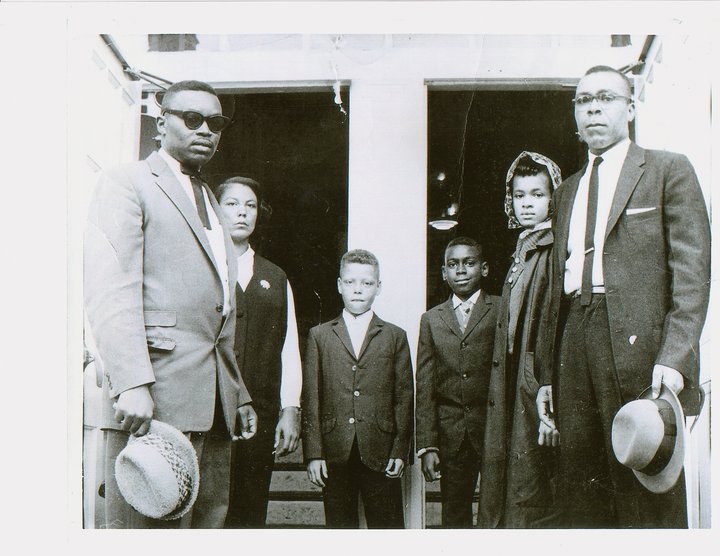
    The fight was long and hard, but in the fall of 1965, the Nansemond County School System finally integrated. The photo above shows my father (in the middle) and my grandmother (to his right) standing in front of Driver Elementary School, the first school in the county to be integrated. The 1970-1971 school year, my father’s senior year, would finally see all schools in the county integrated. He would graduate from John F. Kennedy High School in Suffolk.

    Presidential politics might be the backdrop for this story, Representative Lewis, but this has nothing to do with Bernie Sanders. The hurtful nature of your comments has to do with your erasure of the people who worked outside of the spotlight and the national press to make sure that the Civil Rights Movement touched every corner of Black America. As I said earlier, you did not know or meet my grandmother. Your lack of acquaintance with her does not counterfeit the work she put in, like it does not counterfeit the work of any other person you did not know and yet sought to bring to birth a better world than the one they came into.

    The limited amount of freedom that we Black Americans enjoy today is due in large part to the rallies organized, the meals cooked, the plans conceived, and the bravery shown by organizers whose names we will never know. Believe it or not, our freedom was not won by the Big Six alone. When you use your history as a hero of the Movement to disparage others because you never personally knew them, it is a slap in the face to all those people who fought hard and never made it into the history books or into Congress. It is a slap in the face to people like my grandmother.

    The movement that you, my grandmother, Senator Sanders, and countless thousands were a part of was the largest grassroots movement for social, political, and economic change that this country has ever seen. It was a movement that was bigger than any one participant in it. A movement that, at its best, was unapologetically radical and driven by the Black working class. We should live every moment in awe and praise of all of those people and not sweep them under the rug when it is politically expedient.

    Hillary Clinton ain’t worth that. Not to me, and not to millions of others who owe everything to the Dorothy Marie Boone-Andersons of this world.

    Sincerely,
    Douglas Williams

    Originally posted here.

  • #BlackLivesMatter and #Fightfor15

    Image

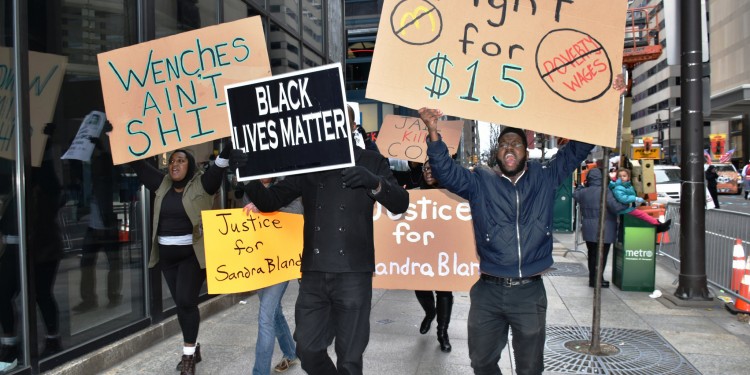
    It may be that in 20 or 30 years we will look back to 2015 as the year that things really began to change in the U.S. This was the year we saw the intersection of the movement for higher wages and Black Lives Matter really begin to crystalize.

    Let’s go back to 2011. On September 17, activists began occupying Zuccotti Park in lower Manhattan, calling attention to the growing inequality between the 99% and 1%, and the massive disconnect between social and economic justice on the one hand, and our political system on the other. The action got little press attention, and even many on the left assumed the rag-tag protest would soon dissipate.

    Meanwhile, civil rights activists had their eyes focused on the upcoming execution of Troy Davis. Davis had been convicted of killing a police officer in Georgia in 1989 and sentenced to death. But the evidence against Davis was questionable, and over the next 20 years advocates worked to get the conviction overturned. Despite these attempts, and a large public campaign calling for clemency, the appeals were rejected and the execution was set to take place on September 21, 2011. The night of the execution, protestors took to the streets in many parts of the country — including in Zuccotti Park — to mourn his death and express their outrage at an unjust criminal justice system.

    The next night, more protestors convened in Union Square, then marched to Zuccotti Park and joined the Occupy protestors. The New York police (NYPD) quickly converged on the park and began arresting people, sometimes with force. According to one report written that night:

    The reaction of the NYPD Thursday night was predictably overzealous and needlessly violent. What wasn’t expected, however, was the spontaneous merger of two growing struggles. One group has taken to the streets out of frustration with an economic status-quo they say leaves too many with not enough. The other has voiced outrage over a so-called justice system that disproportionately targets, imprisons and kills people of color.

    Both are struggles against marginalization. Both are refusing to remain silent.

    They have now marched together, stood up to the police together and been arrested together. Such experiences can create formidable bonds. In its attempt to suppress popular dissent, the NYPD may have just emboldened a movement.[1]

    From then, there continued to be an alliance between the movement against inequality and the movement against police brutality, particularly the ways in which the criminal justice system targeted black people. This alliance was fostered in part by Occupy Wall Street itself, which had working groups [2] focused on criminal justice and racial justice issues, [3] as well as groups ranging from Anonymous, Malcolm X Grassroots Movement, Picture the Homeless, left/socialist organizations and the Center for Constitutional Rights.

    The alliance was not perfect, nor always easy. Some people raised objections about the way Occupy functioned, as its consensus model seemed to privilege white male leaders, and could easily marginalize people of color and issues that they prioritized. Some Occupy activists argued that focusing on racism could be divisive in the new movement. But a core of activists continued to work together, integrating people of color leadership and connecting the issues of social and economic justice. Black activists participated in Occupy events; Occupy activists joined protests related to Trayvon Martin, Eric Garner, Michael Brown, as well as the controversial “stop and frisk” NYPD program. For example, on Father’s Day 2012, Occupy activists joined thousands of other protestors in the anti-Stop and Frisk March. This alliance continued via networks and loose organizations long after Occupy was evicted from the park. In many cases these were loose organizations or simply social media circles or Facebook pages — such as the Trayvon Martin Organizing Committee NYC – many of which built on relationships formed during Occupy. In 2014, some of the labor unions that had supported and participated in Occupy Wall Street helped organize a march in memory of Eric Garner on Staten Island.

    In November 2012, one year after the Occupy eviction from Zuccotti, fast food workers went on strike in New York City. The strike was organized in large part by community organizations New York Communities for Change, the worker center Make the Road, and the union SEIU — three groups that had worked with and were inspired by Occupy Wall Street. Many of the strikers, and their supporters, were black. The strikers called for $15 per hour minimum wage and a union to represent them at work. The next day of strikes was held on April 4, 2013, the anniversary of the assassination of Martin Luther King Jr. Leaders such as Charlene Carruthers, of the Black Youth Project 100, talked about the budding alliance: “Black and brown workers are at the forefront of the FF15.We wanted to make sure their narrative was representative. We tried to shift the messaging and make sure that the FF15 was more squarely centered in racial and gender justice.”[4]

    Over the following years, the fast food strikes spread across the country (and eventually, internationally). These coordinated actions morphed into a demand for $15 for all workers, or “Fight for $15.” The strikes continued, but activists also launched campaigns to set citywide minimum wages of $15 per hour. Coalitions grew, pushing for higher wages and worker rights.

    Alongside this, the movement for police accountability and criminal justice reform grew into Black Lives Matter after the acquittal of George Zimmerman in the Trayvon Martin case. Starting simply as a hashtag, Black Lives Matter is now a movement and network with international reach.

    As Fight for $15 and Black Lives Matter each grew, the two continued to overlap and intersect, sometimes providing solidarity for one another, and sometimes deliberately coordinating actions together. For example, on Martin Luther King’s birthday in 2015, many activists attended rallies to protest for higher wages and better working conditions at retail stores in New York City then joined a march from Harlem to the UN calling for an end to police brutality. In a 2015 day of action for $15, Eric Garner’s mother, Gwen Carr, spoke at a rally noting the links between the issues. Workers rights groups and racial justice groups have been increasingly using “Black Friday,” the day after Thanksgiving, as a common day of protest.

    Alicia Garza, one of the founders of Black Lives Matter, is also on staff with the National Domestic Workers Alliance, highlighting the ways in which activists are linking economic and racial justice (including with immigrant rights issues).

    In many ways, the alliance is an obvious one. Black workers comprise a disproportionate share of low-wage workers; they also have higher unionization rates than non-Black workers. The movements for economic justice and racial justice have intersected throughout history — from the movement to abolish slavery to the collaboration between civil rights groups and public sector unions in the 1960s. Yet that does not mean the alliance is a natural or easy one. Labor unions have an unflattering history of racial exclusion, and while an increasing share of union members are black, the leadership is still overwhelmingly white. And many civil rights organizations, including churches have tried to avoid confrontational class-based politics for fear it could be divisive within the black community, or due to relations with the Democratic Party and elected officials.

    Furthermore, the Black Lives Matter movement is a loose network with no clear hierarchy or structure. Fight for 15 is in some ways also a loose network of campaigns and activists, but behind it are labor unions and organizations that are highly structured and hierarchical. Black Lives Matter is operating through social protest and direct action without clear demands or a policy agenda. Fight for 15 is using protests and direct action but also has a clear policy agenda, aiming to win a clear demand and pressure politicians or use the ballot initiative process to pass higher wages. Black Lives Matter has been militant and insistent on challenging the police and elected officials (and even left-leaning political candidates like Bernie Sanders); Fight for 15 works closely with labor unions that have historically stood by the police union and many elected officials.[5]

    Despite these differences, the movements have been working together in various ways. In New York City, the campaigns have a t-shirt that says “Black Lives Matter,” “Fight for $15,” “Freedom Fighters,” and “Hand’s Up, Don’t Shoot,” and “I Can’t Breathe.” Activists wear these shirts at rallies and protests, and when testifying for a higher wage in front of the New York State Wage Board. In Chicago, Fight for 15 is working with Black Youth Project 100. According to sources, bringing BLM into the Fight for 15 has helped move the latter to the left, pushing the labor movement to take racial justice as central. Alicia Garza noted, “In Ferguson I saw leaders from the Fight for $15 movement really on the front lines moving labor leaders by saying, ‘I’m not just a worker. I’m somebody who lives in this community, who is being targeted by the police all the time — and you have to see that about me.’” [6] Douglas Hall, a member of the Fight for $15 National Organizing Committee, says, “What good is $15 an hour and a union if my daughter is murdered. That money would have been nothing. There’s a direct relation between these issues.”[7]

    On the other hand, the alliance pushes BLM to integrate economic issues into their vision. In California, the Black Lives Matter Bay Area issued a statement declaring their partnership with the Fight for $15, noting the need to bring in economic justice issues: “The movement for Black lives is about more than criminalization and incarceration. Because the lives of Black people are not one dimensional, the fight for justice must also be multi-layered in its approach. As Black people, we are fighting for our basic humanity; the ability to watch our children grow up, to live in communities free of fear, and to have the resources that we need to survive.”[8]

    This budding alliance is exciting for several reasons. Each of these movements on their own would be important: movements that have grown quickly around bold demands, capturing the public’s attention and for now, it seems, their support (polls show a majority of whites do not support Black Lives Matter, but polls also show a large increase in all Americans that think African Americans do not receive fair treatment). But the intersection of the movements takes this to a new level, by integrating issues that are clearly connected (race and class, economic and racial justice), as well as making short-term immediate demands alongside deeper systemic critiques. The ways in which it is an uneasy alliance seem productive, as they have pushed both sides to be more comprehensive and deal with challenging issues. Rather than avoiding complicated and divisive issues, the intersection of the movements takes them on. It seems impossible to imagine building a more just society without both elements of this alliance.

    [1] Ryan Devereaux, “Troy Davis Protestors Occupy Wall Street,” New America Media. September 24, 2011.

    [2] Such as Occupy Faith, the Occupy Wall Street Meditation Working Group, Occupy Criminal Justice Working Group, and the Occupy Wall Street Activist Legal Working Group.

    [3] Occupy Wall Street had issued a communiqué on their fifth day of protesting, decrying the Davis execution. “A Message from Occupied Wall Street (Day Five)

    [4] Brendan McQuade , “A United Front.” Jacobin. September 2, 2015.

    [5] Last year the United Auto Workers Local 2865, made up of teaching assistants and other campus workers at the University of California, called on the AFL-CIO to expel the police union from the AFL-CIO.

    [6] Amy B. Dean, “Is the Fight for $15 the Next Civil Rights Movement?” AlJazeera America, June 22, 2015.

    [7] David Moberg, “In Latest Round of Fast Food Strikes, Fight for $15 Tells Politicians: “Come Get My Vote.” Working In These Times. November 11, 2015.

    Originally posted here.

  • Sanders, Strategy and "The Left": Behind the Fist Pump

    Image

    Bernie Sanders’s dropping the hammer on Clinton’s cozying up to the vile genocidaire Henry Kissinger was one of the fist pump moments of the campaign. That’s recognized by pretty much everyone now, so I don’t need to say much about it here.

    What does seem to be worth mentioning is what it shows about Sanders’s campaign strategy. And make no mistake-he has a larger strategy and it is a successful one, obviously. One core element of it appears to be to inject into the discourse Clinton’s transparently indefensible positions while making sure that when he does so these are a) factually irrefutable b) not entirely dissonant with conventional wisdom c) entered at sufficiently spaced intervals to that they don’t overwhelm the capacity of the media (both social and conventional/corporate) to assimilate the factual basis of the charges.

    What I have in mind includes but is not limited to the following: 1) attacking Hillary’s position on Iraq (entered during the first debate). 2) targeting Hillary’s Wall Street connections, particularly the Goldman Sachs speaking gigs, which he did in the second debate. 3) Now the attack on Kissinger. Notice that in every instance, Clinton was caught completely off guard and had essentially no response. As Sanders understands, that’s an inherent liability with being an establishment hack: you assume everyone agrees with you (as Noam has shown for years) collapsing when you are confronted by facts which challenge the conventional wisdom, ending up looking clueless and ridiculous (e.g. C: “Who advises you? S: It ain’t Henry Kissinger, that’s for sure.”)

    Also, in every instance, claims which previously would have been written off as conspiratorialist ravings now have the chance to get a footing.  This is partly because they are being uttered by a legitimate presidential contender but also because they are quickly reinforced  evidentiary support provided by Sanders’s team which then makes the social media rounds.  That was most conspicuous with the immediate response to Clinton’s denial that her receipt of Wall Street cash had ever influence her votes: Sanders’s team knew they had an ace in the hole–the paragraph from Elizabeth Warren’s book and her appearance on Bill Moyers, and it’s easy to imagine them salivating when they played it.

    In any case, it is clear that Sanders has a strategy along these lines and that he is implementing it beautifully. Not to belabor the obvious, had Sanders been listening to “the left” who was constantly criticizing him for his failure to attack Clinton, all this would have been put immediately on the table: at his campaign announcement he would have denounced Clinton (and the Democratic Party), as Wall Street stooges, apologists for mass murder, mass incarceration, environmental pillage, etc. He chose a different strategy, and, to reiterate, it was obviously the right one.

    So can “the left” finally go back to its dog eared copies of the Grundrisse admitting that its history over the past decades is a painful, prima facie demonstration that it has not the slightest idea of how to operate in the real political world, having shown itself utterly incapable of building mass constituencies for a left program.

    Sanders does. That is why he is where he is and why his “left” critics are yet again reprising their role as the dogs frantically barking while the caravan passes by.

    Originally posted at http://johnhalle.com/outragesandinterludes/?p=793.

  • Adolph Reed on Sanders, Coates, and Reparations

    Image

    The following is a segment from Doug Henwood‘s Behind the News, January 21, 2016. Henwood is interviewing Adolph Reed. Audio link here.

    DH: We’ve got Ta-Nehisi Coates citing the call for reparations and finding Sanders guilty of hostility towards reparations. What do you think of his critique?

    AR: I read the thing in The Atlantic and it’s so utterly empty and beside the point, I can’t even characterize it.

    You can go down Sanders’s platform issue by issue and ask, “so how is this not a black issue?” How is a $15 minimum wage not a black issue? How is massive public works employment not a black issue. How is free public college higher education not a black issue. The criminal justice stuff and all the rest of it. So one head scratching aspect of this is what do people like Coates imagine is to be gained by calling the redistribution program racial and calling it “reparations”?

    The charitable or benign interpretation of what he and others imagine the power of this rhetoric to be, is that there is something cathartic about it like Black Power. I’m thinking for instance of “say Black Lives Matter” or “say Sandra Bland’s name.” It’s like the demand to call it reparations, which doesn’t seem to make any sense whatsoever. It doesn’t add anything to calls for redistribution. If anything, it could undercut them. Since there’s nothing (less) solidaristic than demanding a designer type program that will redistribute only to one’s own group and claim that that group (especially when times are getting tougher and economic insecurity is deepening for everybody) it seems like it’s guaranteed not to get off the ground and seems almost like a police action.

    DH: I’m not Ta-Nehisi Coates but I imagine he and others favoring reparations would respond by saying that it’s meant to address wounds that were specifically racial in their origin.

    AR: The logic fails on its own terms. If you grant for the sake of argument that the injuries were highly and explicitly racialized, it does not follow from that that the remedy needs to be of the same coin. And I have not seen Coates or others who make that assertion actually argue for it, i.e. give a concrete and pragmatic explanation of how (the remedy is supposed to) work. That is to say, what the response, or atonement, I suppose, for past harms would look like and what they imagine the response would actually be.

    Coates makes this stuff up as he goes along: by his own account, he read Baldwin and wanted to write like Baldwin and his editor would check him and say “Look, you’re writing these passages which don’t mean anything whatsoever” since he was so focussed on wanting to write like Baldwin absent having anything in particular to say.

    So the first question for me has always been how can you imagine putting together a political alliance that would be capable of prevailing on this issue. And what you get in response is a lot of “What black people deserve” because of the harms that have been done to them. I just think it’s fundamentally unserious politically.

    But I’ll say this and I’ll say this as a Sanders supporter—I’ll come clean on that. The idea that Bernie Sanders becomes the target of race-line activists now, and not Hillary Clinton, is just beyond me and it smells. It smells to high heaven.

    You might say, well, she’s not the one who pushed through NAFTA or signed the omnibus crime bill, or ended the federal government’s commitment to direct provision of income support or housing that her husband did. But she supported all that stuff then. My mind is blown by the understanding of politics that undergirds this perspective that people like Coates and proud TFA alum Deray McKesson and holy roller Marissa Johnson and all those others embrace. It’s fundamentally anti-left. The only thing you can say is that this is a class program. That this is a program that expresses and connects with the interests, or the world view, if not interests-although they do come together-of an aspiring or upwardly mobile stratum of the black and other colored PMC (professional managerial class) that scoffs and sneers at programs of material redistribution.

    When I was working in the GI movement, when people like that would come into the meeting, I’d just ask them “So which branch of military intelligence are you assigned to?”

    DH: This sort of stuff plays very well to guilty white liberals doesn’t it.

    AR: Yeah, well, a friend, whom I won’t out, observed to me a while ago that one of the things that really irks him (and he’s a professor) about Coates is the way that white liberals gush over him and my informant said that it reminds him of the way that upper middle class liberals fawn over the maid’s son who has gone to college and “made something of himself.”

    DH: That’s pretty harsh.

    AR: Yeah, but there’s a lot to it because, it comes back to this question: why should anyone pay any attention to anything this guy says?

    DH: Well he has a “literary writing style” that appeals to certain populations.

    AR: Right. I understand that and that it’s absolutely divorced from content except for this funny sort of fake Candide like thing of “I’m just astounded that white people read me.” It just all feels tawdry and evasive and cheap.

    I’ve heard some people argue that it strengthens the case for affirmative action but I think it does the opposite, since reparations is really affirmative action on steroids. I can imagine going to talk to a long displaced steel worker in Western Pennsylvania whose fretting now about further increase in economic insecurity around the fracking stuff. And you’re going to explain to him or her that because of slavery they’ve got to be on the giving end of some transfer payments that will go to recompense blacks for harms done in the past.

    Again, some of this stuff really feels like a moral panic and the moral panic aspect of it, it seems to me, converges on the class perspective. And the career aspirations. Don’t forget that. And that leads us where we are.

    DH: Coates and lots of his supporters would say that what you are arguing is for a class based politics that’s blind to the injuries of race and the enduring damage of racism. What do you say to that?

    AR: I say that their race first politics is a class politics. It’s not an alternative to class politics it’s a politics of a different class. It’s not a working-class politics, it’s an aspiring PMC politics that’s hinged in material terms ultimately on race relations administration as a career path. There’s a multi-billion dollar diversity industry now—it might be interesting to have Ken Warren on and talk about that since he did a three year tour as a Deputy Provost for Diversity at the University of Chicago and made deep penetrations behind the lines of the corporate diversity industry.

    DH: One of the points you made in your Progressive piece back in 2002 was that whenever universal class-based politics rears its head, the reparations call pops up. One doesn’t want to get too conspiratorial about this but what were you thinking of?

    AR: I was out of the country for a while back then and hadn’t paid much attention and the reparations thing had blown way up while I was away—there were conferences all over C-Span—Ron Karenga, Kimberly Crenshaw and Charles Ogletree. Because it’s the kind of thing that lawyers dine on. I was bemused. I couldn’t figure out what was going on. When (James) Foreman and the Black Manifesto group raised the reparations issue back in the '60s, it was connected with something like the freedom budget and what Whitney Young had described as a Marshall Plan for the ghetto, so in that sense reparations was a hook which expressed Foreman’s cleverness and engagement with the soap-box nationalists up in Harlem who had been talking about that stuff for a long time.

    It seemed to me that clearly was a response or an alternative to the possibility that a more universally, class based redistributive agenda would gain currency. Part of the problem, and I think this is a big chunk of the appeal of reparations since 1965 and into the 1970s, is that it appeals to people whose political commitments is to maintain the centrality of a racial interpretation of every form of inequality or injustice that affects black people. So the commitment is to a race politics. And so the race politics could be challenged by what they imagine to be post-racial politics (which nobody other than them has ever talked about, anyway) and by a class politics.

    What the race discourse does is it forces a racial interpretation onto any manifestation of inequality or injustice to be associated with black people on the receiving end. So in that sense, the demands aren’t even that important. The discussion of the program isn’t even that important. The real objective is to maintain the dominance of the racialist interpretive frame of reference and that goes back to my contention that this is a class program because part of the material foundation of the class has been, since the class began to take shape at the end of the 19th century, a claim to be representatives of the aspirations of and of the voice of black people writ large.

    DH: And not to get too conspiratorial about this, but it seems like people like Fred Hampton and Martin Luther King, people who talk about non-racial analyses of capitalism and cross-racial alliances against it, end up dead. And people like Karenga and Assante end up doing pretty well for themselves. Is that just an accident or should I be concerned about this?

    AR: Well, I’m not sure about Assante but we know that Karenga knew his way to the offices of the authorities and their phone numbers. And it’s easy to throw around charges of his being an agent because he acts like an agent-and we all know where that leads. But having said all that, that strain of nationalist—I sometimes think of it as a Duvalierist politics—has always been capable of making alliances with the most dangerous and reprehensible elements of the opposition: Garvey and the Klan, Elijah Muhammed and the Klan, Floyd McKissick and Roy Innis and other Black Power nationalists who created Black Americans for a Responsible Two Party system, or as the rest of us called it, “Negroes for Nixon.”

    And they all gave the same line: all white people are racist. It’s foolish to try to make distinctions among them based on principle and on politics, we have to be pragmatic and align ourselves with whichever ones of them are going to do something for black people and that formulation of course is an instantiation of the famous slippage between first person singular and plural that’s a characteristic of nationalist ideologies no matter where you find them.

    DH: I remember an old slogan, “Black and White Unite and Fight”: a pretty good guideline to political action?

    AR: Look, it doesn’t need to be Kumbaya. It’s practical—if you assume that the interests and the structures which generate inequality, dispossession and misery are not amenable to the petitions to the enlightened ruling class from one section of the oppressed, then the only way we’re going to be able to make anyone’s life better is to change the terms of political debate. And we can only do that on the basis of common experience and the most broadly shared experience is that of those who work for a living or are expected to work for a living. And I don’t see how we can get to any sort of a better world going through any other route. And we certainly can’t do it by hanging out, like McKesson and John Legend-in-his-own-mind with the Broad Foundation and Bruce Rauner and TFA and people like that.

    There’s a sense in which these people are the black shock troops for neoliberalism.

  • The Flint Disaster: Why Doesn’t Black Health Matter?

    Image

    The lead-poisoning disaster in Flint, Michigan is more than a shocking public health failure. It is an assault on human rights – a recognition that has been largely absent from most discussions of how and why this could have happened in the advanced industrial democracy of the United States. It is arguably the largest discrete violation of its type since the infamous and grossly unethical Tuskegee syphilis medical study of the last century. The water poisoning in Flint was finally forced into official recognition by a brave and stubborn pediatrician, Dr. Mona Hanna-Attisha, who documented what was really happening to Flint’s vulnerable children and other residents.

    There are differences between Flint and Tuskegee, of course. Tuskegee was a deliberately, even cynically, planned trial involving a moderate number of adult African-American men, who were purposely left untreated to suffer the progression of their disease, while falsely told that they were being helped. It was a cruel medical study directed by government public health doctors who violated their professional medical ethics. Flint is the consequence of depraved indifference and layer upon layer of smug, incompetent denial by the state government – more like a slow-moving, long-lasting Tuskegee, with an impact orders of magnitude greater in terms of the numbers of people affected: tens of thousands of particularly vulnerable children and tens of thousands more adolescents and adults.

    However, just beneath the surface of these two events is the similarity. All of the men in Tuskegee were African-American, and so were the majority of those exposed to toxic water in Flint. In both events, a particularly despicable form of racism is manifested: a contemptuous disregard for the health of people of color, especially if they are poor and can be dismissed as politically and economically irrelevant.

    Every person has the universally-recognized right to the highest attainable standard of physical and mental health – a right callously ignored by the very people tasked with safeguarding these citizens’ wellbeing: their local, state, and federal public health and environmental agencies and their elected representatives. For almost two years, the children of Flint have been exposed to the risk of brain damage – impairing IQ and causing behavioral disorders – that in many cases will prove to be irreversible, and will continue to unfold for years.

    Into this swamp of denial stepped Dr. Hanna-Attisha, who carefully reviewed past and current hospital records and documented what was already happening: a doubling and tripling of cases of dangerously elevated levels of lead in children’s blood. She went public with those facts, and, like other citizens of Flint, she was accused of causing hysteria. But she persisted, and won: Flint’s mayor declared a state of emergency over the water issue in December.

    Dr. Hanna-Attisha’s work illustrates a truth larger than the Flint case itself. A new and important domain of professional responsibility has emerged for health professionals and medical scientists: the documentation and exposure of human rights and civil rights abuses that violate long-established legal and ethical agreements, and international and domestic laws. Dr. Hanna-Attisha’s efforts are essentially similar to the work of Physicians for Human Rights (PHR) in Syria or other conflict zones, in detention camps and prisons in the United States and abroad, in humanitarian crises, and among asylum seekers.

    Such work, and efforts by many other organizations, will be needed in Flint to assure that affected children will receive the careful monitoring, medical care, and intense educational support they may need for many years to come.

    But a moral response to the outrage in Flint obliges all of us – not just doctors, bioethicists, and human rights advocates – to act. We must add our voices to calls by the ACLU and other organizations for transparency and accountability for those that caused human damage on this massive scale. We need action now. State authorities must conduct adequate sampling and water testing in the homes where lead pipes are likely to be present, and enforce rigorous inspection, testing, and removal of lead paint in old housing, which is likely the biggest source of chronic lead exposure.

    Most important of all, authorities must recognize and address the need for active and ongoing federal supervision. We must assure congressional funding for the essential infrastructure repairs and for ongoing educational, cognitive performance, and remedial support for affected children for the next decade. And we should prevent one last parallel between Tuskegee and Flint from emerging. After Tuskegee, no one ever faced effective criminal prosecution. It remains to be seen whether or not that will happen in Flint.

    Reprinted from Physicians for Human Rights. See more at: http://physiciansforhumanrights.org/blog/the-flint-disaster-why-doesnt-black-health-matter.html#sthash.z2ALH6HQ.bcDS5I5V.dpuf


  • Sanders Supporters March from Union Square to Zuccotti Park

    Image

    Some 3,000 supporters of Bernie Sanders marched through the streets of Manhattan yesterday from Union Square, historic site of labor and left rallies since the beginning of the last century, to Zuccotti Park, the site of the Occupy Wall Street movement of 2011.

    The mostly young, white crowd, dotted by people of color and older supporters, returned to the place that five years ago turned the national conversation from the Tea Party to questions of economic inequality and the role of money in politics.

    Image


    Image

    The marchers screamed “Bernie” and chanted slogan’s from Sanders’ speeches, as they waved mostly homemade placards. There were Bernie stickers, life-size photos of Bernie, and Bernie puppets.


    Image

    Among the most popular signs was one reading “Not Me—Us” referring to Sanders’ call for a “political revolution” that would involve all of us. Many onlookers took photos and videos, many others waved or made the V for Victory sign, yet others in offices gave the thumbs up, while some came out on balconies to cheeer.

    Most had come to the demonstration through People for Bernie or their local groups of Bernie campaign activists. 


    Among the marchers were leftists from the Democratic Socialists of America and Socialist Alternative, though most of New York’s many radical left groups were notably absent. The photos here give a sense of the demonstration. 

    Image


  • Will "Friedrichs" Derail Teachers Unions?

               Image Much has been written about the harm the Supreme Court will wreak on US labor if it overturns the right of public sector unions to charge nonmembers a fee equal to the cost of the union’s expenses in representing them. Pundits on the left and the right have predicted a cataclysm. Will it “decimate” labor? Is it likely a “killing field for unions.” Ironically, Supreme Court Justice Scalia (as David Moberg noted) is one of the few people who has identified how unions are actually weakened by representing “free riders,” workers who haven’t been persuaded that they should join the union.  It’s significant that Friedrichs targets the California Teachers Association because the case continues the intense teacher and teacher-union bashing that has characterized political rhetoric and policy about education reform in California, across the US and globally, from Democrats and Republicans. The Right has demonized teachers unions because they can be formidable opponents. Teachers and their unions are the best organized, most stable opponents of policies privatizing public education.  As was evident from the 2012 strike of the Chicago Teachers Union, teachers unions that adopt a “social justice” orientation and are committed to building the union at the workplace (school site) can challenge the political status quo in ways other unions have not been able to do for many years. 

             However, despite – and because of – the ferocity of the attacks on teachers’ wages, benefits and professional autonomy, teacher unionism is being reborn. Activist teachers are growing reform caucuses committed to transforming their unions in almost every major US city. From Philadelphia to Seattle, Boston to San Francisco, Massachusetts to Los Angeles, a new generation of teacher union activists is taking on — and down — the old guard.

             The reformers’ contestation is a serious challenge to the current union leaders, who must balance their self-conception as power brokers, nipping at the edges of the reforms pushed for public education (more privatization; standardized testing used to control what is taught and how; loss of due process protections for teachers), with members’ increasing militancy. Increasing numbers of teachers don’t want a “seat at the table” because they see their jobs threatened, schools closed, kids hurt by seemingly “practical” deals the union negotiates. The increasingly successful challenges to teacher union leaders who have controlled their locals for decades explains why the American Federation of Teachers (AFT) bulletin to members about Friedrichs eschews the grim predictions of most pundits. While noting the harm Friedrichs can do, the union argues it will weather a loss of agency fee — by organizing.

             Members infuriated with the choice of AFT and the NEA (National Education Association) leaders to protect their access to the Obama administration instead of launching an offensive to turn back policies teachers feel hurt the profession and kids, especially linking teacher salaries to students’ standardized test scores, are not going to placated by the unions’ new interest in organizing. Many teachers feel betrayed, deserted, by the organizations they looked to for support of the profession and public education.

             Friedrichs will do the most harm to the unions that are most bureaucratic, that have relied on the legal right to collect fees rather than do political education — organizing — of members. A ruling against the unions in Friedrichs won’t retard the organizing we see in Detroit, by teachers who staged a “sick out” that closed the system — without their union’s help. A loss in Friedrichs won’t halt the momentum of Organize2020, the social justice reformers in the North Carolina teachers union, who don’t have collective bargaining, let alone agency fee. Their organizing occurs side by side with civil rights activists. The fight to raise the wages of low paid workers is as much a concern for these teacher union reformers as is teachers’ salaries.

             Teachers unions that organize by building member “ownership” of the union will be hurt by loss of agency fee, but they won’t be crushed.  It’s not Friedrichs that’s the biggest threat to teachers unions but rather the continuing belief that union officers and staff can do things for the members the members can’t win by mobilizing.  To restore union strength unions don’t have to rely on “fair share” from people who don’t want to join the union. We have to create unions teachers want to join, unions that will fight hard on economic concerns while showing parents and students how unions can use organizational strength and political power to defend good schools for all kids.

    Lois Weiner, a member of the New Politics editorial board, is Professor of education at New Jersey City University and the Director of the Urban Education and Teacher Unionism Policy Project. You can follow her on TwitterFacebook, and here at New Politics.


  • Is an Injury to One an Injury to All? Some Critical Thoughts on Trade-Union Internationalism Today

    Image

    The necessity of working-class internationalism must surely be one of the left’s most invoked truisms, providing the semblance of a solution to the problems facing embattled workers and governments of the left. But too often the concept is deployed in vague, even contentless ways. The global economic crisis has put the issue of ‘internationalism’ into greater focus – particularly, perhaps, in Europe, where political and monetary union is in question as never before.

    The 2015 election of Syriza in Greece, and the dead-end negotiations of the first avowedly socialist European government in decades with international lenders, have underlined the urgent need for working-class internationalism against finance capitalism and austerity. But these ‘exceptional’ problems for Greece, Portugal, Spain, Cyprus and Ireland are faced every day by workers and left-wing states in the Global South. The inadequate international support for Greece cannot be a lesson for and about Europe alone, but the start of a new, broader, more grounded conversation about building left labour internationalism generally.

    Here I examine three brakes on a left working-class internationalism within the trade-union movement today: economism; absorption by the foreign-policy apparatuses of imperialist states; and top-down technocratic orientations. The common thread is the problem of labour bureaucracy – specifically, that of national labour unions in the Global North. Distant enough from the rank-and-file to make agreements with employers and governments that don’t serve their own members’ long-term – and often even short-term – interests, they’re even less capable of standing up for workers in other parts of the world. Such groups jealously guard power and resources, with which they control priorities of global union federations. There are examples of progressive, successful international efforts from Northern unions: but, relative to their power and resources, they are rare, and heavily self-interested.

    Successful local efforts at union reform – what is called the ‘union democracy movement’ in the US – could, then, have profound consequences for labour internationalism. Indeed, radical labour internationalism has historically come, typically, from the local layers closest to the rank-and-file, and their work to raise consciousness, funds and hell on the shop floor and beyond.

    What’s needed for a left labour internationalism, then, isn’t more progressive global bureaucracies or technical capacities, but reforms to shave away layers of bureaucratic mediation, bringing workers from different countries together more directly. In the meantime, fighting against tendencies that absorb national unions into states’ foreign-policy apparatuses, force unequal ‘partnerships’ with employers, and conduct global campaigns in a top-down manner, would be a good start.

    hammersickle_glyph

    Solidarity is hard to define: we know it when we see it, but try putting it into words. Take the famous slogan of the Industrial Workers of the World (IWW): ‘An Injury to One Is an Injury to All’. Outside of individual workplaces – or exceptional, extreme antiworker authoritarian states –instances in which an injury to one is an injury to all in the most literal and unmediated senseare hard to find, particularly internationally. In fact, in such immediate and local terms, an injury to one, when not neutral for others, may even, to put it provocatively, be a short-term opportunity for them, on the basis of successful divide-and-conquer strategies pitting workers against one another. Such divisions, great enough locally and nationally, are magnified many times at the international level, by imperialism and uneven development. Across such widely divergent objective conditions, the material bases for solidarity are often shrouded in layers of mystification.

    In fact, the principle of ‘An Injury to One Is An Injury to All’ is most often invoked as part of an imaginative process of proto-class formation, rather than to reflect immediate material realities. When it comes to these at an international level, the ugly fact is that trade union ‘interests’ – in terms of marginal wage gains – are sometimes better served in the immediate term by making protectionist alliances with national capitalist classes or states to preserve jobs – in exchange, perhaps, for an insular approach to the rest of the world. Yet, it is clear that in the long run, workers everywhere are harmed by harm to workers anywhere, from lowering standards, increasing the size and desperation of the reserve army of labour, and emboldening states and employers to step up attacks. This tension between short- and long-term interests is a classic problem of trade-union economism – a problem that of course remains just as relevant today as it was in the past.

    hammersickle_glyph

    During the Cold War, the international labour movement fractured along Communist and Social Democratic lines. But the damage was deeper than just organisational separation, particularly in the US. There the AFL-CIO union federation collaborated with the CIA against left-wing unions (and governments) in the US and beyond. After World War Two they supported anti-communist unions in Europe; engaged in wide-ranging activities to undermine left governments in Latin America, including Allende’s Chile; backed the most conservative sections of the labour movement in South Africa during apartheid; and provided support for government sponsored unions in Marcos’ Phillipines and death squads targeting trade unionists in Indonesia. Nor were they alone: global union federations, like the International Transport Workers Federation (ITF), played a similar role, collaborating with the CIA, with their post-war Mediterranean anti-communist ‘vigilance committee’, and their activities in Latin America and beyond.

    Unions, especially in the US, continue to toe their states’ foreign-policy lines – particularly, though not exclusively, when they overlap with perceived economic self-interest. When my own union, UAW 2865, representing 13,000 academic student employees at the University of California, became the first mainstream local union in the US to vote in favour of the call from Palestinian trade unions – including fellow university-teachers’ unions – to support the Boycott, Divestment and Sanctions (BDS) movement, unions in other sectors put intense pressure on us to back down. The Teamsters issued a public letter stressing the fact that many of the targetted companies – all heavily complicit in the Israeli occupation – are Teamsters (and UAW) employers in the US. Ignoring the repressive conditions faced by Palestinian trade unionists calling for boycott, they wrote,

    [w]hatever your motives, we cannot conceive of an action more hostile to the interests of our members and more antithetical to the most basic principles of the union movement than for a union to call for actions which are intended to do harm to the economic security of other union members.

    Even putting aside the absurd argument that a boycott aimed at getting giant transnational corporations to drop business with one small country would harm their employees, it’s important to note that with their intervention, the Teamsters harmed ‘the economic security of other [Palestinian] union members’. Moreover, they are supporting the occupation, working to ensure the smooth flow of bulldozers and weapons.

    There are, of course, rarer, uplifting instances of labour intervention in foreign-policy issues on behalf of workers internationally. There is in particular a strong potential for meaningful, concrete international trade-union solidarity from workers at key nodal points of the global economy, or those involved in producing commodities used directly by the repressive apparatuses of states. The United States West Coast (ILWU) dockworkers have a long history of such actions. They refused to load weapons for fascist countries in the 1930s, and through industrial action, they supported the Chilean resistance during the dictatorship; the fight against apartheid in South Africa; and opposition to US involvement in Vietnam and the Middle East. And last summer, during the siege of Gaza, members of ILWU Local 10 in the San Francisco Bay Area refused to cross a community-led picket to ‘Block the Boat’, an Israeli Zim line carrier. This minor action was a first in the US – taken for the BDS movement, echoing earlier actions by European dockworkers. In part, it inspired my own union to take up the issue. We refused to be put off by the Teamsters’ – and other unions’ – arguments, and became the first mainstream local union in the US to join the BDS movement through a membership vote. The great majority of the US labour movement, however, lags far behind.

    hammersickle_glyph

    Our national union, the United Auto Workers (UAW), has a tawdry history, ranging from its McCarthy-era expulsion of Communist organisers who had played a central role in forming the union in the 1930s; to the repression of radical black rank-and-file activists fighting racism in the plants and the union in the 1970s; to signing off, during the economic crisis, on shameful multi-tier contracts that that have done untold damage to the workforce. As one of the largest industrial unions in the country, heavily involved in global export, the UAW is important for proponents of left labour internationalism. Recently, it has illustrated the calculated self interest of the international orientation of many American and European unions.

    In the mid-2000s, the UAW played an active role in the coalition of US and South Korean labour unions opposing their countries’ proposed Free Trade Agreement. In 2007, the UAW highlighted the negative impacts the FTA would have on US autoworker jobs and conditions, but also the difficult and repressive conditions faced by unions in South Korea, and the agreement’s lack of protection for South Korean workers. Nevertheless, in 2011 the UAW endorsed the agreement, after protections were added – for the US auto industry. Pressure from the Obama Administration to step into line doubtless played a critical role in the decision, following the government’s bailout of the auto industry. While selling out erstwhile allies was bad enough, more galling still was that the UAW cited, as a factor behind its shift, the strength of South Korea’s trade-union movement – despite continued opposition from South Korean unions.

    The UAW’s role in the campaign of General Motors – one of the ‘Big Three’ auto company UAW employers in the US – in Colombia is also revealing. Colombia has the highest annual rate of murders of union activists, and is widely considered by international monitoring bodies to be among the worst countries in the world for labour organising. Nevertheless, against these odds, since 2011, Colombian autoworkers formerly employed by the GM plant in Bogotá have been camped, demanding justice, in front of the American Embassy, since hundreds of workers were fired after sustaining severe workplace injuries. The UAW agreed to help negotiate with the company in 2012, but GM came back with minimal concessions: a payout insufficient to cover expenses for, in many cases, permanently disabling injuries – and a refusal to rehire workers, as required by law. When the workers refused these terms, the UAW ended its support for them, and pressured other unions to do the same.

    Such behaviour would be appalling anywhere, but this hypocrisy is particularly deep, given that UAW now-former president Bob King staked his legacy in part on developing stronger ties with unions in other countries. The UAW has developed international relationships over the past five years, but as these examples indicate, they will likely only stretch as far as self-interest allows.

    Such behaviour serves to illustrate how Northern union interests are constituted within national economic and political environments. Locking unions into corporatist arrangements as the UAW has done since the bailout, is an effective – though not the only – means to prevent the development of left-oriented trade-union internationalism. Ironically, such ‘social partnership’ constraining UAW support for workers in other countries has been a Faustian bargain within the US itself, as UAW members suffer from concessionary bargaining and multi-tier contracts.

    hammersickle_glyph

    In Europe, ‘social partnership’ is far more common than in the US and often embedded in long-standing formal arrangements. Yet few but the most committed union bureaucrats could argue that such arrangements still function well for workers in Europe today. But memories of seemingly positive experiences have led international departments of many Northern European unions to advocate similar approaches in repressive political contexts where they are wholly inappropriate, and unlikely to benefit workers. What’s needed to bolster labour in most of the Global South is support for militant, democratic class-conscious unionism, not the importing of a strategy which – even at home – is under question. Also common in ‘Northern’ solidarity is support for unions elsewhere in a purely technocratic fashion without regard to union politics – proceeding as if what is needed is simply training activists, and as if this can be done in a politically neutral fashion. Union strategy, though, is not at all neutral. Where unions are organised along political lines (as in much of the world), simply providing training or support to one union over another is a highly political act, with potentially far-reaching consequences. Decisions disguised as politically neutral can anoint winners or losers, as the Cold War experience shows.

    hammersickle_glyph

    The need, one might think, is to shift from a framework of national unions to a global level of organisation. But in fact, the international labour movement has more than a hundred years’ of experience with global union federations (GUFs, formerly the International Trade Secretariats). The results have been, at best, mixed. For years, the GUFs were caught up in the politics of the Cold War, acting more as proxies for states and blocs than workers’ advocates. But they have reorganised in recent years, and, at least on paper, their politics today are improved. And they’ve racked up important victories, like the ITF’s Flags of Convenience campaign, resulting in a global collective bargaining agreement for seafarers on low-standard vessels; and the agreement with primary employers reached by IndustriALL and UNI in the wake of the Rana Plaza disaster.

    But what are these federations? They claim to represent millions – the membership totals of their affiliate unions – but they aren’t representative bodies in any meaningful sense. With their leadership elected by national officers of their affiliates and day-to-day work largely carried out by hired professionals, they are several steps removed from members. Additionally, top-level decision making tends to be dominated by wealthy, powerful Northern unions. All of this is no criticism of the good work they often do carry out: it is an appeal for clarity. These are not international labour unions, built on principles of bottom-up democracy: they are, essentially, international labour-rights NGOs set up to provide technical support, industry research, training, corporate campaigns and advocacy. Left labour internationalism requires more than this.

    This NGO-like structure underlies serious problems. The GUFs are funded primarily by wealthy Northern unions and are all based in Europe, with mostly European staff. Many observers have pointed out their Northern bias in priorities, and in their relations with Southern unions. As the Teamsters have shown, campaigns for labour in the South that are deemed to threaten the bargaining position of Northern unions will likely be opposed.

    The lack of organic connection to rank-and-file workers and the geographic stretch of many campaigns results in a top-down approach to activism. Participation by affiliate unions is often limited to easy-to-organise symbolic actions, typical of bureaucratic unionism, rather than more powerful industrial actions that require rank-and-file engagement. Whatever gains GUFs have made for affiliates, the extent to which such top-down, technocratic activism transforms the consciousness of members is suspect.

    hammersickle_glyph

    Will labour-union internationalism ever be enough? Of course not. There are real limits to making politics through unions. But the Left must not underestimate unions: better to inquire what is possible within this arena. As long as there is capitalism, workers can strive to organise at the point of production, and at a moment of much soul-searching on the Left over forms of politics and organisation, we must remember that many people’s primary experience of class happens at the workplace. A well-organised workforce can fight for changes that go far beyond its own immediate economic well-being – should it choose. A truly global and leftist labour movement could not just deliver powerful gains at the workplace, but might embolden workers to fight for truly systemic change.

    As the hope in Syriza crashes against a brick wall of European and IMF intransigence, we must ask what could have been, had a united European labour movement stood behind Greece’s workers. Without state allies, how would Syriza’s bargaining position have looked different in the context of mass solidarity strikes in Europe? We mustn’t lose sight of this international dimension of left government viability.

    European unions could or would not see that in this case, an injury to one is indeed an injury to all –and likely sooner rather than later. With the troika’s success in humiliating Syriza, the possibilities of similar projects emerging elsewhere diminishes. Europe’s workers will feel the effects of a state with severely eroded labour standards on its periphery. For the sake not only of the local, but for a globalism from below, it is past time for the rank and file.

    Originally posted here.

  • Film Review: The Price We Pay

    Image

    The figure of a gryphon, the legendary feral, clawed, winged creature that nests above the one-square mile City of London, Britain’s financial industry (akin to Wall Street, but with its own legal authority, too) is an apt symbol for an untrammeled center of global capital. A creature of prey, it is redolent as the guardian of ill-gotten, even murderous gain. What else is the financial center of the United Kingdom, which introduced the tax-free zone that modeled capital flight around the world?  The City predates the Cayman Islands or Switzerland as tranches for tax avoidance and is a main locus for starving the welfare state.

    It’s what George Monbiot called in The Guardian “the dark heart of Britain, the place where democracy goes to die, immensely powerful, equally unaccountable,” and “exist[ing] outside many of the laws and democratic controls which govern the rest of the United Kingdom.” Even Parliament has little authority over the 800-year-old corporate body, which is the centerpiece for documentarian Harold Crooks’ scorching The Price We Pay, a 93-minute exhaustive look at the latest tack in economic pillage, what Monbiot has called “a kind of offshore state, a secrecy jurisdiction which controls the network of tax havens housed in the UK's crown dependencies and overseas territories.” Not too shabby as a second career for an expired empire.

    The point of focusing on the UK’s peculiar institution? It prefigures a world in which capital has no accountability to democratic control. It operates internationally, despite its principals’ whinings, virtually tax-free. Guess who pays the difference, in both taxes and collapsed government services?

    The new film, including scenes of Apple executives caviling before a congressional committee as Michigan’s Carl Levin excoriates them for their canard of declaring “that two-thirds of your profits are in Ireland and 95 percent of innovation is in California,” is a revelation. The scene is juxtaposed with dislocated, homeless workers and their families sleeping in cars, and footage of London Occupy protesters in 2011 naming The City “the world’s largest tax haven” and a prime contributor to collective losses even in 2010 that cost all the world’s governments some $21 trillion, or as much as 15 percent of total wealth.

    The masterful film fills in the blanks dramatically as a combination investigative report cum Wes Craven necropolis shocker. As one commentator notes re London’s financial center alone, “the City replaced the empire.” In France until recently, just 16 auditors—ostensibly asset-recovery specialists—were responsible for monitoring and repatriating international tax earnings.  

    One reviewer of a dynamite book on the problem said the same thing, that “we're talking about a universal way of business life here, about a system so entrenched, so formidable in the lobbying, so familiar in its assumptions, that even [the collapse of 2008] can't blast it away.” A November 2015 report to the Bank of England on the collapse of Scotland’s mammoth HBOS—the report was seven years in the making and too late to hold bank officers criminally liable—quotes a senior government financial manager as saying “enforcement against big bankers had become virtually impossible.”

    Sure, the depredations of capital include more than tax avoidance, and Crooks’ film centers also on the resulting deregulation and a muting of any democratic accountability, in effect famishing when not erasing the welfare state and the last traces of any social contract.  But the trend alone is worth the film’s attention. Among its empirical sources is the reputable Tax Justice Network, whose recent report on 100 tax havens (issued in November 2015, following the film’s release)“reveals that the world’s most important providers of financial secrecy are not the traditional small, palm-fringed islands [such as the Caymans], but some of the world’s biggest and wealthiest countries.”

    The film marshals Columbia University sociologist Saskia Sassen to tell viewers that the practice is “navigating the space between legal and illegal.”  Yale University’s International Studies professor Krishen Mehta calls the practice “tax competition,” citing “an underpricing of exports and an overpricing of imports,” that particularly harms Third World nations.

    Chicago Democratic Socialists of America economist Bill Barclay (no relation to the secretive, manipulative billionaire twin Barclay brothers of UK infamy) advocates the Robin Hood Tax, where “trading assets back and forth [sometimes instantaneously, as in cloud investing] would be taxed heavily, while those who invest longer-term in firms will be taxed negligibly.” A corporate sock puppet answers DSA’s Barclay that “the world would lose millions.” Whose world? Whose millions?

    One part about the 93-minute exposé I’d elide is its unfortunate subtitle “How Offshore Havens are Silently Killing Our Middle Class.” Silent killers? More stealth than silent, but okay. Middle class? That terrible language, what sociologist Stanley Aronowitz has rightly called “one of the sustaining myths of American ideology and political culture.”  First, there is no “middle class,” except as an income category, or more specifically a melange of faceless consumers in  ostensible shopping frenzy, even if the real consumer choices range from clipping stock or sales coupons, lining up for the latest smart phones or keeping long-line service, choosing between Armani and Goodwill or commuting in a Lexis versus turnstile jumping on public transit.  Or bobos and debt-riddled ex-students.

    But misuse of “middle class” is more than a Pickwickian exercise when it’s not linguistic porn.  The real damage from talking “middle class values” as the great leveler is discounting the horrific policy backwash capital places on working families and the poor—what else is “entitlement reform” or “a union-free environment?”—while the real upper-class malefactors get a free ideological and programmatic ride. The sooner we Reds banish the income category “middle class” from our vocabulary, the better we’ll be at naming the offenders and telling the truth about toxic inequality.  

    Another bugaboo: Given how traditionally it’s been a strata of shopkeepers, dislocated professionals and farmers—not in the main working-class people—moving right during economic crises who formed the heart of fascist and racist movements, a film that wants better outcomes needs solutions beyond the film’s coda “to get the people to push back against that and understand how to push back,” as one commentator adds.  Barclay’s Robin Hood tax is one powerful weapon; we need more to neutralize corporate power.

    Tax avoidance and off-shoring is another tactic in a long tradition of what capital does to maximize profits regardless of a larger social cost, and the film is definitive on this latest slimy gambit. If successful, the cost to home countries will be immense not just economically but politically, in states where politics will devolve into which parties can claim to administer austerity most facilely. That warning alone makes the film worth watching and promoting.

    Interested in streaming The Price We Pay?  Go HERE for further information.

    Michael Hirsch is an editorial board member of New Politics and a member of New York City Democratic Socialists of America.

    Originally posted at http://www.dsausa.org/the_price_we_pay_dl.

  • Mexico Labor Year in Review – 2015

    Image

    2015 was another in a series of very bad years for Mexico. Mexican working people continued to experience in 2015 the difficulties of a stagnant economy, the violence of the drug war, repression of the labor and social movements, and the rule of corrupt political parties. Few workers had legitimate labor unions with which to resist employer and government policies, and fewer had the desire to engage in strikes. Yet some workers—teachers in southern Mexico, farm workers in Baja California, and maquiladora workers in Juarez—did courageously attempt to fight for their rights and for greater power. We begin this report with the drug wars that have so dominated Mexican life for the last decade.

    The Drug War, Crime, Justice

    Mexico remains a killing field. The Mexican New Year, January 1, 2016, opened with the assassination of Gisela Raquel Mota Ocampo, the 33-year old woman who had just taken office as mayor of Temixco, Morelos. She was killed by four armed men who arrived in a black van and shot her gangland style. Senators and congressional representatives of her party, the Party of the Democratic Revolution (PRD), asserted that she had been murdered by organized crime. Her assassination was one of the 100 city council members and 1,000 municipal officials who have been killed in the last decade, principally by organized crime.  In addition to government officials murdered, three reporters were killed in Mexico in 2015 and 35 have been killed since 1992, most by drug dealers.

    The killings and mass kidnapping of the students of the Ayotzinapa Rural Teachers College that took place in Iguala, Guerrero in September 2014 continues to haunt Mexico. With the Mexican government unable to provide a credible explanation for the events that had taken place in Iguala, the Inter-American Commission on Human Rights created the Interdisciplinary Group of Independent Experts to investigate the situation. The group produced a series of reports that impugned the government’s accounts, but failed to provide any complete explanation that could satisfy the parents of the disappeared students or the Mexican public. Much of the public has concluded that Mexican government officials at various levels, and possibly the Mexican Army as well, were involved with organized crime in either carrying out or covering up the kidnappings and murders.

    The New York Times in an editorial on January 4, 2016, excoriated Mexican President Enrique Peña Nieto’s government for its’ handling of the case: “On Mr. Peña Nieto’s watch, the Mexican government has swiftly and systematically whitewashed ugly truths and played down scandals….”, mentioning the “white house” provided by government contractors to the president and the escape of drug kingpin, Joaquín Guzmán Loera from prison. “More troubling is the government’s botched effort at investigating the September 2014 disappearance of 43 students, who appear to have been massacred in the state of Guerrero.” The report, referred to the case as “one of Mexico’s worst human rights atrocities in recent history.”

    Meanwhile Mexico continued to suffer the effects of the war between the government and the drug traffickers in 2015. Mexicans continued to be killed in extraordinary numbers in many states in the country. Between 2007 and 2014 some 164,000 people have been the victims of homicide, the great majority of those killed in the drug wars. Once source reported over 8,000 homicides between January and June 2015.

    The violence is so great that life expectancy has actually declined even as health services were extended. Health Affairs magazine reported in January 2015, “The increase in homicides is at the heart of life expectancy stagnation for males in Mexico between 2000 and 2010. Homicide rates increased from 9.5 homicides per 100,000 in 2005 to more than 22.0 per 100,000 people in 2010. As a result there was a reduction of about .6 years in male life expectancy in the period 2000 to 2010.” This was despite the 2004 health program, Seguro Popular de Salud, for the uninsured population, which appeared to have improved the distribution of health resources.

    A Stagnant Economy that Produces Enormous Wealth and Great Poverty

    Mexico’s economy remains stagnant, growing last year at a rate of 2.4 percent, according to the World Bank, below the government 3.5 percent goal. Some economists attribute the sluggishness in large part the weakness of the U.S. economy. Oil production, a mainstay of the Mexican economy, fell by 6.7 percent this year, the eleventh straight year of decline. PEMEX posted a US$10.2 billion loss in the third quarter of 2015, and is in debt for US$100 billion. The government is privatizing much of the industry and many of these companies are from the United States. Tens of thousands of workers are expected to lose jobs.Falling oil prices led to a weakening of the Mexican peso, hitting a record low of 17.96 pesos per dollar. 

    The Mexican economy, like all capitalist economies, manufactures inequality, producing a small group of very rich men and women and tens of millions of poor people. The richest men and women in Mexico and the corporations dominate the entire economy. Mexico’s 1%, much like that in the United States, exerts a tremendous influence over government policy through business organizations such as the Confederation of Mexican Employers (COPARMEX).

    Mexico’s Richest Men and Women

    Mexico’s richest men and women own many of the major industries of the country where the country’s working people work for wages lower than those paid in China.

    1. Carlos Slim Helú is the owner of Grupo Carso a conglomerate with stakes in many major Mexican companies. He was the richest person in the world from 2010 to 2013.His wealth is $75.9 billion dollars.

    2. Germán Larrea Motta Velasco has a major stake in Gruppo Mexico a company that is the largest mining and infrastructure company in Mexico. His wealth is $14.2 billion.

    3. Alberto Bailleres owns bottling, mining and retail operations. His wealth is $10.2 billion.

    4. Ricardo Salinas Pilego heads Grupo Salinas, made up of companies that have interests in telecommunications, media, financial services and retail stores. He owns the large Television Network called Azteca TV. His wealth is 9.8 billion dollars.

    5. Eva Gonda Rivera owns a major stake in a beverage company FEMSA that operates both in Mexico and in South America. Her wealth is $6.7 billion.

    6. Maria Asunción Aramburzabala holds a stake in Grupo modelo, the company that produces the beers Corona and Negra Modelo. Her wealth is $5.6 billion.

    7. Jerónimo Arango and his brothers sold their stake in retail company Cifra to Wall Mart’s Mexican subsidiary in 1997.This brought them substantial wealth and Jerónimo Arango’s net worth is $ 4.4 billion dollars.

    8. Emilio Azcarraga Jean is the director of the Mexican Televisa, a broadcasting company that makes soaps called Telenovelas. His wealth is $3 billion.

    9. Rufino Vigil González is CEO of Industries CH, a steel and processing company with the annual capacity of more than 5 million tons. Mr. Gonzales owns 64% stake in the company that has numerous subsidiaries and produces commercial steel and wielded steel tubes. His wealth is $2.4 billion.

    10. José and Francisco Rojas are the Mexican beverage and snacks magnates. They own more than half of shares in Coca-Cola Philippines. Their wealth is $2.2 billion dollars.

    Poverty in Mexico

    The top 10 percent of the Mexican population receives 35 percent of the nation’s income, the bottom 10 percent receive only 1.9 percent. The Mexican economy makes some very rich. It, also, makes millions poor and who grow poorer even when the economy grows.

    Coneval, a Mexican government agency, found that the overall poverty rate rose in 2014 to 46.2 percent of the population or 55.3 million people from 45.5 percent or 53.3 million in 2012. The growth in poverty took place, despite the fact that the gross domestic product rose 3.9 percent in 2013 and 2.1 percent in 2014.

    Unicef, the United Nations Children’s Fund, reports that more than 40 million Mexican children live in poverty and 4.7 million in extreme poverty.

    The State of the Working Class and the Labor Unions

    What is the size of the Mexican working class? Mexico’s total population in November 2014, according to the Mexican Institute of Statistics and Geography (INEGI), consisted of 121,168,094 persons; of those 88,694,199 were 16 years of age or older; but the economically active population numbered just 53,179,919. As of November 2015, the Mexican Institute of Social Security, which covers private sector workers, had 17,239,587 affiliates.

    Mexico’s official unemployment rate is only 3.9 percent, but that is largely because the unemployed so often become street vendors or engage in other petit business. Informal employment in Mexico, that is workers who work for private businesses not covered by IMSS or who are self-employed, represents about 60 percent of all Mexican workers. An International Labor Organization study found that 59.1 percent of works labored in the informal market. Workers in this sector not only do not have membership in IMSS, the national workers’ health service, but they do not have labor unions, contract, or standard wages, benefits, or conditions.

    Mexican labor unions continue to decline in size, strength, and political power, while remaining largely controlled by the government and the ruling Institutional Revolutionary Party (PRI). One study suggests that unions declined from representing just over 30% to just below 20% of workers between 1984 and 2000,[i] while today unionization is about 10%.[ii] One expert finds that only 8.6% of the economically active population is unionized.[iii]

    Still even that figure might be high. A recent article suggested that there are less than three million union members, and perhaps less than one million. Exactly how many union members there are is difficult to ascertain because no one has confidence in the unions’ reported membership figures. While the Confederation of Mexican Workers (CTM) claims to have four million members, an anonymous source told the author of the article mentioned above that it actually has only about 700,000.

    Figures regarding labor union contracts are equally difficult to access. The Federal Labor Board (JFCA) claims that there are almost 30,000 labor contracts, though the Secretary of Labor (STPS) has registered only 5,846 contracts and 3,716 other labor agreements.

    Those unions that do exist are often creations of the government and the labor bureaucracy operating in collusion with lawyers and sometimes gangsters to create “ghost unions,” often unknown to the workers they represent, that negotiate collective bargaining agreements with minimal wages, benefits, and conditions called “protection contracts.” Independent unions say that there are 12,000 such “protection contracts.”

    In 2014 there were only 68 strikes called of which 41 were resolved. While this is not a measure of all strikes and workstoppages that might have taken place—many of which take place outside of the cumbersome official process—it does indicate that the level of class struggle in Mexico is low. (We look below at some of the larger and more important workers’ movements.)

    Repatriated Mexicans

    Migration to the United States has long been a safety valve for Mexico, permitting Mexicans unable to find good jobs or fearing violence to find employment and relative security across the northern border. The Obama administration deported more immigrants than any of his predecessors, expelling 438,421 in the peak year of 2013. The administration carried out a policy shift in 2015, reportedly intended to integrate immigrants rather than deport them, though by December of 2015 Latino immigrant groups around the country were protesting a new wave of holiday season deportations aimed principally at Central Americans.

    Mexicans make up the greatest number of immigrants, both documented and undocumented, and are those most likely to be deported.  According to the PEW Research Center, 33.7 million people of Mexican descent or origin live in the United States, 11.5 million of them immigrants and another 22.3 million who identify themselves as of Mexican descent. Also, of the estimated 11.1 million undocumented immigrants in the United States, 55 percent are believed to be Mexican. Though as the PEW Research Center recently reported, more Mexicans are now voluntarily leaving than coming to the United States, returning to their homeland to unify their families.

    The Obama administration acted aggressively in 2015 to deport undocumented immigrants to the United States, expelling some 235,413. While those deported came from 181 countries, the largest numbers came from Latin American countries and principally from Mexico which had 146,132 of its citizens removed from the United States. Many of those returned to Mexico find it difficult to reestablish themselves, and some children and adolescents may not know the country or speak the language. A study by the Mexican Secretary of the Interior (Gobernación) describes the returnees as stigmatized as “failures and delinquents” and often face problems of health, employment, and education, reports La Jornada, the Mexico City daily.

    Labor Protests, Strikes, and Issues

    Workers have faced enormous difficulties in Mexico in the last decade.Most of the unions, controlled by the government or sometimes by gangsters, have proven to be obstacles to workers, a few independent unions or other workers’ organizations have led important struggles to improve workers’ lives and increase their power.

    Teachers Continue Protests

    The National Coordinating Committee (la CNTE) of the Mexican Teachers Union (el SNTE) remained, as they have been for the last three decades, the most militant sector of the Mexican working class, mobilizing hundreds of thousands of teachers in militant demonstrations. La CNTE and allied dissident teacher organizations in other states have mobilized to oppose the Education Reform Law pushed by Mexican President Enrique Peña Nieto and passed by the Mexican Congress. The Education Reform Law strengthens government control over education by requiring testing of teachers, among other measures. Teachers have also been supporting the movement demanding justice in the case of the Iguala disappearance of the 43 Ayotzinapa Teachers College students.

    In the states of Oaxaca, Chiapas, and Michoacán where the movement is strongest, teachers engaged in enormous marches, occupied public buildings, and stuck the schools They closed testing centers and burned tests. Teacher activists have attempted to keep teachers who took the tests from entering the schools. At the time of national elections in June, teachers attempted to force voters to honor the call by the Ayotinapa movement and the teachers union dissidents for a boycott, closing polling places and destroying ballot boxes and ballots.

    The Mexican and state governments mobilized troops and police to suppress the teachers demonstrations, arresting a number of teacher activists in different cities and states. The dissident teachers accuse the government of criminalizing their protests. Undeterred, la CNTE and its allies entered the new year with calls for more protest marches over education reform.

    Farm Worker Uprising in Baja California

    In early 2015 farm workers in Baja California Norte surprised their employers and the nation. Thousands of farmworkers in the San Quintín Valley of Baja California, just 185 miles south of the U.S. border, struck some 230 farms, including the twelve largest that dominate production in the region, on March 17 interrupting the picking, packing, and shipping of zucchini, tomatoes, berries and other products to stores and restaurants in the United States. 

    The strike was organized by the Alliance of National, State, and Municipal Organizations for Social Justice (AONEMJS or Alliance) made up of indigenous groups from Chiapas, Oaxaca, Guerrero, and other areas whose members work in the San Quintín Valley. The Alliance combined a call for a general strike in the valley’s fields with the blocking of the Trans-Peninsular Highway that leads north to San Diego, California. Creating roadblocks and burning tires along a stretch of some 120 kilometers of the highway, they succeeded for 26 hours in stopping the delivery of the ripe produce to markets in the United States, with immediate repercussions for grocery stores and restaurants. Costco, for example, reported that its shipments were down. Strikers also seized government buildings and a police station.

    Some employers made promises of improvements in wages, but few workers’ saw significant improvements. While both state and federal authorities called for investigations and various agencies sent officials to look into conditions in the fields, in the end the federal and state government took no action that would have improved the workers’ situation significantly.

    The Alliance and a number of workers continued to engage in protests and to seek support from the public, but the movement gradually dwindled. Some Alliance activists continue to organize clandestinely in the fields.

    Juarez Maquiladora Workers Strike

    In November 2015 in Ciudad Juárez across the border from El Paso, Texas, maquiladora workers in several factories began a series of protests that continued into the new year. Juárez has 330 maquiladoras employing some 225,000 workers, about 13 percent of the national maquiladora industry workforce. Just 17 of the largest factories owned by U.S., Japanese, and European capital employ 69,000 workers.

    Workers at Foxconn, Lexmark, ADC/Commscope, and Eaton demanded better pay, improved working conditions, and union representation. The workers handed out leaflets, marched in the streets, picketed in front of industrial parks, participated in hunger strikes. Workers base pay was typically about $50 per week plus another $40 in bonuses in a high cost of living border city.

    The protests in December focused on the Lexmark, a multinational company that produces printer cartridges, paying workers 70.10 pesos of US$4.03 per day. Workers are demanding an increase to 120 pesos or US$7.00 per day. On December 8, some 700 employees stopped work to that demand, as well as insisting on the annual holiday bonus, required under Mexican law, which the company had withheld.

    The AFL-CIO, the largest U.S. labor federation, issued a statement in solidarity:

    “The AFL-CIO stands in solidarity with the workers at Commscope, Eaton, Foxconn, Lexmark and all of the maquiladoras in Ciudad Juárez. To improve conditions, the labor movement calls for: 

    ·       Companies to end their repressive practices, reinstate the workers who have been fired and negotiate contracts that establish living wages and decent working conditions.

    ·       The Labor Board to order the reinstatement of workers who have been fired and grant legal registration to the unions that have requested it.

    ·       Mexico’s federal government to intervene to ensure that events in Ciudad Juárez do not make a mockery of its proposed labor reforms before they are even enacted.

    ·       The U.S. government, as well as state and local ones, to any review any government purchases from these suppliers that may be using U.S. taxpayer dollars to subsidize violations of labor rights.   

    “More holistically, when Pope Francis visits Ciudad Juárez next month to conduct a cross-border mass, we hope his call for the faithful “to fight for social benefits, a dignified retirement, holidays, rest and freedom for trade unions” will be heard loud and clear.”

    On December 28, the Local Labor Board (JLCA) denied the Lexmark workers petition to create and register a labor union (registro).

    As the new year began, workers at Lexmark and some other workplaces continued their plantónes (sit-ins) while working to organize and win recognition for independent labor unions.  

    Cross-Border Solidarity in Fight Against Chedraui

    Local 770 of the United Food and Commercial Workers (UFCW) in Los Angeles and the Frente Auténtico del Trabajo (FAT), an independent labor federation in Mexico, as well as other labor union and community organizations have been fighting the multinational Chedraui corporation both in Mexico and in Los Angeles. Chedraui is the third largest retailer in Mexico after Walmar and Soriana and operates super markets and big box stores in Mexico and in 50 stores in Southern California and Arizona.

    In Los Angeles, a dozen workers and their allies were arrested in mid-December 2015 when they blocked the Five-Points intersection.

    The UFCW has also succeeded in persuading U.S. law makers, led by Representative Alan Lowenthal, Democrat of California, to write a letter to U.S. Secretary of Labor Thomas Pérez calling for an investigation of the company practices.

    The two unions, UFCW and FAT, have also pursued a unique legal strategy, filing charges simultaneously against the company's policies under both the North American Free Trade Agreement and the Organization for Economic Cooperation and Development. 

    Lance Compa, an international labor law expert at Cornell University's School of Industrial and Labor Relations said that, “The simultaneous NAFTA and OECD complaints reflect an innovative union strategy for putting local and national labor disputes under an international spotlight. No one has ever tried this before. Unions have filed complaints under the NAFTA labor agreement, and under the OECD guidelines, but in unrelated cases.”

    In the NAFTA portion of the case, the FAT accuses Chedraui of maintaining phony unions with protection contracts to keep out legitimate labor organizations. At the same time, when Chedraui took over the Mexican Gigante chain in 2008, it refused to bargain in good faith with the UFCW.

    Electrical Workers Win Some Jobs for Members

    The Mexican Electrical Workers Union (SME), after six years of struggle in the streets, won a victory in November 2015 when as a result of negotiations with the Mexican government a new private, Portuguese company called Fenix, a subsidiary of Mota Engil, agreed to hire some of the unions 16,000 active, jobless members.

    The problems began several years ago. In October 2009, President Felipe Calderón of the National Action Party (PSN) sent the military and the police to seize the Light and Power Company of Mexico City plants, then liquidated the company, resulting in the termination of 40,000 unionized electrical workers. Calderón’s motivation was both to break the power of the independent union, to destroy the anti-privatization coalition that it led, and simultaneously to destroy a bastion of more independent voters, many of whom cast their ballots for the left-of-center Party of the Democratic Revolution.

    Most of those who were terminated accepted their severance pay and went in search of other work, but 15,000 continued to fight for their jobs under the leadership of the SME which organized every imaginable sort of protest while also pursuing both legislative and legal options. The Fenix/Mota-Engil company has so far agreed to hire 541 workers, or 4 percent of the workers fighting for their jobs. While the numbers so far are small, the union sees this as an important victory in beginning to win jobs for all of those still seeking employment.

    Domestic Workers Organize Labor Union

    Domestic workers, those who clean, cook, and watch children homes of wealthier people, formed the Domestic Workers Union (SINACTTRAHO) in August of 2015, the first in the country’s history. The union is affiliated with the independent National Union of Workers (UNT). (A Spanish language news clip about the documentary Día de descanso [Day of Rest] and the campaign here.)

    Mexico has more than two million domestic workers who in addition to long hours (often on-call 24-hours a day), low pay, and few if any benefits, often suffer sexual harassment and sometimes physical and psychological abuse. They hope that their union will help them win both better wages and conditions and dignity on the job.

    Some 1.5 million of Mexico’s 26 million homes have domestic workers, according to the Mexican Institute of Statistics and Georgraphy.

    Cananea Miners Win Long Overdue Profit-Sharing Settlement

    Miners at the Cananea mine, members of Local 65 of the Mexican Miners and Metal Workers Union (SNTMMRM) won a long overdue demand when the Mexican Labor Board (JFCA) ordered Grupo Mexico, one of the country’s largest mining companies, to pay workers 318 million pesos (or about US$18 million) owed in profit sharing. The union had sought the profit-sharing payments eight years ago.

    In the midst of a strike in 2010, the company, with assistance from state and federal authorities, succeeded in breaking and eliminating the union at Cananea, though the union and the workers have continued various protests and actions.

    Petroleum Workers

    As mentioned above, the Mexican Petroleum Company (PEMEX)—some would argue as a result of failed government policies—has both been losing money and falling into debt, as a result of which the company plans to layoff what are expected to be large numbers of its 153,000 employees. 

    Last summer the Mexican Petroleum Workers Union (STPRM), led by Carlos Romero Deschamps, a PRI loyalist who is not only secretary general of the union but also a Senator, began negotiations of a new contract with PEMEX. Dissident groups within the union claimed that Romero was giving away substantial elements of their contract.

    The company and the union refused to file copies of the draft contract with the authorities or to make it available to the public or to the workers. The Mexican National Institute of Transparency, Access to Information, and Protection of Personal Data (INAI) has demanded that PEMEX present a copy of the draft contract to that agency.

    Independent of the contract negotiations, on January 13 it was announced that PEMEX will layoff 13,000 more workers, bringing the total for 2015 and 2016 to 26,000 workers who are now unemployed. 

    The National Technical and Professional Petroleum Workers Union (UNTPP) is bringing suit against both Romero’s STPRM and against the Mexican Labor Board (JFCA), claiming that the negotiations carried on by the STPRM and PEMEX violated their rights by increasing the retirement age from 55 to 60 and the years of service from 25 to 30. Workers also argue that the union illegally used their pension fund to pay union debts.

    The Political Situation

    President Enrique Peña Nieto and his Institutional Revolutionary Party (PRI) rode out a series of scandals in 2015 and remained the dominant political party in the country. Despite the criticism of the government’s handling of the Iguala killings and disappearances, despite the revelations that the president and his wife had use of the “white house” from a government contractor, and despite the escape from prison for the second time of the drug dealer Joaquín “El Chapo” Guzmán (later recaptured), the president and his party held a firm grip on power. The left-of-center Party of the Democratic Revolution has lost ground everywhere because of the apparent role of the PRD mayor of Iguala in the disappearance of the 43 Ayotzinapa students.

    In the June 2015 national elections, the PRI and its subordinate ally the Green Ecological Party won 24 million or 67 percent of the 39.7 million votes cast. The PRI-Green coalition won exactly hall the seats in congress, meaning they needed only one vote to secure a simple majority. With the New Alliance Party, the teachers union party allied with the PRI, they have a majority. The conservative National Action Party (PAN) won 8.3 million or 20.9 percent, while the left-of-center Party of the Democratic Revolution (PRD) won only 1.9 million or 10.8 percent of the vote. The new Movement of National Regeneration Party (MORENA)—which split from the PRD—running in its first national election received 3.3 million votes. The leftist Workers Party (PT) lost its registration because its percentage of the vote had fallen to 2.99 percent; it is no longer an electoral party.

    The political situation is similar in state government. The PRD has three governors and the mayor of the Federal District, PAN has six governors, and the rest of the 32 federal entities, 22 states, are controlled by the PRI. In the Federal District, the PRD continues to control six districts, but there too it was punished, with the PAN winning two and the PRI and its allies three and MORENA five.

    The attempt of the National Coordinating Committee (la CNTE), the dissident group in the Mexican Teachers Union (el SNTE), together with some left organizations to organize a boycott had a negligible impact on the election.

    Andrés Manuel López Obrador, twice a PRD presidential candidate and the founder and leader of the left-of-center MORENA, declared in February 2015 that he will be MORENA’s presidential candidate in 2018. He has called upon his new party to build the organizational structure that will make it capable of winning the presidential election and the majority in Congress. While it is possible that he actually won the 2006 presidential election, it seems doubtful at present that he would be able to united the three left parties, the PRD, MORENA, and the Citizens Movement Party (also known as Convergence) to defeat the PRI.

    So, as 2015 ended, a government serving business and la clase política remained in power, the left electoral parties remained divided, the unions remained on the defensive, but some courageous workers continued to fight for their rights, for a better life, and for a more democratic society.

    This article was first published in Mexican Labor News and Analysis.


    [i] David Fairris and Edward Levine, “Declining union density in Mexico, 1984–2000,” Monthly Labor Review, available at: www.bls.gov/opub/mlr/2004/09/art2full.pdf

    [ii] Roberto Zepeda , “Disminución de la tasa de trabajadores sindicalizados en México durante el periodo neoliberal,” Revista Mexicana de Ciencias Políticas y

    Sociales, Vol. LI, núm. 207, septiembre- diciembre, 2009, pp. 57-81.

    [iii] Enrique Quintana, “Sindicatos, especie en extinción,” El Financiero, April 29, 2015, available at: http://www.elfinanciero.com.mx/opinion/sindicatos-especie-en-extincion.html


  • Ending Anti-Black State Violence

    In 1992, the world witnessed African American Rodney King being brutally beaten by Los Angeles policemen. In 1999, Amadou Diallo, an unarmed Black immigrant from Guinea, was shot 19 times by five New York City policemen outside his apartment. Sean Bell was shot to death by NYPD in 2006 on the morning of his wedding. And just in 2014, Officer Darren Wilson murdered Mike Brown in broad daylight in the city of Ferguson, Missouri.

    All these incidents sparked an uptick in activism against police brutality. It was not until the murder of Mike Brown, however, that people actually stayed in the streets. Because of the courage of the people in Ferguson, #BlackLivesMatter emerged as a formidable counter-hegemonic political force.

    AN IDEOLOGICAL INTERVENTION

    However, #BlackLivesMatter began more than a year before the events in Ferguson. The movement started in response to the 2013 murder of 17-year-old Trayvon Martin and the acquittal of his murderer, the white Latino vigilante George Zimmerman. It was in July 2013 that Alicia Garza, Patrisse Cullors and I created #BlackLivesMatter as a political intervention and mobilizing project, making use of social media and taking action on the ground.

    We created #BlackLivesMatter in the midst of a profound sense of love, grief and rage on both the personal level but also communally, knowing fully that the trauma that Black people and allies of conscience in this nation were experiencing could be debilitating or catalyzing. We introduced #BlackLivesMatter into the lexicon not merely as language, but as a much-needed ideological intervention in a society that has systematically disregarded Black bodies and treated them as disposable ever since they were kidnapped from Africa and violently enslaved throughout the Americas.

    It was with this depth of understanding and as trained leftists that the three of us took to creating a project to address structural racism. We are out to expose the fact that police brutality and extrajudicial killings are not outlier activities but part of a systematic attempt to keep Black people subjugated and bound.

    It was as though our entire Black society was attempting to make sense of how, despite a mountain of evidence, a vigilante could stalk and murder Trayvon Martin, an unarmed Black teenager, and still be let off. And so we embarked on a grand political project that, with the use of technology, we hoped would be visceral, because undoubtedly millions of people across the world had felt this same grief and outrage.

    Many Black youth-led organizations emerged during this same period. So when approximately a year later, 18-year-old Mike Brown was gunned down by Ferguson police officer Darren Wilson, representatives from Dream Defenders, Black Youth Project, Millions Hoodies and #BlackLivesMatter were quickly dispatched to support the people and the protests in Ferguson. In particular, we responded to the retaliation that the courageous people of Ferguson were experiencing based on their righteous dissent.

    A FORMIDABLE DECENTRALIZED NETWORK

    It was in this period that #BlackLivesMatter emerged as a national and international rallying cry, as nearly 500 Black people mobilized to Ferguson at the urging of BLM leaders Darnell Moore, Monica Dennis and Patrisse Cullors. As a result of that convergence of Black people, activists returned home and formed dozens of chapters across the nation. In a short period of time, BLM emerged as not only a political platform and ideological intervention, but as a formidable decentralized network of chapters.

    Prior to Ferguson, the human rights organization Malcolm X Grassroots Movement had researched and reported the reality: every 28 hours a Black person is killed by a police officer, security guard or vigilante in the US. To be clear, this is not just happening to Black men in the US, but also to Black women and girls. We saw the video footage of a young Black woman, Tasha McKenna, being beaten, tased and suffocated by several corrections officers. And questions still linger about the death of Sandra Bland, a young Black woman who allegedly committed suicide in jail after a routine traffic stop.

    These tragic stories have enraged millions of people in our nation and illustrated the profound need to shut down a system that relies on the criminalization of Black bodies. They make visible the ways in which Black lives are being brutalized in the material world, on a structural level.

    THE NEO-CONSERVATIVE AGENDA KILLS

    The levels of violence Black people are experiencing the US is a result of a neo-conservative political and economic agenda that is directly connected to efforts to systematically undermine the gains made by previous Black liberation struggles, particular the Civil Rights Movement.

    During the 1980s, a neo-conservative agenda emerged under the leadership of Republican Presidents Ronald Reagan and George Bush, Sr. This agenda was not strictly partisan. Other presidents, like Democrat Bill Clinton, further enshrined laws and policies that would systematically devastate Black communities. The War on Drugs, for example, embraced by successive Republican and Democratic presidents and Congresspeople, led to a legalized all-out assault on Black people.

    The Broken Windows Theory was one of the outgrowths of the War on Drugs. It was originated by James Q. Wilson and George L. Kelling in the 1980s and introduced at a time when the neo-conservative agenda was attempting to find its footing. The current NYPD Commissioner William Bratton was the first to implement the Broken Windows Theory in the 1980s in Boston, Massachusetts. Bratton concluded that cracking down on “disorder” or “petty crime” would prevent “violent crime”. And “pre-emptive” measures like racial profiling were a key feature of the implementations of the Broken Windows Theory.

    This theory turns the relationship between poverty and crime on its head. Poverty causes crime; crime does not cause poverty. Broken Window policing continues to result in the criminalization of poverty, while being touted as a landmark of crime reduction. Such policies have led to high rates of disproportionate arrest, fines, incarceration and mistreatment of Black people at the hands of police, such as in the case of Freddie Gray, a 25-year-old resident of Baltimore, Maryland who was detained for running from the police and who subsequently died from injuries he sustained at the hands of six police officers.

    Under the guise of improving the “quality of life”, hyper-policing of low-income neighborhoods has become a mainstay, coupled with the criminalization of non-violent acts of “disorder” such as jaywalking, having your feet up on a subway bench, or selling loose cigarettes. Very similar to Jim Crow laws in the US South, these policies identify actions to classify Black people as criminal, using the underlying racist ideology that Black people must be controlled with brute force. Thus, racialization and the criminalization of poverty are inextricably linked.

    Black people, of course, have become the primary targets in every phase of the criminal justice system from arrest to prosecution, sentencing to administration of the death penalty. Only armed with the color of their skin, the murders of Rekiya Boyd, Islan Nettles, Aiyana Stanley Jones and Tamir Rice are consequently justified under the realities of structural anti-Black racism.

    TWENTY-FIRST CENTURY MOVEMENT-BUILDING

    Despite the alarming rates of murder and brutality against Black people, the public outcry, mass mobilizations and extensive advocacy have led to only trivial reforms. Orwellian solutions such as body cameras, addendums to police training, the introduction of “community policing” strategies and the recruitment of more personnel have been the preferred response of lawmakers.

    Sadly, all of these proposals and tactics fail to address the root cause of the violence that social justice advocates are working tirelessly to upend, and often offer so-called solutions that further entrench the ideas that policing and control are the answer to systemic human rights violations.

    Though graphic videos of intense confrontations between riot gear-clad police and uarmed civilians have captured the most attention, police killings are not the only concern of Black organizers and activists. Blacks in the US are acutely aware that we are not a monolith, nor is the movement. And so an expansion of the framing of state violence has been key to understanding the ways in which diverse Black bodies are all vulnerable to oppression and explicit forms of violence from government forces and institutions.

    Creating spaces that embrace diverse Black bodies is key to this movement period. In order to do this, an embodied practice that has emerged in the #BlackLivesMatter network is that of prioritizing the needs of those most marginalized. For example, the #BlackLivesMatter network has made the prioritization of Black trans- and cis-gendered women central to their political ideology and programmatic work, as these communities are often targeted by the state and experience interpersonal violence that must be stopped.

    Other Black-led formations like the Black Alliance for Just Immigration and Black Immigration Network have been engaged in protecting Black undocumented immigrants from deportations, which happen in disproportionately high numbers due to racial and religious profiling. These vulnerable and marginalized populations are often not seen as the typical Black persons targeted for violence, however, they are – and they arguably have always been.

    BEYOND THE POLITICS OF “RESPECTABILITY”

    The emerging movement is characterized by its disavowal of respectability politics that frames “Black issues” in a narrow, patriarchal frame centering on the aspiration to assimilate and obtain full citizenship for African-Americans. With great acknowledgement of the dramatic progress and gains made by the Civil Rights Movement and the Black Power Movement, many unrecognized struggles were pushed by the wayside. A new politics is emerging among strategists that makes these marginalized people within Black communities and their issues of main importance in order to achieve improvements that will work for all.

    As for its predecessors, taking non-violent direct action is a must for the current movement. Communities are tired of the status quo and know that in order to make visible the grievances of Black community members, these tactics are a necessity. From the shutting down of highways, train stations and sites of commerce, to rallies and actions in strategic places, multiracial, intergenerational people have been convening to interrupt the system and declare that there will be no business as usual until Black lives matter.

    What is needed is not merely reform, but the fundamental transformation of culture, policy and institutions to address the root causes of structural racism. Campaigns such as Reparations for Torture Victim survivors in Chicago and Safety Beyond Policing in New York are examples of visionary initiatives that make demands that would lead to the reconstituting of the public safety net.

    There must be a divestment from the oppressive, punitive systems of policing and incarceration and an investment of resources to benefit those who need it most, those who have been systematically disenfranchised. Also important is establishing reparatory justice for those who are victims of brutality and the surviving family members of those who have been murdered.

    Linking these efforts to campaigns that are pushing back against international trade agreements like the Trans-Pacific Partnership are the new ways that Black communities are grasping at the root, like dear sister former-Black Panther Assata Shakur admonished members of our movements to do. And in focusing on root causes, the movement is necessarily raising real questions about the nature global capitalism and the displacement and criminalization that are key features of it.

    TRANSNATIONAL COMMITMENTS TO UPEND GLOBAL CAPITALISM

    Connecting to the international community is key to US-based Blacks winning some semblance of justice in the face of structural racism. However, any gains in this field will be short-lived if there is only one-sided solidarity. The reality is that Black communities across the globe have always connected for mutual support, and the beginnings of a similar practice are emerging today.

    Communities from Kenya, Venezuela, Germany, South Africa, Brazil, Israel, Palestine and other countries have been demonstrating solidarity, and US-based activists have reciprocated. Building Black power across continents and nations is critical. Formations such as the Pan African Network in Defense of Migrant Rights, an Africa-wide network based in Kenya, #BlackLivesMatter and its chapters founded outside of the US, the European Network for People of African Descent and others, help materialize the possibility of a global movement to challenge neoliberalism and global financial institutions.

    Black people in other regions like Europe and the Caribbean experience the systematic devaluation of Black life as well. Remnants of colonialism reinforce modern discriminatory practices, often coupled with practices exported from the US. From mass deportations to mass deaths in the Mediterranean Sea caused by Western nations that continue to prey on African countries and other economically depressed nations, forcing them into oppressive trade policies that cause families to make difficult decisions to migrate, it is imperative that our movements continue to take a visible stand against the injustice and decry abuse whenever governments put the blame on refugee and migrant populations.

    Key flashpoints in history have often led to a reinvigoration of social movements, but the very nature of social movements is that the scope of work is beyond that of a singular issue. As Caribbean-American poet Audre Lorde aptly stated, “there is no such thing as a single issue struggle, as we do not live single issue lives.”

    The hallmark of this movement is that there is not one issue. The movement is for racial justice that goes beyond one geographic community and one particular Black person. The struggle will always be for democratic societies that work for all of us. Truly, Black people and other marginalized communities have always struggled for transformational justice believing that another world is possible. But it is clear we will not get there until all Black lives matter.

    From ROAR mag:
    https://roarmag.org/magazine/opal-tometi-black-lives-matter/

  • Ellen Meiksins Wood: A Marxist who put Class at the Center of Her Analysis

    Image

    Ellen Meiksins Wood, the wife of former Canadian New Democratic Party leader Ed Broadbent, has died of cancer at the couple’s Ottawa home at the age of 73.

    She was a noted intellectual figure on the international Left, whose studies of class, politics and political ideas influenced several generations of thinkers and activists.

    Wood’s writings were thought-provoking and luminous.

    She first came to a wide Left audience with The Retreat from Class: A New ‘True’ Socialism (1986). This was a collection of her intervention in debates, conducted through the pages of New Left Review and the Socialist Register, that took place in the wake of Eric Hobsbawm’s famous polemic, The Forward March of Labour Halted? (in Marxism Today, 1978 – expanded in book form with replies from supporters and critics in 1981).

    Many Left intellectuals not only backed Hobsbawm’s view that the material importance of class institutions in shaping politics was declining with the drop in numbers in the industrial working class, but extended this to question the relationship between class and politics itself.

    Post-Marxists began to argue that a plurality of ‘democratic struggles’ and social movements would replace the central place of the labour movement in politics. Some contrasted  ‘civil society’ a more complex and open site of democratic assembly to the alleged ‘monolithic’ vision of politics embodied in the traditional labour movement. In a diffuse way this was associated with the once fashionable idea that “a “post-modern” society dissolved reality in ‘simulacra’. Others claimed it  meant the end of “grand narratives” – or more bluntly, that the ideas of socialism and the Left was splintering so quickly that only a fragmented series of ‘critical’ responses were possible against neo-liberal regimes of ‘governance’.

    Wood argued for the importance of class in shaping not just political interests but the potential constituency of  radical socialist politics. Fights over power were at the centre of Marxism and these were part and parcel with disputes over exploitation and the appropriation of the social surplus. The ‘new social movements’, the women’s movement, the rising ecological movement, campaigns for racial and sexual equality, were interlaced with class conflicts. Democracy could not be abstracted from these relations. To appeal, as writers such as Ernesto Laclau and Chantal Mouffe did, to the formation of a new hegemonic strategy based on  relations of “equivalence” between various democratic demands ignored the basic facts about class and power. Like her comrade Ralph Miliband, Wood saw socialism as an effort to bring together people around the central issues of exploitation and oppression in democratic organisations that could shape politics. This had historically been the result of conscious action, and this kind of collective work was needed more than even against a very real and growing grand narrative – the reality of neo-liberal economics and government assaults on working people, and the unemployed – in building a new regime of capitalist accumulation.

    In academic as well as left-wing activist circles Wood became known for her “political Marxist” approach to history. This focused on the issue of the transition from feudalism to capitalism and social property relations. The Pristine Culture of Capitalism (1991) was a summary of this approach. It was also directed against the views of Perry Anderson (editor of New Left Review) and Tom Nairn (today best known for his Scottish nationalism). In the early days of the Second New Left they had asserted  that the so-called ‘archaic’ British state was a reflection of a an equally ‘pre-modern’ capitalism. They also claimed that the ‘supine’ bourgeoisie – who abdicated political rule to the ‘aristocracy’ (which they claimed continued to dominate UK politics in the early modern period) – had been mimicked by a supine working class. In later writings Anderson talked of the need for a new wave of democratic modernisation to bring the country into line with the ‘second’ bourgeois revolution of modernity.

    Wood, by contrast, pointed out that the UK had a developed capitalism, indeed it was the most ‘modern’ form of capitalism. Its state form was related to its early advance, and its allegedly old-fashioned trappings – from the monarchy downwards – had not thwarted capitalist expansion but arisen in relation to needs of its own bourgeoisie. The labour movement had developed in struggle with these forces, not in deference to them.

    On all the essential points present-day Britain was no more, no less, ‘modern’ than anywhere else in Europe or in any contemporary capitalist state. Indeed it was for long a template for bourgeois democracy. In particular Wood attacked the claims of Tom Nairn that in some fashion Ukania (his ‘funny’ word for the United Kingdom, modelled on the novelist (1880 – 1942) Robert Musil’s term for the Austro-Hungrian empire, Kakania – shit land) owed its economic difficulties to its constitution.  Economic problems  arose at root from the general contradictions of capitalist accumulation, in a specific form. The problems of British democracy were due to its capitalist character – it is hardly alone in having a monarchy to begin with – not to the issues Nairn-Anderson dreamt up about its sonderweg.

    More widely Wood is known as an advocate of a version of the ‘Brenner thesis’ (after Robert Brenner’s article Agrarian Class Structure and Economic Development in Pre-Industrial Europe,” 1978). The creation of market relations in British agriculture were considered to be the foundation of modern capitalism. The essential condition was separation from non-market access to the means of subsistence, the means of self-reproduction. Wood argued that it was the capitalist transformation of agriculture, followed by the rise of merchant class expanding these forms through international trade, created the ground of Western capitalism.  It was also responsible for the distinctive state forms that emerged in Britain.

    In “The Agrarian Origins of Capitalism” (1998) Wood summarised her views:

    The distinctive political centralization of the English state had material foundations and corollaries. First, already in the 16th century, England had an impressive network of roads and water transport that unified the nation to a degree unusual for the period. London, becoming disproportionately large in relation to other English towns and to the total population of England (and eventually the largest city in Europe), was also becoming the hub of a developing national market.

    The material foundation on which this emerging national economy rested was English agriculture, which was unique in several ways. The English ruling class was distinctive in two major and related respects: on the one hand, as part of an increasingly centralized state, in alliance with a centralizing monarchy, they did not possess to the same degree as their Continental counterparts the more or less autonomous “extra-economic” powers on which other ruling classes could rely to extract surplus labor from direct producers. On the other hand, land in England had for a long time been unusually concentrated, with big landlords holding an unusually large proportion of land. This concentrated landownership meant that English landlords were able to use their property in new and distinctive ways. What they lacked in “extra-economic” powers of surplus extraction they more than made up for by their increasing “economic” powers.

    Wood’s political stand was firmly within the Marxist ambit. In 1999 she stated (in “The Politics of Capitalism“):

    …all oppositional struggles—both day-to-day struggles to improve the conditions of life and work, and struggles for real social change—should be informed by one basic perception: that class struggle can’t, either by its presence or by its absence, eliminate the contradictions in the capitalist system, even though it can ultimately eliminate the system itself. This means struggling for every possible gain within capitalism, without falling into the hopeless trap of believing that the left can do a better job of managing capitalism. Managing capitalism is not the job of socialists, but, more particularly, it’s not a job that can be done at all.

    This broader focus on the links between capitalism and state forms continued in her study Empire of Capital (2003). This analysed how the “empire of capital” (rather than the vague ‘globalisation’ or the rhizome’ of Michael Hardt and Antonio Negri’s Empire) shapes the modern world through“accumulation, commodification, profit maximization, and competition”.

    Wood’s later works, Citizens to Lords: A Social History of Western Political Thought from Antiquity to the Middle Ages (2008) and Liberty & Property: A Social History of Western Political Thought from Renaissance to Enlightenment (2012) were ambitious attempts to narrate and analyse Western political thought in the light of class categories.

    Wood had a profound influence on countless people.

    She was a democratic Marxist, a feminist, a perceptive writer and a force for good.

    Homage to her memory.

    Reblogged from Shiraz Socialist.

  • What’s At Issue in the Siege of Madaya: Mass Starvation, or a Few Fake Pics?

    ImageThroughout the world, people have been shocked by the scenes of starving people in the Madaya concentration camp in southern Syria, besieged by the Assad regime and its allied death-squad Hezbollah (which has invaded Syria from Lebanon). Some 40,000 people are trapped, besieged and starved as a weapon of war by the dictatorship which has used every conceivable means to maintain its power over the last five years; people are reported to be eating grass, insects and cats and dogs.

    Yet it appears that the main task confronting leftists – i.e., opponents of exploitation, oppression and injustice, advocates of a “another world is possible” – is once again to find whatever excuses, whatever obfuscation, whatever mitigation they can on behalf of the tyrannical fascist regime responsible.

    Perhaps not unexpectedly, though, they are often as incompetent as they are mendacious. I am referring to a number of allegations about several false images that have published in some media. As examples, I will just use three links that were sent to a list-serve I am involved with, the GreenLeft Discussion Group:

    1. From the Baathist organ El Akhbar: ‘Fake Images of Starvation in Madaya Surfing the Web’ http://el-akhbar.com/en/Fake-Images-Starvation-Madaya-53082/(while obviously media connected to a fascist state is not leftist media, it is being spread by leftists)
    1. ‘Madaya: BBC caught recycling footage from Yarmouk’ https://thewallwillfall.wordpress.com/2016/01/11/madaya-bbc-caught-recycling-footage-from-yarmouk/, and
    1. ‘West Media Starves Truth in Syria’, by the indefatigable defender of the Assad regime, Finian Cunningham, on the oddball conspiracist site ‘Information Clearing House’ http://www.informationclearinghouse.info/article43915.htm

    Before looking at the charges, we need to underline a couple of important points.

    Starvation siege is real

    First, the starvation siege is real (like a host of other medieval sieges, accompanied by massive aerial bombing, throughout Syria). Reports from Doctors Without Borders (MSF: https://www.msf.org.au/media-room/press-releases/press-release/article/syria-siege-and-starvation-in-madaya.html), Amnesty International (https://www.amnesty.org/en/latest/news/2016/01/harrowing-accounts-of-life-under-siege-in-syria/), the Red Cross (http://eaworldview.com/2016/01/syria-1st-hand-from-madaya-first-impression-really-heartbreaking/), the United Nations, the Syrian-American Medical Society (https://www.sams-usa.net/foundation/index.php/componentarticle/2-uncategorised/245-madaya-siege-report), among countless others, testify to this.

    The UN humanitarian chief, Stephen O’Brien, said about 400 “are in grave peril of losing their lives” if not evacuated immediately (http://www.independent.co.uk/news/world/middle-east/madaya-un-plan-to-evacuated-400-starving-people-from-village-after-being-trapped-by-assad-regime-a6807006.html), and MSF has reported that 23 patients in the health centre it supports have died of starvation since the beginning of December. MSF Director of Operations, Brice de le Vingne, claiming this “is a clear example of the consequences of using siege as a military strategy,” laid the blame squarely on the Syrian regime:

    “Madaya is now effectively an open air prison for an estimated 20,000 people, including infants, children and elderly. There is no way in or out, leaving the people to die. The medics we support report injuries and death by bullet and landmine wounds from people that tried to leave Madaya” (http://www.msf.org/article/syria-siege-and-starvation-madaya-immediate-medical-evacuations-and-medical-resupply).

    Thus, even if every image published were fake – which would be a problem, certainly, and call into question motivations etc – it wouldn’t alter the facts of what is going on.

    The issue of false images

    Second, the overwhelming majority of images would appear to be genuine. According to chief official of the UN representative for the Office of Coordination of Humanitarian Affairs, Yacoub El Hillo, “It was at times difficult to determine whether what we were seeing was actually fabricated or exaggerated,” but after stepping foot in Madaya, he confirmed, “It is not. It is not. I am sad to say it is not. These are true stories coming out of Madaya” (http://mobile.abc.net.au/news/2016-01-12/united-nations-confirm-images-of-starving-children/7084492).

    However, it is true that some images have been published which are not from Madaya, whether intentionally or otherwise. Given that the numbers of images coming out of this terrible war are probably in the millions, it is hardly surprising that fake images abound on all sides. The absolute experts on it are the regime and its armies of propaganda outlets, spin doctors, death squad allies and the Russian and Iranian Fox News equivalents. The difference is that, whereas in the case of Madaya, it appears a few fake images have slipped into the story of a genuine tragedy, the regime’s propagandists sometimes create “events” that are backed in their entirety by nothing other than fake images.

    One good example was the ‘Adra massacre’ of late 2013. According to the Putinist spin machine RT, the militia Jaysh Islam, based in the bombed out, besieged, Gaza-Plus ghetto of East Ghoutta, invaded Adra, another Damascus suburb held by the regime, and carried out a particularly gruesome massacre of some 80 people of the largely minority (Christian and Alawite) population. The problem is that the entire “evidence” produced for this “massacre” was a bunch of images all of which were fake (see: http://lopforum.tumblr.com/post/70411153632/alleged-adra-massacre-collated-media).

    In comparison with this level of dedication to manufacturing “facts” out of air, the relative handful of fake images produced about Madaya, a crisis that cannot be denied, simply does not compare (although such unprofessionalism and sloppiness is not alright – especially because it gives the tyrant-lovers an opening to divert attention from the real issue of mass starvation to their conspiracies and irrelevancies).

    But now let’s look at the three stories by Assad-lovers who believe finding fault with the oppressed and terrorised is more important than condemning the oppressors and terrorisers.

    The article ‘Madaya: BBC caught recycling footage from Yarmouk’ (https://thewallwillfall.wordpress.com/2016/01/11/madaya-bbc-caught-recycling-footage-from-yarmouk/) shows that the BBC used footage from the Yarmouk Palestinian camp in southern Damascus in June 2014 in a video about Madaya. Yes, clearly a mistake was made. The article shows both youtubes with the image of a young man shouting about the situation. However, on the Madaya video, this scene from Yarmouk lasts a total of two seconds. The rest would appear to be Madaya.

    Why would the BBC deliberately fake one image for a mere two seconds, “to build the climate for war on Syria” as the Assadists would have us believe, when they have plenty of genuine footage, especially given that the genuine footage is so much more harrowing than a healthy-looking young man shouting? Surely this is just minor incompetence?

    The Baathist el-Akhbar source (Fake Images of Starvation in Madaya Surfing the Web’ http://el-akhbar.com/en/Fake-Images-Starvation-Madaya-53082/) provides several images which were taken at other times. It begins with one about a smiling young girl which Al-Arabiya news has claimed is a Madaya resident:

    “This photo that has gone viral on the web to win the world sympathy and turn it into a global condemnation of the Damascus government has been taken in Amman, the Jordanian capital, and belongs to a Syrian refugee covered in an al-Arabiya news channel report in January 2014, where she was called Syria’s Mona Liza.”

    This is true. Here is a story about the original photo: http://www.moroccoworldnews.com/2014/01/118759/picture-of-a-syrian-mona-lisa-selling-gum-in-ammans-streets-goes-viral/

    It is certainly incompetent of Al-Arabiya to post its own photo and claim it is something else. But although Akhbar claims the photo has “gone viral,” I must say that I had not seen it until now on countless pages about the Madaya crisis. There have been a number of photos of starving people, including children, that have gone viral, but none of them that I’ve seen a lot of are among these handful of fakes.

    One interesting thing here is that Akhbar shows that this one is from Jordan’s massive Zaatari refugee camp, which houses 100,000 who have fled Assad’s terror; the starving boy she is being compared to is actually from East Ghoutta; another image of a starving man is from East Ghoutta; and a starving baby is also from Yarmouk. Incompetent, even deliberately, perhaps; but what these Baathist mouthpieces try to skip over is that the reason photos of starving children and adults can be found in Yarmouk and East Ghoutta is the same that abundant images are available from Madaya: yes, the Assad regime also bombs, besieges and starves East Ghoutta, Yarmouk, Moademiyah, Daraya and countless other poverty-stricken southern communities which resist its rule.

    For the apologists, mixing up which children are being starved to death by Assad is a much bigger crime than starving all of them to death. For East Ghoutta, it claims the man “died of cold, malnutrition and disease,” but of course it does not tell us why. With the baby in Yarmouk, it says “Palestinians have long been taken hostage by the ISIL and al-Nusra Front terrorists. ” However, the photo was taken on March 31, 2014, according to Akhbar, yet ISIS did not invade the camp until April 2015! The starvation, as is well-known, was due to the long-term Assad-regime starvation siege on Yarmouk, nothing to with ISIS. Baathist organs are thus just as incompetent as Al-Arabiya, and in this instance, far more malicious. Nevertheless, this Akhbar article at least has some real exposure, unlike 2 seconds of a 2 minute video, as in the first source.

    The third source, Cunningham’s article (http://www.informationclearinghouse.info/article43915.htm), is mostly just his wild Baathist propaganda, but it does touch on the question of images, and gets it all wrong. Cunningham begins:

    “Take the image of the malnourished little girl whom the BBC and the British Independent newspaper claimed was from the Syrian town of Madaya. Turns out the girl is from south Lebanon. Her name is Marianna Mazeh. The photo published widely this week byWestern media is from three years ago … Turns out too that Marianna’s family are infuriated that her forlorn image is being circulated for propaganda purposes. “I live in Tayr Filsey [south Lebanon], not Madaya, and I am fine,” the little girl told Al Manar news agency.” [Go to Cunningham’s article for embedded links.]

    Trouble is, the image that Cunningham shows at the BBC and Independent links – a baby in a hood that has indeed “gone viral” and is seen on a great many Madaya solidarity pages – is not the same image as the one that “Marianna” claims to be in his other link. “Marianna” in Lebanon claims to be the same smiling young girl that Akhbar claims is a Syrian refugee in Jordan – so while Cunnningham gets his images wrong, Cunningham and Akhbar make rival claims about who the smiling girl is.

    Cunningham assures us that “she is now aged seven and apparently has made a full recovery from her earlier emaciated condition,” noting “the reason for her previous illness is not clear.” Of course, the smiling girl photo was not of an emaciated girl with an illness.

    Regarding the claim that “Syria’s Mona Liza” is actually “Marianna” from Lebanon, the link in question is a video of Marianna and her father speaking. Is it the same girl several years later? While not impossible for a face to change shape, it is unusual for eye colour to change from green to dark. At no time in the video does Marianna or her family show a photo of Marianna several years earlier, except a blurry one within a family photo, still less a copy of the actual photo which they claim to have taken.

    Like much else on the Internet, therefore, the Baathist exercise in disproving either propaganda or incompetence turns out to be propaganda and incompetence. Meanwhile, Assad’s war against the southern communities goes on.

    The Political Context

    Around a million communities throughout Syria are currently under siege, and of 52 active sieges, 49 are imposed by the regime, 2 by rebels in Idlib (of the Shiite villages Foua and Kefraya) and one – Deir Ezzor – by both ISIS and the regime (https://breakthesieges.org/en).

    The context of Assad’s starvation siege of Madaya is his stepped up war against the working-class communities around Damascus which have been in revolt against the regime since the outset, and stepped up Russian bombing all over the south (where, needless to say, Russia engages in its “war on ISIS” in a region where ISIS does not exist, like elsewhere). In the context of the current flurry of imperialist-driven “peace” discussions, the regime is going out of its way to consolidate its position with an all-out carpet-bombing and starve-till-you-submit campaign.

    It is deeply ironic that the pro-Baathist propaganda machines claim the “propaganda” around Madaya is, yet again, you guessed it, part of some imaginary imperialist war-drive against the nice “elected, secular government” of Assad (a particularly egregious example of this pro-Baathist propaganda, oblivious to facts is this shitty piece: (http://blackagendareport.com/madaya_victim_of_war_against_syria). These people, who presumably still haven’t noticed some 16 months of actual U.S. bombing of Syria – bombing everyone except Assad – have reality turned on its head.

    The imperialist and Russian Vienna “peace process” aims to get the regime and selected opposition representatives to form a “transitional” authority, which would keep Assad in power till at least March 2017, after which “elections” would allegedly take place. The U.S. has now explicitly accepted this timetable for Assad to remain in power another 14 months (http://news.yahoo.com/apnewsbreak-us-sees-assad-staying-syria-until-march-081207181–politics.html).

    In the meantime, this “transitional” regime, and Russia, the U.S. and various other countries currently bombing Syria, would together launch an all-out war against ISIS, Jabhat al-Nusra, and any other opposition militias deemed to be “terrorists” by these countries. An initial list drawn up by the Jordanian monarchy included the names of 160 rebel groups (http://www.middleeasteye.net/news/jordan-presents-list-160-terrorist-groups-syria-international-council-2106399989)!

    In the initial discussions, the U.S. and other western governments pushed for a 6-month “transition” period in which Assad would remain in power (note that even this 6 months, or even one day, was rejected out of hand by every wing of the opposition, who agreed to negotiate with Assad only on the basis that he resign at the beginning, not end, of the transitional regime).

    However, as analyst Scott Lucas explains, these earlier goals to get the process moving earlier (and finished earlier) were “ unlikely to be met amid disputes over which opposition and rebel groups are acceptable, continued Russian and regime bombing of opposition areas and assassination of rebel commanders, and Assad’s rejection of discussions until “terrorists” have been defeated” (http://eaworldview.com/2016/01/syria-daily-us-plan-assad-stays-until-march-2017-in-political-transition/).

    Put another way, once the regime and Russia responded to these meekly put western proposals by continuing this bombing, assassinating, rejecting and so on, the U.S. and the West decided, OK, let’s give Assad an extra year to finish bombing the opposition to bits, assassinating more leaders, starving more communities to death, torturing to death thousands more, and hence properly defeating all the troublesome “terrorists” (i.e., everyone fighting Assad), who, after all, are no more loved by the US than they are by Assad and Russia.

    In particular, given that the opposition rejects the imperialist blueprint for Assad to remain in power throughout the alleged “transition” period, it seems most likely that imperialist rulers have decided to look the other way while Assad bombs and starves their support base into submission; and so given this extra year or more by the “international community” to continue bombing all these “terrorists” (aged from under one to 100 or more), Assad is now going for broke to fulfil this international expectation.

    Commenting on the delays by the UN and other international organisations, Ahmed Moadamaini, representative of the Coordination Committees of Moadamiyeh, another southern town under siege, claimed “quite frankly, today the street no longer trusts the United Nations and considers them partners in these crimes.” In reference to the international plan to keep Assad in power till 2017, Ahmed further noted that:

    “After all this misery, we are sure that the UN, in one way or another, doesn’t want Assad to leave… so they do not make a move to stop this disaster taking place and to try him for war crimes.”

    UN special envoy Staffan de Mistura claims this alleged “political solution” will be facilitated by “local ceasefires” in bombarded and besieged areas, but, according to reporter Imogen Lambert, “Syrians say that this forces them out of their homes and cities, and allows Assad to gain further ground in opposition-held regions,” giving as an example the Assad regime “issuing strongly worded threats to Moadamiyeh that the city will be annihilated if locals do not immediately evacuate, with sieges intended to put more pressure on locals to accept deals.”

    However, “we would rather die honest and free than live in humiliation and slavery,” according to Ahmed (http://www.alaraby.co.uk/english/indepth/2016/1/8/starved-into-accepting-a-political-solution-in-syria).

    Drop Food, Not Bombs

    For those less concerned with whitewashing fascist regimes and being apologists of the use of starvation as a war tactic, the slogan “drop food, not bombs” became a rallying cry:

    “The UK has shown it can drop bombs in Syria: they are no help to the starving. Now it is time to show what good the UK and its armed forces can do for people inside Syria. Protect civilians: Begin RAF food aid drops to Madaya now” (http://leftfootforward.org/2016/01/syrians-call-for-raf-food-drops-on-madaya-where-people-are-starving-to-death/; also http://www.thestruggle.org/air%20drop%20food%20to%20towns%20under%20siege%20in%20syria.htm, http://www.huffingtonpost.co.uk/2016/01/12/snp-mp-calls-for-uk-to-dr_n_8961776.html).

    Meanwhile, the international campaign over the starvation in Madaya did score an important success, in forcing the regime to allow the UN to bring in food, thus temporarily breaking the starvation siege. For all the nonsense talk about a “propaganda” campaign uses fake images to beat the war drums, the reality is that the campaign brought food to children’s stomachs.

    Importantly, solidarity came from the region as well. Palestinians in Yarmouk refugee camp, similarly besieged and starved by the regime, sent their solidarity on a number of occasions (https://syriafreedomforever.wordpress.com/2016/01/04/messages-of-solidarity-with-besieged-madaya). Palestinian children in Yarmouk sent a message to Hezbollah Secretary General Hassan Nasrallah: “O Hassan the Trumpet [a derogatory name for the ‘resistance’ leader]: The road to Jerusalem does not pass through Madaya or Yarmouk. Try another one” (https://www.facebook.com/RadioFreeSyria/photos/a.382885705129976.91927.363889943696219/959717220780152/?type=3&theater). Likewise, hundreds of Lebanese demonstrators blocked the Beirut to Damascus highway to protest Hezbollah’s involvement and show solidarity with Madaya (http://www.dailystar.com.lb/News/Lebanon-News/2016/Jan-09/330983-protesters-block-masnaa-crossing-over-madaya-siege.ashx#).

    Meanwhile, a group of Lebanese Shiites published a document rejecting the siege and Hezbollah’s role in the war in Syria, rightly comparing the “siege logic” to tactics used by Israelis against Arabs and Palestinians for decades, and they condemned the sectarian displacement of population in Syria, declaring full solidarity with the Syrians demanding freedom. They reject Hezbollah’s claim to be acting on behalf of the Shia (https://twitter.com/mustafafahs/status/685527418040270848)

    Madaya, and the rebel-besieged towns in Idlib

    While a small victory has been won, it must be noted that this aid had been held up despite the UN knowing for some time how desperate the situation was. As the ‘Break the Sieges’ site (https://breakthesieges.org/en) explains:

    “The UN is choosing not to deliver aid to the besieged areas in Syria without the Assad regime’s permission. This is permission the UN does not even need, since Security Council resolutions 2165, 2191 and 2258 authorise it to deliver aid without the regime’s consent. Unnecessary bureaucratic hurdles are being created as people starve, in some cases just a few minutes away from stockpiled aid.”

    It seems that one reason for this was to appear so-called “even-handed,” by delaying aid to Madaya until its arrival could be synchronised with aid arriving in the besieged Shiite towns Foua and Kefraya in Idlib. While this may sound very fair, the reality was that people were starving to death in Madaya by the day, as delays continued, while this was not the case in Foua and Kefraya.

    And here may be the place to say a few words about these sieges. The Baathist cheer squad has made much of these two sieges, claiming they allegedly don’t get the same coverage as the 49 sieges the regime is imposing on opposition communities.

    Foua and Kefraya are not simply “Shiite villages; they are armed regime outposts in opposition-controlled Idlib province. Surrounded by rebel-held territory, it is hardly surprising that the rebels launch offensives against regime-held territory. Irresponsible claims that they are targeted “because they are Shiite,” and the rebels of course “hate the Shia,” ignoring the fact that they are regime camps, are irresponsible. Moreover, one reason the rebels haven’t prioritised taking these towns, despite being vulnerable and completely surrounded, and instead have pushed south into (mostly Sunni) south Idlib and Hama province, is precisely because of opposition to the rebels within these towns.

    However, what this has meant is that the rebels have tended to increase or reduce the pressure on these towns in response to greater or lesser regime pressure on besieged towns in the south, such as Zabadani and Madaya. By thus using them as bargaining chips, however, the rebel leadership is effectively locking in the sectarian logic pushed by the regime. A rebel leadership with a less sectarian outlook than some of the actors in Idlib (especially Nusra) would make genuine anti-sectarian overtures to the Shia communities in these two towns, like the deals they have done with small Alawite communities in neighbouring Hama (http://www.thenational.ae/opinion/comment/even-assads-supporters-are-baulking-now#full – notably, Nusra is less prominent in the Hama front, which is dominated by Ahrar al-Sham and the Free Syrian Army).

    Actually, there is some evidence that non-Nusra rebels, even Ahrar al-Sham, have tried to resist the sectarian logic driven by the regime and its Iranian backers. Notably, during the negotiations to end the regime-Hezbollah siege of Zabadani (a town nearby Madaya) several months back, where Ahrar al-Sham negotiated on behalf of the Zabadani population directly with Iran, the Iranian-Hezbollah demand was for a complete population swap between Zabdani and Foua/Kefraya. Ahrar, backed by other rebel groups, rejected this plan for mutual sectarian cleansing.

    In any case, however, there is a difference between legitimate military offensives and actual siege. The difference is that in a siege, civilians are not allowed in and out to obtain food and so on, under threat of violence. If the Idlib rebels are imposing actual siege on Foua and Kefraya, then this must be condemned like all sieges (and of course, it is condemned by every international declaration on Syria; see Amnesty’s even-handed condemnation of both sides: https://t.co/eune0Fd7I8).

    An important difference exists, however, related to the question of power in Syria. Only the Syrian regime has an airforce. Apart from using it to bomb the country back to the Stone Age, it also uses it to drop food – and arms – to the besieged communities in Idlib. This is one reason people are not starving in these two towns, though the situation is reportedly grim. In addition, the Syrian Red Cross entered Foua and Kefraya in December, with the rebels’ authorisation, and evacuated 450 wounded pro-Assad fighters and civilians as part of the final Zabadani deal (http://www.reuters.com/article/us-mideast-crisis-syria-evacuation-idUSKBN0UB0DE20151228).

    In contrast, it is not only in Madaya, but also in other towns besieged by Assad – towns that haven’t got a mention during the Madaya crisis, such as Moademiyah – that people are dying of starvation. Thus the mantra of being “even-handedly” giving focus to rebel-besieged towns where no one is starving had the effect of keeping the focus away from other towns where they are.

    All sieges must end. But when people are being deliberately starved to death, anyone claiming to believe in justice and to oppose oppression knows what the priorities are. ‘Drop food, not bombs’ to break the siege was the slogan that arose from genuine solidarity.

    This post originally appeared here.

  • The End of Progressive Hegemony and the Regressive Turn in Latin America: The End of a Cycle?

    Image

    We offer the following translation in the wake of the legislative elections in Venezuela on December 6, 2015 which saw the right-wing Mesa de la Unidad Democrática (Democratic Unity Roundtable, MUD) decisively seize control of the National Assembly from the Partido Socialista Unido de Venezuela (United Socialist Party of Venezuela, PSUV), and the recent election to the Argentine presidency of conservative candidate Mauricio Macri, formerly the neoliberal mayor of Buenos Aires, who defeated the Kirchnerist candidate Daniel Scioli, a figure himself on the Right of Peronism. The present essay by Massimo Modonesi was written prior to those events, but it grapples with a question that has only become more pressing in their aftermath: Whither Latin America?

    ***

    The experience of the so-called progressive governments in Latin America (Argentina, Bolivia, Brazil, Ecuador, El Salvador, Nicaragua, Uruguay and Venezuela) seem two have entered a critical phase which some authors have called the end of a cycle, opening up a debate on the character of the regional conjuncture with important strategic implications for the immediate future.1 I will defend, in a synthetic way, the idea that, in a strict sense, the cycle has not ended, nor is it nearing its end in the short term, understanding by cycle the period of the exercise of government of progressive forces; at the same time, however, we can and must identify and analyze the close of the hegemonic phase of this cycle, with the consequences that this implies for the medium term.

    To do this we begin with the characterization of the progressive Latin American cycle as a totality of different versions of passive revolution – that is, following the intuition of Gramsci, a series of processes of significant but limited structural transformations, with a conservative undertone, pushed forward from above and through demobilizing and subordinating political practices.2 These are expressed principally through the devices of caesarism and transformism as modalities of emptying out, from top to bottom, channels of popular organization, participation and protagonism.3 Passive revolution is a formula that seeks and achieves a hegemonic exit to a situation of an equilibrium of forces, or a “catastrophic equilibrium” – a formula reflected in the experience of Latin American progressivism in the decade of the 2000s. We can analyze the current moment through this lens in order to problematize and deepen our understanding of the hypothesis of the end of the cycle, by highlighting a central and determining feature of the conjuncture: the relative loss of hegemony, which is to say the growing incapacity to build and sustain a broad cross-class consensus, and strong popular roots, both of which characterized the earlier stage of consolidation of these governments.

    In effect, the phase of hegemonic consolidation, which was repeatedly expressed in the results of elections and plebiscites, appears to have ended. That phase was forged fundamentally through the effective exercise of a series of state- and party- mediations, displacing the right from strategic institutional lymph nodes and ideological apparatuses of the state, and installing in their place a series of idea-forces, slogans, and political values of a national-popular character, such as sovereignty, nationalism, progress, development, social justice, redistribution, and plebeian dignity, among others. In some countries, this phase was accompanied by a direct confrontation with attempts at conservative restoration, either through coup attempts or other extra-institutional forms – as in the cases of Bolivia, Ecuador, and Venezuela, but also in Argentina during the recent agrarian conflict. The outcomes of these attempts left the right-wing of these countries deeply weakened and, as a consequence, opened up a path toward a more profound and far-reaching hegemonic practice of the progressive governments, including the reformulation of constitutional frameworks and in so doing the generation of the scenario for the so-called “epoch of change.”4

    This phase seems to have definitively ended. At least since 2013, a point of inflection is perceptible, with certain temporal and formal variations across different countries, a shift from a more progressive profile to one tendentially more regressive.5 This turn is particularly evident in the most recent period in the budgetary responses to the economic crisis that is plaguing the region, which privilege capital at the cost of labor and the environment. It is also evident in the attitude assumed by these governments in relation to social movements situated to their left. The regressive turn has tended to harden discursively and materially with time, as in the case of repressive measures adopted against recent mobilizations in Ecuador.

    Gramsci maintained that one can and must distinguish between progressive and regressive caesarisms. I would add that this antinomy is also an interpretive key which can be applied to the analysis of diverse forms and distinct phases of passive revolutions, since it allows us to recognize diverse combinations and progressive and regressive features, and the predominance of either one of these in successive moments of the historical process.6

    From the beginning, diverse tendencies have coexisted inside of the blocs and social and political alliances that have supported progressive Latin American governments. If in the initial phase the progressive features dominated, contributing to their denomination as progressive, one can identify a later tendential conservative turn which operates in a regressive sense with respect to the earlier progressive features of the hegemonic phase in the exercise of power by the progressive governments. This change in direction manifests itself organically in the heart of the blocs and alliances which sustain these governments, and expresses itself further in the orientation of public policies, justifying itself, from the optic of the defense of positions of power, due to the necessity to compensate for the loss of transversal hegemony through a movement toward the Centre.

    This centrism, incidentally, would seem to contrast with the logic of Left-Right and people-oligarchy polarizations which characterized the emergence of these governments, supported by the eruption of strong anti-neoliberal movements and the later confrontations with the conservative restoration attempts by the Right that opened up doors for hegemonic consolidation. At the same time, if we follow the hypothesis of Maristella Svampa of a return of populist devices, a real, organic and political movement toward the Centre does not exclude the use of confrontational rhetoric, typical of the populist format; although, tendentially, this would have to, and probably will, be moderated in the interests of greater coherence between form and content.7

    In any case, we are witnessing a fundamental, historical, and structural turn in the political composition of these governments, and, therefore, of a significant period in the political history of contemporary Latin America.

    The slide towards a regressive profile is more noticeable in some countries (Argentina, Brazil, and Ecuador) than in others (Venezuela, Bolivia, and Uruguay), since in the latter cases the social and political blocs of progressive power has remained relatively intact; strong cleavages have not opened up to the Left, and the Right remains relatively weak (except in the uncertain Venezuelan scenario where this assessment is debatable). Although the molecular displacements at the level of social and political alliances, the influences of classes and class fractions and social and political groups, and their counterpart in the reorientation of public policy, are the foundational phenomena of the period, we will mention here, as an example – for reasons of space and because of the objective difficulty in realizing such a complicated analysis in all of these areas at the scale of Latin America – only some of the most visible reflections in the sphere of political parties and leaderships.

    In Argentina, the conservative turn is quite evident in the candidacy of Daniel Scioli in the Frente para la Victoria (Front for Victory, FpV), someone who is not, to use an Argentine expression, a Kirchnerist in his kidneys (del riñon kirchnerista), in contrast with the Vice presidential candidate Carlos Zannini, who had sanctioned an adjustment of the Peronist “miniature political system” (using an expression of historian Juan Carlos Torre) toward the Centre-Right which was set in motion in the final years of the gradual weakening of Kirchnerism.8

    In Brazil, it has been some time since various authors began to signal a genetic mutation, aside from the scandals of corruption, in the interior of the Workers Party (PT). The sociologist Francisco “Chico” de Oliveira identified it in the emergence of the ornitorrinco, a hybrid figure, part trade unionist, part financial speculator, installed in the management of immense pension funds which navigate the financial markets.9 In this sense, the possible return of Lula would not substantially modify the political orientation assumed by Dilma, in the same way that no change of orientation occurred when she replaced him; the turn toward the Centre has manifested itself in the conjuncture above all through the diminution of social spending in comparison to the persistent direct and indirect support to the process of capital accumulation.

    The same tendency has appeared in the Ecuadorian case since the displacement of sectors of the Left internal to the Alianza País (Country Alliance, AP) party and the selection of Jorge Glas, clearly identified with the private sector, as the vice presidential candidate to run alongside Correa in the 2013 elections.10

    In Uruguay, the regression is evident at the ideological level in the change of leadership from Pepe Mujica to Tabaré Vázquez, who reflects the internal and external equilibriums of the Frente Amplia (Broad Front, FA), which are moving toward the Right, although with a certain continuity of a stable political force and a defined project. At the same time, this movement has only very recently begun to reflect on events and concrete situations that seem to point in the direction of a loss of hegemony and the awakening of social and political oppositions.11

    In relation to the Andean cases – Bolivia and Ecuador – Maristella Svampa points out a rupture with previous commitments which could sanction “the loss of the emancipatory dimension of politics and the evolution toward models of domination of a traditional kind, based in the cult of leadership and identification with the state.”12

    In the case of Bolivia, in spite of the emergence of an “Aymara bourgeoisie” and the bureaucratization and institutionalization of broad sectors of the leaderships of the social movements that led the anti-neoliberal struggles, the shift toward the Centre is less visible in terms of the political composition of the power bloc. At the same time, the theme of the re-election of Evo and a possible referendum on this, opens up a delicate scenario, in spite of the fact that solid electoral alternatives from the Right have not been consolidated. The Right, apart from some local results, still has not reared its head, and the Movimiento Sin Miedo (Movement Without Fear, MSM) has not been able to expand on its solid rootedness in the capital city of La Paz (the MSM achieved less than 3% in the 2014 national elections).13

    These regressive tendencies are still less evident in Venezuela, the only country where the generalized participation of the subaltern classes has been pushed forward through the configuration of the communes since 2009, in spite of the fact that this decentralizing development was balanced with the almost simultaneous creation of the Partido Socialista Unificado de Venezuela (United Socialist Party of Venezuela, PSUV), as an organ of centralization, and as the political arm of Chavismo. On the other hand, the exacerbated polarization by the Right has tended to compress the popular camp behind leadership groups of the Bolivarian Revolution, in spite of particularly fragile economic circumstances that do not allow a deepening of the process, generate internal tensions, and eventually could strengthen the most conservative tendency within Chavismo.14

    Reflected in these national differences is the greater or lesser influence of a reactivation of a social, and/or political, opposition of the Left. In effect, it is important to note how in the majority of these countries, in addition to the relative recovery of right wing forces, we have been witnessing over the last few years a rebound of protest on the part of popular actors, organizations, and movements, which highlights the return of an antagonistic and autonomous profile of these movements as a counterweight to their earlier subordination within the passive revolutions. Regrettably, however, due to their newness, and the absence of organizational consistency and political articulation, there does not appear to be a scenario in which Latin American politics could shift to the Left in the immediate horizon. Indeed, in spite of a slow recovery of autonomy and capacity for struggle, we have not seen widespread and important processes of the political accumulation of forces over the last few years, since the loss of hegemony of progressivism, except possibly in the case of the Frente de Izquierda y de los Trabajadores (Workers’ Left Front, FIT) in Argentina, whose perspectives and potential expansion are also not guaranteed.15 The explosion of protests in Ecuador over the last several months have put forward several demands of distinct sectors, but in spite of the accumulated discontent of popular sectors, and in particular of indigenous movements and organized workers, this does not guarantee the strengthening of an alternative political pole of attraction.16

    This difficulty is partially due to the ebb that followed the ascendant wave of anti-neoliberal struggles, as popular sectors adapted to a political culture of clientelism; on the other hand, and more importantly, this ebb was a product of the initiatives, or lack of initiatives, of progressive governments that were more interested in building electoral support, and to guarantee governability without social conflicts, than in pushing forward, or simply respecting, the antagonistic and autonomous dynamics of popular organization, and the construction of channels and forms of participation and self-determination. These would have been necessary in order to deeply transform the life conditions, and not only the capacity of consumption, of the subaltern classes.

    This weakness, or absence of empowerment, suggests that the pacifying intention which operated as a counterpart to the structural transformations and redistributive policies (without considering here the problematic extractivist and primary-export continuity in the economies) provoked a decade of loss in terms of the accumulation of political force from below, seen from the vantage point of the autonomous capacity of popular sectors, in contradistinction to their ascendancy that marked the nineties and that broke neoliberal hegemony, opening up the current historical scenario.

    This negative balance is what impedes, for the moment, the ability to deal with the double movement to the Right – that is, the relative strengthening of the political Right and the internal conservative and regressive turn which has modified the equilibriums and political orientations of the power blocs which sustain the progressive Latin American governments.

    At the same time, the end of progressive hegemony does not appear to imply an immediate risk of the restoration of the Latin American Right, as sometimes is predicted as a means of blackmailing the Left. The various Rights are just beginning to recuperate from their major losses in the 2000s, and as an indication of the impact of progressive hegemony, they are incorporating ideas and principles that do not correspond to the neoliberal ideal.17 This is a demonstration of the fact that the cycle of anti-neoliberal struggles of the nineties and the governments that declared themselves post-neoliberal, have displaced certain pillars of common sense and have indeed provoked a relative change of epoch in terms of the political and cultural agenda and debate.

    In conclusion, in these convulsive times, the course of the Latin American passive revolutions continue, surrounded by a growing opposition on the Right and Left, and characterized internally by their own conservative and regressive turn; they are sliding dangerously down a slope in which they are losing their hegemonic luster, demonstrating the possible beginning to an extended end of the cycle, a process of ending with variable and indeterminate duration.

    – Translated by Jeffery R. Webber


    1. I do not include Honduras and Paraguay, which, under the governments of Zelaya and Lugo, for a short period before the so-called “white coups,” were part of the “cycle,” nor Peru, because the government of Ollanta Humala did not exhibit a sufficiently clear or sustained progressive moment. I also do not include Chile because of the neoliberal profile of the governments of the previous Concertación and, more recently, of the New Majority led by Bachelet. Apart from their characterization, these governments are chronologically out of step with the processual temporality and resurgence of the conjunctural cycle. For a measured assessment see Franck Gaudichaud, “¿Fin de ciclo en América del Sur? Los movimientos populares, la crisis de los ‘progresismos’ gubernamentales y las alternativas ecosocialistas,” in América Latina. Emancipaciones en construcción(Santiago: Tiempo Robado Editoras/América en movimiento, 2015). It is important to highlight that the notion of “the end of the cycle” is exacerbating an already polarized debate. Some organic intellectuals of Latin American progressivism reacted by unconditionally defending the achievements of the governments and vehemently denouncing the hypothesis for being, according to them, the work of a marginal ultra-Left. For example, Emir Sader,” ¿El final de un cicle (que no existió)?” Página 12, Buenos Aires, September 17, 2015. This position, which simplifies and polarizes the criticisms as ultra-Leftist is also advanced by the Bolivian Vice President Álvaro García Linera, combining it with the environmental question, beginning with the TIPNIS conflict in Bolivia that began in 2010 and extending it to the recent period by accusing NGOs of being “Green Trotskyists,” acting in collusion with foreign interests. ↩
    2. Massimo Modonesi, “Revoluciones pasivas en América Latina. Una aproximación gramsciana a la caracterización de los gobiernos progresistas de inicio de siglo,” in Horizontes Gramscianos. Estudios en torno al pensamiento de Antonio Gramsci (Mexico: FCPyS-UNAM, 2013). ↩
    3. See Massimo Modonesi, “Revoluciones pasivas en América Latina. Una aproximación gramsciana a la caracterización de los gobiernos progresistas de inicio de siglo” in El Estado en América Latina: continuidades y rupturas, ed. Mabel Thwaites Rey (Santiago de Chile: CLACSO-ARCIS, 2012). ↩
    4. The Vice President of Bolivia, Álvaro García Linera, spoke of the “point of bifurcation” in order to capture this strategic phase in the correlation of forces which opened up the possibility for hegemonic rule. See Álvaro García Linera, “Empate catastrófico y punto de bifurcación,” Crítica y emancipación, núm. 1, CLACSO, Buenos Aires, June 2008. The notion of a change of epoch emerged from an expression of the Ecuadorian President Rafael Correa who in 2007 argued that what was happening was not “an epoch of changes, but rather a change of epoch.” This idea was taken up in the title of ALAS Congress in Guadalajara that year, where I presented a text accepting and developing the theme. It was later published as Massimo Modonesi, “Crisis hegemónica y movimientos antagonistas en América Latina. Una lectura gramsciana del cambio de época,” A Contracorriente 5, no. 2, 2008. Simultaneously, Maristella Svampa – with whom I developed a fruitful dialogue at this conference – published a book whose title contributed to the wider diffusion of this notion within the sphere of academic debate. Maristella Svampa, Cambio de época. Movimientos sociales y poder politico (Buenos Aires: CLASCO-Siglo XXI, 2008). ↩
    5. As suggested in Massimo Modonesi, “Conflictividad socio-política e inicio del fin de la hegemonía progresista en América Latina,” in Anuario del conflicto social 2013, eds. Jaime Pastor and Nicolás Rojas Pedemonte (Barcelona: Universidad Autónoma de Barcelona, 2014). ↩
    6. See Massimo Modonesi, “Pasividad y subalternidad. Sobre el concepto derevolución pasiva de Antonio Gramsci,” in Gramsciana. Rivista Internazionale de Studi su Antonio Gramsci, no.1, Turin, 2015. ↩
    7. Maristella Svampa, “América Latina: de nuevas izquierdas a populismos de alta intensidad,” Memoria, no. 256, November 2015. ↩
    8. Mabel Thwaites, “Argentina fin de ciclo,” in Memoria, no. 254, May 2015. ↩
    9. Massimo Modonesi, Entrevista a Francisco De Oliveira, “Brasil: una hegemonía al revés,” OSAL, no. 30, November 2011. ↩
    10. Francisco Muñoz Jaramillo, ed., Balance crítico del correísmo, Quito: Universidad Central del Ecuador, 2014. ↩
    11. Raúl Zibechi has pointed out very concrete and tangible expressions of this in recent mobilizations against the free trade and services agreement, TISA. Raúl Zibechi, “Diez días que sacudieron a Uruguay,” La Jornada, September 18, 2015. ↩
    12. Maristella Svampa, “Termina la era de las promesas andinas,” Revista ÑClarín, August 25, 2015. ↩
    13. Pablo Stefanoni, “¿Perdió Evo Morales?” Revista Panamá, April 9, 2015. ↩
    14. Edgardo Lander, “Venezuela: ¿crisis terminal del modelo petrolero rentista?”Aporrea.org, October 30, 2014. ↩
    15. Pablo Stefanoni, “El voto trotsko explicado a un finlandés,” Revista Panamá, July 24, 2015. ↩
    16. Massimo Modonesi, “Entrevista a Alberto Acosta, ¿Fin de ciclo de los gobiernos progresistas en América Latina? Límites y crisis del correísmo en Ecuador”Memoria, no. 256, November, 2015; Jeffery R. Webber, “Ecuador: en el impasse político” Viento Sur, September 20, 2015. ↩
    17. See the symposium in the journal Nueva Sociedad, no. 254, on “Los rostros de la derecha en América Latina,” November-December, 2014, and in particular the articles by Fernando Molina on Bolivia and Franklin Ramírez and Valeria Coronel on Ecuador. ↩

    Originally published at Viewpoint.

  • U.S. Workers & Puerto Rico's Crisis

    PUERTO RICO HAS been in the news lately, particularly the financial news. The possibility that its government may default on part of its $73 billion public debt has drawn the attention of Wall Street analysts. The New York Times has deemed the situation worthy of several editorials.

    More often than not, the island is offered as a yet another lesson on the consequences of “big government” and of too generous social provisions. Other factors are rarely mentioned — such as the tax privileges of U.S. corporations, or the potential consequences for working people of the austerity measures under consideration.

    Working people in the United States need their own analysis of Puerto Rico’s crisis, not the least because the austerity measures under discussion here are similar to those ruling sectors would like to impose there. Our fight in Puerto Rico and the United States should be a joint struggle.

    Here we will consider four elements: structure, policy, conjuncture and alternatives.
    By structure we refer to long standing features of Puerto Rico’s economy, which are often ignored in discussions about the present crisis.
    Policy refers to the measures that the Puerto Rican government has adopted in recent decades to promote economic growth, above all the policy of tax exemption.

    Conjuncture refers to the present situation, which combines economic stagnation and debt crisis.
    Alternatives refer to the different proposals put forth by creditors, the Puerto Rican government and Puerto Rico’s progressive organizations.

    Structure: Colonial Domination

    Through the different epochs into which we may divide Puerto Rico’s development since the onset of U.S. rule in 1898 some features have remained constant.

    First, since 1900 Puerto Rico’s economy has been shaped by the priorities and preferences of U.S. capital. Such was the case before WWII, when sugar production was the main industry, during the expansion of light-manufacturing from the 1940s to the 1970s, and during the following period, characterized by capital intensive manufacturing (pharmaceuticals, for example).

    While specializing in the production for export, largely controlled by U.S. capital, the island has imported most of the consumer goods needed for its reproduction. This one-sidedness is the distinctive second feature of Puerto Rico’s colonial economy. An example of this is the destruction of Puerto Rico’s agriculture, to the point that we now import more than 85% of our food.

    Third, an additional consequence of the domination of Puerto Rico’s economy by U.S. capital has been the constant outflow of a significant portion of the income generated in Puerto Rico. At present, around $35 billion leave every year, in the form of payments to external investors. This is around 35% of Puerto Rico’s Gross Domestic Product.

    Needless to say, this capital is not reinvested in Puerto Rico, leading to a fourth feature of its economy since 1898: Puerto Rico’s dependent economy has never been able to provide sufficient employment for its workforce.
    At present, Puerto Rico has a 40% labor participation rate. The official unemployment rate is 14%. Even between 1950 and 1964, i.e. during the period of rapid postwar growth, the number of jobs fell. Manufacturing was not able to compensate for the jobs lost in agriculture.

    Yet the unemployment rate remained fairly constant due to a fifth feature of Puerto Rico’s evolution: given the lack of employment, mass migration has been a feature of Puerto Rican life since the early 20th century. This was the case in the 1910s and 1920s, when the first Puerto Rican colonia took shape in New York, as well as in the mass migration of the 1950s and during the last decade.

    Mass unemployment also conspires against higher wages, which deepens economic inequality and insures high levels of poverty. This helps explain the sixth feature: the persistence of the wide gap in living standards between Puerto Rico and the U.S. mainland.

    Puerto Rico’s per capita income is a third of the U.S. figure. It is half the per capita income of the poorest state. Around 45% of the people in Puerto Rico live under the poverty level. The corresponding figure in the mainland is 15%.
    The present crisis has intensified these problems, but it did not create them. It should be the occasion for addressing the problems as such, not only their intensification.

    Policy: Corporations Benefit

    The attraction of U.S. investors has been the main feature of the official economic policy in Puerto Rico. In turn, since 1947 tax exemption has been one of the main instruments for attracting foreign investors.

    Exemption from both federal and Puerto Rico taxes was indeed an attractive proposition for many U.S. corporations. Yet one leg of this two-legged policy disappeared as of 2006: exemption from federal taxation has been phased out. This fact, combined with the global economic recession, has led to a shrinkage of Puerto Rico’s manufacturing sector, where jobs have fallen by half in the last 20 years (from close to 170,000 to less than 80,000).

    We are thus faced with a paradox: a stagnant economy that nevertheless generates considerable profits for U.S. corporations. As indicated, on the average about $35 billion leave the island every year as earnings of U.S. multinationals. This massive outflow lies at the root of both the present stagnation and the growing debt.

    In other words, the Puerto Rican government’s unwillingness to reconsider the tax privileges of U.S. corporations has been the key factor perpetuating the present recession and pushing toward increased and ultimately unsustainable borrowing.

    Conjuncture: Debt and Austerity

    As government revenues fell, successive administrations applied austerity measures such as new sales taxes (IVU) in 2006, mass firing of public employees (law 7) in 2009, attack on pensions and public sector workers (law 66), plus further sales taxes (gasoline) in 2014 and increased IVU in 2015.

    This was combined with increased public debt. Puerto Rico’s total public debt (including the central government and public corporations) grew 64% between 2006 and 2014, from $43 to $73 billion. Servicing the growing debt demands an increasing portion of the public budget.
    On June 29, 2015 the Governor of Puerto Rico admitted that Puerto Rico’s debt is “unpayable,” as he put it. In other words, paying it in the terms it was originally contracted would impose unacceptable human sacrifices and prevent the government from financing initiatives needed to revive the economy.

    This admission is, in itself, a step forward: the Partido del Pueblo Trabajador (PPT, Working Peoples Party) has been arguing as much since February 2014. Yet the Governor’s new position on the need for debt restructuring has not led to he determined campaign required to confront the predictable resistance of creditors and Wall Street interests. Worse: trying to placate the latter, the government seeks to combine debt restructuring with harsher austerity measures, contained in its Fiscal Adjustment Plan, made public on September 9.

    Alternatives: Creditors vs. Reconstruction

    The perspective of Puerto Rico’s creditors has been expressed most openly in “For Puerto Rico There is a Better Way,” a report commissioned by the Ad Hoc group, which includes close to 40 investment funds that hold part of Puerto Rico’s debt.

    The document argues that Puerto Rico’s public debt should not be renegotiated. It should be paid in full. To enable such payments it proposes closing schools, reducing public employment, lowering salaries and pension benefits of government employees, privatizing government agencies, selling off state properties, and limiting public health insurance coverage, among other measures.
    Such austerity programs have been enacted in many countries, as part of the neoliberal policies dominant since the 1980s. Their results have been so disastrous, both socially and in terms of generating economic growth, that even enlightened sectors of the established economic profession have come out against them.

    Joseph E. Stiglitz, Nobel Prize winner and former chief economist at the World Bank has denounced the myopic approach of the creditors. He warns:

    “Creditors, focusing narrowly and short-sightedly on repayment, force a cutback in government expenditures (austerity), and the combination of financial constraints and decreases in private and public demand bring on a major recession or depression. They wrongly reason that if the country is spending less on itself it has more to spend on others — to repay its debts. But they forget the large multipliers that prevail at such times: the cutbacks in expenditure decrease GDP and tax revenues. The underutilization of the country’s resources makes it more difficult for it to fulfill its debt obligation — the austerity policies are normally counterproductive even from the creditors’ perspective.”

    Unfortunately, creditors have more often than not imposed their narrow policies, with dire consequences. They do so through the threat of both market and legal retaliation (denial of further credits and litigation to collect owed payments).
    But according to Stiglitz, the capacity of creditors to impose their terms does not only block the efficient resolution of debt crises when they arise — it promotes their emergence to begin with. Creditors, confident that they will recuperate their investment (through litigation if necessary), lend when they should be more cautious.

    Such was the case with the $3.5 billion Puerto Rico bond issue in March 2014, just after the government’s credit rating had been degraded to speculative or junk level. Governments, conscious of the difficulties and the political cost of seeking debt restructuration, prefer to borrow more and pass the problem to a future administration. This is what successive administrations did in Puerto Rico.

    In order to do so, argues Stiglitz, governments agree to ever higher interest payments and further concessions, such as the litigation of any disputes in U.S. courts. This is what happened in Puerto Rico.

    Finally, the foreseeable success of creditors in the courts invites the intervention of vulture funds. They buy distressed bonds at a discount price and seek payment at their nominal value; their business depends on debt renegotiation failing or being insufficient. This is also the situation in Puerto Rico where at least 25%, and perhaps as much as 50% of the debt has been acquired by hedge and vulture funds.

    In Puerto Rico, this debt-promoting machine had an additional lever: the exemption of its bonds anywhere in the United States from local, state and federal taxes.

    Such are the guilty parties in our drama: a government unwilling to reconsider a failed tax exemption policy, investors eager to acquire triply tax-exempt bonds, intermediaries happy to collect the fees for issuing them, and a creditor-friendly framework that promotes over indebtedness.

    Escaping Disaster: A Road Forward

    According to Stiglitz, overly indebted countries do not need short-term temporary relief, nor regressive austerity measures, but rather measures that allow them to reconstruct their economies. Economies should not be subordinated to the debt; on the contrary, debt payments should be subordinated to the needs of economic rehabilitation.

    In Puerto Rico this must include a reconsideration of the tax exemption policy mentioned above, which allows around $35 billion in profits to leave the island every year while not generating economic growth. Yet the government insists in combining its plea for debt restructuring with both unjust and regressive austerity measures and a return to the pre-1996 combined local and federal tax exemption policy. In other words, instead of revising its reliance on tax exemption it seeks to revive it.

    The proposed labor “reforms” include redefining overtime in order to reduce compensations for it, weakening seniority rights, making firings easier and reducing severance pay, excluding young workers (under age 25) from increases in the federal minimum wage, eroding the right to an end-of-the-year bonus and eliminating it for young workers, and extending probation periods from 90 days to one year.

    Through attrition, the plan also seeks to reduce government employment by 2% every year and extends to 2020 the suspension of labor rights and many contract dispositions, decreed in 2014 through Law 66. The plan also includes the operation of more government services as Public Private Partnerships as well as the privatization of the generation of electricity.

    The mix of limited debt relief, extended corporate tax exemptions and/or reductions and austerity measures can only result in extended recession and perpetuation of the present economic structure characterized by the extraction of profits, high unemployment and lack of development funds.

    Even debt renegotiation is uncertain. The government is seeking a voluntary agreement with bondholders, which is not likely. It also hopes that Congress will approve legislation extending Chapter 9 of the U.S. bankruptcy code to Puerto Rico, thus allowing its public corporations to file for bankruptcy under federal legislation (as Detroit has done).

    So far the bills pending in Congress show little promise. What will the government do if bondholders fail to negotiate or if Congress does not act? Nobody knows.
    There seems to be no Plan B.

    If Congress does act, Puerto Rico’s situation would be in the hands of a federal judge. In that case, how will the government act to insure that the judge’s decisions are beneficial to Puerto Rico? This is also unknown.

    The PPT has put forward a five-point program for escaping the disaster, including:

    • revision of the tax exemption policy, as an emergency revenue measure and as part of a larger shift in economic strategy

    • true renegotiation of the debt to prioritize fairness and economic efficiency, a process that must include, first, a citizens’ audit of the debt in order to determine which parts of it are illegal or illegitimate and to determine who exactly owns it and under what conditions it was acquired, as well as secondly, a willingness to unilaterally suspend payments when appropriate.

    • democratic and participatory public sector reform that transforms how services are provided and resources are used (ending both corruption and mismanagement).

    • a program of economic reconstruction that should emphasize internal initiatives (public, cooperative, private) that enhance workers’ rights and participation, distribute wealth more equally, and reinvest in the island the surpluses or profits generated.

    • federal support and financing for such a project, which would also be funded through tax and debt measures mentioned above.

    Fifteen years ago, mass mobilizations and activism in the island and the United States forced the U.S. Navy out of Vieques (an island the U.S. military used as a base for target practice). With or without Chapter 9, similar actions are needed if bondholders, the courts, Congress and the White House are going to respect Puerto Rico’s needs. Yet Puerto Rico’s government is intent on attacking, not mobilizing Puerto Rico’s working people.

    Such a project demands an expansion of the public sector, eonomic planning at the expense of the destructive imperatives of capitalist competition, and placing social well-being over private profits, that is to say, the very opposite of the neoliberal policies dominant since the 1980s.

    This is not a local agenda. Broadly speaking, this must also be the agenda of working people in the United States, who are suffering the consequences of several decades of pro-business policies promoted by both dominant political parties. All the more reason, then, to combine the agendas of progressive movements in Puerto Rico and the United States.

    The fact that these movements are still minority forces in both the United States and Puerto Rico makes it all the more urgent that those seeking to build them join forces and collaborate as effectively as possible.

    Notes
    • See César J. Ayala, Rafael Bernabe, Puerto Rico in the American Century:
    a History Since 1898 (Chapel Hill: U. of North Carolina Press, 2006).

    • See Puerto Rico Fiscal and Economic Growth Plan, available in web page of Puerto Rico Government Development Bank. In part, it seeks to replace tax exemptions with lower tax rates for corporations, a simpler way of achieving the same result.

    • On the Partido del Pueblo Trabajador see its statements in pueblotrabajador.com and my article in New Politics Summer 2015 “Puerto Rico’s New Party of the Working People Fights Austerity” www.newpol.org

    From: Against the Current 179, Dec 2015

  • Contemporary American Radicalism: The View from Below

    Image

    Howard Brick and Christopher Phelps. Radicals in America: The U.S. Left Since the Second World War. New York: Cambridge University Press, 2015. 355 pp. Photos. Bibliography. Index.

    Howard Brick’s and Christopher Phelps’ Radicals in America, covering the period from 1939 to 2014, is a masterful narrative history of the left of our time, an account that integrates the experience of the post-war left into American political, economic, and social history, with an eye to the cultural context as well.

    We have had, of course, dozens of books about the history of the American left, most of them either about the Socialist Party in its heyday in the 1910s or the Communist Party in the 1930s. There are also scores of accounts of one or another of the more recent social movements: the civil rights movement, Students for a Democratic Society, the anti-Vietnam War movement, the women’s liberation movement, environmentalism, or the fight for LGBT rights. Now, for the first time, we have a book that presents a comprehensive overview of the U.S. left in all of its manifestations since World War II with a focus on the grassroots of the movements and on often little known organizers. Brick and Phelps have produced a fine history of the left of our time, a book that, unlike so many others, does not suggest that radicals must ally with or become liberals. It is a book that describes and honors radicalism, but which—surprisingly—and perhaps despite the authors’ intentions, seems to suggest that there was little possibility for building a successful movement for socialism in the recent past, a view which naturally tends to dim one’s hopes for the future.

    Other generations produced their own panoramic histories of the left. There are enough studies of the American left to constitute a genre, each book offering a view from its time and its author’s perspective. In the Great Depression years, Lillian Symes and Travers Clement produced the comprehensive, beautifully written, and inspiring Rebel America: The Story of Social Revolt in the United States, first published in 1934 at the dawning of the mass labor revolt. The Communist Party was just emerging as the leading left organization of the time, and in their conclusion, Symes and Clements offered a sympathetic but critical assessment of its role, suggesting that if it expected to make a revolution the Communist Party needed to adapt itself to American culture and conditions. One might say that the Communists took that advice but went too far in the Popular Front period that began in 1935, becoming a part of the broader radical upsurge but also accommodating to liberalism and ending up in the Democratic Party.

    In the next great upheaval, that of the 1960s, Sidney Lens published his Radicalism in America (1966) as both a summing up of the past and as a contribution to the radical movements from labor to peace in which he was personally active. Lens, a former Trotskyist labor organizer, emphasized in his book the role of workers’ struggles from below. He appreciated the sudden appearance of the New Left, but criticized it for failing to come up with a “system of ideas” and a strategy to fit the times. He concluded that, bereft of a theory and a program, he was not sure that the New Left had a future. And as it turned out, by and large, it did not, dissipating by the mid-1970s with the end of the Vietnam War and the draft.

    There was also another sort of history of radicalism of the “Great Lives” sort so popular in the nineteenth and early twentieth centuries. Publishing executive Charles A. Madison wrote the stirring Critics and Crusaders, published in 1947—just before the onset of the Cold War—and dedicated “To those who cherish freedom, practice equality, and seek justice.” His book dealt with the lives of eighteen American idealists and freedom fighters—including two women—in six sections each preceded by a description of the economic, social, and political background at the time. Madison’s eighteen heroes were an interesting lot: William Lloyd Garrison, John Brown, Wendell Phillips, Margaret Fuller, Albert Brisbane, Edward Bellamy, Henry D. Thoreau, Benjamin R. Tucker, Emma Goldman, Henry George, Brooks Adams, Thorstein Veblen, John Peter Altgeld, Lincoln Stefffens, Randolph Bourne, Daniel De Leon, Eugene Victor Debs, and John Reed. Wonderfully written and some 534 pages long the book presented not only the biographies but, with a historical introduction to each period, it was a real history of a hundred years of American radicalism.

    Ten years later, the enormously popular, leftwing University of Wisconsin professor Harvey Goldberg edited a similar collection of biographies written by several authors titled American Radicals: Some Problems and Personalities. Written in the depths of the Cold War and anti-Communist crusade and published in 1957, it also included many excellent essays, among the subjects John Brown, Eugene V. Debs, and Daniel De Leon, as well as the Communist Party Popular Front fellow traveler New York Congressman Vito Marcantonio. But, true to the time, not one woman was included.

    Christopher Lasch’s The New Radicalism in America, 1889-1963, The Intellectual as a Social Type, published in 1965, dealt not so much with social rebels—though it does discuss a few—as with alienated intellectuals of the middle class and their relationship to American progressivism. As he explained to th reader, he was less interested in politics than in culture. Some of his most fascinating essays deal with women or the role of women in society—Jane Addams, Woman as Alien, Mabel Dodge Luhan: Sex as Politics—and they are intriguing and insightful. Beginning as a leftist himself, by the end of the 1970s Lasch had begun move to the right, a sad loss to the left.

    Histories of American radicalism frequently asked: Where did the left go wrong? And the answer was often: When it went left. By the 1950s broader accounts of the American left were attempting to prove its marginality, its irrelevance. Daniel Bell’s Marxian Socialism in the United States published in 1952 argued that Marxist dogma made the left marginal.

    “At one crucial turning point after another, when the socialist movement could have entered more directly into into American life—as did so many individual socialists who played a formative role in liberal political development—it was prevented from doing so by its ideological dogmatism.”

    The Socialists, Bell argued were “in the world, but not of it;” while the Communists “lived neither in the world nor of it.” The New Left he dismissed (in a 1967 preface) as “moral, not political.” For Bell they were all voices crying in the wilderness and getting lost out there, and, from his point of view, that too was probably for the best.

    Not so differently, in 1978 Milton Cantor’s The Divided Left: American Radicalism, 1900-1975, using Antonio Gramsci’s theory of hegemony as its compass, contended that the lack of an historic feudal structure, the American the belief in social mobility and the fluidity of class structure, the democratic and egalitarian ethos, and the two-party system, the country’s wealth had made it impossible for the left to establish its hegemony. Cantor, it was clear, had simply brushed off and refurbished the fountain of all theories of the failure of American radicalism, Werner Sombart’s Why is there no Socialism in the United States? first published in 1906. Not only had American exceptionalism made the country immune to socialism, but, Cantor argued, there was nothing the left might have done could have changed things:

    “Whether or not radical organizations became sterile sects, descended into irrelevance, engaged in “Mecca watching” [an allusion to Moscow], deteriorated into bureaucratic rigidity—whether or not they became basically reformist or still voiced the opinions of Lenin and looked forward to the Götterdammerung—it is doubtful that a durable socialist consciousness could have developed.”

    Cleary, he thought, it made more sense to be a liberal than a leftist or a radical.

    More recent accounts of American radicalism such as Michael Kazin’s American Dreamers: How the Left Changed a Nation (2011) and Eli Zaretsky’s Why America Needs a Left: A Historical Argument (2012), learning toward liberalism rather than toward the left, fundamentally agree with the notion that a revolutionary left is impossible in the the United States. Kazin, for example, believes that American radicals generally had most influence when they acted as junior partners of liberal reformers, whether those reformers were the abolitionists working within the Republican Party or the labor activists of the 1930s working within the Democratic Party. Though, Kazin argues, the radicals, though they fail at politics, are often successful in transforming culture and thus influencing politics.

    Similarly Zaretsky argues that,

    “Without a left, liberalism becomes spineless and vapid; without liberalism, the left becomes sectarian, authoritarian, and marginal. In great eras of reform, the struggle between them strengthens both. Only when the liberal/left dynamic is weak does a strong right emerge.”

    For these authors, radicalism can only be meaningful when it is partnered with the American liberal tradition. The logic of the argument then is that independent radicals must not only engage with but must move together with the Democratic Party.

    If until now there was one book that was different, it was Paul Buhle’s Marxism in the United States: A History of the American Left, first published in 1987 and reissued in 2013 with a new preface and a new conclusion comprising 50 additional pages. Buhle’s book—encyclopedic, optimistic, and idiosyncratic—found the roots of American radicalism in its utopian forbearers and its immigrant socialists, then traced the trunk and branches of left history of America, describing the rise and fall of Socialist, syndicalist, Communist, and New Left organizations to the present day, pointing out and explaining as he proceeded cultural and intellectual developments.

    Interested in Marxist theory as much as the left, labor, and social movements, Buhle can enter into a long digression that takes us from the sixteenth century mystic Jakob Böhme, to G.W.F. Hegel at the opening of the nineteenth century, to Marx, and then to C.L.R. James, the Afro-Caribbean Marxist who is one of his heroes. Alternating between theory and practice, between mass activity and radical thought, and looking for the synergy between them, while describing the series of revolutionary organizations that in one era or another dominated the American scenario, Buhle’s book criticized the top-down tendencies, lauded cultural radicalism, and implicitly urged his readers to look for a way to turn the next intellectual insight or cultural development into a new movement, and to derive from the next movement new theoretical understandings. Where in the past there was hope in the labor movement, and later in the Black and women’s movements, Buhle came to find hope in the twenty-first century in the new environmentalism and in Occupy.

    Radicalism in America, with its emphasis on the grassroots activism of the social movements, is quite unlike all of its forerunners. Brick, Louis Evans Professor of History at the University of Michigan, and Phelps, professor of American History at the University of Nottingham, have given us an altogether different interpretation. The do not see the left’s existence and significance as depending on liberals. They do not place at the center of their book either left political organizations, such as the Communist Party or the Democratic Socialists of America (DSA), nor the influential institutions created in the post-war period such as the Southern Christian Leadership Conference (SCLC) or the National Organization for Women (NOW).

    They do mention leading figures of left, but their focus is not on the leaders or intellectuals. The heroes of this book are not Socialists or Communists, Trotskyists or Maoists, not religious activists or pacifists—though all have their place in the story. The protagonist of their history is the radical—or better put, the radicals collectively—who may or may not be members of one of the leftist parties but they can almost always be found in the social movements. They are the people whose critical spirit and willingness to challenge the system—even at the risk of being scorned, fired, spat upon, beaten, jailed, or possibly killed—succeeds decade after decade in inspiring new mass movements implicitly aiming for another sort of society with greater freedom, equality, democracy, and solidarity. 

    Brick and Phelps, who have read virtually everything about the left and radical movements of this period, from contemporary periodicals to the academic literature, have included not only leftist parties but also the groups too often neglected in radical histories: the feminists, LGBT activists, and environmentalist radicals. They weave the stories of American radicals into a dense, but highly readable and fast paced book.

    The axis of Brick’s and Phelps’ book is the tension between the radicals as marginal, minority groups often disdained by society who, at the same time, strive, principally through democratic means, to organize the solidarity that would create a new majority. The radicals always live “oscillating” between margin and mainstream, between militant minority and the upheaval of the masses. When the stars align—that is, when political and economic conditions are right—the radical minorities can set mass movements in motion, but, when the stars are crossed, radicals become persecuted—or, even worse, ignored minorities on the fringes of society, until their creativity and their persistence bring them back once again to the center of a movement. In the period from 1939 to 2014, Brick and Phelps argue, radicals—though their most radical visions often receded into the distance as they advanced—were nonetheless often the driving forces of significant reform.

    Unlike, say, Buhle’s history, this book does not spend much time on leftist political theory, though it is not ignorant of it. The authors’ point of view is close to that of the “Third Camp” or “socialism-from-below” perspective of groups such as the Campaign for Peace and Democracy (CPD) and the journal New Politics (of which I am a co-editor). While describing the radical movements they admire, they do not hesitate to criticize the “opportunism” of the CPUSA in the Popular Front period, the “sectarianism” of the anti-Stalinist and pacifist left in 1940s or the elitism and destructiveness of the Weathermen, nor do they fail to condemn the “liberal hawks” writing for Dissent in the 2000s or to show their contempt for “neo-Stalinist sects” like the Workers World Party (WWP).

    The critical and profoundly democratic perspective of this book must be applauded, and its attention to the humble organizers and lowly beginnings of what later became mass movements deserves praise. The heroes of this book—even when they are members of a left organization—are independent-minded activists who were the first to speak out against racism in the military when the dominant left tended to be patriotic; the first to risk their lives to take on the issue of civil rights for Blacks when racism was overt, violent, and deadly; the first to organize rank-and-file workers to challenge ossified labor bureaucracies even when it meant challenging the Mafia in the Teamsters or the self-styled socialist leadership of the United Auto Workers; the first to defend gay rights when nearly every gay man or lesbian woman was in the closet; the first to talk about the health of the planet when most in the country believed in “better living through chemistry.” There are people like Harry Hay and Dale Jennings who, expelled from the CPUSA for being gay, established the Mattachine Foundation, a forerunner of the LGBT liberation movement. There is the chapter Mothers for Peace that founded the Abalone Alliance to fight the Diablo Canyon Nuclear Reactor. There are Marty Robinson, Michael Petrelis, and Larry Kramer who founded the AIDS Coalition to Unleash Power (ACT UP). And there are dozens of others who in some small town or big city neighborhood organized a meeting and held a demonstration that launched a movement, changed the times, and often won reforms.

    In each period it covers, their book clarifies the debates between different leaders and groups in the various movements, whether SDS in the 1960s or the environmentalists in the 1990s. The authors’ characterizations of the various periods and their judgments about the significance of various left movements seem right to me; for example, when they write “Of all the breakthrough movements of 1968-69, women’s liberation had perhaps the deepest, most lasting effect on American life” (p. 157).

    Yet one wants more. Perhaps because this book is such a detailed, dense and fast-paced narrative of radicalism in the United States, the authors could not pause to ponder the possibility of socialism in America. Though informed by a radical sensibility, this book does not project any possibility of revolutionary change either in the period it covers or does it imply any such change might develop in the future. The authors do touch on revolutionary socialism in their chapter “The Revolution Will Be Live, 1967-1973,” and in a few pages dealing with the anti-Vietnam War movement, SDS, and the Black Panthers make some interesting and insightful one-line observations, concluding that, “This revolutionary hopefulness produced many searching and creative innovations that would reshape American culture, although in some insurrectionary fantasies or apocalyptic visions it took on surreal qualities.” Absolutely true, but not the fuller discussion that one yearns for at that point in the story.

    Developing economic and political conditions, we learn, created opportunities seized upon by radicals who were sometime able to bring about progressive change and, at other times, failed, either because of the economic strength of the system, government repression, or “the proverbial circular firing squad” exemplified in groups such as the Weathermen or tactics such as the Black Bloc. Radicalism, the authors make clear, has been significant because it has changed the attitudes of Americans about such issues as black people’s civil rights, LGBT rights and the environment, and because it has led to all sorts of reforms of American capitalism, from Food Stamp programs to the Americans for Disabilities Act.

    Brick and Phelps recognize and praise the radicals for the reforms that they brought about, reforms that improved American society. But they do not ask if these radical movements might have contributed to the building of a socialist society. And,true, it is hard to imagine. While the post-war era with which they deal saw twenty years of uninterrupted social upheaval form the beginnings of the civil rights movement in 1956 to the end of most of the large social movements in 1975, from the 1980s until today the social and political scene has beceme increasingly conservative. Throughout the post-war era, capitalism and bureaucratic Communism, two equally exploitative and oppressive systems, divided the world. Then came the collapse of Communism in the Soviet Union and the Eastern Bloc, accompanied by the victory of capitalist globalization and neoliberalism around the world. Communist China turned from totalitarian bureaucratic Communism into a ruthless state capitalist country, still devoid of democratic rights, while the Social Democratic parties in Europe became the administrators of neoliberalism. In the United States the Republicans and Democrats moved together to the right, accepting the free market ideal, attacking social welfare and imposing austerity. Certainly the global situation has grown increasingly difficult for radicals and socialists.

    Yet still one wants to ask what might have been done, both in the 20-year period of social turmoil and the in more conservative aftermath, to posit a general, societal alternative. The radicals who fought for and won reforms also often envisioned a democratic socialist socialism, and some remained true to that cause. Others either gave up the fight for socialism or turned toward Democratic Party liberalism and were carried rightward with the mainstream. How and why did some radicals either give up or fail to envision a socialist alternative, to develop a socialist program, and to build an independent socialist movement?

    To be a revolutionary is to hold a political posture that rejects capitalist society and demands the creation of a society where all democratically control both government and the economy. Were there in the post-war period opportunities to develop those ideas, to organize for them, and to begin to establish a socialist movement? Certainly the upheaval of the 1950s-1970s, the late-1990s global justice movement, and Occupy Wall Street all implicitly raised that issue, but this question of the road not taken is only just touched on in Brick’s and Phelps’ story.

    One might imagine another book on American radicalism reorganized not around the sporadic radical upheavals that won reforms, but around the axis of a series of movements that challenged the capitalist system and implicitly or explicitly posed the alternative of a democratic socialist society. Such a book would ask us to attempt—and this is no easy task—to draw the lessons of the mass movements, and to draw them together into a kind of political vision and a rough approximation of a program for the future, as well as suggesting the strategies that could put revolution—that is, the revamping of society to the benefit of all exploited and oppressed people—on the agenda. Perhaps the authors—who do so well is providing us a history of American radicalism in this book—will offer us an analysis of the failure of socialism in the past and a vision of socialism and a strategy for the future in another book.

    That said, Brick’s and Phelps’ Radicals in America will certainly become a standard history of the post-war American left, sure to be widely used in classrooms, to be dog-eared and underlined by radicals and stuffed into their crammed bookshelves, next to Lens and Buhle, and to be consulted in libraries. It will help today’s radicals to locate themselves in the trajectory of American radicalism and offers all of us the socialism-from-below perspective that defies all undemocratic regimes and challenges us to create a truly democratic society.


  • The Truth About Charlie: One Year after the 7 January Attacks

    Image

    Two French Islamist gunmen of Algerian descent entered a newspaper office in Paris a year ago today and gunned down a generation of Europe’s greatest political cartoonists – many from an anarchist, anti-racist tradition  – along with their co-workers and those protecting them, who also included people of Algerian descent.  In case anyone is confused about the politics of this – it was a far right attack on the left

    At first the world reacted with justified horror and a solidarity which is not always forthcoming for the frequently anonymous victims of Islamist slaughter, and which was not often experienced by the Charlie Hebdo staff in previous years when they endured threats and firebombs. However, the backlash began quickly.  The truth about Charlie was that many were shockingly equivocal in their reaction to these events.

    There was the “I am not Charlie” campaign, promoted by Tariq Ramadan, grandson of the founder of the Muslim Brotherhood.  The meaning of that was clear enough.  Those whose ideology helped pave the way for such killings were publicly admitting their lack of solidarity with the victims.

    There were outright vilification campaigns suggesting that the cartoonists (or perhaps French people generally) were racists, “Islamophobic” or otherwise had it coming.  In California – which by year’s end became the site of another Islamist bloodbath – a number of people expressed such views to me, thinking that because I have a Muslim name I would agree.  Not long after the Charlie Hebdo attacks, I spoke at a U.S. university event on freedom of expression along with a self-appointed young American spokesperson for “the Muslim community” from the Council on American Islamic Relations – whom I must say I never elected to speak for me.  She reviled the 7 January victims to the point where I felt compelled to ask if she understood that they were actually dead.  She did not know as I did that just before their murders, the Charlie Hebdo cartoonists were in a heated discussion about terrible socio-economic conditions in the Paris suburbs where much of the Muslim population lives – an injustice which mattered a great deal to them.

    Another response was the more sophisticated “I am Ahmed” campaign named for the stalwart French policeman Ahmed Merabet also of Algerian descent who was killed by the Kouachi brothers as they fled the newspaper’s offices. Sadly, this was sometimes meant as a rebuttal rather than an amplification of “Je suis Charlie,” when in fact people like the murderous Kouachis have been killing Ahmeds around the world for years.  Very few have been paying attention to that body count.  When they depicted their version of the Prophet Mohamed crying over terrorism, the Charlie Hebdo cartoonists had the courage to take on those carrying out that slaughter while others looked away or were silent.

    That is committed anti-racism and solidarity, even if it comes in the shape of a merciless, sometimes disturbing French satirical tradition not always well understood elsewhere – like Mad Magazine with politics.

    On this anniversary, we must remember that those who killed Charlie also killed Ahmed and that saying “I am Charlie” is also a way of saying “I am Ahmed,” and vice versa. Indeed, opposing the Kouachis of the world is essential to saving those countless people of Muslim heritage and their fellow citizens in the Global South who have been dying in the tens of thousands at the hands of Muslim fundamentalist killers in places like Afghanistan, Pakistan, Somalia, Iraq, Nigeria, Libya and beyond. Ahmed is a synonym for Charlie, not an antonym. That was why so many people of North African descent stood with the 7 January victims.

    For example, Ali Dilem, one of Algeria’s best political cartoonists joined the Charlie Hebdo team in February out of solidarity.  His bold cartoons have lampooned political figures and fundamentalist terrorists for years, earning him jail sentences and countless fatwas. On 7 January 2015, Dilem’s cartoon bore the heading: “God is Humour” (in French: “Dieu est humour,”a play on words derived from “Dieu est amour” – “God is Love”).  Another of Dilem’s cartoons after the 7 January attacks shows a dying figure writing in his own blood on a wall: “the idiots killed me.”

    I saw a copy of this Dilem heartbreaker hanging atop piles of flowers when I went to pay my respects at the Bataclan theatre in Paris in December.. I stood in the street where a pregnant woman had hung from a windowsill trying to escape the “Islamic State” offensive, and in front of the small club where 89 mainly young people lost their lives at the hands of another group of young Islamist assassins of North African descent.  I found my visit doubly poignant because I went with Samia Benkherroubi a former Algerian TV presenter whose own producer, the legendary Aziz Smati, had been shot in 1994 by the Armed Islamic Group, the forerunners of “Islamic State,” and is today a paraplegic, but continues his work from his wheelchair. Smati’s crime, like Charlie’s, was creativity.  He produced Algeria’s groundbreaking youth music TV show, Bled Music, showing the first Rai music videos on TV, which were also controversial at the time.

    Outside the bullet-riddled Bataclan, Samia and I laid flowers and mourned together, lamenting that the fundamentalists we have been battling for years are still so much stronger than their civil society opponents.  She had written to me after the 13 November attacks to say how deeply saddened she was to see the fundamentalist violence she fled in 1990s Algeria reproducing itself elsewhere.  What was especially mystifying to her, was the way in which some on the left tried to use the history of French colonialism as the excuse (or so-called “explanation”) for these attacks. The same thing happened after 7 January. Samia wrote that “looking for explanations in colonial history is an injury to all victims of blind terrorism.” It also entirely overlooks that Algeria itself lost as many as 200,000 – including many veterans of the liberation struggle – to extremist terrorism in the 1990s, a fact often conveniently forgotten.

    The same night that Samia and I paid our respects at the Bataclan, we visited the plaque by the Seine to the victims of the massacre of 17 October 1961 when several hundred Algerian nationalists were slain and thrown into the river by police during a peaceful protest.

    We vowed by that memorial not to let their brave memory be misused to justify fundamentalist atrocities, even while keeping their memory alive like those of other victims.  For me, this is very personal. My Algerian grandfather Lakhdar Bennoune died defeating French colonialism.  His death is part of an historic injustice which still demands real accounting – but is no justification whatsoever for the lamentable Kouachis who would have said he was not a true martyr because he died fighting for a republic rather than an “Islamic State”.

    All of this complexity seems to have been lost on the authors and signatories of the petition against the granting of the PEN Freedom of Expression Courage award to the Charlie Hebdo staff  signed by a group of mainly Western intellectuals in the name of anti-racism.  They wanted to make clear that they were not Charlie.  They claimed solidarity with Ahmed.  They presumed to know what the Ahmeds of the world think (and that they think alike) whileoverlooking the contemporary politics of the Muslim majority regions of the world.  They regretted the killing, but clearly didn’t understand it.

    The petition’s authors presumed a) that French Muslims were mostly devout, and b) that this meant they could not stomach satirical drawings – two huge and highly inaccurate presumptions. This was a recurring theme after 7 January – that all Muslims and all people of Muslim heritage were offended by the publication of cartoons (whether they liked the cartoons or not). It is not at all clear how assuming that 1.5 billion people have no sense of humor (and no politics) is anything other than patronizing.

    Meanwhile, the campaign to support the presentation of the PEN award to Charlie Hebdo was led by Salman Rushdie, who is of Muslim heritage, and whose name is derived from a great 12th century Andalusian Muslim philosopher Ibn Rushd who likely would not have been terribly troubled by provocative cartoons, and whose own books on philosophy and theology were burned by Muslim fundamentalists while his Christian followers were slain by the Inquisition.

    So, we must remember that January 7, 2015 was one in a long line of far right attacks on creativity, and part of a history of fundamentalist assaults against artists and intellectuals who have defied them.  And, sadly, it was only one of the first armed Islamist salvos of 2015 which will be remembered as the year of endless, expanding jihad. Charlies and Ahmeds, Ceciles and Samiras died in many regions of the world at the hands of those seeking a free ticket to paradise.

    In 2015, Muslim fundamentalists would go on to target Pakistani arts promoters, Iraqi women lawyers and teachers and most of the country’s minorities, Syrian archaeologists, a Kosher grocery store in France, an event about freedom of expression in Denmark, Afghan airports, Tunisia’s national museum, countless Shiite mosques everywhere, minarets, a Beirut shopping district, a Sousse beach, Nigerian markets, a Kenyan University, and a Russian airplane carrying families home from vacation.  Grave crimes, crimes against humanity, war crimes, even genocide, in some cases.  Afterwards we were all assaulted verbally both by some on the left who tried to excuse the perpetrators or minimize their crimes in defiance of the facts, and some on the right who sought to lump all Muslims in with those perpetrators notwithstanding how many Muslims have died at their hands and how many have opposed them.

    With all of this bloodletting and intolerance, why is it important to remember the Charlie Hebdo attack and its victims?  Algerians I have interviewed about the country’s “dark decade” of 1990s fundamentalist violence have often told me about the debates regarding the motives behind fundamentalist killings. In the beginning, people tried to explain away the targeting – “oh, he was a policeman, he we was an atheist, she was a communist,” until the terrorists began killing Every(wo)man and it seemed inexplicable.  Grassroots solidarity with less popular or controversial victims was crucial but sometimes harder to come by, something which their assassins knew only too well.  A muted response to what happened to the cops and the communists only emboldened the so-called Warriors of God to attack others.

    So, a year later, remembering the Charlie Hebdo attack, and paying tribute to its victims, are critical aspects of the ongoing struggle against Muslim fundamentalist terrorism.  Likewise, remembering that many Muslims and people of Muslim heritage have spoken up in defense of Charlie Hebdo and against fundamentalist violence (and have died in that violence) is a key way of fighting the racism and discrimination against Muslims which also burgeoned in 2015.  The truth about Charlie is that in the year since the attacks we have often forgotten all of these things.

    So today, in memory of Charb, Cabu, Wolinksi, Tignous, Bernard Maris, Honoré, Elsa Cayat, Mustapha Ourad, Frédéric Boisseau, Michel Renaud, and the police officers Franck Brinsolaro and Ahmed Merabet who were killed exactly a year ago, and all those who died at the hands of Islamist terrorists in 2015, I say simply, “I am still Charlie.”  It is a battle cry in the ongoing campaign against fundamentalist violence and the ideas that motivate it, which is one of the defining human rights struggles of 2016.  That is perhaps the most important truth about Charlie.

  • "What we’ve achieved so far": An Interview with Jeremy Corbyn

    Image

    Leo: Your remarkable campaign for the leadership not only doubled the party membership but galvanised some 400,000 people overall to associate with the party. This is frankly unheard of anywhere in terms of party mobilisation on the left in recent decades. What do you think this reflects about the possibilities for a new politics, not only in Britain but more broadly – especially in Europe? 

    Jeremy: I think our campaign excited people who were very depressed by the election result and very depressed by the analysis that was being offered at the end of it, which was essentially that Labour wasn’t managerial enough and we had to be better managers in order to do better in the future. I only really got on the ballot paper because of a combination of people – from those who just absolutely wanted an alternative to be put, to those who thought that there ought to be a democratic debate in the party. This kicked off the social media campaign that encouraged others to get involved.

    We finally made it into the ballot – which required 35 MPs so sign on to a nomination – with one vote to spare and one minute to go. Then at the hustings where the party leadership debates were held, the point of view I put got quite a good reception. And as we started organising fringe meetings around them, the campaign suddenly took off. The first one was Nottingham, where we organised a meeting in a room for 100, and 300 turned up. From then on they just grew and so by the end of July, beginning of August, we were getting 1,000 people at every rally we organised. Most of them were filled up with one day’s notice. One place, we filled a hall for 1,500 with only four hours of notice on Facebook.

    Leo: Is it your sense that the same type of thing is happening elsewhere? 

    Jeremy: Yes. Because this wasn’t anything to do with me. This was to do with people wanting a different way of doing politics – particularly the young people who came in and were very enthusiastic. Our campaign was a combination of the young and the old, very little in between, the middle-aged weren’t there. They were either under 30 or over 60, most of the people that came in to work on the campaign, and the phone-banking they did was quite extraordinary. There was one of them where I witnessed this 18-year-old Asian girl with a burka explaining to a 90-year-old white woman how to operate the mobile phone to make calls, and they were both getting on just fine. And it was kind of lovely.

    We had 400 people on a phone bank one night. It was quite extraordinary. I’m not sure how much phoning they did – they did a great deal of chatting to each other. Most of our funding was raised by crowd-funding, small donations, the average donation was £25, and we got union money in. So about half of it was union-funded and the other half was fundraised.

    Hilary: What was it exactly that you were tapping in public consciousness? 

    Jeremy: The basis of the campaign was anti-austerity – that was the whole basis of it.

    Hilary: And the appeal for the ‘new politics’, the new way of organising politics – how do you see the connections between these two themes? 

    Jeremy: Oh, they’re two sides of the same coin. Austerity is essentially making the social systems of all of Europe pay for the banking crisis, and with this comes a popular sense of either resignation or anger. So the idea that there is an alternative, that we can do things differently, is very important. That is why we have had the most unremitting attacks on me from day one of the campaign. Some of it is so bizarre it’s funny.

    ‘If you respond to these kind of ludicrous personal attacks you then end up in a swamp’

    Leo: Worse than what Tony Benn experienced? 

    Jeremy: Hard to tell, different time, different age. It feels bad at times, although I just never respond to any of it, whereas Tony tried to at times and I think that’s a mistake. I mean, I don’t blame him for it. At that time, those days, I was with Tony in responding to all this. But if you respond to these kind of ludicrous personal attacks you then end up in a swamp or a trench with these people.

    I’ll give you an example… I was accused of not bowing properly to the queen. I decided I wouldn’t respond. Had I responded, the debate would have been about at what angle one should bow. And by now, five days on from it [at the time of this interview], anyone who hadn’t followed the story closely would say, why is the leader of the Labour Party engaged in a public debate about how one should bow to the queen? They’d think, is that all he’s interested in? I’m about to lose my house and he, the leader of the Labour Party, has got nothing to say about that. So I just took the view from the very beginning that I’m not responding to any of it.

    Hilary: That links to a question I was going to put, which was that you have this reputation that’s sometimes symbolised – for example in Steve Bell’s cartoons in the Guardian by you facing Darth Vader in Star Wars – or as the wise wizard in Harry Potter. You appear fearless. Have you always been fearless, is it something that comes from your family and background – or is it something you’ve gradually, intuitively learned or cultivated through your experiences, your 30 years as an MP? When you’ve been taking on powerful interests, diving in at the deep end every day as an MP, have you ever been fearful? 

    Jeremy: There’s two points here, really. One is that I have this 18th century religious view that there is some good in everybody. Sometimes you have to search quite hard for it. Sometimes it’s very hard to find and you wonder if it really is there. Secondly, because I’ve never had any higher education of any sort, I’ve never held in awe those who have had it or have a sense of superiority over those who don’t. Life is life. Some of the wisest people you meet are sweeping our streets.

    A friend of mine, a building worker – he sadly died, committed suicide last year, I was very sad about that and I’m very sad I wasn’t there for him at the time – whose house was very simple, lots of reused this and reused that, and somebody said to him: “Jim, why do you live like this?” He said, very wise, he said: “I live simply, that others might simply live.” And you think, hang on, that’s actually very profound. So you’ve got to have a bit of respect for people. I do have a respect for people and I actually, genuinely enjoy meeting the wide variety of people I do. My constituency has probably about 70 different languages spoken within it, people from all over the world. There’s the great, there’s the good and there’s lots of people who have been in the prison system. They’re all there.

    What is fundamental is the attitude with which you approach people, it’s an attitude towards your environment, your attitude towards other people. Interestingly, the first leader of the Labour Party, Keir Hardie, who was a more thoughtful man than he’s often given credit for, was much more bothered about education and opportunities for women than about nationalisation.

    Leo: It’s interesting in that connection that before you were elected in 1983, you were already associated with the attempt to change the Labour Party’s old statist and parliamentarist politics. Tony Benn had articulated very well in the 1970s the notion that the real problem is not about more state or less state, it’s about a different kind of state and, above all, a much more democratic British state that would be capable of introducing a cooperative, egalitarian and democratic economy. He would be so proud of you for having achieved what he wanted so badly – to be the Labour Party leader committed to this. 

    Jeremy: I wish he was still here. I knew Tony very, very well for a very long time. The difference between Tony and me was that whereas he was one of those very unusual politicians who was actually very successful in a conventional career pattern, I have been monumentally unsuccessful in the conventional career pattern.

    The first time I met Tony was 1969-70 period, was when he was reflecting on his experiences as a cabinet minister in the 60s. What was interesting about him then was that, whereas most of the cabinet ministers reflecting on the experience talked about the ministerial car, the mendacity of the opposition, and how they were going to win again, Tony had quite different and more interesting personal reflections on what he had done or not done.

    Leo: Yes, and on the basis of such reflections, he wrote a Fabian pamphlet in 1970 called The New Politics: A Socialist Reconnaissance, in which he surveyed all the anti-authoritarian social movements in the late ‘60s – black power, women’s movement, anti-Vietnam War – and said, we need to bring that spirit into the party, that’s what we’re missing. 

    Jeremy: I remember those discussions with him, and then I worked very closely with him in the mid-70s on industrial democracy. Sometimes he was idealistically too excited. He’d sort of say: “Yes, it’s all going to happen now.”

    Leo: You were quoted in Tony’s diaries as saying that you attributed the defeat in the 1983 election to “the great incompetence of the party machine”. So what I want to ask you is, did you mean this in the sense of its incapacity to project the promise of the new politics you shared with Tony beyond the active party membership – and does this remain the case today?

    Jeremy: I honestly can’t remember saying that but I can imagine the thought-processes I was having, which was that the party in ’83 presented a very interesting electoral platform but lots of people in the party were quite frightened of it, and the Tories were running essentially a fairly xenophobic election surrounding the Falklands war which we never challenged. We also were faced with the SDP being set up by those leading Labour parliamentarians who left the Labour Party at that time, so it was a very interesting period. I felt the party didn’t really understand what was happening.

    Leo: But what about the incompetence of the machine? 

    Jeremy: In some cases just the actual organisation on the ground was very poor.

    Leo: Are you worried about this now? 

    Jeremy: No, not at all. The party now is in a very different place. The ground operation, as we call it, in the General Election was actually very good.

    Leo: Was it? 

    Jeremy: Oh, yeah. We had more people active than many I can remember. I went to quite a lot of constituencies, key constituencies. And the membership is now much bigger, it’s double what it was. What I am worried about now is that the party needs to reach out and involve a wider range of people. That’s my main message.

    I’ve just been speaking in Birmingham, to a very big Unite shop stewards’ conference. I said actually every one of you in this room is an expert, every one of you has an opinion, every one of you has optimism, every one of you has hopes. I want a party structure and a union structure that allows your intelligence to come forward and be part of our policy-making. So we don’t go through to 2020 where I, as the leader, go away and write a manifesto. We go through to 2020 where its patently obvious to everyone in the country what our manifesto is going to be – on housing, on health, on jobs, all those things – because everybody’s had a part in it. So the need is to reach, to widen our organisation to make us a community-based party.

    Leo: And you think the party’s regional organisers know how to do this? 

    Jeremy: Well, it’s not so much do organisers know how to do it – do we all know how to do it? I’m not an expert on this but I’ll try. We’re going to try various experiments in how we reach out and how we involve people, how we use social media, how we use digital tools to share ideas and knowledge. The idea is that we have a community conference on policy in which some people are there, some people are on Skype, some people are on a livestream feed, some people are sending in emails, whatever. All saying something, because they’ve all got something to say.

    It’s reaching out to people and understanding that what we couldn’t do in ’83 was win parts of the national media because the story was written by the Radio 4 Today programme and The Sun. Radio 4 Today is still there and it’s influential, The Sun is still there and it’s influential, but they’re both much less influential than they were.

    I do this weekly YouTube video, the lowest viewing figures we’ve had have been 400,000, the highest we’ve had is over a million. That’s the numbers of people who want to watch it. So, we’re doing all of that, and I’m spending a lot of time as well travelling around on trains, like this.

    Hilary: This links in to what we’ve done to prepare this interview. Inspired by your approach to Prime Minister’s Question Time in the House of Commons, we’ve asked people what questions they want us to ask you. 

    Jeremy: Dave from Witney, what’s his question?

    Hilary: Well, Dave from Witney did not come up with anything, but Tim, from Barking, has a question about democratisation of the state: he asks what your views are on a federal UK, given that new politics and democratisation surely involve sharing power? 

    Jeremy: Yeah, I’m glad that question has come up because of the problems that have arisen out of the UK being such a highly centralised state. It is changing, because Scotland is obviously very different now – as government in Scotland is devolved, it now has tax-raising powers which they may or may not want to use. But whatever the outcome in Scotland – whether independence or otherwise – England is still not decentralised at all. George Osborne is offering city-devolution to some places – over which I have some concerns because it is devolution to big cities and it doesn’t necessarily include adequate funding of the services that have been devolved. So you could end up with a form of devolution that doesn’t include any kind of financial autonomy or alternative source of income. You negotiate every year on limited funding with a central government which relies on you running even more services on its behalf.

    The other end of the scale is the total federal model that Germany has, with not only the very powerful ‘Lander’ levels of regional governments but also very powerful cities and a relatively weak federal state. I think there is a very interesting debate on federal models to be had here. I don’t want us to go into government in 2020 saying simply that we are going to think about it. So I’ve asked Jon Trickett to set up a constitutional convention, which he’s doing – it’s under way now. It is looking at powers of government, powers of parliament, powers of the House of Lords, an elected second chamber. Then issues of rights and accountability in society, bill of rights kind of thing – protecting the Human Rights Act but moving on from that, of course, to how you sort English regional government.

    Because there are no effective regional voices it means there is a disproportionate level of capital investment in London and the south-east compared to the north-west and north-east, for example. The East Midlands actually does the worst of every region. I put some ideas together on this during the leadership campaign as one of our consultative papers. I did 13 consultative papers on lots of different stuff. They are on the Jeremy4Leader website. Look at those and you’ll see some ideas there. All of those are open to comment. The difficulty we have at the moment is simply the capacity we have to respond to all this, because of the volume of stuff we’re getting in.

    Leo: And to raise the stakes even higher, what about democratising European institutions? 

    Jeremy: Well, European institutions – I want us to approach the European referendum on the basis of demands for a social Europe, demands for workers’ rights across Europe, demands for environmental protection across Europe, and turn it into a debate about: do you want a free market Europe that controls people or do you want a Europe where the people control the market? Essentially advancing that kind of alternative.

    ‘Some of the wisest people you meet are sweeping our streets.’

    Now I’m not sure how far we’ve got with that debate, there’s a long way to go. I’m having a lot of discussion with a lot of union people on this at the moment. Our problem is simply the capacity to respond to everything. After only two or three weeks in office we discovered we had a backlog of a hundred thousand emails sent to me. We had a backlog of a thousand invitations to speak at places all over the country, and all over the world for that matter. We started from scratch with our office, so just the sheer management of issues off this is huge. It’s now much better, it’s getting better. We’ve got more staff in place, a better team in place, it’s growing but it is quite difficult.

    Also I’m quite concerned that if I spend time in the office someone will always find something for you to do. There’s always a crisis that needs your urgent attention. If I wasn’t there, either the crisis wouldn’t happen or it wouldn’t need your urgent attention. But the fact I’m there means that it becomes my problem, not somebody else’s. So I’m quite assertive about the need to ensure I go travelling round the country. I’m doing basically three days travelling every week. So we’re going everywhere. I did over a hundred events during the leadership campaign and by the end of the year I will probably have done 400 to 500 public meetings.

    Hilary: How do you organise the input you get through those meetings? 

    Jeremy: That’s the hard part. That is the hard part. It can’t all reside in my brain – it’s not capable of retaining all this information. That is actually the problem area, how we deal with all this. And so, when we’ve finally got the rest of the team in place, we’re going to look at much more interactive websites and interactive ideas. A lot of it is depending on computers and social media. You couldn’t do this without computers and social media.

    I think back to the Tony Benn deputy leadership campaign in 1981. I think of the miners’ strike in 1984. I think back to the industrial democracy movement in the early 1970s. All of which I was very involved with, but they would have been so much more successful and so much better if we’d had better forms of communication. We had to write letters to everybody, and spent a lot of time licking stamps.

    Hilary: This leads into another question concerned with the party. It’s from Thomas Barlow: his question is how are you going to open up the party – both the party apparatus and the Parliamentary Party – to democratic inputs and participation in policy-making? And I might add, how far could your own Islington North constituency party be a participatory model for the rest of the party? 

    Jeremy: There’s no perfect model, but what I say to anyone active in the party is that we’ve recruited 200,000 new members, but please don’t take them to the branch meetings. You get to your average branch meeting and you’re discussing the minutes of the last meeting but one, it’s not necessarily very attractive. My constituency party is not perfect but we have a very large membership. We’ve got 3,300 members in my CLP and 2,000 registered supporters. So we’ve got 5,000 people and the Labour vote is 30,000 – so one in six of the Labour vote are members of the party.

    Hilary: So how do you involve them? 

    Jeremy: We have thought a lot about how we conduct meetings. Our normal monthly meeting has a guest speaker, a discussion, a report from me and then after an hour and three quarters, we do the business in 20 minutes.

    Leo: So have you sent this out to other CLPs, to the regional organisers? 

    Jeremy: This is where it’s going. We’ve organised a very interesting national executive ‘away day’ where I’ll be presenting ideas on this.

    Leo: This isn’t widely known… 

    Jeremy: It will be, don’t worry. The word will get out there and one day the BBC will mention it.

    Hilary: Maybe you could do a little film of sort of your local party in action showing what meetings could be like… 

    Jeremy: Yeah, but the whole thing should not be personal around me…

    Hilary: Then, moving on beyond the personal, how far could this model influence the Parliamentary Labour Party – so the issue is less whether MPs will be reselected as candidates for the next election by each of their constituency parties, but more that they face local parties that are so full of energy and capacity that they can’t resist the new politics agenda by clinging to the old politics. 

    Jeremy: Abraham Lincoln had a point when he said: “With charity to all and malice towards none, we go forward.”

    Leo: Are there red lines you won’t cross, apropos of this? 

    Jeremy: Yeah, I mean, my views on nuclear weapons are very well known. My views on social justice are very well known. My problem is all my views are extremely well known on everything. To be fair, you get a lot of noise from a small number of members of the Parliamentary Labour Party. But there’s a much larger group that are actually very interested – very interested in who has joined the party, very interested in the fact that their membership has doubled. Some are nervous, some are concerned, some are excited. We’re all humans. We have to try and understand people. My natural, default position is to work with somebody, not against them. It does make my life quite busy.

    ‘By the end of the year I will probably have done 400 to 500 public meetings… You couldn’t do this without computers and social media.’

    Hilary: So this relates to another crowdsourced question which is from Finn Smith, who is asking how you envisage changing the present political culture? He says that you’re “respected because you’re humble, modest and caring but you’re up against a dominant narrative of personal gain, competition, private entrepreneurship. How do we change the mentality of this neoliberal sort of narrative?” 

    Jeremy: Well it’s about the psychology of our society. It’s exactly where we started. Is socialism just about state power, state control, state ownership and so on, or is socialism about a state of mind of people. I think the response across Europe to the humanitarian crisis of Syrian refugees is very interesting. The Hungarian government are not very nice people, and very nasty towards asylum seekers and refugees. But when those poor Syrians were trying to walk through Hungary to get to Austria, ordinary people came out and gave them clothes and water. They could’ve been throwing rubbish at them. They could’ve been attacking them. They weren’t. There is a basic humanity towards other people.

    Of course, you have to unlock this when young people are brought up to understand their history and their culture largely in terms of consumerism, competition and self-advancement. So my absolute passion is that, starting with pre-school facilities, the emphasis should be on schools as places of social interaction, where people to learn to play together, and where they are asked, is the advance of a community the ability of somebody to get very rich at the expense of others; or is the advance of the community when there is nobody homeless, nobody unemployed, nobody sleeping rough? We have to insist it is only about “getting ahead” if we all get ahead.

    Somebody said to me “you don’t speak for aspiration”. So I said, “Oh yeah I do, I’ve got a real aspiration.” And he said: “Okay, so what’s that?” And I said: “Everybody to have a house.”

    Hilary: What about how to appeal to UKIP voters. Does it require redefining patriotism? 

    Jeremy: No, it just requires reaching out and saying, well actually, the housing shortage is created by not enough houses, the doctors shortage is created by not enough doctors, the limits on school places by not enough schools. Stop blaming people. Look to ourselves how we solve it.

    Leo: So, it sounds like you are actually enjoying yourself in this new leadership position? 

    Jeremy: Yeah, of course I am.

    Leo: Seriously? 

    Jeremy: Yeah, I was pushed into this, but I’m happy I was.

    Hilary: Are there any surprises? I mean, is it as you expected? Or are there things that are different, for good or ill? 

    Jeremy: I feel constantly concerned that I’m spending all this time doing everything involved in all my leadership activity and sometimes I feel a tear between that and my responsibilities to the community that I represent. So I have a weekly fight over the schedule set out in my diary. That’s where I do get quite assertive, because I insist on spending time with those people and groups I always have represented even while now also travelling across the country – and also I make sure that I have time for myself. Half a day, or a day a week, so I can dig my allotment.

    Hilary: OK, just one final question. You are known for your exemplary lack of sectarianism. You work with whoever is on board for the cause. You worked with the Greens, for example, in Stop the War, on anti-austerity platforms and so on. Now people are worried – and this is reflected in the crowdsourced questions – about the party’s electoral approach to the Greens, and in particular whether the Labour Party should stand down in the next election from challenging their leader, Caroline Lucas, in the Brighton constituency she is MP for. How does a non-sectarian ethic extend to that level as a party leader? 

    Jeremy: That’s tomorrow’s problem, that’s not today’s. We’ve got to build the ideas, then develop the movement, and then we’ll see. Today is what we’ve achieved so far.

    Originally published at Red Pepper.

  • Connecting Anti-Austerity and Climate Justice Policies

    ImageHumanity is currently faced with a number of deep and challenging crises: economic, social, political, food, and—last, but not least—the climate crisis, which is threatening the very existence of millions of people on this planet. These crises have many of the same root causes, which go to the core of our economic system. Strong vested interests are involved. Thus we are facing an interest-based struggle.

    All over the world, people are organizing and fighting against the effects of these crises. Trade unions are heavily involved in many of these struggles, as are many other movements—single-issue as well as broader social movements. Increasingly, our entire social model, the way we produce and consume, is being questioned. The way out of these crises requires a system change, which can only be achieved if we are able to shift the balance of power in society. This leaves us with the challenge of unifying movements and on-going struggles—particularly to unify the struggle against austerity with the struggle against climate change.

    Emissions continue to rise

    Governments have been negotiating for more than 20 years (more or less since the Rio Summit in 1992) in order to agree on measures which can save us from the climate crisis. What has happened during those more than 20 years, however, is not the required reduction of greenhouse gas (GHG) emissions. Quite the opposite, emissions have increased immensely, by more than 60% since 1992. Transport emissions have increased 120% over the last 30 years, and they are still increasing all over the world— at a rate that outweighs reductions in other sectors of the economy.

    Given the catastrophic effects that global warming will have, why have our governments not been able to agree on necessary measures—which are both possible and realistic—to reduce GHG emissions? It is not because solutions are lacking. The climate crisis can be prevented. We have the knowledge and technology we need. What we lack is the social, political, and economic power sufficient to carry out the measures necessary to stop global warming. It is, in other words, a question of power.

    The social, political, and economic power to stop global warming, however, will not come from the economic and political elites who govern us and control big oil and big finance. Only massive pressure from below, from a broad coalition of trade unions, other social movements, environmentalists, and others can save us from climate catastrophe.

    An interest-based struggle

    We are talking about vested interests, and we are up against some of the most powerful corporations in the world—in cahoots with an army of neoliberal politicians serving their interests. Seven of the ten biggest and most powerful corporations in the world are oil companies. These companies are using all their power to avoid policies that could hurt their economic interests. They execute enormous economic and political power. Where politicians are for sale, they buy them. Where governments or regimes challenge their power, these companies contribute to getting rid of them.

    The effects of the economic, social, and political crises we live with—and have lived with for some time—is another interest-based struggle, and it is not so difficult to identify the different interests. Workers all over the world fight against the crises. They fight for jobs. They fight for decent jobs. They fight for living wages. They fight for social protection. They fight against unemployment. They fight against social degradation. They fight to improve their communities. They fight for their families’ livelihoods.

    Many of the policies addressing these crises are austerity policies. Austerity policies are not, as some will have it, “necessary cuts in over-expanded public services” or “necessary downward adjustment to make workers’ wages competitive.” Austerity is a class-based policy, carried out in order to destroy the welfare state, privatize public property and public services, and defeat the trade union movement—all with the final aim of increasing the return on investment. This represents the main frontline in the current global class war.

    Systemic crises

    The fight against climate change—against climate catastrophe—is not an additional struggle that the trade union movement must take on, alongside fighting austerity. It is, and will increasingly be, an important part of the same struggle. If climate change is not stopped, or limited to the 1.5 or 2o C, it will become job-killer number one. It will destroy communities. It will destroy millions and millions of jobs, and it will lead to enormous social degradation. It will further redistribute wealth from the bottom to the top, massively increase poverty, and cause emigration crises of unknown dimensions. Our struggle to avoid devastating climate change is therefore an important part of the interest-based struggle for the kind of society we want.

    Both the economic crisis and the climate crisis are systemic. They are both rooted in the same economic system: a system which is geared toward making profits rather than producing use values, a system which is dependent on economic growth (a capitalism without growth is a capitalism in crisis), a system which is exploiting workers and over-exploiting natural resources, a crisis-ridden system which again and again creates and recreates mass unemployment, poverty, and misery. Now, this system is also about to destroy planet earth as a place to live for future generations.

    Public ownership and democratic control

    To stop this we need to act rapidly and forcefully. We are already approaching the point of no return regarding the 2o C threshold of global warming. During the more than two decades of the COP process, we have seen that big oil, big finance, neoliberal governments, and market forces have not been able to solve these problems for us. The same goes for the economic and social crises. On the contrary, they are mobilizing all their power to avoid any restrictions on their desperate hunt for more profit. More austerity and more greenhouse gas emissions are the results.

    Therefore, the only way to meet these challenges is to bring these powerful corporations and institutions under democratic control. That requires the mobilization of enormous social and political power. Neither the trade union movement, nor the environmental movement, nor other sectoral social movements, nor single-issue movements are able to win this struggle alone. We need, more than at any time before, to build broad alliances of social movements—and others—if we are to turn the tide in this struggle.

    Unify the social with the climate change struggle

    Because of its strategic position in society, the trade union movement will have to play a decisive role in this struggle. However, we have to be honest and admit that, so far, the trade union movement has not taken sufficient responsibility in fighting these crises. Trade unions are on the defensive all over the world. There are reasons for that, which I am not going to go deeply into here, even though it is an immensely important issue which I think should have been higher on the agenda in many of the meetings here, not least in the meetings organized by trade unions themselves. Maybe that could also have helped us to go beyond the very narrow, textual preoccupation of the so-called “just transition,” to focus more on the strategies to achieve it.

    The main tasks we face today seem quite clear to me. We have to unify the social struggle with the climate change struggle—since the root causes as well as the measures necessary to fight them are mainly identical. We have to build broad alliances—strong enough to mobilize sufficient power to shift the balance of power in society. To bring strategic sectors of our economy into public ownership under democratic control will have to be a decisive part of such a struggle. In the climate change struggle, the energy sector stands at the forefront. CO2 emissions are all about energy, and without bringing it under democratic control, there is no possibility to achieve the transformations we need, deeply and rapidly enough.

    Growing pressure from below

    The anti-austerity struggle raises the need for public ownership and democratic control in a number of other areas—in defense of public utilities as well as in the fight to bring privatized property and services back under democratic control. The fight against climate change and the fight against austerity cannot be abstract and too general. These struggles have to address concrete problems and solutions in workers’ and people’s daily life. We need to unify and make the struggles broader, as our experiences teach us to do. Most unions today are involved in some kind of anti-austerity fight, and more and more trade unions are joining the campaign against climate change. Initiatives like Trade Unions for Energy Democracy (TUED) represent important developments in this regard. What we need now are broad coalitions willing to fight, a more radical agenda, more militancy, and thus a growing pressure from below.

    Asbjørn Wahl serves as Chair of the International Transport Workers’ Federation’s Working Group on Climate Change. This text is from his presentation at the panel “Power to the People,” organized by the Rosa Luxemburg Stiftung—New York Office and Trade Unions for Energy Democracy at the Peoples’ Climate Summit in Paris, December 5, 2015.

    Originally posted here.

  • Turkey’s Elections: Crisis Continues – And This is Not the Worst Outcome

    Image

    The November 2015 snap elections in Turkey have given back to the governing Justice and Development Party (AKP) the parliamentary majority that it lost just a few months ago, in the June 2015 elections. However, the election results can neither resolve the crisis of Turkey’s authoritarian and neoliberal order, which is being challenged by the spirit of Gezi Park and new developments in the Kurdish movement nor obscure its complexity.

    In the Prison Notebooks Antonio Gramsci describes a crisis as an “interregnum,” a period when “the old is dying and the new cannot be born,” and “morbid phenomena of the most varied kind come to pass.”[i] The morbid phenomena arise because the rulers lose their capacity to lead by consent and desperately attempt to re-assert their rule by using excessive force, what Gramsci calls domination. The rulers’ loss of capacity to lead, the approaching “death of the old,” needs to be viewed dialectically. It is the possibility of the new — although not-yet-become but can be foreseen — which causes the loss of consent, and pushes the rulers to exert coercion. And the bigger the threat of the new, the more ferocious are the attempts to contain it.

    Such has been the nature of violence that preceded Turkey’s November 2015 elections. The June elections meant that the AKP lost its parliamentary majority for the first time; and should the opposition parties have founded a coalition, many who became victims of the violence could still be alive today—and the AKP could have been questioned for a few of its wrongdoings. But the old has been given another breath not only by the AKP but also by the ultranationalist Kemalist Nationalist Movement Party (MHP), and by the silent support of the anti-AKP Turkish public, thus allowing the state to continue its war against the Kurds. The latter has been reinforced by retaliation by the Kurdistan Workers Party (PKK) that awoke dormant prejudices against the Kurds.

    As the clashes between the PKK and the Turkish Army brought the Kurdish southeast back under exceptional rule (martial law), neither the People’s Democratic Party (HDP) nor the main opposition Republican People’s Party (CHP) could have rallies. The AKP’s aim was clearly to evoke fear and terror in the eyes of the Turkish and Kurdish public that still has vivid memories of the violent 1990s. The disregard for the threat from the Islamic State (ISIS) also contributed to terror, with 108 people dying at a peace rally in Ankara in what became the deadliest terror attack in the history of Turkey. The November 2015 elections happened amidst this violence, handing back to the AKP its parliamentary majority. What the violence has shown, however, is the continuation and deepening of the crisis Turkey finds itself since the turn of the century and the crisis’s multi-layered nature.

    The AKP as the First Popular Sign of the Crisis

    Turkey’s crisis has first and foremost been political and pertained to the “representativeness” of the Kemalist foundations of the regime. The regime maintained its elitist and exclusionary configuration in its nationalist-conservative, hence seemingly populist, neoliberal form that was put into place following the 1980 military coup. The select few, who ran the state apparatuses, continued to exercise the most radical interpretations of Kemalism against the pious and ethnic groups, while those seeking representation continued to increase in the decades following the coup. The 1990s were a period of heavy conflict with the PKK and closures of various Kurdish and political Islamist parties by the Constitutional Court.

    The situation was altered with the economic crisis of 2001, when public expenditure hit sky-high levels and the Turkish banking system collapsed. Given the high intensity of strikes during the 1990s — 1996 was the year with the highest worker participation to strikes in Turkey’s history[ii] — the need for transforming the hegemony to save Turkish neoliberalism became clearer.

    The AKP emerged in the midst of this crisis. As an organic transformation of Turkish political Islam, it was first of all the representative of two groups seeking recognition from the regime: a religious capitalist class that was getting richer and a religious poor that was urbanizing during the 1990s. The former was ready to jump from the domestic markets to the global ones and the latter prepared to be more visible in public life. Thus, it challenged the regime on grounds of representativeness, anticipating its approaching death. Yet, to satisfy the needs of the first group and also to save Turkish neoliberalism, it has also been a neoliberal party unlike its predecessors in the political Islamist tradition. Eventually, the AKP acquired the new label required in the post-9/11 world, “moderate Islamist.”

    The AKP’s Transformation and Its Limits

    The AKP’s initial popularity and legitimacy in the eyes of most domestic and global critics of Kemalism show the depth of the Turkish regime’s crisis at the time. Yet, the party has essentially displaced Turkey’s crisis to the contours of a pragmatist representative democracy that was globally being questioned on the legitimacy of the Iraq War and by a nascent broad alter-globalization movement. It has continued to deepen the neoliberal reforms of the previous two decades in the country. In other words, the AKP may have challenged the hegemony in Turkey but it has sided with the hegemony globally. Its neoliberalism has always limited its democratization, and has relied heavily on state intervention to facilitate dispossessions of social, ecological, and urban commons in favor of capitalist classes. The party’s indifference to workplace deaths, which reached a total of 15,000 in its 12-year rule, is a case in point.[iii]

    Even though the economic growth until 2007 rendered opposition to the AKP invisible, by 2008 the contradictions of the AKP as a supposed solution to Turkey’s crisis have become apparent for wider segments of society. The regime has transformed itself into an authoritarian neoliberalism, a natural development given the political soil in which the AKP grew and its response to the capitalist crisis of 2008.

    The first source of this authoritarian neoliberalism is the AKP’s political Islamist roots, which much like any other ideology in modern Turkey’s history, grew out of the same soil as Kemalism. Behind its populist facade, it desires an equally, if not more, authoritarian and top-down control and full-deployment of state apparatuses, which should transform society. Nevertheless, the depth of conservative and nationalist ideologies in Turkish society means the AKP’s conservatism has acted partly like a mirror image of Kemalism, which was critical of society and aimed to transform it to resemble the “modern man.” The AKP has, instead, transformed the state to resemble the conservative and nationalist masses; filled with myths about national grandeur, religiosity, and an infamous culture of public shaming known as “neighborhood pressure” (mahalle baskısı). While this system is not representative, this community involvement provides the necessary illusion.

    The second source of the AKP’s authoritarian neoliberalism is global. The 2008 economic crisis and the massive opposition to austerity politics that followed have exacerbated the authoritarian neoliberalism put into place following 9/11. The AKP, now feeling secure inside the state apparatus as the military’s influence had been minimized, yet also fearing that a halt to the economic growth since 2002 was imminent, dropped any democratization discourse and put the unitary, homogenizing logic of the Turkish State apparatus into motion. Backed by the AKP’s popular conservative ideology, this state apparatus was more than suitable for the global rise of authoritarian neoliberalism.

    The AKP’s authoritarian neoliberalism has continuously revealed itself since 2008. Erdoğan urged the small shopkeepers to undertake their “traditional role” and keep the “neighborhood clean,” while the State kept its own “neighborhood” clean by pressuring journalists and incarcerating many. Everyday life and bodies would become targets of the regime. Erdoğan criticized popular TV shows for damaging Turkish values, compared abortion with murder, and continued his disparaging remarks about women.

    All this happened as the economic growth proved unable to solve the unemployment problem in the country. The overall unemployment has been stuck at 11%, while unemployment for those between 15-29 has increased to a staggering 32%. By 2008 and onwards, the engine of the AKP’s economic growth was to turn Istanbul and other major cities into a “giant construction site,” entirely disregarding the environment and rural livelihoods.

    The Gezi Uprising and the Nascent Opposition

    The AKP’s balance sheet shows it has actually become the morbid interregnum that accompanies a crisis. In order to salvage its neoliberalism and guarantee its permanence, the party has appropriated the parts of Turkey’s regime that it deems useful for its conservative authoritarian neoliberalism, hence contradicting its democratization claims and constraining its representative capacities into much less than even a liberal democracy. As a result of the increasing repressiveness, the simmering opposition erupted with in a radical and unexpected form. The Gezi Uprising, despite its limited outcomes, proved that the possibility of the new has been alive in Turkey.

    The characteristics of the participants were the uprising’s first novelty. The so-called silent, apolitical generations of the 1980s and 1990s took to the street. It is true that there were also activists in this generation, part of the alter-globalization movement influenced by Zapatismo and active in urban and ecological struggles. Yet, most had no prior political experience, and the activist strand had usually been sidelined by the centralizing logic of the hierarchical leftist parties of all sorts. The transformative potential of the uprising appeared, when the previously silent youth embraced the activist element’s politics.

    The politics in the occupied Taksim Square and later in the neighborhood assemblies was reminiscent of the uprisings that had shaken the world in 2011. It was radically inclusive — as if all the old divisions in the country disappeared for a while, and radically democratic, horizontal, and autonomist — as if the dominant histories in Turkey have not been written by a homogenizing hierarchy in the left and right alike. In many ways, Gezi has brought the country’s radical politics to the present time, much like the AKP has brought its hegemonic politics in line with the global hegemony. Gezi has liberated Turkish radical politics from its esprit de sérieux, its Orthodox Marxism, democratized and popularized it.

    Gezi defied definition by every dominant political organization in Turkey. However, it has also avoided defining itself, which might have made it possible to educate and mobilize some if not all of its constituents. The problem became more apparent as the uprising dissolved into hundreds of neighborhood assemblies. Almost every assembly had its own distinct definition of the Gezi depending on the socio-economic and/or ideological composition of the neighborhood. This discordance meant the new could not materialize out of Gezi, yet Gezi has undoubtedly altered Turkish politics in an unprecedented way.

    The people’s experiences in the occupation of the Taksim Square and of some of the neighborhood assemblies generalized a new sensibility towards the country’s politics, one that sees the country’s problems are not only caused by the AKP’s conservatism and authoritarianism but are also related to the authoritarianism deeply rooted in Turkey’s political history as well as in neoliberalism. Notably, this new sensibility has found hope in inclusive, horizontal, and autonomist tendencies challenging the very foundations of the country. Through this new sensibility, a bridge between the younger populations in Western Turkey and a transforming Kurdish movement could be created, and so the HDP has appeared on the country’s political stage.

    The Transformation of the Kurdish Movement and the HDP

    The HDP is the latest reincarnation of the Kurdish movement’s political parties, organizations which had been shut down by the Constitutional Court. Yet, different from the past parties of the movement, the HDP clearly situates itself as a party for all peoples of Turkey. And in rallies before the June 2015 elections, the party’s co-president Selahattin Demirtaş acknowledged Gezi’s neighborhood assemblies and the city of Kobane as the inspiration of their “new life,” based on grassroots democracy, an outlook that positioned the party in line with the new left emerging in Europe such as Podemos and Syriza.[iv]

    Overall, the HDP reflects the transformation of the Kurdish movement from Stalinist nationalism and secessionism to a radically democratic and autonomist political project dubbed “democratic confederalism” and represents its unification with the radically democratic sensibility that came out of Gezi. The most noteworthy example of democratic confederalism has been put into practice in Rojava by the Kurdish movement in Syria, whose fight against ISIS drew Western support, and also attention from notable leftist intellectuals, some of whom compares the political project to that of the Zapatistas. Yet, before Rojava Group of Communes in Kurdistan (KCK) undertook a similar effort in Turkey. The infamous reaction of the AKP government to the siege of Kobane, the state pressure to the KCK since 2009, and the heavy police response to the Gezi Uprising and the neighborhood assemblies prove the challenge put forth by these radically democratic projects to the authoritarian neoliberalism of the AKP regime but also show the difficulty of these projects to defend themselves without a defensive line inside the State. The HDP was born out of the hope generated by the Gezi Uprising to correspond to this necessity.

    The Kurdish movement saw an unexpected ally in the Gezi Uprising, as well as a chance to legitimize its political project in the West of the country through a more popular alliance than what its usual leftist allies could offer. Leading individuals in the Kurdish movement praised Gezi for “breaking the hegemony,” defined it as “a message for democratic and new vision for Turkey” with which the Kurds should join forces, and assessed that “nothing can stay the same in Turkey after Gezi.”

    Similarly, the grassroots forces in Gezi required a new bloodline because their first experiments in creating their own institutions through the neighborhood assemblies started to slow down by the end of 2014. Groups like On’dan Sonra and +1 organized mostly by people in neighborhood assemblies and in Western Turkey provided support to the HDP from below while preserving their autonomy from the party. Backed by such forces, the HDP has managed to become a hope for the country’s underrepresented as well as the younger generation in the West and the East, alike, overcoming prejudices against the Kurdish movement.

    From June to November 2015: Crisis Intensifies

    The violence inflicted upon the HDP prior to June elections and between June and November demonstrates the extent of the threat it has posed upon the old kept alive inside the morbidity of the AKP. Yet, electoral success of June and the necessary hope invested in the HDP have also concealed the contradictions of the Kurdish movement, which poses a challenge to the future of the party and the politics it promotes. For some in the Kurdish movement, the HDP appears to represent the “degeneration” of the Kurdish cause and the left. PKK’s leading cadres’ warning to the HDP to “get rid of the marginals in Cihangir” in August 2014 following Demirtaş’s promising results in the Presidential elections targeted the LGBTQ groups in the HDP, a manifestation of the PKK’s patriarchal and orthodox logic. Right after the June elections, the Group of Communities in Kuridstan (KCK) accused the HDP for wrongly suggesting to Öcalan that the call upon the PKK to give up the armed struggle, which, they argued, should be the decision of the PKK. What perhaps became the climax of the tense relationship between the HDP and older forces in the Kurdish movement was Demirtaş’s interview in the Financial Times in which he both invited the Turkish State and the PKK to an armistice and condemned the killings by the PKK. The PKK, however, played deaf to Demirtaş’s calls for a ceasefire, and it appears that the armed movement regards the HDP as subject to its control.

    The PKK’s response to the state violence did not help the HDP, particularly, the killing of two police officers at their home by PKK’s urban forces on July 22, just two days after ISIS’s Suruç bombing that killed 33 people, thus legitimizing further action from the Turkish State. The AKP, using the incident to accuse the PKK of  “unilaterally breaking the truce,” cultivated Turkish public’s fear of Kurdish separatism, which, the government claimed, was now “active not only in rural areas, but also in the cities” and “could kill police officers at their home.”

    These instances suggest a deeper contradiction that overshadows the transformation of the Kurdish movement. The movement may articulate radical democracy, horizontality, and autonomism, but it has yet to provide a critique of the armed, hierarchical PKK and the idolized vanguard role of Öcalan’s which are incompatible with such politics. This situation adds another layer to Turkey’s crisis. The PKK and Öcalan’s persona feeds the hierarchical, centralizing logic of the Turkish State and the charismatic authority such a logic strives for, and vice versa. To address this deeper contradiction of the Kurdish movement is more critical at this juncture than the losses in the November elections.

    What is to come?

    At this point, without resorting to any short-term optimism, we should expect that the AKP will worsen its “morbidity” in the short term, as curfews and heavy military and police attacks over Kurdish towns, and the murder of the human rights lawyer and President of the Kurdish city of Diyarbakir Bar have already shown. Between June and November, the AKP has managed to consolidate a wartime power bloc that includes the entire political spectrum of Turkey’s strong state tradition. The attacks against the HDP and the Kurdish populace received support from the nationalist MHP, which has lost half of its voters to the AKP, and Kemalist nationalists, who seemed to be more concerned with the defense of the state than AKP’s anti-secularism for a change. Traditionally aligned with the CHP, the Kemalist Nationalists have recently been critical of the CHP’s softening towards Kurdish separatism with promises of increasing local autonomy and the selection of members who feel affinity to the Kurdish movement.[v]

    The AKP also continues to reinforce unity through the possibility of an international war. The recent downing of a Russian plane is a case in point. This interregnum is likely to deploy all of its powers as it continues to intensify the authoritarian neoliberalism in responding to the economic crisis looming over Turkey and suppressing the opposition. Street thugs, pro-government civil society organizations that spread the AKP propaganda,[vi] a devoted police force, forced dispossession of the commons as well as opposition businesses, the reemergence of Turkey’s notorious “deep state,” and a daily religiosity that would try to infiltrate more and more into the daily lived experiences of Turkey’s society are likely to worsen the morbidity.

    The global conjuncture also seems to work in favor of the Erdoğan regime as “a clash of barbarisms” that is no longer a distant possibility. The fears of radical terrorism and ISIS as well as a refugee influx generate another source of legitimacy for Turkey’s authoritarianism as it confronts the continuing crisis of capitalism. Accordingly, the EU officials have decided to restart negotiations with Turkey less than a month after the violence of the November elections, which comes in exchange of an agreement that allows the EU to return refugees, who used Turkey as their passage to EU countries. The AKP's risky actions towards Russia show its confidence in its Western allies.

    Yet, the possibility of countering this development also remains alive because what a regime that is incapable of generating the single bit of consent from half of its people can do with violence will always be limited. The AKP’s weakness in creating a cultural hegemony had already been apparent during the Gezi Protests as the Party failed to exert any influence on the popular culture and technological savvy of the younger generations. The AKP and its authoritarian neoliberalism also have to deal with the inherent contradictions of neoliberalism, which promises individual liberties, all the while destroying the social fabric where such individually can gain meaning. The AKP’s destruction of the urban and rural commons is not only an economical dead-end but also a social one that will soon hit the poor classes among the AKP’s supporters.

    It should also be noted that the HDP may have lost the conservative Kurds, but this saves the party from a “representational burden,” and its 10% in November elections shows it has consolidated much of its support in the West since the June elections. This consolidation also shows changed perceptions towards radical democracy and autonomism in the West of the country, despite how the Turkish state had associated these demands with the PKK and Kurdish separatism historically as well as recently during the June-November period.

    Moreover, the opposition to the AKP outside the HDP is not entirely an oppositional position which only seeks to get rid of the AKP. The CHP’s internal democratization, opening towards the Kurdish cause, albeit limited and slow, is a demonstration of the latent influences of the new post-Gezi sensibility. The sooner the CHP can fight with the ghosts of its past, and pick its side in this crisis, the sooner it can serve as an immediate, although not permanent solution to the violence of the regime by seeking an alliance with the HDP.

    Such a move could be beneficial in the short term for various reasons. It would create a broad democratic left bloc — whose leftism would undoubtedly come from the HDP but democracy can come from both parties given the authoritarianism of the present moment — to counter the AKP’s authoritarian statism. The HDP would then become more able to challenge the hierarchy of the PKK, and could also explain the similarities between “democratic confederalism” and the new sensibilities of Gezi, saparting the left from the shadows of the violence that concern many in the West. And finally, such a broad coalition could cultivate hope again against the risk of increasing apathy among the youth, who for a second time in two years witness their nascent dreams of change being crushed. While focusing on organizing—where the regime would feel the most damage in and around everyday life—is the most crucial step for the radical transformation of Turkey, such a broad coalition – although pragmatist – could provide the barrier against further regression of the people’s hopes amidst state violence.

    Finally, there is the new that is waiting to born from the global crisis. The movements of 2011 continue their struggles, and despite failures, the hybrid parties combining autonomism and electoral politics such as the Podemos of Spain and the Syriza of Greece, or Barcelona in Comú and its role in the Guanyem citizens’ platform in Spain are examples to follow for the nascent new in Turkey’s radical politics.

    In the end, the AKP may have extended the morbid interregnum by using the old repressive state apparatus and its constituents, but the crisis is nowhere near resolved. Should the opposition not accept defeat and continue organizing the new not only through political parties but also inside everyday life, which the AKP’s authoritarian neoliberalism would eventually target, the possibility remains of deepening the crisis of the old, preventing the consolidation of the authoritarian neoliberalism, and bringing to earth what may as well be a much more seasoned “Gezi Spirit.”

    * Onur Kapdan is a PhD. candidate in Sociology and Global Studies at the University of California, Santa Barbara. He is from Istanbul, Turkey and his current research scrutinizes the aftermath of the 2013 Gezi Uprising in the country in relation to the global crisis between the autonomist and radically democratic tendencies that surfaced since 2011 and the authoritarian neoliberalism imposed since the capitalist crisis of 2008. He has written two pieces, published online, on the Gezi Uprising. The first was written at the beginning of the event ,“Reflections on Turkey’s Gezi Park Protests” and a later one followed during his field research in Turkey last year, as a silent solidarity against the police murders in the US was taking place, titled “Lonesome Corners, Where So Many Flowers Bloom Like Accidents.”

    Contact: Kapdan@umail.ucsb.edu   Twitter handle: @onurkapdan


    [i] Antonio Gramsci. 1999. Selections from the Prison Notebooks. London: Electric Books, p. 556.

    [iii] One unforgettable incident is the Soma Coal Mine Massacre on May 13, 2014, in which 301 miners died due to the absence of legally required safety systems. In the face of the massacre, Erdoğan argued, “mine deaths were normal” and compared Soma with mining accidents in 19th century Britain, while one of Erdoğan’s consultants was kicking a protestor on the streets of Soma under police protection.

    [iv] See (Selahattin Demirtas, “Le rêve d’une Nouvelle Turquie est possible,” Le Monde 6-30-15).

    [v] See a series of columns from Yılmaz Özdil, a popular columnist among the nationalist Kemalists (ulusalci) since 2011 at the dailies Hürriyet and Sözcü such as his final column for the Hurriyet available here.

    [vi] The Ottoman Hearths, Osmanli Ocaklari, has been the most visible of these prior to the elections. Moreover, as the state-supported violence targeted HDP offices across the country, and the PKK-Turkish State armistice came to an end pro-AKP NGOs, under a platform called “Civil Solidarity Platform” held a rally in Istanbul, which was framed as a “civil” reaction to terror. Yet, Erdoğan and Davutoğlu were the only political figures invited, and both gave speeches related to the November elections.


  • Urgent Action for Imprisoned Iranian Teacher Unionist

    Image

    Mahmoud Beheshti Langroodi has been on hunger strike in Evin prison since November 26, 2015. His health has severely been deteriorated but he has refused to stop his hunger strike.

    In a statement from Evin Prison on December 2, 2015, Mr. Beheshti Langroodi announced: “I hereby declare: I, Mahmoud Beheshti Langroodi, who have spent 25 years of my life teaching children of this land, and have more than 15 years of trade union activities in support of our esteemed teachers, have been on hunger strike since Thursday, November 26, 2015 (Azar 5, 1394), to protest against an unjust verdict of “9 year imprisonment” by Judge Salavati in a trial that lasted a few minutes, hoping that authorities, especially judicial authorities, after hearing my cry for justice, take actions ‘to vacate the prison sentence until a judicial review by a competent court with a jury is conducted publically’.”

    Mr. Beheshti Langroodi ends his statement by emphasizing that those who have put him behind bars are directly responsible for any unfortunate consequences of this hunger strike.

    As previously reported, Mahmoud Beheshti Langroodi, a board member and spokesperson for the Iranian Teachers’ Trade Association (Tehran), had been granted a furlough from October 11th to 17th, 2015; however, Tehran’s prosecutor denied his request for the extension of his leave despite the fact that his bail conditions had previously been approved. He therefore returned to Evin prison on October 17, 2015.

    Prior to his temporary leave, Mr. Beheshti Langroodi had gone on a dry hunger strike for six days following his arrest on September 6th to protest against his unjust incarceration. Mr. Beheshti Langroodi had previously been arrested a few times and was sentenced to a total of 9 years as indicated above, but it was not clear whether this sentence was going to be carried out, suspended, reduced or otherwise annulled. In recent months it has become very clear that the Iranian government is increasing repression of teachers and intends to keep as many leading members of Iranian teachers’ associations as possible in prison.

    Mr. Esmail Abdi, General Secretary of the ITTA-Tehran, as well as a number of other prominent teachers including Rasoul Bodaghi, Ali Akbar Baghani, Alireza Hashemi and Abolreza Ghanbari continue to be in prison. Mr. Bodaghi has recently been given an additional three year jail sentences despite finishing his six-year prison term. Iranian Teachers’ Trade Associations form the Central Council of Iranian Teachers Trade Associations, which is affiliated to the Education International.

    Background: Iranian teachers organised three rounds of nationwide rallies in January, March and May 2015, to protest against their poverty wages (the estimate for the poverty line in Iran is above 3 million toman, approximately $1000.00 per month, but teachers’ average monthly income is around 1 million toman or about $330.00). Iranian teachers have been calling for free education for all and are strongly opposing the privatisation and commercialization of schools and the education system and demanding that all classes meet the internationally recognized standards. For these rightful demands they have been paying heavy prices. Their last day of action on July 22nd was crushed by security forces and over one hundred teachers were arrested.

    Please send protest letters to the authorities of the Islamic Republic of Iran (Please see the sample letter below).

    Sample Protest: Free imprisoned teachers in Iran: updated December 13, 2015

    We are writing to raise our extreme concerns and condemnation regarding increasing repression of teachers and labour activists in Iran.

    We are alarmed that Mahmoud Beheshti Langroodi has been on hunger strike since November 26, 2015 and the authorities have refused to address his concerns and demands. Mr. Beheshti Langroodi has been sentenced to 9 years imprisonment in an unjust trial that lasted only a few minutes. He has demanded that the authorities to take actions to vacate the prison sentence until a judicial review by a competent court with a jury is conducted publically.

    Mr. Mahmoud Beheshti Langroodi is a board member and spokesperson for the Iranian Teachers’ Trade Association (ITTA-Tehran), who was arrested by security forces at his home on September 6, 2015. Iranian Teachers’ Trade Associations form the Central Council of Iranian Teachers Trade Associations, which is affiliated to the Education International.

    We are also seriously concerned that many teachers have been persecuted in recent years. Mr. Esmail Abdi, General Secretary of the ITTA-Tehran, as well as a number of other prominent teachers including Ali Akbar Baghani, Alireza Hashemi, Rasoul Bodaghi and Abolreza Ghanbari continue to be in prison. Mr. Bodaghi’s prison term was for six years and he was scheduled to be released in September 2015; instead, he received an additional three years in prison.

    We denounce repression and prosecution of teachers and other trade union activists in Iran and call for the immediate and unconditional release of all teachers and labour activists in Iran and the recognition of workers and educators to have the right to organize without fear of persecution. In particular, we are extremely worried about the health and well-being of Mr. Beheshti Langroodi and call on the Iranian government to immediately address his demands and vacate his prison sentence. All governments around the world have obligations to protect the lives of their prisoners. Mt. Beheshti is a prisoner of conscious and must be treated according to all internationally recognised human rights.

     PLEASE SEND protest letters to:

    • Leader of the Islamic Republic
    Ayatollah Sayed ‘Ali Khamenei
    Twitter: @khamenei_ir (English) or @Khamenei_fa (Persian)
    Email: info_leader@leader.ir

    • President of the Islamic Republic of Iran
    Hassan Rouhani
    Email: media@rouhani.ir
    Twitter: @HassanRouhani (English) and
    @Rouhani_ir (Persian)

    • The Judiciary of the Islamic Republic of Iran – High Council of Human Rights
    Email: info@humanrights-iran.ir

    • Permanent Mission of the Islamic Republic of Iran to the United Nations
    Email: iran@un.int

    Cc: info@workers-iran.org

    International Alliance in support of workers in Iran (IASWI)

    Information originally found at http://www.europe-solidaire.org/spip.php?article36704.