Blog

  • South African Students Win Reforms, Build a Movement

     
    Image
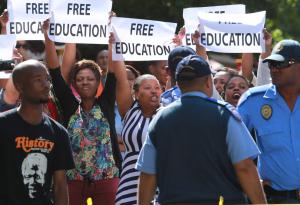
    In South Africa students have been protesting for the past couple of weeks. Their immediate concerns are the intended hike of tuition fees, on average about 10%. Starting from the University of the Witwatersrand (Wits) in Johannesburg, they have demonstrated against the planned hikes. Students have occupied buildings on their campuses, held mass meetings, moved around the campus grounds, forced senior university administrators and university councils into negotiations. Campuses across the country have been brought to a stand still; this has happened at a crucial time of the South African academic year, just before the end of the year exams are about to start.

    Over the past few days the students also have moved out of university grounds and taken the protests into the cities. Most spectacularly, on Wednesday (Oct 21) hundreds of Cape Town-based students moved toward the precinct of the national parliament in downtown Cape Town. A number of them broke through the cordon of police – with their arms raised. The police responded with teargas and the shooting of stun grenades. Twenty-nine students were arrested, six within the parliament precinct and another 23 in the city’s Central Business District. Those arrested inside the parliament grounds face charges of “trespassing” while all 29 have been charged with taking part in an “illegal gathering” and “public violence”. Initially the “Bellville 6” (named after the suburban police station where they were held over night) had been threatened with the exceptionally serious charges of “high treason”, which have since been dropped.
     
    On Thursday (Oct 22) demonstrations continued throughout the country, in the major cities, but also in smaller towns and at campuses, which are located in rural areas and normally don’t find much attention in the South African public debates. Thursday afternoon saw thousands descending upon the ANC headquarters in downtown Johannesburg. This morning, Friday, 23 October, thousands and thousands of students and their supporters are marching on the Union Buildings in Pretoria, the seat of government.
     
    What is happening here? Why are these young people – dubbed the “born frees”, raised and mostly born after the end of apartheid – taking on university administrations and the South African state? Why are they, who were supposed to be the post-apartheid dispensation’s beneficiaries, exceedingly unhappy with the state of affairs? There can be no doubt that these protests are about much deeper problems than simply a raise of tuition fees, as much as such hikes will affect the poorest of the students. The current protests have brought young South Africans of different social backgrounds out to raise their voices on campus and in the streets. The protesters come from townships and rural areas, but they also come from the comfortable middle-class areas, and some even from the leafy high-end suburbs. They are black (mostly) but also white (in quite substantial numbers). Among those arrested in the Cape Town parliament incident were several children of prominent families, including, as the social media picked up quickly, the son of the University of Cape Town’s vice-chancellor. It is significant indeed that black and white students march together.
     
    The students have been principled and courageous in their activism, mostly disciplined and despite the lack of formal leadership in many institutions where the official student representative councils have often been slow to react appear to be remarkably well-organised. At Wits University they organised alternative lectures before leaving for more activism and made sure they cleaned up the spaces they occupied because, as they say, they don’t want to make the workers, “their mothers” have to clean up after them.
     
    Academics from universities across the country have come out in solidarity with the student protests; professors, lecturers and researchers have marched with the students, some having donned their academic gowns, they have protected students against police brutality by forming human shields. A national declaration in support of student protests was released on Wednesday, signed initially by close to 250 academics; now this letter has gone global. The signatories affirm that they “stand with students in their fight for the democratisation of our universities.” The incisive analysis of the letter of solidarity continues, “The current student protests that have erupted across the country are historic. They demonstrate a younger generation willing to take up the struggle against inequality, and to insist on the principle of education for all. Our students are leading the national debate on education, and we insist that they deserve our respect and attention.”
     
    The current student protests have not come about as rabble-rousing on a spur. Some have mused that the revolution is being tweeted; the movement however is far more than simply a hashtag. It may be better to say that what we see now is a catalyst of a politicisation that has spread-out on South African campuses over the past six months. In March this year, students at the University of Cape Town (UCT) began a vigorous campaign, “#RhodesMustFall” to have the statue of Cecil John Rhodes removed, which had been sitting on the university grounds in a prominent position for the past eighty years. They succeeded to find the university’s support, a few weeks later the objectionable item was removed under the thunderous applause of hundreds who had gathered to watch this significant moment. From Rhodes Must Fall the movement grew to include other campuses, mostly those of the former white-liberal English campuses, such as Wits and the small university in the Eastern Cape, which bears the name of Rhodes, but also the Afrikaans, still very conservative and overwhelmingly white Stellenbosch University in the Western Cape.
     
    The movement pursued the aim of “decolonizing the mind”. Campaigns and discussions were started, at times aggressively, with the aim to change the academic environment, to establish new syllabuses to replace those that are perceived as Euro-centric, to change the institutional cultures of the universities, which were seen as still being untransformed and “too white” in style and substance, and, last but not least, to employ more black academics. This took occasionally ugly turns, the most painful of which perhaps occurred during a spell of overt anti-semitism in the wake of a social media declaration by Wits’s former Student Representative Council President that he “loved Hitler."
    Yet prevailing has been the hunger for new forms of knowledge. “One could also see it coming”, writes Achille Mbembe, professor at Wits University who has accompanied the student movement class of 2015 with insightful analysis and relentless engagement, “in the extraordinary return to critical black intellectual traditions, to black feminism, queer theory, critical race studies, theories of intersectionality etc.” Young students have rallied to read Steve Biko again and more intensely, Biko of course had always been part of alternative and in recent years also the official South African canon. Significantly the new generation also rediscovered and revered and memorized the works of Frantz Fanon, read on his own or in conjuncture with Biko’s. More recently some have found a new hero, an icon perhaps more than a thinker and strategist in Thomas Sankara, who had earlier remained virtually unknown in South Africa.
    What has newly arisen over the past few weeks, couple of months, dating back to artistic activism to commemorate the third anniversary of the shooting of thirty-four striking miners during the 2012 Marikana massacre in August, is a new alliance of students and workers at universities. Both groups have been rendered precarious in the corporate university, which has fast been emerging with the neoliberal restructuring of the higher education sector in South Africa. “#FeesMustFall” and “#‎EndOutsourcing” campaigns have joined hands and these hashtags indeed have been painted together on banners carried by protesters this past week. This recent move from the sole focus on racism to pay more attention to issues of socioeconomic inequality has, in turn, inspired new intellectual desires. Mbembe again: “To these currents [of critical black studies] is now being added a renewed critique of political economy that aims at bringing together, dialectically, questions of race and property, of class and inequality, and of identity and what many call lived experience.”
    Mbembe has variously spoken about the present time as South Africa’s “Fanonian moment”, a time when twenty years or so after the country’s initial political “independence”, an incomplete decolonisation, a new generation enters the social scene and asks new questions. The students who now rally and march and discuss and occupy ask such new questions; they also remind – quite consciously – South African society and politics of the challenges raised by earlier generations. “1976” has been written on placards held up by students at campuses this past week, recalling the revolt of the youth that eventually brought the apartheid regime to its knees. At this moment we don’t know what will come of all this. We don’t know how the state and the ruling ANC – neither being monolithic – will react. Institutional and political reactions these past few weeks, and indeed the past six months have been uneven and even ambiguous, ranging from police brutality to attempts of incorperation. We also can’t foretell how the vibrant student movement will develop beyond the current moment. What we do know is that we witness an extraordinary moment – what a time to be alive! http://rs21.org.uk/2015/10/23/south-african-students-win-on-fees-an-extr…

  • Ten Days That Shook The World

    Image

    In celebration of the 98th anniversary of the Russian Revolution we are publishing this short extract from John Reed’s brilliant eyewitness account, Ten Days That Shook The World. Reed was a socialist journalist from the USA, who described the revolution as: “Adventure it was, and one of the most marvelous mankind ever embarked upon.”

    This section is from the night before the insurrection of November 7th, 1917. The full text is available on Marxists.org.

    Up the Nevsky in the sour twilight crowds were battling for the latest papers, and knots of people were trying to make out the multitudes of appeals and proclamations pasted in every flat place; from the Peasants’ Soviets, the “moderate” Socialist parties, the Army Committees—threatening, cursing, beseeching the workers and soldiers to stay home, to support the Government.

    Image

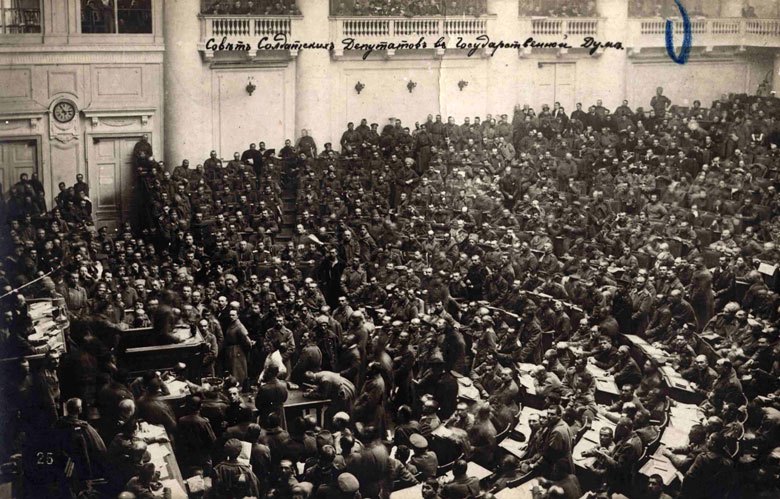
    Petrograd Soviet, 1917

    An armoured automobile went slowly up and down, siren screaming. On every corner, in every open space, thick groups were clustered; arguing soldiers and students. Night came swiftly down, the wide-spaced street-lights flickered on, the tides of people flowed endlessly. It is always like that in Petrograd just before trouble.

    The city was nervous, starting at every sharp sound. But still no sign from the Bolsheviks; the soldiers stayed in the barracks, the workmen in the factories. We went to a moving picture show near the Kazan Cathedral—a bloody Italian film of passion and intrigue. Down front were some soldiers and sailors, staring at the screen in childlike wonder, totally unable to comprehend why there should be so much violent running about, and so much homicide.

    From there I hurried to the Smolny Institute. In room 10 on the top floor, the Military Revolutionary Committee sat in continuous session, under the chairmanship of an eighteen-year-old boy named Lazimir. He stopped, as he passed, to shake hands rather bashfully.

    “Peter-Paul Fortress has just come over to us,” said he, with a pleased grin. “A minute ago we got word from a regiment that was ordered by the Government to come to Petrograd. The men were suspicious, so they stopped the train and sent a delegation to us. ‘What’s the matter?’ they asked. ‘What have you got to say? We have just passed a resolution, “All Power to the Soviets.”’ The Military Revolutionary Committee sent back word, ‘Brothers! We greet you in the name of the Revolution. Stay where you are until further instructions!’”

    All telephones, he said, were cut off: but communication with the factories and barracks was established by means of military telephonograph apparatus.

    A steady stream of couriers and Commissars came and went. Outside the door waited a dozen volunteers, ready to carry word to the farthest quarters of the city. One of them, a man in the uniform of a lieutenant, said in French, “Everything is ready to move at the push of a button.”

    There passed Podvoisky, the thin, bearded civillian whose brain conceived the strategy of insurrection; Antonov, unshaven, his collar filthy, drunk with loss of sleep; Krylenko, the squat, wide-faced soldier, always smiling, with his violent gestures and tumbling speech; and Dybenko, the giant bearded sailor with the placid face. These were the men of the hour—and of other hours to come.

    Downstairs in the office of the Factory-Shop Committees sat Seratov, signing orders on the Government Arsenal for arms—one hundred and fifty rifles for each factory. Delegates waited in line, forty of them.

    In the hall I ran into some of the minor Bolshevik leaders. One showed me a revolver. “The game is on,” he said, and his face was pale. “Whether we move or not the other side knows it must finish us or be finished.”

    The Petrograd Soviet was meeting day and night. As I came into the great hall Trotsky was just finishing.

    “We are asked,” he said, “if we intend to have a vystuplennie. I can give a clear answer to that question. The Petrograd Soviet feels that at last the moment has arrived when the power must fall into the hands of the Soviets. This transfer of government will be accomplished by the All-Russian Congress. Whether an armed demonstration is necessary will depend on— those who wish to interfere with the All-Russian Congress.

    “We feel that our Government, entrusted to the personnel of the Provisional Cabinet, is a pitiful and helpless Government, which only awaits the sweep of the broom of History to give way to a really popular Government. But we are trying to avoid a conflict, even now, to-day. We hope that the All-Russian Congress will take— into its hands that power and authority which rests upon the organised freedom of the people. If, however, the Government wants to utilise the short period it is expected to live—twenty-four, forty eight, or seventy-two hours—to attack us, then we shall answer with counter-attacks, blow for blow, steel for iron!”

    Amid cheers he announced that the Left Socialist Revolutionaries had agreed to send representatives into the Military Revolutionary Committee.

    As I left Smolny, at three o’clock in the morning, I noticed that two rapid-firing guns had been mounted, one on each side of the door, and that strong patrols of soldiers guarded the gates and the near-by street-corners. Bill Shatov, from the USA, came bounding up the steps. “Well,” he cried, “We’re off! Kerensky sent the yunkers to close down our papers, Soldat and Rabotchi Put. But our troops went down and smashed the Government seals, and now we’re sending detachments to seize the bourgeois newspaper offices!” Exultantly he slapped me on the shoulder, and ran in.

    Image

    John Reed

    This excerpt originally appeared at rs21.


  • The Protests in Lebanon Three Months After

    Image

    In response to the failure of the state to manage and dispose of accumulated trash, a series of protests erupted in Lebanon in August 2015 demanding the toppling of the Lebanese corrupt regime and the basic rights for water, electricity and a clean healthy environment. This article provides an overview of the strategies used by the state to dismantle the protest movements, a class reading of the social movements three months into the protests, and an analysis of the strengths and achievements of the demonstrations.

    Image

    This regime is bad for: 1-Refugees; 2-Migrant workers; 3- LGBTQ, signed by the popular student movement, Lebanese University (source: Moe Ali Nayel)

    The strategies of the state, its police and paramilitary branches in targeting activists and protest movements

    The regime adopted multiple strategies to contain and dismantle the protests and shift public understanding of the protesters. These tools, visible in contingent interactions during the protests, in arrests conducted and in political statements, were all undeniably informed by the massive wave of NGO-ization of Lebanese security state institutions and apparatuses after the July war in 2006, and the rehabilitation, trainings, coordination and conferences on security and anti-terrorism issues organized for various Lebanese security sectors by foreign states. Various professionalized and ‘under the counter’ coercive and containment techniques have been adopted in these protests in Lebanon.

    The classic trilogy: ‘Ghareeb, Ta’ati, Irhab’ (Foreigners, drugs & terrorism)

    In his effort to discredit the legitimacy of the protests, Lebanese interior minister Nouhad El Machnouk relied on a classic trilogy that represented the protesters as drug addicts and non- Lebanese who are manipulating the protests for ulterior motives, like terrorism and implementing a foreign agenda. The irony of these accusations did not go unnoticed in a state that is literally and materially functional primarily because of foreign money and agendas. The interior ministry and its apparatus addressed the presence of moundasseen, or infiltrators, among the protesters, claiming that police have arrested Syrians and Sudanese nationals, as well as ‘drug addicts’ in the protests, while media sources hinted at the presence of ISIS enthusiasts planning terrorist attacks. These familiar categories are how the Lebanese regime understood and treated disobedience in times of social and political anxieties and violence.

    The ideology of Al-Ghareeb, or the foreigner non-Lebanese, has been evoked to instigate fear, mistrust and recreate an insider/outsider binary. Al Ghareeb has always been highly racialized in the Lebanese discourse. Al Machnouk’s insistence on the Syrian and the Sudanese as the main infiltrators in the protests should not go unnoticed. Both racialized bodies are refugees and asylum seekers in Lebanon, and have been part of the Lebanese labor force. In recent years, with the influx of Syrian refugees into the country, the Lebanese state have used ‘the Syrians’ as a scapegoat category for almost every occurring problem, from lack of water, electricity, to the dearth of  jobs. Sudanese asylum seekers have been engaging in a strike outside of UNHCR offices which they accuse of racism and discriminatory treatment, under severe conditions and bullying from both UNHCR and the police. Both black bodies — and we use black here inspired by Ta-Nehisi Coates’s deconstruction of blackness in “Between the World and Me” (2015) as a category foremost implicated in the national dream of what it means to be Lebanese and the racialized ideology of the state vis-à-vis its residents– are highly managed and abused by the police and army. Both are not allowed to protest for their rights and are made to be invisible except when evoked as infiltrators. The use of the Syrian and Sudanese bodies works to evoke foreignness and terror, while justifying the excess of force and governance by the police.

    Violence and the protests: military courts in a democratic state

    Another strategy used by the interior ministry consists of portraying the protests as unsafe and violent, and protesters as irresponsible rioters, to extend its own “legitimate” use of violence in the protests. This was intensified by the coordination with paramilitary forces in the form of armed civilians kidnapping protesters and beating them up. In Akkar for example, armed civilians opened fire to dismantle a protest against the opening of garbage dumps, wounding five people.

    More institutionalized and professionalized practices of detainment, such as the opening of temporary detention centers, were adopted, while less familiar maneuvering strategies were employed by riot police during protests, exhausting the protesters and depleting their spirit. However, police violence and detainment techniques seem to suddenly break away into “street violence” in other protests, with videos showing riot police throwing stones at protesters, following them in the street with tanks, and shooting disproportionate amounts of teargas directly at them, instead of into the air. One protester, Mohamad Kassir, suffered from full body paralysis when shot with a teargas canister from a point blank range on the night of the August 23rdprotest. Many other protesters have also been wounded. So far preliminary data show that approximately 250 people have been, arrested, 54 of them were referred to military court for trials. Among these were ten underage protesters. Al Machnouk have justified the excess of violence by claiming that the protesters have a desire to be beaten and arrested.

    What is disquieting is the random arrests of protesters and activists convicted and tried in military, rather than civil, courts under the pretext of disturbing “civil peace,” attacking military hardware, and the barbed wire placed to prevent protesters from reaching the parliament and the government palace.

    Three months of civil protests: a class reading of civil movements’ strategies, anxieties and of the abrupt fall of the momentum

    The protests that engulfed Beirut were met with repressive measures by state security. which sparked and galvanized nationwide popular outrage. However, that revolutionary spark was gradually tamed by the sectarian-capitalist establishment and abandoned by the organizers of the street movement that became known as the Harak (mobility). In order to understand the current stalemate it’s noteworthy to point out how the so-called Harak is governed by middle-class anxieties and privileges that when threatened took on de-escalation tactics and deflated what could have turned into a historical event in the history of modern Lebanon.

    Following the brutal attacks by state security against protesters there was a juncture when protests climaxed and became a force capable of creating a dent in the Lebanese political system. At that juncture the Lebanese political sectarian mafia felt intimidated by protesters who in their peaceful persistence turned into a raging fireball that awakened a portion of the dormant Lebanese consciousness. The peaceful method of the protests was a unique phenomenon in a Lebanon governed by daily organized violence.  Thus, the dysfunctional Lebanese state that was being condemned on the street turned into a highly functional and efficient repressive machine orchestrated by minister of interior Nohad al-Mashnouk, funded trained and equipped by foreign aid programs.

    By curbing the sentiment on the street from an uprising into a Harak, NGO-oriented activists proved that they were not fit to handle the fireball they had created; their organizational methods were inconsistent with the revolutionary spirit that united people in one protest. As pressure mounted on the streets people demanded a bigger scope of change; to topple the whole sectarian system. But protest organizers were reluctant to move towards such change and settled for merely protest organizing. Furthermore, the most prominent movements: We want Accountability, You-stink and other movements downsized their scope of action and gradually fell back from crude street defiance into flash mob activities and “event” organizers. While the street was fidgety and anxious for more action its energy was drained by the extensive meetings held behind closed doors by the You-stink and We want Accountability movements vying for the forefront of public representation. Nevertheless, the street at this point was still ahead of organizers’ hesitance; to the organizers the street increasingly became too big to handle and seemed like it might really get things out of their hands and shake the sectarian system from its foundations. As a result of not matching the sentiments on the street, the backpedalling started, which created time and space for politicians and state authority to organize their ranks and respond to the rebellion on the streets with calculated coercive and containment tactics. This is when campaigners began their withdrawal from an ongoing street battle to topple the regime, to a battle for recycling trash and finding solutions for the corrupted state whose own corruption led to the trash crisis.

    On the 23rd of August was the protest that exposed the classist colours of the You-Stink organizers who betrayed the street calling on state security to clean the protest of agent provocateurs while thousands of protesters stood their ground defying state repression. Approximately two million refugees and migrant workers in Lebanon face the worst forms of daily violence; however the emphasis on the “Gharib” by minister of interior and rumors spread by organizers about “infiltrators” eliminated the participation or even the suggestion of including refugees and migrant workers in protests. The classist aspect amongst protest organizers especially among the You-Stink movement has a) criminalised and alienated protesters who have come from low income areas with vengeance and stood up to police brutality during protests and b) supplied Lebanese politicians a pretext to delegitimize the protest for being “infiltrated by agent provocateurs,” simultaneously blocking the way for participation of migrant workers and refugees and serving further bogiemanization of the latter.

    While in privately planned minimalist-protests prominent You-Stink activists acted violently in front of the cameras as they confronted state security; these were celebrated as heroic acts, but when this same violence was taken by ordinary and low income angry protesters they were called “infiltrators” and “undisciplined elements” by You-Stink activists. Then it became clear that you-stink activists wanted any direct action to go through their filters and get their approval: a move to monopolize the public image and representation of the protests, not an unusual occurrence in sectarian Lebanese politics.

    When violence was perpetrated by protesters in general as a defense mechanism against repressive state security measures, then the reaction by the whole array of the sectarian polity and their media trumpets was that of shock and bafflement, as if Lebanon was an island of tranquility. The fact that the state has been devolving in a dysfunctional mode for decades is in itself a form of daily violence that led to angry resentments on the streets this last summer. Violence against refugees, domestic migrant workers, LGBT individuals and women is an ongoing violence that doesn’t raise an iota of the outrage voiced against “violent protesters.”

    The major achievement of the protests is that it has created cracks in the sectarian bubbles and some people have started leaking out to meet their counterparts andrealize that everything is in fact common, that they are all victims of the same repressive social order. The patriarchal sectarian blinders fell in the street.  That’s why it’s imperative for the street movement to abandon the Harak mentality and return to the uprising mode. Only an uprising could impose a real threat to the capitalist ruling elite and the sectarian lords, while simultaneously creating confidence in the street to empower those undecided citizens still stuck inside their sectarian bubbles, who need to defect and leak out to the street.  That’s why it’s erroneous to wait for a corrupt establishment to come up with solutions or even feel morally pressured by the Harak’s tactics and reform. The make-them-wait-promise-to-keep-them-waiting approach is what the Lebanese have had in the last 25 years; Mafioso politicians will only feel intimidated if their own thievery was directly threatened and when their own timid constituencies find an alternative to their hegemonic sectarian social order.

    And so the street movement has sunk into a frustrated feeling of defeat as a result of the Harak’s inaction and de-escalation tactics. The biggest mistake was committed while the climax on the street was at its peak; the organizers who led the protests failed to embrace and organize those outraged on the streets who had just abandoned their sectarian social bubbles. Those dissident individuals who dared to defect from the social hegemony of family authority and broke away from the sectarian political identity that governs their social relations needed a safe Haven.

    The Harak’s weakest point is the fact that on an organizational level its ranks are dominated by middle-class activists steeped in an NGO mentality, and as a result the revolutionary mood on the street was taken hostage by their middle-class anxieties.  Seeing that the street swelled with angry protesters making demands beyond the scope of action that was planned by the organizers of You-Stink, the Harak then de-escalated its measures of direct action. Worse, the campaigners switched their modus operandi into exclusive and elitist-looking attempts, seeking media stunts rather than taking the uprising to the next level, thereby nipping in the bud the revolutionary character of the protests. The toxic elitist sentiment lies within decision-making circles that kept on meeting behind closed doors away from the street and missed the chance of establishing an open sit-in at Riad al-Solh that could function as a shelter, a place of belonging, a visible ongoing body of the protest and a safe haven reclaiming public space. Secular activists who have had experience with and a history of street protests and organization have failed to open the doors of the streets or/and secure them – to embrace first-time protesters who flowed onto the streets since August 22. Many young individuals who had just abandoned their traditional habitats at the risk of severing their familial/social-sectarian ties joined their peers in the streets denouncing the defeatism of their parents’ generation. They needed an alternative to embrace them, but that alternative did not match their needs.

    It’s precisely this type of middle-class anxieties that reproduce the system within the protest movement itself. The two major movements that were born out of public resentments against trash and corruption, You-Stink and We want Accountability, became the two most dominant movements in the Harak. It increasingly seems that the way in which these two movements operate and politically differentiate themselves from the other have placed them at the risk of slipping into a polarization that resembles the political mode of March 8 and March 14 political blocs, the political alliances that were formed following the withdrawal of Syrian security from Lebanon in 2005.

    At present, autumn’s arrival has cooled down the atmosphere in Beirut. The sentiment in the street seems to be back to square one, but not without its symbolic achievements. The backtracking from movements’ organizers into tactical gambling to solve the trash crisis deflated the revolutionary enthusiasm that created a momentary existential threat to the Lebanese political order. Middle-class activists who are at the risk of missing a historical chance to change the lethal Lebanese political equation ought to realize that it’s only a matter of time until their middle-class privileges that they cling to are eventually going to vanish by the political establishment they hesitated to topple.

    The shaking of the patriarchal discourse and political cynicism: reconfiguring hope & political action

    Perhaps the undeniable strength of the protests so far rests in their ability to put an end to the cynicism and helplessness reigning over conversations and actions for change in Lebanon, thereby producing political hope in the ability to dismantle the Lebanese corrupt structure. The personal-emotive transformations experienced by activists and non-activists alike, and the possibility of imagining something new, have created a stimulating platform for political and social debates. One slogan held in the protests “A revolution on the life we live with (the help of) drugs and pills,” portrays this personal revolution over slow and structural death in a stagnant system.

    Image

    A revolution over the life we live with drugs and pills (Source: Al Manshour)

    The protests have also caused a crack in the discourse and esthetics of power itself. This is visible in the state’s rhetoric and arguments against corruption that are no more convincing. Ministers and state leaders are ridiculed and mocked in the protests. Intellectuals are challenged publically and accused of being paternalistic.

    In a counter move, the regime attempted once again to attack the authenticity of the protests on the basis of morals, manners and the esthetics of protesting. They filed lawsuits against name defamation, arrested activists under the pretext of disrespecting the flag and nation. Not everything of course has been challenged. The sacredness of certain political leaders and parties, notably Hezbollah, remained mostly unchallenged and undebatable while protesters try to advance the idea of “All means All,” that everyone is corrupt and needs to be held accountable.

    However, social movements have yet to offer new forms of political action and expression. Many of the protests have been incorporated into sometimes outdated and a politically insignificant way of doing politics & protesting. Protests have been turned into a media spectacle, constricted by recycled speeches and old political music that has lost the ability to express the present. A rise in nationalism is also noticeable, where many times there is an intentional forgetting of Palestinians, Syrians and foreign migrant workers and maids who also have crucial demands and rights in the country they reside in and are as affected by the same system if not more severely.

    The feminist bloc, a feminist platform for groups and activists that emerged as a result of the protest to provide feminist solidarity and secure a safe space in the protests for women and gender-minority groups to express their opinions and demands, has been marching in the protests under the slogan of “the patriarchal regime kills.” This is a good example of these practices of challenging and revealing what lies inside the Lebanese discourse of power. The bloc’s chant “I want to dance, I want to sing and I want to topple the system” can be read as a double commentary on the freedom of women to occupy the streets, but also as challenging hegemonic male-centered ways of doing politics and protesting, signaling the need to challenge and take back the streets and protests re-appropriated by “the Lebanese male activist” and recycled activist forms of political expressions.

  • Comment on Recent Elections in Argentina

    Image
    The Frente de Izquierda y los Trabajadores (the Left and Workers Front) or FIT went into last week's election with confidence. The new electoral alliance, comprised of the older and more doctrinaire trotskist formation Partido Obrero (Workers Party) or PO, the newer PTS (Socialist Workers Party), and the smaller IS (Socialist Left), hoped to build on recent electoral successes, including double digit tallies in a few provincial elections, and continue advancing along the ripples of youth and rank-and-file discontent against looming austerity and layoffs.

    With a climate of polarization surrounding a contest that is to decide on the continuity of neo-populist Kirchnerism and the general rightward shift of the major electoral forces, peronist and non-peronist alike, this election was going to be challenging for the left. But the FIT nevertheless expected to increase its voter appeal and establish itself as a radical pole for left national politics. The Front's aim was to peel off sectors of the working class and progressives who are sympathetic to Kirchnerismo or straddle the fence, skeptical of its reform agenda yet unwilling to support the pro-business fractions of the mainstream opposition.
     
    Many FIT sectors thought this was possible as Scioli, the candidate hand-picked by outgoing president Cristina Fernandez, was undeniable evidence that Kirchnerismso has exhausted any progressive potential and is inescapably moving to the right. In a race in which all leading candidates took positions that sought in some measure to win over business confidence, the FIT was optimistic that it could capitalize on a popular-left space it expected to open.
     
    Surprisingly, the FIT was led by the PTS which edged out the PO-IS alliance in Argentina's bizarre compulsory primaries held in August (PASO). THe PTS claimed success both in terms of electoral performance and broader anti-capitalist political positioning celebrating that it's candidate, the youthful Nicolas del Cano, who surprised socialists and the entire country by being voted into congress in 2013 with 14% of votes, got 800,000 presidential votes and nearly 1,000,000 congressional votes cast for the FIT. While other FIT members have been relatively silent, the PTS is claiming that this election cemented the FIT's position as the 4th electoral force of the country, having displaced what remains of the 'progressive-liberal' opposition. It points to a vote total that compares favorably to the 500,000 votes the FIT received in the last 2011 presidential elections.
     
    Unfortunately, a more pessimistic analysis of the FIT's electoral performance is more compelling. In terms of electoral results the inescapable fact is that the FIT failed to grow compared to its 2013 congressional vote total and the August primaries. This time around, the FIT got almost 500,000 fewer congressional votes than in 2013! And while it surpassed the half million presidential votes that it won in 2011, this increase should not be viewed as real growth. The FIT's low 2011 total came in the context of pro-Cristina euphoria which has since faded considerably.
     
    Over the ensuing four years, things have turned south for Cristina and Kirchnerismo yet the FIT was unable to capitalize on growing popular discontent as it has been optimistically claiming it would do since the 2013 congressional elections. In this light, the extra 70,000 presidential votes it picked up since the PASO are discouraging. Considering that 300,000 voters went for other radical left candidates in the primaries, this marginal improvement indicates that the FIT was unable to turn out layers of the electorate that should be natural supporters. In other words, a chunk of Argentine radicals actively voted against the FIT. Viewed this way, the fourth place finish is not much of an accomplishment, reflecting instead anti-Kirchner mainstream realignment rather than actual consolidation of an anti-capitalist pole.
     
    The PTS thought it could run a less orthodox campaign, targeting youth and women for instance, and thus win over the progressive wing of Kirchnerismo. It's fair to say this strategy failed for a number of reasons. But the defeat of the PO candidate (Altamira) in the primaries also shows that, though the alliance itself is a valuable step away from the characteristic sectarianism of Argentina's revolutionary socialists, it has not yet figured out how to run a non-dogmatic socialist campaign rooted in the working class and based primarily on anti-capitalist grievances. Nevertheless, even if the FIT failed to reach beyond its hard activist base of a small minority of worker activists and a majority of campus activists, the alliance deserves to be supported and inclusively transformed from within. If, however, the PTS continues to insist on combining programmatic purity with facile campaigning, prospects for the Argentine socialist left will remain weak.
     

  • Behind Ciudad Juarez’s New Labor Movement

    Image

    The Mexican and U.S. government first agreed to the creation of the maquiladora plants along the U.S.-Mexico border in 1965 and already by 1975 there were strikes for union recognition. Yet in the last 40 years, thanks to the cooperation of the multinational corporations and the U.S. and Mexican government virtually no group of workers has succeeded in organizing a genuinely independent labor union. Most plants have no unions. Some plants have unions run by lawyers and gangsters who are allied with the ruling Institutional Revolutionary Party (PRI) and the government. A combination of legal chicanery, intimidation, and violence have been used to keep workers from organizing. Now, once again, after many years there are labor protests in Ciudad Juarez one of the major maquiladora centers across the border from El Paso Texas as reported by Kent Paterson of Frontera NorteSur News where this article originally appeared.- Dan La Botz

    In a virtually unprecedented development, labor protest is widening in the maquiladora industry of Ciudad Juarez, Mexico. While worker dissatisfaction or protest is nothing new in the foreign-owned border factories that produce goods for export to the United States, previous manifestations of discontent in the generally union-free industry have usually been confined to one company at a time.

    But recently, movements for better pay and working conditions- and union representation- have emerged at four different companies-Foxconn, Lexmark, ADC/Commscope and Eaton. Hundreds of workers have participated in street protests, hunger strikes and leafleting.

    “This is the time bomb going off,” said Elizabeth Flores, director of Pastoral Obrera, the Ciudad Juarez Catholic Archdiocese’s labor justice and human rights arm. “It’s interesting to see how all the people are demonstrating.”

    Flores spoke to FNS as ex-workers of the North Carolina-based Commscope company, a manufacturer of products for networking infrastructure like fiber optics, joined in on an October 26 demonstration at the Bridge of the Americas organized by rural, human rights and environmental activists.

    Several former workers complained to FNS about abusive treatment by company management that included shouts, insults and arbitrary changes in work shifts. The workers said they had been fired for forming an independent union on September 16, Mexican Independence Day. Many of the former employees are single mothers like Veronica Rodriguez, who said more than 100 workers joined the new union.

    According to the mother of three, her earnings came out to less than $50 in base pay weekly plus bonuses that averaged about $40 per month. “You can’t get by very well. You have to look for another source of income,” Rodriguez said. “We are also protesting to see if the government helps.” To press their cause, Rodriguez and fellow workers have set up an encampment outside Commscope’s Juarez plant.

    “The company isn’t disposed to negotiate and doesn’t want to dialogue,” said Cuauhtemoc Estrada, lawyer for the fired Commscope workers. “We don’t know why the company fired 120 workers in an act of revenge.”

    Estrada told FNS that he filed a legal complaint on behalf of the dismissed workers  with Mexico’s Labor Arbitration and Conciliation Board. The firings, he contended, were not only illegal but a violation of human rights.

    In addition to the guarantees of union association written in the Mexican Constitution,  Mexico belongs to the International Labor Organization of the United Nations and recognizes the American Convention on Human Rights, both of which uphold freedom of labor association.

    Despite its commitments, the Mexican government has privileged the power of the semi-official Mexican Workers Confederation and other unions historically tied to the ruling PRI party in the places where nominal union representation exists, while “independent organizing has been impeded in the northern border part of the country,” according to Estrada.

    Rick Aspan, vice-president of corporate communications for Commscope, disputed the workers’ version of the labor conflict. “We terminated fewer than ten people from the facility recently,” Aspen told FNS in a phone interview. Although declining to go into details, Aspan said the workers were fired for violation of work rules and not because of joining a union.

    Commscope’s spokesman said he was in the process of obtaining more information about the Juarez conflict, but maintained that his company had been a “good employer” with a productive work force of more than 3,000 employees at its Juarez facility.

    Formerly run by ADC, the Juarez plant was acquired by Commscope in August of this year, Aspan said.

    The status of labor rights in Juarez is being monitored by Cereal, a Jesuit-supported worker advocacy organization with offices in Mexico City and Guadalajara.

    In recent conversations with Juarez workers, Cereal staff member Felipe Burgueno said he found commonalities in their grievances, including wages and benefits, safety, union representation and management practices.

    The current wave of protest “has to do with the conditions under which workers are laboring and how they are being recruited,” Burgueno said. Low wages, he added, lubricate a “vicious circle” of poverty that does not allow workers the necessary income to obtain educational studies that could improve their lot in life.

    “Who thinks that a father or a single mother can provide food, education and health care for their children on 90 pesos (less than six dollars) a day?” labor attorney Estrada separately weighed in. “Nobody can do this.”

    Burgueno said Cereal’s findings on the Juarez labor situation will be included in a forthcoming report on the Mexican electronics industry’s working conditions also in Tijuana, Mexicali, Reynosa and Guadalajara. “They are the same violations of labor rights, but each region has its own particularities,” he added.

    The surge in labor protest at Juarez factories comes as the local industry trade association, AMAC-Index Juarez, celebrates the 50th anniversary of the arrival of the maquiladoras to the border city.

    The assembly-for-export plants were envisioned as an alternative source of employment for former Mexican guestworkers in the United States who lost their jobs in the agricultural industry when the Bracero Program was terminated in 1964. However, the maquiladoras largely harnessed a distinct workforce, especially young women workers.

    FNS spoke to two Juarez women with a combined experience of 30 years in the maquiladora industry. One of the women is still actively employed. Both asked that their names not be used for this story due to security concerns.  The women identified three major reasons why worker protests are escalating now as opposed to earlier years, when wages and shop floor conditions were also burning issues.

    According to the industry veterans, the first reason has to do with a changed composition of the labor force, from younger and even adolescent workers to employees with more household responsibilities. The second factor is connected to the current crisis of worker recruitment, in which many locals are shunning factory jobs because of the low pay. Consequently, to lure workers, employers offer new hires better deals over long-time employees, who with ten years or more of service are resentful to see their compensation stagnating.

    “The majority of the new movements are arising in repudiation of these policies,”  one of the women said.

    Last but far from least is the decline of violence in Juarez in comparison with the years between 2008 and 2012, when more than 12,000 people were estimated murdered during the so-called narco war. During that time the city was under virtual occupation by soldiers, federal police or warring gangs.  Extortion, kidnapping and car theft were rampant. According to the two women, free speech was suppressed while labor organizing was rendered virtually impossible.

    “People are survivors and have lost some fears,” one woman said. “When you lose your fear, you act.”

    Still, the atmosphere for labor organizing is a fragile one. Cereal’s Felipe Burgueno pointed to one well-known labor lawyer who became the target of constant threats and harassment. Burgueno also cited the case of an activist worker who was followed home by management personnel. “This could be symbolic,” he added. “’We know where you live, where you are.’”

    For Burgueno, the present juncture in Juarez is a critical one for not only workers, but the city as whole.

    “It’s important that the workers are becoming conscious of their rights, and it could result in the creation of a social actor who improves conditions for everybody. It’s important to strengthen these groups,” he said.

    The two maquiladora veterans interviewed by FNS said they are working with a newer women’s collective in analyzing the socio-economic conditions and the Mexican government’s latest political and economic reforms to strategize a path forward for women workers.

    “Our objective is to generate an organic process of women workers for social and economic development,” one of the women said. “We are barely constituting ourselves as a non-profit organization, and will have a diagnosis of the social situation, of how violence impacted the city, and of the structural reforms and how they impact women.”

    As FNS was going to press, the Ciudad Juarez daily Norte reported that a group of 70 Lexmark workers began staging a protest early Monday morning, November 2 at the maquiladora’s plant entrance.  According to the newspaper, the demonstration was called to protest the firings of two workers, including one who had previously spoken out on television in favor of a union. “We demand an independent union” read one placard carried by a protester.

    Meanwhile, Veronica Rodriguez and other ex-Commscope workers continue with their protest outside the company’s Juarez plant. A hearing on the workers’ complaint before the federal Labor Arbitration and  Conciliation Board originally scheduled for October 30 was postponed to November 19, Rodriguez said.

    “We are surviving by donations, and with the little bit that the workers have left,” she said. The Juarez labor activist said the public response to the workers’ protest was “good,” with people stopping by the encampment to give protesters burritos, water and other supplies. Former Commscope workers are also meeting with workers from other companies to discuss forging a bigger movement, she said.

    “A union would be the biggest gain we could get, and to get our jobs back” Rodriguez told FNS.

    Reprinted from: Frontera NorteSur: on-line, U.S.-Mexico border news, Center for Latin American and Border Studies, New Mexico State University, Las Cruces, New Mexico. For a free electronic subscription email: fnsnews@nmsu.edu

  • Brazilian Activists Prosecuted for Giving Small Donations to Left-Wing Parties

    A still undetermined number of supporters, activists, and sympathizers of two Brazilian left-wing political parties, the Socialism and Freedom Party (PSOL, Partido Socialismo e Liberdade) and the Unified Socialist Workers’ Party (PSTU, Partido Socialista dos Trabalhadores Unificado), are being charged by the State Prosecutor's offices (Ministérios Públicos) of Rio de Janeiro and São Paulo for having made small donations to these two parties during the 2014 elections.

    Image

    One of the activists linked with PSOL, Lucas Mourão, being charged by the Electoral State Prosecutor's office (Ministério Público Eleitoral) of Rio de Janeiro, explained his case on his Facebook page on October 15. He says in 2014 he donated R$60 (about US$15) to the campaigns of Jean Willys and Tarcísio Mota, two PSOL candidates running for, respectively, Federal Deputy and Governor of Rio de Janeiro.

    "I aided the campaign as a volunteer, in my free time, always with a handful of pamphlets in my bag and stickers on my chest, and, obviously, without receiving a single penny.

    I donated 40 reais (10 US dollars) to the campaign for Jean and 20 reais (5 US dollars) to the campaign for Tarcísio. That was what I could spare at the time.

    (…)

    Now this is where the story gets strange: the Electoral State Prosecutors office is charging me (and many others!) for having donated those petty 60 reais (15 US dollars)! That's because electoral law only allows for donations from individual persons up to a limit of 10% their income of the previous year…

    When it was all tallied up, the State Prosecutors’ office arrived at the brilliant conclusion that I, in the year prior to the donation (2013), earned a gross income of less than 50 reais (13 US dollars) per month!

    These guys, these great thinking Brazilian lawyers, came to this conclusion because, upon cracking open my confidential tax report (!) they saw that I was exempt from income tax, then, they concluded that I had earned ZERO income in 2013 and, therefore, I could not donate anything to any electoral campaign…"

    In Brazil, people with an annual income under R$22,499.13 (about US$5,790) are exempt from paying income tax. Electoral law allows campaign donations up to 10% of an individual person's income from the year prior to an election, but, being exempt from paying income tax, the State Prosecutors office deemed the activists to have no income. As such, the state claims they could be committing an electoral crime by making donations.

    Lucas Mourão, who is also an attorney, explained that exempt individuals may donate up to 10% of the value of the exemption limit, therefore, there is no illegal wrongdoing.

    Mourão says that already nearly 100 such cases have been counted in Rio de Janeiro alone. In fact, in the comments on his post thread, multiple people reported how they are being prosecuted by the state for the same reason.

    One of these is Sabrina (who asked not to disclose her last name), who donated R$15 (just under US$4) to the campaign of Marcelo Freixo, a PSOL candidate for the Federal Deputy position in Rio de Janeiro in 2014. According to Sabrina, her case has already been ruled in her favor:

    "I donated 15 reais (4 US dollars) and was also prosecuted! (…) In my case, the State Prosecutors office requested to dismiss the case and the judge ruled in agreement, in a judgment that was shorter than 2 paragraphs… And now I'm advocating the defense of a guy that was also charged for having donated 50 reais (13 US dollars). It's so surreal to use the judicial machine like this just because of these donations!

    (…)

    All donations to PSOL from individual persons exempt from income tax are being investigated, by all indications."

    Antônio Bastos noted that cases seem to be coming “in order from top to bottom,” which would point to a persecution of left-wing parties and their supporters.

    "In some cases there is even a copy of the announcement sent to electoral prosecutors from the head of the Rio de Janeiro Electoral State Prosecutors office, asking for “commitment” in pressing charges. […] I mean, it's a directive from above for “general prosecution” framed in these terms, and maybe some prosecutors made a point to gather cases to prove it…"

    For Sabrina, this is a “clear violation of the democratic principle”:

    "[To] presume that an exempt individual cannot donate anything at all prohibits income tax exempt citizens from being able to contribute to whichever political party they hold in highest affinity (and, thereby, disenfranchises their citizenship) and, consequently, tosses the smaller-sized political parties out of the electoral race."

    The activist Matheus Lara said he had been acquitted, but he did not agree to the invasion of privacy:

    "I was also prosecuted. I was exempt, but I had a way to show my income. I was acquitted. But my tax AND banking confidentiality were broken open."

    The activist Cristiane Talhiaferro is also being prosecuted:

    "My case is still in proceedings too. The judge requested evidence and I had to send in my year of banks statements from 2013. They can breach into confidential banking records for someone who donates 50 reais (13 US dollars) and that's okay, but for someone who embezzles millions they can't…"

    For further details, see the original article at GlobalVoices.


  • Katrina: 10 years after

    I was sitting in a small town Greyhound bus station when I first saw images from Katrina. Happenstance, in retrospect, was so apropos. Bus terminal stations throughout America (so often) being lachrymose warehouses for the poor, the vulnerable, the mentally ill, the psychologically worn down and the just plain penniless –hostels of the many with vagabond destinations. The station held any number of “the kinds of people” who knew what it was to go elsewhere, oftentimes meaning anyplace but the places they’re at. I sat among America’s disenfranchised classes.

    All eyes fixed on the overhead television set. The scenes. Abandoned rooftop families. Watery chaos. “I guess they should have left” somebody darkly whispered. A women (probably mentally ill) began performing a kind of spastic interpretive dance. I suspect under other circumstances she might have had security called to remove her. But on that day the mood – I would call it the mood of real identification– was so thick it infected the security personal, who “let it slide.” America was absorbing the news. The facts were still coming in. But my fellow Greyhound travelers understood that many of them could have been residents of the Lower Ninth Ward. There was no lack of empathy because they intuited the real story was a tragedy of the ne’er-do-wells and the expendable. It revealed the worst that can happen in America, if you can’t afford to stop it.

    Katrina – from beginning to end — described America’s usual relationship with the poor; first, they were “set up for failure” by land and housing patterns that put them in high risk; secondly, perfunctory and indifferent systems of government bureaucracy worsened the toll; and finally the capitalist hierarchy deflected focus away from its responsibility by the usual means – classism and racism.

    Weren’t the poor the least equipped to leave New Orleans under the threat of the hurricane? Besides which generations of the poor had been forced by economics to live in New Orleans’ most dangerous death traps, the “low ground.” It was a nightmare for the residents who had bought into the American dream, by buying homes in the perilous Lower Ninth, trusting in insurance policies and the Army Corps of Engineers expressed commitment to upkeep the levee system. On August 28th and 29th this assurance proved to be like so many promises made to the poor – a con. The shoddily maintained levee system collapsed like pipe dreams (under winds which had diminished to a category 2 or 3 hurricane)

    Then a human calamity followed a manmade catastrophe. The Federal Emergency Management Agency (FEMA) botched the rescue effort so badly that Geraldo reached the New Orleans to film a sensationalistic TV show, while FEMA presumably could not. The Bush administration handled the rescue effort as irresponsibly as it had ignored urgent warnings, and cut necessary funding to restore the levees. Three weeks later, when Bush finally addressed the carnage, he merely opined “Americans have every right to expect a more effective response in a time of emergency.” He stated the obvious. “As all of us saw on television, there is some deep, persistent poverty in this region. And that poverty has roots in a history of racial discrimination which cut off generations from the opportunity of America. We have a duty to confront this poverty with bold action.” Again, the obvious.

    “As all of us saw” (but some of us lived) elided the real harm, weight or damage of forms of social, economic, or physical oppression. (So many more Americans than Bush allows for live in or close to conditions of poverty and economic stress–for them they are not armchair reality television.) But Bush referred to the silent accusation inherent in Katrina, the TV melodrama. Every lost soul crying, pleading and suffering in the Lower Ninth Ward’s death trap was a Black woman, child or man. This crack in America’s imaginary Norman Rockwell revealed the racist Hieronymus Bosch beneath. It revealed who really subsisted at the bottom of America’s socio-economic ladder under an enterprise which had functioned by exploiting race, racism and race privilege since slavery till today’s for-profit prisons and the school-to prison pipeline.

    Then the victim blaming began which exhibited why racism remained capitalism’s most effective social marker. Conservatives “played dumb” regarding the levee failure. Blame Mother Nature. Or rather, blame slow-witted Blacks for living in the hazard zones in the first place. “The failure in New Orleans was a failure of character” wrote columnist Michael Graham, who withheld the least sympathy for Katrina’s “government dependent victims.” During the first days after the hurricane hit rumors (later shown to be false or exaggerated) circulated that New Orleans had fallen into the hands of gangs of looters and roving rapists. Media bias was such that while federal assistance was slow-in-coming a white couple scavenging to stay alive in New Orleans was described as having “found food” and assistance, while blacks were invariably “looters.” Katrina coverage proved a high point in the lowly American tradition of personifying Blacks as animals.

    Bush commiserated sympathetically on TV. But by the time he spoke Katrina coverage was so entrenched in racist connivance, innuendo and fearmongering that his speech was notable for all that he didn’t say. He didn’t criticize the stereotyping of Katrina victims. He didn’t abhor the enthusiasm that a Louisiana representative had already expressed for the idea that Katrina would provide a pretext to roll back public housing. His lack of offense winked in the eye that the rebuilding of the Gulf Coast would be market-driven, gentrification-friendly, and (particularly in New Orleans) a scheme to eliminate the dispossessed poor.

    I was able to visit New Orleans nine months after the hurricane hit, while the city was still partially in wreckage. I spent weeks there interviewing the excess numbers of homeless New Orleanians and participating in the activist movement which was vigorous at the time — because New Orleans’ spirit was still strong. The poor suffered from a basic lack of housing and resources (not character). Progressives from across the country responded by inundating the area with volunteer activism. Thousands locally and afar contributed to making post-Katrina New Orleans an experiment in hands-on cooperative living. They lived in bunk beds and often relied on power generators, but for a brief moment in history “government dependent” New Orleanians and volunteers experimented with a cooperative living microcosm. The work they accomplished was by any measure was more successful than the botched FEMA assistance. This was also a time of extreme hostility towards the federal bureaucracy, which had few local defenders.

    New Orleans became the focus of a movement that demanded the federal government take full responsibility for the levee failure by repatriating New Orleanians on the basis of “human values” — renters’ rights to affordable housing and homeowner’s right to rebuild based on actual costs, not pre-storm property values. I have never forgotten a slogan that was popular at the time, a rallying cry, a summation of the heart of the movement. “Solidarity. Not Charity.” The banner “Solidarity. Not Charity” was also a response to various “non-political” charitable organizations which provided assistance, without mentioning rights. Charity and gift giving was insufficient (even condescending) without acknowledging how racism, indifference and capitalist economics had abrogated New Orleanians’ rights (and extracted a cost in lives.)

    Ten years since (because this year marks Katrina’s watershed 10th anniversary) New Orleanians have achieved legalistic moral victories. In 2009, a federal ruling blamed the extent of the destruction on the Army Corps of Engineer’s negligence. (The caveat is that a later ruling granted the Corps legal immunity, regardless of the prior verdict.) In 2010, a housing advocacy group won a ruling that federal rebuilding grants have been racially discriminatory. (This ruling came with the caveat that no retroactive compensation would be made to the thousands of Black homeowners who had already accepted grants at discriminatory rates.) These moral victories marginally impacted the preordained end results — New Orleans today is a much whiter and heavily gentrified city. Hopefully a percentage of the Lower Ninth’s displaced poor chanced on “better lives” elsewhere. The majority have probably been reshuffled to less inconvenient ghettos.

    I will sum up Katrina’s legacy, like this. Sometime ago I and a small group of economically disadvantaged friends speculated the impossible. We imagined a hypothetical political party in Citizens United USA whose platform prioritized the interests of America’s poor — literally, a Poor People’s Party. Yet all of us eschewed this name. The title “Poor People’s Party” seemed a concession to too many racist and classist stereotypes. (“Poor” and “worthless” seemed inextricably ideologically linked.) I suggested “The Solidarity, Not Charity Party” inspired by the movement in New Orleans which championed the un-American idea that the poor have rights. The condescending cliché is that the poor have dignity –but they also have rights. These included rights immediately related to Hurricane Katrina and beyond –rights to environmental safety, housing, healthcare, quality education, quality public services, and beyond. Respecting rights (and protecting rights) required public policy to meet higher standards than providing “charity” “safety nets” or “welfare.” The Solidarity, Not Charity Party was enthusiastically embraced.

    Katrina’s 10th year anniversary legacy rests in remembering the poor by embracing Solidarity, Not Charity — by protesting cuts to nutritional assistance, and state governments which refuse to accept Medicaid expansion. It lies in all the nagging questions related to the possibility of justice – in particularly the bleak possibility of justice for the poor — under a capitalist system.

  • My Week with Libertarians: An Accidental Socratic Socialist vs. Capitalism’s Euthyphros

    Image

    This story begins where all good stories do; I hit a bit of a rut with the second to last chapter of my dissertation, a dissertation which looks at the psychological aspects of capitalism that undermine arguments for global justice that are deeply entrenched in the liberal political-philosophical tradition. When I get stuck, I try to motivate myself by reminding myself how necessary this kind of demystifying critical scholarship is. Naturally, I usually turn to Fox News for such motivation. However, for whatever reason, I decided to look on Facebook for something that would piss me off and send me on a writing blitz.

    I had no intention of writing anything about my experience. Ludwig von Mises, F.A. Hayek, Milton Friedman, Ayn Rand, Robert Nozick and a few Tea Party platforms have been plenty for me to work with. I was looking for motivation and inspiration—what I found was all sorts of both.

    Here is what I learned about libertarians (some of which I knew or could have guessed, but to experience it first hand and to have successfully resisted the urge to slam the computer closed was something that I will remember until I die—or lose my mind). In fairness to libertarians (another idea that they think is a complete joke: I was told several times that because there are always some natural differences between people and luck varies, doing anything that exacerbates this unfairness—however preventable—is completely acceptable because we can’t ever get rid of all unfairness. Follow the logic? Me neither), I don’t think that a thoughtful, sophisticated libertarian political philosophy would actually include all of these dimensions exactly as they were presented to me. With that qualification, much of what follows represents actual-existing libertarianism (and these points are not wholly inconsistent with those made by the most prominent purveyors of this philosophy like Mises, Friedman, and Rand…Paul).

    1.     Everything the government does based on taxation is violent. Taxation in and of itself is violent and coercive, even if it is voted on by an actual non-corrupt direct or representative democracy. Yet, manipulative practices of capitalists, including proven-psychologically manipulative advertising and marketing are not coercive in any way.

    2.     Free exchange cannot harm anyone under any circumstances. I asked if I sold someone a bomb, not telling them it was set to detonate in ten minutes—though never telling them the opposite—and the person I sold it to was killed along with several bystanders, would that constitute a harm from free exchange? My interlocutors agreed this was a free exchange, but it was not the free exchange that was harmful, it was the bomb. (I also used the more realistic example of pollution, but they were even more dismissive of that possibly being a real harm or the result of unregulated trade.)

    3.     Relatedly, lying and coercion should be outlawed, but they oppose all government attempts to enforce this, because obviously that would be central planning and Hitler did that (and apparently from what I was told, that inspiration came from Marx. I’m still waiting for the textual or historical bases for that claim…I won’t be holding my breath much longer).

    4.     After one generation, people have no responsibility for where their inheritance came from (e.g. from slavery or other forms of outright theft).

    5.     Inheritance though is legitimate, yet everyone’s wealth (not acquired during any recent theft and/or government policy) was acquired and/or maintained through hard work.

    6.     An individual does not benefit from society if they work hard and make a lot of money, no matter what their career is (unless they are a college professor because “they contribute nothing to society”), and therefore owe nothing to anyone else. Even asking the question of where their justification for their irrevocable right to whatever they possess, however obscenely excessive amongst so much extreme poverty of their fellow citizens or human beings globally comes from, makes you a “bullshit Marxist” and worthy of death or at least grievous bodily harm.

    7.     Libertarians like to quote John Locke—out of context. They may (as they did to me) accuse you of intentionally misquoting Locke when you post the exact language from Locke that asserts (in Ch. 2 Sec. 6 of the Second Treatise of Government): "Every one as he is bound to preserve himself, and not quit his station wilfully; so by the like reason when his own Preservation comes not in competition, ought he, as much as he can, to preserve the rest of Mankind." Instead of saying “well I guess I don’t agree with Locke,” they would rather accuse me of lying.

    8.     Anything that is not profitable by definition has no social importance (see any college degree that cannot obviously get you a job like “Women’s’ Studies” or “Race” (though I think they meant African-American Studies?)). I was told that no matter how useful and necessary these fields may be for society (a point none of the avowedly non-racist, non-misogynistic libertarians would concede to), because they are not profitable they are “stupid majors.”

    9.     Military wages paid by the government are not in any way in principle similar to a college professor’s wage from a public university. Why? Because a military is necessary and education is not. I was told twice that I was forbidden from speaking on the topic because I was too biased, being an instructor at a public university. However, the soldiers were not too biased to speak on the subject.

    10.  Lastly, and this one truly is the most egregious: voluntary slavery (including pimping) is okay so long as it is agreed to “voluntarily.” When I inquired as to what counted as “voluntary,” I found out nearly everything we do is voluntary by virtue of the fact that we do it. I came to the conclusion that according to libertarians on Facebook, the only things that wouldn’t be voluntary would be if you were given very specific drugs that made you 100% susceptible to suggestion and/or were attached to strings like a marionette and someone was literally controlling your movement.

    What surprised me the most, I must say, were the number of people who came to my defense either by “Liking” a comment I made or by posting something expressing their agreement, thanking me for being polite and continuing to challenge libertarians to provide justifications for their views and provide more coherent arguments for their opposition to alternatives, but the most humorous gestures of support asked me more or less why I was wasting my time arguing with fundamentalist “psychos.” Little did they know, they were answering their own questions.

    Though I began my week with the libertarians, and this weird case of gonzo political philosophy, simply trying to get inspired to write forcefully and creatively against capitalism, I continued on because of the support from like-minded Leftists and the few middle-of-the-road people who posted that the debate was helpful or interesting to them.

    Once I realized where these debates were headed, I looked back on a number of previous posts on this page and the comments that followed. There are tens of thousands of people following this page, and about 300 to 500 might “Like” or comment on a particular post. From what I found there was very little beyond masturbatory self-congratulating and fully-capitalized (pardon the pun) posts of agreement and reinforcement. With that said, I found out that not everyone who follows or comments on a far-right wing libertarian page or blog does so because they agree that page. Sometimes, they’re people like me who know they disagree and just enjoy calling out the bullshit, but sometimes they are people who are overworked, raising children, with little time to figure out their own political views or are unsure what to do with all the conflicting narratives, so they follow a variety of pages representing different political perspectives (I only know because I asked a couple of these people that exact question).

    Gaining access to the so-called “undecided” with clear, cogent, rational argumentation from the radical Left against the contradictory, cold-hearted, idealism of unquestioned belief in the unregulated “free” market and the complete rejection of all government and all taxation, is worth the effort. Though my experience certainly hasn’t made me more sanguine about the possibility of the Internet and social media being a potential progressive public sphere, it didn’t completely erode that hope either.

    Though I have always understood the value of a good conversation and a good argument with smart people, I don’t think I have ever come close to arguing for as long and as in-depth with as many different people who seemed to hate me than I did during my week with the libertarians of Facebook (though some were rather explicit and appeared to possess some intimate knowledge about what kind of phrasing does and does not count as an illegal threat of bodily harm…). What I learned, more than anything, is how passionately people can believe that capitalism is inherently just and how viscerally they react when someone merely questions it—never mind providing ample historical and contemporary evidence for its injustice (and I also learned to never EVER ask a libertarian what the “free” in “free trade” or “free exchange” means).

    For the first time, I felt like I knew how Socrates must have felt arguing with Euthyphro and how difficult such conversations can become when they take place on social media (though I was pleasantly surprised at how few people attempted to derail the conversation with absurd trolling—at worst there were vague threats and mindless sloganeering).

    I wanted to conclude by saying that my experience provided evidence for the importance of the Socratic figure in a social-mediatized society, and although solidarity found me at times, I may have provoked these people more than I successfully convinced the unsure or inspired the already-Leftists. I think reminding those on the Left of the ideological baggage we are up against and the violent fervor with which people defend capitalism, are important take-aways from my experience. I am thoroughly depressed about the possibility for genuine democracy in a society so thoroughly conditioned by the ideals that I confronted in my view brief but all-too-long encounter on Facebook, but not so depressed to ignore the possibility that as easily as these people were convinced of the virtuousness of their beliefs, so too they can be unconvinced or convinced of our alternative. We’re only generations behind capitalism, but luckily we have conscience and truth on our side—along with the contradictions of capitalism, which eventually everyone will be unable to ignore.

    Perhaps I got precisely what I should have expected or perhaps this experience represents little more than an aberrational coterie of the American Right—but based on the success of Tea Party candidates and Donald Trump’s unconscionably popular racism-driven superrich-as-hero worship (though Trump himself is not a libertarian, his “message” is certainly popular with them), I think this experience represents more of a scary microcosm than it does some fringe exception. According to Reuters’ polling done in April 2015, 20 percent of Americans self-identify as libertarians, and 32 percent of people aged 18- 29 adopt that label. As opposed to labels like liberal or conservative, labels like socialist or libertarian tend to get used more often when the person has some idea of what those labels actually mean. Having 32% of young people sympathetic to these far-Right ideas, regardless of the increase in favorability to the term “socialism” (now 31 percent), should motivate us more than ever to call-out the injustices and sheer hypocrisies that are central to American libertarianism.

    I am still processing the experience myself, but I, at the very least, accomplished my goal: these people certainly inspired me to keep writing and working toward a more just and emancipated society—however we can.

    *Bryant Sculos is a doctoral candidate in political theory at Florida International University. His dissertation deploys the social-psychological understandings of capitalism developed by Theodor Adorno and Erich Fromm to criticize contemporary theories of cosmopolitanism and post-Marxism. Bryant teaches Modern and Contemporary political theory, and he is also a regular contributor to the open-access journal Class, Race, and Corporate Power.

  • Despite Protests, Guatemalan Elections Return the Military to Power

    Image

    Karl Marx once wrote, quoting Hegel, that history repeats itself, but he added “first as tragedy, and then as farce.” And history has repeated itself in Guatemala following voting in the second round of the country’s 2015 presidential election. Despite protests against corruption, Jimmy Morales, a former comedian who is backed by the same military forces that backed disgraced ex-president Otto Pérez Molina, easily won the presidency by a wide margin following the second round of voting October 25.

    Morales’ election comes after the nearly 24 weeks of protests in the Guatemalan Constitutional Plaza against corruption. Tens of thousands gathered here to demand the resignation of Pérez Molina, a former military general, following revelations of massive corruption in his administration. On September 3, just days before the elections, Pérez Molina resigned. All these events greatly influenced people’s decisions to go to vote, and on September 6, Jimmy Morales, a political outsider and former comedian, came in first, and Sandra Torres, the former first lady, in second.

    Protesters had hoped that for once they were participating in actual change for their country, but in the end, they got more of the same.

    The revelations of widespread corruption, protests, and elections have exposed deep-seated frustration within Guatemalan society with the state of their country, and society. Furthermore, there is an understanding that this election wasn’t going to change anything. Many voters who I spoke with on Election Day stated that they were only voting because they wanted the right to protest later. For many in Guatemala’s indigenous communities, none of the candidates represent them as indigenous persons.

    The demonstrations against corruption brought together a diverse group of people to demand an end to corruption and impunity. Many organizations and community associations, such as the United Campesino Committee (CUC) and Committee for Campesino Development (CODECA), which have been important part of the historic mobilization and organization of communities in the defense of territory, played an important part of mobilizing in the protests. These historic organizations were supported by mobilization of students from the National University of San Carlos, and by indigenous authorities such as the 48 Cantones of Totonicapán.

    Yet despite these social organizations, much of the support for the protests came from people who are unaligned or unassociated with any organization. They were inspired by a sense of indignation with the corruption of the administration of Pérez Molina, and joined the movement. Many times this was done in spite of their feelings about the other groups who were participating. One woman during the elections explained that she was voting so that she had the right to protest, but went on to complain about the “devil children” from the National University.

    The administration of Pérez Molina represented a rallying point for people from middle classes to link with the poor and indigenous to challenge the inequalities in the country. For many who joined the protests, the realization of the massive levels of corruption, and the enrichment of their leaders through the corruption, represented the final straw after years of faltering public institutions.  Many people who turned out to the part stated that they were joining the protests due to the fact that their leaders were enriching themselves while children died of hunger, and because hospitals lack medicine. They were hoping for the actual possibility of change in their country – it is this that led for many to refer to the movement as the “Guatemalan Spring.”

    But the protests opened the door for the victory of a candidate with troubling connections. In the end, Guatemalans received more of the same with Morales’ victory, and his victory represents the doubling down of the power of the Guatemalan military’s full return to politics.

    The Return of the Internal Armed Conflict

    The accusations and charges against OPM that were raised by CICIG just weeks before the beginning of the campaign, and the subsequent movement against corruption together formed the perfect opening for Jimmy Morales’ campaign, and his success as the frontrunner on election day.

    “My candidacy is just part of the anti-corruption movement,” Morales told the rightwing outlet Breitbart. “I’m not a career politician. I am not a traditional politician, but I am a citizen who has tried to prepare to confront a corrupt political class that steals money from the state with impunity.”

    Frontrunner Jimmy Morales had painted himself as a political outsider, who is concerned with state of the Guatemalan political structure. But behind the scenes lies on of Guatemala’s political powers; Morales has become the latest face of the Guatemalan military.

    Support for Morales has poured in from the various elements of the military. Across Guatemala former members of the Civilian Defense Patrols, death squads formed by the military in communities during the 1980’s to combat the Marxist insurgency, have expressed their support for the comedian, turned politician. Support has also come in from former military officials such as Byron Lima, a former Captain, who is currently serving a prison term for the 1998 assassination of Bishop Juan Jose Gerardi.

    The Morales campaign has attempted to downplay the presence of former military leaders in the party. The candidate told the Guatemalan digital magazine, Diaro Digital, “I believe that there is not a single party that can say that it does not have military among its affiliates or within its organization.” But despite this, connections between the FCN-Nación and the Guatemalan military run deep.

    The FCN-Nación party was founded in 2004 by retired generals Luis Felipe Miranda Trejo and José Luis Quilo Ayuso of the Association of Military Veterans of Guatemala because of the perceived disrespect for the military following a confrontation between families of the disappeared and military officials on Guatemala’s Day of the Military. Reportedly, both are no longer involved in the party, but Quilo Ayuso has contributed financially to the 2015 campaign.

    Morales is also not quite the political novice that he paints himself as. According to the campaign, he has studied and prepared for his political run since 2004. In 2011, he attempted to run for Mayor of the municipality of Mixco, near Guatemala City, but lost to Otto Pérez Leal, the son of Otto Pérez Molina. In 2012, Ex-Colonel Edgar Justino Ovalle Maldonado, who was a member of FCN’s executive committee, approached Morales about joining the party. Ovalle Maldonado also ran for a congressional seat during the 2015 election, and won.

    The Guatemalan Military was responsible for the majority of human rights violations during Guatemala’s 36-year-long internal armed conflict, which led to the deaths of over 200,000 people, majority of whom were indigenous Mayan, and the disappearance of nearly 50,000 people. The founders of the party directly participated in the genocide against the indigenous Maya people in the Guatemalan departments of Alta Verapaz and El Quiche.

    Miranda Trejo was stationed at Military Base 21 in Coban as head of intelligence between 1981 and 1982. During this time hundreds of indigenous Q’eqchi Mayas were murdered and buried on the base. Ovalle Maldonado would also briefly be stationed at the Coban base in 1983. Quilo Ayuso was stationed in the Ixil Triangle between 1981 and 1982 as the head of intelligence during the time of the genocide against the Ixil people.

    In a sense, it is a direct result of the movement against corruption that Morales came in first. But it is important to state that social movements are complex, and represent a diverse set of interests and goals. The movement against corruption in Guatemala is no different. There were radical elements within the movement that pointed out the inequality, and structural violence, but overwhelmingly the protests tended to be conservative in nature.

    Many voters were looking for someone who was not part of the political elite, and Jimmy offered them this. During a time of crisis, Morales’ campaign slogan “Not corrupt or a thief,” his positioning as a political outsider, and the electorates’ familiarity with his television show played to his favor.

    But as many involved in Guatemala’s social movements recognize, Jimmy represents more of the same. Furthermore, all these connections to the massacres and genocide are troubling to the indigenous communities that today face new attacks by the expansion of transnational capital into indigenous territory. One indigenous authority told me, “we are worried by the connections of Jimmy to the generals of the past.”

    Politics as Usual

    Morales faced former first lady, Sandra Torres of the center-left National Unity of Hope (UNE) party in the run-off. If Morales represented the military, than Torres was the representative of the oligarchy. A report by the Guatemalan daily newspaper, La Hora, exposed that her campaign has received millions of Quetzales from business interests. Some of the financers, such as Roberto Carlos Antonio López Roesch, who has contributed millions of Quetzales, have interests in projects such as the Santa Rita Hydroelectric project, which has been a source of violent conflicts.

    She had received support across rural communities, because of the memory of the social welfare programs she formed during the administration of her ex-husband, former President Alvero Colom. She has campaigned on continuing these programs, and has promised the expansion of similar programs. But these mild-social reforms should never overshadow the return of social conflict that emerged during the administration.

    But Torres’ support was unable to mobilize voters on October 25, and she was unable to win the presidency. For many, Torres represented a more direct continuation of the corruption.

    The Coming Storm and Further Social Conflict

    There is near consensus that Morales will be a continuation of social conflict created by the extractive industries and “development” projects. For indigenous and campesino movements, the deep connections of the Morales to the military and the oligarchy has lead many in Guatemala to be concerned about the coming administration.

    “Either candidate is going to be the same as before,” said Benito Morales, a lawyer who has worked with the Guatemala’s indigenous movements. “These elections are not going to change anything for us. If anything, things are going to be worse (for the social movements.)”

    The administration of Pérez Molina was marked by not just corruption, but as well for the rise of widespread social conflict over the expansion of extractive industries looking to exploit the country’s vast natural resources. These conflicts have also led to the re-militarization of indigenous communities.

     “The panorama right now with the elections is nothing good,” said Morales. “There will be a continuation of violence against the communities. Though I think it will be a more aggressive campaign.”

    The Seeds of a Larger Movement

    It is in this environment of crisis that the movement against corruption and for structural changes can lead to the beginning of a larger movement in Guatemala for real change, or as Andrea Ixchiu, an activist and independent journalist, told me recently, “We are planting the seeds.” And it is after the elections that these seeds must sprout into the real organizing for change. And it is in this environment of continued examples of corruption that will contribute to the further growth of the movement in Guatemala, and lead to the real “Guatemalan Spring.”

    The climate of protest has galvanized the left, and inspired the formation of new forms of organizing. The Popular and Social Assemblies, which brought together over 72 organizations from the spectrum of women’s groups, campesino organizations, indigenous groups, and civil society, brought together a diverse group of resistances and movements to discuss the social conflicts in the country. It is here that the formation of change begins.

    The elections have brought to the forefront once again the forces of repression of the past, and threaten to unearth the darkest memories of the war. But the ‘Resign Now’ movement has brought about a renewed sense of the ability to bring about change is that these protests have undone years of fear that have gripped the Guatemalan population. As Donald Urizar, an organizer from Quetzaltenango, Guatemala’s second largest city, recently described it, “At first our parents, who grew up during the war, were contributing to the fear. They were telling us that (the government and military) were going to kill us, or going to disappear us – this is a military government. The fear was a strong. But we broke this fear that has crippled us. Right now we have the opportunity to renew our country.”

    The breaking of the fear was also fostered by the lack of repression by state forces against the protesters. This fostered a sense of feeling that Guatemalan civil society could actually challenge corruption. Yet time will tell if the large protest movement re-emerges following the elections. Either way, the new administration will face a mobilized and vigilant population.

    “Right now comes the real work,” said Urizar. “This was never just about Otto Pérez Molina, but rather about changing the system into something that benefits all Guatemalans.”

    *Jeff Abbott is an independent journalist currently based in Guatemala. He has covered human rights and social movements in Central America and Mexico. His work has appeared at VICE News, Truthout, and Upside Down World. Follow him on twitter @palabrasdeabajo


  • Building the Paris COP21 Climate Protest

    Image

    The pace of climate change is relentless. The projected date for the arrival of a 2°C rise in the global average surface temperature over pre-industrial levels is coming down all the time. It’s now estimated to happen by 2038. The earth will warm by at least 4°C by the end of the century, possibly 6°C.

    The results of this are catastrophic: intensifying extreme weather events – heatwaves, droughts, floods, water shortages, hurricanes and tornadoes. The sea level is rising as a result of the melting icecaps.

    It was clear by August that 2015 will be the hottest year on record in terms of the average global temperature. Only freak conditions late in the year could prevent this happening, and this is highly unlikely since the current El Nino weather pattern – a warming of the central Pacific Ocean that changes weather worldwide – continues to strengthen.

    In fact this year’s temperature could go off the charts. June was the fourth month in a row to break all previous records. Monthly heat records have been broken 25 times since the year 2000 whilst the monthly cold record has not been broken since 1916.

    This summer has seen exceptional temperatures in Spain, Austria, in parts of Asia, Australia and South America. In May, a heatwave in India claimed more than 2,000 lives and ranked as the fifth deadliest on record. In May Southern Pakistan had a heatwave that killed more than 1,200 – the eighth deadliest in the world since 1900.

    All this makes the Paris COP crucially important. A binding global agreement is an essential component in tackling climate change.

    Preparing for Paris

    Over 600 activists attended the final meeting of the International Coalition on Climate Change, formed to organise the events around COP21 in Paris jointly with the French COP21 Coalition, on October 2-4.

    The aim is to make the actions from November 28 until December 12, around the talks, the biggest series of protests against climate change the world has ever seen. We are on course to achieve this goal.

    The meeting was titled The Road To Paris and Beyond; making it clear that the first and foremost objective of the exercise was to build the movement itself, to come out of Paris stronger and to continue the momentum into 2016.
Reports were given of the very successful events and demonstrations organised across France, in particular over the weekend 26 -27 September; which were termed a staging post to Paris. Across France over 200,000 people took part in various events including the culmination of a two month round the country cycle ride involving over 1500 riders.

    The main events to come include:

    The eve of the Summit, November 28-29 will see a series of mass demonstrations, across Europe and the world, protesting about climate change and calling for the COP to take action. Over 1,000 events have already been registered.

    In Paris on December 5-6 there will be a Citizens Climate Summit centered on Montreuil. As well as multiple conferences and debates on a range of issues concerning climate change and ecology and workshops to prepare actions for the week ahead, in parallel there will be a Global Village of Alternatives; a place to explore practical technologies.

    From December 7-11 there will be Citizens Action Zones during which many forms of direct action and protests will take place. These will include flash mobs and occupations, with targets such as EDF and Total as well as the summit itself, being explored. Each afternoon there will be a general assembly to discuss what is happening at the COP itself.

    On December 12, at the end of the COP, there will be a massive international mobilisation in Paris – and other parts of France but predominately Paris – to make a declaration that whatever has or has not happened at the COP the struggle continues as a higher level than before.

    The assembly is planned for 12 noon on the 12th of the 12th – a massive demonstration, which have at least two starting points and converge in the Eiffel Tower area, but not only a demonstration. It will be linked to various forms of mass action and civil disobedience that will take place in the course of the day. The aim will be to bring parts of Paris to a standstill.

    There is a plan for a call out when the final plenary starts at the COP for people to head for the key transport hubs near Le Bourget airport where the summit is being held in order to completely surround the area. The idea is also that similar actions will take place in other parts of the planet at the same time.

    This is how it is motivated on 350.org:

    “We want to have the last word as the climate talks conclude. And we’ll get it by speaking in the language of movements: by putting tens of thousands of people into the streets of Paris, and making sure business as usual cannot proceed as long as world governments fail to do what’s needed.

    “This will be a day of mass mobilization and actions in the streets. We will take to the streets of Paris with our determination, our diversity and our creativity; to resist and to build. Our movement is here to last, and it will be shaped by every one of us. Everything we do, we will do together.

    “The Paris moment will be defined not by what happens in the negotiating halls, but in the streets of Paris and around the world. Politicians aren’t the only ones with power. If enough people agree that it’s time for the world to move in a new direction, and push together, the world will begin to move.

    “December 12th plans are still developing. We’ll be in touch as details come together, so sign up now to stay up to date.”

    The task now is to build all these events to the maximum. Nothing is going to come out of Paris that will be adequate to the problems we face. We know that in advance. Another total failure such as Copenhagen five years ago would be a total disaster.

    This is probably the last chance to get an agreement that can actually influence the 2°C tipping point. The struggle for a binding global agreement needs to go alongside the fight to build a movement on a scale that can take the climate struggle forward.

    This article was originally published on October 21, 2015
 at www.leftunity.org

  • Film Review: “Suffragette”

    The movie Suffragette is the first feature film that dramatically depicts the monumental struggle for women’s right to vote in pre-World War I England. (Please erase from your memory the horrible, and I mean horrible, portrayal of suffragettes in the Disney monstrosity Mary Poppins.)

    Image

    Directed by Sarah Gavron, with screenplay by Abi Morgan, the project also had the support and star power of Meryl Streep in a brilliant-as-always portrayal of Emmeline Pankhurst, the leader of the militant suffragette organization, the Women’s Social and Political Union (WSPU).

    This film is a powerful and moving story of women’s struggle and sacrifice to win the right to vote and, in addition, to be considered citizens and treated with dignity. In twentieth-century England, there were two major suffrage organizations. One was the constitutionalist suffragist organization, the National Union of Women’s Suffrage Societies (NUWSS). The movie focuses on the activities of the more militant suffragette organization, The Women’s Social and Political Union, (WSPU) which was founded and led by Emmeline Pankhurst and her two daughters Christabel and Sylvia. The militants used in-your-face tactics, unheard of at the time, such as heckling politicians, conducting mass nonviolent civil disobedience, smashing windows and blowing up mailboxes and buildings, even the Brighton Pavilion. They used acid to etch “Votes for Women” on men’s golf courses. One suffragette debutante had the audacity to ask King George for the vote! The Liberal government responded by jailing the suffragettes, who then retaliated by hunger striking. Desperate and unwilling to deal with the basic demand for the vote, the government then began forced feeding (read: torturing) the women.

    Not all women campaigning for the vote were middle or upper class. Some, like Emmeline’s daughter, Sylvia, were socialists. Many trade union and labour militants supported the women’s suffrage struggle, albeit warily. They were concerned that the middle-class suffrage fighters would support Tories and Liberals over the nascent Labour Party.

    Suffragette takes place mainly in London’s East End, a diverse, working-class immigrant community. Suffragette’s protagonist, Maud Watts, is a married mother who works in a laundry. She embodies the experiences most working women faced and face today — long hours, back-breaking labor, sexual harassment and dangerous working conditions. She comes home to a tiny, dingy, poorly lit, badly heated flat to shop, cook, clean and take care of a husband and son. Maud, a very conventional working-class woman, is drawn into the WSPU’s orbit after witnessing (and enjoying) window breaking in the more middle-class West End of London. Maud ends up testifying about the horrendous working conditions women face in the East End, joins demonstrations and attends meetings. She meets other WSPU comrades but finds herself ostracized by some friends; her husband kicks her out of their home and takes away her son. But Maud finds sisterhood and comradeship in the WSPU and the struggle, even as the suffragettes move away from mass militancy and more toward individual acts of property destruction. The movie ends with the martyrdom/death of Emily Wilding Davison and her massive funeral. There were no dry eyes in the theater.

    As a historian of the British suffrage movement, I could quibble with some of the historical inaccuracies. But the strength of the movie, along with the brilliant performances, lies in its emphasis on the struggle, on sisterhood, on comradeship. The movie doesn’t ignore the real class differences that existed in the suffrage movement, though it avoids exploring political differences between the suffragist and suffragette wings. The scene of forcible feeding was horrifically real. (And now, think of what the U.S. government is doing in Guantanamo.) There was not a whiff of the “lean-in” feminism, power-feminism, or anyone-can-do-it feminism that get touted these days. Even though Emmeline Pankhurst was quite an elitist, she believed fervently in women’s inherent worth, dignity and emancipation. It is so clear in the movie that without women’s feminist militancy there would be no women’s suffrage. (Partial suffrage was granted in 1918; all women over age 21 gained the vote in 1928.)

    U.S. women won the vote in 1920. (The U.S. activists called themselves “suffragists,” while their detractors, seeking to belittle and diminish them, called them “suffragettes.”) What galled me at the end of the movie was the thought that today, while women have the constitutional right to vote, the U.S. Congress, the Supreme Court, and state governments are taking the vote away from the poor, people of color, the elderly, youth and students. It’s hard to believe that in this day and age, women have to take up the fight for birth control, contraception and the right to be sexual. For every gain women have made, thanks to suffragists and suffragettes and then women’s liberation activists in the post-1965 era, we always have to be on the alert and always fighting to save what we have as we continue to demand more. Hmmmm, maybe it’s time for some in-your-face window smashing.


  • The Endurance of Race in a Postracial World: A Letter to Fanon

    Image

    Dr. Fanon,

    I am writing you in regards to your book The Wretched of the Earth. Before discussing your book in detail, I would like to thank you for writing it. Evidently it was written with passion. This letter serves as a means to recognize the continued resonance your work holds amidst our ever-changing geopolitical realities. Moreover your work, particularly its emphases on structures of power as well as experiential learning has had a direct impact on me. Increasing my understanding of my position in this world, The Wretched of the Earth has influenced my decision to relocate to South Africa as a volunteer with the Rural Women's Movement I anticipate the perspective gained from this experience will be incalculable.

    To begin I would like to offer a modest summary of your work, followed by a brief critique of your discourse vis-à-vis the Lumpenproletariat, and contemporary color-blindness or the post-racial paradigm about which your work has proven prescient. I would also like to address the reflexive nature of your work, the romantic tendencies of The Wretched of the Earth, while placing you in dialogue with figures both present and past such as Arendt, Gelderloos and Wright.

    The Wretched of the Earth is sweeping in its analysis of both the un/making of the colonial condition, claiming that a system created by violence can only be destroyed through violence. However, you certainly lay out the shortfalls of violence insofar as its destructive impact on those responsible for rebirthing the nation as well as the need to maintain discipline; unfettered or completely spontaneous violence is doomed to lead to a short-lived liberation struggle. Key to this is the necessity for the intellectual to provide a political education to the masses, himself undergoing revitalization during the experience. Perhaps most poignantly, you note the necessity to continue the struggle post-liberation, as white supremacy may take a new shape in an elite-led postcolonial order.

    I find the text’s discourse on the Lumpenproletariat or unemployed urbanites problematic insofar as your claim of this group’s likelihood to become turncoats in the liberation struggle. If they are some of the most alienated or dehumanized of the colonized, and if violence is as cleansing as you claim, then would they not be some of the first and most eager to heed the liberation’s call to arms? Would the liberation not provide the most relief to these individuals, as they would experience the greatest reinvigoration of self?

    One of my favorite passages from your book reads, “…for the colonized subject, objectivity is always directed against him.” As I read this, I could not help but think of how relevant that sentiment is today – one could substitute the colonized for any marginalized group. I realized that your statement forms the basis for oppositional arguments to so-called post-racial or color-blind policies, policies that privilege and view formal equality as both fair and the solution to racism. Essentially, postracialism posits racism simply as a legal constraint thus when it is made formally illegal, such as with the end of legal segregation in America, no further action is needed; the problem disappears. Postracialism serves to problematize injustices, leading to a line of thought that ignores structural imperatives; imagining that once racist law is declared illegitimate politically, culturally or legally, racism will end. Similarly, once colonial powers withdraw, foreign exploitation will end.

    Ideologies of color-blindness are inherently flawed as they fail to address various historical inequalities and privileges. Perhaps the greatest contemporary manifestation of color-blindness or postracialism and its inherent maniacal emphasis on the present is the rise of the model-minority phenomena; used to frame initiatives such as affirmative action not as historical correctives, but rather as special treatment at the expense of members of more meritorious communities. The model-minority argument posits a zero sum situation wherein groups such as South and East Asian communities succeed due to thrift and hard work; while African-Americans stagnate due to laziness, single parent homes and so on, thus policies that provide resources to African-American communities deprive more deserving Asian-American communities. Essentially a strong work ethic and fiscal responsibility are highlighted as the exclusive reasons for success while ignoring historical circumstances that inform the context in which communities operate. Author Vijay Prashad notes that these respective narratives or categorizations are superimposed onto a global context such as economic powerhouse East Asia and debt-ridden Africa.

    Color-blind positions assume that all individuals are beginning with the same resources, with the same opportunities. This is of course not true as Mae Ngai notes that 48% of South Asian community in the United States belongs to the professional or business class. This is a result not of a stronger work ethic or thrift but rather American immigration policies that favored skilled immigrants and their relatives. Perhaps this social amnesia evinced by the viewing of formal equality as a fresh start or an erasure of history is a product of capitalism’s ability to renew itself and reform our social relations. In some respects this is a domestic, metropolitan parallel to your concerns over the role of former African liberation leaders turned post-colonial politicians and their participation in the neo-colonial order. Instead of erasing the past to further exploitation, the past is hailed to justify contemporary conditions. In both situations historical narratives are manipulated or erased to foster continued inequalities.  

    Your insight into the intellectuals on the fringes of (and later expelled from) the nationalist parties was particularly important. These intellectuals gain much by living amongst and interacting with the peasantry; the nation’s repository of spontaneity, sacrifice and vitality. Throughout this process the intellectual undergoes a psychological emancipation or a vitalization of consciousness in a Hegelian sense. It is through these interactions brought on by common cause of national liberation that the colonized intellectual frees him or herself intellectually, shedding the chains of colonial thought such as individualism.[i] One can easily see how you had grown intellectually from a young man in Martinique to embody these changes as a freedom fighter in Algeria, most notably by your repeated call “…that the last become the first.” This specific, empathic sentiment is beautiful in its timeless social (and could be expanded to ecological) nature. Moreover, this ethic’s continued demand to raise those at the bottom is dynamic and adaptive insofar as a counter to the destructive ability of capitalism to regenerate itself and reform our social relations; as new faces and spaces are designated as disposable by the logic of capital, so too does this tenet define a new front for liberation and uplift.

    As you note, these intellectuals are necessary to train, politically educate, and discipline the peasantry in order to prevent “total brutality” from laying ruins to any hope for a successful liberation struggle and also to provide the intellectual framework needed for a true liberation in the postcolonial age. While I admire the concept of the mutually beneficial elite-peasantry exchange, this analysis suffers from the absence of your own position in this affair; there is no guise of objectivity insofar as you are one of the progressive self-conscious elites that you describe and highlight the importance of. The argument would have been stronger had you placed yourself into it, or at least formally acknowledged your position. You essentially spoke to the importance of yourself and your colleagues; you are the intellectual who after “bunker[ing] down with the people…discover[ed] the falsity” of much of Western discourse. Your mind was emancipated from this experience as you were forced to reexamine and reconsider Western culture and your relationship to it. Due to this challenging of hegemonic intellectualism, your work gained credibility with readers sharing your space and epoch but also with readers elsewhere and beyond your time.

    However, your work’s lack of personal reflexivity is all the more striking as through its rigorous analysis of class, race and coloniality, your work has informed an intellectual breakthrough in terms of positionality. Today it is hard to find both a scholar or even lay person who does not try to locate themselves in their writing; paradoxically you neglect to do so in your work. This is perhaps all the more notable as you emphasize the power and responsibility wielded by intellectuals; by writing this book, implicitly you recognize yourself as one.

    Just a quick note, I do think it worthwhile to put your ideas about individuals such as yourself or conscious intellectuals into a historical context. It is very easy to draw parallels to the vanguard expounded by Lenin or even the notion of the Talented Tenth put forward by Du Bois, especially given that all of you were members of the elite yourself. Although, one key contrast between yourself and Lenin with early Du Bois is that rather than challenging capitalism, Du Bois pushed for inclusion within the capitalist framework. Working within the capitalist structure arose from early Du Bois partially because he was, uniquely, working as a racialized colonial citizen (paradoxical, right?) in a metropolitan context; this fundamentally alters one’s understanding of the possible and thus one’s aims. Perhaps this is similar to your less (albeit still very) radical work Black Skin, White Masks written while you were still in France.

    Dr. Fanon, you are fundamentally a romantic. In your call for a rethinking of the Third World and well, frankly everything, you propagate a paradigm shift towards “negation and transformation” such as exists in the Marxist tradition. You are echoing calls not to settle, but rather to struggle until a new dispensation is constructed. This is perhaps best articulated in your belief that for colonized peoples liberation is achievable through violence, as that is how their condition was established; systems and peoples made through violence must be remade through violence. However, this is not on an individual level, as you note the “militant…fully realized the price he had had to pay in his person for national independence.” Effectively, this reclamation of their futures and their world, by the people Alain Badiou frames as the inexistent or those in but not of the global order, is achieved at great cost.

    Your book’s chapter “Colonial Wars and Mental Disorders” effectively demonstrates the personal ruin and sacrifice of a generation due to the liberation struggle. This should be taken to mean that the brutality experienced by individual martyrdom exists as part of a project to recreate humanity by re-instilling collective dignity. Herein lies your conception of history, as something progressively made by and through struggle.

    “Colonial Wars and Mental Disorders” also serves to refute many critiques against your work including the claim by Hannah Arendt that your work is riddled with “rhetorical excesses,” such as “hunger with dignity is preferable to bread eaten in slavery.” Firstly, Arendt is missing the aim of your text: Wretched of the Earth acts as a commentary or analysis on both colonialism and the condition of coloniality. While rhetorical or colorful writing is key, Arendt responds to your work as if it is strictly a manifesto. More importantly, had she read or given more weight to your final chapter she would have understood this quote better – individual sacrifice in the act of revolution is better than mild comfort in collective bondage.

    Arendt’s observation that non-pacifism (as meaning the inclusion, or at least lack of rejection of violent tactics), progressed from philosophy and rhetoric to practice with the arrival of Black Power on American college campuses perhaps shows two things. Firstly, an affirmation that simple (exclusive) compromise fails to shake exploitive systems such as shown in your discussion of the attempts by the national bourgeoisie to maintain their positions. Secondly, that how we remember (non)violence is often mired in racism. For Arendt, many of the “Negro demands [were]… silly and outrageous,” part of efforts to “lower academic standards” and at times acceded due to white guilt.[ii] Perhaps concessions were made (albeit incomplete) as Black Power represented an actual threat to white supremacy.

    Peter Gelderloos notes that the ethic of nonviolence often serves to sanitize historical narratives of struggle, pointing to the coopting of Dr. Martin Luther King’s memory and the consistent neglect of his support for the anti-imperial Vietnamese struggle as well as the anti-capitalist sentiments he espoused or the censorship of the March on Washington. By selecting pacified, “feel-good” segments from King, white anti-racists are able to stake their place in activist society without having to reconcile their own privilege. Arguably, Arendt does this in her presentation of Civil Rights era successes being attributed to nonviolent politics.

    I would like to note one more issue with nonviolence, which you initially highlighted and Gelderloos has brought into contemporary terms. Much as you point out that the colonialist bourgeoisie propagation of nonviolence is based on their established comfort with colonialism and not with the masses, contemporary proponents of nonviolence rely on the violence of the state for protection. This reliance is an implicit acceptance of state violence thereby undermining the pacifist ethic, while leaving themselves helpless to state endorsed or accepted violence such as at the 1979 Greensboro Massacre. Perhaps what is most important about nonviolence then and now, is that it both relies on and derives from, the power of the (colonial) state and thus the powerlessness of the marginalized.

    Gelderloos also notes that in Wretched of the Earth’s final chapter Colonial Wars and Mental Disorders, the costs of violent revolution are made clear; however he asks if pacifists are aware of the personal costs of their tactics. Noting that nonpacifist groups are often more effective because the cost of intimidating them is high, nonviolent activists make for easy prey for authorities. How do experiences with the security apparatuses of the state affect those who adhere to nonviolence?

    One of my favorite arguments you make is that, “Europe is literally the creation of the Third World.” This has a few important implications: firstly as you note it makes altering the international order a priority; reparations and the like is not simply charity but rather a historical corrective (in many respects this argument is similar to the discussion on model-minorities but internationalized). Vitally, you note this requires a change in consciousness both for the colonizers and the colonized.

    Intellectually, the realization of Europe’s reliance both materially and conceptually on the rest of the world has profound consequences. Evidently, we must reexamine and challenge existing historical, sociological and anthropological (among other) narratives to deconstruct the inherent binaries present. Moreover we need to retrieve lost stories, memories and histories previously discarded in order to further our collective understanding of humanity. Essentially, we need to look into what we previously have emphasized and why. For instance, The Universal Declaration for Human Rights is a direct product of the horrors of World War Two. Césaire notes that Nazism was not new to Europe, it had just not been practiced in Europe; Nazism was colonialism returning home. You correctly add “…Nazism transformed the whole of Europe into a genuine colony.” If the horrors of colonialism in Europe (yet ignored elsewhere) were strong enough to generate an entirely new field (Human Rights), is this discipline inherently Eurocentric at best, neocolonial or racist at worst? Moreover, what are the political implications of recovering colonial histories from the colonized? Lastly, if we view Nazism as an extension of colonialism making it a global phenomenon, what are the implications for global capitalism and other structures that are seemingly transcendent in nature?

    Dr. Fanon, I think in many ways your analysis and passion matured between Black Skin, White Masks and Wretched of the Earth, in a somewhat similar way to the personal trajectory of the protagonist in Richard Wright’s autobiographical text Black Boy. In your earlier work, your focus is on the colonial condition, evinced by analyses such as that of Europeanized black man who cannot escape his race. In some respects this mirrors Wright’s frustration at having “…to feel that there were feelings denied me, that the very breath of life itself was beyond my reach.” Just as Jean Veneuse is rejected by both white and black society, Wright speaks of the “stunted way of life” that is “mapped out” by white supremacy for black males and the internalization of these norms by his black contemporaries, creating a double alienation of sorts. Together these works serve to articulate the both the emotive and sociological structures of racism in their respective eras and geographies.

    Conversely, your final work, written in the context of the Algerian War for Independence, emerges as a commentary threaded with fiery confidence. For instance, though you expect the complicity of the local elite in the neocolonial order, you do not fear this as you have greater faith in the masses. The change in your passion and your increased confidence is perhaps due to your change in location to Algeria but also the international geopolitical realities of the time, wherein the global maturation of capitalism had created a historical moment insofar as the colonized became “acutely aware of everything he does not possess” serving as the stimulus for the colonized individual to shift from an object acted upon to an agent.

     As to your claim that “[t]he colonized, underdeveloped man is today a political creature in the most global sense of the term,” this is affirmed by Wright’s Hegelian informed coming-of-age realization that “the whites… [are] as miserable as their black victims.” A shared global passion for and belief in revolution is also evinced in Black Boy’s final phrase “I would hurl words into this darkness and wait for an echo, and if an echo sounded, no matter how faintly, I would send other words to tell, to march, to fight, to create a sense of the hunger for life that gnaws in us all, to keep alive in our hearts a sense of the inexpressibly human.” This metaphysical humanity conveyed is expressed in On Violence, is worth the Colonial Disorders, and as such is justified by any means necessary.

    In Richard Wright’s most famous work, Native Son, following the discovery of the bones of the murdered Mary Dalton, the protagonist, Bigger Thomas, assuming that white society will accuse him of raping the victim, claims a greater predation by white supremacy against him. He describes himself as “…a long, taut piece of rubber which a thousand hands had stretched to the snapping point, and when he [Bigger] snapped it was rape.” The all-consuming pressure described by Bigger is perhaps mirrored in your description of the colonial project’s attempt to alienate the colonized from themselves in order to build a dependency relationship – lest the colonized revert to their natural barbarism. This attempt to devise self-hatred and a loss of a sense of self constitutes the greatest violation of one’s dignity as recognized in your work.

    Dr. Fanon, The Wretched of the Earth has become a seminal text in my personal library. Not only has it altered my perception of present as well as historical events, but more so my understanding of human nature. For instance, as I read Primo Levi describe the amorality of the conniving Jewish “Prominents” or turncoats in Auschwitz, your conception of the collaboration and the loss of self experienced by the colonized intellectual came to the fore. This may be counterpoised with the intellectual who finds him/herself through exposure to the ostensible other, which has informed my decision to relocate to KwaZulu-Natal, South Africa. Though inequities of power persist, the flow of knowledge and perspective remains multidirectional potentially serving as liberating and revolutionary forces for social justice; an unalterable truth both in your time and ours.

    Richard Raber


    [i] Please note your call for gender equality: Fanon, The Wretched of the Earth, 142.

    [ii] These comments reflect a flaw previously alluded to in liberalism; that as independent agents, all have the same opportunities. Rather than an effort to decrease academic standards, affirmative action was designed to provide opportunities for success for capable individuals belonging to previously excluded groups. Please see Arendt, On Violence, 18-19.


  • The Portuguese election: quicksand in the center, an emboldened left and a desperate president

    Image The Portuguese center-right ultraliberal government, which went “far beyond the troika” won a relative majority in the 4th of October general election. With 36.8% of the vote and 1.994 million votes, the previous governmental coalition (PSD and CDS) was the winner. In second place came the Socialist Party, with 32.4% and 1.746 million votes.

    The biggest surprise and strongest rise was the Left Bloc, which had 10.2% of the vote with 551 000 votes, followed by the Communist Party, with 8.3% and 446 000 votes. When compared to the previous 2011 election, the right-wing parties lost more than 700 000 votes, the Socialist Party (PS) had 160 000 more, the Left Bloc (BE) rose by 260 000 and the Communist Party (PCP) by 3400 votes. The PS, which has for the last forty years been running the country with the Social-Democrats (PSD) and the conservatives (CDS) suffered a massive shock, although the polls in previous weeks clearly predicted this outcome. Not seen as an alternative to the rightwing’s austerity, it had a disastrous campaign after its best-known leader, previous prime-minister José Sócrates, was arrested for corruption. It now faces its greatest dilemma: turning right and approving a right-wing government or turning left and opening a whole new scenario, never seen in Portuguese politics: a PS government supported in Parliament by left-wing parties (BE and PCP, which now amount to 18.5%, one million votes).

    The President of the Republic, former prime-minister (1985-95), Cavaco Silva, had previously stated, far exceeding his mandate, that he would not empower a relative majority and an unstable government. After a long career once more he has lied. Two days after the election, after meeting with only his own party (PSD), Silva told the country he had asked Passos Coelho (former prime-minister and head of the winning coalition) to form a stable government, in which there couldn’t be parties that didn’t assume “international and historical treaties and agreements”, as well as “the grand strategical options” adopted for the last 40 years: that is, NATO, European Union, the Euro, the EU’s Budgetary Treaty and the future TTIP. This option clearly meant to exclude BE and PCP from any governmental solution.

    Nonetheless, it was to the left that António Costa, leader of PS, turned. The PS-PCP meeting, the day after the President of the Republic laid out his “rules” as to who could be in government, came as a shock: the communists said that they would support a PS government and could even eventually be a part of that government. The communists felt the pressure from being overtaken once again by the Left Bloc and gave a historic sign of the political possibilities of participating in a broader coalition. During the campaign, in the debate with PS leader, BE’s spokeswoman Catarina Martins laid down conditions for talks on a left agreement, telling the PS to retreat on three points of its program: no freezing on current pensions, no welfare reform with cuts on future pensions and no flexibilization of labour laws. On the election evening speech, Martins was also clear: “The Left Bloc will do everything to prevent the right wing coalition forming a government. We now await for the response of the other parties”. PCP spoke afterwards and supported this idea. The final decision would be in the hands of the PS.

    After the support of PCP, the Socialists started talking about good chances of forming a left-wing government. This put the right-wing coalition and all pundits in a terrified frenzy. From calling it a coup to anti-democratic, everything has been said. Waving the banner of the red scare, and of the Portuguese revolutionary period, news and opinion columns have shown how the simple prospect of a discontinuty to extreme austerity opens the gate of generalized hostility from the mainstream media. From the EU, through Wolfgang Schauble, came the cheer for the right-wing coalition’s meager victory as a sign of support of the Portuguese for more austerity measures, came Durão Barroso’s claim that a government supported by far-left parties would face a major backlash from the markets. After a frustrating meeting of the coalition (PSD-CDS) with PS, Costa went to meet Catarina Martins in BE’s headquarters. The Left Bloc spokeswoman declared afterwards that “the Passos (PSD) and Portas (CDS) government is over”.

    The fall in the stock markets, the day after, was presented as as a consequence of this meeting and declarations. Since the "markets" rose, which meant "they" didn’t really care. A second meeting of PS with the coalition turned out to be another frustrating assembly, put an end to negotiations in the "central bloc". PSD-CDS accepted 20 of the PS’s election program measures, and PS had demanded at least another 20 (to which the right-wing said they were willing to negotiate everything). PS fully turned to a left-wing solution, although there is turmoil inside the PS’s ranks, with senior leaders both supporting and opposing a left-wing solution. António Costa has now promised to take the left-wing solution to a party referendum. The right-wing parties accepted they were losing ground and victimised themselves, relying heavily on a Presidential veto. The possibility of a Socialist Party government supported in Parliament by the Left Bloc and the Communist Party is now a credible one.

    The devil, of course, is in the details. It is clear that the PS will not assume any anti-capitalist stance, it will not accept defiance of the EU’s austerity regime and will have important difficulties in implementing some of the agreements it is making with BE and PCP. The left-wing parties are fighting to ensure a stop to austerity in the short term and some recoverage in labour income — and stopping the “further than the troika” coalition from returning to power. They are also exploiting all the possibilities of forcing the PS to choose a path between PASOK and Labour, pulling it to the left and exposing a lot of PS members and leaders as de facto right-wing representatives. Two weeks after the election, the President of the Republic insisted on on naming Passos Coelho as Prime Minister, against the majority of Parliament (PS+BE+PCP+Greens = 53% of Parliament). In his speech to the country on the 22nd of October he directly addressed PS MPs calling on their rebellion to vote against their own party and give their support to the right-wing government. Further, he again attacked the Left, pointing out is unavailabity to support a solution with "anti-european" parties, which is the current term used by the right to undermine any deal between the PS, the Left Bloc and the Communists. He finished with a very clear threat that he would not accept a majority government of the left.

    Now, PS, BE and PCP (or any of the three) will have to present a no confidence vote, which will lead to a fall of government. The question is: in January, there will be presidential elections and this president cannot dissolve the parliament and call another election. Also, any incumbent president will not be able to dissolve parliament and call for another election in the first 6 months of mandate. This means the current parliament will stay for at least 9 months. If Cavaco Silva insists on the ilegal action of not naming the left for government, the previous government will stay in power without most of its powers, managing without a budget, that is, without being able to implement any new measures. On the day after Cavaco Silva named the right to run the country, PS’s candidate for the second figure in the Republic, the President of the Assembly of the Republic, Ferro Rodrigues (one of the most leftist MPs of the socialists), was elected with 120 votes, uniting PS, BE, PCP and the Greens and defeating the right-wing candidate. It’s the first defeat for the right, and next week there will be the final test, the vote to fail the right-wing government and put all responsibility on the President of the Republic for either naming a left-wing government or leaving the country in a 9 month coma (that’s stability and responsibility for you, right?).

    The contradictions in this whole process seem to be solidifying the PS’s turn to the left. The rebellion of its most right-wing leaders seems to be put down by the reactionary actions of the President of the Republic. If the PS had chosen not to make a turn to the left (that is, not accepting a minimum program to halt austerity and restore parts of all that has been taken from the people in the last years) it faced a melting into PSD. This apparent move to the left opens a whole new set of possibilities. In Portugal as in other countries, with Spanish and Irish elections just around the corner. All signs from the Portuguese bourgeoisie were that there should have been a government between PS and PSD. That possibility is over. Now that the political center is shattered, the left needs to push and make sure that the middle ground is just quicksand from now on. The class struggle settling in the Portuguese Parliament has amassed all reactionary forces to speak out. The desperate actions of the President of the Republic, to safeguard the status quo of misery, austerity, precarity and the massive theft of wealth from the workers to capital, represent how off guard they were caught by an emboldened left. The time will soon come to once again push all these contradictions back in the streets and destroy once and for all the “arc of power” and the end of history.

    From International Viewpoint

  • New Colonialisms and the Crises of Left Values

    When visibility is minimal because powerful storms cloud the perception of reality, it may be appropriate to enlarge one’s view, to climb slopes to look for broader observation points, in order to discern the context in which we move. In these times, when the world is crossing through multiple contradictions and interests, it’s urgent to stimulate the senses to gaze far and inside.

    Times of confusion in which ethics are shipwrecked, basic points of reference disappear and something is installed like “anything goes,” which permits supporting any cause that goes against the bigger enemy, beyond all consideration of principles and values. Shortcuts lead to dead ends, like equating Putin with Lenin, to use a somewhat fashionable example.

    The Russian intervention in Syria is a neocolonial act, which places Russia on the same side of history as the United States, France and England. Good, emancipating colonialisms don’t exist. As much as Russian intervention is justified with the argument of stopping the Islamic State and the imperial offensive in the region, it is nothing more than an action symmetric to one using identical methods and similar arguments that is condemned.

    The question that I consider central is: Why are voices from the Latin American left raised in support of Putin? It’s evident that many have hung their hopes for a better world, on the intervention of the big powers like China and Russia, with the hope of stopping or overthrowing the still hegemonic powers. It’s understandable in view of the exploits that Washington commits in our region. But it’s a strategic error and an ethical deviation.

    I would like to illuminate this especially critical juncture, appealing to a historic document: the letter to Maurice Thorez (secretary general of the French Communist Party), written in October 1956 by Aimé Césaire. The text was born in one of the corners of history, a little after the XX Congress of the Communist Party of the Soviet Union, where the crimes of Stalinism were denounced; the same month as the uprising of the Hungarian people against the pro-Russian bureaucratic regime (which resulted in thousands of deaths) and of the colonial attack Egypt for the nationalization of the Suez Canal.

    Césaire renounced the party after a shameful congress in which the leadership was incapable of the least self-criticism before the revelation of crimes that, in fact, it was supporting. He was born in Martinique, like Frantz Fanon, where he was a secondary school teacher. He was a poet and the founder of the blackness movement in the 1930s. In 1950 he wrote Discourse on colonialism, with a big impact in black communities. His letter to Thorez was, in the words of Immanuel Wallerstein, “the document that best explained and expressed the distancing between the global communist movement and the different national liberation movements” (in Discurso sobre el colonialismo, Akal, p. 8).

    I find three questions in his letter that illuminate the crisis of left values through which we travel.

    The first is the lack of will to break with Stalinism. Césaire turns against the ethical relativism that seeks to exorcise the crimes of Stalinism with “some mechanical phrase.” It’s like that cracking of the whip that is repeated over and over, saying that Stalin “committed errors.” Murdering millions is not an error, even though it supposedly kills in the name of a just cause.

    The largest part of the lefts do not make a serious and self-critical balance of the Stalinism that, as has been written in these pages, goes way beyond the figure of Stalin. What gave life to Stalinism is a model of society centered on the State and on the power of a bureaucracy that comes from a State bourgeoisie, which controls the means of production. It continues betting on a socialism that repeats that old and expired model of centralization of the means of production.

    The second is that the struggles of the oppressed cannot be treated, Césaire says, “as part of a more important whole,” because a “singularity of our problems exists that cannot be reduced to any other problem.” The struggle against racism, he says, is “of a very different nature than the struggle of the French worker against French capitalism,” and cannot be considered “a fragment of this struggle.”

    On this point, the anti-colonial and anti-patriarchal struggles touch the same fibers. “These forces would be faded into organizations that are not their own, made for them, made by them and adapted to objectives that only they can determine.” Even today there are those who don’t comprehend that women need their own spaces, like all oppressed peoples.

    It’s about, affirms Césaire, “not confusing alliance and subordination,” something very frequent when parties of the left seek to “assimilate” the demands of the different groups below to a single cause, through the sacrosanct unity that does nothing more than homogenize differences, thereby installing new oppressions.

    The third question that Césaire’s letter illuminates, highly topical, is related with universalism; in other words, with the construction of non-Eurocentric universals, in which the totality is not imposed on the diversities. “There are two ways of getting lost: by walled segregation in the particular or by dissolution into the ‘universal.’”

    We are still far from constructing “a universal depository of all the particulars,” which supposes the “deepening and coexistence of all the particulars,” as Césaire wrote six decades ago.

    Those who bet on powers symmetric with the existing, excluding and hegemonic ones, but of the left; those who oppose the bad bombs of the Yankees with the good bombs of the Russians, follow the path traced by Stalinism of making a clean sweep with the past and with differences, instead of working for something different, for “a world where many worlds fit.”

    Originally Published in Spanish by La Jornada

    Translation: Chiapas Support Committee

  • NYC Day of Climate Protests a Step Forward

    Image

    The last protest of the day of the New York City Climate Protests was at a Broadway theatre where Gov. Cuomo was scheduled to attend.  It was a spirited demonstration complete with a little orchestra and playful costumes focused on persuading Cuomo to veto the Port Ambrose Liquefied Natural Gas  (LNG) plant off the coast of Long Island right near JFK airport. Opponents argue that it is very dangerous security risk, terrible for the environment, and would kill the chance for a 700-megawatt wind farm that would create 17,000 local jobs.

    When Cuomo arrived—in a mega SUV!—a protester and reporter cornered him. The governor said he had not yet decided about Port Ambrose but that, “he had concerns.” So do opponents “have concerns” and they promised to be back. The hope is that just as Cuomo was finally moved to ban fracking because of all the protestors dogging him at every public appearance, so too can he be pressured to ban the Port Ambrose LNG plant and approve a renewable energy alternative.

    This was the third of three protests that took place in New York City, beginning on Wed., Oct. 14 and billed as a Climate Day of Action leading up to COP 21, the international climate meetings in Paris next month. The protests were organized by a coalition called the People’s Climate Movement (PCM), formed after the giant Peoples’ Climate March, with SEIU locals 1199 and 32BJ, AFSCME DC37 Climate Committee, ALIGN, Alliance for Climate Education, Climate Works for All, Community Voices Heard, Greenfaith, Make the Road, NY Communities for Change, NYC Environmental Justice Alliance, People’s Climate Arts, Rising Tide NYC, and System Change Not Climate Change, an eco-socialist coalition, all taking part.

    As this broad range of sponsors suggests, the other two demonstrations had broader aims, focusing on the intersection of economic, racial and ecological injustice. At one point around two hundred people met in Midtown and marched to the offices of Chase Bank. The protesters decried Chase’s massive investments in coal, oil, and gas, as well as its one million-plus shares in private prisons, its role in the foreclosure crisis, and its support for the NY Police Foundation with a $4.6 million donation in 2011, the largest in the Foundation’s history.

    Led by activists from Right to the City, NY Communities for Change, Homes for All, and Churches United for Fair Housing, much of the group then marched back to the office building housing the Blackstone Group, where the focus was on the right to housing. Blackstone has been instrumental in promoting subprime mortgages and housing activists in Spain and elsewhere had targeted them for protest on this day. Housing is an environmental issue in a broad sense, but it is tied to the ecological crisis through Hurricane Sandy, as a result of which many poorer families, (predominantly people of color, were displaced and many remain displaced. 

    Harlem’s State Office Building on 125th St. was the site of the second demonstration, which should have been the biggest both because it was held at 5:00 p.m. and because its institutional support. Joining issues of racial injustice with the economic and environmental crises, it had the support of SEIU 32BJ, DC 37, WEACT for Environmental Justice, the West Harlem Democratic Club, COPWATCH, residents from NYCHA, several churches, and the Raging Grannies. Banners proclaimed TO “CHANGE EVERYTHING WE NEED EVERYONE,” “GREEN JOBS,” and—probably the most popular—SCNCC’s banner “RACIAL INJUSTICE/CLIMATE INJUSTICE.” Speakers included State Senator Bill Perkins, the head of WEACT, a pastor from Greenfaith whose church in Far Rockaway was flooded by Hurricane Sandy, someone from NYCHA, and a person from COPWATCH.

    The protest was a broad and promising effort. Unfortunately, the turnout was small. Given the organizational power behind it, this is odd. Surely these unions could have turned more people out if they had tried. One DC 37 member reported that she had only received one e-mail the day before. It’s one thing for a union to take a progressive position; it’s another thing to really educate, organize, and mobilize its members on behalf of the issue. Rank-and-file members who care about the environment, and its intersection with economic and racial injustice have their work cut out for them.


  • Beyond the Broad Left Party

    ImageThe radical left strategy of working within broad left parties has suffered a major setback after SYRIZA´s capitulation. The answer to this crisis lies neither in continuing “business as usual,” nor in ignoring the question of political power. SYRIZA´s capitulation to the austerity diktat, the ensuing emergence of Popular Unity and the fresh elections looming ahead, have brought the question of organization for the radical left at the forefront of debate. SYRIZA, which used to be the prime example of left unity against austerity, is giving way to an increasingly fragmented political landscape of the Greek left, as Prime Minister Alexis Tsipras declared his will to implement the new memorandum.

    Both the paradigm of the broad left party as well as that of coalitions of the revolutionary left are in a deep crisis, and the situation poses critical questions for the international left. The answers will determine its future course, not just in Greece but also in all the other countries where similar broad left parties are well established. It´s not the intention of this article to show the right way out of the current impasse, but rather to contribute to the debate about the circumstances in which the Greek people's proud “Oxi” to austerity was transformed in just a matter of days into a mandate for more brutal austerity by a government of the left. I argue that the reasons for this are to be found both in certain structural dynamics of broad left parties, as well as in a particular reductionist mindset, in which overcoming the memoranda-imposed austerity was transformed from a political strategy to an ideology that was never implemented in the end. At the same time, I argue that the current crisis does not necessarily expose the limits of left reformism, but rather the limits of a particular subspecies of it. In understanding these factors lies the key to preventing the mistakes of the past from repeating themselves in the future. Only then can new strategies be developed that are up to the task of rolling back austerity and putting the prospect of socialism firmly on the agenda.

    The end of a cycle

    Whatever happens next, one thing is certain: we are witnessing the end of a long cycle in the history of the international left, particularly in Europe and North America. The precise origins of this cycle are a matter of debate. Some might name the French public sector strikes of 1995, other the Seattle protests of 1999 as starting points. Preceding the advent of this cycle were more than two decades of defeat upon defeat and neoliberal triumphalism. The collapse of the Soviet Union helped amplify this, as it seemingly discredited all streams of Marxism for good, regardless of how critical they were of the Stalinist regimes. Now, various streams of Marxists and Keynesians, from the altermondialistes of Attac in France to refounded left-wing parties elsewhere in Europe, were filling the new political void and giving it a concrete political identity after social democracy´s zealous conversion to a particularly cynical form of neoliberalism misnamed “social liberalism.” The collapse of SYRIZA and the ensuing fragmentation of Greece´s left (which might eventually be replicated elsewhere in Europe) marks the end of this cycle and raises, as it should serious questions about future strategy.

    At the heart of this debate is the seemingly eternal question on the pros and cons of the radical left working within broad left reformist formations. In a recent article, Catarina Principe and Dan Russel name a number of problems facing these formations, while at the same time stressing that “these projects remain the only viable path toward an eventual rupture with not just austerity but capitalism itself.” Accordingly, they view left reformist parties as “instruments of social intervention.” Tad Tietze in another article holds a more pessimistic view, seeing SYRIZA´s spectacular capitulation following a successful popular mobilization before the referendum as “an obituary for the idea that radical left politics seeking governmental power is a viable solution to the growing social contradictions in Europe.” 

    Of fatalists and optimists

    The aforementioned debate can be summarized (very simplistically) as following: On the one hand, there are those (“the fatalists”) who greet the emergence of the parties as societal shift leftwards but nevertheless stress that their electoralism will sooner or later lead them down the way of capitulation. On the other hand there are others (“the optimists”) who maintain that working within broad left formations widens the revolutionary left´s audience and induces critical masses in society to expand their anti-capitalist horizons. Both postulates are entirely correct in principle, and their most sophisticated proponents will be honest enough to admit shortcomings in each of them. However, they do not suffice in articulating a clear preference in favor of any path. The limitations with the first example are obvious. The members of the most representative formations of this path – ANTARSYA in Greece, the NPA in France, the SWP and its successors in the UK – are usually dedicated, highly competent and well-respected activists. Those parties were instrumental in creating principled mass movements against austerity, war and racism in the last ten years. But they have not achieved even the slightest electoral breakthrough before and after the outbreak of the global financial crisis. Bourgeois elections are of course not their prime operating ground, but they nevertheless act as instruments of measuring their appeal as formations trusted to transform society, which is one of the main reasons they participate in them in the first place. Being “right all along” is obviously not a guarantee of success for when left reformism fails to deliver. There are a number of reasons for this, but the inability of these formations to break out from a subaltern status ranks high on the list, next to their failure to cast themselves as useful electoral alternatives. Radical left politics in modern day capitalist democracy – and unlike in pre-1917 Russia or Egypt today for example – are not just a set of ideas or a movement but inevitably a self-reproducing subcultural social milieu, in whose self-assuring confines it is often quite tempting to remain instead of venturing into a broader environment. The definition of a broader environment is in this case should not be limited to a picket line, a public meeting or a paper sale during a demonstration, but should equally apply to a common organizational environment where different political approaches in the left are constantly in dialogue with one another and put to the test. It´s an environment where there are equal amounts of talking as well as listening and understanding of how people that were socialized in reformist traditions think and act.

    Despite its present state, one of SYRIZA´s major achievements was creating such an environment, arguably at its best before the different radical left organizations composing the original alliance were dissolved for the sake of a more coherent organization based on a “one person, one vote” principle – one that ultimately favored the charisma of Tsipras´s persona at the expense of more radical forces. Broad left parties as collective organizations But there are limits. Yes, it is true that parties like SYRIZA have opened up to the social movements to include various strands of radical ecology and feminism for instance, especially in their youth wings. But so far these moves have yielded little of practical significance, as SYRIZA´s backtracking on various issues while in government demonstrates. Putting a known right-wing nationalist with anti-immigrant views as minister of defence and violently turning against a popular movement protesting the construction of a gold mine in northern Greece, are just a few examples of how shallow the radical left´s influence on SYRIZA´s top brass was, at least since the electoral “openings towards the center” after the 2012 elections. Indeed, the ease with which internal democracy was sidelined in the past three years, as Tsipras began relying more on the media and professional PR-firms, was astonishing. Some reasons for this are structural and typical for all current broad left parties. Left reformist parties are sophisticated collective organizations. They are institutions with an internal life of their own. The right wing of these parties is usually clever enough to take control of what party sociologists call “zones of uncertainty”, sensitive areas of operation – the party press, funding distribution, a media-savvy charismatic figure, control over the parliamentary caucus and others. They are generally at ease with the left taking charge of writing party manifestos, doing the recruiting and generating mobilizing myths for strengthening the party´s collective identity. Even in times of flux in a society like in Greece from 2010 onwards, this structural embeddedness of left reformist parties produces situations where the left can easily be outmaneuvered if need be, by blackmailing those indecisive members with abstract appeals for “unity” and painting dissidents as wreckers. Just consider the many SYRIZA MPs who reiterated their opposition to the new memorandum but voted for it “for the sake of unity.” Clearly, they live in a world of their own, the world of the party, and this is not a moral judgement.

    Uniformity on the other hand, need not always be shifting a broad left party rightwards. In the German context, the dwindling significance of organized factions within DIE LINKE since the announcement of the party manifesto in 2011 has benefited a much stronger anti-capitalist identity that relies less on a charismatic figure as in Greece, even as the right retains key functions in the apparatus. This can of course drastically change with the deepening of social crisis, during which ideological manifestos become less significant compared to the pressing matters of strategy and transitional demands. But it goes to show that “going broad” is not a “one size fits all” recipe but a strategy whose effects may produce different results depending on various circumstances involved. All in all, broad left parties can be very hospitable environments for the radical left, but we should not overlook the fact that other forces within them have quite different agendas than our own, which often prevent us from simply utilizing these parties as instruments of social intervention. Politicians like Alexis Tsipras are not naïve believers in the power of parliaments to transform society, who can be convinced of the advantages of a more radical approach. They are skilled gamblers with a significant degree of autonomy, who will balance between different social and political forces in order to promote their own specific version of reformism. And in doing this, they will happily dispose of those that disagree with them from the left, when the need arises.

    The danger of anti-austerity politics as an end in itself

    Nevertheless, other flaws that can be held accountable for SYRIZA´s capitulation have less to do with organizational structure and more with a certain mindset that were followed in the last years. SYRIZA rode the giant wave of massive social struggles against the memorandum-imposed austerity measures enforced by Greece´s traditional establishment parties. While correctly seeing this struggle as the main task of the day, it did not integrate other important political fields such as foreign policy or the struggle against the Nazis of Golden Dawn into this strategy in a coherent way or in any way at all. Instead, for the wing currently heading the remains of SYRIZA, the “memorandum/anti-memorandum” contradiction was elevated from a strategy arising from the conjuncture, to an ideology (in the sense of never being implemented fully). This transformation became visible after 2012 and the abandoning of the slogan of a “government of the left.” Hence the significance attributed by the Tsipras government to the symbolic abolition of the term “troika,” or its insistence that “in contrast to previous governments,” it just doesn´t accept everything imposed on it by the lenders without a murmur. Even as the Tsipras government began imposing harsh austerity on the Greek people, its current election rhetoric is be targeted mainly against the “rotten parties of the old days.” But more importantly, the predominance of the memorandum/anti-memorandum cleveage was reflected in the alliance with the right-wing anti-austerity “Independent Greeks” (AN.ELL), which was not merely born out of necessity but was also facilitated by the good working relationship between Tsipras and AN.ELL leader Panos Kammenos in the last few years.

    What followed January 25 was a situation, where everything was subordinated to the futile task of convincing the lenders of their supposed interest in restructuring Greek debt. As Tsipras and Varoufakis were negotiating in Brussels and Berlin, the “left patriot” foreign Minister Nikos Kotzias was signing agreements with Tel Aviv, expanding military cooperation and granting Israeli military officials immunity from prosecution on Greek soil (becoming the second country to do so after the United States). Kammenos on the other hand, now the defence minister, was echoing the known slogans of Greek irredentism on his inaugural visit to Cyprus, proclaiming the Greek military contingent there to be “not just a force of deterrence but also a force of attack.” Tsipras´s willingness to enter a “tripartite alliance” with Cyprus and Egypt´s totalitarian regime was only the natural conclusion of a general “pragmatism” and a quest for respectability on the international level that set in after the lost elections of 2012. Too much attention was paid to the themes of austerity, precarity and the question of political power, and very little to the importance of a truly independent and principled foreign policy in triggering vital international solidarity from below. As if remaining within the confines of NATO and U.S.-led alliances in the region is compatible with breaking with an austerity partly imposed by the IMF, an institution acting as multilateral cover for U.S. efforts to “promote free markets” worldwide.

    Even more ironic for a left government fighting austerity was the retention of bloated military budgets, whose sole purpose is maintaining the “balance of power” in the sub-imperialist rivalry with Turkey. On the antifascist front, SYRIZA missed the opportunity created by the double momentum of the left´s electoral victory and the incarceration of the Golden Dawn leadership, to finish of the Nazis politically by isolating them further. Instead, its attitude to Golden Dawn was a part of a classic game of “divide and rule” towards the right in general. Relying on the dynamics of electoralism as it was, the government tried to weaken the right by nominating a rival of former Prime Minister Samaras from within New Democracy for the ceremonial title of the presidency, by entering a coalition with AN.ELL and by being alarmingly tolerant towards the presence of the Nazis in parliament. This attitude was not even reflective of the left-right split inside the party, for even president of parliament Zoe Konstantopoulou, who has since then joined Popular Unity – and who can by no means be accused of harboring any Nazi sympathies; on the contrary, she is an advocate for migrant and LGBTQ rights – has taken a narrow legalistic approach to the issue reminiscent of the attitude of German social democracy before 1933. This can be summed up as treating the Nazis as a legitimate party, “since the people voted them into parliament.” This policy was not just questionable from a moral point of view; it was also shortsighted, given how obvious the synergies between the Nazis on the one hand and big capital, especially the ship owners were on the other. In the last years, the Golden Dawn has voted for tax breaks for the rich in parliament, and helped create scab unions at Piraeus’s ship repair zone to counter traditional communist dominance of the labor movement there. Even as they officially supported “Oxi,” they reportedly instructed members to vote for the lenders’ measures. Never before since the rise of the German Nazis has the narrative of fascism as an “antisystemic” force of the underclasses against the supposedly liberal elite seemed as preposterous as in Greece today. Add to this the known connections of Golden Dawn with the “deep state” and it is not hard to see it being used by capital in the case of a drastic rupture with austerity that would threaten the vital interests of the ruling classes.

    But of course, SYRIZA never intended to antagonize those classes in the first place. It is often said that SYRIZA´s government never had a “Plan B.” This is only partly true. SYRIZA tried in its first days to truly be a different government than all the previous ones. Its first announcements by decree included halting the privatization of the port of Piraeus (a decision later reversed), granting citizenships to children of immigrants and announcing measures to combat the humanitarian disaster caused by the crisis. Yianis Varoufakis did an excellent job in exposing the shallowness, intellectual incompetence and deeply authoritarian nature of institutions like the Eurogroup. His legacy in this regard will not be forgotten easily. But as SYRIZA´s strategy ran its course, its Plan B was not a rupture with the Eurozone or the EU, but initiating a process of modernizing the political system, combating corruption and moving the party´s social base to the center and the middle classes. The contours of this Plan B of an entirely different type were visible for the last three years. Left reformism in the age of TINA can be broadly defined as a strategy of reforming a status quo perceived as unacceptable in a progressive direction. But this direction can vary. It might be geared towards socialist transformation, but it can alternately also be a return to and expansion of the welfare state, simply liberating the political system from feudal vestiges of clientelism (especially in the European south) or even managing austerity more “humanely”.

    What´s left?

    It´s very easy to claim that SYRIZA´s capitulation generally exposes the limits of reformism. However, if this is the case, why have thousands flocking to Jeremy Corbyn´s campaign for the leadership of the Labour party in the UK? And why – albeit a very different context – is income inequality currently an issue in light of Bernie Sanders’ campaign for the Democratic nomination in the U.S.? Shouldn´t SYRIZA´s capitulation have created a “collapse of the Soviet Union”-moment, relegating reformism to some “dustbin of history”? Clearly, this is the end of the road for a certain type of left populism that bases its strategy on the assumption that all the players in the game are rational actors who have an interest in rolling back austerity and promoting growth. This is the ideology that has recently collapsed. For all its limitations, the reformism of Oskar Lafontaine, Zoe Konstantopoulou and Jeremy Corbyn, is different from the one of Tsipras, Pablo Iglesias and Gregor Gysi, who emphasize compromise through the power of “better arguments” in their rhetoric, rather than confrontation. Indeed, the biggest contradiction within the forces challenging neoliberalism today is not the one between those who want socialism by smashing the state and those who want socialism by using it to implement radical reforms that will put the current economic system into question. It is the one between those who talk about socialism at all, and those who want to “save capitalism from itself,” to make it more redistributive and less speculative, or greener and more sustainable. If one believes in the theory of permanent revolution or in winning over the state in a Poulantzian strategy is currently not the pressing dilemma of the day. What is now needed is realignment of all forces who won´t settle for an “austerity with a human face” in the name of some hollow idea of socially transforming the European Union. We don´t know yet what form this realignment will take, but it will vary depending on the country involved. Ideally, it should involve constant dialogue, interaction and experimentation between different currents of the organized revolutionary and radical-reformist left. If the experience of Greece teaches us something valuable, it´s that, there are no magical recipes and that the answer lies neither exclusively in going broad or “populist”, nor in the abstract movement, nor in formations that are ideologically more coherent but have a limited influence on the electoral level.

    The need for a concrete set of demands

    Does this mean that the question of reform versus revolution, which was so well formulated by Rosa Luxemburg, is not relevant anymore? Certainly not. And neither is the question of organization in the terms posed by Lenin and Gramsci. There is clearly a need for those parts of the working class that are most class-conscious to organize in a circle whose aim will be to expand, both in quantity and quality. But what the current conjuncture also desperately begs for are demands with the capacity to function as transitional demands if the need arises; that will go beyond simply rolling back austerity and promoting growth, while at the same appearing practically plausible to great parts of society beyond the confines of the anti-capitalist left. The key demand of exiting the Eurozone, as it is expressed now by Popular Unity, Lafontaine and possibly Mélenchon is one such demand. There is no use in left parties seeking office in the first place if the states they seek to govern are dependent on politicized neoliberal institutions for their liquidity. Its subversive nature, especially for Greece now, lies in the fact that its left-wing version (not Wolfgang Schäuble´s “Grexit + austerity”) can only be implemented through a direct confrontation with local and international capital, through capital controls and nationalization of key industries and the banks. However, like the demand of abolishing the memoranda, this demand also runs the risk of turning into an ideology, filled with illusions about economic growth through soaring exports and alliances with the equally neoliberally minded BRICS states. To prevent this strategy from meeting the same fate as the one of reforming the Eurozone from within, it must be accompanied by other, equally important demands that will prevent other vital aspects from being subordinated to it. Just as the Bolshevik slogan was “peace, bread and land” and not “peace, and maybe later bread and land”, the left´s current set of proposals cannot be reduced to a break with the neoliberal EU institutions. They must equally include putting an end to the inhumanity currently underway throughout the continent, the thousands of refugees treated in the most disgraceful way by institutions that profess to constitute a “normative power” and their enforcing instruments such as FRONTEX. These must include the dissolution of NATO against the backdrop of resurgent Cold War rivalries over the Ukraine. And they must finally include the Europe-wide struggle against all forms of racism and fascism. Any strategy that focuses on exclusively on just one of those demands (for instance demanding the abolition of FRONTEX but viewing Grexit as a “regression” to the national state) is bound to fail, even in its own terms – the realization of one is contingent on the realization of the rest.

    Leandros Fischer is a member of DIE LINKE in Germany. He wrote his doctoral thesis on DIE LINKE´s position on Israel and Palestine.

  • Postmodern Plotting in Ecuador? A Response to Guillaume Long

    Image

    One of the tasks Guillaume Long sets himself in his recent interview with Jacobin is to refute the magazine’s recent coverage of Ecuador. In particular, the two recent pieces of note are an interview I conducted with Ecuadorian activist and intellectual Alejandra Santillana Ortíz  and an article I wrote separately, reflecting on my most recent visit to the country. I was happy to learn of Long’s contribution to Jacobin on the current conjuncture in Ecuador. I expected a lucid articulation of the broad perspective advanced by the government of Rafael Correa for international consumption. Unfortunately, rather than a serious contribution to the ongoing debate, Long’s intervention is characterized to different degrees by evasion, caricature, and obfuscation. I will limit myself to a few instances in what follows.

    Long argues that what “sparked the recent wave of protests was two bills put forward by the Ecuadorian government that tackled two of Marx’s favourite issues: inheritance and speculation.” In reality, there is no “wave” connecting the various disputes of 2015 but a series of disparate protests with unique motivations and grievances.

    Right-Wing Conspiracy?

    The “spark” in Long’s interview is circumscribed to a set of right-wing mobilizations in June of this year, which indeed centred on the government’s two (extremely modest) progressive reforms in the areas of inheritance and speculation. Referring to the events of June as representative of the recent wave, however, is misleading because the “people’s strike” and indigenous march of August 2015 are plainly distinct phenomena from the right-wing June protests. The people’s strike and indigenous march were organized well before the inheritance and speculation legislation was introduced, and they link not to these issues of right-wing grievance but to a separate lineage of indigenous and popular struggle since 2009, beginning with disputes over the pro-capital legislation vis-à-vis water use and mining concessions. Long’s depiction of figures mobilizing against the government from the Right – Guillermo Lasso, Jaime Nebot, Mauricio Rodas, and so on – is thus beside the point, insofar as their particular role in contemporary politics is fully recognized and articulated in the earlier Jacobin coverage. The right mobilized opportunistically in the events of August, as everyone understands, but to suggest that they dominated the people’s strike and indigenous march is obfuscation.

    Long also attempts to portray the August protests as a failure by contrasting the incredible aims of the Left and indigenous movement from what they were able to achieve. He suggests that “minority left-wing groups did call for a general strike on August 13, but it didn’t happen. There was not strike, no workplace closures, nothing that resembles what is understood as a workers strike in the English language.”

    In fact, the Left groups involved in the events of August did not call for a general strike, but rather, and explicitly, for a “people’s strike,” a much more modest tactical intervention in the conjuncture, given a realistic assessment of the independent Left’s relative weakness. The fragmented Left understood that they lacked the capacity to carry out a general strike in workplaces, and instead opted for a tactic of occupying public space in the capital and disrupting the flow of capital – briefly and often symbolically – in the sphere of circulation. This has been known in left-wing Ecuadorian circles since the 1980s as the tactic of the “people’s strike.” The interview with Santillana Ortíz explains these local particularities in close detail. Through this realist lens of the possibilities at the moment, they more or less were successful in their aims.

    Thus when Long remarks that the indigenous march in August was “a far cry from the great indigenous uprisings of the 1990s,” he is introducing a political truism as though it were a revelation. The independent Left is fragmented and the indigenous movement relatively weak. But the absence of a strong Left alternative is no reason to mystify the character of the Correa government, just as is isn’t in Greece with the Syriza government, or in Brazil with the Workers’ Party. Indeed, a proper characterization is the first step to building the necessary new Left.

    Social Movement Violence?

    The most outrageous factual claim is that “the demonstrations were exceptionally violent. Over one hundred police officers were left injured, with some policemen kidnapped and humiliated by protesters in the south of the country.” The only violence in Quito was carried out by the state, leading to several (violent) arrests of left-wing and indigenous movement activists. How many right-wing agitators were arrested?

    In the south, who was “kidnapped” precisely, and what does Long mean by this? This is a hyperbolic claim for which I can find no evidence. What was the context of police injuries? None of this is explained or substantiated.  These accusations are presumably a reference to the police incursion into the community of Saraguro at the end of August, during which 26 indigenous activists were arrested. As they have been wont to do in such situations of police presence in their territory, the community detained a police officer and a chief of police for a brief period. The “kidnapping” charge is hysteria.

    It is obviously true that unarmed clashes with the armed apparatus of the Ecuadorian state is a regularity for social movements in the Ecuadorian south in an era characterized by the expanding radius of extractive multinational capital where it is unwanted. But in which direction does the violence flow? One good indicator is the rampant use by the state of “terrorism and sabotage” charges against non-violent, often indigenous protesters, for activities such as blocking roads or preventing the transport of equipment of multinational mining companies to their concession sites. There are hundreds of such socio-ecological conflicts ongoing in Latin America at the moment, and unfortunately the Ecuadorian state is not unique in its consistent defence of mining and oil capital when such lines are drawn.

    Useful Idiots?

    Another rhetorical move is Long’s interview is the reduction of the critical Left in Ecuador, along with their sympathizers internationally, to naïfs or postmodern liberals posing as radicals. “In some cases,” Long suggests, “this is based on a poor knowledge of Ecuador and a great deal of confusion regarding recent events. But in other cases it reflects a tendency to espouse a postmodern critique to nation-state building in general,” a “vaguely… defined … anti-power, anti-state, anti-leadership, and essentially liberal (even if the new fashionable word is ‘libertarian’). It cloaks itself in radical rhetoric but ultimately plays into the hands of a conservative political agenda.” In an impressive turn of statecraft, such generalities are directed at no one in particular, but by implication are meant to belittle huge swathes of the critical Left. With regard to one of the specific motivations of his interview, Long fails to uncover evidence of confusion or post-modern liberalism in the earlier Jacobin coverage. Paired with general defamation is Long’s particular evasion of precisely what loyalty to the state and “nation-building in general” mean in this particular Ecuadorian conjuncture.

    In a paradigmatic expression of passive revolution in the country today, Long weaves a technocratic thread throughout his interview, of loyalty and submission to benevolent elected officials and anxiety in the face of undisciplined, independent, social organization of workers, peasants, and indigenous communities from below. The post-modern liberal left, in this view, “exalts non-state actors, NGOs, and a nebulously defined civil society, elected by no one, who are always seen as forces for good.” The Correa government’s electoralist calculus – in which politics is increasingly reduced to choosing who rules – extra-parliamentary politics lose all texture and particularity. This is evident in Long’s inability to differentiate between Jaime Nebot and trade union activists, between Guillermo Lasso and indigenous activists mobilizing to fight mining incursions into their territories. There is no room in such a calculus for a virtuous dialectic of a Left government operating inside the contradictory apparatuses of a dependent capitalist state, on the one hand, and self-organization and mobilization of popular sectors from below. You could argue, plausibly, that such a dialectic was visible during the Constituent Assembly process of 2006 to 2008, but that time has long since passed.

    Economics and Social Gains

    No one disputes Long’s basic points on economic growth and social improvements under Correa in the realms of health care, education, income inequality, and poverty. But he misrepresents the realities of the international economic environment and exaggerates some of this social improvement, while ignoring its most recent directionality. Improvements in income inequality and poverty outcomes in Ecuador have not been out of step with the general improvement across these areas throughout much of South America (governed by gradations of Left and Right parties) throughout the duration of the Chinese-driven commodities supercycle (2003-2011). Economic growth was rapid throughout this period in South America. Therefore Long gets the timing of the global recession’s impact on South America wrong. “Economic growth has averaged 4.3 percent,” he writes, “despite Rafael Correa’s coming to office on the eve of a global recession.” This was a general regional trend, not a particular achievement of Correa’s administration.

    The global recession, however, is now reaching South America in a delayed reverberation, through China’s slowdown. South America has entered what is likely to be an extended period of low growth, and Left (and Right) governments in the region are facing class decisions, made sharper by the absence of high commodity prices to lubricate social programs. Who is paying for the fall in state revenues? The rich or the poor? Mining capitalists or indigenous communities? Early signals in Ecuador are not promising for those interested in genuinely shifting costs onto the elite.

    On the directionality of change in income and poverty, a recent intervention by sociologist Pablo Ospina is suggestive:

    “The figures for poverty reduction and income inequality in Ecuador since 2001 are no doubt very positive. However, it is clear that the rate of reduction was more pronounced between 2001 and 2006 than between 2007 and 2011, while between 2011 and 2014 things began to stagnate or worse. Indeed, poverty fell from 64% to 37% between 2001 and 2006 and from there dropped to 24% in 2014. More significant is that since June 2013 poverty initially dropped and then started to climb slowly (from 23% to 24%). Something similar happened with income inequality, the Gini index which in 2001 was at 59 points, fell to 54 in 2006 and reached 48 in 2014. The significant thing is that December 2011, when the index was at its lowest point (around 47) it stagnated and then began to climb.”

    The Transitional Program that Never Begins

    Long argues that contrary to the doctrine of an “essentialist Left” there must be a transitional period, away from an extractive primary-commodity driven economy toward a more diverse productive basis. It cannot happen overnight. Instantaneous transformation, “can’t be a serious proposal.” This is yet another straw-person, set up by Long, only to be knocked down with characteristic vigour. No one of any import is arguing against a transitional program away from primary-export led accumulation, nor are there any notable currents in Ecuador’s critical Left dreaming of an overnight reversal of Ecuador’s characteristic integration into the world capitalist economy.

    If that’s the caricature, Long’s evasion is a failure to recognize the absence of any serious transitional program under Correa. Indeed it is much worse than this. There has been a well-documented intensification of the model of accumulation which Correa inherited from the past – most notably in the unprecedented acceleration of mining concessions to private capital, and the dispossession of those inhabiting these immediate and surrounding areas that such processes necessarily entail.

    Ethnic Essentialists and Other Bogeymen

    Long complains, finally, that the composition of CONAIE has changed, from an indigenous movement that once “had a more class-based approach” to one where “ethnicists (or essentialists)” now reign supreme. The “founding fathers of the movement,” he argues, “rightly denounced the ethnic roots of exclusion and domination, but also insisted on structural factors.” Long contends that many of the “old” CONAIE currents support the government. Here is an indicative passage from an interview I conducted in 2010 in Quito with perhaps the most iconic “founding father” of CONAIE, Luis Macas.  How well does Long’s story hold up?

    “We have to differentiate between the platform of the social movements, and the indigenous movement, and the platform of this government. What we have to be clear about is that the government did indeed usurp the language of the movements for its political project. This is evident in the government’s discourse, but is not present in the substance of its practice. The government talks about the ‘citizens’ revolution,’ now the ‘country is for everyone.’ But the country apparently does not include the indigenous communities. As it never has, for centuries. This is the characteristic, the type of government we have in this country, despite the fact that outside the country Correa is seen as absolutely progressive, and it is believed even that this is a government of the Left. But there’s nothing to substantiate this.”


  • A Global City, Emptied of Inconvenient Reality

    Image

    The English translation of this article was originally published by International Boulevard

    From Al Safir Al Arabi

    Behind the violence shaking occupied Jerusalem, writes Haneen Naamnih in Al Safir Al Arabi, is a vast colonial enterprise slowly remaking the city.

    Jerusalem is (was?) an Arab city. But for Israeli nationalists, it is the capitol of their country, “eternal and undivided.” The process of remaking a “foreign” city into your own is first of all concrete: the inhabitants must be removed. But it is also symbolic; a link must be built to the imagined past when it was yours, and emblems of inconvenient reality expunged. More than just a Potemkin village to disguise the misery of Jerusalem’s native inhabitants, the vast construction projects Israel is carrying out in the occupied city are intended to remake the place as Israel’s trademarked claim to Palestine, Naamnih writes.

    The illustrations here are stills from Larissa Sansour’s Nation Estate, a short film which imagines a dystopian future Palestine enclosed in a giant skyscraper-mall.

    In 2013, Jerusalem hosted an exhibition show of Formula One car racing, transforming itself into a gigantic racetrack that attracted thousands of people eager to watch the thrilling event. The holy city with its ancient neighborhoods and native people suddenly became the background décor for throngs of the elite. For its guests, the city offered summery or wintery resorts and various recreational and cultural spectacles, produced locally or internationally. All in all, they could feel that they were visiting a very tranquil corner of European civilization.

    Behind a complicated façade of modernization and urbanization, Israel has for two decades been hard at work reconstructing the image of Jerusalem in the global imagination, with the aim of transforming it into a cosmopolitan global city, attractive to local and foreign investment; remanufacturing it as an exotic tourist destination no less alluring than Paris, London or Berlin. Jerusalem as “World City”: an Israeli global commercial brand that generates endless profits on the colonization investment, the fact that it is under occupation a mere side note.

    In this remaking, Israel narratively and symbolically erases the real Arab city from the mind, transforming it into an Orientalist ornament for its colonization project, a project that is simultaneously extracting the Arab city’s people and history from the city of Jerusalem. Havoc dressed up in the clothes of modernization.

    Image


    With its religious importance, bustling crowds of tourists are nothing new to Jerusalem. The city experienced a cultural renaissance in the late Ottoman period and throughout the years of British control, when it flourished through cultural, economic and scientific exchange with other important Arab cities. Even the Nakba of 1948 [creation of Israel], and the accompanying colonization of the new city [West Jerusalem] did not stop the flow of visitors. With an airport developed in the 1950s, the city could be described by the newspaper al-Manar al-Maqdissiya as “resembling a beehive.” Superstars like actor Omar Sharif and singers Fairouz and Mohamed Abdel Wahhab visited, as well as prominent international sports teams; the city was also a favored destination for school trips for children from Syria and Iraq.

    But with defeat in the war of 1967, and the Israeli occupation of the Old City, Jerusalem’s beating heart, the city was knocked to its knees. The highway that had carried in all of those visitors from neighboring Arab countries was closed down, cutting the town off from its human environment. Jerusalem declined as a vibrant center of Arab culture, though its religious prestige remained untouched.

    Like all other aspects of life in Jerusalem, tourism fell under Israeli control, as the occupiers took over most of the city’s museums and archaeological sites. Israel now took control of the tourist guides, who were forbidden from working unless they obtained a license from the Israeli ministry of Tourism, a process which meant pledging their allegiance to the Zionist narrative as a condition for working. As for the vendors of Oriental crafts in the Old City, once a pillar of the city’s tourist economy, their numbers steadily declined. Israeli vendors took over their customer base, since Israeli guides send their tour groups exclusively to Israeli merchants.

    The two Intifadas had a profound impact on the tourism sector in the city. However, the decline of Palestinian participation in the tourism sector was primarily due to their inability to keep up with their Israeli counterparts. For example statistics show that nearly a million and a half tourists stayed in Jerusalem hotels in 2013, 88 percent in Israeli hotels and only 12 percent in Palestinian hotels. There are 5,817 hotel rooms in West Jerusalem and 1,969 in the East. 90 percent of hotel revenues go to those run by Israelis.

    Image

    The absence of a Palestinian tourism infrastructure in a city of such importance is of course no coincidence. It is the result of the disappearance of any [Palestinian] governmental authority that can support it. What is left to maintain it are scarce sources of [Palestinian] wealth, and a few NGOs that rely on foreign financing; the Palestinian Ministry of Tourism has effectively ceased to exist here. And although the United Nations’ UNESCO has declared the city a World Heritage site, the international body is essentially powerless in this occupied city.

    The Israeli takeover of Jerusalem’s airport was one of many ways that Palestinian sovereignty was stripped away; they no longer had any control over this or other points of entry and exit. The starvation and death of many revenue sectors followed as a consequence. The situation worsened as the city was cut off from the rest of Palestine in the aftermath of the Oslo agreements and the resulting Israeli policies against the Palestinians. The Israeli occupiers of the city borrowed from the global neoliberal system the techniques which they are applying here; the practice of repackaging great cities as a kind of consumer good, as the academic geographer David Harvey has described it. Tourism is obviously an essential consumer market for the ‘cities/goods,’ which typically manufacture whatever suits the well-being of visitors, even at the expense of the locals, or to the detriment of the city itself.

    That is why if you visit Jerusalem today, wherever you look, you will see construction cranes, at the bottom of each of them signs and posters describing massive urban projects, luxurious condominiums, gigantic shopping malls, ‘national parks,’ museums, urban trains and modern bridges. All of this development now overseen by the private sector, with both local and foreign companies investing in large-scale projects intended to change the face of the city, as well as its underlying demographic and economic structure.

    ‘Jerusalem 5800’ [named for the Jewish calendar’s year 2040]is probably the pinnacle of these projects, a key to understanding the present wrecking of Jerusalem. Launched in 2011, the project is being financed by an Australian Jewish businessman [Kevin Bermeister], who previously invested in the construction of Jewish settlements in the heart of [Arab] East Jerusalem. The project gives a detailed vision of Jerusalem as it is meant to be in 2050, a global tourism destination that will attract 10 million foreign visitors and 2 million local visitors. It takes Rome as a model, striving to remake Jerusalem in the form of the Italian capital. To that end, there are plans to construct a new airport at a site near the Dead Sea to link the city to the rest of the world. And Jerusalem itself would be remanufactured as a huge metropolis comprising the [Palestinian West Bank] cities of Bethlehem, Ramallah, Jericho and the surrounding [Israeli] settlements as integral parts of the city.

    The structural violence that underlies these vast urban projects is inherent to a fertile imperialist imagination that tries to cover reality with maps. Maps that erase the people, history, architecture and culture, all these inconvenient obstacles to constructing the new reality.

    Their projects envision underground tunnels for trains that will run beneath the Old City; and they imagine enormous glass escalators as well; they want to transform all of the areas that surround old Jerusalem into hotels, and close the Old City down to traffic. The final death, in other words, of the Palestinian way of life and existence in their own city. And even as the [Jewish] residents of the city are being showered with good news of impending wealth and well-being, the city’s Palestinian residents are being crushed by poverty, ground down by a system that never pauses in its oppression.

    For a week last June, every night as dusk fell on Jerusalem, projectors drew gigantic shapes and images on the walls and archaeological sites of the Old City. The Festival of Lights, organized by the municipality of Jerusalem in imitation of similar festivals in Milan, Amsterdam and elsewhere, was not welcomed by Palestinians since it annexed their share of the city’s public space, projecting onto it Jewish representations and symbols.

    The festival and its figures of light are products of a wider logic, a vision of the city that not only contradicts its history, but also its lived reality; a vision that intends to remake the city into the image of a centrally (and eternally) cohesive centerpiece in the life of the Jews of the world, as described by Edward Said in his essay “Projecting Jerusalem”(1995).

    Image

    The author of Orientalism, himself born in the lost Jerusalem, was aware very early on of the role of imagination and movie-making in the process of remanufacturing Jerusalem as an Israeli city: first comes the new representation, and then the construction and the displacement follows. Starting with the Nakba, he reviews the incision that was sliced through the city in 1948, and how that dissection is now concealed within the occupied city.
    Said writes tellingly of the meaning of a festival “Jerusalem 3000-City of David,” a 15 month long celebration of the conquest of the city by King David – 3,000 years ago. Since then, King David has become an ever more important and omnipresent symbol in the city’s religiously sacred precincts; the “Davidization” as researchers refer to it, of Jerusalem.

    Hotels and luxury condominium developments are named after the biblical king; an imaginary “City of David” bible park was erected in the form of a giant tourist park in the obliterated neighborhood of Silwan. And Jerusalem’s [700-year-old] Mamluk citadel, located in the city’s western wall, has been transformed into the museum of the so-called “Tower of David,” one of its spires renamed the Tower of David, the citadel repurposed as a focal point for the numerous advertisements of urban projects and festivals, all as if to say that “we too have a tower like the Eiffel Tower.”

    And even as these symbols of the city’s colonization are being produced, other symbols are being seized, the authentic ones that are legitimately rooted in the Arab and non-Arab imagination: most visibly the gilded Dome of the Rock, and the crowded souks of the Old City, still in constant motion in spite of the crushing garrote of Israeli occupation.
    These symbols are repurposed as mere décor for the modernization projects, their treasured historical significance erased. The Dome of the Rock for example, was a major backdrop for one of the advertisements for the Formula 1 race, a symbol extracted from its true context.

    Tourism here is more than a consumer market; it is also the ground on which a new narrative can be constructed, tell a new and exclusive story. Here, it is a very singular use of the cognitive power of colonialism. This perhaps explains why Israeli tourism organizations are so laser-focused on research, analysis, and opinion polling to come up with precisely the kinds of festivals and public entertainment that best fits the image of Jerusalem as an Israeli global city: modern technology to assemble a fabricated kind of culture that will nurture the abstract myths that Israel clings to like an infertile woman beseeching at the feet of the taleb [faith healer].

    Image

    Some of the owners of the remaining Palestinian craft shops in the Old City sell souvenirs that carry symbols of Israeli identity: Jewish candlestick holders, or shirts that are imprinted in Hebrew, alongside souvenirs that bear the marks of the Palestinians. Though big cities everywhere are inherently places where opposites gather to either oppose or encounter one another, what is at stake in Jerusalem is something else: an enterprise of destruction, of both a way of being and an idea of the city. The colonization is confiscating the city from the Palestinians, it is undermining their ability to express a collective identity, to live in their city and protect the social and cultural heritage which were at the heart of their relationship to their own place. A place that once both gave and received from them. Today it is a place that does not even offer the possibility of making a real living to its people; now it chases them out, both concretely and symbolically, since it is impossible to dissociate the home demolitions and expulsions from the grand project of killing Jerusalem as an Arab urban space, and replacing it with another Jerusalem, an Israeli Jerusalem.

    The dilemma of Jerusalem has always been rooted in the overwhelming symbolism it bears for all sides of the conflict. What the real city needs is a way to express a story that contradicts the one that the colonial power tells about it, one that expresses the life of the people in it, that dismantles all of the symbolisms and restores the human to the face of the occupied city. A story that will speak from every hole dug in its walls or from the tunnels beneath the ground, that will speak from a history that is simply impossible to truly confiscate in spite of all their efforts.

  • “We lost a lot of good, beautiful people”: Demanding Justice in Turkey

    Image

    The October 10 Labor, Peace, and Democracy Rally in Turkey’s capital of Ankara was called to demand an end to the violent policies of the Turkish state. Organized by trade union federations and progressive organizations, the demonstration was also supported by the People’s Democracy Party (HDP), a leftwing pro-Kurdish party consistently demonized in recent months by the ruling Justice and Development Party (AKP).

    Demonstrators from throughout Turkey began to arrive at the Ankara Main Train Station at around 9 a.m., after which a march to Sıhhiye Square would culminate in a mass rally. Just after 10 a.m. as the march began, two coordinated bomb attacks occurred within seconds of one another. Mass death and carnage beyond description followed. As of this writing at least 128 have died with many hundreds wounded; the death toll will likely rise in the coming days, weeks, and months.

    Observers quickly noted the similarities between recent attacks against an HDP rally in the southeastern city of Diyarbakır in June, as well as the ISIL suicide bombing in July of this year in the city of Suruç, in which most of the 33 victims were members of the Federation of Socialist Youth Associations (SGDF). The government has confirmed that the Ankara attack was carried out by suicide bombers, and suggested ISIL as the probable culprit.

    Though it is certainly possible ISIL was involved in the bombing, in the aftermath of the mass killing on Saturday the fury of the thousands who rose in protest in Ankara and Istanbul was focused squarely on the AKP government and President Tayyip Erdoğan. Witnesses have emphasized that no security was provided by authorities, and when police arrived 15 minutes after the attacks they fired teargas at those trying to help the wounded or find friends and relatives; ambulances and doctors were not allowed to reach victims. Later, in a truly callous display police again teargassed and prevented mourners from laying red carnations at the site of the attack.

    If the state’s targeting of protesters with violent methods in Turkey sounds familiar, that’s because since 2013 the Turkish government has regularly met any public opposition to its rule with brutal repression. The Gezi Park protests in the summer of 2013; widespread labor demonstrations and strikes in 2014 and 2015; protests in the southeast over the government’s permissive policies toward jihadists on border with Syria—all have been met with a violent suppression of dissent that has become disturbingly routine. That thousands chanted “chief and murderer Erdoğan” and “death to fascism” during demonstrations after the Ankara attack is a testament to the level of anger and the courage of citizens opposed to the AKP regime.

    Though on Sunday the government declared three days of national mourning, statements from AKP party officials have made government leaders’ lack of sympathy glaringly clear. Erdoğan and Prime Minister Ahmet Davutoğlu emphasized the bombing was a terrorist attack on the Turkish nation, a narrative also followed after the earlier killing of socialist activists in Suruç and an attempt to deflect from the state any responsibility for the attack. Officials were quick to equate the massacre of peaceful demonstrators with Kurdistan Workers’ Party (PKK) attacks against police forces, the message being “terror” in any of its manifestations were simply attempts to a divide the unified nation.

    In addition, Davutoğlu and other AKP officials have accused HDP co-chair Selahattin Demirtaş of politicizing the attack for political gain—as if the bombing was not clearly perpetrated against the HDP and the Turkish left. The official story now seems to be that the bombing was an attempt to influence the outcome of a parliamentary election scheduled for November 1, with the abstract nation as the primary victim of the massacre rather than progressive activists advocating for peace, democracy, and social justice.

    The notion that provocateurs aim to sabotage the “New Turkey” is not a new idea. The belief that outside forces intend to destabilize the state has an illustrious and useful—if not always inaccurate—career in Turkish political culture, dating to the late Ottoman Empire in the years before the founding of the Turkish nation-state. Erdoğan, whose neo-Ottoman aspirations to the status of sultan are well-known, has consistently ignored demonstrable facts in arguing that opposition to the ruling AKP comes solely from “marginal” elements consisting of external forces—whether Western, Jewish, Kurdish, capitalist, revolutionary socialist, Gulenist, or some bizarre combination of the above—whose sole goal is to keep Turkey from recovering its former imperial greatness. This alleged menace stands in contrast to a vague concept of the “national will,” which has become a keyword for the desire of the AKP to remake Turkey in its own conservative, religious, neoliberal image.

    Though such crass attempts to maintain the fiction of a unified Turkey being subject to the machinations of destabilizing outside forces are hardly credible, pro-government media has diligently followed the AKP line, and in the process suggested the HDP (or simply Kurds) actually bombed themselves. In an article published the day after the attack, Yunus Paksoy of the Daily Sabah repeated the suggestion Demirtaş and the HDP are using the massacre to obtain support prior to the November election. The article (not, it should be noted, an editorial) went on to claim that the June 5 Diyarbakır bombing of an HDP rally “created an environment for the victimization of the HDP, which eventually helped it pass the 10 percent national election threshold.” The Suruç suicide attack in July likewise “played into the PKK’s hand as the terrorist organization found an excuse to take up arms again.” Similarly, so the reasoning goes, it is the HDP that will benefit from the Ankara murders—therefore it must be they who are actually behind the attacks.

    Fortunately, though a small minority of far-right nationalists and religious fundamentalists may find solace in such fanciful conspiracies, the notion that multiple suicide bombers would blow themselves up for the sake of gaining some extra votes for a leftist political party simply will not be believed.

    The practice of blaming the victims, as well as the impunity with which violence against the HDP has been perpetuated, does however explain the outraged response to the attack from opponents of the regime. The media blackout of coverage of the massacre is just one indication that the perpetrators will not be brought to justice by the state, while HDP has claimed government support for radical Islamist proxies in the Middle East (and particularly groups used against Kurds in Rojava) lies at the heart of the Ankara massacre. One survivor of the attack pointed out that security is abundant for AKP demonstrations, while those “who are targeted are the opposition, those who want peace, defenders of human rights and the democratic struggle in Turkey.” Others, Demirtaş included, have responded more forcefully in arguing for state responsibility for the murders.

    Erdoğan has recently suggested that the violence of the summer would not have occurred had the AKP achieved a majority in the June 5 election, since this would have made possible constitutional changes that would have increased executive—Erdoğan’s—power. The implicit message is that an AKP majority would restore stability and order, in contrast to the messy system of parliamentary democracy that allows “terrorists” like those in the HDP into the halls of government. Hence it is not surprising many in Turkey believe the AKP regime, if not actually behind attacks like that in Ankara, are encouraging and fomenting violence and chaos in order to regain the parliamentary majority it lost in June.

    The rising tide of anger against the state, and the demands for justice, will not be silenced. AKP strategy is failing spectacularly. Organizers of the rally, including the Confederation of Public Sector Trades’ Unions, (KESK), the Confederation of Progressive Trade Unions of Turkey (DISK), the Turkish Medical Association (TTB), and the Union of Chambers of Turkish Engineers and Architects (TMMOB), have declared a general strike on October 12 and 13 “To protest the fascist massacre and to commemorate the death of our friends.” On October 12 numerous strikes, demonstrations, and marches were held throughout the country; workers, students, and whole neighborhoods gathered to mourn the loss of so many committed to peace. The nationwide displays of sorrow and solidarity have been inspiring, and indicate growing antipathy to the regime in regions other than the largely Kurdish southeast.

    Nevertheless, more than demonstrations will be needed. The AKP responses to the Ankara mass murders do not indicate a rethinking of government strategy or any new commitment to peace and democracy. Perhaps an HDP statement from October 12 sums up one way to remember the victims and also to change society: “We should unrelentingly show every day and in every place to those who tried to silence the people who gathered in Ankara for peace, that the voice of life and peace will not keep quiet.”

    *Daniel Johnson is a writer and historian.

  • Turkey Massacre: The Culprit is the AKP!

    Image

    Strikes, boycotts, marches and demonstrations were held throughout Turkey on Oct. 12 in protest against the massacre at the Labor, Peace and Democracy Rally in Ankara on October 10 that killed at least 97 people, with funerals of the victims being held one after another, daily Hürriyet reported.

    Turkey’s leading labor unions and professional organization–the Confederation of Public Sector Trades’ Unions (KESK), the Confederation of Progressive Trade Unions of Turkey (DİSK), the Turkish Medical Association (TTB) and the Union of Chambers of Turkish Engineers and Architects (TMMOB)—called for a nationwide strike and boycott for Oct. 12 and 13 to protest the massacre. The Revolutionary Workers Party has issued this statement. –  Dan La Botz, Co-Editor

    Turkey is rapidly being transformed into another Syria. Terrorists protected by the state explode bombs in the midst of tens, maybe even hundreds of thousands of people in the capital city of Ankara.  Over one hundred deaths, close to four hundred wounded… And this massacre is taking place in a Turkey where the government has not lifted a finger to go after the perpetrators of the pre-election explosions in Mersin, Adana and Diyarbakir and the bombing in Suruç on July 20.  Thus even before attempting to figure out who the perpetrators are this time, we can point our finger at the AKP government without hesitation.

    The goal is not only to turn Turkey into a country where civil war mongers, sectarians and takfiris [those who declare all others as non-believers] have a free hand. The future of the AKP and Tayyip Erdoğan is now completely dependent on such organizations. They are in a controlled kind of conflict with ISIS, hiding a deeper collusion. But there are so many other organizations in the picture: İBDA-C, the Kurdish Hezbollah parading as an innocent legal party (Hüda-Par), the so-called Ottoman Corps, the Turkoman Brigades… You name it. Do not ask who carried out the bombings in this massacre. Ask who caused bombings to become an indispensable aspect of Turkish politics. Again all fingers will point at Tayyip Erdoğan and the AKP government.

    An NGO meeting had been organized in Ankara the week before last. They were supposedly declaring “No to terrorism, yes to fraternity!”. Then a similar meeting organized by the AKP and the state was held in Istanbul. Later, in Rize [Erdogan’s home town on the Black Sea coast] the infamous mafia leader Sedat Peker spoke at another rally standing in front of Erdoğan’s full-size posters. He cursed terrorism and declared that soon blood would flow wide as a river in the whole country. And what about state terrorism? Why are you all silent about the bombings in Ankara, Mersin, Adana and Diyarbakir? Why are you all ignoring the police gassing even the dead in Ankara and intimidating people who ran to the aid of the wounded by shooting in the air?

    The message of this massacre is very clear: it is forbidden to hold demonstrations in Turkey! Or more precisely, it is forbidden to hold demonstrations against Tayyip Erdoğan and the AKP. The message is: “We’ll destroy all those who attend these demonstrations!”

    This is not how things will go forever! Your days are counted! The time is getting close when all your crimes will be revealed! You will not only be toppled, but you will also be put on trial!

    Central Committee of DIP

    Revolutionary Workers Party

    10 October 2015

  • Statement from new Climate Space initiative about COP21

    Image
    Why we need to build alternatives and dismantle a process that will lock us into another decade of burning the planet.

    Just a few months before the 21st Conference of Parties of the United Nations Framework Convention on Climate Change (UNFCCC COP21) in Paris in December 2015, we see with great foreboding that a very bad deal is coalescing. The consequences of the problematic UNFCCC process leading towards the Paris deal are incredibly grave. If the world is locked into another decade of burning the planet, there will be disastrous consequences including the loss of biodiversity, mass extinctions, loss of habitat, the flooding of Small Island States, and the melting of Polar Regions. The predicted negative outcome in Paris will notably have a disproportionate impact on local communities, and indigenous and marginalized peoples.

    A recent study shows that the current emission reduction pledges from US, EU and China – who together account for 45% of global emissions – are grossly inadequate, and if implemented will almost double the 2030 target of 35 Gigatons of CO2e emissions. [1] Instead of real reductions and solutions, the proposed increase in carbon market and techno-fixes, such as carbon capture and storage (CCS) will only worsen the situation and open a dangerous path towards climate manipulation through geoengineering.

    Intended Contributions are Severely Insufficient

    After twenty COPs, emissions of greenhouse gases continue to rise and are forecasted to increase even further. In 1990 global emissions were at the level of 38 GtCO2e. Twenty years later they have reached a perilous 50 Gt CO2e. To avoid a catastrophic increase of 2°C in global temperature, worldwide emissions of greenhouse gases should have peaked last year and then begun their decline. However, the peaking year will not be reached this decade and probably not even the next.

    The United Nations Environment Program’s Emissions Gap report and other studies show that to be consistent with a trajectory that limits the increase of the temperature to 2ºC, global greenhouse gas emissions should be reduced to 44 Gigatons (Gt) of CO2e by 2020, to 40 by 2025 and then to 35 by 2030. This is the cap that is needed to avoid a global future that is too dire to imagine. The UNFCCC’s draft text does not reference these figures and only mentions proposals related to percentage reductions for the next half of the century, which are nowhere near sufficient to the action that needs to be taken.

    Just this past March, the European Union proudly announced its Intended Nationally Determined Contributions (INDCs). At first sight, the EU seems to aim for a 40% reduction in greenhouse gas emissions by 2030 (compared to 1990 levels), but the pledge is full of flaws and hot air. The most significant gaps in the commitment are caused by the fact that it continues to calculate for bioenergy as ‘carbon neutral’ ‘renewable’ energy. Moreover, due to significant carbon accounting flaws in the so-called Land Use, Land Use Change and Forestry (LULUCF) sector, the emissions caused by the forest degradation triggered by this bioenergy demand are not taken into account.

    In the current UNFCCC proposal every country will do what they want through their voluntary INDCs and the UNFCCC will simply take note of them. The easiest way to understand this is to visualize a scenario where a great fire is coming and everyone needs to commit to stop it, some more than others because of historical responsibility. The UNFCCC should be holding all nations to account, instead, countries are allowed to simply contribute what they feel is necessary, whether a glass of water or a bucket. The UNFCCC will just keep track of all of these contributions, not caring if the fire engulfs us all.

    No government has challenged this suicidal path by demanding that the negotiating text include a global target to reduce global emissions to only 40 Gt of CO2e by 2025 to avoid an increase in the temperature of 4ºC to 8 ºC. In reality some governments are pledging even more lax reductions like Canada for example who says that it will only reduce emissions by 14% between 1990 and 2030.

    The Corporate and Fossil Fuel Industry Capture of the COP

    It is well known that to achieve the goal to limit the temperature increase to below 2ºC, we need to leave 80% of the current known fossil fuel reserves under the ground. This has been stated in many studies, reports and interventions, but not one single country has submitted this proposal in the current text of negotiations. The word “fossil fuels” only appears twice throughout the text and only in reference to the reduction of fossil fuel subsidies. It is impossible to make genuine, deep emission cuts if the fossil fuel industry is not confronted head on.

    On the contrary, French officials are defending the acceptance of financial support for COP21 from fossil fuel firms and large corporate carbon emitters. Dirty energy corporations such as EDF, Engie (formerly known as GDF Suez), Air France, Renault-Nissan and BNP Paribas will fund 20 percent of the 170million Euro costs of the Paris COP21.[2] The public trust is being subverted when multilateral negotiations designed to stop pollution are funded by the biggest polluters.

    More markets, loopholes, and damaging technologies

    Despite the clear failure of carbon markets, the proposals on the table for Paris are all about how to enhance the current market mechanisms and develop new ones, including the development of high risk technologies.

    False solutions abound like carbon pricing, climate smart agriculture, REDD+, BECCS, Carbon Capture and Storage, bioenergy, nuclear, synthetic biology, geo-engineering, fracking and other technological proposals that arrogantly claim to be able to cheat Mother Earth.

    Carbon market mechanisms are mentioned 27 times and REDD+ 13 times. In the text there are mentions of an “enhanced Clean Development Mechanism (CDM+),” the “Emissions Trading System (ETS),” “REDD Plus,” “market mechanism in the land use sector,” “sub-national and regional emissions schemes” and “carbon pricing.” A reading of the text shows that COP 21 will open the door for new carbon market mechanisms that will be developed and agreed to at future COPs. In addition, the largest oil companies, the biggest culprits for climate change, are now telling the UNFCCC that they will save the planet with carbon capture and storage technologies and bioenergy (CCS and BECCS, both geoengineering proposals) while they continue to exploit the planet’s most unconventional sources of oil.(3)

    Changing the System is our Hope for Reclaiming our Future

    We know what is going to come out of Paris and it is not going to be the system change that we want but more corporate power, more carbon markets, and more dangerous techno fixes that will lead to the financialization of nature. We know what is going to come out of Paris and it will not be about leaving fossil fuels under the ground, but will be about ambiguous concepts like “net zero emissions” that will open the door to geo-engineering.

    We are therefore prepared to march to Paris like we did in New York, however we hope for a situation more like Seattle so that the UNFCCC and governments will finally learn that there is a mass movement that will not accept business as usual. This movement needs to: dismantle the process of climate negotiations that have been captured by corporations; stop a very bad deal that will burn the planet; and build a political, ecological and economic system that is good for the people and Mother Earth.

    System Change for the people and Mother Earth means to:

    Leave fossil fuels under the ground and under the ocean floor and to have clear binding targets for emission cuts for this decade and the next. It is a call to stop false solutions like carbon pricing, climate smart agriculture, REDD +, BECCS (bioenergy with CCS), Carbon Capture and Storage, bioenergy, nuclear, synthetic biology, geo-engineering, fracking and other false solutions that treat Mother Earth like a thing that can be exploited;

    Stop the big projects of industrial infrastructure such as airports, high speed railways, extractive industries, huge industrial farms, dams, all of which are projects designed to accelerate growth and result in increased global emissions;

    Dismantle free trade agreements like TTIP, TPP, ISDS and the WTO;

    End all austerity measure and cancel the debts imposed to benefit the banks. System change can only be achieved if we transform radically the banking and financial systems;

    Reclaim real democracy for the people and not for corporations;

    End all wars and military intervention.

    For all these reasons, we need a radical system change. Neither the planet nor the people and societies can bear capitalism, which is intrinsically founded on anthropocentrism, productivism, patriarchy and neo-colonialism. Therefore, we must confront the capitalist model of accumulation and reclaim democracy for the people and not for corporations. Not only to move to a system based on genuine and public sustainable energy but also to a socially just low energy society where we stop overconsumption, over production and waste.

    System Change is not going to come from States in collusion with transnational corporations but from people on the ground and frontline communities resisting fossil fuel development. It will take all of us, it will take everyone: from small farmers and peasants that are cooling the planet with agroecology and food sovereignty; from indigenous peoples who preserve Mother Earth and implement community conservation, traditional knowledge and protection of the forests; from citizens that confront coal plants in their communities, and other big projects including free trade; from students who are promoting disinvestment from fossil fuels and many others grassroots movements.

    System Change is not something that will happen in the future. System change is something that we are building here and now.

    Our strategy is not to wait for Paris to see what happens. We are saying now and before Paris: we don’t trust the UNFCCC and the corporations that have captured the process. The movement for systems change is growing and various sectors of society are getting mobilized and are aligning around common action on the road to Paris, during the UNFCCC negotiations and beyond.

    We have all long hoped for the possibility of another world. Today, we take that hope and turn it into courage, strength and action, so that together we can change the system. If there is to be a future for humanity, we need to fight for it right now.

    SIGNED:
    Initiating Organizations of Climate Space

    > Alternatives International
    > ATTAC France
    > BiofuelWatch
    > Critical Information Collective
    > Ecologistas en Accion
    > ETC Group
    > Fairwatch, Italy
    > Focus on the Global South
    > Fundación Solón
    > Grassroots Global Justice Alliance
    > Global Forest Coalition
    > Health of Mother Earth Foundation
    > Indigenous Environmental Network
    > La Via Campesina
    > No-REDD Africa Network
    > Migrants Rights International
    > Oilwatch International
    > Polaris Institute
    > Transnational Institute