Blog

  • SOA Watch Calls for Protests as Anniversary of Ayotzinapa Events Approaches

    Image

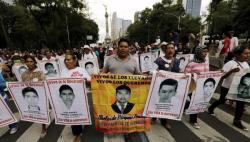
    One month from today marks the first anniversary of the horrific state crime perpetrated against the students of the Ayotzinapa teachers' college in Mexico. 

    On September 26 and 27, 2014, Mexican police attacked protesting students from Ayotzinapa in the state of Guerrero. The police killed six people, including three students and three bystanders. They forcibly disappeared 43 Ayotzinapa students, who remain missing.

    In response to these heinous crimes, a protest movement erupted in Mexico where hundreds of thousands took to the streets and social media (#YaMeCanse, #FueElEstado) to demand justice for the Ayotzinapa 43 and all those affected by Drug War violence.

    In the United States protests were also held across the country and Mexican-American communities and allies continue to organize against Plan Merida and the U.S.-funded militarization that is destroying Mexico. Last month, a delegation of School of the America Watch (SOA Watch) activists visited Ayotzinapa to connect with family members and students to better inform our resistance and strengthen our solidarity with Mexico.

    This September 26, we at SOA Watch ask you to join an action taking place in cities across the U.S. to remember the Ayotzinapa 43 and to demand that the U.S. stop funding the militarization that is enabling human rights violations in Mexico. Click here for a list of actions taking place throughout the U.S. (which will continue to be updated).

    If there is not an action in your area, we urge you to organize one, make signs, print our Ayotzinapa posters, and demonstrate in a public space to raise awareness about the Ayotzinapa 43. Demand an end to the U.S. taxpayer-funded Drug War in Mexico!

    Events on or around the 1-year anniversary are also a great way to connect the dots around the bigger issue of U.S. militarization in Latin America, and a mobilization opportunity for our 25th Anniversary Vigil. Click here to order November Vigil palm cards to distribute on September 26Ayotzinapa Vive, La Lucha Sigue!

    You also still have a few more days to order bulk boxes of !Presente!, the biannual, bilingual newsletter and Vigil mobilizing tool by clicking here.

    *Arturo J. Viscarra is the SOA Watch Advocacy Coordinator


  • May First/PeopleLink Under Attack!

    May First/People Link is being attacked in a Denial of Service attack that is unprecedented in its length and viciousness. We have been fighting off this attack for over three weeks now.

    We are convinced that the attack is political. We know how the attackers are targeting us, we know they are targeting the entire organization’s systems and we know that they are carefully monitoring our responses because they are quickly adapting to every move our technologists make to return us to service.

    We know they are sophisticated and capable. We do not know who they are and, while this started with our defending of our member The National Network of Abortion Funds (which was under DOS attack), we can’t be sure why precisely they are attacking us. In the end, however, that is not the important issue.

    Both the United States and Mexico (as is true of the entire world) are in profound, irreversible crisis. Fierce struggles are taking place. The rulers of our countries are searching for some strategy of self-protection and all their strategies will make people’s lives much harder. Repression is common and attacks on the resistance movements are more frequent.

    To resist that, our movements need the Internet and answering that need is our mission as an organization. May First has been the organization that combines actual technology service with the kind of activism that holds tech anc communications issues up. While we are not the only organization in the coalitions we work in, we are the only one with actual technology service experience. While we are not the only alternative provider, we are the one most active in concrete movement work around these issues.

    The disappearance of May First would constitute a huge blow to our movements of struggle. We do not intend to allow that to happen.

    Our technologists will not allow it. They have worked day and night for weeks fighting off this attack and keeping us on-line. They have forgone vacations, weekends and very often sleep to keep us functional.

    Our members will not allow it. Throughout the difficulties and crippled communications they have had to endure, our members have remained strong, committed and supportive. We have not had any member loss as a result of this attack and that, perhaps, is our greatest victory.

    Finally, our Leadership Committee will not allow it. We have been in constant consultation and held emergencies meetings about these attacks, made several decisions about it, executed an effective members and movement communications program to keep people up to date and have just approved yet another additional layer of protection for our organization.

    We think that attack is going to be the normal for us from now on. We are ready for that. Our enemies should know that successful resistance to those attacks, protection of our members services and data and constant outreach to our movement with innovative alternatives is our normal

    This is a battle we need to win and we intend to do just that.

    On behalf of our entire organization, we thank all our movement allies for your critically important support and the opportunity to continue working with you.

    The Leadership Committee

    May First/People Link
    237 Flatbush Ave, #278
    Brooklyn, NY 11217

  • Mexican Teachers Strike as School Year Begins Despite Militarization, Arrests, and Firings

    Image

    Thousands of teachers in Mexico have gone on strike against the national government’s Education Reform Law, doing so in the face of the militarization and arrest of teacher activists in Oaxaca and firings of teachers who have missed work in other states. The Mexican government and state governments are clearly attempting to break the dissident teachers movement that has for forty years led the fight for union democracy and teacher power.

    Miguel Ángel Osorio Chong, Secretary of the Interior (a position something like the vice-president of Mexico), has pledged that “Nothing will stop the education reform.” Teachers, he said, should not be permitted to interfere with the schools, public buildings, or highways.

    The teachers, led by the National Coordinating Committee (la CNTE) of the Mexican Teachers Union (el SNTE), struck on August 24, the first day of the school year in Mexico. The strike in 21 states–out of 31 states plus the Federal District–was estimated to have affected 20 about percent of Mexican schools, some 50,000 of the 228,000 elementary and high schools in the country. At least 13 la CNTE locals have agreed to carry out a national 48-hour strike.

    “We are going forward confidently and with unity,” said Antonio Castro López, a member of la CNTE’s national executive committee, “knowing that union representing teachers in elementary and high schools throughout the country have been protesting against the Education Reform Law and the other structural reforms.”

    In the State of Oaxaca, the historic center of the teachers’ movement, Governor Gabino Cué called upon the federal government to send the army, navy, and air force into the state because he was unable to control the 80,000 teachers there. Thousands of soldiers and police have been deployed in Oaxaca, creating an intimidating presence that has, nevertheless, failed to deter the teachers there. Cué has also called upon 570 mayors to report teacher absences to officials there.

    Teacher strikes in Mexico have historically often go on for days or even weeks at a time, but under the new Education Reform Law teachers have been warned that if they miss more than three days without a legitimate excuse they will be fired. In Mexico City, some 84 teachers were fired for absences in the 2014-2015 school year, though the exact reasons for those firings were not clear. A spokesman for the dissident union movement said that none of those teachers had approached la CNTE for assistance with their defense.

    In the state of Oaxaca some 15 teachers have also been arrested and charged with destroying election materials during the June 7 federal election. Teachers called for a boycott of that election, but in Oaxaca the teachers also shut down polling places and burned boxes and ballots.

    While the teachers’ movement has been strongest in Oaxaca, Chiapas, Guerrero, and Michoacán, this time the strike spread to two-thirds of the states in all regions of the country including Baja California on the northern border, Durango in the Northwest, Querétaro in the Center, and Tabasco in the Southeast. In most states where it took place, the strike was only partial, with some schools shut down and others operating as normal.

  • The Iran Deal: Up, Down or Sideways?

    (NOTE: For some background, see my previous article: www.solidarity-us.org/node/4058 in Against the Current, January-February 2014.)

    ImageAUGUST 19 — Even while the rhetoric around the P5+1 nuclear deal with Iran seems to be reaching reactor-grade “critical” level, signs are emerging that the fix just may be quietly in.

    Senate Majority Leader Mitch McConnell, after lining up his entire 54-member majority to vote down the agreement, states that it’s “quite likely” that the presidential veto of the disapproval resolution will be upheld. This is the man, remember, who once announced that his political agenda revolved around “making Barack Obama a one-term President.” Now it’s as if he’s pleading with the Democrats: It’s up to you to round up 34 of your Senators to uphold the veto and keep us from all going over the cliff.      

    A sophisticated Israeli analyst, Uri Savir, writes that it’s time for Tel Aviv to give up on blowing up the deal and develop new security understandings with regional Arab states (“Rethinking the Middle East’s Nuclear Balance,” al-Monitor.com, posted August 16). And when the founding president of United Against Nuclear Iran, nuclear weapons expert Gary Samore, resigns with a statement that he finds the deal better than anyone could have expected, it looks like rational thinking may be blowing in the wind.

    Then again, this is America, the land of the Crack Brothers and AIPAC and Sheldon Adelson and 17 Republican presidential candidates in an election that’s only 14 months away – one Super Bowl, one NBA Finals and two World Series from now.

    Let’s try to unpack the real from the rhetorical and the ridiculous in the raging political fight around the agreement. In particular, what are its loudest opponents actually defending?

    What the Deal Does

    As suggested above, the deal to drastically reduce Iran’s nuclear development programs and remove sanctions reflects “rational thinking” among all the parties. That’s not quite the same thing as “progressive thinking,” even though every liberal and progressive-leaning force in the land is understandably throwing itself into lobbying Congressional Democrats to uphold it.

    This is a deal among four imperialist states – the United States, Britain, France and Germany; two emerging or aspiring ones, Russia and China (depending on your definition of imperialism); and Iran, ruled by a theocratic-military partnership. It reflects a convergence of interests among the dominant elites and ruling classes of these states, amidst all their other conflicts and brutalities, recognizing that this deal is better than the alternative of sliding toward a U.S.-Iran war.

    Underlying the agreement is the emergence of a new Middle East reality. If this language seems detached and bloodless, let’s never forget all the immediate horrors of the region. These are the lands of the Syrian regime’s hundred Guernicas, of the genocidal and mass rape cult called the “Islamic State,” of Yemen’s state meltdown and mass child starvation, the crushing of Egypt’s democracy and the hopes of the Arab Spring, of U.S. drone strikes and bombings that rarely fail to make the most appalling situations even worse, of refugees fleeing by the millions for dubious safety on European shores.

    The agreement with Iran solves none of these, nor does it bring justice for the Palestinian people any closer, or any promise for internal reforms in Iran or anywhere else, let alone a nuclear-free Middle East – although to be sure, defeating it would surely make the regional wars, the repression in Iran and the danger of nuclear weapons proliferation much worse. What then does it actually mean, and what’s at stake in the political war around it?  

    1) The P5+1 deal with Iran at bottom reflects an emerging U.S.-led strategy – which Russia and China would also see in their state interests – to “stabilize” the mess that imperialism created in the Middle East. The big change: Israel will be an important but no longer the absolutely primary U.S. strategic ally. Instead, it's now necessary to develop a multilateral set of tactical and strategic balances that will include Iran and Saudi Arabia, Turkey and Egypt, along with Israel as first-but-not-only partner.

    2) The essence of the fight is that “pro-Israel” hawks reject this multilateral strategy and insist on maintaining Israel-uber-alles. It's not about an Iranian military threat to Israel, which is nonexistent regardless of Iran's nuclear status. (If anything, it’s the Saudis who have more serious real concerns about Iran.) Iran’s nuclear weapons contingency plan was developed against Saddam Hussein’s Iraq, which invaded Iran with U.S. encouragement in the 1980s. Tehran was prepared for a grand bargain with the United States after the U.S., invasion toppled Saddam in 2003 – an opening that the Cheney-Bush gang arrogantly refused.

    Senator Charles Schumer's statement of opposition to the deal is revealing in this regard. Obviously, his pledge not “to be affected by politics or party” was never to be taken seriously. Further, he’s certainly smart enough to know that the Iranian mullahs’ “Death to the Zionist entity” rallies – which draw visibly dwindling crowds of Iranians – are “for the goyim” (i.e. for the entertainment of the foolish and ignorant). Interestingly, Schumer concedes that the deal is acceptable in its early stages, but problematic down the road – a concession that Netanyahu’s comical “weeks or months to the Iranian bomb” is drivel. It’s the future, in which Israel’s demands on the U.S. may no longer reign unquestionably supreme above other considerations, where his problem lies.

    3) For the dead-end neoconservatives who supply the ideology for the AIPAC wing of the Israel Lobby, and for the entrenched bureaucracies of major U.S. Jewish organizations, the main threat is the diminution of their own power in the new Middle East policy dispensation. Ever since 1967, a cohort of intellectuals attaching themselves to the project of American power ruling the world – many but by no means all Jewish, and many but not all ex-liberals – have derived considerable influence as bridges between U.S. and Israeli military, political and economic power elites.

    It’s not Israel’s existence that’s at stake here – the threat to its future lies in its own internal rapidly deteriorating politics and creeping social disaster, but that’s another whole story. The fury of AIPAC and allied organizations is a rearguard defense of themselves, their unparalleled access to the halls of power and their capacity to bully and intimidate dissident politicians. That helps explain why they are doubling down on trying to kill the Iran deal  even when Jewish Americans favor the deal in higher proportions than the overall U.S. population.  
     

    What if it Fails?

    4) In view of the consequences of a congressional overturn of the agreement (a 2/3 veto override in both House and Senate), such an outcome seems almost unthinkable. Presumably, votes are being carefully calculated to allow some Democrats to vote against it without actually killing the deal.  I think it can also be predicted that if the deal is upheld, the Republican candidates' current pronouncements that they'd cancel it are the hot air of August before the primaries. But we do need to think about what a rejection would mean.

    5) An overturn of the deal by Congress would obviously cripple this administration's foreign policy for the rest of its term, and possibly the next one.  It might conceivably wreck the final Trans Pacific Partnership negotiations, where the U.S. is going up against all the other TPP countries in its crusade to protect the monopoly super-profits of Big Pharma. A president desperately trying to save his remaining “legacy” deal will not be in a strong position to arm-wrestle the rest of the world.

    As Obama and Kerry are warning, most likely the Russians, Chinese and ultimately Europeans would walk away from the global sanctions on Iran – whether overtly or unofficially. Why bother with a U.S. administration that couldn't even get support from one-third of its Congress?

    6)  The enormous reservoir of popular pro-U.S. feeling in Iran would take a huge hit. Iranian “hardliners,” mainly the Revolutionary Guard elements who control much of the economy and have become rich because of the sanctions, would rejoice. It might be effectively curtains for Rouhani's presidency.

    7)  The defeat of the Iran deal would hugely expand the already significant split in the U.S. Jewish community. Furthermore, while the power of the Israel Lobby in U.S. politics would be enhanced at least in the short term, the global picture would be quite different. The raging opponents of the agreement can’t all be stupid enough (though some surely are) to fail to recognize this: Internationally, this could be Israel’s all-time biggest political disaster.

    The crippling of U.S. Middle East policy would entail huge damage to its capacity and perhaps willingness to continue defending Israel’s outrageous actions in Palestine. There would likely be a vast mushrooming of BDS globally, including possible European sanctions against Israeli banks that are already threatened. How much of its remaining credibility would the Obama administration want to expend in protecting Israel from the consequences of wrecking such a strategically critical deal?

    What Will Netanyahu Do?

    8)  How the Israeli government might respond to a defeat, or the more likely near-defeat of the agreement – what Netanyahu calls “resounding moral majority” against it – is speculative and as always dependent on internal political considerations. What’s certain is that Israel will demand even more U.S. military aid, and almost surely get it as a consolation prize (and a way for Obama to buy a few Congressional votes).

    A unilateral military attack on Iran is out of the question – Israeli generals know it’s crazy – but there might be the possibility (for example) of resuming Israeli assassinations of Iranian scientists as a provocation, in the hopes of getting an Iranian retaliation that would give Israel a pretext for escalation.

    If Netanyahu wants to go for some kind of new war (in Gaza or Lebanon or whatever), I assume he couldn't really do it from his current tiny majority with barely 61 Knesset seats, but would need to bring in either the “Zionist Union” (Herzog) or the fascist Avigdor Lieberman into his coalition – or both. Just in case anyone had illusions about Herzog representing a positive alternative, he’s openly and literally embraced Netanyahu in condemning the deal.

    9) One must wonder if the Republicans and AIPAC really want to “win” this fight, aside from those for whom destroying Obama supersedes any other goal. With the Middle East already in flames with so many victims trying to escape, this president’s chances (and probably the next one’s) of pulling off any measure of political-military success in Iraq or Syria – which depend on at least tactical cooperation with Iran and coordination with Russia – would be almost nil. Is this what the Republican candidates seriously want to inherit? Do even the craziest-talking among them want to be taking on Iran, ISIS and maybe the Syrian regime at the same time, with no allies?   

    As Uri Savir reports “a senior member of AIPAC’s political leadership” saying on condition of anonymity: “We have decided to go all-out on the issue, despite this being a partisan cause…Secretly, some of us pray not to succeed in this battle.” (“AIPAC Chooses Sides: Picks Bibi Over Own Supporters, U.S. Jews,” al-Monitor.com, posted August 2, 2015)

    In short, for so many reasons it's hard to contemplate an actual 2/3 congressional vote to kill the deal. It’s just that in this crazy-ass country, you can never know for sure.

    David Finkel is an editor of Against The Current.

  • In solidarity with Oaxaca's teachers

    Image   Mary Compton, who edits the informative and unique website www.teachersolidarity.com, tracking struggles globally to defend public education, teaching, and teachers unions, gives us a strikingly different – and more hopeful – take on Oaxaca and teacher unionism in Mexico than a recent New Politics blog.  Compton’s analysis is informed by first-hand contact with union activists throughout the global South, including Mexico, as well as work of respected Mexican activist/scholars like Hugo Aboites, Professor of Education at the Autonomous Metropolitan University in the City of México (UACM), who in  May 2014, was elected Rector of UACM for the period of 2014-2018. Aboites has been tracking the neoliberal project in Mexican education for decades.  Compton’s  23 August 2015 blog  about Oaxaca is reprinted below. I should add that Oaxaca’s teachers are fighting against policies pushed by the World Bank in all of Latin America, including the wholesale firing of the teaching force. A critique Mary and I have written of this World Bank document, Great Teachers, will appear shortly. (Pictured here is a school in Oaxaca.)

    The democratic teachers of Oaxaca in Mexico are continuing their determined defence of public education, and defying the provocations of the state. As we reported last month, the government of Pena Nieto has moved thousands of security forces into Oaxaca, in an effort to defeat the teachers, who have proved themselves both to be determined fighters against the efforts to privatise and standardise education, as well as world leaders in the development of indigenous and bilingual education. 

    The government and the right wing media in Mexico and the US have framed Nieto's actions as, in the words of the Wall Street Journal: 'the most important part of President Enrique Peña Nieto’s agenda to raise Mexico’s long-term living standards.' In fact it is part of a determined campaign by neoliberal 'reformers' in the country to destroy democratic education and the possibility of harnessing the power of education to develop critical thinking and resistance to the onslaught of capital. At the same time, the reforms will divert much of the public money used to finance education into private hands, while forcing parents to take more responsibility for funding their children's schools.The abduction of the 43 student teachers in neighbouring Guerrero state almost a year ago, was the most extreme manifestation of these policies.

    The government's attempts at provocation in Oaxaca have so far failed however. They were planning to fire Oaxaca teachers who struck at the beginning of the school year this week, so instead the teachers have started the new year early. At the same time, they plan to continue peaceful civil disobedience to the demands of education reform, as they continue to promote democratic and critical education.

    The teachers union, the CNTE, in other states as well, is meanwhile undertaking programmes of meetings with parents and communities to let them know exactly what Nieto's reforms  will mean to them, not least in increasing demands for money. They also point out the pitiable state of many Mexican public schools, particularly in rural areas, as education budgets are cut. The campaign will be accompanied by protests in many towns, against the 'reforms' and for the return of the 43 missing student teachers from Ayotzinapa.

    The teachers of Oaxaca have always been an inspiration to teachers globally who are resisting corporate education reform. The tactic which they are now employing, of simply carrying on with their vision of education in defiance of the new orders will be watched with interest by us all. It brings to mind the words of the arch education 'reformer' Michael Barber, chief education adviser to Pearson, who wrote of UK teachers who were resistant to one of his dictatorial reform efforts, at a time when he was a government adviser: 'what if in spite of all the training that had already taken place, the primary teachers of England just carried on doing what they'd always done? What would government do then? How powerless would I (sic) be? To be ignored: surely a worse fate than to be resisted.' 

    http://www.teachersolidarity.com/blog/oaxaca-teachers-continue-their-defence-of-public-education

    You can follow me on twitter  Facebook, as well as my blog here at New Politics.


  • The Suruç Massacre and the Reigniting of an Old Struggle

    Image

    On July 20 at least thirty-two people were killed and at least 100 people were wounded by an ISIS suicide bomber. The attack took place in the Turkish town of Suruç, which stands only thirty miles away from the Syrian border. The victims, members of the Federation of Socialist Youth Associations (SGDF), were part of a 300-person contingent en route to Kobanî to assist in reconstruction efforts. The group consisted of a number of Turkish and Kurdish anarchist and socialist youth. As such, the solidaristic venture represented a major effort to create further bridges between the broader Turkish left and the Kurdish left.

    There have been suggestions of Turkish collusion with the attack in Suruç. As noted in the Kurdish Question, there was considerable Turkish military presence in Suruç. Kurdish filmmaker Garip Çelik took video of the explosion, and he has asserted that it took place within the SGDF crowd. Çelik also asserts Turkish "police searched all buses carefully but skipped ours."

    Whether or not Turkey colluded in some way with the attack, Turkey has capitalized on the event—as well as countering to the Kurdistan Workers Party (PKK) killing of two Turkish police—by attacking the Kurds. Ostensibly, Turkey is entering the war against ISIS. Inside the 28-member state North Atlantic Treaty Organization (NATO), the Suruç massacre has been framed as an attack on Turkey. For only the fifth time in 66 years, an Article 4 meeting was called, allowing NATO members to seek consultation when “territorial integrity, political independence or security” is found to be in jeopardy.

    Yet, Turkey has concentrated most of its energy on attacking the PKK and other Kurdish groups. Patrick Cockburn asserts that it may be a tactical mistake for the United States to turn away from the Kurds so as to garner more far-reaching support from Turkey. He writes, “The U.S. will undoubtedly be able to strengthen its air offensive against ISIS, enabled to keep more planes in the skies above the self-declared caliphate because Incirlik base is only 60 miles from the Syrian border. On the other hand, about 400 U.S. air strikes were unable to prevent ISIS from capturing Ramadi, the capital of Anbar province, on May 17.”

    The Turkish government is prohibiting pro-Kurdish rallies and demonstrations. Turkish authorities have arrested at least 1,300 people since the Suruç massacre — with at least 80 percent of those arrested being Kurdish or generally on the far-left. Turkey has also carried out a number of airstrikes in Iraq and Syria. Like the arrests, most of these airstrikes have targeted the Kurds. There are also reports of towns in Rojava being shelled by the Turkish military.

    Arrests within Turkey and airstrikes in Kurdish Syria and Iraq constitute two fronts in the struggle — internal and external to Turkey. The arrests are an attempt to suppress rising internal dissent and opposition (the HDP). Continued airstrikes will be an attempt to destroy the infrastructure — material and institutional — that Rojava's nascent system of self-governance is built on.

    Kurdish Victories in June 2015

    In mid-June the struggle for Kurdish autonomy appeared to be gaining momentum. On June 7 the Peoples' Democratic Party (HDP) won over 13 percent of the overall vote in the Turkish general election. Almost concurrently, in Rojava, a decisive victory against the Islamic State of Iraq and Syria (ISIS) opened up a corridor between the cantons of Cizîrê and Kobanî.

    The pace of change has accelerated following the aforementioned developments as well as the breakdown of negotiations between the Kurds and Turkey over Kurdish autonomy. Since then, the Turkish state has become more overtly violent in its confrontation with the Kurds. While the Turkey-Kurd conflict holds a long violent history, from 2013 up until last month there was a ceasefire. The Suruç massacre may prove to be the catalyst for this reigniting of violent struggle between Turkey and Kurdish groups. Before engaging with these developments, it is important to briefly describe the recent efforts in building Kurdish autonomy.

    Briefly Contextualizing the Current State of the Kurdish Struggle

    Integral to the struggle for Kurdish autonomy is the Rojava Revolution, which is taking place in West Kurdistan (a region embedded within Syria). The Rojava Revolution's most significant actor is the the Democratic Union Party (PYD). Abdullah Öcalan of PKK— himself influenced by eco-anarchist Murray Bookchin, and academics like Michel Foucault and Immanuel Wallerstein — have deeply influenced the PYD. These influences appear to have had an impact on the character of the Rojava Revolution, which possesses an explicitly feminist, anti-state and anti-capitalist character.

    Also, as TATORT Kurdistan (a Kurdish activist group based in Germany) and Zaher Baher (a member of the Kurdistan Anarchists Forum) note, a vibrant movement with a similar character is underway in North Kurdistan. North Kurdistan is embedded in the Turkish state. As a result, the Kurds in the North have been unable to acquire the degree of autonomy as that gained in Rojava. In Rojava the PYD has proved capable of using the crisis in Syria to its advantage. Whereas those in Rojava have largely warded off the external threat of ISIS, the threat to Kurds in North Kurdistan is principally internal. In North Kurdistan militants must contend with the daily threat of violence and imprisonment by the Turkish state.

    Seeking to transcend the national-state, capitalism and patriarchy, the Kurds and other religious and ethnic groups in North, East (embedded within Iran) and West Kurdistan seek to establish what they call Democratic Autonomy and Democratic Confederalism. In other words, the main actors of the Rojava Revolution have put economic self-management — through various types of cooperatives — and political self-governance (in the form of council democracy and assembly democracy) at its core. The Rojava Revolution appears to be largely internally defined as a revolution in gender relations, as much as it is one in economic and political relations. This is seen by the widespread presence of women's councils and women's assemblies that hold veto power over general assemblies and councils. It is also apparent in the requirement for gender parity in both general assemblies and councils.

    The HDP's Historic Victory

    What is written above is a broad sketch of matters I've written about in greater detail in New Politics. As noted earlier in this piece, the Peoples' Democratic Party (HDP) received over 13 percent of the vote in the Turkish general election. Bypassing the threshold — of 10 percent — for parliamentary representation, the HDP now holds 80 out of 550 seats in the Turkish parliament.

    The HDP victory is even more significant when contrasted with the election results for Recep Tayyip Erdogan's Justice and Development Party (AKP). If the election outcome holds, the AKP will not possess a parliamentary majority for the first time since 2002. With the AKP unable to acquire a three-fifths majority, the party cannot unilaterally alter the constitution. If this majority was acquired the AKP would have been able to shift Turkey from a parliamentary to presidential system, thus transferring significant formal power to Erdogan's largely ceremonial position.

    In contrast to the centralizing and nationalist tendencies of the AKP, the HDP, according to a Roar Magazine article “openly recognizes the Armenian genocide, fights for the rights of LGBT individuals, promotes the use of minority languages and has a political program stressing the need for decentralization, horizontal democracy and local autonomy.” The internal configuration of the HDP is in some ways similar to the structures emerging in Rojava. Most notably, this includes the co-chair system, in which every distinct social unit and assemblage must include both a male and female chair.

    The HDP is quite libertarian (in the left-wing sense of the word) in its position on the state. For instance, in a speech, HDP co-chair Selahattin Demitras declared "We believe that the best government is the least government. We aim to make the state smaller and create a system where democracy and citizens' rights prevail." Demitras follows this with a call for radical democracy, best expressed in the assembly format. He vows that the HDP "will establish assemblies of women, youth, the disabled, belief groups, cultural and ethnic groups, farmers, workers and laborers." Throughout, though, Demitras looks to radical democracy as necessary to transforming Turkey.

    With the HDP also holding itself to a standard of gender parity, its victory has helped raise the number of women in parliament to record levels. Of the eighty HDP members elected to parliament, thirty-one are women. One HDP member of parliament is the first openly gay MP in Turkey's history. A number of HDP MP's include individuals of non-Kurdish groups, including Armenians, Assyrians, and Yezidis.

    Turkish Hostility to Kurdish Autonomy

    While dialogue was re-opened between Erdogan and the Kurds in 2009, peace talks have stalled. Publicly, Erdogan has consistently made inflammatory remarks against the Kurds and Kurdish autonomy. Erdogan has even stated, “I am saying this to the whole world: We will never allow the establishment of a state on our southern border in the north of Syria. We will continue our fight in that respect whatever the cost may be.” Subsequently, Erdogan has called peace with the Kurds “impossible.”

    While Erdogan has shown distaste for Kurdish autonomy in Syria, the HDP has also faced repression inside Turkey as well. A Jacobin article notes, “150 attacks on the HDP recorded in the weeks leading up to the elections, including: fascist mobs attacking a HDP rally with the police idly watching in Erzurum; gunshots at various HDP offices; simultaneous bombs in HDP offices in Adana and Mersin, which fortunately killed no one but left six people injured; the killing of Hamdullah Öğe, who was driving a HDP campaign vehicle; and two bombs in a huge HDP rally in Amed/Diyarbakır two days before the election, which killed four and left scores more severely injured.”

    There have even been reports of Turkey assisting ISIS in the latter's fight against the Kurds. Allowing ISIS militants to freely cross within and outside of its borders has proved lethal. On June 25 ISIS infiltrated Kobanî by crossing over the Turkish border into Syria. The attack resulted in over 200 deaths. According to The Guardian, Turkey was purchasing oil from ISIS at a rate of $1m-4m per day. In the same report, an unnamed Western official stated that links between ISIS and Turkey are “undeniable.”

    The official went on to say, “There are hundreds of flash drives and documents that were seized there. They are being analyzed at the moment, but the links are already so clear that they could end up having profound policy implications for the relationship between us and Ankara.”

    The AKP government has also blocked the funneling of humanitarian aid into Rojava. Thus, immediately following its electoral success the HDP was looking to voice a serious call for recognition of the three Cantons of Rojava, as well as secure steady passage of aid. Yet, the situation has become significantly complicated and has intensified. Securing passage of aid is off the table. The question of recognition is no longer a matter up for negotiation. Instead, it appears this question is returning to the battlefield.

    With Turkey still being ruled by an interim government, new elections are imminent. With massive arrests of Kurdish activists, it will be difficult for the HDP to reproduce its historic victory. With nationalism fueled, the AKP could reach the three-fifths majority needed to alter the constitution. As a result, the Kurds would lack a voice in Turkish parliament, removing a powerful tool for achieving recognized Kurdish autonomy.

    One wonders if this may be a step back in the fight against ISIS. Motivated by a desire to carve out its own post-state self-governing polity, the Kurds have far more to gain from victories against ISIS. Given its relationship with ISIS, Turkey's investment in seeking to defeat ISIS is questionable. Turkey contains far greater military capacity than the Kurds. Yet, thus far it appears that the majority of Turkey's military might is being spent on weakening the Kurds rather than striking any significant blows on ISIS. In this fight, Turkey's geopolitical position is at stake. For the Kurds, their very survival is on the line—in jeopardy both from ISIS and Turkey, as Suruç showed.

    Declarations of Self-Government Across Turkey

    As part of the back-and-forth nature of the struggle, Kurdish militants within Turkey have responded. Some of the response has included women forming self-defense brigades. And the response has not simply been military; there has been a wave of declarations of autonomy by groups in various regions. This wave is sweeping across Turkey but is particularly strong in North Kurdistan (southeast Turkey). According to JINHA, “the towns and neighborhoods that have declared self-government are Silopi; Cizre; Batman's Bağlar neighborhood; Diyarbakır's Sur district; Lice; Silvan; Varto; Bulanık; Yüksekova; Şemdinli; Edremit; Van's Hacıbekir neighborhood; Istanbul's Gazi neighborhood; and Doğubeyazit.”

    Many of the declarations of autonomy have been issued by people's assemblies. Such declarations have, at minimum, meant that these towns and neighborhoods no longer recognizing the Turkish state. Similar to the libertarian socialist orientation of Rojava, this rejection of the state has not simply meant rejecting Turkey, but rejecting the state-as-such. As a result of these declarations, however, a number of activists have been detained.

    Furthermore, the declarations of autonomous self-governance and the rapid mobilization reflect the increased political capacity of Kurdish groups in North Kurdistan. With the ideological shift of the PKK, Kurdish groups have invested themselves in a more participatory democratic framework for a number of years now. In the last decade this has meant the spread of more libertarian socialist propaganda, as well as trainings, workshops, and micro-institution-building in North Kurdistan that is based in participatory democratic practice. With the struggle reignited, this framework is being scaled in and scaled up. According to reports, much of this has been made possible by Kurdish youth taking a lead role in building organization with an aim of constructing institutions that are autonomous from the state.

    Some Responses on the International Left

    Many across the ideological spectrum support the Rojava Revolution. This includes a range of notable individuals and organizations: Noam Chomsky, Michael Hardt, and Antonio Negri, and many more who are signatories to a statement urging people to donate to Rojava. David Graeber, David Harvey, and John Holloway are also in support.

    Organizations pledging to provide and currently providing support range from Black Rose Anarchist Federation/Federación Anarquista Rosa Negra to the Marxist-Leninist Party of Germany (MLPD). A number of solidaristic organizations have sprung up across the world: from Australia, to England, to Brazil, and further on.

    This is not to say support has come without criticism. In North America, Black Rose/Rosa Negra has, among other things, criticized what it sees as gender essentialism existing within the dominant feminist perspectives of the Rojava Revolution. Yet, Black Rose/Rosa Negra sees much that is positive in the Rojava Revolution and the overall Kurdish struggle, stating,

    “the specific project of democratic confederalism (which is only one part of their political vision for 'democratic modernity' and the reorganization of society) has set the popular classes of Kurdistan in motion, constructing autonomous alternatives to capitalism, oppression and the state. In Rojava, and in some cases also in Bakur (north Kurdistan) when state repression doesn’t forbid it, workers’ cooperatives are being formed, land is being collectivized, women’s collectives are spreading, neighborhood assemblies are taking on power, restorative justice is replacing the court system, a democratic militia is defending the region, and other aspects of self-governance are being organized.”

    As a result, Black Rose/Rosa Negra has publicly declared a set of organizational goals in relation to the Rojava Revolution. This includes, but is not limited to, organizing speaking tours, participating in the reconstruction of Kobanî, translating Kurdish texts, and pushing the U.S. government to remove the PKK from the list of terrorist organizations.

    Other groups are and already have mobilized to support the Rojava Revolution. Rojava Solidarity NYC has consistently sent radical books and materials to Rojava. The Marxist-Leninist Party of Germany assists in providing direct support and manpower in the reconstruction of Kobanî. Many from around the world are assisting Kurdish military forces in the struggle against ISIS. This has come in the form of International Brigades.

    This is not to say all on the left are pledging support for developments in Rojava. Some on the left express concern over what may be seen as a cult of personality around Abdullah Öcalan. The Anarchist Federation in the U.K., has largely admonished the Rojava Revolution. Workers Solidarity Alliance has also criticized the revolution from an anarcho-syndicalist perspective.

    Most significantly though, Turkish anarchists–who have expressed solidarity with Rojava since its declaration of autonomy (coincidently, this declaration on July 19, 2012 came on the 76th anniversary of the beginning of the Spanish Revolution)—have also beyond mere statements. The Turkish Revolutionary Anarchist Action (DAF) prove direct auxiliary support to Rojava. (h

    Moving Forward

    While anarchists in Turkey have coordinated with those on the Kurdish left, the question remains as to whether the broader Turkish left will do so — if it has the capacity to do so. In March of 2015 there were a number of wildcat strikes in Turkey's auto industry, indicating some radical life within the Turkish working class. Will Turkey's labor movement show and act in solidarity with the Kurds and other ethnic and religious movements for post-state participatory self-governance and economic democracy? Or will the Kurds and other oppressed minorities remain alone in their fight for liberation? The answer to this question may prove integral to whether the Rojava Revolution will spread and move forward, or not.

    *Alexander Kolokotronis is a BA/MA philosophy student at Queens College, City University of New York. He is the Student Coordinator of NYC Network of Worker Cooperatives, and the Founder of Student Organization for Democratic Alternatives.


  • Leon Trotsky – 75 Years Since His Assassination – The Legacy

    Image

    Leon Trotsky, the Russian revolutionary, was murdered seventy-five years ago today—on August 21, 1940—by Ramón Mercader, an agent of Joseph Stalin, Trotsky’s former comrade in the Communist Party and then the ruler of the Soviet Union.  Stalin feared that Trotsky might organize a movement to overthrow the new ruling elite in the Soviet Union and that Trotsky’s followers might challenge the leading role of the parties of  the Communist International active in working-class movements around the world. So Stalin had Trotsky murdered. The occasion of the anniversary of Trotsky’s assassination provides a moment to reflect on his significance both during his lifetime and for today.

    For some on the left, Trotsky is—after Vladimir Lenin—the world’s greatest revolutionary. His career was certainly remarkable: the president of the Petrograd Soviet in the failed Revolution of 1905, a leader of the Revolution of October 1917, Soviet Russia’s leading negotiator at the Brest-Litovsk negotiations from December 1918 to February 1919, the founder and leader of the Red Army in the Russian Civil War from November 1917 to October 1922, a leading figure in the first four congresses of the Communist International (1919-1922), leader of the Left Opposition to Stalin, Cassandra-like critic of Communist policy in Germany in the late 1920s and early 1930s, analyst and critic of the role of the left in the Spanish Civil War, author of a critical analysis of Stalinism in The Revolution Betrayed and of the great History of the Russian Revolution, and finally founder of the Fourth International, a new revolutionary international that challenged the Stalinized Communist International.

    Certainly Trotsky’s achievements as a writer, an intellectual, and as an organizer—and he was also a great orator—vie with those of any other figure of the twentieth century. Even his greatest failure, the loss of his leadership of the Russian Revolution to Joseph Stalin, leading to a counterrevolution and eventually to his own death, has an admirable if tragic quality about it. Many on the left in his own time and later in the 1960s and 70s saw Trotsky as an iconic figure, emblematic of the struggle for socialism.

    Still, we have to wonder what we in the twenty-first century can take from Trotsky’s life and work. Do we take his body of work as a doctrine? Or do we take key elements of his thought as a method? Or do we pick and choose from Trotsky’s various analyses? Or, finally, are there within Trotsky’s ideas and actions, elements that should lead us to reject the notion that he can serve us as any sort of a model today?

    Rethinking Trotskyism

    There are some who hold that Trotsky’s ideas constitute an integrated whole that can be called “Trotskyism,” a doctrine—in many cases a dogma—which explains events and serves as a guide to action today. For these “Trotskyists,” Trotsky—at least after he became a belated Bolshevik in 1917—was virtually never wrong. The starting point of all discussions is to be found in the texts of Lenin and Trotsky. We have come over the years to refer to these true believers as “orthodox Trotskyists” because of the quasi-religious character of their adulation of Trotsky’s words. As with all religious thinkers, there is no arguing with these apostles of Trotskyism; one must wait for them to recognize the cult-like character of their organizations and credos. We need not name these groups, but anyone who has met them will know them and recognize the type.

    Another group emphasizes Trotsky’s method as seen in his theoretical works and believes that this method has the consistency of a sort of general field theory of revolution. So for them, the theory of permanent revolution laid out in Results and Prospects, the analysis of the rise of Stalinism in The Revolution Betrayed, the critique of the German Communist Party in the years before the triumph of Adolf Hitler and the Nazis, the analysis of world capitalism in the first four congresses of the Communist International, the documents justifying the creation of the Fourth International and its Transitional Program of 1938 can be seen as the heart of “Trotskyism.” Some would argue that, conceived in this way, Trotskyism puts the working class at the center of all analyses. But does it?

    The Theory of Permanent Revolution

    While this approach to Trotsky has a certain attractiveness to those inclined to desire a general theory, the issue is that there are many problems with the individual parts of the theory. For example, Trotsky theory of permanent revolution developed in the first few years of the twentieth century argued that in late- developing capitalist societies—such as Russia—the bourgeoisie could not undertake to overthrow the aristocratic order. Therefore, the working class would have to both undertake the bourgeois-democratic revolution while at the same time carrying out a socialist and international revolution.

    The Russian Revolutions of February and October 1917 seemed to vindicate his theory, as the Bolshevik Party led the Russian working class to overthrow the Czarist autocracy; and when the bourgeoisie failed to carry out a bourgeois-democratic revolution, the Russian working class acted to attempt to create a democratic workers state that would lay the foundations for socialist society in the relatively near future. The failure of that project by the 1930s does not vitiate the insights of Trotsky’s theory of permanent revolution.

    The problem for the theory, however, was that by the mid-twentieth century other phenomena unforeseen by Trotsky were taking place. World War II led to an international decolonization movement, the result of the United States becoming hegemonic at the expense of Britain, France, the Netherlands and other European powers and of nationalist movements within the colonies themselves. New capitalist states, some calling themselves “socialist,” arose, often without significant working- class intervention or leadership, from Africa and Asia to Latin America and the Caribbean.

    In Asia, the Communist Parties, which were not working-class parties but rather political armies, led revolutions of national liberation to victory in China, North Korea, and Vietnam installing bureaucratic governments that had nothing to do with either democracy or socialism. Later in the twentieth century, capitalists succeeded in carrying out bourgeois revolutions in Singapore, Hong Kong, Taiwan, and South Korea; more authoritarian than democratic to be sure, but bourgeois revolutions nonetheless.

    Similarly, a guerrilla group, with none of the characteristics of a working-class movement and party, carried out a revolution in Cuba, and soon became a bureaucratic ruling class, however fine its education and health system and however much it claimed to rule on behalf of the working class. The capitalist class also proved capable of carrying out revolutions that overturned old criollo elites and landed interests in countries as different as Bolivia, Mexico, Brazil, and throughout Central America and the Caribbean.

    The theory of permanent revolution—the idea that a national working class with an international revolutionary perspective would have to accomplish the bourgeois revolution in late developing capitalist countries—proved by the mid-twentieth century to no longer hold true. The attempts by orthodox Trotskyists to squeeze the various and contradictory experiences of twentieth century national revolutions into Trotsky’s original theory became positively Ptolemaic.

    What was and remains useful in Trotsky’s theory, however, was the attempt to place national political economic developments and class struggles into the international context—but since globalization and the neoliberal counter-revolution, that has become a quite common approach. In that sense, perhaps we are all Trotskyists now, though I am sure the Trotskyists will not like that idea.

    The Nature of the Soviet Union and the Communist Parties

    Or let us take Trotsky’s book The Revolution Betrayed and his other writings on the rise of the Stalinist ruling group in the Soviet Union. Trotsky’s view on this phenomenon no longer compels many people, and not because of the fall of the Soviet Union in 1989 and 1990. The problem is that Trotsky clearly misunderstood the nature of Stalin’s counter-revolution, believing that although Stalin and the bureaucracy controlled the government, Russia, because of the nationalization of finance and industry, remained “a workers’ state,” albeit “a degenerated workers state.”  A workers’ state where workers’ labor unions had been turned into labor fronts to increase productivity, where the workers’ councils (soviets) had ceased to function, where the bureaucracy’s Communist Party was the only party and workers had none of their own? A workers’ state where the government killed tens of thousands of peasants, workers, old Bolshevik leaders, and its political opponents until the numbers mounted into the millions?

    After World War II, Trotsky’s followers extended this analysis, claiming that the Soviet Red Army’s conquest of Eastern Europe and imposition of Communist Party governments in the Baltic states, Poland, Hungary, and East Germany had created “deformed workers’ states” there. Trotsky himself, I think, would never have arrived at such a preposterous conclusion. Clearly, the argument that Trotskyism is a theory that puts workers at the center of the analysis didn’t hold up for his analysis of the Soviet Union where his fixation on the nationalization of property obscured his understanding of the role of the workers themselves.

    Trotsky’s analysis of Germany in the late 1920s and early 1930s, in particular his critique of the German Communist Party for its failure to create a united front with the Social Democratic Party, remains one of his most brilliant pieces of writing. Whether or not a discussion of the strategy of the united front rises to the level of theory is debatable as is the question of whether the united front of working class parties is particularly Trotskyist, as opposed to Leninist, or simply part of the working class arsenal of strategies and tactics.

    Where Trotsky proved to be absolutely wrong about the Communist Parties was in his argument that they had become social democratic, reformist parties that blocked the way to revolution. Already in Spain in the late 1930s it was clear that the Communists would attempt to push aside other parties in order to seize state power and reorganize it along Stalinist lines—though this was only adumbrated in Spain. At the end of World War II, the Soviet Union’s Red Army moved through Eastern Europe overturning capitalist governments and putting Communist Parties in power, carrying out a full scale revolution that replaced capitalism and liberal states with Communist regimes.

    In Albania and Yugoslavia the Communist Parties proved capable of leading national revolutions, while in Czechoslovakia the Communists combined the threat of the Red Army, an alliance with a wing of the Social Democratic Party, and the political leadership of mass strikes to take power there. And as we have already mentioned, the core of a bureaucratic ruling class leading peasant armies was able to take power in China, Vietnam, and North Korea. The Communist Parties proved to be really revolutionary—only the anti-capitalist revolution they fought for and achieved had nothing to do with socialism.

    But weren’t things different in Western Europe? The French and Italian Communist parties that might have led a revolution in those societies did not, but not because they were reformist. They had been ordered by Stalin to restrain and to disarm the working class, to prevent revolution because he had made a deal with Britain and the United States to divide Europe. If Stalin had given the order, the French and Italian parties would have attempted revolution in those countries, as would Comunists in any other, but Stalin wanted to honor the deal he had made divvying up Europe with Winston Churchill and Franklin D. Roosevelt. a deal that recognized Soviet control of Eastern Europe. Later in the heyday of Eurocommunism in the 1980s, the Communist Parties would become social democratic, but they were not in Trotsky’s time.

    The Fourth International

    What about the analysis that justified the establishment of the Fourth International in 1938? Trotsky argued that since the Communist International had failed the test of resisting the rise of the Nazis—principally because of Stalin’s rejection of the strategy of the united front in the early 1930s—that it was necessary to create a new international revolutionary organization. We see here a method that Trotsky’s followers (and other leftists) have sometimes applied to other situations, the notion that the objective situation necessitated revolutionaries to do something, however unfeasible the project might be.

    Trotsky’s call for a Fourth International was based on his assessment—one shared by many other leftists at the time—that there would be a second world war and that it would be followed by a revolutionary upheaval throughout capitalist Europe. After all, the First World War had led to the overthrow of the governments of Austria-Hungary, Germany, Russia and the Ottoman Empire. The Communist bureaucracy in the Soviet Union, Trotsky believed, would be swept away by revolution.

    So, convinced that the Communist International was incapable of leading the working class, Trotsky, with only a handful of followers in just a few countries, launched the Fourth International hoping to gain the forces to contest with the Stalinist Communists leadership of the working class on a world scale. Trotsky dismissed those who questioned the founding of the FI as “pedants,” arguing that struggle was increasing and would lead to revolutionary regroupment and a growing revolutionary international. Trotsky’s prediction of the post-war European revolution and the instability of Stalinism proved to be wrong.

    While the notion of maintaining a revolutionary alternative to Stalinist Communism and Social Democracy was certainly admirable, the Fourth International failed to grow and prosper as Trotsky had hoped. At the same time, the establishment of the Fourth International on such a weak basis tended to make Trotsky the Pope—and nothing creates schisms like a Pope. The small—sometimes tiny—Trotskyist groups were riven with factionalism, while at the same time Trotsky sought to keep out of the FI leaders of other Marxist groups who did not adhere to every jot and tittle of his views. Consequently Trotsky had no rivals of stature in the Fourth International and little base in the working class. Effectively isolated and defeated by Stalin, his sphere of political activity reduced to the small world of the Fourth International, his son and other friends and colleagues murdered by Stalin’s agents, his own organization riddled with spies, Trotsky’s role as undisputed leader of the FI tended to bring out the worst of his arrogant personality, offending many of his longtime friends and allies.

    In retrospect it seems that the establishment of the FI—the attempt to create a world party of revolution— was the wrong project, however objectively necessary it might have appeared to Trotsky. Perhaps what was needed was a broad front for the defense of democratic socialist principles and against the dictatorships in Germany and Russia, though that too would have been a difficult task.

    Despite the fundamental flaws in the project, the founding of the Fourth International provided the opportunity for Trotsky to write his brilliant “The Transitional Program: The Death Agony of Capitalism.” In this essay, surveying the world scene as he had done in the early 1920s, Trotsky summed up the situation facing workers in many countries and offered them “a bridge between the present demand and the socialist program of the revolution.” As workers fought for the program’s transitional demands they would come to see the need for a socialist revolution. While the Fourth International’s member sections were too small to have much impact at the time, the program embodied a method that would be taken up by others in the future.

    Revolutionary Democrat?

    Early in his revolutionary career, Trotsky had been a scathing critic of Lenin and his Bolshevik theory of the disciplined party. He argued that Lenin’s conception of the party of professional revolutionaries would lead to the party substituting itself for the working class. As he famously said in 1904, “Lenin’s methods lead to this: the party organization [the caucus] at first substitutes itself for the party as a whole; then the Central Committee substitutes itself for the organization; and finally a single ‘dictator’ substitutes himself for the Central Committee…” He argued that instead, “The party must seek the guarantee of its stability in its own base, in an active and self-reliant proletariat, and not in its top caucus, which the revolution…may suddenly sweep away with its wing…”

    In this way Trotsky excluded himself from Lenin’s Bolsheviks, but neither did he join the Mensheviks. Trotsky spent the years between 1903 and 1917 attempting to convince Lenin’s Bolsheviks and Martov’s Mensheviks that they should reconcile their differences. Only in April of 1917, when it seemed that the Bolsheviks were preparing to take power, did Trotsky join Lenin’s Bolsheviks, quickly becoming second in the party only to Lenin himself. From that time on Trotsky called himself a Leninist and a Bolshevik, though he failed to convince many of the Old Bolsheviks that he really was what he said he was.

    Personality is frequently aligned with political predilections. Trotsky had since he was a youth been capable and confident, but also often arrogant; he believed he was right and fought hard for his views. His experience as head of the Red Army may have amplified his authoritarian tendencies, perhaps accounting for his advocacy of such policies as the militarization of labor at the Ninth Bolshevik Party Congress of 1920.

    Trotsky had been put in charge of the Soviet Union’s transportation system; that is, of its railroads and their difficult and demoralized workforce. Trotsky wanted the unions to help him make the railroads run more efficiently, but to do so, he wanted the unions to function like the military. Workers should be treated, he said, like soldiers in the army; those who deserted should go to punitive labor battalions or to concentration camps. Lenin opposed him on the issue, which failed to pass the congress, but one sees here Trotsky’s weaknesses.

    At the Tenth Party Congress in 1921, when the Bolsheviks were challenged by the Workers’ Opposition, Trotsky wrote,

    “It is necessary to create among us the awareness of the revolutionary historical birthright of the party. The party is obliged to maintain its dictatorship, regardless of the temporary wavering in the spontaneous moods of the masses, regardless of the temporary vacillations even in the working class. This awareness is for us the indispensable unifying element. The dictatorship does not base itself at every given moment on the formal principle of workers democracy, although the workers democracy is, of course, the only method by which the masses an be drawn more and more into political life.”[1]

    The idea of the “birthright” of the revolutionary party represents the extreme of Trotsky’s authoritarianism.

    After Lenin’s death in 1924, Trotsky fought only on “Leninist” terms—that is, within the party. When in the mid-1920s various factions arose to challenge the rise of Stalinism, Trotsky refused to support them or align himself with them, arguing that the fight against Stalin could only be carried out within the party, which contained the most revolutionary elements of the working class. Trotsky put his faith in the party, not in the broader working class that he viewed as far less politically conscious than the Communist Party members. While there were many opposed to Stalin and the state bureaucracy’s growing power who came from a variety of socialist tendencies, Trotsky disdained to work with them because they stood outside of his specific wing of the Communist Party.

    Trotsky fought for democracy within the Communist Party, or more exactly within the leadership of the party, but in the 1920s he had no desire to fight for democracy in Russian society at large. In truth, he only explicitly became an advocate of multi-party democracy in the Soviet Union in 1936. One wonders if Trotsky’s conversion to “Leninism” hadn’t convinced him that the primary struggle is always one for leadership, leading him to neglect the struggle for power by the working-class rank-and-file over their own institutions.

    Yet in the late-1920s and into the 1930s, Trotsky would become the leading figure in the opposition, advocating greater democracy against the developing dictatorship of Stalin and the party-state bureaucracy. He continued throughout his exile in Turkey, France, Norway, and Mexico to analyze every step of the process of Stalin’s rise to power while demanding greater internal democracy in order to chart a new course for the party.

    The Legacy

    What is Trotsky’s legacy, then? Trotsky was a central figure in the Russian Revolution, the only working-class revolution that—excepting the Paris Commune—we have seen. When the revolution had clearly begun to degenerate, he opposed the tendencies toward nationalism, bureaucracy, and the cohering of a new ruling elite led by Stalin.

    Trotsky became the leading oppositionist, dedicating himself to analyzing and attempting to understand the impact of the counter-revolution in Russia on the frustrated European revolution, most fundamentally the failure of the German Revolution (1918-23) followed by the rise of Nazism and then the left’s defeat in the Spanish Civil War (1936-1939). At the same time, he attempted through his writing to offer correctives to the Communist policy, providing an alternative strategy for building a united front and within it a revolutionary party. He never rested from his political work until the moment that he was killed.

    While some of his theories failed to hold up over time, and though the Fourth International failed to become a significant revolutionary force, many of Trotsky’s insights into the dynamics of revolutionary movements in Russia, Germany, and Spain and his analysis of the Soviet Union—however flawed—contributed enormously to the democratic socialist left’s understanding. While one may not agree with everything he wrote, almost nothing he wrote can be ignored and much of it remains critically important to our understanding of the history of socialism.

    The left in the last 75 years has, in large part because of his writing, put a greater emphasis on the dangers of a revolutionary party and state transforming themselves into a new ruling elite capable of interrupting and subverting the struggle for socialism. Even if Trotsky was not always the most consistent exponent of democracy, his work has made us more aware of the centrality of democracy to socialism.


    [1] Deutscher, The Prophet Armed, pp. 508-09.


  • Oaxaca Braces for Conflict

    Image

    Mexican teachers are mobilizing once again —demonstrating by the tens of thousands—this time against anti-union reforms and the militarization of the state of Oaxaca by its governor Gabino Cué Monteagudo from the center-left Party of the Democratic Revolution (PRD). Nine years after the 2006 teachers’ rebellion, Oaxaca is bracing for another potentially violent conflict.

    For the last year, tens of thousands of Mexican teachers have demonstrated, carried out lengthy strikes, seized highway tool booths and government buildings, and clashed with the police and army. These teachers, mainly from the southern and western states of Chiapas, Oaxaca, Guerrero, and Michoacán oppose the 2013 education reform, which grants the government power to evaluate the country’s 1.4 million teachers and remove them if they don’t pass a standardized test. President Enrique Peña Nieto argues that the reform will improve education for the country’s youth, but teachers insist that it is designed to break the union, weaken public education, and destroy what’s left of the country’s social compact. 

    The teachers, many of whom are indigenous and bilingual, argue that they have developed an educational model appropriate for the communities, parents, and students they serve. The national test, they argue, will not benefit them or their students. Nor will it benefit their own families: In 1992 Oaxaca’s teachers won the right to pass their teaching positions on to family members. Many teachers believe that they should be able to turn their jobs over to their children, but if graduates of other colleges can compete, their children may not get their jobs.

    Led by the National Teachers’ Coordinating Committee (CNTE), a dissident left-wing caucus of the National Teachers Union (SNTE), teachers have prevented the examinations from taking place in their stronghold states, closing test sites, burning testing materials, and cutting the hair of any teachers who attempt to take the test. When the national elections for Congress, state governors, and mayors took place this past June, teachers called for a boycott, arguing that all the parties were corrupt and anti-union. And in Oaxaca the union went further, closing polling places and burning ballots in the street, coming into conflict with the police and army and sometimes with grassroots community groups that wanted to vote.

    Since June Oaxaca has been occupied by thousands of soldiers and police, and only a few days ago it came to light that in late July the governor had officially called upon the federal government to send the Army, Air Force, and Navy to maintain order. Governor Cué has argued that the strength of la CNTE, which has shown that it can put over 80,000 teachers into the streets, makes it impossible for him to govern without the backing of the military.

    Oaxaca has been at the heart of the militant teachers movement, and the federal and state governments are determined to break the union’s significant power there. Since 1992 when, under teacher pressure, the state created the State Institute of Public Education of Oaxaca (IEEPO), the Oaxaca state government has been obliged to hire all graduates of the teachers colleges, which are dominated by the same left groups that lead la CNTE.

    Local 22 of the Mexican Teachers Union—controlled by the CNTE—has played a large role in IEEPO where its members hold some 300 of the Institute’s 4,000 jobs. The government alleges that many teachers collect salaries without ever showing up to teach in a classroom.

    Governor Cué and la CNTE have been heading toward confrontation since last month when the governor announced that he was replacing IEEPO with a new structure. He also secretly called upon the federal government to send in the military. The CNTE sought an injunction against the closing of the Institute, but a judge threw the union’s request out of court, ruling that the governor’s closing of the agency was legal and that the injunction was against the public interest. The CNTE has called for a national strike to coincide with the beginning of the Mexican school year on August 24, but Cué has announced that any teacher who misses three consecutive days will be fired, in accordance with the 2013 Education Reform Law. In a recent development, courts in Oaxaca City have issued arrest warrants on August 19 for 15 teachers who were accused of having destroyed election materials in the June 7 federal elections.

    While education reform has been the central issue, teachers in Oaxaca, Chiapas, Guerrero, and Michoacán also joined the massive demonstrations following the forcible disappearance of 43 protestors last September 26 in Iguala, Guerrero, most of them students at the Ayotzinapa Rural Teachers College. Though over 120,000 Mexicans have been killed, 25,000 forcibly disappeared and hundreds of thousands displaced since former President Felipe Calderón began his war on the drug cartels in 2006, it was the forced disappearance of 43 young students that put a human face on the killings that have plagued Mexico. While the core of the teachers’ opposition is based in Chiapas, Oaxaca, Guerrero, and Michoacán, in this latest spate of protests against state repression, teachers in Morelos and Puebla in central Mexico and by others in Chihuahua and Durango in the north also took to the streets.

    Marching under the slogan “alive they were taken, alive we want them back,” parents of the disappeared college students have mounted what has become an international campaign to find their children. Accounts of the violent events, however, suggest that the police colluded with a criminal gang in the killing of the students and the subsequent burning of their bodies.

    Though La CNTE’s teachers have shown a remarkable ability over the last 30 years to mobilize tens and even hundreds of thousands of teachers, today they have few allies in the working class. And while the teachers’ strikes and militant protests might appear to be the vanguard of a rising, radical worker movement, they may in fact, be the desperate rearguard action of a labor movement in decline.

    Ten years ago things were different. Then the Mexican Electrical Workers Union (SME), an independent union unlike most in Mexico, would have joined teacher protests. But in October 2009 former President Felipe Calderón seized the electrical facilities, liquidated the company, fired 44,000 workers, and eliminated the union. Some 16,000 SME members continue to fight for their jobs, but the union no longer has any economic or political power.

    Ten years ago the Miners and Metal Workers (SNTMMRM) might have also offered support, but a 2006 disaster at the Pasta de Conchos mine in the state of Coahuila that killed 65 miners changed that. Union president Napoleon Gómez Urrutia called the tragedy “industrial homicide,” blaming the companies and the government for lax enforcement of safety standards. In retaliation, President Felipe Calderón’s administration falsely accused Gómez Urrutia of embezzling $50 million from his union. With the help of the United Steel Workers of Canada and the United States, Gómez Urrutia fled to Vancouver, B.C. to avoid being imprisoned.

    With the miners on the defensive, Grupo Mexico, one of the country’s largest mining corporations, waged a war against the union and eventually eliminated it from the Cananea mine. While the courts have thrown out all charges against Gómez Urrutia, he has continued to lead the union from Canada, fearing to return to Mexico.

    Occasionally some group of workers does decide to fight, but this almost always leads to swift retribution. In March, for example, farmworkers in San Quintín, Baja California struck for higher wages against both their employers and the state-controlled union that represents them. The coalition of indigenous fieldworker organizations shut down the Trans-Peninsular Highway that carries produce from the fields to stores in the United States and paralyzed the agricultural assembly line. President Peña Nieto’s government promised investigations but sent the army and police, which successfully broke the strike. Afterwards the companies continued to pay the same low wages.

    Most of Mexico’s “official unions” do the government’s bidding: they prevent strikes, work with the company to eliminate rank-and-file militants, and they keep wages low to attract domestic and foreign investment. Many, run by gangsters and lawyers, are “ghost unions” unknown to their members, while 80% to 90% of all collective bargaining agreements are thought to be “protection contracts” that offer only the legal minimum while allowing employers to say they have a union and a contract in order to keep out independent unions. The most important independent union is the National Union of Workers (UNT) made up largely of the telephone workers and university workers unions and some small federations like the Authentic Labor Front (FAT). But their impact is limited.

    So the teachers fight on virtually alone, a militant minority whose interests seem selfish to some and whose tactics seem violent to others. Yet many CNTE teachers are convinced that they fight not only for themselves, but also for their union, their communities, and for the Mexican people at large.

    This article was first published in NACLA.

    *Dan La Botz is an editor of Mexican Labor News & Analysis and of New Politics.

  • Interview with Mimi Soltysik, Candidate for the Socialist Party Nomination for President

    ImageThe following is an email interview with Mimi Soltysik, a member of the Los Angeles chapter of the Party USA. He is currently seeking the Socialist Party's nomination for the 2016 US Presidential election. This interview was originally published by The Hampton Institute. 

    Tell us about yourself and your politics.

    Here’s the statement I made when I announced my intent to run for the Socialist Party USA's POTUS nomination. I think it fairly well captures who I am and where I stand politically:

    ¨The campaign I will be running will not be about votes, will not be about ballot status, and will not be about revenue raised. It will primarily focus on the unique media opportunities that are presented during a general election. Given the Bernie Sanders candidacy, it may be reasonable to expect that any candidate from a democratic socialist organization might see enhanced opportunities to discuss socialism from an explicitly anti-capitalist perspective. Failure to take advantage of those opportunities in this general election would be a crucial mistake, in my opinion.

    “I am not a fan of respectability politics. It doesn't resonate with me others I have spoken with throughout my time as an organizer. Frankly, in a fairy-tale situation where a democratic socialist would actually take the White House, my belief is that the candidate would have to need to fire herself or himself the moment victory was declared. Why? In this electoral system, a democratic socialist would have to so thoroughly compromise or concede her or his beliefs, beliefs that inspired the votes leading to victory, and would be so incredibly beholden to corporate interests, that she or he would be completely unfit to govern once taking office.

    “I am not here to play nice with those who support our money-driven electoral system. I also believe this is an opportunity to take a few dramatic shots at capitalism and our current electoral system, to convey a radical message, and to stress revolution from below. Much of the messaging will focus on what folks throughout the country can do to speed up the revolutionary pace, helping in any way possible to connect the people to existing social movements. Finally, I believe that the campaign can be a unifier, offering support to local socialist campaigns throughout the country. This is an opportunity to smash sectarian walls where they exist while still maintaining a democratic socialist identity.¨

    How did you come to socialism? How do you define socialism?

    To be completely honest, the roots of my socialist evolution lie in behaviors perhaps highly antithetical to a socialist perspective. For years, there was little that I cared about. I was incredibly self destructive, self absorbed, and almost entirely focused on instant gratification. By the time I reached my early 30s, I felt as if I had bottomed out. Substance abuse had taken a heavy toll on my health, both physically and mentally, and I found myself in a position where I was essentially starting from scratch. In the process of rebuilding, I started to become acutely aware of how my past behaviors had a direct impact on the suffering of others – my consumption, care for others (or the lack thereof), self-care (or the lack thereof), willful ignorance, etc. I came to the conclusion that, if the first half of my life was spent tearing humanity down, the second half of my life would be dedicated to making a substantive difference. When I say ¨making a difference,¨ I didn't want to help apply band-aid solutions to a cancer. I wanted to attack the cancer directly.

    While I understand that socialism is a contested term, the following portion of the Socialist Party USA'sStatement of Principles offers, in my opinion, a wonderful articulation of the term: ¨Socialism is a new social and economic order in which workers and consumers control production and community residents control their neighborhoods, homes, and schools. The production of society is used for the benefit of all humanity, not for the private profit of a few. Socialism produces a constantly renewed future by not plundering the resources of the earth.”

    How do you differ from Bernie Sanders? Do you see him as an actual socialist?

    Well, for starters, I am not running for the Democratic Party nomination whereas Sanders is. From what I see of Bernie Sanders, he appears to be delivering a social-democratic message. That's not where I am coming from. I do not see solutions existing within the capitalist system. Capitalism cannot be reformed. Capitalism is inherently classist, racist and sexist. Do we want kinder and gentler classism, racism and sexism? Kinder oppression? I know that I don't.

    I may have seen Sanders define himself as a democratic socialist. I suppose he can define himself however he chooses. What I see is something of a reformist, and as I mentioned, a social democrat. I think what's important at the moment is developing some sort of dialogue with those who are supporting Sanders. Regardless of what Sanders is or isn't, I think dismissing or shaming Sanders supporters is a bad move. If Sanders loses in the primaries, where do his supporters turn? If we can establish a dialogue, can that dialogue grow into something meaningful for the U.S. Left? I think it can.

    Do you think that the American people are ready for socialism? There still seems to be a lot of stigma surrounding the very term.

    I do believe that the people of the U.S. are ready for socialism. For whatever it's worth, a 2010 Pew poll revealed that those between the ages of 18 and 29 had a more favorable view of socialism versus those who held a negative view. I think as we get some distance from the Cold War, we're seeing less use of the term in the pejorative. That doesn't mean that there aren't still many out there who use the term to slander or who to imply a negative connotation, but many now have quick access to information, so it's a bit easier to fact check and discredit bunk information.

    Where I live in Los Angeles, I rarely come across folks who give me flak when they found out that I am a radical. In my experience, people generally tend to be interested and curious. I completely understand that my experience might be different if I lived in another area of the country, but I've also had some pretty positive experiences in other areas that may be perceived as highly conservative. For example, a few years ago I was with some of my Socialist Party buds at a student center at Southern Methodist University in Dallas, and one of the students behind the main desk noticed an SPUSA button on my jacket and mentioned that she follows our posts on Facebook. It led to a broader discussion with some of the students there, and all were quite receptive.

    What would your response be to mainstream Democrats who accuse you and other third parties of splitting the vote?

    With the number of votes we tend to get in the general election, I'd say the Democrats have real problems if they are concerned about our impact on their battles with the GOP. I'd also ask how a party labeled ¨Democratic¨ finds the idea of choice beyond two parties in a country of 318,000,000 to be problematic? I am hopeful that we will soon see the day where framing the inclusion of third parties in the electoral arena as being ¨bad¨ ceases to carry any currency.

    What would you say is the purpose of third parties? Do you think they will have more of a chance in the future?

    I can't necessarily say what the purpose of other third parties are, although I think having a range of choices is key to democracy. I can say what the Socialist Party USA's purpose is, and that is to overthrow capitalism and ¨establish a radical democracy that places people's lives under their own control — a non-racist, classless, feminist, socialist society in which people cooperate at work, at home, and in the community,¨ which we highlight in our Statement of Principles. We organize at the community level, focusing on a bottom-up approach, identifying pressure points, organizing around those pressure points, and working on campaigns to overthrow the systemic oppression of capitalism.

    If we're talking electoral politics, I think that there are incredible chances at the local level. Look at Kshama Sawant in Seattle. Look at Pat Noble in Red Bank, N.J. I think we're going to be seeing more and more radical candidates at the local level.

    Why do you think that third parties throw their hats in for the presidential race rather than slowly building up momentum on the local and state levels?

    My personal strategy with this campaign might differ a bit from some of the other third-party candidates running for POTUS. Much of my focus will be on the local and state levels. How can this campaign help connect others at the local level? How can the campaign help support the work of folks at the local level? Can it help to increase capacity at the local level? Can it make a contribution toward highlighting much of the great work being done at the local level? What can it do to help swiften the revolutionary pace in the U.S.? I think that by using a POTUS campaign to support efforts at the community/local level, we can make a valuable contribution towards building up the kind of momentum you mention.

    In 1970, Huey P. Newton penned an essay entitled, " We Must Survive Until We Can Transform Society." In it, he referred to the Black Panther Party's Ten-Point Program as neither revolutionary nor reformist, but rather survivalist. Some argue that, until we can develop the impetus for revolutionary change, part of this "survivalist mode" includes participating in electoral politics, and even possibly supporting Democratic candidates from time to time.

    Do you think there is a place in for revolutionaries in mainstream, electoral politics?

    Do you think revolutionaries should support welfare (survivalist) legislation like food stamps, public housing, and unemployment, even if it means supporting a Democrat?

    Do I think there is a place for revolutionaries in mainstream, electoral politics? I'd say there is. I mentioned Kshama Sawant and Pat Noble earlier. I think that the folks who have supported and continue to support their efforts feel there is a place for revolutionaries in mainstream, electoral politics. We live in this country and we demand a right to be heard in this country. If that means running electoral campaigns, so be it.

    Supporting a Democrat? That's not me. Supporting welfare legislation, like food stamps, public housing, and unemployment? Sure. I don't personally know a revolutionary fighting against unemployment benefits or food stamps. But I think that, given current capacity, we have to define our goals and strategically choose where and how we fight. Do we throw all of our resources into supporting welfare legislation? We don't in the Socialist Party Los Angeles Local, where I do most of my work. We're pragmatic, but our eye is on revolution.

    When it comes to electoral politics, some on the Left view the campaign process as much more important than the actual election (which becomes sort of an afterthought). Do you see election campaigns as an opportunity to network and build coalitions?

    I think that electoral campaigns can be an opportunity to network and build coalitions. As I mentioned earlier in the interview, votes are not much of a consideration for my campaign. I think much of our work, whether it be through an electoral campaign or a community project, can help to build and strengthen working relationships. In L.A., we tend to focus heavily on establishing relationships with others throughout the Left in the city. Every few months, we host what we call a ¨Radical Ruckus¨ where we invite folks from all over the Left to join us in a relaxed environment where we can get to know another, share some laughs, and enjoy each other's company. To date, in addition to folks from both the Socialist Party Los Angeles Local and the Socialist Party Ventura Local, folks from Solidarity, Socialist Alternative, the IWW, the DSA, LRNA, the Stop LAPD Spying Coalition, the Converging Storms Action, Network, the L.A. Red Guards, etc. have joined these events.

    Is it a worthy endeavor for leftists to participate in mainstream campaigns and attempt to pull liberals, progressives and Democratic loyalists to the Left?

    If by mainstream campaigns you are referring to campaigns like ¨Fight for $15,¨ I definitely think its a worthy endeavor. The ¨Fight for $15¨ campaign, like the Sanders campaign, is a great opportunity to have a dialogue. While it appears that there is much progress being made with the ¨Fight for $15¨ campaign, is that an end? Does it go far enough? In Los Angeles, if you are an adult with one child, a living wage is actually over $25 an hour. By participating in a mainstream campaign like ¨Fight for $15,¨ a campaign where we might find progressives, liberals, etc., we can have a deeper discussion about the broader issues and figure out how we can get to where we need to be. And in my opinion, ¨where we need to be¨ is a classless society.

    There are numerous, small socialist parties active in the US, including the International Socialist Organization (ISO), The Party for Socialism and Liberation (PSL), The Socialist Party (SPUSA), The Communist Party (CPUSA), Socialist Alternative (SA), Democratic Socialists of America (DSA), among others. There have been attempts to create a Left Unity project. Considering the various approaches and ideologies, do you think this is viable?

    This is an interesting question, and as I'm sure you are well aware, is a pretty hot topic. I mentioned earlier the approach we take with the Socialist Party Los Angeles Local. We maintain a keen eye toward establishing cooperative and productive working relationships with much of the Left in the city. We have members who frequently work on projects with other organizations and we often see members from other organizations attend our events. It can be a bit surreal to hear some of the stories about inter-organizational hostility and sectarianism. I appreciate the differences between the organizations on the U.S. Left, and I don't see those differences as necessarily prohibitive of cooperation, friendship, and ultimately, some sort of sustained unity.

    What's your take on anarchism? Do you think attempts at Left Unity can and should include anarchist organizations?

    I have some very close friends who identify as anarchists, and over the years. I have highly valued their insight and perspective. I have worked with some of them on projects, conferences, etc., and expect to continue to work with anarchists in the future. Should some type of Left Unity project include anarchist organizations? I certainly hope so! Much of who I am and where I stand is informed by anarchism, and I don't think I'd like to be excluded from a dialogue because of my perspective.


  • What Happened in Ukraine?

    Ukraine went through mass mobilizations and a political revolution during November, 2014 – February, 2015.  In this it resembles struggles in Tunisia and Egypt since 2010, and as in the Egyptian case, the outcomes of these struggles (to date) have sorely disappointed most of the left in the United States and, indeed, internationally.  Unlike the Egyptian and Tunisian struggles, however, from its outset the struggles in Ukraine were seen in remarkably contrasting ways by different parts of the left. ([1]) Some have viewed the Maidan struggles as an illegitimate movement that supported US (or US/EU) imperialism and should thus be opposed. Others have viewed it more favorably. 

    Image

    Far too much of the discussion on the left and in progressive publications, in my opinion, has focused on the geopolitical aspects of the struggles in Ukraine. Far too little has focused on the failures of those movements that did succeed in ousting their governments in Ukraine but also in Egypt and Tunisia to bring about governments that moved away from supporting austerity, belt-tightening, and support for neo-liberalism. Most importantly, far too little discussion has focused on the failure of left currents in any of these movements to create serious efforts to bring about a socialist, anarchist, environmentalist or horizontalist reorganization of the economic and social order of society.

    In this article, I first try to clarify what happened in Ukraine, focusing primarily on events in the Kyiv Maidan movement but also addressing what has happened since.  I base what I say on the words of friends of mine who took part in it.  At the end of the paper, I will also address several important analytical questions: 1. Why the government that developed from a politically-amorphous popular revolution has been so rightwing; 2. why no mass movement has developed to oppose from the left the austerity that has drastically reduced living standards in the months since this revolution; and 3. What are the implications of these events for the actually-existing lefts in the “post-Communist” countries and in the rest of the world?

    Unlike most Americans who write and speak about these events, I had several good friends in Ukraine before these events began. ([2])  I had met them because I have conducted research (and assisted in activism) around HIV/AIDS since 1983, with a considerable amount of this research focused on people who use drugs and their communities. In the 1990s, after the USSR broke up, HIV began to spread among Ukrainian drug users and sex workers.  The people who later became my friends got involved in efforts to stop its spread and to help those who became sick, mainly through the activities of the International AIDS Alliance Ukraine, various medical institutions and the All-Ukrainian Network of People Living with HIV. I became involved with their efforts in 2010 when they decided to use some of my ideas to try to stop HIV’s spread. In the next few years, particularly in visits I would take to Ukraine two or three times a year but also when we would meet at international conferences around drug use and/or HIV, we shared in these efforts and some of their other projects. In some cases, we became very close friends. For example, in some cases, they sought my advice about problems with lovers or other intimate issues.

    On one of my first trips to Ukraine, about two years before the Maidan struggles began, I became impressed with how much more deeply a sense of Russian imperialism was in my friends’ consciousness than I had expected. It was based on their understanding, based on what they learned in school and from family recollections, of Ukrainians’ experiences before 1917, during the Revolution, from the famine and state repression of the 1930s, and in the decades since. It was most strongly impressed upon me by a young woman I have worked with who grew up in Odessa in a non-elite family. As I have thought over what they were saying about this and other political and economic topics, I have realized how deeply the consciousness of my friends in Ukraine—and I might add, also of my friends in Russia and Poland who are engaged in work with drug users, sex workers and others facing the HIV epidemics in their countries—is deeply shaped by their understanding that what some call “state socialism” was a bad thing. Since they were taught, and are taught, that this is the essence of Marxism and of anti-capitalist thought, this poses barriers to my friends’ thinking through the possible outcomes and strategies for their Maidan revolution—barriers even more challenging than those we face in the USA.

    During the Maidan struggles, I had conversations with some of them via Skype and e-mail, and had the opportunity in late January, 2014, as the Maidan struggles were nearing their climax, to have a several hours long face to face conversation with one of them in another country in a context where we could speak freely with much less fear that others would know what we were saying. At that point in time, my overwhelming impression was the similarities between what he was describing and what I remember of the US movement in the mid-1960s in terms of its being an effort to organize democracy from below while engaging in potentially-mortal struggle with the “power structure.”  In May, at the time of the confrontation in Odessa, two of my friends, including the one I spoke with in January, were in New York and were in my office when they heard about the way the confrontation between pro- and anti-Maidan forces had involved considerable violence on both sides, and how this led to the tragedy of scores of anti-Maidan activists being killed in a fire in a building they had taken refuge in (while continuing to exchange gunfire with the pro-Maidan forces.) By then, it was clear that the radical-democracy direction of their consciousness was being moved by events into a more nationalist direction. Since then, I have spoken with Ukrainian friends face to face in Australia during the International AIDS Conference and during two-week trips to Odessa and Kyiv in February and in May, 2015. During the February trip, I had long conversations about what had gone on, and got written comments or descriptions from several of them.

    What this means is that I am reasonably confident that the descriptions they have given me over these months have been honest descriptions. Unlike much of what we read, they have not been presented orally or in written form “with political intent” but rather as statements to a friend. There is one exception to this, perhaps, in that when they spoke to me in February 2015, they knew I planned to write it up for US publication.  (And they know I am a Marxist antiwar activist in the US, and that my primary audiences will also be left. Which, I might add, my friends are not.) But even in these cases, they were speaking to me primarily as a friend. This by no means implies that I think that their words are “neutral” or “objective,” since this is not possible in social conflicts of this sort. But I do believe that they were honest reports about what they did and saw.

    At this point, I will present several descriptions that friends gave me about what happened in the Kyiv Maidan over the months of the struggle during November, 201 , through February, 2014. I present them edited only for clarification. ([3])

    Recollections of a Recent Public Health Graduate

    This first set of recollections is from a recent graduate in public health from the Kyiv-Mohyla Academy, the only university that teaches public health in the country. I had asked her to write up her experiences and this is what she wrote. In conversations, she refers to these events as their revolution.

    She wrote: When all these events began, nobody could have imagined that situation would drop so far. It was the end of autumn and everyone was waiting for signing the resolution on the accession to the EU. For every Ukrainian it meant something different: for some it was an opportunity to travel, others saw it as a chance to live like in Europe. Everyone knew that this process would be difficult, but at the same time, very necessary. When Yanukovych [then the President] said that the signing of the agreement is transferred [to set up an agreement with Russia instead], it was the first signal that we were deceived. We heard promises, and then did not receive them. And so it will continue in the future if nothing is changed. Students have always been a kind of revolutionaries, and therefore there was no doubt that our rights must be fought for, and if we continued to be silent now, they would cheat us always. The head of our student parliament together with his colleague from National University organized a students’ meeting and I knew that I had to be part of it. We met near the Kyiv-Mohyla academy together with our teachers and graduates. There were at least 500 people. At that moment I could not even understand that we were at the beginning of the fight. It was very awful that some politicians wanted to make a public relations point on our desire to say that we are free.

    I think that Maidan had its three main points [of crisis]. The first one was the night when police beat the tar out of students. Some of them are my friends. I was there till 8 p.m. and it is hard to understand that I had just left the main square several hours prior to when everything started. Many people were upset at such actions and went to the Maidan to express their position. Ukrainians were divided in  two groups: those who did not support the power as it was and those who did. But I don’t understand the part who were neutral. I think it was the biggest evil.

    After the New Year, 2014, people lost their belief that something could be changed and went home. I was one of them and thought that we have no chance to change the situation. But events in the middle of January changed our mind. The laws that were adopted forced many people to come back. [These laws criminalized the protestors.—SF ] It was the second main [crisis] point. We were afraid of staying alone; we walked only in big groups, because we knew that we had no protection. Our power was our voice.

    The hottest point of Maidan was in February when they started to kill people. When I looked through the news I could not even imagine that those events happened with our people and in our country. I could not watch TV without tears. When you came to Maidan, you understood that there was no stratification: rich people stood next to poor and had the same aim – they wanted to protect their rights and stop the junta of Yanukovich. The positive side of these events was the changes in people’s minds. I’ve never heard how beautiful can be the hymn performed by millions of Ukrainians. In spite of thousands of deaths, there were many people who thought that we were crazy, especially when the economic situation went down. Some of them were my friends. At first I began to argue with them and was very nervous, but then I understood that nothing could change their mind and just asked them to delete my phone number. They were blind. They thought that everything was good and these crazy people destroy their heaven.

    In addition to that recollection, I also interviewed her.

    In what ways, if any, did you take part?

    When we crossed the line of war [violent conflict in the Maidan] in February, I understood that I should help those people who struggled for my freedom. I knew that I could not help those brave people at the front line, but I understood that I had to do something for them. We worked in the field kitchen: we made tea, cooked meals for our men. I was surprised by the cleanliness and self-discipline. I felt no fatigue at the end of the day only happiness; it was my own drop in the freedom ocean. Also, we helped to take up a subscription, buy foods and clothes, medicine and equipment. When I came back home, I was waiting for next day when I could do something even small but so needful for my country.

    Were there activities you wanted to do there but were unable to do because you are a woman? Or for other reasons?

    Of course, I could not fight at the front line. But also I could not help people in the hospital for some reasons: firstly, I have no education in this sphere; also, I could not  stand seeing how many people had died for our freedom. It was too harmful for me, especially when you met people who thought that we were just wasting our lost time and had nothing to do.

    Did it help you to develop new skills or new ways of thought? 

    I think that the events on Maidan changed me dramatically. I grew up in a Russian-speaking family, I was never very patriotic and didn’t like the Ukrainian symbolism very much. But now I know that I am Ukrainian and proud of it. I know that if we do not change ourselves and our future, no one will do it for us. I’m not afraid to tell the truth. I think if we want to change society, it is necessary to start with yourself, and do not to shift the responsibility for our mistakes on someone else. It is silly to think that a new man will come [into office] and change everything, and if nothing changes then he will be guilty. I understand that I am not alone and even unknown persons can help me without any compensation. We can change the situation if we fight together every day. I understand that we are at the midway, but we have no right to stop, because so many people have been killed to give us a chance to be happy.

    Pointing Our a Few Things

    At this point, I will just point out several key but disturbing things in what she has written. It is clear that the struggle did not raise issues of class in her mind, but instead she explicitly still says “there was no stratification” between rich and poor in the struggle. It is also clear that she accepted the sexual division of labor within the struggle—men fought, women did the support work. It is probably worth mentioning, given what some news media and progressives in the United States  have written about the primacy of conflicts between “Russians” and “Ukrainians” in these conflicts, she is from a Russian speaking family, but the events she took part in made her see herself as a patriotic Ukrainian. Finally, she makes a statement that flatly belies the claims by many “progressives” in the US and elsewhere that what took part was a “coup.” She states clearly that:  “I’ve never heard how beautiful can be the hymn performed by millions of Ukrainians.”  Anyone who has been part of large mass actions knows that it is impossible to know how many people are there, but also knows that a statement like hers reflects the reality of a truly mass movement. (Below, I will analyze this revolution in terms of its many flaws, and the disturbing questions that its failure to become a movement trying to change fundamental social relationships raise. In this, I might add, it resembles similar failures of the revolutions in Tahrir Square in Egypt and of the Tunisian revolution before it.)

    Interview with a Ukrainian Man

    My next description is provided by a man I have known since 2010 and who has become a very dear friend indeed. I interviewed him over a long brunch in February, 2015, typed up the notes, and sent them to him for changes. He added a lot of detail in written form. When I interviewed him, I asked him general questions (in parenthesis), and his answers were somewhat shaped by that.

    How were the food and other supplies for the Maidan demonstrations financed?

    Many donations were brought in buses and trucks from Western Ukraine. People would donate food, money, old clothes in collection boxes. Some came from political parties for their own parties’ people or their own group’s tents. Most people in Maidan were volunteers and unpaid, but it could be that parties would give some members small stipends and provide transportation to Kyiv. The Batkivschina, Svoboda (opposition parties) had their own tents and  may have paid some stipends to people who were there (but maybe 50 people were paid out of the thousands who were there a lot) and sponsored some money for supplies, like petrol for generators, generators, some woods. There was less need in food and water as it was brought by citizens of Kyiv regularly in huge quantities as well as warm new and used clothes. The more sophisticated supplies – toilets, electrical generators, petrol, big military tents, etc. were likely supplied by opposition parties or some bigger civil society or political organizations.

    Also there were some new public self-organized groups created that did a lot of logistics around Maidan. There was a well organized hot-line (with people volunteering to call to different people and arrange supplies and delivery from the list they collected on the needs from Maidan. For example every day they updated the website list of needs (clothes, socks, tents, barrels, woods for fire, water, warmers, construction helmets, shovels for snow, sacks, charcoal ovens, large woods for barricades, wire, cold medication) and then people placed whatever they could buy or donate, bring or just ask someone to pick it up. Smaller items were brought by individuals, large quantities and oversized by trucks like the one I used. Later gasoline and oil (“tea for cocktails”) and empty beer bottles (“glass”), tires (“bagels”) probably were not officially listed, but everyone who could risk bringing them knew that it was needed and silently brought them through all police blocks around Maidan.

    The Centurions (Maidan self-defense) were from a wide variety of different backgrounds, including a few from parties. Some were apolitical office workers, some were students, lots of different kinds of people. The more “radical” [by which I think he means militant, not political radicalism] joined fighting units of the Right Sector to some extent.  It is notable that none of those killed in the actions were from Right Sector. The biographies of the martyrs are well known. Those killed included students and workers (many from Western Ukraine).  Who lived and died was in many ways a question of what part of the Maidan they were in when the snipers started shooting.

    The Centurions had no uniform. People brought their own helmets. [My friend] had a construction worker helmet, which he later upgraded by buying a ski helmet. Some people had ice hockey or motorcycle helmets. Most people had cheap construction worker helmets—which were cheaper and people were donating a lot of them.

    People would come to Maidan usually after work, then go home at some point near midnight. And in the morning, when subways started working, some would pour into the square, particularly when there was another police attack on the barricades during the night (it was usually timed at 3-4 am). Often, taxis would give free rides to Maidan for pedestrians they saw walking during such attack nights.

    At night, there were fewer demonstrators, so cops would try to take Maidan then.  In the morning during the key days, huge crowds would show up, and you could see busloads of police leaving the area (only to come again when balance of forces changed again during some nights.)

    Barricades were three barricades deep, Many nights police would capture and destroy an outer barricade and maybe others, but then the next day the crowds would build them even higher.  Barricades often were made of plastic garbage bags filled with ice and snow, large woods, steel wires, steel barrels. But once shooting started, tires and cocktails were key. The smoke blocked the police shooters and snipers’ aim. There was a tent filled with people making Molotov cocktails from petrol and oil. People brought petrol in canisters, perhaps in trunks of private cars.  Later, they added Styrofoam pellets and this made the mixture sticky like napalm—which meant that cops now became afraid of the Molotov cocktails. Before they had laughed at them.

    People with more experience organized the Maidan self-defense.

    At this point, I mentioned that I have heard the Independent Trade Unions tried to organize a tent but were repressed by right forces.

    He responded that he had never heard of the Independent Trade Unions.

    There were some inter-party fights among the rightwing groups in terms of who got to run which municipal or government buildings after building take-overs began around Maidan.

    The Self-Defense Leader was from Tymoshenko’s party (Батьк вщина) at the time of the Orange Revolution in 2004. He had been the self-defense coordinator then as well.

    The toilets on Maidan were organized and paid for by the parties (most likely). Maybe by Батьк вщина. At one time following few days after heavy police siege, [my friend] noted that the toilets were full and leaking over. He found a company that took care of this, and organized for them to be replaced with good ones.

    He organized wood, tires, food etc. on his own and in coordination with volunteers and coordinators on hotline. At the first days of Maidan he brought a more than 50 of 4 by 3 meters wooden shields and pallets to build bottoms of the large tents, more than 30 steel barrels for bonfire and about  three vans full of wood, and some bags of coal (250 kg). One time a lumber mill near Kyiv called the Maidan Hotline to say they had piles of remnant wood to donate, and the Hotline called my friend to do it. It was in huge piles. He and others loaded the van and took it every other day for few weeks. Some days he brought two or three van-loads of woods (each time about 3,000 kilos). Some wood was coming from the forest belonging to [President] Yanukovych. (The forest guards secretly called and supplied Maidan.) It was really good quality logs and stumps, very wide but also dry.

    Early in the Maidan, there was a web site to register your ability to help (with whatever resource you have). He registered with truck (a large van) to be able to do deliveries of supplies. He left his phone number and agreed to be contacted any time of day or night to deliver anything to Maidan.

    There were periods when they had huge numbers of volunteers and suppliers. Other times, people were too scared. For a few rather short periods, when people were not actively offering anything for free, my friend bought the wood out of his own money from the trucks standing outside of Kyiv, because there was a huge need on Maidan, particularly when it was very cold and it was not clear what would happen next.

    Trucks were not allowed into the city and definitely in downtown, but large cargo vans were. So he had to drive out of the city or some distant blocks to get stuff from trucks and load it on a van.

    Cops also had checkpoints in the city and would turn him away sometimes.  Usually, he would just find another route to Maidan. The balance of forces was such that the cops couldn’t get away with too much. Once he was near the Maidan, he could call the Maidan and one or two dozen people from self-defense would come to clear the way for the van.

    [I here deleted a paragraph to protect my source.])

    At one point, when the government had brought in criminals to attack the movement’s people at home or on the streets, the Auto-Maidan and many citizens decided to protect themselves, so one night there were about 2,000 cars patrolling the streets. They could get 50 cars somewhere in 5 or 10 minutes using a common channel on the Zello app.

    [His partner] tells him that women did food and nursing and made Molotov cocktails. During the fighting, the Stage sound system would direct people on what to do. Women would be told to move to internal areas near the stage and men to go to the front lines.

    My friend does not know who organized and ran the stage. The political control was not all that tight. Anyone from the crowd could go up to speak for themselves or at least with some public support from the people on the Maidan.

    Here again it is clear that these events were massive and were self-organized. Politically, the parties of the neoliberal pro-European Center (such as Батьк вщина) played an important initial role, and Right Sector and others became important as the struggle continued—but at no time did these groups have large numbers of members mobilized. Instead, the self-mobilization through the web and the telephones of the Maidan Hotline played a key role, as did the crowds of people who simply came to take part. What is also clear is that there was little organized left presence—which resulted from the inability of the Independent Trade Unions, the feminists and others to organize successfully on a large scale in Kyiv. (The Maidan movement in Krivih Rih, on the other hand, was based in miners’ trade unions.)

    Interview with a Woman Doctor

    My third description is by a woman doctor whom I have known for several years. I asked her in writing certain questions which appear as bullets below. Her answers follow them.

    How were the food and other supplies for the Maidan demonstrations financed?

    For sure, at the earlier stages of Maidan there were funds that came from different political parties (and maybe some oligarchs), but at some point later people started to have self-organized groups responsible for different services needed at Maidan. Social networks were used as main source of coordination. Hot telephone lines were organized and this information was shared through the Internet as well. Actual needs were daily updated (such needs as human resources, food, supplies). Bank accounts were created so anybody from Ukraine or from other countries could donate money.

    Also some companies and institutions organized internal groups who were responsible to provide support for Maidan (gather money etc.) Some working days were canceled so people could join the movement.

    How about in other parts of the country?

    As far as I know, in Western Ukraine and other Regions (except Eastern), the situation was similar to Kiev but to lesser extent. Also lots of people came to Kiev Maidan and supported Maidan thru different sources.

    Two More Reports

    I asked two of these friends to answer some questions about struggles in other parts of Ukraine against the Maidan revolution. These were questions that others raised that I found hard to answer. Their responses appear below. The first set is from the woman whose descriptions of the Maidan struggle appear directly above.

    To what extent was the original anti-Maidan movement in Eastern Ukraine indigenous? How do we know? Do we trust these sources to be both honest and to know what they are talking about? If so, why?

    I don’t think the original movement in Eastern Europe was really indigenous. In this region more people supported Russia compared to other regions in Ukraine. But my understanding is that the movement has been organized by pro-Russian Ukrainian politicians from Yanukovych’s party and from people who were sponsored by Russian government. From the very beginning they organized some movements paying money to people from Eastern Ukraine to come to Kiev [to oppose the] Maidan, and then also organized movements in the Eastern Ukrainian cities using same mechanism of “buying people.” It was also easier to do because (as I wrote before) at first Russia and Yanukovych had more support in this region.

    Also people who used to participate in such meetings (anti-Maidans) mainly came from so called “underclass population” [sic] that was widespread in the eastern Ukraine because of economical and cultural characteristics.

    To what extent are those doing the fighting now indigenous? Russian? How do we know? Do we trust these sources to be both honest and to know what they are talking about? If so, why?

    There are local Ukrainians participating in the fighting, lots of them were bandits and excluded populations in the peaceful time. (Now they sort of found their role in the new–built community.) There are also lots of Russian military in the region. I know it from people who have moved from Eastern Ukraine, also there are lots of reports of the Russian documents that have been found there. (It’s always hard to check what was shown on TV, but using information from different sources I personally think that Russian people and pro-Russian locals are doing the fighting there).

    Some Thoughts on Their Comments

    In this quotation, too, it is clear that the writer’s (relatively privileged) sense of class structure and the meaning of class differences was not changed by her experiences in the movement. Her description also parallels that of my other two friends in that the movement began to some extent as an initiative supported by existing parties and some oligarchs, but that in the course of struggle the movement escaped from their control and became a mass movement and then a revolution.

    I would add an important interpretation to this. To some degree, at least, the ruling oligarchs of Ukraine have been helped to get this revolution under control by the Russian seizure of Crimea and underwriting of the fighting in the Donetsk and Luhansk areas.

    Additional Information From the Ukrainian Man

    Next, I present the responses to my questions from the Ukrainian man already introduced who above described his activities bringing supplies to Kyiv Maidan in his van. The format is that I asked him these questions during the brunch interview, wrote them up, and sent them to him. He then added detail and corrections and sent it back. Again, I have edited this only for clarification. Again, I posed to him questions that I found hard to answer.

    To what extent was the original movement in Eastern Ukraine indigenous? How do we know? Do we trust these sources to be both honest and to know what they are talking about? If so, why?

    To what extent are those doing the fighting now indigenous? Russian? How do we know? Do we trust these sources to be both honest and to know what they are talking about? If so, why?

    The movement in the East is heavily supported by Russia. Originally, the local oligarchs tried some initiatives to try to control the region (even though they had lost control of the national government) through trying to organize for federalism.  But czarist Russian nationalists in favor of a Russia from ocean to ocean came over the border to further their cause. They were independent of the oligarchs. Putin let them do it. They had some funding, My friend does not know from where.

    Is this what you said or did you just not mention from where?

    ALL this is not-proven information from multiple sources. Some were ex-KGB. Igor Strelkov was a major game-changer in this. He organized among Fundamentalist Russian Orthodox Church guys, with ideas similar to those of the White Army. They got weapons and some military professionals and took over administrative and police buildings in cities. It was a coup against the oligarchs organized by Russians from Russia. They did not obey the oligarchs. They then took over local media and propaganda and called Maidan etc. fascists. They want to make Ukraine and Europe part of Russia.

    They started this war. Then the Ukrainian government realized it was a war and mobilized the army and started fighting back.

    Strelkov went back to Russia after the plane was shot down. ([4]) Then power went to the local military governments. And the two cities [Donetsk and Luhansk] split apart.

    How do you know all this?

    I read journalists who are reporting from there. And Strelkov’s writings and talks. And official Ukrainian reports.

    What do people in the East whom you know tell you?

    The people I know do not take part in any of this. They just want to live their own lives. The “new governments” talk with harm reduction groups and let them continue. ([5])

    The military and police and judges are headed by people who came from Russia. They say this freely to reporters and on video, that they came to help their fellow Russians at a time of need and they are on vacation from their work/military service/whatever back in Russia. Some “bandit groups” of fighters are not from Russia, some are from Russia, Chechnya and Abkhazia (where there is not much work so I imagine many come to earn some money or get some money by force) but they do coordinate military activities with the Russian-led military. The Russian military units have the local bandit groups take the front line positions in engagements. Thus a large proportion of the casualties are these local bandit groups. In these groups there are a lot of “local crazies with guns.” That will be a problem.  But a lot of them are killed in action as the first wave or under artillery fire (might be from both sides).

    The leaders of the Eastern governments and military have ordered the execution of a lot of people. They should face life sentences when hostilities end.

    Who is fighting on the Ukrainian side?

    Army, police, and volunteer battalions.

    Some U.S. “progressives” say some of these battalions are fascists.

    My friend has not heard this. One of the battalions is Right Sector, but that is one battalion out of 10 or 15.  And my friend has heard Right Sector people speak, and he says that at least publically they speak nationalist but do not speak fascist.

    When I wrote up the notes of our interview, I realized that I had failed to ask him about a key event in Odessa.  So I asked him about this in the notes I sent to him. His replies follow the question.

    What is your current interpretation of the events in Odessa that even Chomsky has called “the Odessa massacre”?

    There was a group of pro-Russians organized in Odessa in small anti-Maidan for a few months before May 2. I guess they had hope that there will be much public pro-Russian support or at least passive pro-Russian mood like in Crimea. The same pro-Russian mobilization was in other cities – Donetsk, Kharkiv … so I think there was a scenario to start anti-Maidan and pro-Russian movement in all south and east cities. It failed in Kharkiv and it failed in Odessa – it only succeeded in Donetsk and Luhansk – I think after Odessa there was activation of military action in the east.

    Specifically in Odessa – there was a football game and two teams of football fans Ultras (very pro-Ukrainian) which wanted to march to the game with the United Ukraine march. There were some Maidan supporters. I think that the intended scenario was (like previously in Donetsk) to violently punish Maidan supporters by some “radical pro Russian groups ” with support of local police. This was successfully done in Donetsk – the aim was to make people fear to support Maidan in those big cities. But this time it was not successful because of football fans and some Self-Defense from Odesa Maidan who were better prepared to respond to violent attack. When they were attacked they fought back – the police were covering [protecting] pro-Russians. There was shooting and some people were killed on the streets – it escalated the situation and pro-Russians were pushed back with police trying to cover their retreat. The fans got very angry that some of them were killed.  The anti-Maidan camp was burned away and so was the building where pro-Russians were barricaded, although I think that the killing people in the building was a bad accident and some gas or chemicals involved – I am not clear on this part.

    Generally I think that if there had not been football fans there could be many more victims among peaceful Maidan people in Odessa which were planned to be punished by pro-Russians with support of local police.

    Some Comments on His Responses

    I just want to add two sets of comments about what he said above. The first set concern the Odessa events. Many people on the US left have interpreted the events in Odessa as a massacre by fascist forces of those who opposed them. I remember hearing about the likelihood of a confrontation on May 2 from a friend of mine who worked on our research project in Odessa. She grew up in Odessa before attending public health school in Kyiv, and I had visited her mother’s apartment in Odessa some months before these events.  She was worried about whether peaceful Maidan demonstrators would be massacred. As it turns out, a confrontation occurred, and it was the anti-Maidan forces who lost.

    In the days following the event, I read widely in the web to try to get to the bottom of what happened. I was particularly impressed by the writings of some anarcho-syndicalist Ukrainians (such as the Autonomous Workers’ Union—see http://avtonomia.net/2014/05/05/awu-kiev-statement-odessa-tragedy/#comments. See also the reprinted eyewitness report from “Sergei” in People and Nature (https://peopleandnature.wordpress.com/?s=Darkness+in+May.+A+socialist+eye-witness+in+Odessa) who concluded that the police were supporting the anti-Maidan forces to some extent, and that when the building caught on fire and people fled from it, some pro-Maidan activists helped them. (But some—and I do not know how many—were shot by pro-Maidan activists.)

    So I consider these events a tragedy—and one that contributed to the violence in Eastern Ukraine—and not a massacre. I furthermore think that many on the international left who call it a massacre have uncritically accepted the news coverage and perhaps the arguments of the Russian propaganda machine, while seeing this (as I suspect Chomsky does) as a more accurate view than the lies and obfuscations put out by the US propaganda system. (My own interpretation of Chomsky on this is that he has been focusing so much on the US propaganda system in recent years that he has lost sight of the existence of rival imperial countries that have their own propaganda systems. Putin, as an ex-officer in the Russian secret police and an oligarch in his own right, is particularly familiar with how to use the Russian system.)

    But I want to emphasize one point about Odessa that many people do not seem to understand: Had the Odessa anti-Maidan forces won in the confrontations of May 2, 2014, then Odessa would likely have become devastated by the war that broke out like the regions of the East. Additional hundreds of thousands of refugees, and thousands of deaths, would have been the result.

    The second point I want to make based on what my friend said above is to call attention to his analysis of Strelkov’s role in organizing the war in the East.  Strelkov is a rightwing Russian nationalist with roots in the Russian Orthodox Church as well as in the Russian Army and its suppression of autonomists and fighters for independence in Chechnya. Thus, a key organizer of this war was a man with deep roots in the Russian imperial army. (Given the emphasis that some on the left have put on the presence of fascists in the Ukrainian government after the revolution drove the government out in February, 2014, I would add that there are credible reports about fascists on the other side of this war as well. These include Oleg Tsarev; Pavlo Gubarev, a former head of Donbass militia and of member of Russian fascist paramilitary group, Russian National Unity and the Progressive Socialist Party of Ukraine [which is lined to Russian fascist groups]; and Valeriy Bolotov.)

    Some Concluding Thoughts

    The main reason for this paper is to make available to the international left the realities of the Maidan revolution in Ukraine as it was experienced by some of its participants. To my mind, they make it quite clear that what happened was a political revolution by a politically- and socially-amorphous mass movement that successfully drove the government from power.

    In my concluding remarks, I want to address three questions, all of which deserve fuller treatment. First, why was the government that developed from the Maidan Revolution so rightwing? Second, why has the Maidan Revolution not developed into a social revolution or even into a major social confrontation between the working class (however conceived) and the rightwing capitalist “oligarchs” who dominate the current Ukrainian state? Third, why does so much of the international left view this revolution as a coup and thereby miss its deep implications for revolutionary strategy and visions today?

    § Why was the government that developed from the Maidan Revolution so rightwing?

    We should not be surprised that the Maidan Revolution resulted in a right-wing government. This almost always happens when an insurrectionary struggle ousts the government. At that time, sections of the ruling classes almost always dominate the immediate temporary government that comes to power. This happened in Egypt earlier in this decade, it happened in Argentina in 2003, and it even happened in the classic struggles in the Russian Empire in February 1917 and in Germany in November 1918. Furthermore, these governments often include some extreme right elements like the Moslem Brotherhood in Egypt—and in Ukraine, it included some extreme rightwing nationalists and a few fascists. Due to the extreme weakness of the organized left in the Maidan struggles—even though there were large numbers of vaguely left participants, and even though the great bulk were radically democratic, anti-Russian imperialist, and desirous of economic changes and an end of corruption—which is to say, open to moving left—the power of capital dominated. Also, as is always true, to the extent that they are able, representatives and/or secret agents of a range of imperialist powers attempted to influence the composition of the resulting temporary government. In this case, many have pointed to the role of the US in supporting Yatsenyuk to be the man who ended up as temporary prime minister. Some on the left have called this a “coup,” but it is far more accurate to call it the process by which imperialists and ruling classes respond to successful mass revolutions if they are able to. In this sense, the process in Ukraine in February, 2014, was no more a coup than that which led to the provisional government in the Russian empire in February, 1917, or that which led to the temporary government in Egypt in February, 2011.

    § Why hasn’t the Maidan Revolution moved to become a social revolution?

    I think we have to look to the history of the USSR and the years since its fall to begin to understand this. Stalinism was a horrible experience in Ukraine, as was World War II. Millions of Ukrainians were killed in both. ([6]) The years immediately after World War II were years of continued Stalinist brutality in Ukraine as elsewhere, followed by some continued economic growth, various experiments with economic and political reform, and then the collapse of the USSR and the incredible economic depression and social demoralization of the 1990s. But in one way, Stalinism was a success: It convinced the overwhelming majority of Ukrainians (and Russians and indeed the world) that Stalinism was the true meaning of Marxism and even of socialism. In the context of the Maidan Revolution, this posed a huge ideological barrier to the movement. Based on the face to face talk I had with my Ukrainian friend in another country in January, 2014, I think that by then many in the movement supported radical democratic forms that are akin to what we called “participatory democracy” in the US movements around 1963.  But they stalled at that point. Perhaps due in part to the weakness of the Independent Trade Union movement in the country (which itself reflects in part this same ideological barrier), the activists continued to see all classes as participants in the struggle, and no sense of working class agency or of socialism based on it became a mass current in the Maidan in Kyiv. ([7]) In my opinion, the failure of both the left and of union activists to be able to establish on-going presences in the Maidan in Kyiv and most other major cities shows a major weakness of the left internationally, and particularly in those countries that used to be part of the “Communist bloc.”

    Solving this problem, which is in part due to the popular equation of “left” with Stalinism and other forms of statist autocracies, is a crucial problem for the left and for humanity as a whole. Finding solutions for this can only be retarded by the interpretations and actions of much of the US left in interpreting the Ukrainian crisis as an issue of fascism in Ukraine and/or in terms of the “legitimate” right of Russia to control politics in countries along its borders. (It is shocking to hear some on the left point to the U.S. refusal to allow Cuba to host Russian missiles as a parallel justification for Russian intervention in Eastern Ukraine. But leftists ought to defend the right of any small country to determine its own foreign policy regardless of the wishes of its larger imperial neighbor, whether it’s the U.S. or Russia – even if we disagree with the choices the smaller nation makes.) Both of these interpretations help convince many left-thinking workers and activists in Ukraine, Russia and other “post-Communist” countries that the left is either deluded or their enemy.

    Despite these issues, at the time of the Maidan Revolution, the movement did have enormous potential to move sharply to the left. This is because the incoming government was another government of corruption and, most important, because it supported and indeed has accepted IMF/US/European demands for structural adjustments and cutbacks. This has led to a number of strikes and other class-based struggles—but they have been muted and weakened because of the Russian intervention and annexation of Crimea and the ensuing struggles in the East.

    It is important to understand the potential impact on other countries and the world if the Ukrainian revolution had evolved into a left movement and a workers movement during Spring, 2014. There was a real—but hard to quantify—chance that this could have spread to other countries. There was—and perhaps remains—a potential for it to spread to Bosnia, to Greece, to Italy, to Spain—and particularly to Russia. All of these countries had mass disaffection with their governments and might have followed the lead of a Ukrainian or other social revolution or revolutionary movement. Of course, the movements in each country has its own weaknesses and unclarities about political directions and goals, which would have shaped their responses—but as events after the Tunisian revolution showed, revolutionary movements can sometimes spread more than we would expect.

    Putin is no dummy ([8]). He and the government officials and the Russian (and perhaps foreign) capitalists around him saw this potential threat to their power and indeed, perhaps, to capitalism. They moved intelligently—but with some risk of causing a world war—to prevent it by creating a threat to Ukrainian national independence by its former imperial master. They seized Crimea, and supported efforts at rebellion by groups in East Ukraine and Odessa. In Odessa, they were defeated quickly, but the Russian propaganda machine distorted what happened as discussed above. In Eastern Ukraine, they had more success. This, as I think they knew it would, strengthened the nationalist and militarist forces within Ukraine, ([9]) and therefore weakened the possibilities of the fight against cutbacks taking forms that would threaten Putin’s rule in Russia, the oligarch’s rule in Ukraine, and, more generally, that of capitalism and all imperialism.

    Part of their success was based on a line that distorted the fascist threat out of all proportion. A fair number of Ukrainians, perhaps particularly those with less understanding of Russia as imperialist, believed this description of either Maidan or the new government as fascist. Others were confused and were immobilized, or had opposed Maidan for other reasons. (The anti-Maidan reaction was helped along by the stupidity—quickly reversed—of those in the temporary Kyiv government who passed a law making Ukrainian the only official language.) It should be noted that in the elections during Fall, 2014, neither the Right Bloc nor Svoboda got the 5% votes needed to enter into parliament.

    § Why does so much of the international left view this revolution as a coup and thereby miss its deep implications for revolutionary strategy and visions today?

    I do not have space here to do a proper job of presenting the various statements by groups that view this revolution as a coup and implicitly or explicitly support the actions of Russia in seizing Crimea and backing the struggles in Eastern Ukraine. Instead, I will briefly present their rationales for such an action and then briefly critique it.

    Most basically, they present this in terms of American (and European Union) imperialism as being the greatest purveyor of violence in the world (which it is) and the overwhelmingly dominant imperialist force. They see Russia’s actions in opposing any increase of US/EU power in Ukraine or other countries near Russia’s borders as being “legitimate” defensive anti-imperialist actions. Some of them still see the world from the viewpoint that many in the US left had in the late 1960s as being a world where the main actors are the imperialist states (US and its allies) and those states which oppose imperialism—which have included, for some of them, Gaddafi’s Libya, Syria, China, and Russia, among others.

    In my discussions with them, furthermore, they proudly proclaim that they oppose US imperialism and see these other countries as their allies. Put in terms that Lenin or Marx might have used, they are thus siding with the capitalist rulers of these other countries and against the capitalist rulers of their own country. In some ways, this echoes Lenin’s call to create revolutions in your own country since your own rulers are your main enemy—but neglects to mention that Lenin saw this as the proper strategy for the global left and thus would freely criticize and act against the rulers of Germany or the USA even while embroiled in the struggle against Czarism and Russian imperialism.

    In a time of global climate change, not to mention severe strains among nuclear-armed states like the US, Russia and China, I have trouble seeing how such an analysis of some powerful states’ rulers as allies offers much basis for hope or strategy. Petro-state Russia (which just seized the Crimea with its nearby Black Sea carbon fuel resources) is not going to move to end climate change any faster than the USA.

    Furthermore, this analysis totally ignores the democratic rights of 45 million Ukrainians and those of other countries that border Russia. Inside the US, it blows up in our faces when people see “the left” supporting regimes like Assad’s or Putin’s.[10]

    Even more important, to the extent that people in Ukraine and other countries who rightly understand that Russia has been and is imperialist—which includes some in the Russian left–see “the left” supporting the imperialists closest to them, they will see the left as either an enemy or feeble-minded. It will be hard enough for the left in these countries (and Russia too, for that matter) to unlearn the lessons of the USSR that equate the system they lived under at that time with Marxism and socialism.  Add to that the support of large sections of the Western left for Russian imperialism, and the task becomes monumentally harder.

    Finally, let me be clear. I do not believe that capitalist states are forces for good. They form the basis for imperialism, warfare, workers’ exploitation, and a host of oppressions around race, religion, nationality and gender. What I have learned from my own activism and also from reading history is that change comes from below. Any hope for liberation or indeed for the survival of human civilization in an age of climate change depends on workers and their allies mobilizing and taking the power to destroy the planet and our lives and happiness away from capital and its states. Our commitment both inside the US and around the world should be with movements for workers’ rights and power, democracy, sustainability, an end to all imperialism, and an end to all oppressions. In terms of Ukraine, this will mean siding with those who fight for their rights and needs, like the workers in Krivih Rih who were the bulk of the local Maidan movement there, and later waged massive strikes around economic issues, or like the tram drivers in Kyiv who struck against cutbacks instituted by the new government there. It will also mean generally opposing the Kyiv regime, US/Western imperialism—and Russian imperialism. And just as I wish US anti-war and anti-imperialists would support the workers’, pro-democracy and anti-Russian imperialist movement in Ukraine, I also wish that more Ukrainian democrats and activists would oppose not only Russian but US/EU imperialism.

    *Sam Friedman is an internationally known HIV/AIDS researcher, an activist and socialist for most of his life, and a published movement poet.

    This article was previously published in various versions on other websites. We thank the author for permission to republlish here.

    References

    Dzarasov, Ruslan. 2013. The Conundrum of Russian Capitalism: The Post-Soviet Economy in the World System. London: Pluto Press

    Pinkham, Sophie. “We Dream of Europe,” December 3, 2013. https://nplusonemag.com/online-only/online-only/we-dream-of-europe/

    “Maidan Stories,” December 17, 2013. https://nplusonemag.com/online-only/online-only/maidan-stories/

    “Are you alive, brother?” February 23, 2014. https://nplusonemag.com/online-only/online-only/are-you-alive-brother/

    “Ukraine in Flames,” July 22, 2014. https://nplusonemag.com/online-only/online-only/ukraine-in-flames/

    “Which Ukraine?” New Yorker, February 12, 2015. http://www.newyorker.com/news/news-desk/ukraine

    Appendix:

    Timeline: Ukraine’s Political Crisis

    (Source: Al Jazeera http://www.aljazeera.com/news/europe/2014/03/timeline-ukraine-political-crisis-201431143722854652.html  20 Sep 2014 05:48 GMT) downloaded 4/15/2015

    I amended the Al Jazeera timeline by deleting a lot of entries not central to this article and by monor text editing for brevity and clarity. Anyone who wishes to see the original can look at the URL cited above.

    The dates of my trips to Ukraine appear on the right

    September 2010 Kyiv

    May/June 2011 Kyiv

    October 2011 Kyiv, Kriviy Rih, Lviv

    May 2012 Kyiv, Crimea

    October 2012 Kyiv, Odessa

    May 2013 Kyiv, Odessa

    October 31/November 14, 2013 Kyiv, Odessa

    Nov 21, 2013: President Yanukovich abandons trade agreement with EU, seeks closer ties with Moscow.

    Nov 30: Public support grows for pro-EU anti-government protesters as images of them bloodied by police crackdown spread online and in the media.

    Dec 1: About 300,000 people protest in Kiev’s Independence Square. The City Hall is seized by activists.

    Dec 17:  Russian President Putin announces plans to buy $15bn in Ukrainian government bonds and a cut in cost of Russia’s natural gas for Ukraine.

    Jan 16 2014: Anti-protest laws are passed and quickly condemned as “draconian”.

    Jan 22: Two protesters die after being shot. A third dies following a fall during confrontation with police.

    Jan 28: Mykola Azarov resigns as Ukraine’s prime minister; parliament repeals anti-protest laws that caused the demonstrations to escalate in the first place.

    Jan 29: A bill is passed, promising amnesty for arrested protesters if seized government buildings are relinquished.

    Jan 31: Opposition activist Dmytro Bulatov found outside Kiev after being imprisoned and tortured for eight days, apparently at the hands of a pro-Russian group.

    February 4 – 8, 2014 Odessa

    Feb 16: Opposition activists end occupation of Kiev City Hall. In exchange 234 jailed protesters are released.

    Feb 18: Street clashes leave at least 18 dead and around a hundred injured. Violence begins when protesters attack police lines after parliament stalls in passing constitutional reform to limit presidential powers. Protesters take back government buildings.

    Feb 20: Kiev sees its worst day of violence for almost 70 years. At least 88 people are killed in 48 hours. Footage shows government snipers shooting at protesters from rooftops.

    Feb 21: Protest leaders, the political opposition and Yanukovich agree to form a new government and hold early elections. Yanukovich’s powers are slashed. The parliament votes to free Yulia Tymoshenko, the former prime minister, from prison. Yanukovich flees Kiev after protesters take control of the capital.

    Feb 22: Ukraine politicians vote to remove Yanukovich. Tymoshenko is freed from prison and speaks to those gathered in Kiev. May 25 is set for fresh presidential elections.

    Feb 23: Ukraine’s parliament assigns presidential powers to its new speaker, Oleksandr Turchinov, an ally of Tymoshenko. Pro-Russian protesters rally in Crimea against the new Kiev administration.

    Feb 24: Ukraine’s interim government draws up a warrant for Yanukovich’s arrest.

    Feb 25: Pro-Russian Aleksey Chaly is appointed Sevastopol’s de facto mayor as rallies in Crimea continue.

    Feb 26: Crimean Tartars supporting the new Kiev administration clash with pro-Russia protesters in the region.

    Feb 27: Pro-Kremlin armed men seize government buildings in Crimea. Ukraine government vows to prevent a country break-up as Crimean parliament sets May 25 as date for referendum on region’s status. Yanukovich is granted refuge in Russia.

    Feb 28:  Armed men in unmarked combat fatigues seize Simferopol international airport and a military airfield in Sevestopol. UN Security Council holds an emergency closed-door session to discuss the situation in Crimea.

    Moscow says military movements in Crimea are in line with previous agreements to protect its fleet position in the Black Sea. Yanukovich makes his first public appearance, in southern Russia.

    March 1:  Russian upper house of the parliament approves a request by Putin to use military power in Ukraine.

    March 2:  A convoy of hundreds of Russian troops heads towards the regional capital of Crimea.  Arseny Yatsenyuk, Ukraine’s new prime minister, accuses Russia of declaring war on his country.

    March 3:  Russia’s Black Sea Fleet tells Ukrainian navy in Sevastopol in Crimea to surrender or face a military assault.

    March 4 : In his first public reaction to crisis in Ukraine, Putin says his country reserves the right to use all means to protect its citizens in eastern Ukraine. Russian forces fire warning shots on unarmed Ukrainian soldiers marching towards an airbase in Sevastopol.

    March 6: Crimea’s parliament votes unanimously in favour of joining Russia. Hours later, the city council of Sevastopol in Crimea announces joining Russia immediately.

    March 11: The EU proposes a package of trade liberalisation measures to support Ukraine’s economy. Crimean regional parliament adopts a “declaration of independence”.

    March 12: Obama meets with Yatsenyuk at the White House in a show of support for the new Ukrainian government and declares the US would “completely reject” the Crimea referendum.

    March 13:  Ukraine’s parliament votes to create a 60,000-strong National Guard to defend the country.

    March 15: UN Security Council members vote overwhelmingly in support of a draft resolution condemning an upcoming referendum on the future of Crimea as illegal. Russia vetoed the action and China abstained.

    March 16:  Crimea’s referendum official results stating that at least 95 percent of voters support union with Russia.

    March 17: US and Europe put asset freezes and visa bans on individuals involved in the Crimean breakaway.

    March 18: Putin signs treaty absorbing Crimea into Russia, the first time the Kremlin expands the country’s borders since World War II. Kiev says the conflict has reached a “military stage” after a Ukrainian soldier was shot and killed by gunmen who stormed a military base in Simferopol,  the first such death in the region since pro-Russian forces took over in late February.

    March 19: Pro-Russian activists, apparently Crimean self-defense forces, overtake Sevastopol base without using violence.

    March 20:  EU leaders condemn Russia’s annexation of Crimea. EU and US extend list of individuals targeted for sanctions.

    March 21: Russia backs off from tit-for-tat sanctions after US targets Putin’s inner circle and EU adds 12 names to sanctions list. Ukraine says it will never accept loss of Crimea while Moscow signs a bill to formally annex the peninsula.

    March 29: Ukraine’s presidential race begins with former Prime Minister Yulia Tymoshenko and billionaire confectionery tycoon Petro Poroshenko registering as hopefuls.

    March 31: Russian troops partly withdraw from Ukrainian border in the south region of Rostov in Russia, following talks between Russia’s foreign minister and his US counterpart.

    April 2:  Ukraine’s ousted president admits he was “wrong” in inviting Russian troops into Crimea and vows to try to persuade Moscow to return the peninsula.

    April 6:  Pro-Russian activists seize control of government buildings in the eastern cities of Donetsk, Luhansk and Kharkiv, calling for a referendum on independence. Ukraine authorities regain control of Kharkiv buildings on April 8 after launching an “anti-terror operation”.

    April 11: Ukraine’s interim prime minister offers to give more powers to the eastern regions, as pro-Russia separatists continue to occupy buildings in Donetsk and Luhansk.

    April 12:  Pro-Russian gunmen take over the police station and security services building in the town of Slovyansk, 60 kilometres from Donetsk where pro-Russian rebels take over the police headquarters. The separatists also seize a police HQ in Kramatorsk.

    April 13:  Ukrainian special forces fail to dislodge pro-Russian gunmen in Slovyansk. One Ukrainian officer and one pro-Russian activist are killed in the operation. Meanwhile, separatists seize city council buildings in Mariupol and Khartsyzsk.

    April 16:  Ukrainian troops turn back from Slovyansk while a pro-Russian group seizes the town hall in Donetsk.

    April 17:  Ukrainian troops repel an overnight attack in Mariupol, killing three assailants. Around 200 people then demonstrate in the town against Kiev. Putin acknowledges that Russian forces were deployed in Crimea during the March referendum on joining Russia, but says he hopes not to have to use his “right” to send Russian troops into Ukraine.

    April 18:  Pro-Russian groups say they will not be moved from occupied buildings until the government in Kiev, which they see as illegitimate, is also removed. Russia condemns talks of more sanctions. Ukraine’s interim government pledges broad independent governance and says the Russian language will be given a “special status” in the country.

    April 20:  A deadly gunfight in an eastern Ukrainian town shatters a fragile Easter truce.

    April 21:  Protesters in Luhansk pledge to hold their own local referendum on autonomy on May 11.

    May 1: About 300 pro-Russian fighters seize the prosecutor’s office in Donetsk. Conscription is reintroduced for all Ukrainian men aged 18-25.

    May 2: The bloodiest day since the new government came to power. At least 10 die in fresh army assault on Slovyansk. In the southern city of Odessa, 42 die when clashes between pro-Russian fighters and pro-Ukraine supporters culminate in a massive blaze.

    May 9: Putin flies to annexed Crimea after overseeing a display of military might in the Red Square where he paid tribute to Russia’s “all-conquering patriotic force.” Clashes break out in Mariupol that the interior minister says leave 21 dead.

    May 12 :  Pro-Russia activists declare resounding victory in a twin referendum on sovereignty for eastern Ukraine. The provinces of Donetsk and Luhansk voted on Sunday to secede from Ukraine. Russian gas giant Gazprom gives Ukraine until June 3 to pay $1.6bn for natural gas. The EU ramps up sanctions on Moscow.

    May 25:  Petro Poroshenko wins the Ukrainian presidential runoff, but reports indicate that access to voting was blocked or heavily impeded in many rebel-held areas of eastern Ukraine.

    June 16: Russia halts gas deliveries to Ukraine, despite an offer from Ukrainian and European negotiators for an interim agreement. Gazprom announces Ukraine will only receive gas it pays for in advance.

    June 27:  Poroshenko signs an EU association agreement, eight months after protests over the abandonment of the agreement began.

    July 5:  Ukraine’s army recaptures Slovyansk, formerly a major rebel base. A simultaneous operation in Kramatorsk also forced the rebels out of the town.

    July 17:  Malaysian Airlines flight MH17 is shot down of eastern Ukraine, killing all 298 people on board. An adviser to Ukraine’s interior ministry states the plane was shot by a missile from a Buk surface-to-air launcher.

    July 18:  Obama confirms that initial assessments suggest MH17 was shot down by a BUK-M1 surface-to-air missile shot from territory controlled by pro-Russia rebels.

    July 19:  Kiev accuses rebel forces of tampering with evidence at the crash site, saying the armed groups were moving bodies and destroying evidence. Other reports indicate the OSCE monitoring group sent to the site was only granted limited access.

    July 20:  Several EU leaders threaten to impose further sanctions on Russia if the Kremlin does not pressure rebels thought to have shot down the MH17 passenger plane to grant more access to the crash site.

    July 23:  US intelligence officials say they believe the plane was shot down by pro-Russian separatists “by mistake.”

    July 24:  The US accuses Russia of firing artillery across the border into Ukraine, but does not share its evidence. A Pentagon spokesman describes it as a “military escalation.” on the same day, the coalition government in Ukraine collapses, and Prime Minister Arseniy Yatsenyuk resigns following the withdrawal of the Svoboda and UDAR parties.

    August 1: Ukraine’s government votes to reject the resignation of Prime Minister Arseniy Yatsenyuk. Yatsenyuk’s budget proposals, previously blocked by the parliament, forcing his resignation and the collapse of the coalition, are approved in full. Meanwhile, investigators from Holland and Australia begin a detailed inspection of the MH17 crash site.

    August 13: At least 12 Ukrainian nationalist fighters from the Right Sector group are killed and an unknown number taken captive when their bus is ambushed in eastern Ukraine.

    August 26: Ukraine says its troops have captured a group of Russian military servicemen who had crossed the border into eastern Ukraine. Russian and Ukrainian presidents meet in Minsk face-to-face for the first time since June.

    August 30: Ukraine announces that it has abandoned an eastern city of Ilovaisk through a corridor after days of encirclement by the rebels.

    Source: Al Jazeera and agencies

    January/February 2015 Kyiv, Odessa

    Footnotes

    [1] See the Appendix for a brief timeline of events.

    [2] Sophie Pinkham, who worked for Soros-connected US NGOs that worked on harm reduction activities in Ukraine, has also described what some of her friends have told her. See Pinkham citations in the Reference list. Given the extent to which some progressives have demonized NGOs, I would add that the funding of the Ukrainian organizations my friends work in comes heavily from the Global Fund on AIDS, Tuberculosis and Malaria; World Bank; and PEPFAR. These groups are of course funded by governments and by capital, but their anti-HIV activities are far less directly political than those usually mentioned by progressive critics. Many of the critics of NGOs, I would add, work for universities or other organizations in the US (or elsewhere) that are likewise funded to a large extent by governments and capital, although in some cases the degree of direct political control of these organizations is considerably less than is true for the NGOs that they focus their criticism on.

    [3] This means, in some cases, that some of the words they use may seem imbalanced or unclear.  For this I apologize, but I think it is better to present what they say and leave some questions in readers’ minds than to ask them to explain and perhaps get sanitized explanations.

    [4] This is a reference to the shooting down of Malaysia Airlines Flight 17 over the war zone in Eastern Ukraine in mid-July, 2014. It dominated the news reports for several days. Since some well-known AIDS researchers were on this plane from Amsterdam on the way to the International AIDS Conference, I knew at least two of the people who were killed, and was interviewed (at the Melbourne AIDS Conference) about the event by several TV stations. My remarks centered on the bravery of all AIDS researchers in flying so much, particularly after the death of Jonathan Mann and Mary Lou Clements-Mann in the crash of Swissair Flight 111 off Nova Scotia in September, 1998. That air crash also dominated the news, and was used by groups in the US government to enact what they framed as anti-terrorist legislation. I knew Jon Mann well, and Joep Lange and Glenn Thomas who died in the Ukraine disaster to a lesser extent.

    [5] My friends who provided this interview information are part of the efforts to counter the large-scale HIV/AIDS epidemic in Ukraine. As in Russia, this epidemic is centered among people who inject drugs. Thus, my friends are part of networks of harm reduction projects across Ukraine (and beyond) that provide access to sterile syringes and HIV testing and counseling to help stem the spread of HIV and also help people who inject drugs and others to gain access to, and due well in, HIV-related medical care. In the course of this work, they are in frequent communication with similar harm reduction activists in Donetsk, Luhansk, Crimea and elsewhere.

    [6] Many supporters of the Putinist interpretation of Maidan emphasize the existence of pro-German Ukrainian groups who fought against the USSR in WW II, and the pro-Nazi views of some of them. These same Putinists discuss the many millions of Russians who gave their lives fighting the NAZIs. They fail to mention the millions of Ukrainians who died either as victims of Nazi repression or as soldiers fighting the German forces. Even for those who view WW II as a morality play between evil Nazis and a virtuous democratic alliance, this failure to take account of the huge number of Ukrainian deaths fighting Germany is shameful. For those of us who are Marxist or other left activists who understand the WW II was a war among rival imperialisms, such an analysis is simply naïve and incomplete.

    [7] Unfortunately, although I visited Krivih Rih a couple years before these struggles broke out, I do not have friends there who can tell me the details of what happened in their Maidan movement. In that city, the movement was heavily working class and based on the unions. But overt working class power or even participation in the movement did not broaden to many other cities. Huge numbers of workers took part—but not consciously as workers.

    [8] Putin may be worth analysis.  He seems to me to be taking a “Metternichean” role in trying to organize a “concert of nations” against revolution.  At a talk he gave at the Valdai International Discussion Club in October, 2014, this is quite clear.  One sentence in this talk was particularly revealing. He said: “Only the current Egyptian leadership’s determination and wisdom saved this key Arab country from chaos and having extremists run rampant.” In this, he supported the coup against the Moslem Brotherhood and the repressive dictatorship which currently rules the country in a counter-revolution directed against workers, strikes and the Tahrir Square liberation movement. His effort to form a counter-revolutionary concert of nations is unlikely to be any more successful at holding off revolutions than the Holy Alliance or any more successful in preventing a World War than were similar efforts in the early 1900s.

    Another perspective on Putin is that he is head of a petro-state at a time when global warming threatens the economic and political power of petro-states and the industry. Furthermore, if Dzarasov is right in his analysis (Dzarasov, Ruslan. 2013. The Conundrum of Russian Capitalism: The Post-Soviet Economy in the World System. London: Pluto Press), the internal organization of Russian capitals in terms of high vulnerability to political attacks and related short-term “grab the cash” approaches to investments means that it will be difficult for policy or other action to reduce national economic dependency on energy extraction.

    [9] A friend sent me an email on 10 November, 2014, that said, “Sorry for missing this on time. If I still may, I agree with most of what you said. It is after speaking to you I noticed in the Ukrainian events that there was a huge swing from left to right in public debate. However some people stay focused on anti-corruption and lustration and change of the system but now because of the war and conflict this is quite lost in patriotic rhetoric … Military and war leaders become popular heroes of popular vote and they are in the top list of most political parties along with the  usual politicians and some Maidan leaders. Worrisome are some radical calls to fighters to come after fighting with Russia to Kyiv and demand or take power. Reminds me of some military coups following revolutions. At the same time the Right Sector as a political party didn’t get many votes in the last elections. So it is not swinging all way to the right yet.”

    [10] Which are generally not as horrible as the US propaganda machine paints them. But they are nonetheless pretty terrible and nothing to emulate or praise. People in left and workers’ movements in Ukraine or Russia will wonder how the left can support people like Putin who oppress gays and limit democracy, and base their economic and diplomatic power on carbon-based fuels and atomic weaponry.


  • Sanders and Black Lives Matter: The Great Debate of Our Time

    Image

    For the first time in decades a great debate about the priorities and the program of the American people is taking place not among small groups of leftists but in society at large. The debate between Sanders and Black Lives Matter—on social media, on TV and radio, in the newspapers, and on the street—is one of the most important discussions of our time and could if it is deepened help us all to find a way forward against both capitalism and racism. What appears to some only as conflict could lead to the construction of a new analysis and lay the basis for a new and broader social movement. We should all become involved in this debate and help to further it toward the common goal of a society of equality, democracy, and solidarity.

    While many people on the left—both Sanders supporters and BLM activists—have sometimes seen this confrontation of opinions as conflict alone, it is in reality a progressive development, even if also sometimes painful experience, out of which could come a common understanding of a need for both economic and racial justice in America. The debate is only beginning and we have a long way to go, but how we interpret and approach this most important discussion could well influence its outcome. We should view this new national discussion as a positive development. We should support Black Lives Matter in pressing Sanders, while at the same time embracing the Sanders’ supporters who oppose economic inequality. And the debate remains incomplete until Sanders supporters also decide challenge him to change his position on the U.S. military, U.S. foreign policy, and Israel. We should work to bring this critique into the debate.

    Remember Where We Were Five Years Ago

    What has happened already is really remarkable. Think where we were five years ago when the Tea Party dominated the political conversation until Occupy Wall Street drove it off the scene, turning our national discussion. Then Bernie Sanders, for years the independent and self-styled socialist from Vermont, decided to run for president as a Democrat on a program aimed to fight economic inequality and the role of money in politics. He also addressed the environmental catastrophe and the status of women in America. His demand for higher wages, for free public education, and for universal health care represent a challenge to the Republicans and to the Democrats who have spent the last few decades shredding social programs and subsidizing the corporations and demanding austerity. Hundreds of thousands of people around the country responded to Sanders’ campaign turning out in massive numbers for rallies and house meetings and providing in small, individual donations, millions of dollars to finance his campaign.

    But at first he had little to say to African Americans, though the Black Lives Matter movement, a phenomenon much like Occupy, had begun only a few months before. The Black Lives Matter movement as we all remember began about a year ago after the police killings of Michael Brown and Eric Garner. The pain and anger of those and several other police killings fueled a powerful new Black liberation movement. Black Lives Matter set out to challenge America’s institutional racism, particularly in the legal system, the courts and the police. But Black Lives Matter activists also spoke out against institutional racism in housing, education, and health care.

    When Sanders launched his campaign, Black Lives Matter began to challenge him because his political program had virtually nothing to say about racism in American society. Black Lives Matter disrupted Sanders’ rallies on two occasions, insisting that he and his supporters recognize the significance of racism in American society and speak to it. Sanders, who had been a member of CORE and SNCC and who had one of the most progressive voting records on civil rights issues, responded positively to the challenge of Black Lives Matter by publishing a racial justice platform that speaks to the issues raised by Black Lives Matter.

    The Sanders campaign and Black Lives Matter are now engaged in one of the most important debates about political movements and social program in modern American history. There has been nothing like this either in terms of the national scope or the depth of the discussion since the early 1970s. We have had social movements, but no really significant discussion about the future of our country for over 50 years. Neither Sanders nor Black Lives Matter has so far produced a political program for the American people, but now in their debate–which is taking place among millions of working class Americans of all races–this clash of ideas could begin create a program for all of us: economic equality, gender equality, and racial justice.

    The confrontations have sometimes been painful for both sides as Black Lives Matter activists felt that they had to shout to be heard, even by the left, and some Sanders supporters went on the defensive while others felt that their candidate should move more quickly to recognize his problem in dealing with the new civil rights movement and deal with it. Some, apparently including Sanders, would like to shutdown the Black Lives Matter interruptions of his rallies, as indicated by the Sanders’ campaign’s development of a new chant to drown out protestors. Hillary Clinton’s security guards kept Black Lives Matter activists from interrupting one her rallies, though afterwards she shrewdly attempted to charm a group of the Black activists in a private meeting. These attempts to stop or to attenuate the debate will surely fail. The debate will continue until not only the candidates and their parties but most American people recognize our society’s racist character—which is to say the debate will go on until we sweep this social system away.

    This debate is limited by the fact that it is taking place around Sanders’ primary campaign in the Democratic Party, a party that represents the American corporations and the capitalist system, a party that can never resolve the issues of economic inequality, racism, militarism and imperialism. We have to say that to Sanders too, demanding that he break his promise to support the Democratic Party nominee, most likely Hillary Clinton, if and when he loses in the primary. We will only ultimately make progress when we fight free of the Democratic Party. Still, this debate presents, the movements for social justice and the American people at large a wonderful opportunity to think through the program needed by our society and particularly by its working people, women, African Americans and Latinos, and other people who suffer discrimination.

    Interestingly, while Sanders is a Democratic candidate, this debate is not taking place principally within the Democratic Party (though it is having some impact there) but rather among leftists, among social movement activists, among rank-and-file union members, and in the American public at large. The other Democratic Party candidates will be forced to take up both the economic and racial issues—though we should have no hope that they will actually do much about them, certainly not while there is no mass movement pressuring them. Our job should be to take this discussion into our workplaces, social meeting places, schools and colleges, and places of worship. We want all Americans involved in this debate.

    Division or the Struggle for Unity

    Arun Gupta has argued that the Sanders campaign is leading to divisions in the movement, and drawing people toward the elite and away from the movement. Gupta apparently sees only division and no possibility of reconciliation and eventual unity between those who have emphasized economic programs and those who have prioritized the fight against racism. Yet, we could be witnessing the beginnings of a synthesis of these different points of view and of the movements they have historically represented—labor and the Black and Latino movements principally.

    Once has, of course, to be realistic about this. The debate between Sanders and Black Lives Matter will not be able in several months to overcome hundreds of years of both institutional racism and widespread racist attitudes and behavior. Overcoming the long, exploitive and violent history of racism in America will require a powerful social movement, new social policies, and radical, fundamental change in American society. The Sanders campaign in the corporate-dominated Democratic Party is not the ideal interlocutor in this debate. And the young Black Lives Matter movement has yet to cohere into a national organization with its own recognized leadership and program that might put forward a more systematic analysis and program. Nevertheless, both sides have put forward clear enough positions and the debate as we have it represents a tremendous step up in American politics.

    We should be contributing to the debate to push it forward. As many of the left have suggested, this is still not sufficient. Sanders need to take a position against U.S. militarism and imperialism and to break with support of Israel. Most important, we should approach this debate positively. We may be at the beginning of building a new movement that combines the fight for greater economic equality with the demand for racial justice, perhaps a movement for socialism.

  • Puerto Rico and the Philippine Example

    ImageIn a recent op-ed in the New York Times, Nelson Denis describes the horrendous economic situation in Puerto Rico and compellingly shows the source of the problem to be the continuing colonial exploitation of the island by the U.S. government acting on behalf of key U.S. corporate interests. The long-term solution, says Denis, is independence. Puerto Ricans needn't be afraid of breaking from the United States, he reassuringly advises:

    A gradual transition to independence (like that of the Philippines in 1946) would allow both island and mainland to adjust to a sovereign and self-sustaining Republic of Puerto Rico. It is the only way to end this colonial tragedy.

    The Philippine example, however, is one that should be used by social justice activists with considerable caution. Two points in particular should be kept in mind. First, although the Philippines became formally independent on July 4, 1946, U.S. economic and military domination remained. Second, the immigration situation with the Philippines is very different from what it is with Puerto Rico.  

    Trade relations between the United States and the Philippines were governed by the 1946 Philippine Trade Agreement that specified that

    1. U.S. exports would be admitted into the Philippines duty-free, with no limitation on quantity, for a period of 8 years. Then the tariffs would be incrementally increased over the next quarter century until at the end the full duty was being paid. Philippine exports to the United States would follow the same pattern, except that there would be absolute quotas — a limitation on the amount that could enter the United States whether paying full duty or not — sugar and other major Philippine exports. Given that the Philippines had been devastated during World War II and that the United States had emerged from the war with the strongest economy in the world, justice would have demanded that Philippine exports receive more preference than U.S. exports; but the opposite was the case.
    2. If the U.S. president determined that any Philippine export was coming into competition with U.S. products, the president could unilaterally impose a quota on it. No comparable authority was given the Philippine president.
    3. The Philippines was prohibited from imposing export taxes; the United States was similarly prohibited, but this was already prohibited by the U.S. Constitution.
    4. The Philippines was prohibited from changing the value of its currency relative to the dollar or imposing any restrictions on the transfer of funds from the Philippines to the United States, except by agreement with the U.S. president.
    5. The existing Philippine constitution had provided that operation of public utilities and ownership of natural resources be restricted to firms that were at least 60 percent Filipino-owned. Now the "parity" provision of the trade agreement required the Philippines to amend its constitution so that American citizens and companies had the same rights as Filipinos. This gave U.S. corporations rights in the Philippines that corporations of no other country had.
    6. The U.S. president had the authority to suspend all or part of the Trade Act if he or she found that the Philippines was "in any manner" discriminating against U.S. citizens or business enterprises.

    The Philippines agreed to this trade agreement, but under duress. If the parity provision were not accepted, war damage payments would be sharply limited. (During the war, U.S. officials had promised rehabilitation aid. The Philippines had suffered terrible destruction during World War II, with Manila the most completely devastated capital city in the world after Warsaw, and much of the damage had been caused by the U.S. military in its reconquest of the islands from the Japanese.). But even then, the parity provision would not have made it through the Philippine Congress but for the fact that nationalists and leftists were ousted from the legislature.

    U.S. military interests in the Philippines continued and were expanded after independence. The United States acquired the huge Clark Air Base, Subic Naval Base, and numerous other facilities for 99 years, rent-free. These bases were not for protecting the Philippines from foreign threat — U.S. officials knew that there was no such threat — but for projecting U.S. power into Asia. (These bases played a major logistical role in the Korean and Vietnam Wars.) In return, the Philippine elite received military aid and military advisers that were designed to protect the elite from the radical and impoverished peasantry.

    Over the years, the terms of these agreements were modified in various ways to mollify nationalist criticisms. Sometimes cosmetic changes were made (e.g., parity was made reciprocal, so that Washington could not discriminate against the negligible Philippine investment in the United States) and sometimes the changes enhanced U.S. privileges (e.g., parity was extended to cover not just public utilities and natural resources, but all business activity). But the basic pattern of the neocolonial relationship remained: despite formal independence, U.S. elites were able to maintain their economic and military interests by forming an alliance with the Philippine elite at the expense of the well-being of the Philippine people.

    So what happened to the Philippines in 1946 should hardly be considered a model for what one would like to see happen to Puerto Rico.

    The second thing to note about the Philippine experience is that its formal independence was so much easier than would be the case with Puerto Rico. In 1934, there were some 150,000 Filipinos in the United States — most of these in Hawaii, which wasn't a state at the time — compared to a population in the Philippines of 14 million. In that year the U.S. Congress passed the Tydings-McDuffie Act providing for the independence of the colony after a 10-year Commonwealth period. But the Act specified that during the Commonwealth period only 50 Filipinos would be allowed to enter the United States as immigrants per year. (The motives for the passage of this Act included some anti-colonial sentiment, along with the desire to keep out Philippine competition to American agricultural products and the desire to keep out Filipinos, against whose presence there had been race riots on the West Coast.) So in 1946, the number of Filipinos in the U.S. was quite small compared to the population of either the Philippines or the United States. And, given the distance involved, those who had left the Philippines generally did so on a permanent basis.

    In the case of Puerto Rico, on the other hand, the island's population today (3.4 million) is actually a bit smaller than the number of Puerto Ricans living in the United States (3.6 million). And many of these people have ties and lives in both jurisdictions, often moving back and forth as economic conditions change. Thus whereas a clean break between the Philippines and the United States in 1946 caused little dislocation to individual Filipinos and Filipino-Americans, for Puerto Rico today any break with Washington would have to address the complications of many Puerto Ricans having connections to both the mainland and Puerto Rico. Would the United States grant dual citizenship to all those living in an independent Puerto Rico? To their descendants? Would an independent Puerto Rico want all its citizens to also be citizens of the United States? These problems are not insoluble, but any advocacy of independence for Puerto Rico needs to seriously engage with them, and these problems did not exist in the Philippine case.

    In the modern world, global capitalism makes sovereignty a rather contested notion, especially for small countries. Is sovereignty the path to social justice? Is it even possible? Can a country like Greece make it on its own, apart from the European Union? These are questions that the Puerto Rican left, and the international left more generally, will have to confront, questions that the Philippine experience of 1946 does not help us answer.   


    Stephen R. Shalom is on the editorial board of New Politics. He is the author of The United States and the Philippines: A Study of Neocolonialism (1981) and co-editor of The Philippines Reader (1987).

  • Ecuador’s New Indigenous Uprising

    Ecuador’s Indigenous movements have launched an uprising to challenge the government’s opposition to bilingual education and its support for an extractive-based economy.

    On August 2, the Confederation of Indigenous Nationalities of Ecuador (CONAIE) began a march from the southeastern Amazonian province of Zamora Chinchipe that will arrive in the capital city of Quito on August 13. Upon its arrival, the Indigenous march will join a general strike called by the Workers United Front (FUT) in opposition to the government’s labor policies.

    The CONAIE march and FUT strike are separate actions from conservative protests that the wealthy and previously dominant oligarchy organized in June 2015 against proposed increases in inheritance and capital gains taxes. In that situation, Ecuador’s leftist president Rafael Correa backed down in the face of the right wing’s defense of their class interests, and called for dialogue rather than protest.

    The CONAIE declared that during his almost decade in power Correa had never shown an interest in talking to them and that the time for dialogue was past. Rather, they said it was time for action.

    Correa has denounced the Indigenous uprising and general strike as an attempt to destabilize his government. The activists deny that this is their intent, but instead claim that their goal is to make the government more responsive to social movement demands.

    Although politics can make strange bedfellows and introduce opportunistic alliances, for the most part the left and right opposition to Correa’s government follow different strategies and seek different goals.

    Some conservatives have made open calls for a coup against Correa. Any such extra-constitutional move against the president is unlikely to succeed without the military’s support. At present it appears that the army prefers the social gains and stability of Correa’s government to the disruptions that a conservative government would introduce.

    The left opposition to Correa, on the other hand, appeals to the government to implement the promises of the progressive 2008 constitution to defend the rights of nature and the plurinational nature of the Ecuadorian state. These are not demands that appeal to conservatives.

    Some radicals accuse Correa of governing as a conservative, and of defending entrenched economic interests. They would like to replace him with a true leftist, and have run candidates against him in presidential elections. In most cases, principled leftists refuse to ally with conservatives and do not want to return to previous neoliberal governments.

    Moderates in Ecuador, as well as Correa’s international supporters, contend that the global capitalist order constrains the Ecuadorian government from taking more radical action. Correa’s supporters argue that if he attempted to implement the left’s political agenda it would destabilize the country and threaten to undo the dramatic socio-economic gains of the last ten years.

    A history of protest
    In the 1980s, the FUT organized a series of powerful general strikes against conservative governments that implemented neoliberal economic policies that shifted public resources from the poor to the wealthy. In 1990, the CONAIE brought the country to its knees with a powerful uprising in support of rural land demands.

    In the 1990s, the CONAIE emerged at the head of well-organized social movements that removed a series of unpopular conservative governments from power. One of the CONAIE’s most significant gains was control over the country’s bilingual education programs, an agreement that the Correa administration later rolled back.

    Social movement protests created political space that Correa used to win election as president in 2006. Correa quickly had a falling out with the CONAIE over the question of whether the executive or social movements should define the policies that the government would implement.

    In office, Correa overturned previous neoliberal economic policies as he shifted significant resources to previously marginalized and impoverished sectors of society. Dramatic increases in social spending significantly lowered poverty and inequality rates, and increased access to social services. His success earned him the highest approval ratings of any chief executive in the Americas and repeated reelection to office.

    Social movement activists complain that Correa’s success has been due to a continued reliance on extractive industries, in particular petroleum and gold mining, to fund social programs. Such policies, according to the activists, harm the environment and require vast amounts of water that would otherwise be used to meet human needs. In addition, the extractive policies fail to break from a capitalist mode of production.

    Since Correa took office almost ten years ago, the CONAIE has organized a series of protests against extractive enterprises and in support of water rights. The current march departed from an area that has been the site of intense protests over gold mining. Over the past year, the FUT has also organized a series of strikes against Correa’s proposed revisions to the sacrosanct 1938 labor code. None of these actions, however, has gained the size or public presence of previous protests in the 1980s and 1990s.

    Divisions
    Correa claims that the CONAIE does not speak for the majority of the Indigenous masses in Ecuador, and instead has allied with discredited conservative politicians against his leftist government. In reality, Indigenous movements are rent with divisions that have always been present, both within the movement and between the bases and their leaders. It is a mistake to think that Indigenous communities, as with any group of people, would speak with a single voice.

    Even in the 1990s when the CONAIE held a dominant position in social movement organizing, despite its best intent it never gained a hegemonic voice. Rather, the CONAIE leaders generally staked out a center-left position generally associated with non-governmental organizations (NGOs) and liberation theology influences in the Catholic Church.

    The CONAIE occasionally collaborated and sometimes competed with three other Indigenous organizations. The Ecuadorian Federation of Indians (FEI) is the oldest federation and worked closely with the communist party. The National Confederation of Peasant, Indigenous, and Negro Organizations (FENOCIN) was identified as a more “peasant” organization associated with the socialist party. The Council of Indigenous Evangelical Peoples and Organizations (FEINE) often takes more conservative positions in line with its religious orientation, but also has collaborated with the other Indigenous federations around common economic interests.

    On occasion Correa turns to other federations, in particular the FEI and the FENOCIN, to claim that Indigenous communities support his policies. Correa has also attempted to create new organizations with dissidents from the CONAIE, a strategy that previous conservative governments also implemented in an attempt to undermine independent social movement organizing efforts.

    Despite Correa’s efforts to defeat the CONAIE, it still remains the largest and best organized Indigenous federation, even though it has never achieved its goal of speaking for all Indigenous peoples and nationalities with a single united voice. At the same time, very clear political divisions have emerged within the CONAIE.

    In a break from previous declarations that Indigenous movements would never collaborate with their historic enemies in the oligarchy, a conservative wing in the CONAIE has engaged in opportunistic alliances with Correa’s opponents on the right. They viewed these alliances as the best option to challenge the president’s authoritarian and anti-democratic policies.

    The conservative wing condemned a competing left wing for their openings to the Correa administration. Some leftist activists have called for a “third line” approach in which they criticize Correa for his policy failures even as they are open to collaborating with the president on his positive policy initiatives. While this position does not have majority support among the CONAIE leadership, if polls are to be believed it is perhaps a more common position among the bases in rural communities.

    In a July assembly at which the CONAIE decided to organize a mobilization against the government, the leadership condemned both those who collaborated with the conservatives and those who were open to working with Correa. Rather, the federation decided to continue a policy of open opposition to the government’s policies on bilingual education and extractive industries.

    Other demands that the CONAIE and the FUT are making of the government are to archive a set of constitutional amendments that would expand executive power including permitting Correa’s reelection, limit pensions for retired people, limit free access to higher education, expand oil drilling in the Yasuní National Park, and challenge the rights of nature.

    Meanwhile, the FUT no longer has the power it had in the 1980s, and the CONAIE has lost much of the coherence and force it enjoyed in the 1990s. Neither organization is likely to be able to shut down the country as they previously were able to do.

    At the same time, despite the presence of a conservative tendency within the diverse Indigenous movements, Correa is wrong in attempting to paint all opposition to his government with such broad strokes. Correa has excelled at making electoral calculations that assure his continued hold on power, and is unlikely to be removed from power.

    Rather than representing a threat from a resurgent rightwing, as was the case with the June protests against inheritance and capital gains taxes, the current protests illustrate that a leftwing government and leftwing social movements often operate at divergent and incompatible sets of logic and policy objectives.

    Marc Becker is an associate professor of Latin American Studies at Truman State University. He has worked with indigenous movements and has written widely on social and indigenous movements in Latin America. He is the author of numerous books including Pachakutik: Indigenous Movements and Electoral Politics in Ecuador (2012).

  • Bernie Sanders' Racial Justice Program

    I don't support Bernie in the Democratic Party because I believe the key question in U.S. politics is building a political party that can defend theImage needs of the vast majority of the American people. As more and more people on the left agree, the Democratic Party is not and cannot be such a party; to my mind this constraint makes paramount the political independence of candidates, no matter how progressive their program.

    But whether or not one supports Bernie as a Democratic Party candidate today, the pressure on him to move to the left programmatically is a positive step, as his current racial justice program, certainly adopted in response to demands from Black Lives Matter and its allies, shows below. 

    Such pressure should extend to foreign policy issues (as Norman Solomon convincingly argues) and, beyond program, to calling on Sanders to support an independent progressive candidate in the very likely event that he is defeated in the race to become the Democrats' presidential candidate. We should not passively accept Sanders' position that a third-party campaign would simply serve as a "spoiler."  Such a campaign can serve as a declaration of independence, a declaration that we simply will not accept the retrograde options offered to us by both the Republican and the Democratic Party presidential candidates.

    Here is Bernie Sanders' new racial justice program as posted on his website:
     

    Bernie Sanders on Racial Justice

    We must pursue policies that transform this country into a nation that affirms the value of its people of color. That starts with addressing the four central types of violence waged against black and brown Americans: physical, political, legal and economic.

    Physical Violence
    Perpetrated by the State

    Sandra Bland, Michael Brown, Rekia Boyd, Eric Garner, Walter Scott, Freddie Gray, Tamir Rice, Samuel DuBose. We know their names. Each of them died unarmed at the hands of police officers or in police custody. The chants are growing louder. People are angry and they have a right to be angry. We should not fool ourselves into thinking that this violence only affects those whose names have appeared on TV or in the newspaper. African Americans are twice as likely to be arrested and almost four times as likely to experience the use of force during encounters with the police.

    Perpetrated by Extremists

    We are far from eradicating racism in this country. In June, nine of our fellow Americans were murdered while praying in a historic church because of the color of their skin. This violence fills us with outrage, disgust, and a deep, deep sadness. Today in America, if you are black, you can be killed for getting a pack of Skittles during a basketball game. These hateful acts of violence amount to acts of terror. They are perpetrated by extremists who want to intimidate and terrorize black and brown people in this country.

    Addressing Physical Violence

    It is an outrage that in these early years of the 21st century we are seeing intolerable acts of violence being perpetuated by police, and racist terrorism by white supremacists.

    A growing number of communities do not trust the police and law enforcement officers have become disconnected from the communities they are sworn to protect. Violence and brutality of any kind, particularly at the hands of the police sworn to protect and serve our communities, is unacceptable and must not be tolerated. We need a societal transformation to make it clear that black lives matter, and racism cannot be accepted in a civilized country.

    • We must demilitarize our police forces so they don’t look and act like invading armies.
    • We must invest in community policing. Only when we get officers into the communities, working within neighborhoods before trouble arises, do we develop the relationships necessary to make our communities safer together. Among other things, that means increasing civilian oversight of police departments.
    • We need police forces that reflect the diversity of our communities.
    • At the federal level we need to establish a new model police training program that reorients the way we do law enforcement in this country. With input from a broad segment of the community including activists and leaders from organizations like Black Lives Matter we will reinvent how we police America.
    • We need to federally fund and require body cameras for law enforcement officers to make it easier to hold them accountable.
    • Our Justice Department must aggressively investigate and prosecute police officers who break the law and hold them accountable for their actions.
    • We need to require police departments and states to provide public reports on all police shootings and deaths that take place while in police custody.
    • We need new rules on the allowable use of force. Police officers need to be trained to de-escalate confrontations and to humanely interact with people who have mental illnesses.
    • States and localities that make progress in this area should get more federal justice grant money. Those that do not should get their funding slashed.
    • We need to make sure the federal resources are there to crack down on the illegal activities of hate groups.

    Political Violence
    Disenfranchisement

    In the shameful days of open segregation, “literacy” laws were used to suppress minority voting. Today, through other laws and actions ­ such as requiring voters to show photo ID, discriminatory drawing of Congressional districts, not allowing early registration or voting, and purging voter rolls ­ states are taking steps which have a similar effect.

    The patterns are unmistakable. An MIT paper found that African Americans waited twice as long to vote as whites. Wait times of as long as six or seven hours have been reported in some minority precincts, especially in “swing” states like Ohio and Florida. Thirteen percent of African-American men have lost the right to vote due to felony convictions.

    This should offend the conscience of every American.

    The fight for minority voting rights is a fight for justice. It is inseparable from the struggle for democracy itself.

    We must work vigilantly to ensure that every American, regardless of skin color or national origin, is able to vote freely and easily.

    Addressing Political Violence

    • We need to re-enfranchise the more than two million African Americans who have had their right to vote taken away by a felony conviction.
    • Congress must restore the Voting Rights Act’s “pre-clearance” provision, which extended protections to minority voters in states where they were clearly needed.
    • We must expand the Act’s scope so that every American, regardless of skin color or national origin, is able to vote freely.
    • We need to make Election Day a federal holiday to increase voters’ ability to participate.
    • We must make early voting an option for voters who work or study and need the flexibility to vote on evenings or weekends.
    • We must make no-fault absentee ballots an option for all Americans.
    • Every American over 18 must be registered to vote automatically, so that students and working people can make their voices heard at the ballot box.
    • We must put an end to discriminatory laws and the purging of minority-community names from voting rolls.
    • We need to make sure that there are sufficient polling places and poll workers to prevent long lines from forming at the polls anywhere.

    Legal Violence

    Millions of lives have been destroyed because people are in jail for nonviolent crimes. For decades, we have been engaged in a failed “War on Drugs” with racially-biased mandatory minimums that punish people of color unfairly.

    It is an obscenity that we stigmatize so many young Americans with a criminal record for smoking marijuana, but not one major Wall Street executive has been prosecuted for causing the near collapse of our entire economy. This must change.

    If current trends continue, one in four black males born today can expect to spend time in prison during their lifetime. Blacks are imprisoned at six times the rate of whites and a report by the Department of Justice found that blacks were three times more likely to be searched during a traffic stop, compared to white motorists. African-Americans are twice as likely to be arrested and almost four times as likely to experience the use of force during encounters with the police. This is an unspeakable tragedy.

    It is morally repugnant and a national tragedy that we have privatized prisons all over America. In my view, corporations should not be allowed to make a profit by building more jails and keeping more Americans behind bars. We have got to end the private-for-profit prison racket in America. Profiting off the misery of incarcerated people is immoral and it is immoral to take campaign contributions from the private prison industry or its lobbyists.

    The measure of success for law enforcement should not be how many people get locked up. We need to invest in drug courts as well as medical and mental health interventions for people with substance abuse problems, so that people struggling with addiction do not end up in prison, they end up in treatment.

    For people who have committed crimes that have landed them in jail, there needs to be a path back from prison. The federal system of parole needs to be reinstated. We need real education and real skills training for the incarcerated.

    We must end the over incarceration of nonviolent young Americans who do not pose a serious threat to our society. It is an international embarrassment that we have more people locked up in jail than any other country on earth – more than even the Communist totalitarian state of China. That has got to end.

    We must address the lingering unjust stereotypes that lead to the labeling of black youths as “thugs.” We know the truth that, like every community in this country, the vast majority of people of color are trying to work hard, play by the rules and raise their children. It’s time to stop demonizing minority communities.

    We must reform our criminal justice system to ensure fairness and justice for people of color.

    Addressing Legal Violence

    • We need to ban prisons for profit, which result in an over-incentive to arrest, jail and detain, in order to keep prison beds full.
    • We need to turn back from the failed “War on Drugs” and eliminate mandatory minimums which result in sentencing disparities between black and white people.
    • We need to invest in drug courts and medical and mental health interventions for people with substance abuse problems, so that they do not end up in prison, they end up in treatment.
    • We need to boost investments for programs that help people who have gone to jail rebuild their lives with education and job training.

    Economic Violence

    Weeks before his death, Dr. Martin Luther King, Jr. spoke to a union group in New York about what he called “the other America.”

    “One America is flowing with the milk of prosperity and the honey of equality,” King said. “That America is the habitat of millions of people who have food and material necessities for their bodies, culture and education for their minds, freedom and human dignity for their spirits. . . . But as we assemble here tonight, I’m sure that each of us is painfully aware of the fact that there is another America, and that other America has a daily ugliness about it that transforms the buoyancy of hope into the fatigue of despair.”

    The problem was structural, King said: “This country has socialism for the rich, rugged individualism for the poor.”

    Eight days later, speaking in Memphis, King continued the theme. “Do you know that most of the poor people in our country are working every day?” he asked striking sanitation workers. “And they are making wages so low that they cannot begin to function in the mainstream of the economic life of our nation. These are facts which must be seen, and it is criminal to have people working on a full-time basis and a full-time job getting part-time income.”

    King explained the shift in his focus: “Now our struggle is for genuine equality, which means economic equality. For we know that it isn’t enough to integrate lunch counters. What does it profit a man to be able to eat at an integrated lunch counter if he doesn’t earn enough money to buy a hamburger and a cup of coffee?”

    But what King saw in 1968 ­ and what we all should recognize today ­ is that it is necessary to try to address the rampant economic inequality while also taking on the issue of societal racism. We must simultaneously address the structural and institutional racism which exists in this country, while at the same time we vigorously attack the grotesque level of income and wealth inequality which is making the very rich much richer while everyone else – especially those in our minority communities – are becoming poorer.

    In addition to the physical violence faced by too many in our country we need look at the lives of black children and address a few other difficult facts. Black children, who make up just 18 percent of preschoolers, account for 48 percent of all out-of-school suspensions before kindergarten. We are failing our black children before kindergarten. Black students were expelled at three times the rate of white students. Black girls were suspended at higher rates than all other girls and most boys. According to the Department of Education, African American students are more likely to suffer harsh punishments – suspensions and arrests – at school.

    We need to take a hard look at our education system. Black students attend schools with higher concentrations of first-year teachers, compared with white students. Black students were more than three times as likely to attend schools where fewer than 60 percent of teachers meet all state certification and licensure requirements.

    Communities of color also face the violence of economic deprivation. Let’s be frank: neighborhoods like those in west Baltimore, where Freddie Gray resided, suffer the most. However, the problem of economic immobility isn’t just a problem for young men like Freddie Gray. It has become a problem for millions of Americans who, despite hard-work and the will to get ahead, can spend their entire lives struggling to survive on the economic treadmill.

    We live at a time when most Americans don’t have $10,000 in savings, and millions of working adults have no idea how they will ever retire in dignity. God forbid, they are confronted with an unforeseen car accident, a medical emergency, or the loss of a job. It would literally send their lives into an economic tailspin. And the problems are even more serious when we consider race.

    Let us not forget: It was the greed, recklessness, and illegal behavior on Wall Street that nearly drove the economy off of the cliff seven years ago. While millions of Americans lost their jobs, homes, life savings, and ability to send their kids to college, African Americans who were steered into expensive subprime mortgages were the hardest hit.

    Most black and Latino households have less than $350 in savings. The black unemployment rate has remained roughly twice as high as the white rate over the last 40 years, regardless of education. Real African American youth unemployment is over 50 percent. This is unacceptable. The American people in general want change – they want a better deal. A fairer deal. A new deal. They want an America with laws and policies that truly reward hard work with economic mobility. They want an America that affords all of its citizens with the economic security to take risks and the opportunity to realize their full potential.

    Addressing Economic Violence

    • We need to give our children, regardless of their race or their income, a fair shot at attending college. That’s why all public universities should be made tuition free.
    • We must invest $5.5 billion in a federally-funded youth employment program to employ young people of color who face disproportionately high unemployment rates.
    • Knowing that black women earn 64 cents on the dollar compared to white men, we must pass federal legislation to establish pay equity for women.
    • We must prevent employers from discriminating against applicants based on criminal history.
    • We need to ensure access to quality affordable childcare for working families.


  • Why I #StandWithPP

    Image

    I wanted to write and let you know why I support the doctors and clinic workers of Planned Parenthood who help people obtain abortions, often at great personal cost.

    The current call to defund Planned Parenthood has been coordinated with attack videos that are highly edited in order to demonize the doctors who were filmed. As David Cohen and Krysten Connon document in their book, “Living in the Crosshairs,” the personal nature of political attacks on abortion in this country have led to harassment, stalking, and violence against providers and their families.

    In Kansas, Dr. George Tiller’s acquittal, after years of investigations by anti-abortion state officials, so enraged one of the trial spectators that he later led pickets outside Dr. Tiller’s clinic and church, and then shot and killed him in front of his family and congregation.

    This summer, during Operation Save America’s national convening in Alabama, a doctor who at one time was a medical director at Planned Parenthood sent the following message to friends to assure them that he was all right:

    “I ask you to share my sense of perspective on the attempts to intimidate women and those of us who support their assertion of their human rights,” wrote Willie Parker, who now travels to perform abortions in Alabama and other states where there are no doctors to provide the service.

    “I am fine here in my home state,” he wrote. “I am aware of the critics and that some of them are dangerous, just as Dr. King and others in the civil rights movement always knew that the Klan was around and sometimes they showed up at the church during the meeting… Here is the bottom line: I am going to stay safe, women are going to be served, hate speech and mob behavior cloaked in the facade of constitutional rights will not prevail, and I hope that the appallingly silent good people will wake up and speak up.”

    Last year, Planned Parenthood provided health care for over 2.5 million people — including abortion care, routine exams, life-saving cancer screenings, contraception, and testing and treatment for HIV and other sexually transmitted diseases. It served another 1.5 million people through sex education programs.

    Fetal tissue has been used in research since the 1930s, leading to the development of critical advances including the polio, rubella, and varicella vaccines. Some Planned Parenthood affiliates across the country participate in fetal tissue donation programs, which are legal – but 89 percent of abortions are performed so early that there is no opportunity to donate tissue.

    The current attack on Planned Parenthood is not about basic health care, or the ethics of tissue donation, which notably is supported by people across the political spectrum, including those opposed to abortion. It is an attack on the right to abortion itself. And tainting the doctors who provide them is not a tactic to spur political discourse. It is a tactic to incite violence. Most abortions are performed in standalone clinics, leaving both clinic workers and patients seeking care vulnerable to exposure and harassment. In 2011, 84 percent of clinics experienced some form of anti-abortion harassment; 53 percent of clinics were picketed 20 times or more.

    What was edited out of the attack videos is how deeply Planned Parenthood doctors and other providers care about the patients they serve, and that they continue to work in the face of such harassment and violence. And that for many of their patients, abortion care is part of basic, and sometimes life-saving, comprehensive reproductive health care.

    In solidarity,

    Mia Kim Sullivan
    Director
    Civil Liberties and Public Policy Center

    Letter originally published in the Daily Hampshire Gazette on August 4 2015


  • Why We Commemorate August 9th and the Ferguson Uprising

    As those committed to social justice in St. Louis prepare to mark the August 9th killing of unarmed teen Michael Brown Jr. by Officer Darren Wilson in Ferguson, we know that many in the region would like us to just go away. Enough already, they say. Why commemorate something so sad and wrong, anyway? Let’s just move on. But we’re at the beginning, not the end of this struggle. It’s not time to move on, and this day calls for reflection. We want to remember Brown’s life as well as commemorate the uprising of resistance against police misconduct generally, and the killing of Black people in particular. We will remember and grieve with the Brown family. Families of countless people who have been killed by police violence grieve alone every day. This August 9th, we will remember Michael Brown and all lives lost to police violence. We have not forgotten Kajieme Powell or Vonderitt Meyers or countless others. We will honor those in the Ferguson community who said no more to police violence and took action to stop it. Their courage and perseverance has inspired millions around the world. And we will celebrate the activism of the St. Louis Region demanding long overdue and much needed change in how Black people are treated and perceived by police, the courts and the St. Louis community as a whole. We will celebrate as we plan and prepare to keep up the struggle. We know we face a long and difficult struggle. But we will not give up because we know that change will not come by itself, and we can no longer endure the status quo. To live, we must make the change that we seek. Finally, we will commemorate the day to remind the St. Louis Region and the world that the movement for Black Lives is dynamic, creative and ready for action. We will not go back to a time when a Black person killed by law enforcement was only a headline, without scrutiny or accountability. We understand the system will not stop killing us unless we make it. We will see this struggle through, for we have nothing to lose but our chains, and everything to gain. We seek a world where we don't have to say Black Lives Matter. We call on all people who want to see a peaceful and just world to join the movement for change. Don’t stand on the sidelines observing the struggle for Black Lives. Our community can only heal if we work together. The fight to end racism and the legacy of slavery is far from over. To end police abuse, economic inequity and racist laws is not a win for Black people, it’s a win for all of us. We are a better nation because of slavery’s end and the Civil Rights movement’s relative success. We are a better, safer and more prosperous nation when all people receive fair and just treatment at the hands of government and fellow citizens. In commemorating Michael Brown’s death, we are redoubling our efforts to secure a world in which black lives really do matter. Now is the opportunity to be part of the change, on the right side of history. Michael McPhearson is Executive Director of Veterans For Peace, based in St. Louis, MO, and co-chair of the Don’t Shoot Coalition. Don’t Shoot formed in the direct aftermath of the killing of Michael Brown Jr. in Ferguson.

  • The Sun, the Rain and the Whip

    Image

    Edward E. Baptist, The Half Has Never Been Told: Slavery and the Making of American Capitalism. Basic Books, 2014. 528 pages. Paperback, $19.

    “Changes that reshaped the entire world began on the auction block where enslaved migrants stood, or in the frontier cotton fields where they toiled…Enslaved African Americans built the modern United States, and indeed the entire modern world, in ways both obvious and hidden.”
    — Edward Baptist, The Half Has Never Been Told

    This vital and enthralling book reveals how U.S. capitalism was built on the torture of enslaved people. Edward Baptist quotes a Mississippi overseer telling his friends that “the whip was as important to making cotton grow as sunshine and rain.” The whip “might open deep gashes in the skin of its victim, make them 'tremble' or 'dance'…but it did not disable them.”

    Women who didn't pick cotton fast enough were forced “to kneel in front of their baskets,” Baptist writes. “Shoving their heads in the basket, [the overseer] would pull up their dresses and beat them until the blood ran down their backs.”

    Torture wasn't an aberration–it was the basic means of extracting ever more production from enslaved people. One man named John Brown recalled that “as I picked so well at first, more was required of me, and if I flagged for a minute, the whip was applied liberally to keep me up to my mark. By being driven in this way, at last I was able to pick a hundred and sixty pounds a day” after starting at a minimum requirement of 100 pounds.

    Enslaved people were given a quota to pick. Anyone who didn't make their quota was whipped. As soon as they made the new quota, a new higher one was required, again on pain of the whip.

    This torture compelled enslaved people to constantly innovate in the desperate drive to produce ever more cotton. Baptist writes that this “repeatedly accomplished the enslaver's ongoing goal of forcing enslaved people to invent, over and over again, ways to make their own labor more efficient and profitable for their owners.”

    The cotton extracted by this forced labor fueled the growth of U.S. capitalism. The first modern factories were textile mills to turn cotton into cloth that could make clothing. Northern financiers invested directly in slavery. They bought from and sold to slave owners. Bankers and investors even bought bonds secured by the title deeds to enslaved people whose labor was now a commodity. As Baptist writes:

    Cotton became the dominant driver of U.S. economic growth. In 1802, cotton already accounted for 14 percent of all the value of U.S. exports, but by 1830, it accounted for 42 percent–in an economy reliant on exports to acquire the goods and credit it needed for growth.

    Baptist, however, believes that “all northern whites had benefited from the deepened exploitation of enslaved people.” It's true that the profits from slavery made jobs in the new textile mills possible. But the women and children working in those mills 12 hours a day, six days a week, for starvation wages, were hardly benefiting from the new industrial order built on enslaved people's labor.

    Slavery’s Contradictions

    Slavery had its own contradictions that eventually proved fatal. Like capitalism, it had to continually expand. King Cotton exhausted the soil wherever it went. The huge profits slave owners demanded largely precluded crop rotation or allowing fields to lie fallow.

    By 1820, slave masters in the Old South of the Carolinas, Virginia and Maryland were selling enslaved people to work in the cotton fields of the Lower South. These sales enabled them to raise large sums of money quickly to offset their dwindling income. In The Political Economy of Slavery, Eugene Genovese writes:

    The sale of surplus slaves depended on markets further south, which necessarily depended on virgin lands in which to apply the old, wasteful methods of farming…The steady acquisition of new land could alone guarantee the maintenance of that interregional slave trade which held the system together.

    The Half Has Never Been Told describes the human cost of slavery's extension to the South and West. “Hurrying in lockstep, the 30-odd men came down the road like a giant machine,” writes Baptist. “Each hauled 20 pounds of iron, chains that draped from neck to neck and wrist to wrist, binding them all together.” In the words of Baptist:

    Expansion was marked by vast suffering. In it, hundreds of thousands of people died early and alone, separated from their loved ones. Millions of people were lost by millions of people. By the water's edge they parted.”

    Enslavers had to control the federal government to ensure that slavery could continue to expand into new territories. Slavery was written into the U.S. Constitution, with every slave counting for three-fifths of a free man toward a state's delegation in the House of Representatives.

    In the decades leading up to the Civil War, slavery's expansion haunted American political life. One “compromise” after another–from the Wilmot Proviso to the Missouri Compromise, the Kansas-Nebraska Act and the Compromise of 1850–appeared to resolve it, while perpetuating slavery's steady expansion. But each time, the debate resumed in a more intense and bitter way.

    The South Controlled the White House

    Until Abraham Lincoln was elected in 1860 on a platform of ending slavery's expansion, the South controlled the White House. Five of America's first seven presidents owned slaves. They were succeeded by “Northern men of Southern principles,” pledged to support the expansion of slavery.

    Enslavers chose secession and war rather than remain in a country whose president was resolutely opposed to slavery's expansion. They started something that finally led to the end of U.S. slavery.

    Baptist demonstrates that it was slavery's expansion, not the existence of slavery itself, which precipitated the Civil War. But once the war began, slavery was doomed. Enslaved African Americans forced the issue by fleeing en masse to Union lines, later enlisting to fight for their own liberation.

    The Half Has Never Been Told belongs on every socialist's bookshelf. It deserves to be read, re-read, pondered and debated. It is especially essential because Baptist tells the story very largely from the point of view of enslaved people, relying heavily on interviews done for the Works Progress Administration in the 1930s:

    Frances Frederick told of the morning he started his forced march from Virginia to Kentucky. He saw men and women “on their knees, begging to go with their wives or husbands.” He recalled that the begging was “of no avail.”

    Something died in Lucy Thompson when she was sold from Kentucky to New Orleans and separated from her mother. Years later, she remembered her zombie days. And she never forgot the men who called to her…Liza, they sang. Lucy raised her head. Tears flowed down her face, and she opened her mouth. ‘I got happy,’ Lucy Thompson remembered 80 years after her resurrection ‘and sang with the rest.’

    Charles Ball had left his family behind in Maryland when he was sold to South Carolina where “he adopted a trade-orphaned little boy ‘the same age [as] my own little son whom I had left in Maryland; and there was nothing I possessed in the world I would not have divided with him, even to my last crust.’

    The slavery they endured is gone, but U.S. capitalism's super-exploitation of Black labor has never ended. In 2011, with Barack Obama in the White House, white households made $27,415 more a year than African American households.

    The Half Has Never Been Told is a clarion call for the full emancipation of African Americans. Yet it also demonstrates that it will take the final abolition of U.S. capitalism, which began oppressing Black people in 1619, when the first slaves arrived in Virginia, and continues today, to achieve that aim.

    This article originally appeard in Socialist Worker. Thanks to Sandy Boyer and Socialist Worker for permission to republish.


  • On the Puerto Rican Debt Crisis: A Reply to Krugman

    Image

    Paul Krugman’s analysis of the Puerto Rican debt crisis has subtle problems, but with big policy implications. Overall, his piece hits key points that other economists continue to miss: 1) Puerto Rico’s fiscal crisis is closely related to its economic depression, 2) the government patched up the problem with borrowing, instead of going to the root of it, 3) Puerto Rico’s low rate of labor force participation is not necessarily a result of welfare, 4) the situation is exacerbated by the Jones Act, 5) too much austerity can be self-defeating, and 6) it would be a terrible idea to give the hedge funds what they want (destroying the island’s education system in the name of fiscal responsibility). All of these points demonstrate Krugman understands the Puerto Rican case better than many Puerto Rican policy makers and economists. However, the subtle problems in his piece should be further discussed.

    First, the idea that the island was doing well as a manufacturing center is not necessarily true. GDP Per Capita might have grown, but the fact most manufacturing profits were repatriated to the US, led to GNI Per Capita growth being much less impressive. Furthermore, poverty and inequality have remained historically high, even during the manufacturing “boom.” Research focusing on the linkages between US manufacturing capital and the Puerto Rican economy suggest the latter actually benefited relatively little from this period. Second, the idea that Puerto Rico is simply “in the wrong place at the wrong time” is a pat in the back for the government, as it suggests there was little they could actually do. On the contrary, economists within and outside Puerto Rico have been arguing in favor of alternative development strategies that take into account the new conditions in the world economy for decades. The problem was not that the government was slow to adjust, as Krugman suggests. The problem was that the government did not adjust at all.

    Third, the idea that Puerto Rico’s colonial situation is somehow a blessing, where the only tradeoff is a high minimum wage, is particularly off the mark. Puerto Rico’s economic history since the U.S invasion in 1898 is a history of economic obstacles sent down to the colony from the metropolis (see for example the classic “Economic History of Puerto Rico” by James Dietz). Again, we should avoid relieving the Puerto Rican government of its role in the crisis; but the role of the U.S. should also be emphasized. While it is true the poorest Puerto Ricans benefit from the federal safety net, this does cancel out the US government’s role in the historical political and economic crisis of Puerto Rican colonialism. Finally, Puerto Rico is much more than a collective of U.S citizens who happen to live on a Caribbean island, which can be simply transferred to the mainland if the island is not working out, as Krugman suggests. Puerto Rico is a collective of communities with a historical, geographical, and economic link to this particular island. “Pack up and leave your home” cannot be the main policy recommendation.

    The policy recommendation is big government, as Krugman suggests, but a particular kind of big government. Puerto Rico needs a government that develops an industrial policy, a development state, equality-led growth, etc. In other words, Puerto Rico needs a government focused on sustainable growth and development. In this sense, the main economic problem in Puerto Rico is a political one: the two traditional parties (the PNP and PPD) are evidently unable to build such a government. For those of us who want to stay and fix the Puerto Rican economy, the first step might be voting differently.

    *Ricardo R. Fuentes Ramírez is Adjunct Professor of Economics at the University of Puerto Rico-Mayaguez and Staff Economist in the League of Political Economy of Puerto Rico. 

  • Online Attack against May First/People Link

    May First/People Link is the organization that hosts the New Politics website. But it is more than a hosting platform: it is a membership-based political community that tries to use the Internet to advance progressive causes. It has now come under attack by rightwing anti-abortion hackers because it hosts the National Network of Abortion Funds. We express our solidarity with May First/People Link and with the National Network of Abortion Funds. Below is the statement sent by May First/People Link to its members on August 4.

       Attackers continued their assault on May First/People Link operations Monday evening shutting down the organization's website at https://mayfirst.org. All other services continue operating.
       The Denial of Service attack targeted the website but, as collateral damage, much of May First's hosting system was paralyzed for a short time about 11:00 pm Monday evening. May First technologists restored all services except May First's own website, the specific target, by 11:30 pm.
       The attack follows several days of Denial of Service attacks on May First servers, targeting specifically May First member the National Network of Abortion Funds whose website, http://fundabortionnow.org was down for almost a day last week. That attack appears to have been part of the campaign aimed at the pro-choice movement which included the attacks last week on Planned Parenthood and various pro-choice websites.
       Today's action is the first time the attackers have targeted the May First/People Link website specifically.
       "We consider our organization attacked when one of our members is targeted so we've been under attack for several days now," according of Jamie McClelland, MF/PL Leadership Committee member. "But the targeting of our website means that these people are not just focusing on the issue of abortion or trying to repress communication about it but punishing an organization that allows that communication. This isn't about choice specifically, this is about May First/People Link and, because of who we are, it's about an entire movement in two countries."
       Technologists continue working to return the website to service. No other services are affected at this time.
       May First/People Link is a political progressive membership organization specializing in Internet work and the sharing of services with most members in the United States and Mexico. It is the largest organization of its kind in either country.


  • What's the Big Deal?

    ImageOf course Congress should endorse the Iran deal. The renunciation of the agreement by Congress would have disastrous consequences for the Middle East, empowering warmongers everywhere, but especially in Washington, Tel Aviv, and Tehran.

    There are three motives driving opponents of the deal.

    The first is the desire to maintain the neocons' hegemonic vision of a New American Century, even if this risks war, and in some cases because it means war. Thus Joshua Muravchik declares that war is "our only option." And Norman Podhoretz, writing in the Wall Street Journal, explains:

    "I remain convinced that containment is impossible, from which it follows that the two choices before us are not war vs. containment but a conventional war now or a nuclear war later."

    The second motive is partisan opposition: Republicans oppose on principle anything President Barack Obama does — some denouncing the deal even before they had read it. Even Rand Paul, who claims to reject foreign interventionism, toes the GOP party line. It doesn't matter that President George W. Bush offered Iran what was in some respects a better deal or that some key Bush administration diplomats have endorsed the current agreement: if Obama's for it, today's Republican politicians are against it.

    The third motive is to support Israeli Prime Minister Benjamin Netanyahu's regional hegemonic designs and his efforts to distract from his government's failure to address the occupation and Israel's domestic problems. Iran has been an obstacle to Israeli domination, supporting Hezbollah and Hamas. Anything that weakens Iran, thereby gives Israel a freer hand to pursue the occupation. Even without nuclear weapons, Israel wants a weak Iran. As former CIA analyst Paul Pillar explained, if Netanyahu were concerned about an Iranian nuclear weapon, he would be supporting this agreement, which makes an Iranian weapon less likely. "Clearly he has other motivations." His career has been based on fearmongering about Iran, which he has used to great effect against his domestic political opponents. "[R]epeatedly invoking Iran as the 'real threat' in the Middle East serves to divert attention and change the subject whenever people start to talk about things, such as the occupation of Palestinian territory, that Netanyahu’s government would rather not talk about."

    As always, supporting the Israeli government is not the same as "supporting Israel." Not all Israelis oppose the Iran deal. Aside from the Israeli peace movement, the deal is backed by many Israeli national security experts, not to mention the overwhelming majority of Palestinian Israelis.

    The deal is widely supported within Iran, but in particular by Iranian dissidents and human rights activists, and who — apart from welcoming the reduced risk of war and the end to the economic suffering that the sanctions have caused — have always viewed the sanctions as strengthening regime hardliners and undermining their own democratic struggle.

    In the United States, polls initially showed that the public, and especially Jews, backed the agreement. But vast amounts of money are being poured into blocking the deal. The major groups opposing the agreement have at least five times the resources of the groups in favor. The rightwing Israel Lobby led by AIPAC and the Zionist Organization of America, has hugely more funds than the smaller, liberal pro-Israel pro-deal groups J-Street and Americans for Peace Now. The intense advertising blitz has led to much more mixed poll results (though Jewish support seems to be holding).

    But the opponents of the deal have a very tough road. They need to not only pass a bill opposing the agreement in both houses. But then they need a two-thirds vote in both houses to override Obama's promised veto. To do that they need to get lots of Democrats to cast a vote against the president, against the views of Democratic voters, and against the political prospects of their party, let alone against common sense and the views of many experts and diplomats. (These diplomats are not anti-imperialists, but they understand the realistic limits of U.S. power.) Many business interests also stand to gain from the agreement (including the arms industry). The bookies think the deal will survive.

    For AIPAC, Iran has served for years as its major foil for fundraising, and it is going all in on its opposition to the deal. This could have a silver lining. As Philip Weiss of Mondoweiss put it, "the great thing about the Iran deal going through over the opposition of AIPAC and the feverish Jewish community is that it is going to lead to open and vocal opposition to the lobby inside the Establishment." In particular, if the deal's opponents fail to derail it in Congress that will represent a decisive defeat for the rightwing Israel lobby and will weaken its clout among liberal Democrats. The lobby's image of invincibility (often exaggerated) will be dealt a strong blow.

    The Downside

    But despite all these benefits of the agreement, it is important to understand what's wrong with it.

    First, most of the sanctions against Iran that are currently in place and scheduled for lifting under the terms of the agreement are sanctions that should never have been imposed in the first place. Thus, to cheer Obama's having achieved this deal is to endorse the use of deeply unjust means. We don't endorse agreements reached by using torture on an individual; so too we shouldn't endorse agreements reached by torturing a whole society.

    The administration has frequently claimed that the sanctions aimed only at Iran's leaders and its nuclear program and were "not intended to hurt the people of Iran." In fact, however, the impact of the sanctions on ordinary Iranians has been devastating. In the words of a leading expert on sanctions, Joy Gordon, the measures "affect Iran's economy, infrastructure, and civilian population in a way that is deeply damaging and indiscriminate, affecting even food security, access to health care and education." (Gordon, "Crippling Iran: The U.N. Security Council and the Tactic of Deliberate Ambiguity," 44 Geo. J. Int'l L., 973, 975.) (Hillary Clinton told Congress back in 2009 that she would seek "crippling" Iran sanctions.) By asserting that the oil industry supports the Iranian nuclear program, U.S. officials rationalized cutting off the country's main source of revenue, its banking system, and its international commerce. This has undermined Iran's health care system, access to medicines, airplane safety, and so much else that affects the well-being of the population.

    Obama of course was under strong pressure from Republicans in Congress to impose these harsh sanctions. But he was hardly dragged along kicking and screaming. When he signed the 2010 "Iran Sanctions Act," Obama did not express any reservations or criticize legislators for overzealousness. In fact he said,

    "I’m pleased to sign into law the toughest sanctions against Iran ever passed by the United States Congress — the Comprehensive Iran Sanctions, Accountability, and Divestment Act.

    "I want to thank all the members of Congress who worked on behalf of this legislation, including another tireless person, but who never seems to break a sweat — the Speaker of the House, Nancy Pelosi.  I want to thank Representatives Steny Hoyer and Eric Cantor for doing outstanding work. Although they weren’t able to join us, I want to acknowledge Senators Harry Reid, Jon Kyl and Richard Shelby.  And I want to thank those who led the effort to forge a final bill that received overwhelming bipartisan support — Senator Chris Dodd and Representative Howard Berman.  Thank you for your good work." 

    In 2011, early 2012, mid 2012, and in 2013, Obama issued executive orders — meaning on his own authority — tightening the sanctions in ways not focused on Iran's nuclear program. The 2011 executive order imposed "penalties on foreign companies with sales to Iran of more than $1 million for equipment and services related to its oil industry, or sales of more than $ 250,000 of goods or services for Iran's petrochemical production." (Gordon, p. 984) The July 2012 order placed "extensive sanctions on any company that purchases oil or petrochemical products from Iran." (Gordon, p. 984)

    There is nothing wrong with blocking the sale to Iran of items that are actually part of a nuclear weapons program. Nor should we object to the imposing of various diplomatic sanctions against Tehran's leaders for their gross violations of human rights — which Iranian dissidents have supported. (Though of course, U.S. officials do these things for their own reasons, and hypocritically — only penalizing leaders of enemy states while giving friendly human rights abusers a free pass.)  But the dissidents have strongly objected — and we should as well — to those sanctions that, in violation of international humanitarian law, impose collective punishment on the Iranian people.

    In addition to the sanctions being unjust, they were also unnecessary. In 2010, Brazil and Turkey negotiated a deal with Tehran whereby Iran would send most of its enriched uranium out of the country. Rather than welcome this confidence building measure and building on it, the Obama administration pressed forward with sanctions. Both the head of the IAEA and experts from the Federation of American Scientists assess that this was a missed opportunity to settle the dispute without any need for sanctions.

    The second problem with Obama's Iran deal is that it represents the wrong way to go about reducing the danger of nuclear weapons. Iran does not have nuclear weapons, says it does not intend to acquire nuclear weapons, and is believed by the U.S. intelligence community not to be engaged in a nuclear weapons program. Nevertheless, the United States has continually declared, despite the clear obligation under the UN Charter to refrain from using or threatening force, that "all options are on the table" — a not very subtle way to threaten military action.

    In 2006, Pres. George W. Bush was asked explicitly whether the United States might use nuclear weapons against Iran. He replied "All options were on the table." In the words of two experts writing in The Bulletin of the Atomic Scientists, Bush "directly threatened Iran with a preemptive nuclear strike. It is hard to read his reply in any other way." In 2010, the Obama administration issued its U.S. Nuclear Posture Statement, which, while maintaining the U.S. position that Washington reserves the right to be the first to use nuclear weapons in a conflict against other nuclear powers, declared that it would henceforth not use them first against non-nuclear powers that were parties to the Nuclear Non-Proliferation Treaty (NPT) and in full compliance with their NPT obligations. However, since the International Atomic Energy Agency has said that Iran has violated some of the safeguard agreements it had reached with the agency, the United States considers Iran not to be in full compliance, and thus the Nuclear Posture Statement explicitly indicated that its no-first use policy does not apply to Iran. Note that if the United States had wanted to create an exception to cover the possibility that Iran (or some other country) was a member of the NPT but had illicitly developed nuclear weapons nonetheless, it could easily have worded its policy as allowing nuclear first use against any country possessing nuclear weapons. To threaten Iran with military attack contrary to the UN Charter is bad enough; but to threaten nuclear attack against a country that doesn't have nuclear weapons is simply outrageous.

    U.S. intelligence believes that while Iran is not developing nuclear weapons, it seeks the ability to build nuclear weapons, "if it chooses to do so." That is, it wants to have peaceful nuclear technology — as permitted by the NPT — that in the future could be quickly redirected to military purposes if it becomes necessary. This is a plausible assessment of Tehran's thinking. (It may be the thinking of some other countries as well: for example, Japan.) U.S. intelligence estimates that "Iran does not face any insurmountable technical barriers to producing a nuclear weapon, making Iran’s political will the central issue." But if one wants to influence Iran's political will, then threatening a military strike, aside from being morally and legally unjustified, provides exactly the wrong kind of incentive, encouraging rather than discouraging the development of a nuclear deterrent.

    The United States has not just threatened Iran with the use of force; it has also used force. The Stuxnet cyberattack, almost certainly developed by the United States and Israel, was, in the words of a legal study commissioned by NATO and authored by a broad spectrum of international law experts, an act of force and of intervention. Presumably if the Chinese government deployed malware that destroyed scientific facilities in the United States, we would not restrict our commentary to admiration for the technical expertise involved. (Israel, of course, probably went further than computer viruses, running an assassination program against Iranian nuclear scientists, despite the fact that — again, according to U.S. intelligence — there is no nuclear weapons program.)

    The NPT is a treaty that sets up two classes of states, privileging those that already have nuclear weapons. According to the Congressional Reference Service, "Whether Iran has violated the NPT is unclear." Moreover, the "U.N. Security Council has never declared Iran to be in violation of the NPT." However, the IAEA Board of Governors has issued a "determination that Iran has violated its safeguards agreement." This doesn't mean, however, that Iran is building nuclear weapons. The 2007 U.S. National Intelligence Estimate "assessed that Iran halted its nuclear weapons program in 2003; subsequent U.S. official statements have consistently reiterated that Tehran has not yet decided to build nuclear weapons."

    But if Iran has failed to live up to its NPT obligations, it is not the only one. One obligation that the treaty imposes on the nuclear-weapon states (Article VI) requires those countries to make good faith efforts to move toward nuclear disarmament. But, as noted above, the United States still refuses to declare a no-first-use policy and explicitly threatens to use nuclear weapons against some nonnuclear states. Washington continues to modernize its nuclear forces, adding new military capabilities. At an international conference on the humanitarian impact of nuclear weapons in December 2014, the U.S. representative stated that his government “does not support efforts to move to a nuclear weapons convention, a ban, or a fixed timetable for elimination of all nuclear weapons.”

    Of course the irony of the NPT is that the treaty only binds those states that have ratified it. Three countries that have not done so have acquired nuclear weapons — India, Pakistan, Israel, and North Korea — and North Korea withdrew from the treaty, as the treaty permits in Article X. But even though these nations are not in violation of the NPT, there is a U.S. law (the Symington amendment) which prohibits most U.S. economic and military aid to countries that develop nuclear weapons. When India and Pakistan went forward and built nuclear arsenals, the United States imposed sanctions, but offered frequent waivers and exemptions. When the Bush administration signed a civil nuclear cooperation agreement with India in 2006, India — and then Pakistan — were able to increase their unsafeguarded uranium- and plutonium-production capability, with obvious military applications.

    In the case of Israel — which obtained its arsenal with a combination of theft and deception — the United States hasn't formally waived the Symington amendment. It has simply pretended that Israel doesn't have nuclear weapons, though in fact U.S. officials have known about Israel's nuclear arsenal for many decades. As the debate rages about whether Iran might obtain enough fissile material for several atom bombs, Israel is thought to have between 80-100 nuclear warheads, with fissile material for up to 200. And, of course, the planes that might deliver those Israeli nukes are provided by the United States (violating at least the spirit of the NPT's prohibition on assisting other countries' nuclear weapons programs).

    The Alternative

    So if Obama's approach was not the proper way to address the possibility of Iran's developing nuclear weapons, and if going to war or continued sanctions was not the way either, what is the alternative?

    Some commentators have suggested that if Iran developed a nuclear weapon, it wouldn't matter very much: nuclear deterrence would kick in and there would simply be a stand-off between Iran and Israel, with neither party seriously thinking of using their nuclear weapons. After all, the argument continues, mutually assured destruction kept the United States and the Soviet Union from a nuclear war throughout the Cold War.

    It is certainly true that an Iranian nuclear weapon does not mean an automatic Iranian attack on Israel (just as Israeli weapons have not led to nuclear strikes on Iran). But the fact that we survived the Cold War should give us very little comfort. As Seth Baum, executive director of the Global Catastrophic Risk Institute, has pointed out, "The historical record contains several near-misses in which nuclear war was narrowly avoided due in no small part to luck." Alan F. Philips has listed "20 Mishaps That Might Have Started Accidental Nuclear War." No, more nukes is not the way to protect us from nuclear war.

    Here is a far more just (and fruitful) approach to addressing Iran's potential nuclear program:

    • Stop threatening Iran with attack, which encourages it to acquire a means of deterrence. As Israeli military analyst Martin van Creveld wrote back in 2004, after the United States attacked Iraq for no good reason, "Had the Iranians not tried to build nuclear weapons, they would be crazy." And, of course, the same goes for Israeli threats.
    • Support a nuclear-weapon-free zone in the Middle East that includes all states, including Israel. No one anywhere should have nuclear weapons, but least of all in such a volatile area of the world.
    • Make real progress toward disarmament, rather than trying to lock in U.S. military dominance.

    The international conference to review the NPT that was held this past spring illustrates how far we are from this better approach. The conference ended without issuing a consensus document. As Cesar Jaramillo of Project Ploughshares reported, the nuclear weapons states insisted on removing "any language alluding to specific and effective measures to implement nuclear disarmament." And the call for a conference to pursue a nuclear free zone in the Middle East was blocked by the United States, Britain, and Canada on the grounds that Israel didn't agree — and Israel wasn't even a participant at the review conference because it is not a party to the NPT.

    So by all means, let us urge Congress to support the Iran agreement: it will reduce the risk of war and make the world safer, benefit the Iranian people and especially Iranian dissidents, and defang the Israel lobby to some degree. But let us also make clear that we need a fundamentally new U.S. foreign policy, one that doesn't seek to protect Washington's nuclear arsenal and that of its ally Israel, and one that doesn't use crippling sanctions and military threats to get its way.


  • Jill Stein on Why She's Running for President – A Radio Interview

    Image

    Jill Stein is campaigning as a Green Party candidate for the 2016 presidential race. She says we need real solutions for the economic, social and environmental crises we face. But the broken political system is only making things worse. It's time to build a people's movement to end unemployment and poverty; avert climate catastrophe; build a sustainable, just economy; and recognize the dignity and human rights of every person.

    She argues that independent politics are the best way to build progressive power, that the Democratic Party is the historic graveyard of progressive movements, and that people currently supporting Sanders will need a progressive alternative, a Plan B, as the Democratic Party Establishment will do everything possible to prevent Sanders from becoming their party's nominee.

    It would be tragic to waste an upsurge where folks are coming together around an anti-corporate, anti-austerity program by ending with the whimper of voting for Hillary or some other corporate Democrat and calling it a day.
    Listen at: http://www.equaltimeradio.com/2015/jill-stein-on-why-she%E2%80%99s-running-for-president

    Equal Time Radio 
    WDEV 550AM/96.1FM – 244-1777 or 1-877-291-8255
    Mon-Tues 1-2pm
    http://www.equaltimeradio.com/

    Have a show idea, email: Traven.L@gmail.com

    Missed our show? Find the audio from past shows on our website at:
    http://www.equaltimeradio.com/

    Traven Leyshon
    55 E. Bear Swamp Rd.
    Middlesex, VT 05602
    tel: 802- 223-4172802-522-3484 (cell)