Blog

  • Resisting the Marginalization of Democracy and the Fetishization of “the Candidate”

    Image

    In the United States, even more so since the advent of twenty-four hour news channels, there is a consistent fetishization of political candidates. Who is viable? Who is trust-worthy? Whose ideas best fit with the prevailing public opinion polls on certain issues at a given time? Who has the most attractive haircut or family? Who has the right skin color, gender, or business experience to win over key demographics?

    Though few of us are under any illusions that this country is or has ever been a genuine democracy, it seems that even those people who are not convinced by the patriotic rhetoric of the purity of American democracy too often acquiesce to the “all of our hopes rest in a single individual or political party” approach to politics. If socialism means anything beyond mass resistance to capitalism, it should be resistance to this mindset. When we fetishize the candidate we marginalize true democracy, the cornerstone of socialism.

    Sanders, “the Candidate”

    The media is as much to blame as we are. Nearly every political article published by mainstream Right, Center, or Progressive “Left” outlets is hyper-focused on candidates. We are conditioned daily—or hourly now—to believe that politics is inherently channeled through a small coterie of elites in suits (whether of the pant or three-piece variety). It is precisely this glorification of “the candidate” that undermines socialism from below—and this can be especially problematic when we are deciding whether to support the ostensibly democratic socialist platform of Bernie Sanders.

    Bernie Sanders may or may not be a genuine democratic socialist. His economic and social platform calls for a more comprehensive welfare state where higher education and health care are fundamental rights. He wants to pay for these programs through greater taxation on the rich, especially the super-rich. Sanders has compared his vision of “socialism” to the social democracies of northern Europe. Regardless of the tenuous association these social democracies have with a more egalitarian and participatory version of socialism, what is enduringly important is the political message Sanders is spreading.

    Sanders’ pragmatic decision to run as a Democrat will certainly hamper his radical potential, as there could be few things more status-quo oriented than organizing a campaign through one of the two major parties in the US. That notwithstanding, what Sanders seems to be calling for is much more than popular support for a conventional political campaign as we saw with Barack Obama in 2008.

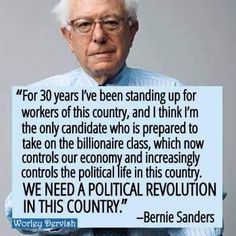
    We see this message in Sanders’ many replies to questions about how he is different from other more mainstream candidates. He repeats the similar refrain: “We need a genuine political revolution in this country; one that extends beyond the campaign. We need a political revolution by millions of people becoming active and speaking out, that is carried out through the governing process” (the wording varies somewhat, but this is the consistent message).

    Whether Sanders can accomplish this is entirely the wrong question (though we can still be skeptical as to whether his rhetoric is not itself a ploy to garner electoral support). The question is whether the people, whether we, will ensure that these words become a reality. If they do, who Sanders is and what he believes in becomes irrelevant. What he is calling for could become a Presidency where the executive is merely a managerial place-holder for the voices of the people, for the voices of on-going popular movements—as opposed to the current version where the Presidency seems to function as an empty shell populated by the interests of corporations and imperialist war-hawks.

    A Revolutionary Message?

    In this country there has rarely been any significant or consistent democratic control over political institutions or public policy, never mind over its economic capacities. Sanders might not be a theoretically consistent socialist, but he is certainly a champion of democracy, and in the United States, that might just be a genuinely revolutionary position.

    There have been vital popular movements in our history, whether this was the labor movement in the early twentieth century, the anti-war and civil rights movements in the 60s, or the women’s rights and environmental movements of the 70s and 80s. These movements have had a lasting effect on our political system, but they all fell short of radically reorganizing our politics. When we fetishize or hyper-focus on particular candidates or leaders, to the point where other dimensions of politics seems secondary or even irrelevant, there is little hope in maintaining a democratic movement from below.

    The US government has always represented the class-interests of the bourgeoisie (or the white, male aristocracy in the early years) and thus the maintenance of the capitalist mode of production. A genuine popular movement would certainly disrupt this over two-century-long trend of anti-democratic governance.

    Sanders is certainly not a revolutionary in the sense of advocating violent resistance to the existing order of things, but I wonder if, given the Right-wing status-quo in this country, what Sanders is advocating isn’t a kind of revolution (regardless of how much we read into the fact that his campaign is selling “HONK for a Political Revolution” bumper stickers).

    The goal of socialism from below is to give all people equal social power over and within the relevant political and productive forces that shape their lives. Sanders is not advocating this, but if his radically democratic message is more than just words, what he is calling for—and has thus far been successful in inspiring, based on the record breaking turn-out at his campaign events—could certainly lead to a more thoroughly democratic politics. This kind of authentic, bottom-up politics could then, over-time, appropriate the means of production for rational, egalitarian ends.

    Though I am not sanguine about the likelihood of this, the message is important. The messenger is not, but it is true that having a more trustworthy-than-average candidate calling for such a movement does give it some credence it certainly wouldn’t have if say Donald Trump—in-between racial slurs of course— advocated a grassroots political movement.

    Sadly it seems socialism is still too radical for the conservative forces of the American electoral mainstream at the moment, though it certainly has more popular support than it has in the past forty years in this country. This is why liberal progressives populating the pages of Salon.com and the airwaves of MSNBC are sparing no energy explaining precisely why Sanders isn’t really a socialist. This also precisely why the supporters of socialism from below in the US must be especially cautious of Sanders. He could move further to the Center at any time. We need to focus on the movement—our movement—not the man.

    When we rigidly focus on who the candidate is or what their specific views on issues are to the point that nothing else seems relevant to an election or to politics in general, we lose sight of our politics, of our political potential, and of our movement. This is the fetishization of “the candidate.”

    The Case for Supporting the Message (and for now, the Candidate)

    The mainstream Progressive argument boils down to this: people should support Bernie Sanders precisely because he is firmly within the capitalist paradigm. For democratic socialists, the argument should instead be this: we should support Bernie Sanders because he is calling for a non-candidate centered campaign and of all of the other electorally-viable candidates in both parties are Right wing neo-liberals. Thus Sanders’ campaign seems like it is the best hope any semblance of a Left agenda has given this status quo—even though Sanders’ campaign platform is rooted in traditional post-WWII welfare-state social democracy, as opposed to something more radical.

    If (and this could not be a bigger IF) Sanders keeps his promises and maintains a thoroughly democratic grassroots campaign through and beyond the primaries, through and beyond the general election, into his (our) governing strategy, he should retain the contingent, strategic, and skeptical support of the socialist Left in the United States. This tactical support should never extend to a rigid support for a single candidate nor to the Democratic Party.

    We should not support the man because of his views (though they are certainly the best ideas I’ve heard coming from someone under the Democratic Party banner in my lifetime), but rather we should contingently support his campaign for what he claims to stand for: a genuinely democratic political movement that places everyday people collectively in control of regulating the means of production. While this would still fall short of true socialism if it stopped at mere regulation, the democratic element is worth supporting for its radical potential to become more than just mere regulation.

    We need not trust the candidate, but the voice of a single candidate is important in our electoral system—for better or worse (it’s certainly for the worse). However important candidates remain in our system, regardless of who the candidate is, what matters above all else is the grassroots movements that compel any candidate, in this case Bernie Sanders, to live up to their promise of fighting to facilitate the reorganization of our politics and institutions in such a way that mass participation results in true popular efficacy in all aspects of our collective lives. The goal is to make genuine democratic power the norm, not the exception.

    The fact that Bernie Sanders is bringing this potentially revolutionary message back into the mainstream through the consistently corrupt Democratic Party should make us very hesitant. It will either work or it won’t, but our support of him need not be and should not be unconditional. After all, Jill Stein and the Green Party, along with a whole host of other smaller Left parties and organizations like Solidarity, will be there with open arms if Sanders loses to Hillary Clinton or deviates from his democratic promise.

    When you fetishize the candidate, you marginalize democracy. This marginalization of democracy through candidate-centric politics is what we must get away from in order to sustain a practicable radical Left in the United States and beyond.

  • Sanders for President: a Political Phenomenon that Challenges all Preconceptions

    Image

    Last night more than 100,000 people attended 3,500 meetings in all 50 states and the District of Columbia to watch a video-cast of Bernie Sanders and to begin to organize his on-the-ground campaign. Some of the meetings in various parts of the country had as many as 200 people in attendance. The meeting I attended in Crown Heights, Brooklyn was attended by 25 people, most in their 20s, with background working for social justice NGOs, in media, and in the arts, as well as a few graduate students.

    These are young idealist people who are attracted to Sanders because he calls for a “political revolution” against the billionaires, and because they believe in public health care for all, free higher education, and improving the lives of working people. By and large, those in attendance had no interest in the Democratic Party and a few suggested it would have been better had Sanders run as an independent. The organizer of the meeting suggested that we could build a mass movement and take-over the Democratic Party, but nobody in the meeting seemed particularly to think that possible or to care.

    What has become clear from the Sanders’ rallies and meeting is that no one is supporting Sanders because he’s the “lesser evil.” After all, that’s Hillary Clinton. People back Sanders as a protest against economic inequality and against the power of money in politics. Sanders is the Occupy Movement’s political expression. Not so much a Democratic Party candidate as the voice of the underdogs.

    A Marginal Candidate

    When in late April Bernie Sanders, the independent Senator from Vermont who had long called himself a socialist, announced that he would run for president in the Democratic Party primary no one had any idea what the response would be. After all, Sanders is Senator from the small state of Vermont with a population of just 625,000 (only Wyoming has fewer inhabitants), a state which is virtually all white (95.2%), and whose largest city of Burlington (of which Sanders had been mayor) is only a small town with a population of 44,000.

    Sanders name was well known only in his own state and in neighboring New Hampshire. If he had any national reputation, it was chiefly because he was a strange bird: the only independent in Congress and the only national public official who called himself a socialist. Only progressives knew him for his pro-labor voting record. What would happen if such a marginal figure ran for president?

    Huge Spirited Crowds

    The response to Sanders candidacy has been nothing short of phenomenal. After rallies of hundreds or a few thousand in his home state, Sanders hit the road. In the historically liberal city of Madison, Wisconsin on July 1 some 10,000 people turned out to hear Sanders decry the billionaires and call for greater economic equality. Perhaps that was to be expected in a city where 100,000 had occupied the state capitol building to oppose Republican Scott Walker’s anti-union legislation back in 2011. After all, Sanders was speaking there to Democrats, union members, and University of Wisconsin professors and students. And the Sanders rally of about 8,000 in Portland, Maine could be attributed to local support for a New England candidate.

    Would Sanders be able to rally support in Republican red states of middle America as well? Well that question was answered on July 18 Sanders attracted a crowd of 11,000 in Phoenix, Arizona and then again on July 19 when 8,000 people showed up for a rally in Dallas, Texas. The groundswell continued on July 26 when 4,000 turned out in the smaller city of New Orleans, Louisiana. Everywhere the Sanders’ crowds have been exuberant By comparison, Hillary Clinton’s largest rally so far attracted 5,500 people to park in New York in June.

    Why have such phenomenal crowds appeared to hear a man who appeared to be such a marginal candidate? There are several reasons. First, many agree with Sanders fundamental message, that banks and corporations have taken over the political system and made it serve their interests. These people are supporting Sanders as a protest against the corporate agenda of both the Republican and the Democratic parties.

    When Sanders typically asks his audiences, “Why are we living in a society in which for the last 40 years the middle class in this country has been disappearing and almost all of the wealth and income are going to the people on top?” They nod yes, thinking themselves, “Why are we?” The answer he suggests is the corporate dominance of America and the beating down of the labor movement and the living standards of working people.

    Second, many Democrats deeply resent the idea that almost automatically Hillary Clinton would become the party’s candidate without any political alternatives being presented. Progressives in the Democratic Party wanted not another neoliberal Democrat, but someone who raised their issues of jobs, wages, health care, and education. When Senator Elizabeth Warren declined to run, Sanders stepped in and became the champion of all those to the left of Clinton.

    Labor for Bernie

    Since then, not only has he drawn large crowds, but he has also done surprisingly well in other ways. While not as popular in the polls as Hillary Clinton, he has good approval ratings compared to other candidates in both major parties, and they are rising. He also has a strong rank-and-file labor following, Labor for Bernie, with some 5,000 rank-and-file members and local leaders supporting him as well as the small Vermont and South Carolina AFL-CIO councils.

    Larry Cohen, past president of the Communications Workers of America and now a volunteer working on the Sanders' campaign says, “Our strong and growing grassroots movement shows that Bernie shares our values and beliefs.  Workers are fed up with business as usual. This campaign is about putting a stop to the corporate assault on our kids, our country and working families!”

    When the leaders of the American Federation of Teachers—whose president Randi Weingarten hopes to become Secretary of Education—endorsed Clinton without holding local meetings to consult the members, hundreds of angry teachers rebelled and signed up with Labor for Bernie. There has been such a reaction that the AFL-CIO leadership has decided to postpone its endorsement, which will give Sanders an opportunity to seek greater labor backing.

    In terms of fundraising, Bernie is not nearly as strong as his opponents, but the favored candidates’ campaigns and Sanders’ are hardly comparable. Clinton and Republicans such as Jeb Bush have the backing of big financial donors—banks, corporations, and the 1% of the very wealthy, while Sanders has received mainly small donations from individual donors. In the first quarter Republican Jeb Bush has raised $103 million, Clinton $47.5 million, while Sanders has remarkably raised $15 million in first quarter of 2015.

    Sanders and Black Lives Matters

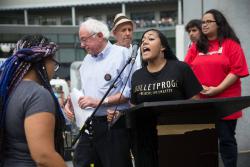
    Sanders initially failed to speak out strongly in favor of the Black Lives Matter movement and blundered when confronted with black protesters as the Netroots Nation conference in Phoenix, Arizona. In his earliest statements he had tried to be for both cops and black people, an untenable position. The black movement, continuing police killings like that in Cincinnati recently, and, one could say, reality itself, have forced Sanders to move toward the black movement.

    In fact, Sanders has an outstanding record as an opponent of racism and an advocate of civil rights dating back to his participation in the Congress of Racial Equality (CORE) and the Student Nonviolent Coordinating Committee (SNCC) in the1960s. In recent campaign appearances he is reasserting his opposition to racism and police violence. Speaking in New Orleans he told the crowd, “Black lives do matter, and we must value black lives.”

    The problem is that Sanders emphasis on economic equality for all failed to take into account the issues of racism, discrimination, exclusion, and violence that faced some. His program does not mention African Americans. He did not put black issues at the center of his politics. But he is changing.

    In a talk at a reception organized by leaders of the Southern Christian Leadership conference, one of the historic civil rights organizations, one could see the impact of the Black Lives Matter movement on Sanders as he said, “Anybody who saw the recent Sandra Bland tape understands that tragically, racism is alive and well in America,” referring to a black woman who was found dead in a cell in a Texas jail. When an African-American woman gets yanked out of her car, when we all know that would not have happened to a middle-class white woman, we know we need some serious change in criminal justice in this country.”

    Speaking to SCLC conference as a whole, Sanders talked about “the need to simultaneously address the structural and institutional racism which exists in this country, while at the same time we vigorously attack the grotesque level of income and wealth inequality which is making the very rich much richer while everyone else – especially the African-American community and working-class whites – are becoming poorer.” The SCLC speech—which is well worth reading—showed the depth of Sanders’ knowledge and commitment to black Americans’ fight for racial justice. These recent speeches and comments show that in reaction to criticism, he has begun to make a shift, moving black issues toward the center, though, as sympathetic critics have pointed out, he and his organization still have a way to go.

    Sanders the Organizer

    Vermont labor organizers friends of mine talk not only about Sanders as a supporter of labor, but as a man who used his office to help unions and workers to organize, for example, by calling a meeting with unions to encourage unity and struggle for improved conditions in his home state. One sees this aspect of Sanders now in this campaign. Speaking with Katie Couric on Yahoo News, Sanders called for students to march on Washington:

    “My view is that the only we can bring about an agenda that works for working families is if millions of people are actively involved in the political process. If a million young people march on Washington they to the Republican leadership, we know what’s going on, and you better vote to deal with student debt. You better vote to make public universities and colleges tuition free, that’s when it will happen.

    “We’re already seeing that with the minimum wage. Do you know why the minimum wage is going up around the country? Because workers are going out into the street, so we need a political revolution, in my view, where people begin to stand up and fight and take on the big money interests. If we don’t have that, no president, not the best president in the world will ever be able to accomplish anything.”

    If Sanders supporters want to really build a new social movement for both economic and racial justice, they will have to find a way to bring the Black Lives Matter movement and the rank-and-file labor movement together and to keep them together beyond Sanders campaign. Such a connection between the labor movement and the black and Latinos movements is the historic aspiration of the best of the socialist left.

    Sanders Foreign Policy: A Big Problem

    For those of us radicals on the left, Sanders greatest weakness is his foreign policy. While it is true that Sanders voted against war to “liberate” Kuwait (the first Iraq war) and voted again against the Iraq war resolution of 2002, on the other hand, he supported President Bill Clinton’s airstrikes on Kosovo and the war on Afghanistan in 2001 and voted that same year for the Authorization for the Use of Military Force against terrorists, the law used today by President Obama to attack ISIS in various countries. In 2003 he voted for a bill that gave President George W. Bush support in Iraq and in the war on terror. Sanders has voted for the military appropriations bills about as often as he had voted against them. In the Middle East he leans toward Israel against Palestine, though not without reservations.

    What this record makes clear is that Sanders has no consistent and principled position against U.S. imperialism. While his program calls for reductions in military spending, he does not call for dismantling the hundreds of U.S. bases around the world, for ending the war on terror, for stopping the use of drones, and so on. Sanders’ program makes no mention of the military.

    While he calls himself a socialist, Sanders’ foreign policy and military policy remain in line with corporate capitalism, militarism, and imperialism. The central issue for those concerned about world peace is the Middle East region (from Algeria to Afghanistan)—and in that region his position in support of Israel, rather than with the Palestinian underdogs, places him on the wrong side. Sanders is not an aggressive hawk like Hillary Clinton, but he is no dove of peace and no ambassador for internationalism. Despite these crucial foreign and military policy failings, Sanders’ campaign poses a challenge to the left.

    The Socialist Left and Sanders

    The Sanders campaign has posed a serious challenge to the thinking of the far left in the United States. Over the years, a variety of socialist groups have pursued different strategies to build a radical political party in the United States. Some left groups, particularly the Communist Party, the Committees of Correspondence for Democracy and Socialism and Maoist groups such as the Freedom Road Socialist Organization have historically worked in the Democratic Party and see no problem with that. They have hoped to build a peoples’ movement both within and without the party. They may have supported Jesse Jackson and the Rainbow Coalition in the 1980s or Dennis Kucinch in the 2000s, but these groups can generally be called upon in the end to support the Democrat’s nominee against the Republicans, rejecting candidates like Ralph Nader and parties like the Greens. While they are both boosting Bernie now, the CP and the CCDS are likely to go on to support Hillary—or who ever is the Democratic Party candidate—in the national election.

    The Democratic Socialists of America, originally founded as an organizing committee by Michael Harrington in 1973, had as its strategic objective the “realignment” of the Democratic Party. Socialists, Harrington argued in his book Socialism, would drive the Dixiecrats and the corrupt big city machines out of the Democratic Party, leaving the labor unions as the dominant bloc and revealing that the Democrats were in reality a labor party. The DSA working with officials of the United Auto Workers and the International Association of Machinists pursued Harrington’s realignment strategy up to the end of the twentieth century when it was clear that though the Dixiecrats and most big city machines had withered away, the corporations not the unions had taken over the Democratic Party. In recent elections, DSA did not endorse Barack Obama and very likely will not endorse Clinton. Younger DSA members no longer see realignment of the Democratic Party as the way forward.

    Some other socialist groups, including old-line Debsian socialists such as the Socialist Party USA and various Trotskyist groups, have generally been opposed on principle to any work in the Democratic Party, arguing that the Democrats are the party of the banks and corporations and that working people needed their own party. The Debsians called for the building of a Socialist Party. Other socialists of this ilk have historically argued that the AFL-CIO and other unions should give up lesser-evilism, “break with the Democratic Party,” and form a labor party.

    In 1996 it seemed that after decades of arguing for the “break with the Democrats” the dream was being fulfilled when Tony Mazzocchi, a leader of the Oil, Chemical and Atomic Workers Union, brought together the United Mine Workers, the International Longshore and Warehouse Union, the American Federation of Government Employees, the California nurses and hundreds of locals from various unions to found the Labor Party. The problem was that while those unions wanted to form a party, they didn’t want to run candidates who might take votes away from the Democratic Party, so for several years there was an ongoing fight between the union leaders and small socialist groups over the issue of elections, paralyzing the party. The party suspended operations in 2007, though by then there were only a few functioning local chapters.

    The Labor Party experiment having failed, some activists went on to join the Green Party that had been formed in 1984 as a federation of several state Green Parties. Between its founding and the 2000 election the Greens evolved from simply an environmental party to a party that was concerned with the environmental as well as economic, social, and racial justice issues. The Green Party’s influence peaked in 2000 with the controversial campaign of consumer activist Ralph Nader who won 2.7 percent of the vote—leading him to be accused of having been a “spoiler” who had taken votes from Democratic candidate Al Gore, allowing George W. Bush to win the election. Howie Hawkins, a socialist, ran as the Green Party candidate for New York Governor in 2014 winning 5 percent of the vote. Sanders has for the moment overshadowed Jill Stein, the Green Party’s presidential candidate for 2016; but as she says, “I’ll actually be on the ballot in November.”

    Of all the far left groups, the International Socialist Organization had been the most critical of and hostile to the Sanders campaign—and for all the right reasons: his caucusing with Democrats, his foreign policy, and above all the belief that Sanders will be an obstacle to building an independent left movement and political alternative. The issue is whether these principled objections should keep us from working closely with Sanders’ supporters, while at the same time maintaining our own political independence.

    Where Does Sanders Fit?

    For Sanders campaign doesn’t fit neatly into the historic categories of the far left. Sanders is virtually the only person in national politics who calls himself a democratic socialist and who advocates the kind of social democratic policies—free health and education, strong unions, a comprehensive social safety net—such as existed in Scandinavian nations for decades. The debate over socialism in America, which began with the Tea Party attack on Obama’s Affordable Care Act, has with Sanders’ campaign become part of a broader national conversation. In a nation once dominated by anti-Communism, red-baiting, and the common jeer at leftists “Go back to Russia!,” socialism is now on the table if not yet on the agenda.

    As far as the Democratic Party question, his entire political career Sanders has been an independent—though he caucused with the Democrats–never a Democrat until now, and never argued for a strategy of realigning the Democratic Party. This is quite different, for example, than the careers and strategy of people like Jesse Jackson and Dennis Kucinich who systematically worked to reform the Democrats. Sanders has never suggested that the Democrats could be reformed and is not now.

    And Sanders’ supporters aren’t fundamentally lesser-evilists. They support Sanders precisely because he appears to be the alternative to the lesser evil of the Democratic Party leaders’ choice of Clinton. On the other hand, Sanders has promised to support Hillary Clinton if she is nominated, thus thrusting his supporters into the arms of the corporate-controlled Democratic Party that they resent and reject.

    Given the Republican alternatives of a rightwing union-buster like Scott Walker or a racist like Donald Trump, most of Bernie Sanders followers today will probably cast a vote for Hillary Clinton in the general election. They will not be doing this because Bernie has tricked them and rounded them up for Hillary, but because they fear the Republican reactionaries. They will do that simply because they all along intended to vote to stop Scott Walker or some other anti-working class, racist, or anti-women’s rights Republican from winning.

    Where Do We Fit?

    Okay, that is lesser-evilism of a sort. But many will be looking for a way to build a political alternative when the primary campaign is over. So, some on the far left—in groups like Socialist Alternative and Solidarity—have decided that they will work among Sanders supporters, while still declining to either become Democrats or to endorse him. What can such groups—I myself am a member of Solidarity—do in and around such a campaign? We can bring into the campaign all of the issues—environmental, women’s, LBGTQ, black—on which we are working. We can bring our point of view that while the Bernie Sanders campaign represents a fundamentally progressive development, but that taking the movement into Hillary’s campaign would be a mistake. Most important, we can argue that out of the campaign we must build a movement that becomes part of a new era of social struggle in America.

    Some Sanders supporters, once money and the media have made Clinton the Democrats’ nominee, may come out of this experience so disgusted with the Democrats that they vote for the Green Party’s candidate Jill Stein or go on in the future to organize the working class alternative that the far left has dreamed of. Or is it possible to think that Sanders, now 73 years old and with nothing to lose, might attempt to launch an independent campaign—hard to do under the 50 different state electoral laws—or perhaps endorse or join with Stein of the Greens. Who knows? We can only hope.

    What the Sanders campaign may accomplish is to popularize a program of social democratic reforms, to deepen the discussion about socialism, to bring together labor, black, female, and LGBTQ activists into a movement with enough cohesion, energy, dynamism, and excitement to continue to build something after the election. The Sanders campaign could contribute to the launching of a new period of social movements and upheavals with a higher level of political consciousness and if it does that, it will be a great contribution.

    So, while remaining a registered Green and planning to work for Jill Stein in the election, I plan to work with the Sanders campaign in the primary period, hoping–like other Sanders supporters–that out of this experience we can build a new, stronger, left in America.

  • UAW Local Calls on AFL-CIO to End Ties to Police Unions


    Image

    United Auto Workers Local 2865 representing 13,000 teaching assistants and other student workers throughout the University of California system, called on the AFL-CIO to end its affiliation with the International Union of Police Associations (IUPA) in a resolution passed by its governing body on July 25. This is the union’s resolution passed by the union:

    Statement:

    We, UAW Local 2865, call on the American Federation of Labor and Congress of Industrial Organizations (AFL-CIO) to end their affiliation with the International Union of Police Associations.

    It is our position that this organization is inimical to both the interests of labor broadly, and Black workers in particular. Historically and contemporarily, police unions serve the interests of police forces as an arm of the state, and not the interests of police as laborers. Instead, their “unionization” allows police to masquerade as members of the working-class and obfuscates their role in enforcing racism, capitalism, colonialism, and the oppression of the working-class. We ask that the AFL-CIO recognize this history and take steps to serve the interests of its Black workers and community members.

    Background:

    The AFL-CIO’s official mission is “to fulfill the yearning of the human spirit for liberty, justice and community; to advance individual and associational freedom; [and] to vanquish oppression, privation, and cruelty in all their forms.” This, we argue, is the calling of a union to be a force for advancing the lives of workers. Within this framework, police unions fail to meet the criteria of a union or a valid part of the labor movement.

    While it is true that police are workers, and thus hypothetically subject to the same kinds of exploitation as other laborers, they are also the militarized, coercive arm of the state. It is the job of the police to protect capital and, consequently, maintain class society. How can there ever be solidarity between law enforcement and the working class when elites call upon police and their organizations to quell mass resistance to poverty and inequality? The police force exists solely to uphold the status quo. Their material survival depends on it, and they hold a vested interest in the preservation and expansion of the most deplorable practices of the state.

    Present Day:

    We have seen this vested interest manifest itself very visibly over the past year. By calling themselves a union, police have utilized union resources to defend brutality and anti-Blackness. Police unions channel resources towards upholding racist practices in a few key ways:

    1. Lobbying to oppose independent oversight by civilians and other governmental entities.
    2. Campaigning for political actors who support limited police accountability.
    3. Defending officers’ crimes of racist brutality in court.  

    These elements have clearly shaped the context that enabled the tragic circumstances of Freddie Gray’s death and speak to the contemporary moment in which Black lives are considered less important than job protection for police. Advocated for by the police union, The Maryland Law Enforcement Officers’ Bill of Rights (LEOBoR) aims to protect the rights of officers above the needs of the community. In cases where police misconduct is reported, such as in instances of “rough rides,” police officers do not have to answer questions until 10 days have passed and a lawyer has been consulted. Subsequently, the overall review process outlined by the LEOBoR empowers a hearing board of fellow officers to have final approval over any penalties imposed upon accused officers—this has resulted in the preservation of employment for nearly all accused officers despite the 3,048 complaints have been filed against 850 Baltimore PD officers (30% of its police force) since 2012.  If complaints do manage to make it past this extra layer of due process, union legal resources are used to defend the officers against charges of racist misconduct in court. By unconditionally insulating officers accused of brutality from facing consequences, police unions maintain the status quo of racial violence that upholds the exploitation of Black communities in particular, as well as other communities of color.

    Historical Evidence:

    We recognize that these are not isolated incidents, but arise from a long history of policing as a profession. Police unions in particular emerge out of a long history of police intervention in labor politics and its complicity in racial violence. The modern U.S. institution of the police has roots in the repressive demands of powerful white capitalists. Overseers and slave patrols in the South evolved alongside the growing need to maintain “order” in early urban areas in the North. In fact, armed “night watches” mirrored policing practices by being a front line of defense against Native American raids on colonies. Policing in the U.S. has always served the needs of colonialism, racism, and capitalism by protecting the property of those who would steal land and exploit the labor of others. Neither the property of indigenous people nor the products of the labor of both workers and slaves has ever come under protection of the institution of the police. It has only ever been the property of the powerful that the police protect. Maintaining this system of relations is the so called “order” that police have sworn to defend.

    In fact, early attempts by labor to organize and fight for rights and better pay and working conditions have historically been met with violence. These instances are many: from picket line fights to police enforced lock-outs; from crackdowns on rallies, like the Thompson Square “riot” of 1874 at a rally for the unemployed in New York City, when police indiscriminately brutalized men, women, and children; to massacres committed by private police, like the two dozen men, women, and children killed in the Ludlow Massacre; and by public police, notably during the Haymarket Massacre we commemorate every year on May Day.

    Modern examples exist as well: police played a significant role in defending Jim Crow segregation. We have all seen the images and video of police siccing dogs on Black protesters, shooting them with water cannons, or billy clubbing them. Racist violence was not confined to the pre-Civil Rights South; Philadelphia police bombed the headquarters of Black radical organization MOVE in 1985, killing 11 people, including children. Recall also the assassination of Fred Hampton, leader of the Black Panther Party, by the Chicago PD in collaboration with the FBI. Very recently, the nationally-coordinated effort to crack down on and ultimately destroy the Occupy movement involved police departments across the country working in unison to stop the most effective modern social movement in opposition to economic inequality. American police as an institution have historically been and continue to be the violent supressive force used to maintain a white supremacist capitalist system on settler colonial land. If labor is to ever truly exert its power and challenge the corporate rule of the U.S., we will need to break the illusion that the police are part of the family of unions that make up organized labor.

    Conclusion:

    The AFL-CIO is an organization truly concerned with issues facing the laborers of America today. The history of policing and its use of union resources to silence those who are harmed by police brutality runs contrary to this mission statement. As Shawn Gude recently put it, to become agents of progressive change and labor solidarity, police unions would need to work actively to negate their own power and abolish the police. We endorse this position, and call on the AFL-CIO to do so as well. As a union, we argue that the International Union of Police Associations fails to adhere to the goals of the Federation, and therefore should not be included in the list of unions which are fighting for worker’s rights.

    This resolution came to our attention through In These Times.


  • A Report on the Crises in Greece

    While in Athens, I have gotten into the habit of ending the day by enjoying an iced coffee with cream in an outdoor cafe in a park about one mile from my hotel. It is there that I have been writing these dispatches. As I remarked in my first report, the park the cafe is in is filled with children, teenagers, young couples, the middle-aged, and old people until quite late. The cafe does not start to empty until after midnight.

    Image

    Yesterday I slept through breakfast at the hotel and, needing coffee, walked to the cafe in the late morning. While I sat under a canopy shielded from the broiling Mediterranean sun, poor people made their rounds. They came to each table asking for a handout or trying to sell whatever trinkets they had managed to acquire: an old man was selling cheap watches, a boy of around ten hawked packages of syrupy liquid that could be frozen to make ice pops, and so on. A young woman with a depressed and semi-vacant expression moved around the tables asking for money so she could get something to eat. I gave her my last two-euro coin, and she proceeded to the next table. When she asked the middle-aged Greek couple seated there for a contribution, the female partner reached into a small paper bag and withdrew a breakfast roll that she handed to the beggar. The young woman took the roll and proceeded to the next table. There is a visual joke from a Marx Brothers' movie where a bum asks Harpo for a dime so he can get a cup of coffee. Harpo reaches under his dilapidated trench coat and, grinning his maniacal grin, brings out a steaming cup of coffee resting on a saucer of China. The bum reacts with a look of shock and disappointment. What he wanted, of course, was the dime, not the coffee. There was no such look on the young woman's face when the older woman handed her the breakfast roll.

    Early in the morning of July 16, the Parliament of Greece passed the first round of laws necessary to continue discussions with the Troika on new loans enabling the country to continue making payments on its debt. There was a twenty-four hour strike of the public employees’ union, a mass demonstration outside Parliament, and a battle between anarchists and police in which they exchanged Molotov cocktails, tear gas, and stun grenades. All of the Left Platform MPs (around forty) within Syriza voted against their own government, but the legislation still carried overwhelmingly. Tsipris engineered the capitulation, but retained his political honesty. He said that he did not believe in the deal imposed by the Troika and in fact thought it was irrational but that, given the banking crisis, the Greek government had no choice but to accept it. He had to depend upon the discredited opposition parties to pass the laws. Tsipris carried the vote by a razor thin margin of members of his own party, just two more than necessary to prevent the opposition from calling for new elections in accordance with Greek electoral practice. All of the Syriza ministers who voted against the legislation have now resigned from their ministerial posts, but have kept their seats in Parliament. There are rumors that Costas Lapavitsas, economics professor at the University of London and a leading member of Syriza's Left Platform, may walk out of Syriza and form a new party to its Left. The rumors may be false since Lapavitsas recently said he would stay in Syriza and fight to return the party to its radically anti-austerity origins. According to him, the Left Front was the only group within the Party that kept faith with the democratic will of the people expressed in their resounding No! to the Troika in the July 5 referendum.

    I had dinner with three friends yesterday evening and then went with them to do some sight-seeing at the Acropolis. Afterward we took a cab to the anarchist neighborhood, Exarchia, for drinks. The cab driver was a highly intelligent and friendly man in his late 50s. He told us that he normally voted for the right-wing parties but that, in the last election, he voted for the Left. He also voted No! in the referendum. But like the rest of Greece, he was betrayed by Tsipris, and he vowed never to vote for Syriza again. He quoted Gianni Agnelli, the politically lucid Italian president of Fiat during the tumultuous 1970s, who said that is sometimes necessary to vote for the Left to implement measures that are painful for workers and the lower middle class. According to the driver, that is precisely the role Syriza has played. We asked for his opinion of the Greek neo-Nazi party, Golden Dawn. He said that the Greek people are not Nazis, but that some vote for Golden Dawn to protest the negative effects of immigration, especially rising urban crime rates. He told us with a note of both realism and regret that Golden Dawn is now the third largest party in Greece.

    The most worrisome consequence of the betrayal of the referendum by the majority of Syriza in Parliament is that it will give new impetus to the rise of the neo-Nazi Right. Golden Dawn has been quiet recently as a result of the indictment of some of its leaders for responsibility in the murder of immigrants. But Hitler was once jailed for his participation in the Beer Hall Putsch. In times of severe crisis – the Great Depression of the 1930s, the current Depression in Greece – the road to fascist power is opened when the Parliamentary Left takes on the role of managing a crisis on behalf of the capitalist class that cannot be successfully managed. It amazes me that so many Left professors, inside and outside Syriza, have failed to see that.

    The agreement between the Troika and the Greek government will someday be remembered as a colossal economic and political farce, but a farce that will end in tragedy unless the Left plays the cards it has left very carefully. No one – the Troika and the government least of all – believes that the deal can be implemented, let alone succeed. The parliaments of Northern Europe will never make the promised 80 billion euros available to Greece over the opposition of their own voters. On its part, Greece will not be able to find 50 billion euros of public assets to privatize, as the agreement requires. It is also unlikely that the government will be able to implement a host of other reforms under the agreement because of its lack of control over the state apparatus. Corruption and clientelism are so rampant in Greece that many candidates run for political office solely to get jobs for their relatives.

    Greece might as well have been defeated in a war, because it has now surrendered its national sovereignty. It has been forced to rescind all of the legislation the government had passed in its five months in office. In addition, under the agreement, the Troika has the right to veto any new law that it judges will adversely effect the ability of Greece to pay off its debt. The agreement also demands that the government set aside past judicial decisions that conflict with the interests of the Troika. To add insult to injury, the Troika will now set up its physical headquarters in a building in Sytagma Square. Tsipris is right that the Troika's demands are irrational economically. They will deepen the depression in Greece, depriving the state of the revenues necessary to pay back the loans. But the Troika is not stupid – it knows very well that this is the case. It is operating in accordance with a different, specifically political rationale. Quite simply, it wants to crush Greece as an object lesson to Italy, Spain, Portugal, and Ireland, all of which face debt crises. Golden Dawn will take note.

    There are three categories of crime under which the Nazi prisoners were tried in Nuremberg: crimes against peace, crimes of war, and crimes against humanity. By refusing to live up to its constitutional responsibility to provide liquidity to the Greek banking system, the European Central Bank launched an economic war against the Greek nation. It is guilty of crimes against peace. By targeting the civilian population, the ECB and the other two members of the Troika are guilty of war crimes. Even before the ECB brought down the Greek banking system, the Greek department of health released data showing that one-third of all Greeks are under-nourished. Some hospitals have already closed and more will certainly follow. People will die of malnutrition and lack of medical care. The Troika is guilty of crimes against humanity. We need a new version of the Nuremberg trials. At the very least, Merkel, Shaeuble, Draghi, Holland, and the rest ought to be brought before the International Court of Justice in the Hague. If the Court is unable to achieve justice in the case of the People of Greece vs. the Troika, then the idea of Europe as anything other than a pack of ravenous wolves and a flock of helpless sheep is indeed doomed.

    In a war of the wolves and the sheep, the most aggressive wolves win. Golden Dawn and its counterparts in the rest of Europe are waiting to enter the fray.

    Gary Zabel is a professor of philosophy at UMass Boston. He has been visiting Greece for the conference, Democracy Rising, and has been writing a series of reports about his trip for Open Media Boston. This report concludes the series. To see the other reports see openmediaboston.org

  • July 25,1898: INVASION OF PUERTO RICO & THE EMERGENCE OF U.S. IMPERIALISM

    For the many people who have engaged in the struggle for Puerto Rico’s independence, July 25 has a special significance. On that date in 1898, U.S. troops invaded Puerto Rico, beginning a period of U.S. colonial domination on the island that continues to this day. The United States invaded Puerto Rico, along with the Philippines, Guam and Cuba, in the setting of the Spanish-American War. That war was the opening of what would be the menacing role and predatory nature of the U.S. capitalist class in the Caribbean, Latin America and the entire world. The seizure of Puerto Rico, Cuba, Guam and the Philippines by the United States signaled the quest of the U.S. capitalist class to become a world power. European powers had pursued a policy of colonial acquisitions since the end of the 15th century. But only in the late 19th century had the mature and developed capitalist powers virtually colonized the entire planet. The projection of U.S. power outside of the North American mainland signified a rush not to be left behind in this global division of markets. Imperialism was transforming from a policy into a global system. No capitalist power could stand on the sidelines. Eventually this scramble and competition for colonies led to the first “world war” in human history, from 1914 to 1918, involving all the major capitalist powers. V.I. Lenin (leader of the Russian socialist revolution) noted this trend in the very first sentence of his classic 1916 work “Imperialism the Highest Stage of Capitalism.” “During the last 15 to 20 years, especially since the Spanish-American War (1898) and the Anglo-Boer War (1899-1902), the economic and also the political literature of the two hemispheres has more and more adopted the term ‘imperialism’ to describe the present era.” Until the Spanish-American War, capitalism in the United States was focused on expansion within North America. The expansion came from the push west and the seizure of the land of the Native American population and the theft of nearly half of Mexico’s territory in the 1846-1848 U.S.-Mexican War. Following the end of chattel slavery and the conclusion of the U.S. Civil War in 1865, industrial capitalism was able to grow rapidly. Facilitating trade and the transfer of raw materials, railroad track was laid throughout the entire stretch of the U.S. territory. Mining of raw materials increased. Factories, ports, bridges and dams were constructed at a greater pace. Beneath this supposed progress in U.S. society, there was a tremendous cost in human suffering. The consolidation and expansion of capitalism in the country could be measured by the genocide of the indigenous people—Native Americans. By the late 1890s, Native people were virtually annihilated within the territories of the continental United States with the close of the so-called “Indian Wars.” Eventually the dynamism of capitalism meant that the home market was insufficient. New markets, raw materials and cheaper labor were increasingly required for continuation of a vast increase in productive forces. Capitalist development began to be propelled in the direction of a new kind of expansionism, aimed at subordinating the economies of other lands. THE COMPETITION BETWEEN THE US AND SPAIN The more benefits that U.S.-based companies derived from economic investments made in the Spanish colonies of Cuba and Puerto Rico before the war—amounting to $50 million in 1897—the more that U.S. manufacturers and bankers desired direct control of these markets. Throughout the 1890s, there was a growing war fever among the U.S. ruling class. Prominent bourgeois figures, politicians, journalists and the clergy encouraged hostilities and openly called for the military seizure of Spain’s remaining colonies. “Democracy” and “freedom” became the banner for all sorts of demagogic warmongers. Militarism and arrogance, nurtured by capitalist expansion in the centuries of campaigns to expel Indigenous people from their lands and enforce a genocidal system of slavery, were now utilized to justify imperialist expansion. The use of brutal force against people in the invaded lands was justified as “divine will” or “manifest destiny.” With mounting tensions between Washington and Madrid, the U.S. Navy targeted and harassed any vessel flying the Spanish flag in the open sea. U.S. Navy warships were instructed to stop Spanish freighters, carry out searches, and in many cases seize the cargo. This was despite the fact that a state of war did not yet exist. Spain was a crumbling feudal power facing severe internal political strife. It no longer had the empire status that it enjoyed centuries ago. The Spanish government was not in a position to engage in hostilities with any country—especially the United States, which was demonstrating its industrial might and was obviously eager to test its military ability. A PRETEXT FOR WAR On the evening of Feb. 15, 1898, the battleship USS Maine exploded while docked in the harbor of Havana, Cuba. While 266 sailors were killed as they slept in their quarters, the ship’s captain and his close officers were not harmed. Washington officials were quick to blame the Spanish government, claiming that the explosion was caused by a floating mine. The fact that many eyewitnesses saw the force of the explosion coming from within the bow of the ship did not matter to U.S. investigators. Later investigations discounted the possibility of a mine explosion altogether. Whatever the cause, the Spanish government was in no way responsible. Despite Spain’s repeated diplomatic efforts and willingness to compensate for the loss of life and the destroyed ship, the U.S. government exploited the situation as a perfect excuse for war. On April 25, 1898, President William McKinley, with the consent of the U.S. Congress, made his infamous declaration of war against Spain. The United States would now be recognized as a world imperialist power. The military campaigns that followed impacted the lives of millions of people in the Philippines, Guam, Cuba and Puerto Rico. They were now to become subjects of a new colonial oppressor. On July 25, 1898, 26,000 U.S. soldiers stormed the shores of Guanica, Puerto Rico—the stepping-stone to the invasion of the entire island nation. The invasion was led by the notorious Gen. Nelson Appleton Miles—a reliable servant of U.S. capitalist expansion in the western U.S. states. Miles was infamous for his role in the suppression of the Pullman strike and other labor struggles. He was also known for his capture of Native leaders like Geronimo and Sitting Bull after hard fought resistance battles waged by Native people. But Miles’ most outstanding crime was the Dec. 29, 1890, massacre of 300 Indigenous men, women and children at Wounded Knee, South Dakota. As the U.S. Army marched through the mountains of Puerto Rico, they encountered peasants who had been forewarned of the invasion’s brutality. These mountain people, armed solely with machetes, valiantly attacked the invaders. Those captured by the invaders were often bound to trees and shot. That resistance today symbolizes the beginning of the ongoing Puerto Rican resistance to U.S. colonialism. The U.S. military occupations in the Philippines, Guam, Cuba and Puerto Rico were the opening shots of a wave of imperialist invasions over the next decades in the Western Hemisphere and other parts of the world. U.S. troops were sent to Nicaragua in 1898 and again in 1899, 1907 and 1910, and from 1912 through 1933; to Panama from 1901 through 1914; to Honduras in 1903 and again in 1911; to the Dominican Republic in 1903; to Korea in 1904; to China in 1911; to Mexico from 1914 through 1918; to Haiti from 1914 through 1934; to Cuba in 1906 to 1909, 1912 and again from 1917 through 1933; to the Soviet Union from 1918 through 1922; and to Guatemala in 1920. The list continued throughout the 20th century. With hundreds of military bases around the world today, U.S. military interventions are a constant feature of world affairs. CONTINUED ANTI-COLONIAL STRUGGLE The big business mass media make every effort to disguise the foreign subjugation of Puerto Rico. But events take place that push the truth about the U.S. occupation to the surface. The FBI assassination of Machetero leader Filiberto Ojeda Rios in September 2005 and the struggle to stop U.S. Navy bombing on the Puerto Rican island of Vieques in 2000 were two recent cases. Despite the many U.S. claims about Puerto Rico’s “progress,” the island’s people never asked to be invaded and colonized, have economic hardships imposed upon them or be forced to uproot and emigrate to the colonizing country. Within the United States, Puerto Ricans are among the poorest nationalities. The U.S. invasion of July 25, 1898, is why today Puerto Ricans have no say in any fundamental matters pertaining to the economic and political life of their homeland. The U.S. government’s colonial policy denying the Puerto Rican masses their right of self-determination and independence accounts for the continued people’s resistance there. QUE VIVA PUERTO RICO LIBRE Y Socialista! FREE OSCAR LOPEZ RIVERA, NOW!

  • The Value of Protest

    As a strong supporter of Bernie Sanders, my first reaction to hearing about the Black Lives Matter protest at Netroots Nation was disappointment. This looks bad, I thought. Bad for Bernie, who is the only presidential candidate with any chance of challenging structural injustice. And bad for Black Lives Matter, who could easily be interpreted as shutting down progressive discussions about immigration and economic inequality to make people focus on their priorities. I’ve had my share of mistakes during protests, as have all the activists I respect most, so I certainly had some sympathy. But I thought their protest was just that: a mistake.

    Then I watched the video of Sanders responding to the protest, or should I say, failing to respond and instead just speaking over and past them. He tried to just continue with his stump speech and seemed annoyed with the disruption. Several times he looked at moderator Jose Antonio Vargas as if he expected Vargas to control these women, once asking, “Are you in charge here?” The closest he came to discussing policing issues directly was mentioning his success with community policing in Burlington, VT, a city that was pretty much all white and pretty much irrelevant to the discussion of racist policing.

    As black women, those activists are people who have always been systematically locked out of the public discourse, and they were making their voices heard even if it ruffled some feathers. In theory, Bernie’s campaign platform is all about the way ordinary citizens have been locked out of the political discourse and the need to make those voices heard. But when the very thing he says he is looking for appeared right in front of him, he didn’t see it. As my dad says, if it was a snake it would have bit him. And this time, it did.

    Others have written thoughtful reflections on what this protest meant for challenging white privilege. The value for me personally was in what the protest exposed in Bernie Sanders, and by extension, myself. When asked directly about white supremacy and police violence against people of color, Sanders responded by talking about fixing the economic system and providing more jobs. He didn’t explicitly connect unemployment with getting killed by police, but the implication was that if a black person doesn’t have a job, we can pretty well expect that he’ll get gunned down by a cop. Bernie was focused on Big Ideas, and derailing that to talk about one woman, or even one certain segment of the population, seemed like a frustrating distraction.

    The thing is, this specific protest was in honor of Sandra Bland, who had a job when she was arrested for not using a turn signal and died in custody. In fact, she moved to Texas for her job, but her pursuit of a career didn’t save her. On the other hand, the 31% of unemployed white high school graduates mentioned by Sanders don’t get killed by police at anywhere near the rate of the 51% of unemployed black high school graduates. In retrospect, Bernie’s response to the BLM disruption looks like an exercise in avoiding the obvious fact that race matters.

    Like Sanders, my tendency is to zoom out from the personal and look at things structurally and systemically instead. When I think about anti-racism, I tend to focus more on changing institutionalized inequality than on challenging individual attitudes. In the past I’ve worried that the BLM movement’s focus on the names of specific people killed by police might simplify the need to dismantle complex systems into a perspective that considers justice done when specific killer cops are prosecuted. The most disappointing part about watching Sanders yesterday was the degree to which I recognized myself in him.

    But the BLM protestors chanted “Say her name!” in reference to Sandra Bland because Bland’s particularity demonstrates that increased economic opportunities alone will not solve the problem. We also have to actually confront racism. Bernie never did say her name, and his failure to depart from his script to validate the particularity of Bland’s life is inseparable from his failure to really see the particular living black women standing right in front of him as the embodiment of everything his campaign strives to be.

    I think Bernie Sanders can actually win the presidency, but to do so he needs the energy and grassroots organizing of the Black Lives Matter movement on his side. It’s early enough in the campaign that with some serious reflection and humility, he can learn from this and earn the trust of the movement. And importantly, when he is president, this learning experience will make him far better at dealing with the reality of racism and other kinds of oppression that plague our country.

    The BLM protest revealed the deficit not only in Bernie’s campaign, but in the approach of folks like myself who would rather avoid the particular lived experience of individuals who suffer from oppression. An exclusive wide-angle view on structures is just as much of an oversimplification as an exclusive narrow focus on individuals. Like any oversimplification, it compromises our ability to find adequate solutions to real world problems. Avoiding the particular also blinds us to our real allies when they are right in front of us.

    Some might say that people like me could have been taught these lessons without disrupting a critical dialogue with Jose Antonio Vargas and possibly damaging Sanders’ campaign. Maybe so. But that would have required people like me and Bernie Sanders to really see and listen to these people, which was exactly the problem. Part of the point is that the lived experience of black women is excluded from the public discourse. It’s never going to be their turn to have their voices heard, so they have to create the opportunities to make their voices heard. Protests are always criticized as being at the wrong time because those who need to protest are never the people writing the agenda. That’s the value of protest.

    Bernie Sanders rightly recognizes that all of us are increasingly excluded from the political discourse that shapes our country. If his campaign is to realize its revolutionary potential, we would do all well to follow the lead of the women of Black Lives Matter who made their voices heard at Netroots Nation.


    Tim DeChristopher, as Bidder 70, disrupted an illegitimate Bureau of Land Management oil and gas auction in December of 2008, by outbidding oil companies for parcels around Arches and Canyonlands National Parks in Utah. For this he served 21 months in jail. This article first appeared on his blog.

  • After Greece, Puerto Rico: Another Crisis Created by Capitalism

    ImageOn Monday June 29, the Governor of Puerto Rico, Alejandro García Padilla, delivered a live message to the people of Puerto Rico stating that the government’s $73 billion debt is unpayable. The governor stated, “The public debt, considering the present level of economic activity, is unpayable”.
     
    Several analysts in the corporate media, and also on the liberal left who are not very familiar with Puerto Rico, have stated that his message came as a shock to the country. This is not true. Articles and editorials in El Nuevo Día, El Vocero and Primera Hora, the country’s three major newspapers as well as television and radio broadcasts in the days subsequent to the Governor’s message express the general consensus that the people of Puerto Rico were not surprised by his words.
     
    What did shock many was the payment of almost $1 billion two days later to pay off debt fees. An article in El Vocero July 3 goes into this matter.
     
    This is a fabricated crisis.
     
    The colonial government of Puerto Rico is simply bowing to the demands of international financial forces which, like in Greece, have been demanding that taxes on working people be increased, that the labor rights enjoyed by some be eliminated and that remaining productive sectors still in hands of the government be privatized.
     
    Since the privatization of the Puerto Rico Telephone Company in 1998, the people of Puerto Rico and in particular the working class have been resisting countless efforts by the two ruling political parties, the Popular Democratic Party and the New Progressive Party, to eliminate labor and democratic rights in order to tighten the screws of neoliberal economic policy and maintain wealth accumulation for a small predator elite.
     
    Similar to the Greek peoples’ long struggle against austerity, two years ago teachers and other public sector workers and supporters occupied the Legislature building of Puerto Rico in response to the government’s decision to reduce the benefits for retirees. Videos and pictures of the dramatic takeover electrified the country as an example of popular resistance and indignation (see picture).
     
    Instead of supporting the people, Governor Padilla has been telling the country that the way to solve this crisis is to implement the recommendations in the Krueger Report, developed by a group of economists headed by Ann Kruger, a former bureaucrat for the IMF (the International Monetary Fund) the same financial institution that the Greek people rejected in their recent NO vote.
     
    This Report proposes that Puerto Rico:

    1. Reduce the number of hours worked by government employees;
    2. Privatize government owned agencies specifically the electric company (Autoridad de Energía Eléctrica), the water resources company (Autoridad de Aqueductos y Alcantarillados), the State Insurance Corporatio (FSE) and the public  education system;
    3. Reduce the minimum wage which is now $7.25 an hour;
    4. Reduce the number of sick days;

     
    In addition, the July 11 edition of El Nuevo Día says it has confidential information that the government intends to fire public sector employees. The previous governor already fired 20,000 workers.
     
    As evidence of the preference by elites to attack workers via "disaster capitalism" and Puerto Rico's inability to remedy its economy due to its lack of sovereign power, the colonial governor said, as quoted by El Vocero on July 3: “We will not get Puerto Rico out of this mess by taking sun on the beach.” With these words he was referring to his intention of reducing the number of vacation days won by public sector unions. However, regarding the corporate sector he has a different tone, putting forward a plan to grant multinational corporations even more tax breaks.
     
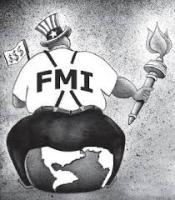
    This is what capitalism is, a plan of attack by Wall Street, by the hedge fund investors who profit off these debts and the misery they cause and by the international capitalist financial institutions like the IMF and the World Bank to dominate the economies of many countries thru imperialist debt.
     
    In his book, Confessions of an Economic Hitman, John Perkins states: “Economic hit men (EHMs) are highly paid professionals who cheat countries around the globe out of trillions of dollars. They funnel money from the World Bank, the U.S. Agency for International Development (USAID), and other foreign ‘aid’ organizations into the coffers of huge corporations and the pockets of a few wealthy families who control the planet's natural resources. Their tools included fraudulent financial reports, rigged elections, payoffs, extortion, sex, and murder. They play a game as old as empire, but one that has taken on new and terrifying dimensions during this time of globalization."
     
    He explains in detail that the goal of these hitmen is to first sink countries in debt. Then since the debt is not payable, the international loan agencies takeover and privatize a country’s public sectors and are also granted access to mineral deposits and given other corporate incentives or privileges.
     
    In a nutshell, that is what Wall Street, the banks and international finance institutions are attempting to implement in Puerto Rico. But our fight has just begun!

    Image

    Last week several labor leaders met with the governor. After the meeting, Pedro Maymi, President of the Puerto Rican Workers Central Union, declared that they have already given back all that they can. The new President of the Teachers Federation Mercedes Martínez urged teachers to prepare for a renewed fight against the privatization of schools in August.
     
    In the long run however, Puerto Rico, which was invaded by the USA in 1898, must break the chains of colonial capitalism. Puerto Rico is covered with shopping malls and fast-food chains. These corporations make more than $60 billion annually in profits and pay no taxes, unlike its low-wage workers who, contrary to capitalist myth, pay many local and sales taxes (just not federal).
     
    These corporations also receive many government subsidies. Capitalism makes billions in profits from the colonial status of Puerto Rico. That is why Puerto Rico is a colony of the USA: to transfer wealth from the people to the capitalists. This is why Puerto Rico needs independence.
     
    We believe resistance is the only solution. Only a militant and united fight back against the international capitalist gangsters who prefer profits instead of democracy can stop this corporate offensive against people and the planet. We therefore urge solidarity among all working people.
     
    We support the Greek and Black Lives Matter movements for dignity and life.
     
    Puerto Rico owes nothing.
     
    We will not pay. We will fight. #PuertoRicoDignityoverDebt

    Saulo Colón and Daniel Vila for the NYC Committee for Dignity over Debt in PR

  • “What Happened in Ukraine” by Sam Friedman

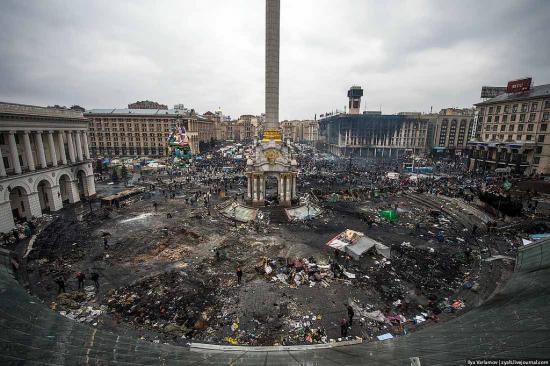
    ImageNew Politics readers will be interested in this ZNet article “What Happened in Ukraine” by Sam Friedman, an HIV/AIDS researcher who spent time in Ukraine for many years before the recent upheavals in the country. The article is based on Friedman’s interviews with friends who were participants in the Maidan events, and is posted on the ZNet site. Footnotes are available from the author at sam4wp@netscape.net.

    As is clear from the outset, Friedman frames the Maidan and its aftermath very differently from the way that either the mainstream media or most progressives have understood the Ukrainian crisis. His article begins:

    Ukraine went through mass mobilizations and a political revolution during November, 2014 – February, 2015.  In this it resembles struggles in Tunisia and Egypt since 2010, and as in the Egyptian case, the outcomes of these struggles (to date) have sorely disappointed most of the left in the United States and, indeed, internationally.  Unlike the Egyptian and Tunisian struggles, however, from its outset the struggles in Ukraine were seen in remarkably contrasting ways by different parts of the left. Some have viewed the Maidan struggles as an illegitimate movement that supported US (or US/EU) imperialism and should thus be opposed. Others have viewed it more favorably.
    Far too much of the discussion on the left and in progressive publications, in my opinion, has focused on the geopolitical aspects of the struggles in Ukraine. Far too little has focused on the failures of those movements that did succeed in ousting their governments in Ukraine but also in Egypt and Tunisia to bring about governments that moved away from supporting austerity, belt-tightening, and support for neo-liberalism. Most importantly, far too little discussion has focused on the failure of left currents in any of these movements to create serious efforts to bring about a socialist, anarchist, environmentalist or horizontalist reorganization of the economic and social order of society.

    In this article, I first try to clarify what happened in Ukraine, focusing primarily on events in the Kyiv Maidan movement but also addressing what has happened since.  I base what I say on the words of friends of mine who took part in it.  At the end of the paper, I will also address several important analytical questions: 1. Why the government that developed from a politically-amorphous popular revolution has been so right wing; 2. why no mass movement has developed to oppose from the left the austerity that has drastically reduced living standards in the months since this revolution; and 3. what are the implications of these events for the actually-existing lefts in the “post-Communist” countries and in the rest of the world.

    Unlike most Americans who write and speak about these events, I had several good friends in Ukraine before these events began.  I had met them because I have conducted research (and assisted in activism) around HIV/AIDS since 1983, with a considerable amount of this research focused on people who use drugs and their communities. In the 1990s, after the USSR broke up, HIV began to spread among Ukrainian drug users and sex workers…. [complete article]

  • Puerto Rico’s Debt: A Conjunctural Overview

    Image

    In this brief essay we offer a general and immediate overview of the socioeconomic situation in Puerto Rico. We do it while recognizing that such an analysis is incomplete if the historical, institutional, and political dimensions within the uneven development of capitalism are left out. In this particular case we do not explicitly deal with the colonial relationship of the island with the United States or provide a structural analysis of the economy (these dimensions will be treated in a forthcoming comprehensive article). 

    Our immediate purpose here is to present a conjunctural picture that can serve as a starting point for those interested (i.e. activists, academics, party militants) that want to approach Puerto Rican reality and insert themselves in the debates surrounding potential solutions

    An Economy in Crisis

    The economy of Puerto Rico entered its ninth year of contraction━with the expected negative effects on government revenues, public spending, and public debt as the result of a variety of factors:  the collapse of a construction bubble, the dismantlement of the industrial model of development, and the approval of the CAFTA-DR. The situation was aggravated by the financial crisis of 2008, which led to the reduction of credit for small and medium firms, many of which had to cease their operations given the cancellation of their lines of credit and their inability to engage in self-financing. The Gross National Product fell dramatically (on average -2.0% annually for the past 8 years), 270,000 jobs have been eliminated, crime reached record levels, and migration to the United States became the immediate alternative to those wishing to escape the crisis.

    Expansive Austerity

    In 2009 a conservative administration of the New Progressive Party entered government and argued that the economic problem of Puerto Rico was based on the “distortions” generated by the public management of the economy that, according to them, limited the competitiveness and productivity of the local “factors of production.” This new government anchored its public policy on the private entrepreneurial sector, both domestic and foreign, that had demanded a better environment for business and private investment. This petition from the private sector was accommodated with structural adjustment policies like the firing of 30,000 public employees (Law # 7 of 2009), favorable tax reform for the highest incomes, increases in the fee for public university registration, the privatization of public assets, etc.

    The policies applied did not have the desired effect. Part of the problem with their application in Puerto Rico, apart from the well known theoretical issues, was that the economy is characterized by being peripheral and dependent on the economy of the United States. Various instances exist of wealth being extracted and not reinvested. The most illustrative example can be seen in the disequilibrium in the balance of payments caused by the repatriation of profits of manufacturing firms to the United States, which amounts to approximately a third of the GNP (close to $35 billion).

    Public Debt

    The cuts in public spending had a negative multiplier effect in the economy given that they did not have a counterbalance with an increase in private sector investment. The deepening of the crisis led the government to issue $16 billion in debt, which represented 22% of the total debt and the gross domestic product. In other words, more than one fifth of the total debt of the country was constituted by bonds and lines of credit opened by the public sector to contain the economic free fall that was in effect created by the same government who applied expansive austerity.

    It is also important to point out that, apart from the debt, that government had access to $6 billion dollars (8.6% of GNP) assigned via the Obama administration’s American Recovery and Reinvestment Act, and to liquidity injected to the local banking sector to prevent its decapitalization. The most conservative estimates calculate that around $25 billion were injected into the Puerto Rican economy, which leads us to believe that the austerity policies could have had worse consequences.

    Degradation of credit: Increase in the debt service

    In 2013, the conservative government of the New Progressive Party was substituted by an administration of the Popular Democratic Party that at the time seemed to have more of a socio-liberal bent given that it had promised to stop laying off public employees. Still, it had left everything else (collective bargains, wage increases, consolidation of agencies) on the negotiation table. With the arrival of the new administration, immediate degradations of credit by Moody’s, S&P, and Fitch followed, which provoked the closing of doors in primary debt markets to Puerto Rico’s government and a fall in the value of its bonds in secondary markets. Apart from this, many of those bonds contained “acceleration clauses” that complicated the outlook given that this particular debt that matured at the moment of degradation was not considered in the books as an expense. Rather, it had a direct effect on the budget, given the impossibility of refinancing the debt with a new issuance of bonds.

    The debt service doubled from one year to another; its  effect was a reduction in public spending. In the meantime, debates were taking place over the possibility of either restructuring the debt or continuing to pay it under the original conditions agreed upon with the creditors. From these debates, proposals by new political parties and bills were developed to provide the government in turn with the necessary powers to declare a moratorium on the payment of the debt, audit it, and to renegotiate it. Of these, the only one that was turned into a law was the bill pushing for the declaration of local bankruptcy, in which a legal and institutional framework would be created so that Puerto Rico could decree the renegotiation without the need to appeal to federal forums. This law was declared unconstitutional on July 6, 2015 under the argument of “preemption”, given that the federal law for bankruptcy was explicit in excluding Puerto Rico and its municipalities from the federal protection to restructure its debt.

    The strict and literal interpretation of the law leaves Puerto Rico with few options to maneuver around its high public debt and its low economic growth. In the current conjuncture, the threat of default is the only viable alternative to convene creditors for a renegotiation of the terms of the debt. The problem with this mechanism outside of the protection of the law is that it will, in all probability, end up in a lawsuit in the federal courts. This is so because the Constitution of the Commonwealth of Puerto Rico (article 6, section 8) clearly states that the debt will have privilege in the order of payments, and if it is not done, it would enter into contradiction with the clause of contractual obligations. It is well known that the argument regarding impairment of contractual rights was used by hedge funds in the case of the restructuring of the debt of Argentina to require compliance with what was agreed upon and to not accept the terms of the renegotiation. In Puerto Rico, a significant part of the debt is in hands of hedge funds, which could take the same course of action, as they did in Argentina, and try to force more cuts in spending and ask for tiered increases in the payment of the debt.

    Proposal from IMF

    Given the multiple failed attempts at renegotiating and restructuring the debt via legal and institutional mechanisms that require a specialized third party, the government of Puerto Rico commissioned  a study that was prepared by three advisors associated with the International Monetary Fund. The proposals of the study followed a “supply side economics” approach, where measures of structural adjustment were recommended, such as: the reduction of costs of production (mainly labor costs), tax reform with more weight on real estate property and indirect taxes (direct taxes would be eliminated), and the continued cutting of the budget of the general fund. The conclusions are standard, given that they establish that these proposals would bring the economy closer to a market equilibrium and to a convergence in terms of payments to its “factors of production,” outcomes that are said to have positive effects in the medium run and to bring welfare in the long run.

    The current discussion of the report has focused on the fact that the majority of the proposals to reduce production costs (decrease in the minimum wage, reduction in labor protection law, coastal trade) are under the coverage of federal laws, which have applied in Puerto Rico via Law #600, which was approved in 1950 by the Congress of the United States. This limitation in what the local government can or cannot do determines the range of constrained alternatives, which implies that reaching the desired “market equilibrium” of the study is impossible. Still, and more importantly, the problems of the debt and the economic depression have continuing direct effects on the country’s workers and firms.

    Conclusion

    The depression that has characterized the economy of Puerto Rico during the first decades of the twenty-first century is the result a variety of short-run, medium-run, and long-run factors, that span from the failure of industrial policy to the intrinsic limits of operating within the legal framework of the United States as a territory. All of these dimensions have given form to an economic model based on the extraction of wealth, where salaries do not move evenly with productivity, a substantial amount of the wealth produced and profits derived in the island is repatriated and not reinvested in the country, and where debt is used to loot the wealth that does remain in the country. Under these conditions it is not surprising that the economy has followed a downward spiral with a significant social burden.

    The different political parties that have come to power throughout the years have demonstrated continuity by proposing and applying policies of a neoliberal bent that have contributed to amplifying the fiscal crisis and have undermined any potential for economic recovery. The attack on the public sector is the most noticeable outcome of these approaches and one would usually expect a social backlash, but the different escape valves available (emigration, federal transfers, informal economy, etc.) and the violence of the state have mitigated the type of mass protest that other countries, like Greece, Argentina, and Spain, have experienced in the last years. Still, more and more progressive voices of citizens against austerity policies have emerged, voices that want social spending to be prioritized over the payment of the debt. The question then is if under the current structure of relations of power can such claims be accommodated. Given the recent history, we believe that they cannot.

  • Awakening to Climate Change


    Image

    I awoke Saturday morning to rain on the roof. I am staying at my sister’s place in my hometown of Imperial Beach at the southwest end of San Diego County on the Pacific Ocean and the Mexican border. I could not at first identify the sound, the crackling of the rain on the awning of the patio just outside my bedroom window. Half asleep, I wondered at first if there might be a fire, then if some machine was running, finally I recognized that it was water and speculated that something might be leaking; perhaps there was a broken pipe. It never occurred to me that it could be raining because when I grew up here from the late 1950s until the late 1960s, it only rained in December and January. Now there is rain in July.

    My wife Sherry and I got up and walked a few blocks to the estuary of the Tijuana River in the virtual miracle of a light summer shower in San Diego. Now the estuary park, when I was a boy in high school we called it “the sloughs.” The sloughs contain a fascinating environment of plants that must live in both fresh and salt water as well as in the arid climate of San Diego. The bizarre plants seem to combine elements of seaweed and cactus, of sagebrush and swamp weeds. Though it occasionally became polluted by the Tijuana sewer system, I and the other high school boys sometimes swam in the Tijuana River, accompanied by little sand sharks. The mouth of the river emptied into the Pacific on the U.S. side of the border where in winter there could be and often still are huge breakers.

    Walking along the sidewalk in Imperial Beach I remembered how fifty years ago when it rained—and then it only rained in December and January—one would immediately find tadpoles in the gulley alongside the dusty paths that served as sidewalks in our town. In the winter frogs abounded. Now there are none. Also gone are the horny toads as we called horned lizards that raced through the brush in the sloughs and the sand dunes on the beach. The demise of those critters was not the result of climate change, but of other developments that affected the environment: the laying of sidewalks and culverts, the increase in population density, herbicides and pesticides used on lawns, and who knows what other threat to the delicate balance of sun, sand, and salt and sweet water.

    When Sherry and I got down to the beach we heard booming, which I presumed was cannon fire from the U.S. Navy ships off shore engaged in training exercises. But looking toward the Island of Pilón de Azúcar which sits off the coast toward the south, we could see lightning and realized that the booming was thunder. I had never in the many years I lived in and later often visited the San Diego area seen a storm accompanied by lightning and thunder. By afternoon, when we drove to Chula Vista to see a movie, the rain had become a full-fledged thunderstorm. Shopper and moviegoers jumped, startled by the thunder and gawked at the lightning, incredulous.

    The latest storm was the result of a hurricane, one of a few this year that have powered up the coast from southern Mexico, then along the Baja California peninsula to the San Diego area. Ironically, the rain, which woke me up and led me to think about climate change is the opposite of the real problem in southern California and throughout much of the Southwest, which is drought.

    Los Angeles is losing trees at an alarming rate. Laura Baurenfeind, principal forester for LA's Department of Recreation and Parks, says the city's parks have lost an estimated 14,000 trees in the last year due to the drought. Regulations intended to reduce water used for watering lawns threatens residents’ trees and bushes.

    While I was surprised by the rain motorists driving through the Riverside National Forest on highway 15 were shocked and terrified when a forest fire jumped the highway and set their cars on fire. Motorists abandoned their flaming trucks and autos and ran from them in terror. “I've never seen anything like this before,” California Highway Patrol Officer Steve Carapia told the Los Angeles Times.

    San Diego, dominated for years by the U.S. Navy and Marine Corps and the aerospace industry, is a very conservative town. Fox News may be the biggest influence on public opinion here and some of its commentators are climate change deniers. So it’s good to see that the San Diego Foundation issued a report that suggests that in the next 35 years it is likely that:

    ·      Sea level will be 12-18 inches higher.

    ·      San Diego’s climate will be hotter and drier.

    ·      We will face a severe water shortage.

    ·      Wildfires will be more frequent and intense.

    ·      We will not be able to meet our energy needs.

    ·      Native plant and animal species will be lost forever.

    ·      Public health will be at risk, especially among our elderly and children.

    The Foundation’s report contains a number of suggestions of measures to be taken to respond to this critical situation, but mostly it presumes that nothing can be done to stop climate change. So build your house on higher ground, farther from the shoreline, for the salt water will be rising as fast as the fresh water table is falling.

    Local residents seem most aware of this issue, the water problem: drought, dry riverbeds, falling water tables, and deeper wells. Walking through my old hometown I see that some of my sister’s neighbors have replaced lawns with gravel, concrete, or cactus gardens. Clearly some of these people have an environmental consciousness.

    That environmental consciousness was demonstrated in the last election when Imperial Beach residents elected a transnational environmental activist, Serge Dedina, as mayor. Dedina, a surfer, has spent years explaining environmental issues and advocating for conservation of natural habitats on both sides of the U.S.-Mexico border. His election in a conservative area where Fox News reigns and climate change deniers advocate laissez-faire policies represents a positive development.

    Still many San Diegans prefer to ignore the more serious problem, the central problem of climate change, which is the increase in greenhouse gases because of the constantly increasing number of cars on the road, as described in another San Diego environmental report by Tanaka Research and Consulting. While the Tanaka report proposes measures to reduce greenhouse gases from auto emissions, much like the San Diego Foundation report, it has nothing to say about the need to change the system that brought us to the environmental catastrophe that we, our children, and grandchildren will face.

    The problem is not the symptom that rain falls out of season or that it doesn’t fall at all. The problem is not simply the growth in greenhouse gases produced by automobiles. The problem is that capitalism has proven to be a system that grows and expands at the expense of the environment. As environmental activists have been saying, what we need is system change if we are to stop climate change.


  • Socialism from below

    ImageDan Swain discusses the contested ambitions and leaderships within our movements. This article was originally published in the Summer 2015 issue of the rs21 magazine.

    Throughout the history of socialist movements and ideas, the fundamental divide is between Socialism-from-Above and Socialism-from-Below

    So argues Hal Draper’s 1966 pamphlet The Two Souls of Socialism. In it, he distinguishes two different broad trends in the socialist movement. Socialism from above had dominated – and would continue to dominate – the 20th century, in the form of Stalinism in the East and social democracy in the West. Both of these, despite their apparent differences, shared a belief that socialism could be handed down by the right kind of government, without the active participation of those who live under it. To these Draper added, perhaps somewhat unfairly, the anarchist movements, influential on US campuses at the time, who were committed to a kind of insurrectionary politics in which a small, well-organised group could bring about change through militant direct action.

    Against all of these, Draper defended socialism from below, a commitment, traced back to Marx, that “socialism can be realised only through the self-emancipation of activised masses in motion, reaching out for freedom with their own hands mobilised from below in a struggle to take charge of their own destiny, as actors (not merely subjects) on the stage of history.”

    But what does this mean today, in the 21st century? Draper’s pamphlet begins with the claim that “for the first time in the history of the world, very likely the majority of its people label themselves ‘socialist’ in one sense or another”. This is painfully untrue today. Stalinism has largely disappeared, and social democracy has abandoned the idea of socialism as any sort of goal. The most that historic social democratic parties offer now is a managed capitalism. Moreover, it might be argued that the ‘from above’ and ‘from below’ distinction seems increasingly unable to capture the complexities of contemporary politics – social movements from below in Spain, Greece and Scotland, feed directly into political parties that promise reforms ‘from above’. What’s the point, in these circumstances, of banging on about socialism from below?

    I want to suggest three contexts in which it is still possible and valuable to talk about socialism from below as a way of doing politics. I stress this is a way of doing politics, rather than a set of hard and fast principles. It won’t give you all the answers in any situation, but it can help to guide actions. It also helps identify what its opposite is. Politics ‘from above’ is how we are encouraged to think of politics. It is politics primarily understood as the administration and management of people – well-meaning management perhaps, but still management. It is part of how we are encouraged to think of our social world – as something so complex it can only be understood and managed by a set of experts (as I write, the Guardian website carries a banner advert saying “Dear Bill Gates, will you lead us in the fight against climate change”). Because of this, it is a default, it is easy. By contrast, socialism from below is difficult. It is a cluster of problems and challenges, which stem from the belief that if socialism is to be anything, if it is to be a world worth living in, it has to be the product of the collective, participative struggles of large numbers. This is so much harder than politics as usual.

    Democracy

    The first arena where socialism from below matters is the question of democracy. There has historically been, and to a certain extent there still is, a way of talking about socialism as being concerned first and foremost with material comfort and a more equal distribution of wealth and resources. To the extent that democracy fits into this it is often as an optional extra, a ‘good thing’, but not strictly part of the picture. Socialism from below rejects this, and re-asserts democracy as an integral part of socialism. Socialism from below follows from a commitment to democracy in socialism in the following way: If your goal is just material comfort, or a better distribution of resources, you don’t need mass participation. You don’t need to involve, engage and mobilise a movement. Or rather, you do, but only temporarily, only in order to back up demands and policies, put pressure on those in power. If, on the other hand, your goal is a society in which the overwhelming majority are capable of participating in the running of society, you have to be concerned with empowering them to do so, and this empowerment requires a level of democracy.

    Democracy is thus not merely a vital part of the goal of socialism, it is also a vital part of the means of getting there. Socialism from below means being concerned with those forms of activity and organisation that empower people, which allow them to develop the confidence, ideas and skills which might allow them to actively participate in the democratic management of society. This is not to say that we have to ‘be the change we want to see’, or that the rules for democratic management of production ought to be implemented in your Capital reading group or housing campaign. But if social movements and political organisations give no space for participants to even glimpse what democratic self-organisation might involve, they are unlikely to contribute to socialism.

    The state

    The second dimension is the state. In Draper’s account, one characteristic feature of socialism from above is a naïve approach to the state, a belief that if only the state can be captured, state power can be wielded to achieve socialism. It is probably this approach that has done most to devalue the idea of socialism in the minds of contemporary anti-capitalists. Many believe this focus on the state has led to betrayals or tyranny, and instead we should seek to avoid it, hold it at arm’s length and build independent spaces in capitalism’s ‘gaps’.

    If socialism is just about taking control of the existing state, it is understandable that many are suspicious of it. But socialism from below implies a different approach. It argues that the institutions of the state are structured in a way that denies popular control. Alongside the formally ‘democratic’ pieces of the state – where those exist – are a series of hierarchically organised bodies, the police, army, judiciary, civil service etc., that limit the space for democracy. These are a block on the possibility of extending democratic control in society. These institutions must be removed and replaced. This is the lesson Marx learnt from the Paris Commune: “the working class cannot simply lay hold of ready-made state machinery, and wield it for its own purposes.” Rather, they must build their own, democratically controlled, institutions to perform the few positive functions of modern states.

    But if socialism from below does not believe that the state can be used to deliver socialism, nor does it believe it can be ignored. Firstly, when it comes to organisations like the police and the army, you can ignore these institutions as much as you like, but they will not ignore you. Rather, any movements that challenge the existing order will be brought into conflict with these forces, and needs to be capable of organising to defeat them.

    Secondly, socialists must be prepared to support and participate in movements that make demands upon existing states – demands for reforms and improvements in people’s lives. This is not because we believe that these reforms will add up to socialism. Rather, it is because it is through these movements that people are brought into collective action, through which they develop confidence, organisation and experiences that allow them to see the possibility of organising society differently. Demanding and defending reforms, and the conflicts that they lead to, help bring forward Draper’s actors on the stage of history. This may include running elections, but always with the understanding that our goal is to strengthen movements from below.

    Leadership

    The final question I want to address is leadership. By leadership, I don’t just mean the formal leadership of organisations, but a whole set of relationships within movements and organisations, in which some people ‘lead’ and attempt to get others to ‘follow’. Again, it is worth saying that it is difficult in the same way that the alternative is easy. A socialism from above leader knows best, tells people what to do, gives out the orders. A socialism from below leader is motivated by a desire to empower others, and ultimately make themselves irrelevant.

    An important question here is the dynamic between ‘mobilising’ and ‘empowering’ people. Mobilising people to take action is a vital part of any ‘leadership’ and it is just as vital to socialism from above as socialism from below. No mass movement can come into existence if people are not motivated and brought into action. But what best mobilises people in the short term may not be the best for empowering them in the long term. People can be sparked into action by all sorts of methods, but not all of these help empower them to become agents of their own emancipation.

    Take a concrete example here: the deal that the Syriza government agreed with the ECB was clearly a defeat. Whether you agree or not that it was the only option, it clearly was a set-back for the Greek people and Syriza as an organisation. It involved going back on key elements of Syriza’s programme, and only marginal improvements on previous deals. Yet Tsipras, and much of the Syriza leadership, declared it a victory. You can understand why they did – they were no doubt terrified of admitting limitations, of demobilising and demoralising their followers. However, calling a defeat a victory, and not acknowledging the way they had been forced to retreat, risks disempowering and alienating their support base, and in the long run makes even short term mobilisation harder.

    Trotsky, in a debate on socialist morality (usually interpreted as justifying anything in service of the revolution), recognises this point: “The liberation of the workers can come only through the workers themselves. There is, therefore, no greater crime than deceiving the masses, palming off defeats as victories, friends as enemies, bribing workers’ leaders, fabricating legends, staging false trials… These means can serve only one end: lengthening the domination of a clique already condemned by history. But they cannot serve to liberate the masses.” If the goal is just mobilising people, there are all manner of ways of doing that, including actively deceiving them. On the other hand, if your goal is to empower them to become actors in their own emancipation, deceiving them is a pretty poor start. It may be true that anything goes that serves the revolution, but if the revolution is to be ‘from below’, not everything serves it.

    But if lying and deceiving the masses is ruled out, there remain a host of other things that are surely both permissible and necessary. Rhetoric, polemic, encouragement, imagination, all of these can change people’s conceptions of what is possible, and inspire them into activity which can expand horizons still further. But these must be backed up by rigorous attention to what actually empowers people in the long term. What this boils down to is the simple point: the ‘leader’ from below may want to change the world, but they also believe that they can do it only with others (and a great many others), and these others must learn in practice that another world is possible.

    If socialism from below is to mean anything today, it is as a guiding thread that runs through our political practice, one that constantly reminds us to ask whether and how what we do empowers people to become agents of their own emancipation. To achieve this truly would be ‘doing politics differently’ – differently from the capitalist parties, broken social democracy, and, sadly, so many revolutionary groups that have gone before. The devil, as ever, is in the detail; but no one said it was going to be easy.

  • Same-Sex Marriage: An Ambiguous Victory

    Image

    In the summer of 1994, my partner and I happened to be on vacation in Stockholm for the Pride celebration, so we joined in.  I remember it as a rather modest, subdued affair compared to the ebullient marches I remembered from New York and San Francisco. But what struck me most was the lesbian/gay federation’s emphasis on legal recognition for same-sex partnerships, at a time when Sweden banned sex in gay bathhouses. I thought these were upside-down priorities. Swedish same-sex couples would win in fact the right to register for partnership benefits in 1995, while the ban on bathhouse sex stayed on the books until 2004. What a curious country this is, I remember thinking.

    Little did I know. With the US Supreme Court’s ruling on June 26 establishing a nationwide right to same-sex marriage, tens of millions of people in the 28 states without laws against discrimination based on sexual orientation are now free to marry someone of the same sex – and be fired or thrown out of their homes if their bosses or landlords find out and disapprove. The stage is set for countless repetitions of the plot of the 2014 film Love Is Strange, where two gay men who get married after decades together end up broke and homeless as a result – though that story is set in New York City, where both city and state anti-discrimination laws make an exception (as is usual) for “faith-based” employers like Catholic schools.

    How did we end up in this peculiar situation? The fight for partnership rights originally gathered steam as a reaction against glaring injustices. Especially during the height of the AIDS epidemic, the trauma of a partner’s sickness and death was compounded for thousands of gay men by having their hospital visits barred and being thrown out of apartments that were in their dead partners’ names. We can only rejoice at the spread of protections that have safeguarded health insurance, housing rights, immigration rights, tax equality and more for people in same-sex relationships. In this sense, the Supreme Court’s ruling is the culmination of a positive trend.

    But at the same time, the lesbian/gay movement’s increasing focus on marriage has reflected a negative trend. From the 1970s to the 1990s, the leadership of US LGBT movements was largely in the hands of the left. Its high points were the national marches in 1979, 1987 and 1994, which were organized through a painstakingly inclusive, democratic process and championed a broad range of progressive demands. The balance of LGBT forces shifted dramatically with the Millennium March on Washington in 2000, organized from the top down by the right-leaning Human Rights Campaign and the Universal Fellowship of Metropolitan Community Churches (a gay-founded Protestant denomination).  Although the National Equality March in 2009 was more broad-based, the movement has never fully returned to the left-leaning agenda of the previous century.

    The emphasis on marriage has been an ambiguous legacy of the movement’s political shift. Wherever in today’s world same-sex marriage is won, it is a victory for equality – and at the same time a contribution to growing inequality.  It is a victory for equality, because it allows millions of same-sex partners to enjoy basic rights that cross-sex spouses take for granted, like not being thrown out of your home when your partner dies. It is a contribution to growing inequality, because it allows the state to pursue the neoliberal agenda of transferring its social responsibilities for people in need to their families. In return for the rights they are granted, same-sex couples pledge to form stable, difficult-to-dissolve households that bear the burden of supporting their members when they are unemployed, disabled or sick. And in fact, initial studies have shown that same-sex marriage helps increase inequality in LGBT communities. Well-off lesbians and gay men gain from it, notably from lower inheritance taxes. Low-income LGBT people often lose out on average, particularly where poor people’s social benefits are slashed when they have an earning spouse.

    This helps explain a paradox of sexual politics: marriage equality has been making rapid, relatively easy gains, while abortion rights remains a hard-fought battle. As Katha Pollitt has pointed out, “Marriage equality has cross-class appeal [whereas it’s] low-income women who suffer the most from abortion restrictions – and since when have their issues been at the top of the middle and upper classes’ to-do list?” Furthermore, “Marriage equality costs society nothing [but] reproductive rights come with a price tag.”

    For at least a decade now, there has been a steady drumbeat of criticism of the one-sided focus on marriage from progressive LGBT veteran activists and intellectuals. A high point was the 2006 statement “Beyond Marriage,” which urged “alternative forms of household recognition beyond one-size-fits-all marriage,” access “for all, regardless of marital or citizenship status, to vital government support programs,” an end to all “state regulation of our sexual lives,” a push for a “caring civil society” instead of privatization of social services, and LGBT movement strategies that speak to the “widespread hunger for authentic and just community.”

    As long as marriage equality offered a simple approach and a prospect of fast, easy victories, support for progressive alternatives has been limited. Now, however, more and more same-sex couples will be experiencing joys of marriage that have previously been a monopoly of cross-sex couples, from tensions over sexual exclusiveness and the division of housework to custody and alimony fights. Especially if the broader left gains more support in response to economic crisis, wars and racist violence, a big audience may yet be won for a radical vision of domestic equality.

    *Peter Drucker is an activist in the Netherlands and an advisory editor of Against the Current. His most recent book, Warped: Gay Normality and Queer Anti-Capitalism, is just out in paperback from Haymarket.

  • AFT's endorsement of Clinton: An undemocratic decision that should be reversed

               Image On July 11 the AFT announced its Executive Council “overwhelmingly” endorsed Hillary Clinton for the Democratic nomination for President.  It did so, the official announcement reported, on the basis of interviews (not released to members) and the results of a poll. This is a terribly wrong decision for the union. Members should demand the Executive Council rescind it, replacing this hierarchical, premature decision with a totally different process: a referendum of members that follows and is informed by debate in union outlets.  Every local should be charged by the Executive Council with providing space and place for members to air their opinions. The national union should encourage use of its magazine and website for this debate.  In this discussion the leadership will have the opportunity to persuade members that endorsing Clinton is the wisest choice but it will be obligated to carry out the will of the membership as expressed in the referendum.

                What is most destructive in AFT’s endorsement of Hillary Clinton is that it has disempowered members at the historical moment when we most need revitalized teachers unions to save public education and its critical function in a society that identifies itself as democratic. The questions and answers about the process offer few specifics except that the national union conducted polls of members and interviews with (some) candidates. According to the union, the Executive Council endorsement was made based on this information, though people who know Washington politics have been aware for many years of the public love fest between AFT President Weingarten and Clinton. The process of seeking member opinion was an embarrassingly transparent cover for Weingarten’s longstanding decision that Clinton would be the AFT’s candidate.

                Not all Executive Council members approved the endorsement, though how individuals voted has not been revealed to members as it should be. While Weingarten holds much responsibility for handling this endorsement as if it were hers to make, the Executive Council members are equally responsible. Those who voted for the endorsement voted on behalf of members without having consulted their own constituencies, let alone the national union membership. They should also be called to account for their shamefully undemocratic action.

                On the blogosphere Bernie Sanders’ teacher supporters are probably the most outraged by AFT’s endorsement of Clinton.  They understand that Clinton endorses the bipartisan policies that have deprofessionalized teaching and made public education a profit-center for transnational corporations. Sanders’ supporters are working for a candidate they believe will fight for progressive policies the union should (but does not) endorse. They are right about Sanders being a Left alternative to Clinton, and that we very much need politicians to push hard against privatization and testing, as well as defending labor, the environment, and progressive economic policies. While Sanders is far better than Clinton, I question whether supporting any Democrat is going to be sufficient to save public education.

                Still, even those who think the AFT is right to support Clinton should be disturbed by this endorsement because it undercuts the union’s power, regardless of which candidate we endorse. A fully democratic endorsement process would truly inform and mobilize members, strengthening the union nationally and locally, making us stronger in the election and beyond.  Weingarten and too many members think we can rely on cozy personal relationships with politicians and "access" to powerful elites to defend our schools, our jobs, and democracy.  We can’t. Only an educated, active membership that understands the profound crisis public education faces is going to be able to turn back our opponents – who include Hillary Clinton and her Wall Street supporters. 

               Another reason US teacher union members need vigorous, thoughtful debate followed by a referendum about whom to endorse in this coming presidential election because the endorsement’s impact extends well beyond the US. Washington in effect sets education policy in international finance organizations, like the World Bank, and teachers and students elsewhere are seeing public education systems dismantled with astounding rapidity and violence.  We have a moral and political obligation to our students, our profession, our communities, and our colleagues in the rest of the world to insist that AFT Executive Council members stand up for a different kind of unionism. To have teachers unions that can fight – and win – we need members to understand that they make policy. The union is theirs.

    A version of this article appears in The Jacobin.

    You can follow me on twitter  and  Facebook.

  • The Catholic Church versus the IRA Hunger Strikers of 1923

    Image

    In the Ireland of 1922, a civil war tore through the land and in its path it ripped apart families and friendships. It also created a deeper wedge in an unstable society where the church grappled for top position in an emerging new state.

    The Irish Republican Army had fought a War of Independence against British rule for over three years and, led by the young enigmatic Michael Collins, it managed to push the British government to the negotiating table.

    Hopes of achieving a free and united Irish republic were dashed when negotiations resulted in six counties of the northern part of the island staying with Britain and the remaining 26 counties of the south gaining home rule under the guise of an Irish Free State.

    It split the Irish republican movement in two halves between those who favoured an Irish Free State and those who wanted to continue the fight for an Irish Republic. What followed was the most unsavoury of wars; a civil war.

    It was a short lived campaign but a bitter and bloody one. It was a war that saw brothers fighting against brothers and comrades who had fought together during the War of Independence now on opposing sides.

    The Irish Free State won the Civil War and as it came to an official end in May 1923, republican prisoners remained incarcerated. To protest at their continued imprisonment, IRA prisoners carried out a hunger strike.

    The act of Irish republican prisoners going on hunger strike had been used during the War of Independence and continued to be used during the Civil War when twenty three members of the women’s wing of the IRA, Cumann na mBan, who were imprisoned  in Dublin’s Mountjoy jail, conducted a hunger strike in February 1923. After 34 days the women were released, including Nellie Ryan who was a sister-in-law of the Free State Minister of Defence Richard Mulcahy.

    Although hostilities had come to an end in spring 1923, internment without trial became a common aspect of Free State tactics against republicans and this led to IRA prisoners taking to another hunger strike in late 1923.

    The Free State government used various tactics to break this hunger strike, including supplying prisoners with forged orders from IRA headquarters to call off the strike. The government also had the overwhelming support of the Catholic Church which was also used as a tool to break the strike.

    The Catholic hierarchy had a keen interest in the formation of the new Irish Free state thus becoming a staunch supporter of its government. The Church established a strong opposition to the IRA and this can be clearly seen in its attitude to the republican hunger strikers of 1923.

    Large numbers of IRA prisoners went on hunger strike in the early winter of 1923, but it did not stir the government into action. Neither did the Church flinch; it saw the republican movement as subversives. The Church instead solidified its full support for the Irish Free State with its bourgeoisie interests and stern opposition to left wing politics.

    The Church had mildly supported the IRA during the War of Independence but, during the Civil War it had changed its outlook.

    From the start of the Civil War in 1922, IRA volunteers were instantly condemned from the pulpit while some priests even refused family members of hunger strikers to enter a Church or even light a candle for their loved one. Such tactics would increase as the year went on.

    Without any release in sight for the many IRA prisoners still incarcerated after the end of the war in 1923, 300 republicans prisoners in Mountjoy jail started a hunger strike in October. The hunger strike soon spread to other institutions of incarceration resulting in over 7,000 prisoners going on hunger strike across Ireland.

    Days before the hunger strike began, the Catholic hierarchy released a statement declaring their opposition to the IRA. The statement called on excommunication for IRA members who partook in the war against the Free State. This attitude of the church hardened as the IRA hunger strike began.

    The total tally of hunger strikers in Mountjoy was 462 while in Cork jail they numbered at 70. The Curragh prison camp had the highest proportion of hunger strikers with 3,390 while in the Newbridge camp they totalled at 1,700. In Kilkenny jail there were 350 hunger strikers while 711 prisoners went on strike in Gormanstown camp. In Dundalk jail there were 200 hunger strikers and in Harepark camp there were 100. Members of Cumann na mBan also joined the strike and had 50 of its members on hunger strike in the North Dublin union.

    Conditions in these places were appalling while the treatment handed out to the hunger strikers was calculated to break the strike and most importantly their morale. Medical attention was nil regarding the prisoners while simple things such as clothing and bedding were denied to many. Lice, fleas and rats infested the jails and conditions worsened as the Winter wore on.

    The hunger strike of 1923 lasted for 41 days and tragedy rather than victory was to be the outcome.

    Two IRA members from Cork died on hunger strike just days apart. The first was Denis ‘Dinny’ Barry from Riverstick who died on November 20 while Andrew O’ Sullivan from Mallow died two days later and even though death had occurred, the stance of both the government and church did not soften towards the prisoners.

    Denis Barry was a member of the first Cork brigade and had been politically active in Sinn Fein. In 1917 he became election agent for W.T. Cosgrave in the Kilkenny by-election, one in which Cosgrave was successfully elected, but just six years later Barry would find himself imprisoned by the government Cosgrave was in charge of.

    In 1922 Barry was imprisoned in Newbridge camp in Kildare and took part in the hunger strike of 1923. After 34 days protesting against the harsh regime and undignified conditions, Barry died but even in death he was still refused dignity.

    The body of Denis Barry was not released to his family and was instead, on the orders of Minister of Defence Richard Mulcahy, buried in the grounds of Newbridge prison camp. The Barry family took legal action against this and eventually achieved the body of their loved one but their stress did not end there.

    Upon returning back to Cork with the body of the dead hunger striker, the Bishop of Cork Daniel Cohalan, instructed his priests not to allow Barry’s funeral in any church. Ironically just a few short years before, Bishop Cohalan had been a strong vocal supporter of Terrence McSwiney the Sinn Fein lord mayor of Cork who died on hunger strike in Brixton prison, but shortly after McSwiney’s death bishop Cohalan’s  attitude towards the IRA changed.

    Not long after MacSwiney’s death, Bishop Cohalan issued a decree condemning the IRA in which he stated that: ‘Anyone who shall within the diocese of Cork organise or take part in an ambush or in kidnapping or otherwise shall be guilty of murder or attempted murder and shall incur by the very fact the censure of excommunication.’

    Bishop Cohalan was the perfect example of Catholic hierarchy hostility towards the Republican movement. It was a hostility based on the interests of the church which wanted a strong grasp on an emerging new country, one which would be conservative and Catholic both socially and politically.

    On December 10 1922 the bishop had preached publicly his support for the Anglo Irish treaty which set up the Irish Free State and he urged his flock to do the same. This led to an even greater wedge between the Catholic church and many IRA members, yet it would be the incident with Denis Barry that would seriously taint the Bishop of Cork and the Catholic church in republican eyes.

    Because of Bishop Cohalan’s stern objection to Barry’s body being let into a Catholic church, the dead hunger striker had to lay in state in the Cork Sinn Fein headquarters on the Grand Parade in Cork city. Barry was then taken in a funeral procession to St.Finbarr’s cemetery where he was buried in the Republican plot next to Terrence MacSwiney whose funeral Bishop Cohalan presided over three years previously.

    In place of a priest was David Kent, Sinn Fein Teachta Dála (representative) for Cork and brother of Thomas Kent who was executed for his part in the 1916 Rising. Kent gave an oration, recited the rosary and sprinkled holy water on the grave.

    On November 28th 1923, the day Barry was buried, Cohalan sent an open letter to the Cork Examiner newspaper publicly denying a Christian burial for Denis Barry and urging all men of the cloth to stay away from any such attempts for a funeral for the dead hunger striker. Bishop Cohalan went so far as to write to the Bishop of Kildare Dr. Patrick Foley to enquire about Barry getting the last sacraments. Denis Barry did indeed receive the last rites from a Fr. Doyle who was serving as prison chaplain and this did not impress the Bishop of Cork.

    Two days after Barry’s death another IRA prisoner from Cork died. Andrew O’ Sullivan died on November 22nd and the strike was called off the day after.

    The attitude of the Catholic Church towards the IRA and those imprisoned and on hunger strike during the Civil War sums up the position the church took in the aftermath of the conflict.

    Once the Free State was established the Church saw an opportunity to position itself in a seat of power. Although many priests and some bishops continued to sympathise with the Republican movement post War of Independence, the majority followed the middle class patterns the provisional government were knitting out.

    When the hunger strike came to an end, only women prisoners were released. The men remained in prison until the following year which would see some of them granted their freedom in drips and drabs. By then the Irish Free State was fully set up through a bedrock of conservative Catholicism.

    The Church hierarchy decided to support those who represented the haves rather than the have nots and the total disregard for anyone who opposed them can be summed up in incidents such as Bishop Cohalan’s opposition to a Christian burial for Denis Barry in Cork. 

    The photo is Dennis Barry, the first hunger striker to die.

    *Lily Murphy lives and writes in Cork, Ireland.

  • Bigotry 101: Why Haters Gonna Hate

    ImageA review of The Bigot: Why Prejudice Persists, by Stephen Eric Bronner, Yale University Press, 2014.

    Late last year in Florida, following a federal court’s overturning the state law banning same-sex marriage, footage aired on MSNBC of protesters demanding that the odious law be restored. One clip showed a dorky Walter Mitty type getting up in the face of a gay Florida couple filing marriage papers. “Two men and two women can’t marry. It’s perversion,” he shouted. “Don’t you understand that it’s perversion?”

    Here in New York, more than a few of our neighbors have been willing to blame Eric Garner for his death-by-cops, allegedly deserved because he was selling loosies on a Staten Island street corner and put his hands in the air when cops sought to arrest him. In letters to the editor of the Daily News, usually the less rancid of the city’s two tabloids, there was a clear subtext that New York is full of lesser breeds whose control is the police’s job, no questions asked. Some letter writers weren’t even subtle, saying that “they” can’t control themselves or their kids, and that New York’s Finest needed respect, not second-guessing about officers’ proclivities for murder.

    Where does this animus toward “the other” come from?

    In The Bigot: Why Prejudice Persists, Rutgers University political theorist Stephen Eric Bronner displays a keen understanding of the aggrieved if damaging psychology of the subjects of his book.

    For Bronner, the bigot’s style “is not a derivative matter, but is instead part of his character. The bigot senses that modernity is undermining his belief system and his ability to make sense of himself … The bigot always directs his hatred against those who threaten (or might threaten) his privileges, his existential worth and the (imaginary) world in which he was once at home … Once the beneficiary of social privilege, the bigot now views himself as a loser … it is always about him and never about his victims.”

    So bigotry for Bronner has less to do with philosophy or a studied point of view and more to do with anger at “them” getting something “they” don’t deserve because “they,” well, they ain’t “us” and “why don’t we benefit more?” Anything that smacks of redistribution, especially to people of color and even low-income whites, is proscribed.

    Bronner’s emphasis on “privileges” and “victims” reveals both the book’s enormous strengths and some weakness. Its strengths lie in looking for a concrete explanation for bigotry that goes beyond bad attitudes of rotten people to suggest that benefits are derived from racial, ethnic and gender oppression. Its key weakness: the text doesn’t distinguish between actual privileges, which mostly relate to class, and ascribed privileges, which are social and may be no less detrimental ideologically and culturally but lie in what Marxists name “false consciousness.” There’s a relationship there — one of course informs the other, but they are not the same.

    From the days of Ronald Reagan, the past 35 years have shown that a Republican program fits a bigot’s needs. However, a “blame the other, but never the rich” framework is not peculiar to the United States. Far-right nationalist and even openly fascist parties are growing throughout Europe, largely over opposition to immigrants, even as sweeping austerity policies have been key to damaging the well-being of millions of working people and no palpable inconvenience has been caused by migrant labor.

    Instead of massing against capital and its political enablers, go blame the outsider for the lack of jobs and a perceived degrading of national culture. The racist siren song doesn’t have to deliver, but the left parties do. Since many of these have ceased to provide any sort of credible opposition to a deregulated free-market capitalism, it’s little wonder that, purely for opportunistic reasons, French Socialists and the British Labor Party are borrowing from the right’s hymnbook, echoing right-wing noises about unassimilated immigrants running amok.

    Defining bigots politically as those who are often the least able to ward off the effects of economic crisis and are susceptible to blaming the narrowing of their own life chances on a despised other explains much about why the strategy has legs. As Bronner writes, “securing policies favorable to capital requires conditional support from other larger classes or disunity among those who might offer resistance to any given policies. This gives the bigot a card to play,” especially when the U.S. Left and its opposite numbers in Europe find themselves struggling to offer a counter-narrative, let alone force better policies and build movements.

    Bronner isn’t the first theorist to tackle the dangerous salience of racial and ethnic hatred. Wilhelm’s Reich’s The Mass Psychology of Fascism (1933) and Theodor Adorno, et. al.’s The Authoritarian Personality (1950) are in their own ways well-regarded classics, too. Add Bronner’s to that must-read list.

    We’ve been warned.


    Michael Hirsch is an editorial board member of New Politics. This article first appeared in the July 2015 issue of The Indypendent. # 207


  • The Crises of Colonial Capitalism: Video Interview on Puerto Rico's Debt

    Image

    In this TeleSur interview with Rafael Bernabe, the spokesperson for the Puerto Rican Working Peoples Party advocates for a moratorium on the debt. Bernabe has written an extensive article in the current Summer 2015 issue of New Politics.

  • Britain's End Austerity Now: Revival of Radical Political Left

    Image

    On Saturday, June 20, a quarter of a million people marched in London from the Bank of England to the Houses of Parliament in order to protest against the Conservative government’s planned spending cuts to public services. This was the largest single demonstration against austerity to date and reflected to a degree the revival of a radical political left in Britain after decades in the wilderness.

    Austerity

    Austerity refers to government cuts back on spending to try to reduce a budget deficit, the gap between what the government spends and what it earns in a single year, in order to “balance the books.” This is especially the case during a recession or during a period of slow economic growth (as has been seen in Britain and the entirety of Europe over the past seven years). Of course this period of slow growth can be traced back to the 2007-08 sub-prime mortgage crisis and the subsequent recession that followed – it has in fact been referred to as an epic recession by political economist Jack Rasmus, on account of the extended period of time during which debt, default, and depression defined the economy.

    Austerity is presented as an economic necessity – a belt-buckling exercise for a bloated public service sector that has been living beyond its means. This language of economic necessity forms the framework through which more visceral moral arguments are built. Because it is taken as given that there is only one economic reality, the choices are limited and thus morally charged (hence economic realism forms something of a religion in its unwavering commitment to a singular doctrine).  This moralism presented itself in the form of sacrificial fairness, with the Tory-led coalition government’s mantra of “We’re all in it together” prefacing just about every announcement of spending cuts. But of course we haven't all been in it together. Britain is reaching Victorian levels of inequality, with the richest thousand families more than doubling their wealth since 2009, and owning more than the poorest 40 percent of British households).

    It's society's most vulnerable who have been "in it." There has been the usual demonization of the poor and especially benefits claimants, despite the fact that only £1.2 billion was fraudulently claimed in 2011-12 compared to £70 billion lost through illegal tax evasion in the same year. Further spending cuts have inflicted damage on firefighters, the National Health Service, children’s mental health (and mental health in general), child benefit, social care, legal aid, services devoted to victims of domestic violence, housing benefit, and – perhaps most damaging of all – the scrapping of the ILF (independent living fund) which allows people with disabilities to live in their communities rather than in residential care. In brief, government-spending cuts have targeted the weakest and poorest in society in order to meet government targets for reduction in spending.

    The anger that austerity provokes is very much a result of a perception of gross unfairness on the side of the government – which is why they are so keen to diffuse anger through Orwellian moral arguments (we’re all in this together), nonsense economics (debunked in a letter from a group of high profile economists saying that proposed government spending cuts have no basis in economics), or shifting public anger onto society's weakest . This is seen as grossly unfair because while these savage cuts decimate programs of unequivocal social benefit, they do so as a result of a recession that many believe to have been caused by excessive financial deregulation and the high-risk behavior of the financial sector in general. In fact it was excessive private debt fueled by financial speculation which became unpayable, that caused the financial crisis. Furthermore, the hike in government debt in the crisis's aftermath was principally as a result of the "bail-out" of the banking sector, with the estimated cost to the taxpayer of £124 billion. And there was no subsequent financial regulation, imprisoned bankers, or higher taxes on the rich.

    All in all then, austerity makes people angry because it is an ideologically driven program of public spending cuts which punishes the weakest in society, and takes the side of the powerful (the rich, the financial sector, the 1%, creditors). It’s an age-old story then which has been made confusing because of an aggressive and unrelenting public relations campaign supported by a right-wing media which has passed economic incoherence off as doctrine, diverted public anger towards immigrants and benefits claimants, and created a sense of constant uncertainty from which no coherent opposition can be drawn.

    The demonstration

    The march was organized by The People’s Assembly Against Austerity – an organization which describes itself as “a broad united national campaign against austerity.” It is a loose conglomeration of groups from all over Britain who share a commitment to resisting austerity, cuts, and privatization in workplaces, as well as community and welfare services. They have no direct affiliation with any political party and aim to supplement rather than supplant trade union, student, pensioner and community opposition to austerity measures. In other words, The People’s Assembly provides a platform from which a plurality of anti-austerity views can be presented in a nonhierarchical manner without itself forming a cohesive political faction. The march on the 20th was an attempt to bring together the campaign’s multifarious groups into a single, collective demonstration.

    The protest could be seen as a reflection of the political context of Britain today. This was very much a general "protest of the left," with an infinitely diverse crowd being formed of thousands of separate groups with vastly different aims and ambitions but united in their opposition to the continued Tory austerity program. There were student groups, sections of the anti-austerity Green Party, trade unions, housing groups, public sector workers, environmentalists, communists, and even members of the anti-fascist football team the Clapton Ultras. It was refreshing to see so many people of all different walks of life come together to stand against the powerful.

    The atmosphere was something of a carnival, with the sound of drums, horns, whistles and music providing the march with a constant buzz of noise. There was also an eclectic series of costumes and signs summing feelings up anger and discontent in a series of witty statements. Interestingly the march was saturated with a number of homemade signs that reflected the absolute anger and disillusionment of many people, articulated through a frustrated outburst of swearing – unable to express anything other than an explosion of anger and exacerbation; “Fuck the Fucking Fuckers” and “Why don’t you all just Fuck Off” summed up the feelings of a furious population which is still to develop a suitably effective vocabulary with which to critique an odious austerity program while simultaneously imagining a better world. This is a reflection of a broader existential problem within the movement at large – a campaign characterized almost entirely by its opposition to Conservative rule, rather than a viable alternative. However, there is reason for hope. The demonstration showed that an increasingly angry and disillusioned British society is pregnant with an exciting radical potential, from which a new world can be built. Bubbling under the surface a number of groups are making steps towards articulating a new language of the left from which a more coherent ideal can be established.

    A long but enjoyable march to Parliament Square ended with a number of impassioned speeches – the most notable of which came from Welsh singer-songwriter Charlotte Church who managed to combine clarity, anger and grace into a short speech that received a roar of approval from the crowd. Once the march itself had finished however, the effervescent energy one is filled with when moving with a crowd dissipated rather quickly. Tiredness set in as each speaker took his or her turn on the stage and over time the crowd settled down until the speeches came to an end. Getting the Tube home gave me a moment’s pause to reflect on the day; I was tired but filled with a nervous hope that once the fiery energy of the day had begun to dwindle there would be left a hardened remnant of resistance from which we can move forward.

    Afterthoughts

    The demonstration was incredibly refreshing in the sense that it literally embodied resistance to socially corrosive cuts in government spending. It showed that people do still care passionately about the society in which they live, as well as for the weakest and most vulnerable in society. The anger and disillusionment felt raw and unfocused, but there appears to be a dormant potential lying beneath the surface of British society. The carefully constructed myths surrounding the illusion of austerity appear to be crumbling ever so slightly as people are beginning to question the true power at the heart of this ideologically-driven political project.  Inspired by what is happening on the continent, a more radical politics is beginning to emerge after decades in the wilderness – it will be interesting to see what effect it will have.

    *Aidan Harper of Wealth Equality is 24 years old and from London

    Photo by Hayley Bruford.

  • The Poverty of Hatred and the Hatred of Poverty: The Ideology of American Progressivism

    Image

    “Rich people are the fucking worst.” This is the premise and title of Sean Illing’s recent Salon.com article (June 22, 2015). While I agree with his sentiment, the argument that follows this provocative title leaves a lot—too much—to be desired. Illing is a self-professed progressive, and the purpose of his article was to discuss the various “new” ways the rich are expressing disgust for the poor or anyone who isn’t rich, in the context of the on-going drought in California. While I completely agree that “rich people are the fucking worst,” Illing misses the proper target of critique. Rich people do indeed suck. However, progressivism itself sucks, and here’s why: it misses the systemic root problem. The rich suck, because capitalism encourages them to suck.

    As bad as that is, capitalism also encourages the poor to hate themselves. It is only through the rejection of capitalism, if not through revolution then through ground-up radical reforms, that both the currently rich and poor can collectively live emancipated lives without this poverty of hatred. We can and should maintain a hatred of poverty, without ever hating the poor. Hate the rich, but hate them productively by viewing them as the product and beneficiaries of an unjust, exploitative system. Though thinkers like Erich Fromm and Herbert Marcuse, the foremost Freudo-Marxists of the twentieth-century, often disagreed with one another, their theories coincide around the idea that capitalism encourages a certain kind of psychological disposition and even specific manifestations of that psychology, which tend to reproduce and normalize capitalist relations of production. We can hate the rich, but blaming individuals for deeply normative beliefs is precisely what the forces of capitalism count on. Go ahead, blame individuals, but the system gets to keep on going.

    Illing claims that the top 1% suck and this specific kind of sucking is “new.” Rich people suck, but why do they suck and for how long have they sucked? Let’s take the second question first. The answer is: nearly forever. Since before feudalism, the elites have sucked. They have talked down to the poor, to put it mildly. They have always attempted to express how their privileged position warrants special desert (and dessert). Even if this “war” on the poor were new (it isn’t), this perspective of the wealthy deserving more privilege and are simply better has not been silent recently in any way, as Illing seems to imply. Are we really surprised to hear random rich people like Steve Yuhas and Gay Butler expressing so much disdain for the poor when we hear such nonsense from public figures, elected leaders or even Supreme Court justices on a daily basis? Scott Walker has reinvigorated the war on labor and teachers of all stripes. Tom Perkins has suggested that the rich are under similar threat that the Jews were under the Nazis, and equally unjustifiably. He also suggested that the richer you are the more votes you should get. Mitt Romney’s comment on the 47% of people who mooch of the government fits well in this barrel of class warfare rhetoric aimed at the lower classes. Even a cursory examination of the rhetoric on Fox News exposes the fact that the hatred of the poor across all classes is pervasive and loud.

    In the United States, this hatred of the poor—this unjustified, repulsive elitism—is hardly limited to the super-rich or even the conventionally rich. Our middle class despises the poor. The poor despise the poor. This is the function of ideology, and it is a product of the system we live in: (neoliberal) capitalism. My argument is hardly novel though. From Marx to the early Frankfurt School thinkers like Theodor Adorno, to the aforementioned Fromm and Marcuse, there has been no shortage of theorists pointing to this counterrevolutionary, status-quo affirming, justice-defacing mentality perpetuated under capitalism—the longer it persists, the worse this seems to get. Contemporary cultural critics like Fredric Jameson and Slavoj Žižek have taken up the mantle of this tradition in various ways.

    From this socialist perspective, the problem is not that the rich suck (though they certainly do). The real problem is that, for the most part, we all suck. We all suck, because capitalism sucks (marginally less that feudalism and its predecessor systems). The subjects of capitalism, particularly the subjects of late, neoliberal, market-masturbatory, consumeristic capitalism, are psychologically conditioned by the ideological forces of the system they are raised in and learn to become “respectable adults” within. The belief in the laziness or unworthiness of the poor (even among the poor) is a direct result of the forces of capitalism. The only difference between the rich and the poor in this regard is that the rich benefit ridiculously more from the arrangement, but their hatred of the poor has its origins in the same place as the poor’s hatred of themselves and one another—the ideological apparatuses of capitalism. The rich suck. The poor suck. We all suck, because capitalism sucks.

    Yes, the rich also have greater institutional capacity to deal with these larger structural, systemic problems, but their psychological conditioning largely prevents them, or seriously inhibits their desire to do anything about it. They are told by other rich people, themselves perpetuating these ideological clichés (which is why Lukács suggested that the bourgeoisie could never attain class consciousness without renunciating their own existence). This is not to let the rich off the hook. Psychological conditioning is hardly absolute, especially with their access to the best schools and university education in the world. This social conditioning is deeply influential though, especially in a society that, regardless of class, exhibits such a minimal capacity for the practices of self-reflection and self-criticism.

    Sean Illing is not the source of the problem, and I am a bit unhappy with myself for feeling the need to criticize a person who is at least attempting to point out the massive issues we are facing as human beings rooted in the massive wealth and income inequality in the US and the world. He is actually fairly close to pointing the finger in the right direction. However, my critique is necessary because it speaks to the larger failure of American progressivism, namely its complicity with the system of capitalism. Now, I am not suggesting that because outlets like Salon.com or thinkers like Illing live within capitalism they cannot criticize it honestly (though they typically don’t). What I am saying is that the progressivism they represent actually supports capitalism. With lines like “Wealth…isn’t the enemy. The problem is the attitude of the wealthy…” “To be rich is no crime.” “[T]o profit at the expense of others, is quite another thing – and it’s all too common these days.” These lines represent the true error of progressive liberalism in the United States.

    While it is certainly true that there is plenty of industrial capacity to provide more than decent lives for everyone in this country and probably the world if production capacity and resources were reorganized justly, it is very unlikely that there would be any group of people who could justifiably be rich, under such a reorganized system. The rich are the enemy of the people, but they are also victims of the ideology of capitalism. The poor are subjected to and internalize this ideological narrative regarding the unworthiness of the poor as well—and suffer all the more for it. Capitalism is based on the pursuit of profit at the expense of others. Without this “all too common” practice, there would be no capitalism. Illing and those center-Leftists of his ilk are ignoring the truth that capitalism undermines the progressive goals of justice, equality, and freedom. Progressives, and even many socialists and Marxists, seem to ignore how what remains of the middle class and the poor are taught to hate to the poor as much as the rich clearly do.

    I recently saw a friend of a friend’s post on Facebook. A young soldier posted a side-by-side picture of his grocery cart alongside the grocery cart of the woman in front of him (for the purposes of anonymity, the names and images have been left out—who he is, is irrelevant. He is simply a representative of what I am speaking about). The other person’s cart was full to the brim. A few steaks and slices of fish are visible. His cart has some cherries, a few frozen meals, a loaf of bread, peanut butter, jelly, and not much else. The caption for the picture said “I hate people who don’t work and get to eat like kings for free when I work hard every day and these are the only groceries I can afford for me and my family of four… “   Apparently, the person in front of him paid for her groceries with an EBT card and then took her groceries to her brand-new Hyundai Genesis. The comments on this picture from his friends ranged from shared hatred to limited sympathy for his tough situation. A couple comments were nearly genocidal in terms of their proposals for what we should do with people who refuse to work but expect to eat “like kings.” Ignoring the fact that this solider himself is probably eligible for some sort of government assistance if his situation is truly that bad, his wild assumptions about the person in front of him (who was, for the record, black and the original poster was white) are entirely off-base.

    First, he assumes this woman is unemployed because she is using an EBT card. Thousands of people who receive government benefits on EBT cards are in fact employed (usually in jobs that do not provide a living wage for a single person, never mind a family). Second, he was buying his groceries for about a week: how do we know this person was not buying her family’s groceries for a month? How do we even know that the EBT card used contained welfare or SNAP benefits (food stamps)? Child support can be given on EBT cards when done through the court, in additional to other categories of government benefits. Regardless, this young soldier is poor. We should feel sympathy for him and his family, but he is publicly expressing hatred for someone he probably should be feeling solidarity with. He is justifiably angry for the injustice that he is experiencing, but the woman in front of him (even if all of his assumptions were correct—doubtfully though, because only 10% of people who receive government benefits are estimated to be “gaming” the system. Even if that number were double or triple, that would leave 70-80% of recipients rightfully needing and deserving those benefits.). Yet to this young man, the woman in front of him is an object of hatred.

    Due to the mystification of the actual relations of production and consumption within capitalism, this young soldier has no other choice, it seems, but to hate the poor. He eventually even posts, in response to all the other comments, that he feels terrible about himself for not being able to better support his family. His story is hardly unique, nor is his reaction. When the poor are repeated told by the “leaders” of this country to put themselves up by their boot straps, how could they be expected to take the time to see through this flaccid rhetoric? Working two to three jobs (if people are able get even one) to support a family doesn’t leave a whole lot of time for ideologiekritik and neither does shopping all day for the best new Jimmy Choo shoes and Louis Vuitton purses on Rodeo Drive— both to the benefit of the status quo. The only similarity between these two counterrevolutionary lifestyles is that the prevailing ideological narratives go unquestioned in both. It is an important similarity though.

    Does it do any good to hate the rich, when the poor are also guilty of hating the poor? Probably not, but it does feel like the right thing to do. It is. We all really should hate the rich. Illing is quite right to say that “the rich are the fucking worst.” Capitalism is the root of that problem though. Our system of wealth is inherently based on the pursuit of profits at the expense of the working and non-working classes. Capitalism requires at least some degree of inequality and in practice has produced extremely high degrees of it. Hating the rich though, only does so much if that hatred is not coupled with an even greater hatred of capitalism. Those of us on the Left need to be wary of the kind of progressivism that fails to locate the true enemy of progress and justice. Sure, hate the rich, but don’t forget to hate capitalism more. Absent this hatred of capitalism, the rich—and everyone else—will continue to hate the poor while failing to sow the seeds of a kind of society that can develop a hatred of poverty absent a hatred of the poor.

    *Bryant is a PhD Candidate in political theory at Florida International University. His dissertation deploys the social-psychological understandings of capitalism of Theodor Adorno and Erich Fromm to criticize contemporary theories of cosmopolitanism and post-Marxism. Bryant teaches Modern and Contemporary political theory, and he is also a regular contributor to the open-access journal Class, Race, and Corporate Power.

  • IUF Statement: What Is Really at Stake in the Greek Crisis

    Image

    The following is a statement on the Greek Crisis issued by the International Union of Food, Agricultural, Hotel, Restaurant, Catering, Tobacco and Allied Workers' Association (IUF) on July 1, 2105.

    A specter is haunting Europe – the specter of a democratic alternative to austerity. The Syriza government of Greece incarnates that alternative, which is why the European Commission and the European Central Bank (ECB) have allied with the IMF to exorcise the challenge it represents. With few exceptions, political parties of every persuasion have tacitly or actively supported the anti-Syriza coalition.

    Since its election victory in January, Syriza has fruitlessly sought to negotiate relief from the ruinous austerity imposed on previous governments, a program which has wreaked levels of economic and social destruction normally associated only with wartime, postponed recovery to a distant future and added to the burden of debt.  

    The government, despite its electoral pledges to end austerity, scoured the country for all available cash, slashed expenditure to achieve a budget surplus and met its payments to creditors. The Commission, the ECB and the IMF (now known as 'the institutions' rather than the Troika) made it clear from day one that debt reduction, the only realistic solution to the enduring crisis, was not on the table. While the government patiently sought to negotiate, and even agreed to a continuation of the ruinous bailout on terms which would have sucked additional billions of euros out of the economy, their proposals met with dismissal, contempt and insults.

    The 'institutions' cynically refuse all responsibility for the predictably massive economic collapse. Limited government measures to ensure basic nutrition and continued access to electricity for the most vulnerable parts of the population were denounced as unacceptable 'unilateralism'. For Commission head Jean-Claude Juncker, whose previous claim to distinction was consolidating Luxembourg as a tax haven for multinational corporations, no Greek tax proposal was regressive enough. Government proposals to maintain skeletal systems of collective bargaining and social protection were repeatedly condemned. The ECB orchestrated capital flight and a run on the banks by limiting Greek banks' access to loans while spooning out just enough emergency liquidity to maintain permanent pressure.

    Now the 'institutions' have taken new measures to sink the Greek economy in response to the government's decision to call a July 5 referendum on the bailout terms. The goal is to reinforce rule by banks and so-called technocrats (who are in fact highly political) and remind the citizens of Greece they must never imagine they might challenge the power of finance.

    The simple truth is that the social savagery called austerity [1] could never produce the result it was ostensibly intended to deliver.

    The negotiations were never about economics, but about regime change – and eliminating possible political contagion elsewhere in Europe.

    In 1953, the London conference of Germany's creditors agreed to write off half of Germany's sizeable pre-war debt and made payment of the remainder contingent on Germany's ability to pay by running a trade surplus. No surplus, no payments. The London Agreement was political; it was intended to fortify Germany's position in the Cold War. The decision to undermine a government of the left in Greece is equally political. The assertion, endlessly repeated during 6 months of negotiations, that Europe can weather a Greek default and exit from the euro, can be turned on its head. Europe can digest a substantial write-down of Greek debt – in fact it would be beneficial to everyone – but the 'institutions' are determined to deliver a political lesson, and not just to Greece.

    Throughout the negotiations, the government has defended its position patiently, at times eloquently. Its proposals for limited measures to defend workers, pensioners and the poor from the ravages of an unprecedented depression would have appeared as the most moderate Keynesianism three decades ago. That they are now denounced as a threat to the European order tells us a great deal about that order and about the underlying crisis of European and global politics. Syriza's election victory has shown the potential power of a broad movement of the Left which is prepared to contest the status quo. Solidarity is crucial, now more than ever, for Syriza to continue fighting. Unions should be organizing that solidarity.

  • A Response to Riad Azar on Sanders' Foreign Policy

    I find it odd that my friend and fellow New Politics board member Riad Azar should center his criticism of Bernie Sanders’ foreign policy on Sanders’ supposed “irresponsible” “isolationism.” 

    Image

    It seems to me that a critique of Bernie’s foreign policy should begin by criticizing him for voting for the Authorization for Use of Military Force resolution that paved the way for U.S. military intervention in Afghanistan, and for refusing to unequivocally condemn Israel’s shameful 2014 war on the people of Gaza. These positions might or might not be sufficient to preclude support for Bernie if he or someone like him ran as an independent — to my mind that would depend on the overall dynamic and trajectory of the campaign — but in any case they represent Bernie’s deep failure to consistently break with U.S. global imperialism and Israeli repression, and should form the central part of a critical assessment of his foreign policy stance.

    Riad writes, “Pulling out of the Middle East and leaving the ‘Muslim nations,’ as Sanders calls them, to go through their own version of the European Reformation is as irresponsible as it is inaccurate. Even if the United States were to completely withdraw from the Muslim world, US support for sub-imperialist powers in the Muslim world is enough to make us responsible for what happens there in the future. In other words, one cannot plan to withdraw from the region while continuing support for Israel, Saudi Arabia, Turkey, and Pakistan, and hold the belief that the support of these nations does not amount to interference.”

    What is Riad driving at here? Of course progressives should demand that the U.S. embrace a consistent, democratic, non-militaristic foreign policy committed to social justice everywhere, and that it stop supporting Israel, Saudi Arabia, Turkey and Pakistan in the face of their violent anti-democratic actions. But does Riad think it would be a negative development if American popular opinion, crystallized by anti-war activists, were to succeed in pressuring Washington to end its military interventions in the Middle East if the underlying imperial nature of U.S. foreign policy has not yet been successfully dismantled? Riad seems to imply it would be meaningless, and perhaps dangerous, when he writes “Retraction from the Muslim world without a critique and reevaluation of these relationships and alliances is useless.” This is a strange sort of purism, suggesting that if the left doesn’t gain an immediate total, comprehensive victory against U.S. empire, its success in forcing Washington to retreat from specific military ventures should not be supported and celebrated. In fact, however, the opposite is the case: whenever we succeed in forcing the U.S. not to intervene militarily in one country or another, it removes one (though certainly not the only) major obstacle to the emergence and victory of grassroots democratic movements in those countries, and it strengthens the anti-war movement here at home for future and broader domestic and foreign policy battles.

    So yes, Bernie should be criticized for his failure to advocate a fundamentally new U.S. foreign policy, but he shouldn’t be condemned as an irresponsible isolationist for the steps he has taken to oppose US military intervention, such as his opposition to the war on Iraq.

    *Joanne Landy is Co-Director of the Campaign for Peace and Democracy and a member of the New Politics editorial board.

  • Explaining Acquiescence

    Image

    Steve Fraser, The Age of Acquiescence: The Life and Death of American Resistance to Organized Wealth and Power (New York: Little, Brown and Company, 2015)

    All of us on the left are all too familiar with the capitalist offensive of the past forty years. Under the banner of “neo-liberalism” capital has rolled back almost every gain working people across the world have made since the 1930s. All sorts of public industries, services and institutions have been privatized, social welfare programs that protected workers from the worst insecurities of the labor-market have been rolled back or simply abolished and unions and working class political parties that had traditionally organized and represented working people have been severely weakened.

    The result has been both growing impoverishment of formerly “stable” layers of the working class (an increase in the US minimum wage to $15 an hour would raise the wages of auto workers hired since 2008) and the sharpest levels of social inequality since the Great Depression of the 1930s. Many in the US refer to a second “Gilded Age”, drawing parallels with the era of robber barons and precarious workers in the 1870s and 1880s.

    However, unlike the “Gilded Age”–or the era before the mid-1970s–there have been relatively low levels of working class resistance to capital. The 1870s and 1880s saw waves of mass strikes, most unsuccessful, which laid the basis for the growth of mass working class parties and unions in the quarter of a century before the First World War. The “Red Years” of 1917-1923 gave birth to revolutionary Russia, near revolutions in Italy and Germany and a massive strike wave across the capitalist world. The late 1930s again produced revolutionary upsurges in Spain and France, and factory occupations in most other industrialized societies. The “long 1960s” (1965-1975) was marked not only by massive revolts by people of color, women and queer folks, but-despite predictions of the “end of the working class”–waves of unofficial (“wild-cat”) strikes in Japan, Western Europe and North America.

    In contrast, the capitalist offensive has met little sustained resistance since the mid-1970s. Clearly, there have been major battles (the British miners' strike of 1984-1985, the PATCO strike in the US in 1980-81), sporadic upsurges of protest like the Occupy movement, and some top-down controlled one-day general strikes in Canada and Europe. Most of these struggles have either been defeated, and have not sparked the massive struggles that those of us on the left have hoped for.

    In no other country is the level of resistance as low as in the heartland of modern capitalism-the United States. Still the only major capitalist society without an even timidly reformist independent workers' party, the working class and the oppressed in the US have mounted little sustained opposition to the deterioration of their social and economic position.

    Resistance and Acquiescence

    Steve Fraser, a noted labor historian, attempts to unravel why there has been so little popular resistance to the new “Gilded Age” in the US in his new book The Age of Acquiescence. The great strength of the book is its detailed accounts of levels of both working class resistance and acquiescence to an aggressive capitalist class before and after the 1930s and 1940s.

    Fraser's reconstruction of the myriad forms of opposition in the period before the 1930s is a welcome alternative to the all too common notion that the US working class lacked a tradition of class warfare. Fraser detail waves of strikes, often involving pitched battles with the force of state and private repression and the seizure of workplaces, and pro-working class resistance among farmers and people of color.

    Even more importantly, he documents how anti-capitalist politics were the “common sense” of a significant minority of working people from the 1870s through the 1930s. From the Knights of Labor to the Wobblies, Socialists and Communists before the Second World War, Fraser demonstrates that “class war” and the vision of a democratic and collectivist order beyond capitalism were part and parcel of the politics of a minority of workers in the US.

    The contrast with the post-World War II period-and especially the neo-liberal era since the 1980s-is marked and painful. For Fraser, the decline of radicalism and militancy began during the 1940s, as the new industrial union became increasingly embedded in the institution of US capitalist democracy. While he rejects any attempt to attribute the de-radicalization of the labor movement simply to the machinations of the labor officialdom, Fraser believes that working people traded any alternative to capitalism for “full citizenship” in the US polity and society.

    Not only did this effectively “tame” labor as a potential challenger to capital, but it set limits on the potential radicalism of the movements of people of color, women and LGBT folks in the 1960s and 1970s. In contemporary America, large segments of working people embrace “fables” that undermine resistance: capitalists as rebels, stock ownership democratizing the economy, and contract work as liberation.

    Rooting Working Class Radicalism in Non-Capitalist Relations

    While Fraser's depiction of the rise and fall of popular opposition to capitalism in the US is quite compelling, his explanation of the historic shift leaves much to be desired. Buried in the mass of detailed description is the claim that anti-capitalist radicalism in the US-and by extension other capitalist societies-is rooted in the collective experience and memory of non-capitalist social relations.

    The experience of artisanal and rural household production, where producers organized their own and their families' labor independently of capital allowed workers in the nineteenth and early twentieth century to easily imagine a world beyond capitalism. This radical vision, combined with the experience of the successful struggle against slavery, fueled their belief that “another world” was not only imaginable, but possible.

    As capitalism established itself through the destruction of independent production-the process of primitive accumulation-the ability of working people to envision a different world declined, leaving them open to integration into capitalism through the promise of citizenship and increased consumption.

    The notion that working class radicalism is rooted in the experience of non-capitalist relations and that radicalism necessarily declines as capitalism destroys non-capitalist social relations has a long history. It is also, historically inaccurate.

    While it is true that the early workers' movements in many industrialized countries appealed to a romantic vision of pre-capitalist society, radical and revolutionary working class movements survived for a considerable time after the consolidation of capitalism. Germany, perhaps the most capitalist society on Continental Europe before World War I, produced the largest Marxist workers' organizations-both social-democratic and communist-in the world.

    In addition, the workers who made up the bulk of the membership of radical and revolutionary organizations in the twentieth century were not those who were new to capitalist industry. Workers who had recently been independent artisans or farmers tended to be attracted to more reformist variants of labor politics, while it was second and third generation industrial workers-in particular skilled workers-who were drawn to revolutionary syndicalism, left-wing social democracy and communism.

    Most importantly, workers in the post-World War II period displayed the capacity for militancy in the face of capital. Fraser tends to give extremely short shrift to the wave of strikes, many of them “wild-cats” which shook US industry between 1965 and 1975. These were part of a wave of mass strikes, often led by younger, second and third generation workers, which swept the global North. In almost all of these struggles, workers were able to not only resist speed-up and deskilling of work, but won substantial workplace and political concessions from capital, while actually threatening capitalist rule in France in 1968 and Portugal in 1974-75.

    The Militant Minority

    Despite Fraser's mistaken identification of a pre-capitalist past with working class anti-capitalism, his claim that the decline of anti-capitalist radicalism is central to understanding the decline of working class resistance is substantially correct.

    Conflicts over strategy and tactics mark every wave of working class struggle in the history of capitalism. On one side is a layer of workers who have become the full-time officials of the labor movement-the social layer that systematically promotes the limitation of working class struggle and the integration of workers organizations into the capitalist economy and state. On the other is the “militant minority”-the real workers' vanguard-who agitated for militancy against capital, for democracy and solidarity among workers and who were the mass audience for radical and revolutionary politics in the global North before World War II.

    The success of working class struggles often hinged on the ability of the militant minority to win workers to their vision rather than the officialdom's strategy at crucial moments. One could argue that the decline of resistance in the past three decades is the result of the weakening of a substantial layer of radical, anti-capitalist workers since the late 1930s. [1]

    However, this was the result not of the destruction of non-capitalist relations in the global North, but the historic shift in the political and social orientation of the workers' vanguard.

    In the wake of the Russian Revolution, the bulk of the militant minority joined the new revolutionary Communist Parties. These parties, over the course of the 1920s and 1930s, became instruments of the foreign policy of the Soviet bureaucratic ruling class and their political strategy and tactics shifted in line with these needs rather than the class struggle in their own country.

    In the late 1930s, as the Soviet rulers sought an enduring military alliance with the capitalist democracies against fascist Germany and Italy, the Communist parties adopted the “popular front” strategy-an essentially reformist orientation of long-term alliances with 'progressive' union officials, social-democratic leaders and “democratic” capitalists. This shift not only ideologically disoriented the ranks of the Communist Parties, but led to their integration into the trade union officialdom.

    Put simply, the independent militant minority that had historically posed an alternative to the politics of the labor officialdom at key junctures of the class struggle was socially and politically disorganized. The weakening of the workers vanguard-and its almost complete disappearance in the US-accounts for the ability of the labor bureaucracy to so easily derail working class resistance over the past forty years. In order to revive infrastructures of resistance and successful struggles against the current neoliberal offensive, the left will need to prioritize the rebuilding and reorganization of the militant minority.

    *Charlie Post is a long-time socialist and labor activist who teaches sociology in New York City. 

    This article originally appeared in New Socialist at: http://www.newsocialist.org/797-explaining-acquiescence

    NOTES 

    [1] For a more detailed discussion of this history see C. Post and K.A. Wainer, Socialist Organization Today (Detroit, MI: Solidarity Pamphlets, 2005) ; and C. Post “What's Left of Leninism: New European Left Parties in Historical Perspective,” in G. Albo, L. Panitch and V. Chibber (eds.), Socialist Register 2013: The Question of Strategy (New York: Monthly Review Press, 2014), pp. 175-187.