Blog

  • Mexico – Plunder and Violence in the New Belle Epoque

    Image

    This is the third and last of three book reviews that look at what Mexican intellectuals on the left have written in an attempt to understand Ayotzinapa and what it symbolizes and signifies for their country and its future. The first review appeared here and the second here.

    Adolfo Gilly and Rhina Roux. El tiempo del despojo: Siete ensayos sobre un cambio de época. Mexico: Editoria Ithaca, 2015. 191pp. Bibliography. Available only in Spanish.

    Time of Plunder: Seven Essays about an Epoch-Making Change (as I translate the title) must have been written and already in production when the Night of Iguala occurred, though both of its authors have since spoken out strongly on the September 26, 2014 murder of six and kidnapping of 43 students at the Ayotzinapa Rural Teachers College, placing blame on the capitalist system and on Mexican President Enrique Peña Nieto. While Iguala and Ayotzinapa aren’t mentioned in Time of Plunder, which is focused on the violence and plunder of the contemporary era, still it represents a profound analysis of the forces that have created the system that generated those events and that has taken the lives of at least 160,000 Mexicans an disappeared some 25,000 since President Felipe Calderón launched the drug was in 2006.

    Some of the seven essays in this collection were written by Gilly, some by Roux, and some by the two together, though the intellectual, political, and even stylistic coherence of the book is such that one would hardly know who wrote which. These are two authors who have come to think and write as one and the result is impressive. I will not, therefore, pause to describe each author and essay, but treat them as a team, simply referring to the book’s arguments.

    The book they have produced is highly theoretical, analyzing the nature of the current, turbulent period in which we live, its economy and its politics. They characterize our contemporary era as a second Belle Epoque. The first Belle Epoque, referring to the period between the Franco-Prussian War (and the Paris Commune) and the outbreak of World War I, was an era in which the European (and for that matter the American) bourgeoisie flourished—an extraordinary period of scientific and cultural achievement—based on the oppressive exploitation of their own working classes and on the savagely violent pillage of their colonies in Africa, Asia, Latin America and the Caribbean.

    The Belle Epoque gave rise to imperialism and led, of course, to the First and Second World Wars, together with the Jewish Holocaust. But when it ended a new period ensued, a result of the earlier struggles of the European labor movement, including the Russian Revolution of 1917. The end of the Second World War, the war-time resistance movements and the class struggles that accompanied and followed the struggle for liberation from the Nazis, led to a new social compromise in Europe, in the United States, and also in some developing countries such as Mexico where the new pact resulted from the Mexican Revolution. The British Labor, European Socialist, American Democratic Party and Mexico’s Institutional Revolutionary Party entered into a new social pact with the unions and established welfare states that to varying degrees provided pensions, health coverage, unemployment insurance, and workers’ compensation to the working people in their countries.

    The famous “Thirty Golden Years” from 1938 to 1968—a period of expansion for the leading capitalist countries and a kind of “Bronze Age” some developing countries made this possible. The capitalist system’s uncharacteristic stability throughout the period depended not only on prosperity, but also on the corporate character of relations between the ruling party and the labor unions. Labor militancy was attenuated by the unionsstake in the system that gave them rising wages and benefits, even if working conditions often declined, and their votes kept social reform parties in power.

    Gilly and Roux, frequently referring to Marx’s writings, describe the history I have summarized here, then go on to argue that beginning in the early 1970s and accelerating in the twenty-first century we entered a new period now characterized by the privatization of the common and social property, driven by technological change, organized by finance capital, and heading toward environmental catastrophe. We live, they write, in an era of transition, restructuring relations between nations and capitalist enterprises, a life and death struggle of capital at the global level and in every region of the world.

    Turning to Mexico, and influenced by Antonio Gramsci and particularly by Cornelius Castoriadis and his view of the state as not only an organization commanding resources but also as an idea (an “imaginary”) constructed out of past social conflicts and the resulting social pacts, they examine modern Mexico’s history. Here Adolfo Gilly’s earlier writings, particularly La revolución interrumpida (published in English under the title The Mexican Revolution), form the basis of their interpretation. The authors go on to trace the breakdown of Mexico’s social pact from the crises of the Tlatelolco massacre in 1968, through President Carlos Salinas’ violente assault on the corporate unions (the bazukazo), to the Chiapas uprising led by the Zapatista Army of National Liberation (EZLN), to the murder of presidential candidate Donaldo Colosion, the negotiation of the North American Free Trade Agreement, and the mass migration of Mexicans to the United States.

    Avoiding facile arguments that U.S. imperialism controls Mexican politics, they write:

    The tendency of Mexico to be dragged toward the north, however, does not mean the conversion of Mexico into a protectorate. The governing Mexican elite is not an administrator or manager of U.S. interests. It represents the existence of an internal political leadership that is attempting to round its relationship with its northern neighbor on the existence of a complex local business class and on its own domestic legitimacy. The absence of this legitimacy, or this precarious legitimacy, means the national leadership becomes every more fragile as it confronts the external limits.

    The history of the Mexican ruling class since the loss of Texas in 1836 and U.S.-Mexican War of 1846-48 (finalized with the Gadsden Purchase of 1854) has meant, I would add, that the Mexican ruling class has forever been renegotiating the terms of its subordination to and dependency on the United States.

    Having discussed Mexico, they reinsert it into the world economic and political situation, describing the four dominant characteristics of the period: 1) a new special division of labor; 2) new information and communication technologies; 3) the expansion of the means of transportation; 4) the growth of mass migrations. All of this accompanied by the violent dispossession of ordinary people.

    In a final essay, they take up the issue of race, in particular the idea of whiteness, based on Bolívar Echeverría’s argument that whiteness is a constitutive element of modern capitalism. The book ends with the warning of Aimé Césaire, the great poet, that we are in an era—he was writing of the Nazi era—of barbarous civilizations. Though Césaire wrote of the Nazi era of the 1930s, his warning seems to apply to our era, around the world, and in Mexico.

    How could we not then see this book as a profound discussion of the origins of the system that produced the terrible Night of Iguala, of the massacre of the poor, indigenous, peasant students of the Ayotzinapa teachers’ college. As already mentioned, Gilly and Roux have both spoken out strongly against the system and the state that produced that atrocity.

  • The Case of Kumar Gunaratnam: Democracy is at Stake


    ImageThe case of Kumar Gunaratnam (KG) is a typical example of justice turning into its opposite. The Kegalle magistrate gave his verdict on March 31 imposing one year imprisonment and Rs. 50,000 fine on Kumar Gunaratnam for violation of immigration law, i.e., overstaying visa.

    It appears to be a simple technical issue. Mr. Noel Mudalige, an Australian citizen, was granted visitor visa to enter Sri Lanka. After a month, he refused to go back and expressed his willingness to stay in Sri Lanka even requesting dual visa status as a first step. He was arrested and the police filed a case against him for defying immigration law of Sri Lanka. Hence, one may argue that the verdict given by the Magistrate is absolutely valid and legal. However, the real story behind this case has revealed time and again the true nature of the Sri Lankan democracy in its neoliberal phase.

    Often times, a situation arises that revolutionaries have to leave their country when the respective states pose a threat for their lives. Russian revolutionaries including Lenin and Trotsky were forced by the Tsarist regime to leave Russia and to continue their political work in exile. In doing so they had to use forged passports, pseudonyms and names of dead people. It is a well- known story that Lev Bronstein had to escape from Tsarist prison and go abroad. In the process, he became Leon Trotsky.    

    Kumar Gunaratnam is a prominent leader and a member of the political bureau of Janata Vimukthi Peramuna (JVP), a radical leftist formation. JVP that was formed in the mid 1960s emulating the Cuban revolutionaries, organized a rebellion in 1971 and again in 1987-88 in Southern part of Sri Lanka. In the post 1987, it became Sinhala nationalist and stood for the defeat of Tamil militants led struggle against the Sri Lankan government. JVP led a second rebellion, but was crushed by the Sri Lankan government killing at least 40,000 youth and almost all of its central leadership.

    The brother of Kumar Gunaratnam, Rajitham Gunaratnam, a JVP student leader, was also killed. Kumar was arrested but somehow managed to escape. He played a leading role organizing the JVP after 1987-89 debacle and became one of its central leaders. In 2005, JVP joined with the Sri Lanka Freedom Party (SLFP), a bourgeois party, to form a coalition government. A group led by Kumar Gunaratnam fought against the class collaborationist and racist politics of the JVP, and as a result, the group within the JVP conspired against him putting his life in danger, especially in an intensified war against Tamil militants. KG is Tamil in ethnicity. Those who were with KG advised him to leave the country.

    Under the name of Noel Mudalige, KG left the island. He led his group from exile. When non-racist forces that fought against class collaborationist politics of the JVP had finally decided to break away and formed a separate party following Marxist principles, KG returned to Sri Lanka in 2011 using his Australian passport under the name Noel Mudalige. In 2012, he was abducted with another member of the political Bureau by the police and held unlawfully until the Australian government, on the requests made by the Sri Lankan civil society, intervened and acted to save his life. He was sent back to Australia. Just before the presidential election in 2015, KG was allowed to come back to support the candidate of the newly formed Frontline Socialist Party (FSP) in which KG is a member of the political bureau. As the new government asked all exiled political activists to return home, KG asked for the Sri Lankan citizenship that he never gave up. However, the new government, in spite of its democratic rhetoric refused KG’s request and ordered his arrest.

    The above story reveals that the issue is not a technical one of overstaying one's visa. It is not a case against Noel Mudalige. The issue is over the right of KG to stay in Sri Lanka and to do politics he believes correct. He was born in Sri Lanka. He had been in Sri Lanka until he was forced to leave in 2011. He has never given up his Sri Lankan citizenship. There is no legal document that a person called Kumar Gunaratnam left the island.

    Free KG!

    Ensure his right to do politics in Sri lanka!!

    Free all political prisoners!!!


  • Labor for Bernie and Beyond Plans for the Primaries and the Future

    Image

    “We’re going all the way to the convention,” said Larry Cohen, former President of the Communications Workers of America and Senior Advisor to the Sanders campaign. “We’re working to see that Sanders wins the Democratic Party nomination, but that’s not all we’re doing. We’re going beyond to build a democracy movement in this country.”

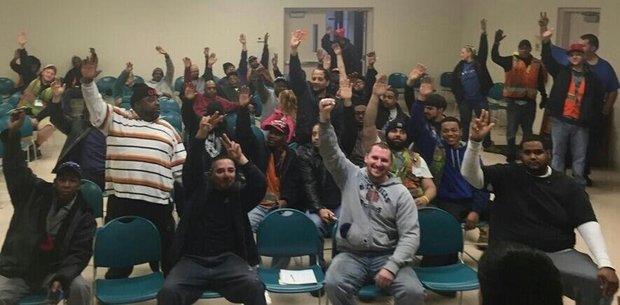
    Cohen was speaking, just before the opening of the Labor Notes Conference, to some 125 union activists and local leaders who gathered for four hours at the Hilton Hotel in Chicago on Friday, April 1 at the Labor for Bernie and Beyond meeting. They met to discuss the next stages and of the Sanders campaign as well as the future prospects for the movement of union activists who support him. The meeting was convened by Cohen and 23 other national or local union offices.

    The Labor for Bernie movement has become a national phenomenon with more than 12,000 supporters, a Facebook page with 27,000 likes and traffic of almost 400,000 hits per week. Five national unions and some 90 plus local unions—often defying their international officers’ endorsements—have endorsed Sanders in the Democratic presidential primary. Labor for Bernie claims that Sanders is now predicted to win 60 percent of the labor vote in upcoming primaries.

    Labor for Bernie claims some credit for Sanders’ overwhelming victory in Washington State where he won every single county. Katie Nelson told the group that though the American Federation of State County and Municipal Employees (AFSCME) national leadership had endorsed Sanders, the Washington AFSCME Council 28 executive board, of which she is a member, voted to endorse Sanders because they had to respect their members’ wishes.

    A dozen other union activists from a variety of unions around the country—from National Nurses United (NNU) and the Inland Boatmen’s Union, to the International Brotherhood of Electrical Workers and the United Auto Workers—described their successes in either winning endorsements for Sanders or in holding off nominations for Hillary Clinton.   

    Pledging for Bernie

    As Sanders heads into two crucial primary elections—Wisconsin on April 5 and New York on April 15—Labor for Bernie will be concentrating on workplace organizing and using new tools to increase Sanders vote in those primaries and in other upcoming primary elections. Union members will be distributing a Bernie for President pledge card to be signed by their coworkers, collected, and used to get out the vote.

    Cohen described what he called an inside-outside strategy for the Democratic Party Convention in July; that is, the Labor for Bernie and other Bernie activists plan to have as many people as possible as delegates on the inside and as many other supporters as possible on the outside of the convention. Inside, said Cohen, the group will fight for Sanders and his policies in all of the possible arenas: the credentials committee, the rules committee, the platform committee, and for the actual nomination.

    And Beyond

    Labor for Bernie, like other Sanders supporters, believes their candidate can still defeat Hillary Clinton for the nomination. But in a system where Clinton has hundreds of unelected super-delegates pledged to vote for her, and several corporate super-PACS putting large amounts into her campaign, Sanders supporters know that their candidate—even if he wins big in several more states—could have victory wrested from him at the convention. So, whatever happens at the convention, several speakers offered suggestions for the future of the progressive labor activists who are backing Bernie.

    Michael Lighty of NNU told the group, “We are not in this for ‘Bernie or Bust.’ This movement will not back off.” His union, he said has already begun to organize for a June 17 People’s Assembly in Chicago, working with National Peoples Action, a housing organization, and with United Students Against Sweatshops.

    Cedric Johnson, a professor of African American studies at the University of Illinois Chicago, suggested that Bernie’s supporters needed to rethink their relationship to the black movement. “The movement may not include all Blacks,” he said, because Blacks are divided into different classes with different interests.” His colleague, Dean E. Robinson, a political science professor at the University of Massachusetts Amherst, told the group, “Civil rights activists in the 1950s and 60s pressed the limits of the movement. Black politicians today tell us the limits should not be pushed—which is just the opposite. We have an opportunity to contest Black politicians.”

    Seattle’s socialist City Councilwoman Kshama Sawant suggested that, “If we really want to fight the right and Trump, we must break from the Democratic Party, we begin now to create a movement for an independent candidate and consider building an independent party.” Sawant’s supporters in #Movement4Bernie are circulating a petition calling upon Sanders to “Run Through November.” It reads, “….we urge you to continue the political revolution by running independently of the Democratic Party rather than endorsing Hillary Clinton.”

    Finally, Peter Olney, a retired ILWU organizer, called for the creation of a “new force for a democratic economy.” He said this force made up of unions, community groups, workers centers, immigrants groups and people advocating for people of color, LGBT rights should be organized around five key principles:

    • Fighting economic inequality.
    • Addressing discrimination based on race, gender, and sexual orientation.
    • Opposition to the permanent war economy and militarized foreign policy.
    • Tackling global climate change.
    • Defense of the right to organize with the labor movement playing a leading role to promote working class interests

    This first conversation about the future among Labor for Bernie activists represented an important first step, but the group adopted no strategy for the future at this time. Rand Wilson, who volunteers as a coordinator for the group, said he would provide a report back to all of the national and local endorsing unions.   

    Many of those attending the Labor for Bernie meeting were then off to the Labor Notes conference where they would working with others to build stronger and more democratic unions, while also advocating for stepped-up involvement in the Sanders campaign.

  • Chicago teachers (again) rewrite a playbook stacked against labor

    Image

    The Chicago Teachers Union (CTU) strike April 1 is not primarily about increased school funding, standardized testing, pensions for teachers, or even just corporate taxation, though the union is fighting for all of these. The strike is about democracy, especially who owns our society’s resources and how decisions about those resources are made.

    CTU has shown us – again – what real democracy looks like. Under an Illinois law designed to undercut teachers’ rights as workers to withhold their labor, 75 percent of the union’s active members must authorize a strike. CTU met and surpassed that bar with 92% of CTU members voting on the issue and 96.5% of those voting endorsing strike action. Its representative body, the House of Delegates, voted by a margin of 4-1 to call the strike April 1.

    Is it democratic that the union demands that all members respect the decision of the vast majority of members to strike? Insisting on solidarity in action after a democratic vote is unusual in our society. In contrast to the cut-throat competition and dog-eat-dog individualism that capitalism cherishes, unions are based on the idea that one’s own well-being is bound up with the fate of others. Collective action depends on trust and a strong sense of shared interest, ideals that underlie democracy.

    The CTU has asked its members to take an action that its opponents describe as illegal. In doing so, the union has made interpretation of its contract a political struggle rather than one that is fought only in the courts. Labor unions have been seriously weakened by acceding to the rules in a political game rigged by wealthy, powerful elites who own most politicians.  In this one-day job action the CTU reminds labor that winning collective bargaining, the 40 hour week, overtime, and social security required direct action. Unions had to engage in activities that were defined as illegal and cast as immoral by those who controlled business, government, and often religious institutions.

    Budget cuts have hurt so many children, especially those most in need of the best services, exposing as crocodile tears the laments of officials who fault Chicago teachers for denying poor, vulnerable children a day of instruction.  Although the media hope parents will be turned against teachers by a walkout that targets school funding, it’s unlikely parents whose communities have been devastated by school closings and whose kids have lost weeks of learning to testing will agree. Here too the CTU has shown what democracy looks like by developing strong collaborations with other unions and social justice groups, from low-wage fast food workers to Black Lives Matter.

    The Chicago Tribune's editorial dismissal of the CTU’s strike as a “tantrum” is a telling indication of the frustration the city’s most powerful business interests and Mayor, Rahm Emanuel experience in dealing with a union that won’t play the usual game of living with cuts and defeats while waiting for friendly politicians to be elected  Although Emanuel and his backers have won victories, primarily school closings, the CTU has with each defeat developed new relationships with parents and community.  Because the union has built strong support at the building level, teachers (mostly women) are not so easily cowed by threats. And few parents from communities of color buy the rationale for tax giveaways that rob the schools of needed revenue, again because the union has worked so diligently in making the political case for fair taxation that pays for school expenditures.

    Chicago’s teachers are not alone in redefining the rules of engagement with governments over school funding and ownership of public education. UK teachers will shortly engage in a national one-day strike, followed by local strikes throughout the summer. From South Africa to Hungary, Kenya to India, teachers, parents and students are resisting dismantling of public education, the process of dispossession.  What makes the CTU strike singular is that it occurs in the U.S. and so implicitly challenges the rest of U.S. labor to break the old rules, working with those most disempowered and most affected by brutal cuts and injustice to fight back as allies.  

    CTU’s one-day walkout is an April Fool's Day present to US capitalism. Surprise! We’re fighting back!


    Lois Weiner is a professor of education at New Jersey City University, where she directs the Urban Education and Teacher Unionism Policy Project. You can follow her on Twitter and Facebook and read her blog at New Politics.

    A version of this article appears at Jacobin.

  • Why Chicago teachers should support the April 1 walkout

    A new Jacobin piece by Micah Uetricht and Sarah Chambers is a must-read to understand  what's at stake in the April 1 walkout of Chicago teachers. (My own thoughts about the political implications of the strike are in a piece in press.) But for now I want to explain to teachers who may be considering crossing the union's picket lines tomorrow why that would be a very big mistake for them personally. Frankly, I've been surprised by feedback from a self-identified progressive active in opt-out struggles that the CTU's "hard line" about expelling srike breakers is "garbage."   The Chicago media have been encouraging "revolt" by teachers by promoting letters from individual teachers about why they find the strike unnecessary or even immoral.       

    Here's advice from a teacher educator who has also been on strike as a teacher. The way your colleagues will see your teaching when they are respecting the majority vote to strike is that you are collecting your wages (and avoiding fines or legal penalties) while they are forfeiting wages and risking penalties for the common good. Most of your colleagues, on whom you must rely for help and companionship, will regard your crossing the picket line a betrayal of  trust, a refusal to join in a needed struggle to defend educational ideals that the school (system) does not support. 

    Regardless of your reasoning,  your colleagues will NEVER forget. Even if you change schools, your reputation as a strikebreaker will follow you. Forever.  Even if you become an administrator, the people you supervise (and perhaps your peers) will recall this act. Don't cross the line.

  • The Dark Night and the Coming Dawn in Mexico

    Image

    This is the second of three book reviews that will look at what Mexican intellectuals on the left have written in an attempt to understand Ayotzinapa and what it symbolizes and signifies for their country and its future. The first review appeared here. – DL

    Manuel Aguilar Mora and Claudio Albertani, eds., La noche de Iguala y el despertar de México. Mexico: Juan Pablos Editor, 2015. Pp. 382. Photographs. Illustrations. Maps. Tables. (Available only in Spanish at this time.)

    The Night of Iguala and the Awakening of Mexico (as we translate the title of this book), like Sergio Aguayo’s From Tlatelolco to Ayotzinapa, deals with the horrifying killing of six people and forced disappearance of 43 students of the Ayotzinapa Rural Teachers College in the town of Iguala, Guerrero on September 26, 2014.

    How and why did this massacre occur? What interests does it serve? Who does it benefit? And what will be its impact on the Mexican people and movements for political change? Those questions are the subject of this tremendously informative, interesting, and important book edited by two Mexican leftists and with contributions by more than a dozen others who attempt to understand both the historical context for these terrible events and how those events have changed Mexican society and politics.

    The book is also an interesting experiment in political collaboration between the editors, both university professors: Manuel Aguilar Mora, a long-time Trotskyist intellectual and political activist in Mexico, and Claudio Albertani, an anarchist teacher, writer, and activist.[1] The authors introduce the book from their shared revolutionary opposition to Mexico’s violent authoritarian political and economic system. In their introduction they argue, as others will in several essays in this collection, that while Mexico has a long history of extreme violence, the current explosion of tens of thousands of murders, can be correlated to the investments of the great multinational corporations, particularly those involved in the extractive industries, above all mining, and is not simply due to the drug cartels. (This is an argument similar to that of Dawn Paley’s Drug War Capitalism.)

    Aguilar Mora and Albertani adopt Raúl Zibechi’s argument that “the massacre is a form of domination” and a way to expropriate social wealth while crushing all resistance. The also argue that the night of Iguala represents a turning point in Mexican history, having lead to the “radicalization of broad sectors of society” and destroyed any further illusions in the Party of the Democratic Revolution (PRD), the party that governed both the State of Guerrero and the city of Iguala at the time of the massacre. They recognize that the protests movements that arose afterwards, having failed to unify, remained dispersed, and that the Mexican left will be challenged to unify both rural and urban protests into a radical movement for social change.

    The book poses several important political questions about the movement as it has existed so far and about its future. But let’s take those up after describing the components of this very valuable book.

    The Night of Iguala is divided into three sections: the first deals with the crime, the second with the context, and the third with the movement. In the first section we find:

    ·      Carlos Fazio’s essay “About the Facts of Ayotzinapa/Iguala” provides a thorough and detailed account of the events of the night of the murders and forced disappearances, making the case that this was a state crime.

    ·      Professor Román Munguía Huato’s contribution, “The Disappeared: Violence, Impunity, and State Terror,” discusses the significance of disappearance as a form of repression and traces the history of disappearances in Mexico from the first—the teacher Epifanio Avilés Rojas who was disappeared in 1969—to the tens of thousand that have taken place in recent years.

    ·      Journalist Luis Hernández Navarro, contributes two stories he wrote, one that suggests the involvement of the Mexican Army in the Iguala events and another from the point of view of the parents whose children were disappeared as they deal with the government officials and their explanations.

    In the second section dealing with the context we have:

    ·      Investigative journalist Flor Goche provides an account of the history of Raúl Isidro Burgos Rural Normal School of Aytozinpa (the teachers college where the disappeared students had all studied) from its founding in the post-revolutionary era in 1926 to today, discussing various government’s attempts to starve the school to death.

    ·      Ramón Espinosa Contreras, a graduate of Ayotzinapa and with a doctorate in Social and Political Sciences at the Ibero-American University in Guerrero, and now a researcher at the Autonomous University of Guerrero, writes a fascinating essay, “My Life in Ayotzinapa,” that discusses the history of the school, his early life as a child of a poor family, his entrance into Ayotzinapa in 1960, and his association with future guerrilla leader Lucio Cabañas, and involvement with social movements.

    ·      Ramón Espinosa Contreras also writes an essay, “Guerrero Between Violence and Poverty,” that provides a statistical account of the state’s poverty and deals with issues from forced sterilization to other occasions of mass murder such as Aguas Blancas in 1995 when 17 peasants were massacred.

    ·      Falviano Bianchini’s essay on “Mining and Violence” explores the role of the drug cartels in mining districts in several states.

    Part three dealing with the movement contains:

    ·      Manuel Aguilar Mora’s essay “The Collapse of a Certain ‘Left’” dealing with the devastating impact of the Night of Iguala on the Party of the Democratic Revolution, placing the Mexican political situation in the broader context of the current state of the left in Latin America. (We return to say more about this essay below.)

    ·      Claudio Albertanti’s piece “In Defense of the Anarchists” presents a panorama of anarchism from its origins in the nineteenth century to the Battle of Seattle, the black bloc, and contemporary protests.

    ·      Journalist Luis Hernández Navarro writes in this section an essay on “Anarchism, Provocation, and Protest,” dealing with the anarchist protestors in Mexico, as well as police infiltration and provocation.

    ·      Enrique González Rojo Arthur, teacher, writer, and activist, contributes essays entitled “Capsules to Get Out of the Labyrinth,” a series of short essays with a political program calling for combining election boycott, with a general strike, and the calling of a constituent assembly.

    ·      Finally, Rafael Miranda Redondo, a doctor of philosophy at the Cumplutense University in Madrid, in her “Ayotzinapa and the Society We Want,” provides a long essay of situationist inspiration, with elements of Cornelius Castoriadis and Antoinio Negri among many others, that looks back to 1968 as a way out for the left today.

    The essays are followed by three very useful chronologies put together by Albertani, one on the return of the dirty war to Mexico; one dealing with the history of the normal schools, and one dealing with the events of September 26, 2014 to March 26, 2015. In addition to the many essays, there are also the photos of Mario Marlo, photojournalist and director of Somos el Medio, drawings by Omar Reséndiz (Chirín) and muralist Norberto Hernández, and poems by David Huerta and Rojo Arthur. (A drawing by Norberto Hernández, "I think, then they disappear me," accompanies this review.)

    The book ends with an Afterward by the editors in which they suggest that the election boycott of June 2015 represented a key turning point. They ask, paraphrasing, is this the awakening we were waiting for? They answer, “Yes and no.” As a result of the many protests and the boycott, they argue, “In the Federal District, Guerrero, Oaxaca, and in some other parts of the country there now exists a mass base with a clear consciousness of what is meant by a truly revolutionary struggle.” Yet at the same time they recognize that the radicalization of some sectors of society principally in the south of Mexico is not sufficient to create a new revolutionary movement.

    While this is without a doubt an extremely useful, interesting, and engaging book, still it has some weaknesses. The book’s introduction argues that capital investment, especially mining, is at the center of the upsurge in violence we have witnessed in Mexico, and yet the short chapter on “Mining and Violence” does not provide much information about mining in Mexico and is not convincing. Bianchini argues that Canadian and U.S. mining companies end up working with national drug cartels at the local level and in rural areas where it is possible to pressure governments and communities to accept their deals. Yet, while several mining states are mentioned, it is really only in Guerrero and Michoacán that we have seen the most extreme violence. The drug cartels seem more important than the mining interests. 

    Aguilar Mora and Albertani point out that many disappointed PRD intellectuals and activists have turned to the new political party, the Movement for National Regeneration (MORENA). The authors warn us, quite correctly it seems to me, that, based as it is largely on the charisma of López Obrador, MORENA is likely to repeat the unfortunate experience of the PRD, rounding up working class and middle class people who want a more democratic and egalitarian society and corraling them in a party with a reformist rhetoric and even some reformist intentions, but that is fundamentally committed to capitalism and in reality the existing political order.

    The authors’ case for a new awakening in Mexico rests largely on the boycott. Aguilar Mora and Albertani argue that the election boycott was a turning point for the movement, but that was true only in Guerrero and Oaxaca, or perhaps one might include Michoacan and Chiapas at most. But in Guerrero and Oaxaca, when the Ayotzinapa protestors and the teachers union movement failed to convince their fellow citizens to boycott the election, they decided to peremptorily impose the boycott on other citizens, closing polling places, burning ballot boxes, sometimes alienating local communities. The oganizers never succeeded in taking the boycott movement to a national level and it remained isoalted in just a few states. In retrospect it seems that the boycott may have served not to create a vanguard that could lead a movement, but to isolate the vanguard and separate it from any potential national movement.

    Certainly we can agree with the closing lines of the book, that we still await the rise of a new Mexican workers movement to throw itself into the balance and begin to halt the many injustices—economic, legal, and political—and create a new Mexico.

    Editors Aguilar Mora and Claudio Albertani have produced a book that should be in every university library, in every major public library, and in the hands of those who are concerned about human rights in Mexico.


    [1] I should mention that I am friendly with one of the editors, Manuel Aguilar Mora, and with one of the contributors, Román Munguía Huato, though we also have our political differences.


  • Questions to Oklahoma Green Party about Its Endorsement of Bernie Sanders

    Image

    Interview by Jim Brash of North Star Editorial Board, February 26, 2016

    Questions posed to Rachel Jackson, State Facilitator, Green Party Oklahoma Cooperative Council about their endorsement of Bernie Sanders

    1.     Is the endorsement of Bernie a tactical move?

    Our endorsement of Bernie Sanders in the Oklahoma Democratic Primary accomplishes two goals: 1.) to find a way to participate electorally given our state’s repressive ballot access laws, and 2.) to build a base to strengthen our efforts to reform those ballot access laws.

    2.     Why endorse him now?

    The Oklahoma Democratic Party recently decided to allow Independent voters to participate in their primaries. Because we cannot register to vote as Green Party members, many are registered as Independents. We want to encourage them to use their electoral power in the Democratic primary to support the candidate that aligns most with Green Party values. We believe Bernie Sanders represents the best chance for Oklahoma Greens to do that, given the current lack of ballot access.

    3.     How will this endorsement help the Green Party of Oklahoma?

    We hope it will bring attention to our ballot access situation among progressive and leftist voters in Oklahoma. Because of it’s relative obscurity compared to other social justice issues, ballot access is a difficult issue around which to mobilize. We are hoping that we can sustain the support we gain from Sanders supporters in our state and fold it into our ballot access reform efforts.

    4.     Will you be endorsing Bernie in November?

    At this moment, the Green Party of Oklahoma does not intend to endorse Sanders should he win the Democratic nomination.

    5.     What has been the feedback from the Green Party national office?

    We have not received a response from the GPUS national office, though many Greens around the country have responded via social media. Those responses have been divided. Many of them express support for our endorsement given our lack of options for electoral participation in Oklahoma. There have also been a few strongly negative responses from Greens who believe (for various reasons) that our endorsement is problematic. You can likely identify their comments on our Facebook page. The Green Party values local control, and we believe we made the best decision for Oklahoma.

    6.     What has been the feedback from greens in general, about the endorsement?

    From members of the Green Party of Oklahoma, the response has been divided as well, but the majority of the response has been positive. Those who have responded negatively believe we should not endorse any candidate of the two major parties, or believe that his stance on issues such as Israel and the Middle East disqualify him from a Green endorsement. Those who have responded positively see the potential in local coalition building with the progressive Oklahomans the Sanders campaign has attracted.

    7.     Have the Green Party of Oklahoma made endorsements of Democrats, independents, and other non-greens previously?

    We have endorsed Independent candidates in state legislative and city council elections.

    8.     What were the results of those endorsements?

    We currently have a Oklahoma City Councilman, Ed Shadid, who we endorsed and who has successfully represented Green values while in office.

    9.     Why is it so hard to gain ballot status in Oklahoma?

    Oklahoma Greens hold varied opinions on this. I explain it this way. The current ballot access laws create a double bind for the Green Party of Oklahoma, and any other third party seeking access to the ballot here. In Oklahoma, people effectively join political parties by registering to vote. Currently, people cannot register as Greens in Oklahoma because registration is tied to ballot access. This creates a disconnect that makes it difficult to amass the number of Green Party members we need to help us meet the ballot access requirements. In this election cycle, for instance, we would have needed to collect approximately 24,745 signatures, or 3% of the total votes cast in the last gubernatorial election. The numbers of petitioners we would need to collect these signatures exceeds our current membership numbers by quite a bit. There’s the double bind. In order to increase our party membership to attract both volunteer petitioners and funding for paid petitioning, we need ballot access so people can register as Greens so we can increase our party membership.

    I might also add that beyond volunteers, most successful petitioning campaigns pay signature collectors. For instance, the Libertarian Party of Oklahoma was successful in collecting enough signatures (approximately 42,000) to get their presidential candidate on the ballot this November. However, and without citing specific numbers, their national party spent twice the amount of the total national Green Party budget paying petitioners to collect these signatures in Oklahoma. We simply do not have the local or the national financial resources to field such an effort. We have to rely on volunteers. Thus, building our base for future ballot access efforts is our best strategy.

    10.  Do you think the Green Party should endorse Bernie during the entire primary season on a national basis?

    No. The GPOK does not hold this position either. We would much prefer to have the GPUS presidential candidate on our state ballot, and we urge Greens elsewhere who can vote for the Green presidential candidate to do so.

    11.  How does the Bernie Sanders campaign help independent political activism in Oklahoma?

    I think the Bernie Sanders campaign has mobilized independent political activists, making them more visible as a voting block as well. Stereotypical constructions of Oklahoma as a “red state” erase the political progressivism and leftist activism the Sanders campaign has managed to harness. My hope is that regardless of whether or not Sanders wins, independent Oklahomans continue to build and grow the coalitions his campaign has enabled.

    12.  Does a Bernie Sanders nomination, help or hurt the Green Party?

    With ballot access in a limited number of states, it’s hard to imagine a Green Party presidential candidate winning a national election regardless of who wins the Democratic Party nomination. However, I do think the Sanders campaign has brought attention to Green Party values and their increasing appeal to American voters. Politically, I think this is a gain for the Green Party, regardless of who articulates those values and what party he or she represents.

    13.      How do you think his potential presidency would affect the Green Party, going forward?

    I am not sure if it would, particularly as long as Sanders is affiliated with the Democratic Party. I think the bigger barrier for Green reform is the current Congress, even with Sanders as President.

    14.      Are there any other gains, from your perspective, for the Green Party of Oklahoma making this endorsement?

    Other than electoral participation, greater local visibility for our party, and coalition-building for ballot access, none come to mind.

    15.     What would you like to say to greens around the country that don’t agree with this endorsement?

    A couple of things:

    a.) Honor local decision-making and trust those of us on the ground.

    b.) Urge the GPUS to invest more in achieving and retaining ballot access nationwide.

    16.     Where does the Green Party of Oklahoma, sees itself heading & accomplishing post 2016 ?

    We will continue to work with other third parties in Oklahoma to reform the state’s ballot access laws. There are currently several bills under consideration in our legislature (particularly HB 1813 and SB 2181) that reduce the signature requirements for ballot access and forming a new political party. We plan to organize a strong citizens’ lobbying effort around this legislation. We would also like to field candidates in city council elections and possibly the 2018 gubernatorial election as well.

    Originally posted at http://www.thenorthstar.info/?p=12463.


  • State Terror from Tlatelolco to Ayotzinapa – First of Three Book Reviews

    Image

    This is the first of three book reviews that will look at what Mexican intellectuals on the left have written in an attempt to understand Ayotzinapa and what it symbolizes and signifies for their country and its future. – DL

    Sergio Aguayo. De Tlatelolco a Ayotzinapa: Las violencias del Estado. Editorial Ink, 2015. (This book in Spanish is available in several formats including Kindle, which is how the reviewer read it.)

    The horrifying killing of six people and forced disappearance of 43 students of the Ayotzinapa Rural Teachers College in the town of Iguala, Guerrero on September 26, 2014 had a dramatic impact on Mexico.

    The disappearance and very probably the murder of so many young men, apparently with the collusion of a criminal gang and the police—and some believe the army—suddenly put faces on the terrible violence that had been taking place in Mexico since 2006. To date the Ayotzinapa killings have yet to be solved. The killers have not yet been identified and indicted. This is Mexico.

    The violence in Mexico is really incomprehensible. Neither our reason nor our imaginations can hold before us in our minds the more than 164,000 killed, the 27,600 who have been disappeared, the countless numbers who have been injured, not to mention the hundreds of thousands who have been displaced. Then too there is the femicide, the targeting and murder of women that has become a pandemic in Mexico. All of this is accompanied by the impunity of the murderers and kidnappers, the government’s failed investigations, and the politicians’ evasion and deceit.

    The violence continues to take place in a society where half the people live in poverty, where a fabulously wealthy oligarchy controls the government, and where American, European, and Asian corporations continue to make billions dollars in foreign direct investment, attracted by the low wages and state control over the labor force. All of the political parties are corrupt. The politicians are venal. The outlook is dim.

    Sergio Aguayo – Tlatelolco and Ayotzinapa

    Sergio Aguayo, a professor at El Colegio de México and Harvard Univesity has written a number of books dealing with the issues of human rights, nationalism, politics, and the intelligence services in Mexico. He was in the 1990s a leading figure in the civil society movement working with other groups to win free and fair elections and he continues to speak out on human rights, as he has in this book. If he were an American, Aguayo would be described as a liberal—though that category that doesn’t really exist in Mexico—a man who would reform institutions.

    He writes in the introduction that the Mexican state has to be held primarily responsible for the continuing violence in his country, that the Ayotzinapa kidnappings demonstrate organized crime has created a parallel state, and that the Mexican people will have to organize themselves to take back their government and insure legality.

    While Ayotzinapa appears in the title and is discussed in the last chapter, this seems  to be a book principally about the Tlatelolco massacre of 1968 that Aguayo had been working on for some time and apparently decided to publish last year because of the Ayotzinapa events. So some readers may be disappointed, and justifiably, for though they will find a meticulously researched and annotated account of the Tlatelolco, they will be unsatisfied by a very thin and weak account of the period from 1968 to today, and virtually nothing of interest on the Ayotzinapa disappearances.

    The Democracy Movement of 1968

    Aguayo’s account of Tlatelolco provides an impressive description of the breadth of the pro-democracy movement of 1968 that had sprung up not only among students, but also among working class and middle class people, and not just in Mexico City but throughout the country. Many students were influenced by Pablo González whose book Democracy in Mexico (1965) who criticized the Mexican state but argued against violence.[1] Though most activists were committed to militant but peaceful protest, a small fringe contemplated violence. Carlos Fuentes’ Paris: The May Revolution (1968), about the massive May-June strikes in France, suggested that an initially peaceful movement might take to the barricades described and pictured in his book.

    The Cuban Revolution of 1959 influenced some Mexican youth, though they failed to appreciate the actual relationship between the Cuban and Mexican governments. As Aguayo writes:

    We knew that the United States supported the Institutional Revolutionary Party regime unconditionally; the terrible mistake was the inability—authentic in some, simulated by others—to recognize that the government of the Soviet Union and Cuba formed part of the foreign legion, of the Praetorian Guard, dedicated to protecting the government of Gustavo Díaz Ordaz. Our heroes were the partners of our oppressors. [My translation – DL.]

    The government, working closely with the news media that it controlled, had to “fabricate an enemy,” as Aguayo puts it. So the claims were made that the students and others involved were privileged ingrates, that they were ingenuous idealists, that they were dupes of the Communists—Russian, Cuban, or Chinese—or that they were tools of the United States. They were called anti-Patriotic, traitors. In his memoir the president called them “bloodsucking parasites.”

    The Government Against the People

    The Mexican government carried out what Aguayo calls a “general offensive” aimed at separating the students and other movement activists from other sectors of society, but particularly from the working class. Aguayo writes,

    They vaccinated union workers with “hundreds of meetings” in which they presented “the government version of the facts” and in the factories they created “permanent groups to prevent student incursions.” (My trans. DL)

    The author argues that various branches of the Mexican state—President Gustavo Díaz Ordaz; Luis Echeverría, the Minister of the Interior; Fernando Gutiérrez Barrios, head of the secret police; and the generals Luis Gutiérrez Oropez and Mareclino García Barragán—each had different understandings, misunderstandings, and conflicting objectives in attacking the movement, none of which excuse them, since they all intended to violently suppress it. The president wanted the movement crushed before the Olympic Games being held in Mexico City within a week. Minister of the Interior and future president Echeverría had promised the U.S. Embassy that they would end the student agitation before the games.

    President Díaz Ordaz told Javier Barros Sierra, rector of the University that he would end the conflict between the democratic movement and the government peacefully. But that was just a political maneuver, as cover for the unleashing of the military on October 2, 1968. The last demonstration by the democratic student and civic movement numbered about 8,000 people who believed that the government was finally going to sit down and negotiate with them—but the government sent between 5,000 and 10,000 soldiers to crush them. Hundreds were killed in the confusing assault—most today believe around 300. The leaders of the movement were taken to Military Camp #1, the cadavers removed, the wounded taken away. The sidewalks scrubbed to wasy away the blood.

    Aguayo holds Díaz Ordaz to be absolutely responsible for the Tlatelolco Massacre, which, Aguayo argues was similar to another that the president had ordered in San Luis Potosí in 1961 when he was the Minister of the Interior in the administration of Adolfo López Mateos.[2]

    While the magazine Por Que? brought out a special addition with photos of wounded and dead students, most of the press and the other media gave out the government’s story that sharpshooters had fired at the Mexican Army. In fact, there were sharpshooters, but they were also part of the Mexican Army. The government asserted that only seven people had been killed, a preposterous claim given the photos that had been published abroad. The United States and England, the Soviet Union and Cuba all cooperated with Mexico, working to suppress any actual account of the events. Yet the government and its media failed to put forward a very convincing story, because, as Aguayo writes, it didn’t understand that in history the account is as important as the bullets.

    Where there was a free press the foreign media told the truth: The New York Times wrote that “federal troops fired rifles and machine guns at a peaceful student demonstration.” Le Monde likewise reported that “the army and police opened fire without warnng,” saying as well, “it was a massacre: there exists no other word to describe what has happened in the Plaza de las Tres Culturas.” The Italian journalist Oriana Fallaci, was wounded by a bullet and robbed of her money and watch by a cop, wrote vivid, veridical accounts of the massacre, making her a hated enemy of the Mexican government.

    Still governmental officials and most of the country’s major intellectuals defended the government’s version of events, the cowardly attack on the soldiers by the dupes of foreign powers. Even the beloved and esteemed former president Lázaro Cárdenas rallied to the ruling party he had helped to create and affirmed the government’s official story, helping to win over the national and international left.

    Anywhere in the country that the democratic movement raised its head, a demonstration or a march, the police and the army moved in. Hundreds were arrested. Everywhere in the world, the Mexican government attempted to quash its critics. Virtually no Mexican official spoke out. The exception was the writer and poet Octavio Paz, at the time Mexican Ambassador to India. Paz resigned his position in India, calling Tlatelolco “an act of State terrorism pure and simple.”

    Beginning in 1969 a number of intellectuals began to tell the story of what actually happened: Julio Scherer García, director of Excelsior; Ramón Ramírez in El movimiento estudiantil de Mexico, Octavio Paz in Posdata; writesr Carlos Monsiváis, Carlos Fuentes, y Elena Poniatowska, Jacinto Rodríguez Mungía, Kate Doyle and Susana Zavala.

    Tlatelolco to Ayotzinapa

    Aguayo devotes the last chapter of his book to the path from Tlatelolco to Ayotzinapa.  He creates a periodization of repression in Mexico. The first period lasts from November 1969 to August 1985. During this period President Luis Echeverría Álvarez both create a political democratic opening while also continuing to engage in the violent repression of government opponents. Aguayo mentions but does not explain or detail the “dirty war” of the 1970s during which the government disappeared some 500 left activists, many of them from armed leftist guerrilla groups.

    Aguayo’s second period goes form 1981 – 2000 (the second set of dates don’t line up with the first), during which he argues that the Mexican Army refused to continue to be used for repression of the civilian population without express conditions. The Miguel de la Madrid Hurtado government closed down the Federal Security Administration (LaDFS), an organization that operated with impunity while its agents enriched themselves, says Aguayo. This came as the result of the agency having kidnapped and murdered a U.S. Drug Enforcement Agency agent in February of 1985. LaDFS was shut down, but its corrupt agents were not prosecuted and many went off taking their talents to the country’s criminal organizations.

    The financial crises of the 1980s and 1990s debilitated the state, and at the same time the presidentialist system began to weaken partly as a result of political reform. The North American Free Trade Agreement of 1994 led to the Chiapas Rebellion led by the Zapatista Army of National Liberation (EZLN), another indication that the state as the only legitimate source of violence was weakening. Aguayo suggests that the drug deals followed the EZLN’s example or at least acted similarly, establishing regional redoubts beyond government control. This led in the end to what he sees as the development of two states: one headed by President Enrique Peña Nieto and the Institutional Revolutionary Party (PRI) and the other headed by organized crime.

    Aguayo says that both President Vicente Fox and Felipe Calderón missed opportunities to right the ship of state. Fox promised a “Truth Commission” to look into past abuses, but then gave up the idea. Calderón, writes Aguayo, “…had the courage and the wisdom to throw himself against organized crime. But he lacked will, information, temperament, and compassion with the victims.” And, “he was indifferent to the cost in human lives.”

    Peña Nieto, says Aguayo, began by professionalizing the security forces, improving coordination between them, and putting emphasis on prevention. But then came the typical weaknesses of the government. “His government has not recognized the magnitude of the challenge lacks a coherent national and regional policy that attacks the root of the problem, and shows great indifference to the cost in human lives.” Aguayo then spends a few pages on Ayotzinapa, offering nothing of significance.

    Aguayo’s account of the period from 1968 to 2015, really more an outline than a narrative or analysis, is extremely disappointing, and not only because it is so thin. It is also clear that Aguayo, despite write that the Mexican people will have to create a just society, really looks to the state to reform itself. This is clear from his comments about Fox, Calderón, and Peña Nieto, in each of whom he at first saw some hope of change. Aguayo’s liberal outlook looking for change through the system, rather than changing the system is the fundamental weakness of this book.


    [1] I have to admit that took the title of Pablo González’s book for my own, Democracy in Mexico (1995). Under international law titles cannot be copyrighted. I only wish my book had had the success of González’s.

    [2] Aguayo had made this argument earlier in his book La Charola: Una historia de los servicios de inteligencia en México (Mexico: Grijalbo, 2001), pp. 135-36.


  • Should Cuba Remain a One-Party State?

    Image

    The one-party state is a very controversial question that few of the left-wing critics of the Cuban regime have been willing to address. What follows is an attempt to explore, from the left, some of the issues around this topic.

    In the first place, the abolition of the Cuban one-party state is one thing, separate and apart from the political system that would replace it, whether without or with many political parties. In reality the Cuban Communist Party (PCC, its Spanish acronym) is not a party – which would imply the existence of other parties – but the organ that monopolizes the political, social and economic life of Cuban society. This monopoly – explicitly sanctioned by the Cuban Constitution – is based, among other authoritarian mechanisms, on the control of Cuban society through the so-called mass organizations that function as transmission belts for the decisions taken by the PCC. For example, the CTC, the official trade union central, is the transmission belt that allows the Cuban state to maintain its monopoly of the organization of Cuban workers. Many left critics of the Cuban regime will agree that workers (and all other Cubans) should have the right to organize themselves independently of the PCC to struggle for their own interests. Taking this notion to its logical conclusion would imply the abolition of the one-party state system, including its control of the mass organizations that function as the transmission belts for the Cuban Communist Party.

    Cuba’s dominant system is going through a transformation – likely to accelerate after the historic leaders of the revolution pass away – towards the Sino-Vietnamese model of state capitalism under the direction of the PCC, which means that the need to abolish the one party state system with its transmission belts will remain in effect.

    The function of political parties

    The modern political parties came into being in the nineteenth century as suffrage expanded. As sections of the ruling class felt increasingly threatened, they organized themselves politically to defend their class interests, typically in conservative, liberal and, sometimes, Christian parties. There have been times when a ruling party represented one whole social class, as was the case of the Tory party in the U.K. in various historical periods. More frequently, however, different parties have represented different sectors of the ruling class. Liberals and conservatives not only represented material conflicts within the ruling classes, as for example the interests of the great landlords against those of the new industrial capitalists, but also ideological conflicts of pre-capitalist origin concerning the power and role of the Catholic Church in society.

    Aside from representing different sectors of the ruling classes, these parties also incorporated intermediate sectors of society, such as independent professionals and small businesspeople, and tried to coopt popular expectations and struggles in a manner that would not threaten the fundamental interests of the powerful. In many occasions, the so called middle classes and strata also organized their own political parties especially in parliamentary systems with proportional representation (which historically propitiated the creation of numerous parties.) In Cuban political history, we have the case of the Ortodoxo Party founded by Eduardo Chibás, a party principally based on the middle classes but with a growing multi class support. But the fact that this party implicitly or explicitly accepted Cuban capitalism does not mean that it was an expression or had an organic relationship with the ruling classes.

    That means that, historically speaking, the relationship between class and party has not been unequivocal: the ruling class has usually not been a monolith and has generally not been represented by a single party. This has also been certainly the case with the working class, the representation of which has been assumed by such diverse parties as social democrats, communists and social Christians. In the case of the classical social democracy that represented the working class through its close links with the unions, its growing conservative tendencies were not merely ideological but also represented the growth of a union bureaucracy, which based on the power that the unions had acquired, had the possibility of extracting sometimes significant concessions from the ruling classes. These concessions helped to demobilize the workers and solidified a bureaucracy more concerned with protecting its huge investments in the union infrastructure than in risking everything in pursuit of a revolutionary break (like in the Europe of the first postwar period) or in resisting imperialist war making (1914). This was the history of the very powerful and supposedly revolutionary Marxist German Social Democracy, whose bureaucratic-oligarchic model was portrayed by the Italian-German sociologist Roberto Michels in his classic Political Parties.

    With respect to the Russian Bolshevik party: although Stalinists as well as Cold War apologists in the Western world held on to the myth that there was no difference between the Bolshevik and Stalinist parties, numerous historians (Stephen Cohen, Alexander Rabinowitch and William Rosenberg among others) have demonstrated that before undergoing the process of bureaucratic degeneration that began with the Civil War that took place from 1918 to 1920, this revolutionary party was in reality quite pluralist and democratic. Among many examples, I can cite the fact that although Bolshevik leaders such as Kamenev and Zinoviev opposed the October Revolution, they continued to be important party leaders after the revolution, and that although Bukharin publicly adopted and agitated for a political line radically opposed to Lenin’s regarding the peace of Brest-Litovsk in 1918, he remained as party leader for many years afterwards. Far from the “monolithic unity” defended by the Castro brothers, the Bolsheviks were characterized not only for the plurality of political positions, but also for a chronic tendency to factionalism that generally did not become an obstacle to “unity in action.” It is for all these reasons that almost 80 years ago Leon Trotsky in The Revolution Betrayed harshly criticized the Stalinist theory about political parties and social classes that tried to justify the one-party state:

    In reality classes are heterogeneous; they are torn by inner antagonisms, and arrive at the solution of common problems no otherwise than through an inner struggle of tendencies, groups, and parties. It is possible, with certain qualifications, to concede that “a party is part of a class.” But since a class has many “parts” – some look forward and some back – one and the same class may create several parties. For the same reason one party may rest upon parts of different classes. An example of only party corresponding to one class is not to be found on the whole course of political history – provided, of course, you do not take the police appearance for the reality.

    With respect to the multi-party systems of capitalist societies: there is no doubt that political democracy has seriously deteriorated throughout the world. Political parties are increasingly devoid of content and subject to the demands of the shallowest kinds of political marketing, a process that has been aggravated by the huge costs of political media campaigns, particularly in the U.S., which in turn has closed the access to the big media for nascent movements and candidates who oppose the existing system. Also, parliamentary bodies have been declining, and many of their powers have been taken over by the executive branches, which unscrupulously use the doctrine of state secrets to protect their newly assumed prerogatives. As a result, political apathy, ignorance, and abstention have become prominent features of capitalist democracy. While this is fatal to any notion of democracy built on the participation and control of an active and informed citizenry, is has certainly been convenient and highly functional to a capitalist system that structurally privileges private and corporate economic power at the expense of public regulation and democratic control from below.

    After the One-Party State

    But let’s suppose that Cuba’s one-party state will be abolished. Whether we want it or not, new parties will develop once repression and the legal and constitutional obstacles against independent party organizations have ceased to exist. Shall we demand then that those new parties are suppressed, or instead of that, shall we engage wholeheartedly in the propaganda and political and ideological agitation against the inevitable neoliberal and reactionary wave that generally has succeeded bureaucratic Communism throughout the world? Those are the circumstances, when we could struggle, for example, for a new Constitutional Convention to publicly debate the critical question of the kind of society that should replace bureaucratic Communism, debates that should include, of course, our arguments in favor of the construction of a socialism based on democracy and liberty. This debate would also be a strategy to prevent the immediate recourse to electoral campaigns and their marketing focused not on political programs but on individuals, many of who are going to be financed, among others, by the rich Cuban-Americans in Miami. To confront this plutocratic possibility, we could, for example, campaign for the exclusively public financing of all electoral activity, including free access to the mass media and distribution of public funds according to the popular backing for each political group.


    But let us assume the optimal case – unfortunately very unlikely under the current circumstances – of a broad mass movement replacing the bureaucratic one-party system with a revolutionary and democratic socialism based on the fullest liberties and on worker, peasant and popular self-management. In that case, what would be the meaning of the unity that many Cubans have wished for? To the extent that there are common interests – material as well as ideological and political – we should aim for a unity based on joint political activities and negotiations to form alliances based on shared political interests and principles. But this need not be the “monolithic unity” propagated by Raul Castro and other revolutionary leaders, which has meant censorship and the suppression of different point of view even within the ranks of the revolutionary government. As Rosa Luxemburg put it, freedom is for those who think differently. It is mistaken and dangerous to assume that there will not be important conflict of interests as well as of points of view among the popular classes under a revolutionary and democratic socialism.

    There is no reason to think that class conflict exhausts all possible social conflicts, including those based on strictly material questions. For example, one fundamental questions for any society, be it socialist or capitalist, is the rate of accumulation, or in other words, what part of economic production is to be immediately consumed and what part is to be saved to insure the reproduction of society and the improvement of the standard of living. In capitalism this is decided through the decisions of the ruling class within the framework of the market economy that favors and consolidates its power. Under socialism, this decision would affect every social group because it would determine the resources to be available resources for each work and community center. It is to be expected that differences over this question will develop between, for example, those who want to enjoy a better standard of living today and those who are more concerned with the standard of living of future generations. In that case, how would those differences and conflicts be organized into coherent and systematic alternatives so they are decided democratically? That would be the critical function of parties under socialism, educating and agitating in favor of alternative visions of the road that society can or should take.

    It is well known that political parties, like many other types of organizations, have shown pronounced bureaucratic and oligarchic tendencies. But there are measures that can be adopted to compensate and fight those tendencies, such as combating the apathy and abstention among the rank and file through democratic debate and the continual practice of real power. An active, informed and involved membership in the affairs of their parties and society is the best guarantee against bureaucratization. There are also organizational measures that can reinforce that participation and control from below, such as mechanisms that assure its local and national democratic control of union and party functionaries, and the maximum transparency with respect to party policies and its internal functioning, aside from its right to remove any leader through party and union referenda. (There are people who have advocated a ban on reelection for union and party leaders. Although this proposal is worth discussing, I believe that it would be counterproductive and possibly undemocratic and in any case would not prevent manipulation on the part of the leaders that have been officially removed.)

    I hope that this discussion on the one-party state continues. The topic is too important to ignore it; it is one of the kernels of the thoroughly undemocratic system ruling in Cuba.
    —–

    *Samuel Farber was born and raised in Cuba and immigrated to the United States before the 1959 Cuban Revolution. He has written many books and articles about Cuba including Cuba Since the Revolution of 1959: A Critical Assessment, published by Haymarket Books in 2011.

    An earlier version of this article appeared in Spanish in ObservatorioCriticoCuba.org on May 27, 2015.

    Reposted from http://www.havanatimes.org/?p=111764

    Copyright © 2008 Havana Times. All rights reserved.


  • Getting From Here to There: A Response to Barry Finger

    Image

    I must admit that I’m somewhat reluctant to write a response to my friend Barry Finger’s response to my article in the Winter 2016 issue of New Politics on Bernie Sanders while the Democratic presidential candidate race between Hillary Clinton and Sanders is still going on. Nevertheless, I will do so.

    First, it should now be clear, in the wake of Sanders’ victories in yesterday’s Democratic caucuses, that Barry’s assertion that “the Sanders challenge within the Democratic Party has come to its natural conclusion” is not justified. Let’s not make grand pronouncements of this sort until we’re far closer to the Democratic National Convention.

    Second, it’s certainly my contention that “American democracy is more reactionary and less responsive to the will of the masses than most all other democratic capitalist societies.” I’ve been saying this for years. One should note that the Constitutional Framers never intended for the United States to have political parties in the first place. (Think back to James Madison’s obsessive fear of “faction” as expressed in the Federalist Papers.)

    I do wish, however, that Barry had noted that if you have to win governorships, mayoralities, county executives, and the presidency to fend off the veto possibility by the executive branch, you “naturally” get two very broad parties competing for office. Such is the nature of the U.S. political system. This should be challenged, of course, by changing electoral laws – which probably requires electing officials who want to change said laws – but one has to first acknowledge the problem.

    I have already discussed much of what Barry brings up. I did make it clear that I think it is highly unlikely that the whole of the Democratic Party could ever be taken over by the left in the way that Max Shachtman and then Michael Harrington came to believe. I discussed the DP superdelegates, and I noted that People for Bernie and other Sanders supporters are well aware of the problem of the superdelegates. I even argued that the Sanders campaign should, I hope, come to be the foundation of an independent left-wing (not merely “liberal,” even in the American sense) party democratically controlled by its members.

    And regarding the superdelegates: they were established when the DP became more neoliberal as a whole in the early 1980s. The DP had become more democratic internally in 1965-78 because left-wing forces (left labor activists, civil rights activists, feminists) forced them to do. With the end of the post-World War II economic boom, the rise of the New Right and the New Democrats (the Democratic Leadership Council, etc.) – only then did the superdelegates come into existence. But every left-liberal and radical doing “DP work” is certainly aware of the problem.

    So what are we arguing about then? I suppose we’re arguing about whether or not it’s ever permissible to support Democratic Party candidates. I say yes. Barry, it seems, still says no. Which means that, for example, he won’t be supporting Debbie Medina’s run for State Senate in New York’s 18th District, despite the fact that Medina is an open socialist inspired by both Sanders and Kshama Sawant. Forgive me, Barry, but I can’t join you there. I would feel hopelessly sectarian if I didn’t support Medina.

    In regards to how Dennis Kucinich was ultimately replaced by Marcy Kaptur – who is supporting Sanders, I should note – I must ask: if Kucinich had been an independent, or a Green, how would his fate have been any different? He still could have been redistricted out of existence. I never argued that the DP wasn’t dominated (not 100% controlled, contrary to what Barry says, but certainly dominated) by forces that are hostile to labor and leftists. Barry also should have checked on this matter, as it appears that redistricting Kucinich out of office was more a Republican plot than a Democratic one. See hereThis only makes sense, as Republicans have dominated the Ohio legislature for some years now.

    I am as aghast at the behavior of the Congressional Black Caucus (most of whom never had anything resembling a pro-worker class-struggle perspective) and most of the Congressional Progressive Caucus as is Barry. But my analysis of the reasons for the behavior of many CBC and CPC members differs from his. As I stated, the U.S. has a particularly horrible campaign finance system and therefore many CPC members end up taking at least some corporate campaign cash. If they endorsed Sanders, that cash flow would dry up. (Example: Sherrod Brown and Elizabeth Warren have voted perfectly on financial regulation issues – and Brown explicitly supports a Robin Hood Tax – yet some in finance still give them money. If they supported Sanders over Clinton, I suspect that would change.) If these elected officials became independents, the campaign finance problem would not suddenly go away. Being an elected non-Democrat (or non-Republican) doesn’t mean you just can do whatever you want very easily. It doesn’t solve the “committee problem” unless you have a new party that can very, very quickly sweep away the Democrats. And only do we not currently have a party, but even if we had the numbers to form one, it would not just immediately sweep away the Democrats everywhere – not even if all Sanders supporters joined it. It will most likely take some time for the DP to be displaced even if the Sanders campaign leads to a new mass party.

    I have made it clear that I think that an independent labor party should have been formed decades ago. It did not form. The most progressive wing of what remains of U.S. organized labor doesn’t have the power to form an labor party that could win very many elections all by itself. I wish this was not the case. But given this reality I do not blame democratic, left-wing unions like National Nurses United (NNU) for supporting Sanders or supporting left Democrats in general. What choice do they have? Ignore electoral politics? That isn’t an option. Are NNU really sellouts, Barry, as you imply? One should not so offhandedly condemn movements that strive for legislative victories and the organizers who work for those campaigns, even if those campaigns are left DP campaigns. Such campaigns are vital organizing tools for building a mass left, not inevitably stepping stones to selling out.

    Barry still seems to be saying that socialists, and the labor movement, must stand outside the DP at all times and that an independent and successful left/labor party could have been formed at some point in the past half century if only left-liberals and socialists had mustered sufficient willpower. But every attempt at building such a party has failed because the constituencies that socialists must reach have had no interest in the various “third parties” of the last 50 years. One must ask: if the social forces in and around the left wing of the DP (left-wing feminists, labor unionists, Blacks, Latinos, and environmentalists) were too feeble to even weaken the neoliberal hold on most of the Democratic “Party,” weren’t those forces also far too weak to build a credible third party? The creation of a party cannot be put ahead of the movements that would be the basis for that party. I thought Barry understood this.

    Now, it seems that times are finally changing. I hope that Sanders’ seriousness about a “political revolution” that lasts beyond his campaign does lead to a real movement of the left and not a repeat of the Jesse Jackson experience of 1988 (i.e., Jackson shutting down the Rainbow Coalition) even if that movement initially mostly takes the form of “Sanders Democrats” getting elected. We can’t yet be sure what will happen. But note, Barry: every European social democratic party privileges its “electeds” at its convention, in a manner somewhat reminiscent of the DP superdelegates. Would a labor party, or an ideologically leftist party, in the U.S., automatically be any different? Would electeds would even abide by convention decisions if they didn’t have to? There’s nothing holy, so to speak, about workers’ parties, unless they’re revolutionary workers’ parties – and mass revolutionary workers’ parties currently exist almost nowhere in the world. Absent a commitment to workers’ democracy, radical class-struggle politics, and structures guaranteeing one member, one vote at conventions and in party referenda, any structure can turn in on itself.

    As to Sanders’ “acquiescence” to the DP leadership – I’ve already commented on how little it really means. No, he won’t run as an independent if he loses the DP primary (unless perhaps if there’s a split in the Republican Party – which I certainly hope for, as does Barry). Yes, he’ll most likely say “vote Clinton to beat Trump.” (As many of his voters will do anyway, no doubt, out of understandable fears of a Trump presidency – not that Clinton’s foreign policy would be to the left of Trump’s in any way.) And that, I believe, will be it. The sheer nastiness of the Clinton/Sanders contest tells me that nothing more “non-defiant” than that is coming – I highly doubt that Sanders will be actively working for Clinton, appearing at her general-election events, at the Democratic National Convention, etc. It would be too embarrassing for him, if nothing else. It would make many of his supporters feel betrayed. One should also note that Sanders, in an interview on MSNBC, made it clear that he’s running for president as a Democrat because it was the only way he could get mainstream media coverage. This is absolutely true. Does this sound like “loyalty” to the Democratic Party? Establishment Democrats who’ve thrown hissy fits on television – Donna Brazile in particular – certainly don’t see it that way.

    It is not likely that anything that happens in the near future, regardless if Sanders wins or loses the Democratic presidential party, will make it impossible to work towards creating the independent democratically-run mass leftist party that we need. Nor will waging electoral class war inside DP primaries (“Sanders Democrats” vs. Establishment Democrats), particularly given the hatred that the two sides now feel for each other (or have you not been following social media, Barry?), make that impossible. If anything, that class war inside the DP will finally make a split in the party possible. There is historical precedent for this in Vermont: Jesse Jackson’s run for president in 1988 led to the creation of the Progressive Party, the most successful statewide left-wing “third party” in the U.S. For details, see this link. Jackson may not have planned for anything like the VPP to appear, but appear it did.

    My original point was simply that if Marxists abstain from the Sanders campaign then we will be utterly ignored by millions of working-class people whom we now finally – finally!! – have a chance of reaching. I refuse to let this chance slip through our fingers just because the DP is dominated by ruling-class politicians. Again, if the only choice for U.S. socialists is dirty hands or no hands, we should damn well make sure that we have hands.

  • A New Politics in America – Part 9 – From the Sanders Campaign Forward: Where Do We Go From Here?

    Image

    Part 9 of A New Politics in America. This concludes the series. All nine parts can be fond on the New Politics website, newpol.org

    So what does this era of a new politics in America mean? How significant are new right and new left in America today? Where do we go from here? What are we in the left to do? Should we be building progressive Democratic Party campaigns? Should we just go back to building the movements? Or is there another option? To figure this out, we have to understand that though we are in a new political era, many of the old problems still remain.

    It seems today in late March 2016, that Donald Trump will become the Republican nominee and Hillary Clinton will be the Democratic Party candidate. If that happens, where do Sanders supporters go? The attempt will be made to carry Sanders’ supporters into the Democratic Party and to get them to campaign and vote for Clinton by portraying their contest as a battle between reaction and democracy. The cry will be: “Vote Hillary to Stop Fascism!” 

    Many no doubt will rally to this cry, but neither the danger or the remedy are what they seem. While Trump represents racist and reactionary policies, and while his campaign has conjured up all of the little fascist group, there is not, at least yet, a fascist movement in the United States. Once nominated, Trump will likely move a little toward the left, toward the center; and given his erratic political history, it is not inconceivable that he will adopt some relatively progressive economic and social rhetoric. At the same time Hillary will move to the right, toward the center—dropping the slogans and issues she has picked up from Sanders. In no way will Sanders campaign—no matter how successful it has been—influence Hillary Clinton to change her real views or future behaviors. She belongs to Wall Street and Washington.

    When Ryan Lizza, a writer for the New Yorker, asked Bernie Sanders what he thought about Clinton’s role he was unequivocal. “He was adamant that Clinton could not deliver the kind of change that voters are demanding, no matter what policy positions she adopted,” writes Lizza. Said Sanders,

    The issue is creating an economy and a political system that works for all Americans and not for the one percent. That does not happen through a speech. That happens by reaching out and mobilizing millions and millions of people There is no indication that Hillary Clinton has ever done that, or ever wants to do that. You don’t go and give speeches behind closed doors to Wall Street and be the same person that is going to rally the American people. That just does not exist.[1]

    While Sanders has promised to endorse the Democratic Party nominee, who seems likely to be Clinton, it is hard to think that he could do so sincerely or enthusiastically, or that he could convince his followers to support her. And at the same time, it seems unlikely that he will organize a third party, since So where will they go and what will they do? Deeper into the Democratic Party?

    Can the Democratic Party be Reformed?

    Some argue that the Sanders campaign has laid the foundation for building a progressive movement within the Democratic Party. Eric Stetson writing in the Daily Kos:

    The only effective antidote to the seduction of neo-fascism is a new progressive populism — the Sanders path, basically. That’s the way to get the swing voters who are dissatisfied with the establishment of both political parties — a huge and growing portion of the American electorate — to vote for the Democratic Party instead of the newly populist version of the Republican Party after Trump is done transforming it.

    I would feel more confident in the future of American politics and the Democratic Party if I could see that hundreds of progressive candidates in the mold of Sanders are being groomed to run for Congress in 2018 — and that down at the state level, thousands of ordinary citizens are getting ready to run for office on a Sanders-inspired platform, building a base from which seasoned candidates can rise up and win Congressional seats in the future.

    He goes on to say: “Really, there is no excuse for this not to happen — if, in fact, a progressive political revolution is to be created, which is what Bernie Sanders is asking for, and what we know is needed.”[2]

    Stetson here is reviving an old strategy, arguing that the left can transform the Democratic Party into a progressive vehicle for social change, that is, into a social democratic or anti-capitalist party. There is virtually no chance of this happening.

    The Democratic Party, while not a political party in the European sense with affiliated mass organizations, individual memberships, party programs, and a disciplined parliamentary delegation[3]—nevertheless is not a vehicle that can be commandeered by the left or the working class. The Democratic Party—while it is a broad party in terms of class, candidates, and permissible platforms—is not an amorphous collection of ordinary people and politicians; it is actually a tightly controlled, highly structured, and quite effective capitalist political party at the service of corporations and high finance.

    Despite the name, the Democratic Party is not a democratic organization that can be taken over and controlled by working people. The Democratic Party has state-mandated structures, legislative organizations at the federal and state levels (speakers, party leaders, whips, party caucuses, committee appointments, sanctions against dissidents, etc.). The Democratic Party has policy organizations and think tanks, and it works closely with Madison Avenue advertising firms. And, of course, it is well connected to the banks, corporations, and wealthy individuals whose money funds the party and its related institutions. Most Democratic Party politicians in both houses of Congress are professional politicians, businesspersons, or lawyers (and, while the other of the three largest occupational groups in Congress comes form education, virtually few if any are there as representatives of the teachers unions or working people).[4]

    The constellation of organizations and individuals who make up the Democratic Party is deeply committed to capitalism and the great majority is committed to its current neoliberal form, supporting policies of austerity for working people. Moreover, the growth of the rightwing of the Republican Party has tended to move the entire spectrum further to the right, pulling the Democrats along with it. However repugnant he was, Richard Nixon and the Republicans of his era were to the left of the Democratic Party today. The Democratic Party has not been able to resist the gravitational pull of the Republicans, and like twin stars they swirl toward the black hole of reaction.

    True, there have been some liberal voices and victories in the Democratic Party recently, namely Elizabeth Warren and Bill de Blasio, and there is the Progressive Caucus of Congress with its 69 of the House’s 435 members in its ranks. But de Blasio’s career as mayor, joining with Governor Andrew Cuomo to crush the progressive Zephyr Teachout’s bid for endorsement by the Working Families Party, and then backing Hillary Clinton, demonstrates clearly the limits of progressivism in the Democratic Party. To change the Democratic Party we in the left would have to elect thousands of Sanders-type candidates and to do so in a short enough time period to actually influence the party’s direction. At best this is an idealistic dream—at worst it is a distracting fantasy.

    The 1930s Labor Upheaval and the Democratic Party

    The Democratic Party can only be moved and changed, and American politics can only be transformed by building powerful social movements and a political party to the left of the Democrats. Most important, working people can only set their own agenda and challenge both employers and the government if they have their own party, a working people’s party.

    Consider the 1930s. The Democratic Party of the 1930s was profoundly transformed, from a moderate party with the profound deformations of the Solid South’s racism, the second Ku Klux Klan’ anti-immigrant (anti-Catholic and anti-Semitic) views, and the crime and corruption of the big city machines. The Democratic Party was not transformed by progressive campaigns—though there were some of those—but rather by the labor upheaval of the 1930s which pushed the Democrats to the left.

    The Communists, Socialists, and the tiny Trotskyist groups organized the first citywide general strikes in San Francisco, Toledo, and Milwaukee in 1934. Union organizing campaigns continued throughout the 1930s with mass picket lines, factory occupations, and pitched battles between workers and police that led to the organization of the auto, rubber, glass, electrical, and steel industries, eventually created the Congress of Industrial Organizations (CIO). Those movements—which many Americans at the time were the beginning of a revolution—forced the Democratic Party to create public works programs, to pass Social Security, and to pass the National Labor Relations Act, giving unions legal rights to unions nationally for the first time.

    The socialist leaders of those movements did not simply fight for unions, however. Most of them, when the period began in 1935, fought for three things: industrial unions, a labor party, and socialism. [5] Some socialists and labor unionists organized independent labor parties at the local or state level and some pressed for a national labor party,[6] but—though CIO leaders John L. Lewis suggested it in 1940[7]—no progressive or labor party was ever built. The Democrats, therefore, captured the labor unions, and the labor party and the struggle for socialism were pushed off the agenda.

    Roosevelt and the Democratic Party, after granting unions the right to organize, succeeded in derailing the second and third goals of the left of the 1930s. During the World War II and in the post-war period, the Democratic Party was able to domesticate the labor unions, government, capital, and the labor leaders working together to win the war. The Communist and Socialist parties, though they ran presidential candidates in the 1930s, practically supported Roosevelt in an American version of the Popular Front. Independent politics disappeared during the war and afterwards the bipartisan prosecution of the Cold War and McCarthyism eliminated the left.

    The Civil Rights Movement and the Democrats

    The same thing happened with the civil rights movement of the 1960s. President John F. Kennedy and his brother Attorney General Robert F. Kennedy worked at first to contain the civil rights movement. The Democratic Party refused in 1964 to seat the movement’s Mississippi Freedom Democratic Party, leaving many Black activists feeling betrayed by the party. But the growing movement, engaging in civil disobedience that led to massive violent confrontations in several cities, finally forced Lyndon B. Johnson to push through Congress the Civil Rights and Voting Rights Acts, a total victory for the civil rights movement.

    After that, the Democratic Party opened its doors to Black civil rights leaders and to Black politicians in general. Once in Congress, these politicians formed the Congressional Black Caucus in 1971, initially advocates of civil rights and progressive policies, they also gradually became integrated into the Democratic Party without fundamentally changing its character. In this election, the Black Caucus endorsed Hillary Clinton and has played an important role in mobilizing Black voters support for her.[8]

    Reverend Jesse Jackson’s1988 presidential Democratic Primary campaign also showed the limitations of the strategy of reforming and transforming the Democratic Party. Jackson ran on a progressive program advocating for workers and for Blacks, and in the course of his campaign he made links with virtually every social and labor movement, participating in protests and walking picket lines from Maine to the Mexican border in California. His campaign challenged both corporate capital and racism and even American foreign policy,[9] and he received support from much of the far left. The campaign, much like Obama’s in 2008 and Sanders today, took on the characteristics of a social movement.

    Jackson did remarkably well, receiving 6.9 million votes and winning 11 states: seven primaries (Alabama, the District of Columbia, Georgia, Louisiana, Mississippi, Puerto Rico and Virginia) and four caucuses (Delaware, Michigan, South Carolina and Vermont). But in the end, he went to the convention where he gave his famous two wings to fly speech: “Progress will not come through boundless liberalism nor static conservatism, but at the critical mass of mutual survival. It takes two wings to fly. Whether you're a hawk or a dove, you're just a bird living in the same environment, in the same world.”[10] A loyal Democrat, Jackson led his movement back into the Democratic Party, where it died.

    The point should be made that candidates like Jackson have in the past played the role of both building the left and keeping the left in the Democratic Party, keeping those in it from leaving. So those who argue for strengthening the left wing of the Democratic Party should keep in mind that when they talk about changing the Democrats, they are also talking about preventing the development of an independent party. For it is from those in such a left that such a party would otherwise be built.

    Build the Movements?

    A second strategy for the future of Bernie Sanders supporters is put forward by Brad A. Bauerly and Ingar Solty who, after correctly assessing the important success of the Sanders campaign, then write, “the American left now has the opportunity (and, we think, obligation) to not let the Sanders mobilization eventually dissolve but integrate the millions of enthused, but often – not least because of their extremely young age – politically inexperienced Sanders supporters into (the already existing) social movements mobilizing around those concrete demands of ‘Medicare for all,’ ‘Fight for 15 and a union’ etc.”

    Bauerly and Solty are certainly right that the movements must be built, but to direct Bernie Sanders’ supporters to the social movements without providing a political direction represents a retreat from politics. Many in the American left have for decades engaged in building social movements—some of them powerful—but have failed to recognize that the seeds they sowed in the movements were ultimately harvested by the Democratic Party. The labor and social movements need and deserve a political party of their own. Unless one provides a political alternative, movement activists will by default turn to and vote for the Democratic Party because it is the lesser of the two great evils. We have to offer something more to Sanders’ activists than protests, demonstrations, or even labor union activism.

    Independent Political Action?

    There is also a third alternative, this one proposed by former New York Times correspondent Chris Hedgeswho calls for what would be a real revolution as opposed to Benie Sanders' “political revolution”—and who has suggested that the vehicle for that revolution is the Green Party whose presidential candidate is Dr. Jill Stein.[12] Stein’s Green Party campaign, with its radical platform, certainly represents a left political alternative to the Democratic Party, whoever its nominee should finally be. Given the tremendous excitement surrounding the Sanders campaign, Stein and the Green Party have been hard pressed to get much attention.

    The Green Party has had some real electoral successes, for example, Howie Hawkins’ campaign for governor of New York in 2014 in which he won 5 percent of the vote. The GP has elected legislators in Arkansas, California, and Maine, and a number of city council and school board members. But in national elections, however, the Green Party has received less than one percent of the vote for all of its candidates for congress or senate in all states, and only with Ralph Nader’s presidential campaign in 2000, which got 2.74 percent of the vote is the only occasion that the party has won more than1 percent of the vote.[13] And though it came out of the environmental movement, the Green Party today is not well rooted in the social and labor movements today. The Green Party, while it has the aspiration to become or to lay the foundation for a left third party, represents at this point a fine way to cast a principled vote against the capitalist parties, but is not at this point a vehicle to changing the balance of political power in the country. It will be hard for the Green Party to grow through the recruitment of Sanders followers, though it will get some.

    The Role of the Left

    The American left is small and divided into a large number of groups, and the Sanders campaign has not united them.[14] Many on the left want not only Sanders "political revolution," suggesting mass democratic participation and a changed agenda towards Keynesian liberalism, but they also want a socialist revolution that would overturn capitalism and the existing state and create a democratic socialist economy. Some Benie supporters have become interested in socialism, many have also become interested in the debates about the difference between social democracy and democratic socialism.

    Only a few left groups have become actively involved in the Sanders campaign, particularly Socialist Alternative (SAlt), a Trotskyist group, and the Democratic Socialists of America (DSA), historically a left social democratic group. The Communist Party USA is also silently involved in the Sanders campaign—but seems to be preparing to plump for Hillary Clinton to stop Trump.[15] Still, despite differences, there is some healthy discusion and cooperation on the left. In 2015, before the Sanders campaign got under way, several left organizations met in Chicago for a conference on the importance of independent political action.[16] And the Sanders campaign has led to respectful debates among both supporters and left critics of the Sanders campaign such as the International Socialist Organization (ISO) and the Green Party (GP).[17] What are the prospects for the various left organizations as they attempt to relate to Sanders’ supporters?

    Kshama Sawant’s successful election and reelection to the Seattle City Council gives her organization, Socialist Alternative, great authority on the left. Sawant, a model socialist in office, has not only been active in promoting legislation in the city council, but has also used her position to support movements such as the Fight for $15. SAlt decided to support Sanders’ campaign in the primary, and even created their own pro-Sanders organization, #Movement4Bernie.[18] Socialist Alternative has been the most active socialist recruiter from the Sanders campaign.

    At the same time, from early on, SAlt made it clear early on that they want Sanders to leave the Democrats and run as an independent.  If Sanders loses the primary, Socialist Alterative will immediately leave for the Green Party and the Stein campaign. As SAlt's newspaper wrote: 

    Sanders should not allow the political revolution to die at the July Democratic Convention…The emerging movement for a political revolution needs to urge Sanders to run independently all through November or to develop a plan B of support for the remaining strongest left, anti-corporate challenger, Jill Stein of the Green Party.[19]

    The SAlt approach has won the support of some Bernie supporters, but the independent #Movement4Bernie organization and the advocacy for a Plan B before Plan A has been either successful or defeated, has alienated some rank-and-file Bernie supporters. Will Sanders supporters want to follow Socialist Alternative into the Green Party? Also a supporter of the Green Party option is the ISO, though since it has not been involved in the Sanders campaign is even less likely to attract many Sanders supporters. The small socialist-feminist group Solidarityhalf-in and half-out of the Sanders campaign and not officially endorsing italso likes the Greens, but it is in the same boat, having little presence in the movement. 

    The DSA seems like the group best positioned to offer a left alternative to the Sanders supporters. Like Sanders, DSA has for 35 years defined itself as a “democratic socialist” organization, making it a logical destination for many Sanders supporters. DSA members have been very active in the campaign, principally in the many locally initiated organizations as well as mobilizing their own members to register votes and knock on doors. A democratic, multi-tendency organization with nearly 7,000 members, chapters throughout the country, and a youth group, the Young Democratic Socialists (YDS), DSA also has the size and resources to attract and hold new left activists.

    DSA members have always been active locally in the social movements. And while DSA has throughout its history worked with progressive candidates in the Democratic Party, some in the organization have recently proposed the option of running socialist candidates both within the party and as independents. Finally, some DSA members are advocating that DSA make work among rank-and-file union members and union reform caucuses more central to the organization’s strategic goals. This combination of independent political action plus militant labor movements and powerful social movements represents the best future for Sanders’ supporters.

    Setting aside the difference among left organizations, all of us who have been involved in or simply enthused about Occupy Wall Street, Black Lives Matter, and the Bernie Sanders presidential campaign need to find a way to working together to build a new American left, independent from Wall Street and Washington, both a social movement and a political power. The Sanders campaign has shown us that there are hundreds of thousands of young people in the United States who want to change American politics and who are not afraid of the word "socialism," who in fact want to work to define it for a new era.

    We need to build a larger and more united left that can work with these new leftists. We have the opportunity and responsibility to present to these activists the genuinely democratic socialist alternative, the building of an independent party for the socialization of our economy, for not only a political revolution, but also a social and cultural revolution that changes the face of our country and the world.

    Dan La Botz is a Brooklyn-based teacher, writer, and activist. He is a member of both Solidarity and of the Democratic Socialists of America. He is also a co-editor of New Politics (www.newpol.org) and the editor of Mexican Labor News and Analysis (http://www.ueinternational.org/MLNA/index.php).  


    [1] Ryan Lizza, “The Great Divide: Clinton, Sanders, and the Democratic Party,” The New Yorker, March 21, 2016, pp. 38-44.

    [2] http://www.dailykos.com/story/2016/2/28/1492958/-After-Sanders-How-Can-We-Build-Bernie-s-Political-Revolution Steton is only one of several to advocate this strategy, see also: Peter Bloom’s variant: http://www.commondreams.org/views/2016/03/19/sanders-must-build-progressive-movement-all-way-convention-and-beyond. A more systematic version of this strategy as once popularized by Michael Harrington, Socialism (1972), Chapter XI, “The Invisible Mass Movement.”

    [3] http://newpol.orgbernie-sanders-and-dilemma-%E2%80%A8-democratic-%E2%80%9Cparty%E2%80%9D; also see the reply by Barry Finger, http://newpol.orgsanders-and-democrats-reply-jason-schulman 

    [5] David Milton, The Politics of U.S. Labor: From the Great Depression to the New Deal (New York: Monthly Review Press, 1982), especially Chapter 7, “The Great Bargain.”

    [6] Eric Leif Davin, “The Last Hurrah? The Defeat of the Labor Party Idea, 1934-36,” in: Staughton Lynd, “We Are All Leaders”: The Alternative Unionism of the Early 1930s (Urbana: University of Illinois Press, 1996), pp. 117-171.

    [7] Melvyn Dubofsky and Warren Van Tine, John L. Lewis: A Biography (New York: Quadrangle/The New York Times Book Co., 1977) pp. 284-49, 250, 327-30, 343-47, 351-53.

    [11] http://thehill.com/homenews/campaign/268325-democratic-establishment-starts-to-gang-up-on-sanders

    [15] The party’s Peoples World newspaper has covered the Sanders campaign quite sympathetically, but also see: http://peoplesworld.org/clinton-will-need-sanders-political-revolution-if-she-s-the-nominee/


  • Towards Progressive Politics in the Middle East

    Image

    Recent mass movements in Middle Eastern and North African countries, despite their defeats and failures, showed prospects and possibilities of a progressive change or a progressive mass organization in the region.  Fulfillment of these possibilities requires concentrating on attaining a comprehensive, critical knowledge of the region’s social, political, economic and cultural mechanisms and relations. To achieve these initial goals, Problematica has started a series of interviews with progressive or leftist Middle Eastern and North African intellectuals, activist and MENA scholars. In this interview over Skype, we have put some questions to Gilbert Achcar, Marxist intellectual and scholar of Middle East Studies and Professor of Development Studies at SOAS, University of London. He has published in 2013 The People Want: A Radical Exploration of the Arab Uprising. A sequel will be coming out soon under the title of Morbid Symptoms: Relapse in the Arab Uprising.

    Abbas Shahrabi: How do you define “Left” and “Leftist Politics”? What are the main theoretical elements of a leftist politics?

    Gilbert Achcar: Well, I think properly understood “progressive” politics – let me use the term “progressive” rather than “left” here – is one that upholds the whole set of the values that define modernity and historical progress since the revolutions in the eighteenth century with an emphasis on the key value of social justice and equality. So, I would define as left-wing or progressive politics any politics that truly sticks to this full range of values.

    AS: What about leftist politics or as you said progressive politics in the Middle East? How can we reconstruct the Left in the Middle East and North Africa according to the values you mentioned?

    GA: I reject the view that the Middle East or Muslim countries must have different values. The values I mentioned are universal human values and rights that should be upheld everywhere. They actually include separation of religion from state: freedom and democracy require this separation, because no state that is based on religion, no state that claims to be inspired by divine scriptures, can be free and democratic, since religious institutions will want to impose what they see as their interpretation of the rule of God’s law, instead of the rule of democratic human-made law. So, likewise you have a whole range of emancipatory issues related to separating religion from state. One of them is women’s emancipation, which is a major component of any truly progressive program anywhere – and the Middle East is no exception. On the contrary, it is actually one of the most important issues in the Middle East, because the region is so backward from that angle. We are far behind most of the world when it comes to women's emancipation. Likewise, of course, the rights of all the oppressed groups in society, including national, ethnic, and gender groups, are a crucial component of progressive politics. Progressive politics should be dedicated to the full emancipation of human beings, men and women, as well as social justice and equality.

    AS: How about political organization and social mobilization? What are the main challenges and opportunities with which leftist activists are confronted in the way of organization and mobilization?

    GA: I think that the issue of organization is an issue that evolves with time and technology. You cannot stick today to the same conception of organization that prevailed fifty years ago. As everyone saw, modern communication technology played a key role in mass movements and uprisings of recent years in the Middle East. But these experiences also show us that it is not enough to use modern technology, the social media in particular, in order to win. Because, if you live under a regime that controls a centralized state apparatus, there is no way you could beat it just by using social media and the internet. You need an actual organization on the ground. But this can no longer be in the form of centralized political machines as we had in previous historical times. These were specific to countries living under repressive conditions, but the fact is that it has become no longer possible to build such machines under repressive regimes, because the regimes themselves take advantage of modern technologies in the surveillance of their populations. It would be very difficult to build any significant organization under modern surveillance and repression. So this shows here a key difficulty. In repressive countries, the role of social media can be decisive indeed in the initial moment when the masses go to the streets, i.e. in the beginning of an uprising. But as soon as freedom is imposed on the streets, it becomes crucial to organize as quickly as possible on the ground, in actual networks rather than purely virtual ones. Otherwise, the risk of setback and defeats as we have seen in recent experiences in the Middle East is very big indeed.

    AS: What about leftist traditions (Marxist or Non-Marxist) in the case of organization and mobilization? What we can learn from Lenin, Luxemburg or Trotsky in this case?

    GA: Well, I believe that these are mostly old debates of another time. Those who stick to Lenin’s conception of organization are like businessmen or factory owners who would want to organize their factory nowadays in the same way factories were organized one century ago. This would not succeed today. We live in different times, and modern technologies allow for a type of organization that is much more democratic, much more horizontal, built on networks rather than on a centralist pyramidal model. But of course, organization needs to be adapted to the conditions in each country. There is no universal model of organization. The tragedy was that after the Russian Revolution, the Bolsheviks generalized the model they had built in Russia under the specific conditions of the fight against Czarism and then during the civil war. They wanted to impose this model on the whole world, but it didn’t work. You must take into account the conditions under which you are fighting, the degree of freedom that exists in your country, the type of political regime which you are confronting. All these issues are part of the problem and there is no magical solution that applies everywhere. So, as I said, if you live under very repressive conditions, the electronic social media can help you considerably to overcome disadvantages in setting the conditions for an initial phase of mass movement, uprising and revolt. But thereafter, as soon as you have the possibility of organizing more or less freely, you must seize it immediately and start building a broad network of people committed to a common goal. That is why it is very important to create a consensus among progressives, among young activists in particular since most of those who are committed to the fight for progressive goals are generally young people. It is important to build up a consensus on the goals, a common freedom charter, and as soon as possible to organize around those goals in order to take the situation to a further stage.

    AS: Another controversial problem in the history of leftist thought and strategies is the problem of coalitions. What do you think about coalitions that a Middle Eastern Left can form in its political struggles? Do you propose a pure proletarian or “workerist” strategy, or can we think of multiclass coalitions? Other than class coalitions, with which political groups and ideologies can the Middle Eastern Left build a coalition?

    GA: This depends primarily on the issues that you are facing. If you are in a country where you still need to achieve basic democratic freedoms, you will need a broad coalition and should be able to build one, because there are a lot of social and political groups who share an interest in freedom. But if you live in a free country where your main fight is for socialism, you will have a much narrower kind of coalition, a coalition of like-minded people sharing the goal of socialist change on which there is less consensus than on the fight for democracy and freedom. So, again, these issues are not matters of general principles. There are no general recipes. What is crucial in everything that relates to organizational and tactical matters is to base oneself on “the concrete analysis of the concrete situation” as Lenin used to say, which is the best principle to retain from his views on these matters.

    AS: You mentioned the relation of democracy with socialism and the value of democracy for socialism. But I want you to explain more about the relation of socialism with democracy and of course secularism. If there is a positive relation between these three, of which kind of democracy and secularism are we speaking?

    GA: I tried to explain how secularism is connected to democracy in responding to your first questions. There can be no democracy without secularism in the sense of the separation of religion and state. Religion should be a matter of strict individual freedom. The state should not be based on religion and should not interfere in the beliefs and private lives of people. This is a major principle. Likewise, religious institutions should not interfere in running the state, nor should the state interfere in running them. The state is based on the sovereignty of the people. This is the cornerstone of democracy. And democracy is a key prerequisite for anything that could be properly called socialism, if it is to function. That is because with public ownership of the social means of production, if a society is not democratic, this means inevitably the reproduction of social inequality in a different form. Instead of being based on private property, social inequality can be based on bureaucratic privileges. So, to sum up, true democracy needs secularism, and true socialism needs democracy.

    AS: What is the role of imperialism and colonialism in the region’s backwardness? How can the Middle Eastern Left balance between the fight against despotism and the fight against imperialism?

    GA: The problem that you are hinting at emerges only when you have a despotic regime that is hostile to Western imperialism. If you are facing a despotism that is supported by imperialism, there is no problem whatsoever in fighting both at the same time. For instance, if you are fighting against the Saudi monarchy and since the United States is the protector of the kingdom, you are fighting against both the regime and its protector. Likewise, if you were fighting in Iran at the time of the Shah, you would be fighting against both the Shah and US imperialism as the power behind him. But when you face a despotic regime that is hostile to Western imperialism or having tense relations with it, the problem can rise. The key point here is that, for the mass movement, the fight for its basic rights is its absolute priority; and that fight clashes with despotism. But, at the same time, this fight should be waged without any illusions about imperialism, any reliance on imperialism. Because if faced with a genuinely progressive fight, imperialism will prefer despotism, even if that despotism is unfriendly to its interests. It is always better for imperialism to deal with despotism, than with progressive revolutions. In the Middle East, the United States and its allies prefer to deal with the despotic regimes, instead of revolutions. At the time of the Arab uprisings in 2011, the United States’ main concern was to prevent them from radicalizing, to keep them within narrow limits, and to keep the states in place. This applies to all uprisings, including the Syrian one. The Syrian regime had tense relations with the United States. It was not “anti-imperialist”, but it had tense relations. Nevertheless, the United States did not want the regime to fall – otherwise, it would have been overthrown with U.S. help five years ago. Washington refused to provide the Syrian opposition with the defensive weapons that it needed most crucially, i.e. anti-aircraft weapons. It acted like that because it did not want the regime to fall: it only wants some changes within the regime, keeping the state in place. Those who took part in the Syrian uprising with illusions about U.S. intervention on their behalf have been very bitterly disillusioned.

    AS: You’ve taught Development Studies for many years. Of course, there are differences between MENA countries, but from a general viewpoint, what is the proper development strategy for these countries? What are the main problems and challenges in the way of their development? What is the role of the governments in this development?

    GA: All the governments in the region are inspired by a neoliberal conception of development. They all regard the private sector as the one that should be leading the economy. This strategy, however, has failed miserably in a region where private capital has no confidence in the future, and is therefore little inclined to undertake the kind of long-term investments that are needed for real sustained development. Private capitalism in the Middle East is overwhelmingly a capitalism that seeks quick profit and speculation, not a capitalism of the kind that industrialized Europe in the 19th century. It is a total illusion to believe that this could be repeated in the present Middle East. That is why the only path to development is one in which the state plays the major role. This is all the truer because this is a region endowed with huge oil resources, which generate a state income that should be injected into long-term development. Now, the issue becomes what kind of development? Here we get back to democracy. Because, if there is no democracy in society and the state collects important oil revenues, the result is extreme waste and extreme corruption, which are most detrimental to development.

    AS: Do you consider a positive role for private capital in the development process of MENA countries under a socialist government? What should the relation between private capital and the state be? More generally, what should the relation between civil society, private capital and the state be?

    GA: The lesson of past collectivist experiences is that it is a serious mistake to eradicate private enterprise brutally as was done in the Soviet Union starting in the late 1920s. The socialization of the means of production should be a gradual process and public property should take control only where and inasmuch as it can be more efficient under the prevailing conditions. The state should encourage the capitalists who are willing to invest in productive and useful activities, those which the public sector does not have the human and know-how resources to run efficiently, while respecting taxation and labor laws. Under such conditions, the state should give to private investment, whether local or foreign, full guarantees of fair compensation in case of future collectivization. As for society at large, what you probably mean by “civil society”, it should be able to exert control on both private capital and the state itself. A truly socialist government is one that is truly and fully a “government of the people, by the people, for the people”, where “by the people” is not limited to the election of representatives but involves the involvement of grass-root bodies in the control of government.

    AS: Let us turn to more specific events and phenomena in the region. We can start from one of the oldest: the Palestinian question. What position should the Middle Eastern Left take on the Palestinian question? What are the main problems in Israel-Palestine's unequal war?

    GA: I think that the key issue is the right of the Palestinian people to self-determination. The Palestinian people have been oppressed by the state of Israel since its creation. Since then, most of the Palestinian people have been deprived of their land and turned into refugees. Part of those and another part of Palestinians fell under occupation close to fifty years ago, in 1967. So this is an accumulation of tragedies, which should be all addressed. The main issue here is the right of the Palestinian people to self-determination; that is, their ability to decide whether they want to return to the land from where they or their parents have been expelled, or want to live in an independent state in the 1967 territories, or else in the countries where they have settled in which they should be entitled to complete equal political rights. This applies to countries like Jordan, Syria, and Lebanon where Palestinian refugees are oppressed. That is also a key part of the Palestinian issue, because the oppressor of the Palestinian people is not only Israel. Of course the Zionist state is the Palestinian’s main oppressor. That much is obvious. But there are also other oppressors against whom the struggle should be waged likewise.

    AS: What is the relation between the Palestinian fight for democracy and the fight against Israeli occupation? What position should the Left and progressive groups take on Islamist resistance groups like Hamas and Islamic Jihad?

    GA: If you take the region as a whole, there has been a shift since the 1970s, from a time when the main forces fighting imperialism, Zionism, and despotic regimes were left-wing forces, to a time where Islamic fundamentalist forces took over and became dominant in claiming this fight. This shift happened at various times from the 1970s onward depending on the country. If you take the Palestinian case, the emergence of Hamas started from the end of the 80s. Before that, the Left was playing a much more important role as a radical force, than Hamas. But then Hamas started growing and the Left went into crisis, as the global Left also went into crisis in connection with the collapse of the Soviet Union which was identified with the Left, however wrong this might be. The result has been the growth of Islamic fundamentalist organizations. However, they play very different roles in different countries. In a country like Palestine or even a country like Lebanon – if you think of Hezbollah – when it was under Israeli occupation, these forces played an important role in fighting the occupation. In such cases, if you are an anti-imperialist and anti-Zionist like every progressive should be, then you must support anyone waging a just struggle against imperialism or Zionism. But, here again, this should be done without any illusions. If you are fighting against a so-called anti-imperialist despotic regime, you should do it without any illusions about imperialism. And if you are fighting against imperialism, you should do it without any illusion about despotic Islamic fundamentalist forces that are fighting imperialism or claiming to be anti-imperialist, because you must keep in mind that these forces are as much anti-left as they are anti-imperialist, if not more. They are actually much more opposed to radical democracy, to socialism, to women emancipation, than they are opposed to imperialism or Zionism. So, even when you are supporting them in a clash with Zionism or imperialism, you should remain very critical of what they represent and you should not lose sight of these fundamental differences with them.

    AS: Can we say that an organization is progressive on an issue and reactionary on another issue? If we look at organizations as totalities, we may not be able to draw such separation. The Tudeh Party of Iran followed such path in the wake of the 1979 Revolution in supporting Islamic hardliners, and actually helped the consolidation of Islamist power. I understand that there is a dilemma: We have a reactionary, anti-occupation organization on one side, and Zionist occupation forces on the other side. But how can the secular, progressive resistance groups become hegemonic against the Islamist resistance in the fight against Zionist occupation, so that progressive organizations can advance both anti-occupation struggles and progressive, democratic, anti-Islamist struggles?

    GA: This is indeed the crux of the matter. The rules to be respected are well-known rules of joint action with any groups with which we don’t have much in common beyond a common enemy. They have been summarized by a Russian revolutionary over a century ago, and I like to repeat them: “1) Do not merge organisations. March separately but strike together. 2) Do not abandon our own political demands. 3) Do not conceal divergences of interest. 4) Pay attention to our ally as we would pay attention to an enemy. 5) Concern ourselves more with using the situation created by the struggle than with keeping an ally.” If these rules are observed, then what remains is for the progressives to prove to the masses that they are as much dedicated to the struggle against the common enemy than the fundamentalists, while resolutely defending the interests of workers, women and all exploited and oppressed categories in direct contrast with the fundamentalists and, often, in opposition to them.

    AS: I will turn back to the question of Islamism and political Islam in the next question. But before that I want to ask about the so-called Arab Spring. How do you explain the rise of these events? What was the role of leftist groups in the so-called Arab Spring? If we accept that the Arab Spring – at least temporarily – has been defeated, whether by dictatorships or by reactionary Islamist parties, what are the prospects for the future?

    GA: First of all, I did not call it “Arab Spring”. The idea behind this designation was that during that “spring”, i.e. a short period of time, you will have something like the Eastern European revolutions in which a few months were enough to overturn everything. I never believed that, because I knew how difficult the Arab regimes are to overthrow, much more than what you had in Eastern Europe, because they are willing to kill millions of people to remain in power. So, it is a much more difficult situation. That is why I have used the term “uprising” instead of “spring”, and have described these events from the beginning as a long-term revolutionary process. What started in 2011 in Arabic-speaking countries is a long-term process that will last for many years and decades. It is a historical, protracted revolutionary process, in which there will be ups and downs, phases of revolution and counter-revolution, and no durable stability for a long time. Indeed, as long as the key issues, which are the social, economic problems that led to the explosion, are not solved, there will be no stability in the region. There were a lot of illusions at the beginning and I was warning people not to be too optimistic, because I knew how difficult it would be and could expect phases of counter-revolution to be coming. Indeed, you had the first revolutionary wave, a revolutionary phase of some two years, and then you had a backlash. Since 2013, the region entered into a counter-revolutionary phase in which we are still. The Left and progressive forces in Arab countries failed in taking durably the lead during the first phase. They failed in building an independent, progressive force. What they did basically was to switch alliances: they allied once with old regime forces, and once with the Islamic fundamentalists; they allied with Islamic fundamentalists against the old regime, and then with the latter against the Islamic fundamentalists when they become dominant. This game proved to be a complete failure. The Left has been marginalized as a result, although it played a major role in the early uprisings. Today what prevails is not a clash between revolution and counter-revolution, but one between counter-revolution and counter-revolution. There are two counter-revolutionary forces: one is the old regime, the other is Islamic fundamentalist. These forces are clashing militarily in Syria, in Libya, in Yemen and politically elsewhere like in Egypt. This is a tragic situation, but it is not the end of the story, because as I said, there will be no stability as long as the real problems are not solved. And the real problems, rather than being solved, are getting worse and worse and worse, because the situation itself is creating bigger economic problems which lead to more social tensions. Therefore, the revolutionary process will continue, we will see new uprisings as we have seen recently in Tunisia where there was a local uprising on the issue of unemployment. This is an indication of what will be coming. We will see more uprisings, more social explosions, and the situation will carry on like this. The key issue for the future is the ability or inability of the progressive forces to organize themselves as independent forces capable of leading their countries to real progressive change. If this does not happen, then the future of the region will be very dark, quite frightening. When you think of the big hopes that arose in 2011, and then look at the situation today, the contrast is terrible. But this happened in five years, and in five more years the situation can again change completely. We have to keep this in mind. It is crucial for the progressive forces to build a progressive alternative to the two counter-revolutionary camps that exist in the region.

    AS: And finally two questions about Iran. The first one is about the 1979 Revolution. You belong to a Marxist current that strongly criticizes political Islam and its expressions like the 1979 Revolution. What are the main pillars and elements of your critique of political Islam and especially the 1979 Revolution? How do you explain these phenomena?

    GA: First of all, there are different sorts of Marxism. Marxism is a general, methodological approach and a general conception of history, but there are many different uses of it. People who call themselves Marxists may have many different views on the same issue. I remember well the year 1979, when there was a big debate among Marxists. Many saw the Iranian Revolution as a progressive revolution, believing that Iran’s was like other revolutions, some kind of national-democratic revolution. I stressed at that time that those who are saying this do not understand the role of Islamic fundamentalism in the Iranian Revolution. It is true that the Iranian Revolution started on a national-democratic ground, but due to the weakness of the Left, the national-democratic revolution was hijacked by an Islamic fundamentalist leadership. This leadership stood on the ground of the national-democratic revolution and, from there, it took the revolution in a very different direction. Instead of following a national-democratic path, it went into a reactionary path inspired by an Islamic fundamentalist perspective. This created all the ambiguity of a revolution that overthrew the Shah and was strongly anti-Western, but at the same time had a social perspective that was very reactionary regarding women rights, the Left, political and cultural freedom, etc. Even if Islamic fundamentalism can play objectively a role which can be seen as progressive in the fight against Zionism, imperialism and a despotic regime such as the Shah’s, it does not change its fundamental reactionary character. All religious fundamentalisms, whether Islamic, Christian, Jewish, Hindu or whatever, are reactionary by definition, by essence. The essence of fundamentalism is the will to impose religion on society and base the state on religion. Whatever the religion is, fundamentalism is reactionary, anti-democratic, and oppressive.

    AS: How do you see the future possibilities of progressive, leftist politics in Iran, after the nuclear deal between the Islamic Republic and Western Powers? Can we see some visible and meaningful political, social changes after the deal? What are the implications of this deal for the Middle East?

    GA: The nuclear deal is a good thing, because anything that can contribute to defusing regional tensions is good. Fundamentalist hardliners need tensions to sustain their ideological control of society. They control society in the name of the fight against the “Great Satan”. In that sense, the reduction of the tension is positive. We can see now its result in the recent elections in Iran, with the rise of the so-called reformists. Whatever the limitation of these elections, they remain a positive sign that the Iranian society wants change. People do not have the freedom to choose what they really want, because who runs in the elections is selected by the regime, so they chose therefore what they see as the lesser evil as a way of showing their discontent. More generally, Iran’s situation is difficult, because it is a country with two states: normal institutions of army and the rest, and a parallel state represented by unconventional military institutions, which have been set up by the Islamic fundamentalist leadership. This creates a very complicated and difficult situation. In the long-run, as everywhere else in the region, the main problem for the victory of the revolution will be its ability to win a major part of the armed forces over to the side of the revolutionaries. This is how the revolution of 1979 won, because a large section of the army abandoned the Shah. If the army had engaged in a large-scale bloody repression of the movement in order to defend the Shah’s regime, the revolution might have been defeated. This is a crucial point: the ability to win over a major section of the armed forces, especially the rank-and-file.

    AS: Thank you very much, Gilbert for the time you devoted to this interview.

    [This article originally appeared in Farsi on the Problematicaa website, March 12, 2016.]

  • On the Brussels Attacks

    The following statement was made by the Revolutionary Communist League-Socialist Workers Party (LCR-SAP) of Belgium following the attacks in Brussels. 

    The LCR-SAP condemns in the most energetic fashion the cowardly terrorist attacks that were perpetrated on 22 March in Brussels. No political or religious motivation can be an excuse for these heinous crimes. The LCR-SAP expresses its support and its profound solidarity with all the innocent victims of this blind violence.

    The LCR-SAP also calls for greater democratic vigilance in the face of the new warmongering, racist and Islamophobic security drive that these terrible events are likely to encourage, in Belgium and beyond, on the part of politicians and the mainstream media. Just days after the cries of triumph from the authorities following the arrest of Salah Abdeslam, after the shameful European agreement to turn back the refugees, after another deadly attack in Istanbul and a Russian bombardment of Raqqa in Syria, which left dozens of civilians dead, we can see once again that we do not fight terror by bombing the Syrian people, supporting dictatorial regimes, putting the army on the streets, stigmatizing a community (with racist measures such as deprivation of nationality),by throwing refugees into the sea and limiting democratic freedoms. And that on the contrary, these policies of terror only fuel terrorist organizations and correspond perfectly to their goal, which is to deepen sectarian hatred and to suffocate society. We reiterate our conviction that nothing will protect us as long as our society is based on injustice, violence and exclusion, at home and abroad.

    In these tragic circumstances, the LCR intends to honor the victims by advocating a radical shift towards a generous social policy, based on solidarity, democratic freedoms and the fight against inequality in this country and in the world. It is with life that we combat a policy of death.

    First published in English in International Viewpoint.


  • A New Politics in America – Part 8 – Hillary and the Donald

    Image

    This is part 8 of A New Politics in America. Find previous parts on newpol.org.

    Hillary—Establishment and Dynasty

    The tremendous success of the Bernie Sanders campaignin turning out tens of thousands to his rallies, getting millions to contribute to his campaign, and winning an impressive number of states and delegatesis primarily due to his clear message: his call for a progressive economic program to provide jobs, universal health care, and free higher education, as well as an end to the role of money in politics, and an insistence on an end to structural racism, in particular racist police violence. Yet there is also no doubt that many have turned to Sanders because they do not want the Democrats’ presidential candidate to be Hillary Clinton, whom they see as embodying all that they despise about the American political system.

    Hillary Clinton entered the Democratic Presidential primary as the extreme front-runner. She was seen from the beginning as the Democratic establishment’s candidate with all of the credentials one could ask for: former First Lady, former Senator, former Secretary of State. Wall Street provided her with tens of millions for her campaign war chest, and she had connections to the entire Democratic Party organization, to its think-tanks, to its Madison Avenue advertising firms, and to its loyal labor unions, Black and Latino civil rights and women’s organizations that lend credence to candidates and get out the vote on election day. Though she had been surprised and defeated by Barack Obama in 2008, this time, she thought and virtually everyone else thought, she would be a shoo-in.

    Hillary, however, also had the Bill Clinton legacy to deal with, and that proved to be problematic, especially since she had been a full partner in the Clinton team since she and Bill married. So she has to bear responsibility for her husband’s attacks on teachers unions in Arkansas, for his “three strikes” and other destructive criminal justice policies, and for his welfare-to-work program that had a devastating impact on hundreds of thousands of women and children.[i] Throughout Bill Clinton’s political career, from Arkansas governor to President of the United States, Hillary had backed her husband’s policies 100 percent, and as a candidate she would have to either defend them or explain them away.

    Then there is the problem of her international positions. Hillary Clinton’s foreign policy as Senator and Secretary of State had been hawkish, an advocate of regime change for nations in the Middle East, and personally responsible for the disastrous collapse of government and civil war in Libya following the overthrow of Gadhafi. She may have helped to organize and certainly worked to cover up the coup that overthrew then-Honduran President Manuel Zelaya in 2009.

    She can also be credited with helping to bring to power in Haiti, through fraudulent elections, the pop singer-turned-candidate Michel Martelly, linked to Duvalier family gangsters. The Clintons’ foundation, family, and friends also became involved in business deals in Haiti; Hillary’s brother Tony Rodham, for example, became involved in a Haitian gold mine. If the Haitians remained poor, some of the Clinton clan and camp followers got rich building shopping centers and shabby housing.

    Secretary of State Clinton's use of her own personal server for her emails and lies about that issue made her the center of both a House and an FBI investigation and led people to question her integrity. And well they should, though it goes far beyond her emails. Thanks to Secretary of State Clinton’s work Libya, Honduras, and Haiti became political and social disasters.[ii] Clinton is a believer in the American empire, its economic interests and geopolitical commitments, and in the military might and bellicose behavior necessary to defend them.

    Clinton’s biggest political problem however, was herself. Many Americans rejected the idea of a political dynasty, whether another Bush or another Clinton. The American people were fed up with the Washington-Wall St. establishment, which she so clearly represented. And, even if they didn’t all understand the role of the Democratic Leadership Council in designing the corporate and conservative Clinton politics, they knew they didn’t like them.

    People didn’t like her assumption that she was entitled to the presidency, that it was her turn. Without a doubt the Republican campaign against Clinton, often mean and misogynistic, had had an impact, and some Americans both men and women still rejected the idea of a woman president, but that was not why most rejected her. Many Americans found Clinton—despite her occasional just-folks posture and sparkling smile—to be another Clinton but without the charm. People found her insincere, believed her to be a liar, didn’t trust her.[iii]

    The rejection of Clinton by a large group of current or former Democrats tended to many drive voters toward Sanders or Trump. Working class voters especially have both been attracted to Trump or Sanders both they attacked the international trade agreements that had been at the center of the Clintons’ foreign and economic policy programs. With quite different plans, both Sander and Trump promised to create jobs and improve the lives of ordinary Americans. Their message mobilized voters who otherwise might have sat out the primary. As voters pulled away from the center and gravitated toward the poles of the political spectrum Hillary’s support diminished. Some Democrats dislike Clinton so much that they contemplate voting for Trump should she be the nominee.[iv]

    Clinton’s success in winning several of the key primary elections and caucuses was due in large measure to the corporate money that funded her, the Black organizations that supported her, and the union officials who endorsed her and sent their members out to knock on doors and make phone calls. And, of course, Clinton’s success was also due in large measure to the votes of many women who believed that her election would be a victory for women and feminism, much as Black voters had believed that Obama would be a victory for Black people and the civil rights movement.

    The Trump

    When the Republican Party primaries began there were nearly a dozen candidates competing in the debates, all of them very conservative.[v] Many expected the contest to be between, on the one hand, Republican establishment candidate Jeb Bush, son and brother of two former presidents, whose pockets were filled with corporate cash, and, on the other, one of the more extreme rightwing candidates backed by the religious right such as Ted Cruz. Billionaire businessman and TV reality show host Donald Trump was seen as an amusing sideshow spectacle.

    Yet through the debates Trump, who had little support from the Republican Party and virtually no on-the-ground campaign organization, emerged as the frontrunner. How to explain Trump’s surprising success? The economic recessions from the 1970s to 2008, the changing demographic balance, and the decline of American economic and political weight in the world all contributed to the creation of contemporary American conservatism, as described earlier. While Cruz and most of the conservative candidates appealed to conservative principles in an attempt to mobilize the party’s core conservative voters, Trump appealed to middle class and working class white angst and resentment against the political elite and against immigrants, Muslims and—without saying so explicitly—against Blacks.

    Ted Cruz might well claim that history and his personal biography entitle him to the Republican nomination. The junior senator from Texas and candidate for the Republican nomination is virtually the embodiment of conservative developments since the 1960s. Cruz was born in Calgary, Alberta to middle class parents, his father a Cuban immigrant and his mother a native-born American from Delaware (making a Cruz a U.S. citizen). Both were computer programmers who worked for the oil industry. His father was also an Evangelical preacher and the young Ted became a born-again Christian and a Southern Baptist.[vi] Educated in private and religious schools, already in high school Cruz had joined the Free Market Education Foundation of Houston and studied Milton Friedman. He went on to graduate from Princeton and Harvard Law School, and became a prize-winning debater. After Law School he became an editor of the Harvard Law Review and then a clerk to Supreme Court Chief Justice William Rehnquist.

    As a lawyer in private practice he represented conservative causes: he was a lawyer for the National Rifle Association, he prepared testimony for the impeachment of President Bill Clinton and he represented Congressman (later Republican majority speaker) John Boehner. Cruz worked on the George W Bush campaign in 1999 and then became part of the Bush legal team in Bush v. Gore, the case that won Bush the presidency after the contested counting in the Florida election. As Texas Solicitor General and then once again in private practice he fought a number of cases, 70 of which went to the Supreme Court, and won a good number of them, including cases to stop hand-gun bans, to deny immigrant prisoners the right to see their national consuls, to allow Texas to carry out dubious electoral redistricting, and to protect drug companies that allegedly over-charged. Elected to the Senate in 2012 with loans via his wife from Goldman Sachs and Citibank and with backing from the Koch brothers’ FreedomWorks and from the Club for Growth, Senator Cruz sponsored 25 bills to forward a variety of rightwing causes from repealing Obamacare to advancing the Keystone XL Pipleline. He fiercely attacked both President Obama and Republican senate majority leader Mitch McConnell and played a key role in the Republican shutdown of the government in 2013.

    As this brief overview makes clear, Cruz—Evangelical Christian and rightwing economic conservative, trained in elite schools and financed by Goldman Sachs and the Koch brothers—represents the chemically pure version of the American right—and yet in the primaries he, like the dozen other Republican would-be presidential candidates, was overshadowed by Donald J. Trump. Why?

    If Cruz had God on his side, Trump proved to be the candidate from Hell. His father Fred Trump, a successful and prosperous ($200 million net worth) real estate developer, launched Donald into the world of New York business. Trump, who had studied at private schools and then because of behavior problems at a military school, went on to Fordham University and then the Wharton School where he studied estate business. He walked right out of graduate school into his father’s real estate business and began to transform it.

    Trump created The Trump Organization and threw himself into large scale and sometimes grandiose projects: office buildings, hotels, golf courses, and casinos both in the United States and abroad, and even the dubious Trump University, now being sued by former students. Forbes magazine in 2015 estimated his complicated finances at $4 billion. Not happy with wealth alone, Trump became the producer and host of the NBC reality show The Apprentice, in which contestants competed for jobs and he “fired” those who failed. It was his role as boss in The Apprentice that made Trump’s reputation among tens of millions of Americans as he came into their homes to belittle and humiliate the failures whom he fired, people perhaps much like themselves.

    Trump launched his first serious political venture in 2000 when, inspired by businessman Ross Perot’s independent bid for president in 1996 and wrestler Jesse Ventura’s 1998 victory in the Minnesota governor’s race, Trump put himself forward for the Reform Party presidential candidate. The Reform Party, as Trump himself acknowledged, had become a magnet for far rightwing ideologues, conspiracy theorists, anti-Semites, and white racists, and he left, saying, “I leave the Reform Party to David Duke, Pat Buchanan and Lenora Fulani. That is not company I wish to keep.” Though perhaps the real reason that he left is that he realized it would not be easy to defeat Pat Buchanan for the nomination and that even if he did the Reform Party was not a realistic vehicle for his political ambitions.

    It was rather strange that he had gone there. He had been a Democrat from his youth in the 1960s until 1987, but then a Republican from 1987 to 1989; after the two-year spell in the Reform Party, he was a Democrat again from 2001 to 2009; then a Republican again from 2009 to 2011, then an independent in 2011, only finally returned to the Republican fold again in 2012. His financing of campaigns resembled his political affiliations. Throughout his adult life, like many wealthy people, Trump hedged his bets, making campaign contributions to both major parties, but until five years ago giving more to the Democrats—including Hillary Clinton. His largest beneficiary was New York’s Democratic Party Representative Charles Rangel, though he also gave a lot of money to Rahm Emanuel’s successful campaign to be Mayor of Chicago.[vii]

    As early as the mid-1980s and throughout the 2000s Trump raised the idea that he might become a candidate either for New York governor or president. While he had once held liberal views[viii], as a contender for the Republican nomination in 2016, Trump redefined himself, adopting all of the standard conservative positions: opposition to abortion, opposition to regulation of firearms, support for “school choice” (code word for school vouchers and charter schools), opposition to birthright citizenship, and denial of human influence on climate change.

    Most important, however,—and showing he had not wasted his time in the ultra-right and racist Reform Party, but had rather learned something there about demagoguery—Trump put forward in his outspoken and bombastic style an authoritarian, nationalist economic position aimed at winning white working class voters. Trump appealed to those who rejected politicians, their parties, and the political system and called to those—especially whites—who blamed the government, Blacks and Latinos for their problems. He argued that as a businessman he not part of the system and was beholden to no special interests; therefore he could bring economic prosperity to the United States as he had to his own real estate empire. He would do so, he said,—and this was at the heart of his program—by rejecting trade agreements that cost American jobs. But he also promised to build a wall between Mexico and the United States (he proposed to call it “The Great Wall of Trump”) to keep out the Mexicans whom he called “rapists.” To protect the new prosperous America he would also refuse to accept Muslim immigrants, since, as he said, “Islam hates us.” Trump, always a macho type, also engaged in misogynistic remarks, including suggestions that Fox News reporter Megyn Kelly who asked some hard questions “had blood coming out of her wherever.”

    By late February 2016 Trump seemed to be flirting with fascism. He quoted Benito Mussolini, the founder of Italian fascism, and when asked about David Duke, a leader of the Ku Klux Klan, pretended not to know who he was and then took days to dissociate himself from Duke’s endorsement. At one rally he asked his followers to raise theirs arms and pledge to support him, a moment that some likened to the Nazi salute to Hitler.[ix] Trump encouraged violent attacks on protestors who appeared as his rallies saying, “I’d like to punch him in the face,” or telling his followers to “beat the crap out of them,” and praising those who did, as well as saying he’d pay the legal bills for those who engaged in violence.[x] Nor surprisingly, given Trump’s racist rhetoric and encouragement of violence, larger number of protestors began to appear at his rallies, leading to the cancellation of one in Chicago in March. Trump followers began to organize the Lion Guard to keep protestors out of Trump’s rallies, a group that could easily become shock troops to fight political opponents.[xi] Finally, Trump predicted that if he did not win the Republican election, there would be riots.[xii]

    Trump’s style and his “platform,” as can be interpreted from his various one-liners, threats, and promises, represents a powerful appeal to white working-class and middle-class men, though he also has won support from some people of color and many women.[xiii] The results of the primary indicate that Trump has increased the number of Republican voters in the primaries by tens of thousands and perhaps by the end will have brought in hundreds of thousands. Democrats, meanwhile, have lost thousands of voters since the last election, and in some states former Democrats have dropped their party registration and become independents.[xiv]

    What this suggests, as many have noted, is that Trump is appealing to the same white working class voters as Sanders, and doing as well or better in winning their votes—though it seems that Trump is winning many of the racists in the working class, while Sanders is winning those who are more racially tolerant. It has been suggested that Trump’s racism and sexism may drive some into the Sanders camp. 

    The presidential primary campaign has made clear that it is Hillary Clinton who represents the establishment, the financial and corporate status quo, and it is Donald Trump and Bernie Sanders who represent the new politics in America, right and left.


    [i] Journalist Doug Henwood, My Turn: Hillary Clinton Take Aim at the Presidency, provides damning details of all aspects of her career.

    [v] Eleven candidates in first debate: millionaire businessman Donald Trump; Texas Senator Ted Cruz; Florida Senator Marco Rubio; the retired neurosurgeon Ben Carson, the party’s only Black candidate; New Jersey Governor Chris Christie; former Florida Governor Jeb Bush; Ohio Governor John Kasich; Kentucky Senator Rand Paul; former Hewlett-Packard CEO Carly Fiorina; former Arkansas Governor Mike Huckabee; and former Pennsyvania Senator Rich Santorum.


  • Sanders and the Democrats: a Reply to Jason Schulman

    Image

    There is much to admire and learn from in Jason Schulman’s article “Bernie Sanders and the Dilemma of the Democratic ‘Party.’,” not least of which is Jason’s implicit insistence that the base of any future American left is composed of people who are currently in the liberal wing of the Democratic Party, and in its best elements represented by the Sanders’ insurgency. Obvious as this might be to readers of New Politics, this is still a disputed opinion on the radical left in America. We – Jason and I  both look forward to that movement developing a breakaway consciousness as it confronts an implacable Democratic establishment proudly wedded to the status quo.

    And we both understand that, even if we are only now witnessing the uncertain beginnings of that consciousness, any independent party or tendency that later emerges is most likely to carry all the baggage and limitations of liberalism as it currently exists. It will, in its initial stages, be a more consistently liberal party in program and worldview, probably still with substantial illusions about the “free market,” and consequently an inability to fashion a truly democratic foreign policy. Neither of us would consider this disqualifying. For as a real party, a party controlled by its membership, any mass liberal breakaway, no matter how modest in its political perspective, would present a propitious opening for the left.

    But I fear that Jason misses the larger institutional context of the DP that helps us understand why, despite it not being a party in the traditional sense, it is still driven by the capitalist state rather than the neutral vessel he describes.  And I think some of our differences, as well as our overlapping understanding, reside in this issue, and color our respective views concerning the urgency of raising the issue of breaking from the Democratic Party. The “neutral vessel” approach, while different from the old Shachtman-Harrington realignment strategy – a strategy rooted in treating the DP as a traditional party that could be dominated by a labor coalition  is still based on a misunderstanding of the real nature of the DP.

    I think it’s long been the contention of Marxists that American democracy is more reactionary and less responsive to the will of the masses than most other democratic capitalist societies. And not by accident but by historical design and evolution. When bourgeois politicians insist that American democracy is the envy of the world, they mean of aspiring as well as established world elites. And for good reason.

    No other bourgeois democracy has a system so efficiently designed to thwart the aspirations of the people: with its states’ rights, its winner take all elections, its gerrymandered districts, its division into a bicameral legislative body whose upper house magnifies the influence of backward sparsely populated rural states, its enormously bureaucratized executive with unprecedented latitude to amass power, its appointed federal judiciary, its electoral college, its immensely complex and undemocratic system of amending its constitution, its broken field system of staggered elections for president, Congress and Senate and its anachronistic haggling over functionally meaningless debt ceilings At the national level, the Senate and House are themselves millionaires’ clubs with an ingrained class bias and a revolving door relationship with the corporate and financial sectors. This network of democratic encumbrances exists with the media in an interlocking directorate that works to shape public opinion to the near exclusion of radically dissenting voices. The combination of these ingredients creates a seemingly endless, costly and exhaustive network of speed bumps and potholes that generally succeed in fracturing and frustrating movements for change and resistance.

    And lurking behind this, as behind every bourgeois state, is, not least, the permanent apparatus of repression – the police and the dark state of capitalist and capitalist-minded bureaucrats: the FBI, NSA, CIA, Department of Homeland Security all growing in power and arrogance, and with a deep history of being imbued with a scrupulously cultivated contempt for all but the surface formalities of democracy.

    But the icing on this “democratic” turd, a system so structurally driven to subvert democratic progress and fragment resistance, is the two-party system itself. And here, despite a multitude of things upon which Jason and I concur, lies the crux of our disagreement.  Unlike other bourgeois democracies – although this is increasingly being marketed abroad as an attractive alternative (the Blairites being an outstanding example)  our party system is fully integrated as the sturdiest frontline buffer against democratic insurgencies.

    We both recognize that the main parties are not parties in the traditional sense. They are not membership organizations. There is no institutional accountability, there are no mass meetings, no party newspapers, no internal democratic life, no way of crafting a binding platform, no way of making voices heard. They are public utilities of the capitalist system, financed and regulated from on high and protected from outside competition by a dense thicket of legal obstacles against market entry and competition from upstart parties. 

    The two parties are designed to function as first line dampers muffling the response of political institutions to mobilized groups and mass action from below. They perform this function by demobilizing the public and reorganizing it into political consumers to be surveyed through the test marketing (the primary system) of prospective products (candidates) typically handpicked by various stockowner factions on high, and ratified in the last instance by consumers (voters). And should the selection process get off course, the super-delegate system of DP functionaries and bureaucrats casts its meaty thumb on the scale to do the ratifying for its base.

    The parties rely not on membership fees but on external sources of funding. This drives them to fawn over Wall Street, to curry favor with the tech industry, Big Pharma, the telecoms, and the well-heeled professionals who toil in such places. And those same tentacles reach out further to most human rights groups such as the NAACP, the Human Rights Campaign and Planned Parenthood etc., whose leaders and networks are reliable sources of DP funding and who are equally and reciprocally as dependent on supplemental corporate contributions, as is the DP itself. These networks lend credibility to the DP and mobilize their bases to vote in accordance with this partnership. This effectively places them into receivership, as subsidiary satellite companies – as semi-independent mass organizations – in thrall to the broad DP holding company. Breaking from the DP means effectively losing sources of financing, both corporate and public, that the maintenance of that relationship otherwise engenders. Reliance breeds a self-reinforcing dependency loop.

    Labor and the Democratic Party

    The labor movement increasingly exists for the DP not as the primary source of funds, or even as vote fodder but as a staffing – get out the vote – service.  This service buys influence. It gives labor a seat at the table, along side capital. To be sure, unions do not accept corporate funding, do not place corporate representatives in advisory roles and are not dependent on the DP in the same way as many human rights groups are for public funding. But they are no less boxed in, forced to leverage their influence in the DP by creating both ad hoc and working coalitions with other liberal mass movements who are dependent on the corporate donor class.

    Consider the difference between how unions and the Democratic Party make decisions. A mass movement cannot operate democratically on an independent basis within a broader unaccountable institutional framework. That is why bottling the labor movement within the DP necessitates the political demobilization of its membership by its bureaucracy.  A labor movement that fully debates, deliberates and votes on its own political platform has, at a bare minimum, every right to insist that the political vehicle it endorses makes itself available for mass democratic intervention from below on the same basis. It has every right, moreover, to demand full membership privileges, to insist on the exclusion of prospective members with hostile political and social beliefs and to limit funding sources on a class basis. All of this is precisely what the institutional framework of the DP expressly precludes.

    All unions eventually have to compromise with the bosses. But when a strike or other action is initiated and before it is ended and a contract agreed to, the membership should have a say. The process of eliciting consent is rarely a paradigm of democratic virtue. But without mass consent, contracts can rarely be ratified, much less enforced. Without propagating a degree of rank-and-file militancy a strike cannot be won. Members who are neither mobilized nor consulted walk away from their unions.

    The political compromises made with capital within the DP take place on a far different, wholly anti-democratic footing, through the deliberate exclusion of mass participation and approval. It is the very antithesis in spirit and process from that needed to come to a working agreement with employers during an industrial dispute. That is why participation in the DP, generally a bureaucratic affair on the part of the AFL-CIO higher ups and its local functionaries, is a breeding ground for political cynicism and indifference on the part of labor’s rank and file. It internalizes and reflects the empty top-down political life of the DP and, in so doing, reduces labor to a weaker and weaker pressure group. Concentrating, for instance as it did not long ago, on electoral means to stop Wisconsin’s anti-labor governor, the union leadership leveraged a winning mass mobilization strategy of paralyzing the state through wildcat strikes, occupation of the capitol building, and street actions, into an electoral debacle. What was rejected was not the labor movement, but the Democratic Party. However working people paid the consequences, and the DP “learned”  what it always conveniently learns — to further dampen its liberal agenda, particularly its pro-working class planks.

    The labor movement surrenders its political independence by functioning as an adjunct of the DP. It is politically “independent” in much the same way that Jason believes candidates running on a DP line can also be independent, if they only so choose. They, like Bernie, can opt to reject corporate consultants, and decline to place millionaires in key positions. They might only accept nonbusiness donations. On paper DP candidates can be their “own” man or woman. It’s “just” a voting line, according to Jason. But even this is not entirely true. In many localities, state, county or city committees have to anoint candidates.

    This quibble aside, Jason’s analysis ends, precisely where it needs to be developed.

    The assertion of neutrality would be true if the DP had no means of forcing independents within its ranks to toe its pro-business line. But it has a myriad of ways that Jason fails to explore. The DP funds local elections. This is not a problem for candidates in safe districts, where fundraising is not a pressing concern. But where candidates, such as Dennis Kucinich, demonstrate an unacceptable degree of unruliness, the party redistricted him out of existence by creating a gerrymandered electoral amalgam where, for lack of funding, he was no longer competitively viable. Or, the DP can simply sit on its hands, withhold resources, sacrifice an election and wait for a better day.

    But these are extreme measures. More commonly, the party has somewhat gentler means of coercion. It makes clear to officeholders that funding for local projects requires of them that they behave as team players with the DPs broader corporate and financial perspective. Failure comes at the cost of political viability. Progressive legislation is horse traded against other corporate sponsored bills, one being conditional on the other. Or they are directly fused: a step forward on one front, balanced by a step back on another. All social problems are addressed – as they must in this way– by half measures, balancing class against class, polluters against environmentalists, the anti-war movement against the war machine, black lives against the prison industrial complex, down the line with a clear, ever present bias towards the elites.

    The ability to rise in the DP ranks and stay at the top  to acquire senior positions on committees that are important to DP independents  is contingent on one’s matured and properly seasoned political “realism.” The unwavering support accorded to Hillary by the Black Caucus is the most blatant and shameful example of this process in play. Even among the 69 members of the Congressional Progressive Caucus, cofounded by Sanders himself in 1991 before he was a Senator, exactly two have endorsed him. Careers are in the balance and that balance is tipped decisively in a pro-corporate direction.

    Sanders is a political independent, not, until recently, a registered Democrat (though to a large extent he has functioned as a de facto member of the party, caucusing with them and not advocating building a new, independent national party that can represent the interests of progressive social movement . For the presidential campaign, the power brokers of the DP clearly presented Bernie with a Faustian bargain. Acquiesce and renounce in advance any intention to split the party in the event of a Clinton victory. Proclaim your willingness to repudiate your principles in support of a prospective pro-Wall Street candidate and urge your followers to do the same. In return, you will be allowed to participate in debates against other Democratic presidential candidates, voting lists will be turned over to your campaign, local headquarters will be made available for staging your run, and traditional Democratic venues for mass meetings will be placed at your disposal. You can be viable within the DP sphere of influence, but you must understand the limits to your defiance. And of our tolerance. 

     *******

    Jason’s viewpoint is a political step forward from the realignment strategy of the DSOC founders. Harrington would have seen all third party challenges to the Democrats as a dangerous diversion and would have openly advocated against them. And as long as the left insurgency is ascendant in the DP, Jason’s inside/outside position retains the patina of legitimacy. Vote for an independent party of the left where competitive; the best DP candidate where that option is closed.

    But this is a means of maximizing progressive office holders, not of building an independent party of the left.

    And where does that leave him now, when it is all but apparent that the Sanders challenge within the DP has come to its natural conclusion? Sanders has raised essential questions of class: of how self-serving moneyed interests dominate political discourse and why a class struggle program against entrenched power is an urgent necessity. But it is being defeated by the ingrained habits of subservience to established elites that the two-party system so effectively breeds. Yet the logic of Jason’s analysis leads, one would think, to a capitulation before the lesser evil Clinton mainstream where, unfortunately, a most of Sanders’ supporters as well as Sanders himself will find themselves.

    If, instead, Jason and those who think along similar lines, choose, as I am sure some will, to cast a protest vote for the Greens – who are not immediately competitive because have no practical chance of winning – what then is left of Jason’s approach? There is no bridge in his analysis from the mass base of disaffected DP liberalism to independent politics. They exist as two ends of a metronome, a controlled swing from one approach to the other without resolution.

    The thunder in American politics now resides largely on the right. Reagan Democrats have soundly rejected the conservative economic pabulum they have long been forced fed: a perpetual, taxpayer-funded bribe to corporations in exchange for the mirage of decent paying jobs that never materialize for most working people. They see in Trump a lone wolf business benefactor, a Henry Ford corporate savior, who will restore the glory days of 1950s American capitalism, where the white working class was the envy of the world. He promises to tighten labor markets by casting out undocumented workers whom he viciously scapegoats for corroding wages and by erecting tariffs and trade walls to rein in the outflow of factories and jobs and the inflow of goods. Where Sanders offered a stripped down class struggle program, Trump offers America-first nationalism.

    The long dormant American working class is restive. It’s now a controlled burn in the Democratic Party, but a rampaging fire on the right. And it threatens to tear apart the Republican Party. How soon will it be before an overtly pro-Clinton Republican constituency begins to coalesce, if, for no other reason than to undermine that insurgency from without and restore the historic balance between the two parties?  Or where the threat of that competes against time with those who would drive out the Trump movement by depriving him of a nomination that is rightfully his, or by withholding resources needed to be competitive in a national election?

    Both augur one thing for Clinton. She will tack to the right, secure her hold on Wall Street and offer a safe harbor for traditional Republican elites until the dust settles. And that dust may not settle any time soon. It will be triangulation on a grand scale and the left will be thrown under the bus in the DP’s haste to court disaffected Republican voters. It is time, abundantly time, to disabuse those remaining Sanders supporters who still harbor the illusion  an illusion Jason never shared  that their challenge has forced Clinton substantially to the left. The DP promises, now more than ever, to be a political dead end for progressive forces. And the Sanders’ movement, if it remains in the DP, will be isolated and neutralized.

    We have to face the fact that a new independent progressive party, by splitting the anti-Trump vote, may turn out in one election, to bring about a Republican victory. It is not our goal, but it may be an unavoidable stage in the development of independent politics.  But the truth is that Trump’s issues are Sanders’ issues. And Sanders is a much stronger candidate against Trump than is Clinton. So despite how the media is likely to spin a Republican victory, it would be the perpetuation of the Democratic Party, with its built-in corporate and financial interests, that proved to be the chief obstacle to a Sanders’ victory and not the reverse.

    The takeaway is that if the left cannot begin to offer a meaningful alternative for hard hit American workers, nationalist demagogues on the right will arise now and in the future to do just that. 

    The Sanders’ campaign has incubated an incipient third party within the existing framework of the DP. His movement has shown that class struggle politics has traction with young people, independents and disaffected white working class voters. Its appeal is beginning to make significant headway in minority communities. He has created an autonomous political apparatus, an effective ground game and accumulated a massive voters list. He has demonstrated that parties can be self-funding mass membership organizations even in the American context.

    He has created the pre-condition of the political revolution he seeks.

    What we urgently now need is clarity about the DP; what we urgently need to do is convince the Sanders movement of the immediate imperative to complete their split and chart a new path to independent politics.


  • A New Politics in America – Part – 7 – From Occupy to Progressive Politics and Black Lives Matter

    Image

    This is party 7 of A New Politics in America. Part 6 and links to earlier parts can be found here.

    Progressive Politics

    Occupy, though it had eschewed politics, had important political ramifications. A few liberal Democrats soon appeared to give expression to the new movements within their rightward moving party.

    Elizabeth Warren—a former Harvard law professor who had served as chair of the Congressional Oversight Panel created to keep an eye on the Troubled Asset Relief Program (TARP) created by Bush and had then headed the Consumer Protection Bureau for Obama—decided to run for senator in Massachusetts. In The Two-Income Trap, written with her daughter Amelia Tyagi, they wrote, “Our data show families in financial trouble are working hard, playing by the rulesand the game is stacked against them.” Coming from a background of modest means, daughter of a “maintenance man” as she wrote in her biography A Fighting Chance, Warren put herself forward as the defender of ordinary working people against the banks and corporations—and was elected the first woman senator from Massachusetts in 2012. Many progressive Democrats, unsatisfied with or even hostile to Hillary Clinton, hoped that Warren would run for president in 2016—but she declined.

    In New York City, another liberal Democrat, Bill de Blasio, ran for and won the office of mayor in 2014. De Blasio, who had been one of the many youths attracted to the Sandinista Revolution in Nicaragua in 1979, visiting the country in 1988 and become a supporter of its socialist government. Moving to New York City he became a Democratic Party politician connecting with all the right people and making all the right moves. He served in Mayor David Dinkins' administration, managed Congressman Charlie Rangel’s 1994 reelection campaign, served under Bill Clinton as the highest Housing and Urban Development official in the region, was elected to the New York School Board in 1999, managed Hillary Clinton’s successful campaign for the U.S. Senate in 2000, and was elected to the city council in 2001. He became the city’s Public Advocate from 2010-2013, giving him the role of the people’s ombudsman to the government.

    When de Blasio ran for mayor in 2014, he was backed by a diverse coalition of community groups; the unions divided their forces among several candidates with de Blasio winning the backing of only a few. De Blasio ran as an opponent of the city’s racist police stop-and-frisk program, an advocate of more affordable housing and of universal pre-kindergarten education. He won election with a remarkable 73 percent of the vote.

    The elections of Warren and de Blasio gave a strong indication that at least in the Northeast, some in the Democratic Party electorate were turning against the politics of the Democratic Leadership Council and against austerity combined with police repression. Space also opened up to the left of the Democrats. In Seattle, Kshama Sawant, an Indian immigrant, erstwhile college instructor with a Ph.D. in economics, and an activist in the Occupy movement, ran as Socialist Alternative’s candidate and was elected to the Seattle City Council in 2013, the first socialist to hold office in Seattle in nearly 100 years (though there had been Socialist Party mayors in Milwaukee and Connecticut up until the 1960s). Sawant’s victory signaled that it had now become possible for socialists to run for and win office in the United States.

    The elections of Democrats Warren and de Blasio and of socialist Sawant hardly represented a trend, much less a force, but they did demonstrate the continuing existence of liberal and left currents within American politics. The Democratic Party has, of course, always had such politicians—Dennis Kucinich and Ron Dellums come to mind—and the Congressional Progressive Caucus has about 70 members. The existence of a left-liberal wing of the party, usually too weak to have much influence on the whole party’s course, is precisely what makes it possible for the Democrats to hold on to voters and to contain labor and social movements when they begin to become a challenge to the party’s fundamental commitment to the banks, corporations, and capitalism.

    Democratic liberals and progressives soon find out exactly how far they can go. De Blasio provides an excellent example of the limits of the liberal wing of the Democratic Party. When it appeared that New York’s Working Families Party, which functions as a pressure group on the Democratic Party, might decide to endorse for governor the progressive Zephyr Teachout, de Blasio—dependent on Democratic governor Cuomo for much of his budget—worked to pressure the WFP to support the center-right Cuomo.[i] And, after months of vacillation, de Blasio also joined Cuomo in supporting Hillary Clinton—not the more progressive Bernie Sanders.[ii] Progressive though he may be—and that is very debatable[iii]—de Blasio was forced to back Cuomo and Clinton, the embodiments of the party’s centrist, corporate leadership.     

    Image

    Black Lives Matter

    In 2014 another social movement erupted on the American scene much as Occupy had. Black Lives Matter—founded by three Black women organizers Alicia Garza, Director of the National Domestic Workers Alliance; Patrisse Cullors, Director of the Coalition to End Sheriff Violence in Los Angeles; and Opal Tometi, an immigrant rights activist—had been founded in 2013 with the #BlackLivesMatter hashtag to protest the acquittal of George Zimmerman, a neighborhood watch volunteer who had killed Trayvon Martin, a 17-year old Black youth.

    The movement remained small until August 2014 when it began to grow rapidly in response to another police killing, that of Michael Brown in Ferguson, Missouri, where the grand jury decided not to indict his killer Darren Wilson. In Ferguson local activists reinforced by supporters from around the country took to the streets in peaceful demonstrations and disruptive activities, at times accompanied at times by looting, arson, gunshots and riots. The militarized local police, armed with high-powered weapons and using tanks, could not suppress the movementnot with the whole world watching.

    Black Lives Matter organized a “freedom ride” of 500 activists to Ferguson to support the protests there, an event that created a sense of identity and community among the participants. Leaving Ferguson, the young Black activists returned to their hometowns to continue to work together to turn the movement into a national organization. What had been a network of activists thus became a national movement.

    Black Lives Matters, founded as it was by women, broke with the patriarchal and heteronormative notions of Black movements of the past. Of course, there have always been Black women leaders from Ida B. Wells, who fought against lynching, to Ella Baker of the Student Non-Violent Organizing Committee, as well as gay leaders, such as civil rights organizer Bayard Rustin. In the past, both women and LGBT people faced discrimination not only in the broader society, but also in the Black movement itself. Black Lives Matter also made it clear that all Black lives matter, whatever their gender identity, including those of the foreign-born who may have a different culture, religion, language, or legal status.

    Throughout the end of 2014 and the first months of 2015, tens of thousands of mostly young Black people, often accompanied by Latino, Asian and white allies, demonstrated in cities around the country protesting the many police killings of Black men. While the demonstrations were peaceful, they were also militant: marchers blocked major streets and highways, sat-in in front of sports arenas, interrupted political candidates, including both Hillary Clinton and Bernie Sanders, and challenged government officials at public meetings and press conferences. While Black Lives Matter focused its demonstrations against the police and the criminal justice system, but Black activists also criticized economic inequality, lack of access to housing, and racism on college campuses.

    In September 2015 at the University of Missouri Black students began to hold “Racism Lives Here” protests over racist epithets and symbols displayed on campus, forcing the resignation of President Tim Wolfe resign. The student victory at Missouri sparked protests at public and private colleges across the country from East to West: Princeton in New Jersey; Ithaca College in New York; Smith College in Massachusetts; Yale in Connecticut; the University of Michigan; Arizona State College; the University of California at Los Angeles; and at many others as well.

    All of this made clear that a layer of young Black activists both in the colleges and in the streets was growing, developing, and radicalizing throughout the country. The new Black movement became part of the broader radicalization on the left that had begun with Occupy, though how far left remained an open question. Several of Black Lives Matter’s founders and leaders are politicians, hold appointive government office or inhabit the world of the NGOs that at its highest levels merge with the inside-the-DC-Beltway lobbyists and think tanks or the Manhattan world of philanthropy and foundations as well as at the more rarefied levels within the Democratic Party. With some of its leaders and activists involved in that world, maintaining political independence would be a challenged.

    While Black Lives Matter has not yet endorsed any candidate in the Democratic Party,[iv] it did become part of the Democratic primary, working with the Democratic Party National Committee to organize town hall meetings,[v] and some BLM activists are now running as Democratic candidates in local elections, an issue that has divided the movement. DeRay Mckesson, a prominent Black Lives Matter leader and the special assistant in the office of human capital with Baltimore City Public Schools, opted to run as a Democrat for mayor of Baltimore.[vi]

    In a somewhat different case, Maria Chappelle-Nadal, a sitting Democratic Party State Senator in Missouri and a Black Lives Matter leader decided to run for the U.S. Congress against William Lacy Clay Jr., an eight-term incumbent whose father was a founder of the Congressional Black Caucus.[vii] In Philadelpia, Movita Johnson-Harrell, a Black woman, a Muslim, and the founder of the Charles Foundation that assists at-risk youth, is running a “progressive Democrat.”[viii] Not all Black Lives Matter candidates are Democrats. Rashad Turner of St. Paul, is running on the Green Party line for the Minnesota House. There will be tremendous pressure for Black Lives Matter to move into the Democratic Party and eventually into Hillary’s campaign for the presidency, presuming she wins the nomination.

    In the larger picture, it is clear that, like Occupy, Black Lives Matter represent part of what seems to be a new era of short-lived, pop-up social movements that despite their evanescence are contributing to a new left-leaning demographic among youth. The young people who created Occupy and those who created Black Lives Matter share—albeit in different ways and to different degrees—share a conviction that the establishment is failing them and that there has to be some other way forward. And they have had an impact and an influence among millions of other mostly people mostly young but also some older folks who in the current political season have in large numbers looked toward Bernie Sanders as the candidate who not only offers the genuinely progressive agenda so long absent from American political campaigns, but also talks about democratic socialism, an idea that not only does not scare this generation, but intrigues and attracts.  

    Yet it seems that Black Lives Matter has had little measurable impact on the larger Black community’s political loyalties. Among black voters, three quarters or more support Hillary Clinton over Bernie Sanders. Disturbed by this trend, Michele Alexander, author of The New Jim Crow asked Black readers, “Why are we supporting Hillary Clinton?” given that Hillary had supported all of Bill’s policies. Alexander explained

    Bill Clinton presided over the largest increase in federal and state prison inmates of any president in American history….He supported the 100-to-1 sentencing disparity for crack vs. powder cocaine, which produced staggering racial injustice in sentencing and boosted funding for drug-law enforcement.

    Bill championed the idea of a federal “three strikes” law in his 1994 State of the Union address and, months later, signed a $30 billion crime bill that created dozens of new federal capital crimes, mandated life sentences for some three-time offenders, and authorized more than $16 billion for state prison grants and the expansion of police forces. The legislation was hailed by mainstream-media outlets as a victory for the Democrats, who “were able to wrest the crime issue from the Republicans and make it their own.”

    When Bill left office in 2001, the United States had the highest rate of incarceration in the world. 

    But, despite criticisms like Alexander’s, most African American voters were not moved to break with Hillary Clinton. Why?

    We on the left in America have always believed that African-Americans stood to the left of the white working class or practically any other group in our society. African-Americans, after all, have always constituted the most oppressed and exploited sector of American society, together with Latinos and especially undocumented immigrants. Blacks’ experience of the fight against slavery, of the struggle for Reconstruction, of resistance to Jim Crow, and of the Great Migrations and of the fight for Civil Rights had given Black people a critical view of government and our society. The exploitation Black workers suffered at work—fewer job opportunities, fewer promotions, lower wages, worse jobs (always the hard, hot, heavy and dangerous work), also made African-Americans leaders of the labor movement. At the same time, their higher levels of unemployment, greater poverty, and fewer resources made Blacks more likely in general than whites to look upon government intervention as desirable.

    The two related but different sorts of experiences—as fighters for their rights and advocates of state intervention—made African-Americans among the most loyal members of the Democratic Party, especially during its more liberal periods in the 1930s-40 and the 1960s-70s. At the same time, given teir history as a kind of dispersed Black nation within the United States, to a far greater degree than whites, Blacks have tended to stick together; about 70 percent of Black voters have always supported the same party, Republican until 1936 and Democratic since then. All of those experiences have made Blacks more likely to stick with the Democratic Party establishment and with the Democratic politicians from whom they could get a hearing.

    At the same time, the Democratic Party leadership shrewdly and successfully worked to maintain this loyalty by building relationships with Black churches, Black civil rights organizations, with labor unions with Black leaderships and memberships and, naturally with Black politicians and businessmen. Many Black voters rememberand are encouraged to remember—the Bill Clinton years not for high rates of incarceration and welfare-to-work programs, but for their relative economic prosperity.[ix] And, as already discussed, Blacks remained proud of and loyal to President Obama, even though their situation did not improve during his presidency. All of this has insured that Hillary Clinton, who promises to build on Obama’s presidency, has a virtual stranglehold on the Black vote.


  • New York City Has the Power to Do Better than de Blasio’s Housing Plan

    On Tuesday, March 22, the New York City Council is expected to pass Mayor Bill de Blasio’s housing and zoning plan, which permanently ties the creation of a relatively small amount of not-that-affordable housing to the massive co-production of luxury housing.[i] It is being sold as the best we can do with the tools that we have. It is not. Instead, it puts to work the most lucrative and least effective tools available, and locks the city into repeated cycles of gentrification and displacement.

    Image

    The language surrounding this plan fluctuates between grandiose hyperbole about its capacity to fix New York’s perpetual housing crisis and technical twaddle about floor area ratios, area median incomes, and setback requirements. It is an extremely complex set of mechanisms to tweak the private market, which does not even touch the city’s real need—housing for households making less than $40,000 a year—and leaves out roughly 43% of Blacks, Latinos and Asians.[ii]

    The plan is so complicated in large part because politicians, policymakers and planners have foreclosed on all of the other, simpler, time-tested mechanisms for creating and preserving low-income housing: building or acquiring more public housing, and expanding rent regulations in the private rental market. Instead, it seeks to further refine the Rube Goldberg machine of zoning in New York City, which sets the legal parameters for the shape of new buildings and the types of uses (residential, industrial, commercial, etc.) allowed in a given location.

    Significant expansions in public housing and rent regulation would require changes to federal, city and state laws, as well as substantial new revenue sources. Since the city’s fiscal crisis in 1975, New York State laws in particular have hindered the city’s ability to strengthen its rent laws and levy new kinds of taxes.[iii] The housing movement in New York is organizing and pushing to change that, but in the meantime many have asked—what could the mayor have done right now with the tools already allowed by the city’s land use and zoning codes? Under existing laws, how could he have put together a better plan?

    Paradoxically, the most important thing an administration could have done before rezoning the city was to halt rezonings. This is not because the status quo is favorable; it is atrocious and needs to be overturned. But every time the mayor says he will rezone a new area, speculation is sparked and displacement ensues. Investors know that rezoning a given area from industrial to residential or from low-rise to high-rise creates immediate value for landowners, since the capacity to earn higher rents has just been bestowed by the state on the monopoly capitalists who control access to that turf.

    That is exactly what has been happening these past two years, after the city named 15 neighborhoods it planned to rezone. In East New York, the first neighborhood targeted for rezoning, land prices for lots with four to six-unit buildings jumped by 63% in the two years since the rezoning was announced.[iv] Median rents rose 16% in 2015, bringing them up to $1,850—what would be considered “affordable” for a household making $74,000. Meanwhile, median incomes in East New York are just $33,000.[v]

    All of this inflation and its attendant displacement is a result of an expected rezoning, the details of which are still being hammered out. Simply announcing the rezoning immediately moved most local rents beyond the reach of neighborhood residents. The purpose of a moratorium on rezonings, therefore, would not be to preserve the legal status quo (which is severely unequal and unworthy of protection), but rather to prevent speculators from driving out existing residents based on visions of zoning-induced payouts.

    The next step would have been to establish a citywide anti-demolition and anti-harassment zone. This technique was tried out in Hell’s Kitchen in the 1970s, and, while imperfect and weakened over time, succeeded in slowing gentrification and keeping many tenants in their rent regulated apartments. The concept is simple: no landlord can demolish or gut-renovate their building if they can be shown to have harassed any tenants into leaving. The zoning already exists in one part of the city; it should be extended to cover it all. A version of this law has now been attached to the mayor’s rezoning plan (after his housing department dismissed the idea a few weeks ago[vi]), but it should have been done well before the plan and its targeted neighborhoods were announced, not after.

    The third step would have been to encourage every neighborhood in the city to create community plans, set guidelines for planning goals (including fully affordable housing for all), and make a commitment to put them into practice. The city currently allows this, and many neighborhood residents have spent years coming to painstaking consensus around the kinds of land use changes they would like to see. The City Charter even mandates funding for technical experts in land use and planning for every Community Board, though this money has yet to materialize.

    Unfortunately, these plans are summarily ignored by the City Planning Department, which often does exactly the opposite of what the community plan recommended, as was the case in Williamsburg/Greenpoint and West Harlem. Most recently, a coalition known as the Chinatown Working Group brought over 40 groups together for a 7-year intensive planning process, only to have their plan dismissed as “not feasible at this time” by the City Planning Commissioner.[vii] A truly transformative zoning plan would have started at the scale of community districts and worked its way up to the city.

    Next the city should have taken a closer look at the relationship between taxes and development. Currently the city and state give out enormous subsidies to private developers to build luxury housing (through the over-$1 billion 421-A program[viii]), or transform existing commercial or residential spaces into luxury housing (through the over $250 million dollar J-51 tax abatement[ix]). The city simply should not provide tax breaks to market rate development. It would take state action to end these programs and devise alternatives (such as speculative property sales taxes or anti-warehousing fees), but the city could have used its discretionary power to drastically reduce the amount of luxury owners that get these generous tax breaks.

    Finally, the city should have reconsidered its approach to public land at the same time it was retooling the private land market. The city owns an enormous amount of land, and should use it as leverage towards the creation of truly and permanently affordable housing.

    First, public housing developments should be rezoned to prevent speculative development. Public housing lots are generally zoned for much higher densities than what is built atop them today, and therefore are considered “soft sites” by city planners. Under both former Mayor Bloomberg and Mayor de Blasio, the New York City Housing Authority has proposed placing private housing inside public housing developments as a money-raising scheme. Many see this as a back door for privatization and an encroachment on the residents’ open spaces.

    A better approach would be to rezone all public housing as “special planned community preservation districts,” an approach taken by the Chinatown Working Group. This zoning language, currently used to protect private developments like Sunnyside Gardens, could be applied to New York City Housing Authority land and used to ensure that any new development on public housing land would have to match the existing economic mix at these sites.

    Next the city could radically rethink its approach to the parcels it owns—from tax-foreclosed homes to fenced-off vacant land. Right now, that land is sold cheaply to private developers, who usually build a mix of below and above-market housing at a rate that fails to satisfy the city’s demand. Worse yet, some of it is sold in tax lien auctions, which often dispossess homeowners at the same time as they enrich developers. Instead, the city should consolidate its vast holdings into a scatter-site community land trust, upon which mutual housing associations and limited equity coops could be formed. This would create a large, new, deeply and permanently affordable stock of housing, as well as room for community gardens and cultural spaces.

    None of these are utopian schemes. True, the city’s current political leadership—from the Mayor and his agencies on down to the City Council, and even most of the Community Boards—would reject nearly every piece of this vision because it breaks with the norms of market-based planning. But these ideas are all legal, and within the realm of the practical, if not the imminently probable.

    Another city is possible, even with the tools immediately available at our disposal. We just need to build the power to pick them up.

    * Samuel Stein is a PhD student in geography at the Graduate Center, City University of New York. His work has appeared in Jacobin, Metropolitics, Progressive Planning and many other magazines and journals.


    [i] https://www.jacobinmag.com/2014/10/de-blasios-doomed-housing-plan/

    [ii] http://www.nydailynews.com/new-york/housing-plan-leave-non-white-residents-critics-article-1.2552285

    [iii] https://www.jacobinmag.com/2014/10/if-you-can-make-it-here/

    [iv] http://citylimits.org/2016/03/10/some-suspect-east-new-york-rezoning-has-triggered-speculation/

    [v] https://www.dnainfo.com/new-york/20151204/east-new-york/rezoning-east-new-york-would-displace-50000-residents-comptroller-says

    [vi] http://www.nydailynews.com/news/politics/de-blasio-opposes-plan-protect-tenants-slumlords-article-1.2540342

    [vii] http://citylimits.org/2015/09/15/chinatown-zoning-plan-meets-resistance-in-de-blasio-administration/

    [viii] http://www.cssny.org/news/entry/css-report-421-a-costing-city-one-million-per-affordable-apartment-created

    [ix] http://b.3cdn.net/nycss/b3347d0b9b1c3a863d_ffm6ivrrh.pdf


  • A New Politics in America – Part 6 – From the Tea Party to Occupy Wall Street

    Image

    This is Part 6 of A New Politics in America. Part 5 and links to early parts can be found here.

    The Tea Party 

    The Great Recession and the government’s response to it gave a new impetus to the right. President Barack Obama’s election in 2008 in the midst of the recession proved an ideal catalyst for the bringing together of a new far right movement.

    A Black president whose anthropologist mother’s peripatetic career had provided him with a Kenyan father, birth in Hawaii, and a childhood in Indonesia, he was for many conservatives—who believed or claimed that he was not really born in the United States and was a Muslim—the ideal bogeyman. He was not only Black, but in their view a foreigner, and, as a putative Muslim, a traitor in the White House. How, they asked, could a man of such alien origins be our president? They did not accept this possibility in their minds or hearts and they soon took their anger about this foreign-born, Muslim, Black man to the streets.

    As early as 2007 the Tea Party took to the streets demonstrating against “illegal immigrants,” decrying immigrant access to any government services, and opposing immigration reform as “amnesty.” President Obama provided the Tea Party with a target when he proposed his Patient Protection and Affordable Care Act, conceived in 2009 and signed into law in 2010. Though it was a market-based insurance law written by health and hospital corporations and the pharmaceutical companies, and similar in many ways to the auto insurance that the states require, the far right attacked “Obamacare,” as they called it, as not only a government intrusion into citizens’ private lives but also as “socialist.”

    While the Tea Party movement had genuine local roots in some areas, its growth was fertilized by money from Charles Koch and David Koch and their foundations, Americans for Prosperity and FreedomWorks. Their largesse, as reported by Jane Mayer in The New Yorker in 2010, provided the money to propagandize and to organize the Tea Party movement. It was the Koch foundations that actually organized the Tea Party’s April 15, 2009 Tax Day Protests. Fox News and its commentators such as Glenn Beck promoted the organization and its activities, as did other rightwing radio and TV talk-show hosts. By 2009 the Tea Party had about a thousand local chapters across the country. But it was not only a social movement; it was also a political organization that succeeded in electing scores of Republican legislators at the state and national level, often by defeating more traditional conservatives.

    Tea Party members and supporters tended to be older whites from the Midwest or the South with higher levels of education and higher incomes than other Americans. They got their information from Fox News programs or from Clear Channel Radio station that broadcast a steady stream of conservative propaganda and rightwing commentary. Tea Party followers opposed Obama, whom they considered a socialist, disliked Democrats and especially liberals; and while most Tea Party members were Republicans, they were also critical of their own party as representing big government and making too many compromises with the Democrats.[i]

    The demonstrations against Obamacare became mass protests against the president and his allegedly socialist agenda. Throughout the country Tea Party members showed up at town hall meetings to protest Obamacare and to lambast the president. While they denied that they were racists, Tea Party members either brought or tolerated in their demonstrations signs that carried racist caricatures of President Obama. Such signs either portrayed Obama as an African tribesman with a bone through his nose or as a monkey, while other placards claimed that Obama had turned the United States into Kenya or Uganda. The signs called Obama and his Obamacare law either socialist, communist, or fascist and they were decorated with swastikas or the hammer-and-sickle symbols. Some demonstrators carried signs saying, “We came unarmed—this time.”

    The Tea Party also targeted the labor unions. When Governor Scott Walker of Wisconsin pushed through the state legislature sweeping anti-union legislation, the Tea Party rallied to him. As I wrote elsewhere:

    During the winter of 2010-11 the Tea Party organized demonstrations against labor unions in cities and towns around the United States. Most were counter-demonstrations that pitted Tea Party activists against union members in face-to-face confrontations, many of them shouting matches. While the unions rallied in solidarity with Wisconsin workers, the Tea Party demonstrated to back Governor Scott Walker and to support his attack on public employee unions’ bargaining rights in Wisconsin. One Wisconsin Tea Party activist told the media, “Wee see this as the opening salvo of the 2012 election season. The Tea Party movement facing off against the unions. We like the odds.”[ii]

    The Tea Party was not only a social movement, but also a political movement aimed at driving the Republican Party and the U.S. Congress to the right. Dozens of Tea Party candidates ran for local, state, and federal offices throughout the United States, often challenging conservative Republicans who were not conservative enough. By 2013 the Tea Party caucus had 48 members of more than 10 percent of the 435 members of the House of Representatives. Many of these would later rally to Senator Ted Cruz's call to paralyze Congress.

    So, by the 2010s, the United States had both a far right social movement and a rightwing political movement, and, interestingly, for the first time in 70 years a debate about socialism. The Tea Party had, unwittingly, by attacking Obama as a socialist, overcome the legacy of the Red Scares of the 1920s and the 1950s and made socialism a legitimate subject of debate in American society.

    Occupy Wall Street 2011

    A new left also began to appear in the wake of the Great Recession after the government moved to save the banks while leaving the foreclosed and the evicted, the jobless and the homeless to fend for themselves.[iii] The Occupy Wall Street movement began in Zuccotti Park near Wall Street in New York City in mid-September 2011, crying out against the overbearing power of the corporations, the enormous inequities of American society, and the inordinate role of money in politics—and within a few weeks the movement had spread across the country. The brilliant slogan “We are the 99%” captured the imagination not only of the participants, but of large swathes of the broader American public as well, and for good reason.

    Over the previous decades, there had been an epoch-making upward re-distribution of income to the top 1%, while capital and the rich had established a stranglehold on politicians and government not seen since the Gilded Age. During the fall months of 2011, thousands participated in Occupy encampments in cities from coast to coast while tens of thousands participated in marches and protest demonstrations organized by the movement. Occupy emerged as the largest and most important social movement in the United States since the 1960s and 70s, though it lacked the depth, breadth, and it would turn out the endurance of the movements of that earlier era. Still its impact was huge.

    Occupy Wall Street and its offspring were the first serious response by working people to the economic crisis of 2008, and it briefly played the role that in an earlier period in American history or in another country might have been played by a mass labor movement or an emergent populist or socialist party. Occupy’s “Declaration” represented a wide-ranging radical challenge to the economic and political establishment and to the status quo such as we had not seen since the civil rights and Black Power struggles, the anti-Vietnam War movement, and Students for Democratic Society (SDS).[iv]

    The Occupy movement’s antecedents were in the anti-globalization and global justice movements that preceded and then rapidly expanded after the Battle of Seattle, the massive environmental and labor protests against the admission of China to the World Trade Organization at its meeting in Seattle, Washington in 1999. The Battle of Seattle brought together a range of environmental organizations and unions such as the United Steel workers, Teamsters, and International Longshore and Warehouse Union that shut down the streets of Seattle, providing a model of militant direct action against corporate globalization.

    The Battle of Seattle encouraged the global justice movement’s massive and militant demonstrations of radical youth, environmentalists, and labor unions at a series of international trade and policy meetings of government and corporate leaders around the world in the following couple of years. Though never socialist, the global justice movement represented a significant, radical social movement, but it was suddenly interrupted by the September 11, 2001 terrorist attacks and the almost immediate rightward turn of both government and society.

    Mass protest didn’t return to American streets until the spring and summer of 2006 when millions of immigrants, most of them Latinos and most of those Mexicans, demonstrated for a reform of immigration laws that would allow them to live and work legally in the United States. In cities like Los Angeles and Chicago as many as a million immigrants filled the streets—the largest protests in American history—carrying their own nations’ standard and the American flag. While the movement was not radical and the demonstrations were not militant, in Los Angeles, Chicago and some smaller cities where some employers supported it, the movement became something like the 2004 film “A Day without a Mexican,” somewhere between a virtual general strike and a national Latino holiday.

    Though President George W. Bush had sparked the movement with his call for immigration reform in 2004, Congress refused to act and the movement, defeated and disappointed, dispersed. Its million of of participants returned to their mostly low wage jobs in the fields and on construction site, in hotels and restaurants, and in private homes and gardens. From the streets the immigrants were driven back into the shadows, but the children of these immigrants, many of them citizens and growing old enough to vote, would not forget their disappointment, and some would become part of the new progressive and radical movements.

    The immediate predecessor of Occupy Wall Street was the Wisconsin protest of 2011, a reaction against Governor Scott Walker’s anti-union legislation. As many as 100,000 union members and their allies protested in the state capital of Madison, as thousands occupied the capitol building itself while at the same time teachers engaged in wildcat strikes. Though the labor bureaucracy and the Democratic Party worked to end the protests as quickly as possible and succeeded in channeling the movement into the recall efforts and electoral politics, still the Wisconsin uprising had provided the model of the occupation of public space, mass protests by working people, and wildcat strikes. Wisconsin, occurring at the same time as the Egyptian occupation of Tahrir Square, and both of those provided the prototyped for Occupy Wall Street.

    When the Occupy movement began, the rightwing Tea Party movement fille the pages of the newspapers, television screens, and the radio waves, but almost from the moment that it appeared, Occupy pushed the Tea Party off the front pages and the TV screens and took center stage, spreading its message through the Internet and social media. Virtually the entire political establishment had been pushing austerity–reductions in workers' standards of living–as its basic response to the economic crisis, and, only weeks before, the Obama administration, following its own Bowles-Simpson commission, had proposed a “grand bargain” for reducing government spending and balancing the budget, especially by cutting social security, Medicare, and Medicaid. But, in a matter of months, the Occupy movement had changed the national conversation from the Tea Party’s rightwing agenda of tax-cuts and budget-cuts to discussions of the inordinate salaries and bonuses of the bankers and CEOs, the financial contributions of the wealthy to the politicians, and, above all, the economic crisis facing tens of millions of Americans. Obama himself had to drop, for the time being—until after the election—all talk of belt-tightening.

    Occupy criticized the continuing high rate of unemployment, the foreclosures on homeowners, the inadequacy of the health system (including Obama’s health plan), and the crisis in the costs of higher education. While never explicitly anti-capitalist and certainly not pro-socialist, Occupy’s critique of the economy and politics tended to challenge the system as a whole—and the system was capitalism even if it usually went unnamed. The movement’s cry, “We are the 99%!” rang out not only in the stone canyons of Wall Street, but also in cities, towns, and university campuses across the United States and soon reverberated around the world as Occupy sites were established in countries in Europe and Latin America.

    The Rejection of Demands and Politics

    The Occupy movement defined itself negatively as the rejection of traditional organizations and political organizations that had so often failed the people. Movements, unions, and parties all had representative and delegated leadership structures where the leaders soon escaped the control of the members. Occupy would have none, adopting the old slogan: “We are leaderless. We are all leaders.” Occupy declined to make specific demands in large part as a defense against cooptation by the Democratic Party, the labor unions, and the far left sects all of which urged the movement to define itself by a list of demands. Such program seemed to Occupy’s activists to be the first step toward institutionalization and co-optation.

    While many of Occupy’s practices, such as its interminable open assemblies may be criticized, they arose as part of a healthy rejection of everything that was undemocratic, bureaucratic, and stifling about many more traditional movements, NGOs, unions and parties. Occupy represented an idealistic if naïve—yet still tremendously inspiring—attempt to begin society and politics anew: transparent, democratic, and participatory. And though Occupy rejected politics, would have a profound political impact, eventually finding expression in the Democratic primary campaign of 2016.

    The combination of a radically democratic movement, with the socially disaffected, and with workers employed and unemployed, together with leftists, and all of it taking place in the heart of the city and poised to mobilize at a moment’s notice in forays against banks and corporations, posed a serious threat not only to city governments and the corporate elite headquartered downtown, but also represented a general and potentially more dangerous threat to the system and the state precisely because it might be only the beginning. The perception of this threat would lead to massive and sometimes brutal repression by the mostly Democratic Party mayors and city councils throughout the country, apparently in coordination with the Obama administration in Washington.[v]

    Occupy encampments were demolished, as occupiers were manhandled and roughed up, beaten, pepper gassed, and arrested by the hundreds. Throughout the country there were thousands of legal actions against occupiers ranging from tickets and fines to misdemeanor and felony indictments. Altogether there were 7,361 arrests in 117 cities in the United States between September 2011 and July 2012.[vi] The authorities also sought to link Occupy to leftwing group and brought charges of terrorism and use of violence against persons in Cleveland and Seattle who could be linked to or had been involved in or been on the periphery of Occupy movement.[vii]

    The Obama administration and state and city government—most of the cities run by Democrats—suppressed the Occupy movement, but its primary political ideas—economic inequality and the inordinate role of money in politics—not only continued to reverberate throughout American society but would in a few years find expression in the first seriously left leaning and openly socialist campaign by a major political figure in the entire post-war period: Bernie Sanders, socialist, candidate for president in the Democratic primary.


    [ii] Dan La Botz, “The Tea Party and the Unions: Class Struggle in America at the Opening of the 21st Century,” in: Roger Chapman, Social Scientists Explain the Tea Party Movement (Lewiston: The Edwin Mellen Press, 2012), pp. 211-243.

    [iii] I have here from “The Significance of Occupy,” an essay written by myself, Robert Brenner, and Joel Jordan and published on the Solidarity website at: http://www.solidarity-us.org/significance_of_occupy

    [iv] http://www.nycga.net/resources/documents/declaration/

    [vi] http://stpeteforpeace.org/occupyarrests.sources.html – arrests at Occupy sites or of individuals involved in Occupy continued into 2014.


  • Mexican Education: A Mere Simulation

    Image

    Like many countries trying to wedge their way into economic prosperity Mexico has affirmed an emphasis on education but in practice has negated its importance. Recently passed constitutional reforms relegate educators to temporary employment controlled by the federal government and private investors who have little or no interest in universal coverage or academic excellence.  A huge portion of federal money designed for education goes to administrative personnel and is not subject to audit.

    Demands for improved education have fallen into a void because economic philosophy based on supply and demand not does recognized non-consumer (i.e. non-marketable) demands. The purpose of the supply side is to provide, thereby achieving financial gain. When the demand is educating the nation’s children the government, being a third party not a producer, shifts the responsibility to the private sector. To profit financially private sector suppliers need to be recompensed for providing education, making education a product that those on the demand side must pay for. As with automobiles, computers and beer those who can’t afford the supply sides’ prices must do without the product, i.e. receive no education.

    Like most world governments Mexico is constitutionally committed to providing schools and teachers to its populace—an archaic concept that does not fit twenty-first century economics. Money spent on education becomes an unrecoverable expenditure. To mitigate the amount of loss Mexico’s federal government year after year has cut its budget for public education. The 2013 constitutional reforms centralized control of teacher salaries, placements, firings and promotions, opened the way for hiring non-trained teachers from the private sector to replace unionized teachers and imposed mandatory teacher evaluations. Under these new definitions no longer are teachers considered professionals but become salaried (and sometimes paid-by-piecework) government employees.

    Supply and demand economics rewards the most proficient suppliers: In Mexico, as in the United States and Europe, one’s “worth” is defined by his or her financial status, a top-to-bottom scale that puts CEOs, sports stars, entertainment celebrities in the highest brackets and immigrant workers, pensioners and ambulatory vendors in the lowest. Economic status and social status are not visibly different one from the other: The clothes one wears, the car one drives, the neighborhood one lives in define one’s place in society.

    The beginning salary for teachers in Mexico’s rural and central city areas is approximately $8,000 pesos a month ($600 U.S.) depending on the location of the schools. The beginning salary for policemen is $5,000 ($375 U.S.), again depending upon location. State and federal Congressmen garner $150,000 a month ($12,500 U.S.) plus benefits that exceeded 1 million pesos for federal Congressmen in 2014, jumping them into higher economic and social brackets.

    Fifteen-year-old and sixteen-year-old school dropouts recruited by highly organized business conglomerates called “drug cartels” receive $800 U.S. cash every month without deductions, an amount twice that of police and more than that of teachers. As they become proficient in their profession the cartel recruits climb economically and socially. The most proficient become immensely wealthy and hobnob with politicians and entrepreneurs. By contrast the most proficient teachers seek alternate ways to earn money when they retire.

    By reducing the overall amount paid to educators the 2013 reforms enabled administrators to replace top-level employees—in this case experienced teachers—with lesser-paid new hirees. The reforms also authorized the shifting of functions like providing meals, school maintenance and improvements, transportation and school supplies to the private (i.e. supply side) sector. This not only redefined the importance socially and economically of the teachers but of the schools as well.

    In 2014 over 18,000 of Mexico’s schools lacked electricity, 20,000 did not have bathrooms and over 82,000 had no drainage. Six million of Mexico’s 26 million who attend schools do so in structures designed for other purposes than schools including old buses, derailed train cars and circus tents. Many of the bathrooms in schools that have them no longer function. Other schools lack roofs and walls, have neither textbooks nor libraries, do not offer breakfast or lunch programs and have no playgrounds or athletic facilities. Many urban and rural schools are located in unguarded neighborhoods where merely walking to school imperils one’s life. 

    By contrast schools in wealthy suburban districts equip gymnasiums and science laboratories, offer scholarships, organize field trips and attract distinguished educators. A UNESCO study reported that children from the wealthiest 25 percent of the population tested 25-30 percent higher than those from the lowest 25 percent and the dropout rates were highest in impoverished southern states where 17-22 year-olds averaged a mere 5.5-6.5 years of schooling. During the first decade of the twenty-first century illiteracy in Mexico increased by one percentage point. Mèxico Primero, a citizens’ initiative, concluded in 2013 that “59 percent of Mexico’s schools are a simulation,” not really educative institutions but poorly equipped way stations for children who otherwise would be idle or part of Latin America’s poorest paid workforce.

    Part of the simulation is the multi-billion peso textbook industry channeled through the federal bureaucracy and the governing party-controlled central teachers union, a depository for monies authorized for education but for which there is little or no accounting. With each new federal administration new textbooks are written and distributed, textbooks that reflect the political whims of those in power. Grammar lessons incorporate patriotic slogans, biology texts replace scientific investigation with Catholic Church doctrines, history text revisions redefine the Spanish conquest, the submission to the United States and the bloody 1910-1926 revolutions.

    “What difference does it make? We wind up on the streets anyway,” a third-year university student dropout named Jorge de Jesùs asked me. Despite having what he described as “some—a majority—of very dedicated teachers” his education proved meaningless. If one can’t use one’s education to get a job, earn a living, it loses value, becomes worthless. Although Jorge de Jesùs is working as a chemical products assembler he doesn’t earn enough to rent a place of his own, to get married or replace the motor scooter that he wrecked.

    “I’m too cowardly to hook up with drug dealers,” he scoffs. “And too honest to be a politician.”

    Even before passage of the reforms the dropout rate in Mexico’s schools was horrendous. The Secretary of Public Education reported in 2014 that over a million students abandoned their studies during the previous school year, an average of over 5,000 a day. Many of junior and senior highschool age left to work or seek work, the majority in the so-called “informal” sector, i.e. as non-salaried day workers, laborers, ambulatory vendors, etc. Many others slid into the already swollen ranks of the “ninis”—those who ni trabajan, ni estudian (neither working nor studying).

    According to the OECD (the Organization for Economic Cooperation and Development) Mexico has the highest rate of 15-29-year-olds who neither study nor are employed in Latin America and third highest (behind Turkey and Israel) in the world. Their numbers increased dramatically as the United States government strangled the “safety valve”—undocumented employment north of the border, which had provided income opportunities for previous generations. The lack of meaningful employment has nurtured recruitment by criminal groups, contributing to increasing discontent with social values and morality.

    Despite the “simulation” teachers ranked higher on “in whom do you have the most confidence” polls than any other profession, including doctors, lawyers and judges. (Legislators ranked lowest, police second lowest.) But the overall effectiveness of the education these teachers provide falls short of that achieved in other developing nations. Those who should be most involved in education—parents, teachers, and students—have been shoved to the sidelines by political and financial manipulations.

    Mexico’s system of financing education begins with the federal government but is managed by individual state bureaucracies and is rife with loopholes. The money is funneled through the Secretary of Education to the various states, each of which has a centralized department of education. Theoretically distribution of funds is regulated and subject to audit, but state audits often are cursory if not actually criminal. Education funds wind up in officeholders’ campaign chests, enrich education department officials and flocks of aviadores (“aviators,” persons who collect salaries for no-show positions within the bureaucracy) and reward districts within the state that elected municipal presidents from the same political party as the state governor while excluding those that elected opposition party presidents.

    State heads of education are political appointees whose backgrounds and experience may or may not have anything to do with education. Although the cabinet level Secretary of Education and the Mexican Teachers Union (el SNTE) were intended to have separate responsibilities and functions, the Secretary of Education representing the government and SNTE the teachers, the federal government co-opted the union (as it did with other major unions) to create what National Autonomous University of Mexico (UNAM) investigators describe as “a two-headed monster with a gargantuan appetite” able to digest without accounting for millions of pesos in educational funding.

    “As far as SNTE is concerned education should be obedient, disciplined, and organized to serve those in power. Plans, programs, courses aren’t important, what is important is that there’s peace, that the teachers don’t criticize, don’t think, don’t organize,” Pedro Echeverrìa V. insists in his blog. A United Nations evaluator connected Mexico’s dropout rate among primary and junior high school students with teachers’ inadequate levels of ability and training, which he described as “primitive, irregular and inconsistent.”

    The dropout among qualified teachers also is very high, especially among those with less than five years experience. “Salaries are so low that many grab the first non-teaching opportunity that comes up,” a Oaxaca private school teacher explained. Public school teachers pay union dues; those in rural areas often commute miles between their homes and the schools in which they teach; urban and rural schools in low income areas lack even basic supplies—notebooks, workbooks, calculators—that teachers have to provide. Even married teachers whose spouses work take on second jobs in order to make ends meet.

    Although teachers and members of the communities in which they work often have very close ties, hiring, the individual state sections of the national union control transfers and placements. Accusations of corruption are widespread, not only the political diversion of education monies by state and local functionaries but in the selling of plazas (teacher placements in individual schools) by the state unions. Until the passage of the 2013 constitutional reforms, teachers through their unions had permanent contracts but unions had to renegotiate the funding of these contracts with the state government every year, a more or less automatic process in the majority of states whose teachers were represented by the SNTE.

    But in 1979 a number of state sections of SNTE, primarily from Mexico’s poverty-encrusted southern states, which have large indígena populations, created the National Coordinating Committe of Educational Workers (CNTE), a caucus within el SNTE. Unlike el SNTE, la CNTE adopted—at least in theory—a more horizontal structuring based on assembly approval of statutes and elected leaders. Over the years la CNTE won control of some SNTE local unions.

    CNTE—correctly in the opinion of many educators—viewed the so-called educational reforms as a continuation of the federal government’s repression of independent labor unions. Led by Oaxaca’s Section 22, la CNTE teachers took over Mexico City’s Plaza de la Revolución in a massive demonstration that paralyzed much of the city’s central business district and triggered confrontations with teargas firing police units. The “great losers in the conflict,” Antonio Limón-López insists, were Mexico’s President Peña Nieto who miscalculated the extent of CNTE’s protests and the government-controlled SNTE “incapable of fighting for the legitimate interests of its members.”

    Not that CNTE’s methods of protesting were popular. Blockading highways, taking over toll booths and disrupting commercial businesses created traffic jams, obstructed commerce and angered parents. In the words of a Mexico City middle-range bureaucrat they made “a manure pit” out of the Plaza de la Revoluciòn and other places that they occupied. The CNTE protests also upset Peña Nieto’s government’s plan to trailer the educational changes through the House of Deputies and Senate behind more controversial measures, particularly those involving taxes and the television and telephone monopolies.

    Media reportage, often sensationalized, publicized CNTE’s challenges and mass demonstrations. Front page photos and primetime television videos flashed angry faces, Robocop-dressed police and tent city encampments. Protests aroused previously servile union sections to challenge state legislatures’ approval of the other proposed reforms. They also aroused the indignation of commuters, working parents and property and business owners. A no-win situation resulted: Teachers wee maligned for their protests and not being in their classrooms and the government was accused of being disorganized and weak.

    The conflicts further revealed the debilities of SNTE, which wound up being a passive observer of the conflicts. A powerful mover and shaker of money and politics under its general secretary Esther Elba Gordillo, el SNTE sank in national importance after new elected President Peña Nieto’s government arrested her for money laundering, organized crime and diverting union funds for her own extravagances. According to many analysts Gordillo’s real crime had to do with party loyalty since Gordillo bolted the PRI to support opposition party president Felipe Calderón in 2006. In her absence SNTE shrank into obscurity, a mere chattel of the federal government.

    Changes to Mexico’s constitution require approval by the legislaures of at least two-thirds of the thirty-one states. Since the congresses of most states are controlled by the PRI and obedient to PRI (i.e. federal government) dictates the constitutional changes gained approval but the CNTE unions in the south filed legal actions against them and tried to force their own state governments to approve alternative changes more concerned with educating and less with labor issues.

    Not only did CNTE’s rebellion upset the federal government’s planned program of constitutional reforms it encouraged other groups and organizations to use similar tactics to protest changes that would give the federal government greater control of the media and to privatize many functions of the state-controlled oil monopoly. Peña Nieto’s popularity, already damaged by assertions of fraud committed by PRI operatives, nosedived as public opposition to the privatizations, media control and increased taxation forced delays, financial expenditures and court actions. They also revived memories of student strikes in 1968 and 1999 that culminated in brutal government repression of students, teachers and bystanders.

    Many political analysts credit the 1968 takeover of UNAM and the Tlalcoloco massacre during which hundreds of demonstrators were killed, wounded and arrested with exposing Mexico’s authoritarian political system and forcing the government to adopt more liberalized national policies. But the power the student strikers generated and the public support they gained triggered a negative reaction to higher education and to education in general within the PRI.

    No longer did the government appoint distinguished literary and scientific personalities to ambassadorships and cabinet posts. Funding for all except scientific and technical education decreased. Pressured to reduce emphasis on the humanities, state and national universities did so. In the eyes of the PRI—and of the PAN governments from 2000-2012—higher education was geared towards producing technicians, not intellectuals. The federal government shunted aside university-generated analyses of and plans for dealing with criminality, ecology and the economy and paved the way for increased private elitist school and university attendance.

    Throughout three centuries of Spanish domination and the first century of independence Mexico lacked a national system of public education. In 1900 literacy barely exceeded 9 percent of the population; the Catholic Church funded the majority of schools that existed, although in the major cities some government-established primary, secondary and high schools existed. Families that could afford to do so sent their sons to be educated in Europe, primarily in Spain but also in France, Germany and other countries. The creation of a public education system in the 1920s sparked a drive towards greater literacy although the majority of students left school before completing six years of study. As late as 1946 only one out of ten public school teachers were university graduates.

    Greater focus on education during the next two decades, notably under President Adolfo López Mateos, triggered school construction and the creation of normal schools. Earlier in his bureaucratic career López Mateos had sponsored free distribution of educational books and pamphlets, many of which were translations of Russian didactic texts. As president he inaugurated the distribution of free textbooks to the country’s primary and secondary schools.

    By 1962, according to Autonomous Metropolitan University (UAM)-Xochimilco professor Carlos Ornelas, Mexico’s education system surpassed those of Brazil, Taiwan and Korea, three countries that like Mexico had begun intensive programs of basic education. Thirty years later Mexico trailed all three countries, not only in education and levels of scholarship but also in health, percentages of poverty and the distribution of wealth. While those countries were prospering Mexico was sliding backwards towards the nineteenth century.  

    Reducing primary, secondary and high school educators to poorly paid state worker status with few benefits and little government support is a primary reason for the bottoming out of Mexico’s educational system. In Finland, the nation that scores highest on OCDE education evaluations, teachers are considered to fulfill one of the most important positions in society.

    Aspiring teachers in Finland spent three years as teacher assistants before finishing their university educations and have to have a master’s degree in order to qualify for a teaching position. School attendance through the age sixteen is free and obligatory and rural and urban schools have the same standards, curriculum and infrastructure. Granted, Finland is smaller than Mexico and has a more homogeneous population; nevertheless, that a system based on highly educated, well-paid teachers produces well-educated, accomplished citizens is evident.    

    But educated, accomplished citizens who are not subservient, who probe, ask questions, demand accountability are not the type of citizens that an authoritative government can manipulate. They resist being a product like potatoes, beer and automobiles to be marketed so that speculators can profit financially. Products that fail to conform to the system are worthless to the system and have to be discarded—or eliminated—so that the system continues to move smoothly. Teachers should be packagers that turn out all-alike replicas who vote the way they should, acquire what they need to know from television and view conformity as a virtue. Packagers that try to do something different—including improve the quality of the product—bollix the brand name conformity.

    As a football coach once told me: “Don’t think, you’re hurting the team!”

    *Robert Joe Stout is a freelance journalist, novelist and poet in Oaxaca, Mexico. His latest work has appeared in Garbanzo, America, Fox Cry Review and Weber Studies among many other magazines and journals.

  • In Oaxaca, Teachers Won’t Give Up the Fight

    Image

    Oaxaca’s education workers build on the struggles of 2006 to fight corporate-driven education reforms.

    Ten years ago, one of the most radical unions in the hemisphere, the Sección XXII of Mexico’s National Education Workers’ Union (SNTE), led a vibrant movement against the state governor’s heavy-handed rule in the southern Mexican state of Oaxaca.

    The demonstrations, known to many as the “Oaxaca Commune,” featured  six months of mass marches, public encampments, and neighborhood barricades. Although they failed to oust the state’s then-governor, Ulises Ruíz Ortíz, the protestors proved that the radical democracy of everyday people – and not just union officials or opposition politicians – could challenge the PRI, which had ruled the state for decades.

    In July of this year, however, the panorama for social change in Oaxaca seemed to radically change. In the name of enforcing an expansive national education reform, current Oaxaca governor Gabino Cué froze union bank accounts, abrogated contractual agreements, dismantled the state education agency, and asked for thousands of federal soldiers to make sure the school year started without a repeat of the events of 2006. Tellingly, Cué has refused to charge Ruíz Ortíz with a crime, even as the state’s Truth Commission has repeatedly requested that the former governor testify.

    Now, the union that has led fights for democracy since the 1980s can barely cash its checks. Instead of facing off with the PRI-led state government, as in 2006, this time the union is up against global financiers, national economic elites, its own national union, and all the major political parties in Mexico. Each of these groups support a constitutional reform that would privatize schools, punitively evaluate teachers, and standardize education.

    The measure threatens some of the last-standing legacies of the social rights won in the Mexican Revolution, among them the guarantee of a free public education and basic job security. In November, more than 1,000 education specialists in Mexico signed a letter arguing that the governmental reforms “lack an educational project” and were passed without properly consulting educators. As Lois Meyer and Ricardo Rosa have argued, the resistance to corporate education measures in Oaxaca continues as similar policies come under fire in the U.S.

    ***

    In Oaxaca this August, I observed firsthand the vast public relations campaign the government initiated to frame the debate. On the one hand, it weakened the position of the state’s education workers through an “air war” of classic scapegoating techniques. The media blitz simplified a multifaceted matter like education into a single and distinct “problem,” and identified the source of the problem within a vocal, but vulnerable, population – Oaxaca’s teachers. In the process, the media demonized and thereby isolated them from the broader public. Casting educators as selfish, corrupt, and prone to antiquated types of violent protest, the caricature of the teachers that has emerged presents them as anti-democratic, parasitically living off el pueblo and subservient to all-powerful union leaders.

    The image the government has drawn of the teachers and their union resonates because it draws upon material realities and takes advantage of existing social tensions. Many Oaxacans were frustrated with school days cancelled for teachers’ marches and strikes – and the media campaign capitalized on this discontent by questioning the legitimacy of the teachers’ claims. While indigenous and peasant organizations have long collaborated with the union, the media’s persistent displays of select leaders’ illegitimate earnings – rather than on the lives of everyday teachers or on the corruption of government-appointed education functionaries – likely amplified tensions about economic differences between unionists and indigenous agriculturalists. Education workers have long enjoyed job security and stable, if modest, paychecks, while peasants and informal sector workers have faced increasingly precarious conditions. Though many indigenous organizations continue to support the union, their collaboration has been less prominent in 2015 than in 2006, when teachers and hundreds of other organizations and communities formed the radical and democratic Popular Assembly of the Peoples of Oaxaca (APPO).

    In marked contrast to the portrayal of the teachers, the public relations campaign cast the new state education agency as democratically inclusive, child-oriented, and smoothly modern. The new agency, called the New State Institute of Public Education of Oaxaca (Nuevo IEEPO), heralded itself as reflecting Gabino Cué’s slogan of “government for everyone,” as the sign emblazoned on thousands of taxicabs and billboards suggested. Despite its claims of openness, the reforms explicitly restrict union participation.

    *** 

    The imposition of education reforms has undoubtedly produced a new political environment in Oaxaca. The formerly crowded downtown Sección XXII building is now much quieter. The reform slashed funds used to pay long-term substitutes for teachers elected to positions in union educational development and administration, so elected leaders are now forced to stay in their classrooms. In this rural, mountainous, and heavily indigenous state, many teachers travel hours – and often brave washed-out roads – to get to work. Many of their students walk several miles to attend school.

    Teachers often argue that these structural conditions – as well as the vast ethnic and linguistic diversity of the state – are why student and teacher performance shouldn’t be punitively measured and compared against rich schools in Mexico or those in the Organization for Economic Cooperation and Development (OECD) countries. In fact, the OECD itself has recently substantiated the union’s argument that under-resourcing education is the real problem. OECD Chief of Staff Gabriela Ramos recently noted that Mexico spends less per student than any other OECD country.

    The educational reforms also threaten to further damage bonds between education workers and the rest of the public, the very bonds that galvanized the 2006 insurgency. Even as Mexico remains one of the most dangerous places in the world for those who expose high-level abuses of power, the reforms encourage citizens to patrol their peers in the name of attacking corruption. Instead of solidarity, they spur surveillance. The governor, for example, asked municipal presidents to send local police to monitor teachers’ attendance and recruit strikebreakers. On the Nuevo IEEPO’s web site, viewers can’t submit ideas about education, but they can report teachers who miss class. Such denunciations are of considerable political value to the government now, since they delegitimize its most powerful opponents. The broader culture of scrutiny these measures help create responds to the contemporary political clamor for accountability and anti-corruption measures, yet media investigations link the Nuevo IEEPO to corruption as well. In addition, citizens and educators have recounted their frustrations with the lack of basic operational capacity of the new institution.

    The atmosphere of vigilance and accusation the reforms generate could also wear down community cohesion, and this “slow” violence of simmering distrust has been matched by the prospect of the “fast” violence of massive police and military presence, as well as the continued prospect of extrajudicial death or disappearance. In the year following the disappearances of 43 education students, who were protesting education reforms in the state of Guerrero, four teachers have been killed. The state has also imprisoned four of Oaxaca’s teacher leaders, and issued arrest warrants for dozens of others. Many others have been arrested or intimidated.

    When I was in Oaxaca in August, the police and military combined spectacular threat – phalanxes of low-flying military helicopters, for instance – with silent, subtle efforts to militarize society. When teachers threatened to strike during the first week of classes in August, the federal police entered schools under the premise of remodeling them. A police official pledged, however, that they were “ready for any kind of situation.” For several days straight in Oaxaca City’s Santo Domingo Plaza, federal police camped out next to street fairs. With their new vehicles glistening, they invited children to honk their horns, test the radios, and touch the gun mounts. As I saw firsthand in Oaxaca, the government also paid for many of the police to reside in fancy hotels in the city center. The starting price for an individual room in one was 990 pesos, more than 12 times the daily earnings of a minimum wage Mexican worker.

    Regardless of the new conditions, my conversations with teachers in the last few months suggest that resistance to the reforms will continue, even if the rules of the game are rapidly changing. Like in 2006, that resistance will likely operate outside the official spheres of political life. Education workers in the CNTE continue to engage in major one-day strikes and blockades of the sites for new teacher’s evaluation exams, one of the key points of contention in the reforms.

    The reform calls for an increase of class size to 30 students, a particularly difficult number to reach in rural, indigenous communities. Increasing class size will require a thinning of the teaching labor force, and teachers fear the new, national evaluations are a way to do just that. As Luis Hernández Navarro has argued, many teachers are refusing to participate in these evaluations, but states like Oaxaca are offering what one newspaper called “VIP treatment” to teachers who do. In late November, the Oaxaca state government brought in 10,000 federal police to protect evaluation sites from education workers’ protests, and human rights organizations warned of a repeat of the human rights violations of 2006.

    Even as the government tries to typecast teachers as purely self-interested, their struggles to advance holistic efforts in the realm of education in Oaxaca continue. In contract battles, the union still demands things like free textbooks, free breakfast programs, and funds for uniforms and shoes for poor students. And the union’s insistence on linking social struggles to the pursuit of education has helped it maintain ties to local working-class, community, and indigenous organizations. Recently, dozens of organizations and 30 municipal presidents re-affirmed their support of the union and its demands.

    In addition, alternative pedagogical movements, particularly those stressing the importance of indigenous education, are fighting for space within and outside the new institutional framework. Despite the government’s longstanding multicultural rhetoric, the educational reform has eliminated the Center for the Development and Study of Indigenous Languages in Oaxaca (CEDELIO) from its official flow chart, and the state government has yet to clarify its intentions for other indigenous education entities.

    The union has countered these reform plans with a comprehensive educational framework inspired partly by theories of “comunalidad” developed by indigenous intellectuals in Oaxaca. This framework, known as the Plan for the Transformation of Education in Oaxaca, emerged from long-standing discussions inside the state’s alternative pedagogical movements about the need to foment instructional methods that relate learning to community life, and particularly to the communal structures of indigenous communities. Though indigenous education activists have often had to fight to gain a voice inside the Sección XXII, many are vigorously denouncing the reform and its marginalization of the union.

    Oaxacans in 2006 tied the repression of education workers to broader frustrations with official impunity and deep-seated social and economic inequality. Today, those frustrations continue to animate everyday life.  As Oaxacan intellectual and activist Gustavo Esteva recently wrote in the Mexican newspaper La Jornada, Oaxacans are confronting today’s new circumstances by more than simply “saying no.” They’re drawing from a rich array of experiences – including the experience of the Oaxaca Commune in 2006 – to imagine collective alternatives, and make them real.

    Eric Larson is assistant professor of Crime and Justice Studies at the University of Massachusetts Dartmouth.

    This article originally appeared in NACLA.

  • A New Politics in America – Part 5 – The Obama Years

    Image

    This is Part 5 of A New Politics in America. Part 4 and links to earlier parts can be found here.

    If American politics have changed in the 2010s, however, it is in large measure due to disappointment in the Obama presidency. Many Americans thought in 2008 that they had elected a progressive, but they soon found out that the new president was nothing of the kind.

    President Barack Obama was elected on his slogans of “Hope” and “Change” by voters who believed that he would end the economic recession, withdraw the United States from the wars in Afghanistan and Iraq, do something to help the labor unions, deal fairly with the immigration issue, and confront the environmental crisis. Almost eight years later it is clear that he either could not or would not do those things because he was, rhetoric aside, a centrist corporate Democrat whose first allegiance was to the political establishment, high finance and big business. His search for compromise with Republicans in Congress cost him his majority in the House and led to the paralysis of his administration. Disappointment in his presidency would lead more people to move away from the center, moving either toward the right or toward the left.

    When Republican George W. Bush handed off the Great Recession to Democrat Obama, there was fundamental continuity in policy. Above all, both believed the banks must be saved. Both shared the view that the banks were “too big to fail,” and used the taxpayers’ money to save them while at the same time failing to provide adequate assistance to those who lost homes or to provide jobs to the unemployed. Obama’s economic stimulus, as liberal economist Paul Krugman argued for months, proved to be far less than needed to quickly revive the economy that continued in recession for years, a recession that for many hasn’t ended yet. 

    Conservatives called Obama a socialist, but there was nothing socialist about his capitalist health plan. Obama’s principal program, the Affordable Care Act or Obamacare as it came to be called, was written by the insurance, health care, and pharmaceutical corporations, and it didn’t create universal coverage but forced Americans to buy private insurance that was often too expensive and frequently inadequate. As the New York Times wrote at the time, “The health insurers are the most direct beneficiaries of the law.”[i] A columnist for Forbes wrote an article the title of which told all: “Obama care enriches only the health insurance giants and their shareholders.” While nine million previously uninsured people did get health insurance, some 33 million—about ten percent of the population—were still left without it.

    Similarly, Obama’s education program didn’t fight to protect and improve public schools, but undermined teachers unions and encouraged private charter schools. As educator Lois Weiner wrote back in 2009"Obama is pushing for the states to increase the number of charter schools and decrease regulations on how they operate." Education Secretary Arnie Duncan and Obama Chief-of-Staff and later Chicago Mayor Rahm Emanuel took the lead in fighting teachers’ unions and parents to impose testing programs that could be used to close public schools and fire teachers. While there is no hard evidence that the total number of public schools has declined, the number of charter schools has grown, now reaching 6,500 enrolling some 2.5 million children. But, as Dianne Ravitch has argued, since 2,500 charter schools have also closed for financial or academic reasons, it’s hard to argue that they represent any sort of improvement. School closings of both public schools or charter schools created instability, undermined public education, weakened teachers’ unions, and distrupted students’ education. Obama trampled on the teachers and their unions, the very organizations that had formed the foot soldiers of his voting base and of his political success.

    Hopes for comprehensive immigration reform also evaporated. Obama’s program turned out to be comprehensive deportation. The Obama administration deported more immigrants than any of his predecessors, expelling 438,421 in the peak year of 2013. The administration supposedly carried out a policy shift in 2015, intended to integrate immigrants rather than deport them, though by December of 2015 Latino immigrant groups around the country were protesting a new wave of holiday season deportations aimed principally at Central Americans. The Obama administration acted aggressively as recently as 2015 to deport undocumented immigrants to the United States, expelling some 235,413. While those deported came from 181 countries, the largest numbers came from Latin American countries and principally from Mexico which had 146,132 of its citizens removed from the United States. Many of those returned to Mexico find it difficult to reestablish themselves, and some children and adolescents may not know the country or speak the language. A study by the Mexican Secretary of the Interior (Gobernación) describes the returnees as stigmatized as “failures and delinquents” and often face problems of health, employment, and education, reports La Jornada, the Mexico City daily.

    Obama’s key trade program, the Trans-Pacific Partnership (TPP), is a bigger, broader version of the North American Free Trade Agreement (NAFTA) of 1994 between Canada, Mexico and the United States, but this time with 11 other countries–Australia, Brunei, Canada, Chile, Japan, Malaysia, Mexico, New Zealand, Peru, Singapore, and Vietnam—and it will surely have many of the same results. As Public Citizen has argued, TPP will lead to more off-shoring, lower wages, and a weakening of environmental and health standards. Obama’s TPP represents the program of the financial and corporate giants, not the interests of working people.

    The idea that unions might win a law permitting card-check elections or some other sort of labor law reform also disappeared. Such a change was only possible during the first two years of Obama’s administration when the Democrats had a majority in Congress, but on the labor reform issue, as on so many others, Obama failed to strike while the iron was hot. Republicans took advantage of the situation, going on the offensive in the states, rolling back the unions’ gains of earlier years, eliminating the agency shop for public employees in several states and the union shop for private sector employees in a few. West Virginia passed a right-to-work law in 2016, the twenty-sixth state to do so, joining Midwestern states such as Wisconsin, Michigan, and Indiana where such a development was unthinkable only a few years before.[ii] With Obama in power, the American labor unions not only continued to decline but also experienced a qualitative loss of economic and political power. Union membership today is 11.1 percent, but only 6.7 percent in the private sector.

    Obama’s election as the first Black president was understandably a source of great pride for the African American community—he won 96 percent of the Black vote in both elections and generally has an approval rating of 80 percent among the Black population. But a number of Black leaders have argued through his presidency that he has failed the Black community in terms of both economic issues and racial justice. In 2013, Benjamin Jealous, head of the NAACP, told Meet the Press that Black people were no better off under Obama, and in fact they were doing worse. Tavis Smiley, the radio and TV talk show host, argued in 2014 that during Obama’s presidency Black’s had “lost ground.” Prof. Cornel West, the most radical and outspoken of Obama’s Black critics, told Salon, “He posed as a progressive and turned out to be counterfeit. We ended up with a Wall Street presidency, a drone presidency.” He is right. Under Obama, the wealth gap between whites and Blacks has increased, and the president put forward no initiatives to deal with the problem. African-Americans, however, still largely see no alternative to supporting the Democratic Party and most, so far, have voted for Hillary Clinton, rather than Bernie Sanders, in the 2016 Democratic presidential primaries.

    Finally, Obama’s foreign policy—continuing a U.S. role in Afghanistan and Iraq while claiming to have ended the wars—represents a continuation of America’s bipartisan, imperial foreign policy throughout the twentieth century. While George W. Bush’s Iraq War must be held largely responsible for the rise of ISIS and the wars today in Iraq in Syria, Obama’s failure to withdraw U.S. troops from the region has continued to fuel the anti-Western movements, some of them terrorists. Under Obama, the United States, though its economic superiority has diminished, continues to attempt to maintain its position as the dominant military power in the world. Obama’s strategy, now the strategy of the U.S. Pentagon, has been to create a military that is “smaller and leaner, agile, flexible, ready, and technologically advanced.” The most notorious example of this approach is Obama’s use of drones, ostensibly to kill terrorists in Afghanistan or Pakistan, but killing civilian non-combatants 90 percent of the time according to one report.

    Democratic Party voters had either been deceived or deceived themselves—for surely Obama was neither a liberal nor a progressive—and their disappointment with his pro-business record has been a major contributor to the current political mood. His failure to pursue a progressive agenda has helped to create the conditions for a new politics on the left. Many young people who previously supported Obama, reject Hillary, and have turned to Bernie Sanders. Yet, while Obama disappointed liberals, progressives, and the left, he was for conservatives virtually the anti-Christ.