Blog

  • Brazil: Dilma to Be Impeached, The Left Braces for a Hard Right Turn

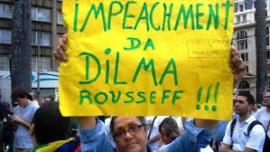
    ImageBrazil’s president, Dilma Rousseff of the Workers Party (PT) will very likely be impeached today, leading to her immediate, temporary removal from office and to a trial that could remove her permanently. Waldir Maranhao, the acting speaker of the lower house, had annulled the impeachment process just a couple of days ago, but then Renan Calheiros, the head of the Senate, said that he would proceed with the impeachment anyway, and it is going forward. This impeachment, which the left calls a kind of golpe de estado or coup d’état could be the end of Dilma’s presidency and the beginning of a new rightwing government that will impose greater austerity and do so by repressing the social movements.

     Brazil is in the midst of its most serious political crisis since the the military dictatorship that began in 1965 and with the return to democracy in 1985. Hundreds of thousands have in recent weeks joined in massive marches against Dilma’s government, calling for her removal. Rightwing judges, politicians, the media have been working for months to see her impeached her for her alleged inappropriate handling of the nation’s finances—though those politicians who have accused her have themselves been investigated for far more serious crimes of embezzlement and fraud. Investigations called Lava Jato (Car Wash), have implicated dozens of politicians, but, even before the current wave of enquiries, members of the administration of former President Luiz Inácio “Lula” da Silva, and the president himself, had been found to be involved in corrupt practices.

    President Dilma Rousseff, a former leftist guerrilla—imprisoned and tortured under the military government—first assumed the presidency in 2011, succeeding Lula, founder and leader of the party for decades and two-term president. Created by militant labor and social movements in the 1980s, the Workers Party during Lula's presidency adapted to parliamentary politics, engaged in political payoffs, and proved adept at neoliberal economics accompanied by social welfare programs. Under Lula, the country’s banks and corporations prospered even during the Great Recession while the Workers Party government pushed through congress programs to redistribute wealth to assist the poor—without changing the system that produced them. But Rousseff took power during an economic downturn, and her turn to austerity has only made the situation more difficult.

    Taking advantage of the president’s discomfort, Eduardo Cunha, the former speaker of the lower house, led the attack on Dilma and the PT, but he has now been suspended from office while his wrongdoings are investigated. Cuhha is a leader of the Brazilian Democratic Movement Party (PMDB), created by the military dictatorship as the official opposition party. Brazil’s vice-president Michael Temer is also a member of this party, and if Dilma is impeached, he will assume the presidency. The PMDB, to which both of these men belong, is an alliance of regional oligarchies with no real program for the future of the nation and principally acts to defend its constituents’ economic and political interests,

    The Left Resists

    With Rousseff facing impeachment, the PT leadership contemplates calling upon Lula to run for president—if he is not indicted and imprisoned. There is the problem, however, that Lula’s and Dilma’s policies have over the last 13 years turned from social liberalism and redistributive programs to policies of greater austerity. Consequently the PT has lost support among its traditional bases of organized workers and the urban and rural poor.

    The question facing the left then is: How to resist the right without supporting Rousseff, Lula, and the Workers Party? More specifically, how should the far left relate to the various coalitions that have been formed to resist the right?

    The PT has organized its own coalition, Frente Brasil Popular, made up of dozens of popular organizations, including such important groups as Via Campesina, but, most important, it includes the two largest labor federations: CTB (Central dos Trabalhadores e Trabalhadoras do Brasil) and CUT (Central Única dos Trabalhadores). The far left hesitates to join this coalition because it defends Lula, Rousseff, and the PT and, of course, doesn’t criticize the ruling party’s faults and failings.

    There is another front, however, called Povo sem Medo or People without Fear, that was initiated by the Movimento dos Trabalhadores sem Teto or Movement of Homeless Workers (MTST). This coalition, also made up of many popular organizations, is independent of the PT government, and its posture of defending democracy but not the government makes it attractive to the far left. Some sections of the Party of Socialism and Freedom (PSOL), for example, back the Povo sem Medo coalition

    At the same time, far left parties—Party of Socialism and Freedom (PSOL), the Brazilian Communist Party (PCB), and the United Socialist Workers Party (PSTU), which often join together in electoral coalitions, are working together make a new coalition of their groups called the Left Socialist Front (Frente de Esquerda Socialista) into a more activist organization in society. The founding congress took place on March 23 with the participation of 500 members from the three participating organizations. They are committed to making a campaign to build the both in the elections and in the streets and social movements.

    Much of what happens politically will depend ultimately on the labor and social movements. The two large labor federations already mentioned, the CTB and CUT, have become business unions that work in partnership with the employers, and they are discredited as well in the eyes of some by their connection to the Workers Party. Some former CUT unions have been leaving the federation are now joining either one of two alternative federations: CSPConLutas or Intersindical.

    There are in Brazil an enormous number of community organizations, ethnic associations, feminist groups, and environmental organizations; and though many of them are affiliated with the Workers Party, there are also many independent groups. The events of June 2013, when millions took to the streets to protest government policies, showed the enormous potential of this movement, though at the moment there are no such mass movements.

    Brace for a Hard Right Turn

    Temer of the PMDB, once he assumes the presidency, will be looking for political allies, and he is mostly like to find them in the center-right Brazilian Social Democratic Party (PSDB), the party that has been the main opposition to Lula, Rousseff, and the Workers Party for more than a decade. The party’s symbol is colorful toucan parrot with its huge yellow bill and its leaders are called toucans. Recently the PSDB voted to cut the education budget for children’s lunches, leading the left to joke: Question: “What is eating the children’s lunches?” Answer: “The toucan.”

    With the PMDB and the PSDB dominating the congress, not only children’s lunches, but all progressive social legislation will be threatened. The government can be expected to take action against the interests of the left political parties, the labor unions, and the social movements. Under such a government, social conflictssuch as the occupation of the schools now taking place in Rio de Janeirowill be handled by the authorities with greater violence. Brazil is making a right turn and the left will be hard pressed to defend its parties, its unions and movements, and the country’s working people and poor.


  • What can we in the United States learn from the left in Europe and Brazil?

    Image

    What can we in the United States learn from the left in Europe and Brazil?

    During the last two weeks of April I visited three European countries speaking about Bernie Sanders and the American elections. I spoke in Paris, Madrid, Barcelona, and in French-speaking Switzerland, while in May I spoke in four Brazilian cities: Rio de Janeiro, the Rio suburb of Niteroi, Vitoria, and Fortaleza. In Paris I spoke to Ensemble, part of the Front de Gauche, in the suburb of Bagnolet. In Madrid and Barcelona, I spoke at meetings organized by the journal Viento Sur which is linked to Anticapitalistas, the leftwing of Podemos. In Switzerland, I spoke at the Spring University of solidaritiéS Suisse, an independent, multi-tendency left wing group.

    In Brazil my talks were sponsored by either the Party of Socialism and Freedom (PSOL), which came out of a leftwing split form the Workers Party (PT) several years ago, or by Insurgencia, a Trotskyist (Fourth International) group active within PSOL. In addition to speaking before these groups, I also met and talked with local activists and leaders and sometimes with national leaders. And I visited union halls and strikes and spokes with union activists and also joined and participated in protest demonstrations around a variety of issues. While these are very different countries and even regions of the world, one can see some general similarities in the situation of the left in both Europe and Brazil.

    In France, Spain, and in Brazil, the labor and socialist parties in power have been utterly discredited among many working people: the young, environmentalists, feminists, and other social activists. In France, François Hollande of the Socialist Party has not only imposed austerity policies on the country, but also, with the excuse of terrorist attacks, he has taken authoritarian measures, banning social protests. Environmentalists, labor unionists, and youthful activists have defied the proscription of demonstrations and taken to the street in the Nuit debout occupation of the Place de la Republic in Paris.

    In Spain, the political duopoly of the conservative Partido Popular and the Socialist Party (PSOE) has been discredited, neither won 50 percent of the vote in the last election, and both were unable to form a government. Podemos, the new leftwing political party that came out of los indignados, also known at the movimiento de las plazas, is engaged in talks with the United Left (la Izquierda Unida), a group that years ago came out of the old Spanish Communist Party. If they unite in an electoral coalition, Podemos-IU could displace the PSOE as a new, radical, and activist socialist party. In Catalunya, a region with its own national identity and political parties, the situation is the same, though the party names are different.

    In Brazil, the Workers Party (PT), a labor party that came out of the movement against the military dictatorship in the 1980s and which has held power now first under Lula and then under Dilma Rousseff for 13 years, has lost support both because of the austerity policies it has imposed, but also because of corrupt practices that it and all of the major Brazilian parties have been involved in, as revealed by a government investigation (Lava Jato). The far right has seized the opportunity to attack the PT and Dilma, calling for her impeachment. The radical left groups, such as Insurgencia and many others in PSOL want to defend democracy, but don’t want to have to defend the PT government or Dilma. They want to build a genuine socialist alternative. The common element of these experiences are supposed labor or socialist parties that have either become corrupt, authoritarian, or pro-austerity or all three in varying degrees, leading to new, more radical left parties.   

    In France, Spain, and Brazil, there have been and continue to be attempts to found new broad left, radical socialist parties as an alternative to the Social Democrats. In France we have seen both the New Anti-Capitalist Party (NPA) and the Front de Gauche, in Spain Podemos, and in Brazil, PSOL. These efforts can be compared to those in the English-speaking nations where Jeremy Corbyn in the British Labor Party and Bernie Sanders in the Democratic Party clearly represent a similar popular reaction among youth and sections of the labor movement to the conservative policies of Labor and the Democrats.

    What is the role of the far left in these movements? Several–though not all–of the groups that invited me to speak have their roots in the Trotskyist tradition. The New Anti-Capitalist Party came out of a merger of former members of the French Trotskyist Revolutionary Communist League (LCR) with environmentalists and other social activists. Anticapitalistas was formed by people out of the Spanish Revolutionary Communist League (LCR), also Trotskyist. Ensemble in France, which participates in the Front de Gauche, has members who come from the Socialist and Communist Party, as well as from NPA and the Trotskyist left. Similarly, solidaritéS Suisse, though it has Trotskyist roots, has also incorporated those from other traditions.

    These groups, if they were Trotskyist in origin, have by and large turned away from many of the characteristics once associated with Trotskyist organizations. At one time many of these groups held a dogmatic view of socialist ideology based almost exclusively on a very particular and narrow reading of Marx and Engels, Lenin and Trotsky—though for a while they also included Fidel Castro and Ernesto “Che” Guevara among their revolutionary heroes. They worked to organize “vanguard parties” based on a supposedly “democratic centralist” model and often attempted to take control of and to dictate to labor unions and popular movements. Dominated by male leaders, they often had a machista culture. Those practices are no longer found among the groups for which I spoke and the people with whom I met and talked. The Fourth International identified with Ernest Mandel (1923-1995), has developed a more broad-minded view of revolutionary socialism, and so have most (but not all) of its affiliated organizations.

    Today most of the far left groups that I visited, whether or not they are affiliated with the Fourth International, work to create organizations that have a more genuinely democratic character while at the same time attempting to create a dialogue with the unions and the movements with which they interact. There is no doubt that the practices of the feminist, environmental, indigenous, and poor peoples’ movements have had a salutary effect on these organizations, leading to more democratic practices and a fuller understanding of the human condition and the struggles before us. The goal for most of these groups and their members is no longer to study the Marxist catechism and then teach it to others, but to develop on the basis of Marxist principles a critical and creative relationship to contemporary social movements and politics.

    Anticapitalistas provides an interesting example of what this means in the actual building of a radical left organization. Starting in the 1980s with about 85 members, today they have more than 700, and the great challenge is to educate and train cadres. At one time, this would have meant reading “the classics” under the tutelage of one of the group’s leaders. They believe there is still value in reading those classics, but today they use articles in Viento Sur as the basis for discussion. These articles, mostly about the contemporary situation, raise questions that often have no “correct answer,” but rather require the discussants to collectively use the Marxist method to analyze a problem. The method is similar to that used by DSA with its involvement in the Jacobin reading groups. At the same time, Anticapitalistas finds that in dealing with the struggle in Podemos against Pablo Iglesias’ populist politics, it actually needs not only more cadres but a stronger organization.

    There are, of course, still Stalinist, Maoist, and orthodox Trotskyist groups on the far left in the countries I visited, and some have a real social base in some movement or labor union organizaton. The United Socialist Workers Party (PSTU) of Brazil, followers of the Argentine Trotskyist Nahuel Moreno, for example, has a significant labor union base in industry. (The PSTU is not associated with the Fourth International.) So one cannot say that the more democratic groups that reject a substitutionist vanguardism necessarily have become dominant, though in some countries they are.

    What conclusions do I draw from my admittedly short, shallow, and in many ways superficial experiences?. First, it seems to me clear that the Socialist Parties (or Social Democratic Parties) of Europe have clearly created governments that administer capitalist states, have neoliberal politics, and impose economic austerity and at times authoritarian measures. The Socialist Parties in these countries are no longer on the left in any meaningful sense. Second, in several instances activists are working to build new radical socialist parties out of upheavals such as the indignados and Nuit debout. Third, that many of the Fourth International parties and some others parties have made a fundamental break with the old method of functioning in the twentieth century and are at work to create new parties that are revolutionary socialist and internationalist, but also democratic groups committed to building independent labor and social movements. Finally, I think that those of us on the left in groups such as Solidarity and DSA or involved in the journal New Politics should recognize ourselves and our methods as part of this new left tendency and work to build networks of international solidarity with such groups. (Solidarity is a permanent observer at Fourth International meetings and has ben for several years.)

    *Dan La Botz is a member of Solidarity and of the Democratic Socialists of America and a co-editor of New Politics.

  • Rio de Janeiro: Teachers on Strike, Students Occupy 76 Schools

    Image

    Teachers in the city of Rio de Janeiro, and in the state of the same name, have been on strike for more than two months now. More than a month ago students at one high school occupied their school in support. The student occupation spread to other schools and are there are now 76 schools occupied throughout the state of Rio de Janeiro and as many as twenty in other states to which the movement has spread. Students have been joined by parents and teachers and by volunteers from left political parties and individuals.

    The school occupations have been spontaneous and completely self-organized, creating a loose network of organized schools. The Rio de Janeiro State Teachers Union has attempted—not entirely successfully—to create a structure to bring unity and organization to the movement. At the Amaro Calvalcani State School, a school that has received awards for excellence from the Rio de Janeiro State Secretary of Education, the fences and walls were covered with posters about the occupation and the gates were padlocked shut—the keys in the hands of the students.

    Image

    I talked with biology teacher Lenir Jane Rodrigues and Portuguese language teacher Edna Bandeira Prestes about the reasons for the strike and the occupation. The teachers explained that they were resisting privatization, demanding an end to cuts in the school budget, better maintenance of the buildings, an increase in wages, and improvement in the students' breakfasts and lunches.

    Image

    Students Laura Maria Araujo Bernardo and Gabriel Richard explained to me that yesterday, Mothers’ Day, many parents had joined the students at the school, celebrating both the mothers and the strike and occupation. At the moment, the school is dedicated to various cultural events. Today teachers were instructing students in a traditional dance based on women’s work washing clothes.

    While the regular school is not in session, various left organizations such as the Party of Socialism and Freedom (PSOL), the Brazilian Communist Party (PCB), and the United Socialist Workers Party (PSTU) visit the school offering classes on various subjects: on the history of the military dictatorship in Brazil form 1964 to 1985, as well as chemistry and the Spanish language.

    A Difficult Situation

    The teachers went on strike on March 2. Now in its second month, the strike and the accompanying student occupations have faced a series of difficulties. First, while the teachers have their demands, each of the occupied schools also has its own, so there is no common set of demands.

    Second, at some schools, students have faced repression from the Military Police who have beaten occupiers. In the worst case, an exception to be sure, in one neighborhood a fight between drug dealers and police that left one police officer dead—but then the police returned to kill 11 people, supposedly drug dealers, but who according to neighbors some had nothing to do with criminal activities. Some of those killed were family members of teachers and students involved in a local school occupation.

    Third, in some schools, groups of seniors, who hope to graduate soon, have invaded the schools to break the strike and occupation, which they see as frustrating their plans for college or work.

    All of this, of course, is taking place in the context of a deeply divided government, where the conservatives have been attempting to impeach President Dilma Rousseff of the Workers Party (PT). 

  • True Confession: I’ve Lost that Bernie Feeling

    Image

    I’m not feeling the Bern anymore. The Bern has gone away. The Bern has turned to heartburn, if not yet reflux.

    And it’s not because our favorite son is so woefully behind in the delegate count leading up to this summer’s Democratic National Convention.  It’s not because of his campaign themes; anyone who says on the electoral stump that the US has a “rigged economy” and points to the Walton family’s fortune comprising more than the combined wealth of the nation’s poorest 40 percent is a truth-teller worth backing. And it’s not because of what some left fantasists write, who, in their latest popgun-burst contribution to the internecine war of the sects, opine how

    Bernie Sanders is shifting into the next phase of his mission on behalf of the American ruling elite, seeking to corral the millions of youth and workers who responded to his campaign and direct them behind the war criminal and Wall Street stooge Hillary Clinton. In parallel, the various pseudo-left organizations that have promoted Sanders are seeking to adjust their tactics to better perform their assigned task of blocking the development of a genuinely socialist movement of the working class.

    Even such measured, saner Sanders critics as the International Socialist Organization don’t explain it. Writing in Socialist Worker (May 2) Paul D’Amato acknowledges that Sanders is indeed

    …giving voice to discontent and creating unprecedented interest in radical, socialist ideas—though these ideas were already percolating before the election cycle began, as various opinion polls during and after Occupy show. But Sanders is also corralling that discontent, and he will, to the best of his ability, try to convince his supporters to help him “revitalize” the Democratic Party…Our task as revolutionaries is to see both sides of this contradictory process and act accordingly. We are excited by the Sanders phenomenon regarding the door it has opened regarding socialism. Which is all the more reason why we must also take on the other side of the contradiction—where this enthusiasm is being channeled.

    Channeling the enthusiasm! But away from what? A left party-building of the mind? The laying down of prodigious tools for recruiting to one’s own de minimis mass party? My response to D’Amato’s concern that supporting Sanders risks radical ruin is this: relax. Let Sanders try to redirect this generation of enrages. He can’t. At the risk of stretching the point, I’m reminded of the Petrograd police spy Father Gapon, who is barely remembered as a Tsarist double agent but as the irreplaceable activist whose work sparked the 1905 Russian Revolution. So if revolutionary history and Comrade Lenin can give the shadowy Russian Orthodox cleric a pass, we can forgive Bernie for the Hillary shilling he will likely be doing soon enough.

    Bernie helped ignite a generation, just as did Occupy, tapping into a rebellious, justified and long gestating radical Geist. You could even argue that our debt to Sanders is greater than to Occupy; at least he put forward a challenge to the State, something the anarchists who monopolized Occupy media outreach squelched for fear of validating government by acknowledging government’s legitimacy to even meet radical demands.  And Bernie’s remarks, which I heard attending mass meetings in Northampton, Massachusetts and Richmond, California  before he announced his presidential candidacy, were masterful in drawing the connections between social problems, corporate causes and the need to build popular movements and electoral networks that outlast any campaign.

    He’s also running for the nomination against Hillary Clinton, whose negatives are so high that even Indiana Democrats rejected her. Sanders can say what Fiorello LaGuardia is often credited with coining, that “I can run on a laundry ticket and beat these political bums any time.” Certainly this political bum, and in states with open primaries and holding simultaneous contests in both parties, as in Indiana.

    So with Sanders doing more to promote socialism and solidarity than any American figure since Eugene Debs, what’s my beef with Bernie? It comes after Sanders couldn’t deliver the substantive coup de grace to Clinton at any of the debates watched by millions of voters. Battle fatigue on his part? More like poor generalship, if we are honest, as Bernie stoked a fire under millions of Americans but couldn’t muster campaign 2.0 beyond a fund-raising bonanza (no small thing) and promises of a confection of free stuff courtesy of the state, yet with too little attention to Hillary’s and Bill Clinton’s role as abettors of the very corporate oligarchy he so despises and has otherwise sketched so well.  It’s that he muffed the ample nationally televised debate opportunities he had to demolish HRC as someone who could deliver nothing but misery, when his programs properly advocated and elaborated were not only desirable but defensible and necessary. 

    On the stump, campaigning against class-based injustices, Sanders was nonpareil. Not in the debates, though. In boxing lingo, facing what by elementary logic and evidence was his social and political enemy, he never laid a glove on his party primary opponent. Poor debating style? Poor staff preparation? Fear of overstepping? Of charges of sexism? Concern with aiding and abetting the GOP come November? Whatever: Sanders stumbled in front of millions of viewers nationwide against a deeply reactionary and properly maligned neoliberal. We lost, too.

    He also mistakenly shifted his discourse (at least in widely reported appearances leading up to the May 3 Indiana primary), thinking that key to his success was not so much ratcheting up and filling in his anti-corporate language but tactically “flipping” the formally unpledged super delegates away from HRC.  It wasn’t missed by the media that the chief public trasher du jour of the political oligarchy was pinning his hopes on playing footsie with the elite’s enablers.

    When could his opposition research have been be better brought into play? Doug Henwood’s explosive My Turn (O/R Books, 2015), the definitive exposé of the Clintons, alone offered enough information to demolish Clinton’s claims as a liberal pragmatist. Henwood showed her as neither liberal nor pragmatic, at least in the sense of delivering for working people and not the Clinton Foundation, which she did with brio as secretary of state. Was there no staffer available to write an executive summary for the candidate?

    Why couldn’t Sanders speak meaningfully about race at a time when police murders and vigilante violence are rife? Why was his initial take on Black Lives Matter (something he was quick to correct) so indecisive? Why so phlegmatic in his criticisms of the far-right, homicidal Israeli coalition government, esp. after Clinton’s hair-shirt prostration in front of AIPAC?  Compared to the three wise monkeys approach to Israeli policy every other major Democrat takes, Sanders—to his immense credit—also discussed the rights of the Palestinians and the “disproportionate” response by Israel in Gaza. As one New Politics editor rightly wrote me, “it was courageous in the context of a Democratic Party debate and it was a welcome opening up of discussion. I recognize the bar on this is pretty low, but I think Bernie took an important step.”

    True that! And his refusal to appear before AIPAC was smart, esp. after they spurned his offer to teleconference in.

    But why not take it further still? Why not use the debates to articulate a democratic and non-imperialist foreign policy as central to his solid critique of the U.S. oligarchy, rather than pose militarism as an unneeded excess to be reined in? Or now offering more than taking “the fight” to the convention’s platform and rules committees, at best a consolation prize if not just a self-gratifying exercise some Bernie supporters on the Left actually advocate.  The Nation’s John Nichols (May 3) cites Working Families Party grandee Dan Cantor approvingly that  “the [Democratic] party has to take a big-vision stand.” It does, but the big vision—if the next big thing is looking toward a convention pie-fight over a platform few read and candidates shun, or rules that don’t take effect for years, or nibbling away at super delegates—will likely be a squint. Unless his delegates win every reform needed—and they can’t —opting for success in a Clinton-dominated convention is nothing to celebrate; it’s like agreeing to and heralding a harsh plea bargain.

    Bernie suffered from another flaw, committing the sin that’s more deadly than being wrong, at least in politics. With each debate he got more boring. His mantra of free public university education, Medicare for All and campaign funding overhaul—all necessary policy and just the beginning of wisdom—seemed with repetition to channel Michael Dukakis’s 1988 paean to “Good Jobs at Good Wages.” These may be great slogans to start a campaign. By election time they are stale. Not just unbelievable when so barely elaborated by Dukakis, but boring. Even the Republican Party’s 1928 slogan promoting a vote for Herbert Hoover as ensuring “A Chicken in Every Pot, A Car in Every Garage,” had a certain pre-Depression cachet. Consistency aside—and Samuel Johnson’s warning about “a foolish consistency” still holds—Sanders’ call for “free stuff” absent pointing to why health care and schooling and jobs are so severally rationed (and by whom) has a short shelf life.

    True, those of us supporting Bernie were not hobbled by the campaign from independently raising vital issues, from cop killings, the salience of Black Lives Matter, and justice for Palestinians, to a full elaboration of Medicare for All, as understood by Physicians for a National Health Program and others. We were free to make a bold critique of union leaders who, with some notable exceptions such as the Communications Workers’ Chris Shelton and Larry Cohen, took the business-unionist route and backed Clinton redux. But even as Sanders was bushwhacked in New York by the state’s peculiarly restrictive voting laws, all he could muster was his being “really concerned about the conduct of the voting process [in the state] and I hope that process will change in the future.” Forget rage. Where was the anger at palpable voting fraud?

    Forget, too, about the demon of closed primaries—if we had a mass socialist party in the U.S. we’d want closed primaries—the fact that the city Board of Elections purged hundreds of thousands of voters from the rolls (more than 125,00 in Kings County [Brooklyn] alone) calls for more than concern. (A re-canvass was started for Brooklyn and Manhattan on April 27. Results are pending.)

    Even the things Bernie was clear about weren’t in his debate remarks. HRC’s whole attack on him, echoed by the punditry, was that Bernie’s economic plans “didn’t add up,” or read as Pollyannaish. Robert Reich had to take to his own blog (March 2, 2016) to justify the veracity and cogency of Sanders’ economic plans.  Including how support for a single-payer health system was a twofer that not only would provide health care for all but also serve as a federal expenditure to “permanently improve economic performance. How could it not,” Reich said, “when healthcare expenditures constitute almost 18 percent of the U.S. economy.”  

    Why didn’t Bernie use that? Or ask pointedly where Hillary stood on Nancy Pelosi and House Democrats’ efforts to retard moves to lower pharmaceutical costs. (HuffPost, 4/27/16.)

    Could we, the left, have done more? Were we so fascinated by the seemingly spontaneous aligning of millions with Bernie to forget that even a citizens’ army needs good generals? Bernie was nothing but clear in saying that “I can’t do this by myself” and that the movement had to be bottom-up. Was it?

    Jason Schulman, my fellow NP editorial board member, in an otherwise smart piece on the tactical wisdom of Sanders running as a Democrat in what sociologist Oliver C. Cox appropriately called one of “two factions of the same party,” was that it gave we reds an opportunity to offer constructive and critical support to the first overtly socialist campaign to reach any number of voters since Gene Debs’ race in 1912. Looking back, we all acted like roustabouts helping erect a giant carnival tent.  The “critical” in critical support was stillborn.

    Again, this isn’t to demean or minimize what Sanders did accomplish or the hard scut work activists including Labor for Bernie, DSA, and so many others put into the campaign. But the debates were watched intently by people planning to and mostly eligible to vote. Consider Hillary as a pustule ready to pop. Maybe Bernie had an endgame fear of destroying the likely winner and giving the race to the ur-human GOP, or feared ripping up the road between Sanders and the party apparatchiks should he actually win the convention and need at least their acquiescence.  Or just poor debate preparation on his part despite HRC’s vulnerability on palpable issues. With the exception of Hillary’s refusal to release her likely fawning Goldman Sachs private remarks (a stupid error on her part) Bernie could have peeled her faux liberal credentials like skin off a ripe banana. Instead he set himself up for the canard of New York Times op-ed contributor Timothy Egan (April 22), who called with some faint justification Sanders’ rhetoric as

    “shouted shibboleths,” naming Sanders ‘a sloganeer with authenticity. But a rant, no matter how dead-on,’ Egan continued, ‘is not a governing blueprint. His answer, on a number of occasions, to complex issues has been ‘I haven’t thought about it a whole lot.  In many areas, he’s almost substance-free.’”

    To his credit, Egan submits that Clinton has no big ideas at all, calling her “the shrug candidate.”

    Okay, the New York Daily News editorial Egan cites as proof of Sanders’ lack of grounding was a caricature of what Bernie actually told its board of editors (the transcript is available HERE) and Bernie is hardly substance-free. Campaigns writ large don’t call for blueprints so much as road signs pointing out general directions, but he certainly came out as thin in the debates, where his direction posts might as well have been jocular Burma Shave roadside poesy. Was his performance really much better and more pointed facing down Hillary than this:

    Statistics prove

    Near and far

    Wall Street honchos

    Gambling madly

    –Are!

    Bernie Shave.


    Sadly, no, his wasn’t. At least that bit of whimsy wouldn’t be boring.

    Michael Hirsch is a longtime board member of New Politics, a Portside moderator and a supporter (still and despite the above) of Labor for Bernie.

  • Travel Notes – Impressions of the Left in Rio de Janeiro

    ImageI was invited to speak here in Rio de Janeiro by the Socialism and Freedom Party (Partido Socialismo e LiberdadePSOL) and spoke last night to an enthusiastic and very well informed crowd of about 200 students at the university (UFRJ). I also sat down to talk with PSOL leaders and activists here about the local political situation and the social movements. So here are my impression, though they are just impressions of the political situation, of the teachers' strike, and of the school occupations.

    Brazil is in the midst of an enormous political crisis, the result of corruption involving all of the political parties, as well as an expression of the severe economic downturn. The right wing—including all of the conservative parties and politicians, the media, and mass demonstrations of over one million people—are demanding the impeachment of President Dilma Rousseff of the Workers Party (PT). The man leading the fight for impeachment is Eduardo Cunha, a rightwinger who is himself implicated in the corruption investigations.

    While there is not yet a call for new elections, which would require a constitutional amendment and a new law, such elections could be on the horizon. Dilma could not run again herself, but her mentor and PT founder and longtime leader Ignácio “Lula” da Silva could stand for president—if he is not indicted first.

    The country’s leftists hesitate to defend Dilma or the PT that has been involved both in the corruption and in the implementation of policies of austerity. The far left takes a position against impeachment and opposing austerity, but not defending Dilma or the PT. Yet there are tremendous pressures for the far left, such as the PSOL, to enter into an alliance with the PT, to defend the PT from the right-wing attack.

    Teachers Strike and School Occupations

    At the same time, there is a major struggle take place over education. Teachers and other public employees in Rio de Janeiro have been on strike over wages and the education budget. Alongside the teacher strike, but organizationally independent, is the month-long occupation of 70 public primary and secondary schools by students and their supporters. As one person told me, this is “an entirely spontaneous and self-organized movement.” The occupiers are supporting the teachers strike, but they are also protesting the problems of the schools’ physical plant and the lack of teachers and educational resources. The occupiers have formed a network of public school activists throughut the state of Rio de Janeiro. I'll be back in Rio in a week and hope to interview some teachers and students then.

    Well, I go on tonight to Vitoria, the capital of the state of Espiritu Santo. I’ll see what’s happening there and send along my impressions.

  • A May Day Message to Teachers – On the Front Lines of a War on Public Education

         Image

    (These are my remarks at an evening panel of what its organizers referred to as a "non-conference" so as to convey the need for participants to interact with one another's ideas, rather than present papers. Sessions spanned two full days. The two evening sessions were videotaped. When they are made available I will post them on New Politics.)

          First, thanks to NYU professors Gary Anderson and Carol Anne Spreen for their thoughtful, critical work in assembling the people at this “non-conference” on privatization of education globally. They have contributed to our understanding by creating space for us to learn from and with one another and by including discussion of teacher unionism, so often ignored by educational researchers.

              Thanks also to NYU/Steinhardt for sponsoring the event. The university and college involvement shows that despite what has been lost in the push for universities to corporatize, scholars can still leverage resources and privileges of our positions to advance social justice in education.

              A commendation goes to Education International (EI), the international confederation of teachers unions, for its co-sponsorship, and to Randi Weingarten, President of the AFT (American Federation of Teachers) and Lily Eskelsen Garcia, President of the NEA (National Education Association) for being respondents in the panel. Their involvement invests what we do here with a special significance because of unions’ situation in the society, unions’ access to power that emerges from their being mass membership organizations that represent and can call on the resources of millions of teachers and education workers, internationally.  The power and the potential unions have to be the backbone of mass mobilizations against privatizations explain the viciousness of the attacks on teachers unions in the corporate media and political forces pushing to “marketize” schools and de-professionalize teaching.

              My current research is with and about teacher activists who are building social movement unions, primarily by creating reform caucuses within the existing union structure. The caucuses are the embryos of a new kind of teacher unionism committed to social justice; mobilization of union members with community allies as respectful partners; and thorough-going union democracy, beginning at the school level. Collaborations between social justice activists, academics, and teachers unions are extraordinarily important today. When we say teachers are on the “front lines” we imply they are at war.  In my remarks I will try to clarify what the forces are in this war and what is at stake, posing three challenges for us.  

              While privatization is an aspect of the neoliberal project in education as many speakers have noted, in fact education is being transformed by policies that cannot be separated from a more fundamental drive: to make all human activity, including intellectual and artistic work, subject to what is called the discipline of the market, but is, in fact, the control of powerful elites who manage capitalism and are using the state to extract profit from what is viewed as an  untapped source. Educational researchers in the UK have recently noted that the notion of “dispossession” better captures what occurs in the policies associated with “austerity.” “Dispossession” gets at the transfer of wealth and power that is at the heart of capitalism’s shift in operations in this stage we call neoliberalism.

              My first challenge to teachers unions is to name privatization of education as a function of capitalism’s ethos of putting profit over people and to use union resources to oppose this distorted value system. We limit the explanatory power of our campaigns against privatization if we do not say explicitly that public resources belong to the public and must be allowed to remain so. There is no room for profit in the public sector. We need to stand unequivocally against educational policies that give business access to services provided in public education, whether it is teacher evaluation, professional development, or school management. Moreover, the public sector has to be overseen through democratic means. Operationally this means protecting or creating elected local school authorities. It means insisting that capitalist elites and the politicians in their thrall do not have the right to dictate terms of educational policy to communities or nations as an ostensible quid pro quo for loans and financial assistance.

              The systemic dispossession of the global south and poor communities of color within the global north is a transfer of resources from vulnerable, impoverished people to corporations and the wealthy few. Like the original colonial project, the current economic dispossession destroys cultures and is racist.

              My second challenge is to understand the different roles of academics, social justice activists, and unions in encouraging understanding – and resistance to – this global project of capitalism. The challenge for teachers unions is especially complex and difficult as they must represent all members fairly and well. Unlike advocacy groups organized on the basis of shared principles, unions are mass membership organizations. If they are the exclusive bargaining agent they include members with highly divergent, contradictory political beliefs and values. Mass membership makes building consensus more difficult, but union democracy, starting at the school site, supports the process. We should expect that key policy decisions, like whom the union endorses for President of the United States in party primaries, are  taken to members, providing an opportunity for political education and reinforcing members’ understanding that they – not officers or staff – “own” the union.

              Not everyone on the front lines of this attack on public education, teachers, and their unions sees this war as we have configured it in our discussions. Social class, race, gender, religion all influence how teachers view this war.  As we see in the excellent website Mary Compton hosts, www.teachersolidarity.com, the assault is global as is the resistance. Teachers who must strike to be paid wages owed them for months; teachers who are assaulted, kidnapped and jailed for exercising the rights as citizens and workers often see how privatization relates to the degradation of their work and their society’s resources. In the global north teachers are experiencing assault but in less violent ways. While the assault is global, it is not experienced in the same ways.

              Feeling disempowered and alienated from vehicles for resistance, some teachers identify students and parents as their adversaries. This occurs especially in schools that are under-resourced and repressive, where students and parents lack formal education and are members of communities that have been historically oppressed. Teachers are human and are not immune to toxic social prejudices and bigotry. As we see all over the world, those who are economically oppressed often turn against those who are equally or more oppressed. Rage obscures the more distant political and economic forces that create and maintain economic dislocation.

              Unions must respond to members’ wishes but often in so doing they ignore the powerful educative potential of vibrant union democracy and mobilization. Hence unions at all levels, local, national and international adopt policies that assume the irreversibility of members’ current beliefs. In so doing they paint themselves into a corner of adopting what seem “pragmatic” policies: accepting pay for performance; standardized testing; buying into the validity of PISA testing regime; collaborating with the OECD and the World Bank; accepting donations from our foes for purposes that seem to favor our interests. In reality these seemingly “practical” policies undercut possibilities of successful resistance by alienating our potential allies and demoralizing the most politically conscious union members.

              What is a truly “practical” union approach to deal with extraordinarily powerful opponents who aim to destroy all that we stand for and must protect? A seasoned leader of the NUT (National Union of Teachers) explained to me how he understands what unions must do to defend teachers and public education:

    Seeking to engage with governments and employers but ON TERMS YOU DEFINE with a movement you have built behind you that requires them to engage is the only way in a functioning civil society that unions can bring about change. We try in our own small way in the NUT with campaigning platforms like Stand Up For Education and Exam Factories to create the context for encouraging members to act and parents to support us. Their expectation is that this will eventually lead to talks that give us what we want. The fact that we get talks sometimes and are offered little or nothing is to be expected.

    He warns that the success of this strategy is not guaranteed:

    It is a measure of the quality of leadership and the upward pressure from membership whether we get drawn into legitimising things we are opposed to, or whether we "expose" the duplicity of those we deal with in how we report what is taking place, and try to use this to press on with the campaign.

    The dialectic he describes is between union democracy (upward pressure of members) and leadership – its courage and vision.  I would broaden the scope of struggle, adding to this dynamic an understanding that communities and parents must be supported in their own campaigns about social justice that do not directly involve schools.  Support and respect must be mutual if we expect public support for teachers on the front lines.

                My third challenge is to invite frank dialogue between critical researchers, activists, and union officers about resistance to neoliberalism’s global project. This discussion is difficult to organize and sustain, in part due to scarce resources but also due to the insularity of our institutions. Another impediment is the understandable defensiveness of unions, attacked viciously by so many opponents. Still, hearing the critiques of friends, whether activists or academics, who show their support in struggles, is essential for us all. The critique must be accompanied by support. The support must be accompanied by critique.

              We face enormously dangerous, powerful opponents in this war. They aim to destroy public education and with it democracy. They want to control what children learn and how they are taught, so as to produce workers and citizens who will fit into a world order that refracts human need through the lens of profitability.  Teachers on the front lines need transformed unions. They also need support of academics and social justice activists, to develop a critical understanding of this war, of their real enemies and allies, of successful tactics, and an inclusive vision of education that maximizes human potential, not profits. 


    Lois Weiner is professor of education at New Jersey City University and Director of the Urban Education and Teacher Unionism Policy Project.

  • Challenges Facing the Left in Spain

    Image

    Podemos, meaning “We Can,” is one of the most exciting developments taking place on the left in Europe today. For years politics in Spain had been dominated by two parties: the conservative the People’s Party (Partido Popular or PP), headed by Mariano Rajoy, and the Socialist Workers Party of Spain (PSOE), led by Pedro Sánchez. But, in the last election held in December of 2015, the new left party Podemos won five million votes, fundamentally votes by the lower classes against the economic elites and their austerity plans. That represents 20% of the electorate, and 69 out of 350 seats in the house of deputies.[1]

    Podemos has its roots in the Spanish Occupy 15-M movement, also known as the indignados (indignant ones) or movimiento de las plazas (the movement of the plazas) that began on May 15, 2011. Eventually over six million Spaniards participated in the 15-M protests that from occupation of the public squares developed over two years into tides of mobilization against unemployment and government privatization of public services such as the national health system and public education. This movement reflected the lack of confidence of large parts of Spanish society, specially educated youth, in the old parties’ system, including the traditional social liberal PSOE that enacted and supported  the austerity policies, but also lack of confidence in the social democratic Izquierda Unida (United Left, IU).[2] That long wave of mobilization eroded the legitimation of the bipartismo or two-party domination of the political system that had been set up in the transition from the Franco dictatorship to democracy that took place in 1978.

    The success of Podemos in the 2014 elections for the European Parliament led others with more conservative views to set up a new neo-liberal party, Ciudadanos (Citizens) that got support from people disenchanted with the inefficacy and corruption of the PP. The success of Podemos on the left and Ciudadanos on the right meant that neither the PP nor the PSOE won over 50 percent of the vote. Consequently, neither PP nor PSOE could rule alone, and, since they could not agree to join together, one or the other would be forced to form a coalition in order to rule.

    The PP attempted to form a coalition with the new right party, Ciudadanos, while the PSOE was hostage to its loyalty to neoliberal politics and it also preferred a coalition with Ciudadanos—or even a suicidal broad coalition with the PP—rather than a progressive coalition with Podemos. Therefore, after 128 days, no government had been formed. So on April 26, PSOE went to King Felipe VI to tell him that a government could not be formed and that there would have to be new elections in June.

    Podemos, the party expressing the demands of the 15-M movement, was created by two groups. The first was a group of political scientists and consultants in Spanish universities, while the second was a radical left organization called Izquierda Anticapitalista (Left Anti-capitalists) that evolved out of the Trotskyist Revolutionary Communist League (LCR). Podemos adopted many practices of 15-M political culture, such as a wide network of open and democratic assemblies that allowed it to expand fast, currently reaching 300,000 members and, as mentioned, won over 5 million votes in the last election. Of those 300,000 members, about 20,000 can be characterized as activists.

    The composition of Podemos comprises three main groups: The two original founding groups, the group led by Pablo Iglesias and Íñigo Errejón, Anticapitalistas group, and a third group of people whose main political experience was in the 15-M movement. Pablo Iglesias, a former member of the Communist Youth of Spain, leads the young academics that have the support of the majority of the organization. Iglesias is a charismatic figure and he and his inner circle tend to make decisions and then hand them down to the members, largely through social media. Their tendency is to create a populist organization based on the charisma of the leader and plebiscitarian participation, that is, the leaders hand down decisions that the members vote to endorse. Most recently there has been a break within this tendency between Iglesias and Íñigo Errejón, the party’s second most important leader.

    The second founding component is Anticapitalistas, an organization of about 700 members that works through the discussion and organizing circles that form the base of Podemos in an attempt to make the organization more democratic. Though small in numbers, Anticapitalistas activists exert an inordinate influence because of their role in the circles and because their anti-capitalist politics tend to both better explain the current situation and provide better answers.

    Anticapitalistas is a revolutionary current that evolved from a classical working-class based Marxist organization with a deep involvement in social movements such as the feminist movement and the movement that rejects Spain’s joining NATO. During the current financial crisis Podemos has been built and gained influence through its members’ involvement in social movements such as the 15-M, Juventud sin Futuro (Youth with no Future), the Plataforma de Afectados por las Hipotecas (PAH, Platform of those Affected by Foreclosures ), and most recently the Mare Mortuum (Sea of Death) movement protesting European policy toward Syrian and other immigrants. Anticapitalistas does have a relationship to the labor movement, supporting the wave of autonomous struggles and  strikes often outside the framework of the major unions (like Coca-Cola and the subcontracts of the cellphone operator Telefónica).

    Anticapitalistas is not an old left organization with a single doctrine and a disciplined membership. It does, however, attempt to be a radical, democratic organization. All of the party’s major decisions are made in public at mass meetings. The party exerts no discipline over its members in the social movements whom it trusts to make responsible decisions.

    The third component is a large and diverse group of people which with no previous political experience participated in the 15-M movement. There they drew the conclusion of the need of a political tool beyond the assemblies in order to cope with the systems’ institutions and change the balance of power in society. This group thus conveys 15-M's political culture of democratic open assemblies.  In the internal debates and decision processes of Podemos, this group does not participate as an organized collective, used to maintain pragmatic positions and to shift alliances with the other two groups.

    For the upcoming elections, Podemos has been negotiating a coalition with IU. There is widespread support for this coalition because the million voters of IU may help the left overtake the PSOE as the second political ticket in the parliament, and if that happens it will represent a dramatic change in the political situation. The support for this coalition also stems of the success of Peoples’ Unity platforms in the May 2015 local elections. These platforms, formed by Podemos, IU, and the municipal assembly slates of 15-M in various cities, allowed the left to win the majority of the big Spanish cities in these elections. Most important, in Catalunya (a region within the Spanish state with its own strong sense of national identity), the coalition Barcelona en Comú succeeded in electing the organizer of the PAH Ada Colau to mayor of Barcelona (the second biggest city in the state).

    The agreement between Podemos and IU may also end in a merger, especially since several former currents of IU have already joined Podemos, taking positions of power within the party structure and electoral lists. The possibility of this merger represents both a new opportunity and a challenge for Anticapitalistas.

    Today Podemos is debating four central questions: 1) What is the relationship between Greece and the Syriza party on the one hand and Podemos and Spain on the other? 2) What is the relationship between reforming the existing system and moving toward the creation of a socialist society? 3) What kind of internal organization should Podemos have? 4) And what is Anticapitalistas doing in Podemos; that is, what role should it play?

    Anticapitalistas has an important role to play these debates because it sees the central issue as being the capitalist system itself and therefore has a different program. As Manolo Gari told the solidaritéS Suisse’s Spring University, “We are for the nationalization of the electrical industry. We are for refusing to pay the debt. We are for auditing the debt.”

    The coming elections present Podemos with the opportunity to become the leading party of the left and challenges Anticapitalistas to find a way to build a stronger radical current within Podemos. We will be watching these developments with interest.

    *Dan La Botz is a Co-Editor of New Politics and a member of both Solidarity and the Democratic Socialists of America (DSA). Hector Grad is a member of Podemos and Anticapitalistas.


    [1] The following article is based in part on the talks of Andreu Coll and Manolo Gari, both of whom are members of both Podemos and of Anticapitalistas, on April 25 at the Spring University of solidaritéS Suisse (Swiss Solidarity) held near Lausanne,  supplemented by conversations with other members of Anticapitalistas..

    [2] IU was founded in 1986—after the Spanish Communist Party (PCE) did poorly in the 1982 election—as a coalition of the PCE and other smaller left groups. The IU’s politics were a continuation of the Eurocommunism of the PCE; that is, the attempt to turn the former Stalinist Communist Parties into social democratic parties.


  • C.L.R. James and the Race Question

    On March 25, 2016, New Politics sponsored a forum centered on its release of a never-before-published lecture by Afro-Trinidadian socialist C.L.R. James on Oliver Cox’s Caste, Class and Race.

    Speaking at the forum were:

    Paul Ortiz, oral historian and CLR James expert whose University of Florida research team restored the lecture.

    and

    Scott McLemee, a C.L.R. James expert and a member of the New politics editorial board.

    The panel was moderated by Nancy Holmstrom.

  • Statement of Purpose for the Alliance of Syrian and Iranian Socialists

    Image

    Five years after the beginning of the popular Syrian Revolution which demanded democracy and human rights, the Syrian revolutionaries have been decimated through the combined military force of the Assad Regime, the Iranian regime with its sectarian militias, Russian air strikes and military assistance on the one hand, and the ultra-terrorist ISIS and other Salafist – Jihadist organizations on the other hand.   Nevertheless a partial reduction of airstrikes by Russia and the Assad regime in early March led to an immediate revival of mass protests of the democratic opposition across the country with banners such as the following in Idlib:  “Our peaceful revolution is still in progress until toppling Assad and imposing justice all over Syria.”

    Almost half a million people, mostly Sunni Arab Syrians, have been killed mainly by the Assad regime. The population faces a situation that is worsening daily. Russian air raids, Hizbullah and Iranian supported ground forces as well as the December 18, 2015 United Nations Security Council Resolution backed by the U.S., Russia, China, France and Britain have all given new life to the Assad Regime.

    At the same time, the Saudi monarchy and the Iranian regime are intensifying their competition for control over the region by fanning the flames of religious sectarianism.   The Turkish government has in turn intensified its attacks on and repression of the Kurds in Turkey and northern Syria and also plays a role in promoting religious sectarianism in the region.   President Recep Tayyip Erdogan has praised Hitler’s “presidential system” as a model of “efficiency.”

    The Syrian refugee crisis, with over 8 million refugees inside and over 4 million refugees outside Syria has become a much larger version of the Palestinian al-Nakba. The European Union is setting refugee quotas, closing its gates and implementing an agreement with Turkey based on which Turkey would take more refugees in exchange for 3 billion Euros and a possible future membership in the European Union.   This is clearly not a solution.   Neither Turkey nor any other country in the Middle East region is willing to admit over 12 million refugees and give them the possibility of a decent life.

    As Syrian and Iranian socialists, we call on you to join us in taking a stand against this inhumanity and for finding real solutions:

    First, we refuse to accept the myth that the Assad regime is the lesser of the two evils and that stabilizing it will end the war in Syria or stop the rise of ISIS and other Jihadists.   On the contrary, the Assad regime is responsible for the majority of the deaths which are now estimated at half a million.   This regime’s destruction of the democratic forces embodied in the Syrian revolution has created a fertile ground for the rise of ISIS and other Salafist-Jihadist groups.

    Secondly, given the fact that both the Assad regime and ISIS are capitalist, racist, misogynist governments, no viable alternative to them can be shaped without tackling the class/ethnic/religious divisions and gender discrimination that are present in the Middle East.

    Thirdly, while we insist on upholding a principled position of support for the Kurdish national liberation movement and its struggle for self-determination in Iraq, Syria, Turkey and Iran, we think it is also necessary to challenge many of those on the left who separate the struggle for self-determination of the Kurdish people in Syria from the dynamics of the Syrian revolution. It was the 2011 Syrian revolution that made it possible for the autonomous cantons in Rojava to come into existence. Without a Syrian revolution there can be no democratic Rojava. The latest evidence of the coordination and collaboration between the Syrian Kurdish Democratic Union Party (PYD), the Syrian regime and the Russian air force is alarming and does not bode well for the Kurds. The liberation and emancipation of the Kurdish people is linked to the liberation and emancipation of the people of the region.

    It is time for Syrian and Iranian socialists to work together to challenge class, gender, ethnic and religious prejudices and speak to the struggles of women, workers, oppressed nationalities such as Kurds and Palestinians, oppressed ethnic and religious minorities, and sexual minorities.     It is time for us to restate socialism as a concept of human emancipation not only opposed to the regional and global capitalist-imperialist powers but also as an affirmative vision distinguished from the totalitarian regimes that called themselves Communist in the former Stalinist Soviet Union and Maoist China.

    Toward that aim we are asking you to join us by collaborating with the forthcoming trilingual (Arabic, Persian, English) website of the Alliance of Syrian and Iranian Socialists. Our goal is to promote solidarity between Syrian and Iranian socialists on the basis of addressing some very specific questions, both through articles and through joint activities such as conferences. Questions such as the following:

    1. How can we challenge Shia and Sunni prejudices that promote hatred in the region?
    2. What will happen in Syria if Iranian and Russian support for the Assad regime end?
    3. How will Syrian and Iranian socialists answer the criticisms/concerns of Kurds and other nationalities who want self-determination?
    4. Do Syrian and Iranian socialists think that federalism can be an initial solution?
    5. What is your vision of social justice when it comes to class and gender struggles?
    6. What does socialism mean to you and how do you distinguish your concept of socialism from the totalitarian regimes that existed in the Stalinist Soviet Union and Maoist China?
    7. What appropriate joint actions of Syrian and Iranian socialists would you suggest in order to help us express our opposition to the Assad regime as well as ISIS and other jihadist organizations, and engage in solidarity with the Syrian democratic opposition?

    If you would like to participate in this effort, please contact us.

    info@allianceofmesocialists.org

    Endorsers:

    Frieda Afary, producer of Iranian Progressives in Translation Blog, U.S.A.

    Anthropos, translator, Greece

    Forough Asadpour, writer and translator, Denmark

    Joseph Daher, producer of Syria Freedom Forever Blog, member of the Revolutionary Left Movement in Syria, and Assistant Professor, Lausanne University, Switzerland.

    Razan Ghazzawi, activist and producer of Exiled Razaniyyat Blog, U.K.

    Riska Javedan, journalist, Holland

    Abbas Kakai, political activist, Germany

    Mehdi Keshavarz, political activist, U.S.A.

    Yasser Munif, activist and professor, Emerson College, U.S.A.

    Ghayath Naisse, Member of Revolutionary Left Movement in Syria, France

    Nahid Navid, psychologist, U.S.

    Praxis Collective (Praxies.org), Europe

    Nasser Rahmaninejad, actor and theatre director, U.S.A

    Aboud Shlhoub, independent activist, Holland

    Siamac Sotudeh, writer and journalist, Canada

    Yaaser ezZayyaat, blogger (yalzaiat.com)

    March 15, 2016

  • International Conference of Agrarian Reform: Marabá Declaration

    Image

    (Marabá, April 17, 2016) We are more than 130 representatives of La Via Campesina member organizations and allies from four continents, 10 regions and 28 countries of the world. We are here in Marabá, Pará, Brazil, to analyze, reflect and continue our collective processes to develop our ideas, proposals, and alternative projects for confronting the offensive of global capital against the peoples and natural goods of the countryside, coasts and seas. More than anything, we come together to struggle for our territories, and for a different kind of society.

    We are organizations of peasants, family farmers, indigenous peoples, landless, farm workers, herders, fisherfolk, collectors, forest dwellers, rural women and youth, as well as allied organizations from across the world. We are here to remember the massacre of rural workers in El Dorado dos Carajás, Pará, which took place exactly 20 years ago and led to the creation of the International Day of Peasant Struggle, celebrated every year on April 17th. We are also here to demand that the governments of the world follow through on their commitments to agrarian reform, made 10 years ago at the FAO’s International Conference on Agrarian Reform and Rural Development (ICARRD) in Porto Alegre, Brazil.

    The current situation: The offensive of Capital against our territories throughout the world and the attacks on democracy

    We have listened to our brothers and sisters from our organizations in the Americas, Asia, Africa, Europe and the Middle East, and we can see that everywhere we are facing the same enemy and the same problems. There are ever more cases of land-, forest- and water-grabbing, attacks against democracy and popular will, political prisoners, etc. in Latin America, Asia Africa, Europe and North America. In the current historical period, we are witnessing the emergence of an alliance between financial capital, transnational corporations, imperialism, broad sectors within national states (almost without regard to their purported ideology), particularly but not only judicial and public security institutions, the private sectors in industrial agriculture, fishing and food (including agribusiness and aquaculture), mining, construction, forestry and other extractive sectors, and the mainstream media. The members of this new alliance are promoting an avalanche of privatizations, grabbing and taking over the commons and public goods, such as land, water resources, forests, seeds, cattle raising, fisheries, glaciers and entire territories. In order to achieve their goals, they are using financialization to convert everything into commodities, free trade and investment agreements, the corruption of our politicians and leaders, control of the mass media and financial system, and  mergers and acquisitions of companies.

    Lately we have noted, with increasing alarm, how this alliance—and Capital in general—no longer tolerates the implementation by democratically elected governments of public policies that show the slightest independence, no matter how weak. This alliance has become the main force behind a wave of coup d’état attempts, many of which are taking place right now. These coups range from “soft,” “technical,” “parliamentary,” and “judicial” coups, to the most “hard-core,” military and violent coups, all of which disregard the law, constitutions and popular will. This is the case in Brazil, where we find ourselves together now. We add our voices to the voices of the Brazilian people, who struggle to defend democracy against an illegitimate coup attempt, and try to push forward the political reforms needed so that democracy can get out of the dead-end it is in toda

    Why we struggle against agribusiness

    The offensive of Capital is threatening rural life and our entire society, including our health, Mother Earth, the climate, biodiversity, and our peoples and cultures. Mass migration, the destruction of the social fabric of our communities, urban sprawl, insecurity, agrochemicals, GMOs, junk food, the homogenization of diets, global warming, the destruction of mangrove forests, the acidification of the sea, the depletion of fish stocks, and the loss of anything that resembles democracy, are all symptoms of what is taking place.

    The emergence of this new alliance between financial capital, agribusiness, the State and mass media—and its capacity to dispute territories, public opinion and the State, even where the government is “progressive”—has forced us once again carry out a process of reflection and reformulation of our concepts and proposals, as well as our strategies, forms and practices of struggle.

    Here in Brazil, we have seen how financial capital has transformed the old enemy of peasants and landless workers—the unproductive large landholdings or latifúndios—into capitalized agribusinesses, mines, industrial fishing and aquaculture, and energy projects. In reality, all these so-called “productive” sectors are mostly “producing” extreme poverty and environmental devastation. In this transformation, capitalism no longer requires a “classical agrarian reform” to raise productivity in rural areas. In the past, the landless peasantry formed alliances in favour of this kind of agrarian reform, with factions inside the parts of the State that represented the interests of productive capital. But this change takes any alliance with a fraction of capital off the table, leaving future agrarian reform squarely in the domain of class struggle. It also reduces the usefulness of the old argument for agrarian reform, that so much land in the hands of people -who do not even use most of it- is an injustice in the face of so many more people with no land at all. But at the same time it creates the basis for a new call to all of society and to all working classes, both rural and urban, to question the very basis of the project of Capital for the countryside.

    Any resistance by rural peoples is demonized by the mainstream media, as organizations, their leaders and supporters face repression, criminalization, persecution, assassinations, enforced disappearances, illegitimate jailing, administrative detentions, sexual harassment and rape. Laws are being changed to criminalize peasant and working class struggles even more, as well as granting total impunity to perpetrators of crimes against peasants, workers, fisherfolk, indigenous peoples and all rights defenders.

    Facing this terrible panorama, rural peoples, and our organizations, movements, alliances and convergences, currently represent the best hope for humanity and Mother Earth. We are on the front lines of the territorial and political fight against this dark alliance. Our proposals for food sovereignty, popular agrarian reform, the building of agroecological food production territories, and peasant agriculture to cool the planet, represent real alternatives and solutions to the problems created by the capitalist system and by this barbaric alliance in particular.

    What we defend and call for: Popular Agrarian Reform

    In La Via Campesina and the Global Campaign for Agrarian Reform we have more than 20 years of history in the struggle for land and the defense of land and territory. In 2012, in Bukit Tinggi, Indonesia, we took stock of this history, how it has evolved in the context of a changing world and our own accumulation of experiences and dialogues, and identified key elements of a common strategy for agrarian reform. But in 2012 we were only beginning to see the scope of the ascendance of financial capital and its growing dominance over other kinds of capital. This changes the nature of the game, and how we approach society on the question of rural territories.

    Now we ask, which is better? Do we want a countryside without peasants, trees or biodiversity? Do we want a countryside full of monocultures and feedlots, agrochemicals and GMOs, producing exports and junk food, causing climate change and undermining the adaptive capacity of communities? Do we want pollution, illness, and massive migration to cities? Or do we want a countryside made up of the food producing territories of peasants, indigenous peoples, family farmers, artisanal fisherfolk, and other rural peoples, based on human dignity and diverse knowledges and cosmovisions, with trees, biodiversity, and the agroecological production of healthy food, which cool the planet, produce food sovereignty and take care of Mother Earth?

    In this sense, we consider the proposal of our Brazilian comrades for a Popular Agrarian Reform, an agrarian reform not only for landless peasants, but for all of the working classes and for all of society. This agroecological and territorial approach to agrarian reform can only be won through class struggle and direct confrontation of the project of Capital, including its profits, media outlets and its national and international agents. This is an agrarian reform to maximize the potential of peasant agriculture, economy and territory.

    Throughout the Americas, Asia, Africa, Europe, and the Middle East, our organizations, movements and convergences are putting forth similar proposals and territorial approaches in their dispute with the global project of Capital. These include the convergence among our diverse popular and traditional knowledges and ways of knowing the world in agroecology, artisanal fishing, traditional herding, and in our diverse strategies and ways of life. Our proposals, though similar, differ based on the nature of our different realities. In places where land is concentrated in few hands, we struggle for its redistribution. In some countries, we speak of an “agrarian revolution.” In places where our peoples still hold onto their lands and territories, we struggle to defend those territories, and prevent land and water grabbing. Meanwhile, in places where land was nationalized and is now being conceded to foreign entities by governments, we struggle for the return of ancestral land rights to our communities. The fisherfolk among us speak of the struggle for the recovery and defense of artisanal fishing territories. In Europe we have once again taken up the strategy of land occupations, and organized struggles against land use changes, making clear to all that the problems of land grabbing and concentration are also a growing problem in Northern countries. In Palestine we struggle against a brutal occupation and we call to boycott Israeli products. And everywhere, there are burning struggles by young people to access land and other resources.

    We have achieved great victories, such as the massive agrarian reform carried out after peoples’ land occupations and recuperations in Zimbabwe, the “Education for and by the Countryside” policy in Brazil, the cancellations of mining concessions and plantations in many parts of Africa and Asia, and the permanence of Cuba’s agrarian reform and its successful “peasant-to-peasant” agroecology movement. We also have partial but promising victories, such as the possibility of a large scale agrarian reform in Indonesia, for which we must mobilize in order to make our governments follow through on their promises.

    We have organized our struggles by providing political and agroecological training for both leaders and grassroots members of our organizations. We have built training centers and peasant agroecology schools in all continents, and provided educational alternatives for our children. We have learned from the indigenous peoples of our movements that “the life of people and nature are one.” We have old and new tactics, such as occupation and recovery of land and territory, solidarity, caravans—such as in East Africa and in Bangladesh—as well as alternative media outlets, art and culture. We continue to develop our popular peasant feminist, humanist, environmentalist and socialist values, youth mobilization and creativity, new rural-urban alliances, the voluntary guidelines of the FAO, the Peasant Rights Charter, and other efforts. We need to continue to adjust and innovate new tactics, especially since the enemy quickly evolves new ways of taking our territories. We need new approaches and strategies, such as the construction of autonomous spaces and self-provisioning, as well as the scaling-up of peoples’ agroecology.

    Our challenges

    – We will transform the struggle for land into the struggle for territory, along with developing a new productive model for food sovereignty, based on a more “independent” agroecology by using our own local resources and inputs and recovering our ancestral knowledges.

    – We will organize the struggle for public policies supporting peasant and small farmer production as well as health, education, culture and sports in our communities.

    – We will carry out our political and ideological training on a mass scale, fortify our work with our membership and our work with the masses, in order to improve the internal structure and operation of our organizations, and progressively integrate the leadership and participation of woman and youth.

    – We will confront the ways by which the mass media demonize our movements and promote the culture of consumption and the hollowing out of democracy. We will work hard to build our own media, which foster dialogues with our membership as well as with the working class and the entire society.

    – We will oppose more effectively the criminalization and repression of our movements as well as militarization, and organize an international struggle in support of our political prisoners. We will organize an ongoing solidarity campaign that will be based on the principle of sharing what we have rather than on sharing only what we don’t need.

    – We will continue to carry out our permanent task of building class alliances, without dependencies, between the country and the city, between food producers and consumers, and with progressive researchers, academics and support organisations that share our vision.

    – We will denounce and oppose so-called “anti-terrorist” laws and their use against our legitimate struggles.

    – We will increase our solidarity with the struggles of the Palestinian and Kurdish peoples as well as other peoples that are subjected to military aggression. We condemn military occupations and the militarisation of lands and territories.

    – We will develop an analysis of the role played by drug trafficking in the destabilization of our territories with the complicity of capital and governments, as well as a strategy to fight this problem more effectively.

    – We will take on corporate concentration in different sectors of the economy, especially agro-industrial farming, fishing and food, media and financial systems, as well as the frontal attacks against democracy. We shall create forms of struggle that generate economic losses for capital, transnational corporations, banks and other agents of capital.

    – We will build convergences and greater unity based on common objectives and our diversity (women and men, peasants, workers, fisherfolk, pastoralists, indigenous peoples, urban populations, consumers, etc.).

    – We will oppose the ascendance of conservative and right-wing religious fundamentalism, racism and cultural discrimination. We will fight the new wave of neoliberal privatization laws and treaties.

    – We will rethink the relation between our popular movements, the State, political parties and electoral processes, taking into account the specific history and context of each country, and fight the generalized undermining of international and national human rights mechanisms.

    – We will fight against US imperialism, and while we recognize the importance of multi-polarity in the world, we sound the alert about the emergence of new economic, political and military imperialisms.

    – Through our organizations, we will strive to build convergence movements around alternative popular projects developed through collective constructions; we will also work to improve the organization of production, such as cooperatives, promote small- and medium-sized agro-industries in order to add value to our products, and we will work to achieve more and improved short and medium marketing circuits, and promote cooperation.

    – We will struggle to address the issue of credit: how to obtain more credit for the peasantry and at the same time produce without credit and with less debt.

    – We will oppose the institutional tendency (for example by the World Bank, FAO, and some academia and NGOs) to try to dilute the content of concepts such as “agrarian reform” and “agroecology”, by launching “light” versions of these concepts, as in “access to land”, “corporate social responsibility” and “industrial organic” food production in monocultures, with the objective of green-washing agribusiness.

    – We will struggle to achieve international mechanisms to defend and support our visions and strategies that are not “voluntary” but rather compulsory and actionable.

    – We will stop the approval and proliferation of dangerous new technologies, such as “terminator” seeds and synthetic biology.

    – We will strengthen the participation of women and youth in our social movements. We will develop mechanisms to increase the number of youth who remain in the countryside. We will struggle against the dominant model of patriarchy in the capitalist system, and demand the full rights of peasant and indigenous women to land, water and territory.

    – We will carry out ever more unified international struggles to oppose our common enemies.

    Defending the land and honouring life

    On this 17th of April, International Day of Peasant Struggles, 20 years after the El Dorado dos Carajás massacre in the State of Pará, Brazil, we are meeting once again, inspired by the thousands of men and women who defend the right to life itself, who fight for a more just society through a permanent struggle for peoples’ rights to land and territory, for the promotion of food sovereignty and agroecological production, to end hunger and poverty.

    Globalize the struggle! Globalize hope!

    Global Campaign for Agrarian Reform of La Vía Campesina

    Delegates from 4 continents and 10 regions, united to Defend Land and Honour Life.

    Originally posted here.

  • Paris Agreement on Climate Change: Interview with Daniel Tanuro, Ecosocialist

    Image

    More than 130 of the leaders of the world’s nations are about to sign the Paris agreement on climate change. New Politics had the opportunity to interview Daniel Tanuro, the founder of Climate and Social Justice, a Belgian based environmental organization and author of Green Capitalism: Why it Can't WorkTanuro’s writings on ecosocialism are well known to those in the European ecosocialist movements. New Politics co-editor Dan La Botz had an opportunity to interview Tanuro about the Paris agreement at the Swiss Solidarity Spring University.

    New Politics: Do the Paris agreements begin to solve the environmental crisis?

    Tanuro: No. The Paris agreement won’t solve the climate crisis. The nations signing the agreement have adopted the goal of a global temperature increase of 1.5 to 2 degrees Celsius. But this is a phony claim. The important things in this agreement are the INDCs, that is the “intended nationally determined contributions,” or each nation’s contribution to reducing the global temperature. If one takes the INDCs and globalizes them and make projections on that basis, the likely increase in warming will between 2.7 and 3.7 degrees Celsius by the end of the century, or double what the agreement says.

    There are among the world’s leaders, some smart people, who understand the seriousness of global warming and the threat it poses to the capitalist system. For example, the former U.S. Vice-President Al GoreMark Carney, the governor of the Bank of England; and Nicholas Stern, a professor at the London School of Economic. They want to fight within the bourgeoisie over climate change. The Paris agreement is a victory for this current. Their problem will be to find a way to make up the difference between the goal of 1.5 degrees of warming and the INDCs 2.7 degrees, which is the overall objective of the agreement. If they’re serious in their strategy against climate change, they will have to find ways to make up that difference, at least partially.

    NP: How might they that do that?

    Tanuro: It’s extremely difficult because given the climate budget remaining for this century, in order to have a 66% chance of achieving the 2 degree goal, the world must emit less than 1,000 gigatons (GT) of carbon between 2011 and the end of the century. The carbon budget for 1.5 degrees is only 400 GTs. The annual emissions at present are about 40 GTs, so the remaining budget today for 2°C is about 800 GTs and for 1.5°C only about 200 GTs. 

    To stay within those budgets is totally incompatible with capitalism because it is incompatible with growth, and capitalism without growth is a contradiction in terms. There's no doubt that the carbon budget will be exceeded, so the only way to try to fill the gap, even partially, between 1.5C and 3.7°C will be the use of the so-called “negative emissions technologies.” That's why I say the agreement is not only insufficient, but it entails new threats, threats from geo-engineering on the one hand and threat of a massive appropriation of the ecosystems to capture carbons on the other.  

    NP: What do you mean by geo-engineering?

    Tanuro: The British Royal Society’s definition is this: Geoengineering is human intervention to change the climate system. The massive use of fossil fuels from the beginning of the industrial revolution until today was a kind of geo-engineering, so those who want to stop global warming will have to find something similar to reverse our current direction.

    NP: They need a technological solution then. Is there one?

    Tanuro: Yes, there are various things that can be done. The first thing would be planting trees, for example. Some research suggests that one could capture10 GTs of carbon yearly simply through the planting trees on a massive scale.

    But, there are two social problems with this. One is the appropriation of ecosystems and the other is competition with other land use, such as the production of food, of course. The appropriation of ecosystems would mean a new era of enclosures, something like Marx’s description of “primitive accumulation of capital.” For example, in Africa, where this is already happening, businesses investing in the carbon market expropriate the land from farmers and then turn those former farmers into workers to plant trees.

    We should be very critical of this approach because of its social implications. But there are also environmental issues. They aren’t planting forests. They’re engaging in monoculture, that is, planting just one specie such as eucalyptus tress. Or they may plant genetically modified fast-growing trees. I think we should oppose all GMOs, including trees, because new problems can be introduced. If one, for example, one introduces GMO trees, they might create new allergies that would affect humans

    NP: What about more high tech solutions?

    Tanuro: The major technology is called BECCS, that is, bioenergy with carbon capture and sequestration. The idea is to combine the use of biomass as an energy source with the technology of geological capture and sequestration. This is very hypothetical. It has been done in Norway on a small scale and there are a few pilots in Europe financed by the European Union, but nobody knows if the gas will stay in the ground or how long it will stay in the ground.

    If there is an earthquake the gas could escape. Or perhaps the storage of gas might cause earthquakes. This has already occurred in the North Sea where Norway is experimenting and it also happened in British Columbia, where there was a 4.5 Richter scale earthquake last summer.

    BECCS is really the priority for these people and this would be one way that they might try to make up the gap between the goal and the global projection on the basis of the INDCs. According to some researchers, the technical potential of the BECCS could be greater than the 2°C carbon budget.

    There are other technologies of course. One is ocean liming. If you disperse lime in the ocean, the CO2 in the ocean will react with this lime and Calcium carbonate will precipitate to the bottom of the ocean. This would create a virtuous circle, because as the captured CO2 fell to the bottom, the water could also absorb more atmospheric CO2. This could be one of the most massive responses in order to lower the concentration of CO2 in the atmosphere and in the ocean (thus lowering the acidification), but nobody knows what might be the effect on the marine ecosystems—nobody knows that. Technically it would be quite tricky to organize. If you want to distribute enough lime to have an impact, you would also have to build as many new ships as currently exist on earth.

    NP: Are there other technologies?

    Tanuro: One technique is quite similar to the ocean liming, partly the same reaction between CO2 and lime, not at sea, but on the earth. After the reactions take place, the CO2 could be released to be stored in the ground. This would require an enormous economic investment in order to build the thousands of huge of devices that would be necessary.

    The problem then becomes, how does this affect economic growth. The consumption of matter – thus of energy – must be lowered in absolute terms if we are to solve the climate crisis. Certainly the developed countries should lower their consumption of matter and energy, or there is no possible solution to the climate crisis. Because the situation is worsening so quickly, it might even prove to be necessary to lower consumption of matter and energy on a world scale.

    The discussion of degrowth, therefore, is not absurd in my view. However, degrowth is not a project for a different kind of society. It is not a social alternative.

    This is a problem for these smart people that I’ve mentioned, because they know from the economist Joseph Schumpeter that you can’t have capitalism without growth. So they will want to use geo-engineering to deal with the issues.

    All of this can be seen in Nicholas Stern’s “Report” on climate change made for the English government. We need to stabilize at 450 parts per million CO2 equivalent, but that would cost 3 percent of the world’s GDP. To stabilize the climate at 550 ppm would take 1 percent of the world’s GDP. The economic costs thus lead Stern to recommend that we not do too much too fast. For him it’s all too expensive and too disruptive. But 550ppm most probably means a 3 to 4°C warming by the end of the century.

    NP: Well, what should those of us concerned about these issues do then?

    Tanuro: We need to block investments in fossil fuels. We need to throw sand in the productivist machine as happened with the XL Pipeline, and with the struggle against the new airport in Notre Dame des Landes in France, and as is happening with the struggle against the exploitation of brown coal and coal in general in Germany. The German government decided to phase out the nuclear plant but they didn’t change the nuclear power with renewable but by coal. So there’s a very important movement to block the mines. We need to throw more sand in the machine and stop these fossil fuel investments.

    At the same time, we have to put forward a program for the transition towards an ecosocialist society. Key demands are the expropriation of the energy and finance sectors – which are deeply interconnected – the development of the public sector and the reduction of hours in the workday. This is the only way to simultaneously solve the ecological crisis and the social crisis, particularly the problem of unemployment.  


  • Detroit Chassis in Avon averts strike by accepting temp workers in union

    Image

    AVON, Ohio – Less than a day before temporary workers at the Detroit Chassis plant on Chester Industrial Parkway were scheduled to strike, the company agreed to their request to join a union.

    The plant is staffed by about 60 workers – all of them temps — who make between $9.50 and $11.50 an hour, according to workers helping with the organizing effort to have the UAW represent them. The workers want permanent full-time employment and better wages and benefits. Their duties include assembling axles for the F-650 and F-750 trucks being made at Ford’s Ohio Assembly Plant in nearby Avon Lake.

    “(W)orkers won a commitment from Detroit Chassis that averts a strike and sets in motion a process that will allow workers to achieve their goals—forming a union with the UAW, making them solely employees of Detroit Chassis rather than contracted temporary workers, and bargaining a fair contract that will transform these workers’ lives,” said Ken Lortz, UAW’s Region 2B director, in an email. “We will begin working with Detroit Chassis immediately to make these changes a reality.”

    Detroit Chassis is choosing not to discuss the matter.

    “It is our Company policy that we do not comment publicly on pending labor relations matters,” reads an emailed company statement.

    Workers successfully organizing to join a union isn’t that unusual. However, it is unusual for temp workers to unionize.

    “What happened here in Avon, Ohio, is the first time I remember seeing temporary workers stand up and say ‘enough is enough,’” Lortz said in the email.

    Successfully organizing is also unusual for these low-wage temps because they are in the auto parts industry, where workers have experienced declining wages for years. For example, workers at the Camaco plant in Lorain have been trying to get a union for a few years in the hope of winning higher wages. Auto parts plants now employ three-fourths of all auto workers in the country, according to the liberal National Employment Law Project.

    A 2014 NELP report, “Manufacturing Low Pay: Declining Wages in the Jobs that Built America’s Middle Class,” declining salaries among these workers. In Ohio, one-quarter of all manufacturing workers made less than $12.43 per hour, it found. As late as 2006 – the year before the start of the Great Recession — such jobs paid significantly more than the average private sector wage.

    The increase in using temporary workers has contributed to the low-wage trend, said Sarah Leberstein, a NELP senior staff attorney.

    “The plant that is benefiting from their labor is contracting with a staffing agency, even while it may call the shots about what they do, what they get paid and whether or not they get benefits,” she said.

    Leberstein said this has proven problematic because the temps are usually paid less and receive no benefits, even though they often work along side permanent employees, usually making higher salaries with benefits. She said it was unusual for an entire plant to be staffed with temporary workers such as at Detroit Chassis.

    “Workers are often on hold, months week or maybe even years waiting for full-time permanent employment,” she said.

    When Philaedonna Wade went to work at Detroit Chassis as a temporary worker about eight months ago, she said she was led to believe she would be eligible for permanent employment after 30 days. She makes $9.50 an hour, and believes no one working at the facility should make less than about $12, especially when one considers the price of the Ford trucks they help make can sell for more than $60,000.

    “I thought this was an opportunity to improve my life,” she said of what she believed was a chance to be hired full-time. “Then it looked like it was turning out to be a lie.”

    Wade said she was confused why the company was paying low wages when it emphasized quality in the production process.

    “Usually when you want quality, you are willing to pay for it,” she said.

    Dave Perrier, one of the workers helping to organize the union, said he hired on as a temp a year-and-a-half ago. He said he was among the first workers at the plant and was given no guarantees of being made permanent. Perrier said after a year on the job, he asked to take vacation.

    “I found out that there would be no vacation pay approved for anyone,” said Perrier, who makes $11. “That was rather frustrating. After a year of working some place, you weren’t going to be granted any vacation time?”

    Workers said they began speaking frequently among themselves about the low pay, no benefits and no chance at permanent employment. They decided to organize to get a union. Perrier said everyone knew they risked being fired because they had no job security. But he said the workers also knew their value. Without them, Perrier said it would take no more than a day to potentially shut down the Ford plant for lack of auto parts.

    He said these apparently vulnerable workers were able to tap into the one strength they had in order to form a union.

    “It couldn’t have happened if we couldn’t have stuck together,” Perrier said. “Everyone was on board.”

    Originally posted in Labor Notes.

  • Travel Notes – Impressions of the Left in Switzerland

    Image

    I am in Switzerland to attend the Spring University of Swiss Solidarity, a radical socialist group most active in the French speaking region, for whose newspaper solidarities I write regularly. I’ve been talking to some of the group’s activists about the situation here, and they have given me some impressions of the situation of the left here. So these are my impressions, just impressions.

    There have been two important movements in Switzerland recently, the first in the Canton (state) of Geneva. Geneva, with a population of about 500,000 in the metropolitan area, is dominated by a conservative party that represents high finance linked to international capital and which is bent on imposing austerity on the country’s working people—but it has met resistance.

    The public employee unions in Geneva carried out an important 7-day long strike, and a demonstration of more than 10,000 people, just before Christmas last year. The unions struck, under the pressure of the rank-and-file workers, against a new budget being imposed by the canton government.

    The Geneva Canton government proposed budget cuts, arguing that if there were not cuts immediately there would soon be a deficit. If the original budget for 2016 had passed, it would over three years have reduced the overall wage (both wages and benefits) by 5 percent while also increasing the workweek from 40 to 42 hours. The proposed budget would also have reduced state funding for the para-state institutions, hospitals, universities, seniors’ assisted-living facilities, and cultural institutions museums and theaters. The proposed 2016 budget would also kept workers from receiving the small step increase in wages that are the norm.

    In the parliament the majority voted for strong laws against labor, passing a hiring freeze until the Canton of Geneva’s debt was under 7 billion francs, which would take about twenty years to achieve. The conservatives argued that the debt had to be reduced immediately, though the current debt of 12 billion francs costs almost nothing because the interest rate is close to zero. The public employees weren’t having it.

    With the workers up in arms, the Canton of Geneva government said to the unions, that it would try to pass another budget for 2016 trying to soften the 5 percent cut. The Geneva government, however, decided to simply extend the 2015 budget, though it was not adequate either. Then, surprisingly, the Geneva government somehow found almost one billion francs that had not previously been accounted for, leading the moderate Populist Party (some of whose leading members are police officers and public employees) to vote with the Socialists, the Greens, the radical Ensemble a Gauche against the Conservatives’ budget. In the end, the union could claim a small victory in the fight over the 2016 budget. Yesterday, at the initiative of Ensemble a Gauche, the majority of the Geneva Canton parliament voted a non-binding resolution to stop the cuts. Geneva is on the frontline, but the same battle against austerity is going on in every Canton in Switzerland.

    The second important development, called Collectif R in Laussane and called “No Bunkers” in Geneva, is a movement to safeguard asylum rights and for better conditions for asylees in Switzerland. It is called “No Bunkers” because some of those who had received asylum in Switzerland were being housed in bomb shelters and bunkers built during the Cold War out of fear at that time of Soviet aggression. The bunkers are hardly appropriate housing for immigrants who have received asylum. The movement’s slogans are “No Bunkers” and “No Borders.”

    While the movement has been around for years, but now new, young activists recently became involved and set up their headquarters in the Saint Laurent Church in Lausanne that has become the center and symbol of the movement. They have also occupied part of the University of Lausanne and carried their protests right into the Federal parliament.

    There are now two important political struggles taking place in the country, one dealing with the social security system and the other with taxation. Switzerland has a retirement system much like our own, with an employer-worker funded public fund and private funds like our 401Ks. The public system is inadequate and the private system is risky, so the Swiss left is pushing to bring the both funds under public regulation.

    At the same time, the right is pushing to reduce taxes on Swiss corporations, with the usual argument that reducing taxes will attract investment and make the country more competitive, and naturally the left is fighting against any such conservative change in tax laws.

    What constitutes the far left in Switzerland? In French speakig Switzerland solidaritiéS Suisse is the most important group, while in Germany the far left has several components. There are three important organized groups: The Young Socialists are affiliated to the German Swiss Socialist Party, but are to the left of it. Another group is Revolutionärer Aufbau (or simply Aufbau), an unlikely combination of Stalinist, Maoist, and autonomist groups, known for its violent tactics. Finally there is the Trotskyist group Movement toward Socialism. In addition to these three there are many small autonomist or anarchist groups.

    Well, based on conversations with a few activists, those are my impressions of the left in Switzerland, but they are just impressions.

     
  • Travel Notes: Impressions of the Left in Madrid

    Image

    In Madrid to give a talk on American politics and the Bernie Sanders campaign at , I took time to meet and converse with some young organizers of Anticapitalistas and one longtime leader of the left who had to go into exile toward the end of the years of the Franco dictatorship.

    Spain, like much of the world, entered a new period with the economic crisis of 2008. In May 15, 2011, the Indignados and the movimiento de plazas grabbed the attention of the Spain and of the world. When the movement began to recede, Pablo Iglesias and his political team and Izquierda Anticapitalista joined forces to create Podemos. In May of 2014, Podemos succeeded in electing five European Parliament representatives. The two major parties each won less than 50%, creating what is described here as la crisis del partidismo, that is, the crisis of the two-party system. At about the same time, because of financial scandals, both the King and his son abdicated, as other financial scandals swirled around the Popular Party (PP) and the Socialist Workers Party of Spain (PSOE), the social democratic party.

    The question was, what kind of party would Podemos be? Pablo Iglesias, a charismatic leader, tended to turn it into a Latin American style populist party, which meant a top-down internal organization. Anticapitalistas fights for a democratic, pluralistic party, based on the círculos, the circles organized in the towns and in the barrios of the large cities on which Podemos is based.

    There have been a series of elections in the states and municipalities, though in the September 27, 2015 election Pablo Iglesias made a mistake by trying to put the social question ahead of the national question in Catalunya. Now having recognized that mistake Iglesias has adopted the concept of the state of Spain as being pluri-national in character. At the same time, a new party appeared on the right, Ciudadanos, a kind of conservative mirror image of Podemos.

    Anticapitalists, the young organizers explain to me, has about 700 members of whom 30 percent are women. The average age of activists is around 30 years; 70 percent of the organization they estimate is under 40. The organization has grown through its involvement in the social movements, and the organizers are proud of the fact that they are the ones known for their ability to organize and mobilize social protests.

    Yet the group that has grown rapidly doesn’t have enough cadres, that is, experienced leaders. This makes education of new members particularly important. While this organization has its roots in the old left, it has attempted to break with the old-style indoctrination once common on the left. They organize their educationals as discussions of article from Viento Sur, the Spanish socialist magazine and website for which I write.

    In the evening I spoke at the monthly Viento Sur forum held at the beautiful Traficante de Sueños (Dream-Dealers) bookstore on the topic of American politics and the Bernie Sanders campaign. A well informed audience asked all of the most important questions.


  • Travel Notes: Impressions of the Left in Catalunya

    Image

    I spent a few days in Barcelona, meeting with older and younger activists, some of them former members of the Revolutionary Communist League (LCR), others younger activists in the group Anticapitalistas or in Procés Constituent. I also joined two protest demonstrations and gave a talk at the Ateneu Rebel for the journal Viento Sur for which I write. Here are my impressions, just impressions.

    On the afternoon of April 18, I joined two demonstrations in Barcelona. The first was a demonstration by Plataforma de Afectados de Hipoteca (PAH) at the offices of the Partido Popular de Barcelona to demand the passage and implemntation of a new law dealing with foreclosures and housing issues. My hosts tell me that this has been the most important social movement of the last couple of years, while the movimento de las plazas, that is of indignados was the most important political movement.

    The housing movement in Catalunya pushed for this law that, I am told, that would be the best law in Europe, but the government will work to have it overturned by the Supreme Court. Under this law, people could only be expelled from their apartments if they were given either with a low-rent apartment or an apartment in public housing. In Spain, if one suffers a foreclosure, not only does he or she lose their house, but they have to pay the difference between what the bank paid for the foreclosed house and what is owed on the mortgage.

    The second demonstration an hour later was a Mare Mortum movement protest at office of the Commission of the European Union. Mare Mortum movement, or Sea of Death, refers to the refugees coming to Europe from the Middle East, many of whom have died at sea. As many as 600 bodies of refugies, for example, remain in a boat that sank off the coast of Italy. There were about 100 people at the demonstration until it was joined by about 100 of those coming from the foreclosure movement demonstration, and the 200 or so protestors blocked the Avenida de Gracias.

    In the evening of April 19, I went out to talk with four of the leaders and activists of Anticapitalistas, men and women in their 20s to 40s. They came out of older left organizations and began organizing about fifteen years ago with less than 100 members, today they have some 700 throughout Spain. They participate in and are a factor in the young political party of the left, Podemos.

    That same night, as New Yorkers were voting, I spoke in Ateneu Rebel about the American elections and the Bernie Sanders campaign to an enthusiastic crowd of about 50 people. Surgi Cutillas of Plataforma per l’Auditoria Ciutadana del Deute (Platform for a Citizen Audit of the Debt) also spoke about the economic and social situation of the European Union.

    The crowd’s questions indicated that they well informed not only about Europe, but also about American politics. And afterwards we were off to do an interview for a local public television show. Like us, people in Europe are hoping that the Sanders campaign represents the beginning of a new era in American politics.


  • Travel Notes – Impressions of Paris and the Left

    ImageWhile in Paris in mid-April, I had conversations with a number of mostly older, leftist intellectuals: professors, publishers, editors and writers. These are men and women who historically have had close ties and involvement in the labor and social movements. I also went to political protests and attended a socialist meeting. Here are my impressions, just impressions of a few days in Paris.

    François Hollande’s Socialist Party government has become utterly discredited with the population in general and with the left. No one likes him, no one believes him. Recent polls show that most French people—75%think that he should resign. And 66% of the people on the left feel the same way.

    Activist movements of environmentalists, labor, and youth aggressively oppose Hollande. And no wonder. The unemployment rate hit a record high last month of 10.4%. This month some 120,000 marched in the streets of Paris against his labor law reform. Now the movement has become nocturnal.

    The Nuit debout protestswe might translate it as “Take a Stand Tonight”—have been taking place nightly in La Place de Republic, a few of them as large as a few thousand but most nights in the hundreds. They have inspired and enthused the left, which hopes that they will spread across France as the Indignados protests spread across Spain or as Occupy Wall Street spread across the United States. 

    I went to the “Nuit debout” protest and offered words of solidarity from activists in the United States. Not surprisingly, when I mentioned the Occupy Wall Street movement and the Bernie Sanders campaign the crowd cheered and applauded enthusiastically.

    Most of the intellectuals with whom I spoke in Paris come out of the Trotskyist tradition, though now they are in mutli-tendency left organizations. The New Anti-Capitalist Party (NPA) that was created by the merger of the League Communist Revolutionnaire (LCR, of the Fourth International) with environmentalists and other radical left activists, and which was greeted with such a sense of hope just a few years ago, seems now to some of those with whom I spoke to be hopelessly lost.

    One person said that NPA had become a congeries of leftist activists, groups, and tendencies, with no unified leadership, no program, and no sense of direction. Some described NPA as having become ultra-leftist and sectarian. Some of those to whom I spoke remain members, but some have also joined Ensemble, another multi-tendency left group that forms part of Le Front de Gauche led by Jean-Luc Melanchón. Ensemble brings together who have come out of the Socialist, Communist, and Trotskyist parties, together with people new to politics who are working to create a radical and democratic left that can work with both in electoral politics and in extra-parliamentary mass movements. 

    I spoke to Ensemble comrades about the U.S. elections and the Bernie Sanders campaign at their office in the Paris suburb of Bagnolet. Afterwards, of course, we had a glass of wine and talked a little. I found their group to be made up of people of political principles, deep commitment, and an orientation to the central movements and questions of their society. The Ensemble folks seemed to me to represent the kind of political organization that fits the times in France. 

  • Impeachment and Rural Violence: Two Faces of the Same Class Struggle

    The vote on impeachment, which is in a decisive week, makes clear the interests of the ruling classes and their inclination to reverse the losses from the global economic crisis. It is the class struggle carried out in government offices.

    Brazil is experiencing a severe economic, political and social crisis, and, in this scenario, economic power wants to restore their profit rates. But those who hold this power are not going to get out of the crisis by themselves. For this, they need to wipe out all the social gains, take away workers’ rights, privatize the power and oil companies, and implement the neoliberal project.

    This project of the elites is being presented by the PMDB in the form of what would be a future Temer government. So what is at stake is whether we will return to neoliberalism or not. That’s what they need to remove President Dilma. And that is the central element of the class struggle, which is intensifying.

    I believe that society has mobilized and denounced that what is happening is a political process that has spurious motivations that have nothing to do with President Dilma’s behavior and her government. And this awareness is leading people to take to the streets in the struggle for democracy, which is what is at stake at this point.

    According to the assessment of many political analysts that have followed this issue, the government will lose in the Commission but will win on the House floor. This is because the process developers have failed to prove that the president has committed a crime. To use tax “pedaling” is an accounting gimmick that all the presidents of the Republic have done and, among the current governors, 24 of them have already practiced it. So, if this is considered a crime, you should also have impeachment of all of them.

    I think after the vote, there are only two possible scenarios. If there is no coup, President Dilma has been strengthened, but will have the task of reassembling her government from other bases. Reassembling the ministry, now in dialogue with the forces of society, not just the parties, and resume the program that got her elected in October 2014. I hope that Lula can be the coordinator of this process.

    If there is a coup, we will get a government crisis with an unpredictable outcome because 80% of the population will not accept a Temer-Cunha Mendes-government, nor a neoliberal program, which will bring even more problems for the Brazilian people. So if there is a coup, the political crisis will deepen, and there will be no way out in the short term.

    Far from the Palacio do Planalto, the class struggle has been using firearms. In Quedas de Iguaçu (PR), the alliance of oligarchs and local governments killed two farm workers on Thursday April 7 in the same month in which we remember the 20th anniversary of the massacre of Carajás.

    What happened in Paraná was a provocation organized by the secretary of the chief of staff of the state government, which has historical, financial and political ties with the company that fraudulently claims the land that belongs to the Union. He wanted to show his support for his patrons and supported the provocation which led to two deaths.

    This tragedy shows how the elites react when they feel they are immune from punishment. It was in that context that the massacre of Carajás, Corumbiará, happened 20 years ago, not to mention the massacres in the cities, during the FHC government. Because the political and ideological victory of neoliberalism in the elections signaled the most belligerent elites that can now act with impunity.

    For our part, we do not cower, but we will take all possible care not to fall into provocations or pitfalls of violence of the large estates. Our role as the MST is to continue the struggle for agrarian reform. We will continue occupying unproductive estates. We will continue occupying the lands of politicians, companies and farmers who are indebted to the Union by avoiding taxes and do not pay loans in public banks.

    We know there are more than 5 million hectares in these conditions in all states of Brazil, and that more than 130 thousand families could be settled. This is the equivalent of all our people in encampments. And you do not need the government to spend a penny in compensation.

    We will continue our struggle for a people’s agrarian reform, which means in addition to occupying the unproductive estates we will be producing healthy food without pesticides for the entire population.

    And on April 17, we will organize mobilizations throughout the country. After all, it’s the law! Because the Cardoso government, ashamed of the massacre that took place in 1996, decreed April 17 as National Day of Struggle for Agrarian Reform, in one of the last acts of his second term. There will not be a coup! And we will have agrarian reform.

  • The Left's Failure on Syria

    ImageOn February 27th of this year, an article appeared by scholar and journalist Idrees Ahmad titled “Aleppo is our Guernica — and some are cheering on the Luftwaffe,” a timely analogy with the Spanish Civil War. Continuing with that analogy, we can say that we now have the counterpart of George Orwell’s Homage to Catalonia in Robin Yassin-Kassab and Leila Al-Shami’s Burning Country, a work that gives a voice to the Syrian revolutionaries who are the political and moral descendants of the brigades that took up arms against Franco in the name of democracy and social justice. Unfortunately, the type of solidarity that the left offered to Spain’s freedom fighters 80 years ago is sorely missing today, a result of much of the left seeing revolutionary Syrians as jihadist stereotypes refracted through an Orientalist lens rather than as flesh-and-blood human beings.

    Burning Country likely got its title from the graffiti of Baathist counter-revolutionaries that warned “Bashar al-Assad or we burn the country,” a threat they made good on. Yassin-Kassab and Al-Shami’s book cannot help but reflect on the tragic outcome of a revolution that was forced to fight on the regime’s terms: a witch’s brew of sectarianism, violence, and reliance on outside powers that had little interest in—even antipathy toward—a successful revolution, whatever stake they had in the geopolitical chess game Syria was forced to play. Ultimately the rebels were squeezed between a regime that had much more in common with Franco than most of the left would be willing to admit and an Islamist opposition that could count on funds and weaponry from Saudi Arabia, Qatar, and Turkey—states that would have used violence against any movement within their borders that had taken up the goals of the Arab Spring.

    Burning Country makes abundantly clear that the left made a terrible mistake by repudiating the men and women who rose up against Assad. Some of the key figures had long and proud histories in the country’s left, enduring repression and even death to defend the values that supposedly the left is committed to. One of them is Riad al-Turk, who was a leader of the Democratic People’s Party that had split from the Communist Party over its support for the Baathist party. He spent 18 years in prison for his beliefs, suffering torture and solitary confinement. Interviewed by Syria Comment in 2005, al-Turk referred to the economic distress of the average Syrian that would only grow worse under Bashar al-Assad as the country deepened its neoliberal turn:

    The issues that concern people are the issues that affect their daily lives. The average salary, for example, is less than 6,000 lire (about $115) per month. It’s not enough; they need to pay rent and put food on the table and most families have at least five people. At best, it can cover only the most modest expenses like food. With that salary, at least three people in the family have to work, but how often do you find a family with three people who can work?

    Yassin al-Haj Saleh is another revolutionary fighter who refused to bow down to the Assad dynasty. A member of al-Turk’s group, he spent 16 years in prison himself for refusing to toe the Baathist line. He is bitterly eloquent about the people he would have once considered his comrades but who have now turned their back on him and taken the side of Syria’s tyranny:

    I am afraid that it is too late for the leftists in the West to express any solidarity with the Syrians in their extremely hard struggle. What I always found astonishing in this regard is that mainstream Western leftists know almost nothing about Syria, its society, its regime, its people, its political economy, its contemporary history. Rarely have I found a useful piece of information or a genuinely creative idea in their analyses. My impression about this curious situation is that they simply do not see us; it is not about us at all. Syria is only an additional occasion for their old anti-imperialist tirades, never the living subject of the debate.

    Like Idrees Ahmad and the authors of Burning Country, I have struggled to understand why otherwise well-meaning people could attach themselves to a ghoulish family dynasty that has gassed, barrel-bombed, and forced half the country from its homes. In some ways, it is the same political, moral, and intellectual failure that existed in Stalin’s day. There is unfortunately an authoritarian streak in the left that is unleashed when confronted by a genuine revolutionary movement that challenges a state power seated on the opposite side of the geopolitical chessboard from Washington.

    This was driven home to me when I attended a Syrian revolution solidarity rally in Washington in September 2012 as one of a tiny handful of American leftists. While the pro-Assad left would have bet that a keynote speaker might have been someone like John McCain or Hillary Clinton, it was instead a Berkeley professor named Hatem Bazian who was the first Palestinian ever to be elected the head of student government at San Francisco State in the late 1980s. As a student activist, he led fights for affirmative action, against apartheid in South Africa, and to stop American intervention in Central America. It was his efforts on behalf of the BDS movement that made him the target of Daniel Pipes’s Campus Watch.

    The young Syrian-Americans who organized the Washington rally are no different from those who began protesting in March of 2011, people that Yassin-Kassab and Al-Shami introduce us to in the chapters “Revolution from Below” and “The Grassroots.” Like the elder statesmen Riad al-Turk and Yassin al-Haj Saleh, the new generation was ready to take great risks to win their freedom. It also took considerable risks for the authors to enter Syria and get their stories. As such, they are the genuine investigative journalists rather than a Robert Fisk who repeated regime falsehoods as a reporter embedded with the Syrian military.

    One of the Syrian revolutionaries was AbdulRahman Jalloud who was arrested in one of the earliest demonstrations against the regime. He was beaten on a daily basis and frequently the victim of electric shocks administered by guards who were hopped up on methamphetamines. After several months of this treatment, he was released. Without skipping a beat, he looked up his comrades and devoted himself to the struggle once again. He told the authors: “We blocked roads with fire and ran. When they shot at us, we decided to resist. We bought 300 slingshots and distributed them to the fastest runners. We spread information to revolutionaries in other areas—how to make and throw Molotovs for example.”

    Jalloud was just one of the many young people who were “shocked, but not awed” as the authors put it. One young Damascene told them that Bashar al-Assad was really the leader of the revolution. “Every time he kills someone, every time he tortures, he creates ten more men to destroy him.”

    Eventually the people protesting in the streets in various towns and cities reached the critical mass that made it possible for them to send the Baathist cops and officials packing. In the early days of the revolution, a grass roots democracy developed that was just as deserving of the left’s respect and solidarity as the Kurdish-controlled Rojova. Jalloud told the authors: “The tanseeqiyat were trust networks. Just five or seven full-time revolutionaries in each neighborhood, working in total secrecy, but linked up to other networks throughout the city.”

    The fruit of such efforts were the LCCs or Local Coordination Committees that were organized horizontally in a fashion that won many anarchists to the cause of the Syrian revolution. Indeed, history will record that the international anarchist movement was far more capable of transcending the Orientalist prejudices that afflicted the self-described Marxist left. The LCCs rejected sectarianism and remained committed to nonviolent resistance. In October 2011 they aligned with the Syrian Non-Violence Movement, Nabd (Pulse), and the Syrian People Know Their Way to establish the Freedom Days collective that called for a “Dignity Strike” that drew the active support of workers, students, and small business owners. The LCCs documented more than 600 striking locations across ten governorates. In Damascus and Aleppo, the universities and suburbs joined in, but big business and government offices in the city center stayed open.

    To give you a sense of the Orientalist tendencies of the left, CounterPunch has published one hundred articles on Syria but there is only one that refers to the LCCs in any detail. In an article titled “Why No Revolution Exists in Syria,” Shamus Cooke disparaged the LCCs as having a “snazzy website” but little else to show for their efforts.

    Notwithstanding Cooke’s shallow reporting, the LCCs called general strikes on a number of occasions just as the trade unions have done in Greece but at much greater risk. In retaliation the regime carried out mass arrests and burned businesses closed in honor of the actions. During one strike a hundred shops were damaged in Deraa alone. In the two months following a strike, Assad closed 187 factories and laid off 85,000 workers, according to official figures. Apparently, many on the left are for working class militancy except when it is directed at a figure opposed to U.S. imperialism and, if allied with the Kremlin, all the better.

    While most rebels raised demands limited to human rights and democracy, there were some who went even further toward a radical analysis that once again was never reported in the online and print magazines that relied on Cold War paradigms for their tilt toward Assad. One exception was Open Democracy that published an article by Budour Hassan, a Palestinian blogger and law graduate based in occupied Jerusalem, who is cited by Yassin-Kassab and Al-Shami. She told the story of the Syrian Revolutionary Youth (SRY) that promoted a program of social justice, free education, free health care, gender equality, and liberation of the occupied Golan Heights and Palestine. Because they represented true anti-imperialism and—more importantly—anti-capitalism, it was necessary for the Baathists to strangle the group in its infancy. By the end of 2013, most of the members of SRY had been imprisoned or forced into exile. At least six were tortured to death.

    Based on the historical evidence, it is tempting to conclude that revolutionary struggles are Quixotic ventures doomed to fail. As a Vietnam era antiwar activist, I never would have imagined in 1975 that a reunited country under a Communist government would be presiding over an economy virtually identical to the one American imperialism tried to impose on the country. The same thing goes for Nicaragua, which under former FSLN guerrilla Daniel Ortega pins its hopes on a Chinese-funded canal that environmentalists consider a looming catastrophe for wildlife and peasants. In the late 1980s, a radical Argentine sociologist named Carlos Vilas spoke to a Brecht Forum audience in New York City about the problems that would eventually lead to Ortega being voted out of office, and that anticipated his return to power in subservience to foreign capital. He likened the revolution in Nicaragua to doctors trying to help a woman deliver a baby in a hospital operating room without electricity during a hurricane.

    When new life is bursting at the seams of a womb, there is no point telling a mother to wait until conditions at a hospital become more favorable. That is also true of an embryonic new society. Syrians did not have a crystal ball in March 2011. Furthermore, once they tasted a bit of freedom as cities and towns ousted the Baathist officials and cops, there was no turning back.

    Ra'ed Fares, the man who led the citizens of Kafranbel in their witty English-language slogans at weekly demonstrations, was honest enough to admit that if he had such a crystal ball, he would have chosen another path. In a 2013 visit to Kafranbel, Yassin-Kassab asked him: "If you'd known what would happen, would you have still joined the revolution?" Fares replied: “No, the price was too high. Just in Kafranbel we've had 150 martyrs. As many as that are missing; they're probably dead too."

    But the revolution continues despite all attempts to kill it. When a ceasefire was called on February 29th of this year, protests broke out all across Syria, including Kafranbel where its courageous citizens held aloft a banner with these words: “Ceasefire is a ceasefire, peaceful revolution is still in progress until toppling Assad and imposing justice all over Syria.”

    Burning Country is a book that the pro-Assad left will likely ignore since it is an obvious threat to their most cherished fact-free beliefs. As an indication of its mastery of facts and analysis, it garnered a favorable review from CounterPunch contributor Ron Jacobs who describes it as “great journalism” and—like me—compares it to Orwell in an article titled “Homage to Aleppo.” Since Jacobs’s main interest in Syria in the past was its role in the geopolitical chess game, it is a sign of some momentum toward solidarity with people who clearly deserve it.

    As another indication that the tide might be turning, Patrick Cockburn admitted to Independent readers  that despite Assad’s opposition to jihadists, there’s no good reason to support him:

    In Syria since the turn of the century, for instance, the rural population and the urban poor no longer enjoyed the limited benefits they had previously received under an equally harsh but more egalitarian regime. By 2011, President Bashar al-Assad’s first cousin Rami Makhlouf was reported to be a dominant player in 60 per cent of the Syrian economy and to have a personal worth of $5 billion.

    Cockburn’s article was prompted by the Panama Papers revelation that Mossack Fonseca and HSBC helped Makhlouf avoid paying the taxes that might have allowed the government to assist the jobless and hungry rural poor, thereby avoiding the terrible bloodshed of the past five years.  Juan Cole, another high profile commentator on Syria who has overemphasized the jihadist presence, addressed the Mossack Fonseca connection in an article on the Syrian political economy that he never published before—perhaps because it would have undermined his jihadist-threat narrative. He writes:

    By 2004, Syria’s per capita gross domestic product was, in nominal terms, only $1,190 a year—half that of neighboring Jordan, a fourth that of Turkey, and a fifth that of Lebanon. Six years later, in 2010—on the eve of the outbreak of massive protests, the per capita GDP was still less than $3000 a year (124th out of 183 countries ranked), whereas neighboring Turkey’s was nearly $11,000 (61st), according to the International Monetary Fund. That is, in 2010 Syria was similar in this regard to Honduras and the Congo, whereas Turkey was more in the neighborhood of emergent economies such as Malaysia and Brazil. By the outbreak of protests in 2011, the poverty rate in Syria had climbed to something between 11 and 30 percent, depending on how it was measured.

    This was the sort of analysis that the left should have been identified with ever since March 2011. It was economic misery, not Saudi Arabia, Qatar, or Turkey, that drove people to protest and eventually take up arms.

    In the early 1980s, I had long discussions with Peter Camejo, a former leader of the Socialist Workers Party, over new directions for the left. He warned about turning international questions into a litmus test, a tendency that had fractured the Trotskyist movement for its entire history. It was also a problem for the Maoists whose quarrels over which side to support in Angola kept them from uniting over American political tasks.

    Despite this having made sense to me over the decades, I find myself close to abandoning that outlook because of Syria. To some degree, it flows from my concerns over the affinity that the ultraright has with the Baathist dictatorship. As Yassin-Kassab and Al-Shami point out, Nick Griffin of the far-right British National Party has visited Damascus in solidarity with Assad while members of the Greek fascist group Black Lily have fought alongside the Syrian military.

    In making up my mind on the basis for left unity, I also remember another point that Camejo made. He said that the left has tended to underestimate the importance of democracy. When you take the side of a dictatorship against its own people because the USA is opposed to it, you lose track of the fundamental goal of socialism, which is to break the chains of oppression whoever is wielding them.

    This is an especially complicated question when it comes to Syria since a good part of the rebel forces are opposed to the values the left has traditionally espoused. In a perfect world, the Syrian people would have lined up properly under the banner of socialism or at least democratic values.

    Since this is the hundredth anniversary of the Easter Rebellion in Ireland, another Quixotic attempt to break the chains of oppression that failed to realize its goals, it is useful to remember what Lenin argued in a debate with members of the socialist left who were just as dismissive of a revolt that was susceptible to Catholic extremism just as some Syrian rebels are to Islamism:

    To imagine that social revolution is conceivable without revolts by small nations in the colonies and in Europe, without revolutionary outbursts by a section of the petty bourgeoisie without all its prejudices, without a movement of the politically non-conscious proletarian and semi-proletarian masses against oppression by the landowners, the church, and the monarchy, against national oppression, etc.—to imagine all this is to repudiate social revolution. So one army lines up in one place and says, "We are for socialism," and another, somewhere else and says, "We are for imperialism," and that will be a social revolution! Only those who hold such a ridiculously pedantic view would vilify the Irish rebellion by calling it a "putsch."


    Louis Proyect is a long-time socialist activist who blogs at louisproyect.org and the moderator of the Marxism mailing list.

  • Privatization in education globally: a "non-conference" with real attendees

     Image

    A "non-conference" organized by two education faculty at NYU on April 12-14 brings together researchers and activists in what I hope will be (as they say in diplomatic circles) a "frank exchange of ideas" about privatization in education, globally. The idea is to get away from typical conference formats of paper presentations so as to encourage participants to really learn from and with one another. The panels on April 12 and 13, from 6:30-8:30pm will be open to the public. Both presidents of the national teachers unions in the US, AFT and NEA, will be responding to remarks on the panel in which we'll discuss "Teachers on the front lines: The global response." Should be fun!

          The panel April 12, also 6:30-8:30 is worth attending as well. More information is on the "non-conference" website, including location: http://wp.nyu.edu/politicsofprivatization/
    The Facebook page is https://www.facebook.com/PoliticsofPrivatizationinEd/

  • The Tightening Vise in Turkey

    Image

    On March 11, 2016, a Turkish prosecutor dropped a complaint against officials for failing to take adequate security measures both before and after the bombing of a peace rally in Ankara that killed more than 100 on October 10, 2015. Two days later, suicide bombers struck in Turkey’s capital city for the third time in five months. A car bomb was exploded in the downtown neighborhood of Kızılay, killing 36 and injuring many more. As with other recent attacks, the government of the Justice and Development Party (AKP) quickly suggested the Kurdistan Workers Party (PKK) was responsible for the attack.

    The Turkish military immediately sent warplanes to bomb PKK targets in northern Iraq, while large-scale police operations were launched and curfews were imposed in cities throughout the predominantly Kurdish southeast. Shortly thereafter President Recep Tayyip Erdoğan directed his wrath against political opponents, stating the definition of “terrorist” needed to be expanded to include those who support terrorism. “Their titles as an MP, an academic, an author, a journalist do not change the fact that they are actually terrorists.” “Some circles,” Erdoğan continued in a reference to domestic critics as well as to Turkey’s NATO allies, are at a crossroads. “They will either side with us, or with terrorists. There is no middle way.”

    Thus collective punishment and serious human rights violations in the southeast find their counterparts in the elimination of dissent in northern and western population centers like Ankara and Istanbul. As the repressive apparatus expands, the Kurdish rights movement has been pushed back years, perhaps decades, and the renewal of war increasingly resembles the 1980s and 1990s, when more than 40,000 were killed and millions of Kurds were forced from their homes. Many in Turkey can be forgiven for believing the state is allowing (or provoking) the escalation of violence in order to eliminate challenges to its hegemony by militarizing society, rewriting the constitution, and destroying the threat of Kurdish autonomy.

    * * *

    Though negotiations for resolving the decades-long conflict between the Turkish state and the PKK stalled almost as soon as it had begun in 2013, the current large-scale violence began in 2015. In June of that year a rally of the People’s Democratic Party (HDP), a pro-Kurdish leftist party, was bombed two days before a general election, likely by the Islamic State. The following month 33 youth activists were killed by ISIL suicide bombers in Suruç, a Turkish town across the border from Kobani—the city in Rojava (northern Syria) taken from ISIL by Kurdish forces in January. Many found it difficult to believe suicide bombers could have entered a city on the Syrian-Turkish border at a time of civil war in Syria without the knowledge of Turkish intelligence. The immediate appearance of the police after the bombing, together with their unusual absence in the hours before the leftist demonstration, fueled speculation of government knowledge of the attack.

    After the PKK claimed responsibility for the killing of two policemen in retaliation for Suruç, the state began what was ostensibly a dual offensive against ISIL and the PKK. However, while a number of ISIL suspects were detained, the vast majority of the state’s campaigns were waged against the PKK, while curfews and police operations have become ubiquitous in the southeast.

    Amnesty International reported in January that the Turkish state was engaging in collective punishment in the southeast, with approximately 200,000 people at risk. Numerous reports claimed security forces prevented ambulances from reaching areas under curfew and providing treatment to the sick. In some places people were unable to leave their homes for more than a month, and cuts to water and electrical supplies combined with difficulties accessing food and medical care have had brutal effects. In addition to denouncing police and military operations in residential areas that use heavy weaponry and snipers, AI condemned a January 13 PKK car bomb attack that killed one police officers and five civilians, including two young children.

    According to a more recent report from the Human Rights Foundation of Turkey, numerous rights violations occurred in majority Kurdish areas between the summer of 2015 and March of 2016. Since August, 63 officially confirmed round-the-clock curfews in 22 districts and 7 cities have impacted a population of more than 1.6 million. The Foundation reports that at least 310 civilians have been killed since August 16, and more than 350,000 have been forced to leave their homes. Erdoğan has proudly claimed that the Turkish military has killed more than 5,000 alleged militants since July of 2015.

    While access to accurate information is crucial for any understanding of what’s happening in the Kurdish-majority provinces, it is difficult to obtain as journalists are often unable to reach impacted areas. Limiting the availability of information in the southeast forms one part of a larger assault on independent media. This includes most recently the prosecution of editors Can Dündar and Erdem Gül, whose Cumhuriyet newspaper reported in May of 2015 on the government’s illegal shipment of weapons to Islamist rebels in Syria, as well the takeover of opposition media outlets.

    Erdoğan’s hostility to university professors was triggered by a petition created by Academics for Peace and signed by more than a thousand scholars called “We Will not be a Party to this Crime.” The petition condemned curfews which left large populations without food and basic services for extended periods of time, emphasizing the operations violated the Turkish constitution as well as international law. Signers demanded an end to state-led massacres and deportations, called for independent national and international observers to make reports on human rights violations in the region, and demanded a negotiated political settlement to the Kurdish movement.

    The government, with the aid of pro-regime university administrators, responded by purging large numbers of signatories from the academy; investigations have been launched into 158 academics. On March 15 Muzaffer Kaya, Kıvanç Ersoy, and Esra Mungan were arrested on charges of “propagandizing for terror” after publicly reading the declaration, suggesting the extent to which the state will deploy the vague signifier “terror” to muzzle any criticism.

    Most threatening to the AKP however is the HDP, which stands as the major obstacle to ruling-party desires to change the government system. A crucial success of the HDP prior to the ongoing crackdown was its ability to link the Kurdish movement with other left and liberal organizations in western Turkey in the aftermath of the Gezi uprisings in 2013. Hence Erdoğan’s “with us or against us” rhetoric seeks to divide anti-government forces, and the strategy of characterizing HDP as the political wing of the PKK appears to be working. While HDP support in the west is almost certainly plummeting (despite the party’s consistent condemnation of acts of violence), it is possible the party will simply be shut down, as has occurred frequently to pro-Kurdish parties in the past. This will likely be achieved through the removal of parliamentary immunity of HDP members accused of “provoking the people” and “being a member of an armed organization.”

    * * *

    Since its abandonment of Marxist-Leninism—which included, among other things, the elimination of any challenge to its dominant position in the Kurdish movement—and an attendant shift to a strategy of Democratic Autonomy (or Democratic Confederalism) in the twenty-first century, the PKK has become something of a cause célèbre among much of the international left. PKK founder Abdullah Öcalan, inspired by Murray Bookchin and other theorists of radical democracy, articulated a vision of an anti-state movement based on democratic, ecological, and gender-liberationist ideas in the early 2000s. Utilizing a system of democratic councils that in some cases originates at the street level and has a 40 percent quota for women, the movement seeks to create non-state democratic structures through communal organization.

    Criticisms of Öcalan’s theory and the policies of the Democratic Union Party (PYD)—the Kurdish party that controls large sections of Rojava and that constitutes a main source of contention between Turkey and the U.S.—have recently emerged, however. Alex de Jong has examined the essentialisms of Öcalan’s representations of Kurdishness and women, for example, noting the theory’s trans-historical and self-orientalizing characterization of a “Kurdish mentality” and the equation of women with nature, nonviolence, and empathy. De Jong also sees the economic proposals of the PYD for Rojava as basically social democratic, putting into question the supposedly anti-capitalist orientation of the party.

    In addition, questions have arisen over the revolutionary claims of the PYD in Syria. According to Robin Yassin-Kassab, the “current tendency to romanticise the PYD also ignores the rapidly expanding gap between the party’s rhetoric and the reality on the ground,” as dissent is repressed and many view the PYD as collaborating with the Syrian regime. Elsewhere Yassin-Kassab points out that while the PYD has initiated positive changes in Kurdish majority areas, in a number of Arab majority regions the party has abandoned Democratic Confederalism in order to create a territorially contiguous area—in other words a state.

    However problematic radical democratic theory (and Öcalan’s version of it) and the practices of the PYD may be, the regime in Turkey appears set on destroying a radical social movement that has made important inroads in a traditionally conservative, patriarchal society. Democratic autonomy may be another casualty of the war, as government plans to expropriate affected areas portends wholesale reconstruction and gentrification of towns and regions.

    Though analysts disagree over the probability of the PKK’s involvement in recent Ankara attacks that were claimed by the militant Freedom Fighters of Kurdistan (TAK), the killing of civilians in the center of the capital city contributes to a mainstream view of the Kurdish movement as separatist and terrorist. At the same time, many Kurdish youth, who have grown up with family members’ stories of disappearances and torture at the hands of authorities, see the PKK as defending their communities and dream of becoming guerilla fighters themselves.

    It is difficult to predict what will happen in the coming weeks and months, but at present there is little reason for hope. For the left the current conjuncture is a dramatic reversal from the optimism of a year ago, when it appeared broad opposition to the AKP regime could potentially coalesce around a radical alternative. Though resistance in Turkey is not dead, for the moment it seems violence and authoritarian repression, rather than liberation, are on the immediate agenda. 

  • Q & A with Angela Walker, Socialist Party USA candidate for Vice-President

    Image

    TNS: First question, why were you chosen to be Mimi Soltysik’s running mate?

    Mimi reached out to me about the campaign following my run for County Sheriff in Milwaukee. He said that he’d followed my campaign and really liked the fact that we took a very grassroots, people-centered approach. He felt that I would make a good running mate based on work I was involved in in Milwaukee, and the fact that I ran for sheriff unapologetically as a socialist.

    TNS: Which public offices have you previously run for?

    I ran for Milwaukee County Sheriff in 2014.

    TNS: What did you accomplish by running?

    I like to think that we reopened the discussion in Milwaukee about socialism, and how placing the needs of people at the center of the issues needed to be done, and could be done. We can demand, in very clear terms, the changes we want and agitate for those changes. People just need to be reminded of their power.

    TNS: What would you like to accomplish with this current campaign?

    I think we’d like to accomplish something similar with the presidential campaign. We want to remind people that they have power, and that worker ownership of their workplaces and communities makes as much sense now as it ever has. At a time when so many people have been victimized by deindustrialization, gentrification and institutional racism, we want people to be reminded that there really is another way to live. It’s not supposed to be this way, and people need to know that.

    TNS: What is the difference between the Soltysik/Walker campaign and the presidential campaigns of other socialists?

    I think the difference between our campaign and the campaign of other socialist candidates is the fact that we really do center the voices and faces and needs of people in what we are doing. Both Mimi and I agree that showing up and telling folks what they need and what we’ll do for them is insulting and pretentious. By honoring the ideas and input of the people who are involved with the Party, and involved in activist work, and involved with the campaign, we keep ourselves grounded where we need to be. We are focused on building and maintaining relationships between people that will endure beyond November 2016. This work will continue.

    TNS: Why didn’t the SPUSA just support one of the other socialist campaigns, be it Mary Scully’, Gloria La Riva, Monica Moorehead, or some other socialist?

    I believe we decided to do our own thing with this campaign and run our own candidates because we are in a position to speak unapologetically about what it means to be socialist, and to make the connections between the Party platform and Black Lives Matter, the movements for immigrant rights, the fight for LGBTQ rights, the struggle for the end of the exploitation of the environment, an end to public school privatization, and so many other issues. We can speak to all of those things because our approach is an intersectional one.”

    TNS: Why not support Bernie Sanders?

    We need Bernie Sanders to be brave enough to talk explicitly about the need for workers to own their workplaces and what is produced. We are not interested in reforming capitalism, we are interested in destroying it. We understand why Sanders is not discussing that, but Mimi and I are not here for slapping a Band-Aid on a sucking chest wound. Call out capitalism for what it has done to the people in this country and abroad. Mainstream candidates will not do that. We can do that.

    “TNS: What is your honest opinion of the Sanders campaign?

    My honest opinion of the Sanders campaign is that he is doing what is in bounds for a Democrat candidate to do, and saying what it is permissible for them to say. He’s playing the game, it’s politically expedient to do that.

    TNS: Is the Soltysik/Walker campaign expecting to get ballot access anywhere?

    The Soltysik/Walker campaign may get ballot access in some states, while in others it would be an uphill battle. Ballot access has not been our main focus, we want to make the connections with the people doing the work of uplifting their communities, and that is more important to us. The push for ballot access has not been our priority. We’ll get it where we can, and still move our message everywhere else.

    TNS: What has the fight for ballot access been like so far?

    The current two-party system operates in its own best interest. This country runs on this illusion of choice, and there are entities who are very deeply invested in making sure that nothing changes or threatens the status quo. If the people of this country truly desire change and would be willing to look past the smoke and mirrors of the current system, things would get interesting.

    TNS: Why do you think the current electoral system makes it so hard for independents and third party candidates?

    As the Vice Presidential candidate for the SPUSA, I believe that dismantling institutional racism and U.S. imperialism, honoring the planet we live on by ending our dependency on fossil fuels and aggressively adopting measures that are environmentally responsible and creating environmentally responsible jobs that rebuild the infrastructure of this country and are owned by the people who live here are the most pressing issues for me. Those, and immediately creating a high-quality single-payer national health system.”

    TNS: As the VP candidate on the ticket what are the 3 most important issues, in your opinion, facing this nation?

    Ending the system of mass incarceration, detaining and deportation would go a long way towards addressing the damage institutional racism has caused in this country. The legalization and decriminalization of marijuana, with a rider attached that immediately frees all people currently incarcerated for nonviolent marijuana offenses is another way. Creating a revenue stream with priority given to people from the communities most harmed by drug policies- Black and Brown marijuana growers and suppliers- is yet another way. Cutting military spending and removing US presence from countries that have been exploited for their resources is something we would address. If we divested from making war on other countries, we could reinvest that revenue in strengthening our public schools through the community schools model, rebuilding our bridges, roadways, and all public transportation systems, and promote affordable alternatives to fossil fuels, using cooperative models for all of these things.

    TNS: How would the Soltysik/Walker administration resolve these issues? If you comrades actually won, what would be the hallmarks of your administration, hypothetically of course?

    If we actually won the election, Mimi and I have no illusions about the way we would be treated by Congress. We’d be blocked every step of the way. But the hallmarks of our administration would be the things I mentioned, and a sense of possibility that we believe people aren’t feeling now.

    TNS: The American Left is fractured and bogged with sectarianism, how could this be overcome going forward?

    The sectarianism of the Left in the United States is problematic, but can definitely be addressed and worked on. Essentially, we are fighting for the same things. Take the egos out of the equation, be willing to be humble and to work cooperatively with other groups, and adopt an intersectional approach so that ALL segments of the population can engage. We can do this.

    TNS: Are there any current issues that the various left/socialist groups could build a united front around?

    I think there are plenty of issues that socialist groups can unite around. Black Lives Matter, the fight for womyn’s reproductive rights, the struggle for the environment, the fight for a living wage for all people, immigrant justice and the end of borders…so many things. I can’t stress the need for intersectionality enough. If you are about liberation for all people, then you’ll connect your freedom with the right of Indigenous sisters to live without being assaulted and disappeared. You’ll fight against the terrorizing of Muslim sisters and brothers. You’ll see yourself in the children of Flint, Michigan, and you’ll know that the folks who denied clean water to them deserve nothing less than prison time and reparation paying. You’ll know that dropping bombs on people in Syria, that undermining democratic governments in Honduras, poisoning people in the Amazon…you’ll know that those things cannot be allowed to happen. That they’re unacceptable, because your freedom is connected to so many others’ liberation.”

    TNS: How do we build a broad left/mass left party, or coalition of parties in the USA?

    It’s exhausting, and it’s painful. It forces your heart to be bigger than you ever thought it could. But if we are about liberation, then we have to be about liberation for all people, everywhere. Unity and intersectionality are essential. Unite around the issues. That’s how we build coalitions and a mass Left movement. Leave out the ego.

    TNS: Any lessons that you think the America Left could learn from Podemos or Syriza?

    I think the Left here could learn a lot about perseverance and flexibility from Podemos and Syriza, and definitely about taking real political power and using it to move our agenda forward instead of having to stay on the fringes.

    TNS: Are there any issues that the radical Left and Right could work on with each other?

    With the polarization of politics and issues in the United States now, I honestly don’t see where there could be honest and respectful collaboration between the radical Left and Right, especially not with the hideousness that is the rise of Donald Trump. No.

    TNS: How do third parties, socialist parties in particular, break the stranglehold that the Democratic Party has over the Black community?

    I think the best way for third parties to loosen the hold the Democratic Party has on the Black community in the United States is to let folks know they exist, and that their platforms address the particular needs of that community. We need to be much more intentional about getting information about third parties into communities where folks aren’t hearing about them.

    TNS: Why don’t we see more Blacks gravitating towards socialism and anarchism these days?

    I would argue that we are indeed seeing more Black folks, particularly young Black folks, moving towards socialism and anarchism (to a lesser degree). The Black Panthers and Young Lords were socialist, and those movements resonate with young people, especially those involved in the Movement for Black Lives. People are aware that capitalism is at the bottom of the oppressions our people face, and they are making the connections between Black Liberation and the elimination of the capitalist system.

    TNS: What has happened to independent Black political action in the 21st century?

    I see independent Black political action coming out of Black Lives Matter. The people on the ground are creating the agendas, deciding on action (or inaction in some cases), and acknowledging the fact that in many places, the current two-party system has not served our people well and has actually failed us, and that it’s time to talk about alternatives. Those discussions and decisions are happening. The fact that the Movement as a whole is refusing to endorse any candidate in the upcoming elections is big. The fact that young activists are centering the needs of the Black community using candidate debates as a platform is big. I would say independent Black political action in the 21st Century is in the hands of young people, who are very smart and very intentional about direct action and social media and other methods of getting the messages out.

    TNS: What are your thoughts on the Black Lives Matter and prison reform movements?

    Black Lives Matter is an essential continuation of the struggle that started for Black people in the United States in 1619. It’s an intersectional movement that understands that there is no room for kyriarchy or ageism. It’s a movement that is diverse, nimble on its feet, very exciting and engaging, and unafraid of calling out institutional racism, sexism, ableism, heterosexism, white supremacy, classism, imperialism and the capitalism that upholds all of that. The fight against mass incarceration is a part of the work Black Lives Matter does, and it’s necessary work. The ending of state-sponsored violence against Black people must happen. The fight to end the abuses of the prison system and this entire system of “justice” is happening, and it’s needed.

    TNS: How will we keep the next movement created by a community of color from being co-opted by the Dems?

    I think, with a couple of exceptions, that movements like Black Lives Matter have been very vocal about making sure the Democrats know that they’re not here to be subsumed into the Democratic Party or the interests of the mainstream. I believe that grassroots, people-centered and people-led movements have got to be vigilant and vocal about keeping mainstream interests at bay because co-optation is always a real danger. A perfect example of this co-optation was the Wisconsin Uprising in 2011. All of that raw energy that came from the people themselves was co-opted and funneled into a recall effort that left people feeling powerless and depressed. This is unacceptable. So I am excited and happy when I see Black Lives Matter activists being very specific about keeping the Democrats away.

    TNS: Do you see mass incarceration as the New Jim Crow? If so, why?

    Mass incarceration is absolutely the New Jim Crow. It’s a system of control that impacts the way Black people move and interact in this country. It’s the constant knowledge that as a Black person, your life is worth nothing in this country, unless you are providing the labor that makes the system work. It’s an understanding that you really don’t have any rights under law, and that because of the color of your skin, you are subject to discrimination everywhere and by anyone. It’s the stigma attached with being labeled a felon and not being able to house or support yourself, and ending up back in the system that labeled you. The privatization of public schools, the restriction of access to public resources such as transportation and food stamps and housing, all of these things are linked to the New Jim Crow. The issue of protection and safety, and who deserves those things, that’s also related. Mass incarceration is a system that is pervasive and extends far beyond prison walls.

    TNS: As a Black woman, how do you view feminism in relation to the Black female experience?

    I believe that mainstream feminism is for White womyn and always has been. Black, Latina, Native and Asian womyn have always had to create their own way of relating to the world and demanding culturally-specific ways of honoring womyn’s experience, because the mainstream movement doesn’t include us. It doesn’t speak to our intersections of race, class, gender, sexual orientation, age, ability, and other issues.  Mainstream feminism takes the experiences of White womyn as the only experience to be honored, and that’s exclusive. The lived experiences and needs of womyn of color can only be discussed by womyn of color.

    TNS: Do Black Girls Rock? What does that actually mean?

    Black Girls Rock simply is that. It’s the assertion that Black womyn are not less than anyone else, that we deserve the same love and care and mobility and respect as anyone else. We have to lift one another up, and constantly affirm our brilliance, beauty and versatility and diversity in a society that consistently devalues us. And so we do it. Black Girls definitely Rock.”

    TNS: Ms. Walker, what is socialism to you?

    Socialism, to me, is worker and community ownership of the means of production. If that is a farming community, the folks who live and work in that area own the farm and the tools needed to work it. They decide what is produced. In an urban setting like Milwaukee, that would be the workers at a factory owning that factory and all that it produces, and making democratic decisions about what is produced and how it is distributed. Whatever would be produced is something of use to the workers and the community, and is available to all without profit motive. As a worker, I know that I would be more invested and interested in my workplace if I were a part owner who made valued decisions in that workplace.

    TNS: What will the revolution look like in the USA?

    My advice to young people interested in socialism is to read about it from diverse sources, and look at socialism from many different perspectives. The forms that socialism takes in Africa and Central and South America are vastly different than the forms socialism takes in the United States. I would want them to understand that socialism must be intersectional, taking into account all of the differences people bring to the work with them, and understanding that those differences are never weaknesses.  I would want them to know that there is joy possible in this work, and that that joy is something that must be incorporated into what they’re doing. It’s a form of self-care.

    TNS: Any advice for young people just entering the socialist movement?

    I have a hard time picturing what revolution will look like in the United States. People here are very diverse, with diverse needs and viewpoints and life experiences. In my own life, I have no national identity that moves me. For me, revolution is necessary for the liberation of my own people, and others who are oppressed by those forces that hurt and humiliate Black people. I believe that any revolution in this country would be bloody and painful, because there are so many institutions deeply rooted in the domination and exploitation that is the capitalist system. They won’t want that power taken from them, and have proven around the world what they are capable of when their interests are threatened. I don’t have any illusions whatsoever that they won’t come against revolutionaries in this country full force. They have before. I believe revolution is possible, but I don’t know exactly what it will look like.”

    TNS: Anything you would like to add?

    The only thing I want to add is the reminder that people are powerful, more powerful than they know. I hope folks in the neighborhoods embrace their power, step into it, and use it to build the world they believe in and want, even if that is only in their own small areas. Because they can, and it desperately needs to happen. It’s the only change that we’ll get, and the only change that matters.

    TNS: Thank you Angela, for your time and good luck with the campaign.

    Originally posted at http://www.thenorthstar.info/?p=12512.