Blog

  • A Divided MAS Roils Bolivia

    A Divided MAS Roils Bolivia

    It is undeniabe that Luis Arce, the President of Bolivia, is no longer responding to the demands of his ex-boss, former President Evo Morales. Confrontations between the two men appear to be turning into what in Bolivia we call a ch’ampa war. 

    In Bolivian history, most of what are called ch’ampa wars are disputes that escalate into confrontations between powerful men, but that involve different segments of the civilian population, usually in a violent manner.

    This most recent conflict does not seem to be the exception.

    The struggle for control of the Movement Towards Socialism (MAS) and the presidential candidacy in 2025 is taking place in a country ravaged by fires, droughts, and as economic crisis looms large.

    Since Arce was elected president in 2020, conflicts within MAS assemblies have been escalating. Two years ago, these conflicts escalated into fights with chairs and a stabbing. 

    As the finger-pointing grew, each side accused the other of covering up for drug traffickers. Arce’s supporters even blamed Morales for creating the conditions that led to his resignation in 2019 so that he could go on to play the victim and install the “coup d’état” narrative. 

    For his part, Morales accused Arce’s son of corruption, alleging he is benefiting from negotiations connected to lithium. The pro-Evista bench, with the support of the rightwing opposition in congress, censured Eduardo del Castillo, the most influential minister in the Arce administration. Arce went on to reinstate del Castillo, overriding the decision of the legislature.

    Morales enjoys strong support from the six coca growers’ federations in the Chapare, but appears to be losing the support of social organizations in different regions of the country. To counteract this tendency, and in an effort maintain his control over the party, Morales supporters within the MAS organized a meeting in the Chapare region of Cochabamba without the participation of the Arcista wing. 

    Those present at the Chapare congress, which was managed and overseen by the coca growers’ federations, named Morales the 2025 presidential candidate. Then, Luis Arce, his vice president David Choquehuanca and those from the “renewal” wing—as those who support the current president call themselves—were expelled from the party.

    In response, Arce’s faction organized a massive rally in the city of El Alto as a way to demonstrate their political muscle. This event had the support of the most important rural organizations in the country, including the Union Confederation of Bolivian Peasant Workers, the Bartolina Sisa Peasant Women’s organization, and the Bolivian Workers’ Central. 

    For several years now, the leadership of these organizations have been responding primarily to clientelist logics stemming from their relationships with the government. 

    In order to stop this demonstration, pro-Morales sectors in the Chapare attacked the buses in which Arce’s supporters were traveling to the city of El Alto. More than 20 were wounded in the confrontation. This dispute is in full swing, and both sides are using every possible situation to swipe at their opponent.

    Evo Morales remains the “owner” of the Movement Towards Socialism, and has the support of sectors such as the coca growers, who have a great deal of capacity to mobilize as well as economic resources. But Arce has control of the state apparatus, which is hardly a trivial amount of power. 

    This week, the Supreme Electoral Tribunal annulled the congress in the Chapare organized by Morales. The climate of tension is continuing to rise.

    A few years ago, Bolivians watched as Morales’ face was systematically replaced by Arce’s on billboards and government propaganda. Today we can see that the violence stemming from this ch’ampa guerra has only just begun.

    Succession gone wrong

    After the political crisis that resulted in the fall of Morales in 2019, the MAS had to choose a new candidate for the October 2020 elections. Morales was not an option, not only because of a constitutional restriction, but also because he was in exile.

    Despite the fact that an important faction of the MAS rank and file threw their support behind former foreign minister Choquehuanca, Morales and his inner circle—who legally control the party—opted to choose their favorite, and designated Arce as the official MAS candidate. Arce was the only minister who served Morales’ government (2006-2019) faithfully and without complaint. He seemed to be the most desirable option in order for Morales’ faction to maintain absolute control over the party. 

    Choquehuanca, on the other hand, had shown signs of insubordination as chancellor (2006-2017), during which time he gave voice to discontent within the party and demonstrated personal ambitions that concerned the MAS leadership. In 2017 he was banished to Caracas, where he served as Secretary General of the Bolivarian Alliance for the Peoples of Our America (ALBA). Despite this, and due to his own political weight, in 2020 Choquehuanca was named Arce’s second in command. 

    In the context of the “transitional” administration of Jeanine Añez, which was explicitly repressive and right-wing, Arce ended up winning the October 18, 2020 elections with 55.1 percent of the votes. 

    While it was initially expected Arce would also oversee a transitional government that would open the door for Morales to return to the presidency, the plans of the old guard of the MAS did not pan out as expected. Instead, it became clear that Arce wanted—and wants—to run for president again in 2025.

    The distance between Arce and Morales is not about political differences, and does little to alter the continuity of MAS governance. Rather, the conflict is about the desires of two men, their egos, the control of the party, and the question of the next presidential candidate. It is a dispute between strongmen, not a debate about the political project.

    The future of the MAS

    The Movement Towards Socialism emerged as a political force in the context of social struggles against neoliberalism that took place in Bolivia between 2000 and 2005. These struggles had their roots in neighbourhood councils, peasant and Indigenous communities and in different communal and autonomous ways of organizing life. The MAS was able to take advantage of the strength of the uprising and capitalize in one specific field of struggle: electoral politics.

    From the outset, the MAS was built on a broad popular base of articulated social organizations with the capacity to influence the party’s agenda and the nomination of candidates, especially for local and regional positions. The party structure, however, was always vertical. It centered on the leadership of Morales and was controlled in large part by organized coca growers.

    When the MAS took power in January of 2006, it was under intense pressure from social organizations, which had their own demands for transformation of the state. Measures such as the call for a Constituent Assembly or the adoption of the Agrarian Reform Law were implemented because of popular pressure, as in some cases MAS was reluctant and worked to limit the scope of these measures.

    Since 2010, the MAS party structure has become comfortably ensconced in power. 

    Beyond its revolutionary leftist discourse, MAS politicians forged alliances with the new and old ruling classes of the country and with transnational capital, giving continuity to an economic model based on extractivism. It employed a variety of mechanisms to subordinate and co-opt the leaders of the main social organizations in the country. At the same time, as high ranking party members became increasingly concerned with staying in power, the authoritarian drift of the party became more pronounced.

    The disregard of the 2016 referendum, in which Bolivians voted against the indefinite reelection of Morales, created an impasse and gave rise to a highly polarized political scenario. On the one hand, the right wing organized around a utilitarian discourse of “democracy” and gained some popular support. On the other, the MAS showed it was willing to do anything to stay in power. 

    The political crisis and the wave of violence that broke out after the failed presidential elections in October 2019 was the outcome of this process of political deterioration.

    A struggle for power

    Given everything else going on in Bolivia, the dispute between MAS strongmen should, in reality, be of little relevance to the public. This is not only because Arce and Morales both represent the continuity of a political and economic regime based on extractivism, but also because there are other, much more urgent problems in the country.

    Their confrontation has acquired an unusual relevance because both appear willing to achieve their goals by any means necessary. The Arcista wing, which controls state institutions, has been deploying a variety of strategies to obtain the support of social organizations that have the capacity for large scale mobilization, and which were previously loyal to Morales. 

    One example of this is the support given to Arce by the members of mining cooperatives, especially those active in gold mining. In exchange, the Bolivian government has been granting gold mining rights in national protected areas. Not only does this generate serious environmental consequences, but gold mining is virtually tax exempt, so it does not even benefit the country economically.

    Another example has to do with the “burning laws”, which form the legal basis for major fires that have filled the country with fires and smoke. These regulations were promoted by the Morales government, and Arce’s government has continued to extend them as a bargaining chip with agribusiness and with some factions of the so-called interculturals. The interculturals are groups of colonizing peasants—both coca growers and small farmers from other regions of the country—whose economic activities are related to the expansion of the agricultural frontier, in many cases in Indigenous territories and protected areas.

    All of this has turned Bolivia into the country with the highest per capita loss of primary forest in the world.

    As if that wasn’t enough, in his quest to gain legitimacy, Arce’s government continues to maintain a fictitious “economic stability” based on spending Bolivia’s international reserves, which are close to running out. It is also irresponsibly increasing public debt, which has now reached 80 percent of the value of the national gross domestic product. 

    In March the country had already shown the first signs of this crisis, which the government has so far managed to contain by selling a large part of the gold in the international reserves. This situation is becoming increasingly unsustainable, and its eventual denouement will impact popular sectors of Bolivian society.

    It is important to bear in mind that the dispute within the MAS does not respond to the needs or demands of the population. It is not anchored in class contradictions, nor does it have to do with expanding social justice. This confrontation is one more turn of the screw in the polarizing dynamic that has been setting the tone of official Bolivian politics for some years now. It’s yet another ch’ampa war.

    The key challenge today has nothing to do with figuring out which of these two men will emerge victorious from their brawl. Rather, it is to minimize the impacts that this conflict —and the decomposition of the MAS— will have on the rest of the Bolivian population.

    This article originally appeared in Ojalá.

  • Ukrainian Letter of Solidarity with the Palestinian People

    Ukrainian Letter of Solidarity with the Palestinian People

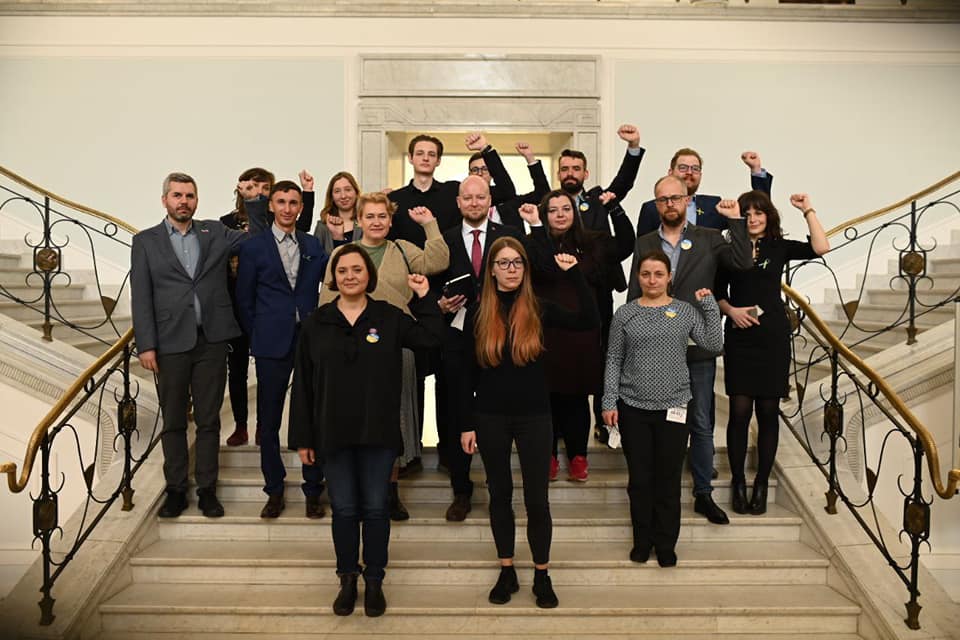
    We, Ukrainian researchers, artists, political and labour activists, members of civil society stand in solidarity with the people of Palestine who for 75 years have been subjected and resisted Israeli military occupation, separation, settler colonial violence, ethnic cleansing, land dispossession and apartheid. We write this letter as people to people. The dominant discourse on the governmental level and even among solidarity groups that support the struggles of Ukrainians and Palestinians often creates separation. With this letter we reject these divisions, and affirm our solidarity with everyone who is oppressed and struggling for freedom.
    As activists committed to freedom, human rights, democracy and social justice, and while fully acknowledging power differentials, we firmly condemn attacks on civilian populations – be they Israelis attacked by Hamas or Palestinians attacked by the Israeli occupation forces and armed settler gangs. Deliberate targeting of civilians is a war crime. Yet this is no justification for the collective punishment of Palestinian people, identifying all residents of Gaza with Hamas and the indiscriminate use of the term “terrorism” applied to the whole Palestinian resistance. Nor is this a justification of continuation of the ongoing occupation. Echoing multiple UN resolutions, we know that there will be no lasting peace without justice for the Palestinian people.
    On October 7 we witnessed Hamas’ violence against the civilians in Israel, an event that is now singled out by many to demonize and dehumanize Palestinian resistance altogether. Hamas, a reactionary islamist organization, needs to be seen in a wider historical context and decades of Israel encroaching on Palestinian land, long before this organization came to exist in the late 1980s. During the Nakba (“catastrophe”) of 1948, more than 700,000 Palestinians were brutally displaced from their homes, with entire villages massacred and destroyed. Since its creation Israel has never stopped pursuing its colonial expansion. The Palestinians were forced to exile, fragmented and administered under different regimes. Some of them are Israeli citizens affected by structural discrimination and racism. Those living in the occupied West Bank are subjected to apartheid under decades of Israel’s military control. The people of the Gaza Strip have suffered from the blockade imposed by Israel since 2006, which restricted movement of people and goods, resulting in growing poverty and deprivation.
    Since the 7th of October and at the time of writing the death toll in the Gaza Strip is more than 8,500 people. Women and children have made up more than 62 percent of the fatalities, while more than 21,048 people have been injured. In recent days, Israel has bombed schools, residential areas, Greek Orthodox Church and several hospitals. Israel has also cut all water, electricity, and fuel supply in the Gaza Strip. There is a severe shortage of food and medicine, causing a total collapse of a healthcare system.
    Most of the Western and Israeli media justifies these deaths as mere collateral damage to fighting Hamas but is silent when it comes to Palestinian civilians targeted and killed in the Occupied West Bank. Since the beginning of 2023 alone, and before October 7, the death toll on the Palestinian side had already reached 227. Since the 7 of October, 121 Palestinian civilians have been killed in the occupied West Bank. More than 10,000 Palestinian political prisoners are currently detained in Israeli prisons. Lasting peace and justice are only possible with the end of the ongoing occupation. Palestinians have the right to self-determination and resistance against Israeli’s occupation, just like Ukrainians have the right to resist Russian invasion.
    Our solidarity comes from a place of anger at the injustice, and a place of deep pain of knowing the devastating impacts of occupation, shelling of civil infrastructure, and humanitarian blockade from experiences in our homeland. Parts of Ukraine have been occupied since 2014, and the international community failed to stop Russian aggression then, ignoring the imperial and colonial nature of the armed violence, which consequently escalated on the 24th of February 2022. Civilians in Ukraine are shelled daily, in their homes, in hospitals, on bus stops, in queues for bread. As a result of the Russian occupation, thousands of people in Ukraine live without access to water, electricity or heating, and it is the most vulnerable groups that are mostly affected by the destruction of critical infrastructure. In the months of the siege and heavy bombardment of Mariupol there was no humanitarian corridor. Watching the Israeli targeting the civilian infrastructure in Gaza, the Israeli humanitarian blockade and occupation of land resonates especially painfully with us. From this place of pain of experience and solidarity, we call on our fellow Ukrainians globally and all the people to raise their voices in support of the Palestinian people and condemn the ongoing Israeli mass ethnic cleansing.
    We reject the Ukrainian government statements that express unconditional support for Israel’s military actions, and we consider the calls to avoid civilian casualties by Ukraine’s MFA belated and insufficient. This position is a retreat from the support of Palestinian rights and condemnation of the Israeli occupation, which Ukraine has followed for decades, including voting in the UN. Aware of the pragmatic geopolitical reasoning behind Ukraine’s decision to echo Western allies, on whom we are dependent for our survival, we see the current support of Israel and dismissing Palestinian right to self-determination as contradictory to Ukraine’s own commitment to human rights and fight for our land and freedom. We as Ukrainians should stand in solidarity not with the oppressors, but with those who experience and resist the oppression.
    We strongly object to equating of Western military aid to Ukraine and Israel by some politicians. Ukraine doesn’t occupy the territories of other people, instead, it fights against the Russian occupation, and therefore international assistance serves a just cause and the protection of international law. Israel has occupied and annexed Palestinian and Syrian territories, and Western aid to it confirms an unjust order and demonstrates double standards in relation to international law.
    We oppose the new wave of Islamophobia, such as the brutal murder of a Palestinian American 6-year old and assault on his family in Illinois, USA, and the equating of any criticism of Israel with anti-Semitism. At the same time, we also oppose holding all Jewish people all over the world accountable for the politics of the state of Israel and we condemn anti-Semitic violence, such as the mob attack on the airplane in Daghestan, Russia. We also reject the revival of the “war on terror” rhetoric used by the US and EU to justify war crimes and violations of international law that have undermined the international security system, caused countless deaths, and has been borrowed by other states, including Russia for the war in Chechnya and China for the Uyghur genocide. Now Israel is using it to carry out ethnic cleansing.
    Call to Action
    We urge the implementation of the call to ceasefire, put forward by the UN General Assembly resolution.
    We call on the Israeli government to immediately stop attacks on civilians, and provide humanitarian aid; we insist on an immediate and indefinite lifting of siege on Gaza and an urgent relief operation to restore civilian infrastructure. We also call on the Israeli government to put an end to the occupation and recognise the right of Palestinian displaced people to return to their lands.
    We call on the Ukrainian government to condemn the use of state sanctioned terror and humanitarian blockade against the Gazan civilian population and reaffirm the Palestinian people’s right to self-determination. We also call on the Ukrainian government to condemn deliberate assaults on Palestinians in the occupied West Bank.
    We call on the international media to stop pitting Palestinians and Ukrainians against each other, where hierarchies of suffering perpetuate racist rhetoric and dehumanize those under attack.
    We have witnessed the world uniting in solidarity for the people of Ukraine and we call on everyone to do the same for the people of Palestine.
    Signatures:
    1. Volodymyr Artiukh, researcher
    2. Levon Azizian, human rights lawyer
    3. Diana Azzuz, artist, musician
    4. Taras Bilous, editor
    5. Oksana Briukhovetska, artist, researcher, University of Michigan
    6. Artem Chapeye, writer
    7. Valentyn Dolhochub, researcher, soldier
    8. Nataliya Gumenyuk, journalist
    9. John-Paul Himka, professor emeritus, University of Alberta
    10. Karina Al Khmuz, biomedical engineer programmer
    And more than 100 others.
  • The Claim that Hamas’ Military Center is Under Gaza’s Biggest Hospital

    The Claim that Hamas’ Military Center is Under Gaza’s Biggest Hospital

    Dar Al Shifa Hospital – CC BY-SA 4.0, https://commons.wikimedia.org/w/index.php?curid=68136302

    On October 19, Ehud Barak, former Israeli Prime Minister, gave an interview to the BBC on its “Newsnight” program in which he said that it was well known that Hamas has its “central command post” under Al Shifa hospital in Gaza and implied Israel would attack it after seeing that all the patients were evacuated to another facility. There’s a recording of the interview at the site Archive.org. You can see it by clicking here and scrolling right until you see Barak’s picture. A transcript of that section of Barak’s remarks is below.

    Barak said, “Every reporter that lives in Gaza or in Israel knows” about the location of this command center. His claim is preposterous and a cover for a likely upcoming large-scale war crime. This illegal alleged act to locate a “command post” underneath Al Shifa hospital has never been reported. If it had been known, it would certainly have led to big exposes in many newspapers and on TV. Hamas is ruling the Gaza Strip and surely has a web of tunnels all over that area, but it’s hard to imagine the doctors and officials of the hospital would allow a command post to be built under the hospital or if they had been threatened to keep silent the facts still would have been leaked out. Barak says that Hamas is cynically using “patients” to protect this command center. As Eli Valley reminds us in a brilliant cartoon, this “human shields” argument has been an Israeli government propaganda trope for many years.

    If in fact the Israeli military believed Hamas had its command center under the hospital, it already would have been attacked many times. The idea that the IDF would wait and then, as Barak says, take out patients, “passing them to another installation,” is a sick joke. Even if the IDF could develop a humanitarian sense, there is no other “installation” to move patients to from Gaza’s biggest hospital. The World Health Organization has said that 12 of Gaza’s 35 hospitals have closed this month. Israel, which routinely bars Gaza Palestinians from Jerusalem in “peacetime,” certainly is not going to allow thousands of injured “children of darkness” as Netanyahu calls them into Israeli hospitals.

    The whole thing should bring to mind what happened in Iraq in 1991 when the United States bombed the Amiriya shelter. The U.S. military claimed it was a “command and control center,” but in fact it was a well-known civilian shelter. Hundreds were gruesomely killed. An attack on Gaza’s biggest hospital to destroy a supposed underground shelter would take bombs of huge power and likely kill multiples of those killed in that Baghdad shelter. On Democracy Now! on October 24, Sherif Kouddous said the Al Shifa hospital is designed for 700 people, but was treating 5,000 with many on the grounds outside hoping proximity to the hospital would bring them safety.

    On October 28, the Israeli military command openly made the charge at a press conference. According to the New York Times, “It said that Al Shifa conceals underground command centers for Hamas.” The Times reported that Rear Adm. Daniel Hagari, the chief spokesperson for the Israeli military, claimed that Hamas “does its command and control in different departments of the hospital.” The only “proof” offered were photos from the air of Al Shifa with drawings made by the IDF superimposed. The Times article also estimated that 60,000 Palestinians were sheltering around Shifa hospital.

    On October 30, Dr. Mads Gilbert, a Norwegian doctor who worked in Gaza hospitals in many of the recent wars, was asked about the charge on Democracy Now! He said:

    I will ask President Netanyahu to put on the table the proofs and the evidence that there is a control and command center for the Palestinian resistance in Shifa Hospital. We have heard these claims since 2009. We have twice been threatened to leave Shifa Hospital, in 2009 and 2014, because the Israelis were going to bomb it because it was a command center. Now, I have been working in Shifa for … 16 years on and off, in very hectic periods…. I’ve been able to walk freely around. I take lots of pictures. I video, film. I’ve been sleeping in the hospital during bombardment. I’ve been all over. I’ve never been restricted, controlled. Nobody has ever controlled my picture and documentation material. So, …, if there is a command center, show us. You have pictures and X-ray films of all Gaza, all the tunnels, everything. So, why is it that these 16 years of threats that Shifa is a command center has not been given any evidence at all that it de facto is? Now, if it was a military command center, I would not work there, because I obey to the Geneva Convention, number one.

    One also wonders why the IDF, if it really believed that Hamas had its center under the hospital, would be openly proclaiming this top bit of “intelligence” and giving Hamas commanders an opportunity to slip away.

    Relevant portion of BBC transcript:

    Barak: I know that no Israeli general would give an order to attack a hospital and no pilot will launch a weapon into a place he knows is a hospital. 

    Interviewer Emir Nader: They may well be right. You may well be right, but the reason why so many people find it credible that they can believe this is because schools have been hit. Numerous hospitals have been told by the Israeli army to be evacuated ahead of a strike because it is a potential target.

    Barak: I don’t know to what extent the viewers of the BBC know that the central command post of the Hamas in Gaza Strip is where it is you believe. It’s in a bunker underneath the Shifa Hospital. The biggest hospital in the Gaza Strip is the place under which they buried their command post in order to be protected by those patients.

    Emir Nader: That’s a very strong claim and we have to take your word for it, the Israeli army’s word for it, because you’re the only people saying that, and it could be used to justify a very, very devastating attack on one of the most important places, humanitarian places within Gaza.

    Barak: So first of all, it’s a matter of facts. It’s known to everyone who knows the Middle East. Every reporter that lives in Gaza or in Israel knows that the command post of the Hamas in the Gaza Strip is underneath.

    Emir Nader: We have not heard that, we’ve not heard that. No one outside of the Israeli army is saying that.

    Barak: I am happy to be the first to tell you, but it’s deliberate. It’s a system that doesn’t care about their own citizens, So we are facing a tough and shrewd rival, but we are determined to destroy it, and we will do and it will take.

    Emir Nader: So you think you’re going to attack the Shifa Hospital? Do you think that’s what’s next? Because this language is extremely…It’s laying the ground for any humanitarian position in the Gaza Strip to be leveled. …nowhere’ s safe.

    Barak: Believe me it’s more complicated. So I can promise you that we will never attack the hospital as it’s full with patients who are there, in spite of knowing that it’s deliberately underneath the hospital, but I cannot promise you for sure that at a certain point we won’t impose a kind of taking the patients out and passing them to another installation where they can be treated safely and then they destroy the command post of Hamas.


  • Gaza, the West, and the Rest

    Gaza, the West, and the Rest

    [Editors’ note: A major American liberal daily solicited from Gilbert Achcar an article about the ongoing Gaza war, but ended up rejecting his submission as “not a good fit for us.”]

    Since Hamas’s October 7 assault across the fence that surrounds the Gaza Strip, that open-air prison holding 2.3 million inmates, a flood of horror has invaded the world’s TV screens. Scenes of slaughter across the fence were soon surpassed by scenes of massacre within. The killing of Israelis (close to 1,400) stopped with the end of Hamas’s incursion by the end of the same day, bar the small number of victims of later rockets launches from Gaza and the unknown fate of the Israeli hostages. The mass murder of Palestinians by the intensive bombing of urban civilian concentrations within Gaza has been increasing at high speed ever since October 7, with bodies piling up in thousands upon thousands at a frightening rhythm.

    Hamas is known to believe that all Israeli citizens of voting age are responsible for their state’s oppression of the Palestinian people, invoking a highly reprehensible notion of “collective responsibility.” The killing of non-combatant people is a crime—not only the murder of civilians indeed, but also the killing of surrendering soldiers and war prisoners. The same notion of “collective guilt” has obviously been guiding Israel’s successive sequences of bombing of the Gaza Strip since its army evacuated it in 2005. Over the past fifteen years until the eve of October 7, the ratio of Israeli to Palestinian fatalities was 1/20.8 according to UN figures. Applied to the present situation, this ratio would lead to the killing of over 29,000 Palestinians. There are legitimate fears that the final toll may be even worse.

    Statements made by Israeli officials have gone out of bounds. Minister of defense Yoav Gallant’s sinister announcement caused a stir: “I have ordered a complete siege on the Gaza Strip. There will be no electricity, no food, no fuel, everything is closed…. We are fighting human animals and we are acting accordingly.” An open violation of international law constitutive of a war crime was thus being justified by dehumanizing a whole population. Israeli president Isaac Herzog blatantly invoked collective responsibility: “It is an entire nation out there that is responsible. It’s not true this rhetoric about civilians not aware, not involved. It’s absolutely not true. They could have risen up, they could have fought against that evil regime….” By a tragic irony, this statement, which Herzog later tried to walk back, replicates Hamas’s line of argument with yet lesser validity since Israelis elect their government whereas Gazans don’t.

    Can one imagine Western leaders making such statements after a terrorist attack on their territory? Could George W.  Bush have said about the Afghans, in the wake of 9/11, that their entire nation is responsible because they could have kicked out Usama bin Laden and his men or risen up against the Taliban who hosted them? Could the U.S. president have decreed a total blockade of Afghanistan while calling its people animals? Why then were such statements tolerated, when not straightforwardly condoned, by Western leaders in their profusive expressions of unconditional solidarity with Israel in the wake of October 7? The only possible explanation is also related to collective guilt, this time as a self-accusation. The participation in the destruction of European Jews as well as the lack of action to prevent it have become the original sin of the Euro-Atlantic West, born as a geopolitical entity in the aftermath of World War Two.

    This original guilt has been weaponized by the Israeli state from the prelude to its foundation in 1948 until today. It has been intensively used immediately after October 7, especially in the statement that it constituted the bloodiest day for Jews since the Holocaust, a description that became rapidly ubiquitous in Western media. The obvious function of this characterization is to establish a continuity between Nazism and Hamas—“modern-day Nazis” in the words of Israel’s ambassador to the UN—and by the same token between Nazi Germany and Gaza. This is indeed the perception that has been dominant in the West. It is based on a distortion of reality: most Israelis killed on October 7 were Jews. That much is true. But they were not a persecuted minority systematically exterminated by a mighty state that occupied most of Europe, but members of a privileged majority in an apartheid state that has been occupying the West Bank and Gaza for 56 years, inflicting upon their population a continuum of oppression. Add to this that this state is ruled by a far-right government that includes neo-Nazi ministers and you will realize how incongruous the analogy of October 7 with the Holocaust is.

    There is the West and there is the rest. Most of the world—especially in the Global South, as reflected at the emergency session of the UN general assembly—sees the Israel-Palestine issue from a very different perspective: not as a continuation of World War Two but as a continuation of the long history of colonialism. They see Israel as a settler-colonial state, the outcome of a colonization process that is still ongoing in the West Bank. They see the Palestinians as victims of colonialism, desperately fighting against a much more powerful colonizer in a disproportion of forces that is closer to that of European invasions of North America or Australasia than to those of other colonial territories. And they therefore see Hamas’s deed as one more instance of those indiscriminate excesses of violence with which the history of anticolonial struggle is scattered, excesses that pale in comparison with the much heavier toll of colonial violence.

    The discrepancy between the West and the rest is aggravated by the fact that not only did Western governments express their compassion for the Jewish victims of October 7 while dismissing, if not condemning, any hint at the context—the fact that Hamas’s attacks “did not happen in a vacuum” as UN Secretary-General António Guterres put it, eliciting a call for his resignation from the Israeli ambassador. They also appeared as condoning the war crimes that Israel’s government had embarked on, starting with the blockade imposed on Gaza’s population, its forced displacement and the bombing of vast swathes of urban civilian agglomeration in the strip. As former senior U.S. and U.N. official Jeffrey Feltman put it: “What better way to reinforce perceptions in the so-called Global South of American double standards than comparing Washington’s condemnation of Russian destruction of Ukrainian civilian architecture with Washington’s relative silence about Israel’s destruction of Gazan civilian infrastructure?”

    It is thus that Gaza has come to epitomize more than any conflict in modern history the dichotomy between the global North and South, as well as a “clash of civilizations” that turns out to be a clash of barbarisms. This is extremely serious, for it exacerbates tensions that translate in the spillover of conflicts from South to North—a blowback of which the 9/11 attacks remain the most spectacular manifestation, to this day. As everybody knows, 9/11 unleashed in return a cycle of U.S.-led wars in the Global South with devastating consequences for Afghanistan and Iraq and beyond. There is no way to prevent this bloody spiral from escalating in intensity and scope other than the observation and enforcement of international law and the demonstration of qualitatively equal and quantitively proportional consideration for all victims—be they Jews or Ukrainians or Palestinians.

  • Poland: Women, youth mobilize in election to defeat reaction

    Poland: Women, youth mobilize in election to defeat reaction

    Poland’s October 15 parliamentary elections have ended the eight-year rule of the incumbent Law and Justice (PiS) party and the United Right (ZP) political alliance centered on it.

    The election had the highest turnout in the history of the Third Republic of Poland, at 73.38%.

    This result was due to the mobilization of young people and women, especially in the large cities: they were much more inclined to support candidates of the democratic opposition parties.

    On election day, the most frequent scenes on Polish media were the queues at polling stations, lasting in some places until the early hours of the following morning (in Wrocław, voting ended at 3am). The scene was similar abroad, with social media circulating pictures of queues in front of Polish embassies and consulates around the world, from Tbilisi to New York.

    In the background to this outpouring lay the social movements that have swept Poland in recent years, notably the mass protests against the Constitutional Tribunal ruling limiting grounds for abortion. These engulfed the whole country and were very noticeable in the small towns that have been PiS strongholds.

    The massive movement to help Ukrainian refugees at the start of the Russian invasion was likewise important, as has been the longer-term growth of secularization — the drop in the number of young people attending religious classes in schools.

    Pre-election situation

    PiS traces its origins to the Solidarity (Solidarność) movement. Originally it had a socially conservative and Christian democrat ideological profile, but Catholic-nationalist, Polish-sovereigntist and even moderately Eurosceptic currents have recently emerged within it.

    A big part of PiS’s previous successes were its social commitments including 500 zloty (PLN500/$A187) a month for each child — rising to 800 zloty from January 1, 2024, the introduction of 13th and 14th month pension payments, and a rise in the minimum wage.

    PiS politicians also portrayed themselves as champions of energy sovereignty (especially more coal mining), finance sector renationalization and ending the privatization of state assets.

    In many cases PiS promises ended up as mere rhetoric, notably in a failure to implement an effective housing program (the Polish housing gap is 1‒2 million units) and respond to the demands of parents raising adult children with disabilities.

    Although there has recently been less worker protest in Poland, the demands of teachers, civil servants and, especially, miners, also went unmet.

    Candidates

    The right. Beside PiS, the ZP camp consisted of Sovereign Poland, representing a more national-Catholic electorate hostile to abortion, euthanasia, LGBTQ+ rights, immigration and “the impositions of Brussels”, the less extreme Republican Party and Renewal of the Polish Republic, and Polish Affairs and Kukiz`15, seat-winning tools for individual right-populist politicians.

    The center. The opposition Civic Coalition (KO) was centered on Civic Platform, led by former prime minister and European Council president Donald Tusk. It brought together center-right and liberal forces, along with smaller center-left groupings, including the Greens. KO’s most surprising acquisition was the agricultural trade union AGROunia, famous for its colorful anti-government actions.

    The “Third Way”. The new Poland 2050 grouping, led by former Catholic journalist Szymon Hołownia, initially challenged KO in many polls. However, with support declining, it formed the Third Way coalition with the center-right, agrarian Polish People’s Party. This alliance emphasized free-market demands, although its voters and activists had diverse positions on these and other issues like abortion.

    Social democracy and the left. This was represented by New Left. Formed as a result of the merger of the post-communist Democratic Left Alliance and the social-liberal Spring, its list also included Left Together, the most left-wing grouping in mainstream Polish politics.

    Far right. The far-right Confederation presented as a “third force” in opposition to both PiS and KO. In early polling its anti-Ukrainian, anti-immigrant and anti-social welfare message gained around 15% support. However,  ratings soon began to fall and this “technical party”, composed of the libertarian-conservative New Hope, the nationalist National Movement and the Catholic-monarchist Confederation of the Polish Crown, failed to recover from its candidates’ statements on eating dogs, disenfranchising women, supporting Russia and downplaying pedophilia.

    Others. This panorama was completed by Non-Partisan Local Government People, the anti-vax and conspiracy theorist party There Is One Poland, the German Minority Electoral Committee and a gaggle of regional far-right groupuscules.

    Campaign themes

    The election campaign started long before officially announced, with PiS trying to find “catchy” themes to enthuse voters. A tour of the country by leader Jarosław Kaczynski’s featured transphobic jokes, allegations of EU technocrats ordering that insects replace meat on Polish tables and mobilizations defending the honor of late Pope John Paul II, allegedly slandered by a documentary producing evidence that he had done nothing about cases of pedophilia of which he was aware.

    PiS also returned to the anti-immigrant rhetoric, in particular the tragic situation on the Polish-Belarusian border. PiS ministers declared that Poland “will not be a second Lampedusa”, painted Tusk as facilitating the Islamization of Europe, launched a hate campaign against the film Green Border (about a Syrian family and an Afghan woman trying to enter Poland via Belarus) and even introduced temporary border controls at the crossings with Slovakia, the Czech Republic and Lithuania.

    Yet this narrative was shattered by the cash for visa scandal, in which Polish consulates were found to be charging up to $US5000 for facilitating visa applications in Asian and African countries.

    Other tactics included: stirring anti-Ukrainian prejudice over imports of cheaper Ukrainian grain (PiS prime minister Mateusz Morawiecki threatened that temporary rights for Ukrainian refugees to social benefits could lapse and Poland no longer arm Ukraine); defense (the KO were branded as “traitors” soft on Russia); and bribes in the form of pension increases, handouts to voluntary organizations and a discount price for state-owned Orlen petrol.

    The opposition relied on mobilizations, including KO’s half-million strong June 4 march (anniversary of the first partially free elections in 1989) and the October 1 Million Hearts March called in response to the detention of a Krakow woman for taking the morning-after pill (more than a million attended).

    Results

    PiS won 35.38% (194 seats in the 460-seat Sejm), KO 30.7% (157 seats), Third Way 14.4% (65), the New Left 8.61% (26) and Confederation 7.16% (18). No other forces passed the 5% threshold.

    PiS lost support even in districts that traditionally favor it and several well-known ruling party politicians lost their seats.

    The Left also lost 23 of its 49 seats in the Sejm, mainly to KO and Third Way, even while within its caucus Left Together increased from six seats to seven. In the Senate, by contrast, the New Left went from two seats to nine (Left Together from zero to two).

    The far right, while increasing representation, failed because its expected gain had been much higher.

    Thanks to the opposition’s so-called Senate Pact — in each of the 100 Senate districts only one candidate was fielded — it won 66 senators (KO 41, Third Way 11, New Left 9, independents 5) to PiS’s 34.

    PiS was unable to form a government coalition, even with Confederation, and the three democratic opposition groups, with 248 seats in total, declared they would govern together.

    PiS also presented four loaded referendum questions on election day. All failed because participation failed to meet the 50% threshold.

    What next?

    A government formed by KO, Third Way and New Left will have to balance varying interests. Initial announcements include improving relations with the European Union, unblocking money for the National Reconstruction Plan, wage rises for public servants, teachers and health workers, and a halt to the construction of the so-called Central Transport Port, target of local community protest.

    Shops will again open on Sundays, but in return New Left is demanding 2.5 times higher pay for Sunday and public holiday work. Renewable energy’s role will increase (including the construction of a nuclear power plant), as will defense spending.

    Tax policy will be problematic. While the three parties support reinstating tax deductibility for health contributions, they disagree over the tax-free threshold and tax rates on higher incomes (New Left for, KO against).

    Issues like abortion or same-sex partnerships will probably not be part of the coalition agreement but possibly subject of a free vote in the Sejm.

    Stopping illegal pushbacks on the Polish-Belarusian border, reforming the police and a less repressive approach to culture? We will soon find out.


    This piece was originally published on Green Left on Oct. 27, 2023. A detailed version of this article will soon be available on the web site of Links — International Journal of Socialist Renewal

  • The West cannot escape the extension of the Israeli-Palestinian conflict

    The West cannot escape the extension of the Israeli-Palestinian conflict

    For Gilbert Achcar, specialist in the contemporary Arab world at the University of London, the West cannot escape the extension of the Israeli-Palestinian conflict on its lands. But how can we understand this quasi-global solidarity within the Muslim world? Interview.

    The Israeli response to the offensive led by Hamas generated the uprising of a large part of the Muslim world, from Baghdad to Tehran via European capitals. How can we not fear a conflagration in relations between East and West, when the solidarity of Muslims with the Palestinian people is powerfully heard, between peaceful demonstrations of support and acts of terrorism? Elements of response with Gilbert Achcar, professor at the School of Oriental and African Studies (SOAS) at the University of London, specialist in the contemporary Arab world and author of various works on the subject, including The Clash of Barbarisms. The Making of the New World Disorder (2002).

    How should we understand solidarity reactions of the Muslim world after the Hamas attack?

    These reactions highlight the North-South divide that exists in the perception of the conflict in the Middle East. Certainly, the assault carried out by Hamas was particularly violent, but there were similar reactions to September 11. After that absolutely monumental shock, the Western world identified with the United States, as it is doing today with Israel. However, in the countries of the Global South, many people rejoiced at the fact that, for once, the United States had “taken the heat”.

    Is this how Muslim countries feel about Israel today?

    There is, within the Muslim world, a large gap between Arab governments which establish relations with the State of Israel and public opinion, which takes up the cause of the Palestinians. The latter considers, rightly on a historical level, that in Palestine, the victims are not the Jews, but the Palestinians. In the world of European culture, people tend to see Jews as victims because of the incomparable historical horror that was the Shoah. And they tend to project this same reading grid onto current events.

    And that isn’t the case?

    References to pogroms and the Holocaust are precisely inadequate. What Hamas did is barbaric. But what Israel constantly does by bombing hospitals, buildings, civilian concentrations, is also barbarism. So, outside the Western world, we do not see Israelis – I am not talking about Jews in general, but Israelis – as victims, but as settlers, protagonists of settler colonialism. We must therefore move away from this Western vision a little and try to see things as others can see them – these others who are the majority of the planet.

    So are we then facing a clash of visions between the Western world and the Global South?

    As I already wrote in the aftermath of September 11, we live in a world where each civilization produces its own forms of barbarism, which depend on its means. The United States committed unspeakable barbarities in Vietnam, Iraq, etc. And the September 11 attacks were eminently barbaric. But, in this clash of barbarities, we cannot be neutral.

    That’s to say?

    We cannot wrap ourselves in a moral attitude that would send everyone back-to-back. This would be unfair, because the main responsibility falls on the strongest, on those who are oppressors. I obviously condemn any act of barbarism. But if we add up, there have been over the years many more Palestinian than Israeli victims. And this is what people in the Muslim world record. And that is why, despite the atrocity of what happened, they continue to see the Palestinians as the fundamental victims.

    Doesn’t the support given to Israel since this attack risk further inflaming tempers?

    Yes, of course, and that is why the Hamas attack is madness. 9/11 was a big blow to America’s arrogance, but it enormously served the administration of George W. Bush, who was previously at rock bottom in the polls. He suddenly found himself with 80% popularity and launched into wars: Afghanistan and Iraq. Members of his administration had been toying with the idea of occupying Iraq for a long time, and Bin Laden offered them the perfect opportunity. We are seeing the same thing today: Netanyahu, who was against the withdrawal from Gaza in 2005 and who resigned from the Israeli government for this reason, will now be leading a new occupation of Gaza. This is clearly his plan, but this time with a massive and forced displacement of the population, which he wishes to push across the border into Egyptian Sinai.

    In this spirit of intra-Muslim solidarity, how can we understand that the doors of Egypt remain closed?

    The Egyptians understand very well that Palestinians who leave Gaza will probably not be allowed to return. Everyone has in mind the pattern of what happened in 1948 when the Palestinians fled the fighting. They abandoned their homes, taking their keys with them, because they thought they would return. However, they were never allowed to return and that is how they became refugees. This is exactly what is likely to unfold before our eyes.

    How can we understand that this solidarity is expressed not only in the Muslim world, but also among Muslims in Europe or America?

    Because they come from the colonized world and see things very differently in fact. Obviously, we should not generalize when talking about the West, Muslims, and Jews. There are, for example, in Europe and America, many people of Jewish descent who are very critical of the State of Israel. These people clearly see the paradox: this state was created by military means in 1948 with the ambition of offering a safe haven to Jews. But is there anywhere in the world where Jews are less safe today than in Israel? It is a terrible historical failure.

    How did we get here?

    Since 1967, the West Bank and Gaza have been under occupation. And Israel continues to violate international law and build settlements in the West Bank. It’s an infernal dynamic. But make no mistake: what will happen there will be terrible and will have repercussions on the Israeli population itself, but also on Europe and the United States, which will be regarded as complicit. The international community is guilty of letting the situation deteriorate, starting with the United States which has the most influence over Israel, followed by Europe.

    Therefore, should we expect a resurgence of terrorist attacks?

    I fear this is what awaits us. The cycle of violence in the Middle East has continued to spill over into Europe, and even reached the United States in spectacular fashion in 2001 in what remains the largest terrorist operation in history.

    How can we prevent this conflict from spreading to our country?

    Maybe I’m naive or idealistic, but I believe in international law. I believe that the UN is a precious achievement for humanity and the only framework that can shape a peaceful world. But the UN charter continues to be violated. Only its integral application can achieve the very reason for which it was conceived: universal peace.

    https://www.chretiens.info/chretiens/chretiens-de-terre-sainte/loccident-ne-saurait-echapper-a-lextension-du-conflit-israelo-palestinien-sur-ses-terres/2023/10/17/17/48/

    https://www.protestinfo.ch/sites/default/files/data/documents/reprise/Achcar_LaTribuneDeGene%CC%80ve_Protestinfo.pdf

    https://www.protestinfo.ch/sites/default/files/data/documents/reprise/Achcar_24heures_Protestinfo.pdf

    https://www.protestinfo.ch/sites/default/files/data/documents/reprise/Achcar_LeCourrier_Protestinfo.pdf


  • An uprising for democracy in Guatemala

    An uprising for democracy in Guatemala

    Maya Kaqchikel dancers perform at the protest outside the public prosecutors’ office after walking for four days from the Chimaltenango department to Guatemala City. Photo: Sandra Cuffe.

    The kitchen tent was bustling with activity as volunteers prepared tortillas, scrambled eggs, doled out portions of beans and cheese, and poured coffee. It was just before eight in the morning at the protest outside the public prosecutors’ office in Guatemala City, where a dedicated crew has been serving Indigenous leaders and other demonstrators around the clock for more than two weeks straight.

    “We have been sleeping here,” said Juana Chávez, gesturing to a little patch of road under the canopy, between piles of equipment and shelves stacked with food supplies. A Maya K’iche member of Oxlajuj Ajpop, an organization dedicated to Mayan spirituality and sacred sites, Chávez has been one of the core kitchen volunteers since day one. “We are here in the resistance,” she told Ojalá proudly of the crew of women and men, young and old, Indigenous and not.

    The Guatemala City protest is part of an Indigenous-led national shutdown now in its third week, with ongoing highway and road blockades around the country, and the threat of an imminent crackdown. People are demanding the resignations of the attorney general and other judicial system operators who are behind the efforts to subvert electoral democracy.

    Outrage against ‘the pact of the corrupt’

    Bernardo Arévalo, a social-democrat congressman and son of the country’s first democratically elected president, won the presidential run-off election on August 20. Since he qualified for the run-off in June, prosecutors have periodically raided election tribunal offices, seized original vote tally sheets, targeted election magistrates, sought to cancel Arévalo’s Semilla party, and continued investigations into various aspects of the electoral process. There is widespread concern that the ultimate aim of the efforts, condemned by everyone from local community associations to the UN Secretary-General, is to prevent Arévalo from taking office in January.

    “They want to carry out a technical coup d’état,” said Mynor Say, a Maya K’iche authority from the village of Vázquez in Totonicapán, during a march in Guatemala City. “We are seeing that democracy is being undermined in Guatemala.”

    Indigenous authorities—elected autonomously by their communities—from Totonicapán and around the country called the shutdown, and their representatives have maintained a permanent presence in the capital. The mass actions began as dawn broke on October 2, when thousands of people began gathering along the Pan-American and other highways in Guatemala. The shutdown is categorically non-partisan; people are defending democracy, not Arévalo or his party.

    Thousands of vendors from markets all over Guatemala City march to the public prosecutors’ office in support of the demands of Indigenous authorities. Photo: Sandra Cuffe.

    The number of highway and road blockades has constantly fluctuated up and down, ranging from a dozen to more than 150, peaking on October 9. Since then, many have let up, some periodically let traffic through, and a few have been evicted by police. Groups of armed men have also intimidated or attacked several blockade actions, in a few cases opening fire and injuring demonstrators. A protester, Francisco Gonzalo Velásquez, was killed on October 16 when gunmen attacked a blockade in the municipality of Malacatán, near the Mexican border.

    Interior Minister Napoleón Barrientos resigned the evening of October 16, citing “the complexity of the current situation in which the country finds itself” in his resignation letter. In charge of the national police force, he had been under pressure to crack down on the protests. Prosecutors filed a court motion earlier that day seeking to force his removal for failing to do so.

    On October 18, the Constitutional Court ordered police to take action and “enable full access” to all locations of the public prosecutors’ office within six hours. The court also ordered the military to assist if necessary. The protest outside the Guatemala City headquarters is not obstructing employee access, but protesters expect a crackdown.

    The convoluted latest chapter in a long-simmering crisis did not come out of nowhere. When Arévalo unexpectedly made it to the run-off and then won, “we saw this coming,” said Angelina Aspuac, coordinator of the National Movement of Maya Weavers. “State institutions today are coopted,” she told Ojalá at the protest outside the public prosecutors’ office.

    After a few years of groundbreaking criminal cases that saw former heads of state stand trial for genocide and corruption, a backlash campaign began around 2017 and has not stopped since. The government shuttered a UN-backed anti-impunity commission. Dozens of judges and prosecutors facing criminalization and threats were forced into exile. An informal multi-partisan ruling alliance commonly known as the “pact of the corrupt” stacked the Constitutional Court, the ultimate check and balance on power. Supreme Court and appeals court magistrates have now been in office four years beyond their five-year terms.

    “They see Bernardo Arévalo as a threat because he is a dissident voice in this whole process of corruption,” Aspuac said of the alliance that effectively controls all three branches of government. “Now they want to prevent him from taking office at all costs.”

    Joy and hope on the front lines

    In spite of the democratic backsliding and attacks against blockades, the actions have also been celebrations of resistance, with music, dancing, art, ceremonies, piñatas, and other activities. Communities have been caravaning and even arriving on foot to support blockades in the highlands and capital, taking turns to keep the actions going strong. Every day, different old US school buses painted in vivid colors are parked behind the public prosecutors’ office.

    Around the corner, doctors set up tables and boxes filled with medications and supplies every morning at a makeshift medical aid station, an all-volunteer initiative that got started toward the end of the first week of the protest. Every day, the team provides medical attention to roughly 350 people, among them Indigenous authorities, protesters, neighborhood residents, and anyone else who shows up. Some of the most common ailments they see are respiratory infections, diarrhea, and skin infections, according to Carlos Díaz, one of the volunteer doctors.

    At the medical aid tent outside the public prosecutors’ office, doctor Carlos Díaz bandages the feet of a Kaqchikel woman who marched for four days to Guatemala City. Photo: Sandra Cuffe.

    “We responded to the call of the Maya authorities to resist,” Díaz told Ojalá, adding that they too will remain until the clamor of the people’s struggle is heard. “Our way of protesting against the government, against corruption, against shortages, is providing health to the people.”

    Beyond the stationary protests and support organizing, marches snake through the capital on a near-daily basis. Diverse sectors have been mobilizing, and market tenants and vendors have been especially active. One of their biggest marches involved thousands of people from dozens of markets, filling multiple city blocks. Alicia Portillo, a clothing vendor at the San Martín market, told Ojalá no one can remember there ever having been such a united mass movement across markets in the city.

    “We’re showing that democracy really matters to us,” José Pérez, who sells jewelry at the El Tierrero market in another zone of the capital, shouted over the ear-splitting din of plastic noisemakers. Market closures are affecting him and so many others who live day to day, he said, “but it is better to stop work to support the people because we show that everybody united can create change and make a difference.”

    The march ended with a show of support for Indigenous authorities at the protest outside the public prosecutors’ office, where —as at other actions around the country— people vow they will remain until the attorney general and others resign. “I don’t think their resignations would resolve the situation, but it would be a step,” said Aspuac. “We don’t have much hope in this state. Nevertheless, we can’t remain silent.”


    This article originally appeared on Ojalá, Oct. 18, 2023


  • Iranian Progressives Respond to Israel’s Genocidal Assault on Palestinians

    Iranian Progressives Respond to Israel’s Genocidal Assault on Palestinians

    Photo by Naaman Omar, AP images

    [Editors’ Note: This statement from Iranian progressives indicates that Hamas’s October 7 assault on Israeli civilians was “planned with the Iranian government’s extensive training and support.” We take this to refer to the well-documented Iranian government military support for Hamas, not direct planning of the Hamas attack. The New York Times reports that “The United States, Israel and key regional allies have said they have not found evidence in early intelligence gathering that Iran directly helped plan the attack.”]

    Iranian progressives strongly condemn Israel’s bombing of the people of Gaza. While they emphasize the genocidal character of the Israeli siege of Gaza, they also strongly condemn Hamas’s October 7 assault on Israeli civilians, planned with the Iranian government’s extensive training and support.

    ***

    A majority of the Iranian public who oppose their own government know that for the past four decades the Islamic Republic has instrumentalized the plight of the Palestinians for its own authoritarian purposes. Nevertheless, they feel a deep sympathy with the Palestinian people in their struggle for national self-determination against Israeli occupation.

    Iranian progressives,  strongly condemn Israel’s bombing of  the people of Gaza. While they emphasize the genocidal character of the Israeli siege of Gaza, they also strongly condemn Hamas’s October 7 assault on Israeli civilians, planned with the Iranian government’s extensive training and support.

    The Association for Iranian Studies wrote:

    As academics, we have a moral obligation to counter hate speech and hate-acts and to work toward peace, tolerance and justice. Sometimes, it is difficult to know how to compare different experiences of suffering or to mete out justice, but one thing is certain: Endless cycles of oppression, violence and hate only derail and delay the possibility of a peaceful future. (Association for Iranian Studies, 2023)

    Most Iranian progressives have learned lessons from the 1979 Iranian Revolution when a religious fundamentalist, authoritarian and misogynist organization was allowed to represent the aspirations of the masses. They do not wish this on the Palestinian masses.

    F. Dashti, a writer for Zamaneh, a Persian-language website in Holland with writers inside Iran, wrote: “Of course the Israeli Palestinian issue is very complicated. . . If only these two main elements were involved, perhaps the situation would not become so complicated. However, there are others behind the scene or sometimes on the stage who establish themselves with utterly different interests and calculations. The changes that they have brought about and their occasional ruses for appearing on one side and then on the other, make everything more complicated.” (Dashti, 2023)

    Khosrow Sadeghi-Borujeni, a labor and social welfare researcher in Iran, writes about Israel’s role since 1987 in propping up Hamas as an alternative to the more secular Palestinian nationalist leaders. He cites Adam Hanieh, a Jordanian political economist, on Hamas’s torture and murder of Palestinian leftists, and its promotion of misogyny and capitalist exploitation. Borujeni concludes that “if these realities and interactions of existing forces in the field of struggle are not taken into consideration, the legitimate defense of Palestine and the violence of a captive people will only lead to a greater human toll and will be a pretext for further repression of the people of Palestine and Lebanon, in the interest of the U.S. and Israel. Therefore, a force that is itself part of the problem and which has itself benefited from this problem for decades, cannot take forward steps in the pathway toward solving the problem.” (Sadeghi-Borujeni, 2023)

    A recent statement issued by several Iranian socialist organizations in exile is entitled, “The People of Palestine and Israel Will Not Benefit from This Reactionary War.” This statement argues that “in the past few years, with the ‘Abraham Accords’, reactionary Arab governments have promoted open reconciliation with Israel, which has endangered the position of Hamas, Islamic Jihad, Hezbollah and the Islamic Republic in confronting Israel.” Thus, the Islamic Republic of Iran “needs this war and is one side of these politics of war promotion.” (Rahe Kargar, 2023)

    Many activists inside Iran are also deeply concerned about the Islamic Republic’s instrumentalization of the Palestinian cause and its use of pro-Palestinian rhetoric to cover over its intensifying repression at home. While the Iranian government speaks about the suffering of the Palestinian people under Israeli colonialism, it continues to crack down on Iran’s national minorities such as the Kurds, many of whom have been executed simply for believing in the Kurdish right to self-determination. Kurdish activists who have fled to northern Iraq’s Kurdistan Regional Government to seek refuge in Kurdish opposition party camps are now being pushed out under Iranian government pressure.  Most recently, a prominent Iranian filmmaker,  Dariush Mehrjui and his wife,  Vahideh Mohammadifar,  a screenwriter were stabbed to death in their home in a manner similar to various other dissident intellectuals in the past few decades.  Prior to his assassination,  Mehrjui had challenged the Ministry of Culture in a videotaped message against censorship.  (Najafi, 2023)

    S. Shams, a reporter from Zamaneh writes: “It seems that a deep dialogue to build solidarity between Iranian and Palestinian fighters does not exist. With the exception of a letter from some Palestinian artists at the beginning of the Zhina Uprising [the Woman, Life, Freedom movement] in defense of Iranian freedom fighters, we have not seen any other clear stances expressed about current struggles inside Iran, and often it seems that Palestinian activists are evasive when it comes to talking about issues in Iran.” (Shams, 2023)

    In response, a Palestinian Boycott, Divestment, Sanctions activist states: “The state of constant war severely limits free speech. The Palestinian people are under pressure. They live and struggle in a complicated situation and cannot easily criticize anyone.” (Shams, 2023 )

    While the pressures that the Palestinian people face are immense, and Israel’s latest invasion of Gaza is becoming bloodier and more destructive by the day, the possibility of this war becoming a massive regional war with the intervention of Iran and its proxy militia groups is very real.

    Iranian progressives are with the Palestinians in their struggle against genocide. However, they also want to make sure that the Iranian government does not take advantage of this war to extinguish the Woman, Life, Freedom movement that emerged in Iran last year as a struggle for women’s rights, the rights of oppressed minorities and labor rights. They do not want the world to forget that Narges Mohammadi, an Iranian feminist human rights activist who is incarcerated, was awarded the Nobel Peace Prize for her courageous struggle for women’s rights and against the death penalty.

    Iranian progressives want to express their solidarity with the Palestinian struggle on the basis of a life-affirming vision that challenges religious fundamentalism, authoritarianism, colonialism, imperialism, racism, misogyny, homophobia and class exploitation. (Statement of Minimum Demands, 2023)

    References:

    Association for Iranian Studies. (2023) “AIS Council Statement on the War in Gaza.” October 12.

    Fassihi, Farnaz and Ronen Bergman. (2023) “Invasion Prompts a Renewed Examination of Hamas’s Connections to Iran.” New York Times. October 14.

    Dashti, F. (2023) “Vahshat-e Bitafavoti.” Zamaneh. October 10.

    https://www.radiozamaneh.com/784876/

    Najafi, Elahe. (2023)  “Mehrjui as Aqaz to Farjam.”  Zamaneh.  October 14.  https://www.radiozamaneh.com/785457

    Rah-e Kargar. 2023. “Mardom Felestin va Esrail Hich Manafe’I dar in Jang-e Erteja’I Nadarand.” Rahe Kargar. October 9.

    https://rahkargar.com/?p=23706

    Ramezanian, Ali. (2023).  “Hemayat-e Mali va Taslihati-ye Iran as Hamas Cheqadr Ast?”  BBC Persian,  October 17.  https://www.bbc.com/persian/articles/cprxydnn3v7o

    Sadeghi-Borujeni, Khosrow (2023). “’Madar-e Sefr Darejeh-e’ Khavaremianeh.” Naqd-e Eqtesad-e Siasi. October 11.

    https://pecritique.com/2023/10/11/%d9%85%d8%af%d8%a7%d8%b1-%d8%b5%d9%81%d8%b1%d8%af%d8%b1%d8%ac%d9%87%db%8c-%d8%ae%d8%a7%d9%88%d8%b1%d9%85%db%8c%d8%a7%d9%86%d9%87-%d8%ae%d8%b3%d8%b1%d9%88-%d8%b5%d8%a7%d8%af/

    Shams, S. (2023) “Mobarezeh-e Jahani Aleyh-e Apartaid dar Felestin: Peyvandsazi baraye Azadi-ye Hamegani.” Zamaneh. October 8.

    https://www.radiozamaneh.com/784342/

    Statement of Minimum Demands of Iranian Unions and Civil Society Organizations. February 14, 2023.

    The Statement of Minimum Demands of Independent Iranian Unions and Civil Society Organizations – Iranian Progressives in Translation


    This statement first appeared on Frieda Afary’s blog, Iranian Progressives in Translation, on Oct. 17, 2023.


  • The Rise, Fall, and Rise Again of  School-Based Military Training

    The Rise, Fall, and Rise Again of School-Based Military Training

    A review of Breaking the War Habit: The Debate Over Militarism in American Education, by Seth Kershner, Scott Harding, and Charles Howlett. (University of Georgia Press, 2023).

    In the late 1960s and early 70s, no symbol of university complicity with the Vietnam War aroused more students than military training on campus. Campaigning against the Reserve Officer Training Corps (ROTC) program became a major focus of the anti-war movement. Critics demanded everything from stripping ROTC courses of academic credit to, more popularly, kicking the program off campus. Foot-dragging by college trustees, administrators, and faculty members reluctant to cut ties with the military sparked an escalation of protest activity, from peaceful picketing to more aggressive action. ROTC buildings were trashed, bombed, or set on fire — most famously at Kent State University. There, a May 1970 arson attempt triggered a National Guard occupation that led to the fatal shooting of four students (one of them a ROTC cadet) and then the largest student strike in US history.

    During the Vietnam era, the manpower requirements of the U.S. military were met by conscription, draft-driven enlistments, and volunteers. In the last category were graduates of West Point, other service academies, and private military colleges like the Citadel and VMI. The Department of Defense (DOD) needed far more first lieutenants than these institutions could produce. So a then-fifty year old infrastructure of DOD-funded Military Science Departments at two thousand colleges and universities, around the country, played a critical role in generating the necessary newly commissioned officers.

    When I entered college in 1967, I became one of 250,000 ROTC cadets drilling in uniform, firing guns at the rifle range, and studying military science that year. Two years before, at my alma mater, I would not have had any choice; ROTC enrollment was mandatory for all freshman and sophomore males. Apolitical at the time, I was already the beneficiary of a great class injustice—student deferments which enabled millions of draft age young men to avoid being drafted as long as they maintained their under-graduate or graduate student status. (See Cheney, Dick, the infamous Republican chicken-hawk who got six such deferments prior to reaching the safe age of 26 in 1967).

    But, even with college attendance providing draft protection for four years, there was still the need for military service contingency planning, post-graduation.  “When you have to go,” we were advised by sage elders. “It’s better to go as an officer than an enlisted man.” Plus, at the small private college I attended, ROTC defenders on the faculty—World War II vets among them–claimed that having a stream of non-military academy graduates with liberal arts backgrounds serving, as army officers, would have a leavening influence on the U.S. military.

    It didn’t take long for most of my freshman ROTC class to conclude that our future citizen-soldiering was unlikely to have such positive impact. No one was enthusiastic about US intervention in Southeast Asia, except our instructor, a gung-ho Army captain recently returned from Vietnam.  His impassioned lectures about fighting “world communism,” there and everywhere, were met with mounting skepticism and derision, leading to a sizeable number of defections after a single semester. I was not the only former cadet who became very active in efforts to abolish the draft, kick ROTC off campus, and end the Vietnam War, in whatever order any of those goals could be achieved, locally or nationally.

    Little Known History

    Our anti-ROTC activism in the Vietnam era was not informed by any knowledge of previous campus or community-based campaigns against military training of students, of the sort described in Breaking the War Habit.  For that little-known back story, New Politics readers can now consult this valuable history of anti-ROTC campaigning, over the last century. It’s co-authors include Seth Kershner, a PhD candidate at the University of Massachusetts, Scott Harding, who teaches at the University of Connecticut, and Charles Howlett, a retired professor of education at Molloy College,

    As they report, the creation of ROTC via the National Defense Act of 1916 did not go uncontested, either before or after World War I. By the mid-1920s, “nearly two-thirds of all universities hosting ROTC had made the program mandatory for at least some of its male students.” So a national Committee on Militarism in Education (CME) was formed in 1925 to seek a Congressional ban on compulsory military training “in any educational setting other than a military school.” Even the conservative AFL-CIO backed this effort. Organized labor warned that the U.S. would soon become a “militaristic nation” if the “propaganda of military sabre-rattlers” was allowed to “make goose-steppers out of the school boys of America” (and potential strike-breakers as well).

    Between the two world wars, CME effectively debunked the notion that ROTC was an innocuous form of “citizenship training” and helped persuade “dozens of colleges and universities to abolish compulsory military instruction.” Its “small cadre of committed individuals—pacifists, educators, socialists, and clergy—believed that, by opposing the militarization of education, they could prevent the formation of the military mindset capable of tipping the nation into another world war.” But the climate for “peace education” was not very favorable in the late 1930s. Many of CME’s own “longtime allies began to view war as the only path to eliminate the threat of fascism” in German, Italy, and Japan. When conscription was re-introduced in 1940 by the Roosevelt Administration, the group folded its tents and disbanded.

    In the post-World War II era, as the authors of Breaking the War Habit note, a victorious United States emerged “as the sole global superpower” but used its rivalry with the Soviet Union to justify the “largest peacetime military establishment in U.S. history.”  The resulting “repressive Cold War atmosphere constrained peace activism throughout the 1950s.”

    All that had changed by 1967, when President Lyndon Johnson escalated U.S. military intervention in Vietnam but did not want to call up either the National Guard or reserve units to fight. His “decision to move nineteen-year-olds to the top of the draft list catalyzed the anti-war movement and sparked a much bigger wave of protest against on-campus military recruiting.”

    ROTC Redux

    That wave peaked during the student strike of 1970, with its widespread targeting of ROTC facilities on campus. By the following spring, when I graduated from college, ROTC enrollment had shrunk to 87,000 and the program had either been evicted from a number of colleges and universities, or forced to shut-down due to declining enrollment. So, like many other former student radicals, I went on to other causes and campaigns, paying very little attention to what became of school-based military training in the era of the “all-volunteer army.”

    As Kershner points out, after US troops were withdrawn from Vietnam and the draft ended in 1973, “high schools became the answer to the Pentagon’s manpower problems.”  While the armed forces beat a strategic retreat from the Ivy League and some elite private colleges, enrollment in public high school Junior ROTC programs (JROTC) mushroomed.

    The DOD began targeting “under resourced schools and low-income communities, where opportunities are limited and young people are susceptible to the military’s promise of career advancement and college benefits.”

    According to a New York Times analysis, “majority minority schools are nearly three times as likely as majority white schools to have a JROTC program.” Nationwide, half a million teenagers now get military training in 3,300 public high schools throughout the country. About 40 percent of the cadets who spend three years in such programs end up enlisting after graduation. This makes JROTC a key component of the Pentagon’s annual struggle to meet its “all-volunteer force” recruitment quotas. 

    JROTC is not promoted as a pipeline to active duty. Rather it’s sold to teachers, parents, and school board members as an opportunity for additional adult mentoring, exposure to military discipline, and inculcation of civic values. Cadets get to drill in uniform, handle weapons, learn military ranks and history, and stand at attention when visitors come to their classes. Their instructors are military veterans certified by the DOD, although many states don’t require them to have either teaching certificates or a college degree. In addition, the DOD leaves day-to-day monitoring of their classroom performance (and after class behavior) to school administrators busy with many other responsibilities.

    That lax oversight has had calamitous results. As the New York Times recently revealed in a major investigative piece, at least 33 JROTC instructors have engaged in sexual misbehavior with young women in the program during the last five years. And that JROTC rap sheet does not even include the “many others who have been accused of misconduct but [were] never charged” or the inappropriate behavior that went unreported because cadets were afraid of jeopardizing their potential military careers.

    Adult Mentoring?

    The front-page revelations sparked outrage from two House members with government oversight functions. In an August, 2022 letter to DOD Secretary Lloyd Austin and the Secretaries of the Army, Navy, and Air Force, US Representatives Carolyn Maloney (D-NY) and Stephen Lynch (D-MA) called incidents of sexual harassment and abuse “completely unacceptable and an abject betrayal of the trust and faith these young men and women placed in the U.S. Military.” The House members specifically demanded to know what action Pentagon leaders are taking in response to the reports, including whether additional oversight of JROTC instructors is being planned “to insure the safety and well-being of cadets.”

    If the DOD’s past response to sexual harassment and assault of women in uniform by fellow soldiers is any guide, its efforts to protect vulnerable teenagers from pre-enlistment exposure to “military culture” will also fall short. The criminal behavior of so many “military science” instructors, implanted in public high schools by the DOD, may have two unintended consequences, however, First, it could give campaigners against such programs a new issue to organize around. Second, as Maloney and Lynch note, negative publicity about JROTC could further dampen enthusiasm for military enlistment.

    Even with the Pentagon dispatching some 20,000 recruiters, spending $1.4 billion every year on 1,400 military recruiting stations, and gaining wide access to high schools throughout the country, only one in ten young people are considering military service. As Major General Edward Thomas, Jr., commander of the Air Force Recruiting Service, says of that polling result, “There are just lower levels of trust with the U.S. government and the military.” By June of 2022, for example, the Army had only 40 percent of the 57,000 new soldiers it needed to signed up by last fall — so it began offering enlistment bonuses as high as $50,000.

    In addition, three-quarters of the 17 to 24-year-olds targeted by recruiters have disqualifying conditions like no high school diploma, a criminal record, chronic obesity, or some other physical or mental health problem that renders them ineligible to serve without a special waver. Among those in the last category are some of the damaged survivors of Junior ROTC. One, profiled by the Times, is Victoria Bauer from Picayune, Mississippi who wanted to become a Marine before she was sexually assaulted, at age fifteen, by her instructor. To this day, she still wants to know why those ostensibly responsible for defending the US can’t even protect their “own people.”

    Counter-Recruiting

    Activists trying to spare other high school students the traumatic experience that plunged Bauer into depression and self-harm can learn much from the case-studies in Breaking the War Habit and an earlier book by Kershner and Harding called Counter-Recruitment and the Campaign to Demilitarize Public Schools (Palgrave Macmillan, 2016). As anti-JROTC campaigners in Baltimore learned, the hard way, challenging the “school to military pipeline for economically disadvantaged youth” in communities of color requires deft coalition-building. Despite persistent efforts, led by the American Friends Service Committee, foes of military training in Baltimore inner city schools “ultimately failed…because their antimilitarist, ideological messages did not connect with pragmatic school board members and the local community.”

    During an earlier phase of this struggle, Maryland peace activists got critical backing from U.S. Rep Parren Mitchell, a co-founder of the Congressional Black Caucus and the first African-American elected to the House from his state. In a letter to the Baltimore school board, Mitchell acknowledged the need for programs that encouraged young people to stay in school, learn job skills, and stay out of gangs. But he strongly differed with those in the community “who believe that having military training for students…will dissipate underlying currents of unrest, anger or frustration” among African-American youth. “This is a poor solution to a serious problem” Mitchell declared. “You do not solve the problems of our young people by teaching them to march and shout, ‘Yes, sir!’”

    Like younger veterans involved in countering JROTC today, Mitchell had the street cred of past military service. Before becoming a local civil rights leader, he served as an infantry officer in World War II and received the Purple Heart after being wounded during combat in Italy. But voices like his—or the late Congressman Ron Dellums (D-CA), a Marine Corps veteran critical of JROTC—are few and far between today. More typical is the boosterism of a non-veteran named Barack Obama who used his 2011 State of the Union address to encourage a ROTC come-back at colleges and universities across the country.

    Two years later, the Department of Defense celebrated its return to City College in NYC, where ROTC had been ousted four decades earlier and student resistance to military training began in 1925. As the authors note, strong opposition from the Professional Staff Congress, which represents thirty thousand faculty members, did thwart the DOD at several other City University of New York campuses, “a partial victory that was one of the few bright spots in an era marked by growing acceptance of ROTC.”

  • Gaza: The Impending Catastrophe and the Urgency of Stopping It

    Gaza: The Impending Catastrophe and the Urgency of Stopping It

    In the last few days, Gaza has epitomized the global North-South divide more than any other conflict in contemporary history. The indecent unanimity of Western governments in unreservedly expressing their unconditional support of the Israeli state—at the very moment when the latter had already and quite obviously embarked on a campaign of war crimes against the Palestinian people of unprecedented magnitude in the 75-year-long history of the regional conflict—has been truly sickening. Since the 7th of October, these governments have been outbidding each other in this endeavour—from projecting the Israeli flag on Berlin’s Brandenburg Gate, London’s Parliament, Paris’s Eiffel Tower and Washington’s White House, to sending military hardware to Israel as well as dispatching U.S. and UK naval reinforcements to the Eastern Mediterranean in a gesture of solidarity with the Zionist state, to prohibiting diverse forms of expression of political support to the Palestinian cause, thus curtailing elementary political freedoms.

    All this is happening at a time when the usual imbalance in Western media reporting on Israel/Palestine has reached a peak. As usual, grieving Israelis, women in particular, have been profusely shown on screens, incomparably more than grieving Palestinians have ever been. Hamas’s Operation Al-Aqsa Flood occasioned a flood of images of violence against unarmed people, with a special focus on a rave similar to those commonly organized in Western countries, so as to accentuate the “narcissistic compassion … evoked much more by calamities striking ‘people like us’, much less by calamities affecting people unlike us.” The much larger-scale Israeli violence that has been pounding civilians in Gaza since Hamas launched its operation has been much less reported, let alone condemned. Even as blatant a war crime as the total blockade in water, food, fuel, and electricity inflicted upon a population of 2.3 million and the no less blatant violation of humanitarian law consisting in ordering more than one million civilians to leave their city or face death under the rubbles of their dwellings is all but condoned by prominent Western political leaders and major Western media.

    It is as if they had reconstituted the International Society for the Suppression of Savage Customs for which Joseph Conrad’s fictional Kurtz (in Heart of Darkness) had written a report ending with the terrifying postscript: “Exterminate all the brutes!” Kurtz’s prescription has indeed found an equivalent in Israeli minister of “defence” Yoav Gallant’s sinister announcement: “I have ordered a complete siege on the Gaza Strip. There will be no electricity, no food, no fuel, everything is closed … We are fighting human animals and we are acting accordingly.”

    Western media have been unsurprisingly echoing Israel’s media in depicting Hamas’s operation as the deadliest attack targeting Jews since the Holocaust, continuing the usual pattern of Nazification of the Palestinians in order to justify their dehumanization and extermination. The truth, though, is that, however dreadful some aspects of Hamas’s operation have been, they are not a continuation of Nazi imperialist violence in any meaningful historical perspective. They are inscribed instead in two very different historical cycles: that of the Palestinians’ struggle against Israeli colonial dispossession and oppression, and that of the struggle of the peoples of the Global South against colonialism. The key to the mindset behind Hamas’s action is not to be found in Adolf Hitler’s Mein Kampf, but indeed in Frantz Fanon’s Wretched of the Earth—the best-known interpretation of the feelings of the colonized by a political thinker who was also a psychiatrist. Fanon reflected on the struggles of the colonized against French colonialism—the Algerians in particular. The parallels are striking:

    The colonized, who have made up their mind to make such an agenda into a driving force, have been prepared for violence from time immemorial. As soon as they are born it is obvious to them that their cramped world, riddled with taboos, can only be challenged by out and out violence. …

    The violence which governed the ordering of the colonial world … will be vindicated and appropriated when, taking history into their own hands, the colonized swarm into the forbidden cities. To blow the colonial world to smithereens is henceforth a clear image within the grasp and imagination of every colonized subject. …

    The outcome, however, is profoundly unequal, for machinegunning by planes or bombardments from naval vessels outweigh in horror and scope the response from the colonized. The most alienated of the colonized are once and for all demystified by this pendulum motion of terror and counterterror. They see for themselves that any number of speeches on human equality cannot mask the absurdity whereby seven Frenchmen killed or wounded in an ambush at the Sakamody pass sparks the indignation of civilized consciences, whereas the sacking of the Guergour douars, the Djerah dechra, and the massacre of the population behind the ambush count for nothing.

    Were some of the acts committed by Hamas fighters during Operation Al-Aqsa Flood “terroristic”? If by “terrorism” is meant the deliberate assassination of unarmed people, they certainly were. But then, the deliberate killing of thousands upon thousands of Gazan civilians over the past seventeen years—since 2006, a few months only after Israel evacuated the Gaza Strip to control it from without, in the belief that the cost would be lesser than controlling it from within—that is terrorism too. State terrorism has indeed caused many more casualties in history than terrorism by non-state groups.

    Likewise, were some of the acts committed by Hamas fighters acts of “barbarism”? Undoubtedly so, but they were no less undoubtedly part of a clash of barbarisms. Allow me to quote here from what I wrote about this more than twenty years ago, in the wake of the 9/11 attacks:

    Taken separately, each barbarous act can be judged equally reprehensible from a moral standpoint. No civilized ethic can justify deliberate assassination of non-combatants or children, whether indiscriminate or deliberate, by state or non-governmental terror. …

    Nevertheless, from the point of view of basic fairness, we cannot wrap ourselves in a metaphysical ethic that rejects all forms of barbarism equally. The different barbarisms do not carry the same weight in the scales of justice. Admittedly, barbarism can never be an instrument of “legitimate self-defence”; it is always illegitimate by definition. But this does not change the fact that when two barbarisms clash, the stronger, the one that acts as the oppressor, is still the more culpable. Except in cases of manifest irrationality, the barbarism of the weak is most often, logically enough, a reaction to the barbarism of the strong. Otherwise, why would the weak provoke the strong, at the risk of being crushed themselves? This is, incidentally, why the strong seek to hide their culpability by portraying their adversaries as demented, demonic and bestial.

    The most crucial issue with Hamas’s conception of the fight against Israeli occupation and oppression is not moral, but political and practical. Instead of serving Palestinian emancipation and winning over to its cause an increasing number of Israelis, Hamas’s strategy facilitates the nationalist unity of Jewish Israelis and provides the Zionist state with pretexts for increased suppression of Palestinian rights and existence. The idea that the Palestinian people could achieve its national emancipation by way of armed confrontation with an Israeli state that is far superior militarily is irrational. The most effective episode in Palestinian struggle to this day was unarmed: The 1988 Intifada provoked a deep crisis in Israel’s society, polity, and armed forces, and won for the Palestinian cause massive sympathy in the world, Western countries included.

    Hamas’s latest operation, the most spectacular attack it ever launched on Israel, has provided an opportunity for much more than the usual pattern of brutal murderous retaliation in a protracted cycle of violence and counter-violence. What looms on the horizon is nothing less than a second stage of the Nakba—the Arabic word for “catastrophe” that is the name given to the forced displacement of most of the indigenous Palestinian population from the territories that the newborn Israeli state managed to conquer in 1948. The present Israeli government, which includes neo-Nazis, is led by the leader of Likud and heir, therefore, of the political groups that perpetrated the most infamous massacre of Palestinians in 1948: the Deir Yassin massacre. Benjamin Netanyahu led the opposition to Ariel Sharon and resigned from the Israeli cabinet run by the latter in 2005, when Sharon opted for Israel’s “unilateral disengagement” from Gaza. Soon after, Sharon quitted Likud which Netanyahu has been leading ever since.

    The Israeli far right led by Likud has been relentlessly pursuing its goal of a Greater Israel that encompasses the entire territory of British-mandate Palestine between the Mediterranean Sea and the Jordan River, including both the West Bank and Gaza. Only a few days before Hamas’s operation, Netanyahu, during his speech at the UN General Assembly, brandished a map of Greater Israel—a deliberate signal that did not go unnoticed. That is why the injunction given to the population of Northern Gaza to move southward is much more than the usual hypocritical excuse for the deliberate destruction of civilian-populated areas, while laying the blame at Hamas’s door by accusing it of hiding among civilians (an absurd accusation indeed: how could Hamas exist in the wilderness, out of urban concentrations, without being wiped off by far superior Israeli remote warfare means?).

    What we are witnessing is in all likelihood the prelude to a second round of displacement of Gazans toward the Egyptian Sinai, in the intention of committing the second major act of territorial conquest combined with ethnic cleansing since the Nakba, under the pretext of eradicating Hamas. The Palestinians immediately remembered the 1948 exodus, when they fled war only to be prevented from returning to their towns and villages. They have understood that they are now facing in Gaza a second instance of forced displacement preluding to further dispossession and settler-colonization. This second stage of the Nakba will be much bloodier than the first: The number of Palestinians killed until the time of writing is already nearing the number of those killed in 1948, and this is but the beginning of the Israeli onslaught. Only massive popular mobilization in the United States and Europe to bring Western governments to pressure Israel into stopping before it fulfils its sinister war aims could prevent this dreadful outcome. This is extremely urgent. Make no mistake: the impending catastrophe will not be contained in the Middle East but will certainly spill over into Western countries as has been happening for several decades—on a yet more tragic scale.

    15 October 2023. Originally published on Gilbert Achcar’s blog.

    Photo by Ali Hamad \ apaimages


  • Palestinian Liberation and the MENA Revolutions

    Palestinian Liberation and the MENA Revolutions

    The following article was originally published by Joseph Daher, a Syrian/Swiss academic and Marxist internationalist, in the journal Tempest on July 5, 2021. We republish it here believing it provides important background, particularly on Palestinian originations and their politics. – Eds.

    Israel’s recent attacks against Palestinians in Israel, the West Bank, and Gaza demonstrated, once again, the brutal colonial, racist, and apartheid nature of the Zionist state. The replacement of Israeli Prime Minister Netanyahu’s government by a new coalition led by ultranationalist Naftali Bennett will change nothing for Palestinians.

    The new regime’s policy is no different than Netanyahu’s. Proving this reality, Bennett ordered fresh air strikes on Gaza just a few days after his assumption of power. These new acts of violence and repression prove why the international left must stand in unconditional solidarity with the Palestinian resistance.

    But we also must engage in the strategic debates about how to win liberation and our role in it. Socialists should see the Palestinian struggle as inextricably tied to the revolutions in the Middle East and North Africa (MENA) against all the region’s states, most importantly Israel. This combination of resistance in Palestine and regional revolution is the only realistic way to free Palestine and all the peoples of the region.

    Israel: a settler-colonial  state

    The Zionist movement from its origins in Europe to its foundation of Israel in 1948 and its displacement of Palestinians today has been a settler-colonial project. To establish, maintain, and expand its territory, the Israeli state has had to ethnically cleanse Palestinians from their land, homes, and jobs. Throughout this process it allied with, and found sponsorship from, imperialist powers, first the British empire and then the United States, which used Israel as their agent in the struggle against Arab nationalism and socialism.

    Thus, the Israeli state’s support for Zionist settler’s expropriation of Palestinian’s homes in Sheikh Jarrah must be seen as a continuation of the Nakba (“catastrophe” in Arabic) that drove over 700,000 Palestinians from their homes in 1948. This process of ongoing colonization is the reason why more than 5 million Palestinians refugees live in camps and cities in the Middle East and North Africa.

    Given the utterly reactionary nature of Israel, the far right’s political hegemony over the last decade should come as no surprise. It is in some sense the logical outgrowth of the Zionist movement…

    Even mainstream groups now recognize the reactionary nature of Israeli colonization. For example, both Human Rights Watch  and Israel’s B’Tselem  have recently denounced Israel’s ongoing seizure of Palestinian land. They have documented how Israel has violated international laws to back 620,000 colonists building colonies in the occupied territories of the West Bank and East Jerusalem. They also concluded that Israel is an apartheid state that gives Jew’s special privileges and reduces Palestinians to second-class citizenship.

    Given the utterly reactionary nature of Israel, the far right’s political hegemony over the last decade should come as no surprise. It is in some sense the logical outgrowth of the Zionist movement, its ethnonationalism, Israel’s institutional racism, and its more than seven decades of oppression and dispossession of Palestinians. These create the conditions for the flourishing of right-wing Zionist mobs that march through Palestinian neighborhoods chanting “Death to Arabs.”

    Mistaken alliances with authoritarian regimes

    Just like any other population under colonial occupation and apartheid, Palestinians have the right to resist, including with military means. Support for this right should not be confused with support for the political perspectives of the various Palestinian political parties. None of these parties—Fatah, Hamas, Islamic Jihad, the Popular Front for the Liberation of Palestine (PFLP), the Democratic Front of the Liberation of Palestine (DFLP), and others—offer a political strategy capable of winning Palestinian liberation.

    The dominant Palestinian political parties look not to the Palestinian masses and the regional working classes and oppressed peoples as the forces to win liberation. Instead they seek political alliances with the region’s ruling classes and their regimes to support their political and military struggle against Israel. They collaborate with these regimes, and argue for non-intervention, even as those regimes oppress their own popular classes and Palestinians within their borders.

    One of the key examples in the evolution of this approach was in Jordan 1970, and culminated in the events known as Black September. Despite the strength, organization and popularity of the Palestine Liberation Orgization (PLO), within Jordan— a country whose population was seventy percent Palestinian— the Fatah leadership of Yasser Arafat initially refused to support a campaign to over throw the country’s dictator, King Hussein. In response, and with the backing of the U.S and Israel, Hussein declared martial law, and with the regional Arab governments largely passive, Hussein attacked the PLO camps, killed thousands of Palestinian fighters and civilians, and ultimately drove the PLO out of Jordan and into Syria and Lebanon.

    Despite this history, and its subsequent experiences in exile, the PLO pursued this strategy of collaboration and non-intervention for decades. Today, the Palestinian Authority’s (PA) President Mahmoud Abbas supports Abdel Fattah al-Sisi’s dictatorship in Egypt. In another shocking example, Abbas recently sent a message of congratulations to Syrian autocrat Bashar al-Assad on “his re-election” in May 2021, despite Assad’s brutal repression of Palestinians participating in the Syrian uprising and destruction of the Yarmouk refugee camp.

    Hamas pursues a similar strategy; its leaders have cultivated alliances with monarchies in Gulf states, especially Qatar more recently, as well as the fundamentalist regime in Iran. In 2012, Ismail Haniyeh, prime minister of the Hamas government in Gaza at the time, praised Bahrain’s “reforms” while the regime with the backing of its Gulf allies smashed the country’s democratic uprising. Many Hamas leaders viewed it as a “sectarian” coup d’état by the Shi’ites of Bahrain supported by Iran.

    In April 2018, former Hamas leader Khaled Mashal praised Turkey’s invasion and occupation of Afrin in Syria during a visit to Ankara. He stated that “Turkey’s success in Afrin serves as a solid example” hopefully to be followed by similar “victories of the Islamic ummah in a lot of places in the world.” The occupation of Afrin by Turkish armed forces and its reactionary Syrian proxies drove out 200,000 mostly Kurdish people and repressed those who remained.

    Unfortunately, the Palestinian left has for the most part implemented its own version of the same strategy. It too has withheld criticism of its allies’ repression of their people. The PFLP, for example, has not voiced any objections to the Syrian regime’s crimes and has even supported its army against “foreign conspiracies,” declaring that Damascus “will remain a thorn in the face of the Zionist enemy and its allies.” The PFLP’s relationship towards the theocracy in Iran, and the military dictatorship in Egypt follow a similar pattern.

    Regimes betray the liberation struggle

    Rather than advance the struggle, despotic states in the region have repeatedly betrayed it and even repressed Palestinians. As noted earlier, the Jordanian state crushed the Palestinian movement in 1970, killing thousands and expelling the PLO during Black September.

    In 1976, Hafez al-Assad’s regime in Syria intervened in Lebanon against Palestinian and leftist organizations in support of far-right Lebanese parties. He also conducted military operations against Palestinian camps in Beirut in 1985 and 1986. By 1990, approximately 2,500 Palestinian political prisoners were held in Syrian prisons.

    Egypt has collaborated in Israel’s blockade of Gaza since 2007. Iran opportunistically seeks to use the Palestinian cause as foreign policy tool to achieve its wider objectives in the region.

    While the Syrian regime has supported Hamas, it drastically cut assistance to it when it refused to support the regime’s counter-revolution against the democratic uprising in 2011. Iran only resumed formal ties with Hamas after the election of Ismail Haniyeh and Saleh al-Arouri as the new leadership.

    Tehran collaborated with U.S. imperialism in Afghanistan and Iraq. That’s why during the recent Iraqi uprising protesters marched under the slogan “Neither USA, Nor Iran”. These examples alone demolish the idea that Iran is a reliable ally of the Palestinian cause or that is an ant-imperialist state.

    Turkey, despite Recep Tayyip Erdogan’s criticisms of Israel, maintains close economic connections with it. Erdogan has increased the volume of trade with Tel Aviv from the $1.4 billion when he came to power to $6.5 billion in 2020. Thus, the regimes restrict their support for the cause to areas where it advances their regional interests and betray it when it doesn’t.

    Dead end of peace deals brokered by U.S. imperialism

    With the failure of its strategy of relying on political support from, and alliance with the regions regimes, the PLO turned to an even more bankrupt approach of pursuing a peace deal brokered by the U.S. and other great powers. The hope was to secure a two-state settlement through the Oslo Accords struck in 1993.

    Instead of winning Palestinian liberation, such a settlement would amount to surrender, accepting Israeli colonialism in historic Palestine, while at best winning a Palestinian rump state, and betraying Palestinian refugees the right to return to their stolen land in Israel. In the final analysis, the peace process has reduced the PA to ruling over a bantustan entirely under the control of Israel.

    This disastrous result should come as no surprise. The U.S. and other imperialist powers have supported Israel as their local police force against the revolutionary transformation of the region, an event that would challenge their control over its strategic energy reserves.

    Israel served this purpose repeatedly since its founding. In 1956, it participated in France and Britain’s attack on Nasser’s Egypt following its nationalization of the Suez Canal. In 1967, Israel’s Six Day War targeted Nasser’s Egypt as well as the Syrian state during their radical nationalist phase.

    Since then, the U.S. has backed Israel. Washington has poured an average of $4 billion annually into Tel Aviv’s coffers, backing its colonization of Palestine and its wars of aggression against progressive governments and movements in the region. Washington supported Israel’s military intervention in Lebanon in 1978 and 1982 that oversaw the terrible massacre of Sabra and Shatila, destroyed progressive Palestinian and Lebanese forces, and installed a friendly regime in Beirut.

    Israel’s victories against Arab nationalist states and its intervention in Lebanon led to the retreat of radicalism in the region, isolating the PLO. This predicament led, in 1978, to  Yasser Arafat’s Fatah faction adopting the two-state solution, a necessary step along the path to its signing off on the 1993 Oslo Accords.

    Washington has poured an average of $4 billion annually into Tel Aviv’s coffers, backing its colonization of Palestine and its wars of aggression against progressive governments and movements in the region.

    In effect, this meant the surrender of the struggle for the liberation of historic Palestine, and the transformation of Fatah into the Palestinian Authority (PA), administering the occupied territories. The Palestinian intellectual Edward Said, who opposed the Oslo agreement, declared that it represented “a massive abandonment of principles, the main currents of Palestinian history, and national goals” and “relegated the diaspora Palestinians to permanent exile or refugee status.”

    The U.S. and Israel have supported the PA controlling Palestinians in the West Bank as well as Gaza (before the latter was taken over by Hamas in 2007). The PA has been happy to serve as Washington and Tel Aviv’s cop. For example, during the recent uprising, the PA arrested more than 20 activists for their social media posts and leadership of protests. More recently, Nizar Banat, a leading Palestinian activist and critic of the PA, was killed in a raid by its security forces on his home in Dura in Hebron.

    With the PA functioning as a quisling regime, the U.S. has promoted Israel’s political and economic integration with states in the region, most recently through the Trump administration’s Abraham Accords. This normalization of relations between Israel and several Arab states further isolates the Palestinian liberation struggle.

    Newly elected president Joe Biden has reaffirmed Washington’s unflinching support for Israel, whatever its crimes against Palestinians. In the midst of its most recent bombing of Gaza, a sale of $735 million in precision-guided weapons to Israel passed Congress and the billions in annual aid will continue to pour in. The PA strategy of collaborating with the U.S. entails surrender to the occupier and its imperial sponsor.

    The Weakness of the Palestinian Working Class

    If strategies based on the region’s states and peace deals brokered by the U.S. are dead ends, what about an alternative orientation on the Palestinian working class? That too is foreclosed by Israel’s particular nature as a settler-colonial state.

    Unlike apartheid South Africa, which relied on Black worker’s labor in its factories and mines, Israel has driven Palestinian workers out of any central role in its economy and replaced them with Jewish workers. As a result, Palestinian workers do not have the means to shut down the Israeli economy through strikes like Black workers did in South Africa.

    That does not mean that the Palestinian resistance is powerless within the state of Israel and in the occupied West Bank and Gaza Strip. The struggle of workers of other groups remains central to the movement.

    The most recent wave of Palestinian struggle demonstrates its power as well as its potential to forge a new strategy to supplant the failed one of relying on support from the region’s regimes. New youth and feminist groups such as Tal’at as well as the working class has been at the heart of the recent resistance.

    The most recent wave of Palestinian struggle demonstrates its power as well as its potential to forge a new strategy to supplant the failed one of relying on support from the region’s regimes.

    The worker’s general strike on May 18 was called and led from below. It shut down sections of the economy from Israel to the West Bank and the Gaza Strip. As Haaretz noted: “The Israel Builders Association observed that Palestinian workers had observed the strike, with only 150 of the 65,000 Palestinian construction workers coming to work in Israel. This paralyzed building sites, causing losses estimated at 130 million shekels (nearly $40 million).”

    The character of the strike, while extremely important, should not be exaggerated. As Assaf Adiv, the director of the MAAN Workers Association — the only Israeli trade union that organizes Palestinians in the industrial zones of the West Bank settlements (from which Palestinian trade unions are barred)—noted the observance of the strike by Palestinians who work in Israel was in part “due to closure of the checkpoints and uncertainty on the roads of the West Bank”.

    Regardless of the breadth of the participation in the strike, the Israeli economy was relatively unscathed, showing that the Palestinian working class and other social movements need solidarity from other workers, peasants, and oppressed peoples. The question is which ones should Palestinians orient on to win a secular democracy in historic Palestine.

    The Israeli working class—not a strategic ally

    The first and perhaps obvious strategic orientation would seem to be on the Israeli working class. But it has always placed loyalty to Israel over and above class solidarity with the Palestinian masses.

    This is not just the result of ideological devotion but material interest in the Israeli state, which provides Israeli workers with homes stolen from Palestinians as well as inflated standards of living. The Israeli ruling class and state thus integrate the Israeli working class as a collaborator in a common project of settler colonialism.

    Its working class’ institutions such as its union, the Histadrut, have played a central role in the ethnic cleansing of Palestine. Labor Zionist leaders established the Histadrut in 1920 as an exclusively Jewish union and used it to spearhead the displacement of Palestinian workers.

    Its slogan “Jewish land, Jewish work, Jewish product” neatly summarizes its ethnonationalist class-collaborationist project and underlines how fundamentally hostile it is to solidarity with Palestinians. Applying these slogans during and after the founding of Israel, it has helped ensure that land was only leased to Jews; farms and industries hired only Jews; and Palestinian farms and industries were boycotted.

    On top of that, the Israeli state has militarized the incorporation of Israeli workers through mandatory conscription. This compels them to participate in the repression of Palestinians, enforce the occupation, and defend Zionist settler’s theft of Palestinian homes and land.

    Given this incorporation into the colonial project, it should come as no surprise that, with few exceptions, workers supported the most recent assault on Gaza. In just one example among many, the union of the Israeli Electric Corp (IEC) went so far as to declare that it would not repair power lines to the Gaza Strip until two Israeli soldiers and a missing Israeli civilian were returned.

    Does this mean that Palestinians should not seek collaboration with progressive sectors of Israeli working class? Of course not. Examples of small-scale solidarity exist, but they are rare.

    It is hard to imagine these becoming a counter to the overwhelming pattern of ethnonationalist unity of Israeli workers with the Zionist state. A strategy focused on trying to build working class unity against Zionism between Israeli and Palestinian workers is thus unrealistic.

    The regional revolutionary strategy

    The key to developing a better strategy for liberation is putting Palestine in the regional context. Because Palestinian refugees in their millions are integrated in the Middle East and to a lesser extent in North Africa, their national and class struggle is necessarily intertwined with that of the region’s masses.

    Those workers and peasants remember their forebearers’ fight against colonialism, confront imperialist powers’ that support the regimes that oppress them, identify with the struggle of the Palestinians, and therefore see their own battle for democracy and equality as bound up with its victory. That’s why there is a dialectical relationship between the struggles; when Palestinians fight it triggers the regional movement for liberation, and the regional movement feeds back into the one in occupied Palestine.

    Their united revolt has the power to transform the entire region, overthrowing the regimes, expelling the imperialist powers, ending both forces’ support for the state of Israel, weakening it the process, and proving to Israeli workers that the regional transformation can end their exploitation. Far-right minister Avigdor Lieberman admitted the danger posed to Israel by the Arab Spring in 2011 when he declared that the Egyptian revolution that toppled Hosni Mubarak and opened the door to democracy was a greater threat to Israel than Iran.

    The power and potential of this regional strategy has been repeatedly demonstrated. In the 1960s and 1970s, the Palestinian movement spurred a rise in class struggle throughout the region. In 2000, the Second Intifada opened a new era of resistance, inspiring a wave of organizing that would eventually explode in 2011 with revolutions from Tunisia to Egypt to Syria.

    In the summer of 2019, Palestinians in Lebanon organized massive demonstrations for weeks in refugee camps against the Labor Ministry’s decision to treat them as foreigners, an act they considered to be a form of discrimination and racism against them. Their resistance helped inspire the broader Lebanese uprising in October 2019, which in turn has led to the popular uprisings in Iraq.

    [T]here is a dialectical relationship between the struggles; when Palestinians fight it triggers the regional movement for liberation, and the regional movement feeds back into the one in occupied Palestine. Their united revolt has the power to transform the entire region…

    To implement a strategy based on this regional solidarity, Palestinian groups and movements must abandon the policy embraced by the PA, Hamas, and most of the left of non-intervention in the affairs of countries in the region. Such non-intervention was the precondition of getting aid from various regimes. Accepting that policy means cutting Palestinians off from the social forces that can help them win liberation.

    Instead, the Palestinian struggle must recover the regional revolutionary strategy that was pursued by leftists in the 1960s. Unfortunately, most abandoned this strategy to tail the PLO in allying with the region’s reactionary states.

    The strategy of regional revolution based on class struggle from below is the only way to win liberation from Israel to Saudi Arabia and Syria as well as their imperialist backers from the U.S. to China and Russia. In that fight, Palestinians and those in other countries must embrace the demands of all those that suffer national oppression like the Kurds and others who suffer other forms of ethnic, sectarian, and social oppression.

    Now is the time to resurrect the regional strategy. The whole of the Middle East and North Africa is in a long-term revolutionary process rooted in the masses’ blocked political and economic aspirations. There have already been two waves of uprisings, the first in 2011 that rocked the whole region and a second in 2018 and 2019 that swept through Sudan, Lebanon, Algeria, and Iraq.

    With none of the popular grievances won, no doubt a third wave is on its way. And Palestine can and must be at the center of this next wave in a fight to liberate it and the entire region.

    Palestine in the revolutionary process

    Only through this regional revolutionary strategy, can we envision the establishment of a democratic, socialist, and secular state in historic Palestine with equal rights for both Palestinian and Jewish people within a socialist federation throughout the Middle East and North Africa. In the new Palestinian state, all Palestinians would have the right to return to their land and homes from which they were forcibly displaced in 1948, 1967, and after. In addition to this, the liberation of Palestine must also include a global project of economic development and reconstruction to guarantee Palestinians their social and economic rights.

    To implement this strategy, Palestinians must forge a new political leadership committed to self-organization from below within historic Palestine and the region. They cannot do that alone but must do so through collaboration with socialists from Egypt to Lebanon, Syria, Iran, Turkey, Algeria, and all the other countries.

    The most important task for those outside the region is to win the left, unions, progressive groups, and movements to support the campaign for Boycott Divestment and Sanctions against Israel. Forcing this on institutions and corporations in the imperialist powers, especially the U.S., will help block their support for Israel and other despotic regimes and weaken their hold in the region.

    The liberation of Palestine thus passes through the liberation of all the peoples living under tyrants in Damascus, Riyadh, Doha, Tehran, Ankara, Abu Dhabi, Cairo, Amman, and all the others. As a Syrian revolutionary wrote from the Israeli-occupied Syrian Golan Heights in the summer of 2014, “freedom—a common destiny for Gaza, Yarmouk and the Golan.” This slogan holds out the hope of regional revolutionary transformation, the only realistic strategy for liberation.

    *I would like to thank Ashley Smith and Sai Englert for their help in the writing of the article.

  • Two Stories, One Position

    Two Stories, One Position

    Boris Kagarlitsky and Alina Barbara López Hernández

    Understanding is not condoning. One can understand the logic behind authoritarian behavior, without endorsing the pretexts it often uses to punish its victims. Understanding is important to anticipate the actions of the repressors, dismantle their lies, and generate solidarity with the persecuted.

    As I write (and you read) these lines, two intellectuals, two friends, are persecuted by the respective governments of their countries. Alina Barbara López Hernández in Cuba, and Boris Kagarlitsky in Rusia.[i] Both face spurious criminal proceedings, deployed against them in a punitive environment where the basic guarantees provided by Cuban, Russian and international legality have been violated. Alina awaits her hearing in freedom, Boris has been imprisoned.[ii] The two continue, in their situations to confront the power that threatens them. And also their accomplices.[iii]

    Both have revealed the ideological and political incoherence of power. The lie become the state’s (un) reason. Because Alina is a socialist intellectual persecuted by a government that declares itself socialist while carrying out a brutal economic reorganization on the backs of its workers. While, Boris is an anti-fascist punished by a regime that presents its invasion of a neighboring country as anti-fascist.

    Both belie the fatalisms instilled in power. They come from generations formed under the propaganda and education forged by the Mass-Man; but they have become citizens and behave as such. They have avoided confusing their rejection of Stalinism with the denunciation of the entire left tradition. Both decided to continue thinking, educating, resisting… In the same land ungoverned by its repressors.

    Their stories contrast with those of courtly intellectuals who, in Havana or Moscow, have chosen to shut up, flatter or ramble while their nations are crushed by selfish, exploitative, cynical, abusive governments. The mere existence of Alina and Boris (and the thousands of Alinas and Boris who learn, right now, that another way of being is possible), is a cause of gossip and badmouthing by those who have chosen to put their knowledge at the service of oppressive powers.

    Both make us remember the reasons why silence, in cases like this, sooner or later reaches us all; why it makes as little sense to push anyone to sacrifice – Alina and Boris have never demanded that others immolate themselves for them – as to remain impassive before the dignified position they hold. If Cuba and Russia are ever again worthy of a full and happy life, it will be due to the Alinas and Boris who still resist.

    That’s why we can’t leave them alone.[iv] There are many ways to be supportive of your “cases.” Taking their messages to the international press; supporting their causes on the WEB (right now putting  a like is a sign of civic courage in Russia and Cuba), or accompanying them in court. Giving all the necessary support to their loved ones, leaving the greatest possible warning to their repressors. Everyone does what, according to choice and circumstances, they can, but paralysis is not an option.

    Hanna Arendt once wrote: “Nobility, dignity, perseverance and a certain laughing courage. Everything that constitutes greatness remains essentially the same through the centuries.” It is just that, a struggle for one’s own dignity and that of others, embodied in the fragile matter of two human beings, of two people like us, that is at stake now. You decide.

    Notes:

    [i] (https://es.wikipedia.org/wiki/Borís_Kagarlitski)

    [ii] https://www.counterpunch.org/2023/08/17/letter-from-prison/

    [iii] https://www.nuso.org/articulo/Rusia-Putin-guerra-Ucrania/

    [iv] https://nuso.org/articulo/Kagarlitski-Rusia-guerra/


  • Adalah’s Statement following the Extreme Violence in Gaza and in Israel since Saturday 7 October 2023

    Adalah’s Statement following the Extreme Violence in Gaza and in Israel since Saturday 7 October 2023

    Oct. 11, 2023

    Adalah calls on the international community to intervene immediately to protect the lives of civilians in Gaza, most of whom are Palestinian refugees, who are now subject to Israel’s ruthless retaliatory actions. Israeli Prime Minister Benjamin Netanyahu clearly declared on 9 October 2023 that Israel “will exact a price that will be remembered by them [Hamas] and Israel’s other enemies for decades to come”. Yoav Gallant, Israel’s Defense Minister, stated that, “We are imposing a complete siege on [Gaza]. No electricity, no food, no water, no fuel – everything is closed.” These announcements and the ensuing retaliatory actions indicate the intent to commit war crimes against the civilian population in the Gaza Strip.

    These acts, which violate international law, come after the unprecedented, brutal and illegal attack by Hamas militants in Israel against civilians. According to Israeli sources, more than 1,200 people were killed and 2,900 injured, most of whom were civilians, and over 100 individuals (including children, women and the elderly) were taken as hostages into Gaza. While the Palestinian people are entitled to resist the Israeli brutal and prolonged occupation under international law, the killing of civilians, the holding of civilian hostages, and the holding bodies for any political purposes are completely prohibited means and constitute war crimes.

    The root causes – the illegal 56-year-old Israeli military occupation, the longest occupation in modern history; the killing of tens of thousands of Palestinians; the blockade on Gaza; Israel’s settler-colonial policies in the West Bank, including East Jerusalem; and the denial of the inalienable right of the Palestinian people to self-determination – as well as the total disregard by the international community of its obligations to fulfil UN resolutions – provide the context to these events.

    The extremist, racist Israeli government is using the attacks by Palestinian militants as a pretext to launch illegal attacks and commit war crimes toward ethnic cleansing against the Palestinian people in Gaza. As of 11 October 2023, the death toll in Gaza has risen to 950 people, most of whom are civilians, with over 5,000 individuals injured as a result of the ongoing Israeli attacks, and over 185,000 Palestinians displaced in Gaza. Israeli forces killed an additional 19 Palestinians, including one child, in the West Bank. The dead, wounded and displaced of the last few days join the tens of thousands of Palestinian victims of earlier Israeli military offensives in Gaza, primarily airstrikes. The Israeli military is also striking and destroying infrastructure, including water and sewerage systems, cutting off electricity and humanitarian supplies, and targeting medical facilities and personnel and journalists, creating one of the cruelest humanitarian crises in the world.

    We call on the Israeli and Gaza authorities to cease all violations of international humanitarian law and to release all civilian hostages and bodies. We call on the international community to protect the Palestinian people in Gaza from Israel’s brutal and illegal actions, to stop the inhumane blockade on Gaza, and to put an end to the Israeli prolonged occupation, in order to uphold Palestinians’ right to self-determination.

  • Imagine a Country

    Imagine a Country

    Bedouins in a camp in South Hebron Hills. Palestine 2011.

    Let’s imagine the following story. A country is occupied, its people systemically oppressed. The policies of the occupying state encourage the installation of new permanent colonizers — settlers. The struggle for emancipation by this oppressed people receives insufficient support from progressive forces outside the country, and is marginalized and ignored by the world’s leading states. Then reactionary forces take up the cause of national liberation and recruit from the population that suffers daily injustice. Their methods increasingly involve terrorist acts. The colonizers’ government brutally represses the movement and the resistance is increasingly radicalized, giving rise to an ultra-right-wing, ultra-reactionary organization.

    At some point, the international balance of power begins to shift: emerging ultra-reactionary imperialist forces gain in power, bourgeois democracies find themselves increasingly weakened, discredited and losing their position of absolute hegemony, not least due to their internal political crises. Emerging imperialisms provide support for the reactionary organization claiming to represent national emancipation movement, which has become the bearer of the ideology of hatred.

    At some point, under the impetus of external actors and under the weight of internal oppression that was only growing year by year, the organization intensifies acts of violence against the civilian population of the oppressing nation: hostage-taking, rape, murder. In Ukraine’s history, we’ve already had a story that strongly resembles this scenario. It was when the Ukrainian Insurgent Army under the leadership of the Organization of Ukrainian Nationalists (OUN), our very own Hamas, massacred entire villages of Poles in Volhynia and Eastern Galicia in 1943.[1]

    I’m deliberately giving a simplified and generalized description, because I’m trying to see the structures that make it possible not to exoticize Palestine, but to make it potentially comparable to other situations of colonial oppression and legitimate resistance carried out nonetheless by ultra-right-wing, ultra-reactionary organizations. This is not to say that Hamas and the OUN are the same thing, but I do think the comparison has a place and helps us to understand the systemic dynamics underlying conflicts of this kind.

    Today, to remain silent about apartheid and systemic violence against Palestinians and to side with Netanyahu’s regime, which wants to wipe out 2 million people in Gaza, is unacceptable. To say that Hamas’ murder of civilians is somehow justifiable, or to pretend that Hamas currently represents the Palestinian people’s struggle for freedom, is equally unacceptable. Hamas and Netanyahu are not only two reactionary forces, they both openly declare that the civilian population of the adversary is a legitimate military target.

    In this situation, the only reasonable thing would be to support what’s left of the Palestinian emancipation movement, which is able to fight without falling into ultra-reactionary delirium. And also to support those Israelis who actively oppose their ultra-right colonialist regime and support the Palestinians’ right to self-determination. But where are they after more than half a century of endless horror? They still exist, but the fact that they are so weak is also our fault. We haven’t done enough to support them and make them strong in the face of the reactionary forces. We have betrayed them, thinking that expressing solidarity is the same thing as concretely helping the resistance of the oppressed. No, it’s not.

    And if we carry on like this, if our political activism today is limited to posting flags on social networks or writing endless comments on Facebook – we’re going to have a second Palestine with its Hamas, except that it will be in the middle of Europe and taking hostage the population of over 40 million. Yes, that’s very likely what will happen if we betray the Ukrainians and allow their country to be partitioned in the name of “peace”. What’s worse is that this is exactly the kind of scenario some left-wing activists would have preferred. If Ukraine had been occupied and subjugated, it would be so much more comfortable to express solidarity with the Ukrainians. And yes, I’ve heard this reasoning with my own ears.

    Unlike Hamas, the fascist Azov isn’t in power (yet) and isn’t slaughtering whole families of Russian civilians that have moved to the occupied Ukrainian cities. Ukraine is still defending the democratic project and there are still many forces fighting against the occupier, but defending the project of a secular, open, anti-authoritarian, socially conscious and just Ukraine. But it seems that for some on the left, this is not enough to get them to support the struggle of a people who accept American weapons. On the other hand, supporting those who take up arms from the Iranians has never been a problem for much of the “western left.”

    I’m shocked by the reaction of many left-wing organizations. People are celebrating what’s happening in Israel/Palestine as if it were “an opening” to something good, to the liberation and emancipation of the oppressed. For me, what’s happening is a failure of humanity and especially of all those who identify with the forces of the left. What’s happening today is an acknowledgement of the powerlessness of all progressive forces, who have not done enough to support the cause of the oppressed. Not in Palestine, not in Iran, not in Syria, not anywhere else. Waving Palestinian flags was cool for the good conscience of anti-mainstream activists, but it wasn’t enough. The real Palestinians were still alone in the face of the horror of occupation.

    We need to realize this and acknowledge our failure as soon as possible. We need to stop fooling ourselves and finally start thinking seriously about what we can do concretely today to oppose the fascism that’s spreading like a virus, and to really help those fighting for their emancipation before they fall into the cycle of despair and insurmountable hatred.

    [1] The OUN is a Ukrainian far-right movement founded in 1929 and responsible for numerous massacres against Poles and Jews during the Second World War. Stepan Bandera headed one of its factions – the OUN(b).

  • JVP calls on all people of conscience to stop imminent genocide

    JVP calls on all people of conscience to stop imminent genocide

    The Israeli government has declared a genocidal war on the people of Gaza. As an organization that works for a future where Palestinians and Israelis and all people live in equality and freedom, we call on all people of conscience to stop imminent genocide of Palestinians. 

    Jewish Voice for Peace mourns deeply for the over 1,200 Israelis killed, the families destroyed, including many of our own, and fears for the lives of Israelis taken hostage. Many are still counting the dead, looking for missing loved ones, devastated by the losses.

    We wholeheartedly agree with leading Palestinian rights groups: the massacres committed by Hamas against Israeli civilians are horrific war crimes. There is no justification in international law for the indiscriminate killing of civilians or the holding of civilian hostages.

    And now, horrifyingly, the Israeli and American governments are weaponizing these deaths to fuel a genocidal war against Palestinians in Gaza, pledging to “open the gates of hell.” This war is a continuation of the Nakba, when in 1948, tens of thousands of Palestinians fleeing violence sought refuge in Gaza. It’s a continuation of 75 years of Israeli occupation and apartheid.

    Already this week, over 1,000 Palestinians in Gaza have been killed.  The Israeli government has wrought complete and total devastation on Palestinians across Gaza, attacking hospitals, schools, mosques, marketplaces, and apartment buildings.

    As we write, the Israeli government has shut off all electricity to Gaza. Hospitals cannot save lives, the internet will collapse, people will have no phones to communicate with the outside world, and drinking water for two million people will run out. Gaza will be plunged into darkness as Israel turns its neighborhoods to rubble.  Still worse, Israel has openly stated an intention to commit mass atrocities and even genocide, with Prime Minister Netanyahu saying the Israeli response will “reverberate for generations.”

    And right now, the U.S. government is enabling the Israeli government’s atrocities, sending weapons, moving U.S. warships into proximity and sending U.S.-made munitions, and pledging blanket support and international cover for any actions taken by the Israeli government. Furthermore, the U.S. government officials are spreading racist, hateful, and incendiary rhetoric that will fuel mass atrocities and genocide.

    The loss of Israeli lives is being used by our government to justify the rush to genocide, to provide moral cover for the immoral push for more weapons and more death. Palestinians are being dehumanized by our own government, by the media, by far too many U.S. Jewish institutions. Defense Minister Yoav Gallant said that Israel is “fighting human animals” and should “act accordingly,” As Jews, we know what happens when people are called animals.

    We can and we must stop this. Never again means never again — for anyone.

    We call on all people of conscience to stop the imminent genocide of Palestinians. We demand our government work towards de-escalation, that it immediately stop sending weapons to the Israeli military. A future of peace and safety for all, grounded in justice, freedom and equality for all, is still the only option.

  • Statement from the Leadership of Religion and Public Life on the Current Spate of Violence in Palestine/Israel

    Statement from the Leadership of Religion and Public Life on the Current Spate of Violence in Palestine/Israel


    This statement was authored by leaders of Harvard Divinity School’s Religion and Public Life program.


    October 11, 2023

    “The Palestinian poet Mourid Barghouti writes that if you want to dispossess a people, the simplest way to do it is to tell their story and to start with, ‘secondly.’ Start the story with the arrows of the Native Americans, and not with the arrival of the British, and you have an entirely different story. Start the story with the failure of the African state, and not with the colonial creation of the African state, and you have an entirely different story.” -Chimamanda Ngozi Adichie, “Danger of a Single Story” TEDGlobal, July 2009


    Start with the rockets fired into Israel by Hamas on October 7, 2023 and not with the illegal occupation of Palestinian land by Israel and the blockade of Gaza since 2007, and you have an entirely different story.

    We are horrified by what is unfolding in Palestine/Israel. We recognize the pain, loss, and humanity of Palestinians and Israelis and are in touch with family, friends, and colleagues in the region as we are able. There is still so much that is unknown and unfolding.

    What we do know is that single story narratives are dangerous. To acknowledge the context out of which this latest spate of violence arises is not to diminish the pain and suffering of Israeli and Palestinian victims. We agree with UN special rapporteur on the Occupied Palestinian Territories Francesca Albanese who is “shocked and appalled” by the violence unfolding in the region and “horrified by the narrative, by the discourse, because it is possible, and necessary, to stand both with the Palestinians and the Israelis without resorting to ethical relativism, to selective outrage or worse, calls for violence.” Albanese calls for the international community to be “wise and even-handed” when confronting the result of “decades of oppression imposed on the Palestinians…”

    When these “decades of oppression” are left out of the story about Hamas’ horrendous attack on Israeli civilians, a narrative about an “innocent” state of Israel’s right to “defend” itself against supposedly “unprovoked” aggression is legitimized. The reality is much more complex, and that complexity must be confronted if there is any chance to avoid endless cycles of dehumanization, destruction, and death.

    In this time of sorrow and pain, may we all challenge single story narratives that justify vengeance and retaliation. Pathways out of the catastrophic events in Palestine/Israel and regionally cannot be military ones but must involve diplomacy, historical accountability, dismantling the structures of violence, and retraining the political imagination to disrupt exclusionary and ethnocentric conceptions of belonging.

    May we be mindful of each other at this moment. May we put into practice all we have learned and the values we hold dear as we continue to pursue a just world at peace.

    Diane L. Moore, Associate Dean of Religion and Public Life, Harvard Divinity School

    Hilary Rantisi, Associate Director of the Religion Conflict and Peace Initiative, Religion and Public Life, Harvard Divinity School

    Atalia Omer, T. J. Dermot Dunphy Visiting Professor of Religion, Violence, and Peacebuilding and Senior Fellow in Conflict and Peace, Religion and Public Life, Harvard Divinity School

    Hussein Rashid, Assistant Dean of Religion and Public Life, Harvard Divinity School

    Susie Hayward, Associate Director, Religious Literacy and the Professions Initiative, Religion and Public Life, Harvard Divinity School

    The views expressed here represent those of the signatories.


  • CARICOM must say no to UN intervention in Haiti

    CARICOM must say no to UN intervention in Haiti

    [This is the text of a statement written by Eusi Kwayana and open for signatures by others. The introduction states: This petition/open letter is a counterproposal for the gathering of forces instead of current United Nations (UN) policy toward Haiti. Signatories are asked to endorse broad consultation and a Caretaker government to guide transition out of the disturbing circumstances in Haiti. This counterproposal is in opposition to the policing action under Ariel Henry’s authority.]

    The grandfather clock of foreign armed intervention is ticking again, this time again for the republic of Haiti. Those inspired by the historical Haitian Revolution (1791-1803) must remind global citizens this is not a minor event for an obscure small territory in the Caribbean Sea. We must draw a line of steel between the Haiti, characterized as exhibiting perennial chaos, and the Haiti that has always had a large vision and been at the center of democratizing world civilization.

    A conquered people who organized a powerful war of liberation against the slavery and empires of the French, Spanish, and English, has also since 1915-1934 been intermittently occupied in the last 100 years by the USA. Haitians, women and men, have conducted profound experiments in self-government and expressed solidarity to both whites and people of color on a world scale in their times of need. The signatories bear witness that Haiti has never been forgiven for its search for identity and autonomy.

    On October 2, the UN Security Council adopted resolution 2699 (2023), clearing the way for a multilateral armed force into Haiti as the supposed means of solving what is described as a regime of disorder due to the activity of armed gangs in that country.

    The public has not been offered by the august body of the UN an explanation of the origins and causes of this disorder. Hence it is no surprise that to many including those who signed this statement the situation is much like a team of medical experts prescribing deep surgery for a patient without letting the diagnosis be known. Before drafting this statement those who signed it have spent much time inquiring into the texture and present motion of Haitian society, which for many years has been denied the right of self-determination.

    Some features of the UN resolution need to be recalled. Most noteworthy is the fact that 13 nation-states voted in favor and two abstained. The People’s Republic of China and the Russian Federation, which along with the UK, France, and the USA have the power of veto, abstained at the time of voting for this critical resolution of the Security Council. China and Russia had also abstained in 2011 when the UN Security Council voted to impose a no-fly-zone, leading to a USA-led war against Libya.

    The most recent resolution of the Security Council purports to authorize or invite armed intervention to pose as a police action into Haitian society. It seems to approve and welcome the offer of the government of Kenya to lead this intervention with a police force of 1000, an offer that was quickly approved by the USA in its pledge to contribute $100 million dollars to the implementation of this unfortunate mode of conflict resolution.

    Though some are satisfied, some are disturbed in the Haitian and Caribbean community by Kenya’s role. Certainly, there is agreement among many that Kenya is fronting an initiative by the USA. But more is required of us.

    We must remember that the CARICOM governments not only endorsed the intervention in Haiti. The smallest territories including St Lucia, Antigua & Barbuda, and Grenada are federated through the RSS (Regional Security Service) project.

    The RSS proudly traces its history to taking part in the US invasion of Grenada in 1983 and claims to be a project of Pan Caribbean unity. Even the larger territories including Guyana, Jamaica, Trinidad, and Barbados are affiliated.

    The RSS has been trained by the US, UK, and Canada. Its major contemporary mandate for existence is to fight “gangs” and “firearms proliferation.” It is peculiar that we don’t hear much about the RSS at this moment of danger. Whatever their well-wishers say, all the CARICOM governments are taking part and are complicit in this policing action in Haiti. That is why the RSS exists. It might be renamed “the Rulers Security Service.”

    The USA seems sensitive to not placing CARICOM RSS toward the front of this Haiti intervention – even though they have been trained explicitly among other things to fight gangs and firearms proliferation. They are of course concerned about protests close to home. Kenya’s taking of the initiative is also a grave and disturbing maneuver.

    In our view, the UN organization has had a series of mishaps in its efforts to intervene in Haiti and is on the verge of implementing another project, the failure of which is even more predictable than those that have gone before.

    It should be made clear that in this critique of UN activity, the signatories have doubts about the UN’s capacity to aid the Haitian people. This is consistent with vigilant global citizens who desire accountability and increasing power over our lives including in foreign affairs.

    It is clear that the voices of Haitians who do not want intervention express serious concerns. Past policing actions in Haiti have been widely acknowledged as reasons for the Haitian masses to question UN prescriptions or designs for their delivery.

    Before making any attempt at proposing alternative measures, the signatories affirm that the basic statutes of the UN organization and in particular the 1948 Universal Declaration of Human Rights, with their amendments, appear to be reliable guidelines to be applied in the case of the disorders in Haiti.

    Our first proposal is that the resolution of October 2 should be revisited for reconsideration and improvement in light of the fact that there has been little or no consultation with formal or informal associations representing or reflecting the opinions of the mass of the population outside of government, official, and pseudo-official positions.

    It is therefore urged that in revisiting the resolution of October 2, the Secretary-General with the help of others should arrange for genuine consultations in Haiti, or at the site of the UN, with a cross-section of opinion reflecting what can be called, without a general election, the will of the people. This should be carried out at the expense of the United Nations.

    The will of the people is not an easy standard to achieve but when it is considered that the future of Haitians of various strata, classes, opinions, and generations is involved, all people of good will should agree that making the effort, is a worthy endeavor.

    It is our hope that what can emerge from such consultations, in the place of support for a transitional government headed by a controversial present office holder placed there by ill-considered intent expressed in high places, is a Caretaker government of plural origins. This Caretaker government should represent the widest possible cross-section of Haitian society. Such a Caretaker government of many strata, including women, men, and youth, not excluding the humblest, will have a far better likelihood of leading a transition to a society far more conducive than the present for growth and development of humanity in Haiti.

    The resolution of the Security Council contains, so far as it is known, one element worthy not only of universal support but of strengthening and expansion. It is the proposal for an embargo on arms sold or delivered to Haiti. There are Haitians today who believe that the official security forces are unable to import or receive equipment they need to contend with gangs, whereas they experience that the gangs seem to have no difficulty obtaining weapons that they use for domestic terror.

    There can be justifiable arguments against some of the recommendations in this statement. Yet on examination it will be found that the measures modestly recommended here will result in far less conflict, far less disorder, and far less arbitrariness in attempts to implement the Security Council’s resolution. It is hoped that this letter, this statement, offers new hope of coming to grips with the unfortunate developments in Haiti without a resort to, and reliance on, brute force, which is the logic of the present resolution we criticize. Hence, we have taken the liberty of offering this counter-proposal.

  • Israeli Conscientious Objector Haggai Matar: Hamas Attack Reflects Israeli Violence in Palestine

    Israeli Conscientious Objector Haggai Matar: Hamas Attack Reflects Israeli Violence in Palestine

    Israel has mobilized some 300,000 army reservists as it ramps up its war on Gaza following a devastating surprise attack by Hamas militants on Saturday that killed hundreds inside Israel, including many civilians. Journalist Haggai Matar of +972 Magazine says that while the violence shocked Israelis, the unending military occupation and apartheid set the stage for this weekend’s events. “There is no military solution. These recurring attacks on Gaza bring nothing but death and destruction, and no hope for any of us,” says Matar, a conscientious objector who refused service in the Israel Defense Forces.

    Transcript

    (This is a rush transcript. Copy may not be in its final form.)

     AMY GOODMAN: This is Democracy Now!, democracynow.org. I’m Amy Goodman, with Juan González.

    Israel is continuing its bombardment of Gaza City, has extended its mobilization of reservists. For more, we’re joined by Haggai Matar, an Israeli journalist and activist who serves as the executive director of +972 Magazine. That’s the area code of Israel and the Occupied Territories. Haggai Matar is a conscientious objector who refused to serve in the Israeli army. His new piece is headlined “Gaza’s shock attack has terrified Israelis. It should also unveil the context.”

    Welcome back to Democracy Now!, Haggai. As we speak to you in Tel Aviv, tell us the context that you feel is so important.

    HAGGAI MATAR: Thank you, Amy.

    I think when I wrote that piece already on Saturday, the shock was just in its initial phases. We had not yet learned the entire scope of the horror of the atrocities in the south of Israel, the hundreds of people who were massacred in their homes and at a music festival, just entire communities decimated. Those stories were just seeping through gradually, and the shock of that tragedy, that atrocity, was just beginning to land.

    And what I felt important to say, while also recognizing this collective shock and the dreadfulness of this attack, was also to understand the history of this, how we, as Israelis, for many years have become — have developed a sense of immunity, that in the context of Gaza wars, for example, Israel could bomb Gaza, as it is doing now, and wipe out entire families, destroy entire neighborhoods, not be held accountable, and when Gazans throw rockets back, almost all of them are intercepted by the Iron Dome. So the casualty rate between Israelis and Palestinians in these past wars over the past decade or so has been one to 100, one to 200 or so. Just now, actually, there were air sirens here in Tel Aviv, and I didn’t move from my desk, because I know there’s Iron Dome, and I feel pretty safe. That feeling of safety was cracked and went away with one whiff of that attack on Saturday. But it was important for me to remind Israelis and people abroad that that feeling of defenselessness is one that Palestinians have experienced for the past few decades, definitely people in Gaza who have been attacked routinely by Israel.

    So, when we think about how we understand the Hamas attack, without justifying it, but also recognizing that it is not unprovoked or unilateral, on the one hand, and also as we think about the next steps, we need to understand there is no military solution. These recurring attacks on Gaza bring nothing but death and destruction, and no hope for any of us.

    JUAN GONZÁLEZ: And, Haggai, about this issue that’s been raised that this was an unprovoked or unilateral attack, you’ve written that, quote, “The Israeli army is routinely raiding into Palestinian cities and refugee camps. The far-right government is giving settlers an entirely free hand to set up new illegal outposts and launch pogroms on Palestinian towns and villages, with soldiers accompanying the settlers and killing or maiming Palestinians trying to defend their homes.” Could you talk about how the Palestinians have experienced this new right-wing government, especially this extreme right-wing government in Israel in their daily lives?

    HAGGAI MATAR: Sure. So, I think, first of all, for context for that, as well, we need to remember: Nothing about what this government is doing is entirely new — the attacks on Gaza, the settlement expansion, the attacks on Palestinian communities in the West Bank. None of this is unprecedented. This far-right government is only taking things one step further, which, you know, needs to be contextualized, but also we need to recognize the places where these things are getting worse.

    And we are definitely seeing, since the election of this government, a much freer hand for settlers to do basically whatever they want in the West Bank. There’s absolutely no guard rail, no limitations on what settlers can do. If they want to attack Palestinian communities and set their houses ablaze, they will have soldiers accompanying them and [inaudible]. If they want to set up new outposts on private Palestinian land, they can do that. If they want to go into the middle of Nablus to pray in the middle of one of the biggest Palestinian cities in the West Bank, they can do that, and soldiers will accompany them and protect them.

    So, what Palestinians are feeling, very much related to what I was saying before, is being defenseless, because the Palestinian police is not allowed and does not offer them defense, and when they try to defend themselves, soldiers would shoot them to death. So, that is the reality that Palestinians have been feeling for a very long time, and increasingly over the past few months.

    JUAN GONZÁLEZ: And this whole issue of how the United States and other countries, major countries in the world have essentially ignored the unresolved Palestinian-Israeli question now for years, hoping to negotiate just with the governments of the region and not deal with the central issue, what do you — how do you think that this has played a role in the desperate attacks now of Hamas into Israel?

    HAGGAI MATAR: I think it is very much connected, as we’re talking about the tools Palestinians have for resistance and the bargaining chips they can bring with them to the negotiating table. Palestinians never had too much to offer. Basically, they’re asking Israel, rightly, to leave their territory, to have an independent state. But all they can offer in return is the lack of violence, so peace. And they used to have this other bargaining chip, which is, if you make peace with us, you will get as a bonus the entire Arab world, the entire Muslim world, that was committed, at least outspokenly committed, to supporting Palestinians and not normalizing relations with Israel.

    Ever since the Abraham Accords, championed by President Trump, in 2020, 2021, and now with the normalization deal that is being brokered by President Biden with Saudi Arabia, Palestinians are seeing those last bargaining chips just slipping away. Netanyahu has always said, “We can have peace with the Arab world without Palestinians. We can just go over their heads.” And Arab nations and countries and governments and the U.S. government, in brokering this, have proved Netanyahu right. So, Palestinians, without those abilities, are seeing fewer and fewer options to claim their just cause against Israeli apartheid.

    I don’t think that justifies massacring hundreds of people in their homes and destroying entire communities of civilians. But at the same time, I understand the context in which Palestinians are feeling more and more desperate and pushed to the point of doing these things.

    AMY GOODMAN: Haggai Matar, you were a conscientious objector in the Israeli military. You refused to serve. Can you talk about overall Israeli reaction right now? And are Israelis concerned about the total siege of and possible ground invasion of Gaza, which the U.N., by the way, the siege, has called illegal?

    HAGGAI MATAR: No, not at all. It’s actually deeply troubling to see how much rejoicing there is in the siege, in the attacks. We’re seeing people, even people associated with the center and with the left, talking. Haaretz journalists, for example — not all of them, obviously, but some — have said this is a time to cause great damage to Gaza, this is a time to extract many deaths in Gaza. So, it is very, very troubling and painful to see how, out of a very understandable feeling that I myself also share of shock, of defenselessness, of the tragedy of the massacres in the south, people are taking that and translating that into saying the only answer is revenge. I think it is a very dark mirror to look at when you understand that these same atrocities committed by Hamas came out of that feeling of anger, anguish and dread of Israeli attacks. And now, as a response to those atrocities, Israelis are supporting their own atrocities again against Gaza. And this seems like a dead end, almost literally, for both of us.

    AMY GOODMAN: Haggai Matar, Israeli journalist, activist, executive director of +972 Magazine, Israeli Jewish conscientious objector. He refused to serve in the Israeli army.

    This article was originally posted on the Democracy Now! Website, https://www.democracynow.org/2023/10/10/haggai_matar_israel_reservists_palestine.

    The original content of this program is licensed under a Creative Commons Attribution-Noncommercial-No Derivative Works 3.0 United States License. Please attribute legal copies of this work to democracynow.org. For further information or additional permissions, contact us.

  • Misguided Award from an Anti-Nuclear Group

    Misguided Award from an Anti-Nuclear Group

    The Nuclear Age Peace Foundation was formed in 1982 and says it is made up of 50,000 individuals and groups worldwide. It works to build a world “free of nuclear weapons.” This is indeed a worthy goal. So, it’s shocking that the foundation is giving a peace award in October to a man who has repeatedly appeared on the TV shows of a Russian known as Putin’s chief propagandist while Putin wages a murderous war of aggression against Ukraine, a propagandist who has called for Russia to drop nuclear bombs on Ukraine.

    The man is economist Jeffrey Sachs and the propagandist is Russian TV talk show host Vladimir Solovyov. Last November (2022) after mentioning nuclear weapons, Solovyov said,

    “If we have weapons that secure total victory it would be strange not to use them. Otherwise, why did we even make them? If we think that our lives have no value anyway and that nuclear weapons are not necessary because the wonderful Western world has to remain but Russia can be destroyed.”

    On January 25 of this year a Russian Member of Parliament said on Solovyov’s show that using nuclear weapons would be a “dangerous trend.” Countering him “Solovyov replied that ‘not using nuclear weapons is a dangerous trend’ as he said that Russia should make the most of its ‘superiority in tactical nuclear weapons.’” On June 22, he said,

    “They’re striking bridges on the border between Crimea and Kherson region. We no longer have any option. We must wipe them from the face of the earth… their decision-making centers. If our tactical nuclear weapons give us an advantage, maybe it’s time? Maybe we simply need to batter them.”

    On August 22 he tore away any ambiguity: “Why are we still dancing around? I think we should strike. As soon as they officially deliver [F-16s], we conduct a strike with tactical nuclear weapons,” suggested Solovyov. “They’re convinced we won’t do it. This is why it should be done.” He said nuclear weapons would work “wonderfully in Ukraine.”

    Solovyov was awarded the Order of Alexander Nevsky by the Kremlin in 2014 “for objectivity in covering events in Crimea.” He is a fierce supporter of Putin and of the Ukraine War. “He not only calls Ukrainians Nazis but insists they’re now working in league with LGBT activists to destroy Russia.” In March of 2022 he said: “And if you think we’re going to stop with Ukraine, think 300 times, I will remind you that Ukraine is merely an intermediate stage in the provision of the safety of the Russian Federation.” This is the fellow Sachs chats with.

    To be clear Sachs was not on Solovyov’s program when the latter called for the nuclear strikes, but he could hardly not have known about Solovyov’s monstrous proposals. In late March of this year a statement by scores of economists via an open letter to him noted that “Vladimir Solovyov (apart from calling to wipe Ukrainian cities off the face of the earth, … called for nuclear strikes against NATO countries)”. Despite this open letter, Sachs appeared on Solovyov’s talk shows four more times. Needless to say, he didn’t do this to debate Solovyov or denounce his calls for genocide via nuclear weapons.

    Sachs came to international prominence in the ‘90’s while as a Harvard professor when he advised a “shock therapy” regimen for a quick leap to free-market capitalism for Russia as it emerged from the ruins of the Soviet Union. It didn’t work so well. One critic said, “Between 1991 and 1997, Russian GNP – i.e. the value of all goods and services that Russia produces – went down 83%. Agrarian production decreased 63%. Investment decreased 92%.” Russia started on a deep dive in population. Sachs defended himself by saying Russia didn’t adopt his playbook at all.

    In the new century Sachs reinvented himself as a friend of the poor. In 2005 he wrote The End of Poverty: Economic Possibilities for Our Time, how one could reform capitalism and eliminate extreme poverty by 2025 in a “Big Push.” The grand idea was to send poor countries lots of targeted development aid. He became advisor to a number of UN Secretaries General on poverty eradication. The U.A.E. gave him $3 million to study positivity and he issues a “World Happiness Report.”

    Somewhere along the line Sachs decided he was an expert on diplomacy and geopolitics. The day before Russia’s 2022 invasion of Ukraine, as tens of thousands of troops were on Ukraine’s border, Sachs, then a professor at Columbia, was on Bloomberg denouncing U.S. policy as provocative because it was supposedly expanding NATO.

    By June 2022 he was blaming the Russian invasion completely on the United States. In an article on Tikkun he declared, the war was a“30-year project of the American neoconservative movement.” I did my best to tear his piece apart in this article. One does have to admit that Sachs became popular in the media. He appeared on CNN, Bloomberg, the Economist, the New Yorker, Fox Business, CNBC, Hungary Today, Democracy Now!, and more. One of his appearances on Democracy Now! garnered three million views on YouTube, which I suspect was a DN! record. Just a year after the invasion (on Feb. 27, 2023), Sachs was addressing the U.N. Security Council, sharing his supposed expertise to talk about the explosions at the Nordstream pipelines. It wasn’t as big a deal as it sounds, though. He was there as a guest of the Russian Federation.

    The Nuclear Age Peace Foundation (NAPF) started announcing its upcoming award to Sachs over email in mid-August 2023. It intends to honor him as a “Distinguished Peace Leader” on October 18 in Santa Barbara, California. In September, on behalf of the peace, anti-nuclear, and environmental group Promoting Enduring Peace (PEP), I wrote letters of protest to NAPF. There was no answer. So, some Ukraine solidarity activists started an open letter to the NAPF.

    The signers of the letter are scientists, economists, professors, and writers who praise the anti-nuclear goals of the foundation, but fiercely criticize Sach’s view of Russia’s invasion of Ukraine and his appearances on the programs of Russian TV presenter Vladimir Solovyov.

    There were 175 initial signers including Anastassia Fedyk, UC Berkeley economist; noted Black feminist author Barbara Smith; Dr. Zaher Sahloul and Mayson Almisri, co-winners of the Gandhi Peace Award; Joseph Cirincione, national security analyst and author; Yuriy Gorodnichenko, professor of economics, UC Berkeley; writer Adam Hochschild; Denys Bondar, Associate Professor of Physics, Tulane University; and Bill Fletcher of the National Writers Union.

    The letter notes Sachs’ endless claims about U.S. and NATO “provocations” and remarks that he ignores the Nuclear Age Peace Foundation’s own “Declaration of Concern” which says that the attack is “a violation of the Budapest Memorandum of 1994” (a document signed by representatives of Russia, the United States, and the U.K.). The letter asks how an organization dedicated to avoiding nuclear war could honor someone who has appeared on a program with a man who has repeatedly advocated for the immediate use of nuclear weapons. It calls on the foundation to withdraw the designation of Sachs as a “Distinguished Peace Leader” and to withdraw the invitation to Sachs to speak at their meeting.

    The full letter with hyperlinks and current signers can be found at: https://bit.ly/44JSACHS. New signers are welcome. The Nuclear Age Peace Foundation email is info@napf.org. If you write to them and they respond, please let me know.


  • Ukraine: arms, alliances, and the logic of internationalism

    Ukraine: arms, alliances, and the logic of internationalism

    This is a reply to Gilbert Achcar, following his initial article, my first reply, and his reply to that, concerning two topics: the supply of arms to Ukraine, and the politics of international military alliances in the context of Russia’s invasion.

    Despite my criticisms here, Achcar’s position is a considerable improvement on that of much of the left: it represents a real attempt to develop a position that is rooted neither in kneejerk support for, or opposition to, the interests of this or that geopolitical bloc.

    Yet his position is unsatisfactory because rather than committing to the policy necessary to realize his stated objectives in the context of a full account of Ukraine’s reality, Achcar instead tries to reconcile those goals with certain conventions derived from the broad-left and peace movement of the late 20th and early 21st Centuries. That reconciliation, I believe, is a failure.

    Arms

    On arms, Achcar begins with the right idea: “The starting point is support for Ukraine’s right to get what it needs to defend itself and push Russian troops back from the territory they grabbed since last year’s invasion.” Unfortunately, he precedes to establish a series of principles that ensure that, if followed, that goal will not be met. The result is a well-meaning case study in the impossibility of useful comment on any war without understanding its material-technical realities.

    This is evident in four areas.

    First, the distinction between offensive and defensive weapons is not merely “not clear-cut”; it is close to non-existent. Achcar attempts to distinguish the former from the latter, in a theoretical innovation hidden to generations of military theorists, first by saying that any weapon with the prefix “anti” is defensive, and second by saying that “long-range missiles and planes” are offensive. Let’s consider the second of those conditions. How long-range does a weapon have to be before it counts as offensive? The range of standard GMLRS ammunition (90km)? ATACMS (up to 300km)? The Storm Shadow (up to 400km)? And why is that the important figure? Defensive strategies necessarily involve a) offensive tactics (rendering any such distinction irrelevant, even if it could be coherently described) and, b) in particular, long-range missiles, as the example of the GMLRS in stabilizing Ukraine’s lines last summer shows.

    Second, limiting the range of munitions supplied by the West is not an optimum tool to manage escalatory risks supposed to be associated with strikes “deep into Russian territory.” There are four important considerations that disrupt the relationship between the range of the matériel the West supplies, and such strikes:

      1. Ukraine’s suppliers have insisted that technologies that they send, at least beyond the range of conventional tube artillery, not be used to target sites within pre-2014 Russian territory. This restriction has been observed. The reason it has been observed is that, as I mentioned in my previous piece, Ukraine’s supporters have the ability to close off, at any time, an ammunition and matériel pipeline that operates on a basis somewhere between just-in-time and definitely-too-late. This is also the reason that a Ukrainian attempt to take Crimea or the Donbas by force could be prevented by Ukraine’s external backers. There is an overriding incentive for Ukraine to abide by such restrictions.
      2. Several technologies have facilities that allow their target locations to be restricted, independent of their range. We know this includes the HIMARS (and therefore M270) launchers that fire both standard GMLRS and ATACMS munitions. It may cover the Storm Shadow or other air-launched munitions too: a similar modification was made to counter-battery radar given to Ukraine in 2015. In such cases, the same weapon, situated in Kharkiv can target sites in Crimea, hundreds of kilometres away, yet not target sites in Russia a few dozen kilometres away.
      3. Ukraine is not going to get air superiority, because it is not going to get F-35s. Russia’s air defense envelope extends even into Ukrainian territory. Even with longer range air-launched munitions such as the Storm Shadow, Ukraine’s aviation reach into Russian territory will always be fundamentally limited. The function of jets is to extend range through air-launched munitions fired from well within Ukrainian-held territory – as the Storm Shadow is already doing.
      4. Ukraine is manufacturing its own long-range strike drones, which have already conducted strikes up to 600km inside Russian territory – considerably further than even the Storm Shadow could penetrate.

    In this context, preventing Ukraine from receiving ATACMS, jets, or more air-launched cruise missiles is neither necessary nor effective as a means to limit strikes deep inside Russia: its only function would be to make Achcar’s purported objectives harder to realize.

    Third, it is part of Achcar’s declared purpose that Ukraine should retake land. Retaking land means offensives. Offensives require offensive capacities. As a matter of logic, a policy that deliberately restricts some category of weapons on the grounds that they have offensive potential cannot meet this declared aim. Thus, if there were a distinction between offensive and defensive weapons, it would be incoherent with his own stated objectives to enforce a policy built on that foundation. As a matter of observation, long-range strike capacities are vital for these offensives; as we saw in Kherson a year ago, and as is being demonstrated in Zaporizhia today. Neither defense nor offense can succeed without systematic measures to destroy and push back command and logistic nodes: that needs range.

    Although cluster munitions are opposed by Achcar on different grounds, it is important to note that the current offensive would already have had to stop were it not for the US decision to provide these munitions, due to a shortage of conventional 155mm shells. Because these munitions are being fired into the middle of heavily mined areas, there are fewer humanitarian concerns than in other use cases: these areas will be inaccessible to civilians pending future one of history’s largest demining operations. The transfer of cluster munitions thus had more upsides and fewer downsides than were contemplated by those countries – not including Russia, the US, or Ukraine – which have agreed to proscribe them.

    Fourth, and perhaps most importantly, Achcar shows no understanding of the dynamics of escalation as they have played out in the war. (I gave examples in my previous piece, which he did not address.) Both sides will make use of all escalatory mechanisms within their grasp, and will do so irrespective of whether their opponent adopts a given escalatory step themselves. The reason for this is simple: to do otherwise would amount to willingness to accept defeat unnecessarily. Both Ukraine and Russia are rapidly expanding their production of long-range suicide drones, with greater range than anything the US will provide to Ukraine. The idea that either would halt production if only their counterparts were unable to produce the equivalent munitions is baseless invention. The qualitative limit to this escalation is set by the two parties’ international partners: the use of chemical, nuclear, or biological weapons will not be permitted; and fortunately so.

    Achcar expects the delivery of F-16s to be a “qualitative escalation of U.S. and NATO participation” that will lead Moscow to “do anything in its power to prevent their use (such as pounding Ukraine’s airports) and conduct further murderous onslaughts on the country’s civilian population in retribution.” If anything, it is more likely that Russian attempts to strike military runways (F-16s need very level tarmac) will redirect Moscow’s limited stock of ballistic strikes away from their usual, civilian targets. Even if a flurry of attacks on civilian targets greets the first use of an F-16, there is no reason to think that over time equivalent attacks would not have happened anyway: to believe otherwise is to be credulous about Moscow’s own restraint.

    F-16s do not, in fact, represent a drastic qualitative escalation; particularly in the form of the Mid-Life Update model currently promised. As usual Achcar does not say what he thinks this qualitative edge is supposed to be. F-16s will allow Ukraine access to a number of slightly more sophisticated air-to-air missiles, and additional air-to-ground munitions similar to those it already has. They will allow it to maintain and perhaps marginally expand the size of its air force, which otherwise would inevitably become unviable due to wear and tear: there is only so long that whole new airframes can be cannibalized for spare parts.

    Undoubtedly, F-16s represent less of a qualitative escalation than did the MiG-21s which the USSR supplied to North Vietnam. In that case, Achcar has already argued, the supply of such armaments (and even the occasional direct involvement of military advisors in fighting) did not amount to the participation of the USSR in the war for the purposes of his theoretical framework.

    Achcar wants Ukraine to mount offensives against prepared positions without offensive weapons, and specifically without being able to fire over a certain (unstated) range. He wants it to do so with a quantitative disadvantage in matériel (a given), and, perhaps, no qualitative advantage in certain crucial types of matériel (as a matter of policy). He wants Ukraine’s partners to supply it, but not to increase net expenditure to do so (he never explains why this principle is so important, or how he is so sure it can be reconciled with his battlefield objectives), and also not to draw down existing stocks where these are problematic (as with cluster munitions). Something has to give. There is a need to bring objectives and means into alignment. On the basis of the means Achcar proposes, Ukraine could likely not even manage a sustainable defense, let alone the offensive action he seems to want.

    Alliances

    Achcar agrees with my characterization of the multiple causes of Russia’s invasion, and is nearly correct that I insist on a defensive alliance involving the United States as a necessary means to prevent it – I wrote that the other option was that European countries considerably expand their military-industrial base. Achcar has two arguments against my position.

    The first is that I’m wrong to dismiss the OSCE and UN as guarantors of Ukraine’s security because, although they are presently unable to fulfil those roles, they could be “revamped and enhanced so as to be effective guarantors of world peace.” But absent some account of what these enhancements would look like, and how they could either neutralize the sources of Russia’s aggression or deter it through credible threats to deploy countervailing force, this merely moves the abstraction to another set of terms, in a manner reminiscent of the most utopian versions of liberal institutionalism.

    Achcar’s second argument is that there was an alternative means available to prevent the sources of Russia’s external aggression reemerging after the 1990s. He writes that the neoliberal “shock therapy” of that decade initiated the hyper-nationalist, externally aggressive version of Russian politics that we see today, and implies that were it to have been avoided “collective security organizations” would be sufficient to deal with the reduced pitch of tensions. This argument has several difficulties.

    The first problem is that although Russia’s path to its present condition ran through the economic catastrophe of the 1990s, history is replete with other paths to authoritarianism and imperial reassertion. There is a path leading not through recent national humiliation, but through wealth and power. That is the path that the US followed into the Iraq war, and that, perhaps, China is following now in respect of its intentions toward Taiwan. As a large hydrocarbon economy with a compact political elite steeped in an imperial ethos and weak civil society, the pressures in Russia toward authoritarianism and militarism were always going to be strong (compare Azerbaijan, the UAE, Saudi Arabia). Augurs of resurgent Russian revanchism were, contra Achcar, visible during the 1990s: in Transnistria, Chechnya, and Abkhazia, and in the Russian diplomats who told their Eastern European counterparts that Kyiv would soon be under Moscow’s control again. (See D’Anieri, Ukraine and Russia: From Civilized Divorce to Uncivil War. 2nd Ed. Cambridge: Cambridge Univ. Press, 2023, pp. 54-56.) This is why Ukraine sought the Budapest Memorandum: as a hedge against an evident danger.

    M.E. Sarotte, who is a skeptic of NATO enlargement, in her conclusion to Not One Inch, accepts that while it is “reasonable to speculate” that rising tensions between Russia and NATO may have been contained without the latter’s expansion, she admits that it is “impossible to know” whether Russia would not have chosen to engage in aggression anyway. We might also wonder whether the leaderships of NATO countries would really have moved, as Sarotte recommends, to admit frontline states to membership in the context of escalating Russian ambitions, should these have emerged anyway. It may have been that the late 1990s and early 2000 were a unique political window that made possible the expansion of NATO to the Baltics and Poland possible, and thus their ongoing security against Russian invasion.

    Once this double uncertainty is admitted – that Russian aggression may have emerged whether the crisis of the 1990s was much softer or not, and whether NATO expanded or not – any worthwhile security policy, one with the interests of Eastern Europeans at its heart, must inevitably take place in that context. That implies deterrence, which for small states implies alliance politics.

    The second problem is that, even if a different economic approach to Russia’s 1990s crisis would have made all the difference, that recognition is wholly useless a) once the opportunity to act differently had passed, and b) to any actors who did not have the capacity to deliver that different economic policy. It therefore implies nothing in policy terms a) since the mid-1990s, or b) to anyone save the most powerful actors within the US (and perhaps West European) political system that had the capacity to provide the necessary billions of dollars. What use is it to say to the Ukrainian majority who now favor NATO membership that the progressive alternative involves a time machine? What use is it to criticize the Polish and Czech leaders, who were so crucial in driving NATO expansion, on the grounds that there was an alternative route to their security that they had no capacity to enact? None at all.

    Another world is possible. But it has to be dragged out of the sludge of the present through means available to specific actors at the moments in which policy is enacted, not established by pure critique of the aggregate consequences of historical development. Political actors, no matter how radical, propose their policies in a world in which the conditions of their action are defined by the mistakes, the practical limitations, and the deliberately vicious decisions of their predecessors. The subsequent policy debates are not primarily opportunities to rerun the debates of the past, with a view to proving one’s own political current to have previously been correct. Rather, they are primarily invitations to take responsibility for certain reasonably foreseeable consequences in the deplorable conditions of the present.


  • The Article on Ukraine that DSA Suppressed

    The Article on Ukraine that DSA Suppressed

    DSA has now answered that question — by removing the article from its website.

    This is the result of a decision taken yesterday by the organization’s National Political Committee.

    Thanks to New Politics for publishing it here.

    Please read it, share it, and spread the word.

    We will not be silenced. – Eric Lee


    Notes from Kyiv: Which side are we on?

    Kyiv: A temporary memorial to those who have given their lives to defend Ukraine. Photo by Eric Lee

    by Eric Lee

    As I walked around Kyiv on a beautiful, sunny morning in early September, I noticed the scaffolding in the city’s squares.  Statues had been covered up to protect them from bomb damage. Later, I saw a statue with no protection around it– a graffiti-covered memorial to a Red Army general whose name nobody remembered. I was told that this statue had been covered by protective scaffolding before the war. The protection was removed when the war broke out. There was some hope that Russian bombs might solve the problem of what to do with this relic of Soviet rule.

    You cannot understand the war in Ukraine without knowing its history. This was made very clear to me in a conversation I had with Olesia Briazgunova, who works for one of Ukraine’s two national trade union centers, the KVPU (Confederation of Free Trade Unions of Ukraine).  I suggested that I saw some similarities between the situation in Ukraine today and the Spanish Civil War.

    Olesia stopped me right there and  asked if there had been genocide in Spain.  I said there hadn’t been. She said, “Well there’s genocide here — and the Russians have been trying to wipe out the Ukrainian nation for a very long time.”  I thought of Stalin’s terror-famine of the early 1930s, which Ukrainians call the Holodomor, and which they rightly consider an act of deliberate genocide.  She had a point.

    Eric Lee (center) and the KVPU’s Mykhailo Volynets and Olesia Briazgunova look at film to be used to cover windows shattered by Russian artillery and bombs. The film is part of aid being collected for workers and their families. Photo by KVPU

    History surrounds you in Kyiv.  You hear it in conversations, you see it in the street names, and you breathe it in the air.  The Solidarity Center, which is the AFL-CIO’s global workers’ rights project, is located on a street once named after Stalin’s Communist International.  The street was renamed in honor of Symon Petliura, a leader of the Ukrainian People’s Republic and a deeply controversial figure in the country’s history.

    In addition to renaming streets with Soviet connections, the city seems to be removing much of its Russian history, too.  At one point I was directed by Google Maps to Pushkin street.  But Pushkin street no longer exists.

    When I interviewed Georgiy Trukhanov, the leader of the 1.2 million member teachers union in Ukraine, about their relationship with the teachers union in Russia, he told me that those Russian teachers were partially guilty here. “Guilty of what?” I asked. All the Russian soldiers currently fighting in Ukraine, all of them, studied in Russian schools, he said. They were taught to be what they have become — killers and rapists.

    The war has united Ukrainian society as never before. The unions are fully signed up. The FPU president, Grygorii Osovyi, told me that 20% of Ukrainian trade union members are now serving in the armed forces. Georgiy Trukhanov told me that teachers could not be drafted as they are considered essential workers — so thousands of them have volunteered.

    I spoke with many union leaders about the situation in what Ukrainians call the “temporarily occupied territories.” Russian occupiers have essentially banned the Ukrainian language from classrooms. Many workers have fled those territories, and unions are doing an amazing job of helping them, collecting aid, providing accommodation, and much more. Union offices I visited were full of boxes of aid, including plastic sheeting to replace windows destroyed by Russian artillery. Mykhailo Volynets, a former miner and head of the KVPU, told me that there was an urgent need for bandages.

    Amid the horrors of the war, there are occasional bits of very positive news.  An LGBTQI activist explained to me how Putin had weaponized homophobia in Russia, including spreading rumors that Ukrainian president Volodymyr Zelensky and other leaders were gay. Meanwhile, in Ukraine, there has been a huge shift in public opinion regarding LGBTQI people, many of whom are serving at the front. This is a part of the world where homophobia has run rampant, and even turned violent, as we have seen in countries like Georgia. But in Ukraine, the war has helped change attitudes in a positive way.

    I spoke with Ukrainian socialists, with young workers who organize couriers, with aviation workers and railway workers. I was interviewed by women members of the nuclear power workers union — who are staying at their posts at Europe’s largest nuclear power plant in Zaporizhzhya, now under Russian occupation.

    The message I got from everyone could not have been clearer:  The Ukrainian labor movement and Left stand fully against the Russian invasion.  They want and expect solidarity from the labor movement and Left in other countries.  They enormously appreciate everything from solidarity gestures such as the visits of leading trade unionists, including the American Federation of Teachers’ president Randi Weingarten, and donations from unions ranging from generators to much-needed bandages.

    Despite the differences, I still see this conflict as the Spanish Civil War of our time.  The many young men and women who have come to Ukraine to join the fight are inspiring in the way that the International Brigades were some 90 years ago.  The Spanish Republic was defeated in large part because many democracies failed to come to its aid, while the fascists were fully backed by Nazi Germany and Fascist Italy.  Will the same thing happen in Ukraine?

    Putin’s regime is a fascist one, and the war on Ukraine is an illegal, imperialist war. Ukraine is not a perfect society, and its government is not a perfect government. Nor was the Spanish Republic.  But in the fight against fascism, we need to ask ourselves, to paraphrase the old song, which side are we on?