Online Features
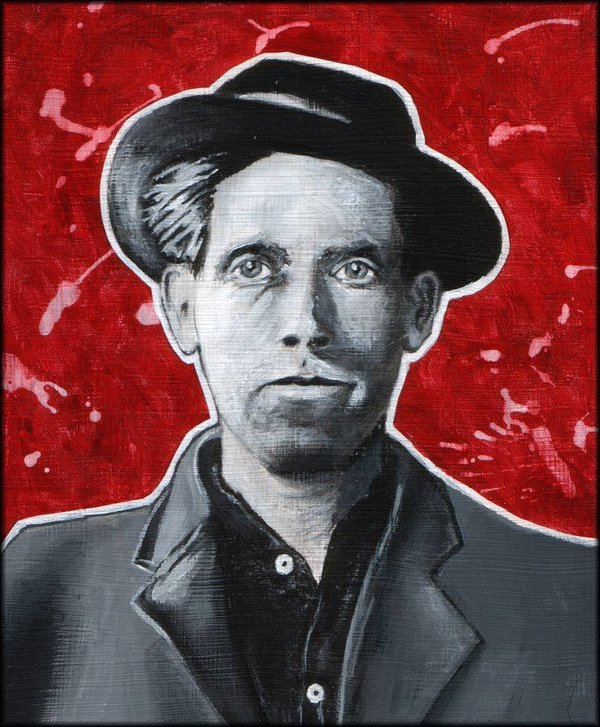
Almost a century ago, the socialist journalist John Reed wrote of the Industrial Workers of the World, popularly known as the Wobblies, “Remember, this is the only American working-class movement which sings. Tremble then at the IWW, for a singing movement is not to be beaten.” On the other hand, the sheriff of San Diego complained of his jails filled with Wobblies, “I do not know what to do. I cannot punish them. Listen to them singing all the time, and yelling and hollering, and telling the jailers to quit work and join the union.”
The following discussion was originally published in Internatonal Viewpoint
What will happen now in Portugal? Here we publish an exchange of views between Stathis Kouvelakis, leading member of the Left Platform in Syriza and now of Popular Unity in Greece, and Catherine Samary leading member of the Fourth International, from France. Thoughts on Stathis Kouvelakis’s text “From Greece, taking the risks into account: Some thoughts on the situation in Portugal“ “The risks are however immense and seem to me to outweigh by far the expected gains,” says Stathis Kouvelakis. What are what he calls “the three ways of summing up” this opinion? (His text is below.)

In South Africa students have been protesting for the past couple of weeks. Their immediate concerns are the intended hike of tuition fees, on average about 10%. Starting from the University of the Witwatersrand (Wits) in Johannesburg, they have demonstrated against the planned hikes. Students have occupied buildings on their campuses, held mass meetings, moved around the campus grounds, forced senior university administrators and university councils into negotiations. Campuses across the country have been brought to a stand still; this has happened at a crucial time of the South African academic year, just before the end of the year exams are about to start.
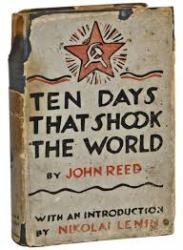
In celebration of the 98th anniversary of the Russian Revolution we are publishing this short extract from John Reed’s brilliant eyewitness account, Ten Days That Shook The World. Reed was a socialist journalist from the USA, who described the revolution as: “Adventure it was, and one of the most marvelous mankind ever embarked upon.”
This section is from the night before the insurrection of November 7th, 1917. The full text is available on Marxists.org.
In response to the failure of the state to manage and dispose of accumulated trash, a series of protests erupted in Lebanon in August 2015 demanding the toppling of the Lebanese corrupt regime and the basic rights for water, electricity and a clean healthy environment. This article provides an overview of the strategies used by the state to dismantle the protest movements, a class reading of the social movements three months into the protests, and an analysis of the strengths and achievements of the demonstrations.
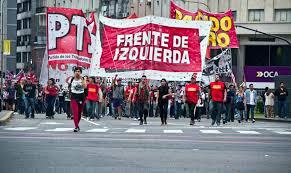
The Frente de Izquierda y los Trabajadores (the Left and Workers Front) or FIT went into last week's election with confidence. The new electoral alliance, comprised of the older and more doctrinaire trotskist formation Partido Obrero (Workers Party) or PO, the newer PTS (Socialist Workers Party), and the smaller IS (Socialist Left), hoped to build on recent electoral successes, including double digit tallies in a few provincial elections, and continue advancing along the ripples of youth and rank-and-file discontent against looming austerity and layoffs.
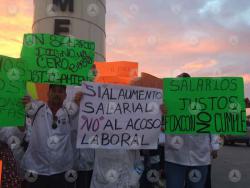
The Mexican and U.S. government first agreed to the creation of the maquiladora plants along the U.S.-Mexico border in 1965 and already by 1975 there were strikes for union recognition. Yet in the last 40 years, thanks to the cooperation of the multinational corporations and the U.S. and Mexican government virtually no group of workers has succeeded in organizing a genuinely independent labor union. Most plants have no unions. Some plants have unions run by lawyers and gangsters who are allied with the ruling Institutional Revolutionary Party (PRI) and the government. A combination of legal chicanery, intimidation, and violence have been used to keep workers from organizing. Now, once again, after many years there are labor protests in Ciudad Juarez one of the major maquiladora centers across the border from El Paso Texas as reported by Kent Paterson of Frontera NorteSur News where this article originally appeared.- Dan La Botz
In a virtually unprecedented development, labor protest is widening in the maquiladora industry of Ciudad Juarez, Mexico. While worker dissatisfaction or protest is nothing new in the foreign-owned border factories that produce goods for export to the United States, previous manifestations of discontent in the generally union-free industry have usually been confined to one company at a time.
A still undetermined number of supporters, activists, and sympathizers of two Brazilian left-wing political parties, the Socialism and Freedom Party (PSOL, Partido Socialismo e Liberdade) and the Unified Socialist Workers’ Party (PSTU, Partido Socialista dos Trabalhadores Unificado), are being charged by the State Prosecutor's offices (Ministérios Públicos) of Rio de Janeiro and São Paulo for having made small donations to these two parties during the 2014 elections.
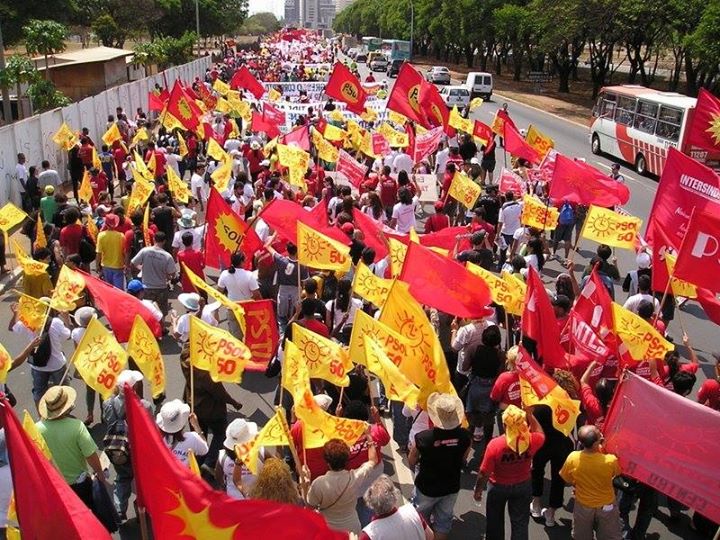
One of the activists linked with PSOL, Lucas Mourão, being charged by the Electoral State Prosecutor's office (Ministério Público Eleitoral) of Rio de Janeiro, explained his case on his Facebook page on October 15. He says in 2014 he donated R$60 (about US$15) to the campaigns of Jean Willys and Tarcísio Mota, two PSOL candidates running for, respectively, Federal Deputy and Governor of Rio de Janeiro.
I was sitting in a small town Greyhound bus station when I first saw images from Katrina. Happenstance, in retrospect, was so apropos. Bus terminal stations throughout America (so often) being lachrymose warehouses for the poor, the vulnerable, the mentally ill, the psychologically worn down and the just plain penniless –hostels of the many with vagabond destinations. The station held any number of “the kinds of people” who knew what it was to go elsewhere, oftentimes meaning anyplace but the places they’re at. I sat among America’s disenfranchised classes.

This story begins where all good stories do; I hit a bit of a rut with the second to last chapter of my dissertation, a dissertation which looks at the psychological aspects of capitalism that undermine arguments for global justice that are deeply entrenched in the liberal political-philosophical tradition. When I get stuck, I try to motivate myself by reminding myself how necessary this kind of demystifying critical scholarship is. Naturally, I usually turn to Fox News for such motivation. However, for whatever reason, I decided to look on Facebook for something that would piss me off and send me on a writing blitz.
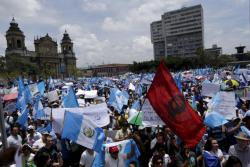
Karl Marx once wrote, quoting Hegel, that history repeats itself, but he added “first as tragedy, and then as farce.” And history has repeated itself in Guatemala following voting in the second round of the country’s 2015 presidential election. Despite protests against corruption, Jimmy Morales, a former comedian who is backed by the same military forces that backed disgraced ex-president Otto Pérez Molina, easily won the presidency by a wide margin following the second round of voting October 25.

The pace of climate change is relentless. The projected date for the arrival of a 2°C rise in the global average surface temperature over pre-industrial levels is coming down all the time. It’s now estimated to happen by 2038. The earth will warm by at least 4°C by the end of the century, possibly 6°C.
The results of this are catastrophic: intensifying extreme weather events – heatwaves, droughts, floods, water shortages, hurricanes and tornadoes. The sea level is rising as a result of the melting icecaps.
- « Newer Posts
- 1
- …
- 155
- 156
- 157
- 158
- 159
- 160
- 161
- …
- 227
- Older Posts »