Online Features
The movie Suffragette is the first feature film that dramatically depicts the monumental struggle for women’s right to vote in pre-World War I England. (Please erase from your memory the horrible, and I mean horrible, portrayal of suffragettes in the Disney monstrosity Mary Poppins.)

Directed by Sarah Gavron, with screenplay by Abi Morgan, the project also had the support and star power of Meryl Streep in a brilliant-as-always portrayal of Emmeline Pankhurst, the leader of the militant suffragette organization, the Women’s Social and Political Union (WSPU).
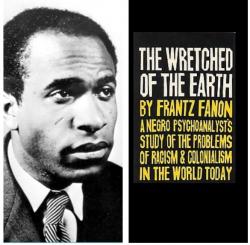
Dr. Fanon,
I am writing you in regards to your book The Wretched of the Earth. Before discussing your book in detail, I would like to thank you for writing it. Evidently it was written with passion. This letter serves as a means to recognize the continued resonance your work holds amidst our ever-changing geopolitical realities. Moreover your work, particularly its emphases on structures of power as well as experiential learning has had a direct impact on me. Increasing my understanding of my position in this world, The Wretched of the Earth has influenced my decision to relocate to South Africa as a volunteer with the Rural Women's Movement I anticipate the perspective gained from this experience will be incalculable.
 The Portuguese center-right ultraliberal government, which went “far beyond the troika” won a relative majority in the 4th of October general election. With 36.8% of the vote and 1.994 million votes, the previous governmental coalition (PSD and CDS) was the winner. In second place came the Socialist Party, with 32.4% and 1.746 million votes.
When visibility is minimal because powerful storms cloud the perception of reality, it may be appropriate to enlarge one’s view, to climb slopes to look for broader observation points, in order to discern the context in which we move. In these times, when the world is crossing through multiple contradictions and interests, it’s urgent to stimulate the senses to gaze far and inside.
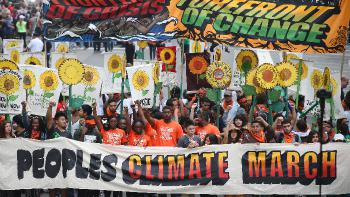
The last protest of the day of the New York City Climate Protests was at a Broadway theatre where Gov. Cuomo was scheduled to attend. It was a spirited demonstration complete with a little orchestra and playful costumes focused on persuading Cuomo to veto the Port Ambrose Liquefied Natural Gas (LNG) plant off the coast of Long Island right near JFK airport. Opponents argue that it is very dangerous security risk, terrible for the environment, and would kill the chance for a 700-megawatt wind farm that would create 17,000 local jobs.
 The radical left strategy of working within broad left parties has suffered a major setback after SYRIZA´s capitulation. The answer to this crisis lies neither in continuing “business as usual,” nor in ignoring the question of political power. SYRIZA´s capitulation to the austerity diktat, the ensuing emergence of Popular Unity and the fresh elections looming ahead, have brought the question of organization for the radical left at the forefront of debate. SYRIZA, which used to be the prime example of left unity against austerity, is giving way to an increasingly fragmented political landscape of the Greek left, as Prime Minister Alexis Tsipras declared his will to implement the new memorandum.
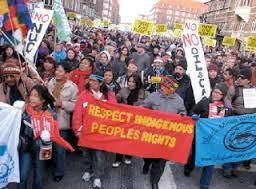
One of the tasks Guillaume Long sets himself in his recent interview with Jacobin is to refute the magazine’s recent coverage of Ecuador. In particular, the two recent pieces of note are an interview I conducted with Ecuadorian activist and intellectual Alejandra Santillana Ortíz and an article I wrote separately, reflecting on my most recent visit to the country. I was happy to learn of Long’s contribution to Jacobin on the current conjuncture in Ecuador. I expected a lucid articulation of the broad perspective advanced by the government of Rafael Correa for international consumption. Unfortunately, rather than a serious contribution to the ongoing debate, Long’s intervention is characterized to different degrees by evasion, caricature, and obfuscation. I will limit myself to a few instances in what follows.

The English translation of this article was originally published by International Boulevard
From Al Safir Al Arabi
Behind the violence shaking occupied Jerusalem, writes Haneen Naamnih in Al Safir Al Arabi, is a vast colonial enterprise slowly remaking the city.
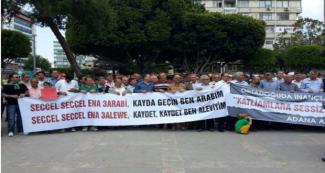
The October 10 Labor, Peace, and Democracy Rally in Turkey’s capital of Ankara was called to demand an end to the violent policies of the Turkish state. Organized by trade union federations and progressive organizations, the demonstration was also supported by the People’s Democracy Party (HDP), a leftwing pro-Kurdish party consistently demonized in recent months by the ruling Justice and Development Party (AKP).
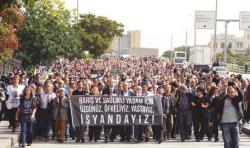
Strikes, boycotts, marches and demonstrations were held throughout Turkey on Oct. 12 in protest against the massacre at the Labor, Peace and Democracy Rally in Ankara on October 10 that killed at least 97 people, with funerals of the victims being held one after another, daily Hürriyet reported.
Turkey’s leading labor unions and professional organization–the Confederation of Public Sector Trades’ Unions (KESK), the Confederation of Progressive Trade Unions of Turkey (DİSK), the Turkish Medical Association (TTB) and the Union of Chambers of Turkish Engineers and Architects (TMMOB)—called for a nationwide strike and boycott for Oct. 12 and 13 to protest the massacre. The Revolutionary Workers Party has issued this statement. – Dan La Botz, Co-Editor

Why we need to build alternatives and dismantle a process that will lock us into another decade of burning the planet.
 New Politics shares this post, written in June 2015 to celebrate the 100th birthday of Grace Lee Boggs, who passed away Monday Oct 5, 2015. See a film about her:
- « Newer Posts
- 1
- …
- 156
- 157
- 158
- 159
- 160
- 161
- 162
- …
- 227
- Older Posts »