Online Features
 Mary Compton, who edits the informative and unique website www.teachersolidarity.com, tracking struggles globally to defend public education, teaching, and teachers unions, gives us a strikingly different – and more hopeful – take on Oaxaca and teacher unionism in Mexico than a recent New Politics blog. Compton’s analysis is in
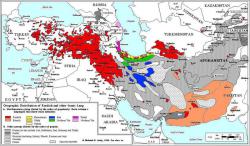
On July 20 at least thirty-two people were killed and at least 100 people were wounded by an ISIS suicide bomber. The attack took place in the Turkish town of Suruç, which stands only thirty miles away from the Syrian border. The victims, members of the Federation of Socialist Youth Associations (SGDF), were part of a 300-person contingent en route to Kobanî to assist in reconstruction efforts. The group consisted of a number of Turkish and Kurdish anarchist and socialist youth. As such, the solidaristic venture represented a major effort to create further bridges between the broader Turkish left and the Kurdish left.
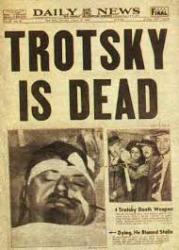
Leon Trotsky, the Russian revolutionary, was murdered seventy-five years ago today—on August 21, 1940—by Ramón Mercader, an agent of Joseph Stalin, Trotsky’s former comrade in the Communist Party and then the ruler of the Soviet Union. Stalin feared that Trotsky might organize a movement to overthrow the new ruling elite in the Soviet Union and that Trotsky’s followers might challenge the leading role of the parties of the Communist International active in working-class movements around the world. So Stalin had Trotsky murdered. The occasion of the anniversary of Trotsky’s assassination provides a moment to reflect on his significance both during his lifetime and for today.
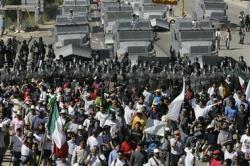
Mexican teachers are mobilizing once again —demonstrating by the tens of thousands—this time against anti-union reforms and the militarization of the state of Oaxaca by its governor Gabino Cué Monteagudo from the center-left Party of the Democratic Revolution (PRD). Nine years after the 2006 teachers’ rebellion, Oaxaca is bracing for another potentially violent conflict.
 The following is an email interview with Mimi Soltysik, a member of the Los Angeles chapter of the Party USA. He is currently seeking the Socialist Party's nomination for the 2016 US Presidential election. This interview was originally published by The Hampton Institute.
Tell us about yourself and your politics.
Here’s the statement I made when I announced my intent to run for the Socialist Party USA's POTUS nomination. I think it fairly well captures who I am and where I stand politically:

For the first time in decades a great debate about the priorities and the program of the American people is taking place not among small groups of leftists but in society at large. The debate between Sanders and Black Lives Matter—on social media, on TV and radio, in the newspapers, and on the street—is one of the most important discussions of our time and could if it is deepened help us all to find a way forward against both capitalism and racism. What appears to some only as conflict could lead to the construction of a new analysis and lay the basis for a new and broader social movement. We should all become involved in this debate and help to further it toward the common goal of a society of equality, democracy, and solidarity.
 In a recent op-ed in the New York Times, Nelson Denis describes the horrendous economic situation in Puerto Rico and compellingly shows the source of the problem to be the continuing colonial exploitation of the island by the U.S. government acting on behalf of key U.S.
Ecuador’s Indigenous movements have launched an uprising to challenge the government’s opposition to bilingual education and its support for an extractive-based economy.
On August 2, the Confederation of Indigenous Nationalities of Ecuador (CONAIE) began a march from the southeastern Amazonian province of Zamora Chinchipe that will arrive in the capital city of Quito on August 13. Upon its arrival, the Indigenous march will join a general strike called by the Workers United Front (FUT) in opposition to the government’s labor policies.
I don't support Bernie in the Democratic Party because I believe the key question in U.S. politics is building a political party that can defend the needs of the vast majority of the American people. As more and more people on the left agree, the Democratic Party is not and cannot be such a party; to my mind this constraint makes paramount the political independence of candidates, no matter how progressive their program.

I wanted to write and let you know why I support the doctors and clinic workers of Planned Parenthood who help people obtain abortions, often at great personal cost.
The current call to defund Planned Parenthood has been coordinated with attack videos that are highly edited in order to demonize the doctors who were filmed. As David Cohen and Krysten Connon document in their book, “Living in the Crosshairs,” the personal nature of political attacks on abortion in this country have led to harassment, stalking, and violence against providers and their families.
As those committed to social justice in St. Louis prepare to mark the August 9th killing of unarmed teen Michael Brown Jr. by Officer Darren Wilson in Ferguson, we know that many in the region would like us to just go away. Enough already, they say. Why commemorate something so sad and wrong, anyway? Let’s just move on. But we’re at the beginning, not the end of this struggle. It’s not time to move on, and this day calls for reflection.
- « Newer Posts
- 1
- …
- 159
- 160
- 161
- 162
- 163
- 164
- 165
- …
- 227
- Older Posts »