Online Features
 New Politics readers will be interested in this ZNet article “What Happened in Ukraine” by Sam Friedman, an HIV/AIDS researcher who spent time in Ukraine for many years before the recent upheavals in the country.

In this brief essay we offer a general and immediate overview of the socioeconomic situation in Puerto Rico. We do it while recognizing that such an analysis is incomplete if the historical, institutional, and political dimensions within the uneven development of capitalism are left out. In this particular case we do not explicitly deal with the colonial relationship of the island with the United States or provide a structural analysis of the economy (these dimensions will be treated in a forthcoming comprehensive article).

I awoke Saturday morning to rain on the roof. I am staying at my sister’s place in my hometown of Imperial Beach at the southwest end of San Diego County on the Pacific Ocean and the Mexican border. I could not at first identify the sound, the crackling of the rain on the awning of the patio just outside my bedroom window. Half asleep, I wondered at first if there might be a fire, then if some machine was running, finally I recognized that it was water and speculated that something might be leaking; perhaps there was a broken pipe. It never occurred to me that it could be raining because when I grew up here from the late 1950s until the late 1960s, it only rained in December and January. Now there is rain in July.
 Dan Swain discusses the contested ambitions and leaderships within our movements. This article was originally published in the Summer 2015 issue of the rs21 magazine.
Throughout the history of socialist movements and ideas, the fundamental divide is between Socialism-from-Above and Socialism-from-Below

In the summer of 1994, my partner and I happened to be on vacation in Stockholm for the Pride celebration, so we joined in. I remember it as a rather modest, subdued affair compared to the ebullient marches I remembered from New York and San Francisco. But what struck me most was the lesbian/gay federation’s emphasis on legal recognition for same-sex partnerships, at a time when Sweden banned sex in gay bathhouses. I thought these were upside-down priorities. Swedish same-sex couples would win in fact the right to register for partnership benefits in 1995, while the ban on bathhouse sex stayed on the books until 2004. What a curious country this is, I remember thinking.
 On July 11 the AFT announced its Executive Council “overwhelmingly” endorsed Hillary Clinton for the Democratic nomination for President. It did so, the official announcement reported, on the basis of interviews (not released to members) and the results of a poll.

In the Ireland of 1922, a civil war tore through the land and in its path it ripped apart families and friendships. It also created a deeper wedge in an unstable society where the church grappled for top position in an emerging new state.
The Irish Republican Army had fought a War of Independence against British rule for over three years and, led by the young enigmatic Michael Collins, it managed to push the British government to the negotiating table.
 A review of The Bigot: Why Prejudice Persists, by Stephen Eric Bronner, Yale University Press, 2014.
In this TeleSur interview with Rafael Bernabe, the spokesperson for the Puerto Rican Working Peoples Party advocates for a moratorium on the debt. Bernabe has written an extensive article in the current Summer 2015 issue of New Politics.
.jpg)
On Saturday, June 20, a quarter of a million people marched in London from the Bank of England to the Houses of Parliament in order to protest against the Conservative government’s planned spending cuts to public services. This was the largest single demonstration against austerity to date and reflected to a degree the revival of a radical political left in Britain after decades in the wilderness.
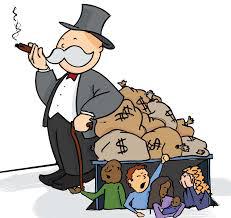
“Rich people are the fucking worst.” This is the premise and title of Sean Illing’s recent Salon.com article (June 22, 2015). While I agree with his sentiment, the argument that follows this provocative title leaves a lot—too much—to be desired. Illing is a self-professed progressive, and the purpose of his article was to discuss the various “new” ways the rich are expressing disgust for the poor or anyone who isn’t rich, in the context of the on-going drought in California. While I completely agree that “rich people are the fucking worst,” Illing misses the proper target of critique. Rich people do indeed suck. However, progressivism itself sucks, and here’s why: it misses the systemic root problem. The rich suck, because capitalism encourages them to suck.

The following is a statement on the Greek Crisis issued by the International Union of Food, Agricultural, Hotel, Restaurant, Catering, Tobacco and Allied Workers' Association (IUF) on July 1, 2105.
A specter is haunting Europe – the specter of a democratic alternative to austerity. The Syriza government of Greece incarnates that alternative, which is why the European Commission and the European Central Bank (ECB) have allied with the IMF to exorcise the challenge it represents. With few exceptions, political parties of every persuasion have tacitly or actively supported the anti-Syriza coalition.
- « Newer Posts
- 1
- …
- 161
- 162
- 163
- 164
- 165
- 166
- 167
- …
- 227
- Older Posts »