Online Features
I find it odd that my friend and fellow New Politics board member Riad Azar should center his criticism of Bernie Sanders’ foreign policy on Sanders’ supposed “irresponsible” “isolationism.”
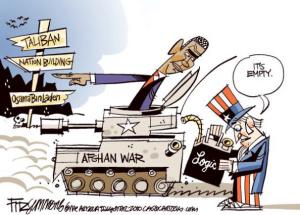
It seems to me that a critique of Bernie’s foreign policy should begin by criticizing him for voting for the Authorization for Use of Military Force resolution that paved the way for U.S. military intervention in Afghanistan, and for refusing to unequivocally condemn Israel’s shameful 2014 war on the people of Gaza. These positions might or might not be sufficient to preclude support for Bernie if he or someone like him ran as an independent — to my mind that would depend on the overall dynamic and trajectory of the campaign — but in any case they represent Bernie’s deep failure to consistently break with U.S. global imperialism and Israeli repression, and should form the central part of a critical assessment of his foreign policy stance.
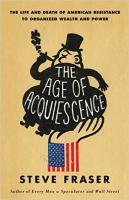
Steve Fraser, The Age of Acquiescence: The Life and Death of American Resistance to Organized Wealth and Power (New York: Little, Brown and Company, 2015)
All of us on the left are all too familiar with the capitalist offensive of the past forty years. Under the banner of “neo-liberalism” capital has rolled back almost every gain working people across the world have made since the 1930s. All sorts of public industries, services and institutions have been privatized, social welfare programs that protected workers from the worst insecurities of the labor-market have been rolled back or simply abolished and unions and working class political parties that had traditionally organized and represented working people have been severely weakened.
 Regardless of one's views on whether or not the socialist left should support Bernie Sanders in his race for the White House, the momentum behind the self-described “democratic socialist” has been impressive. Beginning at 2% in April, his popularity grew to 14% in May and at last check was 32% in New Hampshire.
 How are we to assess the Bernie Sanders presidential campaign?
There are three reasons that one runs a candidate for president. One is the hope of winning, second is to influence other candidates to modify their views, and third is to use the campaign to build for the future, either educationally or organizationally.
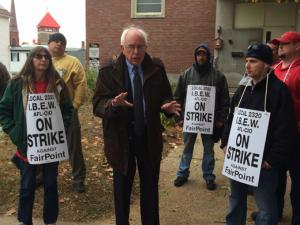
Grassroots labor initiative urges Democratic primary support for Sanders by AFL-CIO and national unions.
Over 1,000 union activists from around the country today kicked off Labor for Bernie 2016.

In the weeks leading up to the June 7 parliamentary election in Turkey communities across the country were gripped with a mixture of excitement, anxiety, and fear. Though President Tayyip Recep Erdoğan was supposed to be above the fray of party politics, the former two-term prime minister and co-founder of the Justice and Development Party (AKP) made no secret of his hopes for an AKP victory, as he rallied and spoke continuously in the weeks and months before the election. 367 seats in the 550-member parliament would make possible Erdoğan’s desire to change the Turkish government from a parliamentary to a presidential system, thereby enhancing executive, and Erdoğan’s, grip on political power.
[Introduction by Todd Chretien: In the run-up to Argentina's national elections in October, a scramble for power has divided the incumbent Peronista party into warring factions. Founded by Juan Perón in 1946, the Partido Justicialista ruled through sometimes radical nationalism, state intervention in the economy, clientelist patronage and control over trade unions, and the loyalty of sections of the bourgeoisie and an elite political class of bureaucrats.
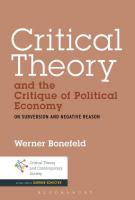 Werner Bonefeld, Critical Theory and the Critique of Political Economy: On Subversion and Negative Reason, New York: Bloomsbury Academic, 2014, 246 pp.
Despite widespread d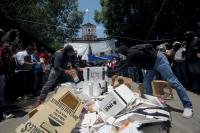 isillusionment with the political system, an organized attempt to prevent the election from taking place in a few states, and continuing economic doldrums, President Enrique Peña Nieto and his Institutional Revolutionary Party (PRI) were the big winners in the Mexican election, followed by the conservative National Action Party (PAN).
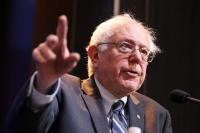 Despite his relatively low poll numbers at the moment, Bernie Sanders’ bid for the Democratic presidential nomination is catching fire and will undoubtedly attract a great many more supporters in the months to come. For radicals, and especially for socialists in the “third camp” tradition (so called from the time of the Cold War, when our tendency stood for revolutionary opposition to both camps) this poses a challenge.

A quarter century has passed since the June Fourth Massacre that took place in Beijing, China’s capital, near the end of the last century. But the truth of this tragedy has to this day not been laid bare to the world, and the massacre victims, who have still not received justice, cannot rest in peace. This is a disgrace for the whole Chinese people, and a disgrace for all of civilized humanity!
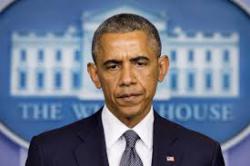
So why did things go so wrong under the leadership of President Barack Obama? David Bromwich has written an informative and important critical article on the Obama presidency, critical one might say from the progressive point of view, titled “What Went Wrong: Assessing Obama’s Legacy” which appears in the June issue of Harper’s. Fundamentally, Bromwich sees Obama as a weak president who has consistently pursued the “path of least resistance” rather than the “path of courageous resistance.” He was, says Bromwich, a president who mistook talk for action, who avoided political conflict and struggle, and who missed opportunities that presented themselves, moments when he might have advanced a progressive agenda.
- « Newer Posts
- 1
- …
- 162
- 163
- 164
- 165
- 166
- 167
- 168
- …
- 227
- Older Posts »