Online Features
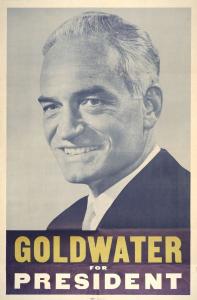
This is the third part of A New Politics in America. Part 1 looked at the Civil Rights movement and the White Backlash; Part 2 examined the impact of the economic crisis of the 1970s; Part 3 discusses the decline in American power, and then turns back to look at how all three elements contributed to the growth of a New Right from the 1960s to the 1980s.
The United States: A Declining World Power
While the United States remained a world power—and the greatest military power on earth after the fall of the Soviet Union in 1991—U.S. military might did not necessarily always lead to military victory and modern weapons could not always ensure its place as the leading world power.

This is the second part of an article about the new politics in America today. The first part can be found here.
Deindustrialization and Downsizing Gut the Labor Movement
The second development that led to a new far right was the economic crisis of the 1970s, or, to be specific, the two recessions of the 1974-75 and 1979-82. These two downturns caused employers to close steel mills, auto plants and other manufacturing plants throughout the Northeast and the Midwest with a devastating impact on the working class and on the labor movement.

This is the first part of an article about the new politics in America today.
The presidential election campaign of 2016 represents a turning point in American politics, raising issues and political agendas that would have been unthinkable in the United States only a few years ago. The major media and the public debate whether or not Republican Donald Trump is a fascist, while at the same time there is a discussion about whether Democrat Bernie Sanders’ version of democratic socialism is the answer to the country’s problems. Trump’s political rallies have, at his instigation, become violent and he now threatens to send his followers to disrupt Sanders’ rallies.
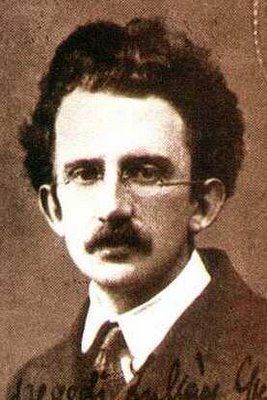
[This petition was sent to us by Zsuzsa Hermann. György Lukács (1885-1971) was a Hungarian Marxist philosopher, aesthetician, literary historian and critic. Best known for his essay collection History and Class Consciousness (1923), he initiated the tradition of "Western Marxism." In 1919 he was the Hungarian Minister of Culture of the government of the short-lived Hungarian Soviet Republic (March–August 1919).]
 Will we ever get over this thing called civilization? That's what I wondered as I watched The Embrace of the Serpent, directed by Colombian filmmaker Ciro Guerra, a black-and-white film in several indigenous and European languages that has some of the qualities of a documentary. But this is a truer-than-history fiction, fabricated out of the travel diaries of two botanists, Theodor Koch-Grunberg (Jan Bijvoet) and Richard Evan Schultes (Brionne Davis), both of whom traveled in the Amazon region, the former in 1909 and the latter in 1940. The challenging and sometimes horrifying experiences of the two scientists are linked together by the character Karamakate who serves as guide to both and a challenge to each. (Nilbio Torres plays the young Karamakate and Antonio Bolívar the old Karamakate.) Both botanists are looking for yakruna, a rare, sacred, and hallucinogenic plant, and their search takes them into the jungles inhabited by peoples menaced by the encroaching modern world.
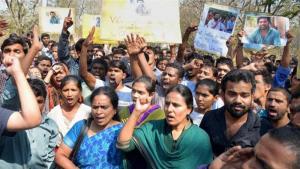
Reservation is an issue that only affects a small proportion of Dalits, says sociologist Vivek Chibber.
The ferment on campuses across the country following Rohith Vemula’s suicide and the recent crackdown on free speech at Jawaharlal Nehru University have drawn international attention, with many academics, students and activists across the world expressing solidarity.
When the head of al-Nusra declared back in November that the Free Syrian Army didn't exist, journalist Rami Jarrah went to north Aleppo and asked people what they thought about that and found that despite the claims of al-Nusra and some leftists who should know better, the FSA was still around.

“We are being targeted for contract killing ordered by the judiciary and the armed forces. Our lives are hanging by a thread.”

[Sandy Boyer, a veteran socialist, radical journalist and treasured contributor to Socialist Worker and New Politics (see his review in our current issue), died last month after a short illness. Joan McKiernan, a longtime comrade and friend, offered this tribute to Sandy that speaks so well for all of us at NP and SocialistWorker.org.]
SANDY BOYER, socialist fighter, died last week. His death is a loss to all the working-class struggles and the social justice movements in the U.S., Ireland and, indeed, the world that he was involved in.
Whether it was Teamsters or teachers in the U.S., political prisoners in Ireland, Puerto Rican independence activists, Palestinian solidarity campaigners or the Black Lives Matter movement, Sandy was tirelessly exercising his brilliant organizing skills on their behalf.
 The racist and utterly reactionary Republican legislative majorities that dominate the South are on an aggressive march this legislative session. From Texas to Florida, Arkansas to Virginia, and all the states in-between, they are employing cut-throat strategies and tactics to pass a package of regressive, exploitative and outright anti-human legislation drawn up by the likes of ALEC (the American Legislative Exchange Council)[1] and other right-wing think tanks. They are attacking the right to vote, Black voting districts, the right to education, access to housing, workers rights to organize themselves, wage protections, alternative energy plans, marriage equality, and the list goes on.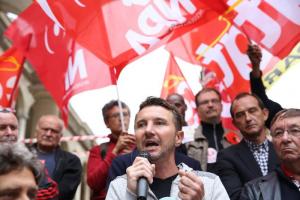
The following piece was written for Kojkkino, the theoretical magazine of the Greek organization DEA. Though quite long, it does not claim to cover all sides of the question. Indeed, it’s the kind of article that is never really finished and that has to be constantly reworked and supplemented. Its main objective is to stimulate collective thinking about the lessons of the successes and failures of the NPA from its birth to the present day.
Radical Left organizations in Europe have tended to focus their attention on the major political and electoral experiences that have stood out in the recent period – beginning with Syriza in Greece, Podemos in the Spanish State and the Left Bloc in Portugal, and often also including Die Linke in Germany, Rifondazione Comunista in Italy, the Red-Green Alliance in Denmark (RGA) and others. This is entirely justified. Still, other attempts at “doing something new” merit analysis, even where their successes were fewer or shorter-lived. They provide food for thought about a broader range of national contexts.
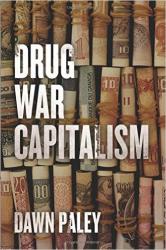
Dawn Paley. Drug War Capitalism. Oakland: AK Press, 2014. Notes. Index.
Dawn Paley’s Drug War Capitalism presents an overview of the drug wars in several Latin American countries: Columbia, Mexico, Guatemala, and Honduras. Mexico receives the most attention, and Paley provides a wealth of information from a variety of sources documenting the impact of the war-on-drugs on Mexican society and on the role of the United States. She focuses especially on the relationship between the drug business, government policies, and the militarization of Latin American societies, elucidating the role of U.S. policies such as Plan Mérida. She demonstrates the nefarious part played by the U.S. government’s overall structuring of both the drug market and the drug war by elaborating on both the military and civilian aspects of U.S policy in an attempt to prove her thesis, which is the war on drugs forms part of a plan—or if not a plan at least a process—that furthers capitalism, especially its expansion “…into new or previously inaccessible territories and social spaces.” (p. 15) Paley’s book contributes to, but does not resolve the debate over the relationship between drug dealers, capitalism, and the state.
- « Newer Posts
- 1
- …
- 150
- 151
- 152
- 153
- 154
- 155
- 156
- …
- 227
- Older Posts »