Online Features
On March 25, 2016, New Politics sponsored a forum centered on its release of a never-before-published lecture by Afro-Trinidadian socialist C.L.R. James on Oliver Cox’s Caste, Class and Race.
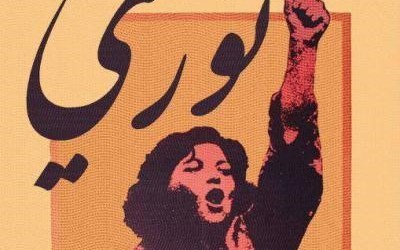
Five years after the beginning of the popular Syrian Revolution which demanded democracy and human rights, the Syrian revolutionaries have been decimated through the combined military force of the Assad Regime, the Iranian regime with its sectarian militias, Russian air strikes and military assistance on the one hand, and the ultra-terrorist ISIS and other Salafist – Jihadist organizations on the other hand. Nevertheless a partial reduction of airstrikes by Russia and the Assad regime in early March led to an immediate revival of mass protests of the democratic opposition across the country with banners such as the following in Idlib: “Our peaceful revolution is still in progress until toppling Assad and imposing justice all over Syria.”

(Marabá, April 17, 2016) We are more than 130 representatives of La Via Campesina member organizations and allies from four continents, 10 regions and 28 countries of the world. We are here in Marabá, Pará, Brazil, to analyze, reflect and continue our collective processes to develop our ideas, proposals, and alternative projects for confronting the offensive of global capital against the peoples and natural goods of the countryside, coasts and seas. More than anything, we come together to struggle for our territories, and for a different kind of society.
More than 130 of the leaders of the world’s nations are about to sign the Paris agreement on climate change. New Politics had the opportunity to interview Daniel Tanuro, the founder of Climate and Social Justice, a Belgian based environmental organization and author of Green Capitalism: Why it Can't Work. Tanuro’s writings on ecosocialism are well known to those in the European ecosocialist movements. New Politics co-editor Dan La Botz had an opportunity to interview Tanuro about the Paris agreement at the Swiss Solidarity Spring University.
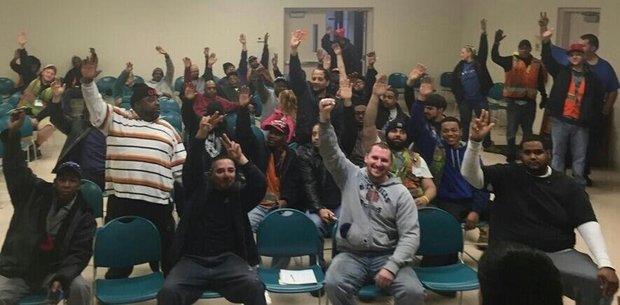
AVON, Ohio – Less than a day before temporary workers at the Detroit Chassis plant on Chester Industrial Parkway were scheduled to strike, the company agreed to their request to join a union.
The plant is staffed by about 60 workers – all of them temps — who make between $9.50 and $11.50 an hour, according to workers helping with the organizing effort to have the UAW represent them. The workers want permanent full-time employment and better wages and benefits. Their duties include assembling axles for the F-650 and F-750 trucks being made at Ford's Ohio Assembly Plant in nearby Avon Lake.
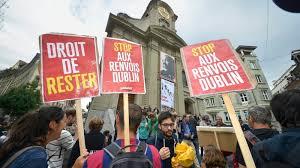
I am in Switzerland to attend the Spring University of Swiss Solidarity, a radical socialist group most active in the French speaking region, for whose newspaper solidarities I write regularly. I’ve been talking to some of the group’s activists about the situation here, and they have given me some impressions of the situation of the left here. So these are my impressions, just impressions.

In Madrid to give a talk on American politics and the Bernie Sanders campaign at , I took time to meet and converse with some young organizers of Anticapitalistas and one longtime leader of the left who had to go into exile toward the end of the years of the Franco dictatorship.
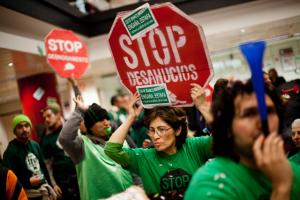
I spent a few days in Barcelona, meeting with older and younger activists, some of them former members of the Revolutionary Communist League (LCR), others younger activists in the group Anticapitalistas or in Procés Constituent. I also joined two protest demonstrations and gave a talk at the Ateneu Rebel for the journal Viento Sur for which I write. Here are my impressions, just impressions.
 While in Paris in mid-April, I had conversations with a number of mostly older, leftist intellectuals: professors, publishers, editors and writers. These are men and women who historically have had close ties and involvement in the labor and social movements. I also went to political protests and attended a socialist meeting. Here are my impressions, just impressions of a few days in Paris.
The vote on impeachment, which is in a decisive week, makes clear the interests of the ruling classes and their inclination to reverse the losses from the global economic crisis. It is the class struggle carried out in government offices.
 On February 27th of this year, an article appeared by scholar and journalist Idrees Ahmad titled “Aleppo is our Guernica — and some are cheering on the Luftwaffe,” a timely analogy with the Spanish Civil War.

- « Newer Posts
- 1
- …
- 147
- 148
- 149
- 150
- 151
- 152
- 153
- …
- 227
- Older Posts »