Online Features
This article is based on a talk given at the Left Forum in New York City, May 21, 2016.
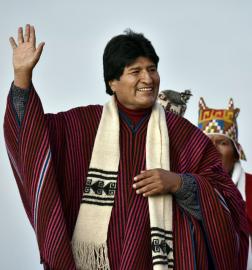
Evo Morales’ government has suffered two significant electoral setbacks in the past year and is currently mired in scandal, which has put its long term projections – planned for up to 2025 – into question. Why is one of the America’s most progressive government’s stumbling at this juncture?
The mood among the 3,000 Bernie Sanders supporters meeting in Chicago McCormick Place was improbably optimistic this past weekend, with many of the speakers proclaiming to cheering crowds that the movement has been victorious—even though Hillary Clinton, the presumptive nominee of the Democratic Party has received a majority of the popular votes and a majority of elected delegates and super-delegates, as well as the endorsements of President Barack Obama, Vice-President Joe Biden, and Senator Elizabeth Warren.
That disjuncture—between the Sanders’ movement’s belief that we have achieved something quite important and Clinton’s clear victory in the primary—provides the contradictory context for this conference of progressives, radicals, and socialists searching for the way to the future, I among them.

Preamble: Among the elements of the weak form of democracy enshrined in the constitution, presidential elections continue to pose a dilemma for the left in that any form of participation or non participation appears to impose a significant cost on our capacity to develop a serious opposition to the corporate agenda served by establishment politicians. The position outlined below is that which many regard as the most effective response to this quadrennial Hobson’s choice, namely the so-called “lesser evil” voting strategy or LEV. Simply put, LEV involves, where you can, i.e. in safe states, voting for the losing third party candidate you prefer, or not voting at all. in competitive “swing” states, where you must, one votes for the “lesser evil” Democrat.
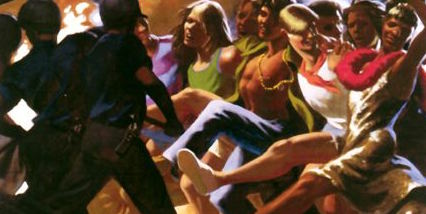
The Stonewall riots kicked off in protest against a police raid on the Stonewall Inn on June 28, 1969. Especially after Orlando, we should resist the co-optation of Gay Pride and instead remember the revolutionary spirit of the queer and trans militants who fought against oppression and violence against them.

[This interview was originally published in Left History, vol. 18, no. 1 (2014).]
Phyllis Jacobson (1922-2010) and Julius Jacobson (1922-2003) were socialist activists in New York City from the mid-1930s through the first years of the twenty-first century. They were members of a radical generation that came of age during the great depression and embraced the language of socialism, communism, and Marxism. They were also the children of working class Jewish immigrants who grew up in the city’s outer boroughs. For their parents, the First World War, the Bolshevik Revolution, and the general strikes and mass uprisings that convulsed many countries after the war were all recent events. The near collapse of the global economy in the early 1930s confirmed for many of their cohort the basic assumption that capitalism was inherently impermanent. Adopting a socialist outlook in a period characterized by social upheaval and economic crisis was easy; the challenge had to do with selecting a suitable group or tendency from a fissiparous menu of options.

For a year now presidential candidate Bernie Sanders has been the hope of millions in the United States, people who were disgusted with the role of the banks and corporations in politics, angered by the increasing inequality in society, appalled by our country’s racial injustice, and opposed to a foreign policy based on military intervention. Throughout the nation millions rallied to Sanders’ slogans calling or a fight against the “billionaire class” and for a political revolution. Taking up the demands and embracing the spirit of Occupy Wall Street first and then of Black Lives Matter, the Sanders campaign has been an unprecedented radical, populist movement, rejecting Wall Street and Washington and suggesting a more democratic, egalitarian, and peaceful future.
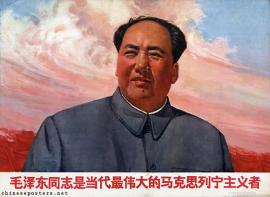
Elliott Liu. Maoism and the Chinese Revolution: A Critical Introduction. Oakland: PM Press, 2016. 148 pages. Bibliography. Notes. Photos. Tables.
During the 1960s and early 1970s, Maoism became the dominant political tendency not only in China but also in Western Europe and the United States, while it also influenced developments in Asia, Latin America and Africa. In the United States thousands of young activists rallied to Maoism, a political theory and practice that appeared at the time to be a democratic alternative to the bureaucratic Communism of the Soviet Union.
On Sunday 12 June, 49 people were murdered in an LGBT club in Orlando, Florida, in the largest mass shooting in US history.
At around 2am the attacker Omar Mateen entered the Pulse nightclub and opened fire; shortly after he took a number of people hostage, barricading them and himself in a bathroom. Police used an armoured vehicle to demolish the wall into the bathroom, before engaging in a gun battle in which Mateen was killed. 53 more people were injured in the attack. The victims ranged from 20 to 50 years old, and were apparently overwhelmingly from black and Latino communities.
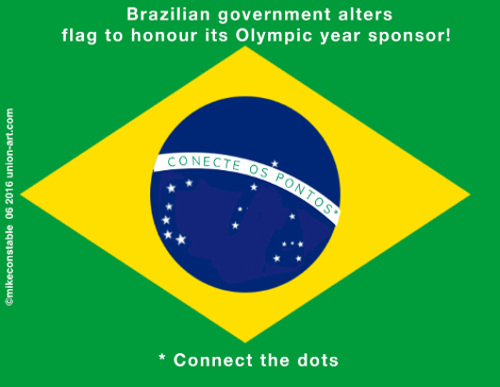
On May 12, Brazil's democratic government, led by the Workers’ Party (PT), was the victim of a coup. What will the other BRICS countries (Russia, India, China, and South Africa) do? Will they stand by as the reactionaries who took power in Brasilia pivot closer to Western powers, glad to warm Dilma Rousseff's seat at the BRICS summit in Goa, India in five months’ time? Or take a stronger line, following the lead of Latin American progressive countries (Venezuela, Cuba, Ecuador, Bolivia, Nicaragua and El Salvador)?
International Call to Struggle and for Solidarity against the Imposition of the Oversight Board (Junta) in Puerto Rico
We invite the international community and the Puerto Rican diaspora to join us in struggle and solidarity with Puerto Rico’s present situation.
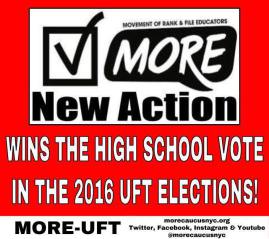
The good news is that the MORE/New Action slate won the seven seats on the UFT Executive Board elected by high school teachers. Furthermore, voter turnout increased across the board from roughly 18% in 2013 to roughly 24% in 2016. Finally, the absolute number of votes for the opposition increased in every division. However, still less than one-quarter of UFT members participated in this election. And the slight increase in voter turnout benefited the ruling Unity caucus at least as much as it benefited MORE/New Action.
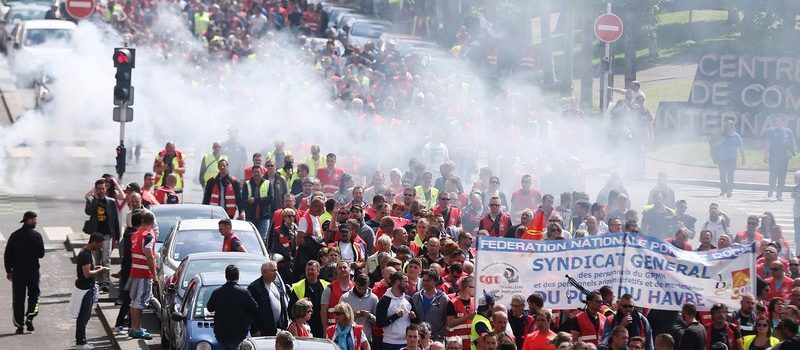
As France prepare to host millions of visitors at the Euro 2016 Football Championships, a state of emergency has been extended in the country as it faces its largest protests in recent history.
Hundreds of thousands of citizens have taken to the streets in France, amounting to what some are calling the new French Revolution amid a total media blackout in Western news outlets.
- « Newer Posts
- 1
- …
- 144
- 145
- 146
- 147
- 148
- 149
- 150
- …
- 227
- Older Posts »