Online Features

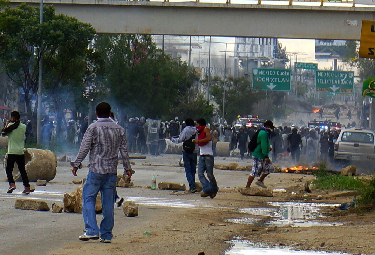
 ImageTwo new articles provide useful, accurate analysis about what's behind the protests in Oaxaca Mexico about education reform. One explains the economic factors that compel the government to respond with such vicious repression and are behind its refusal to compromise about its policy to replace the existing teacher workforce with contract labor.

Image

Israel’s attacks on the Boycott, Divestment and Sanctions (BDS) movement and other human rights defenders living under occupation, such as Al Haq staff, have dominated the headlines in recent weeks, including the direct threats made by leading Israeli officials against BDS activists and in particular against the movement’s co-founder Omar Barghouti.

Image

The British electorate issued a stunning rebuke to the establishment by demanding, by a surprisingly respectable margin, withdrawal from the European Union. Just weeks ago, this outcome was considered remote. For David Cameron and the Conservative mainstream, it was – or so it seemed – a clever gamble.  Let the nativists of the right, the Tory backbenchers and the UK Independence Party bigmouths test their outsized claims to speak for Britain.

ImageThere are 500 delegates from more than 100 political organizations in the Americas here at the São Paolo Forum being held this year in San Salvador. Yesterday at the opening session I found myself seated next to Julio Molina, a delegate from the Farabundo Martí National Liberation Front (FMLN) of the host country, El Salvdor. We introduced ourselves and when the session ended went out to talk about our mutual interest in history.
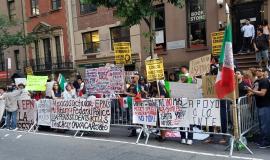


To show support for Mexico's teachers, demonstrations are being held internationally, as they are in the U.S.  In today's blog about the situation in Mexico, Mary Compton provides background to the current repression and information about how readers can support the teachers.

Image

There were demonstrations yesterday at Mexican Consuls in several American cities protesting the Mexican government’s violent repression of teacher protests in Oaxaca. Many of the protests also criticized the U.S. government for supply the Mexican government with military equipment being used in military and police actions against the teachers.

There were protests in New York, Chicago, Houston, and Los Angeles among other cities. The one pictured here, which grew to a couple of hundred people, took place in Manhattan at the Mexican Consul.

Image

Three thousand Bernie Sanders supporters from all over the US gathered in Chicago to share ideas, hear about each other’s movements, learn about becoming  “down-ballot” candidates, and collectively grieve. The Summit started by acknowledging that the Bernie Sanders for President movement suffered a loss: he will, very likely, not be running for President of the United States in 2016, either on the Democratic Party ticket or any other. While the Summit celebrated the joy of the movement, having a candidate to actually believe in, the shared energy of working so hard on concrete tasks like phone banking and door-to-door canvassing, meeting new friends and building new alliances, the big question hanging over the crowd was “Where do we go from here?”

Image

This article is based on a talk given at the Left Forum in New York City, May 21, 2016.

Evo Morales’ government has suffered two significant electoral setbacks in the past year and is currently mired in scandal, which has put its long term projections – planned for up to 2025 – into question. Why is one of the America’s most progressive government’s stumbling at this juncture?

Image

The mood among the 3,000 Bernie Sanders supporters meeting in Chicago McCormick Place was improbably optimistic this past weekend, with many of the speakers proclaiming to cheering crowds that the movement has been victorious—even though Hillary Clinton, the presumptive nominee of the Democratic Party has received a majority of the popular votes and a majority of elected delegates and super-delegates, as well as the endorsements of President Barack Obama, Vice-President Joe Biden, and Senator Elizabeth Warren.

That disjuncture—between the Sanders’ movement’s belief that we have achieved something quite important and Clinton’s clear victory in the primary—provides the contradictory context for this conference of progressives, radicals, and socialists searching for the way to the future, I among them.

Image

Preamble: Among the elements of the weak form of democracy enshrined in the constitution, presidential elections continue to pose a dilemma for the left in that any form of participation or non participation appears to impose a significant cost on our capacity to develop a serious opposition to the corporate agenda served by establishment politicians. The position outlined below is that which many regard as the most effective response to this quadrennial Hobson’s choice, namely the so-called “lesser evil” voting strategy or LEV. Simply put, LEV involves, where you can, i.e. in safe states, voting for the losing third party candidate you prefer, or not voting at all. in competitive “swing” states, where you must, one votes for the “lesser evil” Democrat.

Image

The Stonewall riots kicked off in protest against a police raid on the Stonewall Inn on June 28, 1969. Especially after Orlando, we should resist the co-optation of Gay Pride and instead remember the revolutionary spirit of the queer and trans militants who fought against oppression and violence against them.

Image

[This interview was originally published in Left History, vol. 18, no. 1 (2014).]

Phyllis Jacobson (1922-2010) and Julius Jacobson (1922-2003) were socialist activists in New York City from the mid-1930s through the first years of the twenty-first century. They were members of a radical generation that came of age during the great depression and embraced the language of socialism, communism, and Marxism. They were also the children of working class Jewish immigrants who grew up in the city’s outer boroughs. For their parents, the First World War, the Bolshevik Revolution, and the general strikes and mass uprisings that convulsed many countries after the war were all recent events. The near collapse of the global economy in the early 1930s confirmed for many of their cohort the basic assumption that capitalism was inherently impermanent. Adopting a socialist outlook in a period characterized by social upheaval and economic crisis was easy; the challenge had to do with selecting a suitable group or tendency from a fissiparous menu of options.