Online Features
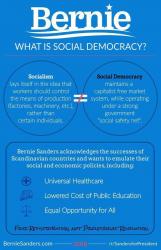
Part 9 of A New Politics in America. This concludes the series. All nine parts can be fond on the New Politics website, newpol.org
So what does this era of a new politics in America mean? How significant are new right and new left in America today? Where do we go from here? What are we in the left to do? Should we be building progressive Democratic Party campaigns? Should we just go back to building the movements? Or is there another option? To figure this out, we have to understand that though we are in a new political era, many of the old problems still remain.

Recent mass movements in Middle Eastern and North African countries, despite their defeats and failures, showed prospects and possibilities of a progressive change or a progressive mass organization in the region. Fulfillment of these possibilities requires concentrating on attaining a comprehensive, critical knowledge of the region’s social, political, economic and cultural mechanisms and relations. To achieve these initial goals, Problematica has started a series of interviews with progressive or leftist Middle Eastern and North African intellectuals, activist and MENA scholars. In this interview over Skype, we have put some questions to Gilbert Achcar, Marxist intellectual and scholar of Middle East Studies and Professor of Development Studies at SOAS, University of London. He has published in 2013 The People Want: A Radical Exploration of the Arab Uprising. A sequel will be coming out soon under the title of Morbid Symptoms: Relapse in the Arab Uprising.
The following statement was made by the Revolutionary Communist League-Socialist Workers Party (LCR-SAP) of Belgium following the attacks in Brussels.
The LCR-SAP condemns in the most energetic fashion the cowardly terrorist attacks that were perpetrated on 22 March in Brussels. No political or religious motivation can be an excuse for these heinous crimes. The LCR-SAP expresses its support and its profound solidarity with all the innocent victims of this blind violence.

This is part 8 of A New Politics in America. Find previous parts on newpol.org.
Hillary—Establishment and Dynasty
The tremendous success of the Bernie Sanders campaign—in turning out tens of thousands to his rallies, getting millions to contribute to his campaign, and winning an impressive number of states and delegates—is primarily due to his clear message: his call for a progressive economic program to provide jobs, universal health care, and free higher education, as well as an end to the role of money in politics, and an insistence on an end to structural racism, in particular racist police violence. Yet there is also no doubt that many have turned to Sanders because they do not want the Democrats’ presidential candidate to be Hillary Clinton, whom they see as embodying all that they despise about the American political system.
There is much to admire and learn from in Jason Schulman’s article “Bernie Sanders and the Dilemma of the Democratic ‘Party.’,” not least of which is Jason’s implicit insistence that the base of any future American left is composed of people who are currently in the liberal wing of the Democratic Party, and in its best elements represented by the Sanders’ insurgency. Obvious as this might be to readers of New Politics, this is still a disputed opinion on the radical left in America. We – Jason and I – both look forward to that movement developing a breakaway consciousness as it confronts an implacable Democratic establishment proudly wedded to the status quo.
This is party 7 of A New Politics in America. Part 6 and links to earlier parts can be found here.
Progressive Politics
Occupy, though it had eschewed politics, had important political ramifications. A few liberal Democrats soon appeared to give expression to the new movements within their rightward moving party.
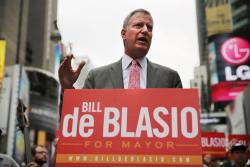
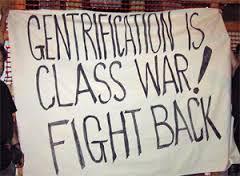
On Tuesday, March 22, the New York City Council is expected to pass Mayor Bill de Blasio’s housing and zoning plan, which permanently ties the creation of a relatively small amount of not-that-affordable housing to the massive co-production of luxury housing.[i] It is being sold as the best we can do with the tools that we have. It is not. Instead, it puts to work the most lucrative and least effective tools available, and locks the city into repeated cycles of gentrification and displacement.
This is Part 6 of A New Politics in America. Part 5 and links to early parts can be found here.
The Tea Party
The Great Recession and the government’s response to it gave a new impetus to the right. President Barack Obama’s election in 2008 in the midst of the recession proved an ideal catalyst for the bringing together of a new far right movement.

Like many countries trying to wedge their way into economic prosperity Mexico has affirmed an emphasis on education but in practice has negated its importance. Recently passed constitutional reforms relegate educators to temporary employment controlled by the federal government and private investors who have little or no interest in universal coverage or academic excellence. A huge portion of federal money designed for education goes to administrative personnel and is not subject to audit.
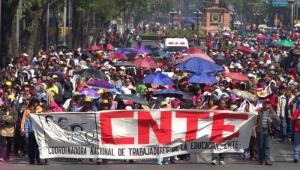
Oaxaca’s education workers build on the struggles of 2006 to fight corporate-driven education reforms.
Ten years ago, one of the most radical unions in the hemisphere, the Sección XXII of Mexico’s National Education Workers’ Union (SNTE), led a vibrant movement against the state governor’s heavy-handed rule in the southern Mexican state of Oaxaca.

This is Part 5 of A New Politics in America. Part 4 and links to earlier parts can be found here.
If American politics have changed in the 2010s, however, it is in large measure due to disappointment in the Obama presidency. Many Americans thought in 2008 that they had elected a progressive, but they soon found out that the new president was nothing of the kind.
_1968.png)
This is the fourth part of A New Politics in America. Earlier parts of the series can be found here.
The Republican Party responded to the white middle class and working class voters who had lost status, income, and pride in their country by working to turn their disappointment and depression into ressentiment and political power. Richard Nixon famously first saw how whites' resentment could be turned in the Republicans' direction during his 1968 presidential campaign, adopting the “southern strategy” of winning over the South’s racist white voters—the former Dixiecrats of the Democratic Party.
- « Newer Posts
- 1
- …
- 149
- 150
- 151
- 152
- 153
- 154
- 155
- …
- 227
- Older Posts »