Category: Social Policy

I was sitting in a one-bedroom apartment watching the telethon for Hurricane Katrina when it happened. After a commercial break, Kanye West stood nervously looking like he was about to do something that would end his career. He was fidgety and sweating when he said it: “George Bush doesn’t care about Black people.” It was a transcendent moment for Black America.

The following is a statement on the Greek Crisis issued by the International Union of Food, Agricultural, Hotel, Restaurant, Catering, Tobacco and Allied Workers' Association (IUF) on July 1, 2105.
A specter is haunting Europe – the specter of a democratic alternative to austerity. The Syriza government of Greece incarnates that alternative, which is why the European Commission and the European Central Bank (ECB) have allied with the IMF to exorcise the challenge it represents. With few exceptions, political parties of every persuasion have tacitly or actively supported the anti-Syriza coalition.
 Review of: Corruption in America: From Benjamin Franklin’s Snuff Box to Citizens United, by Zephyr Teachout. Harvard University Press, 2014
 In the weeks following its historic victory in the Greek elections on January 25, 2015, Syriza has been engaged in a bitter struggle.
 Since the pressures of international financial capital and its subservient political elites will continue with the same if not greater intensity, it is also certain that a new cycle of social mobilization in Greece and the rest of Europe will begin again.
New Politics has previously posted a video version of a Feb. 6 New York City panel discussion sponsored by the Campaign for Peace and Democracy (CPD) entitled “After the Greek Elections: The Future of Austerity in Greece, Europe and Beyond.”
CPD has now posted text versions of the talks, along with separate updates by each of the speakers.
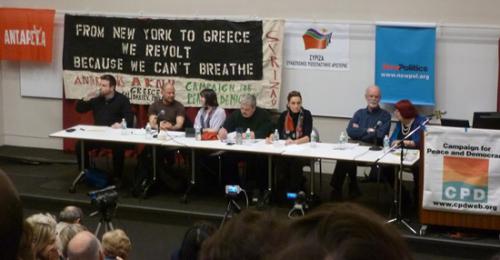

The agreement signed between Greece and the EU after three weeks of negotiations is widely lamented on the left as a setback, if not a defeat, for Syriza. The two sides emerged from the agreement, if that is an accurate description, with different interpretations of the memorandum, signifying perhaps that no real deal was made after all. Greece obtained brief reprieve. Its banks will remain liquid for the next few months. The next phase will not be about what can be extracted from the troika, as much as what Greece can do despite and in defiance of the troika. That is what will be discussed here.
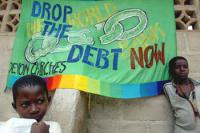
The lion’s share of indebtedness in this world is invalid and immoral. Forgiveness is not what is called for; it’s liberation.
Talk of a “debt jubilee” leaves open whether the debts are valid or not, but talking about debt forgiveness raises the question of whether a debt is valid from a moral point of view.
 For Syriza to triumph, it is not enough for it to play tough with the European Union. not enough to bypass the structure of the European Central Bank to find individual national allies, not enough to refuse to cooperate with capitalist auditors. Greece has already lost 30% of its GDP since the peak before the crisis, with unemployment standing at 25%, a decline only comparable to that seen in the US during the Great Depression.
[Ed. note: The list of signatories to this declaration includes seven out of nine German trade union presidents, all members of the executive boards of the German Trade Union Confederation (DGB) and IG Metall, plus some (primarily social-democratic) politicians at the Bundestag and European Parliament levels, including the vice-chairman of the SPD, as well as numerous academics.]
The political landslide in Greece is an opportunity, not only for that crisis-ridden country but also for a fundamental reassessment and revision of EU economic and social policy.
Since the year 2000, victories claimed by death penalty abolitionists have seemed significant. In 1999, the United States executed 98 death-row inmates, the highest number since capital punishment’s reinstatement following the Gregg v. Georgia Supreme Court ruling in 1976. Subsequently, however, executions have been on the decline, with 39 inmates killed in 2013.
Those disturbed by the United States’ largest-in-the-world incarceration rate have some new reasons to be cautiously optimistic. President Obama nominated an opponent of the drug war to the Justice Department’s highest civil rights position, signaling the possibility that the costly and counterproductive imprisonment of drug users may be coming to an end.

“Vermont…is the only state with universal single-payer health coverage for its residents.”
–James Fallows in The Atlantic, April, 2014
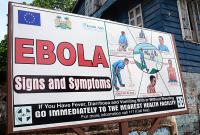 According to the latest predictions of the U.S. Centers for Disease Control and Prevention (CDC), if the Ebola pandemic continues to progress at the current rhythm, it could affect 1.4 million people in Liberia and Sierra Leone between now and January 2015, leading to the deaths of 700,000 in a year, and thus making Ebola the third leading cause of death from infectious diseases in Africa, after AIDS and respiratory diseases.
Review of
This is Not a Test: A New Narrative on Race, Class and Education
By José Luis Vilson
Haymarket Books, 2014
Badass Teachers Unite: Reflections on Education, History and Youth Activism
By Mark Naison
Haymarket Books, 2014
Only large-scale civil disobedience will make our leaders address economic injustice.
In 1989, Bob Dylan recorded a song titled “Everything Is Broken”. That song seemed to go largely ignored, perhaps because it seemed to be only a pessimistic lament that offered no suggestions for how to go about fixing the “everything”.
But as with many of his songs, it was prophetic. Lately, many Americans are experiencing the feeling that everything is broken, but people in many other countries have had this feeling for a long time.
The Affordable Care Act commentariat—including those confidently awaiting the day when all its promises are vindicated, those rooting for its ignominious demise, and those of us in a separate camp—have been kept occupied in recent months. Between autumn’s website drama and winter’s enrollment saga, the news cycle has been full of stories of IT dysfunctions tackled, right-wing challenges thwarted, enrollment goals met, electoral prospects threatened, and individuals newly insured (or variously dissatisfied).
The February 6 issue of The New York Review of Books carried Dr. Arnold Relman’s account of his own hospitalization at Massachusetts General Hospital (and elsewhere) under the title “On Breaking One’s Neck.” In a subsequent article, I said that the appearance of Dr. Arnold Relman as a patient at Massachusetts General Hospital, accompanied by his wife, Dr.
Review of Picking Up: On the Streets and Behind the Trucks with the Sanitation Workers of New York City By Robin Nagle (Farrar, Strauss and Giroux, 2013).
Rationally, we know garbage isn’t picked up by the faeries, but to much of the public, it might as well be. We “take out” the garbage, but who removes it?
 The inner-city parish of La Vega sits in the lush mountain terrain of Western Caracas. Roughly 130,000 poor residents are cordoned off sociologically from nearby El Paraíso, a wealthy neighborhood that supplies the clients for the upscale shopping center that separates the two communities. In La Vega, the bottom 20 percent of households live on US$125 per month, while the average family income is $US409.
 Enclosed in and insulated by their own structures of thought, many doctors are quite blind to the role of privilege, including their own, in getting or not getting medical care and in determining the quality of that care. If they acknowledge some flaw (or even ignorance or barbarity) in individual health care, they see it as non-systemic, simply a matter of a bad apple in an otherwise benign barrel. They may maintain this obtuseness even when they themselves become patients.
- « Newer Posts
- 1
- …
- 5
- 6
- 7
- 8
- 9
- 10
- 11
- …
- 16
- Older Posts »