
Category: Social Policy
The Mexican Congress passed President Enrique Peña Nieto’s energy reform bill in December, allowsing private and foreign investment in the energy sector, despite widespread public opposition and massive protests by opponents. Peña Nieto and his supporters argued that the energy reform would allow more effective development of the country’s petroleum resources, leading to economic growth and more jobs.
Kari Lyderson, Rahm Emanuel and the Rise of Chicago’s 99%, Haymarket Books, 2013
New Yorkers rejoicing in Michael Bloomberg’s departure from office can be grateful for another small favor: they don’t live in Chicago, where residents are stuck for at least two more years with an austerity-mad, street-brawling mayor who wields near absolute power over a City Council far more supine than the one we have here.
Growing Income Disparities ‘Danger to System,’ says Former Clinton Labor Secretary
(A mixed review of Robert Reich’s documentary ‘Inequality for All’)
Review of The Unwinding: An Inner History of the New America by George Packer, Farrar, Straus and Giroux, 2013
This American life is a mess, argues George Packer in The Unwinding: An Inner History of the New America. It’s a nation fraying, with core institutions from government and finance to housing, jobs and education dysfunctional or “unwound.”
Fewer than two weeks before the US House of Representatives brought on the government shutdown, it voted (9/19/13) by a slim margin to cut $40 billion from the Supplemental Nutrition Assistance Program (SNAP), or food stamps, over the next 10 years. Now, $4 billion a year may not seem like much, given the enormous figures our "leaders" play with, but it will mean that a great many families as well as individuals will not have enough to eat.
That is the affirmative conclusion one might reasonably come to by listening to the Democrats and their MSNBC and Nation magazine echo chambers. Far right monies bundled together by conservative “social welfare” groups are said to be defying a hapless public powerless to thwart the House Republicans from exercising veto power over the budget process, in their effort to impose more austerity and defund the Affordable Care Act.
Books reviewed:
Charles V. Bagli, Other People’s Money: Inside the Housing Crisis and the Demise of the Greatest Real Estate Deal Ever Made (Dutton, 2013).
Laura Gottesdiener, A Dream Foreclosed: Black America and the Fight for a Place to Call Home (Zuccotti Park Press, 2013).
Mexican President Enrique Peña Nieto and his Institutional Revolutionary Party (PRI) have proposed constitutional changes and legislation that would for the first time since 1938 allow foreign companies to explore for and produce oil in
Perhaps you shouldn’t be surprised that the chief economist during George W. Bush’s presidency seems happy that economic inequality in our country is at its most extreme since the Great Depression.
After all, the Bush administration delivered huge tax breaks to the wealthy, the very people described by the former president as his political base.
The coincidence of the “Justice for Trayvon” protests all over the country and the 50th anniversary of the March of Washington for Jobs and Freedom presents the African American people and all of those concerned with social justice a real opportunity to revive the black freedom and equality movement in the United States.
The financial collapse of 2008 was a sudden, shrill alarm that abruptly exposed neo-liberalism to be nothing more than a fool’s paradise. For decades, many Americans marched to the hypnotic music of free market fantasy and willfully ignored the low, droning crescendo of social decay. The hypnotic melody of constant growth, full employment, low taxation, and rugged entrepreneurialism muffled the warning sirens that had gone off around them.
The financial crisis that began in 2008 has accelerated many economic trends already at work in the neoliberal period of capitalist development. Wages continue to decline, the class struggle bursts out in contradictory fits and starts at the same time as the societal value of work, and therefore the people who do it, continues to depreciate.
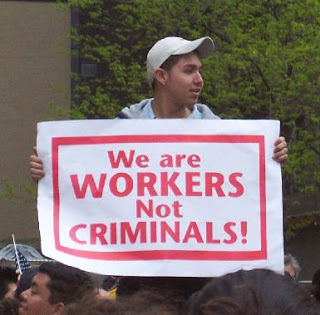
We need an immigration policy based on human, civil, and labor rights, which looks at the reasons why people come to the United States and how we can end the criminalization of their status and work. While proposals from Congress and the administration have started the debate over the need for change in our immigration policy, they are not only too limited and ignore the global nature of migration, but they will actually make the problem of criminalization much worse. We need a better alternative.
Colombia has the longest history of ongoing political violence in Latin America. Some date the beginning as April 9, 1948 when Jorge Eliécer Gaitán, the Liberal Party’s presidential candidate, was assassinated, leading to the Bogotazo riots that took 5,000 lives and unleashed a civil war between Conservatives on the one hand and the Liberals and Communists on the other. Between 1948 and 1958 that war took 200,000 more lives, injured hundreds of thousands more, and displaced perhaps a million.
A Conference of the Union for Radical Political Economics
Co-sponsored by New Politics
St.

As the housing crisis plows through our neighborhoods, it leaves behind the same bleak scenes. The former owner separated from her home, her neighbors, her children’s schools, and possibly her children themselves ― a tragedy anonymous to millions of analogous others across the country. Neighbors staring down the dead, wall-eyed windows of the vacant homes on their block and seeing the promise of rising crime and falling attendance at block parties.
I’m here with Mazibuko Jara. Mazibuko is from the Democratic Left Front of South Africa. He was spokesperson for the South African Communist Party and the deputy secretary for the Young Communist League, back a decade and more ago. He is one of the co-founders of Amandla magazine and the Democratic Left Front, and they’ve been extremely active in the support for the Marikana miners and for South African farmworkers, and elsewhere. We’ll talk about this and more in this interview. Today is Sunday, Dec 2, 2012.
(Translation By Özlem İlyas Tolunay; Turkish version here.)
Oğuzhan Müftüoğlu was born in Anamur, Turkey in 1944. He joined the Revolutionary Youth (Dev-Genç) movement while he was a law student at Ankara University during the 1960s.
In Bangladesh, the transnational corporations’ production system regressed into one of its most brutal manifestations. Most safeguards that could prevent or at least mitigate the exploitation of workers have been eliminated. While capital enjoys complete freedom, the working class, shackled by oppressive labor laws and a ruthless repressive apparatus, is struggling for bare survival.
The following letter from me was published in the Boston Globe on June 26, 2013.
June 18, 2013
The Boston Globe
To the Editor:
Human trafficking is an issue so entirely abhorrent, it seems that it would be impossible to inappropriately address it. And yet a forthcoming paper (to be published in by Dr. Hebah Farrag, Richard Flory and Brie Loskota) argues that often religious organizations fail to get the job done right.
- « Newer Posts
- 1
- …
- 6
- 7
- 8
- 9
- 10
- 11
- 12
- …
- 16
- Older Posts »