Blog

  • The “Inescapable Need and Possibility” of Third Cinema

    The “Inescapable Need and Possibility” of Third Cinema

    While accepting an Honorary Oscar this past November, the great film director Charles Burnett spent some time reflecting on his formative years as a film student at UCLA. It was there that he and his colleagues not only learned their craft, but also laid the foundations for what would become known as the “L.A. Rebellion” — a radically independent, alternative Black Cinema movement that produced such remarkable filmmakers as Julie Dash, Haile Gerima, Billy Woodberry, Jamaa Fanaka, and Larry Clark. “We talked about ‘What is a black film?’ continuously,” Burnett explained. “‘What is our responsibility?’ ‘What do we have to do?’… We were interested in making a difference, and using film as a means for social change.”

    These conversations were no doubt informed by the life experiences and artistic inclinations of Burnett and his fellow students, but also the influence of a prior insurgency: the revolutionary, global film movement known as “Third Cinema.” UCLA faculty member Teshome Gabriel, an Ethiopian historian and proponent of the tradition, used it as a touchstone in his work helping the L.A. Rebellion filmmakers articulate their concerns and develop their aesthetics. Although Third Cinema began as a movement of, by, and for the colonized, Gabriel argued passionately for its transnationalist possibilities. In his seminal work Third Cinema in the Third World: The Aesthetics of Liberation, for example, he writes that “the principal characteristic of Third Cinema is really not so much where it is made, or even who makes it, but, rather, the ideology it espouses and the consciousness it displays.”

    Not only is Gabriel on solid theoretical ground here vis-à-vis the movement’s founding proclamations, but he is far from alone in this belief: the L.A. Rebellion is just one of many instances of Third Cinema impacting on the history and development of cinema outside the regions in which it was developed (and continues to flourish). In fact, it’s far from the only example of its influence in just the United States! As we enter the second year of Trump’s presidency, it might be wise, then, to give some special attention to these American contributions to Third Cinema. For filmmakers looking to affect meaningful change, these efforts provide crucial food for thought. In addition, there’s also much we can learn from the critical feedback these works have received.

    However, we should first clarify the nature of the movement and its origins. Though a great deal of work now considered to be canon preceded it, the term was first used by Argentina-based filmmakers Fernando Solanas and Octavio Getino in their 1969 manifesto “Towards a Third Cinema: Notes and Experiences for the Development of a Cinema of Liberation in the Third World.” With their statement, the authors, who were part of the left-wing Peronist filmmaking collective known as Grupo Cine Liberación, shored up the foundations of an emerging film practice. The work they were creating was distinct from both “First Cinema,” the products of entertainment industries like Hollywood, and “Second Cinema,” which usually refers to the arthouse fare operating at the peripheries of corporate moviemaking. (In some sources, Second Cinema is also interpreted as inclusive of or even synonymous with state propaganda, which helps to make an important point: as scholar Mike Wayne has noted, a characteristic of Third Cinema is its suggestion that “[social and cultural] emancipations cannot be achieved merely in the political realm of the state.”)

    But regardless of what is or is not included when we speak of First and Second Cinema, Third Cinema is distinguished first and foremost by its politically radical content: generally speaking, the imperative of revolution in response to colonialism and neocolonialism is boldly underscored in these works. Film form, though, is another story; here, things are far less easy to spell out clearly. As scholars Robert Stam, Richard Porton, and Leo Goldsmith put it, “[Works of Third Cinema are] aesthetically eclectic, [drawing] on currents as diverse as Soviet montage, Surrealism, Italian neo-realism, Brechtian epic theater, cinéma vérité, and the French New Wave, all alongside the rich legacies of national cultural practices.”

    By way of an example, we can do no better than Solanas and Getino’s own pioneering 1968 documentary The Hour of the Furnaces — unquestionably the most famous and oft-referenced work of Third Cinema. Covertly produced and surreptitiously screened, the 260-minute, two-part film takes up the legacy of colonialism both in and outside Argentina. Organized into fourteen distinct chapters, with subjects ranging from “The Country” to “Daily Violence” to “The System” to “Ideological Welfare,” it offers, in the words of critic Nicole Brenez, “a comprehensive analysis of the history, geography, economy, sociology, ideology, culture, religion and daily life of Latin America. Each dimension and source of oppression is documented and pondered, as is each link between determinations and their consequences.” In so doing, the film’s style necessarily becomes as wide-ranging as its subject matter, veering between many of the “currents” reference by Stam, Porton, and Goldsmith — often in quite exhilarating fashion.

    As important as The Hour of the Furnaces was and continues to be, however, it’s probably the case that Solanas and Getino’s “Towards a Third Cinema” has ultimately been far more consequential in the long run. To be sure, as scholar-filmmaker Michael Chanan has pointed out, “the manifesto [has been] much more widely diffused than the film.” Considering this fact as well as the nature of the document, it’s little wonder that Third Cinema not only spread throughout Latin America, Africa, and South Asia, but in the “First World” as well. As Ponzanesi and Waller elucidate, Solanas and Getino “[position Third Cinema] as a ‘guerilla cinema’…explicitly urging that it not be collapsed into ‘Third World,’ thereby challenging the persistent dichotomy between the West and the Rest. Third Cinema could be made anywhere.”

    In fact, as Solanas and Getino saw it, works of Third Cinema were already being made elsewhere in the world — even in the United States. Among others, “Towards a Third Cinema” name-checks the storied Newsreel (now called Third World Newsreel). The self-described “activist filmmaker collective” began in New York but “grew to become a network with chapters across the U.S.” It produced and distributed 16mm educational films on “anti-war and women’s movements, civil and human rights movements, getting unique access to such groups as the Black Panther Party and the Young Lords Party.” Though Solanas and Getino saw Newsreel as a parallel movement, it was actually deeply informed by those same Latin American documentaries of the early 1960s that they considered works of proto-Third Cinema. As articulated by Charles Musser, “the polemical montage juxtapositions of Cuban documentarist Santiago Álvarez” as well as “other Cuban shorts, such as Octavio Cortázar’s enchanting Por Primera Vez (For the First Time, 1967), recording the reactions of country people seeing the cinema for the first time” were especially inspirational to Newsreel’s leadership.

    By 1973, though, that leadership had shifted rather dramatically. As activist media maker and scholar Alexandra Juhasz explains, this was preceded by “debates within Newsreel” about the fact that many chapters were “led largely by females and people of color within the cooperative who felt that the critique of society expressed by the collective was not holding true within the collective.” (Newsreel’s evolution into Third World Newsreel is instructive today, as the film industry struggles to address institutional sexism and racism.) The shakeup brought not only new personnel and a name change, but also a “[redirection] to represent international communities of color.”

    In a similar vein, the L.A. Rebellion borrowed elements of Third Cinema (as well as other influences) in service of a larger political project: what scholars Allyson Field, Jan-Christopher Horak, and Jacqueline Najuma Stewart call the “project of resistance and self-determination.” By offering a microscopic view of black lives in southern California, the L.A. Rebellion managed to make incredibly meaningful contributions to the worldwide cinema of the oppressed. In these films, “local issues are presented as part of a larger international struggle against systemic oppression,” write Field, Horak, and Stewart. “The role of filmmaking, then, is to visualize these concerns and put them in terms that are relatable and transformative for Black audiences.”

    As the late scholar Chuck Kleinhans has pointed out, though, the L.A. Rebellion diverges from Third Cinema in that the latter “presumed both a specific political movement and a coherent community that the makers and films were speaking from and to” while “these conditions were not really in place in the United States in the 1970s” for the former, as “the unity of the civil rights movement had fractured into the Black Power era with different and often competing organizations and agendas.” As a result, individual L.A. Rebellion films like Gerima’s Bush Mama (1979), Woodberry’s Bless Their Little Hearts (1984), Burnett’s To Sleep With Anger (1990), and Dash’s Daughters of the Dust (1991) differ from one another in terms of their priorities, politics, and aesthetics. Kleinhans further notes that “in critical discourse, the L.A. Rebellion is best known for developing an auteurist dramatic-feature Second Cinema for the arthouse and niche market.” (The fact that directors such as Reginald Hudlin, Ava DuVernay, and Sean Baker were all on hand to pay tribute to Burnett at the Governor’s Awards attests to this.) Field, Horak, and Stewart may be right, then, when they say that, more than anything and not for nothing, “these filmmakers translated Third Cinema’s emphasis on film as social practice to the social practice of filmmaking — collaborating on shooting, editing, and exhibition.”

    Conversely, one individual American filmmaker whose content is often much more closely aligned with the Third Cinema tradition is Travis Wilkerson. On his website’s “Bio” page, we learn that “a chance meeting in Havana with legendary Cuban film propagandist Santiago Álvarez” led him to Third Cinema. The aforementioned Álvarez directed such “found footage” classics of the tradition as Now (1965) and LBJ (1968), and was an influence on Solanas and Getino, as well as Newsreel. He was, in the words of film critic Derek Malcolm, “a committed son of Castro’s revolution and a natural successor to the great Russian Dziga Vertov,” whose “methodology as a socialist was to attempt to use images as powerfully as they are used in the west to sell goods.” It was Wilkerson’s meeting with this seminal figure that “changed the course of [his] life,” and accounts for his “now [making] films in the tradition of the ‘Third Cinema,’ wedding politics to form in an indivisible manner.” (So much so that Álvarez became the subject of Wilkerson’s very first film, 1999’s Accelerated Development: A Film in the Idiom of Santiago Álvarez.)

    Wilkerson’s best-known work, An Injury to One (2002), recounts the 1917 lynching of the Industrial Workers of the World’s Frank Little in Butte, Montana, where the labor leader had come to organize a strike at the infamous Anaconda Mining Company. Much of the rhapsodic praise that greeted the film testifies to Wilkerson’s success at working in the Third Cinema tradition on American soil. Critic Saul Austerlitz may well have been thinking of Solanas and Getino’s manifesto when he penned his review for Reverse Shot, saying that “Wilkerson’s mournful, empathetic, angry, politically astute film is an elegy to the lost political radicalism of early 20th century American life; it is also a blueprint for a future American art that looks to reclaim the political.” Indeed, by tapping into “Wobbly” slogans (such as the one from which the film takes its title) and songs (performed throughout by Will Oldham and others), An Injury to One is able to breathe powerful new life into some well-used methods for radicalizing and organizing the working class — it’s old-fashioned, tried-and-true IWW soapboxing reworked by a visionary 21st century film artist.

    Though he has made many others in the interim, Wilkerson’s upcoming feature Did You Wonder Who Fired the Gun? is receiving the most attention of any film of his since An Injury to One: the autobiographical documentary, which investigates a racially-motivated murder committed by his great-grandfather, screened at this year’s New York Film Festival and was acquired for distribution by Grasshopper Films (the company behind this year’s Oscar-nominated documentary Last Men in Aleppo, among others). In her capsule review for the New York Times, Manohla Dargis praises it as “an urgent, often corrosive look at America’s past and present through the prism of family, patriarchy, white supremacy and black resistance.”

    There have been some early criticisms as well: Variety’s Jay Weissberg, for instance, calls Did You Wonder Who Fired the Gun? “well-intentioned yet maddeningly self-focused,” and the Celluloid Liberation Front suggests that its “insistence on identity politics” is “problematic, as it distracts us from the structural nature of racism and the historical necessity of slavery for a system based on exploitation and economic growth” in their review for Cinema Scope. These critiques point to an important question about Wilkerson’s work as it relates to the goals of Third Cinema: Does his status as a “resolutely independent American filmmaker” (Dargis’s words) put his work more into the general category that scholar Alisa Lebow calls “first-person political” cinema? With so much of Third Cinema’s history having what Kleinhans refers to as “a specific political movement and a coherent community that the makers and films were speaking from and to,” as well as what scholar Glen M. Mimura calls “democratic, participatory” aspects, we might further ask: Is one contributing to Third Cinema if they are operating outside of a movement and community of committed practitioners?

    On the other end of the spectrum, we have the aforementioned Alexandra Juhasz, whose work as a media maker and scholar aims to “contribute to political change and individual and community growth.” In her pursuit of change and growth, Juhasz has not only worked closely with marginalized groups, relevant organizations, and social movements, but also looked to Third Cinema as a guiding light. “Filmmakers and theorists described the making and viewing of the Third Cinema in terms similar to those I have used for the alternative AIDS media,” she observes in her book AIDS TV: Identity, Community, and Alternative Video. “Making and viewing politically motivated film is a revolutionary act which can help to construct ‘liberated personalities’.”

    Of special note, though, is Juhasz’s more recent work on the video medium’s move into internet. She has responded to these dramatic changes with essential reflections for those of us interested in how Third Cinema might inform filmmaking in the digital age. For example, in a conversation with fellow scholar Henry Jenkins, she cites the influence of “early soviet cinema, Third Cinema, feminist film, AIDS activist video, and a great deal of new media” on her own work, and explains the impetus for her Pitzer College course “Learning from YouTube”: “I continue to be concerned about why I am not seeing more on [YouTube] that is influenced by, and furthering this tradition, and my orientation in the course was to push the students to consider why serious, non-industrial, political uses of the media were not better modeled or supported on the site.” Questioning the idea that the internet has leveled the playing field and democratized filmmaking, she continues: “I believe that for engagements with the media to be truly transformative, the fact of expanded access to its production and exhibition is only one in a set of necessary conditions that also include a critique, a goal, a community, and a context.”

    In proactive response to her concerns, Juhasz has begun to “attend to ‘Third-Tube,’” or online video content that she describes as “people-made, simple-in-form, complex in thought, media about the material of daily life that is not beholden to corporate culture and products.” For her, this type of content would be that which is “neither the vlog [or, video-log] nor the music video,” but also not too great a departure from that which can be found on YouTube either. “This kind of video formally marks the hand of its DIY producer (with ‘bad’ production) while also signaling the seriousness of her mind, vision, goals or politics (with ‘big’ ideas),” she explains.

    Juhasz is careful to qualify her critique of vlogging, however, and in doing so offers useful insights from her other social and political commitments to complement the template set by Third Cinema. For her as a feminist, it would be problematic to suggest that “the ‘personal’ nature of the vlog disqualifies it from Third-Tube.” In an addition that is also relevant to the conversation about Wilkerson, Juhasz suggests that Third-Tube must grapple with the second-wave feminist truth that “the personal is the political.” She continues: “When vlogs move to the next step, which is making systematic (theoretical) and communal (political) claims grounded in personal experience, then they move into what I am calling Third-Tube.”

    Juhasz’s thoughts here recall critical takes from feminists elsewhere in the world. As Ponzanesi and Waller point out, academics like Ella Shohat and Ranjana Khanna “have called attention to the ways in which gender politics and Third Cinema sometimes missed each other.” Shoat, they mention, has suggested that there might be a need for “Post-Thirdism,” while Khanna has gone so far as to call for a “‘Fourth Cinema,’ in which women’s gazes and voices would not be assimilated to the political programs of their male protagonists.” For her part, Juhasz has continued to develop her ideas through both her online video work, and also her MIT Press video-book Learning from YouTube — based in part on her eponymous Pitzer course.

    Of course, the material referenced here predates National Security Agency whistleblower Edward Snowden’s 2013 disclosures about the extent of digital surveillance around the globe. Following these revelations, there have arisen salient questions about doing truly radical work in the online space beyond just those raised by Juhasz. For instance, what are the implications here in terms of privacy? If someone streams a radical work online, who then knows about it? In addition, the lack of encryption in professional cameras has raised the hackles of activist filmmakers: in late 2016, over 150 documentary filmmakers and photojournalists formally petitioned Canon, Sony, Nikon, Fuji, and Olympus to “build encryption features into [their] still photo and video camera products,” as they are “needed to protect our safety and security, as well as that of our sources and subjects worldwide.” The lengths that filmmakers must go to now in order to ensure safety and security call to mind the necessity of “underground” distribution strategies employed in the early days of Third Cinema, such as those screenings that writer Nicola Marzano remind us “had to be protected by militant armed guards to avoid the risk of government retaliation.” There is a pressing need for further work on the matter of distributing radical films safely and securely in the twenty-first century, and revisiting this history might provide some useful ideas.

    Fortunately, as Burnett’s Honorary Oscar would suggest, for American filmmakers in 2017, looking ahead also seems to involve some productive measure of looking back. For example, the Film Society of Lincoln Center put Third Cinema even more directly in the spotlight not long ago: the tradition was frequently invoked during their post-election event “Film and Media in a Time of Repression.” Scholar Chris Robé’s new book Breaking the Spell: A History of Anarchist Filmmakers, Videotape Guerrillas, and Digital Ninjas also begins with a lengthy discussion of Third Cinema, and the significant debt his subjects owe to it. With all this attention, perhaps, then, there’s a chance that Third Cinema practice in the United States will be reinvigorated and expanded. To paraphrase Solanas and Getino, the filmmakers, organizations, and movements discussed above have already helped show that “what appeared yesterday as a preposterous adventure” has been “posed today as an inescapable need and possibility.”

  • When Karl Marx Was Young and Dashing

    Image

    Raoul Peck’s The Young Karl Marx is the best buddy movie since George Roy Hill’s Butch Cassidy and the Sundance Kid in 1969. It’s also among the most important films in decades, bringing to a mass audience not just the revolutionary ideas of Marx and his friend and collaborator Frederick Engels in the early days of modern capitalism, but an approach to politics and history that still has no peer. Charting the world as he saw it, Marx wrote: “Accumulation of wealth at one pole is at the same time accumulation of misery, agony of toil, slavery, ignorance, brutality, mental degradation, at the opposite pole.” Has anything changed?

    The film is the story of two young men, beginning in 1844 when they challenged not only leading thinkers of the academy but radicals abstracted from real struggles. It ends with the publication of the Communist Manifesto in 1848 when neither of the authors was yet 30 years old.

    Heavily influenced by the German philosophers Georg W.F. Hegel and Ludwig Feuerbach, the duo created not just a philosophy but a politics. They took from Hegel the idea of the dialectic as a clash of opposites leading to a synthesis and applied it to institutions and movements as a framework for action through understanding power and powerlessness. From Feuerbach, they adopted how reality was materially based, though reliant on human will and sensuous activity, not as abstractions as Feuerbach had it.

    “Philosophers have hitherto only interpreted the world in various ways; the point is to change it,” Marx wrote in his concluding Thesis on Feuerbach. Unlike the era’s utopian socialists, Marx and Engels based their politics on a reading of economic relations in which the state and politics do not determine the economy. Rather it is the relations of production that determine the state and its politics.

    Engels, in his magisterial The Condition of the Working Class in England, written in 1845 while working in Manchester as a clerk for his father’s cotton-spinning factory, saw first-hand the contradictions inherent in what was then the world’s most industrialized nation. A national economy dependent on trade could go into crisis with the first bump of a business downturn, with half its population even in good times “unpropertied, absolutely poor people, a class which lives from hand to mouth, which multiplies rapidly.”

    Poverty in this perverted system was treated as criminal, with Engels noting that paupers were consigned to either prison or penal colonies, offering the keepers of the state “the satisfaction of having converted people without work into people without morals.” Who could blame them, Engels wrote, “if the men have recourse to robbery or burglary, the women to theft and prostitution.” If a revolution came, he believed, it would be based on material interest, not — or not just — on principles. It would be a social upheaval, not simply a political reaction.  

    The film’s treatment of factory worker Mary Burns, Engels’ longtime lover and part of the group that helped him investigate conditions among Manchester’s poor, is a pleasant surprise. While it posits Burns as a dissident worker at his father’s factory — something there’s no known evidence she was — it presents her as a self-directed militant at a time when women in the workforce were invisible to scholars and journalists. It also counters the usual treatment of Burns, who historians often either ignore or mention in a risqué manner, given that she and Engels were never married.

    Peck, who also directed the I Am Not Your Negro documentary profiling James Baldwin, has said he did not want to create a period piece. “The goal was to concentrate on recreating an atmosphere,” he told a press conference. “The feverish reality of an era — to better immerse the audience in 1840s Europe: the harshness of English factories, the extreme destitution and filth of Manchester streets (comparable to a shanty town), the gilded warmth of Parisian interiors (luxurious residences, libraries, etc.) and the energy of youth eager to change the world, all combined to illustrate the early years of gaping inequalities.”

    Does he pull it off? Yes and no. The film’s craft is nonpareil and it vividly portrays an aggrieved class and a parasitic caste of exploiters. But is it is possible to understand Marxism and the deep contribution Marx and Engels made to economic thinking and revolutionary politics from a two-hour movie? Too little is elaborated on to make the film a solid pedagogical tool.

    “From the outset, I decided to make a film that would speak to the widest audience, without distorting historical truth,” Peck insists. He keeps his word: There is no distortion, although there is one factual flub. The film says that Marx, assigned to write the Communist League’s manifesto in the fall of 1847 to make its ideas compact and plain for the insurgent movements emerging throughout Europe, missed his January 1848 deadline because he was busy with assignments for Horace Greeley’s New York Tribune. Marx actually didn’t begin writing for the Tribune until 1851. With help from Engels, the Communist Manifesto was delivered in February 1848; the rest is history.

    Also, did the film really need Bob Dylan’s nasal “Like a Rolling Stone” to accompany the closing credits? The tune isn’t about the working class, let alone fighting back. Kicky musically, but a strange choice.

    Absent these caveats, the film is a must-see.

    The Young Karl Marx opens at New York’s Metrograph Theater on Friday, Feb. 23.

  • West Virginia's school employees teach US labor a huge lesson

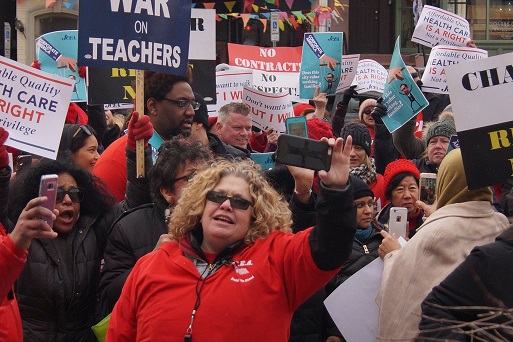
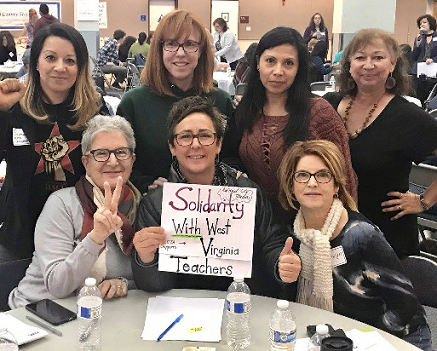
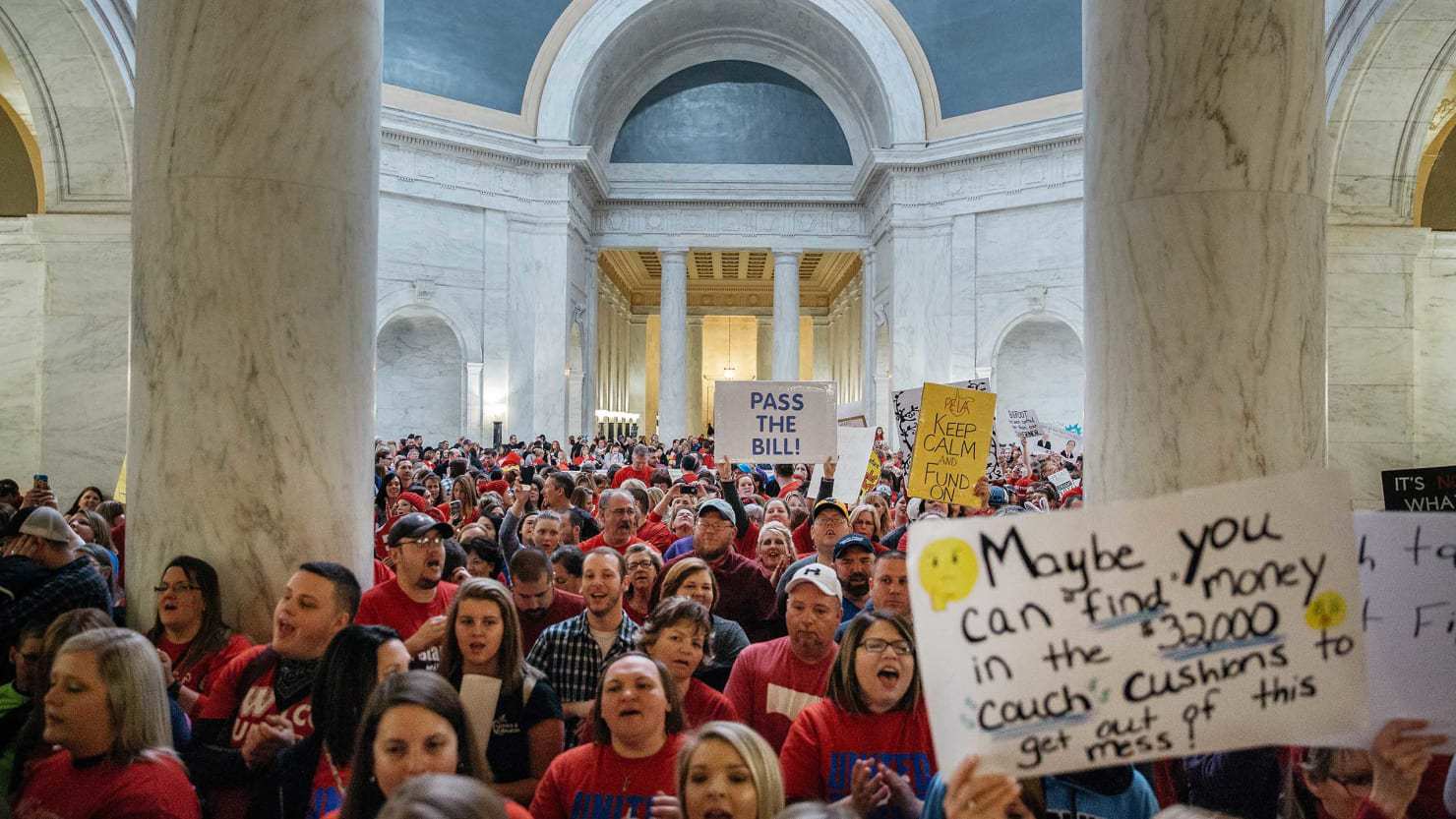
    ImageAs the AFL-CIO holds its day of action across the US, protesting what has been cast as a likely loss in the Janus case, which the Right intends to use to destroy labor and the Left, a movement of school employees in West Virginia is showing organized labor what it means to be a union without the right to strike and without collective bargaining.

    West Virginia is a “right to work” state and bars strikes by public employees, yet schools in  every county in the state closed because school employees had shown they would not come to work on Thursday or Friday.  Although officers of the state affiliates of the American Federation of Teachers (AFT-West Virginia) and the National Education Association (West Virginia Education Association) are asked to speak for the strikers and are regarded as the movement’s leaders, most participating in the walkouts are not union members, and the unions cannot bargain legally-binding contracts on behalf of teachers and school employees. 

    As occurred in Detroit when teachers organized “sick outs” about appalling conditions in their schools, the group of West Virginia teachers who took the lead in organizing this movement did so independent of the union apparatus.  They invited teachers in both the NEA and AFT affiliates, which had historically spent resources fighting one another, as well as all school employees in other job categories, to join the actions, “keeping it open” as one activist described their strategy.  Within months the movement mushroomed, the closed Facebook page expanding to 17,000 members.  School workers were frustrated and angry at low wages to be further diminished by higher costs for health insurance, in policies imposed by the state legislature and governor.  Many school workers knew of West Virginia’s history of labor battles in the coal fields, memories of which still resonate.  This inspired them.  Many teachers identify with workers and labor, not always the case because of teachers’ educational credentials and social class aspirations and origins.  Still West Virginia is a state that is attuned to class inequality: Sanders won the Democratic primary – while Trump carried the state in the general election.

    Understanding this movement’s success requires seeing that the unions that ostensibly spoke for teachers and other school workers did not to tap into or build this labor consciousness nor use its resources to mobilize actions that addressed anger at poor wages.  The unions’ strategy was to court state politicians with donations and votes, finding a new “friend” after each betrayal.  In contrast, the activists who built the movement, many of them socialists, believed that traditional labor tactics, ranging from rallies to walkouts, were essential and that their colleagues throughout the state would respond, if provided leadership that should have come from the teachers unions.   

    They were right. The movement developed at breathtaking speed, protests and local walkouts expanding to a state-wide strike and mass protests in the state legislature.  Teachers and school workers confronted legislators who refused to raise wages and alter health care costs taken from their paychecks. At each step, the movement has made demands on the union, prepared to carry out actions without union endorsement or help.  In the process they have gone far in making the union carry out its responsibilities to them – and to public education. A key concern of teachers is that by keeping wages so low, West Virginia has created a teacher “shortage” that it has “solved” by allowing people who have no preparation to teach to become teachers – a strategy being adopted in many other states.

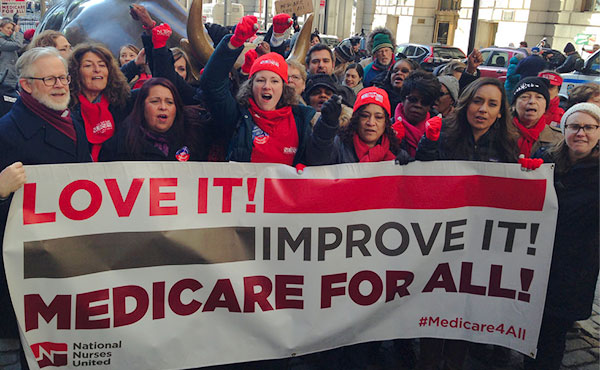
    The West Virginia struggle has shown the energy of the 2012 strike of the Chicago Teachers Union. But it also resembles what occurred in Madison, Wisconsin when public employees,  teachers in the forefront, took their defense of collective bargaining  to the state legislature, occupying the seat of power. Labor was badly bruised in that battle because workers did what union officials instructed: they disbanded the protest and channeled power into recalling Scott Walker, the Governor.  The alternative was to maintain the strike while building more public support by expanding their political program beyond collective bargaining, to other economic and political rights that have been attacked.  That same choice confronts the movement in West Virginia.  One logical expansion of their political struggle is to demand a state-wide “single payer” health plan to cover medical care for everyone in the state.  Public employees who face higher costs for health care will find natural allies with parents who cannot afford insurance or are worried about cutbacks to Medicaid and Medicare.  That alliance is part of the growing move within labor for “Medicare for all,” a struggle that requires fighting Democrats who won’t break with their party leadership’s rejection of “single payer” as unrealistic.  The demand can also weaken the grip of Republicans who won’t break with the GOP – and Trump – about funding health care as a human right.

    Officers of large public employee unions have said that Janus has caused deep introspection and change, but their actions have not reflected their rhetoric about member engagement.  While the unions are reaching out to “involve,” “engage,” and “hear” members, they don’t see the need to encourage self-organization of workers.  The consciousness and capacity of workers to organize at the work site is what will save labor.  West Virginia’s school employees have demonstrated what workers’ power looks like  without collective bargaining or the right to strike. Their lesson is clear to the unions:  Either fight for the dignity of work and workers or move over and let others show you how it’s done.

    A version of this article was published in In These Times with the accompanying photo.

    If you like this blog, please donate and subscribe to New Politics. Subscriptions are cheap! Content is great! The journal makes my blog possible.

  • Russiagate or Deep State? What Some Progressives Get Wrong on Russia

    Image

    When it comes to the Russiagate scandal, progressives usually take one of two positions.

    They either dismiss the scandal as a lot of hooey, a “nothingburger,” just a way for warmongers and the “Deep State” to revive a cold war between Washington and Moscow. Or they treat the scandal as just a means to an end, a way to cast doubt on the 2016 presidential election, implicate the administration in a variety of crimes, and ultimately impeach the president.

    Both of these positions are wrong.

    last wrote about the perplexing positions of some progressives on Russia back in March 2015, long before the Russiagate scandal and the 2016 elections. At the time, I was trying to understand why some progressives were bending over backwards to excuse the actions of Russian President Vladimir Putin, both domestically (his authoritarianism) and externally (his meddling along the periphery of Russia and further afield in Syria).

    Putin, I argued, was an autocrat, an anti-progressive nationalist, and an imperialist wannabe. By all means, the United States should negotiate treaties with Russia and avoid a resurgent cold war, I maintained, but progressives should have no illusions about the nature of the current wielder of power in the Kremlin.

    What had once been a strange sideshow of geopolitics has now, with the election of Donald Trump, become the main act. And the bizarre overlap in positions between some elements of the left and the right about Russiagate does not bode well for the future of American politics.

    The stakes, in other words, are far greater than the fate of the current president of the United States. Why focus on Russiagate when we face possible nuclear war in Korea, a slow-motion apocalypse through climate change, and growing economic inequality worldwide? Because Russiagate points to a new kind of politics, in the United States and elsewhere, that makes resolution of these crises increasingly difficult.

    Yes, the U.S. status quo before Russiagate was grossly unfair. The future status quo, a world of continuous Russiagates, will be grossly unfair and authoritarian as well.

    Addressing the Skeptics

    The Russia scandal has scrambled the political spectrum. Consider the case of Glenn Greenwald, the journalist based in Brazil who writes for The Intercept.

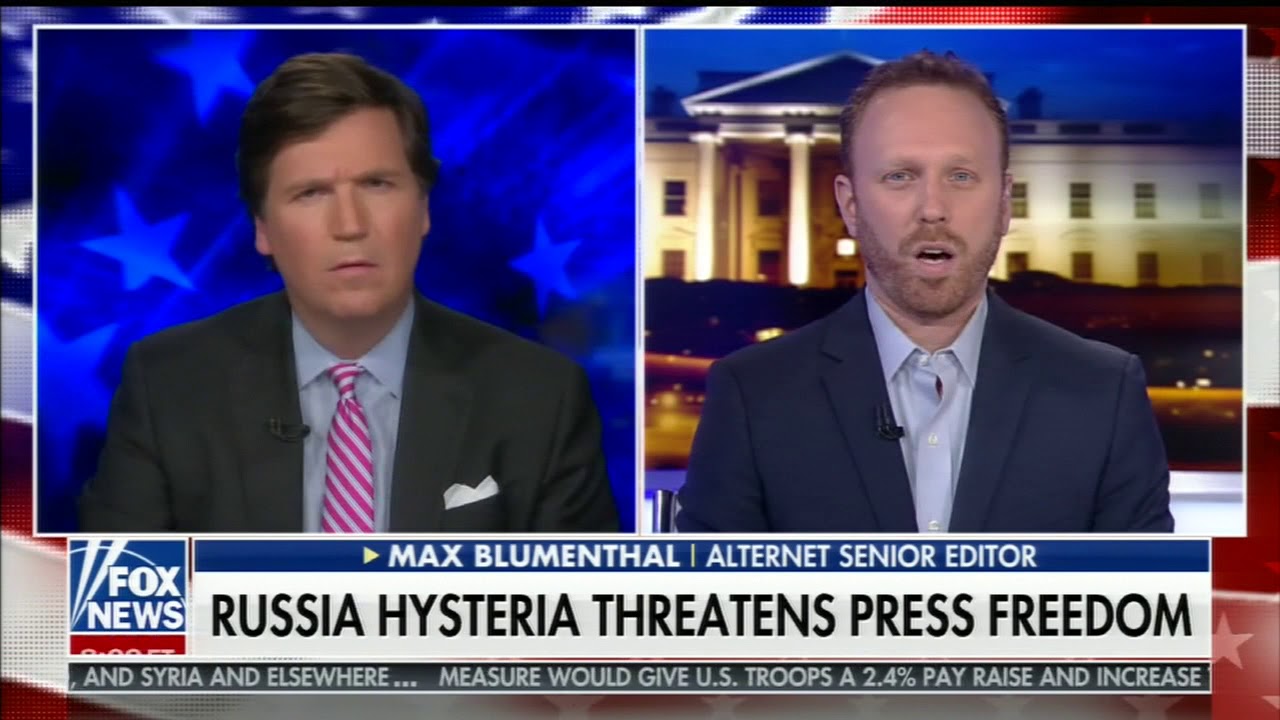
    Greenwald has emerged as one of the prominent skeptics of the investigation into collaboration between the Trump campaign and the Russians. Once a fixture in the progressive media for his dissection of the national security state, he is now more frequently cited by the far right in its efforts to discredit the investigation run by Robert Mueller. The journalist used to chat regularly with MSNBC’s Rachel Maddow, but now he’s more likely to appear with Tucker Carlson on Fox News.

    “I used to be really good friends with Rachel Maddow,” Greenwald told New York magazine. “And I’ve seen her devolution from this really interesting, really smart, independent thinker into this utterly scripted, intellectually dishonest, partisan hack.”

    Wow, that’s harsh.

    Greenwald is not alone. You can find skeptical articles about Russiagate at The Nation, Counterpunch, Consortium News, and many other progressive outlets. And these articles can be equally scathing about the journalists, mainstream or otherwise, that take the investigation seriously.

    Over at The Nation, Russia specialist Stephen Cohen regularly challenges the emerging narrative, most recently suggesting that the intelligence community essentially fabricated Russiagate, which has generated in turn a different scandal — he calls it “Intelgate” — even larger than Watergate.

    I cut my Sovietology teeth on Stephen Cohen and have always had tremendous respect for him. I certainly understand his desire to counter the demonization of all things Russian and his skepticism of the organs of U.S. national security. But he seems to have lost sight of the fact that the two principal groups of actors in this saga — the Trump team and the Putin people — are ruthless operators who have imported their mafia style into democratic politics.

    Remember: The enemy of my enemy, even if that enemy is the U.S. national security state, is not necessarily my friend!

    Consortium News, meanwhile, likes to give voice to former intelligence operatives. For example, former CIA analyst Philip Giraldi accepts the charges in the recent Nunes memo at face value and asserts that Israel, not Russia, played a much more prominent role in determining the 2016 election. Former CIA analyst Ray McGovern, also at Consortium News, believes that he can prove that the FBI, on behalf of the “Deep State,” is out to get the Trump administration.

    But really it’s the same old material that Fox News has been trumpeting. I suppose it takes one to know one, but I suspect these former operatives have other axes to grind in this fight. Hell hath no fury like an intelligence operative scorned.

    At Counterpunch, meanwhile, political economist Rob Urie argues that Russian involvement in the 2016 election is a “red herring” because, essentially, it has not been proven that any voter changed his or her mind as a result of Russian influence. Oh, and there isn’t any proof anyway of Russian meddling — or, if there is “proof,” it comes from unreliable sources. And if Russia engaged in such meddling, it had good reason to do so, given U.S. foreign policy maneuvers in Ukraine and elsewhere.

    There’s a lot here to parse (which I will do below). But let’s return to Greenwald, because his perch at The Intercept is so influential.

    Most of the time, Greenwald has delighted in revealing what the mainstream media has gotten wrong on the Russia story. In September, he ridiculed reports of Russian hacking of 21 state election systems, which turned out to be, in some cases, misreported. But some overly hasty conclusions don’t entirely discredit the entire story. The Department of Homeland Security first mentioned the attempted hacks in June 2017 but noted that it did not affect any votes. Again, this month, the head of cybersecurity for DHS, Jeanette Manfra, repeated the same claim.

    Perhaps DHS is continuing to engage in disinformation. But Greenwald didn’t bother to write anything about Illinois, the one specific and rather well-documented case of Russian hacking that did manage to penetrate a state system (again without having any impact on the election results).

    Also escaping his scrutiny have been the reports I mentioned in last week’s column: Dutch surveillance of Cozy Bear in Moscow as the operation hacked into the Democratic National Committee and the trial in Russia of a hacker who described receiving orders from the Russian Federal Security Service (FSB) “to attack the DNC’s servers for the purpose of manipulating the U.S. electoral process.”

    Okay, so the U.S. media has made mistakes in its coverage of Russiagate. It’s not exactly a transparent story. And it’s very useful for journalists to keep other journalists honest (not to mention government officials).

    But Greenwald is after something different. He is out to discredit all claims of Russia’s malign conduct. In a recent article, he made a list of all the “false” claims involving Russia — interference in the Brexit vote, responsibility for the #releasethememo Twitter campaign, intervention in the recent German and French elections — alongside the “corrections.”

    These dismissals are too casual. The jury is still out on how much Russian social media presence influenced the Brexit vote. Greenwald cites a Senate report on Russian bots using Twitter and Facebook in large numbers then “refutes” the report with an article on YouTube’s denial of Russian interference. Well, those are very different platforms. Greenwald is skeptical that the #releasethememo Twitter campaign was, in part, Russian-influenced, but cites as proof an article with a single anonymous source. On Russian involvement in the German election, he identifies a New York Times article with the headline: “German Election Mystery: Why No Russian Meddling?” But he neglects to investigate the deeper Russian involvement — in cultivating the far-right Alternative fur Deutschland, supporting its messages on social media, and unleashing a botnet onslaught in the final hours of the campaign (a story that broke after The New York Times article but well before Greenwald’s putative takedown).

    Finally, Greenwald points to an AP article refuting Russian involvement in a celebrated hacking of Emmanuel Macron’s election campaign. Perhaps Fancy Bear was not involving in phishing schemes, as investigators allege. But, as with Germany, Russia was involved in other ways, primarily through support for the National Front and Marine Le Pen.

    In other words, the exposure of one poorly reported story on Russia — or even a dozen such embarrassments — does not mean that Russiagate or reports of Russian interference in European elections are “fake news.” Greenwald should know better, as a lawyer and a journalist. He’s pissed at the Democratic Party for running a lousy presidential campaign. He’s pissed at the Obama administration for its drone and surveillance policies. Fair enough. But please, do us a favor and look at all the evidence instead of playing the blinkered prosecutor.

    Now let’s take a look at some of the other efforts to debunk this supposed myth.

    Countering the Counter-Narrative

    One of the major arguments of the skeptics is that Russian interference, even if there was some, didn’t influence the election because it was only a trivial amount of Twittering, Facebook ads, and trolling. Okay, perhaps that’s true. But Russian hacking was not just bots and trolls. The release of the results of the DNC hacking turned out to be quite damaging for the Clinton campaign.

    But frankly, this isn’t the most important question. The election is over, and the Democratic Party should own up to its failures rather than blame it on some other party, be it Bernie Sanders, the Green Party, the Russians, or the deplorables.

    Instead, the investigation should focus on only two things — the Trump campaign’s complicity and safeguarding future elections. Any interference in U.S. elections — whether from a foreign power or domestic actors trying to suppress voter turnout — should be taken very seriously.

    A corollary to the “Russia didn’t really do anything” argument is that other countries had greater impact on the elections. The two countries usually cited are Israel and Mexico.

    Certainly Israeli Prime Minister Benjamin Netanyahu has shown a fondness for Donald Trump, and hardline pro-Israel donors Sheldon and Miriam Adelson poured millions into the Trump campaign. But there were also plenty of friends of Israel pushing in the opposite direction because of an authentic fondness for Hillary Clinton, or because of authentic fears of the anti-Semitic forces supporting Trump. As for Mexico’s meddling, this is largely a right-wing rant about how immigrants are subverting America, not about Mexico trying to sway any particular election.

    Then there’s the argument that Russia wasn’t doing anything that the United States hadn’t done over the years. It’s certainly true that the United States has engaged in such conduct. So? It has also been involved in the assassination of foreign figures. Would that justify another country taking out the U.S. president? Do U.S. regime-change efforts in Afghanistan and Iraq justify another power taking over Washington DC and setting up a puppet government?

    It’s always useful to point out U.S. hypocrisy. But this should be done in order to reform U.S. policy — not to excuse other countries for acting in similarly reprehensible ways.

    Finally, let’s talk about the so-called Deep State.

    I have to be honest. I’m not really sure what the “Deep State” is. Given that the pushback against Trump has been widespread, does the “Deep State” include all the judges who have blocked the administration’s immigration plans? Does it encompass all the career bureaucrats who refuse to go along with the anti-regulatory fervor at the Environmental Protection Agency, the Energy Department, and elsewhere in the federal system?

    Should we include whistleblowers who are aghast at the abuses of power? What about the “Washington playbook” that pushed for military solutions during the Obama era but has also resisted Trump’s more radical proposals?

    Obviously such an amorphous entity lacks any meaningful coherence. So, let’s assume that it’s just the intelligence community and elements of the Justice Department and the FBI that are “out to get” Trump because he’s a rogue president.

    Stephen Cohen argues that the intelligence community targeted Trump during the Obama administration and continues to push its agenda. But this is more usually an argument from the right wing. As Fox Business Network host Lou Dobbs put it, “It may be time to declare war outright against the deep state and clear out the rot in the upper levels of the FBI and the Justice Department.”

    I’m quite sure that there are a lot of folks at the FBI, the Justice Department, and the intelligence agencies who are freaked out about Trump. The president shows little interest in intelligence briefings, has casually given away sensitive information and shown no regard for security protocols, has sought to politicize intelligence, has given highest-level security access to people like his son-in-law without proper vetting, supports all manner of lawbreakers (Joe Arpaioneo-Nazis at Charlottesville, sexual harassers left and right), has defied the emoluments clause of the Constitution, and so on.

    Is it remotely possible that intelligence agencies are genuinely worried about Russian interference? At the latest congressional hearing on Russia’s gearing up for the U.S. midterm elections, even Trump’s Director of National Intelligence Dan Coats and CIA chief Mike Pompeo expressed their very clear concerns about Russian interference, directly contradicting their commander in chief.

    Forget the Deep State. The intelligence agencies are just doing their day job — which I often don’t like, but which I also don’t think is conspiratorial against Trump.

    Moreover, might Greenwald and others consider the possibility that a number of federal actors are pursuing investigations of Trump and his colleagues because this is how a democratic system operates?

    It’s not a question of partisan squabbling. It’s not a question of some shadowy group of operatives trying to take down the president in secret. This is an open investigation, by people who call themselves Democrats and Republicans and independents, into the potential violations of the U.S. law by a presidential candidate and now a current president.

    To the extent that these operators began to investigate Trump during the Obama administration, they only did so in a partial and, given the potential enormity of the threat, frankly half-hearted way. Now, when the very rule of law is threatened, the institutions of American democracy are arguably doing their job.

    Ultimately, the strengthening of the rule of law and of democratic process — not the impeachment of the president — should be the goal of these investigations. Yes, it shouldn’t be just any rule of law (apartheid was a rule of law, after all), but rather a rule of law informed by all the social movements that have shaped it. And it shouldn’t be just any democratic process (Putin is an elected leader, after all), but it should be a democracy of citizens informed by a free press and influenced as little as possible by big money and the machinations of foreign governments.

    Impeachment, however satisfying, would be just a quick fix to the more serious threats Trumpism poses to democracy and rule of law.

    Trump is leading the country in the opposite direction, and he’s doing so to a large extent by trampling on U.S. laws and institutions. If that isn’t clear to Greenwald and others, then they’re missing the big picture even as they get so many of the details wrong as well.


    John Feffer is director of Foreign Policy In Focus at the Institute for Policy Studies. This article first appeared on Foreign Policy in Focus. It is the second of two recent articles on Russiagate by Feffer. For the first, see here.

  • A Litmus Test for Detecting Syria Trolls

    Image

    The situation in Syria is incredibly complex, so it’s not surprising that there are conflicting interpretations of different pieces of information. But, sometimes, a claim is so clearly without merit, so obviously ludicrous, that those who promote it mark themselves, at best, as individuals wholly uninterested in examining evidence when a dubious claim conforms to their preconceived notions, or, at worst, as scoundrels.

    A recent story provides almost a litmus test separating serious commentators from the propagandists and the dupes.

    There have been various credible allegations of chlorine gas attacks by the Syrian government on rebel areas since the beginning of the year. There have also been some allegations that the Assad government has recently been using not just chlorine gas on civilian populations, but sarin. Military use of either chemical is a war crime and a violation of the chemical weapons convention, but because chlorine has commercial uses as well its mere possession is not illegal. On the other hand, manufacture, stockpiling, or possession of the far deadlier sarin is banned outright.

    At a press conference on Feb. 2, Defense Secretary James Mattis was asked about the reports of recent chlorine and sarin use. He replied that chlorine has been used several times, but that the sarin reports are being examined but have not yet been confirmed or disconfirmed by the United States

    He noted that the commitment Assad gave during the Obama administration to destroy his chemical weapons stockpile “after they had been caught using it” had been reneged upon, as demonstrated by the fact that sarin had been used during the Trump administration:

    we think that they did not carry out what they said they would do back when — in the previous administration, when they were caught using it. Obviously they didn’t, cause they used it again during our administration.

    Assad’s record of “deceit and denial” regarding his past chemical weapons use, said Mattis, gives us reason to suspect him now. So having gotten various reports of current poison gas use by Assad, we’re looking at the evidence.

    Mattis warned that the United States was concerned about possible sarin use, and that “we are on the record, and you all have seen how we reacted to that, so they’d be ill-advised to go back to violating the chemical convention.”

    The day before, “a senior U.S. official” had stated that President Donald Trump "hasn't excluded anything" in the bid to halt chemical weapons use. "Using military force is something that is still considered."

    At Mattis’s press conference, reporters went on to ask him if the U.S. was looking into both chlorine and sarin use, to which the defense secretary replied that he believed chlorine had been used repeatedly, but as to whether both had been used:

    No, I have not got the evidence, not specifically. I don’t have the evidence.

    What I’m saying is that other — that groups on the ground, NGOs, fighters on the ground have said that sarin has been used. So we are looking for evidence. I don’t have evidence, credible or uncredible.

    All of this seems pretty straightforward. Numerous news reports of the Mattis press conference made clear that Assad was being warned not to use chemical weapons “again,” that Washington had no evidence Syria had used sarin “recently.” An AP story by Robert Burns, however, lacked clarity, though if one read it carefully, it’s statement that Mattis “alluded to the April [2017 U.S.] attack [on the Syrian airbase], saying, ‘So they’d be ill-advised to go back to violating’ the international prohibition on the use of chemical weapons” – showed that Mattis believed there was previous sarin use. (Burns’s confusing story was picked up by the New York Times, the Washington Post, and others.)

    But notice, that if you extract the indented quote from Mattis immediately above (“I don’t have the evidence,” etc.) from its context, it could be misread as saying that there was no evidence of sarin use in Syria ever, rather than that there was no evidence of a reuse of sarin in recent weeks.

    So those intent on falsification could quote Mattis’s “I don’t have evidence” and try to pass it off as a comment on what happened in 2013 or 2017.

    And so, sure enough, Russia’s RT, a site considered by some on the left as a worthy source of alternative news to counter the mainstream media, ran a story that began this way:

    Washington has no evidence that the chemical agent sarin has ever been used by the Syrian government, Pentagon chief James Mattis has admitted. It did not stop him from still being concerned about Assad, though.

    "We do not have evidence of it,” the US Defense Secretary told journalists, referring to the alleged use of sarin nerve agent by Syrian government forces. He said the only information the US has been able to obtain so far, comes from “other groups on the ground, NGOs, fighters on the ground” and just “people who claim it’s been used.”

    The Duran, a rightwing news site, headlined their story, based on Mattis’s press conference:

    “US finally admits: ‘NO EVIDENCE’ Assad used sarin gas; No specific supporting evidence for claims that Syrian leader Bashar Assad ordered sarin gas attacks in 2013 and 2017”

    Zero Hedge (the pseudonymous Tyler Durdin) wrote an article. re-posted on the MintPress site (famous for its sarin-denialism), that began:

    Secretary of Defense James Mattis stated on or about February 2nd, 2018 that the United States has “no evidence” that the Syrian government used the banned nerve agent Sarin against its own people in attacks in 2013 and 2017.

    (Zero Hedge is so lazy he didn't even bother to check the date of Mattis's press conference.)

    And then on Feb. 8, Newsweek ran an op-ed – not a news story, but a reader-submitted opinion piece – titled “Now Mattis Admits There Was No Evidence Assad Used Poison Gas On His People.” (Notice the use of the past tense: there was no evidence.) The author, Ian Wilkie, wrote that at his press conference:

    Mattis offered no temporal qualifications, which means that both the 2017 event in Khan Sheikhoun and the 2013 tragedy in Ghouta are unsolved cases in the eyes of the Defense Department and Defense Intelligence Agency.

    But of course, the temporal coverage of Mattis’s comments are evident to anyone who actually looked at the transcript.

    Wilkie (identified as “an international lawyer, U.S. Army veteran and former intelligence community contractor”) goes on to repeat a host of Syrian regime talking points, drawing on Seymour Hersh, Ted Postol, and Gareth Porter – whose arguments are mutually contradictory and have been well refuted previously, and now again by Eliot Higgins and Scott Lucas. One could argue those points, but given how Wilkins so distorted Mattis’s press conference remarks, he cannot be taken as a remotely serious source, and anyone citing him would have to be gullible or dishonest.

    Wilkie’s piece was reprinted on the Information Clearing House website. It was on Antiwar.com’s list of linked viewpoints. A large chunk of Wilkie’s article was reprinted in a post by Brandon Turbeville on Activist Post.

    Not surprisingly, “Americans who Support President Bashar Al-Assad” spread the Wilkie story.

    So too did Vanessa Beeley.

    Gareth Porter (who claimed in a report for Alternet’s Grayzone Project that rebels injected people with drugs that mimicked the symptoms of sarin) tweeted Wilkie’s article, writing:

    .@Newsweek, which always reflects the official line on anything involving U.S. adversaries, has published an opinion piece questioning the alleged evidence of a sarin attack at Khan Sheikhoun. Kudos 2 Ian Wilkie (@Wilkmaster) for what seemed as impossible as water running uphill. https://t.co/8aMj7aQfEw

    After the evidence that Wilkie had falsely characterized Mattis's remarks was pointed out, Porter published a retraction – of sorts.

    So we are to conclude apparently a) that an article whose main claim is false is “a small victory for dissent”; b) that’s it’s not wrong to celebrate a statement that Mattis didn’t in fact make, it’s just “too early” to do so; and c) that Mattis’s comments were “apparently” related to recent claims as opposed to being obviously related to recent claims.

    Sharmine Narwani, another favorite of the Assad-didn’t-do-it crowd, also posted the Wilkie piece on her Facebook page, though she later discretely removed it, without explanation, so she didn’t have to face up to promoting a palpably false story.

    Image

    Comedian and political commentator Jimmy Dore, another apologist for Assad, had a field day with the Wilkie story.

    Dore, by the way, is one of many who don’t just cite Wilkie’s bogus claim, but refer to it, or make it seem, as if it were a news report from Newsweek rather than a reader-submitted commentary. (This is like saying that, according to the New York Times, “The global economy is not working for the majority of people in our country and the world.” – when in fact the words come from an op-ed by Bernie Sanders published in the Times.)

    Ben Norton tweeted the AP story, with its misleading headline, with no attempt to clarify what it meant.

    Norton cleverly even tweeted an out-of-context excerpt from the transcript of Mattis’s press conference, either never bothering to read the whole thing or hoping that his twitter followers wouldn't bother.

    On February 9, Carl Davidson, who seldom comments on these issues, also bought into the pro-Assad propaganda. He linked Wilkie’s piece on his Facebook page and commented:

    FROM REAL NEWS TO FAKE NEWS…Here's an example of why we have to be critical and skeptical of 'offical' new [sic], listen to the other side, and study a variety of sources

    Indeed.


    Stephen R. Shalom is on the editorial board of New Politics.

  • It’s Still Fried Ice: On "Market Socialism"

    Image

    In “Our Road to Power,” an article from the most recent issue of Jacobin, Vivek Chibber makes some very familiar arguments about socialism and “central planning.” One hardly has to quote him—they’ve been repeated many times since Alec Nove’s The Economics of Feasible Socialism appeared in 1983.

    Chibber hedges his bets, but he certainly seems to agree with Nove and other “market-socialists”—even avowed Marxists such as David Schweickart—that deliberately planning a modern, complex economy will lead to failure. Any attempt at what Chibber misleadingly calls “central planning,” however different it might be from Stalinist “command planning,” can’t work; only via market pricing, with its sensitivity to supply and demand, can decisions on what and how to produce be rendered “efficient,” and only market competition can provide incentives to motivate worker-managed enterprises to be efficient and innovative. But we needn’t worry too much, Chibber says; the market “will be constrained so it isn’t the arbiter of people’s basic well-being” and inequalities of wealth “will not be allowed to translate into political inequalities.”

    Precisely how “politics” will be able to override “economics” in “market socialism” is left unexplained. Presently, inequalities of wealth do translate into political inequalities, and there’s little reason to think that those who own (or, as in Schweickart’s model, lease from the state) firms in “market socialism” won’t do all they can to make sure that government policy once again rewards market “winners.” And how much “market constraint” are we talking about here? If it’s constrained too much, what happens to the much-vaunted advantages of the market over planning? Won’t this interfere with “efficiency” and “innovation”?

    But what about the Communist experience, Chibber says? We can’t just “handwave it away,” after all. Firstly, Marxist economists such as Hillel Ticktin have gone into great detail about how defective so-called planning in the USSR and like states really was. Secondly, no classical Marxist ever advocated “planning” as it was in the USSR, and as Bertell Ollman reminds us, “Socialism, according to Marx, could only solve the social and economic problems inherited from capitalism because the enormous achievements of capitalism were available as a foundation on which to build. None of these material, social, organizational, political, educational, and psychological foundation blocks were available [in Russia]. Socialism was never understood by anyone before the 1920s as an alternative to capitalism as a way of industrializing and modernizing underdeveloped societies.” If this is handwaving, so be it; it also happens to be true.

    Let’s go back to the Marxist basics. Any “socialism” that deliberately retains value-production will be unable, as Peter Hudis puts it, to overcome capitalism’s “inversion of subject and predicate, in which the products as well as the actions of people take on the form of an autonomous power that determine and constrain the will of the subjects that engender them.”  Our working lives will remain dominated by abstract labor, “a monotonous, routinized activity” that serves as the substance of value. Businesses in an industry trying to put other businesses in said industry out of business will still be required to work at a uniform rate of exchange that workers themselves do not collectively determine. Furthermore, whatever “planning” that might exist within “market socialism” would be indicative planning—planning by remote control, essentially—and there’s no reason to think that such “planning” would be better able to overcome “anarchy of production” in a “socialist” context than fiscal and monetary policy, foreign trade and exchange rate policy, urban and regional policy, competition and industrial policy, and prices and incomes policy have done within a capitalist context, where unemployment, inflation, balance-of-payments problems, regional and personal inequality, etc., remain norms.

    In capialist society, which lacks commanding centers of planned regulation, the distribution of productive forces—both people and means of production—among the different branches of the economy, the distribution of the net product between classes, the allocation of surplus value to expanded reproduction, the introduction of technical innovations, etc. are all determined by the law of value. It logically follows that a system of “market socialism,” in which the means of production are administered as the collective property of the immediate producers (in essence, its shareholders) would, in response to market signals, mimic capitalism, even if this property is formally owned by the public and leased to specific groups of workers. Such a system would be fundamentally unstable and lead back to capitalism, which is the more consistent expression of these relations.

    Does this mean that even “early” socialism must dispense with “market categories” (prices, money) entirely? No, because it simply can’t. The a priori calculations of democratic planning must be tested against what might be called “market expectations” (is there a demand for this or that use-value, are there people trained and willing to perform this or that type of labor and, if so, in what quantities?). This doesn’t equal the domination of the law of value. Following Pat Devine, social ownership of industry should be used to overcome market forces, where each private owner acts in an atomistic fashion, in ignorance of the decisions being made simultaneously by all the other owners—while retaining the use of market exchange: the output of an enterprise, produced with its current capacity, being sold to another enterprise in the case of intermediate goods and services, or to consumers in the case of consumer goods and services. We shouldn’t try to plan consumption in advance, but we must incorporate planning in advance of significant investment. Consider how transnational corporations today already use electronic networks (intranets) and planning software to manage their operations—for profit. Why not use the supercomputers currently used by TNCs (and stock-trading firms) to instead allocate resources and plan for the future, from the workplace level to the global level? Given the delegatory potential of modern IT, there’s no reason that this would have to take a “command-central” form.

    A central point of socialist economics is to maximize the public good and meet everyone’s needs. This requires effective planning and central coordination while creating ample room for local autonomy and initiative. Contra Chibber’s doubts, this is technically feasible. But to provide every minute detail in advance would be futile. Ultimately, no mass audience for socialism will be recruited based on how convincingly Marxists answer Ludwig von Mises or Friedrich von Hayek on socialist planning. Even with the inevitable usage of market exchange, socialist society can still be built upon an organizing principle that doesn’t capitulate to the “spontaneous” market, that abolishes labor-power as a commodity, and which places human needs at the center of social concern, rather than as a contingent instrumentality of capital accumulation. Socialist production and distribution, even before the coming of relative abundance of all mass-produced goods and the end of prices and money, will rest upon the solidarity of the associated producers. But advocating “market socialism” won’t help us reach that necessary solidarity.

  • The War is Far from Being Over in Syria

    Image

    Gilbert Achcar is Professor of Development Studies at SOAS, University of London, as well as a well-known author focusing on the Middle East and the Arab World. He met with Syrian Corner during Syria Awareness Week 2018. Achcar posits that the Syrian conflict is far from over and that for Bashar al-Assad to establish a new political framework, an accord between the US and Russia is necessary. Achcar says the role of Iran in a future Syria is one of the key issues at stake, and discusses the Turkish war against the PYD, the regional role of Saudi Arabia, the international peace conferences for Syria, the recent demonstrations in Iran, and the new US foreign policy for the Middle East in the interview below.

    Assad and Putin recently declared that they have “won the war.” Is the Syrian war over? What will happen to Bashar al-Assad?

    There is a lot of wishful thinking in such proclamations: battles are still raging in the Idlib region and in East Ghouta. It is true, though, that the regime, backed by Iran and Russia, has now been consolidated and is no longer facing an existential threat. Twice before, it was on the verge of a massive defeat, rescued each time by foreign intervention, first by Iran, then by Russia. As a result, the regime has now the upper hand militarily. But when I say ‘regime,’ I am actually referring to the Russia-Iran-Assad axis, as the Assad regime alone would not have been able to accomplish any of this. Far from it, it would have been defeated a long time ago.

    Besides, there is still a very large area of Syria out of regime control in the North-East, dominated by the Syrian Democratic Forces (SDF). The Syrian-Kurdish People’s Protection Units (YPG) led by the Democratic Union Party (PYD) are the SDF’s backbone. They control a huge part of Syria, comprising the whole area east of the Euphrates to the Turkish and Iraqi borders — and this is where US troops are actually involved on the ground. Two more areas are under control of the YPG and their allies: Manbij, west of the Euphrates, and Afrin where the present Turkish offensive is taking place.

    Specifically addressing the issue of the YPG: Turkey has started an attack on the YPG-controlled area of Afrin. Does this represent a new escalation of the conflict?

    Here lies a major contradiction. For many years, Western powers have been following their Turkish ally, a key member of NATO, in labelling the Kurdistan Workers’ Party (PKK) as a terrorist organisation. The Turkish army has engaged in several offensives against the Kurds in Turkey over the years with the support of NATO countries.

    However, when the United States decided to combat ISIS in both Syria and Iraq in 2014, it did not want to involve US troops on the ground directly in the battle but provided instead air and material support to local forces. Thus, it found that the best possible ally in this battle in Syria from a military perspective would be the Kurdish forces. Washington encouraged the creation of the SDF, with the inclusion of Syrian Arabs mostly belonging to the region now under SDF control, so that the US does not appear as involved in an ethnic fight on the side of the Kurdish minority. Since everybody knows that the PYD/YPG are closely tied to the PKK, this alliance created a political paradox. In fighting ISIS, the US relied on a force that is tied to a political movement officially labelled as ‘terrorist’ by Turkey and its NATO allies, including Washington. Unsurprisingly, this has hugely irritated the Turkish state, outraged at seeing the US cooperating with its public enemy number one.

    This was made even more acute by the fact that Erdogan had undergone a sharp nationalist shift in 2015 when his party, the Justice and Development Party (AKP) lost the parliamentary majority. This was due to an increase in the votes garnered by a left-wing coalition in which the Kurdish movement played a central role, but it was also due, most importantly, to losing votes to the far-right Turkish nationalists. Faced with this, Erdogan resumed the war on the Kurds after years of making peace with the Kurdish movement, resorting to whipping up Turkish nationalism. The Islamic conservative stance of his discourse did not change, but a new shift occurred in the direction of Turkish nationalism and renewed onslaught on the Kurds. Erdogan organised a second election five months later, in which his party regained a parliamentary majority. Currently the AKP is in alliance with the major far-right Turkish nationalist party.

    Basically, this stance of Erdogan put him increasingly on a collision course with the US. Tensions with the Obama administration surged. Erdogan bet for a while on the Trump administration — Donald Trump promised to stop supporting the Kurdish forces in Syria. However, the Pentagon contradicted him, for the Kurdish forces have proven that they are excellent fighters and have been instrumental in defeating ISIS.

    The Pentagon regards the SDF as the main card they hold today in Syria. They know that if they cut ties with the SDF, the Assad regime and Iran-led forces will inevitably try to recover the vast strategic area to the east of the Euphrates. Since the US is determined to contain Iran’s expansion in the region, the Pentagon sees no other option than to provide the Syrian-Kurdish forces and the SDF continued support. This is where the friction lies.

    Erdogan is currently attacking the Kurdish-majority region of Afrin in North-West Syria. This region did play no role in the fight against ISIS and was thus no concern for the US. No US troops are present there. But Erdogan threatened to turn against Manbij — where the SDF is backed by direct US presence on the ground. Russia greenlighted the Turkish intervention in the Afrin region, withdrawing its own troops from there. Its aim is to thus exacerbate the Turkish-US rift.

    This whole situation is getting even more complicated, and this is where we can reconnect to the original question: it is far from being over in Syria. Any “mission accomplished,” as Bush announced very carelessly and unwisely soon after the occupation of Iraq and as Putin has proclaimed twice about Syria, is merely wishful thinking. Nothing is solved in Syria. The Assad regime, even with Russia’s support, does not have the capacity to control the country. It needs Iran. Yet, Iran’s presence in Syria is unacceptable for both the US and Israel.

    Image

    Courtesy of syria.liveuamap.com

    Would Turkey, if it defeats the Kurdish forces, be willing to go as far as to occupy Manbij?

    It is a very tough nut to crack indeed, and what is happening now is quite telling. It would be quite difficult for Turkish forces to remain in the Afrin region for a long time even if they manage to occupy it, as they would fall under permanent attacks. Moreover, they would be engaged in war on a foreign territory, without the excuse of being invited by the official government unlike Iran’s and Russia’s forces.

    Erdogan is playing with fire. He has taken a great risk with this operation. Facing discontent even within his own party, he is using this nationalist drive to consolidate his power. But a military setback could cost him a lot.

    Under what circumstances would Iran leave Syria?

    Iran would need to be compelled to leave. This could happen if there is a Russian-American agreement, in the form of a United Nations Security Council resolution stipulating that, on the basis of a political agreement that would be reached in Geneva, all foreign troops that entered Syria after 2011 (excluding the Russians who were already in Syria long before that year) should leave the country.

    It would be difficult for Iran to say “no,” especially if the Syrian regime is part of this deal. Assad would not side with Iran over Moscow if he had to choose. Moscow relies on his regime’s forces on the ground, while Iran is occupying the ground. Tehran would not allow the Syrian regime the same margin of autonomy as Moscow would. Add to that that the Iranian regime is ideologically quite different from the Syrian regime. The Syrian regime has been portrayed by many as a bulwark against Islamic fundamentalism even though it is propped on the ground by Iran-led Islamic fundamentalist forces. That’s also part of the complexity of this situation.

    There have been some important demonstrations in Iran since the 28th of December last year. What influence on Iran’s intervention in Syria can they have?

    Had the movement carried on and continued to expand, it may have created a situation compelling the regime to reconsider its intervention in Syria, which was condemned by the demonstrators. But the movement subsided and was quelled, and the regime is back in control. We see, however, a surge in the tension between the two wings of the regime. The reformist wing represented by Iranian President Rouhani is trying to curtail the hard-line wing of the Revolutionary Guard (Pasdaran), arguing that the latter and its foreign interventions are a burden on the Iranian economy.

    If the social turmoil resumes, things may change, but for now the regime is in full control. Moreover, Syria is an important card in Tehran’s confrontation with the Trump administration, which threatens to cancel the nuclear agreement. Such a move would play into the hands of the hardliners and therefore encourage a continuation of Iran’s expansion as a counter movement to US pressure.

    Do you think the European Union (EU) should have a bigger role in criticising Turkey for the attack on the Kurds?

    The EU has failed to act independently of the United States on the global level with regard to political and military issues. It has mostly behaved until now as an auxiliary of the United States. This has become a problem for Europe with the Trump administration because it is the first time that there is a US president who is so much in contrast politically with Europe’s mainstream and so close to Europe’s far right. The Bush administration did have problems with some European governments, such as France’s and Germany’s that stood against the invasion of Iraq due to differing interests. But Tony Blair’s UK government, for instance, was fully involved on the side of Bush.

    On the Palestine issue, there has been a crystallisation of a different EU opinion, which is why the President of the Palestine Liberation Organization (PLO), Mahmoud Abbas, is now attempting to get the Europeans to recognize the Palestinian state. On Iran too, there are open divergences between the Europeans and the Trump administration. The European governments were quite happy with Obama’s policy leading to the nuclear deal with Iran, which Trump considers to be the worst agreement ever concluded by the US. If he does rescind the nuclear agreement, this will create an open crisis in US-European relations. Thus, Palestine and Iran, for the time being, are two contentious issues on which there is a sharp contrast between the US and the EU. The Syrian issue though is not one on which Europe holds views opposed to that of the US. On Syria, the EU has displayed no independent stance to this day.

    Considering that the conflict is not over, do you think there is any possibility of reconstruction, as Assad is calling for?

    Again, that is wishful thinking. Russia itself has on several occasions called upon the EU to fund the reconstruction of Syria. They have a lot of nerve because Russia has secured a position whereby, if there were to be a reconstruction of Syria, it would play a key role in it. Moscow would like the Europeans to fund Syria’s reconstruction with Russian companies pocketing the lion’s share of contracts. But this will not happen because the Europeans will not disburse any money without a US green light, which will not be given until Washington is convinced that Iran won’t take advantage of the situation. Under the present conditions, Iran too would necessarily secure a major part of the market. So, reconstruction won’t really be on the agenda until this whole political puzzle is solved.

    Russia is trying to set a post-war political framework for Syria. They’ve started doing it at the end of 2016, shortly before Trump inaugurated his presidency. They were expecting him to deliver on his promise of new relations with Russia, but for the time being this is not happening as the establishment in Washington reacted with a strongly anti-Russian position. In any event, Trump won’t reach any deal with the Russians unless they agree to stop cooperating with Iran in Syria and push its forces out of the country.

    For Trump the ideal scenario would be to reach a deal with Putin, entrust the Russians to take care of Syria on the condition that they push Iran out. In exchange for that, the United States could remove sanctions on Russia and give it some concessions in Europe. But this is clearly not on the horizon for now.

    Do you think any of the talks in Sochi and Geneva will change anything in Syria?

    These talks are about the conditions of a political settlement. We know more or less what this will look like — a transitional period, a new constitution, new elections, all this with Assad remaining in power and running in a new presidential election — so there’s not much new to be expected in that regard. Moscow and Assad proclaim that they are willing to have international observers monitoring new elections. They may be betting on Assad’s victory in free presidential elections today in Syria, because the Assad regime is one bloc whereas the opposition is very much divided. The fact that the opposition is in shambles may give the Assad regime enough confidence to undergo such a scenario.

    However, for such a settlement to happen, an international agreement is necessary first. In the Moscow-sponsored Sochi talks, only Russia, Turkey, Iran, the Syrian regime, and a discredited part of the Syrian opposition did participate. In the UN-sponsored talks in Geneva, the United States and Europe are involved. I can’t see the US accepting an agreement that does not stipulate the withdrawal of all foreign troops that entered Syria after 2011. In other words, the US would say, “We are willing to leave Syria provided that Iranian forces leave it as well.” That’s why the US is currently sticking to the region east of the Euphrates. Washington’s message to the Russians is: “We will leave Syria to you if you get it rid of the Iranians, otherwise we won’t.”

    Trump’s view of the conflict is different from Obama’s. He is trying to isolate Iran and has recognised Jerusalem as capital of the Israeli state. Why are their policies different and what implication will Trump’s policy have for the region?

    There are different issues here. When it comes to Israel, Trump is catering to a specific audience: the Evangelicals and other Christian Zionists, who constituted a large part of the Republican’s constituency under Bush and are still a major part of Trump’s voter base. Mike Pence, the US Vice President, is representative of this segment. He is outbidding even his own boss in pro-Israeli discourse. Conversely, there is no consensus on this issue within the wider US establishment. Even some people in Trump’s entourage were not happy with his stance on Jerusalem, which is very ideological. The only issue on which there is a consensus in the administration is a tough attitude towards Iran, but this does not even include scrapping the nuclear agreement.

    Does the Saudi regime still play any decisive role in the Syrian conflict, especially with regard to Iran?

    Trump very much encouraged the Saudi rulers to escalate hostilities against Iran. They have been very clumsy in the handling of episodes such as that of putting pressure on Qatar or that of the forced resignation of Lebanon’s Prime Minister, Saad Hariri, which both ended up in fiasco. The Saudi rulers have no strategy of their own regarding Syria, they align behind the United States. The remnants of the Syrian opposition that are linked to them have been very much weakened. Thus Riyadh’s overall leverage in Syria is much weakened. Its main concern is to contain Iran and roll it back, and for that they can only rely on Washington.


    This article was originally published in Syrian Corner, the SOAS Syria Society magazine.

  • Solidarity with the Metalworkers Strike in Turkey!

    Image

    Hands off the metalworkers’ strike in Turkey!

    Government ban means AKP despotism serves the bosses!

    International solidarity with metalworkers of Turkey!

    The Erdoğan-AKP government has banned the metalworkers’ strike crowning the collective bargaining process of fully 130 thousand workers. This is unlawful, illegitimate and unacceptable.

    130 thousand metalworkers of Turkey declared a strike that was supposed to begin on 2 February 2018. The strike involves all three unions organised in the metal industry. Metal unions affiliated to three different confederations of absolutely contradictory ideological orientations are going on strike simultaneously. This fact alone is sufficient evidence of the urgency of the situation for the workers in this industry, since one of the unions, the largest, is a union that workers protested in their tens of thousands for its docility only two years ago and a second one is affiliated to the confederation controlled in hardly disguised form by the ruling AKP!

    The strike is meant to fight the imposition by the bosses’ organisation of minimal wage raises in a situation where the metalworkers of Turkey already receive the lowest wages in comparable countries and work the longest hours with the lowest rate of absenteeism. As a novelty, the bosses also wish to extend the term of the collective bargaining agreement from the two-year period that is accepted as a rule across all industries in Turkey at all times to three years so as to be able to enjoy the benefits of low wages for a longer period of time.

    The 130 thousand strong striking workers would be a sufficiently powerful force to fight the bosses, were it not for the prospect of the intervention by the AKP government of Recep Tayyip Erdoğan on the side of the capitalists, mostly large joint ventures between Turkish and foreign imperialist corporations such as Ford Otosan, Renault, Mercedes, Tofaş (subsidiary of the Italian Fiat) and others. This government has banned three metalworkers’ strikes in the last three years, as well as large strikes in the glass, petrochemicals and banking industries. President of the republic Erdoğan himself has openly boasted in the past more than once that his government is using the State of Emergency, declared in response to the failed coup attempt in July 2016, to stop strikes!

    We support the just struggle of the metalworkers of Turkey against the imposition of unacceptable terms by the capitalists and declare our full solidarity against intervention by the government in the lawful right to strike by banning this very important action under whatever pretext. We call on working class forces in all countries to turn their attention on this strike: Erdoğan’s regime has been rightly criticised for its increasingly despotic practices. Banning a lawful strike is a clear example of those practices and exposes the Erdoğan regime for what it is: a government in the service of the bosses against the struggle of the working class.

    Metalworkers of Turkey, we are in solidarity with your action!

  • The AFL-CIO Convention: Beginning of the End or Steps toward a New Beginning?

    Image

    From October 22nd to the 25th, 2017, the AFL-CIO held its quarto-annual convention in St. Louis, Missouri. The choice of city was, if not intentionally, appropriate.

    Within St. Louis’ history is an extended case study of the American working class’ past militancy and current predicament. The great boom of capitalist development in the mid-nineteenth century caused a migration of workers from Europe and agrarian areas of the East Coast to the growing industrial towns of the American Midwest.

    When this great boom came to a screeching halt, becoming the Long Depression of the 1870s, manic railway expansion across the United States came to haunt the bourgeoisie in 1877, as workers across the United States struck against the railway companies. In St. Louis, the railwaymen were joined by workers across industries in a General Strike that became an almost Paris Commune-type situation.

    Fast forward to present, St. Louis reads as a characteristic case of contemporary American capitalism’s triplet blights: de-industrialization, urban collapse, and union decline. The former railroad hub’s fortunes fell with that mode of transport; employment in meatpacking and leather goods vanished. With the decline of these industries came the decline of unions. With decently paying union jobs gone, the small businesses which sold to St. Louis’ heavily black working class also went bankrupt. With both its workforce and circle of employers shrinking, the municipal authorities found themselves with a much narrower tax base. The authorities responded with austerity. Taxes went up and public services were cut. The combination of all these factors led to mass flight. The city’s resident population was halved between 1960 and 1990.

    Given St. Louis’ character as a microcosm for neo-liberal pathologies as well as its historical symbolism, the failure of the labor movement to seriously challenge capital’s offensive in the final quarter of the last century was staring the delegates right in the face. In an alternative universe, the setting might have acted as further motivation to throw away failed strategies and begin to put an end to the erosion of worker power in the United States. There would be a certain historical justice if labor historians of the future could the write the words: “In St. Louis, a city ravaged by de-industrialization and urban decline, the AFL-CIO finally turned to the left and laid the foundations for a socialist labor movement which fundamentally transformed American society in favor of the working class.”

    Growing Polarization within the Labor Movement

    The actual course of events, unfortunately, did not conform to this fantasy. [1] If the history books pay any attention to the 2017 AFL-CIO convention it will be as yet another stepping stone in the growing polarization between the emerging, yet still poorly defined left-liberal faction pushing for a more social movement oriented direction and a business unionist bloc.

    The fragility of the federation was reflected in the attendance, reportedly lower than before. Unions no longer with the AFL-CIO, such as the ILWU, did not, of course, show up. Representation from Central Labor Councils was down as well.

    The elephant in the room was the political situation, now substantially worse since the last convention in 2013. The Republicans have seized the Senate and the White House, and continued their almost unstoppable conquest of state government. The legislative horror of a National right to work law poses a severe threat, while the president staffs the Department of Labor and NLRB with anti-labor functionaries.

    Above all, the most immediate threat to the AFL-CIO is the Janus case. The incredible harm which this ruling would do to public sector unions would undermine the existing structure of the federation. Further, if the more parochial, conservative building trades pull out, the AFL-CIO would be reduced to a largely volunteer operation.

    The slogan of the convention: “Join Together, Fight Together, Win Together” expressed the aim of AFL-CIO leadership: to keep the affiliated unions from breaking decisively. There were obligatory references to the need to organize and to the dire political straits in which unions have found themselves. Nobody, however, takes the rhetoric seriously. Despite the AFL-CIO leadership urging greater efforts at organizing in the 1990s and 2000s, the labor movement continues to suffer from an inability to break its weak position. AFSCME and AFT are focusing on internal organizing against National Right to Work. The recent failures to organize southern manufacturing were unacknowledged.

    Labor’s currently defensive position, its almost total reliance on the survival of public sector unionism, is the product of a long decline. According to the Bureau of Labor Statistics, union membership in 2015 was only half of the 1983 rate. But in 1983 it was only 20% of the labor force. Even in its supposed golden age in the 50s and 60s, after purging the labor left, American labor was afflicted with a syphilis of bureaucratic inaction, famously symbolized by George Meany’s claim that he never walked a picket line. This refusal to go beyond the confines of limited, legalistic industrial relations, a dependency on any Democratic Party politician no matter how right-wing, and failure to organize outside of the urbanized Northeast and Midwest were the structural roots of labor’s current crisis.

    The left-liberal wing took initiative at the convention to push for a more independent, social movement-oriented labor movement. Unfortunately the weight of conservative forces makes transforming a united AFL-CIO into an adequate instrument for class struggle unionism currently unimaginable.

    Independent Political Action on the Agenda

    Meetings held by Labor for Our Revolution, the carry-over organization from Bernie Sander’s labor supporters, and the APWU on the topic of a labor party were relatively well attended. On the other hand, despite the acknowledged need for labor to adopt some form of political action independent of the Democratic Party, no one believed labor had the ability to play a serious political role on its own.

    The need for political independence was vaguely acknowledged by a resolution put forward by AFSCME calling for an end to a “lesser of two evils” politics. It was acknowledged that labor wins around issues not Democratic Party personalities. This resolution was offered as an alternative to a much stronger political independence resolution proposed by Mark Dimondstein, the pro-labor party leader of the APWU. In the end, both resolutions were passed together

    The left pole of at the convention was anchored by the APWU and National Nurses United. The Nurses, who had boycotted the previous convention, were Bernie Sander’s main labor backer. Despite Sanders’ popularity, it was impolite to mention his name at the convention. Any accommodation towards even the soft left could not go too far.

    A Step Forward for Medicare for All

    The Left’s greatest success at the convention was getting a resolution passed in favor of Medicare for All which will enable single-payer organizing by labor on the local level. The Labor Campaign for Single Payer (LCSP) dominated the discussions surrounding healthcare. Coordinating with allies, LCSP had the mics at the convention covered, and were in tune with the sentiments of the majority at the convention.

    LCSP however faced a hurdle in the resolution committee which was packed with representatives of the building trades. The building trades, the main conservative force in AFL-CIO, wanted to concentrate on going after the Cadillac tax. Unions that have large Taft Hartley funds are concerned about how single-payer would affect their funds. In the end, however, the LCSP carried the day. The building trades chose not to block the momentum for single payer. Medicare for All gained the support of not only the APWU and the NNU, but industrial unions such as the CWA, UAW and the Steelworkers.

    A Step Backward on Green Jobs

    The success of the left in healthcare was not mirrored in efforts to push labor to take a stand on the environmental question. While a resolution was passed recognizing the problem, it lacked a sense of urgency. Moreover, a thorough policy addressing climate change by creating jobs in the clean energy was lacking. The Labor Network for Sustainability, which had advocated for a comprehensive climate change resolution, criticized the approved resolution for its vagueness in formulating a “green jobs” creation policy.

    On climate change, undoubtedly the victors were a conservative bloc composed of the building trades and the extractive industrial unions. The UMW, despite its militant tradition, from spearheading the CIO to the Miners for Democracy movement, stuck by their immediate interests in defending the coal industry from environmental constraints.

    Challenges Facing Just Transition Politics

    Unfortunately, the conservative stance of extractive industrial unions is almost inevitable. The left’s position hinges upon “just transition”— that is, industrial policies geared towards promoting sustainable jobs which would match or improve the employment, pay, standards, and benefits of workers in industries detrimental to the environment. The problem, however, lies in the absence of any force capable of pushing for such a transition. The labor movement is too weak and the Democratic Party is disinterested. The Republicans in power are certainly not going to implement a just transition. It simply is far more pragmatic for the UMW to stick by their industry than bet on something that seems unrealizable in the short term.

    The real tragedy is that just transition is the only hope for depressed coal mining communities. Even if environmental regulations were lifted, even if coal mining was more heavily subsidized, the only way for coal mining to survive as an industry in the face of growing competition from natural gases are drastic cuts in capacity. For coal companies to restore their profitability, there would have to be a massive wave of coal mining closures amounting to a loss of about 160 million tons according to a report from business magazine McKinsey Quarterly.

    The environmental question demonstrates that workers only have two choices: the ecologically blind capitalism of the coal bosses, whose fraudulent appeals to miners mask the exploitative relation between them, or a socialist industrial policy based on just transition. This dichotomy corresponds with the fundamental issue at the heart of the labor movement’s growing polarization. Either the labor movement remains a federation of organizations who put the short-term interests of their respective industries first or it becomes a movement for social transformation in the interests of all workers.

    Underneath the Complacency A Progressive Force Begins to Stir

    The 2017 AFL-CIO convention did not resurrect the spirit of the St. Louis general strike; but ,while this was not the decisive battle, there were some signs that the future belongs to an emerging left. The victory on healthcare and the fact that the leadership was forced to acknowledge climate change and pay lip service to independence from the Democratic Party in very watered-down resolutions show that the tide may be turning. The convention may have been a depressing ritual of self-affirmation in the face of an increasingly grave predicament, but underneath the complacency, a progressive force begins to stir.

    [1] Interview with a delegate, Traven Leyshon, whose firsthand account of the convention was indispensable for this article and whose edits saved the author from the sin of journalistic exaggeration.

  • Behind Turkey’s Attack on the Afrin Kurds: Imperialist Machinations in the Middle East

    Image

    The danger of nuclear war is present today more than ever with Trump’s threats against North Korea and Iran. Without precedent in US history, the president openly states that he is willing to wage war and destroy a nation for US interests, disregarding his allies’ wishes. Trump not only follows the advice of his buddy Benjamin Netanyahu about the Iran nuclear deal, but he also announces that Jerusalem is the capital of Israel. He remains ahead of schedule on the opening of the US embassy there as well as cutting off funding for Mahmoud Abbas for a Palestinian state, unless he bows to Israel and respects Trump. At same time, his military commander General Jim Mattis announces that the US should be ready for war at any moment.

    It is at this contradictory juncture, the triangle of the US, Israel, and Saudi Arabia, that we can see the beginnings of war with Iran, adding yet another front to the war being led by Erdogan in his attacks on the Kurdish people of northern Syria in Afrin.

    We must defend Afrin from the aggressive and reactionary government of Erdogan before it is able to move on the rest of Rojava. These reactionary governments, along with or on behalf of imperialism, are ready to destroy any progressive movements in the Middle East in order to keep themselves in power.

    We should condemn this illegal invasion by the Turkish army under the false pretense of a fight against “terrorism” in the Syrian Kurdish region of Afrin. The Kurds earned the world’s respect for defeating ISIS with their courageous freedom fighters.

    Erdogan’s attack could not have been launched without the approval of Russia, which controls the airspace over Afrin. In fact, Russia moved its troops out of Afrin as Turkish warplanes bombed the Syrian Kurdish militia group YPG and also its parent organization, the PYD.

    “According to officials in Afrin, Russia proposed to protect Afrin in return for handing over control to the Assad regime. But as the offer was rejected, Russia gave green light to Turkey’s invasion. The United States, meanwhile, which conveniently used the Kurds as ‘reliable boots on the ground’ in Syria for the last years in the international anti-ISIS coalition, stays quiet over their NATO ally’s ambitions to sacrifice the heroes of the ISIS war, merely warning Turkey to ‘avoid civilian casualties.’” (Roar Magazine, Jan. 24, 2018)

    For years, Erdogan and the Turkish government were not bothered by the jihadism of ISIS (or Al Qaeda’s brutal beheadings) and the rape of women on the Syrian-Turkish border. Turkey even called the Kurds “terrorists,” while staying silent about the danger of of Kobane falling into the hands of ISIS in 2014. This is because they saw a multi-ethnic and democratic movement of liberation-oriented women from a grassroots organization, which happened to take root in Rojava, as more threatening to their government than ISIS. And now that these heroic Peshmerga drove ISIS out, Turkey is trying to do what the jihadists could not do themselves: kill off the democratic feminist alternative form of self-governance in the Middle East, all this with the approval of Iran and Russia with the consent of the US, and after the uprising in Iran that could affect all progressive movements, whether in Iraq, Turkey, Syria, and around the world. They call this massacre “Operation Olive Branch” for “Democracy and Peace” and the “War on Terror.”

    Is the historic genocide of the Armenian people to be repeated in front of our eyes with the Kurds? Given this threat, the least we can do is to offer solidarity with the progressive, multi-ethnic people of northern Syria for the future possibility of a democratic alternative in the Middle East based on justice and freedom, something that could evolve into an anti-capitalist humanist alternative. The Kurdish people of Afrin can depend only on international solidarity and the comradeship of progressive forces who stand for an anti-capitalist alternative.

    This was a Speech at the Coalition for Peace, Revolution and Social Justice’s January 26 banner drop marking “Year 2 of Trump: LA Rise Up!” originally posted at the CPRSJ website.

  • Training: Neither Politics nor Education

    Image

    As an employee at a large state university, I have to attend a myriad of trainings, on everything from fire safety to preventing workplace discrimination.  The mood at these trainings is typically sour, the participation minimal and perfunctory, and the information provided mostly inadequate to the topics discussed.  I know what P.A.S.S. stands for, but that knowledge is not going to make me any less terrified if I ever have to use a fire extinguisher.  That being said, at least I know what the purposes of these trainings are: to give a false sense of security, to prevent lawsuits, to feed the bureaucratic apparatus, etc.  They’re excruciating to sit through, but their existence makes enough sense.

    The same cannot be said of the trainings I encounter in my other life as a political actor, where I am always hearing about trainings on subjects like “how to organize,” “how to use social media to mobilize,” or “how to tell our story in a powerful way.”  These trainings, put on by unions, non-profits, and other community organizations, are often pervaded with a compulsory excitement, though they bear all the trappings of bureaucratic self-maintenance.  I was recently fortunate enough to be a delegate at the 2017 convention of the Democratic Socialists of America (DSA), where we were split up regionally for the first “Workshop Block” and subjected to one such training entitled “Values, Strategy, and Structure.”  It was later revealed that this training was only one of a host of other non-issue-based and remarkably abstract trainings like “Building through Relationships” and “Community and Culture” that comprised a proposed “National Training Strategy” for the DSA.  I left the convention generally hopeful about the possibilities for the organization but very concerned that a significant portion of our membership wanted to devote our growing but still relatively small resources to “training.”

    Now no doubt training has its uses: if I am going to phonebank for a candidate or go knock on doors to talk about a particular bill or issue, I am very appreciative of a rap training and some practice time.  But the kind of training I have in mind here is more abstract and purportedly educational.  The implied promise is that sufficient training prepares you to hit the ground running, as if the often painful trial and error of actually doing political work were simply an application of training knowledge rather than the education itself.  The very real danger here is that people are set up with an overly simple model of organizing and activism, and then disappointed, defeated, and bewildered when political reality doesn’t meet their expectations.  Especially in the era of social media, when leftists can happily exist in their self-righteous echo chambers, we desperately need to break out of any cloistered spaces that are safely sequestered from this reality.

    ***

    I was first introduced to the pushy demand to be trained at my first job at an immigrant rights organization in Chicago, where most of the organizers had been trained at the Industrial Areas Foundation, an organization founded by Saul Alinsky.  The problems with “Alinskyanism” – the philosophy centered on apolitical ‘single-issue’ campaigns that focus on ‘winnable demands’ run by a well-oiled, staff-heavy organization” – have been well-charted elsewhere.  Under the auspices of “realism” and “pragmatism,” Alinsky encouraged organizers to be anti-ideological, to focus on very small victories, and to avoid dealing with larger systemic problems – all points that are more or less inimical to socialist politics.  Jane McAlevey sees the failures of New Labor after 1995, including its corporate campaigns and top-down decision-making, as a result of their adoption of “Alinsky’s extreme pragmatism and his embrace of ‘ends justify the means’ tactics, [which] enabled New Labor’s leaders to rationalize accords with big business that stripped workers and their communities of the ability to defend themselves against their employers.”

    Less emphasized in the literature on Alinsky is his maniacal focus on training, a concern that animated the writing of his well-known Rules for Radicals: A Practical Primer for Realistic Radicals in 1971 and which became the central focus of the Industrial Areas Foundation around that same time.  In Rules for Radicals, Alinsky describes the “major problem of [his] years of organizational experience” to be “the finding of potential organizers and their training,” and proudly holds up his “special training school for organizers” (one that is still in existence today) as a crowning achievement.  Alinsky was always adamant that a good organizer is “suspicious of, and antagonistic to, any idea of plans that work from the top down.  Democracy to him is working from the bottom up.”  But there is an important paradox in his position: the organizer always works from the bottom up, but it is only the organizer who is properly qualified to recognize what is at the bottom from their position at the top.  Proper training endows the organizer with a special expertise – Jeffrey Stout tellingly compares organizers to soccer coaches – that establishes an implicit hierarchy, and it is only within this schema that “bottom-up” issues are identified.

    In a comprehensive and exacting critique of Alinskyanism, Aaron Petcoff argues that professional organizers bear a “relatively constrained field of vision in which the rank and file appears hopelessly disorganized and conservative.”  This is a very subtle point: if one is a psychiatrist, one will walk into a consulting room ready to fit patients into certain diagnostic categories.  (The history of psychiatry bears some amusing anecdotes where this process has gone awry: for instance, when Emil Kraepelin interpreted a patient’s mocking retorts to be non-sensical gestures of “catatonic excitement.”)  The same basic problem goes for trainers, and this was in abundant evidence at the DSA’s “Values, Strategy, & Structure” training, where many “trainees” objected to the infantilizing nature of the trainings and refused to participate.  Armed with the notion that their job was to bring order to disorder, the trainers – no doubt well-intentioned, but some of whose qualifications entailed only recently having gone through the training themselves – chided the disobedient and pushed on with the training, as if the participants were acting like children rather than lodging reasonable complaints.

    One might pass this off as a specific problem of tin-eared trainers, but it is the very structure of training that encourages this kind of behavior.  A hierarchy is established wherein workers, organizational members, and community leaders are the raw material to be shaped by organizers and trainers, rather than political agents in their own right.  Of the many damaging things Alinsky introduced into left discourse, this paternalism, veiled by claims about “working from the bottom up,” is one of the most insidious, and it is part of the fabric of the whole training model of politics.

    ***

    This is not, of course, to say that we all don’t have a great deal to learn, merely that you learn political work by doing political work.  Canvassing, for instance, isn’t just for the experienced: properly organized, canvasses can be used to onboard newcomers, and in such a way that exposes them to the reality of people’s everyday issues, struggles, and hopes, rather than the make-believe world created in trainings.

    One might nonetheless think that training offers a good model of political education, but here again it offers only a simulacrum of the thing itself.  Any socialist model of education must transcend what Frances Reade has identified as the “sit and get” or “drive-by” model of learning and create spaces wherein people are really encouraged to communicate, out of a respect for the autonomous capacities of ordinary people.  It should not encourage the selling, pitching, or packaging of the basics of socialism because the possibility of a better society is only truly internalized through slow reflection on and discussion of everyday experiences in the harsh world of late capitalism.

    The training model, by contrast, is profoundly disrespectful of the capacities of the people who are supposedly “served” by it.  Training material is typically Powerpointed into slides that offer the most cursory of power analyses or concept explanations, any audience participation is highly structured in such a way as to prevent real conversation, and the time where dialogue is allowed is often devoted to activities like practicing political sales pitches.  Capitalist society, especially in its neoliberal phase, encourages us to think about other people as unintelligent and at best to be manipulated for our own ends.  Training, in assuming that we “meet people where they are” by obsessively directing and limiting conversation, participates in this deep disrespect for human autonomy that is inherent in contemporary society.

    To be clear, to reject the training model of political education is not to affirm the quasi-Talmudic Marxist reading group as the standard we should all strive for.  Full immersion in political economy, great in itself, is certainly not a precondition for being a socialist, but a good socialist education model will discourage oversimplification and encourage reading, reflection, and discussion amongst peers.  On both counts, training fails miserably, and if we follow the logic of Doug Henwood, Liza Featherstone, and Christian Parenti’s classic article, “Action Will Be Taken,” this should come as no surprise.  Undergirded by the kind of non-profit culture that pursues “specific politely meliorative schemes” while avoiding any systemic focus, training “fosters an array of mind-killing practices,” and in so doing participates in the general anti-intellectualism that so dominates American life.

    A more recent Parenti article, “If We Fail,” does a spectacular job of illustrating what an incomprehensibly important political moment we live in.  The reconstitution of the left in the wake of Bernie and in the face of Trump is tremendously exciting, but the intensifying climate crisis, the worrying reemergence of regressive ideologies, the threats of new wars, etc. means that we must think and act with clarity.  The process of being trained – somewhat like exercising on a stationary bike while watching the news on television, in that two perfectly good activities are debased in being combined – dulls both thought and action.  Forgive the extended metaphor, but the topic elicits the facile: we cannot afford to spin our wheels at such a critical juncture.


  • In Latin America: A New Left, A New Marxism?

    Image

    This is an excerpt from Webber's article From Nuestra América to Abya Yala: Notes on Imperialism and Anti-imperialism in Latin America across Centuries in the newest issue of Viewpoint.

    The richness of the extra-parliamentary cycle of revolt, and the contradictions of subsequent left-government rule, unsurprisingly spurred a new period of Latin American Marxism (2000–). It is perhaps imprudent to make summative judgements on key features of the theory and praxis generated thus far, and assuredly over hasty to determine whether the phase of Marxism begun in 2000 is drawing to a close in tandem with the end of the political cycle of the latest Left turn. But one tentative conclusion might be hazarded – the latest season of Latin American Marxism has been characterized by the kind of bursts of originality and profundity last witnessed after the Cuban Revolution, and, at the same time, signs of sclerotic rigidity and formulaic dogma that preceded it. Winds of transformation and restoration wrestled each other indeterminately through this latest storm of the region’s Left.

    Some of the intellectual highs and lows are visible in the outpouring of recent works on imperialism and anti-imperialism. We can document such polarities, at least in a preliminary fashion, through a comparative juxtaposition of recent work by two of the region’s weightiest theoreticians: Atilio Borón and Claudio Katz, both highly acclaimed Argentine Marxists. What is most striking in examining their distinct treatments of contemporary imperialism and anti-imperialism are their different theorizations of the relationship between capitalism and imperialism. Borón, on the one hand, implicitly absorbs a number of Realist axioms from orthodox academic debates in North American International Relations, the most important being the near-total separation of the sphere of “geopolitics” from the laws of motion of capital accumulation as they unfold unevenly in and through the world market. This is not merely a heuristic separation for analytical purposes in Borón’s analysis, but purports to document a real separation. Thus a window is opened to hyper-contingent and, at times, conspiracist readings of U.S. domination and its ostensible decline over the last few decades. For Katz, by contrast, the economic and the political are often out of sync in their specific temporalities, but there is nonetheless always a dialectical relation between the two. A better balance between objective determination and historical contingency is thus possible in this framework. Capitalist dynamics running through the world market over different phases of capitalist development internationally are understood to set limits on political maneuver for the asymmetrically positioned, constitutive parts of the totality. The same capitalist dynamics contain internal contradiction, and tend toward recurrent systemic crises, potentially opening up political opportunities.

    América Latina en la geopolítica del imperialismo, by Borón, is perhaps the most eminent contribution to the latest wave of work in this area.51 The book received a conspicuous boost in stature when it won the 2012 Premio Libertador al Pensamiento Crítico prize, established in 2005 by Hugo Chávez, and administered by the Red de Intelectuales, Artistas y Movimientos Sociales en Defensa de la Humanidad (Network of Intellectuals, Artists, and Social Movements in Defence of Humanity).

    Audacious in ambition, Borón’s panoramic vision in this text moves in and out of broad theoretical controversies – classical and contemporary – and the concrete historical and political terrains of Latin America. He surveys classical questions of Marxist imperialist theory since the late 19th century and offers a novel synthetic framework for understanding the present machinations of global geopolitics. On that backdrop, Borón makes a first foray into more concrete analytical claims surrounding the general crisis of capitalism that erupted in 2007–08 and the questions it posed and poses for the apogee or decline of American empire. Regarding Latin America, he tracks the strategic centrality of the region in U.S. foreign affairs, from the Monroe Doctrine of the early 19th century to the Free Trade Area of the Americas initiative in the early 21st. This explains, for Borón, why the intensified militarization of American power around the globe includes an impressive tentacular reach – through military bases, covert operations, joint military exercises, and the “war on drugs” – into Mexico, across Central America, and throughout parts of South America.

    A series of interwoven thematics are at the center of Borón’s account: the question of natural resources, both as a strategic motivation for U.S. intervention and domination, but also as a source of debate and contestation between social movements and left-wing governments over the character of “extractivism” during the accelerated commodities boom of 2003–2011; the specificities of U.S. military extension into Latin America; the difficulties of periodizing recent cycles of popular movements in the region and their relationship to anti-imperialist resistance; and tentative interpretive outlines of a “new epoch” of geopolitical politics on a world-scale.

    Much of the book is anecdotal and patchily organized. Intellectuals of lesser renown could ill afford its breezily assertive style. Fundamental theoretical elements – relative U.S. decline, rise of the BRICS, progressive orientation and transformative potential of extant leftist regimes – are more opening gestures than elaborated theses, with internal inconsistencies and soft-spots for conspiracy. But the political conclusions resonate with the most “statist” inflections of Latin American Marxism in recent years – i.e. those closely aligned with governments in office. Leftist opponents of the intensification of extractive capitalism under progressive governments – Raúl Zibechi, Eduardo Gudynas, and Alberto Acosta especially – are caricatured and ridiculed, while indigenous critics of capitalist mining expansion are portrayed as naïve romantics – pachamamistas – in a section relying heavily on a sycophantic reading of recent writings of Bolivian Vice President, Álvaro García Linera.52

    In his strongest thread of argumentation, Borón offers a cartography of military expansion – the agreement between Barack Obama and Álvaro Uribe to establish seven new military bases in Colombia, the vigilant patrolling of the Caribbean basin by U.S. forces, the broad encircling of Venezuela with U.S. military outposts – in the north, in Colombia, and the Dutch Antilles; in the south, bases in Paraguay; in the west, bases in Peru; in the east, those in Guyana, Surinam, and French Guyana.53 He demonstrates how Plan Colombia, Plan Puebla-Panama, and Plan Mérida, among others, have enabled joint military exercises with local armed forces.54 Borón also points out the expansion and decentralization of U.S. military bases in recent decades with the U.S. Southern Command’s “forward operating locations,” which are little more than specialized landing strips and crude accompanying infrastructures. With local communications facilities around these strips quickly enabled by the monumental network of U.S. satellites around the world, and the use of enormous C-17 Globemaster transport planes, what appear to be more or less empty sites could be retrofitted, Borón contends, with operational U.S. troops and tanks within hours in most parts of Latin America and the Caribbean.55 Such insights into the military dimensions of imperialism, however, are underspecified in relation to the dynamics of global capitalism. In an unacknowledged echo of mainstream “realist” theories of North American International Relations theory, geopolitics for Borón appear frequently as a wholly distinct sphere. Each time economics seems poised to enter the analysis, the narrative short circuits back to diplomatic intrigue.

    In a degrading turn, which dishonours his landmark early books, Borón lends credence in América Latina en la geopolítica del imperialismoto 9/11 truther theses in several discrete moments of his argument.56 What accounts for sustained celebration of this book, nonetheless, is perhaps the easy ideological veil it offers the governments of Bolivia, Ecuador, and Venezuela. All three processes are said to be advancing toward “a socialism of a new type,” a description which for Borón is flexible enough to cover Vietnam and China, despite decades of capitalist restoration57The state, so this thesis goes, remains in control and dominance over private capital in these countries, and thus they cannot be described accurately as capitalist. Such a perspective also allows Borón to accept as necessary the totality of market reforms introduced recently in Cuba.58

    The strategic political conclusions Borón draws from history are of a kind with his economic conceptualization of market socialism. From the Allende period in Chile, for example, we are to conclude that the activities of the “most intransigent and radicalized” sections of the Chilean Left, unwittingly and in spite of themselves, “converged” with the interests of imperialism and the domestic Right in the early 1970s, precipitating the 1973 Pinochet coup. This must not be allowed to happen again, he stresses, particularly in contemporary Bolivia, Ecuador, or Venezuela.59 Allende’s moderation was apparently a plausible exit for that conflictual period, had it not been for radicals to his Left. By contrast, the great historian of the Allende years, Peter Winn, contends that,

    in Chile, it was the counterrevolutionaries – not the revolutionaries – who utilized political violence and state terror as a conscious strategy. In the face of this violent counterrevolution, the determination of Allende, the bulk of the Popular Unity to keep to the nonviolent road to socialism may have doomed that strategy to ultimate failure – and condemned Chile to suffer the darkest night of political violence in its history.60

    In the first version, Allende went too fast, reached out insufficiently to his Right, and did so because of the intransigence of the Chilean radical Left. In the second, Allende’s excessive moderation, faith in leadership from above, trust in the established institutions of the capitalist state and the bourgeois opposition’s commitment to democratic continuity, and especially his suspicion of unleashed capacities of those from below and to his Left, are what led to the preventable Pinochet disaster.

    Doubling down on key analytical features of his book – the statist conception of socialism, the demonization and caricature of left-oppositional forces in Latin American countries with progressive governments, and the tendency to radically reduce each Latin American conjuncture to the geopolitical expression of imperial power – Borón has more recently compared the 2017 elections in Ecuador to the Battle of Stalingrad, eschewed the possibility of independent left forces in Venezuela critical of Maduro, and interpreted Trump’s arrival to the White House as the “end of the cycle” of neoliberalism, and thus an opportunity for progressive forces in Latin America.61

    In Borón’s theorization and historicization of imperialism, burdened by a geopoliticist idealism, diplomatic positioning by state managers in the core of the world system is granted excessive explanatory power, as is, in terms of resistance, action by progressive state managers of certain Latin American states with centre-left or left administrations. These state managers become the privileged potential agents of emancipation. Class struggle from below is largely eclipsed, despite occasional gestures to the contrary. This eclipse is as true of Borón’s treatment of the United States as it is of Latin America, and it is in part what allows him, finally, to wade into conspiracist waters.

    Beneath the Empire of Capital

    The two latest books by Claudio Katz are of incomparable sophistication, whatever their internal tensions and misfires. Bajo el imperio del capital, published in 2011, contributes to the latest period of international theorization of contemporary imperialism (drawing on debates in Spanish, Portuguese, French, and English), while Neoliberalismo, neodesarrollismo, socialismo, published at the end of 2016, links the wider imperial context to narrower political and economic debates surrounding the last 15 years of leftist experimentation in Latin America.62

    Perhaps the most consequential element in Bajo el imperio del capital is Katz’s careful periodization and characterization of the distinct phases of imperialism since the late nineteenth century – classical (1880–1914); post-war (1945–1975); and neoliberal (1980s–present).63 Drawing on the theorizations of Lenin, Kautsky, Luxemburg, and Hilferding64 – at times overlapping, and at others competing – Katz characterizes the classical era as one of ferocious capitalist expansion, with private enterprises playing a protagonist role, in which peripheral territories still external to capitalist laws of accumulation were brought into the system’s orbit through colonial conquest.65

    Here Katz scrutinizes the specificity of distinct modes of production and distinguishes his account from those historians who pay exclusive attention to the rise and decline of empires across centuries – from Rome to Great Britain – without cognizance of the dramatic dissimilarities of the domestic social relations underlying each expansionary state. Following Ellen Meiksins Wood’s Empire of Capital, Katz stresses the analogous relationship between specific forms of domestic social relations and various forms of imperial rule.66 History suggests that there has been a close association between both capitalist and non-capitalist societies, on the one hand, and their imperialisms, on the other. Non-capitalist colonial empires of the past – such as the feudal Portuguese and Spanish Empires in Latin America between the late 15th and early 19th centuries – like feudal lords in their relations with peasants, dominated territory and subjects through military conquest, often direct political rule, and therefore extensive extra-economic coercion; in contrast, capitalist imperialism “can exercise its rule by economic means, by manipulating the forces of the market, including the weapon of debt.”67 It is obvious, all the same, that capitalist imperialism continues to require coercive force. As Colin Mooers suggests, “force remains indispensable both to the achievement of market ‘openness’ where it does not yet exist and to securing ongoing compliance with the rights of capital.”68

    Neoliberal capitalism, Katz stresses, witnessed the transformation of the old international division of labor through the internationalization of production and the modularization of global value chains. The systematic transfer of manufacturing activities toward Asia intensified competition and reduced production costs.69 Massive multinational corporations emerged as key agents in this process. However, contra theses of monopoly capital, the augmentation in size of companies is not synonymous with monopoly control or suppression of competition. Instead, capitalism systematically recreates competition and oligopoly in complementary forms through reciprocal recycling. At certain moments of intense inter-firm rivalry, specific companies introduce transitory forms of supremacy, but these cannot be maintained in the face of new competitive battles just around the corner. This dynamic, Katz insists, is constitutive of capitalism and will persist so long as this particular mode of production survives.71

    Technologically, an information revolution has facilitated the various neoliberal mutations of capitalism, with the generalization of the use of computers in manufacturing and the financial and commercial management of mega-corporations. Radical innovation has increased productivity, cheapened transportation, and enlarged communications networks.72 However, the internationalization of capital has also enabled more rapid and total transmission of disequilibria in the global system – witness Japan in 1993; Mexico in 1994; Southeast Asia in 1997; Russia in 1998; the so-called dot-com bubble in 2000 in the United States; and Argentina in 2001. This list of regional precursors to the 2008 Great Recession is hardly exhaustive.73

    As in all earlier phases of capitalism, neoliberalism is based on competition and fierce economic rivalry between firms for control of markets. Yet, in the classical phase of imperialism a certain proportionality existed between economic and military rivalry, whereas in the post-war and neoliberal epochs this proximate relationship has been partially displaced and fractured through the military supremacy of the United States.74 The present system of imperialism is sustained in part through American military intervention and a historically unprecedented global military presence and attendant capabilities.75

    At the same time, U.S. hegemony in the 21st century is much reduced relative to its near-absolute dominance in the first-half of the 20th century. The effectiveness of its military superiority is increasingly in doubt, as the fallout from wars in Afghanistan and Iraq partially demonstrate.76 Part of the explanation for U.S. military belligerence in the neoliberal period, generally, and the temporally and geographically indefinite character of the “war on terror,” specifically, can be understood as a compensation for declining industrial competitiveness and productivity. In the present moment U.S. military power is employed in part to redress economic deterioration.77 The United States must constantly reaffirm its global leadership through new wars, Katz insists, but the results of each war are impossible to anticipate, and the instrumentalization of each bloody conflict has become more difficult with the absence of compulsory conscription.78

    The great advantage of Katz’s framework relative to Borón’s is the attentiveness it affords to the underlying character of shifting epochs of capitalist development globally, alongside careful defence against crude economic determinism. Capitalist dynamics in the world system in different historical periods are never reduced to empty abstractions, as though they mechanically determined political outcomes. Katz, following Marx, rises from the abstract to the concrete as he introduces new, specific determinations and mediations across capitalist phases, as these determinations and mediations arise in different regions of the world, in different ways. Class struggle – from above, and from below, and within both dominant and dominated countries – features at the heart of Katz’s historical narrative and theoretical premises. Thus history is open, if not wide-open.


  • Fossil Fuels and Toxic Landscapes – Issue Launch and Panel

    Image

    Monday, February 26 at 7:00pm

    Verso Books

    20 Jay St., Brooklyn, NY

    Please RSVP Here!

    A year after President Trump's inauguration, our worst climate policy nightmares have become a reality. Fossil fuel interests have hijacked every part of the new administration—the State Department, Department of Interior, Environmental Protection agency, Department of Energy and National Economic Council, and the list goes on and on. Meanwhile, the intensity of global-warming fueled devastation increases daily as over a century of fossil-fueled war and violence against labor and nature rages on. Latin America is familiar with this kind of violence.

    Join us for a discussion that brings together contributors from NACLA's latest issue, Fossil Fuels and Toxic Landscapes, with internationally recognized activists and organizers for a discussion on the fight for environmental justice, sustainable energy, and a livable future across border—from New York to Houston to Oaxaca.

    • Elizabeth Yeampierre, UPROSE
    • Bryan Parras, Beyond Dirty Fuels, Sierra Club
    • Todd Miller, Independent Journalist
    • Alexander Dunlap, Vrije Universiteit Amsterdam
    • Moderated by Nicole Fabricant (Towson University) and Bret Gustafson (Washington University)

    And join us on Facebook!

    Sponsored by the North American Congress on Latin America (NACLA), New Politics, and the Democratic Socialists of America Climate Justice Working Group.

  • Solidarity with Afrin, al-Ghouta, Idlib Against All Military Attacks

    Image

    We, the Alliance of Middle Eastern Socialists, oppose the various military attacks on Afrin, Idlib and Eastern Ghouta and support all the innocent civilians in Syria. . . There has been a consensus between all the international and regional powers on the necessity to liquidate the revolutionary popular movements initiated in Syria in March of 2011 . . .

    Solidarity with Afrin against Turkish military intervention

    January 23, 2018

    Since January 20, 2018, Turkish military assisted by pro-Turkish Syrian opposition militia groups have launched a large scale air and ground offensive, dubbed “Operation Olive Branch” on Afrin province located in northwest  Syria with a Kurdish majority population and controlled by the Democratic Union Party (PYD) and its People’s Protection Units (YPG).  At least 30 civilians have been killed since the beginning of the operation.

    Afrin has welcomed many Internaly Displaced Persons from other regions of the country which has led to a doubing of its population to 400,000 and 500,000, because it was relatively spared from the war and agressions of the Assad’s regime forces.

    This attack comes after months of tensions and agression by the Turkish military against Afrin. The Turkish army used as a pretext, an announcement by a military spokesman for the US-led global coalition against the Islamic State (IS) to build a 30,000-strong border force under the command of Syrian Democratic Forces (SDF) led by People’s Protection Units (YPG). In Ankara’s opinion, the US decision meant that  the US-YPG partnership would not end with the collapse of the IS, as the Turkish government had hoped.

    Ankara considers the People’s Protection Units (YPG) and PYD in Syria, as an extension of the Kurdistan Workers Party (PKK), which the United States, the European Union and Turkey have labeled a terrorist organization.

    Turkish President Recep Tayyip Erdogan said the Afrin operation would be followed by another against Manbij. Erdogan also threatened any critical voices in Turkey against the “Operation Olive Branch,” notably stating in reference to the pro-Kurdish Peoples’ Democratic Party (HDP), “that wherever you go out on the streets our security forces are on your necks.”  With the exception of the HDP, the rest of the main parties in Turkey, including the fascistic National Movement Party (known as MHP) and the Kemalist Republican People’s Party (known as CHP), support Turkey’s military intervention.

    Despite a statement from the Russian Foreign Ministry expressing “concern” and calling on the parties “to show mutual restraint,” Moscow, which controls large large parts of Syrian air space, has actually given Turkey the green light for this invasion and has withdrawn its forces from the areas targeted by Turkish forces. Russian officials had demanded that the YPG hand over Afrin to the Syrian regime to “stop” the Turkish attacks on the region.

    The USA has remained rather passive, only urging Turkey to exercise restraint and ensure that its military operations remain limited in scope and duration. At the same time, Russian, Iranian and Turkish diplomats met to prepare for the Syrian “National Dialogue Congress” to be held in Sochi, Russia on January 30, and seek to consolidate a so-called peace process in which the Assad regime’s  structures would be maintained.

    The Syrian National Coalition Of Syrian Revolution and Opposition Forces (known as the Etilaf), composed mostly of liberal and Islamic conservative and fundamentalist groups and personalties, have not only supported the Turkish military intervention and continued their previous chauvinist policies against the Kurds in Syria, but are also participating in this operation by calling on Syrian refugees in Turkey to join the Syrian armed opposition groups fighting in Afrin.

    The current Turkish military operation against Afrin and the very recent failed Kurdish independence referendum in Iraqi Kurdistan, have shown that international and regional powers have no willingness to see any Kurdish national or autonomist aspirations come to fruition. It is evident that the previous support of Moscow and and Washington for the YPG, and the YPG’s support for the Russian air and military campaign alongside the Assad regime launched at the end of September 2015, did not prevent Ankara’s military aggression against Afrin.

    More broadly, the Afrin operation reflects the weakness of all democratic and progressive actors in Syria in the face of the Assad regime and its allies’ destruction of the Syrian revolution, and the consequent renewed power of this regime which has received acceptance by all International actors.

    Solidarity with Idlib and al-Ghouta against the attacks by the Assad regime and its Russian ally

    At the same time, we condemn the Assad regime’s attacks on Eastern Ghouta and Idlib, areas which are supposedly considered “de-escalation zones” according to the Astana “peace” negotiations, led by Russia, Iran and Turkey.

    Since mid-November 2017, the nearly 400,000 people in Eastern Ghouta have been subjected to airstrikes, shelling and bombardment on an almost daily basis by regime forces and its allies. At least 21 civilians have been killed by regime airstrikes and shelling of Eastern Ghouta between January 20 and 22. This brings the death toll to more than 200 civilians since the regime escalated its offensive against this area on December 29. According to the local Civil Defense, regime forces reportedly fired nine shells carrying suspected chlorine gas on Douma city on January 20 and injured 21 people. As a reminder, this region has been under siege by the Syrian regime and allied militias since 2013.

    Opposition groups in al-Ghouta have also shelled various districts of Damascus, resulting in the killing and injuring of a dozen civilians these past few weeks.

    In addition to this, following regime advances, in southern Idlib and northern rural Hama, over 200,000 civilians have been displaced in the past month. while more than 100 people were killed in the fighting.

    In both Idlib and al-Ghouta, socialists need to stand in solidarity with the civilians against the authoritarian rule of Salafist and Jihadist movements, respectively Hay’at Tahrir al-Sham and Jaysh al-Islam.

    There has been a consensus between all the international and regional powers on the necessity to liquidate the revolutionary popular movements initiated in Syria in March of 2011 and to stabilize the murderous and authoritarian  regime in Damascus with Bashar al-Assad at its head in the name of the “war on terror.” It is this consensus which has given the latest “carte blanche” for these crimes.

    In the face of this counter-revolutionary consensus, what is desperately needed is solidarity between all (Arabs, Kurds and all other ethnic minorities) revolutionaries who are against the Assad regime and all the regional and international imperialist powers and support the struggles for social justice, women’s rights and the rights of oppressed minorities.  

    The Alliance of Middle Eastern Socialists supports the right of self-determination of the Kurdish people in Syria and in other countries. This does not mean that we take an uncritical stand  on the policies of Kurdish parties leading these struggles, whether the PYD or the Kurdish Democratic Party or others, notably regarding violations of human rights against civilians.

    Oppose all forms of sectarianism and racism

    Our destinies are linked

    Join the Alliance’s Campaign in Solidarity with Middle Eastern Political Prisoners:

    https://www.allianceofmesocialists.org/14964/

    January 23, 2018

    Originally posted here.

  • UFT shows how Not to protect unions and the public sector

    ImageIn its January meeting, after a pro-forma discussion, the Delegate Assembly of the UFT (United Federation of Teachers), which still has the legal right to bargain collectively on behalf of New York City's teachers, voted down a resolution to work with community groups to support Black Lives Matter in the schools in February. LeRoy Barr, UFT's assistant secretary, co-staff director, and Chairperson of the Unity Caucus, gave the UFT leadership's rationale for rejecting the motion. Support for BLM was, he contended, a splinter issue, divisive, at a time when the union had to stay focused on what was key, the Janus decision and the threat to collective bargaining rights.

    UFT President, Michael Mulgrew, opened the Delegate Assembly warning teachers about the threat of the Janus decision, which may decimate membership of public employee unions. Mulgrew and the Unity Caucus, which controls the UFT apparatus, explain Janus threatens the union’s mission, “standing together and taking care of each other.”  However, what they mean by “stand together” — as workers, teachers, public employees, union members — is what’s called “business unionism,” the conception that has brought us to this precipice, paving the way to Janus.  

    In his remarks, Barr referenced (inaccurately) how the UFT and Albert Shanker had navigated the divisions of the Vietnam War. A better analogy is AFT’s long-time refusal to support the rights of gay teachers for forty years until the issue was made “safe” by activists, many of them teachers acting as individuals. They changed the minds, hearts, and laws of this country, without their union’s  support or encouragement. They did it by taking to the streets, educating people about their right to be equal in all regards, then pushing for laws that advanced the struggle.

    I pursued this privately with AFT President Randi Weingarten after a panel in which she and I appeared at New York University, because Weingarten had used the recent legal victories about gay marriage as an example of how we could win on controversial issues — if we backed off of confrontation. Was the AFT right to refuse to support gay teachers' rights in the 1970s, when we had first raised it, I asked? The AFT's argument was that the issue was unpopular, divisive, and would distract from the union's core purpose — protecting teachers.  “I wasn’t around then,” she hedged, annoyed. I pressed her, asking if, in retrospect, the union's decision had been morally and politically right, if she would defend it now. She said “No.” Had those of us who pushed the AFT to take a stand been correct? "Yes," she said, even more frustrated at the turn of conversation.

    LeRoy Barr erred about supporting Black Lives Matter protests using same reasoning that places the AFT and the UFT on the wrong side of every social justice struggle that challenges inequalities embedded in capitalism — until the cause is made respectable by activists. To take strong positions on social justice issues, the union needs its members' loyalty and trust. To do that it has to fight, hard, for its members’ economic interests. As the summary of the business taken up by January Delegate Assembly shows, that doesn't happen. Unwilling and/or unable to defend teachers’ dignity on the job, the union leadership is afraid to alienate teachers who don’t see that systemic racism is a union concern, especially in a school system that is majority "minority."

    Teachers are human and are not immune to toxic social prejudices and bigotry. In response, unions often assume the irreversibility of members’ current beliefs, adopting what seem pragmatic policies. In reality these seemingly “practical” policies undercut possibilities of successful resistance by alienating our potential allies and demoralizing the most politically conscious union members. Barr's position and the DA's vote to support it makes building support for union struggles that affect kids' lives in classrooms harder.  Their position weakens the union at the moment teachers and public employees most need to build trust in communities of color.

    Randi Weingarten admits that the AFT was wrong to delay its support for gay rights. LeRoy Barr should acknowledge that he and the UFT are repeating that mistake. The time is now, Brother Barr.

  • How to Legalize Marijuana in New Jersey

    Image

    The victory of Democrat Phil Murphy in the New Jersey gubernatorial election this past November makes it quite likely that recreational marijuana will be legalized in the Garden State. Public opinion in the state has clearly been ready for a change in the drug war model of prohibition – with even Murphy’s Republican opponent having called for decriminalization.

    Murphy quite rightly made racial justice his central argument for legalization: In New Jersey African Americans are three times more likely than whites to be arrested for marijuana possession despite similar usage rates – a disparity that has been growing over time. And the consequences of these arrests can be significant. As the ACLU noted,

    Even for individuals who are never incarcerated, collateral consequences that flow from their arrests and convictions—such as lost jobs, ineligibility for public housing, suspended driver’s licenses, and restrictions on access to federal student loans—can significantly derail their lives. A “criminal history” built on minor marijuana convictions can categorize defendants as “career criminals” for sentencing purposes in subsequent cases, thereby triggering harsh mandatory sentences.

    Decriminalization would also address some of these concerns, but that policy has several disadvantages compared to legalization. (I leave aside the problem that in many cases decriminalization isn’t real: New York supposedly decriminalized marijuana back in 1977, but its marijuana-related arrest rate in 2013 was twice the national average. New York City mayor Bill de Blasio ordered the issuing of summonses instead of arrests for minor possession, which lowered the arrest tally for a while, but the numbers soon went up again.) Decriminalization means that users are still getting their marijuana from illegal drug cartels, thereby contributing to the profits of vicious organizations that have done so much to undermine democracy and social justice in Latin America.[1] Decriminalization means that users still directly get their marijuana from illegal dealers, who are far more likely than legal ones to also be selling other illegal and more dangerous drugs. And decriminalization means that it is difficult to regulate the quality of the marijuana (for example, to ensure the absence of contaminants) or the conditions of purchase. And decriminalization foregoes tax revenues, which are estimated at $300 million a year in New Jersey.

    But if legalization is better than decriminalization and both are far better than the war on drugs approach, this still doesn’t tell us what kind of legalization would be best. The way that legalization has been carried out across the nation thus far has been far from optimal.

    I.

    In Colorado, Washington, and most recently California, marijuana production and sales have been placed in the hands of private entrepreneurs. One doesn’t have to be a committed socialist to realize that the capitalist profit motive is not the way to maximize social welfare. The free market can of course be tamed to some degree by government regulations, but it has been well documented over many years that regulatory agencies under capitalism are susceptible to being captured by – and becoming beholden to – the very industries they are supposed to regulate. It may be more gross under Trump, but it has been a constant feature of modern capitalism. So regulation of an industry will rarely be as successful as public control of that industry in furthering the public interest, given that a regulated industry (as long as it is profitable) still retains the financial clout to lobby and tame regulators.

    The relative ineffectiveness of regulations has been particularly evident with respect to the tobacco and alcohol industry. Private alcohol and tobacco corporations have ferociously worked to expand their user base, especially among young people who can become lifetime customers. These corporations also know that a major portion of their sales come from heavy users, so they push those people to use even more. And the corporations deploy their substantial financial resources to oppose any public health measures that might cut into their profits.

    For years cigarette companies were able to use part of their immense profits to buy politicians to protect them from any legislation that might interfere with their narco-trafficking. When finally the scientific evidence of tobacco’s health effects could no longer be suppressed, the cigarette companies were banned from advertising on TV and radio. But they moved their massive advertising budgets to other media. In 2014 tobacco companies spent more than $9 billion on marketing (50 percent more than the obscene $6 billion spent on marketing candidates in the 2016 election). Today, they cram the Sports Illustrated swimsuit issue, with its substantial teen-age readership, with their tobacco ads; they manufacture candy-flavored e-cigarettes and cigars to lure kids. (E-cigarettes might offer a valuable means of helping smokers reduce the use of regular cigarettes, but in 2013 more than a quarter of a million high school kids who had never smoked cigarettes were using e-cigarettes.) Cigarette ads invariably feature beautiful models in order to make smoking more glamorous. When critics appealed to the companies' social conscience and asked them to stop this practice, the Tobacco Institute responded, "What do they want us to use for a model, a hobo wearing a torn raincoat and standing in front of a porno store? We have a product to sell."[2] This, of course, is precisely the problem: they have a product to sell. And this doesn’t get into the even more horrendous record of U.S. tobacco companies overseas.

    The alcohol industry too spends billions of dollars on advertising, and there is plentiful evidence that ads glamourizing alcohol – on TV and elsewhere – contribute to the prevalence of binge drinking and hazardous drinking behaviors. Such behavior is clearly not socially valuable, but it is extremely profitable for the alcohol companies.

    The only way to really end drug advertising and promotion is to nationalize the alcohol and tobacco companies. Admittedly, this is not on the agenda today. However, as marijuana legalization creates a new industry, we have the opportunity to do this one right from the start, and avoid establishing a privately-owned special interest that, once established, will be very difficult to control given that private profits will be spent to oppose any restrictions on those profits.

    To be sure, government-owned operations can also behave irresponsibly. In the United States, state government advertising for their state lotteries has been vile. And state entities are exempt from the Federal Trade Commission’s truth-in-advertising regulations. But while it’s been very hard to limit private advertising – the Supreme Court has generally supported “commercial free speech” – state agencies are more subject to public control, either as a result of political pressure or as part of their enabling legislation, or both. That is, the law legalizing marijuana could specify that the state agency set up to handle marijuana would be prohibited from all advertising. In addition, legislation could put the agency under the Department of Health, rather than an economic development department, to make sure that public health considerations would be given top priority.

    II.
     
    Many drug policy experts agree that a government-run agency has many advantages from public health and public policy points of view, but they suggest that, “alas,” this option is not currently available in the United States because marijuana remains illegal under federal law throughout the country.[3]
     
    To understand this objection, and why it’s not compelling, the complex legal status of marijuana must be clarified. Under the Controlled Substances Act of 1970, marijuana has been classified as a Schedule 1 narcotic, with a high likelihood of addiction, no medical benefits, and no safe dosage. Marijuana is thus in the same category as heroin, LSD, and Ecstasy, and in a more restrictive category (prohibiting, for example, clinical trials) than cocaine, oxycodone, or methamphetamines. Under the U.S. Constitution, states have no obligation to pass laws in conformity with federal law – that is, they don’t have to make marijuana distribution, possession, and use state crimes – nor do they have to enforce federal law, but at the same time they do not have the authority to change or override federal law and make marijuana legal under federal law.
     
    During the 2008 presidential campaign, candidate Barack Obama hinted that he might be more tolerant of marijuana. Early in his administration, Deputy Attorney General David Ogden released a memo indicating that, unlike under George W. Bush, federal resources would not be focused “on individuals whose actions are in clear and unambiguous compliance with existing state laws providing for the medical use of marijuana.” But when California put a referendum question on the ballot in 2010 to legalize recreational marijuana, Attorney General Eric Holder warned that if the measure passed, he would not show the same forbearance. The referendum question, which had been leading in the polls until that point, went down to defeat.  The next year the Justice Department released another memo, the Cole Memo, which explained that the Ogden Memo was not intended to shield the medical marijuana business from federal law; and federal agents cracked down on legal medical marijuana. However, when in 2012 Colorado and Washington passed referenda legalizing recreational marijuana, the Justice Department issued yet another memo, Cole Memo II, declaring that – given their drug enforcement priorities – they would not enforce the federal CSA in states that passed their own marijuana laws as long as state laws met federal priorities (keeping marijuana from minors, keeping revenues from going to gangs, preventing violence, preventing drugged driving, and exacerbation of other public health consequences, etc.).[4] But of course, as legalization advocates had long argued, all these priorities were better addressed with regulated legalization than with unregulated criminalization.
     
    Nevertheless, the disconnect between state and federal law still caused serious problems. Banks would not give loans to marijuana entrepreneurs for fear they would run afoul of federal anti-money laundering legislation. Most lawyers would not provide legal assistance to marijuana companies for fear of being disbarred for aiding and abetting an illegal enterprise. Credit card companies are hesitant to offer their services to marijuana retail outlets. And when a Coloradan was fired by a company for using marijuana in his off hours, despite any evidence that he was ever impaired at work, the state Supreme Court ruled that the firing was justified because the state’s statute prohibiting termination for lawful off duty conduct didn’t apply given that marijuana is not legal.[5] And it was at least questionable whether contracts – say a contract between a marijuana grower and retailer – could be enforced for nonperformance as long as marijuana remained formally illegal.
     
    Thus, all state legalization programs have run up against this legal difficulty. Anyone who distributes, possesses, or uses marijuana will remain in violation of federal law regardless of state law. But whether or not they will be prosecuted depends on what the Justice Department does. On January 4, 2018, Trump’s attorney general, Jeff Sessions, announced that he was rescinding the Obama-era guidance and that U.S. Attorneys were now directed to enforce all laws enacted by Congress regarding marijuana.
     
    It would of course be hard for the federal government to enforce the CSA in a legalization state – it simply doesn’t have enough federal officers to do the job (the vast majority of marijuana arrests are made by state and local law enforcement officers). But it would be trivial for the federal government to close down the “legal” market. Arresting a single retailer and confiscating her or his assets (as drug laws allow) would immediately drive the marijuana business back underground.
     
    But Sessions is going to get a lot of political pushback. 29 states – including many “Red” states – plus the District of Columbia have legalized marijuana to some degree and almost two thirds of Americans – including a majority of Republicans! – favor legalization of recreational marijuana. A more detailed poll carried out by an anti-legalization organization found that “Only 16 percent of Americans favored keeping the current policy. About 29 percent backed only medical legalization, 5 percent backed decriminalization, and 49 percent backed full legalization. The remaining 1 percent were not sure.” Even among Republican voters, only 25% favored the current war-on-drugs policy.
     
    In Congress, there is broad criticism of Sessions and a bi-partisan bill has been introduced to deny the Justice Department funds for carrying out marijuana enforcement in violation of state laws. A bi-partisan group of California House members has called on the state’s U.S. Senators to refuse to confirm any Justice Department appointees until Sessions reinstates the Cole II memorandum. How this will play out, we don’t yet know.
     
    The question, however, is not whether legalized marijuana in any state is vulnerable to a federal decision to close it down – of course it is – but whether a state-run legalization program is more vulnerable than a free market model. It is hard to see why this would be the case.
     
    Consider the most extreme federal action: where they not only close down legal marijuana, but act to punish those who worked in the industry while it was legal under state law. Yes, in principle the federal government could arrest every state employee who worked in the state-run marijuana industry and prosecute them for violation of the CSA. Having facilitated marijuana use by many people they could theoretically be charged with being major distributors. States could pass laws giving employment protection and pension guarantees for anyone charged only under federal marijuana laws, but they couldn’t keep them out of prison if the feds were determined to punish them.

    But the same is true of participants in a free market legalized marijuana industry: anyone who owned or worked in a marijuana retail establishment, a marijuana processor, a marijuana growing establishment, a firm transporting marijuana from farm to processor to retail – all these people would be (and are) potentially at risk of a vindictive federal government deciding to charge them retroactively as major drug dealers. Moreover, even under the free market model, there are still many state employees who are involved in the industry: the regulators who verify the quality of the marijuana, the police who offer protect to the participants in the marijuana business (the enforcers for illegal drug cartels are aiding and abetting drug trafficking even if they are not actually trafficking themselves), the staff who maintain the California Cannibas Portal. All of these folks are potentially subject to vindictive federal enforcement policies.

    Say instead the feds don’t try to punish people for what they did under the legalization regime, but simply force it to close. Under a state-run model, the state as a whole would bear the financial loss (unneeded facilities rented, goods and services purchased, etc.), while under the free market model the burden would fall hardest on the individual participants who laid out the money. There would be job losses in both cases, but presumably the state can take better care of its former employees than of independent operators. Many supporters of a legalized free market model urge that special efforts be made to recruit minorities and the poor to these businesses (as a way to partially compensate communities who have borne the brunt of the drug war). To the extent that this diversification is successful, the costs of failure will be especially borne by the most vulnerable. The poor will not have been able to get bank loans for their small marijuana stores, so they may have pooled family resources to make a go of it. In the event of forced closure, those resources would be wiped out. State stores forced to close would impose a financial burden on the state as a whole, and (especially if the millionaires’ tax that Murphy promised is enacted) not on those worst off.

    Do governors violate their oath to uphold the U.S. Constitution when they set up a state-run marijuana operation, given that such operations conflict with a ban in federal legislation? Perhaps, but so do governors who authorize state employees to regulate the quality of marijuana, which aids and abets those carrying out an activity that conflicts with a ban in federal legislation. In both cases it might be argued that the legalization measures actually reduce the things that the CSA is most concerned about (people being harmed by drugs, drugs supporting organized crime, etc.), and thus comport with the spirit if not the letter of the federal legislation. Whether this argument is persuasive or not is a political question, not a legal one. If Congress and the Justice Department want to close down legal marijuana, they will do so, whether that legal marijuana is provided by the free market or a state-run program.

    III.

    Some will wonder why marijuana should be treated as a public health concern at all. Isn’t it true that the dangers of marijuana have been grossly exaggerated, with “reefer madness” propelled by a mixture of racism and hypocrisy? The racial history here is clear – and if we needed it, Republican Kansas state representative Steve Alford provided vivid proof that the racism is not just a thing of the past, when he urged a tightening of marijuana laws because of African Americans’ character make-up and genetics. And the hypocrisy too is clear, given that marijuana is vastly less harmful than tobacco or alcohol.

    But less harmful doesn’t mean harmless. Given the sordid history and the hypocrisy and the ways the war on drugs has devastated poor communities, it is understandable why many on the left dismiss all health concerns about marijuana. Nevertheless, one needs to follow the science, wherever it may lead.  And one needs to be wary of the claims of those with a financial interest. The counterculture made many valuable critiques of traditional medicine and practices, but once the alternatives have become industries of their own (like the dietary supplements industry) they too lobby, they too oppose regulations and oversight, and ignore science and the public interest in their quest for profits.

    In short, it is imperative to look at the public health evidence in a non-ideological way.

    So first the good news. Marijuana is not just less harmful than many other substances, but likely has a substitution effect with more harmful substances. That is, it seems that people who use marijuana reduce their use of alcohol and opiates, leading to a substantial public health gain.

    But though alcohol impairs driving far more than marijuana does, the joke that the only problem with marijuana is that potheads will stop at the green understates the very real dangers of driving under the influence of marijuana (and the even greater dangers of driving under the combined influence of alcohol and marijuana). So strict enforcement of laws against intoxicated driving is essential. Marijuana presents special challenges in this regard because blood level measurements are not accurate indicators of impairment. So, it makes sense for field sobriety tests to be the basis for sanction, not blood or breathe tests. Ideally, all cars would be equipped with devices that would prevent driving if there were driver impairment for any reason (alcohol, drugs, tiredness).

    There are many other issues related to legal marijuana: what should the price be set at, should THC levels be regulated, and so on. The key to all these questions is that public health concerns should be paramount, and not private profit or the need for tax revenues. And that means make the marijuana industry state-run rather than private and house it in the public health department.

    IV.

    Legalization would mean an end to one part of the incredibly destructive war on drugs that has ravaged poor and minority communities. But it is essential that to the maximum extent possible the past harm of the drug war be rectified. This means that anyone serving a sentence for marijuana possession and low-level distribution should be immediately released; anyone serving or having served a sentence for one of these crimes should have their convictions expunged and be eligible for state-funded job training and other support programs.

    Some have proposed that the funds derived from taxing marijuana should be earmarked for the poor and minority communities that have suffered the most from the drug war. The need to re-invest in and re-build the State’s impoverished communities is indeed an urgent moral obligation, but it is unclear whether earmarking marijuana funds is the way to do this. (The evidence is mixed as to whether earmarking lottery revenue for K-12 education actually raises education spending.[6]) In this case, would earmarking encourage legislators to view marijuana proceeds as the only source of funds for inner cities? Would it leave the rebuilding of poor communities dependent upon the unsettled legal status of marijuana? Would we be setting up a system under which the desire to raise funds to help poor communities would create pressures on the government to encourage greater drug use?

    What is clear is that the war on drugs has been a disaster in so many respects. We now have a chance to chart a new course: it’s important that it be done right.


    [1] Analysts differ as to the effect of U.S. drug legalization on the Mexican cartels. The Rand Corporation estimated that legalization in the US would not have a very dramatic effect on the cartels’ profits, while other sources differ. Many people, however, would prefer not to contribute to the cartels’ profits in either case. One recent study found that medical marijuana laws lead “to a reduction in violent crime in markets that are traditionally controlled by Mexican drug trafficking organisations.”

    [2] Elizabeth M. Whelan, A Smoking Gun: How the Tobacco Industry Gets Away With Murder, Philadelphia: George F. Stickley Co., 1984, p. 186.

    [3] Jonathan P. Caulkins, et al., “High Tax States: Options for Gleaning Revenue from Legal Cannabis,” Oregon Law Review, vol. 91 (2013), p. 1050; Transform Drug Policy FoundationHow to Regulate Cannabis A Practical Guide, 2nd ed., Updated Oct. 2016, , pp. 26, 54, 173; Sam Kamin, “Legal Cannabis in the U.S.: Not Whether but How?” UC Davis Law Review, Vol. 50, Dec. 2016, 617, n25.

    [4] Armikka R. Bryant, “Taxing Marijuana: Earmarking Tax Revenue from Legalized Marijuana,” Georgia State University Law Review, vol. 33, Spring, 2017, 659, pp. 670-76.

    [5] Kamin, “Legal Cannabis in the U.S.,” p. 631.

    [6] Neva Kerbeshian Novarro, “Does Earmarking Matter? The Case of State Lottery Profits and Educational Spending,” Stanford Institute for Economic Policy Research, SIEPR Discussion Paper No. 02-19, Stanford University: December 2002 (“a dollar of lottery profits earmarked for education increases current educational spending by roughly 36 cents more than a non-earmarked dollar”); Louis Pantuosco, William Seyfried, and Robert Stonebraker, “The Impact of Lotteries on State Education Expenditures: Does Earmarking Matter?” Review of Regional Studies, vol. 37, no. 2 (2007), 169-185 (“earmarking lottery proceeds for K-12 education has little or no impact on actual state K-12 funding”).


  • Solidarity with the popular protests in Iran!

    Image

    We, the Alliance of Middle Eastern Socialists, support the popular protests in Iran and call on progressives in the region and throughout the world to stand in solidarity with them as well. We believe it is an absolute necessity to build regional and global solidarity with anti-authoritarian struggles for democracy, social justice and equality, and to oppose patriarchy, racism, sectarian or homophobic discrimination and prejudice. We hope that the current protests in Iran will force the Iranian regime to withdraw its military and financial support for the murderous regime of Bashar al-Assad in Syria, and to end its reactionary interventions in the region. We also hope that the efforts by some elements to inject anti-Arab chauvinism into the movement will be rejected in order to reach out to grassroots struggles across the region.

    Solidarity with the popular protests in Iran!

    Statement from Alliance of Middle Eastern Socialists

    January 11, 2018

    Since December 28, 2017, the Islamic Republic of Iran has been shaken by a wave of social protests unprecedented since the 2009 Green Movement. The protests first erupted in Mashhad, a holy city and Iran’s second largest city near the northeastern border. Protesters opposed the rise in prices of basic goods and increasing poverty, chanted “death to Rouhani”,  “death to the dictator [Ayatollah Khamenei]” and called for an end to Iran’s military intervention in Syria and Lebanon. Protests quickly spread to more than 100 cities and villages throughout Iran, including the capital city of Tehran.

    So far, at least 22 individuals have been killed (three in detention) and the violent security forces have arrested more than 3700 persons including 1000 in the southern city of Ahvaz, and many women who have been actively involved in the protests. Iran’s authoritarian regime has also blocked access to Telegram and Instagram instant messaging, which are heavily used, and has limited access to the internet by creating interferences. At least 100 student activists, especially leftists and progressives, have been arrested and some have been released.  Security forces have surrounded and in some cases invaded university campuses. Other students and labor activists are being hunted and kidnapped from their homes and dorms. Those captured may well face torture.

    The Iranian regime, similar to other authoritarian regimes of the region, has accused the protesters of being part of an international conspiracy led by the USA, Saudi Arabia and Israel.

    The protests are rooted in socio-economic problems, notably poverty, unemployment, and political repression, lack of democratic freedoms such as freedom of speech and assembly.  Furthermore, discrimination against women and national and religious minorities is intensifying opposition in an ethnically diverse population that has an 87% literacy rate and is connected to the world through the internet. 40% of the population lives under the relative poverty line and 90% of Iran’s workers are contract workers without any rights and benefits.  The minimum wage of $230 per month, which is one fifth of what is needed to support a family of four, is not even enforced. Many subsidies for basic food items and essential services were abolished between 2010 and 2014, during the presidencies of Mahmoud Ahamadinejad and Hassan Rouhani. At the same time the prices of basic foodstuffs are exploding. The share of healthcare in the budget has been slashed. Energy prices are going up. All this, combined with rising general inflation (12% according to the regime and 40% in fact) is a new blow to the purchasing power of workers and the poorest segments of society.

    At the same time, billions of dollars in the budget are going to institutions/foundations related to the Islamic Revolutionary Guard Corps (IRGC). These non-accountable and tax-exempt foundations are among the largest holding companies in the Middle East. These foundations or “parastatal institutions” are in fact run by the state and led by the dignitaries of the regime and the leadership of the IRGC, Iran’s de facto military. They hold more than 80% of the Iranian economy.  Furthermore, in 2103, the Supreme Leader, Ayatollah Khamenei, controlled about 95 billion dollars through the Setad (“Setad ejraiye hazrate emam” or “Seat for the execution of the orders of the Imam”). It has shares in virtually every sector of the country’s economy, from finance to oil, real estate and telecommunications.

    Large portions of the profits which the state/IRGC extract from the Iranian/Middle Eastern labor force are spent on direct and indirect military intervention and ideological propaganda in the region as well as funding security/police/basij forces inside the country.

    The latests protests have actually been preceded by over a year of almost daily actions and strikes by workers against non-payment of wages and terrible working conditions, protests and strikes  by impoverished retirees, teachers, nurses as well as those who have lost their meager savings in bankrupt banks and financial institutions. Many political prisoners, including Reza Shahabi, a labor leader, have been on hunger strike off and on for several years.

    Two statement by independent labor organizations have declared their support for the most recent popular protests. These statements have been issued by the Tehran Bus Workers Union and the Haft Tapeh Sugarcane Workers Union, as well as five other independent labor organizations (Free union of Iranian workers, Association of Electrical and Metal Workers of Kermanshah, Association of Painters of Alborz Province, Labor Defenders’ Center, Committee for the Pursuit of the Establishment of Labor Organizations). We support their views which are summed up in the following passage:

    “We, together with the toiling masses of Iran, shout something that should be clear: Our demands for an end to poverty and misery should be realized; all oppression and prisons should end; all political prisoners should be freed and predators of social wealth and those responsible for oppression should be prosecuted and tried, no matter what position they hold; the wealth stolen from people by financial institutions should be given back; the minimum wage of workers and employees of both public and private sectors be increased fivefold and the massive income of government authorities be slashed; the right of workers to form independent trade unions and civil organization and their unconditional freedom of speech and press and freedom of political parties is to be guaranteed and the demands of millions of Iranian masses be realized.”

    Most protesters have raised slogans against all factions of the authoritarian regime, whether the so-called “reformists” or the hardliners, while calling for democracy, social justice and equality symbolized by the slogan “Bread, Work and Freedom.”  Although the wave of street protests has receded after two weeks under the pressure of state repression, the struggle has now turned toward labor strikes and other industrial actions.  Many women’s rights activists, teachers, families of political prisoners, various well-known intellectuals and artists are also publicly defending the protests.  Families of political prisoners have been protesting outside the Evin prison in Tehran and other prisons to demand their release.

    Similar to the uprisings and popular protests in the region of Middle East and North Africa since 2010-2011, these protests are a response to both economic impoverishment and political and social repression. They have the added feature of opposing the military interventions of the Iranian regime in other countries of the region, especially Syria, symbolized by the slogan “Leave Syria Alone, Pay Attention to Us”.

    The Islamic Republic of Iran cannot be reformed. Since 1979 when the Iranian revolution quickly transformed into a counter-revolution, Iranian youth, women and workers have been subjected to a capitalist, reactionary and theocratic regime that represses, tortures and physically and systematically eliminates its opponents.

    This is why we, the Alliance of Middle Eastern Socialists, support the popular protests in Iran and call on progressives in the region and throughout the world to stand in solidarity with them as well. We believe it is an absolute necessity to build regional and global solidarity with anti-authoritarian struggles for democracy, social justice and equality, and to oppose patriarchy, racism, sectarian or homophobic discrimination and prejudice. We hope that the current protests in Iran will force the Iranian regime to withdraw its military and financial support for the murderous regime of Bashar al-Assad in Syria, and to end its reactionary interventions in the region. We also hope that the efforts by some elements to inject anti-Arab chauvinism into the movement will be rejected in order to reach out to grassroots struggles across the region.

    We oppose all foreign imperialist interventions and demand an end to the sanctions against Iran, which affect firstly and mostly the popular classes of the country.

    We demand the release of all protesters, trade-unionists and other political prisoners.

    Solidarity with the popular protests in Iran for democracy, social justice, and secularism!

    Solidarity with our comrades!

    No to Capitalism! No to Patriarchy! No to Racism! No to Sectarianism! Yes to the unity of the popular classes!

    Our destinies and our emancipation are linked!

    Originally posted by the Alliance of Middle Eastern Socialists.

  • The Iran Protests: The Revolution is Dead. Long Live the Revolution!

    Image

    An Alternative to the Politics of “National Security” Emerges

    Days of protests in Iran have caught statesmen, analysts and observers by surprise, even though the anti-austerity and anti-establishment sentiments behind this primarily working-class revolt have been brewing for years. All the same, surprise is not a common reaction across the media.

    An early analysis expressed in a tweet by the popular and self-styled Marxist pundit, Ali Alizadeh, captures a sentiment which is common to an array of responses to these events by individuals and groups as disparate, in both aim and ideas, as the Iranian reformists, the Iranian postcolonial left, and middle-class Iranians both inside and outside Iran. Alizadeh asks: “Do you realize that it is because [Iran’s] [national] security is [safeguarded by the Islamic Republic of Iran], and [because] external threats [to Iran’s regional security] have been minimized [by the policies of the IRI], that the right to protest [inside Iran] is now recognized [by the IRI government]?…[This is why I] insist that [regional] security is the prerequisite to everything else, including [civil, political and personal] freedoms.”

    Here, Alizadeh suggests that the prerequisite to the growth of democracy inside Iran is the long term stability of the IRI state, given that the many international and civil wars that plague the region have imperilled the prospects of long term security and democracy in countries such as Iraq, Syria and Libya. Over the years, reformist, postcolonial and conservative commentators have employed narratives similar to Alizadeh’s as a key reason for supporting the Iranian reformist movement. Offering itself as the only viable alternative for political change in Iran that does not jeopardize the safety and stability of the Iranian people and state, the Iranian reformist movement has largely deployed Alizadeh’s narrative toward establishing hegemony over articulations and mobilizations of dissent inside Iran. The reformists claim that concrete political change inside Iran, and any transfer of power from the conservative faction of power spearheaded by Ayatollah Khamenei to the Iranian people, is possible only via their gradualist and revisionist agenda.

    The IRI’s priority of internal security over regional stability is, however, inverted in Alizadeh’s analysis. In reality, the signature strategy of the IRI’s foreign policy is to police the Middle East region in order to police dissent inside Iran: as long as the Middle East is unstable and the IRI must take an active part in securing its interests all over the region, all political projects for change inside Iran must take a backseat to the contingencies of national security. Therefore, and without reducing the role of international and regional players such as the United States, Russia and Saudi Arabia in destabilizing the Middle East, it is necessary to foreground how the reformist inversion of the strategic relation between Iranian regional and internal security (which Alizadeh here articulates for the mass media) only works to erase the role of IRI as a neoliberal state and expansionist force in the Middle East region.

    On one hand, the inverted reformist narrative promotes a reductive dichotomy between the Iranian state and international threats to its regional hegemony. On the other, it establishes an anti-democratic antagonism between the Iranian state and grassroots movements for radical change inside Iran. Alizadeh and others employ this inversion to suggest that the new round of protests in Iran only advances the agendas of IRI conservatives and Washington neoconservatives, because any form of dissent that projects itself outside the accepted avenues of reformism ultimately undermines Rouhani’s reformist-backed presidency. Evidently, the inverted narrative also overrides the agency of subaltern classes to present an alternative to the Iranian middle class’s reformist agenda, a strategic and tactical platform that has delivered little in plans and promises in the 22 years of its hegemony over the discourse of political dissent in Iran. The recent protests have highlighted the erasure of the agency of the subaltern Iranian classes through the hegemonic reformist narrative: prior to these events, the IRI regime seemed to be at its peak power and stability, and any challenge to its domestic and regional ambitions appeared as utterly futile.

    The new round of protests offers an alternative path for political change inside Iran. The most defining characteristic of this new movement is precisely its differences, in both form and demands, from the majority middle-class, reformist movements that have appeared in recent years. From the Green Movement to the many online and electoral campaigns that promote a mainly liberal agenda, the reformist protests of the past evolved from and revolved around liberal economic and political demands, with an emphasis on nonviolence as a tactic of political dissent. The new protest movement is not only primarily working-class, with demands centered around social and economic justice, but also more defiant, visibly less conciliatory in tone, and equipped with a strongly anti-establishment array of slogans.

    Importantly, it is the homegrown and subversive character of the recent wave of protests which defies any simplistic, reductive and disempowering classification of this as an “imported,” “co-opted” or “supervised” project of “regime change” devised and navigated by the West and its regional allies. Although the slogans of this movement do, in many instances, openly call for “regime change,” these subversive chants for the overthrow of the “clerical hierarchy,” as well as the songs which refuse the proffered choice of the reformist/conservative dyad, are different in demands and aspirations from similar expressions found in the political language of exiled opposition and monarchist groups.

    The new protest movement’s calls for an outside alternative to the options tabled by the reformist/conservative status quo harbours a transformative potential for a third, and more effective, movement for political change in Iran. Its transformative character is evident, first and foremost, in its unwillingness to confine its political options to the political gradations and horizons fixed by the IRI state; these protesters chant, “Conservatives, Reformists, One Way or Another / It’s All Over!”. Their counternarrative is significant despite the Iranian reformists’ track record as the more “progressive” and “moderate” faction of the IRI’s ruling clique – reformist ‘virtues’ duly instrumentalized by an Iranian middle-class seeking open dialogue and interaction with the West to advance their class agenda. Antonio Gramsci famously remarks that “appearances are historical necessities.” The new protest movement’s anti-establishment counternarratives should be interpreted as such “necessary” expressions of a deep divide and disconnect between the Iranian working and middle class movements. These new slogans are rendering all Iranians inescapably aware of deep socioeconomic contradictions within their ranks. No matter the outcome of these protests, the Iranian reformists can no longer claim to represent the political interest and aspiration of all Iranians.

    If the growing debate over a “third path” of “transition” from reformism which presently occupies Iranian statesmen, analysts and observers is essentially a concern with the implications of the new protest movement’s political counternarrative, it is because neither the reformist nor the conservative factions of power in Iran can possibly offer a long-term solution to the unequal labour conditions and subsistence issues and demands of the Iranian working-class. The Iranian economy is structurally incapable of catering to these demands in the long run, as we will demonstrate, and the neoliberal exigencies of Iran’s transition to the global markets will only exacerbate the shortcomings that plague the lives of Iranian subaltern classes. It is necessary to situate the political consciousness of Iran’s new protest movement in the context of the Iranian working-class’s long-term view of the economic policies of the IRI state over the past four decades, which have led to the present impasse in Iranian politics.

    The IRI’s Violent History of Eliminating Political Alternatives

    The IRI has historically confined the limits of the language of political dissent and organization inside Iran to a choice between its own conservative and reformist/centrist political factions. And, despite internecine power struggles between these two factions, which have on occasion led them to conflicts as serious as the contentions over the results of the 2009 elections, in practice and overall strategy these two groups have functioned as a unified clique of power. This clique has ruled Iran since the 1979 revolution and upholds a tacit, but inviolable, inter-factional agreement regarding the “principles of the IRI state” (Ayatollah Khamenei’s favorite terminology).

    The ruling IRI clique consolidated its hold over power in the post-revolutionary 1980s by way of eliminating all left, liberal, secular and “Islamist-socialist” (Mujahedin-e Khalq) parties that participated in the 1979 revolution. By the time the Serial Killings of Iranian intellectuals were carried out in 1998, and after the leaders of Iran’s Kurdish Democratic Party were assassinated in Berlin in 1992, all domestic alternatives to the rule of the IRI clique had been exterminated from the post-revolutionary political stage. Nonetheless, the IRI’s template for consolidating power was first cast and put into practice prior to the 1990s, throughout the Iran-Iraq war. In the name of resisting Western imperialism and “paving the road to Al-Quds through [the Iraqi city of] Karbala,” the ruling IRI clique led by Ayatollah Khomeini extended and protracted a largely won and waning war campaign against Saddam Hussein’s retreating army, only to domesticate the military security and ideological imperatives of fighting a war against the US-backed Iraq in order to exterminate all political opposition that threatened the internal security of the Iranian state, thus inaugurating Iran’s notorious and bloody “80s.” This wage war and rule strategy would later set the template for the current hegemonic “national security” discourse, which justifies political oppression inside Iran in the name of securing the strategic “Shi’a Crescent” that extends from Iran to Israel through Northern Iraq and central-southern Syria.

    However, the post Iran-Iraq war era imposed its own imperatives on the IRI’s economic agenda. Having already nationalized and monopolized revenues from big industries such as oil, and having confiscated the assets of the capitalist class loyal to the Pahlavi regime in the immediate years after 1979, the IRI clique had managed to significantly “bridge” the class divides that it had inherited from the Pahlavi era throughout the early and mid- 1980s. Nevertheless, the high costs of the protracted war campaign and the need to rebuild the state and country after the war were simultaneous to the devastating 1980s oil glut and the drop in the global demand for energy.

    The loss in oil revenues, coupled with Khomeini’s sudden death, served to intensify the conflict between two competing interpretations of the IRI’s foundations and its future: the centrist-conservative faction led by the then-president Khamenei and speaker of parliament, Hashemi Rafsanjani, who advanced the cause of the structural adjustment programs of the IMF and the World Bank; and the left-Islamist (now reformist) faction led by figures including the prime minister Mir Hossein Mousavi, who instead promoted a statist program of economic reform and rejuvenation. In this conflict, the latter camp was ultimately sidelined from power, and the neoliberal phase of the IRI’s existence was inaugurated. Significantly, the privatization and deregulation policies carried out under this neoliberal economic regime favoured the economic interests of the ruling power clique and its affiliates, with the Iranian Revolutionary Guard Corps, which had found its way to political and strategic decision-making power during the Iran-Iraq war, as a primary beneficiary. This change of fortunes would transform the IRGC into a powerbroker of the Iranian economic, military and political spheres over the following decade.

    Nonetheless, the conservative faction’s economic reform program – officially dubbed “The Reconstruction Era” – was essentially only a continuation of the Pahlavi regime’s own development program, one that favoured the expansion of industry and services to the urban metropolises at the expense of under-developing the peripheries and margins of Iranian urban geography. The neoliberal version of the Pahlavi economic agenda pursued by the IRI during the 1980s and 90s produced the same results as in its earlier political incarnation under the Shah: it bloated the urban middle class at the expense of the working and marginalized classes. Ultimately, “The Reconstruction Era” led the country’s economy to such a degree of inflation and recession that a first round of working-class revolts erupted in 1992 from the urban and economic peripheries.

    This first round of working-class revolts, coupled with the legitimacy crisis that the Iranian state was dealing with as a result of the Mykonos court’s revelations and the pressure of Bill Clinton’s “D’Amato” round of economic sanctions, forced the conservative faction of the IRI to reinvite the sidelined reformist faction to a power sharing project aimed at restoring the legitimacy of the IRI state. This feat was accomplished with a landslide vote in the 1997 elections, when Iranians appointed Mohammad Khatami – deemed the “Chief of Reform” – to the office of the president. But this time around, the reformists were only loyal to the neoliberal economic agenda of the ruling IRI clique. And even though the reformist government did allow for controlled expression of criticism within liberal media and culture, the conservative faction remained in firm control of key state institutions such as the Judiciary, the Guardian Council, the IRGC and, most importantly, the office of the Supreme Leader. As a result, Khatami and his reformist faction managed little in the way of critical reforms during their two terms in the president’s office; they rarely challenged the conservative factions’ monopoly over state power, and even gradually lost ground on the media and cultural reforms that they had initially implemented.

    The critical shortcomings of the “Reformist Government” of Mohammad Khatami alienated core demographics of its support base, and particularly its middle-class power base. In the absence of middle-class support, the conservative hardliner Mahmoud Ahmadinejad rode a populist wave of working-class dissatisfaction with the reformists’ prolongation of the IRI’s neoliberal economic agenda to surpass the reformist candidates in the first round of the 2005 elections. In the second round, a strong “no” vote cast by the working-class against Hashemi Rafsanjani (the reformists’ coalition partner at the time) in favour of Ahmadinejad, returned the control of the president’s office to the conservative faction.

    Proving more strategic in his economic plans for the subaltern classes, Ahmadinejad implemented popular subsidiary, housing and loan policies backed by a sudden upsurge of oil prices in the international markets. Nonetheless, it was ultimately Ahmadinejad’s notorious “surgical” cuts to many essential subsidies that inaugurated a new era of austerity politics in Iran that culminated, initially, in the rise and crackdown of the working-class “Bread Revolts.” Ahmadinejad’s two terms in office were also simultaneous with the inauguration of a notorious era of economic profligacy, corruption and consolidation of capital by the IRI clique, especially the IRGC military-industrial complex, which took advantage of Ahmadinejad’s popular mandate to extend its influence to every significant economic and political institution of the IRI.

    The fear of Ahmadinejad’s corrosive corruption, the dire economic consequences of the US sanctions against Iran’s nuclear program, as well as growing concerns over the IRGC’s widening influence, mobilized the middle classes to rally around the resurrected reformist-backed candidate, Mir Hossein Mousavi, during the 2009 elections. Facing the possibility of a humiliating defeat and – at a critical juncture when the IRI was under international pressure for accelerating the development of its nuclear program – the transfer of power to a more conciliatory reformist “nuclear rhetoric”, the conservative faction backing Ahmadinejad hijacked the results of these elections in an organized coup d’état sponsored by the Supreme Leader and the IRGC, and went on to violently suppress the reformist Green Movement that disputed this anti-democratic takeover. Needless to say, the IRI’s clique’s costly support of Ahmadinejad’s hawkish politics, and its increasing belief in the necessity of acquiring nuclear technology as a matter of national security, were only directly correlated with the presence of American forces all around Iranian borders in the post 9/11 era.

    Despite mass discontent with the IRI’s state apparatuses in the aftermath of revelations about the violent crackdown of Green Movement protesters, in 2013 the Iranian middle class once again voted for the reformist-backed candidate, Hassan Rouhani. This time, it was the crippling and isolating effects of the Obama round of sanctions against Iran’s nuclear program, and the plummeting of the oil price as a result of Saudi Arabia’s increased production, which sent the Iranian demos back to the voting booth. As for the IRI hierarchy, they were already negotiating the foundations of the 2015 nuclear deal (Joint Comprehensive Plan of Action) in secret via Omani mediation, and appointed Rouhani – Iran’s chief negotiator during the initial round of nuclear talks in 2003 – the candidate to bridge a consensus over the seemingly irreconcilable divide between the IRI state and the Iranian nation.

    In the meantime, and throughout Ahmadinejad’s second term and Rouhani’s first, the IRI state media – and many reformist websites and papers – had waged an effective campaign to convince Iranians that US sanctions against the nuclear program were the primary obstacle to improving their deteriorating livelihoods.[1] This propaganda campaign effectively transformed an increasingly subversive disillusionment with the IRI’s economic and political record into popular support for the nuclear program as a matter of “national security” and “sovereignty”, invoking historical comparisons with Mohammad Mossadegh’s Pahlavi-era decolonization of the oil industry in the reformist media. If Iran’s economy were to improve, the Iranian people were convinced that they would have to fully support the IRI throughout the bargaining process with the Americans. In the process, the IRI also manufactured the expectation that, with the end of economic sanctions against its nuclear program, the economic situation of the country would also drastically improve. Though the dismal effects of the US sanctions on the lives of Iranians cannot be undermined, it was the IRI’s media campaign that galvanized legitimate sentiments against these sanctions into support for Iran’s nuclear program and regional ambitions.

    This domestic media campaign was twinned with a foreign policy strategy that ultimately forced America’s hand during the nuclear negotiations. Obama’s “Shift to the Pacific”, the decisive interventions in Syria and Crimea by Russia, Iran’s ally, the rise of ISIS, an ineffective US foreign policy in Iraq and the Gulf states (which had handed Iraq over to Iranian control and spread IRI influence in the mainly Shi’ite nations of Bahrain and Yemen) and finally the upheavals of the Arab Spring movements in northern Africa, had altogether destabilized the established balance of power in the Middle East and jeopardized American control over strategic waterways in the Black, Mediterranean, Oman and Red Seas that were essential to the movements of its navy and the flow of oil to international markets. Throughout this strategic shift, Iran’s unilateral support for the Assad government in the form of intelligence and policing aid had led an initially peaceful Syrian protest movement down the path of the current civil war. The IRI tactics went even as far as transferring Al-Qaeda leaders held captive in Iran to Syria, all in order to “radicalize” the protest movement and justify Assad’s crackdown against Syrian opposition. The IRI therefore kept the Shi’ite crescent intact by maintaining its vital and threatening access to Israel via Lebanon’s Hezbollah; Assad-controlled regions of Syria; and, during Iraq’s civil war, Baghdad-controlled areas of Iraq. Moreover, the IRI’s orchestrations in Syria helped nurture the violent spectre of ISIS as a straw man with which to frighten the residents of both the Middle East and the West into cynicism and submission – a feat accomplished only with the help of other regional powers that pursued their own political ends in Syria, as well as, critically, the regional and global backlash against a violent history of Western imperialism in the region.

    The stark ‘success’ of the IRI’s strategy affirmed the status of Iran as an “island of stability in the region” (Alizadeh’s popular reappropriation of Carter’s terminology) and rallied popular support for its “national security” campaign, forcing the US government into a tactical checkmate: having already conceded part of its control over the Middle East, the Americans now had to resign themselves to the new status of Iran as a legitimate nation-state and unacknowledged regional partner. The Joint Comprehensive Plan of Action of 2015 soon followed, because the continuation of the Iran – US dynamic of hostilities was no longer plausible in its traditional forms and rhetoric.

    Having effectively set its strategic depth and borders outside Iran and across state lines in the region, not only had the IRI secured its bargaining rights over the nuclear deal and pushed back against US sanctions, but it also appeared for a time (prior to the new round of protests) that the IRI had finally established and consolidated itself as the legitimate, rightful representative of the Iranian people. With the success of Iran’s regional project, it was also inevitable that the likes of the security discourse expressed by Alizadeh would be utilized by the IRI regime and its reformist intellectuals as a tactical and ideological measure against those expressions of dissent inside Iran that threaten the IRI hierarchy and the ‘stability’ this regime provides for Iranians through its policing of the Middle East region. In this hegemonic security discourse, the reformists are then framed as the “rational” and “moderate” faction of Iranian politics that can secure both the IRI’s regional and international ambitions, without risking the economic and political costs incurred by hardliners such as Ahmadinejad.

    Naturally, Iran’s renewed access to global markets secured through the nuclear deal could only materialize through further deregulation and neoliberalization of the labour and finance markets inside the country. A welcome prospect for many middle class Iranians who sought renewed ties to the West after years of international isolation, Rouhani’s campaign promises of rejuvenating the post-sanction Iranian economy and international image – such as lowering the inflation rate to “below 25%,” raising the “minimum wage,” and “improving bilateral ties” with regional actors such as Saudi Arabia – secured a second term in office for him in 2017. But, having already weathered the storms of the nuclear sanctions and the wars in the Middle East, the two factions of the IRI’s ruling clique waged a vicious election campaign against each other prior to Rouhani’s landslide win. With a bounty of new economic deals with Europe and the rest of the world at stake in this runoff, the reformists and conservatives aired each other’s dirty laundry during presidential debates live-streamed on Iranian State TV, exposing the Iranian public to a disillusioning array of scandalous, corrupt and nepotistic practices by both sides.

    Last month, in order to justify cutting subsidies on foodstuff and petrol, Rouhani’s team leaked an overlooked component of his government’s budget. The list of offices, institutions and religious, military and paramilitary persons and organizations connected to the office of the Supreme Leader and the IRGC – all of whom pocket a large segment of Iran’s annual budget – provoked a wide wave of popular discontent with the direction and policies of his government that swept the print and online media landscape. The timing of this leak was critical to the events that followed: over the course of the months leading up to the new protest movement in Iran, close to a thousand protests and strikes had been staged all over the country by various labour and retiree unions who were disenfranchised by the economic policies of the Rouhani government, as well as by ordinary citizens who had lost their life savings to fraudulent or bankrupt financial institutions. The climate of domestic public opinion about the IRI was ripe for an abrupt shift.

    Retaliating against Rouhani’s leak, a hardline cleric connected to the conservative factions reportedly staged a protest in the city of Mashhad to underline Rouhani’s poor track record with the poor, and further undermine the reformists’ flagging reputation with the subaltern classes. Staged against a background of dissatisfaction and impatience with the slow pace of economic recovery after the lifting of US sanctions – an expectation formed by IRI’s own propaganda during the nuclear negotiations – the events in Mashhad quickly triggered rounds of working-class protests all over Iran that lasted several days and spread to more than ninety cities.

    As expected, protests were carried out in the margins and cities peripheral to Iranian urban centres, and their central rallying cry of “Bread, Work, Freedom!” has translated the marginalized Iranians’ economic concerns into an emergent political program. Interestingly, when these protesters vandalized public and private property, their targets consisted of venues which were symbolic of the IRI’s state power, such as patrols of Basij (an IRGC-affiliated paramilitary organization), banks and offices of the Supreme Leader’s clerical representatives in their cities. So far, more than twenty protesters have been reported killed, and close to a thousand more are believed to be in prisons and detention centres all over Iran. To brand this movement as simply a “plot” orchestrated by the Saudis, the West or the Iranian conservatives against the Rouhani government only erases the wider and recent histories that inform the political spirit and demands of these protesters.

    The Necessity of a Third Path to Political Change

    In a live interview with Vahid Yaminpouran Iranian state TV host and IRGC affiliate, Alizadeh spoke from London, England, to stress the need to recognize and “manage” the legitimate anti-corruption demands of the working class, only to then suggest that the radical and anti-establishment overtones and slogans of this movement had to be repressed, for “any riot” in England or the US deserves this fate. Echoing this mindset, some leftist, postcolonial and pro-reformist Iranian academics inside and outside Iran have equally undermined the new protest movement by reducing its political demands to “diffuse” expressions of ideological or purely economic “grievances.” Critically, these commentators erase these protesters’ deep consciousness of their treatment by the IRI, a long history from which their new movement draws its radical aspirations.

    Marxist and postcolonial commentators on Iranian politics should instead focus on countering the right-wing and orientalist narratives offered by Western policymakers and the mass media, without overlooking the many critical nuances of political developments inside Iran. In overemphasizing the role of the United States and other global actors in shaping the economic hardships endured by Iranians – which also underestimates the aforementioned histories of the plundering and brutalizing of the Iranian subaltern classes by the Iranian ruling clique – these leftist, postcolonial and reformist commentators risk complicity in reproducing the very conditions of suffering denounced by Iranian protesters.

    In the name of reconciliation with the West and the global markets, the reformist Iranian middle class has been likewise complicit in Rouhani’s economic policies and the IRI’s expansionist agenda in the Middle East. In instigating market reforms and subsidy cuts, Rouhani’s policies have only jeopardized the livelihood of working class Iranians. In a climate of dissent, where many of the leaders of the working class movement are in prison for charges of “acting against national security” and Rouhani’s popular foreign minister repeats that “there are no political prisoners in Iran,” the Iranian working class is now articulating its own distinct social movement in order to distinguish its demands from the middle class support for the IRI’s overall agenda; their new protest loudly chants, “Leave Syria Alone / Do Something for One of Your Own!”

    Reformist commentators may very well argue that it is the heavy presence of anti-riot forces and machinery in the capital and major urban centers, and the recent painful memory of the Green Movement crackdown, which has prevented the middle class from joining their fellow working class Iranians. They also highlight how the heavy presence of the IRI task force in the center has left its disciplinary organs in the peripheries thin and under-equipped, thus allowing the new working class movement to fill the power void. But regardless of how the Iranian middle classes choose to heed the chants of their fellow working class Iranians – “Don’t just observe us from up there/ Come and join us down here!” – the Iranian people as a whole know well enough that the radical economic and political character of the recent protests is rooted mainly in the long-standing and cumulative discontent of subaltern classes from the margins, and that their anger is the expression of a deep discontent with the entirety of the ruling clique and its capitalist, authoritarian and expansionist rule over many years.

    The political aspirations behind the economic slogans of the new protest movement are directed at the IRI’s economic corruption and political repression. However, outside the heavily moderated presidential elections and the choice between reformists and conservatives, there are no other established venues for democratic dissent within the Iranian political space. Neither will the IRI tolerate any political education and organization outside the reach of its own state apparatus, leaving the Iranian working class with a lacking, or poorly-equipped, language of dissent. The question of transition from reformism must therefore contend with three future possibilities, the first two of which will not bring these groups any nearer to their aims and demands, namely, that the new protest movement may fall prey to the populist promises and plans of the likes of Ahmadinejad once more, or that the classes behind this movement may risk other rounds of protests in the future only to risk even more arrests and killings. But there is also a third possibility, that of transforming the new protest movement’s class consciousness into a radical platform for political change in Iran. The stakes for such a practice are high, and the strategic field for its implementation is mined and muddied with danger, but the tactics of Dual Power and Democratic Confederalism are proven possibilities in the Middle Eastern political scene and could very well form the strategy for this radical political transition.

    The Iranian middle class voted for Rouhani just four years after the Green Movement, despite his collusion with the state oppressors at the height of the crackdowns, and there is no guarantee that, in the absence of a political alternative, the middle class will not empower the reformists, its traditional representative in Iranian politics, once again. What is more, the structural and political deficits that characterize the dichotomies of Iranian politics are only symptomatic of a late capitalist milieu of confinement to what we might term the “Clintonite”-“Trumpist” dyad, which currently haunts neoliberal politics from the US, to France and Japan. The Iranian people would do well to articulate their own transition out of this international impasse, toward an egalitarian principle of democratic self-governance and international politics.

    [1] For example, the ban against medicine – one of the most unpopular items on the US sanctions list – was not on the US Treasury’s official list of sanctions against Iran. Controversial revelations by Marzieh Vahid Dastjerdi, Ahmadinejad’s health minister, regarding the IRGC’s ‘mismanagement‘ of funds earmarked for medicinal supplies from abroad, were followed (after her removal) by Seyed Hassan Ghazizadeh Hashemi’s concession that “The medicine problem is caused by ourselves, it is not related to sanctions at all.” The Iranian public had been led to believe that the drug shortages were mainly due to the US sanctions.

    This article was first published in New Socialist.

    *Fouad Oveisy is a PhD student in Critical Theory and Comparative Literature at University of California, Irvine. His research is broadly focused on the intersections between realpolitik and critical theory and, in specific, on the role of post-revolutionary literatures that shaped the historical space of the modern and pre-modern Iranian state. 

    *Behnam Amini is a PhD student at York University, Toronto in the program of Social and Political Thought. His research is mainly focused on democratic theory, the Kurdish question and decolonization.


  • “Smitten Gate," a Brutal Anti-war Novel

    Image

    The author himself lets you know at the start that this book is going to be very harsh. After the end of the chapter titles, Stan Goff writes, “Warning to readers who have experienced violent trauma or sexual assault. This book contains portrayals of extreme violence, including combat, murder, and rape.” His purpose is not to titillate, but to reveal. There are some brief loving sexual passages, but the descriptions of sexual violence and killings are there to repel you.

    I had no idea what the title was about until after I finished the book. I was thinking Watergate or something, but the book is not about a scandal. I took another look at the dedication, which mentioned a passage in the bible, Isaiah, section 24:10 which reads, “Broken down is the city of chaos, every house is shut against entry.” Looking up Isaiah 24 one reads further in 24:12, “In the city is left desolation, and the gate is smitten with destruction.” So there it is. The “city” could be read as the “Camp Virtue” of the novel or as the whole U.S. military.  This is no Tom Clancy gung-ho adventure story. 

    The book flips back and forth between Belize, Honduras, Afghanistan, Somalia, and North Carolina and forward and backward and time. I admit I sometimes got confused, but halfway through the book I couldn’t put it down. The story follows Abner Dale, a Master Sargent in the U.S. Army Special Forces, sent to Afghanistan to shape up a unit in disarray. It does not go well. His soldiers are pretty nasty and he himself is falling apart because of the strain between the decency of his family and his “job” which he sees more and more as killing for corporations. In the midst of this his unit is sent off to capture or kill a high profile Taliban target.

    Goff does not glorify “elite” units. His character, Abner, tells his daughter, “’There are a lot of Rangers that really hate black people.’ His heart clutched when he saw her change of expression. ‘I know, I haven’t told you this part, have I? A lot. Including in the chain of command. There’s this goddamn Soldier of Fortune Klan Shit subculture there that stays just below the radar.’”

    He goes further challenging the “support the troops” brand of so-called patriotism.  At one point in the novel there’s an argument among journalists in Kabul in which the French journalist is called “anti-American”.  The journalist fights back and says:  “You worship America, a kind of golden calf that demands human sacrifice. Some of us do the same for Mere France. Secondly, the idea that the armed forces in the United States are doing anything thankless is ludicrous . . . wait, hold on . . . it is ludicrous, because your culture worships them. It worships the soldier. You refer to them reflexively as heroes—as ‘our’ heroes—even though the vast majority of them have done nothing that could be construed as heroic.”

    There are passages full of military lore and slang, weapons descriptions and talk about Rangers and Special Forces and other top notch units. A raid is described in detail with all of its electronics and choreography. The author has the cred to write about this because he was in the military for over 25 years, until 1996. Goff fought against the Vietnamese during the last years of our invasion. Then he was in the Rangers, the Special Forces and Delta Force. He event taught for a time at West Point. His experiences “liberating” Haiti turned him anti-war and anti-capitalism.  He wrote a book about it “Hideous Dream-A Soldier's Memoir of the U.S. Invasion of Haiti.”

    A lot of this book is about the attitude of soldiers towards women. Afghan women are more or less seen just as meat. Feelings towards female soldiers and women generally are on the ultra-crude level. Dale isn’t like that. He has a family back home, a wife and a daughter, and it all tears him apart.

    There are acts of decency and acts of revenge in Smitten Gate, but unfortunately no organizing against the war. I guess that’s just the way it was. This is not a group of Vietnam draftees in 1968. It’s 2010 in Afghanistan in a “volunteer” military and the long hoped for soldier anti-war movement did not develop.

    It would be nice if Americans had the same distrust of standing “professional” armies as did our “founding fathers”, men like George Washington for instance.  It would be nice if they could remember Vietnam.  About ten years ago Seymour Hersh talked at Yale about how he uncovered the My Lai massacre.  He talked about going to Indiana to interview one of the soldiers who shot scores of women and children.  Hersh told the audience an anecdote that he wrote about later in The New Yorker. The distraught American soldier’s mother looked at Hersh and said, “I sent them a good boy and they made him a murderer.”  As Trump and his four star generals talk tough about victory in Afghanistan, Americans would do well to read Smitten Gate. E ven if they don’t care about the Afghans they might want to see what the war there is doing to our soldiers.

    You can buy Smitten Gate from online vendors for well under $20.

    * Stanley Heller is host of "The Struggle" TV News and author of The Uprising We Need (Amazon.com).


  • Vivek Chibber’s "Road to Power" Is Not

    Image

    Vivek Chibber’s “Our Road to Power” published recently in Jacobin—oddly enough written as a commemoration of the Russian Revolution of October 1917—codifies a strategy for what is one of the dominant tendencies in the American left today: social democracy. The principal argument of “Our Road to Power” (a title chosen by Jacobin’s editors, perhaps alluding to German Social Democrat Karl Kautsky’s The Road to Power) is that a “ruptural strategy” is off the agenda. By “ruptural strategy” Chibber means one that is predicated upon a crisis of the economic and political system leading to the breakdown or to the overthrow of the state. Chibber believes that since the power of the state is so great today—because of its legitimacy, its coercive power, and its power of surveillance—a revolutionary strategy is ruled out. It would be, he says, “hallucinatory” to think otherwise.

    Since the power of the state is so great and we can expect no fundamental crisis of the capitalist system, then what we are dealing with today is not a crisis of capitalism itself, but rather a crisis of neoliberalism, says Chibber. Our task then, he suggests, is to organize to bring about social democratic reforms such as those achieved by the Nordic social democracies in the 1970s. This will be done by building strong labor unions, constructing a mass socialist party, and participating in elections. The strategy will be one of “non-reformist reforms, revolutionary reforms,” but “whatever you call it,” it will be “gradual.” The end goal of such a struggle will not be the revolutionary left’s historic objective of a democratically planned economy, but some sort of market socialism. So, Chibber writes, “precisely because a ruptural strategy isn’t on the table, we must start down the road to social democracy and then to market socialism.”

    We have arrived it seems at classical social democracy. Or if we haven’t, then what does Chibber actually have in mind? What differentiates his position from social democracy? Nothing in this article would suggest that there is any difference.

    The Marxist Strategy

    The Marxist strategy of the road to power is altogether different. It is based on the notion that economic and political crises, sudden changes in present conditions, lead working people to take action, perhaps at first in small numbers but then on a mass scale, and that the experience of struggle—usually at first a struggle for reforms—changes their consciousness. Working people become class conscious. When that happens, things can change very rapidly, even suddenly. The classic example of such behavior is, of course, the mass strike about which Rosa Luxemburg wrote so eloquently. The development of class-consciousness facilitates the adoption of socialist objectives and ideals; and that in turn leads to broader mass action, which may become political and even revolutionary. But, in any case, such action always tends to overflow the narrow channels of labor union contract negotiations and parliamentary elections, escaping the control of bourgeois and of social democratic politics that are predicated upon the gradual pursuit of reforms.

    Such a vision of the relationship between crises, action, and consciousness as well as their dynamic interaction is completely at odds with a social democratic strategy such Chibber advocates. In fact, the strategy that Chibber outlines has historically led labor union bureaucracies, socialist parties, and other political institutions to attempt to control and oven repress such radical movements from below because they threaten the gradual, peaceful, legal march to reform and socialism.

    Classical Social Democracy and Its Contradictions

    The positions that Chibber asserts are those of classical social democracy. They are based on the notion that capitalism can resolve its economic crises, or at least regulate and soften them, and that it can maintain the prosperity that forms the basis for reformism. These views have been put forth often before: in the 1890s by the German Social Democratic revisionists, such as Eduard Bernstein; again in the 1930s by the Stalinist Communist International in the period of the Popular Front; and later by both the Socialists and the Eurocommunists in the 1980s.

    While the analysis was somewhat different in each case, they all had the commonality of accepting and acquiescing to the strength and stability—the virtual permanence—of the capitalist economy and the liberal state, and the conclusions were much the same: a rejection of revolutionary possibilities and a turn toward gradual reform to be achieved through labor unions and electoral politics. Each of these social democratic projects was, however, disrupted by the experience of economic and political crises of capitalism.

    Influenced by British Fabianism, Bernstein foresaw the end of capitalist crises and an evolutionary path to socialism—his utopian dream was interrupted by the crisis of the First World War that led to the overthrow Kaisers, Tsars, and Sultans and the fall not just of states but of entire empires. In the 1940s, the American Communist leader Earl Browder, whose slogan was “Communism is Twentieth Century Americanism,” foresaw American capitalist prosperity and democracy and working hand-in-hand with the Soviet Union bringing about world peace and eventually socialism, until his dream was interrupted by the outbreak first of the Cold War and then of the Korean War.

    François Mitterand, elected by a Socialist and Eurocommunist coalition in 1981, pursued social democratic policies until trapped by the contradiction between pro-labor policies and pressures to adopt austerity in the emerging neoliberalism of the mid-1980s. While Mitterand survived in office until 1995, he and his Socialist Party found themselves administering neoliberal programs and imposing austerity. Bernstein, the Popular Front Communists, and the Socialists and Eurocommunists of the 1970s and 1980s all held views similar to Chibber’s. Chibber’s project would face the same difficulties, for crises and ruptures will occur, and capitalists will take action to block the peaceful socialist march to power.

    Crisis and Collapse Off the Agenda

    Why does Chibber argue for this social democratic strategy? Chibber writes that revolution has been off the agenda since the 1950s, when the state began to become legitimate, grew stronger, and developed greater powers of surveillance. Though of course in the 1950s we had the Bolivian and Cuban revolutions, and since then we have seen a series of economic and political crises that led to revolutions and brought down states in societies as different as Iran and Nicaragua, as well as overturning governments in Portugal, Spain, and the Soviet Union. And throughout the last half of the twentieth century we had the decolonization movement, driven by mass movements from below, that contributed to the breakup of empires and led to the creation of dozens of new independent states in Asia, Africa, and the Caribbean.

    Not all of these—in fact very few of these—had progressive upshots. But they did demonstrate the continuing importance of economic and political crisis and the fact that states do sometimes collapse or can in the right circumstances be overthrown. And we saw as well a whole series of political crises and nearly revolutionary working class upheavals in France in May-June 1968, in Italy in 1970-71, Portugal in 1974-5, in Poland in 1980, demonstrating the continuing significance of crises, the vulnerability of states, and the power of movements from below, even if those movements failed. And though it is true that they failed, they were not defeated by strong states using their repressive power but rather by Communist and Socialist parties pursuing social democratic strategies, parties that protected the existing states and the capitalist system while working to break the momentum of the radical movements from below. The Communists and Socialists did so because genuine democratic and socialist movements from below threatened their road to power sharing in a capitalist government.

    To assert today, the strength of the capitalist system and the stability of capitalist states after the economic crisis of 2008, given the current menace of nuclear warfare with Korea, and in the face of the threatening planetary environmental disaster seems incredibly naïve or, perhaps, well, hallucinatory. We live in an unstable era that constantly produces crises. We have experienced in the last few years the movement of the plazas in Spain; Tahrir Square and the Arab Spring; Syntagma Square and the Greek movement. All sprang up as reactions to economic and political crises, escaping the hold of traditional party politics. All of these shook the state, if they did not shatter it. The movements in Europe led to the emergence of new political parties such as Syriza and Podemos, but insofar as those attempted to become new, reformist social democratic parties, they tended to undermine the struggle.

    The Legitimacy of the State

    Chibber’s claim that the contemporary state is more legitimate is astonishing given experiences like the Arab Spring, the growth of rightwing populism in Hungary, Poland, Germany, and France, as well as in Turkey and India too, and the current rightwing upheavals in Argentina, Venezuela, and Brazil, not to mention the demands for autonomy among the Kurds of Syria, Iran, Iraq, and Turkey, and among the Catalans in the Spanish state. Look at Iran at this very moment where mass movements from below are challenging the theocratic state. And didn’t Donald Trump and Bernie Sanders recently demonstrate just how little sense of legitimacy not only the Republican and Democratic Parties, but also the capitalist state has for millions in America? The modern state, whether in Europe, Asia, the Middle East, Africa, or the Americas enjoys little legitimacy among tens or even hundreds of millions, and in many place it is reviled. As well it should be.

    But, for the sake of argument, let’s accept the proposition that the modern state is as strong as Chibber says. If that were the case, then how could the social democratic strategy ever be successful? As the labor and socialist movements grew and began to make political inroads, challenging the power of the banks and corporations and of the politicians and the military, the powers-that-be would begin to use the powerful modern state to resist and if necessary to crush movement. Or perhaps a fascist movement would prove capable of taking control of the state and institute a reign of terror. When push comes to shove, as it must, any attempt at building reform movements that aims to bring about social democracy or genuine socialism, can expect to come into conflict with the state. All roads to socialism seem to inevitably lead to a rupture. All lead to a revolutionary situation, which requires a revolutionary strategy.

    A Crisis of Neoliberalism or of Capitalism

    But in fact, the state is not as strong as Chibber argues. The state lacks legitimacy in large part because of capitalism and its crises. Chibber writes at one point, “Today, the political stability of the state is a reality that the Left has to acknowledge. What is in crisis right now is the neoliberal model of capitalism, not capitalism itself.” Chibber’s view, that the crisis today is a crisis of neoliberal capitalism but not a crisis of capitalism itself, leaves one pondering. After all, neoliberalism is not some sort of add-on to what might be called basic capitalism. The crisis of laissez-faire capitalism in the 1930s, was not just a crisis of the laissez-fair model, but of the capitalist system itself at that time. Similarly the crisis of New Deal or Social Democratic capitalism in the 1970s was not a simply a crisis of the Keynesian social welfare system, but of capitalism of that day. Today neoliberalism is the contemporary form, the current avatar of capitalism, and, we should be clear, of imperialism as well.

    The crisis of neoliberalism then is the crisis of capitalism today. The neoliberal system itself developed out of the earlier crisis of profitability that began in the late 1960s and continued into the mid 1970s, leading to economic stagnation and a falling rate of profit. The neoliberal solution to the crisis of profitability—privatization and deregulation, open markets, cuts in social welfare, and an attack on the labor unions—created in turn a crisis for the working classes. This was precisely the crisis of the Socialist Mitterand government, which had imposed neoliberal reforms in order to create economic growth would provide basis for social democratic reforms, neoliberalism quickly becoming austerity and overwhelming social liberalism.

    If then we struggle against neoliberalism, we are struggling against the capitalist system; and, if we fight to end neoliberalism, then we are fighting to end capitalism. We may and we must carry out this fight as one for democracy and social reform, even though it is not at all clear what we can win. But at the same time, we are fighting to end capitalism as a system, a system that is not necessarily seen as legitimate, where the state is vulnerable, and in which a revolutionary alternative—a structural rupture—still remains a possibility, even if it is not on the agenda at the moment.

    Consequently any road to power requires alternatives. Some, and apparently Chibber among them, think that we can go back to the New Deal or back to Nordic social democracy. But those political-economic compromises, and the social pacts on which they were based, arose out of a particular period of economic prosperity and expansion. They were the political expression of what has come to be called “The Thirty Golden Years.” Perhaps we will see another period of economic expansion, but if it happens soon it will be within the structure of neoliberalism or whatever follows it, and so it will be altogether different. And he himself, in one of the many contradictions of his piece, suggests that the social democracy, which he advocates, was “a spent force by the 1980s,” and so, even if we could go back there, we wouldn’t.

    So what are we fighting for then? Chibber suggests that part of our fight is the defense of bourgeois democratic rights. He writes that, “It was a calamitous mistake to denigrate liberal rights as ‘bourgeois’…” This view, Chibber argues, made it easier for Lenin and Stalin to extinguish those rights. Those so-called bourgeois democratic rights, Chibber claims were won not by the capitalists but by the working class. And he is right about that. “Any left worth its salt,” he writes, “has to protect and deepen those rights, not throw them aside.” This is absolutely true—but also completely one-sided.

    What leftists should continue to denigrate is the notion that it is possible within a capitalist society, within the constraints of bourgeois democracy and bourgeois rights, to win socialism and to see the complete fulfillment of human potential. Bourgeois democracy not only established rights, it also set limits to those rights, even when challenged by working peoples, oppressed racial or ethnic groups, women, and others who pushed those limits. Bourgeois democracy, the liberal state, is the form through which the capitalist class defends it property, profitability and the accumulation of capital—and through which it rules. And while we fight to defend and to expand our rights within the capitalist system and the liberal state, we must also fight to push the limits, to break through, and to go beyond the bourgeois democratic state, to create a more democratic government that represents working people.

    Beyond Capitalism

    And what do we fight for that goes beyond the capitalist system and state? Is is Soviet style Communism? No. Chibber suggests, quite correctly, that we have to examine the experience of the Soviet Union asking why its central planning failed. We should. In fact a large body of literature suggests that Communist totalitarian planning failed because the bureaucracy could not get accurate information from technicians, managers, and workers who lied and cheated to protect their department, plant, and industry in order to make their quotas, to protect their positions, and their very lives. But we should certainly continue the autopsy of bureaucratic Communism, though all of the lessons after the early 1920s appear to be not only negative but also actually disastrous, both economically and socially.

    The other alternative of the twentieth century was Social Democracy, the broad outlines of its strategy recapitulated by Chibber. Yet he writes, “but social democracy was a spent force by the 1980s; its parties degenerated into a managerial ethos; their reformist agenda was halted and then reversed; and they have proven to be largely uninterested in revitalizing their own legacy.” Absolutely true. Still, Chibber wants to reexamine the Meidner Plan, the Swedish Social Democrats’ program for preventing the accumulation and concentration of private capital. Well, yes, everything should be reexamined. It was that ambitious plan, of course, that led the Swedish capitalist class to mobilize quite successfully to defeat the Social Democrats, whose program for a more egalitarian society was reduced to much smaller proportions and modest reforms, until in the 1980s even the Nordic welfare state began to go into crisis and turn neoliberal. As Chibber himself writes, “we also need to see why it was defeated, and why the Social Democratic Party became increasingly conservative in the following years.”

    Nordic Social Democracy had a lot to recommend it in terms of social policy and democracy. Certainly one would rather have lived in Social Democratic Sweden than in the Soviet Union. But Nordic socialism could only exist as an insular social welfare state—actually a collection of states—within the capitalist world. Its highly educated and skilled workforce kept the Nordic socialist island humming, producing Volvo, Electrolux, and Ericsson products and making a profit by selling them to the capitalist states of Europe and North America. The Nordic island could only exist because Europe and North America controlled the wealth of the world, exploiting their own working classes, and extracting oil, minerals, lumber, and labor from the developing world. Nordic socialism stood firmly on capitalist legs, and capitalism rested on imperialism around the world.

    Chibber suggests that given the experience of Communism and disappointments of Nordic social democracy, we should turn to market socialism. Market socialism, of course, is not a so much single concept as an array rival visions that are embraced by everyone from anarchists and left liberals to some socialists. The most important experiment in market socialism, Communist Yugoslavia, proved successful for a time during the post-war period because of the Balkan nation’s integration into the capitalist market. It was not so much market socialism that was successful as post-war capitalism. And inside Yugoslavia Communist politicians, factory managers, technicians, and highly skilled workers gradually pushed aside the majority of industrial ad service workers. Meanwhile over a million Yugoslavians went off to Germany as guest workers. The Yugoslav Communist elite, their 1%, ruled the country’s market socialist system whose prosperity depended on the post-war economic boom.

    The Struggle for Socialism

    Chibber dismisses the idea of a centrally planned economy. “We can want planning to work, but we have no evidence that it can,” he writes. “In other words, we have to seriously consider the possibility that planning as envisioned by Marx might not be a real option.” The Marxist idea, of course, was the notion of a democratically planned economy, and it was not simply one of a long list his favorite thoughts. The idea of the democratically planned national economy stands at the very center of Marx’s concept of socialism. The working class, having through a long struggle become “fit to rule,” destroys the capitalist state and creates a new state where working people and then the people as a whole govern. The working class, democratically, through a system of representation, probably one involving rival parties and programs, takes control of a new kind of state that reorganizes and plans according to the needs and desires—and the votes—of the entire population.

    While Marx did not elaborate much on this, we can say that this might be done through the nationalization of industries, through the coordination of cooperatives, and might even involve some private ownership of highly regulated smaller firms. A national economic plan might even permit and require some market mechanisms to strengthen central, democratic planning. But democratic planning of the economy stands at the center of Marxian socialism. The central philosophical notion is that when human beings take conscious control of the entire national economy they can end both alienation and exploitation that characterize capitalism. Democratic planning, the notion that a new more democratic government takes command of the economy for the sake of the people and the planet, is the very definition of socialism.

    Fighting for Social Democracy with a “Leninist Party”

    Chibber might have called his essay “The American Road to Socialism.” That’s a title taken it from one of the many Communist parties, which in different nations declared in various decades a French or Spanish or Chilean “Road to Socialism.” The various Communist national roads were generally social democratic, though the Communists may have aspired to their transformation into Soviet-style states. I suspect that in fact the Communist model may have had as great an influence on Chibber as the Social Democrats. This is the odd twist in Chibber’s essay, the call for a “Leninist” party to fight for social democracy.

    Though we take it up here at the end of our critique, Chibber’s essay actually opens with a discussion of Lenin and his party. Vladimir Lenin’s Bolsheviks, Chibber thinks, may have been more democratic in their earliest days—that’s true—but its successors in the Soviet Union and elsewhere, the “Leninist parties” became authoritarian. That is true too. But, Chibber avers that they provided us with what became the universal model of efficient and successful parties of all sorts: “a mass cadre-based party with a centralized leadership and internal coherence.” He writes, “no other model has come anywhere so close to being politically effective.” Problematic as it is, Chibber writes, “given our experience, we don’t really have a basis to reject our most accomplished model.”

    But are they really “our most accomplished model??” Those post-Lenin “Leninist” parties—Stalinist in inspiration, Communist in practice, that is, bureaucratic, authoritarian-centralist organizations—proved to be powerful machines for both taking power and keeping more democratic movements from doing so. They are the kinds of parties that ruled in quite similar ways—i.e. one-party states with nationalized economies—in the Soviet Union, in Eastern Europe, in China, Vietnam, and North Korea, as well as Cuba. None of those places were or are examples of either socialism or democracy.

    But as Chibber suggests, the “Leninist” parties did became the model for cadre-based mass parties in the modern era, eventually ruling in dozens of nations from Africa and Asia to Latin America. If they were politically effective, as he suggests, it was principally in keeping power, whether they imposed Communism or authoritarian capitalist governments. The record of achievement of the “Leninist” parties in terms of social well-being is no better than that and perhaps even worse than that of looser social democratic parties such as the British Labour Party and the French Socialist Party. Whatever the party model, they faced the same challenges of capitalist crisis and the same pressures toward neoliberalism and austerity; they also contributed their part to the ecological catastrophe that threatens us today. None of them represents a democratic model that might further a genuinely socialist society.

    Another Road

    We can agree with Chibber that we need to rebuild the workers’ movement to fight for democratic and social reforms. Chibber is, however, offers no advice two key issues. What should be the left’s attitude toward and involvement with the Democratic Party? And how should it deal with the labor bureaucracy? Would Chibber’s “Leninist” party, like the Communist Party USA, embed itself in the Democratic Party? Or would it like the Democratic Socialists of America (DSA) today experiment in Democratic and independent campaigns? Or would it support the Green Party? Or would it work to build an independent working peoples’ party? In America, these are central strategic questions.

    And, while we agree that we need a stronger labor movement, what is to be done about the labor officialdom, which works in partnership with capital, often fails to organize and to take action, or sometimes inhibits the workers’ movement? Does Chibber urge collaboration with the labor officialdom or the building or rank-and-file movements in the unions to make them more democratic, mlitant, and anti-capitalist? This question too is strategially central.

    Conclusion

    To conclude, Chibber’s view, as far is it is laid out in this article, doesn’t reflect the reality of the profoundly unstable character of contemporary, crisis-ridden capitalism, which can suddenly open new perspectives. There is in his approach no appreciation of that dynamic interplay of crisis, working class action, and a change in consciousness that forms the basis of a revolutionary movement for socialism from below. And, even when revolution is not immediately on the agenda, of a revolutionary method for fighting for reform. Historically, it has been revolutionaries fighting for socialism whose struggles often produced the most important reforms. Social Democracy in post-war Europe was largely a result of the anti-Nazi Resistance, whose slogan was “From Resistance to Revolution,” and of the left, which led mass strikes and fought for socialism.

    A revolutionary understanding means that we fight not only to win reforms but also to prevent the establishment of new social pacts, institutions, and governments that would become a block to the further radicalization of the movement. It is not simply a matter of trying to push the movement one step further, but of trying to build the forces to break the framework of the existing system. Chibber’s strategy, combining what he calls a “Leninist” cadre party with a mass base and a social democratic program, has historically produced governments that not only fail to carry reform as far as the might go, but actually become obstacles—as they have in the past—to more radical reforms and to revolutionary change.

    Vivek Chibber has sketched out not a road to power, but a highway to frustration or to defeat. We can certainly join the fight for democracy and for social reforms alongside Chibber. We can work together to build labor unions, join in strikes, support movements such as Occupy and Black Lives Matter movements. Yet, looking farther down the road, Chibber seems to see a relatively smooth road that leads through labor unions and electoral action to social democracy and market socialism, and he will turn that way—but it is a mirage. In fact, the road to power is hardly a road at all, it is a path made by walking that passes over the broken terrain of crises and the breakup of illegitimate states, perhaps through a contest with fascism, but in any case involves a massive upheaval from below, a path that leads to a “rupture” of the system, and eventually leads to revolution. There are no guarantees about the future. Nothing is inevitable. But if we want socialism, that is the road to power.


  • Future History: Women’s Revolt Sparks Global Revolution

    Image

    The Future Historians’ International Study Group and Collaborative Writing Project has obtained the following excerpts from the 2117 high school history book “Then, Now and How.” The title of this chapter is “#MeToo and the origins of today’s egalitarian society.”

    For more information, go to http://futurehistorians.org/doku.php?id=start.

    “… It is often difficult for today’s students – raised in societies where equality, and gender equality in particular, is the norm – to comprehend the oppressive  conditions under which women workers were forced to labor just a century ago. Twenty-one seventeen was the year things started to change when numbers of female employees in Western media, business and government circles came forward to accuse their bosses – prominent, powerful men – of perpetrating predatory sexualized violence on them; 2118 was the year they were finally heard.

    It was then that, thanks partly to social media, the ancient wall of silence surrounding male violence and bosses’ “right” to compel sexual favors with impunity had been breached. That breach was first opened up by women in the celebrity class, whose names gave them credibility. Through that breach poured a vast army of angry, indignant lower-ranking female workers and employees who were tired of suffering fear, humiliation or sexual violence on the job and were now also demanding justice. This flame of women in revolt spread from one country to another and eventually grew into an international mass movement to put an end to male predation in the workplace and to contest the patriarchal power on which the then-existing class system was based.

    Celebrity Sex Scandals

    The spark that lit the flame in 2017 was the publication in early October, of a NY Times story detailing numerous accusations of sexual harassment against a powerful movie producer named Harvey Weinstein, whose films had won a number of Academy Awards. The story detailed three decades' worth of sexual harassment and unwanted physical contact accusations made against Weinstein by a number of women, including actress Ashley Judd. The story started a flood of new accusations from dozens of other women, including some who said Weinstein had raped them.

    Weinstein’s predatory behavior had been an open secret in Hollywood for years, but his victims were cowed by his threats of retaliation, and the industry establishment had kept his secret.

    At last the genie of “sexual harassment” was out of the bottle. Under the hash tag #MeToo, thousands of U.S. women began outing famous predators, and the rebellion spread to France, where the taboo protecting males was deeply entrenched, under the hash tag #balance ton porc (“out your pig”). Among the upstanding Americans outed were a liberal talk-show host and media icon named Charlie Rose (who preached “character”) and Alabama Senatorial Candidate Roy Moore – who as a judge had famously placed the Ten Commandments in front of his court (a breach of the Constitutional separation of church and state), for which he was twice fined. Moore, a racist reactionary accused of molesting teenage girls, was strongly defended by President Trump – a self-confessed “pussy grabber” whom sixteen women had accused of sexual harassment.

    At first this rebellion against sexualized workplace violence played out in the celebrity spheres of politics and entertainment where the media, had a field day publicizing ever-new sex scandals about the rich and famous. The underlying labor issue of power and inequality in the workplace was downplayed.

     “It is not at all the same thing to tweet in 140 characters and to bring a complaint in court,” said Marilyn Baldeck, a lawyer with the European Association Against Violence Against Women at Work in France, where legal procedures enabling female employees to sue their bosses for sexual harassment were quietly being further restricted. These legal procedures generally lead to more humiliation and paltry results, and in any case ordinary working women with children to feed were too scared to complain and find themselves fired, as was often the case when women did complain, a process that often led to more humiliation and paltry results. Acting on legal precedent, U.S. courts routinely dismissed cases brought by workers who claim their supervisors propositioned them, kissed them or grabbed their breasts. The judges declared that the conduct does not constitute harassment in a legal sense, and refused to let the cases go to trial. [1]

    Collective Resistance

    Low-wage women, too poor to bring a lawsuit and too obscure to interest the media, struck back collectively. They picked up the one method of struggle they were familiar with: the picket line. First in NY, then in Paris and around the world, “Out Your Pig!” picket lines began springing up in front of McDonald’s and other fast-food emporiums. Indignant women carried  picket signs demanding predators be fired including the names (and photos) of the bosses they were outing. While guilty supervisors cringed inside and desperately called headquarters for help, customers, both female and male, turned away or joined the pickets. Local media had a field day covering the picketing, videos of confrontations went viral, and “Out Your Pig” picket lines sprung up outside hospitals, factories, retail stores wherever bosses and supervisors were using their power to abuse their workers.

    These images of working women in revolt soon spread around the globe. The pent-up indignation of super-exploited female workers in sweatshops from Central America to South-East Asia, long brutalized and sexually humiliated by their bosses, exploded into direct action. In Dhaka, Bangladesh, scene of the disastrous 2012 garment factory fire, a sewing machine operator, trapped in the stockroom by her supervisor who expected her to submit to his advances instead called loudly for help. Her fellow workers came to her defense, swarmed over the supervisor, and, laughing, pulled down his pants to shame him! This predatory supervisor was never seen again, and his colleagues suddenly began acting more respectful. A video showing him trying to run away with his bottom bare and his pants around his ankles soon went viral. “How em-bare-assing!

    This boss’ humiliation gave a new meaning to the expression “out your pig,” and from then on there was no way to stop the swarming and de-pantsing scenario from repeating itself all over the world. When the factory women informed the press that their company was making clothes for famous brands like Timmy Hilfiger, women in the U.S. declared a boycott to pressure management to clean up their act.

    In the midst of this crisis, women across the world took to the streets during the 2017 International Day for the Elimination of Violence against Women. Crowds poured into the streets in Peru, Mexico, France, Sweden, Spain, Mozambique, and other countries and protest femicide, rape and sexual harassment. In Turkey, thousands of women clashed with police in Istanbul during the protest. “They do not even let this (march) happen. They cannot even tolerate this. They do not want us, the women, to be free. But we will not leave the streets, as long as we can.”

    In France and Morocco, the outing of vastly popular Moroccan singer Saad Lamjarred exposed the underlying culture when the women he raped was vilified and the King supported the rapist. “This case is a little summary of the reality in Morocco,” said Saida Kouzzi, a founding partner of Mobilizing for Rights Associates, a nongovernmental organization based in Morocco. “We can be tolerant about rape and forget all moral and religious values when it concerns men,” she added, “while at the same time we are not willing to protect women.” Marital rape is not a crime in Morocco, and sex outside of marriage is illegal. Both rules discourage rape victims from coming forward because of the fear of being incriminated, advocates said. “Going to the police to file a complaint about rape can also become an admission of having sex outside of marriage,” Ms. Kouzzi said.[2]

    Women and the Labor Movement

    The womens’ new-found power naturally sparked further struggles for better wages and conditions. Historically, women workers’ resistance to the boss’ sexual predations had been at the origins of the organized labor movement. In 1905, many of the women who hand-painted the world-famous Limoges vases and figurines went on strike in France — not because they were poorly paid or toiled long hours, but because they were prey to the factory overseer’s sexual urges. In the 19th century similar struggles brought together young women textile workers in Massachusetts, U.S.A. in 1844 and so continued on.

    In the U.S., the women workers’ revolt grew out of the developing 21st century culture of social-movement style labor organizing among low-paid workers. These underpaid jobs had long been consigned to women and oppressed minorities. Since 2012, the “Fight for $15” movement, backed by progressive unions like SEIU, had grown from a walkout by 200 fast-food workers in New York City to a global movement of home health aides, child care teachers, airport workers, adjunct professors, retail employees – and underpaid workers in over 300 cities on six continents demanding a $15 an hour minimum wage. Soon the ardent demand for gender justice was grafted on to a movement which was already allied with the movement for racial justice. The change to “$15+Dignity” seemed hardly a big jump for this movement of largely female workers.

    Although in that period it was nearly impossible for low-paid workers to actually strike and legally win union rights under US labor laws, they were able to win victories by adapting the tactics of the civil rights movement through “direct action, taking to the streets, organizing” Indeed, the alliance between labor and the Black liberation movement went back to the 1960s, and you may have read Martin Luther King met his assassination when went to Memphis, TE to support a municipal strike of Black garbage workers in1968. This alliance was renewed in Memphis in 2017 by a public alliance between the ASCME union and #Black Lives Matter. The women’s revolt for dignity completed the picture.

    Women Take the Lead

    In the early 21st century, the most dynamic unions remaining on the dismal US labor scene were movements of majority female workers led by women, like the Chicago Teachers Union, the California Nurses and the Social Service Employees. In contrast, membership in traditional, male-dominated bureaucratic unions was at an all time low. Thus a new alliance, between labor, civil rights and the gender justice movement was being formed in the struggle against the male violence, openly racist billionaire class war offensives of the Trump era.

    From the very beginning, women had taken the lead in uniting the fractured elements of the U.S. resistance to misogynist Trump. On January 21, 2017 the day after Trump was inaugurated, a national Woman’s March brought millions of women and their allies into the streets in Washington, New York, and six hundred cities in the U.S. and world-wide. As Trump’s support plummeted to 32% in the polls, the New York Times reported that the women’s protest was three times the size of the Inauguration crowd.

    The Women’s March had been organized, rather spontaneously, soon after Trump’s election, by a bunch of women who got together via social media, started the ball rolling and created a loose federation of networks and social movements. The Women’s March brought together unprecedented masses to state loud and clear their solidarity with all oppressed people – women, exploited workers, ethnic, religious and sexual minorities, civilian casualties of American imperialist wars abroad. In the words of actress America Ferrera:

    We are gathered here and across the country and around the world today to say, Mr. Trump, we refuse. We reject the dehumanization of our Muslim mothers and sisters. We demand an end to the systemic murder and incarceration of our black brothers and sisters. We will not give up our right to safe and legal abortions. We will not ask our LGBTQ families to go backwards. We will not go from being a nation of immigrants to a nation of ignorance. We won’t build walls, and we won’t see the worst in each other. And we will not turn our backs on the more than 750,000 young immigrants in this country currently protected by DACA.

    Against Trump’s open misogyny and racism, the marchers maintained that women’s oppression is the basis of all oppressions. The speakers and signs proclaimed mutual solidarity among the social movements they represented – while at the same time maintaining each own group’s demands. Many signs took up the 2011 slogan of Occupy Wall Street: “This is what America Looks Like.” The most original feature of the demonstration was the proliferation of knitted Pussy Hats – a charmingly feminine satirical jibe at America’s pussy-grabber-in-chief that actually warmed peoples heads.

    The Harvey Weinstein scandal broke out nine months later, nine months into the Trump regime, which turned out to be more horrendous, but also more divided than had been imagined by the January pussy hat marchers. And so the stage was set for a showdown…

    EDITORS’ NOTE: In further chapters, we will discuss how women spearheaded the popular mass revolts that provoked a split in the U.S. ruling classes when the Trump administration called upon Federal troops to brutally disperse their demonstrations and sentenced activists to long prison terms. We will also study the origins of the famous March 8 International Assembly of Working Women, which inaugurated the first global strikes against  multinational corporations which forced them to their knees through a bottle-neck strategy interrupting their global supply-lines.

    Topics For Further Discussion:

    Faced with an entrenched social evil, the media consensus in 2017 America was to indict “human nature” (which of course could not be changed!) instead of indicting politically sanctioned workplace oppression and inequality. Thus, the Times which first broke the story published an essay a month later entitled “The Unexamined Brutality of the Male Libido[3]”. The author, one Steven Marche, apparently blind to the power and impunity of a self-protective male establishment, accused “the nature of men in general” and concluded that “the problem at the heart of all this [is] the often ugly and dangerous nature of the male libido.”

    Thus the Times, at the time considered the mouthpiece of US liberalism, was unwittingly spouting the same party line as the Saudi Arabian Wahhabist Imams, who also used that “dangerous male libido” as a pretext to lock up all Muslim women in the home and “protect” them by denying them civil rights and basic freedoms.

    By now 22nd century readers are naturally asking: Was all this violence about sex? Or about power? Young people today are growing up free to explore and express your individual sexuality at your own pace. You live in a world where cooperation has replaced domination, and you understand that sex is about caring and sharing, about pleasure, adventure, lust and love. So you ask yourselves: what is “sexy” about a creapy powerful male dominating, humiliating and violating his helpless female subordinates? From your 22nd century viewpoint, it seems obvious that the male predation behavior of earlier historic times had more to do with power than with pleasure, with domination than with sex, with class society than with human nature.

    Historically, male-dominated societies, priestly, royal or capitalist, had from earliest times proclaimed their rule to be ordained by the Gods, or more recently as “natural,” but this was propaganda. Modern archeologists and anthropologists have supplied ample evidence of the existence of stable matriarchal and matrilineal societies both in ancient history and among groups that remained isolated from Western influence well into the 20th century. Indeed, it was Morgan’s 19th century study of the Iroquois that inspired Friedrich Engels to conclude in The Origins of Private Property, the Family and the State (1884) that the rise of male dominance within previously egalitarian clans and the transformation of cattle, women and children into the personal property of the dominant male was the basis of all future class societies.

    Under European feudalism, the lords of the manor gave themselves the “right” to compel the sexual services of the young women who worked and lived in their domains. In the U.S., whippings, beatings and the fear of having their children sold down the river, compelled enslaved African-American women to submit to their masters. The same oppression prevailed under capitalism, where bosses routinely expected female workers to submit to their lusts if they wanted to keep their jobs. In addition, despite legal “equality” under capitalism women were made to do most of the work, both as wage earners, as informal workers and as unpaid home-makers, cooks, child-care and elder-care providers.

    No wonder why the elite men who ran those violent class societies united to keep women “in their place” and closed ranks against them. No wonder why many subordinate men, themselves exploited and humiliated in the workplace, were tempted to oppress and exploit the women this male culture placed under their power. And no wonder so many guilty men in those dark times unconsciously hated women, feared their power, and used violence to humiliate and subdue them.

    Today in 2117 in our egalitarian society where women no longer fear male violence, where women are free to openly express their own libido and where social labor is cooperative and mostly voluntary, the question of “human nature” and the allegedly “uncontrollable male libido” seem curiously antiquated. The early pioneer of psychanalisis, Dr. Freud, mistakenly wrote the women suffered from “penis envy,” when it was the men who were suffering from the terror of the womb, from which they all came and the power of woman to give and sustain life.

    Richard Greeman is a Marxist scholar long active in human rights, anti-war, anti-nuclear, environmental and labor struggles in the U.S., Latin America, France, and Russia. Greeman is best known for his studies and translations of the Franco-Russian novelist and revolutionary Victor Serge (1890–1947). Greeman also writes regularly about politics, international class struggles and revolutionary theory. Co-founder of the Praxis Research and Education Center in Moscow, Russia, and director of the International Victor Serge Foundation, Greeman splits his time between Montpellier, France and New York City.

    Originally published by The Indypendent