Blog

  • No to Trump’s, Netanyahu’s, Bin Salman’s Imperialist War Drive Against Iran!


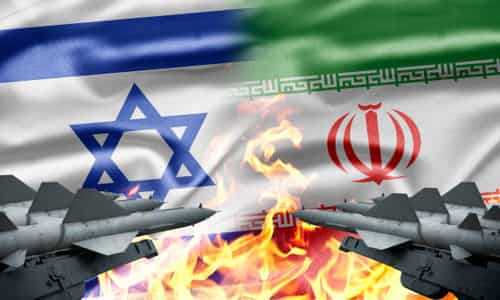
    ImageFor Iran, the U.S. withdrawal from the 2015 Nuclear Agreement will mean crushing sanctions and direct or continued indirect war declared by Israel and Saudi Arabia with U.S. support. For the Middle East, it will mean further destruction and regional imperialist competition. For the world, it will mean further division between the U.S. and the European Union and further global imperialist competition.

    Donald Trump’s announcement on May 8 that the U.S. is withdrawing from the Joint Comprehensive Plan of Action or Nuclear Agreement with Iran was not a surprise. However, the full range of its ominous ramifications not only for Iran, but also the Middle East region and the world remain to be seen.

    For Iran it will mean crushing sanctions and direct or continued indirect war declared by Israel and Saudi Arabia with U.S. support. For the Middle East, it will mean further destruction and regional  imperialist competition. For the world, it will mean further division between the U.S. and the European Union  and further global imperialist competition.

    Trump and Netanyahu have claimed that the Iranian government had violated the terms of the 2015 nuclear agreement by holding on to secret plans for developing nuclear weapons, by promoting a ballistic missile program and by its military intervention in Syria, Yemen, Lebanon and Iraq.  While the nuclear agreement did not include the latter two points, it had successfully imposed a limit on Iran’s nuclear capabilities and a verification program to which Iran had abided according to the International Atomic Energy Agency, the United Nations and the other signatories of the nuclear deal (Germany, Britain, France, Russia, China).

    The U.S. withdrawal from the nuclear deal and the imposition of further sanctions on Iran will punish not only Iran but all banks that do business with Iran’s Central Bank and all companies that do business with Iran. These companies will have 90-180 days to wind down their operations in Iran or they will run afoul of the U.S. banking system. The sanctions on oil will require European and Asian countries to reduce their imports from Iran.

    For now Britain, Germany and France have declared that their countries and the European Union as a whole will stay committed to the nuclear deal but will also try to work out a broader agreement with Iran on the issue of its ballistic missile development and military interventions in the region. Iran’s government has also announced that it will stay committed to the nuclear deal if Europe, China and Russia abide by it.

    Israel and Saudi Arabia have enthusiastically supported Trump’s decision. Within an hour of Trump’s announcement, Israel launched another missile attack on a Syrian base used by Iran. Iran responded by firing missiles at Israeli military outposts in the Golan Heights. Israel then  notified Russia before responding with air attacks on 50 Iranian military and security installations in Syria. A direct war between Israel and Iran has already started.

    U.S. withdrawal from Iran Nuclear Agreement in context of Israel and Saudi Arabia’s Power Struggle with Iran

    Iran is still the second largest Middle Eastern economy after Turkey and a government with a degree of regional imperialist involvement that rivals Saudi Arabia (the third largest economy in the Middle East). While the Islamic Republic’s opposition to Western imperialism and Israel had given it much appeal among both Shi’a and Sunni Muslims for much of its existence,  Iran’s military intervention in Syria in support of Bashar al-Assad’s murderous regime has taken away much of that appeal. This intervention and other interventions in Lebanon and Iraq have also bankrupted Iran economically.

    Iran’s recent alliance with Turkey in competition with Saudi Arabia and Saudi Arabia’s new ally, Israel, once again shows that the power struggle within the region transcends the Shia-Sunni divide and  now even the Muslim-Jewish divide. It involves a struggle for control over capital and strategic geopolitical influence in the region and is not limited to exporting Shi’a Islamic fundamentalist ideology.

    The current economic bankruptcy of Iran and the growing Iranian popular opposition against the Islamic Republic, however, have created a situation which Saudi Arabia and Israel find opportune for getting rid of the Iranian regime.

    It is in this context that the Trump administration has announced the U.S. withdrawal from the 2015 nuclear agreement negotiated by the Obama administration.

    U.S. Further Dividing Itself from European Union and Indirectly Aiding China & Russia

    The current position of the U.S. however, not only puts it at odds with its former European allies, but can actually strengthen its global imperialist rivals, Russia and China.

    In the words of Susan Rice, the national security adviser during President Barack Obama’s second term: “The costs to American global leadership are steep. When the United States unilaterally abrogates an international agreement in the absence of any breach, we undermine international perceptions of our reliability and responsibility. That is precisely what we have already done with the Paris climate agreement and the Trans-Pacific Partnership. But violating the Iran deal is far more dangerous.” (New York Times, May 9, 2018)

    China which is one of Iran’s main trade partners and its largest provider of  imported goods would continue to purchase Iranian oil and pay with goods and construction projects.  Russia which sells arms to Iran and is involved in oil and gas facility and nuclear power plant construction in Iran, has already announced that the U.S. withdrawal from the nuclear deal will actually help Russia. In the words of Vladimir Yermakov, a high-ranking representative of the Russian ministry of foreign affairs, “The U.S. withdrawal will help us economically because there will no longer be limitations on economic cooperation with Iran. We will continue our bilateral relations in all fields, including energy, transportation, high technology…” (وزارت خارجه روسیه:  با خروج آمریکا از برجام روابطمان را با ایران گسترش می دهیم. زمانه 14 اردیبهشت 1394 )

    Need for Solidarity with the progressive and revolutionary opposition inside Iran

    Those who will suffer the most will be the Iranian popular masses. Not only will they face even more back-breaking sanctions. Iranians now face the strong possibility of a direct war on Iranian soil launched by Israel, Saudi Arabia and the U.S.

    Just at a time when a wave of labor protests and strikes has spread throughout the country following the December and January mass protests which called for the overthrow of the Islamic Republic and an end to its intervention in Syria and Lebanon, the sanctions and a possible direct war will have deadly effects. They will allow the regime to label any genuine progressive or revolutionary opposition as an expression of support for the U.S., Israel and Saudi Arabia. It will also strengthen nationalist sentiments to rally forces behind the regime. Young people who are now protesting on the streets will be conscripted as soldiers.

    Even if the regime is not able to rally enough forces behind itself to legitimize itself, war and imperialist intervention will make it extremely difficult for progressive and revolutionary forces.

    In the midst of the war sirens, it is the plea of a woman labor leader, Parvin Mohammadi, that progressives and socialists around the world need to publicize: “The Iranian government has a large budget and immense assets … The most important part consists of large funds given to military and religious institutions inside the country and war expenditures in Syria, Lebanon, for Hamas, Yemen etc. This is not to mention billions stolen and embezzled. . . A government that responds to hungry workers with anti-riot guards, repression, imprisonment and expulsion, has only one message.  Its message is that it has no solution for resolving the problems and economic dead end and wretchedness that workers face. . . The task we face is  addressing the lost lives of millions of working-class households and offering them welfare, healthcare, housing, education, in one word, a life worthy of a human being in the 21st century.”  (http://ettehad-e.com)

    Those who are opposed to U.S. imperialism and all global and regional imperialist forces need to express their support for progressive and revolutionary forces that are speaking out within Iran’s labor, feminist, student and intellectual opposition movement.

    See also:

    Iran: Ongoing Labor Strikes, Women’s Protests and Ideas for International Solidarity

    https://www.allianceofmesocialists.org/iran-ongoing-labor-strikes-womens-protests-and-ideas-for-international-solidarity/

    Statement from a group of international socialist feminists in solidarity with Iranian women

    https://www.allianceofmesocialists.org/statement-group-international-socialist-feminists-solidarity-iranian-women/

    International Campaign in Solidarity with Middle Eastern Political Prisoners

    https://www.allianceofmesocialists.org/14964/

    Originally posted at the Alliance of Middle Eastern Socialists website.

  • New York Taxi Drivers: Pushed To Suicide

    Image

    Over the past four months, four New York City taxi drivers have been pushed to suicide in an industry that is becoming increasingly dangerous. In response to the recent deaths, the New York Taxi Workers Alliance has launched a campaign for regulation and released its own proposal to re-establish driving as a viable occupation.

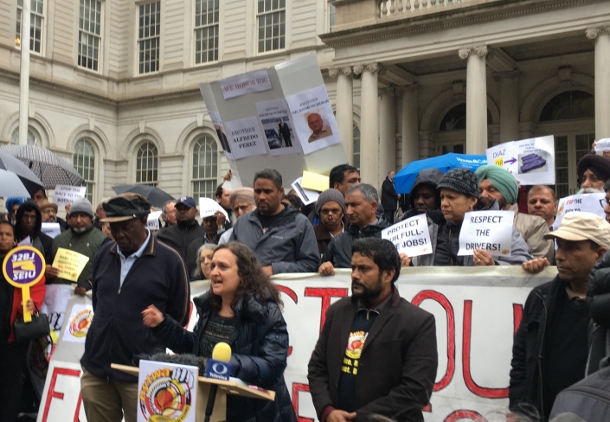
    On April 25, the Taxi Workers Alliance demanded that city leaders address the lethal impact of lax regulation of app-based, ride-hailing services at a press conference in front of City Hall. The conference preceded a hearing on April 30 concerning regulations for app-based companies.

    The business model offered by Uber and Lyft, they argued, has been instrumental in lowering labor standards so that drivers from across the taxi industry — whether they are behind the wheels of yellow cabs, green cabs or black cars — are literally working themselves to death. Ride-hailing companies have gained notoriety for being able to put an unlimited number of vehicles on the road, underpaying drivers and even going so far as to not recognize them as employees. This has created a “race to the bottom” with severe repercussions.

    Before shooting himself at the gates of City Hall Park, Douglas Schifter called the industry in which he’d been working for decades “the new slavery.” Schifter wrote this in a suicide letter he posted on Facebook and blamed the Taxi and Limousine Commission, the Mayor’s Office and Gov. Andrew Cuomo for promoting deregulation without regard for the impact on workers.

    Joined by fellow founders Biju Matthews, Beresford Simmons and Taxi Workers Alliance organizer Mohammed Tipu Sultan, the NYTWA’s executive director Bhairavi Desai addressed the assembled drivers and members of the press. “No matter what Uber wants to claim,” she said, “this is a struggle about the workers trying to defend a full-time job in a gig economy that offers nothing but poverty pay.” Founded in 1998, the alliance currently represents over 50,000 drivers throughout the city and has affiliates across the country. It has played a pivotal role in defending workers’ rights and livelihoods from the impacts of deregulation.

    According to Matthews, the situation created by Uber and its peers has taken a broad psychological toll on drivers. It is a situation that became even more dire due to Uber clogging city streets and shrinking worker income by constantly adding new vehicles. He hopes this is the last spate of suicides, noting that the alliance regularly refers drivers to suicide prevention services.

    Danilo Castillo Corporan leapt from the window of his Manhattan apartment in December of 2017 after being told by the Taxi and Limousine Commission that he could lose his license for picking up an illegal hail. Charges against him were dropped the day after his death. Castillo penned his suicide note on the back of his summons, citing the “disastrous state” of the industry. Corporan had been a Bronx-based driver, as was Alfredo Perez who also committed suicide earlier this year.

    On March 16, yellow cab driver and medallion owner Nichanor Ochisor hung himself in the garage of his Maspeth home. He, like so many other drivers, found himself starved of fares after Uber led the charge in flooding the streets with vehicles. Ochisor and his wife both worked but found their combined income to be half of what he had been making individually before app-based cars flooded the streets with the blessing of both Gov. Cuomo and the mayor’s office. Last year there were a total of 83,000 app-linked cars, which outnumbered the city’s remaining yellow and green cabs. Increasingly burdened by mortgage payments and mounting debts on his medallion, Ochisor saw no way out.

    In response to these tragic suicides, the Taxi Workers Alliance has gathered drivers from all sectors and their allies for repeated demonstrations in front of City Hall. They demand action to address the wide reaching harm caused by ride-hailing companies’ dominant position in the gig economy and their antipathy to regulation. These are not limited to promoting hazardous labor conditions or normalizing inconsistent and low pay. Companies like Uber and Lyft have also ensnared drivers in a web of predatory financial relationships and have been accused of discriminating against disabled passengers. City council member Ruben Diaz Sr. and members of Disabled In Action Metro NY, a group fighting for civil rights of disabled people, are among those who have joined the taxi drivers in this fight.

    Working incessantly while earning very little is a norm across the industry. According to one study, 41 to 54 percent of Uber drivers make less than minimum wage. According to Taxi Workers Alliance member Bigu Haider, it’s common to work 70-80 hours a week and have nothing left over after paying rent and other living expenses. “If you want to save, you have to add 100 hours,” he said. Before taking his life, Douglas Schifter wrote he had regularly been working 100-120 hours per week.

    The activists of Disabled In Action, who have been allies of the Taxi Workers Alliance since 1998, point out that the impact of ride-hailing companies’ allergy to regulation extends beyond worker abuse. Uber, Lyft and Via took the Taxi and Limousine Commission to court over whether or not they have an obligation to provide vehicles that disabled passengers can access. Starting this July, commission rules will mandate that 5 percent of outgoing trips from taxi bases be wheelchair accessible. This is part of a broader effort to ensure that half of all New York City taxis are able to accommodate passengers with disabilities. Uber, Lyft and Via filed a petition with Manhattan’s Supreme Court in early April to have the same Taxi and Limousine mandate “vacated and annulled.” “They should just bite the bullet and stop fighting the system,” Disabled in Action’s president Edith Prentis said. “You don’t want to follow the rules in New York? Then get out.”

    In response to these companies’ intransigence when it comes to being regulated, Ruben Diaz Sr. is backing a measure that would require the city to vet new app-based services. Only those that fulfill an “actual need” would be allowed to operate. Additionally, this legislation would require drivers to work with only one company. Battling against diminishing incomes, many drivers currently shift from driving the city’s cars to working under one or more ride-hailing companies on a regular basis.

    The Taxi Worker’s Alliance has put forward its own position, though. Their plan offers a model for fair labor standards that would also check the power ride-hailing companies have gained in New York. A cap on the number of ride-hailing vehicles, a wage floor based on the yellow and green taxi meters, an increase in fares, industry caps on drivers’ expenses and an end to predatory leasing practices are among the key points of the plan.

    “We are asking for an immediate moratorium on new cars,” Biju Matthews explained. “Then, through attrition we have to bring the numbers down.” The cap itself, however, will not provide a solution to drivers’ woes concerning pay and saving. That is why Matthews says the wage floor is crucial. The plan also demands the city’s congestion pricing scheme, which would fund maintenance of the MTA, not burden drivers and that the city implement the health and wellness fund, which is the product of Taxi Workers Alliance victories in 2012 and 2013.

    Biju Matthews is optimistic about the prospect of pushing regulations through despite Gov. Cuomo’s longstanding support of Uber and its model. “I think there’s enough support in city council that we’ll be able to see this through … there at least eight or 10 city council members that openly come out to say they openly support the alliance.”

    Originally posted at Waging Nonviolence.

  • Brazil: the snare of short-cuts

    Image

    Brazilian socialist Andressa Alegre spoke to Solidarity about the experience with the governments led by the Brazilian Workers’ Party (PT) between 2003 and 2016.

    The PT, was founded during the military dictatorship, in the conflict against the dictatorship of 1964-85.

    It came out of the union movement, mostly in Sao Paolo, and the steelworkers’ union. Lula, the first PT Federal President, came from the steelworkers’ union.

    It was a very radical party. In 1988 it said that the way to end Brazil’s external debt was to nationalise the banks and Brazil’s mineral wealth.

    It promised to do a big land reform.

    Between the time the party started in the 1980s and when it first formed a government in 2003, it lost a lot of its basic politics. The ideology of the party became more and more washed-out, and when it was elected, it was on the basis of a slogan like “Hope will defeat fear”.

    Even then in 2003 people expected land reform: the movement of landless workers was a really big thing in Brazil. They expected an end to corruption, which was very much a legacy of the military dictatorship, and taxation of the rich to build a welfare state.

    During the PT government about 20 million people came out of extreme poverty. Many workers previously “informal” gained formal employment status.

    Lula expanded massively the Bolsa Familia, a benefits system which gives a certain amount of money to families depending on how much money they have, the only condition being that their children attend school. That was very popular.

    Lula was more popular at the end of his administration, in 2011, than when he got in, which almost never happens.

    Resentments built up on the right. You hear people saying, “you can’t find the help any more” (about domestic servants).

    Because of the kind of government that we have, even though the PT had the biggest number of seats in the chamber of deputies, Lula had to make various forms of coalitions with different parties, including the PMDB, which was a kind of official opposition party under the dictatorship.

    The government was able to do all this because of favourable economic conditions and making favourable deals with big landowners.

    It had money to spend on benefit systems; but also made deals with big landowners. The landless workers’ movement MST still protects the PT, but says that the PT government was not good for land reforms.

    Inside the PT, the internal life is not great. An internal web-forum was set up to discuss the PT’s policy, and then there were fewer meetings. Activists are no longer responsible for political campaigning, which has been outsourced to private companies. The PT now only exists in industrial life, or industrial politics in the union movement. It is much less active on the streets.

    There was still opposition from some groups like the PSOL, which was a split, and the PSTU. Other parts of the left like the Communist Party had electoral coalitions with the PT and weren’t doing much at the grassroots.

    I don’t know if the PT label themselves as “anti-Stalinists” but they see themselves as a more liberal-socialist alternative to the Communist Party.

    The economic crisis from 2014, made it harder for the government to conciliate the ruling class with reforms. Yet the left is really disorganised.

    In 2013 we had really big demonstrations in Brazil, which were politically brainless. They called for better education and better healthcare, but they lacked the organisation to make a programme, or to criticise the government, or hold them to account instead of trying to throw out. Those two things together made Dilma Rousseff’s popularity fall massively.

    The crisis made it much more difficult for the government to conciliate the needs of the ruling class and the working class.

    The massive unrest was not channelled by the left. The left was not organised to do that.

    The demonstrations became more and more right wing and were led, especially in big cities, by the MBL movement, which is like the “Free Brazil” movement, a “neither-right-nor-left”, “new-politics” type of alliance. The decline of the PT also left a vacuum in communities which was often filled by communalism and/or by Evangelical Christians, who have grown a lot and become a really big political power.

    The current leading candidate for the next Presidential election is a right-wing evangelical Christian.

    The lessons for UK Labour should be: don’t sell out your principles in order to get into government. It is better to take the “long route” of persuading people of ideas instead of abandoning them in order to get into government.

    Secondly, to maintain the internal life and democracy of the party. Do that to maintain your principles and shape policy, and also to hold leaders to account once they are in government.

    Once those leaders are in government and all the other forces, mostly bourgeois forces, are pushing them to the right, we need a big movement that we can rely on.

    Originally published at the Alliance for Workers’ Liberty website.

  • Trump’s Road to War — Why?

    Donald Trump’s withdrawal of the United States from the Iran nuclear agreement has set a path toward another Middle East war. It is not necessarily a war that will erupt right away or in the short term, and it may be averted if the United States is politically isolated and there’s a mass revival of an international antiwar movement. That’s what every sane person, and certainly every socialist and peace activist, should hope and work for.

    Nonetheless, the course now is set toward intensified regional tensions, potential nuclear proliferation, growing conflicts between Israel and Iranian forces in Syria, and ultimately a U.S. military confrontation with Iran with incalculable consequences for the world. Beyond condemning this reckless adventurism, the question to ask is: Why?

    This is not a war that the U.S. population wants — the big twit campaigned, after all, on the pretense that he opposed the disastrous invasion of Iraq. It is not a war that most of the U.S. capitalist class seems to want, and certainly not what the United States’ imperialist allies in Europe want.

    In immediate terms, Trump’s blowing up the deal is a gift to Vladimir Putin as the price of oil increases. It also benefits Iran’s hard-right enemies of president Rouhani — reactionaries, fundamentalists and Revolutionary Guards officials who control much of Iran’s sclerotic economy, and happily profit from the lucrative activities of sanctions-busting. Iran’s people pay the price in a falling currency, consumer shortages and higher prices, increasingly dangerous aircraft deprived of spare parts, and other hardships along with harsh political repression.

    Trump’s action sets up a tussle with the European Union and its member states, over whether U.S. financial muscle can coerce European companies to withdraw from economic deals with Iran — on top of the conflict over his protectionist tariffs and pending European counter-measures. If this U.S. coercion succeeds, as is possible given the huge extent of U.S. power over international banking and the EU’s weaknesses, Iran’s return to uranium enrichment becomes all the more likely.

    What then lies behind Trump’s effort to unilaterally cancel the JCPOA (Joint Comprehensive Plan of Action, the formal title of the agreement with Iran negotiated in 2015 by the United States, Britain, France, Russia, China and Germany)? Partly, no doubt, it’s to satisfy the twit’s egotistical drive to cancel anything that Barack Obama worked to achieve — health care, financial regulation, consumer protection, action on climate change, protection for immigrant youth, and everything else. And it appeals to part of his political base at a time when he’s swamped in corruption, sex and collusion scandals.

    But Trump’s destructive personal agenda is not a sufficient explanation. Secondly, he has the enthusiastic approval of the Israeli and Saudi Arabian regimes. Benjamin Netanyahu has been agitating for years for a U.S. attack on Iran, which Israel can’t do on its own. And the Saudi kingdom’s agenda is driven by hostility to Iran’s growing regional power — an agenda that includes the Saudi-U.S. war in Yemen that is destroying the population of that country by starvation, epidemic and indiscriminate bombing. And it undoubtedly encourages Israel’s wanton shooting of Palestinian civilians at the Gaza border fence, and the escalating Israeli bombing of Syria.

    Third and probably most important, the Trump regime is now stuffed with the neoconservative militarists who still think that the Iraq invasion was a good idea, and want to double down on it — arguing that extreme sanctions will weaken the Iranian economy to the point of collapse and set the stage for “regime change.” It’s an ideological mission. For these types, gambling with the lives of literally hundreds of millions of people is playing with house money. The fact that the U.S. capitalist class lets them do so testifies to its cynicism, the absence of a serious Democratic Party opposition to military adventurism, and the general dysfunction of bourgeois politics in this country.

    What about the argument that the JCPOA was “flawed” to begin with? What about Iran’s role in Syria and “promoting terrorism”? What about those “sunset clauses” that Trump complains about in the agreement? We have to go back to what the agreement was, what it wasn’t, and what it couldn’t be.

    To begin with a basic truth: In the long run, nuclear weapons will be globally eliminated — as over 120 member states of the United Nations have demanded — or they will proliferate, whether in the Middle East or the Korean peninsula or anywhere else. Iran’s initial nuclear development began in the 1970s under the Shah, with U.S. approval.

    The Iranian rulers halted that program following the 1979 revolution, but resumed it in the 1980s — directed not against the United States or Israel, but against Saddam Hussein’s Iraq, which invaded Iran in 1981 to begin a hideous eight-year war where both sides worked to develop chemical, biological and nuclear “weapons of mass destruction.” The Reagan administration encouraged Iraq to launch that war and worked to prolong it (while also secretly selling weapons to Iran to finance the U.S. illegal contra war against Nicaragua’s revolution.)

    Following the U.S. invasion of Iraq in 2003, which toppled Saddam’s rule and made Iran the strongest state in the area, the Iranian regime offered a comprehensive regional agreement with the United States. Washington dismissed the idea — as its grand plan was to move on from its great Iraq victory to overthrowing the Islamic Republic. We know how that turned out.

    Against that backdrop and Iran’s subsequent advances in uranium enrichment, the 2015 JCPOA had one objective — to block one flashpoint of proliferation, Iran’s potential path to nuclear weapons capability and by extension the nuclearization of its regional rivals. In exchange, crippling economic sanctions on Iran were lifted. The United States never fully even honored that commitment, and now Trump claims that unilateral “maximum economic sanctions” will squeeze more concessions from Iran, including a permanent cessation of nuclear enrichment. Whether or not the big bully actually believes that, the logic of that position leads toward forced “regime change,” or war — or both.

    The nuclear deal did not change the hideous character of the Iranian regime, or any other — not Saudi Arabia, not Egypt, not the Gulf kingdoms. Nor did it curb the malicious mischief perpetrated in Syria by Iran or any other state — not Saudi Arabia, not Russia or Turkey, not Israel and certainly not the United States. Any fiction that the deal would change the nature of any regime, or prevent any states and ruling elites from acting in their own state interests (real or perceived), was delusional.

    Even more delusional and dangerous is the idea that U.S. withdrawal from this agreement will bring stability or progress to the Middle East, fresh negotiations for “a better deal,” or any progressive reform or regime change in Iran. Regime change in Iran can only be accomplished by its own people, not from outside — any more than political change in the United States could come about through bombing or invasion from the outside. As for ending the threat of war and ultimately the nuclear destruction of human civilization, that requires a global “true revolution of values” — Martin Luther King’s memorable prophetic phrase — and an international movement to end imperialism for good.

    Originally posted at the Solidarity website

  • New Eugene Debs Film Does the Socialist Proud

    Image

    A charismatic and militant labor leader, five-time Socialist Party presidential candidate, class-war prisoner jailed by the ostensibly liberal Woodrow Wilson administration for opposing U.S entry into World War I and a fiery, moral force in a corrupted era — Eugene Victor Debs was among the greatest orators this nation ever produced, yet no recording of his voice survives. And what a speaker he was! John Swinton, the late 19th century New York labor writer who as a young man heard Lincoln speak, likened Debs to Lincoln not just in intellect but in character. And unlike Lincoln, Debs could speak cogently to crowds for hours without notes.

    Even foreign-language speakers were won over, with many testifying that Debs’ mannerisms alone were magnetic, his fist smacking his palm as he offered such injunctions as “Progress is born out of agitation. It is agitation or stagnation.”  

    To know Debs and his impact on American working-class politics as it emerged to confront the mammon of industrial and finance capital, we are ably served by his voluminous writings and by a series of fine, highly readable biographies by such writers as Ray Ginger, Nick Salvatore and Ernest Freeberg, the latter author focusing on Debs’ later years as “democracy’s prisoner.” Add to those a plethora of histories of the old Socialist Party. Ira Kipnis’s The American Socialist Movement: 1897-1912 is likely the best, though it ends prematurely with a massive vote for Debs in the presidential race and party membership peaking at 118,000 — all before the government’s full-bore assault on the left and Debs’ jailing.

    Fortunately two strong movies are also available that help underscore  Debs’ impact, including a 1979 documentary by Bernie Sanders and a new feature: American Socialist: The Life and Times of Eugene Victor Debs, by filmmaker Yale Strom, currently artist-in-residence and professor in the Jewish Studies Program at San Diego State University, and narrated by actor Amy Madigan. Debs’ legacy is especially well served by the new production, which takes advantage not only of scholarly accounts of Debs’ life and American socialist movement he rose out of but judiciously utilized the extensive Debs archives at Michigan State University-Lansing, the Debs Foundation collection in Terra Haute, Indiana and others.  

    So Who was Debs?

    Born in 1855 and named by his immigrant parents after the French novelists Eugene Sue and Victor Hugo, Debs was slow to embrace radical politics in his hometown of Terra Haute, where the capitalists were still of the small, local variety and social mobility was not impossible for working people. The metastasizing of monopoly capital in the area through the intrusion and consolidation of finance and industry would come soon enough. The future socialist even married a rich man’s daughter and was a Democratic state office holder, if briefly.

    The film makes clear that Debs, a strong railroad worker-unionist, didn’t start out as a socialist; that transposition came after the Democratic administration of Grover Cleveland broke the American Railway Union strike under the mendacious claim that strikers were sabotaging mail delivery. Debs, it’s president, went into prison a militant trade unionist and, courtesy of the federal evisceration of his union and a prison reading of Marx’s Capital, came out six months later a committed revolutionary, though of a discernible American type. He would, for example, define socialism as “Christianity in action.” For Debs’ religiously inclined listeners, greed and the pursuit of personal wealth were presented as sin, the riches of capitalists balefully gained.  

    That appeal to traditional religion as a bulwark of cooperation — the essence of socialism — sparked interest in Debs’ “Red Special” whistle-stop electoral campaign in areas such as Oklahoma, where, the film argues, small-farmer militancy combined with ingrained Evangelical Christianity. The strategy was less successful in the South, where we can intuit that racial division was a prime factor mitigating unified class action.

    But whether addressing farmers, workers or urban intellectuals at such venues as New York’s Cooper Union, Debs was in his element.   

    It was the Socialist Party’s opposition to World War I that led to its undoing and to a five-year prison sentence for Debs. His crime: violating a Sedition Act provision against urging young men to dodge the draft.

    On July 16, 1918, a year after the act’s passage, Debs was in Canton, Ohio to address the Ohio Socialist Party’s state convention and visit comrades jailed for speaking out against the war. He knew he was at risk of arrest himself. “I must be exceedingly careful,” he told the convention delegates, “prudent as to what I say. I may not be able to say all I think, but I am not going to say anything that I do not think. I would rather a thousand times be a free soul in prison than to be a sycophant and coward in the streets. They may put those boys in jail — and some of the rest of us in jail — but they cannot put the Socialist movement in jail.”

    True to form, government stenographers in the crowd noted his comments selectively. Prison followed, based on the alleged danger that his remarks, those of a known “agitator,” posed to troop recruitment — this just months before the Treaty of Versailles was signed.

    A red scare followed the war. Foreign radicals were rounded up and deported. Native-born leftists of any stripe were imprisoned.

    Running for president on the Socialist ticket in 1920 while incarcerated, Debs garnered just under 1 million votes. Even as late as 1921, on the eve of his leaving office, Wilson still refused to pardon Debs. It was the GOP’s Harding who granted Debs and 23 others a Christmas commutation.

    The Irony of a Humble Man Lionized

    It seems odd that a movement valorizing collective action and the social context of everyday life over invidious egotism and careerist grasping would also need to anoint leaders and elevate heroes. As Debs himself put it 1906 to an audience of workers in Detroit: “I would not be a Moses to lead you into the Promised Land, because if I could lead you into it, someone else could lead you out of it. You must use your heads as well as your hands, and get yourself out of your present condition.”

    Even allowing for the early glint of its religious trappings, his was an American variant of Marx’s insistence on working-class self-activity, that the emancipation of working people was not the provenance of elites no matter how well-intentioned but a task largely of the workers alone. Debs’ often quoted statement to his trial judge at his conviction for violating the Sedition Act makes much the same point.

    “Years ago, I recognized my kinship with all living beings, and I made up my mind that I was not one bit better than the meanest on earth. I said then, and I say now, that while there is a lower class I am in it; while there is a criminal class I am of it; while there is a soul in prison I am not free.”

    Debs’ heroes were not great men and women but ordinary people who showed uncommon bravery and solidarity with one another.

    A story Debs told, though not included in the film, concerns a black-balled former railroad worker in desperate straits who proudly tells Debs that he never scabbed, knowing the principled stance meant exorcism from a decent-paying job. “If I’d have been like some of them, I’d had a passenger train years ago and been saved lots of grief,” he tells Debs. “But I’d rather be a broken-down old umbrella fixer without a friend than to be a scab and worth a million…. And when I cross the big divide, I can walk up to the bar of judgment and look God in the face without a flicker.”

    Debs’ cited the man as the epitome of working-class solidarity.

    “There was something peculiarly grand about the scarred old veteran of the industrial battlefield,” Debs wrote in 1913. “His shabbiness was all on the outside, and he seemed transfigured to me and clad in garments of glory. He loomed before me like a forest monarch the tempests had riven and denuded of its foliage but could not lay low. He had kept the faith and had never scabbed.”   

    Neither did Debs. See the film.

    American Socialist: The Life and Times of Eugene Victor Debs is scheduled to be shown in Hudson, NY (April 26-May 13); Los Angeles and Pasadena, (May 4-10); San Diego (May 11-16), Washington, D.C., (May 22), and the Cleveland Museum of Art (June 12-15.)  

    Originally posted at The Indypendent.

  • The Merry Month of May

    Image

    Where Are the Riots of Yesteryear?

    This month marks the 50th anniversary of the wave of radical revolts and revolutionary uprisings that startled the world in 1968 and which,  although ultimately crushed by the forces of reaction that dominate the world to this day, left in its wake rights so fundamental that we tend to take them for granted — sexual freedom, civil rights, women’s’ equality. Yet a half-century later these hard-won rights are under attack and people are once again rising to defend them.

    Today in France, where in 1968 the student-worker rebellion led to a weeks-long of general strike, the students have once again occupied the universities, while the railroad workers, airline, and public service workers are striking against the counter-reforms being imposed by the autocratic, neoliberal President Macron. Following the example of May ’68, these diverse groups are hoping to unite and force the government to cease their attacks on public services and working peoples’ standard of living.  

    In the United States as well, a wave of spontaneous strikes by underpaid, overworked, idealistic "Red State" teachers backed by public opinion is making sweeping gains, and movements like #MeToo, #BlackLivesMatter and other post-Occupy Wall Street anti-capitalist struggles are on the rise. Is there hope for real change?

    For more read https://indypendent.org/2018/05/the-merry-month-of-may-a-firsthand-history-of-68-france/.

  • Why class still matters: a reply to Paul Mason

    Image

    This article is a response to Paul Mason’s recent essay ‘Labour must become the party of people who want to change the world, not just Britain’, in which he argues that there can no longer be any privileged position for organised labour as an agent of socialist change. This reply will respond to that question specifically, leaving aside some other aspects of Mason’s essay, and argue that the working class remains the key strategic actor for overhauling capitalism.

    The post-class left

    Paul Mason’s 2007 book ‘Live Working Or Die Fighting: How The Working Class Went Global’ described how advanced capitalism had globalised capitalist class relations. The process has been recent, and spectacular. An internationalised proletariat has only recently become the world’s biggest single class; there are more wage workers in South Korea now than there were in the entire world when Marx and Engels wrote the ‘Communist Manifesto’. Vast new working classes have been created in Brazil, India, Mexico, Nigeria, Bangladesh, and elsewhere. Objectively, the material potential for socialism as a politics of working-class self-emancipation, based on workers organised as workers at the site of production, exists on an unprecedented scale.

    But the Paul Mason of 2018 faces in a quite different direction to the Paul Mason of 2007. He is now one of the figureheads of what might be termed a new “post-class left”, writers, commentators, and activists who no longer believe in any privileged role for the working class as an agent of socialist change.

    Mason argues that: “Networked technology, combined with high levels of education and personal freedom have created a new historical subject across most countries and cultures which will supplant the industrial working class in the progressive project.” What has caused Mason to give up on the idea of the centrality of class? The proletariat, it seems, has let him down. “It persistently refused to play the role of capitalism’s gravedigger”, he complains.

    Some facts appear to lend weight to Mason’s argument. While new and powerful labour movements have emerged around the world, on the whole labour is weak and on the defensive. It is certainly the case that the past generation has been characterised by defeat and decline for organised labour in Britain. The trade union movement is now half the size it was at its 1979 peak, with vastly fewer elected workplace reps and shop stewards. In 2016, strike levels were at their lowest since records began. In 2017, after a period of stagnation, trade union membership fell. Recent high-profile national disputes – my own union’s fight against the imposition of “Driver Only Operation” on the mainline railway, or university workers’ strikes against pension cuts – are very much exceptions rather than a rule.

    Do those sobering and disappointing statistics speak to an objective change? Is the organised working class disappearing from the historical stage as a distinct actor? What the statistics in fact reflect is working-class defeat, not changes in the structural position of labour under capitalism. That defeat is not eternal, or insurmountable. Mason and the rest of the post-class left have extrapolated erroneous claims of objective changes from those subjective realities of those defeats. Rather than attempting to challenge and overcome them, they have assimilated them into their worldview. Mason describes what the French labour movement called “la vie ouvrière”, what has elsewhere been called the “union way of life”, as having been “vapourised”. A more accurate metaphor might be to say that it has been smashed. Not much more comforting, perhaps, but containing an implicit potential for rebuilding that Mason rejects.

    The post-class left is not a new phenomenon. It is a political tradition with a long history, that reasserts itself in periods of retreat for organised labour. In 2017, Paul Mason won the inaugural Ellen Meiksins Wood Prize. Three decades previously, the Marxist theorist after whom the prize was named wrote ‘The Retreat From Class‘, a superb polemic against those careering away from the idea of working-class agency in the direction of, amongst other things, liberal “social movement” politics. The new agents to whom Wood’s targets looked greatly resemble Mason’s “networked individuals”, including in the respect of being largely non-existent as a cohesive social element with any structural power within capitalist society.

    Wood described the post-class socialists’ perspective like this:

    “The formation of a socialist movement is in principle independent of class, and a socialist politics can be constructed that is more or less autonomous from economic (class) conditions. This means two things in particular […] A political force can be constituted and organised on the ideological and political planes, constructed out of various ‘popular’ elements which can be bound together and motivated by purely ideological and political means, irrespective of the class connections or oppositions among them. […] The appropriate objectives of socialism are universal human goals which transcend class, rather than narrow material goals defined in terms of class interests. These objectives can be addressed, on the autonomous ideological and political planes, to various kinds of people, irrespective of their material class situations.”

    Wood was prescient. She could have been describing Paul Mason in 2018 directly. His incantational listing of movements such as the Arab Spring, Occupy, Scotland and Catalonia’s independence movements, demonstrations against Orban in Hungary and more besides are precisely an attempt to conjure a new agent “out of various ‘popular’ elements which can be bound together and motivated by purely ideological and political means, irrespective of the class connections or oppositions among them.”

    It might be noted that the only one of those movements to come anywhere near to achieving any of its goals, the initial Egyptian revolution at the heart of the Arab Spring, did so precisely because of the unique role played by organised labour in huge industrial combines like the Mahalla Textile Company.

    What is it that Mason claims gives his “new subject” its revolutionary potential? Neither the mere condition of being “connected” (connected to what? By what means?), nor that of being “educated” (by whom? On the basis of what ideology?) imbue structural power vis-à-vis capital. As Christian Fuchs put it in his critique of Mason’s 2015 book ‘Postcapitalism: A Guide to Our Future’:

    “Almost all managers, CEOs, and other members of the class of the 1% are ‘educated and connected’. They are the globalised, networked, educated, influential – and wealthy. Are the educated, connected and networked hedge fund manager and the educated, connected and networked entrepreneur, who parks and hides his wealth in tax havens, part of this subject? Definitely not! Education, networking and connectedness are not automatically politically progressive.”

    Mason argues that our consumption power may give us leverage:

    “We are ‘pro-sumers’ in many different ways: our fashion choices create the value of global brands. In addition, huge new corporations have adopted business models based on harvesting the positive network effects of our online behaviour.”

    But what common, socially-cohesive, interests, do “pro-sumers” having their data harvested by tech corporations actually have, beyond perhaps a desire for more digital privacy? What structural power can people organised on this basis actually wield? Indeed, how can they even be organised, except perhaps as passive electoral supporters of a party that promises to represent their “values”? Maybe that is indeed Mason’s ultimate aspiration: there is more than a little evidence to suggest this may be the case. He is entitled to this view, but whatever else it is, it is not a strategy for “overhauling capitalism”.

    What appears to underlie much of Mason’s wider perspective is a morass of theorisation that contends that capitalism itself has entered a new condition. Sometimes referred to as “information capitalism” and “cognitive capitalism”, the claim is that individualised cognitive labour, based on interface with digital systems, has replaced the collective production processes of “industrial” capitalism.

    Certainly, information technology has changed the nature of a great deal of waged labour. But a dockworker who operates a semi-automated crane from a digital workstation is still engaged in an industrial process and in a wage relation. Combination and common organisation with other workers engaged in other aspects of that process – the workers on the ships, the workers driving the containers away from the port, the transport workers running the train networks serving the port – are still the means by which that worker, “cognitive” and technologised though their labour is, can confront their employer and affect change.

    It is on that basis, of structural position within the social and economic infrastructure of capitalism, that Marxists have understood the working class as central to the socialist project. As Wood puts it:

    “Revolutionary socialism has traditionally placed the working class and its struggles at the heart of social transformation and the building of socialism, not simply as an act of faith but as a conclusion based upon a comprehensive analysis of social relations and power. In the first place, this conclusion is based on the historical/materialist principle which places the relations of production at the centre of social life and regards their exploitative character as the root of social and political oppression. The proposition that the working class is potentially the revolutionary class is not some metaphysical abstraction but an extension of these materialist principles, suggesting that, given the centrality of production and exploitation in human social life, and given the particular nature of production and exploitation in capitalist society, certain other propositions follow.”

    In other words, it is the position of labour in the machinery of capitalism that gives its unique power. The wage relation is capitalism’s essential core. It is in the workplace where capitalism most fundamentally “happens”. Until the answer to the question “where does value come from under capitalism?” is something other than “human labour”, organised labour will continue to have this unique potential, no matter how weak, beaten-down, or misled our organisations may be at any given moment.

    For all his insistence that it must be supplanted as the agent of socialist change, Mason makes little attempt to account for what has actually happened to the working class, or where he alleges it has gone.

    “The bargaining power of the individual worker is weakened by globalisation” he says, without making any attempt to substantiate this. Globalised production process and supply chains in fact provide the potential for a greatly increased bargaining power: what is lacking is a subjective element, an organisation of workers across the supply chain that can take collective and coordinated action.

    In many ways, Mason’s use of the word “industrial” is misleading. The types of work traditionally associated with this word, such as mining and heavy manufacturing, have certainly declined in Britain. But firstly, that is not the case globally. Read against the backdrop of miners’ strikes in South Africa or factory workers’ revolts in China, Mason’s present thesis seems parochially Anglocentric, even on its own terms.

    And secondly, it is not the “industrial working class”, or any other section or subset, that Marxists posit as the key agent of change, but simply the working class as a whole: all those live by selling their labour power, and the social collective around them. Yes, certain industries, such as transport, logistics, and telecommunications, may have more strategic significance within capitalist economic functioning than others. But it is neither the case that workers outside these strategic industries are powerless, nor that the strategic industries themselves have disappeared.

    Kim Moody’s new book ‘On New Terrain‘ examines a generation of change in the American working class, and concludes that far from causing it to disappear as a strategic anti-capitalist actor, many of the changes (for example, the creation of vast logistics hubs and distribution networks) provide a renewed potential to build working-class organisation and power. Again, it is the subjective element of working-class organisation and resistance that is missing, rather than objective changes to the way in which work is structured under capitalism having rendered organised, or potentially organised, labour powerless.

    At its height, the great 1984/85 miners’ strike involved less than 150,000 workers. Around 20 times that number, close to 3 million, work in the supermarket industry today. This is not a picture of a disappearing proletariat. Many of those 3 million retail workers may not have the same direct leverage in terms of the immediate strategic significance of their labour to the economy as coal miners did, but collectively, their labour is of huge strategic significance.

    Imagine a union organised across the retail sector, organising shop workers, warehouse and distribution workers, and drivers. A strike by such a union would have an immense economic and social impact. Many of those workers might, according to some of Mason’s categories, also be “networked individuals”, in the sense of being connected by their common usage of various social media platforms, for example. Many are young. Many are migrants. All of these conditions and identities are important, but it is their position as workers, and their involvement in the production process and a wage relation, that fundamentally coheres them and gives them socially-transformative power.

    Mason also cites “precarious work” and “a culture of individualism that would have been obnoxious even to the dockers of Limehouse fighting over halfpennies on the streets in 1889” as factors that have destroyed the working class’s power to affect socialist change. Neoliberalism has indeed had ideological and cultural impacts (the “culture of individualism” Mason refers to), but there is something of imaginary-golden-age reminiscence about his Limehouse dockers “fighting over halfpennies on the streets”. In any case, those dockers were no strangers to precarious work. Indeed, the organisation of employment on the docks were heavily based in precarious hiring practises and zero-hour contracts. Far from being a uniquely new development, “precarity” has been a feature of capitalism, since its inception.

    New Unionism, and a new New Unionism?

    Mason’s article makes much of the period of “New Unionism” in the 1880s, a moment of immense upheaval and recomposition for the labour movement in Britain. This is indeed a useful focus. Where was the organised working class movement prior to this period? Weak, bureaucratised, divided in conservative and exclusionary unions based on craft, and still reeling from the defeat of Chartism, the great movement for working-class democracy, a generation previously.

    But, as Mason’s article and history records, organised labour revived. That revival did not happen by mere collision of historical forces but because conscious, organised actors within the working class undertook political and educational work to develop an approach that could catalyse struggles, spread them, and help them win.

    Mason refers to Eleanor Marx telling a crowd in Hyde Park: “enough of strikes, fight for socialism and the eight hour day”. But this is a gross misrepresentation of Marx’s role in the period. She taught Will Thorne, a gas worker in Beckton and a key strike leader and founder of the ancestor union of today’s GMB, to read. She helped found that union’s women workers’ section, and sat on its executive committee. She spoke repeatedly at rallies for the dockers and other strikers. The role of Marx in New Unionism was absolutely not, as Mason alleges, as a carrier of “the left wing orthodoxy of the previous century”. Indeed, while Marx, Thorne, Tom Mann, and other New Unionist leaders were members of the Social Democratic Federation, Britain’s first organised Marxist group, their political activity as SDF members and their industrial organising were largely separate, and the SDF as a whole tended to take a sectarian attitude to the reviving labour movement. Their roles in New Unionism were precisely to break from orthodoxy and inertia, to find an opportunity to light a fire, and to help it spread.

    The potential for labour movement renewal and recomposition today, a new New Unionism, lies precisely in the struggles of the modern analogues of the workers who made the 1880s movement: the precariously-employed, often migrant, often women, often young workers largely on the margins of the existing, bureaucratic unions, whose self-organisation and activity exploded the inertia.

    Fast food workers in the Bakers’ union and cinema workers in the Bectu section of Prospect taking on multinational corporate giants in McDonald’s and Cineworld; restaurant workers in Unite; outsourced migrant cleaners in small unions like IWGBCAIWU, and UVW, as well as in established unions like RMT, fighting for living wages and direct employment; “gig economy” workers exploding the myth that superficially atomising employment practises have robbed them of power and leverage; and politically-disparate but expanding attempts to consider how workers in the immensely strategically-significant logistics and distribution industries can organise. These are sparks that can be fanned into a conflagration if the workers within them, supported by organised socialist activists in the wider labour movement acting as the “memory of the class” and providing a repository of previous struggles, victories, and defeats, undertake the same conscious efforts that Marx, Mann, Thorne, and others took in their day.

    The Corbyn surge and the return to class: how to transform the labour movement?

    The immediate backdrop for Mason’s essay is the Corbyn phenomenon in the Labour Party. Still immensely febrile and in flux, this movement has seen hundreds of thousands of people, many of them young, flood into the Labour Party, inspired by a sharp break from Blairite orthodoxy on many policies. The movement has the potential to radically transform the party, making it more democratic, rooted in working-class communities, and a catalyst, supporter, and political representative of working-class social and industrial struggle.

    In this sense, Mason is right to aspire to a party that is both itself a social movement and part of a wider social movement. But to overthrow or even meaningfully confront capitalism, that social movement needs deep roots in capitalism’s engine room: the workplace. A return to class on this basis can move past the psephological triangulations between the perceived wants and desires of “metropolitan”, socially-liberal workers and youth on the one hand, and those of ex-“industrial”, socially-conservative workers in the north and Midlands on the other. A democratically and politically transformed Labour Party could seek to organise, represent, and empower both groups on the basis of a shared class interest.

    The Corbyn surge is yet to find a real expression in the trade union movement. Even Unison’s Dave Prentis, a notoriously bureaucratic and conservative leader, has managed to position himself as a Corbynite. What the situation requires is not a desperate casting around for a new agency, but a conscious effort to transform and revolutionise the existing labour movement.

    In the first place, the young people energised by the Corbyn surge need to express that energy where they work. The US collective Labor Notes’ Troublemaker’s Handbook provides a basic manual for fighting back against the direct and immediate representative of capital in your own life: your boss. Socialists involved in the Labour Party should be seeking to adapt it for a British context, and run workshops on it through local Labour Parties and Momentum groups.

    Trade union militants in Labour should be agitating for it to become the party of strikes. For the first time in generations, a genuine organic link can be made between the demands of strikes and Labour Party policy. Labour can say to striking McDonald’s workers: we are the political expression of the demands of your strike. If we are in government, we will legislate to secure your demands. And, conversely, McDonald’s workers seeking to politically bolster their industrial dispute can join and becoming active in Labour, not as passive electoral foot-soldiers but as conscious actors seeking to express their class interests on the political terrain.

    Within unions, the dynamic energy of the Corbyn surge can be a force for democratic renewal, just as it has the potential to be within the party. The tradition of independent rank-and-file organisation and insurgency is largely submerged in the British labour movement, but it is one that may soon be rediscovered by, for example, University and College Union (UCU) members organising to build a counter-power in their union against a capitulatory leadership. UCU is not a Labour-affiliated union, but many of the activists leading the new rank-and-file initiative are broadly situated within the milieu of the Corbyn surge. Many of them, no doubt, would also fall into Mason’s category of “educated, young, networked people”, but like the skilled cognitive dockworker operating computer systems in a container port, it is their position as workers, and their involvement in transformative struggle within class organisations, that gives them their power.

    In this way, there can be a symbiotic relationship between the radical transformation of both the political and industrial wings of the labour movement. This will be a prerequisite for consolidating and defending, even on its own moderate social-democratic terms, the Corbyn project in government. If a Corbyn-led Labour government attempts to legislate for a £10/hour universal living wage for example, and rogue employers simply refuse to cough up the increase, how else will that policy be enforced other than by those employers’ workers leveraging their own class power and striking to enforce it? That level of militancy and organisation can be achieved if socialists active in the Labour Party and the unions develop a perspective of building for it right now.

    There are other voices in the Labour milieu advocating what might present itself as a “return to class”. But refocusing on class on the basis of seeking a radical transformation and renewal of the labour movement is quite distinct from the perspective advocated by, for example, the Blue Labour tendency. This ostensible return to class is in fact a form of nostalgic identity politics, with class conceived of as a category of cultural identity, often figured in deeply socially-conservative terms – see Blue Labour’s use of the slogan “faith, family, and flag” – rather than a collective social relation.

    The working class has never really resembled the picture painted by both Stalinists and Blairite “authentocrats” like Stephen Kinnock, centred on an archetypal male, white, essentialised worker, in a manual industrial job, part of a “stable community”. That was not the working class of New Unionism; it is not the working class of today. Our class comprises migrant workers, women workers, LGBT workers, benefit claimants and the unemployed, and women engaged in unpaid domestic labour. A revitalised and transformed labour movement must become the organised expression of our class as a whole.

    Horizons beyond electoralism

    Accompanying, and informing, Mason’s retreat from class is an unacknowledged but massive contraction of his political horizons.

    Despite his selective quotations from (Karl) Marx, and despite stating in the introduction to his essay that he wants to “overhaul” capitalism, he now argues that “the ultimate, and most revolutionary form of political action that can be taken amid a neoliberal system in crisis is to put a party into government committed to the positive goals and values of “educated, young, networked people”, etc.

    Wood answered him in 1986:

    “In the final analysis, the theoretical and political touchstone for the NTS [“New True Socialists”, Wood’s tag for the post-class left of her day] is not socialism at all, but simply electoral victory. Once we understand that the logic of their argument is an electoralist logic, once we accept that their standards of success and failure have little to do with the conditions for establishing socialism and everything to do with constructing victorious electoral alliances […] it will at least make some kind of political sense.”

    This is not to dismiss the importance of electoral activity, or organisation on the political terrain. Marx and Engels’s identification of three fronts of class struggle – ideological (or theoretical), political, and economic – remains a vital frame, and the socialist movement must be actively organised and intervening on all three. Electing a Labour government and shaping, pushing, and radicalising its policies via pressure from below, including extra-parliamentary action, should be a key aim. But it is only by reconnecting with class, the structuring relationship at the core of capitalism, that this electoral horizon can be expanded into a horizon of revolutionary anti-capitalist counter-power.

    Mason has retreated from class into the diminished horizons of electoralism, confecting a substitute agent for the project that is part radical-sociological woo-woo (tip: another word for “member of the ‘salariat'” is… “worker”) and part psephological fantasy. It is a defeatist recoiling from a situation of weakness, masquerading as innovation. Contrary to its own claims, it does not develop Marxist politics, but gives up on them.

    Our task is to rebuild class power, not to pretend it no longer matters. The socialist project does not need to move beyond class, but return to it. This is not a matter of millennarian faith in a historical mission, but of renewing our political resolve and undertaking an act of will to help our class unlock its potential. As Hal Draper, the great writer of the unorthodox-Trotskyist American left, put it in his 1950s article ‘Why The Working Class?’:

    “The socialist revolution, once observed Rosa Luxemburg, is a war in which there are necessarily a continuous series of ‘defeats’ followed by only one victory. Nothing can be guaranteed, of course, except the honor and dignity of fighting for a new and better world, rather than the vileness of adapting one’s mind and heart to a vile one.”

    Young activists eager to forge from today’s febrile political moment a movement that can overhaul capitalism and replace it with socialism – radical democracy, common ownership, and social freedom – would do better to take their strategic advice from Hal Draper, Eleanor Marx, and Ellen Meiksins Wood than Paul Mason.

    The Marxist project – working-class self-emancipation, and through it, the emancipation of all humanity – is as possible now as it ever was. What it requires is new activists to fight for it.

    Originally posted at openDemocracy.net.

  • Nicaragua—Protest, Repression, Negotiations

    Image

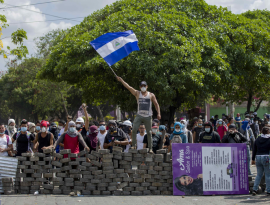
    The upheaval in Nicaragua that lasted from April 18 to April 21 and the repression that reportedly left 63 dead, 15 missing and 160 injured by gunfire, have both subsided for the moment. The protests halted after President Daniel Ortega announced the cancellation of his proposed changes in the social security pension law. Photographers were among those beaten. Other human rights centers and the Jesuit University of Central America in Managua as well as Nicaraguan newspaper accounts and discussions with people in Managua confirm many of these deaths and injuries.

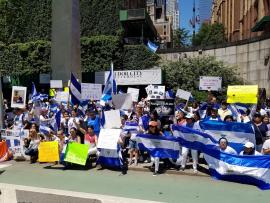
    Since April 22 Nicaraguans have participated in numerous marches, some raising the call for “Peace and Justice,” and many of the participants carrying placards calling upon President Ortega and his vice-president and wife Rosario Murillo to resign. On April 26 an enormous pilgrimage of tens of thousands called for peace and negotiation organized by the Catholic Church.

    The early protests and the subsequent peace marches—and those killed or injured in them—have involved virtually every sector of Nicaraguan society: students, workers, religious leaders and their lay associates, medical and veterinary students, employees of private companies, and business leaders. La Prensa, a conservative newspaper, produced a photo essay that puts faces on the protesters.

    While the protests began with opposition to the increasing in social security payments and the accompany reduction in benefits, they soon became massive outpourings against the violent repression of peaceful protestors, and finally a call for the end to the Ortega dictatorship. The Catholic hierarchy in Nicaragua is attempting to mediate the conflict and to organize a dialog between Ortega and his opponents. The questions now are: Who will get a seat at the table? and Will Ortega be willing to negotiate his own resignation?

    The Repression

    Ortega and Murillo ultimately hold responsibility for the repression that was organized both through the police forces and by the Sandinista party (FSLN) through the Sandinista Youth (JS). For years, as I discuss in my book What Went Wrong?,  the party and its youth group have harassed and beaten opposition political candidates, feminists, workers, farmers and other dissidents.

    Among the most serious incidents (which are documented in my book and also in the Revista Envío available in Spanish and English) were these:

    • In 2008 both the Catholic Church and the Rosario Murillo who was part of the Ortega administration attacked the Autonomous Women’s Movement which supported abortion rights including helping a nine-year old rape victim get an abortion. The Catholic Church filed a criminal proceeding against the Network of Women Against Violence while Ortega’s Attorney General raided the office of the Autonomous Women’s Movement. The government engaged in a persistent campaign aimed at intimidating feminists.
    • In May of 2008 the Ortega government sent police to break a strike by truck and taxi drivers, during which police beat the strikers and intentionally broke truck windows.
    • In August of 2008 Sandinista thugs attacked political opposition protesters in the city of León.
    • In February of 2009 Sandinista goons attacked protest demonstrations by political opponents in Jinotega, Chinandega, and León.
    • Throughout 2014 farmers’ and environmentalists’ protests against Ortega’s Chinese-financed inter-oceanic canal were violent repressed with scores of injured and five killed.

    In many of these incidents, the police and Sandinista hooligans cooperate, or the police look the other way as the Sandinista heavies do their dirty work.

    All of this makes us want to know, What went wrong? The following is a reprint of my October 17, 2016 New Politics article written on the eve of the Nicaraguan election in which Ortega was reelected. 

    An Authoritarian Government

    In late July 2016 President Daniel Ortega, running for his third consecutive term as president—his fourth term altogether—succeeded in having sixteen members of the opposition expelled from the legislature. Also removed were their 12 alternates, 28 legislators altogether. Those who were removed belonged to both the conservative Independent Liberal Party (PLI) led by banker Eduardo Montealegre and to the Movement for Sandinista Renovation Movement (MRS), originally a leftist breakaway from Ortega’s own FSLN. The legislators’ removal ended any semblance of political pluralism and gave Ortega absolute control over the parliament, making Nicaragua effectively a one-party state on the eve of the November 2016 election.

    Then at the beginning of August, Ortega announced that his running mate for vice-president would be his wife Rosario Murillo, now the Minister of Communications and in practice already the country’s co-president. The Nicaraguan Constitution once forbid anyone from holding the office of president for two consecutive terms or from holding more than two non-consecutive terms as president, as well as forbidding a spouse from being a candidate. Ortega’s control of the Supreme Court, the legislature and the Supreme Electoral Council made it possible for him to create a new constitution in 2014 that allowed him to run for president for a third term. To make sure that there is no questioning of the election procedure, Ortega has forbidden international election observers. Ortega and his wife, who have placed their children in positions in government, appear to have insured that, like the Somozas before them, they will hand power on to their children and establish another dynastic dictatorship.

    Nicaragua’s National Coalition for Democracy called the coming elections to be carried out under these conditions “a farce,” while the Bishops of the Catholic Church condemned Ortega’s attempt to impose a one-party regime. Faced with the closing off of democratic options important figures on both the right and the left have suggested that a revolt may be the only option. On the right, Carlos Fernando Chamorro, the son of former president Violeta Chamorro, told the Nicaraguans that the situation had “legitimized the right to rebel.” Vilma Núñez, a longtime FSLN activist who had challenged Ortega for the FSLN presidential nomination in 1996 and who today heads the Nicaraguan Human Rights Center (CENIDH), went even further, calling upon the Nicaraguan people to exercise their “right to rebellion.”[1] Creating a new dictatorship, Ortega may also be creating the conditions for a future revolution, though at the moment neither the forces nor the leadership for a rebellion exist.  

    Daniel and Danielismo

    Ortega has ruled Nicaragua intermittently since the Nicaraguan Revolution of 1979. He headed the revolutionary government from 1979 to 1990, first as head of the revolutionary Junta that ruled the country from 1979-1985 and then as elected president from 1985-1990. He ran unsuccessfully for president in 1996 and 2001, but even out of office, he generally controlled the legislature, working as a partner with the conservative Liberal Party governments. Then in the 2006 elections he won the presidency with a plurality of 38 percent of the vote and won again in 2011 with 62 percent of vote. Polls show him likely to win this election by 60 percent or more, a testimony not so much to his leadership as to the ruling couple’s control of the government, of the social welfare programs, and of much of the media.

    Ortega’s political domination of the country today is nearly absolute. Since he took office as president for the second time in 2007, Ortega, the former guerrilla fighter and leader of the Sandinista Front for National Liberation (FSLN), has succeeded in concentrating in his hands the control not only of the executive office—which he shares in an irregular and extra-constitutional manner with his wife Rosario Murillo—but also domination of the Supreme Court, of the legislature, and of the Supreme Electoral Council. His political power is reinforced by his personal control over Venezuela’s financial contributions to Nicaragua, and until recently by an alliance with the Catholic Church constructed around opposition to abortion and feminism, as well as by his association with the country’s largest corporations and wealthiest families, not to mention his shrewd buying up of radio and TV stations.

    The FSLN, better known as the Sandinistas, once a revolutionary party, functions today as a typical political machine, winning votes through fear and favors. The party is constructed around “Daniel” and a system and ideology of social welfare that has come to be called Danielismo. The FSLN has created a cult of personality around Ortega that rivals any, with huge portraits of Ortega and Murillo appearing on billboards throughout Managua year in and year out, while crowds are brought out to public places to chant, “Daniel! Daniel!” To enhance his image, periodically Ortega stands beside foreign heads of state with left-wing credentials—Hugo Chávez before he died, Nicolás Maduro since then; Fidel and later Raúl Castro; and also Evo Morales of Bolivia—maintaining the illusion that his government has something to do with some sort of socialism. In fact what he shares with those leaders is not socialism but rather his stature as a populist caudillo, though now one with right-wing politics.

    Regrettably and shamefully, much of the Latin American and U.S. left continues to support Ortega and the Sandinista government, largely because of its alliance with the Cuban Communist regime and Venezuelan Bolivarian government. The Foro de São Paulo, the conference of Latin America’s left parties, continues to treat the FSLN as if it were a genuine left party, while TeleSUR, the TV station and news service supported by Venezuela, Cuba, and several other Latin American governments, brushes off any criticism of Ortega as right-wing and imperialist. Some on the U.S. and European left suggest that any criticism of Ortega and the FSLN is either directed by or serves the interest of the U.S. State Department.[2] Yet for decades some of the strongest criticism of Ortega has come from Nicaraguans, many of them former Sandinista leaders who argue that Ortega long ago abandoned any socialist principles.

    Some American and other foreign leftists, such as Roger Burbach or more recently Jennifer Goett and Courtney Desiree Morris have criticized Daniel Ortega, placing responsibility on U.S. imperialism and on Ortega personally for the betrayal of the revolution, but denying that the Sandinistas’ political values and particular leftist ideals had anything to do with the revolution’s degeneration. In fact, the core beliefs of the Sandinistas—the political vision and theory of Carlos Fonseca, Tomás Borge, and Daniel Ortega—not only contributed to the revolution’s deterioration but lie at its root.

    The Nicaraguan situation must be appraised not only in terms of U.S. imperialism and of Ortega as a leader, but also by making analysis of the country’s history and of its political and economic regime. Analyzing Nicaragua’s supposedly “socialist” regime, we must ask the same questions we would if we were analyzing any other nation: What is the nature of the political system? Who rules? Whose voice is not heard? What is the nature of the economic system? Who profits? Who works for low wages? Who must emigrate to find work? 

    While Ortega and his party govern, a handful of extremely wealthy families dominate the economy, enriching themselves at the expense of the country’s people. Nicaragua remains the poorest nation in Latin America, excepting Haiti, with 12 percent of the population unemployed and over 30 percent of the population living in poverty and 8 percent in extreme poverty. Nicaragua ranked 125th out of 188 nations on the United Nations Human Development Index in 2015.[3]

    In 1979 Nicaragua experienced a genuine revolution, one that utterly destroyed the Somoza dictatorship, swept away the state, and created a new political system. At the time there was talk of a mixed economy, political, pluralism, and democratic socialism. National literacy and health campaigns improved the lives of much of the country’s rural population. The U.S.-backed Contra War in Nicaragua kept the Sandinista government of the 1980s from carrying out much of its reform program, while the 1990 election and subsequent elections brought right-wing governments to power. When Daniel Ortega and the Sandinistas returned to power in 2006, they were no longer the revolutionary party with the socialist program of the past. Rather Ortega and the Sandinistas allied with big business, the Catholic Church, and right-wing parties lead a government with neoliberal economic programs combined with social welfare programs, what has been called “social liberalism.” We examine here exactly how this transformation took place, as explained in much greater detail in my book What Went Wrong? The Nicaraguan Revolution: A Marxist Analysis.

    The Imperialist Background

    Imperial powers—the Aztecs, the Spanish, the British, and the Americans—all took advantage of the fact that Nicaragua was a small territory, sparsely populated, and easily penetrated. While the Aztecs never fully controlled the country, Spain conquered and ruled Nicaragua for 300 years, establishing the domination of the conquerors’ descendants over the indigenous and over the African people who had been brought as slaves.

    When thanks to revolutions in Mexico and South America between 1810 and 1821 all of Spanish America became independent, Nicaragua did as well, but while the Conservatives in the city of Granada and Liberals in León fought for control of the Pacific coast, the British entered into a treaty with indigenous Miskito people on the Caribbean coast, establishing a protectorate.

    Later, with the discovery of gold in California, New York shipping magnate Cornelius “Commodore” Vanderbilt established a shipping line to Nicaragua, together with overland and overwater service across the isthmus to the Pacific coast and from there to California and the goldfields. The American businessman’s involvement in Nicaragua perturbed the British who dominated Latin American banking and ran the import-export houses, leading to rising tensions between the two Anglo-Saxon imperial powers.

    Then suddenly William Walker, an American filibuster—a politically ambitious pirate, with a small army of a couple of hundred men—inserted himself into the Conservative-Liberal conflict and quickly took control of the country, making himself president. Walker made English an official language, instituted slavery, and made it clear that he had broader ambitions in Central America and the Caribbean. Seeing the threat to their own existence, the surrounding nations—Costa Rica, Honduras, and El Salvador—raised an army, and, with the support of Vanderbilt and the British, defeated and expelled Walker, who during a later attempted invasion attempt was captured and executed.

    Vanderbilt and Walker had brought Nicaragua to the attention of the United States, and the American eagle now had its eyes on the little country to the south, waiting for his chance.

    Following the Central American war against Walker, a joint Conservative-Liberal government came to power in Nicaragua and established its authority in the Pacific region—the “Thirty-Year Regime” it was called. But the country languished until the late nineteenth century sugar boom when José Santos Zelaya, a Liberal leader from Managua, center of the new sugar industry, took power in a coup.

    Zelaya was determined to make Nicaragua a modern state, to create a United States of Central America, and to establish a degree of independence from the United States of America, which had meanwhile invested heavily in lumber, mining, and agriculture. Zelaya’s national project, however, coincided with the rise of the United States to Great Power status through foreign wars, the taking of colonies, and the building of an empire.

    Under President McKinley, the United States fought and won the Spanish American War of 1898 taking Cuba and Puerto Rico, while in 1903, with the subterfuge of support for independence movement, President Roosevelt took Panama from Colombia. With the United States becoming the dominant power in the region, Zelaya’s plans for a stronger Nicaragua and a united Central America were doomed.

    With the pretext of supporting a supposed democracy movement in Nicaragua that opposed Zelaya’s tyranny, President Taft ordered the U.S. Marines to invade and occupy the country in 1909, an occupation that in several phases that would last until 1933. The U.S. took control of the political system through a puppet president, while also managing the national finances, and running much of the economy. Nicaragua became a colony in all but name.

    The Nicaraguan Liberals, however, continued to fight against the Conservatives who under U.S. tutelage now ran the country, leading to a civil war from 1926 to 1927. But when the Liberals finally gave up the fight, one man, Augusto César Sandino, refused to lay down his arms.


    Image

    Sandino, a mystic and a radical, organized what he called the Army in Defense of the National Sovereignty of Nicaragua, in reality a ragged band of a few hundred workers and peasants who fought a guerrilla war against the U.S. Marines 1927 until 1933 when the Marines finally left. But it was not Sandino who had driven them away.

    President Franklin D. Roosevelt, fearing a war in Europe, called for a “Good Neighbor Policy.” FDR withdrew the U.S. Marines from Nicaragua and other nations in the region, but in their stead the United States worked with friendly governments, often dictatorships, establish U.S. Marine-trained “National Guards,” armed forces that could be counted on to protect pro-American governments and American interests.

    In Nicaragua, as the U.S. Marines left, Anastasio “Tacho” Somoza García became head of the new National Guard. When the new Nicaraguan Liberal president, Juan Bautista Sacasa, took power in January 1933, he called for peace negotiations between himself, Somoza, and Sandino. Somoza took advantage of one of the meetings to kidnap and assassinate Sandino; from that moment Somoza effectively became the ruler of Nicaragua, winning election to the presidency in 1937.

    Somoza, his sons Luis and Antonio Somoza Debayle, backed by the United States, would rule the country from 1937 to 1979, maintaining their power through a series of pacts with the opposition political parties combined with whatever repression as needed. They modernized the country, building highways and improving the agricultural economy, while enriching property-owning class and themselves; the majority of Nicaraguans remained poor, often hungry, unhealthy, and illiterate.

    Virtually a monarchy, the Somoza family was for two generations all-powerful in Nicaragua. The Somoza dictatorship led to opposition: various attempts at armed rebellion by the Conservatives, including the assassination of Tacho Somoza in 1956 (succeeded immediately by one of his sons), were followed by the rise in the 1960s of a revolutionary movement taking its name from Sandino and calling itself the Sandinista Front for National Liberation or FSLN.

    The Origins of the Sandinistas

    Earlier, in the 1930s, pro-Soviet Communists had organized the Nicaraguan Socialist Party (PSN), which, following the Communist International’s line, supported a Popular Front against fascism. In practice this meant supporting Tacho Somoza while simultaneously attempting to expand democratic rights and organize labor unions. This was a virtually impossible task, but this remained the Communist PSN’s position until the 1970s.

    It was in this pro-Soviet Communist Party that the founders of the Sandinistas—Carlos Fonseca, Tomás Borge, and others—received their early political education, an experience that made them life-long supporters of the “Communist camp” and believers in a Communist-style of party organization.

    Image

    In 1957 the PSN chose the young Fonseca to visit the Soviet Union, a year after Nikita Khrushchev’s revelation of Stalin’s crimes at the Twentieth Congress of the Communist Party of the Soviet Union and not long after the Soviet’s crushing of the Hungarian Revolution. Yet Fonseca, future founder and leader of the Sandinistas until his death in 1976, remained a staunch supporter of Stalin and praised the Soviet Union for crushing the Hungarian uprising.

    The Cuban Revolution of 1959 changed everything for leftists throughout Latin American, including the Sandinistas. Fidel Castro’s “26 of July” guerrilla movement’s overthrow of the dictatorship of Fulgencio Batista established an alternative leftist strategy, one not based on peaceful, gradual, electoral politics, but predicated upon armed revolution led by a dedicated guerrilla band.

    Latin American revolutionaries in many countries turned away from the Communist Popular Front and took up armed struggle, believing it was possible to struggle not simply for a bourgeois-democratic state but for socialism. Fonseca justified the strategic change of direction in Nicaragua arguing that Augusto César Sandino had used just such a guerrilla war strategy in his struggle against the U.S. Marines in the 1920s.

    Convinced by Castro’s model and Ernesto “Che” Guevara’s theory of the guerrilla foco, Fonseca and his co-thinkers left the Communist PSN, breaking with its Popular Front politics, and took up the Cuban example, but they never paused to reflect uponand never  criticized Stalin, Communist Party organization, or the Soviet Union. While becoming guerrilla warriors in the Cuban model, they would remain lifelong supporters of the Soviet Union and the Communist camp.

    Founded in 1962, the Sandinistas courageously pursued a guerrilla strategy for more than 15 years, fighting and dying in the mountains of Nicaragua, but their strategy proved unsuccessful and by 1977 they had been virtually wiped out by Somoza’s National Guard. The FSLN’s guerrilla foco established two things: their heroism and their absolute and uncompromised determination to overthrow Somoza, but it also proved that their strategy was an utter failure.

    The failure of their approach led the FSLN to split into three rival tendencies. Tomás Borge headed the Prolonged Peoples’ War tendency, which modified the Cuban model by adopting Mao Tse-Tung’s Peoples’ War theory, based on the notion of building up a peasant army in the countryside. Jaime Wheelock led the Proletarian Tendency, with the more traditional Marxist notion of organizing agricultural laborers and other workers.

    Daniel Ortega was the leader of the Third or Insurrectionary Tendency that called for an alliance with other political organizations and with all Nicaraguan social classes, while at the same time seeking support from foreign governments in Europe and Latin America, and building a real army to invade Nicaragua from Costa Rica. By 1978, partly under pressure from Cuba, the three tendencies had reconciled, all of them supporting the Third Tendency position.

    Dictator Anastasio Somoza Debayle had selfishly enriched himself until he dominated so many industries that by the mid-1970s he had alienated and angered many in the Nicaraguan bourgeoisie. Nicaragua’s capitalists and Liberal and Conservative politicians organized the Democratic Union of Liberation in 1974 to oppose Somoza and the FSLN began to work with this bourgeois opposition. In 1978 the Sandinistas and its coalition partners presented to the world a new face of the revolution: Los Doce, the Twelve, a group of intellectuals, businessmen, and religious leaders—not one Sandinista revolutionary among them, apparently—who called upon Somoza to resign.

    The country seethed with protest and rebellion as the newly formed Sandinista Army began its offensive. The Somoza government appeared about to collapse, and U.S. President Jimmy Carter, having concluded that it was impossible to save Somoza, worked through the Organization of American States to negotiate the dictator’s exit while preserving the government and the murderous National Guard, in order to prevent the FSLN from coming to power. The Broad Opposition Front (FAO), dominated by moderates, accepted the idea, but, when Somoza called for a plebiscite on his resignation, negotiations broke down. Carter then called for elections to create a “constitutional” successor government.

    With that the FSLN left the FAO and with the United Peoples Movement created a new coalition the National Patriot Front. When National Guardsmen murdered ABC reporter Bill Stewart, a murder caught on camera and broadcast to the American public, Carter could no longer prevent the revolution from bringing down not only Somoza but the Guard and the government as well.  

    The FSLN had meanwhile built up its army under the shield of a friendly government in Costa Rica, strengthened by hundreds of Latin American volunteers. As the FSLN launched its attacks, supported by uprising in cities and towns throughout the country, Somoza’s National Guard tortured and murdered many young people while his air force bombed working class neighborhoods in the major cities.

    Image

    The revolutionary movement cold not b suppressed. The FSLN, now supported by the entire country, pushed on to Managua in the midst of a popular national uprising, taking power on July 17, 1979. The revolution was greeted with jubilation by virtually the entire Nicaraguan population.


    The FSLN in Power

    The Sandinistas came to power with extremely widespread support and surprisingly with no competitors for power. The FSLN hurriedly a convened a three-day meeting of 400 members (virtually its entire membership in a nation of almost three million people) and adopted the “72-Hour Document.” The document stated that the FSLN planned to consolidate itself as a Marxist-Leninist Party; that its goal was the “dictatorship of the proletariat”; that it should become part of the Communist camp with the Soviet Union, Eastern European Bloc, Vietnam and Cuba; and that it would work through temporary alliances with other classes and political groups until it achieved those goals. As many of them said, their goal was to create another Cuba.

    Publicly, however, the FSLN stated that it wanted to have a mixed economy, a pluralistic government, and a non-aligned foreign policy. That is, while planning to create a Cuban-style, one-party, Communist state that would become part of the Communist camp, the Sandinistas presented themselves as social democrats. Their duplicitous position confused and confounded both their enemies and their allies.

    Always until then a clandestine “military-political organization,” now that the Revolution had been won, the FSLN was in a position to call a democratic convention of its members, to adopt a constitution, to ratify a program, and to elect a leadership—but the FSLN did none of those things. In fact, the FSLN would call no convention until after it lost power in 1990. The FSLN’s nine-man directorate would continue to lead the party through top-down commands to the country’s regions and zones as it had since its founding. Democracy in the party was not a core value of the Sandinistas; on the contrary, an authoritarian, quasi-military organization remained in place.

    To rule the country, the FSLN created two bodies: la Junta de gobierno (the Governing Committee) and el Consejo del Estado (Council of State). The Consejo, was presented as a kind of popular parliament, though the member organizations were chosen by the Junta and were overwhelmingly FSLN controlled mass organizations: labor unions, women’s groups, and farmers. In reality, the Consejo took no initiatives on its own.

    The real decisions were made by the Junta, made up of five members, two moderate business people and two Sandinistas, and a fifth supposedly neutral person. But the fifth person, author Sergio Ramírez, was actually a secret FSLN member, allowing the FSLN to dominate. When the two non-FSLN members realized that they were being lied to and manipulated, naturally they resigned. The FSLN National Directorate headed by Daniel Ortega thus became the country’s government. While other parties existed, they had no role in government.

    Democracy wasn’t an important Sandinista value, but equality was. The FSLN launched a remarkable national literacy campaign involving tens of thousands of young people who went to every region of the country teaching people to read and write.

    The new revolutionary government also made health care a priority, educating new doctors and nurses, creating a public health system with clinics and hospitals that brought health care to hundreds of thousands of people who had never in their lives seen a doctor.

    Once in power, the FSLN leaders and party members took over virtually all of the government’s most important offices, making themselves the heads of ministries that had thousands of employees and managed important resources. In this way the FSLN began to fuse with the state, much like the Communist Party in Cuba or the Institutional Revolutionary Party in Mexico.

    The Sandinistas nationalized the country’s banks and the U.S.-owned mines and lumber industry, but avoided confrontation with the largest U.S. corporations such as Caterpillar, Exxon, IBM, and Texaco. Understandably and quite reasonably, the FSLN nationalized the properties of Somoza and of other capitalists who had left the country and supported the armed opposition.

    The FSLN did not nationalize the properties of all Nicaraguan businesspeople, however. Those who stayed in the country and continued to produce could keep their property and produce their goods, though the only market for them was the Sandinista government. Still, many of the Nicaraguan capitalists who stayed in the country were hostile to the government, even if not involved in the armed resistance, and worked to undermine it.

    The Sandinistas now ran the country’s government, managed national finances and controlled much of the economy. Suddenly, the men who had lived such dangerous and precarious lives in the mountains had salaries, automobiles and homes. Somozas’ fleet of Mercedes-Benz autos passed into the hand of FSLN comandantes. The FSLN took over the mansions of the bourgeoisie and used them for offices and in many cases for residences for the leaders. Even if most at first lived modestly, the slender edge of the wedge of privilege began to separate the leadership from the regular party members.

    The Sandinistas developed plans for the management of the economy, but the execution of the plans proved difficult for a variety of reasons. To begin with, the country was poor and suffering from Somoza’s destructive bombing of the cities. Somoza and other wealthy people had carried their money off to Miami or to other Central American or Caribbean countries. The comandantes, each ensconced in his own ministry, worked to strengthen their respective positions within the state, some developing mega-projects that absorbed tremendous resources without necessarily producing many benefits. The capitalists who remained in Nicaragua often resisted the government’s proposals, sabotaging national plans, while the mass of the population raised its own demands for economic improvements, demands that the FSLN administration could not meet.

    The FSLN organized and controlled a range of mass organizations in Nicaraguan society to provide the party with a social base of power and to resist the capitalist class and the conservative parties. After more than forty years of dictatorship, the Nicaraguans were anxious to organize themselves and use their collective power to right the wrongs that they had endured.

    The farmers wanted land while the working class wanted higher wages, but these groups would find it hard to fulfill their desires. The Sandinistas, who believed in state ownership of the farmland and collectivized agriculture, declined to give farmers titles to their land, and many became disgruntled, some joining the armed opposition.

    Workers wanted higher wages, but the Sandinista government, which controlled the largest labor unions, worked to restrain workers’ wages in what the Sandinistas saw as the interests of the whole society. Especially after the U.S. backed Contra War began the Sandinistas cracked down on the independent labor unions. When independent left-wing unions or right-wing unions struck, the government crushed their strikes.

    The Contra War

    Republican Ronald Reagan was elected president in 1980 on a campaign platform that included support for “the efforts of the Nicaraguan people to establish a free and independent government.” The meaning of this phrase was clear: he would work to overthrow the Sandinistas. In January of 1981, Reagan, operating through the U.S. Central Intelligence Agency, successfully pressured the more moderate Nicaraguan opposition to unite with the more right-wing elements including the former National Guard officers. By March 1982 the Contra War began with the bombing of bridges in northern Nicaragua.

    Image

    The CIA helped the new Contra movement, armed by the United States, to establish a headquarters in Honduras from which it launched sorties, principally attacks on civilian Sandinista institutions such as schools, health clinics, and agricultural cooperatives, killing many. The U.S. would spend hundreds of millions of dollars in support of the Contras in an attempt to bring down the Sandinista government by force. The CIA’s support for the Contras was supplemented by an economic embargo that strangled the economy and brought tremendous hardship to the Nicaraguan people.

    The Sandinistas, however, also made mistakes that deepened what became not simply a foreign military intervention on the side of the old regime, but a genuine civil war with working people fighting and dying on both sides. Many small farmers, disappointed in not receiving title to their land, went off in significant numbers to join the Contras.

    The Sandinistas’ dealings with the indigenous Miskito peoples on the Caribbean coast, at first insensitive and then aggressive—aggravated by CIA and U.S. State Department intervention—led some of the Miskitos to join the Contras as well. Finally, fighting not only the old National Guard but also Nicaraguan peasants and indigenous people, and with its back to the wall, the Sandinista government instituted military conscription, a tremendously unpopular policy that led many young Nicaraguans to dodge the draft by fleeing to Contra held territory.

    Because Reagan’s principal charge against the Sandinistas and a point of leverage with other governments was the fact that the FSLN had never been elected to power, it was decided to hold national elections to a genuine legislature and to a new set of offices that included a president. Daniel Ortega was the FSLN presidential candidate running against Arturo Cruz, one of Los Doce, who had gone into the legal opposition. Though secretly subsidized by the CIA, the U.S. government came to the conclusion that Cruz could not win and pressured him to withdraw at the last minute, making Ortega’s election with 67 percent of the vote appear to be illegitimate because there was no opposition candidate.

    The FSLN government, now based on a national election, and still controlling the country’s mass organizations, was more powerful than ever, though it was a government that less resembled Communist Cuba and more and more resembled Mexico.

    ImageBy the mid-1980s, under pressure from the Central American solidarity movement, which had a great deal of support from U.S. churches, the United States Congress was beginning to turn against the war. The Boland Amendment to the 1985 budget cut off funding to the war. But Ronald Reagan, not to be stopped, arranged for the secret and illegal sale of weapons to Iran via Israel, the proceeds of the sale to be used to continue to support the Contras. The story of the unlawful Iran-Contra deal came to light in 1986, further discrediting the Reagan administration and leading to the end of U.S. support for the Contras, while at about the same time the Soviet Union began to phase out support to the Sandinistas.

    The U.S.-backed Contra War had a devastating impact on Nicaragua, making it virtually impossible for the Sandinistas to pursue their ambitious program of economic and social reforms. In fact, by the mid-1980s the Sandinistas had been forced by the war and embargo to impose neoliberal policies, reducing taxes on businesses and cutting the budget for social programs.

    The U.S. intervention in Nicaragua—taking place at the same time as civil wars in both El Salvador and Guatemala, where the U.S. backed right-wing governments against left-wing guerrilla movements—represented a threat to the entire region. Faced with that reality, Costa Rican President Oscar Arias courageously, in defiance of Reagan, called for peace negotiations between the Sandinistas and the Contras, and finally in March of 1988 the war ended.

    The war’s impact had been devastating: 30,865 Nicaraguans had been killed, 30,000 or more wounded and maimed; the war had cost of $1.9 billion, while the embargo represented another $1 billion loss. The Nicaraguan government sued the United States for damages at the World Court, which ordered the U.S. to pay Nicaragua $17 billion in war reparations. The U.S. government refused, still intent on destroying the Nicaraguan economy and driving the Sandinistas from power.

    From Revolution to Reaction

    A year after the war ended, preparations began for the 1990 presidential and legislative elections. Daniel Ortega put himself forward as the FSLN candidate, campaigning in his military uniform as a leader of the revolution and of the war against the Contras. The FSLN, which had still never held a convention, was transformed from a military-political organization into an electoral party aimed at getting out the vote.

    Opposing Ortega and the FSLN was “The National Union of Opposition” (UNO), an unwieldy coalition of all the opposition parties, from the Conservatives on the right to the Communists on the left. Encouraged by the CIA, UNO chose as its president Violeta Chamorro, widow of the famous Conservative leader and opposition journalist Pedro Joaquín Chamorroa, widely believed to have been assassinated by Somoza shortly before the Revolution.

    Violeta Chamorro had revolutionary credentials herself since she had been a member of the Junta, though now she presented herself as a housewife, mother and grandmother who would reunite the nation in peace. The CIA and the U.S. National Endowment for Democracy largely funded her campaign, while the U.S. Republican and Democratic Party, principally the latter, provided political consultants. U.S. President George H.W. Bush also did everything he could to help her, frequently posing with in her in photos.

    Ortega and the FSLN were convinced they would win the election, but to the Nicaraguan people, a vote for the revolutionary Ortega appeared to be a vote for war and the draft, while a vote for Chamorro seemed to be a vote for peace and a return to civilian life. Exhausted by a decade of revolution and war, not surprisingly, the country chose the latter. Some 86 percent of the population voted and to the shock of the Sandinistas, Chamorro garnered 55 percent of the vote, while Ortega received 41 percent. Her coalition won 51 seats in the legislature, while the Sandinistas won 39 out of a total of 93.

    Image

    Immediately upon her election Chamorro’s UNO coalition split into two parts: a right-wing led by her vice-president Vigil Godoy that wanted to return to the glory days of the Somoza era, and the moderate wing led by her son-in-law Antonio Lacayo, who simply wished to establish a modern capitalist state that could create the conditions for the making of profit and the accumulation of capital. With their electoral coalition collapsing, Chamorro and Lacayo realized that they could only govern with the cooperation of the FSLN.

    The FSLN, after all, held not only the largest disciplined block of votes in the National Assembly, but also commanded all of the mass organizations, most importantly the labor unions, which could paralyze Chamorro’s government. And, most significant of all, Humberto Ortega, brother of Daniel Ortega, headed the Sandinista Army.

    Lacayo and the Ortega brothers met and negotiated a transition pact that demobilized the Contras, 1) reduced the size of the Sandinista Army and made it a politically neutral, professional organization; 2) respected titles of land distributed to the people; and 3) promised no reprisals against public employees. At the same time, a secret deal was made. Antonio Lacayo, Daniel Ortega, and his brother Humberto Ortega became—in the words of former Sandinista leader Moïses Hassan—the “triumvirs,” the real rulers of Nicaragua during the Chamorro administration.

    The three men agreed that they would marginalize “the radicals” in both of their parties, the Somoza element in UNO and the radical, militant leftists in the FSLN, in order to create a center bloc that had a majority in the National Assembly. This was the Popular Front the Sandinistas had rejected twenty years before, but now with a vengeance. This was a kind of government of national unity formed by right and left. Ortega and the FSLN, intent on keeping as much political power as possible, declined to go into opposition and fight the right-wing government, but rather took responsibility for the government and its policies.

    The policies would be neoliberal. Nicaragua in 1990 owed $4 billion to the Soviet Union and about $7 billion to western nations. Working together, the triumvirs would make arrangements with the International Monetary Fund to deal with its debt, accepting a program of structural adjustments in exchange for approval for new loans. The banks and industries that had been nationalized by the Sandinistas would be privatized; property that had been expropriated from Nicaraguans who had gone abroad would be returned to them.

    Life for the working class deteriorated at once. Soldiers were demobilized; public employees were laid off, and unemployment mounted. When public employees struck, they were granted big wage gains, but inflation then wiped out those increases almost immediately. Free trade zones were reestablished, maquiladoras opened up, with a special tax regime to attract foreign investment, while maquiladora workers were discouraged from organizing unions or striking. Health care and some other social programs survived, if on reduced budgets, but the standard of living of working people declined drastically.

    In the last days before Chamorro took office, the FSLN government had passed a series of laws transferring nationalized lands, public buildings, and homes from the government to top Sandinista leaders. The ostensible justification for those laws was that the FSLN would protect social property from being seized by a right, and to a large extent that was what happened. But it was also the case that Sandinista leaders took advantage of the laws to acquire homes and other real estate and to enrich themselves. The laws were often referred to as the piñata, after the papier maché figures that children, breaking the effigy open and spilling the candy inside, then scramble to gather up and put in their pockets. Many Nicaraguans now viewed the Sandinistas as greedy.

    During the changeover from the Ortega to the Chamorro government, FSLN leaders also took over various programs and resources that they had managed, transforming them into non-governmental organizations. The new NGOs, some supported by funds from foreign governments, provided the Sandinistas with jobs, titles, incomes, cars and new careers. The wedge of privilege began to drive more deeply into Nicaraguan society and the divide between the FSLN leaders and the members grew.

    Faced with entirely new circumstances and demands for a voice from the party’s rank-and-file, in 1991, the FSLN held its first ever convention attended by 581 delegates, the majority of them democratically elected. While some delegates criticized the FSLN’s lack of democracy, and while the convention divided into two factions, there was no strong alternative leadership. Daniel Ortega managed to put himself at the center of the party and to hold on to power.

    With the Soviet Union having collapsed, and Cuba economically desperate, the convention voted to affiliate with the Socialist International, the historic organization of social democracy led by the European socialist parties. This development resembled the Eurocommunist movement of the 1970s and 1980s when the formerly Stalinist Communist parties of Western Europe began to transform themselves into social democratic parties. At about the same time, the social democratic parties in government managed capitalism by adopting neoliberal policies.

    While the 1991 convention represented the FSLN’s first experience with democracy in almost thirty years, it focused principally on questions of internal party questions and dealt with none of the actual political issues facing the party. The Sandinista members did not seriously discuss and debate the FSLN-UNO coalition, or the secret role of the Ortegas in cahoots with Lacayo (the triumvirs), or the fact that their party was jointly responsible for the government’s neoliberal policies.

    So despite the apparently democratic convention, the former comandantes of the National Directorate continued to control the party in a top-down fashion, in the way they had learned from the Communist PSN and the Cuban Communists decades before. Daniel Ortega was not solely responsible for the FSLN’s rightward movement; he had the support of the National Directorate, of many historic FSLN leaders, and the tacit support of the party’s rank-and-file. The argument was that at the end of Chamorro’s term, the FSLN would be elected to office again and return to the struggle for socialism. Trained in the Soviet and Cuban top-down organizational tradition, the ranks by and large followed their leaders loyally, though there were some important exceptions.

    During the years of the Chamorro administration, the difference that had surfaced at the 1991 convention would lead to a split at the top of the party. Novelist Sergio Ramírez, comandante Dora María Téllez, FSLN Barricada editor Carlos Fernando Chamorro, and priest-poet Ernesto Cardenal wrote a document, “Return to the Majorities” calling upon the FSLN to make a full transition to a European-style social democratic party. Daniel Ortega, Tomás Borge and other members of the Sandinista National Directorate wrote a rival document, misleading titled “The Democratic Left,” though in fact they defended their historic Soviet- and Cuban-inspired politics. The political divisions in the party were widening.

    In a struggle shortly afterwards over amendments to the Nicaraguan constitution, Ramírez led virtually the entire FSLN parliamentary delegation into opposition to Daniel Ortega. Thirty FSLN delegates left and created a new party, the Sandinista Renovation Movement (MRS), though the intellectuals and politicians of the MRS proved no match for the Sandinista organization and were later badly beatenin their bids for reelection to the National Assembly.

    Still, for the first time ever, Nicaragua had in the 1994-1997 period a democratic legislature, though the politics were a combination of conservative economic measures and democratic reforms. At the same time, in Nicaraguan society new independent NGOs and social movements appear, most importantly a dynamic new feminist movement and some activist environmental organizations. The economic situation also improved somewhat at the end of the Chamorro years, though about 75 percent of the population remained poor.

    The Somocistas Returns to Power

    Violeta Chamorro and Antonio Lacayo—working with Ortega and the FSLN—had aligned Nicaragua with the “Washington Consensus”; that is, with the neoliberal policies of the era, but they had not been arch-reactionaries, nor were they fundamentally corrupt. Worse was yet to come.

    From 1997 to 2007 Nicaragua would be led by two presidents, Arnoldo Alemán and Enrique Bolaños, who came out of the Somoza political milieu and who would combine profoundly right-wing politics with widespread corruption. But like Chamorro, in order to run the country, they too found that they had either to enter into partnership with Ortega and the Sandinistas or face political paralysis. The Sandinistas were not the principal instigators of the conservatism and corruption that flourished in those years, but they shared political power with the culprits.

    ImageArnoldo Aleman, known as El Gordo, the Fat Man, had lived briefly exile in Miami but then returned to Nicaragua to become leader of the somocista Liberal Constitutionalist Party (PLC). During Chamorro’s presidency he won election to the Managua city council, which then chose him to be mayor. Alemán encouraged public works like street paving, traffic circles, and fountains, and he promoted the development of gas stations, fast food restaurants, and shopping malls, all very popular with the public. Alemán had the Sandinistas’ revolutionary murals painted over and put up billboards proclaiming, “The Mayor gets things done.” People mostly seemed to agree.

    Backed by wealthy Nicaraguans at home and by those still living abroad, Alemán created the Liberal Alliance coalition and built a grassroots organization like the Sandinistas. Unlike the historic Liberal party, which was anti-clerical, Aléman talked religion and won the backing of Cardinal Obando y Bravo, the spiritual leader of the rightwing, who gave a sermon referring to Ortega as a snake. Running on the slogan “War against unemployment and poverty,” Alemán traveled around the country distributing t-shirts and caps bearing his name. An attempt on Alemán’s life, presumed by the public to have been carried out by the Sandinistas, won him the sympathy of some voters.

    Daniel Ortega was challenged for the FSLN’s party nomination by comandante Vilma Nuñez, one of the few women comandantes and a leader of the democratic dissidents still within the party. Ortega easily defeated her democratic and feminist challenge, becoming the party’s nominee for the third time.

    For this campaign he transformed himself completely, dressing in civilian clothes, appearing as a respectable family man with his wife Rosario Murillo and their children. He talked about the United States as Nicaragua’s “great neighbor,” not its implacable enemy. Ortega advocated a politics of “Neither extreme right nor extreme left” and called for a “United Front.” While accepting neoliberal economic realities, Ortega continued to advocate social programs for working people and the poor. Nevertheless, Alemán won by a landslide, defeating Ortega 51 percent to 38 percent while his Liberal party took 42 of the 93 seats in the National Assembly.

    Alemán’s political practice in power was simple: use the public treasury to enrich himself and his Liberal Alliance allies, understanding that every government contract for infrastructure or services provided opportunities for graft. Everything, even a disaster, was an opportunity for larceny. Hurricane Mitch of 1998 led to massive destruction in Nicaragua and then to considerable economic aid from Europe and the United States, which created even more opportunities for embezzlement. When Comptroller General Agustín Jarquín discovered and revealed many of Alemán’s swindles, the president had him jailed, leading to protest demonstrations. The corruption scandal raised the possibility of prison for Alemán

    Image

    By 1999, Aléman was in serious trouble—but so was Daniel Ortega. Ortega’s step-daughter Zoilamérica Nervaez, 30-year old FSLN member and sociologist, filed detailed charges her step-father, first in a Nicaraguan court and then in the Inter-American Court, accusing Ortega of having sexually molested her since she was 11 years old. Both Alemán and Ortega feared being hauled into court, tried, and possibly convicted and imprisoned, almost surely putting an end to their political careers.

    Their common fear of prosecution led them to forge the Pact of 1999. The FSLN and PLC leaders agreed to revise the Constitution and the Electoral Law, and to carve up the government so as to equally distribute positions in the Supreme Court, the Electoral Council, the Controller, the Attorney General’s Office, and the Superintendent of Banks to both parties.

    Key to the deal was that Aléman like Ortega would, without an election, become a member of the National Assembly, so that both men would enjoy legislative immunity and could not be brought into court. The number of votes needed to overturn legislative immunity was increased to make it virtually impossible. Thus Ortega and the FSLN now not only participated in a bourgeois political system, but in the most undemocratic and corrupt version of such parliamentary politics.

    His reputation destroyed by the revelations of his administration’s corruption, Aléman had no chance as an incumbent candidate, and so he chose as his party’s standard bearer for the 2002 election his vice-president Enrique Bolaños Geyer whom Alemán thought he could control. Bolaños was a cotton farmer, director of the High Council of Private Enterprise, and a member of the somocista PLC. He would prove, however, to be more independent that Alemán expected.

    Humberto Ortega suggested that Daniel Ortega sit out the 2002 election so that he would appear to be more democratic, but the ever-ambitious Daniel went ahead with his fourth national presidential campaign, once again in civilian clothes, with his wife beside him, now talking social democracy and religion. Despite Ortega’s new spiritual conversion, Bolaños won by 56 to 43 percent. While Bolaños became the president, Aléman and Ortega together controlled the National Assembly.

    Bolaños quickly went to war with Aléman. His Attorney General indicted Alemán for embezzling $96.7 million and using his government credit card to pay for $1.8 million in personal bills: jewels, carpets, hotels in Bali, Paris nightclubs. Aléman responded by revealing that while serving as his vice-president, Bolaños had received from the National Democratic Front—that is, from the Contras—some $7,000 per month in salary and $40,100 per month in expenses, that is $564,000 a year, ostensibly to train election watchers.

    Bolaños, unfazed by those revelations, had Aléman arrested, tried, and convicted of corruption, embezzlement, and money laundering. Alemán should have spent years in prison, but, ostensibly because he was ill, the court—controlled by Ortega—allowed him to serve his sentence at first at home and later anywhere in the country he liked. At the same time Ortega and Aléman renewed their pact in 2004, making it virtually impossible for Bolaños, who had no party and little parliamentary support, to govern.

    While the government was paralyzed by the feud between Bolaños and Aléman, the Nicaraguan capitalist class continued the process of reconstituting itself that had begun under Chamorro. Large banks—Grupo Proamérica, Bancentro (Lafise); Grupo BAC, Grupo Pellas, and Grupo Uno, which were owned by the McGregor, Montealegre, Pellas and other extremely rich families—dominated Nicaraguan finances. And large landlords grew wealthy in agriculture. Foreign buyers and domestic investors in the maquiladoras prospered. Most Nicaraguans, however, lived in poverty as small farmers, agricultural day laborers, industrial workers or maquiladora laborers. Poverty and hunger remained widespread.

    Throughout the period from 1990 to 2006, the Sandinistas entered into political pacts first with Chamorro and then with Aléman—utterly undemocratic political arrangements, corrupt and conservative. Still Ortega and the FSLN continued to use a Marxist-Leninist (that is, Stalinist) discourse within the party while in society they adopted a populist language, promising to improve the lives of the people. On the international stage, Ortega attended conferences and meetings with Fidel Castro and Hugo Chavez, thus identifying himself and the FSLN with the far left of the Latin American pink tide.

    “Left” politics of the Soviet-Cuban variety, once sincerely held but now opportunistically deployed, served as a political cover for Ortega and the FSLN, and as an illusory motivation for longtime Sandinista militants. “Marxist-Leninist” politics were not irrelevant, but were absolutely essential to Ortega’s project, a project for which he was not solely responsible, but to which much of the historic leadership of the party and many militants contributed.

    The 2006 Election—Ortega to Power

    In 2004 Ortega called a quite irregular meeting of FSLN leaders and militants at which he announced that he would be the FSLN candidate. Victor Tinoco, a longtime Sandinista leader and former FSLN Minister of Foreign Affairs, who later joined the MRS, wrote in the Jesuit magazine Envío:

    Nearly two years before the 2006 elections, in a final anti-democratic spasm, Daniel Ortega announced the suspension of the FSLN’s primary elections and [declared] that he would be the sole candidate. He made this announcement in Matagalpa, with the “support” and “approval” of some 400 previously selected people, 95% of whom are party or municipal workers, and all of whom have salaries of $2,000-$3,000 a month and are not going to dare to dissent and risk their personal economic prospects. In this way, Daniel Ortega and 400 others decided that the other 600,000 Sandinistas do not have the right to an opinion or to elect their chosen candidate.[4]

    The Movement for Sandinista Renovation (MRS) and the Christian Alternative put forward as their candidate the former FSLN leader Henry Lewites. Lewites, who was quite popular and whose campaign began very well, died of a heart attack in July 2006. His running mate Carlos Mejía Godoy, the enormously popular singer, carried on, but the campaign had lost its momentum and fizzled out.

    Split by the Bolaños-Aléman feud, there were two rival Liberal Party candidates. Eduardo Montealegre, a former banker who had held cabinet positions in both the Aléman and Bolaños governments, organized the Nicaraguan Liberal Alliance (later the Independent Liberal Party). George W. Bush did everything possible to support Montealegre, sending several national Republican figures, such as Jeanne Kirkpatrick and Otto Reich, both of whom had organized U.S. support for the Contras, to assist him, as well as providing millions of dollars for his campaign. Aléman’s wing of the Liberal Party put forward José Rizo, lawyer, businessman, and politician, but one with fewer resources. Alemán’s backing of Rizo’s candidacy served the interests of his partner Ortega.

    Ortega’s campaign in 2006 was more conservative and more religious than any he had run so far. All was sweetness and light. For the 2006 campaign, the Sandinistas got rid of their revolutionary red and black flags and replaced them with pink and turquoise regalia and bunting. The campaign theme song was a Spanish language version of John Lennon’s “Give Peace a Chance.” Ortega and his wife Rosario Murillo, married for more than twenty years, had a Catholic wedding performed by Cardinal Miguel Obando y Bravo. Ortega made a public “confession” to Obando for the Sandinistas’ sins during the Revolution, and in return Obando gave Catholics permission to vote for Ortega.

    As Wikileaks has revealed, U.S. Ambassador Paul A. Trivelli informed Secretary of State Condolezza Rice that rumor had it that Ortega had blackmailed Obando with the threat that he would reveal that the Cardinal had had children with his secretary. One of those children was Roberto Rivas, who could also be blackmailed; he would become the future head of the Supreme Electoral Council. To make good on his side of the bargain with Obando, Ortega led the FSLN representatives in a 52-0 vote to make all abortions illegal, without previous exceptions for rape, malformation of the fetus, or risk to the life or health of the mother.

    With the Church behind him, Ortega also wanted to reassure the domestic and international capitalist class that the Sandinista government was no threat. So Ortega chose as his running mate Jaime Morales Carazo, banker and former Contra, a choice that nauseated many Sandinistas. He met with foreign investors, assuring them that their investments in Nicaragua would be safe, saying, “Confiscations are not even being considered.” Ortega did not reject the Central American Free Trade Agreement, but rather called for its renegotiation. Yet, by the same token, Ortega had no problem in May of 2006 attending the Third Alba Summit in Havana, joining Fidel Castro, Hugo Chavez, and newly elected Evo Morales. 

    When the votes were counted, Ortega had received 38 percent—just enough to be elected without a second ballot—Montealegre, 28 percent, and Jose Rizo, 7 percent, while MRS candidate Edmundo Jarquín won just 6 percent. Finally, after three unsuccessful presidential campaigns, Ortega had won the presidency, returning to the office he first occupied in 1984. Then, he had been a Marxist-Leninist revolutionary who admired Cuba, the Soviet Union, and the Communist camp. Now he was…well, what was he now?

    Ortega began his presidency by announcing that he would share power equally with his wife Rosario Murillo, saying that people want 50 percent women in the government, so he was giving her half of the presidency. He and Rosario chose a cabinet made up of a congeries of veteran Sandinistas, businessmen, one self-described anarchist, and a New Age reflexologist (whose patients were Daniel and Rosario), as well as several not-very-political professionals. While there were several women, none were feminists in this government that had defined itself as anti-abortion. Ortega and Murillo appointed Cardinal Obando y Bravo to head up the Commission of Verification, Peace, Reconciliation and Justice. Obando also became Ortega’s personal spiritual advisor,

    Early in his presidency, Ortega traveled to Venezuela to meet with Chávez and returned to tell a May Day workers meeting that Venezuelan oil money being delivered through the Latin American Bolivarian Alliance (ALBA) would soon lift Nicaragua out of poverty. Over the next five years Chávez sent Ortega over $2.2 billion in loans and oil credits. These funds went to Albanisa, a private company, and from there principally to poverty programs aimed at providing housing, ending hunger, assisting farmers, and providing scholarships to low-income students.

    Daniel Ortega, unsupervised by either the FSLN or the Nicaraguan government, personally controlled these Venezuelan funds—as much as $200 million per month—which he could use at his discretion: to suborn legislators, to buy the support of NGOs, or to win over church officials. Most famously he gave public employees a $30 per month bonus “a gift of thanks from comandante Ortega.”

    At the same time, Ortega worked with the IMF and the World Bank to have some of the country’s more than $1 billion in debts to them cancelled in return for adopting neoliberal structural reforms. With the United States, Ortega arranged a Millennium Challenge Account $175 million to combat poverty in certain regions. Ortega also cooperated with the U.S. Drug Enforcement Agency (DEA) that provided equipment to the Nicaraguan police. While he railed against U.S. imperialism, year after year he accepted anywhere between $25 and $50 million dollars from the American government.

    Ortega and Murillo worked to rebuild and reorganize the FSLN. After all, Nicaragua was an altogether different country than it had been when the revolution took place. The population had doubled from 2.4 to more than 5 million inhabitants. Those born the year of “The Triumph” of 1979 were now 25 years old and had had no experience of the revolutionary struggle whatsoever and had grown up under the right-wing Chamorro, Aléman, and Bolaños governments.

    Once a party of Marxist-Leninist cadres, the FSLN had become an electoral party that handed out membership cards to hundreds of thousands of people, many of whom had only the vaguest idea of what party membership meant. Yet the party was still led by a handful of Sandinista leaders, the Ortega brothers, Bayardo Arce, and a few others who had been trained in Soviet and Cuban political theory and organizational methods. Now that training and their experience was used to maintain political power in a liberal capitalist state that implemented austerity policies accompanied by social welfare programs.

    Rosario Murillo undertook to replace the largely defunct Sandinista Defense Committees (CSSs) with the new Citizens Power Councils (CPCs), claiming to have organized thousands of them with nearly one million members. The CPCs became vehicle to channel aid, scholarships, and, wrote Envío, “other vote-buying goodies.”

    At the same time Murillo was largely responsible for creating a cult of personality around Daniel Ortega, giant portraits of whom were erected in Managua. Ortega and Murillo, firmly allied with the Catholic Church, led the FSLN in defining itself in the public mind as an anti-feminist organization. Murillo spoke and wrote pamphlets in which she labeled women who worked for abortion rights as upper-class agents of imperialism.  

    The FSLN faced challenges—from the independent feminist movement that fought for abortion rights; occasionally from workers’ strikes, such as those of the truck, bus, and taxi drivers strikes of 2008; and from the political opposition left, right, and center which demanded genuine democratic elections. But none of these movements had the leadership, social weight, or strategy to challenge the FSLN successfully.

    A Second Consecutive Term…and a Third

    Ortega, having finally returned to the presidency after more than twenty years, was not about to give it up. The problem was that the Nicaraguan Constitution prohibited anyone from holding the presidency for a consecutive term or for more than two terms, doubly disqualifying Ortega from running for office. Unable to pass a constitutional change through the legislature, in 2009 Ortega reorganized the Supreme Court and had it overturn the constitutional language, making him eligible to run. As the 2012 election approached Ortega also began to buy up TV and radio stations, the country’s principal source of news and information, installing his children as the managers.

    The Liberals, divided amongst themselves and unable to agree on a candidate, found themselves faced with a fait accompli when Fabio Gadea Mantillo threw his hat in the ring. He was an unlikely candidate. A 79-year old pioneer in radio broadcasting and a famous and beloved radio storyteller who held extremely reactionary views on both economic and social issues, Gadea succeeded in winning the Liberal nomination.

    Gadea, backed by Montealegre’s wing of the Liberal Party, held rallies of tens of thousands and appeared to have a real chance of winning the election. In the end, however, Ortega was proclaimed the winner with 62 percent of the vote, while Gadea received 31 percent and Arnold Aléman, the other Liberal candidate got 6 percent. European observers suggested that the victory could be attributed to Roberto Rivas, head of the Supreme Electoral Council, who had overseen an utterly fraudulent election.

    Contemporary Capitalist Nicaragua

    Under Ortega, Nicaragua has become a typical capitalist country with an authoritarian populist political regime. The Nicaraguan government works to promote foreign and domestic investment and to insure that it is profitable. Daniel Ortega, for example, has formed a political and economic alliance with Carlos Pellas, one of the wealthiest men in the country. Nicaragua typically receives nearly $1 billion in foreign direct investment each year in a variety of sectors such as mining, communications, and maquiladoras, the investment coming mainly from countries like Venezuela, Panama, the United States, Spain, and Mexico.

    The Nicaraguan capitalist class, some of which had stayed in the country during the revolution and some of which had gone into exile in Miami, other Central American nations, or the Caribbean, returned wealthier and better-connected internationally than ever before. Some of the Sandinistas who enriched themselves with the piñata became very junior partners in the capitalist world, though most remained socially unacceptable there.

    Today about a dozen families who run the nation’s largest banks and control its most import industries today control Nicaragua’s economy. Each of the dozen wealthiest families controls financial institutions or companies with earnings of about $1 billion. In addition, according to banker and scholar Francisco J. Mayorga, the country has another 1,500 families in the millionaire range, and beyond them a stunted middle class of small merchants and professionals who are not very well-off. Teachers, for example, earn about $200 per month.

    Most Nicaraguans remain farmers or factory workers who earn low wages, and many of them live in poverty. Among those low-wage workers are thousands in the multi-billion dollar maquiladora sector that produces for companies such as the Gap, Levi’s Target, Walmart and JC Penny. Unions have complained that they have difficulty organizing, negotiating contracts, and face unfair treatment. Unable to find decent work and wages in Nicaragua, about one million workers migrate to work abroad in Central America or the United States, and many stay there. Such is Daniel Ortega’s Nicaragua.

    Conclusion

    The argument has been made in several recent articles that criticism of the Nicaraguan government is either a product of imperialism or benefits imperialism. These assertions are belied by the fact that the many of the most incisive critiques of the FSLN and the Nicaraguan government have been made over the years by former comandantes who argue that the FSLN had become authoritarian and abandoned the struggle for socialism. (Their words can be found in many issues of the Jesuit Envío magazine published from 1981 to today as well as in a number of Sandinista memoirs.)

    Others are willing to criticize Daniel Ortega and the FSLN of today for betraying the Nicaraguan Revolution, but they deny that the left has any responsibility for what happened. In fact, at the root of the degeneration of Ortega and the leadership of the FSLN were the Stalinist politics in which they had been trained by the Communist PSN in the 1950s as well as the Cuban version of Communism that they later adopted. While they rejected the Soviet Union’s Popular Front politics based on building a reformist electoral party and trade unions, they never questioned the nature of the Soviet Union or the Communist Party model of organization.

    The force of U.S. imperialism was enormous throughout the original Sandinista period. The U.S.-backed Contra War and the embargo, followed by the U.S. support for rightwing candidates, had a tremendous negative impact on the Nicaraguan Revolution. U.S. imperialism was the principal external force working to drive Nicaragua to the right. Still, the Sandinistas themselves must also take responsibility for the political choices the made within those highly unfavorable circumstances. Their Soviet-Cuban politics meant that democracy had no central role in the Sandinstas’ conception of socialism. The idea that the working class and the farmers should have a voice and vote in deciding their own fate was simply beyond the ken of the Sandinistas.

    Ortega and the FSLN comandantes believed that they were the leaders of the vanguard of the working class and that they knew what was best for the working people of Nicaragua. At the beginning, they sincerely believed that they would create an egalitarian society, uplifting the workers and farmers, but they never believed that those workers and farmers should actually control the party, the government, the society, or their workplaces. While Ortega and the FSLN leadership gradually gave up on their condescending version of the socialist ideal and became simply ordinary politicians in a capitalist state and society they continued to see themselves as the nation’s necessary leaders.

    Today in Nicaragua there still exist intellectuals who speak out and criticize the government from the left. And feminists continue to organize against domestic abuse and for abortion rights. Workers organize and fight for a living wage. And farmers and environmentalists march together to oppose Ortega’s transoceanic canal project. Perhaps these movements can coalesce one day into a new political movement for a democratic socialism to be constructed from below by the Nicaraguan people themselves.

    Image


    *Dan La Botz is the author of What Went Wrong? The Nicaraguan Revolution: A Marxist Analysis, now available in Haymarket Books paperback. He is also an editor of New Politics: A Journal of Socialist Thought.

    Notes:

    [1] Envío Team, “No Bridge Over These Troubled Waters,” No. 429, July 2016.

    [2] Chuck Kaufman, “Political Turmoil on the Right Gives a Pretext for the US to Question Upcoming Election” Nicanotes, Alliance for Global Justice, email, August 3,

    2016.

    [3] UN World Food Programme, Republic of Nicaragua, at: https://www.wfp.org/countries/nicaragua


  • Some Reflections on #MeToo

    Image#MeToo has seen countless people coming forward with experiences of sexual violence and harassment and has become central to conversations around gendered violence.

    Understanding gendered violence is key to understanding women’s oppression more broadly and #MeToo has largely centred around uncovering the violence of men in positions of power. Of course this doesn’t mean that sexual violence is solely perpetrated by men against women; the way in which people are made vulnerable to gendered violence is not monolithic. I won’t pretend to be able to do justice to all of these subtleties in a short article. My focus will be on the need to understand men’s violence against women as a form of gendered power and as part of women’s oppression, to be able to extract lessons from the #MeToo moment to aid our political practice around women’s liberation.

    Many approaches have, at least implicitly, tended to treat #MeToo as a “campaign”. There are campaigns that are and have taken place under the #MeToo umbrella, but actually what we have seen is a much more loosely defined, and sometimes aimless, outpouring of experiences of harassment and violence. It was after the stories about Harvey Weinstein broke that the MeToo hashtag went viral. Alyssa Milano, a Hollywood actress that had worked closely with Rose McGowan, one of Weinstein’s victims, tweeted: “If all the women who have been sexually harassed or assaulted wrote ‘Me too.’ as a status, we might give people a sense of the magnitude of the problem.” It went viral in October 2017, and represented a major phenomenon for several months. The response has varied from women posting on their individual social media profiles, some detailing their stories and some simply using the hashtag, to attempted campaigns to uncover the scale and severity of the problem. We have seen numerous revelations in the media about widespread abuse in the workplace, touching almost every sector, as well as an absolutely unprecedented amount of personal testimonies from women on social media and disclosures of experiences of abuse to media outlets.

    One of the primary responses to the revelations about Weinstein took the form of an open letter from actresses and other women working in the entertainment industry demanding an end to workplace harassment, intimidation and violence. At the Golden Globes awards actresses wore black in “a silent protest”, and both men and women were encouraged to wear pins saying “Time’s Up” – the name of the campaign spearheaded by women in Hollywood. There have been other campaigns outside of Hollywood. In Norway and Sweden women in different trades unions collected #MeToo stories and used them in anonymised form in open letters detailing concrete demands for change in their industries. This format meant that anonymised stories were “everyone’s” stories, and were signed by often hundreds of women who worked in each sector. In this way these actions deployed incredibly personal and private experiences to do something politically. Other examples have included trade union campaigns against sexual harassment in specific contexts. Both Unite and a number of Trade Unions across Scandinavia were simultaneously running a campaign called “Not on the Menu” against harassment of waitresses and other workers in the hospitality industry.

    These inventive and inspiring initiatives represent some of the clearer avenues for tackling sexual violence in society, but outside of this context there are a lot of limitations. There is often a lack of clarity as to who demands are directed at, especially when they are made in the absence of a previously existing political structure like a trade union and in the absence of a more developed political or theoretical position on the connection between harassment, sexual violence and women’s oppression. The aforementioned Golden Globes awards is a very good example of the limitations of the more mainstream campaigns, since people wearing the Time’s Up badges in a “show of solidarity” with the Weinstein’s victims included several men who are known perpetrators of domestic violence or sexual assault. Several of the women victimised by Weinstein were not even invited to the ceremony, nor were they consulted about the open letter or the Time’s Up campaign more generally. In that sense, the ceremony can be seen as a form of containment of the revelations, a coordinated exercise in disciplining those who had spoken up and containing the political implications. The subtext is that there are “monsters” who are kept outside, but there are normal, “good” men that are kept inside, despite it being public knowledge that these men are also perpetrators. Likewise, whilst there was a “silent protest” by women in Hollywood, there is a cruel irony in the fact that silence has been the issue all along, and that so many of the women who had spoken out are still blacklisted, still not able to be heard, and actually not even consulted in the campaigns supposedly inspired by their courage.

    Outside of Hollywood, we are grappling with further questions; what is the impact of a tidal wave of women speaking up about their experiences, especially in a context where for many, the effect can be retraumatising, with limited avenues for receiving appropriate trauma-support? What is the impact of a mainstream acknowledgement, and maybe even co-option, of certain ideas or ways of analysing sexualised violence? What does it mean for how we organise politically? How do we think about integrating an understanding of widespread trauma amongst those we organise with, and what does it mean for how we think about workplace organising that this is the background? Of course, it is important to bear in mind that none of this is new. The #MeToo “moment” has not happened because women have suddenly begun experiencing higher levels of sexual violence and harassment. It is also not the case that women have not previously spoken up about the harassment they have experienced. A great deal of feminist activism for decades has centered around consciousness-raising, campaigns against domestic violence and street harassment, setting up rape and domestic violence shelters, and developing a shared political identity on the basis of living with the constant threat of violence from men; at home, on the streets and in our workplaces. What this particular moment has demonstrated is a new ability to uncover the reality of sexual and other forms of violence in the mainstream. This partly explains the uncoordinated and embryonic nature of a lot of the activity, and cautions us to remember that this is not really “a campaign”. The #MeToo moment paradoxically reflects how far the feminist or women’s liberation movement has pushed public debate at the same time as demonstrating the relative weakness of the movement, given that so many of the attempts at dealing with it are scattered and lack clarity.

    A few months ago revelations broke over endemic sexual harassment at the all-male Presidents Club charity fundraising dinners, where waitresses reported that they were repeatedly groped, flashed and assaulted by guests. This relates very closely to the campaigns mentioned above run by trade-unions to emphasise that waitresses are ‘not on the menu’. The dynamic this points to, and the idea implicit in the affective labour performed by service staff; that customers are entitled to their time and attention; obviously relates to broader issues of male entitlement and how this plays into issues of domestic violence and sexual assault. It’s not hard to see how these scenarios both sit on a spectrum; where, because in certain contexts such as hospitality work customers feel entitled to the attention of workers (especially women), this also reinforces the entitlement that men feel in environments of greater intimacy due to their socialisation. There’s a certain kind of capitalist logic that makes this inevitable – the stark inequality in power between workers and management for example, or the precarity of women workers in the hospitality sector and the way this forces workers to stay in uncomfortable or violent situations. It’s easy to buy into the idea that powerful and charismatic leaders, who ruffle feathers and don’t care for niceties, are necessary to drive the business, and that they should be followed and obeyed by their staff. As we’ve seen, though, trade unions have been able to use the #MeToo moment to challenge these assumptions and this fatalism in inventive and inspiring ways.

    On the Left we already have a well established cultural understanding of how workers’ power can be used to resist workplace harassment, though #MeToo has undoubtedly stimulated greater concern for seeing sexual harassment as a particular dynamic in the workplace. What is less easy to answer is how we deal with sexual violence and harassment which occurs outside these quite formal settings. How we build the means and institutions for holding perpetrators accountable, a task which is especially complicated by the fact that many of them will also be friends and comrades? These are questions which we urgently need to develop solutions to, but which may also only be possible alongside a vastly strengthened feminist movement which can provide institutional and political support to survivors and victims of harassment, and provide the political influence to hold their perpetrators accountable. In that sense it is crucial not to buy into the very liberal impulse to think that it is sufficient to simply “speak up about it”; that if you just fight the stigma or empower women to speak about their experiences that will, in and of itself, lead to change. What we see most commonly is that speaking up actually does not help create change of its own accord, and it often re-victimises the person who has chosen to do so. There has been a lot of discussion about Save the Children and the serial harassment perpetrated primarily by Brendan Cox and Justin Forsyth, chief strategist and chief executive respectively. It’s tempting to ask why we are only talking about this years after the fact, after both men had already left the organisation and walked into equally high-paying and prestigious jobs in other charities – why didn’t anyone speak up before? But the truth is people (women) did speak up before – and nothing was done, the men were allowed to leave their roles quietly. The Guardian and other liberal news outlets refused to even report on the stories, despite having been approached multiple times, and continued to publish and promote the men in question.

    While we should caution against a naive feel-good narrative that speaking out about your experiences will in and of itself create change, what we have seen with the #MeToo moment is something much more inspiring. The way stories have been shared, even on people’s personal social media profiles, has often been either infused with, or very explicitly about, solidarity. Whilst the liberal mainstream, riven with the forces which benefit from women’s silence, will attempt to portray this as just another example of personal ‘empowerment’, we can see the glimmers and the potential for something much more powerful.

    Originally posted at rs21.

  • Are We on the Eve of Another Nicaraguan Revolution?

    Image

    The government of former revolutionary and Nicaraguan president Daniel Ortega has in the last few days killed at least 24 protestors who were demonstrating against sudden and drastic alterations in a new pension law, changes that would have adversely affected the incomes and lives of tens of thousands. Some 200 were arrested and 20 are missing, according to the National Human Rights Commission. Other protestors, many of them university students, were beaten by the police or by goons armed with pipes sent by President Ortega’s party, the Sandinista Front for the Liberation of Nicaragua (FSLN).

    Ortega’s administration also shut down the Noticias news channel and Channel 12 to prevent both coverage of the events and criticism of his government. Sandinista thugs beat reporters and destroyed TV video cameras as well. Angel Gahona, a journalist with the show “Onda Local” on Facebook Live, was reporting on the protests when was shot and killed in the midst of his broadcast. His murder, the censorship and the repression led in turn to more protests and to looting in Managua markets.

    Students have called for a strike on all college campuses and remarkably farmers have called for a strike until the students' demands are met. Large protest marches of thousands have taken place in Managua and other cities. U.S. diplomats have been ordered to leave the country as soon as possible. The Catholic Cardenal Leopoldo Brenes is attempting to set up a meeting between the National Council of Businesspeople (COSEP) and the Ortega government. While it it too soon to say what will happen, the current upheaval has all the earmarks of a revolutionary movement—though so far without a leadership.

    Ortega’s pension law follows the same neoliberal logic as that of other similar legislation in countries around the world; that is, the imposition of austerity on the working class and the poor. The new law would have increased both employer and worker contributions while at the same time lowering overall benefits. Nicaragua, with a population of six million, is one of Latin America’s poorest countries, with over a third of the country living in poverty and half in rural areas in extreme poverty. There the average income is about $2.00 per day.

    The protests led Ortega to announce that he is cancelling the pension reform law and will negotiate, but it is not clear with whom he will negotiate or whether or not he is prepared to make meaningful concessions. Some opponents, raising the slogan “We are not afraid,” are demanding that Ortega, now in his third consecutive term as president (his fourth term altogether), must resign.

    What Went Wrong?

    How did a political party and a government born in a popular revolution in 1979 go so wrong? And wrong in so many ways? For, while this is the worst repression in post-revolutionary Nicaraguan history, it is not unique. Since 2014 farmers and environmentalists have demonstrated against Ortega’s plans for a Chinese-financed inter-oceanic canal across Nicaragua, and police have frequently used violence against those protestors. The government, which is allied with the Catholic Church, has also harassed the feminist movement that seeks to overturn the country’s laws against abortion.

    Image

    Huge billboards throughout Managua, bear smiling portraits of Ortega and his wife and virtual co-president Rosario Murillo, proclaiming, “Cristiana, Socialista, Solidaria!” But the regime would better be described as authoritarian, pro-business, and anti-worker. The Ortega Sandinista government is a product of both the ideology that inspired its revolutionary past and of the deals that constituted its practice since 1990. As I argue in my book What Went Wrong? The Nicraguan Revolution: A Marxist Analysis, that the central problem is that the Sandinistas have never held democracy as a core value, neither in their revolutionary past nor in their post-revolutionary and quite reactionary present.

    Yet at one time the Sandinistas had inspired the left around the world. From 1936 to 1979 Nicaragua was run by the Somoza family, a brutal dynastic dictatorship, supported by the United States, that in alliances with sections of both the Liberal and Conservative parties used the state to protect the landlords, to modernize the economy, and to repress its opponents. The Sandinistas, founded in 1961 by a small group of former Stalinist Communists (members of the Nicaraguan Socialist Party) who had become admirers of Fidel Castro and Ernesto “Che” Guevara, adopted a guerrilla strategy.

    After almost fifteen years operating as tiny guerrilla bands in the mountains as well as the organizers of some spectacular kidnappings and killings of government officials, the Sandinista’s revolutionary movement stalled. The guerrilla war was a failure. What was to be done?

    The frustrated Sandinista leaders divided into three rival factions, one led by Daniel Ortega and writer Sergio Ramírez, called the “Third Tendency,” which eventually won out, called for a new strategy based on a moderate program, an alliance with the progressive bourgeoisie, support from other Latin American governments, and an armed military invasion from Costa Rica combined with a national uprising. Bolstered by thousands of Latin American foreign fighters, the Sandinistas took power in 1979.

    Inspired by el triunfo, thousands of foreigners flocked, myself among them, traveled to Nicaragua to learn or to help, some stayed for days or weeks, others for years or even decades. The revolution would turn out to be different than they imagined.

    In Power and at War

    While there was briefly an ostensibly coalition government, in fact the Sandinistas dominated the country from day one of the revolution, their coalition partners gradually resigning. The revolution was founded on deception. In a post-revolution secret three-day meeting, the Sandinsta directorate, the collective leadership, proclaimed that the party would be Marxist-Leninist, would establish "the dictatorship of the proletariat," and would become part of the Communist camp with the Soviet Union, the Eastern Bloc, and Cuba. Ortega and other FSLN leaders, however, told the Nicaraguan people and the world that they would establish a democratic government, a mixed economy, and a non-aligned foreign policy.

    Unconcerned with democracy or honesty but deeply committed to social equality, the Sandinistas carried out remarkable national literacy and health campaigns. The FSLN created a series of party-led mass organization of workers, women, and youth through which it could both mobilize and constrain the population. And with the aid of the Soviet Union and Cuba, it created a new state, an army and a police force. Meanwhile, President Ronald Reagan decided he would destroy the revolution.

    The U.S. State Department and the Central Intelligence Agency took responsibility to organize and to arm former Somocistas and new opponents into the Contras, counter-revolutionaries. But the FSLN’s political mistakes also contributed to the growth of the Contras. The FSLN’s refusal to distribute land to the peasants and its heavy-handed treatment of the indigenous population on the Caribbean Coast created a large-scale rural opposition and led to what became a genuine civil war. Unable to rely on a volunteer army, the Sandinistas turned to conscription, and lost more support, some opponent going over to the Contras.

    After a decade of war, though not defeated, the population was exhausted and demoralized. Daniel Ortega, who had been elected president in the first post-revolutionary elections in 1985, was challenged in 1990 by Violeta Chamorro, widow of a popular newspaper publisher who had been assassinated by Somoza. With a broad opposition from Communists to the far right, but principally running against the war with lots of help from the United States, Chamorro won and became president.

    Daniel Ortaga Turns to Politics, the Church, and Business

    Chamorro’s coalition fell apart immediately after her election, while the Nicaraguan National Assembly was dominated by her opponent Ortega’s FSLN. Antonio Lacayo, the power behind Chamorro’s throne, secretly entered into a relationship with Ortega, still head of the FSLN, and his brother Humberto Ortega, and together the triumvirs ran Nicaragua. Ortega and the FSLN transferred real estate and other wealth from the government to themselves—the famous piñata—for sake keeping the explained at the beginning. And began to enter into relationships with former Somoza figures and the old landlord class. Ortega and his girlfriend, Rosario, married in the Catholic Church, and proclaimed themselves believers.

    Ortega’s complicated involvement in corrupt politics and crooked business deals, which I have discussed at greater length elsewhere, is too complicated to go into here, but suffice it to say that through such machinations he continued to be a king-maker and king-breaker from 1996 to 2006 under presidents Arnoldo Alemán and Enrique Bolaños. During those years Ortega and Murillo took absolute control of the FSLN and transformed it into a political machine, led by old Sandinista cadres and filled with a post-revolutionary rank and file, apolitical but willing to get out the vote for cap and a t-shirt, for a handout and a few meals.

    Today Ortega controls not only the presidency, but also the National Assembly, and the Supreme Court. Like a monarch—and like Donald Trump—he has bestowed great power on his wife and his children. 

    Ortega has had a lot of "left cover" as he has become a thoroughly reactionary dictator. Over the last couple of decades, Ortega can be found in smiling photographs with Fidel and Raúl Castro in Cuba, or alongside Evo Morales of Bolivia or Hugo Chávez of Venezuela. ALBA (Alianza Bolivariana para los Pueblos de Nuestra Améric), a financial alliance created by Castro and Chávez, provided millions of dollars to Nicaragua, money personally controlled by Ortega. The Foro de São Paulo, the regular congress of Latin America’s leftwing political parties, which I attended in the summer of 2016, treats the Sandinistas as if they were a socialist government. And in the United States the Alliance for Global Justice, which publishes NicaNotes, has until now been uncritical of the Sandinista government. It’s time the left quit providing covering for a dictator.

    Ortega has attributed his country's problems to unidentified political enemies. At the moment the Cuban government argues that the upheaval in Nicaragua is an attempt at regime change by the Nicaraguan business class and the U.S. government.

    Today Ortega and his friends and family own a variety of businesses, control most of the country’s television stations, and cut deals with the old bourgeoisie. Nicaraguan workers in maquiladoras or in agriculture have no real unions to defend them, and resistance can lead to being fired. Hundreds of thousands of Nicaraguans have had to go abroad to find employment in other Latin American nations and in the United States. For years the country’s intellectuals have compared Ortega to the Somozas. Now the people are doing so as well.

    When I finished my book What Went Wrong? in 2016, I speculated about the prospects of Nicaragua’s small and beleaguered opposition movement. I predicted that one day a new opposition would arise to challenge Ortega’s corrupt regime. I had not expected the opposition to rise as powerfully and as quickly as it has. But now Nicaragua has put the dictator on notice. Nothing frightens a dictator more than their slogan: “We are not afraid."

    *Dan La Botz is a co-editor of New Politics.


  • Lou Andreas-Salomé vs. The Patriarchy

    Image

    Lou Andreas-Salomé, The Audacity to Be Free

    Directed by Cordula Kablitz-Post, 1 hr. 53 min

    Cinema Libre Studios, 2016

    This biopic is not subtle. From its opening scene featuring a pyre of books and a frenzied crowd cheering as a manic speaker justifies the burning of Marx, Trotsky, Freud and “everything that is not German” followed by a romp through Lou Andreas-Salomé’s prodigiously intellectual life and her last days as a target of the Nazis, the film is as much about the pain of choosing a vaporous freedom as it is the flailing pursuit of fulfillment by a self-assertive, iconic woman.

    Born in 1861 in St. Petersburg, Russia, Louisa von Salomé, as she was known then, was as a small child adored by her father but singularly ignored by her mother, a member of the nobility who preferred the five sons that preceded Louise. As a teenager mourning the early death of her father, Louisa — soon to be called Lou — stays in bed reading Spinoza in preference to being confirmed. Soon enough, studying late into the night at the University of Zurich, the only European university admitting women at the time, she turns down a marriage proposal by telling her suitor it would be better for him to treat her like a man. The bulk of the film follows the playing out of that choice.

    Except for the Nazi hysteria featured at the film’s start, some stray supportive comments by her about a women’s movement, and the very real threat of the fascist state confiscating all of her drafts and voluminous diaries for the high crime of being a student of psychology and a practitioner of Sigmund Freud’s psychoanalysis — papers which she of necessity destroys — there are no overt politics in the film. At one point she even tells Friedrich Nietzsche, one of her many failed lover-aspirants,“you want to change the whole world; I only wish to change my own fate.”

    What the film succeeds in doing — and where its real politics lie — is in portraying a brilliant, freely associating woman who blazes her own path through a largely oppressive and sexist culture almost a century before the rise of the modern feminist movement. Subsidized at first by her estranged and disapproving mother who insists she come to her senses and have a family, Lou rolls up her sleeves and ensures her financial independence from both men and her mother by writing more than a dozen books. If she doesn’t entirely succeed at being free — and what does freedom mean as an absolute in any repressive culture? — she doesn’t lack for the audacity to be free, as the film’s title states. Rather than love affairs, she preferred kameradshaften or fellowship with men and women.

    Her need to keep men at arm’s length and on her own terms is exemplified in a droll photograph taken of her sitting in a cart drawn by Nietzsche and Paul Rée, another aspiring lover. She holds the whip in hand, reminiscent, she says, of the legend of Aristotle and Phyllis, where Alexander the Great’s consort humbles the great philosopher by riding him bareback.  

    One scene is classic: Trying to open Lou up to sensuality and mediate her ferocious claims to rationality, as though that were a fair summation of her problem, Nietzsche introduces her to opium.  She likes it, but tells him “I don’t need a man for that.” Later, in a brawl with an increasingly abusive Nietzsche, she writes him off, quoting her totem Aristotle that “character manifests itself in behavior.”

    German filmmaker Cordula Kablitz-Post is the film’s director and co-writer, noting how “the promise [Lou] made to herself, at age 17 after her adored tutor proposed to her, to never fall in love was a defense mechanism against losing herself in a man.” A lifetime later, nearly invalided and under the shadow of fascism, working with a young scholar who would go on to be her literary executor, she said of the poet Rainer Maria Rilke, her longtime and much-younger lover, that he was “the only man who seemed to have so much femininity. We complemented each other perfectly. Everyone should find the opposite sex within them.”

    To say she had relationships with men is to strain — or at least enlarge — the concept. Refusing for decades to engage in sex for fear of pregnancy and housebound slavery, she tells one aspiring lover in eschewing marriage and family that she has no wish “to be a broodmare” or be subordinated to him by law.

    In her late 30s, finally backtracking on her insistence to never physically take on lovers, she said she now agreed with Nietzsche, “that the Dionysian principle is much more intense than the Apollonian.”

    After Rilke becomes too clingy, she breaks off with him, saying “you can’t breathe without me, and I can’t breathe with you.” Chided by her biographer says she is self-absorbed and has “paid for it in loneliness,” her response is a flat “everyone is lonely.” When her biographer asks if her living unmarried so early in the century with a man wasn’t itself a big step toward liberation for a woman, she nearly spits out an “Ach, what has changed for us women since then?”

    What indeed!

    This film has played to much acclaim in Germany and is now poised to make its American debut. One final note: Much of what makes the film work is the score. Credit for the soundtrack goes to Judit Varga, a Hungarian composer and pianist living in Budapest and Vienna. As Koblitz-Post explains, “I wanted to work with a female composer to give Lou’s inner voice also an emotional expression by music.” She pulls it off.

    The film is currently playing in New York City at Manhattan's Village East Cinema and debuts in Los Angeles at Laemmle's Royal on April 27.

    Originally posted at The Indypendent

  • The roots of Venezuela’s crisis and the lessons for the left

    Image

    Collapsing wages, food shortages, and rampant inflation have led to growing hunger and desperation in Venezuela. Recent videos illustrate just how desperate the situation has become, as hungry people chase down livestock in the fields to butcher it for its meat, or skin dogs and cats on the streets of Caracas. Violent food-related protests have erupted in various cities around the country, and the looting of grocery stores is becoming more and more widespread. Meanwhile, thousands of Venezuelans are flooding across the borders into neighboring countries.

    Maduro’s defenders on the left have basically turned a blind eye to this situation, claiming that mainstream reports are exaggerated, and assuring that the situation is the result of an “economic war” waged from the capitalist class and the United States. In their view, the current crisis is just another example of US imperialism and capitalist interference with a leftwing government in Latin America, a conspiracy to topple the socialist experiment by making the economy “scream” like Chile in 1973.

    Others admit Maduro deserves some of the blame, but claim he has been limited in his ability to act because of the fall in oil prices and a campaign of sabotage from the right-wing opposition. Supporting the current regime as a bulwark against imperialism and the neoliberalism of the opposition is still the best option, they assure.

    However, while it is true that Washington and local capitalists have long sought to undermine and overthrow the Chavez government, a closer look at the current crisis shows that a supposed “economic war” has very little to do with it. Nor does it have much to do with falling oil prices.

    In fact, the primary cause of growing hunger and desperation in recent years are the government’s very own policies, which are under direct control of President Maduro himself, and could easily be rectified if the ruling elites so desired. But the policies remain in place, and the reason is pretty straightforward: corrupt government insiders are benefiting enormously from them.

    As ordinary Venezuelans scramble to survive, Maduro and his friends are lining their pockets with oil dollars. Yet, inexplicably, many among the international left continue to give them their support.

    “Thieves with no ideology”

    At the crux of the crisis is Venezuela’s currency control system, which began under Hugo Chavez as a way to restrict access to foreign exchange, and ensure the government had enough dollars to import priority goods like food and medicine.

    Like previous attempts at fixed exchange rates in Venezuela, there was some corruption and abuse of this system under Chavez. But it wasn’t until Maduro came to power in 2013 that things really started falling apart.

    “A gang was created that was only interested in getting their hands on the country’s oil revenue,” says Hector Navarro, former Chavista minister and socialist party leader.

    “They are thieves with no ideology,” he added.

    Chavez’s former finance minister, Jorge Giordani, has said the same, estimating that some $300 billion have been embezzled through the foreign exchange system in recent years. Both Navarro and Giordani were long time members of Chavez’s inner circle, and mainstays of his cabinet until they became critical of Maduro in 2014 and were sacked.

    Longtime Chavista insider Mario Silva also warned about this very thing after Chavez’s death in 2013. In a leaked audio recording, he claimed that a group of corrupt officials headed by then Vice President Diosdado Cabello were gaining the upper hand within the government, and they were “bleeding” the country of its dollar reserves.

    This made Giordani’s dismissal in 2014 especially noteworthy, as he was the primary person in charge of keeping the currency regime in check, making periodic adjustments to avoid major distortions. Once Giordani was out of the way, the currency was allowed to get increasingly overvalued, greatly benefitting the “gang of thieves” and their foreign exchange schemes.

    Image

    The basic scheme goes like this: those who can get access to foreign exchange at the cheap official rate set by the government, then simply turn around and sell those dollars on the black market for an extraordinary profit, or deposit them in bank accounts abroad. The greater the distance between the black-market rate and the official rate, the more profitable the scheme becomes.

    Since 2013, Maduro has allowed rampant inflation to continually erode the value of the currency, refusing to make any significant adjustments to the exchange rate. As a result, the going rate for dollars on the street is now thousands of times higher than the rate at which the government sells them, creating huge incentives for illicit activities.

    As a result, hundreds of millions of dollars have disappeared in goods that are never imported, infrastructure that is never completed, and briefcase companies that don’t exist. Instead of using the incoming oil dollars to pay for needed goods and services, government officials and their associates in the private sector simply abscond with them, leaving ordinary Venezuelans to deal with the consequences.

    Numerous examples have come to light in recent months. The common denominator in these cases is that those involved usually have close ties to the Maduro government—a necessary ingredient for acquiring dollars at the official rate.

    Even President Maduro and his vice president El Aissami have apparently gotten in on the fun. According to the former attorney general, a company owned by El Aissami was granted $120 million last year to import food from Mexico, while another $340 million were approved for a company with ties to Maduro.

    All in all, the two companies received nearly half a billion dollars at the official rate of exchange, which was only one percent of the real value of the dollar at the time. Whatever food they imported was then sold in Venezuela at more than twice the price they had paid in Mexico.

    There’s no wonder why Maduro and gang aren’t interested in fixing the distorted currency system. It allows them to funnel massive amounts of oil dollars into their own pockets, while profiting off food shortages in Venezuela.

    Squeezing the poor

    These same currency distortions are the primary cause of the current economic disaster. With so much of the oil revenue being misappropriated through the currency system, or sent abroad in the form of debt payments, there is very little money left over for the needs of ordinary Venezuelans.

    But instead of fixing the currency distortions, or defaulting on the debt, the solution for Maduro has been to impose austerity on the country. And he has done so at a level that would put any neoliberal government to shame.

    Since 2012, imports have been cut by over 65 percent, even amidst severe shortages of food and medicine. Social spending has also been cut drastically, with overall government expenditure reaching a lower percent of GDP than during the neoliberal years of the 1990s.

    The results of these cuts have been very predictable: a collapsing health system and widespread shortages of food and medicine. Infant mortality and maternal deaths have skyrocketed, and thousands of preventable deaths have occurred as basic medications and medical supplies are frequently unavailable to those whose lives depend on them.

    The lack of funds has also forced the government to ramp up the printing press in order to create the money they need to make up budget shortfalls. But printing money with no backing greatly exacerbates inflation, and erodes wages, sending people’s income downward while prices continue upward.

    Since 2013, wages have declined by more than 90 percent in real value as runaway inflation has been met with inadequate wages hikes from Maduro. The national minimum wage has gone from the equivalent of about $300 per month in 2012 to about $5 per month today. In other words, the roughly 40 percent of the Venezuelan population that earns the minimum wage is now scrambling to get by on less than $5 per month!

    Image

    Meanwhile, food prices have continued to spiral upwards at an astounding rate. Though the government uses price controls to combat inflation, widespread trafficking of goods means they can seldom be found at regulated prices. With the drastic cuts in dollars approved for imports, business owners import goods with dollars they acquire on the black market, and, therefore, they sell the goods at black market prices.

    The result is that a single food item like a carton of milk or a pound of meat can cost as much as half the monthly minimum wage. Venezuelans often spend hours in line to buy food, only to find that their monthly salary will only afford them two or three items in the grocery store.

    As might be expected, this has caused growing hunger and malnutrition. Hundreds of thousands of Venezuelans are now flooding into neighboring countries in search of basic necessities, or to start a new life there. Others attempt the risky and often deadly trip by boat to nearby islands.

    Workers are also leaving their jobs en masse as their salaries have essentially become worthless. As a result, major sectors of the economy are now critically understaffed, only worsening what is by far the worst economic crisis in Venezuelan history.

    A litany of excuses

    Maduro and his defenders point to a number of factors to deflect blame for this situation—from the “economic war,”, to low oil prices, to US sanctions. But none of these excuses holds much water.

    The capitalists and food traffickers that are accused of sabotaging the economy are actually just following the incentives set up by government policies, and are often well-connected insiders themselves. In fact, some of the worst food trafficking has been shown to be people inside the government, including the military, proving that the motivation is economic, not political.

    Meanwhile, it is the government and the government alone that controls the exchange rate, and the allocation of oil dollars, making this a fairly easy problem to solve. But despite constant calls to fix it, Maduro has insisted on maintaining an extremely overvalued currency, and has continued to hand over the oil dollars to those who squander them while cutting imports, wages, and social spending for the poor.

    As for falling oil prices, this has only exacerbated what Maduro’s policies were already causing. By the time oil prices fell in late 2014, the economy had already been contracting for three straight quarters, real wages had already dropped 80 percent, and imports had been cut by 25 percent. The growing inflation, food shortages, and currency distortions at the root of the crisis all began in late 2012, two years before oil prices had fallen.

    The same goes for US sanctions, which had a negligible impact until Trump imposed broader sanctions last year. By that time, Venezuela’s economy had been in a free fall for four straight years.

    In other words, it makes little sense to try to point the finger at things that did not occur until well after the crisis was underway. While sanctions and low oil prices have certainly exacerbated the problems, the truth is that Maduro’s own policies have ruined Venezuela’s economy far more than Washington or the opposition could have ever dreamed possible.

    Lessons for the left

    Venezuela’s collapse has some important lessons for the left. But in order to grasp them, there must be an honest accounting of what went wrong.

    Many have insisted on viewing the enemy of their enemy as their friend, and so have continued to defend the Maduro regime, and deny the extent of the current disaster. Insisting that things would be worse under the neoliberalism of the opposition, they ignore the brutal austerity that Maduro himself has imposed, and shrug at the fact that the country is now poorer in per capita terms than at any time in the last 40 years.

    But for those willing to take an honest look at the evidence, there is little point in trying to minimize the magnitude of the crisis, or the government’s role in it. Instead, we should attempt to learn about what went wrong, so that the left doesn’t keep repeating the errors of the past.

    The first lesson to be learned is that leftist projects in developing countries need to take the problem of economic development more seriously. Though Chavez placed much emphasis on social programs for the poor, and anti-imperialist alliances abroad, he did not give the problems of the domestic economy the attention they deserved.

    His approach to the economy generally involved the state taking over key sectors, with the notion that state control would remedy the problems of underinvestment by the private sector. Firms were often expropriated on a whim, and endless state-owned endeavors were launched without giving them careful thought or planning.

    This led to a very bloated state bureaucracy, widespread corruption, and a long-term decline in production in key sectors, which became a major drain on state revenues and economic growth. State owned enterprises often ended up in the hands of corrupt bureaucrats who made them into their own private domains, and then milked them dry.

    One notable example of this was in 2010, when Chavez launched a major offensive in the agricultural sector. Hundreds of large farms were expropriated, along with multiple food processing industries.

    Given that the farms and industries were often undercapitalized and unproductive, state intervention was the right approach. But most of the enterprises that were expropriated were then handed over to state officials and bureaucrats who had little preparation or oversight. The result was complete mismanagement, leading to a drastic decline in food production in the years that followed, and a worsening of food shortages.

    Image

    The lesson here is that state takeovers of major sectors of the economy are not necessarily a good idea in poor countries with weak institutions. These types of interventions must take into account the organizational capacity of the state to administer enterprises without running them into the ground, especially in sectors that are so crucial to the national economy.

    One alternative might have been to turn control of these enterprises over to workers. And, in fact, there was a proliferation of community and workers’ organizations under Chavez. But the government did not do this in most cases, and here lies another important lesson for the left.

    While increasing worker power and control over production should be a major goal of any socialist project, to be successful workers and social movements must build organizational power that is independent from political parties and the state.

    In Venezuela, the communal movement was very much a state-sponsored initiative, with local communes and community councils usually following directives on how to organize from above. The extent of their power and control over production was decided by the government, not workers.

    This resulted in the communes being used as mechanisms of patronage and control rather than vehicles of liberation. Nowadays, members of these organizations get certain perks and benefits from the government, but come election time they are forced to vote for the government candidates to avoid losing those benefits.

    Finally, there is an important lesson here on the question of reforming liberal democracy. Though Chavez was justified in his criticisms of Venezuela’s previous two-party system, and the fairly exclusionary kind of democracy that existed in the country before 1998, in attempting to dismantle and transform this system, he ended up creating something even worse.

    Virtually all organs of the state, including the courts, the electoral body, and the military, were stacked with party loyalists, and yes-men that were valued more for their obedience than their competence. As a result, the institutions became rubber stamps for orders coming out of the executive. This was often justified by pointing to the fact the institutions were never really independent under liberal democracy either, and so the abuses under Chavez never seemed too consequential.

    However, when Chavez died, and Maduro’s “gang of thieves” gained the upper hand inside the government, there were no longer any checks on their power. The lack of any independent institutions allowed them to force out internal opponents, neutralize the congress, hold fraudulent elections, and form an all-powerful body that now runs the country as they please.

    Instead of making liberal democracy more inclusive and democratic, Maduro and gang have transformed it into a kind of authoritarianism that now deports journalists, jails union leaders, detains online activists, murders whistleblowers, and tear gasses the poor and hungry. What once was one of best electoral systems in the world has now been stripped of all the guarantees that ensured free and fair elections, allowing Maduro and gang to bend everything in their favor.

    All of this should serve as an important lesson for the left—that despite the major limitations of liberal democracy, having some checks and balances is better than none. Had Chavez allowed more room for independent institutions, and permitted real checks on the power of the presidency, Venezuela might not be in the mess it is today.

    As the country heads into another very questionable electoral process, the left should not throw its support behind the corrupt and authoritarian Maduro regime, nor should it support the US-aligned right-wing opposition. Our support and solidarity should instead be with the Venezuelan people, and their right to democratically elect their leaders. That is the only possible solution to the crisis.


    Chris Carlson is a PhD candidate in Sociology at the CUNY Graduate Center. His research is on the sociology of development, with a focus on agrarian relations and structural transformation in the Global South.


  • Anatomy of a Flop

    Image

    Looks to me that the ANSWERIACUNAC rallies this weekend were a huge flop.  The biggest was in NYC on April 15.  The only article I could find that mentioned it was on a Chinese news service that said there was a protest of "hundreds." I saw one video of what I think was the whole crowd and it looked like 400 people. Hell, in 2003 we had hundreds of thousands. 
     
    In Washington, DC this past Saturday, it seems from this video there were about sixty marching; imagine, just sixty marchers in the national capital.  The video is narrated by medical doctor Margaret Flowers, who at one point (2:30talks about a "staged chemical attack." In the Bay Area of California several hundred assembled.  In Chicago there were about twenty.  Their “big” rally, for some reason, is next weekend.
     
    On Friday there was one in New Haven.  Around six of us went to counter-protest with flyers.  We expected ANSWER would have 100 people. They had about 20. One guy was holding Assad and Russian flags and had a large picture of Assad on his lapel.  In Greenwich, CT, a Friday rally got front-page treatment in the Greenwich Times, but the article (and ten photos online) made it all seem pretty pathetic. They said sixty attended at one point or another, almost all being in their 70s. One photo showed no more than twenty people sitting among a lot of empty chairs. 
     
    A Los Angeles march had maybe eighty people with many Assad signs.  Clay Claiborne spotted among the marchers one “Baked Alaska,” a notorious racist who had marched with the rest of the crappers in Charlottesville several months ago.
     
    Remember, these rallies were the result of months of planning and organizing, with scores of groups sponsoring, and right after a bombing which should have gotten the blood up. What a farce.
     
    The NYC rally seemed to be a mish-mash of all leftist causes, not as Assadist as the other ones, but some carried his flag and photo-bombed the speakers. Judging from the posters and banners of most of the rallies they seemed to stress alarm at the U.S. bombing of Syria (which has been going on since 2014) and the illegality of the strikes (that was true enough).  But was there any sympathy in any of the rallies for the Syrians who were gassed, or the Syrians who were merely shot dead or blown apart by bombs?  Was there any condemnation in any of these “anti-war” rallies of Russia-Iranian warfare on Syrians? 
     
    People are ready to get out massively for certain causes like #MeToo and gun control.  Clearly they’re not inspired by an “anti-imperialist” leadership which thinks this is still 2003, that the Arab Spring was just a nuisance and whose minds reject observable facts and prefer conspiracies.  It’s time for new leadership and new ideas. One person to listen to is Syrian-American Ramah Kudaimi who spoke on Democracy Now! on April 16.
     
    Stanley Heller is Administrator of Promoting Enduring Peace and is active in RPM (Revive the Peace Movement Network, www.rpm.world).
  • Marx This Time

    ImageThe path taken by political life around the globe since the end of the Cold War appears as if designed to crush the liberal optimism with which this period excitedly began. The rise of Islamic fundamentalism manifestly disturbs a concept of peace understood in terms of sovereign states. Economic disquiet persists nearly a decade after a financial crisis highlighted the epochal decline that had occurred in the world economy after the post-Second World War growth boom. American populism has seized the allegiance of vast masses, led to a spontaneous storming of Wall Street, emboldened proud neo-Nazis to take to the streets, and wracked the nerves of liberals at home and abroad as it saw Donald Trump descend an ill-advisedly gaudy escalator to the White House.

    None of this appeared on the horizon in the heady days of Boris Yeltsin, Y2K, and Super Nintendo. As early as 1989, Francis Fukuyama, among the most influential neoconservative intellectuals of the period, gave voice to classical liberal enthusiasm (as opposed to the nominal liberalism of the DNC) in a manner that appeared to perform a transubstantiation of Marxism. Taking on the very Hegelian categories that had characterized historical materialism—most conspicuously, the ‘end’ or ‘goal’ of history—Fukuyama announced that, while there may well be a temporal future, the coming to be of a fully formed human society had already occurred. The terms in which he described the coming order were chilling and cartoonish at once. “We might summarize the content of the universal homogenous state as liberal democracy in the political sphere combined with easy access to VCRs and stereos in the economic,” Fukayama tells us. In other words, the spiritual education of the developed world is now complete. We have overcome ideology. After all, by his lights, “both economics and politics presuppose an autonomous prior state of consciousness”[1]—a state of contented capitalist consciousness.

    The Failure of Capitalist Recovery

    The situation almost thirty years later is dire. Even as the stock market rides a wave of Trump-era enthusiasm to the apex of an increasingly thin-skinned bubble, talk among the capitalist intelligentsia frets and shudders. Larry Summers, former Treasury Secretary in the Clinton administration and, along with Paul Krugman, as representative a voice for the Left wing of mainstream policy making as one could hope for, has devoted much of his post-2008 publishing to a thesis about ‘secular stagnation.’ At a meeting of the IMF Economic Forum in 2013, five years after the crash and only four since the Recovery was officially announced, Summers sowed what he deemed productive doubt among his fellow elites. Musing cryptically, he said that “finance is all too important to leave up to financiers.” Having recourse to metaphor, he said that if the financial system is the power grid that helps run the economic system, then one would expect a panic—an outage—to bring destruction. The lights would go out. After the grid came back online, however, one would assume that the bulbs should burn just as brightly as before.

    This is far from how things turned out. Interest rates, which central banks slashed to zero or near zero in the middle of the crisis have remained there. And conditions are only now (a decade in) encouraging enough for Janet Yellen to consider moving them up even a small amount, the start date for that process kicked off ever farther into the future. Labor force participation has fallen steadily since 2007. In 2009, the CBO (which scores legislation and about which we heard a great deal during the Obamacare repeal fight) predicted that GDP today would be more than a trillion dollars higher than it is.[2] There is a persistent growth deficit in the US economy. Finally, since there is so much talk of inequality today: a decades long gap between wage growth and productivity continues apace.

    Continuing economic disquiet clearly indicates that there are structural failures in the capitalist system that stare down threateningly on the smooth functioning of our daily lives. This, along with the increasingly fatal effects of climate change and the election of Donald Trump, is the significant context for the growth of the Left in the United States, seen most clearly in the blind growth of membership in the Democratic Socialists of America (DSA).

    It ought to concern us, then, that the Left is far from united when it comes to interpreting the economic landscape and charting a strategic path forward. Most Left accounts are focused on income inequality. By far the greater share of the gains made since 2008 have gone to a small segment of the population, bypassing the masses who must sell the hours of their day in order to survive. Across the ideological spectrum, a demand gap is understood to ultimately lie behind decline. Among Keynesians this is referred to as a lack of “effective demand.” Among Marxists, it is called “under-consumption.” Summers writes that “the main constraint on the industrial world’s economy today is on the demand, rather than the supply side.” It is certainly true that the wages of labor have stagnated since a successful assault on labor unions characterized the response to the last major economic disturbance, the Great Stagflation of the 1970s. It is also true that inequality was exacerbated by the crash. However, while it may go some way toward explaining some of the phenomena we see around us (especially in the political sphere) inequality alone is of little help in explaining the root cause of the crisis.

    The Fortunes of Value Theory

    Marxism has been very far from the mainstream of Left thought in the United States for over half a century. Nevertheless, the most interesting attempts to explain the causes of systemic crisis have recently come from a newly resurgent and sophisticated Marxist economists. In a world softly tucked into an order where representative democracy and VCRs could be enjoyed at the same time, Marxism appeared to be an anachronism. Things look differently in an age of secular stagnation.

    The Marxism that thrived in the preceding period was primarily the product of the academy. In the US, the intellectuals who associated themselves with the label were cultural critics. The so-called Frankfurt School was particularly influential. A band of German exiles, shaken by the abyssal moral failure of Auschwitz, formulated habits of thought geared to understanding the psychological conditions that had both prevented the emergence of socialism and allowed for the triumph of barbarism. Stationed in America in the midst of its post-WWII growth boom, the relevance of Marx’s political economy was opaque. The very core of his contribution to science, Capital, remained smooth spined and on the shelf. Meanwhile, the ideological structure of the Western world was torn dramatically to bits. Theodor Adorno and Max Horkheimer mapped the authoritarian personality. Herbert Marcuse, with a turn to Freud, unpacked the failure of love. Erich Fromm anatomized human violence. And all were agreed that Reason itself, concepts taking hold of objects, was at best a self-defeating mistake, and at worse a violation.

    Mainstream economics, for its part, did more than ignore Marx. The classical tradition of political economy that Adam Smith, David Ricardo and Marx all took part in was thrown aside. The discipline was furnished with new premises: a notion of competition in which firms strive to serve consumers rather than struggle to ruin one another, a concept of utility devoid of need and inspired only by lustful desires, and assumptions about human reason and action that were very far from the everyday experiences of living and working with people. Atop this fiction was erected a vast, mathematical modeling system. Finally, the whole academic endeavor merged with industry, finance, and government.

    One might imagine that in the Soviet Union Marx’s theory would have fared much better. While it is true that the Soviet state funded scholarly research on the founders of scientific socialism and the revolutionary ferment that followed its founding initially inspired some of the most important contributions and elaborations of its theoretical achievement, the revolution’s Thermidor saw a theoretical retreat. The fate of Isaak Illich Rubin is a case in point. Dedicating himself to elaborating Marx’s theory of value, in 1924 he published a book length account of the structure of commodity fetishism in capitalist economies that broke similar ground to what Georg Lukács would in the same period. Less than decade later he was arrested and tortured. He endured a show trial and submitted a forced confession. He was dead by 1940. In the Stalinist period, the economist Leontiev signaled a shift in the Soviet political economy. The law of value, which Marx identified as the rule that regulates commodity exchange, was said to not apply to Soviet socialism in which “all labor useful to societies is rewarded by society.” As the core of Marx’s political economy had been pronounced inapplicable to actually existing socialism, there was little ground on which to build on his theory.

    In light of all this, engaging with Marxism today involves a rediscovery of Marx after the clutter of 150 years of history. That rediscovery begins with the concept of value itself. Like Smith and Ricardo before him, Marx understood the source of value to be human labor. He held that the “socially necessary labor time” required for the reproduction of commodities determines the ratio at which they exchange. This social construction of value was the common property that allowed very disparate things—apples and tables, cars and hats—to become commensurate. While socially constructed, value can only be represented in things themselves. It is the apple or the table itself that appears to have value. The social, historical scaffolding that allows value to appear at all is invisible and leads us to behave as if values inhere in things rather than the social relations we enter into as members of an economy.

    In the context of a money economy, it becomes possible to take the measure and means of payment of the social form of value and, as if by magic, cause it to expand. By investing money in means of production and buying the hours of workers, a capitalist can reap more value from production than she started with. The value of the means of production would transfer to the product in proportion to the extent they were used up in the process. The value of labor, however, is different. Labor adds value, but is not paid its full value. Value added is divided between the worker in the form of wages and the capitalist in the form of profit. The value-increasing process, then, is revealed to be a mystified form of exploitation.

    The labor theory of value and the model for the exploitative origin of profits it leads to is a central part of Marx’s critique of both the economics of his day and the system it is meant to describe. Nevertheless, it is not ultimately why Marx thought capitalism was inherently unstable. He found that as the capitalist production cycle iterated, a portion of the profit share was thrown back into production. Capital, as it were, would accumulate. Given competitive pressures, capitalists would invest in labor-saving mechanisms that would reduce costs, allowing firms to undercut one another’s prices. As a result, the value of the means of production would increase compared to the value of wages. However, since labor is the source of value added, the rate of profit would tend to decline. The third volume of Capital outlines a series of countervailing tendencies that offset this fall in the profit rate, but over time, Marx held that one should expect secular profitability decline in an advanced capitalist economy. The capitalist can increase the mass of profit even while the rate falls, but this only further advances accumulation.

    From the founding of political economy, it was understood that a tendency for the rate of profit to fall required explanation.[3] It was and continues to be an empirical reality.[4] The law of the tendency that Marx was the first to fully elaborate was even glimpsed by the right-wing economist Friedrich Hayek.[5] Besides being the most robust account of the phenomenon, Marx’s falling rate of profit thesis links his political economy to his political radicalism. According to his accounts, it is capitalism’s fantastic ability to make production more efficient that is the ultimate cause of its inability to maintain profitability over time. Production is its own limitation in a system of individual firms that seek profit maximization. Declining profitability can also be identified as a driver of the more proximate causes of crisis, such as the increased financialization of the economy, massive lending to home buyers, and the development of arcane, elaborate insurance instruments. If industry does not offer the best return per dollar invested, capital will seek speculative avenues.

    There are also political consequences to the fight to maintain the profit rate. One of the countervailing tendencies to the law that Marx identified was the ability for capitalism to push the wage share below the average standard of living previously operative in society. This is roughly the result of the neoliberal assault on the power of syndicalism that began at the end of the post-WWII boom in the US and Europe. Breaking working-class power and driving the wage share downward succeeded in stopping a precipitous fall in the profit rate. It did not, however, create a boom; it merely staved off the secular decline. As a result, the profit rate has been trendless since the 1980s.

    Since the Cold War, Marxist economists have largely abandoned value theory. Even Robert Brenner, who in 2006 published a book detailing how the falling profit rate at a global level was driving increasingly turbulent cyclical trends, is happy to abandon both the labor theory of value and the law of the tendency for the rate of profit to fall. In fact, he dismisses the whole theory in a footnote.[6] The climate around Left economics, however, has shifted since then. The likes of Michael Roberts, Andrew Kliman, and Fred Moseley have rescued Marx’s value theory from its premature arrival in the dustbin of social science. With the publication last year of Anwar Shaikh’s magisterial Capitalism: Competition, Conflict, Crisis (the subject of the keynote address at the Historical Materialism conference in New York this year), an authentically Marxist framework for a new generation of Left theory is at hand.[7]

    Fighting the “Recovery”

    At the height of the Greek sovereign debt crisis, the newly elected Greek prime minister, Alexis Tsipras—a member of the far-left Syriza party—chose the neo-Keynesian economist and game theorist Yannis Varoufakis to go to Berlin to discuss terms for the country’s bailout. He met there with Wolfgang Schäuble, the German finance minister, and a passionate advocate of austerity—a policy that involves the reduction in state-provided public services, everything from healthcare to trash collection, to ensure scheduled payments on debt owed to banks. According to Varoufakis’ memoir, the German finance minister spoke to him about how

    “the ‘overgenerous’ European social model was no longer sustainable and had to be ditched. Comparing the costs to Europe of maintaining welfare states with the situation in places like India and China, where no social safety net exists at all, he argued that Europe was losing competitiveness and would stagnate unless social benefits were curtailed en masse. It was as if he was telling me that a start had to be made somewhere and that somewhere might as well be Greece.

    My rejoinder was that the obvious solution was the globalization of welfare benefits and living wages, rather than the globalization of insecure working poverty. In response, he reminisced at length about a secret mission he had undertaken in the 1970’s and 1980’s, to liaise with the East German authorities on behalf of his Christian Democrat party. ‘The DDR people were not bad,’ he told me. ‘They had good intentions for the social welfare system that was not economically possible.’ The insinuation was perfectly clear.”[8]

    Crises tend to alter the political terrain. The Great Depression changed for decades the conditions of the class struggle, introduced mass unionization, and popularized Keynesian economics and state intervention in the economy. The Great Stagflation reversed this course. It used the state to crush the power of unions and reduce overall union density. It subsequently drove down the increase in wages relative to productivity. In Britain, Margaret Thatcher declared that “there is no society.” The state quickly came to be widely understood to be the most significant barrier to growth, rather than a condition for its possibility.

    The financial elites in Europe, at least, have decided that in a truly global labor market, the standard of living of the laboring population in the advanced capitalist countries must be reduced to a new normal. As is often pointed out, my own generation stands to make less money over the course of its lifetime than the generation that produced us. And this, for the first time since the Great Depression. Austerity policies at the state level threaten to drive national economies into prolonged recession and, in the process, impoverish the population.

    On the mainstream liberal Left, a very similar conclusion has been drawn. During his Google lecture, self-styled leader of the anti-Trump resistance and former Labor Secretary under Bill Clinton, Robert Reich, told his youthful tech audience that they are

    “part of the problem, […] and part of the solution. There’s been a great deal of job displacement and there will be more job displacement. […] But there are areas where we need your help. One is enabling people to live better even though they may have lower incomes.”

    This thought is frankly baffling. The suggestion seems to be that the fall in the wage share is inevitable and what tech companies ought to be in the business of doing is inventing machines that allow people to raise their standard of living while their share in social production decreases. No-one should be holding their breath for a solution to endogenously generated unemployment and underemployment being delivered by (the woke bros of) Silicon Valley.

    The challenge facing us is stark. There will continue to be an effort to lower the standard of living for the majority of Americans and our fellow workers around the world. The next crisis may well test the social limits of capitalism itself. In the face of this, it is natural for there to arise a social movement that seeks to expand the welfare state, provide healthcare to all Americans, provide housing to the un-housed, and cover other basic social necessities. These demands are reasonable and to the extent that they are met, will greatly improve the lot of workers.

    But they are not enough. Taken by themselves, they are alarmingly myopic. If they are not understood as demands to end the wage system of coerced labor and organize production for consumption, they amount to a crimped utopianism. Capitalism does not produce for consumption and does not stop producing when everyone’s needs are met. It cares little about needs; its only driver is profit. Ending the system that extracts value from value, then, ought to be the goal of modern socialism. The problems of distribution, productivity, and growth can best be handled in a system in which free people come together to produce goods for human needs.

    Originally posted at Konkret.la.


    1. Francis Fukayama, “The End of History?,” The National Interest, Summer 1989 ↩︎
    2. Andrew Kliman, The Failure of Capitalist Production (London: Pluto Press, 2011) ↩︎
    3. Maurice Dobb, “The Falling Rate of Profit,” Science and Society (Spring 1959) ↩︎
    4. Anwar Shaikh, “The Falling Rate of Profit as the Cause of Long Waves: Theory and Empirical Evidence,” in Alfred Kleinknech, Ernest Mandel and Immanuel Wallerstein, eds., New Findings in Long Wave Research (London: Macmillan, 1992) ↩︎
    5. Chris Harman, Zombie Capitalism (London: Haymarket, 2009), p. 67 ↩︎
    6. Robert Brenner, The Economics of Global Turbulence (London: Verso, 2006), p. 15 ↩︎
    7. Anwar Shaikh, Capitalism: Competition, Conflict, Crisis (Oxford: Oxford University Press, 2016) ↩︎
    8. Yannis Varoufakis, Adults in the Room: My Battle with the European and American Deep Establishment (New York: Farrar, Straus and Giroux, 2017), p. 212 ↩︎
  • Intersectionality and Divergence

    Intersectionality and Divergence

    Image

    Looking back on nearly 25 years of involvement in the LGBT movement, and 45+ years in the labor movement, I am struck by the way those paths have crossed, intertwined and separated over the long term. This arc took me into unexpected territory, where queer identities, once deeply hidden and guarded, have achieved wide mainstream acceptance and support, while organized labor, once powerful and self-confident, now struggles to maintain its existence.

    I went to work in my first union shop as a copy editor trainee at the Baltimore Sun in May 1969, barely a month before the Stonewall uprising that launched the queer activist movement into mainstream attention. At the time I didn’t identify as gay, but I understood that I had a gender issue; I thought even then that there was a relationship between gay/lesbian people and those who were gender nonconforming, although I would have been hard put to explain it. I know I felt a sense of satisfaction when I read about Stonewall.

    However, my attention, as a convinced socialist, was largely focused on becoming a rank and file labor activist; a few months later, at the age of 22, I was a founding member of International Socialists (I.S.), a group best known for its focus on working in labor to build a radical rank-and-file movement from below.

    In those days, the beginnings of labor’s long retreat were barely apparent – more a matter of slowed growth than serious defeats, or so it seemed at the time. In January 1970, when the Pressmen’s union went on strike against The Sun and Baltimore’s other local daily, the News American, all of the half dozen or so other unions (including my own, the Newspaper Guild) honored the Pressmen’s picket lines as a matter of course. We were out for almost 11 weeks, and neither paper tried to publish. The strike was settled in March, and all of the unions won hefty pay increases.

    While I wanted to become a rank-and-file leader, I was handicapped by the deep uncertainty and guardedness that came from having what seemed an unspeakable secret. Shame, stigma and isolation prevented me from developing any real confidence and held me back as an activist.

    I’m sure there were gay people at The Sun, and perhaps even other gender-nonconforming people, but if so they were as deep in the closet as I was. I had a few close calls, but I was never outed. I compartmentalized my queerness and was too afraid to try to connect with the growing queer movement. That was probably just as well – by the mid-70’s the organized gay and lesbian movement was increasingly unfriendly to gender-different people (“transgender” had not yet emerged as a widely accepted label). Gay men regarded trans women as an embarrassment, and lesbians often reviled transmasculine queer people as traitors who were seeking straight privilege.

    With both my queer self and my labor activist self blocked, I let those dreams fade away. I was embarrassed that while my I.S. comrades were going into industry to build rank-and-file struggle, I really wasn’t doing very much at all. I resigned from I.S. in 1976, figuring I just wasn’t up to it.

    Becoming a Rank and File Activist

    But life has a way of changing unexpectedly. In early 1977, almost on a dare, I applied for a copy-editing job at The New York Times, and much to my surprise, I was hired. What I found there was a much more promising environment for an activist. Guild Local 3, in New York, was much more highly politicized than Local 35 in Washington-Baltimore, with distinct left and right wings. Labor’s crisis in the mid-1970’s was intensifying, and the newspaper industry was in the thick of it. In 1975-76, the Washington Post broke the Pressmen’s union, and reduced the remaining unions there to a weakened state that has persisted ever since.

    NY Daily News Strike Picketer

    Elsewhere, publishers were emboldened and became more aggressive in demanding concessions from the unions. In New York, the Daily News forced a strike in June 1978 by the Newspaper Guild over the company’s demand for two-tier pay scales. Most of the unions honored the Guild’s picket lines, but crucially, the mobbed-up independent News and Mail Deliverers’ Union (NMDU), which organized the delivery truck drivers, scabbed. For two nights, there were wild, chaotic and violent confrontations on the picket lines, and a parked delivery truck was firebombed. The drivers stopped crossing the lines, but the strike was settled with major concessions by the Guild, including two-tier. This, in turn, sparked much anger in the ranks, and splits in the local leadership.

    I quickly got involved with the left wing of the New York Guild, and was elected shop steward on the Times’ Foreign News Desk in 1979. For most of the next 15 years, left-leaning reformers fought to oust the local’s conservative, business unionist leadership, with only limited success. The Membership Slate (later to be reincarnated as the Rank and File Caucus), won shop-level and local elections in 1979 and 1980, but soon broke up and was forced from office. We fought on for more than a decade but were not able to mount another serious challenge for power in Local 3, the largest in the international union. I became a chief steward, shop vice chairperson and local Executive Board member, shedding some of my guilty feelings and rebuilding my self-esteem. Despite the defeats in bargaining and in union elections, I felt I had begun to vindicate my earlier dreams of playing a significant part in a revitalized working-class movement. But my trans side was still hungry, and was not fed.

    First Steps

    My first tentative steps to connect with that part of me took the form of reading. In the mid-80’s, I devoured Renee Richards’s autobiography, and saw enough similarities there that I decided I was probably transsexual. But I quickly decided to keep that secret locked up. I was too afraid of the consequences of coming out, and those fears were well founded.

    Camp Trans was established across from the Michigan Womyn’s Music Festival when transgender women were barred from attending. Photo: Mariette Pathy Allen

    In the 1980’s, transgender people (a term that didn’t come into widespread use until around the end of the decade) were perhaps at their lowest point as a community and a movement. We were shunned by gay and lesbian organizations striving for respectability, excluded from ride celebrations and parades, and denounced by many second wave feminists and gender normative gay men. As I grappled with the impulse to let my trans self out of its rigidly guarded cage, bolder spirits were beginning to pull together a movement. They coined the term transgender to cover transsexuals, cross-dressers and others who challenged rigid gender lines. They protested our exclusion from the larger queer community, denounced hate crimes like the killing of Brandon Teena, began to press state and local legislatures for anti-discrimination legislation, and even went to Washington to lobby Congress for federal protection.

    An Interesting Paradox

    Nearing my 50th birthday, I began taking tentative steps into this strange new world. I found an interesting paradox – I had been active for most of my adult life in the organized labor movement, which had potentially great social power, but enormous inertia. Trans organizing, still in its infancy, had almost no social power, but far fewer restraints. In the late 90’s, we made it up as we went along.

    Unions had dues-funded offices and staff that allowed them to survive in hard times, and to deliver gains to their members, although these were badly reduced. Their democratic structures allowed members at least the possibility of influencing the direction of the organization. But their history and relationships with employers and the state seriously crimped the possibility of genuine rank and file control.

    While relatively small volunteer-run LGBT groups were usually ultra-democratic, with few officers and no money or staff, they lacked social weight. The larger LGBT organizations followed the board-and-staff NGO model, in which “members” donated money or took part in events but had no say in setting policy or priorities. Boards of directors were generally self-perpetuating, and priorities and direction were heavily influenced by the foundations that provided much of the money. This remains a key factor in skewing activism away from confronting employers and the super-rich.

    Those differences mirrored another divergence – labor, although powerful, was (and is) under growing attack from employers, well-funded right-wing politicians, and even its supposed friends in the Democratic Party. Union membership and strike activity fell, and struggles were overwhelmingly defensive. Identity-based movements (women’s, LGBT etc.) also faced powerful enemies, but the overwhelming power of capital was not focused on destroying them. Instead, these movements increasingly focused on a narrowly defined liberal interest-group politics, striving to win inclusion within a competitive, hierarchical society. Demands became more focused on individual rights (reproductive autonomy, marriage equality, etc.) and less on economic equality and gains in the workplace. The needs of working-class women and queers were tacitly, but effectively, given lower priority.

    Bridging Labor and Transgender Organizing

    While I found all of this unfamiliar and sometimes disorienting, I managed to adjust, and spent much of the last 15 years or so fighting for transgender rights and inclusion.

    T
    Transgender pride buttons

    Sometimes there was overlap – in the early 1990’s, a few years before I came out, gay and lesbian workers at The New York Times began to organize for domestic partner benefits and protection against discrimination. Union contract negotiations were beginning, and some of them came to me for advice (by that time I was well known as a union activist). I helped them write and circulate petitions for their demands to be included in the bargaining; somewhat to my surprise, this was accomplished without much difficulty. About 10 years later, I pressed for inclusion of transgender people in the nondiscrimination clause of the union contract, again successfully.

    I was also able to combine union and LGBT activism on a more sustained basis outside the workplace. I became the first transgender board member of Pride at Work, the LGBT constituency group of the AFL-CIO, in 2002, and worked with queer brothers and sisters to make sure that the labor movement threw its weight behind those insisting on local, state and federal anti-discrimination legislation that is fully inclusive of trans people. From 2009 through 2012, I was Pride at Work’s first transgender co-President.

    Looking back across this long arc, I see that social justice movements from below have opened undreamt-of hopes and possibilities, but at the price of a shady and corrupt bargain. The billionaire class offers a future in which all kinds of marginalized groups can believe that everyone, regardless of race, sex, sexuality, ethnicity, gender identity, etc., should have an equal opportunity to serve the moneyed elite. In return, the ruling class requires that we accept subordination, seek the favor of our “betters” to compete for scarce perks, and avoid raising demands for systemic change.

    Demonstrators shut down L.A. intersection to protest murders of transwomen (March 2015)
    Photo: Katie Falkenberg/Los Angeles Times)

    The “bargain” we are offered is a fraud. Trans people, along with other oppressed sectors, are far from achieving this promise of identity-based equality. With those others, we remain subject to economic discrimination and state and private violence. While some marginalized groups may see one or another of their own in a position of power, the elite reproduces itself and its general system of political and economic domination, while changing its internal composition only slowly, if at all. What do we need? The social power of the working class, the energy and innovation of long marginalized groups, in movements that demand wholesale systemic change, not piecemeal adjustments.

    Donna Cartwright is a member of Solidarity in Baltimore; she is active in labor, single payer and LGBT rights campaigns.

    Originally posted at the Solidarity web site.

  • Christian Socialism-From-Above

    ImageOn March 19th, 2018, Gov. Phil Bryant of Mississippi signed into law the earliest abortion ban in the United States, restricting abortions after 15 weeks in the entire state. The day after, the Supreme Court housed debate on the legality of a California law regulating speech at anti-abortion crisis pregnancy centers, which required that they present information about affordable abortion, contraception, and prenatal care, and to display signs saying that they are not a licensed medical clinic, in cases where they are not. This has re-ignited debate over the appropriate stance for the left to take on abortion, and whether there is space on the left for anti-abortion views.

    As part of this discussion, a 2014 article by Elizabeth Bruenig (née Stoker), in which she lays out her belief system as a “pro-life leftist”, has resurfaced and sparked much debate on Twitter and elsewhere. While she has since expressed opposition to abortion criminalization, in this article Bruenig (who is Catholic) explains how abortion is “contrary to Christian ethics,” and should therefore be discouraged through social democratic measures aimed at reducing its necessity, such as universal healthcare, paid parental leave, and a state-supported child allowance. Bruenig presents this stance as bridging the divide between socialism and Christianity; however, her top-down approach to Christian socialism reflects a fundamental error about the role of religion in the lives of most believers, and ignores the rich history of Christian socialism-from-below, in which working class experiences and needs have been prioritized over the standards of church elites.

    The phrase socialism-from-above refers to a 1966 pamphlet by Hal Draper called “The Two Souls of Socialism,” in which he proposes a fundamental division between those who would seek to institute socialism at the hands of an elite minority (“socialism-from-above”), and those who promote a socialism by and for the proletarian masses (“socialism-from-below”). According to Draper, the defining characteristic of socialism-from-above is “the conception that socialism (or a reasonable facsimile thereof) must be handed down to the grateful masses in one form or another, by a ruling elite which is not subject to their control.” In Christian socialism, socialist theory is fundamentally linked with Christian morality; as such, if church hierarchies are allowed to determine all aspects of Christian socialist morals, the socialism in question will at least partially be determined by the rule of church authorities. In “Why I’m a Pro-life Liberal,” Breunig assumes that the morality of the Catholic church with regard to abortion represents the totality of Christian ethics, and that Christian socialism must follow by promoting measures to reduce the occurrence of abortion. In reality, however, the stances which Christians take on abortion are anything but homogenous, and do not neatly reflect the positions of church institutions.

    Polling results on religious attitudes on abortions vary widely, and survey questions have largely focused on whether it should be legal, rather than more abstract questions of its morality. However, a 2011 survey by the National Catholic Reporter found that 52% of Catholics believe that the authority to determine the morality of abortion lies with individuals, not with church leaders. Similarly, according to a 2017 Gallup poll, approximately 50% of mainline Protestants (ranging from 57-46%, depending on denomination) consider abortion to be morally acceptable. These numbers are significantly lower for evangelical Protestants, but still, from 13-27% of Baptists, Non-denominational Christians, and Pentecostals consider abortion to be morally acceptable. So even for evangelicals—who make up a minority of Christians in the U.S, albeit a vocal one—opposition to abortion is hardly unilateral. Among these three divisions of Christians (Catholics, mainline Protestants, and evangelicals), only in mainline Protestantism do official church statements condone abortion. However, few Christians in practice view church doctrine as a rulebook which must be followed exactly; as such, we regularly see disagreement from lay Christians even on subjects on which church authorities have clearly delineated positions. As such, actual Christian morality generally comes “from below” even for Christians without any socialist politics, and even in the Catholic Church, where official interpretations of the bible are meant to be determined by the Vatican rather than by individual Catholics.

    So if the ecumenical of U.S. Christianity, and of the Catholic Church specifically, is not wholly pro-life, why does Bruenig act as though Christian socialists must oppose abortion? Even the Catholic socialist tradition specifically, by and large, has not represented rigid adherence to canon law. The Brazilian theologian and former priest Leonardo Boff, an early proponent of liberation theology, was censured by the Church in 1985 for his book “Church, Charism, and Power”, which critiqued the church for its hierarchies, involvement in human rights violations in Latin America, and participation in class society. Don Primo Mazzolari, the Italian priest and anti-fascist partisan who preached about a “church for the poor” was suspended from preaching outside of his diocese, and had a magazine he founded cancelled by the Vatican. And Catholic Worker, the paper of Dorothy Day, perhaps the most widely known Catholic socialist, dropped from 150,000 to 30,000  subscriptions when she went against the church hierarchy by refusing to support Franco over the (largely anarchist and communist) Republican forces. The most important task for socialists, Christian or otherwise, is to be on the right side of history.  And while in many of these cases the Church eventually came around—Pope Francis recently made a pilgrimage to honor Mazzolari, and Day is currently a candidate for canonization—these examples illuminate a Christian socialist morality stemming not from the Vatican, but from everyday priests and lay people.

    Even among non-socialists, lay Catholics and clergy alike regularly rebel against social teachings that limit bodily autonomy in order to police social reproduction. According to a 2010 survey by the Guttmacher Institute, Catholics get abortions at about the same rate as the general population. While the Catholic Church’s official stance on homosexuality promotes celibacy in order to avoid sin, a “GLBT Ministry” of Franciscan priests in New York provides an affirming and inclusive space for queer Catholics. And in 2014, the National Coalition of American Nuns took a stance against the Supreme Court’s Hobby Lobby decision, which allowed for employers to make decisions about employees’ access to birth control. Bruenig’s doctrinaire theologism attempts to “bridge the gap” with an imaginary Christian sector of the working class which is far to the right of most actual Christians.

    This misconception of working-class Christians is important, as it cuts to the core of a form of socialism-from-above that has recently become common within the social democratic milieu. In this form, the working class is assumed to be unilaterally reactionary and opposed to anti-oppression politics; as such, attempts to appeal to the working class end up embracing reactionary politics. Bruenig isn’t wrong to note that the majority of the U.S. working class is Christian, but her mistake lies in assuming that the best or only way to appeal to them is by abandoning core socialist principles. In reality, Christians are already working on some of the same issues as socialists; for instance, churches across the country have begun offering sanctuary to immigrants facing deportation, as ICE is less likely to perform arrests in “sensitive locations” such as places of worship. Politics aren’t formed in a vacuum, or through sharing the right thinkpiece, but through practice, in coalition with others. It makes sense to prioritize working with Christian comrades on the issues on which we agree, rather than attempting to win them over ideologically by sacrificing our own principles.

    Abortion is not a side project distracting from the “economic issues” on which socialists must focus; rather, the fight for reproductive freedom, including abortion rights, is an integral part of the class struggle. When abortion is discussed as a class issue, it’s often framed either in the terms of the economic factors which contribute to abortion’s necessity or in terms of the economic factors which restrict abortion access. Bruenig discusses the ways in which the need for abortion is often a matter of economic necessity, as justification for the social democratic measures which she proposes to reduce the need. Meanwhile, pro-choice leftists explain how abortion access is often limited by economic factors, and by policies such as the Hyde Amendment, which makes it so that state funding in the U.S. cannot be used to pay for abortions. But abortion access is an economic issue at an even more basic level, insofar as pregnancy and childbirth are an essential part of the social reproduction of the workforce under capitalism.

    First developed by Lise Vogel in Marxism and the Oppression of Women, social reproduction is the process by which the institution of the family reproduces the labor force, which in turn produces value. This idea is foundational for Marxist feminism because it explains how, even though reproductive labor does not directly produce value, it is an essential part of the capitalist economy. According to Tithi Bhattacharya:

    “Labor power, in the main, is reproduced by three interconnected processes:

    1. By activities that regenerate the worker outside the production process and allow her to return to it. These include, among a host of others, food, a bed to sleep in, but also care in psychical ways that keep a person whole.

    2. By activities that maintain and regenerate non-workers outside the production process–i.e. those who are future or past workers, such as children, adults out of the workforce for whatever reason, be it old age, disability or unemployment.

    3. By reproducing fresh workers, meaning childbirth.”

    It is, of course, the final process of social reproduction which is most relevant to this discussion. Pregnancy and childbirth is an essential part of ensuring that the workforce continues on and is able to produce value another day. As such, the right to abortion is the right to withhold one’s labor. This is a priority for us as socialists; we must oppose coercion into labor, particularly by means of economic necessity and/or state oppression, but also by soft power and social or interpersonal pressure.

    Breunig claims that her stance on abortion is left-wing insofar as it attempts to reduce abortion through social democratic means, rather than through criminalization. But by assuming that Christian socialism requires an acceptance of abortion as sinful, she contributes to stigma which ultimately makes abortion harder to access for those who need it. Ultimately, abortion is a medical procedure, and feminists believe that it should be treated like any other necessary medical procedure. Medical procedures are not usually fun—they are often stressful, even traumatic, and can sometimes be invasive. Insofar as abortion can be all those things, there is nothing inherently wrong with wanting to reduce the need for it, just as there is nothing wrong with wanting to reduce the needs of mastectomies through screening and prevention. In fact, Bruenig’s specific policy proposals are eminently reasonable, and her stated opposition to criminalization is of course appreciated. But in context, when pro-life leftists use their platforms to advocate for reducing abortions for moral reasons, it still contributes to a culture of stigma which ultimately makes it harder for people who need abortions to get them.

    There is a reason why abortion is treated differently from mastectomies; this is because of the stigma and moralism associated with these procedures. On the level of base/superstructure, this stigma exists because to get an abortion is to refuse the duty to reproduce the workplace. But the superstructure can also have concrete impacts; while stigma is not a direct material determinant of abortion access in the way that anti-abortion policies or healthcare coverage are, it undeniably has an impact on both abortion access and the experiences of people who have abortions. For example, while parental consent laws have the most direct impact on minors’ access to abortion, it is stigma and moralism that makes it so they can’t ask their families for permission, financing, or a ride to the clinic. And even though Bruenig disapproves of some of the more extreme tactics of anti-abortion activists—finding them unsuitable to a “culture of life”—she nonetheless plays into the moralism about abortion which leads to the harassment of women at clinics, and to violence against abortion providers. This is particularly egregious because, as has been shown, pro-life politics are not a requirement for Catholicism or Christianity in general, and Christian socialists have consistently resisted church authority in circumstances where church policies went against socialist principles.

    In developing a Christian socialism-from-below, then, it is important that we recognize the ideological diversity of the base of working-class Christians who make up this sector of the proletariat. While not all working class Christians are pro-choice, it makes no sense to reach out to those more conservative elements of the population at the expense of those working class Christians who have had or will have abortions. Ultimately, socialist politics cannot be proscribed an external authority, whether it’s a “vanguard” or the Vatican Council. Only through the united action of working class people of all religions, genders, and reproductive capabilities will we achieve proletarian liberation.

  • Massacre of Peaceful Gaza Demonstrators: An Israeli Crime Against Humanity

    ImageOn March 30, over 30,000 Palestinians – children, women, and men – gathered near the Gaza border with Israel. As they assembled several hundred yards away from the border fence, 18 peaceful demonstrators were gunned down by Israeli military snipers using live ammunition, with over a thousand reportedly suffering bullet wounds. Many of the demonstrators had come as whole families, with picnic supplies.

    The Palestinian protests continued for a second week on April 6, when Israeli snipers again used live ammunition, killing 10 demonstrators. Time will tell whether this turns into a new Intifada.

    March 30, 2018 showed Israel’s descent into unabashed crimes against humanity, carried out openly by its military, and defended afterwards equally openly by its political and military leadership.   

    While its military attacks on Gaza in 2006, 2008-09, and 2014 resulted in far greater loss of life, in these cases Israel claimed that it was hitting military targets and not deliberately aiming at civilians. (Of course, it did kill thousands, mainly civilians.)  In the 1982 Sabra and Shatila massacre in Lebanon, Israeli forces did not carry out directly the actual killing of thousands of Palestinian refugees themselves, but left that to reactionary Lebanese militias allied with them.  In March 2018, mass murder was openly carried out and openly defended after the fact.

    The idea for a peaceful demonstration near the border fence was launched by Gaza social media activist Ahmad Abu Artema, a political independent. It gained support from the Islamist Hamas movement, which has governed Gaza for over a decade. (Isabel Kershner and Iyad Abuheweila, “Confrontations at Gaza Fence Leave 15 Dead,” New York Times 3-31-18). Hamas promoted the event as a peaceful one: “Our orders are strict, to engage in peaceful forms of action,” stated Hamas official Bassem Naim (Piotr Smolar, “Dix-huit Palestiniens tués vendredi par l’armée israélienne: autopsie d’une répression meurtrière à Gaza”, Le Monde 4-3-18).

    In response to the announcement of the demonstration, Israeli spokespersons cried bloody murder, literally: “The Hamas leadership is risking your lives,” tweeted the ultra-reactionary defense minister Avigdor Lieberman (Kershner and Abuheweila, “Confrontations”). Retired general Yoav Galant told journalists that if demonstrators approached the border, they risked “a bloodbath,” while Army Chief-of-Staff Gadi Eizenkot warned of “the deployment of more than 100 elite snipers” (Piotr Smolar, “Dix-huit Palestiniens tués”).

    In the aftermath, Palestinians and their allies pointed to clear evidence that a large-scale massacre of peaceful demonstrators had occurred. Not one Israeli soldier was even wounded.  Israeli snipers fired at demonstrators who were well over 100 meters away from the border. The most Israeli authorities could claim was that some protestors had thrown projectiles toward them, but apparently without any of them reaching their targets, or having the chance of reaching them.

    For their part, Israeli leaders literally crowed at their “victory” over unarmed demonstrators: “Bravo to our soldiers,” wrote Prime Minister Benyamin Netanyahu (“Après un journée de protestation à Gaza, les Palestiniens enterrent leurs morts,” Le Monde 4-1-18)

    An ancillary effect of the Gaza massacre could be to bolster support for the Islamist Hamas movement among the Palestinian people.  Hamas is basically the Palestinian branch of the socially and politically conservative Muslim Brotherhood, which means that its charter says nothing about the elimination of social hierarches within Palestinian society. On women’s rights, for example, this document states, with more than a little nostalgia for the past: “The role of Palestinian women is fundamental in the process of building the present and the future, just as it has always been…”

    In contrast, the more secular Palestine Liberation Organization (PLO)-inspired Draft Palestinian Basic Law (Constitution) of 1995 states, “Women and men shall have equal fundamental rights and freedoms without any discrimination.” Its 1968 version went further: “The Movement tries to liberate the individual from all social ills, especially the discrimination women face, the thing that hinders their potentials and effective contributions at all disciplinary levels.” This shift is also a marker of the PLO’s degeneration from a more liberationist movement to a corrupt out-of-touch bureaucracy that governs the West Bank in cooperation with Israeli authorities. 

    The essential conservatism and narrow partisan agendas of both Hamas and the PLO has led younger and more radical sectors of Palestinian society to demand an end to their feuds, while also searching for new perspectives and forms of organization from which to continue the struggle.

    Today, the people of the entire Middle East are tired of endless imperialist and civil war, and of the harsh repression that ended the Arab revolutions of 2011.  They are at a point where they can no longer take it, and the outbreak of protest elsewhere in the region – or something even more serious – is highly likely in the aftermath of the massacre.

    Inside the US, the political leadership has greeted the March 30 massacre with silence. Of 535 members of the House and the Senate, only three, Senator Bernie Sanders (VT) and Representatives Betty McCollum (MN) and Barbara Lee (CA) spoke out to condemn the massacre.

    Israel was also testing its weapons systems on human targets March 30, like the armed drones it used to spray teargas on the demonstrators. Israel produces its own drones, for itself and the world arms market, and March 30 served as a sort of advertisement. It has recently sold drones to Modi’s Hindu nationalist government India, where they are being used to suppress the people of Kashmir. Modi may now be interested in buying more.

    But most of Israel’s military hardware is of US origin, and is being spectacularly augmented under the unprecedented $38 billion ten-year deal for military assistance agreed to by the US in the waning days of the Obama administration. 

    Add to that the Trump administration’s unconscionable decision to move the US Embassy to Jerusalem, thus recognizing Israel’s permanent occupation of the city that Palestinians claim as the capital of their future state, and it becomes more evident than ever that US imperialism stands behind Israel, from occupation to occupation, from massacre to massacre, and from invasion to invasion. 

    Moreover, both Egypt and Saudi Arabia, respectively the largest military and financial power in Arab world, have recently indicated their support for Israel, with Saudi Arabia confirming this in the aftermath of March 30.

    Thus, Netanyahu’s Israel seems to be riding high in its struggles against the Palestinians, confident of its impunity in suppressing and murdering them, and hiding behind its walls and military strength.  But this triumph is built upon sand, on the assumption that the Palestinian people will eventually give up and accept second-class status under Israeli occupation.

    The history of oppressed nations and peoples shows the opposite. Some 250 years ago, Poland was conquered and divided up among its neighbors, the Russian, Prussian, and Austrian empires.  It was proclaimed to the skies that Poland was dead.  It took nearly 150 years, but the Polish people never gave up. Nor did their allies on the left, among them Jean-Jacques Rousseau, Karl Marx, and the movements they inspired, like the Parisian masses who took on the monarchy in 1848, shouting as they marched, “Long Live Poland!” The Poles persisted, staging mass uprisings in 1830, 1846, 1863, and 1905, and also lending their support to liberationist movements of other peoples, as in the Paris Commune of 1871.   In 1918, as the three occupying empires crumbled, an independent Polish state arose again, proving how hard it is to eradicate the legitimate national aspirations of an entire people.

    Keeping that history in mind, we conclude: Long live Palestine, today and in the future!

  • The Red State Walkouts

     ImageWhen I write for New Politics, I tag my blogs with key words. I wonder how many other Left publications include "teachers unions" under "labor" or include "education" as a separate topic and run critical analyses—as we do?

    I explain in this just-out piece in Jacobin why the Red state teacher walkouts cannot be understood without noting how teaching as work and teachers as workers have been overlooked. The work they/we do is in education. It's a story about women's work and school reforms that have aimed to destroy the profession, globally. The story pushes against the mold of labor struggles in which union officials speak for workers and of national boundaries.

    If you like this article, please share it. And subscribe and donate to New Politics, which has consistently published critical work on education and teachers unions for a broader Left audience.

  • Postmodern Conservatism and Capitalism

    Image

    Conservatives today have been deeply critical of what is often called postmodernism.  They have associated it with identity politics, political correctness, social justice warriors, relativistic “cultural Marxism” and a host of other evils.  For some conservatives, post-modernism is signifies everything that is wrong with contemporary society. University of Toronto Professor Jordan Peterson has characterized it as “dangerous” and “radical” and dismissed important authors like Derrida as “charlatans.” The National Security Council has claimed that “postmodern cultural Marxism” (whatever that means) mobilizes opposition to Donald Trump.  And right wing commentator Ben Shapiro has characterized Barack Obama the first “postmodern” President.

    Moreover, conservative criticisms of postmodern thinking are not relegated to its intellectual claims.  They are often directed against specific groups in society that are perceived as promulgating postmodern doctrines. Here, Jordan Peterson, now the number one selling author on Amazon, is perhaps the most articulate and comprehensive right wing critic.  He criticizes postmodern theorists and scholars for corrupting the youth of the West with “nihilistic” doctrines that “rip out their ethical foundations.”  Most particularly, he directs his scorn against postmodernism’s most pernicious product: identity politics. Taught that powerful institutions are marginalizing their identity, individuals become “hell-bent” on tearing down apparently oppressive structures without appreciating the valuable service they provide. This leads to growing social fragmentation, a sense of atomistic isolation from all other individuals and groups, and destroys the “substructure of Western Civilization” and its affiliated moral values.

    There is much that could be said defending postmodern intellectuals and theory from critics like Peterson.  To my mind it is clear that they do not have a particularly robust understanding of most of postmodern doctrines.  But here I want to raise another, more direct criticism.  Conservative critics often take various social groups who advocate for postmodernism to be responsible for social fragmentation and the alleged collapse of the Western tradition and its values.  Apparently a small cabal of university professors, activists, and students, is ripping apart the “substructure” of Western civilization one Derrida citation at a time.  However, these conservative criticisms all have a curious shallowness to them. By directing blame against easily targeted and reviled social groups like intellectuals (and, as we shall see, ethnic minorities), they either miss or distract from more powerful social trends which might play a far more significant role in what David Harvey calls the “production of difference” across society. In this essay, I want to discuss how capitalist societies actually produce the kind of social fragmentation and atomism these conservative critics decry. Moreover, I will suggest that capital plays a fundamental role in the production of what I call “postmodern conservatism.”

    Capitalism and the Production of Difference

    In The Communist Manifesto Marx and Engels characterized capitalism as a revolutionary mode of social production where “all fixed, fast-frozen relations, with their train of ancient and venerable prejudices and opinions, are swept away, all new-formed ones become antiquated before they can ossify.”  In capitalist societies “all that is solid melts into air.”  This brilliant formulation is tantalizingly rich with insight about the impact capitalism can have in destroying old social relations, replacing them with new ones, and then in turn eliminating those.  Later, Marx would elaborate on this position more concretely. In the Grundrisse Marx claimed the production of surplus value, the unpaid labor time added to objects which allows them to be commodified and sold at a profit,

     “…requires the production of new consumption requires that the consumer circle within circulation expands as did the productive circle previously.  Firstly quantitative expansion of existing consumption; secondly, creation of new needs by propagating existing ones in a wide circle; thirdly, production of new needs and discovery and creation of new use values.”

    What Marx was describing in the Grundrisse was nothing less than the origins of social fragmentation taking place on a global scale as capitalism grew in strength.  Throughout Capital and other works, he elaborates on this theme. Most notably, Marx discusses how the introduction of money as the primary medium of exchange in traditionally oriented societies transforms the way individuals interact within them.  From seeing one another as common members of a community, they gradually transform into egoistic and competitive consumers pursuing their own particular desires. In other words, capitalisms and its mediums transformed traditional societies into those characterized by alienated modern individuals concerned only with their own identity and its private satisfactions. Moreover, since all individuals now competed with one another for position and capital, everyone became increasingly concerned with power.  Where before power had been relegated to the top of the social hierarchy, in the apparently equal realm of liberal society, everyone was expected to acquire power in order to get ahead.

    Years later, David Harvey developed this same idea geographically, vividly describing how capital both creates new geographies only to tear them down shortly after.  Capital produces a new set of factories, service centres, and centres of production to create new moral values.  This is its moment of greatest triumph—capital has successfully eliminated the old in order to market and sell the new. But what Harvey calls the “paradox” inherent in this process is that these same centres of productions then post a barrier to the development of new ones designed to create new economic and by extension moral values. So eventually capital tears down the very geography of the old to build the new, transforming landscapes and communities as it goes. 

    We can develop this line of thinking even further.  Capitalism must inevitably destroy old moral values in order to continuously create new ones through what Joseph Schumpeter called a process of “creative destruction.” It has no use for traditional mores, since they pose a barrier to the creation of new values and the set of commodities affiliated with them.  Moreover, I would claim that since we frame our identity in relation to the world around us, these new values and commodities lead to social fragmentation through the creation of new identities.  Capitalism establishes new ways of being in the world, commodifies them, and gradually dissolves the social fabric that once existed in more homogenous traditional societies.  Moreover, in an accelerating attempt to destroy space through time (as Harvey puts it), modern global capitalism also brings the world closer together, unbalancing the traditional legitimacy and identity of the “nation-state.” It does this through moving factories from the developed to the developing world to take advantage of low labour costs, relocating private assets to off shore tax free havens, or creating zones for the “free” movement of labour such as the European Union, and a host of other trends. 

    The power of these movements is undeniable.  But as we have seen recently, there has been a dramatic pushback against these trends.  Some of this has come from the left.  But in the final section of this article, I will try to account for how capitalism precipitates the rise of what I am calling “postmodern conservatism.”  Postmodern conservatism is highly dangerous because, rather than critically examining the root causes of social fragmentation in capitalist processes, it directs its rage against the most vulnerable in society.

    Postmodern Conservatism

    Post-modern conservatism draws on the philosophical heritage of Edmund Burke, Joseph De Maistre, Lord Devlin, Michael Oakshott, and other conservatives.  These figures located the root of social fragmentation not in capitalism and social processes but in the ideology of liberal rationalism. They argued that liberal ideology, developed and disseminated by intellectuals fascinated with abstractions, were establishing a world where respect for traditional society and its values was being abandoned.  In its place, they erected a kind of atomistic individualism, where each person was concerned to pursue their own desires without interference from others or respect for traditional values.  As the late Robert Bork—Ronald Reagan’s erstwhile favorite for the Supreme Court—put it, progressive liberals had no interest in “particularity-respect for difference, circumstance, history, and the irreducible complexity of human beings and human societies.”  Against this, these classically conservative thinkers argued that individuals should respect traditional authority and be distrustful of pretentious “rational” intellectuals.

    There are virtues to this intellectual tradition; for instance, Edmund Burke’s staunch criticism of imperialism based on its tendency to destroy long standing cultures and traditions. However, these virtues are not shared by post-modern conservatism, which is the contemporary bastardization of this right wing intellectual tradition, vastly empowered through modern technologies such as digital media and deeply radicalized. Emerging largely on the internet in in the mid-2000s, postmodern conservatism embodies what Wendy Brown characterizes as a politics of resentment.  It aggressively denounces allegedly "progressive" doctrines formulated by intellectual elites who claim to have some privileged understanding that lets them arbitrate issues of facts and values with objectivity.  Against this, post-modern conservatism radicalizes the positions of Burke, Oakshott, Bork and others that the traditional “common sense” understanding of the heartland should be taken as authoritative.  It is the average person in the heartland, the man on the “Clapham omnibus” to invoke Lord Devlin, whose moral values should be accepted as authoritative. Not because his values are demonstrably more valid. Postmodern conservatism, with its reverence for “alternative facts,” its dismissal of different opinions as “fake news,” and its distrust of intellectuals, has shown little concern for epistemic validity.  Postmodern conservatives want their values accepted because that is what tradition dictates and what most “regular” people value (though apparently not enough to win a majority of votes in the United States).

    Conclusion: The Roots of Postmodern Conservatism in Capitalist Processes

    This is in part what makes postmodern conservatism so dangerous.  Postmodern conservatism blames unpopular “elite” groups like intellectual and marginalized communities such as LGBTQ groups and ethnic minorities drawn to developed countries with the promise of jobs for the fragmentation of society.  In practice, this means that post-modern conservatives have mobilized ethnic identity to push for a retrenchment of tradition, and its affiliated moral values, against the demands of both liberals who believe in objective truth and post-modern leftists who want a more pluralistic society.  The irony here being, of course, that postmodern conservatives have developed their own form of identity politics. Postmodern conservatives such as Donald Trump, Marine Le Pen, or “illiberal” democrats such as Janos Ader of Hungary, have directed the outrage produced by social fragmentation against vulnerable identities who allegedly don’t belong.  Against the power of globalizing capitalist trends, they have demanded a return to a kind of state oriented corporatism in which national capital is insulated from global competition by putting restrictions on competition, foreign goods, and the “free” movement of labour through immigration. This, combined with repressive domestic policies clamping down on progressive groups and “alien” identities, is meant to abet social fragmentation and help postmodern conservatives feel great again. 

    Postmodern conservatives have failed to see that capitalism itself is the greatest source of social fragmentation and value creation in the world.  The attempts to insulate national capital from globalization, even if successful, cannot stop this trend.  It is inherent in the nature of capital to revolutionize society in a manner conducive to accumulation through the creation of new moral values and the destruction of the old. Moreover, postmodern conservatives fail to see that they themselves are the product of such trends.  Indeed, as Harvey, Brown and others have observed, the modern fixation of identity and the emphasis on identity politics is itself partly the product of capitalism.  Through establishing a society in which alienated individuals are seen as responsible for pursuing their private pleasure in competition with others, the political mobilization of identity can become a locus for pursuing social power.  In some cases this can be an extraordinarily progressive effect—for instance, when historically marginalized groups push for an “equal share of the pie.”  However, in the case of postmodern conservatives, capitalism, combined with new digital technologies, has wrought a cabal of truth- denying nationalists aggressively pushing for the retrenchment of their traditional identity, values, and authority.  These are the same values and positions of authority which capital itself helped dissolve while maintaining the basic hierarchy integral to capitalism.

  • A Working Class Mayor Is Something To Be

    Image

    Review: Winning Richmond: How a Progressive Alliance Won City Hall by Gayle McLaughlin. Hardball Press, 2018.

    Well before the Trump era, U.S. presidents from both major parties failed to address urban problems or made them worse. Congress, state legislatures, and governors weren't much better. The job of fighting poverty, inequality, and environmental degradation shifted to the municipal level, where activist mayors have tried to mobilize the limited resources of local government on behalf of neglected constituents and causes.

    When the U.S. Conference of Mayors met in San Francisco several years ago, the SF Chronicle congratulated its members for “shaking up the national agenda” by “tackling issues like climate change, education and police brutality.” In his keynote address, then-President Barack Obama proclaimed that “mayors get the job done. It’s not sufficient to blather on—you actually have to do something.”

    Under Obama’s successor, creative municipal leadership has become part of widespread resistance to federal attacks on immigrants, union members, and the urban poor. But in cities across the country, powerful private interests and the politicians they support still stand in the way of progressive initiatives. To overcome corporate opposition and “get the job done,” mayors or city councilors must take a nontraditional approach to running for and holding office.

    Union or community activists hoping to capture city hall will find a good role model and much practical advice in Winning Richmond. This new book is Gayle McLaughlin’s memoir of her 14-year career as mayor and city councilor in Richmond, California. Set in a state where politics is much dominated by men and women who are rich, famous, and/or corporate-connected, McLaughlin’s story is a case study in working class leadership development, female empowerment, and grass roots base building.

    Located in the East Bay near Oakland and Berkeley, blue-collar Richmond was once notorious for its street crime, gun violence, poverty, and pollution. During McLaughlin’s tenure in office, the city acquired a far different reputation—for battling Big Oil, Big Soda, Big Banks, and the landlord lobby. Today, this majority minority community of 110,000 is cleaner, greener, safer, and more equitable because it hired a top-notch city  manager and police chief, boosted the minimum wage, adopted rent control, curbed police misconduct, defended immigrants, and sought increased tax revenue and environmental justice from its largest employer, a Chevron refinery.

    The Richmond Council, New and Old

    As McLaughlin reports, the group she co-founded to achieve these goals—the Richmond Progressive Alliance (RPA)—now has a super-majority of five on the city council. All five of these RPA leaders are people of color who supported Bernie Sanders in 2016; four come from immigrant backgrounds and two are under 30. One is a black Latina lesbian and Teamster public employee. One is a retired public school teacher, also a union member. Three others are advocates for tenant rights, renewable energy, and immigrant women, respectively.

    This rainbow coalition didn’t gain office or influence overnight. In fact, when McLaughlin, a white newcomer from Chicago and member of the Green Party, won her first election in 2004, she became the lone progressive on the city council, for the next four years. As she recalls in her memoir, “the political culture was vastly different from anything I had ever encountered.”

    All six of Richmond’s black and Latino city councilors, including the mayor, were corporate Democrats backed by Chevron. On issues like promoting renewable energy or improving refinery safety, she had, at most, only one reliable ally, then Richmond city councilor and now mayor Tom Butt.

    “I was a working class person consciously representing the voices of many people living in a system dominated by the rich…,” McLaughlin writes. “One of the first things I realized was that I wasn’t going to get anything done without an organizing campaign on each issue.”

    This realization—and how the RPA acted on it—informs McLaughlin’s account of her inside/outside role as a catalyst for change, mobilizer of public opinion, and ally of constituent groups.

    A Durable City-Wide Formation

    Too many would-be reformers, once elected, don’t want to break with business as usual or build anything other than a personal fan base for future electoral campaigns. In contrast, McLaughlin never stopped being a movement-builder.

    The result is a durable, city-wide political formation, with its own elected leaders, a dues-paying membership, a year-round, multi-issue organizing program, and candidates who run as a slate, committed to a common progressive agenda. Whether they are Democrats, Greens, or independents, all RPA candidates run “corporate-free.” They refuse all business contributions, relying instead on Sanders-style small donors and local public matching funds.

    Last year, McLaughlin stepped down as a Richmond city councilor so she could pursue a long-shot campaign for lieutenant governor of California. Her purpose was not to become the next Gavin Newsom (Governor Jerry Brown's longtime understudy and would-be successor). But rather, she wanted to “encourage others to build local political power in their own cities” and a “powerful, independent network of progressive forces across the state.”

    Despite her working class background and her long record of mayoral activism on behalf of labor causes, only the United Electrical Workers (UE), a small national union with just a handful of California members, has endorsed her. Most big unions have gotten behind state senator Ed Hernandez, a wealthy southern California doctor and corporate Democrat who does favor single-payer health care. Even the California Nurses Association, a reliable past supporter of the RPA and Ralph Nader’s biggest union backer when he ran for president in 2000, fell in line behind Hernandez because of his single-payer stance. Much to the chagrin of rank-and-file nurses who favored McLaughlin, CNA officials wouldn’t even grant the progressive independent from Richmond a candidate interview.

    Backed by Our Revolution

    Undeterred, McLaughlin has traveled the state, winning the enthusiastic support of nearly 35 California affiliates of Our Revolution (OR), the activist network spawned by Sanders’ presidential campaign. In January, national Our Revolution responded to this grassroots sentiment by endorsing her as well. In late April, Our Revolution President Nina Turner is due to appear at California events on behalf of McLaughlin and the OR-backed Assembly campaign of RPA leader and Richmond city councilor Jovanka Beckles.

    If more California union members—not to mention their organizations—got behind her, McLaughlin’s labor-oriented candidacy (like Sanders’ in 2015-16) wouldn’t be viewed as such a long shot. But, of course, being an “outsider” who is vastly out-spent is not a new experience for the winner of four consecutive elections in Richmond, including the 2014 contest in which Chevron spent more than $3 million to defeat McLaughlin and the RPA.

    Anyone else of modest means—a tenant, a worker, a union or community organizer—who hopes to succeed in electoral politics against the usual well-funded foes (i.e., corporate lawyers, doctors, bankers, developers, and other multi-millionaires) will be much inspired by McLaughlin’s story.

    Steve Early belongs to the Newspaper Guild/CWA and the Richmond Progressive Alliance. He is the author of Refinery Town: Big Oil, Big Money, and the Remaking of an American City from Beacon Press. He can be reached at Lsupport@aol.com.

    Hear speakers from the Richmond Progressive Alliance at the Labor Notes ConferenceApril 6-8 in Chicago.

    Originally posted at BeyondChron.

  • An Inside Look at How Pro-Russia Trolls Got the SPLC to Censor a Commie

    An Inside Look at How Pro-Russia Trolls Got the SPLC to Censor a Commie

    Image“An Orwellian destruction of meaning and words — so many absurdities; absurdities stacked on absurdities,” Alexander Reid Ross told me. Fox News had just declared him the leader of a nasty smear campaign, aided by the “far-left Southern Poverty Law Center,” that aimed to make television personality Tucker Carlson and his guests out to be “fascists.” So far, so normal, but it was the specific charge that shocked and awed the communist author who once lived in Russia: “McCarthyism,” with white nationalists’ favorite host, and those who come on his show to agree with him, the victims.

    Ross’s ironic sin, which he spoke to me about in an hour-long phone call, was writing a series of articles about a topic he wrote the book on: fascist entryism, or efforts to normalize far-right politics and infiltrate left-wing discourse. In particular, he noted the shared affinity for the Kremlin and its talking points among the fringe right and a subsection of leftists, and he detailed how Russian state media was facilitating a popular, “anti-establishment” front against the foreign and domestic enemies of Donald Trump, Vladimir Putin and Bashar al-Assad, platforming right-wing nationalists alongside those who self-identify as progressive internationalists.

    Max Blumenthal is a fixture in this, found almost every week defending Russian foreign policy on platforms such as RT and Sputnik, a track record detailed in Ross’ last article. The son of Hillary Clinton confidant Sidney Blumenthal, he has admitted to accepting a free trip to Moscow, where he attended the same RT anniversary party in 2015 as U.S. General Michael Flynn — Trump’s former national security advisor is under investigation, in part, for failing to disclose he was paid $45,000 for his appearance . In Moscow, Blumenthal spoke on a panel, “InfoWar: Will there be a winner?” with Charles Bausman, editor of the website Russia Insider and the author of articles such as, “It’s Time to Drop the Jew Taboo.”

    Blumenthal has also been a repeat guest on Tucker Carlson’s Fox News broadcast, where he functions as the network’s useful leftist, defending President Trump from claims he colluded with Russia or benefited from its interventions in the 2016 election. His last appearance was to defend RT from the charge that it’s Kremlin propaganda.

    I don’t know Blumenthal well, but we have met before: six years ago at a bar in downtown Brooklyn where a single, square artisanal ice cube displaced what ought to have been $6 of gin in my $12 cocktail. It was a birthday party for a mutual friend who I no longer follow on Twitter.

    It was with some surprise, then, that I received a call on March 13 from the SPLC’s bemused general counsel, Jim Knoepp, regarding a peculiar legal threat Blumenthal had sent to the civil rights organization. That threat named me as a “shadow author” of an article I did not write by a man I did not know on topics we had never discussed.

    Blumenthal would repeat this claim in an interview with Ed Schultz, an RT anchor who enjoyed previous stints as a conservative on talk radio and a liberal on MSNBC. “It’s very clear,” Blumenthal asserted. “This wasn’t by one writer. This was by a cabal of people who have been trying to suppress dissent.”

    It only took $20, Blumenthal added, to pay for the threat of litigation that got the article by Ross pulled by the SPLC, the civil rights group apologizing for hurt feelings but not actually conceding any error in fact. The piece is now hosted elsewhere.

    “I don’t think it was even being read,” Ross said when I spoke to him. What was being read were the claims being made about it. The Intercept’s Glenn Greenwald, for instance, alleged that the SPLC had “published an article claiming that anti-war activists in the left were in an alliance, and were basically the same as, neo-Nazis and Holocaust deniers.”

    This viral mischaracterization was why the SPLC retracted the piece. In its apology, the group said that some of those named in the article had protested that they had been “falsely described… as white supremacists, fascists, and/or anti-Semites.” It continued: “Because neither we nor the article’s author intended to make any such accusations, we took it down while we re-examined its contents.”

    Ross, himself a seasoned anti-war activist, hadn’t called anyone names, but rather detailed how some who purport to be his comrades had begun echoing, and sharing platforms with, far-right extremists. A secessionist conference in Moscow, for example, saw activists such as Joe Lombardo, of the United National Antiwar Coalition, declaring opposition to the “destructive manifestations of the ‘new world order’” in a statement cosigned by Andrey Kovalenko, leader of the Eurasian Youth Union, a wing of Aleksandr Dugin’s “National Bolshevik” movement — basically Russian nationalism fused with German fascism — and Yana Lantratova, head of Putin’s Council for Civil Society and Human Rights. A UNAC write-up of the conference highlighted the presence of “a leading anti-Zionist writer,” Israel Shamir, a Holocaust denier and associate of WikiLeaks.

    Ross told me it was the convergence of left and right rhetoric on the war in Syria, especially, that led him to begin investigating the origin and spread of pro-Russia talking points on opposite poles of the political spectrum. “Something in my stomach churned,” he said. The conspiracy theories about first responders and child refugees — the former “terrorists,” and the latter “PsyOps” — were “getting so far fetched, and then I realized that’s part of the issue.” Debunked as fast as a new theory is spawned, these insta-conspiracy theories mirror Moscow’s strategy of muddying the waters rather than trying to come up with a logical and internally consistent counter-narrative.

    “The networks that are denying it are just making it confusing,” Ross observed. “But there’s nothing really that confusing here.”

    Though I did not write Ross’ article, a month before I had written an exposé for The Daily Beast on “Redfish”, a new “grassroots” media company, led by an associate of the Voltaire Network, a far-right conspiracy website that the company’s chief credited with informing her Syria reporting. The company is almost completely staffed by known agents of Moscow’s propaganda apparatus.

    Blumenthal had appeared on Redfish, interviewed by his friend and Redfish employee, Rania Khalek, and was unpleased when this platform was revealed to be a “wholly owned subsidiary of Ruptly,” itself a subsidiary of the Kremlin. He has since gone on to help produce features for RT; Khalek has also gone on to openly work for the Kremlin-backed network and its affiliates. (The Society of Professional Journalists’ Code of Ethics says reporters should, “Avoid conflicts of interest, real or perceived”; “Refuse gifts,” including “free travel”; and, “Disclose unavoidable conflicts.”)

    Why an unrelated journalist’s name might show up in a threat of litigation over someone else’s article makes a little more sense if one accepts that Blumenthal is in the business of selling state-sponsored conspiracies to a diminishing audience of cranks. It’s also vital, for understanding, to know that this sort of propagandist is unconcerned with making their counter-narrative coherent or even internally consistent; it often just feels like trolling — like Blumenthal rebutting claims of a left-right-Kremlin axis by turning to Bill Moran, a former editor at Sputnik turned lawyer for the dregs of the reactionary left and right. Indeed, Blumenthal’s attorney previously represented “alt-right” e-celebrity Cassandra Fairbanks, the Bernie Sanders supporter turned “alt-right” Trump voter who Moran worked under at the Russian state outlet (employees there were instructed to promote “false flag” conspiracies about the Syrian regime’s use of chemical weapons).

    The SPLC would not provide me a copy of the legal threat that Moran sent to them, their general counsel instead reading me the parts that, flatteringly, detailed my extravagant role in a conspiracy theory. But I did receive a copy of a separate legal document demanding the preservation of all my “potentially relevant” web history.

    Stating as fact that an author is a fraud who outsources their writing to a freelance journalist is defamatory, but that’s one of the lesser ironies here. Blumenthal’s record of slandering those less fortunate than him speaks for itself, and here I do not mean slander of journalists, who should accept that as the cost of doing journalism.  No, it’s Blumenthal’s record of pushing conspiracy theories about children and rescue workers and others living in the worst war zones the 21st century has yet seen — eagerly picked up by Russian state media; always debunked and unceremoniously discarded — that is the scandal that can’t be purged.

    *****

    When a UN aid convoy was bombed on its way to what was then rebel-held Aleppo, Blumenthal was quick to suggest the account of the first responders was unreliable. In an October 2, 2016 piece, he implied the White Helmets, a favorite target of Russian missiles and conspiratorial defamation, were part of a false-flag conspiracy, having “pinned blame squarely on the Syrian and Russian governments. In fact, a White Helmets member was among the first civilians to appear on camera at the scene of the attack, declaring in English that ‘the regime helicopters targeted this place with four barrel [bombs].’”

    “This account,” he added, “remains unconfirmed by both the UN and SARC, and no evidence of barrel bombs has been produced.”

    The White Helmets are a featured target of 21st Century Wire, an alternative-to-news site founded by an editor of Infowars, the far-right conspiracy website. Their writer, Vanessa Beeley, has frequently accused those who rescue survivors of airstrikes of being an arm of al-Qaeda, staging incidents to spur Western intervention against Assad.

    Blumenthal’s work on the topic has revealed nothing that couldn’t have been found, earlier, in her archives; a year before his first piece on the White Helmets, Beeley told Sputnik that the “Soros-sponsored” group “demonizes the Assad government and encourages direct foreign intervention.” Much is made of the fact that a volunteer rescue organization filling the void left by a state only operates in areas where there is no state; where there is no state, there are extremists, ergo those who dig out children from bombed buildings are extremists too.

    That these rescue workers have been the target of a concerted propaganda campaign is not news; that discrediting them serves the interests of those bombing them is not either; and that those who volunteer for the White Helmets, and survive, risk arrest and torture, like Abdulhadi KamelAmnesty International notes he was forced to record a “confession” that aired on Russian media claiming he was an actor paid by Turkey, Europe and Saudi Arabia — is not in dispute. Words have consequences, and they are weaponized in areas of conflict, but some who purport to do journalism, not propaganda, are blithely unconcerned about the impact of the false things they have claimed, never bothering to correct them.

    Contra notions of a false flag, for example, the United Nations soon confirmed that the aid convoy to Aleppo was, as that volunteer said in English, hit by barrel bombs dropped from a Syrian regime helicopter. The attack, according to the UN, was “meticulously planned” and “ruthlessly carried out.” There was no equivocation, but Blumenthal neither updated his piece nor acknowledged the finding elsewhere. Why bother? By that point, weeks later, no one remembers any details — it’s the broader narrative that sticks.

    Blumenthal is prolific when it comes to inverting victims and perpetrators of war crimes. In January 2017, for example, he was quick to blame the contamination of Damascus’ water supply on anti-regime militants in the Wadi Barada valley — and to attack the mainstream media for not saying that. “The Guardian,” he complained, “can’t bring itself to name Al Qaeda in Syria, waits til the last line to mention it poisoned Damascus water supply with diesel.”

    A UN report on the incident did not mince words, and Blumenthal was proven wrong again. “Syria’s air force deliberately bombed water sources in December [2016], a war crime that cut off water 5.5 million people in and around the capital Damascus,” the UN found, as Reuters reported.

    Blumenthal never got around to correcting the record.

    History would soon repeat, again. When the Syrian regime once again used the nerve agent sarin against a civilian population, Blumenthal once again turned his sights to the Guardian, mocking the “pro-rebel” correspondent who had reported on the chemical weapon massacre from the site itself, Khan Sheikhun.

    In a July 7, 2017 article for his self-funded Grayzone Project, Blumenthal and his associate Benjamin Norton likewise cast doubt on the guilt of the only party known to have possessed and used sarin in the Syrian conflict. “More than 30 people were killed in that attack under circumstances that were shrouded in mystery,” they wrote, citing a report from Sy Hersh that claimed sarin wasn’t used at all.

    A week earlier, the Organization for the Prohibition of Chemical Weapons had already confirmed “that people were exposed to sarin, a chemical weapon.” A subsequent report from UN investigators squarely blamed the regime.

    There is no mystery around what happened next: nothing.

    Blumenthal also attacks children in Syria with the zeal of an Infowars reporter going after survivors of a school shooting.

    “Bana Alabed [and] the White Helmets build on a grand tradition of pro-war psy-ops,” Blumenthal has written, referring to an 8-year-old girl who once lived in the besieged, eastern half of Aleppo (his colleague, Rania Khalek, once even doubted that). Bana’s mother, Fatemah, created a Twitter account for her daughter to publicize their plight — and that child has since joined a long line of children who survived atrocities only to have their experience, and even their existence, called into question. Blumenthal’s friend and collaborator, RT’s Dan Cohen, has also taken the fight to besieged teenagers in Eastern Ghouta.

    Blumenthal refuses to cast the plight of children outside the narrative that the U.S. is itching for regime change in Damascus, after seven years of allegedly trying. The implicit premise is that there is a dearth of victims in Syria, so P.R. firms must create them. To bolster this claim, Blumenthal has promoted the work of Caitlin Johnstone, an Australian astrologer who advocates a left-right, anti-establishment alliance “against the deep state” with the likes of Mike Cernovich, a “pick-up artist” turned contributor to Infowars (he was also no fan of the SPLC article).

    But these targets of slanderous conspiracy theories are safely foreign and distant. And unlike American bloggers, dead Syrians don’t have lawyers.

    *****

    When I spoke to Ross, he was somewhat befuddled — he, the anti-fascist author of a censored article on the threat of far-right entryism, was the one guilty of modern-day McCarthyism. This, by virtue of the fact he detailed the media platforms that right-wing, authoritarian state generously provides to outright fascists and some on the left who share their positions on the world outside of the U.S.

    In its report on the controversy, Fox News only added to the confusion. “A source close to Blumenthal mocked the [SPLC] article, pointing out that it attempts to portray an appearance on [Tucker] Carlson’s show as a negative, despite the fact that it’s among the most popular cable programs in the country.”

    It’s a “‘disgusting, backhanded McCarthyite smear’ against Fox News,”  the source stated, according to the report.

    “I’ve been called a neoconservative, McCarthyist liberal enemy of Fox News — we’re talking about Fox News here, which has relentlessly attacked left-wing journalists,” Ross told me. “Fox News bleating about McCarthyists from the left is the height of absurdity.”

    As for the Fox News regulars who have piled on, from the left, Ross notes the bitter irony. “They’ve been content just to label me — to namecall, to use their platforms and influences to silence me,” he said. “It doesn’t seem very journalistic.”

    He thinks there needs to be a conversation, and that there needs to be accountability, noting those who want neither were also, “from June 2016 to the elections, constantly calling any attempts to talk about Russia ‘McCarthyism’ or the ‘new red scare’ or the ‘new cold war.’”

    These were some of the same people who miscast Ross’ piece and were uncritical at best when it was removed. Like Greenwald, for instance, the journalist best known for publishing NSA documents leaked by Edward Snowden. A Pulitzer Prize winner, what he says still carries weight on the left, and what he suggested was that the SPLC article engaged in a vulgar conflation; that it said “anti-war activists in the left” were “basically the same” as Nazis on the right. But this was the danger that Ross was illuminating — the conflation of those who are supportive of Russian and Syrian government war efforts with the anti-war left. And rather than say leftists and fascists were the same, he detailed when and where a few who claim those labels say the same thing.

    When a white supremacist killed a left-wing protester in Charlottesville, North Carolina, Greenwald composed  a principled defense of free speech. But when an anti-fascist communist has his journalism purged after conspiratorial legal threats from an alt-right champion’s lawyer, no principled defense of speech can be found but a meek suggestion that there must have been something to it.

    On another occasion, when a college pro-Palestine group chose to not to invite Rania Khalek to speak at their event, Greenwald, Blumenthal and Noam Chomsky alike all signed an open letter proclaiming it a threat to discourse. “It runs contrary to the possibility of people learning from one another, changing their minds, and educating one another,” the letter stated.

    No one purged her work, even when it was flawed.

    Where, then, is the defense of unpopular speech — and on the left, Ross’ position is a dissenting one — in the face of an organization buckling to the pressure of online mobs and the threat of pending litigation? “I find that the people behind these lawsuits are truly so odious and repugnant, that creates its own motivation for me,” Greenwald once said of civil rights activists seeking to hold a neo-Nazi responsible for inciting violence; he was motivated to provide the defendant counsel, to which all are entitled and which lawyers of principle have long provided, however unsavory the client. But where’s the defense, on principle, of civil speech, published by civil rights organization, that its harshest critics are fully entitled to counter on platforms that are readily available to them?

    Where’s the left, in general? Missing in action, perhaps, because the subject is unsettling: these fascists are not your friends, but some of your friends may have partied with them. But even those don’t buy the thesis, yet — that the Russian government pursues its interests abroad; those interests are pursued with the help of the media properties it owns; the left should be wary of those who say those interests are its own — should absolutely reject attempts to shut down the conversation with appeals to the state.

    Consider also that the right, historically, has been the perpetrator of McCarthyism, not its victim. Misuse of the term to silence left-wing dissent, however, has a long tradition: Murray Bookchin, a socialist writer, called it “McCarthyism in reverse” — and it was used then as now by reactionary elements looking to silence their critics to the left. In practice, “McCarthyism” today means “shut the fuck up,” and it is being used by those who invoke its specter to deplatform and censor others.