Blog

  • Marx, Our Contemporary

    Image

    No one should underestimate the changes in the social world occurring since Marx’s day, or overestimate to what extent we find ready-made answers to contemporary issues in his writings. Nonetheless, Marx’s analysis uncovers essential features and defining tendencies of capitalism far better than alternative frameworks.

    So long as capitalism remains in place, Marx will remain our contemporary. Five examples will be sketched here:

    1. Most social theorists assume that the purpose of the capitalist economy is to meet human wants and needs. Those on the right assert that this happens automatically, while “progressives” insist that nudges from governments are often required.

    In sharp contrast to both, Marx ex­plained that as social relations are mediated by the production and sale of commodities, an impersonal force, capital, emerges over society. Its goal — the ceaseless augmentation of money capital from some amount (M) to a greater value, M’ — predominates over human goals.

    Marx’s critical concept of capital makes visible what other theoretical frameworks occlude: in capitalism, human well-being necessarily tends to be sacrificed to the valorization imperative, M must become M’!

    2. In sharp contrast to slavery and serfdom, capitalism is widely affirmed to institutionalize individual freedom and equality, at least in principle. Marx realized, however, that the capital/wage labor relationship is not based on free individuals meeting as equals in labor markets to contract for mutual benefits.

    In a society where most of the products required for life take the social form of commodities that must be bought, we aren’t free to choose whether to engage in monetary transactions. It is a brute necessity imposed by the social relations defining capitalist market societies.

    The vast majority, lacking adequate monetary reserves, are socially coerced to sell their human capacity to engage in labor as a commodity in order to meet their needs. They are then forced to spend most of their adult waking life under the authority of representatives of capital, serving as means to capital’s end of ceaseless augmentation.

    The connection between the legal freedom and equality capitalism (sometimes) offers, and the social coercion and class inequality that (always) defines it, is as strong today as when Marx wrote.

    3. It is hardly a secret that serious problems beset contemporary capitalism. Most believe that these can be overcome by the right sort of public policies whenever the political will to do so is sufficiently strong.

    Marx’s political and journalistic essays show that he fully recognized that a wide range of state policies are possible in principle, some far more rational and humane than others. Nor did he hesitate in support of the latter. Nonetheless, he argued, the range is not unrestricted.

    The state cannot transcend the social relations defining capitalism without ceasing to be a capitalist state. In particular, it cannot abolish either the alien power of the valorization imperative, or the structural coercion and exploitation at the heart of the capital/wage labor relation, without abolishing itself.

    Marx taught that struggles for reforms must be conjoined with recognition of how partial and precarious reforms will be under the reign of capital. The importance of this lesson has not lessened.

    The Limits of Capital

    4. In the mid-19th century Marx foresaw that capitalism would eventually confront historical limits. This was not a prediction of its automatic and inevitable collapse. Only collective political action can dissolve the alien power of capital. The point was instead that whatever creative dynamism capital possesses will tend to erode over time.

    Only fools or charlatans continue to deny that capitalism now confronts profound environmental limits. A system based on appropriating profits as much and as fast as possible, by producing, selling, and consuming as many commodities as possible, as fast as possible, will inevitably tend to deplete resources at a faster rate than our planetary ecosystem renews them, and generate wastes at a faster rate than they would have to be processed for planetary conditions to remain within the range that has held for the last ten thousand years.

    The longer the time and the larger the scale of capital’s rule, the greater the destructiveness inflicted on the plants, animals and humans that share this planet.

    Capital may continue to be accumulated from investments in technologies to mitigate and accommodate environmental constraints, and from opportunities for investment arising after environmental disasters. But the “creative destruction” that has always accompanied capital accumulation will become ever more skewed towards the latter.

    Another sort of historical limit concerns one of Marx’s most striking claims: The very technological dynamism that contributes so much to capitalism’s economic dynamism tends to undermine that dynamism over time.

    Profit-driven technological change generates a tendency for the rate of profit to fall. Marx’s argument for this thesis is notoriously complex and contested. Even its defenders disagree about whether the tendency dominates for only a part of economic cycles, or whether it holds over the long-term.

    There is not space to delve into these issues here. I would instead like to suggest that a version of Marx’s claim can be based on the social context of innovation today,

    In earlier phases of capitalist development, technological dynamism, and the economic dynamism of capitalism, were thoroughly intertwined. A technological revolution would mainly unfold in a specific region of the world market, with other regions needing decades to catch up.

    These leading areas enjoyed “golden ages,” thanks in good measure to the competitive advantages domestic capitals commercializing scientific-technological advances enjoyed in the world market for extended periods of time. Their high rates of profit justified high rates of investment, eventually leading to relatively significant real wage increases.

    Today there are more effective national innovation systems in place than in any previous period of world history.(1) The United States continues to be the biggest investor in research and development, funding a bit over a quarter of the global total. Asian countries (especially Japan, South Korea, and China) now fund over 40% of global research and development expenditures. Europe’s share is over 20%.(2)

    This may be a positive development as far as the rate of innovation goes.(3) What matters in capitalism, however, is not use-value, but value; not innovation per se, but the period of time high profits can be won from competitive advantages from innovations.

    Whenever an innovation is commercialized in some region that promises to be especially profitable, national innovation systems in other regions across the globe will kick into high gear more or less instantaneously. As a result, other units of capital tend to be able to duplicate the innovation within a relatively brief period.

    As other capitals madly rush to capture some of the profits appropriated by initial innovators, productive capacity in the given sector tends to grow at a faster rate than the market for the good in question. The period in which initial innovators enjoy a competitive advantage from innovations necessarily tends to shrink, as does the time before innovative sectors begin to be threatened by excess productive capacity due to an overaccumulation of investment.(4)

    Technological dynamism, in brief, now hampers capitalist dynamism.

    In previous eras capitalism has responded to falling profits and overaccumulation difficulties with depressions, destroying much of the excess capacity and severely devaluing the rest. Recently alternative paths forward for capital have been taken.

    Once world money (the dollar) became a pure fiat currency, a massive and utterly unprecedented explosion of debt proved possible. Increasing levels of debt, whether used to increase the spending of governments, firms or households, has enabled more productive capacity to be employed profitably than would have otherwise been the case.

    A ferocious war on labor has reduced labor’s share of income across the globe, pushing profits to new heights. Extending the intellectual property rights regime in scale and enforcement has allowed high returns to be appropriated from innovations for an extended period, despite the spread of innovation systems.

    These measures have significantly checked the tendency for the rate of profit to fall. Global depressions have been avoided. But there has been no new “golden age.” With the threat of overproduction continuing, there has been no new investment boom in productive sectors of the world market.

    Much of the credit created by the financial sector has remained within that sector, fueling speculative bubbles in financial assets, punctuated by recurrent financial crises.

    The use of the coercive powers of the state to bestow monopolies on holders of intellectual property has benefitted only a few (in specific, the ten percent of U.S. companies that appropriate 80% of total profits). And working households face increased radical economic insecurity.

    Perhaps greater and greater injections of debt, more rounds of financial speculation, a further intensification of intellectual property, and continuing a relentless war against labor can keep the investor class happy. Even if it does, Marx’s insight stands confirmed: Whatever creative dynamism capitalism may once have possessed is eroding over time, due to its own internal development. The technological change that has so often been seen as its great strength now ironically points to its world historical limits.

    5. There is only space here to mention one other way Marx remains our contemporary: in his answer to the question, where do we go from here?

    Many still regard Marx as a misguided prophet of rule by a privileged and unaccountable elite, unaware of his strong endorsement of the principle that anyone holding a position of political authority should be elected, subject to recall, and paid only average wages.(5) Marx’s political project was not the erosion of democracy, but its extension.

    The form of social reproduction, and its ultimate purpose, are inherently political matters. Even the most democratic forms of capitalism, however, depoliticizes these issues, taking social reproduction through the circulation of commodities and money for the ultimate purpose of capital accumulation as an essentially “private” matter.

    This leaves “politics” in even the most democratic form of capitalism profoundly impoverished. And it condemns us to the social pathologies discussed above. Marx insisted that a better world is possible. He remains our contemporary, first and foremost, because creating that better world remains our task today.

    Notes

    1. Of course, it is also true that there are only a relative few. Most regions remain in a vicious circle, unable to fund an effective national innovation system because their domestic firms are not competitive in the world market, and unable to generate competitive firms due to the lack of an effective national innovation system.
      back to text
    2. “2016 Global R&D Funding Forecast,” R&D Magazine (Winter 2016), 3-4.
      back to text
    3. When we consider environmental costs of technological change in capitalism, however, it is not such a positive matter.
      back to text
    4. See Robert Brenner, The Economics of Global Turbulence, New York: Verso, 2006.
      back to text
    5. The Civil War in Francehttps://www.marxists.org/archive/marx/works/1871/civil-war-france/ch05.htm.
      back to text

    Originally posted at Against the Current.

  • #FreeRider and #Freeloader obscure labor’s challenges post-Janus

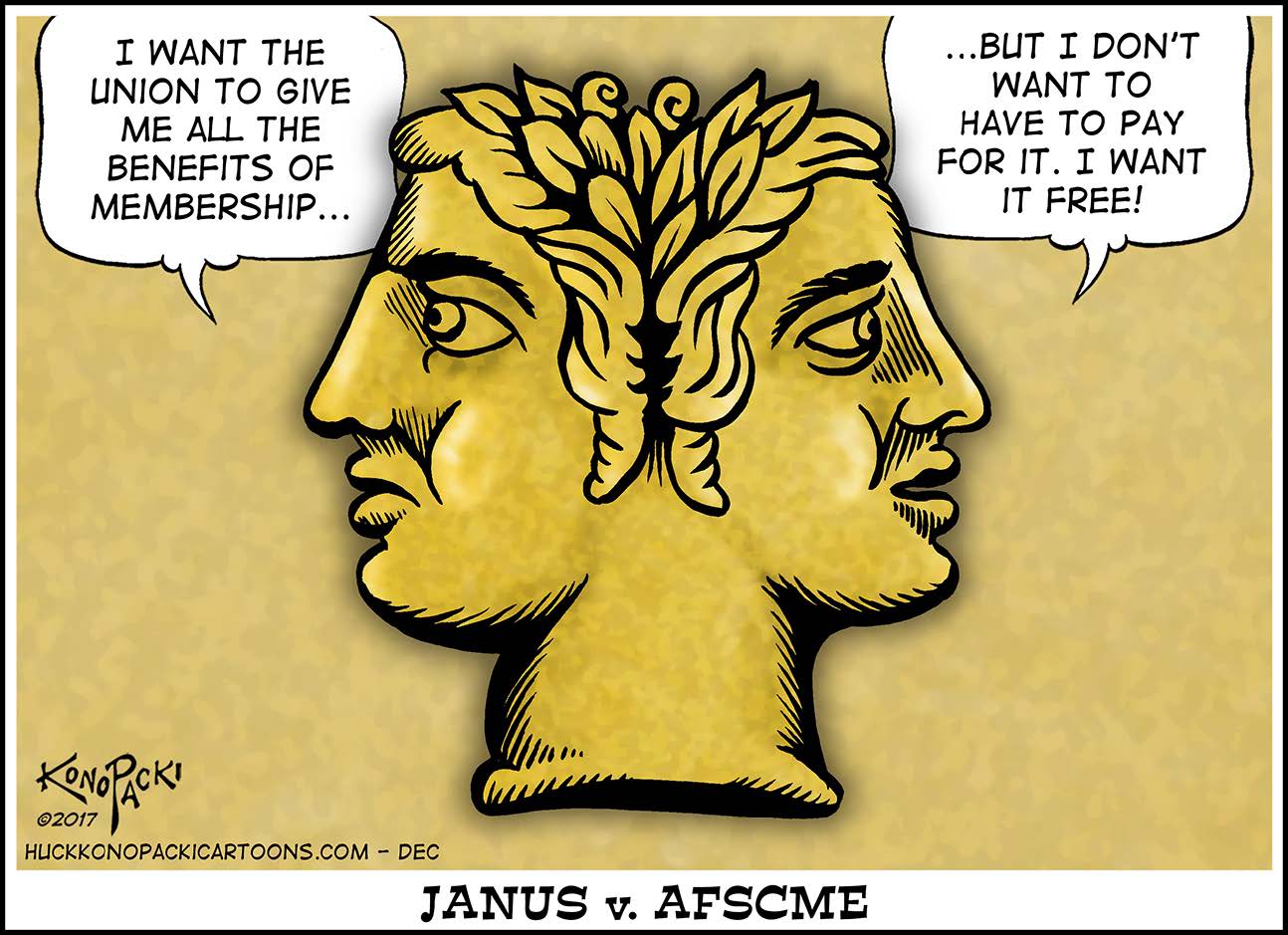
    ImageThe Supreme Court’s long-anticipated – and feared by progressives – decision outlawing the collection of fees in public employee unions equivalent to costs of collective bargaining was met with indignant or defiant words, rightly decrying this attack on organized labor. The response, though, has mirrored what has been missing in labor’s understanding of how we got to this point and what we need to climb out – and win.

    First, there were few demonstrations. Though unions knew this decision was imminent, few were prepared with protests, or had held demonstrations earlier, like this one in Chicago.  Janus was an opportunity for political education about the class war being waged against working people.  Also emblematic of the problem is use of the term “free rider” and “free loader” to describe members of a bargaining unit who are covered by a collective bargaining agreement but don’t join the union and pay dues.  Let’s be clear that workers’ conservative consciousness is a crisis, but it won’t be solved by blaming individual workers who don’t think the union represents their interests and don’t understand why the assumption that individual effort and competition in the workforce aren’t a solution to deteriorating conditions.

    As I explain in my forthcoming article in New Politics (available to subscribers, shortly), I heard countless times in conversations with teachers in the “red state” walkouts that the unions that ostensibly represented them were “irrelevant” and worse.  These teachers weren’t union members and had they been cast as “free loaders” by the activists who organized the walkouts (some of them not union members!) no walkouts could have occurred.

    The unions that will be most hurt by Janus v. AFSCME are those that have done the least to educate their members politically about the real challenges we face in the public sector and have done the worst job of fighting hard for those most exploited.  

    What should we be saying now, post-Janus? It’s not good enough to repeat labor’s traditional mantra “I’m sticking with the union” because many unions, including the ones about which I write most, AFT and NEA, are in need of profound transformation to do what they ought.  AFT and NEA too often do the work of Wall Street, as when they applauded ESSA, the new federal education funding law  which included “social impact bonds,” giving Wall Street profits when it keeps pre-school children out of special education.  These “social impact” bonds are despicable, and even if AFT and NEA officials thought they could get no better from Congress than they did in allowing this new intrusion of privatization, they had to speak truth to members and the public by saying they were reluctantly supporting the legislation.  We need unions that will, at the very least, take up and act on the the demand that people come before profits.

    I propose we say to public employees and the public “We need good unions now more than ever. Join the union and work with us to make it the democratic, fighting organization we, our kids, and working people need.” #MakeOurUnionsWhatTheyShouldBe


  • Support the Popular Rebellion in Nicaragua – Oppose U.S. Intervention

    Image

    At this moment, the government of President Daniel Ortega and his party, the Sandinista Front for National Liberation (FSLN or Sandinistas), face a popular rebellion from below on a national scale. We look here at the origins of this rebellion, at the alternatives facing it, and at the responsibilities of those of us in the United States toward the people of Nicaragua.

    Daniel Ortega and the Sandinista Front for National Liberation (FSLN or Sandinistas) led a popular revolution to overthrow the Somoza dynastic dictatorship in 1979, and, despite a U.S.-organized and U.S.-sponsored counter-revolution and subsequent civil war, they attempted to improve the lives of the Nicaraguan people. Daniel Ortega was first elected president in 1985, but lost popularity because of refusal to distribute land to the peasants, heavy-handed dealings with the indigenous, and the adoption of conscription; above all the war demoralized the Nicaraguan people who wanted peace.

    Nearly Thirty Years of Accommodation to Conservatism

    With the loss of the 1990 election, the Ortega government carried out the famous piñata, giving government property to Ortega and other FSLN leaders. Once conservative government President Violeta Chamorro took power, Daniel Ortega and his brother Humberto Ortega formed a relationship with her son-in-law Antonio Lacayo and began a process of accommodation to the corrupt Conservative and Liberal parties, formed relationships with the country’s business class, and joined with the conservative Catholic Church under Cardinal Obando y Bravo. There followed a series of unethical political and economic arrangements that continued through the presidencies of Arnoldo Alemán and Enrique Bolaños governments over a period of 15 years.

    When Ortega’s won election to the presidency in 2001, he turned Nicaragua into a typical "developing" capitalist country, suppressing democracy, social movements, and the labor unions to attract U.S. and other foreign investment. The Nicaraguan economy grew rapidly, but the benefits flowed to the capitalist class. Government social programs financed by the United States or by Venezuela, failed to raise the standard of living of the people despite rapid economic growth. Ortega meanwhile gathered all power into his own hands: the presidency, the National Assembly, the Supreme Court, as well as controlling most of the TV stations and many organizations, such as the labor unions. Having changed the Nicaraguan Constitution, he was reelected in 2006, 2011, and 2016; that is, he has been president for four terms, three consecutively. In 2016 Ortega’s wife Rosario Murillo was elected vice-president.

    Part of the American Imperial System

    While Ortega and the FSLN claimed to be “anti-imperialist,” in fact they made Nicaragua an integral part of the U.S. imperial system of economic dominance, political hegemony, and military supremacy in Latin America. Under Ortega, Nicaragua adopted policies intended to attract U.S. and other foreign investment, such as suppressing independent worker movements, crushing independent labor unions, and maintaining a low-wage economy. The strategy was successful and Nicaragua sent 54 percent of its products to the United States and 8.4 percent to Canada. Ortega also worked closely with the U.S. government, being a large recipient of U.S. economic aid, engaging in collaboration with the U.S. Army and Navy, and working with the Drug Enforcement Agency (DEA) of the United States. While he had many photos taken with Communist and populist leaders (the Castros, Chávez, Maduro, and Evo Morales), his government had become an integral part of the U.S. security system as well as of U.S. economic hegemony in the region.

    Yet Part of the Reactionary “Axis of Resistance”

    Yet it is also true that Nicaragua’s opportunistic foreign policy, however, has never been in line with that of the United States. At the time of the Nicaraguan Revolution, through the 1980s, and until the fall of the Soviet Union in 1989, Ortega and the FSL maintained strong ties to Fidel Castro’s Cuba and to the Soviet Union and the Eastern Bloc, as well as with Kim Jong-Il’s Communist government of North Korea. Ortega and the FSLN saw themselves as part of the “socialist camp,” never raising any criticism of its undemocratic regimes. At the same time Nicaragua received aid from Mexico and other Latin American countries, as well as from Social Democratic party governments in Europe.

    After the fall of Communism in Europe, Ortega reoriented Nicaragua’s foreign policy, supporting the authoritarian regimes of Muammar Gaddafi of Libya and Mahmoud Ahmadinejad in Iran. At the same time, he formed strong ties to the more populist and democratically elected governments of Hugo Chávez in Venezuela and Evo Morales in Bolivia. Chávez of Venezuela, through the regional economic institution ALBA, provided Ortega with billions of dollars in economic aid. He has continued to be allied with Venezuela under the Maduro government.

    By the 2010s we could speak of Nicaragua as part of the so-called “Axis of Resistance,” an alliance of rightwing and authoritarian governments including Iran, Syria, and Russia. Beginning in 2006, Ortega expanded relations with Russia and by 2015 strengthened military relations, opening ports to Russian Navy ships and receiving Russian military equipment, such as armored personnel carriers, aircraft and mobile rocket launchers, and T-72 tanks. While the “Axis of Resistance” is sometimes referred to as “anti-imperialist,” it is in reality several of the nations involved have their own imperial ambitions in Europe or the Middle East, most obviously in the case of Russia’s seizure of the Crimea in 2014.

    The Nicaraguan government has never spoken out in favor of the democratic social movements in the authoritarian countries with which it has allied itself.

    An Authoritarian Regime

    Beginning with his election in 2006, Ortega used the power of the government—controlling the executive, legislative, and judicial branches—to strengthen his party to construct an authoritarian regime. For over a decade he has used not only the police but also the FSLN and Sandinista Youth and their turbas (thugs) to impose his political power and to attack and beat political opponents, social movement activists, labor union organizers and workers, as well as university students. Physical attacks were often preceded with and accompanied by attack from the media attempt to denigrate and discredit any opponents. Most notorious was Ortega’s and Murillo’s attack on the feminist movement that advocated a liberalization of abortion laws and other improvements for women. Murillo vilified them as agents of imperialism. The authoritarian and violent character of the Ortega regime first came to widespread public attention in 2013 and 2014 when police and thugs violently attacked farmers and environmentalists concerned about the building of a transoceanic canal.

    The current popular rebellion began with protests by elderly people against the social security reform, which met with police repression. That led students to join the peaceful protests. After Ortega's government and his party began fire on and kill students, the entire society erupted in a popular, peaceful rebellion. The full brutal violence of the regime against its population, which went so far as to murder mourning mothers leading the Mother's Day march, killing thirteen and wounding dozens. Since then the Ortega government’s police and thugs have been murdering activists involved in the movement, attacking small towns, burning public buildings and markets, and beating and torturing as they went along, the people reacted by blocking the highways (tranques) and barricading their towns or their neighborhoods. 

    After several weeks, the situation became chaotic and other actors, such as criminal gangs, have sprung up to take advantage of the situation through looting and theft, and they have also increased the violence. While this is extremely unfortunate, it does not change the fundamental political situation, which is a conflict between an authoritarian government and a popular rebellion.

    ImageThe Opposition

    Since the movement arose from below through social networks organizing social media, a spontaneous and grassroots movement, it has been difficult to identify leaders. The students did attempt to create leaders and various groups have attempted to create coalitions, but give the chaotic and violent situation, it has been very difficult to create very stable organizations. Outside of Ortega and the FSLN, the best organized groups in the society are COSEP, the business council, and the Catholic Church hierarchy, both fundamentally conservative organizations that had accepted and supported Ortega’s government for more than a decade.

    The left has virtually no organization in Nicaragua for quite understandable reasons. First, Ortega and the FSLN, who had led the 1979 revolution, had claimed to be the left, raising the slogan of “Christian, Socialist, and in Solidarity.” So on the one hand, they claimed the title of being the left, but on the other hand, their authoritarian regime, with its oppressive and exploitative character, discredited the left. It is not surprising then that socialist ideas would not have much appeal to most Nicaraguans today.

    Two splits from the FSLN, the Sandinista Renovation Movement (MRS) and the Movement for the Rescue of Sandinismo (MPRS), formed by former Sandinista comandantes and political leaders, both developed a critique of the Ortega regime and a social democratic political platform. Neither, however, despite their democratic and pro-working class views, succeeded in finding a social base in the society. A Christian Alternative group, inspired by the Theology of Liberation, also failed to build a movement or a real party. These social democratic and theology of liberation ideas, however, have some resonance, and no doubt university professors and priests who espouse them have had some impact on their congregations.

    The Alternatives Facing Nicaragua at the Moment

    At the present moment, faced with an overwhelmingly popular rebellion, Ortega and his government are trying to keep themselves in power by attempting to discredit the opposition and to slow the movement. Ortega and his spokespersons such as Paul Oquist suggest that the United States government has organized the movement and is carrying it out through agents in Nicaragua, though they provide no evidence of such a conspiracy.  

    The popular rebellion has raised the slogan, Que se vayan ya. (Let them get out now.), that is that Ortega and his party leaders should leave office and ideally leave the country. This appears to be the sentiment throughout the country.

    The business council (COSEP) and the Catholic Church have called and been carrying out intermittently a national dialogue with Ortega aimed at seeking a peaceful resolution to the crisis that has included among other things calling early national elections. COSEP has attempted to establish ties with the U.S. government and with Congressional legislators, no doubt with the hope of U.S. support for a conservative, pro-business political outcome.

    The United States government has come out strongly against Ortega, but it would clearly favor some transition that brings to power a new conservative, neoliberal, pro-United States government that can take over the existing state, that is the army and the police. No doubt that U.S. diplomats and political fixers are busy in Nicaragua attempting to construct the government they want and preparing to foist it on the Nicaraguan people.

    What Can We in the United States Do?

    We as Americans should give our full support to the popular rebellion and its call for a return to democracy because the elimination of the Ortega dictatorship and any increase in democracy would be a progressive outcome. If Ortega’s government falls then farmers and environmentalists can work to stop the canal, women can organize for abortion rights, and workers can strike to build independent unions.

    We should take a strong stand against any U.S. political or military intervention in the country. The United States government under either Democrats or Republicans has never been a friend of the Nicaraguan people, and the Trump government would certainly not be an exception. We should raise the slogan “Hands Off Nicaragua!”

    We should at the same time be proponents of international solidarity among the world's peoples to support the Nicaraguan people against their oppressive government. Whenever the situation calms down, we should make personal contact with the Nicaraguan people to let them known that they support from people abroad. We should especially work to develop relations with Nicaraguan labor and social movement activists.

    At present, we should support the calls for democracy, social justice, and national sovereignty, though if things were to radicalize and move to the left, we should call for not only a political but also a social revolution that would lead to a democratic socialist society.


  • A 99Rootz Organizer’s Story

    Image

    Driving down Route 99 highway, miles upon miles of flat land sprouting grapes, nuts, lemons, and tomatoes line the stretch of land next to the hot asphalt. Highlighted within this landscape of farmland and truck filled, busy highways are youth. Strong, beautiful, Black and Brown young people unapologetically organizing amidst big agriculture and quiet towns. They are organizing for a Central Valley that provides all its residents with what they need to be whole. These young people, full of wisdom and fire, are ready to reclaim the region as their own, creating from the soil rich land a movement that pushes forward their vision of a California for all. At the center of this energy and youth-led, transformative movement is 99Rootz.

    In an election year, where the powerful work of grassroots movements can often be overshadowed by prime time news, there is an urgent need to lift up the story of 99Rootz. As a youth organizing project rooted in social justice, 99Rootz builds leadership pathways and safe growth spaces for young people in the small towns that surround Route 99 highway. Their work includes re-connecting youth with their culture, political education, electoral organizing, and voter registration. Working out of two offices in Sanger and Merced, Alicia Olivarez, 99Rootz Strategy Director and Crisantema “Crissy” Gallardo, 99Rootz Senior Organizer know firsthand the joys and struggles young people experience in the Central Valley. Alicia and Crissy were both born and raised in the region, left to attend university at Harvard and UC Berkeley respectively, then returned to their hometowns eager to help build a movement of young people of color transforming their communities grounded in culture. Crissy describes her life experience, which eventually saw her decide to leave her hometown Atwater for college:

    “In Atwater, I always felt like there was never anything to do. Public transportation was pretty much non-existent so getting around to the “bigger” towns was hard. Monday through Thursday my immigrant parents worked in the fields and on Sundays, their only day off, we would go to mass and then grocery shopping. That was our routine. My older siblings got involved with drugs and gangs and law enforcement was constantly at my house. When I could hang out with friends, we would go to a local burger joint, Foster Freeze, a park, or to someone’s house to kick it. My friends and I all had dreams of leaving as soon as we could.”

    “My older sister was murdered when I was sixteen and my older brother was in jail at the time. That moment made me feel like I was the last child that could do something to make my immigrant, farmworker parents proud. They worked really hard and their biggest dream was for one of us to make it to college. I felt like college was going to be my only way to escape all the pain back home and succeed. I left for UC Berkeley not knowing the difference between a UC, CSU, or community college. I was fortunate to find a support system composed of womyn of color. They helped me unlearn all the lies I was taught by the school system in the Central Valley, like if I spoke English well enough I would succeed and if I assimilated everything would be fine. My time at UC Berkeley challenged me to think for myself to find my own identity. Learning my true hxtory opened my eyes to the injustices impacting my family and community. My experience as a young person of color in the Central Valley and subsequent political education informs my work at 99Rootz. I am committed to helping create the resources I wish I had growing up.”

    Alicia grew up in the quiet town of Sanger in a diverse community of immigrants, refugees, and young people building community together. Dubbed the “Nation’s Christmas Tree City” in 1949 by the U.S. Post Office, this otherwise jocular designation doesn’t encompass the problems residents face, including unemployment, lack of access to healthcare, environmental issues, and mass incarceration of youth of color as adults. Alicia decided to leave her hometown based on the direct impact that economic disparity had on her family:

    “My neighborhood was made up of hard-working, largely immigrant, farm and packinghouse workers. This included my family who worked the surrounding fields. My parents could not be around for numerous reasons, including needing to work, so it fell on me as the oldest child to take care of my siblings. I did this as best as a child can take care of other children. Growing up all I could think about was how badly I wanted out of my reality, which included being accustomed to drive-by shootings, worrying about loved ones with meth addictions, and living in housing infested with roaches and mice. I just felt incredibly alone and hopeless. Through all of these challenges I learned about my own capacity for resilience and transformation. To resist, I had to learn to cultivate my own hope and a different narrative of our communities and carry this with me in my work with 99Rootz. To resist collectively as a region, we have to plant, nourish, and cultivate our own narratives and hope.”

    The scale and concentration of the problems in the Central Valley creates a heightened sense of an absence of community safety and wellbeing. Elected officials and law enforcement in the region maintain power by fabricating a performance of safety through excessive criminalization of the communities that Alicia, Crissy, and the whole 99Rootz team work with. True community safety requires inclusion of people who are the least engaged in decision making – especially youth and women of color, queer, and disabled folks – while also lifting up their power. 99Rootz is shifting the way these communities are viewed and held within the political space in the Central Valley by utilizing a combination of culture and organizing to build community power. 99Rootz is actively creating a future where all people have a say in the decisions that affect their lives; power that truly rests with the people.

    This year, youth organizers at 99Rootz are campaigning for safe schools and communities.  The 99Rootz office serves as: a cultural hub for young people to experience and create art;  bases from which to run phone banking and door knocking campaigns; and a resource for political education and voter registration.

    Building Youth Power for the Future

    People in power control the economic, social, and political infrastructure including education in their communities. Unfortunately, the majority of people in leadership positions in the Central Valley hold values counter to the needs of the majority of people in the community, who are Black and Brown. Alicia encapsulates this dynamic by sharing:

    “The Central Valley continues to be a political battleground when it comes to hotly contested seats, conservative congressional leadership, and prominent local criminal justice agencies allied with the racist federal administration.”

    99Rootz works to change this from the ground up. They are using their collective power – led by young people – to elect decision-makers who have genuine knowledge and an understanding of the communities they work in.

    99Rootz builds youth power to train up the next generation of leaders in the values and skills they will need to faithfully govern for all.

    As part of 99Rootz’ commitment to providing youth with the skills and resources they need to thrive, they lead a Freedom Summer in partnership with UC Santa Cruz and UC Merced. In the footsteps of the 1964 Freedom Summer where young Black folks travelled to Mississippi to register as many Black people as they could to vote, 25 students from the Central Valley have come back to their hometowns as 99Rootz interns to organize youth in low-income communities. 99Rootz provides knowledge and skills training to support these young people’s voter education and registration drives in their communities. The student interns will also help facilitate 99Rootz Summer Academies for youth of color. The academies include deep training on identity, political education, and campaign planning. As well as an arts and culture track where youth will have opportunities to create art and attend healing workshops.

    A Vision for 99Rootz

    As Crissy and Alicia deepen the work they are spearheading, their vision for 99Rootz is expansive and rooted in love for community as captured below.

    “[99Rootz is] a pathway that amplifies the local talent and resources that already exist in our communities. Young people in the Central Valley are powerful! We are proud to be Black and Brown, we are proud to be immigrants and refugees, and we are thriving. More freedom centers will open up across the valley and more young people of color are going to be in the forefront fighting for justice. I want 99Rootz to be the vehicle youth use to transform our schools, cities, and region. We are going back to the basics, #eachoneteachone, sharing our stories, building our leadership, and taking it to the streets and ballots. The contributions of Hmong refugees, Punjabi immigrants, and Latina farm workers will be acknowledged and represented brightly in community murals, school curriculum, and elected positions. Our Central Valley is full of color, art, and pride. The Central Valley is the HEART of Cali.” – Crissy Gallardo

    “I came back to the Valley because although I was talking about social justice work and wanting to create change, I kept finding myself further and further away from those most impacted. By the time I got to Harvard, literally across the continent in one of the most concentrated institutions for power and privilege, I couldn’t lie to myself anymore. Our communities deserve to be healthy by design and free from corporations that seek to profit off our people. My vision is for 99Rootz to help create pathways that are bigger than us, that are unapologetic about where we are from, and that build collective power.” – Alicia Olivarez

    The model that 99Rootz leads with is so brilliant because it places the power directly in the hands of young people from the Valley. Youth register other youth to vote in their high schools, they talk to their peers on the phone, and they walk in their own communities talking to their neighbors. What makes 99Rootz work even more impactful is the direct integration of art and culture into organizing. They recognize that this movement is not whole until we start connecting to each other in a new way. That when those in power want us to be quiet we scream louder, when they want us to be still we dance joyously with all our loved ones. 99Rootz is making space for the creativity and joy that comes from art and culture, to surround organizing work in what people truly need to grow and imagine beyond the present. Ultimately, they are leading the way and showing us that it is possible to be woke, dream, and change the power structure at the same time.


  • On the Mass Protests in Iran, Revolutionary Socialism, and International Solidarity


    Image

    Below is the text of Frieda Afary’s presentation to a group of international labor activists on June 10, 2018.

    The mass protests that began in Iran on December 28, 2017 and have continued in the form of smaller nationwide protests and strikes, have been unprecedented in scale since the 1979 Iranian revolution, a revolution that was soon transformed into its opposite, the Islamic Republic.

    The December protests that were started by mostly unemployed youth in smaller cities demanded the overthrow of the Islamic Republic and the withdrawal of Iran’s military and paramilitary forces from Syria, Lebanon, Iraq and Yemen.

    They were preceded by over a year of persistent protests among workers, teachers, nurses, retirees, as well as hunger strikes by political prisoners and years of various forms of women’s struggles against gender discrimination. They were caused by economic, political and social reasons and were the product of the dissatisfaction of a young, literate population that is connected to the world through the Internet and is fed up with poverty, repression, gender and ethnic discrimination as well as discrimination against religious minorities.

    The focus of today’s presentation is on labor protests because at this moment there are nationwide labor strikes/protests taking place in Iran that do have the potential to move Iran in a revolutionary direction.  At the same time these protests face various internal barriers as well as external barriers: a repressive capitalist regime, the threat of imperialist wars from the U.S., Israel and Saudi Arabia, and the existence of patriarchy and discrimination against oppressed minorities. As socialists, we need to understand the scope and depth of these labor protests, and help them overcome their barriers.

    Scope and Depth of Labor Protests

    More than 50% of the population of 82 million live under the poverty line.  90% of the 13 million Iranian workers who are covered by the labor law are contract workers with few rights and benefits.  While the official workforce is estimated at 28 million, millions work unofficially without any rights.   The real unemployment rate is over 40%.  The minimum wage of $200 per month (which is less every day with rising inflation) is one-fifth of the poverty line for a family of four.

    Currently there are nationwide strikes in progress by railway workers and truck drivers. Teachers and healthcare workers are protesting everywhere. There is an ongoing strike by 4,000 Ahvaz (Khuzestan) steel workers which has led to marches around the city by workers and their family members, attacks by anti-riot police and arrests of 50 workers.  There are on-and-off strikes by Haft Tapeh Sugar Cane workers and oil and petrochemical workers also in the province of Khuzestan which has a large ethnic Arab population that faces discrimination.  HEPCO heavy equipment production workers in Arak (Central Province) faced a lockdown and arrests after staging several strikes and sit-ins.  Kurdish Koolbars (workers who carry cargo on their backs)  on the Iraq-Iran border have been protesting against the closing of the border.

    Most labor actions are protesting the non-payment of wages, non-payment  or lack of health insurance benefits, and lack of job security.  Many are protesting what they call “privatization” of government owned enterprises. The lack of safe working conditions, the low quality of education and the terrible quality of healthcare are major problems.  Farmers are demanding water rights to irrigate their crops and are deeply concerned about the very serious water shortage caused by the building of dams (not only in Iran but also in Turkey and Afghanistan), the diversion of water reservoirs to other cities, as well as other environmentally damaging government policies and practices. Their demands also highlight the important environmental dimension of the current labor protests in a country that is on the verge of environmental collapse.

    Most of the factories and industrial complexes in which strikes and sit-ins are taking place are immensely in debt. They have limited production and are in a way out of the game. The Iranian economy is not as dependent on these dying factories. They represent a very small percent of the gross domestic product.  Hence the regime does not care if they stop producing.  However, the regime can decide to  repress the protests much more brutally if  production in more valuable enterprises  is at stake.   Hence, when the truck drivers – whose role is vital to the economy and living conditions – started their nationwide strikes last month, the government’s response was much more severe,  and a lot more concern was expressed by regime officials.  Strikes among workers in the  oil industry or large companies such as SAIPA, Iran Khodro (automobile production)  or steel production factories in Isfahan can have the same impact.

    Some international labor activists might be familiar with the names of labor leaders such as Reza Shahabi of the Syndicate of Workers of Tehran and Suburbs Bus Company who had been in and out of prison for the last six years, suffered from beatings, solitary confinement,  various hunger strikes, and was released on parole in March. The fact that he was released showed that the current protests and the international solidarity from various labor activists and labor organizations around the world who called for his release, have made a difference. He and two other labor leaders, Davood Razavi and Loghman Veisi visited  Europe last week at the invitation of several French syndicates.  They protested the International Labor Organization’s recognition of Iran’s state-sponsored unions and called for the recognition of independent labor unions.  Shahabi is opposed to capitalism and was one of the few labor leaders who in 2013 in a statement from prison, opposed not only U.S. economic sanctions and war threats against Iran, but also Iran’s military intervention in the region.

    Another important labor leader is Parvin Mohammadi, a woman worker who along with Ja’far Azimzadeh has been the leader of the Free Union of Iranian Workers, a union which is opposed to capitalism, strongly supports women’s rights and is very influential in reporting various labor strikes throughout Iran through its Telegram news channel.  In a statement recently published by the website of the Free Union of Iranian Workers, she wrote: “The Iranian government has a large budget and immense assets … The most important part consists of large funds given to military and religious institutions inside the country and war expenditures in Syria, Lebanon, for Hamas, Yemen etc. This is not to mention billions stolen and embezzled. . . A government that responds to hungry workers with anti-riot guards, repression, imprisonment and expulsion, has only one message. Its message is that it has no solution for resolving the problems and economic dead end and wretchedness that workers face. . . The task we face is addressing the lost lives of millions of working-class households and offering them welfare, healthcare, housing, education, in one word, a life worthy of a human being in the 21st century.” (ettehd-e.com)

    Of the three imprisoned leaders of the teachers’ union, Esmail Abdi, Mahmoud Beheshti Langeroudi and Mohammad Habibi, the most outspoken one has been Esmail Abdi who in a recent statement from prison declared: “This is the 40th Nowruz [Iranian New Year’s day] since the revolution; a revolution that took place in 1979 with the promise of ending dictatorship, establishing democracy, implementing transparency and preventing the accumulation of wealth in the hands of a particular class; a revolution that the clerics and some political groups said would be a harbinger of peace and freedom and would put an end to poverty and discrimination, where people would have access to free water and electricity and enjoy such rights as freedom of thought and expression, free and equal education, with the right to form organizations and unions, hold protests and strikes, assemble and rally and be equal against the law. But these aspirations did not amount to anything besides slogans. The blessings of the revolution benefitted not the poor but rather the rich, the powerful and tricksters. The groups that came to power used the state media to promise a better and more dignified life. They took advantage of the people’s beliefs and values to attract votes while amassing wealth from the nation’s treasury, and now we see competing factions trying to expose each other.” (https://www.iranhumanrights.org/2018/04/teachers-rights-advocate-writes-scathing-letter-from-prison-on-revolutionary-irans-failed-promises/)

    In addition to the statements of these known labor leaders, the growing radicalization of the content of the strikes is expressed in the demand for independent labor unions. Furthermore, workers at Haft Tapeh Sugar Cane factory in Khuzestan, have challenged the regime by stating that if their demands are not met, they would take over the management of the company.  At Haft Tapeh, Ahvaz Steel and other labor protests, the following chants are being heard:  “They say our enemy is the U.S.  But they are lying.  Our enemy is right here.”  Leave Syria alone and think about us.”

    The above mentioned developments in addition to the participation of women and members of oppressed national minorities such as Kurds and Arabs in nationwide protests all show that these protests have the potential to go much further and deeper. At the same time, although the right-wing populist forces of Ahmadinejad and the pro-U.S. imperialist Mujahedeen are still too discredited, the secular nationalist and pro-U.S. imperialist-monarchist opposition do have some appeal among the masses.  Secular nationalists and monarchists speak of fighting corruption, ending  inefficiency and replacing this regime with a secular and efficient state that would give women their  civil rights and stay away from military interventions abroad. Nationalist slogans such as “Face the Motherland and Turn Your Back to the Enemy” are being used at some labor protests.

    What Are the Barriers to a Revolutionary Socialist Direction?  

    The problem we need to face is that while the demands of the current protests have the potential to create the basis for a revolutionary socialist movement, an explicit articulation of socialist content is missing from the protests.

    There are various reasons for this. The Islamic Republic has used the language of “revolution,” “anti-capitalism” and “anti-imperialism” from its inception. Furthermore, during the 1979 revolution, the majority of Iranian socialists, who were followers of Stalinism and Maoism, discredited socialism and Marxism by supporting Khomeini as an “anti-imperialist.”  Soon, many socialists were executed by the regime, or were driven into exile and became disillusioned.

    Even now the positions of most Iranian socialists and Marxists on the two key issues raised by the December-January mass protests have been very problematic.

    1. Most Iranian socialists have refused to take a position against Iran’s military interventions in the region. On Syria in particular, they either supported Assad or called him “the lesser of the two evils” in comparison to ISIS.  At most they have attributed Iran’s military interventions only to ideological motivations for expanding Shi’a Islam. They have not addressed the connections between the strategic interests of Iranian capitalism, its militarism and its regional imperialism.
    2. Most Iranian socialists limit capitalism to the private ownership of the means of production and view a state-owned economy as a progressive alternative. They trace the roots of the current massive decline in the standard of living to what they call “privatization.” Since 2005, the bulk of the state’s assets have been transferred to parastatal organizations such as the Islamic Revolutionary Guard Corps and other religious foundations, in order to allow the state to avoid paying the meager benefits that  it is required to provide for its employees.  State employees have been fired and rehired by parastatal contractors who only hire contract workers and pay few or no benefits. The bulk of the economy however is still directly and indirectly controlled by the state.  Instead of seeing Iran’s economy as state capitalist, most socialist economists claim that it is private capitalist. They do not support the Islamic Republic but see more state ownership and state intervention as the solution.

    In contrast to these views, some socialist and Marxist labor activists, especially among the younger generation, are discussing alternatives such as workers’ cooperatives and workers’ councils.  Some Marxists discern the limitations of workers’ cooperatives and emphasize that even workers’ councils can only be effective if they overcome capitalist alienated labor, its mental/manual division of labor as well as patriarchy, sexism and heterosexism. They recognize that overcoming capitalism goes far beyond workers taking over the workplace and requires ending the capitalist mode of production globally through international revolutionary solidarity and global coordination. These are the socialist voices inside Iran that offer the most hope at this time.

    To sum up, the mass protests that arose in Iran in late December and have continued in the form of labor strikes, protests of women for their rights and protests of oppressed national minorities against discrimination, offer tremendous potential for revolutionary developments.  However the regime is using the threat of U.S., Israeli and Saudi Arabian imperialist intervention to crush them.  The nationalist opposition forces who support western imperialist intervention are using the promise of a secular, efficient and non-interventionist capitalist state to divert the movement.

    What Kind of International Solidarity Is Needed?

    The Alliance of Middle Eastern Socialists is trying to reach out to anti-authoritarian and humanist socialists from around the world to seek solidarity  with these struggles.  We need to oppose the repressive Iranian regime,  oppose the imperialist war threats against Iran, support the above discussed protests/strikes, and promote debate on a humanist alternative to capitalism.

    Here are some immediate ways in which you can express your solidarity with these protests:

    Protest Trump’s, Netanyahu’s and Ben Salman’s war threats and economic sanctions against Iran. Challenge their lies and rhetoric.  Their imperialist war on Iran will bring nothing but more death and destruction for the Middle East region, and misery and repression for the rest of the world.

    Write a letter to the Free Union of Iranian Workers (http://ettehad-e.com/) at k.ekhraji@gmail.com, or to the Syndicate of Workers of Tehran and Suburbs Bus Company (http://vahedsyndica.com/) at vsyndica@gmail.com, express your opposition to imperialist war threats and support for their demands and protests. Say how you think labor struggles in your country and Iran can speak to each other and help each other.

    If you work with a labor union, organize a meeting to discuss how you can express your solidarity with Iranian labor protests.

    Reprint the article below on how U.S. teacher protests can learn from Iranian teacher protests. Call for the immediate release of the three imprisoned leaders of the Teachers’ Union, Esmail Abdi, Esmail Abdi, Mahmoud Beheshti Langeroudi and Mohammad Habibi:

    https://www.allianceofmesocialists.org/what-can-u-s-teacher-protests-learn-from-iranian-teacher-protests/

    Express your solidarity with the Girls of Revolution Avenue, some of whom have received long prison sentences for opposing the compulsory hijab:

    https://www.allianceofmesocialists.org/statement-group-international-socialist-feminists-solidarity-iranian-women/

    Join the Alliance’s Campaign in Solidarity with Middle Eastern Political Prisoners:

    https://www.allianceofmesocialists.org/14964/

    References:

    Abdi, Esmail. “Teachers’ Rights Advocate Writes Scathing Letter From Prison on Revolutionary Iran’s Failed Promises.” Center for Human Rights in Iran, April 12, 2018.

    Afary, Frieda. “The Particular Features of the Islamic Republic’s Capitalism.” Alliance of Middle Eastern Socialists. June 2017

    Darolshafa, Yashar. “An Analytical History of Iranian Labor History.” Critique. May 2018

    Hakimi, Mohsen. The Transformation of Marx’s Communism: From an Anti-Capitalist Working Class Movement to the Ideological Party of State Capitalism. Tehran: Akhtaran Press, 2017

    Hosseinzadeh, Leila. “The Question of Democracy and Workers’ Right to Self-Organization.” Critique of Political Economy. May 2018

    Iranian Student News Organization. "The number of official contract workers in Iran." Jan. 2018

    Maljoo, Moammad. “Privatization: The Direct Barrier to Liberation.” Meydan, September 2016

    Mashreghnews. "The real unemployment rate in Iran. " September 15, 2016

    Mohammadi, Parvin. “A Conversation with Parvin Mohammadi.” Free Union of Iranian Workers, May 1, 2018

    Rais Dana, Fariborz. “The Results of Increasing Privatization.” January 2016

    Zamaneh. “Interview with Mehdi Kuhestani.” May 1, 2018

    Zamaneh. "Unemployment in Iran."  November 2017

    Zamaneh’s informative and daily reports on Iranian labor strikes are too numerous to cite.

    Originally posted on the Alliance of Middle Eastern Socialists website.

  • Alex Pareene: Pundit of the Century

    Image

    Alex Pareene, first of Wonkette, then Gawker, then Salon, then back to Gawker, then a stillborn First Run Media project, and now Splinter News is a great pundit.

    In fact, he is a brilliant pundit and criminally underrated. His talent is generally overlooked because he has by-and-large written for outlets derided by both the right and the center. Conservatives have treated Salon as a punching bag for years now, and Gawker—no matter how biting or insightful it got—was never treated as serious by the mainstream because of their willingness to sneer, and even cuss at, the powers that be. If instead Mr. Pareene had been blogging at Mother Jones or Slate for the last ten years, he would be delivering college commencement speeches by now. In an attempt to make the world better appreciate this elucidating polemicist, here are some of his best hits.
     

    Mr. Pareene first got noticed, rightfully, for his “Hack List” feature when he was still with Salon. Therein, he took mainstream pundits both “left” and right to task for, well, being idiots. What is impressive about the list is that although it was written years ago, when America’s political landscape was dramatically different from what it is today, it still holds up.


    In 2012, after noting that while The New York Times has good reporting and that not all of their opinion columns were bad… most of them were. Putting it succinctly: “Ross Douthat is essentially a parody of the sort of conservative Times readers would find palatable, now that David Brooks is a sad shell of his former self, listlessly summarizing random bits of social science and pretending the Republican Party is secretly moderate and reasonable.” Mr. Pareene then goes on to note that Thomas Friedman is a “national embarrassment,” who “is a fraud and a simpleton, whose job is to sell comforting platitudes to rapacious plutocrats and those who aspire to be rapacious plutocrats.” The description of Mr. Douthat is right on point, as a more recent Chapo Trap House dissection reminds us. The description of Mr. Brooks is almost too nice. Remember when, in January of 2016, the man said, "It’s going to be Rubio. I’m telling you, it’s going to be Rubio." Mr. Friedman, blessedly, has lost considerable clout over the last half decade, but he is still at the Times, pretending to have learned his lesson from the Iraq War fiasco by advocating that President Trump launch an American occupation of Syria. The New York Times, impressively, decided to up its hack quotient recently by enlisting Bret Stephens to join them.

    Two other publications who, as a whole, Mr. Pareene identified as being unwilling or unable to break from centrist clichés were The Washington Post and The Atlantic. Both have had considerable line-up changes in the intervening years, but the song remains the same. WaPo is the foremost mainstream publication now giving space to pro-Trump dupes such as Marc Thissen (who Mr. Pareene had lambasted years earlier)—a low matched only by the right-wing-but-respected Wall Street Journal. The Atlantic, meanwhile, is prominently features GOP ghouls, so long as they are protected by the veneer of being #NeverTrump, such as warmonger David Frum, whose hatred for immigrants makes his hatred for the President rather surprising. The magazine’s longstanding agitating for war with Iran is also worthy of condemnation—and another reason why their anti-Trump posturing is not nearly as logical as they’d like you to think. After all, it was not so long ago that the magazine ran essays championing American empire and even Henry Kissinger.

    Two other takedowns deserve highlighting. In 2013, Mr. Pareene warned of one Ezra Klein’s “dangerous fantasy” to “imagine that the right charts will eventually lead to the right policy.” That was written before Vox debuted. Commenting on the news that President Obama’s list of favorite pundits included Jonathan Chait, Mr. Pareene lamented, “While Chait is a top-notch writer, any list in which he represents The Left is a list that isn't challenging any reigning Democratic Party orthodoxy.” That was years before Mr. Chait set about declaring war on the entire Bernie Sanders wing of the Democratic Party—which is a bandwagon the aforementioned publications all jumped in to, particularly The Atlantic.

    But perhaps even more important than its accuracy was the breakthrough that the Hack List represented. It was one of the first times that ruthlessly mocking and deconstructing the stupidity of our elite commentariat was taken mainstream. Salon was very popular when these polemics were getting published, and the Hack List helped make full throated assaults on legacy media institutions acceptable, and not just fodder for blogs or specialty leftist publications with miniscule circulations. This helped plenty of future left-wing intellectual bomb throwers attain a level of respectability that wouldn’t have been possible even a decade ago, from Jeet Heer to Corey Robin to Malcolm Harris.

    While at Salon, Mr. Pareene also managed to royally piss off one Donald Trump. The goofy billionaire had announced that he had a big surprise for the 2012 Republican National Convention, and one plucky Salon blogger publicly mused that it might be a video of President Obama getting fired. That turned out to be true, though the video never ended up being aired. For his insight, said plucky blogger was treated to a tweet from the next President of the United States reading, “Lightweight reporter Alex Pareene @pareene is known as a total joke in political circles. Hence, he writes for Loser Salon. @Salon.”

    You could claim that Mr. Pareene’s assumption about the 2012 video was a lucky guess, but then in 2016 he proved damn near clairvoyant. Back at Gawker, this time in as an editor, he wrote a shockingly on point piece called “Don’t Blow It.” The piece opens this way:

    It’s Trump versus Clinton. It’s a well-funded mainstream Democrat against a widely reviled demagogue who will struggle to earn the support of his party’s donor base. It’s a man whose every public utterance is a potential negative ad waiting to be cut, versus the most cautious candidate in modern memory. The Clinton campaign has been given a tremendous gift, as I am sure they know.
     
    They better not fucking blow it.
    The piece is worth reading in full—I cannot recommend that strongly enough (here’s an archived link to it in case Gawker’s assassinated corpse loses its formaldehyde and is left to rot), but here’s another worthy breakout quote:
    They’re [the Clinton campaign] going to build Trump up as a reckless and virile force of nature—and a true outsider—rather than expose him as a pitiful clown and an obvious fraud. This is completely backwards. As any writer who’s ever received an angry personal response from Trump can tell you, you get under his skin by mocking and emasculating him, not by feeding the myth of his power and strength, the precise qualities his authoritarian followers adore.
     
    So, look: I’m not saying the Democrats are definitely going to blow it. But they’re more than capable of blowing it.
    Almost nobody, aside from myopic Trump-partisans, thought it possible that Donald Trump would win the election. Certainly no hack pundit at any legacy media outfit did. And Mr. Pareene did not ever say Mr. Trump would assuredly win it, he just noted that there was a real chance of it, and with chilly precision explained why. No one at Harper’s, Mother Jones, or The American Prospect, for all their talent, managed to do the same. And after it happened, after Donald Trump became president-elect, Mr. Pareene held nothing back. His first piece after the fact was “Fuck Everything And Blame Everyone.” It is the most cathartic, most honest article-reaction to the event published anywhere. Despite being a paid writer, editor, analyzer, and quipper for about a decade, Mr. Pareene is still a human, like the rest of us.

    These days, Mr. Pareene ably serves as the politics editor at Splinter News, a more serious redux of Gawker. There, he continues to be insightful and funny. He can show you why the “Unite the Right” rally in Charlottesville was a preview of the GOP’s future. He can explain how it is that Donald Trump lost his mind over the course of the last two decades. And, as always, he is quick to point out the infuriating ignorance of our chattering class.

    So three cheers for Alex Pareene, the Minnesotan hipster who understands these crazy times better than every poseur out there taking in three times his salary.
     
  • Requiem for a Steelworker

    Image

    In progressive circles in the upper midwest today, if you’ve heard the name Sadlowski, it’s probably because you were involved in the Wisconsin labor uprising of 2011, where you might have linked arms with AFSCME organizer and state capitol occupier Edward A. Sadlowski. Or maybe you applauded the electoral victory of his sister, Susan Sadlowski Garza, when she won a Chicago city council seat four years later, as a standard bearer for her union, the Chicago Teachers.

    Ed, Susie, and their union comrades were up against two would-be union busters, Republican Governor Scott Walker in Wisconsin and Rahm Emanuel, the corporate Democrat who is mayor of Chicago. This week both Sadlowskis are mourning the death of 80-year old Edward Eugene Sadlowski, after what his son calls “a hard struggle” of a different sort. The cause of death, on June 10, was Lewy body dementia, a condition that drove Robin Williams to suicide.

    Four decades ago, their father was a really big name in the United Steelworkers (USW), well-known throughout organized labor, and a hero of the labor left. As director of USW District 31, covering Chicago and Gary, Ed Sadlowski was the elected leader of 130,000 blue-collar workers, part of a USW membership then totaling 1.4 million, about twice what it is today.  In a challenge to authority rare among union officials of his rank, Sadlowski broke with top USW leaders in Pittsburgh who were too cozy with management. Backed by a campaign network called Steelworkers Fight Back (SFB), he ran for international president on a controversial platform calling for greater union democracy, shop floor militancy, protection of black workers’ rights, and the right to strike.

    In the mid-1970s, Mid-western cities were still ringed with the glowing hearths of steel mills instead of their post-industrial rubble (or, in the case of US Steel’s fabled Homestead [Pa.] Works, a shopping mall built on top of it). Donald Trump’s delusional aspirations for the coal industry today were a reality then; our nation had more than two hundred thousand underground miners. Unions like the United Mine Workers and the much larger USW and Teamsters negotiated master contracts that were industry-wide. Owners of steel mills and trucking companies signed agreements covering half a million workers at the same time.

    In the era before de-regulation, de-industrialization, and corporate globalization, such union density and bargaining clout produced good wages and benefits. But discontent, among blue-collar workers, over poor working conditions was too often ignored. Problems like compulsory over-time, job safety and health hazards, unfair discipline, and relentless management pressure for greater productivity spawned dissident activity, which took the form of unauthorized strikes or internal union election challenges.

    Revolt From Below

    At the local level, if union officials failed to provide proper representation, aggrieved members often took matters into their own hands. They by-passed grievance-arbitration procedures that were frustrating and overly legalistic. Risking injunctions, fines, and even jail time, they flouted the “no strike” clauses found in almost every U.S. labor agreement.  In 1972, a slate of rank-and-file coal miners, with just that kind of wildcat strike experience, made U.S. labor history when they toppled the corrupt and thuggish national leadership of the UMW. Inspired in part by these Miners for Democracy, restive truckers and warehouse workers formed Teamsters for a Democratic Union (TDU) a few years later, with much help from socialists among them.

    In an era when rank-and-file rebellion was the wave to ride, young Ed Sadlowski was a pretty good surfer. His father, known as “Load,” worked for Inland Steel in East Chicago, joined the Steel Workers Organizing Committee in the 1930’s and became a founding member of USW Local 1010. Eddie’s own nickname—“Oil Can”—came from his job oiling equipment at US Steel’s South Works in 1956.

    For a budding, second-generation union activist, this relatively low-status position proved to be an in-plant organizer’s dream. He was able to circulate widely and connect with disgruntled co-workers throughout a mill employing 14,000 members of USW Local 65. In 1964, when Sadlowski was only 26, he led a local reform slate to victory, against much older incumbents, and became president of Local 65. (In today’s labor movement, local union presidents under the age of thirty are exceedingly rare.)

    An Official Family

    Less than a decade later, after a brief stint on the District 31 staff, Sadlowski found out how much his union (and others, in that period) welcomed promising new leaders. When he tried to run for District 31 director, the union’s “official family,” as it was called, rallied around his better-connected opponent. The election was stolen but the US Department of Labor ordered a re-run under federal-supervision. Backed by USW pioneers like George Patterson, a picket captain who survived Republic Steel’s massacre of strikers in 1937, Sadlowski won that vote by a 2 to 1 margin. In 1975, he became a most unwelcome addition to an international executive board then headed by USW President I.W. Abel, a 68-year old gent fond of black-tie dinner soirees with Big Steel management.

    Abel’s strategy, as a “labor statesman” nearing retirement, involved not just discouraging grievance strikes, but also promising, in advance, that steelworkers wouldn’t strike when their national contract expired. This questionable approach, allegedly dictated by industry conditions, was dubbed the Experimental Negotiating Agreement (ENA).  Sadlowski became the USW’s leading critic of Abel’s experiment because ENA replaced the right to strike with binding arbitration and was negotiated, in secret, without any membership vote approving it. (When his deal was challenged in court, Abel claimed a bargaining black-out was necessary because, with any advance publicity, ENA “might have been rejected.”)

    Sadlowski decided to take his case, against the ENA and other manifestations of “tuxedo unionism,” directly to the membership, in a February, 1977 election to choose Abel’s successor. Abel, his e-board colleagues, and USW headquarters staff cobbled together an establishment ticket headed by Lloyd McBride, the union’s bland but loyal District 34 director from St. Louis. McBride strongly defended the ENA and accused Sadlowski of promoting an “impractical kind of pure democracy that would lead to chaos.”

    A Civil Rights Struggle

    Long before bumper stickers appeared on Volvos urging us to “Celebrate Diversity,” Sadlowski did just that when he assembled his own insurgent slate. In addition to himself, a Polish-American, the Fight Back slate included a Chicano, a Croatian-American, a Jew of Eastern European origin, and an African-American. (This rainbow coalition made for quite a mouthful on lunch-pail and helmet stickers—“Elect Sadlowski, Rodriques, Kmec, Weinstock, and Montgomery!”)

    As of 1976, no African-American had ever made it to the top ranks of America’s second largest industrial, during the first four decades of its existence. In the 1960s, persistent racial discrimination in the mills and under-representation of black members in the USW bureaucracy spawned a civil rights movement within the union. One of its leaders was Oliver Montgomery from Youngstown, who became Fight Back’s most articulate spokesman (out-shining even the presidential candidate himself on many occasions). To undercut Sadlowski’s appeal to minority workers, with a formidable ally like Montgomery, USW headquarters created a new vice-presidency for “human rights.”  The position was filled by an Abel Administration loyalist, whose main qualification was notbeing part of past civil rights agitation within the union.

    On the ground, the Fight Back campaign swarmed with lefties, young and old. Most were “colonizers,” toiling in difficult and dirty steel mill jobs but able. Each of their competing political organizations—from the old Communist Party to the Revolutionary Communist Party to the Socialist Workers Party and the International Socialists—had a different “line,” leading to much jockeying for position among their respective cadres.  Only the Chairman Mao-inspired October League dismissed the USW election as “a trick by the bourgeoisie to channel the revolutionary aspirations and strivings of the masses into reformism.”

    Liberal Cult Figure?

    Meanwhile, anti-communists were attacking Sadlowski with more impact than the October League.  Anonymous plant gate flyers in the Mon Valley, where I was a SFB volunteer, claimed that our candidate favored a ban on all gun ownership—not exactly a popular position in Deer Hunter country. Our many external critics included right-wing social democrats allied with conservative AFL-CIO president George Meany. Their aggressive red-baiting focused on Old Left friends and allies of Sadlowski in Chicago and former staffers of the United Mine Workers in Washington, DC. Under new UMW leadership, the latter had already ruined labor relations in the coalfields. Now, these same “outsiders” (of whom I was one) were trying to disrupt USW functioning too.

    In Pittsburgh, we sought to counter such smears by enlisting one of the nation’s premier labor priests (before that breed became nearly extinct). At his dark-paneled Pittsburgh office, Msgr. Charles Own Rice expressed some pastoral regret about having been a red-baiter himself in the 1950s, doing much local damage to left-wing unions like the United Electrical Workers. Perhaps as an act of personal penance, Rice soon penned a column in the Pittsburgh Catholic that we quickly reprinted and distributed widely at shift change in the mills.

    The good monsignor sadly observed that the USW had become “stodgy and its leadership uninspired.”  According to Rice, Ed Sadlowski was “a breath of fresh air for the whole labor movement…Workers like him and so do those who are not workers—students, writers, reformers, and idealists of all sorts. The man inspires loyalty as well as affection and thus represents a formidable threat to the old guard.”

    As he barnstormed around the country, giving rousing speeches in every available working class meeting place, Sadlowski received some supportive media coverage. But business-oriented scribes like the young David Ignatius, then at the Wall Street Journal, found lots of reasons to prefer “the old guard.” According to Ignatius, Sadlowski was just “an engaging young union official unsullied by the experience of major responsibility…a momentary liberal cult figure…with a short and un-distinguished record.” Why, Ignatius wondered, should anyone be drawn to romantic invocation of past-industrial union glory when modern-day steel workers should be content with “actual organized power and stability, as evoked by Lloyd McBride.”

    Inside the union, USW headquarters deployed an army of appointed “staff men”—International Union reps who were then almost entirely male—to ensure McBride’s victory in February, 1977. Only four of these 800 full-time pay-rollers dared to endorse Sadlowski (and two of those were members of his own slate!) USW field staff  wielded much influence over elected officers and stewards in the thousands of smaller USW shops they serviced.  Many used their workplace visits—ostensibly for grievance handling or contract negotiations–to do heavy campaigning for McBride, a misappropriation of union resources often hard to document in post-election complaints.

    After a grueling contest, with all the trappings of an electoral campaign for public office, about 580,000 USW members trooped to the polls in hundreds of local union halls. Balloting on this scale made Sadlowski vs McBride the biggest direct election ever held by a U.S. union. Of course, competition in that category is virtually non-existent today. Only the Teamsters—as part of a court-approved racketeering case settlement—regularly hold contested referendum votes for top officers, after grassroots campaigning by incumbents and TDU-backed candidates every five years. Most national union leaders are chosen at more easily controlled conventions of several thousand delegates, or fewer.

    Unfortunately, 57% of those voting on February 8, 1977, embraced Lloyd McBride, rather than the “breath of fresh air” represented by Sadlowski and SFB. The Association for Union Democracy, which organized and funded poll watching for Sadlowski, suspected that election fraud tainted the outcome. This time, the Department of Labor didn’t agree that the Landrum-Griffin Act had been violated.

    A Changed Union Culture

    After Sadlowski lost, he returned to his old District 31 staff job, kept his head down, and beavered away, for many years, as a servicing rep. He was shielded from headquarters retaliation, initially, by the fact that his elected successor, as district director, was Jim Balanoff, a longtime friend, ally, and SFB stalwart. Steelworkers Fight Back did not become a long-distance runner like TDU. But, even as it was disappearing as a formal oppositional network, Sadlowski campaign veterans in Ohio, Pennsylvania, Illinois, and Indiana put their organizing skills to use in the bitter plant-closing fights of the 1980s, when the steel industry cratered.

    Left-leaning Sadlowski supporters like Dave Patterson and Dave Foster won district director elections in other parts of the union. Foster played a key role in getting the USW involved in the Blue-Green Alliance, which tries to unite industrial workers and environmentalists. The Alliance continues to receive strong backing from current USW President Leo Girard, a socialist-minded Canadian who didn’t back Sadlowski in 1977 (or Bernie Sanders two years ago). As Sadlowski’s son noted on June 10, “the Steel Workers Fight Back movement, without question, changed the culture of the USW and the labor movement for the better.”

     In two decades of retirement, Oil Can Eddie did not become a golfer, although Florida was a seasonal refuge from the Windy City for him and his wife Marlene, a pillar of their family for 58 years. Sadlowski remained active in many labor-related causes, including the Association for Union Democracy in New York. Just a few years ago, out here in California, I found myself on the same team with him again, during a National Union of Healthcare Workers  (NUHW) campaign to help 45,000 Kaiser workers escape from a dysfunctional and undemocratic SEIU local. In his seventies, Sadlowski was still sharing advice, handing out leaflets, knocking on doors, and making phone calls to workers in what proved to be, for the time being, a lost cause.

    Suffering an election setback, after a rancorous debate about labor-management partnering, was not a new experience for this NUHW volunteer. Better than anyone active in labor over the last half century, Ed Sadlowski knew that today’s “losers” can become tomorrow’s winners, if we stick together and keep organizing. If his failing body and mind hadn’t made that impossible, he would have been applauding the red state labor rebels responsible for recent public school walkouts. Whether it was steel workers, hospital workers, under-paid educators, or other public employees fighting back, you could count on Brother Sadlowski being there, in person or in spirit. His gruff, but caring, presence will be missed on many a picket line now.

    In 1976-77, Steve Early served as a volunteer for the Steelworkers Fight Back campaign, between better-paid tours of duty with union reformers in the United Mine Workers and Teamsters. He later spent three decades working as an organizer and International Union representative for the Communications Workers of America. He is the author of four books on labor and politics, most recently Refinery Town: Big Oil, Big Money, and the Remaking of an American City. He can be reached at Lsupport@aol.com.

  • The Baqee Protest: A Way to Shock the Prince and His Billionaire Admirers

    Image

    Saudi prince Salman dazzled Wall Street and the glitterati in his three-week U.S. tour this past March. The captains of finance (Stephen Schwartzman, Peter Thiel), tech (Gates, Bezos), politics (Trump, Clinton), and Hollywood (Disney’s Bob Iger, director James Cameron, Morgan Freeman) all met with him. “60 Minutes” did a fawning piece, as did NPR and the Atlantic. The New York Times printed two rapturous articles by Thomas Friedman. Finally, they had a marketable Saudi royal. Mohammad bin Salman was not the usual doddering nonagenarian, but a vigorous take-charge guy, who … get this… is going to let women drive!

    The war in Yemen continued on, but that didn’t bother the elites. Weddings and funerals were bombed, ten thousand children died from lack of water and medicine, a million inflicted with cholera, but Yemen was one of the “off-limits” topics at the Hollywood dinner.

    Just weeks before the magic month of June with drivers’ licenses ready on the printers, the leading Saudi feminists were arrested. These were people who had campaigned and even suffered prison for calling for giving women #Right2Drive. The Gulf Centre for Human Rights says around ten were imprisoned and their whereabouts are unknown. The Guardian (UK) reports the Saudi interior ministry as saying they’re accused of serious charges, like communicating with foreign entities, working to recruit government officials in sensitive positions, and send money to foreign circles to destabilize the country. Big Saudi media have denounced those arrested as “traitors.” If you don’t know, treason is one of the many grounds for the death penalty in Saudi Arabia. The arrests have not stopped. Mayya al-Zahrani was arrested June 9 after posting online about how sad she felt about the arrest of Nouf Abdulazi.

    On May 22 a well-reasoned and documented open letter was sent to the executives and celebrities who had me with Salman. Created by the Center for Constitutional Rights, Human Rights Clinic (Columbia Law School), and the Yemeni group the Mwatana Organization for Human Rights and signed by a number of professors and national organizations it criticized those feting Salman, “By meeting with the Saudi Crown Prince but failing to raise concerns about Saudi Arabia’s human rights violations in Yemen, you allowed yourself to be instrumentalized in a public relations effort to whitewash Saudi Arabia’s abuses in the war in Yemen.” It asked them to “show some concern” in public for the actions of Saudi Arabia in Yemen. As of this writing none of the thirty or so men and women has shown a milliliter of concern, not even Oprah.

    I’m hazarding a wild guess that the 1% of the 1% are blown over by Salman’s money. One could start and end with his Aramco company. This fossil fuel monolith is Saudi state owned, but the lines between government property and dynasty property in the Kingdom of Saudi Arabia are murky at best. After watching Salman arrest hundreds of super-rich Saudi businessmen and forcing them to “settle” by paying up around $100 billion, it’s pretty clear no one can challenge him from using Aramco resources any way he wants. The company is valued at $2 trillion. Arguably this makes Salman the richest man in the world. Salman dangles the prospect of selling 5% of the company to foreign investors. Which capitalists would miss such a chance to “wet their beaks”?

    In March there were small protests in most of the U.S. cities where activists found out that Salman would be arriving. There were five in New York City alone including a march to the New York Stock Exchange. After his visit to MIT, the Cambridge City Council passed a resolution entitled “In opposition to the oppressive policies of Crown Prince of Saudi Arabia Mohammed bin Salman (MbS) and Saudi Arabia”. He was met with protestors in front of Bill Gates’ home in Seattle and a large demonstration in Trinity Park, Houston. 

    A big protest is planned on Friday afternoon, June 22 in front of the Saudi embassy in Washington DC. Thousands are expected to attend. It’s part of the annual Baqee protest. Jannat-ul-Baqee is a graveyard in Medina, Saudi Arabia. In it are the graves of many of Islam’s earliest and most prominent figures. At one time it was filled with cupolas, domes and mausoleums. In 1924-5 as Ibn al-Saud conquered Medina from the Ottomans Baqee was razed. The reason was the Saudi /Wahhabi dogma that structures around graves necessarily give rise to worship of saints and idols and are thus an impermissible break with monotheism (tawhid). The Baqee graveyard is now brown earth and unmarked stones.

    Baqee protests have been going on in front of the Saudi embassy since 2007. Originally speeches were only in Arabic and focused almost totally on Saudi destruction of monuments and ancient buildings. In the last few years other Saudi abuses have been condemned, from regime support of terrorism, to mistreatment of women, to the savaging of Yemen. CODE PINK’s Medea Benjamin spoke several years ago and will speak again this year.

    This is an interview with Ali Moosvi, a cardiologist from New Jersey, who is active in the Baqee movement and the Coalition to End the U.S.-Saudi Alliance (disclosure, I’m active in the coalition, too.)

    Around how many took part last year in the Washington, D.C. demonstration?

    Over 1,000 last year. This year we have buses coming in from Chicago, New York and New Jersey and from metro DC.

    Why do you feel so strongly about what happened to the Baqee graveyard?

    Baqee was a resting place for Prophet Mohammad’s family, but Wahhabis do not allow any tombs or engraved stones to exist in a graveyard. They’ve destroyed about 90% of the Saudi heritage. If this continues they’ll destroy our holy sites in Mecca and Medina in the future.

    Is your movement calling for the Baqee tombs to be rebuilt?

    Yes, and more. They don’t allow women inside the grounds of the cemetery and beat up visitors to discourage them from coming. Just building tombs but having the same discrimination against pilgrims and women would be a hollow victory. We also ask for the Christian and Jewish heritage sites destroyed by the Wahhabis to be restored. To accomplish all this we need replacement of the Saudi regime with a democracy.

    What do you say to those who claim that the Baqee protests are merely disguised Shia conflicts with Sunnis?

    The graveyard has many personalities revered by Sunnis, too. Sunnis are distancing themselves from the Saudi royal family because the family’s ways do not represent Sunni Islam either.

    Are non-Muslims welcome at the protest on the 22nd?

    Absolutely. By the way the Wahhabis have destroyed a lot of non-Muslim heritage, too. They’ve demolished the statue of Buddha in Afghanistan and Jonah’s Tomb in Mosul, Iraq, etc.

    Could women and feminist supporters march together as a contingent?

    Absolutely. There will be female speakers addressing the issue of women’s rights in Saudi Arabia where the situation is horrendous.

    What about Yemenis angry at Saudi attacks in Yemen? Should they attend?

    Yes, Yemen will be addressed. Yemenis should surely participate. The same country that demolished Baqee has created a humanitarian crisis in Yemen with its bombings and food blockades.

    Describe what will happen the afternoon of the protest.

    We will assemble at the Saudi embassy at 3 p.m. and have chanting and speeches. Then we’ll march to the White House in a permitted march. We’ll be at Lafayette Park and end at 6:30. For more details see www.Baqee.org

    What’s the street address of the embassy?

    601 New Hampshire Avenue, NW

    All indications are that this year’s protest will take place during a Saudi coalition bloodbath. UAE troops and some Yemeni forces have launched a full-scale attack on Hodeida, the country’s western port. The city and surrounding countryside are not only inhabited by 600,000 people (think the size of Boston), but it’s also the entry port of most humanitarian goods into the country. The UN has a “worst case” estimate of 250,000 deaths in a major battle and many more fatalities from loss of aid. Not only is the number ghastly in itself, it’s probably ten times the number that have already died from warfare in Yemen since the first Saudi/U.S. bomb in 2015.

    Don’t worry about the theology. The Baqee rally and march is a natural place for people to demonstrate to Salman, to Trump, and to the Democratic leadership that growing numbers are fed up with the Saudi royals and their blank-check U.S. support. If the protest this year include a large number of non-Muslim human rights and anti-war activists, it will give the Saudi monarchy and its wealth-worshipping enablers a much-needed jolt. 

    Stanley Heller is Administrator of Promoting Enduring Peace and host of the TV news magazine “The Struggle.” He’s active in the Coalition to End the U.S.-Saudi Alliance.

  • Phyllis Jacobson on Norman Podhoretz and Kenneth Tynan

    Reprinted from New Politics, Spring 1967, pages 95-97  Image

    Making It, by Norman Podhoretz, Random House, New York, 1967. 360 pp. $6.95.

    Tynan Left and Right by Kenneth Tynan, Atheneum, New York, 1967. 479 pp. $8.95.

    The blurb for Mr. Podhoretz's book describes it as "a confessional case history" and that is just what it is. Making It reads as though it was taped in an analyst's office and the reader's reaction is almost certain to be a cross between morbid interest and sheer embarrassment.

    The editor of Commentary, it turns out, writes because when he was a little boy his teachers told him he wrote well. "The desire to write, if real, arises in the first place from the ability to write: a child, for example, may show himself to be unusually articulate on paper and will then be encouraged by teachers or parents to exercise this power." This "articulateness on paper is a gift" which "like a muscle . . . needs to be exercised." The problem that arises, of course, is what is our little writer going to write about. Not to worry. Mr. Podhoretz has the answer. "The urge to write, then, is there long before anything can possibly be there to write about . . . it will continue to be there at a later stage in the absence (really apparent absence) of anything to say (for articulate people always have something to say when inhibition does not get in the way.)"

    And in Mr. Podhoretz's case, inhibition, unfortunately, does not get in the way. Wildly casting about for something to say and finding precious little, he has hit on the idea of recounting the story of his own success. Lest one think that he is merely guilty of "self-inflation and therefore of tastelessness," our uninhibited author assures us in his preface that: "There was a time when to talk candidly about sex was similarly regarded as tasteless—a betrayal of what D. H. Lawrence once called "the dirty little secret." He is about to do for success (his own, of course) what D. H. Lawrence did for sex. Such self-inflation is not only tasteless, it is ludicrous.

    But then all of Podhoretz's posturing is ludicrous. He wants so desperately to be a part of "the family," that group of intellectuals including such talented figures as Saul Bellow, Meyer Schapiro, Alfred Kazin, the late Delmore Schwartz, to invite them to his parties "without feeling presumptuous" and to be invited to theirs. He is presumptuous. How else describe a man who writes of Edmund Wilson, "Wilson, of course, had always been a skilled, professional journalist…" but about himself, "I had become a New York literary intellectual"?

    By what stretch of the imagination can a man minus ideas describe himself as an intellectual? And Podhoretz has no ideas. That is painfully clear. When Irvying Kristol, then editor of Commentary wrote an outrageous article for that journal blaming the liberals for the McCarthy phenomenon, Podhoretz got "caught up…on the side of the hard anti-Communists" because they seemed to have better arguments and "also seemed more thrillingly brilliant and moral." It took him a number of years to discover that these "moral" types were not terribly concerned with the erosion of civil liberties or the practice of blacklisting during the McCarthy era. As for "the major event" in his literary career, his essay "My Negro Problem— and Ours," to say that the essay was socially, politically and morally dense is to be charitable. What Podhoretz dredged out of his psyche on his feelings about Negroes may be of some interest in psychoanalytic circles but it is hard to see why readers of Commentary should have been made to suffer still another dose of not-too-subtle bigotry. Here again, Podhoretz was not writing because he really had anything to say but in this case, because he was angry at James Baldwin for selling The Fire Next Time to The New Yorker when it had been promised to Commentary and "to act again on the lust for fame I had been trying so hard to suppress. . . ."

    Podhoretz spends a good deal of time moaning about his difficulty in producing a book. Early in Making It he discusses "willed" writing and says that, "The Augustinian analogy to a willed piece of writing would be an orgasm achieved by masturbation . . . " One wishes both for him and us that Mr. Podhoretz would not perform in public.

    BY CONTRAST Tynan Right & Left is a sheer delight. Kenneth Tynan, the British drama critic at large has collected pieces he has written during the last ten years on the theater, movies, books, people and places and because he is a cultivated, talented man his brief essays make excellent reading.

    The essays on the theater cover performances of Shakespeare, Shaw, Brecht, Ionescu and the contemporary British and American playrights. They are essentially reviews done for The Observer and The New Yorker. Knowledgeable and perceptive, Tynan brings to his work an understanding of drama and the theater and an awareness of the contemporary scene

    His discussion of the younger British playwrights like Osborne, Pinter and Wesker is valuable for its insights and appreciation. About Arnold Wesker's Roots, he writes: "Arnold Wesker has sometimes, and misleadingly, been likened to Clifford Odets; misleadingly, because his attitude towards working-class people is far less romantic (and hence less apt to plummet into disillusionment) than that of the young Odets, in whose hands the apathetic countryfolk of Roots would probably have been inspired by a fierce dedication to the cause of agrarian reform." Tynan is right, of course, although one wonders whether Wesker, had he been writing in the thirties, would not have been swept up in the Odets type of agit-prop dramaturgy since there is a distinct trace of it in his plays written so much later. And yet, Wesker's working-class characters, much like Sillitoe's in Saturday Night and Sunday Morning, are flesh and blood and infinitely more complicated human beings than the stock figures created by the "proletarian" writers of the thirties.

    They may not succeed, (and in this reviewer's opinion they do not), but Wesker and Osborne are trying to be rational and persuasive. For their contemporary American counterparts, however, reason barely exists. Tynan is well aware of this startling difference between British and American playwrights. Writing about Arthur Miller's After the Fall and James Baldwin's Blues for Mr. Charlie, he says: "Each is the work of a liberal conscience in a headlong flight from reason; and each is blighted by an unstated, perhaps unconscious, assumption that American audiences are reachable only on the level of emotional assault. They can be hypnotised, browbeaten and breastbeaten; but they cannot be persuaded." (I think he is wrong about Baldwin if only because in dealing with racial drama emotional assault may be the only way to reach American audiences.) He is not only right about Miller, but he might also have included Edward Albee and Tennessee Williams, both of whom revel in browbeating the audience.

    Aside from criticism, Tynan has included several interesting portraits. Among the best are the ones of Miles Davis, the jazz musician, a comic encounter between Ernest Hemingway and Tennessee Williams and a long interview with Sartre, a bit of which is worth quoting:

    Tynan: If Altona [Sartre's play about the guilt of a rich shipbuilding family in Hamburg whose complicity in the horrors of Nazism is universalized] were presented in Moscow, do you think the public would support it?

    Sartre: Yes. Because in Moscow the working-class—even perhaps the peasantry—is much further evolved than ours. . . . These people really discuss things in their factories; they make their own choices, and care about the choices they make. They are devoted to educating themselves. Ilya Ehrenburg told me that the soundest criticisms he received came not from the critics but from his readers. That isn't the case here.

    Tynan: Some years ago, I saw La Putain Respectueuse in Moscow, very much lengthened and simplified. Were the changes made with your consent?

    Sartre: I didn't see the production, but I agreed to an optimistic ending, as in the film version which was made in France. I know too many working-class people who had seen the play and had been disheartened because it ended sadly. And I realised that those who are pushed to the limit, who hang on to life because they must, have need of hope.

    Expressed succinctly by Tynan, the moral of Sartre's Altona is "We shall be judged by what we do, not by how we felt while we were doing it." It is a moral which might be appropriately applied to Altona's author.

    Along with several travel sketches, some excellent reportage on censorship rounds out this volume. Two such essays, "The Royal Smut Hound" and "Lady Chatterly's Trial" are notable.

    Kenneth Tynan, who is Podhoretz's contemporary and who has also "made it," was undoubtedly told when he was a little boy that he wrote well. He is a skilled, professional journalist. Unlike Podhoretz, however, he seems to have no difficulty finding something to say and saying it with intelligence, sensitivity and humor.


  • Democracy and Ecological Crisis

    Image

    Last fall 15,000 scientists issued a second dire notice to humanity that we are on a collision course with the limits of our planet. They concluded, “To prevent widespread misery, humanity must practice a more environmentally sustainable alternative to business as usual,” including “reassess[ing]… the role of an economy rooted in growth.” That means that we have to challenge capitalism; there is no capitalism without growth. Rosa Luxemburg’s statement on the eve of World War I that the choice is between socialism or barbarism was never more true. But today our struggle is about our very existence.

    This reality should shape the way we think about politics and how we do politics.  Democracy is often said to be both the means and the end of socialism. Capitalist societies are peculiar class societies in that, especially the United States, they are said to be democratic. So what do we mean by “democracy” and by “socialism?”

    The root meaning of “democracy” is rule by the people – which entails that it admits of degrees according to two measures: first, how inclusive is the category of “the people” and second, what the people get to decide. By the first measure – usually the only one considered – our democracy has clearly expanded. In those capitalist societies that are politically democratic, (not all, of course) everyone, at least all citizens, gets to vote, but this hardly happened from the beginning, by “nature” as supporters of capitalism seem to believe; indeed it has been a long heroic struggle. At the beginning only a tiny percentage of the population had the vote; property qualifications for male voters were not removed throughout the U S until the middle of the nineteenth century, while women won the right to vote less than one hundred years ago. African Americans were effectively denied the right to vote in the southern states until the Civil Rights movement won the Voting Rights Act of 1965, and they still face struggles over felon disenfranchisement and voter ID.

    Even at its most inclusive, however, the formal equality of democracy in capitalism is undermined by economic inequality; those with more economic power simply have more influence over political decisions. Extreme inequality, the influence of money in elections, and the peculiar institution of the electoral college further limit US political democracy.

    Even more important, however, is the second measure of degrees of democracy, viz, that the range of issues on which voters have power is extremely limited. Both before and after capitalism (in the Soviet-style systems) political and economic power were fused. With capitalism, however, the “economic” and the “political” became separate for the first time, and real social power rests in the economy. As Ellen Meiksins Wood argued, this made political democracy both more possible but also less important. The most crucial decisions affecting us all: what to produce (gas-guzzling and driverless private cars or buses and trains), how to produce (fossil fuels or renewables), and the all-important question of how much to produce are not up for a vote; they are not made by the majority of citizens, but by capitalists who are unelected. A full-scale economic democracy is simply incompatible with capitalism.

    Small countries, more subject to global capitalist powers, have even less ability to govern themselves. Pushed to austerity and anti-ecological decisions, democratically elected governments are fragile, as people get frustrated and can turn to authoritarian leaders. European countries have now in the same situation through the domination of the European Union.

    Aristotle defined democracy very clearly as a constitution in which “the free-born and poor control the government – being at the same a majority,” whereas in an oligarchy “the rich and better-born control the government – being at the same time a minority.” By these definitions, we live in an oligarchy not a democracy, despite the vote……. And how could it be otherwise given the extremes of inequality? Noam Chomsky has a nice acronym to describe our system of political democratic institutions within an oligarchy – he calls them RECDs (really existing capitalist democracies).

    Despite these criticisms, however, I think it is very important not to reject totally the limited institutions of political democracy we have, or disparage the concept of democracy, as some on the Left are wont to do. That we can meet here and make these critiques, publish them and organize to change things is crucial. The absence of these democratic controls on China’s development is one of the chief contributors to the ecological disaster their development is creating. Freedom of speech and association are essential to building the experience and capacities of working people necessary for democracy of a deeper kind.  In our RECDs, we can not only talk, but organize around concrete issues that challenge vested interests like fossil fuel corporations. Sometimes we even win, as did the struggle to ban fracking in NY State – but, as NY now transports fracked gas from PA, the struggle goes on.  The campaign to Divest NYC pension funds from fossil fuel corporations also won but we now need to ensure that the freed-up pension funds be invested in environmentally sustainable alternatives. Moreover, that any loss of jobs be compensated by living wage jobs. Eco-socialists need to push all our options – while supporting all struggles around concrete environmental issues, we have to press the philosophical idea that the Earth belongs to all of us, or rather to no one – we are only its beneficiaries and its stewards for future generations.

    More important than specific wins, we should struggle to put these decisions under popular democratic control, thereby deepening democracy.  Open public discussions are essential, with mechanisms in place that allow people to indicate what they want, but along with institutions that enable them to have control, not just consultation, over the representatives they choose to carry out their decisions. Participatory budgeting is an example of this, though very limited so far. Another good example, surprising because it comes from the US, is the public regulation of utilities. Though they are private, their profits and investments are capped, they’re forced to subsidize the poor, and to fund environmental projects. Every aspect of their work is open to the public. More people should know about this and think about how to replicate it.

    Critics would say it’s utopian to imagine that “every cook can govern.” But consider the near-catastrophe at Three Mile Island. The nuclear reactors were built and operated by private corporations without adequate information or any control by the people affected. In interviews with people in the community after the near-meltdown one woman said that if they had just explained the possible consequences of relying on nuclear reactors to get cheap energy, she would have preferred to hang her clothes out to dry. Explaining the implications of different options is the role of experts. Ordinary people can then evaluate those options according to their values and decide what to do. If the community’s values had been in place, they would not have come to near-catastrophe.

    For an exciting experiment along these lines see the article on Barcelona in Socialist Register 2018 about a new kind of party that came out of social movements fighting the economic crisis. It ‘“crowd-sourced” its code of ethics and uses new “digital-technological means of developing democratic experiments at the local and regional scale.” Of course, they are still operating within a capitalist system that limits what they can do, but they give us ideas for bottom-up democratic and creative alternatives to capitalism.

    As Marx envisioned it, a post-capitalist society is one in which “the associated producers rationally regulat[e] their interchange with Nature, bringing it under their common control… and achieving this with the least expenditure of energy and under conditions most favorable to, and worthy of their human nature.” Beyond this, lay “the true realm of freedom, …[concluding] the shortening of the work day is its basic prerequisite.”

    But this vision of a socialist society where the means of production are owned in common and democratically planned is far from universal on the left today. Such a vision requires public institutions at various levels of society in addition to non-governmental institutions. And state institutions are necessary in the transition. Many people today are distrustful of the state for good reasons and focus instead on what they call horizontal movements and on non-state institutions. While this reflects a healthy democratic impulse, and such movements and institutions are crucial to building a better world, this focus is insufficient. We need governments, under democratic control, to effect the massive regulation we need to control producers who are destroying the environment. Putting demands on existing governments is an important way to build and unify a movement of diverse groups: workers, farmers, environmental groups and consumers, all of whom would benefit from sustainable industries. And under capitalism, who but the government can provide jobs, or income, to workers who will be displaced when destructive industries are shut down?

    Consider the workers and their labor unions that support the building of gas pipelines because they want the jobs. Many of the proposed pipelines go close to rivers and are highly likely to pollute the water and the land, as well as increasing global warming. Obviously this is highly irrational from a social point of view, but the workers are caught between the proverbial rock and a hard place. Within capitalism it is just very difficult for individuals to carry out rational life plans. Even corporations face structural constraints from the market system. In the 1990s, the CEO of British Petroleum adopted the slogan Beyond Petroleum and invested in solar energy. But 99% of their investments remained in fossil fuels and that percentage is increasing. So the decisions impacting us all must be taken out of the hands of corporations.

    Others today focus on democratic ownership and control at the level of enterprises, but within a market system. This seems attractive but it has serious limitations. Some markets could exist in a society in which the crucial questions were decided democratically. However, the crucial question regarding markets is the relative power of the market within the society in which the enterprises exist. This is true both when worker-owned enterprises are put forward as a model of socialism – and even more so when we are speaking of cooperatives within capitalism but as leading to socialism. The largest and most successful cooperative in the world is Mondragon, often put forward as a model for socialists and a key strategic element of the struggle for socialism. A closer look should give one pause as the article on Mondragon in Socialist Register 2018 shows.

    Most importantly, even if we are talking of worker-owned enterprises in a post-capitalist, socialist society, as long as socialism is conceived as basically a market system, then it cannot resolve the multiple ecological crises we are facing. Worker-owned enterprises are constrained by the same political and economic forces of the market to continue producing the same stuff in the same way. Even many prominent environmental thinkers, Bill McKibben, e.g., seem to accept the logic of capitalist reproduction; they call for reliance on renewable energy sources rather than fossil fuels, but fail to mention that we need also to reduce growth. Even if we switched to cleaner greener cars, if we continue to produce ever more cars, the resources and materials for building, maintaining and transporting them would cause more pollution than we have at present. We need to contain our production and consumption within the limits of our finite planet, which means stepping outside the competitive market system. Thus, whatever markets there are in socialism have to be brought under the control of institutions of rational democratic planning.

    At what level should the planning be done? That all depends… A focus on the local is very important; I always buy local when I can, and there are many inspiring examples of economic planning on the local level like the participatory budgeting developed in Brazil and extended in Barcelona or the agro-ecological practices of la Via Campesina. Many experts stress the importance of keeping the planning small because local knowledge is bound to be more reliable than far away experts’ and people can develop trust and abide voluntarily by rules they themselves develop to protect natural resources. Due to lack of knowledge and cooperation, regulation by central governments has often led not to conservation but to destruction of natural resources. This advice is very important to keep in mind.

    However, we must also recognize that many things simply cannot be accomplished in towns, or cities or regions or even countries. We need national clean air regulations or else states will compete for business by lowering environmental standards, and the same is true on an international level. Marx said in The German Ideology that socialism in one country was impossible. How much clearer that should be today! Climate problems do not respect national borders. The whole planet shares the air; particularly bad air pollution in California a few years ago was traced to Asia. Deforestation in Latin America affects our air in North America and contributes to melting the polar ice caps. Dirty water in China leads to contaminated soil that leads to contaminated food that is then exported around the world. This is why climate scientists call for planet-wide curbs on emissions and ocean scientists say we need a Five-Year plan to save the oceans “plundered by over-fishing.” Nor do the human and political problems engendered by climate problems stay within national borders. Consider unemployment due to depleted resources, wars over scarce resources and the millions of refugees fleeing across the globe as a result. (Many of these social catastrophes particularly victimize women.)

    Thus socialism would need more institutions of international governance, that is, planning and regulation, such as a United Nations of socialist societies, as well as local, regional and national institutions. The issue is not primarily whether planning is local, regional, national or even international, I contend, but what kinds of institutions enable rational democratic control from below and effectively address our environmental crisis. Our urgent task in this period is to create a global network of these grassroots institutions. 

    Originally presented at the panel "Democracy: Liberal, Radical, Socialist" at the 2018 Left Forum, co-sponsored by RLS-NYC and Socialist Register.

  • What Do We Really Want Policing To Be?

    Image

    Brooklyn College sociology professor Alex Vitale’s provocative new book, The End of Policing, comes amid the national debate about deadly force by police and the rise of the Black Lives Matter movement. But Vitale — one of the country’s fiercest advocates of police reform over the past 25 years — thinks police killings are a symptom of a much broader issue. As the coordinator of the Policing and Social Justice Project at Brooklyn, he argues that police in recent decades have taken on a “warrior mentality” that is fundamentally incompatible with the ideal of equal justice. And he thinks the solutions typically advocated by progressives are not the real answer. Following are edited excerpts of Vitale’s recent appearance on the CUNY Book Beat podcast.

    How has policing changed over the past few decades?
    What we’ve seen is a real expansion in the scope of the police mission. It started with the war on drugs that rolled out in the 1960s and really ramped up in the ’80s, but we can also see this in school policing and the use of police to deal with a whole range of low-level, quality-of-life-type offenses related to homelessness, mental illness, etc. So, all of these have increased the interactions between the police and communities and have really shifted our whole approach of government away from solving problems through restorative approaches, like really building affordable housing, to using punitive and coercive mechanisms instead. And we’ve seen a broader political shift that favors these kinds of responses so that all kinds of institutions — our social welfare system, schools — have become more punitive and more controlling.

    You use the terms “over-policing” and “warrior mentality.” What do they mean, in your view?
    I think the militarization of policing that we’ve seen is sort of the tip of the broader iceberg in which the political leadership of the country at all levels has told the police to wage a war on crime, a war on drugs, on terror, on gangs — a war on disorder. So there’s developed a warrior mindset in policing that views large swaths of the public as an enemy to be managed, controlled and feared, and this has, I think, been a major contributor to some of the most egregious shooting incidents we’ve had over the last four or five years.

    Has there in fact been an increase in police use of deadly force, particularly against young black men, or is it that we hear about it, and more quickly, because of social media and cable news.
    It’s hard to know because the police don’t keep these statistics or don’t make them publicly available. We have some data from individual cities so we know, for instance, that in New York City police kill many fewer people than they did in the ’60s and early ’70s after they implemented a whole series of firearms control regimes, which does show that it is possible to reduce the use of deadly force. However, what I try to point out is that the use of deadly force is just the tip of the iceberg of over-policing. When we look at these individual incidents and unpack what was driving them, we can see the failures of our overreliance on policing in many, many of these cases. And in my mind it’s always been tinged with racial animus and the mobilization of racialized fears.

    The title of your book is very provocative. What do you mean by The End of Policing?
    Race InequalitiesI think the title has a kind of double meaning. One is meant to pose the question of what is it that we really want the police to be doing? What is the end purpose of policing? But also, the title is intended to signal an approach that says that for lots of what police do now there are alternatives that are less coercive and that treat people with more dignity and are often actually more effective. So, when we encounter a problem with policing what we should be asking ourselves is not how to fine-tune the response of the police in that situation, but why are we even relying on police in that situation to begin with? For instance, at least a quarter of all people killed by police in the U.S. are having a mental health crisis at the time they’re killed and many of them have been well known to public health officials, the community and the police. And yet nothing is ever done in most cases to really address their underlying mental health problem. So they’re allowed to spiral out of control to the point where it becomes a crisis, and the only real resource available to respond to that crisis is policing. The idea of successfully prosecuting a police officer, that’s not going to do anything to change the underlying dynamic. We have to get out of this mindset that just a little bit of additional training or holding officers accountable is the solution to, in this case, the collapse of the mental health system.

    You disagree with most police critics and reform advocates who talk about things like de-escalation training and greater accountability. Wouldn’t that change the outcomes in many cases – for instance, the death of Eric Garner on Staten Island?
    It’s certainly possible that a different approach to the use of force might have saved his life — but let’s not forget why that confrontation escalated in the first place. It was because Eric Garner had experienced dozens of punitive interactions with the police over the fact that he wasn’t paying the proper taxes on loose cigarettes and was possibly selling marijuana on a low level, and these behaviors had become high priority issues for large numbers of police. There were about eight or 10 officers there to engage him and his frustration at this constant criminalization of what, for him, was essentially survival behavior is what caused him to not cooperate with police. So you can give police de-escalation training, but what are they going to do when someone they are intending to take enforcement action against resists them? Are they just going to walk away? They’re not. No amount of training is going to overcome those institutional imperatives. The question is why is that such a winning strategy in American civic life?

    How does that change?
    Part of what’s so exasperating is how bipartisan the consensus has been in favor of mass incarceration and turning everything over to the police — progressive mayors, Democratic governors and presidents have all been deeply involved in this. So I decided to write a book that has more public engagement to it rather than a strictly academic book. For everyone who writes a well-researched academic book and thinks that somehow because they’ve laid out the argument and presented the data that it’s going to lead to change, that’s a kind of Pollyannaish worldview. We’re not lacking in data or arguments, we’re lacking in political will to do these things. So my outreach focus for the book has not been on academics and policymakers, it’s been on grassroots politics.


    This Q & A is excerpted from a CUNY Book Beat podcast. To listen to the entire interview, go to www.cuny.edu/bookbeat.

    Excerpt originally posted at CUNYMatters

    See also Michael Hirsch's review of The End of Policing here.

  • Revolution in a Warming World: Lessons from the Russian to the Syrian Revolutions

    Image

    It doesn’t take much imagination to associate climate change with revolution. If the planetary order upon which all societies are built starts breaking down, how can they possibly remain stable? Various more or less horrifying scenarios of upheaval have long been extrapolated from soaring temperatures.

    In his novel The Drowned World from 1962, today often considered the first prophetic work of climate fiction, J. G. Ballard conjured up melting icecaps, an English capital submerged under tropical marshes and populations fleeing the unbearable heat toward polar redoubts. The UN directorate seeking to manage the migration flows assumed that ‘within the new perimeters described by the Arctic and Antarctic Circles life would continue much as before, with the same social and domestic relationships, by and large the same ambitions and satisfactions’ – but that assumption ‘was obviously fallacious.’ A drowned world would be nothing like the one hitherto known.

    In more recent years, the American military establishment has dominated this subgenre of climate projection. Extreme weather events, the Senate learned from the 2013 edition of the ‘worldwide threat assessment’ compiled by the U.S. intelligence community, will put food markets under serious strain, ‘triggering riots, civil disobedience, and vandalism.’ If the armed forces are firefighters tasked with suppressing outbreaks of rebellion, their workload will increase in a warming world. Pursuing its consistent and candid interest in the issue, in such stark contrast to the denialism of the American right, the Pentagon submitted a report to Congress in July 2015 detailing how all combatant commands are now integrating climate change into their planning.

    The ‘threat multiplier’ is already at work, undermining fragile governments, turning populations against rulers unable to meet their needs: and it will only get worse. Most of it will play out in overcrowded littorals. In Out of the Mountains: The Coming Age of the Urban Guerilla, David Kilcullen, perhaps the most astute mandarin of the military wing of the empire, predicts a near future of megacities in the Global South filled to the brim with restless masses, mostly on low-lying coastal land; not only cutting into their food and water supplies, climate change will threaten to directly drown those masses. How can they not pick up whatever arms they have and start marching? Mixing lessons from the second intifada, Central Asian jihads, the Arab Spring and the Occupy movement, Kilcullen envisions a century of permanent counterinsurgency in hot slums sliding into the sea.

    So far, the sworn enemies of revolution have dominated this frenzy of speculation. Little input has come from the other side: from the partisans of the idea that the present order needs to be overthrown or else things will turn out very badly. But if the strategic environment of counterinsurgency is shifting, so is – by definition – that of revolutionaries, who then have just as compelling a reason to analyze what lies in store. The imbalance in the amount of preparation is glaring. Those who pledge allegiance to the revolutionary tradition – in whose collective mind the experience of 1917 will probably always loom large – should dare to use their imagination as productively as any writer of intelligence reports or works of fiction. One might begin by distinguishing between four possible configurations of revolution and heat.

    Revolution As Symptom

    How can rising temperatures translate into social turbulence? In a pair of papers which have caused a stir in the research community, Solomon M. Hsiang and his colleagues collect some fifty data sets covering 10,000 years of world history, feed numbers into their computer models and distil a straight link from heat to various forms of confrontation. On all scales and in all cultures, anomalously hot weather induces hostile honking, police brutality, baseball pitchers hitting batters, urban riots and, at the end of the spectrum, ‘the forcible removal of rulers.’ Somehow exceptional warmth incites more contentious behaviour in individuals, and the effect is three times larger for ‘intergroup conflict,’ the box in which the spectre of revolution appears. Claiming robust quantitative proof of causation, Hsiang et al. proceed to conclude that if the past is anything to go by, a hotter twenty-first century will see all manner of strife – ‘the future holds nothing else but confrontation,’ they could have quoted the opening lines of Public Enemy’s “Apocalypse 91”.

    Naturally, critics have taken aim at the deceptive simplicity of this thesis. By placing all other variables within brackets – a prerequisite for isolating the climate factor – Hsiang and his colleagues effectively invent a unilinear, monocausal mechanism: bad weather–conflict. That criticism could be taken one step further. If there is any link between climate change and the kind of unrest that may issue in a full-fledged revolution, it cannot possibly be immediate. No matter how hot it gets, no one will ever go on strike or attack a police station just for feeling over-heated. There has to be a pre-existing score to settle, some sort of simmering rage brought toward a boiling-point, for otherwise the aggression would be completely random, and so unable to feed into collective action of any significance (hostile honking here excluded). The statistical methodology of Hsiang et al., in which everything but climate is relegated to the dead category of ceteris paribus, should be inverted: if the aim is to understand how global warming may set off discord, it must not be posited as acting on its own.

    That criticism, however, also curves back on some of the critics of the thesis. Laying all emphasis on the variables omitted by Hsiang et al., one team of researchers argues that ‘it is probably more critical to understand “the nature of the state” than the “state of nature.”’ Given that climate never operates in isolation – this is the logic of the argument – it cannot really be that important. But that is to jump to the mirror error. That the violent repercussions of global warming must have travelled along social pathways does not make the process any less powerful. Unmediated, exclusive causation cannot be posited as a criterion for the efficacy of climate change in calling forth something like a revolution, for that would presuppose an empty planet, the non-existence of human societies on earth. Since there are societies – in whose absence we would not have had fossil fuel combustion in the first place, nor contentious politics in streets or squares – any climatic spark will always burn through relations between people on its way to an explosion. Even societies crumbling under four degrees of warming will be shot through with inequalities of power. The critical state of nature is mediated – in no way negated – by the nature of the state. Or, in short, it is a matter of articulation. That is what needs to be understood and acted upon.

    This academic debate now has a testing ground where the stakes count in millions of human lives: Syria. In the years leading up to the outbreak of the 2011 revolution, that country reeled under an epochal drought. Sustaining the agriculture of the Mediterranean basin since time immemorial, a relatively stable regime of rainfall coming in from the sea between November and April abruptly gave way, in the 1970s, to a trend of ever more fickle precipitation and persistent drying. The worst effected corner was the Levant, particularly the area known as the Fertile Crescent, and particularly the part of it located in Syria. 1998 marked another shift toward semi-permanent Syrian drought, the severity of which, tree rings reveal, has no equivalent in the past 900 years. Not only have the winter rains failed, but the higher temperatures have also sped up evaporation in summertime, depleting groundwater and streams and parching the soil. There is no natural explanation for the trend. It can only be ascribed to the emissions of greenhouse gases.

    The Syrian drought reached its highest peak of intensity so far in the years 2006-2010, when the sky stayed blue for longer than anyone could remember. The breadbasket of the northeastern provinces collapsed. Wheat and barley crops more than halved; by February 2010, nearly all livestock herds had been obliterated. In October of that year, the calamity reached the pages of the New York Times, whose reporter described how ‘hundreds of villages have been abandoned as farmlands turn to cracked desert and grazing animals die off. Sandstorms have become far more common, and vast tent cities of dispossessed farmers and their families have risen up around the larger towns and cities of Syria.’ Estimates range between one and two million displaced farmers and herders. Fleeing the wastelands, they hunkered down on the outskirts of Damascus, Aleppo, Homs, Hama, joining the ranks of proletarians seeking to find a living from construction work, taxi-driving, or any other, mostly unavailable, job. But they were not alone in feeling the heat. Due to the drought, the marketplaces of the country exhibited one of the central vectors of climatic influence on popular livelihoods: doubling, tripling, uncontrollably spiking food prices.

    What did the regime of Bashar al-Assad do when the people ate dust? The onset of the peak drought coincided almost exactly with a concerted push to renovate the foundation of the Syrian ruling class. After years of sclerosis, Assad and his closest accomplices resolved to nurture a fresh clique of private businessmen, encourage them to seize hold of large swathes of the economy and task them with launching a bonanza of accumulation. While the crops withered, real estate markets underwent fabulous booms, free trade zones opened up, investments poured in from the Gulf and Iran, luxury boutiques and fancy cafes sprang up in the centres of Damascus and Aleppo, a first car factory was constructed, plans were tabled for rebuilding the entire centre of Homs into a model of Dubai complete with golf courses and residential towers. One individual, Rami Makhlouf, owner of mobile phone operator SyriaTel and king of the crony capitalists, reputedly extended his tentacles into 60 per cent of the economy. In the countryside, the regime matched the dust bowl with a new law allowing landowners to expel their tenants. Subsidies on fuel and food were slashed. State farmlands ended up in the pockets of private entrepreneurs, water in the thirsty cotton plantations and other vain agribusiness projects. In Burning Country: Syrians in Revolution and War, Robin Yassin-Kassab and Leila al-Shami capture the scene after four years of extreme drought: ‘water shortages plagued the cities too – during the hot summer months the taps sometimes only flowed once a week in poorer areas, while the lawns of the rich remained lush and green.’

    And then Syria exploded. Starting in Dera’a – a town in the southern outpost of the agricultural heartland, nearly as heavily impacted by the drought as the northeast – the Syrian revolution stood out in the Arab Spring for having its basis outside the main city centres. The people who first dared to march, chanting against Assad and smashing the windows of SyriaTel, lived either in rural regions or in neighbourhoods on the peripheries of the cities, where large numbers of migrants had taken up residence. When the demonstrations morphed into civil war in 2012, the armed rebels streaming into the cities from their liberated villages found the most avid support precisely in those neighbourhoods, in a geographical pattern that has persisted ever since (witness eastern Ghouta or northern and eastern Aleppo). Looking back on one year of revolution in Jadaliyya, Suzanne Saleeby summed up the lingering effects of the drought: ‘In these recent months, Syrian cities have served as junctures where the grievances of displaced rural migrants and disenfranchised urban residents meet and come to question the very nature and distribution of power.’ Combined with a host of other sparks, climate change, it seems, had ignited the fuse.

    But to some activists and scholars, that thought is obnoxious. Francesca De Châtel has argued against ascribing any role in the Syrian crisis to the climate. To make her case, she must first brush aside all the signs that the pre-revolution drought was unprecedented and anthropogenic. Instead, she claims, it was but a routine episode in a country accustomed to dry weather, with no demonstrated ties to rising temperatures. Global warming poses no serious threat to Syria’s water resources – any scarcity is the regime’s own doing. Blaming fossil fuel combustion is to chime in with the Assad propaganda. The ‘role of climate change in this chain of events is not only irrelevant; it is also an unhelpful distraction,’ lending credence to the efforts of the regime to ‘blame external factors for its own failings.’ It remains to be investigated how revolutionaries on the ground perceive the situation, but it is not inconceivable that many of them would agree. We are fighting Assad and Makhlouf, not ExxonMobil or Chinese coal!

    And yet De Châtel’s argument is flawed in several respects. Firstly, it is premised on a sort of local climate denialism that cannot stand up against the overwhelming scientific evidence. Secondly, if we were to follow the principle that global warming should not be attributed any responsibility for miseries to which provincial exploiters and oppressors have also made contributions, then that planetary fire – and more precisely, the people who have lit it, maintained it, and pour fuel on it on a daily basis – would be very successfully exonerated. Thirdly, and most importantly, the marks of climate change on Syria’s fate by no means wipes Assad’s slate clean. Had the country been a perfect democracy, in which households shared resources equally and made sure to distribute water and food to those who suffered losses, the drought might still have caused stress and even widespread hunger, but it could not possibly have contributed to a revolution. That could only happen because the climatic impact was articulated through the social formation over which Assad presided – or more simply put, the drought could only push people toward rebellion because some lawns were perversely lush and green. Climate change does not take away any of the iniquities of the regime: it is constituted as a destabilizing force in relation to them.

    The Levant has seen a similar logic play out before. In The Climate of Rebellion in the Early Modern Ottoman Empire, Sam White tells the story of how that empire came close to falling apart in the early seventeenth century when a series of extraordinarily severe droughts crippled what is today eastern Turkey and Syria. The droughts were the result not of global warming, but of global cooling caused by the natural drop in solar radiation known as the Little Ice Age. Freezing dry winters killed off the crops and cattle of Anatolian and Levantine peasants – and how did the sultan respond? By levying heavier taxes on those peasants, forcing them to deliver greater quantities of grain, sheep and other provisions to the imperial capital and its armies. Just as famine spread on the plains, the centre moved to squeeze them ever harder, and it was this additional curse, White stresses, that tipped the hungry peasants into open revolt. Starting around the turn of the century, they attacked tax collectors, raided stores and set up military units, coalescing into the great armies of the Celali rebellion, whose territories at one point stretched from Ankara to Aleppo. The sultan eventually defeated the Celalis, but a cycle of drought–higher taxes–rebellion–greater deficits in provisioning–even higher taxes continued to roll through the Empire in the seventeenth century. In 1648, the sultan and his detested grand vizier were killed in a rare uprising in the heart of Istanbul, whose chronic problems of food supply, public health and low wages had been exacerbated by the massive influx of refugees from the desolated countryside: ‘when the people saw that the sultan’s favorites still had water while the mosques and fountains went dry, they rose up and forced out the grand vizier.’

    We can thus propose a first hypothesis for a Marxist theory of climate-induced social confrontation. ‘The specific economic form,’ Marx writes in the third volume of Capital, ‘in which unpaid surplus labour is pumped out of the direct producers determines the relationship of domination and servitude.’ Now if the direct producers experience a climatic shock that reduces their capacity to reproduce themselves, and if the pump continues to operate or even accelerates, sending ever more resources toward the top, chances are that the former will rise up. If they cannot command the clouds to open, at least they can break the pump that takes away what little they have left. These are the relations of domination and servitude through which the impact of climate change is fundamentally articulated. In the case of the Ottoman Empire, they ran along the axis of taxes pumped out of peasants and into the imperial capital, and the shock was of an entirely natural character. What can we expect in a capitalist world rapidly heating up because of fossil fuel combustion? Now the central pump would seem to be the extraction of surplus-value from productive labour. Is the shock felt at the bottom here, too?

    There are indications that a new bone of contention between classes is being formed. In the report Climate Change and Labour: Impacts of Heat in the Workplace, several union federations and UN branches draw attention to what might be the most universal and the most widely ignored experience of global warming: it’s getting hotter at work. Physical labour makes the body warm. If it takes place under the sun or inside facilities without advanced air-conditioning systems, excessively high temperatures will make the sweat flow more profusely and the bodily powers sag, until the worker suffers heat exhaustion or worse. This will not be an ordeal for the average software developer or financial adviser. But for people who pick vegetables, build skyscrapers, pave roads, drive buses, sew clothes in poorly ventilated factories or mend cars in slum workshops, it already is; and the bulk of exceptionally hot working days are now anthropogenic in nature. With every little rise in average temperatures on Earth, thermal conditions in millions of workplaces around the world shift further, primarily in the tropical and subtropical regions where the majority of the working population – some four billion people – live their days. For every degree, a greater chunk of output will be lost, estimated to reach more than a third of total production after four degrees: in this heat, workers simply cannot keep up the same pace. Or can they? Here is a source of any number of clashes, since workers will have to slow down and take long breaks, while capitalists and their representatives – if their entire past is anything to go by – will demand that production be maintained (and preferably sped up). In a hotter capitalist world, the pump can only extract the same amount of surplus-value by squeezing the last drop of sweat out of workers, but on the other side of some locally determined tipping point, that might not be sustainable.

    A workers’ revolution to win rest in the shade? Probably not. If the conflict between the victims of drought and the insatiable sultan of the Ottoman Empire was straightforward enough, the equivalents in the twenty-first century look set to be rather more complex. Extraction of surplus-value may still be the central pump, but the most explosive impacts of climate change will scarcely be transmitted in any straight line along its axis. If there is one overarching logic of the capitalist mode of production through which rising temperatures will be articulated, it is probably rather that of uneven and combined development. Capital expands by pulling other relations into its orbit; as it continues to accumulate, people stuck in those external-but-internalized relations – think of herders in north-eastern Syria – will enjoy few if any of the benefits, and might not even come close to the threshold of wage-labour. Some amass resources, while others, outside the pump but inside the orbit, struggle to get a chance to produce them. If a catastrophe descends on such a society – deeply divided and deeply integrated – chances are that it starts breaking apart along some of the cracks. The Syrian revolution might indeed be a template in this regard.

    Incidentally, uneven and combined development plus catastrophe was also the equation that touched off the Russian revolution. The catastrophe in question was, of course, the First World War, which caused the entire food supply system of Tsarist Russia to crash. To make matters worse, heavy floods in the spring of 1917 washed away roads and railway lines and blocked further procurements. On 8 March – the story is well-known, but now casts a new light on the future – the women workers of Petrograd went on strike and marched through the streets, demanding bread from a duma incapable of delivering it. Soon they called for the fall of the Tsar. The crisis took a new plunge in August 1917, when grain prices suddenly doubled and Petrograd faced the challenge of surviving without any flour. ‘Famine, genuine famine,’ one government official described the situation, ‘has seized a series of towns and provinces – famines vividly expressed by an absolute insufficiency of objects of nutrition already leading to death.’ It was at this moment that Lenin penned what is arguably his key text from 1917, The Impending Catastrophe and How to Combat It, in which he made the case for a second revolution as the only way to avert total nationwide famine. In his internal and external agitation, this was his stock argument for striking the October blow:

    There is no escaping the famine, and there can be none except by an uprising of the peasants against the landowners in the countryside, and by a victory of the workers over the capitalists in the cities. … ‘In insurrection delay is fatal’ – this is our answer to those having the sad ‘courage’ to look at the growing economic ruin, at the approaching famine, and still dissuade the workers from the uprising.

    The Pentagon refers to climate change as a ‘threat multiplier.’ Lenin spoke of the catastrophe of his time as a ‘mighty accelerator’ bringing all contradictions to a head, ‘engendering world-wide crises of unparalleled intensity,’ driving nations ‘to the brink of doom.’ His wager was, of course, to seize the unique opportunity thereby opened up. That did not diminish his hostility to the war – it had no more implacable enemies than the Bolsheviks – but he saw in all its miseries the most compelling reasons to take power, and nothing worked as effectively to rally the workers behind him. Climate change is likely to be the accelerator of the twenty-first century, speeding up the contradictions of late capitalism – above all the growing chasm between the evergreen lawns of the rich and the precariousness of propertyless existence – and expedite one local catastrophe after another. What should revolutionaries do when it hits their turf? Seize the opportunity to depose any exploiters and oppressors they can get their hands on. But there is, needless to say, no guarantee of a happy outcome.

    Counter-Revolution and Chaos as Symptoms

    Acute shortages of food and water are poised to become some of the most tangible effects of global warming. In the run-up to the Tunisian and Egyptian revolutions, rising food prices partly caused by extreme weather intensified the latent tensions, and the Middle East – so far the revolutionary cauldron of the century – can expect more to come. No region is as prone to water scarcity, and none as vulnerable to ‘tele-connected food supply shocks,’ or harvest failures in distant breadbaskets driving up prices of the imports on which the population depends. In revolutionary Russia, the supply shock originally stemmed from the blockades and demands of the First World War and then multiplied across the vast territory; for the Bolsheviks, it was as much a curse as a blessing. In his remarkable study, Bread and Authority in Russia, 1914–1921, Lars T. Lih shows how the dearth of food not only propelled them to power, but prompted them to develop the authoritarian tendencies that would later devour them.

    Moreover, those tendencies were in full swing already before October. The Tsarist state itself took the first steps toward a ‘food-supply dictatorship,’ in which the state applies coercion to enforce the delivery of food to starving citizens. ‘The food-supply question has swallowed up all other questions,’ one government employee observed in the autumn of 1916, and ‘as economic anarchy has spread, all the deeper is the process of penetration of the state principle into all aspects of the economic existence of the country.’ The Provisional Government continued on the same track – all political currents save the anarchists agreed on the necessity of strict centralised control to bring forth the grain – but proved utterly unequal to the task. The Bolsheviks turned out to be the sole party disciplined and hard-hitting enough to reconstitute the centre and reign in the centrifugal forces. But to succeed in their efforts, they had to ditch any ideological doubts about the state and make maximum use of the remaining scaffoldings of the Tsarist bureaucracy. The problem was that they had promised ‘all power to the Soviets.’ According to a logic Lih reconstructs in painful detail, genuinely self-governing soviets (and communes and factory committees) had the interests of their own constituencies closest to heart: in the countryside, they held back grain from the cities; in the cities, they sent volunteers to the countryside to collect whatever could be found and distribute it to their members. The experiment in direct democracy the Bolsheviks had done so much to encourage merely deepened the chaos in the food system – the one plague they had vowed to eradicate. Locked into this contradiction, they opted for subjugating the soviets to the party, shooting suspected hoarders, stationing agents in the villages to surveil the peasants, setting the whole train of bureaucratic control in motion.

    But the choice – this is Lih’s main point – was forced upon the Bolsheviks by the situation. Exacerbated by first civil war and then drought, the scarcities seemed to allow for no other general course of action than a food-supply dictatorship, to which the vast majority of Russians eventually resigned themselves, preferring some stability and food on the table to the endless deprivation and uncertainty of the revolutionary years. Here the seeds of Stalinist counter-revolution were sown. Paradoxically, in Lih’s analysis, they sprang from a remarkable feat: precisely because they were so ruthless and consistent in their centralization of the food system, the Bolsheviks did avert total breakdown. In a formulation now pregnant with meaning, Lih sums up his view of their young state: ‘a Noah hastily constructing a small ark against imminent disaster.’

    Now if very many more disasters are imminent, and if they will trigger revolutions, will they also trigger counter-revolutions in the shape of rough beasts and bloated bureaucracies (claiming to be) indispensable for containing the hardships? It is too early to tell, of course. One hint at such a scenario, however, may be abstracted from the military coup that ended the Egyptian revolution. In the final days of the Morsi regime, the ‘deep state’ orchestrated massive shortages of fuel and food and rolling blackouts, sapping the support for the democratically elected president and prodding millions to take to the streets against him. After the coup of 3 July 2013, those deficiencies miraculously disappeared overnight; the Sisi junta took full credit and won stomachs and minds across the country. This episode obviously has no link to any impacts of climate change, but it points to a political logic that might conceivably reappear when they bite deeper: a strong leader poses as the sole guarantor of a minimum of stable supplies and monopolizes power. That would not necessarily have to wait for a revolution to materialize; it could be stimulated by the scarcities as such.

    The broader danger lurking here might be labelled ecological fascism. It has few adherents so far, but they do exist: in The Climate Challenge and the Failure of Democracy, Australian scholars David Shearman and Joseph Wayne Smith reject the Marxist contention that capitalism is the source of global warming and assigns all the blame to democracy. Now is the time to realise that ‘freedom is not the most fundamental value and is merely one value among others. Survival strikes us as a much more basic value.’ As climate change puts the survival of the human species in question, it has to rediscover its true nature: rigid hierarchy. ‘The human brain is hard-wired for authoritarianism, for dominance, and submission’ (just look at the apes). More precisely, Shearman and Smith advocate a fusion of feudalism and the one-party state – but without any planned economy – headed by ‘an altruistic, able, authoritarian leader, versed in science and personal skills,’ backed up by a class of ‘philosopher kings or ecoelites’ trained since childhood – ‘as in Sparta’ – to steer the world through the heat. (We also learn that female brains are geared toward children, that ‘black rap songs’ expressing ‘desires to murder white people’ should be banned, and that Islam is demographically torpedoing the Western world.) Such lunacy has not yet found much of an audience. But when survival really starts hanging in the balance, one cannot exclude the scenario that it gains traction; indeed, climate change has already brought some lunatic ideas of once-despised mavericks to the fore (notably geoengineering).

    If ecological fascism could be an explicit ideological trend for a very warm future, another possibility is nihilistic, opportunistic, even racist violence: in the drying Ottoman Empire, Sam White records, the Celalis professed no particular political or religious conviction. They merely plundered their way through the ruined landscape. A particular stronghold of theirs was the city of Raqqa: epicentre of the recent drought, capital of the faux caliphate of Daesh. White reports that the droughts fanned the flames of fundamentalist revivals among the various sects of the Empire. In the endless bread queues of revolutionary Russia, rumours of Jews stockpiling and speculating on grain spread like wildfire; the step from the closed bakery to the pogrom remained short. In 1917, Lenin measured the ‘mood of despair among the broad masses’ and prophesied that ‘the hungry will “smash everything, destroy everything, even anarchically.” if the Bolsheviks are not able to lead them in a decisive battle.’ The anti-Semitic Black Hundreds waited for the Russians to swing behind them, and Lenin saw objective tendencies working in their favour. ‘Can one imagine a capitalist society on the eve of collapse in which the oppressed masses are not desperate? Is there any doubt that the desperation of the masses, a large part of whom are still ignorant, will express itself in the increased consumption of all sorts of poison?’

    Celalis, Daesh, Black Hundreds: Christian Parenti has offered a similar prognosis in his Tropic of Chaos: Climate Change and the New Geography of Violence. ‘Damaged societies, like damaged people, often respond to new crisis in ways that are irrational, shortsighted, and self-destructive,’ and the societies of this world – particularly those ravaged by colonialism, Cold War counterinsurgency, wars against terror, neoliberal restructuring – are nothing if not damaged. We can anticipate a ‘slide toward entropy and chaos,’ ‘intercommunal strife, brigandry,’ the undoing of the modern state – which might, of course, flip over into its opposite and resurrect some green-brown Sparta. What about those who can insulate themselves against the heat with any amount of air conditioning? As the most likely protection of their material interests, Parenti foresees a ‘politics of the armed lifeboat’ or ‘climate fascism,’ by which the ruling classes continue on their present course and mercilessly keep their victims at bay with walls, drones and detention centers. One genocide scholar has recently gone one step further and warned that the expected flows of climate refugees toward the North will revive ‘the genocidal impulse,’ a scenario possibly gaining some plausibility from the circumstance that one of the greatest flows will likely consist of people from Muslim-majority countries heading toward a European continent thoroughly infected with Islamophobia. That could be another form of articulation. As such, however, it would be the outcome of relations shaped in struggle. Revolutionaries in a warmer world would then have to be as much vigilant and militant anti-fascists. We might be living not right after, but at the very dawn of the age of extremes.

    Revolution for Treating the Symptoms

    So far we have two configurations, then, although the line between them may be difficult to draw: revolution and/or counter-revolution/chaos as symptoms of climate change. One might take a leaf from meteorology to conceptualize this symptomaticity. Climate scientists often speak of how rising temperatures ‘load the dice’ in favor of extreme weather events: a superstorm could have happened in the eighteenth century, but all the carbon dioxide accumulated in the atmosphere since then has filled the weather systems with material, such as hot and high sea surfaces, that works like an extra weight at number six, making a deadly hurricane dramatically more likely. The type of extreme social events on which we have speculated here can evidently also happen without anthropogenic climate change, but that novel mega-weight inside all planetary systems now seem to push things in such directions. If all of this sounds surreally extreme, consult state-of-the-art climate science. The shattering of the material foundations on which human existence stands really will be fatal if global warming rolls on, it tells us, and it reports on a monthly basis on how much faster the process unfolds than first predicted.

    In January 2016, the average temperature on Earth was 1.15°C higher than for the period 1951-1980. It was a record jump instantly beaten by February, which reached 1.35°C. By then the planet stood right on the threshold to a 1.5°C warming above pre-industrial levels, identified by world leaders congregating in Paris for COP21 in December 2015 as the limit that should not be crossed (although a more common marker for the shift from already dangerous to extremely dangerous climate change is still 2°C). When might that be attained? Fresh results suggest it could happen sooner rather than later: in clouds, for instance, ice crystals reflect more sunlight back to space than do liquid droplets, but climate models have vastly underestimated the share of the latter, missing a considerable extra warming effect already in the pipelines. Others have revised the estimate of how much temperatures would increase if all proven fossil fuel reserves were burnt. Using conservative figures, excluding any future discoveries and deposits made available by new technologies, Katarzyna Takorska and her colleagues place the effect in the ballpark of 8°C – hitting 17°C in the Arctic – rather than the previously believed 5°C. Converted into actual conditions for life on Earth, those average eight degrees would, of course, spell the end of all stories. This will not happen tomorrow, but it now marks the general direction of late capitalist history. Anyone who wishes to dispute the forecast that the ensuing dislocations will usher in an age of political extremes would need to build a case for the astounding stoicism of the human species, or for its utter detachment from what happens inside ecosystems. However that case might look, it would certainly not be materialist.

    But there is the possibility for cushioning against some impacts. Consider the case of Syria. Most agriculture in that country still relies on flood irrigation – peasants opening channels and flushing water through their fields – which might have been an adequate method in the days of old, but not in this dry era. Shifting to drip irrigation is imperative, so as to save or make optimal use of every valuable drop of water. A state attuned to the needs of poor farmers and willing to provide them with the basic productive forces could make it happen, but the Assad regime has instituted water policies sucking the land dry. In Egypt, the rising Mediterranean pushes saltwater ever deeper into the clayey soil of the Nile Delta. To save their crops from being killed, farmers try to ‘elevate’ fields by applying enormous amounts of sand and fertilisers, but only the richest farmers can afford such measures of adaptation. Along the coastlines, storm surges are growing in frequency and strength, but sea walls and other buffer systems are primarily built in front of resort towns, while communities of fisherfolk and farmers are left unprotected. The Egyptian revolution represented an opportunity to fill such cracks in the armour and move toward comprehensive, popular adaptation to climate change. It would be an understatement to say that it was missed.

    Here, then, can be discerned the contours of a third hypothetical configuration: revolution to treat the symptoms of global warming. The Syrian and Egyptian cases are no outliers. Surveys have found that the day-to-day processes of capital accumulation – enclosures, commodification, planning for real estate, centralization of resources – heavily distort most adaptation projects around the world, leaving precisely the most vulnerable people without cushions. But ‘in revolutionary times the limits of what is possible expand a thousandfold,’ recalling Lenin. If social relations block the way to effective pro-poor adaptation, they ought to be overhauled. Here is one more reason to seize every opportunity catastrophes open up. Unlike the two previous configurations, this one would presuppose revolutionaries who consciously act against the impacts of climate change on the terrain over which they can wield influence. But that influence will by nature be constrained.

    Revolution Against the Causes

    Adaptation to three, four, not to speak of eight degrees is bound to be a futile endeavour. No matter how advanced the sprinklers Syrian farmers install, irrigation requires water. No walls can save the Nile Delta from the underground infiltration of the sea. No one can perform any kind of physical labour when temperatures settle above a certain level, and so on. But the proven fossil fuel reserves can be kept in the ground. Emissions can be slashed to zero. ‘Everybody says this. Everybody admits this. Everybody has decided it is so. Yet nothing is being done,’ and this is the rationale for the most exigent type of revolution, the one that, in full consciousness of the roots of the problem, wages a full-scale onslaught on fossil capital, just as the Bolsheviks set themselves the task of putting ‘an immediate end to the war,’ insisting that ‘it is clear to everybody that in order to end this war, which is closely bound up with the present capitalist system, capital itself must be fought.’ This is the moment to read the Lenin of 1917 anew and salvage the kernel of the Bolshevik project:

    We can draw, perhaps, the most striking comparison of all between reactionary-bureaucratic methods of combating a catastrophe, which are confined to minimum reforms, and revolutionary-democratic methods, which, to justify their name, must directly aim at a violent rupture with the old, obsolete system and at the achievement of the speediest possible progress …

    – speed here being the critical dimension. The dawdling bourgeoisie, meanwhile, ‘as always, are guided by the rule: “Après nous le deluge.”’ Policies that would save millions or even billions of lives could be put in place, if only the obstructing interests were removed. ‘The ways of combating catastrophe and famine are available, the measures required to combat them are quite clear, simple, perfectly feasible, and fully within reach of the people’s forces.’ We could begin by updating the Communist Manifesto and list ten:

    1. Enforce a complete moratorium on all new facilities for extracting coal, oil or natural gas.
    2. Close down all power-plants running on such fuels.
    3. Draw 100 per cent of electricity from non-fossil sources, primarily wind and solar.
    4. Terminate the expansion of air, sea and road travel; convert road and sea travel to electricity and wind; ration remaining air travel to ensure a fair distribution until it can be completely replaced with other means of transport.
    5. Expand mass transit systems on all scales, from subways to intercontinental high-speed trains.
    6. Limit the shipping and flying of food and systematically promote local supplies.
    7. End the burning of tropical forests and initiate massive programmes for reforestation.
    8. Refurbish old buildings with insulation and require all new ones to generate their own zero-carbon power.
    9. Dismantle the meat industry and move human protein requirements toward vegetable sources.
    10. Pour public investment into the development and diffusion of the most efficient and sustainable renewable energy technologies, as well as technologies for carbon dioxide removal.

    That would be a start – nothing more – yet it would probably amount to a revolution, not only in the forces of production but also in the social relations in which they are so deeply enmeshed. Just how thoroughly the phenomenon of CO2 emissions is bound up with class society has recently been highlighted by two striking reports. One tenth of the human species accounts for half of all present emissions from consumption, half of the species for one tenth. The richest 1 per cent have a carbon footprint some 175 times that of the poorest 10 per cent; the emissions of the richest 1 per cent of Americans, Luxembourgians and Saudi Arabians are two thousand times larger than those of the poorest Hondurans, Mozambicans or Rwandans. Shares of the CO2 accumulated since 1820 are similarly skewed. Some ecological class hatred is certainly warranted, and then we have not even mentioned the hard inner core of fossil capital, the Rex Tillersons of this world, the billionaires who swim in money from pulling fossil fuels out of the ground and selling the fuel for the fires. Make no mistake: this revolution would have its fair share of enemies.

    Who shall execute it? Who are the Petrograd metalworkers and the Kronstadt sailors of the climate revolution? Look at the country that tops a survey of the populations most worried about global warming: Burkina Faso, currently devastated by declining rains and magnified sandstorms, topping the list of African nations suffering from excessively hot working days. Can a farmer from Burkina Faso storm the Winter Palaces of fossil capital – can she even catch sight of them in her lifetime, or are the headquarters of ExxonMobil in Texas and the glittering towers of Dubai so distant as to be utterly beyond her reach, let alone her and her peers’ capacity for effective revolutionary action? It would probably be as easy to gain mass support for the above program in Burkina Faso as it would be hard to implement it from there.

    Precisely the abysmal divides within the species – belying the talk of the ‘Anthropocene,’ of humanity in general as responsible, of ‘us all’ as the enemy – may prove the greatest obstacle to attacking the causes of catastrophe: the victims of the systematic violence known as fossil fuel combustion may simply be too far away from the perpetrators to topple them. ‘Revolutions-as-symptoms’ target exploiters and oppressors in the immediate vicinity and so are not hard to imagine when some lives become unbearable, but ‘revolutions-against-the-causes’ must, if they are to be launched by the classes most concerned, travel across the globe. Uprisings then seem likely to continue targeting nearby Makhloufs rather than faraway Tillersons. Put differently, the spontaneous formation of trade-union consciousness in a warming world – a basic prerequisite for any kind of October thrust – looks like a very uncertain prospect. It is otherwise with, for instance, oil exploration – when a corporation intrudes on a people’s ancestral homeland to drill for the fuel, the antagonism is in your face and resistance comes naturally – but global warming as such can slaughter millions from within a castle never seen and, alas, hard to raid.

    This appears to be the fundamental strategic conundrum for the struggle against climate change. The most promising vision for breaking out of it has been formulated (although not in such terms) by Naomi Klein in This Changes Everything: Capitalism vs. the Climate. Short-circuiting the distance problem, she argues that, since present-day capitalism is so saturated with fossil energy, more or less everyone involved in some social movement under its rule is objectively fighting global warming, whether or not she or he cares about it or suffers its consequences. Brazilians protesting fare hikes and demanding free public transit all but raise the banner of the fifth measure in the list above, while the Ogoni people kicking out Shell are busy working on the first. Similarly, European auto-workers fighting for their jobs, in accordance with the kind of trade-union consciousness they have always possessed, have an interest in converting their factories to the production of technologies required for the transition away from fossil fuels – wind turbines, buses – rather than seeing them disappear to some low-wage destination. All struggles are struggles against fossil capital: the subjects only need to be made aware of it. In Klein’s words, ‘the environmental crisis – if conceived sufficiently broadly – neither trumps nor distracts from our most pressing political and economic causes: it supercharges each one of them with existential urgency.’ This formula has the added appeal of making the broadest possible alliance conceivable. Clearly, nothing less will be needed in this struggle.

    It remains to be seen if this is a solution that can substitute for the absence of immediately victimized strike forces. So far in a warming world, the position analogous to the Palestinians fighting Zionist occupation or to factory workers striking against speed-ups has been vacant – not in-itself (the expelled and sweated are there) but for-itself (they are not actively combating their enemies) – and so far, that absence has stifled the outbreak of explicit climatic unrest on a scale commensurate to the problem. What we do have is a fledgling climate movement. In any alliance drawing in the full spectrum of social movements to take down fossil capital, this one will have to be the linchpin. It has some compelling arguments to make, along the lines of the slogan ‘there are no jobs on a dead planet’: whatever else you are clamoring for presupposes a reasonably stable climate, and even if the desert sands do not encroach on your doorstep in this particular moment, be sure some impact or other is on its way. If the German worker shrugs his shoulder at the condition of the farmer in Burkina Faso, or in optimist fashion comforts himself with the thought than in Germany things are not nearly so bad, the climate movement can tell him: ‘De te fabula narratur.’ This movement collects and crystallizes the insights that Syria cannot survive the disappearance of the Fertile Crescent, or Egypt a three meter sea level rise, or Burkina Faso four degrees of warming; it articulates the interests of their most vulnerable masses even if only on behalf of them. Yes, there is here, for structural reasons yet to be overcome, a component of what classical Marxists would have called substitutionism and voluntarism.

    This movement has scored a number of noteworthy victories of late. The shelving of the Keystone XL pipeline, the retreat of Shell from the Arctic, the spiraling divestment campaign, the cancellation of coal projects from Oregon to Orissa have been added in rapid succession to its vita. The movement further raised its profile with the Break Free campaign in May 2016, the largest coordinated wave of direct action against fossil fuel extraction so far, stretching from the Philippines to Wales, New Zealand to Ecuador. The centrepiece of the campaign was the camp known as Ende Gelände, erected a stone’s throw from Schwarze Pumpe, ‘the black pump,’ a power-plant in the German region of Lusatia running on lignite coal – dirtiest of all fossil fuels – extracted from an adjacent mega-mine, and one of the largest point-sources of CO2 emissions in Europe. The various quarters of the sprawling tent camp were named after distant low-lying island nations: Kiribati, Tuvalu, the Maldives. On Friday 13 May 2016, the multi-pronged offensive against Schwarze Pumpe was set off when some one thousand activists – the camp would attract nearly four thousand – descended into the mine, seized the gargantuan digging machines and settled in for the weekend. On Saturday morning, there were even more occupying the railway lines that bring the coal to the black pump. A brief incursion into the compound of the power plant itself provoked the outnumbered police to hit back indiscriminately with pepper spray, baton wielding and arrests, but the blockades held until on Sunday morning the owners declared that climate activists had forced them to suspend all electricity production. That had never before happened in central Europe.

    The background to the action is instructive. In the parliamentary elections in Sweden in 2014, Gustav Fridolin, leader of the Green Party, kept a piece of coal in his pocket. Wherever he went, in every speech and televised debate, he waved that piece of coal and promised, stern determination in his voice, to take the hands of the Swedish state off the fuel. Deep inside the pits of eastern Germany, those hands have long sullied the self-image of Sweden as a föregångsland or ‘pioneering country’ in climate politics, since the state-owned corporation Vattenfall owns and operates Schwarze Pumpe and four other lignite complexes of the same volcanic size. By the time of the election, the Swedish state produced CO2 emissions from these assets equal to all emissions from its own territory plus a third. Now, Fridolin declared, was the time to liquidate them and put a lid on the coal in the ground. If the Greens entered the government, the single most important promise of their election campaign would be to make sure that Vattenfall closed its German mines and plants. Two years later, they were no longer in Swedish hands. They had been sold to a consortium of capitalists from the Czech republic – including its richest man – craving more resources for the lignite renaissance currently sweeping out from their corner of the continent. The Greens, in other words, resolved to throw some of the greatest lignite riches straight into the mouth of fossil capital. That decision contributed to the worst crisis in the history of the party – probably the most influential of its kind in the world – and hence one of the worst in the history of reformist parliamentary environmentalism. To cap the debasement, Fridolin, on behalf of the Swedish government, denounced the Ende Gelände action as ‘illegal.’

    In any science-based reality, Ende Gelände is the type of action that should be repeated and scaled up a thousandfold. Inside the advanced capitalist countries and the most developed zones of the rest, there is no shortage of appropriate targets: just look around for the closest coal-fired power plant, pipeline, SUV, expanding airport, growing suburban shopping mall, and so many others. That is the terrain on which a revolutionary climate movement should trespass in one great accelerating surge. Obviously, it is still very far from such size and capacity. Perhaps some extreme weather event of truly traumatic proportions could catalyze a leap. Even then, however, as the Vattenfall story makes clear, direct action in itself would solve nothing: there have to be decisions and decrees from the state – or, in other words, the state must be wrested from all the Tillersons and Fridolins of this world for any transitional program like the one sketched above to be realized. In the post-1989 ideological hangover that still affects the activist milieus making up the climate movement in the North, however, there lingers a fetishization of horizontal direct action as a self-sufficient tactic and a reluctance to consider Lenin’s lesson: ‘The key question of every revolution is undoubtedly the question of state power.’ Rarely if ever has it been more important to heed that lesson than now.

    Can the climate movement grow by several orders of magnitude, gather progressive forces around it and develop some viable strategy for projecting its aims through the state – all within a relevant time frame in this rapidly warming world? It is a tall order, to say the least. But in the words of Daniel Bensaïd, perhaps the most brilliant theorist of revolutionary strategy in the late twentieth century, ‘any doubt bears on the possibility of succeeding, not on the necessity of trying.’

    This article originally appeared in Socialist Register 2017.

  • Nicaragua: Where Is The Rebellion Going?

    ImageThe popular rebellion against the dictatorial government of Daniel Ortega, four-time president of Nicaragua, has been going on now for more than a month. And the Ortega government has continued its violent repression. In the last 47 days, it is reported that 104 people have been killed, while some have been arrested or tortured and others have gone missing. In one of the most atrocious events, government snipers fired on the May 30 “Mothers March” led by mothers mourning the murder of their children. Fifteen marchers were killed and scores wounded.

    While students throughout the country have played the leading role in the rebellion, farmers, environmentalists, and women’s organizations have also been involved. Protest marches by the Nicaraguan people demanding “Peace and Justice”—defined as an end to government violence against the students and the resignation of Ortega—have reached huge proportions, from tens of thousands on numerous occasions to some 500,000—the largest demonstration in Central American history—for the Mothers March. Several groups have now taken up the call for a paro, a national civic strike.

    As I have explained in my book What Went Wrong? The Nicaraguan Revolution: A Marxist Analysis (summarized in a recent article), Daniel Ortega began forming alliances with the Nicaraguan business class and with conservative and corrupt politicians after he was voted out of power in 1990. He formed alliance with rightwing governments and eventually succeeded in returning to power as president. Over the next nearly thirty years he became a dictator, making his wife his vice-president and controlling all branches of the government. Now there is a massive popular rebellion against the Ortega dictatorship. I ask here now: What is this rebellion and where is it going? What should be our attitude toward it as Americans on the left?

    A Popular Uprising

    The current protest movement in Nicaragua clearly has the characteristics of a popular uprising. The movement has its origiins in 2012 when Nicaraguan indigenous peoples, farmers, and environmentalists brought lawsuits against the government’s plan to build a transoceanic canal, a project that could have devastating ecological consequences. When the lawsuits failed, those groups began to organize peaceful protests in both urban and rural areas. While most of these numbered in the hundreds, they sometimes involved thousands. Ortega’s police and sometimes his Sandinista National Liberation Front (FSLN) party and its youth group’s violent armed gangs called turbas attacked the peaceful demonstrators.

    When in mid-April the Ortega government announced an increase in taxes for workers’ pensions accompanied by a cut in pension benefits, there was a widespread reaction against the reforms. Students at the country’s major universities protested, but when attacked returned to their campuses and occupied them. All of the major universities—UNA, UCA, UNI, UPOLI, and UNAN, which enroll some about 100,000 altogether—were shut down and occupied. When the students again marched out to protest peacefully, police and turbas attacked the students while sharpshooters in strategic locations shot and killed some of the protestors. Such government-ordered killings, documented by Nicaraguan and international human rights groups, by the country’s newspapers, and by social media – have gone on day after day in Managua and in other cities and towns.[1]

    The killings horrified the Nicaraguan people, and a protest movement spread throughout the country. The Catholic Church, business organizations, and some of the students called for negotiations between Ortega and the opposition, but Ortega failed to bargain in good faith and the opposition became increasingly intransigent in its demand for his resignation. With the suspension of the dialogue, protests resumed and so did government violence. The Church then organized marches calling for Peace and Justice that were joined by tens of thousands, but they brought neither of those objectives.

    At the moment, things are extremely tense. The protestors have established nearly 60 roadblocks throughout the country that have virtually stopped the national economy. In Managua, there is a kind of defacto curfew of 6 p.m. to 6 a.m., because of fear of the FSLN youth group and its thugs. Jesuit Father José Alberto Idiáquez, the rector of the Central American University (UCA) in Managua, who had supported the student protestors, has received death threats for his participation in the dialogue.[2] Monseñor Silvio José Báez, the auxiliary bishop of Managua, who has joined the protest movement’s marches, has been the victim of a campaign of vilification because of his criticism of the Ortega government’s violent repression. The cities of Masaya and of Granada have been assaulted by the police and by armed gangs, public buildings and markets have been burned. The police and gangsters continue to murder students.

    Government Claims of Anti-Imperialism and Foreign Intervention

    The Ortega government has declared that the U.S. Central Intelligence Agency is behind the protests, working with the Sandinista Renovation Movement (MRS), a dissident group that split from the Sandinistas in 1994. This narrative has been taken up by the Cuban government, Venezuelan teleSur news, and by Russian Television (RT). While Latin Americans have every reason to be suspicious of and to fear U.S. intervention in their countries, the popular revolt grew up in Nicaragua among ordinary people concerned about their farms and environment, the social welfare system and women’s rights, as well as other issues, and became an anti-government rebellion only when confronted by violent repression against peaceful protestors. This was not a foreign-instigated movement, despite the usual charges of meddling by outside agitators. There is no doubt that the U.S. government will attempt to take advantage of the situation to promote its own agenda, but that does not undermine in any way what began as and continues to be an independent movement.

    We should note that while the Ortega government has been an ally of Cuba, Venezuela, and Bolivia and has portrayed itself as anti-imperialist, there has been little or nothing that is truly anti-imperialist about its policies and practices. Ortega’s Nicaragua has been deeply involved with the United States government and U.S. business for decades and has cooperated with the United States in many areas: economic, political, and even in terms of policing and the military. Economic domination is, of course, at the heart of the theory of imperialism. As the U.S. State Department’s “Nicaragua Page” notes: “The United States is the dominant economic partner for Nicaragua, buying 51 percent of Nicaraguan exports, supplying 32 percent of its imports, providing 20 percent of investment, sending 54 percent of its remittances, and being the origin of 19 percent of its tourists, according to 2017 figures.” [3]

    One could argue that such trade is inevitable, given Nicaragua’s small size and location and the dominant role of the United States in North America and throughout the hemisphere. Be that as it may, trade and investment are essential features of imperialism. Ortega has certainly encouraged U.S. investment, including promotion of Free Trade Zones and maquiladora plants that represent a substantial part of the country’s exports, based on workers’ low wages. Ortega has worked to prevent strikes and to block the organization of independent labor unions. U.S. and other foreign direct investment currently amounts to 6 percent of GDP.

    The law to promote foreign investment (Ley de Promoción de Inversiones Extranjeras), in force since 2000, allows foreign investors in all sectors to hold 100% of capital in businesses. It guarantees the repatriation of capital and profits at any time, as well as fast and efficient compensations if the investor's property is expropriated on the grounds of public interest. The same law also allows investors to choose their arbitration tribunal in case of conflict.[4]

    Because of laws like these both the Nicaragua capitalist class and U.S. and other foreign investors have been quite satisfied with Daniel Ortega since he came to power.

    U.S. trade has been complemented by U.S. aid. Nicaragua has long been dependent on the United States for economic assistance, receiving billions in economic aid over the last several decades.[5] The U.S. has also provided medical aid at times.[6] The Nicaraguan government has entered into relations with U.S. police agencies as well. The US Drug Enforcement Agency opened an office in Managua in 1997 and the DEA has for many years regularly met with Nicaraguan military and police agencies. Just in March of this year there was a meeting between the Nicaraguan Army and the DEA to discuss their common strategy. The U.S. government has also provided millions of dollars in aid to the Nicaraguan Navy for drug interdiction,[7] and millions in general military aid as well until 2005.[8] When U.S. military aid ceased, Ortega’s government turned to the Russian dictator Vladimir Putin for military assistance, and got it.[9] For Ortega, one imperial power is as good as another as long as he stays in power. (One has to find it ironic that the government of a small nation like Nicaragua, which for so long had to resist U.S. imperialism, would ally with Russia, which seized the Crimea and has intervened in the Eastern Ukraine and Syria.)

    The point is that there was not and is not anything “anti-imperialist” about Ortega’s government, which despite its rhetoric has maintained strong economic and police ties to the United States. Far from being anti-imperialist or anti-United States, Nicaragua has never stopped being part of the American imperial system in Latin America.

    Who Leads the Opposition Movement?

    We should not be surprised that in a country that effectively has had one-party rule by the Sandinista Front for National Liberation (FSLN), which retained considerable prestige for leading the overthrow of the Somoza dictatorship in 1979, and where that party has controlled social organizations and labor unions, that there has been little opportunity for an effective left opposition to arise. To this should be added the government’s long-standing practice of harassing and sometimes physically attacking rival political parties during election periods. The combination of political monopoly and repression created an atmosphere that has inhibited a healthy, democratic political life and especially made difficult the creation of strong opposition groups on the left.

    There are a variety of political parties in Nicaragua, but those on the left have failed to find a base, while those on the right have long been utterly corrupt. Two splits from the FSLN, the Sandinista Renovation Movement (MRS), and the Movement for the Rescue of Sandinismo (MPRS), did attempt to build a left opposition. The novelist Sergio Ramírez and the former comandante Dora María Tellez created the social democratic MRS in 1994, supported by virtually all of the FSLN’s legislators at the time. The MRS, however, never succeeded in building a mass base among the country’s working people. In 2005, Herty Lewites ran for president and gained significant support, but died suddenly of a heart attack in 2006. The party that Lewites and Victor Tirado had established in 2005, the MPRS, failed to take off and became marginal. Both MRS and MPRS continued throughout the 2000s and 2010s to criticize Ortega and the FSLN government, but they never grew into significant organizations. The Christian Alternative, inspired by the Theology of Liberation, also failed. Other small left parties, Communist, Trotskyist, and Maoist, had small followings and no impact.

    Nicaragua’s two major conservative opposition parties—the Constitutional Liberal Party and the Independeont Liberal Party—proved capable of building a following and winning elections, but only because they had made political deals with Ortega. However, over time Ortega’s FSLN became the dominant conservative party and won support from Nicaragua’s bankers and business owners and the hierarchy of the Catholic Church. The Nicaraguan bourgeoisie, finding that Ortega supported its agenda, felt no need to throw its support to opposition political parties. So as this crisis has emerged and developed, there is no political party on the left to provide leadership to the movement, and the remnants of the surviving conservative parties have been utterly corrupted by Ortega and the FSLN as well as their own avarice and lack of scruples.

    The Dominant Social Forces under Ortega

    Ortega and the FSLN have long had a policy of dominating or destroying the country’s popular social organizations. In the revolutionary period of the 1980s the FSLN had created organizations for workers and farmers, students and women, and kept control of most of them for decades. After Ortega and the FSLN lost the 1990 election, the FSLN women’s organization AMNLAE broke up, as dissident women created their own feminist movement and a variety of small women’s organizations. Ortega and especially his wife and now vice-president Rosario Murillo, who had formed an alliance with the conservative Catholic Cardinal Miguel Obando y Bravo, launched a ferocious legal and media attack on feminists who supported abortion rights, accusing them of being criminal abortionists inspired by foreign imperialists. Social movements could not flourish in such an atmosphere.

    While the social movements languished, various sorts of non-government organizations prospered for a time. Ortega and some other FSLN leaders, when they lost governmental power after 1990, went off and formed NGOs, often launching them with resources that they had simply taken from their former government offices. Most used their NGOs to further their own political and business projects, though some took a genuine interest in social issues. Many U.S. and European foundations and NGOs supported work in Nicaragua around issues of poverty, hunger, homelessness, children’s and women’s health care, and environmental issues.[10] While these organizations, both religious and secular, often expressed high ideals, fundamentally—with the exception of some of the women’s NGOs—they engaged in charity, eschewing any social or political activity for fear of losing the government’s permission for their work.

    The best-organized and most important social organizations in Nicaraguan then have been the business class and the Catholic Church. The Catholic Church has a complicated history in Nicaragua. Allied for centuries with the landowning class and its political parties, it reached a modus vivendi with the Somoza dictatorship and later with the Ortega dictatorship. At the same time the Theology of Liberation of the 1960s and 1970s that called upon the church to take progressive social positions and to maintain a “preferential option for the poor,” won over many among the Jesuit order and many other Catholics both religious and lay. Catholic priests joined the FSLN during its heroic struggle against the Somoza dictatorship and continued to support the FSLN through its struggle against the U.S.-backed Contras. But by the 1990s, the Catholic left began to leave the FSLN, critical of Ortega and the party’s lack of democracy and diminishing social consciousness. Some formed the political movement called the Christian Alternative, but it was not successful. The priests and professors who continued to believe in the Theology of Liberation often taught in the country’s universities, and no doubt their ideals have had some impact on the current generation of students. At the moment, Pope Francis and the Nicaraguan Catholic Church are calling for an end to the violence and for peace and a dialogue between Ortega and the opposition.[11]

    The most important social organization in Nicaragua is COSEP (Consejo Superior de la Empresa Privada), the Superior Council for Private Enterprise, an umbrella organization made up of 27 chambers of particular industries. Closely allied with COSEP is AmCham, the American Chamber of Commerce of Nicaragua, part of the American Chambers of Commerce throughout Latin America that promote U.S. investment and trade. COSEP represents the rich and powerful Nicaraguan capitalist class. When the Sandinistas took power in the 1979 revolution, the landowning and industrial capitalist class split into three different groups: 1) some, like Carlos Pellas, today a billionaire, the richest man in Nicaragua, and a friend of Daniel Ortega, remained in Nicaragua; 2) others left Nicaragua, moved to other Central American and Caribbean countries, or moved to Florida, continuing their business operations or entering into new fields; 3) some of those in group #2 supported or even joined the Contras. While in exile, many in the Nicaraguan bourgeoisie actually got richer, since they were forced to expand their business networks, creating new ties to other banks and corporations.

    When Ortega and the FSLN lost power in 1990, the bourgeoisie in exile returned and through the government of President Violeta Chamorro and her son-in-law advisor Antonio Lacayo they gradually recovered most of the property that the government had taken from them. They were back in business. Through the famous piñatas, that is, the FSLN government’s two distributions of properties to Ortega and other FSLN leaders, a number of the latter became small time players in the Nicaraguan bourgeoisie. By the 2000s, Ortega and the FSLN had become not only junior partners in the capitalist economy, but also political partners sponsoring pro-business policies in the legislature and through government decrees. There is no doubt that as the crisis began a little more than a month ago, COSEP represented the most significant organized group in the country. When Ortega proposed the social security reform that detonated the rebellion, COSEP was among the first organizations to oppose changes because they would mean higher taxes on business as well as workers.

    The students, who took the lead in street protests using social media, have attempted to form a national student council to provide organization and leadership, but this has proven difficult because of the government’s violent attacks and the general chaos that exists in much of the country where neighborhoods have barricaded themselves, highways have been blocked, and FSLN gangsters and plain clothes police, together with sharpshooters, arrest, torture, and murder student activists. Some of the students have declared that what is taking place is “a revolution.”[12] But while the students have been the heroic leaders of the movement, given the country’s history and the current conditions, is it not surprising that they have failed to put forward a political program. So far the demands of the movement remain centered on the resignation of Ortega and Murillo, the restoration of democratic institutions, and social justice. There are no actual proposals for what to do with government institutions, the FSLN party and its leaders, the army and the police, or the economy. 

    So Where Are Things Now?

    We can say that facing off against the government there are now three major forces in Nicaragua: the movement of students, farmers, women and others; COSEP; and the Catholic Church. The Church, now headed by Cardinal Leopoldo Brenes, archbishop of Managua, continues to call for peace and dialogue, and despite the massacres has not yet called upon Ortega to resign.

    Nicaragua’s richest man, Carlos Pellas, and others such as Roberto Zamora of LaFise, one of the country’s most important financial institutions, have called for holding early elections.[13] Clearly the bourgeoisie would like a smooth transition to their continued economic dominance of the country.

    The recently created Articulación de Movimientos Sociales y Organizaciones de la Sociedad Civil, or the Coordinating Committee of Social Movements, and Organizations of Civil Society, has issued a call for a paro, a National Civic Citizens Strike, with the intention of paralyzing the country and forcing Ortega from office. With the country’s streets and highways already blocked and the economy disordered by the events, the paro would represent added pressure, though whether it could force Ortega to resign is an open question.

    The United States, which sees an opportunity to impose a still more openly pro-business and pro-United States government on Nicaragua, has via its ambassador Carlos Trujillo declared its opposition to the Ortega dictatorship and called for a date for new elections.[14] Its position is very close to that of COSEP. The U.S. too would like a smooth transition to a new, conservative capitalist government.

    The Challenge Facing the Nicaraguan Democratic Movement

    The challenge facing the Nicaraguan popular rebellion and the democratic movement at its core is to elaborate a program calling for political democracy and also for social justice in very explicit terms. Parliamentary democracy should be defended, but it must be cleansed of its pervasive corruption, and democracy must be extended to everyday life, to the barrios and to the workplaces where FSLN organizations have repressed people on a daily basis.

    A social justice program must include the rejection of the transatlantic canal, the protection of the rural peoples’ and indigenous peoples’ land, and new agricultural programs to lift the standard of living in the countryside. Workers must have the right to organize independent labor unions and to strike for higher wages, and in the meantime a new democratic government should dramatically raise wages. National property and cooperative property should be protected and more institutions should be collectivized.

    Women’s rights, children’s rights, and the rights of the indigenous, the Black Nicaraguans of the Caribbean coast, and all other groups must be protected and enhanced. The fight for the moment in Nicaragua is for programs of democracy and for social justice, but it is important that the new activists adopt a revolutionary attitude toward capitalism and the capitalist government and become advocates of a genuine socialist society.A program of democracy and social justice could inspire, unite, and advance the mmovement. 

    If the current Nicaraguan movement is to be successful, COSEP must be stopped from taking control of the reform process and the United States must be kept from intervening in any way. We in the United States can demand that our government keep its hands off of Nicaraguan and we can in every moral and material way possible offer our support to the democratic movement. The future lies with the young Nicaraguans who have so heroically led this rebellion, and we must be their allies.


    [1] Amnesty International’s report here: https://www.amnestyusa.org/reports/shoot-to-kill-nicaraguas-strategy-to-suppress-protest/ Find the reports of El Centro Nicaragüense de Derechos Humanos (CENIDH) here: https://www.cenidh.org/ The country’s major newspapers are La Prensa https://www.laprensa.com.ni/ and El Nuevo Diario https://www.elnuevodiario.com.ni/ and the digital Confidencial https://confidencial.com.ni/ and all have carried detail reports on the violence that clearly indicate the government’s responsibility.

    [3] https://www.state.gov/r/pa/ei/bgn/1850.htm

    [14] https://www.laprensa.com.ni/tag/carlos-trujillo


  • Roadblocks and possibilities: The Nicaraguan student insurrection

    Mothers March: No More Murders of Our Children

    Canadian internationalist feminist Lori Hanson, who has been working in solidarity with rural Nicaraguans for more than 30 years, has just returned from Nicaragua. Jack Hicks interviewed her for New Socialist. Together, they crafted this piece based on the interview and an article Lori previously wrote for the Greek newspaper, AlterThess. The analysis of an emerging movement in Nicaragua is a work in progress for Lori, who continues to work with Nicaraguans on the deeper meaning of a 44 day-long uprising and the state violence that has accompanied it in April and May, 2018.

    Hicks:  You left Nicaragua on Monday, May 28. What was the situation there when you left?

    Hanson: Last Monday morning students from the Nicaraguan University of Engineering (UNI) decided to return to occupying their campus in solidarity with the students of three other public universities in Managua, that have been en las trincheras – barricaded in and occupying the universities since April 19. UNI is of symbolic importance to the regime of President Daniel Ortega as many engineers, IT specialists, and others graduate from it, providing the technical brains to operationalize Ortega’s pseudo-socialist, neoliberal extractivist, crony capitalist agenda.

    Although spontaneous, leaderless, and uncoordinated in their initial self-organized (autoconvocado) mobilizations, the anger that welled up after the first students were killed on April 19 quickly manifested in university students and other civilians working to support each other across the country. The movement didn’t get its start in April – there are antecedents – but the spark has ignited, and it has grown exponentially over the past 45 days. UNI students had been participating in the occupations of the other universities, but it would seem that their return to take their campus took the regime by surprise.

    By noon on Monday, para-police forces – known locally as turbas – had moved on the campus. Videos show Hilux trucks filled with armed men shooting wildly from the street.[1] The riot squad police joined them later in the afternoon. It was a renewed level of response and repression – the police had been absent, some say in civil disguise, for days. At the end of the day there were two more dead and reports of 22 to 40 detained. The America’s director of Amnesty International was on the campus during the stand-off with the forces of repression, and posted powerful cellphone video of the attack.[2]

    There are varying reports of who these autoconvocado students are as a group. One source said the front-line militants (armed for self-defence with homemade mortars, maintaining the barricades) are the becados – students with scholarships, while supplies and rearguard activity are provided by the better off students. Various previous student groups have also provided experience and know-how – some of those movements being #OccupyINSS in 2013 and the more recent #IndioMaiz environmental movement. The movement has experimented with bottom-up, social network-based approaches that challenge what they see as a rigid hierarchical, top-down, party driven system. The movement has so far apparently avoided engaging with any particular ideology, labour unions or political parties. Its members seem to mistrust the business sector, but clearly there are no anti-capitalist slogans leading their fight. They are driven, much like the Spanish indignados, by a sense of moral indignation to what they see as a corrupt and authoritarian government.

    Additionally, from my sources, it would seem that at least some students come from what are ‘critical Sandinista’ backgrounds. Their parents fought in the insurrection and the war and to a certain extent they grew up believing in the original Sandinista revolutionary values and platform. Their parents have or had jobs in the Sandinista state apparatus and lots of kids they know got scholarships as a result, in part, of party connections. Growing up in ‘political’ households, hearing mounting criticism of Ortega and his regime – the authoritarian style of government, the rigged elections, and the obvious kleptocracy – influenced their thinking. In the mix of people involved are also those influenced by family and friends who had long since left the FSLN (the ruling Sandinista party) and joined the Sandinista Renovation Movement (MRS, which formed from a split in the party between the ‘old guard’ of the party and more centrist social democrats). The MRS is detested by the regime, and in official media quietly blamed for the “soft coup” that the government claims the students are providing fodder for. That explanation for the uprising does not hold water though, if only because the MRS has no significant base of support. Still, the ‘critical Sandinista’ students would appear to have played a role in the occupations and the roadblocks – and in garnering support for the resistance more generally.

    Hicks:  Roadblocks are a key strategy being utilized by the student movement. What was travel in the country like?

    Hanson: When I travelled north along the Pan-American Highway to Estelí, I passed through five different tranques (roadblocks) set up and maintained by students with local community support. Think about that – students control movement along the main transportation artery of the country, which connects Canada and the US through Central America and south as far as Argentina and Chile. In that way, the students are having a huge impact on the economy of Nicaragua (estimates of economic loss and decrease in the growth rate are staggering). Neighbouring countries are also counting their losses. But excepting sporadic para-police activity, the government hasn’t acted to remove them. Removal of the barricades was the government’s #1 demand in the first round of the truncated ‘national dialogue’. (The student representatives’ #1 demand was an end to the repression).

    At the tranques, I had students with t-shirts covering their faces (encapuchados) and home-made mortars in their hands stick their head in my car, inquire about who I was and where I was going, and then with a smile say that there was nothing to worry about – “We’re letting people through, it’s going to be about half an hour.” They were simply making the point that they control the road. On the way back south to Managua I travelled in a car carrying two people to dialysis treatment in the capital, and we were allowed to drive around the roadblock without having to wait. Allowing ambulances and disabled or sick people through is part of an ethical code that is both known and publicized, but nowhere written.

    In Managua I visited students who had participated in the occupation of UPOLI (the polytechnic university) and had helped at roadblocks nearby. I also briefly passed by the UPOLI with a cabbie who lived in the area and wanted me to see the occupation first hand. The students there were obviously anxious and distressed for all they have lived through for the past month – they were nervous and had no particular talking points to relate to a passing internationalist, but did say: “Tell the world what’s going on here.”

    Speaking with the students there were scant key messages, some clear demands, slogans using words like democracy and justice… but no particular platform. I saw and heard no evidence that they have developed links with workers (all unions in Nicaragua are tightly integrated into the Ortega regime), but they clearly have mass support. For example, the barrio surrounding the UPOLI is supplying the occupying students with food and water – and protection. The exterior walls of colleges and campuses in Managua have been plastered with memorials to students who have been killed in recent weeks.

    In many ways, the student-initiated uprising is a remarkable example of mobilization from below, of horizontal democratic organizing. (It is older militants who, while supportive, have trouble envisioning this kind of organizing.) It is also an illustration of how quickly a political situation can change once the lid blows off the pot. One day students are studying engineering, medicine, etc., and a few days later they’re leading demonstrations against the government, occupying their campuses, and building and maintaining roadblocks. And, we must never forget, being shot down by the regime. The level of violence on the part of the regime has been staggering – especially in a country that suffered a full-on war within living memory. Only trained sharpshooters would be able to kill so many young people with shots to their heads, necks and chests.

    Hicks:  What has happened since you left?

    Hanson: On Tuesday May 29, the Bishops managed to secure the release of 22 students who were being held in a prison in Managua. Interviewed in the independent media (which continues to operate), two of the students said that they had been robbed by the police of their cell phones and their money, and also, in one case, of a motorcycle. They also expressed fears that there were other students being held there, and possibly subject to torture. There is a growing list of youth missing who have disappeared, and mounting pressure for their release or an explanation of their whereabouts. Tuesday also saw the Amnesty International report on Nicaragua, issued a day after its author was caught up in the UNI takedown. The report, entitled Shoot to Kill: Nicaragua’s Strategy to Repress Protest is a scorching indictment of the regime, calling it unlawful, in violation of human rights and having committed crimes under international law.[3] It followed on the Inter-American Commission on Human Rights (IACHR) observations released earlier in this month, which documented at that point 76 people killed, 868 wounded and 438 detained – and “the possibility of extrajudicial executions.”[4]

    On Wednesday morning an opinion poll conducted by Gallup was publicized. According to the poll, the most trusted public figure in the country is Cardinal Leopoldo Brenes, who is moderating the deadlocked (and currently suspended) ‘national dialogue’ between the government and the civil society alliance, which includes various movement actors, labor and the students. (Ortega appeared only at the first meeting of the dialogue, where a student representative called him “an assassin” to his face on live national TV). Second most trusted is Silvio José Báez, the progressive Auxiliary Bishop of Managua, who has been openly on the side of the students. The third is business magnate Carlos Pellas, by far the richest man in the country. So there you have it: at a time of popular insurrection, two of the three most respected people in the country are Catholic Bishops and the third is Nicaragua’s only billionaire.

    On Wednesday, May 30, Pellas gave a media interview in which he said that the way forward for the country is through early national elections. (Ortega was last elected President in 2016, and has three years left in his term.) So we see the richest capitalist in one of the poorest countries in the Americas, who along with the rest of the capitalist class had found it possible to live with a dictator who cloaks himself in revolutionary nostalgia while implementing neoliberalism, saying that perhaps the time for change has come. That being said, Pellas knows full well that if elections were held tomorrow Ortega might well win them. Even while the Gallup poll showed that Ortega’s support had waned from 52 to 31%, the constitutional changes he orchestrated as an opposition leader with a previous conservative President – known as “the pact” – require only one round of voting and any party with 35% or more wins. We cannot underestimate the support that Ortega (as the supposed embodiment of a hard-won revolution against a previous dictator) continues to have in some parts of the country, or the lengths that FSLN cadre will go to in order to maintain their positions and privilege.

    Wednesday was also Mothers’ Day – a very important day in Nicaragua. The Mothers of April, a new movement of women who lost sons to the violence of the past month-and-a-half, had called a national march. Ortega responded by calling for a counter-march, complete with a video call with distinctly war-like feel to it.[5] The opposition’s ‘Mother of All Marches’ began as an incredible act of national mourning, with thousands of attendees clad in black taking over a main highway through Managua. For three hours, hundreds of thousands of people marched through the city,[6]with similar marches occurring across the country. But as the sun was going down, and the march nearing its endpoint, parapolice and riot squads opened fire. The reports are that eleven more people were killed, and dozens wounded. Bishop Báez called it “a massacre.” The national Jesuit university, located near the march’s endpoint, opened its gates – 5,000 people flooded in seeking refuge. The firing on them continued.[7] It was the single bloodiest day of the uprising to date. Amnesty International stated that with its “the systematic ‘shoot-to-kill’ policy” the Ortega regime “reached inconceivable levels of perversion today.”[8]

    Meanwhile, across the city at the counter-demonstration, Ortega vowed to stay in power. He declared that the country is “not private property,” in allusion to the Chamber of Commerce having earlier that day publicly demanded that Ortega call early elections. The call for early elections has now been echoed across the world; today the European Parliament joined the call.[9]

    The slaughter of students was only part of the story on Wednesday. On the Pan-American highway, students at the roadblocks had also dug in – preventing buses full of Ortega supporters from getting to Managua for their march. The FSLN supporters were apparently fired on, one was killed, and others wounded. While unconfirmed, the likely story is it that there was an armed group supporting the students that did the shooting. It would seem that there are those that are re-arming in the rural areas, that divisions are deepening, and it is likely that more violence is in the forecast. Rural and urban Nicaragua have always been two different things. Nicaragua’s poor are primarily rural people with the wealth of urban business and middle-class dependent on continuing unequal economic relationships and cheap labour.

    On Friday, June 1, the IACHR adopted “a precautionary measure to protect the rights to life and personal integrity” of Bishop Báez, who has been receiving death threats. This amounts to a public statement that someone’s life is at risk, and that they require protection. The IACHR had previously done the same for the 13 student representatives who participated in the National Dialogue, as they too received death threats. And in Estelí, doctors who had been seen participating in student-led marches woke up to find that black X’s had been spray-painted on their front doors.

    Hicks:  What might happen next?

    Hanson: Some historical reminders may be in order to understand where this may go next. One cannot ignore that Ortega’s second presidency ominously began in 2007 with a crackdown on social movements; one of his first acts in power was the arrest of leaders of the autonomous women’s movement. As an astute politico-military leader, Ortega has assured his own survival by eliminating the power of any opposition, ensuring a favorable climate for the capitalist class, and keeping his head down in the trenches. From his bunkered down position, he has assured his own party and family ascendency by assuring FSLN control over the judicial, electoral, legislative and executive branches of government and over the major radio, TV, and print media. And he has grown increasingly out of touch with reality, yet he has a vast arsenal and loyal foot soldiers at his disposal. And let us be clear – Nicaragua is a post-war country, with an excess of hyper-masculinized machismo and pent-up anger. I don’t see in the immediate future a Nicaraguan society moving toward a less oppressive or anti-capitalist direction, nor toward a lessening of existing social cleavages.

    The regressive forces of ‘Orteguismo’, with its repressive authoritarian neo-liberal political platform has for too many years been presenting an antiquated, degenerated version of so-called socialist politics. Meanwhile the critically thinking progressive left in Nicaragua has been further marginalized and is in disarray. It will be difficult, if not impossible, for the outcome of uprising to correct this historic fact.

    And yet, analysts and opportunists of every political stripe including right wing parties, official and opposition media, church hierarchies, disaffected and critical Sandinistas, anti-imperialist ALBA (Bolivarian alliance) allies (and their mouthpiece teleSUR, whose coverage has been uncritically pro-Ortega), and even sections of the progressive left have used events of the past 44 days to support their own version of the emergent movement and oppositional events in the country.

    Apologists for the authoritarian left like to delegitimize uprisings like the one in Nicaragua. Non-authoritarian socialists like to read more into them than they warrant. This is anything but a socialist uprising – it is popular uprising that merits attention as it has the potential to open space for a grassroots, horizontal movement to develop, and perhaps within the ranks of that movement there are seeds of a new socialism. But those seeds are unlikely to germinate any time soon.

    Here are some considerations when thinking about the future. 1) The Nicaraguan army may or may not enter the fray – there are laws of national security that Ortega could use to justify a military crack-down. 2) Capitalists in Nicaragua are ever ready to pounce on the opportunity offered by the crisis. They have no intention of losing ground here, and may well gain a lot. It says a lot that while a general distrust of business leaders is claimed by students, that does not translate to a mistrust of the country’s biggest capitalists. 3) This could well turn from an urban uprising to a war of attrition, hurting the rural poor the most. Such a war would deepen FSLN support – and remember they are but a few percentage points away from a sure re-election. 4) No opposition political parties are in any kind of shape to win an election, were one to be called any time soon.

    There are some parallels here to the spontaneity and lack of political program of the Arab Spring uprisings. Questions arise about the role of the autoconvocados movement in a hypothetic post-Ortega future, such as whether and, if so to what extent, will it become a mainstream political force in the country’s politics? Will it simply implode? Or, having learned hard lessons about state power, might some students realize that their interests lie with workers rather than with capitalists? With a feminist future, rather than a militarist one?

    The two most likely scenarios for Nicaragua at present seem to me to be either a war of attrition between the Ortega regime and its opponents, or a bloodbath. Students and workers have the potential of building a third possible outcome.

    It is true that the uprising was a much-needed empowering act for a generation of youth that have been disenfranchised, disillusioned and angry – made impotent by a political party/family/state that obsessively cultivated and desperately hung to power for the party and its members. The hope will come through continued mobilization and articulation of progressive Left thinking, organizing from below, and strategizing with authentic worker’s organizations (which need to be built) and radical social movements. Perhaps then a progressive revolutionary Left will re-emerge in Nicaragua. It is and always was worth fighting for.

    Hicks:  And finally, what do you recommend socialists read as background to the current crisis?

    Hanson: The best short read is the article “Capitalist development in Nicaragua and the mirage of the Left,” by William Robinson in Truth-Out. The essential longer read in English is Dan La Botz’s excellent book What Went Wrong? The Nicaraguan Revolution: A Marxist Analysiswhich will soon be out in paperback from Haymarket Books.

    This article originally appeared in New Socialist: Ideas for Radical Change at: http://newsocialist.org/roadblocks-and-possibilities-the-nicaraguan-student-insurrection/

    Photos by Lori Hanson.

    Lori Hanson has worked alongside of social movements in Latin America – particularly anti-mining and rural women’s movements in Nicaragua – for 35 years. She is a professor in the Department of Community Health and Epidemiology at the University of Saskatchewan.

    Jack Hicks is a social research consultant and a university and college lecturer. He has written and presented widely about public policies across the circumpolar Arctic (especially Greenland and Nunavut). 

    [1] https://www.facebook.com/WilmerBenavidesF/videos/1941389255895060/

    [2] https://www.amnesty.org/en/latest/news/2018/05/nicaragua-amnistia-internacional-documenta-ataque-armado-contra-estudiantes/

    [3] https://www.amnesty.org/download/Documents/AMR4384702018ENGLISH.PDF

    [4] http://www.oas.org/en/iachr/media_center/PReleases/2018/113.asp

    [5] https://www.facebook.com/donald.macleay/videos/10156360616777618/

    [6] https://www.facebook.com/endnicaragua/videos/2151038108244020/

    [7] https://www.facebook.com/Cerhes/videos/1817820768237930/

    [8] https://www.amnesty.org/en/latest/news/2018/05/nicaragua-violento-ataque-a-multitudinaria-marcha-de-las-madres-en-managua/

    [9] http://www.europarl.europa.eu/sides/getDoc.do?pubRef=-//EP//NONSGML+TA+P8-TA-2018-0238+0+DOC+PDF+V0//EN


  • Developing Marx’s Mode of Production Theory

    Image

    It is not surprising that Karl Marx is having a comeback today, after the 2008 financial crisis, the growing awareness of capitalism’s propensity to crises and ecological problems, and the fact that global inequality has increased to an obscene degree – all of which Marx foresaw.

    That this is all happening 150 years after the publication of Capital, Marx’s magnum opus, shows the importance of understanding his work. Rather than being outdated, it is even more relevant today than when it was published since the above developments came as a surprise to mainstream thinkers. Capitalism was supposed to get better with time.

    Capital is first and foremost an unsurpassed explanation of the very specific nature and development of the system of capitalism, which was relatively new in his day. Since then it has become so ubiquitous throughout the world that its particularities are often obscure to those who live within it, as a fish might be unaware of the nature of water. Some mainstream economists even say that “capitalism” is just Marx’s word for an economic system that has actually existed throughout history, equating capitalism with any society that had a market. It is thereby naturalized, seen as an expression of the natural human tendency to exchange, to buy and to sell. Capitalism, as a specific system with a very particular nature, thus disappears. But Marx’s masterwork puts the lie to this interpretation, as it shows in detail the inner workings and tendencies of a very distinct kind of economy, radically different from those that existed before, which emerged in a particular historical period for particular kinds of causes. Its prescience makes it easy to see the essential similarities between his world and ours, as globalization has remade the world in its own image, as Marx said it would.

    Capital’s analysis of this peculiar economic system provides us with the means to understand how this happened and why, as well as to understand both previous economies, and ones that followed capitalism. The key concept is the idea of a mode of production that Marx develops in Capital (although the idea is present in earlier work as well). More than a concept, it is the essential methodological tool for understanding history, different societies and the potentials and limits for change within those social formations.

    Implicit also in Capital, I would argue, is a moral critique of capitalism and all other class societies, and by implication, a vision of what he often referred to as a “higher form of society.”[1] According to Marx exploitation was essential to all class societies, indeed defining of class society, both in general and of each particular form. Given that Capital is devoted to an understanding of capitalism, he devoted this work to an elucidation of the form that exploitation takes in this system, viz., the extraction of surplus value. This has unfortunately led many people to identify Marx’s concept of exploitation with the extraction of surplus value and therefore as specific to capitalism. However, this is just the particular form of exploitation in capitalism, as he makes clear in the following quote from Volume I:

    “The essential difference between the various economic forms of society, between for instance a society based on slave labor and one based on wage labor, lies only in the mode in which this surplus labor is in each case extracted from the actual producer, the laborer.”[2]

    Or consider this quote, from Volume III:

    “The specific economic form, in which unpaid surplus labor is pumped out of direct producers determines the relations of rulers and ruled.”[3]

    Notice the words: extracted from and pumped out of.

    From these formulations I infer that in Marx’s view:

    1) a particular form of coercion and surplus extraction are connected in all class societies; in fact they are constitutive of the relations of production that define a given mode of production.

    2) this is a fundamental explanatory feature of all class societies

    3) changes in forms of exploitation are critical for understanding historical change.

    Exploitation occurs when producers lack control of their means of subsistence and hence, in order to survive they are forced, directly or indirectly, to work for others who appropriate their labor’s product. In slavery and in feudalism both the force and the extraction of surplus are clear. In capitalism, neither the force nor the surplus are apparent. Legally speaking workers are free to work for different employers or for none, and employers pay them a wage for their labor. Marx’s specific account of how, despite these appearances, workers are forced to work and the capitalist class extracts a surplus from their labor, rests on the labor theory of value. Many critics of capitalism, including some who call themselves Marxists, reject the labor theory of value. For my purposes here, we can leave aside this debate, because Marx has a broader understanding of exploitation in capitalism. Workers, Marx says, “agree, i.e. are compelled by social conditions,” (i.e. their lack of means of production/subsistence), to work for others who own/control these resources and who then reap the product of their labor. His account of primitive accumulation explains how this came about, resting, he says, on force and establishing the conditions which then force the producers to work for the owners.[4] With or without Marx’s labor theory of value, this is true.

    The mode of production analysis helps us to see that exploitation also existed in post-capitalist societies. The fundamental question is always who controls the means of production? In Soviet-style bureaucratic collectivist systems (so-called because the party-bureaucracy owns the means of production collectively via their control of the state), it was the bureaucracy that controlled the means of production and subsistence, leaving the producers no choice but to work for them. And it was the bureaucracy that controlled the surplus for their needs and purposes. This analysis allows us to see the continuity between the modes of production of capitalism, feudalism, slave systems and the bureaucratic systems, as they are all class societies. But the specific differences between them are equally important.

    Each mode of production, as Marx understood it, has certain kinds of structures and tendencies, a certain nature if you will. To continue the quote given earlier, “it is always the direct relationship of the owners… to the producers … which reveals the innermost secret, the hidden basis of the entire social structure, and with it… the corresponding form of the state.”[5] In capitalism, a competitive market system, each capitalist firm must try to maximize its own profit, in order to beat the other capitalist and get a larger share of the market. So each firm is compelled to grow, to expand, to revolutionize the forces of production in order to produce more while lowering their costs. Whatever the variations and changes within capitalism, – and there are many, as capitalism is a highly dynamic system – this is a constant. Other systems, pre-and post-capitalist, do not have this built-in imperative, this “motor” of to growth. Indeed slavery and feudalism were marked by stasis and crises of underproduction, capitalism by crises of overproduction.

    This concept of a mode of production is important for several debates, starting with what changes are and are not possible within capitalism.

    Consider gender relations: in developed capitalist countries women have become more independent from men and more equal both legally and economically than ever before. Nevertheless, they still are subject to sexual predation, as Donald Trump has helped to highlight, their reproductive rights are insecure, and they still do the bulk of caring labor, whether for free or for low pay. Low-paid care work, being wage work, fits the account of exploitation in Capital, while the work they do for free does not. Feminists have often criticized Marx on this point, but since Capital is intended to elucidate what makes the capitalist system tick, so to speak, unpaid work is irrelevant. Hence this is not a valid criticism in my opinion. Marxist feminists have developed an enriched account of social reproduction, which tries to supplement the account in Capital, showing the crucial importance of this unpaid and under-valued work, both in human terms and for capitalism, as it produces labor power on a daily and generational basis.[6]

    The extraordinary improvements in gender relations within capitalism raise the question of whether women and men could ever be totally equal in a capitalist society. Liberals think so, contending that “it’s just the remaining influences of patriarchy” and “if we only leaned in more…” and so on. Some Marxists also seem to imply this is possible by their contention that, unlike class oppression, sex and race oppression are not essential to capitalism. But while they are not logically essential, (that is, we can imagine a gender and race-neutral version of capitalism), it does not follow that they are incidental; indeed, as Marxist feminists, including myself, have argued, they are very likely historically, pragmatically necessary. Consider what women have and have not achieved. What they’ve achieved are their basic democratic rights, which do not threaten profits, indeed that may augment them. Care work in the United States is still largely a private responsibility because supporting care as the public good it is would seriously cut into profits. In other countries with more social supports, the advent of global neoliberalism has meant drastic cut backs in these benefits, as such supports put them at a competitive disadvantage vis-a-via countries without them, like the United States and China. Consider also the racialization of this type of work, which is mostly done by immigrants and women of color; this allows its under-valuation to be obscured or rationalized as natural and appropriate for “those kinds of women.”

    Thus capitalism’s inherent nature puts constraints on gender and race equality. Today individual women and minorities have moved to the top ranks of society. At the same time however, class differences among women and among blacks have actually increased. Movements that could reduce sex and race oppression for the majority of people must be based on working class struggles, integrating the different dimensions of oppression. Thus the frequent counter-position of class and “identity politics” is misleading, unhelpful, indeed counterproductive.

    Another and probably most important example of the capitalist limits to change is the multiple ecological crises facing the planet, which, as Al Gore’s charts show, took off with the development of capitalism. Its imperative to grow is simply incompatible with a sustainable environment. As the Southern regions of the United States struggle to recover from hurricanes of unprecedented strength and in the West from devastating forest fires, Americans can no longer imagine that global warming is only a problem for far away places. Those environmentalists who advocate a simpler no-growth economy are one hundred percent correct, but unless they also recognize that this is impossible within capitalism they are another variety of climate change deniers. This point is underlined by the contrast between capitalism and non-capitalist modes of production, as I will try to show after a short detour.

    The concept of a mode of production is important for debates as to how to understand various societies transitioning to capitalism, some from “traditional” feudal modes of production e.g. India – and others coming from so-called socialist or communist modes of production. People on the left disagree as to whether capitalism, as Marx understood it, is applicable to both these kinds of societies.

    Many post-colonialist thinkers have denied that Marxist analyses are applicable to countries like India because, they argue, India lacks key features of developed capitalism, in particular, it lacks liberal political and cultural institutions. Since India did not make these political changes, and remains deeply colonial in many ways, therefore, they argue, Marxism does not apply to post-colonial societies like India. But Vivek Chibber,[7] using the mode of production analysis, distinguishes those features that are essential to capitalism and those that are not. Marxism does not contend that capitalist development will be uniform all over the world. Rather, it claims that certain features of capitalism are universal. Capital’s economic needs – the sine qua non being profit maximization – are the defining ones; they are present in India and in fact they might be aided by the very traditional social hierarchies and oppression that post-colonialists deem to be incompatible with capitalism. Even in the West, as Chibber points out, liberal political forms did not come automatically with capitalism but had to be fought for over many centuries. So the mode of production analysis enables us to see that such traditional societies can be understood in Marxist terms, even though they are different in many respects from developed capitalist societies in the West.

    The systems that existed in the Soviet Union and China after their revolutions pose other questions; people calling themselves Marxists have disagreed from the very beginning as to how to characterize them. The mode of production analysis helps us to approach these debates. Though the Soviet Union and China developed (economically) under Stalin and Mao, their push for development and growth was not the same as capitalism, either in scope (they had nowhere near the same growth) or in cause. Unless the bureaucracy decided to develop something, it did not happen; there was no automatic motor that drove growth as there is in a market system. In fact the cause of growth was more like feudalism in that it stemmed from political rather than economic needs; as feudal lords competed with each other, so these countries competed with other global powers.

    Today these systems have changed radically. I will focus on China, the most complex and interesting of the two, relying here on the work of Richard Smith who identifies China today as a hybrid tripartite mode of production – part state-owned, part foreign-invested private-state joint venture export sector, part domestic capitalist.[8] The foreign-invested sector of the economy, which accounts for about a third of industrial output, produces most exports and has created enormous growth (20% in this sector), helping to push China’s overall GDP to more than 10% per annum for twenty years up to 2011. (The development of this capitalist sector was similar in crucial ways to the development of capitalism in Europe.)[9]

    But the other sector, of state-owned enterprises, which produce half of China’s industrial output, and which includes the commanding heights of the economy, runs on very different imperatives. Many of the state-owned enterprises are justly called dinosaurs because they would have gone extinct in a fully capitalist economy. But the government, nominally “communist,” cannot afford to let millions of people be unemployed. So the government keeps its zombie companies going producing steel and aluminum it can’t sell, building things like ghost cities, an airliner that costs more to produce than it would to import, etc., etc. This makes sense in their bureaucratic mode of production even though they are totally irrational from a capitalist point of view, as Western economists never tire of pointing out. The two systems, or modes of production, simply have different natures, therefore different drivers, and different rationalities.

    This combination of market-driven growth in the largest economy in the world and the lack of even the minimal political democratic checks typical of capitalism is driving China toward what Smith has called an ecological apocalypse.

    And finally, the mode of production analysis also gives us the key conditions for socialism, a “higher form of society.” As Marx conceived it, this is a society where the means of production are under democratic collective control, so the conditions for exploitation do not exist. The producers control the product of their labor and they get it all back collectively. Nor does alienation exist. Both points are expressed in this famous quote from Capital III[10]: “the producers rationally regulate their interchange with Nature, bringing it under their common control… with the least expenditure of energy and under conditions most favorable to and worthy of their human nature.” Beyond that is the true realm of freedom, he says concluding, “the shortening of the work day is its basic prerequisite.”

    Such a society would allow for more time with our families and friends, for all kinds of labor that are not profitable under capitalism, be it caring labor to enhance the health and welfare of human beings and of the Earth, artistic, and other kinds of creative work – and more time simply for leisure. Socialism is thus inherently feminist and eco-socialist. But Marx’s vision of collective “rational regulation” of production is only possible on a global level, as the level of production has to be sufficient for everyone in the world to have a decent standard of living. Global systems of democratic governance will be required.

    Today it is ever more clear that – in Rosa Luxemburg’s words – humanity’s choice is between socialism and barbarism.


    Notes

    [1] Though this might seem obvious to most readers, it was an object of intense debate in the 1980s. See Norman Geras, “The Controversy about Marx and Justice,” in Literature of Revolution (London, 1986) for an excellent summary.

    [2] Capital Volume 1 (New York, 1967), p. 217.

    [3] Capital Volume 3, p. 791.

    [4] Capital Volume 1, p. 714.

    [5] Capital Volume 3, p. 791.

    [6] In particular, Lise Vogel, Marxism and the Oppression of Women: Toward a Unitary Theory, second edition with Introduction by Susan Ferguson and David McNally (New York, 2013); Johanna Brenner, Women and the Politics of Class (New York, 2000).

    [7] Vivek Chibber, Post-Colonial Theory and the Specter of Capital (London, 2013)

    [8] Richard Smith, “China’s Communist-Capitalist Ecological Apocalypse,” paecon.net.

    [9] “The Necessity of Gangster Capitalism: Primitive Accumulation in Russia and China,” Nancy Holmstrom and Richard Smith, Monthly Review (February 2000).

    [10] Capital Volume 3 (New York, 1967), p. 820.

    Originally posted at Logos Journal

  • Une déclaration sur le voyage de Mélenchon en Russie

    Image

    This is a declaration signed by two French militants and a young Ukrainian left-wing activist describing the details of Jean-Luc Mélenchon's trip to Russia not long ago, and the scandal of the ignorance of part of the left under the pretext of anti-imperialism.

    Texte écrit à l’occasion de la rencontre, à Commentry, vieux foyer du mouvement ouvrier en France, de militants français et d’une militante ukrainienne originaire de Donetzk.

    Le président français s’est rendu en Russie, quelques semaines après être allé voir Trump. De même qu’ont été douchées les légendes sur l’influence de « l’homme qui sait parler à l’oreille de Trump », les espoirs ou allégations sur un Macron qui saurait aussi « parler à Poutine » des « questions qui fâchent » aboutissent à ce bilan officiel : c’est « le dégel » (RFI), « Macron et Poutine parlent d’une seule voix » (Le Point), ils sont d’accord sur la Syrie (pour garder Bachar el Assad), un contrat de 2,5 milliards est assuré à Total dans l’exploitation du gaz arctique, les « droits de l’homme » auraient été « évoqués » et des noms, dont celui d’Oleg Sentsov, prononcés, mais la coupe du monde de football en Russie doit bien se passer (Oleg Sentsov en grève de la faim risque de mourir au début de celle-ci …), et concernant les sanctions liées à la guerre en Ukraine, il faut que d’ici juillet « les deux parties » fassent des « progrès ».

    Militants de gauche, syndicalistes, partisans des droits humains et de la solidarité internationale, nous ne sommes naturellement pas représentés par E. Macron. Quelques semaines avant son voyage, J.L. Mélenchon s’est lui aussi rendu en Russie, avec par contre quelques prétentions à représenter, sinon « la gauche », du moins « le peuple », voire même « l’unité populaire ». Dans ce texte nous abordons les graves problèmes politiques posés par ce voyage et ce qu’il révèle en creux : l’urgence d’un véritable internationalisme.

    Les vrais opposants de Poutine

    La visite de J.L. Mélenchon en Russie n’a pas comporté de réception officielle par les dirigeants de l’État mais elle faisait suite à la réélection de Vladimir Poutine aux élections présidentielles du 18 mars dernier. Rappelons que dans ces « élections' » sur mesure, toute candidature réellement oppositionnelle avait été écartée, en particulier celle du libéral « anti-corruption » Alexeï Navalny (seule la candidature de Ksenia Sobtchak, fille de l’oligarque qui fut le mentor de V. Poutine, passait pour franchement « oppositionnelle » ; elle avait surtout pour particularité d’être la première candidature féminine à ce poste et a officiellement obtenu 1,6% des suffrages exprimés). Pendant la campagne électorale, c’est-à-dire la campagne d’État pour Poutine, une « affaire » a été lancée par le FSB et médiatisée, celle du « Réseau » ou « communauté terroriste » censé avoir été défait dans la ville de Penza. Il s’agit d’un groupe de jeunes se définissant politiquement comme « antifas » (antifascistes), ce qui en Russie signifie combattant à la fois l’extrême-droite et la soi-disant gauche nationaliste à symboles staliniens et fascistes souvent mêlés.

    Ils s’appellent Dmitry Pchelintsev, Andrey Chernov, Vasiliy Kuksov, Arman Sagynbaev, Ilya Shaburskiy, Viktor Filinkov, Yuliy Bolarchinov, Igor Shishkin, Egor Zorin. Ils ont moins de 25 ans et ont été torturés longuement, de façon à inventer un complot contre la sûreté de l’État, qui serait d’inspiration anarchiste. Le complot est fictif, la question politique est réelle : des milliers de jeunes en Russie ne peuvent que détester l’État, qui, dans l’histoire, sous forme tsariste, « soviétique » et maintenant poutinienne, a toujours représenté répression et forfaiture. Ce qu’ils disent et ressentent rejoint le sentiment de millions qui n’ont pas voté aux présidentielles. Dans la tradition de l’Okhrana et du KGB, le pouvoir invente des complots de peur d’avoir affaire un jour non à un complot, mais à une protestation démocratique massive pour la liberté.

    Électrodes, coups, suspension, gaz dans la bouche, menaces de « destruction de ton rectum » en prison, ces récits attestés et sordides ont aussi pour signification la propagation, dans les structures policières, de méthodes qui existaient déjà, mais plus localisées : dans certains camps pour droits communs, certaines casernes, et, massivement, dans la satrapie concédée à l’islamisto-poutinien collabo, et âme damnée de V. Poutine, Kadyrov, en Tchétchénie, connu pour la chasse aux homosexuels. On ne peut pas ne pas évoquer ici l’encadrement de l’armée décomposée de Bachar el Assad en Syrie par l’armée russe, la Syrie où la torture et le viol sont au fondement de la domination de l’État. L’emploi significatif de ces méthodes contre un groupe de jeunes en fait inoffensifs, dans une ville provinciale russe, est un développement qui, avant même le scrutin présidentiel, marque le franchissement d’un seuil. Elle produit aussi de fortes protestations et mobilisations démocratiques et juridiques en Russie.

    Ces méthodes ont aussi marqué les suites de l’annexion de la Crimée, en 2014. C’est alors qu’étaient kidnappés vers la Russie le célèbre réalisateur de cinéma Oleg Sentsov et le militant anarchiste populaire dans la région, Alexandre Koltchenko, pour un complot nationaliste ukrainien fabriqué de toutes pièces. Le premier a été condamné à 20 ans de camp à régime sévère, le second à 10 ans. 64 arrestations arbitraires connues d’ukrainiens, dont près de 50 Tatars de Crimée, ont eu lieu depuis. Oleg Sentsov, depuis le 14 mai 2018, a engagé une grève de la faim. Un autre prisonnier politique ukrainien, Volodomyr Baloukh, est en grève de la faim depuis le 19 mars déjà. Tous deux sont en danger de mort – Sentsov, malade, est en colonie à régime sévère sur le cercle polaire.

    La revendication lancée par Sentsov est : libération des 64 prisonniers politiques ukrainiens  détenus en Russie.

    Voila les opposants en Russie : jeunesse combattant pour la liberté, antifas, anarchistes, ukrainiens et défenseurs de l’indépendance ukrainienne (comme il a existé en Grande-Bretagne des défenseurs de l’indépendance irlandaise, ou en France des défenseurs de l’indépendance algérienne), sans oublier la force importante des syndicats indépendants, à ne pas confondre avec les syndicats officiels qui s’intitulent « indépendants ».

    J.L. Mélenchon et S. Oudaltsov

    Revenons maintenant à J.L. Mélenchon. En compagnie de son spécialiste des « questions géopolitiques » et officier de réserve de l’armée française, Djorge Kuzmanovic, il dit s’être aussi rendu en Russie pour rencontrer « l’opposition ». Il a rencontré Serguéï Oudaltsov, dirigeant du « Front de gauche » russe. Issu des courants « national-bolchevik », ce qu’il convient de traduire en français par « rouges-bruns », S. Oudaltsov a pris part aux manifestations de 2011 suivant la réélection de Poutine, aux côtés du libéral « anti-corruption » A. Navalny, et a été emprisonné. Pour les présidentielles de 2018 il a soutenu le candidat du KPRF, la principale organisation continuatrice de l’ancien PCUS et « opposition  » préférée de V. Poutine, qui lui a concédé cette fois-ci 11% des suffrages exprimés. Avec le KPRF, nous sommes dans un univers qui n’a rien à voir avec le mouvement ouvrier et donc rien à voir avec le quotidien de milliers de militants de culture communiste en France que les mots en commun ne doivent pas tromper. Rien de syndical, pas de grèves, pas de lutte contre les patrons et l’État, mais un réseau clientéliste, des potentats locaux, des liens policiers, des patrons de kolkhozes privatisés, la xénophobie, le machisme, l’antisémitisme, le racisme, l’homophobie.

    Oudaltsov s’est réellement opposé à Poutine en 2011-2012, mais son évolution politique, en cohérence avec ses origines politiques, l’a conduit à soutenir vigoureusement sa politique étrangère en Ukraine et en Syrie. C’est là une pierre de touche. L' »opposition » que veut Poutine et dont il a besoin dans certaines limites, est une « opposition » solidaire avec lui sur les intérêts fondamentaux de l’État, et particulièrement du cœur militaro-policier de l’État. Alors, J.L. Mélenchon peut dire « Ils ne pourront pas dire que je suis pro-Poutine, je suis venu voir mon ami [qu’il n’avait en fait jamais vu] opposant au président russe. » Opposant de sa majesté, qui (tant mieux pour lui) peut s’exprimer pendant que les jeunes de Penza sont torturés – sur ces derniers, pas un mot. J.L. Mélenchon n’avait aucun intérêt politique à quémander une réception de Poutine, et réciproquement. Le pouvoir russe a le plus grand sens du protocole officieux. Il fait recevoir Marine Le Pen par le président de la Douma, il autorise J.L. Mélenchon (escorté de D. Kuzmanovic arborant une croix de Saint-George, vieille décoration tsariste bannie en 1917, rétablie en 1943 et symbolisant aujourd’hui l’occupation du Donbass) à défiler quelques centaines de mètres derrière lui-même (et derrière B. Netanyahou !) dans le cadre du « défilé patriotique ».

    L’union sacrée, ou les quatre rendez-vous moscovites de J.L. Mélenchon

    J.L. Mélenchon explique avoir fait plusieurs rencontres significatives lors de ce voyage. Comme on ne fera croire à personne que, même s’il fut convenu de ne pas faire de réception officielle, celui-ci n’a pas été coorganisé avec les « organes », elles donnent donc le contenu politique du séjour.

    Premièrement, rencontre avec le « peuple russe ». Celle-ci a consisté dans la marche des Immortels, initiative venue d’en-bas mais dont l’État s’est rapidement emparé, en hommage aux morts de la guerre avec l’Allemagne hitlérienne. J.L. Mélenchon a déclaré que ce « patriotisme positif » pourrait inspirer des manifestations en France, ce qui fait penser à l’imposition de drapeaux tricolores aux manifestations « insoumises ». La manifestation du 5 mai n’a pas vraiment eu ce caractère et l’unité s’est imposée pour le 26 mai : unité des luttes sociales et non pas « patriotisme positif » !

    Deuxièmement, ce fut la rencontre avec « l’opposition », c’est-à-dire avec S. Oudaltsov, dont nous avons déjà parlé.

    Troisièmement, ce fut, juste après, une rencontre officielle avec une organisation politique française ayant une structure officielle parmi les Français de Moscou. France insoumise ? PCF ? Que nenni, il s’agit de LR, le parti de Laurent Wauquiez. Et il s’agit d’une section de LR très pro-Wauquiez, engagée (voir sa page Facebook) dans une campagne anti-immigration combinée à une campagne « géopolitique » sur ce que l’on pourrait appeler, avec et sans ironie, la « ligne Kuzmanovic » : France éternelle, ayant une « politique arabe » non alignée sur Washington, puissante en Afrique, présente sur tous les océans. De même qu’Oudaltsov soutient la politique extérieure de Poutine, cette orientation « géopolitique » et diplomatique fournit la matière de l’union sacrée Mélenchon-LR … à Moscou.

    Quatrièmement, la rencontre finale avec … le patronat, avec la Chambre de commerce franco-russe. C’est là que J.L. Mélenchon a délivré le discours final, résumé de l’orientation de son voyage : alliance franco-russe contre l’ « atlantisme », retour sur la non-vente des Mistral (négociée en 2008 par Sarkozy en contrepartie du soutien à l’occupation de l’Ossétie du Sud et de l’Abkhazie puis annulée par Hollande en raison de la crise ukrainienne).

    L’union sacrée avec LR et les patrons montre qu’il ne s’agit pas là d’une orientation « anti-impérialiste », mais du soutien à une ligne diplomatique que l’impérialisme français a toujours gardée comme option, qui passe un peu facilement pour « gaullienne » – et qui est toujours en œuvre en Afrique sud-saharienne : celle de l’affirmation autonome de l’impérialisme français.

    Kotarac au Donbass

    Parallèlement au voyage de J.L. Mélenchon à Moscou, s’effectuait courant mai le voyage d’un conseiller régional « France insoumise » de la région Auvergne-Rhône-Alpes, Andréa Kotarac, dans une zone militairement contrôlée par la Russie : le Donbass ukrainien. A. Kotarac est allé « en République populaire de Donetsk pour fêter la victoire sur les nazis et acheter du matériel pour une école maternelle détruite. »

    A. Kotarac semble s’imaginer qu’il était ainsi aux côtés de l’armée rouge d’aujourd’hui face à la Wehrmacht, représentée par l’Ukraine. Rappelons, sommairement, les faits.

    En 2014, après la chute du président ukrainien devant une insurrection populaire, l’État étant ébranlé dans tout le pays, les plus puissants oligarques capitalistes du pays, ceux de la première région industrielle qu’est le Donbass, dont est originaire le Président renversé Ianoukovytch, finançaient des « mouvements séparatistes » et une campagne d’affolement des habitants de sentiment national russe (une partie, mais pas la totalité, des russophones) de l’Est du pays. En même temps que la Crimée était annexée avec un référendum bidon, et que commençaient les arrestations arbitraires comme celles de Sentsov et Koltchenko, des « républiques populaires » étaient proclamées à Donetsk et à Louhansk.

    Comme l’expliquait en mars 2015 le premier « premier ministre » de la soi-disant République populaire, Borodaï, évincé dans l’un des nombreux affrontements mafieux des cliques et bandes au pouvoir au Donbass, tout le financement provenait du premier capitaliste d’Ukraine Rinat Akhmetov, donc pas question de « nationaliser » quoi que ce soit comme se sont plus à le faire croire bien des sites internet « anti-impérialistes ». Le Syndicat Indépendant des Mineurs, principale organisation ouvrière, qui peut exister légalement bien qu’en butte à la répression en Ukraine non occupée, est tout simplement interdit par la force dans le Donbass. Le dirigeant historique du syndicat de l’entreprise Artemsol, Yvan Reznichenko, a été retrouvé mort le 14 janvier 2015…

    Entre temps les « républiques populaires » avaient été sauvées par l’infiltration massive de l’armée russe, et elles tiennent depuis sur cette seule base. De son côté, le gouvernement ukrainien corrompu de P. Porochenko a accompagné le pourrissement de la situation et utilisé l’argument patriotique non pour combattre cette occupation de fait, mais pour réprimer ses propres opposants sérieux. Les courants les plus réactionnaires tant du côté ukrainien que du côté soi-disant séparatiste ont un important point commun : la haine des personnes LGBTIQ+, accusés d’apporter la dépravation « occidentale » à l’unisson des Poutine, des Orban et des Erdogan.

    Toutefois la situation en matière de droits n’est pas la même entre l’Ukraine et les zones occupées du Donbass : dans celle-là droit d’organisation, de propagande et élections existent officiellement, et les organisations de la société civile qui se battent contre les discriminations peuvent se faire entendre, dans celles-ci, les bandes armées au pouvoir n’ont strictement rien à faire de la légalité et du droit et ne craignent que le parrain du Kremlin. Pendant qu’Andrea Kotarac joue au héros antinazi, on torture dans les caves du Donbass.

    Refonder l’internationalisme

    Les adhérents de la France insoumise, nous les côtoyons tous les jours dans les luttes sociales et les manifestations. La plupart d’entre eux ne sont pas au courant et ne soutiennent pas, lorsqu’ils le sont, les faits exposés ici. Mais notre préoccupation n’est nullement l’édification de M.M. Mélenchon, Kuzmanovic et Kotarac. Notre préoccupation est la reconstitution, le plus rapidement possible, d’une représentation politique du monde du travail. Or, ceci est impossible sans une compréhension des réalités internationales. Plus : c’est impossible sans internationalisme réel.

    Et l’internationalisme réel a aujourd’hui un ennemi mortel, le soi-disant « anti-impérialisme » campiste, responsable du plus grand déshonneur historique de la gauche : le refus de facto de toute mobilisation sérieuse en faveur du peuple syrien contre Bachar el Assad. Des questions similaires se posent avec les oppositionnels russes, avec l’Ukraine, ou encore avec le Venezuela. Comme si nous héritions du XX° siècle son partage du monde entre Staline et Washington, avec interdiction de défendre tout combat pour la liberté dans la zone de Staline, ceci ayant pris la forme du soi-disant « anti-impérialisme ».

    Les signataires de ce texte n’ont aucune leçon à recevoir en matière d’opposition à l’impérialisme nord-américain. Ils ont manifesté et manifesteront contre Bush, contre Trump, contre le bombardement de l’Irak et l’occupation de l’Afghanistan, pour les droits nationaux des Palestiniens. Mais ceci n’a plus de sens si on soutient d’autres interventions impérialistes.

    L’impérialisme russe est faible économiquement au niveau mondial, mais pas dans la région, et pour des raisons historiques qui tiennent principalement aux ravages causés partout par la peste stalinienne, il est fort politiquement et idéologiquement, et militairement. Son influence délétère est décelable sur tout le spectre politique contemporain. Il a besoin d’interventions militaires : ce furent la Tchétchénie, puis la Géorgie, puis l’Ukraine, et maintenant la Syrie où son intervention a une ampleur comparable à celle de l’impérialisme nord-américain en Irak en 2003, avec un recours aux bombardements des populations sans précédent depuis le Vietnam. Cette intervention, stratégiquement liée pour Poutine à la maîtrise de la Crimée et de la mer Noire, a été faite au compte de toutes les forces mondiales de conservation sociale, contre la révolution syrienne et les aspirations kurdes, et en même temps elle a conduit à accroître les rivalités entre impérialismes.

    Aujourd’hui la « gauche » est aveugle. Quand Trump, Macron et May procèdent à des frappes réellement chirurgicales pour ne pas brusquer Poutine ni même Bachar tout en tentant de reprendre la main, elle s’imagine que « l’Occident bombarde la Syrie » depuis quelques semaines seulement. Quand Poutine bombarde massivement la Syrie, depuis des années, elle ne dit rien. La gauche « anti-impérialiste » et les « populistes » type Mélenchon sautent sur leurs chaises comme des cabris à propos des « sanctions » anti-russes, tout en se taisant sur les affrontements réels entre forces US et russes à Deir-es-Zor en Syrie (janvier 2018). Ignorance et hallucinations sévissent. Elles ont commencé avec l’Ukraine avec les fantasmes sur les « nazis ukrainiens » venant martyriser les « mineurs du Donbass », total délire étayé par un effroyable mixage de provocations, de crimes réels et de fakes, comme en Syrie.

    Une rupture s’impose. On ne sortira pas de l’état de stupidité actuel sans coups de pieds. La tache internationaliste la plus urgente, c’est la solidarité avec les prisonniers politiques en Russie.

    SOUTIEN À LA GRÈVE DE LA FAIM D’OLEG SENTSOV !

    DÉFENSE DE LA JEUNESSE « ANAR » OU « ANTIFA » !

    NI TRUMP, NI POUTINE (NI MACRON) : AUTO-ÉMANCIPATION !

    Commentry, le 25 mai 2018,

    Alexis Mayet, Hanna Perekhoda, Vincent Présumey


    Note du 27 mai :

    Depuis sa parution, cet article a été repris par le site de la campagne britannique Ukraine Solidarity Campaign (the Ukraine Solidarity Campaign seeks to organise solidarity and provide information in support of Ukrainian socialists and trade unionists).

    Originally posted at Arguments pour la lutte social.


  • The Vision of the New Society in Marx’s "Capital"

    ImageMarx’s Capital has been heralded for many things, but providing an exhaustive account of a future socialist society isn’t one of them.

    And for good reason, since it is exclusively concerned with delineating the law of motion of capitalism. Nevertheless, Marx’s univocal focus on the critique of capital is precisely what enables him to develop vital insights about the nature of post-capitalist society. This is because critique in the dialectical tradition does not merely disclose the limits of a phenomenon but also intimates what lies beyond it.

    This is pivotal to understanding what Marx’s Capital is truly about. It is often called a theory of capitalist development—but this is inaccurate. Capital delineates the process of capitalism’s dissolution, which, in fact, ultimately thwarts its development. Its analysis of capitalism’s law of motion shows that “under penalty of death”[1] the system must give way to a higher form of social organization—socialism or communism (these terms are completely interchangeable in Marx’s work and do not denote distinct historical stages). It should therefore come as no surprise that important discussion of the nature of a post-capitalist society appears in Capital itself.

    Capital, of course, does not and cannot provide a detailed outline of post-capitalist society. Since a positive alternative becomes knowable only through a negative critique, it can offer no more than intimationsof the future. However, these intimations—derived from a rigorous analysis and critique of the logic of capital—are of tremendous importance, since they reveal a conception of communism that is radically different from what followers as well as critics of Marx have upheld for many years. In light of the profound impasse facing social movements and radical theorists when it comes to spelling out what a viable alternative to capitalism means in the twenty-first century, it is time to re-examine these intimations with new eyes.

    As should be clear from a serious reading of Marx’s Capital, capitalism is defined neither by the existence of markets nor private property. Its distinguishing feature is rather a specific form of production relations that subjects human activity to the accumulation of wealth in monetary form, in which the augmentation of value is an end in itself. What drives this process is the peculiar social form assumed by labor in modern society. Strictly speaking, “labor” as such is not the source of all value. The value of a commodity is determined not by the actual amount of time in which it is produced but by the socially necessary labor time required to do so on a global level. This social average varies continuously, due to technological innovations that increase the productivity of labor (see Dunayevskaya 2000: 105). The average is communicated to the agents of social production post festum, through the laws of competition.[2] Workers are thereby compelled to produce in accordance with an abstract social average that operates behind their backs. Once this process is set into motion, it becomes impossible for anyone—whether workers or social planners—to exert long-term control of capital. Concrete labor (the varied kinds of labor employed in making discrete products) becomes increasingly dominated by labor that conforms to an abstract average —termed by Marx “abstract labor.”

    The preponderance of abstract over concrete labor transforms the nature of work, by making it more routinized, machine-like, and abstracted from the sensuousness of the individual. It transforms our relation to nature, since it becomes increasingly viewed as a mere externality that must serve the dictates of capital accumulation. Nature ceases to be seen as having intrinsic value (in the moral sense); natural contingency and human creativity count only insofar as they augment economic value—and if they do not, they are ignored or cast aside. And capital’s drive for self-expansion transforms the meaning of time, since both workers and capitalists become governed by an abstract, quantitative, and invariable time-determination over which they have no control. The more abstract labor becomes, the greater the amount of value produced. And the more value produced, the more that capitalism is driven to augment value (and profit) ever more. In capitalism, “Time is everything, man is nothing; he is, at most, time’s carcass. Quality no longer matters. Quantity decides everything; hour for hour, day by day” (Marx 1976, 127). Capital is an endless quest for an infinite magnitude in a finite world.

    None of this may seem to have anything to do with a post-capitalist society. However, Capital’s emphasis on the domination of human activity by abstract universal labor time intimates what must be done to transcend capitalism. It is not enough to simply abolish private property and unregulated markets, since stopping there leave production relations intact. This is no discovery of Capital, of course; Marx had already arrived at this insight in his Economic and Philosophic Manuscripts of 1844, in critiquing “crude communism” for presuming that the mere abolition of private property constitutes the transcendence of capitalism. Capital, in its entirety, is the fullest concretization of this critique.[3] And in doing so it poses a far more radical and expansive vision than those who define socialism as the abolition of market anarchy and unorganized exchange. In fact, Capital suggests that the alternative to capitalism necessarily seems to center on organizing exchange because of the nature of value production itself. The value of a commodity can never be known immediately, by looking at it in isolation; its value becomes manifest only in the exchange relation between discrete commodities. Value is therefore a “social hieroglyphic” (Marx 1977, 167) that is deep, dark, and difficult to understand. It is immediately knowable only on the level of its phenomenal expression—exchange-value. It therefore appears—virtually inevitably—that “rationally” organizing relations of exchange is the sine qua non for ending capitalism.[4] Those who remain on the surface of things—which is a great many of us—never get further than this, making it hard to grasp the radical implications of Marx’s critique of capital.[5]

    Once the proper object of critique is identified, the alternative to it becomes readily visible. Value production renders human relations indirectly social, since they are shaped and dominated by abstract forms such as money. Labor assumes a social or general character not through the self-conscious acts of the producers, but by exchange relations that are imposed upon them from without, post festum. The negation of this state of affairs necessitates that labor assume a social character prior to the exchange of products, on the basis of the communal character of production. Exchange value—which is the phenomenal expression of value production based on abstract labor—is eliminated once human relations are no longer governed by the drive to augment value. For that to happen, freely associated and non-alienated conditions of labor must come into being. Self-determined individuals distribute the elements of production according to their needs instead of being governed by forms that operate independently of them—such as by the state or the market. The labor employed in making products no longer takes on a material quality that is independent of the self-activity of the laborers. This is not simply a matter of forming small, self-contained communities that operate in a world market dominated by value production; it instead requires a communal network of associations in which value production is superseded on a global level.

    Remarkably, the fullest discussion of Marx’s concept of communism is found in the most famous section of Volume One of Capital­—“The Fetishism of Commodities and its Secret.” The fetishism of commodities is dispelled neither by the discovery of labor as the source of value nor the proletariat as the revolutionary class. This is because “the social relations between private labors appears as what they are, i.e. they do not appear as direct social relations between persons in their work, but as material relations between persons and social relations between things” (Marx 1977: 165-6). Since fetishism is adequate to the concept of capital, it can be dissolved, Marx writes, only by examining the present from the vantage point of “other forms of production.” He writes, “Let us finally imagine, for a change, an association of free men, working with the means of production held in common.” In this post-capitalist society, products are “directly objects of utility” and do not assume a value form. Exchange value and universalized commodity production come to an end. Producers decide how to make, distribute, and consume the total social product. One part is used to renew the means of production; the other “is consumed by members of the association as means of subsistence” (Marx 1977: 171-2). Marx invokes neither the market the state as the instrumentality through which this distribution of the elements of production is achieved. It is purely a matter of the self-deliberative acts of the producers. It is a planned distribution of labor time by those who are no longer subjected to socially necessary labor time. This form of organizing time is the cardinal principle of Marx’s concept of communism.

    Marx says that the same principle applies here as in commodity production to the extent that there is an equal exchange, insofar as “the share of each individual producer in the means of subsistence is determined by his labor time” (Marx 1977: 172). But the content of this exchange is radically different than in capitalism, since it is not governed by socially necessary labor time. Socially necessary labor time imposes itself as a person apart, irrespective of the sensuous needs of individuals, whereas actual labor time is the sensuous activity of individuals mediating their relations with nature. There is a parallel with commodity production only in that there is an exchange of equivalents, since one contributes a given hour of labor to the community and receives from it goods produced in that same amount of time (a given hour of labor). But since there is no social average that governs the exchange, generalized commodity production comes to an end.

    Many have argued that the abolition of capitalism entails the abolition of labor. This is true, insofar as we are speaking of labor that has the dual character of abstract vs. concrete labor. The Grundrisse specifies this by speaking of the abolition of productive labor—for which capitalism itself prepares the way. As living labor is progressively replaced by labor saving technologies, the worker “steps to the side of the production process instead of being its chief actor” (Marx 1973: 705). But does the end of productive, industrial labor signal the abolition of all forms of labor? What about kinds of labor that are not productive of surplus value in capitalism, such as labor involved in caring, nurturing, teaching, and facilitating—which some refer to as “affective labor”?

    In approaching this, it is important to note that Capital critiques capitalism on the basis of its own criteria (rather than from some external standpoint, as is true of romantics and idealists). Marx follows the procedure of Hegel, whose Phenomenology of Spirit holds that the standpoint for critiquing any given stage of consciousness is established by the criterion of consciousness itself. But critiquing a phenomenon on the basis of its criterion is not the same as normatively endorsing any particular expression of it.

    Marx’s critics often overlook this when it comes to the distinction between “productive” and “unproductive” labor. Silvia Frederici, for one, has argued that Marx “idealized industrial labor as the normative form of social production” (Federici 2017: 80). However, Marx does not say that industrial or productive labor—which he defines as labor that produces surplus value—is “better” than unproductive labor. On the contrary, he states in Capital “to be a productive laborer is a misfortune” (Marx 1977: 644). Nor does he suggest that unproductive labor is unnecessary (surely, labor power cannot augment surplus value if it is not reproduced in the domestic sphere). Marx is pursuing a different question—namely, what social relations are necessary for the production of surplus value? He does so in order to pinpoint how to abolish value production. With the end of capitalism, the very distinction between necessary and surplus labor, as well between productive and unproductive labor, becomes completely superfluous.

    As Rosa Luxemburg argued, for capitalism “only that work is productive which produces surplus value…while all the toil of the women and mothers of the proletariat within the four walls of the home is considered unproductive work. This sounds crude and crazy, but it is an accurate expression of the crudeness and craziness of today’s capitalist economic order.” She added, “Millions of proletarian women produce capitalist profit just like men, in homework industries” (Luxemburg 2006: 241). It is possible to produce profit without producing surplus value. That doesn’t make one less important.[6]

    So can labor that is not productive of surplus value play a critical role in a post-capitalist society? Marx thinks so, as seen both from Capital and his 1875 Critique of the Gotha Program. In discussing the initial phase of socialism or communism, he writes that the producers “do not exchange their products; just as little does the labor employed on the product appear here as the value of these products, as a material quality possessed by them, since now, in contrast to capitalist society, individual labor no longer exists in an indirect fashion but directly as a component part of the total labor” (Marx 1989: 86). Generalized commodity exchange is possible only if there is a social substance—abstract labor—that makes it possible for products of labor to be universally exchanged. But with democratic, freely associated control of the means of production, abstract labor comes to an end. And since abstract labor is the substance of value, value production also comes to an end—not only in the higher but also in the “lower,” initial phase of communism.

    But labor itself does not come to end. Instead, actual labor time serves as the measure for distributing the elements of production. Marx writes, “The individual producer receives back from society—after the deductions have been made—exactly what he gives to it. What he has given to it is his individual quantum of labor.” Individuals receive from society a voucher or token that they have “furnished such and such an amount of labor (after deducting his labor for the common funds)” and from it obtains “the social stock of means of consumption as much as the amount of labor costs” (Marx 1989: 86). As in Capital, Marx is not suggesting that the worker’s labor is computed on the basis of a social average of labor time. Here, labor time simply refers to the actual amount of hours of work performed by the individual in a given cooperative.

    These passages should not be read, in my view, as a normative projection of how a socialist society emerging from the womb of capitalism ought to be organized. Marx is not writing blueprints for the future. It may be that a voucher system is unviable given certain circumstances, just the relative weight assigned to labor may be different today compared with when Marx wrote 150 years ago (the same is true of the length of any initial phase). Marx is instead trying to think out how a fundamental break can be made from value production even when labor as a socially constitutive activity that mediates our relations with nature remains integral to social existence.[7]

    Nevertheless, Marx’s discussion in the 1875 Critique is widely misread—including by many independent Marxists. An essay in a recent issue of Endnotes, for instance, takes Marx’s discussion of distribution according to actual labor time as signifying that “For Marx, it is only in the higher phase that domination is actually overcome” (Endnotes 2015, 186). This is clearly not so, since in the lower phase there are no classes, no alienated labor, no commodity exchange, and no value production. Nor does Marx suggest that in the lower phase “the same principle will apply as in bourgeois society.” He instead writes that “the same principle prevails as in the exchange of commodities” (Marx 1989, 86)—and that in a formal sense alone, in that a quid pro quoprevails in which one labors so many hours and receives goods and services made in that many hours. But the form of this exchange (which is superseded in a higher phase) is a world removed from the exchange of abstract equivalents in capitalism, which of course takes place behind the backs of the producers. Far from “universalizing” domination as “the precursor to the end of domination” (Endnotes 2015, p. 185), Marx’s discussion of distribution according to actual (not abstract!) labor time posits the liberating conditions that make it possible to ultimately reach “From each according to their ability, to each according to their need.”

    While Endnotes gets tied up in knots when it comes to the lower phase, it does not critique Marx’s discussion of a higher phase, in which labor no longer serves as the measure for distributing the elements of production. But it runs into a problem here as well, since Marx explicitly holds that labor is not abolished in a higher phase of communism either! In a higher phase, “labor has become not only a means of life but the prime necessity of life” (Marx 1989: 87). To be sure, labor as a means toward an end, as an instrumental activity defining industrial capitalism, is abolished long before this. However, Marx’s discussion of distribution according to actual labor time in Capital and the Critique of the Gotha Program does not refer to productive labor that augments value, since the value-form is abolished by the time of the lower phase. He does not conflate all kinds of labor with instrumental labor. “Labor” also includes affective activities, such as caring, nurturing, and sharing, as ends-in-themselves. As he writes in Capital, “labor is the universal condition for the metabolic interaction between man and nature, the everlasting nature-imposed condition of human existence, and it is therefore…common to all forms of society in which humans live” (Marx 1976: 290).

    Many feminist theorists have criticized Marx—rightly in my view—for saying little about women’s domestic labor in Capital.[8] This limitation may be explained by Marx’s effort to emphasize the deleterious impact of labor performed for the sake of augmenting surplus value. But it is still an unfortunate limitation, since it has made it easier for some to read Capital in a narrow, productivist manner—such as by defining communism as the realm in which the power of industrial labor is fully actualized. However, it does not follow from this that Marx’s “concept of communism ignores the largest activity on this planet” (Federici 2017: 90)—the affective labor often carried out by women. The opposite is in fact the case. Capital focuses on productive, instrumental labor because that is the kind of labor that can and must be dispensed with in a new society—after all, where there is no value production, there can be no labor that augments surplus value. But he does not suggest that all forms of labor, including affective ones, come to an end. Since his concept of communism envisions a wider and more enriched scope for the affective labor that is de-valued in capitalism, it is consistent with efforts to conceive of social relations based on caring, nurturing, and loving.

    I am not suggesting that affective labor as it exists today can by itself constitute the alternative to instrumental, alienated labor. Affective labor is clearly shaped by class relations and has become increasingly commodified—as anyone who works in health care and education can attest. However, there is a big difference between affective and productive labor even in capitalism: The later can be automated very nearly out of existence whereas jobs that require “uniquely human characteristics such as empathy, creativity, judgment, or critical thinking will never succumb to widespread automation” (Smith 2014). There is an even bigger difference between them when it comes to socialism, since productive labor that augments surplus value must be abolished for there to be any chance to exit from capitalism, whereas affective labor that is freed from class domination and commodification can become the basis of totally new human relations.

    Contrary to the claim that Marx’s distinction of productive and unproductive labor devalues the contributions of those working outside the factory, I argue that this very distinction enables a Marxian critique to value that which capitalism devalues—affective forms of labor that are not a mere means to an end, but function as ends in themselves. If he had treated affective labor as value creating, then the abolition of value production would also entail the demise—and ultimately, the devaluation—of affective labor itself. This would rob us of access to the source from which totally new human relations can be developed as the alternative to the all-dominating power of capital.

    The objective conditions facing us today are very different from those prevailing when Marx wrote Capital—­even if the logic of his argument anticipates them. Foremost among these is that the displacement of living labor by machines and automated devices has proceeded so far that it seems naïve to presume that that the expropriators will be expropriated simply by obtaining public ownership of the existing productive apparatus. Given the nature of today’s capitalism, it appears that a radical supersession of the very distinction between productive and unproductive labor, as well as between labor and other forms of human interaction, is a necessary condition for a post-capitalist future. This does not mean that the working class has eased to be the subject of its own emancipation; the industrial working class was never more than 35% of the wage earners of a given nation, and at no time in history has there been more wage earners than today (there are several billion of them). But it does mean that the logic of capital is generating a world defined by underemployment, unemployment and precariousness, in which racism, sexism, and environmental destruction are increasingly pivotal. A humanist response to the crisis of capital, as against a class-reductionist one, is called for.[9]

    Of course, many today refrain from envisioning the transcendence of capitalism now that the industrial proletariat is a shrinking percentage of the workforce, and focus instead on capital’s all-pervasive dominance. Some have even tried to read such a standpoint back into Marx, by distinguishing between the “esoteric” Marx who coldly analyzed the logic of capital versus the “exoteric” Marx who supported workers’ struggles and proletarian revolution. But such a separation between subjective and objective is alien to dialectics—and Marx was, if nothing else, a dialectician. He never made a secret that Capital was written to and for the dispossessed. That sets the standard for what needs to be done in light of the radically different realities of our era.

    Notes

    [1] Marx writes in Capital, Vol. I, chapter 15, “Modern Industry, indeed, compels society, under penalty of death, to replace the detail-worker of today, grappled by life-long repetition of one and the same trivial operation, and thus reduced to the mere fragment of a man, by the fully developed individual, fit for a variety of labors, ready to face any change of production, and to whom the different social functions he performs, are but so many modes of giving free scope to his own natural and acquired powers” (Marx 1977, 618)

    [2] It is important to note (contra to the neo-classical theory of competition, which even some Marxists tend to follow) that it is not competition that drives value production; rather, the drive to level the playing field by having discrete units of capital adhere to socially necessary labor time expresses itself on the surface level of society, in competition.

    [3] See for instance Capital, Vol. III: “Capital…now receives the form the social capital…in contrast to private capital, and its enterprises appear as social enterprises as opposed to private ones. This is the abolition of capital as private property within the confines of the capitalist mode of production itself” (Marx 1981, 567).

    [4] While the most obvious form of organizing exchange is the statist command economies of Soviet-type societies, Marx’s critique of Proudhon, who opposed the state in favor decentralized producer cooperatives, indicates that there are other varieties as well.

    [5] This is especially expressed in the tendency of many commentators on Marx to emphasize the distinction between the use-value and exchange-value of a commodity (a notion that was no discovery of Marx’s), while neglecting the all-important distinction between value and exchange-value.

    [6] It is no secret that without unproductive labor within the domestic sphere, productive labor in the public sphere cannot be maintained and reproduced. But that is a separate issue from whether the former is productive of surplus value. By analogy, laboring activity cannot be maintained without breathing; but that does not mean that breathing is the source of a commodity’s value. I need not add that this does not make breathing any less important or “necessary.”

    [7] For more on this, see Hudis 2013.

    [8] For an excellent survey of these debates, see Brown 2013.

    [9] For more on this, see Hudis 2015.


    References

    Brown, Heather. 2013. Marx on Gender and the Family: A Critical Study. Chicago: Haymarket Books.

    Dunayevskaya, R. (2000). Marxism and Freedom, from 1776 Until Today. Amherst, NY: Humanity Books.

    Endnotes. (2015). “A History of Separation,” pp. 70-193. October.

    Federici, S. (2017). “Capital and Gender,” in Reading ‘Capital’ Today, eds. I. Schmidt and C. Fanelli.

    Hudis, P. (2013). Marx’s Concept of the Alternative to Capitalism. Chicago: Haymarket.

    Hudis, P. (2015). Frantz Fanon, Philosopher of the Barricades. London: Pluto Press.

    Marx, K. (1973). Grundrisse, trans. M. Nicholas. New York: Penguin.

    Marx, K. (1976). The Poverty of Philosophy, in Marx-Engels Collected Works, Vol. 6. New York: International Publishers

    Marx, K. (1977). Capital, Vol. I, trans. B. Fowkes. New York: Penguin.

    Marx, K. (1989). Critique of the Gotha Program, in Marx-Engels Collected Works, Vol. 24. New York: International Publishers.

    Smith, A. (2014). “AI, Robotics, and the Future of Jobs,” Pew Research Center  [http:www.pewinternet.org/2014/08/06/future-of-jobs].

    Originally posted at Logos Journal.
     
  • One Massacre, Many Partners in Crime

    ImageOne hundred and seven Palestinians have been killed and more than 10,000 wounded by Israeli troops over the past seven weeks along the border fence between the Gaza Strip and Israel. The Palestinians stormed the fence and Israeli soldiers responded with live fire. On the bloodiest day, May 14, when the new American embassy in Jerusalem was inaugurated, 61 demonstrators were slain. This massacre was not necessary: the IDF did not need to employ snipers to cut down young people who galloped toward the bullets, and Hamas could have prevented those youngsters from approaching the fence. A quiet protest would have been no less effective.

    The protest was not quiet because both sides – the Israeli right-wing government and the Hamas government in Gaza – provided an identical, although uncoordinated, script. Israel supplied the snipers and Hamas, the victims. There is no doubt that those who squeezed the trigger are responsible for the massacre, and they must be held to account. But once again, the massacre could have been prevented! After all, when it ends, each side will claim victory. However, Israel lost the public relations battle. However, with Trump calling the shots, public opinion is a negligible factor. Hamas, for its part, did not manage to achieve what it most needed, that is to lift the siege of Gaza.

    The fence that separates Israel from Gaza is not a border. It is a fence that encircles the world’s largest open-air prison, where 2 million Palestinians live in worse conditions than those in Israeli prisons, who at least receive three meals a day. Gaza is not a state. It is controlled by Israel, who is the sole sovereign in Gaza, even after having withdrawn its army and settlers.

    Israel’s unilateral disengagement from Gaza did not change Gaza’s legal status. In 2005, Israel withdrew from the Gaza Strip without any agreement. The area remained for a short period under the control of the PA (Palestinian Authority) and, after a bloody military coup in June 2007, the territory fell to Hamas control. The PA in Ramallah does not recognize Hamas’ rule, and thanks to Ariel Sharon’s “wise” policy of leaving unilaterally, Gaza became a No Man’s Land. Israel has an interest in maintaining the Hamas regime in order to preserve the political and geographic divide between Gaza and the West Bank. For this reason, responsibility for Gaza’s humanitarian disaster can be placed at Israel’s door. All the above pertains to the ‘here and now’, and not to the Nakba which took place 70 years ago.

    Despite the fact that Israel is directly responsible for what is happening in Gaza, it is secondary to the ongoing struggle between Hamas and Fatah over control of the Palestinian Authority. While Israel imposes a siege on Gaza, Abu Mazen (Mahmoud Abbas) makes sure to tighten the noose. While Hamas exploits the struggle against Israel to attack Abu Mazen and undermine PA legitimacy in Ramallah, Abu Mazen is using the humanitarian crisis in Gaza to subdue Hamas and make life difficult for Israel.

    As Israel turns a cold shoulder to Abu Mazen and basks in Trump’s support, Abu Mazen is turning the screws and creating conditions that will ultimately force Hamas into a conflict with Israel. He keeps fuel from reaching power stations in Gaza, prevents drugs from reaching Gaza hospitals, and avoids paying salaries to PA officials employed in Gaza. He is bringing Gaza to the brink of starvation, poverty and darkness. Life in Gaza is impossible. The Israeli government and army are opposed to Abu Mazen’s policy, but they are not taking action to change the situation. Thus, when Hamas orchestrates the “March of Return,” Abu Mazen condemns Hamas for encouraging children to be killed at the fence.

    Israel, the PA, and Hamas are the main actors in the tragedy playing out before our eyes. But there are others who are no less important: the Muslim Brotherhood headed by Turkish President Erdogan and, as expected, Qatar. There’s also Egypt and Saudi Arabia, both being led by Donald Trump, whose commitment to his evangelical base brings him to a one-sided support of Israel.

    In this tragedy there is no good and bad, there’s only bad.And following the massacre in Gaza, it is difficult to determine who is worse: Erdogan joined forces with Putin and allowed Iran and the Russians to commit atrocities and occupy the city of Aleppo; Sisi massacred 2,600 Muslim Brotherhood demonstrators in Cairo’s Rabaa al-Adawiya Square during the military coup; Hamas maintains a cruel and dictatorial regime that suppresses any opposition, and Abu Mazen reached a new low by expressing anti-Semitic positions while maintaining close security coordination with Israel in order to ensure his autocratic rule. It is impossible to separate what is happening in Gaza from what is happening in the Arab world and in the internal Palestinian arena. The Israeli Right is alive and kicking, fuelled by the Fascist crusade now sweeping the world – from Washington, through Europe, Russia, and Turkey to the Middle East.

    The humanitarian situation in Gaza cannot be resolved when the Right rules in Israel without serious opposition. It cannot be settled with Abu Mazen as head of the PA, it cannot be solved when Sisi controls the Rafah crossing, and it will not be solved when Hamas subordinates the situation of Gaza to its narrow interests – first and foremost to consolidate its rule and defeat Fatah.

    In light of the danger of humanitarian collapse, various “solutions” are floating around which, until now, have produced nothing. The Israeli army is interested in giving Hamas a floating port off the coast of Gaza, and Transportation Minister Yisrael Katz supports it. Many demand that Israel agree to a hudna (cease-fire) with Hamas in order to ensure a temporary quiet. Some demand that Abu Mazen end the security coordination in order to pressure Israel to ease the military blockade of Gaza. And there are those who demand an end to the siege without preconditions. Nonetheless, all these solutions have many opponents with conflicting interests.

    In Abu Mazen’s view, if Israel were to lift the siege on Gaza and normalize life there, this would perpetuate the division between Gaza under Hamas and the West Bank under Fatah, burying the idea of a Palestinian state. Egypt opposes a Hamas entity affiliated with the Muslim Brotherhood bordering Sinai. The Israeli Right wants to tame Hamas, as is evident from the words of Defense Minister Avigdor Lieberman “rehabilitation in exchange for demilitarization”, while Hamas argues that its weapons of resistance are sacred and are not negotiable.

    Therefore, in the current political situation, there is no one to save Gaza. As long as the Right controls Israel, and the Palestinian people are at the mercy of Fatah and Hamas, there is no hope on the horizon. The policy of “sit and do nothing”—of managing rather than solving the crisis—is not an Israeli invention. It is dictated by the White House. It is not just employed here, but also in Syria, Libya, Yemen and Iraq. It is no accident that Netanyahu shuttles between Putin and Trump, dancing to their tune. He is facing Hamas in Gaza and Iran in Syria without having much in his tool box other than planes and snipers.

    The solution in Gaza is connected to a solution in the West Bank, in Syria and in Egypt. There are those who are looking for a quick fix, floating ideas about lifting the siege and the two-state solution without examining an alternative economic and political vision. On the other hand, there are those who think that it is possible to stand up for human rights in Gaza while at the same time supporting the massive uprooting and murder of Syrians by Assad. They have lost their moral compass. The solution is to create an Israeli-Palestinian political movement that will demand democracy and equality for all. This is the only counter-balance to the Israeli Right, Fatah and Hamas – those who have brought us to this precipice.

    – Translated from the Hebrew by Robert Goldman

    Originally posted at Challenge Magazine

  • A Report from Barcelona

    Image

    Barcelona has once again become a center of radical politics. After decades of brutal repression under Franco, the Left has returned and the city is alive with political activity. Of course, the Left of 2018 is not the same Left that controlled Barcelona during the first months of the Spanish Civil War.

    The Struggle for Independence

    Media coverage of the situation in Catalonia has focused on the struggle for independence.  There is no doubt that this has become a bitter confrontation. Those who support independence point out that there had been an agreement under which Catalonia was granted considerable autonomy. Yet when the Catalonian parliament approved progressive legislation, such as a ban on fracking and an end to bull fighting, as well as the levying of taxes targeting the affluent, the Spanish Constitutional Court stepped in to nullify the legislation. It was this decision that fuelled the upsurge in support for independence.

         Nevertheless, popular opinion remains split on the issue, with a substantial segment of the populace continuing to hold the belief that Catalonia should remain a region within Spain. In this context, the push for independence has reached a stalemate, as Spanish courts continue to arrest and detain independence leaders on the charge of sedition. The lack of unity in popular opinion has prevented the supporters of independence from organizing the mass protests, occupations and general strikes that would be required to force the Spanish government to accept a binding referendum.

         For now, the broad coalition supporting independence has shifted the focus of its efforts to a defense of democratic rights. Signs calling for the freeing of political prisoners can be seen everywhere in Barcelona. A cluster of tents in the main square has been erected as a symbolic occupation in support of those being held in jail. Whatever one’s position on Catalonian independence, there can be no justification for the dictatorial acts of the Spanish government. Furthermore, the people of Catalonia have the right to determine for themselves whether they should remain a part of Spain or form an independent state.

    International Women’s Day

    Yet the struggle for independence is only one of several movements that are able to mobilize huge numbers of protestors. These demonstrations are able to bridge the divide arising for the call for independence. We arrived in Barcelona a few days after International Women’s Day, March 8. On that day, a rally brought 500,000 people on to the streets of Barcelona. Men were encouraged to bring their children, thus assuming parental responsibility.  Throughout Catalonia, even in small towns, there were similar rallies on March 8. Indeed, International Women’s Day was celebrated by mass rallies in much of Spain.

         The protests in Barcelona were coordinated by a network of grass-roots community based feminist organizations. While organizing the march and rally, feminist organizations began calling for a one day general strike. Both of the anarchist unions, the CGT and the CNT, were supportive, but the two largest unions, the UGT and the CCOO, were uncooperative. Finally, under pressure from their women members, both of the mainstream unions agreed to support a two-hour general strike on March 8, a considerable victory for grass-roots activists.

    The Broader Movement

    Political activity takes many forms in Barcelona. During our time there, tens of thousands demonstrated in opposition to a cost of living increase for pensioners that fell far short of the rate of inflation. These protests reflected the enormous popular discontent with the drastic austerity measures imposed by the European Union and the International Monetary Fund in the wake of the global collapse of a decade ago.

         While the economy sputters, housing prices in Barcelona continue to soar. In part, this has resulted from the many tourists flocking to the city. In addition, neighborhoods in the city center have been gentrified as the very wealthy opt to own an apartment in this ancient and beautiful metropolis. Most of these flats remain unoccupied for much of the year as working people find themselves crammed into less and less space. Community organizations have mobilized to oppose gentrification and anarchist groups have been active in blocking evictions. Signs declaring that Barcelona can not be bought are highly visible in the contested neighborhoods.

    A Radical Party Arises

    Barcelona is a city with a revolutionary past and a radical present. It is a place of ferment where new ideas are welcomed and conservative traditions no longer hold sway. From this mix of social movements, a new political party has emerged, the Popular Unity Candidacy (CUP), bringing together activists with a range of perspectives, both socialist and anarchist.

         CUP developed out of grass-roots community organizations that first presented candidates at a municipal level. Since 2012, it has fielded candidates for the Catalonian legislature. At the last election in 2017, the party received 4.5% of the total vote and elected four of its members to the Catalonian parliament. Still, the CUP continues to uphold one of its core values by functioning as a decentralized organization in which a great deal of power remains at the local level. Electoral politics remains a secondary concern to movement building in communities and at the workplace.

         General policy guidelines for the CUP for Catalonia are set every six months at an assembly in which every active member can vote. Currently, there are two thousand members who are active at the local level, most of whom participate at the assembly level.

         The CUP is committed to a socialist feminist perspective and it works hard to ensure that women fully participate in the party.   As a result, the percentage of women in the party has doubled, increasing from about twenty percent of the total membership to nearly forty percent. Of course, CUP women were active in organizing the International Women’s Day demonstration and pushing for a general strike that day, but the commitment to feminism goes beyond this. There are strict term limits on those holding office and the party makes sure women are fully represented among those authorized to speak to the media. Furthermore, CUP members in the Catalonian parliament are held strictly accountable to the party’s guidelines as determined by a democratic process.

         CUP views itself as a party committed to a set of principles grounded in revolutionary socialism. For this to be more than rhetoric, the organization needs to formulate a program that pushes the limits of the possible within a global capitalist system. CUP calls for an independent Catalonia that will be independent of the European Union and NATO. It also stands for the repudiation of enormous government debt incurred during the economic collapse of the last decade. CUP would also bring the banks into the public sector without any compensation, pointing to the vast subsidies given the financial sector during the crash. These demands are the start of a transitional program, although one that needs further development before it can provide the basis for a socialist transformation of society.

         During the last year, the CUP has worked within a parliamentary coalition with the two larger, mainstream pro-independence parties. At the same time, the CUP sought to pursue its own socialist agenda. Obviously there is a tension between these two strategies. Recently the party has openly broken with the independence bloc by refusing to support a joint candidate for president of Catalonia. In doing so, the CUP stated clearly that it would focus its energies on building grass-roots movements for fundamental change and would not limit its efforts to support for a broad coalition demanding the restoration of basic civil liberties.

         The CUP has its problems but nevertheless it provides an interesting model for anti-authoritarian leftists in the more economically developed countries. It proves that a viable organization of radicals can be built in a post-industrial society. While linking itself to the past, especially the inspiring examples of worker self-management created during the Spanish Civil War, the CUP understands that it needs to take into account the distinctive consciousness of the current period.

         Socialism can not be built in one country, but rather it requires a revolutionary movement that crosses national boundaries. The CUP needs to strengthen its ties to groups with a similar perspective in Europe and throughout the world. Perhaps this time the radical Left can build an international that is not dominated by one organization, but instead acts as a true federation of organizations committed to a common goal, the revolutionary transformation of capitalist society.

  • The Imperial Realignment of the Middle East

    Image

    US President Donald Trump’s ripping up of the Iran nuclear pact, his shocking relocation of the US Embassy to Jerusalem, and Israeli Prime Minister Netanyahu’s equally shocking mass murder of peaceful Palestinian demonstrators has revealed the utter depravity of today’s rulers.  Despite their sometimes chaotic and reckless appearance, however, these moves amount to nothing short of a breathtaking attempt by the US, with its Israeli and Saudi allies, to realign Middle East politics by creating an uncontested hegemony for the entire region.  To this end, Iran must be crushed as a rival subimperialist power, Russia and Turkey dealt in or sidelined, and both the remainder of the Arab revolutions and newly resurgent Palestinian movement repressed.

    These new moves transpired in just a week, which shook up global politics in ways that go far beyond the almost daily war threats and general chaos of the Trump administration.

    Three Hegemonic Moves

    First, on May 8, Trump announced that he was abandoning the Iran nuclear pact, that the US would restore its harsh pre-2015 economic sanctions, and that these would be applying not only to Iran itself, but to any entity trading with Iran.  This was already foretold last May when Trump visited Saudi Arabia and threatened Iran with nuclear destruction, and even earlier during his racist, Islamophobic election campaign.  It remains to be seen, however, whether the European Union, Russia, and China will bow to this kind of US pressure.  So far, the signs are that these other powers will resist the US, and they have some key economic cards of their own to play.  They genuinely fear that Iran will resume its nuclear weapons program now that the US has backed out of the agreement and are desperately trying to hold it together in order to avert war.

    However, Trump and his ultra-hawkish National Security Advisor, John Bolton, seem to have plans for Iran that go beyond merely economic pressure.  Netanyahu’s Israel, the only state in the region that actually has nuclear weapons, has at times seemed ready to attack Iran. The sectarian Sunni fundamentalist rulers of Saudi Arabia wish publicly nearly every day for some kind of military attack on Iran, though it is doubtful that their lavishly funded but ineffective military forces would be up to something like that. But at the very least, it seems that some kind of air campaign against Iran is being considered by Trump and Netanyahu. This could lead to confrontation in the Persian Gulf, potentially blocking a major source of oil for much of the world, as well as one between Israel and Iranian or pro-Iranian forces across its borders with Lebanon and Syria.

    Second, on the morning of May 14, just six days after Trump’s announcement about Iran, the mass Palestinian demonstrations against being walled in to Gaza reached their climax, with 35,000 women, children and men approaching the border in a nonviolent demonstration. In response, the Israeli armed forces escalated what they had begun on March 30, the first demonstration.  This time, Israeli snipers from afar murdered no fewer than 59 people, and wounded over a thousand, including a number of medics and journalists. 

    Third, a few hours later on the same day, and only 40 miles away from the Gaza carnage, the ceremony Trump and Netanyahu had scheduled to mark the relocation of the US Embassy to Jerusalem took place as planned.  Ivanka Trump participated in a photo op and Jared Kushner spoke insipidly about the glories of the Israeli state and the need for a solid peace plan.  Among the religious figures the US invited to “sanctify” this usurpation of land that is supposed to be divided in a final peace settlement were two fundamentalist Christian ministers best known for their Islamophobic, racist, and even anti-Semitic utterances.  But that was no problem for this depraved US administration, as it was a deliberate move to shore up Trump’s base among evangelical Christians, who dream of Armageddon in a very specific way that entails the propping up of the existing Israeli state.

    While the chaotic Trump is certainly a wild card in all this, as is the bombastic Netanyahu, there are some other wild cards that the rulers have hardly considered, among them the aspirations of the Palestinian and the Iranian people.

    A New Stage of Palestinian Resistance

    The Palestinian movement has been deeply divided for over a decade between the more secular nationalist Fateh movement, which controls the West Bank, and the more Islamist Hamas movement, which controls Gaza.  In recent years, Hamas and other Islamist militants have fought against several Israeli invasions of Gaza, also lobbing rockets on occasion into Israel in a manner more symbolic than military, since they almost always fall short.  Fateh, which controls the Palestinian Authority in the West Bank, has become very discredited due to corruption and craven deals with the Israeli authorities.

    During the past year, new movements have emerged from below.  Last July, for example, a mass movement of Jerusalem Palestinians successfully protested in order to prevent new and more intrusive Israeli security measures around the Muslim holy places in the city. 

    Last December, in the wake of Trump’s announcement of the relocation of the US Embassy, some young Palestinians from Gaza began a Facebook campaign for actions in spring 2018 at the Gaza-Israel border.  As with the 2011 Arab revolutions, these posts went viral, as many youths joined in.  Soon, thousands had committed themselves to nonviolent action at the border. 

    Since it began March 30, the global and especially US media have insisted on calling this a Hamas demonstration, with US media emphasizing the violence from “both sides,” as if flaming kites are equivalent to snipers with assault rifles in fortified bunkers beyond the reach of the other side.  (These “objective” journalists would do well to remember the 1976 Soweto demonstrations when Black teenagers and children “armed” with rocks and garbage can lids as shields were massacred by South African apartheid machine guns. Does anyone today consider this a “violent” demonstration?). In fact, the newest Gaza demonstrations mark an important change from militaristic actions of small groups in “armed struggle” against the occupier to the rebirth of a mass movement on the streets and in the fields. 

    Listen to the words of Ahmed Abu Ratima, whose December 9 Facebook post, “just a few days after President Trump announced he would recognize Jerusalem as the capital of Israel,” helped touch off a mass movement at the Gaza border fence: “Still, despite the response from Israeli snipers, I continue to be committed to nonviolence, as are all of the other people ‘coordinating’ this march. I use quotation marks because when a movement becomes this large — attracting what we estimate to be as many as 200,000 people on Fridays — it cannot be completely controlled. We discouraged the burning of Israeli flags and the attachment of Molotov cocktails to kites. We want peaceful, equal coexistence to be our message” (Ahmed Abu Ratima, “I Helped Start the Gaza Protests. I Don’t Regret It,” New York Times 5/14/18)

    This kind of statement, plus the donning of Guy Fawkes masks — worn Occupy style — by a number of demonstrators, suggest a movement more akin to the Arab revolutions of 2011 than the authoritarian and militaristic politics of Hamas. 

    Therefore, I think it is clear that a new generation of Palestinian youth has emerged, imbued with the global spirit of twenty-first-century revolution.  (That does not mean that Hamas has not, and will not in the future, try to take over the movement, as the Muslim Brotherhood did in Egypt.)

    Another indicator of just how new and fundamentally progressive this movement is, and how reactionary the Israeli state has become, is seen in the kind of women protestors who have emerged.  Some are intensely religious Hamas supporters, others secular leftwing feminists, but all have been in the forefront of the recent demonstrations, at the risk of their lives. Take for example Jumana Adnan Mushtaha, a journalism student who works with a committee documenting the demonstrations.  She also thinks very critically about social issues within the Palestinian community: “She holds that religion, not politics, imposes the biggest obstacle to women’s ambitions and aspirations: ‘When I want to go out, it takes a long time to convince my parents. I begin with my mother, then she convinces my father. After 5PM, I cannot go out alone, to avoid being regarded askance, as if I’m doing something wrong.’ In that case, her brother accompanies her when she takes photos” (Piotr Smolar, “A Gaza, les femmes en première ligne,” Le Monde 5/15/18).

    As for the State of Israel, listen to the retrograde sexism of Army spokesman Avichay Adraee, in a Twitter message of April 5 attacking Palestinian women demonstrators: “A good woman is one who concerns herself with her home and her children.  The depraved woman bereft of honor does not concern herself with these things but acts in a wild manner at variance with her feminine nature, and cares nothing for how she is perceived by society” (Piotr Smolar, “A Gaza, les femmes en première ligne,” Le Monde 5/15/18).  While such statements are indeed shocking, they are in keeping with Israel’s steady evolution toward a rightwing theocratic state. As celebrated Israeli historian Zeev Sternhell noted recently, political leaders whose formulations flirt increasingly with “a racism similar that of early Nazism” (“En Israël pousse un racisme proche du nazisme à ses débuts,” Le Monde 2/19/18).

    On May 18, five days after the massacre of May 14, thousands of Palestinians again returned to the Gaza border.  While up to now the West Bank and Jerusalem have been less active on the streets, partly due to machinations by the Palestinian Authority, this could change on a dime.  As veteran independent nationalist Mustapha Barghouti put it recently: “A national movement on the part of all Palestinians is possible” (Allan Kaval, “La Colère rentrée des Palestiniens de Cisjordanie,” Le Monde 5/18/18).

    Moreover, while the Palestinians are more isolated than before in terms of support from other countries in the Middle East, with Egypt and the Saudis in a virtual alliance with Israel, their popular support, not only in the region but globally, has never been higher. And this will surely grow in the wake of the latest Israeli massacres and the mass creativity exhibited by the Palestinian people.

    Iran in Trump’s Crosshairs

    Netanyahu waited less than 48 hours after Trump pulled the US out of the nuclear agreement to bomb Iranian facilities in Syria, where the Iranian regime has unconscionably propped up the murderous Assad regime as it has slaughtered 500,000 in suppressing the revolution. But Netanyahu has zero concern for the Syrian people, any more than he has for those of the rest of the peoples of the Middle East. 

    As with the Gaza massacre, the US praised Israel’s air attack, but this is nothing new.  Nor is Trump’s bellicosity toward Iran an anomaly, as it is shared by virtually all Republican leaders and a number of mainstream Democrats as well.  Recall that Obama’s support for the 2015 nuclear agreement was almost voted down by the Senate, with some liberals like present Democratic Minority Leader Chuck Schumer joining Republicans in an attempt to scuttle it.

    But with Trump’s appointment of Bolton as National Security Adviser, things seem to have gone beyond rhetoric and posturing, to an actual threat of war against Iran. In Bolton, we now have a fanatical militarist as the closest person besides Trump to the nuclear button. Bolton is particularly close to the Mujahideen-e-Khalq or MEK, a once-revolutionary Iranian group that operates in a cult like fashion and which sided with Saddam Hussein during the 1980s Iraq War, and since then with the US and Israel.  Bolton and Trump seem think they can make the MEK a vehicle of “regime change” inside Iran. On its face, this strains credulity, but we have seen stranger things happen before, for example during Bush’s invasion of Iraq.

    Inside Iran, the economy has taken a dive with the collapse of the currency in April, possibly in anticipation of the end of the nuclear agreement and a return to severe economic sanctions.  Iran has also experienced considerable internal, class-based unrest this year, most notably the January uprising in impoverished rural areas.  Labor unrest has broken out again at the Haft Tapeh sugar factory, a frequent site of strikes and protests over unpaid wages in the past.  

    But this spring, the labor actions seem larger and more determined. As Asa Fitch summed it up for the Wall Street Journal on May 6, “Teachers went on strike in central Iran’s city of Yazd. Steelworkers and hospital staff walked off the job in the southwest city of Ahvaz. Railway employees protested near Tabriz. And a bus driver’s union in Tehran battled the private companies that control many city routes.”  In addition, a group of Iranian labor activists inside the country and their supporters issued a widely circulated May Day statement calling for a nationwide labor organization independent of the state: https://www.imhojournal.org/articles/may-day-call-from-inside-iran/

    Some of this year’s popular protests have also targeted Iran’s subimperialist involvement in Syria and Lebanon, and the untold economic cost of such actions in faraway lands. 

    We have also seen increasingly bold women’s protests against compulsory hijab (headscarves). A succession of young women has publicly unveiled, accepting arrest and imprisonment, with massive sympathetic coverage in social media.

    But Wall Street Journal readers should not delude themselves that Iran is ready for US-style “regime change.”  This was tried once before, in 1980, when the US and some European powers encouraged Iraq’s Saddam Hussein to invade the new Islamic Republic of Iran. This resulted in a tragic nine-year war that killed hundreds of thousands on both sides and allowed the Iranian regime to consolidate itself in the face of strong leftist opposition. Times today are certainly different, but the myopia of US war hawks remains just as dangerous.

    What we do face today from Trump, Netanyahu, and the Saudis, is the real danger of another largescale war in the Middle East. This is the case more than at any time since Bush’s Iraq War was being prepared in 2002. An imperialist war against Iran, a much larger country than Iraq and with allied militias all the way from Iraq to Syria and Lebanon, would be a disaster for all concerned. It could easily involve both the Persian Gulf and the Eastern Mediterranean, with a level of destructiveness far beyond any Middle East war up to now. Even so-called “limited” airstrikes could spiral out of control. 

    We need to mobilize all our forces to stave off these war threats, without in any way lending support to the Iranian regime itself.  It is a hard needle to thread, but a most necessary one, as we need to support the revolutionary and democratic aspirations of the peoples of the region — Palestinians, Iranians, Syrians, Kurds, and others — at the same time that we oppose all forms of imperialism.

  • Flush With Cash: Will Buffy the Bernie Slayer Win in Pro-Sanders District?

    Image

    In a political culture shaped by big money, entrepreneurial candidacies, single-issue campaigning, and union dis-unity, you can run but not hide from crowded fields of Democrats. In many current primary races, they are all claiming to be “progressive,” even as they raise and spend millions of dollars competing against each other—money that might have been better spent on actual movement building?

    Eric Draitser and Nick Pemberton described this phenomena well in several recent CounterPunch pieces. My own case study below comes from the left-liberal precincts of California Assembly District 15, where I’ve been a registered voter (Green or no party preference) for the last six years.

    Our East Bay constituency has one of highest levels of Democratic Party voter registration in the state. Two years ago, many residents of AD 15—Berkeley, a slice of Oakland, Richmond, and several adjoining communities—were ardent supporters of Bernie Sanders in the statewide presidential primary won by Hillary Clinton.

    Sanders strong following here may not herald a permanent "political revolution,” however. When the first stage of an election to replace our current Assembly member is completed next month, one of the top finishers could be someone who was nicknamed “Buffy the Bernie Slayer,” when she directed Clinton’s 2016 California primary campaign.

    In our state’s “jungle primary” system, legislative candidates are lumped together—regardless of party affiliation—in the first round of voting. Buffy Wicks’ first-time run for office benefits from a crowded field of twelve (which includes a single token Republican) and, most importantly, national Democratic Party donor networks. Wicks is a newcomer to AD 15. She had little local name recognition and no track record of service on any city board, council, or commission before announcing her candidacy.

    But she did direct the pro-Hillary Super-PAC, Priorities USA Action, serve in the Obama Administration, and work on both Obama presidential campaigns. Her past experience as a high-powered political operative makes her a magnet for the wrong kind of money in politics today.

    Rock Star Organizer?

    Wick’s campaign cash register started ringing last year with donations from Washington, DC pals like John Podesta and David Axelrod. Their former White House colleague David Plouffe, now on the board of Uber, sent out a fund-raising letter calling Wicks “a rock star organizer” with “the commitment, experience, and political savvy to drive a progressive agenda” in Sacramento. In the Bay Area, her contributors soon included the founders of Craigslist, LinkedIn, and the Gap.

    Wicks pre-primary haul now totals more than $600,000, about 40% of what’s been raised by everyone in direct contributions. As Wicks critic Doug Ricketson reported in a local blog, she has raised “more than twice as much as her closest rival, Berkeley School Board member Judy Appel at $221, 873 and three or four times the amounts raised by locally-based candidates,” who include city councilors from Richmond, Berkeley, El Cerrito, and Oakland. (See www.berkeleyside.com/)

    A third of Wick’s donors come from out-of-state. Among Buffy’s in-state fans is “Govern for California,” an independent expenditure committee “largely funded by hedge fund managers and venture capitalists.” East Bay DSA researchers estimate that $34,000 worth of her campaign cash has come from “neo-liberal Democrats—PACs and individuals—dedicated to closing public schools, busting public employee unions, and stealing public pensions.” And local advocates of tenant protection are alarmed that Wicks has taken $4,400 from Warren Spieker, Jr. a former Mitt Romney and Marco Rubio supporter, whose family real estate firm spent nearly $50,000 trying to defeat rent control measures in multiple Bay Area cities.

    Such financial backing doesn’t trouble top Democratic office holders backing Wicks. They include a similarly funded Gavin Newsom, who hopes to move up from Lt Governor to Governor, and our junior US Senator Kamala Harris. Their pictures (and Obama’s) adorn Wicks’ website and fill the glossy, full-color mailers now filling our mailboxes. The 40-year old candidate has re-branded herself, like a young Obama, as a “community organizer” who rose from humble origins in a working class family to the heights of national policy making, where she mobilized “progressive constituencies to help pass the Affordable Care Act.”

    In Hillary Clinton fashion, Buffy markets herself as the candidate of “Progressive Values, Real Results.” (Hillary, not surprisingly, hasn’t appeared in any Buffy material so far.) In a just released video, Wicks instead boasts of her “100 organizing meetings in living rooms across the district” and legion of volunteers. She explains how she is “trying to run [her campaign] like a real grassroots movement” because that’s the only way to bring about “sustained change in the community.” If you go out and build such a movement, she says, “that lives far beyond any election cycle and far beyond election day,” citing as examples, the 2004 presidential primary campaign of Howard Dean and Obama’s more successful effort four years later.

    Of course, with regards to two of the most important grassroots movements in California at the moment—for single payer healthcare and expanded tenant protection—Wicks is MIA or worse. She favors “moving our state towards a stable single-payer health care system”—but won’t back SB 562, a bill designed to do that. She also stands out for her unwillingness (along with Assembly Democrats) to support repeal of Costa-Hawkins, a state law limiting the scope of rent control in AD 15 cities like Richmond, Berkeley, and Oakland.

    The “Corporate Money Free” Alternative

    Like Ricketson and East Bay Democratic Socialists, I’ve put my time and/or money into the “corporate free” AD 15 campaign of Jovanka Beckles. This two-term Richmond city councilor is a black Latino Lesbian Teamster county worker, with a real track record of movement building and little inclination to become part of “business as usual” in Sacramento.

    As I reported in Refinery Town: Big Oil, Big Money, and the Remaking of An American CityBeckles and her Richmond Progressive Alliance (RPA) allies overcame heavy corporate spending against them in 2014 and 2016, because they championed refinery safety, rent control, campaign finance reform, and independent politics in Richmond.

    Four years ago, Bernie Sanders came to town to support RPA candidates and they reciprocated by backing his 2015-16 presidential bid. RPA is now affiliated with Our Revolution, the post Sanders campaign network of activist groups around the country. OR has endorsed Beckles’ race in AD 15, bringing its national president Nina Turner to Berkeley last month for a rally with several hundred supporters. In addition to OR backing, Beckles was won endorsements from the Working Families Party and her own union, plus SEIU, ATU, UPTE-CWA, and NUHW (which made a dual endorsement).

    Beckles has been embraced by environmental justice and citizen action groups like the Alliance of Californians for Community Empowerment, Communities for a Better Environment, the Asian Pacific Environmental Network, and two local Green Party chapters. Her individual fans include Danny Glover, former Berkeley Mayor Gus Newport, ex-Black Panthers like Bobby Seale and Ericka Huggins, and some of the Bay Area’s best known LGBTQ community leaders.

    But being based in one of the poorest cities in AD 15, with no personal wealth and few deep-pocketed donors nearby, has left Beckles with a campaign budget smaller than the five other “electeds” in the field, not to mention Wicks.

    Beckles’ main competition to the left of Buffy includes a self-described “education candidate” who has served ably on the Berkeley School Board and counts Van Jones and California teachers’ unions among her staunch supporters; an “environmental candidate” backed by the Sierra Club, who serves on the Oakland city council, and drafted the city’s ban on coal shipments; a labor and environmental attorney, who sits on our regional Utility District board and campaigns for workers’ rights; a city councilor in Berkeley, elected just two years ago, but already trying to move up with help from its former Congressman, Ron Dellums; and an African-American RN who recently won election to the El Cerrito city council and then was encouraged to run for Assembly by the current holder of our AD 15 seat, Tony Thurmond, who is now seeking state wide office.

    The Single-Payer Candidate?

    In her AD 15 campaigning, California Nurses Association (CNA) member Rochelle Pardue-Okimoto highlights the importance of passing SB 562 and preventing Sutter Healthcare from closing a Berkeley hospital where she works—two causes embraced by Beckles as well. As Beyond Chron editor Randy Shaw points out, not “many voters feel they have to elect a nurse to keep Alta Bates open.” In its assessment of her candidacy, East Bay Express concluded that Pardue-Okimoto should have been encouraged “to build her resume in the East Bay for a few more years” before trying to succeed Thurmond in the California Legislative Black Caucus (CLBC) in Sacramento.

    Instead, a leading pro-Sanders union in 2016, now organizational ally of Our Revolution, and past supporter of the RPA is undercutting the OR candidate in the race, a black female union member with broad left support. The CNA has spent more than $110,000 on mailers and billboards for Pardue-Okimoto through an independent expenditure committee called Nurses, Patients, and Guaranteed Healthcare Advocates. (“Rochelle’s one of us,” a CNA operative explains. “We’re in it all the way.”)

    If the white corporate Democrat in the race finishes first or second on June 5 and Beckles does not, the spoiler role of CNA’s candidate will be partially responsible. But don’t expect the CLBC to regret that outcome either. When Beckles paid a courtesy call on Black Caucus members in Sacramento last summer, she got a chilly reception. Having taken corporate money themselves, some African-American solons reacted defensively to the Richmond city councilor’s past criticism of Chevron and other big political spenders. They frowned on Beckles’ plan to run “corporate free” for the Assembly because this implied that existing members (including those in CLBC) were beholden to business interests.

    Meanwhile, CLBC member Thurmond stepped up his efforts to enlist Pardue-Okimoto as a candidate, a move rewarded by CNA support for his own campaign for state superintendent of public education. At an AD 15 candidates’ forum just a few weeks ago, Pardue-Okimoto expressed her eagerness to join the CLBC and work with its leaders (five of whom have contributed to her, via their own campaign accounts). Like the rest of the AD 15 field, except Beckles, Pardue-Okimoto was signaling that being a “team player”—in a corporate Democrat-dominated legislature—was a top priority for her, rather than rocking the boat of big money in politics, there or anywhere else.

    Draining the political swamp in Sacramento is no easy task, under any circumstances. The costly left-liberal free-for-all in the East Bay may end up adding to that challenge, instead of helping networks like Our Revolution overcome it. But the AD 15 race does demonstrate what too much candidate-driven campaigning and independent spending—combined with not enough real organization building—can produce, even in Sanders country, when municipal reformers all try to move up at the same time.  

    Steve Early is a member of the Richmond Progressive Alliance, a supporter of Jovanka Beckles' campaign for California State Assembly, and the author, most recently, of Refinery Town: Big Oil, Big Money, and the Remaking of an American City from Beacon Press. He can be reached at Lsupport@aol.com.