Blog

  • Why I Voted Against Endorsing Cynthia Nixon

    Image

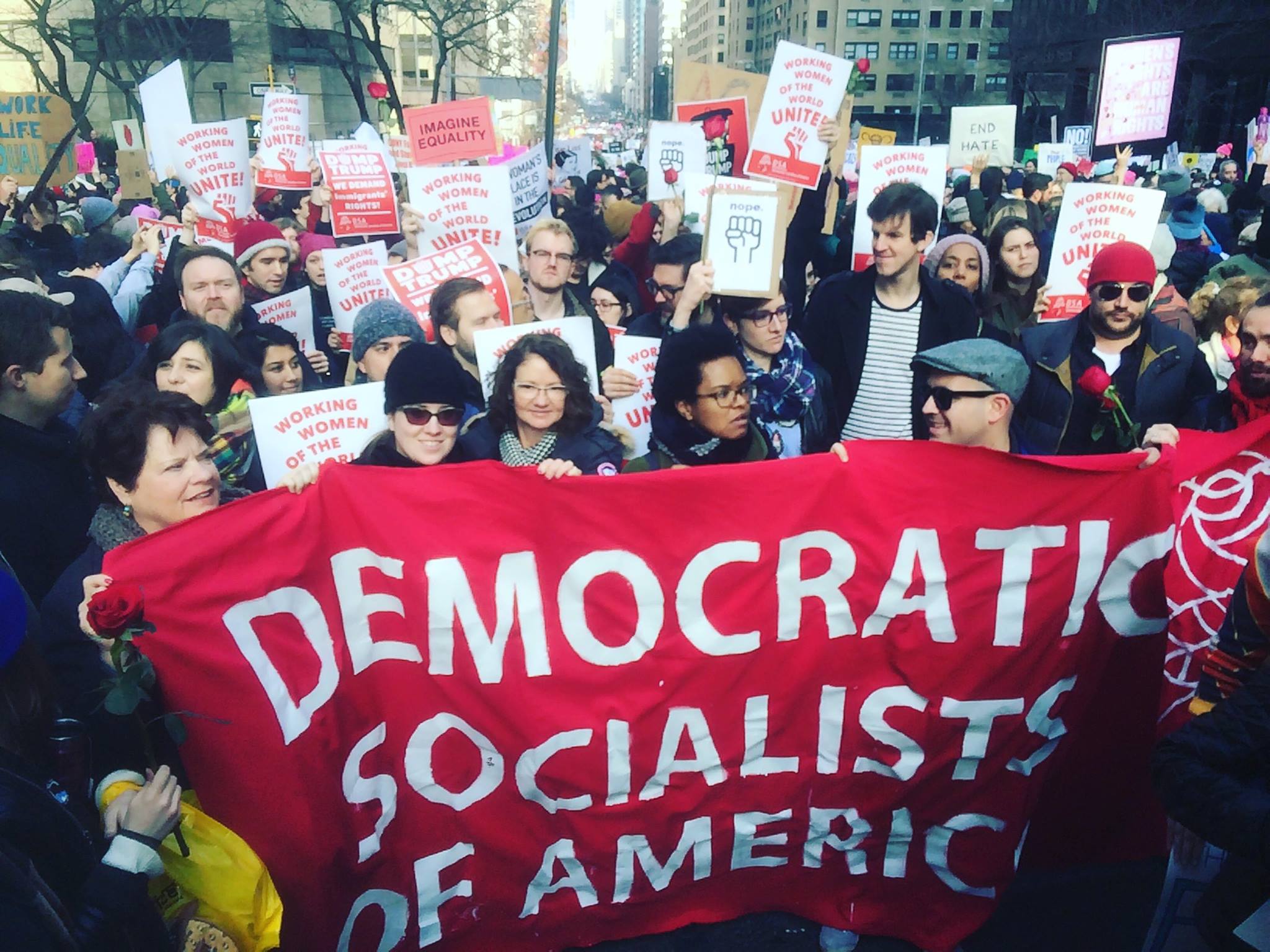
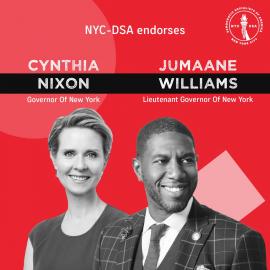
    The leadership of the New York City chapter of the Democratic Socialists of America (DSA) voted this past weekend by a two-thirds majority to endorse Cynthia Nixon in the Democratic Primary race for New York State governor. The decision reflected similar majorities for Nixon among the total membership of the New York City branches. An accompanying motion also passed that linked DSA’s work on the Nixon campaign to the Julia Salazar campaign in the Democratic Primary for State Senate and tied it to our organization’s support for the New York State Health Act and the a city campaign create for expanded rent stabilization.

    Since the majority of my fellow New York City socialists voted to endorse Nixon, I feel obligated as a member of the City Leadership Committee  (CLC) to explain to our members why I cast my vote against, as did eleven other members of the 34-member body, while one person abstained.

    I will try in this brief statement to make clear first what seemed to me to be the principle reasons given to support or reject the endorsement and why i took the position that i did. Let me begin, however, by stating that some at the meeting argued that since the majority of our members had voted to endorse Nixon, that we were all obligated to vote to endorse her. I disagreed because as I stated at the meeting, I was elected in my Central Brooklyn branch by members who know that, while generally supportive of our electoral work over the past three years, I am dubious about the “Progressive” Democrats and about strategies that tend to suggest that we can have significant influence in the Democratic Party or on its candidates. I felt that I had to represent those who voted for me on that basis.

    Readers should be clear that this debate in DSA was not an argument about whether or not Nixon was better than Cuomo. I think that virtually no one in DSA supports Cuomo in the primary and nearly all agree that Nixon would be a better choice. The question was: Do we as DSA want to give her our endorsement? And you should also be aware that voting against endorsement would not have stopped any of our members from working for her as individuals or from voting for her in the primary. The endorsement question was solely about whether or not our socialist organization, its time, energy, resources, and its reputation should be inked to her campaign and, if she were to win, to her future administration. The question of endorsement became critical after Nixon proclaimed her self a “democratic socialist,” or at least a supporter of DSA’s health and housing campaigns and of “democratic socialist values.” The CLC vote took place after a straw poll of the members and a series of debates and votes in branch meetings where half of six NYC branches voted to endorse and half voted against, but a total of approximately two-thirds of the members voted for.

    The Major Arguments Pro and Con

    Many of the DSA members arguments pro and con on the Nixon nomination have been posted online (and can be found here, and here, and here), but let me state what I thought were the principal arguments made by both those in the CLC meeting and in branch meetings who spoke for endorsing Nixon:

    • We should endorse Nixon because we want to defeat Cuomo.
    • We should support Nixon because she is a progressive candidate who has declared herself to be a democratic socialist.
    • We should endorse Nixon because she shares our positions on the Health Act and on rent stabilization.
    • We should support Nixon because our allies with whom we work in coalitions support her and our failure to do so would distance us from them.
    • We should support Nixon because this is an historic opportunity to continue to build the progressive movement and the socialist current within it, including to recruit to DSA.
    • We should support Nixon because it will build our organization’s political and social movement capacity.
    • We should support Nixon because it will build class power, since we will be organizing among working class people around issues like health and housing.
    • We should endorse her because then we will have more leverage over her and we can work with her to improve her political program.

    I would say that among those for endorsing Nixon, there was greater political unity around those points, while those who opposed the Nixon endorsement did so for a variety of reasons that did not form a coherent political view. The principle arguments of those voting against endorsement, each of which has to be taken independently, were:

    • We should oppose electoral politics in principle or opposition to electoral politics at least at this moment.
    • We should not work in the Democratic Party because it is a capitalist party.
    • We should not endorse Nixon because we do not want a rich woman and famous actress to be the face of DSA.
    • We should not endorse her because we do not have the capacity to carry out another political campaign in addition to Julia Salazar’s.
    • We should not endorse Nixon just because some of our allies such as Make the Road support her, since they are NGOs and have different politics and motives.
    • We should not support Nixon because she opportunistically announced her “democratic socialist values” only after Alexandria Ocasio Cortez’s victory over Joe Crowley.
    • We should not endorse Nixon because–-unlike Ocasio Cortez and Salazar—she is not a member of the Democratic Socialists of America.
    • We should not endorse Nixon because since she is not a member, we will not be able to hold her accountable to our organization.
    • We should not endorse her because our failure to endorse will not affect either her campaign (which is very likely to lose in any case) nor our organization.
    • We should not endorse her because for many of the reasons given above, it devalues our endorsement and discredits our claim to be socialists.

    Why I Cast My “No” Vote

    I do not agree with those few DSA members—some self-described anarchists or others who might be called “movementists”—who oppose any electoral work altogether and simply want to work in the labor social movements. I believe that labor and social movements as well as political action will be necessary to build a socialist movement and ultimately to overthrow capitalism. Nor do I think that all work in the Democratic Party should be eschewed at all times. While I am in general an opponent of the Democratic Party as a capitalist party, I think that it can be useful to run socialist candidates in some Democratic primaries or general elections. After all, if we are to create a working class party we will have to do so by eventually splitting and replacing he Democratic Party.

    What we should avoid is becoming simply another progressive group on the left edge of the Democratic Party dreaming that we could somehow have great influence on it or even reform it. I think that is absolutely impossible to reform or capture the the Democratic Party given the control of the party’s organization and finances by the capitalist class and given its historic and deep ties to the banks, corporations, military leadership, and major media. I believe that we need our own working class party, though how to get there from here is not clear. In the meantime, I think it is correct to consider and debate these endorsements of progressives and socialists running in the Democratic Party, as long as we are clear about our long-term goal of contributing to the ruin and replacement of the Democrats by a working people’s party.

    I felt at the CLC meeting that the strongest argument in favoring of endorsing Nixon was that we would then be able to continue the momentum that began with the Bernie Sanders 2016 campaign for president as well as the Ocasio Cortez campaign victory. I think, however, that that opportunity always has to be weighed against the tendency toward the transformation of DSA into simply another progressive organization on the left of the Democratic Party. We don’t simply want to be used to by candidates to advance their political careers by rounding up and corralling leftwing voters for them. After all, once Ocasio Cortez had our endorsement, she more or less quickly cut ties to us—one finds no reference to DSA on her Twitter or Facebook sites, for example, though the Justice Democrats are there—and she has gone off to campaign with the Working Families Party (WFP), with Bernie Sanders, and with some Progressive Democratic Party candidates. Our organization—with 45,000 members large by left standards remains small in comparison to other political organizations—and has so far exerted virtually no gravitational pull on Ocasio Cortez who now orbits around other bodies.

    I think we would have even less influence over Cynthia Nixon. While Nixon came from a lower middle class family, a single mother living in rent stabilized housing, she eventually became a successful actress, and that made her wealthy. Good for her. The problem is that as a wealthy, successful actress she became connected to some influential people in politics. Nixon, remember, was, as she explained in an interview, a supporter of Barack Obama and of Hillary Clinton, the two neoliberal Democrats against whom many of the DSA members rebelled when they backed Sanders. Nixon was also a Bill de Blasio supporter in the mayoral race in 2013, and after winning de Blasio appointed her to various city government advisory positions. DSA, however, has been quite critical of de Blasio on housing and police issues. Given Nixon’s past, it is not surprising that some of de Blasio’s campaign staff are now working on her campaign. These are the important political forces in Nixon’s life, not DSA, which is unlikely to exert any influence over her. Clearly once she has our endorsement, we have no leverage over her. We have, I think, little or no chance of every holding her accountable to anything.

    I find the argument that endorsing Nixon would somehow help DSA to organize working class power to be the most specious. Everyone tries to organize workers. Trump is trying to organize white workers to support him through his attacks on Mexicans, Muslims, and the Chinese. Sanders worked to organize workers by advocating Medicare for All, free college, and a living wage. Cuomo is trying to organize black and women workers to vote for him by offering to protect their political interests; and public employee union endorsements indicate that so far he is winning on that one. Nixon so far hasn’t shown much interest or ability to organize workers, but perhaps she will do better. We too on the socialist left want to organize workers, but we want to organize them as an independent movement with its own interests—not those of the Republican and Democratic Party politicians—and within that independent movement to argue for socialism. If we become dragged into the mainstream of the Democratic Party, they will collect the votes of the workers we organize.

    Like Bernie Sanders and Ocasio Cortez, Nixon apparently thinks of democratic socialism as something like Franklin D. Roosevelt’s New Deal, though, of course democratic socialism goes far beyond that, aiming to see the working class take control of the banks and corporations and to transform our political institutions.  Nixon’s casual acceptance of the label “democratic socialist” followed by her clarification that she supports our health care and housing campaigns and holds our “democratic socialist values” suggests that she hasn’t really thought about it much. As someone brought up at the CLC meeting, she has not joined DSA, nor do I think she is likely to do so.

    The DSA labor branch made an amendment to the campaign plan, suggesting that DSA meet with Nixon to help her develop a labor platform. Interesting that we were about to vote on endorsing a candidate who didn’t have a labor platform and whose remarks on labor have been ill informed and sometimes anti-union. At the CLC meeting I agreed that the DSA Labor Branch leadership should arrange a meeting with Nixon and layout a program such as Julia Salazar has adopted. I made a motion that our endorsement be contingent upon Nixon accepting our labor platform, but that motion received only eight votes. I wish that DSA’s NYC labor branch and all of those in the CLC had taken this up sooner. We as socialists see organized labor as central to both resisting the right and to building a movement for socialism. While workers have many interests, including housing, health care, and police reform, specifically labor union and workplace interests should be among the most important issues for us and for the candidates we support. We should expect our candidates to have the strongest pro-worker and pro-union positions.

    Some argued that we had to endorse Nixon or we would offend and alienate our allies in the social movements, some of whom are working for her campaign. I think that our relationships with our allies, with both leaders and rank-and-filers, have been based on our actual commitment to the issues on which we fight together. We have showed up to fight along side our allies on housing, health, police reform, the environment, workers’ rights, immigrants’ rights, women’s rights’ and LBGT issues, and we will continue to do so in the future, whoever our organization endorses. The Democratic primary will be over shortly, and when it is both our social movement allies and we in DSA will still be together in the demonstration, in the streets, and lobbying in the statehouse on the issues, including with those unions that supported Cuomo. 

    I felt that the discussion among the 34 members of our NYC leadership was one of the best political debates in which I have been involved. People argued hard for their points of view, but they treated each other respectfully. What I regret most about the CLC meetings outcome was that the plan that was adopted—I was one of two who abstained—linked the Salazar and Nixon campaigns. So we have now linked our genuine socialist candidate to a progressive who comes out of the Obama, Hillary Clinton, and de Blasio camp. I will continue to vote as someone who understands the need to work with Democratic Party progressives and with our labor and community allies, but who believes that we must defend the political independence and integrity or our socialist identity. Unfortunately, I think the CLC vote jeopardizes those, but that should lead us to fight even harder to preserve them. At the same time, those of us in DSA who put more emphasis on independent politics need to create a stronger political pole around which to rally DSA’s members.


  • Nicaragua in Pain

    ImageTranslated from Spanish by Fred Murphy

    Writing about Nicaragua is as painful and sad as it is indispensable. Memories of the Sandinista Revolution are still alive for the generation that lived through it. To remain silent would be an affront to those who took part in that memorable insurrection against Somoza.

    Events of recent months leave little room for doubt. A series of social protests has been brutally repressed. Some 350 from only one side have died at the hands of police or paramilitary forces. In all cases there was gunfire against unarmed demonstrators, who responded to or escaped from the onslaught as best they could.

    Information from numerous sources concur in describing an escalating barrage of gunshots at point-blank range, producing at first a handful of deaths and then nearly 60 by the end of April. This tragedy was not interrupted when negotiations began. To the contrary, the dialogue was marked by a further 225 such crimes.

    There is no justifying such savagery. Official statements (and the voices raised in their support) provide no proof of the “terrorist actions” that they impute to the victims. Nor have there been any significant losses on the government side, and no evidence of the use of firearms on the part of the opposition.

    These events have not only been denounced by supporters of the fallen. A vast range of witnesses and a broad gamut of journalists have corroborated the accounts. But most important are the authorized voices of former Sandinista commanders and leaders, who have verified what has happened with on-the-scene reports. Their denunciations have great credibility and coincide with the outlook of foreign participants in the revolution. Their judgments have added importance in light of their deep knowledge of the actors in conflict.

    The bloodshed unleashed by Ortega’s government parallels the reaction of any right-wing president. It has been the typical state violence against the discontented. In face of such atrocious behavior, a movement that had begun with some basic demands was quickly transformed into democratic resistance to repression. The original demands about social-security reforms were sidetracked in face of the Dantesque spectacle of hundreds gunned down by the regime’s gendarmes.

    To raise one’s voice against this crime and demand an immediate end to the repression and the prosecution of those responsible is the first duty in face of these events.

    Endless Involution

    The initial protests against a social-security tax increase found great support among the population. This reaction pointed up the discontent brewing in diverse sectors. People were becoming annoyed at how official policies were diverging from the government’s revolutionary past.

    Orteguismo (“Ortega-ism”) bears not the least affinity with its origins in the Sandinista movement. Ortega has made strategic alliances with the business class, adopted economic measures demanded by the IMF, and strengthened ties with the Church after imposing an outright ban on abortion. He has consolidated his bureaucratic hold over business enterprises that originated in the appropriation of public goods.

    Under Ortega’s direction a clientelist electoral system has been put in place. Continued use of old Sandinista emblems and discourse obscures this qualitative change, which reproduces the involution that other such progressive processes have undergone.

    Long before its evolution into a simple network of gangsters, the Mexican PRI had already buried its legacy of agrarian transformation and nationalist traditions. The same occurred with the MNR in Bolivia, which for many years behaved as a reactionary party despite its origins. Such examples of political regression – now reprised by Ortega – extend to other Latin American parties that have completely discarded their original socialist or anti-imperialist aspirations.

    But repression consummates a still more irreversible turn. It transforms a bourgeoisified formation into an outright enemy of the left. Cold-blooded killings by its police apparatus mark the final break with any progressive outlook. Such a regression has occurred in Nicaragua in the last few months.

    There are significant differences with the Venezuelan case, which is rooted in the persistence of a Bolivarian process that confronts the right wing and defends sovereignty in a context of unheard-of adversity. Facing an interminable succession of guarimbas,[1] Chavismo has done battle against coup attempts, paramilitary incursions, and provocations by groups trained by the CIA. It has committed many injustices and harassed certain popular fighters, but its principal problem has been the destabilization promoted and financed by imperialism.

    What is happening in Nicaragua is quite different. The protests were not stage-managed from Washington but arose from below against reforms demanded by the IMF and took shape thereafter in a spontaneous way to defend rights that were under attack. Nor did the principal conservative figures – who have forged any number of pacts with the regime – provoke the rebellion. The demonstrations have gathered up a wide gamut of the discontented, under the guidance of students and the Church. The various currents among the latter are not following a uniform playbook, and the students are grouped in a number of different factions, some led by the left and others by the right.

    This movement originated with a low level of politicization but began to adopt clearer positions in face of the repressive attacks. Its positions were solidified upon the collapse of the dialog that the government first accepted verbally and then boycotted in practice.

    Seeing the Whole Picture

    Among all the statements distributed in recent weeks, the approach adopted by Manuel Cabieses Donoso, a well-known Chilean revolutionary leader, has some unique merits.

    Cabieses Donoso upholds the legitimacy of the protests, denounces Ortega’s betrayal, and challenges the complicit silence on the part of many progressive currents in face of the repression. But he calls attention as well to the way right-wing forces are trying to utilize the protests and points out that the United States will take advantage of the conflict to undermine the Ortega regime. He affirms as well that a section of the population continues to support the government, and therefore calls for a peaceful solution in order that the local bourgeoisie and its imperialist master not be the beneficiaries of Ortega’s eventual downfall.[2]

    This approach synthesizes quite well moral outrage at the massacres with recognition of the complex situation that has arisen in the country. While Ortega has not hesitated to make pacts with all the reactionary forces, the United States still seeks his ouster. It cannot tolerate the autonomy Nicaragua has maintained in its foreign policy. The country not only belongs to ALBA and has close ties to the Venezuela government. It has also sought to build an inter-oceanic canal with Chinese financing – right in the “backyard” of the region’s principal imperialist power.

    As shown during the coup against Zelaya in Honduras, and more recently in Guatemala, the United States treats the small Central American countries as second-class colonies. It won’t accept the slightest indiscipline from these nations. For that reason it has already begun reaching out to coopt the leaders of the protests and line them up behind a future imperialist puppet that would replace Ortega. The meetings that several student leaders had in Washington with ultra-right anti-Castro legislators (along with similar meetings in El Salvador) mark the most visible episodes of Trump’s latest operation.

    Failure to recognize the preparations for aggression would amount to inadmissible naivete. The same Ortega who is brutally attacking the people is viewed by the State Department as an adversary to be buried. Such contradictions have been frequent in history and need to be taken seriously by the left when it comes to taking a position. It is vital to avoid joining the campaigns of the OAS or Vargas Llosa’s calls to involve the US Southern Command.

    Dangers and Definitions

    That Ortega’s FSLN still enjoys the support of a section of the population is evident from the results of the last election. But Cabieses Donoso does not base his argument for a peaceful solution on that fact alone. Negotiations would make it possible to avoid transforming the current revot into a wider confrontation, with terrible consequences in the number of victims as well as on the national and geopolitical level.

    Events in two Middle Eastern countries provide grounds to fear such an outcome. In both Libya and Syria governments were in power that had progressive origins but had degenerated to the point of unleashing repression against militants and their populations. Qaddafi jailed Palestinians and Assad fired on his people indiscriminately. In each case the prospects for extending the Arab Spring ended in major tragedies. The Libyan state practically disintegrated amid greedy disputes between rival clans. Syria had a still more dramatic outcome in that first the protests were co-opted by Jihadists and then the country suffered the worst humanitarian disaster in recent decades.

    The historical realities and the political situation in the Middle East and Central America are quite different. But imperialism acts with the same objectives of domination in both regions. It destroys societies and dismantles countries without a second thought. Had it won the contest in Venezuela, the country would be a cemetery comparable to Iraq, and the oil wealth would be in the hands of the big US energy companies.

    For these reasons it is crucial to not forget at any moment who is the principal enemy. A peaceful solution in Nicaragua is the best way to avert the danger that the imperialists will make use of the conflict. The mechanism for such an outcome is quite available in the calls for dialog and negotiation of early elections. This approach avoids equating the government with a dictatorship and demanding its fall.

    In recent weeks tensions seem to have diminished, not because of steps forward in the negotiations but rather due to deepening repression. Ortega has managed to achieve a respite by means of the whip. But his conduct has created an unbridgeable gulf with the rebellious youth. His divorce from the left is definitive. The revolutionary traditions of Sandinismo will rise again, but on the side opposite from Orteguismo.


    [1] Disruptive street actions by right-wing crowds. See www.counterpunch.org/2013/04/17/the-venezuelan-guarimba/

    [2] Manuel Cabieses Donoso, “La lección de Nicaragua”, July 17, 2018. www.nodal.am/2018/07/


  • An Israeli twist on homophobia and racism

    Image

    At the mass rally held by the LGBT movement at Rabin Square on July 22, 2018, protesters not only demanded to be accepted as different, but also called for full equality. They cried out against the injustice caused by a government that excludes homosexual men from having children through a surrogate mother.

    LGBTs demands target the hearts and minds of Israeli society. They demand an egalitarian and democratic society when, in fact, their country favors the Jewish nation over the Arab nation, religious over secular. However, like the massive social protest of 2011, the protest opposes a discriminatory society while omitting to oppose the discriminatory state. The omission seems contrived, especially considering that the Surrogacy Law excluding gay men passed in the Knesset on the same night as two strongly nationalistic laws, one against “Breaking the Silence” and the other, called the Nation-State Law, prioritizing Jewishness over democracy. On one fateful night, the fundamentalist Right realized its darkest desires.

    Not very long ago, I need hardly point out, those who murdered Jews because they were Jewish also murdered homosexuals, Gypsies, and the mentally challenged. Today, those who hate Arabs and expel refugees because of their skin color discriminate against homosexuals, even if they are Jews. The fact that the Surrogacy Law and the Nation-State Law were passed by the same number of votes is not coincidental. It conjures up a reality that endangers the future of Israeli society.

    Prime Minister Binyamin (Bibi) Netanyahu had earlier promised to support surrogacy for homosexual men. Those who believe that in changing his mind he caved in before the pressure of the ultra-Orthodox, and that he prefers the governing coalition over his previous commitment, do not understand the world we live in. The people who stand behind these laws – as well as laws changing the face of the High Court, religionizing the army and the schools, applying Israeli law to the West Bank settlements, and preferring “Zionist” culture – are not the ultra-Orthodox. They are the Jewish Home and the Likud: Israeli fundamentalist parties that are closely connected to the populist Right in Europe and the United States.

    It is no coincidence that Putin and Trump’s “attention” to Netanyahu was evident in their Helsinki summit. Putin hates homosexuals, and Trump hates them even more. Both men lean toward dark nationalism mixed with xenophobia. They denigrate women and love adore brute force, and that is what they love about Bibi. He is the darling of the world’s nationalist villains. He serves as a model for them, and they are the rising power. So why should Bibi consider the rights of homosexuals, Arabs, or immigrants?

    An ethno-nationalist tsunami is sweeping the world – from India to Russia, from Europe to the United States. Nations are busy rewriting their histories. They prefer a “glorious” past to an uncertain future. Trump wants to make America great again. Putin emulates Ivan the Terrible. Austria, Hungary, and Poland are reinventing the past, and Netanyahu is laboring to redefine Israel. He wants to weaken the legal system, take over the treasonous media, destroy the old elites, and erase any chance of reconciliation with the Palestinians. The new Poland, on whose land three million Jews were killed, is updating its biography. With the exception of a few rotten apples, Poland “did not cooperate with the Nazis.” Its ruling Nationalist Party passed its own version of a “Nation-State Law”, which at first criminalized anyone accusing the Polish people of collaboration with the Nazis—and later, with Netanyahu’s concurrence, softened this “offense” to a civil one.

    Holocaust survivors and their descendants promised not to forget or forgive, but Netanyahu forgave Poland. Its new government deplores the independence of the Polish Supreme Court; it views the free press as a source of fake news, and it sees Netanyahu as an ally in its struggle against the common enemy – liberal Europe. In addition, Bibi and the Polish leaders are in lockstep with Putin and Trump, who have declared Germany a foe.

    The Surrogacy Law, as well as the Nation-State Law, are not a result of coalition constraints or the competition between politicians about who is more right-wing. They reflect the strategic choice of the Israeli Right as a whole, which stands shoulder-to-shoulder with the international fascist camp. The European Union and German PM Angela Merkel are facing a broad and threatening coalition that includes the Putin-Trump axis, the British Brexits such as Boris Johnson, Matteo Salvini of Italy, Viktor Orban of Hungary, Sebastian Kurz of Austria, and Mateusz Morawiecki of Poland.

    The world as we have known it has changed beyond recognition. Globalization based on neoliberal economics has gone bust. The economic crisis of 2008 created a political vacuum that has ushered in ethno-nationalism, patriotism, exclusion, and white supremacy.

    LGBT is not big enough to withstand the fascist onslaught that is sweeping the world. In order for LGBT to prevail, social movements excluded from the threatening new world order must join the struggle. One hundred thousand protesters would not have filled Rabin Square if the fight were just about gay men demanding the right to have children through surrogates. The square was filled with a general feeling that this government is leading Israel to a place whose agenda is dictated by national religious messianism, and that populism based on hatred of Arabs, immigrants, homosexuals, and women is making Israel an unbearable place.

    Just as no one can fathom what Trump wants to achieve for the US and the world, few can understand where Netanyahu is going. When Minister Yuval Steinitz was asked about the fate of Gaza, he replied honestly, “Nobody knows.” Netanyahu knows how to swim in murky political waters, he knows how to overcome coalition crises, he has proved his ability to win elections, but he hasn’t the faintest idea what Israel will look like a decade from now.

    The Nation-State Law proves that the Israeli Right has no vision. It builds walls of hatred and discrimination while trying to prevent the inevitable: the creation of a bi-national, diverse society in which Israelis and Palestinians live together, a society based on a shared economy, renewable energy, common infrastructure, and a regime that safeguards equality for all citizens regardless of religion, gender, race, or sexual orientation.

    The importance of the LGBT demonstration in Tel Aviv stems from its political nature. The demand of gay men for equality raises the issue of equality for all. Those opposing discrimination based on sexual orientation cannot ignore discrimination based on religion and ethnicity. The struggle for LGBT rights is part of the fierce struggle between ethno-nationalism and global partnership, between dictatorship and democracy, between liberalism and fascism, between democracy and occupation. It is, therefore, crucial to support the LGBT movement at a time when the world has lost its ethical compass.

    – Translated from the Hebrew by Robert Goldman

    Originally posted at Challenge Magazine.

  • All Strikes of Public Sector Workers are Now Political Strikes

    Image

    Left Voice speaks with Marxist labor historian Nelson Lichtenstein on the lessons of the Teachers’ Spring and the signs of a resurgent labor movement in the U.S.

    Arielle Concilio: What are your impressions of the strike wave happening across the education sector in the United States? Why do you think we are seeing this surge now (particularly among Trump’s base) over a year into Trump’s administration?

    Nelson Lichtenstein: That’s an excellent question; you aren’t the only one asking it. Yesterday the Wall Street Journal asked me the same question. So, left to right in America, people are taking note of this phenomenon. Frankly, it was notable for many reasons: its size, of course, but even more so it was taking place in what had been the most conservative states in the country, ones in which unionism had been discouraged both in law and politics, and in the political leadership of the unions themselves. And the law made it very difficult for unions to operate. These were technically illegal strikes, but they had tremendous support, and not just among the strikers, but also parents who wanted the education to be better and even school boards, who normally are in opposition to the teachers, who were not only asking for more money form teachers, but for refunding the entire educational enterprise.

    That said, I was struck by the degree to which the center of gravity of U.S. working-class activism and trade unionism is becoming increasingly centered in the public sector. It’s more like Latin America, where you have teachers who are often the vanguard of militancy, and I think we see this here. They’re not really strikes against the state itself, but against the wealthy interests; oil, and coal mining, and other groups who have not been taxed enough to pay for public services that were needed. And so it was a tremendously hopeful thing for the left, and it has spread, and that’s what’s very hopeful about the whole thing.

    AC: Can you talk specifically about the recent University of California workers’ strike? How did they organize?

    NL: Well, at UC this was a strike of basically buildings and groundskeepers, some technicians, and blue-collar workers, and they were in all the campuses, so at least 25,000 workers. It was a three-day strike, sort of a demonstration strike. It’s remarkable that the UC has been systematically underfunded by the state for years and years, and at this particular stage in California, there’s a boom going on. California has this terrific, important world of technology— Apple, Facebook—they are all headquartered here, making billions of billions of dollars. This money has not been sufficiently funding the infrastructure of the state of California. And really, all strikes of the public sector are now political strikes. This strike really was to demand that the UC , which gets some money from the state, sufficiently fund the infrastructure of UC. It’s a large structure with hundreds of thousands of students, tens of thousands of faculty. The amount that the workers were asking for, a 6 percent raise, was not a dramatic amount, but the university was resisting, and we need to break the log jam of the underfunding of the public sector in the U.S. I think that’s what puts together the teachers strikes in West Virginia and Arizona with the UC workers.

    Also, the workers on strike were 80 percent Latino. The working class in California, both in the public sector and the private sector is predominantly Latino, mostly from Mexico and Central America. Today it resembles the U.S. in 1910 when Eastern Europeans and Italian anarchists and Jewish, Yiddish socialists were the vanguard of the working class, and I think that’s increasingly the case. Blue-collar work in California and Texas, and many other states, the working class is Latino. And the working class in this country is immigrant, which makes the anti-immigrant activities both racist and anti-working class.

    AC: In your first book, Labor’s War at Home, you discuss the role of accommodation to the labor bureaucracy in the ‘40s as a key reason for the decline in militancy in the U.S. labor movement. How do you see the union bureaucracy’s effect on the labor movement today? How do you see the relationship between the union bureaucracy with the state and the bourgeois parties, and how the dems were part of that decline?

    NL: I’ve written about this when I started off my career. When you have stable trade unionism, which, for a couple or three decades we had after WWII, trade unionism seemed to be accepted by the capitalists in this country, and the kind of mechanism for ameliorating and resolving otherwise violent class conflicts, so it was a really stable system. You had big unions of steelworkers, auto workers, which kind of organized their industries thoroughly. You developed a kind of bureaucratic way of doing things, and issues of internal union democracy were very important to the left. And there were cases of wildcat strikes, which meant unauthorized strikes, and things of that sort.

    Since the 1980s, however, trade unionism had become much more on the defensive, much smaller, much more fragile. It’s not stable. We don’t have these big unions which negotiate for a whole industry anymore. Trade unionism is almost like guerilla warfare these days, so while we do have trade union leaders who are clearly hesitant and sometimes strike terrible deals, and would like to be a kind of self-satisfied bureaucrat, they don’t have that. In this environment that’s much less possible. So in general, the trade union movement actually moved to the left and to some extent had become more democratic because it had become more marginal and more threatened in the country as a whole. Take the Teamsters Union, for example, I mean it’s run in a very autocratic and corrupt fashion. But the leadership of the Teamsters Union used to cut deals with the Republicans, and now they don’t cut deals with them anymore. Like I said, the Teamsters Union is now for Democrats. Now, that’s not such a left-wing thing, but in their history it is. And so I would say that the key obstacle to a trade union resurgence in the U.S. is not so much the conservative leadership of the unions, although you can certainly find that there, and I can point it out myself in many places, but rather the evisceration of the labor law, which makes it basically illegal to form unions in many parts of the country. And the divisions of the working class have also been exacerbated by Trump and others, so this is partly the situation we find ourselves in.

    AC: With the recent wave of strikes, and the women’s movement there is the possibility that young people will become radicalized through strikes rather than social movements. What prospects do you see for a more militant labor movement in the U.S. today ?

    NL: The great Women’s March had enormous impact. I mean the people who were involved with that were mainly women and working class, in addition to being primarily people of color. And that was certainly true of the teachers’ strikes and the whole service sector. There’s a kind of a symbiotic relationship between that anti-Trump march, the #Me-Too movement against sexual harassment, and the formation of the strikes and trade unions in heavily female-dominated professions. So I think that’s absolutely the case. I think that today, when something like 40% of all young people are happy to call themselves a socialist, you know this is a product of Bernie Sanders, and also I think the end of the Communist regimes in Eastern Europe, which now is over for a whole generation because now socialism isn’t associated with that. Of course, there is also stagnation in living standards for young people in the last several decades. That means that I think that the possibility of unionism and strike activity is a kind of moment of radicalization. We’ve seen, for example, graduate students form unions, so the impulse for unionism is there in the Ivy League and other places as well. I think that in the strata of professionals and wannabe professionals and lower-level professionals of teachers and journalists and programmers, this element is also in motion, and its gotten larger. This element is vital to the economy, it’s highly skilled and educated, and it’s moving to the left, whether it’s strike activity per se or just unionization. And by the way, unionization is equivalent to a strike in terms of consciousness changing because unions are so vilified by employers. If you wanna form a union, you’re sticking your neck out, that’s for sure. So I think people who want to form a union have a very transformative event in their lives.

    AC: Is there anything else you’d like to add?:

    NL: As an old socialist, I’m delighted with what’s going on. I think that despite the political dysfunction at the national level, there is a social movement in formation here. The word "socialism" is coming closer to the fore of U.S. political consciousness, and it hasn’t been in many decades.

    Originally posted at Left Voice

  • An Open Letter to the NAACP About Puerto Rico

    The 109th annual convention of the NAACP recently approved a resolution supporting statehood for Puerto Rico. The text refers to a similar statement adopted by its previous annual convention a year ago and ratified by its National Board of Directors in October 2017.

    This resolution is a disservice to the struggle for decolonization in Puerto Rico and for equality for everyone in the United States. It should be critically examined by all groups committed to social justice in the United States to better understand Puerto Rico’s situation and what a truly just and democratic response to it could and should be.

    The resolution is based on the results of a plebiscite sponsored by the administration of Governor Ricardo Rosselló in June 2017, in which statehood received 97 percent of the votes cast. But it fails to consider that only 23 percent of eligible voters participated in this plebiscite. The ballyhooed 97 percent vote for statehood corresponds to around 22 percent of eligible voters. Supporters of other status options (independence, free association, a modification of the present status) denounced this plebiscite. Their call for voters to boycott this plebiscite was evidently successful.

    The 2017 plebiscite was the fifth held by the government of Puerto Rico. Previous plebiscites were held in 1967, 1993, 1998 and 2012. The statehood option received 39 percent of the votes in 1967; 46.3 percent in 1993; 46.5 percent in 1998. In 2012, under statehood governor Luis Fortuño, it received 61.3 percent, but if the nearly 500,000 blank and defaced protest votes cast are counted as rejecting the options included on the ballot, the percentage of votes for statehood falls to 44 percent, close to the 46 percent received in 1993 and 1998. No overwhelming mandate for statehood exists, contrary to what the NAACP’s resolution suggests. Why did the NAACP ignore so many in Puerto Rico that prefer options other than statehood?

    However, consensus does exist in Puerto Rico that the present colonial status is unacceptable, which includes supporters of independence, free association and statehood. This is what the NAACP should have focused on, instead of endorsing statehood. It should have called for the decolonization of Puerto Rico. It should have called on Congress to respect Puerto Rico’s right to self-determination. The government of Puerto Rico sponsored all the aforementioned plebiscites. Since Puerto Rico was seized during the Spanish-American War of 1898, not once —let us say that again— not once has Congress consulted Puerto Ricans on what status they prefer, be it independence, statehood or types of association with the United States.

    It is sad, and offensive, that the NAACP gave such a warm welcome to Governor Pedro Rosselló and adopted a resolution to his liking. Governor Rosselló has distinguished himself as proponent of labor law reforms that erase worker’s rights. His administration is busy closing hundreds of schools in Puerto Rico, slashing in half the budget of the University of Puerto Rico and launching a brutal attack on public sector unions inspired by the recent U.S. Supreme Court Janus decision. Are these policies the NAACP wants to be associated with? Is this what it stands for in the United States?

    After adopting the recent resolution endorsing statehood, the NAACP issued a “Puerto Rico self-determination statement” that states “Puerto Rico should be free to decide its preferred option in a fair and inclusive manner.” This is a welcome statement, but it does not seem to rescind support for one status option. The NAACP should take measures to reaffirm its clarification as its central position: Puerto Rico’s right “to decide its preferred option in a fair and inclusive manner.” (A Nuevo Día story reported that the NAACP had rescinded the resolution, but many statehood supporters would dispute that.)

    But what does “a fair and inclusive manner” entail? The resolution adopted by the convention and the statement issued afterwards rightly denounce the inadequate response of the Federal government to the catastrophe caused by Hurricane Maria in Puerto Rico. But this does not go nearly far enough regarding the failings of the Federal government in Puerto Rico. A true process of self-determination should call on Congress to address Puerto Rico’s economic plight. It should urge Congress to adopt measures enabling Puerto Rico’s economic reconstruction.

    For well over a century, Congress has perpetuated a colonial relationship in which Puerto Rico’s economy has been a source of major profits for U.S. corporations but has never functioned to provide employment for most of its workforce. A shocking 55 percent of Puerto Rico’s children live in poverty, with Puerto Rico’s overall poverty rate at 45 percent. Its per capita income is half of that of the poorest state. Unable to obtain employment on the island, millions have migrated to the United States, often joining African-Americans and other Latinos among the discriminated and exploited sectors of the U.S. working class.

    Congress has further aggravated Puerto Rico’s situation by eliminating economic incentives, such as phasing out certain federal tax benefits. Make no mistake: these measures were never sufficient to promote economic development or employment. But Congress replaced them with literally nothing. Meanwhile, Congress has maintained the cap on some federal programs in Puerto Rico and has continued making the island subject to expensive U.S. coastal shipping laws. As in other countries and jurisdictions, including many major cities in the United States, economic stagnation led to growing government debt and fiscal crisis, which in turn is used to impose public sector cuts that most adversely affect working people and the poor.

    In the case of Puerto Rico, these austerity measures are now imposed by a federally appointed, that is to say, unelected Fiscal Oversight Board created by the Puerto Rico Oversight, Management and Economic Stability Act. Puerto Rico’s debt was unpayable before Hurricane Maria. To collect it now, after close to $90 billion in damages caused by the storm, is criminal. The austerity measures inflicted by the Federal board will only prolong Puerto Rico’s economic depression.

    Therefore, real respect of Puerto Rico’s right “to decide its preferred option in a fair and inclusive manner” should include the demand that Congress revoke PROMESA; maintain the stay on claims by creditors on Puerto Rico’s public debts; recognize that the doctrines of change of situation and state of necessity justify canceling Puerto Rico’s public debt; assign sizable funding for Puerto Rico’s economic reconstruction, and take action for Puerto Rico’s decolonization.

    In many ways these demands are not unique. Extreme as it is, Puerto Rico’s current condition cannot come as a complete surprise to people in the United States, and African-Americans in particular. Exploitation or neglect of the poor, deficit reduction as an excuse for cuts in public spending, unelected boards acting to destroy labor and social gains in the context of debt crises, are hardly exclusive to Puerto Rico.

    Congress has often ignored and overlooked, indeed provoked and propitiated, much injustice in the United States (affecting workers, women, African-Americans, Native Americans, immigrants, among others).

    The federal response to disasters in the United States, such as Hurricane Katrina in New Orleans, has been slow, inadequate and discriminatory before.

    Cuts in public spending and jobs, often by unelected boards, has been the formula applied against working people in dozens of budget crises, from New York City in the mid-1970s to Detroit in the recent past, and perhaps coming next to your city or state.

    Working and poor people in the United States face the impact of decades of corporate tax, fiscal, social and economic policies, to which we now add the racist and universally reactionary agenda of the Trump administration. Like Puerto Rico, they also need a vast program of economic reconstruction, geared toward job creation and meeting basic social needs. (We discussed this in our “Open Letter to the People of the United States From Puerto Rico, a Month After Hurricane María” from October 2017).

    The struggles of these communities in Puerto Rico and the United States must advance together. U.S. struggles for economic, social and political justice, as well as to end discrimination based on race, religion, gender and sexuality, affects Puerto Rico directly, not the least because millions of Puerto Ricans live and work in the United States. Their circumstances cannot be divorced from those of other working, Latino, Native-American and African-American communities in the United States. And the struggles for justice in the United States must include decolonization and national self-determination for Puerto Rico, and at least partial reparation for the misdeeds of colonial rule.

    We hope that the NAACP resolves to reflect on and rectify its position in this direction.

    Sincerely,
    Rafael Bernabe
    Manuel Rodríguez Banchs

    ***

    Rafael Bernabe is a researcher and professor at the University of Puerto Rico. He is the author, with César Ayala, of Puerto Rico in the American Century: A History Since 1898 (2007). Manuel Rodríguez Banchs is a labor lawyer and social justice advocate. Both belong to Working Peoples Party in Puerto Rico.

  • The American Oligarchy: A Review

    Image

    Ron Formisano. American Oligarchy: The Permanent Political Class. Urbana, Illinois: University of Illinois Press, 2017. Notes. Index. $19.95

    Consumers of left-wing media are well aware that America is an oligarchy, not a democracy. Everyone with a functioning cerebrum, in fact, should be aware of it by now: even mainstream political scientists recognize it, as shown by a famous 2014 study by Martin Gilens and Benjamin I. Page. Nevertheless, it is important to continue to publicize the oligarchical character of the United States, in order to delegitimize the institutions that have destroyed democracy (insofar as it ever existed) and inspire people to take action to restore it. Ron Formisano’s book American Oligarchy: The Permanent Political Class (2017) is a valuable contribution to this collective project.

    American Oligarchy has been written,” Formisano says, “not to propose a path out of the New Gilded Age, but to discredit the political class by raking its muck between covers in black and white.” Formisano certainly achieves his goal: the “political class” comes out stinking of, yes, a swamp, a putrid moral bog. This “networked layer of high-income people and those striving for wealth including many politicians in and out of office, lobbyists, consultants, appointed bureaucrats, pollsters, television celebrity journalists (but not investigative reporters), and the politically connected in the nation’s capital and in the states” calls to mind in its hedonism, corruption, money-worship, and giddy myopia the decadent Senate-attached aristocracy of the late Roman Republic, greedy beyond the dreams of avarice.

    The term ‘aristocracy’ is apt, for Formisano argues convincingly that the U.S. is headed beyond oligarchy to an aristocracy of inherited wealth, complete with all the ideological and cultural trappings of aristocracy. Our exalted rentiers and their service-providers have the usual attitudes of aristocratic entitlement to all good things in this world (and exclusion of the non-rich), sputtering rage at the occasional prospect of losing a particle of their preferential tax treatment, and the valorization of nepotism as first among the virtues. “The rampant nepotism of the political class fuels the galloping socioeconomic inequality of the twenty-first century.” The main differences between the American aristocracy of today and, say, the French aristocracy of the eighteenth century seem to be that the former has incomparably lower cultural (and architectural) tastes than the latter and is incomparably more destructive of society and the natural environment.

    The circles in which the nation’s political leaders and their thousands of well-heeled minions travel are indeed reminiscent of some enormous eighteenth-century court. Over half the members of Congress are millionaires, with a total worth in 2013 of $4.3 billion; but even the ones whose income is of a mere six figures are able to live like millionaires. The reason is that the gears of Washington are greased by a “gift economy,” which, to quote ex-lobbyist Jack Abramoff, amounts to “a system of legalized bribery. All of it is bribery, every bit of it.”

    In 2007 Congress passed a law prohibiting lobbyists from giving gifts to representatives, but, as Abramoff says, in effect “they just reshuffled the deck… They’re still playing the same game.” Campaign committees and “Leadership PACs” pay for the many luxurious trips legislators take around the world, as do lobbyists and donors. Golf outings, lavish “conferences,” fishing in the Florida Keys, skiing in Colorado, trips to Paris or Vienna or Hawaii, innumerable expensive parties and receptions and breakfasts with lobbyists and donors—all are paid for by either tax dollars or various committees, lobbying firms, corporate interests, etc. Aside from the obviously corrupting influence of all this legalized bribery, it matters a great deal that “politicians have no experience of poverty.” In fact, from 1998 to 2008 only 13 members of Congress came from blue-collar backgrounds, and they had long ago left behind that experience. No wonder policy almost never favors the working class.

    Meanwhile, while in 1970 only 3 percent of members leaving Congress moved into lobbying, now well over half do. As do thousands of congressional aides. In addition to reinforcing the insularity and chumminess of the Beltway culture, this “accelerating exodus of staffers to K Street…has had the effect of increasing the power of lobbyists by shortening the overall tenure of staffers.” As the latter group becomes younger and less experienced, lobbyists take on an ever-greater role in crafting legislation—increasingly byzantine legislation that is difficult even for staffers to understand, which further enhances the power of lobbyists.

    Formisano documents with admirable thoroughness the fact that the foremost concern of politicians and the politically connected in both the nation’s capital and the states is to look out “for me and mine.” The most obvious and common means of doing so is to monetize one’s public service, but almost as common is the practice of nepotism. “[T]he political class practices nepotism routinely, brazenly, and shamelessly, giving their ‘nephews’ plum jobs, promotions, a place at the head of the line.” Donald Trump may (unsurprisingly) be even more shameless than most, with his political use of his daughter, his son-in-law, and his sons—one of whom has remarked candidly that nepotism “is a beautiful thing.” But the second Bush administration took nepotism to a high art, given, for example, the important roles of Liz Cheney, her husband, and her son-in-law; the Mehlman brothers, the McLellans, the Powells, and Ted Cruz and his wife; the Martins, the Ackerlys, and the Ullmans, etc. The Obama administration was hardly innocent either, though it didn’t go to quite the extremes of its predecessor. Children of governors and members of Congress fare well too, whether serving in politics, in law firms, in businesses that benefit from political connections, or as lobbyists.

    The media are almost as riddled with nepotism as politics. When her mother was Secretary of State, Chelsea Clinton was hired by NBC as a television journalist, making $600,000 a year ($26,724 for every minute she was televised). CNN’s Andrea Koppel, Anderson Cooper, Jeffrey Toobin, and Chris Cuomo are beneficiaries of nepotism, as are (at other channels and publications) Douglas Kennedy, Chris Wallace, Mark Halperin, Mika Brzezinski, Bill Kristol, Ronan Farrow, Luke Russert, Meghan McCain, Jenna Bush, Jackie Kucinich, and others. Formisano concludes, “Whether the field is literature, television, entertainment, or politics, the hallmark of this New Gilded Age of Inequality is ‘naked, unabashed favoritism,’ and the shameless effrontery of those who give and receive it.”

    American Oligarchy also contains long discussions of the nonprofit world, specifically of its contributions to rising income inequality. The nonprofit sector employs 10 percent of the U.S. workforce, and in 2010 corporations, government, and individuals donated $300 billion to charitable enterprises. At least $40 billion every year is lost to “fraud, theft, personal enrichment of executives, and misappropriation.” In general, the culture of large nonprofits is approximately that of the permanent political class in Washington.

    University presidents and hospital CEOs, for instance, can make millions of dollars a year, and that doesn’t include such perks as bonuses, deferred compensation, auto allowances, and financial planning. In the same years as student debt has soared and state funding has declined, university foundations have been used as slush funds for big payouts and personal expenses for presidents and other administrators. Even more egregiously, nonprofit hospitals have initiated hundreds of lawsuits against patients who couldn’t pay and have routinely had arrest warrants issued and jailed debtors. Conversely, lawsuits have been filed against hundreds of hospitals in seventeen states for gouging the poor.

    In other cases, nonprofits have in effect become allies of the forces they’re supposed to be challenging. A particularly outrageous instance is that of The Nature Conservancy, “by far the wealthiest green group with well over $6 billion in assets.” On its governing board and advisory committees sit executives of oil and chemical companies, mining and logging businesses, auto manufacturers, and coal-burning electric utilities, who have influence over the group’s policies. Even while preserving millions of acres, The Nature Conservancy has logged forests, drilled for natural gas under the last breeding ground of an endangered bird species, invested millions in energy companies, cultivated relationships with such polluters as ExxonMobil and BP, and sold its name and logo to companies that then claim undeserved credit for being green. Similarly, the World Wildlife Federation has close relationships with both Monsanto and the rainforest-destroying palm oil company Wilmer.

    At any rate, the evidence Formisano amasses proves that the moral corruption of the American aristocracy has utterly polluted the ostensibly selfless and charitable world of nonprofits. From museums, public libraries, and human rights organizations to symphony orchestras, veterans’ groups, and environmental organizations, excessive executive compensation, corporate ties, and outright corruption have perverted the public mission of nonprofits.

    American Oligarchy is not an uplifting read. Its chapter on Kentucky, a case-study of political corruption in a poor state, is, despite the detached analytical tone, at times wrenching, in particular when you reflect on all the human suffering that is the corollary of the aristocracy’s venality and greed. On the one hand are profits for Purdue Pharma in the billions of dollars, and power and money for a complicit political class; on the other hand are numberless opioid deaths and lives ruined by addiction.

    But books such as this are indispensable in their bleakness, since we live in bleak times that call for unstinting exposés. Perhaps as the backlash against Donald Trump grows, American Oligarchy and books like it will acquire a wide readership and so contribute to the radicalization of a generation.

    *Chris Wright has a Ph.D. in U.S. history from the University of Illinois at Chicago, and is the author of Notes of an Underground HumanistWorker Cooperatives and Revolution: History and Possibilities in the United States, and Finding Our Compass: Reflections on a World in Crisis. His website is www.wrightswriting.com. 


  • Dan La Botz on his New Book on Trump and the Resistance

    Image

    Dan La Botz is a member both Solidarity and of the Democratic Socialist of America (DSA), and a co-editor of New Politics. Trained as a historian of the United States and Mexico, he is also a teacher in the graduate Labor Studies program of the Murphy Institute of the City University of New York. New Politics interviews him here about his new book The New American Populism: Resistance and Alternatives to Trump (Nouveau populisme américain: Résistances et alternatives à Trump).

    New Politics: You’ve written a book on Donald Trump and the Resistance that most of won’t be able to read because it has only been published in French. In this book you discuss both the rise of the new populism of Sanders and Trump and its social and historical roots, but you also look at the Resistance and discuss its strengths and weaknesses, as well as examining the strategies of the left and its future. That’s a lot. Tell us a little about your book. What distinguishes it from the many books on Trump that have hit the market since he became president?

    Dan La Botz: I argue in my book that the ideology of the “American Dream” or, as it was often called, “The American Way of Life” that has been coming apart from the 1960s and 1970s finally collapsed following the Great Recession of 2008.[1] The American middle class and working people—who faced 10 percent unemployment and lost millions of home—felt abandoned by Republican and the Democratic parties. The economic crisis and the collapse of the dominant ideology opened the way for populism on the left and the right, for Sanders and for Trump.

    Both Trump and Sanders offered working people a program to protect them from the economic crisis. Sanders, called for a war on the “billionaire class,” declared himself a “democratic socialist,” and proposed universal economic programs such as single-payer health care and free higher education. At the same time Trump proposed to keep out Mexican job seekers and Muslim terrorists and to protect American workers from unfair Chinese competition. Sanders offered a return to Roosevelt’s New Deal while Trump offered a white nationalist economic platform that resembled the European far right’s programs.

    I think most would agree with that view. But, unlike most liberal and even some left authors, I also argue that Bill and Hillary Clinton and Barack Obama, whose first loyalty was to the banks and the corporations and who had abandoned the labor unions and the working class, must share responsibility for the rise of populism. The Democratic leadership’s continued opposition to single-payer is indicative of their fealty to finance over any sense of responsibility to working people. The leaders of the Democratic Party made decisions over decades that led voters, especially white male voters, to abandon the Democrats for the Republicans and finally vote for Trump.

    NP: And how do you explain Trump’s rise to power?

    DL: Well that’s a long complicated story. I see Trump as the product of the world he sprang from. Let me read you a few of the opening paragraphs from my chapter on “The Rise of Trump”:

    Donald Trump is a product of American business, in particular of New York real estate development, a world of high finance and speculation, heavily reliant on local politics and deal making of all sorts. He rose to national notoriety through his reputation as the builder of high-rise apartment and office buildings, of golf courses, and gambling casinos. A tireless and clever self-promoter and media manipulator, throughout his career he sought not only wealth but also fame, leading him to become the host of the popular reality program “The Apprentice,” a TV show where he frequently humiliated contestants and then told them “You’re fired!,”; though some contestants who groveled were rewarded with a job. The Apprentice made him a star of sorts and his name a household word around the country. Throughout his half-century career Trump became involved in a multitude of enterprises and made thousands of business deals that if not illegal—as some were—often verged on illegality. He constantly fabricated figures about his wealth and the value of his properties, either to enhance his reputation as a billionaire, to take advantage of others, or to avoid paying taxes.

    During his long career in business, television, and then in politics he has been associated with much of what is unseemly and distasteful, offensive and malevolent in American society. His friends and associates have included Mafia mobsters, alt- right white nationalists and neo-Nazis, drug dealers and pimps, swindlers and crooks of all sorts—not to mention nefarious financiers, businessmen, and corporate lawyers. His racist practices are a matter of record, having engaged in racial discrimination in his housing projects and in employment in his casinos. His relationships with women have often been exploitative and misogynistic and, as he himself said, he was not above sexual abuse. His cheating of subcontractors and mistreatment of workers is notorious.

    Trump, like many businessmen, and particularly real estate speculators and builders, came to believe that government with its rules and regulations about banking, construction, labor, and the environment was an impediment and a burden that might well be abolished. Politicians and parties that he had lavishly financed, he came to believe, could not be trusted or counted on. Those views corresponded to a rightwing ideology–long present in American society but growing since the 1980s—an ideology compounded of a resentment of the political elite and the state together with the infantile belief in that a brilliant individual who would run the country like a business could save America’s middle class from the government bureaucracy, the labor movement, Blacks and Latinos, homosexuals and lesbians, and nasty women. Upper-, middle-, and working-class white people looking for a strong if abusive father figure found it in Trump. With a brilliant if base political instinct, Trump seized the moment and transformed himself from the television personality into a populist politician, demagogue, and rabble-rouser.

    Trump came to epitomize everything we think when we hear the word “businessman”: greedy, selfish, egotistical, lacking in compassion, a speculator, a control-freak and a megalomaniac. Some have called him a congenital liar. Psychologists have suggested that he suffers from the personality disorders known as narcissistic, paranoid, and anti-social, and warn that he is dangerous. One might say he is capitalism incarnate, the creator-destroyer for whom profit and power are everything, humanity nothing.

    In that chapter I describe his first ventures into politics with his 1987 “open letter from Donald Trump” on U.S. foreign policy and his 1989 ad calling for the death penalty for five black and Latino teenagers unjustly accused of rape in the Central Park jogger case. I describe his frustrated bid to be the presidential candidate of the Reform Party in 2000 and his flirtation with running for Republican presidential campaign in 2012, and then of course his 2016 campaign. I follow in detail his first year and a half in office with its legislative failures—except on reducing corporate taxes—and its racist and anti-labor administrative decisions and executive orders. Trump’s achievement was not his alone, of course. He was the product of twenty years of rightward movement by Republicans and Democrats.

    NP: But this rightward drift of American politics didn’t begin in the last twenty years. It’s been going on for a long time.

    DL: Absolutely. Rightwing racist and xenophobic politics have been growing in the United States since the 1960s and more rapidly since the 1980s. In my book I show the deep roots of Trumpism in America’s long history of populist xenophobia and racism, beginning in the early nineteenth century with the Know Nothings and continuing through the rise of the second Ku Klux Klan. I then take up the rise of the post-war racist populism of George Wallace, whose approach was later followed by Richard Nixon with his Southern Strategy. I also discuss the rise of the New Right of the 1980s and its impact. I believe that one cannot really understand Trump or Sanders unless one has an understanding of America’s long history capitalist exploitation, xenophobia, and racism but also an equally impressive history of social struggles from below. So I also provide chapters that discuss the history of the American labor and social movements and the left as well as another that discusses the contemporary movements such as Occupy Wall Street and Black Lives Matter and their relationship to the Bernie campaign and to the left.

    NP: And what do you have to say about the labor and social movements and the left and their relationship to the Resistance and the struggle against Trump?

    DL: The struggle against Trump and the corporate, neoliberal Democrats… First, of course, the American labor movement is at its lowest point in almost 100 years. Only 10.7 percent of all workers are members of unions. In the private sector membership is 6.5 percent. There were only seven major work stoppages in 2017 involving just 25,000 workers, while in 1970 there were 381 stoppages involving 2.4 million. That is, the class struggle in America is at an all time low. Without a higher level of working class struggle it is hard to imagine a move in a progressive direction. The West Virginia teachers strike and similar strikes in other states give us hope for a revival of the labor movement, but if there is to be one, it has only just begun.

    We have had a series of tremendously impressive mass social protests in the United States beginning with the immigrants protests of 2006, the Occupy Wall Street movement of 2011, the Black Lives Matter demonstrations of 2014, and then the Women’s Marches of 2017. All of these mobilized hundreds of thousands of people and in the case of the immigrant protests and the women’s marches participants numbered in the millions. Yet the movements have been uneven and episodic. While there are tens of thousands of committed activists, we cannot really say that we have today a national environmental movement or a national women’s movement.

    We do not see today the creation of a continuous or what we might call a permanent movement such as existed in the United States from 1956 to 1975. So, given the weakness of the labor movement and the sporadic character of the social protests, I do not believe that we have yet the kind of movement that can create a new left politics in the United States.

    I believe that it is important for the left to educate and train the cadres who can help to provide leadership to the labor movement and to more stable and long-lasting social movements. As I write in my book:

    What makes for a sustainable mass movement? A sustainable movement requires cadres, that is, dedicated activists who have acquired organizational and political skills that can maintain and advance the movement over years, even over a lifetime. In American social movements cadres have come from religious, ethnic, and political organizations; one cannot imagine the civil rights movement without its religious leaders, the black power movement without its black nationalists, or the progressive labor movement without socialist, Trotskyist, and Communist cadres. (Not all ideologies are equally valid or desirable, but without cadres there is no sustained movement.)

    Cadres who can build, sustain, and advance a movement share several characteristics: 1) they have deeply held ethical principles; 2) they have a vision for a better future; 3) they have a set of powerful explanatory ideas; 4) they have an ability on the basis of the first two to elaborate a set of strategic concepts and tactics; 5) they have the ability to take all of those things to a social base in which they have become embedded and which they can help mobilize. What this means is, that while we cannot create mass movements, we can train the cadres, both movement cadres socialist cadres, who can, when a movement arises, carry it as far forward as possible. We on the left should devote ourselves to creating the socialist cadre of mass movements, which means both organizational training and socialist political education.

    In the labor movement, I believe it’s important to support the rank-and-file strategy, that is a strategy—such as that used in the West Virginia teachers strikes—in which the union’s grassroots workers take the initiative and exercise their power, when necessary bypassing union leaders, in order to fight the employer, whether private sector bosses or the government as boss.

    NP:  You haven’t yet mentioned the left? What are your thoughts about the left and especially about the Democratic Socialist of America, which has been so much in the public eye of late?

    DL: The spectacular growth of the Democratic Socialists of America (DSA)—its membership now number 45,000—is incredibly impressive and very exciting. DSA as an organization and the ideas of socialism have suddenly become topics of discussion in the major media as well as in the social media. Bernie Sanders campaign gave the DSA its initial boost, followed by the “Trump bump” after the Donald’s inauguration, and most recently another growth spurt following Alexandria Ocasio Cortez’s victory over Joe Crowley in the Democratic Primary in the fourteenth congressional district. We have for the first time since the late 1940s when the Communist Party dominated the left—then with 100,000 members and one million in its periphery—a small mass left political organization. I think everyone on the left find its an exciting and important development, the development of a still quite small left pole in American politics.

    The principal question posed to DSA and to the entire left revolves around the Democratic Party. I explain in my book that the American left has over the last 75 years attempted two different strategies: independent political action outside of and to the left of the Democratic Party and a strategy to reform the Democratic Party. Both of these strategies have failed miserably, with nothing to show for them. At present DSA supports work both within and outside of the Democratic Party in an attempt to build an independent political force, though it is too early to see if this strategy will bear fruit.

    As I have argued as a delegate at the DSA Convention and as a member of the leading committee of the New York branch, the greatest danger to DSA is that it simply becomes part of the “progressive” organizations on the left of the Democratic Party and with that losses its organizational and political independence. Progressive organizations are our ideological and organizational competitors and we have to be able to explain why we as socialists have a different and a superior strategy and program.

    We will only have social change when the Democratic Party breaks up and its middle class and working class base moves to the left to create a new political party. I believe that we do not at present in the United States have the levels of class struggle and of social upheaval that would make possible a significant political shift to the left.

    NP: You mention program. What program that faces a left organization such as DSA and for that matter the entire left? What sort of political program should DSA advance?

    DL: I think that that’s an important question. DSA has in the last couple of decades talked about “non-reformist reforms” while Solidarity has since its founding talked about a “transitional method.” I think it is the later that should guide the movement.

    Let me explain this by quoting a key passage from my book.

    The elaboration of a socialist program—essentially a program for the democratic collectivization of the economy—will come from the social movements themselves, but it will be up to socialists to create the demands on the capitalist class and on the state that give such a program a transitional character. Some socialists have raised the notion— taken from readings of the Italian Marxist Antonio Gramsci and the French radical André Gorz—of “non-reformist reforms” that introduce structural changes that move from creating public institutions in certain spheres, such as health care, and ultimately lead to a complete break with the capitalist system.

    Whatever it meant for Gramsci in the 1920s and for Gorz in the 1960s, as used by some contemporary socialists it is simply another version of social democratic gradualism that can never lead to a socialist transformation because it does not see the need to overthrow the capitalist state. The non-reformist reform strategy, in fact, usually suggests that we can somehow work through the Democratic Party and through the existing capitalist state to get to socialism. The last 150 years of the experience of the socialist movement suggests that this is an impossibility. Nowhere have socialists been able to use the capitalist state to accomplish socialist aims, and where they have tried, for example Salvador Allende government in Chile in the early 1970s, the results have been disastrous, leading to the destruction of the movement.

    Rather than “non-reformist reforms,” we on the left should advocate transitional demands. By transitional—a term that comes from Leon Trotsky’s writing in the 1930s—we mean demands that tend to set ever large numbers of forces in motion in an escalating series of steps, or, better put, in a continuous process that leads to challenges to capitalist economic and political power at the highest level. The ultimate goal is to replace the economic and the political system that we have with one through which the working class can exercise its power.

    At present in the United States, however, where, as we have described here, the labor and social movements are at such an embryonic stage of development, most of our demands will simply be setting portions of the working class in motion around more minimal demands, such as, for example, a living wage. But even in raising these minimal demands, we can do so in a transitional fashion that leads the movement to advance from one conflict to another and eventually toward national confrontations with the capitalist class and the state, toward revolution. Today, we work to organize the labor and social movements to resist Trump, the Republicans, and the neoliberal Democrats, but we do so while working to build a revolutionary movement for socialism.

    I want to be clear that we are today in the United States far from any social revolution, but we should not lose our focus on that goal. We want to turn this society upside down and see working people taking power and running it.

    NP: Can you make clearer your distinction between “non-reformist reforms” and “transitional demands,” perhaps by giving us an example?

    DL: Yes, let’s take DSA’s current campaign for Medicare for All. I think this is an excellent demand and some in DSA have argued that it is a “non-reformist reform,” that is a reform that tends to make fundamental structural changes to the capitalist economic system. Yet this demand is raised independent of a call for a national health care system, which would actually involve taking over the entire health care system: all insurance, medical groups, hospitals, pharmaceutical manufacturers, medical equipment manufacturers and others. At the same time, we know that even in countries that have or have had national health care systems, there was no direct road to socialism. The call for Medicare for all is not linked to either the construction of a revolutionary political movement or to the revoltionary transformation of our society.

    “Transitional demands,” while they may also aim at legislation, put greater emphasis on the mobilization of the working class to the next stage of the struggle, with an eye to the actual socialization not only of the medical system but of the entire economy. A transitional demand for Medicare for All would link it to a national health care system and to the nationalization of the banks and corporations, together with the creation of a workers' party. There is no doubt a similarity between the two, but, to put it simply: non-reformist reforms suggest a gradual and peaceful evolution toward a social democratic resolution, toward a new social pact within capitalism, while transitional demands are guided by a democratic socialist but revolutionary strategy aimed at changing the entire economic and political system.

    NP: What did you most enjoy about writing this book?

    DL: In order to write this book I had to read biographies of the Clintons, of Obama, of Sanders, and of Trump, and accounts of the political careers of George McGovern and George Wallace. I’ve have always loved reading autobiographies and biographies, and I found it fascinating to learn how these people from their various backgrounds became important national political figures. After all, Bill Clinton, Obama, and Sanders all came from the lower middle class, while Hillary came from the petty-bourgeoisie and Trump a third-rate bourgeois family. Yet, through a combination of their educational experiences, life experiences, and their personal ambition, they all rose to become rival powers attempting to set the agenda for the world’s largest capitalist economy.

    All of them—Sanders included—are opportunists who demonstrate a remarkable ability to see and seize the main chance at a certain historic moment. Nothing is more fascinating than the role of individuals in history, in relation, of course, to social classes in struggle and to the political economy of a nation in a particular permutation. I believe that in this book I’ve been able to demonstrate just how these individuals on the merry-go-round of their lives reached out and seized the ring. And by the way, for four of them, it involved a talk with Goldman Sachs, while for Sanders it meant an ability to turn from the banks and appeal to the middle class and to working people. It was that, of course, that represented much of his appeal.

    NP: Dan, you’ve written this new book about Trump and the Resistance, but for some reason it only exists in French, meaning most of our readers won’t be able to read it. How in the world did that happen?

    DL: Well, a couple of years ago, during the U.S. primary election period, I did a speaking tour in several countries in Europe and Latin America talking mostly about the Bernie Sanders phenomenon, the American labor and social movements, and the left. In the course of that tour, while in Paris I met Patrick Silberstein and Patrick LeTrehondat, the founders and publishers of Syllepse, a wonderful French publishing house. I discussed with them the idea of writing a book on American politics and they expressed interest. We thought then that it would be mainly about Sanders, the movements and the left.

    A few months later, as you know, to the surprise of all, Donald Trump had won the Republican nomination and subsequently the U.S. presidency. So I set about writing a book about Trump and the Resistance, sending the chapters along to my friends at Syllepse who translated the book and published it this June. My book title The New American Populism: Resistance and Alternatives to Trump (Nouveau populisme américain: Résistances et alternatives à Trump) attempts to put the rise of Trump in the broader context of American history and politics.

    NP: And why no English language edition?  

    DL: I approached the major English language left publishing houses, but for one reason or another it didn’t work out. They found my 300-page book to be too long, or to be too historical, or to be just one of too many competing books on Trump. Some wanted a more theoretical book, or a shorter book, or a manifesto, but in truth I liked my book as it was, so it didn’t happen. I think that now, because Trump has evolved during his second year from a conservative businessman and flamboyant television star into a genuine far right politician, my book would have to be revised and update for an English language publication. So, perhaps there will be an English language edition in a year or two. And then all of our readers will be able to see what they think of my view of American politics. In the meantime, thanks for giving me this opportunity to talk about the book.


    [1] The first chapter of the book was originally an essay in New Politics: http://newpol.orgcontemporary-crisis-american-ideology


  • Desperately seeking socialism: why the Soviet Union’s left-wing dissidents matter today

    Image

    The following text appeared on OpenDemocracy, and features a review by Gabriel Levy of Ilya Budraistkis’ book Dissidents Among Dissidents, a new collection of essays published in Russian in 2017 by Free Marxist Publishers. It was originally published on People and Nature

    This new collection of essays seeks to rebalance our understanding of dissent in the late Soviet Union, drawing attention to democratic socialists from the 1950s into the 1980s.

    The “New Cold War” is the subject of the most politically compelling of the essays in this book by the Russian socialist Ilya Budraitskis. He wrote it in the summer of 2014, as Russian troops streamed into eastern Ukraine to fight alongside the Russian-armed militia of the separatist “people’s republics”, and the Russian ultra-nationalists, mercenaries and volunteers who joined them.

    August 1968, Prague. Wikipedia / Public Domain. Some rights reserved.

    At that time, the existence of a “New Cold War” was already being treated in public discourse as an “obvious and indisputable fact”, Budraitskis argues — but “the production of rhetoric has run way ahead of the reality”.

    To question the assumptions behind the rhetoric further, Budraitskis considers the character of the original Cold War, i.e. between the Soviet bloc and the western powers between the end of the Second World War and 1991, in the essay “Intellectuals and the Cold War”. As he writes, the Cold War was a set of “principles of the world order”, construed by ruling elites and then confirmed in intellectual discourse and in the everyday activity of masses of people.

    The reality of continuous psychological mobilisation, and the nerve-straining expectation of global military conflict, as apprehended by society as a whole, became a means of existence, reproduced over the course of two generations, in which loyalty to beliefs was combined with fear and a feeling of helplessness before fate.

    This proposition, that the Cold War was essentially a means of social control, in which masses of people were systematically deprived of agency, certainly works for me. I wondered whether Budraitskis knows of the attempts, made during the Cold War on the “western” side of the divide, to analyse this central aspect of it — for example, the work of Hillel Ticktin and others in the early issues of the socialist journal Critique (from 1973). Here, Ticktin wrote on the political economy of the Soviet Union, interpreting it in the context of world capitalism.

    Today, the Cold War’s binary ideological constraints live on, Budraitskis argues. “The trauma of choice between hostile camps has still today not been overcome”. As an example, he quotes the reactions to Russia’s participation in the war in eastern Ukraine by, on one hand, Alexander Dugin, the extreme right-wing Russian “Eurasianist”, and, on the other, the American historian Timothy Snyder. (See here and here.)

    It is undeniable that elite-controlled public forums have increasingly been dominated by the two-sided, one-dimensional discourse of the Cold War. For Dugin, the military conflict in eastern Ukraine amounted to “the return of Russia to history”. For Snyder, it was confirmation that Ukraine had finally to recognise that it was part of Europe. Dugin’s anti-Europe and Snyder’s Europe leave no room for a third way, Budraitskis asserts gloomily.

    On this at least, I feel more optimistic. It is undeniable that elite-controlled public forums have increasingly been dominated by the two-sided, one-dimensional discourse of the Cold War. On the “left”, this false dichotomy has been reflected in “geopolitical” stances that base themselves on the relative qualities of imperialist blocs, and deny agency to, or sideline, society generally and social movements particularly. But those social movements exist, and there are voices in the intelligentsia that reflect them.

    Escaping the binary

    From the late 1940s, both in the west and in the Soviet Union, the intelligentsia began to be transformed “from a group that was capable simply of implementing an ideological order, to one that was prepared independently to formulate it, make it more precise and reproduce it,”Budraitskis writes. In the Soviet Union, the intelligentsia was constrained by the state’s imperialistic and chauvinistic approach to politics. That defined not only 1960s debates such as those about the scientific-technical revolution and “socialism with a human face”, but even 1970s Soviet dissidents’ discussions of the relationship between “national” and “universal-humanist” values.

    It was “self-evident”, and “required no special confirmation from above”, that a “third way” for intellectuals, that escaped the “binary structure of the East-West conflict [of states]”, was “impossible”, Budraitskis argues. The proof, for him, is that as official “Marxism-Leninism” became completely discredited in the two decades prior to the collapse of the Soviet Union in 1991, that collapse “could not then be understood otherwise than as the victory of one of the military-political blocs [i.e. the western one]”.

    I read this passage hoping for more caveats and qualifications. I accept that the western liberal narrative about the “collapse of communism” in the 1990s became ubiquitous and overwhelming in those spaces — journalism, academia, etc — that in the west are called public opinion. But surely there were dissenting and critical strands in the intelligentsia — particularly if understood in the wider way that it used to be in Soviet times — both in the west and in the former Soviet states.

    In Russia, those public spaces were taking shape, uncensored, in a new way. Immediately before and after the collapse of the USSR, Russian journalism was in its heyday, lashing out at corruption and the horror of the first war in Chechnya, before corporate control and Putin-era censorship tightened the screws. In film, the reckoning with Stalinism began, running from Elem Klimov’s Come and See (1985) to Nikita Mikhalkov’s Burnt By The Sun (1994). In literature, Viktor Pelevin’s Generation “P” (1999), magnificently, turned Yeltsin’s regime into an absurd phantasmagoria.

    These are just the (perhaps rose-tinted?) memories of a western leftist who started travelling to Russia at that time. But I want to know how this rich, chaotic ferment fits in to Budraitskis’s argument.

    The dissidents’ history

    The centerpiece of Budraitskis’s book is a longer essay, “Dissidents Among Dissidents”, that traces the history of socialist trends in the Soviet dissident milieu between the mid-1950s and the Gorbachev reforms of the mid-1980s. It is a fascinating and valuable piece of work.

    Budraitskis describes how a “wave of social discontent” in the Soviet Union in the late 1950s, echoing the workers’ revolts in Hungary, Poland and the German Democratic Republic — from large-scale riots in Chechnya (1958) and Kazakhstan (1959) to protests and attacks on Communist party offices in Murom and Aleksandrov (1961) and culminating in the Novercherkassk rebellion (1962) — formed the background not only to the twentieth Communist Party congress (1956) and Nikita Khrushchev’s post-Stalinist “thaw”, but also to the emergence of the first big wave of socialist dissident groups. They were mostly made up of students and young workers in larger cities, they always met in secret, were usually isolated from each other, and their activity was almost always cut short by arrests.

    There had been precursors, in the last years of Stalin’s rule, such as the “Communist Party of Youth” (formed in Voronezh in 1948) and the “Union of Struggle for the Cause of Revolution” (formed in Moscow in 1951). These student groups were soon crushed by arrests and long prison sentences. But the “thaw” of the late 1950s and early 1960s brought such public forums as gatherings in Moscow for poetry reading and discussion at the statue of Vladimir Mayakovsky, and a corresponding widening of political activity.

    The meaning of socialism, then and now

    In the early 1970s, the conservative wing of the Soviet dissident movement, with Alexander Solzhenitsyn at its head, lurched politically to the right, and Budraitskis’s account of this was for me one of the most interesting passages.

    In 1974, soon after his forced emigration, Solzhenitsyn launched a broadside against the idea of socialism in general, and the socialist dissidents particularly. One of his chief targets was the historian Roy Medvedev, who from the late 1960s, influenced by “Eurocommunism”, had advocated “the democratisation of the economy, education and structures of power”, aims that he believed could be pursued both through samizdat (illegal publications) and through official channels, including pressure on elements in the Communist Party.

    Alexander Solzhenitsyn at Heinrich Böll’s home, Germany, 1974. CC BY-SA 3.0 Dutch National Archives / Wikipedia. Some rights reserved.

    Budraitskis describes how tensions between Medvedev on one side, and Solzhenitsyn and the physicist Andrei Sakharov on the other, came to a head over, among other things, the wording of an appeal to the Chilean dictator Augusto Pinochet in defence of the socialist poet Pablo Neruda. Medvedev scorned a sympathetic reference to Pinochet’s “epoch of Chilean renaissance and consolidation” (which had of course been founded on the killing and torture of thousands of his opponents).

    In a collection of essays From Under The Rubble (1974), Solzhenitsyn denounced “cleaned-up” Marxists whose differences with the official line were “insignificant”. He clearly had Medvedev in mind. The latter responded in samizdat that, for Solzhenitsyn, “in general there is no difference at all between the idea of socialism and its implementation in reality”; socialism had won out in countries such as Russia and China precisely because the suffering of millions of people there under capitalism had been so severe. Budraitskis writes:

    For a significant part of the samizdat readership, though, these conclusions were hardly convincing. On the contrary, Medvedev’s position was considered to be comfortable and collaborationist, by comparison with the uncompromising author of The Gulag Archipelago [i.e. Solzhenitsyn].

    It was precisely at this time that the dissident milieu began to see the use of Marxist language — which was completely dominant in Soviet politics and academia (where Medvedev worked) — as negative in and of itself. “In oppositional ideological discussions, Marxism was taken to be a ‘Soviet language’, which it was indecent to use.”

    This issue starts, in my view, to get to the heart of the problems faced not only by Soviet dissidents, but by anyone who wants to understand socialism in the light of the Russian revolution and the Soviet experience. My fervent plea to Budraitskis would be to develop this theme further.

    The underground dissident groups of the 1960s and 1970s about which Budraitskis writes, who had neither Medvedev’s privileges nor Solzhenitsyn’s fame, braved the danger of arrest and imprisonment precisely to try to recover the meaning of “socialism”. Having so inspired 19th-century workers’ movements, and the Russian workers, peasants and soldiers who made the 1917 revolution, this idea had — by the post-war period in the Soviet Union — had its meaning completely mangled. The lifeless “Marxist” prose of every school textbook was the butt of a thousand jokes. This language had indeed become indecent. I remember clearly how, when I first visited the Soviet Union, in 1990, I declared myself a socialist to militants in the newly-independent trade union movements — and they looked at me as though I had two heads. The positive connotations of the word in my naive western mind simply did not register with their life experience of “socialism”.

    The socialist idea had been trashed; the meaning of words had been turned inside-out. This was the problem that — unknown to me, and probably unknown to those workers too — the dissidents had been arguing about in the 1970s. Today, in the time of the “socialist” Bashar al-Assad and the “communist” Xi Jinping, it remains unresolved.

    Budraitskis’s essay on the centenary of the Russian revolution, “A Heritage Without Inheritors”, did not bring clarity to this issue. He argues that “the aim of the transition to socialism did not arise out of the dynamic of class struggle itself” — rather, it was posed as a Kantian imperative. “The Leninist party took upon itself this moral burden: the transition to socialism in a country that was by any definition unprepared for it.” Fair enough. But what was this “socialism” that the Bolsheviks was trying to build? What was the corrosive effect of this “socialist construction” on the understanding, in Russia and beyond its borders too, of socialism as an aim?

    To my mind, the search for a meaningful soul of socialism is more effectively pursued in Budraitskis’ research of the dissidents. He explains how State and Revolution by Vladimir Lenin became a key text for the socialist dissidents of the 1960s. That most hopeful and democratic of Lenin’s pre-revolutionary attempts to discuss what a future socialist state might be like was — unlike many more far-sighted and utopian imaginings by 19th century European socialists and anarchists — officially published, and therefore widely available, in the Soviet Union.

    The Leningrad dissident Mikhail Molostvov, who formed a discussion group in 1956 and was soon afterwards sent to a prison camp for seven years, recalled in his memoirs a worker who went around libraries, underlining in copies of State and Revolution passages calling for the regular election and recall of all officials, and for their pay to be limited to the average. Another dissident of that generation, Boris Vail, met workers in his prison camp who had been arrested after re-covering officially published copies of Lenin’s book with jackets picturing barbed wire.

    These stories reminded me that Solzhenitsyn’s early novels — which, notwithstanding his lurch to the right in the 1970s, remain for me a profound contribution to my understanding of Stalinism — are full of references to these very issues. In The First Circle, he riffs on Lenin’s musings in State and Revolution about every cook being able to participate in state administration. Stalin’s thoughts, as imagined by Solzhenitsyn, were that Lenin had made promises that turned into a rod for Stalin’s back. Every cook will be able to run the state? What on earth was he [Lenin] thinking, concretely? That every cook on Fridays won’t cook, but will go and work in the district executive office? A cook is a cook: she has to prepare meals. But directing people — that is a great calling, which can be trusted only to special cadres, specially selected cadres.

    Characters in The First Circle (chapter 90) discuss the mind-bending “just inequality” (?!) that characterised the Soviet Union. In Cancer Ward, Pavel Rusanov, the personnel officer and bully who personifies the Soviet “workers’ state”, is subject to a withering denunciation by the central hero, Oleg Kostoglotov. What do you know about work, he asks, when you have such lily-white hands?

    In these books, written and published both in samizdat and in the west by the end of the 1960s, Solzhenitsyn had, clearly, already broken free of the constraints of official Soviet “Marxism” and its contorted language — at a time when he had not yet developed a clearly anti-socialist ideology. Did the socialist student and worker dissidents also make such a break? Or did they, like Roy Medvedev, remain constrained in a linguistic, and therefore to some extent ideological, framework, set by officialdom? Budraitskis’ fascinating quotations from their political manifestos, many of which characterised the Soviet economy as exploitative and its political regime as hierarchical, left me wanting to know more.

    There are related questions, about the extent to which the prison camp writers, of which Solzhenitsyn was the best known, influenced the small groups of students and workers that Budraitskis has researched. To what extent did those groups integrate the camps — that in many ways were a world apart — into their understanding of Soviet society and economy? Had they read Solzhenitsyn? And Varlam Shalamov? I imagine he was far closer in spirit than Solzhenitsyn was to the left-wing dissidents — in his socialist humanism, in the way that his politics were shaped when he was young in the workers’ movement of the 1920s, and even in the bleak pessimism of his later writings.

    Here too, I am looking with the eyes of an outsider, who read these books not in samizdat but in the comfort of my London home. But I am perhaps not the only western reader for whom Solzhenitsyn and Shalamov were stepping stones, and who needs to try to join these up with the stepping stones that Budraitskis is pointing to.

    Analysis in the underground

    Budraitskis’ focus on the small underground groups, who were far less visible than the internationally-known dissidents, is welcome. Those who considered themselves socialists almost all characterised the Soviet system as an exploitative one with class divisions, he explains. Revolt Pimenov, who with Boris Vail established a dissident group in Leningrad in 1956-1957, drafted theses asserting that in the USSR, “the state has become the only capitalist, the only landlord and the only thinker”. For Pimenov, Budraitskis writes, the Soviet economy was “state capitalist”; state property could not be socialised property; and state property and socialism were mutually exclusive. Another Leningrad group, organised by Mikhail Molostvov, while declaring Stalinism and Trotskyism both to have taken a bureaucratic road, nevertheless advanced a political programme that, unlike Pimenov’s, clearly saw the road ahead through reforms, advocating that “the mass of working people are brought into the management of the country”.

    Some of the left-wing dissidents — if I have understood Budraitskis’s account correctly — saw the USSR, for all its reactionary characteristics, as a stepping-stone towards a truly socialist society. For example the Union of Communards, set up in Leningrad in the 1960s, entitled its main platform document “from the dictatorship of the bureaucracy to the dictatorship of the proletariat”, and included an epigraph by Lenin advocating a republic where there would be election and recall of all officials, and “no police, no army and no state bureaucracy”.

    Andrey Sakharov joins Revolt Pimenov during his 1989 election campaign in Syktyvkar, Komi Republic. Source: Bohemian Petersburg.

    Another significant aspect of the socialist dissidents’ politics was their internationalism, which in the 1950s underpinned their support for workers’ revolts in eastern Europe, and in 1968 for the “Prague spring”. Budraitskis underlines the role of socialist dissidents in Ukraine and other non-Russian Soviet republics, whose attempts to combine ideas of socialism with those of national liberation from Russian imperialism would stand in sharp contrast to the increasingly strident nationalism of Solzhenitsyn and other right-wing Russian dissidents.

    The end of the Khrushchev political “thaw” in the mid 1960s opened a new chapter in the history of the dissident milieu. The hopes among the most reformist elements for the “self reform” of the Soviet bureaucracy had been dashed. Socialist dissidence, Budraitskis argues, continued in two parallel trends: one that worked in the dissident milieu and human rights organisations in the big cities, including prominent figures such as Roy Medvedev; the other comprising “underground socialist groups, continuing in the traditions of the ‘thaw’”.

    In the late 1960s and through the 1970s, such groups appeared and reappeared repeatedly, across the Soviet Union: Budraitskis writes of groups in Chisinau (Moldova), Odessa (Ukraine), Tallinn (Estonia), Voroshilovgrad (now Lugansk, Ukraine), Ryazan, Saratov, Petrozavodsk, Gorky (now Nizhny Novgorod) and Sverdlovsk (now Ekaterinburg), as well as in Leningrad and Moscow. “Practically all of them took positions of Marxism and ‘cleaned-up’ Leninism, considered the [Communist] party to have degenerated and the USSR to be some type or other of exploitative society.” This was the background against which the clash between Medvedev and Solzhenitsyn was played out.

    The Soviet dictatorship relied heavily on controlling and limiting the flow of information (and in this respect at least can not be replicated in the 21st century), and the dissident groups worked in suffocating isolation, often learning of each other’s existence only in the prison camps. Budraitskis’ essay is the first I know of by a post-Soviet socialist to start to summarise, compare and think about their experiences collectively — something that was hardly possible at the time. I hope it will soon be translated into other languages, and that the discussion of the dissidents’ legacy will be conducted not only in the former Soviet countries, but internationally, where their heroic battles to recover the meaning of socialism from its Soviet imprisonment are no less significant.

    Ilya Budraitskis comments: how circumstances defined the possibility of a ‘third position’

    I may say that I am doubly grateful to Gabriel Levy for his response to my book: this is a review not only by an attentive and educated reader, but also by a politically engaged person, a socialist activist who almost three decades ago witnessed the collapse of the Soviet Union. Levy’s political position helped him to evaluate that dramatic process in all its diversity and contradiction: on one hand, the atmosphere of social animation, the intensive searches for democratic alternatives to the Soviet system, the widespread mineworkers’ strikes, and the rapid growth of the independent trade unions; and, on the other, the brutal primitive accumulation, the destructive transition to the market, the mass impoverishment, and the beginning of the evolution of the post-Soviet political regime, the results of which we are still living through today, with all the consequences.

    This experience gave rise to questions which, in essence, have for the past two decades not been seriously considered on the Russian left. What were the objective reasons for the collapse of “really existing socialism”? What can we, and must we, counterpose to the historical and political speculation on the Soviet legacy both by the authorities and the liberal opposition? And finally, how can we establish a relationship between our own historical continuity and the Russian socialist tradition of the twentieth century?

    My collection Dissidents Among Dissidents obviously did not exhaust these questions, but I hope that it helped to pose them correctly. The texts included in the volume, including the outline of the history of the Soviet Union’s socialist dissidents, are in one way or another related to establishing the possibility of a “third position” between uncritical apologetics for the Soviet system and aggressive anti-communism.

    Today, the rhetoric of the “New Cold War” — the second time it’s returned more as “farce” than “tragedy” — brings back the logic of an enforced choice between two opposing camps, a logic to which so many intellectuals in the past, from Sartre to Sakharov, were subordinated. Attempts to get away from that choice, and from the loss of political independence that it signified, were all too often seen as evasions of responsibility, as indifference to the real struggle for social emancipation or for human rights (which in the binary logic of the cold war were made to stand in opposition to each other).

    In this way, the possibility of a “third position” came to be defined not as a once-and-for-all dogma, but by the force of concrete circumstances. The socialist dissidents, who criticised the Soviet regime from the left, acted under the constant pressure of these circumstances — not only repression by the Soviet regime, but also the “right turn” in the mood of the intelligentsia, so evident from the beginning of the 1970s. (The issue of the contradictory social and political character of the Soviet and post-Soviet intelligentsia is the subject of another of the essays in my collection.)

    The collapse of the USSR resulted in the collapse of the Soviet intelligentsia as a social group, with all the consciousness specific to it. The striking cultural artefacts of the late 1980s and early 1990s that Gabriel mentioned essentially reflected this phase, of both the disintegration of the intelligentsia’s way of thinking, and the fragmentation of social consciousness in general. From the epoch of glasnost (with its bold engagement with the traumas of the past, that had previously been forbidden), the intelligentsia moved to the postmodernism of the 1990s. The other side of that coin often turned out to be dogmatic political judgments — above all, with respect to the eternal ghost of the “Soviet”, which blocked the transition of post-Soviet Russia to global modernity and “normality”. (I wrote about this in the article “The eternal hunt for the Red Man”, also in my book.)

    It seems to me that the ideas presented in Dissidents Among Dissidents may be of significance not only for Russian leftists but also in the context of current discussions internationally of the political nature of modern Russia and its relationship with the Soviet past.

    Note from the author: If others wish to join this discussion, please email me with contributions, which – within the usual guidelines (see here) – I’ll be happy to publish.

  • Cuba: note for a balance sheet of ten years of reforms

    Image

    I. Since, at the end of 2007, Raúl Castro called for a broad national debate, ten years have passed. It was a kind of “social catharsis” of all the problems of the country. This fact can be marked as the beginning of a transformation process that has affected all the spaces of economic, political, social and subjective life in Cuba.

    During this decade, two important variables have been clarified:

    1) what changes would be undertaken in the economic and social order; and

    2) what would be the conception of socialism put into practice.

    These references allow us to place the analysis on the reforms not in the ether of hypotheses, but in their concrete results, emphasizing the structural and conceptual changes, the contradictions and the complexities that they imply, as well as their perspectives.

    While it is true that any modification of a part of the system affects it in its entirety, another important variable remains to be clarified: the political and legal framework of the relationship between old and new socio-economic actors. These adjustments, which were to be part of a constitutional reform process, would establish a new social contract in Cuba.

    In February 2008, in taking the position of President of the Councils of State and Ministers, Raúl Castro presented what can be considered as the “main lines” of the “updates” that would be undertaken on the island:

    • Ratify that the Communist Party of Cuba (PCC) is the guarantor of the unity of the nation and the heir of the historical leadership of the revolution. He added the condition that “if the people are firmly united around a single party, this party must be more democratic than any other, and with it the society as a whole.”

    • Develop the process of debate within society, because “the massive support for the revolution asks us to question ourselves about what we are doing to improve it (…) There is no reason to fear differences in a society such as ours. (…) From the profound exchange of divergent opinions are born the best solutions, if this exchange is channelled through serious proposals and with a sense of responsibility.”

    • Make government management more efficient. What is necessary is “a more compact and functional structure, with fewer bodies in the central administration of the state and a better distribution of the functions they perform.”

    • Strengthen the economy as an “indispensable premise” for progress in any other area of society. “Productive work is the only source of wealth in society.” We have to “plan well” without spending more than we have (…) in order to find the mechanisms and the means to eliminate all obstacles to the development of the productive forces and to exploit the important potential that resides in saving and in the good organization of work.

    • To satisfy, as a priority, “the basic needs of the population, both material and spiritual, starting with the sustained strengthening of the national economy and its productive base.”

    Two five-year terms later, these lines were concretized thus:

    • Reorganization of the processes of production, distribution, exchange and consumption. This includes the extension of the property management system and the diversification of economic subjects: socialist property of the whole people, cooperative property, mixed ownership, private property, property of political organizations, and of mass, social and other organizations of civil society. The transition from a policy of full employment to an expansion of the labour market. The diminution of the presence of the state in the sphere of distribution. The norm was to move from subsidizing products to helping people. The policy of full employment was abandoned. The role of the market in the distribution of goods and services, in employment and in daily life has been expanded on the basis of personal and family income.

    • Definition of strategic sectors for development:

    1. Socialist government that is effective and efficient and social integration;

    2. Productive transformation and international insertion;

    3. Infrastructure;

    4. Human potential, science, technology and innovation;

    5. Natural resources and the environment;

    6. Human development, equity and social justice (Documents of the Seventh Congress of the PCC, 2017).

    • Modification of mechanisms that are based on vulnerability, with a solid basis in fiscal policies. Efficient use of resources, oriented towards macroeconomic and financial stability.

    • Adjustment of the functioning of the central administration of the state: more decentralization, clarity and stability in the functions of government; Strengthening the role of municipalities; better public information on government management. Election for all public positions of responsibility limited to two terms.

    • Definition of the strategic axes of the national development plan:

    1. Government, defence and internal security;

    2. Environment and natural resources;

    3. Sociocultural;

    4. Territorial;

    5. Demography;

    6. Infrastructure;

    7. Foreign trade;

    8. Monetary, financial and fiscal;

    9. Productive, technological and human potential (Documents of the Seventh Congress).

    • Definition of the role of the socialist state as “the guarantor of equality and freedom, independence, sovereignty, popular participation and control, the development of the country” and which should also guarantee “the exercise and protection of economic, social, cultural, civic, political, individual and collective rights and duties (Documents of the Seventh Congress).

    • Confirmation of the Communist Party of Cuba (PCC) as the only politico-partisan instance that is part of the model. Its permanent bodies meet periodically. During this period two congresses have been held, as well as the corresponding plenary sessions of its Central Committee and, for the first time, a national conference was convened. The policy adopted is aimed at the gradual separation of the administrative functions assumed by this organisation and the concentration of its work in the political/ideological field.

    • Modification of the productive structure: state management dominates with 70 per cent. “Working on one’s own account” (employees, employers and self-employed) has increased, amounting to 567,982 people (12 per cent of the labour force). The 420 approved non-agricultural cooperatives have 112,000 partners and associates. 1,917,000 hectares of land have been granted to 222,000 natural persons. There are more than 250 companies related to foreign capital (companies with 100 per cent foreign capital, joint ventures and international economic association contracts).

    II. The various adjustments in the policies and regulations of new forms of ownership and management have hampered the stability and development of the new structural/productive map – which generates uncertainty among the emerging economic actors. Moreover, measures of consolidation, expansion and promotion have been slow and no timetable has been established.

    In addition to reaffirming the logic of a highly centralized and bureaucratic state order, the “Model…” seems to be based on the cohabitation of classes; it is conceptually reduced to coexistence in the dominant framework of the social ownership of the means of production. Such an understanding does not take into account the complexities and class contradictions that are manifested between different economic actors. It is an economist vision that forgets, both in conceptual analysis and in political practice, conflicts between capital and labour, employers and employees (private or state), citizens and producers.

    In this context two phenomena are underlying, despite the decentralisation of the management of state-owned enterprises:

    1. In the enterprises, there is a verticalist and salary-based logic;, managers are concentrating greater decision-making power in the productive processes. The initiative and creativity required of workers, as owners of the means of production, are reduced to technical questions and not to organizational or strategic issues within the productive units (Martín, 2015);

    2. In the relations of the enterprise with the outside world, the authoritarian and centralizing management of enterprises by the state is materialized in inadequate and inefficient regulations (Torres, 2015).

    The democratization of the relations of production does not appear as a tendency of this “model…“. Its fundamental approach and its normative political practice do not accord a central place to work (human beings directly producing goods and services) – which is what the socialist imperative demands in order to socialize production and power. Therefore, it does not promote a cooperative, complementary and solidarity-based subjectivity, linked to these political/productive processes.

    This tendency is underlined by the fact that cooperatives face greater limits to be approved, which reinforces their exclusively experimental character. The “model…” does not mention co-management and self-management as pillars of socialization, nor the various forms of popular and solidarity-based economy, which could however be concretisations of social ownership in the community spaces for the production of goods and services.

    The “update” does not only concern the economic model, but also social relations and their subjective, individual and collective re-dimensioning. In this regard, psychosocial investigations reveal that employer-employee subordinate relationships are perceived in many cases as exploitation, in which authority, intelligence and leadership are assigned to the employer while obedience and submission are assigned to the employee. Within the framework of these subjective norms, there are few desires for partnership with state institutions, for the development of cooperative processes or for actions in favour of social responsibility. On the other hand, it is more at the individual and family level that the respondents feel that they are participating in the transformations. (Pañellas, 2015)

    Another aspect of the reforms should alert us: although it is indispensable to guarantee the economic sustainability of the Cuban social project and necessary to put an end to the weak harmonisation of social policy with the economy, in practice social policy tends to be subordinate to the economy.

    As a manifestation of this logic, the problem of inequalities and social exclusion is not dealt with rigorously. The words inequality and poverty are no longer used: we talk about populations that are at risk or vulnerable, of disadvantaged groups, of assisted or protected poverty, of social disadvantage (Valdés, 2013 and Zabala, 2013). The non-recognition of this situation prevents the deployment of social policies as well as the economic transformations that would combat existing poverty and misery.

    For example, the Gini index, which measures the inequality between 0 and 1, is enlarged at its lowest level: from 0.24 in 1980 to 0.38 in 2000. For 2015, it was estimated at 0.40. Similarly, the feminization, racialization and territorial character of inequality and poverty have increased (Espina, 2015).

    Recent research reveals that “the social elevator” exists for young white men with higher qualifications and of intellectual social origin. On the other side of the coin are women, non-whites of worker and peasant origin, poorly educated, indicating the generational transmission of inequality (Espina, 2015). It should be noted that there are 33 per cent of women in the “self-employed” sector (Pérez, 2017) and that most of them are not owners, but wage workers, with average incomes lower than men.

    The pillars of such a situation are, in the micro-social space, the lack or insufficiency of assets and their generational reproduction. At the macro level, there is the inability of economic mechanisms to generate sources of work with adequate remuneration, the weakening of the structural mechanisms of social inclusion, dependent on the fact of having a job, such as benefits and social security.

    All this is reflected in the expansion of the “self-employed” sector and of micro-enterprises, without adequate public support and incentives for disadvantaged sectors (preferential microcredits, markets, training, legal and technical advice). This can generate the so-called informal, precarious employment that just makes it possible to survive and increases poverty levels (Espina, 2015). This insufficiency contrasts with the fact that the resources that could be used to promote initiatives or projects remain immobilized – for example the savings of the population that are deposited in the banks (Díaz, 2015) – and with the limitations placed on the deployment of projects of international cooperation.

    In practice, the deficit of private and state sources of financing (subsidies or state aid) is only very insufficiently compensated for by family, friends and Cubans residing abroad. The transfer of money to Cuba is estimated at about 3 billion dollars a year, of which about 50 per cent is used as capital by the non-state sector (Rodríguez, 2017).

    Another nuance of the same question is that credit policies are not aimed at empowering the individuals, groups and communities affected, which would involve taking advantage of the potential of the community and civil society to face up to this reality. It is worth mentioning the deployment of forms of social and solidarity-based economy, participatory budgets and direct access to the resources of international cooperation.

    In this scenario, although the average wage in the public sector has increased, it still does not meet the basic needs. While its average is 740 CUP (Cuban pesos) – and 824 in the entrepreneurial sector (Rodríguez, 2017) – the amount of wages required to meet these needs is estimated at more than 2,000 CUP [Monreal, June 23, 2017]. The distribution of this average is uneven: Since 60 per cent of wages are below the national average, about 38 per cent are between 824 and 2,000 and only 1.7 per cent exceeds the latter figure (Rodríguez, 2017). Similarly, the average pension has risen, but faced with rising prices it does not cover basic food needs.

    In the case of “self-employed” workers incomes are six times the average state wage and the gap is much greater depending on the professions in this sector (Mesa-Lago, 2017). Both among the “self-employed” and in co-operatives, there is a closer link between income and work, which stimulates productivity growth.

    It should be added that the high prices were to be compensated in 2017 with a budget subsidy of 3,740,000 CUP for rationed products, while social expenditure amounted to 36,554,000 CUP. This expenditure includes the costs of health services, education, social security and assistance, as well as subsidized tariffs for electricity, gas, water, telephone and public transport (Rodríguez, 2017).

    The health care system is maintained, thanks to the principle of universal and free treatment. Some indicators continue to progress (infant mortality is 4.3 for 1,000 births, the number of inhabitants for a dentist has been reduced by 35 per cent, vaccination has been increased for seven out of eleven vaccines). At the same time, access, the number of facilities, staff and the quality of services have decreased. The number of hospitals has decreased by 32 per cent and that of polyclinics by 8 per cent: all rural hospitals and rural and urban health centres were closed in 2011 (Mesa-Lago, 2017). This is happening while the aging population requires an increase in services, which are already so costly.

    The educational system, which has also retained its universal and free character, has seen a decrease of 39 per cent in enrolment, and the teaching staff has been reduced by 13 per cent – especially in rural areas and for agricultural workers (Mesa-Lago, 2017). We can also observe areas where the quality of the available education is declining.

    To remedy the situation, salaries have been increased in the sector, it has been made possible for retired teachers to be taken on again and the conditions for hiring and teaching have been revised. The current revision includes a “third improvement” of the education system, which is essentially aimed at bringing the curricula, texts and methodological guidelines up to date; as well as the organization of the educational project in each school according to its context, greater autonomy in the running of the educational centres and their relationship with family and community environments.

    Although it is reaffirmed that the state guarantees free health and education services, the possibility has been opened up to determine centrally, in certain circumstances “the services for payment which can be offered to those who request them for reasons which do not correspond to essential or basic needs” (Documents of the Seventh Congress). This ambivalence opens up de facto the door to the commoditisation of these services, to the potential widening of the already increasing inequalities and undermines one of the main pillars of the legitimacy of Cuban socialism.

    The expansion of the market and private enterprise has an impact on inequality. The same goes for state salaries and pensions that have “fallen behind” in relation to the levels achieved in other more dynamic domains: the wages of private enterprise, the incomes of “self-employed” workers and cooperatives, the remittances of emigrants and other “inflows” (legal and illegal).

    Some analyses suggest that in order to move forward in a discussion on inequality, the primary distribution of value, which occurs in the production process and which ratifies various forms of income, should be analysed, wages in particular (Monreal, June 13, 2017). The minimum wage depends mainly on its equivalence with the cost of the “basic basket”. It expresses the cost of “reproduction of labour”. Therefore, it should not be directly dependent on the level of productivity that exists at the social level or in defined sectors where workers are employed. It should not be violated by bureaucratic whims (Monreal, 23 June 2017).

    The analysis of wages that is used today remains focused on the effects and not on the cause. The controversies between “increasing wages to increase productivity” and “increasing productivity to increase wages” are crumbs of the same bread. In both cases, they start from social forces external to workers, who manage the means of production (the bureaucrats) or are the owners (the capitalists). Both reproduce themselves, with marked differences, by reducing the worker to sell his or her labour power and thus alienating their participation in all the social relations of production.

    It is often obvious, in the criticism of the state’s wage policy, that the private sector (irrespective of the higher incomes it provides today) reproduces the old logic that the capitalists increase their power by appropriating a certain amount of unpaid labour from workers. The capitalist strives to reduce wages and prolong the working day, while the worker constantly pushes in the opposite direction. Even though this tension is regulated by law – the effect of the general political action of workers – the distribution of social wealth between capitalists and workers is increasingly uneven (the empirical observation of such reports emerging in Cuba confirms this).

    In the debates, the proposals and the search for solutions to the wage problem in Cuba, we do not expect the wage system to be a relationship that limits the creativity, freedom and rights of the direct producers of goods and services. Similarly, it creates material conditions and social forms for its reproduction. As a result, the ongoing struggle for wage increases is only a palliative. For this reason, exhorts Marx, the conservative lemma of a “fair wage for a fair day’s work” must be replaced by the revolutionary slogan: “abolition of wages” (Marx).

    This is one more reason for deep exploration of cooperative, solidarity-based and mutualist forms of production, where labour is not subject to the wage conceptions of the bureaucracy or of capital. Where it establishes its own mechanisms for an equitable distribution of wealth, in other words profits… always on condition of a new social relationship of production where labour imposes its centrality.

    In general the traits, tendencies and tensions described above occur on the basis of economic results that are insufficient to achieve the take-off, development and durability of the “model…” Which adds more tension to the process.

    For 2016, according to official data, the main source of economic income is tourism, which contributes 3 billion dollars a year. This sector can make a greater indirect contribution to the economy because of its “fallout” in terms of interactions (still far from its potential) and direct income for Cuban families. On the other hand, tourism has serious social and environmental consequences, since it requires the importation of food, beverages, fuel and luxury products in order to satisfy more than four million visitors.

    All other fundamental economic sectors tend to be in deficit. Nickel production has been reduced and the sugar industry has decreased to 1,500,000 tonnes (400,000 less than expected). The sale of petroleum products fell by 68.9 per cent and imports of Venezuelan oil by 4.4 per cent. Electrical power production fell by 6 per cent. Total exports fell by 16.3 per cent. Exports of services (doctors and teachers) decreased by 11 per cent. On the other hand, imports of foodstuffs amounted to 1,688,000 million dollars, while those of goods fell by 3.3 per cent. In this scenario, the country paid 5,299,000 dollars of its foreign debt in order to continue to have credit (Almeyra, 2017).

    The context of international credit is complex and there seems to be no way to move forward without dealing with this complexity. Although conditions have improved relatively over the last five years, from the restructuring of external debt, some authors underline as elements of this situation: the country is not a member of any relevant international financial organization, neither concessional nor compensatory; the deepening of the sanctions of the United States, and the sad history of Cuban credit, with several debt moratoriums. All this implies that the costs of issuing the debt are very high, to which it must be added that there are not many partners with whom to work. In this complexity it is necessary to include the perception that the debt puts the country in the hands of its creditors, without viable alternatives, who may try to push Cuba towards the adoption of measures that we have tried to avoid up to now (Torres, 2017).

    It cannot be ignored that in the international financial concert, the major institutions do not have as a priority aid to development, but only the expansion and protection of financial capital, and this is not at all compatible with projects of sovereignty that try to protect the economy so that it can be at the service of the needs for development of the population.

    In this tense scenario, foreign investment grew in 2016 to about 1,300,000 dollars, far from the annual growth required, between 2,000,000 and 2,500,000 dollars. The 2017 national economy plan anticipates that foreign enterprises will assume only 6.5 per cent of investment.

    The slowness in approving new projects has hampered access to short-term resources and the expansion of production capacity to ensure an increased dynamism of the economy in the years to come. This is due to bureaucratic inefficiency, linked to the distortions of the national banking and financial system, as well as to the monetary duality (Terrero, 2017).

    Some analysts suggest we should not only take into account large projects, which involve the disbursement of large sums, but that small and medium-sized enterprises should be considered, as well as the strengthening of the capacity to carry out the country’s investments in order to attract foreign capital (Rodríguez, 2017). As an alternative, the authorisation of a limited amount of investment on the provincial and municipal levels could be taken into account.

    The truth is that foreign investment has a paradoxical character. On the one hand, it is perhaps the constituent element of the model of development on which we can act more effectively in the short term. And at the same time it carries the risks that international capital represents for any national project based on popular dignity in general and that of workers in particular. Undoubtedly, this is one of the greatest demands for political creativity in defence of sovereignty. Let us recall that, behind the sinuous slogan of “more stimulation to investment”, there hides the deregulation of capital which, in the most extreme cases, conditions the economic policies of developing countries.

    III. When we try to conduct a thorough review of the reform process, the greatest uncertainties are to be found in the policy/regulatory area. While it is true that the “updating” documents have had more or less significant levels of consultation with different sectors and social institutions, these moments of democracy do not seem to herald the formation of structures of political dialogue with the social and economic actors in the country, who are more and more diverse.

    The guidelines set out in relation to the political order do not go very far: to study how to reduce the number of members of the National Assembly of People’s Power without sacrificing the representativeness of the people, to analyse the usefulness of a permanent and professional body that would direct the electoral processes, and to carry out the programme of Perfecting the Organs of People’s Power approved by the leadership of the party (Penín, 2017).

    The idea of a party that is “more democratic” in its role as a guide to the nation has not had any significant materialization. Proposals to increase, diversify and clarify the state’s dialogue with society do not produce any tangible results. Nor is there any progress in readjusting the PCC’s relationship with the legally constituted mass organizations, nor with the Cuban population in all its diversity.

    However, and this is a significant part of the context, state and party bodies have lost their monopoly over questions and answers. On the contrary, the “density” of civil society has increased, as evidenced by the emergence of associative networks that defend various issues, autonomous and capable of influencing society and public agendas: religious communities, the LGBT movement, the movement for Black rights, various feminist collectives, alternative communication platforms, socio-cultural and productive community work, among others.

    These groups of actors represent a broad ideological and critical gamut, which does not imply a break with “the revolutionary”, but gives it meaning again. Many of these groups are largely overcoming the mistrust of traditional official sectors and gaining legitimacy and access to the public sphere (González, 2015).

    IV. In the face of this reality, it is necessary to promote the redefinition of a new social pact, defining in particular the future modalities for the organisation of a permanent dialogue and strengthening social inclusion in the processes of definition, decision and control of public policy.

    This road is already open and its continuation can be inferred from the “update” documents, but it is imperative to accelerate its construction. That is, to enlarge the normative processes that give it body and content. To this end, a revision of the conditions of “popular control” and “socialist civil society” mentioned in the reform documents would be necessary.

    The more the “model update” progresses, the more adjustments become necessary. The law must serve everyone. The reforms open spaces for new actors who are not totally free of the regulated rights and duties that have enabled their creation, their recognition, the clarification of their functions and their organization, as at the same time economic, social and political actors.

    In the productive sector, it would be desirable to adjust a transparent, predictable and non-discretionary legal framework that facilitates the development of the entrepreneurial world (Torres, 2015), state and non-state. It would be necessary to regulate non-state economic actors by law. They lack specific models in order to adapt so as to develop their activity and thus contribute to their recognition and their regulation. For example, small and medium-sized enterprises, whether as a natural person or a collective. And that does not only concern private enterprises, since state enterprises would equally benefit from adopting varied organizational and associative forms (Cobo, 2016).

    The term “working on one’s own account” must be reconceptualized for its normative adjustment. It concerns both persons who carry out their work individually, others who invest their own or common capital and employ labour, as well as those whose incomes are more a rent than the result of their work.

    Some employers operate as small and medium-sized enterprises, so the status of the contractor must be recognized and legislated for. In the same way, we must take into account the distinction between employers and employees, which must transcend the trade-union sphere, since the two do not occupy the same place, particularly in the private sector. Taking into account these peculiarities, it would be advisable to revise the Labour and Social Security Code.

    As regards the necessary social pact with the new and old actors of civil society, we must consider the readjustment of the law on associations, the reform of the electoral law, the creation of a law of worship, a law on citizenship, a municipal law and a law on communication. Let us add the updating of economic, social, cultural, civic-political, individual and collective rights and duties, as well as the legal regulations that organize and ensure their implementation.

    Almost as the culmination of these ten years, the elaboration, debate and final presentation of the “Update” documents concluded: Conceptualization, Development Plan and guidelines. Taken as a whole, this is a doctrinal corpus, a policy of broad-spectrum proposals. It is an integrative package that will make it possible, in the medium and short term, to have a frame of reference for debates, suggestions and adjustments. A programmatic instrument that we can have recourse to in the long and complex process towards a better country for all.

    One of the aims of the fundamental content is economic development and the increase in the standard of living, based on prosperity, social justice and fairness and in harmony with the environment. The recognition of the equality of rights and duties of all citizens, and in particular of workers, in all forms of management and ownership, is envisaged. Rights and duties that should be effective in terms of inclusion, democratic participation in decision-making processes in economic, political and social life, and dealing with all forms of discrimination detrimental to human dignity (Documents of the Seventh Congress). All these contents are a potential basis for the social creation of politics.

    Ten years have passed since Raúl Castro convened a broad debate on the country’s problems and their possible solutions. As a result, we have a country that has been transformed, even though we must not forget the complexities, the contradictions and the tensions. The truth is that the approach according to which nothing in Cuba has fundamentally changed is untenable. But it is equally true that these years have left many things that need to be unravelled.

    A wide range of options has been opened, but even when presented with similar terms, they do not point towards the same horizon. In the productive sector, the priorities formulated by at least three tendencies are well known:

    1. Higher prevalence of state enterprises with increasing productive and distributive efficiency; 2. 3. Expansion of private property, in various forms, with the opening up to the labour market in order to increase production and income; 4. 5. Priority for social, community and collective forms of production, with a focus on the cooperative, which directly links producers to income resulting from productivity. 6. Faced with a project of social, economic and political justice, as faces of sovereignty, independence and national dignity, three minimum keys would be needed to promote what is most encouraging and contain the dangers that these years have left:

    Re-politicize society. We can choose to be a conscious and active subject. We are all the context, so we need to change what is implied by the question “Where is Cuba going?” into the citizen’s certainty “where I want to contribute that it goes”.

    Popular control. Increase popular participation as a political means to eliminate the crippling power of the bureaucracy and curb the predatory voracity of capital.

    Autonomy and collective creativity. Accumulate experiences in the socializing management of property in the hands of those who produce, in an indispensable connection with the permanent democratisation of all the domains of daily life, public and private.

    Havana, 11 December 2017

    This article was first published on the site of the association “Cuba posible, un laboratorio de ideas”.

    Bibliographie

    • Almeyra, Guillermo. Cuba, problemas y desafíos (I).

    • Documentos del 7mo. Congreso del Partido aprobado por el III Pleno del Comité Central del PCC y respaldado por la Asamblea Nacional del Poder Popular el 1 de junio de 2017. “Conceptualización del Modelo Económico y Social Cubano de Desarrollo Socialista”. “Bases del Plan Nacional de Desarrollo Económico y Social hasta el 2030: Visión de la Nación, Ejes y Sectores estratégicos”. “Lineamientos de la Política Económica y Social del Partido y la Revolución para el período 2016-2021”. Tabloides I y II. Impreso en la UEB gráfica Villa Clara, Empresa de periódicos.

    • Castro, Raúl. Discurso pronunciado en las conclusiones de la sesión constitutiva de la VII Legislatura de la Asamblea Nacional del Poder Popular. Palacio de las Convenciones, La Habana, 24 de febrero de 2008, “Año 50 de la Revolución”.

    • Castro, Yudi. “El desafío de poner a producir las tierras ociosas”. Periódico Granma, jueves 17 de agosto de 2017.

    • Cobo, Narciso. Cuentapropismo y pequeña empresa: una mirada desde el Derecho.

    • Díaz, Ileana y Dayma Echevarría. “Mujeres emprendedoras en Cuba: análisis imprescindible”. En Miradas a la economía cubana. Análisis del sector no estatal. Editorial Caminos, La Habana, 2015.

    • Espina, Mayra Paula. “Reforma económica y política social de equidad en Cuba”. Cuba: los correlatos socioculturales del cambio económico. Editorial Ciencias Sociales. Ruth Casa Editorial, 2015.

    • González, Lenier. Desmitificando la sociedad civil cubana.

    • Martín, José Luis. “El toro por los cuernos. La necesaria transformación de las relaciones de trabajo en el país, como asignatura pendiente de la actualización del socialismo cubano”. Cuba: los correlatos socioculturales del cambio económico. Editorial Ciencias Sociales. Ruth Casa Editorial, 2015.

    • Marx, Carlos. Salario, precio y ganancia. Fundación Federico Engels. Madrid, 2003.

    • Mesa-Lago, Carmelo. El estado actual del bienestar social en Cuba (I, II, III y IV).

    • Monreal, Pedro. Los salarios estatales en Cuba. ¿Cálculo residual o condición indispensable?.

    • Monreal, Pedro. El mercado, lo privado y la desigualdad: del relato al dato.

    • Núñez, Marta. “La cara del género en el “cuentapropismo” habanero”. Cuba: los correlatos socioculturales del cambio económico. Editorial Ciencias Sociales. Ruth Casa Editorial, 2015.

    • Palacio, Juan Carlos. “Fomento de las PYMES en Cuba. Repensando la empresa no estatal socialista”. En Miradas a la economía cubana. Análisis del sector no estatal. Editorial Caminos, La Habana, 2015.

    • Pañellas, Daybel. “Impactos subjetivos de las reformas económicas: grupos e identidades sociales en la estructura social cubana”. Cuba: los correlatos socioculturales del cambio económico. Editorial Ciencias Sociales. Ruth Casa Editorial, 2015.

    • Pañellas, Daybel. Reconfiguración de relaciones sociales: pistas desde cuentapropistas capitalinos. En Miradas a la economía cubana. Análisis del sector no estatal. Editorial Caminos, La Habana, 2015.

    • Penín, Lisbet. Elecciones: preguntas y respuestas (II y III) (20 y 24 julio 2017).

    • Pérez Ariadna A. y Evelio Tellería. “Trabajo por cuenta propia. Perfeccionamiento continúo”. Entrevista a la Vice Ministra de Trabajo y Seguridad Social, Marta Elena Feitó Cabrera. Periódico Trabajadores, lunes 14 de agosto de 2017.

    • Puig, Yaima. “Primero consolidar, luego avanzar”. Periódico Granma, miércoles 9 de agosto de 2017

    • Rodríguez, José Luis. La economía cubana. Actualizado el 2016 y una primera mirada al 2017 (IV) Tomado de Cubadebate, 25 de agosto de 2017

    • Terrero, Ariel. “Amenazas de la lentitud”. Economía con tinta. Periódico Granma, 27, octubre, 2017.

    • Torres, Ricardo. Cuba: Balance económico de 2016 Centro de Estudios de la Economía Cubana, Universidad de La Habana. www.econolatin.com , 2017

    • Torres, Ricardo. “Un nuevo modelo económico en Cuba: el rol del sector privado”. En Miradas a la economía cubana. Análisis del sector no estatal. Editorial Caminos, La Habana, 2015.

    • Valdés, Juan. “Prólogo”. En Algunas claves para pensar la pobreza en Cuba desde la mirada de jóvenes investigadores. Publicaciones Acuario, Centro Félix Varela, 2013.

    • Valdés, Juan. “Prólogo”. En Miradas a la economía cubana. Análisis del sector no estatal. Editorial Caminos, La Habana, 2015.

    • Zabala, María del Carmen. “Equidad social y cambios económicos en Cuba: retos para la atención a la pobreza y a la desigualdad”. Cuba: los correlatos socioculturales del cambio económico. Editorial Ciencias Sociales. Ruth Casa Editorial, 2015.

    • Zabala, María del Carmen. “Los estudios sobre pobreza en Cuba. Un preámbulo necesario”. En Algunas claves para pensar la pobreza en Cuba desde la mirada de jóvenes investigadores. Publicaciones Acuario, Centro Félix Varela

    Posted previously at International Viewpoint

  • War, Imperialism, and Class Polarization on a Global Scale

    Image

    Adapted from a presentation to the Chicago Convention of the International Marxist-Humanist Organization, July 13, 2018.

    Today’s Nuclear World, Capital, and the State

    In January, the Bulletin of the Atomic Scientists moved their famous “Doomsday Clock” on the danger of nuclear holocaust to “two minutes to midnight–the closest the Clock has ever been to Doomsday, and as close as it was in 1953, at the height of the Cold War.”  This resulted, they wrote, primarily from Trump’s threats of “fire and fury” against North Korea and his vow to upend the Iran nuclear pact, and also from North Korea’s continuing weapons tests and “Russia’s deployment of a new ground-launched cruise missile” (“It is 2 minutes to midnight: 2018 Doomsday Clock Statement,” Jan. 25, 2018). Even after tensions eased with North Korea, the administration continued plans for an estimated $2 trillion buildup of US nuclear weapons. While some of this began under Obama, according to arms control expert Lawrence Wittner, Trump's escalation includes plans for “low-yield” nukes that the military could use under a new “nuclear posture” that “lowers the official threshold for use of U.S. nuclear weapons,” allowing the military to “employ them in response to non-nuclear attacks upon civilians and infrastructure, including cyberattacks” (“Trump’s Getting Us Ready to Fight a Nuclear War,” History News Network 6/18/18). Related to this is a massive buildup of US naval forces in what the Pentagon is suddenly calling the “Indo-Pacific,” and which is clearly aimed China as a rising power (see “Tomgram: Michael Klare, Is a War with China on the Horizon? TomDispatch 6/19/18)

    This brought to mind the sixtieth anniversary of Raya Dunayevskaya’s Marxism and Freedom, first published in 1958 during the most fraught days of the Cold War, when threats of nuclear annihilation filled the discourse and Marxism had to be reconceptualized for our time as Marxist-Humanism. One of the book’s greatest achievements was its development of the theory of totalitarian state-capitalism for the nuclear age, in terms of the Hegelian absolute, of life “in an age of absolutes, on the threshold of absolute freedom out of the struggle against absolute tyranny” (p. 24).  Nothing signified the absolute development of the contradictions of capitalism more than nuclear weapons, which threatened, then as now, to wipe humanity off the face of the earth at the same time that new, humanist liberation movements were developing everywhere, from civil rights, to African liberation, to the peace movement itself.

    Just as the Great Recession a decade ago bared the danger of outright systemic collapse after decades of complacency about the underlying stability of the capitalist system, Trump’s wild nuclear threats last fall laid bare the fact that we are still in the nuclear age, wherein a single leader can order mass destruction far beyond anything even Hitler carried out. 

    Since those wild threats of last year, Trump has held his photo op with Kim Jong-un, but who besides his apologists believes that peace is at hand on the Korean peninsula and in the region?  At the same time, the Trump administration continues to move closer toward war with Iran, continues to support Saudi Arabia’s murderous war on Yemen, while accelerating its war at home against immigrants by forcibly separating thousands of children from their parents in a policy reminiscent of slavery or the Nazi concentration camps. 

    All this thrashing about is no sign of US strength, as Trump’s supporters would have it, for the ascendancy of such a retrogressive figure to the top of the political system signals instead the first modern democracy’s degeneration toward corruption and barbarism, that is, toward fascism.  Fortunately for us, Trump may have come to power too early. Hard-won democratic institutions and norms, though attenuated by decades of imperialist war abroad, political opportunism, and rampant economic inequality at home, still stand in his way at a time when we are also experiencing levels of mass mobilization for radical change not seen in decades.

    Underlying all this is the US’s economic decline relative to rising powers, especially China, and US failure to provide any kind of secure economic existence for the majority of its people.  To give one shocking example, as the World Health Organization reported on May 30, “China has overtaken the United States in healthy life expectancy at birth” (Reuters, “China overtakes U.S. for healthy lifespan: WHO data” 5/30/18)

    To be sure, Russia and especially the US remain the world’s most important nuclear powers, with the arms trade another area in which they are still the global hegemons.  However, if present trends continue, the US will be surpassed by China in these spheres as well, just as the US surpassed Britain and Germany a century ago.  For as Marx wrote in his 1880-82 Ethnological Notebooks:

    “The seemingly supreme independent existence of the state itself is only an illusion, since the state in all its forms is only an excrescence of society.  Just as the state only appears at a certain stage of social development, the state will also disappear when society reaches a stage of development that until now it has not reached… fundamental error… that political superiority, whatever its peculiar shape, and whatever the ensemble of its elements, is taken as something standing over society, resting solely upon itself…. For example, better armaments depend directly on improvements in the means of production….” (Krader edition, pp. 329-30).

    Thus, the fundamental economic weakness and stagnation of the US, Russia, Western Europe, and Japan are the most important lens through which to grasp the wild gyrations of Trump and so many other retrogressive developments in these societies. However, the economy is not the only lens. The dimensions of world politics and of social movements of resistance cannot be reduced to underlying economic circumstances, with theory as a mere “photocopy” of material reality, as the pre-dialectical Lenin wrote in his Materialism and Empirio-Criticism of 1908.  For as Marx wrote famously in the introduction to the Grundrisse, certain developments of human creativity can be “out of all proportion to the general development of society, hence also to the material foundation” (Nicolaus trans., p.  110). As to the sphere of the state and politics, for long periods, the state can even seem to be suspended above the various social classes. As Marx wrote in the Eighteenth Brumaire of Louis Bonaparte, the modern state “restricts, controls, regulates, oversees, and supervises civil life from its most all-encompassing expression to is most insignificant stirrings” (Marx, Later Political Writings, ed. Carver, p. 68). 

    In the Eighteenth Brumaire, Marx analyzed Bonapartism, a modern form of authoritarianism with all too much relevance in the era of Trump. He also wrote of history repeating itself, in Hegelian terms, “the first time as high tragedy, the second time as low farce” (p. 31).  To be sure, this farce was not mild or gentle, as many lost their lives, were tortured, or forced into exile. What was farcical was the new Bonapartist order’s claim to any kind of legitimacy besides that of the cynical and corrupt exercise of power.  This contrasted to the real tragedy of the French Revolution of 1789, where lofty emancipatory aims crashed down into a tyranny of a different sort.

    The Trump-Kim Photo Op

    The concept of history repeating itself as low farce is instructive in terms of Trump and Kim vs. Nixon’s famous opening to China in the 1970s, to which Trump’s supporters have tried to compare it. The Nixon-Mao rapprochement was a real opening for US imperialism, which could henceforth play China off against the US’s main rival Russia, all the while seeming to make a move toward peace while also escalating the bombing of Vietnam. And it was a real tragedy for the global left of the time, whether very objectively in how Mao threw his weight against Vietnam and later against the Black liberation movements of Southern Africa, or more subjectively in how China’s rapprochement with Nixon sucked the wind out of the sails of the still large Maoist legions of the New Left and the Black Panthers, leading to a rapid decline of the left at the very time Nixon was being driven out of office after Watergate. Thus, Nixon’s China diplomacy helped extricate the system as a whole from the socio-political crises of the 1960s, not to speak of how it eventually led to the massive profits global capital accumulated on the backs of Chinese workers.

    While the bumbling Trump’s North Korea visit is an example of low farce, the photo op with Kim Jong-un has at least temporarily lessened nuclear tensions in East Asia, no small thing given Trump's 2017 threats of outright nuclear war.  And here the pressure of the South Korean people must be acknowledged in helping to bring the region back from the brink.

    But it will also allow Trump to concentrate on warmongering against Iran and most of all, his war on the American people.  To be sure, Trump has zig-zagged chaotically over the past 18 months, from speaking of “fire and fury” to annihilate N. Korea in a nuclear attack, to the current charm offensive.

    Nonetheless, three large continuities can also be discerned:

    1. Disdain for other liberal democracies — Western Europe, Japan, Canada — as seen in the blowup at the G7 meeting. This is in keeping with his own authoritarian politics and with his tilt away from neoliberal free trade.

    2. Affinity not for dictators in general, but for Putin in particular, and those others, from Duterte in Philippines to Orban in Hungary, who exhibit clear fascist tendencies.  This is not some idiosyncrasy of Trump, but part of a global trend of the right and far right gravitating toward Russia under Putin. It can be seen in Orban’s Hungary, Italy’s new nationalist government, in France’s far right and mainstream conservatives, and in Bavaria’s Christian Social Union in Germany. This explains why there has been so little resistance to Trump’s pro-Russia stance from the Republican party in the US, which is undergoing before our eyes a similar evolution.

    3. A politics of distraction, scandal, and polarization along racist, xenophobic, and misogynist lines that covers over the deep economic malaise underneath a slightly growing economy wracked by unprecedented inequality and tepid profit rates.

    And for Kim’s North Korea, there was no talk of any opening in terms of freer expression or action by the Korean people. This is especially true for the North Korean working class, which suffers under the world’s most repressive dictatorship, which allows them to starve as it goes all out for nuclear weapons.  What may be on the agenda if the rapprochement holds is the hyper-exploitation of a demographically young labor force by multinational corporations.  There are also reports of large unexploited deposits of iron ore and rare earth minerals, crucial for military electronics and communications (Alexandra Stevenson, “What If North Korea Opens Its Economy, Even a Little” NY Times 6/15/18). But if Trump’s erratic moves toward North Korea constitute an attempt to stave off the rise of China in the region, such a relatively minor event will not alter very much the tectonic plates of global economic and political trends.

    Nor should we let down our guard concerning the continuing danger of nuclear war in the region. If Trump thinks that North Korea will actually give up its nuclear weapons in exchange for a few small gestures like cancelling war games, he is sorely mistaken. For unless the US decides, at least implicitly, to recognize North Korea as a nuclear power, no resolution is in sight.  And North Korea’s holding onto its nuclear weapons could easily lead to greater militarization by a Japanese government that is already moving in that direction. 

    The Better to Attack Iran?

    Trump was elected on a platform of military confrontation with Iran, in this case a policy that “mainstream” Republicans like John McCain (“bomb bomb Iran”) share with our demagogic president. Trump abrogated the Iran nuclear agreement on May 8 and has appointed ultra-hawk and Iranophobe John Bolton National Security Adviser. One is tempted to conclude that Trump has feinted peace toward North Korea the better to plan an outright war on Iran.  Whether the US attack comes sooner, later, or not at all, Trump has ratcheted up sanctions on Iran and is pressuring

    Western European governments and firms also to cut off Iran.  So far, European political leaders have held out, but it is unclear if they can or will apply sufficient economic pressure on Europe-based corporations to force them to keep up their economic relations with Iran in the face of US threats of secondary sanctions. 

    At the same time, Iran is seething with internal unrest, especially since the street uprisings of last winter when government buildings were burned and crowds shouted “Death to the Dictator.” Women’s protests over compulsory head covering have also continued, but a harsh crackdown has targeted even their lawyers in recent weeks.  A steep currency collapse has only heightened social tensions.

    Some Iranians believe that they can use Trump’s hostility to the regime to help them overthrow it. This is illusory, as it is likely that Trump’s threats will trigger a nationalist backlash in defense of the homeland. This happened when the US encouraged Saddam Hussein to attack Iran in 1980, and some oppositionists discredited themselves permanently by allying with Saddam.

    Elsewhere in the Middle East: War and Counterrevolution

    As we meet today, the Syrian civil war has been going on for seven years.  The world has watched passively, or worse, aided the Assad regime as it has massacred 500,000 of its own people and created 13 million internal or external refugees, in other words, a majority of the prewar population of 22 million (Phillip O’Connor, “Most displaced Syrians are in the Middle East, and about a million are in Europe,” PEW Research Center, Jan. 29, 2018).

    With strong support from Russia, the Assad regime has retaken Deraa, the city where the uprising began, creating an additional 320,000 refugees stuck in a burning desert at the border with Israel and Jordan, neither of which are admitting them.  It is becoming increasingly clear that Assad plans to change the demographic makeup of the country by preventing most of the 13 million refugees from returning, thus tilting the makeup of the population away from Sunni Arabs (75% of the prewar total) toward Christians (8%) and his own Alawite sect (11%). This is seen in the April 2018 Law No. 10, which allows the regime to confiscate land, homes, and crops of “absentees,” and which has already begun to be applied in areas of Damascus and in some rural areas as well (“The Regime Begins to Reap the Rewards of Law No. 10, Syrian Observer, June 19, 2018).  At the same time, some remnants of the 2011 revolution are still holding out, as are the leftist-oriented Syrian Kurds. Throughout the civil war, Russia, Iran, and their Shia militia allies like Hezbollah have taken part in war crimes on a massive scale, while the US and Western Europe have wrung their hands while failing even to exert serious pressure on Assad and his allies.  Nothing better reveals the fact that there are several forms of imperialism and subimperialism, not just ones emanating from the US and Western Europe.  The war has also revealed the ultimate similarity of aims of all these powers, none of which have wanted to see the actual dismantling of the Assad regime.  Syria will continue to test the left, as seen in the walkout at the Left Forum in New York in June over their slating of Assad apologist and Green Party leader Ajamu Baraka as a keynote speaker, a walkout in which I was proud to have participated.

    In Turkey, Recep Tayyip Erdogan has won a hotly contested election that will consolidate his authoritarian rule. However, regime manipulation of the electoral process probably means that his 53% tabulated support is in reality considerably less than a majority. Moreover, for the first time the Kemalist nationalists agreed to unite not only with moderate religious parties but also with the leftist pro-Kurdish People’s Democratic Party. This suggests that the opposition will continue to struggle in a situation where the economic situation is deteriorating, 100,000 political prisoners remain in jail, and Erdogan has announced further military incursions into Syria to attack the Kurds.

    In Yemen, Saudi and Emirati forces have laid siege to the port city of Hodeida, the main point of entry for international aid for a population threatened by hunger and cholera, in what is being termed the world’s worst humanitarian crisis.  This comes after years of merciless bombings by the Saudi air force, aided directly by the US military.  The anti-Saudi forces, the Houthi militia, which are almost as reactionary, are steeped in a dogmatic form of Shia Islam.

    In Gaza, a new stage of Palestinian resistance has unfolded in the face of Israeli massacre, as thousands of nonviolent protestors have surged against the barrier that walls them into a concentration camp like existence.  While the spring 2018 protests began as a grassroots effort, the extent to which the right-wing Hamas movement has taken it over is unclear. More significantly, the abstract maximalist slogans about return of “all” land going back to 1948 undermines the stated Palestinian aim of coexistence rather than destruction of Israel.  Overall though, the creativity of the youth, the prominence of women in the demonstrations, and their overwhelmingly nonviolent character show that a truly mass movement has come into existence. It is something that has the potential to shake up what has seemed to be a dire and hopeless situation for Palestinians, especially after Trump unconscionably recognized the whole of Jerusalem as the sole property of Israel by moving the US Embassy there.

    But what of countries where revolutions have actually succeeded in bringing leftwing groups to power? Have they begun to achieve a humanist alternative to capitalism?  Since so many revolutions of the past 75 years have had a national element, it is important to remember a distinction Marx drew between what he termed “narrowly national [étroitement national]” movements and national revolutions that were “reforming and democratic,” i.e., ones that put forth issues like land reform even when it targeted the indigenous upper classes rather than just a foreign enemy or occupying power ((Marx, “[On the Polish Question],” Marx-Engels Collected Works 6, p. 549, trans. slightly altered on basis of French original in Rubel, Karl Marx Oeuvres IV (1994), p. 1001).

    South Africa and the Limits of Political Revolution

    Next year South Africa will mark 25th anniversary of the end of apartheid, a great revolutionary victory of the last century comparable to the dismantling of chattel slavery in the US. But this year, while South Africans finally got rid of President Jacob Zuma, he has been replaced by the ruling African National Congress (ANC) with someone equally inimical to the interests of the working class, Cyril Ramaphosa. 

    South Africans forced the resignation of the notoriously corrupt Zuma after months of street protests and unrest.  Zuma had entered office promising to stem the rampant economic inequality that has wracked post-apartheid South Africa. In recent years, South Africa has placed at the very top among the 158 countries measured by the World Bank’s Gini index of economic inequality, with a far worse score than other major countries like Brazil, Mexico, or even the US.  

    How can this be in a country that has one of the most democratic constitutions in the world, where the freedom of the press and assembly are well established, and where the political leadership comes from the ANC, which long espoused socialist as well as democratic goals and demands?

    But what type of socialism was that of the ANC?  Unlike many other African liberation movements, the ANC had a stronger trade union base and a substantial number of Communist Party members, some of whom formed part of the ANC leadership.  This led to constant redbaiting by the apartheid regime, which made it easier for the US and other Western imperialists to support the regime for many years, including CIA help in the 1962 arrest of Nelson Mandela.  It also resulted in two additional problems for the revolutionary movement once its power grew and the transfer of power to the Black majority began to be negotiated.  First, the Communist Party, as was typical of Moscow-line parties, held to a two-stage theory of revolution wherein the so-called democratic revolution had to be consolidated and then, much later, the social revolution. This, not just the neoliberal atmosphere of the 1980s and 1990s, gave an ideological justification for the kind of class compromise that took place in South Africa.  Second, the presence of avowed Marxists in the ANC gave it left cover for these very class compromises, which leftwing and militant elements of the trade unions and the overall anti-apartheid movement might not otherwise have accepted.

    In a road not taken, martyred Black Consciousness Movement leader Steve Biko not only opposed Russian as well as US imperialism, but also wrote of “a socialist solution that is an expression of Black communalism” (“Steve Biko Speaks for Himself,” News & Letters, Nov. 1977).

    Veteran Africa scholars John Saul and Patrick Bond have explored these kinds of issues in their comprehensive 2014 book, South Africa. The Present as History: From Mrs Ples to Mandela and Marikana. They trace the process of what Marxist-Humanists (here following Lenin’s Hegel Notebooks) call transformation into opposite.  In South Africa, this was long and complex, going all the way back to the apartheid days.  Here are some of the key junctures:

    1948: The white Nationalist minority installs apartheid or complete segregation, at a time when many African countries were moving toward independence and Black rule.  In these days the ANC fights back hard, enacts the pro-socialist Freedom Charter, but is crushed by the early 1960s, with key leaders like Nelson Mandela in prison, and others in exile. International capital and the Western powers go along with apartheid, while Russia and China aid the ANC, which the government brands “communist.” It was a very successful capitalism, for a while.

    1976: The spontaneous Soweto uprising, inspired by the Black Consciousness Movement, pits unarmed youth against the state, with thousands killed.  International capital and the Western powers hesitate a bit in their support, especially after several neighboring southern African countries achieve Black majority rule, at a time when Mao’s China sides secretly with South Africa while the Russian-backed Cuban forces help repel their last-ditch intervention attempting to block the independence of Angola.  By the 1980s, mass strikes and street unrest have made South Africa almost ungovernable. Also during this period, ANC exile leaders meet with representatives of big South African capital, reassuring them that they only have a political revolution in mind and that their property will be safe.

    1991: Apartheid collapses as Mandela is released from prison and by 1994 an ANC-led government is in power.  In the interim, the ANC gets the mass community organizations that had mobilized the masses against the system to disband and coopts the labor movement.  This decade is the high point of neoliberalism globally and the ANC leadership goes along with that trend, meeting criteria set by the International Monetary Fund. A new constitution establishes a formal democracy, including women’s rights and gay rights, while the immensely popular Mandela gives the new system a positive face to the masses and home and the international community.

    2012: The Marikana strike of platinum miners at a Lonmin Corporation mine demanding raises above their miserable wages is suppressed, with 34 workers killed by police, and with top ANC leaders condemning the strikers as reactionary elements. Today, unemployment stands officially at 27%, with most of the wealth controlled by the still mostly white top 10% of the population in economic terms (Peter Goodman, “South Africa’s Unemployment Rate Is 27%,” NY Times 2/16/18).  The major city of Cape Town is threatened with complete loss of its water supply due to climate change and poor planning.

    Who is the country’s new president, replacing the corrupt Zuma? None other than Cyril Ramaphosa, the onetime founding leader in the 1980s of the National Union of Mineworkers, which played no small role in bringing down the apartheid system in this mineral-rich country.  After liberation, Ramaphosa was sidelined from the top leadership and instead went into business, partnering with old white-owned capital. Today, he is a billionaire who holds an interest in Lonmin and who strongly condemned the 2012 strike. As Patrick Bond writes of Ramaphosa’s ascent to the presidency, “Indeed a wicked combination of patronage politics and neo-liberalism is likely to continue” (“Cyril Ramaphosa relaunches neo-liberalism,” Links: International Journal of Socialist Renewal 2/28/18).

    What better example is there today than Ramaphosa of the transformation into opposite of someone who was once a revolutionary?  What better example is there of a country where a merely political revolution has led to continued oppression, with Black faces replacing white ones, at least in the political sphere if not at the summit of the capitalist class itself? 

    To be sure, independent leftists and trade unionists are regrouping, with some unions breaking with the ANC and township unrest continuing.  At present it is an uphill battle, but the first steps are being taken, above all recognizing the situation for what it is.

    And what of China, site of one of the greatest social revolutions ever, often ranked in its impact alongside the French and Russian revolutions, but which from 1949 ended up with a totalitarian state-capitalist regime?

    Where Is China Going?

    Since the 2008 Great Recession, the Chinese economy has continued to grow, but at around 6-7%, about half that of the previous “boom” period. 

    This, plus selective but severe repression under the increasingly authoritarian Xi Jinping, has limited the effectiveness of NGO-supported labor organizations.  At the same time, however, a wide and deep pattern of labor unrest has developed over the past two decades (Hao Ren, ed., China on Strike, Haymarket 2016).  Even the 2015 crackdown on human rights lawyers, including those supporting labor NGOs, will not wipe out this kind of resistance. For as Marx noted in the climactic conclusion of Capital, Vol. 1, the modern working class is “trained, united, and organized by the very mechanism of the capitalist process of production” and is therefore its living negation (Fowkes trans., p. 929). Because of this, the class struggle cannot be abolished even if labor organizations are repressed.

    However, the dramatic restructuring of the Chinese economy since 2008 has created challenges for that kind of spontaneously developing working class action and organization. Alongside the old industrial economy with its massive factories, a new Internet-based “platform economy” is emerging, similar in some ways to the “gig economy” in the US.  As China scholar Chin Kwang Lee writes, “In 2015, of the estimated 10 million people involved in e-commerce giant Alibaba, 80 percent were self-employed.” This has led to a more “atomized, informal, and precarious workforce” (“After the Miracle: Labor Politics under China’s New Normal,” Catalyst 1:3 Fall 2017, p. 111). Creative new forms of solidarity will have to be constructed.

    The regime has courted Chinese nationalism and nostalgia for empire, also openly validating Confucianism alongside Mao Zedong/Deng Xiaoping thought.  Xi Jinping has called for a Confucian-style “harmonization” of social conflict, while creating a type of cult of personality around himself not seen since the time of Mao. Most shockingly, he engineered the end of the ten-year term limit, in place for over two decades, for himself. 

    Xi’s appeal to Confucius is not as new as it seems either, however. For as Dunayevskaya noted in the 1963 appendix to the Japanese translation of Marxism and Freedom, later published as chapter 17, Mao departed from his ideological mentor Stalin on two issues: (1) the [paramount] role of the army, in and out of state power; and (2) “Thought Reform” (p. 299). In discussing Mao’s concept of thought reform, wherein “class enemies” are supposedly converted by ideological conditioning, Dunayevskaya writes that such notions show that Mao was “permeated to the marrow of his bones… with Confucianism” (p. 306) and that “he is so blind to the actualities of the class divisions tugging at his rule that he believes in ‘a [Confucian] world of Great Harmony,’ where all contradictions, of course, ‘complement each other’” (p 308).

    Still, the open appeal to Confucius by the current Chinese leadership shows a retrogression, in the sense that Xi has put aside everything that was genuinely revolutionary about Mao’s legacy, such as the radical transformation of the prerevolutionary patriarchal family and the uprooting of some of the most blatant forms of women’s oppression.  Not to speak of the ever-increasing concentration of wealth at the top. However, in continuity with the Mao era, the working people’s standard of living is being held down, the better to foster capital accumulation, but with some of today’s accumulation going to private profit.

    Despite these deep contradictions, Chinese state-capitalism retains a dynamism that places it on track to surpass the US as the world’s hegemonic capitalist power, a process that is only being hastened by the erratic, destructive rule of Donald Trump.

    Back to Europe and the US

    The ascendancy of Trump was preceded by the rise of authoritarian politics in some of the core liberal democracies of Western Europe.  Decades ago, the neofascist National Front was already surging in France as a strong minority party, while Jörg Haider’s Freedom Party briefly participated in a national coalition in Austria. Since Trump’s inauguration, the floodgates have opened.  Most dramatically, Italy elected a far-right government in March, resulting in a refusal even to let a shipload of desperate refugees land their boats, a clear violation of international law.  Late last year, the mainstream Austrian conservatives were taken over by a far-right leadership, which is in coalition with the Freedom Party. In Germany last year, the neofascist Alternative for Germany garnered 13% of the vote, while rightwing Christian Democrat Horst Seehofer of Bavaria almost brought down the coalition government this summer. Again, Islamophobia and anti-immigrant sentiment are the main mobilizing factor. To the east, Hungary and Poland have gone even further to the right, with deeply authoritarian regimes establishing themselves at a very fast pace. To one degree or another, these far-right parties and regimes have also attacked neoliberalism and have, with the exception of Poland, shown an open affinity with Putin’s Russia.  Here too, they have echoed and sometimes anticipated Trump.

    The left is by no means dead, however, especially in the UK, where Jeremy Corbyn continues to surge.  In France, the new centrist party of Emmanuel Macron held off the National Front in last year’s elections, albeit with a strong challenge from leftwing populist Jean-Luc Mélenchon.

    Two types of struggles illustrate both the possibilities and the challenges facing the Western European left. In France, a protracted strike by railway workers against Macron’s austerity measures seems to have faltered, in contrast to a similar movement in 1995 that forced the government to back down by convincing other workers and the public that breaking their relatively high wage and benefit packages would downgrade society as a whole (Cole Stangler, “French Labor Derailed,” Jacobin 6/22/18). Italy illustrates a different type of movement, from the deepest layers of immigrant labor, where the leftist USB union saw one of its organizers murdered a few weeks ago.  Soumayla Sacko, an immigrant from Mali, toiled in the fields of Calabria in southern Italy for paltry wages while living in a shantytown. After Sacko’s death in an apparently racist incident in the community, other agricultural workers, both migrant and Italian born, were able to hold a rally and then a protest strike of 2000 workers, which gained national attention for their cause (Aboubakar Soumaoro, “The Murder of a Trade Unionist,” Jacobin 6/10/18).

    Everywhere today, the challenge facing these forms of subjective resistance is how to unite this kind of struggle with those like the French railway workers strike. Steps have been taken along those lines, but they need to be deepened in the spirit of the Marxist-Humanist concept of “Black masses as vanguard” in the US, and linked to a Marxist critique of capital that also projects a viable and humanist alternative.

    While the neoliberal version of state-capitalism may be waning, we remain in the era of state-capitalism, a global stage born in the 1930s that succeeded the monopoly capitalism of Lenin’s day.  This goes far beyond Bonapartism, which appeared fifty years earlier, at the dawn of industrial capitalism in France.  The monopoly capitalism of Lenin’s time could coexist with political democracy at home while conducting a murderous imperialism abroad. But at the later stage of state-capitalism, capitalism inside the most economically developed countries tends in another direction, as Dunayevskaya wrote sixty years ago in Marxism and Freedom:

    “State capitalism is not a continuous development of capitalism in the sense of a development without breaks.  It is a development through transformation into opposite. Capitalism lived and progressed by free competition. Hence, it found its fullest development under a democratic bourgeois or parliamentary democracy. State capitalism means, and can only mean, bureaucracy, tyranny and barbarism as could have been seen in Nazi Germany and can be seen in totalitarian Russia. One would have to be blind not to see elements of it everywhere, including the United States” (p. 258).

    The long relative prosperity of 1945-75 papered some of that over for a time, but only after tens of millions had been killed in the most destructive war the world had ever seen, most of them civilians, and many of them deliberately murdered in death camps or through nuclear weapons. Today we will not progress, as old Hegel wrote, without “staring the negative in the face, and lingering with it” (Phenomenology ¶ 32).

    Those kinds of dangers are self-evident in Trump’s US, as well as globally.  How can we insert ourselves into this situation in ways that help us not only to resist the present retrogression on all fronts, but also to pose a truly humanist alternative to capitalism? 

  • The AFT, Janus, and the fall of the Berlin Wall

    Image

    Reflecting on the days I spent as a delegate during the AFT national convention in Pittsburgh (held July 13-16), I was reminded of the fall of the Berlin Wall and the collapse of Soviet Communism in 1989-90. No one predicted it, and it seemed to come out of nowhere. But peace activists in the West who organized international support for struggles of dissidents in the Soviet Union and Eastern Europe saw the social ferment.

    Here I refer especially to the Campaign for Peace and Democracy, East and West, a project of Joanne Landy (member of the New Politics editorial board), along with Tom Harrison (also on the New Politics board) and Gail Daneker. The Campaign’s work of developing networks among activists internationally for peace and social justice understood the deep contradictions within the Soviet Union and within the Communist bloc. While activists were as amazed as others at how and how fast Communism imploded and democratic forces at last set free,  the Campaign’s political premises and organizing were aimed at this happening. What the fall of the Berlin Wall should remind us is the desire for freedom and dignity cannot be suppressed indefinitely, even by authoritarian regimes that govern in one-party states.

              The dominant Cold War thinking that only military threats could dislodge an authoritarian regime so we had to choose between Communist repression and the West’s military interventions and suppression of human rights was so pervasive, its proponents in the media, government, and the academy were blind to events that contradicted the assumption that Communism could only be defeated by containment.  Their focus on the Russian elite and its East European puppets as the only force that could produce change obscured from view social forces not controlled by the Kremlin and Politburo. Hence they didn’t see what ultimately caused Communism’s implosion: An elite that assumed it decided the truth and had the right to set policy could not reconcile forces for freedom, democracy, and better living standards with pressures on the system for  economic reform.

              This history has come to mind as I've read accounts of the convention by reporters without knowledge or analysis of the grassroots movements of parents, teachers, and students who have been challenging the bipartisan educational reforms imposed on the schools, or of the teachers’ revolts against business unionism. They filed stories that took the AFT leadership’s propaganda for reality.  In contrast, writers for New Politics have described how the Shanker/Feldman/Weingarten Progressive Caucus machine has been a brake on struggle and has stripped the national union and convention of democratic space, leveraging its stranglehold in the UFT (United Federation of Teachers, the New York City AFT local). This archive documents too much history to repeat in my report but it provides the backdrop for my analysis and I encourage readers  unfamiliar with this material to read it.  

              Reporters didn't understand the AFT’s complicity in "corporate school reform," (we can also describe this as neoliberalism's global project to privatize the schools and destroy public education), its tacit and explicit support of policies ranging from the testing regime to school closures in low-income neighborhoods of color; from the increased push-out of students of color in the school-to-prison pipeline to countenancing good teachers losing their positions and put in “teacher jail,” “displaced” teacher pools, and “rubber rooms.” To the media it seemed the AFT had successfully met the challenge of Janus, the narrative the union has pushed among its supporters. And one can see how someone who was reporting "on the ground" or relying on union press releases, without knowledge of what's happening in schools, would be persuaded by rousing stories from locals that had persuaded the vast majority of members to sign cards stating a commitment to “stick to the union.” This has been the AFT's most assertive method of addressing what will occur in being denied the legal right to collect fees equivalent to services it provides for everyone in the bargaining unit, the result of the SCOTUS Janus decision. Surely that was evidence of the union’s strength, a sound basis for its purported confidence post-Janus? The reporters didn’t ask the hard questions delegates had no opportunity and perhaps no heart to pose: What had been heard from members during these campaigns? What had the union learned, and how would locals alter how they operated as a result of this campaign?   I had a glimpse of what occurred in the NYC campaign, as I was traveling to the convention on the train.  I sat behind and eavesdropped on a conversation of New York City delegates from the UFT, all members of the Progressive Caucus AFT President Weingarten controls. One staffer loudly bragged about how easily he had persuaded people to sign the cards.  “So I told him that only members get legal representation, and bam! He signed right then!” I noticed his colleagues didn’t express enthusiasm and didn’t praise his success. Perhaps they don’t like him – or realized why this is a disastrous strategy, for reasons I hear constantly from teachers who are leery of the union.

              One frequent complaint of young teachers in the “red state” walkouts was they saw union representatives only when a teacher needed legal services for a serious offense, often one they thought inimical to our professional ideals. However, they felt the union offered them and other teachers trying to do help students under oppressive conditions no aid. Instead the union focused on protecting teachers they viewed as bad apples, a common complaint one hears from parents, exploited by the Right. To be clear here, teachers need due process when accused of unprofessional conduct and the union must defend them by providing legal representation when needed. However, the larger reality is the union is "irrelevant" (the word I hear most) in protecting teachers who are doing their jobs well and are victimized by administrators, who have unchecked power to decide if a teacher receives a career-ending evaluation. Experienced African American teachers are disproportionately represented in “teacher jail” or in the pools of teachers displaced from schools when they close, because they stand their ground when administrators do not treat them respectfully. Using legal representation as the main argument to sign teachers up to the union miseducates that the best or only way to push back on the culture of harassment in schools is with a lawyer the union provides. In reality, the best protection of teachers’ voice, power, and good teaching is a culture of collaboration and solidarity, supported by a vigorous union chapter that pursues grievances through formal channels and informal actions.  In its rhetorical embrace of “social justice unionism,” the AFT claims it is “empowering members,” but as the sales pitch I overheard from the UFT staffer reveals, the rhetoric in many places is gas lighting, masking continuation of  “business unionism.”  The alternative, which the AFT national organization doesn’t understand or know how to do, is organizing members to fight on their own behalf, helping them to identify their needs, and supporting them in collective struggle with staff help and resources.

              What did most delegates think and believe?  No one, including me, can say with any accuracy. The machine controls the committees (Progressive Caucus members chair the committees; Albert Shanker’s daughter was secretary for one of them), and committee “recommendations” all passed on the convention floor on voice votes. There were no votes except the election of officers that respected the number of members each delegate represented. Voice votes are highly skewed because the UFT sends all of its 600+ delegates, elected in a block, with no proportional representation. So while we have no empirical data about what delegates thought, I contend that their complete passivity, evidenced by the lack of questions or debate on even the most important organizational questions to come before the body, and the paucity of resolutions submitted by locals to be considered, signaled apprehension and confusion about the challenges we face as a union. Passivity is often assumed, incorrectly, by those in control to signal assent. The President of the Philadelphia local expressed this when he looked out at a “crowd” of 60 people, 20 of them staff, at a city-wide membership meeting and observed the small attendance proved members supported what they were doing.  The savvy, committed activists in Philly’s reform movement, organized as the Caucus of Working Educators, have seen from work in the schools that the leadership clique has fallen into the trap of believing its own propaganda.  Good teachers (and organizers) know that people who are deeply engaged with ideas, in support or opposition, and feel their voices will be heard, have questions.  As is the case throughout the nation's cities, many Philly teachers are deeply angry or dissatisfied with the union, but most are alienated. That’s why participation in union elections and contract votes rarely exceeds 30%.

              One stunning example of the delegates’ passivity occurred when the constitutional amendment that increased national "per capita" dues for purposes of organizing came up for a vote on the floor.  No one spoke against it, but even more alarmingly, not a single delegate asked for specifics how the money would be used and why. The only question was from Jesse Sharkey, of the Chicago Teachers Union, (the union that is the O.G. of the reform movement)  who went to the mic to inquire politely about an embarrassing error in the printed resolution. Was the increase in dues actually for the years printed in the constitutional amendment?  Weingarten’s voice was bristling like a teacher calling on a smart student who makes accurate corrections to the teacher's lecture as she called on Sharkey. She then realized the materials were erroneous, and yes, Jesse was correct. Thanks. Still, no one questioned why a union incapable of presenting to the body an amendment that accurately stated the facts of its dues increase should be trusted to use the funds wisely.

               The key method of smothering debate was to have endless presentations and speeches, packing the agenda with Democratic Party politicians, though allowing Bernie Sanders to have a slot. You can watch the videos of the speeches on the AFT website, but there will be no mention of ideas that ran counter to the party line. The verbatim transcripts that delegates once received each day were eliminated long ago by the machine. Delegates heard from an unending stream of Democrats (mostly White men) who ostensibly know and care about education because their parents or grandmothers were teachers. They reinforced the message of the union that our (only) strategy to protect public education, democracy, and our members is to elect Democrats.  Tom Wolf, Governor of Pennsylvania, was the first politician to speak. He was explicit that he supported the “free market” and a “limited budget” in which education could be a “priority.” Thus the AFT opened its convention supporting a presumption that we must accept austerity, the idea that working people should sacrifice so that corporations and banks can have maximum profits, the very thinking that infuriated voters in the last election and sparked the "populist" revolts of both Trump and Sanders. No mention was made by the Democrats or the union – or reporters – about the fact that one-quarter of AFT members voted for Trump.

              The stories in endless presenations and speeches misrepresented too much for me too catalogue. The sincere reports from individuals about what teachers or the AFT had done to support social justice punctuated a stream of self-congratulatory videos and speeches that misrepresented the history and politics of the union’s actions. One especially egregious recasting of reality was the depiction of the AFT as being a militant force in Puerto Rico though it had, in fact, decertified the  home-grown local (the FMPR) when it was made illegal for striking.  Another astounding misrepesentation was Weingarten’s implication that she and the AFT had helped organize the Red state walkouts, which even the New York Times eventually “got” had been conducted independently of the local and national unions.  

              It’s tempting to focus on Weingarten as an individual rather than on the underlying problem of structures and policies that subvert democracy, which is a mistake. The crisis in the union is of democracy and cannot be pinned on Weingarten alone. Having said that, it was clear from her role at the convention that one cannot separate her person and functioning from the union’s one-party rule. The convention was orchestrated to emphasize her personal importance and confirmed what I have learned in “off the record” discussions with present and past staff who are worried about the future: Weingarten micromanages staff and controls the narrative and the union’s decisions.  Shrill speeches with fiery claims about the union’s strength and determination, intended and probably perceived by some as showing militancy, substituted for substance about implementation of a program to defend public education.  The all-too brief floor discussion led by union leaders who have been elected by reform movements sharply contrasted with the bromides and cheerleading that characterized the rest of the convention. Their speeches explained why we need to do what the AFT leadership cannot or will not: mobilize members for direct action, developing mutually respectful alliances with communities that have been so hurt by economic policies supported by both parties, using the strike, labor’s ultimate weapon, when we must to protect the dignity of our work, schools, and kids. This short interlude was, unfortunately, an isolated breath of fresh air that could not aerate the hermetically-sealed convention center and its proceedings.

              How is it possible that at a national convention in 2018 we had no engagement with  ideas about combatting conditions that have demoralized and angered our members? To ask the question is to answer it if one knows the AFT’s complicity in the reforms that have made teaching drudgery, compensated by stagnant or falling wages:  standardized testing that ties student scores to teacher evaluations (supported by the AFT); budget cuts by the states and federal government  (met by ineffective lobbying) that leave teachers with huge classes, buying supplies for students they often must teach in closets and hallways in dilapidated buildings; school “choice” policies (supported by the Democrats whom the AFT has endorsed and helped elect)  that have intensified racial and class segregation; and the emotional drain of working with students who are physically and emotionally damaged because the social safety net has been shredded and economic deprivation deepened (in the bipartisan project of austerity).

              The convention exposed a national leadership unable to develop alliances with the real, existing social movements fighting against the GOP and Trump.  Chief among these natural allies are parents and activists who are battling racism in the Black Lives Movement; immigrants facing xenophobia, directed primarily against Latinx immigrants and Muslims; and the #MeToo regeneration of feminism. However, the AFT has borrowed a tactic from the NEA (National Education Association), the other, larger U.S. teachers union, to try to mask this problem: It allows resolutions that create a paper record of support for causes the Left embraces. At this convention that strategy included a mention of U.S. imperialism in a resolution about stopping “endless wars.”  While this resolution was allowed to pass through committee, coming to the floor for approval, the leadership undercut the motion’s political aim of educating members about the U.S. war machine by orchestrating  a special order of business saluting AFT members who are veterans. Asking all veterans to rise to be applauded, and then speaking for this special order of business (passed with no debate asked for or permitted – so much for the scrupulous upholding of parliamentary rules of order!) Weingarten encouraged a patriotic frenzy, shouting support for brave soldiers who defend democracy when they are sent to serve abroad, failing to mention that the wars are imperialist ventures – as the resolution explained.  Another resolution that the leadership endorsed and was passed called for presenting a balanced curriculum about the military in higher ed, noting ROTC is free of this regulation of other course work in the university. Though the motion mentions the federal law that gives military recruiters access to students’ contact information, it did not call on the AFT to oppose this provision in its negotiations about federal laws funding elementary and secondary education. Parents may withdraw permission for the military's access to contact information of their children, but few parents know of this right. Military recruiters park buses with video games simulating war outside of schools serving low-income students, especially those with high concentrations of kids of color. The union is mum about this practice though activists opposed to military recuriting in high schools have challenged the practice. Further, should we pass motions about developing curriculum that give the AFT national office final control of content? After all, this is a leadership that ran a smarmy attack on historian Howard Zinn in its magazine, the American Educator, and refused to allow the Zinn Education Project, which continues his work of bringing a "people's history" to the schools, to respond in any form, until a public campaign exposed the union’s censorship and the union relented, allowing  publication of a letter to the editor critical of the article.  

              As these resolutions show, the union often covers itself on the Left with “feel-good” motions that it will not implement, separating them from its core legislative and political work. Another example of this tactic was its refusal to include wording about "recruiting and retaining teachers of color" in its position on improving the quality of teaching. AFT’s policies about "teacher quality," our answer to the neoliberal “accountability” policies that underlie use of standardized testing, endorse the tests’ use.  So AFT’s call for “rigorous teacher preparation and licensure” is operationalized in its endorsing use of  standardized tests for entry and exit from teacher education programs. The tests are well-known as being culturally biased,  measuring social class more than the knowledge, skills or aptitudes needed to teach, and they have reduced the pipeline of young teachers of color to a trickle. The tests, and the AFT in supporting their use, have undercut  programs of urban teacher preparation in public higher education that have historically been the vehicle for working class students (mainly women) of color to become teachers.

              An important exception in this convention’s absence of frank discussion about organizing, in particular the difficulty of forming alliances with communities of color and other unions, the challenge of including anti-racism work in union organizing, was the session organized by the Alliance to Reform Our Schools (AROS). AFT contributes to AROS and it permitted the meeting to be included in convention materials but no time was afforded during convention hours. (Weingarten popped in to make remarks at the end.) Still, this was a valuable, inspiring intervention by the panel organizers, another brief respite from the relentless cheerleading.

    UNION DEMOCRACY: MIA          

              The convention was marked by a paucity of resolutions submitted by locals and the lack of coordination on resolutions that took up the same concerns. My hunch here (about which I invite replies from those more knowledgeable) is that attention of progressive activists is almost entirely focused on local organizing, in preparation for Janus and contract campaigns. Most locals are overwhelmed and disoriented, having no energy to devote to debate about foreign policy, domestic politics, or even the union’s educational program.

              During the convention I tweeted and posted on Facebook offering a counter-narrative to the official proceedings. My tweet garnering the angriest response (in a barrage that seemed to have been prompted by the union) described the convention as having an "aura of fear" masked by cheerleading.  I should clarify that no one expressed fear, but as someone who spends a great deal of time talking with working teachers, I think many delegates know there is a deep malaise among members, which is a frightening reality given the surge of Right wing activity, White supremacy, and anti-immigrant sentiment.  Many teachers feel the union is part of the problem and are unconvinced that it can be a solution. The passivity in the convention was due, I think, to this unspoken and chilling truth. Addressing it required asking questions that challenged the depiction of reality (We're doing great!) encouraged and enforced by one-party control. The incessant references to Weingarten’s splendid leadership, her need to personally dominate the conference proceedings, combined with what seemed scrupulous respect for procedural aspects of debate amid the machine’s control of outcomes, combined to create an atmosphere that suppressed debate and thought. The fear was of thinking critically because thinking might lead to questioning authority, and that is clearly taboo in the national AFT.

              Dissidents in the AFT are not murdered or jailed. Those who don’t toe the party line, however, anticipate, correctly, there will be reprisals, as there are in New York City where the machine conspires with administration to fire troublemakers.  On the national level, Weingarten’s machine exercises its undemocratic control by demanding that presidents of major locals and state federations who want to sit on the national AFT Executive Council join her Progressive Caucus. Though the Executive Council is elected in a process conducted in accordance with federal regulations, its functioning is thoroughly undemocratic. It functions in secrecy. No minutes are published for the membership to see.  Its members’ votes are not made public. Hence there is no way for members to know for sure how their representatives have voted.  It is an open secret that organizing funds from the national organization may be withheld if locals don’t “play nice” enough, though the Chicago Teachers Union has been especially adept at leveraging its power and acting independently.  Fear of reprisal and hope to garner money or political support for their local are what keep dissidents in line.

              The harm in their participation in the AFT Executive Council was apparent in the amendment to change the AFT constitution to alter what had been a “permanent” affiliation to the AFL-CIO to arrangements approved by the Executive Council. The amendment, which passed without opposition on the floor except in my remarks, gives the AFT Executive Council the power to negotiate terms of affiliation with the AFL-CIO with a 2/3 majority.  I noted the amendment should actually have been called the “threat to disaffiliate with the AFL-CIO," an interpretation denied by speakers from the Executive Council until one boasted in a get-tough speech we were indeed threatening to disaffiliate, a necessity to make other unions “pay attention” to us.  Whatever the reasons for supporting a threat to disaffiliate from the AFL-CIO nationally and state and labor local councils, they were to me insufficient to give authority to a hand-picked Council that operates secretly to make a seismic change in our union and the labor movement. Power to decide affiliation should be the membership’s, and in supporting this amendment without having consulted their members, the Executive Council reinforced the undemocratic culture and practices that inhibit reviving the union at its base. This same situation occurred when the Executive Council conducted voted to support Weingarten's wish for the early endorsement of Hillary Clinton in the Democratic primary.  Any endorsement should have been made by the membership, informed by robust debate in local and national publications and venues.  

              As for the substance of the amendment, threatening disaffiliation, I can see its apparent advantages because AFT locals and state federations face betrayals by other unions. AFT locals also undercut one another.  For instance, the United University Professions, (UUP) the AFT local representing State University of New York (SUNY) faculty and professional staff,  refused to support the campaign for adjuncts to win “7K” base salary for teaching a 3-credit class, spearheaded by the City University of New York union, the Professional Staff Conference (PSC). TNew York's state AFT affiliate refused to support the PSC in pressuring the UUP to respect the "7K" minimum.  Perhaps disaffiliation from the AFL-CIO – or the AFT – will support the rank-and-file movement and in so doing help revive and rebuild the labor movement by creating a new labor alliance? This was the argument I heard from a CTU activist I respect.  If this is the reasoning we must have that discussion, not hide behind an Executive Council resolution that pretends not to threaten disaffiliation while doing so, for reasons not known to or debated by members.

              While it may seem expedient for real progressives to join the Progressive Caucus machine, they undercut the creation of a national caucus that challenges one-party rule by  doing so.  They weaken union democracy and in the process contribute to the national union’s internal decay.  Why not instead bring this question of joining the Progressive Caucus as the quid-pro-quo to sit on the Executive Council to the most representative bodies of the local, to be decided there? Ask the House of Delegates, the Representative Assemblies, or for Presidents of state affiliates, the state convention what their Presidents, representing them, should do.  This models democracy in the locals and state federations and simultaneously frees the Presidents to serve  – or not – depending on their members’ wishes. If their members direct them to join the Progressive Caucus in order to be on the AFT Executive Council, presidents come armed with the knowledge that their members are looking out for them. Of course, this strategy assumes that the progressives themselves believe in and want democracy in the locals they represent.

    THE FUTURE?

              Over and over I was asked by reporters and by activists what lies ahead, post-Janus in a Trump presidency?  With the caveat that no one has a crystal ball, I think the future of the union is in the hands of a new generation of activists, represented in the convention by a small but not insignificant number of delegates, but mostly not seen or heard because the members are new to union activity or active in caucuses that have not (yet) won power. Many are socialists, young people radicalized by Trump’s election and the Sanders campaign. Often they are in Democratic Socialists of America. This influx of socialist teachers and ideas has sparked creation of a Socialist Educators Alliance. All school workers who self-identify as socialists, in NEA and AFT, or in states with no unions to represent them, are welcomed.  A closed Facebook page has been created to commence the project of creating space to study about and inform work as educators with the understanding that we must name capitalism as a problem and the vision of a democratic, just, equal society we call “socialism” as a solution.

              Further hopeful news, not spoken at the convention, is that the walkouts that marked the “education Spring” are continuing.  This movement is spreading and I think last Spring's walkouts will spark more activity. As I write, teachers in yet another state, this one with a Democratic governor and a higher proportion of AFT and NEA members than in the “red states,” have a Facebook page and are formulating their statewide campaign for direct action.  Activists throughout the country, meeting in the United Caucuses of Rank-and-File Educators (UCORE), under the umbrella of Labor Notes, are now in contact with activists in the “red state” walkout movement, and this connection is creating a network that has the potential to democratize both unions, creating conditions for coordinated direct action nationally.

              This new generation of activists is building a current in teacher unionism that never before existed. Unlike the members of teachers unions in the 1930s that were controlled by the Communist Party (CP), the majority of activists I’ve worked with understand, perhaps without articulating it as I do or agreeing with the history of the CP as I see it, that defense of teachers’ working conditions and economic needs must be fused with work on social justice and depends on principles of union democracy.  Whether they succeed in this project depends on many factors outside our control. Democracy is at risk, our opponents are adroit and powerful, and we are in a race against time. But when what occurred inside the AFT convention is analyzed light of events outside the convention center, I think we are seeing a situation eerily like what existed when the Berlin Wall fell. We cannot know how or when one-party rule will implode, nor should we base our actions on that speculation, but it is apparent the AFT leadership is incapable of solving the union’s crisis and reform movements are rapidly gaining momentum. The AFT’s one party rule is likely doomed. The question is what will follow.

              The answer depends on how the reformers conduct themselves now so as to inform and support their leadership as they are elected to office – which is coming, rapidly, all over. There are several "ifs" here. If the movement stays committed to union democracy as its rudder and allows its sails to be powered by the winds of change coming from all over the nation, including the “red states,” with the yearning of so many teachers for dignity for their work, if the movement stays fast to its determination to fight for social justice and peace, for the alternative world we are told is impossible, then we can be very hopeful about the vigorous contestation by teachers and their unions of the project to destroy public education, organized labor, and democracy.


    You can follow me on Twitter or Facebook. I encourage replies to this blog on our interface. Let’s have the discussion here that didn’t occur at the convention!

  • Recent Events Leave Brave Gaza Flotilla in More Danger

    Image

    Right now four small boats are on their way to Palermo, Italy, to dare a crossing to besieged Gaza. Because of the rockets from Gaza on July 13 (whatever the true story behind their launch) the Gaza Flotilla 2018 is in even more peril from a cruel IDF puffed up on its own righteousness.  In 2010 the Israelis killed ten on the Mavi Marmara and have often been brutal in captures since.

    Their only defense is publicity and Congressional comment that may embarrass Israel and the U.S into treating them properly (or even letting them in). The boats are scheduled to reach Palermo on the 16th of this month and leave on the 19th for Gaza.

    The boat includes several American citizens. One is Mazin Qumsiyeh, Director of the Palestinian Museum of Natural History in Bethlehem.  Another is Joe Meadors, a Navy veteran and survivor of the 1967 Israeli attack on the USS Liberty.

    Please contact your local media and ask them to cover the story. Contact your member of Congress.

    Some points to bring up:

    • Israel has no right to put 1.8 million people under siege for a dozen years.
    • Whenever Palestinians in Gaza satisfy an Israeli demand (return of a captured soldier, suspending rockets, etc.) the Israeli government comes up with new demands
    • Israel just responded to overwhelmingly peaceful #GreatMarchOfReturn by murdering over a 100 people and shooting thousands.
    • Freedom Flotilla boats going into Gaza are all treated as if they were loaded with weapons even though they’re inspected beforehand.
    • The Israelis illegally intercept the boats on the high seas, make no pretense about inspecting for weapons. They just seize the boats and arrest the passengers.
    • In 2010 they killed 10 passengers on the Mavi Marmara (9 died right away and one was put in a coma and died four years later).
    • Israel even stops boats trying to LEAVE Gaza with wounded people or with articles of trade, something that couldn’t conceivably harm Israelis. The latest attempts this month with small boats with sick and wounded Palestinians were deemed by the IDF as criminal “provocations at sea,” a nonsensical offense.

    The website for the effort is https://jfp.freedomflotilla.org/

    Please let me know of your efforts mail@thestruggle.org

    Stanley Heller is Administrator of Promoting Enduring Peace and host of the TV news magazine “The Struggle.” 


  • Notes on the Party, Reform, Revolution and the Myth of Spontaneity in Rosa Luxemburg

    Image

    This presentation was given at the June 30, 2018, DSA Lower Manhattan Branch meeting/picnic.

    When I was in college and the Vietnam War was raging, I was president of the campus’s SDS chapter. I remember lunching with the head of our local Young Democrats. He was a decent enough liberal who also opposed the war but told me he could never be a radical because he didn’t believe in class struggle. I told him it was less a matter of what he and I believed than in what leading sections of the ruling class thought and did.

    Jump ahead to today and the Supreme Court has just put the final nail in the coffin of any tolerance for labor unions no matter how servile or housebroken with its decision in the Janus Case. Add to that the Trump administration’s war on public education, its brutality toward refugee asylum seekers and the high likelihood of another financial bubble explosion—all of which means the still largely one-sided class war is gathering strength.

    It’s also a good time at least for we precious few socialists to revisit the martyred revolutionary Polish-German Marxist Rosa Luxemburg. In the ten minutes I have, consider this the Tweet version of her importance to American radicals.

    Rosa Luxemburg is thought of, her publisher’s blurb rightly insists, “as one of the most creative writers of modern socialism and the foremost female theoretician of European radicalism.” Her collected works in German total 14 volumes, three-quarters of which have yet to be translated into English, though efforts to do so at Verso Books are ongoing.

    Luxemburg has an odd place in the history of the left. Libertarian Marxists see her as the appetizing alternative to dour, dictatorial Lenin. Communists of the Stalin variety saw her as an enemy of the vanguard party. Centrist Social Democrats either thought of her as a dangerous demagogue or at best an irritant. Even revolutionaries who adored Luxemburg used to either joke or not about DSA—this is a story I got from DSA co-founder Bogdan Denitch—that they couldn’t or wouldn’t join DSA because “you people killed Rosa Luxemburg.”

    That was a reference to the German right-wing Social Democrats’ likely collusion with the proto-fascist Freikorps in the murder of Luxemburg in January 1919 at the age of 47, just days after her Spartakusbund, a radical faction of the German Social Democratic Party (SPD), quit the SPD and changed its name to the German Communist Party (KPD).

    Lenin, her supposed antipode and bête noir, had deep respect, calling her “an eagle.”

    I believe the left, historically, whether friend or foe, exaggerates their differences, ignoring the context in which they worked and giving each one’s ideas a transhistoric importance—Luxemburg as the inveterate democrat and Lenin the scheming organization man. They had differences, sure—who wouldn’t—but those are caricatures either of them would and did reject.

    As I say, much of the differences between Luxemberg and Lenin are exaggerated, due more to conditions prevalent in their respective countries. Lenin was forced by circumstances to lead an illegal, underground and tightly ideological party tailored to a despotic, backward, absolutist feudal state with no real right-wing socialist current to contend with.

    Luxemburg for her part pushed for a radical politics in a legal, mass, multi-tendency party run by full-time bureaucrats and conservatized labor leaders in a largely democratic, highly industrialized western nation.

    There was no huge gulf between Luxemburg and Lenin, I believe, but comradely differences based on history and place. Sadly, too many Leninists insisted that Luxemburg gave short shrift to organization, with her allegedly believing instead in spontaneity by masses of workers. In fact she did believe in organization. Her writings on Poland and the need for a disciplined party even rivaled Lenin’s, given repressive conditions in Poland.

    Just a side note on the sin of spontaneity: As a veteran socialist once told me about what the notion really connotes, “spontaneity means somebody else did the organizing.” Much truth there.

    What Luxemburg could not do was build a united radical opposition to the revisionist, drearily reform-only-minded trend in the SPD. Unlike Lenin, she spent much of World War One in prison. Released after the armistice, she was murdered just months later, her last days no career path for building a democratic, mass party.  

    For those of us who think reform and revolution are concepts tied at the hip, Luxemburg is likely the most important Marxist to speak about politics as practiced in Western democratic societies, and that includes even Antonio Gramsci. I won’t bury Lenin, but I do think we as western radicals have more to learn from Red Rosa than from Vladimir, particularly in her invocation of workers' councils (just as Lenin did) and in the value of mass strikes, themselves educational opportunities that go way beyond what DSAers today do in trainings, as valuable as trainings are.

    So what does she say about reform and revolution, today’s topic. The key essay is her Social Reform or Revolution, a response to Eduard Bernstein, a lukewarm leading comrade who argued that capitalism itself was moving inexorably toward increased socialization and that all that socialists needed to do was win government power through elections and pass enabling legislation. As Bernstein wrote in his Evolutionary Socialism, “The final goal, no matter what it is, is nothing; the movement is everything.”  

    That distinction was anathema to Luxemburg, who disparaged his view as no less than raising “the question of the petty bourgeois or proletarian character of the labor movement.”

    In a lot of ways Bernstein’s epigram encapsulates traditional western liberalism; that is, the idea that capitalism per se is not the problem but that disparities in great wealth are, and that a democratic society would offer remediation and justice to the poor. Electing left-liberals and safeguarding unions alone would tamp down injustices, while capital’s own development through credit, cartels and advanced forms of communication would stabilize capitalism, socialize it of necessity and in itself create a desirable social peace.

    I can’t in the time remaining recreate how Luxemburg demolishes that rubbish, except to say that she isolates each of these phenomena as critical factors leading to crisis, not stability. Rather than a gradual introduction of socialism, the logic of capitalism would lead to collapse, or, as she put it, exacerbate class struggle that would mean “bourgeois society stands at the crossroads, either transition to socialism or regression into barbarism.”

    Has anything changed? In her time, as she wrote “trade union action is reduced of necessity to the simple defense of already existing gains,” while “the so-called social reforms are enacted in the interest of capital.”

    Think this week’s horrific Janus Supreme Court decision, or the last time federal legislation favored workers, which was the the Occupational Health and Safety Act under Richard Nixon.

    Note that she does not disparage reforms as such, provided that the struggle for them comes with

    “a firm and conscious effort  for the conquest of political power [which] impregnates the trade union struggle and the work for social reforms. But if this effort is separated from the movement itself and social reforms are made an end in themselves, then such activity does not lead to the final goal of socialism but moves in a completely opposite direction.”

    Then she adds perceptively that “as soon as ‘immediate results’ become the principle aim of our activity,’ the clear-cut, irreconcilable point of view, which has meaning only insofar as it proposes to win power, will be found more and more inconvenient.”

    What was key to Luxemburg politically was working class political action, though giving it a more expansive definition than electioneering. Her defense of reforms was not based on reforming capitalism for its own sake but in giving masses of working people victories that would encourage them to fight for more.

    For her, “what parliamentarism expresses…is capitalist society, that is to say a society in which capitalist interests predominate.”

    That was not in contradiction to her 1906 essay on the mass strike, which urged the party to shift its tactical emphasis to action and away from an overindulgence on purely organizational and educational issues. She believed that direct experience in political struggles was more salient and enduring than lessons learned through speeches and publications.

    Let me end on this note: would that the level of class struggle in the US today allowed for an emphasis on mass strikes and workplace militancy. For the left, she urged, as one writer put it, “promoting mass actions and—in the process of the struggle itself—giving them leadership and organization.”

    Then we wouldn’t just be celebrating the victory of an isolated handful of insurgents, such as DSA’s Alexandria Ocasio-Cortez, but a mass movement making history.

  • Political Education: Someone’s Done It Better

    Image

    David Camfield. We Can Do Better: Ideas for Changing Society. Halifax & Winnipeg: Fernwood Publishing, 2017. 168 pp.

    The breathtakingly rapid changes in the capitalist world around us has left basic political education by the revolutionary left trailing behind. 

    The organizations of the Fourth International have for the last forty years relied on Ernest Mandel’s From Class Society to Communism as much as on anything else: still a solid overview of the nature and workings of capitalism. But its last edition was published in 1977. Daniel Bensaid pointed out its limitations in 2007 (Thirty years after: A critical introduction to the Marxism of Ernest Mandel): the marginal place it gives to crucial dimensions like gender and ecology; its ‘sociological confidence’ in the growth and maturity of the working class, which failed to foresee the rise of neoliberalism; and its mistaken forecast that Stalinist bureaucracies would resist the restoration of capitalism.

    Now, at last, David Camfield has produced a better primer for basic political education in our times. In a concise 132 pages of text, backed up by an extensive bibliography of recent works, he manages to touch on virtually all the issues that the revolutionary left faces today. Moreover, he achieves this in prose that avoids jargon and reaches out to generations for whom Marxist thinking is less familiar or compelling.

    For example, in Part 1 and repeatedly throughout the text, Camfield tackles non-Marxist worldviews that are major competitors today for what he calls ‘reconstructed historical materialism’, even among radicalizing young activists: idealism, cultural essentialism, evolutionary psychology, reliance on markets, technological determinism and a fixation (especially on campuses) with self-expression at the expense of structural change.

    Like Marxists of past generations, Camfield defends philosophical materialism – but with a difference. His materialism sees humans as an animal species rooted in biology but transformed by culture. The book rejects and consistently avoids economic reductionism, stressing social relations of production and reproduction as the motor of history: the constant interaction of gender, sexuality and class, and in recent centuries of colonialism, imperialism and racism as well. This allows it for example to explore in some depth a range of forms of gender oppression – inequality, violence, denial of reproductive freedom, trans oppression – and of racism, particularly as experienced by indigenous peoples and Muslims. Camfield also touches briefly on other forms of oppression, such as oppression linked to disability.

    Similarly, Camfield does justice to the capitalist laws of motion explored by Marx and their consequences for exploitation and recurring crisis. At the same time he focuses on the environmental destruction caused by capitalism, devoting a specific chapter to capitalist states’ congenital incapacity to respond effectively to climate change. By contrast to Mandel, he shows how capitalism leads to both the recomposition and decomposition of the working class, making this central to his account of neoliberalism. In one chapter, he explains why neoliberalism is making life harder, even in rich countries. In another, he shows how working people’s intensified struggles to keep their heads above water interferes with their ability to fight back against the neoliberal offensive.

    The fourth part of We Can Do Better talks about left alternatives – and once more, it deals head-on with approaches that are serious rivals to the revolutionary left’s: pleas for responsible consumption, electoral politics, and purely local solutions. Camfield paints an appealing picture of a self-governing, much more fundamentally democratic society to replace capitalism. He insists on the centrality of grassroots struggle in the transition to such a society, mentioning not only the classic examples of the Paris Commune and Russian soviets but also more recent ones, up to and including Cochabamba, Bolivia in 2000. He explains why Stalinism was a bureaucratically dominated society fundamentally at variance with any self-governing socialism (expressing in passing, with no real argument, his personal preference for a state capitalist analysis). Acknowledging the steep odds we face in fighting for democratic socialism, he still argues for the value of making Bensaid’s ‘melancholy wager’.

    I see one significant weakness in We Can Do Better: its relative neglect of politics as an autonomous sphere of action, strategy and tactics. Its otherwise copious bibliography includes no works by Lenin, Trotsky, Gramsci, Draper or Mandel. The book says very little about the rise of the reactionary right and how to fight it. It is cogently critical of bourgeois, social democratic and left reformist parties, but says nothing about how essential genuine radical left political alternatives to neoliberalism are to defeating the far right’s fake alternative. Camfield discusses for example the British Labour Party, the Canadian NDP and Syriza, but not the Brazilian PSOL, Portuguese Left Bloc or Danish Red-Green Alliance. He calls for ‘building political organizations committed to the long-term goal of transforming society’, but gives no details. However, people doing political education could effectively fill this gap with readings from their own country.

    Despite this flaw, We Can Do Better is a remarkable achievement. It is the best basis I know of for political education in our times – one that is unlikely to be surpassed anytime soon.

    Originally posted at International Viewpoint

  • AMLO, Mexico’s New President, Promises End to Corruption, Makes Peace with Capitalist Class

    AMLO and Business: All Peace and Lover - Bloomberg Photo

    The leftist candidate Andres Manuel López Obrador, has been carried to victory in the Mexican presidential election by an enormous popular outpouring of voters hoping to improve their lives and those of their fellow citizens. Promising to drive out the political mafia that runs the country, to end the pervasive corruption in government, and to bring an end to the violence that in the last dozen years has taken more than 250,000 lives, AMLO, the left’s perennial candidate, won such a decisive victory this time that the Mexican establishment finally had to recognize his achievement.

    For the last 90 years, the Institutional Revolutionary Party (PRI) held the presidency and ruled the country, with the exception of the period from 2000 to 2012 when the conservative National Action Party (PAN) controlled the nation’s highest office. The PRI permitted Coca Cola executive Vicente Fox of the PAN to claim his victory 2000, and allowed Felipe Calderón of the PAN to become president in 2006. With the PRI and the PAN (or as leftists sometimes call it the “PRIAN”) cooperating in the deepening of the neoliberal model, the rule seemed to be that the left would never be permitted to win a presidential election.

    Twice before leftists candidates almost surely won the national presidential election only to have their victory snatched from them by the fraud committed by the very mafia that AMLO rails against. The first occasion was in 1988 when Cuauhtémoc Cárdenas should have been recognized as the victor and then again in 2006 when AMLO himself was cheated of victory. This time leading in the polls by 30 percent for weeks before the election, fraud would have been too incredible to be believed. In a country where candidates in the last several elections have usually won with between 35% and 40% percent of the vote, AMLO won a landslide with 53% of the votes cast, 30% more than his nearest competitor in an election in which an extraordinarily high 60 percent of the country’s 89 million eligible voters cast ballots. He carried all but one state. He has a powerful mandate, his coalition having won pluralities in both houses of the legislature.

    AMLO began his political career in the 1970s in the PRI but left it a decade later to join the new opposition party of the left founded by Cuauhtémoc Cárdenas, the Party of the Democratic Revolution (PRD). AMLO made his national reputation as head of the Federal District (one can say mayor of Mexico City) where he combined cooperation with the banks and construction companies to build infrastructure and renovate the historic center while at the same time providing pensions for senior citizens. Troubling, however, was López Obrador’s labor policy. While mayor of Mexico City, López Obrador permitted the Labor Board to continue to deal with phony unions and their corrupt lawyers and union officials, while turning a deaf ear to the demands of independent unions, union reformers and rank-and-file workers. Many of the city’s 200,000 public employees found it impossible to have their independent labor unions legally recognized. Workers at the time said: whatever we have won we got by going to the streets — the López Obrador government didn’t give us anything. Still, he left office with an incredible 85 percent approval rating.

    Since the 1990s AMLO has been an indefatigable campaigner, first as a leader of the Party of the Democratic Revolution (PRD), whose presidential candidate he was twice, but which he abandoned because of its factionalism and corruption. After leaving the PRD in 2012, he founded the Movement of National Regeneration (MORENA), which became a political party in 2014. First as a leader of the PRD and then as the head of MORENA, he traveled throughout the country for years speaking, organizing, and assailing what he called the ruling mafia. A charismatic leader, he has dominated MORENA, selecting its leaders and setting its agenda, and always preparing single-mindedly for his next campaign.

    Whenever he ran for president, the PRI, the PAN, and the media redbaited AMLO, suggesting he was like Hugo Chávez or Nicolás Maduro in Venezuela a politician who would impose a socialist system that would bring economic chaos and violent conflict to Mexico. The message frightened off the wealthy and much of the middle class, though AMLO built a solid social base of about one-third of the electorate among the country’s poorer people, its working class, its schoolteachers, and leftwing intellectuals. AMLO also worked through his three presidential campaigns to try to win the confidence of the business class, but without success — until now. This year Mexico’s capitalists, seeing the impossibility of either José Antonio Meade of the PRI or Ricardo Anaya of the PAN winning the election, and facing a fait accompli with AMLO’s election, have decided they can live with him. And AMLO has made it clear that he will get along with them.

    AMLO and Big Business

    When he began his political career in the PRD, AMLO often sounded like he wanted to revive the economic nationalism that began with President Lázaro Cárdenas in the 1930s. He talked about defending the national oil company PEMEX from privatization, about repudiating the North American Free Trade Agreement (NAFTA), and called for a more equal distribution of wealth. It was a program that won him the support of both small business people and sections of the working class. Over time, however, as on three occasions he sought to become president, he moved to the right on all of those questions, so that today there seems to be little left of the economic nationalist approach.

    AMLO’s “National Project: 2018-2024,” a political program written with the assistance of hundreds of academics and other experts, is simultaneously elaborate and vague. (1) The overriding principle is a call for partnership between the government and the private sector to carry out economic development, with an emphasis on the building of infrastructure: railroads, highways, and rural roads. This was his model as mayor of Mexico City and it is his model today: partnership with capital accompanied by improvements in the lives of ordinary people. He has not sketched out a design for a socialist or even for a very progressive economy, but rather for a prosperous capitalism that will expand to incorporate those who have not been previously included, particularly the urban and the rural poor.

    In a recent speech, AMLO stated again, as he has so often, that the country’s principal problem was corruption. Famous social thinkers such as Karl Marx, he said, have argued that the fortunes of the wealthy are made through the exploitation of labor and the accumulation of capital, but he continued, this does not hold in Mexico. In Mexico fortunes are made through corruption, not exploitation. (2) “We’re not against businessmen,” said Lopez Obrador at a mass rally in the National Auditorium during his campaign. “We’re against corrupt politicians.” (3) Whether or not AMLO actually believes this theory, it is a conception that allows him to form a political alliance with the country’s bankers and corporations, since he does not hold them as a class responsible for the country’s ills. And the bourgeoisie has gotten the message, if only belatedly.

    While some corporations had sent letters to their employees warning them not to vote for AMLO because he would destroy the economy and cost them their jobs, now that he is elected, as Bloomberg News writes, “It’s All Peace and Love Between AMLO and Mexico’s Business Elite.” Upon his election, AMLO immediately held a meeting with Business Coordinating Council (CCE), telling the media afterwards, “We trust the business sector and they’ve expressed their confidence in the new government that will transform the country.” Executives from the nation’s biggest mining corporation, Grupo Mexico, to its baking companies, such as Bimbo, issued statements expressing their desire to work together with the new president, some in an idealistic tone. Daniel Servitje, chairman at Grupo Bimbo SAB, issued a statement saying, “It’s time to leave behind the division created by the campaigns and join together to forge a country based on solidarity, justice and an efficient rule of law.” (4)

    AMLO and the CCE went even further, signing an agreement to create a US$5 billion national apprenticeship program. Announcing the new program, AMLO said that it would be the first step to insure that young Mexicans have both education and employment. “They are going to be contracted as apprentices, so that they have work. The employers are going to act as their tutors. The government is going to transfer to the corporations the state’s resources in order to be able to pay the wages to these young people. Some 2.6 million young people are going to participate,” he explained.

    These employers, who will act as tutors, are the same ones who have for decades cooperated with the government’s gangsterized labor unions to prevent the organization of independent labor unions by firing workers. These employer-tutors are the same employers who have kept wages low, ignored health and safety issues, and evaded paying their taxes. The plan made no mention of the labor unions, neither of the government’s gangster unions nor of the few independent unions. “We’re leaving [the meeting] very enthused and with energy to do what can be done to make Mexico more inclusive, more prosperous, and really reaching its potential,” said Claudio X. González, chief administrator of Kimberly Clark de México. And well they should be excited with a five billion dollar government gift to hire more low-wage workers. (5)

    AMLO’s government, which controls the Mexican Petroleum Company or PEMEX, will soon be renegotiating contracts involving hundreds of billions of dollars with 73 national and 20 international oil companies, including Exxon, Chevron, Total BP, Shell and many others. (6) While AMLO’s government may make some modest demands in the new contracts, it is unlikely that there will be any profound changes. He promised during his campaign that the government would carry out no confiscations, no expropriations, and no nationalizations. He made similar promises to the bankers and other industrialists. “We will support banks and we won’t confiscate assets,” he said. “There won’t be expropriations or nationalizations.” (7)

    Certainly, at the beginning of his presidency, he will not be in a position to push very hard against international capital, even if he were so inclined.

    Just as he is attempting to make peace with the Mexican bourgeoisie, so too AMLO has held out an olive branch to U.S. President Donald J. Trump. Trump’s continued rhetorical attacks on Mexico and Mexican immigrants played little role in this election, which was all about Mexico. All of the candidates condemned Trump’s racism and his demand for the building a border wall and for Mexico to pay for it. Still Mexico’s position as an economy entirely integrated into and largely dependent upon American capital means that any Mexican government must reach a modus vivendi with the Colossus of the North. American banks and corporations and the politicians they control have the power to make or break AMLO’s government, as AMLO is well aware.

    Following his election, AMLO and Trump spoke on the telephone. AMLO told Televisa, “We are conscious of the need to maintain good relations with the United States. We have a border of more than 3,000 kilometers, more than 12 million Mexicans live in the United States. It is our main economic-commercial partner. We are not going to fight. We are always going to seek for there to be an agreement … We are going to extend our frank hand to seek a relation of friendship, I repeat, of cooperation with the United States.” And Trump responded in the same vein, “I think the relationship will be a very good one. We talked about trade, we talked about NAFTA, we talked about a separate deal, just Mexico and the United States.” Of course, no one believes anything Trump says, and AMLO’s diplomatic remarks must be understood as a simple statement of geopolitical reality. One can expect some tense moments in the future over the questions of economics, migration, and respect for Mexico’s national sovereignty. Whether or not AMLO’s government will be able to stand up to the United States is one of many open questions.

    A Cabinet Mostly of Academics

    Previous modern Mexican presidents, the great majority of them from the PRI and a couple from the PAN, always took office at the head of a vast entourage of experienced party leaders who had worked their way up the ladder of patronage and privilege. The top leaders had served as governors, senators, and cabinet ministers in previous administrations; often in those positions they had carried out the fraud and extortion and sometimes the murders necessary in a political system like Mexico’s. They entered the top echelons of government their hands covered with blood, but their pockets stuffed with money, and prepared to continue their work at an even higher level.

    Lopez Obrador has few such people in his cabinet. (8) The seventeen people he has chosen — eight of them women — are predominantly academics, some few with experience as administrators or practical politicians. Unlike cabinet members in recent governments, they did not attend the Harvard Business School or the Yale Law School; nine of them are graduates of the National Autonomous University of Mexico (UNAM). (9) Some are admirable choices, such as Luisa María Alcalde, a remarkably talented young woman whose father, the labor lawyer Arturo Alcalde, fights for Mexico’s few independent labor unions and whose mother, Bertha Luján, headed one of those unions, the Authentic Labor Front (FAT).

    Still, it seems unlikely that most of these well-meaning academics with little governmental experience will be either successful or long endure in the positions to which they have been appointed, which will come under tremendous political pressure. Most of these people did not rise to their positions as the leaders of labor unions or social movements that have had to fight to make their way in the world. What will they do when faced with the blandishments or the bludgeoning of the American corporations or with the bribes and threats of the drug cartels? Some are made of sterner stuff, though not necessarily better stuff, such as Marcelo Luis Ebrard Casaubón, another mayor of Mexico City with a long political career, and Esteban Moctezuma Barragán, who previously served in the cabinet of PRI President Ernesto Zedillo and will become the Secretary of Education. One might look to him to become the Secretary of the Interior — the political fixer — in the near future.

    AMLO and his cabinet will be challenged to meet their promises both to capital and to labor. While not always a champion of labor unions, AMLO did over the last few years become a supporter of the National Coordinating Committee of the Mexican Teachers Union (CNTE), which has led the fight both for union independence and in defense of teachers’ rights and economic demands. He also included Napoleón Gómez Urrutia, the head of the Mexican Miners Union, among MORENA’s candidates for the legislature. Gómez Urrutia has spent more than a decade in exile in Canada, fearing imprisonment or perhaps death if he returned to Mexico to lead the union he heads. The question will be whether AMLO can maintain his alliance with capital while he simultaneously asserts control over the labor and social movements in order to use them to advance his modest agenda of increased political democracy and social reform.

    Finally, there is the question of the cartels. The Mexican drug cartels run a business approximately the equal of Mexico’s other major economic sectors such as petroleum, manufacturing, tourism, and remittances from workers abroad (a declining sector recently). Without a doubt, the drug cartels have in many areas taken over the police forces, many of which were already criminal gangs in their own right. They have penetrated parts of the Mexican military, and they have also at times had access to the highest levels of the Mexican government. The cartels control billions of dollars, have tens of thousands of employees, are as well armed as the police and nearly as well armed as the army, and they have influence in both private business and government.

    During the 1970s and into the 1980s it seemed that the PRI government must have made some agreement with the cartels, which permitted them to operate under certain conditions. During the 1990s the cartels fragmented and went to war with each other, and then in 2006 PAN President Calderón launched a war on the cartels, leading to hundreds of thousands of deaths and disappearances. AMLO has promised to end the drug violence and suggested he would do so by improving the lives of ordinary Mexicans so that they would not be attracted to working for the cartels. While that proposal has a progressive ring, it seems completely unrealistic. It will take either a secret deal with the cartels, as one suspects they had in the past, or enormous state violence to suppress the drug dealers, and if the latter, there will be unforeseeable consequences, as there were for Calderón’s drug war.

    The struggle now will be between AMLO, the moderately reformist politician, the Mexican capitalist class, and the country’s working people. One should not rule out the possibility that the electoral victory will raise the hopes of working people and put pressures on AMLO to deliver more than he intends. Over the last two decades Mexico’s working people — electrical workers, miners, teachers, and many others — have demonstrated on many occasions their capacity not only to struggle but also to stand up to tremendous repression. Perhaps the same desire for change and the same hope for a better Mexico that led them to vote for AMLO will now inspire the Mexican working people to assert themselves politically and attempt to set their own course.

    This article was first published on the Solidarity website at: https://solidarity-us.org/mexico_elections_2018_dlb/

    Notes

    1. Description: nchorLineamientos Básicos del Proyecto Alternativo de Nación 2018-2024.
      back to text
    2. Description: nchorThe speech can be found here. Several commentators discussed its implications, for example, Gilberto López y Rivas here.
      back to text
    3. Description: nchorMexico Front-Runner Signals Plans to Maintain Parts of Economic Policy.
      back to text
    4. Description: nchorIt’s All Peace and Love Between AMLO and Mexico’s Business Elite.
      back to text
    5. Description: nchorAMLO y empresarios anuncian programa para jóvenes por 110,000 mdp.
      back to text
    6. Description: nchorAMLO-IP. Sector privado cierra filas rumbo a la reconciliación.
      back to text
    7. Description: nchorMexican leftist seeks to court bankers, to mixed reviews.
      back to text
    8. Description: nchorAsí será el gabinete de AMLO – Gatopardo.
      back to text
    9. Description: nchorLa UNAM se adueña del gabinete de López Obrador.
      back to text


  • Free the Children!

    Image

    2,342 refugee and migrant children were kidnapped at the hands of the state at the US-Mexico border between May and June. Attorney General Jeff Sessions announced a zero tolerance policy that separated mainly Central American refugee children from their parents, as migrant adults were criminally prosecuted with many thrown into federal prisons. Hundreds are toddlers under the age of 4 or even babies as young as 4 months old. The average age of the children is 8. The regime also lied and said that parents who asked for asylum at regular border crossings would not be separated from their children while they did exactly that.

    Many of these children were ripped from their parents under false pretenses. Parents were told that their children were being taken to get baths only to see their children never return. Some children were even taken away in the middle of the night.

    Then the parents were given no information about the whereabouts of their children and no opportunity to even say goodbye to their children. One mother had her baby snatched from her while she was breastfeeding. Many parents were unable to speak to their children for weeks.

    Politicians and journalists have visited the detention centers and shelters where many of the children are held, with almost no photos or videos being allowed. Disturbingly, on multiple occasions politicians were denied entry to the detention centers where children were held.

    What are these child prisons trying to hide? There’s no sugarcoating it; these children are being imprisoned. Oregon Senator Jeff Merkley was blocked from seeing a child detention center run by a private contractor and had police called on him before being told he had to come back another day. A Senator and congresswoman from Florida tried to enter one of the detention centers holding about 1000 teens and were turned away.

    During the first 3 days of their imprisonment, these children are held in cages. (Migrants being held in cages at Border Patrol facilities with just foil blankets has been going on for many years but what is new is these children being left alone in glorified cages). Even siblings have been separated and not kept together. Audio was smuggled out of children crying for their parents in these detention centers and one Border Patrol agent was recorded joking, “We have an orchestra here.” After 3 days these children are sent either to mass shelters, or eventually, foster homes.

    1500 boys between 10 and 17 (including kidnapped boys and unaccompanied teenagers) have been kept in a former Walmart that Senator Merkley was able eventually to visit. There are even murals of Trump all over and children are being forced to recite the US pledge of allegiance, adding insult to injury. 3 child prison camps were set up this month for “tender age” children. One father committed suicide after being separated from his child. There have been reports of migrant children being drugged to calm them down. It’s also been reported that some children have been so distraught they’ve tried to jump out of windows to harm themselves.

    The regime has promised many families it would reunite them with their children if they agreed to be deported and dropped their asylum claims. Some parents have been deported without their children, however. One of the employees of the places where the children have been taken smuggled out a video of children crying for their parents before quitting. Only a few families have been reunited. 2,047 kidnapped children are still imprisoned. One child at a detention center was warned by an employee not to talk to reporters or they would be there “a long time.”

    After a great public outcry — including regime officials being protested and heckled everywhere from restaurants to universities to regime officials homes — the Trump regime announced an end to the child kidnapping policy. But the psychological damage has been done and the regime has no plans to reunite these families. A federal judge ordered that all families to be reunited within 30 days but the federal government isn’t tracking these families very well.

    The executive order Trump signed on June 20th to end his kidnapping policy merely replaced one evil with another as it will keep migrant families together but imprisoned. Until now, minors have been barred from being detained for more than 21 days and the Trump regime has indicated it plans to keep these families indefinitely. Many of the kidnapped children have been taken all over the country to foster homes and shelters and many parents still do not know where their children are.

    The Department of Defense issued a memo saying that it was asking military bases to look for spaces to house up to 20,000 migrant children. Additionally, a Navy memo said it might have to prepare to house 119,000 immigrants on its bases. This regime has fully intends to make immigrant internment camps for immigrant and refugee families.

    On June 28th in a civil disobedience action organized by the Women’s March, 2000 people protested and 630 women were arrested in Washington DC outside the Senate building. They were demanding family reunification, an end to the criminalization of asylum, and the abolition of ICE. In Portland, Oregon, an Occupy ICE encampment shut down an ICE office for almost two weeks until it was shut down in turn by federal police on June 29th. 2000 marched in Texas to a detention center on Fathers Day. Over $13.8 million dollarshave been donated to a nonprofit that provides free legal representation to immigrants. Mothers protested in the ICE offices, literally with their babies in their arms in New York City on June 21st.

    Massive protests are planned in all 50 states & DC to reunite these families, to oppose the imprisonment of migrant children, and the planned internment camps.

    Unsurprisingly, this kidnapping policy is extraordinarily unpopular, with only 25% of Americans supporting it.

    I went to a small protest to defend TPS (Temporary Protected Status) with other people looking for protests to express their outrage and defend mainly Central American refugees and migrants at the border and who live in the USA. A good 200 people showed up to that protest in mid-June at a park in Los Angeles.

    Despite the Trump regime’s attempts to try to get pressure off itself over this travesty, most of the public is not falling for it and won’t rest until these families are back together and freed.

    Let us also not forget that Sessions has also recently announced a policy an end to asylum protections for those fleeing gang violence and domestic violence which is most of the families being detained.

    The movement should demand not only family reunification and no prison camps.

    In addition, we need to agitate on behalf of these families to demand that all be given immediate green cards and US citizenship, given what our state has put them through.

    #FreetheChildren

    Originally posted at The International Marxist-Humanist.

  • A Call Center Coup: Ex-Teamster Boots Riley Tackles Telemarketing And its Discontents

    Image

    When I was a union rep, one of my most challenging assignments was assisting a Communications Workers of America (CWA) bargaining unit at a Boston-area telemarketing firm. Most CWA members in New England had call center jobs at the phone company, with good pensions, health insurance, and full-time salaries. As service reps, they fielded in-coming calls from customers with problems, questions, or new orders to place. In contrast, the telemarketing staff only interacted with the public, on behalf of various clients, via out-bound calling. Like the workers depicted in Boots Riley’s hilarious new film, Sorry to Bother You, they made cold calls to people who did not want to bothered, at dinner time or anytime, with a pitch for a new product, service, or donation to a political cause.

    Even with a union contract, CWA’s telemarketing members in Somerville, Mass. were an unhappy lot—and for good reason. Their work was machined-paced by a “predictive dialer.” The quality of the lists they called, for fund-raising purposes, varied widely. Their base pay was low and earning more required navigating a byzantine bonus system. Benefit coverage was skimpy compared to the phone company. Yet, when we tried to negotiate improvements, a company whose clients included major environmental groups and Howard Dean’s presidential campaign hired Jackson, Lewis, a leading anti-union law firm to drag out bargaining for months and soak up money that could have been spent on its workers.

    This particular call center was filled with “over-educated” part-timers, juggling other jobs or careers, because it did offer flexible hours. Nobody planned to stay long, however, because who wants to spend all day enduring rejection—hang-ups, name-calling, cursing, or long conversations with lonely people who end up giving or ordering nothing, because they are short on cash too.

    Amid such shop-floor frustration and discontent, the telemarketing industry does produce stars–brilliant phone conversationalists who can charm almost anyone out of a few bucks for a magazine subscription, a charitable organization, political cause or candidate. Now 48 years old, Boots Riley was briefly one of those top performers when a mid-1990s downturn in his music career forced the founder of The Coup to seek employment in what is now a $24 billion industry. He had already done a stint, as a Teamster part-timer, loading packages for UPS in Oakland; this time, to pay the rent, he picked up a headset instead, at a call center in Berkeley. As Riley’s hometown alternative weekly, the East Bay Express revealed last week, he toiled under “a punk manager with an anarchy tattoo who enticed workers with cash bonuses to ‘make the grid,’ office parlance for raising money. “

    A co-worker familiar with his rap albums recalls hearing Boots use “the same gravely, raspy voice, I knew from Genocide & Juice going, ‘Sorry to bother you, ma’am, but…’” Riley put his past experience as a door-to-door salesman to good use, carefully calibrating his pitch for each assigned fund-raising project. “It was me using my creativity for manipulative purposes,” he confessed to the EBE. “Like an artist who could make a cultural imprint instead figures out what font makes you buy cereal.”

    Manic Energy

    Fortunately, for millions of potential viewers of Sorry to Bother You, Riley has also found a way to turn his call center experience—shared by millions of other U.S. workers—into a rare Hollywood film dealing with race, class, and the tension between personal ambition and collective action in the workplace. The first-time director employs the manic energy of a Spike Lee movie, rather than the slow, last century pacing of Jon Sayles, to produce one of the best depictions of labor organizing since Matewan (or Norma Rae and Bread and Roses, for that matter).

    The workers involved aren’t the usual blue-collar union suspects—i.e. mill workers, coal miners, or immigrant janitors. Instead, they’re Bay Area denizens of the “new economy,” multi-racial millennial office workers stuck on the lower rungs of a regional job market offering tantalizing riches (and even affordable housing) for some, but a far more precarious existence for many others.

    In Riley’s film, which opened nationwide last week, his fictional alter-ego is Cassius (“Cash”) Green, a struggling young native of Oakland played by Lakeith Stanfield. Cash is behind on his rent and living with his artist girlfriend Detroit (Tessa Thompson) in the converted garage of his uncle, whose home is facing foreclosure. “I just really, really need a job,” he desperately informs his soon-to-be-boss at Regal View, an Oakland telemarketer. Instructed, as all new hires are, to “stick to the script,” Cash stumbles through his first days of toil in a grim, crowded room full of partitioned workstations. Before being sent to their cubbyholes to dial for dollars each morning, Cash and his fellow “team members’ are subjected to a pep rally, led by managers who range from the moronic to demonic. (One urges them to employ their “social currency” to better “bag and tag” customers.)

    Cash does poorly, with his phone contacts, until an older African-American colleague (Danny Glover) offers him some elder wisdom. “Hey, young blood. Let me give you a tip. Use your ‘white voice.’” Once any hint of Cash’s race or class background is scrubbed clean from his delivery, he starts making powerful connections with his telemarketing targets, zooming quite literally into their living rooms, dining rooms, bedrooms, and even bathrooms to make sales.

    His reward, before long, is promotion to “power caller.” He becomes part of the Regal View elite, working many floors above the low-dollar calling room floor, in office splendor of the Silicon Valley corporate campus sort. Cash now wears a suit and tie to work, carries a brief case, and makes marketing calls to potential multi-million dollar clients of Worry Free. The latter is a global manpower agency led by Steve Lift, a tech industry titan with adoring fans and a new book entitled I’m On Top. Played by Arnie Hammer, the charismatic Lift is a cross between Steve Jobs and Hugh Hefner. Among Cash’s rewards for being a top “power caller” is the chance to party with Lift at his Playboy-style mansion; there he gets offered an even more lucrative but truly compromising position at Worry Free.

    Revolt of the Precariat

    Meanwhile, down in the lower depths of Regal View, a revolt of the precariat has been brewing—and before his personal ambition got the best of him Cash was part of it. Led by Squeeze, a young Asian-American caller (Steven Yeun), the “lowly regular telemarketers” are secretly planning to unionize. On an agreed upon day, all head sets are downed, fists get thrust into the air, and the telemarketers stage a 20-minute work stoppage, chanting “Fuck you, pay me” (no messaging confusion there).

    As this labor-management dispute escalates into a full-blown strike replete with mass picketing and police brutality reminiscent of Occupy Oakland, Cash crosses the picket-line, only to become increasingly distraught by the choice he has made and ambivalent about its material rewards (a fancy car and swank new downtown Oakland loft!). “I’m doing something I’m really good at,” he tells one striker. “I’ll root for you from the sidelines.” But that’s not good enough for his feisty and creative girlfriend who threatens to leave him.

    In the end, faced with the loss of Detroit and permanent estrangement from his own community and former co-workers, Cash becomes a fellow rebel against the worldview represented by Regal View and Worry Free. He blows the whistle on the latter’s sci-fi scheme to bio-engineer greater labor productivity and enslave workers, under the guise of providing them with “lifetime housing and jobs.”

    The movie has a happier ending for the employees of Regal View than Riley’s real life co-workers experienced several years after the director left Stephen Dunn & Associates, the telemarketing firm that employed him in Berkeley more than two decades ago. In 1999, the East Bay Express reports, staff members there began a four-year struggle for union recognition, aided by Local 6 of the International Longshore and Warehouse Union (ILWU). Their long legal battle, against blatant union-busting, only ended when management moved the whole call center to Los Angeles.

    In Sorry to Bother You, Steve Lift, the evil CEO of Worry Free, ends up reaping what he sowed. If only more workers struggles had a similar denouement, we’d all be better off. In the meantime, Boots Riley—Oakland activist, musician, and now film-maker extraordinaire—has made labor organizing in an almost entirely non-union industry seem doable and definitely worth the bother.

    In 1976-77, Steve Early served as a volunteer for the Steelworkers Fight Back campaign, between better-paid tours of duty with union reformers in the United Mine Workers and Teamsters. He later spent three decades working as an organizer and International Union representative for the Communications Workers of America. He is the author of four books on labor and politics, most recently Refinery Town: Big Oil, Big Money, and the Remaking of an American City. He can be reached at Lsupport@aol.com.

    Originally posted at the Stansbury Forum.

  • Lessons and not Myths about the Portuguese non-model

    Image

     Jacobin published on June 9 an essay by Catarina Príncipe under the title “The Portuguese Myth.” We’ve deeply appreciated her thoughts on the political changes in the country since 2015, considering it was written by a spokesperson for a minority current inside the Left Bloc, a status Príncipe failed to mention. This should have been stated, for transparency’s sake, since Príncipe offered an alternative political resolution and a competing list for the leadership of the Party in 2016, which were defeated.1

    This is an extra reason for noting her fair treatment of the difficult decisions the Portuguese left had to make during the last three years. Indeed, Príncipe has repeatedly stated agreement with the choices made by the Left Bloc. She wisely considered the challenging situation Portugal went through in the troika period and during the 2015 elections, and she supported the political action of the left since then. In fact, Príncipe accepted and promoted the agreement between the Left Bloc and the PS (Socialist Party) and emphatically opposed any notion of breaking it.

    This is the reason why we were surprised by her startling conclusion: “The truth is that the Left Bloc is today hostage to the PS. It has been weakened at many levels, from its membership numbers to its level of activity and program. And despite the difficulty of the present situation, the party is skeptical of serious strategic debate or internal divergence of any kind.” This “truth” is false on facts and on conclusions. But, furthermore, Príncipe is faced with a contradiction: if the political choices were correct and she supported them all along, how is it possible to conclude that the party is “hostage to the PS” and that a “radical rethinking” is required, to the point of suggesting the creation of a new political formation? We challenged that conclusion in a reply sent to Jacobin but the journal decided to reject it. We were surprised since Jacobin opened a discussion but declined to publish a different point of view. Our response is included in this text and we thank New Politics for its openness.

    In what follows, we will discuss the conditions for the Portuguese “non-model,” since the circumstances were so peculiar that no generalization is possible, and we explore the experience of the Left Bloc. The social conflicts and the growing mobilization of different sectors are briefly indicated. They prove, we believe, that the political parties of the left are right to present their alternatives to austerity and to challenge the government on crucial issues such as precarious labor contracts, or proposing debt restructuring or nationalization of energy firms and banks.

    1. A difficult decision in October-November 2015

    After four years of austerity and social destruction, under the right-wing government and the troika (the European Commission, the International Monetary Fund, and the European Central Bank), the Portuguese 2015 elections imposed a setback to the government parties (the coalition of PSD and CDS, the two bourgeois parties, lost almost one million votes and got 38% of the vote) and a modest recovery for the Socialist Party (PS, which received 32%). As the two left parties, the Left Bloc (10.2%) and the Communist Party (PCP, 8.6%), got almost one in five votes, the parliament was faced with two alternatives: a minority government of the right wing with no allies, except if the PS chose to help it; or a minority government of the PS with the possibility of parliamentary support from the two left parties. To make a long story short, the then-President of the Republic empowered the previous prime minister, Passos Coelho, to form a new right-wing government, which was defeated in Parliament and, then replaced by a new PS government (prime minister António Costa) with a formal pact with the Left Bloc and the PCP. So, for the first time ever, the PS was forced to establish an alliance with the left, and the left accepted this alliance, also for the first time.

    On the eve of the parliamentary vote defining this change, Príncipe was interviewed by Telesur and explained the success of the Left Bloc: the “best result ever” of the party was obtained thanks to a “very good campaign,” in which “Catarina [Martins, the spokesperson of the Left Bloc] won all the debates [on TV, against all the other party leaders] as she was very well prepared and was able to communicate very complex ideas in a simple language everyone could understand.” Moreover, when Tariq Ali, who was interviewing her, asked about the risks of an agreement with the PS, Príncipe was adamant: “We are doing what we must do.” She explained: “We need to do this agreement. It was our proposal so we need to go on with it. And we need to answer to the feeling that people have, a lot of people in this country, we need to get rid of the right and we need to give people some time and space to breath, which is a very important feeling.”

    Príncipe was right. The popular perception was that a new right-wing government was too dangerous and that the center (PS) and the left (Bloc and CP) should establish a platform to avoid the continuation of the policy the ex-prime minister aptly called “impoverishment.” She was also right on the courage and path-breaking orientation followed by the Left Bloc in that campaign, since Catarina Martins at a TV debate challenged Antonio Costa, the leader of the PS, to drop three essential points of his program (freezing the pensions, creating a new form of easy firing, and reducing the firms’ contribution to social security). Her clear conditions for a dialogue on the future government became a decisive question in the national debate. This was not an electoral trick but a clear answer to the needs of the people. That is how a left party should act to lead a political change, and Left Bloc acted as such.

    2. After two years, the same conclusion: the agreement was necessary and correct

    Recently Príncipe maintained the same conclusion: “this was a smart tactic” and the “Left Bloc’s outstanding result, and the active role it had taken in offering the PS baseline terms for an agreement, pushed it into the center of these negotiations.”2

    Let’s go on reading Príncipe. At the end of 2017, after two years of PS government, even after proposing a defeated list and resolution to the congress of the party, Príncipe once again writes that the Left Bloc was right: “But the position of the radical Left is as difficult as it is new. Being called upon to take responsibility and keep the Right out of power put the Left in a position of not really being able to say no—especially when the Left Bloc had been the first party to even mention a government solution with the support of the Left. Navigating this hard situation demands a good deal of prudence from the Left, as well as plenty of internal debate.” Again, we agree. It was a difficult choice, but it was imposed both by the political choice of the party and by popular pressure. “We are doing what we must do,” she stated.3

    But, still, could it or should it be different? Should the Portuguese left reject the agreement with the PS or force new elections, even after some time? Was it wrong to pursue the measures of the agreement and vote for the state budgets accordingly? Just when the third state budget of the new government was approved in parliament, Príncipe answered those questions with a categorical no: “As choices have to be made, we need first to consider the alternative positions towards the government. At this moment, the country is experiencing a decompression period following a time of extreme austerity. The government and the coalition agreement are popular and the signed pact has been partially fulfilled. Given this, and irrespective of the criticism that can be leveled at the agreement process in the first place, it would be counter-productive and unsustainable to defend a toppling of the government” (our emphasis). This was just six months ago.

    3. A “smart” turn for argument sake

    Six months have passed, and Príncipe presents her new version in Jacobin. Was it a “smart” move by the Left Bloc to propose this agreement? Yes, but that was last year. Now, for the Jacobin piece, everyone was “smart”: the left, for signing the agreement, and the PS, for signing the agreement. A win-win.

    As Príncipe states in her Jacobin essay, “This was a smart tactic [by the Left Bloc]: it forced the PS to define itself politically and to clarify its loyalties.” But then she immediately adds, distributing the same label to the PS: “In hindsight, this was a smart tactical move [by the PS]: in a climate of slow but steady economic recovery at the European and national level, it allowed the PS to use the breathing space to its own advantage, with the introduction of austerity-lite policies. At the same time, it was the perfect moment to co-opt the Left into a very difficult situation of supporting a government that would never be meaningfully anti-austerity or adopt the Left’s own demands” (our emphasis).

    So, everyone was “smart,” but finally the PS imposed a government that “would never be meaningfully anti-austerity.” Does this tortured language mean that the PS government is pro-austerity? Príncipe had just written that it would be “counter-productive and unsustainable to defend a toppling of the government.” But six months after, is she suggesting in Jacobin that we should? Again, it is not clear and this conclusion is never made explicit. The text even proceeds with a fair description of the political evolution: “this agreement has put a stop to the process of mass impoverishment (which was the government’s real aim, rather than overcoming austerity as such).” She even adds that Portugal “liberated” itself from austerity: “far from being a solution, austerity aggravates the problem, creating a vicious cycle of lower wages, lower consumption, tax hikes, and rising public debt. But Portugal has in fact gained some breathing space, liberating it from this process.” So, despite thinking that the PS was “smart” to “co-opt the left” and the left was “smart” to promote the agreement, Príncipe finds the fundamental reason for the change: impoverishment was stopped. What a difference that makes for people, right? “A very small income rebound,” mainly for public sector workers and pensioners, and for the “dismantled middle class,” not a bad result to begin with these days.

    Curiously, although arguing that the government “would never be meaningfully anti-austerity or adopt the Left’s own demands,” Príncipe shows an electrifying confidence in the possibility that the PS could move left. The PS “could therefore be forced [in the negotiations] into accepting bolder proposals that were not only about stopping the impoverishment process, but could also reverse austerity in the mid-term—placing the renegotiation of public debt at the core of the discussion.” So, after all, the government that would “never accept the Left’s own demands,” and instead “co-opted” the left, could eventually be moved to “accept bolder proposals” and be “co-opted” by the left. It would have been nice, but is clearly fiction, as stated throughout the text.

    We believe this in an overstatement and an illusion about the possibilities of the agreement. The PS could not be forced to move from its nature, a center party rooted in the European Union orthodoxy, towards a left strategy of rupture with the debt and the euro. What was at stake, as Príncipe by the way clearly noted, was to stop impoverishment and to pave the way for workers, retired people, and youth to recover from the attacks of austerity.

    4. The results of the agreement and conflicts with the PS government

    As Príncipe already mentioned some of the economic results of the anti-“impoverishment” measures, no more detailed account is necessary. For the sake of systematization, we will nevertheless summarize the main achievements and conflicts with the government under three groups of questions: first, the democratization measures, which she ignores, second, the economic and social implications of the agreement, and third, the conflicts on financial issues and the labor laws.

    A. Moving forward on basic rights

    During the almost three years of the minority PS government, different laws were passed in order to abolish fees on abortion (the legalization of abortion was approved through a referendum but the previous right-wing majority imposed some fees in order to deter its use), to enlarge the rights of gay couples including adoption, to generalize medically assisted procreation to single women and lesbians, to rule the conditions for surrogate maternity, to establish a full gender parity political representation, and the medical use of cannabis. In some cases, the Left Bloc and the PS were able to get the laws passed despite the PCP voting with the right-wing parties (lesbian rights, gender parity, surrogacy, and cannabis); more recently, both the Left Bloc and the PS proposed laws in order to legalize euthanasia, but these were defeated by only 5 votes, with the PCP again voting with the conservative parties.

    The relevance of this agenda is obvious since it furthers a process of democratization and effectively challenges different forms of oppression. Global social movements will value these achievements.

    B. Social and economic effects

    The following measures of the agreement were applied throughout this period, among others:

    • The privatizations or concessions established by the right-wing government in public transportation (national airline and public transportation of the two largest cities) were reversed;

    • New privatizations were explicitly forbidden;

    • The minimum wage is raised by 20% until the 1st January 2019;

    • Four holidays were reestablished after being cut during the previous government;

    • The pensions were unfrozen (at the rate of inflation) and the smaller ones were augmented every year by 3 to 4%;

    • The program for displacement of public servants against their will was ended;

    • The collective bargaining process of public servants was reestablished;

    • The tax on consumption in restaurants decreased from 23 to 13%;

    • All children will have a nursery by 2019;

    • Books are offered to all students until they are 17 years old, in successive steps;

    • The extraordinary tax imposed on wages and pensions during the troika period was abolished;

    • The taxes on labor income were reduced and the tax on large firms increased;

    • A new tax on luxury real estate was created;

    • Foreclosures are suspended for old or disabled people living in the same place for 15 years, and the rent law is being revised to protect tenants.

    • New rules were established for self-employed workers who provide services to different firms assuring them social security protection.

    The global effect of these measures in 2016 and 2017, in a favorable context with lower oil prices and better export prospects given the mild recovery in Europe, was a combination of a small growth of GDP (plus 4.3% in real terms, after falling 7.9% during the recession and austerity period), strong creation of employment (the reduction of official figures of unemployment from 17.5% in 2013 to 7.4% now) and a reduction of the public deficit (from -3.1% in 2015 to 0.9% in 2017 and to a prospective virtually zero in 2018), in this case thanks to the effects of the recovery and also to freezing public investment. In any case, aggregate demand expanded as the joint result of more confidence and more pensions and wages. Fighting impoverishment had a real social impact. It is a fact that no other European country pursued this sort of policies.

    Although major challenges are still unmet and the PS will not address them, such as reducing external and public debt, the fact that the Left Bloc was able not only to study and to present concrete alternatives on such topics but also to force a dialogue on them shows the way forward: indeed, a report presenting a concrete proposal of mutualization of 52 billion euros was approved by the Left Bloc and the PS, with the participation of members of the government, stating that the current European Union budgetary rules are “unfair and unsustainable” (although the government does not intend to act on it). This concrete plan strengthens the fight against the debt.

    Let’s keep looking at difficulties and challenges, and again whether the left is “hostage to the PS” or if it fights and exposes the contradictions. As the budgets were being applied, many conflicts have emerged between the left parties and the government, and frequently with the European authorities; some came to be solved and others not. With no exception, the Left Bloc put forward its views, knowing that building a political relationship of forces requires detailed and convincing alternatives and strong will.

    Certainly, we know that the reader has no means to directly check the different views of this effort and its consequences. This is why some examples of our argument are shown here, with the help of front pages from the major daily papers in Portugal, below.

    The first refers to the critique of the daily choices by the finance minister, the most powerful in the government. As you can see, Catarina Martins discusses in different moments detailed alternatives on banks, on the euro and its damaging effect, on the status of the scientific researchers and on the management of public services expenses.

    Photo 1
    Alternatives to austerity
    Image

    Catarina Martins challenges austerity and the action of the Finance Minister. “Captives cannot serve to comply with Brussels and fail with partners”; “Austerity has not ended. The conditions for that have not been met yet.”

    Look now at the second example. Mariana Mortágua, an MP and spokesperson for the Left Bloc for finance and banking, challenges the priorities and the low level of public spending, as further incentives are required for the creation of jobs. That’s what she is arguing in the newspaper.

    Photo 2
    Budget at the center stage of the debate
    Image

    Mariana Mortágua, MP, criticizes how the government is managing its expenses and investment. “A government managed by the Finance Minister is an error”

    Left politics is not a gala dinner, so alternatives must be created and presented, they must attract, convince and mobilize the working people. If we look at some other conflicts, the differences between the Left Bloc and the PS and its government become even more obvious, as they have become for the working people in our country throughout the process.

    C. Conflicts on finance and banking, and labor laws

    The two most important areas which were not covered by the written agreement are the regulation and management of the financial system and the labor laws. In some cases, themes that were not covered by the agreement were included in later negotiations and a consensus was eventually established (that was the case with the new tax on luxury property or of many instances of other budget rules). But that was not possible, given divergent strategies, in major cases in finance and labor regulation.

    As a consequence, the left parties opposed the sale of Banif, a small regional bank, to Santander, and that of Novo Banco, which used to be the largest private commercial bank, to Lone Star, a US real estate firm. In other cases, the left opposed arrangements to ease the future taxes ofthe banking industry or to concede that industry special benefits. These conflicts proved why the left parties were right not to consider actually joining a PS-led coalition, since there is a huge divergence between a center government and the left on finance and other questions.

    The divergence on the labor laws is a fundamental one since, for two years, the Left Bloc pushed with the PS a package of measures to address precarious labor contracts. A part of those measures was approved after long discussions: it changed the way the precarious independent workers pay their dues to the social security, and how much the firms contracting their services should contribute. It was a major victory, not only for the left parties, but also to the social movement built by precarious young workers, which has been the most militant for the last decade.

    Again and again, the social contract came to the front of the national debate. On one occasion, in early 2017, when the PS government proposed a reduction of the payment by firms to social security, the bosses applauded. It was the first case of a direct violation of the written agreement with the Left Bloc. The party reacted and rejected the proposal, since it would damage the receipts of the public pension system, fought it and finally defeated it.

    The most important victory for the workers movement and for the Left Bloc was forcing the government to accept the inclusion of the precarious workers in public services (schools, hospitals, etc.) as permanent public servants. This opportunity extended to more than 30,000 individuals who applied. And the application process is still going on. This is a strategic movement for the Left Bloc, both as a militant force for self-organization and as a political actor able to impose the new rule.

    After being defeated on the social security payments by firms and agreeing to implement important changes in favor of the precarious workers, the government proposed in March and April 2018 new changes in the labor laws. Some were convenient for workers, such as reducing the number of years (3 to 2) of successive term contracts or limiting the number of contracts as temporary work (very short-term contracts). But some represent the worst-case scenario: augmenting the experimental period (no rights, no compensation if fired) or establishing the possibility of verbal contracts up to 35 days (mostly for touristic services but now extended to the whole economy). The trade unions and the left parties are mobilizing against these proposals.

    Our final example of a conflict with the government is the energy issue. The Left Bloc, following its agreement with the PS government, was able to deliver very quickly an important change to poor families: the access to the social tariff on energy, substantially lowering its price, was enlarged from some 50 to 700 thousand families (one in eight families), simplifying the procedure to verify the income tax declarations and avoiding any bureaucratic obstacle. But the big conflict on the energy question would occur by the end of 2017, when the parliament approved a new tax on the energy rents, worth some hundreds of million euros, after a negotiation between the Left Bloc and the ministries of finance and economy. Yet, the government came under pressure from the Chinese government (public Chinese firms own, through privatization in 2012, the largest Portuguese energy firms) and, with the help of the right-wing parties, a new parliamentary vote reversed the previous decision. This major political storm proved how difficult it is to challenge the international capitalistic interests, how vulnerable the PS is to their power, and also how the Left Bloc should pursue its fight for the benefit of the people.

    5. Social action not just for representation, but for presentation

    You know by now what we are living through: there is fight everywhere and every day. It is a clear confrontation for social and economic alternatives. Read the papers, as those we pictured as examples, follow the blogs, learn about the social movements, and talk to the militants and the working class. You will learn that the left grows and is able to mobilize if it is up to the task of presenting not only ideas or slogans but solutions, objectives, measures, accountability and motivation for change, and is prepared to fight for it. You will hear from some reactionary commentators that the left is “hostage,” but not from the leaders of the right-wing parties and the big bosses, who say the opposite—that the left has too much power nowadays. They are wrong on effective power, but that is their perception of the strength of the movement led by the left.

    The construction of social action is therefore a defining role for the left. Three contemporary examples will conclude our argument. The first one is the teachers’ strikes and protests for wages, leading to a recent large demonstration. Whoever argued that the agreement between the left parties and the PS prevented the social movement or imposed restricted forms of protest, is wrong. Precisely the opposite: as many workers know that the government is more vulnerable to social pressure and that the left parties are their allies, more mobilization is indeed possible. The fact is there, teachers demonstrate and prepare a long period of fight with strikes for September and October if necessary.

    Our second example is the organization of different collectives and organizations against oil exploration and, in general, for a radical change in climate change policies. They are particularly strong at the local level, and converge in some initiatives, such as the Portuguese-Spanish demonstrations against the Almaraz nuclear facility or the Retortillo Uranium Mine, which was recently closed by a parliamentary decision in Spain. Mobilizations against other mines, against the pollution of rivers or intensive agriculture companies, and the defense of animal welfare against agrobusiness, for example through internationally articulated demonstrations against live cattle transport, gained momentum in the last couple of years.

    Finally, a third social movement that has proved to be resourceful and growing is the feminist movement, in particular rejecting insulting Portuguese court decisions considering violence against women and feminicide judgments, street harassment and denouncing rape culture. But as well, the feminist movement has been inserting a women’s working-class agenda articulating gender inequality in the productive and reproductive realms, as well as income and rights inequality as a result of capitalist patriarchal society. The feminist movement has organized some minor local demonstrations, but also big national demonstrations taking place simultaneously in various Portuguese cities, whether they are marches against Trump and misogyny, or demonstrations on the 8th of March. They are now preparing the 8th March 2019 Women’s strike.

    Photo 3:
    Demonstration for the 8th of March
    Image

    Demonstrations were called in different cities on the 8th of March and the preparation of the 2019 Women Strike is under way.

    The same could be said of other movements, such as the tenants’ movement against expulsion from their homes and against gentrification of the cities or the informal caretaker’s associations that now arise. In all this, the Left Bloc is part of the movements. They all represent the social struggle as it is: moving, sometimes slowly, sometimes effervescent, joining forces, contradictory and motivating. Nonetheless, bigger and more organized than it was when there were no alternatives. Representing this strength as “hostages” to the PS is not only a mischaracterization, it is sheer insult.

    As we repeatedly state in this text, we do not present the Left Bloc or the Portuguese experience as a model. When mass politics is at stake, there are no models: only a well-rooted capacity of learning and fighting alongside its own people prepares a party for its strategic choices.

    6. An agenda for social justice

    During the less than three years of the PS government, these movement inspired political debate and generated new ideas. They also influenced the political framework. As far as the Left Bloc goes, it signed an agreement with the PS in 2015. This imposed a new cadre to its activity but did not change the party’s aims: to create a large class movement for socialism. Steps in that direction are made at different levels, such as favoring the recovery of the standard of living of workers and retired people, creating better conditions for trade union collective bargaining, promoting self-organization of precarious workers, taking the fight to the core of the economic and social system.

    In this case as in others, the Left Bloc challenges and confronts the politics of the center. We persist and insist. And this is how left politics will win: talking to people that share the same ideas, including in other parties, a social movement that is created, standing for concrete proposals and becoming able to deliver an alternative and not just a protest.

    We fight for the majority in every arena. We are no “hostages” except for our determination as militants for socialism.

    Notes

    1. Catarina Principe’s list for the leadership obtained 11.4% of the votes of the members of the Left Bloc at the last Convention.

    2. Catarina Príncipe, "Anti-Austerity and the Politics of Toleration in Portugal –  A way for the Radical Left to develop a transformative project?," Rosa Luxemburg Foundation, Berlin, December 2017.

    3. Furthermore, the agreement did not mean becoming part of the government and presupposed independence in every matter not covered by the pact: “This allowed the parties to declare that this was not their government and it would not solve the country’s fundamental problems, but it would still to try to address the public’s immediate priority of ending the most damaging austerity measures. Moreover, it allowed the parties to vote against some governmental measures,” as Príncipe rightly describes.

    Maria Manuel and Jorge are members of Parliament; the three are members of the leadership of the Left Bloc, elected for the majority list, which obtained 79.7% of the votes of the members at the last Convention (2016).

  • Walkouts teach U.S. labor a new grammar for struggle

    This article will appear in the Summer 2018 issue of New Politics.         

    Image

     Like the Arab Spring, the U.S. “education Spring,” was an explosive wave of protests. State-wide teacher walkouts seemed to arise out of nowhere, organized in Facebook groups, with demands for increased school funding and political voice for teachers. Though the walkouts confounded national media outlets, which had little idea how to explain or report on the movements, for parent and teacher activists who have been organizing against reforms in public education in the past four decades, the protests were both unexpected and understandable. What was surprising was their breadth of support (state-wide), their organizing strategy (Facebook), and their breathtakingly rapid spread. 

               For most of the far-Right, the West Virginia, Oklahoma, Kentucky, Arizona, and North Carolina walkouts showed greedy public employees exploiting their job security to get pay and benefits better than hard-working taxpayers have. However, teachers won wide popular support, even from Republicans, forcing the media-savvier elements of the Right to alter their tone. The American Enterprise Institute (AEI) posted a blog with a sympathetic tone pushing the same stance. “While teachers are justly frustrated by take-home pay, their total compensation is typically a lot higher than many teachers realize. That’s because teacher retirement and health-care systems are much more expensive than those of the taxpayers who pay for them — whether those taxpayers work in the private or public sector.”  Shedding  crocodile teachers for teachers who are underpaid and retirees without adequate pensions, AEI rejects the idea more school funding would help. What’s needed is tweaking neoliberalism’s (failed) policy of “merit” pay. As I explain later, policies that link teacher pay to their “performance,” judged by students’ scores on standardized tests, underlies much teacher anger. The AEI authors, who write for people in education, adopts the bouncy, cheerleader-like prose to argue the real challenge is “how to pay terrific and invaluable teachers more appropriately.” Teachers now understand these policies force them to compete against one another for elusive bonuses which replace funding pay schedules for everyone that are based on years of experience and education.[i]

                 From the start in West Virginia, local coverage of the state walkouts was impressively accurate. Reporters interviewed teachers, school workers, and parents, hearing from them how and why their movement had gained momentum, noting they were protesting salaries, health care, pensions, but also the need for increased school funding for school supplies and improvements to dilapidated facilities. In contrast, national media were clueless about how the walkouts had been organized, relying on interviews and press releases from union officers and politicians. Few reports explained that in these “right to work states” both the American Federation of Teachers (AFT) and the National Education Association (NEA), the two national teachers unions, had state affiliates with a tiny number of dues-paying members and state union officials did not speak for the protestors. Though the AFT President showed up for a few publicity opportunities, in all of these states the AFT affiliate is far smaller than the NEA and is essentially irrelevant politically in teacher union politics. One singular aspect of the walkouts is that they were organized from below, outside of (and despite) attempted control by state union officials. Though teachers and other school workers who were local union activists were often leaders, they were part of the movement, not its masters. The many activists with whom I communicated in the course of the “education Spring” all concurred that if the unions had been doing what they should have, the Facebook-based movements wouldn’t have been needed.  Though participants were understandably uncomfortable expressing their dissatisfaction with the unions in public during the walkouts, in private conversations teachers were quite explicit that their unions were “irrelevant,” “out of touch,” and “useless.” Teachers in Oklahoma and Kentucky told me they had never been approached to join a union until the Professional Organization of Educators signed them up. They learned once the agitation for the walkouts began and this “union” responded to the calls for action with the same arguments as the far Right teacher-bashers that this was a front group for the billionaires who controlled the state legislature.

              Coverage in liberal media and some Left publications tried to make these walkouts fit the mold of “bread and butter” labor struggles.  While accounts were accurate in noting that reduced state funding was the immediate root of low teacher pay, a unifying demand in the walkouts, the stories ignored other, equally important sources of teachers’ frustration and anger,  profound changes in schools and teaching because of bipartisan reforms in the past ten years and the unions’ acquiescence to them.  The walkouts have brought to the surface widespread frustration and anger about policies that teachers see making their jobs and fulfillment of the reasons they chose to teach almost impossible.

              Despite the flood of stories in popular and Left publications, most analysis has missed key lessons of these walkouts, including how gender and race influenced the movement, why these walkouts exemplified workers’ self-organization, and how collective bargaining both restrains and protects class struggle, issues I discuss in more detail elsewhere.[ii]  When these elements are included, the walkouts suggest a new grammar for labor struggle that can challenge the Right’s legal and political attacks on unions everywhere, the South included.


    TEACHER SELF-ORGANIZATION REPLACES UNIONS MISSING IN ACTION

           West Virginia began the wave of state-wide walkouts, inspiring similar campaigns in Oklahoma, Kentucky, and Arizona. Teachers in Denver closed schools in Jefferson County for a day to mass in their state capitol, and North Carolina teachers held a one-day protest in which 25,000 people participated.  While there were major similarities, the movements also differed in significant ways because of geography, history, demographics, and the state’s balance of political forces.

           My knowledge of the walkouts is drawn from published reports as well as my on-going involvement with activists as an adviser and supporter, on the Facebook pages, in phone calls with organizers, and video conferences with protestors. The movements followed the same pattern: A handful of teachers and other school employees, including some union activists, frustrated about their unions (in)action, created a Facebook group limited to people who were teachers and school employees in the state.  Often an auxiliary group or page was established to provide information and support, but decisions about strategy in votes conducted in surveys were restricted to the closed Facebook pages, to those risking their jobs in taking action. Participants shared information, strategy, and voted. No distinction was made on the Facebook page between those who were or were not union members, although many joined the unions in the course of the walkouts. Discussions became more political by the hour;  remorseful, angry posts by people who had voted for the governors who subsequently ridiculed and insulted them were common.  A post questioning where the money would come from to fund salary increases might be answered with a suggestion to use the lottery, followed shortly by an activist knowledgeable about the Right’s control of tax policy with more information about a progressive alternative, generally in the form of a link to a website.  Many participants self-identified as Republicans and as conservatives. Many identified religious faith, assumed to be Christianity, as a powerful support, and in West Virginia thousands joined in prayer each day at a designated time, asking for guidance and strength.

           The reason I refer to these actions as “walkouts” is that the organizers adopted a strategy that avoided the language of striking although the protests took a form that relied on unity and solidarity no less than in a strike. Teachers phoned in to their schools saying they would not be present, using personal days or sick days en masse to force schools and districts to close, until all or much of the state’s school districts announced they would be closed. Superintendents, who are almost always former teachers, were often sympathetic to the walkouts. In West Virginia, school workers other than teachers were included in the movement from the start, using what one activist called “wall to wall” organizing.  Detroit teachers closed their schools in May 2016, a school system under state control, using the “sick out,” which, like using personal days to close schools, avoids, at least temporarily, some of the legal problems of a walkout in a state that outlaws teachers’ strikes.

              National media, including a labor reporter who represents himself as a savvy insider, consistently assumed that state union officials spoke for the movements, missing a dynamic that made the “education Spring” so special in U.S. labor: those whom union officials say they represent were actually in control much of the time, reversing the typical hierarchy of union officials telling members/workers what to do. In West Virginia union officials tried – and failed – to broker a deal with the government without checking in with the Facebook organization. The movement was sufficiently well-organized and unified that it held strong in rejecting the settlement, forcing union officials to back down after they announced – and the New York Times reported – the walkout had been ended. In Oklahoma and Kentucky the movements were more fragmented, less well-organized, and the teachers and school workers leading the Facebook groups less politically experienced.  Officers of the Oklahoma and Kentucky NEA affiliates made backroom deals to end the walkouts, claiming to have polled members. But as the postings on the Facebook pages showed, the vast majority of walkout participants had no opportunity to weigh-in on the settlement, either on the Facebook page or in the union poll. The reaction to the substance of the settlements was, at best, very mixed. However the anger at union officials’ usurpation of what was almost unanimously agreed was protestors’ right to decide how and when to return to work was expressed quite strongly.  Those who were the most active felt the most blindsided and betrayed by the unions’ actions. Though deeply disappointed with the settlements, which relied on regressive taxes and provided relatively little new money, Oklahoma and Kentucky teachers lacked sufficient organization, even in the cities where they were strongest, to continue the walkouts without union help. “How could we have missed that the union would do this?” one anguished Oklahoma activist asked me.

              In Arizona activists developed a collaborative relationship with the NEA affiliate, which “played nice,” as one leader told me.  A small AFT local, on the other hand, played a “rogue” role, calling for walkouts separate from the unified “Red for Ed” movement so as to claim leadership of the movement. Activists in all the states mentored one another, and in Arizona leaders referred to what had occurred in the  Chicago Teachers Union (CTU) 2012 strike.  They developed a consensus that the walkout was the first round in building a movement that had initiated what would be an on-going struggle that involved political education, electoral action, and building a stronger, responsive union by recruiting and engaging teachers who had lost their fear of standing up and being heard. Unlike in the other states, in North Carolina the May 16 state-wide protest in the capitol planned well beforehand in a process initiated by Organize 2020, a state-wide reform caucus in the NEA affiliate.

              One tension in all the states was balancing direct action with the hope that electoral activity would bring solutions. As teachers massed in the state capitols in the tens of thousands, their protests suggested a possibility of a re-enactment of what had occurred in Madison, Wisconsin. In Madison teachers and other public employees occupied the state legislature in response to the legislation that revoked the right of public employees to bargain collectively. Their occupation ended when  union officials persuaded them to leave the building, to adopt what proved to be an unsuccessful electoral strategy, recall of the governor, Scott Walker.  In Kentucky one contingent of teachers and education activists were alert to the possibility of an occupation and packed bags with clean underwear.  This possibility of a “Madison – with a different ending,” the shorthand I used in my discussions with walkout leaders, explains why national media clung to the myth that union officials spoke for teachers and the corollary, that workers can’t achieve their goals through direct action but must instead rely on the ballot box. In her press conference announcing that the Oklahoma Education Association (OEA) had agreed to support legislation (which the movement had previously rejected), the OEA president said the union “had achieved all it could with a walkout” and would “shift their efforts to supporting candidates in the fall elections who favor increased education spending.” Yet the biggest pieces of legislation passed before the walkout, not during it, so the movement’s strength had not yet been tested. No press questioned how or why the electoral strategy would succeed in Oklahoma or Kentucky when the traditionally liberal and labor-friendly state of Wisconsin had failed to recall Walker, allowing the GOP to destroy collective bargaining for public employees.[iii]

              The walkouts enjoyed huge popular support, from conservative Republicans to socialists. A new generation radicalized by the Sanders campaign, especially  members of Democratic Socialists of America (DSA), made their presence felt by organizing support. Progressive watchdog groups were also important allies in identifying legislation that needed to be stopped – or should be passed – in each state. Save Our Schools Kentucky, an education advocacy group that has strong connections with progressive and "good-government" organizations in the state, did much of the planning that the NEA affiliate did not, serving as an auxiliary to the Facebook group of teachers and other school employees, led by a charismatic school worker.

    LIBERALISM’S RIP VAN WINKLE SLUMBER AND PARTIAL AWAKENING

              Liberals have (mostly) been awakened from their neoliberal somnolence, discovering that reforms supported enthusiastically by both parties, masked in the rhetoric of creating educational opportunity, were aimed at destroying public education.  Still, an exchange in Dissent about what was progressive in neoliberalism reveals that even socialists are not yet clear about the real aims and meaning of the neoliberal project.[iv] Their confusion seems to me related to a fearfulness about confronting head-on the role of the Democratic Party and therefore aligning with popular movements, often people fighting on issues of social oppression, that are pushing for a fundamental political break from both parties and the political status quo.

              There should be no doubt on the Left about the need to reject all of the bipartisan reforms that have been imposed on U.S. schools.  As I explain elsewhere, the project’s key elements include privatizing the education sector; eliminating democratic oversight of schools; and making teaching a revolving door of low-paid, minimally educated teachers who will teach to tests over which students, parents, and teachers have no voice.  In all of the states having walkouts, teachers were aghast that state legislators moved to allow anyone with a B.A. to teach, removing requirements for teaching credentials, because of a “teacher shortage” artificially induced by low pay and poor working conditions in schools. In fact, U.S. state legislatures have been carrying out policies the World Bank has demanded from the global South for decades, destroying teaching as a career.[v]  Though teachers understood that the “shortage” could be solved by funding schools and increasing salaries, even they missed how elimination of certification requirements connects to testing and privatization, pillars of the neoliberal project.

              In a lavishly funded global propaganda campaign orchestrated by powerful elites, teachers have been attacked for a huge range of social and educational problems over which they have no control. As many comments on the Facebook pages showed, frustration and anger that fueled the explosiveness of the walkouts was due in good part to policies and rhetoric that assume “teacher quality” is all that matters in student learning and can be measured accurately by students’ scores on standardized tests. Oklahoma’s “teacher of the year,” one of the fifty teachers given this award and invited to meet privately with Education Secretary Betsy DeVos, told DeVos her “choice policies,” meaning charter schools and private schools receiving vouchers, were draining traditional public schools of resources in his state. When DeVos suggested students were fleeing low-performing schools, the  Oklahoma music teacher, who had voted for Trump, responded that government policies “taking all the kids that can afford to get out and leaving the kids who can’t behind” is what “created the bad schools.” The Montana and California teachers of the year expressed dismay after the meeting at DeVos’ comments opposing teacher strikes. “She basically said that teachers should be teaching and we should be able to solve our problems not at the expense of children … For her to say at the ‘expense of children’ was a very profound moment and one I’ll remember forever because that is so far from what is happening.”[vi]

              Teacher anger at being held responsible for student learning while facing policies that undercut their ability to do their jobs is clearly not limited to the “red states.”  An array of conditions, not just reduced funding, created the perfect storm for direct action that spread so quickly. Some teachers were inspired by student protests over gun violence, but for many years courageous teachers and parents have been allies in the “opt out” of testing movement to stop standardized testing.  The Bad Ass Teachers (BATS), organized on social media, banded together in “red states” and “blue” to fight the attacks on teachers’ dignity as workers because teachers unions have not adequately defended the profession. Nationally, funding of teachers’ salaries mostly comes from local districts, supplemented by state revenues, but much of teachers’ work is directly controlled by state law. Although federal mandates have squeezed the states – with little resistance from Democrats – states still have leeway in deciding who can teach, what is taught and how. States generally fund  teachers’ pensions and health benefits, either entirely or to a considerable extent. Therefore every state is susceptible to state-wide mobilizations by teachers, though the presence or absence of collective bargaining rights is certainly a factor in explaining the walkouts.

              Collective bargaining legislation that was passed in the 1960s and 1970s is a mixed bag. It gave teachers unions stability and the strength to negotiate improved wages and benefits for members, but the legal framework also created a highly circumscribed scope of bargaining, ceding to school boards and administration the right to decide most issues that affect teachers’ work and students’ learning. Even under the best of circumstances, when they have public support for increased school funding, with the best unions, teachers have a very difficult time using collective bargaining to make significant changes in their work.  Improving schools is complex, as even elements of the far Right that want a fully privatized public school system now acknowledge, because privatization has failed to boost students’ test scores. Teacher unions generally focus on what officials see as most winnable “bread and butter” for reasons both political and practical. In places the unions have collective bargaining, the narrowed scope of bargaining has been worsened by the business union model, which has encouraged member indifference and inactivity when not deepening frustration.  Thus business unionism has simultaneously weakened the unions’ capacity to protect teachers’ interests and intensified the constraint of struggle.

    THE WALKOUTS AND TEACHER UNIONISM’S TRANSFORMATION

             The assumption that the state teachers unions in the “red states” spoke for the movement obscured an extremely important political aspect of the walkouts: They were round two in the struggle to transform teacher unionism. Whether knowingly or not, these grassroots movements challenged the premises on which teachers unions have operated for four decades, a fact missing in most reportage and analysis.  Even stories correctly noting links between the walkouts’ and the CTU’s path-breaking 2012 strike omitted reference to how the Caucus of Rank and File Educators (CORE) won CTU leadership by mobilizing union members to fight for a different kind of union, altering the CTU’s priorities, narrative, and operation and in so doing presenting a challenge to the business unionism of both AFT and NEA. [vii]

             CORE’s successful struggle launched a wave of reform caucuses, which is challenging leadership in urban locals and state-wide, supported by a network associated with Labor Notes. In Los Angeles and Boston (AFT locals), as well as the state of Massachusetts (the NEA affiliate), union activists who identify with CORE’s “social justice” orientation and organizing model have been elected union presidents.  In other cities, reform caucuses sometimes share leadership with the older guard.  Key “red state” activists have now joined this reform network. They are  a new, vibrant ally for the CTU and like-minded reformers, in a group that is supported by Labor Notes. [viii]

             Gender wasn’t discussed much but it should be because the walkouts showed its powerful potential to reinvigorate and democratize teachers unions. While CORE was able to win the votes of teachers in elementary schools, has organized in their schools, and has had a remarkable program of political education,  as is true in most teachers unions, its leadership and base were mostly white and male, high school teachers, with some crucial exceptions, the most powerful being Karen Lewis, CTU’s beloved African American president. What has been game-changing in the “red state” walkouts is the participation and politicization of women, especially female elementary school teachers. The movement’s power was “women power.” Though female teachers didn’t discuss gender on the Facebook pages, with the exception of a few postings about paternalistic (my word, not theirs) male principals, and most answered gender wasn’t a factor in their participation when the question was first posed,  after some reflection they identified a range of gender-related issues, from who did housework and shopping for the family while they were protesting in the state capitol, to the ways their work and intelligence were devalued in the society. They were ferociously protective of “their kids” (the term elementary school teachers especially use for their students), making sure they had meals when schools were closed. This speaks to their view of teaching as nurturing, traditionally the mother’s role. Their participation is #MeToo brought to teacher unionism, a response to the deterioration and devaluation of teachers’ work.  One of the best analyses of any of the walkouts, which captured the union’s attempt to “domesticate” the struggle, explained how gender configured the West Virginia protest. “If the vast majority of women strikers did not regard themselves to be feminists, feminism, to paraphrase a revolutionary, certainly was not disregarding the strike. The strike, the conditions that led to the strike, the way the strike unfolded were all deeply gendered.” [ix]

              Perhaps the most dangerous omission in the walkout narrative and subsequent analyses is the salience of race and racism, and teacher unionism’s historic failure to engage with systemic racism in education and the society. Pyrrhic strikes in 1960s and 70s that pitted teachers against civil rights activists, perhaps most violently in Newark, NJ and New York City, accelerated the unions’ demise as democratic, militant organizations capable of winning substantial victories for members. [x]  That pattern was interrupted when CORE, which had organized against school closings in the Black community, foregrounded the gross inequities the city perpetuated against students of color in its 2012 strike, with its program for the schools “Chicago children deserve.”  

              The strategic and moral importance of teacher unions fusing a commitment to anti-racism work with their narratives about what’s wrong with public education can’t be overstated. Tulsa and Oklahoma City were strongholds of the walkouts in Oklahoma, yet in both places the local union was unwilling or unable to articulate demands that would speak directly to the aspirations and apprehensions of Black residents, parents, and students, who are educated in intensely segregated neighborhoods and schools. In Kentucky, the deal the state union brokered allowed the governor to move to take over the Louisville schools.  In being “race blind” the movements failed to connect with one of their most powerful potential allies. As a co-thinker involved in supporting the Kentucky teachers astutely observed in our conversation about racism’s invisibility even among socialists, we have a chance “to get race right this time, and if we don’t, it’s over.”

              The movements created in the “education Spring” face the challenge of how to discuss and act on systemic racism, reflected in every aspect of school life I can think of, while maintaining unity among teachers.  Almost one-quarter of AFT members nationally voted for Trump; one-third did so in the NEA.  The national statistics about teacher union members voting for Trump don’t even reflect how teachers in the South, not members of unions, voted. A color-blindness that obscures racism is not only a problem for teachers and teachers unions, but for the Left, including socialists, as shown by omission of analysis of race in reports about the walkouts and an article about the “progressive potential” of the Scholastic Aptitude Tests (SATs) that ignored the origins of standardized testing in Eugenics. [xi]

              Stating the need for “quality education for all” as do the unions – at their best – avoids confronting the legacy of labor’s and the education establishment’s complicity in accepting government policies that have created and sustained racial segregation in housing, schools, and the labor market.[xii]  Expecting support in economic struggles without giving it to communities of color and immigrants on social battles is a dangerous illusion for teachers unions. When workers mobilize and see the need to have allies, they become open to topics that are otherwise not welcomed.  In conversations with teachers in Oklahoma and Kentucky, I asked if they had support among parents. The White teachers all thought their locals (in large cities) had done a solid job in getting support, but when I asked the African American teachers to comment, they dissented, saying they had heard community and other teachers express ambivalence about supporting the walkout because the local hadn’t been there for the community. For teachers’ organizations with collective bargaining or without it, winning the trust of parents who feel estranged from schools and often teachers personally, especially White teachers of students of color, requires being physically present in community struggles against racist policies, fighting school closures but also police brutality and deportations.

              Organize 2020 is an important model in this and other regards. This state-wide caucus used social media and the excitement of the previous walkouts  to build a one-day protest in the state capitol, and in so doing greatly expand its on-the-ground presence state-wide. Its leadership understands the caucus purpose as long-term, building a democratic union based on socially progressive ideals, including an explicit rejection of racism. It has developed alliances with community groups, and when the North Carolina Association of Educators (NCAE), the lethargic, passive state union, refuses to take action members need, the caucus steps in as best it can given its scarce resources and carries out the plan. Though the North Carolina walkout was just one day, Organize 2020 mobilized teachers on the basis of demands that were race-conscious and that addressed tax breaks for the corporations and wealthy. [xiii]The caucus sees a role for the state’s teachers in rebuilding labor in the state.  It brings CORE’s ideas to its work but looks for strategies that fit its situation.


    TEACHER UNIONISM IN A TRUMP ADMINISTRATION

              Since the “excellence reforms” in education in the 1990s, when the neoliberal project in the country was begun with the warning the U.S. was a “nation at risk” of falling behind in a global economy, liberals have joined conservatives in embracing strategies to use education as “the one true path out of poverty,” as Arne Duncan, Obama’s Secretary of Education phrased the ideological assumption driving educational policy.  Despite overwhelming evidence that poverty and unemployment are endemic to a global economy in which workers globally are forced to compete for low-wage jobs requiring relatively little education, liberals and the labor establishment have embraced an exclusively economic rationale for public education that has subverted its other social purposes. While the Left has rightly emphasized education’s limited potential to ameliorate poverty and its inability to create jobs, socialists have been less willing to grapple with the complicating reality that schooling can make a difference in terms of individuals’ life prospects. So while “teacher quality” is one of the many factors that affect what students learn and we should be concerned about having well-prepared teachers in our schools, good teaching cannot be accurately measured by students’ standardized test scores, nor created or sustained in environments that undercut teachers’ exercise of their judgement, the hallmarks of the last decade’s reforms.[xiv] We need only look at how wealthy elites educate their children – in schools with  small classes, with teachers who are paid well and given considerable autonomy working in properly-maintained buildings and schools offering courses of study that include the arts – to see that education counts. The policies that have created “choice,” that is, privatized schooling, have resonated with low-income parents and communities of color because they want their children to have the same opportunity affluent parents demand for their kids, to attend college so as to compete for the diminishing number of good jobs.    

              However, during the 2016 primaries and election, bipartisan consensus about education being the best way to end poverty and improve the nation’s economy was shattered. Both Donald Trump and Bernie Sanders, campaigning on diametrically opposed premises about capitalism, argued for economic policies to alleviate inequality. In so doing they implicitly rejected education as the “one true path out of poverty.”  Education reform as a jobs policy was jettisoned. Moreover, Trump’s and the GOP’s embrace of policies supporting White supremacy, misogyny, anti-immigrant sentiment, and pseudo-Darwinian ideas about “natural ability” have completely undercut the currency of the Democratic Party’s claims that education reforms it has supported are a viable way to make U.S. society more equal.  The rhetoric masking privatization and “choice” as a method of increasing opportunity for racial minorities has been ditched by the GOP, stripping the Democrats of their cover for supporting privatization.

              Trump and the GOP have been met with outrage and opposition in the streets, and though the “resistance” has not been able to turn protest into political victories, these movements present an opportunity for teachers unions and a dilemma for existing national leadership.  Teachers unions feel pressures from social justice movements to confront the Trump administration, not “sit at the table” as they have in collaborating with previous administrations. The political tightrope NEA and AFT walk was illustrated by an episode shortly after DeVos was approved as Secretary of Education. AFT and NEA mobilized with petitions and phone calls to Congress to block her appointment, raising expectations that the unions would use their power to wage an all-out fight against the GOP and Trump. But when parent and community activists blocked DeVos from entering a Washington DC school, AFT President Weingarten tweeted a reprimand to the protestors for blocking the school, and she invited DeVos to visit schools with her to  engage in dialogue. Weingarten also met with Steve Bannon before he was ousted, an encounter reported (uncritically) in The Intercept with Weingarten’s stance that it was an opportunity to understand Bannon’s entreaties to support Trump.[xv] So while the AFT and NEA endorse the ideas of  “social justice” unionism and provide financial support for Journey for Justice, an alliance that includes well-respected community activists, Weingarten’s meeting with Bannon suggest the AFT leadership’s willingness to desert allies in communities of color should union officials find that expedient.[xvi] And where the AFT goes, the NEA follows shortly, regardless of policies its convention endorses.          

              Though most activists in the “red states” don’t see this – yet – these movements are laying the ground work for a new labor movement in the South. What they need to do now is develop a truly progressive program for tax reform and provision of public services and figure out an electoral strategy that uses mobilizations and controls the politicians it elects.  In West Virginia and in Jersey City, where teachers union conducted a one-day strike, health care was a key issue. To undercut the argument that unions, especially those representing public employees, are no different from other special interest groups, out for their own good, teachers have to use their political muscle to win “single payer” healthcare. Fighting for economic demands without embedding them in a social vision for improving working people’s lives is a losing strategy that may win an occasional strike but depletes the reservoir of support that is needed to win the big battles.

                        One of the greatest contributions of this movement has been to redefine what it means to be a worker. Even the Left has had trouble understanding that teachers’ work, though it is “women’s work,” is real work—that teachers are real workers. In the “turn to the working class” in the 1970s, socialists abandoned their activity in public employee unions with robust reform caucuses in order to influence industrial workers, in steel, auto, communications, transportation. In doing so, they decimated the radical presence in the AFT and NEA.  The walkouts have shown the Left its mistake in a turn to the working class that defined work, workers, and class in ways that ignored a huge swath, even then, of the workforce.     Teachers are fighting for the dignity of their work and the right to voice about their working conditions.  They are defending education as a public good and their students’ rights to have what the wealthy take for granted.  This strike wave has demonstrated an intensity and scale of self-activity and organization of workers we have not seen in the US in decades. This movement of people who do “women’s work,” most of who are women, has confirmed – once again – Marx’s dictum “the emancipation of the working class must be the act of the working class itself.” 


    [i] Frederick M. Hess and Amy Cummings (April 18, 2018). What’s behind the teacher strikes? https://www.aei.org/publication/whats-behind-the-teacher-strikes/

    [ii] How business unionism got us to Janus (November 9, 2017). In These Times. http://inthesetimes.com/working/entry/20677/janus-right-to-work-union-labor; West Virginia's school employees teach US labor a huge lesson (February 24, 2018). New Politics (online). http://newpol.orgwest-virginias-school-employees-teach-us-labor-huge-lesson. West Virginia Teachers Are Showing How Unions Can Win Power Even If They Lose Janus (February 24, 2018). In These Times (online). http://inthesetimes.com/working/entry/20940/west_virginia_teachers_show_how_to_win_power_after_janus. West Virginia’s strike is no ‘wildcat.’ Getting the language right (March 4, 2018). New Politics (online). http://newpol.orgwest-virginia-strike-no-wildcat.  Why support the strike of Jersey City teachers? (March 16, 2018). New Politics (online). http://newpol.orgwhy-support-strike-jersey-city-teachers. Labor renaissance in the heartland (April 6, 2018). The Jacobin (online)  https://jacobinmag.com/2018/04/red-state-teachers-strikes-walkouts-unions . The Red State Walkouts. An analysis – and homage – to the work of teachers ( April 6, 2018 ).  New Politics (online). http://newpol.orgred-state-walkouts. Inside the closed Facbook pages where the teacher strikes began (May 18, 2018). In These Times (online). https://jacobinmag.com/2018/04/red-state-teachers-strikes-walkouts-unions

    [iii] Dana Goldstein and Elizabeth Dias (April 12, 2018). Oklahoma Teachers End Walkout After Winning Raises and Additional Funding. The New York Times.  https://www.nytimes.com/2018/04/12/us/oklahoma-teachers-strike.html

    [iv] Fraser, N. (2017, 2 January). The end of progressive neoliberalism. Dissent. https://www.dissentmagazine.org/online_articles/progressive-neoliberalism-reactionary-populism-nancy-fraser.

    Brenner, J. (2017, 14 January). There was no such thing as "progressive neolberalism." Dissent. https://www.dissentmagazine.org/online_articles/nancy-fraser-progressive-neoliberalism-social-movements-response

    [v] Susan Robertson (2000). A class act. Changing teachers' work, globalisation and the state. New York: Falmer Press.

    [vi] Rebecca Klein (May 1, 2018). Nation’s Top Teachers Confront Betsy DeVos In Private Meeting. HuffPost. https://www.yahoo.com/lifestyle/nation-top-teachers-verbally-spar-134944008.html?.tsrc=fauxdal


    [vii] Maurice BP-Weeks, Stephen Lerner, Joseph A. McCartin, & Marilyn Sneiderman (April 24, 2018). Before the Chalk Dust Settles: Building on the 2018 Teachers’  Mobilization. American Prospect.  http://prospect.org/article/chalk-dust-settles-building-on-2018-teachers%E2%80%99-mobilization

    [viii] Ellen David Friedman (May 27, 2018). What’s behind the teacher walkouts? The Jacobin. https://www.jacobinmag.com/2018/05/teacher-strikes-labor-movement-education

    [ix] Tithi Bhattacharya (March 6, 2018). Bread and roses in West Virginia. https://www.versobooks.com/blogs/3669-bread-and-roses-in-west-virginia

    [x] Marjorie Murphy (May 11, 2018). Militancy in many forms: Teachers strikes and urban insurrection, 1967-74. https://www.versobooks.com/blogs/3798-militancy-in-many-forms-teachers-strikes-and-urban-insurrection-1967-74

    [xi] Wayne Au (April 14, 2018), The socialist case against the SAT. The Jacobin. https://www.jacobinmag.com/2018/04/against-the-sat-testing-meritocracy-race-class

    [xii] Richard Rothstein (March 25, 2014), Segregated housing, segregated schools. Education Week. https://www.edweek.org/ew/articles/2014/03/26/26rothstein_ep.h33.html

    [xiii] Michelle Gunderson (May 25, 2018). North Carolina Teachers Shut Schools and Flood the Capital for a Day. Labor Notes  http://www.labornotes.org/2018/05/north-carolina-teachers-shut-schools-and-flood-capital-day

    [xiv] Marilyn Cochran-Smith, Elizabeth Stringer Keefe, Wen-Chia Chang, and Molly Cummings Carney (May 24, 2018). NEPC Review: 2018 State Teacher Policy Best Practices Guide (National Council on Teacher Quality, March 2018) http://nepc.colorado.edu/thinktank/review-teacher-quality

    [xv] Rachel Cohen and Ryan Grim, (November 1, 2017). Steve Bannon tried to recruit  teachers union to Trump's agenda while in the White House. The Intercept. https://theintercept.com/2017/11/01/steve-bannon-aft-teachers-union-randi-weingarten/

    [xvi][xvi] Journey for Justice Alliance. https://www.j4jalliance.com/members/.


  • Rohini Hensman Analyzes the new "Second Camp Anti-Imperialism"

    Rohini Hensman. Indefensible: Democracy, Counterrevolution, and the Rhetoric of Anti-Imperialism. Haymarket Books, 2018. 400 pp.

    Image

    Rohini Hensman starts off her book with two simple questions: How has the rhetoric of anti-imperialism come to be used in support of anti-democratic counterrevolutions around the world? And what can we do about it?

    The questions came about from her own experience as a Sri Lankan feminist and labour activist living in India. The daughter of “parents who consistently opposed imperialism in every part of the world” as “part of a more general support for democracy and human rights”, she wished to understand how something which is seemingly so ‘pro-human’ (anti-imperialism) could be used to justify that which is inherently ‘anti-human’ (state oppression). She structures her attempt by placing ‘pseudo-anti-imperialists’ into three categories: the first two are the tyrants and imperialists who utilise anti-imperialism to divert attention from their own crimes and the neo-Stalinists who regularly serve as apologists for Russian imperialism. As for the third tendency, it is arguably the most common one as it is capable of adopting the language of progressivism and even solidarity to downplay or support various forms of oppression. This tendency “seem unable to deal with complexity, including the possibility that there may be more than one oppressor in a particular situation”.

    But more than that, Hensman argues that this tendency, which has come to dominate large segments of self-defined anti-imperialists, depends on “a West-centrism which makes them oblivious to the fact that people in other parts of the world have agency too, and that they can exercise it both to oppress others and to fight against oppression; an Orientalism which refuses to acknowledge that Third World peoples can desire and fight for democratic rights and freedoms taken for granted in the West; and a complete lack of solidarity with people who do undertake such struggles.” Here she joins those who have attempted to explore this tendency which has grown increasingly confident over the past few years. The Syrian dissident Yassin Al-Haj Saleh, who spent 16 years in prison for belonging to an opposition Communist party, argues that pseudo-anti-imperialists routinely deny Syrians “epistemological agency‘. The British-Syrian anarchist Leila Al Shami calls it ‘the anti-imperialism of idiots’.

    As mentioned, Hensman’s journey starts with Sri Lanka where following the end of the civil war in 2009, the ruling Rajapaksa regime “claimed to be anti-imperialist when EU nations, Canada and several others in the United Nations Human Rights Council (UNHRC) asked for an independent investigation into and accountability for the huge civilian death toll, as well as unhindered access of humanitarian agencies to hundreds of thousands of internally displaced people (IDPs) detained in military camps.” Rajapaksa used anti-imperialism and got the support of Cuba, Nicaragua, Bolivia and other countries including Russia and China, finally passing a resolution “commending the government for addressing the needs of the IDPs”. By 2014, when the government’s crimes in military-occupied Tamil-majority areas in the north and east as well as its brutal repression of dissent throughout the country was made clear, Evo Morales of Bolivia offered Rajapaksa a Peace and Democracy award. “When Sri Lankans did eventually manage to bring about regime change in 2015, it was no thanks to these pseudo-anti-imperialists”, Hensman continued, referring to the surprise election of Maithripala Sirisena in January of that year.

    But the scope of Hensman’s book is more ambitious than that. Divided in three sections – “understanding imperialism”, “case studies” and “looking for alternatives” – it looks at Russia, Ukraine, Bosnia, Kosovo, Iran and Iraq as well as two chapters on Syria. With each case study, Hensman adapts her own analysis of imperialism and global capitalism made in the first section to the particularities of the countries analysed. Her goal is nothing less than to “suggest alternative narratives in each case, providing enough detail to enable genuine anti-imperialists, antiwar activists, socialists and humanitarians from other countries to identify the people with whom they should be expressing solidarity.”

    In the last section, Hensman suggests five ways to fight the reactionary tendencies among the pseudo-anti-imperialist Left: (1) pursuing the truth and telling the truth; (2) bringing morality and humanity back into politics; (3) fighting for democracy; (4) bringing internationalism centre stage; and (5) pushing for global institutions to promote human rights and democracy. While four of these suggestions would appear uncontroversial, the argument for internationalism is of particular urgency. This isn’t to downplay the others; they remain necessary components of what is needed to move forward in building a serious internationalism that could ally itself with struggles for freedom and justice all over the world. Rather, bringing internationalism centre stage is a challenge to one of the most authoritarian concepts taken for granted by much of the world’s left today, namely that of economic nationalism. This includes supranational entities such as the European Union which preaches internationalism within the borders of Fortress Europe while militarising them to keep out some of the world’s most vulnerable people.

    The Ukrainian Marxist Roman Rosdolsky, reflecting in 1948 on ‘the particularly devilish theoretical issue, the national question, whose horrifying actualité had just been demonstrated by Hitler’s infamous policy towards Jews and other “Untermenschen” as well as by Stalin’s less well known, and only somewhat less deadly, policies towards non-Russian nationalities in the Soviet Union’ concluded, among other things, that just as the working class is not de-facto socialist or revolutionary, neither is it de-facto internationalist. In other words, we must “first acquire through arduous effort the internationalist attitude that its general, historical interests demand from it’. I say ‘we’ rather than the original ‘proletariat of every land’ used by Rosdolsky because the latter seems to have less resonance with today’s audience and is likely to be rendered outdated in our era of anthropogenic climate catastrophe and automation.

    We exist within the confines of capitalist society and challenging it requires serious work on ourselves as well as with others. The absence of internationalism, as is painstakingly obvious today, is fueling the Far Right and other reactionary forces (including among self-described leftists). If leftists wish to ‘out-nativist’ the rightwing nativists by, for example, suggesting that the UK Labour Party will ‘tackle illegal immigration’, they will only become de-facto partners of xenophobia while making themselves, at best, irrelevant or, at worst, an obstacle to those whose lives are shattered by borders. The same goes with Bernie Sanders focusing so much on US workers losing jobs to workers in Vietnam, China and Latin America – and that is putting aside the failure to acknowledge the much greater role of automation in the inevitable loss of jobs. As the late theorist Moishe Postone put it simply: the right (here, Trump) are much better nationalists than the left (here, Bernie). And internationalism-building also requires all four other components proposed by Hensman. After all, there are fascist anti-imperialists and transnational white supremacists attempting to organise with one another. They praise the ‘white’ Assad regime for crushing dissent, they terrorise refugees from France to Australia and demonise Muslims and/or black people and/or transpeople, all the while obsessing over controlling women’s bodies, regardless of borders. If opposition to this international alt-right isn’t internationalist, how can it succeed?

    ‘Putting [enter country] first’ erases the working classes who happen to not be within the borders of the state and, in the process, makes Trump/Orban/Modi/Netanyahu’s [and so on] arguments that ‘we aren’t winning anymore’ for them. As Hensman argues: “Capitalism is inherently global, and it has become even more so over the past half-century; unless the opposition to it is equally global, capitalism will always win. Globalising the opposition even to neoliberalism, in the first place, requires organising across national borders, which is facilitated by freedom of movement across those borders. Closing borders, as the far right wants to do, only sabotages the struggle against neoliberalism.” This fundamental notion is too often ignored by those who already have the privilege of freedom of movement. And the same goes for anti-imperialism. An anti-imperialism that is not internationalist cannot be effectively anti-imperialist. Just as anti-capitalism will always fail without internationalism, so will anti-imperialism. Rather than viewing those on the Left who fail to oppose authoritarian regimes across the planet as exceptions to be dismissed, we should be asking why they are so effective in silencing anti-authoritarians in the first place.

    Hensman’s work will hopefully help make the case for introspection, one which demands community-building and solidarity regardless of borders. “It is absolutely necessary to rebuild an intellectual and political foundation for criticism and seeking change in the world, but metropolitan anti-imperialism is totally unfit for this job”, Al-Haj Saleh once wrote. “It has absorbed subordinating imperialistic tendencies, and it is fraught with eurocentrism and void of any true democratic content. A better starting point for criticism and change would be to look at actual conflicts and actual relationships between conflicting parties.”

    An edited version of this post will appear in an upcoming issue of International Socialist Review.

  • Taking on Dirty Power in Richmond, California

    Gayle McLaughlin. Winning Richmond: How a Progressive Alliance Won City Hall. Hard Ball Press, 2017. 306 pp.

    Image

    On August 6, 2012, an elephantine plume of black smoke rose over Richmond, California, sending some 15,000 people suffering from respiratory distress to area hospitals. Most of the city’s 110,000 inhabitants received “shelter-in-place” warnings to stay indoors and tape their windows shut to avoid breathing the deadly fumes. The smoke came from a massive fire at Chevron’s giant fuel-processing facility in the city, caused by slack maintenance and slacker management oversight. It wasn’t the first or the last mishap at the refinery. Since 1989, 14 such eruptions have been reported. In Richmond at least, the enemy has a name and a besmirched face.

    Gayle McLaughlin’s Winning Richmond: How a Progressive Alliance Won City Hall is the memoir of the East Bay city’s former mayor, focusing on her work in building the Richmond Progressive Alliance (RPA), one of the most successful grassroots municipal political insurgencies in any American city, and detailing its nearly 20-year battle against Chevron for despoiling the environment, throttling local politics and cheating the city of billions in needed tax dollars. Add to that the RPA’s battles against other corporate malefactors, such as Wells Fargo for exacerbating foreclosures and you have a template for how embattled communities can fight back and win.

    Upton Sinclair’s novel Oil touched on the early story of the Standard Oil Company’s despoilation of land and people before the trustbusters of the early 20th century lightly touched up what would become Chevron. McLaughlin exhaustively portrays the real, inhuman costs ordinary people and their environment paid and pay for the oil titan’s success.

    McLaughlin’s memoir is more personal than labor organizer Steve Early’s book on Richmond, Refinery Town: Big Oil, Big Money, and the Remaking of an American City (Beacon Press, 2017). Early’s book charts the rise of the RPA through a scrappy organizing effort that combined electoral activity with a solid base of year-round activism in workplaces and the community. McLaughlin, a key participant in the RPA’s growth, focuses more personally on her struggles as a working-class woman who became not just a leader of the insurgent group, but spent 13 years as an elected official — eight years as mayor and five on the City Council — in a city government all too frequently dominated by Big Oil, Big Soda and Big Charters.

    Despite the odds, McLaughlin won two terms as mayor, while also being a militant anticorporate organizer in a city of some 110,000 souls, 40 percent of them Latino, 25 percent African American and some one-third immigrants. Many of the latter are targets for Immigration and Customs Enforcement despite Richmond being a “sanctuary city” and the city police’s hands-off policy except in criminal cases.  

    Early called Winning Richmond “a case study in working-class leadership development, female empowerment, and grassroots base building.”

    McLaughlin charts a dizzying array of measures her City Council majority enacted or sponsored, including increased school funding; a raise in the minimum wage; no cooperation with ICE in fingering noncriminal immigrants without proper papers; heavy fines against Chevron for polluting; an “invest in people, not in prisons” program; and increased support for the arts. Richmond was also among the first cities nationwide to enact a “Ban the Box” ordinance denying employers the right to inquire about a job seeker’s criminal record.

    Yet amid the wealth of detailed accomplishments and the buzz of activity, there’s a disconcerting element. Some of her accounts read like the stereotypically well-meaning but intrusive older sibling, as in the Council’s doomed effort to enact a penny-an-ounce “soda tax” on sugary drinks, which would be paid largely by precisely that section of the population most likely to be overweight and in resulting ill health. Richmond’s re-entry service efforts for ex-offenders are laudable but potentially overstepping. As good government such as Richmond’s is in such small supply nationwide, it may seem churlish to raise such quibbles, especially as the city’s overall violence-prevention efforts led directly to a 75 percent decrease in the homicide rate. Would that the de Blasio administration were so solicitous of people’s needs and similarly bolstered their capacity to organize. Yet the sheer good faith of McLaughlin’s efforts does clash in spots with the RPA’s insistence that change comes from the bottom, if only in tone.

    Another quibble: In parts, the sheer amount of detail can be stupefying, as when McLaughlin outlines the makeup of a rent-control and just-cause-for eviction coalition comprising 19 local groups. It illustrates how good the RPA is at cohering allies, but did she need to enumerate not only the names of all the local groups, but their acronyms as well? Where was the editor with the blue pencil?  On the other hand, serving two terms as mayor of an embattled city, braving Chevron’s “history of corrupting politics” and building lasting grassroots alliances requires an attention to detail that is no fit meet for lesser beings.

    Quibbles aside, the story doesn’t end with McLaughlin’s securing a workable progressive City Council majority backed by a growing grassroots activist organization, but with her announcement that she would run for lieutenant governor of California in 2018 as an independent. She won the support of Bernie Sanders’ Our Revolution state affiliate, but just one union, the small United Electrical Workers, embraced her effort. The rest, including the leadership of the militant California Nurses Association, went with a centrist Democrat whose one redeeming feature is supporting health-care reform, though not Medicare for all. McLaughlin finished seventh in the June primary, winning 4 percent of the vote, the highest ranking of any candidate outside the Democratic and Republican parties.

    Unlike her mainstream party opponents, the unifying theme of McLaughlin’s career resounds, as her campaign website declared, “to stand against the pernicious influence of corporate greed in our elections. It’s not enough to say that we oppose Citizens United and the Koch brothers, we must be true to our convictions by running truly corporate-free campaigns.”  

    So say all of us.

    Originally posted at The Indypendent.