Blog

  • Wars In The Middle East Since Trump

    Image

    Following his new sanctions instituted against Iran, the dismissal by Donald Trump of the Joint Comprehensive Plan of Action (JCPOA) nuclear deal is the continuation of the capitalist logic of militarization of the Middle East that was escalated by the last Bush administration and which has brought genocide and disastrous humanitarian crises to the region.

    The US-led wars in the Middle East, US threats against the reactionary Iranian government, divided Iranian Marxists and other Iranian leftists regarding questions of the best tactics and strategy with which to confront both Western imperialism and their own reactionary government. These questions persist for the revolutionary and progressive forces in Iran to this day. The failure and crisis of the left, due both to the rise of an unexpected counterrevolution within the revolution of 1979 and to the failure of the Marxist left at that time to grasp soon enough just how reactionary the Khomeini forces were, has led to a loss of trust in the value of Marxist theory and in the value of Marxism to inform emancipatory practice. In 1979-80, some wanted to work with the Islamists because they thought they were allies against imperialism. Today, some tendencies are asking whether we should oppose Trump and the sanctions, or whether we should instead “stay on the winning side’ by not condemning the sanctions and — like the ex-revolutionary Mujahedin-e-Khalq (MEK) — hope for the overthrow of the reactionary government with the help of imperialism. This is what so-called radical Iranian organizations are proposing.

    Unfortunately, the tragic history of the Iranian left uniting with reactionary and fanatical Islamic forces in the 1979 revolution in a misguided and ultimately unsuccessful struggle against the imperialist forces is repeating itself today at a higher stage as the farcical idea of the left uniting with Trump against the reactionary and fundamentalist Islamic government to bring MEK to power.

    One thing that is clear is that sanctions alone have never led to the overthrow of any government or changed any authoritarian state to a democratic society. Instead, past experiences in Syria, Iraq, Libya and Afghanistan show that sanctions have only brought more militarization, poverty, and destruction, further harming both the working class and other poor layers of the people.

    Recent and current US policies are viewed by many experts as themselves important factors in the rise of anti-American sentiment and as causing violent actions in support of repressive regimes. Further, US policies are appropriately seen as being biased in favor of Israel and against the Palestinian people, as dramatically exemplified by Trump’s decision to move the US Embassy to Jerusalem, accepting Israel’s declaration of Jerusalem as its capital; these policies and actions should be considered in the context of escalating the conflict between the US and Iran and in promoting more potential violence throughout the Middle East.

    A 2017 US State Department memo, recently leaked, advised the Trump administration to push for an “Islamic Reformation,” a policy advocated by very reactionary Islamophobic forces in the US, who want to target not only jihadist or actually violent “extremists,” but mainstream Islam as a whole. They actually think that US pressure can force a “Reformation” as they call it. This advocacy for such a form of “Islamic Reformation” is part of a dual ideological counterattack against both Iran and the Islamic State, “which should be discussed at the highest levels of State Department and National Security Council as the official policy of the US in the Middle East.” Rex Tillerson distanced himself from Trump’s anti-Islamic rhetoric. He was then replaced by Mike Pompeo in April, who has a track record as an anti-Muslim ideologue and of being willing, if not eager, to push for a direct US confrontation with Iran. The right-wing ex-Muslim Ayan Ali Hirsi also supports this language of “Islamic Reformation.” (See the document submitted to the White House National Security Council by the State Department Policy Planning Staff in the summer of 2017 — a period in which the NSC was drafting the Trump administration’s National Security Strategy.) General Jim Mattis was worried about Trump’s anti-immigrant and anti-Muslim rhetoric. General H.R. McMaster also tried on multiple occasions to convince Trump to resist using language portraying Islam as intrinsically terrorist. The president fired McMaster in March and replaced him with hawkish neoconservative John Bolton, who is the former chair of an anti-Muslim think tank.

    Trump warned Iran’s president of “consequences the likes of which few throughout history have ever suffered before” in response to Iranian President Rouhani’s earlier declaration that war with Iran would be “the mother of all wars.” Trump’s words could have no meaning other than that he is ready to initiate a nuclear attack, which would leave no winning side in a war in the Middle East.

    The senior Iranian military commander, Qassem Suleimani, who is in charge of the Quds force, the external arm of the Iranian Revolutionary Guards, has responded to Trump’s tweeted threats against Tehran in hostile and colorful language: “The Quds force and I are your match… the Iranian nation has gone through tough events.  Go ask your predecessors about it. So stop threatening us. We are ready to stand up against you.” This response could not have happened without the implicit, anticipated, or explicit backing of Iran by Russia and its new ally Turkey.

    In his first 18 months in office, Trump has indulged in hate speech, dehumanizing immigrants, sticking up for Nazis in Charlottesville, and saying that Africa is full of “shithole countries.” Trump has also amplified the racism that has long been deeply embedded in both the domestic and foreign policy of the United States. He has put the interests of white supremacists first in a country that is shifting demographically away from having a white majority. For the most part, people of color see Trump for who he is, but do white Americans do so as well?  Trump tapped into the widespread anger at Wall Street and corporate corruption but redirected that well-founded anger towards immigration, at a putative immigration issue and a putative “problem of borders,” and used the fear of terrorism to try to link immigration to people’s experience of economic problems.

    A lot of supporters of Trump think that the root cause of violence is Islam itself, or immigrants, or people of color in general. For those who still believe that fascism could never come to the United States, these beliefs, claims and the actions that flow from them, are important warning signs and I have to say we are at the threshold of a turn to fascist tendencies or full-blown fascism that one way or another will bring more dehumanization, brutalization, and incarceration of people of color. The historical facts show that the first “concentration camps” were not in Germany, or even in Poland. They emerged over a century ago in Cuba, Africa and the Philippines – built by colonial regimes to control the colonized populations who had the audacity to resist. African newspapers were filled with talk of fascism in the 1930s, while anti-imperialist figures like India’s Jawaharlal Nehru saw the colonial and fascist regimes as the same tyranny wearing different uniforms.

    The most recent fascistic outrage being committed by the Trump administration has been the separation of children from their families at the border. The New York Times reported in April 2018 that authorities had separated 700 children from their parents since October 2017. In a two-week period in May, an additional 658 children were separated from their parents, according to Sen. Diane Feinstein (D-CA).

    But do not forget that Trump and Trumpism are not about just religion and racism.  There are other reasons underlying the regressive, repressive and fascist tendencies in Trumpism such as furthering the economic interests of US-based corporations and elites in the Middle East. That Trump wants to wage a war against Iran has much to do with its rich oil reserves and the strategic geopolitical reshaping of the Middle East in support of the US and the interests it supports, in opposition to other imperialist forces such as Russia and China.

    Trump wants to end all oil exports from Iran in order to starve the country of foreign currency. Iran’s biggest customers are the European Union, India and China. The big European oil companies have already folded under Trump’s pressure. China has still to decide if it wants to follow the US stand against Iran or to find its own imperialist ways of benefiting from the situation by making its own deals with Iran.

    Trump is pressing Saudi Arabia to increase its oil supplies to replace the Iranian oil that can no longer reach the world market. That is why Iranian President Rouhani said in response to Trump that if we don’t sell our oil, we will make sure that nobody else would either, threatening the Persian Gulf oil shipping lanes. Within the Trump administration, Secretary of State Mike Pompeo and National Security Advisor John Bolton are the biggest proponents of regime change in Tehran. They favor organizations and people with ties to far-right anti-Muslim groups, which push for “Reformation” in Islamic countries in the Middle East regardless of the likelihood that such actions could provoke a backlash in Muslim communities across the world.

    One of these people is the billionaire Sheldon Adelson, who backed Newt Gingrich against the putatively “anti-Israel” Obama in 2012 election and spent $80 million supporting the Republican party in 2016. Adelson not only has ties with the far right in the US, but also with the Israeli state, supporting Benjamin Netanyahu and his goal of preventing the establishment of an independent Palestinian state. Adelson is now a key driving force behind Trump’s Middle East policy and some of his recent controversial decisions, including moving the American embassy to Jerusalem, thus tacitly if not overtly recognizing Jerusalem as Israel’s capital, appointing the ultra-hawkish John Bolton as the National Security Adviser, and violating the Iran nuclear agreement.

    According to the Guardian, “Adelson is no less active in Israel where he owns the country’s largest newspaper, a publication so closely linked with Netanyahu’s administration that people call it ‘Bibipaper’ after the prime minister’s nickname.”

    Nobody in the Middle East believes Trump’s good Muslim/bad Muslim narrative and the threat of nuclear war is present today more than ever.  Some people think because Trump, despite his initial bellicose rhetoric, was willing to engage in negotiations with North Korea, that Trump’s threats against Iran are also merely rhetoric and that there is a chance that the US will also engage in negotiations with Iran, perhaps with Oman as mediator. However, I see the actions of the Trump’s administration as a tactical maneuver to divide Iran and North Korea in order to put more pressure on Iran.

    A year ago, the CIA created a mission center with the goal of regime change in Iran including analysts, covert action, personnel and specialists from across the CIA. Mr. Pompeo picked a veteran intelligence officer, Michael D’Andrea, a former director of the CIA’s Counterterrorism Center, to lead the new group; D’Andrea is well known for his aggressive stance toward Iran. Part of this operation includes using the MEK, which leads a terror cult that had fought alongside Saddam Hussein’s Iraq against Iran and which is despised by the Iranian people. They are supposedly also talking to the Iranian-armed Kurdish Peshmerga KDP (Kurdish Democratic Party) and one of the factions of the Marxist organization Komala, which has a similar history of turning to the right after the crisis of the left.

    Recently, Trump announced he could meet President Hassan Rouhani with “no preconditions” at “any time.” Immediately, Iranian officials spoke out against Trump’s offer.  One hour after Trump’s comments, Secretary of State Mike Pompeo appeared to contradict on CNBC his boss’s statements about meeting with Iranian President Hassan Rouhani without preconditions: “If the Iranians demonstrate a commitment to make fundamental changes in how they treat their own people, reduce their malign behavior, can agree that it’s worthwhile to enter in a nuclear agreement that actually prevents proliferation, then the president said he’s prepared to sit down and have a conversation with him.”

    The Middle East since Trump’s presidency  

    1. Saudi Arabia and Iran

    The Middle East has been torn by a polarizing feud between predominantly Sunni Saudi Arabia and predominantly Shiite Iran. Regardless of the religious rhetoric exchanged between the two, the truth is that sectarianism is not the root of the conflict between these two Muslim majority nations.  This hostility goes back to the 1980-1988 Iran-Iraq war in which the Saudis, with US support, both backed Saddam Hussein’s regime in Iraq and urged other Gulf nations to do so. After the war, Iran considered Saudi Arabia as an enemy and tried to organize and boost support for Sunni jihadist actions against the Saudi government.

    In recent years, we have seen an increase in Iranian regional power, especially in Iraq, with the nuclear deal during the Obama presidency, and its gains in Syria, Iraq, Yemen and Lebanon. The Saudi-Iran feud became antagonistic in recent months, with a regional US-Saudi war against Yemen, with the blessing of Israel.

    In addition, Trump’s accession to the Israeli notion of Jerusalem as its capital has drawn the ire of many US allies, along with 120 other countries, which warned of the dramatic consequences of that.  And Turkish president Recep Tayyip Erdogan said, “This could lead us to break off our diplomatic relations with Israel.”

    The status of Jerusalem is one of the most contested issues in the Middle East. Palestinians see East Jerusalem as the capital of their future state. Through the move of accepting Jerusalem as Israel’s capital, the Trump administration is accepting Israel’s claimed control of Jerusalem, which will, as it is designed to do, cut the northern part of the West Bank off from the southern part. That is the kind of thing that could make a Palestinian state completely impossible. This is leading Iran to have more influence on Palestinian groups and to pit them against Saudi Arabia.

    On November 16, 2017, Israeli military leader Lt. Gen. Gadi Eizenkot gave an unprecedented interview to a Saudi newspaper underlining the ways in which the two countries could unite to counter Iran’s influence in the region. For Saudi Arabia, the Islamic Revolution marked an attempt at dethroning its hegemonic role in the region, especially as Tehran attempted to export its revolution.

    Saudi Prince Mohammad bin Salman’s so-called “reform,” his recent purge and extortion of other princes, and broad domestic repression, and the misleading coverage of Western media gave him concealed the true motive and nature of these putative “reforms”: the centralization of the government to prepare for war with Iran and actions against Lebanon and Yemen. The misleading media coverage also obscured the role of the United States and Israel in promoting these warmongering policies as seen in the extensive involvement of Saudi Arabia in the war in Yemen.

    1. What’s Happening in Yemen?

    The war in Yemen has created the world’s worst humanitarian crisis, in which 22 million people urgently need humanitarian aid according to a United Nation’s estimate. Saudi Arabia and the United Arab Emirates (UAE) began bombing Yemen in March 2015, with the aim of restoring the former Saudi-backed President Abdu Rabbu Mansour Hadi to power. Hadi was deposed after a Shiite rebel group, the Houthis, stormed the capital in 2014; he eventually fled the country.  Saudi Arabia has spent more than three years bombing Yemen and creating a humanitarian crisis. But aid groups claim the worst attack was when the US-backed forces organized by the UAE launched an assault on the rebel-held port of Hodeidah, the entry point for 70 percent of the food, medicine, and other crucial supplies entering Yemen. The war has already killed 15,000 civilians. Most information people see or read in the Western mainstream media, such as the Washington Post, CNN, or Fox news comes from the Saudi media, diplomats, or military officers.

    But many believe that US-Saudi coalition warplanes deliberately target the civilian infrastructure, including homes, farms, factories, schools, buses, gas stations, government buildings, and water treatment facilities. In the past four years, there have been 13,000 civilians killed and over 21,000 injured, mostly women and children; this had been recorded by the Yemeni monitoring group the Legal Center for Rights and Development.

    Saudi Arabia uses cholera as the weapon of choice, since it is a known and expected consequence of the blockade and the targeting of infrastructure like water treatment facilities, further exacerbated by the fact that Yemen imports nearly 80 percent of the food and almost all the medication it needs. From April 2017-April 2018 over 1 million people became infected with this very preventable, very treatable, and highly lethal disease. Thousands died because they were not able to receive medical care in time. This created the largest cholera outbreak in the world.

    1. The New Power Bloc of Russia, Iran, and Turkey

    The Turkish lira is in total meltdown.  It has lost 40% of its value against the dollar in the last six months and fell nearly 20% in the last week. Turkey’s fast economic growth of the last half-decade was built on credit and foreign borrowing, without ensuring a balance between exports and imports. Then, with the rise of the dollar and of global interest rates, Turkish currency markets fell sharply.

    1. The Iranian Uprising

    There was universal recognition that the spontaneous protests from below last winter were triggered by the worsening economy and the economic hardships caused by the country’s surging prices for the basic foods consumed by low-income families, such as bread and eggs. Inflation was estimated at 10% annually by a government report, and according to outside experts, inflation may be between 100-150%.

    The February uprising in Iran pushed beyond political change and mere reform; it put on the agenda an end to the legitimacy of the fanatical Principalist (conservative) and the Reformist leaders and of the illusion that nonviolent reforms would lead to fundamental change. It highlighted that fundamental internal and bottom-up regime change should be considered, beginning with the action of an independent working-class movement against the totality of the current regressive regime. It is the intensity of these endogenous stirrings that might prompt the Iranian regime to make a deal with Trump to keep in power.

    Since most of the women and labor activists are in prison, it is clear that this movement was spontaneous and that neither leftists, nor the MEK, nor monarchists could claim its leadership. But the danger of this movement for the regime was not its spontaneous nature, but the fact that the regime can no longer fully prevent women, workers, the poor, as well as ethnic and religious minorities and young students from pushing back against the current government. Every day, workers are going on strike, from factory workers to truck drivers and unionized teachers, mostly for improvements of living conditions, for better wages, and against rising inflation and the declining value of the currency.

    Unlike the 2009 Green Movement for civil reform under the leadership of the Reformists, this past February’s uprising was a potentially revolutionary movement that could have truly revolutionary implications, getting the working class involved at a time when more than half of the population subsists under the poverty line, in a setting of endemic government corruption and abuse of vast amounts of taxpayer money spent on the mullahs’ foundations.

    The reformers were clearly on the opposite side of this revolt, condemning violence and protest slogans like “Down with the dictator” and “eslah talab, osolgra, ineh tamom majara” (Principalists and Reformists are all equally responsible), which aim at the destruction of totality of the regime.

    This revolt included the participation of the unemployed, women, students and youth, mostly under the age of thirty.

    The prominent women’s protests against the compulsory chador, enforced through an Islamic anti-women law, were especially notable.

    Iran has had non-stop workers’ demonstrations during the past three decades and the current protests are ceaseless. This is seen in the recent environmental crisis in central regions like Isfahan and southern regions like Khuzestan province, Kazeron, and now in major cities like Khorramshahr, Abadan and recently in Kharaj a couple of months ago. There is a lack of proper drinking water, while the regime is selling drinking water to Iraq and has destroyed the Iranian agricultural system and in some places has dried land beyond use. This has forced millions of villagers into cities, where they cannot get jobs and proper housing. A majority of the people demonstrating also were upset at the regime’s sub-imperialist adventurist political actions, especially in support of the murderous Assad regime and its confrontation with the Saudis in Yemen in support of the Houthis.

    Iran has a lot of unfinished democratic tasks in order to build democratic institutions, such as combining class conflict with a civil society agenda or the women’s rights and gender issues. This shows some of the difficulties of combining democracy and socialism after the revolution.

    America’s unsavory record of violent interventions in the Middle East is little known to the American people yet well known to the Iranian people, who remember the CIA coup plots in Iran, Iraq, Jordan, Syria, and Egypt. This is the bloody history that modern interventionists like George W. Bush and Trump do not want the American people to remember. The CIA began its active meddling in Syria in 1949,   barely a year after the agency’s creation. They pumped secret American military aid to tyrants in Saudi Arabia, Jordan, Iraq and Lebanon, sometimes favoring puppets who promulgated conservative jihadist ideologies that the US regarded as a reliable antidote to Soviet Marxism. In 1953, Kermit Roosevelt orchestrated a CIA coup in Iran against the democratically elected President Mohammed Mosaddegh, after Mosaddegh tried to renegotiate the terms of Iran’s lopsided contracts with the giant Anglo-Iranian Oil Company (now BP). Mosaddegh was the first elected leader in Iran’s 4,000-year history and a popular champion for democracy across the developing world. Mosaddegh expelled all British diplomats after uncovering a coup attempt by U.K. intelligence officers working with BP.

    Mosaddegh, however, made the fatal mistake of resisting his advisers’ pleas to also expel the CIA, which, they correctly suspected, was complicit in the British plot. Mosaddegh idealized the US as a role model for Iran’s new democracy and considered it incapable of such perfidies. President Harry Truman had forbidden the CIA from actively joining the British in their attempts to topple Mosaddegh. But when President Dwight Eisenhower took office in January 1953, he gave the CIA a green light. After ousting Mosaddegh in “Operation Ajax,” Rocky Stone and Kermit Roosevelt installed Mohammad Reza Shah Pahlavi, who favored US oil companies, but whose two decades of CIA-sponsored savagery toward his own people from the Peacock throne would finally ignite the 1979 Islamic revolution that has bedeviled US foreign policy for nearly forty years.

    War and climate destruction tragically uproot millions from their home countries. We need to open the borders to refugees, and meet their needs for health, safety and human dignity. We challenge the racism and Islamophobia used to justify wars and occupations and the denial of human rights to refugees.

    The militarism and authoritarianism that the US promotes abroad is reflected in the militarism and attacks on civil liberties in our communities at home. We stand in solidarity with those such as Black Lives Matter who are advocating the demilitarization of police forces. We stand in solidarity with those who seek liberation, social and economic justice, and democracy in all countries, including the United States.

    The Iranian people still remember the CIA coup. They therefore reject any outside intervention aimed at “helping” them, as they remember the results of both the US overthrow of Mosaddegh and the US toppling of Saddam in Iraq. They remember how the US claims to support Iranian people but denies them visas.

    How can we oppose imperialism/Islamophobia on the one hand, and the Iranian regime on the other? This is a task for the truly revolutionary and humanist left for today. Another world, a humanist alternative to capitalism, is possible, free of militarism, war, and poverty.

    Originally posted at the International Marxist-Humanist.

  • Cancel Kavanaugh – Walkout October 4th

    Image

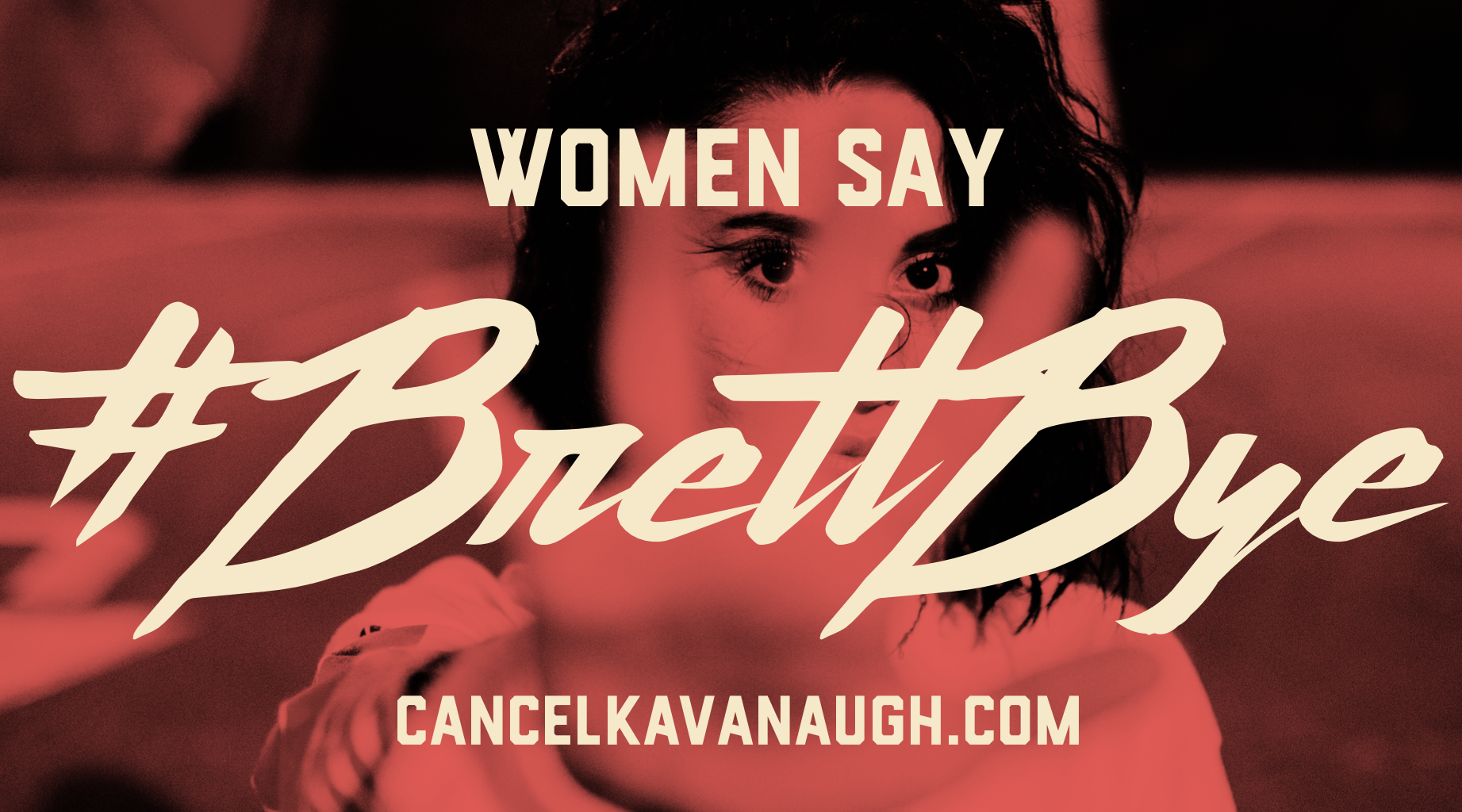
    CANCEL KAVANAUGH. WALK OUT AGAINST PATRIARCHY.
    WE ARE SURVIVORS, BELIEVE US.

    Join a National Walkout from all work, waged and unwaged, on Thursday, October 4 at 4:00 pm to protest the appointment of Brett Kavanaugh to the Supreme Court.  

    In the wake of Brett Kavanaugh’s nomination and confirmation process to the Supreme Court of the United States, we have listened with distress to the women who have so bravely come forward to make public his assaults against them.  

    We have watched with mounting alarm the Senate hearing where Dr. Christine Blasey Ford shared her traumatic account of assault at the hands of Brett Kavanaugh and the dismissal of her suffering by those who are bent on moving forward with a lifetime appointment of Kavanaugh to the highest court in the land.

    The outrageous response to Dr. Ford and other assault victims who have come forward have reminded us of our own assaults and brutalization and we have found solace and hope in the bravery of the survivors who have spoken up.

    But the condescension and disrespect with which Dr. Ford and other survivors have been treated by politicians underscores for us what we have known all along: that the current political system, far from promoting the welfare of women, tries actively to harm us.

    This is not a ‘partisan’ issue in the terms the Democrats and Republicans are framing it: as a struggle for power in the electoral arena. This is a universal issue as it regards hearing the voices of those who speak out against gender violence, investigating charges against abusers, and holding them accountable for their actions. Most importantly, the issue involves challenging and undoing the power structures that systematically keep most women at the bottom so they can be over-exploited, underpaid, easily abused, raped and deported. The system is designed such that that their testimonies can never challenge the claims of innocence and ‘good name’ of powerful men.

    This is a critical issue for political equality and full freedom for women at a moment when women, youth, lgbtq+ people, workers both waged and unwaged, all people of color and immigrant communities are saying “Enough is enough!” This is a key issue for  all  of us in the US, and around the world, who are daily oppressed, humiliated and dismissed, whose suffering and pain often doesn’t matter, all these millions of people who can relate to Dr. Ford’s testimony, and have responded with narratives of solidarity.

    This appointment must not happen. It jeopardizes the future of countless women, our reproductive rights, civil rights, and even the most basic sense of safety that all women, and people, ought to be entitled to.

    On October 4 we call on all women, and those who believe our stories, to walk out of work, school and housework at 4:00 pm and show the world that since our labour runs the world, when we are denied dignity and safety, we can stop the world from running.

    ENDORSING ORGANIZATIONS – [ List will be updated manually ]

    International Women’s Strike US
    International Socialist Organization
    Kanawha Valley DSA (West Virginia)
    Socialist Alternative
    Democratic Socialists of America
    Women’s March San Francisco
    Worker’s Voice/La Voz de los Trabajadores
    Organization for a Free Society
    Red Bloom Communist Collective
    Party for Socialism and Liberation
    National Women's Liberation
    Socialist Workers Alliance of Guyana
    Viewpoint Magazine
    The Woman Project
    Minnesota State University
    Rally Cry Screenprinting
    EBDSA Socialist Feminist Caucus
    CUNY Struggle
    Bucknell University, History Alumni
    Women's March Oakland
    The Women's Building San Francisco
    Economics for Everyone
    Red Wedge Magazine
    Local Sprouts Cooperative – Portland, Maine
    San Francisco Women's Political Committee
    March for Black Women
    Black Women Blueprint
    YDSA UW – Madison
    National Lawyers Guild
    NARAL Pro-Choice California
    Campus Antifascist Network
    Dept of Anthropology, UC Berkeley
    Council on American-Islamic Relations, San Francisco Bay Area (CAIR-SFBA)
    Socialist Viewpoint
    East Bay Sanctuary Covenant
    International Marxist-Humanist Organization
    Cuba Cultural Center, Inc.
    Younger Womxn's Task Force of Greater Lafayette
    BuxMont DSA
    New Politics
    Boston Democratic Socialists of America
    Worcester Socialist Alternative
    Socialist Rifle Association
    Syracuse DSA

  • Trump Administration Declares Me an Anti-Semite

    Image

    I was born a Jew, had a bris and Bar Mitzvah and attended Hebrew school afternoons and Sundays from the age of 7 to 13. I went to schul with my grandfather on holidays and in 1967 I volunteered to defend Israel in the Six-Day War. But I never got to go to Israel then and since the early 1970s, I have refused to visit because of the Israeli occupation of the West Bank and Gaza.

    I am not a “self-hating” Jew. This summer I toured two concentration camps in Eastern Europe and said Kaddish at an eight-hundred-year-old synagogue in Prague for the six million, including family members, who were killed by the Nazis.

    But I continue to oppose the occupation and support efforts to boycott Israel as a way to pressure it to allow the creation of a fully independent Palestinian state. My support for the boycott intensified this spring and summer when Israeli troops used live ammunition to push back and murder protestors at the Gaza-Israel border and when the government declared that only Jews had full rights in the State of Israel.

    Because of my opposition to the Israeli occupation, the assistant secretary of education for civil rights in the Trump Administration has now declared me an anti-Semite.

    I have no problem with redefining Judaism as an ethnicity rather than as a religion, a ploy used by the Trump education department to justify reopening an investigation of supposed anti-Semitism at Rutgers University in 2011. In fact, many secular Jews like myself identify as ethnic, rather than religious Jews.

    But I do object to being labeled an anti-Semite because I believe Israeli treatment of Arabs in Israel proper and in the occupied territories constitutes racism or because I apply what Trump officials believe is a “double standard” by holding Israel accountable for “behavior not expected or demanded of any other democratic nation.” Arab activists with whom I agree accuse the United States government of declaring the Palestinian cause itself and its demand for an independent state inherently anti-Semitic.

    I do not hold Israel to a double standard. I also oppose racism in the United States and I have participated in Black Lives Matter marches and organized for the removal of statues commemorating champions of slavery.

    The redefinition of anti-Semitism as a political weapon against the Palestinian cause is not an isolated action by the Trump Administration. It moved the United States embassy in Israel to Jerusalem, a symbolic act in support of the rightwing Netanyahu regime and an open insult to Palestinians who also claim Jerusalem as a national capital and Israeli and American Jews demanding fairer treatment of Arabs and respect for their human and civil rights. The Trump Administration also recently cut humanitarian aid that supported Palestinian schools and medical facilities.

    My father was a strong supporter of Israel who visited the country many times. Just before he died we were talking about the Israeli treatment of Arabs on the West Bank and Gaza. My father pleaded that Jews would never do such things. Unfortunately, they are. I am an ethnic Jew opposed to Israeli and Trump Administration policies and that does not make me an anti-Semite.

    This article was originally published in the Daily Kos on Sept. 27, 2018.

    Follow Alan J. Singer at: https://twitter.com/ReecesPieces8


  • Gangster Politics

    Image

    In The Communist Manifesto, Marx and Engels referred to the state as “the executive committee of the ruling class.” Reflecting the collective capitalist interest in maintaining its accumulation process, capable of forging compromises among competing sectors of its own and other classes, this committee was also meant to enforce legal norms, contracts, and other rules of the game.

    If necessary, indeed, it would even subordinate individual capitalist interests to the collective interests of the class. The executive committee might foster imperialist ambitions and declare war. But it might also call for redistributive legislation to foster demand even though no individual capitalist would want to pay higher taxes to cover the cost. Recalcitrant elements of the ruling class and protestors from below require punishment. Fascist states easily get carried away in that regard. Banana republics usually exhibit bureaucratic gangster tendencies. In a capitalist democracy, however, things are supposedly different: its executive committee should jail Al Capone and marginalize corruption. The lines between legal and illegal business transactions are blurring and the term “political mafia” is taking on a whole new meaning.[1]

    Gangster politics has little in common with the interests of petty criminals, white collar crooks, ‘Crips and ‘Bloods, and the like. Vast sums are at stake: so, for example, roughly 82.8% of benefits from the 2017 tax bill are being funneled into the portfolios of the top 1%,[2] and the corporate tax rate is being dropped from 35% to 21%. The boss knows where his bread is buttered. That the godfather should get his cut goes without saying: Trump’s family will make upwards of “tens of millions of dollars” from his tax legislation.[3] And with the “ca-ching!” (that sweet sound of the cash register) comes the “bling” (the payoffs, the hush-money, and the gifts) along with the “glitz” of the porno stars, the third-rate actresses, the models, and the rest.

    Gangster politics hovers between the authoritarian and the democratic. The boss and his posse receive their perks for a reason. Gangster politics immunizes capitalist society from class contradictions that have become too acute or demands from below that have grown too onerous. Its representatives are not exactly fascists. They don’t rely on paramilitary forces, concentration camps, official censorship, or explicit ideals of a racially pure society. Sleaze is the ethos of gangster politics. Its style and tone insinuate themselves into existing institutions such as the town meeting, the mass rally, media, electoral debates, and the use of legislative tricks, and legal minutiae. Gangster politicians know how to “game” the system. Their populist rhetoric is window dressing. The old “bicycle mentality” of the petty bourgeoisie holds sway, namely, push up and kick down.

    Gangsters have long been identified with capitalists, cops, and state officials. Balzac noted that every great fortune hides a great crime. Upton Sinclair and Frank Norris made the connection as did Ibsen. But, perhaps most notoriously, Bert Brecht saw the gangster ethos uniting capitalists, imperialists, and militarists in a host of plays beginning with The Threepenny Opera. Contemporary films and television shows constantly depict the CIA, corrupt politicians and greedy corporate interests as interwoven. But these usually appear as either the work of rogue individuals (who must be brought into line) or an always vague and unalterable “system” that demands utter cynicism as the only appropriate response.

    Gangster politics is not a structured institutional formation, as often argued,[4] but rather a semi-legal adaptation to legal forms of governance. It arises when the gangster’s clients sense danger. Memories still linger concerning the economic crisis of 2008.[5] Banks are still over-extending unfavorable loans, stocks have been erratic, insider trading is the rule of the day and the “average guy” is panicking as capital becomes centralized in ever fewer hands.  Production requires an ever smaller yet more educated working class; consumption is inordinately skewed to the wealthy; and the class question increasingly turns on how best to disempower working people, those living below the poverty line, women, citizens of color, and immigrants.

    Enforcing gerrymandering, curtailing voting rights, privatizing the prison system, access peddling, and accruing unlimited donations for electoral campaigns are effective tactics that border on the illegal. Right-wing control over an increasingly centralized media helps deflect criticisms and divide the disenfranchised and exploited. The audience has been primed. The boss’ mass base detests his critics. Environmentalists, immigrants, people of color, uppity women, decadent gays and the transgendered infuriate the “good citizens” of America clinging to outworn traditions in small towns as well as evangelicals and retrograde (white) sectors of the industrial working class. They despair over loss of jobs, government “waste” and “welfare chiselers,” moral decline, and (above all) the loss of their cultural privileges. They look back to a time when “men were men,” “America was great!”  and “happy days” followed one another non-stop.

    Elites nod approvingly, though they have different priorities: de-regulation, lower taxes, fewer welfare policies, and cuts in the “costs of doing business.” Oligarchic tendencies are built into capitalism and, as they expand, their exploitative impact on workers and the urban poor become more intense. That is where gangster politics enters the mainstream. Corporate elites require protection from progressive forces.[6] Their leaders must often choose between authoritarianism with profits as against democracy with costs. Thy always assume that they can control their enforcer.  Once in office, however, the parvenu begins exercising power in his own interest. Donald Trump turned on mainstream Republicans, who pandered to the Tea Party early in the Obama presidency, just as Hitler turned on his former patron, Fritz von Papen, and his “cabinet of the barons” in 1933. It was the same with General Pinochet who was installed by the traditional conservative Eduard Frei following the fall of Salvador Allende’s democratic regime in Chile in 1973. Other examples are available.

    Gangster politics has its own logic. Traditionalists like to believe that the conflict is between “them and us.” For the political gangster, however, the struggle is between “them and me.” The only fixed rule is — don’t cross the boss! And, if only for this reason, he chooses to be feared rather than loved. He taunts his subordinates, publicly humiliates them, throws them under the bus, and perhaps even fires them a few days before their retirement. Cabinet officials and agency directors require no expertise or security clearance,[7] all that counts is loyalty to the boss. But, then, loyalty is a one-way street. Internal security advisers, press secretaries, cabinet secretaries, chiefs of staff, assistants, agency directors, White House attorneys, and deputies of all stripes come and go. Trump’s administration has already had a turnover rate of 34%, more than triple that of the Obama presidency.[8] Confusion and chaos proliferate. There is a sense in which the goal of gangster politics is what Franz Neumann termed “the stateless state.” It serves a concrete purpose: everyone knows who is in charge of everything.

    Gangster politicians like to think that they are slick. They talk slang and curse a lot, grab a girl’s ass (or worse), insist that they never read a book, thumb their noses at intellectual elites, boast about their high IQs, and proclaim their “street smarts.” They also view themselves both as victims of their critics’ malice and “great men” alone capable of curing the nation’s ills. They make their base feel the same: they are despised and yet the real Americans! Their belief in the boss is unwavering. Only he can make America great again. Those who oppose his policies are traitors and the threats they pose are serious—and, if they are not serious, then they must be made serious. History teaches what might become necessary in order to teach them a lesson. The Reichstag Fire of 1933 and the (staged) assassination of Sergei Kirov in 1934 were the dramatic events that led Hitler and Stalin to justify attacks on enemies, renegades, and supposed traitors to the state. Gangster politicians under internal pressure pray for a crisis, or what Trump once forecast as a “major event,” in order to rally the troops and clean house.

    Gangster politics requires no ideology. Lack of principle itself becomes a principle.

    The great man must do what must be done: if that means lying, reneging on deals, shifting gears, rejecting transparency, and whatever else, then so be it. That he can employ the double standard is a given. Big talk takes the place of diplomacy and, if the bluster doesn’t work then America alone — or, better, the boss alone — can rely on “fire and fury” whenever and wherever he likes. Traditionalists employed jingoistic rhetoric and wrapped themselves in the flag. The gangster politician talks like a schoolyard bully and salutes himself. Gangster politicians of times past had subordinates swear an oath of loyalty not to the state but to them. Yesterday’s “America! Love it or leave it!” has today turned into: “Trump! Love him — or shut up!”

    One scandal follows another: financial irregularities, graft, bribery, conflicts of interest, domestic abuse, falsification of documents, secret meetings, gratuitous tweets, racist comments, White House gossip. The “breaking news” is endless. The president apparently lied 2,000 times in public during his first year in office. And, undoubtedly, every lie was exposed. So, what? Each news hour turns into another mind-numbing confirmation of popular alienation as the gangster’s antics steal the headlines. He is seemingly on-screen 24/7. Estimates suggest that Trump received $2 billion in “earned media” — or, better, free publicity — during the 2016 elections.[9] That the president and his cronies should project their own fabrications upon the “fake news” media is just another expression of their contempt for truth.

    Audiences of the great American stand-up comedian from the 1950s, Lenny Bruce, broke into laughter when he told them: “Even if they have photos — deny it.” But the political gangster takes the next step. Criticisms are always unfair, prosecutors are always crooked, protests are always exaggerated, and every misstep is caused by the “deep state.” They are all out for blood. Checks and balances, the separation of powers, and civil liberties are impediments. Congress, the courts, the media, the bureaucracy, the university, the FBI, the political professionals — or, in short, “the system” — are all in on it! Their accusations are “fake news!” All of them are out for blood. Why? Not because of the gangster’s lies, his sewer language, his racism, his illegal dealings, his incompetence, and his policies. No: it’s because this street guy par excellence “tells it like it is” and because he wants to “drain the swamp!”

    Grand strategy is irrelevant: the tactic is the strategy. Success rests on diversion and misdirection. Scandals, investigations, lies, charges, and counter-charges relativize political reality. Public debate thus turns into an ongoing attack on deliberative democracy: logic, argument, and evidence make way for infantile defamations that range from “crooked Hillary” and “little Marco” to “Pocahontas” and “Rocket Man.” Attacks on women’s appearance, people with disabilities, and “shithole” (African) states keeps the dialogue going.  Gangster politics exists at the fringes of democratic will formation, capitalist rationality, and the “system” in which he is actually entrenched. The President has no use for artists, experts, intellectuals, professionals, scientists — all who might know more than he. Gangster politics always has its eye on the lowest common denominator and it aims to depress what Marx termed “the material level of culture.” That’s because the gangster politician, his collaborators, and his base already know it all. None of them has anything to learn. To the contrary, their confidence and their power rest on maintaining their ignorance.

    References

    [1] Herbert Marcuse, 1974 Paris Lectures at Vincennes University, eds. Peter-Erwin Jansen and Charles Reitz (published by the Marcuse Archives).

    [2] Dylan Mattews, “The Republican tax bill got worse: now the top 1% gets 83% of the gains,” VOX, December 18, 2017.

    [3] Louis Jacobson, “How much does the Trump family have to gain from GOP tax bills?PolitiFact, November 27, 2017.

    [4] The term “gangster state” has been used often, and there are a number of different interpretations of the phenomenon, i.e. Katherine Hirschfeld, Gangster States: Organized Crime, Kleptocracy and Political Collapse (New York: Palgrave, 2015); Charles Tilly, “State Formation as Organized Crime,” in Peter Evans et al., eds., Bringing the State Back In (New York: Cambridge University Press, 1985); Michael Hirsh, “Gangster States” at Paul Craig Roberts, “Gangster State America: Where is America’s Democracy?” 

    [5] Gretchen Morgenstern and Joshua Rosner, Reckles$ Endangerment: How Outsized Ambition, Greed, and Corruption Led to Economic Armageddon (New York: Henry Holt, 2011).

    [6] Note the discussion in Stephen Eric Bronner, The Bitter Taste of Hope: Ideals, Ideologies and Interests in the Age of Obama (Albany, NY: SUNY Press, 2017), 1ff.

    [7] Max Greenwood, “At least 30 White House officials, Trump appointees lack full clearances: report,” The Hill, February 9, 2018. 

    [8] Jeremy Berke, “REX TILLERSON IS OUT — here are all the casualties of the Trump administration so far,Business Insider, March 13, 2018; New York Times (February 13, 2018).

    [9] Nicholas Confessore and Karen Yourish, “$2 Billion Worth of Free Media for Donald Trump,” New York Times, March 15, 2016. 

    Stephen Eric Bronner is Board of Governors Distinguished Professor of Political Science and Director of Global Relations for the Center for the Study of Genocide and Human Rights at Rutgers University. His most recent work is The Bitter Taste of Hope: Ideals, Ideologies and Interests in the Age of Obama (Albany, NY: SUNY Press, 2017).

  • "They Count on You Not Knowing"

    Image

    Wealthy Bay Area investor David Crane is a leading promoter of the neoliberal agenda within the California Democratic Party. A former advisor to Republican governor Arnold Schwarzenegger, Crane is a widely-published critic of state and local tax initiatives, publicly-funded health care, public education, public employees and their pensions. He raises lots of money for “courageous” candidates willing to put “citizen interests” ahead of such “special interest” causes.

    According to Crane, Left Coast governance suffers from voters paying insufficient “attention to the legislators who run their state.” In a TED talk delivered in Palo Alto, where Crane lectures at Stanford, the multi-millionaire chided members of his well-heeled audience for being unable to identify their representatives in Sacramento or being unfamiliar with their “voting behavior.” Crane delivers his message, in casual tech industry attire, but his talk is ominously entitled: “They Count On You Not Knowing.” (See https://www.governforcalifornia.org/who-we-are/.)
     
    To elect more candidates who will “govern with independence from special interests,” Crane started a fund-raising machine called Govern for California, with $250, 000 of his own “seed money.” His co-founders six years ago were SF billionaire Ron Conway, and Gregory Penner, a venture capitalist and current board chair of Walmart, who is married to Carrie Walton, granddaughter of the firm’s founder (making them one of the richest couples in the country),

    According to its website, Govern for California is now a network of more than 250 like-minded “political philanthropists.”  Others have described the group, less sympathetically, as a charter school fan club, replete with “donors who have spent hundreds of thousands of dollars supporting right-wing candidates and policies here in California and other states. (See https://48hills.org/2018/06/big-right-wing-money-east-bay/.)

    The donor class hubris reflected in Crane’s preferred organizational branding will be familiar to any reader of Anand Giridharadas’s brilliant new book, Winners Take All: The Elite Charade of Changing the World. In that author’s insider expose of what he calls “Marketworld” philanthropy, the wealthy are less “interested in making politics work better” than “insisting on their proprietary power to give the world what it needs.”

    An Obama-Backed Candidate

    At the moment, David Crane is very insistent that my own California Assembly District 15 needs to be represented by a former White House staffer named Buffy Wicks. With the help of nearly $500,000 in primary spending by Govern for California, Wicks placed first in a field of ten Democrats and one token Republican in June. She is enthusiastically backed by former President Obama, US Senator Kamala Harris, US Congressman Ro Khanna, our soon-to-be governor Gavin Newsom, and two prominent Democratic mayors, Libby Schaaf from Oakland and London Breed from San Francisco.

    In the AD 15 run-off this fall, Wicks faces stiff, if under-funded, competition from Jovanka Beckles, a two-term Richmond city council member. Beckles is a leading East Bay critic of big money in politics who belongs to Democratic Socialists of America and the Our Revolution-affiliated Richmond Progressive Alliance. (For more on the political views and local record that differentiate Beckles from Wicks, see https://jacobinmag.com/2018/09/jovanka-beckles-state-assembly-richmond-candidate.)

    Fortunately for the cause of voter education in AD 15 over the next seven weeks, East Bay DSA has taken Crane’s warning—“they count on you not knowing”—very seriously. But not quite the way he intended.

    On Monday, Sept. 17, a group of DSA volunteers unveiled buffywicks.money, a whistle-blowing website designed, in part, to debunk Wicks’ repeated claim that she doesn’t take “corporate money.”

    In creative, humorous, and suitably outraged fashion, this model intervention in local electoral politics puts a human face on the “high dollar” donors, industry associations, and “independent expenditure” groups financing her run for office (to the tune of $1,450,783 so far).

    Buffywicks.money is worth replicating elsewhere because the corporate Democrat in question is hardly sui generis. In an article entitled “‘The Baton Got Dropped’: Obama Alums Rush to Finish What He Started,” Politico recently reported that Wicks is part of a broader wave of Obama-inspired candidates now running for non-federal office in order to “usher in the progressive era that was promised.”

    Ride-Sharing Help

    In Wicks’ case, two well-known White House colleagues have been particularly helpful in passing “the baton” to her. One of her initial fund-raisers was David Plouffe, who became a Senior Vice President at Uber after his Obama Administration service and now directs the Chan Zuckerberg Initiative, a “change-the-world” foundation in the Winner Take All mode. More recently, Valerie Jarrett, another top White House advisor to Obama, personally campaigned for Wicks in AD 15. Jarrett recently joined the board of Lyft, which further explains why so many Wicks’ donors hold management jobs at ride sharing firms now fighting to overturn a state court ruling favorable to drivers. (See https://www.jovanka.org/beckles_condemns_uber_lyft_bid_to_over_turn_state_court_decision_protecting_gig_economy_workers.)

    At buffywicks.money, we discover that Wicks’ donor base is much broader than the gig economy—both in terms of direct donors (limited, by state law, to giving $8,800 each) and her independent spenders, like Govern for California. The latter have post-Citizens United permission to spend as much as they want, just as long as they don’t coordinate with their favored candidate’s own campaign.

    A savvy organizer and proven coalition builder, Wicks has been able to unite other tech titans (among them billionaire Craig Newmark of Craigslist fame), investment bankers, landlords, real estate developers, corporate lawyers, consultants, and lobbyists, not to mention California’s influential statewide associations of doctors and dentists—all under one big tent!

    *Tench and Simone Coxe are, for example, one power couple now drawing East Bay socialist scrutiny and scorn on buffywicks.money. Tench hails from “Sutter Hill ventures, one of the oldest venture capital firms in Silicon Valley,” and, before that, the gone but not forgotten Lehman Brothers. Simone has “entered the tech start up world with Equestrian Connect, a service to register your horse online for horse shows.” Previous beneficiaries of their spare change have included Mitt Romney, Republican House Majority Leader Kevin McCarthy, and the Republican National Committee (RNC). But now Buffy has caught their fancy too—along with climate change denying Republicans like McCarthy?

    *John and Regina Scully love Buffy too (although not quite as much as campaigns against taxes on the wealthy to provide better funding for California schools, a cause they spent half a million on unsuccessfully two years ago.) As boss of a Mill Valley, CA. investment firm, 69-year old John manages $10 billion worth of assets, generating enough disposable income to spend $400,000 on a model train set in the basement of his vacation home in East Hampton, Long Island. Both Scullys serve on the board of Success Academy, whose co-founder just spent heavily on the pro-charter school incumbent just defeated by Julia Salazar in her NY state senate race.

    *Reid Hoffman, with a net worth of about $4.7 billion, has also maxed out for Buffy, after co-founding Linkedin and serving as an early executive at PayPal. Hoffman “penned a neo-liberal self help book called The Start Up of You that encourages workers to embrace the precarity of the job market and consider themselves an entrepreneurial business-of- one”—a blue-print for Wick’s own post-White House career trajectory?

    *Scott Kepner. As East Bay DSA discovered, this real estate investor and Republican donor poured $125,000 into the pockets of the RNC nine Republican hopefuls two years ago, including Paul Ryan, Tom Cotton, Pat Toomey, and Jeb Bush. This year, Kepner is betting on Buffy–perhaps because she doesn’t support Proposition 10, a ballot measure that would allow cities like Richmond, Berkeley, Oakland, and San Francisco to expand their tenant protections. California landlords, the real estate industry, and big Wall Street firms are all spending millions to defeat Prop 10.

    *Ron Conway is described by DSA as “a notoriously unpleasant billionaire” and San Francisco’s answer to the Koch Brothers (because of “the heavy handed way he uses his extreme wealth to subvert democracy”). He’s been on the wrong side of local political skirmishing over tenant protection and city hall treatment of homeless people. (Buffy’s main political consulting firm, 50+1, is also working, on behalf of the SF Chamber of Commerce, to defeat a local business tax increase designed to fund more housing for the homeless.) Adding to his indirect support via Govern for California, Conway wrote personal checks to Buffy totaling $8,800.

    *Christopher Garland “maxed out” for Wicks as well, in his role as a powerful Silicon Valley player, renowned for “connecting wealthy tech donors to politicians looking for money and direction.”

    Garland has been both a political advisor to Facebook billionaire Sean Parker and chief of staff for Gavin Newsom, our current lieutenant governor. Newsom has raised $45 million, from wealthy donors and special interest groups, for his campaign to succeed Jerry Brown as governor. Garland probably helped arrange a joint campaign event, last week, between Wicks and Newsom, who’ve both gotten financial support from the California Medical Association.

    At their Berkeley love-in, Newsom, a putative supporter of single payer health care, embraced Wicks, who doesn’t support SB 562, the single payer bill promoted by the California Nurses Association, an early Newsom endorser. If Newsom was serious about passing SB 562, in some future form, wouldn’t he want an additional reliable Assembly vote in favor of it? Apparently not.

    A Model Initiative
     
    As DSA’s website researchers and writers note, “Buffy herself is not really the problem in this race; the problem is the corrosive and antidemocratic effects this obscene amount of money has on our local politics.” Eliminating or even reducing its election impact will not be easy in AD 15 or anywhere else. But East Bay DSA vice-chair Frances Reade believes that “dot.moneying” those responsible can be a helpful first step, when combined with the other volunteer activity of scores of DSA members, who are knocking on doors, making phone calls, and registering voters for Jovanka Beckles.

    “If you have some free time and are nosy, it’s very easy,” Reade says. Her fellow DSA communications committee members accessed campaign finance reports filed with the state, googled the names of key Wicks’ donors and Super-PAC supporters, and collected past reporting on their industry backgrounds and political connections. The resulting donor profiles have already drawn thousands of visitors, who according to Reade, are “spending a lot of time scrolling through the site.”

    One surprise to the researchers was how much “fawning coverage Democratic mega donors routinely get,” at the same time they are “pouring money into races all across the country” on behalf of charter school supporters. Unlike the conservative villains of Jane Mayer’ Dark Money, which profiled members of donor networks associated with the Koch Brothers, prominent members of the Democratic Party’s donor class lay claim to greater enlightenment because of their past ties to the Obama Administration, Hillary Clinton’s presidential run, or issue oriented campaigns involving non-economic issues.

    The bottom line for DSA is that “in a real democracy, the wealthy should not be able to buy elections or legislation,” as Reade says. “My California assembly member should be accountable to voters like me and my neighbors, not to the agenda of billionaires, here and in other states.”

    Steve Early is a member of the Richmond Progressive Alliance and DSA and a volunteer in Jovanka Beckles’ campaign for the California Assembly. He is the author, most recently, of Refinery Town: Big Oil, Big Money, and the Remaking of an American City, a book about local political organizing in Richmond, CA. He can be reached at Lsupport@aol.com.
     
  • Liberal fear about teaching a "people's history": Sam Wineburg on Howard Zinn

    Image

    The Zinn Education Project has published a fine response to an article based on Sam Wineburg’s book, “Howard Zinn’s Anti-Textbook.”


    In what seems to me indication of increased influence of Right wing ideas in schools of education, related to increased right-wing funding to universities, Wineburg, holds a prestigious perch in history of education at Stanford. Another endowed chair at Stanford was held by the late David Tyack, author of a seminal history of the development of urban schools, The One Best System. It influenced an entire generation of historians of education and is still worth reading to understand many contemporary debates about school reform.

    Wineburg published an article with the contour of this same attack on Zinn in “The American Educator,” the magazine published by the American Federation of Teachers (AFT). Historians and teachers who use Zinn’s work asked to respond to Wineburg’s piece. The AFT refused. After much public shaming on social media, the union relented and allowed the Zinn Education Project to publish a letter with a link to a fuller rebuttal of Wineburg’s argument.

    Ursula Wolfe-Rocca’s thoughtful, nuanced review of ideas in Wineburg’s book is as much about teaching history as it is history itself, as it should be, because Wineburg's attack is in part about teaching history. However, Wineburg's mission is deeper and broader, actually as much or more ideologically driven than Zinn’s, reflecting "centrist" liberal fears about sullying the narrative about American progress pushed by most textbooks, pundits, and Democrats. Wolfe-Rocca, a social studies teacher, discusses Wineburg’s flawed (and elitist) pedagogical assumptions (he doesn’t bother looking at how teachers actually use Zinn’s work). She then explains “Wineburg completely ignores a crucial difference between A People’s History and standard corporate textbooks: Zinn does not disavow his own voice or power in shaping the history he offers; he makes it explicit.”

    As she explains, Wineburg is willing to concede A People’s History acquaints students with history "too often hidden and too quickly brushed aside by traditional textbooks.” But "he seems strangely uninvested in the necessity of such a project, as if writing bottom-up history and representing the experiences of traditionally marginalized groups is just another polemical trick.”

    Wineburg, like the liberals whose narrative he endorses, rightly sees Zinn's work as a challenge to accepting the status quo as inevitable. The review is worth reading if you care about how history is – and should be – taught.  Other essays addressing the attempts to discredit Zinn’s work, along with free, topical materials for teaching history, are on the Zinn Education Project website.


  • In Memoriam: David McReynolds, 1929-2018

    Image

    David McReynolds was the first “Old Leftist” I ever met, back in 1996, at one of a number of ill-fated 1990s meetings of representatives of socialist organizations in New York City hoping for some sort of “left unity” around a common project. Strictly speaking, David wasn’t an “Old Leftist” – that label was affixed to members of the Socialist Party (SP), Communist Party (CP) or the Trotskyist grouplets of the 1930s and 1940s. David was “inbetween” the Old and New Lefts, joining both the SP and the radical-pacifist War Resisters League (WRL) in 1951.

    David’s main inspiration was the Communist-turned-socialist-pacifist Bayard Rustin (1912-1987), who by 1949 was the organizer for “race relations” in the Fellowship of Reconciliation (FOR), an interfaith nonviolent-action organization. David – who refused being drafted into the Korean War and won his case “on a technicality” – began working for Liberation magazine in 1957 under Rustin and A.J. Muste (1885-1967), who was a founder of the FOR (and a former Trotskyist). In 1960 he became a “peace movement bureaucrat,” becoming part of the WRL staff where he remained until retiring in 1999. He helped Rustin organize the 1963 March on Washington for Jobs and Freedom, organized one of the first draft card burnings, wrote often for the explicitly pacifist WIN magazine, and played a major role in some important demonstrations against the Vietnam War.

    In the early 1970s David’s anti-war Debs Caucus finally split from the Cold Warriors who dominated the re-named SP, the Social Democrats USA (SDUSA), taking the name “Socialist Party USA.” The SPUSA would be David’s primary “socialist home” until 2015, when he resigned, claiming that the party had neither a healthy internal life nor political relevance. He also paid dues to the Democratic Socialists of America (DSA) from the 1980s until his death.

    But long before 2015, David was the first openly gay man to run for president, on the SP ticket in 1980. He did the same again in 2000, leading to an appearance on Bill Maher’s “Politically Incorrect” show on ABC, winning over much of the audience to Maher’s chagrin. Unlike Rustin, who had been “outed” in 1953 via being “busted” for “lewd conduct” in a parked car with another man, David came out in the pages of WIN in 1969. He revealed that he’d been aware of his sexual orientation since 1949, when he began a brief relationship with Alvin Ailey at UCLA, where both men were undergraduates. Ailey, of course, later became a celebrated  choreographer, popularizer of modern dance, and founder of the Alvin Ailey American Dance Theater. (Ironically, before running for president, David had run for Congress from Lower Manhattan as a candidate of the Peace and Freedom Party in 1968 – when the Party’s presidential candidate was the notoriously homophobic Eldridge Cleaver of the Black Panther Party.) He would again run for office as a Senate candidate for the New York State Green Party in 2004.

    Although for a time David was on the editorial board of New Politics and he considered himself a Marxist, his overall political orientation was fairly distant from the heterodox Trotskyism that informed the outlook of NP’s founding editors, the late Julius and Phyllis Jacobson. Undoubtedly this was partly due to David’s anger at having been “burned” by the Jacobsons’ former comrades in the Independent Socialist League (ISL), particularly by its leader Max Shachtman. The ISL had dissolved their organization and joined the SP as individuals in 1958. David, who was on the left edge of the SP, expected that the ex-ISL members would push the Party to be more radical. The exact opposite happened, as many “Shachtmanites” – who became the dominant faction in the SP – soon expressed support (“critically,” of course) for the Bay of Pigs invasion, the Lyndon Johnson administration, and the Vietnam War. (Tragically, Bayard Rustin joined this faction, abandoning his socialist pacifism.) David also believed that the orthodox Trotskyists of the Socialist Workers Party (SWP) played a “splitter” role in the anti-Vietnam War movement. So it isn’t that surprising that David decided that “Stalinism versus Trotskyism” was really little more than a remnant of a power struggle between two authoritarian individuals, though he did admire “Shachtmanites” who retained their old political perspectives, such as Hal Draper and others around NP.

    David was a very warm person and was my only connection to deceased figures of the “literary left” such as Allen Ginsberg and James Baldwin. I admired him. Over time, however, it became clear that our outlooks were rather different. His knowledge of Marxist social theory just wasn’t very deep and his understanding of both Lenin and Trotsky (and even his favorite, Rosa Luxemburg) was similarly superficial. It also became clearer to me over time that David wasn’t really a Third Camp type. He told me in an email last year that he was “much more sympathetic to Russia than most” in our democratic socialist milieu. I asked what this meant – sympathy for the Communist Party of the Soviet Union? His response: “Yes and no – it is complicated, like history.” Not the most satisfactory of answers. Furthermore, in another email last year, David stated that “the U.S. must give up its hope of overthrowing Assad” – failing, like so much of the “Western” left, to understand that Trump, like Obama before him, has no interest in Syrian “regime change” (Trump’s crazed “kill them all!” outbursts notwithstanding – he has no intention to overthrow what remains of the Syrian state). “Seek peace,” David said. I found this glib. Peace under fascism is no desirable peace, and David’s statement struck me as an insult to every democratic revolutionary tortured and/or killed by Bashar al-Assad.

    That said, most of the time, David was on the right side, and I will miss him.

    ***

    Jason Schulman is a co-editor of New Politics. He is the editor of Rosa Luxemburg: Her Life and Legacy (Palgrave Macmillan, 2013) and author of Neoliberal Labour Governments and the Union Response (Palgrave Macmillan, 2015).

    A shorter version of this post originally appeared at the Solidarity Webzine

  • Have No Fear: Defending The NFL Players Protests from Its Defenders

    Image

    The most popular defense of the NFL players protest argues that Colin Kaepernick, as well as those who have joined him, are not protesting the National Anthem or American identity in general, but only police violence. In kneeling at the start of every NFL game, the players perform a respectful nod to the military while simultaneously calling for a re-thinking of minority status in America.

    The reference here is implicitly to former Army ‘Green Beret’, Nate Boyer who gave Kaepernick the “thumbs up” to protest as long as he “took a knee” rather than sat down (the latter would be considered disrespectful to the troops and the flag). Kaepernick himself gave credence to this position, “ I have great respect for the men and women that have fought for this country. I have family, I have friends that have gone and fought for this country. And they fight for freedom, they fight for the people, they fight for liberty and justice, for everyone.” The claim is not necessarily against the American-ideal but for its failed promise, “People are dying in vain because this country isn’t holding their end of the bargain up, as far as giving freedom and justice, liberty to everybody.” The statement is less about contesting American identity but rather its exclusive nature; black lives are in-practice not counted as part of “everyone”.

    This sentiment was picked up by FOX, ESPN, and CNN among other popular news outlets, with a slight (but important) distortion and retreat. Responding to Trump’s inflammatory tweets, Shannon Sharp, on the popular show Undisputed, put forth a clarification,  “this wasn’t a protest this was unity … it’s not about the flag, its not about the military, it’s not about the police, it’s about the brutality that unarmed men and women are suffering. It’s about the injustices of men and inequities that are going on in America”. Other articles appeared (including from fellow NFL protestor Eric Reid) stating that protests were not about “disrespecting” national identity but about an American exercise in free speech protest. Through these defenders, the protests have been understood (among liberals) as not pertaining to the flag, nation, military, or even the police but rather abstract inequality and discrimination against people of color (the prevalence of too many bad apples).

    Nonetheless, countless conservative outlets have (and continue to) bash Kaepernick and the protestor’s actions as “un-American” and “disrespectful”. Here is Kaepernick’s former teammates response: “That flag obviously gives [Kaepernick] the right to do whatever he wants, I understand it. At the same time, you should have some fucking respect for people who served, especially people that lost their life to protect our freedom.” The liberal reply to this has been to double down. Commentators, with increasingly manifest anger, cite the same quotes from Boyer, Kaepernick, Reid, and numerous other NFL players arguing for their pro-military or American intentions. They go even further and discuss the charity many players contribute off the field and their well-meaning character. But the result is a stalemate: liberals claim non-aggression and an American right to self-expression, while conservatives insist that the protesters embody a fundamentally anti-American position.

    But what if stalemate exists because conservatives, in a particular sense, have hit upon something true? What if the Right is correct: The NFL player protests constitutes a critique not only of police violence but of the “flag” and American National identity as such? In other words, movements against police brutality and for black lives, make palpable the false universality of American identity and thus constitute a threat to it in all manifestations (military, flag, identity, and so on).  Regardless of what some conscious “justifications” of the protest claim, then, The NFL players are protesting what it means to be American.  Directly stated, since (1) American identity is constituted through a repression of blackness (through a devaluation and Other-ing of black lives), and (2) the NFL players protest not only makes visible this devaluation, but calls for a reevaluation of values; then (3) the protest necessarily imply a re-definition of Americanism. This is not to suggest that Kaepernick is protesting individual troops (nor should he) or “hates Americans” but that he is indeed protesting something fundamental about American identity. In protesting police violence and American racism, players inherently to do more then put forth particular demands (i.e. to not be killed by police). That is, since American identity is predicated upon this oppression, to challenge said oppression, is to challenge what America itself stands for.

    In this sense, the intense counter-reactions to the protests are appropriate. Acts ranging from fans burning Jerseys, the NFL blacklisting Kaepernick, all the way to the intervention of the president are not “over-reactions” but attest to the radically universal nature of Kaepernick’s simple (particular) demand. The key then, is not to “defend” or qualify Kaepernick and the NFL protest, but to refuse to back-down form their radical (American re-defining) implications.

    This brings us to a final point and the most recent development: Kaepernick’s decision to partake in an advertisement contract with Nike. The collaboration first began with Kaepernick tweeting the Nike logo below the quote “Believe in something, even if it means sacrificing everything” and was followed by a televised commercial featuring kids in Nike gear overcoming obstacles. The latter two-minute ad concludes with a proclamation, “don’t ask if your dreams are crazy, ask if they are crazy enough”. Within the first week of the ad’s public release Nike generated an estimated $42 million dollars in publicity. Its online sales jumped 27 percent in three days.

    Although all this may seem tangential to the NFL protest, the case of Kaepernick himself teaches us otherwise. Consider Colin Kaepernick and Eric Reid’s current NFL status: unemployed. Now consider Nike’s notorious history of labor rights violations as well as numerous racial and sexual discrimination charges. The simply fact is, labor discrimination is instrumental in crushing political dissent. Corporations like Nike have a storied history of suppressing protest like Kaepernick’s. Nike has a vested interest in maintaining an American identity that excludes (predominantly people of color) domestic and foreign workers; it is tied to the same (white supremacists) American identity that NFL players protest.

    So what does this mean? As a recent article in the Guardian noted, this is not to say that Kaepernick has “sold out”, or is politically “insincere”, or to detract from his incredible courage in any way. It is rather to argue that to stick to the radical dimension of the NFL player’s protest itself, players will have to link up with other forms of struggle.

    Kaepernick boldly rejected showing “pride in a flag for a country that oppress black people and people of color”. This rejection implies nothing short of a redefinition of American values and identity; yet, maintaining fidelity to this implication means seeing the ways in which capitalist labor relations and things like gender discrimination not only constitute American identity but are instrumental in the Other-ing of blackness.

    In the most practical terms this means aligning with NFL players who don’t take a knee during the Anthem but jog, sit, stretch, and “worse”. Even further players must also form alliances with the “problematic” stars who hold out (Le’Veon Bell) and seek better contract negotiations; those who are finned for acting-out and “inappropriate celebrations” (Odell Beckham Jr.); offensive lineman who are underpaid yet face an average life expect of mid-50s (due to subconcussive injuries); fans who, at the whims of owners, are subject to ticket hikes, stadium development that comes on the back of tax payers and displaces lower-income communities (often POC), and so on.

    If the protest movement dies out, it will not be because it was too radical; it will be because it wasn’t radical enough. The NFL player’s protest doesn’t require defense; it requires fidelity.

  • A Legacy of Virtue the Government Can’t Silence: The Case of Shahidul Alam

    Image

    The job for media pundits and intellectuals is often to question black and white narratives that are, in reality; washed in greys. But there are other times when things aren’t so complicated. There are times when one side clearly stands for inclusivism, creativity, empathy, mercy, mirth, humor, compassion and an unabashed zeal for the act of living, while the other side represents grim, cynical, self-interested raw power perpetuated by those who use violence to cover their insecurities, fears and incapacity to see that one’s reason for living on this earth has nothing to do with the allure of power and control. The arrest of renowned photographer Shahidul Alam by the Bangladeshi government is one these times.

    Alam, 63, was detained on Aug. 5, 2018, by plain-clothed officers who identified themselves as the detective branch of the Bangladeshi government. He was charged under the Section 57 Information and Communication Technology Act (ICT) with “spreading propaganda and false information used against a government” and for making “provocative comments” about the government’s violent response to students protesting for safer roads, in an interview he conducted with Al Jazeera.

    He was arrested hours after the interview.

    Bangladeshi’s ruling government, the Awami League, has consistently used Section 57 as a legal bludgeon to silence critics. The Bangladeshi court rejected Alam’s bail plea on Sept. 11 and he remains imprisoned.

    The protests, which started in Dhaka but spread throughout the country, began after a private bus ran over a group of college students, killing two. Road safety is a major problem in Bangladesh: More than 3,000 people die in road accidents each year according to data collected by the World Health Organization.

    In the interview with Al Jazeera, Alam criticized the police’s disproportionate use of force against the unarmed student protesters.

    “The police specifically asked for help from armed goons to combat unarmed students demanding safe roads,” Alam said. “There are people with machetes abusing unarmed students and police are standing by watching it happen. In some cases, they [the police] have been actually helping out. This morning there was tear-gassing. I saw the police ganging up and trying to catch unarmed students, whereas goons are walking around carrying sticks and machetes and they [the police] are just standing by.”

    When asked by the Al Jazeera reporter if the protests represented something bigger, he said the government is clinging on to rule “by brute force, looting the banks, gagging the media, extrajudicial killings and disappearances, and protection money and bribery at all levels.”

    In an interview with this writer, Alam’s niece Sofia Karim described what she had heard about her uncle’s abduction:

    “They restrained the security guard, they messed up his cameras, they took the hard drives out of his cameras before they abducted him,” Karim said. “My aunt [Alam’s wife, Rahnuma Ahmed] was in a friend’s flat in the building on another floor, and she heard screaming. It was a bad scream. She knew it was his scream. She went downstairs, and the security guard explained he had been taken away.”

    Alam’s valid criticisms left the government with two options: they could take seriously his as well as the students’ complaints and try to implement changes and reforms that would help the country’s citizens as well as improve the government’s image, or, they could try to silence a man who has arguably brought Bangladesh more global recognition than any other citizen. Unfortunately, they chose the latter.

    When Ahmed and some friends went to the detective branch office to see what had happened to her husband, they waited all night for answers, but they were given no information about his whereabouts.

    “What we know now is that when they abducted him, they put him in a vehicle and blindfolded him and his hands were handcuffed behind his back,” Karim said. “At detective branch headquarters, large objects were placed on his head and he was threatened with waterboarding. They threatened to pick up my aunt, they punched him in the face, and they accused him of being a Mossad agent.”

    The next morning at police headquarters, according to Karim, Alam was offered a statement to sign, promising that he would remain silent.

    “They said if he signed the statement, they would release him, but he refused to sign, and that was when the ICT charge was brought against him,” she said. “Back in London [where Karim and her mother Najma Karim live], the first time we saw him was footage when he was taken to court. We saw that he was being dragged, he was limping, and there were no shoes on his feet. This is when he yelled out to the camera ‘they beat me, they washed my blood-stained Punjab and made me wear it again. I was denied legal representation.’

    “That was really distressing for us to watch because we knew he had been abused that night. My uncle’s work has always been risky — so risky — and we have always been fearful for his safety. But seeing evidence that he was caught and abused physically was really, really hard for us to see.”

    After his family pleaded to the court that he needed medical help because he had been tortured, the Bangladeshi high court ruled he should be assessed for torture. He was in fact assessed in a government hospital but, Karim said, it was not an independent assessment.

    “The assessments they did were just general assessments and not specific to torture. The government denied he’d been tortured,” she said.

    After his assessment, Alam was put in remand.

    “Remand is basically when they hold you in a detective branch rather than in prison, and they interrogate you,” Karim said. “The word on the street is you get tortured there. Human rights organizations have recorded cases of torture in remand and there are other journalists who have written about being tortured under remand. I think it’s quite common to use the ICT act to put people under remand, but the legality of this has been questioned.”

    After six days in remand, Karim found out Alam had been put in jail and was awaiting bail. The family finally made contact with him in prison, but the contact was limited because of the structure of the prison.

    “What you have is a large room that is divided where you have all the family members on one side and all the prisoners on the other side, so these aren’t one-on-one meetings,” Karim said. “My Mum said there were about 60 visitors on the family members’ side on the day she went to visit Shahidul. Everyone was screaming to whoever they were trying to visit to get messages across, and you could not hear anything.”

    The contact the family made with Shahidul, however, was heartbreaking and frightening.

    “He was not mentally well when he was first put into prison, which was very troubling for us because my uncle is a cat with nine lives,” Karim said. “He has always been very brave, and he goes into dangerous situations and he always bounces back because he’s the strongest living human being I know. Through his work he has been to some of the most hostile environments in the world. He’s incredibly strong, so when I heard he was suffering flashbacks from his abduction, he was having extreme anxiety that also was triggered by what he heard from other prisoners, and that when he was shutting his eyes he could see bars, so he couldn’t sleep, I thought ‘oh no, this is not like him. It sounds like he has post-traumatic stress disorder.’”

    His family told the authorities he needed medical attention, but instead, he was put into a prison hospital. Since his arrest, Alam has received an outpouring of support from Nobel Laureates, authors, fellow photographers, artists and intellectuals, including Archbishop Desmond Tutu, Amartya Sen, Tawakkol Karman, Jody Williams, Shirin Ebadi, Muhammad Yunus, Sharon Stone, Jimmy Wales, Richard Branson, Óscar Arias Sánchez, José Manuel Ramos-Horta, Mairead Maguire, Anish Kapoor, Betty Williams, Arundhati Roy, Gro Harlem Brundtland, Vijay Prashad, and Eve Ensler.

    A petition Karim started in the United Kingdom calling for Alam’s release has been signed by filmmakers, artists and leaders of some of Britain’s cultural institutions including filmmaker Steve McQueen, dancer-choreographer Akram Khan, Tate’s France Morris, director of London’s National Portrait Gallery Nicholas Cullinan, Sarah Munro, director of Gateshead’s Baltic Centre for Contemporary Art, and Sophia Wright of Magnum Photos.

    In addition, a group of photographers, filmmakers, artists and journalists from India have demanded Alam’s “immediate, unconditional and honorable release” including Pablo Bartholomew, Ronny Sen, Raghu Rai, and Sanjay Kak. Nepalese artists put installations and art throughout the valleys of Kathmandu as they voiced their support for Alam. Solidarity with him also was shown in Peru where Alta Tecnología Andina (ATA) and the Cultural Center Ricardo Palma came together to organize a photographic exhibition titled “Shahidul Alam: A voice from the shadows.”

    “This exhibition seeks to attract the attention of the public to the committed work of this Bengali photographer and activist and to promote solidarity with him,” Curator José-Carlos Mariátegui and Jorge Villacorta told the Dhaka Tribune. “We are sure that it will be the first of a number of exhibitions around the world. If the Bangladeshi government tries to silence Alam, its powerful images will speak for him.”

    But to concentrate solely on the famous figures who have signed petitions and called for his release would dishonor his legacy. He would be the first to tell people not to forget about the student protesters and other political prisoners in Bangladesh.

    “It’s been so grim for us, so you can imagine what it’s like for other prisoners who don’t have any support, or the families of those who have disappeared,” Karim said. “Shahidul’s whole arena of struggle is to fight for the voiceless. He would definitely want us to be looking out for them. His message has always been ‘stay strong, stay strong, keep working, keep working.’ When he was put into prison, and my aunt went to see him one time, he managed to scream a message to her: ‘Don’t waste time to see me, just keep working, keep working.’”

    Alam and others were inspired by the student’s willingness to criticize the government despite the risk of retaliation.

    “What I know from families in Bangladesh is that the general public was very proud of these students,” Karim said. “They thought it was so great that the younger generation were not politically apathetic, they are coming out and doing all of the heavy lifting.  They were saying these kids were not from the rich, private schools or the international schools of wealthy children. They are just regular kids from regular government schools. This is very promising for our country’s future. What a contrast to the current government.”

    Since he has been imprisoned, Alam has been acutely aware of the hierarchy of the prison system, which led him to initially prefer to be sent to a commoner’s prison to show solidarity with other prisoners.

    “Bangladesh has a prison system of different degrees of status and accommodation,” Karim said. “Different classes of prisoners are entitled to different levels of accommodation. Shahidul was entitled to something called Class 1 Division. Class 1 gives a prisoner a room of his own, a bathroom, a desk and a chair.”

    Karim said her family eventually applied for Class 1 Division status because Alam had become so ill that his health was deteriorating. He was granted Class 1 status and his health is gradually improving, although the family still worries.

    “I feel worst for my Mum because she is 72 and he is the only living sibling in her family that is left,” Karim said. “She’s really close to Shahidul. She’s not saying it, but I know she’s thinking ‘will I ever see him again?’”

    At his core, Alam has not just been a voice for the voiceless — he has been someone who has willingly used his vast talents to give others a voice.

    “He’s intuitively interested in the human condition,” Karim said. “He is interested in both the beauty and horror of the human condition. He started his career in London, and he could have led a very cozy existence here. But he wanted to go to Bangladesh and challenge how Bangladesh is represented in the West. He thought the only way this was going to happen was for Bangladesh to start producing its own messages. He returned to Bangladesh and started doing photography, and the closer he got to the subjects he was taking pictures of, the more of a bond he formed with those people. He’s an intensely strong person, but he’s also very, very sensitive.”

    Alam has blended his art with activism throughout his career. His photography has tackled topics such as the Bangladeshi war of liberation in 1971; the clashes between protesters and police from the era of authoritarian rule in the 1980s to the free and fair elections in 1991; the controversial, elite anti-crime force Rapid Action Battalion (RAB) that has been accused by local and international human rights groups of torture and hundreds of extrajudicial killings since it was formed by the government in 2004; the plight of the Rohingya refugees fleeing to Bangladesh to escape the genocidal intentions of the Myanmar military, and his recent photography of the student protests before his camera was destroyed.

    What is most tragic and ironic about Alam’s jailing is that he is a patriot in the truest sense of the word: he loves his country, but he is determined to hold his government accountable and document its abuses. If that was the type of patriotism practiced by people in all countries, fewer wars would be fought and the world would be a far better place.

    Alam started the Drik Picture Library in 1989 to combat what he considered to be stereotypical portrayals of his country by Western media. He founded the Pathshala South Asian Media Institute in 1998 a multimedia educational organization that teaches photography and challenges social inequality so Bangladeshis and citizens from other South Asian countries wouldn’t have to travel abroad to get an education like he had to do. Then, in 1999 he launched the international Chobi Mela Photo festival in 1999. Known for its inclusivity and diversity, the festival has played host to photographers from more than 20 countries who have tackled topics such as social inequality, injustice, and cultural and economic hegemony. But his indomitable spirit would not allow him to rest on his laurels. Determined to challenge the dominance of Western photography in the world, he started Majority World photo agency, which features photography by people from Latin America, Asia, Africa, and the Middle East.

    Karim said her uncle coined the term “Majority World” because he didn’t like these regions of the globe being referred to as the third world since they were home to most of the world’s citizens.

    “He always wanted to enable photographers from disadvantaged communities and disadvantaged parts of the world to be able to take pictures and sell those pictures to earn a living. He also wanted to challenge the dominance of Western photography,” Karim said.

    Perhaps this is why he is so beloved around the world. Although a deeply compassionate man, Alam’s first instinct seems to be to speak truth to power, whether it be about his own government’s abuses, the genocidal actions of the Myanmar military, or the dehumanizing and patronizing way Bangladeshis and other non-Westerners are often portrayed in Western photography.

    “There is not a single documentary photographer in the [Indian] subcontinent who is untouched by Shahidul,” Ronny Sen told NPR. “He belongs to the world.”

    Reading and researching about Alam, and then hearing about his predicament, is an emotional experience. Often when the body count piles up in one country after another as violence begets more violence, and the little people (in spirit, not in body) with access to big weapons (both legal and military), use the only language they seem to know—senseless and brutish violence—it’s easy to suffer empathy fatigue and become hardened to the suffering of others. Even the most kindly of adults will advise their young sons and daughters “to make sure to look out for yourself first, because no one else will.”

    Shahidul Alam’s life and legacy represent a middle finger to the negative assumption that human beings only act out of their own self-interests. Alam didn’t have to risk his safety time and time again in some of the world’s most hostile environments, but he did it anyway. He has lived a life that many of us aspire to live, but we never do because we lose our softness and idealism somewhere along the way. When someone like Alam lives the life that we promised ourselves we would live when we were younger and less jaded, and then he ends up being silenced by illegitimate force, it can evoke long-repressed emotions of righteous anger and compassion for our fellow human being.

    This story could end better than it began. The Awami League could free Alam, the student protesters and all political prisoners in Bangladesh. There is no rule that says repressive regimes must always remain repressive. But even if he is not released and Bangladeshi politics remain a haven for the fearful, power-hungry and insecure, Alam’s legacy will live on despite the best efforts of his oppressors.

    “He’s an excellent photographer with an incredibly aesthetic eye and he loves the art itself, but he was willing to forego that to pursue activism,” Karim said. “In a speech at the Dhaka Arts Summit he said, ‘For me the main thing is activism. Art has now become the vehicle from which I do the activism. But if there came a time when the art would fall away, then I would quite happily let it go, because my main mission is activism.’”

    Shahidul Alam belongs to the world and the world needs him. Give him back to us.


    Andy Heintz is a freelance writer. He is completing a book of interviews called Dissidents of the International Left.

    For a sample of some of Shahidul Alam’s photographs, see here.

    Shahidul Alam photo credit: Sourobh Deb’s Facebook page.


  • Ecosocialism’s Greatest Challenge: The Color-Line and the Twenty-First Century Ecoleft

    ImageThe problem of the twentieth century is the problem of the color-line.”  —W.E.B. Du Bois

    Shortly before protesters gathered around the world on the eve of the Global Climate Action Summit, an ecosocialist friend commented on the pointlessness of engaging in more “feel good” marches. Something struck me as horribly wrong about this casual dismissal of mass actions in which we take to the streets to bear witness to the mounting opposition to global ecocide.

    As an active participant in San Francisco Bay Area climate actions over the past five years, I can’t think of a single march or rally deserving of the trivializing “feel good” label. None has been a platform for Al Gore or Michael Bloomberg or Jerry Brown or Michael Shellenberger to peddle market solutions to climate change, fantasies of capitalism without fossil fuels, nuclear power, or geo-engineering.

    Marches and rallies are important to the Left not only for their potential to topple governments, but also because the process of organizing street actions builds organizational capacity, strengthens ties among activists working on different fronts, creates opportunities to engage with the larger community, and sparks intense political struggle without which our movement will remain caged on the pages of theoretical journals. If building a more powerful movement also feels good, then we ought to feel good more often.

    The Solidarity to Solutions Week of Actions that took place in San Francisco this past week exemplified these gains for the climate movement. They were not “feel good” exercises. In fact, they highlighted the growing strength of a militant anti-capitalist climate movement with significant leadership by and participation of people of color, women, and indigenous activists greatly underrepresented in the self-identified ecosocialist Left.

    Ecosocialists have much to learn from this movement that we do not lead, but that articulates a critique of green capitalism, the commodification of nature, and imperialist domination of the Global South that is deeply compelling and akin to our own.

    Over recent months, the Climate Justice Alliance, Grassroots Global Justice Alliance, Indigenous Environmental Network and Right to the City joined forces in the It Takes Roots Alliance to build a week of actions in San Francisco as counterpoint to the Global Climate Action Summit where “market-based schemes will be promoted as the only response to climate change.

    It Takes Roots vowed to “spotlight frontline community solutions to the interlinked economic, democratic and climate crises currently threatening humanity. Frontline community leaders from the Bay Area, across the U.S. and around the world will share and discuss place-based solutions that serve to simultaneously decarbonize, detoxify, demilitarize and democratize our economy through critical strategies such as Indigenous land rights, food sovereignty, zero waste, public transportation, ecosystem restoration, universal healthcare, worker rights, housing rights, racial and gender justice, and economic relocalization.”

    The week kicked off with a 30,000-person march in conjunction with the People’s Climate Movement. The march ended without the usual rally orations, but instead featured painting of the world’s largest street mural and a vibrant street fair where groups actively fighting climate change in the Bay Area had an opportunity to engage one-on-one with participants.

    The week continued with tours of local sites of environmental struggle, a day-long It Takes Roots member assembly, another day-long summit of workshops open to all, and two major direct actions confronting the invitation-only GCAS from which grassroots and radical activists were excluded.

    The larger of the direct actions involved over a thousand demonstrators who linked arms to block entrance to the GCAS on the day Michael Bloomberg was scheduled to speak.

    A major theme of this demonstration was “Rise Against Climate Capitalism.”  In the call to disrupt GCAS, Diablo Rising Tide posted, “We’ve known for a long time to not believe the false narrative that green capitalism can take care of us and the planet. The people that got us into the climate crisis are not going to be the ones to get us out of it.”

    Challenging Governor Brown’s claim to leadership of the world’s fight against climate change, the call continued “Jerry Brown’s record on offshore drilling, fracking and protecting the water and air of local refinery communities doesn’t match his rhetoric — so we’re skeptical to say the least.”

    Coordinated by It Takes Roots, Indigenous Environmental Network, Idle No More SF Bay, the Ruckus SocietyBrown’s Last Chance, and Diablo Rising Tide, the blockade of GCAS was at once one of the most diverse and one of the most explicitly anti-capitalist environmental actions ever held in the Bay Area. Led mostly by young people of color, demonstrators held the street for about three hours before marching to a nearby park for a closing gathering around a large circular banner that proclaimed “End Climate Capitalism.”

    What does this all mean for the future of ecosocialism?

    First, it means we means we who belong to largely white ecosocialist groups have many allies with deep roots in communities of color who share our understanding that capitalism is incompatible with a decent future for life on our planet.

    Second, if ecosocialism is to go anywhere, ecosocialists must make common cause with these allies, building relationships through working together, just as they have worked together over recent years to build relationship among themselves. If the members of the more than 200 organizations aligned with It Takes Roots are not going to be part of our ecosocialist revolution, we need to reconsider our vision.

    Third, to join in common cause will require respect for the vision and priorities these groups bring forward as we all struggle for the revolutionary change. Ecological Marxists like John Bellamy Foster, Chris Williams, Ian Angus, Andreas Malm, Fred Magdoff, Michael Löwy, Joel Kovel, and Richard Smith have made great contributions to our understanding of capitalism’s threat to life on the planet and socialism’s offer of a hopeful way out, but we will not find the path forward if we are only listening to the voices of white male academic Marxists, even those who have the happy gift of writing in a popular style.

    Listening to other voices will sometimes require us to accept leadership from others outside our existing circles. The explicit embrace of socialism should not be a litmus test in determining whom we embrace. Twentieth century socialism led to tragic flaws and perversions that have made many sincere anti-capitalists reluctant to reclaim the word, even when garnished with the “eco” prefix. Any notion that we who currently identify as ecosocialists are the bearers of a complete vision of post-revolutionary society, or a complete strategy to get there, is absurd. Our ecosocialist tendency is still much clearer in its diagnosis of the capitalist fever that grips the planet than it is in its practical grasp of how to build a movement that can replace capitalism. The socialist canon does not answer the perennial question, “What is to be done?” An authentic movement for liberation and survival in our time will involve leadership from Indigenous activists like Kandi Mossett and Tom Goldtooth, guiding insights from African-American thinkers like Keeanga-Yamahhta Taylor, and inspiration from the Rev. Dr. William J. Barber II. We have much to offer in collaboration, not only our connection to a worldwide history of struggle against capitalism and a theory of how it can be overcome but also our curiosity, our determination, and, if we are really hoping to change the world, our humility.

    The It Takes Roots alliance has glitches to iron out if it is to be a unifying ideological and practical center. Some Bay Area frontline activists who wanted to be part of the “official” Week of Actions could not figure out how to get on board. Mysteriously, It Takes Roots did not welcome efforts by grassroots activists who have been holding off siting of a coal terminal in frontline West Oakland for three-and-a-half years. No Coal in Oakland offered to organize an ecotour and demonstration on the Bay Bridge pedestrian walkway on the day set aside for ecotours. Sunflower Alliance, a local group that led efforts to deny tar sands oil a path to market by imposing caps on local emissions from Northern California refineries, also found itself sidelined. The emphasis on Indigenous leadership, including prayer, reportedly left some Christian pastors wondering where they fit in. Although It Take Roots is sharply critical of capitalism, it has, as yet, few roots in Labor.

    Despite these concerns, it would be a tragic mistake for activists who are not well-connected to It Takes Roots to assume ill will. Staging the Week of Actions was an enormous undertaking that, as anyone who has organized a big coalition event knows, required much internal struggle that detracted from the group’s ability to sort out some of its relations with those outside its ranks.

    After No Coal in Oakland’s ecotour proposal got no response, No Coal in Oakland activists, a number of whom identify as ecosocialists, found other ways to participate successfully in Sol2Sol week. On the first day of Jerry Brown’s summit, NCIO staged a spirited picket line outside a nearby responsible investment conference to call out the bank seeking to finance the West Oakland coal terminal. Diablo Rising Tide, one of the organizations spearheading direct actions during Sol2Sol week, cosponsored the action along with Sunflower Alliance, and East Bay Democratic Socialists of America. A No Coal in Oakland affinity group also participated in the GCAS blockade. Relationships are built this way, by joining forces.

    To be sure, bridging the gap between the currently small ranks of self-described ecosocialists—some 40 or so of whom marched in the DSA-sponsored ecosocialist contingent on September 8 in San Francisco–and the “movement of movements” prefigured by It Takes Roots is going to require ecosocialists to look outside our silo. Only by dedication to that task will we succeed in addressing the twenty-first century problem of the ecoleft’s own color-line.

    Originally posted at System Change not Climate Change.

  • Life of a Salesman

    Image

    Marine Le Pen’s partner had just left the country. A Jew of Algerian background, Louis Aliot had been dispatched to Israel to raise funds for the Front National (FN).

    Money was tight for the populists in 2012, and they were fishing for cash everywhere. Even from North African Jewish expats, sympathetic to the Front’s Islamophobia.

    “Bibi’s made a point of welcoming all manner of brownshirt,” Elie Schalit, my father said, as we ate Sukkot dinner. “He’s nostalgic for the old country.”

    The longtime security official, who continued to perform various diplomatic and military roles well into his retirement, knew Netanyahu well.

    He not only had worked with him, periodically since the 1980s, when Bibi first joined the foreign ministry. Elie had also known his father, Benzion, in Palestine, during the Mandate.

    “But why the FN?” I asked, sounding somewhat incredulous. “They’re the most overtly anti-Semitic of Europe’s right-wing parties. You’d think they’d push his Holocaust buttons.”

    “Because Bibi is imitating the affection his father, and his Irgun ilk, had for their former compatriots, the Poles, during the 1930s, who trained the IZL, to encourage the community to leave Poland.”

    Reading Anshel Pfeffer’s description of Netanyahu’s fidelity to his father’s politics in Bibi (Basic Books, 2018), it was not hard to recall my father’s harsh words.

    Friend of the Palestinians. Tel Aviv, April 2018.

    Contending that the Israeli premier’s politics are a direct consequence of his father Benzion Netanyahu’s influence, albeit via an American filter, the Haaretz reporter encapsulates what most members of Israel’s political echelon has always known about Bibi and his family.

    Benjamin Netanyahu is not so much an ideological innovator as a torch bearer, a salesman, for a lack of a better term, for his late father’s extremist politics, with all of their contradictory connections: Jewish but fascist, who fled anti-Semitism but was enamoured by anti-Semites.

    For anyone seeking to understand why Netanyahu’s government would ultimately give Poland a free pass to prosecute critics of its complicity in the Nazi genocide, and invite overt anti-Semites like Viktor Orban to Israel, Bibi’s history of the Netanyahu family accurately explains why.

    Pfeffer adds an interesting twist to what makes Zionism such a tragedy, to allude to Bernard Avishai’s 1985 book. Its revisionist exponents allowed themselves to follow the murderous logic of 19th Century nationalism to its fullest extent, to the degree that they would identify with Jewry’s own persecutors, far above and beyond the utility of repurposing their xenophobia.

    It would take the colonial context of Jewish settlement thousands of miles away from Central Europe, in Arab Palestine, to allow them to do that. The noticeable absence, albeit invisibility, of Arabs, throughout most of Bibi, is largely a reflection of that.

    For Benjamin Netanyahu the Palestinians, at their best, are a “diversion” according to Pfeffer – a fictitious people standing in for real Arab nation states such as Syria and Iraq, which, like Palestine, conveniently, did not exist as nation states until the first half of the twentieth century, largely as a consequence of Western imperialism.

    All it took for the Likud chief to enshrine their otherness in Israeli politics were the political campaigning tools he learned during his formative years spent living in the United States, where Netanyahu stayed through his graduate studies at MIT.

    A student of America’s soundbite culture (he even worked with coaches), Israel’s future prime minister learned to reiterate and link to maximum effect keywords such as “Arabs,” “Islam,” “terror” and “genocide” in his television appearances and books, first endearing himself to US media as a terrorism expert, eventually triumphing over a Shimon Peres-led Labour in the 1996 elections.

    Bibi hearts Trump. Tel Aviv, May 2018.

    Curiously, Pfeffer chooses to deemphasise Netanyahu’s propagandistic savoir-faire when discussing the 1995 assassination of Yitzhak Rabin, which most Israeli analysts and historians agree paved the way for Bibi’s victory over Peres.

    Widely blamed for galvanising Israel’s extreme right to murder, Pfeffer singles out Ariel Sharon instead, rather than Netanyahu’s incitement of settlers, who were regularly calling for Rabin’s head. His rhetoric at the time was still fierce and he, more than anyone else, stood most to benefit from any tragedy. Realpolitik or not, it’s an unconvincing point.

    Pfeffer’s biography fully reflects the ethnic narcissism of Netanyahu’s politics. Palestinians have no real role in it, except as distant, impersonal foes engaged in a protracted conflict, who at best could be awarded limited self-rule. They as might as well be in Europe, along with the racist, anti-Semitic forces that helped accelerate Jewish immigration.

    Instead, they are primarily confined to Gaza, where, in Bibi’s last fifty pages, Pfeffer  recounts several Israeli campaigns in the territory – Summer Rains, Hot Winter, Cast Lead, Pillar of Defence and Protective Edge – into a little more than a single page, to demonstrate the premier’s disinterest in getting into it with the Palestinians.

    Only the latter operation, Protective Edge, gets any analysis, due to the fact that it was the most conventional, war-like conflict of Israel’s sojourns into the Strip following 2005’s Disengagement, in which Israel withdrew troops and settlers from the area. Though Pfeffer notes how many Palestinians were killed in the operation (over 2000), there is little analysis or commentary on what impact Protective Edge had on Israeli politics in the years following.

    The same criticism could be applied to the lack of his interrogation of the previous campaigns, too, all of which, particularly following the 2006 Lebanon War, were, in significant part, intended to restore the Israel Defence Force’s deterrence following its failure to defeat Hezbollah.  Without a doubt, the IDF’s periodic ‘mowing the lawn’ forays into Gaza have their own domestic logic. But the last decades’ campaigns have been particularly significant in building support for Netanyahu and his politics.

    The Palestinians might not exist, but Israel’s prime minister has nevertheless gone after the Arabs that matter to him, repeatedly interacting with regional counterparts for decades, both within and outside of Israel’s borders, taking a particular interest in engaging the Saudis. But the absence of any substantive discussions of these interactions in the book helps reinforce Pfeffer’s portrait of Netanyahu’s ethnocentric isolation, inside a country that, within its pre-1967 borders, is over 20% Muslim.

    For Bibi, this myopia is key to understanding the Likud chief’s personality. It is part and parcel of his profound dislike of non-Jews and Jewish liberals, which he developed growing up in the United States and then put into practice in Israeli politics, as though they were essential to Jewishness and Israeli national identity.

    The Netanyahu effect. Jerusalem, May 2018.

    An extension of Zionist anti-Diaspora sentiment, Netanyahu’s version, in Pfeffer’s view, is especially hypocritical, because of his reliance on right-wing American Jewish patronage. Without the support of Lubavitcher Rebbe Menachem Schneerson, and philanthropist Sheldon Adelson, where would Bibi be today? Their backing has been crucial to his success.

    The key, Bibi seems to suggest, is in recognising Netanyahu’s proclivity to contradiction. Repeatedly citing the premier for out and out lying (to the point of even negating major parts of his own books,) Pfeffer portrays Israel’s sophist-in-chief as being someone who routinely adjusts the truth to his own episodic requirements. That, in part, is how he has always won tight elections.

    The question is why someone so transparent could appeal to the hardscrabble communards that once defined Israel. Pfeffer doesn’t provide any answers, but the hints are there. Aside from the obvious cultural appeal of the worldview inherited from his father, his stewardship of the pro-market Likud to the Startup Nation era of instant tech millionaires and low unemployment helps.

    Perhaps, most tellingly, it is Netanyahu’s attraction to the laissez-faire ideology of Ayn Rand, as a student in the United States, that grounds it. Rand’s Jewish, albeit secular libertarianism, with its emphasis on rugged individualism, is a perfect metaphor for the isolated and lonely Israel of the present, forced to stake out and innovate not only economically but politically, as well.

    Photographs courtesy of the author. All rights reserved.

    Originally posted at Souciant Magazine.

  • Indefensible: Idlib and the Left

    Indefensible: Idlib and the Left

    This text was contributed to Freedom by Leila Al-Shami: British Syrian activist and writer, co-author (with Robin Yassin-Kassab) of Burning Country: Syrians in Revolution and War. Leila’s blog on popular struggles, human rights and social justice from an anti-authoritarian perspective can be found here.

    On Saturday regime and Russian airstrikes intensified on Idlib in what appears to be a prelude to the long anticipated campaign to regain control of the province.

    Only a day before, thousands of Syrian men, women and children took the streets in over 120 cities towns and villages across the remaining liberated areas under the slogan ‘resistance is our choice’.

    They were demonstrating for their lives. Idlib is now home to three million people, a third of whom are children. Of the current population, over half have been displaced, or forcibly evacuated, to the province from elsewhere. Their options for fleeing the assault are limited. Borders are closed and there are no safe-zones left. They don’t want to be forcibly displaced from their homes. At the protests many held signs rejecting recent calls by UN envoy Staffan de Mistura to evacuate civilians to regime-controlled areas, where they could disappear into torture chambers or face forced conscription, as has happened to others before them. ‘Reconciliation’ in the Syrian context means a return to subjugation, humiliation and tyranny.

    Through signs and chants, the aim of the protests was clear: to prevent an assault by the regime and its backers, to show the world that there are civilians in Idlib whose lives are now under threat, and to affirm that they continue to refuse Assad’s rule. As-shaab yurid isqat al nizam (the people want the downfall of the regime) rang through the crowds, reminiscent of the early days of the uprising. They were not only protesting domestic fascism, but foreign imperialisms too – those of Russia and Iran – which have backed the dictator in his campaign to wipe out domestic opposition.

    Yet once again the calls of Syrian anti-war protesters were largely ignored by the western ‘anti-war left’. Instead of calling for an end to the bombing or supporting the victims of war, many have instead chosen to buy into the regime’s ‘War on Terror’ narrative that the aim of the assault is to wipe out militant jihadists. Such illusions should have been shattered on Saturday. Sham hospital in Has village, southern Idlib, was targeted by barrel bombs and missiles, taking it out of service. The hospital had been located underground, in a cave, in an ultimately futile attempt to protect it from aerial bombardment. According to the Union of Medical Care and Relief Organizations, three hospitals, two Civil Defence Centers and an ambulance system were attacked on 6 and 7 September in Idlib and northern Hama, leaving thousands without access to medical care.

    Extremist groups have a presence in Idlib – some have been sent by the regime itself following evacuation from elsewhere. Hayaat Tahrir Al Sham (HTS) with former links to Al Qaeda dominates much of the province with its 10,000 fighters. Yet far from being an ‘Al Qaeda stronghold’ HTS has failed to win support from much of the population which has continually resisted the group’s presence and hard-line ideology. At last Friday’s protests in Idlib city, HTS fired live ammunition to break up the demonstration. The crowd quickly turned on the militants calling them shabiha (an insult once reserved for regime thugs) and chanting “Jolani get out” – in reference to the group’s leader.

    Many on the ‘left’ claim that out of a population of three million individuals there are ‘no good guys left’ to support. Or believe the presence of a few thousand extremists is justification enough for razing Idlib to the ground and collectively punishing its residents. The invisible majority of Syrians who don’t use guns to wield power are dismissed as irrelevant. They choose to ignore those who have been resisting all forms of authoritarianism and are committed to creating a better future for their families, communities and society at large. They present a grotesquely simplified binary in which the choice is between Assad and Al Qaeda, as if the conflict and deep-rooted social struggle were a football match between two sides. The side they back is a fascist regime – because at least it is ‘secular’ – a regime which gasses children to death in their sleep, operates death camps in which dissidents are tortured to death and which has been accused by the UN of ‘the crime of extermination’. Anyone who resists a return to regime control is presented as an enemy and a legitimate target for attack. Freedom, democracy, social justice, dignity – they are goals to which only westerners should aspire. The rest should just shut up and make do.

    In this sinister and racist world view, everyone is either an Al Qaeda member or sympathizer. The fact that there are women in these conservative, rural communities that don’t dress like them, or have to courageously overcome numerous obstacles and threats to their safety in order to participate in the public sphere (as they did at last Friday’s protests) is presented as evidence of terrorist leanings, justification in itself for their annihilation. Instead of standing in solidarity with the courageous women in Idlib who are resisting both the regime and other extremist armed groups and fighting to overcome deeply entrenched traditional and patriarchal social mores, they would rather support a state which sent militia to carry out mass-rape campaigns in dissident communities, which inserts rats into the vaginas of female detainees. The dehumanization of Syrians has been so thorough that many struggle to believe that amongst the chaos and war-lords there may actually be ordinary human beings worthy of support – people like ‘us’.

    It is hard to understand how devastating bombing campaigns carried out by the Syrian state and Russia on densely populated residential areas, which have killed hundreds of thousands, can be ignored by anyone who claims to be ‘anti-war’. It seems Syrian lives are only meaningful if they’re destroyed by western bombs. Today’s ‘anti-imperialism’ is often used as a cover in support of totalitarian regimes, by people privileged enough to never have experienced what it’s like to live under them. Not content to ignore war crimes and other mass atrocities, attempts are also made to absolve the perpetrators from blame and deny that atrocities have occurred. Conspiracy theories, often originating in Russian state or far-right media, are circulated about chemical attack ‘false flags’ to white-wash regime crimes and justify the targeting of civilians and humanitarian workers. Syria has become a talking point to score political points without a second thought given to the real-life danger such false accusations place people in, or the deep pain and offence caused to the victims.

    In her recent book, Indefensible: Democracy, Counter-Revolution and the Rhetoric of Anti-imperialism, Rohini Hensman asks; ‘How has the rhetoric of anti-imperialism come to be used in support of anti-democratic counterrevolutions around the world?’ She argues that there are three kinds of ‘pseudo-anti-imperialists’. The first are those who believe that “‘the West’ has to be the only oppressor in all situations”, a “Western-centrism which makes them oblivious to the fact that people in other parts of the world have agency too, and that they can exercise it both to oppress others and to fight against oppression”. The second category consists of “neo-Stalinists” who “will support any regime that is supported by Russia, no matter how right wing it may be”. The third “consists of tyrants and imperialists, perpetrators of war crimes, crimes against humanity, genocide and aggression, who, as soon as they face a hint of criticism from the West, immediately claim that they are being criticised because they are anti-imperialists.”

    In support of her argument, Hensman gives a detailed overview of genuine anti-imperialism as opposed to ‘pseudo-anti-imperialism’ through case studies from Russia and Ukraine, Bosnia and Kosovo, Iran, Iraq and Syria. She shows how self-declared ‘leftists’ have repeatedly supported authoritarian regimes over people’s democratic struggles, spread anti-Muslim bigotry, built tactical alliances with fascists, spread conspiracy theories and Kremlin/state propaganda, and engaged in genocide/atrocity denial and victim blaming. Her book is a timely reminder that the narratives propagated around Syria, in which the far-left echoes the talking points of the far-right and places geo-politics over people’s struggles and lives, are emblematic of a much broader malaise.

    As bombs rain down on Idlib, few Syrians expect to see mass protests around the world in support of their cause or in defence of their lives. Those who claim a politics of ‘internationalism’ have abandoned them and retreated into isolationism or, worse, into apologia for fascism. Without addressing these issues the prospect of building an international movement against authoritarianism, imperialism, war and capitalism seems unlikely. In the meantime, we can expect the horrors which led the world to declare ‘never again’ to happen again, and again and again.

    Leila Al-Shami


    Featured image: protest in Idlib, 7th September 2018

    Originally posted at Freedom

  • The 2018 National Prison Strike: A Movement Making its Mark

    ImageOn August 21st, forty-seven years after the assassination of key movement organizer and theoretician George Jackson, prisoners across the country have once again begun mobilizing. Ranging from sit-ins to work stoppages, boycotts to hunger strikes, their actions have followed a nationwide call for sentencing reform, improved living conditions, greater access to rehabilitative programming, and an end to what strike organizers call “modern day slavery.”

    In the weeks leading up to the start of the strike, women and men held in prisons, jails, and immigration detention facilities in at least 17 states had confirmed their participation, a number that is sure to rise as news of the strike continues to spread. Such a high level of involvement in this strike suggests not simply the continuation of, but also a potential upsurge in a prison movement that, as an informational video has put it, is “self-organized, independent, and fighting against the brutality of the prison system.”

    Movement History, Making History 

    Initiated by Jailhouse Lawyers Speak (JLS), a collective of those providing legal aid and support to other prisoners, this year’s strike highlights the movement’s growing sophistication. JLS, which first announced the strike via Twitter, intentionally picked dates that bridge the anniversary of Jackson’s killing with the start of the 1971 Attica prison rebellion on September 9th.

    Previous national and statewide protests have demonstrated a similar political consciousness, indicative of organizers seeking to cultivate a sense of their movement’s place in history. The 2016 nationwide strike began on the 45th anniversary of the Attica rebellion (September 9th), the 2018 #OperationPush strikes in Florida coincided with the Martin Luther King Jr. holiday (January 15th), and the subsequent call for outside supporters to demonstrate fell on Juneteenth (June 19th), a holiday commemorating the emancipation of enslaved Africans in Texas following the end of the Civil War.

    These recent actions have been just a few of the coordinated protests that have broken out in the years since the 2010 work strikes throughout prisons in Georgia as well as the 2011 and 2013 Pelican Bay hunger strikes. Building on the lessons drawn from these and other protests, this national call prescribes a set of actions to take and a three-week window of time during which to take them, in order to deny prison officials the opportunity to preemptively lockdown their prisons in anticipation of a one-day refusal to work.

    Reflecting a growing operational flexibility, the national call also encourages those taking action to press concerns specific to their institutions, while also promoting a common set of ten demands. These demands include an end to felony disenfranchisement, poor prison conditions, racist over-charging and excessive sentencing, low — or in some instances, no wage — prison work policies, and repressive federal legislation like the 1996 Prisoner Litigation Reform Act (PLRA), a law designed to curtail the ability of prisoners to file federal lawsuits for violation of their constitutional rights.

    “Most of the demands are not actionable items that prison authorities are able to grant,” notes a zine promoting the strike. “The goal is not to hold out and win negotiations with officials, but to last those 19 days and punch the issue to the top of the political consciousness and agenda.”

    Although far from low-hanging fruit, these demands would still go a long way towards undercutting the inhumane and repressive environment in which many prisoners find themselves, and are thus worth the long-term struggle they would require. As an initial step in this struggle, organizers have made paramount raising public awareness about issues like the PLRA, which, while obscure to most, have significantly weakened any sense of prisoners’ rights.

    Poor Conditions and Prisoner Unity

    The need to raise public awareness about the repressive laws and harsh conditions facing prisoners across the country became even more apparent in April of this year following a bloody riot in Lee Correctional Institution, a maximum-security prison long considered the worst in South Carolina. While describing the riot as likely “gang-related,” officials also acknowledged that they made no efforts to intervene for some seven hours, thus leaving at least seven prisoners stabbed to death and dozens more seriously injured in the deadliest incident behind bars in the past quarter century.

    “Prisoners were placed in some really aggravated conditions,” said JLS spokesperson Amani Sawari, describing the events leading up to the riot. “They were placed on lockdown all day. They weren’t allowed to eat or use the bathroom. They were placed in units with rival gang members. And then their lockers were taken away, so they didn’t have any safe place to put their personal belongings, which really aggravated and caused tensions among prisoners — to the point where fights broke out, inevitably.”

    JLS has initially planned to release its strike call in 2019, but instead launched it just weeks after the Lee riot in an effort to shift the public conversation back to the systemic issues — like chronic understaffing, prisoner overcrowding, and generally inhumane conditions — that many critical observers point to as the central causes of the riot. Earlier this year, for instance, an investigative report found that as South Carolina has failed to allocate more money to hire new guard or make headway on other conditions issues, the number of inmates killed in the state’s prisons “more than doubled in 2017 from the year before and quadrupled from two years ago.”

    Considering these circumstances, JLS’s strike call should be seen as serving a dual purpose — shifting public attention back to the issue of the poor conditions behind bars, while at the same time redirecting the attention of prisoners back towards the need for unity. The potential of the latter was perhaps best exemplified during the Pelican Bay Hunger strikes of the early 2010s, as high-ranking prison leaders successfully hammered out an “agreement to end hostilities,” or protracted truce, as part of broader struggle against California’s routinization of solitary confinement.

    “One of the things we’ve noticed in a number of different states, right now I can tell you at least 8 different states, we’ve seen truces being made by gang members, street organizations I like to call them,” offered a JLS organizer during a recent interview. “We’ve seen a lot of truces, they’ve been made across the lines. Obviously, we still have some flutters here or there, but the more it’s getting inside the prisons about August the 21st, the more prisoners are getting to the table, the more prisoners are talking.”

    As the example of the Lee riot demonstrates, officials are all too willing to use the divisions amongst prisoners as a way to maintain control, even if these divisions devolve into violent conflicts. Consequently, forging a working unity across racial lines, religious persuasions, and gang affiliations is an essential aspect of prisoner organizing.

    Prison Slavery and Protracted Struggle

    The start of the 2018 National Prison strike also fell on the anniversary of Nat Turner’s 1831 rebellion in Southampton County, Virginia, further connecting the ongoing prisoner-led resistance to the system of chattel slavery in ways both subtle and overt.

    Recasting mass incarceration as “prison slavery” — usually by way of the Thirteenth Amendment — is perhaps the growing movement’s most innovative intervention. This terminology speaks to the various deprivations experienced behind bars, the movement’s base in states throughout the former Confederacy, and its long-term objective of prison abolition.

    At the same time, “prison slavery” and its identification of poorly or unpaid labor as a central feature of mass incarceration, has helped organizers to attract the outside support of the Industrial Workers of the World (IWW). Best known for its service-sector unionization campaigns, the group has developed various methods for supporting inside organizers through its Incarcerated Workers Organizing Committee (IWOC).

    These methods include using an outside contact available via cellphone to pass messages from one prisoner to another, as well as mailing newsletters with innocuous front pieces that belie organizing information printed in small type several pages later. These more creative methods have joined others, like word of mouth through prison transfers and well established prisoner-oriented publications, like the San Francisco Bay View.

    The IWOC was an early endorser of this year’s strike and has played a crucial role in helping to spread information about it. At last count, over 150 organizations have now endorsed the strike, and solidarity demonstrations have already taken place in over 10 cities. Dozens more are planned for the next several weeks.

    “From past strikes,” explained a JLS organizer, “what we did learn is that from the outside, the more people that tend to stand up, demonstrate from the outside, particularly demos at the prisons, what it does is it incites. It incites inside and this is why prisons have a problem against it.”

    So the biggest thing that we can ask any of these groups or any organization is to hold some type of event, particularly an event that can get the radio’s attention, news media attention, anything that can get back into the jail cells and the prisons. The more radio programs that pick it up, the prisoners can listen to it. Particularly the prisoners that don’t have access to phones or internet access, they can at least get it while they’re listening to their radios or they can see it on television.

    As the strike proceeds, one of the more pressing questions is whether or not the strike itself, along with the outside support it inspires, will not just make it through September 9th, but also further the development of more movement organizations on both sides of the wall. These sort of organizations, like Pennsylvania’s Human Rights Coalition or the Free Alabama Movement in the Heart of Dixie, often come out of intense moments of struggle and are generally best positioned to carry the movement forward — particularly within a society too often willfully blind to what takes place in its name behind bars.

    Dr. Toussaint Losier is an Assistant Professor in the W.E.B. Du Bois Department of Afro-American Studies at the University of Massachusetts at Amherst. He is co-author of Rethinking the American Prison Movement with Dan Berger and preparing a book manuscript titled War for the City: Black Liberation and the Consolidation of the Carceral State.

    Originally posted on the Verso Books blog.

  • Why Graduate Unionization Matters Even More in the Age of Janus

    Image

    With the start of the new academic year underway, students and instructors will again enter into a millennia old relationship built on mentorship, trust and mutual respect. However, this school year, instructors will be walking into a very different classroom not because the this relationship has changed, but because the Supreme Court has signaled it does not politically support the casue of teachers advocating for working conditions that strengthen this bond.

    On the final day of its 2017-18 term, the Court upended 41 years of precedent established in Abood v. Detroit Board of Education, the landmark case that cemented the collective strength of teachers by ruling against the concept of fair share/agency fees in Janus v. AFSCME Council 31. In doing so, as Justice Kagan noted in her dissent, “the majority has weaponized the First Amendment” against the labor movement. [1] But Abood created a false sense of security among us labor advocates who took fair share payers and even membership for granted. We forgot that the Court has not always been friendly to our cause and, during the Lochner Era (1905–1937), the Court invalidated many federal and state statutes regulating worker rights by arguing that they violated the “liberty of contract”, contending that government had no right to intervene in an arrangement established by two consenting parties no matter how unjust the relationship. [2] It was not until the New Deal Era did the Court finally abandon this principle, paving the way for pro-worker policies like minimum wage laws, however, it appears to have once again embraced this reasoning at a time when the country is returning to the socioeconomic inequality characteristic of turn-of-the-century America. But this regression also brings opportunity for progression. With Janus, teachers’ unions, and public-sector unions as a whole, can reorganize and rebrand their message for a new age and new generation.

    A fresh start might involve evangelizing to the generation most receptive to the message of unions in a place known for its progressive ideology. Since the National Labor Relations Board (NLRB) ruled in 2016 that graduate students at private institutions who hold teaching or research assistantships can be considered employees, there has been a flurry of graduate employee organizing nationwide. Prior to the NLRB’s ruling, there were 33 graduate employee labor unions, but in the two-year period since, 18 unrecognized unions have attempted to hold formal votes. [3] This rapid growth can be explained by a combination of forces: the socioeconomic concerns of Millennials, the corporatization of higher education, and the volatile political climate. Labor leaders throughout the country should take note since the same forces acting on the ivory tower are at play nationally and may portend hope for a movement whose relevance is being questioned by the very individuals it represents, such as Mark Janus.

    Millennials have come of age in a time of economic and political instability, specifically the Great Recession and the election of Trump. They benefited the least from the recent economic recovery, as average incomes for Millennials fell at twice the general population’s total drop and they are likely to be on a path toward lower incomes for at least another decade. [4] Despite the fact that Millennials have higher degree attainment rates of any generation, many are stuck in low-paid jobs, with the percentage of such young adults working in low-wage industries rising from 23% to 33% from 2000-2014. [5] Moreover, Millennials have some of the lowest rates of home ownership – 35.3% compared to an overall rate of 64.2% for all age groups – leading to delayed life milestones such as marriage and family. [6] Such a bleak economic picture may explain why Millennials overwhelmingly supported Democratic primary candidate Bernie Sanders and almost half have a more favorable view of socialism compared to capitalism. [7, 8] Millennials are also famously known for their socially liberal views including support for the rights of  historically marginalized groups and restrictions on hate speech with not only 40% supporting censorship of such offensive speech, but also participating in demonstrations against far-right advocates who seek to spread their message on college campuses. [9] Inflamed by the political rhetoric and policies of the Trump administration, the 2018 midterm elections have seen a bumper crop of Millennials and their allies running for political office with Alexandria Ocasio-Cortez in New York and Ayanna Pressley in Massachusetts amongst the most high profile candidates. In an age of Black Lives Matter, #MeToo and LGBTQ equality, Millennials are coming into political and economic consciousness just as they begin to eclipse Baby Boomers as the largest demographic and working age population.

    At the same time, universities have undergone a dramatic transformation. Just as low tuition and a booming postwar economy made higher education affordable to previous generations, the reverse is true for Millennials. The average cost of attendance has increased a whopping 260% since 1980, more than double the rate of all other consumer goods. [10] With student loan debt approaching $1.5 trillion, many Millennials are questioning the value of a college education, especially since as recent as 2012, half of all new college graduates were still unemployed or underemployed. [11] Perhaps equally alarming is that universities have adopted corporate attitudes with divestment in their instructors, central to university life, at the forefront. Between 2005-2015, the number of tenure-track faculty positions declined 1.3%, while the number of non-tenure track faculty, including adjuncts who work on a contractor basis with no benefits, grew by an unsettling 21.5%. [12]

    In what may amount to a silver lining, the growing corporatization of higher education has motivated more graduate assistants to view themselves as expendable employees and not just aspiring scholars. During my tenure as President of the Temple University Graduate Students Association (TUGSA), we experienced a dramatic increase in our union’s membership in large part due to the union’s ability to leverage the socioeconomic and political upheavals taking place within and outside the academy to promote awareness and advocacy. As a union that neither collects fair share fees nor mandates membership and has high turnover, continuous education and engagement with the graduate employee community was both central to increasing membership and a necessity to ensuring our survival – a practice more storied public-sector labor unions must now adopt in the age of Janus. Throughout my tenure, TUGSA consistently argued to students and administrators alike that graduate employees live perhaps the most precarious lives of all University employees thanks to not only a paycheck that barely qualifies as a living wage, but also the conflicting state in which employees simultaneously labor under the tutelage of an employer who also serves as an academic adviser capable of influencing one’s career well after graduation.

    One particularly acrimonious area of contention between the union and the University was the latter’s adoption of a zero-based budgeting model known as Responsible Center Management (RCM). Imported from the world of business and carelessly applied to a public institution, RCM required Temple’s constituent colleges for balancing their budgets based on student enrollment – a practice that is particularly devastating to liberal arts departments who have naturally lower enrollments compared to their STEM or professional counterparts. Consequently, RCM encouraged more expensive tenure track lines and even graduate assistantships, which carry tuition compensation and healthcare coverage, to be eliminated in favor of cheaper non-tenure track and adjunct lines. In fact, almost half of TUGSA’s grievances filed during my tenure were connected to RCM model, underscoring the importance of how management’s approach to finances have an indelible effect on the working conditions of their employees. Grievances ranged from unexplained terminations or non-renewal of graduate employee contracts (often the result of budget shortfalls) to transitioning graduate employees to adjunct employment during the later years to, in extreme cases, paying graduate employees under the table to circumvent collective bargaining requirements. The issues associated with RCM took on a social as well as economic justice component when it was revealed that the University was seeking to spend $130 million on the construction of a new football stadium in the heart of North Philadelphia – one of the poorest regions in the country. Consequently, the union allied itself with groups such as Stadium Stompers, arguing that such a project, which would cost nearly a quarter of the University’s endowment, would be much better spent on developing faculty and students as well as engaging in community development.

    Perhaps most importantly, when the union engaged in its latest round of collective bargaining last academic year, the leadership saw it as an opportunity to educate the graduate employee community of the flawed logic that was the University’s proposals. When Temple refused to waive student fees for graduate employees that amounted to almost $1,000 annually, or 5.5% of pretax income – a practice common at many universities – the union argued that the fee essentially amounted to an “employment fee” since one could not be a graduate employee without also being a student. In some instances, collective bargaining became an opportunity to unite the graduate employee community behind the long forgotten international graduate employee population, which was subjected to a special “international student fee” and whose families are not only barred by federal law from seeking employment, but also abandoned by the University who rejected the union’s proposal to extend subsidized healthcare coverage to dependents. Thus, TUGSA saw collective bargaining negotiations as an opportunity to construct a narrative that membership is more than just paying dues, it is about collectively taking ownership of working conditions, addressing issues of social and economic injustice for diverse constituents, and even owning a piece of the union. This narrative, which the broader labor movement must now wrestle away from antilabor groups, was essential to helping us secure significant pay increases. While the University did not accept all proposals at the bargaining table, even those vacated became a rallying cry to convince the entire bargaining unit to become more involved. Our motto continues to be that the union is you and me; better gains can only be made through a greater show of power and strength in the form of increased membership and engagement.

    There is no doubt that the Janus decision will embolden Right-to-Work champions now that fair share fees have been struck down in 22 states. And with the impending confirmation of Brett Kavanaugh to the highest court, Republicans will push this once-in-a-lifetime opportunity to cement their anti-labor agenda despite vocal public outcry and the spectacle of a kangaroo court that is Kavanugh’s nomination hearings. While it comes as no surprise that Kavanaugh prefers siding with the employers in labor disputes, what is particularly disturbing is his blatant disregard for the labor rights of vulnerable groups, who often most need organized protections. When workers at a meatpacking plant owned by meat wholesaler Agri Processor voted to join a union in 2005, the company refused to bargain, arguing that most of the employees could not be covered by collective bargaining law because they were undocumented immigrants. While the NLRB and the majority of judges for the U.S. Court of Appeals for the District of Columbia Circuit rejected Agri Processor’s claim, Kavanaugh wrote the dissenting opinion in favor of the employer. [14] For labor activists, Janus will mark a new age in which the Court’s probable solid rightwing majority will be the spearhead for future attacks on labor. But the lessons for the labor movement are clear: As the nation moves backwards in terms of labor rights, we must move forward with a new strategy that leverages the current socioeconomic and political instability to mobilize and educate all individuals about the critical role unions play in advocating for justice and hedging against inequality. Millennials in higher education offer an avenue by which the labor movement can gain new adherents particularly as the movement continues to grey. And while anti-labor advocates may feel they have the upper hand, it is worth remembering that Millennials will be running for office, participating in public demonstrations, and influencing policy for far more years to come.

    Ethan Ake-Little served as President of TUGSA AFT Local #6290, the only graduate employee labor union in Pennsylvania, where he led the union’s fifth contract negotiations. A former high school biology teacher, Mr. Ake-Little is a Research Assistant and PhD Candidate in Urban Education at Temple University, where he is enrolled in the superintendent licensure program there.

  • Clever Corporate Criticism of U.S. Schools – by Gerald Coles

    ImageNote: In this guest blog, Gerald Coles, known for his work in literacy education and disabilities, describes capitalism's love/hate relationship with public education.

    U.S. capitalism has a hate-love relationship with the nation’s schools. On the “hate” side is a stream of complaints from business leaders and organizations about the many students, particularly in city schools, who fail grade-level achievement tests, are high school dropouts or, if they complete high school, do not have the academic qualifications for college and advanced-skills education. Given these educational failings, how will the nation’s economic system obtain the workforce needed for the 21st century economy?

     On the surface, this corporate complaining seems to have merit, however, if we pose the question of “how well are the nation’s schools serving U.S. capitalism?,” there is every reason to conclude that business leaders and organizations, despite their complaints, actually very much love the schools because, overall, the nation’s schools do a first-rate job educating and providing the array of workers capitalism needs. As importantly, the varied academic achievement outcomes provide capitalism’s leaders a major explanation of why vast numbers of Americans either work for wages insufficient to meet individual and family basic needs, have job insecurity, cannot obtain secure work, can only patch together several part-time jobs, have jobs for which they are educationally overqualified, and why so many workers lead financially precarious lives. Who’s to blame? Why, the schools, of course!         

    Fundamental to the corporate criticism of the schools for failing businesses and vast numbers of Americans is the view that in the 21st century high-skilled global economy, the nature of work is dramatically changing. That is, an increasingly greater number of high-skilled jobs now demand more workers with the education to do these jobs and schools have the task of providing the educated workers for them. An example of corporate blaming-casting is a report, sponsored by the National Association of Manufacturers, the National Defense Industry Association, and the U.S. Chamber of Commerce, expressing worry that the U.S. would not “sustain [its] economic leadership of the world because the nation’s schools were not providing the highly skilled workers” businesses need to win in the global economic combat.

    For businesses’ political surrogates, this perspective has been bi-partisan. President Barack Obama maintained: “The source of America's prosperity has never been merely how ably we accumulate wealth, but how well we educate our people. This has never been more true than it is today . . . education is no longer just a pathway to opportunity and success, it's a prerequisite for success.” This prerequisite was the aim of his Common Core State Standards, legislation devised "to ensure that students are equipped with the necessary knowledge and skills to be globally competitive.”

    Despite Donald Trump’s antipathy for all-things-Obama, he echoed his predecessor by expressing support for an educational “agenda . . . that better prepares students to compete in a global economy.” Equipping “America’s young people with the relevant knowledge and skills that will enable them . . . to compete and excel in lucrative and important [high tech] fields.”  Echoing her father’s vision, Ivanka Trump, “senior advisor” to the President, proposed closing the “growing gap between workforce and business needs and workers’ skills” by beginning  to teach tech in Kindergarten, thereby putting “our citizens on a pathway to a job.”

    Strong support for this vision of “education for the 21st century economy” has come from national teacher organizations. For example, arguing that new business imperatives underscore the need to fully-fund schools, Randi Weingarten, president of the American Federation of Teachers, asserted that “today’s public school teachers are on the front lines of our collective efforts to compete in the global economy.” Providing scholarly evidence for this view has been the work of many leading educational scholars, such as Linda Darling-Hammond, who advocated for schools in which all students, especially those living in poverty, have "access to an equitable, empowering education" that will enable them to "thrive in a technological, knowledge-based economy."


    High-Tech Jobs and the U.S. Economy Past and Present

    To appraise these purported “21st Century” business and employment imperatives, let's look first at the current proportion of high-tech jobs (commonly called STEM–science, technology, engineering, mathematics—jobs) in the U.S. economy. Calculating the proportion of these jobs, the Bureau of Labor Statistics determined that "depending on the definition, the size of the STEM workforce can range from 5 percent to 20 percent of all U.S. workers." Looking at the issue historically, we find that in 1850, around the start of the Industrial Revolution, top-skilled jobs made up about 10 percent of all work. Consequently, using the Bureau of Labor Statistics’ generous calculation, we can conclude that the proportion of STEM jobs has doubled, but it has taken over 160 years to do so, and these jobs still represent only a significant minority of overall jobs—particularly if the 20 percent estimate is high.

     With respect to the workforce the schools educate for these high-level jobs, a study by the Economic Policy Institute (EPI), concluded that the "United States has more than a sufficient supply of workers available to work in STEM occupations," thanks to increased student enrollment following forecasts of employment opportunities in these jobs: "For every two students that U.S. colleges graduate with STEM degrees, only one is hired into a STEM job." In computer and information science and in engineering, "U.S. colleges graduate 50 percent more students than are hired into those fields each year." Reviewing the “skills gap crisis,” the Boston Consulting Group (BCG), a “global management consulting firm and the world's leading advisor on business strategy,” with clients in the world’s 500 largest companies, concluded it was “overblown. Putting the “crisis” in broad employment terms, BCG added, “Trying to hire high-skilled workers at rock-bottom rates is not a skills gap.”    

    Looking at the array of current and future work, according to job projections of the U.S. Bureau of Labor Statistics, approximately two-thirds of today’s occupations do not require post-secondary education. Although jobs not requiring post-secondary education will decline in the years ahead, by 2022 they will still comprise more than half of all new jobs that are expected to be created. Furthermore, of the thirty occupations with the largest projected employment increase by 2022, two-thirds—such as jobs in personal health care aides, home health care aides, retail salespersons, food preparation and service workers (which includes fast-food workers), janitors and cleaners, medical secretaries, insulation workers, and construction assistants—will typically not require post-secondary education.

    Another illuminating perspective is to compare STEM jobs in the 1950s with the present. In the 1950s, STEM jobs were about 15 percent of all jobs, a proportion that continued into the 1960s. Yet despite this relatively modest percentage, those years were a time when good-paying jobs expanded across the economy and the long-hailed U.S. "middle class"—defined as having a good wage, a house, vacation time, some savings, a retirement pension—was built. And profits accumulated as well. When Trump demands we “make America great again,” that is the time to which he looks back.

     However, given these relatively modest percentages of STEM jobs that persisted over decades and up to the present, why is it that now there is the corporate insistence that if American workers are to survive in the new economy, they must acquire advanced skills (STEM) education. In other words, between the height of the American Dream years—the 1950s and 1960s—and now, the percentage difference in STEM jobs has been about 5 percent, and perhaps less. Is it really possible that with just 5 percent fewer STEM jobs, the age of the American Dream was built?  Or, looking at the other side of the equation, how can we explain that the middle class was built with 85 percent non-STEM jobs, yet presently the middle-class is collapsing with about 80 percent non-STEM jobs?

    One major answer lies in the difference in organized labor then and now, and in the forbidden phrase: labor’s “class struggle.” Consider manufacturing jobs. Although there are not as many manufacturing jobs now as then—currently, there are slightly more than 12 million such jobs in the United States, compared with about 15–16 million in the 1950s—today's 12 million or so manufacturing workers should, by themselves, demonstrate an area of employment through which, as before, the American Dream could be reached. In other words, shouldn't the mantra be, “If you get a STEM education or a manufacturing job, life can be good (or, at least somewhat economically secure)?” The answer, unfortunately, is no, because, as a study by the National Employment Law Project illustrates, today's manufacturers can pay workers deficient wages, so why should they pay them more? In the 1950s, economist Robert Reich calculates, manufacturing job wages were significantly higher than the average wage: "Fifty years ago, when General Motors was the largest employer in America, the typical GM worker got paid $35 an hour in today’s dollars." Wages for manufacturing jobs have continued to drop over the decades, however, with many manufacturing jobs now paying less than a living wage. Currently, the median wage in manufacturing is $15.66 an hour, with approximately one-quarter of manufacturing workers earning less than $12/hour., and many earning just $10–$11/hour. For example, General Electric workers in Louisville, Kentucky, earn $13/hour making electric water heaters. Remington, the gun company, pays workers $11/hour in its Alabama manufacturing facilities.  


    Serving Capitalism Well

    Why does corporate America actually love the nation’s schools? Given U.S. capitalism's control of the American economy, the economic system’s educational needs are best served by ensuring that the nation's school achievement does not get out of hand; that is, schools cannot become too successful in producing well-educated graduates for purported but nonexisting vast number of STEM jobs. To accomplish this, the corporate successful answer is a simple one: Just provide enough funds to maintain the educational system that overall currently serves the economy well; ensure that taxpayers fund most of the schooling serving businesses; do not fully fund schooling for those poor or marginally poor American youth whose futures will fit well with the present and future jobs that will be predominant in the economy, namely, fast food, simple service, basic health care, low-skilled factory work; maximize profit by not contributing more to the public good than is absolutely necessary for business needs; and pay workers as little as possible, maintaining that the work and wages are commensurate with their educational levels and skills.

    Were the schools as a whole not serving the economy well, we can be certain that the nation's major corporations, such as Walmart, Dow Chemical, Goldman Sachs, Chevron, Microsoft, IBM, and Apple would be focused on duplicating the best educational outcomes in STEM education by providing schools with additional tax funds from the more than a trillion dollars these corporations have stashed in offshore tax havens. Similarly, were these corporations concerned that not enough poor children were being properly educated to meet employment needs, we should not doubt that some of these unpaid taxes would have made their way into these children's lives. 


    What To Do?

    Blaming schooling, teachers and students turns the nation's focus away from the reality of the array of jobs available and from U.S. capitalism's numerous ways for extracting ever-greater profits, such as paying the lowest wages here and abroad, reducing or eliminating an array of job benefits, outsourcing work, and creating an ever-growing temporary workforce. While all the blame is foisted on teachers, students, and Americans generally, the “failure of education” ideology is meant to keep the eyes of Americans on one message: YOU are responsible for yourself; getting a decent job and having a decent income depends solely on YOU; and if YOU don't have a good job and income it's because YOU haven't had the right kind of education, for which educators are to blame. Your problem is not a consequence of corporate policy, corporate greed, and corporate attacks on the public good, not a problem of how wealth is acquired and used. YOU and your teachers are the problem, and most of all, you are a problem for American business and America because YOU have failed to become part of the skilled workforce these businesses and the nation need.

    Teacher organizations, parents and older students must face the reality of never obtaining the reforms demanded because the schools are serving the capitalism well although capitalism is not serving vast numbers of people well. Consequently, it is imperative for teacher organizations and other social justice groups concerned with education to begin creating an opposition that explains how educational achievement is primarily contingent on what the economic system needs, which is far different from what American workers and families need. That is, schools serving capitalism well is not fully the same as serving all children and young people well. With respect to the curriculum, these organizations need to take up the very difficult but necessary task—surely a task that will meet strong corporate resistance–of insisting that “education” for the “21st century economy” is a legitimate goal, but that “education” must include comprehensive study of the actual working of that economy.  

           At the present time there has been an increased, critical spotlight on capitalism. “Capitalism” is no longer the word that cannot be uttered. For example, inquiring about American views on capitalism and socialism, Gallup Poll found that a substantial percentage of Democrats/Leaners (57%) had a more positive view of socialism than of capitalism, with the most positive view expressed among Americans 18 to 29. While Americans overall have a positive view of capitalism, the rating has declined over the last eight years, positive rating the lowest since 2010. Again, most significantly, public conversations about “capitalism’s” benefits and harms are increasingly in public and political discourse. Recently, for example, Senator Elizabeth Warren introduced of the “Accountable Capitalism Act,” which raises questions about the interests corporations serve. Education activist organizations might do well working to create similar legislation.

          The time is overripe for teacher organizations to frame schooling and school reforms within the context of that-which-must-be-named. Only by doing beginning to explain within this context how schools as a whole serve capitalism and why capitalism resists reforms and funds for reforms that would better educate more students, will teachers’ organizations begin to acquire a more successful leadership role in improving young people’s education, lives and futures.     

    This article is drawn from Gerald Coles’ Miseducating for the Global Economy: How Corporate Power Damages Education and Subverts Students’ Futures (Monthly Review Press, 2018). References for this article can be found in the book. He can be contacted at gcwriting@fastmail.com

  • French Labor’s Historical Defeat; U.S. Teachers’ Surprising Victories

    ImageAs the French get ready for the “rentrée” – the annual back-to-school/back-to-work day following the August vacation – social peace appears to reign in the land. The long-expected militant strikes and struggles against the neo-liberal counter-reforms introduced by President Macron early last Spring have failed to materialize. Surprisingly, the Macron government successfully force-marched its anti-labor, anti-welfare, pro-business agenda through parliament with little effective resistance by the unions and Left parties. Meanwhile, in the U.S., a wave of spontaneous teachers’ strikes spread from West Viriginia to other conservative ‘Red’ states, winning significant victories and surprising the media and the labor leadership. The contrast is surprising.

    In France, resistance to the arrogant, deeply unpopular Macron started off with a bang in March with student strikes and big demonstrations on the 50th anniversary of the 1968 student-worker rebellion, which, retrospectively, was seen positively here even in the mainstream media. Yet, unlike 1968 or even 2006, when spontaneous strikes and popular demonstrations forced the government to withdraw its program, the resistance, orchestrated by the unions, never got off the ground. Au contraire, the self-confident Macron, perceived as “the president of the rich,” continued fast-tracking a full menu of cuts in education, public services, retirement and worker benefits, all by executive decree (to be later rubber stamped by the legislature).

    Yet despite their publicized calls for “convergence” between strike movements among railroad workers, students, hospital workers, and civil servants, the French union leaders in fact kept the strikes local, fragmented by sector, and limited – all the while carrying on semi-secret talks with government officials. Even when the government bared its teeth and turned its brutal riot police and even Army units against non-violent student occupiers and peaceful mass demonstrations, the union leaders failed to call for action in solidarity with the beaten and arrested members of the students union. Big contrast with 1968, when police brutality against demonstrating students sparked the organization of a general strike of 10,000,000 workers, as TV documentaries regularly reminded us all during this luke-warm Spring offensive.

    A Paradoxical Comparison 

    A comparison with last Spring’s events on the U.S. labor scene may be suggestive. Here, despite Donald Trump’s far-right, anti-labor crony-capitalist reign, an unforeseen wave of militant, self-organized teachers’ strikes began spreading from one conservative state to another. And winning significant victories! Beginning in late February in the U.S., underpaid teachers in so-called Red States set off a wave of successful, mostly self-organized strikes, aimed at reversing years of neo-liberal budget cuts that had reduced both the teachers and their schools to poverty-level. In a totally surprising reversal, these teachers’ strikes, organized from the bottom up and largely circumventing the weak unions that claimed to represent them, won major wage increases for teachers and other public employees as well as significant budget increases for education.

    These victories have been won through a combination of tactics first employed in West Virginia. They included ground-up grass-roots organization, creative use of social media, forging alliances with parents and other workers (organized and un-organized) and ultimately by marching en mass on the seats of government for direct confrontation with the public officials (state governors and legislators) who have the real power to open the coffers and pay for these desperately needed reforms.

    The underpaid ‘Red State’ teachers, circumventing the usual narrow trade-union ‘professionalism,’ chose to struggle along broad class lines with other groups of workers (like school custodians) and for public goods that benefit all poor and working people. Woman power was the driving force in this movement. The teachers thus avoided being isolated by the usual conservative charge that they are merely defending “privileges,” a charge that in France is effectively aimed at the state railroad workers and public servants in general. The teachers thus succeeded in winning public opinion to their cause and were thereby able to face off against public officials, conservatives all, who know they will need these folks’ votes to win this November’s elections. All these gains were unprecedented, not just in the size of the raise but in their inclusiveness and interference in political decisions concerning budgeting and the preservation of public services. Although complicated, they were negotiated directly with the governments by self-organized groups of workers.

    The spread of the protests from West Virginia, Oklahoma and Kentucky, to Arizona – all Republican-dominated states with weak public sector unions – signaled the depth of frustration from teachers and parents over years of education budget cuts. The spark of this spring’s teacher strike wave against austerity leaped across state borders from one legal jurisdiction to another, in part thanks to the Internet and social media. In West Virginia, a private Facebook page [access limited to teachers] enabled theWest Virginia teachers, dispersed in rural areas, to come together, share opinions and information, and unite around tactics. And when the leadership of the two West Virginia teacher unions, the AFT and the NEA, publicly signed an agreement with the Governor and “ended the strike” without consulting the teachers, the strikers were able to unite on Facebook, continue their walkout, and denounce the phony deal to the media (who had already reported it and had to retract). Quoth the NY Times: “When they defied union leaders’ calls to end the strike on March 1, the strikers redoubled the pressure on lawmakers to deliver on their pay raise. The lesson, experts said, is that undermining public sector unions, as the Janus case seeks to do, will not guarantee labor peace.”

    Back to France

    Similar issues (defense of public services like universities and railroads) had also been raised in France as goals proclaimed by the unions’ leaders, but nothing significant was accomplished or even attempted. The government and media continued to scapegoat the railroad workers, considered “privileged” by the media because they still benefit from early retirement provisions won at the end of WWII –as if the real “privileged” groups were not the bosses and bankers!

    Meanwhile, the French media were playing this long-awaited spring offensive as a dramatic struggle between the French unions, personified by tough-talking Philippe Martinez, the leader of the militant CGT (historically affiliated with the Communist Party) fighting to hold onto “outdated labor privileges”, and Macron, the modernist, coolly trying to drag France into the 21st century and make her “competitive.” This epic wrestling match between the heavy-set Martinez with his big black drooping moustache, billed as the red-caped “Rabble-Rouser” and “His Excellency,” the slim, arrogant, aristocratic Macron (blue-caped). As we shall see, this fight turned out to be just as phony as professional wrestling on TV, with the CGT and the other union leaders going through the motions while throwing the fight in return for a seat at the table.

    teacher strikes

    French student strike

    The railway workers were indeed struggling to preserve an essential public service, which the government clearly had plans to privatize once the struggle was over. But the railroad workers remained isolated and grew discouraged, while the CGT kept a firm grip on the leadership tactics. The French union leaders failed to organize the promised “convergence” with other striking groups (hospital workers, civil servants, students) not even calling symbolic one-day demonstrations in solidarity with them. The stop-and-go strike partial railroad strike (grève perlée), organized by the CGT union leaders, never effective, dragged on for months, annoying commuters and exhausting the workers economically. Up to 80% of the engine-drivers were striking on any given day (and losing their pay), but thanks to an arrangement with the CGT, the SNCF railroad management was able to keep most of the trains running using managers as scab drivers! So the workers, not the SNCF, were loosing money.

    This was a demoralizing lose-lose situation for both workers and commuters, but the union leaders were unwilling to do the obvious: shut down the railroad in an open-ended strike and call out the other workers in solidarity. Nor did they allow General Assemblies of workers to take over, as in past struggles. Instead, the leaders met regularly with government ministers behind closed doors, sparring verbally in public while pulling their punches.

    Eventually the CGT and the other railway unions agreed to open negotiations with Prime Minister Edouard Philippe, who had said on record that he would hold talks only if the unions agreed to an EU-mandated opening of the railways to competition, the scrapping of the rail workers’ favorable retirement statute, paving the way for cuts in wages and conditions, and the privatization of the SNCF. However, the CGT had the workers continuing the stop-and-go strike all through the Summer, even after the parliament had passed the reforms, slowly bleeding out the last of their militancy.

    This historic sabotage of the workers’ struggle by the CGT should not come as a surprise. In 1936, during the factory occupations and massive nation-wide general strike that ushered in the Popular Front, the Communist Party, with its trade-union arm the CGT, proclaimed “You must know how to end a strike!” (“Il faut savoir terminer une grève,” Maurice Thorez). The Pop Front got some big concessions out of the bosses (like vacations and healthcare), but most of the salary gains evaporated with a year. A decade later, at the end of WWII, when the collaborationist French business class was disgraced and the Resistance still armed, the same Thorez (having spent the war in Moscow) told French workers to “Roll up your sleeves” and re-build capitalist France before making the “Revolution.” During the 1968 student/worker uprising, the CGT kept the workers and students apart and colluded with De Gaulle to end the general strike of 11 million employees, herding them back into their factories with mendacious reports that “all the other” units had already returned to work.

    What Common Denominator?

    Here again, the comparison between the French Spring offensive that wasn’t and the wave of successful self-organized teachers’ strikes in the U.S. is suggestive. The common denominator is the role of the union bureaucracy in each case. To be sure, French and American unions are quite different in their structured and historical cultures – the U.S. “business unionism” model vs. France’s syndicalist tradition and nation-wide unions. However, in both cases the interests of their leaders – of the labor bureaucracy as a social layer – may differ widely from those of the working classes in general and their members in particular. The modern labor bureaucracy, which depends on the national state for its legitimacy, is an integral part of the capitalist mechanism. This assures its place at the table and defines its designated role as a shill in the game of class struggle.

    A we have just seen, in France, where unions are legal, respected and heavily integrated into the state (receiving 80% of their revenue through various cooperative organisms), the tactics imposed by the union leaders effectively dis-armed and dis-organized the struggle of the workers, civil servants and students they supposedly represented. They went through the motions of combatting Macron’s neo-liberal reforms, while clinging dearly to their place at the government trough during this eochal pro-business economic transformation. The workers lost big, but the leaders held onto their jobs, helping the government make “inevitable” cuts and negotiating give-backs.

    In contrast, back in the U.S., the successful teachers’ strikes took place in the context of Red states where the nationally-affiliated NEA and AFT unions are either illegal (unrecognized) or marginal, with few members and little power. In West Virginia, as we have seen, the out-of-touch professional union leaders in the state capitol helped the pro-Trump governor put an end to the self-organized teachers’ walkout (technically not a “strike” which would be illegal) behind the teachers’ backs. The next day the NEA and AFT officials (as will as the politicians and the media) had egg on their faces when actual strikers, united through their private Facebook page, denounced the “agreement,” continued their job action, and went on to victory.

    In West Virginia, the bureaucrats were unable to stifle the rank-and-file, and the enormous power, courage and collective savvy of self-organized labor burst forth, inspiring others to do likewise. As the NY Times reported “Unions have tended throughout most of their histories to be forces that seek stability, not unrest … When they are weakened, we’re more likely to see the re-emergence of instability and militancy, and the kind of model that we’re seeing happen in West Virginia.” In some of the other states, the teachers did work with or through the official unions, but the teachers there were self-organized in their own caucuses and Facebook groups and were able to keep the upper hand.

    What Next?

    This week the French working classes are returning to their workplaces, but their heads are not held high. To this observer, it appears that they have suffered an historical defeat: the end of the fabled “French exception” to dogmatic Thatcherite neo-liberalism. The French exception was based on France post-WWII Constitution as a “Social Republic” conceived when the workers in the Resistance were still armed and the owners, most of whom had collaborated with the Nazis, were under suspicion.

    The Social Republic is now history, and the French business class, under Macron’s neo-liberal reforms, is getting ready to Thatcherize France with a vengeance and take its revenge after suffering 70 years of state regulations favorable to workers. They will succeed – unless the French rank-and-file workers take a hint from the W. Va. teachers and figure out a way to organize themselves autonomously. Let us hope that the U.S.wave of teacher Internet-connected self-organization which crested in the Spring, continues through the Fall, spreading to other states and inspiring other professions.

    Richard Greeman
    Montpellier, France


    “Don’t mourn, organize!”

    Most working people – French or American – understand that there is strength in unity and that without organization, labor can never successfully defend itself against capital. Why then is union membership down to 7‰ in both countries? Maybe workers are tired of fighting with one hand behind their backs, dominated by professional union leaders who make their livings pimping them to management for a price.

    One possible solution to the problem of labor’s domination by the fat-cat, class-collaborationist labor bureaucracy is simple. Starve the beast. Cut all union ties with government “support”. Have all union reps paid at workers’ wages. Limit mandates to a year or two and keep rotating officials back into the actual working class.

    Labor bureaucrats always justify their existence with the argument that labor relations are complicated and require their professional expertise. Nonsense. The teachers of W. Va. and Oklahoma have just proven them wrong. They were able to negotiate collectively the most complex issues to successful conclusion using common sense, class consciousness and democratic methods. Among those methods was transparency.

    The power of transparency was made clear 40 years ago in Poland, when the Solidarnosc leaders of striking workers at the Gdansk shipyard insisted on carrying out their negotiations with management over an open microphone audible to the great crowds of workers gathered below. Today, instead of passively accepting whatever their leaders tell them, the rank and file are able to get accurate information, discuss their goals on private Facebook pages and mobilize to fight for them in real time.

    Originally posted at L. A. Progressive

  • Brazil’s Racial Capitalism at a Turning Point

    Image

    In February, I published an article in the International Marxist-Humanist reporting that the political scene was horrible in Brazil. Five months ago, I had in my mind how fascism was growing quickly under the hegemony of identity politics, especially with social movements’ fragmentation, and the increase of anti-communist thought, with slanders against Marx as totalitarian, Eurocentric and colonial. I said that all of this, in addition to the legacy of almost 15 years of Workers’ Party government that ended via an institutional coup d’état in 2016, was leading to the destruction – ideological and material – of the left.

    When I said it was horrible, I also had in my mind all the cuts in social policies imposed by the illegitimate Temer government and its allies that left thousands of professors without their salaries for more than four months and almost closed down my University; the setbacks in constitutional rights introduced by the most conservative Congress since the military dictatorship; the increase in killings of LGBT people and of violence against women and feminicide; the massacres in rural areas and the accelerating expropriation of lands from campesinos and traditional communities; the endless genocide of Black and Indigenous peoples that murders daily people like me — my age or younger — in the main cities of my country. I had in mind my 19-year-old Black communist comrade Nathalia, who killed herself last year because she could not support the pain of being a Black – and violated – woman anymore (such as many other students in my University in the past years).

    From February to today the situation worsened in a scary, barbaric way. The federal government still imposes harsh austerity measures that have deadly impacts on the working class – especially members of vulnerable groups. Despite the huge cuts in the public budget to social services, such as public health, retirement and education, on February 20th, the government decreed a federal intervention in Rio’s Public Security System – an unplanned extreme military measure that is estimated to cost 3.1 billion reais[1] (something around 1 billion US dollars, an amount that corresponds to almost half of the total public health spending – R$ 6.4 billion – in the Rio de Janeiro state budget proposal for 2018). The intervention is based upon a provision of the Constitution that is to be used as an ultima ratio in extreme cases and cannot be run by a military unit.

    There is no apparent reason for this intervention; Rio is not even considered one of the country’s ten most dangerous or conflict-ridden cities. In violation of the Constitution, moreover, the president declared that it is an intervention “of a military nature,” nominated a general from the Army to command the intervention. The government publicly characterized this effort as a “laboratory” for the rest of the country,[2] which means that it is an experiment tested in Rio that will be used in the whole country in the future. The federal intervention – which is currently scheduled to last until December 31 – opens a new chapter in the militarization of the lives of the working class in Brazil.

    The announcement of the intervention was accompanied by strategies to shield the authorities from any kind of accountability for what could happen as a result. At the meeting with the Council of the Republic, the general intervenor said it was necessary to give the armed forces “a guarantee allowing them to act without the risk of a new Truth Commission.”[3] For those who don’t know our history, the Truth Commission was installed in 2012 by the federal government – after huge pressure from civil society – to investigate accusations of torture, killings and other crimes committed by Brazilian Armed Forces during the last dictatorship when thousands of citizens disappeared or were executed.

    Thus, the more serious implication of this military policy is to protect human rights violators from accountability. This is even more shocking if we consider that a few months before the intervention was decreed, Congress passed a federal law that reverses one of the most disputed achievements of what we called the democratic transition: the law that transferred the judgment of crimes committed by the Armed Forces (including the military police) against civilians from the military to civilian courts. It means that all acts committed by military and military police officers will no longer be subject to the civilian courts. We call this law the state’s formal license to kill.

    Armed with a framework of impunity or safe conduct to violate our rights, days of intervention followed, with military vehicles on the streets, children’s backpacks searched by heavily armed soldiers, and killings of favela residents. To better illustrate the extent of state terrorism we are living in, I will provide you with a quick example: Less than a month ago, we saw a sheriff interviewed on a midday TV show stating that he would go to one of Rio’s favelas and “drown the ground in blood” in revenge for a policeman who was killed the day before. He also said, “No human rights organization or Facebook denunciation could stop the police entering and killing.” The next day, the police fulfilled this commitment, as citizens were killed or injured by bullets shot from helicopters, among them children and women, and this in broad daylight (a practice that has been repeatedly used in Rio’s favelas). No public authority – at the state or federal level –publicly condemned this attitude from the state police in Rio. This shows the present level of democratic rupture.

    While huge sectors of the middle class all over the country support the militarization of public security in an attitude of both alienation and despair, the media focus on other issues like the FIFA World Cup in Russia. Meanwhile, military intervention consolidates the state’s attacks on the rights, freedoms, and living conditions the working class. The level of state authoritarianism is rising in the context of deep precaritization and expropriation, where space has been created for the public expression of fascist discourses that preach the elimination of “the other” within civil society. Brazilian critical thinkers Guilherme Gonçalves and Marta Machado have been calling this phenomenon “authoritarian neoliberalism” and linking the rise of fascism and state’s terrorism to the wave of expropriations. They suggest that although neoliberalism – with austerity and privatizations – is not a new phenomenon in Brazil, there is something different in the face Temer’s regime gives neoliberalism[4]. I share their analysis and would like to argue that we are approaching a turning point. However, while the organized left is still confused about what is really going on with Brazilian representative democracy, there is also no common ground among socialist intellectuals.

    On March 14th, less than a month after military intervention was decreed in Rio, Marielle Franco was killed.  It’s still hard to believe. One of city council members who received the most votes in Rio’s history – the only Black and revolutionary socialist I can remember seeing occupying a political position in Brazil — was brutally murdered. Personally, it is still hard for me to talk about this:  I began my socialist activism when I was 16 years old in the student movement and soon joined the same tendency from the same party as she (Party of Socialism and Liberty-PSOL). We used to attend the same meetings and lived in the same neighborhood. I left the party over political disagreements in 2012, but a huge part of the activist I am today is influenced by her. Marielle was brutally killed with nine shots in a political murder in the center of Rio, the second biggest city of the country.

    Her murder – for which clear evidence exists that it was committed by well-trained state officers – was a clear attack not only on the Brazilian left, or on human rights defenders in general, but particularly on every Black proletarian woman who dares to fight in the political space of Brazil. To me, it clearly shows how social totality in terms of exploitation and inequality works at the present stage of capitalism – and how capitalism is intersectional in matters of class, race and gender through violent, direct expropriation. Also, it presents the clearest evidence that representative democracy is totally compatible with an authoritarian state for the working class and that the reformist option has failed.  Let me expand on this point by looking briefly at Marielle’s political life.

    As a member of Rio de Janeiro’s State Human Rights Commission for over 10 years, Marielle always fought within the established institutions. She worked tirelessly to defend the rights of Black women, Black and young people in the favelas, LGBTQ+ and other vulnerable communities, publicly denouncing extrajudicial executions and state violence. She was elected to the city council for the first time in 2016. Two weeks before her shooting, she had been appointed rapporteur for a special commission that the city council had created to monitor the ongoing federal intervention in Rio de Janeiro and the militarization of public security. She had been expressing herself publicly against it. Until today, we have no answers about who may be responsible for her murder and state authorities remain silent about it.

    After her shocking murder, the general feeling amongst the left and social movements is that of theoretical loss, disbelief, institutional rupture and profound hopelessness. Definitely, it seems that Brazilian capitalism achieved a point of no return.  Despite te wide expansion of formal rights for minorities, reality shows that there is no longer space for liberal human rights and there is no hope in building a better world. Socialists, human rights NGOs, Blacks, women, and LGBTQ+ movements are all shocked and each took her murder as a personal attack. All those fragmented sectors went together into the streets in what became absolutely massive demonstrations, with only one slogan: Justice for Marielle. During that month, the same feeling that paralyzed thousands of us made us feel the totality again. We all cried together at her funeral, and we were all called upon to rethink our political practices. Marielle’s murder also helped remind us that after almost 400 years under slavery and a total of 30 years under two different anti-communist military dictatorships, the relatively young Brazilian democratic tradition never really existed for us, the working class. Black, indigenous, and poor, expropriated of everything, we are survivors from a genocide that violently incarcerates en masse and kills more than 60,000 citizens per year — more than half of whom are youths (ages 15–29) and 77 percent are Black. Despite the expansion of formal rights achieved since the unified struggles that lead to the establishment of our democratic constitution in 1988, we had always been under classic neoliberal and neoliberal-developmentalist regimes that never aimed or were capable of achieving a real diminishment of inequalities and that had always used direct extraeconomic violence against us.

    The big inter-class agreement promoted by the Workers’ Party after Luiz Inácio “Lula” da Silva achieved power in 2002 worked by way of the cooptation of the major trade unions and the social movements that had been organized up to then. Neoliberal compromises with the support of financial capital for some mildly redistributive social policies were the primary condition for its maintenance and expansion. Gradually, while expanding formal rights and investing in inclusion-through-credit politics, Lula’s government rebooted the economy and assured economic growth by investing in commodities. However, as Alfredo Saad-Filho highlights, after the oscillation of the Chinese economy, the global crisis reached the periphery and the price of agricultural commodities and minerals plummeted. Brazil’s prominent new role in the global economy was evident, but since the crisis reached the country in 2013, it has become clear that bank concentration, high interest rates, and financialization of the social policies of the Lula Era would be insufficient for the protection of the financial system.[5]

    The improvement in the economy, which took place through Lula’s policy of mass consumption including the impoverished masses under the credit system, was followed by a big wave of formal rights for women and Black people, and their inclusion in public spaces, such as universities, through affirmative action. While the traditional left was not self-reflective on issues involving gender, race, and sexuality, downplaying those debates, the major Brazilian urban centers were flooded with theories linked to identity politics and with horizontal movements. These sought to overcome the “old and oppressive left,” and to achieve respect and formal recognition for minorities, and through this, opportunities for them to occupy higher social positions.

    However, Workers’ Party government policies along with an alliance with bourgeois and conservative parties led to the reaffirmation of the country as a commodities/raw materials producer. This had the effect also of strengthening the most reactionary sector of the Brazilian bourgeoise, the rural landowners who control our agribusiness sector. Deeply white, conservatively religious, and violent, they are literally the figure of the Master, the old slaveowning class. Gradually gaining power during Lula’s government, they now control a parliamentary majority– and Brazilian states. The absence of a real agrarian reform and the absorption of militant leaders in the state bureaucracy weakened the major campesino – and revolutionary – movement we had in the countryside (Movimento dos Trabalhadores Sem Terra) and fragmented all the others. The growing dependence on non-industrial and low-tech goods and the deindustrialization process were determinant to also weakening the Worker’s Party’s social base, found mostly among the traditional working-class, both trade unionists and landless peasants. An increasingly conservative mentality among the working people emerged in this context.

    Also, through an anti-corruption crusade against the Worker’s Party, the mainstream bourgeois media stirred up the urban middle classes, which already had economic, social, and political grievances. As Saad-Filho pointed out, since the first term of Lula’s government, the number of upper-middle-class jobs was declining, with 4.3 million posts paying between 5 and 10 times the minimum wage vanishing in the 2000s. In the meantime, the big bourgeoisie was doing very well, and the poor advanced quickly in some respects: even domestic servants got covered under the labor laws; the working-class could now travel on occasion in airplanes – and their children even go to the university! The upper middle classes felt squeezed economically and deprived of their historical privileged spaces. Since Lula’s election, they were also displaced from the state bureaucracy, which, as mentioned earlier and also highlighted by Saad-Filho, “had been populated by thousands of cadres appointed by the Workers’ Party and the left, to the detriment of ‘better-educated,’ whiter, and, presumably, more deserving upper-middle class competitors.”[6] These phenomena increased the colonialist-rooted hatred that the Brazilian white upper middle classes always had against the working-class. Thereupon, a deep fascist wave arose, with a racist and a deeply anticommunist core, masked inside an ultra-nationalist and pro-military intervention discourse.

    This formed the context of the parliamentary coup d’etat in 2016, which allowed an unelected government – the most unpopular in the world according to opinion polls – to approve a constitutional amendment limiting public spending for twenty years and a labor law reform that would universalize precarity. The result so far was, in 2017, a shrinkage by 7.6% of Brazilian family income, with 60.8% of this income affected by bank debt, and an unemployment rate of 12.4%. In a single year, from 2016 and 2017, the number of Brazilians living in extreme poverty increased by 11.2%, from 13.34 million to 14.83 million people. While profits of R$ 53.9 billion accrued to the four largest private banks in the country, approval for the Temer government sank to 3% of the population according to opinion polls.[7]

    At first glance – especially after my sharp critique above of Lula’s administration, it might seem strange to make this connection, but Marielle’s murder and Lula’s arrest had a lot in common.

    In a post-slavery society like Brazil (one of the 10 countries with the highest levels of social inequality in the world), the arbitrary prosecution and arrest of the first and only northern proletarian president, who was only semi-literate in his youth, and the murder of a Black lesbian councilwoman with favela roots are directly linked in the sense that these events represent the core characteristic of Brazilian racial capitalism, and – the aspect I want to highlight here – its expropriation-based essence.

    This kind of capitalism always worked as a huge form of disciplinatory rule over the working class. It doesn’t matter how hard our left tries to occupy spaces in representative democracy in order to reform it, to make it less damaging for the working classes, for we will never get rid of these crucial aspects in a capitalist society. You Black, you woman, you proletarian, don’t you dare to take part in politics! This is the message that Brazilian dominant classes pass to us.

    Is it only in Brazil that representative democracy and fascism work together in the same sentence? Despite the specificities of each social formation, which of course need to be considered, it doesn’t seem to me that this is a solely Brazilian phenomenon. And the state of the world today seems only confirms that the only way out must be international organization. In the Brazilian case, the necessity for international working-class organization to solve what appear to be “Brazilian problems” is becoming more and more evident each day.

    Lula’s arrest on April 7 can be a good barometer of working-class capacity to respond at the national level. He is the most popular president in Brazilian history and finished his second term with 90% favorability in the polls. He was sentenced to twelve years in prison for passive corruption with weak evidence, in a politically motivated trial – completely unfair if we take into account the political partiality of the judge and the deeply corrupt political scenario. Despite all the attempts to mobilize popular support against the arbitrary judgment and sentence, and after he was imprisoned, the working class simply couldn’t react. He has been imprisoned for four months now, with every chance that he will die there. The craziest part is this: He is still leading by a wide margin in voter preferences for the presidency in opinion polls. Unfortunately, however, no candidate endorsed by him or by the Worker’s Party has been able to achieve his level of popularity. The second candidate is the fascist ex-military Jair Bolsonaro (more on him below). I want to stress here that even with this level of popular support for Lula and with the fascist threat, the working class is at present unable to take to the streets in large numbers, let alone stop the country in a general strike.

    Social scientists still have trouble explaining this situation. Some of them blame a lack of political consciousness, or even the ‘subaltern nature’ of the Brazilian people. (Yes, some are still thinking in such terms.) I don’t have a ready answer either. What I can see is a mixture of terrible fear, suffering, poverty, lack of social support, and unemployment and precarity within the working class.

    When it comes to the fear factor, we cannot forget that Brazil is one of the counties with the highest levels in the Americas of killings of human rights defenders’ killings. Those numbers have also increased due to the political situation, with killings usually in the form of massacres. Usually, more than 4 individuals are killed in the same time, with involvement of state actors and huge levels of impunity. As already mentioned, racism and police brutality against Black people also have played a big role in the decline of democracy. Under the so-called wars on drugs, state racial terrorism, genocide, and mass incarceration, people living in the peripheries and favelas have just one concern, to survive. Between January and March 2017, a staggering one in three violent deaths in the city of São Paulo had a police officer as the perpetrator. When people in favelas try to hold street demonstrations in their communities, the same police that brutally repress demonstrations in the center of the city using non-lethal weapons instead attack them here with live ammunition.  In this context, there is no space for progressive debates or demonstrations of any kind among the working class – again, the majority of Lula’s voters.

    The same violent and repressive reality can be seen regarding gender and sexuality issues. Reported violence and killings are increasing rapidly. Brazil has been considered one of the most dangerous places in the world for transgender people.[8] This means that despite the rise of LGBT movements and feminism, the working class is becoming even more homophobic and conservative. In part, this is because those movements are primarily linked to identity politics and individualist activism and there is almost no dialogue between them and the mass of working people — the peasantry, the proletariat, and the “precariat,” whose conversion to Pentecostal alt-right churches has also been massive.

    In this year’s Brazilian presidential elections, scheduled for October, the scenario is completely frightening – please keep in mind that Lula is still in first place, with the double the poll numbers of the second candidate, despite languishing in prison. The second candidate is the fascist Jair Bolsonaro, already called the “Tropical Trump.”[9]Bolsonaro mixes racist and sexist hate speech in a religious, militarized and nationalist public discourse. To make matters worse, research demonstrates that this year we will have 71 military officers running in local elections in 23 of the 27 Brazilian states. At the time of my earlier article in February, I thought that a new path of military dictatorship was being built in the country – through democratic institutions and legal mechanisms. Today, the military is openly saying that “the time has come to get back in power by democratic means,” as stated by General Antonio Mourão, the high-ranking officer who has been organizing candidates to form a military caucus in the new Congress to support Bolsonaro. Unable to overcome their fragmentation and to coalesce in a unified coalition, none the socialist left candidates have been able to attain more than 1% in the pre-election polls.

    Surprisingly, new actors are emerging in this situation. In May, we were surprised by a weeklong truck drivers strike, which was able to shut down the country, as it suddenly provoked a supply crisis. It was a complex scenario for the traditional left to understand. The drivers are an autonomous precariat, fragmented and totally heterogeneous. They have the most diverse ideological composition – some of them were asking for a military dictatorship, while others called for Lula’s freedom. The bigger part of the traditional left labeled the strike non-progressivist, since it could be a lock-out made by entrepreneurs from the logistic sector. But the larger point is that the left was not able to explain why it would be a lock-out, and worse, didn’t try to join the strike to convince the workers and unite other categories in a general strike. They simply ignored the possibility that the lockout could turn into a real strike.

    Other movements of this kind – especially among the precariat – are popping up. The National Black Women’s Network is being reactivated in states such as Rio after 30 years and a huge number of Black women are running as autonomous candidates for parliament through the traditional left parties, in an attempt to change the political scenario.

    Favela dwellers and youth collectives still organizing demonstrations and trying to fight against militarization, human rights violations and for the right to live.

    I asked in February and I will ask again now. How long will our acts of bravery last? Can our fragmented and pragmatic efforts dispell an increasingly fascist national atmosphere? I don’t have an answer for the first question, but I am sure that for the second the immediate answer is no. Look where we have arrived via reformist pragmatism and fragmentation! In the middle of barbarism, building another society is urgent.  I don’t know if we will live to see it become a reality, but I can only fight – transforming my grief into a commitment to rebuild revolutionary internationalist Marxism; helping to reunite the working class; understanding the working class as it really is, diversity in unity. Recognizing and learning from our different survival strategies within the class struggle and hoping that a better future could be possible for all of us. I believe that the path to do this is understanding, as Tithi Bhattacharya writes, “Every social and political movement ‘tending’ in the direction of gains for the working class as a whole, or of challenging the power of capital as a whole, must be considered an aspect of class struggle.”[10] In this regard, I would like to highlight race and gender-based movements like the Brazilian Favela’s Mothers Movement against police brutality and militarization (Rede Contra a Violência) – from whose resistance we have so much to learn.

    I am convinced that the only way out for humanity now is found in the African expression, “Ubuntu,” as Marielle and our Black feminist tradition used to say – “I am because we are.” But I am also convinced that the only path to completely understand this saying is to fully grasp social totality, that is, capitalist totality. We cannot rely on solidarity for convenience, just momentary solidarity; we must understand that there is no “other,” that what we call solidarity with the other is in reality solidarity with ourselves – since no oppression, no expropriation, no exploitation is autonomous.

    Capitalism is individualizing but is not individualistic, capitalism is universal – in the sense of its ideology, domination and exploitation. It is a universal a priori and this universal, which is bourgeois, white, male, and heteronormative, is not – and never was nor will be – what we, the working class, need or desire. We need to build on a daily basis a universal for the future, with no national boundaries, with no borders, and with diversity in unity, as Marx pointed out 200 years ago.

    *****

    Rhaysa Ruas Da Fonseca is a young Afro-Brazilian attorney, researcher, and social activist based in Rio de Janeiro.

    [1] Actually, there is no transparency on the total cost of the measure. Despite being first announced as a deficit in the public expenditure for the security system – to be covered by the intervention – this is the total programmed spending guaranteed for the public security system in Rio in 2018. For the intervention alone, Temer freed up in March an additional 1.2 billion reais, which was added to the already existent spending to Rio’s 2018 public security. For more, see: https://g1.globo.com/rj/rio-de-janeiro/noticia/braga-netto-nega-passivo-de-r-31-bilhoes-na-seguranca-do-rj.ghtml

    [2] Cf. https://www.washingtonpost.com/world/the_americas/rio-could-be-laboratory-for-solving-brazils-crime-crisis/2018/02/19/242b6ff0-15a6-11e8-930c-45838ad0d77a_story.html?noredirect=on&utm_term=.4cba00550678

    [3] Cf.  https://g1.globo.com/politica/blog/cristiana-lobo/post/general-vilas-boas-militares-precisam-ter-garantia-para-agir-sem-o-risco-de-surgir-uma-nova-comissao-da-verdade.ghtml

    [4] Cf. Gonçalves, Guilherme; Machado, Marta. Neoliberalismo autoritário em cinco atos: do salvamento de bancos à morte de Marielle. Revista Le monde Diplomatique.. EDIÇÃO – 129 | BRASIL, Abril 2018. Disponível em: https://diplomatique.org.br/neoliberalismo-autoritario-em-cinco-atos/

    [5] Saad-Filho, Alfredo. 2018. “The attack on Lula and threats to Brasil’s Democracy.”

    ___________________. 2016. “Overthrowing Dilma Rousseff: It’s class war & their class is winning.” FocaalBlog, 22 March. Available on: www.focaalblog.com/2016/03/22/alfredo-saad-filho-overthrowing-rousseff-its-class-and-war-their-class-is-winning

    [6] Saad-Filho, Alfredo. 2016. “Overthrowing Dilma Rousseff: It’s class war & their class is winning.” FocaalBlog, 22 March.

    [7] Data extracted from: Gonçalves, Guilherme; Machado, Marta. Neoliberalismo autoritário em cinco atos: do salvamento de bancos à morte de Marielle. Revista Le monde Diplomatique.. EDIÇÃO – 129 | BRASIL, Abril 2018. Disponível em: https://diplomatique.org.br/neoliberalismo-autoritario-em-cinco-atos/

    [8] Half of the reported killings of transgender people in the world occur here. Data from 2017 Report  “The Vicious Circle of Violence: Trans and Gender-Diverse People, Migration, and Sex Work”  the NGO “Trans Respect versus Homophobia. http://transrespect.org/en/tvt-publication-series/

    http://transrespect.org/wp-content/uploads/2017/11/TvT_TMM_TDoR2017_Tables_EN.pdf

    http://transrespect.org/wp-content/uploads/2017/11/TvT_TMM_TDoR2017_Map_EN.pdf

    [9] Phillips, Tom. The Guardian. 2018. “Trump of the tropics: the ‘dangerous’ candidate leading Brazil’s presidential race.”

    [10] Bhattacharya, Tithi, ed. 2017. Social Reproduction Theory: Remapping Class, Recentering Oppression. London: Pluto Press. p. 85.


  • Shenzhen Jasic Technology: Towards a Worker-Student Coalition in China

    Image

    Last month students and recent graduates from more than a dozen mainland Chinese universities stood up in solidarity support with workers of Jasic Technology, a private company listed on the Shenzhen Stock Exchange. The student activists include those from the Peking University, Tsinghua University, Nanjing University, and Sun Yat-sen University. They wore t-shirts with the slogan “unity is power” printed in bold red. They produced videos of public speeches and peaceful demonstrations in front of the Jasic factory in the Pingshan District of Shenzhen City, a key node of globalized production in South China. They tweeted open letters and blogs and photos via social media. In response, Jasic management retaliated against workers who initiated to establish a democratic union since this May and refused immediate re-instatement of dismissed workers, triggering waves of rights defense protests and social justice campaigns. As of writing, 14 workers were currently still being detained by local authorities, and 50 students were forcibly taken by the riot police, crushing the worker-student coalition.

    Labor disputes in China

    The conflicts between worker and management over punitive fines, wage deductions, and non-payment of social security benefits at Jasic are not an isolated case. Facing rights infringement and harsh treatment, aggrieved workers have resisted in numerous individual and collective forms. In 1982 China removed the right to strike from its constitution and the only official union organization is The All-China Federation of Trade Unions, an integral part of the government. Without the leadership of union, workers like Jasic have taken independent actions to defend their legal rights and interests.

    Government statistics indicate that, in 1996, 48,121 labor disputes (including individual and collective cases) were accepted for arbitration, involving 189,120 persons nationwide. The incidence of arbitrated labor disputes, along with mounting protests, has been growing rapidly. In the global economic crisis of 2008, when millions of workers were laid off, the number of cases skyrocketed to 693,465—nearly double from year ago, involving more than 1.2 million laborers across the country. Following a brief decline, since 2011, labor dispute cases have shot up annually, reaching an unprecedented 813,859 cases in 2015, as documented annually in the China Labour Statistical Yearbook.

    In addition to filing cases through dispute resolution mechanisms, workers have sought to strengthen their associational power to better protect themselves. Jasic workers had submitted their written intent to form a union in accordance with China’s Trade Union Law. They had prepared to engage in dialogue with management.

    On 1 August 2018, under the mounting pressure, Jasic executives quickly set up a union preparatory committee. From 2005 when the company was founded, Jasic, not unlike many other companies, had refused to recognize workers’ fundamental rights to unionize. On 20 August, Jasic called the first meeting to “elect” nine union committee members.

    How were the elections run? Who were the union chair and committee members? Apparently the Jasic management has controlled the sociopolitical space of organizing at the workplace level.

    A worker-student coalition

    For nearly two months now, a core group of university students, along with tens of thousands of fellow students from all over the country, have been supporting Jasic workers in their independent struggles against the repressive regime. This young cohort was born in the 1990s and early 2000s, when China accelerated its opening to the world and privatized its industries to enhance “flexibility” of work and employment in the market.

    In and through self-organized labor studies groups, internships, and waged work, the student activists understand deeper the urgent needs for more progressive legal reforms and fairer share of economic grains of direct producers. The effective use of digital media to present a united worker-student voice, despite removal and blockage of the content from internet by Chinese authorities, has drawn attention from academics and the wider public at home and abroad.

    High-profile labor insurgence has impacted social awareness of the students and far beyond. In recent years, a young generation of migrant factory workers at Foxconn (Shenzhen), Honda (Foshan), and Yue Yuen (Dongguan) have staged numerous strikes and protests to attempt to democratize their respective company unions. The workers’ demand for higher wages and better benefits are among the top priorities. As capital moves from coastal Guangdong to interior provinces to tap into cheaper labor and more abundant land, conflicts over unpaid wages and benefits and arbitrary dismissals may well increase across regions.

    University students share concerns about fair labor in an age of contracting and temporary work. They identify with Jasic workers that a functioning union that wins the trust and confidence of workers is a worthy effort of workers and students.

    The unyielding battle for social and economic justice from the bottom-up at Jasic and other workplaces has written a new page in contemporary Chinese society.

    *Jenny Chan, Assistant Professor, Department of Applied Social Sciences, The Hong Kong Polytechnic University


  • Workers say no to Vietnam’s ‘Special Exploitation Zones’

    Image

    On Sunday, 10 June 2018, thousands of people took to the streets in major Vietnamese cities—Nha Trang, Binh Thuan, Hanoi, and Ho Chi Minh City, among others. Academics, independent journalists, and overseas Vietnamese signed petitions to join in their protest against the Draft Law on the 99-year lease of the three Special Administrative and Economic coastal zones in Vietnam. Workers, too, went on strike in two industrial zones in Long An and Tien Giang provinces. These collective actions led to a concession from the government: it would delay the National Assembly’s ratification of the Draft Law to its next meeting.

    Why now, given that the idea of these three special economic zones was “old news”, having been announced in May 2017? It turns out that lack of transparency about the details of the Draft Law—made available only before a vote in the June 2018 session of the National Assembly—had triggered these massive protests.

    Only once the details became clear did protests begin in earnest. The protesters pointed to the risks of losing national sovereignty to China, alleged to be the key beneficiary of the Special Administrative and Economic zones scheme. While China is not mentioned in the 53-page Draft Law, the geopolitics of these three zones, spread from north to south, suggests otherwise: Vân Đồn (Quang Ninh province, bordering China), Bắc Vân Phong (Khanh Hoa province, ashore of the South China Sea), and Phú Quốc island (Kien Giang province, near the Sihanoukville Special Economic Zone in Cambodia, dominated by Chinese–Cambodian investment). Visas are to be waived for “citizens of the neighbouring country [China] sharing the border with Vietnam in Quang Ninh” (Article 55, Section 4), and for “citizens of the neighbouring country [Cambodia] sharing the border with Vietnam in Kien Giang province” (Article 57, Section 3). Who else would stand to benefit the most from both economic and administrative control over land, air, and sea lanes from these three zones?

    Indeed, why introduce more economic zones when Vietnam already has 18 economic zones, offering tax breaks and low rents, and which still have open spaces for foreign investors? A careful review of the text of this Draft Law reveals many ambiguities and raises grave concerns for the wellbeing of the Vietnamese workers and the environment for them, their families, and society at large.

    Here are some reasons for my concerns.

    First, the list of 131 approved businesses and industries for these three zones are not “green, high-tech, and knowledge-based” as stated goals; rather, they are completely the opposite. Technology transfer is mentioned only once in the 53-page draft law. Instead, hotels, tourism, casino, gambling and assembly work are prominently promoted in all three zones. Logistical controls over air, rail and sea transports are consistent with ongoing Chinese efforts to completely control the sea lanes in the Pacific Ocean.

    New routes will be open to foreign airlines to fly directly to Vân Đồn (bordering China) at discounted fees (Article 55); cargo containers can enter Bắc Vân Phong and get access to any port in Vietnam (Article 56); foreign owners of property in Phú Quốc (near Chinese investments in Cambodia) can keep secrets and manage their property using “international customs” (Article 57). Especially worrisome are the approved toxic industries on the list of 131 businesses (Appendix IV) such as military weaponry, chemical weapons, explosives, mines, dangerous cargos, serpentine (materials to make asbestos), radiation, nuclear energy, toxic waste treatment and imported industrial scraps.

    Other approved businesses allow imports and exports of protected and endangered species listed on the appendices of the Convention on International Trade in Endangered Species of Wild Fauna and Flora (CITES; Appendix IV). Moreover, Appendix V (Toxic List) approves 16 additional industries that are highly toxic (such as nuclear power, metallurgical and metal ores using toxic chemicals, chemical fertilisers, leather tanning, recycling waste, and coal gasification). How can any work safety and environmental monitoring take place in these high-walled enclaves (Article 3), when the owners (the Vietnamese government and foreign investors) can keep secrets on these zones as they see fit (Article 13)?

    Second, ambiguities and conflicting stipulations on privileges in these zones might prevent Vietnam from fulfilling ILO labour conventions promised in free trade agreements (FTAs). Especially important are ILO Conventions #87 (freedom of association), #98 (collective bargaining), and #105 (abolition of forced labour) required by the EU-Vietnam Free Trade Agreement (Chapter 15, EVTFA- [1]) and the Comprehensive and Progressive Agreement for Trans-Pacific Partnership (Chapter 19, CPTPP [2]). These FTA labour provisions are to be considered in the Labour Code Revisions to be submitted to the National Assembly by May 2019. [3]

    For instance, the exception clause in Article 5, Item 5 of the Draft Law states that if there were a conflict between international conventions and higher privileges offered by this Draft Law to foreign investors or corporations with foreign investment (a common practice by Chinese investors using Vietnamese fronts), this law will take precedence. However, Article 5, Item 6 states the opposite. This ambiguity will create problems in implementing this law—benefiting foreign investors, and weakening the unions that represent and protect workers’ rights.

    Third, foreign investors will have maximum control over their interests. Article 46, Item 2 permits them to recruit labour, exempts foreign experts/workers from permission to work for longer periods of time than in other zones in Vietnam, and uses their homeland laws and customs to govern their workers/employees (Article 6). What if these laws and customs contradict the rights and benefits of the Vietnamese workers? Overall, these privileges support a global pattern of Chinese migration to places where there are Chinese investment projects (such as Formosa company in Ha Tinh, Central Highlands bauxite, Cambodia, Laos, Myanmar, Sri Lanka, and South Africa).

    Fourth, Vietnamese workers will have ambiguous or no protection for their rights and interests guaranteed in the Vietnamese Labour Code. Article 6, Item 1 mentions “the minimal rights of workers in the labour contracts” based on Vietnamese laws, but Article 46, Item 4, Point B and C give the Chairmen of these zones total discretion, such as to determine the “minimum wage” for these three zones (Article 46, Item 3). Who can guarantee that this level would not be lower than the national Minimum Wage law which is already not liveable? The chairmen also have the discretion to determine the levels of social insurance contributions and other social support for workers (Article 49). These ambiguities can release foreign investors from compliance with social insurance contribution for assembly workers in these zones.

    While this Draft Law does not rule out the application of existing Vietnamese labour laws (such as the Labour Code, Trade Unions, and Social Insurance laws), failure to mention these requirements—as implemented in other export processing zones—breeds ambiguity and weakens the role of the Vietnamese General Confederation of Labor (VGCL) to represent workers’ rights in their own country. A Deputy Director of the Institute for Workers and Trade Unions warned: “The VGCL’s operation is confined to doing what is prescribed in the law instead of doing what the law does not prohibit. Therefore, anything which is not clearly stated in the law is difficult for the VGCL… Union leaders are confused and fearful and do not know how to deal with problems which are not specified or ambiguous in the law.” [4]

    There are more loopholes in this 53-page Draft Law which give foreign investors virtual carte blanche control in these three “autonomous” zones. The Vietnamese workers and their children will be exposed to all types of toxic materials (Appendices IV and V) without protection by the VGCL nor work safety rights afforded to them in their own country. The promotion of casinos in these zones causes great concerns, knowing damages caused by the Boten casino in Laos (developed in 2003 and shut down in 2011 by the Chinese government) to the local residents.

    In sum, casinos and toxic industries are not “high-tech, green, and knowledge-based.” The ambiguities that promise “minimal rights for workers” will not engender sustainable development and technology transfer in Vietnam. The National Assembly should listen to their citizens’ concerns in their deliberation of this Draft Law. If this law is passed, unchecked toxic industries and ambiguous union protection will endanger generations of Vietnamese workers and their families and the environment for everyone—since pollution does, of course, drift.

    Examples from other ASEAN and South Asian countries (such as Boten casino, Myanmar’s Kyauk Pyu Special Economic Zone’s destroying local residents’ livelihoods, and the most recent Sri Lanka’s loss of their strategic Hambantota Port to China’s ownership for 99 years) should alert Vietnam to these risks. [5] [6] It should thus act in concert with these countries. Finally, solidarity with civil society organisations and global labour movements is needed to guard against the “race to the bottom” on workers’ rights.

    [1http://trade.ec.europa.eu/doclib/docs/2016/february/tradoc_154229.pdf

    [2http://trade.ec.europa.eu/doclib/docs/2016/february/tradoc_154229.pdf

    [3http://www.ilo.org/hanoi/Informationresources/Publicinformation/comments-and-analysis/WCMS_620716/lang—en/index.htm

    [4http://column.global-labour-university.org/2017/10/why-always-wildcat-strikes-in-vietnam.html

    [5https://www.reuters.com/article/us-china-silkroad-myanmar-sez/chinas-10-billion-strategic-project-in-myanmar-sparks-local-ire-idUSKBN18Z327

    [6https://www.nytimes.com/2018/06/25/world/asia/china-sri-lanka-port.html

    Originally posted at New Mandala

  • Don Trudell 1940-2018

    Image

    There is no way that I am qualified to write a proper obituary for Don Trudell, a longtime member of the British IS/SWP who taught history and media studies at the American School in London (ASL) when I was a student there. I do not know where he was born, or went to college, or even his full name. The last time we spoke was in the early 1980s, and the last time I spent any significant amount of time in his company was when I was still in high school. Although I dined at his house a couple of times, and chatted with him after class on innumerable occasions, I can’t say that we ever became friends. But he was a singular individual and he left an indelible impression on how I think about the world.

    I found out that “Trudell,” which is what we all called him, had passed away when someone posted a link to his obituary in Socialist WorkerThe obit offers useful information but only scratches the surface so far as conveying what an amazing teacher he was. There were a number of gifted educators wandering the halls of ASL in those days, such as Linda H. in English, whose love of poetry and literature was palpable, and Don J. in Studio Art and English, who turned me onto Philip K. Dick and who once threw a chair out the window. I should probably note that the window was already open, and that it faced a courtyard rather than a public thoroughfare. No one was hurt. But it was a different era and many of the teaching strategies that Don J. and others favored would probably get them canned in 2018.

    The first time I met Trudell was when I attended an afterschool event designed to help prepare eighth graders for the rigors of high school. He had been charged with the task of leading a mock class, and there were parents in the room as well as rising ninth graders. His talk was on “Law and Power in Eighteenth-Century England” or something equally ornate. But at the outset he told us that he would prefer to pose one or two general questions and then see where the discussion took us. As it turned out, his approach was rather severe. When he smiled it was out of a sense of irony. He listened to what everyone had to say with a kind of intensity that I had never encountered before. He began by asking a deceptively simple question: who should write the law? I thought I knew something about the world and took the bait. “Experts,” I said. “People who know what they are doing.” He responded by asking how exactly I knew who was an expert and who was not. I tried to defend my ground but his Socratic methodology led me to realize that I had no idea what I was talking about and that I had to go back to square one.  

    Some students were put off by his interrogative style but as soon as I could I started signing up for his courses. In a session on the Industrial Revolution I remember watching a student race out of the room when she realized that her fervent defense of nineteenth century factory owners was not exactly airtight. ASL mostly attracted students from upper income backgrounds and she seemed to believe that the powerful are always on the side of the angels. I also remember a substitute teacher who insisted we should memorize rather than deconstruct the assigned readings, and who refused to believe that our teacher took a different approach. “Why would he assign this material if he wanted you to criticize it?” he asked.

    From the SW obituary I learned that Trudell relocated to London at the end of the sixties. If memory serves he initially planned on pursuing a PhD in history. He was fond of writers like Christopher Hill, Eric Hobsbawm, and E.P. Thompson, but he was particularly keen on primary sources. He was the first teacher I encountered who assigned authors like Adam Smith, David Ricardo, and Karl Marx. I doubt whether I’ve ever met anyone who could dispatch a poorly constructed thesis as efficiently as Don Trudell. He was ruthless when it came to emphasizing the importance of clear terms, evidence, and logical argumentation, and he taught me to appreciate the value of close reading. He had a formidable intellect, as well as a sardonic sensibility, and I was by no means the only ASLer who found him hard to please.

    His teaching style may have evolved over the years. Socialist Worker describes him as having a “warm and friendly manner,” which does not quite mesh with my own recollections. In my experience he could be extremely charming but mostly what I remember is his trying to get us to think harder and to move past our own blinders. I have no idea what he was like as a husband, parent, or party member. I suspect he enjoyed teaching but also found it draining. Like many of us he was a bit of a performer. Only now as I write this do I realize how much of my own pedagogy derives from what I learned in his classroom.

    *Kent Worcester attended the American School in London from 1969-1977. His books include C.L.R. James: A Political Biography (1996), A Comics Studies Reader (2008; coedited with Jeet Heer), and Silent Agitators: Cartoon Art from the Pages of New Politics (2016).


  • Two Tributes to Jesse Lemisch

    Image

    New Politics sponsor Jesse Lemisch died on August 25, 2018. He will be greatly missed as a radical historian, a friend, and a tireless fighter for socialism (and history!) from below.

    Here are memories from two friends.

    Marcus Rediker

    Rest in Peace, Jesse Lemisch (1936-2018), radical historian and fun-loving contrarian. I first met Jesse in 1978. I was a graduate student at the University of Pennsylvania who would study eighteenth-century sailors, just as Jesse had done so memorably in his famous article “Jack Tar in the Streets.” I visited him in his small Greenwich Village apartment. We sat on the sofa in one corner of the room as his wife, the brilliant feminist psychologist/neuroscientist Naomi Weisstein, wore headphones and pedaled a stationary bike in the other. Jesse was animated, funny, irreverent, brash, and helpful. It was a joy for me to sit and talk with the person who had done so much to give meaning to the phrase “history from the bottom up.”

    There was much to like about Jesse – his fierce intelligence, his endearing warmth, his larger-than-life spirit. He was a red-diaper baby and radical to the bone, a natural-born fighter. We worked together on various projects over the years. When his legendary dissertation, “Jack Tar vs John Bull,” was finally published in 1997, I wrote the introduction. That intro begins with a description of an adventure Jesse and I had as we searched the massive Hotel Rossiya in Moscow in 1991 for a group of Siberian miners who had come to the capital city to wage a hunger strike.

    It was my pleasure to dedicate my book Outlaws of the Atlantic to Jesse in 2015. I hope he knew how much he meant to me. I lament the passing of someone who showed us how to write history from below.


    Suzi Weissman

    This is terribly sad and shocking news. I adored Jesse and his penetrating, acerbic wit, his good politics, his view of most things cultural, his sense of history, his love for Naomi and his dear friend Joanne Landy. Jesse was funny, smart and warm. Where others cite his curmudgeonliness I saw intransigence on matters of principle, but always coupled with subversive humor. I already miss you Jesse Lemisch.