Online Features

As millions of women around the world held meetings and conferences, rallied and marched to celebrate International Women’s Day on March 8, many also joined an International Women’s Strike, a Day Without a Woman, that in the United States had the character of an anti-Trump movement.
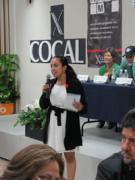
The neoliberal policies implemented since the 1980s in Mexico and around the world have worsened the conditions of academic workers, imposing labor flexibility and precariousness on most of the teachers in higher education. This new academic majority needs a political revival. The reorganization of this sector has become an urgent task for academics and their unions.
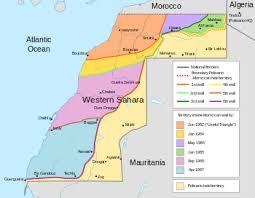
At the twenty-eighth Summit meeting of the African Union (AU) held in Addis Ababa on 30 January 2017, Morocco’s readmission to the continental body generated heated discussion. At the end of the day the Kingdom of Morocco managed to win over sufficient member states on its side and it was allowed to join the fold unconditionally.

Over the past couple of weeks, social media has filled up with breathless accounts of far right leaders having gotten their comeuppance by being physically assaulted or, in a recent case, murdered in an act of domestic violence.
Public education is truly at a crossroads in the US, as are both the American Federation of Teachers (AFT) and the National Education Association (NEA).

 Thousands of people showed up at town halls meetings across the United States in February to challenge Republican congressional representatives and senators on their plans for the Affordable Care Act (Obamacare) as well as on issues from immigration, to the environment, to President Donald Trump’s relations with Russia. While this past week fewer protestors took to the streets where radicals have generally taken the initiative and established the tone of the Resistance, town halls swelled with more moderate but quite militant crowds who challenged Republicans and their politics.

Protests against Trump continue even as new ones are being planned for the future, from the recent Not-My-President Day and Day without an Immigrant protests, to the International Women's Strike planned for March 8.
Thousands of protestors in New York, Chicago, Atlanta, Los Angeles, and some two dozen other cities marched on Monday, Feb. 20 in opposition to President Donald Trump and his policies on what is usually called “President’s Day” but on this occasion was marked by many as Not-My-President Day. On what was in the Midwest and the East a beautiful spring-like day—thanks to climate change—protestors marched to protest Trump’s environmental and immigration policies and just about everything else that the new president stands for.
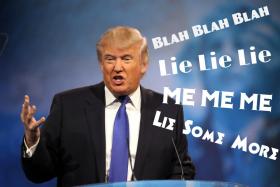 In the wake of the 2016 election, Oxford Dictionaries declared “post-truth” to be the 2016 international word of the year.[i] The viral spread of fake news stories (such as the infamous “Pizzagate”[ii] scandal alleging that Hillary Clinton’s campaign chair John Podesta secretly ran an illegal sex trafficking ring out of a Washington D.C. pizzeria) no doubt helped to install America’s lunatic POTUS and his clown car of white supremacist cabinet members into the Oval Office.

There is good news in the Boston Globe today for the managers, development directors, visionaries, political hacks and propaganda flacks who run “the Progressive Movement.” More easy-to-earn and easy-to-hide soft money, millions of dollars, will be flowing to them from super rich Democrats and business corporations. It will come clean, pressed and laundered through Organizing for Action, the latest incarnation of the Obama Money Machine which has recently morphed into a “nonpartisan non-profit corporation” that will ‘‘strengthen the progressive movement and train our next generation of leaders.’’

The author of The Price for Their Pound of Flesh is Daina Ramey Berry. Professor Berry is an associate professor of history and African and African diaspora studies and the George W. Littlefield Fellow in American History at the University of Texas at Austin. An award-winning historian, she is also a Distinguished Lecturer for the Organization of American Historians. Berry is a specialist in the history of gender and slavery in the United States with a particular emphasis on the social and economic history of the nineteenth century.
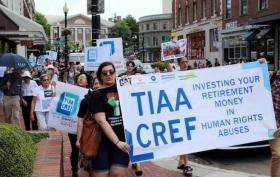
No one wants their retirement to be financed by companies involved in human rights violations and environmental destruction. But that is exactly what is happening to those of us with retirement funds invested in TIAA.
In this guest blog, Rick Baum, who teaches Political Science at City College of San Francisco and is a member of AFT 2121, reports on the struggle over accreditation and the continued attempts to destroy the institution.
- « Newer Posts
- 1
- …
- 132
- 133
- 134
- 135
- 136
- 137
- 138
- …
- 227
- Older Posts »