Place: North America
From teachers to transit workers, civil servants to electricians, the People’s Climate March will have more organized-labor participation than any environmentalist effort in U.S. history.
 Michael Brown, an unarmed African-American teenager, was shot dead by police in Ferguson, Missouri on August 9.

Today it often feels as though we are hopelessly mired in apocalyptic thinking, both in our social movements and in popular culture.
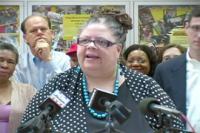
The likely candidacy of the president of the Chicago Teachers Union, which led one of the most important strikes in recent years in the USA, against the incumbent Democrat Rahm Emanuel, formerly the chief-of-staff of the White House and a champion of the privatization of the school system, is a major political event.
Review of
This is Not a Test: A New Narrative on Race, Class and Education
By José Luis Vilson
Haymarket Books, 2014
Badass Teachers Unite: Reflections on Education, History and Youth Activism
By Mark Naison
Haymarket Books, 2014
[We re-post here a statement by Howie Hawkins, Green Party candidate for Governor of New York.—eds.]
Staten Island, Syracuse, Ohio, and Ferguson. Garner, Grant, Crawford, and Brown. Add these locations and names to the long list of young black unarmed men (and women) who are racially profiled and injured or killed at the hands of Police Departments around the country. From every corner of the US there are daily reports of police brutality and misbehavior.
Another young black man has been shot and killed by the police in an American city. Michael Brown’s killing forms part of a national pattern that is a horror for the African American community, an outrage against humanity, and a disgrace to our country.
Review of Sons of Wichita: How the Koch Brothers Became America’s Most Powerful and Private Dynasty
By Daniel Schulman
Grand Central Publishing/Hachette Book Group, 2014
In the past few weeks, New Politics has published two valuable commentaries on the role of socialists and the Left in local electoral campaigns, first a broad overview by Dan La Botz and then a response by David Judd specifically on Dan Siegel’s campaign for Mayor of Oakland.
Only large-scale civil disobedience will make our leaders address economic injustice.
In 1989, Bob Dylan recorded a song titled “Everything Is Broken”. That song seemed to go largely ignored, perhaps because it seemed to be only a pessimistic lament that offered no suggestions for how to go about fixing the “everything”.
But as with many of his songs, it was prophetic. Lately, many Americans are experiencing the feeling that everything is broken, but people in many other countries have had this feeling for a long time.
In 1968, the Mannington Mine in Farmington WV owned by Consol Coal, caught fire, blew up, and 78 miners were buried, many likely alive.
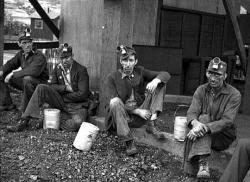
In 1972, a Consol mine in Blacksville, WV, caught fire and 9 miners were buried (again, likely alive) when Consol sealed the mine off to stop the fire and save the coal.
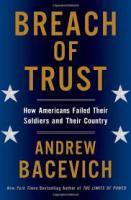 Review of Andrew J. Bacevich, Breach of Trust: How Americans Failed Their Soldiers and Their Country. New York, Metropolitan Books, 2013. 238 pages. Endnotes. Hardcover $26. Paperback $16. Kindle $11.04
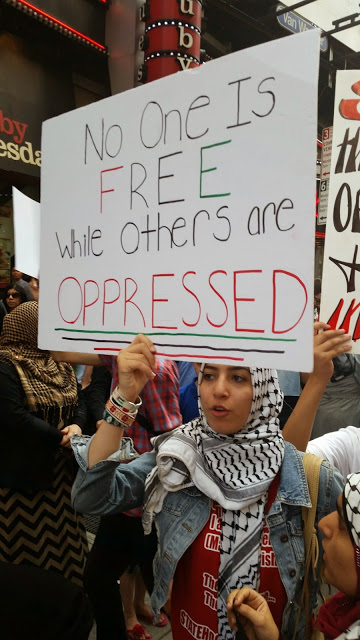 Last Thursday was a national day of protests in solidarity with the people of Gaza, with demonstrations being held across the United States, with follow-up events in many places. There was also a Friday demonstration in New York City that I attended.
Dan La Botz' article on the return of Left to electoral politics is generally insightful, and its survey of campaigns around the U.S. is a valuable contribution. However, the article's analysis of the Dan Siegel campaign for mayor of Oakland is off.
Both US teachers unions, the American Federation of Teachers (AFT) and the National Education Association (NEA), held their national conventions in July. For the first time in decades the conventions were marked by challenges to union leaders on educational policies, including union approval of the Common Core and union leader's unwillingness to take on the Obama administration and Arne Duncan, Secretary of Education.
The mainstream media was never true to its pretension of comforting the afflicted and afflicting the comfortable—which was Gilded Age humorist Finley Peter Dunne’s point—but there were exceptions, and exceptional practices. “Accountability reporting,” or investigative reporting, is one of them.
On February 7, 2014, I sat down with Adelina Nicholls, executive director of the Georgia Latino Alliance for Human Rights (GLAHR) in Atlanta, to talk about the organization’s history and achievements, as well as to reflect on the political role of Latino immigrants in the United States today.
Sit-ins at lunch counters by black students began in Greensboro, North Carolina, on February 1, 1960. Blacks had traditionally not been served there or anywhere in the South at that time. Within a week the sit-ins spread to Durham and Winston-Salem. Eleven of the first sit-ins were within 100 miles of Greensboro. After many arrests, and assaults by white hoodlums, on July 25 all Greensboro stores targeted by the sit-ins agreed to serve blacks on an equal basis.
The moral collapse of the Obama administration on so many fronts—Guantanamo, Palestine, drone warfare atrocities, mass electronic surveillance and brutal prosecution of whistleblowers, presidential-ordered assassinations, and so much more—has rightly drawn shock and outrage from the peace and global justice movements. Indeed, this presidency has been a civil and human rights travesty both domestically and globally. Alongside our horror, however, must be a clear material and political assessment of the underlying strategic purpose of this administration.
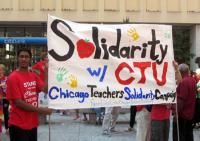 Across the United States, we are in the midst of a great struggle over the nation’s education system. On one side is a bipartisan effort to privatize schools and undermine the promise of public education. Opposing that effort are large numbers of parents and teachers.
The Affordable Care Act commentariat—including those confidently awaiting the day when all its promises are vindicated, those rooting for its ignominious demise, and those of us in a separate camp—have been kept occupied in recent months. Between autumn’s website drama and winter’s enrollment saga, the news cycle has been full of stories of IT dysfunctions tackled, right-wing challenges thwarted, enrollment goals met, electoral prospects threatened, and individuals newly insured (or variously dissatisfied).
- « Newer Posts
- 1
- …
- 49
- 50
- 51
- 52
- 53
- 54
- 55
- …
- 73
- Older Posts »