Blog

  • Reports on the Resistance: Tens of Thousands March for Science on Earth Day

    Image

    Tens of thousands, many of them scientists, joined the March for Science on Earth Day, April 22, in cities across the United States and around the world. There were some 400 marches in the US with crowds estimated at 20,000 in New York and Los Angeles, some 15,000 gathered on the Washington Mall, and 1,000 in Portland, Oregon. Other marches took place in hundreds of other cities around the world from London to Tokyo.

    ImageThe march was largely motivated by President Donald Trump’s proposed budget that would cut funding for many science programs, including the Environmental Protection Agency (EPA), which is being cut by 31 percent. Marchers in Washington carried signs reading, “Save the EPA.” and “Save the NIH” The NIH is the National Institutes of Health, which is also being cut by 18.3% or $5.8 billion. Other marchers in various cities carried signs reading, "There Is No Planet B," and "Make Science Great Again" among many others.



    Many marched for fact-based or evidence-based discussion and debate in society around questions such as global warming, as opposed to the explosion of fake news. Marching in San Diego, Solange Jacobs Randolph expressed he views of many across he country. “We can't have policy that's not based on facts. And we've got too much of that going on in America today, where our President, at the highest level, is not leading with fact-based evidence,” she said.

    In San Francisco one sign read, “Make America Smart Again!” Some marchers there modifying a classic chant shouted, “What do we want? Evidence-based science! When do we want it? After peer review!” Concern about climate change was high on the list of the marchers’ concerns, as were other environmental issues. Some marchers in Los Angeles carried signs that simply read: “Water.”

    The march was sponsored by a variety of scientific organizations, among them the American Association for the Advancement of Science, the American Geophysical Union, the American Chemical Society, and he Paleontology Society. Public health physicians, nurses, and other health workers participated in significant numbers. Many of the scientists marched with their families in spring rains on the East Coast.

    Originally organized through the social media site Reddit and then through a Facebook event site, within a week the supporters grew from 200 to 300,000. Popular educator Bill Nye “the science guy,” Mona Hanna-Attisha, pediatrician and the key whistleblower in the Flint Water Crisis, and Lydia Villa-Komaroff, a cellular biologist and among the first Mexican-American women in the United Sates to receive a doctorate in the sciences served as the public faces of the March.

    While not so central to the leadership of the March for Science as they have been in other protests, in several cities Democratic Party politicians spoke at the rallies. In Los Angeles, Democratic Congressman Brad Sherman told marchers there, “Not since Galileo was condemned by the Inquisition have science-deniers had such powerful friends.”

    In San Francisco, however, no politicians were permitted to speak. “Science is nonpartisan. That’s the reason that we respect it, because it aims to reduce bias. That’s why we have the scientific method. We felt very strongly that having politicians involved would skew that in some way,” Caroline Weinberg, a public health researcher and co-organizer of the march, said at the National Press Club earlier this month.


  • Reports on the Resistance: Tax Day Protests

    Image

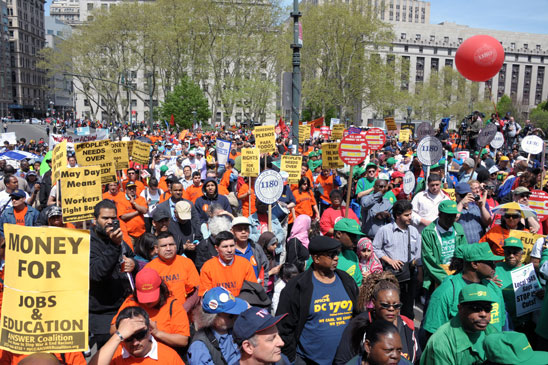
    Tens of thousands of Americans in some 200 cities and towns from New York to San Francisco participated in “Tax Day” marches on Saturday, April 15 to demand that President Donald Trump release information about his tax payments. Some protestors marched at the White House and others at the Trump mansion at Mar-a-Lago, Florida.

    Largely organized through Democratic Party groups like Indivisible, the Tax Day demonstrations were peaceful but spirited affairs. Protestors around the country chanted slogans such as “No more secrets, no more lies.” Many carried signs and banners reading “What are you hiding?” and “Show your taxes!” One sign read “King George didn’t listen to us either,” a reference to the taxation issues of the 1760s that led to the American Revolution of 1776.

    Thirty-foot inflatable chickens, symbolizing Trump’s fear of revealing his taxes, accompanied the marches in New York, Chicago, and San Francisco. In many cities people in Trump costumes with orange hair, mean and homely faces, and short fingers mingled with the crowd.

    Tax day actually falls on Tuesday, April 18, but demonstrators took advantage of the weekend and spring weather to pressure the president, who will be proposing a new tax code to the Congress, to come clean to the American taxpayers and reveal how much he pays. Billed as the largest demonstration since the women’s marches of January 21, the tax protests fell far short of that early massive outpouring.

    Image

    Though both Democratic and Republican legislators have urged him to do so, Trump has repeatedly refused to release his tax forms as other presidents have done, arguing that he cannot do so because the Internal Revenue Service is auditing his tax filing. When Democrats recently forced a roll call vote on in the House calling upon Trump to release his taxes, 229 Republicans voted against; that is, they supported the president in maintaining the secrecy of his tax payments.

    Protestors not only demanded that Trump release his tax forms but also to demand greater transparency and a more progressive tax system. Many other issues were raised on placards and from the rally platforms, such as immigrant rights, environmental justice, and the need for single-payer health care.

    Democrats of the progressive variety, such as Maxine Waters of California and Jan Schakowsky of Illinois and others, played prominent roles as speakers at rallies. Speaking at a rally Senator Ron Wyden of Oregon, the leading Democrats on the Senate Finance Committee, told the crowd, “It’s time to knock off the tax rip offs. No more Cayman Island accounts for the insiders. No more tax breaks for shipping jobs overseas. No more special breaks for Wall Street.”

  • IVAW Statement on Syria Strikes

    Image

    Iraq Veterans Against the War (IVAW) condemns in no uncertain terms the bombing of Sharyat airbase in Syria six days ago by Donald Trump’s administration. As veterans of the unending and expanding wars conducted over the last 16 years, we know intimately that U.S. military intervention exacerbates and further militarizes conflicts overseas and that the people who pay the greatest price are the everyday people of occupied nations. We also know that this is not the first time our military has been used in the Syrian conflict. U.S. bombs have been dropped on Syria under both the Trump and Obama administrations, resulting in more than a thousand civilian deaths.

    As we oppose the long history of U.S. intervention and destabilization in Syria and in the region, we also acknowledge and oppose the many actors causing death and devastation to the people of Syria. Bashar Al-Assad has responded brutally to a popular, non-violent uprising for democracy and freedom which emerged in 2011 and in the years since has descended into civil war. The government has used barrel bombing campaigns, tactics designed to create famine, “disappeared” lead dissidents and voices of opposition, and tortured. In addition to the U.S., foreign nations including Russia, Israel, Saudi Arabia, Iran, Qatar, and Turkey have utilized Syria as a battleground for their proxy wars, further entrenching the violence. We know that without self determination, including an end to all foreign intervention, the Syrian people can’t truly be free.

    We also know that the Trump administration, following the pattern of administrations before it, is deeply intertwined with the military-industrial complex and seeks to increase mutual profit through expanding U.S. wars. This is reflected in the erratic and dangerous foreign policy that the Trump administration is engaged in, as well as the astronomical proposed increase of the U.S. military budget by $54 billion. We see global arms dealers, weapons manufacturers, and defense contractors as beneficiaries of the violence in Syria who stand to turn a profit with each new strike and each successive deployment.

    We call for a stop to all U.S. military actions in Syria, including the removal of all U.S. troops and bases in the country. These cruise missile strikes were launched without consultation with Congress nor with the United Nations Security Council. They continue a series of dangerous precedents that justify military force “as humanitarian” in nature and expand executive power at the expense of democratic oversight. Time and time again, this drive towards war-making has served to create the conditions for further destabilization, displacement, and civilian casualties that have devastating consequences locally, regionally, and in this case globally as we have seen in recent days with the building tensions between North Korea and the United States.

    As the Trump administration claims that its strikes on Syria are for humanitarian reasons, its policies at home and abroad instead demonstrate their strategy in mobilizing war, Islamophobia, and anti-immigrant sentiment as a means of leveraging fear and consolidating power. Just as we have challenged the so-called “War on Terror” and this most recent military strike, we continue to challenge Islamophobia and the “Muslim ban” at home. If the Trump administration wants to be humanitarian, it can begin to address the crises it has inherited by ending its policy of denying immigration from majority Muslim countries and accepting Syrian refugees in significant numbers to the United States.

    We call for an independent investigation by U.N. arms inspectors into the recent release of chemical weapons on a civilian population, and for an internationally led effort to broker a cessation of violence in Syria. From the hundreds of civilians killed in Mosul last week to the ongoing attacks on Yemen, U.S. military operations continue to worsen political instability and erode people’s chances for survival. We call for accountability for the war crimes that the U.S. has committed in Iraq, Yemen, Afghanistan, Pakistan, Somalia, and countless other countries since the beginning of the so-called “War on Terror.”

    As we recognize that U.S. foreign policy primarily relies on war and war profiteering, we also recognize the danger in failing to acknowledge that the people and countries it targets are distinct from each other. When it comes to local needs, demands, and accountability moving forward, we aspire to follow the lead of the people directly impacted by these wars.

    Originally posted here

  • The Imperialist Logic Behind Trump's Attack on Syria

    Image

    Within a few days in April, the Trump administration pivoted away from its nearly open support for the Assad regime to a military attack on it. This was followed by harsh language against Russia, the setting off of a huge bomb in Afghanistan, and the dispatch of an aircraft carrier armed with nuclear weapons toward North Korea.

    What is behind this apparent pivot away from Assad and Russia?  What has really changed in terms of the logic of US imperialism since the November election and especially since the attack on Syria?

    Let us first look at the facts, in chronological order. In late March and early April, highly placed US figures, including Secretary of State Rex Tillerson, stated publicly that the Assad regime was a reality on the ground. He and others implied that the US would no longer oppose the murderous Assad, but seek to work with him against ISIS.  This, after all, had been Trump’s position during the campaign and since.

    On April 4, possibly feeling he had received a green light to do so from the US, Assad’s planes dropped what most observers have concluded were chemical weapons on the town of Khan Shekhoun, Idlib Province, in a rebel-held area, killing over 70 people. This attack was videoed and broadcast by local witnesses.  Trump immediately started shedding crocodile tears over the innocent victims, including babies.  (He said nothing about Assad’s nearly 500,000 other victims.) Within less than 48 hours, Trump launched a missile attack on the Syrian airbase from which the planes had taken off, destroying some structures on the ground but leaving both the runways intact and warning the Russians (and thus their allies the Syrians) to get their aircraft and personnel out of the way ahead of time. Trump gave the final order for the attack while meeting with Chinese Communist Party Chairman Xi Jinping, just as he had launched his travel ban on Muslims during a visit by British Prime Minister Theresa May.  Both of these diplomatic gaffes may simply show the arrogant unilateralism of the Trump administration.

    In the week that followed the attack on the airbase, the Trump administration attacked both Syria and Russia verbally, saying that they would not permit chemical weapons to be used again, and blaming Russia for not having stopped the chemical attack.  Suddenly, administration spokespersons also announced that Assad should step down.  In the same days, a US aircraft carrier was dispatched toward North Korea and a huge “conventional” bomb was dropped on Afghanistan targeting ISIS.

    Why did Assad launch the chemical weapons attack, in violation of international law and of his own agreement of 2013, guaranteed by Russia and the United Nations, to give up all his chemical weapons?  Here, the Trump administration bears a lot of responsibility, for having given him what he apparently thought was a green light for such an attack.  Also, Assad may have thought that such an exercise in impunity would demoralize the opposition further in the wake of his recent military victories in Aleppo.

    For its part, the Trump administration may have launched its attack because it was embarrassed by the use of chemical weapons on its watch, as an offense to what imperialist logic considers to be the maintenance of order and stability.  In the kind of logic the US regularly uses with regard to bloodthirsty dictators, its attack and the explanation for it told Syria that it could not use chemical weapons, but said nothing about dropping barrel bombs, torture, mass rape, and other ongoing war crimes against the Syrian people.  Nor did Trump’s supposed sympathy for dying babies extend to the numerous Syrian babies trying to enter the US as refugees, as he continues to try to implement his travel ban on entry from a number of Muslim countries.  Trump may also have wanted to divert attention from the investigations of his campaign for ties to Russian intelligence services.

    What, if anything has changed since the US election in November — and in the past week — with respect to relations among the US, Russia, and Syria?

    Overall, it is unclear if anything fundamental has actually changed with regard to the US and the Middle East since Trump’s election, certainly with regard to Syria.  Ever since 2013, the US has been signaling that it wants to leave the Syrian regime in place, while also saying publicly that it wants Assad to step down.  Under Obama, the US kept criticizing Russia and Iran for propping him up. Since 2013, the US under Obama has also said that targeting the horrific, reactionary fundamentalists of ISIS is its main aim, not opposing Assad.  Trump had been saying more or less the same thing, but one major difference: refraining from calling upon Assad to step down, or from criticizing Russia.  This past week, however, Trump suddenly said Assad should step down, after having launched his telegenic but merely symbolic attack on Syria.

    Meanwhile, the US continues to aid Saudi Arabia in its brutal air campaign against the people of Yemen, something begun under Obama that almost never comes up in the corporate media.  Under Trump, the US has also minimized even further than usual any criticism of Israel’s settlements and occupation of Palestinian land, and said nothing as Israeli policy makers hint another war on Gaza may occur sooner rather than later.  Trump has also carried somewhat further Obama’s eventual embrace of dictators like General Al-Sisi in Egypt, as the Arab revolutions have moved from ascendancy to defeat.  Once again, these “order-mongering powers,” as Marx liked to say, tend to prefer stability, even that of the graveyard, so long as capital accumulation can continue.

    The Trump administration has also used bellicose language toward Iran, falsely calling it the biggest supporter of terrorism. In addition to Trump himself, this attitude is shared by the supposedly more mainstream military leaders with whom he has peopled his national security apparatus, an attitude also shared by the Republican Party as a whole and by Israel.  (On Iran, there is no daylight between white nationalists and neofascists in the White House like Steve Bannon and mainstream Republicans.) In apparent response to the Trump administration’s public threats, Iran’s most reactionary politician, Mahmoud Ahmadinejad, reared his head in April, announcing that he might run for president next year.  Whether anything will come of Trump’s military threats against Iran, or of his attacks on the Iran-US-UN nuclear agreement, remains to be seen. But inside Iran, Ahmadinejad’s reappearance suggests that Trump has already given ammunition to some of Iran’s most reactionary elements.  Thus, Iran policy is one area where Trump, at least so far, has adopted a stance somewhat different from that of the Obama administration, but this is nothing new for the US Republican Party itself.  Whether this is all bluster toward Iran, or a real danger of war, is something that remains to be seen.

    But the wild rhetoric of Trump and others in his administration, plus his having placed generals rather than diplomats in so many high positions, creates dangers of miscalculation, or worse, in a world where nuclear weapons abound.  Nowhere is this more the case than in the Middle East and the Korean peninsula.

    As we protest Trump’s war moves abroad and war on the American people at home, we cannot turn our backs upon the suffering in places like Iran or Syria at the hands of regimes that the US is targeting.  In this sense, it was an outrage that at some of the demonstrations against Trump’s attack on Syria, leading participants carried pro-Assad banners. We need to acknowledge that noxious ideological pollution is emanating not only from the Trump administration, but also from some parts of the Left who are willing to give anyone — Assad, Putin, Kim Jong-il, Khamenei — a pass, so long as they oppose US imperialism, or appear to do so. Otherwise the humanist content of our revolutionary opposition to Trump will be endangered.

    Originally posted here

  • A Teacher Who's Dangerous – To Chicago's Power Elite

    ImageDuring the Chicago Public Schools (CPS) spring break, Sarah Chambers, beloved to her special needs students, well-known (to staff and parents of her school), notorious (to CPS labor relations officials), received a letter saying she was suspended and had to stay away from the school.  Though Sarah was an early member of the Caucus of Rank and File Educators (CORE) that is now the CTU’s elected leadership,  she remained a teacher of special needs kids who represents her school in the House of Delegates and serves on the union’s Executive Board.

    CPS has concocted a rationale for Sarah’s firing based on her outspoken criticism of harm done to special needs students by the standardized testing that is rampant in US schools, indeed worldwide.  It’s revealing that CPS didn’t bother noting this or any other justification for Sarah’s suspension in the letter it sent to her.  My hunch is CPS is still searching for or embroidering evidence because an activist as experienced as Sarah knows how to push on policies without violating them. That’s Union Organizing 101 – and Sarah could teach the course.  Any teacher activist as passionate about her teaching and students as Sarah knows how to make sure she doesn’t jeopardize her continued ability to be an advocate. We can be sure the charges CPS produces will be bogus.     

    But why pick on Sarah? The national context for Sarah’s  suspension is the witch hunt  against teachers  who stand up for kids’ rights and the dignity of the profession.  In Chicago the witch hunt has extended to principals, shown in the firing of Troy LaRaviere, who led the #1 rated school in the city. This past year CPS has taken advantage of the understandable demoralization teachers feel at having been forced to swallow loss of pay for “furlough” days while fighting attacks on their pensions. 

    With an alliance of community partners, CTU is fighting for an elected school board, but until that legislative fight is won, the school system is controlled by Mayor Emanuel.  Along with the political machine, he and the business elite who are used to running the city threaten to shut the schools three weeks early because they have no money handy to keep them open.  CTU has responded with the possibility of strike action May 1.

    Sarah has been suspended to frighten and intimidate CTU members. CPS is sending a message that if Sarah’s not safe, no one is.  It’s an old ploy, which is why unions fought long and hard for protections in labor law against retaliation for union activity.  Both unions and employers know this  intimidation constitutes  an unfair labor practice but employers hope that by the time they lose the legal battle, they will have crushed the union.

    The stakes are very high in the struggle to protect Sarah, not only for Chicago kids and teachers, but also for public education and democracy.  CTU’s militancy and commitment to social justice has inspired teachers and education activists world-wide. Teachers unions are often the best organized force defending public schools against privatization and policies that aim to  turn classrooms into factories producing compliant workers.  CPS and Emanuel  feel emboldened now by Trump’s election and Illinois Governor Rauner’s explicit attacks on public employee unions.

    You wouldn’t guess it from looking at her, but Sarah is very dangerous. She’s a smart, dedicated activist speaking truth to powerful forces who want to crush the CTU so as to control Chicago’s politics and the destiny of  mostly poor and working class kids of color, whom it considers disposable. If you’re a parent, defending Sarah matters because you want a teacher like Sarah to let you know when your kids are being hurt. If you’re a teacher anywhere, this is your battle because if a school board and mayor can fire Sarah, you’re not safe either – no matter how good you are or how tightly you close your classroom door. If you believe in democracy and public education, you should express your support for Sarah because if Emanuel and CPS can intimidate Chicago teachers, elites all over will try to do the same in your community, state, province, and country.

    A petition in support of Sarah is being circulated.  I urge you: sign it, pronto.  As I’m confident CORE and the CTU leadership will explain to members, defending Sarah isn’t just about CPS. It’s about the future of the teaching profession, unionism, and public education in the age of Trump.

    Lois Weiner is a professor of education at New Jersey City University, where she directs the Urban Education and Teacher Unionism Policy Project.  You can follow her on Twitter and  Facebook and read her blog at New Politics.

  • Building the Infrastructure for a Strong Left

    Image

    Alex Kolokotronis is a 1st year PhD student in Political Science at Yale. He self-identifies as a libertarian socialist and is interested in studying anarchist movements, post-state forms of governance and public power, and associationist self-managed socialism. He is the co-founder of Student Organization for Democratic Alternatives (SODA), a group dedicated to implementing participatory budgeting and participatory democracy at the university level. Participatory budgeting is a directly democratic process by which ordinary people get to deliberate and decide how to allocate a designated budget. He previously worked in Worker Cooperative Development with Make the Road New York and the New York City Network of Worker Cooperatives.

    Interview by Sean Keith

    In the following interview, Alex and I talk about building the infrastructure needed for a new Left political party, how the Left relates to participatory budgeting and workers cooperatives, how leftists should balance using different tactics to pursue their goals, and the details regarding the Democracy at Work organization he recently founded in New Haven, Connecticut.

    Sean Keith: ​In the Jacobin piece entitled “A Blueprint for a New Party,” Seth Ackerman discusses the possibility of creating a new party by (ironically enough) exploiting some of the loopholes of Citizens United and establishing a 501(c)4, a non-profit, tax-deductible, social welfare organization that can freely engage in political activity. This 501(c)4 could receive unlimited amounts of money and spend unlimited amounts of money on sponsoring candidates.

    These candidates would not be bogged down by arcane ballot rules and instead would run without regard to label and adapt to local circumstances (some cases Green, some cases Dem, some cases Independent, etc). At the end of the article, Ackerman acknowledges that filling out the paperwork is not enough  rather, a large chunk of the labor movement would have to get behind it, or some sort of organizational base.

    How can we build this organizational base to facilitate this new party? Does it just have to be through labor unions and labor participation? Could you see the organizational base stemming from workers cooperatives and participatory budgeting councils (what you call in one of your blog pieces “autonomous-participatory organization”)?

    Alex Kolokotronis:​ Honestly, I think talk of a new party in the immediate term is at best overstated, and at worst a diversion from what must really be built: an infrastructure for and of the Left. A new party is not that infrastructure. Also, I should be clear about what I mean when I say infrastructure. I mean a collection of people, spaces, and mechanisms that something like a party – but of course not necessarily a party – could draw upon to maintain and enhance its capabilities and strength.

    The one place where this infrastructure can and should be built is on college campuses. For one, college campuses are not as exclusionary as they once were. Or, at least, the claim has become stronger that everyone should have an opportunity for post-secondary education. More widely, we might say there should be a general focus on youth organization. The Right has been very good at this, and its importance is stressed in the very influential Powell Memo.

    Second, there is largely a vacuum in Left organization on college campuses. The assertion that there is a vacuum is counter-intuitive, as many consider colleges and universities to be hotbeds of left-liberal and socialist ideas. Yet, what’s notably lacking is a strong national-level student organization that does more than simply debate left-liberal and socialist ideas, but acts on them. There are small examples of student organization that try to do this, but, again, at thenational-scale it is lacking. 

    Student activism typically ranges from identity politics groups, to those that behave as quasi-think tanks or lobbyists. Student activism generally lacks a program for the site of the campus. This is not to erase the efforts and successes of hard-fought divestment campaigns. Yet such campaigns aim more at how universities relate to other institutions, and are coalitional at the national-level.

    All of these things are important, but to galvanize those who have recently become politicized, a concerted effort to establish mass student organization is needed – and one that actually teaches and trains its members through the pursuit and implementation of policies it advocates for.

    This is where I think participatory budgeting and worker cooperatives come into play. One thing I learned from the Student Organization for Democratic Alternatives (SODA) campaign for participatory budgeting in the City University of New York (CUNY) is that striving to implement participatory democracy also generates a collective and individual imperative for members to learn skills in rule-making, budgeting, facilitation and more, to actually make it happen. By altering intra-campus relations, students and their allies come to craft institutions that are relatively horizontal, and actively serve as a model for generalizing and scaling up participatory processes.

    In advocating for and implementing participatory budgeting, students create an institution that concurrently provides them with skills that they will take into other arenas. This is why I believe student and youth organization can serve as a source of social power for the Left. The campus can provide space for the Left, and initiatives like participatory budgeting can simultaneously introduce ideas of participatory democracy, as well as the skills and dispositions needed to make it happen. If a student organization with national reach were to adopt such an approach, then we could see a whole generation of activists trained in a type of institution-building that carries over into labor unions, public policy, academic research, and business development (like worker cooperatives or multi-stakeholder cooperatives). In other words, a type of institution-building that centers the experiences of working class and marginalized people, and in such a way that provides mechanisms for the popular classes to exercise direct power.

    Participatory budgeting and worker cooperatives are not only intrinsically valuable, but are strategic inasmuch as they do what I outlined above. Furthermore, participatory budgeting and worker cooperatives have become more of a focal point of advocacy for coalitions and groups like Movement for Black Lives, Cooperation Jackson, Malcolm X Grassroots Movement, various immigrant rights organizations in New York City and the Bay Area, and other groups that often organize along the lines of identity.

    The value of this can’t be understated. In cities like New York City that have implemented participatory budgeting, one thing thing that has been a barrier is an available pool of talent that could increase the number of neighborhood assemblies, that ensure power in participatory budgeting is further diffused from the City Council and city agencies, and that allow the process to be scaled from something last year’s expenditure of $36 million to a future in which it is something like $3.6 billion of the municipal budget. These things take capacity, and such capacity can be built on campuses with a willing youth.

    SK: Why do you think that many on the Left deride participatory budgeting and the workers cooperative movement as worthwhile endeavors? (David Harvey is scoffed at by many over at Jacobin, for example.) Are there dangers of a Left that pontificates about political visions without first focusing on building an organizational base?

    AK: ​For our purposes here, I would say there are two critiques of participatory budgeting and worker cooperatives that have one overarching theme: they – and other solidarity economy institutions – are a distraction.

    The first critique is that these institutions are not a means by which to create class consciousness.

    Some Marxists, for example, view worker cooperatives as economic units that – within capitalism – can only promote “petty bourgeois” dispositions. Second, some see participatory budgeting as an outright failure to create popular power.

    What has been a failure is for the Left to take charge of the design of participatory process to ensure that the popular classes are able to exercise direct power, and that such processes are not just a rubber stamp on elitist policies.

    The failure is not to take existing discourses, institutions, and tendencies, and radicalize them. Participatory budgeting and worker cooperative development are part of such a set. The danger here is that the Left sets itself to action without being in dialogue with people about a different vision of polity and power, and as such quickly loses any legitimacy in being capable of providing an alternative. Many like to talk of alternatives but do not engage in the work of learning about what those may be, implementing them, adapting them, and radicalizing them. Now, more than ever, people are looking for alternatives. We need to be clear about what those are.

    SK​: My vision for the new American Left in the Age of Trump is a broad, big tent committed to a democratic vision of socialism and willing to use a variety of tactics to get there (it would range from social democrats on the "Right" to anarchists and communists on the Left  I think DSA could serve as a forum for this and replicate the best features of the old Socialist Party before the party’s right-wing driven, sectarian implosion, but that is a longer discussion for another time.)

    How do you see participatory budgeting and workers cooperatives existing alongside other tactics like running local candidates? How do we strike a proper balance between using different tactics (organizational base first then elections, elections then organizational base, etc.)? Can they exist symbiotically?

    AK: ​This is very case-by-case. I think a big key is going to those associational, intermediary, and interstitial spaces – whether these are governmental or not. On the governmental end, in New York City, we have Community Boards, and in New Haven we have Management Teams. Leftists should go to spaces like these, at least initially, to understand what the basic needs of the community are. If they can convert these ostensibly neighborhood institutions, great. If not, there will still be an understanding of what needs any organization will have to respond to, whether it is currently being responded to, and which issues can serve as a basis for membership recruitment while tailoring such to goals of implementing participatory democracy.

    On the more non-governmental end, we might look to Brooklyn, NY. There a tutoring worker cooperative called Sunset Scholars was developed by Center for Family Life (CFL). Through its other services in the community of Sunset Park, CFL recognized that Chinese and Latinx youth needed to be provided with more effective learning opportunities to increase high school graduation rates.

    To bring the question back, organizations like DSA must come to understand the very particular needs of respective communities, and put forward “democratic socialist” solutions to those needs. Such solutions can be crafted through active multi-channel community input and advocated for. In those cases where advocacy, demonstrations, and lobbying are not enough – or even when they are enough, and so legitimacy has been gained – this can be leveraged to run for office on a platform of wider and more diverse forms of participatory democracy.

    SK: Can you talk a bit about your recently formed Democracy at Work – New Haven organization? What is its overall vision and goal?

    AK: ​For a while I have talked with friends in the worker cooperative movement about the need for some sort of popular platform or organization to allow people to advocate for economic self-management. It appears that Democracy at Work can serve as such, and founder Richard Wolff was himself one of the first ways I was introduced to worker cooperatives.

    I think the key for advocates is not to rush out and try to create start-up worker cooperatives, and this is something myself and others want to emphasize with the New Haven chapter of Democracy at Work. Having done it in the past, I can say that startups are very time-consuming and labor intensive for the cooperative developer. Our energy is more wisely spent on creating mechanisms by which to convert existing businesses into worker cooperatives. Thousands of baby boomer small business owners are retiring, and many have no one to pass their business onto. This is an opportunity for advocates to step in and say, “Hey, why don’t you give or sell your business to the workers?” There are many appeals that can be made from just a business or community perspective, such as tax incentives in the former, and maintaining the integrity of business and the community for the latter. Converting existing healthy businesses with already trained workers is a way to quickly increase the number of worker cooperatives in the United States, without burning people out.

    SK: ​Thank you, Alex. This was much appreciated.

    To learn more about Alex’s academic and political interests and endeavors, see here. And to learn more specifically about Student Organization for Democratic Alternatives, see this Nationpiece on Building Student Power Through Participatory Budgeting.

  • No to Assad’s Brutality, No to Isis, No to U.S. and Russian Bombing and Military Forces in Syria, For a Revival of the Arab Spring

    ImageWe are horrified by the relentless, cruel attacks of the Assad regime, aided by Moscow and Tehran, on the Syrian people. For sheer brutality the butchers in Damascus have few equals in the world today. But we also wholeheartedly condemn U.S. bombing and military forces in Syria, which will kill innocent people and contribute nothing towards a just solution to the Syrian conflict, while at the same time serving to deepen the reactionary U.S. military presence in the Middle East and reinforce Assad’s rhetorical claim that he is defending the Syrian people against Western imperialism, hollow though that claim may be.

          Assad claims to be the only force standing between “stability” and the victory of ISIS, but this ignores the fact that authoritarian, repressive regimes like those in Iraq, Saudi Arabia, Bahrain and Syria are highly effective recruiting agents for ISIS and similar jihadis. The other major recruiters for religious extremists and terrorists in the Middle East are the United States and its allies, with their bloody history of intervention and, in the case of the U.S., virtually carte blanche support for Israel. And while President Trump’s missile attack on the Syrian Shayrat airbase may have been limited, such bombing has its own logic, dangerously putting U.S. imperial prestige on the line and thus potentially triggering escalating attacks and counterattacks.
     
          We are witnessing a set of deadly symbioses in Syria: Assad and ISIS use one another as justification for their own savageries, while the United States and its allies on the one hand, and Russia and Iran on the other, point to the very real crimes of one another to excuse interventions which in no way protect or defend the Syrian people, but rather serve their imperial (or in the case of Iran, sub-imperial) interests in the region.
     
          The war in Syria cannot be understood apart from the broader political landscape in the Middle East. The popular revolutionary uprisings of the Arab Spring, from Tunisia, Egypt and Bahrain to Syria, Libya and Yemen, offered a glimpse of a democratic and just future for the peoples of the region. For now, they have been thwarted, and in most cases, apparently crushed by a combination of domestic reactionary forces and the support of their foreign patrons. 

          However, the resistance in Syria has proven amazingly resilient: as recently as March of last year courageous street protests under the slogan “The Revolution Continues” erupted in Syrian cities during the brief cessation of hostilities. As reported in The New StatesmanWhen fighters from Jabhat al-Nusra tried to storm one of these demonstrations in the town of Maarat al-Numan, the protesters drowned them out by chanting, ‘One! One! One! The Syrian people are one!’ This is a maxim from the incipient, secular phases of the uprising, in which Syrians struggled to stem the tide of rising sectarian and ethnic tension injected by the jihadists’ engagement in the conflict.” (1)
     
          It is truly a time of colossal, obscene double standards. 
     
          We see Donald Trump, along with most of the mainstream media and leading Republican and Democratic Party politicians, hypocritically deploring the massacre of innocent men, women and babies in Syria — while they remain coldly indifferent to the massacres and loss of human life at the hands of the U.S. and the forces it supports in Mosul and Yemen. And meanwhile desperate refugees from Syria's carnage are cruelly turned away from U.S. borders. 
     
          We also see Donald Trump welcoming Egyptian President Abdel Fattah el-Sisi, while brazenly dismissing any human rights concerns and continuing Obama’s policy of generous military aid, despite Sisi’s horrific record of murdering and imprisoning thousands of his opponents. It is safe to predict, moreover, that if and when the Islamic State gains more and more supporters in Egypt in response to Sisi’s dictatorial rule, we will hear a chorus of apologists saying that unsavory as he may be, Sisi as a secularist leader is better than the barbaric jihadis, has significant popular support, and therefore has to be supported.
     
          Meanwhile, Vladimir Putin, the Russian government and its news agency RT deplore the heartrending destruction of neighborhoods and deaths of civilians in Mosul and Yemen and decry the callousness of the U.S. military — while justifying Assad’s attacks on the people of Aleppo and across Syria. In fact, Russian military involvement, including aerial support for attacks on civilian and military opponents of the regime, has actually played a significant, likely critical, role in keeping Assad’s regime in power. 
     
          We completely reject these grotesque alternatives. We urgently hope for a revival of the movements and the spirit of the Arab Spring, which offer the only possibility of breaking out of the death spiral of Middle Eastern politics. Many will dismiss this perspective as impractical, but what is truly impractical is the idea that the great powers, each with its own imperial agenda, will bring justice or democracy. If, against enormous odds, democratic forces are able to wrest an agreement that protects them from continuing slaughter by Assad and ISIS and leaves them in a position to struggle and fight again another day, then their decision to accept such a limited agreement should be respected. But even such an agreement will only be won as a result of pressure from the Syrian people, not through the initiative of outside powers who, despite their differences and rivalries, share a deep hostility to a resurgence of autonomous popular forces in Syria or anywhere else.
     
          Democratic popular forces may be weak today, but our only principled and practical course is to declare our solidarity with their struggles, try to strengthen them, and oppose all those who attempt to subvert and destroy them.


    (1) The 2016 demonstration in Maarat al-Numan is described in this New Statesman article. Protests in other Syrian cities are described in these articles: here, here, and here
     

    This Statement of the Campaign for Peace and Democracy was originally posted on the CPD website, April 8, 2017.
     

  • Strategic Thinking and Organizing Resistance

    Image

    The first few weeks of Donald Trump’s presidency has seen an amazing explosion of mobilizing to oppose him and his administration on oh-so-many levels.  And that has been heartening.

    But it is not enough.

    The fact is, as things now stand, Trump and his minions can outlast us.  And even if we get Trump out of there—which I think is an impossible dream with the Republicans holding both the Senate and House, unless he leaves on his own—we will still have to deal with Mike Pence who, as an ideologue, is arguably even more dangerous than the opportunistic Donald.

    In other words, even with this incredible mobilization, it will be extremely difficult to stop them if they really want to do something, and if they come up with a coherent plan to implement it.  They have the institutional power to push things through, no matter how much we scream and shout.

    And, to be honest, part of me actually thinks they may be consciously screwing up, so as to get us mad, in the streets, just to exhaust us so we’re tired, worn-out, and can’t mobilize again to stop them when we really need to do so.  (I haven’t seen that they’re this together, but we have to consider the possibility.)

    It’s time that we take a few minutes to think about how we want to proceed, because there is no way that I can see us sustaining this level of mobilization.  We have to think strategically about what we want to do.

    What I propose herein is not some “final” plan or something like that, but I advance it to get others to think about what is being proposed, appreciating what makes sense and rejecting what does not, and to advance our thinking further:  I see this as a collective project moving forward.

    TWO ARENAS OF ACTIVISM

    We need to recognize that there are two arenas of activism:  movement politics and electoral politics.  Now, I’m not going to focus on movement politics right now, but want to write about ideas on proceeding in the electoral politics arena.  (There will be ideas helpful to movement folks, so keep reading, but the emphasis here is on electoral politics.)

    Right now, there is tremendous irritation/anger, whatever, among folks who believe in the electoral realm:  Hillary folks blame Bernie for her loss, and Bernie folks blame the DNC for the Dem’s loss.  We can fight this out til hell freezes over—and undoubtedly some will—but the rest of us need to shut up and realize that, for whatever reason, rightly or wrongly, the Dems lost and we have to deal with Trump and his gang for the next four or more years.

    I haven’t seen anyone say how we do this.  The one thing I know for certain is that we cannot count on the Dems to save us:  despite what Move On, Progressive Democrats, Bold Democrats, Our Revolution or anyone else says—and while I appreciate each of these groups’ efforts to put some spine into the Dems—nonetheless, we cannot count on the Dems to address the problems of the people of the country.  Period.  The fact is, while there are a few good Democrats in office, many of the Dems are just as slimy, self-serving, backhanded, and pro-corporate, pro-capitalist and pro-US Empire as most, if not all, Republicans.  And that’s one part of the reality that we must face.

    And the really bad news is that we must enter the electoral arena so that when we get the chance, we can institutionalize the gains that movement folks drive.  (I can understand why it wasn’t done at the time, but failing to institutionalize our movement gains in the 1960s-70s, is why we have to deal with this shit 40-years on.)

    PROGRESSIVE ELECTORAL POLITICS

    So, how to proceed?  First of all, most of us recognize—to one extent or the other—that liberal capitalist politics is not sufficient to meet the needs of our people.  We have to create a viable alternative politics, whether it is called “socialism,” “ecosocialism” or something else.  (This needs to be addressed, but I’m going to leave it for now.)

    First of all, and most importantly, we’re going to have to organize state-by-state.  Electoral power is based at the state level in this country, and without establishing a firm foundation in every state that we can, we will fail at a national level.  Let’s say the Green Party won the presidency:  great!  But then what?  Because they—or no other left “party”—do not have a solid foundation, they would be turned out of power quicker than Trump.  We have to understand this down to our bones:  we must build a solid foundation before trying to build a national “house” to sit on that foundation.

    If that point is accepted, then the question that demands an answer is:  how do we do it?

    Here’s where we need to think strategically.  We have to take an honest look at where the Dems are stronger and weaker.  I’m not an electoral person, so those more experienced will have to help, but my years of organizing experience tell me that we can divide the states up into three, uneven categories:  (1) states where the Dems are well-organized and generally progressive; (2) where they are not well-organized, albeit generally progressive; and (3) where they are not well-organized and not generally progressive.

    I would argue that we need to approach these categories differentially.  In those category 1 states, leftists should organize and try to push the Dems to be even more progressive, but that we don’t see them as the enemy, and we don’t put too much effort toward organizing a left party, at least for now.  In category 2 states, we intervene when possible to support progressive candidates and processes, and to organize to help them get their act together, but that we start building our left formations so that we can ultimately win; in the meantime, we provide a threat to the Dems, hopefully providing some backbone to them.  And in category 3 states, we ignore the Dems, and have electoral folks make creating a left-focused party a priority.

    Now, in the #3 states, that’s where people and resources are probably the most limited—and that’s where we have to generate national-level support for them.   That doesn’t mean going to that state with the idea that everything is screwed up, that people don’t know anything (and certainly not that outsiders have all the answers!), and that outsiders are going to “save” those people.  It means we need to seek out good people, especially those who are experienced and well-rooted—and they are almost always there, even if outsiders can’t easily find them—and ask them what their situations are, and ask what can we do from outside that could help them?  Do they need training, education, or money (or what?) to help them build an organization in their state?

    Once we find out what they need, we need to organize in our home areas to support them.  Again, I’m not a strong electoral person, but I’d say California is a #1 state, and that the Dems are too strong (and generally too progressive) to make a priority to challenge.  Obviously, activists would have to fight local battles, etc., as they come up, but what if they agreed to support organizing in South Dakota, Indiana, Alabama, or some other state in the #3 category?  If we got the resources to good people in these states, I would guess that there could be a lot more done that matters than fighting the Dems in California, at least for the foreseeable future.  Does this make sense?  I think we need to “pair-up” between states, with the stronger locations supporting those in the less organized areas.  And we have to build electoral organizations in every one of the states where the Dems are non-existent or totally useless.

    Now, is this an argument for the Green Party or any other existent party?  Certainly not intentionally.  I’m arguing that we need to basically forget a national party at this time, and to focus state-by-state.  We need to encourage people to start a progressive electoral party in each state that fights for life-enhancing projects and candidates to concretely address issues and social problems that are harming people, and to try to improve things.  Now, the situation facing people in each state are different, so we must organize to address those problems in those states.  I personally think we should name our parties after our various states; say the Progressive Party of Indiana, of Alabama, etc.  I don’t think we should prioritize any particular issue or cause in the name—things will change over time, and that could be disastrous when that happens.

    One thing that doesn’t really fit here, but must be kept in mind:  Federal office holders, such as in the Senate and House, matter.  We need to elect the most progressive candidates possible in these elections.  For example, whoever wins the House of Representatives in 2018 will set the rules for the 2020 Census, and that will affect Congressional politics nationwide for the next 10 years.  The Dems will probably be better than the Republicans regarding these issues.  Therefore, we will have to support probably all but the slimiest Dems in this election—but we should do it as an organization, and not just submerge ourselves as individuals inside the Democratic Party.

    In any case, electoral activists (at least) will need to build organization across their state, and will have to meet—say in a state-wide convention—to decide their priorities and their policies.  I would argue our (minimum) standard be that we demand that anything that is adopted be life-enhancing or reactionary-challenging.  How that gets worked out will have to be decided by people living in those states.

    Yet, I wouldn’t try this until some certain predetermined criteria has been met—agreed to in advance by activists in each state.  In other words, there are probably informal networks already existing, but there has to be some level of formal organization established before you have a state-wide convention.  Should there have to be 50, 100 people in each county contributing a minimum of $5, $20, whatever a month, plus able to donate two hours of work a month, before a county is deemed organized—and should there be 40%, 50%, 75% of all the counties in the state organized before a convention is held?  (Similar criteria would have to be met before seeking to develop a national party.)

    So, in other words, instead of just getting something together so you can intellectually masturbate, no matter how pleasurable, there has to be some level of organization already in place on which to build.  Also, you want the greatest level of participation in the convention that you can assemble, so you have the people power available to build on convention accomplishments.

    Key to building—and sustaining—any level of formal organization is establishing a fair and supportable decision-making process.  In other words, before formalizing the organization, there has to be a clean, decision-making process elaborated and accepted.  If you don’t take the time and do this carefully and thoughtfully at the beginning, you will almost certainly run into disaster down the road.  And, when you do confront a major problem, as it almost a certainty, it will be especially difficult to then come up with a solution that doesn’t favor one side or the other; raising questions about the legitimacy of the decision, and causing major dissention, if not splitting, in the organization.  I think this is a very important issue, and must be addressed from early on in the organizing process.

    An experience from my anti-war veterans group in San Francisco suggests a way forward that works, even though we established this during the mid-1980s.  (And believe me, an organization comprised mostly of combat veterans is not the most stable of organizations to be found!)  What we did was divide issues into two categories:  some were issues that were relatively simple and straight-forward, while others had major implications for the organization, especially over the long term.  We always strived for consensus, but rarely achieved it. 

    We set different levels of acceptance for these two categories.  For the issues that were relatively simple—do we endorse and participation in this march or rally, or do we send someone to this conference or not?—we went with a simple majority, 50% plus-one.

    For the issues with major implications for the organization, we always required a “super-majority” (I forget exactly what level of agreement we decided to use), but it could be as high as two-thirds, 70 or even 75% agreement being necessary for that issue to be adopted by the organization.  The reason a supermajority is important is that you don’t want your organization to fall apart over 50% plus-one decisions; a supermajority requires that a good number of members think a certain way on particular issues, not that someone has cobbled together a bare majority.

    However, notice that we rejected the requirement of total consensus, even for the most critical issues.  The reason is simple.  If you go for 100% consensus, even one person can immobilize the organization.  (An infiltrator can wreak havoc all by her/himself.)  And while discussing/arguing all night in college dormitories might be fun for those so inclined, very few of us has the time, energy or even desire to discuss things for hours; and most who work or who have young children simply cannot.  So you have to develop a decision-making process that works, but one that also protects the integrity of the organization and its’ members.

    Once you get the necessary level of organization built, and you establish a good decision-making process, then you need to create an “organizing committee” to strategize what you want to come out of the convention.  You want to have necessary committees set up, so that work gets accomplished—including outreach, fundraising, education, media, etc.  Ideally, you’d have an internal organizing plan so as to ensure your people are trained to do the work they want to do successfully—you can’t assume that, just because they volunteer, they know how to do things; those more experienced must be prepared to develop every person they can into a leader.

    With that accomplished, you need to develop a plan, and be prepared to implement it, to develop further your state party.

    But there’s one more thing I want to address, and that’s organization building on the local level.  There seems to be a fascination with numbers and/or mobilizing crowds on the left today.  Along with that is the concept of the “mass” party.

    I am going to argue against this approach.  I’m going to argue we need to organize by affinity groups.

    As far as I know, the first affinity groups were developed during the Spanish Revolution of the 1930s.  Basically, they are small groups of people—say 12 to 14 members—that get together to create a long-term organization to engage in “political” work, however they define it.  The key to the strength of an affinity group is that it is based on a small number of people who each gets to know well and, ultimately, who can trust each other totally.  In other words, people take the time to get to know each other well, and from there, engage in long-term political work, whether in the electoral or movement arenas, or even both!

    An affinity group organization requires that you get to know each person in it.  This takes time, I know:  the house is burning, and you say take time to respond!?!?  Yes.  We have to build our foundation well, because it’s going to be subjected to stresses over time, including opportunism, withdrawal, police provocations, etc.

    A mass party almost never can withstand such stresses, as it doesn’t have that internal structure that provides the resilience against such stresses; a carefully and well-built affinity group can.

    So when you’re seeking recruits for your party-building efforts in town A, you should be seeking out people who you think you’d like to work with over time.  As you get people together, talk to them about building an affinity group, and be ready to explain what you mean—generally, they are based on some commonality.  See who’s interested, and who’s not.  You can build affinity groups on the basis of any commonality you wish:  students, women, workers, poor, white, black, Latino, Asian, seniors, the particular neighborhood/community, whatever it is that brings people together.  The idea is to build small organizations who can operate democratically, based on a commonality, who share an interest in working toward creating a more just, life-enhancing society.

    Now, you may establish one affinity group in town A, but what about towns B, C, D, etc., or even rural locality, in your county?  Obviously, you’d want to establish as many affinity groups as possible in each town, city or local area.

    How to coordinate them?  If you envision a center “hub,” with an empowered representative from each affinity group in each agreed-upon geographical area, then you have the basic idea of a “spokes council.”  A spokes council meets periodically, and ideally, issues have been discussed within each affinity group beforehand, so the representative is empowered to enter into agreements, vote particular ways, etc., and the affinity group will act in accordance to the group decision.  If an issue hasn’t been discussed before the spokes council meeting is conducted, then the issue has to be taken back to the affinity group for discussion and decision, which then is communicated back to the spokes group.  The point being that no one is coerced into any campaign that they don’t agree to democratically; but when they agree, they have committed themselves to act accordingly.

    The nice thing about the affinity group approach is that you get to meet new people, and get to know them well—as they get to know you.  However, it also recognizes that people have different skill levels, experiences, etc., and allows members to respectfully teach each other their skills; in other words, each person gets to enhance whatever they’ve got and build those things they don’t have.  In this process, leadership development of each person is key.  That way, should someone leave the area—say they get a job elsewhere, or go to college/grad school—then they have the skills to take with them to begin building affinity groups there as well….

    CONCLUSION

    In short, we need to sit back and think about how we want to not only build a resistance movement, but we want to build a new social order in the future.  Rushing into the streets, as exhilarating as it can be, is not enough for the long haul.  And if we want to win, we have to be prepared for the long haul.

    While this article has discussed the electoral arena, many of the ideas for the movement arena can be thought through similarly.  We cannot collapse the opposition into just electoral politics, and should not want to; a bird needs two wings to fly.  Yet, thinking strategically and organizing on the basis of affinity groups will focus folks in the movement arena as well.  And as we get our respective acts together, we can start weaving the web between them.

    Kim Scipes is a long-time political activist and trade unionist.  He teaches sociology at Purdue University Northwest in Westville, Indiana.  His latest book is an edited collection titled Building Global Labor Solidarity in a Time of Accelerating Globalization (Chicago: Haymarket Books, 2016).

    Originally posted here

  • Materialism and Feminism: An Interview with Johanna Brenner

    Image

    George Souvlis: By way of introduction, could you explain what personal experiences strongly influenced you, both politically and academically?

    Johanna Brenner: I grew up in a staunchly liberal family and remained politically liberal until I joined the movement against the Vietnam war, where I was introduced to anti-imperialist politics and then Marxism and “third-camp” socialism. In the late 60’s I was part of the student left that turned toward organizing the working-class. I was a student at UCLA. We organized student support for a teamster wildcat strike and we had a group called the Student Worker Action Committee that published a newspaper, Picket Line, where we covered different worker and community struggles in Los Angeles. I was rather slow to embrace feminism, but in the 1970’s I got involved with a socialist-feminist group called CARASA (Coalition for Abortion Rights and Against Sterilization Abuse) which began in New York City. Some friends and comrades formed a Los Angeles branch of CARASA and we were able to connect to radical women of color doing community organizing around sterilization abuse in LA. From that point on, I have been deeply immersed in Marxist-feminist theory and politics.

    Since 1973 I have been part of one or another organized revolutionary socialist group, which I think has been really important for keeping me politically grounded while working in academia. Most of my formative intellectual experiences have come through the theoretical/political debates that I have encountered as a socialist feminist activist/thinker. Feminism opened up many questions for me in terms of the taken-for-granted ideas and organizational practices in my corner of the revolutionary left. I feel very fortunate to have been an academic in Women’s Studies.

    In my first years teaching Women’s Studies, I benefitted tremendously from the kindly critiques of my students and from their excitement about new feminisms focused on racism, colonialism, queer sexuality. Because of this experience, I have always been hostile to the counterposition of “class politics” and “identity politics.” Not that a reductionist class politics or a liberal identity politics are unproblematic—of course they are quite destructive. But I am so encouraged to see in the recent revival of revolutionary/radical activism and thinking a clear rejection of both those poles and a willingness on the part of younger radicals to struggle toward inclusive frameworks for political action.

    George Souvlis: In your writings of the 1980s you developed a materialist approach to explain the oppression of the women by emphasizing the biological factor and the sexual division of labour as a consequence of childbirth. Do you still share this analytical approach? Could you elaborate some more on this materialist approach? What does it imply?

    Johanna Brenner: I still work from a Marxist materialist theoretical framework. Marxist feminists begin, where Marx does, with collective labor. Human beings must organize labor socially in order to produce what we need to survive; how socially necessary labor is organized, in turn, shapes the organization of all of social life. Whereas Marx was thinking mainly about the production of goods, Marxist feminists add to this socially necessary labor the reproduction of human beings—not only inter-generationally, but on an everyday basis–what we’ve come to call “social reproduction.” This is not just a matter of “including” women in the analysis, because the gender division of labor in social reproduction assigns to women responsibility for this work. It also helps us to see the “material grounding”, the compelling logic, if you will, of the life choices that people make—what I like to call their survival projects. So a feminist materialist analysis considers not only the compulsion of wage work in capitalism, but also the limits placed on our personal lives by structures of social reproduction which in turn are shaped by regimes of capitalist accumulation and the demands of profit-making. This is not only or even primarily a matter of intentionality on the part of the capitalist class. It is a matter of the fundamental structures of capitalist political economy and how they open up some possibilities of struggle and also close off others. And these possibilities change over time as capitalist development changes the conditions (for better and for worse) that shape our survival projects—our individual and also our collective action.

    Feminists have thoroughly analyzed discourses of gender difference and the way that they are so deeply embedded in the culture and our subjectivities. Although discourses of gender difference certainly have an effect, a Marxist feminist standpoint leads us to add that ideas do not sustain themselves without some grounding in everyday experience. This was of course one of Marx’s great insights when describing the “fetishism of commodities” in capitalism where relationships between people come to be seen as relationships between things. This way of understanding the world, Marx argued, is a reflection of the wage relation in commodity production. It is not a “false consciousness” in the sense of ideas imposed by cultural and social forces; rather, it is a worldview that expresses, or is consonant with, actual experience under the relations imposed by the commodity form.

    In the same way, ideas about gender difference are so powerful, because they are grounded in the gender division of labor within social reproduction. In turn, the gender division of labor is reproduced within family households in response not only to cultural assumptions and social pressures but also as a response to the privatization of responsibility for the work of social reproduction. The impossibility of socializing care in capitalism confers a logic on, makes sensible and even productive, discourses of gender difference.

    That capitalism tends toward privatizing social reproduction is a large claim. But briefly, capitalist employers resist paying taxes to support public programs. Moreover, because employers, not workers, control how labor is coordinated and because employers aim to extract as much surplus labor as possible, human needs—particularly those of humans not employed by the capitalist—cannot be incorporated into how production is organized. In no capitalist society is production organized to take into account, to actively support, and to provide for, the socially necessary labor of care. Even the most ’family friendly‘ welfare state regimes, such as Sweden, do not intrude substantially on private firms’ employment policies. Capitalist societies with much larger welfare states than in the US, still place the main burden of care work on individual households. And, of course, under the austerity regimes now in place, even there social programs are shrinking, young workers are shut out of benefits and full-time work, and more families are struggling to meet their needs.

    This is, of course, not to say that “family-friendly” requirements on employers and publicly funded programs are not worth fighting for. These programs do improve working-class women’s lives. On the other hand, feminist critics have argued that family-friendly policies tended to aggravate occupational segregation along gender lines, limit women’s employment in the less family-friendly private sector, and reproduce the gender division of labor in the household—and in the occupational structure. This holds true even in Sweden where the state offered additional months of paid parenting leave to households if men took it.

    Now, to come back to your question: the article you are referring to was addressing a question that many feminists were asking at the time: given that capitalism destroyed the material base of patriarchal control over women and children (male property ownership in a political economy where production is organized through the household) at least for the working class, how do we explain the oppression of women in capitalism? Many feminists focused on the gender division of labor within the nuclear family household, arguing that the laws, cultural norms, and social expectations that excluded women from equal participation in economic and political life, were a consequence of women’s assignment to caring labor in the home. True, but then how to explain this?

    Some feminists argued that confining women to the home was advantageous to capitalism because women’s labor is unpaid. Some feminists argued that it was the product of a deal between working class men and employers: men would earn a “family wage” and therefore would be able to exercise the same privileges of “household headship” as bourgeois men. Some feminists argued that ideas of gender difference, about women’s “natural” connection to domesticity, embedded as they are in our subjectivities, were key to the emergence of this family form. I found all of these explanations partly true but not adequate. This is a complicated issue, so I can’t make the argument fully here, but let me just say that I felt that these explanations did not sufficiently take into account what women’s interests and needs might have been. Especially for working class women, how was it that men were able to impose domesticity on women.

    So this brought me to the role of biology. My argument was not that childbirth and lactation were/are inherently antithetical to women’s participation in wage labor. But the draconian working conditions that characterized factory production in the 19th and into the 20th century, pushed women out of wage work, once they began bearing children. Only mothers who had no choice continued to engage in wage labor. In many working class households, children were sent to wage work before mothers were. So it seemed to me important to consider that many working class women might have preferred a male family wage to the alternatives. Think about it, even today, when women are having one or two kids and nursing is a preference not a requirement, being a mother and a wage worker is not easy. And then, of course, there are all the other human needs that have to be met over the whole life cycle. Raising children requires intense social interaction. Older people become infirm. Adults become ill. Everyone needs intimacy and emotional support. Then there is just the work of reproducing ourselves from one day to the next—shopping, cooking, cleaning, etc.

    The gender division of labor is historically contingent and the result of struggle—but paraphrasing Marx, while women make our own history we don’t make it under conditions of our own choosing. The dynamics of the capitalist mode of production sets limits on and opens opportunities for political action. Over time, capitalist development changed the conditions of possibility and we see, shortly after the middle of the 20th century, the explosion of women’s protest.

    Partly as a result of the legal and cultural changes won by 20th century feminism and partly as a result of the employers’ assault on the “male breadwinner” wage, the gender division of labor within the household is shifting in important ways—mothers work for wages and in some families fathers, not mothers, are primary caregivers.

    Nonetheless, it is still the case that women rather than men shape their participation in waged work around care for children. For example, in 2015, among fathers of children under the age of 6, close to 90% were full-time wage workers, whereas 44% of women with children under 6 work full time. Men have increased their share of domestic labor, but women still do more.

    It is extremely difficult to equally share wage labor and caring labor/domestic work. And, indeed, In the US when couples move toward equality they do so by relying on the low-paid labor of women—not only paid labor in the home as nannies and housecleaners, home care workers and home health aides, but outside the home (in daycare centers and assisted living facilities for older people) and in the production of cheap commodities that substitute for domestic labor (e.g., fast food restaurants, prepared meals).

    Most households cannot afford to hire even low paid domestic workers; so they balance childcare and wage work by part-time work, shift-work, informal arrangements with family and neighbors. Or they rely on other low-waged workers and cheap services—understaffed, low-quality, for-profit chain childcare centers and overworked family day-care providers.

    Of course, thanks to the feminist struggle, our ideals with regard to family relationships have moved far from “father knows best.” This is a good thing. Still, there is a gap between the ideals of shared domestic labor and the realities of most households—including the reality of single-motherhood.

    George Souvlis: In your article, “The best of times the worst of times: US feminism today” (1993) you attempt to historicize the gains and limitations of US feminism through the 20th century. Your conclusions focus on the prospects and strategic orientation of the third wave of feminism. 23 years since its publication which of the prospects do you think that have been fulfilled and which are the political stakes of this wave that are still available?

    Johanna Brenner: The emancipatory movements against oppression of the 1960’s and 1970’s evinced a wide range of politics. The dominant view, however, was neither radical or socialist feminism nor classic liberal feminism but what I call social-welfare feminism. (Outside the US where there were actual left parties and where socialist political discourses were more available, this political view would more accurately be called social-democratic feminism.)

    Social-welfare feminists share liberal feminism’s commitment to individual rights and equal opportunity, but go much further. They look to an expansive and activist state to address the problems of working women, to ease the burden of the double day, to improve women’s and especially mothers’ position in the labor market, to provide public services that socialize the labor of care, and to expand social responsibility for care (for example, through paid parenting leave and stipends for women caring for family members).

    Winning these demands required a confrontation with capitalist class power. Yet, almost at the very moment when social-welfare feminism was at its strongest, in the 1970s, the tsunami of capitalist restructuring arrived bringing with it an employers’ offensive against workers’ wages and working conditions—an assault that has only intensified in the era of capitalist globalization. Necessary to take on this attack was a broad, militant, politically radical front—a coalition of labor unions and social movements. Instead, the existing bureaucratic and sectoralist trade unions of that era had neither interest in nor capacity for building movements of any kind, including in defense of their own members.

    The failure to defend the working-class against this offensive led ultimately to the political drift to the right in the US. As people scrambled to survive in the new capitalist world order, as collective capacities and solidarities moved out of reach, as competition and insecurity ratcheted up, as individual survival projects became the order of the day, the door opened for the rise of neo-liberalism which incorporated liberal feminism (and liberal “multiculturalism”) into its increasingly hegemonic political worldview.

    While many feminists have focused on the rise of the religious right, I think it is fair to say that they represent a shrinking share of the political space in the US. In the 1980’s and 1990’s the religious right mobilized serious and dangerous movements against LGBT people and against legal abortion. In the past decade, however, they have completely lost the battle on gay rights.

    For abortion politics, the picture is more complex. At the federal level their signal achievement is annual passage of the Hyde Amendment denying the use of federal funding for abortion (which means that any low-income women dependent for their medical care on government programs have to pay for their abortions). On the other hand, the right lost the battle on the “morning after pill,” which is now relatively inexpensive and available without prescription. Medical abortion (inducement of miscarriage with a prescription medication) is also widely available. They have been more successful at the state level in their attempts to limit access to the abortion procedure. These limits have been successful in part because the main victims of their policies are the most vulnerable and politically weakest groups of women—low-income women and Native American women dependent on government medical insurance, rural women, teen-age women. Women who have private health insurance, women who have enough money to pay for their own abortions, women who live in urban areas still have access to abortion when they need it.

    I don’t mean to imply that the closing of abortion clinics or the oppressive rules that have been enacted (like 24 hour waiting periods for the procedure), have no impact. However, the level of harm they create has not been sufficient to mobilize enough women to stop the Republican attacks. Where the religious right has tried to make abortion illegal which would seriously affect all women, they have mostly failed. I think it is telling that even in Mississippi, a bastion of the religious right, a ballot measure defining life to begin at conception was soundly defeated.

    Far more effective in marginalizing social-welfare feminism has been the “modernizing right,” –the Thatcherite/Reaganite attack on government regulation, the “coddling” dependency of the welfare state and promotion of the romance and freedom of individual opportunity in the market. Of course, this discourse was both covertly and sometimes quite overtly racist, focusing on the “culture of poverty” of the Black poor, supposedly enabled by the welfare state. Bill Clinton, and the Democratic Leadership Council, adapted to these discourses, for example, running against welfare programs for single mothers as “handouts” and adopting the Republican’s anti-crime, law and order, politics. Caught between a demobilized working-class and a Democratic party overtaken by neo-liberalism, many mainstream feminist activists and organizations, themselves adapted to the neo-liberal order.

    Even within this neo-liberal order we have seen significant changes to the gender regime that second-wave feminism challenged. Insofar as liberal feminism sought to dismantle the web of discriminatory laws and exclusionary social norms which reproduced women’s subordination in family, social, economic, and political life they have been enormously successful. And indeed it is this very success that has tended to re-inforce neo-liberal visions of women’s equality. Meanwhile, the marginalization of social-welfare feminism has left stranded many working-class women whose empowerment requires much more than “equal access” to a highly competitive and hierarchical social, political, and economic system. Over the past three decades, class differences among women have widened.

    But if the social welfare politics that reflected working-class women’s interests have not fared so well, they have also not disappeared. And the “intersectional” politics developed in the first instance by women of color activists and academics, has continued to move through various feminist spaces. Throughout the last two decades, women trade unionists, women working in immigrant rights and environmental justice organizations, women doing community organizing with transgender youth, women campus activists, and many more have been struggling toward a more inclusive politics.

    The Platform for the Movement for Black Lives, which I think can be considered one of the most advanced political visions we have ever seen in the United States, emerged from the thinking, activism, and lessons learned within these social movements.

    The uprising of resistance against the inauguration of Donald Trump also indicates the distance that this intersectional feminism has travelled. The Women’s March on Washington emerged from a facebook post by a Hillary Clinton supporter and as the idea gathered momentum, it showed every sign of reflecting the neo-liberal feminist politics that characterized her election campaign—focusing primarily on Trump’s misogyny and fears about his appointment of an anti-abortion supreme court justice. But very quickly the originating group was displaced by an organizing committee that insisted on a much broader and inclusive agenda for the event. The vision and political platform of the Women’s March on Washington is a contemporary iteration of second-wave social-welfare politics, inflected and deepened by an intersectional perspective. This is, I think, a tremendously important step forward and one that we on the left should commit ourselves to building upon.

    George Souvlis: In that same article you mention “the now obligatory invocation that ‘gender, race, and class intersect’ is a good beginning, but does not constitute a political strategy.” 27 years later, do you still share this criticism towards the theory of intersectionality? What are its limitations and what do you think it has contributed, both to the realm of theory and of practice, after almost three decades?

    Johanna Brenner: I was not actually critical of intersectionality. I think it is a starting point for political strategy. But at that time, I was really frustrated by the gap between, on the one hand, the emerging acknowledgement of race/class intersections within feminist thought, especially within academia, and on the other hand, the actual political practice of feminist advocates for women who were adapting to the drift to the right in U.S. politics.

    Here in particular I thought that there was a tendency away from the “class” part of “race/gender/class” intersections. In so many feminist discussions about “class differences,” the emphasis was on divisions between white “middle class” (what I think more accurately we could call professional/managerial class) women and working-class women of color. The analysis and critique of feminism by feminist women of color has been really important in calling out this divide and critiquing the ways in which feminist thought and politics reproduces it. However, as a socialist-feminist, I wanted to see, in addition, attention paid to strategies for overcoming racial divisions and building class solidarity among white women and women of color within the working-class—which is where revolutionary socialist-feminism movements will be developed.

    Another concern I had with “intersectionality” as a framework has to do with the Marxist meaning of class. In one sense, I see class in the same way other feminists see it–as one of many “intersecting” axes of power/privilege that define the social locations and standpoints from which we act. But as a Marxist I also want to emphasize “class relations of production.” So in the concluding chapter of my book, I offered a take on intersectionality from a Marxist perspective. Starting again with the idea of survival projects (which can be individual or collective), I tried to show, using the examples of feminism and the Black civil rights struggle, the political, social, cultural processes through which the “Fordist” accumulation regime created the conditions for the rise of these social movements and the shift to “flexible accumulation,” undermined them. I think it is important to understand this connection, in order to develop strategies for moving forward.

    I agree with Adolph Reed who has argued that the rise of neo-liberalism created the conditions for the rise of a Black elite based in higher professions and upper management and a Black political class, representing their interests, that pretends to speak for Black people, primarily by lecturing the Black working-class and poor on their many deficiencies. In the same way, liberal feminism, based in this same professional/managerial class, has focused its efforts on the problem of the ‘glass ceiling.” Additionally, echoing the carceral side of the neo-liberal state, there has emerged a very strong “law and order” tendency in mainstream feminism in which advocates against gender/sexual violence have allied politically with police departments, conservative politicians, and victim’s rights groups.

    Feminism and other movements against oppression will be cross-class movements and therefore pose the question, “who will have hegemony within those movements?” Whose worldviews will determine what the movement demands, how those demands are articulated and justified, and how the movement itself is organized? In the ordinary course of events, the answer to these questions is the professional/managerial class. Yet, when working-class people walk onto the political stage, the power relations within social movements can shift.

    Gorge Souvlis: What is your take on Nancy Fraser’s view that during the last few decades the feminist movement became entangled in a dangerous liaison with neoliberal efforts to build a free-market society? Do you agree with the critique by Brenna Bhandar and Denise Ferreira Silva that defines Fraser’s understanding as a Eurocentric one?

    Johanna Brenner: I agree very much with their critique, as should be clear from what I’ve said about the fate of second wave feminism. In arguing that feminism has been a handmaiden to neo-liberalism, Fraser takes liberal feminism to stand for feminism as a whole. Bhandar and Ferreira Silva are quite right that throughout the neo-liberal period, Black and Third World Marxist feminists have offered a counter to the liberal feminism that dominated mainstream politics. There has been challenge and struggle within feminist advocacy over the decades since the end of the second wave. For example, organizing by women of color pushed mainstream pro-choice organizations, especially NARAL and Planned Parenthood, to move away from using the bourgeois liberal “privacy” argument to defend abortion and toward “reproductive rights” discourses that are less easily aligned with neoliberal ideology. Women of color challenged the law-and-order feminism that came to dominate advocacy around gender violence. They developed alternative strategies (such as open shelters and restorative justice) and analyzed how interpersonal violence is linked to the violence inflicted by the state on their communities (see, for example, the website of Incite!).

    Internationally, it is true that some organizations like the Feminist Majority foundation supported U.S. intervention in Afghanistan. However, there are well-organized feminist antiwar groups (such as Code Pink and Madre) and other feminist organizations that reject and challenge neoliberal development policies (like the Women’s Environment and Development Organization). The Critical Resistance movement organized many young people to protest the carceral state from a feminist, anti-racist, and anti-capitalist perspective. Many of the activists leading the most radical social movements of recent years, such as Black Lives Matter and the Dreamers, learned their politics through these various oppositional movements and on campuses where women’s studies programs were developing intersectional analysis. The rise of the internet opened up a much larger space for such challenges to liberal feminism and the promotion of more radical, anti-corporate, feminist perspectives. The same is true for many other social movements.

    Another problem with Fraser’s argument is her failure to actually explain the political developments she observes. Her main explanation is that liberal feminism has an “elective affinity” with neo-liberalism—that is, they are ideologically compatible. Yes, of course. But how do we account for the rise of the ideas of the “modernizing right.” I try to offer a materialist analysis of this ideological/political shift away from the “welfare state liberalism” that dominated the post-world war II period in the US, focusing on the processes through which capitalist restructuring and globalization undermined the already relatively weak instruments of working-class defense.

    Clearly, the fate of social-welfare feminism is closely tied to the fate of the broader institutions of working-class struggle. While capitalist restructuring closed off the radical possibilities of the second wave, the intense disruptions of economic and social life it has caused across the globe are now creating the conditions for the emergence of feminist activism led by women of the working classes. I mean working classes in the broadest sense–whether they are women employed in the formal economy, the informal economy, in the country-side or doing unwaged labor.

    George Souvlis: In one of your recent articles you analyze your strategic insights regarding the contemporary socialist feminist movement. Firstly, could you say how you define socialist feminsm in 2016? What are the basic strategic insights that you think that movement should follow, particularly in the era of global neoliberalism?

    Johanna Brenner: Socialist-feminists have always engaged in a two-sided effort: to bring an anti-racist, class-based feminist perspective into social movements and left political parties and a socialist perspective into feminist politics and women’s movements. Social-welfare feminism, social-democratic feminism, revolutionary socialist feminism, revolutionary women of color feminism, indigenous feminism, are some of the different currents within socialist-feminist politics. We can think of socialist feminism very broadly– to include all feminists (whether they would identify with the label or not) who see class as central but would not reduce relations of power and privilege organized around particular identities (e.g., gender, sexuality, race/ethnicity, nationality) to class oppression. Revolutionary socialist feminism is distinguished from social welfare or social-democratic feminism in that, whether implicitly or explicitly, revolutionary socialist feminists are unwilling to allow capitalism to set the horizon for what can be envisioned or struggled for.

    Over the past two decades, women have entered the global political stage in an astonishing array of movements. In the Global south, sparked by the capitalist war on the working class, the enclosures sweeping peasants and farmers off the land or devastating their livelihoods upon it, and the consequent crisis in patriarchal social relations, these movements are creatively developing socialist feminist politics. In the U.S., the crash of 2008 opened the door for the Occupy movement, new political discourses challenging the neo-liberal consensus and a radicalization of young people.

    We have seen both in the global north and global south new sorts of working-class women’s organizing linking workplace struggle to community grass-roots organizing. This is not surprising, given women’s responsibilities for caring labor.

    Historically, working-class women were at the forefront of movements that addressed basic human needs—whether these were urban rebellions against the price of bread or in demand of city services. While these political mobilizations could be very radical, they tended to be based in a “maternalist” politics, through which women make claims based on their responsibilities to care for their children, families, and community.

    In the 20th century, there was, especially in the global south but to a certain extent in the global north as well, a tension between feminist organizing around sexual politics and bodily rights and these working-class women’s movements. In the global south, I think this tension is being overcome, partly through transnational feminist organizing that has been more sensitive to these tensions and partly because of the extreme economic dislocations that have disrupted older patriarchal forms of social and family life. While this disruption has spawned reactionary backlashes on the part of conservative movements, it has also created more space for women to challenge patriarchal power within their families and communities.

    A good example of this is Via Campesina, an international coalition of peasants, farmers, farm workers and indigenous agrarian communities from a wide diversity of locations and cultures. At its founding, in 1992, Via reflected the patriarchal norms and political outlook of its member organizations—for example, all of the regional coordinators elected at the first international conference were men. The formation of a Women’s Commission in 1996 created the space for women within Via Campesina to organize to challenge patriarchal practices and policies. In October 2008, La Via Campesina’s 3rd International Assembly of Women approved the launch of a campaign targeting all forms of violence faced by women in society (interpersonal as well as structural). In 2013, the organization adopted the following resolution:

    “We demand respect for all women’ rights. In rejecting capitalism, patriarchy, zenophobia, homophobia and discrimination based on race and ethnicity, we reaffirm our commitment to the total equality of women and men. This demands the end to all forms of violence against women, domestic, social and institutional in both rural and urban areas. Our Campaign against Violence towards Women is at the heart of our struggles.”

    It is important to note the difference between the liberal politics of mainstream LGBT and anti-violence movements, and the statement by Via Campesina where women’s equality is seen to be necessary for successful collective struggle. In contrast to “law and order” feminism, the women of Via Campesina, like radical women of color activists in the US, link interpersonal and structural violence. Their defense of LGBT rights is inserted into acollective vision of transformation that is also anti-racist and anti-capitalist.

    In the global north, we see also a transformation of working-class organizing, led by women activists. In the US women trade unionists, especially teachers and nurses, have countered the assault on the public sector by organizing not only themselves but also the people who depend on their services. As militant teachers have claimed, “our working conditions are our students’ learning conditions.” The California nurses’ association organized a broad coalition to pass legislation mandating nurse-patient ratios in hospitals. Perhaps, most unexpected, Domestic Workers United, an organization that began with women of color nannies and housecleaners organizing in New York City, won not only a domestic workers’ “bill of rights” for the city and then in the New York state legislature, but encouraged the expansion and establishment of other domestic worker organizing projects. This national movement recently won a ruling from the Federal Government that, for the first time, domestic workers would be covered by federal laws regulating hours of work, health and safety, overtime pay, and the right to time off.

    Across the differences among nurses, teachers, and domestic workers, these projects share two central strategies: organizing in and beyond the workplace and raising awareness of and support for the dignity and importance of caring work. They enact social solidarity, remind us of our inter-dependence, and defend social responsibility for care. In these ways, they represent a fundamental challenge to neo-liberal ideals of entrepreneurship, individualism, and “self-sufficiency.”

    In what ways has the current crisis affected the institution of the family? From this, could you define what you mean in your work by the term ‘utopian family’? How we should understand it? What are the historical cases in which you draw upon in order to build your argument on this issue?

    I wrote about “utopian” families as part of a book on “real utopias,” and then I wrote a longer piece about how we would re-organize family life for a collection on imagining socialism. Historically, socialist-feminists have been quite critical of the “bourgeois nuclear family household” and proposed various collective alternatives. But living in such a non-revolutionary moment, as we are now, the horizon of political possibility is so terribly narrow that not very many people are thinking about or discussing utopian visions. We tend to focus on perfecting the couple-based family household; yet as I point outed before, even the most democratized two-earner nuclear family household cannot meet its care responsibilities alone without over-working its own members and/or exploiting an army of low-paid workers in the service industries. Under current conditions of austerity—with no end in sight—our experience of family includes the exploitation of paid and unpaid labor, distress and overwork, fears for our old age, worry about our kids, and intimacy strained by the burdens of caregiving.

    So what would we put in place of the family as we know it? I argue for the importance of building democratic caring communities. These, I think are a more progressive grounding of relational life than family households (although I’m not opposed to family households being one part of such communities). Enlarging our affective bonds beyond a small circle whether defined by blood and kinship or otherwise is an essential part of any liberatory project.

    From the early 20th century onward, feminist urban planners, architects, and academics have challenged urban policies that assume a male breadwinner household and the privatization of care work. They have envisioned new kinds of built environments that offer more collective alternatives for caring labor. In the 1950’s there were experiments with public housing that incorporated child-care centers, laundries, dining rooms and play spaces in order to meet the needs of working-women heading households. Instead of trying these sorts of models, after a long period of disinvestment, public housing in many US cities was actually demolished. Ironically, while public housing came under attack, professional-managerial class pioneers were organizing to create a new kind of built environment-cohousing projects that encourage caring community. Co-housing offers promise as a strategy for socializing care, because adults share caregiving in reciprocal relationships among an extensive group of people. While most co-housing projects in the US involve upper-middle class homeowners, cohousing could be part of the affordable housing policies that many cities are pursuing. For example, in 2013, the City of Sebastopol California built the first all-rental co-housing project for low-income seniors and families. The non-profit developer, AHA, funded a community organizer who worked for two years with tenants as they developed their community guidelines and norms and their consensus decision-making skills.

    Beyond the built environmnent, we also need to create community-based, participatory, and democraticly run institutions providing care across the life cycle.

    When we talk about socializing responsibility for care, we need to think about how public services are organized. Just expanding current bureaucratic, centralized, and top-down forms for organizing public services will not be sufficient either to really meet people’s needs or to create lasting social bonds and community ties. I think we are all pretty aware of the ways in which Thatcherite, Reaganite, and other neo-liberal discourses about “consumer choice” through the market have been so effective in attacking the welfare state precisely because of people’s often alienating experiences with bureaucratic public services.

    I would argue for locally-controlled institutions based on participatory decision-making. Through these institutions, such as schools, childcare centers, parks and recreation centers, neighborhood centers that offer classes, activities, and support for people of all ages, cooperatives of home care workers, social workers and other care givers, the work of caregiving can be both collective and democratic.

    Talk about “socializing” caring labor makes people quite nervous. Who will set the rules? What kind of choices will we have about how to care and about who will care? What does it mean to make caring work a “public good”? These are really important and complex questions. I think we should approach these questions with three guiding principles: 1) flexibility,variety and choice; 2) universal participation in the work of care; 3) recognition that the right to give care is a basic human right.

    Flexibility, variety and choice are important values because we must appreciate the complexity of human relationships and be willing to let people experiment with different strategies for living together, so long as these strategies are based on certain core values–of mutuality, respect, shared power and decision-making. We need to move away from the domination of experts, many of whom operate out of world views based in their particular class locations. Rather than always seeking the “best” approach, we should acknowledge that there are more than one “good enough” strategies for caregiving.

    If everyone is expected to contribute to the work of caregiving and daily maintenance of life, then we will value the skills necessary for doing at least a “good enough” job in this work. If all or most people are capable of giving care and providing for daily maintenance then this work can be easily shared and weighs less heavily on any one group or individual.

    The right to give care is just as important as the right to receive care. We are perhaps well aware that the right to be cared for is a right that capitalism denies to many. Perhaps because caregiving is so devalued or because it is simply assumed to be a natural expression of femininity, we don’t tend to talk about it as an essential human activity that in contemporary capitalism is increasingly put out of reach OR that people engage in only at great cost to themselves. The particular capacities and abilities that people develop through doing this work are essential to their own full humanity. Moreover, there are unique pleasures that are associated with caregiving and everyone should have the opportunity to experience those pleasures.

    From this starting point, then, I think locally controlled institutions are best because they allow for and encourage a variety of approaches and experiments with different ways of organizing daily life. However, local solidarity can too easily turn into parochial loyalty unless communities are put into contact in meaningful ways with each other. Moreover, the distribution of resources among communities is a matter for the broader society. Local projects can be linked up and decision-making broadened through a council-type system of public governance, where local groups send representatives to regional decision-making institutions.

    For example, day-care cooperatives, rooted in neighborhoods, connected to housing complexes, drawing on volunteers from every child’s caring community and employing highly skilled and well paid childcare workers, would send representatives to a city-wide day-care cooperative association. Decision-making about care giving at the level of the co-op would be made jointly by the children’s caring community and the day-care teachers. And through their representatives, who would regularly report back, they would also engage in the discussion and dialogue about policies and resource allocation on the regional level. Control over as many decisions as possible would stay locally rooted but, on the other hand, active participation would be expected at broader levels and would be a condition for receiving societal resources.

    We have already seen some models for this kind of participatory governance developed—for example, articipatory budgeting in Puerto Alegre, Brasil, which flourished for a time under the newly elected Workers Party. Another example is Quebec’s publicly funded childcare centers. Unionized workers and parents cooperate in administering the centers which are run by boards in which 2/3 of the members are parents elected to serve.

    George Souvlis: Do you agree with those on the Left that say the Democratic Party can’t be reformed to act in the interest of working people? What is your take on the recent Sander’s electoral campaign?

    Johanna Brenner: Bernie Sanders’ campaign showed precisely how/why the Democratic party cannot be reformed in the interest of working people. The Party organized to defeat his challenge and nominated Clinton who was deeply implicated in the neo-liberal economic policies pursued by the Obama administration. Money in politics is a problem in the US, but an even bigger problem is the winner–take–all electoral system that makes building a third party challenge to the Democrats so difficult. One route toward creating a path outside the corporate-controlled national party is to begin at the local level with broad coalitions that run candidates on programs rather than simply endorsing individuals who seek endorsements from social movement organizations and trade unions.

    Many activists counterpose movement politics to electoral politics. I think this is a mistake. Here in Portland, we have fairly dense and successful social movements that since the crash and Occupy have done better at working together in coalition. But we have made little progress in shifting the neo-liberal policies of city government. I think we need our own political instrument with candidates emerging from our movements and office holders who have gotten into office based in grass-roots fundraising and committed volunteers.

    In the long run, only an “on-the-ground” activist organization ready to build and lead movements—organizations that educate, mobilize, and disrupt, will shift the political balance of forces. But I’m not convinced that it undermines grass-roots movements when they organize their own electoral expression. It depends on how that electoral organization works, how it draws its horizon of possibility, and how it seeks to penetrate and open up government once its members are in office. (For instance, participatory budgeting established by the Workers Party in Sao Paulo; or the experiments in democratizing governance by radicals engaged in the London Council Government headed up by Ken Livingstone).

    An organization capable of mounting an effective and principled electoral campaign will not be built overnight. It will not be built through immediately going out to run individual candidates for office. Instead, we on the left could help to establish urban coalitions that are based in existing grass-roots organizing where activists from the base run for election not as individuals with the right politics but as representatives of a platform that they pledge to implement in office. There are several efforts we can learn from. Two that inspire me are Richmond Progressive Alliance in Richmond CA, and Guanyem Barcelona in Spain.

    This interview was first published in Salvage.

    *George Souvlis is a doctoral candidate in history at the European University Institute in Florence and a freelance writer for various progressive magazines including Jacobin, ROAR and Lefteast.

  • Beyond The Democratic Primary: A Reply to Daniel Moraff

    Image

    In his article calling on socialists to run in Democratic primaries, Daniel Moraff argues that some of the barriers to running candidates in Democratic primaries, such as money and incumbency, also apply to third parties. So they do. He points to the fact that socialist and community organizer Debbie Medina got 40.56% of the vote in the 2016 NY State Senate race in Brooklyn’s 18th District as opposed to 13% for a Green candidate for mayor in Baltimore. So, it’s easier to run as a Democrat.

    Yes, but in 2016 Medina lost the primary for a second time to an incumbent party hack facing a scandal who takes real estate money, and who still got over 59% of the vote in a typical low-turnout primary. Nothing was gained, nothing new organized. It’s not the candidate’s fault, it’s the set-up. To most of the public, these primaries are just one more internal dog fight, which is one reason why so few vote in them. But what if she had won?  

    In addition to all the structures and money behind the Democrats at all levels and the reality of party discipline in most legislative bodies there stands the mass of elected Democratic Party office holders. While Bernie Sanders got nearly 13 million votes from rank and file Democrats, his support among Democrats in office was marginal even among self-styled progressives: 10 out of 232 Dems in both houses of Congress endorsed Sanders; 5 of the 75 of his fellow members of the Congressional Progressive Caucus; 91 out of 3,170 Democratic state legislators; 3 of the 48 Democrats in New York’s city council; only two of that council’s 19 Progressive Caucus members; and so on.

    Here was a real test of left possibilities within (or through) this party and all but a handful of the thousands who held political office in its name stuck with the neoliberal mainstream. In other words, win and you find yourself outnumbered in unfriendly territory—and, once again, you will not have built anything new.

    Furthermore, as Seth Ackerman, who Moraff cites, writes in Jacobin (No. 23/ Fall 2016), “electing individual progressives does little to change the broad dynamics of American politics or American capitalism. In fact, it can create a kind of placebo effect…” Instead Ackerman calls for “a national political organization that would have chapters at the state and local levels, a leadership accountable to its members, and electoral candidates nominated at all levels throughout the country.” While I disagree with his “pick-and-mix” approach to ballot status—some Dems, some not—Ackerman at least points toward what is actually needed to change things: a mass democratic membership party/organization of the left with roots in the working class.

    Third parties lose more often than not because they lack a social base and for the most part play by the rules, relying primarily on election-time mobilization. That by itself won’t beat the well-funded, organizationally-backed pros of the two major parties. A new party must be rooted above all in the workplaces, local unions, community organizations, and neighborhoods of today’s predominately urban working class. It should organize and fight on relevant issues and back union organizing drives, strikes, and other struggles all year around. It should educate on how its politics are an extension of these social movement activities face-to-face, day-in-and-day-out not just every two or four years. Grassroots membership organization with a history of fighting on the issues can beat money and complicit Democrats as the activists of the Richmond Progressive Alliance in that “deep-blue” California city have shown (See Steve Early’s Refinery Town for that story).

    Urban-based Democrats at all levels of office are vulnerable to an outside grassroots challenge because with rare exceptions their neoliberal policies have left the cities’ working class residents poorer, ill-housed, their schools in decay or closing, social services cut, unemployment rates high, and much more. At the same time, Democratic mayors and city council members grant huge tax breaks to developers and other businesses—Mayor de Blasio gives away more in city “tax expenditures” to developers, condo owners, etc, than Bloomberg did.

    Democrats are vulnerable because they are losing voters everywhere, less to Republicans than to the “party of non-voters”, who, surveys show, are on average to the left of voters on economic issues and about the same on social issues such as abortion and same-sex marriage. As Democrats reveal their inability to fight Trump and his billionaire cronies in more than symbolic ways, their vulnerability will become even clearer.

    The Sanders’ campaign and the new waves of activism in opposition to Trump and his policies are providing the initial troops for a bigger change and a new independent politics. Why squander this in the morass of Democratic Party infighting. In most cities, small or large, there is little or no “spoiler” problem because the Republicans are so marginal. Ballot access can take effort, but is not insurmountable. With a grassroots activist approach, over time a new party to the left of the Democrats can become the second party in city after city, altering the political balance of forces. And that would be something new.

  • Organizing Against Trump: An Interview

    Image

    Jason Schulman is a member of the Democratic Socialists of America, co-editor of New Politics, and author of Neoliberal Labour Governments and the Union Response (Palgrave Macmillan, 2015).

    He spoke to Workers’ Liberty about the challenges facing the left in America under Donald Trump's presidency.

    What is Donald Trump's presidency likely to mean for the American working class?

    Nothing positive, of course. Trump’s populist rhetoric, his frequent invocation of “forgotten Americans,” was never anything more than bombast. He’s assembled the most oligarchical cabinet in American history. It’s true that the American ruling class overwhelmingly preferred a Clinton victory but the Trump victory hasn’t led to a great clash of interests within that class – yet. Few capitalists are happy with Trump’s appeals to protectionism. But they have no choice but to deal with Trump…and they will make their peace, but not totally on their own terms. For example, the health care industry does not want the American Care Act (“Obamacare”) overturned, particularly the private ho

    spitals. In part this may explain why the new American Health Care Act being pushed by the Congressional Republican leadership is more “Obamacare lite” than a full overturning of Obamacare.

    The Republicans see their dominance of both chambers of Congress and the executive branch as their chance to implement “right-to-work” laws across the whole country, at least in the private sector. As Labor Notes recently put it, these laws will “codify freeloading, making it optional to pay for union representation,” which would starve the unions of revenue. In the context of the generally terrible labor laws in the U.S. this is a particularly awful development and few American unions, particularly at the national level, are at all prepared for it. The response by some union tops to Trump’s victory has been especially appalling. Richard Trumka, president of the AFL-CIO, responded to Trump’s recent speech before Congress by saying it was “one of [Trump’s] finest moments” and giving him credit for the end of the Trans-Pacific Partnership, never mind that the TPP was already moribund before Trump took office. Teamsters General President James Hoffa Jr. praised Trump for having “taken the first step toward fixing 30 years of bad trade policies” and for “executive orders today that will advance the construction of the Keystone XL Pipeline and the Dakota Access Pipeline, creating thousands of good union jobs.” The building trades union leaders are particularly friendly with Trump for the same reasons, though of course those “thousands of good union jobs” will be very temporary, never mind the pipelines’ ecological impact or the lack of acknowledgement of American Indians’ persistent, justified struggle against the DAP. It really is reminiscent of Samuel Gompers and the old AFL all over again. And it will do nothing to revive organized labor, which represents a miniscule portion of the U.S. working class. It also doesn’t help when Randi Weingarten, head of the American Federation of Teachers, is hobnobbing with billionaire Betsy DeVos, new education secretary and a noted opponent of public education and teachers’ unions.

    Trump’s domestic agenda is austerity mixed with at least some degree of protectionism. His promises to protect what there is of a “safety net” in health insurance – Medicare for the elderly, Medicaid for the poor – were completely empty. He intends to slash the federal government’s workforce. And of course he’s promised to deport three million undocumented immigrants in his first year. This is logistically impossible but we can be sure he will “ramp up” the deportations that were a staple of the Obama presidency. Some unions are defending targeted communities but not enough of them. Probably the most inspiring act by a union against the Trump administration’s Islamophobic, anti-immigrant agenda was the Taxi Workers Alliance’s one-hour strike at the international terminal at New York’s JFK Airport on 28 January, in solidarity with the giant protest that erupted in response to Trump’s first attempt at a “Muslim ban.”

    What will be the key strategies and perspectives for organising against his administration, particularly on issues like race, gender, and climate?

    Direct action is essential, however possible and wherever possible, particularly by those of us who aren’t – except as workers – notably part of Trump’s “hit list.” This is absolutely necessary to protect undocumented immigrants from ICE and people who “look Muslim” from Trump’s white supremacist fan club. Persistent pressure on elected Democrats to oppose the entirety of Trump’s agenda is already happening and while Trump’s Cabinet nominees are still winning their appointments, there’s now less capitulation by Democrats than there was earlier. Democratic mayors who pledge to make their cities “sanctuary cities” have to be forced to keep their promises.

    Of course we’ve already seen the gigantic women’s march and the “day without a woman” in response to Trump’s sexism, his inadvertent admission to being a sexual predator, and his opposition to abortion (however insincere that last declaration may be). Even if the current empty Supreme Court seat is filled by a Trump appointment this year it most likely won’t make a difference regarding reproductive rights. It all depends on whether another Justice retires or dies on the bench. Legal abortion is almost a thing of the past in the U.S. as it is.

    As to climate change, Trump has famously said that he considers it a hoax dreamt up by the Chinese, and the new head of the Environmental Protection Agency is a climate-change “skeptic.” Trump not only loves oil pipelines but the dying coal industry. Here I simply don’t know what is to be done because even the most militant direct action is unlikely to be successful. Local governments may be able to effect some change if they’re forced to do so. But “late capitalism” is an ecological nightmare and no reform under it will be sufficient to stop humanity from speeding toward the precipice. If there was ever a case for the global socialist revolution, impending eco-cide is it.

    What's happened to the movement around Sanders? Are the people who went to his rallies still engaged in politics in any permanent, organised way? If so, where?

    Millions of people supported Bernie Sanders but as of yet there’s no organization with which all of these millions are involved. A “political action organization” called “Our Revolution” emerged out of Sanders’ presidential campaign; it engages in educational and electoral work but it isn’t structured as a political party. The organization’s 501(c)(4) designation prevents Sanders from playing a role in the organization because he’s an elected official.

    Similar entities like “Justice Democrats” (a political action committee) and “Brand New Congress” (same) have also formed, but they seem to be completely election-oriented and represent more attempts to replace all elected Establishment Democrats (those who obviously represent the ruling class) with Sanders-style social democrats who eschew funding from big business.

    It’s important to note that these groupings aren’t internally democratic dues-paying membership organizations – they’re not really attempting to found a “party within the Democratic Party,” certainly not with plans of splitting the Democrats in order to found an independent working-class party as – in a sense – your Labour Party emerged from the Liberal Party.

    However, I’ve also seen an online petition to “Draft Bernie for a People’s Party.” I’d be extremely happy if this led to Sanders declaring the need to form a nationwide independent party of the left but I doubt this will happen, as he seems to now think that the only way to create such a party is by taking over the whole of the Democrats, or at least to make a serious attempt to do so. The failure of Keith Ellison to become the chair of the Democratic National Committee indicates just how difficult that would be – at the “commanding heights” the neoliberals are in charge and I don’t see that changing.

    That said, “Berniecrats” – many connected with Our Revolution – just essentially took over the California and Washington State Democratic Parties. So we’ll see what develops. I sincerely hope they don’t end up capitulating to the dominant, ruling class wing of the Democrats.

    What's happening more widely on the American left? The DSA appears to be growing, quite rapidly. What about other far-left organisations? Is there any prospect of a new party or proto-party formation emerging out of the growth of the DSA?

    Democratic Socialists of America (DSA) started growing significantly in 2015 once we became involved in the Sanders campaign. It really was a godsend for us – he brought terms like “democratic socialism” and “political revolution” into the political mainstream, and if one types “democratic socialism” into an online search engine, voila, there we are. And then suddenly after the Trump victory unaffiliated leftists started signing up in droves. We had around 7,000 members before November 2016 and now have around 18,000 members.

    I didn’t expect this at all – but of course, I didn’t expect a Trump victory either. I wish it hadn’t taken a Trump presidency for this to happen, but when so many people – most of them under 35 – are now paying dues and want to be actively involved in building DSA, it gives me hope for the future. Even the mainstream media has taken notice; when, for example, hundreds of people show up at general membership meetings in Brooklyn, New York, the bourgeois press has no choice but to make note of it.

    It’s hard to tell where all these new members are ideologically, but if one were to poll our entire membership I’d say that DSA is somewhere between the left edge of social democracy and what the historian Christopher Phelps once called “the rational wing of revolutionary socialism.” Under current conditions I can live with that, particularly since there’s nothing that prevents Marxists from promoting our political perspectives within DSA. There’s no leadership clique trying to muzzle us. I’m especially glad to see a number of current and former members of the Marxist group Solidarity joining DSA – it says good things about our political trajectory.

    I gather that the International Socialist Organization (ISO, formerly aligned with the British SWP) and Socialist Alternative (aligned with Peter Taaffe’s Socialist Party) have also grown substantially though not to the degree that DSA has. It’s perfectly fine that there are multiple socialist groups in the U.S. though I find it very annoying when some of them attempt to “poach” new DSA members at our events (this is the modus operandi of certain Trotskyist organizations). Thankfully the ISO doesn’t do this (anymore) and we’re friendlier than we once were.

    But unfortunately we’re not on the verge of creating a new mass socialist party. Yes, there’s now a revival of American socialism (finally!), but not to the degree where DSA could form a party that would attract the attention of the entire U.S. electorate. For one thing, American socialists are still disproportionately white and male. This means that if we want to run candidates with a chance of winning elections then it’s particularly important to develop candidates who have “street cred” with constituencies, particularly constituencies of color, beyond our membership. They’d have to be not just leaders of DSA but DSA members who are also leaders of tenants’ rights organizations, union locals, organizations fighting against police violence and our “criminal justice” system, etc. Plus we’d need significant union support at the national level for Congressional campaigns, and even the politically best unions – the ones that supported Sanders against Hillary Clinton in Democratic presidential primaries – don’t seem inclined to support fully independent political action.

    Individual DSA members do run for office (and sometimes even win!). And of course a mass socialist party is a necessity in the U.S. and we should say this often. But even now we can’t just found one with the hope that the toiling masses will suddenly join in great numbers. (The sad truth is that very few membership-driven, member-financed and internally democratic political groups remain in the U.S. – DSA is an anomaly in that regard.)

    How does Trump's election affect international perspectives? An entente between American and Russian imperialism hugely complicates the "two-camp" worldview a much of the Stalinist and Stalinist-influenced left still maintains. What are the prospects for building a third-camp politics of international working-class solidarity?

    The apologists for Russian imperialism are mainly confined to far-left groups whose outlook derives from the late Sam Marcy – Workers World Party, Party for Socialism and Liberation – as well as a few semi-famous individuals and the more Stalinoid, ostensibly-Trotskyist sects. On the other hand, most liberal pundits and elected Democrats seem to be looking for “Russians under every bed” in a bizarre replay of the 1950s minus Joseph McCarthy or the Communist Party USA. I think most American socialists understand that Vladimir Putin is in no sense our friend. Obviously he presides over a far-right, reactionary regime. I also gather that most of the top union officials are following the Democrats’ belief in a Great Russian Conspiracy that helped Trump become president.

    Of course socialists should be declaring “Neither Washington nor Moscow, nor Beijing, nor anywhere else,” so to speak. But building a truly internationalist working-class politics is very difficult when most U.S. unions remain sectionalist and nationalist and not particularly interested in whether or not there’s anything approximating a labor movement in Russia, or in the “spontaneous” strikes that have repeatedly broken out in China, winning significant concessions.

    In Britain, the response from some on the left and in the labour movement to Brexit (in some ways our "Trumpism", although not quite on the same scale) has been to argue that socialist politics should triangulate to accommodate the concerns of nationalist-inclined working-class voters – such as by ending free movement arrangements with other European states and reducing immigration. AWL has opposed this, arguing instead that the left needs to understand but ultimately confront, not accommodate to, the nationalist and protectionist world views of which some sections of our class have become persuaded. Is there a similar debate in America? What policies can the American left offer that address the social grievances of disaffected working-class communities while simultaneously challenging racism and nationalism?

    The debate over “triangulating” seems to be confined to American liberals and partisan Democrats who appear to think that addressing income and wealth inequality or addressing “identity politics” are mutually exclusive things. Some even say that struggling white workers who voted for Trump because he spoke to their desperation, while Clinton said nothing, deserve to have their health insurance taken away. This is a far cry from the quasi-social democratic liberalism of decades past and helps to explain why “liberalism” is increasingly a swear word even among American democratic socialists.

    But even smart left-liberals understand that racism, sexism, bigotry in general often express themselves in “economic” ways in the U.S. Counterposing an economic populism which would supposedly only appeal to working class whites (false on its face) to clear opposition to racism, sexism, homophobia, transphobia, etc. is, as my friend and fellow DSA member Michael Hirsch would put it, “a mug’s game.”

    Adolph Reed is totally right when he says that “Black and other nonwhite working people have been disappeared into categories of ascriptive identity, as have their female and LGBTQ counterparts” and that leftists must be “crafting a politics based on recognition that the identity shared most broadly in the society is having to or being expected to work for a living and that that is the basis for the solidarity necessary to prevail and, eventually, to make a more just and equitable society.” That doesn’t mean we should ignore or dismiss the particular oppressions that women, racial “minorities” and LGBTQ people face within the American working class. Far from it. Sanders’ popularity – he’s currently the most trusted elected official in the U.S. – should indicate that fighting for an immediate program of far-reaching social-democratic reform does not require making concessions to racism and nationalism. Nothing should prevent us from addressing the needs of all American workers without “privileging” any particular sector of the class. Solidarity within the U.S. working class that transcends our “ascriptive identities” is the only basis upon which a social-internationalist workers’ movement can be built.

    Originally published here

     
  • Learning From the Great Depression

    Image

    Recently, the economics editor of the Guardian newspaper in the UK, Larry Elliott, presented us with a comparison of the Great Depression of the 1930s and now.  In effect, Elliott argued that the world economy was now in a similar depression as then.  The 1930s depression started with a stock market crash in 1929, followed by a global banking crash and then a huge slump in output, employment and investment.  In that order. The number of bank failures rose from an annual average of about 600 during the 1920s, to 1,350 in 1930 and then peaked in 1933 when 4,000 banks were suspended. Over the entire period 1930-33, one-third of all US banks failed.  But it was the stock market crash that was first.

    The Long Depression, as I like to call the current one, started with a housing crash in the US, only then followed by a banking crash that was global and then a huge slump in output, investment and employment.  The aftermath in both depressions was a long, slow and weak economic recovery with many national economies still not returning to pre-crash levels of output, investment or profitability.

    By the way, if anybody doubts that the major economies (G20) are not in what I call a Long Depression, defined as below-trend growth in output, investment, productivity and employment, then consider this nice summary by Wells Fargo bank economists of the key indicators since the end of the Great Recession in 2009 for the US, the economy that has recovered the most.

    They conclude that during the 2008-2015 period, the average annual reduction in the level of real GDP from trend was 9.9 percent, 9.8 percent in personal consumption and 10.7 percent in real disposable personal income. During the same time period, the average annual loss in business fixed investment was 20.1 percent, 7.8 percent in employment and 6.9 percent in total factor productivity. The average reduction in the labor force was 2.2 percent, 7.9 percent in labor productivity and 6.4 percent in capital services during the 2008-2015 period.

    “And there has been long lasting damages from the Great Recession as the level (trend) of potential series (for all variables) has shifted downward.  These results are consistent with the overall economic environment since the Great Recession. That is, a painfully slow economic recovery along with a slower growth in the personal income, employment, wages and business fixed investment.”

    Elliott points out that very few economists or pundits predicted the crash of 1929 at the height of huge credit-fuelled boom in stock markets and economic expansion.  Similarly, very few forecast the US housing crash and subsequent global financial meltdown.  But some did.

    The more interesting part of Elliott’s account are the reasons given for the Great Depression of the 1930s and whether they are the same reasons for the current Long Depression.  Elliott quotes the biographer of Keynes, Lord Skidelsky, that the main cause was excessive debt.  “We got into the Great Depression for the same reason as in 2008: there was a great pile of debt, there was gambling on margin on the stock market, there was over-inflation of assets, and interest rates were too high to support a full employment level of investment.”

    This explanation is almost the conventional one among leftist and heterodox economists.  Skidelsky combines the views of post-Keynesians (Steve KeenAnn Pettifor) and some mainstream economists (Mian and Sufi) who highlight the levels of private sector debt (particularly household debt) – “great pile of debt” – with the view of Keynes that “interest rates were too high to support full employment”.

    Indeed, next month, Steve Keen, leading post-Keynesian and Minskyite, publishes a new book in which he argues that “ever-rising levels of private debt make another financial crisis almost inevitable unless politicians tackle the real dynamics causing financial instability.” Ironically, And Anne Pettifor has just published a new book that seeks to argue that printing money (more debt?) could help take the capitalist economy out of its depression.

    Now there is a lot of truth in the argument that excessive debt (or credit, which is just the other side of the balance sheet) is a prime indicator of impending financial crashes.  Debt was high in the 1920s before the crash. This has been documented by many studies, including the seminal work of Rogoff and Reinhart. And Claudio Borio at the Bank of International Settlements has also built up a weight of evidence to show that it is the level and rate of increase or decrease in credit (in effect, a cycle of debt) that is much better indicator of likely financial crashes than the neo-Keynesian idea of some secular stagnation in growth and a collapse in ‘aggregate demand’ (a la Paul Krugman or Larry Summers).

    And it is no accident that Steve Keen was one of the few economists to predict the impending crash of 2008.  In my book, The Long Depression, I devote a whole chapter to this issue of debt – what Marx called fictitious capital.  Credit allows capital accumulation to be extended beyond the creation of real value, for a time.  But it also means that when the eventual contraction in investment comes because profitability in productive sectors falls, then the crash is that much greater as debt must be written off with the devaluation of capital values.  Credit acts like a yo-yo, going out and then snapping back. So ‘excessive debt’ is undoubtedly a ‘cause’ of crashes, in that sense.  The question is what makes it ‘excessive’ – excessive to what?  Borio says excessive to GDP growth, but then what determines that?

    The other argument that is linked to the ‘excessive debt’ cause is rising inequality as the cause of the crashes of the 1929 and 2008.  As Elliott puts it: “while employees saw their slice of the economic cake get smaller, for the rich and powerful, the Roaring Twenties were the best of times. In the US, the halving of the top rate of income tax to 32% meant more money for speculation in the stock and property markets. Share prices rose six-fold on Wall Street in the decade leading up to the Wall Street Crash. Inequality was high and rising, and demand only maintained through a credit bubble.”  Yes, similar to the period up to 2008.

    Now I don’t think that rising inequality was the cause of the crisis of the 1930s or in 2008 and I have detailed my arguments against the view in several places. The empirical evidence does not support a causal connection from inequality to crash.  Indeed, a new study byJW Mason presented at Assa 2017 in Chicago adds further weight to the argument that rising inequality and the consequent (?) rise in household debt was not the cause of the financial crash of 1929 or 2008.  “The idea is that rising debt is the result of rising inequality as lower-income households borrowed to maintain rising consumption standards in the face of stagnant incomes; this debt-financed consumption was critical to supporting aggregate demand in the period before 2008. This story is often associated with Ragnuram Rajan and Mian and Sufi but is also widely embraced on the left; it’s become almost conventional wisdom among Post Keynesian and Marxist economists. In my paper, I suggest some reasons for skepticism.”

    The gist of my view is that inequality is always part of capitalism (and for that matter class societies, by definition) and rising inequality from the 1980s in the neo-liberal period went on for decades before there was the crash.  It is more convincing that rising profitability and a rising share going to capital from labour in accumulation was the cause of rising inequality, not vice versa.  So the underlying cause of the eventual slump must be found in the capitalist accumulation process itself and some change in the profit-making machine.

    The third cause or reason offered by Elliott for the Great Depression of the 1930s and the Long Depression now is that there is no hegemonic power in a position to act as a ‘lender of last resort’ to bail out banks and national economies with credit and also set the rules for global economic recovery. Between the two world wars, the UK was no longer hegemonic as it had been in mid-19th century and the US was unable or unwilling to take its place.  So there was, in effect, no global banker and thus anarchy and protectionism in the world economy.

    This was the main argument of the great economic historian, Charles Kindleberger, with his “hegemonic stability theory” in his book, The World in Depression, 1929-39.  This theory of international crises has been followed on by such economic historians as Barry Eichengreen and HSBC economist, Stephen King, cited by Elliott as saying, “There are similarities between now and the 1930s, in the sense that you have a declining superpower”. So the argument goes that the US is now no longer hegemonic and cannot impose international rules of commerce as it did after 1945 with the IMF, the World Bank and GATT.  Now, there are rival economic powers like  China and even the European Union that no longer bend to US will.  And the IMF is no position to act as lender of last resort to bail out economies like Greece etc.

    This view also comes from Marxist economists like Leo Panitch and Sam Gindin, who (conversely) argue that the US is still a hegemonic power and thus still decides all in an “informal American empire” and this explains the huge economic recovery after the 1980s in the neo-liberal period.  Yanis Varoufakis argues something similar in his book, The Global Minotaur.  Skidelsky too likes the argument that the neoliberal ‘recovery’ was achieved by globalisation under US imperial control.  “Globalisation enables capital to escape national and union control.”  He considers this the Marxist explanation: “I am much more sympathetic since the start of the crisis to the Marxist way of analysing things.”  

    But is the crisis of the 2008 the result of weak US imperial power or too much US power?  Either way, I doubt that the hegemonic stability theory is a sufficient explanation of the Great Depression or the Long Depression.  Clearly, the US has been in (relative) decline as the leading imperialist power economically, although it remains the leading financial power and overwhelmingly dominant as a military power – similar to the Roman empire in its declining period.

    No doubt that this has had some effect on the ability of all the major capitalist economies to get out of this depression and increased the move towards nationalism, protectionism and isolationism that we now see in many countries and in Trump’s America itself now. But the end of ‘globalisation’ was not the result of weakening American power but the result of the slowdown in global investment, trade and, above all, in the profitability of capital that empirical evidence has revealed since the late 1990s. The ‘death’ of globalisation was accelerated by the global financial crash and the collapse in world trade and debt flows since 2008.

    The long depression has continued not because of high inequality or the weakening of US hegemony or because of the move to protectionism (that has hardly started).  It has continued, I contend, because of the failure of profitability to rise sufficiently to revive productive investment and productivity growth; and the continued hangover of fictitious capital and debt.  Indeed, I have shown thatthese are the same reasons that extended the Great Depression of the 1930s: low profitability, high debt levels and weak trade.

    In Elliott’s article we are also offered some differences between the 1930s and now.  The first is that, unlike the 1930s, now central banks acted to boost money supply and bail out the banks with interest-rate cuts to zero and quantitative easing.  Back in the 1930s, according to Adam Tooze in his book The Deluge, deflationary policies were pursued everywhere. “The question that critics have asked ever since is why the world was so eager to commit to this collective austerity. If Keynesian and monetarist economists can agree on one thing, it is the disastrous consequences of this deflationary consensus.”(Tooze).

    And they did agree on this in the current depression.  As I have shown in several posts, former US Fed chief Ben Bernanke was a mainstream expert on the causes of the Great Depression and once told a meeting of the mainstream to commemorate his mentor, the great monetarist, Milton Friedman, that the mistake of the 1930s not to expand the money supply would not be repeated.  But QE and easy money may have bailed out the banks and restored ‘business as usual’ fro them, but it did not end the current Long Depression.  Actually, that easy money and unconventional monetary policy would end the Great Depression was thought possible by Keynes in 1931.  But by 1936, when he wrote his famous General Theory, he realised it was inadequate.  And indeed, the idea that things would be different this time compared to the 1930s because of easy monetary policy has turned out to be bogus.

    The Keynesians, having in many cases advocated easy money as the way out of the current depression, now push fiscal stimulus as the solution, just as Keynes finally resorted to in 1936.  Keynesians like Skidelsky claim that the UK had fiscal ‘automatic stabilisers’ that were kicking in to ameliorate the slump of the 1930s but the governments of the day smashed those and imposed austerity and that caused the extension of the slump into depression.

    Most governments now have not adopted massive government spending or run large budget deficits to boost investment and growth – mainly because they fear a massive increase in public debt and the burden that will put on funding it from the capitalist sector. So we hear from the battery of leftist and Keynesian economists that the application of ‘austerity’ is the cause of the continued Long Depression now.  It is difficult to prove one way or another, but in a series of posts and papers, I have put considerable doubt on the Keynesian explanation of the Long Depression.

    The New Deal did not end the Great Depression.  Indeed, the Roosevelt regime ran consistent budget deficits of around 5% of GDP from 1931 onwards, spending twice as much as tax revenue.  And the government took on lots more workers on programmes – but all to little effect.

    Coming off the gold standard and devaluing currencies did not stop the Great Depression.  Indeed, resorting to competitive devaluations and protectionist tariffs and restrictions on international trade probably made things worse.

    And monetary easing has not worked this time and nor has fiscal stimulus (as Abenomics in Japan has shown), which we shall see again if Trump ever does manage to run budgets deficits to lower corporate taxes and increase infrastructure spending.

    Now it seems protectionism and devaluations are becoming more likely in this post-Trump, post-Brexit period of the Long Depression.  Indeed, the latest policy document for the upcoming G20 summit in Germany next week has actually dropped its condemnation of protectionist policies.  As Elliott sums it up: “So far, financial markets have taken a positive view of Trump. They have concentrated on the growth potential of his plans for tax cuts and higher infrastructure spending, rather than his threat to build a wall along the Rio Grande and to slap tariffs on Mexican and Chinese imports.  There is, though, a darker vision of the future, where every country tries to do what Trump is doing. In this scenario, a shrinking global economy leads to shrinking global trade, and deflation means personal debts become more onerous.”

    The Great Depression only ended when the US prepared to enter the world war in 1941.  Then government took over from the private sector in directing investment and employment and using the savings and consumption of the people for the war effort. Profitability of capital rocketed and continued after the end of the war. Looking back, the depression of the  1880s and 1890s in the major economies only ended after a series of slumps finally managed to raise the profitability of capital in the most efficient sectors and national economies and so delivered more sustained investment – although eventually that led to imperialist rivalry over the exploitation of the globe and the first world war.

    How will this Long Depression end?

    Originally posted at The Next Recession

  • Debating the Revolution

    Image

    Book Review – John Riddell (editor and translator), To the Masses: Proceedings of the Third Congress of the Communist International, 1921 (Brill/Haymarket, 2016), £39.99.

    To the Masses is the last volume of a hugely ambitious project to make the proceedings of the (four) congresses of the Communist International held during Lenin’s time available in English. It’s an extraordinary achievement for John Riddell, a Canadian revolutionary socialist historian and activist.

    With good reason the publisher can boast of “this newly translated treasure of 1,000 pages of source material…supplemented by an analytic introduction, detailed footnotes, a glossary with 430 biographical entries, a chronology, a comprehensive index”. The volume also includes 32 appendices which portray behind the scenes exchanges between delegates at the congress. A brief review cannot begin to do justice to a resource like this. It will justifiably demand the attention of generations of professional and amateur historians, socialist activists and curious general readers who want to deepen their understanding of the desperate struggle to internationalise the world’s first socialist revolution in Russia in October 1917.

    Readers may know that one debate above all dominated proceedings, the so-called “March Action” in Germany 1921 and the “theory of the offensive” that underpinned it. It was an event that came close to destroying the newly founded German Communist Party (KPD) and certainly contributed to the failure of revolution in 1923. This journal [International Socialism] has discussed the theory of the offensive many times but the combination of scholarly devices described above exposes it to a powerful new light. Its seductive appeal carried, at least superficially, both political and intellectual authority. Three examples demonstrate this, beginning with one of its unlikely roots: the Polish-Soviet war of 1920.

    In spring 1920 the Red Army had not only repelled a Polish invasion of Soviet Ukraine but had begun to chase the Polish army back to Warsaw. A year later Trotsky described the expectation among the Bolsheviks that this might have been the trigger for a “landslide of revolutions”, led by workers in Germany and Italy. Of course, it was a dangerous illusion but it inspired an article by Nikolai Bukharin in the Comintern’s world journal, headlined “The Policy of the Offensive”. As Riddell notes, it “drew on precedents from the French revolutionary wars of the 1790s to make the case that Soviet advances could spark revolution beyond Soviet borders”. The theory of the offensive, open to flexible interpretation, was born.

    The emergence of the theory coincided with a major contradiction that Lenin would also address in 1920 in his pamphlet “Left-Wing” Communism. The sudden growth of mass based communist parties, involving tens of thousands of newly recruited workers with very high revolutionary expectations, just as the wider revolutionary tide was receding. The theme of the 3rd Congress, To the Masses, like Lenin’s pamphlet, carried the implicit warning: don’t bypass the masses. With glorious hindsight, this might seem obvious, but the sheer excitement and novelty, the energy and expectation, the pressure of and from so many new revolutionary workers to act now could seem irresistible. Lenin’s dictum that “without revolutionary theory there can be no successful revolutionary movement” had never been more urgent.

    And there was also the insidious but again seductive appeal brought to Germany in March 1921 by one Comintern delegate, the loathsome Béla Kun, which can be summed up as: The Russian Revolution is disintegrating. German comrades must act now to rescue it. Kun denied it but To the Masses conclusively confirms its authenticity. (Loathsome justifiably describes Kun who told Lenin that Clara Zetkin, his major opponent at the congress, was suffering from senile dementia and she should commit suicide).

    Lenin’s task at the congress was to win the argument against the theory of the offensive, but at the same time to manage the argument, because of its potential to blow the congress apart, splitting the German Communist Party and indeed the Comintern leadership. Not just Bukharin, but Comintern chairman Grigori Zinoviev was also implicated.

    Zetkin’s nearly ten thousand word recollection of her conversations with Lenin (appendix 3i) makes absolutely compelling reading. Convincing her would test the strategy. Zetkin, a formidable figure at the congress, was a close comrade both of Rosa Luxemburg and her successor as leader of the German Communist Party in 1919, Paul Levi. Levi had been expelled from the party for opposing the March Action as well as the irresponsible way he had opposed it. Lenin now launched his own offensive, we might even call it a charm offensive, to bring both sides together once the argument was concluded. There would be an attempt to create a path back for Levi, even though he was detested by many in the German party. At the same time, the other side must not feel too “humbled and embittered”. Zetkin recalled Lenin’s words to her:

    You and your friends will have to accept a compromise. You must rest content with taking home the lion’s share of the congress laurels. Your fundamental political line will triumph…

    The congress will wring the neck of the celebrated theory of the offensive and will adopt a course of action corresponding to your ideas. In return, however, [the congress] must grant the supporters of the offensive theory some crumbs of consolation…in passing judgement on the March Action, we will focus attention on the way that proletarians, provoked, fought back against the lackeys of the bourgeoisie” (p37).

    Chivalry aided compromise in the German delegation. Zetkin had clashed with her German comrade Fritz Heckert over the March Action. The following day was her birthday and Heckert presented her with a bouquet of flowers—it was Lenin’s suggestion: “Comrade Heckert, you pursued a wrong policy in Germany, for which you have good reason to be angry. Clara merely told you the truth about your policy. Maybe not all her words were appropriate, but yesterday you attacked her bitterly and unjustly. Make up for it with a bouquet of roses today.” And yet an editorial comment casts a shadow over the compromise: “in a congress notable for its candour and controversy, almost nothing was said in criticism of the Executive Committee of the Comintern’s record”.*

    This debate might have dominated congress but we should not lose sight of its wider significance. There was the sheer majesty of the event itself which lasted three weeks and was attended by 600 delegates from 55 countries, including China, Palestine, the United States and Australia. An enormous effort went into providing translation and written recording facilities with the extremely limited technical means then available. It is no exaggeration to say that this was international working class democracy in action; delegates together represented millions of workers from across the world.

    You can dip into this extraordinary book and track any number of arguments, with Manabendra Roy from India insisting that the Congress’s concluding theses recognise not just anti-imperialist struggles but the role colonial possessions played in stabilising international capitalism. British Communist delegate Tom Bell warned against over-reliance on “past…formulas” partly in response to a speech by Leon Trotsky. There was the “open letter” strategy with demands designed to rally workers in all left wing parties, the forerunner of the united front and a direct counter to the theory of the offensive. Karl Radek introduced the idea of transitional demands. Georg Lukács, philosopher and Hungarian comrade of Kun, contributed to the March Action debate. Alexandra Kollontai, not just reporting on the Communist women’s movement, but also representing the Workers’ Opposition in Russia and opposing the Bolshevik government’s New Economic Policy.

    There was also a catastrophic omission: no debate on the left’s failure to resist the rise of Italian fascism. There is a comprehensive article to be written, with the new material drawn from To the Masses, about the way some Comintern leaders, again under the misguided influence of the theory of the offensive, concocted a split in the Italian Socialist Party. This led to the birth of a frankly deformed Italian Communist Party, incapable of resisting the rise of Benito Mussolini. The To the Masses editorial introduction pulls no punches on this issue:

    [The congress] theses on tactics and strategy made only brief mention of the need to resist fascism. Zinoviev’s closing remarks revealed the Comintern leadership’s ignorance of conditions in Italy: he hailed the Communists’ leading role in a united anti-fascist action in Rome, unaware that the Italian Communist Party had stood aside from this initiative (p30).

    There are also tantalising insights that help explain what we now know to be the thunderbolt of the 20th century: the rise and fall of soviet communism.

    Trotsky to Congress: "I can now reveal this secret, since we are now demobilising (after the civil war victory). During the period when we were fighting on four fronts, our army numbered 5,300,000 men, of which no less than three-quarters of a million were skilled workers. That was an extremely heavy and unbearable loss for the economy ." (p117)

    It had also drained the soviets—tens of thousands of those workers had been local soviet leaders. Workers’ soviets, vibrant revolutionary democratic institutions without historical precedent, rooted in the productive process, would not revive.

    This review was first published in International SocialismIssue: 153, January 3, 2017.


  • We Are No Longer Scared: Non-Tenure Track Faculty at the University of Puerto Rico

    Image

    The situation at the University of Puerto Rico is framed within a context of a 10-year economic depression and unsustainable debt crisis, which was meant to be remedied by the 2016 Puerto Rico Oversight Management Economic Stability Act (PROMESA), signed by President Obama, and its federal Fiscal Control Board (Junta de Control Fiscal, the word Junta in Spanish is politically charged). Similar to what was presented at the conference this weekend regarding Greece, South Africa and Mexico, the public university became, throughout the second half of the twentieth century, a vehicle by which many people have escaped poverty.

    This week marks 100 years since second-class citizenship was imposed upon Puerto Ricans by the United States. Today Puerto Rico continues to be a non-incorporated territory, that is, a colony, and its residents have neither voice nor vote in U.S. Congress. The Fiscal Control Board has exposed and exacerbated the colonial relationship between the United States and Puerto Rico, as it has the power to veto local government actions. In addition, the recent elections not only brought Trump to power but also in Puerto Rico put in power a conservative and neoliberal minority government that favors annexation. This new Puerto Rican government has expressed its willingness to cooperate with the colonial Junta, comprised of the very same people who have direct economic interests in debt servicing and the neoliberal measures to be taken. The people of Puerto Rico pay $3 million dollar monthly for Junta operations. Just like in the old days of structural adjustment programs, cuts are expected in public services like health, education and culture, while energy and water prices skyrocket.

    This week, the government suggested that the University of Puerto Rico should take a $1 billion budget cut within 3 years, that is $333 million per year (more than a quarter of our budget), raise tuition by 30%, reduce health benefits by 23% and pension benefits by 40%, in addition to increasing tenure track course load to 15 credits per semester (it is now at 12 credits). The suggested plan actually seems ridiculous because 7 out of the 11 campuses can be closed or privatized and there would still not be enough money to sustain university operations, only the School of Medicine would be able to sustain itself.

    Doing the math makes it clear that non-tenure track professors, who are now the majority—just over 50% of academic staff across the university system and at some campuses 60% of uni professors are adjunct—will suffer the most.

    The situation is especially threatening for full time non-tenure track faculty. I think it is important to talk straight about salaries and leave behind our academic, petit-bourgeois pretentiousness. A full time non-tenure track professor earns $4,000 per month to teach 12 credits, and a part timer can teach a maximum of 9 credits to earn $1,200 per month. That is, three quarters of the work for one quarter of the salary. I and many of my colleagues are looking at a 75% salary slash. For those of you not familiar with living costs in Puerto Rico, food can be more expensive than in New York City.

    My personal contingency plan is this. I have a not-so-elegant two-bedroom apartment in San Juan. I rent one bedroom via AirBnB, as non-tenure track professors do not get paid for the months of June and July. I will most likely start doing AirBnB regularly and by next year, if I choose to stay home in Puerto Rico, will depend on AirBnB as an irregular but main source of income. Those who cannot bare earning the poverty wages or are not fit to drive from campus to campus on a daily basis have the option of either working in sectors other than education or emigrating to the United States.

    While antagonistic forces in Puerto Rico launched a media campaign to defame University of Puerto Rico, criticizing university professors for their exuberant salaries during a time of crisis, hereby supporting the idea that the public university system should be dismantled, the precariousness of non-tenure track faculty continue to be invisible.

    The Puerto Rican Association of University Professors (APPU, by its acronym in Spanish), is a bona fide labor organization, but without representative status for the purpose of exclusive collective negotiation, that groups together tenure-and non-tenure track faculty members alike. Traditionally, non-tenure track professors are underrepresented in the governing structures of APPU. Yet APPU has spearheaded campaigns in favor of non-tenure track faculty rights. Successful efforts include reaching an agreement for a basic health care plan for full time staff in 2008. However, the work and living conditions of full- and part-time non-tenured staff continue to be invisible.

    Previously, non-tenured staff were often unwilling to play a leadership role in APPU due to their vulnerability and fear for administrative reprisal. Upon APPU announcing a two day strike, a national march to the San Juan Capitol building and the governor’s mansion in conjunction with the students, non-tenure track staff decided to organize themselves autonomously and create the Adjunct Faculty Action Committee (CADSP) for the following purposes:

    1)    To make publicly visible the precarious conditions under which non-tenure track faculty live and work.

    2)    To take direct actions against any cuts until the debt can be transparently audited.

    3)    To advance the rights and working conditions of non-tenure track staff, demanding more tenure track hiring from among non-tenure track staff.

    Participants in this committee have expressed their interest in taking the initiative to lead the defense of their rights and public higher education, now that non-tenure track professors constitute the majority. The attitude is: we are looking at job losses and in many cases at a 75% cut in salary. We have nothing else to lose and we are no longer scared. This is not a dress rehearsal. We shall defend our public university!

    I would like to share with you an extract of a poem written by my colleague at UPR Mayaguez, Beatriz Llenín Figueroa.

    From "This is not a Paper":

    It is possible to make poetry with numbers. I have been informed: the matter amounts to roughly 75% within the “university in ruins.” Poetry is also made with words. This is a tautology, but it must be declared, since the market takes words over… as well. For example, “excellence,” “quality,” “success,” “innovation.”

    The excellent quality that an innovative education promises for the success of young people is the reverse of the 75%, referred to as,

    —what a beautiful name!—

    “precarious labor.”

    Right… surely, that is not poetry, not by a long shot, but in the hands of poets

    –which are not mine– every word has potential.

    This is not a paper.

    Nor is it keywords. Or networking. Or convention of the profession. Or swelling CVs for inexistent tenure track positions. Or knowledge one “works on.” Or sprinkling fashionable names here and there. Or, for that matter, transforming any names in fashionable ones. Or saying nothing in 5,000 words. Or writing with a leftist timbre exclusively for readers with a leftist timbre who, with lots of luck, will read you and then congratulate you for your leftist timbre, and all of this happening in a journal with a leftist timbre, whose internet hits are increased by means of unfathomable databases that auto-control themselves, or so it seems, while conveniently leaving behind loads of money. And the money is not for you, of course.

    Nor is this a parade of hypocritical smiles, with or without hors d’oeauvres, where intimacy, an encounter, thought, vulnerability will never find shelter.

    What it is, perhaps, is a matter of life and death.

    This is not a paper.

    This is a talk presented at Global Resistance in the Neoliberal University: A PSC International Conference, New York, March 2017.

    * Antonio Carmona Báez, Ph.D., Assistant Professor of Political Science at the UPR Rio Piedras, College of General Studies.

  • Who Can You Believe About the “White Helmets”?

    Image

    Recently a group called the “Hands Off Syria Coalition” disrupted a performance of Beethoven’s Ninth in Grand Central Station that was done to honor the White Helmets group. The White Helmets, of course, are rescue workers in Syria, of whom 140 have lost their lives while digging out victims of the Syrian regime and of Russian bombs.

    Russia Today reporter named Alexander Rubinstein was on the spot and took some video and Putin’s very controlled RT immediately published Rubinstein’s article. “Anti-Syrian-war activists” he said held up signs that read “White Helmets are U.S. Propaganda” “No U.S. bases in Syria,” and “This is U.S. war agenda.” The RT article says “allegations have arisen that the White Helmets are little more than a propaganda effort funded by the US government.”

    In the piece Russia Today quotes Rania Khalek who used to write for the Electronic Intifada, who says, “All you have to do is look at their funding source – which is the U.S. government – specifically the USAID and the UK foreign office have given tens of millions of dollars to this group which is run by the Syria Civil Defense, which is a PR firm.”

    She’s a liar. Syria Civil Defense is one of the civil society organizations that came out of the Syrian revolution. It is not a “PR firm.” There are thousands of videos and stills of the people it has rescued. See Time magazine’s piece about them written by their Middle East editor Jared Maslin who at one time also wrote for Electronic Intifada. The fact that humanitarian divisions of Western governments give money is a good thing. It means that we the people have had some impact on governments and forced them to do some charity work. A George W. Bush era program to fight AIDS in Africa has expended $72 billion. Was this an evil imperialist plot?

    Rubinstein’s video of the disruption of the NY musical tribute to the White Helmets is shown here. Among the disrupters I recognize Sara Flounders of the International Action Center and United National Anti-War Coalition disrupting the performance. I have no reluctance in naming her or anyone else supporting Assad’s mass murder despite their “left” labels and verbiage.

    If these people aren’t shamed they will go further. According to “Orient News” supporters of Vanessa Beeley, a so-called journalist and fanatical Assad supporter, physically attacked Syrians on a London street. See the start of the ON video.

    Amazingly only Russia Today wrote about the pop-up concert or the disruption in New York.  No one claimed credit for organizing the pop-up. Max Blumenthal says it was the Syria Campaign and mocked them for supposedly spending tens of thousands of dollars on the action. I’ve been unable to reach the Syria Campaign. In view of the gall of the Assad followers organizing disruptions in the U.S., supporters of Syrians are advised to have  “protectors” or “peacekeepers” at all events, to be ready to link arms and peacefully separate Assadists from activists to keep the latter safe.

    I’m not against disruption on principle, far from it. I interrupted George H.W. Bush once yelling to an auditorium about his genocide by sanctions of Iraqis. CODEPINK disrupts regularly and wonderfully, speaking truth to power. Syrians this week disrupted Hawaii member of Congresswoman Tulsi Gabbard, who went to meet Assad this year and tried to spread his venom at a talk in New Jersey. So what’s the guideline? Disrupt killers, fascists, and their apologists. Shut your mouth at events that honor heroes. That shouldn’t be too hard to understand.

    Interestingly, though the “anti-imperialists” yell “Hands Off Syria,” they only go after supporters of the democratic uprising in Syria. They don’t do anything to oppose the actual U.S. bombing in Syria of ISIS that has also killed many Syrian civilians. Instead they condemn and act against the White Helmets, the Free Syrian Army, Amnesty International and such. Read the absurd statement of the “Hands Off Syria Coalition” here. Note it raises alarms about U.S. troops being used against Assad forces when U.S. soldiers actually are sent to fight ISIS and never fight Assad. But the simplest lies are the easiest to peddle.

    So who do you believe about the White Helmets? These folks support the White Helmets: the Academy Award judges, Jo Cox (assassinated British MP), the 133 organizations which nominated the White Helmets for the Nobel Peace Prize, the leftists who awards the White Helmets the Right Livelihood Award, the reports of Jared Malsin at Time magazine (who had been thrown in an Israeli jail for his reporting some years ago), the Snopes rumor busting website, the reporting of Democracy Now!, Palestinian-American journalist Yasmeen Serhan who writes for The Atlantic, Swiss-Syrian Joseph Daher, Vanessa Redgrave, Daniel Day Lewis and these other celebsAmnesty International UK, the United Nations Office for Humanitarian Affairs…

    Or you could believe Putin’s media organs Russia Today and Sputnika collection of mysterious websites founded by unknown people with names like 21st Century Wire, a passel of “independent” journalists who never worked for pay for any credible news organization, the conspiracist David Icke, and one journalist, Max Blumenthal, who has done a 180 degree turn on Syria and now sees a nefarious U.S. hand everywhere.

    The choice is obvious.

    *Stanley Heller is Administrator of Promoting Enduring Peace.


  • Can the Young Left be Taught Old Tricks?

    Image

    On the curious collaboration between the cultural left and the economic right, and how to overcome it.

    For all the hideous acts of Trump’s administration over the past six weeks there’s something of a silver lining to our current political moment: we’re now witnessing the emergence of what may well prove to be the most energetic and popular protest movement since the 1960s. And yet it’s worth wondering what, broadly speaking, this dissent will stand for apart from spirited opposition to Trump and his administration.

    As the most universally reviled person ever to occupy the Oval Office, he may not last the next four, let alone eight, years as president. But it’s only too clear that the radical right — represented not just by Trump but also by the Tea Party and, to an even greater extent, the alt-right — has graduated from being a formidable force in American political life to a mainstream one. Surely, driving it back to the margins will require more than loud denunciations and protests, indispensable though these activities may be. It will also depend upon fostering broad consensuses around persuasive alternatives to the galvanizing politics the radical right represents. After all, there is, quite literally, no other way to mobilize the voting masses needed to win elections.

    In this light, it’s interesting to see the number of articles that have, over the past few months, revisited Richard Rorty’s 1997 collection of essays Achieving our Country. Most of this attention has taken the form of a belated congratulation to Rorty for his prescience in predicting the rise of a Trump-like strongman. Of course, sharp insights into the conditions that led to this disaster also harbor important lessons. They may help to underscore what the Left, such as it is, has been doing wrong to build those vital consensuses on which electoral victories and effective political movements depend. And in this regard Rorty’s analysis seems particularly instructive. For this reason, it’s worth dwelling and elaborating on.

    Rorty traces the decline, beginning in the 1960s, of what he called the “reformist left” — a left concerned most energetically with union activism, legal reform, and establishing a welfare state — in favour of a cooler, theoretically-savvy left more interested in cultural politics, especially concerning the identity and treatment of minorities, women, and gay people.[1] With origins in the writings of European postmodernism, this new style of politics pollinates in literary departments, and its bloom casts a shadow over large territories of higher educational curriculum. Rorty, a self-identified postmodernist, doesn’t conceal his admiration for the achievements of this “cultural left”, writing that the “adoption of attitudes which the Right sneers at as “politically correct” has made America a far more civilized society than it was thirty years ago.”[2] But, in a passage that went quasi-viral in the weeks after Trump’s election, Rorty predicts a dramatic turn to this story:

    “During the same period in which socially accepted sadism has steadily diminished, economic inequality and economic insecurity have steadily increased… At some point, something will crack. The nonsuburban electorate will decide that the system has failed and start looking around for a strongman to vote for… One thing that is very likely to happen is that the gains made in the past forty years by black and brown Americans, and by homosexuals will be wiped out…But such a renewal of sadism will not alter the effects of selfishness. For after my imagined strongman takes charge, he will quickly make peace with the international super-rich… To get the country to deal with the consequences [of globalization], the present cultural left would have to transform itself by opening up relations with the residue of the old reformist Left…”[3]

    It won’t be necessary to spell out the parallels between this vision and the political crisis we find ourselves in today. Rorty joins a number of other authors who have probed the confluence between the cultural left and the political right. Although unlike Jurgen Habermas, David Harvey, and others, he treats this relationship as more or less accidental — a matter of symbiosis between unrelated creatures rather than collaboration between ones sharing the same makeup or ancestry. Those who insist on this shared DNA have a number of arguments at their disposal. They can highlight the similarities between economic marginalism and postmodern perspectivism, the alt-right’s embrace of postmodernist tendencies (intertexuality, celebrations of “post-truth” discourse, identity politics), Foucault’s fascination with neoliberalism, and postmodernism’s origins with far-right thinkers like Heidegger and Nietzsche. But today Rorty’s critique seems more to the point. His main concern was that by largely abandoning class politics, the cultural left was gradually alienating itself from America’s working-class, making them more vulnerable to the call of regressive, race-baiting voices on the Right.

    In a similar vein, I’d contend that there’s something about the argumentative style that postmodernism has helped to inspire among broad sections of the Left that surely does little to endear otherwise open-minded Americans to progressive causes. We’re often told that postmodernism is no longer a particularly dynamic movement. This seems true, but it’s partially because its leading authors, mostly deceased by now, have ascended into the very canon they so dazzlingly deconstruct. While once considered irreverent, they have been institutionalized and continue to enjoy a prominent place in the curriculum of perhaps most liberal arts programs. An impressionable student of such postmodernist classics as Discipline and PunishDialectic of Enlightenment, and Writing and Difference, might be forgiven for forming the impression that progressive political engagement is mostly a matter of unshackling the grip of problematic tropes, discourses, and signifiers on our thinking and practices.

    It’s not necessarily that postmodernists discourage the mainstays of traditional activism — union struggles, economic and legal reform, anti-war demonstrations. Rather, it’s that these activities don’t really figure into the sort of political dissidence that their most influential writings appear to prescribe. These works, instead, turn us on to all the oppressive discourses that orient society, and they enable the initiated to identify and critique such discourses using new, rarefied techniques and approaches —genealogy, deconstruction, kulturkritik—further honed by their academic followers. Iris Murdoch memorably suggests that the worldview that underpins deconstruction might be called “linguistic idealism” or “linguistic determinism”, because it sets the individual up as a prop of discourse, rather than as an autonomous user of it.[4] Many critics would argue that this worldview typifies postmodernism generally, tracing it back to the linguistic turn in Heidegger’s thought, Barthes’ pronouncement of the “death of the author”, and so on. Professors will go blue in the face defending deconstruction and postmodernism against the charge of determinism. But there’s little denying that postmodernists, like Marxists, tend to single out structural forces as the prime mover of our values and ideologies. And insofar as they do, their focus might be said to involve a shift from the means of production to the means of representation, from the base to the superstructure.

    Writing in the 2000s, David Foster Wallace noticed similar tendencies among more rank and file progressives. In a fun, if somewhat glib, send up of political correctness, he writes that educated liberals have gradually fallen prey to the illusion that “a society’s mode of expression is productive of its attitudes rather than a product of those attitudes.”[5] This fallacy sets them off on quibbles over whether, for instance, the poor should be described as “low-income” or “economically disadvantaged”, as though coming up with the perfect term would, like the wave of a magic wand, make the pain and humiliation associated with poverty disappear. I’m perhaps naïve enough to believe that more than sociological confusion is at hand when we pay attention to whether the language we use conveys proper respect and sensitivity towards the economically disadvantaged and other marginalized folks. Yet, to the extent that his remarks ring true, they help to underscore the continuity between postmodernism and what’s come increasingly to pass in public life for socially progressive engagement.

    While the heavyweights of postmodernism may nearly all have passed away, it’s really not that hard to see their enduring influence on, among others, young writers and activists in the online world today. In articles peppered with postmodernist watchwords like “deconstruct”, “artificial construct”, and “problematize”, writers for publications like VICE, Jezebel, and Everyday Feminism write critically about cultural appropriation, the politics of language, and micro-aggressions. At its best, this sort of criticism helps force into the light all sorts of degrading behaviors woven into everyday life that previous generations of activists took far too much for granted. But for every few timely, even urgent, articles on the complicity of “locker-room talk” with rape culture or on institutional racism in schools, there’s one with a title like “I Was Taught to Be Proud of My Tight Asian P*ssy — Here’s Why I Wish I Hadn’t Been”, “The Most Offensive Halloween Costumes of 2011”, or “Racist Teens Forced to Answer for Tweets About the ‘Nigger’ President”. It might come off as a stretch to trace this clickbait back to the highfalutin pensées of Derrida and Foucault. And yet, precisely because of its gossipy air and sensationalism, it’s tempting to see these sort of pieces as the logical extreme of postmodernism’s politicization of the personal and of the representational.[1]

    It’s not only its superficiality that makes this “call-out” activism frustrating; it’s also its unmistakable bullying streak. In the last of the articles I just mentioned, a Jezebel author names and defames a number of high school students who posted racist comments to social media after Obama’s 2012 reelection. Today such call-out tactics seem commonplace in the world of Internet politics, where those guilty of far lesser offences could easily wake up to find that something nasty they’ve Tweeted or been recorded saying has gone viral and made them the target of a crusade of online ridicule, doxxing, and even death threats. Of course, it’s true that the targets of such crusades often have much to be ashamed of. But social psychologists suggest that rubbing this in is unlikely to get us anywhere.[6] Angry people, it seems, don’t respond well to humiliation.

    It’s the démodé view of this author that there’s only one tactic capable of compelling someone to earnestly abandon a viewpoint, racist or otherwise, and that’s making persuasive, reasonable arguments against that viewpoint. Those who resist this sort of talk relish pointing out when a straight, white male, like me, pushes it. They assume that the capacity to keep one’s head and barrel on logocentrically in a debate is most enjoyed by those who, by virtue of their racial and gender privilege, remain relatively insulated from the toxic effects of prejudice. This is a constructive point. Were I transgender or Black, I’m not sure I’d be coolly seeking out dialogue with someone calling me the wrong pronoun deliberately or the n-word to my face. But the insights of positionality go both ways. Being “woke” to the intersectional webs of oppression that structure contemporary society can also be a form of privilege. This is especially true when this awareness is bestowed by a liberal arts education too unaffordable and unemployable to be sensibly pursued these days by nearly anyone except children of well-to-do families.

    Being faithful to the insights of positionality demands that we see our less socially tolerant interlocutors as more than mouthpieces of problematic text to be deconstructed or called-out. It means seeing them as people with reasons, however misguided and socially conditioned, for holding the views they do. I’m aware that the racist high school students called out by Jezebel, like most of the alt-right, are probably even less interested in the adventures of reasonable interlocution than the online activists I’m grumbling about. But that shouldn’t encourage us to emulate their hit-and-run tactics. Whatever help theory can offer us with the goal I’m promoting, I’m doubtful we’ll find it from those postmodernists who, for all the fascination they continue to exercise, raise such exaggerated suspicions about rationality, the notion of the subject, and the relevance of authorial intent.

    It would be unfair to pin the tendency to pass off titillation as socially conscious commentary on young activists alone. After all, it was widely exhibited by some of the most influential media outlets in their coverage of this past election cycle. To the extent that CNN, for instance, seemed interested in scrutinizing the substance of Trump’s campaign platform, it was usually as a backstory to the main story: Trump’s a racist and sexist piece of garbage. Hence their fixation on proposals like The Wall and the Muslim Ban, rather than his equally bonkers stances on the environment, financial regulation, and taxation. To be sure, Trump’s present muzzling of the press, which his administration excuses by engaging in exaggerated accusations about the rampancy of “fake news”, is ominous. But the media’s sensational treatment of his campaign, and to a lesser extent of the current administration, has done little to reverse the so-called “post-truth” trend in today’s political discourse, in which the age-old struggle between public reason and emotional appeals appears to be increasingly decided in favour of the latter.

    Today, the media can’t help but pay rapt attention to Trump’s political agenda. And yet insofar as they’re analyzing his economic platform, there’s a lingering tendency to depict him as a protectionist, and to disparage him as such. This is unfortunate, not just because it encourages the perception of Trump as a beleaguered champion of working people, but also because it’s actually pretty misleading. While Trump’s stances on trade may be crudely protectionist, this term evokes a tradition that has always been the bugaboo of neoliberals and laissez-faire capitalists. And yet on so many issues, Trump’s economics represent a grotesque, but relatively faithful adoption of neoliberal mandates. By understanding this point, we can be more candid about the outcomes his economic plan portends for working Americans based on historical precedent. And it’s this neoliberal legacy that more than any gadflies on the cultural left has served, in a perverse sort of feedback loop, to precipitate the rise of Trump and the radical right.

    Neoliberalism — whose storming in the 1970s and 1980s of the academic and political world was surely made easier by the cultural left’s simultaneous withdrawal from political economy— is generally associated with three core political initiatives: deregulation, minimal taxes, and privatization. Historically, their implementation has tended to be most forceful in right-wing authoritarian regimes, as abetted by Chicago School trained economists and Washington policy-makers. Although, in American political life, the neoliberal turn also oversaw the steady dismantlement of Keynesian and New Deal policies at the hands of Democratic and Republican politicians alike. After the crash of 2008 and Obama’s election, we witnessed a moderate return to Keynesian policies, tailored for contemporary times, the most important of which Trump’s administration is poised to reverse and replace with a program of neoliberalism so extreme it almost appears as a caricature.

    So far, we know that Trump has approved the Republican healthcare program, which would continue to rely on private insurance but distribute far fewer subsidies than Obamacare did; begun his legislative assault on Dodd-Frank, which he also threatens, if somewhat unrealistically, to repeal in its entirety; endeavoured to stack his cabinet with Tea Party politicians and corporate elites; spoken enthusiastically about charter schools; endorsed the anti-union Right to Work bill; and promised the largest tax cuts for the wealthy since Reagan. When Trump aligns the prosperity of ordinary Americans with such counterreforms, he can only be evoking the old rising-tide hypothesis, which holds that economic growth through laissez-faire practices brings greater wealth and living standards to everyone in society. It was also in this spirit that Reagan mounted an aggressive assault on unions and issued momentous financial deregulations and income tax cuts for the wealthy, who it was imagined would use these freed up earnings to hike up their personal investments, proliferating jobs and opportunities for those beneath them.

    American productivity has risen by about three quarters since Reagan took office, but even conservative analysts disagree about the extent to which this growth is attributable to tax cuts. Uncontroversial by now, of course, is that the gains of this growth, far from trickling down as promised, have disproportionately been enjoyed by the rich. Adjusted for inflation, the average after-tax income of the 1 percent has more than doubled since Reagan first took office.[7] Over this same period median household income has grown by less than 10 percent, and all only during the very first few years.[8] The period in question has been particularly unforgiving for the working class. Their average work-hours, when they weren’t being swallowed up by recession-induced layoffs, have increased[9] while their average wages have fallen.[10]

    All of this has contributed to a situation in which, as widely reported, the richest 1 percent of Americans now owns more wealth than the bottom 80 percent.[11] For all the emphasis by the Left in recent decades on reducing the stigmas associated with race and poverty, since the 1970s the percentage of Americans actually living below the poverty line hasn’t significantly diminished[12], and relative to whites the wages of Black and Hispanic people have scarcely improved.[13] The last time America experienced inequality of this magnitude coupled with economic stagnation, President Roosevelt issued unprecedented tax hikes on the wealthy to finance perhaps the most robust job-creating and infrastructure program in the history of democracy. Trump also promises to unfold a massive infrastructure program, a private investing scheme based on offering billions in tax breaks to businesses. But even fiscally conservative analysts are skeptical that this program creates the incentives needed to stimulate investment in many areas where public need is greatest.[14]

    The story the familiar facts I’ve been discussing tell is one in which the American Dream has again become the stuff of Horatio Alger mythmaking — a mirage for millions of working Americans. It may seem ironic that the anger this situation has inflamed was most frantically on display among supporters of Trump, the presidential candidate least likely to guide America out of this crisis. Yet, after reminding ourselves of the racist air often surrounding this anger it becomes less surprising. The correlations between economic stagnation and escalating displays of chauvinism are widely discussed in the social sciences. They should also be apparent to anyone with some sense of the conditions underlying Brexit and the original rise of fascism nearly a century ago. This connection does not absolve the nativists and racists for their bigotry. But it should sharpen our awareness of the power of right-wing ideologues to exploit the anxieties of the public when diminishing opportunities and social services intensify competition and resentment at the middle and bottom of the social scale.

    Only time will tell whether the parallels between Trumpism and fascism have been exaggerated. But insofar as Trump has sought to shift blame for the economic woes of working Americans towards minorities, evoking an essentializing dichotomy between what the white Christians of the Tea Party would call “real America” and their brown-skinned usurpers, he’s used a tactic uncanny in its similarities to the anti-Semitic propaganda of modern Europe’s darkest period. If, tragically, millions of Trump’s supporters take his bait, so in their way have scores of Democrats and progressives. The xenophobia and racism emanating from Trump’s movement are real. However, by framing his supporters’ anti-immigration sentiments narrowly in terms of these prejudices, progressives effectively gaslight all those whose reservations about immigration stem from natural concerns about its destructive effects on their wages and opportunities. In this way, many progressives participate in the same sort of dichotomizing just described, parting the country into minorities, victimized by race but not so much by class, and the white “deplorables” who antagonize them. Pretending, as hawkers of #alllivesmatter do, that American society is not already divided by racial inequalities and tensions is disingenuous. Racial and gender differences are not only real, ignoring them in favour of some color-blind and neutered vision of the individual is also one of the historical strategies of neoliberalism to avoid redressing racial and gender inequities.

    Still, there’s something fishy about the way the cultural left has habitually depicted the nature of these differences. Contemporary identity politics is supposed to have shed the shackles of essentialism. And yet by entertaining postmodernist conceits about the “constructedness” of human nature and the incommensurability of our cultural “language games”, it deprives us of a theoretical basis on which to assert common interests among people regardless of their gender and race. Thankfully, no theorizing is required, however, to safely assume that everyone has a fundamental interest, for instance, in access to quality healthcare. So, we should take it for granted that nearly everyone would benefit from a single payer healthcare system simply because globally its track record, in terms of its efficiency as well as its accessibility, puts America’s more or less privatized system to shame. It would be silly to hope that this and other urgently needed social democratic reforms, like ensuring that everyone has access to free or affordable quality education, would phase out racism and xenophobia within the ranks of the middle and working class once and for all, as they certainly haven’t in Scandinavia. Effectively administered, however, such reforms would help to quell major sources of material conflicts among working Americans by distributing social benefits and economic opportunities downwards.

    We are entering what may well be the most socially backward, plutocratic, and environmentally catastrophic presidency in the history of the American republic — to say nothing of the threat to international stability posed by Trump’s unpredictable isolationism. If I’ve been partially blaming the Foucault-reading, “politically correct” left for cultivating the seedlings from which these fleurs du mal have sprung, it’s not merely to engage in the sort of political infighting that the Left excels at. It’s also been in a clumsy attempt to illuminate a path out of this awful morass. To the extent that intellectuals have a role to play in building the sort of future for America that their grandchildren won’t recall with shame, I share Rorty’s conviction that they should spend less time in cloistered discussions about cultural and linguistic politics and more time sermonizing about economic injustice. This advice could be extended to many of the “Social Justice Warriors” I’ve been complaining about, that army of online activists whose praxis seems to have too much to do with humiliating those who haven’t fully adopted their jargon and social attitudes. But it’s reassuring to observe that at the grassroots level, a broad, if still fragmentary, movement for radical economic reform has gradually been taking shape since about 2011. It’s represented not only by the remnants of the Occupy movement and the beleaguered Sanders-wing of the Democratic Party, but also, of course, by a cross-generational coalition of union and labour activists, who, while not as visible as they were, say, in the 1950s, are more pissed off and articulate than ever. Its energies are present in the Women’s Marches, which, being far more than a big stink about Trump’s sexist piggishness, were awash with signs protesting the gender pay gap, sexist employment discrimination, and barriers to women’s reproductive and healthcare rights.

    But if any group is at the forefront of this groundswell of progressive economic populism, right now it’s Black Lives Matter. Non-hierarchical and decentralized in its organization, the international movement has nevertheless produced one of the most widely circulated platforms for radical reform in recent memory. Most of its calls to actions aim to redress grievances experienced uniquely or especially by Black communities. But at the heart of this manifesto is the recognition, shared by so many leaders of the civil rights movement, that because poverty is a problem that disproportionately affects persons of colour, racial emancipation depends crucially on socialistic reform. Thus, for a movement that’s had its occasional run-ins with Bernie Sanders and his supporters, many of BLM’s demands sound a lot like Sanders’ campaign talking points. BLM promotes, for instance, establishing free healthcare and education for all, reinstituting Glass-Steagall, restructuring the tax-code along progressive lines, enhancing a variety of labour rights, ending TPP, and supporting the development of economic cooperatives.

    There is much speculation, supported by some polls, that many of Trump’s supporters viewed Sanders’ campaign favourably, and may have even switched sides had Sanders’ name been on the Democratic ticket. In any case, much of the economic left simply regards it as a truism, with more than a little historical evidence in their favour, that most of the initiatives just mentioned would go a long way in improving the prospects of those in the bottom two or three quintiles of income distribution. In addition to millions of American persons of colour, this group includes many, perhaps most, of the non-college educated and Rust Belt whites who voted in record number for Trump. This overlap seems to underscore that one of the crucial contingents largely absent from the progressive economic movement gathering steam is, in a striking reversal of historical norms, blue-collar whites.

    There are many reasons to be cynical about the Democratic Party leadership’s big talk of reasserting themselves as the party of labour. But what’s certain is that no sweeping democratic transformation can ever take place without first building broad public consensuses around common goals. One need not sympathize with Trump’s working class supporters—though you should probably try—to appreciate this point and also that consensuses aren’t won when abusing your opponent substitutes for persuading them. Broad working class solidarity may be as elusive today as it was when Adorno, disheartened by the failures of a proletarian revolution to materialize and defeat the rise of fascism, helped lead an intellectual retreat from political economy towards the lofty pursuits of kulturkritik. But so long as individual self-interest persists, the talking points of Sanders’ and BLM’s socialistic platforms, advanced politely but relentlessly, may still—who knows?—make economic progressives out of millions of Trump supporters.

    I’m afraid the sort of cross-party diplomacy I’ve been recommending will nonetheless sound aloof from the social justice concerns of Muslims, women, LGBTQ*, and persons of colour at a moment when these concerns resonate with more urgency than ever. As so many of Trump’s directives make all too clear, these groups are deservedly anxious about what his presidency portends for their futures. They’re also right to be nervous about what message his behaviour sends to the sort of thug who’s been waiting for his moment to attack those who do not meet his definition of “real Americans”. But I simply can’t square the image of this thug with what I know of the average Trump supporter. She’s someone who may not enthusiastically share our commitments to affirmative action, same-sex marriage, and transforming all public spaces into safe spaces for transgender people, but she’s hardly a brown-shirt in the making. All the same, such differences concern matters of principle central to a progressive vision of America. Those of us striving to establish class alliances with more moderate socially conservatives like her face an ongoing dilemma: whether to change the conversation back to economic injustice when divisive social issues come up, or to get ready for a fight. To the extent that such arguments are inevitable, even necessary, I’ve suggested we should avoid the bullying tactics radiating from certain corners of the Left. But I can’t pretend to offer a more enlightened playbook for confronting everyday intolerance apart from vague nods in the direction of civility and deliberativeness. My hope is that by doing our homework in political economy we’ll be compelled to take better take account of the reality that racism and xenophobia can’t always be explained as the ideological and linguistic fog emanating from our traditions. Sometimes they’re instead rooted in material and economic conflicts of a variety that, perhaps not by coincidence, tend to elude the personal experiences of successful journalists and middle-class activists.

    The postmodernist writers who came into vogue during the era of mounting inequality I’ve been discussing are prone to claiming that judging the conditions of minorities or “the other” according to the standards of the dominant society is Eurocentric and problematic. But when considered in the context of this same history, when so many Hispanic and Black Americans continue to suffer from crippling poverty, this argument sounds particularly callous. Ironically, for a movement so apt at tracing out the role of progressive discourses in preserving hierarchy, the cultural left has sometimes acted as a guardian of the economic status quo at the expense of the very marginalized groups it seeks to protect. All this by way of saying that the mainstream rehabilitation of labour politics and political economy, far from being a struggle only for the soul of America’s white working class, also pursues the unfulfilled social justice goals promoted by the cultural left. With Trump now unleashing the closest thing to a fascist presidency ever seen in America, it seems no exaggeration to say that the welfare of America’s poor and marginalized, and the sound conscience of everyone else, depends in large part upon the fate of this revival.


    [1] I believe that Rorty’s distinction between an old-fashioned, reformist left and a more fashionable cultural left captures a rift that persists among contemporary progressives. It’s a distinction on which I’ll be relying, but is nevertheless oversimplifying. For instance, it seems to imply that political concerns about language can’t possibly lead to the sort of legislative reform that could meaningfully improve the lives of minorities and women. Today, advocacy regarding the abusive nature of cultural stereotyping and tone-policing, however important this advocacy may be, often seems disconnected from rights struggles and electoral politics. But this isn’t always true of the politics of language. For instance, because so many failures to accommodate transgender people stem from society’s unwillingness to even recognize the legitimacy of their identity, it’s natural that transgender activism often concerns the right of transgender people to be identified according to their preferred gender pronouns, such as in government-issued identification. Similarly, Canada’s colonial legacy has meant that the languages and cultures of their Indigenous peoples, now officially recognized as equal partner nations in Canada’s foundation, have faced severe repression, even attempted annihilation, by the state and civil society throughout Canadian history. Among the initiatives demanded as reparations for these crimes include recognizing the right of Indigenous people to receive education and other social services in their native languages.

    *Conrad Sweatman is a writer, arts administrator, and musician. He admits to having written poorly for at least one of the media publications he criticizes in this article.

    [2] Richard Rorty, Achieving our Country (Cambridge: Harvard University Press, 1997), 81.

    [3] Rorty, Achieving our Country, 83–91

    [4]  Iris Murdoch. “Derrida and Structuralism” in Metaphysics as a guide to morals. (London: Penguin Books, 1994), 183

    [5]  David Foster Wallace, “Democracy, English, and the wars over usage”, Harper’s, April 2011, http://instruct.westvalley.edu/lafave/DFW_present_tense.html

    [6] Source: German Lopez, “Research says there are ways to reduce racial bias. Calling people racist isn’t one of them”, Vox, November 15, 2016, accessed March 5, 2017, http://www.vox.com/identities/2016/11/15/13595508/racism-trump-research-study

    [7] Joseph Stiglitz, “Inequality and economic growth”, The Political Quarterly 86, no. 1 (December 2015): 135

    [8] Ibid.

    [9] Ibid.

    [10] See discussion in Figure 3 in Lawrence Mishel, Elise Gould, and Josh Bivens, “Wage Stagnation in Nine Charts”, Economic Policy Institute, January 6, 2015, accessed March 5, 2017, http://www.epi.org/publication/charting-wage-stagnation/

    [11] Barack Obama, State of the Union Address, January 28, 2014, The American Presidency Project, accessed March 5, 2017, http://www.presidency.ucsb.edu/ws/index.php?pid=104596

    [12] See Chart 1 in Robert Rector and Rachel Sheffield, “The War on Poverty after 50 years”, Heritage Foundation, http://www.heritage.org/poverty-and-inequality/report/the-war-poverty-after-50-years, accessed March 5, 2017

    [13] See Figure 1 in Steven Perlberg, “American Median Incomes By Race Since 1967”, Business Insider, at: http://www.businessinsider.com/heres-median-income-in-the-us-by-race-2013-9, accessed March 5, 2017

    [14] John Lowy and David A. Lieb, “Trump’s infrastructure plan has huge risks”, Business Insider, February 7, 2017, accessed March 4, 2017, http://www.businessinsider.com/ap-trump-advisers-tax-credit-plan-for-infrastructure-has-risks-2017-2


    Editors’ note: In this article’s original, the author referred critically to a racial slur, written uncensored in quotation marks. At the author’s recommendation, this quotation was substituted in 2023 with a euphemism. Where the author refers to online articles with titles containing offensive or racist language, these have been left uncensored for bibliographic accuracy.


  • Reports on the Resistance: A Day Without a Woman, For a Feminism of the 99%

    Image

    As millions of women around the world held meetings and conferences, rallied and marched to celebrate International Women’s Day on March 8, many also joined an International Women’s Strike, a Day Without a Woman, that in the United States had the character of an anti-Trump movement.

    Attempting to capitalize on, to perpetuate, and to expand the enthusiasm of the Women’s March on Washington in January, women throughout the United States took action in various forms to show their support for the strike: by actually striking, by joining rallies and demonstrations, or simply by wearing red.

    Women struck against gender discrimination, wage inequality, and racism. As the organizers wrote, “In the spirit of solidarity and internationalism, in the United States March 8 will be a day of action organized by and for women who have been marginalized and silenced by decades of neoliberalism directed towards working women, women of color, Native women, disabled women, immigrant women, Muslim women, lesbian, queer and trans women.”  

    Some 5,000 meetings were held across the country in February to urge women who had been inspired by the Women’s March in January to remain active. By early March tens of thousands of women had pledged their support on line and on International Women’s Day they joined actions large and small. As Linda Sarsour, who had been an organizer of both the earlier march and the strike explained, “The object for us isn’t that we hope to shut the whole economy down. We see this as an opportunity to introduce women to different tactics of activism.” And many did.

    In Alexandria, Virginia, a suburb of Washington, D.C. women teacher struck shutting the school. A municipal court in Rhode Island was forced to close when women clerks struck. While the strike was mostly symbolic in most places, there were rallies in dozens of cities, towns, and on college campuses across the country. In New York women demonstrated outside of the Trump International Hotel and Tower where several of the strikes organizers were arrested for disorderly conduct.

    While perhaps not as large as the January Women’s March on Washington, the organizers of the strike consider it a success, for it publicized the exploitation and oppression of women, it educated wide swaths of the American public about women’s current conditions, and it mobilized tens of thousand of women to take action.

    As the organizers wrote, “The tyrannies we experience—low wages, violence, racism, xenophobia—are wrapped up in global chains of trade and militarism. There has never been a more important time to unite with women fighting the same fights in many nations. And there has never been a more important time to learn from one another. As the last year has shown, women stand at the forefront of today’s struggles. Luckily, we don’t stand alone.”


  • Overcoming Adjunctification & Contingent Labor

    Image

    The neoliberal policies implemented since the 1980s in Mexico and around the world have worsened the conditions of academic workers, imposing labor flexibility and precariousness on most of the teachers in higher education. This new academic majority needs a political revival. The reorganization of this sector has become an urgent task for academics and their unions.

    Precarious labor, corresponding to the model of arbitrary recruitment and intensive exploitation of different kinds of workers, based on labor flexibility and deregulation, has led to new forms of poverty, structural unemployment, an informal economy, the corporate abuse of work time, etc. The weakening of trade unions, the disassembly of social subjects and political actors, the loss of class awareness and depoliticization, and so on, are all expressions of a new paradigm of precariousness in the social relationships of twenty-first century capitalism. This situation has made “normal” conditions of work that were inconceivable in the past, conditions like low incomes, instability and unprotected labor, arbitrary and unilateral flexibility decided by employers, lack of benefits and health insurance, and so on.

    Given this general scenario, academic labor reproduces within the university the same model of precariousness we find in society at large. In Mexico contingent and part-time academic workers represent 80% of all instructors in public and private institutions. We need to study and come an understanding of this situation in order to achieve the repoliticization and collective reorganization of academic workers.

    Adjunctification: Insecurity and Low Wages

    Adjunctification is the process by which institutions of higher education increasingly employ adjunct professors. Adjuncts or part-time academics of Mexican universities are paid about 7,000 Mexican pesos per six-month course, or about US350.  So, if in the United States an adjunct needs to teach five or six courses per semester to earn a little better wage, in Mexico an adjunct would need to teach 10 or 12 courses just to survive. Of course, no university will employ an adjunct to teach more than four or five courses, so, we have to work in two or three different universities or we have to sell our bodies or something to survive!

    In each course we teach we have from 35 to 50 students. Adjuncts in Mexico represent 80% of the faculty today, so the corps of full-time faculty make up only 20%. Many of the full-time academics teach in the masters or doctoral programs, where they have often have only five or ten students in teach course, so there is really a great difference between the conditions of full-time faculty and adjuncts. Of course, as all we know, adjuncts don’t have time to do research or to take new courses.

    The problem of the adjunctification of higher education in Mexico can’t be solved without a general change in all the national government. We urgently need a national project as well as a higher education project. We have had almost 40 years of a severe and extreme neoliberalism and the scenario now is worse for the organization of democratic unions, but this is the only way to change the situation, Mexican professors have to unionize and win again the right to strike as well as other rights that we have lost.

    One of the most central and awful ideas of the neoliberal philosophy is individualism, but only the collective action will let us to become strong again in the new context. In Mexico, simply unionizing the teachers won’t be enough. If we don’t choose a democratic federal government on the next presidential elections in 2018, we won’t change anything, because we won’t have real options. We will only be able to resist, not to carry out the deep transformation.

    Some Encouraging Experiences

    For example, the union that helped to organize the next Coalition of Contingent Academic Labor (COCAL) in Mexico, the SUPAUAQ (Academic Union of Autonomous University of Queretaro) has a big problem. The government of the state of Queretaro, which is not a democratic government, but a conservative government of the National Action Party (PAN) decided not to recognize the elections for the executive committee of that academic union. So, now, the union members are fighting to defend their organization, but it’s not easy, because of neoliberal changes in the law that allow the government to make decisions about the internal life of the unions in Mexico.

    We need to sensitize the unions that exist now, including the unions of full-time faculty, and not compete against them as enemies, but rather incorporate them into the debate over the problem of adjunctification and precarization of part-time academic workers. For example, after COCAL met in Mexico in 2012, Mexican academic unions–including a completely undemocratic union–decided to work together to improve salaries, conditions, and gain more opportunities for research for part-time academics. We know it’s a small achievement, but finally the face of this vast majority of adjunct faculty became visible.

    Those of us who have already been activated and organized have to call for the organization of academics who are in a precarious condition, we have to make the problem public and to denounce it, and we have to organize hand in hand with other great forces for the struggle for labor rights. Anyway, any small fight is valid in these difficult times.

    Since the COCAL’s tenth convention took place in Mexico, academic meetings have been held to organize against job insecurity. For some years the problem of adjunctification has been spreading and this has made us and the issue more visible, but we still need to educate the public. A very important thing that can be done is to write and to publish articles, essays, and journalistic pieces about the problem.

    If adjuncts, even though we make up 80 percent of all instructors, are still invisible, the situation of women adjuncts is worse. I think too we need to feminize the fight against academic precariousness with the support of male teachers who are aware that inequality is unfair. Meritocracy is a myth. In the context of neoliberalism it doesn’t matter what you do, you can stay in the same position forever.

    Four Proposals

    Finally four things that I think we need to strengthen the adjuncts struggles in Mexico:

    1) Our voice has to reach the streets and the other social movements. We have to unite our voices and our power. In Mexico we have some interesting recent experiences, such as the massive protests and strikes of the National Coordinating Committee (CNTE), the reform caucus in the Mexican Teachers Union (el SNTE), and the struggle in reaction to the awful and sad episode of the forced disappearance of 43 students of the Ayotzinapa Rural Teaches College. Even though the Federal government has the control of the media in Mexico, and though the resistance has not been permanent, still those movements were publicized around the world.

    2) Our voice also has to reach the Mexican Congress to defend the Federal Education Law and to get more money for public education. We need to pressure the Mexican Congress to allocate more money for public higher education. I know that this represents a big problem because of the concept of autonomy of the universities, but the redistribution of salaries doesn’t have to mean that we lose academic freedom. And we need to get democratic and  why not? — socialist representatives in the Congress. We have to take control of the Congress, and not wait for neoliberal senators of the right political parties to make good decisions for the people.

    3) We have to develop the theory that will allow us to see the panorama of the struggle, and to understand and to explain the general context. We have to talk again in all of the unions about socialism, communism, democracy, equality, justice, and about making love and not war.

    4) Finally, to overcoming adjunctification and contingent labor system, we need face the overwhelming statistics and to fight for the reorganization of work in order to equality in academia. We need to achieve the repoliticization of the academic workers in higher education in Mexico and throughout the world.

    So, the message to ourselves and to the society has to be that we don’t deserve to live as precarious workers. We don’t deserve bad governments. We don’t deserve that kind of life. We deserve dignity and we need solidarity among all of the workers of the world.

    *María-Teresa Lechuga is an adjunct professor at the National Autonomous Univesity of Mexico (UNAM) and an activist in the Coalition of Contingent Academic Labor.

    This is a talk presented at Global Resistance in the Neoliberal University: A PSC International Conference, New York, March 2017.

    The photo accompanying this article shows María-Teresa Lechug speaking at the COCAL X conference in Mexico in 2012.

  • Western Sahara: An Albatross on African Union’s Conscience

    Image

    At the twenty-eighth Summit meeting of the African Union (AU) held in Addis Ababa on 30 January 2017, Morocco’s readmission to the continental body generated heated discussion. At the end of the day the Kingdom of Morocco managed to win over sufficient member states on its side and it was allowed to join the fold unconditionally.

    Morocco left the Organisation of African Unity (OAU), precursor to the AU, in 1984 after the OAU recognised the right to self-determination and independence for the people of the Western Sahara and admitted the Sahrawi Arab Democratic Republic (SADR) that was proclaimed in 1976 by the Sahrawi people’s Polisario Front.

    It was in keeping with the OAU principle not to recognise the occupation of any part of the continent that it admitted the SADR to its membership. While SADR claimed sovereignty over the Western Sahara territory, Morocco saw it as an integral part of its own territory. Thus, rather than accept SADR’s independence, Morocco left the OAU.

    Since then Morocco has refused to join the AU unless the organisation withdraws the membership of SADR.

    The area of Western Sahara has been occupied by Morocco since 1976 when Spain pulled out and relinquished its claim as a colonial power over the territory. This former Spanish colony was then annexed by Morocco. Saharawi people, who fought Spanish colonial oppression, were now forced to fight Moroccan occupation. They conducted resistance struggle under the leadership of Polisario Front until 1991 when the United Nations (UN) brokered a truce.

    A UN-supervised referendum on independence of Western Sahara was promised in 1992 but it was aborted by Morocco. A UN peacekeeping mission that was to organise the referendum has remained in the territory ever since, while Morocco built a 2,700km-long sand wall, with landmines.

    SADR, headed by the Polisario Front, has been recognized by the AU as the legitimate government in exile. For decades Morocco made futile attempts to delegitimize SADR and Polisario. Eventually it applied to rejoin AU without precondition.

    AU member states argued that Morocco should not be readmitted unless it accepts the 1960 UN Declaration on the Granting of Independence to Colonial Countries and Peoples, which states that, “All peoples have the right to self-determination; and by virtue of that right they freely determine their political status”

    Morocco was also asked to accept unconditionally the OAU/AU African Charter on Human and Peoples’ Rights which provides that:

    “Nothing shall justify the domination of a people by another. All peoples shall have the unquestionable and inalienable right to self-determination. They shall freely determine their political status.”

    Thus, before readmission Morocco should have accepted all the 33 Articles of the Constitutive Act of the AU with Western Sahara as a founding member. Morocco should also accept the AU Act which recognises African colonial boundaries, thus making its continued occupation of Western Sahara illegal.

    All this was thrust aside and Morocco was readmitted to the AU when 39 out of the 54 African member states voted for Morocco. They tacitly endorsed the longstanding occupation of Western Sahara, while Morocco refuses to comply with the successive UN resolutions on the holding of a referendum on self-determination.

    Western Sahara: The Last Colonial Outpost

    Western Sahara thus remains the continent’s last colonial outpost, occupied by another African state. It is an albatross on the African Union’s conscience, since it was a departure from its founding principles.

    Morocco’s readmission was reportedly influenced by Morocco’s King Mohammad’s affluence. This became evident when he demonstrated his largesse while touring the continent, lobbying for support from African heads.

    It is said he will now bankroll the AU in line with what Libya’s Muammar Gaddafi used to do. The two are, of course, poles apart. Gaddafi, arguably, had a pan-Africanist and anti-Imperialist vision, while the king aims at continued annexation of Western Sahara

    That is why prior to the AU vote the King embarked on charm offensive by touring African countries, seeking support for his AU bid. In February 2014 he set off on a tour of Mali, Ivory Coast, Guinea and Gabon. This was his second regional trip in less than five months. He took with him a contingent of advisors and business executive who negotiated a pile of agreements covering practically everything – from religious training to agriculture and mining projects.

    In December 2016 the King concluded the second leg of a nearly two-month, six-country Africa tour, resulting in some 50 bilateral agreements. The visits came on the heels of trips to Rwanda, Tanzania, and Senegal in October, when more than 40 bilateral agreements were signed.

    This is how the monarch wound up his whirlwind tour of Africa prior to the AU Summit meeting in January 2017. For those who say the royal expeditions to African countries had altruistic motive, suffice it to quote his official who said:

    "Aside from west and central Africa we must open up to east Africa and that is what is under way. The context of Morocco's return to the African Union is there too of course, and these are important countries in the AU."

    The tour of east Africa "is also a way to get closer to countries which historically had positions which were hostile to Morocco's interests", said the Moroccan source

    In some circles it is argued that Morocco’s readmission was a ‘positive’ step in that, as full member of the AU, it will now have to recognise the independence and sovereignty of SADR.  If that is so then the readmission should have been conditional

    In any case, Morocco has no intention to give in on its occupation. Its return to the union is intended to eventually push for the removal of Western Sahara out of the AU, thus silencing the voice of the Sahrawi people in connivance with ‘friendly’ member states

    Yet while the AU fails to stand by such principles, the kingdom of Morocco is under pressure in the international diplomatic arena where Polisario is gaining global support.

    In fact on 21 December 2016, few days before the Addis Ababa Summit, the European Court of Justice (ECJ) dismissed Morocco`s claim to Western Sahara.. The ruling means the European Union`s trade deals with Morocco do not apply to the occupied territory of Western Sahara which is endowed with its fish stocks, mineral deposits, agricultural produce and oil reserves.

    The ECJ ruled that Western Sahara cannot be treated as a part of Morocco, meaning no EU-Morocco trade deals can apply to the territory. The ruling confirms the long-established legal status of Western Sahara as a non-self-governing territory, and upholds existing international law.

    The EU member states and institutions have been asked to comply with the ruling and immediately cease all agreements, funding and projects reinforcing Morocco’s illegal occupation of Western Sahara.

    The Court also ruled that a trade deal between the EU and Morocco should be scrapped because it included products from Western Sahara. Morocco had to accept that any free trade deal would have to exclude Western Sahara. This includes the fruits and vegetables grown by companies such as Les Domaines Agricoles, which is partly owned by King Mohammed VI.

    On top of this there have been more than 100 UN resolutions calling for self-determination for the Western Sahara. In March 2016, the then UN Secretary General Ban Ki-moon described the situation in Western Sahara as an “occupation.”

    The UN, however, has to go beyond rhetoric by enforcing its resolutions. It formally recognises the occupation of Western Sahara as illegal, and has maintained a peacekeeping mission (MINURSO) commissioned to hold a referendum in Sahara since 1991. But it has a skeleton staff, with no mandate to even monitor human rights abuses, thanks to France’s Security Council veto.

    And so the French oil company Total is active in Western Sahara, while others have pulled out. Also big investors such as the Norwegian government’s pension fund avoid any deals that involve Western Sahara. And the EFTA free trade association, a group of non-EU countries including Norway, Switzerland, Iceland and Liechtenstein, excludes Western Sahara goods from its free trade deal with Morocco.

    Morocco’s return to the AU is an affront not only to the people of Western Sahara but to African people, for Morocco is a country that once refused to host the African Cup of Nations on flimsy grounds that Moroccans would be infected by African teams bringing in Ebola virus

    Some African heads claim that the admission of Morocco will now resolve the question of Western Sahara`s occupation. Such argument is always pushed with some foreign machination. In fact Morocco is now emboldened. That is why those who voted for readmission of Morocco should have demanded an end to the illegal occupation as a precondition.

    That did not happen at the AU Summit meeting in Addis Ababa. Instead we see the AU blatantly violating its own Constitutive Act, and the principle for African countries to respect each other`s territorial boundaries

    We witness a violation of both the AU and the UN declarations on the inalienable right of the people of Western Sahara to independence and self-determination 

    Meanwhile, hundreds of thousands of Sahrawi people are disenfranchised. It is estimated that up to 200,000 have fled to refugee camps in the neighbouring Algeria and Mauritania. They are separated by a 2700 km long wall going through Western Sahara, surrounded by landmines.

    Image

    *Nizar Visram is a free-lance writer from Tanzania. He can be reached at nizar1941@gmail.com


  • On Punching Nazis

    Image

    Over the past couple of weeks, social media has filled up with breathless accounts of far right leaders having gotten their comeuppance by being physically assaulted or, in a recent case, murdered in an act of domestic violence.

    While it’s hard to have much sympathy for the victims, some of us are disinclined to celebrate. One should never express pleasure in killing or inflicting violence, no matter how loathsome, dangerous or “deplorable” the victim is. Or so the story goes, one whose roots go back to the enlightenment.

    To be clear, that does not mean that violence is never justified. For example, it was probably necessary to kill Nazis-possibly even to kill millions of them. It was also entirely legitimate for the African National Congress to militarily engage the South African army, and to kill as many of them as possible just as it was for the Sandinstas to target the security forces of the Samoza dictatorship. 

    But publicly proclaiming one’s joy in having done so-or, even worse, to have made jokes about the tens of thousands incinerated in Dresden, the necklacing of government informants, or retribution against landowning families in retaliation for their generations of predation–this is in a different category.

    Insofar as the movements did so then, they sacrificed their claim to moral authority and the same can be said for those doing so now. In some cases, it was no more than the usual  suspects attempting to harness a viral meme to promote their own agenda or sects. One would hope that those considering enlisting with them will think seriously about who they are getting involved with. Those celebrating violence perpetrated against views they regard as beyond the pale have only a small step to take to justify retaliation against those with whom they have less extreme disagreements. If they were in charge, many of us would find ourselves on the receiving end as did the leftist opponents of some of the left regimes they look back to with some nostalgia.

    ****
    Of course, not all of those excited about “punching Nazis” were pursuing an agenda. Whether we admit it or not, many of us will experience a visceral thrill from seeing our enemies getting pounded on by our friends. Indeed, this would appear to be a hard-wired response to a stimulus, similar to a dog salivating when it sees a bone, moths attracted by a light source, or our leg muscles flexing when we receive a tap on the knee cap.

    Accepting that we have involuntary reactions, however, doesn’t require that we act on them. We might want to blurt out an insult when our boss or spouse annoys us just as certain testosterone addled males will be inclined to grab an attractive woman “by the pussy.” But it should be obvious that these sentiments are best left unexpressed, either in our actions or our words.

    The same goes for public statements with respect to acts of violence undertaken in the heat of the moment. We should disassociate ourselves from them, making clear that our positions are based on a considered assessment of the facts rather than our immediate emotional reactions to some real or manufactured outrage.

    **** 
    All this should be painfully apparent to the left now more than ever since the reason why we are confronting an emboldened far right is, in part, because of our failure to sufficiently control our emotional reactions only a few months ago.

    All of us knew, or should have known, that preventing a far right victory involved transcending our feelings of disgust at having to vote for yet another lying neoliberal warmonger. Instead, too many of us capitulated to them with the result that white supremacists and neo-Nazis and their sympathizers now have significant influence in all three branches of the federal government.

    That the left needs to learn to act strategically using the entirety of its brain rather than its amygdala in responding to political reality is a lesson that we fail to learn at our, and the world’s, peril.

    Assuming that we can win arguments with our fists rather than our words is just another sad indication of our continuing failure to learn it.


  • Public Education and Teachers Unions at a Crossroads

    Public education is truly at a crossroads in the US, as are both the American Federation of Teachers (AFT) and the National Education Association (NEA). 

    Image

    The GOP intends to eliminate the free, public system of mass public  education characterized by the ideal of “common school.”  Trump and his supporters aim to destroy our public schools as publicly-controlled institutions, just as they are gearing up to eliminate about every victory of working people in the past century.

     Understanding this moment requires that we organize and make demands on the elected leaders while not underestimating the challenges we face within the union.  As we see all over the world, those who are economically oppressed often turn against those who are equally or more oppressed. Rage obscures the more distant political and economic forces that create and maintain economic dislocation. Though teachers have more formal education than many other workers, teachers are not immune to the social epidemics that infect our society. About 20% of AFT members voted for Trump. Close to one-third of NEA members did the same. While recognizing this reality, we should also understand that social attitudes can be challenged and changed in the course of struggles. The right kind of union organizing can alter members’ consciousness by showing them the practical value of ideas like solidarity that seem abstract or unrealistic. The solution to members’ conservative social attitudes and even anti-union ideas is political education through vibrant union democracy and mobilization about issues members feel affect their lives as workers and their ideals as teachers, who want to help kids.

    In contrast to this kind of empowering organizing, which is rooted in a belief in union democracy, AFT and NEA assume the irreversibility of members’ current beliefs. They paint themselves into a corner of adopting what seem “pragmatic” policies based on members’ lack of involvement. As a result, they ask and settle for far less than what the union could win if its members were mobilized.

    While this position was previously unwise and harmful, under the Trump administration, it is an unmitigated disaster. While NEA seems for the moment to be withstanding pressures to “join the conversation” with Betsy DeVos, AFT’s President Weingarten initiated discussion with DeVos shortly after she became Secretary of Education. Although during the nomination fight, she lambasted DeVos as “the most ideological, anti-public-school nominee for secretary of education since the U.S. Department of Education was created," Weingarten moved quickly to befriend DeVos, inviting her to visit schools, while activists tried to keep her out.

    Weingarten’s strategy is an affront to the tens of thousands of teachers who organized against DeVos being nominated. They did so because they know that the GOP will inflict great harm on the profession, public education, and students and that teachers are the front line of the defense against these policies being enacted.  Weingarten insists that the way forward is for the union to refuse to “debate” opponents but rather to “have a conversation about a path forward.”  This conversation occurred a few weeks ago with voucher advocates and Teach for America, which has used its members to staff charter schools that replace shuttered neighborhood schools that employ experienced teachers of color from the community.

    The February 2017 TFA event was moderated by Cecilia Munoz,  whom Weingarten identifies on her blog's description of the event as “the White House domestic policy advisor.”  However when Munoz participated in the TFA conclave, she was not a White House advisor. Weingarten’s political sleight of hand in misidentifying Munoz suggests that nothing significant has changed since the November election. However, it has. Trump’s advisors are people like Stephen Phillips, described, gently, as “Far Right” and far more ominously, Steve Bannon a “racist, anti-Semitic and white nationalist,” whose followers use a Nazi salute.  While Weingarten’s mistaken idea that “reform” Democrats who adopted the privatization policies of the American Enterprise Institute could be allies was very, very wrong, her decision to become cozy with Trump’s Secretary of Education is delusional.  What is there to discuss with representatives of a President who has announced he wants to undermine our courts, banish Muslims, deport immigrants, destroy an independent press?  Does she think teachers can have academic freedom – or that we will have independent trade unions –  in the authoritarian society Trump and his supporters will initiiate if permitted to do so?

    The conversation our union needs to have is not with Betsy DeVos. It’s about why the union failed to stop these policies when they started, measures like “pay for performance” that link teachers’ evaluations to students’ standardized test scores; privatization of schools and services, allowing them to become profit centers for transnational corporations like Pearson and Goldman Sachs.

    Weingarten has sent a message to parents and community activists that she will use her position as AFT President to curry favor with politicians who are loathed by millions of activists and voters.  As usual, AFT members were not asked about this strategy. Did the AFT Executive Council approve Weingarten’s new approach? Who knows? As we saw in the AFT’s premature, undemocratic endorsement of Clinton, the body that should be holding Weingarten’s feet to the fire, our Executive Council, is a rubber stamp. To be allowed to join the Executive Council, which provides access to insider information and perhaps gives some liberal leaders the illusion of influence, one must join the union caucus Weingarten controls. Nationally the caucus/machine is called the Progressive Caucus. In New York City and New York State the machine is named the Unity Caucus. As I explain elsewhere, Weingarten’s machine leverages its stranglehold on the huge New York City local to dominate the New York state union (NYSUT) and with this combination, controls national conventions, the union apparatus, and dominates the Education International, the international confederation of teachers unions.

    But here’s the good news: An authentic grass roots reform effort composed of leaders of NYS locals threatens Unity’s control of NYSUT.  The caucus, Stronger Together, (STC) is pledged to union democracy. I urge a vote for STCaucus. Its leadership is principled and its organization based on local officers. The caucus program contains important planks about school finance and solidarity, and a strong statement about student well-being. Still, I think STCaucus is mistaken asserting there was a time when NYSUT functioned as it should. NYSUT was never democratic because Unity’s power depended on suffocation of democracy in the New York City local. Another concern I have with the program is the absence of explicit attention to historic inequalities in public education based on race as well as social class. To be strong enough today to protect public education we need to develop mutually respectful alliances with communities of color that have been long under-served by public education and want and deserve improvements now. Their legitimate needs and desires are exploited by “reformers” who advance an agenda of charter schools, testing and “accountability” that inhibits schools from doing what they must to address unequal educational opportunity. Opposition to systemic racism and defense of immigrant rights are issues the union cannot and should not try to avoid.

    However, for me these are concerns to be discussed among colleagues and comrades, in a dynamic movement that is worthy of support.  I hope readers who teach in New York public schools  ask their locals to endorse STC in the NYSUT elections that occur shortly.  Thousands of New York City teachers who voted against Unity will not be represented at the RA because the NYC local does not permit proportional representation.

    Though the Professional Staff Congress (PSC), the AFT/NYSUT affiliate that represents faculty and professional staff at City University of New York, has a leadership that self-identifies as progressive, the PSC has thus far supported Unity. I urge PSC members to tell their union that STCaucus deserves the PSC’s support and want its delegates to stand up for union democracy by voting for the STCaucus slate and its resolutions. 

    Sticking with Unity means going down with the Titanic.  Public education, from K-12 through higher education, needs unions that refuse to normalize bigotry and negotiate terms of surrender with elites that aim to destroy gains of a century, including creation of our system of mass public education as a public good.

    I will be joining NYSUT members at the STCaucus Winter Forum on Long Island on March 12 in a workshop that will continue discussion of issues I raise in this blog. Remember you can follow me on TwitterFacebook, and New Politics.