Blog

  • The Fourth of July – Revolution and Counter-Revolution in America

    ImageThe following is an excerpt from a book about Trump, The Establishment, and the Resistance, that will be published in French by Syllepse early next year. – Dan La Botz

    The Fourth of July celebrates the launching of the American Revolution and the founding of the nation. Americans have long prided themselves on having the most democratic country on earth, a model for the world. Yet, while American politicians and the media today frequently praise the “founding fathers” of the United States for establishing the country’s democratic institutions, the truth is that nothing could have been further from their minds.

    The founding fathers—mothers are never mentioned—were by and large wealthy businessmen, rich farmers, or the owners of plantations and slaves. Several of the most famous, such as George Washington, John Adams and Alexander Hamilton at times favored the establishment of a monarchy or life-time president, while their more liberal opponents such as Thomas Jefferson and James Madison were among the architects of a republic of checks and balances so constructed that it would be a barrier against popular self-government.

    The founding fathers generally feared and loathed the idea of democracy. Even Jefferson, who occasionally spoke out for democracy, had a very narrow conception of what that word meant. All of the founding fathers wished to keep their slaves in chains, to keep lower class farmers and laborers in their place, and to restrain immigrants’ rights. The idea of rights for women, blacks, or Indians, or even white farmers and laborers without property was utterly beyond their comprehension and the thought of it would have made them shudder. The American Revolution of 1776-1781 established what Marxists call a “bourgeois democracy,” but one that was far from democratic. America did become more democratic over the last 200 years, but not because of the founding fathers and their Constitution. White working people, black Americans, women, and immigrants have all had to fight the government to achieve political and civil rights, rights on which as we see today they have only a tenuous hold. We look here at the origins and development of the American political system, at the various party systems, and at the modern Republican and Democratic parties, especially the latter.

    The Origins of the System

    The American Revolution of 1776, often portrayed as a struggle not only for independence but also for the freedom of the American people, was in reality a struggle between the British government and its bankers, merchants, manufacturers, and landlords on the one hand and the American colonies’ rich merchants, wealthy farmers and planters on the other. The revolution was a struggle between the British ruling class and an incipient American ruling class; it was a fight over who had he right to exploit the resources and labor power available in the New World. Each ruling group wanted control of the territory, production, commerce, profits, and taxes produced in the colonies. The British elite thought it should be theirs, while the wealthy Americans wanted it for themselves. That was the cause of the Revolution.     

    To fight the revolution, however, the colonial elites had had to mobilize the very lower classes that they looked forward to exploiting, and in doing so they raised the hopes and aspirations of the country’s working people and the poor. Thomas Jefferson’s words in The Declaration of Independence that “all men are created equal” suggested to the laboring classes that they had a stake in the struggle. Jefferson, of course, did not believe that women, blacks, or Indians were equal. He speculated that slavery might end (this was before the invention of the cotton gin), but he wrote of black people that they “are inferior to the white in the endowments both of body and mind.”[i] Indians he considered savages. Women’s inferiority and subordination was taken for granted. Yet the word “equal” had an impact on the population.

    The revolutionary struggle itself tended to empower the lower classes. The war against the British Army and its Hessian mercenaries was fought largely by common folk, by small farmers, mechanics, and laborers who wanted land, higher wages, more equal treatment, and some of whom wanted a voice and vote in government. The Declaration of Independence inspired women too, even if its most famous phrase had not explicitly included them. Slaves, who could see that they had no hope of liberation by the southern planters such as Washington and Jefferson, took advantage of the struggle by going over to the British in exchange for their freedom.  Throughout the colonies things were turned upside down as the lower classes and the oppressed took the fight into their own hands. The Articles of Confederation, the first constitution of 1781, left power in the hands of state legislatures, subject to popular pressures.

    The Counter-Revolution and the Constitution

    When the war ended, the lower classes remained rowdy and even rebellious. Small farmers rose up, sometimes in armed revolts against their creditors and against increased taxation, and the state legislatures frequently granted them relief. Daniel Shays Rebellion, an armed uprising of 4,000 men against creditors and tax collectors, led the Boston merchants to create a mercenary militia that was sent to crush the uprising. These developments, and Shays Rebellion in particular, convinced the wealthy merchants, rich farmers, and plantation owners that they needed a stronger federal government that could insure the collection of debts and taxes.[ii]

    The ruling class realized that it had to stuff the democratic genie back into the authoritarian bottle of government; they had to put America’s underlings back in their places. So the American capitalist and slave-owning classes launched a counter-revolution to suppress democracy and to quash the idea that the majority should rule. That counter-revolution required both a new ruling class ideology and a new constitution.[iii]

    John Adams, who would become the second president of the United States, worked indefatigably to devise the new ideology for the nascent American elite, a worldview that would serve them in their struggle against popular power. At the center of Adam’s thinking was the notion that inequality was natural. As he wrote, “inequalities which God and nature have planted here, and which no human legislator ever can eradicate.”[iv] Those inequalities were birth and wealth. And the idea of democracy, Adams argued, had to be banished because it threatened what he called the “natural conditions” of private property and economic inequality. He firmly believed that, “No democracy ever did or can exist.” Especially after the French Revolution of 1789, which horrified conservatives like himself, Adams argued that, “It becomes more indispensable, that every man should know his place and be made to keep it.” As historian Larry E. Tise writes, “John Adams was by 1790 America’s most articulate counter-revolutionary.”[v]

    Though James Madison had been the principal author of the Bill of Rights (adopted in 1791), amendments that protected Americans’ civil liberties, he too opposed the rise of democracy. As Tise writes:

    Madison saw in the wake of the American Revolution that American ideas about republicanism and democracy had gone awry. He was alarmed at the emergence of majoritarianism (the notion that majority votes in legislative assemblies determine everything) that had suddenly emerged.[vi]

    Madison also believed that democracy threatened property and order. He had no faith in the ability of his fellow citizens to have any role in government. As he wrote in 1788 to Edmund Randolph:

    Whatever respect may be due to the rights of private judgment, … there can be no doubt that there are subjects to which the capacities of the bulk of mankind are unequal and on which they must be governed by those with whom they happen to have acquaintance and confidence.[vii]

    Like Adams, Madison believed that the general public was not wise enough to manage its own affairs and, more important, was not to be trusted. Madison was particularly concerned, as he wrote in The Federalist Papers, number 10, about the dangers of “A rage for paper money, for an abolition of debts, for an equal division of property, or for any other improper or wicked project…”[viii] These were precisely the demands of the small farmers who had fought the revolution, had risen up with Daniel Shays, and who, he believed, must now be disempowered.

    A New Ideology

    The development of this new ideology based on the pillars of natural inequality, private property, and opposition to democracy provided the intellectual foundation for the adoption of the Constitution of 1783, a fundamentally conservative document intended to maintain political power in the hands of the upper classes. Written in secret, adopted by a small, elite assembly of 55 men in 1787, it was ratified by the state governments in 1788. Few except the wealthy had voted for those state governments. At the time only those who owned property of a significant value could vote in the states, excluding at least half of all white men. Or put another way, in the United States at the time, only 150,000 out of a total a population of five million, had the right to vote.[ix] Of course Black slaves and freemen, who made up about 15 percent of the population, and the many Indian tribes who were the original inhabitants of the land were completely excluded. Adopted and imposed by a small minority of wealthy and well-off people, the Constitution was intended to maintain their hold on the new government.[x]

    The new Constitution did many things. First, though slavery was never mentioned by name, 10 clauses in the Constitution implicitly recognized the right to property in slaves, and one allowed the continuation of the slave trade for twenty years. The Constitution also permitted the slave states to count slaves as three-fifths of a person for purpose of representation in the House of Representatives, thus increasing the number of southern representatives and strengthening the political power of the slave states in the South.[xi]

    Second, the Constitution gave the Congress he power, To regulate Commerce with foreign Nations, and among the several States, and with the Indian Tribes . . . .” To do so, the very first United States Congress then created the Department of War with responsibility for Indian affairs, suggesting that Congress viewed the Indian tribes as enemy foreign nations. And Indians could not be considered citizens if they did not pay federal and states taxes, which very few did or would.[xii]

    Third, the Constitution made no mention of women, always referring only to persons, in effect excluding women from both civil and political rights, since women had no legal existence. Under the British doctrine of coverture, men had legal personality, but—except for widows—women none, with no rights to own property or enter into contracts. As one scholar wrote, “Under the civil law of the continent a single woman was the ward of her father, and a married woman the ward of her husband….In the eyes of the common law man and wife were one, and the man was that one.”[xiii]

    The Constitution not only excluded blacks, Indians, and women from citizenship, it built a bulwark against a popular democracy of white men as well. The Constitution’s framers had ingeniously created a number of anti-democratic features intended to frustrate any attempt at popular rule. Most important was the concept of “divided government” or “checks and balances,” that is the idea that each of the three branches of government—executive, legislative, and judicial—would act as checks on the exercise of inordinate power by one of the other branches. In reality, this system was intended to make it virtually impossible for the lower classes to exert any influence on the state controlled by the upper classes.

    One could imagine the people successfully winning control of the House of Representatives where the entire body stood for election every two years. But taking control of the entire Congress would be extremely difficult because Senators had (and still have) staggered six-year terms, only one-third of them being elected every two years. Moreover, Senators were originally not directly elected but were chosen by state legislatures. (Since the adoption of the Seventeenth Amendment in 1913 Senators have been directly elected).

    Neither was the president chosen by popular vote; he was elected by the Electoral College, and those college electors were at first appointed and not chosen by popular vote until the mid-nineteenth century. The very division of the government into three branches meant that if the people somehow took control of the Congress, they would face both the president’s veto and the Supreme Court’s power to overturn their legislation. The Supreme Court Justices were not elected at all but appointed by the president, approved by the Senate, and served for life. All of these features tended to militate against any attempt at democratic control of the government.

    In the United States, with a presidential rather than a parliamentary system, the tendency was from the beginning toward the establishment of two rival parties. The framers created a presidential system, not a parliamentary system such as that in England or later France where the election of the prime minister and the cabinet is dependent upon election by a majority of the parliament. Parliamentary systems permit and may even encourage the establishment of several parties representing the gamut of popular opinion. While it is possible that no single party may have a majority, in the parliamentary system, the various parties can form a bloc to govern.

    The authors of the Constitution may not have realized all of the implications at the time, but the creation of what political scientists call a “single member district plurality system” strongly reinforced the tendency toward a two-party system. In this system a candidate does not need a majority to win, only a plurality, so a third party tends to be a spoiler for the party politically closest to it. This is different, for example, than a system where the two leading candidates face a run off in the final election. So today, for example, a left-of-center third party generally takes votes away from the Democratic Party, thereby possibly contributing to a victory of the Republicans. Similarly with a far right party, which might spoil a Republican majority. So, with two established parties, both dominated by the economic elite, one center-left and one center-right, it becomes extremely difficult to dislodge them.

    The American counter-revolution saddled us with an undemocratic capitalist state and with a two–party system, historically two capitalist parties. On July Fourth, while having a burger and a beer, we should remember that we will have to get rid of this entire system if we are to bring about a genuinely democratic system with real equality, that is a socialist society.

    Dan La Botz is a co-editor of New Politics.


    [i] Thomas Jefferson, Notes on the State of Virginia (New York: W.W. Norton & Company, 1982), p. 163, his speculation on possible freedom, p. 143, his belief in their inferiority.

    [ii] David P. Szatmary, Shays Rebellion: The Making of an Agrarian Insurrection (Amherst: University of Massachusetts, 1980) is the standard account.

    [iii] See: Larry E. Tise, The American Counter-Revolution: A Retreat from Liberty, 1783-1800 (Mechanicsburg, Pennsylvania: Stackpole Books, 1998); Terry Bouton, Taming Democracy: “The People,” the Founders, and the Troubled Ending of the American Revolution (New York: Oxford, 2007); Woody Houton, Unruly Americans and the Origins of the Constitution (New York: Hill and Wang / Farrar, Strauss and Giroux, 2007). See also: Michael Parenti, Democracy for the Few (New York: St. Martin’s Press, 1974), pp. 41-55.

    [iv] Tise, The American Counter-Revolution, p. 401.

    [v] Tise, The American Counter-Revolution, p. 411.

    [vi] Tise, The American Counter-Revolution, p. 419.

    [vii] Tise, The American Counter-Revolution, pp. 419-420.

    [viii] James Madison, The Federalist, #10, available at: http://avalon.law.yale.edu/18th_century/fed10.asp

    [ix] Francis Newton Thorpe, A Constitutional History of the United States, Vol. I, 1776-1850 (New York: Harper and Brothers Publishers, 1898), p. 97.

    [x] Tise, The American Counter-Revolution, p. 402, p. 408, and p. 411.

    [xi]  David Waldstreicher, “How the Constitution Was Indeed Pro-Slavery,” The Atlantic, Sept 19, 2015, available at: https://www.theatlantic.com/politics/archive/2015/09/how-the-constitution-was-indeed-pro-slavery/406288/

    [xii] Robert J. Miller, “American Indians & the Constitution,” available at: http://www.flashpointmag.com/amindus.htm

    [xiii] U.S. Senate Committee on Immigration Hearing, March 2, 1933, containing John L Cable, “Amrican Citizenship Rights of Women,” available at: https://www.loc.gov/law/find/hearings/pdf/0014160126A.pdf


  • Electoral Politics is a Socialist Priority, But It’s No Common Denominator

    Image

    Democratic Socialists of America (DSA) is singular on the left as being both a broad radical socialist organization, encompassing left social democrats, Marxists and even a smattering of anarcho-syndicalists, combined with a strong face toward electoral politics. But an electoral orientation per se is not and cannot be the common denominator of our work. It is true that without an electoral face, any political organization is hamstrung and those on the left who argue that support for any Democrat anywhere is treasonous paint themselves into a corner. Electoral politics on the level it can be rationally conducted is worth doing. That, for me, is not in dispute. Its place in our work is what is problematic. Thinking in terms of power is about more than electioneering.

    Joe Schwartz, in the most recent Democratic Left (Summer 2017) makes a compelling case for working for progressive candidates and building an independent DSA as the best exemplar of a robust resistance. He is also cognizant of the fact that, at some 22,000 members, DSA is still a relatively small organization, given the need for resistance not only to Trump and the GOP majority in Congress but to every neoliberal Democrat, too, and small given the pressing need to lead in a fight-back. While he cautions rightly that we can’t play king-slayer in national politics, Joe still leans here toward prioritizing electoral politics over movement building.

    Despite writing that “DSA trains effective organizers and strategists who can operate as a visible socialist collective with mass movements,” his article valorizes building “a ‘farm team’ of viable socialist electoral candidates.” Movement building for any other reason is absent in the piece, yet the two I believe are in general inextricably linked and of equal merit. Yes, no movement can succeed without an electoral face—revolutionary syndicalists internationally and here at home learned this to their sorrow—but no electoral effort that isn't purely propagandistic can last without a base not only supporting it but growing outside of the electoral arena and in many instances and moments of necessity not even conjoined with electoral action. Consider the paradigm as a Venn diagram: two separate but interdependent forces with strong overlapping interests and conditions. 

    If Joe’s perspective as enunciated in the article is taken at face value—and he may have been bending the stick for effect—the function of the movements is primarily to grow a cache of voters, themselves active only in so far as they can influence and further the goals of their electeds. This collapses categories in civil society that overlap but must also be distinct. For example, Joe rightly praises the work of Brooklyn comrades in helping build tenants organizations. But the strength of tenants’ groups doesn’t come primarily from their capacity to turn out the vote—as necessary as that is—but to take their fight in multiple forms to the landlords, too. In New York statewide it means contending with the notorious landlord lobby, the Real Estate Board NY, not only in the legislature but in the neighborhoods. Rent strikes, mutual housing efforts, tenants’ associations, eviction battles, building takeovers and other mass actions don’t necessarily have electoral analogues.

    In trade union work, DSA’s task is not only to defend and build unions but also to ensure that they are rank-and-file led (the work of Labor Notes and comrades in the Marxist organization Solidarity, for example, are models for this). A revived labor movement would engage not only in campaigning for left candidates but promote what used to be called “industrial action,” including strikes, slow downs and “work-to-rule,” without necessary regard for the timing or even the needs of the electoral cycle. Workers’ control and developing cadres of workplace militants are as much a part of a radical heritage as is electoral work, and so are workers’ cooperatives (with all the dangers inherent in workers prizing their own enterprise over other similar operations) a step in empowering the powerless.

    So too are people’s assemblies, a modern analogue to soviets (the workers, peasants and solders councils of revolutionary Russia and Germany in 1918-19).

    These and others are the institutions in which racism and sexism can be effectively combatted and turned back. The creation of centers of “dual power” is as much our goal as is radical electoral reform. In an advanced capitalist country like the U.S. they can work in tandem. They must work in tandem. Intersectionality, or the ability to have politics reflect the complete panoply of personal experience and everyday life, can’t be reduced to electioneering and legislative reform. The endgame can’t be the singular goal of growing the clutch of radical politicians. Our mandate is broader than that. Strong radical movements are also a hedge against reformism and political opportunism.

    DSA doesn’t yet use the term “socialism from below,” but it should, not to adopt it only as rhetoric or to make our educational work shine but because, in the words of the Internationale, “We want no condescending saviors to rule us from their judgment halls…let each consult for all.” It is the essence of socialism that working-class people liberate ourselves. It also is the essence of what we need to bring to our educational work. DSA is wise enough to understand that electoral politics is a key instrument for building a socialist current in U.S. politics and everyday life, but it’s not a first among equals.

    As the poet Shelley wrote in the coda to his “Masque of Anarchy,” a commemoration of the 1819 massacre by the British government of a Manchester workers’ rally whose public manifestation was for radical reform of parliament and the overturning of the Corn Laws (which exploded the cost of food stuffs and lead to mass starvation): “And these words shall then become, Like oppression's thundered doom, Ringing through each heart and brain, Heard again—again—again—‘Rise like Lions after slumber, In unvanquishable number—Shake your chains to earth like dew, Which in sleep had fallen on you—Ye are many—they are few.’”

    Michael Hirsch is a member of the Labor Branch of NYC DSA.

  • US enforces its No Fly Zone over Rojava, leading to World War III…Or Not

    Image

    For the first time in the six-year Syrian war, the US shot down an Assadist warplane on June 18, in defence of its allies in the Syrian Democratic Forces (SDF), the US-backed military and political front dominated by the Kurdish-led People’s Protection Units (YPG). Assadist warplanes had carried out the highly unusual act of bombing the SDF in the town of Ja’Din, near Tabqa in Raqqa Province.

    For most of the war, the Assad regime and the YPG/SDF have largely avoided militarily confronting each other. While not allies, neither are they enemies, and have at times collaborated in parts of the country when it suited, including the YPG’s assistance to Assad in the recent siege of rebel Aleppo.

    In contrast, the YPG/SDF has become the largest and most strategic US ally in the conflict, as both the US and the SDF are focused entirely on defeating the Islamic State (ISIS) in eastern Syria. As neither have any interest in supporting the rebellion against the Assad dictatorship, a phenomenon overwhelmingly taking place in the more populated west of the country, they can get on with what is largely a parallel war elsewhere. Thus the US has provided the SDF with wall to wall air cover for all its operations since late 2014, has sent hundreds of US special forces to aid the SDF, and has set up a number of military bases in SDF-controlled territory.

    The Obama administration announced its first and only No Fly Zone in Syria in the Kurdish-dominated parts of northern Syria known as ‘Rojava’, controlled by the YPG/SDF, in August 2016, when Assadist jets suddenly decided to do a little bombing of the YPG in Hassakah. Although the YPG had not done anything to provoke this attack, at times the regime likes to remind anyone outside its control who is boss.

    While the regime pragmatically allows the SDF to run Rojava so that it can use all its resources to crush the Syrian uprising, it occasionally likes to remind the SDF that it is opposed to either any Kurdish autonomy, or to any ‘democratic confederalist’ project the SDF seeks to run in Rojava, and that as soon as the rest of the rebellion is crushed, it will come for them.

    That time, last August, the US warned the Assadist warplanes to keep away or they would get bombed. They ran away fast.

    Now they came back to test out the NFZ, so the US knocked a warplane out of the sky.

    On the question of “World War III”

    Last year during the US elections, Hillary Clinton, confronted with the daily genocidal slaughter carried out by the Assad regime against defenceless civilians throughout the length and breadth of rebel-held Syria, made some comments about examining the possibility of the US military – already involved in bombing enemies of Assad for two years at that point – also helping protect Syrian civilians against Assad’s warplanes through some kind of No Fly Zone.

    Donald Trump opposed this idea and instead stressed his support for existing US policy, of only fighting ISIS and Jabhat al-Nusra. In fact, he went further, expressing the view that the US alliance with the Assad regime and Russia against the jihadists should be even more emphatic.

    Much of the pro-Assad but allegedly “anti-war” movement, and even many genuine anti-war folk opposed to Assad, claimed that a vote for Clinton would be a vote for “World War III.” Two years of actual US bombing of Syria, which had already killed hundreds of civilians, was seen as no problem, and certainly not a cause for a single demonstration (as it was not directed against Assad); in contrast, imposing a No Fly Zone to protect civilians would mean shooting down Assadist warplanes, which could cause conflict with Assad’s Russian backers, and therefore “World War III.”

    Even leftists well aware of how much of a far-right neo-liberal racist Trump was, how hard-wired he was into the entire global far-right, expressed the view that on this issue, Trump was, relatively speaking, the “peace candidate.” They said this despite the fact that Trump openly warned that he intended the sharply step up the bombing of anti-Assad targets in Syria; he was the “peace candidate” in comparison to “World War III” Clinton even though he promised to not just “bomb the shit out of” those he called the “terrorists,” but also to “kill their families.” Promises he has kept.

    The soft-on-Trump left had not noticed that the US had already imposed a No Fly Zone over Rojava, which had not caused World War III. US airforce protection the YPG, who identify as leftists, was not considered an issue, but if the US were to protect ordinary Syrian civilians, and their schools, hospitals, markets, refugee camps and so on, living in rebel-controlled zones, from years of relentless massacre, that would have been considered the ultimate evil.

    Thus, Old Left “anti-war” views on these issues had no relation one way or another with any principled opposition to US intervention anywhere; whether or not US intervention, bombing, special forces, military bases, slaughter of civilians and so on was a problem or not depended entirely on who the targets and/or the allies of the US intervention were.

    It is the same again in this case. When the Assad regime, encouraged after the entire Trump cabinet made clear that even Obama’s tepid “opposition” to Assad was no longer US policy, went a little too far and dropped sarin on the north Syrian town of Khan Sheikhoun in April, and so the US launched a relatively harmless “credibility strike” against Assad’s Shariyat airbase, angry mobs launched “anti-war” protests throughout American cities. The previous 8000 US airstrikes against non-Assadist targets had gone unnoticed, despite the significant civilian toll; one with a zero civilian toll, against a military airbase, from where chemical weapons had been launched, created a strange anger.

    Others declared that Trump had now “changed his policy,” despite the fact that Trump, Mattis, McMaster, Tillerson and every other US leader of note went out of their way to declare that they were “not going into Syria,” that there was no change of policy, that the strike was only about sarin and not about any of Assad’s other weapons of mass destruction that he uses daily on a massive scale, that the only US interest remained the defeat of ISIS, and so on and so forth.

    Yet when the US shot down its first Assadist warplane, we get a stunned, and confused, silence. Anti-imperialists are not sure whether to support the “anti-imperialist” Assad regime – which tortured Islamist suspects for the US rendition program, joined the first US Gulf war against Iraq, invaded Lebanon at the behest of the Lebanese counterrevolution and carried out an enormous massacre against the Lebanese and Palestinian resistance at Tel al-Zaatar, kept Israel’s stolen Golan “border” stone cold quiet for 40 years, and regularly massacred Palestinians and tried to extinguish their movement – or to support the “anti-imperialist” YPG/SDF, the strategic partner of the US in Syria.

    If, in an alternative universe, the US were for once to knock down an Assadist warplane slaughtering civilians in a rebel-held town, then of course all hell would break loose, we would again have demonstrations, declarations, “anti-war” statements etc. #MilitaryAirfieldsLivesMatter, apparently.

    The ongoing slaughter in Daraa and Raqqa

    Meanwhile the Assad regime has been pummeling Daraa, the birthplace of the revolution, with literally hundreds of barrel bombs for weeks on end now. According to the Syrian American Medical Society (SAMS) and Medicins du Monde already on June 7, “in recent days, the aerial bombardment campaign over Dara’a has intensified. According to reports from the ground, in the first five days of June, there have been approximately 330 direct fire activities, including air raids, explosive barrels, artillery, rockets, explosive cylinders, and explosive charges. These attacks have been carried out by the Syrian government and its allies, and represent a dramatic increase from the 165 aerial attacks which took place last month.”

    Yet there is no US gun or bullet landing in the hands of FSA and allied rebels in Daraa defending their people against this genocide, let alone a downed warplane. Daraa, its civilians, its infrastructure, its symbolism as a centre of the most democratic part of the revolution, its unbelievable suffering, and unbelievable heroism, can all go to hell, but obviously the US considers the SDF to be a red line.

    The US, in any case, is dong virtually the same thing to the ISIS “capital” Raqqa. As the SDF advances on Raqqa, US airstrikes (and SDF artillery) are creating what UN war crimes investigators described as a “staggering loss of civilian life.” The US is literally carpet bombing Raqqa, “destroying the town to save it.” The death toll from US strikes on Raqqa and neighbouring Deir Ezzor – where the US has been openly bombing in collaboration with the Assad regime since November 2014 – is so high that, for two months in a row, the civilian death toll from US strikes has been higher even than that of the Assad regime (and even in the previous month, the US toll was already higher than either the Russian or ISIS civilian toll). The monitoring site Airwars estimates the US-led Coalition is responsible for over 3000 civilian deaths in Syria, the vast majority in the last four months under Trump. The US has even used white phosphorus in its war on ISIS in Raqqa.

    The anti-ISIS, anti-Assad resistance group ‘Raqqa is Being Slaughtered Silently’ released a statement declaring that Syria as we once knew it is has been “forever changed by the relentless brutality taking place across the country. The horrors happening now in the cities of Raqqa and Daraa are only met with utter silence – both international and local. For months now, the city of Raqqa has been exposed to a campaign of systematic destruction perpetrated by the International coalition and its local allies who are using a scorched earth policy to take control of the city. All violations against civilians receive little to no condemnation, as they are committed under the pretext of fighting ISIS.”

    Calling RBSS “ISIS agents’ simply won’t cut it. ISIS hunts down and murders RBSS members, even outside Syria.

    Yet this all appears to be a non-issue for the western anti-war movement.

    Assad, Russia and Iran now decide YPG/SDF are “terrorists”

    The Assad regime has sent out mixed signals about the YPG/SDF recently. One leader called them a branch of the so-called “Syrian Army”, while the recent declaration in the Russian state’s propaganda organ ‘Sputnik’ that the YPG/SDF are “terrorists like ISIS” quoted “Syrian expert” (ie, regime spokesperson) Husma Shaib, who explained that “we regard these forces as unlawful military formations which operate outside of the legal environment. They are the same as terrorist units like the al-Nusra Front and Daesh. The Syrian Democratic Forces do not coordinate their activities with the Syrian Army. We regard them as terrorists.”

    Iran’s ambassador to Turkey, Mohammad Ebrahim Taherian Fard, also recently clarified to his Turkish counterpart that Tehran “describes the PKK, the PYD and the YPG to be terrorist groups” that Tehran and Ankara needed to jointly work against.

    This turn seems to be caused by rivalry over the mopping up operation against ISIS in the east: with the US-backed SDF advancing upon Raqqa, the Assadist army, backed by Hezbollah, recently broke out from southeast Aleppo and began advancing east as well, in a way that was, unusually, threatening towards SDF positions.

    US: No quarrel with Assad as long as you’re just bombing civilians

    The US Centcom statement on the downing of the warplane emphasised, as usual, that its mission is only to defeat ISIS and that it has no interest whatsoever in fighting Assadist, Russian or pro-regime forces (as is well-known), but that it will defend itself or its “partner forces.”

    As the tweeter ‘Northern Stork’ introduced this Centcom statement, this means “Back off you guys, go barrel bomb some civilians elsewhere, we are not here to fight you, leave us alone.”

    While the regime claimed it was bombing ISIS – in Taqba, which the SDF had liberated from ISIS months ago – this was rejected by the SDF. SDF spokesperson Brig. Gen. Talal Silo accused regime forces of launching “large-scale attacks using aircraft, artillery, and tanks” on the SDF in the Tabqa area.

    The SDF v ISIS and the issue of ethical dilemmas

    Given the nature of the Islamic state tyranny – a pale, yet nonetheless horrific, reflection of the Damascus-based tyranny – there can be little doubt that the SDF can only be a vast improvement, regardless of one’s view of the reality of the Rojava revolution. Actually, even if one fully accepted the loftiest claims about Rojava in its heartlands, it is doubtful that such a vision can be brought about via such frightening terror launched by the US airforce; it would be a first in the history of revolutions. Yet still, whatever turns out can hardly not be a vast improvement on ISIS.

    And while the hypocrisy and selective solidarity of much of the anti-war movement and sections of the western left are an obvious target here, the decisions of the SDF in a difficult environment are not. That does not mean that seriously incorrect decisions should not be criticized; but gratuitous condemnation of the SDF as “US proxies” merely for accepting any level of US support against the ISIS terror regime should be avoided (notwithstanding the fact that the PYD leaders themselves rarely give the same latitude to the forced tactical decisions of the FSA and Syrian rebels, despite the qualitatively greater pressure they have been under for six years; and their western backers, who include some with a strong streak of left-orientalism, are often considerably worse).

    But at a certain point, quantity becomes quality. The massive US/SDF war to liberate Raqqa has turned into such an enormous massacre of the Raqqa citizenry that, no matter how much one hates ISIS and naturally prefers the SDF to win, the severity of the political and ethical dilemma here can no longer be avoided with dishonest platitudes about the SDF “accepting some limited US aid” against ISIS and the like. It is difficult to see that much progressive content can survive this massive “military solution” and relentless, barbaric imperialist bombing. And to the extent that it does in some form, who is there to speak for the thousands killed, and their many thousands more relatives scarred for life as a result, and thousands more maimed?

    Finally, as the SDF leaders are no doubt themselves aware, neither the Assad regime, Russia nor the US are ever going to be reliable allies, and so they will need to constantly watch their backs. Yet this means the only real ally of the Syrian Kurdish people are the Syrian Arab people. “Tactical” alliances by either Kurdish or Arab rebel leaderships that lead to significant bloodshed and betrayal between the two peoples have much more than “tactical” consequences. Neither side have been innocent on that score.

    Originally posted here

  • Polish Video Tribute to Joanne Landy

    This video in honor of Joanne Landy was made at the request of Piotr Niemczyk, an activist in the 1980’s in the Polish independent peace group “Freedom and Peace.” It was shown at an event in New York City on June 1, 2017, honoring Joanne Landy.


    What follows is a loose translation of the Polish description of the video:

    Thirty years ago, during the Polish activist movement in defense of peace, democracy and human rights, Joanne Landy came regularly to Poland from New York to talk about human rights and freedom for political prisoners, mobilize American public opinion and support the oppressed. It has been a long time.

    In the 60’s, Joanne participated in protests against the imprisonment of Jacek Kuron and Karol Modzelewski, co-authors of The Open Letter to the Party, which criticized a new ruling and bureaucratic class in Poland and suggested replacing the existing system with workers' democracy (first published in English by New Politics.) Joanne responds and intervenes wherever human rights are violated, no matter who violates them and why. She can be met among people who are fighting for human rights and justice in Syria, Greece, Iraq, Afghanistan, South America, Asia.

    Unfortunately, she now has a severe disease. She's undergoing a long and difficult therapy. A group of friends is having a meeting today (June 1, 2017) in New York to celebrate her, to show support and gratitude to her. A group of friends from Poland decided to be present at this meeting and therefore we made a special film for Joanne. Each and every one of us is indebted to her, which is why we want to express our solidarity. Especially thanks to the people who participated in the video preparation.

    In the video are Danuta Kuron (underground Solidarnosc activist and widow of Jacek Kuron; Karol Modzelewski; former Solidarnosc activist Wldyslaw Frasyniuk;  Leszek Budrewicz, poet and journalist, former Freedom and Peace (F&P) and Solidarnosc activist; Wojciech Jankowski, former F&P activist; Krzysztof Skiba (vocalist of the popular Polish rock band, Big Cyc and former F&P activist); Malgorzata Tarasiewicz (feminist, former F&P activist); Malgorzata Gorczewska, librarian, former F&P activist; Wojciech Bankyo Jankowski, former F&P activist; Szymon Dajewski, rap musician, performing at an anti-Nazi rally in Wroclaw; Pawel Kasprzak, Piotr Niemczyk, and Slawek Dutkiewicz, former F&P activists. And first of all Pawel Wrabec, without whom most of the photos (those of good quality) could not have been made.

  • On the Exploitation of Outrage

    Image

    Over the past few years, the following sequence has occurred often enough to have become a familiar pattern.

    1) Professor X, a relatively obscure academic (as most academics are), shares an incendiary statement on social media. While recognizable as a left position on racial justice, Palestinian rights or the Trump administration, it is conspicuous for implicitly or explicitly condoning violence. Furthermore, its tone is incendiary, overheated and hectoring. Few regard it as a highly effective statement as it is more likely to antagonize rather than convince those not already inclined to agree.

    2) The right seizes on the most extreme interpretation of the statement, calling for X’s firing, sometimes being able to recruit elected officials in their support (particularly if X is at a public university). Whatever the subsequent outcome, it is mostly irrelevant as the main purpose is to fan the flames of right wing vitriol. The story is invariably entered into wide circulation at Breitbart, Fox and talk radio, likely (though this can’t proven) advancing both the right agenda and the range and intensity of its influence .

    3) The left responds (reasonably) by strongly defending X’s first amendment rights. Letters are circulated with hundreds of signatures, including from those who have serious reservations about the original statement. For so-called free speech absolutists, the content of the statement is irrelevant as the right to free expression should always be defended. These and other statements of support are widely reported on left wing media such as Democracy Now, the Real News, Jacobin, etc. X is a frequent guest on these and other outlets.

    4) As a result of 3), X is no longer obscure, rather the opposite: having made the rounds of left wing media X is now a bona fide left celebrity, a status which is maintained after the commotion resulting from 1) has subsided. They go on to become go to sources for a left perspective on their own areas of expertise, race relations, Middle East politics or Central American liberation movements and sometimes even outside of these.

    As should be obvious, 4) should be a matter of some concern. That’s because those who should be speaking for us are those who can be counted on not only to faithfully represent a left consensus but to do so effectively. The paradox here is that they are being promoted to this status is for exactly the opposite reason: Having put the left on the defensive and provided the right with an issue to exploit for its own advantage they have not successfully communicated our message but have demonstrably failed to do so.

    At this point, it might seem required to mention some of the values for X applicable to the above but I’m not going to. More useful is to note that the most skilled rhetoricians on the left are aware of the potential for their words or actions to function as weapons in the hands of the right.  One of these was Malcolm X who understood the necessity to "be peaceful, be courteous . . . and  respect everyone." (1)  If we do,  the right will need to lie shamelessly and transparently to fan the flames of hatred.   Ultimately, their smears will backfire as their base recognizes them for what they are. The tenuous unity of their alliance will begin to fracture, as was apparent when the right turned its guns against Bernie Sanders and Jeremy Corbyn.

    Conversely, capitulating to the understandable tendency to lash out against those we perceive to be our enemies only makes the job of the right much easier.

    Those who have not learned this lesson should not be speaking for us.

    (1) Thanks to Will Shetterly for reminding me of the relevance of this remark.

  • Union Democracy and Organizing Teachers in Charter Schools

    Image

    In June, the American Federation of Teachers (AFT) proudly announced that teachers at Cesar Chavez Prep Charter School in Washington, DC charter school were the first to vote to form a charter school union in DC. What the AFT has not discussed was the decision of AFT organizers to withdraw a petition for a vote at a larger DC charter school, at Paul Public Charter School, one of the first charter schools in DC. Meanwhile, teachers in the Chicago Alliance of Charter Teachers and Staff have voted overwhelmingly to merge with the Chicago Teachers Union. Their statement foregrounds the need for union democracy: “If you trust teachers, then you should trust their democratic voice — their union. Unions make schools, both district and charter, work better.”

    In this guest blog David Koenig describes what occurred at Paul during the organizing drive and explains what makes organizing a union in a charter school more problematic than in a regular public school. 

    We hope this blog prompts discussion about what union democracy means in practice during organizing drives and welcome comments, either as a reply to the blog or as another guest blog.

    Organizing for Educational Justice in a Privatized School – By David Koenig

    At the beginning of the just-concluded 2016-17 school year, I set out to organize a teachers union at the Washington, DC charter school where I have taught since 2013.  I was motivated in part by what I perceive to be unfair treatment of teachers and staff at the school – contracts not being renewed for no discernable reason; additional duties being added during the school year without compensation; insufficient disciplinary support; lack of transparency in evaluations and salaries; etc.  But I was equally motivated by a belief that unions in general have been, and can be again, a force for promoting economic and social justice in our country.  In the field of education, we have seen in recent years a relentless attack on the professionalism and academic freedom of teachers, and – more generally – an attack on public education as traditional school systems have been partially or even totally privatized through the proliferation of charter schools, vouchers, and other “school choice” propaganda.  I believe that teachers unions are essential organizations that educators can use to speak collectively against the assault on public education. 

          As I began to build support for the union at my school, I followed the advice of American Federation of Teachers (AFT) organizers to talk with people about their individual complaints about the school and its administration and how a union could effectively address those problems.  There was certainly no shortage of complaints, and talking with my colleagues about these “bread and butter” issues helped me and the other organizers to build 75% support in favor of unionization.  Although there was very little discussion in our organizing meetings or conversations with other teachers about justice in education policy, my idea was that we would build the union first, and then I could work within the organization to push us towards collective action on issues such as standardized testing, academic freedom, and school governance. 

         In February, we submitted our formal union petition to the NLRB, with the signatures of 75% of the eligible staff.  The same day, we submitted the petition to our administration and the school’s Board of Trustees, requesting voluntary recognition of our union. After several weeks of stalling and stonewalling by the Board, we filed for an NLRB-administered election.  At that point, the Board (advised by attorneys at Jones Day, LLP, the world’s fourth largest law firm) launched an aggressive anti-union campaign replete with all-staff emails, captive audience meetings, and one-on-one meetings with wavering union supporters – all of which included misinformation and misleading rhetoric.  The Board and its lawyers expertly toed the line of legality and succeeded in peeling off a good bit of our support.  Two days before the election, our organizing committee counted approximately 55% support that we felt completely confident in, and voted overwhelmingly to go forward with the election.  However, too many of our supporters were no longer willing to be public with their intention to vote for unionization to satisfy the AFT that a win was guaranteed, and so they pulled the election petition over our objections. 

         In the wake of this defeat, I remain committed to building a professional organization at my school (be it a union or some other entity) that can speak collectively for justice within our school and, critically, in education generally.  This time I plan to do the organizing entirely in the open, without the help of the AFT.  I also plan to make issues in education policy part of the organizing effort from the outset – and not try to wait until the organization has been established.  In thinking about how to go about this, however, I have run up against a few challenging questions:

        One obvious one is how to convince teachers to speak collectively against school privatization when we all work in a charter school that is part of the privatization regime.  To me, the answer to this is pretty simple: there has to be a line of demarcation between our jobs in our classrooms and our political views and activities.  In urban charter schools we teach urban public school kids.  We do that job because we want to help provide a quality education to students who are in dire need of it and whose families can't afford to pay for it.  We don't have to agree with the school's system of governance in order to accept that challenge.  Especially in DC (where half of the public school kids go to charter schools) and similar cities, it seems too limiting to narrow our employment options to only the traditional public school system.  The job that we do in our classrooms is, and must be, focused on the kids in front of us.  Our efforts to speak out against the unelected, unaccountable governance of our school and to reform the charter school system – from within or from without – is separate from (although clearly related to) the work that we do with our students.

          To me, the tougher question is how to get teachers to perceive the charter school system as part of a bigger, political problem.  While terms such as “neoliberalism,” “privatization,” and “Chicago school economics” are becoming more common in public parlance, they remain esoteric or even foreign to many people, including the majority of the teachers that I have known during my thirteen years of teaching.  How can we convince people who aren't used to thinking in these terms, that charter schools have become a tool of school privatizers…and that the people funding political support for this system are after no less than the destruction of public education and the destruction of public school teaching as a profession?  What language needs to be used?  How much foundational educating has to be done?  How will people react to this sort of discussion?  In what context can we have these conversations in an efficient manner, in the absence of an already-established teacher organization (union), and at the same time advocate for everyone's bread and butter concerns about job security, duties, evaluations, etc.?  

          I think that most of these questions are relevant in any school system and any teachers union/organization.  In traditional public schools with existing unions, it is likely just as challenging to get teachers to think and act on issues of educational justice and to believe that their union can be an effective vehicle for advocacy.  In a charter school without an existing union, though, that difficulty is compounded by the necessity of actually building the union at the same time that you are trying to move teachers to a social justice mindset.  At the same time, however, the situation also presents an opportunity to build a social justice union from the outset, free from the constraints of an existing structure and national union affiliation.  It is also a chance to work against school privatization from inside the belly of the beast.  

    Lois Weiner is a professor of education at New Jersey City University, where she directs the Urban Education and Teacher Unionism Policy Project. You can follow her on Twitter and Facebook and read her blog at New Politics.

  • How to Go Forward from June 8th

    Image

    The 8 June election result has re-energised Labour’s activist base and helped put basic working-class demands back on the agenda. The increase in turnout among young voters, and the huge Labour lead among young voters, signal a major shift in British politics. All of this opens up a new period of Labour revival and recomposition.

    That gives us many opportunity to argue for socialist ideas among people attracted to the Labour Party, and to work to rebuild the labour movement. At least 25,000 people have joined Labour since the election. It is reasonable to assume that a majority of these new members are younger people enthused by the election campaign. To organise these young people Young Labour groups should be built at a constituency level.

    YL groups now have a number of policies in the manifesto they can campaign around like the £10/h minimum wage, banning zero hours contracts, abolishing tuition fees and restoring grants, building council housing and rent controls. Within parliament the Labour Party should withdraw all co-operation from the Tories, making the case that the government is illegitimate and doing everything within its power to bring the government down, hasten a new general election and win it. We should denounce any cross-party cooperation to get Brexit through.

    Labour’s gains in the election have boosted Corbyn’s leadership — his standing with the public, among Labour members and even in the Parliamentary Labour Party. Labour’s popularity has increased since the election, and especially since May’s disastrous response to the Grenfell Tower fire.

    The latest poll by Survation puts Labour on 44 per cent and the Tories on 41 per cent. We should argue that Labour organise demonstrations and mobilise on the streets to oppose the Government outside Parliament. “Force the Tories Out” has a real resonance. industrial struggle Union militants should try to take forward potential disputes. With a weak and discredited government and a more optimistic climate for organised labour, it may be easier to argue for action. A flurry of industrial action would increase the pressure on the government and create the best conditions for positive pressure on an incoming Labour government. Labour should become “the party of strikes”. Labour should explicitly, directly, and full-throatedly support and encourage industrial action.

    We know a left-Labour government will need to rest for its power not on Parliament and the existing state, but a well-organised and combative working-class movement in workplaces and communities. All militant trade unionists should advocate and push for Labour Party affiliation or reaffiliation of unaffiliated trade unions.

    Labour’s manifesto was the most significant statement of Labour policy since Corbyn’s first election. It showed that by challenging the consensus and offering bold, left-wing policies, Labour can win back support. It nails the lie that such policies make Labour “unelectable”. There were several issues on which Labour policy was wrong or severely lacking, for example on the issue of increasing police and border guards.

    There are good possibilities for Labour activists to run campaigns on such issues: freedom of movement/ migrants’ rights, Trident, and the Thatcher anti-trade union laws. In terms of hard policy planks, on many issues, the manifesto was not significantly to the left of the Miliband campaign. Overall the difference of tone in the manifesto was of great political importance, and so were the pledges for the £10 minimum wage, no tuition fees, and significant taxes on the rich.

    The Labour left group Momentum had a very good election, using social media, phonebanking, its marginals app. It mobilised many individuals into the campaign. That helped the election result and attracted people towards the left in the most general terms. But it may encourage Momentum not to say anything to the left of the Corbyn and his team, or to reverse the undemocratic structures which stop Momentum’s membership shaping the organisation.

    Momentum local groups need to be built up and allow open debate so that they can play a role in organising the left in Labour both locally and nationally. With the left in Labour strengthened, we must go on the offensive in democratising the Party. We need an amnesty for all currently”auto-excluded” members. Labour’s rules should be changed so that no one who supports Labour can be auto-excluded for also supporting “a political organisation other than an official Labour Party group”.

    The reviving Labour Party needs a radical Marxist left wing. The left swing represented by the manifesto is important in terms of relation to broad-public opinion and to raising labour-movement aspirations. But relative to what the working class needs to deal with a world capitalist system which is in depression, and may well soon lurch into a new crisis, it is meagre. The manifesto let down migrants, workers who require the repeal of the Thatcher trade union laws to be able to organise effectively, and those who have campaigned to end the threat of annihilation by nuclear weapons.

    A Labour government winning office on the basis of the manifesto would, in one way or another, at one pace or another — unless the labour movement had previously been transformed, with revolutionary Marxists making an essential contribution — crumble in the face of capitalist resistance and capitalist crises. The lessons from Syriza in Greece, the Workers’ Party in Brazil, and the French SP-CP alliance in 1981-3, are unambiguous. We fight to get Labour returned to office, but also to transform the labour movement. We advocate a labour movement which fights for redistributive measures such as in the manifesto, and also goes on to secure those measures and change society thoroughly, by common ownership and democratic control of the chief means of production.

    The election result opens up new chances to instil socialist purpose in the labour movement, in the full revolutionary sense of the word “socialist”, but it is down to us to do the instilling: it is not happening automatically or organically. Workers’ Liberty works to build a revolutionary Marxist force in the labour movement.

    Originally posted here

  • The Popular Front: the Deadest of Dead-End Strategies

    Image

    A few days ago, Paul Krehbiel—a member of the Committees of Correspondence, an organization with roots in a split from the Communist Party USA in 1991—had an essay posted on Portside entitled "United and Popular Front: Lessons from 1935-2017."

    Krehbiel usefully describes both a United Front and a Popular Front:

    The United Front and Popular Front strategy was developed by Georgi Dimitrov, leader of the Bulgarian Communist Party and a leader of the Communist International.  Dimitrov presented his strategy at the Seventh Congress of the Communist International in 1935.  He said that all working-class and socialist organizations should work together in a United Front to defend their interests, and to resist and fight to defeat and overthrow fascism.  He then said this United Front should also promote the creation of a broader, Popular Front, that would be comprised of the forces in the United Front but would reach out to all other sectors of society that are against fascism, including capitalists who opposed it.

    Krehbiel argues that in the face of the fascist potential of the Trump administration, it is time once again to revive Dimitrov's strategy, which Krehbiel sees as a success, both in the U.S. and elsewhere.

    My response, also posted on Portside, is as follows:

    Paul Krehbiel neglects to mention that the Communist Party USA's devotion to a Popular Front strategy led to the Party becoming, essentially, cheerleaders for FDR and opponents of the creation of an independent labor party in the United States. This was a disastrous decision which we are all still paying for. Reaching back to the Popular Front today, when the dominant wing of the Democratic Party isn't even as quasi-social democratic as the New Deal Democrats were, is nonsensical. Hillary Clinton in particular is no New Deal Democrat supporting "many social programs" and "helping children"! Doug Henwood's book on Clinton makes this quite clear.
     
    Furthermore, no country "overthrew fascism and established socialism." At least for terribly orthodox Marxists such as myself, "socialism" means the classless society. The classless society has yet to be created—and Stalinism, a term absent from Paul's article, was in no way socialist or even working-class in character. (Moreover, "socialism" in Eastern Europe was achieved via Russian tanks, not through popular revolution.)
     
    Paul also doesn't mention that the CPUSA put its forthright opposition to Jim Crow "on hold" for the duration of the Second World War, which is why black socialists like Bayard Rustin and A. Philip Randolph either left the party or simply wanted nothing to do with it.
     
    If one wants to argue that under current conditions there's often no choice in the U.S. but to merely vote for Democrats against Republicans (Cadets versus the Black Hundreds, as Lenin might have put it) then one can do that without invoking Dimitrov's discredited pamphlet, which in practice led to the end of criticism of the "left" bourgeois and social-democratic parties that the Communist Parties aligned themselves with, in government, which helped lead to the disasters of the Popular Front in Spain, Chile, Indonesia…not to mention the "Salerno Turn" which led Palmiro Togliatti's Italian Communist Party to give up the possibility of socialist revolution for a "government of national unity" after the overthrow of Italian fascism.
     
    Let's bury Dimitrov—and Stalin—for good.
    In retrospect there are other important points I could have made.

    The Popular Front was designed in the Soviet Union, not as means towards a revolutionary strategy for socialist transformation, but to block such a possibility. The Stalinist regime was in the midst of consolidating its power in the 1930s. It wanted nothing more than to be left in splendid isolation—to build "socialism in one country." Stalin feared both a defeat of fascism by workers' revolution and by war. Workers' revolution in the "West," particularly in Spain or Germany, might embolden the Russian working class to against the Stalinist party-state. And the Kremlin, acting on that fear, sabotaged those revolutionary challenges at every turn.

    The Popular Front was designed to convince the Nazis that unless they sought a separate accord with Stalin, the USSR was prepared to align itself with the West. The Popular Front was, plainly, a counterrevolutionary strategy designed to assist the Stalinist regime in stabilizing its rule. It was self-consciously counterrevolutionary.

    All the more reason to consign the Popular Front to the dustbin of history. 


  • Accelerating Imperial Decline: Trump’s America in the World

    Image

    [The following article was written as a contribution to Solidarity’s pre-convention discussion.

    Foreign policy elites are freaking out:

    “President Trump has accomplished an extraordinary amount in a short time. With shocking speed, he has wreaked havoc: hobbling our core alliances, jettisoning American values and abdicating United States leadership of the world. That’s a whole lot of winning — for Russia and China.”

    Those are the lamentations of Barack Obama’s national security advisor and ambassador to the United Nations, Susan E. Rice (New York Times, Saturday, June 3, 2017, “To Be Great, America Must Be Good.”)

    Voicing the fears of wide sectors of globally-oriented thinkers of both the center-left and center-right, Rice cites Trump’s withdrawal from the Trans Pacific Partnership, renunciation of human rights (or lip service to values thereof), budget cuts to USAID and the State Department, equivocation on Article 5 (commitment to mutual self-defense) of the NATO  treaty, all  topped off by withdrawing from the Paris climate accord, “(t)his last, disastrous decision” which Rice calls ”the coup de grace for America’s global leadership for the foreseeable future…”

    “America voluntarily gave up that leadership – because we quit the field…The network of alliances that distinguishes America from other powers and has kept our nation safe and strong for decades is now in jeopardy.  We will see the cost when next we need the world to rally to our side.”

    The landscape of the mainstream “quality” media is littered with similar observations of how the Trump doctrine, to the extent it exists, endangers the “liberal democratic order,” forged by the United States, which has created a safe and prosperous post-World War II world. Two observations are in order about this widely-shared elite perspective on the world of the past seventy years and its threatened unraveling. 

    The first point, of course, is that the “relative stability and peace” of this period is an ideological and racist fantasy. For Marxists, there is no need to detail here the carnage inflicted on Indochina, the era of military dictatorships in Latin America and genocidal U.S.-backed wars in Guatemala and Honduras, the unending Palestinian tragedy, the murder of Patrice Lumumba leading to decades of unceasing brutality and civil war in the Congo (the center of “Africa’s World War” as described by Gerard Prunier), the depredations of dying French and Portuguese colonialism, murderous “structural adjustment” regimes imposed by U.S.-dominated  international financial institutions, CIA-sponsored coups in Iran, Indonesia, Brazil, Greece, Argentina – all this and so much more. “Relative stability” in the rich countries of the global North has been a holocaust for much of the rest of the world.

    The second point, however, is that in its own terms – that is, from a perspective in which the lives of people and nations in the global South are inherently of secondary and subordinate value – the charge that Trump is endangering a stable world order has validity. In a time of weakening capitalist institutions – a process that we on the revolutionary left naturally don’t regret, but where progressive and working class alternatives are not in place – the incoherence and bizarre twists of Trump’s “America First” policies are accelerants of tendencies toward global chaos with unpredictable consequences.

    That Donald Trump is entirely unfit, unprepared and emotionally incompetent to hold any responsible office let alone the U.S. presidency is self-evident and confirmed by his behavior every day. It isn’t necessary to dwell on this. No one knows it better than those immediately around him, the Republican leadership that will cover up for him so long as they see him as an enabler of their savage legislative agenda, Cabinet secretaries like Tillerson and Mattis who must act as designated pooper-scoopers cleaning up behind him, and other global leaders who interact with him.

    Dictators from Russia’s Putin to the Gulf kingdoms understand that Trump can be manipulated by extravagant flattery. This has produced bizarre results – the stench of collusion between his campaign and the Russian intelligence/banking/organized crime nexus, the eruption of a major crisis between the Saudi-led axis and Qatar in the immediate wake of Trump’s performance in Riyadh. On the other hand, his embrace of far-right forces like Le Pen and the British UKIP have alienated him from the center-right pillars of the European Union, Macron and Merkel. Trump’s unpredictability and volatility, and the fact that whole layers of the normal foreign-policy apparatus are almost unstaffed, all add to the weakening of U.S. “leadership” at least in the immediate conjuncture.

    There is another point to consider here: the low-probability but potentially catastrophic chance that Trump by design or blunder might launch a war with North Korea, or Iran. To be clear, these are highly unlikely events, given the U.S. military leadership’s very acute understanding that these adventures are not “winnable” without risking apocalyptic consequences, and that there would be no strategic “partners.” The very idea, however, is so horrific that it should not be ignored as the outer limit of lunacy.           

    Stepping back from the daily spectacle that Trump is making of himself and U.S. politics, it’s worth looking at the issues and contradictions that he has inherited and didn’t create, even if he’s making them worse.

    Underlying Trends

    The status of an unchallengeable “hyperpower” with which the United States emerged in 1991, following the twin events of the first Gulf War (Operation Desert Storm) and the collapse of the Soviet Union, was of course inherently temporary. In a triumphal orgy, successive U.S. administrations chose courses that accelerated the erosion of U.S. power by using it more assertively and brazenly than the traffic would bear.”

    Post-Soviet Russia would not be flat on its back and humiliated permanently. (Russia’s late 1990s recovery on the strength of high oil prices, and its present lapse into severe economic and social crisis with oil around $50 a barrel, would require an extended separate discussion.) The Clinton administration launched an aggressive, opportunistic and ultimately destabilizing project of expanding NATO to Russia’s borders, which was bound to produce an eventual nasty pushback from Moscow.

    Contrary to some expectations, the slippage of U.S. “control” did not mean the rise of an alternative superpower nation or bloc. The European Union, for example, at the apparent height of its power and pride, set the stage for its own upheaval with the creation of a common currency without the necessary fiscal union or political solidarity to hold its stronger and weaker partners inside it. In the long run, China would emerge as the only major rising power to rival U.S. supremacy.     

    In the meantime the George W. Bush-Dick Cheney gang, in the wake of the 9-11 attacks, undertook a “Global War on Terror” whose real aim was the remaking of the Middle East into a vast U.S. oil lake, the ultimate target of which would be Iran. (The Iranian regime’s offers to cooperate in defeating the Taliban and al-Qaeda were peremptorily rebuffed by Washington, both after 9-11 and again following the toppling of Saddam Hussein, leading naturally to a hardening of Tehran’s attitude. the speedup of its nuclear program, and legitimizing in the eyes of many,  Iran’s assertion as a “regional power” in Syria and elsewhere in the Middle East.) The result was the U.S. disaster in Iraq, the rise of “Al-Qaeda in Mesopotamia,” the strengthening of the Assad regime in Syria, which had been losing strength, and the grinding impasse in Afghanistan.

    Barack Obama campaigned on winning the “smart war” in Afghanistan and ending the “dumb war” in Iraq. Eight years and a “troop surge” in Afghanistan later, he was unable to do either. Meanwhile an uncertain U.S. response to the “Arab Spring” in Egypt; an intervention in Libya, launched in the name of preventing  an imminent massacre of the population of Benghazi, that grew into a regime-change air war leading to state disintegration and chaos; a partial paralysis of U.S. policy as the repression of popular protests in Syria gave way to the colossal disaster of the civil war in that country; the evolution of “Al-Qaeda in Mesopotamia” into the so-called Islamic State in Iraq and Syria, were all aspects of a regional meltdown.  

    To top it off, Obama committed $38 billion in military subsidies to Israel, sold air power to Saudi Arabia that has facilitated the destruction of Yemen, escalated drone strikes and substituted special forces raids for the introduction of U.S. ground troops. After the hopes his election had raised all over the Middle East, Obama’s one solid achievement was the multilateral agreement with Iran to suspend its nuclear weapons program. Thanks to bipartisan Congressional hostility to Iran and eagerness to slap on new sanctions, this deal hasn’t produced much of any substantive political opening with Iran aside from some uneasy tactical cooperation on the ground in the war against ISIS around Mosul in Iraq.             

    Into this maelstrom has walked Donald Trump, an accidental president whose ignorance is overwhelming and whose foreign policy team is way understaffed and distracted by his swirling scandals and twitstorms. In the event of a genuine global emergency, it makes a big difference from the traditional establishment point of view if major strategic allies (and rivals) have no confidence in the competence or stability of the U.S. president and those around him. Certainly on the issue of climate change, Trump has made the United States a pariah country. No wonder then that folks like Susan Rice and so many other prominent operatives, journalists and pundits are concerned.

    Theatrical absurdities aside, however, in terms of day-to-day operations in the absence of unanticipated crises, there’s as much continuity – perhaps more – than disruption. Contrary to his campaign promises, Trump did not move the U.S. embassy in Israel to Jerusalem and shows no inclination to do so anytime soon. In the anti-ISIS war, Trump has not sent an invasion force “to take their oil” but has ramped up air strikes and assassination raids – very much as Hillary Clinton would have done, and as president Obama began. The one-time Cruise missile attack on a Syrian air base was inconsequential.

    Even in the case of the genuinely dangerous rise in tensions with North Korea, as distinct from Trump’s rhetoric, his actions – joint military exercises with South Korea, aircraft carrier movements, beginning deployment of anti-missile technology (stalled by the resistance of the new South Korean government, which doesn’t want it) and heavy diplomatic reliance on China to stem the crisis – aren’t qualitatively different from what we would have seen from a Clinton White House.  His call for $54 billion in increased military spending is “only” $16 billion more than what President Obama proposed.

    There are exceptions. To whatever extent Trump played a deliberate or unwitting role in the eruption of the Saudi-Qatar crisis, this may have serious consequences if not quickly resolved.  His threat to reverse Obama’s opening to Cuba is motivated by squalid partisan considerations, and would be both ineffectual and stupid. Threats to Canada and Mexico over trade practices and “reopening” of NAFTA will be persistent irritants but unlikely to erupt as major crises.

    The general rollback of the “pink tide” in Latin America is proceeding along the lines that emerged in the second Obama administration, which (let’s not forget) facilitated the coup in Honduras that returned that country to the rule of death squads and drug cartels. Trump’s presidency and Republican ascendancy in the U.S. Congress surely emboldens the right wing in Venezuela, but the tragic implosion of the “Bolivarian revolution” and devastating social crisis there was underway well before. The parliamentary coup in Brazil, and the incorporation of the post-revolutionary Sandinista Front into the corporate corruption of Nicaraguan politics, also preceded Trump’s rise to office. If anything, the proposed cuts to the State Department budget and its vacant staffing may weaken the capacity of the United States to intervene in situations that are generally already “going Washington’s way.”       

    Overall, U.S. imperialism in a stage of inevitably declining absolute power, accelerated by the longtime arrogant abuse of that power and by the antics of the present administration. In relative terms, however, U.S. power remains by far superior to others in view of the weaknesses of Europe and the profound crisis and potential social disintegration of Russia (itself a threat to so-called global “stability”). Only China stands as an emerging rival – more in the political and military than economic sense – and that primarily in the Asia-Pacific region rather than globally.

    The absence of a global hegemon is not something that we on the revolutionary left regret – unlike the babblers of “the indispensable nation” on the pro-imperialist political spectrum. We recognize, at the same time, that this situation in the absence of powerful progressive counter-forces exacerbate the tendencies toward chaos. Over it all, of course, hangs the threat to the survival of civilization posed by climate change and environmental collapse – a crisis that the capitalist ruling classes can’t solve, whether (like most) they recognize or (like Trump and the Crack Brothers) willfully deny it.    


  • The French Election

    Image

    The good news this May was that French voters rejected far-right Marine Le Pen by a two-to-one margin in the second round of the Presidential election.

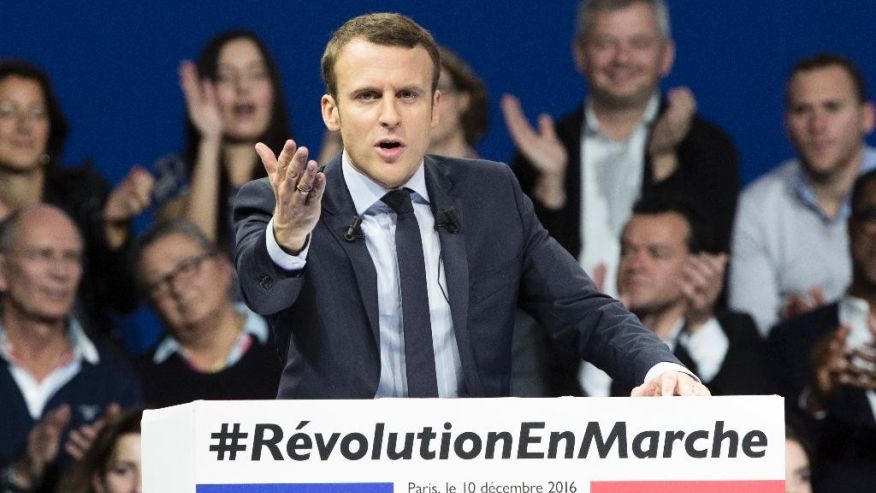
    The bad news was that France ended up electing Emanuel Macron, an efficient technocrat who consciously incarnates French capital’s need to eliminate the "French exception" and level the wages, rights and benefits of the French common people down to the average of the European Union (which includes Romania and Bulgaria).

    Faced with Macron’s calmly-worded, reasonable, deliberately transparent class war agenda, it should be obvious that France needs a united Left of parties, unions, social movements and local associations to oppose it – the June during the legislative elections and later in the streets. Such a powerful coalition from below came together spontaneously against Macron/Hollande’s pro-business Labor Law during the “hot” Spring of 2016, which included strikes, blockades, occupations and all-night discussions. Where is it now?

    The Divided Left

    Alas, more bad news: the French Left today is totally divided, splintered as never before. As I reported last month after May Day, the labor unions couldn’t even agree to march together. This Sunday, June 11, French voters will face the first round of elections to the 577-seat National Assembly. These elections will decide whether President Macron will have a legislative majority with which to govern unopposed, and the opposition parties seem hopelessly divided.

    Last week I watched a young, idealistic Communist Party candidate practically in tears at a Médiapart round-table as he told how at least four Leftist Parties were competing against each other in the first round in his popular Paris district. This Communist candidate was heartbroken because during the Presidential election, his Party had supported Jean-Luc Mélenchon’s Unbowed coalition with all its strength, and now Mélanchon had sent an Unbowed candidate into his district to compete with him in the legislative election. A fratricidal stab in the back! Why?

    Historically, in multi-party systems, Left parties negotiate alliances and coalitions so as to agree on a single candidate, presumably a strong one, in each local district so as to maximise the chance of winning nationally. Each party in the alliance gets assigned a certain number of prospective seats in the National Assembly in proportion to its size –  subject to much haggling and horse-trading. Some negotiations between Mélanchon and the Communists were held last month, but apparently they broke down early. This, in spite of the fact that Mélenchon had previously headed the “Left Front,” a coalition including the Communists and his own “Left Party” (a 2008 left split from the Socialists). Alas, as so often happens in party politics, control trumped goal. The Communists, who still have Representatives in the Chamber and control local offices in many districts, wanted to protect their turf. Mélanchon wants to dominate the Left through his Unbowed  movement.

    Mélenchon’s strategy, based on strength of the 20% of the electorate that voted for him in the Presidentials, is apparently to run candidates in every possible district with the goal of winning an (unlikely) parliamentary majority. Under the Constitution of the Gaullist Vth French Republic, thus would oblige President Macon to appoint Mélanchon Prime Minister (an arrangement known as “cohabitation”) and share power. In Sunday’s first round Unbowed candidates who get 20% of the votes would theoretically place into the second round in a field where the Right is also splintered. Along with Macron’s handpicked “new faces” running for En Marche, ther are also several traditional conservative parties and of course the far-right proto-fascist National Front that won a third of the votes in May’s Presidential election.

    Thus, according to Mélanchon’s strategy, the Unbowed candidates could conceivably beat the Macronistas and the Le Penites and end up with a majority in the second round, automatically making him Prime Minister. On the other hand, the more the Left field is crowded, the greater the chance of a repeat of the Presidentials: Macron’s En Marche facing off against the National Front in the second round, giving Macron an easy majority and marginalizing the Left for the next five years. This would be the tragic consequence of Left disunity based on turf wars and the party politics of control-trumps-goal.

    On the other hand, even in the minority, Mélenchon’s Unbowed group would emerge as the  hegemonic organization of the Left for the next five years, well placed for the next elections in 2022. There is not much competition left. The electorate of the Communist Party, despite its hold on office and ties to the CGT labor union, has shrunk to not much bigger than the “Trotskyist” New Anti-Capitalist Party (part of which has joined the PCF in a coaltion called Ensemble).

    The Socialist Party has also shrunk, having disgraced itself in power. President Hollande, with only 4% approval, didn’t even dare run in the primaries, an historical first for an outgoing president. The Socialists’ right wing has followed Macron in deserting the sinking ship. The SP’s Presidential candidate, a young leftist named Hamon who won the primary, seems a refreshingly sincere and honest social democrat. He is attractive to voters who consider Mélenchon a dangerous demagogue and are suspicious of his apparent support of Putin’s annexation of the Crimea and his flirtation with the idea of a FREXIT. Some also remember he supported the invasions of Syria and Libya. So much for the Left!

    So Who is Macron?

    A brilliant young graduate of France’s elite state graduate schools (founded by Napoleon to run his Empire) with a successful career in banking (chez Rothschild, where else?) and public administration, Emmanuel Macron is well read on nearly every subject and totally confident of his competence and right to rule. He cooly showed himself a statesman last week castigating Trump’s withdrawal from the Paris Climate Accords. Speaking in elegant, charmingly accented English (a first for a French President) he famously concluded: “Let’s make the planet great again.” Macron’s government is made of neo-liberal technocrats, half of them women. Unlike the usual political hacks, his ministers are younger, more dynamic, more diverse – fresh political faces recruited directly out of the economic establishment like Macron himself. This is a new broom eager to sweep clean, so watch out.

    As a candidate Macron had made his program absolutely clear. He is pledged to strip French workers of what remains of their on-the-job rights and protections by further expanding the pro-business Labor Law – a “reform” he helped impose while Economics Minister in the neoliberal government of his predecessor, the unpopular Socialist Hollande. However, even if Macron does not win a majority on June 18 in the second round of the Legislatives, he is pledged to impose his neo-liberal class-war program by Decree. That’s how Hollande’s Socialist government “passed” its pro-employer labor reform last summer after a very hot spring of strikes, blocades, mamoth demonstrations and opposition from many Socialists in the Chamber. (Please see my “The French Stand up.”)

    Macron is also pledged to another anti-worker “reform”: the downgrading of France’s wonderful post-WWII Social Security system which includes healthcare, unemployment insurance, retirement, minimum survival income, housing subsidies and welfare for the poor. The Sécu, as it is known, was created after WWII by workers’ organizations coming out of the Resistance, when the de Gaulle government depended on Communist support to stay in power and the French industrialists were in disgrace for their vile collaboration with the Nazis during the Occupation. The idea of the “social wage” – in addition to the salary – was enshrined in France’s post-war Constitution.

    The Sécu remained a self-governing non-state national institution even after de Gaulle placed business representatives on the board to undermine it. Today, the government votes on its budget. As for unemployment insurance, which is governed, by a bi-part commission of unions and employers, Macron would put the state in charge, with budgetary powers. The impact of these “reforms” will be to break up the semi-autonmous Sécu and turn its functions over to the state. These “reforms” will allegedly rationalize the system and reduce costs, but in fact they are designed to progressively shrink the social safety net that has made ‘the French exception’ so popular. A grim prospect for average French people and lovers of France’s quality of life. 

    Last week, researching  this article, I asked my neighbor, a poised, well-educated young mother from a good local family, to explain the intricacies of French electoral system to me. When the truth finally dawned on me  that with the Left divided there is very little hope left for Social Security and fair labor laws, I blurted out: “Then what will the French people do?” She calmly replied: “Why go down into the streets and throw the bastards out! We’re good at that.”

    Since Summer Vacation is the true God worshipped by the French, this battle will not take place until next September. If anything interesting happens meanwhile, I’ll keep you posted.


  • Russia, the Supposed New Cold War, and Russiagate

    Image

    Fellow socialists and leftists, it is time to dispel that illusion that somehow Putin’s Russia of today is somehow positively connected to the USSR of yesterday.  That simply is not the case. 

    In this, the year of the hundredth anniversary of the Bolshevik Revolution, not only does Vladimir Putin repudiate Bolshevism’s legacy in its entirety, he even repudiates the February Revolution of 1917 in Russia that preceded the Bolshevik-led October revolution.  (See, on this, “Putin Likes to Pretend 1917 Never Happened” in the Atlantic.)  It was the February Revolution that overthrew the Czar and ushered in a whole new era in repressive, backward, even Oriental Despotic, Russia, a short-lived era of freedom and creativity that made even Lenin marvel that Russia was now “the freest country in the world.”  The Bolshevik Revolution was going to extend this freedom in the “freest country” even further, not through just a political revolution at the top, but by a social revolution from the bottom that would free the peasantry and the workers from exploitation. 

    But this Russia of 1917 is anathema to Putin, who sees himself as heir to the Czars, and whose dedication to Russian nationalism is strictly Czarist in tone—as is his contempt for dissent and opposition, as is his devotion to pan-Slavism, as is his support for Russia’s corrupt crony capitalist economic system.  Not surprisingly, Putin sees spreading “chaos” in the West as a good way to advance Russian nationalist goals, and in furthering such, finds agreeable help in Russophile right-wing populists such as France’s Marine le Pen and, of course, the US’s Donald Trump, now our President.  Nor is it surprising that Russia actively tried to influence the French and US elections in favor of these candidates, which is now the matter of grave concern in the US; and over which Putin was confronted directly to his face by newly-elected French President Macron in Paris.  For, certainly standing to reason from the Putin/Russian nationalist standpoint, is sowing “chaos “ in the West by helping Russophile politicians such as Le Pen and Trump win office—which the Russians failed to do in France, but which is a major point of contention in the US:  did Russian interference in the 2016 Presidential election actually help Trump win?

    Whether or not there was actual “collusion” between the Trump campaign and the Russians, or whether there were just vast, intertwining interests involved, but short of actual “collusion,” is a moot point. After all, it’s these extensive involvements of Trump campaign and, later, Administration officials with the Russians, in business deals, as lobbyists, and as government officials, that are currently under investigation; and despite all those who claim there was no Russian interference in the 2016 election, it certainly seems clear that there was such interference.  Russian state and business interests are far more closely intertwined in Russia than they are in the US; and the connections between Russians such as former Trump campaign manager Paul Monafort; the forced-to-resign Trump national security advisor Michael Flynn;  the major business concession now-Secretary of State Rex Tillerson negotiated as head of Exxon/Mobil with the Russians; Attorney General Jeff Sessions’s secret meeting with Russians which he failed to disclose at his confirmation hearings; the attempt by Trump’s son-in-law and major advisor Jared Kushner to set up a “back channel” private line with the Russian government that would be sited in the Russian embassy in the US—just these alone have been the subject of numerous media headlines and stories, as have been other contacts with the Russians by campaign and Administration officials.  (Which seem to be like the Biblical Hosts of the Lord—their number is legion!)  Certainly the appearances are anything but “innocent,” or “just doing international business,” as certain commentators of the right have complained; the most recent one being a Forbes contributor, Paul Roderick Gregory, who writes on “domestic and international economics from a free-market perspective”: “There Remains No Evidence of Trump-Russia Collusion.”

    But it is not the right’s enamoring, absolution, of Russia that concerns me here.  After all, Western capitalists have always being willing to do business with authoritarian regimes when lucrative markets and investment capital have been available from them; and Trumps/s businesses themselves have been the beneficiaries of a considerable influx of investment capital from Russian business oligarchs.  Russian plutocrats also have far more direct ties with the Russian state apparatus than their Western counterparts, so good governmental relations are just good business.  Also, Western capitalists have never had any political problems with authoritarian or even fascist regimes, as long as “business as usual” remains.  We see that is the history of European fascism in the 1930s, with dealings with the Pinochet regime in Chile in the 1970s, and with other unsavory regimes across the world.  As stated by two leading conservative political theorists in regard to capitalism and authoritarian regimes:  Frederick Hayek stated, “[M]y personal preference leans toward a liberal dictatorship rather than toward a democratic government devoid of liberalism” (“liberal” here meaning, as in the 19th Century sense, an unregulated free-market capitalist economy); while William F. Buckley, Jr. wrote notably,

    Let the individual keep his dollar—however few he is able to save—and he can indulge his taste (and never mind who had a role in shaping it) in houses, in doctors, in education,

    in groceries, in entertainment, in culture, in religion; give him the right of free speech or the right to go to the polling booth, and at best he contributes to a collective determination, contributes as a rule an exiguous voice.  Give me the right to spend my dollars as I see fit—to devote them, as I see fit, to travel, to food, to learning, to taking pleasure, to polemicizing, and, if I must make the choice, I will surrender you my political franchise in trade, confident that by the transaction, assuming the terms of the contract are that no political decision affecting my sovereignty over my dollar can be made, I shall have augmented my dominance over my own affairs. (Quoted in Yale Alumni Magazine, April 1978, p. 37; Buckley was a Yale alumnus.)

    Hence for conservatives then and now, from hallowed intellectuals such as Hayek and Buckley to the frequently ill-regarded politicians of today’s Republican Party, up to and including Trump, the “freedom to shop” is the ultimate freedom that overcomes and subordinates all other “so-called” freedoms!

    Unfortunately, sections of the US left, because of visceral anti-Hillary Clinton hatred, have caught this same Russophile pro-Putin virus.  During the 2016 campaign, Green Party Presidential candidate Jill Stein charged that, if elected, Hillary Clinton would get the US involved in a war with Russia over Syria, while, to the contrary, Trump would “normalize” relations with Russia.  Left philosopher Slovoj Žižek announced publicly his support for Trump as President because he would “shake things up.” 

    Not that I doubt Hillary Clinton is a neocon hawk; not in the least.  But there is certainly good reason to believe that she would have demonstrated probity in office that Trump has certainly not shown; because what Trump has shown is that he is the proverbial loose cannon, an impulsive man who makes decisions on the spur of the moment.  Also, that he is guided by a pro-Putin attitude that most resembles a high-school crush on someone he admires as a strongman.  Consider that, when Bill O’Reilly, of all people, declared in an interview with Trump that Putin was “a killer,” Trump agreed with O’Reilly, but then, went on to say, nonetheless, he “respects” Putin! (Perhaps because Putin does to his opponents what Trump would like to do to his?)  Trump continued, saying that the US does the same thing, and has blood on its own hands, which is true; but, more likely, when Trump said it he was merely being the blind squirrel who occasionally finds an acorn.  It is unlikely that Trump has any serious knowledge of how the US overthrew Arbenz in Guatemala, overthrew Mossadegh in Iran and installed the Shah, overthrew Allende in Chile and installed Pinochet, or waged war against Saddam Hussein and set Iraq onto the road to destruction and perpetual sectarian warfare.  It’s really doubtful that Trump is that informed or that smart.  But what it does mean, I aver, is that the Russians, under Putin especially, have taken lessons from the US playbook and, in this cybernetics, cyberespionage and cyberwarfare age, have been able to do nonviolently what it took actual physical intervention by the US to accomplish! (Same also in France with Le Pen vs. Macron.)  Nothing for the left to be proud of, either in singling out only the US for scolding, or in automatically exonerating the Russians.

    Same goes for the charge by certain US leftists that the US government is initiating a “new Cold War” by accusing the Russians of what evidence indicates they did—interfered to tilt the results of the US Presidential election in favor of Trump.  (Whether or not they actually succeeded, or whether, in fact, Hillary Clinton defeated herself, is a moot point that may never be settled definitively.)  But that is assuming that Putin’s Czarism-revering nationalist Russia is somehow the equivalent of the former USSR, a bastion of “peace” and “socialism,” and that somehow Putin is another Khrushchev or Gorbachev, or even a Brezhnev, Stalin, or Lenin:  committed to a left-wing “socialist co-existence” rather than to a resurgent Russian nationalist, and strictly right-wing capitalist, form of Great Power politics and foreign policy.  Certainly, Trump’s own avowed admiration for Russia and Putin should put that charge to rest.  Even at his most bellicose, when he fired Tomahawk missiles at the Syrian airbase in retaliation for Russian-allied Syrian leader Assad’s gas attack on civilians, Trump was careful to warn the Russians beforehand.  No, Putin’s crony-capitalist, repressive Russia is hardly the former Soviet Union, and it certainly can be argued that Russia has very similar imperial ambitions as the US or any other Western capitalist power; and much prefers pliable Russophile right-wing governments in power in the West, same as in Eastern Europe.  What blinds the Western left to these actual geopolitical realities is the left’s own naïvete toward Great Power foreign policies, and its mistaken view that imperialism, and imperial ambitions, can only occur among traditional, well-established, Western capitalist powers—in other words, global politics even in 2017 follows as though straight out of the Marxist playbook as articulated in Lenin’s 1916 Imperialism: The Highest Stage of Capitalism.  Thus, Russia can’t possibly have Great-Power imperialist ambitions, or a shady and dubious foreign policy!        

    Fortunately, these naïve illusions are laid well to rest in Stephen Shalom’s definitive article in the Winter 2017 New Politics, “Russia and the Left.”  Shalom’s carefully-reasoned article justly points out that, when Russia was the former USSR, many well-meaning Communists and other leftists supported the Soviet Union because it was seen as “socialist,” a “workers’ state,” and a progressive, leftist force that supported labor rights, civil rights, and anti-colonialism—even though its own internal practices were highly repressive and its foreign policy checkered, to say the very least.  But such can’t even be remotely said for Putin’s Russia, which is not only clearly repressive, but even openly right-wing.  Contemporary Russia’s foreign policy is not progressive or anti-imperialist, anti-colonial, in the least; but is imperialist, allied with truly noxious regimes, and has one clear goal—to undermine the US specifically, and the West generally; and does so to advance a regressively right-wing, openly chauvinist, Russian nationalism that smacks more of inter-imperialist rivalry than of anything else.  Not that Russia doesn’t spout “anti-imperialist” and “anti-status quo” rhetoric; it clearly does, and assiduously courts allies across the ideological spectrum and among Third World regimes through this.  Such is prevalent in patently state-controlled media outlets such as RT and Sputnik.  But for those of the left to fall for this appearances-only show—either, as Shalom suggests, from, nostalgia or from a narrow “An enemy of my enemy is my friend” perspective—such is both disingenuous and a betrayal of truly left ideals.  Further, in order to advance his agenda, Putin and the Russian state apparatus he dominates assiduously court whatever “anti-Western status quo” forces they can, aiming appeals both to the far right, and to the far left, and finding allies in both camps.

    Such disingenuousness toward Russia is notably found in US Green Party 2016 Presidential candidate Jill Stein, much to the dismay of European Greens—as shown by articles showing her uncritical pro-Putin apologetics: both in the often center-right Daily Beast, Casey Michel’s “How Putin Played the Far Left,” and in the left-leaning Raw Story’s summary article on the Daily Beast revelations by Travis Gettys, “Here’s How Jill Stein helps Putin promote his right-wing agenda to the American left.” Notably, Jill Stein made a visit to Moscow in December 2015 on the tenth anniversary of the founding of RT, where she spoke favorably of Putin at an RT forum, and was feted, even sitting at the same banquet table as Putin and Michael Flynn (according to the Daily Beast).  Who funded all this, Stein has refused to say.

    Fortunately, not all on the left are as naïve as Stein.  For example, delving deeper into the Trump-Putin connection on the other side of the ideological divide is the rather alarming article scheduled for the upcoming hard-copy version of the investigative reporting magazine Mother Jones, David Corn’s “We Already Know Trump Betrayed America.” Concerns about “politically incorrect” nationalist sentiments aside, we of the left certainly should understand that if, for example, we regard the US as ethically wrong when it overthrew Arbenz, then it’s equally ethically wrong for the Russians to try and influence the outcome of the 2016 Presidential election; or, for that matter, the 2017 French Presidential election. Because when realpolitik trumps all (pun only partially intended), then we live in a jungle where the only rule is “eat or be eaten.”  And no, that’s not “bourgeois sentimentality.”  That’s hardheaded expression of socialist ideals.                                                                                                    

    This pro-Putin assiduousness on the part of some generally thought of as being on the left even spills over into pro-Trump attitudes and conspiracy theorizing about a “Deep State” plot by US intelligence and law enforcement agencies, the NSA, the CIA, and the FBI, to topple Trump.  As a really egregious example of this line of reasoning, KJ McElrath, writing for the left-wing Ring of Fire Network, quotes pro-Putin, pro-Assad, Russian election interference-denying (until recently) reporter Glenn Greenwald as stating, “Trump was democratically elected and is subject to democratic controls, as these courts just demonstrated and as the media is showing, as citizens are proving;”  McElrath then goes on to suggest a “Deep State” conspiracy.  But Greenwald, who’s guested on both leftist media and Fox News, is wrong on two counts.  First of all, Trump was not “democratically elected.”  Hillary Clinton received nearly three million more popular votes than he did.  Trump was elected by the deliberately undemocratic Electoral College, which over-represents less-populous states over those more populous.  Second, as for being “subject to democratic controls, as the courts just demonstrated and as the media is showing, as citizens are proving,” those “controls” have come flagrantly under attack from Trump himself, and require constant vigilance to force what can only presently amount to forcing restraint from Trump and the GOP.  But further, whatever the CIA, the NSA, the FBI think of Trump, they are not noticeably at all preparing a coup against him.  While Trump would undoubtedly like to be himself a fascist dictator, even under his bullying the US still remains a bourgeois democracy with a Bill of Rights in place; even if these constitutionally-guaranteed rights are under vigorous attack from Trump and others in his Administration (which certainly isn’t the first time in US history that a President and his Administrations have tried to quash dissent).  Despite several popular books on the CIA and other intelligence, law enforcement, agencies that portray them as an “invisible government,” their actual power to launch coups has been severely limited historically and to date, not only by legal safeguards and public opinion, but also by the self-restraint and the studied apolitical, above-the-fray stances of these agencies’ personnel themselves. And these are most likely to continue.   This is but realism, fellow leftists, not complacency—for truly, “eternal vigilance is the price of liberty.” But the US is not politically akin to a Latin American banana republic, and it is hysteria to think so.  Fear of a “Deep State” conspiracy against Trump, of all people, thus remains but a conspiracist fantasy. Certainly for now.  Lest we forget.

    So, what should the left be doing in the wake of all this?  Obviously, for a starter, we should press for a complete and thorough investigation of the Trump Administration and its ties to Russia, to be conducted honestly, transparently, and without being quashed or interfered with; this is already happening, and we of the left should support it and press for it to continue until all matters are settled.  While, of course, continuing with all our vigor to oppose and thwart those specific reactionary policies and proposals independent of Russiagate that come from Trump and the GOP-dominated legislative branches (e.g., the budget, Trumpcare).  Second, as socialists committed to democracy, especially grassroots democracy from the bottom up by the people themselves, we should not be suckered into supporting one particular nation-state in its rivalry with other nation-states.  That is not what we of the left are about, despite siren calls to line up on the “correct” side, the “anti-imperialist” or “anti-hegemonic” side.  It is not our business to declare left allegiance to either the US or to Russia; this is a dispute between two imperialist nation-states, not a college football rivalry.  Third, and very important, we must recognize the potential war danger presently existent, not only between the US and Russia, but also between the US and China, possibly over access and control over the South China Sea; or between the US and North Korea.  In this world fraught with nuclear-armed powers, the danger of war is omnipresent; meaning that we need an antiwar movement that does not arbitrarily, or in a partisan way, choose Great Power sides.  And last, the left must totally abandon any penchant for an “enemy of my enemy is my friend” mentality, as today’s “friend” can be tomorrow’s “enemy,” and vice versa.  Just considering the US in isolation, for example, at one time it had as a “friend” an “enemy of its enemy” in—Osama Bin Laden! 

    For us of the left, a nuanced and sophisticated, not just ideological, approach is what’s called for.   Above all, a commitment to grassroots democracy and genuine self-determination by the workers and oppressed peoples themselves is called for, wherever and whoever they are:  be they Kurds, Syrians, Russians, Mexicans, Koreans, African Americans, or even displaced US white workers!  This precludes, I say, taking sides in Great Power rivalries; but instead, upholding “liberty and justice for all.”  That’s what we of the left can take out of this Russiagate imbroglio.

    George Fish is a socialist writer living in Indianapolis.

  • Grassroots Global Justice Alliance condemns Trump’s Paris Agreement withdrawal

    Image

    Grassroots Global Justice Alliance condemns Trump’s announcement to withdraw the US from the Paris Agreement.

    While the accord was far from what the planet needs, Trump’s reckless decision underscores a key overarching issue with the Paris Agreement in the first place.  When the Paris Agreement was signed in 2015, we put out this report entitled “We Are Mother Earth’s Red Line: Frontline Communities Lead the Climate Justice Fight Beyond the Paris Agreement.”  We laid out 5 key concerns in the report.  Our number one concern (see page 6) with the agreement was “The Agreement relies on voluntary versus mandatory emission cuts that do not meet targets scientists say are necessary to avoid climate catastrophe.”  Trump’s withdrawal is a clear example that voluntary pledges are not enough.

    “Donald Trump is showing us the art of breaking a deal,” says Tom BK Goldtooth, Executive Director of Indigenous Environmental Network. “By abandoning the Paris Agreement, this administration will further perpetuate environmental racism and climate injustice against Indigenous peoples experiencing the worst effects of climate change across the globe. We’ve stated before that the Paris Agreement falls short of embracing the sort of climate solutions that lift up human rights and the rights of Indigenous peoples. Regardless of its shortcomings, it is critical that the United States be held accountable for its contributions to the climate chaos we are seeing across the globe and to take ambitious action to meet the Agreement’s goal to limit temperature increases to 1.5 degrees Celsius. Backing out of this agreement continues a long history of broken promises and threatens the vital and sacred life cycles of Mother Earth.”

    Our number two concern (page 6) was “The Agreement advances pollution trading mechanisms that allow polluters to purchase “offsets” and continue extremely dangerous levels of emissions.”  If we truly aim to reach the stated goal of reducing carbon emissions to 1.5 degrees Celsius, we will never get there with a carbon market system.

    Monique Verdin, Secretary of the United Houma Nation Tribal Council, Louisiana says “the Paris Accord is not a perfect solution, but to step out of it is to step back. Our coastal communities in the Mississippi River Delta are surrounded by a web of pipelines, oil and gas canals, while our sinking lands are pock marked by oil waste pits. We are being told that our traditional territories may have to be sacrificed to the sea and that our post-colonial sanctuary settlements may have to be abandoned in this unprecedented wake of sea-level rise. If we don’t change our relationships with extreme extraction the heartache of losing some of the most precious biodiversity in the world, will be disregarded for the delusions of “progress.”

    While the agreement was far from what we need at the global scale, at minimum it was still a significant indication that world leaders were taking climate change seriously.  Across the globe, the Paris Agreement was being used as a baseline argument to continue promoting the real Just Transition that we need away from a fossil fuel economy.

    Despite Trump’s claims that the Paris Agreement threatened jobsa clean energy economy will provide new jobs and training for workers hardest hit in the transition from fossil fuels.  Dollar-for-dollar, clean energy technology creates three times as many jobs as fossil fuels, and the wind and solar sectors are among the fastest growing in the economy.  The coal industry cannot be revived as Trump promises.  The market for coal is no longer there.  There will be limited jobs in coal.  Investing in energy efficiency, clean energy technology, and sustainable infrastructure will revitalize the manufacturing and construction industry.

    Trump made this decision not based on what is good for the survival of humankind, nature and Mother Earth, but instead what he and his chief strategist Stephen Bannon believe will be best for his chances at maintaining support from his narrow conservative base.

    However, his statement that he was “elected to represent the citizens of Pittsburgh, not Paris” shows that he underestimates the intelligence of his own base, in addition to calling into question whether Trump even understands the agreement at all.  Bill Peduto, Mayor of Pittsburgh, expressed his outrage at Pittsburgh being used as an example to justify Trump’s decision, and pledged in a Tweet that Pittsburgh will “follow the guidelines of the Paris Agreement for our people, our economy and our future.”  Many other mayors across the country came out yesterday pledging to continue striving to reduce carbon emissions in their own regions.

    “The decision that Trump made to pull out of the Paris Agreement is about his accountability to fossil fuel industry and the Military Industrial Complex, not to the citizens of Pittsburgh or to any people living at the frontlines of the climate crisis,” says Cindy Wiesner, National Coordinator of Grassroots Global Justice Alliance (GGJ).  “This decision also disregards the historical and differentiated responsibility of the US and other countries of the global north to take on their fair share of the efforts to reduce global carbon emissions.”

    We would not go as far as the author of this article to praise Trump for this decision, but we do agree that Trump pulling out of the agreement “will disrupt our complacency and strengthen the most vigorous avenues of climate action left to us,” which we believe come from frontline communities themselves and the solutions they are building on the ground.

    “Communities on the frontlines of the climate crisis have been fighting climate change for decades,” says Elizabeth Yeampierre, Executive Director of UPROSE. “These frontline communities are communities of color and low-income communities, this is true locally, nationally and globally. We have long known that we cannot rely on governing administrations that are in bed with the fossil fuel industry to create or support any domestic or international legislation that would require a shift away from dirty energy. However, this does not diminish our outrage at this administration’s decision to withdraw from the Paris Agreement. While the agreement falls short of known and necessary emissions reductions benchmarks, it opens the door to the critical measures, which are necessary to drive a Just Transition away from the extractive economy. An exit from this agreement will only propel the climate justice movement to rise up against the destructive order that this administration has established, which threatens the dignity of our communities and the stability of our planet.”

    “The shortcomings of the Paris Accord and Trump’s erroneous and embarrassing decision to withdraw the U.S. from the agreement — proves more than ever that communities on the frontlines of the climate crisis are the ones to lead us toward a renewable and regenerative future,” says Angela Adrar, Executive Director of the Climate Justice Alliance (CJA). “We will continue to organize for climate justice and stand in solidarity with our international allies who are fighting for survival, resisting extraction, and creating solutions from the ground up.”

    Now is the time to continue mobilizing for climate action at the local and regional levels, following the efforts led by communities at the frontlines of the climate and economic crises.

    Click here for responses from social movements across the world with the Global Campaign to Demand Climate Justice. 

  • Can “Corporate Free” Candidates Win?

    Image

    Since 2004, members of the Richmond Progressive Alliance (RPA) have won ten out of the sixteen city council and mayoral races they have contested in their majority minority city of 110,000.

    Last November, progressives gained an unprecedented “super-majority” of five on Richmond’s seven-member council—despite more than a decade of heavy spending against them by Chevron Corp. and other big business interests. For 12 years, RPA candidates have distinguished themselves from local Democrats by their lonely, Bernie Sanders-like refusal to take corporate contributions.

    Now two Progressive Alliance leaders—city councilors Jovanka Beckles and Gayle McLaughlin—are preparing to run as  “corporate free” candidates for higher office. It’s the first time either one has sought a ballot line outside their own blue-collar refinery town.  Both hope to capitalize on the energy and enthusiasm (and campaign donations) of thousands of former Bernie Sanders supporters, including those who tried to reform the Democratic Party at its statewide convention in Sacramento May 20-21.

    At a lively pre-convention gathering of 500 “Berniecrats” last in May, McLaughlin discussed her not-quite-final decision to run for lieutenant governor of California as a progressive independent.  Like Sanders during his 2014 visit to Richmond—when he was still soliciting advice from out-of-state audiences about running for president—the former Richmond mayor asked the crowd for its “input.” (The response when she finished her speech, was loud chanting: “Run, Gayle, Run!”)

    Introduced by Beckles, McLaughin faithfully echoed the post-campaign message of the Sanders-inspired national group known as Our Revolution and stressed her personal support for OR. She urged the assembled delegates to “organize locally for political power! Be corporate free! Be the progressive leaders you are waiting for and run for office yourself!”

     A four-time winner at the polls herself, McLaughlin advised Bernie-inspired state and local office-seekers to  “denounce corporate control of our democracy. Make this the issue. It’s a winning issue. People are ready.”

    Taking The Pledge

    Throughout the state party convention, Beckles rounded up support for her own recently announced bid to replace Tony Thurmond in Assembly District 15, which includes Richmond and other parts of the East Bay. Thurmond decided to run for state superintendent of public instruction instead of seeking re-election to the Assembly. Ironically, he began his political career as an-up-and-coming young African-American Democrat who sought RPA backing for his first Richmond city council bid in 2004.

    But, like others at the time, Thurmond refused to join the group or take the “no-corporate money” pledge required for RPA support. At the polls that year, Thurmond was defeated while McLaughlin, a white newcomer to the city, a California Green, and a co-founder of the RPA won a city council seat for the first time.

    The Beckles/McLaughlin message last weekend—delivered in person and via convention leafleting by their supporters—was pretty simple:  the influence of big money in California politics can’t be curbed by sending people to Sacramento who are beholden to business interests (even if they say they aren’t).

    “Billion dollar corporations buying elections are not going to create the future we want for California,” Beckles said. “I’m running a campaign built on individual donations and support from ordinary people—not on interest groups that trying to influence the process for the benefit of the few.”

    The timing of the Richmond councilors visit to Sacramento couldn’t have been better.  During the three-day meeting, restive delegates interrupted speech-making at one reception with the chant, “Hey hey, ho ho, corporate Dems have got to go.” On Saturday, several hundred environmentalists staged a protest directed at Governor Jerry Brown and state legislators too often swayed, during the last ten years, by $266 million worth of oil industry lobbying and political spending in California. “We need champions who are looking out for our communities, not the profits of the oil industry,” the sixty sponsoring organizations declared.

    Among them were a few political heavyweights—like Greenpeace, the California Nurses Association, and Clean Water Action. But most endorsers of the rally against corporate pollution of air, water, and politics were local branches of 350.org or the Green Party, anti-fracking groups, and on-line networks like RootsAction or the Courage Campaign.

    McLaughlin and Beckle certainly look like the ideal “champions” for such groups to support. Few “electeds” in California have done more to hold Big Oil accountable than the Richmond municipal leaders who pressed Chevron to pay its fair share of taxes, sued the company over its 2012 refinery fire, lobbied for stronger refinery safety rules, better emissions controls, and other community health protections. Plus, Beckles and Mclaughlin survived Chevron’s $3.1 million campaign to defeat them when they ran for re-election three years ago. (For more on that victory over big money in local politics, see http://www.beacon.org/Refinery-Town-P1229.aspx)

    Rounding Up Support

    So far, Beckles’ AD 15 campaign has gained endorsements from former State Assembly member Tom Ammiano, BART board member Lateefah Simon, former Berkeley Mayor Gus Newport, and current Berkeley City Councilor Kriss Worthington. Worthington was among fifty activists and elected officials at an “East Bay Progressive Round Table,” hosted by the RPA on May 13. Participants from within AD 15 expressed strong interest in making Beckles’ campaign one priority for coordinated activity by like-minded municipal reformers in Contra Costa and Alameda counties.

    Beckles herself is the personification of Bay Area intersectionality. In addition to being a black-Latina lesbian, she’s a longtime child protection worker for the county, past shop steward, and now a Teamster member. She is seeking her own union’s backing, plus endorsements from the CNA, National Union of Healthcare Workers, SEIU Local 1021, and other labor organizations who’ve backed Richmond progressives in the past.

    Beckles and McLaughlin are also lobbying hard for official support from Our Revolution, with its accompanying boost in small-donor fund-raising. A registered Democrat and strong Sanders supporter, Beckles more neatly fits the profile of most local, state, and federal candidates OR has assisted since its launch last summer.

    But one of OR’s biggest 2016 victories was the election of Vermont Progressive Party leader and state senator Dave Zuckerman as lieutenant governor in the Green Mountain State. No other left-leaning third party in the U.S. has been able to elect a statewide office holder in the modern era. McLaughlin hopes to duplicate Zuckerman’s success in an electoral arena seventy times larger, where Gavin Newsom, the leading candidate for governor has already raised $14 million, more than the total donations raked in by the next top three contenders for Jerry Brown's job.

    A Green Party member when she served as Richmond mayor from 2006 to 2014, McLaughlin changed her registration to NPP, or No Party Preference, so she could vote for Sanders in the California primary last June. In a recent letter sent to Our Revolution on her behalf, the RPA steering committee reported that McLaughlin “hopes to be able to support a 2020 Bernie presidential campaign and to rally many independents to that cause.” The not-yet-official candidate has reached out to all of OR’s forty new affiliates in California seeking their endorsement as well.

     “I remain registered NPP and consider myself an independent,” she says, adding that “a mass-based third party in the future is something that we really need.”  In the meantime, McLaughlin and Beckles may be a catalyst for something other than business as usual in two “jungle primary” contests next June, when Democrats, Republicans, independents, and third party candidates compete for two ballot slots in November.

    Steve Early belongs to the Richmond Progressive Alliance and is the author, most recently, of Refinery Town: Big Oil, Big Money, and the Remaking of An American City, a new Beacon Press book about political change in Richmond. He can be reached at Lsupport@aol.com.

  • Logic of the Bomb

    ImageThe GBU-43/B Massive Ordnance Air Blast (MOAB) or “Mother of All Bombs” was dropped in Afghanistan at a time of great international tension. Sarin gas had filled Syrian hospitals with civilians, threatening to draw Russia, the United States, and their allies into direct war. U.S. warships retaliated by striking one of Assad’s air bases while Donald Trump shared dessert with China’s President Xi Jinping. Hot on the heels of their meeting, Trump (erroneously) declared that another set of warships were en route to intimidate North Korea and its allies. Alarming rates of Syrian and Iraqi civilian causalities from coalition airstrikes were dominating headlines and before the dust had settled, the largest non-nuclear bomb in the U.S.’s mighty arsenal incinerated an ISIS encampment in eastern Afghanistan.

    The bomb’s spectacle dominated conversation. With the phrases “Mother of All Bombs” and “largest non-nuclear bomb” repeated throughout headlines, people came to know little more than that it was big and mighty. MOAB was reported as a singular event, isolated even from its immediate historical context as the cymbal crash to a sudden rise in imperial bravado.  Instead, an exaggerated profile emerged that celebrated its immensity.1

    MOAB is a weapon of psychological warfare; that it terrorizes from afar is a part of the attraction. And while the West enacted its imperial theater, Afghans experienced a spectacle of their own.

    “I thought my house was being bombed,” said Mohammad Shahzadah, a resident of the Achin countryside in eastern Afghanistan. “Last year a drone strike targeted a house next to mine, but this time it felt like the heavens were falling.” Children’s ears had gone deaf from the blast. Windows and doors were blown out. The land inside the one-mile blast radius was left scorched and barren. The Achin mayor couldn’t see why the U.S.’s largest conventional bomb was dropped on such an insignificant target. “My relatives thought the end of the world had come. Every day fighter jets, helicopters, and drones are in the area.” Public council representatives in the eastern Nangarhar province simply called the bombing for what it was: the testing of new and dangerous weapons designed to spread fear.

    In a join statement, the Nangarhar council deputy declared that the attack was against international norms. He was half right. A conventional bomb of that magnitude had never been used before, but viewed in historical context, it was not so unusual. Lost in the singularity of the spectacle is a long history of imperial powers using occupations to test military weapons and develop new strategies.

    In November of 1911, Lieutenant Giulio Gavotti of the Italian forces conducted the world’s first aerial bombardment over Libya. Late to the game of carving up Africa into colonies, Italy looked to Libya as a convenient land grab. Gavotti was an ambitious pilot, and one afternoon he had an idea. “Today I have decided to try to throw bombs from the aeroplane. It is the first time that we will try this and if I succeed, I will be really pleased to be the first person to do it,” he wrote to his father. His plan was simple. Strap a box of 1.5kg grenades to a primitive airplane, fly over an enemy encampment, and drop the explosives. “It will be very interesting to try them on the Turks.”

    Watching bombs explode from the sky pleased him and in turn pleased his superiors, who thought its “wonderful moral effect” made it a clever tactic to fight natives. The media excitement was palpable in the first headline wired across the world: “Aviator Lt. Gavotti Throws Bomb on Enemy Camp. Terrorized Turks Scatter upon Unexpected Celestial Assault.” The initial attack resulted in few casualties, but the spectacle of terror from the sky captured imperial imaginations anyway. By 1912, the Italian Air Force was conducting a variety of missions over Libya including reconnaissance, bombing runs, intercepting camel trains, and dropping propaganda leaflets.

    Soon after World War I, the Kurds of modern day Iraq rebelled against British rule. It was with this challenge that Winston Churchill, along with Air Marshall Trenchard, matured Italy’s nascent vision into the doctrine of “control without occupation.” A strategy where the ever-present threat of aerial bombardment, instead of troops on the ground, would be the main force of coercion. Trenchard was convinced that “strong and continuous action of this nature must in time inevitably compel the submission of the most recalcitrant tribes” through the “dislocation of living conditions and the material destruction caused by heavy and persistent [bombing].” Using aircrafts to terrorize a people into submission was thought to be especially effective against the “ignorance of the native mind” in lands so removed from the British public’s moral consideration.

    Churchill, for his part, argued that terroristic tactics could save lives compared to bombing with conventional explosives. “I do not understand this squeamishness about the use of gas. I am strongly in favour of using poisoned gas against uncivilised tribes,” he explained. “The moral effect should be so good that the loss of life should be reduced to a minimum.” Careful not to endorse lethal gas, Churchill suggested that they should merely use “some kind of asphyxiating bombs” and “spread a lively terror” throughout the Iraqi rebels. A year later, in 1920, he urged Trenchard to continue “experimental work on gas bombs, especially mustard gas” on the “recalcitrant natives.” Though preparation was made for a gas campaign, the revolt would be contained before it was necessary to rely on such measures. In the end, conventional bombing and village burning proved sufficient to quell the Iraqis.

    Not only were these tactics intended to save the lives of reserve British soldiers, but the British economy as well. Churchill was acutely aware that the Empire was overextended, and he employed aerial bombardment as a means of finding “some cheaper form of control” in a war-wearied nation. Its success, in military terms abroad and with public opinion at home, met the demands of capital and set the stage for the state’s reliance on air power. After the High Commissioner for Iraq concluded that control without occupation was a cost effective success, Trenchard prophetically wrote that a continued demonstration of the air control doctrine would have far reaching results and even “lead to still further economies in defense expenditure, not only in Iraq, but also in other Eastern territories.”

    These foundational arguments have underwritten imperial action ever since. While the vernacular changes over time, the logic is consistent: those deemed “uncivilized” have diminished human value and may be terrorized, experimented on, and abused for the benefit of “civilized” lives and their related economies. From Agent Orange in Vietnam, to napalm in Japan, to depleted uranium in Iraq, examples of military abuses in the Global South are many.

    The Mother of All Bombs is only the latest example of such imperial tactics. MOAB is evidence that the U.S. military will continue to test the limits of what counts as conventional weaponry. This is no less the case than with white phosphorous, a weapon of ambiguous legality that the U.S. and its allies routinely flirt with.

    The U.S. government does not consider white phosphorous (WP) to be a chemical weapon because its deadly effect is achieved through the heat byproduct of the chemical reaction, rather than the chemical reaction itself. WP burns extremely hot and so generates large amounts of white smoke, while the plasma itself melts anything it touches from metal to flesh. The U.S. government claims they merely deploy WP as a smoke screen, and any harm to humans is unintentional collateral damage.2 The Organisation for the Prohibition of Chemical Weapons (OPCW), an international organization tasked with enforcing chemical weapon prohibitions, acquiesces to this argument with a caveat. WP’s legality depends also on the intent of use. While permissible as a means of creating smoke, if “the toxic properties of white phosphorus, the caustic properties, are specifically intended to be used as a weapon [against humans or animals], that of course is prohibited,” OPCW spokesperson Peter Kaiser explained.

    In 2004, the US was caught using WP munitions for just that purpose. “WP proved to be an effective and versatile munition,” reported a team of U.S. Army officers upon reviewing the attack on Falujah, Iraq. “We used it for screening missions at two breeches and, later in the fight, as a potent psychological weapon against the insurgents.” Too valuable to waste as a smoke screen when non-incendiary alternatives existed, the WP munitions were instead saved for “lethal missions.” Department of Defense spokesperson Lieutenant Colonel Barry Venable explained these missions involved launching the chemical fire at covered positions where “the combined effects of the fire and smoke — and in some case the terror brought about by the explosion on the ground — [would] drive [enemy combatants] out of the holes so that you can kill them with high explosives.” The OPCW turned a blind eye, and the international community was silent.

    Four years later, Israel dropped WP over Gaza indiscriminately. Civilians, including children, were burned alive. Hospitals and relief shelters were turned to ash. Initially denying that it had used WP, Israel was eventually forced to both admit this was an intentional, deliberate act and argue for its legality. A fact-finding report issued by the UN concluded that Israel was “systematically reckless in determining [WP] use in build-up areas” and Human Rights Watch reported that their own Israel Military Industries produced non-lethal smoke screen alternatives. Both statements strongly urged WP be considered for prohibition. The U.S. and its allies again remained silent.

    Flash forward to sarin gas in Syria and how America found its voice.

    When Trump ordered fifty-nine Tomahawk missiles to strike Assad’s air base, it was ostensibly because the U.S. red line had been crossed — a policy inherited from Obama that said chemical weapons would not be tolerated. Taken in context, the farce of the line is clear. America is interested neither in restraining the use of weapons nor lessening the suffering of innocents. When Trump’s heart breaks for the children of Syria, it is nothing more than the legitimation of further imperialist violence. Where are his concerns for the forgotten children of Afghanistan who die at record rates year after year? Humanity is not a subject of concern in these faraway, “uncivilized” places. The use of MOAB was not about their people at all. It was about sending a message to Russia and China: We will use our weapons.

    Since MOAB dropped, Congress has written a blank check to generals presiding over the Afghanistan conflict to the tune of $23 billion. No arbitrary timelines for withdrawal will be set, and there is no deadline for a new strategy. Clearly, there is no rush to end the war in Afghanistan, and fighting will undoubtedly escalate as the Pentagon decides what to do with its slush fund.

    Meanwhile, Trump has vowed to work with Russia’s Vladimir Putin to find a negotiated end to the Syrian war. Russia has itself profited from testing over 162 modern weapons in Syria, as Defense Minister Sergei Shoigu gushes. Among them has been WP, demonstrating Russia’s own flirtations with controversial weapons. Far from constituting an alternative to the West’s imperial logic, Russia is a competitor. Any peace brokered between the U.S. and Russia may quell all-out war, but it will neither deliver Syria from occupation nor fulfill its own demands for popular liberation. Russia may find itself wanting to test its own MOAB someday.


    Footnotes

    1. Foreign Policy claimed that MOAB had an explosive yield comparable to the first nuclear weapons when in fact it was magnitudes smaller. The New York Times reported that it cost $16 million to produce each bomb when the Air Force had actually estimated $170,000, and many more news outlets, including CNN, used explosive 2003 test footage to picture the attack when actual cockpit footage proved unsatisfying. Soon after, a video went viral that falsely claimed to be ground-level leaked footage of MOAB’s destruction. The video depicted a giant firestorm explosion in a nondescript Middle Eastern countryside that no doubt satisfied people’s expectations for what the Mother of All Bombs should look like. The media’s sensational reporting of MOAB reveals the bomb’s true terroristic function.

    2. White Phosphorous is classified as an incendiary by international law under most circumstances and thus is governed by Convention on Certain Conventional Weapons Protocol III. This protocol prohibits incendiary weapons being used against civilians in any circumstance, even if enemy combatants are present. Drafted in 1980, the Obama Administration eventually signed it in 2009, after the Iraq war. Israel is not a signatory to this date.

    Originally posted the International Marxist-Humanist

  • The FBI Takes Charge: The Establishment May be Done with Trump

    Image

    [Updated May 19, 2017] After nearly four months of President Donald Trump’s chaotic presidency surrounded by controversies and scandals, the American establishment has decided to take things in hand. That is the meaning of deputy attorney general Rod J. Rosenstein’s appointment of Robert S. Mueller III to serve as special counsel to investigate ties between the Trump administration and Russia. Mueller, who had served as the FBI director from 2001 to 2013 under presidents George W. Bush and Barack Obama, has both the confidence of the establishment and the political independence that will allow him to pursue the issue without fear of presidential interference.

    Mueller’s appointment suggests that the American corporate, political, and military elite may have had enough of Trump’s unstable, unproductive, and dangerous behavior and are prepared to drive him from office. Trump’s thoughtless tweets, his off-had remarks on the most important domestic and foreign policy questions, and his erratic political behavior, all of which have led to the paralysis of the Republican congressional agenda, stand in the way both of the dominant neoliberal political establishment supported by many Republican and Democratic politicians, and of the far-right Freedom Caucus, which is anxious to destroy last remnants of the New Deal and the Great Society social welfare programs of the Golden Years of 1939 to 1979.

    Republicans were delighted with Mueller’s appointment, since they have no desire to deal with Trump. The appointment of Mueller as special counsel means that the five Congressional committees looking into the Trump-Russia connections will be asked to narrow their investigations, which allows Republicans to evade the issue while keeping Democrats from pursuing it.

    The Republicans, who are well aware that things have been swirling out of control, have been unwilling to challenge the president because many of them face election in 2018. In the face of the possibility of Trump’s vengeance and also fearing the anger of rightwing populist voters, the Republicans have revealed themselves to be the most cowardly group of legislators in recent memory.

    The Democrats are not much better, with a few exceptions. While they want investigations, they have been opposed to calling for impeachment. House Minority Leader Nancy Pelosi warned her colleagues and the public that the Democrats should not call for impeachment because there were insufficient facts on which to base such a charge. But Congressman Al Green, of Texas, told fellow representatives in Congress: “The President must be impeached.” He went on, “It’s not the politically expedient thing to do. This is what we must do to maintain our democracy.”

    Pelosi and the Democratic Party leadership may fear that Vice-President Mike Pence would be a more effective leader in the fight for the far right agenda. But they may also fear that a campaign for impeachment would stir up social forces right and left that they could not manage, and management of the establishment’s affairs is their first concern.

    And the Resistance?

    These developments taking place in the cupola of the edifice of the American establishment, arranged by consultations among handfuls of the most elite members of the society, have happened without much impact from what has been called the Resistance. The marches by women and environmentalists, immigrants’ protests and small-scale strikes, and the outpourings at town hall meetings have given expression to widespread fear and anger from below and on the left, but they have had little direct political impact.

    The Democrats, working through Indivisible, have attempted to place themselves at the head of the Resistance, while progressives in Bernie Sanders’ OurRevolution—also committed to work in the Democratic Party—have done the same. Many of those in the movement have their own views and are not commited to the Democratic Party. A good many are radical activists. Yet, without a movement with an independent political identity, we have had no impact on the most important high-level developments.

    The other major problem of the Resistance is that the labor movement—the only group with the size and social power to push the Democrats and moderate Republicans to fight against Trump, and not only get rid of Trump but also fight for reforms and for a change in the system—has been deeply divided and largely absent from the fight so far.

    The FBI plays the role at this moment of savior of the political establishment and the corporate political agenda that it represents. It is not our savior. We need to increase the pressure from below, to build a larger, more unruly, and more confrontational movement. We need to go beyond protest to disruption if we are to have any impact on events. Otherwise we go from the more unpredictable Trump, to something which is predictably bad for the American people and the world.

  • Statement of a New Peace Coalition in Los Angeles

    Image

    The Coalition for Peace, Revolution, and Social Justice (CPRSJ) aims to resist capitalism, imperialism, and authoritarianism in the Trump era. We are helping to develop a thoughtful, multidimensional, and proactive opposition to the intensifying authoritarianism that has become evident around the globe, as exemplified by Donald Trump in the U.S., Vladimir Putin in Russia, and Xi Jinping in China. We oppose NATO and U.S. imperialism because they underpin capitalist-militarist hegemony around the globe. In general, we target rampant class oppression, imperialism, racism, sexism, heterosexism, nativism, Islamophobia, and environmental destruction.

    Domestically, we resist Trump’s absurd and deranged proposals to build a vast border wall with Mexico, deport millions of people, broaden the prison-industrial complex and police powers in the name of law and order, cut tens of millions off from healthcare access, further deregulate the economy, suppress climate science, and greatly expand U.S. military and nuclear capabilities. We note that Trump is in sync with neofascist movements in Europe, especially in France, Austria, the UK, and Hungary.

    In contrast to liberals who oppose Trump on the basis of the neoliberal politics of Clinton and Obama, we believe that the problems facing us lie in the very structure of contemporary capitalism.

    In contrast to the authoritarian left, we oppose and organize against the machinations not only of U.S. imperialism and its subimperialist allies like Israel and Saudi Arabia, but also those of Russian imperialism and of subimperialist powers like Iran.  Thus, we oppose the Israeli occupation of Palestine, Saudi Arabia’s barbarous war on the people of Yemen, and the untold brutality of Assad’s suppression of the Syrian Revolution, which has been abetted by Russia, Iran, Hezbollah, and other Shi’a militias.

    In the U.S., we support issues and movements like Black Lives Matter, women’s rights, climate and environmental justice, a living wage, the rights of immigrant labor, struggles of Indigenous peoples for autonomy and liberation, healthcare for all, and full rights for transgender people.

    Our class politics recognizes the fundamental importance of an affirmative and liberatory/humanist alternative to capitalism and the unity of all working people across national borders on the basis of international solidarity.

    Our principles of unity follow:

    1. We strive for the firmest unity of working people in the U.S. across racial and ethnic lines, and across rural/urban and regional divides, together with all those who oppose capitalism’s inhumanity on the basis of affirming Black liberation, women’s rights, LGBTQIA rights, immigrant rights, prisoners’ rights, and climate/environmental justice.
    2. We note the specific detrimental role of white supremacy in U.S. history as a factor in undermining working-class unity. We also note that African Americans have been in the forefront of progressive and revolutionary movements throughout the history of this country.
    3. We proclaim the underlying importance of class analysis and anti-authoritarianism in our theory and practice.
    4. We oppose all forms of imperialism, including the U.S. and NATO’s military interventions in the Middle East, Latin America, Asia, Africa and elsewhere, even if under the guise of humanitarianism.
    5. We hold the growing influence of Trump and Putin and the growth of neofascist movements in Western Europe to be key manifestations of the increasingly authoritarian direction of global capitalism.
    6. We oppose terrorism, whether state-sponsored types such as that of the Syrian regime, or the terrorism of organizations such as ISIS, the Ku Klux Klan, and fascist groups. Instead, we call for people to people solidarity with those who oppose both fundamentalist terrorism and authoritarian regimes.
    7. We envision a liberatory/humanist social movement opposed to capitalism, imperialism, and militarism that equally opposes reactionary regimes that happen to be at odds with the U.S.
    8. We believe that power must be devolved to the people through grassroots democracy and that democracy without social justice is meaningless.
    9. We do not consider authoritarian states that have claimed to be socialist or communist to be models of socialism or democracy in any sense. We strive instead for real human emancipation.
    10. We uphold the principles of internal democracy and transparency in our own efforts, and commit ourselves to these ends.

    We invite other organizations and individuals who share these views to join this coalition.

    Initial conveners include the following socialist and anarchist organizations:

    Alliance of Syrian and Iranian Socialists

    Black Rose/Rosa Negra Anarchist Federation-Los Angeles

    International Marxist-Humanist Organization, West Coast Chapter

    Socialist Party, Los Angeles Local

    Members of Solidarity: A Socialist, Feminist, Anti-Racist Organization, Los Angeles Branch

    Originally posted at the CPRSJ website

  • Standing in Solidarity with Sarah Chambers

    Sarah Chambers is an award winning special education teacher in Chicago’s Saucedo Academy. Sarah is a local leader a national figure in the fight to defend and transform public education against the corporate education reform attack. She is a relentless advocate for special education students and LGBTQ students. Sarah is a published author, organizer, and speaker on issues of education reform and social justice.

    Image

    Now Chicago Public Schools (CPS) has accused her of encouraging student to opt out of the PARCC Test, a wholly unsubstantiated charge.  While Sarah has long been a proponent of promoting critical thinking over drill-and-kill standardized testing, her advocacy has always been directed at consciousness raising among her colleagues to help change policy, not telling kids what to do about the tests. It is clear that CPS has suspended her and is moving to fire her for her courageous advocacy on behalf of her students.

    Moreover, this attack on Sarah Chambers is an attack on the entire movement for education justice, the movement for authentic assessment over standardized testing, and an attack on union organizers generally.

    We the undersigned demand that the Chicago Public Schools drop their erroneous charges against Sarah Chambers and instead use their resources to better support the social, emotional, and academic development of Chicago students.

    Celebrate national teacher appreciation day today by supporting one of the true champions of social justice education in the country! Help Sarah today by sharing this statement on social media and by signing the online petition.

    Wayne Au
    Professor, School of Educational Studies, University of Washington
    Editor, Rethinking Schools

    Bill Bigelow
    Curriculum Editor, Rethinking Schools
    Co-Director, Zinn Education Project

    Nancy Carlsson-Paige
    Professor Emerita Lesley University

    Michelle Fine
    Distinguished Professor of Critical Psychology, American Studies and Urban Education, The Graduate Center CUNY

    Jesse Hagopian
    Editor of the book, More Than a Score Editor, Rethinking Schools
    Editor, Rethinking Schools

    Julian Vasquez Heilig
    Professor of Educational Leadership, Director of the Doctorate in Educational Leadership, California State University Sacramento. California NAACP Education Chair.

    Brian Jones
    Educator and activist, New York City
    Doctoral candidate in Urban Education, City University of New York Graduate Center

    Journey for Justice (J4J)
    An alliance of grassroots community, youth, and parent-led organizations in 24 cities across the country

    Kevin Kumashiro
    Former Dean, University of San Francisco School of Education

    Jia Lee
    Elementary School teacher, Earth School, NYC
    Organizer, Movement of Rank-and-File Educators

    Jose Luis Vilson
    Author, This is Not a Test
    Executive Director of EduColor

    Lois Weiner
    Professor, New Jersey City University
    Director, Urban Education and Teacher Unionism Police Project

    (This statement also appears on the blog of teacher and education activist Jesse Hagopian.)

  • James Baldwin, Stan Weir, and Socialism

    Image

    Raoul Peck’s powerful documentary “I Am Not Your Negro,” which was nominated for an Academy Award, has brought the great writer James Baldwin (1924-1987) to a new generation of Americans who may have been unfamiliar with Baldwin’s life and writings. “I Am Not Your Negro” presented Baldwin as a powerful voice of the black liberation movement, but hardly mentioned his longtime commitment not only to full equality for black Americans, but also to socialism.

    Baldwin wrote in No Name in the Street that he had been a "convinced fellow traveler" at 13 who had marched in the May Day parade and then became a "Trotskyite" by age nineteen. Too young to have been involved in Harlem’s Communist Party in the 1930s, he claimed to have been a member of the Young People’s Socialist League, but that has never been confirmed.

    In the 1940s in New York City, Baldwin moved in both racially integrated bohemian intellectual circles and in the sphere of the Trotskyists, then in the process of dividing between supporters and opponents of the Soviet Union. The opponents called themselves “Third Camp socialists,” that is, opponents of both capitalism and Stalinist Communism. Baldwin leaned toward the Third Camp socialists, influenced by his friend Stan Weir, a member of the Workers Party (WP) and later of the Independent Socialist League (ISL).

    Baldwin declined to join these organizations perhaps because he was gay. Those organizations did not expel gays, as the Communist Party and the Socialist Workers Party did, supposedly because they feared that the police could blackmail gay members, but also because the Soviet Union was hostile to homosexuality. Still the WP and the ISL did not recognize and deal openly with the issue of homosexuality. Baldwin apparently felt his homosexuality would make it difficult for him to be completely accepted and to participate fully in the socialist movement of that era. (See New Politicstwo part symposium on “Gays and the Left.”) Still, his exposure to the Trotskyists and the Third Camp had a tremendous influence on Baldwin as it did on the New York intellectuals in general. 

    Image

    While many people know James Baldwin, fewer know Stan Weir (1921-2001), a long time leftist, labor activist, and worker-intellectual. Weir, a member of the WP, then the ISL, and later the International Socialists (IS), worked as a seaman, a stevedore, in factories, and as a construction worker. Later in his life he taught labor studies at the University of Illinois in Champaign-Urbana and wrote essays about workplace organizing, many of which were collected in his book Single Jack Solidarity (2004). Weir’s life was fictionalized in Harvey Swados’ novel Standing Fast (1970). Baldwin and Weir, perhaps only at the Calypso in lower Manhattan could two such men have met and become friends.

    We present here an article by Stan Weir, together with a letter from James Baldwin, that discusses the cultural and political milieu in which both lived and worked from the 1940s to the 1960s. The article originally appeared in Against the Current 18 (1989). A fuller discussion of Baldwin’s politics can be found in Douglas Field, “James Baldwin’s Life on the Left: A Portrait of the Artist as a Young New York Intellectual,” ELH, Vol. 78, No. 4 (Winter 2011), pp. 833-862.

    These are Stan Weir’s words:

    It is possible that some of the most creative and nurturing relationships being formed at any given moment in the life of a society are those grasped by young people newly “out on their own” and about to leave early youth behind, but who are not yet into the main competition. It is also fortunate, though rare, if over the following years they are allowed to meet again and so co-witness for their generation.

    James Baldwin and I came to Manhattan's Greenwich Village by separate ways early in the third year of World War II. He was eighteen, but knew that there was no other life for him than that of a writer. I was twenty-two, a merchant seaman temporarily ashore. We were introduced by Connie Williams, a Trinidadian restaurateur who was about to open her new cafe, The Calypso. She had recently told her friend and wellknown artist Buford Delaney that she needed a waiter and to send her anyone he thought would be good. Delaney sent Baldwin.

    During the same week, I rented an apartment a few doors from The Calypso with artist Marjorie O'Brien and Mark Sharron, a former shipmate. MacDougal Street was at near center of what was still a genuine Bohemia. Even chance encounters brought excitement. As I left the apartment early one morning, the door to the next apartment was open. Oil paintings stacked on edge covered the entire floor space except for a narrow path. It led to an easel covered with multi-colored droppings. In the path was a sleeping red-bearded man. He was wearing a long black overcoat, also with many droppings. A card tacked on the door said “Jack Probast.” We became friends. Even at later uptown exhibitions, I never saw him in any other garb.

    I went outside and walked toward Fourth Street. A sign in a window announced The Calypso's opening. The door was ajar. Connie greeted me as I entered, “We don't open until Friday, dear, but sit down and let me fix you something.” We became friends while I ate a large breakfast.

    I spent the day at the hiring hall of the Sailors' Union of the Pacific (SUP) deep downtown on Broad Street. It had been located there to recrew West Coast ships then sailing the Atlantic. When I returned to The Calypso in the late afternoon Connie greeted me with the announcement that I was to be a temporary dishwasher and that her waiter, Jimmy, and I were special boarders. Then she introduced us. A unique yet natural adoption process had been set in motion.

    At first, Baldwin was shy, but we soon had long discussions. It was not just the talk and the good food that quickly laid the basis for our friendship. The Calypso was catching on fast with a unique segment of the public, especially among radical intellectuals. C. L. R. James, for example, sometimes brought Pan-Africanists. Buford Delaney attracted the Henry Miller crowd, and then there were the dancers, musicians, actors, and singers from the equivalent of what are now the off-off-Broadway shows. Many were West Indians carrying well-developed political attitudes.

    A common bond among many of these regulars was the feeling that the heads of state in both Russia and the United States were incapable of leading the world to more personal freedom and were themselves part of the problem. It is improbable that there were many other places in New York at that time where people were genuinely entertaining each other in this way, and as an extension of their enjoyment, discussing politics.

    Neither Baldwin nor I had ever before been with people who shared their artistic and social talents so generously, almost as regular ritual. We joined the discussions and after-hours parties—both as equals and awed apprentices. He had grown up in nearby Harlem hampered by narrow opportunity to socialize with people of his own age. Until 1940, I had spent my entire life in East Los Angeles, a product of the big band era. The distances we had traveled to arrive at Connie's were close to equal.

    Life in the Village was as stimulating for him as for me. Just as important, this was the first time either of us had ever been allowed extended faceto- face access to a person of “the opposite race” and the same generation.

    One mid-afternoon coffee break, Baldwin talked about what he felt was the work he could do best. He wanted to help make it possible for white as well as Black Americans to witness the Black Experience—and the white experience—as part of the same societal process. After we had talked of this for a while, I asked what he felt was one of the most important things for a white to learn about the history of racial conflict in our country. He countered that I would first have to give him some actual racial experience in my life. I told him about Willie Slayton.

    The Slaytons were the first Black family with school-aged children to move into our part of town. Their son Willie entered Garfield High School in 1938. Teachers mentioned that he was the first. No matter that he became one of the school's football greats, his daily presence created openings for change. We all knew that somewhere there were millions of Black Americans. We had seen some of them from a distance. The streetcar that took us downtown passed through the wholesale produce market area where most Black Angelenos then lived. Willie Slayton made them more real. Going to a Stepin Fetchit movie or noticing the price of what we were taught to call “Nigger Toes” (Brazil nuts) in the markets was no longer an unnoticed experience. We got insight that the adult world had more than one kind of war in progress. For the first time the environment was demanding that we think in colors other than white.

    “We have had to do the same thing almost from birth for over three hundred years,” Baldwin replied when I had finished, “but from the other way around. And I suspect that, for us, the effort has been much more difficult. As people doing the lowest work, we have always had to think about this country in its racial totality, especially when determining our goals. Still, deep down, we have always known that we can't make it alone, and we have to make alliances. There are terrible segregations on the job everywhere. At the same time, when you look at the total production process in our nation, the people doing the work are so racially interwoven that it is impossible to unravel us without exposing how we are actually governed.

    Days later Baldwin told me that there had been, for him, an element of positive surprise in my story of the Slaytons. His admission freed me to talk about the segregation in my union. I explained that members of the Sailors' Union had heroically fought scabs, police, and the military during the 19305, in order to take control of the hiring process and then attain other conditions of dignity. Baldwin listened intently and let it go at that.

    The subject did not come up again until a late-night party which had developed at The Calypso around a visiting Afro-Cuban band. I was dancing with a woman who was enjoying her first visit to Connie's place. We talked easily, but then I noticed she had stiffened and was staring at the lapel of my jacket. Suddenly she broke away pointing and yelling, “This man is a member of the SUP, the racist Trotskyist union run by Lundeberg's goons.”

    Few who heard had any idea as to what she was referring to, what a goon was, or could identify Harry Lundeberg. Baldwin spared me the need to retaliate. He came out of the kitchen and took a seat nearby. She noticed him, assumed she had an ally, and again took up her attack. “How can anyone be in such a union when they could belong to a progressive union like the NMU [National Maritime Union]?”

    Baldwin did not raise his voice. He made direct eye contact with her and explained that anyone accused of Trotskyism was not tolerated in the NMU. But no matter, if racism had indeed been eliminated from the NMU, “then that man you were just dancing with can best serve my people where he is.”

    I soon got a ship that would make a short North Atlantic run and return to New York only a few months later. It was during this stay ashore that, without asking directly, I nevertheless asked Baldwin to join my radical group, the Workers Party (later the Independent Socialist League). He already knew that it was the product of a split with orthodox Trotskyism and with Trotsky, but he paused longer than usual before tackling a difficult subject. “None of your Shachtmanites, if you will, have ever patronized me. You know that, like you, I do not like this war; you know I agree with you that after all the destruction and death it will probably end with more, not fewer dictatorships in this world. And I agree with you on much more, but what you are really asking of me is impossible. It took you months to become fully aware that I develop relationships that include what is sexual with men. It would have taken you longer if it were not for the presence of a sophisticated Black woman like Catherine Shipley, born and raised right here in the Village. The two of you left here last night after you and I had finished eating together. I saw it happen. She told you without alarm, just out there before you reached the corner. You had known it, and did not know it, because you had buried it. Yes, homosexual is a hard word to accept. You knew instantly that what she said was true. You did not turn on me, but you buried it still another time.”

    He was being kind and so more effectively judgmental. I had been making him invisible. He waved to plead that I should not interrupt and went on.

    “I know that your group does not expel those who join and are then 'discovered' after the fact. But like you, they attempt to ignore this human difference. That it is a matter which cannot be discussed means that the discussion of every subject leads always to that closed door.

    “And there is more. There are no active novelist artists among you. They are there in body, but have become silent, stunted. This makes me know that something exists unseen, that there are other unadmitted denials.”

    Anger had arisen in what he said, but not rejection. I had forced him to do something out of harmony with his style—to make ideology totally specific.

    Sometime in the months that followed, I went back to using San Francisco as home port. The war had begun to grind down and the changes it had made were more visible. At the beginning of the war the San Francisco longshore local of the International Longshoremen's and Warehousemen's Union had only a few dozen Afro-Americans in its membership; by the third year they constituted a majority. Men of European origin had been a minority in the Marine Cooks and Stewards (MC&S) for many years. The Marine Firemen, Oilers, Watertenders and Wipers (MFOW) and the SUP both had Hawaiians, Samoans, Cape Verde Islanders, and Brazilians among their members, but so far as was known neither union had one descendant of an American slave.

    I was ashore in 1945 when the Coast Committee of the Sailors' Union developed its position paper on the “problem” caused by the large number of Black men who had recently taken permanent jobs in the West Coast maritime industry. The paper was ready for membership ratification or non-approval at a regular Monday night meeting. It complained that the leadership of the “Communist-influenced” unions on the waterfront were flooding their memberships with Black men in order to develop automatic yes votes for their union policies. (The statement obviously referred to the ILWU and Marine Cooks. The NMU had no West Coast ships under contract.) But the “checkerboarding” of ships' crews with Black and white seamen, said the paper, caused racial friction and so was not acceptable to the SUP. The presentation of the report concluded with the claim that regardless of its racial restriction, the SUP was still a democratic union because it promised that the day the membership came to favor checkerboarding, the official leadership would go along.

    I was the first speaker to go to the microphone. I argued that the report “solves nothing” and so “the crisis will continue.” I explained it was true that the SUP had conditions that were contractually superior to those on NMU ships, but there were no Black seamen who could hear that as long as we excluded them. I concluded with the claim that the Coast Committee's policy was a gift to the very “Communist leaders” they were so worried about. The chairman of the meeting was Morris Weisberger. He later succeeded Harry Lundeberg as top officer of the SUP. Lundeberg stood speechless at his separate and personal podium. Weisberger shouted, “And what would you have done, Brother Weir, if you had been on the Coast Committee?” With that, he stopped short, brought down his gavel, declared the section of the report passed and moved the agenda without a vote. He had realized in mid-sentence, it appeared, that his question gave me the opportunity to speak a second time.

    There were out-of-order responses from the audience both before and after I had spoken. Those that came after were different and less racist. A drunken member who had stood immediately after the report was finished to inform all “that the day a nigger comes into this union I'll tear up my membership book,” got up again when I had finished speaking to say, “Ah, I'll just take out a withdrawal card.”

    I interpreted the above incident as a measure of the change that had probably taken place in a large section of the entire audience membership. But the union's racism was now official, and the officials had won too easily. After the victories which established the union in the early 1930s, the rank and file had failed to prepare against two traps: failure to share what had been won with all, failure to make the maximum preparations against the formation of a bureaucracy.

    Later that night I phoned Baldwin and described the meeting. I was down. The solidarity subculture that the older SUP men had built in the early 1930s had been a source of strength for me. Now it was a historical lesson. But Baldwin had not expected much. He was less despairing, even a little jubilant. Certainly it would have been better, he said, if more had been accomplished, but the matter had not come and gone in silence, “at least witnesses have been created.”

    I had almost totally lost contact with Baldwin until a chance meeting months after the war was over, and just hours before he left on his first trip to Europe. Suddenly we were face to face crossing Sixth Avenue at Third Street. We talked briefly on the corner out of traffic. We couldn't talk too long, he had to finish packing.

    Yes, he had gotten the Saxton Fellowship to go to France and finish writing Go Tell It on the Mountain. A new part of his life was beginning and he was brimming with enthusiasm. I did not have a lot to say, except that I was working on the Chevrolet assembly line in East Oakland and had recently gotten married.

    Baldwin saw I was a little down politically and noticed my need to talk. He put aside his efforts to quickly end our chance meeting. We talked briefly but without hurry and said good-bye. I walked to Sheridan Square, reminded of my former shipmate who had been expelled from the Workers Party on charges brought by the Political Committee. Mark Sharron had gone to Europe to do some writing in 1946, “without party permission.” It was the kind of tough discipline that came from the opposite of conviction.

    In 1959, Esquire magazine sponsored a joint tour by Baldwin, who had just returned to the States after eleven years in Europe, Philip Roth, and, as I recall, John Cheever. The trio made appearances at three Bay Area universities. After Stanford and Berkeley, Baldwin's turn as featured speaker came at San Francisco State. My wife Mary and I attended. Baldwin came home with us to Berkeley, and stayed overnight so that we might catch up.

    I had recently become a full-time longshoreman with B registered status along with over seven hundred others. On the second day of his visit, Baldwin accompanied me to the union hiring hall just before dawn. I introduced him around. He was impressed that more than half of the men were Black. At least a dozen of us did not take jobs that day. Instead we took Baldwin to Manjo's, a nearby waterfront cafe. A few faces in the crowd around the big table at Manjo's changed from time to time, but at no time were there fewer than fifteen, until we broke it up in midafternoon. This good experience for all the participants did not go unreported to those with power in the industry.

    Because of policies initiated by ILWU president Harry Bridges and the employers, we “B” men were not allowed membership in the union. Our disenfranchised section of the work force had elected me as a representative. Without anyone knowing it, Baldwin's involvement in a twenty-year battle by rank and file dockers against the maritime establishment had begun. He left town in high spirits, though not talkative. To add measure to the time, he picked off the shelf our copy of Go Tell It on the Mountain and on the inside cover wrote, “It is good when survivors meet.”

    Connie Williams held a party for James Baldwin on May 20, 1963, at her then-famous San Francisco restaurant on Fillmore Street. It was a celebration of more than just old times. Since 1959, Baldwin had become a literary star, world class. He was in town this time, I believe, making a documentary film which featured the residents of San Francisco's waterfront view of the ghetto at Hunter's Point and the ILWU.

    Connie's Restaurant was closed to the public that night. About a dozen old friends were present. Baldwin arrived very late. He had been drinking hard and was exhausted. A retinue of about ten men and women followed him in, including a white man introduced as his “representative.” They kept their party intact. The representative was equipped with records “that Jimmy likes to hear.” Connie selected and played Mahalia Jackson's “Didn't It Rain?”

    The representative rose from his chair clapping in what was obviously his rendition of Black religious ecstasy. A contingent of CORE (Congress of Racial Equality) activists came in. Several latecomers had phoned friends. The restaurant quickly filled to capacity.

    I had to be at the hiring hall early the next morning and interrupted several conversations to say good-bye to Baldwin. He got up protesting, “But we were going to talk. I want to hear what has been happening with the men on the docks.” I said we could do a bit of it right then if he had five minutes. We went into the kitchen for privacy.

    I explained that Harry Bridges was offering the “A” men or union members of Local to a chance to get most of the “B” men into the union, if only the “A” men would let him fire about one hundred of the “B” men that he considered “bad eggs.” He would not reveal the identities of the “troublemakers” he had targeted. I felt it was all but certain that I was among the number.

    When I had finished Baldwin said, “Will you do something, Stan? I can't begin to absorb this right now. It's impossible to explain. I apologize. I am leaving for New York in the morning, write me all this, just two pages, right away.”

    The next day I outlined what I then knew about what would three weeks later develop into a mass firing. Some of that information is contained in a letter from Baldwin to Coretta King, and in an article he wrote for Muhammad Speaks.

    I received a note from Baldwin a week later. It read, “Dear Stan: In haste. Have not been well. Apology to the men follows at once, and a more detailed accounting to you. I hope this letter is all right. Jim.” Enclosed was a copy of a letter he had written to Harry Bridges on my behalf. It read:

    Dear Mr. Bridges, I am writing this letter because I have been a friend of Stan Weir's for nearly twenty years, and I know him to be incapable of dishonesty. This is an enormous statement: but it is impossible to know a man as long as I have known Stan without recognizing the man's essential quality. If he is anti-progressive and anti-labor, then I am a dues-paying member of the Birch society.

    We know each other from very far back—I was a waiter. He is not much older than I am now. but when I was a kid, the three of four years difference in our ages made an enormous difference, and I used him as a kind of moral model, a kind of moral older brother. He has never betrayed me, in any way whatever, and he is one of the people I have in mind when I write, when I speak—it comforts me to know that he is in the world. I beg you, do not betray him. Good men are rare.

    Very Sincerely,
    James Baldwin
    June 28,1963

    Baldwin's letter to Bridges must have arrived at the headquarters of the ILWU on the same day that I received my copy. I got a phone call that evening from a longtime longshoreman. He told me that photocopies of Baldwin's letter had circulated among the headquarters' staff of the ILWU and was received with enthusiastic support by many. The man reporting to me concluded with, “You've got him now. With Baldwin's letter he will never be able to carry out his plan to fire you.”

    My observations of Bridges during the previous years made me know that he would not relent. I did not pose a threat to him, but the survival instinct of total bureaucrats makes them know that they must stamp out any and every potential opposition. The only force that could save us was the membership of the union. If they were unable to sustain their support, we would experience what in terms of the job is capital punishment.

    Eighty-two B longshoremen were fired in June 1963, after secret trial in an action openly directed by Bridges. I was one of them. No charges were given, but we were each asked to write a defense, stating why we believed we were innocent. We refused and demanded to be heard. Fake due process was arranged. We were given a first-and-last appeal hearing presided over by the same men who had fired us. ILWU Local 10 officials and members fought again to save us and failed. Rather than accept injustice in silence and submission, we took our last opportunity to resist by going to the Federal courts.

    James Baldwin returned to the United States from a European trip in 1969. He immediately joined the Longshore Jobs Defense Committee that we had formed to raise money for legal expenses. Over 90 percent of the plaintiffs were Black men. Few of us ever regained the earning power we had known as dockers. We carried the main financial responsibility, but it was impossible for us to do it all when resourced mainly by unemployment insurance and minimum wages.

    Our ability to raise money nationally was enhanced in 1967. I had taken a job on the Labor Education faculty of the University of Illinois and was regularly meeting publicly prominent people with experience in fundraising. There were other benefits too. In 1969 the Miller Lecture Series of the University booked several prominent Black intellectuals to speak on the Champaign-Urbana campus. Baldwin was one of them. His turn came toward the end of the series.

    At least two hundred Black students and young citizens from segregated North Urbana arrived early. They took the first four rows of seats. An hour later a mainly white audience filled the rest of the auditorium. During all previous lectures in the series the young Black front row audience had not allowed questions to come from the whites to their rear. Baldwin had heard and had understood. Without any reproach he made it clear that no one at that meeting would be denied voice.

    When he had concluded his main presentation the third person recognized from the floor was a young white woman in the front row balcony. “Mr. Baldwin, would you respond to the attack made on you by Eldridge Cleaver in Soul on Ice?” I heard someone whisper, “My God, that's the part where Cleaver used Baldwin to attack the idea that homosexuality could be an alternative solution to the problems of Black males in this country.” Baldwin had the advantage of total silence. “I'm not going to pretend I like what he said. Nobody likes that kind of an attack, but he was using me to make a point, and take me out of it, he was right.”

    A gasp from every section of the audience demonstrated instant realization that we were all in the presence of an unusual integrity, someone who could attain objectivity sooner than most, the first prerequisite of leadership. Some wiped their eyes without embarrassment. By integrating ends and means he had given evidence of a greater human potential, and for a time, had integrated the meeting.

    Mary and I were in the last row balcony. We had a reunion with Baldwin the next day. He had talked late into the previous night to Black graduate students about “the fight in longshore.” The visit was short. When we walked across the tarmac to the plane for New York, we embraced at good-bye, able to show physical affection for the first time. Helped by the change that had spread with the student rebellions of the '6os, we had both shed some fears.

    As soon as I returned from the airport I phoned Harvey Swados (1922- 1971), novelist and reporter on labor and race conflicts. He had created a distance between himself and the Shachtmanites in the early 1940s in order to devote himself to writing. I knew he was right then writing an article on Eldridge Cleaver for the New York Times Magazine. “Yes,” he would like the story in his piece for the Times. Minutes later, I phoned Baldwin in New York to get his formal permission.

    “What did I say?”

    I repeated the question from the young woman in the balcony and his answer.

    “Yes. That is the way I would have said it. Of course, give it to Harvey.”

    Swados placed the bit in the middle of his article, which appeared late that summer. Months later, Burgess Meredith, who was directing Baldwin's play Blues for Mr. Charlie, came up to Swados at a party: “That cameo of Jimmy in your article on Cleaver. It revealed the essence of the man better than anything I've read.”

    It was in the weeks after Baldwin's speech at the University of Illinois that he wrote Coretta King on behalf of the fired San Francisco dockers. At the same time he wrote an article in support of the case which was finally published in the Black Muslim paper, Muhammad Speaks. Both of these writings and the letter of explanation to me from Istanbul on August 7, 1969, also reproduced here, make clear the constant presence of near exhaustion in Baldwins life after achievement of fame.

    Beyond the tensions imposed on Baldwin by career, add the effects of racism and sexism on his personal life, a social conscience that demanded he be available to every movement against injustice, and a sense of personal loyalty to friends, and then it becomes possible to see how impossible were demands on Baldwin's health.

    A Promethean spirit cannot forever overcome the limitations of a frail physique. But then during a phone call in late November 1976, it was clear that Baldwin would forever drive himself when he felt there was good cause: “Buford Delaney is in a madhouse in Paris. We are getting older, but he is seventy-six. In effect, the French government owns all his paintings. I went broke trying to get them out. When I return now I must take it up once more. I did get an apartment and put all the rest of his things in it. It's too painful for me to say any more.”

    Mary and I crashed a publisher breakfast to hear Baldwin speak during the 1979 Convention of American Booksellers Association in Los Angeles. He sighted us and arranged that we sit at his table. Several agents were competing for his time. A waitress came and Baldwin would only order a double [Johnny Walker] Black Label. We arranged to meet the next day so that again, we might catch up.

    Baldwin came down from his room to the lobby of the Bonaventure Hotel with three aspiring Black writers. The penthouse luncheon area was closing, but was kept open for our party only. Waiters were assigned to hover behind us. Baldwin and I were unable to talk so we drank together. When it was time for me to leave, he walked me to the elevator explaining, “I seldom get time for these young writers who must carry on the effort. Too much of the time I am surrounded by business people who have no idea who I am, but I can't as yet extract myself.”

    A year later, Baldwin and I were both in the Bay Area, I was there to raise funds so that our then sixteen-year-old longshore lawsuit might get reviewed by the Supreme Court. He was there to support a campaign for the improvement of life for prison populations. We made plans for him to meet with us, the surviving plaintiffs he had long championed. At the last minute he couldn't keep the date. There was a note on the screen door of the apartment where he was staying. His hosts had taken him away to a meeting about which they had not informed him in advance.

    I wrote Baldwin a letter after he collapsed on the way to teach one day in 1983. We talked on the phone several months later and once again before he died of stomach cancer on December 1, 1987. But we never saw each other again after our Black Label drinking ceremony atop the Bonaventure.

    Death doesn't end relationships. The living keep on talking to friends who have passed and continue to get insights from them long after the obituaries. I was recently visited by another friend and writer, Ron Greenspun. He did not know that I was involved in this writing and had come to share an insight in a quote from a work on psychology: “the occurrence of an event is not the same thing as knowing what it is that one has lived through.”

    The conscious effort to achieve that kind of knowing brought the quality of greatness to Baldwin long before he was published, or waiting on tables.

    Letter from James Baldwin to Stan Weir, August 7, 1969

    Dear Stan,

    I finally got the King letter out, and I wired you to that effect yesterday. I sent my letter special delivery to my sister, for I had left Coretta's address on my desk in New York. I left New York that abruptly. You must forgive me for my terrible delay, which I can hardly explain—exhaustion hit me like a hammer, and knocked me down. I can scarcely put it any other way, for, though I was, as it seemed, somewhat ill—first the stomach, then the eyes—I never really believed that any of it was physical, really. I think I simply panicked, or in effect, fainted. I'm Puritanical enough to be very ashamed of this, but perhaps I had something to learn.

    I know that when 1 came back East, I immediately spent I don't know how long now, from early morning until late at night, in the corridors and court rooms of the Tombs, trying to help a friend fight for his life. I lost that battle, at least for the moment, that is, he's still in jail; and I had to calculate how to begin the battle, which has already taken nearly two years and far more money than I can afford again. There may be sermons in stones, etc., but there are certainly terrible witnesses in those halls: by watching the visitors, you know who's in jail. Enough.

    There's also the Huey Newton business. And I've been asked, by the Biafrans, to go to Biafra, to write about it, and somehow define it to the world. This caused, as you can imagine, a very perceptible rise in the level of consternation with which my poor family has had to live, in regard to myself, for so long and led me into a veritable thicket of unanswerable questions. And I kept thinking of my friend in the Tombs, and of the DA who asked me to persuade him to plead guilty, and then, since he's already been in prison nearly two years—without trial—after a year or so they'd let him go. Honor, as it were, among thieves.

    But Tony had already turned down the bargain, which, in any case, I could never possibly advise him to accept. The offer seemed—it was— so confident and brazen, and the morality which produced it so pervasive, that every human effort began to seem to me to be unutterably futile and all of my own effort mere doomed pretension: who am I, after all, and who do you think you're kidding, baby? Those big boys are playing for keeps, and nobody's life means anything to them, and you can never win.

    That was why I left and why I left so abruptly. Thank God, I'm a writer, for I had to realize, as a writer, that I had reached the most dangerous possible level of demoralization—for, once you can say, why bother, you are free to become wicked. And I'm already wicked and blind enough.

    I don't know Stan, the older I get, nearly as much about myself or the world as I did when I was young, and I don't know why it isn't possible to leave things as they are. I hope I'm not complaining, but God knows I've never dreamed of finding myself in such a place: and all that strengthens me finally, is my own arbitrary decision that I don't after all, really have to know that. I have to trust that.

    Of course, what paralyzes one in a crisis is the terrible wedding between one's private confusions, anguishes, joys—keep the wound open, Kafka warns—and one's public role: one feels like a drunken surgeon, confronting the most important operation of his life. But if I can't write, then I can do nothing whatever, and I'm pregnant with a book and I had to come away to listen to it kick in me, and live with that most particular terror and attention, to submit myself, again, to life. And also to make money to fight those various trials.

    I meant to write an open apology to the men, but, in my present state, that strikes me, simply, as being the most insufferable presumption. Please convey to them something of my situation, and my very genuine regret. I also promised you a short statement which you could use publicly, and I now belatedly realize that Coretta's letter is now Coretta's property, and you may not be able to quote from that. And I don't know what to say, I am terribly weary of slogans and battle cries. Public as I am, my commitment becomes nevertheless, more and more private, more and more a matter of the most precise articulation. So, you must simply let me off that particular hook—you have my name, and you have my word.

    Take care and keep in touch,

                Jimmy B, Arifi Pasa Korusu, Nazil Ap.i4 (D-i), Bebek, Istanbul, TurkeyDescription: https://ssl.gstatic.com/ui/v1/icons/mail/images/cleardot.gif


  • Trump In Power: The First 100 Days

    Image

    President Donald Trump is neither the populist champion of working-class underdogs that some of his supporters hoped, nor is he is the fascist dictator that some feared. Co-opted by the Republican establishment, he is a dangerous, authoritarian, militarist whose programs threaten the American people, world peace, and the planet.

    As Trump took office, the majority of Americans were anxious, worried.

    Trump’s inaugural address did nothing to put their minds at ease. Many were shocked and frightened by his short, strident speech with its allusion to “American carnage” and its dystopian visions of an American populated by “mothers and children trapped in poverty in our inner cities; rusted out factories scattered like tombstones across the landscape of our nation; an education system flush with cash, but which leaves our young and beautiful students deprived of all knowledge; and the crime and the gangs and the drugs that have stolen too many lives and robbed our country of so much unrealized potential.”[1] His call to put “America First,” using the slogan of the rightwing movement of the early 1940s of which the anti-Semitic aviator Charles Lindberg had been a spokesman, alarmed many. As former President George W. Bush commented, “That was some weird shit.”[2]

    Trump was popular only among his base. He took office with the worst public approval rating of any president in the history of polling. Only 44 percent of Americans approved Trump during his first month in office compared to 51 percent approval of President Ronald Reagan and for George W.H. Bush, 57 percent for George W. Bush, 58 percent for Bill Clinton, 59 percent for Richard Nixon, 66 percent for Jimmy Carter, 68 percent for Dwight D. Eisenhower, 72 percent for John F. Kennedy, and an astounding 76 percent for Barack Obama.[3]

    Trump’s abysmal approval rating was not so surprising when one considers that Trump had won only 19.5 percent of votes from all possible voters, with Hillary Clinton winning 19.8 percent, other candidates 2.2 percent, some 29.9 percent not voting, and 28.6 percent ineligible to vote (since they either had not registered or were felons who had lost their voting rights).[4] Trump was so unpopular that in his first 12 days in office that some 12,000 Twitter messages were recorded that contained the words “assassinate Trump,” presumably either as a speculation, suggestion, or hope.[5] Nevertheless, no matter how unpopular he might be—53 percent disapproved—Trump swore the oath and moved into the White House. Many Americans were apprehensive.

    The great fear in the minds of many liberals and people on the left was that Trump would install an authoritarian, reactionary government, or that his administration might provide a springboard to actual fascism. Equally, or perhaps even more worrisome, was the fact that many of the Americans who had voted for Trump did not seem to share these concerns. Among many Americans of all political persuasions was the question of what could be expected from the president who had been such a demagogue, so vitriolic, so prone to encourage violence, so impetuous, and so unpredictable.

    Psychologists speculated on his possible mental problems. The most common diagnosis was narcissism, but there were various others as well. Psychologist Dan P. McAdams wrote The Atlantic magazine that,

    Donald Trump’s basic personality traits suggest a presidency that could be highly combustible. One possible yield is an energetic, activist president who has a less than cordial relationship with the truth. He could be a daring and ruthlessly aggressive decision maker who desperately desires to create the strongest, tallest, shiniest, and most awesome result—and who never thinks twice about the collateral damage he will leave behind. Tough. Bellicose. Threatening. Explosive.[6]

    A frightening analysis. John Gartner, another psychologist with twenty years experience at Johns Hopkins University, went further circulating a petition signed by 25,000 that read:

    We, the undersigned mental health professionals believe in our professional judgment that Donald Trump manifests a serious mental illness that renders him psychologically incapable of competently discharging the duties of President of the United States. And we respectfully request he be removed from office, according to article 3 of the 25th amendment to the Constitution, which states that the president will be replaced if he is “unable to discharge the powers and duties of his office.[7]

    Others suggested that Trump had had a brain tumor, a stroke, or was in the early stages of dementia or of Alzheimer’s, a heredity disease from which his father had suffered. Whatever the merits of these various analyses and speculations, they demonstrate the great public misgivings with regard to the new president.

    There was also a proliferation of articles comparing Trump and his followers to Adolf Hitler and the rise of the Nazis. Intellectuals, the only Americans besides immigrants and military people who know much about other countries, compared Trump to Viktor Orban and the Jobbik Movement for a Better Hungary or to Marie Le Pen and the National Front in France. But most Americans, more familiar with Hitler, wondered if Trump might not prove to be a similar authoritarian figure. Readers ransacked libraries and bookstores for histories of Hitler and the Nazis and Facebook pages were filled with discussions of Trump and fascism. Others turned to reading dark, futuristic novels like George Orwell’s 1984 and Aldous Huxley’s Brave New World, or to American novels about the rise of fascism in the United States, such as Sinclair Lewis’ It Can’t Happen Here or Philip Roth’s Plot Against America, all of which surged in sales in bookstores and on Amazon.

    Trump might be crazy and reactionary, but he was also shrewd. On his fourth day in office, Trump met with building trades union leaders who gushed over the new president’s plans for vast infrastructure projects: highways, bridges, and, of course, the border wall. Sean McGarvey, president of the North America’s Building Trades Unions, sounded like Trump himself as he called it “an incredible meeting,” the “best he had ever had in Washington.” “We have a common bond with the president,” said Garvey. “We come from the same industry. He understands the value of driving development, moving people to the middle class.”[8] Trump would also woo the president of the historically liberal United Auto Workers, though the public employee and service workers unions consistently opposed him. Trump was appealing to the Democrats' historic labor base, and finding some allies there.

    The Resistance Begins

    But many moved into active opposition. The shock of Donald Trump’s election to the presidency in November 2016 detonated the eruption of a new social and political movement that named itself “The Resistance.” Trump’s Islamphobic, racist, and misogynistic campaign and the rightwing, authoritarian populist politics that characterized his first days in office set in motion millions of Americans who raised the cry “Not my president!” Concerned about Trump’s cabinet of billionaires and generals, angered by his plans to end the Affordable Care Act (Obamacare), disconcerted by his admiration for the dictator Vladimir Putin, shocked by his offhand insults directed at foreign leaders and governments, and appalled by the Muslim ban, everywhere in America by the tens of thousands people began marching and demonstrating as they have not for two generations.

    On January 21, the day after his inauguration, more than 500,000 rallied for the Women’s March in Washington, D.C. to repudiate Trump’s presidency, his vulgar and misogynistic language and behavior, and his anti-woman policies.While Washington, D.C. was the main march, there were some 700 sister marches—some of hundreds of thousands and many of tens of thousands—in cities and towns across the United States.  Altogether, an estimated four million marched in what was the largest national protest demnstration in the nation’s history.[9] The women’s protest reawakened a dormant women’s movement.

    When at end of his first week in office, late in the afternoon of January 27 Donald Trump issued an executive order on immigrants and refugees, popularly known by his own term as the “Muslim ban.” Thousands from New York City to Seattle went on January 28 to the nation’s major airports to protest the executive order. The demonstrations, initiated by immigrant rights groups through social media, took place not only at major airports, such as John F. Kennedy Airport in New York—where it grew to several thousand—and Los Angeles, but also in smaller cities like Portland OR.  Tens of thousands joined the anti-Muslim ban protests on January 28 and 29. A resistance surged up in the streets across the country.

    Trump’s first several weeks in office did little to allay the public’s fears. He continued to send out late-night tweets attacking his political opponents, sometimes antagonizing foreign leaders, and frequently making wild, unsubstantiated claims. At the same time he began his political career with bold strokes.

    A Cabinet of Billionaires and Generals

    Donald Trump had run for president on a nativist, nationalist economic platform, promising to “Make America Great Again” by both encouraging job production and defending those jobs against both foreign capital and foreign workers. Trump promised to rebuild the national infrastructure and to pressure companies to keep jobs in or to return industrial jobs to the United States. He pledged to protect those jobs from Mexicans and other “illegal immigrants” as well as to protect the United States from economic competition from China and from Islamic terrorism. While vowing to protect Social Security and Medicare, he promised to repeal and replace the vilified “Obamacare” with a “bigger, better” healthcare plan. Finally, Trump swore to end America’s foreign wars and the U.S. policy of regime change in foreign countries, concentrating on putting “America First.” It was this nationalist economic platform that in a few key states had won Trump just enough voters to carry the Electoral College vote and win the election.

    In order to carry out his program, Trump had promised to “drain the swamp in Washington,” that is, to eliminate the corruption that resulted from corporate lobbyists and legislators who colluded to put their private interests ahead of those of the American people. During his campaign, Trump railed against Wall Street bankers, often singling out Goldman Sachs, a financial firm close to the Clintons. He vowed to limit congressional terms in office, to forbid former legislators from becoming lobbyists for five years, and to ban foreign lobbyists.[10] With the swamp drained, Trump claimed, his nationalist program would make America great again. As Trump took office in January of 2017, the people wondered: Who would he chose for his leadership team? How would he govern? Would he fulfill his promises? The first clue was the cabinet.

    Because he was a maverick and not a politician—the very “outsider” identity that propelled him into officehe had none of the usual political infrastructure of most incoming presidents: no savvy political advisors, no circles of party loyalists, no legislative allies, no strong ties to the military leadership, no trusted friends in the media. This lack of political connections forced him to depend on family and friends like his daughter Ivanka, her husband Jared Kushner, and his recently acquired buddy the radical alt-right journalist Steve Bannnon. With no reliable consigliore and no political entourage, he had to turn to the Republican Party and the Establishment for assistance in choosing his cabinet. They were more than happy to do so.

    As Grover Norquist, a conservative leader of Americans for Tax Reform, a group that opposed virtually all taxes, had commented back in 2012:

    All we have to do is replace Obama. …  We are not auditioning for fearless leader. We don't need a president to tell us in what direction to go. We know what direction to go. We want the Ryan budget. … We just need a president to sign this stuff. We don't need someone to think it up or design it. The leadership now for the modern conservative movement for the next 20 years will be coming out of the House and the Senate.[11]

    Now in 2017 the Republicans had found that man, whose fingers, however short, were long enough to hold a pen. The populist Trump was being rapidly coopted by the Establishment he had promised to overthrow, but to whom he had upon his election given the keys to the kingdom.

    Trump had vowed to end the corruption in Washington, but from his first days as president making his initial cabinet appointments, nearly all easily approved by the Republican majority in Congress, it became clear that, on the contrary, he was repopulating the Washington sloughs with new swamp monsters. Many of Trump’s cabinet members were Wall Street bankers and several were billionaires—the cabinet’s total worth was estimated at $14 billion—and several appointees were generals, leading his critics to comment that his government looked more like a military junta than a civilian government.

    As in all countries, the four key cabinet positions in the United States are Treasury, State, Defense, and Attorney General, and for three of those four posts, Trump chose individuals from the Establishment who represented continuity with past policy, while for one he chose a rightwing racist who represented a throwback to the country’s bigoted past who could be counted on to restrict the voting rights of the black and the poor. For lesser positions, he chose wealthy conservatives, big contributors to the Republican Party and to his own campaign, who were enemies of the welfare state and advocates of the free market.

    Though he had as a candidate lashed out against Wall Street and in particular against Goldman Sachs, as president he appointed a slew of Goldman Sachs associates to positions high and low in his cabinet and among his advisors. As Matt Taibbi had writtenabout Goldman Sachs, “…it's everywhere. The world's most powerful investment bank is a great vampire squid wrapped around the face of humanity, relentlessly jamming its blood funnel into anything that smells like money.”[12] Trump placed the great vampire squid at the very pinnacle of his administration, allowing its tentacles to grab hold of the country.

    Sachs men were legion. Trump chose Steven Mnuchin, a 17-year veteran of Goldman Sachs, to be his Treasury Secretary, one of the top positions. Stephen Bannon, also a former Goldman Sachs banker, was picked by Trump to be his Chief Strategist, a new title. The sitting President of Goldman Sachs, Gary Cohn, was chosen by Trump to be Director of the National Economic Council, the body that provides the president guidance on economic issues. And Trump selected a Goldman Sachs outside lawyer, Jay Clayton of Sullivan & Cromwell, to be the Chairman of the Securities and Exchange Commission, the government agency that polices Wall Street. Clayton’s wife is also a Vice President at Goldman Sachs. And there were several other Goldman Sachs bankers working in high government positions as well.[13] Placing Goldman Sachs at the center of the administration, just as former president Bill Clinton and Barack Obama had done, showed that on the most fundamental level—the relationship of the financiers of the capitalist class to the government—things remained unchanged.[14]

    For the three other key cabinet positions, Trump chose a corporate CEO, a retired general, and a rightwing politician. Rex Tillerson, the CEO of Exxon Mobil, one of America’s largest corporations, became Secretary of State. For the office of Secretary of Defense, Trump chose General James “Mad Dog” Mattis, who had served as the head of Central Command responsible for American military operations in the Middle East, Northeast Africa, and Central Asia. The selection of Mattis was controversial because civilian control of the military has long been considered fundamental to American democracy.[15] The choice of Mattis suggested continuity with the foreign policy of the Clinton, Bush, and Obama administrations. The first three key cabinet positions—Treasury, State, and Defense—all represented choices from the Establishment. For the fourth key position, Attorney General, Trump did break with the policies of the fifty years since the civil rights movement by choosing the ultra-conservative, atavistic nativist and racist Jeff Sessions, who is also an opponent of abortion, of LGBT rights and hate crimes laws.[16]

    To be Secretary of Commerce, a particularly important top-level position given his campaign promises on foreign trade, Trump appointed Wilbur Ross, a banker and “vulture” investor worth $2.5 billion who was known as the “king of bankruptcies.” Ross specialized in downsizing industrial firms, often reducing the number of employees by half and letting others worry about workers’ pensions, while making a profit for himself and other investors. Ross, who had conducted business in dozens of countries over the years, had at times been an advocate of free trade, though now he would have to make good on Trump’s promises to put America first and create jobs at home.[17]

    National security positions—external and internal—are also, of course, extremely important and throughout American history often headed by civilians. But, unlike his predecessors, Trump filled them all with military men. As his National Security Advisor, Trump first picked retired Lieutenant General Michael T. Flynn, an erratic, belligerent, Islamophobe, but when it became clear that Flynn had lied to Vice-President Mike Pence about contacts with Russian government officials, he was forced to resign after only weeks in office. To replace Flynn, Trump then chose another general Lt. Gen. H. R. McMaster, a military strategist best known for his role in the First Gulf War. To head Homeland Security, Trump selected yet another military veteran, John F. Kelley, a retired four-star Marine general who had commanded the Multinational Force-West in Iraq. To head the CIA, Trump picked a civilian, a Republican politician, but one with military credentials, Mike Pompeo, a graduate of the U.S. Military Academy at West Point in 1986 who had served in the First Gulf War. Taken together, Trump’s appointment of so much brass suggested a significant militarization of civilian government.

    Trump’s chief strategist Steve Bannon suggested that several other cabinet members had been chosen for their positions in order to carry out the “deconstruction of the administrative state,” that is, to destroy the very regulatory or social service agencies they were picked to lead.[18] Rich Perry, a former Republican governor of Texas, America’s largest oil producers, was chosen to head the Department of Energy, an agency that he had, in a previous presidential campaign, promised to eliminate altogether. Perry had no academic credentials and little experience that would prepare him for managing 17 national laboratories, overseeing the country’s nuclear stockpile, detoxifying Cold War era weapons sites, and furthering nuclear non-proliferation. To head the Environmental Protection Agency (EPA), Trump chose Scott Pruitt, a Republican politician from Oklahoma, also a big oil state, a man who had repeatedly sued the EPA in an attempt to limit and weaken the agency. The appointments of Perry and Pruitt would certainly be good for the oil and coal companies and bad for any attempt at dealing with the environmental crisis.

    Trump’s cabinet appointments to social welfare agencies were equally horrendous. As Secretary of Urban Development, Trump appointed the archconservative African American Dr. Ben Carson, a man with no experience in urban and housing issues and an opponent of the agency’s anti-discrimination laws. Perhaps Trump’s most outrageous appointment among these regulatory and social service agencies was his choice to head the Department of Education ,the billionaire Betsy DeVos, a former member of the Republican National Committee, and a well known enemy of public education and the teachers unions.[19] For Secretary of Labor, Trump initially chose Andrew Pudzer, the CEO of CKE Restaurants, the parent company of Hardee's and Carl's Jr., an opponent of labor laws and the minimum wage who disparaged the workers at his own company. Pudzer was forced to withdraw his nomination after it was revealed that for several years he had employed an undocumented worker, as well as revelations that his ex-wife had accused him of abusing her. To replace him Trump chose a Latino, Alexander Acosta, a conservative Republican who had served on the National Labor Relations Board and who had worked for the George W. Bush administration as a Justice Department U.S. Attorney.

    To head the Office of Management and Budget, Trump picked Mick Mulvaney, a man who had failed to pay over $15,500 in taxes on his family nanny. He would prove to be a particularly reactionary and mean spirited individual. Defending Trump’s proposed budget cuts in after school food programs—a significant part of the diet of many millions of poor children—he said there was no evidence that children who received the food actually performed better in school.

    Nepotism in Trump’s leadership team imparts a quasi-monarchical character to  his administration. Trump appointed his 36-year old son-in-law, Jared Kushner, a real estate mogul with no previous experience in politics or government, to be a senior White House advisor and charged him with a variety of tasks: to manage the Office of American Innovation, to act as a special envoy to negotiate peace in the Middle East, and to serve as the primary contact for diplomats of more than two dozen countries.[20] Trump’s daughter and Kushner’s wife Ivanka Trump also became a full-time, unpaid White House advisor to her father.[21] Raising his children to those positions also laid the basis for a future Trump political dynasty.

    Trump’s cabinet of billionaires and generals, the filthy rich and the far right, family and friends is without doubt one of the most reactionary in modern American history. One could foresee corruption scandals that would rival those of the President U.S. Grant’s administration or the Warren Harding presidency. But the appointment that most disturbed and frightened many Americans was Trump’s choice of his former campaign manager Steve Bannon to be his Chief Strategist. Bannon, an ex-U.S. Navy officer and former Goldman Sachs banker, was a founder of Breitbart News, a radical alt-right publication identified with European far right organizations and American white power groups. Breitbart not only took white nationalist and nativist positions, it also promoted white supremacists such as Richard Spencer. On a daily basis it fabricated hysterically anti-Muslim, anti-LGBT, and misogynist news reports.[22] Some described Breitbart as crypto fascist.[23]

    For a few weeks, Bannon was member of the National Security Council, a terrifying thought to many. The presence of Bannon in the White House and at the right hand of the president created enormous anxiety not only among leftists and liberals, but even among conservatives and in the Establishment. Yet as the Establishment took Trump in hand, things returned to a quite reactionary normal. Bannon was removed from the National Security Council and Congress thwarted Trump’s populist program.[24] Trump’s late night tweets and his several post-election campaign style rallies continued to offer up to his base his populist program, even as he accommodated to the Republican Establishment. Conservative and alt-right radio hosts and writers too began to suggest that Trump was selling out.

    The Russian Imbroglio

    During his campaign, Trump had shocked many Americans with his fulsome admiration and praise of the Russian dictator Vladimir Putin, well known for imprisoning or murdering his political opponents, for defying international law by seizing Crimea from Ukraine and militarily intervening in eastern Ukraine. Trump even suggested that the United States and Russia might overcome their differences and perhaps become allies.

    Then too there was the suspicion, later confirmed by U.S. security agencies, that the Russian government had intervened in the American elections. Many of Trump’s associates, such as his former campaign chairman Paul Manafort, had a long history of relations with Russia and meetings with top-level Russian officials.[25] Jared Kushner, Trump’s son-in-law, had also a meeting with banker Sergey N. Gorkov, a close associate of Putin. Roger J. Stone Jr., a veteran Republican operative had contact with Guccifer 2.0, an online figure believed to be involved with Russian intelligence. And Carter Page, who had been a foreign policy adviser to the Trump campaign, had been involved in wide-ranging business deals in Russia.[26] Trump’s National Security Advisor Michael T. Flynn had conversations with Russian officials and then lied about them, leading to an  investigation into his sharing of classified information and acceptance of payment from the Russians.[27] Naturally the question arose, had Trump’s associates worked with Russia to intervene in the U.S. election? The U.S. Justice Department authorized an FBI investigation into contacts between the Trump team and Russia before the election. The Senate and the House also created committees to investigate the Trump-Russia connections.

    Some Democrats were motivated by a desire to prove that Trump and the Republicans, working with the Russians, had stolen the election from Hillary Clinton, but members of both parties, and many ordinary Americans were concerned about what might be interpreted as treasonous behavior that jeopardized American sovereignty. In any case, the Russian imbroglio was not going away.

    Trump’s Strategy and Agenda

    Since Democrat Franklin D. Roosevelt’s first term in 1933, a new president’s “first hundred days” have become an important measure of a new administration. And it was perhaps even more important for a political novice who had campaigned on a populist agenda. Taking office on January 20, Trump’s first hundred days would be completed on April 29, and he moved quickly to take action, pursuing a strategy aimed at fulfilling campaign promises to his overwhelmingly white voter base that he would keep out the Mexicans who threatened their jobs and stop the Muslims who threatened their lives. So, just five days after his inauguration, Trump issued an order to begin immediately the construction of a wall on the Mexican border and  to more aggressively find and deport undocumented immigrants, by expanding the definition of criminal immigrants.[28] Just two days later, Trump issued an order that—in the midst of the mass migration of Syrian war refugees—temporarily banned immigration from seven Muslim countries and suspended the immigration of refugees for 120 days. His order also imposed a religious test, allowing Christian refugees from Muslim countries to enter the United States.

    Trump’s “Muslim ban,” as he had originally called it and as it became popularly known, led to the massive protests at airports across the country. The U.S. Federal Appeals Court overturned the ban. As The New York Times reported, “The three-judge panel, suggesting that the ban did not advance national security, said the administration had shown “no evidence” that anyone from the seven nations — Iran, Iraq, Libya, Somalia, Sudan, Syria and Yemen — had committed terrorist acts in the United States.”[29] Trump’s first major initiative, poorly planned and executed failed completely. Trump went on to issue a second executive order, but the courts overturned it too.

    Trump’s second major initiative was an attempt to repeal and replace the Affordable Care Act, popularly known as Obamacare, a government coordinated and subsidized private insurance and health care program. Paul D. Ryan, the Republican speaker of the House began the push to repeal even before Trump’s inauguration and attempted to pass the repeal in March, but he could not get a majority in the House because of desertions of conservatives on the right, who wanted a more thorough-going destruction of Obamacare, and defections of moderates who had come under pressure from their constituents who were concerned about losing their health insurance. Town hall protests had mobilized large numbers and put a lot of pressure on moderate Republican legislators, several of whom refused to vote for repeal.[30] The failure to repeal Obamacare was an even greater defeat for Trump and the Republican Party. Trump made a second attempt at a health care bill, hoping to pass it during his first 100 days, but it too ran into opposition, so at the present it remains stalled in Congress.[31]

    The one victory that Trump enjoyed in his first few months in office came with the Senate’s confirmation of his nominee to the Supreme Court, Neil Gorsuch, an extremely conservative judge who could be expected to vote to limit gay rights, to uphold restrictions on abortion, to invalidate affirmative action programs, and to reduce the power of labor unions.[32] Gorsuch was groomed for the position by Leonard Leo, the head of the very conservative Federal Society which has played an inordinate role in shaping the Supreme Court and played the leading role in choosing three of its current justices.[33] Evasive about his views during the Senate hearings, Gorsuch was confirmed on a near party-line vote in the Senate with Republicans being joined by three Democrats for a vote of 54 to 45.

    The Budget and the Tax Plan

    The other major Trump initiative in the first 100 days was a proposed budget that would have to pass Congress as a continuing resolution by April 28. Trump’s budget proposal for the fiscal year, would total over $4 trillion, called for large increases for Defense (up 10 percent), for Homeland Security (up 7 percent), and for Veterans Affairs (up 6 percent) while at the same time cutting the Environmental Protection Agency (down 31 percent), the Agriculture and Labor departments (both down 21 percent), Justice (down 20 percent)—through cuts to crime victims, for example, though the FBI will see an increase—Health and Human Services (down 16 percent), and Education (down 14 percent).[34] As the Washington Post observed:

    If you’re a poor person in America, President Trump’s budget proposal is not for you. Trump has unveiled a budget that would slash or abolish programs that have provided low-income Americans with help on virtually all fronts, including affordable housing, banking, weatherizing homes, job training, paying home heating oil bills, and obtaining legal counsel in civil matters.[35]

    The budget also eliminates nineteen small programs whose cost is only $500 million but many of which are particularly disliked by conservatives, among them: Corporation for Public Broadcasting, the Legal Services Corporation, AmeriCorps and the National Endowments for the Arts and the Humanities.[36] At the moment Trump’s budget seems headed for problems in Congress from both Democrats and the Republican Freedom Caucus, raising the possibility of yet another government funding crisis and possibly a government shutdown.

    Trump’s proposed tax plan also works to further enrich the wealthiest. Proposed in April, it would, according to The New York Times, “amount to a multitrillion-dollar shift from federal coffers to America’s richest families and their heirs.”[37] The plan would repeal the estate tax, cut corporate taxes from 35 to 15 percent, and end a surtax that funds the Affordable Care Act. Like presidents Ronald Reagan and George Bush before him, Trump argues that tax cuts will lead to economic expansion that will recoup lost taxes, so that there will be no increase in the deficit. Voodoo economics all over again, and virtually no one believes this. The budget sits in Congress at the moment.

    Trump Reverses Himself on Nearly Everything

    Candidate Trump had told his followers that he rejected the American foreign policy of military intervention and attempts at regime change, and he specifically promised that he would not become involved in Syria. But when he received news of a chemical weapons attack that killed 72, men, women, children, and infants, as well as sickening dozens of others, Trump ordered a missile attack on the airbase that had supposedly carried out the chemical attack. According to the Pentagon, 59 Tomahawk cruise missiles had been fired at Al Shayrat airfield in Syria, though there was no report on damage or casualties. Three other U.S. airstrikes in Syria in April, which had received less media attention, reportedly killed dozens of civilians.

    Democrats, while criticizing the process, “either condoned or did not take issue with the military action”:

    [Charles] Schumer, the Senate Minority Leader, said on Thursday night that “making sure Assad knows that when he commits such despicable atrocities he will pay a price is the right thing to do,” while House Minority Leader [Nancy] Pelosi said the strike appeared “to be a proportional response” to the chemical weapons attack. Senator Elizabeth Warren said the “Syrian regime must be held accountable,” while Senator Mark Warner said that Assad “could not go unpunished,” and Senator Dick Durbin called it a “measured response.[38]

    Democratic Party leaders supported Trump’s airstrike, though polls showed that 61 percent of Democrats disapproved of America’s latest belligerent act.[39]

    The attack on Syria’s airbase in reprisal for the chemical attack and the aftermath constituted a series of dramatic shifts in Trump’s foreign policy positions. Previously Trump had seen Syria as a de facto ally in the struggle against the Islamic State (ISIS), but not only had Trump ordered an airstrike in Syria, but a few days later his Secretary of State Rex Tillerson, stated that the Assad era is “coming to an end.”[40] Second, Trump would no longer be a friend or Russia, which had condemned the U.S. airstrike as a violation of international law. Russia also denied that Syria had been responsible for the chemical attack and suggested that it had been carried out by the regime’s opponents. Russia also rescinded the agreement to coordinate air operations in Syria to avoid potential U.S.-Russian conflict there. Third, Trump, who had previously condemned the North Atlantic Treaty Organization (NATO) as obsolete, now hailed it as bulwark in the defense of Europe and the United States and definitely, “not obsolete.”[41]

    Trump reversed himself on a host of other issues.  After meeting with Chinese President Xi Jinping, he announced, breaking a campaign promise, that he would not label China a currency manipulator. He also declared that the Export-Import Bank, which he had previously characterized as unnecessary, was now “a very good thing.” New York Times reporter Alan Rappeport wrote that, “The shifts confounded many of Mr. Trump’s supporters and suggested that the moderate financiers he brought from Wall Street are eclipsing the White House populist wing led by Stephen K. Bannon, the political strategist who is increasingly being sidelined by the president.”[42] Trump the populist had knuckled under to the Wall Street and Washington establishments.

    Trump’s aggressive language with regard to Korea, most recently stating that a “major, major conflict” with “socialist North Korea is possible, represents a continuation of longstanding U.S. hostility to North Korea because of its production of nuclear weapons and development of a long range missile to deliver them to targets as far away as America. President George W. Bush had famously called North Korea, together with Iraq and Iran, the “axis of evil” and Obama had warned president-elect Trump that Korea was the number one national security priority. While Trump has adopted a more threatening attitude, accompanied by dispatching naval forces to the region, his policy is not new.

    What sort of administration is this?

    Trump’s administration has proven to be neither the populist administration that his supporters had hoped for nor the fascist regime that many liberals and leftists feared—which is not to say that we should be unworried about his government’s clear authoritarian tendencies. What seems to have happened, at least in the first 100 days, is tha tlacking experience and overwhelmed by events, he has been coopted by the Establishment. Guided by these more moderate, but still quite conservative Republicans, Trump has adopted a foreign policy more in line with those of previous administrations, the Bushes, Clinton, and Obama. If more assertive, as demonstrated by the strike on the Syrian airbase and the dropping of the jumbo bomb on an ISIS site in Afghanistan, his policies are based on the same underlying view of America’s role as the “indispensable nation,” as Bill Clinton’s Secretary of State had put it.

    Similarly Trump’s domestic policy, despite his populist appeal, also continues the harder Republican version of the austerity budgets of both political parties over the last few decades. We do not face at the moment an iron fist, though we can expect the state’s gloved hand to push down continuously on those below. Most to be feared is Attorney General Jeff Sessions’ combination of law and order and an attack on the voting rights of the Black and the poor as Trump’s secretaries of regulatory and social welfare departments oversee their withering away.  

    The Resistance Grows

    People recognize the dangerousness of the Trump administration. The Resistance that had begun the day after Trump’s inauguration continued throughout the first hundred days as various groups engaged in street protests or in putting political pressure on their representatives.

    *Day without an Immigrant – On February 16, thousands of immigrants in cities across the country took the day off work to protest President Trump’s policies on immigration and refugees. Some employers, either because they are immigrants themselves or because they are sympathetic to the immigrant cause, shut their businesses so that their workers could participate. In other cases immigrant workers simply didn’t show up for work in what was in effect an immigrant worker strike, and at least 100 workers in different cities were fired for their participation. In some cities, such as Milwaukee, the Day without Immigrants involved mass demonstrations of thousands of immigrants and their supporters who marched to protest Trump's policies.       

    *Not My President Day – Less than a week later, thousands of protestors in New York, Chicago, Atlanta, Los Angeles, and some two dozen other cities marched in opposition to President Donald Trump and his policies on what is usually called “President’s Day” (Monday, February 20), though this year this occasion was marked by many as Not-My-President Day. On what was in the Midwest and the East a beautiful spring-like day—thanks to climate change and global warming—protestors marched to protest Trump’s environmental and immigration policies and just about everything else that the new president stands for.

    *Town Hall Protests – Thousands of people also showed up at town hallmeetings across the United States later in February to challenge Republican congressional representatives and senators. Angry voters rose to demand that the health care plan’s fundamental features be preserved, that immigrants’ rights be respected, and that the Environmental Protection Agency be funded. Nothing like this has taken place at local town hall gatherings since the rightwing Tea Party’s demonstrations in 2009 and 2010, protests that provided the model for the current left-of-center protests.

    Many of the protests were coordinated through an anti-Trump movement linked to the Democratic Party called “Indivisible” that claims 7,000 affiliated groups throughout the country. The group takes its name from the recently published handbook titled: "Indivisible: A Practical Guide for Resisting the Trump Agenda" written by former congressional staffers, Leah Greenberg and Angel Padilla. In New York, the Working Families Party, which supports progressive Democratic Party candidates, has also been involved in organizing protests. The American Civil Liberties Union (ACLU) has also provided resources.

    While they overlapped politically with earlier protests such as the Women’s March, the immigrant rights protests at the airports, and the Day with Immigrants demonstrations, the town hall demonstrations represented a different cut of the population. Senior citizens and the middle aged were often present in large numbers, though those in their twenties and thirties who have formed the majority of the street demonstrations also turned out in significant numbers in many locations. Led largely by Democratic Party-related organizations, the militant town hall protests often had more moderate politics than the crowds in the streets over the past month. Still one saw in the town halls signs for “Single-Payer Health Care” and “No Muslim Ban” and in some cities heard from the floor not only anti-corporate speeches, but occasionally anti-capitalist ones as well. In February, with the emphasis on Town Hall meetings, the Democratic Party appeared to be taking leadership of the Resistance, the name given to all forms of opposition to Trump.

    *Anti-War Protests – After Trump bombed Syria, there were a number of anti-war protests in major cities around the country, but the protestors numbered only in the hundreds, and the organizers from groups like ANSWER were supporters of Assad, Russia and Iran. Quite unlike the mass protests of women, immigrants, and the town hall rallies, the anti-war demonstrations with their sectarian leadership lacked a genuinely popular character. The anti-war movement that was needed, one that could oppose U.S. imperialism, but also Putin, Hezbollah and Assad, had yet to appear.

    *March for Science – Tens of thousands, many of them scientists, joined the March for Science on Earth Day, April 22, in cities across the United States and around the world. There were some 400 marches in the US with crowds estimated at 20,000 in New York and Los Angeles, some 15,000 gathered on the Washington Mall, and 10,000 in several cities. Other marches took place in hundreds of other cities around the world from London to Tokyo.

    The march was largely motivated by President Donald Trump’s proposed budget that would cut funding for many science programs, including the Environmental Protection Agency (EPA), which is being cut by 31 percent. Marchers in Washington carried signs reading, “Save the EPA.” and “Save the NIH” The NIH is the National Institutes of Health, which is also being cut by 18.3% or $5.8 billion. Other marchers in various cities carried signs reading, "There Is No Planet B," and "Make Science Great Again" among many others.

    The march was sponsored by a variety of scientific organizations among them the American Association for the Advancement of Science, the American Geophysical Union, the American Chemical Society, and the Paleontology Society. Public health physicians, nurses, and other health workers participated in significant numbers. Many of the scientists marched with their families in spring rains on the East Coast.

    Originally organized through the social media site Reddit and then through a Facebook event site, within a week the supporters grew from 200 to 300,000. Popular educator Bill Nye “the science guy,” Mona Hanna-Attisha, pediatrician and the key whistleblower in the Flint Water Crisis, and Lydia Villa-Komaroff, a cellular biologist and among the first Mexican-American women in the United Sates to receive a doctorate in the sciences served as the public faces of the March.

    While not so central to the leadership of the March for Science as they have been in other protests, in several cities Democratic Party politicians spoke at the rallies. In Los Angeles, Democratic Congressman Brad Sherman told marchers there, “Not since Galileo was condemned by the Inquisition have science-deniers had such powerful friends.”

    In San Francisco, however, no politicians were permitted to speak. “Science is nonpartisan. That’s the reason that we respect it, because it aims to reduce bias. That’s why we have the scientific method. We felt very strongly that having politicians involved would skew that in some way,” Caroline Weinberg, a public health researcher and co-organizer of the march, said at the National Press Club earlier this month.

    The Need for a Politically Independent Movement

    While opposition to the Trump administration has spread throughout the society and now involves many social groups, the movement does not have a clear and independent political position. The Democratic Party, still thoroughly corporate, neoliberal, and therefore unreliable—as demonstrated for example in its failure to support single-payer health care (Medicare for all”)—has taken the lead in the organization of much of the Resistance, and especially in is more political expressions. If the Resistance is to be successful not only in stopping Trump and the Republican Party, but also in fighting the corporate Democrats, and more important the capitalist system, we will need to build a movement that creates its own political identity, even if we have no political party of our own.


    [1] Donald Trump, “Inaugural Address,” transcript and notation by Aaron Blake, The Washington Post, January 20, 2017, available at: https://www.washingtonpost.com/news/the-fix/wp/2017/01/20/donald-trumps-full-inauguration-speech-transcript-annotated/?utm_term=.a007f738e0ba

    [2] Brooke Seipel, “Report: Bush called Trump's inauguration speech 'some weird s–t',” The Hill, March 29, 2017, available at: http://thehill.com/blogs/blog-briefing-room/news/326438-george-bush-after-inauguration-that-was-some-weird-s-t-report

    [3]  Jennifer Agiesta, “First Trump approval rating lags behind past presidents,” CNN, Feb. 7, 2017, available at: http://www.cnn.com/2017/02/03/politics/donald-trump-approval-rating/

    [4] Dave, Wasserman, “How America Participated in the Election,” Data from U.S. Election Project, U.S. Census Bureau, available at: https://me.me/i/how-america-participated-in-the-election-data-from-u-s-election-4676847

    [5] Sasha Lekach, “12,000 assassination tweets: Trump's social media presence is a new challenge for the Secret Service,” Mashable, Feb. 2, 2017, available at: http://mashable.com/2017/02/02/threatening-posts-secret-service/#fl2doz6dM5qJ

    [6] Dan P. McAdams, “The Mind of Donald Trump,” The Atlantic, June 2016, available at: https://www.theatlantic.com/magazine/archive/2016/06/the-mind-of-donald-trump/480771/

    [7] Emily Willingham, “The Trump Psych Debate: Is It Wrong To Say He's Mentally Ill?”, available at: https://www.forbes.com/sites/emilywillingham/2017/02/19/psychologist-calls-on-colleagues-to-sign-petition-for-trumps-removal/#448c2daf64f3

    [8]  Noam Scheiber, “Union Leaders Meet With Trump, Construction on Their Minds,” The New York Times, Jan. 23, 2017, available at: https://www.nytimes.com/2017/01/23/business/economy/labor-leaders-trump-.html

    [9]  Erica Chenoweth and Jeremy Pressman, “This is what we learned by counting the women’s marches,” Washington Post, Feb. 7, 2017, available at: https://www.washingtonpost.com/news/monkey-cage/wp/2017/02/07/this-is-what-we-learned-by-counting-the-womens-marches/?utm_term=.a36c86e03daa

    [11] Hunter, “Grover Norquist on the GOP candidates: All we need is someone who can 'handle a pen',” Daily Kos, Feb. 13, 2012, available at: http://www.dailykos.com/stories/2012/2/13/1064417/-Grover-Norquist-on-the-GOP-candidates-All-we-need-is-someone-who-can-handle-a-pen

    [13] Pam Martens and Russ Martens, “Here’s How Goldman Sachs Become the Overlord of the Trump Adinistration,” Wall Street on Parade: A Citizen Guide to Wall Street, Jan. 9, 2017, available at: http://wallstreetonparade.com/2017/01/heres-how-goldman-sachs-became-the-overlord-of-the-trump-administration/

    [14] On Bill Clinton and Sachs, see: William D. Cohan, Money and Power: How Goldman Sachs Came to Rule the World (New York: Random House, 2012), p. 309-311; and on Obama and Sachs, see: Greg Gordon, “Goldman's White House connections raise eyebrows,” McClatchy Newspapers, Sept. 18, 2013, available at: http://www.mcclatchydc.com/news/politics-government/article24580456.html

    [15] Steve Benen, “Why Trump’s Pentagon pick may prove to be deeply controversial,” MSNBC, Dec. 2, 2016, available at: http://www.msnbc.com/rachel-maddow-show/why-trumps-pentagon-pick-may-prove-be-deeply-controversial

    [16] Matt Apuzzo, “Specter of Race Shadows Jeff Sessions, Potential Trump Nominee for Cabinet,” The New York Times, Nov. 16, 2016, available at: https://www.nytimes.com/2016/11/17/us/politics/specter-of-race-shadows-jeff-sessions-potential-trump-nominee-for-cabinet.html  and Erich Lichtbau and Matt Apuzzo, “Jeff Sessions Says He Would Be Independent and Stand Up to Trump,” the New York Times, Jan. 20, 2017, available at: https://www.nytimes.com/2017/01/10/us/politics/jeff-sessions-attorney-general.html

    [17]  Max Abelson, “Wilbur Ross and the Era of Billionaire Rule,” Bloomberg, Jan. 26, 2017, available at: https://www.bloomberg.com/news/features/2017-01-26/wilbur-ross-and-the-cabinet-of-billionaires

    [18] David Z. Morris, “Steve Bannon Says Trump’s Cabinet Picks Are Intended to ‘Deconstruct’ Regulation and Agencies,” Fortune, Feb. 25, 2017, available at: http://fortune.com/2017/02/25/bannon-trump-cabinet-cpac/

    [19] Kristina Rizga, “The Senate Just Confirmed Betsy DeVos as Education Secretary. Every Single Democrat Voted Against Her,” Mother Jones, Feb. 7, 2013, available at: http://www.motherjones.com/politics/2017/02/breaking-senate-confirmed-betsy-devos-our-nations-education-chief

    [20]  Alana Abramson, “Here Are All the Jobs Jared Kushner Is Doing at the White House,” Fortune, Mar 27, 2017, available at: http://fortune.com/2017/03/27/jared-kushner-white-house-roles/

    [21]  Maggie Haberman and Rachel Abrams, “Ivanka Trump, Shifting Plans, Will Become a Federal Employee,” New York Times, March 29, 2017, available at: https://www.nytimes.com/2017/03/29/us/politics/ivanka-trump-federal-employee-white-house.html?_r=0

    [22] Elizabeth Sherman, “10 Most Despicable Stories Breitbart Published Under Bannon” Rolling Stone, Nov. 23, 2016, available at:            http://www.rollingstone.com/culture/pictures/10-most-despicable-stories-breitbart-published-under-bannon-w452226 and “Breitbart News Worst Headlines,” Media Matters, August 17, 2016, available at: https://mediamatters.org/blog/2016/08/17/breitbart-news-worst-headlines/212467

    [23] Jim Naureckas, “A Guided Tour of the Racist, Crypto-Fascist “Alt-Right” By Breitbart News,” In These Times, Aug. 31, 2016, available at: http://inthesetimes.com/article/19417/trumps-new-campaign-ceos-website-wants-to-introduce-you-to-the-alt-right

    [24]  Kyle Cheney, “Freedom Caucus thwarts Boehner, Ryan — and now Trump,” Politico, March 26, 2017, available at:

    http://www.politico.com/story/2017/03/freedom-caucus-trump-ryan-boehner-236504 and Daniel Stid, “Why the GOP Congress Will Stop Trump from Going Too Far,” Washington Monthly, Jan.-Feb. 2017, available at: http://washingtonmonthly.com/magazine/januaryfebruary-2017/why-the-gop-congress-will-stop-trump-from-going-too-far/

    [25] Michael S. Schmidt, Mark Mazzetti, and Matt Apuzzo, “ Trump Campaign Aides Had Repeated Contacts With Russian Intelligence,” The New York Times, Feb. 14, 2017, available at: https://www.nytimes.com/2017/02/14/us/politics/russia-intelligence-communications-trump.html

    [26] Scott Shane and Mark Mazzetti, “Trump Adviser’s Visit to Moscow Got the F.B.I.’s Attention,” April 19, 2017, available at: https://apps.washingtonpost.com/g/documents/national/read-the-military-investigation-into-michael-flynn-trumps-national-security-adviser/2246/

    [27] Emmarie Huetteman and Mathew Rosenberg, “Pentagon Inquiry Seeks to Learn if Flynn Hid Foreign Payment,” New York Times, April 27, 2017, available at: https://www.nytimes.com/2017/04/27/us/politics/michael-flynn-trump-investigation-defense-department.html and “Read the military investigation into Michael Flynn, Trump’s national security adviser,” Washington Post, n.d., available at: https://apps.washingtonpost.com/g/documents/national/read-the-military-investigation-into-michael-flynn-trumps-national-security-adviser/2246/

    [28] Julie Hirschfeld Davis, David E. Sanger and Maggie Haberman, “Trump to Order Mexican Border Wall and Curtail Immigration,” New York Times, Jan. 24, 2017, available at: https://www.nytimes.com/2017/01/24/us/politics/wall-border-trump.html   and Jennifer Medina, “ Trump’s Immigration Order Expands the Definition of ‘Criminal’,” available at: https://www.nytimes.com/2017/01/26/us/trump-immigration-deportation.html

    [29] Adam Liptak, “Court Refuses to Reinstate Travel Ban, Dealing Trump Another Legal Loss,” The New York Times, Feb. 9, 2017, available at: https://www.nytimes.com/2017/02/09/us/politics/appeals-court-trump-travel-ban.html

    [30] Robert Pear,  Thomas Kaplan and Maggie Haberman, “In Major Defeat for Trump, Push to Repeal Health Law Fails,” New York Times, March 24, 2017, available at: https://www.nytimes.com/2017/03/24/us/politics/health-care-affordable-care-act.html

    [31]  Thomas Kaplan and Robert Peara, “Health Law Repeal Will Miss Trump’s 100-Day Target Date,” April 27, 2017 available at: https://www.nytimes.com/2017/04/27/us/politics/republicans-propose-short-term-funding-plan-to-avert-shutdown.html

    [32] Alicia Parlapiano and Karen Yourish, “Where Neil Gorsuch Would Fit on the Supreme Court,” The New York Times, Feb. 1, 2017, available at: https://www.nytimes.com/interactive/2017/01/31/us/politics/trump-supreme-court-nominee.html

    [33] Jeffrey Toobin, “The Conservative Pipeline to the Supreme Court,” The New Yorkers, March 17, 2017, available at: http://www.newyorker.com/magazine/2017/04/17/the-conservative-pipeline-to-the-supreme-court

    [34] Alicia Parlapiano and Gregor Aisch, “Who Wins and Loses in Trump’s Proposed Budget, The New York Times, March 16, 2016, available at: https://www.nytimes.com/interactive/2017/03/15/us/politics/trump-budget-proposal.html

    [35] Tracy Jan and Steven Mufson, “ If you’re a poor person in America, Trump’s budget is not for you,” The Washington Post, March 16, 2016, available at: https://www.washingtonpost.com/news/wonk/wp/2017/03/16/if-youre-a-poor-person-in-america-trumps-budget-is-not-for-you/?utm_term=.5a5e0fc92659

    [36] Sharon LaFraniere and Alan Rappeport, “Popular Domestic Programs Face Ax Under First Trump Budget,” The New York Times, Feb. 17, 2017, available at: https://www.nytimes.com/2017/02/17/us/politics/trump-program-eliminations-white-house-budget-office.html and Aaron Blake, “The 19 agencies that Trump’s budget would kill, explained,” The Washington Post, March 16, 2016, available at: https://www.washingtonpost.com/news/the-fix/wp/2017/03/16/the-19-agencies-that-trumps-budget-would-kill-explained/?utm_term=.b23fc0191ffe

    [37] Julie Hirschfeld Davis and Patricia Cohen,“Trump Tax Plan Would Shift Trillions From U.S. Coffers to the Richest,” The New York Times, April 27, 2017 available at: https://www.nytimes.com/2017/04/27/us/politics/individual-business-tax-wealth.html

    [38] Aaron Bernstein, “Trump’s Support From Democrats on Syria,” Reuters, The Atlantic, April 7, 2017, available at: https://www.theatlantic.com/politics/archive/2017/04/syria-strike-trump-democrats-congress/522312/

    [39] Jeff Stein, “Few Democratic voters back Syria bombings. So why do so many Democrats in Congress?”, Vox, Apr 14, 2017, available at: http://www.vox.com/policy-and-politics/2017/4/14/15289772/democratic-voters-politicians-syria

    [40] Gardiner Harris, “Tillerson Warns Russia on Syria, Saying Assad Era Is ‘Coming to an End’,” The New York Times, April 11, 2017, available at: https://www.nytimes.com/2017/04/11/world/europe/russia-syria-rex-tillerson.html

    [41]  Peter Baker, “Trump’s Previous View of NATO Is Now Obsolete,” The New York Times, April 13, 2017, available at: https://www.nytimes.com/2017/04/13/world/europe/nato-trump.html

    [42] Alan Rappeport, “Trump Reversals Hint at Wall Street Wing’s Sway in White House,” The New York Times, April 12, 2017, available at: https://www.nytimes.com/2017/04/12/us/politics/export-import-bank-janet-yellen-china-currency.html


  • May Day: Born in the USA

    Image

    For generations, May Day, the International Workers Day celebrated by working people in more than 200 countries, was ignored in the United States, the country of its origin. In fact, the annual holiday is as American as cherry pie, commemorating as it does the 1886 nationwide general strike in which U.S. trade unionists — largely foreign-born — walked off the job in support of an eight-hour workday.

    This year’s observance marks the 131st anniversary of that campaign to humanize the workday — and of the tragedy at Chicago’s Haymarket Square that followed three days later. New Yorkers marked the day in a rally in support of labor and immigrant rights in lower Manhattan’s Foley Square.

    Back in 1886, when the typical work day was 10, 12 or even 14 hours long and joblessness was rife, the demand for a work day limited to eight hours at decent wages was viewed as radical. The eight- hour-day movement was spearheaded by two organizations, the craft-dominated Federation of Organized Trades and Labor Unions (the forerunner of the American Federation of Labor) and the Knights of Labor.

    This bilingual union leaflet announced the Haymarket Square rally supporting theThis bilingual union leaflet announced the Haymarket Square rally supporting the demand for an 8-hour workday and denouncing Chicago police assaults on strikers.An 1884 proclamation from the Federation pledged that “eight hours shall constitute a legal day’s labor from and after May 1, 1886.” A circular of the time calling for a massive work stoppage on that date read, “Lay down your tools, cease your labor, close the factories, mills and mines (and demand) eight hours of work, eight hours for rest, eight hours for what you will.” Nationwide, anywhere from 150,000 to 500,000 workers — the number is in dispute — answered the call, though the epicenter of the strike effort was indisputably Chicago.

    Today’s May 1 observance is also associated with Chicago’s infamous May 4 Haymarket Square tragedy that same year. Thousands of labor activists had gathered in the square that evening to protest law-enforcement attacks on the strikers. When the peaceful rally was winding down, riot police marched into the crowd, demanding that everyone disperse. An unknown assailant tossed a homemade bomb at the line of police, killing one. In the chaos that ensued, at least a dozen people were killed, including six more police officers, all from gunshot-related wounds. Eight of the movement’s leaders, two of whom were not even present at the rally, were charged with murder and conspiracy.

    The prejudicial trial took place in a hothouse atmosphere. Typical was the Chicago Tribune’s demand for the deportation of immigrants it labeled “ungrateful hyenas” and “foreign savages who might come to America with their dynamite bombs and anarchic purposes.” The prosecution offered no evidence for its contention that the defendants plotted to target police at the demonstration; it argued simply that the remarks of the rally speakers constituted incitement to violence. All eight were found guilty of murder and four of the eight were eventually hanged. Authorities used the incident to launch a massive witch hunt and arrest hundreds of labor leaders, which put a halt to the eight-hour campaign for years.

    The eight-hour day finally became a reality only in 1938, when the New Deal’s Fair Labor Standards Act made it a legal day’s work throughout the nation.

    May 1 was adopted as a holiday internationally in 1890. In 1921, following a postwar Red Scare and the forced deportation of thousands of foreign-born workers— virtually all Southern and Eastern Europeans — May Day was named “Americanization Day” as a slap at foreign-born workers, then seen as dangerous radicals. During the Cold War, Congress sought to reclaim May 1 from “red sympathizers” by proclaiming it Loyalty Day, a day to reaffirm loyalty to the United States. The association of May 1 with communism was abetted by the Soviet Union, which used the date for parading military hardware and rattling sabers.

    May 1 was revived as a day to mark worker rights in the United States in 2006, when immigrant workers participated in giant demonstrations on that day in New York and Los Angeles in their fight for immigration reform and a path to citizenship. For a second year, city unions, including the United Federation of Teachers, together with dozens of ethnic and community organizations joined a rally on May 1 at Manhattan’s Foley Square. 

    Uniting the twin fights for worker and immigrant rights that trace back to the birth of May Day, the rally participants protested attacks on public-sector workers, from union busting and attacks on public and private-sector workers, long-term unemployment, outsourcing and the shift of jobs overseas, the soaring cost of higher education and the increasing precarious conditions for even the college-educated, to anti-immigrant attacks and mass deportations and the need for equitable legislation establishing a path to citizenship.

    In 2012, much of the Occupy movement added its support and presence as well.

    The labor-sponsored May Day rally at Foley Square this year was everything that

    Miller Photography

    Labor is heard: The labor-sponsored May Day rally at Foley Square in 2006 was everything that planners hoped it would be. Some 20,000 union members and supporters — the largest May Day rally in New York City since the 1930s — repeatedly cheered speakers defending teachers and other public-sector workers from attack and applauded calls for comprehensive immigration reform and an end to the stepped-up deportations of immigrants. More photos >>

    The original version of this post was published here


  • The Democrats Delivered One Thing in the Past 100 Days: Disappointment

    Image

    The time has come to bid farewell to a moribund party that lacks imagination, courage and gusto

    The distinctive feature of these bleak times is the lack of institutional capacity on the left – the absence of a political party that swings free of Wall Street and speaks to the dire circumstances of poor and working people. As the first 100 days of the plutocratic and militaristic Trump administration draw to a close, one truth has been crystal clear: the Democratic party lacks the vision, discipline and leadership to guide progressives in these turbulent times.

    The neoliberal vision of the Democratic party has run its course. The corporate wing has made it clear that the populist wing has little power or place in its future. The discipline of the party is strong on self-preservation and weak on embracing new voices. And party leaders too often revel in self-righteousness and self-pity rather than self-criticism and self-enhancement. The time has come to bid farewell to a moribund party that lacks imagination, courage and gusto.

    The 2016 election – which Democrats lost more than Republicans won – was the straw that broke the camel’s back. The unfair treatment of Bernie Sanders was but the peak of the iceberg. In the face of a cardboard Republican candidate equipped with pseudo-populist rhetoric and ugly xenophobic plans, the Democratic party put forward a Wall Street-connected and openly militaristic candidate with little charisma.

    The crucial issues of a $15 minimum wage and saying no to fracking, no to TPP, no to Israeli occupation and yes to single-payer healthcare were pushed aside by the corporate wing and the populist wing was told to quit whining or take responsibility for the improbable loss.

    The monumental collapse of the Democratic Party – on the federal, state and local levels – has not yielded any serious soul-wrestling or substantive visionary shifts among its leadership. Only the ubiquitous and virtuous Bernie remains true to the idea of fundamental transformation of the party – and even he admits that seeking first-class seats on the Titanic is self-deceptive and self-destructive.

    We progressives need new leadership and institutional capacity that provides strong resistance to Trump’s vicious policies, concrete alternatives that matter to ordinary citizens and credible visions that go beyond Wall Street priorities and militaristic policies. And appealing to young people is a good testing ground.

    Even as we forge a united front against Trump’s neofascist efforts, we must admit the Democratic Party has failed us and we have to move on. Where? To what? When brother Nick Brana, a former Bernie campaign staffer, told me about the emerging progressive populist or social democratic party – the People’s party – that builds on the ruins of a dying Democratic party and creates new constituencies in this moment of transition and liquidation, I said count me in.

    And if a class-conscious multi-racial party attuned to anti-sexist, anti-homophobic and anti-militaristic issues and grounded in ecological commitments can reconfigure our citizenship, maybe our decaying democracy has a chance. And if brother Bernie Sanders decides to join us – with many others, including sister Jill Stein and activists from Black Lives Matter and brown immigrant groups and Standing Rock freedom fighters and betrayed working people – we may build something for the near future after Trump implodes.

    This article was originally published in The Guardian.