Blog

  • Reports on the Resistance: Rebellion in the Town Halls

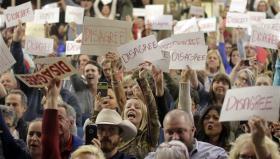
    ImageThousands of people showed up at town halls meetings across the United States in February to challenge Republican congressional representatives and senators on their plans for the Affordable Care Act (Obamacare) as well as on issues from immigration, to the environment, to President Donald Trump’s relations with Russia. While this past week fewer protestors took to the streets where radicals have generally taken the initiative and established the tone of the Resistance, town halls swelled with more moderate but quite militant crowds who challenged Republicans and their politics.


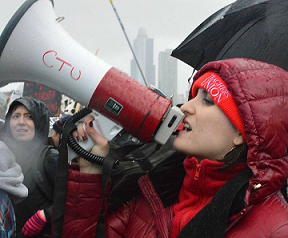
    The rowdy demonstrations, mostly organized by Democratic Party networks, virtually disrupted a few Republican legislators’ meetings while in most town halls angry voters rose to demand that the health care plan’s fundamental features be preserved, that immigrants’ rights be respected, and that the Environmental Protection Agency be funded. Like those at Representative Jason Chaffetz’s town hall meeting in Cottonwood Heights, Utah, pictured in the AP photo accompany this column, they came prepared to disagree. 

    Nothing like this has taken place at local town hall gatherings since the rightwing Tea Party’s demonstrations in 2009 and 2010, protests that provided the model for the current left-of-center protests.

    Republican Response Divided

    The boisterous turnouts succeeded in dividing Republicans on how to handle them. Some Republicans claimed they could not hold old town hall meetings for fear of “leftist violence,” though in reality they feared facing their angry constituents. When U.S. Representative Rodney Frelinghuysen of New Jersey declined to meet with his constituents crowded the Jam-E-Masjid Islamic Center and held a town hall meeting without him. Similar empty-chair events for missing representatives took place in other cities. But some Republican senators and representatives met and debated issues with their constituents and felt the heat.

    Trump and other Republicans falsely accused the Democratic Party and liberal organizations of paying “professional protestors.” While Democratic, liberal, and progressive groups have organized most of the protests, with so many furious about Trump’s and the Republicans’ plans, the opposition has not had to pay people to attend. People turned out willingly in droves. Some Republicans such as Rep. Mark Sanford, a South Carolina Republican, conceded that those at his meeting “weren’t a manufactured crowd.” Republican Leonard Lance of New Jersey conceded that the rambunctious groups at his meeting were not paid, they were just constituents.

    Indivisible Organizes Democrats

    Many of the protests were coordinated through an anti-Trump movement linked to the Democratic Party called “Indivisible” that claims 7,000 affiliated groups throughout the country. The group takes its name from the recently published handbook titled "Indivisible: A Practical Guide for Resisting the Trump Agenda" written by former congressional staffers, Leah Greenberg and Angel Padilla. In New York the Working Families Party, which supports progressive Democratic Party, candidates has also been involved in organizing protests. The American Civil Liberties Union (ACLU) has provided resources to some of the groups the demonstrations.

    While they have some overlap with earlier protests such as the Women’s March, the immigrant rights protests at the airports, and the Day with Immigrants demonstrations, the town hall demonstrations represent a different cut of the population. Senior citizens and the middle aged were often present in large numbers, though those in their twenties and thirties who have formed the majority of the street demonstrations also turned out in significant numbers in many locations.

    Led largely by Democratic Party-related organizations, the militant town hall protests often had more moderate politics than the crowds in the streets over the past month. Still one saw in the town halls signs for “Single-Payer Health Care” and “No Muslim Ban” and in some cities heard from the floor not only anti-corporate speeches, but occasionally anti-capitalist ones as well.

    In February, with the emphasis on Town Hall meetings, the Democratic Party appeared to be taking leadership of the Resistance, the name given to all forms of opposition to Trump. The spring will bring the movement back out into the streets, and if we are to build an independent movement, the radicals will have to begin to take the lead and set the tone.


  • Reports on the Resistance: Not-My-President Day, Day without Immigrants, and More Protests Planned

    Image

    Protests against Trump continue even as new ones are being planned for the future, from the recent Not-My-President Day and Day without an Immigrant protests, to the International Women's Strike planned for March 8.

    Thousands of protestors in New York, Chicago, Atlanta, Los Angeles, and some two dozen other cities marched on Monday, Feb. 20 in opposition to President Donald Trump and his policies on what is usually called “President’s Day” but on this occasion was marked by many as Not-My-President Day. On what was in the Midwest and the East a beautiful spring-like day—thanks to climate change—protestors marched to protest Trump’s environmental and immigration policies and just about everything else that the new president stands for.

    Chanting “No ban, no fear, immigrants are welcome here,” and other slogans, marchers in various cities carried signs reading “Not my president! Nyet!” or “Happy President’s Day, President Putin!” an allusion to suggestions that Putin is Trump’s puppet-master. There were also signs referring to “President Bannon,” meaning the alt-right ideologue Steve Bannon who others think pulls Trump’s strings. In Chicago some signs read: “Hands off our EPA,” “Black Lives Matter,” and “I stand with Planned Parenthood.”

    Sayief Leshaw, a twenty-two year old protestor in New York, told the media, “I'm really concerned for where our country is headed. We've sold out to corporate interests, and Donald Trump's policies are downright offensive.”

    President’s Day was originally known as and is still legally called George Washington’s Birthday though in the late 1960s it was combined with Lincoln’s Birthday and moved to a Monday to create a three-day weekend. The day, combining a celebration of the founding father Washington, a slave-owner president, with a commemoration of Lincoln who led the United States through the Civil War to abolish slavery, illustrates the deep contradictions of American society around the question of race.

    Until this President’s Day it had not been associated with a sitting president and was not a day of opprobrium. 

    A Day without Immigrant

    Only four days earlier, on Feb. 16, thousands of immigrants in cities across the country took the day off work to protest President Trump’s policies on immigration and refugees. Some employers, either because they are immigrants themselves or because they are sympathetic to the immigrant cause, shut their businesses so that their workers could participate. In other cases immigrant workers simply didn’t show up for work in what was in effect an immigrant worker strike, and at least 100 in different cities were fired for their participation.

    The Day without Immigrants had its greatest impact on restaurants, where many immigrants work in the kitchens washing dishes, preparing food, or serving customers. Latino immigrants in particular, and Mexicans who form the majority among them, played an important role in the protests. In Washington, D.C. some 50 restaurants were closed, including six in the Pentagon. In some cities parents kept their children home from school or older students stayed home on their own initiative.

    In some cities, such as Milaukee, the Day without Immigrants involved mass demonstrations of thousands of immigrants and their supporters who marched to protest Trump's policies.

    While important symbolically as a statement against Trump and his policies, nowhere did the Day without Immigrants have a serious economic impact. Some organizers home to build toward another immigrant worker protest on May 1, International Labor Day, which is celebrated in most countries of the world.

    The name Day without Immigrants goes back to Sergio Arau’s 2004 film “A Day without a Mexican,” which imagined that a pink fog led to the disappearance of all of the Mexicans in the California economy, bringing the state to a halt.

    In 2006 some immigrant rights organizers picked up the phrase “day without a Mexican” and suggested that the immigrant rights protests of the spring and summer of that year should culminate in a general strike by immigrant workers. The proposed immigrant strike of 2006 never took place, though the protests in Los Angeles and Chicago, where as many as one million workers took part, did in fact lead to the voluntary or forced closing of many businesses.

    Resistance Everywhere, All the Time—and the Women’s Strike

    While the Not-My-President Day and Day without Immigrants were the two largest and most visible protests nationally, hundreds of protests of all sorts have been taking place across the country over the last two weeks. These include turning out voters for town hall meetings with their representatives, protests over climate change, immigration policy, and many other issues.

    Documentary filmmaker Michael Moore has established The Resistance Calendar to keep activists informed of coming activities. Moore wrote on his Facebook page that The Resistance Calendar will be, “A 24/7 clearinghouse of the already MASSIVE resistance to Trump, to the Republican Congress, and, yes, to many of the spineless Democratic politicians out there. We welcome all resisters across the movement to use this tool. It's completely free. There's no big "funder" or group behind it. There will be no ads, no commercialization, no fundraising lists — all the stuff we hate. Just you, me, the volunteers donating their time to keep it going and the World Wide Web. BOOM!”

    Among planned protests for the future, a group of feminists is organizing for an International Women’s Strike. They write,

    “The International Women's Strike on March 8th, 2017 is an international day of action, planned and organized by women in more than 30 different countries.  

    “In the spirit of solidarity and internationalism, in the United States March 8th will be a day of action organized by and for women who have been marginalized and silenced by decades of neoliberalism directed towards working women, women of color, Native women, disabled women, immigrant women, Muslim women, lesbian, queer and trans women.  

    “March 8th will be the beginning of a new international feminist movement that organizes resistance not just against Trump and his misogynist policies, but also against the conditions that produced Trump, namely the decades long economic inequality, racial and sexual violence, and imperial wars abroad.”

    A number of women’s organizations and a few labor unions have endorsed the call for a Day without Women.


  • Fake News: from Satirical Truthiness to Alternative Facts

    ImageIn the wake of the 2016 election, Oxford Dictionaries declared “post-truth” to be the 2016 international word of the year.[i] The viral spread of fake news stories (such as the infamous “Pizzagate”[ii] scandal alleging that Hillary Clinton’s campaign chair John Podesta secretly ran an illegal sex trafficking ring out of a Washington D.C. pizzeria) no doubt helped to install America’s lunatic POTUS and his clown car of white supremacist cabinet members into the Oval Office.

    In the halcyon days, the term “fake news” used to refer to hard-hitting satirical programs, in the vein of The Daily Show, The Colbert Report, Last Week Tonight, and Full Frontal with Samantha Bee. When the distinctions between truth and fiction, reality and absurdity, and authenticity and fakery have become so hopelessly blurred, comedic satire has felt like a last stand against the bottomless unreality of contemporary political media culture. Satire speaks truth to bullshit by usurping the very language of falsehood and nonsense.

    In 2005, Stephen Colbert ironically declared “truthiness” to be “The Word” of the times.[iii] Re-watching this Colbert Report segment in 2017 feels like walking through a funhouse mirror. Truthiness, defined by Colbert as the fact that you don’t “think with your head” but that you “know with your heart,” has now become the lingua franca of Trumpist authoritarianism: it’s a truth that comes from the gut (because “you have more nerve endings there”—just ask your gut). But displacing cold hard facts with heated emotions evidently has consequences. Colbert quipped: “Who’s Britannica to tell me that the Panama Canal was finished in 1914? If I want to say it was 1941, that’s my right.” Performing his parodic Fox News persona (modeled on Bill O’Reilly and Sean Hannity), Colbert proceeds to defend both the justness of the Iraq War and Bush’s SCOTUS nomination of Harrier Miers as authentically truth-y, meanwhile skewering the dictionaries, encyclopedias, and reference books for being “all fact but no heart.”

    Recently, Trump’s trusted counselor Kellyanne Conway has coined the term “alternative facts”[iv] (to rebrand abject lies), alleged a non-existent terrorist attack called “The Bowling Green Massacre”[v] (which the Internet promptly mocked as “too soon to laugh at” because we should wait until it actually happens), while Trump himself has taken to Twitter to perpetuate easily debunkable falsehoods on topics ranging from the weather and crowd size during his inauguration speech, to massive electoral voting fraud, to the unemployment and crime rates under Obama. Lies and fake news rule the day, while the Trump Administration’s litany of absurdities blur with their comedic lampooning—nonstop ridiculous nonsense, but with catastrophic human and environmental consequences. It is perhaps fitting in this climate—when the distinction between fact and falsehood has been overtaken by the battle for earning more clicks and “likes” on social media—that satire, mockumentary hoax, and comedic buffoonery would represent among the last frontiers of political truth.

    Beyond Colbert’s prophetic vision of truthiness, the news satirist’s slippery mode of truth-telling offers a powerful syntax for asserting just conviction against the relativism of objectivity and evidence. Laughter short-circuits the false opposition between the mind and the gut. It lends a critical comedic filter for managing the endemic desire to align truth not just with the evidence of objective reason, but with the satisfaction of emotional belief and moral conviction. In a political media climate driven by relentless spin, false equivalents, habitual instantaneity, hyper-mediation, and an overriding contradiction between the complexities of context and the need for easy sound bites, safeguarding the truth too often feels like an impossible leap of faith.

    While “fake news” may always have been somewhat of a misnomer for comedic news satire, it is uncanny to see this once playful signifier so un-ironically repurposed in a political war of media disinformation. Sean Spicer (who reportedly chews and swallows two-and-a-half packs of Orbit cinnamon gum every day before noon[vi]), refused to answer questions from CNN or Buzzfeed, branding them “fake news!” at a White House Press Conference. Trump defended his unconstitutional immigration ban on Twitter, asserting that “any negative polls are fake news, just like the CNN, ABC, NBC polls in the election.” Similarly, “the failing @nytimes does major FAKE NEWS China story.”[vii] Fake news has become the catch-all signifier of an allegedly “post-truth” era, used to discredit or defame any truth that one simply does not like. Whoever has the strongest grip on power, or perhaps the loudest microphone, can thus dictate from whole cloth what’s real and what’s fake.

    Yet, the fakery of fake news has always derived from its connotative ambiguity. This is the modus operandi of news satire from The Daily Show to The Yes Men to The Onion. For example, Andy Borowitz’s satirical Borowitz Report recently noted: “Trump says he has been treated very unfairly by people who wrote Constitution.”[viii] Though verifiably false, this certainly “feels true”—if not within the realm of something that Trump himself would plausibly Tweet. It is not hard to imagine Trump bemoaning the TOTAL DISTASTER of the U.S. Constitution and its crooked framers. An exercise in reductio ad absurdum—exposing illogic by taking problematic or dangerous rhetoric to its absurdist conclusions—satirical fake news dismantles bald-faced disinformation by debunking it not through science or reason but through the inherent absurdity of false logic.

    On the eve of the inauguration, Michael Moore thus advised protesters to “fight Trump with an army of comedy.”[ix] Given the extent to which comedic discourse and satire have effectively shaped the terms of Trump’s candidacy and uniquely facilitated his political visibility, it seems inevitable that laughter would then hold the key to Trumpism’s dismantling. Yet, satire always cuts both ways. Even a devastating joke can risk preempting action and dissent through the ideological echo chambers of reassuring laughter. Is there still room for play when the relativism of truth and politicization of language might help pave the way for the very censorship of the free press, the privatization of the social safety net, the erosion of environmental protections, and the escalation of a global arms race—if not worse?

    As Masha Gessen has forebodingly described Trump’s purchase on the truth, he “uses language to assert power over reality.”[x] In a post-election interview with Samantha Bee on Full Frontal, Gessen further paraphrases Trump’s unflagging bullshit: “What he is saying is, ‘I claim the right to say whatever the hell I please. And what are you gonna do about it?’” She compares Trump to the bully at the playground who steals your pencil box, hides it behind his back, and then claims not to have it in his hand. Against our protests, “But it’s there, in your right hand!,” the bully will insist, “But there’s nothing in my right hand.” In other words, “the point is not so much to take your pencil box, but to render you completely powerless, because everything you know how to do…is useless.” “And you look foolish,” Bee adds. “Yes,” and, Gessen nails the coffin shut, “you don’t get your box back either.”

    Gessen (an outspoken critic of Vladmir Putin, gay civil rights activist, and prolific public intellectual) had to flee from Putin’s autocratic state—she is a political refugee, like many, with an ominous sense of déjà-vu. Her article, “Autocracy: Rules for Survival”[xi] (like Richard Rorty’s Achieving Our Country[xii]), went viral after the election. In contrast to Rorty’s tempered pragmatism, which extols the virtues of moral exceptionalism to combat the relativism of truth in postmodern culture, Gessen preaches the powers of mass hysteria. Her rules for survival include #1) Believe the autocrat; #2) Do not be taken in by small signs of normality; #3) Institutions will not save you; #4) Be outraged; #5) Don’t make compromises; and #6) Remember the future. Nicely condensing these six rules in her response to Bee’s plea about what we can each do to resist, Gessen states bluntly: “The thing we can do…is actually to continue panicking. Continue to be the hysteric in the room” – [Bee interrupts, laughing, “I can stay hysterical!”] – Gessen: “Just continue panicking, write a note to yourself of what you would never do, and when you come to the line, don’t cross it.”

    The language of authoritarianism is itself rather hysterical. When Trump addresses his supporters at a rally, his words appeal not to reason, or even to folksy common sense, but to emotional instinct. His chants of “Lock her up!,” “Build a wall!,” and “Make America Great Again!”—which range from illegal, to unactionable, to incomprehensible—solicit an overwhelming visceral response from the body of his exuberant supporter. It is precisely the jouissance of Trump’s hysterical rally cries that make their targets (women, LGBTQ+, immigrants, people of color) feel so vulnerable and at risk in Trump’s America. As many have commented, “take Trump seriously, not literally.” If Trump “uses language to assert his power over reality,” authenticating his meaning with hysterical emotion rather than intellectual persuasion, then responding with pervasive panic seems all too proportionate—especially given the autocratic lessons of twentieth-century history.

    But what does it mean to “be the hysteric?” At its core, hysteria substitutes for language when language becomes impossible: when words fail, or when I have no chance of making my meaning stick through reasoned argumentation, I, as hysteric, turn to the body and emotions as forms of articulation. For example, nineteenth century female hysterics (who were represented as repressed middle-class women), suffered from fugue states, somnambulism, epileptic fits, and uncontrollable laughing, yawning, and hiccupping attacks in the absence of everyday words. Their theater of bodily symptoms substituted for their exclusion from the rational certitudes and enlightened positivism of masculinist public sphere discourse. Hysteria, not unlike comedic laughter, is an irrational means of expression that erupts from the very limits of conscious reason and symbolic language. (It is perhaps unsurprising that Freud, a preeminent theorist of female hysteria, also argued that women lack the mental apparatus for speaking truth to power as tendentious jokesters.) 

    In a recent piece on the underbelly of satire, “How Jokes Won the Election,”[xiii] New Yorker critic Emily Nussbaum associates the misogynistic, pussy-grabbing, whitelash of Trumpism with “the explosion of female comedy” that “found its roots in everything from the female-cast Ghostbusters reboot to the anti-feminist GamerGate movement.” She writes: “Trump’s call to Make America Great Again was a plea to go back in time, to when people knew how to take a joke. It was an election about who owned the mike.” Given the investment in excluding women from the powers of comedic invective, even the milder satire of a widely broadcast show like Saturday Night Live can play a politically consequential role in dismantling the oppressive ideologies of Trumpism.

    As far as bullies go, Trump is notoriously thin-skinned—he’s waged Twitter wars against comedians including Alec Baldwin, Jon Stewart, Bill Maher, Rosie O’Donnell, and pretty much the entire cast of SNL. It is undeniably fun to get Trump’s goat. For example, Melissa McCarthy’s outrageous burlesque of Sean Spicer has already spurred an energetic movement for women to play each member of Trump’s Administration (such as O’Donnell as Steve Bannon, Ellen DeGeneres as Mike Pence, Betty White as Jeff Sessions, and Meryl Streep as Donald Trump).[xiv] Even the laughter of ad hominem satire is still pointed enough to prick the fragile ego of Trumpist authoritarianism.

    While the political law-makers are seizing their monopoly on legitimate falsehoods, the satirists must consolidate their purchase on truthiness. Alongside the facts, absurdist invective has the traction to dislodge falsehoods that are somehow too verifiably inaccurate to debunk through objective or referential means. If fact checking “alt-facts” often feels more absurd than consequential, then why not fight the cynicism of false consciousness with the absurdism of disbelief? It will be a war of consensus between the propaganda of fake-fake news (as disinformation) and the critical apparatus of real-fake news (as comedic truth-telling). 

    In early February, at a breakfast meeting to kick off Black History Month, Trump made comments praising the 19th century Black abolitionist Frederick Douglass, indicating that he has no idea who Douglass actually is and that he still believes Douglass to be alive. Trump proclaimed: he is “an example of somebody who's done an amazing job and is being recognized more and more, I’ve noticed.” Shortly afterward, the fake Twitter account @realFrederickDouglass was also declaring “MASSIVE VOTER FRAUD that led to black ppl and women not voting for entire first half of U.S. history!”[xv] In related news, @realFrederickDouglass recently checked in on Facebook and was marked safe at #BowlingGreenMassacre. When the line between #real and verifiably fake has become dangerously obscure, we must also look to satire to show us the truth. 

    *Maggie Hennefeld is an Assistant Professor of Cultural Studies and Comparative Literature at the University of Minnesota. Her book, Specters of Slapstick and Silent Film Comediennes, is forthcoming from Columbia University Press (2018), and she has published articles and criticism in journals including Film Comment, Slant, differences, Discourse, and Camera Obscura — including a recent think piece on "Laughter in the Age of Trump." She is winner of the 2015 Screen essay award and the 2016 Jack Rosenbalm Prize for the best article in American Humor Studies.


    [i] https://www.oxforddictionaries.com/press/news/2016/12/11/WOTY-16

    [ii] https://en.wikipedia.org/wiki/Pizzagate_conspiracy_theory

    [iii] http://www.cc.com/video-clips/63ite2/the-colbert-report-the-word—truthiness

    [iv] https://www.washingtonpost.com/news/the-fix/wp/2017/01/22/how-kellyanne-conway-ushered-in-the-era-of-alternative-facts/?utm_term=.f037ef4ea981

    [v] https://en.wikipedia.org/wiki/Bowling_Green_massacre

    [vi] http://nymag.com/thecut/2017/01/sean-spicer-swallows-35-pieces-of-gum-every-day-before-noon.html

    [vii] https://twitter.com/realDonaldTrump/status/830047626414477312

    [viii] http://www.newyorker.com/humor/borowitz-report/trump-says-he-has-been-treated-very-unfairly-by-people-who-wrote-constitution

    [ix] https://grassrootscomedy.com/2017/01/27/michael-moore-fight-donald-trump-with-an-army-of-comedy/

    [x] https://www.youtube.com/watch?v=rwQeKSlY56Q

    [xi] http://www.nybooks.com/daily/2016/11/10/trump-election-autocracy-rules-for-survival/

    [xii] http://www.hup.harvard.edu/catalog.php?isbn=9780674003125

    [xiii] http://www.newyorker.com/magazine/2017/01/23/how-jokes-won-the-election

    [xiv] http://www.huffingtonpost.com/zac-thompson/snl-should-cast-only-wome_b_14642374.html

    [xv] http://onehotmessalaska.blogspot.com/2017/02/frederick-douglass-opens-twitter.html


  • The Progressive Movement is a PR Front for Rich Democrats

    Image

    There is good news in the Boston Globe today for the managers, development directors, visionaries, political hacks and propaganda flacks who run “the Progressive Movement.”   More easy-to-earn and easy-to-hide soft money, millions of dollars,  will be flowing to them from super rich Democrats and business corporations.  It will come clean, pressed and laundered through Organizing for Action, the latest incarnation of the Obama Money Machine which has recently morphed into a “nonpartisan non-profit corporation” that will  ‘‘strengthen the progressive movement and train our next generation of leaders.’’

    Does this information concern you?  If not, you need to get out of the propaganda bubble of your Progressive Movement echo chamber and think.  Think hard.  Think about fundamental, radical, democratic, social and economic change, who might bring it about and how.  Ask yourself if the the rich elite, the 1%, are going to fund that.   Leave The Nation and Mother Jones on the shelf;  turn off Ed Schultz, Rachel Madow and Chris Hayes;  don’t open that barrage of email missives from Alternet, Media Matters, MoveOn, and the other think tanks;  and get your head out of the liberal blogosphere for a couple days.  Clear your mind and consider this:

    The self-labeled Progressive Movement that has arisen over the past decade is primarily one big propaganda campaign serving the political interests of the the Democratic Party’s richest one-percent who created it.  The funders and owners of the Progressive Movement get richer and richer off Wall Street and the corporate system.  But they happen to be Democrats, cultural and social liberals who can’t stomach Republican policies, and so after bruising electoral defeats a decade ago they decided to buy a movement, one just like the Republicans, a copy.

    The Progressive Movement that exists today is their success story.  The Democratic elite created  a mirror image of the type of astroturf front groups and think tanks long ago invented, funded and promoted by the Reaganites and the Koch brothers.  The liberal elite own the Progressive Movement.  Organizing for Action, the “non-partisan” slush fund to train the new leaders of the Progressive Movement is just the latest big money ploy to consolidate their control and keep the feed flowing into the trough.

    The professional Progressive Movement that we see reflected in the pages of The Nation magazine, in the online marketing and campaigning of MoveOn and in the speeches of Van Jones, is primarily a political public relations creation of America’s richest corporate elite, the so-called 1%, who happen to bleed Blue because they have some degree of social and environmental consciousness, and don’t bleed Red.  But they are just as committed as the right to the overall corporate status quo, the maintenance of the American Empire, and the monopoly of the rich over the political process that serves their economic interests.

    Rich Democrats to Progressives: We Love You, Man!

    After the 2000 presidential election, the Al Gore Hanging Chad Debacle, rich liberal Democratic elite began discussing, conspiring and networking together to try and make sure that no scruffy, radical  political insurgency like the Nader 2000 campaign would again raise its political head. They generally loved Al Gore, the millionaire technocrat, and they put in play actions, which led to the creation of a movement of their own that aped the right wing’s institutions. They reached out to the well-paid professionals who ran the big environmental groups they already funded and owned,  and to other corporate reform and liberal media operations. They followed plans drawn up by Democratic Party insiders who wanted nothing more than to win elections, and who saw the need for the tools and groups and campaigns the Right wielded.  They made it clear there would be wonderful financial rewards and career advancements for progressive leaders and their organizations who lined up with them.

    The Progressive Movement we see today was created by a small group including Democratic political operatives and foundations including TIDES (formed in 1976), the millionaires and billionaires of the Democracy Alliance, (formed in 2005) and eventually the Obama machine.

    After Al Gore’s 2000 debacle, the rich liberal Democrats in the East and the West began to talk and meet.  The green elite funders and dot.com millionaires of the Bay Area solidified relationships with the Beltway think tanks, political consultants and and PR flacks.   Liberal Democratic Party players like MoveOn’s co-founder Wes Boyd and TIDES Drummond Pike drew closer with others including the George Soros, John Podesta and Stanley Greenberg crowd.  The Democratic Party defeats in 2002 and 2004 fueled further despair and solidified plans for the elite to build a new Progressive Movement that would serve their agenda.

    This became very visible with the arrival of the Democracy Alliance.  A summer 2005 article in the Washington Post  made clear their intent to pour millions into creating and owning a Progressive Movement.  Looking back, someone needs to give these folks an award because the wealthy elitists in the Democracy Alliance succeeded wildly, mission accomplished!

    As the Washington Post reported,  “at least 80 wealthy liberals have pledged to contribute $1 million or more apiece to fund a network of think tanks and advocacy groups to compete with the potent conservative infrastructure built up over the past three decades.  …  The goal of the alliance, according to organizers, is to foster the growth of liberal or left-leaning institutions equipped to take on prominent think tanks on the right, including the Heritage Foundation, the Hoover Institution, the American Enterprise Institute and the Cato Institute, as well as such training centers as the Leadership Institute and the Young America’s Foundation.”

    The Washington Post explained, “There has been a flourishing of new, pro-Democratic think tanks and advocacy groups in recent years. Clinton administration chief of staff John D. Podesta established the Center for American Progress … and author David Brock helped create Media Matters for America last year, among others. All these groups are potential recipients of money from alliance partners. In addition, the number of liberal bloggers on the Web has been growing at a fast pace … .  Jockeying for cash among possible recipient organizations has already begun. Robert L. Borosage, director of the liberal Campaign for America’s Future, said the alliance will fund a ‘set of institutions in this city to be in the national debate, and we would like to be one of them.’ ”

    For almost a decade now the funders of the Progressive Movement, the rich Democrats of the Democracy Alliance and their cliques, networks and organizations, have employed and funded political hacks, fundraisers, pollsters, organizers and PR flacks.  Over the past ten years they have dumped more and more money into the big feeding trough shared by the major players of the Progressive movement.  The overall goal and result has always been to bring withering rhetorical fire and PR attacks upon the Republican Right, while creating a tremendous fear of the Right to increase the vote for Democrats. This has become Job #1 for the Progressive Movement. No one quite remembers Job #2.

    Real movements are not the creation of and beholden to millionaires. The Progressive Movement is astroturf beholden to the rich elite, just as the Democratic millionaires and operatives of the Democracy Alliance intended.  The “movement’s” funding is in the hands of a small number of super rich Democrats and union bureaucrats and advisors who run with them.  Its talking points, strategies, tactics and PR campaigns are all at the service of the Democratic elite. There is no grassroots organized progressive movement with power in the United States, and none is being built.  Indeed,  if anything threatens to emerge,  the cry  “Remember Nader!” arises and the budding insurgency is marginalized or coopted, as in the case of the Occupy Wall Street events.  Meanwhile, the rich elite who fund the Progressive Movement, and their candidates such as Barack Obama, are completely wedded to maintaining the existing status quo on Wall Street and in the corporate boardroom.  Their well-kept Progressive Movement is adept at PR, propaganda, marketing and fundraising necessary in the service of the Democratic Party and the corporate elite who rule it.

    One of the Progressive Movement’s key new movers and shakers is Ilyse Hogue.  Her rise out of the green movement and into the highest echelons of Democratic power encapsulates how it all works. In 2006 Hogue was recruited out of Rainforest Action Network by Wes Boyd of MoveOn to run their national campaigns.  Since then she has accumulated hats and desks at The Nation, Media Matters, the Soros-funded Super PAC Public Campaign Action Fund, and most recently the feminist lobby NARAL.  Hogue is an articulate and well-rewarded spokesperson, fundraiser and mobilizer for the new Progressive Movement. Her network of recent employers all benefited nicely from the successful work of the Democracy Alliance, TIDES, MoveOn, and Soros. Anyone who wonders if there are good careers in the Progressive Movement can look at her and others and see the answer is clearly ‘yes’.

    Every well-funded movement needs an echo-chamber to pump up its propaganda and messages, and for the Progressive Movement the Netroots Nation bloggers, The Nation, Alternet, Mother Jones, and scores of other journalists and pundits have filled the bill.  The development of the messages and talking points of the Progressive Movement is the realm of DC think tanks and organizations such as Media Matters, and a small army of flacks is also utilized including PR maven David Fenton,  pollster Stanley Greenberg and messaging guru George Lakoff.

    Co-opting the Anti-War Movement to Win Elections

    After the 2004 flop of the Kerry/Edwards campaign, luck shone on the Democrats.  The over-reach of the neoconservatives, the failure to find those weapons of mass deception (sic),  the endless wars in Iraq and Afghanistan, turned American public opinion,  especially among the young, against the Republicans.  Growing anti-war sentiment, which had little to do with the organized anti-war movement, delivered to the Democrats what Governor Mario Cuomo called “The Gift.”  The horrific Iraq war, he explained to a Democracy Alliance gathering, was the gift that allowed the Democrats to take control of the US Congress.

    It was at this point in early 2007 that the truly dark and cynical agenda of the professional Progressive Movement and the Democratic Party revealed itself.  Under Pelosi the Democrats could have cut off funding for Bush’s unpopular wars and foreign policy.  Instead,  with PR cover provided by MoveOn and their lobbyist Tom Matzzie, the Democratic Congress gave George Bush all the money he wanted to continue his wars.  For the previous five years MoveOn had branded itself as the leader of the anti-war movement, building lists of millions of liberals, raising millions of dollars, and establishing itself in the eyes of the corporate media as leaders of the US peace movement.  Now they helped the Democrats fund the war,  both betting that the same public opposition to the wars that helped them win control of the House in 2006 could win the Presidency in 2008.

    Their bet paid off with a young, charismatic black candidate backed from his beginnings by Wall Street, and thus able to out-raise even the Clinton Machine for the big money provided by the Democratic elite.  Obama hired top online organizers and combined MoveOn’s “clicktivist”  style and expertise to both raise money and build an effective political machine.  The stock market collapse of 2008 was again like a gift for the Democrats, showing Obama’s cool contrasted with old John McCain’s panic.

    Just before the Obama victory in 2008, Alternet’s Don Hazen interviewed  Drummond Pike, the millionaire who founded the TIDES Foundation in 1976 and a founding member of the Democracy Alliance. The topic was TIDES upcoming “Momentum” conference at a fancy San Francisco hotel. The exclusive confab was described as “an invitational gathering of progressive donors and advocates” where “some of the most creative minds in the progressive community come together to challenge, inspire and energize each other.” Pike said it was “where we bring funders, leaders of key nonprofits, think tanks and activist organizations together…   We are engaged in philanthropy. We granted $93 million dollars last year and manage grant-making for more than 400 individual and institutional donors.”  The wedding of the rich elite Democrats and the Progressive Movement just got better and better.

    Occupying Occupy for Wall Street Democrats

    After Obama’s 2008 victory the Progressive Movement celebrated itself and continued to solidify with ongoing funding from the Dem elite, playing a significant role in delivering the White House again to the Democrats in 2012.  One of their 2012 PR front stunts to benefit the Democrats was launched in early 2012, the “99% Spring.”

    In the Fall of 2011, the spontaneous street action known as Occupy Wall Street withstood media derision long enough to earn its respect.  It’s images struck a chord during the recession.  Overnight protests in major urban areas might not have appealed to the typical Democratic voter, but bashing the rich did.  Occupy might have even threatened the Democratic Party had it ever been able to overcome its anarchistic roots and in some way produced a strategy and organization.  But its slogan “we are the 99%” resonated widely.

    Nothing succeeds like success, and imitation is the most sincere flattery.  The Progressive Movement has plenty of bright marketers and messengers who saw the writing on Wall Street.  They decided to launch and hype an election year PR campaign to co-opt the message and theme of Occupy Wall Street.  They called it the 99% Spring, “Spring” as in the time of year but also as in Arab Spring of 2011.  When you don’t have a real Movement of your own, at least cop good language from some others!

    What amused me most about the 99% Spring was its simultaneous audacity and vacuousness, and how obviously it was a front for MoveOn, Van Jones, and the messaging agenda of the Democratic Party.  And now it’s all gone, just a flash across the webpages of The Nation and Mother Jones, not even a website left behind with its web address up for sale to the highest bidder.  The Progressive Movement lives from PR campaign and to PR campaign.  When the money’s spent, the movement just pivots to the next bit of funding and a new campaign is launched.

    I first heard of the 99% Spring in a February, 2012 email from the group formerly known as  SmartMeme, activists who work with the Progressive Movement and develop “stories” that can be used to get everyone thinking alike in a positive way.  They wrote:  “This spring is our opportunity to take the the emerging movement for the 99% to next level by following in the foot steps of previous successful movements and prepare for organized campaigns of sustained nonviolent direct action. SmartMeme is one of the initiating organizations of 99% spring because we believe the best way to challenge the corporate stranglehold on our economy and political system is with organized people power!”

    Propaganda is my beat, so I was not impressed by this revolutionary development.   It sounded exactly as it was, a big flow of money into key Progressive Movement organizations to co-opt the brand of  Occupy Wall Street movement for the Progressive Movement and the Democrats.  In my email from SmartMeme there was a hotlink to the “the99%Spring” website.  Today that link and URL goes to NameJet, a company that auctions off unwanted web addresses.  How appropriate.

    The MoveOn.org site on 99% Spring is still up as of this writing:  MoveOn pushed 99% Spring hard, and emails from their staffers employed revolutionary hyperbole that might have made Abbie Hoffman proud.  MoveOn wrote,  “groups from every corner of our movement are joining forces to do something that’s never been tried before. During the week of April 9-15, across America, we will bring 100,000 people together for an unprecedented national movement-wide training on what happened to our economy, on the history of peaceful direct action, and how — following in the footsteps of Gandhi and Dr. Martin Luther King Jr. — we can take direct action this spring to challenge corporate power, end tax giveaways to the 1%, fight the influence of money in politics, and more.”

    99% Spring organizers Liz Butler and Joy Cushman extolled similarly in their emails: “Imagine if the 99% of us for whom this country is supposed to work came together as a unified movement for democracy and justice? What could happen if hundreds of thousands of us were willing to take nonviolent direct action to reclaim the America we love from the banks and lobbyists who’ve stolen it from us?  Let’s find out.”

    The SourceWatch website: lists the groups promoting 99% Spring: “Jobs With Justice, United Auto Workers, National Peoples Action, National Domestic Workers Alliance, MoveOn.org, New Organizing Institute, Movement Strategy Center, The Other 98%, Service Employees International Union, AFL-CIO, Rebuild the Dream, Color of Change, UNITE-HERE, Greenpeace, Institute for Policy Studies, PICO National Network, New Bottom Line, Veterans of the Mississippi Civil Rights Movement, SNCC Legacy Project, United Steel Workers, National Education Association, Working Families Party, Communications Workers of America, United States Student Association, Rainforest Action Network, American Federation of Teachers, Leadership Center for the Common Good, UNITY, National Guestworker Alliance, 350.org, The Ruckus Society, Citizen Engagement Lab, smartMeme Strategy & Training Project, Right to the City Alliance, Pushback Network, Alliance of Californians for Community Empowerment, Progressive Democrats of America, Change to Win, Grassroots Global Justice Alliance, Campaign for America’s Future, Public Campaign Action Fund, Fuse Washington, Missourians Organizing for Reform and Empowerment, Citizen Action of New York, Engage, United Electrical Workers Union, National Day Laborers Organizing Network, Alliance for a Just Society, The Partnership for Working Families, United Students Against Sweatshops, Presente.org, Get Equal, American Federation of State, County, and Municipal Employees, Iowa Citizens for Community Improvement, Corporate Accountability International, American Federation of Government Employees, Training for Change, People Organized for Westside Renewal (POWER), Student Labor Action Project, Colorado Progressive Coalition, Green for All, DC Jobs with Justice, Midwest Academy, The Coffee Party, International Forum on Globalization, UFCW International Union, Sunflower Community Action, Illinois People’s Action, Lakeview Action Coalition, Progressive Leadership Alliance of Nevada, International Brotherhood of the Teamsters, Resource Generation, Highlander Research and Education Center, TakeAction Minnesota, Energy Action Coalition, Earthhome.us.”

    In any good front group campaign lists like this serve a few purposes.  One is to give the impression that this is a really powerful and diverse effort with scores of leading organizations actively involved, rather than a well-funded PR effort run by a small group at the top, which it was.  Another purpose is to demonstrate that there is money behind this effort and that the major Progressive Movement hitters are involved.  When I saw the list I sent some emails to Progressive Movement activists asking why they were lending their names to a MoveOn-driven effort to co-opt the Occupy Wall Street for the Democrats.

    Greenpeace’s Executive Director wrote back, clearly not sharing my view.  He said  “something funny is happening here. In a fascinating, good, confusing way.”  He believed that MoveOn and the public employee union SEIU were “focused on scaling civil disobedience. That’s different. You can look at it in many ways.  …  Friends asked us to sign on, we do that a lot.”

    An employee of Campaign for America’s Future also gave 99% Spring a big left-handed thumbs up, writing me, “this is a ton of progressive groups trying to get a national movement going, organized, working together,” and “anything that drives the 99% versus 1% perspective advances everything we are trying to achieve.”

    No one identified with the Progressive Movement would in any way question or criticize the 99% Spring, at least no one I could find.  And then my inquiries uncovered someone new who has a paid position in one of the groups.  She agreed generally with my perspective, and was disgusted by what she saw daily from her “movement”:  pandering to the rich elite; shallow public relations campaigns substituting for organizing; Democratic Party agendas; six figure salaries and consulting fees for the Progressive executives and consultants, and so on.  She saw the Progressive Movement a convenient way for the Democratic rich to control the rabble, manage dissent, and deflect attention from the need for fundamental, radical structural change in the United States.

    Eventually she wrote an article under the pen-name Insider for CounterPunch exposing the 99% Spring as a front group for the agenda of the Democrats, organized largely by MoveOn.  The Insider’s  piece hit a nerve or two and gathered quite a bit of attention and clumsy efforts at rebuttal.

    I bounced the piece around and became its defender and promoter.  She quoted me in her article. I told her that the 99% Spring reminded me of the AAEI coalition, another MoveOn front that worked with Nancy Pelosi in 2007 to see to it that the Iraq war was funded and used as a political stick to beat Republicans in 2008.  Or the massively funded Health Care for America Now coalition backed by MoveOn in 2009 which made sure that single payer health care was ignored while the White House pushed its pro-insurance industry legislation derided as ‘Obamacare’.”

    Keep Hope a Jive

    Predictably the echo chamber of the Progressive Media  —  bloggers, columnists and editors at The Nation, Mother Jones and Alternet and elsewhere who get funding from the Democratic Elite  — defended the honor of 99% Spring.  The Nation produced a special issue promoting it.  A Mother Jones writer claimed that it was an indication that Occupy Wall Street had co-opted MoveOn.

    Some of the idealistic young green activists employed by 350.org bought heavily into 99%.  That inspired Insider to take a critical look at 350.org as a tool for Obama’s re-election.

    Eventually, like all PR campaigns when the funding runs dry, the 99% Spring simply dried up and blew away. It was nothing real, just election year pageantry from a Progressive Movement that — as the rich of the Democracy Alliance planned — would be a way to breathe some life into the morbid Democratic Party. The 99% Spring showed again that the Progressive Movement primarily exists to stick it to the Republicans, the a mirror image of their think tanks, echo chamber media, and PR fronts that rich Democrats have created or funded.

    RIP 99% Spring. It was what we thought it was, all theater, and co-optation, all about getting Van Jones more publicity to promote Obama.

    Will any of the paid professional Progressives ever admit so? Not as long as their careers and funding depend upon it; they can’t afford to take off their rose-hued glasses.

    More importantly, how do people who aren’t the kept, professional Progressives go about asking the right questions, organizing the right ways,  and making the fundamental, radical structural changes that will topple the institutional control of the 1% over our lives, communities, politics and biosphere?

    I posed that question to someone not fooled by the foibles and feints of the Progressive Movement, my colleague Patrick Barrett, a University of Wisconsin academic who studies social and political movements.  A veteran of the 1960s civil rights and anti-war movements, Patrick has never swooned to the spell of the Progressive Democrats.  Patrick is one of the few truly wise people I know.

    “What gets lost in all this faux movement politics,” said Barrett,  “is any real challenge to the growing imbalance of social, political and economic power. Quite the contrary, the ultimate impact of their actions is to reproduce if not  aggravate that imbalance.

    What we’ve got here is a deeply symbiotic relationship between a pseudo-movement that derives its raison d’etre and financial vitality from a vilification of the right, which it has helped to create and without which it would have no reason for existence. Indeed, the more extreme the right becomes, the better it is for them, since they live off of fear-mongering. To oppose the right in a meaningful sense would put them out of business. That isn’t to say that there is nothing to be feared in the right or that some of these folks don’t think they’re fighting the good fight, but rather that the two work in tandem, much like a good-cop-bad-cop team. As the right becomes ever more extreme, this Democratic Party cum non-profit industrial complex moves further and further to the right itself, thereby giving the Republicans and their ilk ever greater leash and making it easier to frighten the “progressive” masses.”

    Barrett concluded, “Lest anyone think that this is some kind of conspiracy theory, it’s important to emphasize that this is primarily a function of social and economic structures and political institutions that create a market for these sorts of pseudo-movement leaders, who will flourish if the conditions are right. That’s why we need to focus our attention on altering those conditions, something these people have little or no interest in doing.”

    This article originally appeared in CounterPunch

    *John Stauber is an independent writer, activist and author. His books include Toxic Sludge Is Good for YouMad Cow USA and Weapons of Mass Deception.  In 1993 he founded the Center for Media and Democracy to exposed corporate, political and media propaganda campaigns.  He retired from the Center in 2008.  http://www.linkedin.com/in/johnstauber.

  • The Price for Their Pound of Flesh: A New Book on the Value of the Enslaved

    Image

    The author of The Price for Their Pound of Flesh is Daina Ramey Berry. Professor Berry is an associate professor of history and African and African diaspora studies and the George W. Littlefield Fellow in American History at the University of Texas at Austin. An award-winning historian, she is also a Distinguished Lecturer for the Organization of American Historians. Berry is a specialist in the history of gender and slavery in the United States with a particular emphasis on the social and economic history of the nineteenth century.

    Her first book, Swing the Sickle for the Harvest is Ripe: Gender and Slavery in Antebellum Georgia (University of Illinois Press, 2007), examined slave labor, family, and community in two distinct regions. She is also the editor-in-chief of the award-winning book Enslaved Women in America: An Encyclopedia (ABC-Clio, 2012), and she published the award-winning volume Slavery and Freedom in Savannah (University of Georgia Press, 2014), edited with Leslie Harris. In addition, Berry has appeared on several syndicated radio and television shows, including NPR, NBC, PBS, C-SPAN, and the History Channel. She is an advocate for public history and served as one of the technical advisers for the remake of the Roots mini-series, which aired in the summer of 2016. Follow Professor Berry on Twitter @lbofflesh

    In life and in death, slaves were commodities, their monetary value assigned based on their age, gender, health, and the demands of the market. The Price for Their Pound of Flesh is the first book to explore the economic value of enslaved people through every phase of their lives—including preconception, infancy, childhood, adolescence, adulthood, the senior years, and death—in the early American domestic slave trade. Covering the full “life cycle,” historian Daina Ramey Berry shows the lengths to which enslavers would go to maximize profits and protect their investments. Illuminating “ghost values,” or the prices placed on dead enslaved people, Berry explores the little-known domestic cadaver trade and traces the illicit sales of dead bodies to medical schools.

    This book is the culmination of more than ten years of Berry’s exhaustive research on enslaved values, drawing on data unearthed from sources such as slave-trading records, insurance policies, cemetery records, and life insurance policies. Writing with sensitivity and depth, she resurrects the voices of the enslaved and provides a rare window into enslaved peoples’ experiences and thoughts, revealing how enslaved people recalled and responded to being appraised, bartered, and sold throughout the course of their lives. Reaching out from these pages, they compel the reader to bear witness to their stories and to see them as human beings, not merely commodities.

    A profoundly humane look at an inhumane institution, The Price for Their Pound of Flesh will have a major impact how we think about slavery, reparations, capitalism, nineteenth-century medical education, and the value of life and death.

    Told: Slavery and the Making of American Capitalism

    Daina Berry has written the richest account of the many ways in which an enslaved African American’s body was bought and sold throughout her or his lifetime. From the cradle to the grave and beyond, enslavers priced black bodies based on their imagined fitness for labor, sexual exploitation, use as collateral, and even their value after death as dissection cadavers. In horrific detail, Berry shows that there was a price tag placed on every pound of flesh. She also shows the efforts of enslaved people to assert that their lives had values beyond the money that could be rendered from their muscles and extracted from their bones. Out of the certainty that their souls were pearls beyond price, black people fought to make room for their own system of human values. —Edward E. Baptist, author of The Half Has Never Been

    Ibram X. Kendi: Tell us a little bit about how you produced this book. What were your source materials, intellectual approaches, and writing style?

    Daina Ramey Berry: After seeing multiple references to enslaved people’s prices in plantation records, I became interested in exploring the topic for the last 10 years. Enslaved people were often second to land value in terms of wealth generated by enslavers. At the same time, I kept seeing references to slave prices in history books, but scholars rarely contextualized the meaning of these values. Were they high, low, or average? How did enslavers and traders place a monetary value on a human being? What coping mechanisms did the enslaved use to survive commodification? What did they know about their values? Did they care whether or not they commanded a high price or were considered a bargain? I wanted to know how they were priced and also how those prices changed over the course of their lives.

    To answer these questions I visited more than twenty archives over the last decade and examined more than 1,000 documents. They included insurance policies, tax records, estate inventories, bills of sales, probate records, deeds, gifts, newspaper advertisements, and court records. But I also studied narratives and other first-hand accounts that contained vivid descriptions of the experience of being treated as a commodity. This reminded me to keep enslaved voices central. Enslaved women and men had their own set of values that did not necessarily align with the values of those who traded them. I call these soul values. I argue that these values governed the way they responded to commodification. They clung to every ounce of their souls that they could, while their bodies were being objectified, exploited, beaten, and overworked.

    At first I struggled with how to frame the study. But as I continued collecting a data set of nearly 12,000 valuations, I discovered that enslaved people were valued from preconception to postmortem. Planters and traders alike anticipated the value of an unborn child and his/her mother, and I remember being shocked to discover that the dead, too, carried a value. Enslaved people convicted of a crime (or not) were appraised and their enslavers received compensation from the state for their loss of property (public hanging). They were also paid for slave cadavers. When I came across a narrative that talked about exhuming the body of a toddler and selling the cadaver to a medical doctor, I began to explore the records, lecture notes, drawings, and autopsies of anatomy professors at teaching hospitals all over the United States. Here I discovered the long reach of ghost values—my term for pricing dead people.

    In the end, I wanted to tell the story of a person and a commodity in the same body. I wanted enslaved peoples’ thoughts and opinions about their commodification to be a central component. My goal was to develop a book that did not relegate them to a trope, an anecdote, or a point on a graph. Each chapter begins with an auction and ends with a burial. The book hinges upon the lifecycle of the enslaved and their evolving understanding of themselves as person and property. Finally, I hope readers walk away with a better understanding of human property, medical education, and the infinite value of the soul.

    *Ibram X. Kendi is the associate editor of Black Perspectives. He is Assistant Professor of History at the University of Florida and author of Stamped from the Beginning: The Definitive History of Racist Ideas in America (Nation, 2016), which won the 2016 National Book Award for Nonfiction. Follow him on Twitter @DrIbram.


  • TIAA Accused of Land Grabs, Human Rights Violations, Environmental Destruction

    Image

    No one wants their retirement to be financed by companies involved in human rights violations and environmental destruction. But that is exactly what is happening to those of us with retirement funds invested in TIAA.

    You can learn about the campaign to get TIAA to divest from companies involved in land grabs and deforestation throughout the world by reading the attached power point – and please sign one of the petitions. You can do so here: http://bit.ly/TIAALandGrabwebinar

    – Nancy Holmstrom, Prof. Emerita Rutgers U, New Politics Editorial Board member and TIAA client.


  • Accreditation struggle at City College of San Francisco – Guest blog by Rick Baum

     In this guest blog, Rick Baum, who  teaches Political Science at City College of San Francisco and is a member of AFT 2121, reports on the struggle over accreditation and the continued attempts to destroy the institution.

              Union members need accurate reporting about issues facing them, especially in stories in union literature.  Unfortunately, that does not always happen, as is the case in an American Federation of Teachers (AFT) report on City College of San Francisco (CCSF) gaining its full accreditation after having been under assault for more than four years. 

              The CCSF community learned on January 13, 2017 that the Accrediting Commission for Community and Junior Colleges (ACCJC) had declared the college to be fully accredited. This decision came four and a half years after CCSF, a college with over 80,000 students at the time, had been harshly sanctioned, and three and a half years after being threatened with closure by the ACCJC.

              Winning accreditation was a big victory for those struggling against the ACCJC whose conduct, in the AFT story on this good news, was accurately described by the AFT President Randi Weingarten as “outrageous and unfair.” 

    CCSF should never have been threatened with closure.  In its report issued when it first sanctioned CCSF, the ACCJC “concluded” that CCSF’s “instructional programs in credit and non-credit…provide high-quality instruction” and  “confirmed that City College of San Francisco provides comprehensive and accessible student services,”  precisely what colleges are supposed to do.[1]  Yet the ACCJC decided that CCSF is a college that should be closed even though its conclusion indicated that CCSF exceeded the U.S. Department of Education’s goal for accreditation which is an education that provides “acceptable levels of quality.”[2]

              The granting of full accreditation comes after CCSF has been severely downsized as a result of the actions of parties in addition to the ACCJC, including the State Chancellor’s office and its Board of Governors (BOG.)  Shortly after the ACCJC’s 2013 closure announcement, the BOG, urged by the State Chancellor, changed rules to enable a state takeover of CCSF and the displacement of its democratically elected Board of Trustees.  This furthered the imposition of outside administrators who were devoted to downsizing and transforming the college to supposedly meet the demands of the ACCJC.  Mainly as a result of their combined actions, the college lost more than 25% of its student population, a comparable percent of full-time faculty and many part-time faculty and staff.[3]

              To add insult to injury, during the accreditation crisis, CCSF’s remaining faculty members were also harmed. The CCSF faculty union, AFT 2121, agreed to contracts that provided a level of pay with purchasing power at least 10% below what it was in 2007.[4]

              The good news about CCSF’s accreditation victory is that the administration will no longer be able to use the closure threat as an excuse for shoving austerity and cuts down the college community’s throats.

    The Future of the College Still Looks Grim

             In the AFT article on CCSF’s accreditation being affirmed, AFT President Weingarten claims: Faculty can get back to teaching and students to learning, without the specter of institutional decimation and devastation hanging over their heads."   (emphasis added)

              Unfortunately, “decimation and devastation” has not ended.  The college’s well-being and what it offers the community is still under attack. The administration continues to make cuts in classes on top of many already made and is planning to reduce the number of classes offered by 5% a year for the next four years.[5] These cuts will result in many faculty and staff losing their jobs, and students having fewer choices and opportunities.

              Additionally, faculty union leaders are cooperating with the continuation of downsizing efforts.  In late 2016,  AFT 2121 union leaders reached “a negotiated agreement” with the administration under which senior full-time faculty are being offered a “golden handshake,” that is a bribe, to encourage as many as 100 (around 16% of full-time faculty) to retire.[6]  Under this agreement, CCSF’s administration promises to replace only half of these retirees during the next 5 years.[7]

              About a month before the good news on accreditation, the CCSF school community learned that it will likely be further harmed by the State Chancellor’s office.  It is demanding almost $39 million  to be repaid by the college, some of which is  disputed by the faculty union.[8] However, any money given up will probably result in and provide an excuse for further cuts.

              Meanwhile, San Francisco’s Mayor Ed Lee, who supported the state takeover of the college, is sabotaging the full implementation of a voter-approved free tuition program slated to start in the fall of 2017 that could help restore student enrollment.[9]  He is refusing to timely spend all of the money allocated and necessary for this program. 

                    Despite the above, President Weingarten concludes "After five [actually four and a half] years weathering needless sanctions and punitive attacks from their rogue accreditor, the brave students and faculty at City College of San Francisco can finally breathe freely again…”

              Weingarten is jumping the gun. The administration at CCSF and others intend to continue the downsizing and transformation nightmare at CCSF.  At a time when accurate reporting is more necessary than ever, AFT’s reportage masks and mystifies much of what is actually going on at CCSF resulting in AFT members not being properly informed.


    1.  See pages 37 and 18 ACCJC 2012 Evaluation Report at:  http://www.ccsf.edu/ACC/Accreditation%20Evaluation%20Report%202012.pdf

    2.  See The U.S. Department of Education goal of accreditation under the title:  Accreditation in the United States:  “The goal of accreditation is to ensure that education provided by institutions of higher education meets acceptable levels of quality.”

    Link  http://www2.ed.gov/admins/finaid/accred/index.html


    3.  CCSF’s administration acted to downsize the college and discourage students from enrolling.  For example, an email sent out to students by the interim chancellor on

    July 4, 2013, right after the accreditor’s closure announcement, opened as follows:

    “Dear Students:

    We have received the decision from the Accrediting Commission for Community and Junior Colleges. The Commission has decided to terminate City College of San Francisco’s accreditation effective July 31, 2014, approximately one year from now.”

    No mention was made that the ACCJC stated that CCSF might remain open after July 31, 2014.

    4.  Union literature indicated that pay would have to be 25% higher as of August 2015 to be where it was in terms of its purchasing power in August 2007.  The latest contract, that expires in 2017/18, results in faculty pay increasing by around 14%, (not taking into account subsequent givebacks and further erosion from inflation.) 

    5.  On October 7, 2015, faculty received an email from the CCSF’s Employees Relations Office describing the cuts to be made:

    “In order to align our funding with the actual number of students after the period of stability funding, we will have to reduce our course offerings 5% a year over the next five years.  We have been building up a reserve of funds to avoid a more sudden and devastating reduction in course offerings.”

    6.  For faculty about to retire, taking the golden handshake makes much sense.  Many doing so is bound to undermine the integrity of the college, its institutional memory and its programs.  Note: An AFT 2121 email blast sent out January 13, 2017 states that “a negotiated agreement was reached…over the retirement incentive.”

    7. See http://www.aft2121.org/2017/01/serp-update/  next to the last question is:

         Q. Will CCSF replace faculty who leave under the SERP [name given to golden handshake]?


               A. The only guarantee they have given us is that they will replace at least 50% of SERP  positions with full-time hires within five years.

       8.  The supposed reason behind the state demanding some of this money back occurred during part of the time of the state takeover of the college.


  • Reports on the Resistance: Hundreds Rally to Support Muslim Immigrants

    Image

    Hundreds of Brooklyn area residents crowded the Brooklyn Museum auditorium on the freezing cold night of the February 9 blizzard—a storm that had closed the City University system, the public schools, and disrupted public transportation—to hear leading figures, principally from the Muslim wing of the immigration rights movement, analyze Trump’s immigration policy and propose measures to resist.

    The speakers fiercely defended immigrant rights and criticized “broken windows policing,” the two-party political system, and capitalism to the enthusiastic applause of the diverse audience.

    Linda Sarsour, known for role in organizing the Women’s March in Washington, D.C. against Trump’s policies, talked about short-term and long-term solutions to the immigration issues. In the short-term she said, we have to win back support from the legislative branch, while in the long-term “we need to crush the two-party system” because neither major party will resolve these problems.

    “We need a new party that puts the marginalized at the center. And, pardon me Brooklyn,” she said, “but I don’t mean the Green Party.”

    Others asserted that, beyond electing other officials, communities needed to fight for themselves.  

    In an opening round of discussion speakers told how moved they had been to see the the Women’s March and the January airport protests against the Muslim ban and in general mass support expressed for women’s and immigrants’ rights.

    What’s a Sanctuary City?

    One speaker said, “We have to take back the meaning of ‘sanctuary city.’ Other speakers rejected the notion that New York and other cities could be called “sanctuaries” while the authorities engaged in practices such as “broken windows policing,” which led to harassment and arrest of many immigrants.

    One example of a problem was that when an Immigration and Customs Enforcement (ICE) official appears at a school, rather than being shown to the principal’s office they should be barred from entering the campus.

    Carl Lipscomb of the Black Alliance for Just Immigration discussed the persistence of racism in our society and the relationship between racism and immigration.

    Community leaders emphasized that real sanctuary means knowing your neighbors land building solidarity with them.

    Billed as Defending Immigrant Rights: A Brooklyn Call to Action, and co-sponsored by the Brooklyn Community Foundation, the speakers at the event included Linda Sarsour, Arab American Association of New York; Murad Awawdeh, The New York Immigration Coalition; Carl Lipscombe, Black Alliance for Just Immigration; Lisa Schreibersdorf, Brooklyn Defender Services; and Nayim Islam, DRUM – Desis Rising Up & Moving.

    The discussion was moderated by Cecilia Clarke, President and CEO of Brooklyn Community Foundation. Opening remarks by Bitta Mostofi of the Mayor's Office of Immigrant Affairs. Panelists represented community-based organizations funded through the foundation's newly established Immigrant Rights Fund. Presented in collaboration with the Elizabeth A. Sackler Center for Feminist Art.


  • Trump and the Alt-Right (A View from Washington)

    Image

    Donald Trump likes to think that he has not only won an election but “built a movement.” And to judge by his first week in the White House office, he has — just not in the way he thinks.

    One day after the smallest public attendance at a presidential inauguration that anyone can remember, roughly a half million people turned out for the Women’s March on Washington to denounce Trump’s agenda of immigrant-bashing, misogyny, and attacks on reproductive rights. It was perhaps the largest protest since the antiwar rallies during George W. Bush’s second term, and a number of speakers expressed solidarity with the Black Lives Matter movement against racist police violence. On the same day as the march, hundreds of “sister” events were held at the same time in cities throughout the United States and around the world (including Berlin, Munich, and Frankfurt) with estimates of up to 3 million participants in total.

    In short, Donald Trump may well be on the way to inspiring a new mass radicalization on a scale that American leftists have only dreamt of in recent decades. In 2016, millions of first-time voters came out in support of Bernie Sanders, a Democratic Party candidate who identifies himself as a socialist and has called for “political revolution” — a concept left vaguely defined, to be sure, but one that resonates with a generation that has grown up with no reason to think that either the world’s economy or its environment can take much more of capitalism’s “invisible hand.”

    **

    Just two months ago, the movement most associated with Trump’s name was the so-called “alt-right” of extreme reactionaries, including the neo-fascists who joined Richard Spencer in chanting “Hail Trump!” during a meeting of the National Policy Institute, a white supremacist “think tank.” Another leading alt-right figure, Trump’s campaign manager Stephen Bannon, now serves as the president’s Chief Strategist and Senior Counselor and has undoubtedly been the adviser urging Trump to think of his electoral success as proof that he is at the leader of a mass movement.

    It is something Trump himself quite desperately wants to believe. Anyone paying attention to his campaign could see how deeply he craved the adulation of crowds that laughed, cheered, and expressed rage in time to his moods. Someone once called politics “show business for ugly people.” By that standard Trump is a star ne plus ultra.

    But he is far from knowledgeable about affairs of state, much less about the complex ideological terrain of American conservatism. He enters office with a Congress dominated by a Republican party that — as one of its leading strategists put it — only needs the president to have enough fingers to sign the legislation it gives him. Trump qualifies in that regard, so the Republican establishment thinks it can work with him. They can all agree on dismantling Obama’s health-care reform, cutting taxes, privatizing public education, restricting the rights of women and LGBT people, and removing or preventing government regulation of the economy (especially of anything based on a recognition of man-made climate change), for example.


    Most of this has been central to the Republican agenda for decades, along with support for military spending and an aggressive imperialist foreign policy. Carefully avoided, for the most part, is any explicit reference to race. The late Lee Atwater, an influential Republican figure, once explained that the old-fashioned race-baiting had become unpopular and ineffective, so the trick was to be more subtle. “So you say stuff like, uh, forced busing, states’ rights, and all that stuff,” he told a political scientist, “and you’re getting so abstract. Now, you’re talking about cutting taxes, and all these things you’re talking about are totally economic things and a byproduct of them is, blacks get hurt worse than whites.… “We want to cut this,” is much more abstract than even the busing thing, uh, and a hell of a lot more abstract than ‘Nigger, nigger.’”

    Trump’s political ascent began with a variant on this tactic: he promoted the idea that Barack Obama could not prove that he was actually a U.S. citizen. But his campaign rhetoric against Mexican and Muslim immigrants was less “abstract” (to borrow Atwater’s term) about appealing to racist sentiments. This proved embarrassing to Republican leaders, but they were hardly in the position of taking a principled stand against it. At the same time, a tension within the American right had intensified under the impact of the world economic crisis: Republican propaganda might celebrate the wealthy as “job creators,” proclaim the virtues of small business ownership, and declare rural towns to be “the real America.” But the policies they actually advanced (and that the Democratic party under Clinton and Obama largely supported) have heightened economic uncertainty and inequality to extremes not seen since the Great Depression.

    Spencer, Bannon, and other alt-rightists understand their role as building up mechanisms of political and social authority over a population that will only grow more ethnically and cultural heterogeneous in the next two decades — while also being unlikely to recover its standard of living through the pure magic of the free market. They reject bothneoliberalism and Atwater-style coyness about channeling racial hostilities.

    Insofar as the conservative establishment has a body of ideas to shore it up, the influences come from a blend of Ayn Rand’s celebration of “the virtue of selfishness” with a belief that God dictated the Constitution, or at least had a hand in the outline. By contrast, the more sophisticated of the alt-right strategists are acquainted with Alain de Benoist’s ethnic communitarianism and Carl Schmitt’s understanding of politics as defined by the sovereign’s combat with an enemy. And they see most of the Republican leadership as being an enemy.

    **

    Donald Trump is no doubt entirely innocent of such esoteric concepts. He spent his first week in a simmering rage over slights by the media and fuming from an awareness that he entered office with the lowest level of public confidence of any incoming president (only to lose another three points since then). But he sits astride the fault line between members of Congress who see themselves as Ronald Reagan’s political heirs, on the one side, and those who share Bannon’s aspiration to destroy the Republican party and replace it with something more vicious and brutal.

    It is, in other words, a precarious and unstable conjuncture and one that can only grow more volatile as far-right campaigns mobilize elsewhere in the world. One thing that Marxists bring to the situation is an understanding that capitalism’s crises are always international — throwing down to us the challenge of finding ways to learn from and unify the forces from below that resist them. Millions of people in the United States are thinking about how to shut down Trump’s assaults on vulnerable segments of the population. And seeing millions more around the world take to the street in solidarity can only help as we relearn the truth of the old Wobbly slogan: An Injury to One is an Injury to All. 

    *Scott McLemee is a New Politics board member living in Washington, DC.

    This article was written for the German magazine Marx21 and will appear in the forthcoming issue.

  • Fighting Trumpism: where do we go from here?

    Image

    It’s been two weeks since Donald Trump’s inauguration sparked some of the largest rallies in American history. Each week since has also seen demonstrations, culminating in those that broke out at airports across the country at the end of January to protest the president’s new Muslim ban barring travel from seven predominantly Muslim countries. Mass protests are in large measure a bellwether of popular sentiment. They carry an implicit threat that politicians who defy the will of the people will be voted out, but that threat must be channeled strategically, or it will dissipate.

    The Clinton campaign and its most strident defenders continue to point the finger at everyone but themselves for our country’s current predicament. On the left, however, a general consensus has emerged: It was the campaign’s own elitism, not the bigotry of the white working class, that led to Clinton’s loss. Yes, bigotry played a tremendous role, but it was a bigotry driven by desperation and anger at a system that has left so many behind–and that Donald Trump expertly manipulated.

    The emerging resistance must reach out not only to liberals but also working-class Trump supporters. We cannot afford to accept that roughly 62 million Trump supporters are irredeemably bigoted because, if we do, there is no hope. Culture and emotion come into the mix but our politics–the politics of the left and of the labor movement–are ultimately predicated on the belief that people are rational actors, that they act in what they believe to be their own best interest and that they can be swayed by rational argument. Therein lies one of our most basic but most important tasks.

    Black Lives Matter co-founder Alicia Garza recently wrote about her decision to participate in the Women’s March in D.C. last month that it required her to “challenge myself to be a part of something that isn’t perfect, that doesn’t articulate my values the way that I do.” Tellingly, it was one of the first of the hundreds of demonstrations Garza has attended at which she did not know or know of most of the attendees. She asks us to be patient with those with whom we disagree or who are first participating in social movements: “If there was ever a time to activate our organizer super powers, this is it,” Garza writes. “We will need to build a movement across divides of class, race, gender, age, documentation, religion and disability… Building a movement requires reaching out beyond the people who agree with you.”

    That’s what we need to do now–and, as every organizer knows, conversation is the heart of organizing. It’s not as romantic as civil disobedience or building rallies and may even be downright unpleasant, but it’s necessary.

    Whether we are talking to liberals or Trump voters, the key is to speak and listen with an open mind and without making snide remarks about the Clinton campaign and assertions that "Bernie would have won" or hurling accusations of bigotry at Trump supporters. Instead, let’s take a conciliatory tone and focus on the issues at hand: the elitism inherent in liberalism as an ideology that has brought us to this point when speaking to liberals and the common interests that downwardly mobile whites have with people of color when speaking to Trump supporters.

    What to do?

    We need to use these conservations not just to change people’s views but to move them to action. But what action? Attending rallies is important; so too can be symbolic actions like wearing a safety pin to demonstrate your commitment to defending your neighbors from harassment–and then acting on that commitment. But these actions, on their own, are not enough. In some cases, they do more to assuage white guilt than challenge the power structure.

    Racism in America is systemic and requires a systemic response. Defending someone on a bus or subway or on the street doesn’t change the fact that they’ll still face other subtler forms of discrimination and more blatant structural ones, including threats of mass surveillance or deportation. Indeed, too many already do. Nor does punching fascists prevent them from spreading their ugly views that are now seeping into government policy.

    We need to push for collective and not just individual responses, and the unions are the perfect vehicle. Even in their weakened state they still retain tremendous power; they also have a lot to lose. Stephen Lerner and Maurice Weeks suggest in The Nation that “the challenge before us is to make life in Trump’s America unbearable for the newly enshrined and empowered billionaire class” and that the unions can help by organizing workers at the companies these billionaires own and divesting workers’ pension money from their hedge funds and private equity firms. These are great ideas. But that doesn’t mean the labor movement will run with them.

    Past experience shows that they’re just as likely to respond to the Republicans’ ascendancy by pouring tremendous sums of money into the 2018 and 2020 elections. Just consider the experience of both John Sweeney’s New Voice leadership at the AFL-CIO in the 1990s and Andy Stern’s breakaway Change to Win Federation in the 2000s, both of which promised to ramp up organizing and instead continued to throw money hand over fist at the Democrats. Most unions, at the end of the day, just don’t know what else to do anymore.

    Beefing up political action–including involvement in elections–isn’t necessarily the wrong response to what is, after all, a political crisis. The question is how not whether the unions will intervene in the electoral arena. The vast majority of them endorsed Clinton in the primary and it is painfully clear that, absent tremendous pressure from below, they are likely to stick with the party establishment. It’s up to rank-and-file union members to see that they don’t. That means collecting petitions and raising motions at union meetings that commit the unions not just to fighting Trump but also to moving away from the Democratic establishment. If there was ever a moment when they might, it’s now; but without this pressure from below, they most certainly won’t.

    Whatever the unions do, they will probably be doing it with less: Already the Service Employees have announced plans to cut their budget by 30 percent over the next year in anticipation of renewed attacks on their dues base.

    We also need to channel the energy of mass rallies into more targeted efforts to turn up the heat on recalcitrant Democratic politicians at the local, state, and national levels. Petition, email, and call-in campaigns are all underway, but we need more. We also need more actions like the sit-in at Sen. Chuck Schumer’s Washington office by #AllOfUs–a group comprising veterans of Occupy Wall Street, Black Lives Matter, the environmental movement, and the Sanders campaign–that took place shortly after the election, and the ongoing #ResistTrumpTuesdays that in New York have also frequently targeted Schumer, albeit in much milder fashion.

    The “Indivisible” guide is chock full of similar ideas—some drawn from the Tea Party playbook–about how to pressure legislators. Many groups are already running with these ideas. It’s about time that the unions also take a swing at Democrats who might collaborate–or who already have. (Similar actions have also targeted Goldman Sachs and other corporate Trump backers. Striking workers at the Momentive factory in upstate New York, for example, have succeeded in linking their fight with the anti-Trump movement by focusing their fire on investor Stephen Schwarzman, Trump’s “jobs czar,” who until recently was a partial owner in the company).

    Whatever we may think of efforts to reform the Democrats, they are the frontline in Congress against the Trump administration, and they need to be pushed to fight Trumpism by abandoning Clintonism and instead offering an alternative, expansive vision of free public higher education, single-payer health insurance, infrastructure spending, higher wages, cheaper housing, and more generous Social Security. It’s not enough to hold the line against the worst of Trump’s policies or try to block his most heinous appointments; the Democrats need to go on the offensive, whether they want to or not.

    Sanders, the obvious leader of the Congressional opposition, has already taken up this challenge, hardly missing a beat since his campaign ended at the Democratic convention in July. It’s true that Sanders’ early statement that “if Mr. Trump has the guts to stand up to those corporations he will have an ally with me" was disconcerting. That’s because it’s impossible to endorse Trump’s populism without running the risk of also legitimizing his white ethno-nationalism. The two are inextricably linked: Trump’s populist program is for white workers only. But the Senator has since made it very clear that he will not collaborate with the administration.

    Sanders’ offer of an alliance was in fact a clever gambit: he was banking on Trump abandoning his populist campaign promises, and he was right. Richard Spencer and the alt-right agree. Trump has carried through on his promise of a Muslim ban and may yet build a border wall. But when it comes to cabinet appointments, the economy and social programs, it’s (so far) an entirely different story.

    Rather than “draining the swamp,” Trump has stocked his cabinet with swamp-dwelling billionaires, and Sanders’ early offer of a populist alliance now allows him to point to Trump’s hypocrisy and position himself as the true populist leader we need. He’s getting ahead of Trump by taking the lead on issues such as infrastructure and outsourcing that were central to Trump’s popular appeal in the hopes that he’ll be able to peel off Trump’s white working-class supporters and lead them back to a revived, class-based Democratic Party.

    There’s no way to know whether this strategy will succeed. Many very smart people are skeptical. But Sanders has a once-in-a-lifetime opportunity and he has to give it a go. If he fails, he should be ready to break with the Democrats for good. While they have tapped Sanders to head up their outreach, Democratic elites remain staunchly opposed to his efforts to transform the party. The likely Democratic presidential contenders in 2020 are dominated by Clinton look-alikes, including the staunch charter school advocate Corey Booker and Clinton protégé Kirsten Gillibrand (who, to her credit, has voted against more of Trump’s appointments than any other senator, including Sanders).

    But there are hopeful signs that Sanders’ efforts may not be in vain. While the two-party system isn’t going anywhere soon, parties do change. The Whigs collapsed in the 1850s when the Republican Party emerged to oppose the expansion of slavery. In the 1960s, Democrats’ support for civil rights led white southerners to abandon the party in favor of the Republicans. And in the 1980s we saw the emergence of “Reagan Democrats” on the right and the Demcoratc Leadership Council- and Clinton-led rightward shift in the Democratic Party that was intended to win them back. Perhaps nothing so dramatic is afoot today, but the Republicans have over the last several years moved toward the Tea Party right–with Trump’s election the most significant result of this rightward shift–and it may now be the Democrats’ turn to move to the left.

    Many Trump supporters already appear to be on the verge of defection. In fact, many have said that they want the Democrats to be a check on Trump and that they regret their vote, in some cases because they are now afraid they’ll lose their Medicare or Social Security. Vox conducted a particularly affecting interview with a woman, Debbie Mills, who voted for Trump because of his economic appeal but is now afraid she won’t be able to pay for her deathly ill husband’s medical treatment without Obamacare. It’s clear from the interview that Mills, like millions of others, didn’t fully understand what she was voting for:

    Um, no, I guess we really didn't think about that, that he was going to cancel [the Affordable Care Act] or change that or take it away. I guess I always just thought that it would be there. I was thinking that once it was made into a law that it could not be changed, but I guess it can? Yes?

    Not surprisingly, some liberals have mocked Mills, calling her stupid or saying that she and her family are getting what they deserve. Worse still was the widely-circulated post on Daily Kos that said we should “be happy for coal miners losing their health insurance. They're getting exactly what they voted for.” This reaction isn’t just morally reprehensible; it’s profoundly counterproductive, reproducing the same elitist attitudes that alienated many white workers from the liberal establishment in the first place. Our goal shouldn’t be to shame these people but to convince them to join the anti-Trump opposition.

    Organizing in Trump country

    Which brings us to perhaps the most important long-term work that we need to take up in the wake of the election: organizing the “deplorables.” This doesn’t mean making excuses for them or even offering empathy, just talking, listening, and trying to understand and convince. We need to persuade these Trump supporters that if we don’t let race-hatred break us up we can win and improve life for everyone. And history shows it can be done.

    Bob Zellner did it in Mississippi in the 1960s as a leader of SNCC’s Grassroots Organizing Work (GROW), a multi-racial project to organize poor whites, including Klan members, around their economic interests, and to challenge their racism in the process. So did Hy Thurman and the Young Patriots Organization, which in the ‘60s organized poor southern whites who had migrated to Chicago and worked with the Black Panthers and Young Lords to address common concerns: poverty, health care, child care, and policing. As early as the 1860s, Newton Knight led a successful rebellion of escaped slaves and poor Confederate deserters sick of fighting and dying for the planter class against the Confederacy in Jones County, Mississippi from 1863 to 1865. Other examples abound.

    Zellner, Thurman, and Knight were white–but they weren’t white saviors. Multi-racial coalitions are best but the white part of the coalition must be the responsibility of white organizers. Whites need to quit trying to organize in minority communities as “allies”–a practice that too often crowds out minority organizers from leadership positions–and instead look to our own house. That doesn’t mean we should shy away from working to support minority organizers and their organizations. But we must recognize that too many of us are doing this work and too few are organizing in our own communities.

    The unions have a critical role to play in this work. Only they have the organizational resources–including armies of organizers–to do it. They can start by educating their existing white members around race and the need to organize across race lines. Whatever they have done so far has been insufficient. Despite a mighty effort to turn out their members for Clinton, 43 percent of members of union households voted for Trump. Race ought to be a regular topic in every union newspaper; at every union meeting; and in every organizing conversation.

    But the unions represent a measly 10.7 percent of American workers. Even the best educational effort won’t make a difference if they don’t extend their reach among conservative whites in non-union areas. Fortunately, there’s a model for this type of mass union organizing: Operation Dixie, the CIO’s campaign in the late 1940s to organize the South. Dixie failed for a variety of reasons, including red-baiting and the purge of radicals from the unions in the late 1940s, and a second attempt won’t be easy, but it has to be done. The labor and progressive movements’ survival depends on it.

    While its goal isn’t necessarily to organize workers into unions, the SEIU-backed Fight for $15 provides a good starting point for contemporary efforts. Fight for $15 has so far focused on organizing low-wage workers in urban areas to push for increases to local and state minimum wages but the campaign is now looking to expand its coalition to include working-class Trump voters who have lost the blue-collar factory jobs on which they once depended. If it succeeds, it will be well-poised to tackle the racism that divides the working class.

    Small groups can do this work too. The International Socialists, which emerged from the ‘60s student movement, became known on the left for sending members to take industrial jobs in key unionized workplaces in an effort to push the unions to the left [editor's note: the IS was one the groups that eventually merged to form Solidarity]. They weren’t the only ones but they were some of the best, especially inside the Teamsters, where their efforts led to the formation of Teamsters for a Democratic Union (TDU), which exists to this day. TDU mostly sticks to bread and butter workplace issues, only obliquely addressing broader social concerns, but there’s no reason the IS model of deep-rooted organizing can’t be adapted to tackle race head-on, in the workplace and the community.

    Following in the footsteps of organizations like SNCC and organizers like Zellner, white radicals who might have planted themselves in industrial unions in large cities in the 1970s can today do the same in poor white communities instead. It’s hard work but important–far more important than engaging in sideshow street battles with the alt-right, the recent debate over which has unfortunately detracted from more serious conversations about organizing. Very few will do this work but we’ll all owe those who do a great debt of gratitude.

    Micah Landau is a graduate student and longtime union staffer in New York. He is a member of the New Politics editorial board and the Democratic Socialists of America and a sympathizer of Solidarity.

    This article originally appeared in the Solidarity Webzine.

    Updated Feb. 19, 2017.

  • Syria and the Left


    Image

    Behind the humanitarian disaster of the Syrian civil war is a political crisis the Left urgently needs to understand.

    The Syrian tragedy is a key moral and political question today. Yet it has not been easy for leftists around the world to decide where they stand on Syria.

    To illuminate the history and nature of the Syrian conflict, Yusef Khalil for Jacobin conducted an extensive interview with Yasser Munif, a Syrian scholar who studies grassroots movements in the country. The wide-ranging discussion that follows focuses on such core issues as the character of the Assad regime; the roots and development of the Syrian revolution, and the various opposition groups active there; regional and global interests and interventions; and the tasks and responsibilities of US solidarity.

    The United Nations has called Syria the worst humanitarian crisis of our time. More than eleven million Syrians, which is more than half of the Syrian population, are displaced. Hundreds of thousands have streamed to Europe, with thousands drowning in the sea because of Europe’s border and asylum policies. We have 4.8 million refugees in Turkey, Jordan, Lebanon, and neighboring countries, and 6.6 million are internally displaced inside Syria. More than half of those refugees are children. Are these refugees simply victims of a humanitarian crisis? What are they fleeing, and what experiences do they carry with them?

    Obviously in addition to being a humanitarian crisis, it’s also a political crisis. We can’t understand the refugee question without connecting it to the Syrian conflict and Syrian revolution. As such, we need to connect it to the recent history of Syria and the political process over there.

    That’s one of the main problems. The people who have been working with the refugees oftentimes disconnect the refugee question from the larger Syrian conflict. They, for the most part, have an ahistorical, apolitical take on the refugees. They view them simply as individuals who need help and support. I think that’s unproductive. I think that the refugee question is an extension to the Syrian revolution. It’s a byproduct and should be understood in that larger context of the Syrian revolution and should be politicized.

    Many of the activists and organizers who were supporting the grassroots movement in Syria ended up going to Turkey and neighboring countries in Europe because of the scale of the violence, the displacement, the political isolation, and so on. They’re an extension to that revolution, and many of them are still operating in Europe, and are, in a way, an organic part of that revolution. That’s the first problem. The idea that it’s simply a humanitarian crisis that needs to be resolved as such, I think, is very problematic.

    The second question is the way that the refugees, Syrian or otherwise, are perceived as individuals with individual needs. I think that’s also a major problem. Instead, I think we need to think about those refugees as communities who have political rights and have cultures that need to be preserved and cherished. Instead, oftentimes, they are dispersed in different villages and cities in European countries. The reason why they’re doing that is they’re thinking that by dispersing those populations, they will avoid a high concentration of Muslims, and potential threats to Europe, and terrorism, and so on. That’s the second problem, the idea they’re thought of as individuals rather than communities.

    Thirdly, initially, there was a lot of solidarity with the refugees, but later on, when there were several terrorist attacks in Europe and then also in the United States, the public opinion changed, and many Europeans and many Westerners in general became very skeptical of the refugees. Many of them perceive them as potential terrorists. That also is another issue that needs to be addressed.

    That’s also feeding into the right-wing, Nazi, xenophobic politics that is producing a binary between Europe and the Syrian region, as if there is a clash of civilizations between those “barbarian” Arabs, potential “terrorists,” and so on, and, on the other hand, Western culture and Christian values. There is no in between. It’s perceived as a clash of civilizations, and there is no resolution but complete separation between those two populations.

    Whether in Europe or here in the United States, the way that the refugee question is deployed in the political field feeds into those very racist and xenophobic discourses. That also needs to be criticized, especially by the Left and the progressive groups and parties. We should fight for the integration of the refugees. They should be given rights like European Westerners, and they should be treated as communities.

    You mentioned the necessity to connect the refugee issue with recent history. How would you characterize the Syrian regime and its developments so we can get a better picture of what’s been happening?

    The Syrian regime has a long history, at least four decades. It’s a totalitarian, sectarian, and, more recently, neoliberal regime. Hafez al-Assad, the father of the current dictator, seized power in 1970 and isolated the radical segment of the Ba’ath Party back then, the group that was led by Salah Jadid. Since then, he began his process of the de-radicalization of the Ba’ath Party.

    Initially, the Ba’ath Party had support from part of the middle class, and peasants, and socially marginalized groups, and was opposed to the landowners, but that initial politics started withering away. Instead, Hafez al-Assad started pushing for a more conservative politics. All the nationalism and anticolonialism of the 1960s and ’70s became part of the background, and instead, Assad started introducing more deregulation in the economy.

    The economy was obviously more centralized in the beginning, and some people perceived that as a form of socialist economy with a large public sector and so on. All these different elements were dismantled by the father and then by the son, Bashar al-Assad, and starting in the mid-1990s, there was a push for more private sectors, and private capital; the dismantling of some of the public sectors, the end of the subsidies, and, more and more, private universities, and so on. That’s usually perceived as the neoliberal turn in Syria.

    There is a combination of a totalitarian police state that basically monitors any kind of political action or activity. Politics is obviously outlawed. Unions were completely repressed and dismantled back in the 1980s, when there were several strikes in 1980–81. Instead, those leaders were put in prison and many of them fled the country. The Assad regime put Ba’ath members instead to lead those unions. There were no political spaces in Syria for at least several decades.

    It’s also a sectarian regime. It uses two different discourses. In public, it presents itself as secular, as non-religious, as inclusive, and so on, and yet, it’s at the same time operating a very sectarian discourse. I think that’s very important because oftentimes that’s misunderstood. Some people believe that the Assad regime is actually a socialist, anti-imperialist power in the region. That’s not very accurate if we look at the long history of Syria.

    How secular is the Syrian state? What does secularism under Assad look like?

    I think that the Syrian regime was very smart in projecting the image that it’s modern and secular and against sectarianism, inclusive. As we know, there are different sects and religions in Syria. They were all living together and sharing the political space, but that’s far from truth.

    Assad actually built a very subtle balance between Sunnis and Alawites, and the party and the army, very early on to consolidate his power. Obviously, he couldn’t do it only by getting support from the Alawites, so he needed the support of the Sunnis. He did that by giving some positions to certain generals and merchants and so on, but every time there were confrontations and at every purge, the Alawites were doing better off, and were getting more strategic positions within the army, the security apparatus, and within the party. The Assad regime played on these contradictions by also pushing for opposition between the urban Sunni class and the rural Sunni class and the Sunnis from different regions, playing on all these contradictions and differences to consolidate his power.

    When there was a confrontation with the Muslim Brotherhood in the early 1980s, the Syrian regime crushed the rebellion of the Muslim Brotherhood and killed some twenty to forty thousand people in Hama, depending on different estimates. To undermine the power of the Muslim Brotherhood, it allowed some Saudi sheikhs to open religious schools and propagate their Wahhabi ideologies among the population in the 1980s. It did that with the approval of Saudi Arabia, as long as Saudi Arabia agreed to not support the Muslim Brotherhood. It was playing on all these different contradictions and deploying sectarian discourses among certain segments of the population while at the same time presenting itself as a secular and modern regime or power. I think that’s important.

    That’s still ongoing, by the way, this kind of double discourse. That’s confusing many people who believe or see only the sectarian aspect or only the secular aspect, depending on your political affiliation and what you want to see, but both these discourses are being deployed by the Syrian regime. The Syrian regime is using sectarianism not as an ideological apparatus, but rather a pragmatic tool; to pit one part of the population against another and consolidate its power, rather than using sectarianism like ISIS does, as a foundation of its state.

    Assad’s supporters also claim that there’s a high degree of unity among all sections of Syrian society behind their president, and some of them say behind their “democratically elected” president, against the foreign invasion of their country. What is Assad’s base of support? What does that look like?

    Assad does have some support. I think it would be inaccurate to deny that, but the Assad regime has been using a combination of hegemony and force to consolidate its power, so part of the population fears the Assad regime. Thus, they’re not willing to protest or to join the rebellion because of the possible consequences. As I mentioned earlier, the Assad regime used a number of different strategies to split the population between urban and rural, between the middle class and the poor who live in informal settlements, and so on and so forth.

    Using those different contradictions, and pitting different populations against each other, and using sectarianism to pit, for example, Christians and Jews against others, the Assad regime was able to pacify part of the population and send a dual message. Part of the population fears the Assad regime, and therefore is unwilling to join the protests and unwilling to support the revolution. This is perceived as support because they’re the silent majority. They don’t support, but they can’t really oppose the Syrian regime with its security apparatus and its army deployed in the urban space and so on.

    Part of the population believes, and some of the minorities believe, that the Syrian regime is the only protector and that it’s the least-worst scenario or option for them, that the other options are much more cruel. Therefore, they’re willing to stay silent and not oppose the Syrian regime. I think there’s also a large segment of such minorities, and so the regime has played that card of protecting the minorities. That plays well in the West. Whenever you are protecting, between quotation marks, the “Christian” or any minority, it’s perceived as a good thing, because the Sunnis are obviously perceived as a threat. That’s part of the Orientalist imagination. Sunnis are the majority, and therefore, they’re by definition a threat to minorities.

    Some parts of the population benefit from what is happening, or they’re not really affected by what is happening. There are some wealthy neighborhoods that are completely disconnected from the current conflict and the violence. They don’t see it. The Syrian regime was also very smart in avoiding any kind of confrontation in those neighborhoods. Usually, it was much more ambivalent and, as I said, unwilling to use force in those neighborhoods, to avoid any confrontation or alienation of the population.

    I would say that it’s a combination of hegemony and force on the one hand, but there is a small segment of the population . . . Many of the Alawites believe that if Assad is toppled, there is a direct threat that they might be displaced or they might be under threat by the Sunni majority. I don’t believe that it has a solid base. I think it’s just playing on the contradictions and the differences to consolidate his power.

    Then what are the underlying causes which led to the revolution against the regime?

    There are a number of reasons, obviously, but the most important one is forty-plus years of dictatorship. I think that it’s a combination of internal reasons related to dictatorship, a dictatorship that reached its limits, and then also original and global reasons.

    The domestic or internal reasons have been very well and amply documented. The Ba’ath Party used to have a nationalist ideology and opposed imperialism back in the 1960s and ’70s, but later on, very quickly, it turned into a much more moderate party, tried to de-radicalize and reverse many of the progressive goals of the old Ba’ath Party that were implemented in 1963 up until 1970.

    I think the main symbol of the new era is Rami Makhlouf, the cousin of Bashar al-Assad, who really is a symbol of corruption and the new wave of neoliberalism in Syria. Some people have mentioned that the drought of 2007 and 2010 played a role in splitting part of the population, and marginalizing part of the peasant class, and pushing part of that population into the outskirts of the large cities, and forming those belts of misery. I think that’s a reason, but I don’t think it’s a major reason.

    In addition to those internal reasons, I think it’s important to connect the Syrian revolt to the larger context of the Arab revolts. We cannot understand the Syrian uprising without connecting it to this larger Arab uprising or revolt. I think in many ways it is the end of a totalitarian order in the region. The totalitarian order reached its limits and is not able to survive or go on for much longer. It has become, in a way, obsolete and is facing major challenges. In many ways, it’s the end of the totalitarian order, similar to the way that the socialist bloc or the socialist order ended in the 1990s. It’s a structural dismantling of that order.

    That doesn’t necessarily mean that we’re going to have democracies in the region. We might have a new version of that totalitarian, more militarized order, but what we used to have for thirty or forty years, depending on the country, after decolonization cannot survive anymore. We are basically at a new conjuncture, starting a new era in the region. Syria is connected to that organically. It cannot be separated from that regional process, and therefore should be understood within that larger context.

    Finally, there is the global-economic-crisis context. I think that generated a number of protests worldwide, and the Arab protests are part of those global protests. Not to necessarily imply a direct or deterministic linkage between the economy and the political, but there is definitely some connection between the two. The neoliberal policies in the region and in Syria had major repercussions. The economic crisis, obviously, and the food crisis, before that, had also major repercussions in the Arab world in general but also in Syria. It’s a combination of all these different forces that basically led to the revolution.

    How should we understand the current conflict in Syria? Is it a revolution? Some call it a civil war. Others call it an international proxy war. How should we understand it, and why is a major focus of the Syrian revolution aimed very specifically at the Syrian president, Bashar al-Assad?

    I would start by saying that there are two different dimensions of the Syrian crisis. I think the first one is an extremely complex conflict with multiple ramifications, and the second one is a simple situation. I think we need to engage with those two dimensions at the same time.

    The simplicity of the Syrian situation is that there was a popular national revolt that opposed a totalitarian regime, as I mentioned earlier. That is true in the entire Arab region. That is the key to understanding what is happening in Syria. I think that is actually the entry point to understanding what’s happening in Syria. Then there is obviously a lot of complexity and confusion, but I don’t think we can really understand the Syrian conflict without understanding that the origin of the rebellion is the opposition to the Syrian president and the Syrian regime.

    The Syrian regime obviously, like all the Arab regimes, knew that it couldn’t oppose a peaceful, popular uprising for very long. It had to muddy the waters in a way by creating some kind of confusion. It did that deliberately and very early on. This is why it confronted the peaceful protest with force. If the Syrian regime was opposing the rebellion only on the ground of peaceful protest and reforms and demands, I think it would have lost the battle long ago, and so it deployed a number of different strategies to create that confusion.

    One of them, it very early pushed for militarization. It created geographical violence. It did that by killing peaceful protesters for months and months and months. Several thousand protesters were killed before there was a militarization of the Syrian uprising. I think that’s important. People didn’t choose to oppose the Syrian regime with weapons.

    Actually, most who supported the revolution were convinced that if it turned into a militarized uprising, they would lose. I was one of those. I think many of us changed our position by realizing that militarization was not optional; it was the only way that people could defend themselves against the violence of the Syrian regime who was unwilling to back down and agree on any kind of even simple reform.

    The second tool it used is the Islamization of the uprising and the revolt by incarcerating and imprisoning the secular segments of the revolt, and torturing them, and killing many of them. Those were perceived as the main threat for the Syrian regime. On the other hand, as it has been said many times, the Syrian regime released many Islamists from its prisons in 2011, 2012. Many of those became major leaders in the main jihadist groups, including Ahrar Ash-sham’s leaders, and Jaysh al-Islam’s leaders, and many of Al Qaeda’s leaders, and so on and so forth. Obviously, the Syrian regime would be more comfortable crushing a jihadist, Islamist opposition than a secular, popular, national opposition.

    The third element that it used is sectarianization by basically attacking Sunni villages and Shi’a villages, and making sure that there was no coming together or alliances, although those were happening in the beginning. That was obviously a main threat for the Syrian regime, and so it made a lot of effort to implement a fracture between Sunnis and Shi’as and Christians and make sure that no alliances were possible.

    Those who were also targeted are the Alawites who supported the Syrian revolt. They were opposed with a lot of violence, oftentimes killed, incarcerated. Some of them are still in prison because they supported the Syrian revolt. They were perceived as a main threat for the regime because it didn’t want any kind of opposition within the Alawite sect.

    Finally, I think it pushed for internationalization by inviting Iran and Russia and others to play a role in what’s happening, and as such, inciting others, such as Saudi Arabia and Turkey, to play a major role in backing different groups in the opposition. I think it’s the combination of those two factors: on the one hand, undermining and erasing the popular protest, making sure that it becomes invisible by besieging that revolt, and silencing those voices, and by pushing for those different strategies that also undermine the Syrian revolt and are part of the counterrevolution.

    It’s a war of different narratives, as Gilbert Achcar has suggested. Discourse is a battleground, and we have to perceive it as such. It’s not simply a representation of what is happening; it’s a battleground. This is why it’s important to push for the revolutionary grassroots narrative that has been completely isolated, silenced, marginalized, and, for many, unthinkable. This is why, I think, we should highlight that struggle and make sure that people hear about it.

    Some on the Left have said we need to stop the demonization of Bashar al-Assad. I just wanted to go back to the previous question, about why is a major focus of the Syrian revolution directed at Bashar al-Assad specifically?

    The Assad regime is basically revolving, and has been built, around the cult of personality. The dictatorship in Egypt is very different from Syria. Dictatorship in Egypt is institutional. As we have seen, after Abdel Nasser, there was Sadat, and then after that there was Mubarak, and so on. It’s a dictatorial institution that doesn’t necessarily rely on a family or an individual or a sect, unlike in Syria where the entire system is built around a sect and a family and the individual.

    As such, he has become a major symbol against which protesters were opposed. It’s not clear why part of the Left is unwilling to understand the anatomy of the Syrian regime, how the Syrian regime is in many ways revolving around this figure, the father figure, around which many of the slogans, ideology, and the graffiti in the streets also revolve.

    In many ways, if Bashar al-Assad is toppled, I think it’s fair to say the regime will not necessarily survive for very long, because it’s built in a way that makes it almost impossible to separate the head from the rest. Unlike in other countries, as I said, in Egypt, where there are institutions that allow for the replacement of the dictator, as we have seen with Sisi replacing Mubarak and preserving the entire dictatorship, I don’t think such a scenario is possible. I think this is why it’s very difficult to replace Assad and keep the dictatorship in Syria. That’s why the international community and whomever is sponsoring Assad was not able to find a replacement of the Assad regime.

    You’ve visited the liberated areas of Syria and you’ve witnessed the self-organization of ordinary Syrians. Can you tell us more about how people organized themselves during the initial protests, and also how they organized after the regime was forced to withdraw its repressive apparatus from large swaths of Syria?

    Yeah. I spent several months in Syria, mostly in Manbij, back in 2013 and 2014. I was there during, I think, an important period for Manbij. It was several months after the liberation of the city. The city was liberated peacefully, without any infighting within the city, but the demonstrations were very, very large, and the security and the police and the state apparatus felt threatened and they fled from the city. With them, a lot of the public employees also fled from the city. The city was left without resources, without expertise.

    It’s a quite large city in the Syrian context. It has around two hundred thousand inhabitants with another additional two hundred thousand internally displaced. That’s a population of almost half a million. The revolutionaries were basically trying to create institutions, political institutions and economic institutions, to make their city livable. It was, on the one hand, a form of decolonial politics, decolonizing the spaces that were previously occupied by the Syrian regime, and also decolonizing culture and institutions and the minds.

    That’s what I perceived and witnessed in Syria. It’s a process of getting rid of the old culture, and acquiring a new decolonial politics, and rethinking politics and activism and organizing in different ways. People were able to create democratic spaces to a certain extent. I don’t want to make it an ideal space. There were obviously problems, but in many ways, what people were able to achieve was quite incredible, despite the lack of resources.

    They were able to create a revolutionary council and a revolutionary court. They created one of the first labor unions in the country, a free and independent labor union. It had, I think, around a thousand members. They were rebuilding the city from the bottom up, because many of them didn’t necessarily have the expertise. Many of the public employees and public officers left the city because they felt that they were threatened. They were able to keep some of them, but many also left, and so with that, they also lost a lot of the expertise that is needed to run the water company, and the grain silos, and so on and so forth. They were creating or recreating all these different spaces.

    That was happening in the context of mass violence. The Syrian regime was bombarding those areas frequently to undermine the emergence of any alternatives, because the Syrian regime feels that the emergence of an alternative Syria, a democratic Syria, a post-Assad Syria, would send the wrong message to those who still support it and would be the beginning of the end. The Syrian regime feels more threatened by those democratic alternatives than the military dimensions of the Syrian revolution. In many ways, those experiences and those experiments in those liberated areas were making the Syrian revolution possible. They were the backbone of the Syrian revolution.

    They were laboratories where people were experimenting all sorts of things, creating new media, new culture, new discourses, experimenting with new ways of organizing because they were organizing in a very different context. Some of them were researching, organizing, and so on, and they were finding literature on Europe and other places. That’s not very useful in the context of Syria, and so in many ways they had to reinvent many of those strategies and tactics that they could deploy in Syria, in the context of war, of insecurity, of torture, of exchange of information and taking risks as you’re doing that, smuggling goods in besieged areas, smuggling medication. Doctors were taking a lot of risks doing that, sometimes crossing ten, fifteen checkpoints to make sure that they provide equipment and medication to those besieged areas. Obviously, if you’re stopped with that kind of equipment or medication, chances are that you’re going to be tortured and killed as a doctor.

    People still are taking those risks and supporting the revolution in those ways, but in many ways, those voices are invisible. They are not necessarily visible for the Western audience because they’re speaking a language that’s not simply Arabic, but an organizing language, which is not necessarily understandable to an audience that is trained in Western politics and Western spaces. I think this is also part of the confusion. People are not able to discern and perceive those incredible grassroots projects that have been going on, and still are, in Syria because of that disconnect, because of, I would say, a clash of cultures or misunderstanding.

    People in Syria need to do that kind of translation to the foreign audience, the international and Western audience, but also people in the West need to educate themselves and try to go beyond the simplistic, orientalist narrative about Muslims and being pious or secular, because many of those binaries do not operate and don’t have the same significance in Syria.

    In Syria, most of the population is pious and is Muslim, and so asking that population to be secular in the way that some Western countries are is not realistic and is not what is happening in Syria. As long as people are not willing to transcend those orientalist binaries and make an effort to understand those processes, I think they won’t be able to understand the magnitude and the importance of the Syrian revolution.

    What still exists of those structures of self-organization today, whether in Manbij or in other parts of Syria?

    Manbij was taken by ISIS shortly after I left in 2014, early 2014, but even during that period of occupation, people were organizing and they were protesting. ISIS was actually scared of that organizing and were threatened by the population. People were able to organize a major strike during the ISIS period.

    Now, the city has been liberated from ISIS. It’s under the control of the Democratic Union Party (PYD), but even in the ISIS areas or the Syrian regime areas, people are organizing. They do all sorts of things. Part of that organizing is happening actually underground. People have hospitals underground. They have schools underground. They even have playgrounds. They organize activities for kids, painting and other kinds of activities. Obviously, no one is willing to send their kids to play in a park anymore, and so they’re creating those spaces underground. There is an entire life underground. There is that kind of work that is happening.

    The revolutionary council and the local councils still exist. There are more than three hundred of them. They’re all over the spectrum. Some of them are very secular, others are very close to some of the jihadist groups, some of them are independent, others are much less so, and so on. Some of them have much more funding; others are very poor, but they’re still there. Those revolutionary councils were started very early on in 2012.

    The initial thinking was very much the work of Omar Aziz, one of the important Syrian intellectuals who was tortured and died in prison back in 2013; he is one of the people who inspired this idea of local organizing, because in many cases, those areas are disconnected. Some people like to talk about village republics because, in many ways, you have to organize yourself in a way to operate at that local level and provide to the population at that local level, to deal with the fact that you are either besieged or it’s too difficult to transport goods from one area to another.

    That’s been one of the challenges of organizing at that micro level. The micro politics, or the way that micro politics is operating, oftentimes faces those kinds of challenges: how do we operate at a larger scale when there are different groups controlling different areas? There were conflicts obviously in the past, but more and more, people are able to synchronize and collaborate and operate together, but that’s a major challenge.

    When you have a centralized power in the state, it’s very easy to manage the different regions. When you don’t have that centralized power, it’s good in some ways, but it also has repercussions. One of them is the lack of exchange or cooperation between the different regions, but people are still very much active and working. The number of radios that have been created, the number of newspapers and magazines that are operating and are covering the situation in Syria, the street theater, what is happening also in the Syrian camps because that is also an extension to the Syrian revolt . . .

    I don’t think we should perceive the Syrian revolution as simply what is happening within Syria as a nation-state. I think it’s more productive to look also at what’s happening in the refugee camps and the different diasporic Syrian communities that are dispersed throughout. Those are also spaces where people are creating different ways to back and support the Syrian revolution in different ways by fundraising, by raising awareness, by communicating information, by building pressure on different governments, and so on and so forth.

    Some claim that both the opposition and the people in the liberated and non-regime areas are terrorists and jihadis. How do you respond to that characterization?

    I think that’s very inaccurate. I think that the jihadists have a megaphone, and they make themselves heard. They have different social media with large followers, so their voice is heard. That is very different from the situation on the ground. There is a whole spectrum of different forces on the ground that go from the more secular and progressive to the jihadists.

    At the same time, I think there is an important distinction to be made. There are several different groups. There are the global jihadists, and that includes ISIS and Al Qaeda. Those global jihadists are not necessarily interested in overthrowing the Syrian regime as such but rather in establishing their own state, the caliphate. Their objectives transcend the Syrian nation.

    Then there are the national jihadists. Those national jihadists are also on a spectrum. Some of them are more sectarian or more jihadist than others. Many of them and even the most radical including Jaysh al-Islam and Ahrar al-Sham have made it clear in several statements that they support a national democratic transition and that people will be able to choose their own representatives. Their goal is to overthrow the Syrian regime. After that, they are willing to enter the political arena. This is very different from globalist groups who have connections and goals that transcend Syria.

    Then there are many Free Syrian Army groups. The Free Syrian Army is a very heterogeneous umbrella term that includes a number of different subgroups that also have different ideologies. Many of them have much more secular or moderate kind of politics.

    Many Syrians actually support the Free Syrian Army. The Free Syrian Army has become almost a slogan in many cases that people use against the jihadists. In certain regions you might see a protest, people protesting against Al-Nusra and people repeating slogans about the Free Syrian Army, if they don’t exist in that region. That’s the popular sentiment in most of those Syrian regions.

    We know now that there is tremendous opposition to ISIS. People have been fighting ISIS since day one, since its emergence back in 2012, 2013 actually. They have been doing that in a number of different ways. There is a pious culture in Syria, and people are more or less pious. That’s also the culture in the region. The leftist parties have been completely decimated and destroyed by the Assad regime and by Arab dictators in general.

    The political spaces have been destroyed and disappeared. In many cases, the mosque and political Islam was the only arena where people could express some form of social or political discourse or discontent. That is why many people are expressing their revolt and opposition to the Syrian regime in using that kind of Muslim or Islamic discourse. That doesn’t mean that this is sectarian discourse or a discourse that wants to exterminate the other. In many cases, that is an inclusive discourse that is not opposed to any minorities, but people are more or less pious. They have demonstrated in many cases that they are going to oppose the violence and the authoritarian rule of jihadist groups whether that is Al Qaeda, or Ahrar al-Sham, or Jaysh al-Islam, or ISIS.

    I think if we are not able to transcend that orientalist discourse that perceives any form of Islamic language as jihadist, then I don’t think we can really understand the situation in Syria. People express and deploy their political ideologies using Islam because that is the language and that is the culture. That doesn’t mean that it’s a sectarian or totalitarian kind of ideology. I think we need to transcend the orientalist discourses in order to understand the depth and the geography of the opposition in Syria.

    You spoke about the civilian councils, and you’ve also spoken about the armed groups. What is the relationship between those two? There were calls from Darayya early on to coordinate the work of the civilian wing and the armed wing of the movement. How successful were those attempts?

    That is really contextual. It depends on the region. Some groups were more successful than others. It also depends on whether ISIS or Al Qaeda were prominent or were controlling some of those regions. In many cases, if there is a powerful armed group, those councils oftentimes lose their independence. They become just an auxiliary or an extension to that armed group.

    If only small armed groups are present in the region, there is a much more symbiotic relationship between the civilian council and the armed groups. They complement each other, and oftentimes the civilian council asks the armed group to be outside the city, and to operate at the front, and avoid any kind of activity within the city, and so on and so forth.

    I think we have to look at specific cases to really assess the situation. In some regions the armed groups were protecting the civilian council and were in a way dependent on the council. In other places they were coercive, and hegemonic, and subjugating the civilian council.

    There are, as I said, more than three hundred civilian councils or revolutionary councils. In many cases, there is a very healthy and collaborative kind of relationship. In other cases, it’s a failure, and the civil council or the local council is completely dependent or lacks any kind of autonomy.

    The Kurds appear to have the most progressive platform among the plethora of actors on the ground in Syria. How do we understand their achievements in Rojava and what is their relationship to the revolution, the regime, Turkey, the United States, and also to each other?

    The Rojava experiment has obviously some progressive aspects and it’s been implementing some form of horizontal politics in the Kurdish Region in northern Syria and it has been implementing and trying to build networks based on local politics. Women play a major role in those regions. They’re experimenting with autonomy and self-determination and new ideas and I think it definitely has some positive aspects.

    However, the main issue with that experiment is that the PYD is hegemonic in the region and has crushed any form of opposition. Back in 2011 and 2012, it was opposed to the Kurdish grassroots movement that supported the revolution. There are even reports about the PYD being involved in the assassination of Mashaal Tammo, one of the important intellectual leaders in that region and beyond. It also marginalized all Kurdish parties that were not part of or approved completely its policies. Most recently, they burned the headquarters of a political party and exiled many of the politicians in Hasakeh, Qamishlo, and other places.

    That’s the main problem. The PYD is really hegemonic in the region and doesn’t allow for any form of opposition or negotiation and monopolizes the decision-making. I think it’s important to differentiate and avoid any kind of conflation between the PYD as a political party and the Kurdish population who have legitimate demands and have been struggling for autonomy and self-determination for a long period and struggle against Arab chauvinism. All these demands are obviously legitimate and Syrian Arabs and others should support those legitimate demands.

    The main problem is with the PYD and the kind of alliances it built with the Russians and the Syrian regime. It’s not always explicit. Oftentimes, it’s an implicit alliance with the Syrian regime and an avoidance of any kind of confrontation between the Syrian regime and the PYD. The main agreement is that those regions are kept outside the confrontation zone. The Syrian regime doesn’t bomb them. There is no state violence and the Kurds will not oppose the Syrian regime directly.

    Because of that, the PYD has been opposed to the Syrian revolt or the revolution and has been denigrating it and oftentimes portraying it in very negative terms. Often they talk about the Syrian revolt in a chauvinistic and orientalist way especially when they are in the West. They have a tendency to represent the revolution as violent, as led by jihadists, that Syrian women are oppressed, they play no role, have no role in the Syrian uprising and so on and so forth, basically using mainstream orientalist cliché against the Syrian revolution to avoid supporting it and avoid any confrontation with the Syrian regime.

    The Syrian regime is willing to give them some room or some autonomy because of that kind of position. That’s the main problem with the Kurdish issue, but they have obviously legitimate demands and we should oppose the Turkish war against civilians in the Kurdish region in Syria or in Turkey.

    How do we understand the genesis of ISIS and who is responsible for its emergence and growth? The Syrian government, Russia, Iran, Hezbollah, and the American-led coalition are all ostensibly fighting against ISIS so how has it survived?

    Obviously, ISIS has different and several genealogies. I think we should trace its emergence back to the confrontation in Afghanistan between Russia and the United States and the flow of mujahideen from the Arab Afghans, as they were called back then, from the Gulf and from other regions to Afghanistan.

    Back then, they were obviously supported by the United States and that’s not a controversial history. There is plenty of documentation of how the United States and Saudi Arabia funded and supported the struggle of the mujahideen. They used to call them the “freedom fighters.” They were very efficient in undermining the Russian presence in Afghanistan. Obviously, they were instrumental in undermining the Soviets and were in a way instrumental in the downfall of the Soviet Union.

    That’s the first origin of ISIS which is the precedent of Al Qaeda. The other dimension is Arab dictatorship in the region. Arab dictators have suppressed any kind of political opposition, prevented the emergence of political parties, and exiled any kind of political figures or put them in prison, tortured them, oftentimes killed them. The only spaces that were available for people to have any kind of meaningful political discussion were the mosques and other similar spaces.

    The Syrian regime and other Arab regimes have opened some spaces to Salafis and Sufis as long as they didn’t interfere in political matters. They were allowed to have their own schools and their own clinics and so on and so forth and they were operating in Syria and they were quite hegemonic. The Syrian regime has used the Salafis to undermine the power of the Muslim Brotherhood. That dimension of Arab dictatorship is also foundational in any kind of understanding of ISIS, which is composed of the different Salafi groups in the Arab region.

    There is also the issue of the Wahhabi ideology of the Saudis. The Saudis have been exporting the Wahhabi ideology to the entire region and beyond and they’re able to do that because of their wealth and the oil in the region. They were able to also undermine the Left in the Arab region which was perceived as a major threat to Saudi and US interests and so the West was not opposed to that Saudi project. The Saudi were becoming more or less hegemonic. They were in a way opposing Abdel Nasser and Arab nationalism and progressive parties and communism by funding schools and universities and scholars through this Wahhabi ideology.

    So I think it’s the combination of all these factors in addition to the marginalization and poverty of major segments of the populations in Syria and Iraq. Finally, there’s the Iraq War and the US invasion of Iraq which is the most direct reason for the emergence of Al Qaeda in Iraq and after that, ISIS. I think we should put ISIS in that kind of lateral framework and understand it as the result of those multiple genealogies.

    For the second part of the question, yes Russia, Iran, Hezbollah, the United States, and others are fighting ISIS but in many regards, there’s a lot of avoidance. Russia, Iran, Hezbollah, and the Syrian regime avoided the direct fight against ISIS until at least 2015. From the perspective of the Syrian regime, ISIS was very useful for undermining the Syrian revolution, stopping the momentum of the uprising, and turning the revolution into a jihadist war between a secular regime and that fundamentalist terrorist group, ISIS. They gave those two options to the West and presented the conflict as terrorists versus the Syrian regime. The West had to choose the lesser evil with that being the Syrian regime.

    In a way, Russia and Iran have been using the same kind of strategy, avoiding any kind of confrontation with ISIS as long as it wasn’t necessary or as long as ISIS was not attacking directly. Only more recently they’ve been fighting ISIS just for PR reasons, to tell the world that they are in a war with ISIS, but there was no real confrontation with ISIS until 2015. Most of the fighting against ISIS was actually done by the Free Syrian Army and the Syrian opposition and more recently by the Kurds.

    What would it take to ultimately defeat ISIS and its reactionary ideology? Is Assad really the lesser evil to ISIS?

    I think that there is no way to defeat ISIS and other similar jihadist groups unless Assad is removed from power, unless Assad is defeated. This is true for the entire region and the kind of organic relationship between Arab dictatorship and those jihadist groups. In a way, they are complementary. They need each other and they feed off of each other. Those jihadist groups or fundamentalists can’t be defeated as long as we have Arab dictators in power.

    In many ways, Arab dictators have been, as I suggested earlier, using political Islam and Salafism to solidify their rule and making sure that this potential threat from the Islamists is always present in order to send a signal to minorities but also to secular and people who are opposed to Salafi or Al Qaeda that the only way to prevent those groups from taking power are Arab dictators.

    I think the entry point to defeating ISIS and Al Qaeda in the region is by toppling Arab dictators but also opposing any kind of foreign intervention, Western or Russian, in the region because those jihadist groups oftentimes justify their wars and their struggle by showing that there is foreign intervention, that the West is fighting Muslims, that there is Western threat, and so on. If there was no foreign intervention or Arab dictatorship, I don’t think that those groups could really operate. They need the chaos. They need marginalization, poverty, dictatorship, lack of political spaces, to operate and function. Without that, they wouldn’t get much momentum or power.

    What do you think are the kind of social movements locally, regionally, and internationally which are necessary to defeat these counterrevolutionary forces, from ISIS to the dictatorships, and to realize the democracy that the Arab mobilizations of 2011 aspired to?

    Obviously, we need progressive social movements, grassroots movements that understand the nature of the Arab uprisings and be able to understand the anatomy of the Arab regimes; the way they’re built and the kind of alliances they were able to produce, and build a strategy to oppose them. They have to operate on several fronts. On the one hand, they need to produce more or less a horizontal kind of politics that is democratic, that takes into consideration the different segments of the population that doesn’t marginalize any group whether ethnic or religious, and also oppose the US interests and other powers in the region.

    You had mentioned the foreign intervention so let’s switch to the regional and global players that are in Syria. We know that the Syrian Army has been unable to recruit enough troops to fight on its behalf and instead, it’s relying on the Russian Air Force, on Iranian military forces, Hezbollah units, and the Shia militias from Iraq and elsewhere. How essential are these forces for the regime’s survival?

    I think there are two major reasons the Syrian regime relies on foreign fighters. The first one, as I mentioned before, is the Syrian regime pushing for an internationalization of the conflict, to incite a foreign intervention. By inviting Hezbollah, Iraqi Shia militias, and Iran and Russia to take part in the Syrian conflict, they were also inciting other states and regions to play a major role, and they were successful in doing that.

    Also, the Syrian regime, especially since 2012 or 2013, needed those foreign troops and foreign forces. The Syrian Army was overstretched and exhausted and was fighting on different fronts. Initially, it invited the Iraqi militias and Hezbollah to come to Syria and protect the Shia holy sites but that was just a pretext. Later on, those forces played a more important role and Iran was orchestrating the entire show.

    It’s not clear how many militia members are fighting but according to different estimations, there are between twenty to thirty thousand Iraqi, Afghani, and Hezbollah militia members; in addition to the Iranian Revolutionary Guard, plus the Syrian Army and the Russians who became much more directly involved in September 2015.

    Twice in the past five years, the Syrian regime was about to fall. In 2013, when Hezbollah and the Iranians played a major role especially in the battle in Qusayr, and that’s when Hezbollah was explicitly involved in the battles. Then the second time is when Assad gave a very defeatist speech in the summer of 2015 and the Russians felt an urge to be much more involved and started a campaign of aerial bombing.

    Since then, it has been extremely violent in Aleppo and Idlib and other regions. So they are essential. It’s not simply the militia members but also the funding and the equipment and the weapons that Iran and the Russians are providing to the Syrian regime. Without which, I don’t think it can really last for long.

    What are Russia’s interests in Syria? Assad supporters in the West insist that Russian intervention in Syria is legitimate under the UN charter because they were invited by the Syrian government.

    The Syrian regime is illegitimate. It’s a dictatorship. It’s a terrorist state not necessarily in the Western sense but terrorist in the sense that it’s been terrorizing the Syrian population for five years now so it’s an illegitimate government and as such, all its actions are illegitimate including inviting Iran or Russia and so on and so forth. So, that’s not a very persuasive argument that some people on the Left and others tried to make.

    Russia’s interests in the region and especially in Syria are multiple. I think we have to look at the geopolitical, economic, and political levels. Geopolitically, Russia would like to have a presence in the region. It was already present before the Syrian uprising. It had a naval base in Tartus. It views Syria as a strategic region because it would give Russia access to the Mediterranean and that entire region.

    Also, Russia uses Syria as a bargaining chip to solidify its position in other regions such as Ukraine and the Balkans, where it’s been battling with the West and fears that some of the Balkan countries would join NATO. For them, Syria serves a similar purpose in other regions such as Yemen and Iran.

    There is also the political level. Russian foreign policy, at least since Putin took power, has been motivated by anti-Atlanticism and has been opposing the US presence not only in the region but also beyond. Syria has become one of those hotspots where Russia feels that it needs to make a point against the West and doesn’t want to lose that country to the West. It’s also using Syria to oppose some jihadist groups because Russia believes that there is a conspiracy against the Russian state after the collapse of the Soviet Union and that there are different jihadist groups or regions that could potentially split because of the continuation of the Arab revolts.

    Very early on, Russia has opposed the Arab revolution and felt that this was a Western conspiracy against Russia and that it was a continuation of the Velvet Revolutions and so on and so forth. So it’s been opposing the Syrian revolt for that second reason. Finally, there are also economic reasons. They’re not as substantial as the political and geopolitical but they’re there. Russia used to have at least $20 billion of commercial exchange with Syria before the revolution in 2009 and would like to preserve that in the future and expand it. I think it’s important to look at all these different dimensions.

    On the other side, what role did the United States and the Gulf monarchies play in the arming and financing of certain groups and how did that affect the coherence of the revolutionary movement against the dictatorship?

    The United States had a very ambivalent position on the Syrian revolt. The United States under Obama was reluctant to be too much involved in Syria because he didn’t want to commit new troops or fund new wars in the region. He was more interested in a presence in East Asia and other regions. There was obviously a conflict or some kind of tension within his administration. For example, Ambassador Ford and Hillary Clinton had slightly different positions.

    The United States was also interested in stopping the momentum of the Arab revolts and Syria was a good place to do that by pushing for militarization and for a war of attrition, undermining the Arab uprising and sending a message to Arab populations that revolutions could end in a very bloody way sometimes. I think that was part of the message.

    In addition to that, the United States was not necessarily opposed to incremental involvement by Iran and Hezbollah in Syria and as such weakening those two important powers in the region and helping Israel in that regard. The Gulf had similar reasons in undermining the Syrian revolt. Oftentimes the Gulf is presented as a supporter of the opposition and a supporter of the revolution but I think that’s a very misguided understanding of the Syrian revolt.

    The Gulf very early on was backing the Syrian regime and it kept backing the Syrian regime at least for six months until it felt that that was the lost cause. Then it shifted to backing the most reactionary and conservative groups in the opposition and wanted to play a role by funding those groups and undermining the more progressive and secular groups. Playing a geopolitical role for at least Saudi Arabia and Qatar was important and they were doing that in Syria.

    There was also some kind of confrontation between Saudi Arabia and Qatar. Qatar was supporting the Muslim Brotherhood in Syria and in Egypt and Tunisia, whereas Saudi Arabia was more interested in funding and supporting more Salafi and jihadist groups. Syria was also used by the Gulf countries to send a signal to their populations that revolution could end up in a civil war and can be very violent, and that was a threat to their populations that igniting or starting a revolt might end up into something similar to what’s happening in Syria. I think it’s the combination of these different dimensions that led the Gulf to an incremental and more important role in Syria.

    Why hasn’t the United States allowed the Syrian opposition forces to acquire the weapons they need to defend themselves from regime and Russian air strikes? What is the US policy towards Syria and does Washington actually want the collapse of the Syrian regime?

    It’s not clear if in the early period Washington really wanted the collapse of the Syrian regime or was just conducting a PR campaign. Obviously, the United States backed Mubarak early on and was opposed to the revolutionary grassroots movement in the entire region and so it wanted to run a PR campaign to improve its image in the region and send a signal that it supports those legitimate revolts and so on. That policy very quickly changed once some Islamist groups emerged and it felt that Iran and Hezbollah, as I mentioned before, would play a more important role, it discarded that policy and allowed for the war of attrition.

    I think since the emergence of ISIS, the United States changed its policy and because of the spillover effect, the fear of ISIS conducting terrorist attacks in Europe and in the West in general, the United States felt that it had to be much more involved in northern Syria where ISIS is present, but has not pushed for an end to the Syrian regime since 2012. There are multiple examples that demonstrate that.

    Turkey under Erdoğan has also been a significant player in Syria over the last five years. What are Turkey’s interests and how have they influenced the situation in Syria? Are we seeing shifts in Turkish policy towards the Syrian revolution?

    Like the Gulf countries, Erdoğan was supporting the Syrian regime early on and was fearing a form of contamination or ripple effect in Turkey and was opposed to the Syrian revolt for these reasons, but he’s changed. Like the Gulf region or the Gulf countries, Qatar and Saudi Arabia, he changed his position once he felt that the Muslim Brotherhood could play a role and could possibly topple the Syrian regime. That has been the policy in Turkey since early on.

    Also, very early on, Erdoğan was funding and equipping and pushing several opposition groups to fight the Kurdish regions and prevent any kind of role that those Kurdish regions would have played during that period. But once the Muslim Brotherhood was marginalized, it shifted its policy and now it’s siding and trying to build an alliance with Russia because the Russians support Erdoğan’s policy of limiting the influence of the Kurds in Syria, and Putin has allowed Erdoğan to send troops into Syria and fight the Kurds and prevent the emergence of that Kurdish entity.

    That’s basically the tacit agreement between Putin and Erdoğan. Erdoğan is mostly interested in building a buffer zone between Turkey and Syria and preventing the emergence of a Kurdish entity rather than supporting any legitimate demands of the opposition or the success of the Syrian revolution.

    I’d like to shift to the Left’s response to these events. What positions do you think the antiwar movement in the West should have to the Russian bombing of Syria? Should a Western antiwar movement only have demands aimed at their government?

    Obviously, the global left, the antiwar movement in the West and beyond, should oppose the Russian bombing of Syria. That’s the most rational and commonsensical position to have and it’s bewildering to see that some groups in the Left and some anti-imperialist parties or segments of the Left support the Russian war of aggression in Syria and they believe that this is a war against jihadists and against ISIS and in support of an anti-imperialist government in Syria. That can’t be further from truth.

    So the Left should build a front against not only the Western involvement in the region in Syria and the Arab world but also understand the new development in world politics and the incrementally aggressive and violent role that Russia is playing and build strategies and policies and tactics to oppose that incremental role. They could do that in different ways. Some of them have been very creative. Some grassroots movements in the West have been very creative in building some form of opposition to the role that their country is playing. In any case, they should oppose the Russian bombing of Syria.

    Some on the Left also argue that anti-imperialists should take no position on Assad and that the American people have no right to determine who runs the government of Syria because that’s really up to the Syrians themselves. What in your view should a genuine anti-imperialist position look like?

    That kind of neutralist position is obviously very detrimental and is very costly and will only give more power to the Syrian regime and basically will allow the Syrian regime to perpetrate its violence against the population. Many anti-imperialist groups have been misunderstanding the situation in Syria and the nature of the Syrian regime and have been arguing that the Left should not be involved, but in reality, that position is a form of tacit support to the Syrian regime because it has invited a number of different state actors, Russia and Iran and others, Iraq, and in a way, Lebanon to play a major role.

    They are basically allowing the Assad regime to use foreign forces and foreign intervention to crush the revolt. That’s not a tenable or a defendable position, I think. The Left has been perceiving the Syrian revolt and the Arab Revolt more generally as Islamist, as basically led by jihadists, and that’s due to the orientalist understanding of major segments of the Left who think that Arabs have no agency, that only Islamist groups or parties have momentum and are playing a role in Syria and the Arab region more generally, and they deny any agency on the part of the secular and the Left in Syria.

    They also understand the situation in Syria simply through a geopolitical lens by arguing that it’s a war against Syria, and since from their perspective Syria is an anti-imperialist force or state, that’s a war against a progressive force or a progressive country. Again, I think that’s misguided. Instead, we should understand the conflict in Syria from a grassroots lens, understand the power of the social movements in Syria and the entire Arab world, and understand also the importance of micro-politics which is taking place in every region in Syria.

    People are struggling on an everyday basis and creating institutions and reimagining policy and ideology and culture and so on and so forth. From the perspective of that anti-imperialist left, that doesn’t really exist. It’s invisible. We don’t see it because it doesn’t function within the framework with which they’re familiar, which is geopolitical, which uses the state as the only unit of analysis.

    I think the Left in general would benefit from shifting its understanding of politics in the region and should avoid reducing all politics to a state-centric geopolitics and try to understand the significance of micro-processes and grassroots movements and their momentum and power. Those movements are operating on a horizontal level and oftentimes, they’re difficult to perceive if you’re not involved or not interested in the region except for making an “anti-imperialist stance.”

    Also, the Left should stop its Islamophobic, Arabophobic reading of the region and stop using Western politics as the sole entry point to understanding politics in the region because obviously, people are using different political and cultural tools to operate. They’re not using the same kind of language. The nature of the Arab revolts and their newness are preventing a part of that Left from understanding what’s happening.

    As such, that so-called anti-imperialist left is reducing everything to conspiracy and to a jihadist war, to foreign, imperialist intervention. That’s obviously very detrimental in the short run and the long-term. I think that the Arab revolution and Syrian revolt more specifically will not only topple the Syrian regime, but also that kind of archaic old-left ideology that’s not able to acknowledge the struggle of the Syrians and understand their suffering and pain and their politics of dignity.

    One topic that has been very controversial is the issue of a no-fly zone. How should the Left understand pleas for a no-fly zone over Syria? Are they simply calls for imperial intervention?

    I think that the Left should oppose the no-fly zone. There is a long history of the implications of the no-fly zone and the destruction that they cause, the suffering, pain, and the killing of civilians and innocents. I don’t think that there are any real successful examples of a no-fly zone. That should be the entry point to producing a position on the no-fly zone.

    On the other hand, I understand that many Syrians who are receiving the bombs of Russia and the Syrian regime are calling for a no-fly zone. I think that it’s important not to demonize those people, who are dying under those bombs, and understand their demands. For example, one of the things that the Left should do is put enough pressure on the United States and on the West more generally and I think that there is some tension on that issue.

    The United States does not want the Syrian opposition to acquire anti-aircraft missiles or MANPADS whereas some Western countries and the Gulf would like to send those weapons. But the opposition is forming these demands for no-fly zones because of the US embargo preventing such weapons from entering Syria. If the opposition really had those type of weapons, the no-fly zone would not be necessary because people would be able to defend themselves and strike back if the Syrian jets or the Russian jets are bombing their cities and villages. That’s my position and I think that should be the position of the Left.

    Finally, what do you think people in the United States can do, people who want to stand in solidarity with Syrians?

    I think that they should start by informing themselves and understanding the complexity of the Syrian revolution, recognizing the legitimate demands of the Syrian people, understanding the long history of dictatorship in Syria, building alliances and networks with Syrians who are on the ground but also Syrians in the diaspora.

    I think that Syrian migrants and the Syrian refugees in general should play a major role in building those movements in the United States and Europe and other places. So building a grassroots global coalition to put pressure on the Syrian regime and Russia and other players to put an end to the war in Syria and remove the Syrian dictator from power.

    That has to be done in many different forms. I think that grassroots movements in the past have been very creative and powerful, and there are numerous examples; the Vietnam antiwar movement, the movement against South African apartheid, the more recent Palestinian struggle and global boycott, divestment, sanctions (BDS) campaign, that we should learn from.

    I think the starting point is to have an open and sincere conversation with Syrian activists who, because of the war and because of the revolution, have been exiled and are present in almost every society on earth. Many of them were involved to different degrees with the grassroots movements in Syria. The European and US left could benefit and learn from those Syrians, while strategizing to build a coalition that unites the antiwar movement in the United States with Black Lives Matter, women and LGBT movements, and the BDS movement.

    I think we need to think about Syria and the Arab world in the long term. It’s going to be a long struggle unfortunately. The counterrevolution is currently winning and the revolution is in many ways besieged, like many cities and villages in Syria. So the question is how do we break that siege and how do we make the voices of the Syrians on the ground heard? How do we translate the struggles of the Syrians to Western audiences that don’t necessarily speak the language? I don’t mean by that speaking Arabic but rather the political and cultural language and the way that people are struggling and fighting back and resisting.

    Oftentimes they’re not necessarily familiar with those strategies, and because of the newness of the Arab revolt and the specificity of Arab dictatorship and Syrian dictatorship, people in Syria have come up with new strategies and new tactics that are not necessarily known in the West. That’s making the formation of solidarity between the grassroots Western movement and the Syrian people more difficult. I think that should be the entry point, trying to build a public sphere where Syrians can have their voice heard to explain the conflict and the revolution to Western audiences.

    The Western grassroots movement should be more humble in understanding and supporting the Syrian people. It’s not going to be easy, we should think about the long term. We should understand the nature of the counterrevolutionary movements and avoid easy explanations through conspiracy theories or “anti-imperialism,” whose analytic tools don’t function the same way anymore.

    The entry point to building a coalition is not asking a set of demands from the Syrian opposition and the people who are struggling in the region, but rather understanding the difficulty of operating in Syria and the Arab region more generally. Not denigrating Syrians because they are too Islamist or too religious or not secular enough or not feminist enough and so on and so forth, but rather understanding how feminism in that region functions, without bringing the orientalist clichés. Understanding that Islam can be also emancipatory and that pious people have also rights to a politics of dignity.

    That’s a big agenda and a difficult movement to build but I think we can see some of that emerging in the West and in the United States. For example, there is more and more fragmentation in the antiwar movement. Part of the antiwar movement is opposed to foreign intervention while ignoring completely the violence of the Russian intervention in Syria or the violence of the Syrian regime. That kind of obsolete politics should be opposed and this is why I think that a new antiwar movement should emerge.

    Likewise, Syrians who are in the diaspora should also understand the struggle of Black Lives Matter for example and support that, understand that the struggle against the police state in the United States is a continuation of their struggle, and the migrant struggle in France against xenophobic parties is also a continuation of their struggle in France and Britain and Germany and so on and so forth. Basically, the question is how do we make that kind of global movement, how do we make those connections and translate each other, and understand the priorities of the different struggles, to build a multi-layered horizontal movement that addresses all these different questions.

    I think that’s necessary in the context of the economic crisis; of the xenophobic parties emerging in the West; also of the jihadist groups that have gained momentum not only in Syria but the entire region. The momentum of some of the old discourses such as clashes of civilization and a Western war against Islamic fundamentalists and so on should be opposed. Instead we should find the commonalities between the West, Syria, and the Arab world; and make connections between the labor movement and the antiwar movement and the antiracist movement and so on and so forth.

    This article was first published in Jacobin.

  • Reports on the Resistance: Opposition, Protest, Resistance to Trump Muslim Ban – Day 2

    ImageOpposition and resistance to Trump’s Muslim ban continued for a second day on Sunday, January 29 with more massive demonstrations in American cities, as some corporate CEOS as well as Republican and many Democratic politicians also spoke out against Trump’s Muslim ban. Democrats rushed to put themselves at the head of what have been many spontaneous demonstrations around the country. As Democrats race to make themselves the leaders and spokespersons for the movement, it is clear that the new movement will need to find its own voice.

    In New York City, with the Statue of Liberty in the background, ten thousand demonstrators turned out at Battery Park to oppose Trump’s policy that excludes Muslims from seven nations and refugees, while also giving priority to Christian minorities in those countries. Immigrant organizations, such Make the Road that has thousands of Latino members throughout the city, were prominent.

    There were also demonstrations of thousands in Washington, D.C., Boston, Cleveland, Houston, Atlanta, Los Angeles and other cities. More demonstrations are planned for Monday. Once again everywhere protestors chanted, “No hate. No fear. Immigrants are welcome here” and carried placards expressing support for immigrants, refugees, and Muslims.

    Democrats Put Themselves in Front

    A few Republican politicians and many Democrats also spoke out against Trump’s executive order. Republican Senator John McCain and Lindsey Graham and some eighteen other congressmen criticized Trump’s Muslim ban either in principle or for particular aspects of it, such as the detention of Green Card holders, or its crude implementation.

    Some CEOs of major banks and corporations have also broken with Trump over the Muslim and refugee ban. Goldman Sachs CEO Lloyd Blankfein, CEO of Goldman Sachs, which has provided Trump with cabinet members, said, “This is not a policy we support, and I would note that it has already been challenged in federal court, and some of the order has been enjoined at least temporarily.”

    Democratic Party politicians attempted to take advantage of the second day of massive protests to strengthen their party vis-à-vis Trump and to capture the tremendous energy of the mostly young protestors. New York Mayor Bill de Blasio, Sen. Chuck Schumer and Sen. Kristen Gillibrand of New York, Sen. Corey Booker of New Jersey and state Sen. Jerry Nadler all spoke at Battery Park against Trump’s order.

    “We came to this country for freedom. We came to this country because it is a beacon,” de Blasio told the crowd. “We will not let this beacon be put out by Donald Trump.”

    “Deliver a vociferous ‘No’ to the president and those horrible executive orders… that are against everything that is American,” said Schumer. Some in the crowd booed Schumer, a moderate Democrat who despite tough talk had voted for three of Trump’s nominess. The following day Schumer announced he would put before Congress a bill to overturn Trump’s executive order and was voting against other Trump nominees.

    Growing Resistance Needs Independent Voice

    The resistance movement is growing and already radicalizing, as always happens in moments of intense struggle, but as yet the movement had no independent voice, and the Democrats who run to put themselves at the head of it are no doubt appalled by Trump’s agenda and anxious to find ways to block him. Yet by and large they represent the Democratic Party establishment that endorsed Hillary Clinton for president and supported her neoliberal and hawkish agenda. Many Democrats in Congress are voting for Trump’s cabinet, rather than waging a battle against him.

    The crowds at these demonstratoins, their posters, their chants, and their conversations make it clear that they are people who want an end to racism, to Islamaphobia, who want gender equality and who want a nation that is democratic, fair, and just, a nation at peace with the world. The Democrats have not and will not provide those things. Barack Obama continued George W. Bush’s wars in Iraq and Afghanistan, and he continued a drone war that killed many innocents, as well as deporting more people than any other president. At the time of the economic crisis of 2008, Obama saved the banks, but not the working people of the country. Hillary Clinton, as she often stated, would have continued Obama’s policies. As the movement grows, it will need to find its own voice, rather than let the Democratic Party speak for it.


  • Reports on the Resistance: Trump’s Muslim Ban Spurs Strong Resistance: Thousands at Airport Protests

    Image

    Thousands from New York City to Seattle went on January 28 to the nation’s major airports to protest President Donald’s Trump’s order banning for 120 days Muslim immigrants and refugees from seven nations, an order issued that same day. The protests, initiated by immigrant rights groups through social media, took place not only at the John F. Kennedy Airport in New York—where it grew to several thousand—but also at Dulles in Washington, D.C., O’Hare in Chicago, and at the Los Angeles and San Francisco airports.

    Cet article est également disponible en français.

    The protests of the Muslim ban were only the latest of almost daily protests against Trumps policies around the country, the largest of which was the January 21 women’s march on Washington, D.C. that involved about four million in the United States. 

    In New York City, where I joined the demonstration, some 5,000 protestors rallied at Terminal 4, in the parking structure, along the parking lot, in the walkways, and finally blocking the streets and stopping airport traffic. At one point the Port Authority, a joint New York-New Jersey agency, stopped Airtrain Service to prevent more demonstrators from arriving, but Andrew Cuomo, Democratic Party governor ordered service restored and protestors continued to arrive. In Seattle protestors marched into one terminal’s ticketing area.

    Demonstrators in New York chanted, “No Hate, No Fear, Immigrants are Welcome Here,” and held many handmade signs with slogans such as “Let Them In,” which was also a chant. When police appeared in riot gear to remove people blocking an entrance to Terminal 4 and then the roadway, the chant of the peaceful protestors became, “Why you wearing riot gear? We don’t see no riot here.”

    The protest had the flavor of the Occupy Wall Street movement of 2011. People used the “human mic,” repeating together an announcement or proposal to make themselves heard. Some supporters brought dozens of pizzas to the march and distributed them, as others brought bags of food, bananas, granola bars, and also hand warmers. Most of the demonstrators had traveled at least an hour each way by bus, subway, and Airtrain to get to the protest in cold winter weather.

    The crowd in New York was made up mostly of young white men and women, though being New York there were immigrants from all over the world among them, and a number of Muslims, some of the women in hijabs. A number of women were wearing the pink "pussy hats" from the earlier women's protests against Trump.

    As the size of the crowd grew after 1:00 p.m., with at least two organized protests at 4:00 and 6:00 p.m., the throngs became more militant, moving into the streets in defiance of police who everywhere seemed to behave with restraint.

    At one point the crowd of protestors, some from Jewish organizations, such as Jews for Racial and Economic Justice (JFREJ), some of whom carried pro-Muslim signs, chanted, “Never again! Never again!” The obvious meaning was that neither Jews nor Muslims should ever again face a holocaust again. The chant was taken up by all of the protestors.

    Those arriving at the airport on incoming or leaving on outbound flights found themselves awash in a sea of protestors chanting, “No ban, no registry, fuck white supremacy.” A few older white men hollered the usual, “Get a job,” but some Muslim Americans arriving with their suitcases joined the demonstration as protestors greeted them with “Welcome home!”

    News that the American Civil Liberties Union had won a partial suspension of Trump’s ban swept through the crowd at some point as did information about further protests planned for the following day.

    The resistance to Trump is growing, creating tens of thousands of new activists who are being radicalized by the protests and now see themselves as part of a national movement. While we are not there yet, we are heading towards a social protest movement that could reach the enormous proportions of the civil rights and anti-war movements of the 1960s. 

  • Redeeming the revolution: A review of “October 1917 – Workers in Power”

    Image

    Fred Leplat and Alex de Jong, eds. October 1917 – Workers in Power. London: Merlin Press, the IIRE and Resistance Books, 2016. 256 pages

    Nearly a century ago, the workers and peasants of Russia overthrew the Provisional Government and established the world’s first socialist republic. It was a seminal moment in human history. For the capitalists of the world, it was an event to be feared and they marshaled their forces to contain Bolshevism.

    For the workers of the world, the Russian Revolution was an inspiration to take the socialist road. Now, as we approach the Russian Revolution’s centenary, its influence appears buried beneath not only the onslaught of anticommunist propaganda, but from the salvos of Stalin’s counterrevolution, which crushed so many hopes. Yet the world still needs the alternative, which the Bolshevik Revolution represents – working class democracy, socialism, and internationalism. October 1917 – Workers in Power does a magnificent job with its scholarly, primary sources, bibliography, time-line and a glossary to help for those curious about socialism and seasoned activists to reassess and redeem the meaning of the Bolshevik Revolution.

    The opening chapter by Paul Le Blanc provides a historiographical overview of the mountain of works on the Russian Revolution. Le Blanc discusses the different interpretations of the revolution from sympathizers such as John Reed and Leon Trotsky to hostile accounts like Richard Pipes and Orlando Figes and revisionists such as Sheila Fitzpatrick and J. Arch Getty. Le Blanc is not an unthinking partisan of the Revolution, but carefully distinguishes between scholars who challenge the Cold War mythology of either the capitalist west or from the USSR who claim a basic continuity of Bolshevism from Lenin and Stalin. For those who want to immerse themselves in the vast literature on the Russian Revolution, Le Blanc’s essay contains not only a wonderful bibliography, but raises thoughtful questions on many issues ranging from nationalism, women’s oppression, political power and the nature of working class consciousness. It alone is worth the price of the book.

    The heart of October 1917 is found in three essays by Ernest Mandel and David Mandel (no relation). Ernest Mandel was a longtime Trotskyist activist, historian and economist. Ernest Mandel’s "Coup d’etat or social revolution" tackles one of the most propagated myths of the Russian Revolution – that it was a coup led by an elitist group of ideological fanatics who instituted a totalitarian system from day one. Mandel’s account demolishes this myth by showing that the revolution did not interrupt a gradual modernization and democratization of Russia, but that the Tsarist Empire was unreformable and revolution offered the only way out. The other political groups, whether Mensheviks or Socialist-Revolutionaries were willing to compromise their vaunted democratic and socialist principles rather than see them through to the end, while the Bolsheviks championed and put those principles into practice. Mandel explains how the Bolshevik government expanded democracy for workers, granted land to peasants and put internationalism into action. However, Mandel is not blind to criticism of the revolution and details how the civil war brutalized society and led to the end of democracy in both the party and state (a process that Lenin and Trotsky contributed to). Mandel believes that in time 1917 will be rescued from those who see it as a destructive waste, and once again viewed as a liberating event capable of inspiring workers and radicals.

    The two essays by David Mandel (a long time Soviet-studies scholar) explore the history of the Russian Revolution “from below.” In the first, "Economic power and factory committees in the Russian Revolution", Mandel focuses on the factory committees and their demands for workers’ control in the capital of Petrograd during the turbulent days of the revolution. Mandel shows that the workers’ control movement was not utopian or anarchist, but dominated by the Bolsheviks, who understood the importance of both political power and coordinating production. Russian workers did not begin their struggles in 1917 demanding socialism, but wanted some form of control or supervision over production. However, the resistance by the bourgeoisie and the general breakdown of production caused the workers to move beyond simply demanding supervision to advocating nationalization and expropriation of the capitalists. Mandel shows the shifting attitudes of Lenin and the Bolshevik Party to these developments. The party recognized that Russia was not ripe for socialism and kept their own slogans of workers’ control necessarily vague. However, the economic crisis and capitalist resistance meant that demands for workers’ control coincided with the slogan of “all power to the soviets.” And more than any other party, it was the Bolsheviks who were able to provide a realistic alternative for the workers.

    In the second essay, "The legitimacy of the October Revolution", Mandel defends the legitimacy of the Russian Revolution as an anti-capitalist revolution with massive popular support. Mandel says that there was no meaningful democracy in Russia before October, since the ruling classes feared it and refused to satisfy the aspirations of the people. He praises the Bolsheviks for not only championing the demands of workers and peasants, but for daring to take power to transform society. True the revolution degenerated, but Mandel states this was due to the material conditions of an isolated revolution in a devastated country and not something written into the ideology of Bolshevism or socialism.

    The remainder of the collection is rounded out with texts by first-hand participants and supporters of the Bolshevik Revolutionsuch as Lenin, Trotsky and Luxemburg. These accounts show what the revolution meant to those who took part in it and what they believed it meant for the rest of the world – an end to exploitation and oppression. For me, the Trotsky’s 1932 lecture, "In Defense of October" is not only a concise explanation of the causes of the revolution, but a spirited defense of its achievements. Trotsky’s essay is an excellent introductory text on the Russian Revolution (and his masterpiece The History of the Russian Revolution) and worth revisiting just for its sheer literary brilliance.

    The collection October 1917 manages to combine partisanship with objectivity and a critical spirit. For those who wonder what is the relevance of the Russian Revolution for the struggles ahead, this book will arm the spirit for further research and debate.

    Originally published in: International Viewpoint


  • Women's March 2017: The Birth Of a New Women's Movement (?)

    ImageI came back when the Women’s March in D.C. exhausted but thrilled, convinced that we are seeing the birth of a new women’s movement. Hearing about all the other Women’s Marches around the world only confirmed that impression. The size, the inclusiveness, the defiant but good-humored spirit and the progressive politics make me very optimistic.

    Though there will be challenges, as I will discuss. This is one ground for optimism in our current very discouraging political climate (the “upside of the downside” as Gloria Steinem put it).

    Let’s start with the size: Having gone to demonstrations in D.C. since I was in high school, more than fifty years ago, including the 1963 March for Jobs and Freedom, numerous anti-Vietnam War demos, and the 2004 March for Women’s Lives, my estimate is that the numbers for this one were a lot more than the 500,000 estimate so far. Where we listened to the speeches the crowds were packed so tight we literally could not move. At one point we heard there was going to be no march because there were too many of us; we just filled the streets. When we finally did get out, it seemed there were a few marches on either side of the Mall and other streets. The program lasted more than four hours, instead of the scheduled three, (when will organizers ever learn?!), so late that some had to leave to catch their transportation home. So it was difficult to get a visual sense of the whole.

    The demographics of the marchers were encouraging, though there is room for improvement. Overwhelmingly women (maybe 25% men – one sign said “Real Men are Allies, Not All Lies”), they were of all ages and from all over the country. Some my age carried signs saying “I can’t believe I still have to struggle for this…,;” but they were predominantly middle aged and young, including very young girls who probably had to have a key word of the demo – “pussy” – explained to them. Most of the signs were hand-done, feisty, and many were very playful, often loaded with sexual double-entendres. (“This pussy grabs back,” “Get your tiny hands off my private parts,”). LGBTQ issues and people were much more prominent than ever in the past. Although, disappointingly, the marchers were overwhelmingly white, this was in marked contrast to the speakers, performers and organizers who were at least 50% women of color.   

    Key positive themes of the March were Self-determination for women (“My Body My Choice,” “No Uterus – No Opinion,”) and inclusiveness (“WE are America;” “Illegal Immigration Started in 1492”) and the combination (“I am a Muslim Mexican Undocumented Pussy with Teeth”). “Black Lives Matter” was a popular sign and chant, which felt great coming from white marchers.

    Initially I was unenthused about having the only big march planned around Trump’s inauguration being a specifically women’s march, as there are SO many issues to protest, and because I thought it would be just a liberal Hillary event. But other issues were connected to women’s issues – and this will be key in the next period. There was a Women for Climate Justice contingent, (though we never caught up with it); (some) anti-war, and a lot of race/criminal justice issues raised, and many others. Certainly many marchers and speakers were no more left than liberal, but the political reality today is that many basic liberal gains are threatened by the rise of the Right and socialists need to be there in the struggles, pushing beyond reliance on the Democratic Party. As Tamika Mallory, a young black woman who was one of the National Co-Chairs said, “you’re scared now, well this has always been our reality forever,” under Clinton and even Obama. Many of the speakers were very radical and militant, although mostly around race and gender issues. They included rape survivors, gay and transwomen, a formerly incarcerated woman, black women elected officials, and others, including adorable six year old Sophie Cruz who said we were “building a chain of love to protect our families” from deportation. Many (including Madonna!) used the word “Revolution,” usually explained as a Revolution of Love. Angela Davis, unsurprisingly, was the most radical. (You can watch most of the speeches on YouTube).

    This new women’s movement that seems to be emerging will be mixed ideologically, just like the March. Read the Guiding Vision and Definition of Principles at the Women’s March. Com. Website, which are quite good, though they could be better. They start with statements about Human Rights and Women’s Rights, then “Gender justice is Racial Justice is Economic Justice, but were weakest on the latter.” They call for an “economy powered by transparency, accountability, security and equity… workforce opportunities that reduce discrimination…” the right to “organize for a living wage,” but no mention of the “$15/hour demand;” “equal pay for equal work” but no mention of “equal work.” (The two union speakers were Ai Jen Poo of the Domestic Workers Alliance and Randi Weingarten.)

    But how could we expect otherwise? We are far from a mass socialist movement. At least, thanks to Occupy, Black Lives Matter, and the Sanders campaign, these issues are on the agenda. When the Republicans repeal the Affordable Care Act, and have nothing better to replace it, many of his followers will be surprised and disappointed. This will give us an opening to raise the demand for Single Payer, stressing how it is a women’s issue and a racial issue, pushing the liberals in the new women’s movement to extend their call for “reproductive health care for all” to simply “health care for all.” Mainstream feminists today, like Hillary Clinton have moved far to the right of the Women’s Liberation movement of the 1970s where the mainstream were social welfare feminists, like Gloria Steinem. A more radical politics is implicit in a lot of the Women’s March principles and socialists should be prepared to expose the contradictions and draw out their more radical alternatives. Ecological issues will only become more pressing, and we have to push beyond “Protect Mother Earth” to their anti-capitalist implications.

    As speaker after speaker said, this is only the beginning. Resistance is on the agenda. 

  • Labor and "Pussy Power"

     ImageThe Women’s March was glorious. Yes,  I disagree with much said in the speeches, but that wasn’t an issue because like the vast majority of people who participated, I didn’t go to hear celebrities or politicians talk.  I participated to show my rage and frustration at Donald Trump and the policies he and the GOP are preparing to impose on us. Women like me, disgusted, dismayed, enraged at Donald Trump’s misogyny, which the GOP has endorsed, flooded to this demonstration.  

    We brought family, friends, supporters, male and female, protesting the human rights and climate deniers whom Trump has brought with him into office. There was some diversity but this was primarily a march of young White women who carried signs about their bodies, “Pussy power” being the most prominent at the New York march.  “Pussy power” strikes me as especially apt. Like women who fight patriarchy, it’s naughty. It evokes the strength in numbers. Most of all, the march birthed a new social movement which will owe its life to pussy.

    But like all newborns, this infant movement has a great deal it must learn to survive, let alone grow powerful enough to challenge the arrogant elites who now aim to control our lives and bodies. The March's temerity and unwillingness to call out systemic racism was dangerous and life-threatening. Still, I was heartened to see more than a smattering of men and women of color, willing to be a small minority for now. So much resistance has already come from Black Lives Matter and immigrants’ organizing from which we should learn.

    “The tone of the march was not so much militant as excited, even joyous….The comment over and over was, ‘Can you believe this?’ Nobody was disappointed.” That description is of another movement and march, (pictured in the photo), Solidarity Day, organized by the AFL-CIO in Washington DC, on September 19, 1981. It drew 250,000 participants to support PATCO, the union representing air traffic controllers, fired by Ronald Regan for striking. The AFL-CIO was pushed to use its resources for one day and showed in that brief moment what labor might bring. It rented the DC Metro, making it free to all users, and bussed in a remarkably diverse group of marchers. Labor remains, as it has been since the CIO, the least racially segregated institution in this country, less segregated than churches and schools.

    PATCO and labor were felled despite this remarkable, temporary show of labor's potential and solidarity. Reagan won and the labor movement never recovered its capacity and will to use its most powerful lever, the strike. So analysis of labor's defeat should inform how we now confront the Trump administration: No single issue no matter however life-threatening, not even climate change, no single constituency however large or vocal, not women, not labor, not Blacks, or immigrants, none by itself can defeat the powerful elites who now control the US government.

    Though a few unions officially endorsed the march and individual unions sent small contingents, the Women’s March lacked the institutional muscle we have to push labor to contribute, the kind it demonstrated (albeit fleetingly) in Solidarity Day. Pussy power can go only so far alone. It needs allies. To have an ally you have to be an ally, showing up in word and deed. We need a program that encompasses the needs of all humanity, commitment and information on how to resist in multiple ways. We need an electoral vehicle that will fight to turn our demands into laws. Like many in the march, I do not trust the Democratic Party, which has already started their compromises/betrayals. Creating a new party that is controlled by the people it says it serves is a huge, unavoidable challenge.

    Let’s not romanticize the dangers our new movement faces or the hard road in building unions that fight. But at the same time remember birth is never easy. Phyllis Jacobson, a founder of New Politics, once remarked to me when we were discussing labor – giving birth, that is – that if women vividly remembered pregnancy and labor, they’d never have more than one child and the society wouldn’t be able to reproduce itself. Fortunately for humanity, a kind of amnesia sets in. We forget the pain and see only the great contribution we’ve made.

    Here’s to pussy power and labor.


  • Reports on the Resistance: Millions of Women March Against Trump and His Policies

    Image

    Millions of women around the world marched on Saturday, January 21, to repudiate Republican Donald Trump’s presidency, his vulgar and misogynistic language and behavior, and his anti-woman policies. On Trump’s first full-day as president, he was greeted in Washington, D.C. by a magnificent pink demonstration of women in protest promising he would face four years of resistance.

    [Cet article est également disponible en français.]

    In the United States about four million marched in what was one of the largest national protest demonstrations in the country’s history, protests that have reawakened the women’s movement. While Washington, D.C. was the main march, there were some 700 sister marches—some of hundreds of thousands and many of tens of thousands—in dozens of other cities and towns in the United States and many more on every continent.

    “Don’t Touch My Pussy or My Rights”

    Many women carried signs with messages such as, “Keep your little fingers off my pussy and my rights,” an allusion to Trump’s recorded remarks bragging about grabbing women by their genitals. Many of the women and men wore caps dubbed pink “pussy hats,” most of them sewn or knitted by themselves, and chanted slogans such as, “Immigrants welcome here!”

    Protestors’ placards mostly focused on women’s issues, many reading “Nasty woman,” an allusion to a Trump remark about Democratic presidential Hillary Clinton in the presidential debates. Women have adopted Trump’s insult as a badge of honor, proud they say to be “nasty women.” Other women and men carried posters, however, had progressive messages on virtually every issue from “Black Lives Matter” on some to “Stop Climate Change” on others.

    The march was vocally anti-trump, angry, but also jubilant: women thrilled by the massive outpouring of so many like-minded sisters, and warmly welcoming the men who supported them. Like my daughter-in-law, for many women this was their first protest march ever, having come in buses, cars, and by trains, most in groups of women friends, but some traveling alone to be present.. In conversations some women remarked that they saw this as the beginning of a long fight against Trump his administration, and policies.

    In Washington, where I marched with my wife, daughter-in-law and son, half a million people from up and down the East Coast turned out, perhaps 80 percent of the marchers women and 20 percent men. Chatting with the women, these were mostly working class or middle class women who had felt insulted by Trump and wanted to make both a personal and a collective statement. While the Washington march was overwhelmingly a march of white women with some Black participants, another daughter-in-law marching in New York reported that it was perhaps 20 percent Black and Latino there. Marches were also somewhat more diverse in San Francisco and Los Angeles, but despite the fact that the lead organizers of the event were women of color who lead NGOS, the march failed to overcome the historic divide between white feminism and black women.

    The Politics of the March

    The political atmosphere was overwhelmingly liberal. Most of those protesting were women who had voted for Democrat Clinton and were disappointed in her defeat. One saw in the crowd, signs for Hillary and for out-going president Barack Obama. Others called for the election in 2020 of a woman president, some for liberal Senator Elizabeth Warren of Massachusetts and others for First Lady Michelle Obama. In the massive sea of liberal feminists, the leftist groups represented a mere drop in the bucket.

    Speakers at the DC rally included early feminist leader Gloria Steinem, radical Black intellectual and anti-prison activist Angela Davis, Washington D.C. Mayor Muriel Bowser, and TV show host and transgender rights activist Janet Mock. They and other speakers condemned Trump and the Republican Party for policies that would take away women’s right to abortion, curtail women’s access to contraception, as well as dismantling the Affordable Care Act known as Obamacare and restructuring Medicaid, a national care health program for low income families and individuals, both of which would be particularly harmful to women.

    The march’s political atmosphere reflected the official endorsers: Planned Parenthood, providing reproductive health services to women; the National Resources Defense Council (NRDC), an environmental organization; Emily’s List, an organization that sponsors women political candidates; NARAL Pro-Choice America, an organization that defends women’s right to abortion; the American Civil Liberties Union (ACLU), the civil rights organization; the American Federation of Teachers (AFT); 1999 SEIU United Health Care Workers East; Peace is Loud; and MoveOn.Org, a progressive political lobby. The march was also endorsed by hundreds of other mostly feminist organizations.

    Some labor unions, most important the American Federation of Teachers and the Service Employees International Union, had sponsored the protest, and the United Auto Workers, the United Steel Workers and other unions were also present in small numbers, though there was not much of a sense of an organized labor presence.

    America’s women have taken the lead in launching the resistance to Trump with their tremendous angry, joyful and moving demonstration. They know as we know this is only the beginning of what will be a long and difficult four years and that the massing of the troops to march is only the prelude to the battle. And if the movement continues to be dominated by liberal politics, it will not be able to achieve its goals, which only a radical reordering of our society can accomplish.

  • I See America Marching Again

    [Spanish/French]

    I see America marching again,
    As we have marched so often.

    I see America marching again,
    Led by the women, by our mothers, our sisters, our daughters,
    In all the colors and shades of our country,
    Which are all of the colors and shades of the world,
    Inheritors of the Seneca Falls Declaration,
    Great-grandaughters of the fight for suffrage,
    Mothers and daughters of Women’s Liberation,
    Knowing that the personal is political,
    Angry, proud, unafraid declaring, in our many tongues,
    “You will not touch us, you will not touch our rights.
    “Listen and understand-we will fight back.”

    I see America marching again,
    Among the first come the immigrants
    from Latin America, Asia, Africa, Europe
    In all the colors and shades of our country,
    Which are all of the colors and shades of the world,
    Unintimidated, unbowed, proud, declaring in our many tongues,
    “We offer you our labor, our culture, and our friendship, but understand:
    We are here now, this is our country,
    We are not going anywhere, and we will fight for our rights.”

    I see America marching again,
    People of all creeds: Christians, Jews, and Muslims,
    Buddhists and Hindus, agnostics, and atheists,
    All of them stepping forward to defend their beliefs
    And their commitment to a country
    Where everyone may believe what she wishes,
    And where no creed is favored and no belief is forbidden,
    Where no one is persecuted for their faith or their lack of it.
    They march as an assertion of their rights:
    “Do not dare to desecrate that temple,
    Do not dare to touch that woman’s hijab.”

    I see America marching again,
    Marching under the rainbow banner,
    Marching in pride: lesbian and gay,
    Bisexual and transgender,
    As they have marched to end “don’t ask, don’t tell,”
    As they marched for marriage equality,
    As they march every year in a thousand American cities and towns
    To remind us that they are our
    Parents, our siblings, our children and grandchildren,
    And that they have the right to love who they will,
    As do we all.

    I see America marching again,
    Our working people:
    The garbage collectors, the dishwashers,
    The bartenders and the servers,
    The farmworkers who plant and harvest our food,
    The home care workers who take care of the elderly and the infirm,
    The computer programmers and the data-entry workers,
    The bicycle messengers and those who deliver the pizza,
    The teachers, the professors, and the adjuncts,
    The healers: the nurses and the doctors,
    The psychologists, and the social workers,
    The factory workers, the warehouse workers, and the truck drivers,
    The carpenters and the electricians,
    The laborers and the stevedores,
    The interpreters and the translators,
    The artists and designers, the dancers and the singers, and the writers,
    Workers all,
    Proclaiming, “We must have jobs and we must have living wages,
    We will defend our unions and our contracts.”
    And they take up the old slogan,
    “An injury to one is an injury to all.”
    And the women workers take up the old song,
    “Our days shall not be sweated from birth until life closes,
    Hearts starve as well as bodies, give us bread, but give us roses.”

    I see America marching again,
    Black Americans, so often the leaders of our fights,
    Against slavery, against Jim Crow,
    Against racism, against police violence,
    The leaders of our fights
    For justice, for fairness, for democracy, for equality.
    The Black churches, the Black communities,
    The Black women and men organizing at the grassroots,
    They march to remind us we still fight for civil rights,
    To remind us that we still struggle for Black power,
    To remind us that that Black Lives Matter,
    And that Black Liberation means the liberation of all.
    And today once again we sing with them:
    “Tell old Pharoah, Let My People Go!”

    I see America marching again,
    All of those from Latin America,
    The Mexicans whose land was taken in the Mexican-American War—
    Who never crossed the line, but rather the line crossed them—
    And they became American citizens by force,
    yet never allowed to be fully Americans.
    The Puerto Ricans, whose island passed from Spain to the United States,
    Becoming citizens by decree, but never fully citizens.
    And all of the other Latin Americans,
    The harvest of the American empire,
    That took their natural resources,
    Exploited their labor and invaded their markets,
    That deposed and imposed governments,
    And sent in the Marines to restore order,
    Until there was so much order that one could
    Not make a living or speak one’s mind,
    So that they followed the money,
    And came here to build communities,
    To established their churches, create labor unions,
    Crying, “Sí se puede.”,
    Enriching us in so many ways,
    Though they were often impoverished.
    And they have joined us here,
    And they too are marching again.

    I see American marching again,
    As we have marched before,
    All of us from everywhere now marching,
    For our Mother Earth’s in danger.
    The American Indians often the first to cry out,
    The scientists too and the environmentalists,
    As the ice caps melt, the coral dies,
    The fish disappear, and a thousand species are no more.
    So now we march, now all together,
    For Pachamama, for Mother Earth,
    Against carbon fuel, global warming, and climate change,
    And not just against climate change,
    but for system change,
    to change the system that could destroy us all.

    I see America marching again,
    As we have marched so often,
    As we have demonstrated so often,
    As we have protested so often,
    As we have gone to jail so often,
    To build the labor unions,
    To fight for equal rights for
    To stop militarism and to end wars,
    As we have marched so often against a government
    Of the rich, of the corporations, and of the military,
    Against a string of imperial presidents,
    Scoundrels and fools, immoral and evil.

    So we march again on January 20
    To make America great for once,
    To make it what it might be:
    Democratic, egalitarian, just, and fair,
    A national community
    In a world at peace.
    We march and know it won’t be the last march,
    And marching is just the beginning.

    —Dan La Botz
    (Thanks and apologies to Walt Whitman.)


    [English/French]

    Veo a América Marchando Otra Vez

    Veo a América marchando otra vez,
    Como hemos marchado tantas veces.

    Veo a América marchando otra vez,
    Liderados por las mujeres, por nuestras madres, nuestras hermanas, nuestras hijas,
    En todos los colores y matices de nuestro país,
    Que son todos los colores y matices del mundo,
    Los herederos de la Declaración de Seneca Falls,
    Las bisabuelas de la lucha por el sufragio,
    Madres e hijas de la Liberación de la Mujer,
    Sabiendo que lo personal es político,
    Enojados, orgullosos, sin miedo declarando, en nuestras muchas lenguas,
    “No nos tocarás, no tocarás nuestros derechos”.
    "Escucha y entiende, vamos a luchar."

    Veo a América marchando otra vez,
    Entre los primeros vienen los inmigrantes
    De América Latina, Asia, África, Europa
    En todos los colores y matices de nuestro país,
    Que son todos los colores y matices del mundo,
    Sin miedo, sin aliento, orgulloso, declarando en nuestras muchas lenguas,
    "Les ofrecemos nuestro trabajo, nuestra cultura y nuestra amistad, pero entiende:
    Estamos aquí ahora, este es nuestro país,
    No vamos a ir a ninguna parte y lucharemos por nuestros derechos ".

    Veo a América marchando otra vez,
    Gente de todos los credos: cristianos, judíos y musulmanes,
    Budistas e hindúes, agnósticos y ateos,
    Todos ellos avanzando para defender sus creencias
    Y su compromiso con un país
    Donde todos puedan creer lo que ellos quieran,
    Y donde ningún credo sea favorecido y ninguna creencia sea prohibida,
    Donde nadie sea perseguido por su fe o por su falta de ella.
    Marchan como una afirmación de sus derechos:
    "No osen profanar ese templo,
    No te atrevas a tocar el hijab de esa mujer”.

    Veo a América marchando otra vez,
    Marchando bajo la bandera del arco iris,
    Marchando con orgullo: lesbianas y gays,
    Bisexual y transgénero,
    Como han marchado hasta el final contra el "no preguntes, no digas,"
    Como marcharon por la igualdad matrimonial,
    Como marcharon cada año en mil ciudades y pueblos americanos
    Para recordarnos que son nuestros
    Padres, nuestros hermanos, nuestros hijos y nietos,
    Y que tienen el derecho de amar a quien quieran,
    Como todos nosotros.

    Veo a América marchando otra vez,
    Nuestros trabajadores:
    Los recolectores de basura, los lavaplatos,
    Los barman y los camareros,
    Los trabajadores agrícolas que plantan y cosechan nuestros alimentos,
    Los trabajadores de atención domiciliaria que cuidan de los ancianos y enfermos,
    Los programadores de computadoras y los trabajadores de entrada de datos,
    Los mensajeros de bicicleta y los que entregan la pizza,
    Los maestros, los profesores y los adjuntos,
    Los sanadores: las enfermeras y los médicos,
    Los psicólogos y los trabajadores sociales,
    Los trabajadores de la fábrica, los trabajadores de almacén y los conductores de camiones,
    Los carpinteros y los electricistas,
    Los trabajadores y los estibadores,
    Los intérpretes y traductores,
    Los artistas y diseñadores, los bailarines y los cantantes, y los escritores,
    Todos los trabajadores,
    Proclamando: "Debemos tener empleos y debemos tener salarios que alcancen para vivir,
    Defenderemos nuestros sindicatos y nuestros covenios".
    Y levantan el viejo eslogan,
    "Si tocan a uno tocan a todos."
    Y las obreras levantan la vieja canción,
    "Nuestros días no serán sudados desde el nacimiento hasta que la vida se termine,
    Los corazones mueren de hambre tanto como los cuerpos, dennos el pan, pero también dennos las rosas. "

    Veo a América marchando otra vez,
    Los americanos negros, tan a menudo líderes de nuestras luchas,
    Contra la esclavitud, contra Jim Crow,
    Contra el racismo, contra la violencia policial,
    Líderes de nuestras peleas
    Por justicia, equidad, democracia, igualdad.
    Las iglesias negras, las comunidades negras,
    Las mujeres y los hombres negros que se organizan en la base,
    Marchan para recordarnos que todavía luchamos por los derechos civiles,
    Para recordarnos que todavía luchamos por el poder Negro,
    Para recordarnos que “la vida de los negros importa”,
    Y que la Liberación Negra significa la liberación de todos.
    Y hoy una vez más cantamos con ellos:
    "¡Dile al viejo Faraón, Deja que Mi Gente se Vaya!"

    Veo a América marchando otra vez,
    Todos los de América Latina,
    Los mexicanos cuya tierra fue tomada en la Guerra Mexicano-Americana,
    Quiénes nunca cruzaron la frontera, sino que más bien la frontera los cruzó a ellos,
    Y se convirtieron en ciudadanos estadounidenses a la fuerza,
    Pero nunca se les permitió ser completamente estadounidenses.
    Los puertorriqueños, cuya isla pasó de España a los Estados Unidos,
    Convertidos en ciudadanos por decreto, pero nunca plenamente ciudadanos.
    Y todos los demás latinoamericanos,
    La cosecha del imperio americano,
    Que tomó sus recursos naturales,
    Explotó su trabajo e invadió sus mercados,
    Que depuso e impuso gobiernos,
    Y envió a los Marines para restaurar el orden,
    Hasta que hubo tanto orden que no había forma de ganarse la vida o decir lo que uno piensa.
    Así que buscaron el dinero,
    Y vinieron aquí para construir comunidades,
    Para establecer sus iglesias, crear sindicatos,
    Gritando, "Sí se puede.",
    Enriqueciéndonos de muchas maneras,
    Aunque a menudo fueron empobrecidos.
    Y se han unido a nosotros aquí,
    Y ellos también están marchando de nuevo.

    Veo a América marchando otra vez,
    Como hemos marchado antes,
    Todos nosotros de todas partes marchando ahora,
    Porque nuestra Madre Tierra está en peligro.
    Los indios americanos han sido a menudo los primeros en gritar,
    Los científicos también y los ambientalistas,
    A medida que las capas de hielo se derriten, el coral muere,
    Los peces desaparecen, y miles de especies ya no existen.
    Así que ahora marchamos, ahora todos juntos,
    Para Pachamama, para la Madre Tierra,
    Contra el combustible de carbono, el calentamiento global y el cambio climático,
    Y no sólo contra el cambio climático,
    Sino para el cambio del sistema,
    Para cambiar el sistema que puede destruirnos a todos.

    Veo a América marchando otra vez,
    Como hemos marchado tantas veces,
    Como hemos demostrado tantas veces,
    Como hemos protestado tantas veces,
    Como hemos ido a la cárcel tantas veces,
    Para construir los sindicatos,
    Luchar por la igualdad de derechos
    Para detener el militarismo y poner fin a las guerras,
    Como hemos marchado tantas veces contra un gobierno
    De los ricos, de las corporaciones y de los militares,
    Contra una cadena de presidentes imperiales,
    Sarnosos y tontos, inmorales y malvados.
    Así que marchamos nuevamente el 20 de Enero
    Para hacer América grande de una vez,
    Para que sea lo que debe ser:
    Democrática, igualitaria, justa y equitativa,
    Una comunidad nacional
    En un mundo en paz.
    Marchamos y sabemos que no será la última marcha,
    Y marchar es solo el comienzo.

    —Dan La Botz
    (Gracias y disculpas a Walt Whitman)
    Traducción por Daniel Ximénez


    [Spanish/English]

    Je vois l’Amérique en marche à nouveau

    Je vois l’Amérique en marche à nouveau,
    Comme nous avons marché si souvent

    Je vois l’Amérique en marche à nouveau,
    Menée par les femmes, par nos mères, nos sœurs et nos filles,
    Dans toutes les couleurs et teintes de notre pays,
    Qui sont toutes les couleurs et les teintes du monde,
    Héritières de la Convention de Seneca Falls,
    Arrière-petites-filles du combat pour le droit de vote,
    Mères et filles de la libération des femmes,
    Qui savent que le personnel est politique,
    En colère, fières et sans crainte de déclarer dans nos nombreuses langues:
    “Vous ne nous atteindrez pas, vous ne toucherez pas à nos droits.
    Ecoutez-nous et comprenez nous bien: nous allons nous battre.”

    Je vois l’Amérique en marche à nouveau.
    En tecirc;te viennent les immigrés
    D’Amérique latine, d’Asie, d’Afrique, d’Europe,
    De toutes les couleurs et teintes de notre pays,
    Qui sont toutes les couleurs et teintes du monde.
    Sûres d’elles, inflexibles, fières, déclarant dans nos nombreuse langues:
    “Nous vous offrons notre travail, notre culture, notre amitié, mais soyons clairs:
    Nous sommes ici maintenant, c’est notre pays,
    Nous n’allons partir nulle part ailleurs, et nous nous battrons pour nos droits.”

    Je vois l’Amérique en marche à nouveau,
    Gens de toutes confessions: chrétiens, juifs et musulmans,
    Bouddhistes et hindouistes, agnostiques et athées,
    S’avançant pour défendre leurs croyances
    Et leur engagement pour un pays
    Où chacune peut croire ce qu’elle veut,
    Où aucune confession n’est favorisée et aucune croyance interdite,
    Où personne n’est persécuté parce qu’il croit ou ne croit pas.
    Ils marchent pour affirmer leurs droits:
    “Ne songez pas à désacraliser ce temple,
    Ne songez pas à toucher au hijab de cette femme.”

    Je vois l’Amérique en marche à nouveau,
    Qui défile sous la bannière arc-en-ciel,
    Ils marchent fiers: lesbiennes et gays,
    Bisexuelles et transgenres,
    Comme ils ont marché pour mettre fin au “don’t ask, don’t tell”
    Comme ils ont marché pour l’égalité du mariage,
    Comme ils marchent chaque année dans des milliers de cités et de villes
    Pour nous rappeler qu’ils sont nos
    Parents, frères et sœurs, enfants et petits-enfants,
    Et qu’ils ont le droit d’aimer qui bon leur semble,
    Comme nous le faisons tous.

    Je vois l’Amérique en marche à nouveau,
    Nos travailleurs:
    Les éboueurs, ceux qui font la plonge
    Les barmans et les serveurs,
    Les paysans qui plantent et récoltent ce que nous mangeons,
    Celles qui prodiguent les soins à domicile aux vieillards et aux infirmes,
    Les programmeurs et les collecteurs de données informatiques,
    Les messagers à bicyclette et les livreurs de pizzas,
    Les instituteurs, les professeurs et les assistants,
    Les soignants: les infirmières et les médecins,
    Les psychologues et les travailleurs sociaux,
    Les ouvriers, les magasiniers et les camionneurs,
    Les charpentiers et les électriciens,
    Les manœuvres et manutentionnaires,
    Les interprètes et les traducteurs,
    Les artistes et designers, les danseurs, chanteurs et écrivains,
    Tous travailleurs,
    Qui proclament: “Nous voulons des emplois et des salaires décents,
    Nous défendrons nos syndicats et nos contrats.”
    Et ils reprennent le vieux slogan,
    “Un tort pour un est un tort pour tous.”
    Et les travailleuses reprennent la vieille chanson:
    “Nos jours ne partiront pas en sueur, du berceau à la tombe,
    Les cœurs sont affamés comme les cœurs, donnez-nous du pain et des roses.”

    Je vois l’Amérique en marche à nouveau,
    Afro-Américains, si souvent en tecirc;te de nos combats,
    Contre l’esclavage, contre Jim Crow,
    Contre le racisme, contre la violence policière,
    En tecirc;te de nos combats
    Pour la justice, pour l’équité, pour la démocratie, pour l’égalité.
    Les églises noires, les communautés noires,
    Les femmes et les hommes noirs s’organisant à la base,
    Qui marchent pour nous rappeler que nous luttons toujours pour les droits civils,
    Pour nous rappeler que nous luttons toujours pour le Black power,
    Pour nous rappeler que la vie des noirs compte,
    Et que la libération des noirs est la libération de tous.
    Et aujourd’hui, de nouveau, nous chantons avec eux:
    “Dis à Pharaon: laisse aller mon peuple!”

    Je vois l’Amérique en marche à nouveau,
    Tous ceux d’Amérique latine.
    Les Mexicains dont la terre a été occupée par les Etats-Unis,
    Qui n’ont jamais violé la frontière, mais que la frontière a violés,
    Et qui sont devenus citoyens américains sans le vouloir,
    Tout en n’étant jamais pleinement américains.
    Les Portoricains, dont l’île est passée de l’Espagne aux Etats-Unis,
    Devenus citoyens par décret, mais jamais vraiment citoyens.
    Et tous les autres Latino-Américains,
    Véritable moisson de l’Empire,
    Qui s’est emparé de leurs ressources naturelles,
    A exploité leur travail et envahi leurs marchés,
    Qui a déposé et imposé des gouvernements,
    Et envoyé les Marines pour restaurer l’ordre,
    Jusqu’à que l’ordre soit tel qu’on ne puisse
    Plus vivre ou exprimer sa pensée,
    Et qu’ils emboitent le pas aux dollars,
    Et viennent ici bacirc;tir leurs communautés,
    Etablir leurs églises, créer des syndicats,
    En criant, “Oui nous le pouvons”,
    Nous enrichissant de tant de manières,
    Alors que si souvent ils s’appauvrissaient.
    Et ils nous ont rejoint ici,
    Et eux aussi marchent à nouveau.

    Je vois l’Amérique en marche à nouveau,
    Comme nous avons déjà marché,
    Venant de toutes parts et marchant aujourd’hui,
    Pour la Terre-Mère en danger.
    Les Indiens d’Amérique. souvent les premiers à crier gare,
    Avec les scientifiques et les écologistes,
    Tandis que la glace fond et que le corail meurt,
    Que le poisson disparaît et qu’un millier d’espèces s’éteignent.
    Ainsi nous marchons tous, maintenant tous ensemble,
    Pour Pachamama, pour la Terre-Mère,
    Contre les combustibles fossiles, le réchauffement et le changement climatiques,
    Pas seulement contre le changement climatique,
    Mais pour changer le système,
    Pour changer ce système qui peut nous détruire tous.

    Je vois l’Amérique en marche à nouveau,
    Comme nous avons marché si souvent,
    Comme nous avons manifesté si souvent,
    Comme nous avons protesté si souvent,
    Comme nous sommes allés en prison si souvent,
    Pour construire les syndicats de travailleurs,
    Pour lutter pour les droits égaux,
    Pour arrecirc;ter le militarisme et stopper les guerres,
    Comme nous avons marché si souvent contre un gouvernement
    Des riches, des grandes compagnies et des militaires,
    Contre une lignée de présidents impérialistes,
    Fripouilles et fous, immoraux et perfides.
    Ainsi marchons-nous de nouveau ce 20 janvier
    Pour rendre l’Amérique enfin grande,
    Pour faire d’elle ce qu’elle devrait ecirc;tre:
    Démocratique, égalitaire, juste et équitable,
    Une communauté nationale
    Dans un monde en paix.
    Nous marchons et savons que ce ne sera pas la dernière fois,
    Et marcher n’est que le commencement.

    —Dan La Botz
    (Mes remerciements et mes excuses à Walt Whitman.)
    Traduction par Jean Batou et Stefanie Prezioso.


  • Left of Death: The Socialist Case Against the Death Penalty

    Image

    On January 10, 2017, white supremacist and mass murderer Dylann Roof was sentenced to death by a jury of his peers in federal court. He was deemed competent to stand trial multiple times, despite serious questions regarding his mental stability. He was afforded what, by all means, appeared to be a competent legal team to defend him against the charges stemming from the shooting of ten (killing nine) Black church-goers at Mother Emmanuel African Methodist Church in South Carolina on June 17, 2015, though Roof decided to abandon legal counsel at several points in the legal process. Roof was 21 years old at the time of the attack—barely old enough to legally consume alcohol and not old enough to even rent a car. He has expressed nothing resembling regret for his crimes, and in fact has remained steadfast in his justification for them. Assuming the psychological experts are right and Roof lacks any kind of relevant mental illness, I have no sympathy for Roof nor should anyone else. I even understand the visceral desire to want to see Roof suffer the ultimate penalty for his crimes.

    If anyone deserves the death penalty, it is Dylann Roof.

    What is most often missing from such pronouncements like this “If anyone deserves it, it is…” is this: No one deserves the death penalty. If anyone deserves the death penalty it is Dylann Roof, and despite his crimes, complete lack of remorse, and that he was afforded all the legal opportunities to defend himself in court, no one deserves the death penalty—not even Dylann Roof. While there are good liberal and conservative reasons to oppose the death penalty, this essay will expound an explicitly socialist case against this most horrific legal institution.

    If socialism means the replacement of the private ownership of the means of production and marketized access to basic goods and resources with democratic control over the same, there seems to be no reason to think that so long as our laws are genuinely democratically decided upon that the death penalty would be inherently inconsistent with socialism. If the people come together and decide that for certain crimes where there are confessions and evidence that proves the crime beyond a shadow of a doubt, why should this practice be disallowed?

    We could start with the perhaps more well-known response rooted in how the death penalty is actually carried out in the countries where it is still practiced like the US, Iran, China, North Korea, Saudi Arabia, and Sudan. The argument here is that the death penalty is unjust because people are executed for political reasons, through racially-biased processes, and in absence of the kind of evidence that we imagine should be necessary to carry out such a final, unalterable punishment. The consequence of this argument is that if the process were to be made more just and fair, the penalty would then be acceptable for the most heinous of crimes. I reject this argument, and I think all socialists should as well.

    Before proceeding to the socialist case against the death penalty, I want to state firmly, that despite the fact that I reject the “process” argument overall, this rejection should not be taken as a rejection of the important fact that the critique of the process is accurate. The process involved in carrying out the death penalty, even in the US where there are far more legal protections for the accused than in the other countries that allow capital punishment, is unjust—most egregiously due to racism. I support those working to abolish the death penalty for these reasons, though my reasons—the same reasons I consider myself a socialist—differ.

    Put simply, I support the dignity of life. Dylann Roof is a human being, and should not be killed. He was arrested, charged, tried, and convicted for killing people—people he believed deserved to die. He is wrong, and so are the jurors who unanimously voted to execute him. Some people think that the poor deserve to be poor because they lack a strong enough work ethic to improve their circumstances. As socialists, we know they are wrong. I—we—oppose capitalism because it harms and kills people.

    The discourse of personal responsibility pervades all kinds of justifications for capitalism, the prison-industrial complex, war, and the death penalty. I support life and I want to live in a society that values all life, even life that we hate—even life that we disagree with.

    Capitalism is based on and perpetuates a culture of suffering and death, shrouded in the most superficial narratives of freedom, equality, and justice for all. While socialists should still value personal responsibility, all good socialists understand that even personal responsibility is a social project. As socialists, we want CEOs and business owners to take personal responsibility for their exploitative, oppressive, self-aggrandizing practices, whether they are entirely within the law or not. We need to understand that personal responsibility and social responsibility are inseparable.

    Dylann Roof did not invent murder. He did not invent nor build the gun he used to kill those parishioners. He did not invent white supremacy. He was conditioned by a society that justifies all kinds of killing: in “self-defense,” by police, by soldiers in war, by pharmaceutical companies who profit of off limiting access to life-saving drugs, and by courts that sentence people to death—often incorrectly as we’ve found out many times after executions have been carried out. Dylann Roof was conditioned into a society with a thirst for guns and violence. He was conditioned into a society that is pervaded by white supremacy—a white supremacy whose standard-bearers have once again found their way into the White House.

    Opposing the mentality that justifies and naturalizes capitalism and all systems that reproduce unjust, preventable suffering means opposing the death penalty, even for someone like Dylann Roof, who commits heinous acts against life. Being genuinely pro-life should have nothing to do with policing women’s bodies and choices; instead, it means supporting all life: human, animal, ecological, and even the accused or convicted criminal’s life. Even if I or you want Dylann Roof to die, it is my—it is our—personal and social responsibility to oppose the death penalty (and inhumane prison sentences and prison conditions more broadly, by the way). The death penalty—like capitalism—is sustained by people systematically giving-in to their basest fears and desires and codifying them into law. We should oppose all laws, whether democratically determined or not, that violate life in any of its forms. This is the strongest case—the socialist case—against the death penalty.

    Bryant William Sculos is a contributing writer with The Hampton Institute, a PhD candidate in political theory at Florida International University, and Politics of Culture section editor for Class, Race and Corporate Power. His work has been published in New Political SciencePolitical Studies ReviewMarx & Philosophy Review of Books, and New Politics. Bryant is an at-large member of Socialist Alternative in the US. He can be reached at bscul005@fiu.edu.

  • What labor should learn from Trump’s victory

    Michael Hirsch, Saulo Colon, Murray Schneider, and Lois Weiner respond to an exchange between  Larry Cohen and Randi Weingarten and Leo Casey in New Labor Forum about what organized labor could and should have done differently so as to avoid Donald Trump’s victory. We hope to encourage wide-ranging debate among labor activists and supporters about these issues. You can reply on our blog, below, or in the comments section of the New Labor Forum reprint of our article.

    Bernie Sanders was the obvious choice for all of labor. He was a candidate custom-made for the movement, and he handed himself to labor’s leaders ready to wear, running as a Democrat rather than an independent.

    Unlike Hillary Clinton, a one-time member of the Walmart board of directors, Sanders has been a lifelong friend of labor with the record to prove it. It was Sanders who represented the leftwing of the possible, not Clinton. Moreover, a Sanders presidency was certainly possible, especially at the early stage at which the AFT leadership made its peremptory and undemocratic endorsement of Clinton.

    Labor officials, such as Weingarten as well as many others, in refusing to endorse Bernie Sanders while grossly exaggerating Hillary’s viability and worthiness for top office, share responsibility for the Trump victory.

    While we agree with Cohen that Sanders was labor’s natural candidate, Cohen’s analysis misses an essential lesson for unions about backward social attitudes our society, workers, and union members harbor, and how unions must address these toxic prejudices.

    First we need to clarify why Donald Trump won. Casey and Weingarten excuse a blundering campaign strategy and a candidate tarnished by her support for economic policies that harmed millions of working people, including union members. Their argument points to Clinton’s expertise: her being an eminently qualified and experienced candidate for the presidency. They repeat the error of the Clinton campaign, ignoring considerable evidence that this “expertise” – read “insider position” – made her unpalatable to many voters.

    Ironically, it is the workers who mistakenly voted for Trump who will be those most hurt by his administration. The union officials and political experts who were responsible for Clinton’s failed campaign will be relatively unscathed.

    The Roosevelt Institute, a liberal think tank that is wholly favorable to Clinton’s economic policies (which we find, at best, limited), issued a report analyzing shifts in voter attitudes that completely undercuts Weingarten and Casey’s assertions that voters failed to hear Clinton’s real message:

    The Comey letter re-opened the vote decision for some people and critically impacted the race, but the Clinton campaign moved from running on change to running on continuity. She fully articulated an economic change message throughout the three debates and offered her plans for change, but after the Comey F.B.I. letter, the campaign no longer spoke of change, the economy and her bold plans for the future. In the final weeks, the Clinton campaign conceded the economy and change to Trump, while seeking to make him personally unacceptable.

    Frustratingly, it closed the campaign appealing for unity, promising to promote opportunity and to “build on the progress” of the Obama presidency. That is why key groups of voters moved to Trump in the Rust Belt and why the turnout of many base groups was so disappointing in the end.

    Moreover, according to USA Today, AFT’s internal assessment shows 20 percent of AFT members voted for Trump. Close to one-third of NEA’s members did likewise. Clinton’s being the first female candidate of a major American political party was indeed historic. It was not, however, a persuasive enough factor by itself for White women workers to vote for her. Neither a politician’s gender nor his or her race, as Barack Obama’s administration demonstrates, is a guarantor he or she will pursue an agenda consistent with organized labor’s professed ideals or workers’ economic interests.

    The authors are of course correct in faulting the archaic Electoral College for invalidating the popular voting majority Clinton received. And voter suppression, as they say, is rampant in GOP-dominated states, where Congressional and state district lines are gerrymandered to minimize urban and minority voting blocks. That was a given going into the election.

    Weingarten and Casey are on sounder ground when they call for labor to push elected officials for “an economic program and [to] highlight class issues that convincingly take on what have been decades of economic losses to working people in the American heartland.” But that can’t happen without recognizing why the Clinton campaign didn’t or couldn’t do it, and why the bulk of the labor movement abetted what in retrospect was a betrayal of their members’ interests. The irony, of course, is that Sanders ran just such a campaign. He said and did during his run – when Weingarten and Casey spurned him – what they now say Democrats must do.

    Weingarten and Casey point to the key flaw in Cohen’s analysis: his denial of the salience of bigotry in Trump’s electoral success. They are correct to name “a significant backlash vote in which ‘others’ – most prominently, people of color, immigrants, women, LGBTQ people, Muslims and Jews – were scapegoated for the declining economic and social status of white male workers,” contributing mightily to the Trump victory. While a majority of those earning $50,000 or less annually backed Clinton, voting members of union households were sharply divided. Although organized labor’s apparatus was mobilized for Clinton, 43% of members of union households voted for Trump. Julius Jacobson explained this phenomenon decades ago:

    The racist attitudes of American workers are a social problem, with roots that are deep and complex. The unions are certainly not responsible for this state of affairs. The AFL-CIO does not preach discrimination. On the contrary, its formal educational material invariably advances the ideas of racial equality and nothing here is intended to detract from what the labor movement has contributed to civil rights legislation. The point is that the good that the union movement does is primarily on an elitist level, i.e., it is done from above. There has been no corresponding effort to bring the principles of racial equality home to the rank and file. For this reason, the union movement, bureaucratized and elitist, must assume its share of responsibility for the racial savagery and ignorance exhibited by so many rank-and-file workers. (The Negro and the American Labor Movement, Introduction, 1968).

    So it’s no surprise that Trump built a campaign around hate; “divide and conquer” by fanning prejudice is an old employer tactic. And while it is no surprise either that the unions didn’t place opposition to Trump’s appeals to bigotry at the core of their campaign work, Cohen’s failure to namethis problem is a critical flaw in his analysis. Labor’s unwillingness to endorse and work for Sanders, a presidential candidate for whom its members would vote, cannot be separated from the conservative, elitist culture in unions, which in turn weakens unions in addressing social attitudes that undercut solidarity, at the workplace and in the voting booth.

    Labor historian Judith Stein argues that “context, geography, religion, gender, skill, ethnicity, and — yes — race all make solidarity contingent, not something that inexorably flows from economic conditions or the social relations of production.” At the same time, “egalitarian racial sentiment is often the consequence, not the cause, of unionization.” For unions to develop a winning political strategy they need to empower members to “own” decisions about political endorsements and policies, while simultaneously addressing intolerance that workers share with the rest of the society.

    What of the claim that the far left in effect elected Trump by siphoning off votes from Clinton? Even if this were factually accurate, which it is not, the argument sidesteps the scant gains the Democrats sustained in the House and Senate, where the Greens did not run. Glenn Greenwald said it best: “When a political party is demolished, the principal responsibility belongs to one entity: the party that got crushed. It’s the job of the party and the candidate, and nobody else, to persuade the citizenry to support them.”

    Weingarten and Casey quote Newsweek’s Kurt Eichenwald and Slate’s William Saletan to validate their doomsday theory that had Sanders won the nomination he would have inevitably been sandbagged by the GOP in the general election. They claim “a Sanders defeat on the order of the 1972 McGovern campaign” was more likely than a Sanders victory. Their choice of historical analogy is revealing because it demonstrates that despite their rhetoric about Trump having ridden a tide of bigotry into office, they actually continue the AFT’s and organized labor’s failed political strategy of cutting off unions from social movements. McGovern forfeited the support of state Democratic Party organizations and the AFL-CIO because of his alignment with the movement against the war in Vietnam. Opposition to the war was McGovern’s singular issue. In contrast, Sanders raised the “bread and butter” concerns of working people.

    In fact, Sanders would have been better at attacking GOP policies than was Clinton. He was a credible opponent of the rich and corporate plutocrats; she was not. And as we know from his primary campaign, his candidacy would have stirred widespread support for economic issues that Casey and Weingarten argue should be at the heart of labor’s politics. Clinton lost the campaign because she had nothing new to offer, and not because the left or misguided idealists voted their fantasies over their interests. A loss for Sanders would have invigorated the Democratic Party, unions, and the progressive movement. Clinton’s loss has spawned demoralization. The effort to blame Clinton’s and the Democratic Party’s defeats on the left denies political realities that need to be faced. It obfuscates failed political strategies that need to be changed.

    Weingarten and Casey’s explanation for Clinton’s failure illustrates both calamitous mistakes of labor leaders C. Wright Mills’ identifies in The New Men of Power[1]. First, they “[look] to the government or to particular politicians rather than to the workers. The second is thinking of [their] movement essentially as a minority affair, which must balance its power against others, rather than as a potential majority movement with which to reorganize modern society.”

    The form of political action that Weingarten and Casey defend is a suffocating loser. It seeks accommodation when confrontation is required. It is more concerned with the longevity of the union as an institution – an important consideration for labor, but one that demands a more courageous vision –  than with the overall strength of its members vis a vis their employers, which in fact is the only guarantor of institutional survival.

    While they incorporate rhetoric about social justice that appears to reject “business unionism,” their political strategy continues the self-defeating thinking and practices of the old ways. They confuse the personal relations union heads curry with politicians for the real power of the union – a mobilized, informed membership – and continue to tail the Democrats, endorsing their tepid, even damaging economic programs, instead of challenging them. They ask for too little and settle for even less, and their members and many working people are no longer buying that scenario.

    It’s time for friends of labor and working people to say our unions need to radically overhaul their strategies; it’s the beginning of wisdom and a necessity for survival.


    [1] C. Wright Mills, The New Men of Power, (1948, pp.237-238.)


  • Russia and the Left

    [Note: This article is forthcoming in the Winter 2017 issue of New Politics.]

    What explains the enthusiasm in certain quarters of the left for Vladimir Putin and Russia? Why do some cheer on Russian bombing in Syria, dismissing out of hand the evidence from Physicians for Human Rights, Amnesty International, and Human Rights Watch1 that they are criminally targeting hospitals? Why do some try to justify Russia’s takeover of Crimea or its blatant intervention in Ukraine?

    Image

    Apologetics for Moscow, of course, has a long and ignoble history on the left. There is no excuse for this betrayal of left values, but we can at least understand some of the reasons that people held these wrongheaded views.

    In the past, many Americans who were committed to progressive causes — especially civil rights and labor rights — joined the Communist Party because it was an organization actively and powerfully engaged in these struggles. They were aware that CP membership required following the Soviet line on foreign policy questions, but many joined despite this, not because of it. Now in fact even their contribution to the civil rights and labor movements was compromised to some degree by their allegiance to a hierarchical party that was subservient to Moscow’s foreign policy. (How many honest radicals became alienated from the left because of the CP defense of the Moscow Trials or the Hitler-Stalin Pact? How much harm was done to the left by the CP supporting the trial and conviction of Trotskyists under the Smith Act in World War II?) Still, we can understand why many CPers believed that their participation was furthering the cause of social justice at home, and, hence, why they gave the Soviet Union a pass.

    Another reason for leftists to be soft on the Soviet Union was that internationally it was generally on the side of the great anti-colonial struggles of the day. Its economic and military aid and its diplomatic support helped many Third World nations break from Western colonial or neocolonial rule. Now this was never as consistent or as selfless as Moscow’s acolytes suggested. Soviet opposition to the Eritrean liberation struggle, for example, was horrendous, and as early as 1921 the new Soviet state sold out communist militants in Turkey in order to maintain its relationship with Mustafa Kemal. Moreover, national liberation that was supported with Stasi agents setting up a security apparatus was hardly very liberating. Likewise, Soviet support to the Republic during the Spanish Civil War was such that even if Franco had been defeated, Spanish democracy was unlikely to survive. In addition, it should be noted that great powers often tried to weaken their rivals’ colonial empire without at all being progressive — think of the German Kaiser’s aid to Irish rebels. Nevertheless, there is no doubt that the Soviet Union played an important role in hastening the end of colonialism, and so we can understand why many leftists were enamored of it. Soviet prestige was also enhanced by its role in the defeat of Nazi Germany (though this followed its pact with Nazi Germany).

    A third reason that some leftists wrongly but understandably championed the Soviet Union is that the country was committed, rhetorically at least, to socialism. Principled socialists differ in their assessment of when the Soviet Union became a repressive state — I would date it from the crushing of the Workers’ Opposition and Kronstadt — but there is no doubt that by the mid-1920s there was no democracy in the Soviet Union and, because there can be no socialism without democracy, nor was there socialism. Beyond their rhetorical socialism, members of the Soviet bloc proclaimed their allegiance to social justice, and to some extent this was not all just words. Because social justice, like socialism, has to include democratic rights, the Soviet Union and other members of its camp were crucially deficient in social justice. But they did tend to have greater social and economic egalitarianism and more developed social welfare policies than many Western states. These accomplishments had the unfortunate effect of erroneously suggesting that we face a trade-off: we can have either economic justice or democracy, but not both. It is true that a resident of Brazil’s favelas might choose Cuba’s heath care over her own country’s formal democracy. But Costa Rica, no paragon of socialist enlightenment, offers both democracy and a life expectancy equal to that of Cuba’s. Still, to many leftists the fact that the “communist” countries, led by the Soviet Union, declared themselves to be pursuing socialism made it easier to overlook their misdeeds.

    The question is, why do many leftists today close their eyes to Russian crimes given that each one of these lame but understandable reasons for Soviet apologetics no longer applies?.

    Where the Soviet Union generally backed parties around the world and in the United States that were on the left, at the moment Moscow seems to be much more supportive of far right parties than of left ones.2 In the United States, Putin’s backing of Donald Trump over Hillary Clinton was clear, whether or not it is confirmed that Russia hacked emails with the intention of helping the Republican candidate. So left apologists for Putin are not turning a blind eye to the crimes of a regime that at least is promoting the U.S. civil rights movement. No, their blind eye is to the crimes of a regime that favors the candidate who will preside over one of the most rightwing governments in U.S. history.

    Where the Soviet Union generally stood against colonialism, in this post-colonial age Putin’s Russia is now one of the leading powers seeking to acquire or hold on to territory by force: Chechnya, South Ossetia, Eastern Ukraine, Crimea (the latter annexation condemned by a vote of 100-11 in the General Assembly, with 58 abstentions).

    Some leftists like to claim that Russia, Syria, Iran, and Hezbollah constitute an “axis of resistance” that has heroically been challenging U.S. and Israeli imperialism. This account ignores the fact that in the 1970s Hafez al-Assad intervened in Lebanon against Palestinians and the Lebanese left, and more recently Bashar al-Assad partnered with Washington in torturing prisoners.3 Today, hundreds of Palestinians languish in Bashar’s torture chambers.If this is an axis of resistance, we might consider adding the European far right parties that have been supporting Assad.5 Indeed, given that Moscow has been a substantial purchaser of Israeli military drones6 and a leading supplier of its oil and has coordinated its bombing in Syria with Israel,7 perhaps Israel too should be considered a member of the axis of resistance? After all, Israel did absent itself from the UN resolution condemning the annexation of Crimea.8

    And where the Soviet Union could boast some progressive social policies, these are things of the past. Putin has explicitly adopted a rightwing ideology, drawing on émigré and even fascist philosophers.9 Putin’s party, United Russia, with three-quarters of the seats in the Duma, has officially adopted “Russian Conservatism” as its position. As RT, the Russian-government sponsored news outlet, reported:

    Having called themselves “conservatives,” the members of United Russia “have simply determined their place” as a right-wing party, political scientist Dmitry Travin said. That means that they are “politicians who defend values of the market economy based on national traditions,” Rosbalt news agency quoted him as saying.

    At the same time, they “are not staunch defenders of freedom as liberals,” and they are not “followers of egalitarianism as social democrats,” he said.10

    In terms of Islamophobia and anti-LGBT repression, Russia makes the United States look like Paradise. Male life expectancy in Russia is six years less than in Brazil and a decade less than in Mexico; its spending on education as a share of GDP is 80 percent that of Mexico and less than three quarters that of Brazil.11 In terms of the size of the public sector, Russian government spending as a percent of GDP is smaller than that of Japan, Greece, the UK, and Spain (and its military spending is a far greater share of its overall government spending than any of these countries).12 Neither in practice nor in inspiration nor even in rhetoric does current-day Russia reflect left values.

    So why then the left enthusiasm for Russia?

    For some, no doubt, it’s simply nostalgia. The U.S. Peace Council, a slavish Moscow tool during the Cold War, fondly recalls the Soviet alliance with the Baathist regime in Syria under Hafez al-Assad, and so perhaps it’s a simple move to glorify Russian support today for the successor to the Assad dynasty. (And thus the Peace Council’s awful propaganda trip to Damascus and subsequent participation in Syrian-government sponsored propaganda events.13)

    But wistful longing for the glory days of the Soviet Union doesn’t explain most left attachment to Russia. Instead it’s the pernicious doctrine of “the enemy of my enemy is my friend” that unfortunately has permeated large sectors of the left.

    A civilian airliner is shot down over the Russian-backed break-away zone of Ukraine, the United States (among others) accuses the Russians of being responsible, and the automatic, reflexive response from some is that this was either a Western false flag operation (an intelligence concoction) or at a minimum a tragedy for which the United States and its allies bear primary responsibility. That Russian propaganda on the matter was so easily refuted merely confirmed for some how devilish the false flag operation really was.14

    An aid convoy is bombed in Syria. Washington accuses Russia or Syria of being responsible. Given that Assad had a clear policy of forcing Aleppo to “surrender or starve,”15 Washington’s accusation was certainly plausible, but further evidence left little doubt as to Russian/Syrian responsibility.16 But to some on the left, the fact that the U.S. government said it made it false.

    Now it is true that any time two imperial states contest for power each is going to try to push a one-sided, jingoistic narrative of the differences between them. Skepticism about the claims of one’s own government is certainly warranted. During the Soviet period, in the United States the official line tried to portray Moscow as wholly responsible for the onset of the Cold War, and as being in the wrong, the aggressor, in every single international dispute. It was and remains important to contest this dominant view. That doesn’t mean, though, that we should have dismissed the tendentious U.S. narrative only to adopt the equally tendentious Soviet counter-narrative — dismissing as Western propaganda such things as the gulag or the secret clauses in the Hitler-Stalin pact or the Katyn massacre or Soviet aggression in Hungary in 1956 or in Afghanistan in 1979-88. It was entirely possible — and right — to reject both the U.S. and the Soviet propaganda lines. The forerunner of the current Campaign for Peace and Democracy (www.cpdweb.org)– the Campaign for Peace and Democracy East and West — famously got Western Central America activists to sign on to a statement condemning Soviet policy in Eastern Europe and got East European dissidents to sign on to a statement condemning U.S. policy in Nicaragua and El Salvador. It’s this sort of rejection of both sides and their lies that ought to be key to any left politics.

    If Russian hacking interfered in the U.S. election, it is not enough to point out Washington’s sordid record of interfering in foreign elections. The left condemns U.S. interference in foreign elections and we ought to condemn Russian interference as well (and not just in the United States). While some of the attacks on Russian hacking by the Hillary Clinton camp (“Ronald Reagan would be rolling over in his grave”17) do indeed smack of McCarthyism, there’s nothing wrong with the left denouncing Russian crimes. And all the U.S. crimes in the world don’t justify Russian crimes. Nor should U.S. crimes lead us to withhold our criticisms of the crimes of Moscow, any more than Russian crimes would lead us to withhold our criticisms of the crimes of Washington in Iraq, Honduras, and elsewhere.


    1. Physicians for Human Rights, “Russian Warplanes Strike Medical Facilities in Syria,” Oct. 7, 2015; Amnesty International, “Syrian and Russian forces targeting hospitals as a strategy of war,” March 3, 2016; Human Rights Watch, “Russia/Syria: War Crimes in Month of Bombing Aleppo,” Dec. 1, 2016. See also Medecins Sans Frontieres, “Review of Attack on Al Quds hospital in Aleppo City,” Sept. 2016.

    2. Alina Polyakova, “Strange Bedfellows: Putin and Europe’s Far Right,” World Affairs, Sept.-Oct. 2014; Alina Polyakova, “Why Europe Is Right to Fear Putin’s Useful Idiots,” Foreign Policy, Feb. 23, 2016;  Anna Nemtsova, “How Vladimir Putin Feeds Europe’s Rabid Right,” The Daily Beast, Oct. 4, 2016; Mike Lofgren, “Trump, Putin, and the Alt-Right International,” The Atlantic, Oct. 31, 2016; Fredrik Wesslau, Putin’s friends in Europe,” European Council on Foreign Relations, Oct. 19, 2016. This is not to say that there are no left parties close to Moscow. See Péter Krekó and Lóránt Győri, “Don’t ignore the left! Connections between Europe’s radical left and Russia,” Open Democracy, June 13, 2016.

    3. David Cole, “Getting Away with Torture,” New York Review of Books, Jan. 14, 2010.

    4. Budour Youssef Hassan, “Syria’s disappeared Palestinians,” The Electronic Intifada, Feb. 18, 2015.

    5. Wikipedia, Bashar al-Assad.

    6. Patrick Hilsman, “Drone deals heighten military ties between Israel and Russia,” Middle East Eye, Oct. 3, 2015. There are reports that Washington has blocked further Israeli drone sales to Moscow.

    7. Robert Zapesochny, “An Emerging Alliance: Russia and Israel,” American Spectator, Dec. 15, 2016.

    8. Barak Ravid and Jonathan Lis, “Defense Official on Ukraine Policy: Israeli Interests Needn't Be Identical to U.S.',” Haaretz, Apr. 13, 2014.

    9. Dan La Botz, “In Putin’s Head,” New Politics online, Sept. 25, 2016.

    10. Sergey Borisov,ROAR: United Russia ‘determined itself as a right-wing party,’” RT, Nov. 23, 2009.

    11. See UN data here.

    12. See UN data here and here.

    13. See “Bashar Ja’afari (Syria) and US Peace Council Representatives on Syria – Press Conference,” Aug. 9, 2016.

    14. Eliot Higgins, “How the Dutch Safety Board Proved Russia Faked MH17 Evidence,” Bellingcat, Oct. 15, 2015; Eliot Higgins, “The Russian Defence Ministry Presents Evidence They Faked Their Previous MH17 Evidence,” Bellingcat, Sept. 26, 2016; Aric Tole, “The Weird World of MH17 Conspiracy Theories – Part 1,” Bellingcat, Aug. 7, 2015.

    16. Eliot Higgins, “Confirmed: Russian Bomb Remains Recovered from Syrian Red Crescent Aid Convoy Attack,” Bellingcat, Sept. 22, 2016; Anne Barnard and Somini Sengupta, “‘From Paradise to Hell’: How an Aid Convoy in Syria Was Blown Apart,” New York Times, Sept. 24, 2016.

    17. See Adam Schiff.


    Stephen R. Shalom is a member of the New Politics editorial board. Thanks to Joanne Landy for helpful discussions.