Blog

  • Letter to American Friends and Comrades

    Image

    Dear Friends and Comrades,

    Today is a terrible one for America and the world.

    Unlike too many on the left, I’ve always been pro-American. Pro-American in the sense that I love and admire American culture, the the ideals of the founding fathers and the noble battle by black and white Americans to achieve Life, Liberty and the pursuit of Happiness for all US citizens. Most of all, I admire the fact that America is a nation of immigrants – multi-cultural in the best sense.

    Now all that appears to be at risk, with the election of a narcissistic, isolationist bigot who quotes Mussolini with approval and openly admires Putin.

    Trump may not be a fully-fledged fascist, but he’s certainly giving the far right a major opening. “Trump has shown that our message is healthy, normal and organic,” one white nationalist leader told the New York Times.

    Racist violence and harassment, whether or not it’s driven by organized groups, is already on the rise. The past two years have seen a dramatic rise in hate crimes against Muslims, and the month before the election witnessed a spate of anti-Black incidents in Mississippi–including an African American church that was set on fire and spray-painted with the words “Vote Trump.”

    Now the left will have to figure out how to mobilize against the threat of a growing far right. As Dorian Bon wrote for SocialistWorker.org:

    [T]he right wing can’t be shrugged off as insignificant, and protesting against it shouldn’t be dismissed as giving the right the attention it craves. The vile ideas of figures like Trump, just like the more developed reactionary filth of openly fascist parties, have to be named and confronted…

    Equally important, the right wing’s politics of despair and scapegoating have to be countered with a positive alternative–one that stands for justice and democracy, in contrast to the prejudices of the right. This is why building social movements against all the oppressions and injustices faced by ordinary people is important–not only for winning change on particular issues, but in challenging the success of the right wing that tries to exploit these conditions.

    Trump, the boorish, sexist, racist tax-dodging mountebank and charlatan, has been the unworthy beneficiary of working class and middle class disillusionment with both the Democrat and the Republican so-called “establishments”. The dreadful Hilary Clinton was the embodiment of the reviled “political class” that has left blue collar rotting in enforced idleness and industrial areas turned into rust-belts. She and her Democrat fixers had privately welcomed Trump as the Republican candidate, believing him to be unelectable. The reality was that Clinton was the ideal opponent for Trump. Much of what he and his supporters said about her was sheer sexism, but some of it was true – or, more importantly, it rang true: privileged, out of touch, uninterested in the day-t-day concerns of working people. Ironically, the self-styled socialist Bernie Sanders would have been a stronger candidate and quite possibly have beaten the charlatan.

    Richard Rorty in his last book, Achieving Our Country, written in 1998, presciently saw where a post–industrial USA was headed.

    Many writers on socioeconomic policy have warned that the old industrialized democracies are heading into a Weimar-like period, one in which populist movements are likely to overturn constitutional governments. Edward Luttwak, for example, has suggested that fascism may be the American future. The point of his book The Endangered American Dream is that members of labor unions, and unorganized unskilled workers, will sooner or later realize that their government is not even trying to prevent wages from sinking or to prevent jobs from being exported. Around the same time, they will realize that suburban white-collar workers—themselves desperately afraid of being downsized—are not going to let themselves be taxed to provide social benefits for anyone else.

    At that point, something will crack. The nonsuburban electorate will decide that the system has failed and start looking around for a strongman to vote for—someone willing to assure them that, once he is elected, the smug bureaucrats, tricky lawyers, overpaid bond salesmen, and postmodernist professors will no longer be calling the shots. A scenario like that of Sinclair Lewis’ novel It Can’t Happen Here may then be played out. For once a strongman takes office, nobody can predict what will happen. In 1932, most of the predictions made about what would happen if Hindenburg named Hitler chancellor were wildly overoptimistic.

    One thing that is very likely to happen is that the gains made in the past forty years by black and brown Americans, and by homosexuals, will be wiped out. Jocular contempt for women will come back into fashion. The words “nigger” and “kike” will once again be heard in the workplace. All the sadism which the academic Left has tried to make unacceptable to its students will come flooding back. All the resentment which badly educated Americans feel about having their manners dictated to them by college graduates will find an outlet.

    Populist and fascist movements build their base from the politically inactive, the “losers” who feel, often correctly, they have no voice or role to play in the mainstream political process . The sociologist Émile Durkheim warned that the disenfranchisement of a class of people from the structures of society produced a state of “anomie”—a “condition in which society provides little moral guidance to individuals.” Those trapped in this “anomie,” he wrote, are easy prey to propaganda and emotionally driven mass movements. Hannah Arendt, echoing Durkheim, noted that “the chief characteristic of the mass man is not brutality and backwardness, but his isolation and lack of normal social relationships.”

    We have seen this in the UK in the form of “Brexit” and the racist carnival of reaction it has unleashed (some on the supposed “left” to their shame, even supported a “Brexit” vote!), so for me personally, the Trump victory is a second body-blow to come within a few months. Elsewhere, authoritarian nationalist populism is in power (Putin, Erdogan, Modi) or waiting, menacingly, in the wings (Le Pen, Golden Dawn, Wilders, etc).

    I believe America will survive and eventually defeat Trump and Trumpism. Your democratic tradition and history of civil rights struggle is too strong to be permanently subdued by this creature. But it will take a revived left, embracing workers of all ethnicities and decent people of all classes an d backgrounds, willing to take on not just the proto-fascist Trump, but the “respectable” Democrats so disastrously personified by Hillary Clinton. Joe Hill’s famous words to Big Bill Hayward have become something of a cliché over the years, but rarely have they been more apposite than now: “Don’t mourn, organize!”

    Originally posted at Shiraz Socialist

  • Solidarity with the Standing Rock Sioux and all the Struggles of Indigenous Peoples

    Image

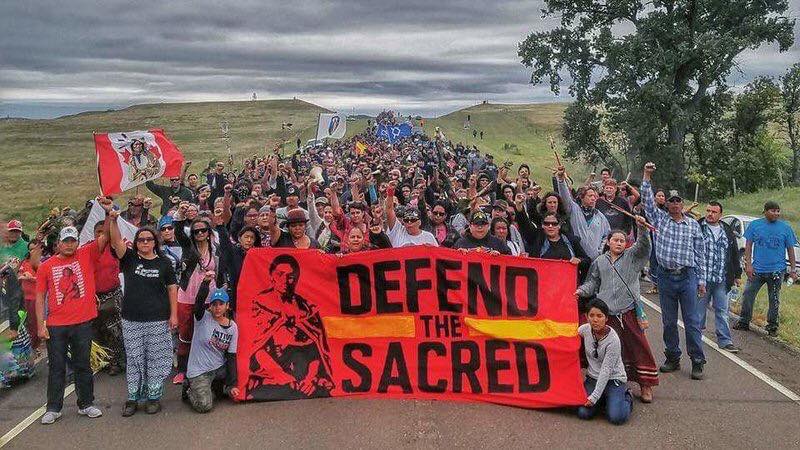
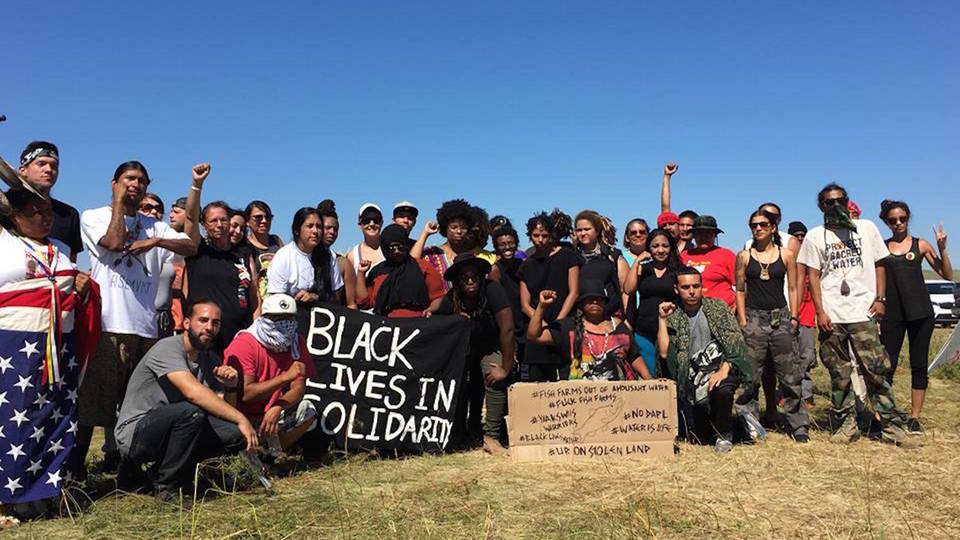
    The Black Workers for Justice support the struggles of the indigenous peoples to defend their land and treaty rights and their struggles for environmental justice. And in this moment we are in full support of the resistance of the Standing Rock Sioux to the construction of the Dakota Access Pipeline (DAPL). We call on all people to support them politically and materially.

    Racism at Work

    The location of the Dakota Access Pipeline is another transparent case of environmental racism. The pipeline’s original path crossed the Missouri River just north of Bismarck, but the residents objected fearing oil spills. The city’s population is 90 percent white. The pipeline was redirected south to go under the river along the Standing Rock Reservation. The river provides the majority of the reservations drinking water.

    For us this is just another case of targeting people of color and other vulnerable populations for receiving the harmful byproducts of capitalist production. That was the case in Warren County in 1982 when PCB was dumped in the community or in the Shiloh Community of Morrisville when wastewater from the Koppers plant resulted in Superfund Clean Up Site in 1989.

    The contrast between the treatment of the Standing Rock protestors and the anti-government protest in Oregon led by the Bundy family is stark. The white supremacist rightwing group seized and occupied Federal land while heavily armed. They were not assaulted and have recently been exonerated. The Standing Rock protestors while peacefully protesting have been subject to violent responses including physical injuries, being held in dog cages, having numbers written on their bodies and being subject to invasive body searches.

    Who are the Culprits?

    The DAPL is a $3.7 billion project that promises to provide 470,000 barrels of oil a day. The Energy Transfer Crude Oil Company is constructing it. 17 banks are providing capital for construction of the project. They are Citi-Bank, Wells Fargo, BNP Paribas, SunTrust, Royal Bank of Scotland, Bank of Tokyo-Mitsubishi, Mizuho Bank, TD Securities, ABN AMRO Capital, DNB First Bank—and that’s actually a bank based in Philly; it’s not the DNB Bank based in Norway, which is actually provided several hundred million to the Energy Transfer family separately—and ICBC London, SMBC Nikko Securities and Société Générale according to Hugh MacMillan of Food and Water Watch. In other words it is the banks and Wall Street, the chief instruments of the 1%.

    We should also note that Donald Trump holds stock in Energy Transfer and Phillips 66, which holds one quarter of the stock in Dakota Access. No surprise here.

    States join together to repress the struggle

    We are witnessing not only the militarization of law enforcement that was so blatantly on 2016-09-16-1474044012-2676960-defend_the_sacreddisplay in Ferguson but also the cooperation of law enforcement agencies across state lines. At least six states across the Midwest, including Wisconsin, Minnesota, Indiana, Nebraska, South Dakota and Wyoming have deployed deputies to join local law enforcement, state police and a private security firms. Activists in Minnesota and elsewhere mounted protest against the Sheriff demanding they bring their deputies home.

    Response from National Political leadership

    President Obama has acknowledged that Native American nations are making their voices heard and called for more consultation between the Native American tribes, the agencies and other parties. He has said this in the context of relationships developed during the course of his administration but has offered no condemnation of the tactics of the security company employed by Energy Transfer or the violation of sovereignty and treaty rights.

    The statement released by the Clinton campaign is an affront to the Standing Rock Sioux and says absolutely nothing. It tries to maintain neutrality but simply maintains her support for fracking, the oil industry and the banks. “From the beginning of this campaign, Secretary Clinton has been clear that she thinks all voices should be heard and all views considered in federal infrastructure projects. Now, all of the parties involved—including the federal government, the pipeline company and contractors, the state of North Dakota, and the tribes—need to find a path forward that serves the broadest public interest.” This what the people can expect in a Clinton presidency.

    AFL-CIO position on DAPL

    This repressive and violent response to the non-violent actions by the Protectors is taking place in the shameful context of the AFL-CIO’s support for the Dakota Access Pipeline. At the urging of the Building Trades, the Federation has placed support for a few temporary jobs above the sovereignty and cultural rights of the Standing Rock Sioux. Moreover it flies in the face of the AFL-CIO’s previously acknowledged position that “The carbon emissions from coal, from oil and natural gas, agriculture and so many other human activities have caused global warming, and we have to act to cut those emissions, and act now.” Trade union and labor activist are horrified that President Trumka has not condemned the violence, including attack dogs and mace, being used against the protestors include placing arrestees in cages. Many unions such as UE, CWA and APWU have come out in opposition to DAPL and have criticized the AFL-CIO for their position. We encourage other union members, individually and through their locals, to do the same.

    Indigenous united front

    The Dakota Access Pipeline has created the broadest united front of Native American tribes seen in North America in many years. It is reported that at least 100 and perhaps as many as 300 tribes have given support. Moreover indigenous groups from South American have joined the effort. In North Carolina, the Cherokee, Lumbee and Occaneechi Band of the Saponi Nation have given political and material support.

    Support for IEN

    blacklivessolidarityWe also support the efforts of our friends in the Indigenous Environmental Network (IEN)(http://www.ienearth.org/) who have taught us much about climate justice and have been essential leaders of the struggle for environmental justice here in the US, especially among people of color. Their leadership is recognized on the international level as well. They have been and will continue to be a vital source of information about what is taking place on the ground.

    Build Solidarity

    Our communities have limited resources and are called upon to support so many things. We ask that as you provide support for Haiti and Eastern North Carolina that you also consider support for the Standing Rock Struggle as they take their resistance into the fall and winter months. At a minimum we must educate our family, friends and coworkers. We should see this as a duty.

    The resistance at Standing Rock and the Black Lives Matter Movement are two of the most important struggles of our time. The well being of oppressed people depends on our strong support for these fights. The forces of white supremacy and right wing populism on display during this presidential campaign make it clear that we are entering a very dangerous period. Our survival depends on us building unity, creating democratic peoples assemblies and contending for power locally and statewide while we participate in national efforts to resist, build and win.

    Originally posted by Black Workers for Justice

  • Our Postwork Future: A Prospect to Win or to Lose?

    ImagePeter Frase. Four Futures: Life After Capitalism. New York: Verso, 2016. 160pp.

    It borders on a disservice to characterize Four Futures: Life After Capitalism as a primer on contemporary political philosophy, since Peter Frase, the author, explodes any expectation of pedantry in his prose, or more importantly, in his approach to political theory, which he calls “social science fiction.”

    Primer or not, Frase has written a critical introduction to our times every incoming freshman should read. Frasedistinguishes his approach from the numerous recent accounts of the rise of automation and the disappearance of jobs by situating in his Four Futures class power as central to his speculations. And a ruling elite, bent on self-preservation in a world spirally into a climate change catastrophe, appears in each future as an obstacle to be overcome, or as victor imposing disastrous prospects upon society.

    Frase has packed into his small book a bonanza of sci-fi references to illustrate his four futuristic themes. He intends, he states in the Introduction, to “reclaim the long left-wing tradition of mixing imaginative speculation with political economy.” Despite his disclaimer – “my approach is deliberately hyperbolic” – he nonetheless illuminates “fundamental principles” with precision (except for one future, more on that later) and with literary aplomb.

    The four futures in the title are divided into two utopias where egalitarianism is realized and two dystopias where coercion rules. These are further characterized by economic preconditions of abundance or scarcity. For example, in the first future to be explored – the communist one – Frase’s favorite, and mine, here abundance prevails, capitalism no longer hinders the advance of science and technology so that, as in Star Trek, the replicator (the future economy) materializes desires. Unlike Star Trek’s hierarchy, radical egalitarianism thrives in the form of “many hierarchies, no one of which is superior to any other.” In the communist future, wage slavery is abolished; everybody receives an income as a human right and work and leisure are transcended by an activity people seek for self-fulfillment and the pleasure of freely being with others.

    With the second future, the socialist one, environmental resources are limited by climate change and scarcity infuses society with measures of constraint that result in, shall we say, a more modest egalitarianism. In the next future, Frase retains scarcity, but deletes equality and replaces it with hierarchy to arrive at the future of exterminism – or communism for the few, insured by a massive military superstructure, and misery for the masses preserved by that same superstructure. Hunger Games comes to mind.

    The fourth future is rentism. Political economists usually call this rentier capitalism, though historically those who lived off funds by providing access to limited resources, like land, were called rentiers and were differentiated from capitalists who lived off the backs of laborers. Frase tweaks rentierism in ways that may justify his new term since, for him, those collecting rents in this future would do so by controlling the Star Trek replicator and implementing an artificial scarcity based on licensing agreements. Renting ideas is not the same as renting land. In other words, the replicator owners would sequester abundance for themselves by the use of copyrights, patents or other forms of government connivance. Ultimately – we should be clear about this – by the coercive exercise of economic power enforced by violence.

    In his discussion of rentism, Frase quotes the accepted estimate that it comprises one-third of the US GDP: a figure that relies on traditional sources of rent like intellectual property rights (music, film, literature) and finance (interest is a form of rent). Though the size of this figure may shock many people, it nevertheless is a gross underestimation of the scope of rentism today, where the rapid, global expansion of platform capitalism rivals finance as the prime source of rent. From platforms like AirBnB, Uber, the giants in this sector, to Mechanical Turk and Task Rabbit that scoop up the exiles of the “sharing economy” too poor to have space to rent or a late-model vehicle to drive, these capitalist ventures are mischaracterized as innovations when really they function as modern day enclosures of the commons that provide astronomical rental earnings for their owners. Counting these “disruptors” as rental sources, as Guy Standing does in his new book The Corruption of Capitalism, seriously magnifies this sector in GDP statistics and defines the US as a rentier economy.

    Frase does qualify that the four futures are not merely fanciful speculations. Each one can be seen as an extrapolation of contemporary currents. This is where politics enters his discussion. The point here is that rentism is our present reality, not a future. For example, Frasespeculation about the inherent instability of rentism – due to a lack of demand – occupies today’s headlines. When economists issue warning about sluggish growth or “secular stagnation,” what they mean is that consumerism is withering like vegetation in a drought.

    And Frase’ view of employment in his rentism future seems less dystopian than the reality we face today. He imagines, for instance, a tiny creative class designing the code for the replicator, an army of lawyers fighting intellectual property rights cases and legions of marketing and advertising personnel. Finally, since these professions will hardly amount to a sizable portion of the population, Frase includes cops to keep the jobless in line. We have here, he concludes, a society ripe for revolt. Am I wrong? Do I recognize today’s world here?

    Yes, recognizable, but missing the grimmer aspects of our reality, especially regarding employment. What about all the meaningless jobs that our economy creates? As just one example among many, enter any doctor’s office and half the staff (or more!) will be processing insurance claims. And what are we to make of the multiplicity of so-called service jobs – from closet organizers to personal trainers? For those who don’t have a nonsense job, we have a “no future” tragedy that leads to the deathly expansion of drug addiction – the misery of everyday life materialized as pills and or injections. And speaking of death, the rising mortality rate of white middle-aged men alone attests to a far grimmer reality than Frase’ rentist future.

    Frase describes the utopian, and subversive, communist future in a chapter twice as long as the other three futures. By giving equal weight to the remaining three futures, he misses an opportunity to emphasize in his postwork narrative “politics, specifically class struggle.” Each future raises political choices, because each future resonates with some aspects in our society, as he says. Rentism, however, more than resonates – it dominates and defines our economy.

  • Towards an Anarchist Money and Monetary System: An Interview with Nathan Cedric Tankus

    Image

    Though conceived out of conversations concerning the Eurozone crisis in summer 2015, this interview with Nathan Cedric Tankus engages with heightened focus by the left on finance capita. Tankus is research scholar at the Modern Money Network, an organization committed to: “The creation and improvement of monetary and financial institutions governed by the public and directed in support of public purpose; The universal, enforceable and inalienable right of every person to participate in economic life in a manner consistent with basic principles of justice, fairness, equality and dignity; The security of individuals, families and communities, the development of autonomous, non-state entities and the flourishing of civil society as critical components of economic freedom” as well as principles of ecological sustainability and intellectual freedom.

    Relatedly, this interview with Tankus is situated around two concerns: (1) understanding the existing capitalist macroeconomic system, and (2) envisioning possibilities for transition and a post-capitalist, post-state alternative. This involves delving into questions of agency and structure, money and monetary operations, central banking, as well as Marxism and anarchism. How might the left theorize and respond to such questions? Through this interview we hope to generate discussion. Discussions that could lead to concrete answers to questions that the left has ignored for far too long. It should go without that saying, to move beyond the rule of capitalist finance we must have some basic understanding of it. It is only through this understanding that we can adequately theorize and put into practice a post-capitalist, post-state world.

    Q – Nathan, what is your conception of structural analysis? How does it differ from others?

    A – First, it’s important to start with the background of my analysis. Given my age, the Obama administration has been a foundational awakening for my politics. The left’s relationship with Obama has, frankly, been bizarre. On one side you have leftists who have tried to claim him as their own. This group even contains some leftists who wouldn’t warm up to someone of similar politics to Obama in any other context. These people wouldn’t be showering love on Hillary for example- well outside of the fevered nightmare that is the final stretch of the 2016 general election anyway.

    On the other side, there is ambivalence towards Obama. Many denounce the specific policies that he’s actually a champion of, but very few on the left have been willing to claim that Obama both has agency and has used that agency malevolently. There’s a general sense that Obama has done “as much” as a U.S. president can do. At the very least, the claim is that even if he did have room to do better on some issues, he’s generally at the “limits” of American politics. An uncharitable summary would go something like “Yes it’s the imperial presidency but only for imperialism. He just can’t do anything else”.

    I think these perspectives have made the left blind to the reality of the Obama administration. I think it is a major reason – beyond the dry technicalities of the subject – that the American Left hasn’t really grasped the magnitude of the political and economic crisis in the United States. In particular, the left doesn’t understand the magnitude of the fraud that was disproportionately perpetrated on People of Color, how the financial industry shook the foundations of centuries old property laws to perpetuate that fraud and how the Obama administration retroactively legalized one of the biggest fraud schemes ever concocted.  Sure you can find individual leftists talking about how foreclosures are bad and it is a longstanding form of left activism to fight to prevent individual foreclosures and evictions, but the systemic analysis is completely lacking. If you’d like to read more about this see here, here, and here.

    What I want to focus on is that last part: the Obama administration's legalization of property law fraud. There is just no way to underplay what happened. It was nothing less than a new enclosure movement legalized by executive fiat; and the left has had essentially nothing to say. This is no understatement. Since the seventeenth century North America has had laws on the books detailing the specific processes by which property is transferred and how it must be recorded. These haven’t changed and there is good reason they haven’t changed. The rules surrounding who can do what to which resources, especially land, are essential to any society – or a confederation of overlapping societies.

    It is one thing for private actors to do everything in their power to undermine it by unilaterally replacing physical and local property recording with an under resourced national electronic recording system. It is another for the President to prevent reform or even investigation into the subject while bullying and bribing state attorneys across the country to go along with a federal settlement that retroactively legalized not only the privatization of this fundamental institution but also all the fraudulent transactions built on top of them and institutionalize them. I can talk all day about the imperial presidency when it comes to foreign affairs but as horrible as all those things are I think this is the biggest overreach of executive authority in decades – perhaps ever.

    The question is: why is the left attracted to analysis that downplays the role of Obama and specific individuals with a lot of power when Obama has arguably instigated the most important legal change in property rights since the end of slavery? I think it is pretty clear that a dominant current in left wing politics conceptualizes talking about the agency of elites as denying structural factors in the progression of history. They think pointing out the malevolent and negative effects of powerful people imply some inverse- that “good leaders” would make capitalism workable. In other words, they think talking about individual elites and their decisions is necessarily reformist. This leads to a formulation of structural analysis designed to say that everyone’s agency is extremely constrained and structures are propelling history forward – until of course the proletariat uses its agency and makes revolution.

    This is what one might call the “ruptured spleen” theory of revolution. Now I think many people would recoil at this characterization and if I were able to push them on these issues personally, I could get some concessions. However, I think you’ll find that this perspective is an instinctive crutch of the left and I would be surprised if readers don’t recognize the kind of analysis I’m referring to in people they’ve interacted with or left pundits they’ve read.

    I see things very differently. To me the fact that elites- whether in government or at the head of corporations- have so much agency is an ipso facto indictment of this system. After all, why do these groups have so much agency? It’s because of their ability to command others. Thus, rather than structure constraining everyone’s agency, I have an agency and structure analysis where structure works to constrain the agency of some and expand the agency of others. In short I see structure as functioning to redistribute agency and the role of agency in left politics as to undermine hierarchical structures. Sure, we could talk about World War I and the agency of elites who led the world into catastrophe as a “few bad apples” and wished that there had been better elites, but we could also talk about how this system made the personal characteristics of some upper crust mediocrities in a very small circle of diplomats and other decision-makers the relevant factor in determining whether millions of people were going to live or die.

    Q – Though this interview primarily concerns what an alternative – may I say post-capitalist – monetary system might look like, I think your work, at least implicitly, touches upon a larger point that most across the left dangerously ignore. This point being that there are other sites of extraction and exploitation beyond the workplace – beyond the point of production. What you have sometimes referred to as Volume 1 Marxists versus Volume 2 and 3 Marxists. Could you elaborate on this?

    A – Volume one Marxism is an overemphasis on production as where the surplus is extracted. This of course is important – production is important. A surplus of outputs over inputs is the “structural feature” that allows for profit margins and thus a profit share of output. However, production isn’t where the surplus is ultimately distributed or where monetary profits are determined. Money spent (along with the administered prices of business enterprises) is what determines what goods and services go where, and who spends what money is not simply determined by wages. As Marx points out here:

    Finally, the rise in the rate of profit [to industrial capitalists] was due to rising nominal prices of commodities…and this enabled the manufacturers to retrieve part of the product paid to the landowning rentiers and other men on a fixed income in the form of rent, etc.[1]

    In other words, price changes can “redistribute” output after wages (and other fixed money payments) are paid. Rent extraction can both reduce disposable income and raise prices. Rents charged by landlords, capital gains captured by developers, interest and fines charged by the financial sector, insurance premiums and charges of Insurance companies – in short the FIRE sector – takes a huge share of income. “Taking” being the operative word. These sectors also modify the behavior of enterprises. Landlords exert control, creditors have a property interest in debtors and insurance companies can influence policy with the rates they charge – especially as those rates can adjust to the specific characteristics of their workforce.

    Why does any of this matter? It of course isn’t news by now to the left that the FIRE sector is large and in charge. Nonetheless, the on-the-ground activism still focuses on individual workplaces and working conditions while ignoring the macroeconomic forces driving problems behind the scenes. Housing activists in cities like New York know instinctively that something screwed up is going on, but the left isn’t producing an overarching analysis of what’s causing problems and what to do about it. In the worst cases, a handwaving appeal to “capital flows” and “capital strikes” suggest that the only point of organizing is to irritate a larger fraction of the work force while losing so they will be stirred to revolution.

    If it isn’t capital flows and capital strikes, the handwave is to the low rate of profit. In my view the obsession with profit rates is overdone for the most significant reason that they have no analytical basis. Which businesses are making investment decisions based on profit rates? How do the arbitrary monetary values put on machinery for tax purposes become an aggregable and relevant factor for the economy overall? Does anyone really think that what the United States is chronically short of is low cost productive capacity? The instinct behind this analysis from Marx was that the output of the economy is shared between three different categories: “productive” workers , “broad” profit (broad as in including rents, interest etc) and depreciation’s share of output. The deprecation share of output is the output consumed to maintain the society as a going concern (e.g. upkeep cost of buildings). If investment accelerates strongly this commits the society to a greater upkeep cost in the future. That cost may not be bearable and thus may lead to the scrapping of past investments, i.e., malinvestment. It is the macroeconomic equivalent of abandoning a house because you can’t afford the maintenance costs and it isn’t salable.

    This is an interesting and important notion, but if you’re not actually measuring how much output gets consumed in this way every year, you can’t really say anything definitive. And of course there are many reasons to think that our problem isn’t that too much of the economy’s resources is being consumed keeping up the buildings and roads but that resources are going criminally unused. It also makes certain “Low Rate of Profit” ideas strange. For example, one quasi-Marxist analysis says that low profit rates in the 1970s explain the drive for mass incarceration. From the perspective outlined above, that assertion is very odd. If the problem is the depreciation share of output is too high how would building big new economically unproductive infrastructures that will need to be kept up for decades be at all a sensible response to this problem?  Indeed translated into this language, many Marxists used to discussing profit rates may be recoiling. This is ultimately one of the biggest problems on the American left. The form, but not the content, of Marx’s analysis has remained and has become a way of obscuring a lack of understanding and critical thinking, rather than an essential part of it.

    The essential point is we can understand the ultimate source of the surplus as production until we’re blue in the face, but if we don’t understand how these broader macroeconomic forces influence production and the surplus we aren’t going to get anywhere. Most importantly, we need to get past the jargon and gain a better understanding of how this system works so we can target precisely what about this system we think is wrong or destructive and change those parts. We also need to figure out what points we can most easily push this system to work more in our interest without falling into the reformist trap. The belief that we can control capitalism is inherently contradictory because by definition capitalism is the system where ordinary people are limited in their ability to influence the course of events. There may be some forms of capitalism where we are less limited than we are now, but if we really do eliminate all the hierarchical constraints on ordinary people’s agency, I don’t see how what results could meaningfully be called capitalism.

    Q – It seems to me that part of touching on broader macroeconomic forces means that we must look at central banks. Can you give a simple explanation of what central banks do and why having an understanding of them is important for left politics? Even more broadly conceived, from a macroeconomic perspective, how does money work?

    Well this is a big question and I don’t have the space here to give anything beyond a broad sketch of an answer. Central banks manage the payments system, i.e., the infrastructure that allows individuals, businesses and financial institutions to make payments to each other – and the government – on a daily basis. In short, it is the lifeblood of capitalism. To do this banks are given what are essentially checking accounts at the central bank. Since banks always need to be able to make payments – otherwise capitalism will fall apart in short order – the central bank has a responsibility to preserve the stability of the payments system. In practice this means providing settlement balances – money in a bank’s checking account – through purchasing financial assets like government bonds or lending them directly to banks. This in turn means setting an interest rate at which banks lend these settlement balances to each other. 

Their ability to create settlement balances is the essential power they use to manage the financial system. When they want to provide liquidity to entities that aren’t licensed banks, they use their ability to create settlement balances. When they want to manage exchange rates, they create settlement balances.

    These settlement balances – and IOUs of the government generally – have value because banks can pay their debts, and the debts of their customers, to the government with them. These debts to the government are predominantly in the form of taxes. Macroeconomically, the point of this system is to give governments the ability to manage the distribution of resources in the rest of the economy and acquire resources they need to accomplish their objectives. Further, when combined with the existence of private property rights and the expropriation of ordinary people, it gives them the ability to manage the distribution of natural resources and means of production between themselves and among corporations/capitalists. In short, when combined with private property rights and primitive accumulation this money becomes “capitalist” money.

    Thus, whether this is malevolent or not relies on your assessment of the objectives of monetary policy, fiscal policy and property laws that are being aimed at. It does not rely on the existence or non-existence of money. When this system is used to provide health care services based on need and not on the basis of price, I generally approve. When it is used to devote a society’s resources to war and policing, I don’t. To me the principle of democratic management (or at least accountability) comes about because democratic decision-making seems to me the only way to ensure that the goals pursued by organizations are desirable social goals. We might think of this principle – and imperative – for democratic management as participatory budgeting at every level.

    Q – From this we get into the question of whether money is the “root of all evil” or if it is a tool that is simply often just wielded by evil? What is your perspective on this? Otherwise put, if money is a tool of undemocratic coercion, is there a way of imagining money working differently? Or do we have to abandon money itself?

    A – This is one of the big questions for radical politics. It’s not remembered now but this was one of the biggest and most controversial debates of the Russian Revolution. It was also complicated by the fact that hyperinflation was a tool used to more easily expropriate the Elites. This was primarily because they didn’t have the technical knowledge to take over the monetary system and prevent the elite from using it to finance the counterrevolution. It was also because the normal tax system was breaking down and they started switching to ‘in kind’ taxation and confiscation – especially as the civil war got going. As we’ll get to later, a monetary system requires the enforcement of monetary debts – especially monetary taxes – to persist. Preobrazhensky expresses the role of the printing press in the aftermath of the October revolution quite well in “Paper Money in the Epoch of Proletarian Dictatorship”:

    The revolutionary government of France was able to survive and wage war thanks to the issuing of paper-money; the assignats were what saved the Great French Revolution. The paper-money of the Soviet Republic has supported a new power during the most difficult period of its existence, when it was not possible to pay for the costs of a civil war through direct taxes. Glory to our printing press! True, it is not left with much longer to live, but it has already completed three-quarters of its work. In the archives of the great proletarian revolution, along with the cannons, rifles and machine-guns of our epoch, the mechanism of the Commissariat of Finance’s machine-gun will occupy the place of honour. This machine-gun shot up the bourgeois order in its rear, in its monetary system, and transformed the laws of monetary circulation in the bourgeois régime into a means for destroying that régime and a source for financing the Revolution.[2]

    In this milieu money abolitionists were extremely dominant. There’s an attitude now that socialist politics are antithetical to monetary cranks but this has historically not the case – as Marx himself confronted (perhaps over polemically). You can get a sense of what the Russian Revolution climate was like based on this comment Finance Commissar Gukovskymade in a speech in 1918 “In a socialist society, finance is not supposed to exist, and therefore I beg to be excused for its existence and for my own appearance here”.[3] Others took the more traditional position that the movement towards communism would (in some vague sense) lead to the elimination of money. Thus the early debate (before the New Economic Policy and 1922-1924) was dominated by forcible money abolitionists and a Marxist position that under socialism (and eventually communism) money would “wither away”.

    It’s unclear whether the inability to impose monetary taxes (or at least to do so on a nationwide basis) generated these ideas as rationalizations or whether they were deeply held beliefs. Whatever their origin they do a good job of representing twentieth century socialism’s relationship to money and monetary thinking. At best you get some grudging acknowledgement that cost accounting is a useful tool of socialism (and thus implicitly money as a unit of account is important) and of course no socialist country ever abandoned money, financial systems or monetary cost accounting. However, the relationship has always been schizophrenic and it is very clear socialist decision-makers were uncomfortable with money – hence the attempt to resort to vouchers, tokens and ration cards.

    Let me put my cards on the table: I think societies need a common measure for accounting purposes to do economic calculations and a general system of distribution. For various reasons I think that labor measures, energy measures, etc. are inadequate for the job (although I think statistical work on how much energy is needed to produce varieties of outputs is important). Thus, a monetary unit of account is the worst unit of account, except for all the others. I do not think this is a concession to the capitalist mode of production and this is where I disagree with a great many Marxist and radical thinkers. Traditionally, the existence of markets has been conflated with capitalism.

    The clearest and most thought out statements along these lines (and thus easiest to critique) comes from the “Sprouts of Capitalism” view within Chinese Marxism. This view emerged to say that between the sixteenth and eighteenth century China had developed a kind of “proto-capitalism” that could have evolved into capitalism. A major part of their evidence was the development and “expansion” of consumer markets. I completely disagree with this view. I think following Marx’s logic of M-C-M' and C-M-C to its logical conclusion means seeing only the expansion of human beings undemocratically coerced to work for others for the purposes of monetary profit as the development of capitalism. If more output is being sold in markets but by independent (or cooperative) producers who are doing it to get yet other goods (or to settle tax liabilities) I don’t think it’s right to see that as the expansion of capitalism.

    To me the major differences between the kind of post-capitalist societies I would want and societies dominated by the capitalist mode of production come in three crucial respects:

    1) the entrepreneurial going concerns aren’t owned and thus aren’t sellable (For example, cooperatives are communal entrepreneurial organizations. They are meant to continue indefinitely and are thus "going concerns". What makes them different from capitalist firms is no one owns them and thus the cooperative – and any other type of communal organization – can't be sold)

    2) private ownership of means of production is eliminated (although that doesn’t suggest that usufruct – i.e., individual use of property on specified terms – is eliminated)

    3) Neither cooperatives or other democratic decision-making councils redistribute agency away from some individuals towards an elite. In other words, social institutions don’t become hierarchical.

    In short eliminating labor markets, eliminating markets in natural resources including land, and eliminating hierarchical structures is the essence of ending capitalism, not eliminating consumer markets. If you take the ‘sprouts of capitalism’ view then consumer markets must be suppressed to prevent capitalism from reemerging. If you don’t take this view then they are just not that important. Nor would you expect them to “wither away”. The important thing is that markets aren’t managing the most important institutions anymore and thus almost by definition they aren’t that important. Cooperatives and other democratically organized going concerns may be administering prices in a similar way to capitalist firms.

    Administering prices is just the idea that those who manage going concerns calculate their expected production costs and then set what prices output is sold at in reference to their costs. The crucial difference with cooperatives and other democratic organizations calculating monetary costs and administering prices is that the democratically chosen goals of the social institutions – not profit seeking or whatever other undemocratic goal capitalist firms have – is informing the decisions surrounding the quantity, qualities and prices of output that the democratic organizations are making. Who cares if individuals are selling things for cooperative IOUs on their own? If they’re doing that with say, a computer and some ingenuity, who cares? Even if they’ve been democratically granted the privilege of using some means of production for their project e.g. usufruct, does it really matter? The community is deciding and if they see a problem they can respond.

    This is the essence of the difference between the society we want and the current one we have in my view. The existence of large institutions isn’t the problem. The existence of money or imposed monetary liabilities isn’t the problem. The problem is that these large institutions are run undemocratically and their tools, including money and taxation, are used to pursue goals contrary to the common interest. It is this we need to strike at. Other things are, to a large extent, a distraction. It is notable in this regard that the “socialist” countries didn’t ever hit at these crucial points. These institutions weren’t run democratically and although they may rhetorically say that the going concerns under their control were being run in the “common interest”, they were very transparently run in the interests of their elites. They may have done a better job providing for citizens than many capitalist countries but that is a low bar. A more cynical man than me might say that the attempts to suppress markets were a symbolic way of expressing commitment to socialist ideals without the express emphasis and institutionalization of socialist practices like democratic management.

    There are valid reasons to object to this view. David Graeber for example thinks that quantification necessarily leads to violence and thus the lack of quantification is a crucial part of his post-capitalist vision (or at least that’s my interpretation of his views from what I’ve read of him). He provides an enormous amount of convincing evidence that quantification starts with violence (e.g. Wergild debts) and he has good reason to be skeptical that we can quantify without it leading to the traditional moralities of debt and violence. I do agree that, for example, medical care, food and housing shouldn’t be distributed on the basis of consumer markets. Ultimately however, I just haven’t been convinced that there is a way to organize production on the scale to preserve the current human population in a non-quantitative fashion. Remember that we have an enormous amount of people that not only require the basic necessities but are reliant on specialized international supply chains. In particular, medication for chronic medical conditions, relatively rare diseases, specialized surgical tools, specialized products and services for the elderly and disabled etc. This is all currently produced capitalistically and in order to preserve these production lines we will need to quickly build organized social and communal arrangements across oceans and long geographic distances. This is much easier with quantified relationships, especially given people’s prior socialization in capitalism. These reasons make me think that any transition away from capitalism will involve something along the lines I’m discussing. As with past attempted transitions the path chosen constrains future options. This could be a lack of imagination and I could certainly be convinced on this front though.

    Q – Can there be anarchist money, then? If so, what is your concept of anarchist money?

    A – The issue is this: I think imposed debts by governments (taxes, fees, fines, etc.) have been essential for making a currency valuable. On its face this suggests that an anarchist society can’t have money because anarchism is premised on smashing the state. There are many ways I think the existence of money can be made consistent with anarchism but my essential premise here is that coercion can be acceptable as long as it's based on democratic decision-making. So for example a cooperative democratically decides to administer prices on its output and to only receive the cooperative’s ious in payment for that output. This necessarily involves not letting people have output they haven’t paid for. I’m not an expert on anarchist political theory so perhaps that isn’t acceptable from many anarchist points of views. In that case I must confess I don’t see how any actual way of organizing and producing output could be made consistent with anarchism. I think these activities require planning and I think at some level planning requires fixed commitments to do certain specified activities.

    My concern about social arrangements that don’t involve any social enforcement of obligations (not necessarily debts) is that production falls to volunteerism. My experience with volunteerism is not positive and where it does come even close to functioning it seems to involve an inequitable distribution of work. Women and many others who are oppressed in our society – and thus empathize most with the afflicted – tend to be moved to action more quickly than anyone else and by the time they start, others feel less social obligation to participate. I also think that just like many activists they would burn out over a few years and even if a semblance of stability could be reached for a time, volunteerism would break down. I think social obligations are essential to an equitable distribution of work. That is without even dealing with the issue that without social enforcement of obligations planning becomes very difficult.

    Moving on to some more details about my vision. I think administering output prices and then announcing that the only acceptable payment would be cooperative (or a federation of cooperative’s) IOUs would be a sufficient to create a demand for those IOUs. This is simply an expanded (and non-state) version of selling metrocards for money. Access to the social product is a major incentive. However, for various reasons (for example wanting to distribute more output on a non-market basis e.g. healthcare and food) a cooperative – or a communal council – may want to charge membership fees. This requires people to do a certain amount of work for their cooperative rather than relying on the need to buy output to encourage labor participation. This I’m sure would be more controversial because it comes the closest to being similar to a traditional tax. I still think democratic decision-making makes all the difference but it is very understandable how uncomfortable I’m sure this would make many anarchists. The ability to leave for another community is also another way of making this process less coercive that isn’t available in a system of capitalist nation states.

    In order to expand the usability of these IOUs – and make interregional planning and supply chains possible – cooperatives should federate. Cooperatives could even be created as working groups sprouting off of city or regional councils. Thus rather than having their own IOUs they would all be users of the city or regional council’s IOUs. I say that not as a concrete proposal but just to emphasize that decision-making over money doesn’t have to be centered in these “social enterprises” but could be put on a separate political level. Federation would involve receiving each other’s IOUs at negotiated exchange rates in payments. If the geographical space covered by such federations is large enough, this has the advantage of letting someone vacation. They can accumulate – save – IOUs and then vacation in another region by meeting their obligations with their locally earned IOUs. This recreates one of the great virtues of modern money without the lack of democracy or the devastation. In short, I see various forms of Bookchinian confederation as consistent with an anarchist approach to money.

    The point of floating exchange rates in capitalist economies is to create an informally political way of dealing with the balance of payments between countries. It also takes a lot of resources to run a worldwide floating exchange rate system and I don’t see why horizontalist decision-makers would need such a device. Horizontalists and anarchists should embrace more explicitly political forms of decision-making. Since the exchange rates are stable you can net out balances between each other. For example if region A accumulates 1000 IOUs of region B and region B accumulates 1000 IOUs of region A, you can just cancel those IOUs against each other. This is called clearing and is a major part of what clearinghouses do. Some regions would – measured at stable exchange rates – run deficits (thus, by definition, others would run surpluses) and overtime stocks of debts (assets) would accumulate between regions. This should be dealt with by periodically canceling debts in exchange for something from the community, e.g., cooperation with a big irrigation project they were planning on undertaking. This has the virtue of being explicitly and formally political.  This kind of thing could happen every year but it could also be every five years.

    Another thing you could do is cancel the debt with a big feast and party organized, funded and thrown by those who had accumulated the IOUs. This has the virtue of being much more fun than the alternatives. People joke today about the Eurozone crisis being solved by a bunch of Germans taking southern European vacations. Democratically federated entities can put these kind of strategies of preserving balance – and thus equality – into practice. On the flipside if for some reason an agreement can’t be reached, a federation of cooperatives or a city council can exit a confederation. They don’t have foreign denominated debts. All they have to do is stop accepting the other confederation’s IOUs and the other parties will just stop accepting their IOUs. In other words, the hope is that the benefit – not the threat of utter catastrophe – hold these alliances together. This of course relies on a social norm that federations are unwilling to fight to maintain confederations or to enforce more favorable terms on an unwilling partner.

    Q – In terms of thinking about mutual aid and mutual benefits, how does this fit with thinking about welfare arrangements. For example, what might an anarchist social security look like? How might that work?

    A – In my view one of the biggest virtues of this proposal- or perhaps vision for approaching anarchist money- is that it provides a concrete way to build social security programs on top of a democratic foundation. Since we’re using cooperative/city council/regional council IOUs to distribute goods and services, IOUs must be distributed to those who can’t work for this system not to be ablest.

    This leads to all sorts of issues. If you know how much output you’ll be producing (and selling) over the next year, you administer the prices they will be sold at, and you know how the division between IOUs distributed to those who work and those distributed to those who can’t, you know approximately how much saleable output you’re distributing on a non-work basis. In other words, by default, federations of cooperatives/city councils/regional councils are deciding how much output social security beneficiaries are getting. What factors are going into that decision?

    In our society, because by definition cooperatives and other democratic going concerns can’t acquire very much of the means of production, there are real limits to how much can be accomplished without revolution, social breakdown or various victories that increase the social space for alternative production arrangements. I still think such an approach to building anarchist money in the here and now is valuable. It provides people with the experiential tools to understand how money works now and how it could work in a future society. It is quite well known that your random teenage crust punk anarchist is more expert in democratic decision-making than most people on the planet. My goal for the here and now with an implementation of anarchist money would be for the proverbial teenage crust punk anarchist to be more expert in monetary theory and fiscal policy than a lot of central bankers purely because of this kind of experiential learning.

    Incidentally, this is also a good way of showing the difficulties with a basic income guarantee/universal basic income. If you distributed to everyone the same amount of IOUs regardless of whether they worked, production will fall into volunteerism and the community has no method of insuring that work is distributed equally or that production continues at adequate levels given the goals of the community. In many ways though, this situation is better than the capitalist one because the capitalist state can’t give workers unmediated access to the means of production or communally administer all consumer prices.

    *Nathan Cedric Tankus is a writer in New York City and relapsed student. He is a student at John Jay College in City University of New York, former Research Assistant at University of Ottawa, former Visiting Researcher at Fields Institute, and Research Scholar at the Modern Money Network.

    *Alexander Kolokotronis is a PhD student in political science at Yale University. He is the founder of Student Organization for Democratic Alternatives, and formerly the Student Coordinator of NYC Network of Worker Cooperatives and Worker Cooperative Development Assistant at Make the Road New York. He has published on topics ranging from worker cooperatives, participatory budgeting, and the Rojava Revolution for publications such as New Politics, Truthout, Counterpunch, the Kurdish Question, and Grassroots Economic Organizing.


    [1] Marx, Karl, and Friedrich Engels. Karl Marx, Frederick Engels: Collected Works. Vol. 32. International Publishers, 1990. Chapter Sixteen of the Theories of Surplus Value, Page 94

    [2] Day, Richard B., and Mikhail M. Gorinov. "4. EA Preobrazhensky’s Book Paper Money in the Epoch of Proletarian Dictatorship, 1920." The Preobrazhensky Papers. Brill, 2014. page 733

    [3] Arnold, Arthur Z. "Banks, credit and money in Soviet Russia." (1937) page 112

  • Behind the Demonstrations in Morocco

    ImageOn Wednesday, Oct. 26, the well-known Moroccan historian and human rights activist Maâti Monjib and five of his colleagues were hauled into the High Court at Rabat to answer charges of “attacks on national security” and “receiving foreign funds.” They are facing up to five years in prison for their activities as investigative journalists, human rights advocates and members of the “February 20th Movement”  the Moroccan version of “Arab Spring” of 2011.

    Two days later, anti-government demonstrations spread across Morocco after social media spread the story of  Mousine Fikri, a fishmonger crushed to death inside a garbage truck as he tried to block the destruction of a truckload of his fish confiscated by police. The February 20th Movement, long assumed dormant, sprang back to life and took the lead in organizing the protests, which spread to 40 cities.

    These two events – the Monjib trial and the demonstrations sweeping the country  are hardly unrelated. Monjib and his co-defendants, journalists, media activists, and fighters for human rights, were already a thorn in the side of the regime even before the 2011 rising. Since then they and their colleagues have courageously struggled for media freedom while building the on-line infrastructure of information and interaction that makes possible real-time on-the-ground mobilizations like those taking place this week. Their efforts have not gone unrewarded, despite years of government harassment including base defamation campaigns in official media, bogus arrests on morals charges and the current treason trial. As today’s headlines illustrate, social media remain a potent tool in the hands of the oppressed, and the authoritarian regime of King Mohammed VI had “good” reasons to persecute media activists like Monjib and his friends.

    A Long Tug of War

    The mastery of social media has apparently leveled the playing field in Morocco’s  long struggle for democracy and human rights. On the ground, it helps coordinate mass mobilizations challenging the regime in the streets, demanding an end to corruption, brutality, and injustice summed up by the cry (and hash tag) of Hoga! (oppression). His Majesty, out of the country on an official visit, has not returned to take charge of the emergency. In any case the authorities dare not attempt to repress the demonstrations and sit-ins by force on the eve of the upcoming COP conference in the Moroccan city of Marrakesh, at which the Monarchy’s international reputation as a progressive island of stability in the Arab world is at stake. The timing couldn’t be worse for Mohammed VI.

    The tug of war on the ground is matched by propaganda war in the air in which for once both sides are well armed. The regime controls all the official “vertical” media and can spin the truth in any direction. The popular movement ripostes with its Internet-based, horizontal social media and investigative journalist-bloggers. Here’s how the story of Mousine Fikri’s death plays out in the rival media.

    The regime is going through the motions of satisfying the call for justice without actually seeking justice. The Royal Prosecutor in the town of Al Hoseima noisily prosecuting eleven officials. This made the N.Y.Times. But don’t look too closely. To calm the fury, the eleven police and fishery officials have been locked up, but for “forgery” (in fact faulty paperwork in recording the incident). They will be released when things calm down. However the Prosecutor is not investigating the question of who gave the order to turn on the crushing machine at the back of the empty garbage truck. (The fish had not yet been loaded). According to the independent on-line journal Le Desk, this operation requires the cooperation of two workers: the driver to turn on the electricity in the cab and his assistant to pull the lever at the back of the truck, where Mr. Fiki and his friends were presumably visible. Eyewitnesses have been quoted saying they heard someone give the order: “crush him.” 

    The authorities are classing Mr. Fiki’s death as an accident. In the social media, it is called a “state-crime.” Few believe the regime will keep its promises to “investigate” Fiki’s death: after five years the Interior Ministry still has not found who was responsible for the deaths of 15 protesters on Feb. 20, 2011  the date which gave the popular movement its name. The regime, through its official and allied websites, has also been flooding the web with disinformation designed to confuse and discredit what the protestors and the independent media are saying. These wild stories are not likely to be believed by anyone but dedicated loyalists.

    Background to this Struggle

    The democratic uprising in Morocco (also known as “Revolution 2.0” or “the social media revolution”) was not defeated in the Spring of 2011, only stalemated in its struggle with the makhzen(or deep state) that rules supreme behind the façade of a progressive, pro-Western monarchy, based on well-controlled moderate Islam (the King is also Commander of the Faithful). In July 2011, Mohammed V succeeded in diverting the broad democratic movement’s demands into electoral channels by proposing a new, more “liberal” constitution in a snap referendum.

    This “compromise” Constitution gained a hardly credible 98.7% of the votes, and has never been enforced, au contraire. As the democracy spring faded into memory, the makhzen, thirsty for revenge, began tightening the screws on February 20th and Human Rights activists and above all on the independent investigative journalists, who expose corruption and oppression. For example my good friend Ali Anouzla, the independent journalist who in 2011 first brought the news of the uprisings in Tunisia and Egypt to the Moroccans, was imprisoned in 2013 for inciting terrorism (in fact for exposing the corruption of the Monarchy)

    Meanwhile, during 2009-2016 over at the Center for Study and Communication in Rabat, hundreds of young journalists and human rights activists were being trained to use the electronic tools of citizen-journalism, in particular the App known as StoryMaker (mentioned in the indictment against Maâti Monjib and his students). The Center was founded by Monjib (Professor of History at the University of Rabat) and named for the tolerant medieval Arab philosopher Ibn Rochd (Averroes in English).

    Repression

    As repression increased in 2015, the government forced the Center to close. Monjib, an internationally known scholar who frequently attends conferences, was stopped at the Casablanca airport and banned from traveling. Only at the end Monjib’s 20-day public hunger strike did the government agree to lift the ban. Next came a series of groundless accusations culminating in the Rabat High Court trial for “attacks on state security” and “mishandling funds,” a trial that once again was adjourned last week, perhaps because there is no evidence.

    Another reason why the regime is trying to discredit Monjib is that he edited a book entitled Islamists versus Secularists: Dialogues and Confrontations and brought representatives of two independent Islamic Parties together with Socialist and Secularist leaders on his campus. This was the first public dialogue between the two sides, which have often settled their differences in blood, and was covered by Al Jazeera and other serious media. These meetings continued and resulted in the rapprochement of the two sides in a common pro-democracy movement, such as has recently been achieved in Tunisia. The Makhzen, whose policy is “divide and rule,” rightly considers this rapprochement a threat to its hegemony.

    As a result of these activities, Monjib has been the object of a sustained campaign of calumny aimed at destroying his reputation as a scholar, human rights activist and man of peace. Pro-government websites continue to spew filth about Monjib’s impeccable personal and financial life. Monjib himself analyzed these techniques in an article published before he himself became a victim: First, activists are attacked in media close to the secret services so as to discredit them and prepare public opinion for what is coming next. He distinguished three types of slander: sex for Islamists, drugs for young activists and money for Left personalities. Next are publically accused of “high treason,” “espionage,” “drug possession,” “tax evasion,” “illegal business,” etc., often changing the charges and keeping them tied up in court.

    A defense committee (supported by Noam Chomsky) has been established in France, and funds and support are very much needed. Please sign up at solidaritemonjib@gmail.com (dollars and pounds accepted).

    Theory and Practice

    Among the ibn Rochd Center’s most promising graduates are two of Monjib’s young co-defendants before the High Court of Rabat: Samad Iach and Hicham Mansouri. Last year, the scholarly, slight Mansouri was arrested, convicted and sent to prison a trumped-up charge of living off prostitution. Iach and Mansouri are now in exile in Paris, where they are working as journalists and studying communications at the University. Mansouri’s thesis-in-preparation documents how on-line discussion of democracy and revolution actually preceded the revolts of 2011 and shows how “people with a common interest in democracy built solid networks and organized political actions.” He concludes, “armed with their Smartphones connected to the Internet, thousands of young activists and citizen-journalists have succeeded in getting around censorship and providing information in real time while encouraging sharing, comments and interactions among the citizen-users.” This is clearly bad news for corrupt despots everywhere, Morocco not excluded.

    According to Forbes, Mohammed VI is the richest man in North Africa and the fifth richest on the continent. The King has control over and profits from the national economy in every sphere, for example phosphates, Morocco’s most profitable export, as well as the fishing industry. His Majesty has imposed an electoral system which makes it impossible for any party to win an absolute majority, and the new Constitution, devised by a commission all of whose members were nominated by the King, leaves all power in his hands. Unlike his father, Hassan II, who during his long reign (1961-1999) was infamous for his use of kidnapping, torture, and long-term imprisonment, Mohammed VI, a progressive, modern autocrat, prefers new methods of repression, similar to those used by the ‘progressive’ and pro-Western Aliev dictatorship in post-Communist Azerbaijan, considered one of the worst human rights violators in the world.[1] Mohammed VI has excellent reasons to want to take revenge on Professor Monjib and his friends, and today His Majesty is stuck between a rock and a hard place. Stay tuned.

    Although the world looks dark these days, the continuing tug of war in Morocco inspires hope… and solidarity. Please contact:solidaritemonjib@gmail.com

    Nov. 1, 2016


  • Final Dispatch from Greece

    ImageDear Friends and Family,

    I’ve been in Salonica just over a month. All my time here has been as a volunteer in the Elpida Refugee Center, working mainly in the communal kitchen or in the food distribution center.

    A 14th century Byzantine scholar wrote that “No man will be without a homeland, as long as Salonica exists.” From the Ottoman welcome of the Sephardic Jews in the 15th century to the arrival of a million plus Christians from Asia Minor in the population exchanges in the 1920s, Salonica has been a place of refugee. As my friend Thanos, a Salonica native, said to me when I first met him, “No one is Greek here.”

    After the Greek people helped 850,000 refugees escape US funded wars in Afghanistan, Iraq and Syria and cross borders to their dream of Europe farther to the west, the EU shut the door in early 2016.

    Sixty thousand plus refugees got stranded in Greece and by now are hidden from view in a variety of official refugee tent camps, many of which are in northern Greece like the no-name camp I visited one day with 800 Kurdish people living in tents under an open corrugated metal roof.

    The EU promise of “family resettlement” and “relocation” to other EU countries for those stuck in Greece is for the most part still born, as is the overwhelmed Greek asylum process.  Neither the asylum process, nor resettlement/relocation are de facto EU policies.

    The new EU policy is not just to keep war refugees in “transit countries” like Turkey, Lebanon, Jordan and Libya, but to return them, embodied in the recent EU deal to exchange “aid” to Afghanistan for taking back 80,000 plus Afghans in Europe. There is even talk of returning refugees in EU countries back to Greece. And, a reverse smuggling business is beginning to blossom taking refugees back to Turkey via a land route through Alexandropolis.

    With the national elections coming up in the Netherlands, France and Germany, no one on the right or left wants anymore refugees coming to Europe trying to escape the on-going, but quite profitable slaughter such as the US financed assault on Mosul, or the US financed Saudi bombing campaign in Yemen or the Russian/Assad bombing of eastern Aleppo.

    Still, what about the 60,000 refugees stuck in Greece?

    From my limited experience here, I would say their main emotion is anguish. Anguish from not knowing their fate. Anguish from an uncertain asylum process. As some of the refugees told me, these camps are worse than prison. At least in prison, you know when you are going to get out.

    When I asked Turkish speaking Syrian refugees what they wanted in a new country, the first two things they said were: “Insanlik” (humanity) and education for their children. I know they don’t want to hear this even though they know it,  but I think they can find that humanity here in Greece and specifically in Salonica.

    Salonica has a Mayor named Yiannis Boutaris. He spoke recently at a World Affairs Symposium that I attended.  He said that historically the current refugee flows were “not more dramatic than ever before” and that “the EU should be ashamed that it can’t absorb four or five million refugees.”

    Mayor Boutaris also interrogated the sub theme of the symposium: “seeking stability.”  He said dictatorships offer stability, but that if the city embraces the refugees with social stability it will work better than police protection.

    I know that Greece has a 25% unemployment rate and, as another Greek friend told me, the new Gulag is forcing people and refugees not to work. I also know the Greek’s  Insanlik is being tested.

    But still, the Mayor believes in the vibrancy of young people and I learned from my new Greek friends about all the social economic experimentation in Salonica that isn’t  just about survival but also about new forms of self governance. Then I watched the young refugees, neatly dressed with their new backpacks, going off to Greek schools with their Arabic/ Greek dictionaries and I had hope.

    I left the women with some roses and I think I got a wave good bye.  See you at home.

    Dan

  • A courageous Syrian collective challenges both ISIS and Assad in Raqqa

    Image

    Just hours after Secretary of Defense Ash Carter announced that the United States is preparing to launch an offensive against the Syrian city of Raqqa, Abdalaziz Alhamza, a 25-year-old Raqqa native, spoke to a New York City audience about his hometown. Before the Islamic State captured the city in 2014, he recalled, few people outside of Syria had heard of Raqqa, “but now, most people hear about our city as the capital of ISIS.” Alhamza, an activist-journalist and founding member of the resistance group Raqqa Is Being Slaughtered Silently, or RBSS, has risked his life for the past several years in order to tell a different story. “Almost no one there has joined ISIS. We should be known as the capital of resistance.”

    The group formed in 2014 as a collective of just 17 members, all under 30, aiming to spread stories of “the true extent of the suffering in Raqqa, and the hideous crimes of ISIS in the city.” RBSS both documented and helped organize protests against the Islamic State, using online platforms to connect activists with like-minded people. “We would find out there were many small demonstrations going on. We said, why don’t we tell everyone to come to one place, and make a really good preparation?”

    The group has also used humor to undercut the caliphate, publishing satirical videos online and performing anti-ISIS stunts. The group has posted videos of themselves tagging city walls with graffiti slogans, including “down with ISIS, down with Assad, long live Syria!” The group also published a secular dissident magazine, which they disguised by choosing a cover design that mimicked ISIS publications. Concerned, too, that young people would be indoctrinated by ISIS, the group disseminated cartoons that deliver pro-freedom messages.

    It wasn’t long before the group’s audacious efforts drew retaliation from the Islamic State. “We were making them crazy,” Alhamza recalled, “they installed security cameras and tweeted that they would catch us. But we were smarter than them.” Alhamza chuckled, a look of defiant mischief on his young face, but his smile was fleeting.

    The group is aware they are playing a dangerous game. Four of their young members have been assassinated by ISIS, while others have lost family members. “One of our members, they took his father and three of his friends, and said they’d only let them go if he gave them the name of three of our reporters. He refused. They killed his father.” The terrorists then sent the man footage of his father’s murder. “It was horrible to watch,” said Alhamza.

    ISIS has also followed RBSS members abroad. Syrian filmmaker Naji Jerf, who Alhamza called “a mentor, like a father to our group,” was killed by a sniper in broad daylight in Gaziantep, Turkey, where he’d sought refuge. Two other RBSS members were captured and beheaded in Turkey, and Turkish authorities intercepted several armed cars headed for the RBSS headquarters.

    Alhamza now lives in Berlin. ISIS recently published his details online, promising a reward to anyone who killed him. The German authorities offered him protection, but he declined. “It didn’t seem right, when so many other Syrians have no protection.”

    Now, the group operates in two teams — 17 remaining members in Raqqa continue to collect footage of atrocities and protests, which they send encrypted files of to their counterparts abroad. When ISIS seized control of internet services in the city, cutting the general population off completely, RBSS found ways around the lockdown. “We are smarter than them,” Alhamza repeated.

    Women play an important role in the dangerous work of documenting life in Raqqa. “It’s almost like they have it easier in this way — they are forced to cover everything, and ISIS people believe they are not supposed to talk to women,” Alhamza said. All this helps their female members to avoid detection. “The work they do is just amazing,” he added.

    RBSS has received international attention for their efforts, including being honored last year with the International Press Freedom award by the Committee to Protect Journalists. Today [October 27], Alhamza will accept the 2016 Civil Courage Prize in New York on behalf of his group. While the group is grateful for the international support, they are outspoken about the need for Syrian solutions to Syrian problems. “Local people are the answer,” said Alhamza, when it comes to liberating and rebuilding cities.

    Alhamza says he’s hopeful that one day he’ll return to Raqqa. He and his fellow RBSS members have made a pact — return to Raqqa one day, or die trying. “I’m hopeful that one day I’ll be back there, and I’ll open a business — maybe a cafe, a bar — and my friends and I will be able to live the rest of our days there.”

    Originally posted here

  • Third Parties—My Personal Experience

    Image

    I joined the Peace and Freedom Party under the guidance of leaders of the International Socialists (IS), including Mike Parker and Jack Weinberg, in 1967-68. This was my only real involvement in a third party. It was not only long ago, it was a different context: there was a large, lively left movement, which at the time appeared to be still growing (we hoped).  

    Thus the P & F was conceived of—and briefly was—a movement party. That’s why it may be worth a look back. 

    To get the party on the ballot in California, we had to get people to change their party registration, via a registrar, often from Democratic, to P & F. Some 107,000 did so in California, which was remarkable. The same year George Wallace used the same procedure to get an almost exact number of registrants for his party. 

    I recall an IS member, J.B., said to me “I just wish we had his demographics!”  So true.

    The IS view was that P & F was a party that expressed a movement, mainly the anti-war movement and the student radical movement more broadly. In fact the IS got the P & F to make its name not the official name, P & F Party, but the P & F Movement. It was the expression of a movement. That was the punchline of the project. 

    This was true, if only for a few months. P & F could call marches, etc. Prominent radical leaders became a few of its candidates for California offices.  

    They wanted to capture the Eugene McCarthy movement into the P & F. It was called “the second wave” for P & F. McCarthy would be shut down at the Democratic Convention, and his followers, or a good bite of them, would move toward P & F. That was the goal.  

    It did not happen at all. He was shut down hard, partly by the infamous Mayor Richard Daley of Chicago, but no wave came for P & F to surf. Hindsight is 20-20, but it was a worthy goal (or hope) at the time. 

    P & F was thus confined to the far left. The party was allied, mostly on paper and on the ballot line, with the Black Panther Party. But the BPP was already starting to deteriorate and "black power" was playing out. 

    P & F, lacking any alternative, nominated Eldridge Cleaver for President. He was not yet 35 years old, so California would not even put his name on the ballot. The party was fading, and it got worse.

    [Aside: Cleaver’s worst side was coming out. He was constantly high, making horrible sexist speeches and then withdrew in favor of Pigesus, a pig that Jerry Rubin carted around in a cage. A bad ending indeed. (Cleaver himself went nowhere but down from there… and in his end-game he endorsed Reagan for president, became a Mormon—recall they had a special heaven for whites-only—and invented Penis Pants…but I digress.)]

    But getting back to the point here: P& F was aimed at being the PARTY OF A MOVEMENT. Movement leaders would be candidates. Civil rights, black power, anti-war leaders. Their dream really was to have Martin Luther King run for president. “King-Spock in '68!” said the stickers.

    This made sense at the time, when there was a left movement of note. The civil rights movement had moved the country, and the anti-war movement drove President Lyndon Johnson to stand aside and not run for reelection. 

    Without that element, a third party is just a “protest vote,” such as a vote for the Socialist Workers Party (or another small socialist party) or P & F or the Green Party.  

    Movements can pull the political debate to the left. So can candidates, if they have a constituency. Bernie Sanders sure did. But can protest votes?

    Later Efforts – Protest Voting

    Some on the left advocated never ever voting for Democratic Party candidates, so they supported protest votes in elections (or non-votes?) for the Socialist Workers Party or other small leftist parties.

    Except in 1980. Something called the Citizens Party ran Barry Commoner for President. I attended a meeting with maybe 400 people, the high water mark. Commoner raised issues of the global environment, which was very wholesome, but this party never got near to being a movement party. And it was soon forgotten. Nothing was built from it. 

    In 2000, Ralph Nader ran a vigorous (if individualist) campaign against corporate globalization and got a couple million votes—huge for a leftist third party. He had big rallies in liberal and university towns, drawing out real enthusiasm, albeit briefly. It was inspiring. 

    But then he was blamed for the loss of Al Gore to George W. Bush, and the experience is now recalled with a very sour taste. Michael Moore, who toured with Nader, later wrote that he secretly asked Nader to withdraw in battleground states; even his best buds turned on him, and on the effort to get him 5 percent of the total presidential vote.

    The notion that such efforts pull the debate to the left … that did not happen here. If anything, the opposite happened, in the biggest protest movement of the past generation.  

    So in my experience, protest votes by the left have not built a movement, nor have they pulled the debate to the left.  

    My experience is that movements built quite aside from electoral politics have built grassroots power, moved people to the left and helped shape the debate. The environmental movement, the gay and lesbian rights movement, and others. They did best when they were outside the electoral arena. Protest-vote parties have not contributed to movement building. 

    Of course I am talking here of my experience in national elections, in our two-parties-by-design electoral system. Good activists running local candidates, who actually have a chance to win, play a different ballgame and can indeed help build movements. (Especially because most local candidates can run in non-partisan races.)

    2016

    Now, again, there is the Green Party. It is not the party of a movement. Also, its national candidate says Wi-Fi will harm children’s brains, from the radiation.

    This last tidbit may not be just a quirk. Because there may be more screwballs who believe things about Wi-Fi radiation than there are activists in leftist movements, sad to say. So the candidate appeals to an important element of her constituency: conspiracy theorists. 

    All my political life, I have had to combat conspiracy theory in its working-class manifestations. It is a major impediment to building a working-class movement. 

    The Green Party, not being rooted in any movement, has conventions that I hear resemble shopping malls of such anti-science conspiracies. It seems to be held together by persons who are third-party die-hards. They may be good people (I know a couple of them) but are not rooted in mass movements. 

    If someone wants to vote for the Green Party as a “protest vote” that is fine. I think I voted for 1-2 of their candidates a week ago (by mail). I’m not sure, as my partner votes for me.

    But they will not build a movement. And they will not pull mainstream political debate to the left. Movements pull the debate to the left. Big left electoral efforts like Sanders' can do it, and did do it. The Green Party, not. 

    And if the Green Party draws enough votes to tip the election to Donald Trump, the left will suffer for years (not to mention the country and perhaps the world, with Trump as president).

  • Who Would You Vote for in 1840? And Who Will You Vote for on Nov. 8?

    Image

    Imagine that it is 1840 and someone approaches you on the street and hands you a flyer for James G. Birney, the presidential candidate of the new Liberty Party. The flyer says that the Liberty Party opposes slavery. It is the only party that does.

    The Democrats and the Whigs–the two parties of the two-party system of that time–supported slavery, not to the same degree perhaps, but neither party opposed slavery. The Liberty Party is new and small, tiny. It’s candidate Birney has absolutely no chance to win the election. But he stands opposed to slavery. Who will you vote for on voting day in 1840?

    Will you argue that voting for the Liberty Party would be wasting your vote, and that instead you would vote for the Whig or Democratic parties, both of which accepted slavery?  

    Of course, if you vote for the Liberty Party, the Whigs or the Democrats will take power. They will appoint the Supreme Court. So what will you do? Vote the Whig Party because it is perhaps a little less a slave party than the Democrats?

    Doesn’t it seem right to vote for the Liberty Party, to vote against slavery? Doesn’t it seem like the right thing to do, even though the party won only 6,797 votes in 1840? (Yet it should be noted that four years later Birney received 62,103 votes or 2.3 percent of the popular vote.)

    Yes, it was the right thing to do. And not only morally, but also politically.

    The Liberty Party and later the Free Soil Party, and other small and apparently insignificant abolitionist parties grew in influence. They were the political expression of a growing abolitionist movement that was challenging the fugitive slave law by liberating blacks from the hands of Federal marshals on the streets of American cities. The abolitionist movement and the apparently insignificant abolitionist parties eventually forced a realignment of the political system in the United States.

    If you voted for the Liberty Party in 1840, you helped to initiate the process that led to the formation of the Republican Party out of splits in the Whig and Democratic Parties. Your vote helped to create the momentum that led to the victory of the Republican Party candidate Abraham Lincoln. Your vote in 1840 helped to bring about the Civil War, a revolutionary war that led to the abolition of slavery and then to the passage of the 13th, 14th, and 15th Amendments to the Constitution, ending slavery, making the former slaves citizens and giving black men the right to vote. Was your vote for a minor third party in 1840 wasted?

    And Your Vote in 2016

    Today in this election, someone may approach you on the street with a leaflet for Jill Stein of the Green Party. Stein is the candidate of a small party. Her party’s presidential candidate has never won more than 2.7 percent, Ralph Nader’s accomplishment in 2000.

    Stein’s leaflet will tell you that she opposes the corporate domination of America, what is, in fact, contemporary slavery. She opposes militarism and war. She pledges to take action against climate change. Yet, she hasn’t got a chance of winning.

    Will you then vote for Hillary Clinton, the candidate of the banks and corporations? Of militarism, invasion, and occupation abroad? The candidate of empire and war? Or will you vote for Donald Trump, the misogynist, racist who promises to make America great again on a national capitalist model? Isn’t it clearby now, that capitalism is the problem? And isn’t it clear that Clinton and Trump both stand for capitalism with all of its attendant problems: economic inequality, poverty, racism, gender discrimination.

    But isn’t a vote for a third party, for Jill Stein and the Greens a wasted vote? Worse than a wasted vote isn’t it in reality a vote for Trump.

    No, it isn’t. Like the vote for the Liberty Party in 1840, a vote for the Greens is a vote for the future. We are voting for the Greens because it is an expression, even if not a fully adequate one, of the movements we have fought in: of Immigrant Rights, of Occupy Wall Street, of Black Lives Matter. We are voting for the Green Party because it is part of the process of laying claim to the future, of building a mass, working class, socialist party.

    A Third Party on the Left

    The Liberty Party demonstrates perfectly the function of the third party on the left. What is it that such parties do, parties like the Liberty Party and the Green Party?

    1.     They develop a political analysis of the social system, revealing its class character and its oppressive nature.

    2.     They serve as organizing centers for reform and revolutionary movements opposed to the status quo.

    3.     They allow one to take a moral position against the great evils of a society, evils involving racism, economic exploitation, and abuse of political power.

    4.     They blaze the trail and open the way for larger, future reform or revolutionary movements to come.

    5.     They offer a different conception of politics, as between elections the party and its members engage in radical and militant organizing not only fighting against the status quo, but also


     offering in their own behavior and activities a model of a future society.

    6.     They provide an alternative, a place to go, for those becoming alienated from the major political parties, thus increasing the mass and creating the gravity to help break up the old parties.

    7.     They stake out a new, liberationist political position, a vision of a more humane society. The hold up a utopian model of a new society, one without the class divisions, racism, and gender oppression of the world we live in.

    I will not waste my vote in this election, voting for one of the two parties that represent and support the existing system. I will not simply cast a protest vote—though there is nothing wrong with taking a moral stand against a pervasive evil, since those who first take a stand convince others to do so as well. I will not waste my vote on Clinton and the past. No, I will cast my vote for the Greens, for freedom and for the future.


  • A Solid Trump Exposé That Gives Hillary a Pass

    Image

    John K. Wilson. Trump Unveiled: Exposing the Bigoted Billionaire. New York: OR Books, 2016. 256 pp. 

    November 8 is show time.  What will the time tell? The egregious Hillary Rodham Clinton will likely be elected president over the menacing tin pot Donald Trump. Clinton may be the shoddy Brand X, but corporate capital will sleep soundly in its bed with a Clinton presidency and even a Democratic Senate.  Working families will be screwed again, but with more finesse than under a solipsistic Trump diktat. Sure, Hillary’s evasions and saccharine pronouncements pale in comparison to Trump’s Orwellianisms, his fabrications and the unsubtle subtext of his real stance, to “Make America White again.” No wonder Hillary will win.  And by default. 

    Isn’t political life at the top grand?

    Comes now John K. Wilson, whose Trump Unveiled: Exposing the Bigoted Billionaire, could be subtitled “1,000 Reasons why Donald Trump is the Emperor with no Dick.” Viewed in the context of a political race, Wilson’s is a scorchingly fierce and first-rate piece of opposition research, exhaustive in its profile of Trump as a grifter and misogynistic poseur. Wilson’s read everything. His sourcing is excellent, though his endnotes, which the author will soon make available on line, are not contained in what was unfortunately a rush to get out a timely cost-contained book.  We know Donald is rat poison.  As Falstaff said in Henry IV, Part 1, so we can say of Donald Trump: “There’s neither honesty, manhood, nor good fellowship in thee, nor thou can’st not of the blood royal, if thou darest not stand for ten shillings.”

    To be kind, Trump is a character out of Billy Barnes’s ode “I’ve stayed too long at the fair.” To be frank, Trump is a supreme asshole; even the sordid Hillary passes muster  in comparison to the orange peril. His comment alone at the Las Vegas food-fight cum debate that “we have no country if we have no border” ranks among the worst sort of nativist toxin. He defines country itself not as a homeland but as a combination prison/elite club. The scent is unmistakable. As George Orwell put it in The Lion and the Unicorn”: “One cannot see the modern world as it is unless one recognizes the overwhelming strength of patriotism, national loyalty…Christianity and internationalism are as weak as straw in comparison to it.” Trump may be the bumbling sorcerer's apprentice, but he’s gotten a following.

    With days before the agony of this election cycle is over, we know much of that. So why another exposé of Trump, even if the elements Wilson unloads about Trump, both the cartoonish and the instructive, are legion?  I think the reason Wilson’s book is worth reading and keeping is that we will forget what even a bad actor like Trump can do, and that a less flawed future candidate presenting themselves as a redeemer  might actually sell. A less mannequin-like pretender could come again, making a critique of the failing consensus, but in a faux populist pose that is itself both toxic and saleable. 

    Trump’s is a gargantuan ego that justifies petty revenge as key to business success. Even his lies are masked in what he brags is “truthful hyperbole.” His is an almost studied indifference to facts, has the military acuity of a six-year old and an instinctive urge to, in Wilson’s words, “engage in brutal, merciless violence with little regard to the consequences. Whenever faced with a threat to American interests, Trump would bomb first, steal oil second and ask questions later.”

    Wilson shows Trump to be an inveterate racist and misogynist—case closed. These are just Trump’s characterological flaws, and the book is a compendium of his whacked and ill-informed fantasy positions on virtually everything. In isolation, Wilson’s is a masterful compilation of Trump’s intellectual and moral crimes.

    The books is also a tough read, like surveying the poisons at a toxic-waste dump site. Tough, but fair.  At its most brutal, Wilson’s is like taking stock of sins in a world without gods or justice.  The experience is like watching a montage of lynchings. Be prepared.

    What also bears knowing, and what Wilson doesn’t deal with, is why Trump is idolized by so many who would be his victims. Why is this mad clown popular? Its research strengths aside, what the book doesn’t do is offer a broad enough context. 

    That lack of context, implicit in its specific topical partisan approach, comes out sharpest in his cavalier dismissal of a trenchant critique made by Chicago activist and acute political observer Marilyn Katz. She, unlike so many liberal Hillary supporters, is encouraged by the many instances of direct confrontation Trump opponents make at Trump’s Nuremburg-like rallies. Wilson says these confrontations, which he doesn’t acknowledge as themselves nonviolent to a fault, actually feed the right by making the left look like bullies and opponents of free speech.

    In fact, Katz’s defense of  the demonstrators is nuanced and well-put. Writing in In These Times (3/16/16), Katz responds to a plethora of liberal critics who label demonstrations against Trump as counterproductive and reminiscent of 1960s New Left efforts many today hold as responsible for Richard Nixon’s ascendency. But Wilson doesn’t cite what Katz actually says. Katz wrote that violence at Trump demonstrations is appropriately blamed on his own supporters and the egging on by the puppet master, and that the linking of 1968 and today is spurious to both phenomena. She wrote:  

    The Democratic Party’s intransigence [in 1968], its unwillingness and inability to hear and incorporate the sentiments of the young, the blacks, the women, the anti-war sentiments and the ugly brutality of the state—all of those things suppressed the vote and brought on the Nixon victory. After being shunned by our elders, attacked by the party and the police force of its leader, did anyone really think we were going to go out and vote for Humphrey? The nation hated the war and after the deaths of King and Kennedy and the bloodying of the young in Chicago, seeing the party as the defender of democracy and civil rights was a stretch.

    It was the police riots that caused the violence, as the pathbreaking Kerner Commission report made clear. Or as then-Chicago Mayor Richard Daley malaproped, “The police are not there to cause disorder; they are they there to preserve disorder.”

    Katz  is right about 1968, and today. The counter demonstrators at Trump rallies are not the provocateurs. While Wilson has a right to his tactical reservations—the left is not sacrosanct—his not offering Katz’s reasoning, which is sound and to me self-evident, is a lapse.

    In looking at the far right, Bob Dylan’s sentiment in Restless Farewell” has it correct.

    “Oh, every foe that ever I faced,
    The cause was there before we came.
    And ev'ry cause that ever I fought,
    I fought it full without regret or shame

    So while Wilson is definitive on Trump writ small and gives readers at least the basis for going farther and teasing out why the Donald might be attractive to some voters, there is a hole in the analysis. Trump is also attractive because Hillary is what she appears to be—more of the same politics as stasis.  What’s missing in Wilson’s narrative is a corresponding  critique of the Democrats and how the entire Hilary Clinton oeuvre is emblematic of a reigning concession to and an enabling of global capitalism. Doug Henwood’s masterly 2016 study of HRC—My Turn: Hillary Clinton Targets the Presidency, produced by OR Books, Wilson’s publisheris a good counterpoint.  Read them both.

    Given how Trump’s overkill takes the form of intense disgust for both parties, even mainstay conservative writers are not amused. The Wall Street Journal’s Bret Stephens (WSJ 10/25) writes that “if I can’t get my Grand Old Party Back, I’d rather build a new one,” with which he means one built around such Reaganite verities as relatively open borders, free-trade a la Adam Smith and Milton Friedman, and something nebulous called “culture, civility and character.” Even as egregious a poseur as Glenn Beck is on board about how the GOP has lost its noble moorings. Good luck with that comeback in a world of class-against-class and permanent war, with the US the world’s military hegemon but a debtor to the money-lenders in Beijing. Maybe the greatest crime of the Democrats is that they gave Trump a free ideological ride instead of taking the fight to the GOP, something Bernie Sanders at least offered the ideological frame for doing.

    Neither Hillary nor Trump hinted at opposition to the core principles of neoliberalism. Some competition! Some choice!

    Will the response to a Hillary presidency by the left be a resurgence of opposition, or will the refrain be, even under a necessarily retrograde Democratic regime, “we’re still better off with Hillary”?

    But as Orwell also said (and you can’t quote Orwell too often) about the Communist International's Popular Front strategy, so it can be said of the Democrats under Hilary; it is just an "unholy alliance between the robbers and the robbed." He dismissed the effort as “a combination with about as much vitality, and about as much right to exist, as a pig with two heads or some other Barnum and Baily monstrosity.”  (Sonia Orwell and Ian Angus, eds., The Collected Essays, Journalism and Letters of George Orwell, Vol 1., pp 305, 271.) Among the Democrats' crimes: giving Trump a free ride.

    Scarifying as is the truth about Trump, Wilson’s is worth reading as a cautionary tale for the left: that the next atavistic mass candidate won’t be an overt buffoon. That effort could feature a candidate running a better funded, tighter operation, likely in full harness (unlike Trump) to a media- savvy flesh-eater like Alt-Right’s Stephen Bannon, the Breitbart News chief.  If Germany and France’s resurgent far-right parties are models that “he” might even be a “she.”

  • President Clinton? 4 Big Battle Lines for Pushing Her to the Left

    ImageOn October 6, 2008, an executive with Citigroup sent John Podesta, then co-chair of Barack Obama’s transition team, a list of possible cabinet appointments. There were still 29 days left in the hard-fought campaign. But the list, according to the New Republic, was almost entirely on the money; for who went on to fill senior posts in the Obama Administration, including Rahm Emanuel as chief of staff, Eric Holder as attorney general, Susan Rice as U.N. ambassador, and Janet Napolitano to lead Homeland Security.

    That gem, squirreled away in the Wikileaks dump of emails from Podesta, who now is Hillary Clinton’s campaign chairman, shows how capitalists play the long game with Democratic administrations.

    Many liberals and those on the left are still bickering about whether to vote for Clinton, Jill Stein, or sit out the race. But it’s all moot, even with weeks to go in the 2016 election. By every measure, Donald Trump is in a cataclysmic meltdown.

    Each day brings new signs of his sinking candidacy. Clinton averages an early 9-point lead among “high-quality polls,” and no candidate has ever overcome such a deficit this late in the race. Some veteran political analysts say Clinton has locked up 352 electoral votes, far more than she needs to win, and her cautious campaign is confident enough to extend the battle to red states like Arizona, Indiana, Missouri, and Utah in hopes of a landslide that could possibly flip Congress to the Democrats.

    The time is ripe to envision a truly progressive policy agenda and plan how to organize for it under a potential Clinton administration. Here, leading national activists and thought-leaders have weighed in on Hillary Clinton’s proposals and the battles that lie ahead for progressives.

    Free quality college and debt cancellation

    After Bernie Sander’s powerful insurgent candidacy, the buzz this summer was that Clinton was running on the “most progressive Democratic platform ever.” Sounding like Sanders, Clinton says she “will make debt-free college available to everyone and take on student loan debt.”

    That is precisely the problem, says Ann Larson: “It sounds good.” Larson is co-director of the Debt Collective, which organizes for debt cancellation and free quality education. “When you get into the details, there’s not much to celebrate.” Sanders proposed “tuition-free” higher education, while Clinton’s term is “debt-free.” Larson says that’s misleading. “Clinton is proposing income-based repayment,” she says. “So graduates have a portion of their income deducted. It’s not tuition-free. It’s going straight to garnishment.” Larson claims this fits into Clinton’s neoliberal perspective on education. “They view education as something individuals invest in to improve their competitiveness against peers in the job market.”

    While Clinton does not make repayment from wages mandatory, her plan encourages payroll deductions as the primary means for borrowers to repay student loans. To the degree that former students opt in to Clinton’s payroll deduction program, movements like Debt Collective would lose leverage. Larson says, “The current system allows us to collectivize our struggle through debt strikes, and that option is taken off the table” when payments comes out of debtors’ paychecks automatically.

    But there are bright spots and opportunities. Clinton’s plan would make community colleges tuition-free, for example. Larson cautions that this plan could reinforce “a tracked system where working-class folks go to low-status campuses that are resource-poor.”

    The Debt Collective is seeking transformative change. “The student debt movement is galvanizing around two demands, free quality four-year college for everyone, and real student debt relief, broad cancellation. We need to rectify four decades of failed policy, and we are not going to do it with band-aids or by doubling down on neoliberal policy as Clinton proposes.”

    Congress-proof immigration reform

    Erika Andiola served as national Latino outreach press secretary for Bernie Sanders’ campaign and now conducts political outreach at Our Revolution—a progressive group set up by Sanders to continue the campaign’s work. Andiola, who is undocumented herself, rocketed tonational prominence when immigration officials were in the process of deporting her mother and brother after nabbing them in Arizona, and Andiola’s tearful plea led to their safe return.

    She credits immigrant-rights activists for pushing Clinton to pledge to close private detention centers and “end family detention for parents and children who arrive at our border in desperate situations.” Previously, Clinton had accepted hundreds of thousands of dollars in contributions from private prison interests and lobbyists and advocated for deporting child refugees fleeing violence in Central America.

    Once in office, Clinton says her priority is a bill for “comprehensive immigration reform with a pathway to full and equal citizenship” within her first 100 days in office.

    This is where policy and strategy part ways, explains Andiola. Comprehensive immigration reform is doomed if Republicans retain control of either house of Congress. So activists want Clinton to push for smaller bills like the DREAM Act, which nearly passed in 2010. It would have granted conditional resident status to undocumented immigrants who arrived as children, then permanent status if they fulfilled conditions such as two years of college or military service. Another piece of legislation supported by many immigrant-rights activists is the AgJOBS bill, originally proposed in 2007, which would offer limited amnesty to farmworkers and has bipartisan support. Andiola says Clinton could also exercise her executive and administrative powers to stop enforcing deportation programs that rely on local police and encourage racial profiling, such as the Priority Enforcement Program and the Criminal Alien Program.

    She adds Clinton should appoint officials who know immigration law and think creatively about it. Activists fault the Obama White House for waiting until 2012 to issue an executive order that made 1.5 million undocumented immigrants eligible for protection if they arrived in the United States as children.

    Universal Medicare  

    Margaret Flowers has been fighting for single-payer health care for more than a decade as a pediatrician, adviser to Physicians for a National Health Program, and now as a Green Party candidate for the U.S. Senate. Scouring Clinton’s plan for “universal, quality, affordable health care,” Flowers spots modest improvements, such lowering prescription drug prices and doubling funding for community health centers.

    But at best, she says, Clinton’s proposals are “tweaks to a fundamentally flawed system.”

    “There is no way to make the current system universal or affordable,” she says. “Clinton will continue the private insurance system, which adds more bureaucracy and cost. The insurance companies aren’t going to reduce their costs because that’s their profits.”

    Many progressives are excited Clinton has put a “public option” back on the table, but Flowers is not so sanguine. She calls it “the profiteers option.” Flowers says numerous states have implemented public insurance systems, but each one has failed. She explains, “Insurance companies cherry-pick the healthy, the sick end up in the public program,” which is then subjected to financial stress from spiraling costs. One study found that in the eight states that have implemented a public option since 1988, the number of uninsured increased or stayed flat because the programs lacked “effective cost-control measures.”

    “The only thing that will turn this system around is to expand traditional Medicare,” Flowers says. “Everyone is in it. All the health care providers are in it. Everyone pays through a progressive tax. Then we can get the cost savings that we need to provide high-quality universal care.”

    Only popular power can push Hillary to take this position, she says. “People need to stand up and say this is no longer tolerable, like the climate crisis.”

    Climate justice

    When it comes to global warming, climate justice activists will say we dodged a planet-heating bullet in Donald Trump. But Ananda Lee Tan works with EDGE Funders Alliance to support movements and communities battling the fossil-fuel industry, and he points out that Hillary Clinton “is beholden to the biggest and most-powerful polluting and carbon-intensive industries.”

    To be fair, Clinton supports some policies opposed by the dirty energy industry. She pledges to meet U.S. commitments made at the 2015 Paris climate conference by reducing “greenhouse gas emissions by up to 30 percent in 2025 relative to 2005 levels.” Since most Republicans are dead set against taking action on climate change, Clinton aims to bypass lawmakers through executive actions.

    But that goal is less impressive than it sounds, says Tan, because emissions are already trending downward. In the power sector, which accounts for nearly a third of U.S. emissions, the industry is phasing out many coal-fired power plants and turning to natural gas instead. The EPA estimates that cars, trucks, and SUVs will average more than 50 miles per gallon by 2025, a substantial increase over today’s levels. And the U.S. Energy Information Administration forecasts that production from the most sustainable types of renewables will more than double over the next decade. That means the United States can meet most of the promised reductions without making deep changes to the current system.

    What’s more, the 30 percent target doesn’t go far enough. Tan says we’d fall far short of what’s needed to keep temperatures below catastrophic levels even if every nation in the world adopted such a plan.

    Nonetheless, Tan sees potential after the election. For him, the top agenda items include distributed generation—creating electricity at the point of consumption instead of at big power plants. A related goal is energy democracy—making sure residents who use energy have a say in how it’s generated and distributed. A third is a “just transition,” a complex idea that includes ensuring good jobs for workers and communities who currently depend on the dirty-energy industry.

    Climate justice activists, Tan says, will also need to fight the Clinton administration to close loopholes and eliminate incentives for liquefied natural gas, fracking, and nuclear power plants.

    Tan says the “real bright spots” are the movements, which have increasingly been taking leadership from the communities most affected by climate change. “We need to build the scale of power that allows us to take on the Koch brothers and the big energy companies destroying the planet.”

    Arun Gupta wrote this article for YES! Magazine. Arun is an investigative reporter who contributes to YES! Magazine, The Nation, Telesur, The Progressive, Raw Story, and The Washington Post. He is a graduate of the French Culinary Institute in New York City and author of the upcoming Bacon as a Weapon of Mass Destruction: A Junk-Food-Loving Chef’s Inquiry into Taste (The New Press). Follow him on Twitter @arunindy.

  • Trump’s Temerism

    ImageThe night of the penultimate presidential debate I was at a screening of the Brazilian film Aquarius, which tells the story of a woman fighting a corrupt development company to remain in her apartment building. During the Q&A session with the director and force-of-nature actress Sonia Braga, a handful of demonstrators stood up, silently, holding “Fora Temer” signs to protest the government that has illegally installed itself in Brazil. Within sixty seconds Lincoln Center had the NYPD to escort them out, against Braga’s objections, and the Q&A continued with police watching from the edges of aisles.

    Brazil’s illegal government, led by interim president Michel Temer, was able to impose itself on the country through a wave of discontent stemming from two things: 1) legitimate anger about the massive corruption of the ruling parties, which is endemic, but for which the Workers Party and its leader Dilma Rousseff was especially scapegoated; and 2) the racist conflation of official corruption with perceived “special benefits” given to black people, the poor, and the marginal under Workers Party governments. The media and judicial system helped oil the putchists’ plot by using their respective powers to investigate, jail, and denounce wrongdoers along baldly partisan lines.

    Scandalously, President Temer has admitted that he and his cronies impeached Rousseff because they disagreed with her economic program; this is entirely separate from the formal charges for which she was removed, but apparently this thin veneer of legalism is no longer necessary for the new government to complete its aims.

    Viewers of the debate I skipped for Aquarius witnessed quite a Temer-ism coming from the Republican Party candidate. Donald Trump, speaking on national television, promised to jail Hillary Clinton if elected, throwing a juicy piece of red meat to his most hardcore supporters. In the next debate he pushed this line, asserting that the election is “rigged” and refusing to say whether he would accept the results if he loses.

    There is one key difference between Trump and Temer: Temer has the unanimous backing of domestic and international capitalists. Trump has their near-unanimous revulsion.

    Yet the narratives of corruption they peddle and the antidotes they prescribe are strikingly similar.

    In Brazil, members of the self-installed government are themselves implicated in corruption and are using their newfound power to push legislation that would protect them from the serious charges that could be leveled against them. If they had only mobilized anger against official corruption they would have made themselves into victims. But very wisely they managed to tie grievances around corruption and economic dysfunction to the “threat” posed by the lower and browner sections of Brazilian society. Policies like affirmative action for Brazil’s black and indigenous populations instituted under the Workers Party were sold in the right-wing narrative as a symptom of the PT’s corruption and clientelism, in the same family as vote buying. The Right took an anxious middle class, worried about Brazil’s status in a globalized economy, and turned their ire towards the PT as the official representative of the working class. Racial resentment, and misogyny toward the easier target of Dilma Rousseff, was helpful for creating the political and social frenzy needed to unseat a democratically elected president who has never been convicted of corruption.

    In the United States, there is some kernel of (distorted) truth to Trump’s charges.   

    It’s clear that Hillary Clinton, like the PT, has behaved unethically and without transparency. It’s possible that she’s abused her and her husband’s office to further private ends, especially related to their foundation. She is unapologetically linked to some most notoriously shady foreign policy ventures of the United States. And she’s a standard-bearer for a bipartisan political establishment that’s used decades of dirty tricks, from gerrymandering to voter disenfranchisement to ballot restrictions, to effectively remove average voters from decision-making and create mafia-like one-party strangleholds on local politics from district to district.

    But the “Jail Hillary” movement isn’t just about that. It’s nearly inextricable from the Birther movement; it’s been nourished on years of paranoia about creeping Sharia law and Obama’s secret ISIS ties; and, like a dog who refuses to let go of the stray chicken bone it found in the gutter, still cultivates resentful fantasies about Reagan’s “welfare queens” eating lobster dinners, having too many children, and shucking-and-jiving their way into Harvard under the Democratic Party’s largesse.

    As Charlie Post writes, “The Bush and Obama administrations’ bailouts of banks, the auto industry, and some homeowners was the catalyst for the radicalization of the Republican electorate. The Tea Party began as an alliance between a grassroots rebellion of older, white, suburban small businesspeople, professionals and managers, and elements of the capitalist class. The middle-class ranks of the Tea Party railed against ‘corporate welfare’ and ‘bailouts for undeserving’ homeowners, in particular people of color who held sub-prime mortgages.”

    That groundswell, led by Koch-funded politicians all too happy to redirect anger over the bailouts towards black people attempting to keep their homes, became the basis for the Trump campaign.

    This politics gestures to the real corruption and indifference to ordinary peoples’ lives that characterizes the political establishment, while suggesting that that establishment’s strings are held by the poorest and most marginalized of society.

    The reason why Temer is now in charge of the fifth largest economy in the world while Trump is undergoing the most fantastic political implosion in the world is because Trump veered off the Koch brothers’ script. He spoke against free trade. He advocated a radical anti-immigrant stance that would endanger capitalists’ access to a precarious low-wage workforce. He displayed a general irreverence for the foreign-policy priorities of every major section of capital.

    The GOP establishment is invested in Trump’s meltdown and it’s likely we’ll see a raft of apologetics and platitudes about preserving American democracy from conservative figures in the coming days, just as we’ve been subjected to vales of crocodile tears over Trumpian “hate.” But they don’t actually want to banish either the racial resentment or authoritarian tendencies of his base. They just want them as junior partners to a more skilled, and loyal, leadership, just as Temer maintains the fascist demagogue Jair Bolsonaro as a junior partner of his project.

    The Democratic Party, on the other hand, is incapable of responding to this politics. It will continue to insist that all the charges against HRC are baseless, strawmen for the GOP’s misogyny. This is half true; some of the accusations are substantive, though the misogyny is inescapable. But denial will only feed voters’ perceptions that a powerful establishment is lined up to protect their own and that the system is rigged against them. When Hillary Clinton enters the Oval Office, the conspiracy theorists well get to work disseminating narratives about how the election was stolen. The politics of “Jail Hillary” are one of resentment that thrive, rather than subside, under conditions of rejection and defeat.

    What they dissolve under is serious class-based politics; one that invests the white working class in a social-democratic platform that addresses their needs alongside those of people of color and immigrants. Many people argue that poor whites are so irrational that they would pass this up to preserve the racial status quo. This is based on little evidence since no one, save Bernie Sanders, and especially not the Democratic Party, has actually tried to reach red-state whites with such a program in over half a decade. Such people have given up on politics at the ground level; they are terrified to mount a grassroots counter-insurgency against the Right’s claim on this constituency and deferential to a wonkish Beltway mode of winning elections that involves lots of redistricting, narrowing of voting bases, and polling predictions.

    The Left needs to make this intervention not to protect Hillary Rodham Clinton or because we care so much about white workers’ feelings, but because this election has awakened a section of the radical right to the idea of using the levers of state power to exact political revenge. At the moment this sentiment is in the hands of an incompetent, and doomed, campaign. But it could be in the hands of an American Temer.  

  • The End of Lulism and the Palace Coup in Brazil


    Image

    In general, analyses of Brazil’s current political and economic crisis emphasize the economic policy “errors” of the government, inherited by President Dilma Rousseff of the Workers’ Party (PT) from her predecessor, Luíz Inácio Lula da Silva. While it is true that certain federal policy decisions have interfered with the dynamics of the Brazilian distributive conflict, this focus on political regulation is far too narrow to illuminate the complexity of the current crisis. These explanations tend to obscure the changes in class structure that took place during the Lula era (2002-2010), and to overlook the impact of the international economic crisis. Indeed, such analyses fail to explain how the relationship between political regulation and economic accumulation not only failed to pacify class conflict but radicalized it.

    Strike Cycles

    In the world of work, the collapse of any armistice between subordinate and dominant classes often comes in the form of a strike wave. According to the latest data from the Strike Tracking System of the Inter-Union Department of Statistics and Socioeconomic Studies (SAG-DIEESE), Brazilian workers staged an historically-unprecedented strike wave in 2013, totaling 2,050 strikes – a 134% increase over the previous year, setting a historical record. Thus, the country reversed the steep decline in strikes during the previous two decades and the trade union movement regained at least a part of its political momentum. In several capital cities, bank workers’ strikes have become routine. Teachers, civil servants, steelworkers, construction workers, bus and train drivers and fare collectors also increased their union mobilization between 2013 and 2015. Equally, strikes by private sector workers have increased significantly since 2012.

    In 2013, private sector strikes represented 54% of the total. Here, it is especially worth noting an explosion of job actions in the service sector involving unskilled or semi-skilled workers – many of whom are outsourced and underpaid, subject to precarious work contracts and lacking conventional labor rights. In addition to eight national strikes by bank employees, workers in tourism, cleaning, private health, safety, education and communication were especially active, as were transport workers.

    In general, union activity expanded outside the categories of employees who have traditionally been seen as central to labor militancy. Even in the public sector, strike activity rose among municipal workers, who tend to be among the more precarious workers in public administration. Overall, in both private and public spheres, strike activity moved from the “center to the periphery” of the union movement, involving increased mobilization by an urban precariat.

    Given the magnitude of this strike cycle, perhaps this is the most underestimated explanation for the current political crisis: the ruling classes simply do not need a union bureaucracy that has proven itself unable to control its rank and file. From this perspective, the only credible ruling class project would involve the restoration of capitalist accumulation, by deepening social dispossession through attacks on workers’ rights.

    The current strike cycle and the vicissitudes faced by Brazil’s subaltern classes in their precarious way of life both reveal the limits and ambiguities inherent in the Lulista project. To understand the contradictions of this project involves analyzing the limits of the PT’s precarious hegemony over the past thirteen years.

    Precarious Hegemony

    Understood as a mode of regulation of class conflict, Lulism as a hegemonic social relation was based on the articulation of two different, but complementary, forms of consent, which together produced a decade of relative social peace in the country. Brazil’s subaltern classes gave passive consent to a government project led by the trade union bureaucracy, which ensured modest but effective concessions to workers – for the duration of a period of economic expansion.

    The semi-rural subproletariat benefited from the Bolsa Família Program (Family Fund), rising from extreme poverty to the official poverty line. The urban precariat was also seduced by minimum wage increases beyond the rate of inflation, as well as formalization of the labor market and employment creation. Workers who belonged to unions benefited from a booming labor market, achieving new pay and benefits gains through collective bargaining.[1]

    At least until the 2014 presidential election, the PT combined redistributive policies, formal job creation and popular access to credit, promoting a slight deconcentration of national income distribution. In a country famous for social inequalities, this small advance was enough to secure the consent of subaltern classes to the politics of Lulista regulation.

    At the same time, the PT government managed to combine the interests of trade union bureaucrats, leaders of social movements and an intellectualized middle class, creating the foundation for anactive consent to Lulism organized around the state apparatus. Thousands of union members were absorbed into parliamentary advisory functions, positions in ministries and in state companies; some trade union bureaucrats assumed strategic positions on the boards of large pension funds, managed by the state as investment funds. PT members and supporters were also nominated to management positions in the three main national banks: the National Development Bank (BNDES), the Bank of Brazil and the Caixa Econômica Federal.

    Thus, Lulista unionism has become not only an active administrator of the bourgeois state, but a key actor in directing capitalist investment in the country. Since this political-administrative power does not involve private ownership of capital, the privileged social position of the trade union bureaucracy depended on control of the political apparatus. And to reproduce this control, both the interests of its historic allies – the middle levels of the bureaucracy and the small intellectualized bourgeoisie – and its historic enemies – hostile bureaucratic layers and sectarian groups with corporatist interests – must be accommodated within the state apparatus.

    Although this strategy was complicated by the PT government’s acceptance of the anti-democratic rules of the Brazilian electoral game – including an effort during the first Lula government to directly purchase parliamentary support – by 2014, Lulista hegemony had achieved notable success in reproducing both the passive consent of the masses and the active consent of union and social movement leaders.

    The Contradictions of Lulism

    Nevertheless, social contradictions were already evident during the economic expansion between 2003 and 2014, foreshadowing the current crisis. Despite an impressive increase in formal wage work, about 94% of the jobs created during the PT’s first decade in power paid only 1.5 minimum monthly wages (roughly about $US 250 per month) or less. By 2014, as the economy slowed, about 97.5% of new jobs were in this category, and were occupied mostly by women, young people and blacks – that is, by workers who have traditionally earned less and are more discriminated against.

    At the same time, year after year, the number of accidents and deaths at work increased, as did rates of job turnover, with both patterns clearly indicating some deterioration in the quality of work. A deepening economic crisis and a shift towards a policy of austerity during the second government of Dilma Rousseff, installed in 2014, strengthened these regressive tendencies, prompting unionized workers to take strike action.

    Although it was already beginning to falter, support from the precarious proletariat ensured Dilma Rousseff’s victory in the second round of the 2014 presidential election; but this support assumed the PT government would maintain formal (albeit low-quality and poorly-paid) employment. But the cyclical contraction driven by federal spending cuts has led to increased unemployment among both the urban precariat and the organized working class: according to the latest research, Brazil’s unemployment rate rose from 7.9% to 10.2% in the last twelve months.

    On the other hand, the traditional middle class has evolved towards a markedly right-wing economic agenda and politics – including those who had been allied with the PT and the main trade union federation, CUT, at least until the 2005 bribes-for-votes scandal known as the “Mensalão.” It is not hard to imagine why. Progress in the formalization of employment among domestic workers led to higher salaries for maids, while the heated labor market boosted the cost of services in general – with immediate impact on middle-class lifestyles. And the increase in mass consumption linked to higher wages for Brazil’s poorer households meant that workers “invaded” spaces previously reserved for the traditional middle classes, such as shopping malls and airports.

    Finally, increasing vacancies in low-quality private universities for the children of workers increased the competition for jobs previously available only to the children of the middle class. When the “Petrolão” scandal, linked to kickbacks and money laundering in the state petroleum company Petrobras, broke into the open, middle class dissatisfaction exploded into a huge wave of protest, driven by a reactionary political agenda.

    Thus the collapse of the Rousseff government’s support in Congress is only the most visible face of an organic crisis whose roots lie in the social structure of a country mired in a deep recession. Based on the creation of precarious jobs and the deconcentration of income distribution, Brazil’s development model is no longer able to guarantee corporate profits, let alone attract the consent of subaltern classes.

    The Palace Coup

    Faced with a worsening international crisis, the main representatives of Brazilian business, led by private banks, began to demand that the federal government deepen austerity. For large companies, policies that would deepen the recessionary adjustment, increase unemployment and contain the current strike cycle seem a necessary step toward enacting a series of unpopular reforms, such as cuts to social security and labor rights.

    This project has been fed by the current PT government’s retreat. The fiscal adjustment applied at the beginning of Dilma’s second mandate betrayed the expectations of 53 million voters who had been seduced by her campaign promises to maintain jobs, social programs and labor rights. The resulting unpopularity of the second Rousseff government was then further fueled by the middle class discontent over the reduction of inequalities between social classes. When Operation Lava Jato of the Federal Police decided to focus exclusively on PT politicians involved in Petrobras’ corruption schemes, Brazilians took to the streets demanding that the government fall.

    This mobilization prompted the political parties which had been defeated in 2014 to embark on the impeachment process. Negotiations between the Party of Brazilian Social Democracy (PSDB) and the Brazilian Democratic Movement Party (PMDB) intensified, converging on the latter’s political manifesto “A bridge to the future” – essentially, a promise to ensure the payment of the public debt to the banks at the expense of spending on education, health and social programs.

    Most significantly, conservative political forces took to overthrowing Brazil’s government not because of what Rousseff gave to the popular sectors, but because of what she failed to deliver to entrepreneurs: an even more radical fiscal adjustment, which would have required changing the Constitution, reforming social security and withdrawing key labor protections. Yet on the other side, the trade unions, mostly controlled by PT, are still engaged in a historic strike cycle.

    Thus Brazil is currently in a position of deadlock: the coup has encountered strong popular resistance which promises to intensify, even as regressive measures undertaken by an illegitimate government are adopted by Congress, and a period of unprecedented social struggles seems inevitable.

    *Ruy Braga, University of São Paulo, Brazil and Member of ISA Research Committee on Labor Movements (RC44). Direct all correspondence to Ruy Braga <ruy.braga@uol.com.br>

    Originally published in Global Dialogue.

    [1] On the activities of these three fractions of the Brazilian subaltern classes in the last decade see: André Singer, Os sentidos do lulismo: reforma gradual e pacto conservador (São Paulo, Companhia das Letras, 2012); Ruy Braga, A política do precariado: do populismo à hegemonia lulista (São Paulo: Boitempo, 2012); and Roberto Véras de Oliveira, Maria Aparecida Bridi and Marcos Ferraz, O sindicalismo na Era Lula: paradoxos, perspectivas e olhares (Belo Horizonte, Fino Traço, 2014).

  • The 'War' against Islamic State: A Military Strategy Doomed to Political Failure

    ImageThe last terrible terrorist attack by the so-called “Islamic State” (also known as Daech) killed at least 300 people in Baghdad’s central shopping district of Karrada on July 2. It was the worst single car bomb attack in Iraq since U.S. and British led forces toppled the dictator Saddam Hussein 13 years ago and deepened the anger of many Iraqis over the weak performance of the security apparatus. This followed other terrorist attacks in the region and elsewhere. This put forward once more the question on how to answer and end the threat that represents Daech. The Western states led by the USA have shown that they consider Daech as the main enemy for the region of the Middle East and North Africa. Daech constitutes in the opinion of Western officials a source of regional and international instability, particularly with the terrorist attacks in West. However they propose to use the same elements that fueled the development of Daech to try to stop it militarily. This is therefore a recipe for defeat.

    In Syria, the United States, as well as other Western states, have been concentrating their military actions against Daech, while a change of the authoritarian Assad regime is not at all on the agenda, and actually never was.  In addition to this, on June 30, the Obama administration proposed a new agreement on Syria with the Russian government that would deepen military cooperation between the two countries against Daech and Jabhat al-Nusra, al-Qaeda’s branch in Syria, in exchange for Russia getting the Assad regime to stop bombing groups of the FSA with contacts with the USA. The allies (Russia, Iran, Hezbollah and Iraqi Shi’a fundamentalist militias) of the regime continue on their sides their military assistance to Damascus to eliminate all forms of armed opposition, democratic (Free Syrian Army) and reactionary (Jabhat al-Nusra and Daech) while continuing their crimes and abuses against Syrian civilians. The raids of the Russian aviation on June 25 against the town of al-Kouriyé, southeast of the city of Deir Ezzor, for example, have killed 31 civilians, while 16 others died without anyone knowing if they were civilians or jihadists.

    The only political groups that will benefit from these bombings are effectively the two sides of the counter revolutions: the Assad regimes on one side and the reactionary Islamic and Jihadist political forces. The Assad regime as we have seen since Russian intervention in October 2015 benefited from these bombings militarily with the weakening of various armed groups, but more particularly FSA groups in various regions, which were the real targets of the Russian intervention rather than Daech or Jabhat al-Nusra, while civilians also suffered enormously from these bombings. At the same time, Assad forces have actually continued its attacks on various areas of the country, especially on the besieged liberated areas of Aleppo, but moreover the regime sees another opportunity to regain “legitimacy” with the West as part of an alliance in the War against Terrorism. On the other side, if the bombing really target Daech and Jabhat al Nusra, it will probably weaken them on the short term military, but will also most likely to prove counterproductive for the Syrian revolutionaries upholding the objectives of the revolution by increasing the popular support for Daech and Jabhat al-Nusra and other reactionary forces, driving even more recruits to their ranks, by describing themselves as the only serious group fighting the “infidel” Assad regime and Russia and Western “Crusaders”. These bombings also occur while the various Western international powers did and are not envisaging any action against the Assad regime, which continues its murderous war against the Free Syrian people. We have seen as soon that the truce, even partial, was implemented, the democratic popular movement started once again its demonstrations against the regime, but also challenged jihadist forces such as Jabhat al-Nusra. The people of the city of Maaret al-Nuuman have been resisting Jabhat al-Nusra for more than 100 days now. The only solution to put an end to both the Assad regime and Islamic fundamentalist forces is to empower the democratic popular movement and FSA democratic groups upholding the objectives of the revolution and uniting the various components of the Syrian people to challenge sectarianism and racism.

    In Iraq, the fight against Daech is led by the Iraqi army and its elite groups, but also by Shi’a fundamentalist militias supported politically, economically and militarily by the Islamic Republic of Iran and especially hated by large sections Sunni populations in Iraq because of their crimes and abuses against them and their sectarian discourses and practices. Some Pasdaran’s senior officials of the Iranian regime and senior commanders of Iraqi Shi’a fundamentalist militias have actually appeared often on the front lines of fighting and participate in military elaborations with the generals of the Iraqi army in the offensive against Daech. At the End of May 2016, the head of the Revolutionary Guards’ elite Quds Force, Iranian General Qassem Soleimani, was spotted visiting Shi’a fundamentalist paramilitary forces fighting alongside the Iraqi army to drive Daech out of the Sunni city of Falluja, prompting harsh criticisms from various Iraqi Sunni political forces in the country. In the beginning of June 2016, it was reported that a 17-month U.S. effort to retrain and reunify Iraq’s regular army has failed to create a large number of effective Iraqi combat units or limit the power of sectarian militias, according to current and former U.S. military and civilian officials. The Iraqi military operations command of Salahuddin province, north of Baghdad, is dominated by a Shi’a fundamentalist militia leader, Abu Mehdi Mohandis, Mohandis who serves as the chief state administrator for Shi’a fundamentalist paramilitary forces. The U.S. Treasury sanctioned him in 2009 for allegedly attacking U.S. forces in Iraq. He was also convicted in absentia by Kuwaiti courts for the 1983 bombings of the U.S. and French embassies in Kuwait. The Fifth Iraqi Army Division in eastern Diyala province is considered to be under the command of the Badr group, a powerful Shi’a fundamentalist militia and political party with strong ties to Iran’s Islamic Revolutionary Guards Corps. In Baghdad, U.S. military officers estimate that 10 percent to 20 percent of the 300 officers who run the Iraqi military’s Operations Command have an affinity or association with either the Badr militia or the Shi’a religious leader Muqtada al Sadr.

    The solution to end the jihadist reactionary forces of Daech cannot only be military and especially not with forces such as the Shi’a Fundamentalist sectarian forces supported by the IRI [Iran] and with a government led by the Dawa Party, which has been characterised under the former Prime Minister Maliki between 2006 and 2014 by sectarian [ism] and authoritarian [ism] that alienated the great majority of the Iraqi Sunni population, while repressing democratic popular movements challenging the whole sectarian and bourgeois regime. The new Prime Minister Abadi from the same party, Dawa, despite rhetorical propaganda, has not made any radical changes regarding this situation. These are all elements that played an important role in fuelling the development of Daech in Iraq. These two actors, Shi’a fundamentalist sectarian forces and Daech, feed each other and have to be overthrown and defeated in order of hoping to build a social and progressive popular movement opposing sectarianism enabling Iraq to end a nightmare that has lasted too long. This has actually been expressed by large sections of the democratic popular movement that erupted in Iraq in the summer 2015 challenging the Iraqi sectarian political regime with slogans such as “the parliament and the Islamic State are two sides of the same coin”, “Daech was born out of your corruption”.

    In Libya, the Western states supported the formation of a unity government, who are trying to bring together the various Libyan parties, with two priorities as stated by them: the fight against Daech and “illegal immigration”. The political and socio-economic issues are virtually ignored, while the unity government is hardly able to extend its authority throughout the whole territory, particularly in the east, in Cyrenaica, where  four ministers of the unity government resigned on July 1st. In this eastern part of Libya, militias and units of the Libyan army remain loyal to unrecognized authorities, under the command of the controversial General Khalifa Haftar. Several European countries have already pledged tens of millions of euros in support for the unity government.

    This is not to mention the support of Western states, to the Egyptian regime headed by the dictator Sissi who continues its violent crackdown against all forms of opposition, from leftist movements to the Muslim Brotherhoods. The massive repression of the Egyptian regime has indeed created new numerous Daech members in the country. Similar support for other dictators and authoritarian governments in the region has similar consequences such as in the case of Saudi Arabia and other Gulf monarchies. On this issue, the war between on one side the Saudi kingdom and the other side Al-Qaeda and Daech must not however make us believe that their fundamentalist and reactionary ideologies would fundamentally be different. A number of Saudi jihadists takes as references the earlier texts of Wahabism, which are the sources of official Islam in the country, and other authors of Wahabi references, but with different interpretations.

    In all these cases, it is simply not enough to put an end military [a military end] to all capacities for violence of Daech, only to see its reappearance in the future as was the case in the past, but to address the socio-economic and political conditions that enable and enabled its development. We have to remember that Daech is a fundamental element of the counter revolution in the Middle East that has experienced unprecedented growth as a result of the crushing of popular movements by the authoritarian regimes. The interventions of regional and international states have greatly contributed and continue with their policies to the development of Daech. Finally, neo-liberal policies impoverishing the popular class together with the repression of democratic and trade union forces are of course also a key element in the development of Daech, which has been able in some cases to capture the frustrations of certain parts of the popular classes.

    Western regimes will not change their strategies regarding the region, our duty as international solidarity movement is to oppose these policies and to support democratic and non sectarian popular movements, which continue across the region despite significant setbacks, defying both authoritarian regimes and fundamentalist religious movements such as Daech or Jabhat al-Nusra. It is these means that can stop these two forms of barbarism, instead of repeating the same mistakes of the past contributing to their rebirths.

    Originally published July 5, 2016. 

    *Dr. Joseph Daher is an assistant teacher in the university of Lausanne, Switzerland and has a PhD in Development of the university of (School of Oriental and African Studies), SOAS, London, UK. He is the founder of the blog Syria Freedom Forever. He is a Swiss/Syrian leftist activist.

  • Daniel Ortega, Nicaragua’s Nov. 6 Election, and the Betrayal of a Revolution

    Image

    For many years now Nicaraguans on both the right and the left have referred to Daniel Ortega, a leader of the Sandinista Revolution of 1979, as a “dictator.” Now it appears that when country votes on November 6, he may succeed in becoming the country’s virtual monarch. Dan La Botz, author of the new book What Went Wrong? The Nicaraguan Revolution: A Marxist Analysis, asks here how the Nicaraguan revolution was betrayed and what ideas and decisions of the Sandinistas themselves were responsible for the betrayal.

    In late July 2016 President Daniel Ortega, running for his third consecutive term as president—his fourth term altogether—succeeded in having sixteen members of the opposition expelled from the legislature. Also removed were their 12 alternates, 28 legislators altogether. Those who were removed belonged to both the conservative Independent Liberal Party (PLI) led by banker Eduardo Montealegre and to the Movement for Sandinista Renovation Movement (MRS), originally a leftist breakaway from Ortega’s own FSLN. The legislators’ removal ended any semblance of political pluralism and gave Ortega absolute control over the parliament, making Nicaragua effectively a one-party state on the eve of the November 2016 election.

    Then at the beginning of August, Ortega announced that his running mate for vice-president would be his wife Rosario Murillo, now the Minister of Communications and in practice already the country’s co-president. The Nicaraguan Constitution once forbid anyone from holding the office of president for two consecutive terms or from holding more than two non-consecutive terms as president, as well as forbidding a spouse from being a candidate. Ortega’s control of the Supreme Court, the legislature and the Supreme Electoral Council made it possible for him to create a new constitution in 2014 that allowed him to run for president for a third term. To make sure that there is no questioning of the election procedure, Ortega has forbidden international election observers. Ortega and his wife, who have placed their children in positions in government, appear to have insured that, like the Somozas before them, they will hand power on to their children and establish another dynastic dictatorship.

    Nicaragua’s National Coalition for Democracy called the coming elections to be carried out under these conditions “a farce,” while the Bishops of the Catholic Church condemned Ortega’s attempt to impose a one-party regime. Faced with the closing off of democratic options important figures on both the right and the left have suggested that a revolt may be the only option. On the right, Carlos Fernando Chamorro, the son of former president Violeta Chamorro, told the Nicaraguans that the situation had “legitimized the right to rebel.” Vilma Núñez, a longtime FSLN activist who had challenged Ortega for the FSLN presidential nomination in 1996 and who today heads the Nicaraguan Human Rights Center (CENIDH), went even further, calling upon the Nicaraguan people to exercise their “right to rebellion.”[1] Creating a new dictatorship, Ortega may also be creating the conditions for a future revolution, though at the moment neither the forces nor the leadership for a rebellion exist.

    Daniel and Danielismo

    Ortega has ruled Nicaragua intermittently since the Nicaraguan Revolution of 1979. He headed the revolutionary government from 1979 to 1990, first as head of the revolutionary Junta that ruled the country from 1979-1985 and then as elected president from 1985-1990. He ran unsuccessfully for president in 1996 and 2001, but even out of office, he generally controlled the legislature, working as a partner with the conservative Liberal Party governments. Then in the 2006 elections he won the presidency with a plurality of 38 percent of the vote and won again in 2011 with 62 percent of vote. Polls show him likely to win this election by 60 percent or more, a testimony not so much to his leadership as to the ruling couple’s control of the government, of the social welfare programs, and of much of the media.

    Ortega’s political domination of the country today is nearly absolute. Since he took office as president for the second time in 2007, Ortega, the former guerrilla fighter and leader of the Sandinista Front for National Liberation (FSLN), has succeeded in concentrating in his hands the control not only of the executive office—which he shares in an irregular and extra-constitutional manner with his wife Rosario Murillo—but also domination of the Supreme Court, of the legislature, and of the Supreme Electoral Council. His political power is reinforced by his personal control over Venezuela’s financial contributions to Nicaragua, and until recently by an alliance with the Catholic Church constructed around opposition to abortion and feminism, as well as by his association with the country’s largest corporations and wealthiest families, not to mention his shrewd buying up of radio and TV stations.

    The FSLN, better known as the Sandinistas, once a revolutionary party, functions today as a typical political machine, winning votes through fear and favors. The party is constructed around “Daniel” and a system and ideology of social welfare that has come to be called Danielismo. The FSLN has created a cult of personality around Ortega that rivals any, with huge portraits of Ortega and Murillo appearing on billboards throughout Managua year in and year out, while crowds are brought out to public places to chant, “Daniel! Daniel!” To enhance his image, periodically Ortega stands beside foreign heads of state with left-wing credentials—Hugo Chávez before he died, Nicolás Maduro since then; Fidel and later Raúl Castro; and also Evo Morales of Bolivia—maintaining the illusion that his government has something to do with some sort of socialism. In fact what he shares with those leaders is not socialism but rather his stature as a populist caudillo, though now one with right-wing politics.

    Regrettably and shamefully, much of the Latin American and U.S. left continues to support Ortega and the Sandinista government, largely because of its alliance with the Cuban Communist regime and Venezuelan Bolivarian government. The Foro de São Paulo, the conference of Latin America’s left parties, continues to treat the FSLN as if it were a genuine left party, while TeleSUR, the TV station and news service supported by Venezuela, Cuba, and several other Latin American governments, brushes off any criticism of Ortega as right-wing and authoritarian. Some on the U.S. and European left suggest that any criticism of Ortega and the FSLN is either directed by or serves the interest of the U.S. State Department.[2] Yet for decades some of the strongest criticism of Ortega has come from Nicaraguans, many of them former Sandinista leaders who argue that Ortega long ago abandoned any socialist principles.

    Some American and other foreign leftists, such as Roger Burbach or more recently Jennifer Goett and Courtney Desiree Morris have criticized Daniel Ortega, placing responsibility on U.S. imperialism and on Ortega personally for the betrayal of the revolution, but denying that the Sandinistas’ political values and particular leftist ideals had anything to do with the revolution’s degeneration. In fact, the core beliefs of the Sandinistas—the political vision and theory of Carlos Fonseca, Tomás Borge, and Daniel Ortega—not only contributed to the revolution’s deterioration but lie at its root.

    The Nicaraguan situation must be appraised not only in terms of U.S. imperialism and of Ortega as a leader, but also by making an analysis of the country’s history and of its political and economic regime. Analyzing Nicaragua’s supposedly “socialist” regime, we must ask the same questions we would if we were analyzing any other nation: What is the nature of the political system? Who rules? Whose voice is not heard? What is the nature of the economic system? Who profits? Who works for low wages? Who must emigrate to find work?

    While Ortega and his party govern, a handful of extremely wealthy families dominate the economy, enriching themselves at the expense of the country’s people. Nicaragua remains the poorest nation in Latin America, excepting Haiti, with 12 percent of the population unemployed and over 30 percent of the population living in poverty and 8 percent in extreme poverty. Nicaragua ranked 125th out of 188 nations on the United Nations Human Development Index in 2015.[3]

    In 1979 Nicaragua experienced a genuine revolution, one that utterly destroyed the Somoza dictatorship, swept away the state, and created a new political system. At the time there was talk of a mixed economy, political, pluralism, and democratic socialism. National literacy and health campaigns improved the lives of much of the country’s rural population. The U.S.-backed Contra War in Nicaragua kept the Sandinista government of the 1980s from carrying out much of its reform program, while the 1990 election and subsequent elections brought right-wing governments to power. When Daniel Ortega and the Sandinistas returned to power in 2006, they were no longer the revolutionary party with the socialist program of the past. Rather Ortega and the Sandinistas allied with big business, the Catholic Church, and right-wing parties lead a government with neoliberal economic programs combined with social welfare programs, what has been called “social liberalism.” We examine here exactly how this transformation took place, as explained in much greater detail in my book What Went Wrong? The Nicaraguan Revolution: A Marxist Analysis.

    The Imperialist Background

    Imperial powers—the Aztecs, the Spanish, the British, and the Americans—all took advantage of the fact that Nicaragua was a small territory, sparsely populated, and easily penetrated. While the Aztecs never fully controlled the country, Spain conquered and ruled Nicaragua for 300 years, establishing the domination of the conquerors’ descendants over the indigenous and over the African people who had been brought as slaves.

    When thanks to revolutions in Mexico and South America between 1810 and 1821 all of Spanish America became independent, Nicaragua did as well, but while the Conservatives in the city of Granada and Liberals in León fought for control of the Pacific coast, the British entered into a treaty with indigenous Miskito people on the Caribbean coast, establishing a protectorate.

    Later, with the discovery of gold in California, New York shipping magnate Cornelius “Commodore” Vanderbilt established a shipping line to Nicaragua, together with overland and overwater service across the isthmus to the Pacific coast and from there to California and the goldfields. The American businessman’s involvement in Nicaragua perturbed the British who dominated Latin American banking and ran the import-export houses, leading to rising tensions between the two Anglo-Saxon imperial powers.

    Then suddenly William Walker, an American filibuster— a politically ambitious pirate, with a small army of a couple of hundred men—inserted himself into the Conservative-Liberal conflict and quickly took control of the country, making himself president. Walker made English an official language, instituted slavery, and made it clear that he had broader ambitions in Central America and the Caribbean. Seeing the threat to their own existence, the surrounding nations—Costa Rica, Honduras, and El Salvador—raised an army, and, with the support of Vanderbilt and the British, defeated and expelled Walker, who during a later attempted invasion was captured and executed.

    Vanderbilt and Walker had brought Nicaragua to the attention of the United States, and the American eagle now had its eyes on the little country to the south, waiting for his chance.

    Following the Central American war against Walker, a joint Conservative-Liberal government came to power in Nicaragua and established its authority in the Pacific region—the “Thirty-Year Regime” it was called. But the country languished until the late nineteenth century sugar boom when José Santos Zelaya, a Liberal leader from Managua, center of the new sugar industry, took power in a coup.

    Zelaya was determined to make Nicaragua a modern state, to create a United States of Central America, and to establish a degree of independence from the United States of America, which had meanwhile invested heavily in lumber, mining, and agriculture. Zelaya’s national project, however, coincided with the rise of the United States to Great Power status through foreign wars, the taking of colonies, and the building of an empire.

    Under President McKinley, the United States fought and won the Spanish American War of 1898 taking Cuba and Puerto Rico, while in 1903, with the subterfuge of support for independence movement, President Roosevelt took Panama from Colombia. With the United States becoming the dominant power in the region, Zelaya’s plans for a stronger Nicaragua and a united Central America were doomed.

    With the pretext of supporting a supposed democracy movement in Nicaragua that opposed Zelaya’s tyranny, President Taft ordered the U.S. Marines to invade and occupy the country in 1909, an occupation that in several phases that would last until 1933. The U.S. took control of the political system through a puppet president, while also managing the national finances, and running much of the economy. Nicaragua became a colony in all but name.

    The Nicaraguan Liberals, however, continued to fight against the Conservatives who under U.S. tutelage now ran the country, leading to a civil war from 1926 to 1927. But when the Liberals finally gave up the fight, one man, Augusto César Sandino, refused to lay down his arms.


    Image

    Sandino, a mystic and a radical, organized what he called the Army in Defense of the National Sovereignty of Nicaragua, in reality a ragged band of a few hundred workers and peasants who fought a guerrilla war against the U.S. Marines from 1927 until 1933 when the Marines finally left. But it was not Sandino who had driven them away.

    President Franklin D. Roosevelt, fearing a war in Europe, called for a “Good Neighbor Policy.” FDR withdrew the U.S. Marines from Nicaragua and other nations in the region, but in their stead the United States worked with friendly governments, often dictatorships, establish U.S. Marine-trained “National Guards,” armed forces that could be counted on to protect pro-American governments and American interests.

    In Nicaragua, as the U.S. Marines left, Anastasio “Tacho” Somoza García became head of the new National Guard. When the new Nicaraguan Liberal president, Juan Bautista Sacasa, took power in January 1933, he called for peace negotiations between himself, Somoza, and Sandino. Somoza took advantage of one of the meetings to kidnap and assassinate Sandino; from that moment Somoza effectively became the ruler of Nicaragua, winning election to the presidency in 1937.

    Somoza, his sons Luis and Antonio Somoza Debayle, backed by the United States, would rule the country from 1937 to 1979, maintaining their power through a series of pacts with the opposition political parties combined with whatever repression as needed. They modernized the country, building highways and improving the agricultural economy, while enriching the property-owning class and themselves; the majority of Nicaraguans remained poor, often hungry, unhealthy, and illiterate.

    Virtually a monarchy, the Somoza family was for two generations all-powerful in Nicaragua. The Somoza dictatorship led to opposition: various attempts at armed rebellion by the Conservatives, including the assassination of Tacho Somoza in 1956 (succeeded immediately by one of his sons), were followed by the rise in the 1960s of a revolutionary movement taking its name from Sandino and calling itself the Sandinista Front for National Liberation or FSLN.

    The Origins of the Sandinistas

    Earlier, in the 1930s, pro-Soviet Communists had organized the Nicaraguan Socialist Party (PSN), which, following the Communist International’s line, supported a Popular Front against fascism. In practice this meant supporting Tacho Somoza while simultaneously attempting to expand democratic rights and organize labor unions. This was a virtually impossible task, but this remained the Communist PSN’s position until the 1970s.

    It was in this pro-Soviet Communist Party that the founders of the Sandinistas—Carlos Fonseca, Tomás Borge, and others—received their early political education, an experience that made them life-long supporters of the “Communist camp” and believers in a Communist-style of party organization.

    Image

    In 1957 the PSN chose the young Fonseca to visit the Soviet Union, a year after Nikita Khrushchev’s revelation of Stalin’s crimes at the Twentieth Congress of the Communist Party of the Soviet Union and not long after the Soviet’s crushing of the Hungarian Revolution. Yet Fonseca, future founder and leader of the Sandinistas until his death in 1976, remained a staunch supporter of Stalin and praised the Soviet Union for crushing the Hungarian Revolution of 1956.

    The Cuban Revolution of 1959 changed everything for leftists throughout Latin American, including the Sandinistas. Fidel Castro’s “26 of July” guerrilla movement’s overthrow of the dictatorship of Fulgencio Batista established an alternative leftist strategy, one not based on peaceful, gradual, electoral politics, but predicated upon armed revolution led by a dedicated guerrilla band.

    Latin American revolutionaries in many countries turned away from the Communist Popular Front and took up armed struggle, believing it was possible to struggle not simply for a bourgeois-democratic state but for socialism. Fonseca justified the strategic change of direction in Nicaragua arguing that Augusto César Sandino had used just such a guerrilla war strategy in his struggle against the U.S. Marines in the 1920s.

    Convinced by Castro’s model and Ernesto “Che” Guevara’s theory of the guerrilla foco, Fonseca and his co-thinkers left the Communist PSN, breaking with its Popular Front politics, and took up the Cuban example, but they never paused to reflect uponand never  criticized Stalin, Communist Party organization, or the Soviet Union. While becoming guerrilla warriors in the Cuban model, they would remain lifelong supporters of the Soviet Union and the Communist camp.

    Founded in 1962, the Sandinistas courageously pursued a guerrilla strategy for more than 15 years, fighting and dying in the mountains of Nicaragua, but their strategy proved unsuccessful and by 1977 they had been virtually wiped out by Somoza’s National Guard. The FSLN’s guerrilla foco established two things: their heroism and their absolute and uncompromised determination to overthrow Somoza, but it also proved that their strategy was an utter failure.

    The failure of their approach led the FSLN to split into three rival tendencies. Tomás Borge headed the Prolonged Peoples’ War tendency, which modified the Cuban model by adopting Mao Tse-Tung’s Peoples’ War theory, based on the notion of building up a peasant army in the countryside. Jaime Wheelock led the Proletarian Tendency, with the more traditional Marxist notion of organizing agricultural laborers and other workers.

    Daniel Ortega was the leader of the Third or Insurrectionary Tendency that called for an alliance with other political organizations and with all Nicaraguan social classes, while at the same time seeking support from foreign governments in Europe and Latin America, and building a real army to invade Nicaragua from Costa Rica. By 1978, partly under pressure from Cuba, the three tendencies had reconciled, all of them supporting the Third Tendency position.

    Dictator Anastasio Somoza Debayle had selfishly enriched himself until he dominated so many industries that by the mid-1970s he had alienated and angered many in the Nicaraguan bourgeoisie. Nicaragua’s capitalists and Liberal and Conservative politicians organized the Democratic Union of Liberation in 1974 to oppose Somoza and the FSLN began to work with this bourgeois opposition. In 1978 the Sandinistas and its coalition partners presented to the world a new face of the revolution: Los Doce, the Twelve, a group of intellectuals, businessmen, and religious leaders—not one Sandinista revolutionary among them, apparently—who called upon Somoza to resign.

    The country seethed with protest and rebellion as the newly formed Sandinista Army began its offensive. The Somoza government appeared about to collapse, and U.S. President Jimmy Carter, having concluded that it was impossible to save Somoza, worked through the Organization of American States to negotiate the dictator’s exit while preserving the government and the murderous National Guard, in order to prevent the FSLN from coming to power. The Broad Opposition Front (FAO), dominated by moderates, accepted the idea, but, when Somoza called for a plebiscite on his resignation, negotiations broke down. Carter then called for elections to create a “constitutional” successor government.

    With that the FSLN left the FAO and with the United Peoples Movement created a new coalition the National Patriot Front. When National Guardsmen murdered ABC reporter Bill Stewart, a murder caught on camera and broadcast to the American public, Carter could no longer prevent the revolution from bringing down not only Somoza but the Guard and the government as well.

    The FSLN had meanwhile built up its army under the shield of a friendly government in Costa Rica, strengthened by hundreds of Latin American volunteers. As the FSLN launched its attacks, supported by uprising in cities and towns throughout the country, Somoza’s National Guard tortured and murdered many young people while his air force bombed working class neighborhoods in the major cities.

    Image

    The revolutionary movement could not b suppressed. The FSLN, now supported by the entire country, pushed on to Managua in the midst of a popular national uprising, taking power on July 17, 1979. The revolution was greeted with jubilation by virtually the entire Nicaraguan population.


    The FSLN in Power

    The Sandinistas came to power with extremely widespread support and surprisingly with no competitors for power. The FSLN hurriedly a convened a three-day meeting of 400 members (virtually its entire membership in a nation of almost three million people) and adopted the “72-Hour Document.” The document stated that the FSLN planned to consolidate itself as a Marxist-Leninist Party; that its goal was the “dictatorship of the proletariat”; that it should become part of the Communist camp with the Soviet Union, Eastern European Bloc, Vietnam and Cuba; and that it would work through temporary alliances with other classes and political groups until it achieved those goals. As many of them said, their goal was to create another Cuba.

    Publicly, however, the FSLN stated that it wanted to have a mixed economy, a pluralistic government, and a non-aligned foreign policy. That is, while planning to create a Cuban-style, one-party, Communist state that would become part of the Communist camp, the Sandinistas presented themselves as social democrats. Their duplicitous position confused and confounded both their enemies and their allies.

    Always until then a clandestine “military-political organization,” now that the Revolution had been won, the FSLN was in a position to call a democratic convention of its members, to adopt a constitution, to ratify a program, and to elect a leadership—but the FSLN did none of those things. In fact, the FSLN would call no convention until after it lost power in 1990. The FSLN’s nine-man directorate would continue to lead the party through top-down commands to the country’s regions and zones as it had since its founding. Democracy in the party was not a core value of the Sandinistas; on the contrary, an authoritarian, quasi-military organization remained in place.

    To rule the country, the FSLN created two bodies: la Junta de gobierno (the Governing Committee) and el Consejo del Estado (Council of State). The Consejo, was presented as a kind of popular parliament, though the member organizations were chosen by the Junta and were overwhelmingly FSLN controlled mass organizations: labor unions, women’s groups, and farmers. In reality, the Consejo took no initiatives on its own.

    The real decisions were made by the Junta, made up of five members, two moderate business people and two Sandinistas, and a fifth supposedly neutral person. But the fifth person, author Sergio Ramírez, was actually a secret FSLN member, allowing the FSLN to dominate. When the two non-FSLN members realized that they were being lied to and manipulated, naturally they resigned. The FSLN National Directorate headed by Daniel Ortega thus became the country’s government. While other parties existed, they had no role in government.

    Democracy wasn’t an important Sandinista value, but equality was. The FSLN launched a remarkable national literacy campaign involving tens of thousands of young people who went to every region of the country teaching people to read and write.

    The new revolutionary government also made health care a priority, educating new doctors and nurses, creating a public health system with clinics and hospitals that brought health care to hundreds of thousands of people who had never in their lives seen a doctor.

    Once in power, the FSLN leaders and party members took over virtually all of the government’s most important offices, making themselves the heads of ministries that had thousands of employees and managed important resources. In this way the FSLN began to fuse with the state, much like the Communist Party in Cuba or the Institutional Revolutionary Party in Mexico.

    The Sandinistas nationalized the country’s banks and the U.S.-owned mines and lumber industry, but avoided confrontation with the largest U.S. corporations such as Caterpillar, Exxon, IBM, and Texaco. Understandably and quite reasonably, the FSLN nationalized the properties of Somoza and of other capitalists who had left the country and supported the armed opposition.

    The FSLN did not nationalize the properties of all Nicaraguan businesspeople, however. Those who stayed in the country and continued to produce could keep their property and produce their goods, though the only market for them was the Sandinista government. Still, many of the Nicaraguan capitalists who stayed in the country were hostile to the government, even if not involved in the armed resistance, and worked to undermine it.

    The Sandinistas now ran the country’s government, managed national finances and controlled much of the economy. Suddenly, the men who had lived such dangerous and precarious lives in the mountains had salaries, automobiles and homes. Somozas’ fleet of Mercedes-Benz autos passed into the hand of FSLN comandantes. The FSLN took over the mansions of the bourgeoisie and used them for offices and in many cases for residences for the leaders. Even if most at first lived modestly, the slender edge of the wedge of privilege began to separate the leadership from the regular party members.

    The Sandinistas developed plans for the management of the economy, but the execution of the plans proved difficult for a variety of reasons. To begin with, the country was poor and suffering from Somoza’s destructive bombing of the cities. Somoza and other wealthy people had carried their money off to Miami or to other Central American or Caribbean countries. The comandantes, each ensconced in his own ministry, worked to strengthen their respective positions within the state, some developing mega-projects that absorbed tremendous resources without necessarily producing many benefits. The capitalists who remained in Nicaragua often resisted the government’s proposals, sabotaging national plans, while the mass of the population raised its own demands for economic improvements, demands that the FSLN administration could not meet.

    The FSLN organized and controlled a range of mass organizations in Nicaraguan society to provide the party with a social base of power and to resist the capitalist class and the conservative parties. After more than forty years of dictatorship, the Nicaraguans were anxious to organize themselves and use their collective power to right the wrongs that they had endured.

    The farmers wanted land while the working class wanted higher wages, but these groups would find it hard to fulfill their desires. The Sandinistas, who believed in state ownership of the farmland and collectivized agriculture, declined to give farmers titles to their land, and many became disgruntled, some joining the armed opposition.

    Workers wanted higher wages, but the Sandinista government, which controlled the largest labor unions, worked to restrain workers’ wages in what the Sandinistas saw as the interests of the whole society. Especially after the U.S. backed Contra War began the Sandinistas cracked down on the independent labor unions. When independent left-wing unions or right-wing unions struck, the government crushed their strikes.

    The Contra War

    Republican Ronald Reagan was elected president in 1980 on a campaign platform that included support for “the efforts of the Nicaraguan people to establish a free and independent government.” The meaning of this phrase was clear: he would work to overthrow the Sandinistas. In January of 1981, Reagan, operating through the U.S. Central Intelligence Agency, successfully pressured the more moderate Nicaraguan opposition to unite with the more right-wing elements including the former National Guard officers. They formed the Contras, or counterrevolutionaries. By March 1982 the Contra War began with the bombing of bridges in northern Nicaragua.

    Image

    The CIA helped the new Contra movement, armed by the United States, to establish a headquarters in Honduras from which it launched sorties, principally attacks on civilian Sandinista institutions such as schools, health clinics, and agricultural cooperatives, killing many. The U.S. would spend hundreds of millions of dollars in support of the Contras in an attempt to bring down the Sandinista government by force. The CIA’s support for the Contras was supplemented by an economic embargo that strangled the economy and brought tremendous hardship to the Nicaraguan people.

    The Sandinistas, however, also made mistakes that deepened what became not simply a foreign military intervention on the side of the old regime, but a genuine civil war with working people fighting and dying on both sides. Many small farmers, disappointed in not receiving title to their land, went off in significant numbers to join the Contras.

    The Sandinistas’ dealings with the indigenous Miskito peoples on the Caribbean coast, at first insensitive and then aggressive—aggravated by CIA and U.S. State Department intervention—led some of the Miskitos to join the Contras as well. Finally, fighting not only the old National Guard but also Nicaraguan peasants and indigenous people, and with its back to the wall, the Sandinista government instituted military conscription, a tremendously unpopular policy that led many young Nicaraguans to dodge the draft by fleeing to Contra held territory.

    Because Reagan’s principal charge against the Sandinistas and a point of leverage with other governments was the fact that the FSLN had never been elected to power, it was decided to hold national elections to a genuine legislature and to a new set of offices that included a president. Daniel Ortega was the FSLN presidential candidate running against Arturo Cruz, one of Los Doce, who had gone into the legal opposition. Though secretly subsidized by the CIA, the U.S. government came to the conclusion that Cruz could not win and pressured him to withdraw at the last minute, making Ortega’s election with 67 percent of the vote appear to be illegitimate because there was no opposition candidate.

    The FSLN government, now based on a national election, and still controlling the country’s mass organizations, was more powerful than ever, though it was a government that less resembled Communist Cuba and more and more resembled Mexico.

    ImageBy the mid-1980s, under pressure from the Central American solidarity movement, which had a great deal of support from U.S. churches, the United States Congress was beginning to turn against the war. The Boland Amendment to the 1985 budget cut off funding to the war. But Ronald Reagan, not to be stopped, arranged for the secret and illegal sale of weapons to Iran via Israel, the proceeds of the sale to be used to continue to support the Contras. The story of the unlawful Iran-Contra deal came to light in 1986, further discrediting the Reagan administration and leading to the end of U.S. support for the Contras, while at about the same time the Soviet Union began to phase out support to the Sandinistas.

    The U.S.-backed Contra War had a devastating impact on Nicaragua, making it virtually impossible for the Sandinistas to pursue their ambitious program of economic and social reforms. In fact, by the mid-1980s the Sandinistas had been forced by the war and embargo to impose neoliberal policies, reducing taxes on businesses and cutting the budget for social programs.

    The U.S. intervention in Nicaragua—taking place at the same time as civil wars in both El Salvador and Guatemala, where the U.S. backed right-wing governments against left-wing guerrilla movements—represented a threat to the entire region. Faced with that reality, Costa Rican President Oscar Arias courageously, in defiance of Reagan, called for peace negotiations between the Sandinistas and the Contras, and finally in March of 1988 the war ended.

    The war’s impact had been devastating: 30,865 Nicaraguans had been killed, 30,000 or more wounded and maimed; the war had cost $1.9 billion, while the embargo represented another $1 billion loss. The Nicaraguan government sued the United States for damages at the World Court, which ordered the U.S. to pay Nicaragua $17 billion in war reparations. The U.S. government refused, still intent on destroying the Nicaraguan economy and driving the Sandinistas from power.

    From Revolution to Reaction

    A year after the war ended, preparations began for the 1990 presidential and legislative elections. Daniel Ortega put himself forward as the FSLN candidate, campaigning in his military uniform as a leader of the revolution and of the war against the Contras. The FSLN, which had still never held a convention, was transformed from a military-political organization into an electoral party aimed at getting out the vote.

    Opposing Ortega and the FSLN was “The National Union of Opposition” (UNO), an unwieldy coalition of all the opposition parties, from the Conservatives on the right to the Communists on the left. Encouraged by the CIA, UNO chose as its president Violeta Chamorro, widow of the famous Conservative leader and opposition journalist Pedro Joaquín Chamorro, widely believed to have been assassinated by Somoza shortly before the Revolution.

    Violeta Chamorro had revolutionary credentials herself since she had been a member of the Junta, though now she presented herself as a housewife, mother and grandmother who would reunite the nation in peace. The CIA and the U.S. National Endowment for Democracy largely funded her campaign, while the U.S. Republican and Democratic Party, principally the latter, provided political consultants. U.S. President George H.W. Bush also did everything he could to help her, frequently posing with her in photos.

    Ortega and the FSLN were convinced they would win the election, but to the Nicaraguan people, a vote for the revolutionary Ortega appeared to be a vote for war and the draft, while a vote for Chamorro seemed to be a vote for peace and a return to civilian life. Exhausted by a decade of revolution and war, not surprisingly, the country chose the latter. Some 86 percent of the population voted and to the shock of the Sandinistas, Chamorro garnered 55 percent of the vote, while Ortega received 41 percent. Her coalition won 51 seats in the legislature, while the Sandinistas won 39 out of a total of 93.

    Image

    Immediately upon her election Chamorro’s UNO coalition split into two parts: a right-wing led by her vice-president Virgilio Godoy that wanted to return to the glory days of the Somoza era, and the moderate wing led by her son-in-law Antonio Lacayo, who simply wished to establish a modern capitalist state that could create the conditions for the making of profit and the accumulation of capital. With their electoral coalition collapsing, Chamorro and Lacayo realized that they could only govern with the cooperation of the FSLN.

    The FSLN, after all, held not only the largest disciplined block of votes in the National Assembly, but also commanded all of the mass organizations, most importantly the labor unions, which could paralyze Chamorro’s government. And, most significant of all, Humberto Ortega, brother of Daniel Ortega, headed the Sandinista Army.

    Lacayo and the Ortega brothers met and negotiated a transition pact that demobilized the Contras that: 1) reduced the size of the Sandinista Army and made it a politically neutral, professional organization; 2) respected titles of land distributed to the people; and 3) promised no reprisals against public employees. At the same time, a secret deal was made. Antonio Lacayo, Daniel Ortega, and his brother Humberto Ortega became—in the words of former Sandinista leader Moïses Hassan—the “triumvirs,” the real rulers of Nicaragua during the Chamorro administration.

    The three men agreed that they would marginalize “the radicals” in both of their parties, the Somoza element in UNO and the radical, militant leftists in the FSLN, in order to create a center bloc that had a majority in the National Assembly. This was the Popular Front the Sandinistas had rejected twenty years before, but now with a vengeance. This was a kind of government of national unity formed by right and left. Ortega and the FSLN, intent on keeping as much political power as possible, declined to go into opposition and fight the right-wing government, but rather took responsibility for the government and its policies.

    The policies would be neoliberal. Nicaragua in 1990 owed $4 billion to the Soviet Union and about $7 billion to western nations. Working together, the triumvirs would make arrangements with the International Monetary Fund to deal with its debt, accepting a program of structural adjustments in exchange for approval for new loans. The banks and industries that had been nationalized by the Sandinistas would be privatized; property that had been expropriated from Nicaraguans who had gone abroad would be returned to them.

    Life for the working class deteriorated at once. Soldiers were demobilized; public employees were laid off, and unemployment mounted. When public employees struck, they were granted big wage gains, but inflation then wiped out those increases almost immediately. Free trade zones were reestablished, maquiladoras opened up, with a special tax regime to attract foreign investment, while maquiladora workers were discouraged from organizing unions or striking. Health care and some other social programs survived, if on reduced budgets, but the standard of living of working people declined drastically.

    In the last days before Chamorro took office, the FSLN government had passed a series of laws transferring nationalized lands, public buildings, and homes from the government to top Sandinista leaders. The ostensible justification for those laws was that the FSLN would protect social property from being seized by a right, and to a large extent that was what happened. But it was also the case that Sandinista leaders took advantage of the laws to acquire homes and other real estate and to enrich themselves. The laws were often referred to as the piñata, after the papier maché figures that children at birthday parties break open spilling the candy inside, then scramble to gather up and put in their pockets. Many Nicaraguans now viewed the Sandinistas as greedy.

    During the changeover from the Ortega to the Chamorro government, FSLN leaders also took over various programs and resources that they had managed, transforming them into non-governmental organizations. The new NGOs, some supported by funds from foreign governments, provided the Sandinistas with jobs, titles, incomes, cars and new careers. The wedge of privilege began to drive more deeply into Nicaraguan society and the divide between the FSLN leaders and the members grew.

    Faced with entirely new circumstances and demands for a voice from the party’s rank-and-file, in 1991, the FSLN held its first ever convention attended by 581 delegates, the majority of them democratically elected. While some delegates criticized the FSLN’s lack of democracy, and while the convention divided into two factions, there was no strong alternative leadership. Daniel Ortega managed to put himself at the center of the party and to hold on to power.

    With the Soviet Union having collapsed, and Cuba economically desperate, the convention voted to affiliate with the Socialist International, the historic organization of social democracy led by the European socialist parties. This development resembled the Eurocommunist movement of the 1970s and 1980s when the formerly Stalinist Communist parties of Western Europe began to transform themselves into social democratic parties. At about the same time, the social democratic parties in government managed capitalism by adopting neoliberal policies.

    While the 1991 convention represented the FSLN’s first experience with democracy in almost thirty years, it focused principally on internal party questions and dealt with none of the actual political issues facing the party. The Sandinista members did not seriously discuss and debate the FSLN-UNO coalition, or the secret role of the Ortegas in cahoots with Lacayo (the triumvirs), or the fact that their party was jointly responsible for the government’s neoliberal policies.

    So despite the apparently democratic convention, the former comandantes of the National Directorate continued to control the party in a top-down fashion, in the way they had learned from the Communist PSN and the Cuban Communists decades before. Daniel Ortega was not solely responsible for the FSLN’s rightward movement; he had the support of the National Directorate, of many historic FSLN leaders, and the tacit support of the party’s rank-and-file. He had after all been a key leader of the revolution and many still trusted him. The plan was that at the end of Chamorro’s term, the FSLN would be elected to office again and return to the struggle for socialism. Trained in the Soviet and Cuban top-down organizational tradition, the ranks by and large followed their leaders loyally, though there were some important exceptions.

    During the years of the Chamorro administration, the difference that had surfaced at the 1991 convention would lead to a split at the top of the party. Novelist Sergio Ramírez, comandante Dora María Téllez, FSLN Barricada editor Carlos Fernando Chamorro, and priest-poet Ernesto Cardenal wrote a document, “Return to the Majorities” calling upon the FSLN to make a full transition to a European-style social democratic party. Daniel Ortega, Tomás Borge and other members of the Sandinista National Directorate wrote a rival document, misleadingly titled “The Democratic Left,” though in fact they defended their historic Soviet- and Cuban-inspired politics. The political divisions in the party were widening.

    In a struggle shortly afterwards over amendments to the Nicaraguan constitution, Ramírez led virtually the entire FSLN parliamentary delegation into opposition to Daniel Ortega. Thirty FSLN delegates left and created a new party, the Sandinista Renovation Movement (MRS), though the intellectuals and politicians of the MRS proved no match for the Sandinista organization and were later badly beatenin their bids for reelection to the National Assembly.

    Still, for the first time ever, Nicaragua had in the 1994-1997 period a democratic legislature, though the politics were a combination of conservative economic measures and democratic reforms. At the same time, in Nicaraguan society new independent NGOs and social movements appeared, most importantly a dynamic new feminist movement and some activist environmental organizations. The economic situation also improved somewhat at the end of the Chamorro years, though about 75 percent of the population remained poor.

    The Somocistas Returns to Power

    Violeta Chamorro and Antonio Lacayo—working with Ortega and the FSLN—had aligned Nicaragua with the “Washington Consensus”; that is, with the neoliberal policies of the era, but they had not been arch-reactionaries, nor were they fundamentally corrupt. Worse was yet to come.

    From 1997 to 2007 Nicaragua would be led by two presidents, Arnoldo Alemán and Enrique Bolaños, who came out of the Somoza political milieu and who would combine profoundly right-wing politics with widespread corruption. But like Chamorro, in order to run the country, they too found that they had either to enter into partnership with Ortega and the Sandinistas or face political paralysis. The Sandinistas were not the principal instigators of the conservatism and corruption that flourished in those years, but they shared political power with the culprits.

    ImageArnoldo Alemán, known as El Gordo, the Fat Man, had lived briefly in exile in Miami but then returned to Nicaragua to become leader of the somocista Liberal Constitutionalist Party (PLC). During Chamorro’s presidency he won election to the Managua city council, which then chose him to be mayor. Alemán encouraged public works like street paving, traffic circles, and fountains, and he promoted the development of gas stations, fast food restaurants, and shopping malls, all very popular with the public. Alemán had the Sandinistas’ revolutionary murals painted over and put up billboards proclaiming, “The Mayor gets things done.” People mostly seemed to agree.

    Backed by wealthy Nicaraguans at home and by those still living abroad, Alemán created the Liberal Alliance coalition and built grassroots organizations much like those of the Sandinistas. Unlike the historic Liberal party, which was anti-clerical, Aléman talked religion and won the backing of Cardinal Obando y Bravo, the spiritual leader of the rightwing, who gave a sermon referring to Ortega as a snake. Running on the slogan “War against unemployment and poverty,” Alemán traveled around the country distributing t-shirts and caps bearing his name. An attempt on Alemán’s life, presumed by the public to have been carried out by the Sandinistas, won him the sympathy of some voters.

    Daniel Ortega was challenged for the FSLN’s party nomination by comandante Vilma Nuñez, one of the few women comandantes and a leader of the democratic dissidents still within the party. Ortega easily defeated her democratic and feminist challenge, becoming the party’s nominee for the third time.

    For this campaign he transformed himself completely, dressing in civilian clothes, appearing as a respectable family man with his wife Rosario Murillo and their children. He talked about the United States as Nicaragua’s “great neighbor,” not its implacable enemy. Ortega advocated a politics of “Neither extreme right nor extreme left” and called for a “United Front.” While accepting neoliberal economic realities, Ortega continued to advocate social programs for working people and the poor. Nevertheless, Alemán won by a landslide, defeating Ortega 51 percent to 38 percent while his Liberal party took 42 of the 93 seats in the National Assembly.

    Alemán’s political practice in power was simple: use the public treasury to enrich himself and his Liberal Alliance allies, understanding that every government contract for infrastructure or services provided opportunities for graft. Everything, even a disaster, was an opportunity for larceny. Hurricane Mitch of 1998 led to massive destruction in Nicaragua and then to considerable economic aid from Europe and the United States, which created even more opportunities for embezzlement. When Comptroller General Agustín Jarquín discovered and revealed many of Alemán’s swindles, the president had him jailed, leading to protest demonstrations. The corruption scandal raised the possibility of prison for Alemán

    Image

    By 1999, Aléman was in serious trouble—but so was Daniel Ortega. Ortega’s step-daughter Zoilamérica Nervaez, 30-year old FSLN member and sociologist, filed detailed charges her step-father, first in a Nicaraguan court and then in the Inter-American Court, accusing Ortega of having sexually molested her since she was 11 years old. Both Alemán and Ortega feared being hauled into court, tried, and possibly convicted and imprisoned, almost surely putting an end to their political careers.

    Their common fear of prosecution led them to forge the Pact of 1999. The FSLN and PLC leaders agreed to revise the Constitution and the Electoral Law, and to carve up the government so as to equally distribute positions in the Supreme Court, the Electoral Council, the Controller, the Attorney General’s Office, and the Superintendent of Banks to both parties.

    Key to the deal was that Aléman like Ortega would, without an election, become a member of the National Assembly, so that both men would enjoy legislative immunity and could not be brought into court. The number of votes needed to overturn legislative immunity was increased to make it virtually impossible. Thus Ortega and the FSLN now not only participated in a bourgeois political system, but in the most undemocratic and corrupt version of such parliamentary politics.

    His reputation destroyed by the revelations of his administration’s corruption, Aléman had no chance as an incumbent candidate, and so he chose as his party’s standard bearer for the 2002 election his vice-president Enrique Bolaños Geyer whom Alemán thought he could control. Bolaños was a cotton farmer, director of the High Council of Private Enterprise, and a member of the somocista PLC. He would prove, however, to be more independent that Alemán expected.

    Humberto Ortega suggested that Daniel Ortega sit out the 2002 election so that he would appear to be more democratic, but the ever-ambitious Daniel went ahead with his fourth national presidential campaign, once again in civilian clothes, with his wife beside him, now talking social democracy and religion. Despite Ortega’s new spiritual conversion, Bolaños won by 56 to 43 percent. While Bolaños became the president, Aléman and Ortega together controlled the National Assembly.

    Bolaños quickly went to war with Aléman. His Attorney General indicted Alemán for embezzling $96.7 million and using his government credit card to pay for $1.8 million in personal bills: jewels, carpets, hotels in Bali, Paris nightclubs. Aléman responded by revealing that while serving as his vice-president, Bolaños had received from the National Democratic Front—that is, from the Contras—some $7,000 per month in salary and $40,100 per month in expenses, that is $564,000 a year, ostensibly to train election watchers.

    Bolaños, unfazed by those revelations, had Aléman arrested, tried, and convicted of corruption, embezzlement, and money laundering. Alemán should have spent years in prison, but, ostensibly because he was ill, the court—controlled by Ortega—allowed him to serve his sentence at first at home and later anywhere in the country he liked. At the same time Ortega and Aléman renewed their pact in 2004, making it virtually impossible for Bolaños, who had no party and little parliamentary support, to govern.

    While the government was paralyzed by the feud between Bolaños and Aléman, the Nicaraguan capitalist class continued the process of reconstituting itself that had begun under Chamorro. Large banks—Grupo Proamérica, Bancentro (Lafise); Grupo BAC, Grupo Pellas, and Grupo Uno, which were owned by the McGregor, Montealegre, Pellas and other extremely rich families—dominated Nicaraguan finances. And large landlords grew wealthy in agriculture. Foreign buyers and domestic investors in the maquiladoras prospered. Most Nicaraguans, however, lived in poverty as small farmers, agricultural day laborers, industrial workers or maquiladora laborers. Poverty and hunger remained widespread.

    Throughout the period from 1990 to 2006, the Sandinistas entered into political pacts first with Chamorro and then with Aléman—utterly undemocratic political arrangements, corrupt and conservative. Still Ortega and the FSLN continued to use a Marxist-Leninist (that is, Stalinist) discourse within the party while in society they adopted a populist language, promising to improve the lives of the people. On the international stage, Ortega attended conferences and meetings with Fidel Castro and Hugo Chavez, thus identifying himself and the FSLN with the far left of the Latin American pink tide.

    “Left” politics of the Soviet-Cuban variety, once sincerely held but now opportunistically deployed, served as a political cover for Ortega and the FSLN, and as an illusory motivation for longtime Sandinista militants. “Marxist-Leninist” politics were not irrelevant, but were absolutely essential to Ortega’s project, a project for which he was not solely responsible, but to which much of the historic leadership of the party and many militants contributed.

    The 2006 Election—Ortega to Power

    In 2004 Ortega called a quite irregular meeting of FSLN leaders and militants at which he announced that he would be the FSLN candidate. Victor Tinoco, a longtime Sandinista leader and former FSLN Minister of Foreign Affairs, who later joined the MRS, wrote in the Jesuit magazine Envío:

    Nearly two years before the 2006 elections, in a final anti-democratic spasm, Daniel Ortega announced the suspension of the FSLN’s primary elections and [declared] that he would be the sole candidate. He made this announcement in Matagalpa, with the “support” and “approval” of some 400 previously selected people, 95% of whom are party or municipal workers, and all of whom have salaries of $2,000-$3,000 a month and are not going to dare to dissent and risk their personal economic prospects. In this way, Daniel Ortega and 400 others decided that the other 600,000 Sandinistas do not have the right to an opinion or to elect their chosen candidate.[4]

    The Movement for Sandinista Renovation (MRS) and the Christian Alternative put forward as their candidate the former FSLN leader Henry Lewites. Lewites, who was quite popular and whose campaign began very well, died of a heart attack in July 2006. His running mate Carlos Mejía Godoy, the enormously popular singer, carried on, but the campaign had lost its momentum and fizzled out.

    Split by the Bolaños-Aléman feud, there were two rival Liberal Party candidates. Eduardo Montealegre, a former banker who had held cabinet positions in both the Aléman and Bolaños governments, organized the Nicaraguan Liberal Alliance (later the Independent Liberal Party). George W. Bush did everything possible to support Montealegre, sending several national Republican figures, such as Jeanne Kirkpatrick and Otto Reich, both of whom had organized U.S. support for the Contras, to assist him, as well as providing millions of dollars for his campaign. Aléman’s wing of the Liberal Party put forward José Rizo, lawyer, businessman, and politician, but one with fewer resources. Alemán’s backing of Rizo’s candidacy served the interests of his partner Ortega.

    Ortega’s campaign in 2006 was more conservative and more religious than any he had run so far. All was sweetness and light. For the 2006 campaign, the Sandinistas got rid of their revolutionary red and black flags and replaced them with pink and turquoise regalia and bunting. The campaign theme song was a Spanish language version of John Lennon’s “Give Peace a Chance.” Ortega and his wife Rosario Murillo, married for more than twenty years, had a Catholic wedding performed by Cardinal Miguel Obando y Bravo. Ortega made a public “confession” to Obando for the Sandinistas’ sins during the Revolution, and in return Obando gave Catholics permission to vote for Ortega.

    As Wikileaks has revealed, U.S. Ambassador Paul A. Trivelli informed Secretary of State Condolezza Rice that rumor had it that Ortega had blackmailed Obando with the threat that he would reveal that the Cardinal had had children with his secretary. One of those children was Roberto Rivas, who could also be blackmailed; he would become the future head of the Supreme Electoral Council. To make good on his side of the bargain with Obando, Ortega led the FSLN representatives in a 52-0 vote to make all abortions illegal, without previous exceptions for rape, malformation of the fetus, or risk to the life or health of the mother.

    With the Church behind him, Ortega also wanted to reassure the domestic and international capitalist class that the Sandinista government was no threat. So Ortega chose as his running mate Jaime Morales Carazo, banker and former Contra, a choice that nauseated many Sandinistas. He met with foreign investors, assuring them that their investments in Nicaragua would be safe, saying, “Confiscations are not even being considered.” Ortega did not reject the Central American Free Trade Agreement, but rather called for its renegotiation. Yet, by the same token, Ortega had no problem in May of 2006 attending the Third Alba Summit in Havana, joining Fidel Castro, Hugo Chavez, and newly elected Evo Morales.

    When the votes were counted, Ortega had received 38 percent—just enough to be elected without a second ballot—Montealegre, 28 percent, and José Rizo, 7 percent, while MRS candidate Edmundo Jarquín won just 6 percent. Finally, after three unsuccessful presidential campaigns, Ortega had won the presidency, returning to the office he first occupied in 1984. Then, he had been a Marxist-Leninist revolutionary who admired Cuba, the Soviet Union, and the Communist camp. Now he was…well, what was he now?

    Ortega began his presidency by announcing that he would share power equally with his wife Rosario Murillo, saying that people want 50 percent women in the government, so he was giving her half of the presidency. He and Rosario chose a cabinet made up of a congeries of veteran Sandinistas, businessmen, one self-described anarchist, and a New Age reflexologist (whose patients were Daniel and Rosario), as well as several not-very-political professionals. While there were several women, none were feminists in this government that had defined itself as anti-abortion. Ortega and Murillo appointed Cardinal Obando y Bravo to head up the Commission of Verification, Peace, Reconciliation and Justice. Obando also became Ortega’s personal spiritual advisor,

    Early in his presidency, Ortega traveled to Venezuela to meet with Chávez and returned to tell a May Day workers meeting that Venezuelan oil money being delivered through the Latin American Bolivarian Alliance (ALBA) would soon lift Nicaragua out of poverty. Over the next five years Chávez sent Ortega over $2.2 billion in loans and oil credits. These funds went to Albanisa, a private company, and from there principally to poverty programs aimed at providing housing, ending hunger, assisting farmers, and providing scholarships to low-income students.

    Daniel Ortega, unsupervised by either the FSLN or the Nicaraguan government, personally controlled these Venezuelan funds—as much as $200 million per month—which he could use at his discretion: to suborn legislators, to buy the support of NGOs, or to win over church officials. Most famously he gave public employees a $30 per month bonus “a gift of thanks from comandante Ortega.”

    At the same time, Ortega worked with the IMF and the World Bank to have some of the country’s more than $1 billion in debts to them cancelled in return for adopting neoliberal structural reforms. With the United States, Ortega arranged a Millennium Challenge Account $175 million to combat poverty in certain regions. Ortega also cooperated with the U.S. Drug Enforcement Agency (DEA) that provided equipment to the Nicaraguan police. While he railed against U.S. imperialism, year after year he accepted anywhere between $25 and $50 million dollars from the American government.

    Ortega and Murillo worked to rebuild and reorganize the FSLN. After all, Nicaragua was an altogether different country than it had been when the revolution took place. The population had doubled from 2.4 to more than 5 million inhabitants. Those born the year of “The Triumph” of 1979 were now 25 years old and had had no experience of the revolutionary struggle whatsoever and had grown up under the right-wing Chamorro, Aléman, and Bolaños governments.

    Once a party of Marxist-Leninist cadres, the FSLN had become an electoral party that handed out membership cards to hundreds of thousands of people, many of whom had only the vaguest idea of what party membership meant. Yet the party was still led by a handful of Sandinista leaders, the Ortega brothers, Bayardo Arce, and a few others who had been trained in Soviet and Cuban political theory and organizational methods. Now that training and their experience was used to maintain political power in a liberal capitalist state that implemented austerity policies accompanied by social welfare programs.

    Rosario Murillo undertook to replace the largely defunct Sandinista Defense Committees (CSSs) with the new Citizens Power Councils (CPCs), claiming to have organized thousands of them with nearly one million members. The CPCs became vehicles to channel aid, scholarships, and, wrote Envío, “other vote-buying goodies.”

    At the same time Murillo was largely responsible for creating a cult of personality around Daniel Ortega, giant portraits of whom were erected in Managua. Ortega and Murillo, firmly allied with the Catholic Church, led the FSLN in defining itself in the public mind as an anti-feminist organization. Murillo spoke and wrote pamphlets in which she labeled women who worked for abortion rights as upper-class agents of imperialism.

    The FSLN faced challenges—from the independent feminist movement that fought for abortion rights; occasionally from workers’ strikes, such as those of the truck, bus, and taxi drivers strikes of 2008; and from the political opposition left, right, and center which demanded genuine democratic elections. But none of these movements had the leadership, social weight, or strategy to challenge the FSLN successfully.

    A Second Consecutive Term…and a Third

    Ortega, having finally returned to the presidency after more than twenty years, was not about to give it up. The problem was that the Nicaraguan Constitution prohibited anyone from holding the presidency for a consecutive term or for more than two terms, doubly disqualifying Ortega from running for office. Unable to pass a constitutional change through the legislature, in 2009 Ortega reorganized the Supreme Court and had it overturn the constitutional language, making him eligible to run. As the 2012 election approached Ortega also began to buy up TV and radio stations, the country’s principal source of news and information, installing his children as the managers.

    The Liberals, divided amongst themselves and unable to agree on a candidate, found themselves faced with a fait accompli when Fabio Gadea Mantillo threw his hat in the ring. He was an unlikely candidate. A 79-year old pioneer in radio broadcasting and a famous and beloved radio storyteller who held extremely reactionary views on both economic and social issues, Gadea succeeded in winning the Liberal nomination.

    Gadea, backed by Montealegre’s wing of the Liberal Party, held rallies of tens of thousands and appeared to have a real chance of winning the election. In the end, however, Ortega was proclaimed the winner with 62 percent of the vote, while Gadea received 31 percent and Arnold Aléman, the other Liberal candidate got 6 percent. European observers suggested that the victory could be attributed to Roberto Rivas, head of the Supreme Electoral Council, who had overseen an utterly fraudulent election.

    Contemporary Capitalist Nicaragua

    Under Ortega, Nicaragua has become a typical capitalist country with an authoritarian populist political regime. The Nicaraguan government works to promote foreign and domestic investment and to insure that it is profitable. Daniel Ortega, for example, has formed a political and economic alliance with Carlos Pellas, one of the wealthiest men in the country. Nicaragua typically receives nearly $1 billion in foreign direct investment each year in a variety of sectors such as mining, communications, and maquiladoras, the investment coming mainly from countries like Venezuela, Panama, the United States, Spain, and Mexico.

    The Nicaraguan capitalist class, some of which had stayed in the country during the revolution and some of which had gone into exile in Miami, other Central American nations, or the Caribbean, returned wealthier and better-connected internationally than ever before. Some of the Sandinistas who enriched themselves with the piñata became very junior partners in the capitalist world, though most remained socially unacceptable there.

    Today about a dozen families who run the nation’s largest banks and control its most important industries control Nicaragua’s economy. Each of the dozen wealthiest families controls financial institutions or companies with earnings of about $1 billion. In addition, according to banker and scholar Francisco J. Mayorga, the country has another 1,500 families in the millionaire range, and beyond them a stunted middle class of small merchants and professionals who are not very well-off. Teachers, for example, earn about $200 per month.

    Most Nicaraguans remain farmers or factory workers who earn low wages, and many of them live in poverty. Among those low-wage workers are thousands in the multi-billion dollar maquiladora sector that produces for companies such as the Gap, Levi’s Target, Walmart and JC Penny. Unions have complained that they have difficulty organizing, negotiating contracts, and face unfair treatment. Unable to find decent work and wages in Nicaragua, about one million workers migrate to work abroad in Central America or the United States, and many stay there. Such is Daniel Ortega’s Nicaragua.

    Conclusion

    The argument has been made in several recent articles that criticism of the Nicaraguan government is either a product of imperialism or benefits imperialism. These assertions are belied by the fact that many of the most incisive critiques of the FSLN and the Nicaraguan government have been made over the years by former comandantes who argue that the FSLN had become authoritarian and abandoned the struggle for socialism. (Their words can be found in many issues of the Jesuit Envío magazine published from 1981 to today as well as in a number of Sandinista memoirs.)

    Others are willing to criticize Daniel Ortega and the FSLN of today for betraying the Nicaraguan Revolution, but they deny that the left has any responsibility for what happened. In fact, at the root of the degeneration of Ortega and the leadership of the FSLN were the Stalinist politics in which they had been trained by the Communist PSN in the 1950s as well as the Cuban version of Communism that they later adopted. While they rejected the Soviet Union’s Popular Front politics based on building a reformist electoral party and trade unions, they never questioned the nature of the Soviet Union or the Communist Party model of organization.

    The force of U.S. imperialism was enormous throughout the original Sandinista period. The U.S.-backed Contra War and the embargo, followed by the U.S. support for rightwing candidates, had a tremendous negative impact on the Nicaraguan Revolution. U.S. imperialism was the principal external force working to drive Nicaragua to the right. Still, the Sandinistas themselves must also take responsibility for the political choices the made within those highly unfavorable circumstances. Their Soviet-Cuban politics meant that democracy had no central role in the Sandinistas’ conception of socialism. The idea that the working class and the farmers should have a voice and vote in deciding their own fate was simply beyond the ken of the Sandinistas.

    Ortega and the FSLN comandantes believed that they were the leaders of the vanguard of the working class and that they knew what was best for the working people of Nicaragua. At the beginning, they sincerely believed that they would create an egalitarian society, uplifting the workers and farmers, but they never believed that those workers and farmers should actually control the party, the government, the society, or their workplaces. While Ortega and the FSLN leadership gradually gave up on their condescending version of the socialist ideal and became simply ordinary politicians in a capitalist state and society they continued to see themselves as the nation’s necessary leaders.

    Today in Nicaragua there still exist intellectuals who speak out and criticize the government from the left. And feminists continue to organize against domestic abuse and for abortion rights. Workers organize and fight for a living wage. And farmers and environmentalists march together to oppose Ortega’s transoceanic canal project. Perhaps these movements can coalesce one day into a new political movement for a democratic socialism to be constructed from below by the Nicaraguan people themselves.

    Image


    *Dan La Botz is the author of What Went Wrong? The Nicaraguan Revolution: A Marxist Analysis, Historical Materialism Book Series (Leiden/Boston: Brill, 2016). He is also an editor of New Politics: A Journal of Socialist Thought.

    Notes:

    [1] Envío Team, “No Bridge Over These Troubled Waters,” No. 429, July 2016.

    [2] Chuck Kaufman, “Political Turmoil on the Right Gives a Pretext for the US to Question Upcoming Election” Nicanotes, Alliance for Global Justice, email, August 3,

    2016.

    [3] UN World Food Programme, Republic of Nicaragua, at: https://www.wfp.org/countries/nicaragua


  • On Scott Ritter’s Attack on the White Helmets

    Image

    It’s painful to read Scott Ritter’s “The ‘White Helmets’ and the Inherent Contradiction of America’s Syria Policy” and see him joining the ranks of the conspiracists on Syria.

    As a weapons inspector for the United Nations Special Commission charged with finding Saddam Hussein’s weapons of mass destruction, he was perhaps the most aggressive and outspoken inspector claiming that Saddam was hindering inspections and could be hiding weapons caches. However, after he left UNSCOM in 1998 he gradually had a political conversion and by 2002 was telling the media that the UN had in fact forced Saddam to destroy his weapons of mass destruction in the ‘90’s. He was given some national coverage, but Senator Kerry refused to allow Ritter to appear at crucial hearings on Iraq before the Senate Foreign Relations Committee. After Bush’s “Shock and Awe” invasion of Iraq Ritter did admirable work fighting the hysterical charges that Iran was amassing nuclear weapons. I interviewed him on the subject in 2005.

    But with this article he takes a conspiracist view, denying the obvious motivations of tens of hundreds of thousands of Syrian people in trying to remove the Assad dynasty and instead seeing only manipulation by U.S. intelligence and terrorists. He’s a former intelligence officer and like a number of former government officials has a predilection to see political affairs as geopolitical plots and conspiracies, but that doesn’t make them so. 

    I want to refute some of his allegations (none of which are sourced with links or footnotes).

    Ritter: “moderate opposition to Assad that existed only in the minds of Washington politicians, the reality was that what Power called the ‘Syrian opposition’ was, in fact, largely composed of Islamist fundamentalists…”

    My response: For months in 2011 tens of thousands of Syrians marched peacefully against the regime in city after city. Their slogans were democratic and non-sectarian. These demonstrations ended only after so many were shot down or taken to Assad’s torture-to-death prisons and “hospitals.” Even then the non-violent Local Coordinating Committees continued their work and communities set up local governing bodies in areas liberated from the tyrant.  Read Burning Country.

    Ritter: “And yet, when Islamic State launched a major offensive against Syrian government forces in and around the ancient city of Palmyra, in May 2015, the U.S. responded with a single airstrike that targeted Islamic State antiaircraft artillery.”

    My response: Assad has an air force busy blowing up civilians. He could have defended Palmyra himself. I don’t want the U.S. doing bombing, but the idea that the U.S. is at fault for not doing his job for Assad in Palmyra is bosh.

    Ritter: “White Helmets are very partisan.”

    My response: They never claimed to be apolitical. They have openly opposed the regime from the start as all decent people should. They do claim to rescue anyone who needs rescue and as far as I can tell that is true.

    Ritter: “the organizational underpinnings of the White Helmets can be sourced to a March 2013 meeting in Istanbul between a retired British military officer, James Le Mesurier—who had experience in the murky world of private security companies and the shadowy confluence between national security and intelligence operations and international organizations.”

    My response: It’s kind of ironic that Scott Ritter, a former aide to General Schwartzkopf, should dismiss Le Mesurier because of his military background. I don’t know about the man, but he doesn’t seem to be hiding. Here’s his website. Maybe it’s all nefarious, but that requires proof, not innuendo.

    Ritter: The White Helmets have “120 teams located throughout rebel-held Syria—including areas under the exclusive control of Al Nusra Front and Islamic State.”

    My response: This is crap. The Islamic State doesn’t let any independent force like the White Helmets operate in its areas. Al Nusra is different. From what I understand they don’t have totalitarian control of areas in which they operate. They are in and around Free Syrian Army military units usually fighting against them, but sometimes cooperating with them like in the break out attempt from Aleppo a month ago.

    Ritter: “video clips of known White Helmet members, in their distinctive uniform, openly celebrating with Al Nusra fighters in the aftermath of Syrian government defeats, and even carrying weapons.”

    My response: Show us the proof that this happened in any systematic way. I understand that there were a couple of instances of this and that the people involved were dismissed from the White Helmets.

    Ritter: “for all of their heroic rescue work, the White Helmets function as an effective propaganda arm of the anti-Assad movement.”

    My response: No, they function as a rescue squad that have saved tens of thousands from the rubble. Of course, they try to sway world public opinion. Syrians are being bombed day and night and they want it to stop.

    Ritter: “The images and videos depicting the work of the White Helmets inside Syria are exclusively self-produced and distributed.”

    My response: Who else but Syrians are in the besieged and bombed out areas. Assad has killed off independent journalists who’ve tried to report on Syria.

    Ritter: “the United States is the No. 1 funder and facilitator of one of the most effective recruiting tools used by terrorists inside Syria today—the White Helmets.”

    My response: This is revolting. First he uses the term the “anti-Assad movement,” but now they’re all “terrorists” — exactly mimicking Assad’s “analysis.”

    Ritter: In remarking on the decision to give the Right Livelihood Award to the White Helmets he writes, “No mention was made of the murky role played by the White Helmets in fabricating a narrative about a Russian-Syrian airstrike against the Urem al Kubra aid convoy in a way that diverted attention away from Al Nusra Front.

    My response: So Al Nusra has a secret air force that bombed a relief convoy that was sending in material that would be helping people in its area? This is beneath contempt, like the conspiracies seen by some other misguided ex-intelligence professionals who think Syrian oppositionists sarin gassed their own children to gain sympathy from the West and intervention from Obama. The credibility of the Russian-Syrian claims regarding the aid convoy have been convincingly debunked.

    Ritter: Since the White Helmets are “operating side by side, and often in cooperation with, Al Nusra Front (and even Islamic State) on the other—the ability to distinguish hero from villain becomes a challenge.”

    My response: Again he repeats the claim that the WH operate in Islamic State areas. I’ve never heard that claim before. Prove it.

    Conclusion, I’m very glad to see the White Helmets get the Right Livelihood Award along with these other human rights heroes and that Democracy Now! had a favorable report on them on October 13. There is more to the world than great powers and their machinations. Sure, the world’s intelligence agencies are looking for allies and stooges. Popular forces don’t have a lot of choices. They have to seek aid where they can, hoping not to get ensnared. So far the White Helmets have done so. Good luck to them.


    Stanley Heller is Administrator of Promoting Enduring Peace and host of “The Struggle” Video News, stanley.heller@pepeace.org.


  • Trump’s Sexual Assaults Spark Revival of Women’s Movement

    Image

    Republican presidential candidate Donald Trump’s bragging about his sexual assaults on women appears to be sparking a revival of the women’s movement.

    Trump’s remark that he could “grab women by the pussy”—followed by more women coming forward to describe his sexual assault on them over many years—has led to social media protests and to demonstrations in New York City and Washington, D.C.

    Trump’s outrageous remarks prompted women of all ages, races, and ethnicities who had been silent for years and even decades to speak out, sit-in, and protest. We seem to be at a “Women’s Lives Matter” moment and perhaps at the beginning of a new women’s movement.

    While this is taking place in the context of a political campaign where Trump is challenging Democratic Party presidential nominee Hillary Clinton, women’s comments have generally ignored politics as they have spoken up for full equality, for respect for women, and for an end to men’s sexual accosting and assaulting of women.

    After writer Kelly Oxford responded to Trump’s remarks by describing her own first experience of sexual assault and invited others to describe theirs, thousands of women responded with their stories. As NPR described the responses, they told of being: “Groped. Penetrated. Rubbed against. Exposed. Masturbated on. Stalked. Slapped. Raped. Forcibly kissed.”

    The National Organization for Women (NOW) and an ad hoc group with the slogan “Pussy Strikes Back” held a small demonstration at Trump Tower and other Trump properties in New York. So too did a group of women survivors of sexual assault. Another group of 20 women sat in at the Republican National Committee headquarters in Washington, D.C. 

    Women-led protests against Trump are not brand new. A demonstration led by women in New Jersey last August protested against Trump’s remarks and actions against women, but also criticized his denigration of immigrants, Muslims, and the disabled. But these latest protests, while not unconcerned about others, are all about women.

    Donald Trump claims that while he made in appropriate claims about kissing and touching women, that he never did such things, but with more women coming forward everyday with their stories his credibility—which was never great—has been destroyed.

    Republican leaders around the country have said that he should step down, or that they can’t support him, or that they won’t vote for him. Some 160 Republican leaders have abandoned their party’s candidate, whose campaign appears to be crashing and burning—though in this wildly unusual campaign season it would not be wise to make predictions of his defeat and Hillary’s victory.

  • Black Liberation and the Abolition of the Prison Industrial Complex

    Image

    Rachel Herzing lives and works in Oakland, CA, where she fights the violence of policing and imprisonment. She is a co-founder of Critical Resistance, a national grassroots organization dedicated to abolishing the prison industrial complex and the Co-Director of the StoryTelling & Organizing Project, a community resource sharing stories of interventions to interpersonal harm that do not rely on policing, imprisonment, or traditional social services. The following interview was conducted by the True Leap Publishing Collective.

    True Leap Press (TLP): Hi Rachel, thank you so much for taking the time to do this interview. We are excited to have you as a contributor in this inaugural edition of Propter Nos. Our publishing collective thinks the specific timing of this issue is important to highlight, as it is set to be released in the closing days of Black August. Could you possibly explain what Black August is for our readers, and why it is so important for people to recognize today?

    Rachel: Black August is a call for reflection, study, and action to promote Black liberation. Its roots go back to California prisons in the 1970s, during a period of sustained struggle and resistance against racialized violence against Black imprisoned people, especially those calling for Black liberation and challenging state power. Ignited by the deaths of Jonathan and George Jackson in August 1970 and August 1971, and honoring others who gave their lives including Khatari Gualden, William Christmas and James McClain, a group of imprisoned people came together to develop a means of honoring that sacrifice and promoting Black liberation. While August is significant because of the deaths of the Jackson brothers, it is also a month with many other significant moments in Black history in the United States including the formation of the Underground Railroad, Nat Turner’s rebellion, the March on Washington, and the Watts uprising, to name just a few. So there was an idea that this could be a time that imprisoned people in the California prison system could use for reflection, study, and to think about how to strengthen their struggles. During the month, people wouldn’t use radios or television, would fast between sun up and sun down, and practice other measures of self-discipline. Eventually the commemorations during that month were taken up outside of prisons, too. Malcolm X Grassroots Movement became the stewards of the commemoration outside prisons, although many people honor and celebrate this legacy and the roots of the practice. Black August is important to commemorate (and I hope that the variety of ways that people commemorate that legacy can be nurtured and encouraged), in part, because it connects imprisoned organizers and revolutionaries with communities outside of prisons that are struggling for similar things. It’s often the case that imprisoned communities are meant to be invisible, and essentially cut off from non-imprisoned communities, especially communities of struggle. I think that is an important reason to reflect, as well as to study and honor the sacrifices Black revolutionaries have made over centuries and recommit ourselves to the struggle. Black August provides one important vehicle for doing that.

    TLP: On this note, how did the contemporary prison and policing abolition movement emerge? What are some of the major theoretical and historical connections existing between abolitionism in its current iterations and these earlier articulations of the Black/Prisoner liberation struggle just mentioned?

    Rachel: Well I think the periodization probably depends on who you talk to. So since you’re talking to me, you’re going to get something pretty specific [laughter]. I think it also depends on what you mean by “contemporary.” In my mind, there is a long through line of people fighting particularly for the abolition of imprisonment that goes back to Eastern State Penitentiary, which was the first modern day US prison. That was in Philadelphia, 1829. Almost immediately, the Quakers, who played a role in building this institution to encourage reflection, understood that this was a mistake. And Quakers ever since that time have been on the frontline of advocating for the abolition of imprisonment. So there is that old-timey version of it, which links back to the development and the build up of penitentiaries as institutions of containment and human control.

    If you jump ahead to the 1970s and 1980s, you begin to see organizations that are fighting for a moratorium on prison construction, but also groups advocating actively for the abolition of imprisonment. For instance, there is a book that came out during this period called Instead of Prisons, originally published in 1976, by a group called Prison Research Education Action Project (PREAP). At that time, they were looking at a national prison population that was 250,000. They thought surely this is a tipping point, we need to take action now. And so, as we know, the imprisoned population in the US is now nearly 2.3 million. So this struggle dates back, then, to the seventies and eighties, and became somewhat quieter in certain periods, but never completely went away.

    1998 is another important year: the founding Critical Resistance (CR) conference was held in Berkeley that year. That conference did some work to reinvigorate the concept of abolition, and not just as a thing to organize around intellectually, but to organize campaigns and projects around, as well. It also introduced the concept of the prison industrial complex (PIC) into a more popular consciousness. While that conference didn’t form some kind of modern abolitionist movement, it did reignite an energy that may have been less prominent or less active just prior to it. That conference was still very focused on imprisonment and it wasn’t until 2001, when Critical Resistance East happened that there was a really strong attention toward thinking about the abolition of the prison industrial complex as a whole. That was kind of at the forefront of what that conference was all about.

    I think today, and since becoming an organization in 2001, CR plays a particular role in advocating for the abolition of the entire system—of the entire prison industrial complex—rather than just being a prison abolition organization. CR was really at the forefront in the early 2000s as an organization advocating for the abolition of policing, too. Nowadays you hear a lot more people talking about policing itself as something to fight, as opposed to resisting its function within the PIC or even just its relation to imprisonment. It is more common these days for people to think about ways to live without some idea that law enforcement is a kind of natural feature of our world.

    So I think there is a through line there from early Quaker opposition to imprisonment to the contemporary movement for PIC abolition. And like all movements, there are some ebbs and flows to it, but those are some of the key markers that I would use to talk about its development.

    TLP: What exactly brought you into the abolitionist movement? Do you identify as an abolitionist, or is this one aspect of a larger, overarching framework which informs your praxis?

    Rachel: I think it is both. I definitely identify as a prison industrial complex abolitionist. I do that work because I believe in the liberation of Black people and I think that it is one of the foremost ways to see that broader goal fulfilled. Without the abolitionist movement and without a commitment to ending mass criminalization, containment, and death of Black people, I don’t think Black liberation is possible in the United States—or elsewhere, frankly. So I come to this work as a survivor of sexual harm and law enforcement harm who doesn’t believe the PIC makes me any safer, and as somebody who is committed to the liberation of Black people.

    TLP: You alluded earlier to the differences between a politics of gradualist police and prison reform and a prison-industrial-complex abolitionist praxis. What are your thoughts on framing political struggle in terms of either “abolition” or “reform”? Are there not limitations to framing the conversation in this way?

    Rachel: I don’t think it’s very useful to position those as binaries. I think it’s more about different end games. Back in the early 2000s, Critical Resistance started using a framework that a lot of people are using now, and almost never credit CR by the way (which I hope just means it has permeated the common sense and not that people simply don’t credit CR [laughter]). We started saying that the distinction between abolitionists and reformers (or people who either have abolition as their end goal or reform as their end goal) is that reformers tend to see the system as broken— something that can be fixed with some tweaks or some changes. Whereas abolitionists think that the system works really well. They think that the PIC is completely efficient in containing, controlling, killing, and disappearing the people that it is meant to. Even if it might sweep up additional people in its wake, it is very, very effective at doing the work it’s meant to do. So rather than improving a killing machine, an abolitionist goal would be to try and figure out how to take incremental steps—a screw here, a cog there—and make it so the system cannot continue—so it ceases to exist—rather than improving its efficiency. Whereas reformers, with criminal justice reform being their end goal, believe there is something worth improving there. So the groups have different end games.

    I have never understood or participated in moves toward abolition that didn’t take steps of some sort. A reform is just a change, right? So there can be negative reforms and there can be positive reforms. You can make a change that entrenches the system, improves its ability to function, increases its legitimacy, so: a non- abolitionist goal. Or, you can take an incremental step that steals some of the PIC’s power, makes it more difficult to function in the future, or decreases its legitimacy in the eyes of the people.

    I think the false distinction between reform and abolition assumes that there is some kind of pure vision that doesn’t require strategy or incremental moves. If it is possible to get everybody to open all prison doors wide today, fantastic! If it is not, then what can we do to chip away, chip away, chip away so that the PIC doesn’t have the ability to continually increase its power or deepen its reach and hold on our lives?

    TLP: What do you see being the most significant overlaps between: the past two decades of abolitionist organizing, “Black Lives Matter,” and the movement for Black lives in its current phase? I know it’s a messy question, because there are folks at the forefront who are situated both ideologically and physically at the intersections between each. Maybe a better way to phrase it is: do you see any tensions or contradictions between the abolitionist work that has unfolded over the past two decades and the emergent Black-led political forms taking shape today?

    Rachel: First off, I want to be very clear: I cannot speak for Black Lives Matter. I’m not a member of Black Lives Matter, I’m not involved in that organization, and do not have the ability to speak on their strategy or form. But I know there is a distinction between them and the Movement for Black Lives, which is a network of nearly sixty Black-led organizations across the US that came together to meet first in Cleveland, and then out of that, have continued to work together. And Black Lives Matter is one of those organizations. The Movement for Black Lives recently released this policy platform, titled A Vision for Black Lives, with more than thirty policy pieces in it.

    I guess I would say a few things to this question: First, I think that what we are seeing emerge today—what I would loosely call a Black protest movement, which includes a lot of these organizations and formations just mentioned—would have actually been impossible to come out in the way that is has (to have the foundation to stand on and to have people move in the way that they have) if there hadn’t been growing movements against imprisonment and policing in the United States over the previous two decades. I don’t know if there is a single set of politics within Black Lives Matter (and I know it’s not true within the Movement for Black Lives) that compels an abolitionist orientation towards their work. I think there are some people who lean that way and I think there are some people who lean other ways and I think there are a variety of political perspectives and orientations that I’ve seen emerge from this broader network. I guess, at various points, I’ve been surprised that so little attention has been paid to the decades of work (well actually centuries of work, but recent decades in particular) done by Black people and Black organizations to fight the violence of policing in the United States; especially when the protest movement jumped off. I understand that people participating in that protest were fueled in no small part by outrage and in just complete disbelief at the scale and scope of the violence, and that people are being activated and drawn out for the first time. There are some who felt compelled to action right away and weren’t necessarily connected to those other organizations or movements.

    I think as the past two years have unfolded I’ve seen, particularly in the Movement for Black Lives, some of that leadership and some of those organizations doing good study, thinking about other Black liberationist platforms, thinking about the histories of Black struggle around a variety of other issues and really broadening their understanding of the violence facing Black people. That is, not only issues surrounding the prison industrial complex, but also the economic, social, and political features of it. I don’t know that there is a direct relationship between the previous decades of work—and again, I mean prior work along the spectrum from abolitionist to moderate reform—and these new Black protest formations. I think there is probably overlap of people, probably some overlap of thinking, and probably some overlap of strategy. But I don’t know if they are in direct relationship to each other. I would say that while there can be no doubt that Black Lives Matter has had unprecedented cultural significance and impact on US popular culture (on US media and the cultural life of people in the states and globally), it is less clear to me what the organizing impact will be. And in a place like Oakland where I live, there are strong organizations with decades of strong organizing going back to the Panthers and before that set the stage differently than what might be true for other places that have a different history. So I think the longer term impacts of this most recent activism on the power of the prison industrial complex over Black lives (and the lives of people of color and Indigenous people more generally) has yet to be seen. That said, I think there has been a change in the conversation. I think there is no doubt that there is a really significant cultural impact, even though some of it is still in the making.

    TLP: How do you understand the prisoner hunger strikes and other prisoner-led activisms that have occurred over the past decade in relationship to such mobilizations against policing and criminalization in the so-called “free world”?

    Rachel: I think it depends on how you define mobilizations in the free world. I think there is a strong movement outside of prisons and jails. Sometimes it gets more attention and sometimes it gets less attention, but I think it has sustained. I don’t necessarily think that is the same thing as this Black protest strain. Again, there are overlapping people and overlapping players and that sort of thing, but I have yet to see (which again, isn’t to say that it couldn’t happen) an engagement or activism beyond direct action that has meaningfully connected to more sustained organizing around imprisonment.

    So I’m not sure that it’s fair necessarily to say “they’re not doing a good job,” because I’m not sure that’s their goal, right? I think the goal is a much more media focused one. With that being said, I think there is what I would call (and this is me showing my age and crabbiness about social media) an overreliance on social media which has meant that a lot of people are just left out. I personally have the luxury to make choices about being on social media or not and the choice to opt out of certain types of feeds of information and conversations. But there are many people who are living in cages who don’t have access to social media. And even for those who do, they might not have access to it in the same real-time that people living outside of cages do. A lot of that organizing, a lot of that conversation happens over Twitter, happens via Facebook, happens via Instagram. So there are potentially millions of people who don’t have a voice in the conversation. Which is not to say that all imprisoned people are not finding ways to participate. There are many who are finding ways to engage. It’s complicated to organize with imprisoned people and there are all kinds of structural and institutional barriers to doing that. Like I was saying, the system is set up to make people who live in cages invisible and disappeared. So it’s not without all kinds of challenges. And again, I don’t know necessarily if that’s their intention or that’s what the mobilizations against policing are set up to do.

    But to return to the movement that is meant to do that and is engaged in all of that: the 2011 and 2013 prisoner-led hunger strikes in California really re-energized the movement outside of prisons and jails and activated a lot of people. The strikes gave an injection of energy. Part of that was the inspiration of the leadership of people who are imprisoned in solitary confinement, living under the most excruciating conditions that human beings can imagine. They managed to study together, build bridges across the racial divides that are perpetually stoked by the prison regimes, and were able to engage people outside of cages to take up this call to end indefinite solitary confinement—to get people in conditions that they could actually live and fight from. The work of people imprisoned inside of Pelican Bay, Corcoran, High Desert, Folsom . . . wherever they are living and working, really, was a shot in the arm for the outside movement. And I think that’s sustained and spread. California isn’t the only place, and California wasn’t the first place. You also see Alabama, Wisconsin, West Virginia, Washington, and others. In these places you see imprisoned people using this last resort, their own bodies, to highlight just how excruciating and torturous these conditions actually are.

    Pieces like the agreement to End Hostilities that came out of the California prison system and was then taken up by other communities across the state and nationally is an important organizing tool. It refocuses attention to the fact that people are always struggling inside. There are also imprisoned people who are behind the elimination of the use of sterilization on people in women’s prisons, working to increase visitation or organizing against prison and jail expansion or construction. Imprisoned organizers are important players in all of these campaigns and many more.

    TLP: So, to shift gears a bit, how do you suggest we think about the relationship between struggles against the aforementioned aspects of state-condoned racist domestic warfare within US borders and the numerous declared and undeclared imperialist wars abroad?

    Rachel: There can be no doubt that there is a direct relationship between war- making at home and war-making abroad. While I do not use the word “war” lightly in the domestic context (and I know its articulations are different here than in theaters of combat in places like Afghanistan or Iraq), I do think that it is an appropriate term to use regarding the genocidal practices at home—going back to the first attempts to exterminate Indigenous people from this land, to the ongoing structural and actual physical violence used to eliminate peoples’ access and opportunity to have meaningful, healthy lives. There are some concrete overlaps. There are overlapping technologies, for instance. The weaponized drone that was recently used to kill Micah Johnson in Dallas has been used in Iraq; surveillance technologies once tested out in such theaters of war are used regularly by domestic law enforcement; data collection methods used there are also used here; etc.

    I think it is oversimplified to just say: “Oh, well did you know the military is giving extra equipment to law enforcement?” That’s true and that’s a scandal. But that is merely a sliver of where the overlap of interests and warfare practices is happening. The people who are designing war to take place in spaces outside of the United States are influencing the tactics of law enforcement here in the United States. I think you can look at the borders as one of those places where that stuff coalesces strongly. However this is also happening in cities, in counties, and rural areas across the country. There’s also a way that the logic of law enforcement in the United States is taking on an increasingly explicit war-making tenor. There are very clear examples of this such as the declared War on Drugs or War on Gangs. The enforcement of these wars uses a lot of the same tactics and technologies, but also is premised on a sense that there is an enemy that needs to be targeted and eliminated here at home.

    One way this has played out dramatically is with the creation and growth of the Department of Homeland Security since September 11th and the fear-mongering around terrorism that’s used to clamp down on the domestic setting. One small example of this that we have been fighting in Oakland is a program called Urban Shield. It is 48 hours of war games simulations and trainings for SWAT and other special law enforcement forces. The scenarios are incredibly racist, really sensationalized, and millions upon millions of dollars of my county’s money go into these war game competitions. Simultaneously, they hold a trade expo, so you can go and get the latest night-vision goggles, the newest guns, the latest tracking softwares or stingray technology, or robots and drones. In terms of its cultural impact, in this period of increased public attention on the policing of protest you’ll also see things like t-shirts with things like images of protesters in cross-hairs for sale at these tradeshows.

    TLP: While we are on this topic of repression, counterinsurgency warfare, and police spying, could you speak a little bit on the politics of movement security? I don’t mean this as a reiteration of criminological notions of security and securitization. I simply mean, are there certain principles, organizing strategies, or ways of collectivizing political labor that you suggest be embraced, at both organizational and larger popular levels, which can stave off intrusion from the state or the counterrevolutionary aspirations of liberal civil society?

    Rachel: This is definitely not my area of expertise [laughter], but I’ll tell you what I think [more laughter]. I think organizers should always operate on the assumption that they’re being watched, that their communication is being monitored, and that they likely will encounter people intent on provoking people and sharing information to discredit and disrupt organizing, particularly organizing that challenges state power. That said, I think being smart and cognizant of that is different than being paralyzed and paranoid.

    My sense is that strong organizations are a good line of self-defense. Strong organizations, strong coalitions, and strong networks. Trying to go it alone, as individuals or as a handful of people is always more risky than being connected to an organizing infrastructure and a base. But people make different choices about what their tactics require and what they think is strategic. I feel quite certain that when things get more powerful they get more closely monitored. That balance between moving forward toward political goals and using common sense caution is really important. I think calling out and not cooperating with law enforcement always makes really good sense to me [laughter]. Calling out visits by law enforcement, not cooperating, and then letting people know that it’s happening—those kinds of things are extremely important. Having consistency in how people get to enter spaces, when people get to participate in decision-making, those basic organizing guidelines used by many organizations for a long time, is also important.

    TLP: So in the spirit of Black August, we have pulled three quotes from Assata Shakur’s autobiography that we hope to get your opinion on. The first is as follows:

    I have never really understood exactly what a “liberal” is, though, since i have heard “liberals” express every conceivable opinion on every conceivable subject. As far as i can tell, you have extreme right, who are fascist, racist capitalist dogs like Ronald Reagan, who come right out and let you know where they’re coming from. And on the opposite end, you have the left, who are supposed to be committed to justice, equality, and human rights. And somewhere in between these two points is the liberal. As far as i’m concerned, “liberal” is the most meaningless word in the dictionary. History has shown me that as long as some white middle-class people can live high on the hog, take vacations to Europe, send their children to private schools, and reap the benefits of their white skin privileges, then they are “liberals.” But when times get hard and money gets tight they pull off that liberal mask and you think you’re talking to Adolph Hitler. They feel sorry for the so-called underprivileged just as along as they can maintain their own privileges.

    What comes to mind after hearing this quote?

    Rachel: I think it’s an interesting point. In the movement against the prison industrial complex we have struggled a lot with . . . umm . . . liberals [laughter]— some of the most stalwart reformers where reform is their end game. I also think there is some interesting wiggle room there. What is necessary to fulfill their commitment to justice, and equality, and human rights? I mean, if there is a kernel of that there, then part of our work as organizers is to amplify our shared interests, to compel them in that direction, and also to make that compelling. That doesn’t mean we always succeed or that their class interests, racial benefits, gender benefits or other sources of power they want to protect might not ultimately play them one way or the other. But thinking about where can we exploit that kernel of shared interest is interesting to me here, rather than just giving up and writing them off entirely. Of course we need to be cautious of what they are recommending and what they think is “practical” or “pragmatic.” But it’s our job now to push on that and to make other suggestions.

    TLP: Here is the second quote:

    Constructive criticism and self-criticism are extremely important for any revolutionary organization. Without them, people tend to drown in their mistakes, and not learn from them.

    Rachel: Yes. I couldn’t agree more [laughter]. So yes, what Assata said [more laughter]. I worry a little bit, in this period, about a lack of intellectual rigor and lack of discipline, as well as accusations of working “too slowly” or “not understanding” the sense of urgency. You know, we saw this similarly around the rise of the anti- globalization movement which I also think is a direct antecedent of what we are seeing in terms of Black protest today. Similarly, I would say that about Occupy. I would call that a direct antecedent. I don’t think we would be seeing what we are seeing now without those previous movements.

    TLP: Like a tactical antecedent? Or something more ideological?

    Rachel: I think both. But I don’t mean a one-to-one overlap, or like: this led directly to this. But more in terms of some of the orientations towards organizing and the ideological parallels. So definitely not a one-to-one, but I think influenced by quite certainly.

    I think in these moments where there is a heightened investment in direct action as the primary way to move, the pacing and the urgency and all that is required to keep up the pace sometimes makes it challenging to engage people in longer term planning, or study, or assessment. Because people are really feeling like there is no time to do that. That said, if you don’t engage with decades of previous organizing, if you don’t engage with where you are falling down, then you will make the same mistakes over and over. You will make mistakes made a month ago. You will make mistakes that were made ten years ago. You might make those anyways, but they might be more productive mistakes if you’ve made a commitment to studying movement history. The last thing I’ll say about this is that it’s also fucking hard. Nobody wants to confront the stuff they’ve messed up on, or the things they think they’ve done wrong, not to mention talk about their vulnerabilities. I think that also what Assata is describing is very different than a callout culture that’s like “you’re fucked” or “let me just describe all the ways that you’ve messed up.” I think what she’s talking about is a disciplined assessment and reflection within organizational settings on where we need to improve, where we need to tighten up, and where we need to be stronger and smarter.

    TLP: This point on the pace and tempo of struggle is so crucial! I am glad you mention it. There truly is, as you say, this kind of militant presentism (and ahistoricity) unique to the so-called “Left” that is as troubling for movement-builders as the gradualist impulse of liberal antiracist reform. This point also makes for a good transition into our final quote from Shakur, which goes as follows:

    Just because you believe in self-defense doesn’t mean you let yourself be sucked into defending yourself on the enemy’s terms. One of the [Black Panther] party’s major weaknesses, i thought, was the failure to clearly differentiate between aboveground political struggle and underground, clandestine military struggle.

    Rachel: I believe in self-defense. I think that self-defense and self-determination are really key concepts if Black people want to get free. But also for all people who want to be free. In my mind, there is a certain romanticism of a very fixed and narrow conception of self-defense that I think actually comes from, well . . . actually . . . reading Assata, for instance [laughter]. And that is not to criticize her or people who read her. It’s more to say, what does self-defense look like in 2016, versus in 1969 or 1973? In my mind, self-defense requires an understanding of shared fate. It requires an understanding of how what happens in El Salvador or what happens in Palestine or what happens in the Philippines impacts my ability to fight for my own liberation. Some of that has to do with the nature of US imperialism. Some of that also has to do with what we have learned, over many decades, about the power of internationalism generally, and Third World solidarity in particular.

    What is required from our organizations or movements in relationship with these sectors internationally needs to be a determining force in how we shift power. Building a sense of how we defend our own abilities to live healthy, meaningful, powerful lives in relationship to people in similar conditions around the globe is a way of thinking about self-defense that I am interested in exploring further. That includes how we fight US imperialism, or how we fight for food security, or how we fight against large-scale gentrification and the march of capitalism. Toward that end, I think this idea of not being sucked into defending ourselves on the enemy’s terms is important. Building these networks I’ve been describing is one way of determining our own course. It allows us to be proactive instead of only defensive. It allows us to say: “this is what we want to build.” In a lot of ways an abolitionist vision is an example of this kind of proactive vision. It’s not just: “I want to eliminate imprisonment” or “I want to eliminate the cops.” It really is an affirmative ideology and practice. Affirmatively, this is the world I want to live in, therefore I need to take these steps to create the conditions that make that world possible.

    Originally published here

  • Nicaragua’s Authoritarian Turn is Not a Product of Leftist Politics

    Image

    On July 29th, Sandinista President Daniel Ortega unseated 16 opposition members and 12 alternates from Nicaragua’s legislature, eliminating one of the few remaining obstacles to one-party rule. Days later, Ortega named his wife, Rosario Murillo, as his vice presidential running mate for the November elections. Political analysts inside and outside of the country see the move as an attempt to secure a line of family succession, as Ortega, 70, enters the final years of his political career.

    Both Ortega and Murillo are members of the Sandinista National Liberation Front (FSLN), which overthrew the U.S.–backed Somoza family dictatorship in 1979. Ortega led the country from 1985 until the Sandinista electoral defeat in 1990, returning to power after a long hiatus in 2007. After successfully backing a constitutional reform to remove term limits, he won the presidency for a third time in 2011.

    The recent events in Nicaragua have garnered attention from mainstream media outlets in the U.S., decades after international press corps flocked to the country to cover the Sandinista Revolution and the Contra War that followed. While Nicaragua has faded from public consciousness, old political narratives about the country and the Latin American Left die hard. Nowhere is this more evident than the recent New York Times editorial, ‘Dynasty,’ The Nicaragua Version.

    Authored by the Times editorial board, the piece tells a story that reflects U.S. political interests as well as a good deal of amnesia about our country’s history of intervention in Nicaragua. Focusing on the corruption of the Latin American Left as an explanation for rising authoritarianism, the board laments the democratic deficit that now exists in the country. The analysis, steeped in a heady dose of American exceptionalism, omits U.S. efforts to squelch democratic aspirations in Nicaragua and misses the true tragedy of events: Ortega’s betrayal of the revolutionary Left and the vision of a more just society it represented.

    U.S. intervention in Nicaragua began in the 19th century, setting the stage for political instability and violence in the 20th century. Aspirations for an interoceanic canal route in Central America drove early U.S. interests in the region. After the U.S. opted for the more favorable Panamanian route, the Marines occupied Nicaragua from 1912 to 1933, in part to avert competing canal proposals that might weaken their monopoly to the south. Nicaragua’s Augusto César Sandino mounted a guerrilla opposition to the occupation in 1927. To help quash the rebellion, the U.S. armed, trained, and expanded the Nicaraguan National Guard. Anastasio Somoza García headed the organization and used its coercive power to establish one of the most enduring family dynasties in Latin America. After orchestrating Sandino’s assassination, Somoza established an expansive system of political patronage, isolating opponents and maintaining firm control over Nicaraguan civil society. His sons, Luis and Anastasio Somoza Debayle, took the reins of power after their father’s assassination in 1956.

    U.S. occupation and support for the Somoza regime bestowed on Nicaragua a deep and enduring experience of political repression. It is no wonder that FSLN founder Carlos Fonseca identified U.S. imperialism as the driving force behind authoritarianism in the country. Inspired by Sandino’s struggle for national sovereignty in the 1920s, the FSLN emerged in the 1960s as a homegrown response to dictatorship and imperialism. The improbable success of the Sandinista Revolution initiated a period of political transformation, as Nicaragua attempted to forge a new society, grounded in political pluralism and democratic participation, which served the interests of its most vulnerable sectors. Sandinista state policy reflected these commitments with agrarian reform, expansions in health services, and a national literacy campaign that brought a generation of youth to the countryside to teach rural families to read. The revolution infused new social and democratic energies into political life, and popular participation in revolutionary organizations burgeoned.

    The New York Times covered the destabilization campaign extensively, making the editorial board’s claim that “allegations of corruption” led to the Sandinista electoral defeat appear myopic at best.No single factor explains the 1990 electoral defeat that brought the Sandinista Revolution to a close. Certainly, the fledgling Sandinista state made significant errors as it sought to remake the highly unequal society it inherited from the Somoza regime. The Sandinista’s early approach to governing indigenous and Afro-descendant communities on the Caribbean coast was one of the most serious. But these missteps are overshadowed by the tremendous resources and energy the U.S. dedicated to sabotaging the revolution. As Nicaraguan poet and former Sandinista Gioconda Belli writes in her memoir of the revolutionary years, “I will never cease to be appalled at the utterly venomous, unwarranted manner in which the United States acted toward a tiny country that simply tried to do things its own way, even if this meant making its own mistakes.” A massive propaganda campaign against the revolutionary state paired with diplomatic pressures to isolate the country were followed by $400 million USD in aid to the Contra insurgency, the mining of Nicaraguan harbors, and a debilitating U.S. trade embargo. The New York Times covered the destabilization campaign extensively, making the editorial board’s claim that “allegations of corruption” led to the Sandinista electoral defeat appear myopic at best.

    War weary and suffering scarcity and economic crisis by the late 1980s, the Nicaraguan people sought relief in the democratic process. But beyond the respite from war, the average Nicaraguan did not fare well after the revolution. U.S. intervention persisted, now through the mechanism of development and “Washington Consensus” reforms. The Sandinista government inherited $1.6 billion USD in debt from the Somoza regime. Burdened by economic sanctions and defense spending during the war, the country’s debt had grown to $10.8 billion USD by the end of the revolution. The economy stabilized with International Monetary Fund oversight, but poverty and unemployment rates remained high and popular sectors bore the brunt of austerity, privatization, and economic adjustment policies. Meanwhile, the national economy staggered under a growing debt burden that necessitated debt relief through the Heavily Indebted Poor Countries (HIPC) program in the mid-2000s. This period of free market reform, sociologist William Robinson contends, resulted in a process of class restructuring that concentrated wealth in the hands of the Nicaraguan elite and multinational corporations.

    It was during these difficult years that Ortega’s betrayal of the revolutionary Left began in earnest, as he molded the Sandinista Party into a vehicle to advance his own interests. The transfer of power from the revolutionary state to the center-right coalition led by President Violeta Chamorro was marred by the appropriation of public funds and properties by outgoing officials, Ortega included. These acts of plunder, popularly referred to as the Piñata, paved the way for the development of a powerful Sandinista business class. Another key moment of alienation occurred in 1998 when Murillo’s daughter, Zoilamérica Narváez, accused Ortega of sexually abusing her as an adolescent. The feminist Left rallied in support of Narváez, but Murillo chose to side with Ortega, cementing her position as his second-in-command. Once it became clear that the popular vote alone would not be a viable strategy to regain the presidency, Ortega engineered his return to power by changing electoral laws, aided by quid pro quo pacts with right-wing caudillo Arnoldo Alemán. The coup de grace was Sandinista support for a total abortion ban, which established Ortega’s alliance with the Christian Right in the run up to the 2006 elections that returned him to power.

    Despite their alliances with the Right, Ortega and Murillo, who is currently communications director for her husband’s administration, continue to characterize their political project as one of popular revolutionary democracy, now rebranded with the slogan “Christian, Socialist, and in Solidarity.” Their vision of direct democracy or “the presidency of the people” is administered through local Citizen Power Councils (CPCs), which have become a conduit for redistributive programs that focus on reducing hunger, poverty, and infant mortality. But even with a growing economy and some success with poverty reduction, Nicaragua continues to be one of the poorest countries in Latin America and many citizens remain dependent on remittances from family living outside of the country. Moreover, critics suggest that the decision to funnel social services through party-based organizations like CPCs is part and parcel of Ortega’s effort to consolidate power. The result is the politicization of redistributive programs, as CPCs become vehicles for new systems of party patronage.

    Civil society, which emerged as a vibrant political sphere in the 1990s, has suffered under the Ortega administration. For instance, Ortega has targeted feminist non-governmental organizations, many of them founded by onetime Sandinistas, with policies that monitor and limit their outside funding. These efforts have been accompanied by a vitriolic campaign in FSLN-controlled media, accusing Nicaraguan feminists of money laundering, CIA collusion, pornography, and promoting illegal abortions. Attempts by former Sandinistas to develop opposition parties like the Sandinista Renovation Movement have been met with similar responses. A cursory review of Ortega’s policy positions shows that his administration no longer enacts the values that once defined the Sandinista Revolution. As Sandinista Vice President of Nicaragua from 1985 to 1990, Sergio Ramírez, writes in his memoir Adiós Muchachos, the party has been “entirely replaced by the personal will of Daniel himself and his wife, Rosario Murillo.” What we are witnessing today is not the return of Sandinismo but the rise of Orteguismo.

    Nowhere is the betrayal of the revolution more apparent than in Ortega’s efforts to construct an Interoceanic Grand Canal for Nicaragua. This $50 billion USD megaproject led by the Chinese-owned Hong Kong Nicaragua Development Group represents a high-risk bid to integrate the country into the global economy. Detractors argue that the canal would strip Nicaragua of its national sovereignty, damage the environment, increase vulnerability to climate change, displace tens of thousands of people, violate the rights of indigenous and Afro-descendant peoples, and bring scant economic benefit to popular sectors. Pushed through the Sandinista controlled-legislature with little debate and no public consultation, the canal concession, Law 840, grants extraordinary power to the concessionaire. Once in operation, the state will receive a mere 1 percent of the profit share with an increase of 10 percent each decade of operation. Law 840 further grants the concessionaire the right to expropriate lands for subprojects, including a petroleum pipeline, an interoceanic railway, free trade zones, an international airport, and any other infrastructure deemed necessary.

    In a stark departure from the ethos of revolutionary socialism, the canal project shifts risk from corporate backers to some of the most vulnerable sectors of Nicaraguan society. The move reflects Ortega’s embrace of foreign direct investment and his close working relationship with the Nicaraguan business class, represented by the Superior Council for Private Enterprise (COSEP). If built, the canal and its subprojects would effect land reform in reverse by transferring lands held by smallholders and indigenous and Afro-descendant communities to private capitalist interests. In response, mestizo communities in the path of the canal have organized mass protests, and indigenous and Afro-descendant leaders have denounced the state’s violation of their right to free, prior, and informed consent at the Inter-American Commission on Human Rights.

    Popular resistance to the canal project reflects new and unprecedented solidarities that defy traditional political rivalries between Left and Right. Revolutionary figures from the 1970s and 1980s have come out in support of rural communities populated by former Contra combatants, while mestizo, indigenous, and Afro-descendant people living along the canal route have found new grounds for solidarity. These coalitions represent the real face of progressive politics in the region, which harbors a healthy distrust of electoral politics and politicians on both the Left and Right. As the vanguard of participatory democracy in Nicaragua, canal opponents offer a critical take on how capitalist intensification and creeping authoritarianism undermine the interests of popular sectors and the pursuit of a more just society.

    What the New York Times editorial board misses is that the corruption and authoritarianism unfolding in Nicaragua is not a failure exclusive to the contemporary FSLN. Ortega’s efforts to establish a family dynasty are distressing, but he is hardly unique. The revival of the strongman role reflects a political tradition of caudillismo in Nicaragua. The Sandinista Revolution offered a short-lived challenge to that tradition. Even with the mistakes made by its leadership, the revolution’s vision of popular democracy and embrace of liberation theology’s preferential option for the poor created a democratic opening in the 1980s that was once unimaginable. U.S. efforts to crush this opening are a shameful product of our interventionist policy in the region.

    The editorial board closes by noting dire conditions in Honduras, El Salvador, and Guatemala, which have led citizens of these countries to flee their homes for an uncertain future in the U.S. Nicaragua has been spared the worst of the violence that plagues postwar Central America, but all four countries share a crippling legacy of U.S. intervention. After the Cold War, the focus shifted to counternarcotics, and the U.S. helped to remilitarize the region to fight the drug war. At home, border militarization and the criminalization of immigration has added another layer of violence to our historical entanglement with our neighbors to the south. For the rest of the world, our interference in Latin America has had similarly destructive consequences. Historian Greg Grandin writes that the region, as a workshop for U.S. empire, has served as a testing ground for interventionist strategies and counter-insurgency tactics used in Southeast Asia, Africa, and the Middle East.

    There is no mistake that we are witnessing an authoritarian turn in Nicaragua. But if we are to understand how and why this happened we cannot ignore the role of U.S. intervention. Rather than chiding the Latin American Left for its corruption or anti-democratic tendencies, we would do well to consider how the U.S. presence in the region has diminished democracy and promoted violence and suffering. Any effort to understand contemporary Central America demands an honest reckoning with this history. And while we too lament the growing authoritarianism of the Sandinista state, a critical reexamination of U.S. policy in Central America is long overdue.

    Originally posted at NACLA

  • Organizing Prisons in the 1960s and 1970s

    Image

    On the 45th anniversary of the Attica Prison rebellion in 1971, Process speaks with seven scholars of the carceral state about prisoners’ organizing in the 1960s and 1970s and movements protesting mass incarceration today. This is the first of a three-part series, guest edited for Process by Jessie Kindig. Check out parts two and three.

    Part I: Building Movements

    Process: What kinds of demands and visions did activist-prisoners from the 1960s and 1970s propose? What was won, and what goals were not realized?

    Heather Ann Thompson: Prisoners have been treated inhumanely throughout American history and in every region of the country and they have always resisted. With increasing determination after World War II, and in conjunction with the rise of the black freedom struggle nationally, prisoners became particularly active in the 1960s and 1970s. On the one hand their demands very much mirrored those of activists on city streets—they spoke out against racism, against the violence directed at them by officers of the state, for better living and working conditions, for greater access to education, and for better medical care. On the other hand, as people under the full control of the state, their demands often and most pointedly focused on fundamental human rights—they demanded time and again to be treated like people.

    Garrett Felber: The Ruffin v. Commonwealth ruling of 1871 established that a prisoner, “as a consequence of his crime, not only forfeited his liberty, but all his personal rights except those which the law in its humanity accords to him. He is for the time being the slave of the State.” This meant that nearly a century later prisoners were still denied basic constitutional rights and had little access to the courts. But the demands to basic constitutional rights of the early 1960s expanded dramatically alongside broader transformations within the black freedom struggle by the latter part of the decade. This included anti-colonial critiques of the Vietnam War, labor demands such as unions, a minimum wage, and workmen’s compensation for prison labor, as well as intersectional analyses drawn from women of color feminists. Most importantly, the movement asserted prisoners’ humanity and demanded dignity. For example, the Attica Liberation Faction ended its manifesto in 1971: “We are firm in our resolve and we demand, as human beings, the dignity and justice that is due to us by our right of birth.”

    Lydia Pelot-Hobbs: In the first half of the 1970s, prisoners at Louisiana State Penitentiary (Angola) were primarily pushing for an end to dehumanizing conditions. For example, in 1971, four Black prisoners, Arthur Mitchell, Hayes Williams, Lee Stevenson, and Lazarus Joseph, filed a lawsuit (which became known as “Hayes Williams”) against cruel and unusual punishment and civil rights violations at Angola. Their lawsuit charged that Angola was guilty of ongoing racial segregation of Black and white prisoners, religious discrimination against Muslims, woefully inadequate medical care, unsanitary living and dining quarters, censorship of legal mail, over-reliance on solitary confinement, and that prison officials fostered a violent environment through practices such as the use of “trusty guards.” The Fifth Circuit ended up finding in favor of the prisoners in 1975 and mandated a slew of reforms to the conditions at Angola.

    As the decade wore on the emphasis of prisoner activism shifted from conditions to sentencing and opportunities for release. For many incarcerated people, the goal was never to make prison more comfortable but to get out of the prison all together. As we know, the 1970s was the beginning of the U.S. prison boom. One of the major factors for the growth of the Louisiana prison population, for example, was the lengthening of sentences and curtailment of parole. With scores and scores of prisoners finding themselves unable to attain the freedom they had anticipated, a new wave of jailhouse lawyering emerged. The knowledge gained about the Louisiana legislature and the connections built through fighting for parole laws ended up being important building blocks for later collective prisoner organizing.

    Tony Platt: The prison movement of the 1960s–1970s was actually several movements: liberal campaigns to humanize conditions inside and implement the post–World War II “rehabilitative ideal”; civil rights activism and civil disobedience practiced in Southern jails and prisons; left campaigns to “tear down the walls,” drastically reduce the prison population, and expose the malevolent abuses of rehabilitation policies; the revolutionary politics of prisoners incarcerated for non-political crimes who followed Malcolm X’s example as he transformed himself from a “ghetto-created Negro” to a leader who offered the “black man something worthwhile”; and feminist organizing in women’s prisons, carving out a space in the hyper-masculinist world of the struggle inside. One important legacy was the successful effort to make the prison cell into an outpost of a broader agenda for social and economic equality.

    Thompson: From the demand for basic necessities such a toilet paper and light to the more abstract demand that they be allowed to organize politically, prisoners more than any other group kept the state in check in this period.

    Toussaint Losier: It’s striking to look back and see the variety of demands that the prison movement put forward nearly a half century ago. At the most basic level, prison organizers wanted to be considered citizens, with the freedom to observe their religion, organize themselves, and hold controversial political beliefs as well as to enjoy the freedom from physical torture and sexual violence. They sought due process of law, a standardization of policies, access to the public, the courts, and the press. They wanted adequate medical care, fair compensation for their labor and worker’s compensation, as well as humane living and working conditions.

    Beyond this, they had a more expansive vision, calling for prisoners to educate themselves politically, to organize themselves into labor unions, and exert control over their own lives. They called for more democracy in prison management and an end to the reliance on racism and patriarchy to manage prisons. At their most imaginative, organizers believed they could build genuine solidarity amongst prisoners and that as comrades, prisoners could contribute to the construction of a socialist society, particularly one that did not compulsively rely on putting people in cages.

    Dan Berger: Someone like George Jackson, a California prisoner who was arguably the intellectual figurehead of prisoner activism in the 1970s, cared less about prison reform and more about socialist revolution—a goal far from realized.

    george_jackson

    Change did come, though. As a result of lawsuits, strikes, exposés, and rebellions, the prison movement changed several things about American prisons. Prisons outlawed formal racial segregation, hired more black and Latino/a officers, provided more First Amendment protections in what prisoners sent and received through the mail, safeguarded religious expressions and diet, made it easier for prisoners to seek redress for grievances, secured equal programming across women’s and men’s facilities, and ended some egregious forms of abuse.

    Alan Eladio Gómez: The demands and visions of imprisoned people imagined new worlds, different social institutions and economic policies, and a transformation of people’s relationship to the state. The prison rebellion years were a total re-imagination of what was possible in society.

    Inspired by and taking the lead from imprisoned activists organizing strikes and legal challenges, study groups and newspapers, prisoner support organizations, family members, lawyers, academics, psychologists, psychiatrists, and journalists contributed to these movements in a variety of ways. Progressive legal organizations developed prison legal projects; universities organized law clinics; psychologists and “street lawyers” intervened in the use of prisons’ Behavior Modification programs; journalists investigated wardens, litigated with institutions, and exposed the violences behind prison walls.

    Berger: However, the situation on balance remains rather bleak. Prison activists often lost even when they won: in California, for instance, activists won an end to indeterminate sentencing, but the state responded with mandatory minimums and increasingly tough, if determinate, sentences. Other victories were stripped away by the 1996 Prison Litigation Reform Act, which limited a prisoner’s ability to sue the state, or the conservatism of the Rehnquist court. And as prisons grew more modern and technologically sophisticated, they became more atomized and restrictive. The widespread use of solitary confinement, among other things, has limited prisoners’ ability to organize. And the most far-reaching demands, a total reorganization of the criminal justice system, remain unheeded.

    Losier: Very little of what prisoners sought was attained, and over the past several decades, much of what was attained has been lost. True, few prisoners today live in the almost medieval circumstances that were prevalent a half-century ago. Not only have living and working conditions entered the twentieth century, but most prisoners also have greater access to their loved ones and the public in general. In a sense, prisoners won a limited legal standing and a modicum of procedural justice. Yet even these gains have been rolled back with laws that have significantly limited their access to the courts and channeled their concerns into a dead-end complaint process. One could even say that officials have turned the benefits of limited procedural justice against them, demonstrated by the elaborate set of rules governing how a prisoner transferred to long-term solitary confinement might be released from conditions properly defined as torture. In the worst instance, however, the most significant loss has been the disciplining of the movement’s imaginative vision, of prison organizers’ horizon of possibility.

    Platt: Forty years later, we are trying to figure out what went so wrong, what it will take to revitalize the movements.

    Process: How would you describe the historical trajectory of prison organizing in the 1960s and 70s? Is it best understood as a history of dramatic moments or as a slow transformation wrought through everyday organizing?

    Thompson: It is both. Every day of every decade saw acts of organizing and resistance and periodically those coalesced and became a historic or iconic act of collective activism. The misunderstanding that many scholars have about prisoner rights is that the times between the iconic uprisings were, somehow, apolitical or quiescent. The other misunderstanding is that acts of prisoner resistance—either episodic or iconic—either moved prisons, inevitably, to become more humane, or always touched off backlash. The outcome of these rebellions was always mixed. In key instances, the prisoner activism of the 1960s and 1970s brought fundamental improvements to institutions of punishment around the country, and in other respects they indeed fueled a hostility that served to net them even more unconscionable abuse. To write the history of this period fully, scholars must wade into this complexity.

    Felber: The Attica rebellion in 1971 is the most dramatic moment in the history of the prisoners’ rights movement, one which ushered in significant transformations in prison conditions. As such, it is one of the most important stories. But accounts of prison uprisings cannot alone explain the prisoners’ rights movement. We cannot hope to understand a social movement through only its most visible and violent manifestations.

    As scholars have importantly pointed out, one of the central obstacles to the prisoners’ rights movement was visibility. While prison uprisings such as Attica certainly publicized prison conditions, there were also much slower labors which brought about greater visibility, such as prison litigation. So-called “jailhouse lawyers,” who prepared writs to be copied by other prisoners and signed under their own names, flooded the courts and brought prison conditions under the auspices of the judicial branch. We also have records of smaller, everyday acts of political resistance that I describe in my work, such as refusing to shave or submit to rectal examinations, or throwing away pork and speaking in Arabic. All of these make up the larger mosaic of prisoners’ activism which inflect and inform a dramatic moment such as the Attica rebellion.

    Berger: Here too I think the prison movement is not unlike other social movements, including the other social movements it formed through and alongside. The modern black freedom struggle is unimaginable without the 1963 March on Washington, the passage of landmark civil rights legislation between 1964 and 1968, or the urban rebellions in those years. Yet each of those phenomena took a lot of patient organizing to make possible, and produced a lot of grassroots endeavors in response. Looking at any of them in isolation misses the larger social field of how they happened and what they produced. There are times when history moves faster—generating massive demonstrations or uprisings—and times when only the slow-and-steady organizing creates change.

    Losier: Rather than one or the other, it might be best to understand this history as a product of the tension between the two. When we look at the sources, it is clear that this was a period in which prison activists labored to build radical organizations behind bars. They struggled to do so in spite of the conditions of their confinement, from the hostility of the guards and treatment staff to the deprivations of triple-celling and repeated lockdowns. And in doing so, they also had to prepare for and respond to rebellions that occurred spontaneously and attempt to bend them to their advantage. It’s important to remember that in the histories of San Quentin and the Tombs, Leavenworth and Marion, Stateville and Pontiac, Attica and Walpole, a regular theme is that while prison organizers might have laid the foundation for a revolt to break out, they did not dictate how this might occur and had to contend with the dramatic moments as they unfolded.

    Pelot-Hobbs: At Angola, prison organizing during the seventies could be best characterized as a collectivizing process. Prisoners had long been fighting for their freedom through individual legal cases, escapes, and the occasional protest. However, during the 1970s as prisoners were increasingly confronting the combination of dehumanizing conditions and long sentences, they began to utilize the prison club system to ask questions about how they ended up in this predicament to begin with and, in the words of formerly incarcerated activist Norris Henderson, “what we can do to change not necessarily our conditions, but our circumstances” of being incarcerated. These conversations and the leadership that developed proved to be important building blocks for significant organizing campaigns in the 1980s.

    Berger: The scores of labor strikes and uprisings that took place in prisons during the 1960s and 1970s did a lot to focus attention on the abusive conditions of prisons. Yet those rebellions were only possible as a result of a number of steady organizing initiatives. Rebellions and other forms of activism often concretized multiracial solidarity within the notoriously divided landscape of prison, which proved necessary in surviving the typically brutal reprisals people faced for participating in dramatic conflicts. At the same time, it is important to remember the crowded field of political activity: prisoners, prison guard and police unions, prison officials, prosecutors, and politicians were all pursuing competing and contradictory approaches to criminal justice issues. Prisons were being dramatically transformed throughout (and since) the 1970s, but reforms were hardly going in one cogent direction.

    Platt: Organizing of any kind is usually a slow, steady, un-dramatic process, much like preparing and planting a field. And then, if you’re lucky, a spark will light a prairie fire: Martin Luther King’s letter from Birmingham jail, the murder of Fred Hampton in Chicago, the death of George Jackson, the trial of Angela Davis, and the Attica rebellion in 1971 (so well known that we only have to say Attica to evoke the historical moment). And then, after the fire is extinguished, it’s back to the everyday work of unglamorous organizing, while hoping that a hunger strike by prisoners in solitary or local Black Lives Matters protests will reignite the movement.

    Participants:

    Dan Berger is an assistant professor of comparative ethnic studies at the University of Washington Bothell and adjunct affiliate assistant professor of history at the University of Washington Seattle. His book Captive Nation: Black Prison Organizing in the Civil Rights Era won the 2015 James A. Rawley Prize from the OAH. With Toussaint Losier, he is coauthor of the forthcoming Rethinking the American Prison Movement (Routledge).

    Garrett Felber is a scholar of twentieth-century African American history at the University of Michigan and co-author of The Portable Malcolm X Reader with Manning Marable. He currently leads a racial justice community reading group at the Columbia River Correctional Institution (CRCI) in Portland, OR, where he helped establish a Freedom Library with books on social justice and the African diaspora.

    Alan Eladio Gómez is an Associate Professor in the School of Justice and Social Inquiry at Arizona State University. He is the author of The Revolutionary Imaginations of Greater Mexico: Chicana/o Radicalism, Solidarity Politics, and Social Movements in Latin America in the 1970s (University of Texas Press, 2016), and ‘With Dignity Intact’: Cycles of Struggle in the Post-WWII U.S. Federal Prison System (University of Nebraska Press).

    Jessie Kindig is a writer, editor, and literary agent based in New York and a visiting scholar at the Center for the Study of Ethnicity and Race at Columbia University. She is at work on a book analyzing wartime violence and U.S. culture during the Korean War, and her writing has appeared in Radical History ReviewAmerican Quarterly, and in the forthcoming Opposition to War: An Encyclopedia of Peace and Antiwar Movements (ABC-CLIO). Kindig is a former assistant editor at the Journal of American History and Process.

    Toussaint Losier is an Assistant Professor of Afro-American Studies at the University of Massachusetts at Amherst. He is currently working on a book tentatively titled War for the Cities: Mass Incarceration, Black Liberation, and the Remaking of the Carceral StateWith Dan Berger, he is coauthor of the forthcoming Rethinking the American Prison Movement (Routledge).

    Lydia Pelot-Hobbs is a doctoral candidate in Geography at the The Graduate Center, CUNY where she is writing her dissertation on the dialectical relationship between the formation and contestation of the Louisiana carceral state from the 1970s to the present. Her writing has been published in academic and activist venues including The Abolitionist, Southern Spaces, Souls: A Critical Journal of Black Politics, Culture, and Society, and in the anthology Unfathomable City: A New Orleans Atlas.

    Tony Platt is a Distinguished Affiliated Scholar at the Center for the Study of Law and Society, UC Berkeley, and a founding member of the journal Social Justice. He is currently working on a book for St. Martin’s Press, tentatively titled Something That Has A History To It: A Genealogy of American Injustice.

    Heather Ann Thompson is a historian at the University of Michigan in the Departments of African American Studies, the Residential College, and the Department of History. She has written on the history and impact of mass incarceration for The New York Times, Time, The Atlantic, SalonDissentNew Labor Forum, and The Huffington Post. She served on a National Academy of Sciences blue-ribbon panel that studied the causes and consequences of mass incarceration in the United States and has given Congressional staff briefings on this subject. Her latest book is Blood in the Water: The Attica Prison Uprising of 1971 and its Legacy (Pantheon). Thompson is also the author of Whose Detroit? Politics, Labor, and Race in a Modern American City and editor of Speaking Out: Activism and Protest in the 1960s and 1970s.

    Originally posted here

  • Working Class Power & Feminism: An Interview with Alia Amirali

    Image

    Writer and labor organizer, Sara Jaffri, and left-wing political worker and the Punjab Deputy General Secretary of the Awami Workers Party, Alia Amirali talk organizing, feminism and class in Pakistan.

    Sara Jaffri (SJ): How did you get involved in political work, and with what sort of organizing have you been involved?

    Alia Amirali (AA): I grew up with very politically conscious parents, and we often attended demonstrations and rallies. It was unusual to be brought up in that way in this society. When I got a bit older and started to come into my own, I got involved in organizing in the local anti-war effort in 2001 during the U.S. invasion of Afghanistan.

    I went abroad for college between 2002 and 2006, and returned to Pakistan in between during the climax of the Okara peasants’ movement, which has again resurfaced recently. Later on I worked with the Katchi Abadi Alliance and People’s Rights Movement, both collectives involved with people’s struggles for land, livelihood, shelter, and so on. So these were the various avenues through which I moved beyond the activism that I participated in with my parents, and which allowed me to get involved with other movements, cities and struggles.

    SJ: You have been organizing with the Awami Workers Party for some time now. In your experience, to what extent can or has the AWP worked with an intersectional understanding of gender and class struggles?

    AA: What forms the actual day-to-day agenda of our organizing work is quite separate from intersectional theory that is almost mainstream in certain parts of the world, especially amongst activist and academic circles. Within the party, there isn’t a homogenous understanding that class and gender and ethnicity are all linked. Building that understanding within the party is something we are doing as we go along– and we are also learning how to do it without facing a backlash. Because if you don’t advance an analysis of class and gender strategically, you can actually end up having people against your agenda, which is much worse than not having them support it at all.

    Although there are common values held by party members, in terms of the gender question there are variations in the ways people conceive of its position in our larger political project. What has helped to bring feminism on the agenda is the fact that there are now many more women in the party than there were a few years back.

    I feel that is the case in any organization and with any kind of oppression- the more people there are within the party who belong to marginalized groups, the stronger the struggle against that very marginalization becomes, both within and outside the party.

    SJ: Moving away from the discussion on the role of women in the Party, can you share your view on the role of women in various katchi abadis you have worked in?

    AA: Katchi abadis are not a monolith; different abadis have different dynamics and histories. Not all katchi abadis are equally vulnerable, either. For example those which are officially registered are better off and more secure than those that are considered ‘illegal’ and constantly face the threat of eviction.

    When it comes to organizing women in particular, the difference in dynamics between the Muslim majority and Christian majority abadis is significant. In the Christian abadis, we see a lot more women coming out and participating, because the daily lives of these women involve more work outside of home. There are many more women [in the Christian community], who go out and work as maids, cleaners and cooks in rich peoples homes. The fact that they also earn and are much more mobile than a lot of Muslim women makes it easier for them to be motivated to join the movement in a public realm and to participate in mixed gatherings.

    There are differences within Muslim communities as well, with Pashtuns historically being the most resistant to letting women participate in public affairs. But that is precisely the reason why we work in those places. We are not just service delivery people, and we don’t and cannot afford to romanticize the people we work with. Politics is always about leading and following at the same time, and how to do both together. So for instance, at one of our May Day events which we held in one of the largest Pashtun abadis of Islamabad (which has since been razed to the ground), after a great deal of cajoling and insisting and arguing with the men of the abadi, we were able to set up a separate enclosure for women to enable them to participate in the event. It was not very many women, and they were all very shy and hesitant, but it was a first. It is only through little things like this that can we start to change the culture of public participation for women.

    SJ: You brought up struggling with men to enable women’s participation. In what ways do you think men can be or have been allies to women in the movement?

    AA: That’s a very complex question, because there are all types of men.  Right now, a very small minority of men are allies. Most men are on the other side of the fence (i.e. hostile and/or dismissive), and there are some who have an opportunist approach but are not ‘harmful’ as such.

    As women, there is no point in shouting blue in the face to men from the working class communities we work in, where the number of allies is close to nil. They basically have to be bludgeoned into engaging with the idea of women’s participation and gender equity at this point; there is no pretense about that. So much for romanticising working class movements!

    As women in the party, we push the work (of organizing on feminist lines) also through our male allies in the party, both because this (feminism, and the Party) is a collective project and also because as women, we are often socially disadvantaged in our relations with male leaders in working-class communities, and we need men in the Party to be able to promote the feminist agenda in our day-to-day politics. It’s really lovely to see the few men in the party who see the need to do this and who don’t have to be forced to recognize its necessity by women. Though still few and far between, such men didn’t exist in the Party at the outset (just as there were very few women then too), and their presence in the party brings a lot of relief to me.

     SJ: Can you speak about sexism within the left? Have their been such issues within the AWP and how have they been dealt with?

    AA: Yes there have been issues related to sexism within the AWP. It is hardly surprising that such issues have arisen within the party, given the deeply sexist and patriarchal society we come from. But the fact that these issues are emerging– as issues— and not just as ‘occurrences’ which happen and then ebb away but are actually flagged as a problem that needs to be addressed, dealt with, and punished– this is a new development for us and a positive one. However, what makes dealing with sexism within the Party more complicated than it is anyway (given the deeply personal nature of sexism-related issues) is the fact that we did not have mechanisms in place within the organization to know how to deal with such matters when they come up. The recognition – both of sexism as a problem, as well as the lack of (and hence, an acceptance of the need for) a mechanism to deal with these issues – has led to a process whereby these mechanisms are being created and put in place. There is still a long way to go in terms of having everyone in the party on the same page on sexism – but there is a difference between maintaining healthy differences within the party and seeing any kind of difference as a threat. Some of the differences in the party on how to deal with sexism (both within and outside the organization) are about strategy and method, while others are connected to larger differences about what feminism means, what Marxism means, or what it means to be a party or a party member. Needless to say, these debates are not light or frivolous ones. It was important for us to recognize that these debates do not require a ‘resolution’ in order to begin putting mechanisms in place that could tackle sexism within the party. The debates must continue, alongside the work, and I am glad that there was enough maturity within the party to make this happen.

    As for sexism within the left in general- it is certainly there. I hope that other left organizations and movements too will accept the need and develop the capacity to fight it within their ranks. But at the same time, this should not turn into mud-slinging in which ‘sexism’ merely becomes an accusation flung by feminists onto the left, only to be met with ‘liberal/bourgeois’ being flung back onto feminists in response. This kind of exchange only leads to defensiveness and blindness on both sides, and erodes the possibilities for meaningful and productive exchange– an exchange which I believe is possible and necessary.

    I also think that while it certainly is important to tackle sexism within the party and within the Left generally- and admittedly we are coming around to it very late –we should refrain from making this only about ‘ourselves’ to the point of becoming detached from the fight against sexism that is taking place around us in society, and that is in this respect ‘external’ to the party. I feel that we as a party get as much perspective on ourselves from internal self-criticism as we do from moving out into our deeply patriarchal society which we are a part of and engaging with people- those who are fighting sexism as well as with those who are not—thereby deepening our understanding of the problem(s) and enabling us to build movements to end exploitation—of women but not of women alone.

    SJ: In a public lecture at Habib University, you spoke of these very movements, as well as the lack of representation of the largest and most exploited section of labour-women. What do you see as some of the more significant barriers to working class women (i.e. those who have to work for wages, and often also do unpaid home work) self-organizing in Pakistan specifically?

    AA: I think in some respects, women and men both face similar difficulties in organizing because of social and workplace isolation and alienation.

    But it so happens that women get the lowest paid jobs and often the most flexible and precarious ones as well, putting them at a further disadvantage than men, especially in the informal and agricultural sectors.

    As far as organizing goes, the starting point to grapple with is the perception of women’s participation in public life, and the idea that a woman is forced to be outside working exclusively because of economic hardship. The fundamental assumption is that she should really be in the home, so she if she has to go out, she should just work and come back. This is not at all the assumption on which men go out to seek work.

    So the whole idea that women would organize to change something in the public sphere is less than straightforward. Women themselves are changing now, as we see with the lady health workers movement and many other examples. But many women themselves conceive of politics and organizing as work reserved for men. That’s very much the signal that they get from within their homes too, as well as from the male-dominated public sphere. Their primary responsibility is still considered to be home making, even if they actually spend a great deal of time outside the home working.

    Even with the changes that we are witnessing in this age, there is a class pattern at work. Somewhere in the lower middle class for instance, women workers—most notably lady health workers, teachers, and nurses– are organizing because they have to, but they are not the poorest of the poor either. So on the one hand women are much more visible in politics than they were a decade or so ago, but the stronger and more vocal women’s organizing is still not happening in the most proletarian or destitute sections of the working class.

    SJ: Within the context that you describe, how far can the discussion on a woman’s right to her body, her own sexual expression and reproductive rights go?

    AA: We live in a society in which just to talk about women is sort of an anomaly. Even in left wing discourse, discourses of resistance, or the more radical nationalist discourses, the discussion is either silent or downright patriarchal.

    On the other hand, imperialism, multinational capital and non-governmental organizations have used feminism, or at least the slogan of it, to pave the way for their neoliberal imperialist agendas. This includes a discourse on reproductive rights, popularly packaged as ‘family planning’.

    Within the party, it’s still a long shot to even conceive of mainstreaming the issue of sexuality. Reproductive rights is still a term that might be more palatable for men for instance, because the language of rights itself has this acceptability now. I am ambivalent about this though- I feel we could and should use the rights discourse strategically when it helps us to further an agenda that we think needs to be pushed, but at the same time we must be careful about not falling into politically problematic mainstream discourses, of which the rights discourse is certainly one.

    What is certain though is that sexuality, sexual freedom, and autonomy are all areas which we cannot side-step, ignore, or wish away if we are working towards collective freedom and re-humanization of society and our selves. However, while recognizing the centrality of these issues to the attainment of freedom, it is equally important to be cognizant of the environment in which that struggle is unfolding, The last thing I would want would be to make that struggle even more difficult than it already is, or to lose or fragment the handful of people who have been united through years of hard work and organization-building. We must be patient and loving in our efforts to educate those— including those who are “comrades”– who don’t see eye to eye with us on such fundamental matters. But while educating others, we must also remain open to being educated; to acknowledging that we all carry our own blind spots, that we carry the oppressor within us too, and that an agenda for freedom cannot be thrust upon anyone or anything.

    SJ: What do you see as the level of progress on inclusion of those who do not identify with the hetero-normative man/woman gender binaries?

    AA: There has been an emergence of a more active queer politics in recent years, which is great. As a party, we have recently reached out to a group that a section of the local transgender community has made for themselves- obviously their agenda is pretty broad but part of what we want to support is that no sexual orientation or gender identity can be discarded. Every worker has a common cause and transgendered people in particular have a really hard time making a living.

    In my experience, there has been a greater acknowledgement (historically) of the existence of diverse sexualities in smaller towns and village settings; on the other hand, some of the most gruesome and frequent instances of gender-based violence (particularly in recent times) have taken place in these very settings. I don’t mean to romanticize rural life at all, but I do think that a lot of the patriarchal backlash that is being witnessed in the small towns and villages currently does not have very deep historical roots (which should not be confused with patriarchy itself, which has very deep historical roots). It seems to me to be a sharp and sudden response to a lot of other rapid changes in social conditions, coupled with women’s growing refusal to simply accept their status as slaves. I find the cities are in certain respects more conservative than rural areas- the murder of transgender activist Alisha in Peshawar is just one recent example- and one will encounter a very real rejection of and disdain for queerness. But the flip-side is that it is the cities which have been the site for the emergence of transgender politics. In the cities, there are now organizations that openly claim a queer identity and do public actions (protests, campaigns, etc.), even though they are often met with a harsh patriarchal backlash. And then there is the possibility of finding individual freedom through anonymity which the cities provide- these are ‘liberal’ freedoms, yes, but ones that are criticized largely by those who take these freedoms for granted (and hence are already beneficiaries of the system), and ironically, criticize those who don’t [have these freedoms] for claiming them…

    SJ: Speaking of liberalism, in a podcast interview with Christopher Lyndon, you raised the point that life was hell before the Taliban ever came about, and that mainstream liberalism claims that all our problems developed exclusively in the wake of religious militancy. How has patriarchy and feminist organizing been affected by the rise of this militancy?

    AA: There are two separate aspects to this. One is the growing impact of Taliban and its influence on women, which is very detrimental and violent. The other aspect is a whole ‘discourse’ which presents the Taliban as this barbaric disease that needs to be done away with by the secular rational liberal forces of reason. The fact that in this discourse the saviours are the United States and the military, and that the means are military operations, makes that political position (which is basically a liberal feminist position) extremely problematic and untenable.

    Military operations have doubled and quadrupled and disrupted the lives of the very women whose name they are supposedly being launched in. This military kills indiscriminately, is answerable to no one, and is extremely patriarchal and masculinist in its very constitution as well as openly in its ideology.

    So this is like the U.S. invading Afghanistan with the pretext of liberating Afghan women, which is a joke but also a cruel joke, which feeds off of really existing problems in those societies. The so-called solution is a very serious exacerbation of the problem.

    In Pakistan, the war on terror has lead to an extreme polarization between the civil society/liberal crowd and those who are left-wing, and obviously between feminists on both sides. It has become a very charged environment and one in which it is very difficult for us to find common ground again, at least for the time being.

    SJ: What is your response to the commonly held view proposed by imperialists and their allies that the oppression of women is inherent to Islam?

    AA: A lot can be said on this but to be brief: imperialists- who use people’s oppression as a pretext to invade, ravage, extract and then dump- have no legitimacy in their claims to defend human rights or dignity. Imperialism has always needed an enemy, and now Islam (embedded in a larger civilizational discourse) has replaced Communism as that enemy. That does not mean, however, that we throw the baby out with the bathwater.

    What I mean to say is that being opposed to imperialism does not mean automatically throwing away one’s position on secularism. My own upbringing has been extremely secular (despite growing up in a religious society). This coupled with the blatant subjugation of women in the name of Islam we witness on a daily basis- whether within the realm of ‘culture’ or with direct reference to religious doctrine – has only cemented my secular position over the years. If someone were to make a strong and believable case for why and how Islam (as a doctrine) can be liberating for women, I would hear them out sure, but my own position is a sceptical one. The more interesting question to me is about why this conversation has begun in the first place and what the contours of this debate are in Pakistan.

    The ‘wearing-secularism-on-your-sleeve’ kind of secularism seems to emanate from those haven’t actually gotten out of their particular class environment and interacted with and organized women of the working or even middle classes, who- whether we like it or not- do identify with religion. A lack of engagement with religious beliefs of people is impossible when organizing. That would mean lack of engagement with the very people whose freedom we as leftists or others as secularists claim to be dedicated to. We in the party are not analysts or academics; we are political workers. For us on the ground, religion is an idiom that cannot be wished away; it comes up often and has to be dealt with – it’s not something that can be so simplistically sidelined.

    SJ: You mentioned the character of social attitudes held by those who haven’t ‘gotten out of their particular class environment’. What is your view then on acts of women reclaiming public space such as the Girls at Dhabas project?

    AA: I think it’s a good initiative. There is no doubt about the fact that women, regardless of whether they are elite or non elite, need to struggle in a country like Pakistan where patriarchy is so entrenched and public space is so male dominated.

    With initiatives such as these though, one has to be careful about not just being jazbaati and doing what you feel like in the name of your freedom. I mean that’s valuable in and of itself, but politically it can also be quite damaging at times, and I am not sure whether they really care about that or think about that.

    Social engagement requires political sensitivity or maturity or just even the sense that what you do impacts people other than yourself. I fear that something like Girls at Dhabas could be just a continuation of claiming more and more, of claiming what’s ‘mine’ and within ‘my’ right.

    In my view, it’s not just a question of being able to express yourself and re-claim public space- which in this case is a claim coming from a class which already has more (collective and individual) freedoms and privileges and claims than the vast majority of men and women in this society.

    It is about being able to understand- or at least be willing to learn in the process of your struggle- that freedom is something that can only be really known through giving up of certain freedoms; through challenging the very ‘self’ that it is presently being glorified in the struggle.

    The kind of relationship that we as a socialist feminist party could have with a group like Girls at Dhabas really depends on whether they are willing to engage with the fact that there are many issues other than the particular ones they are interested in. I don’t really see any inclinations towards that kind of politics there, unfortunately, but we have not interacted with them too closely so I do not know how much potential there is (or not) to have a fruitful relationship.

    However, if through this initiative, a larger number of elite women are willing and able to recognize and support acts of self expression and ‘re-claiming’ when such acts emanate from the working class or other marginalized groups who have been invisibilized, and who need very much to re-claim a lot more than just public space, then I would have a much more sympathetic approach towards such initiatives.

    SJ: What gives you the inspiration and excitement to continue struggling?

    AA: Over the last decade we have grown in number, and in the last five to six years more women have joined. There has been an emboldening and strengthening of not just feminist politics within the party, but also what I consider to be very healthy culture of debate about what feminism is, about what Marxism is, about what liberation is. The ability to disagree and yet see nuances of various situations, and to consider disagreement neither as a problem to be done away with nor a mantra to exhaustingly emulate for the sake of difference, is something I feel can and does enrich us, and it is encouraging.

    That kind of a culture is just slowly starting to emerge here. It’s such a new plant or bud that it’s not possible to say whether it’s going to survive or not. Even if the party survives, this particular ethos is something that will have to be very carefully nurtured, and strangely enough militantly protected. But if there are more people who are interested in saving this, nurturing it, creating it, then I think that there is definitely a lot to look forward to.

    Sara Jaffri is a labour union worker and community news writer based in Toronto, Canada.
    Alia Amirali is the Punjab Deputy General Secretary of the Awami Workers Party. She is also a lecturer in Gender Studies at the Quaid-e-Azam University in Islamabad.

    Originally posted here