Blog

  • Why Is Oscar López Rivera Still A Political Prisoner?

    Image

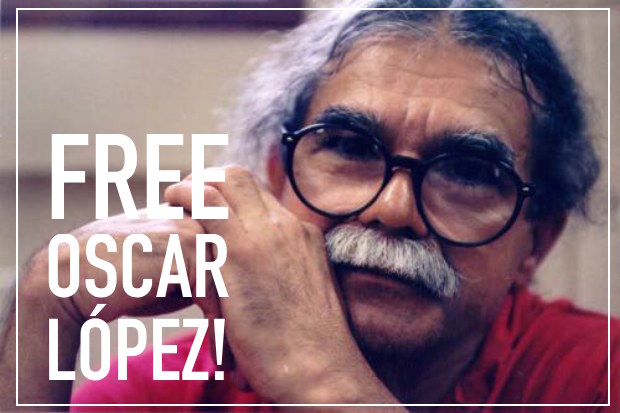
    Oscar López Rivera is the longest-held Puerto Rican political prisoner in U.S. history. He has now served 35 years in U.S. federal prisons, including 12 in solitary confinement. The movement calling for his release has intensified, broadened and strengthened in the last few years.

    For example, on June 20, 2016, solidarity events with Oscar López took place on all six continents, and in 39 countries, including Chile, Cuba, Eritrea, France, Kenya, Mauritius, Mexico, Syria, Switzerland and Venezuela. In addition, five Nobel prize winners, Archbishop Desmond Tutu (South Africa); Jose Ramos-Horta (East Timor), Adolfo Pérez Esquivel (Argentina), Jodi Williams (United States) and Mairead Corrigan Maguire (Ireland) took part that day in actions urging President Obama to release López. Who is Oscar and why is he still imprisoned? Why is the movement for his freedom growing, and how does it relate to the current economic crisis in Puerto Rico?

    Oscar López was born in Puerto Rico but grew up in Chicago, after his father migrated here for work. When he returned from Vietnam in 1967, he worked against the substandard housing conditions, the skyrocketing dropout rate and the lack of jobs or well-paying employment that plagued the Puerto Rican community of Chicago. Along with several other community activists, he founded an alternative high school for 16 Puerto Rican youth in 1972. Since that time, hundreds of kids have graduated from the high school now known as Dr. Pedro Albizu Campos High School. It enrolls roughly 180 students a year.

    In 1976, the Chicago police and FBI announced they had found a FALN (Fuerzas Armadas de Liberación Nacional) bomb factory in a garage owned by Chicagoan Carlos Alberto Torres. From that date until his arrest in 1981, López’s whereabouts were unknown.

    Between 1974 and 1980 the FALN carried out 120 bombings against U.S. military facilities, banks and government and corporate offices. The goal of the bombings was to inform people in the United States about, and to mobilize them against, U.S. colonialism in Puerto Rico, the imprisonment of the five Nationalist Party political prisoners and the abject conditions in which most Puerto Ricans lived, both on the mainland and the island.* Five people died as a result of the FALN bombings, one because he was not evacuated from the Mobil Oil building in New York City, despite the FALN warning that an explosion would soon occur. The other four were killed in 1975 when the FALN bombed the upscale restaurant Fraunces Tavern in lower Manhattan in retaliation for the murder of independentistas in Puerto Rico.

    Members of the FALN eluded capture until 1980, when 11 Puerto Ricans were arrested in Evanston, Illinois, and accused of being members of the FALN. They, and Oscar López, who was arrested on May 1981 in a Chicago suburb, declared themselves prisoners of war and refused to participate in their trials. They were all convicted of a variety of state charges and of the federal charge of seditious conspiracy, conspiring to overthrow the U.S. government through the use of force or violence; in other words fighting to end U.S. colonial rule in Puerto Rico. Although no evidence tied him to any of the bombings, Oscar López received a sentence of 55 years, to which 15 years were later added after he was convicted of attempting to escape the prison.

    President Bill Clinton granted López and ten other Puerto Rican political prisoners clemency in 1999. López refused the offer since it did not include two of the prisoners, Carlos Alberto Torres and Haydeé Beltran, who have since been released. Thus, as of this writing, López has served an additional 17 years beyond the date he had been granted clemency. One reason for this is that when he goes before the parole board, the FBI and family members of those killed in Fraunces Tavern mobilize against his release. Because the FBI has failed to pin the bombing of Fraunces Tavern on anyone, they want to make sure that the last remaining accused member of the FALN remains in prison.

    Puerto Ricans who have marched, signed petitions, made phone calls, written letters or engaged in any of the numerous activities that have been held calling for López’s freedom cover the entire political spectrum. They range from politicians who support statehood for Puerto Rico, to the current mayor of San Juan, who supports the Commonwealth (Puerto Rico’s current status), to religious leaders, to major cultural figures such as the Grammy award winning rapper Calle 13. The otherwise disunited independence movement is united in its support for Oscar’s release.

    This support for Oscar’s release, galvanized by organizations in the United States and on the island under the slogan “It’s time to bring Oscar home,” reflects the strong sense of Puerto Rican identity that defines Puerto Ricans wherever they live. The sense that Oscar is in jail, suffering a disproportionately long sentence, despite the fact that President Clinton offered him clemency, also mirrors the fairly widespread feeling that the U.S. government does not care about Puerto Ricans and ignores their needs, interests and demands.

    The U.S. government’s failure to adequately or even partially address the economic crisis that has swept Puerto Rico and resulted in the underfunding or elimination of hospitals and schools and cutbacks in jobs and wages is both a continuation and an intensification of U.S. colonialism. The situation and expectations are so dismal that thousands of Puerto Ricans have abandoned their homeland, seeking jobs, better salaries or education in the United States. In response to the crisis, the U.S. government has imposed PROMESA, the Puerto Rico Oversight, Management and Economic Stability Act, on Puerto Rico. The board that oversees the implementation of this act, staffed by capitalists, does not have the best interests of Puerto Rico at heart. Instead, much as Naomi Klein spelled out in The Shock Doctrine, the managers of hedge funds, some of whom are part of the board that oversees PROMESA, view the dismal state of affairs as an opportunity to profit from Puerto Rico’s economic woes.

    There is not a direct link between the breadth of support Puerto Ricans have expressed for the release of Oscar López and the growing opposition to PROMESA, since the former predated the latter. Yet, in the eyes of many Puerto Ricans and those who oppose U.S. colonialism, there is an obvious and nefarious tie. The U.S. government views Puerto Rico and Puerto Ricans through the eyes of a colonial master. It disregards their needs and ignores their wishes. It has not released the longest-held political prisoner in Puerto Rican history, and it has not taken the necessary steps to overcome the devastating economic crisis that promises only increased privations for Puerto Ricans.

    For information on how to support the release of Oscar López, see the National Boricua Human Rights Network, http://boricuahumanrights.org/.

    Originally posted here.

  • Rage for Aleppo and Syria

    Image

    They say that generals usually prepare for the last war.  This has happened to the peace movement, too.  The anti-war coalitions in the U.S. and UK are acting as if this was 2003 and everyone need to focus on Western imperial adventures.  Instead circumstances are quite different. The main carnage right now has little to do with “the Empire”. A dictator from a family dynasty is using his entire military, every weapon the country owns, to bring a nation to heel.  He’s assisted (and in some ways commanded) by foreign powers, one semi-fascist, the other a theocracy. The larger anti-war organizations and coalitions have nothing to say or bleat “Our main responsibility is to criticize our own government’s abuses” or airily call for all foreign forces to stop intervening. (There are also the unspeakable organizations licking the dictator’s boot in the name of  “anti-imperialism”.)

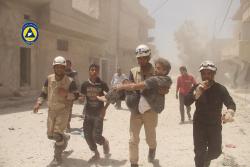
    Half a million people have died because the Assad gang is determined to hold on no matter what. The Russians are blowing up whole blocks in Aleppo, systematically destroying medical facilities and White Helmet rescue facilities. Assad has hundreds of thousands of people under siege. Palestinians refugees from camps like Yarmouk are exiled once again. The “world community” has fed refugees, but is paralyzed about action within Syria.  The UN airdrops food to only one city, the Assad-run Deir al-Zour surrounded by ISIS.  Worse, they’ve been sending aid money right into the pockets of members of the regime.

    It has the feel of the late ‘30s, Spain to be exact. In 1938 the Spanish democratic forces were being drowned in blood by the internal and foreign fascists. That by and large is the situation in Syria today (that in Syria the fascists are the “government” and the rebels the progressive forces is immaterial). Yes, the rebels are not pure. After years of neglect religious based armed groups predominate. Some ally with some very nasty Islamic supremacist groups.  Before anyone points fingers remember that in Spain in 1936-8 the democratic and revolutionary forces were allied with and armed by the Soviet Union.  That land was led by a dictator who had just killed millions in Ukraine and purged immense numbers of Soviet communists. He was a monster, but few today say the Spanish republic should have spurned that alliance.

    No-fly Zone?

    Syrians have called for a no-fly zone for years. In October 2011 the BBC reported 170 demonstrations calling for a no-fly zone in a single day. The Left was dubious. The history of those zones was not encouraging. In Iraq a no-fly zone was established in 1991 over the north of the country, supposedly to protect the Iraqi Kurds. It did stop Saddam Hussein from ravaging them (and Shia in the south), but it was seen as a step in the full scale “Shock and Awe” invasion and occupying of Iraq by the West. In Libya in 2011 France, Italy, Britain and the U.S. set up a non-fly zone supposedly to protect the civilian population from threats of immense violence from Omar Gaddafi. They got UN support for it but used it as an excuse to assist rebels to oust and kill Gaddafi. Today Libya looks like a mess. On the other hand in the light of what happened in Syria those who warned that Gaddafi very well could have committed a bloodbath seem on solid ground. Clay Claiborne recently wrote a piece about Libya and pointed to a 2012 Gallop poll of Libyans which he says shows that Libyans “overwhelmingly” supported NATO airstrikes.

    I heard Jill Stein speak in New Britain, CT last week to mostly students at a local college. She said virtually nothing about foreign policy, but she did take time out to bash Hillary Clinton for comments she’s made supposedly supporting a no-fly zone. Stein said it was risking war with a nuclear armed power. And that was all she has to say about Syria. If she had an alternative or even expressed horror about what Assad/Russia/Iran were doing I could respect what she was saying. But what I heard really deflated respect I had for her (and I’ve written in support of her candidacy even with neo-fascist Trump making his run).

    You may be surprised but there actually is a no-fly zone in Syria. It’s one small area where Assad troops attacked the Kurdish YPD force that’s getting U.S. military aid.  After it happened the U.S. sent up jets and buzzed Assad planes and said in no uncertain terms that no air force was to touch the YPD. And that was that.  There was no repetition.  A portion of northeast Syria was made a no-fly zone and World War III did not break out.

    I’m not saying that the peace movement should call for a no-fly zone, but I respect desperate Syrians who do and am repulsed by the “anti-imperialist” left who demonize as an "agent of the Pentagon" anyone who demand a NFZ.

    Ideas for Action

    A number of us on the RPM network have come up with a letter with a few ideas.  Basically it amounts to 1) denouncing the Lavrov-Kerry plan for a temporary ceasefire and then joint expansion of the bombing to anti-Assad forces; 2) demanding airdrops of food and supplies to break every siege in Syria, and; 3) open denunciation of Russian and Iranian participation and support for Assad war crimes.

    As Russia proceeds to use bunker busters inside of Aleppo and have produced scenes of unparalleled horror, activists have called for days of protest this weekend, especially on Saturday, October 1 for a “Global Day of Rage for Aleppo”.

    Other ideas: Urge the media to interview some of the 150 Syrian secular intellectuals featured in a Nation article this week. Urge them to  talk about the Right Livelihood Award (co-)Winner of 2016, the White Helmets. Have them investigate why the World Food Program can airdrop food to Deir al-Zour and nowhere else.

    In 1943 hundreds of rabbis marched from the Lincoln Memorial in DC to demand action against what we now call the Holocaust.  Couldn’t a large of groups of imams and other clergy lead something similar?

    Put pressure on the candidates for president. Only Hillary Clinton expresses any sentiments about doing something to protect Syrian civilians (though she didn’t do much as Secretary of State). She talked about a no-fly zone before the Democratic Convention, but neither Clinton or Trump have talked about Syria since August. A number of Syrians are campaigning for Hillary, but if she wins she doesn’t even take office until January.  By then Aleppo may go the way of Darayya, or worse.  Why not a major demonstration in front of one of the remaining debates with a messages, #DropFoodNotBombs #BreaktheSieges #SaveAleppo?

    Stanley Heller is a longtime activist and writer on the Middle East and is webmaster for www.rpm.world.

  • Some Left Arguments on the Election

    Image

    Several left arguments on the U.S. election frankly leave me baffled.

    For example, James Robertson writes in Jacobin that “It’s better to think of the choice in November as one not between a greater and a lesser evil, but between two different threats.” I don’t get it. Just because threats are different doesn’t mean that one is not more dangerous than the other. If someone is ill and is considering risky surgery, there is no doubt that the threats are different — dying of the disease versus dying on the operating table — but a rational person will want to determine whether one of the threats is worse than the other and choose the lesser threat.

    Robertson's survey of the positions of Trump and Clinton is odd because he doesn't actually compare the two. So he's right of course that Clinton will continue her support for the Israeli occupation, but he ignores Trump’s call for the construction of more Israeli settlements, a position well to the right of any previous president. He's right also that Clinton will oppose BDS, but he ignores the more malignant language on BDS — and Palestine more generally — in the Republican platform. Clinton, Robertson tells us, favored intervention in Libya — but he doesn’t tell us that so did Trump, who also wanted to take Libya’s oil. Robertson says Clinton would favor deeper involvement in Iraq and Syria, but doesn’t mention that Trump like Clinton initially supported the 2003 Iraq war, or that Trump called for 20,000-30,000 troops, promised to “bomb the hell” out of ISIS, urged the targeting of ISIS family members, refused to rule out nuclear weapons against ISIS, denounced Obama for not having announced that “we’re never leaving” Iraq, denounced Obama for lacking courage for not going in with “tremendous force” when Assad used chemical weapons, or asserted that the United States should have taken Iraq’s oil. (Ever wonder how one can take a country’s oil without long-term occupation? Ever wonder how this might promote peace in the Middle East?) Relations with Iran will get worse under Clinton, says Robertson — probably true, but Robertson ignores Trump’s call to abrogate the Iran nuclear deal, which will certainly do more to poison relations with Tehran than anything Clinton might do.

    Trump’s connections to Russia and admiration for Putin may slow down the new Cold War with Moscow, but other aspects of his foreign policy are incredibly dangerous: his refusal to rule out war with China because he wants to maintain unpredictability, his opposition to nuclear non-proliferation, his charge that Obama has allowed the U.S. military to “atrophy,” and his explanation that the “Trump doctrine is simple. … It’s strength. Nobody is going to mess with us. Our military will be made stronger.”

    Robertson argues that “we should expect the national-security state — built up under George W. Bush and significantly expanded under Obama — to be further strengthened with Clinton as commander in chief.” True enough. But Robertson says nothing about Trump in this regard — even though the article he links to (also from Jacobin) understands that while Trump is not different in kind from past policies, he is worse, “his national security proposals are horrifying — worse than anything we’ve seen since the Cold War.”

    Yes, Clinton has “vocally condemned” whistleblower Edward Snowden, but Robertson doesn’t mention that Trump called for executing the “traitor.”

    Robertson sums up that while Trump may be worse on immigration, Islamophobia, and police violence (though, we are told, he may not succeed in any of these), Clinton “would likely” be worse on wars and the national security state. This calculation is based, as noted above, on failing to address Trump’s positions on these issues, but in any event it overlooks many other crucial policy areas, such as the environment, reproductive rights, tax policy, minimum wage, and college tuition.

    Left critics of strategic lesser-evil voting often claim that those who point out the dangers of a Trump presidency are fear-mongering. It’s hard to understand this objection. It is the left that has identified the catastrophic risks the world faces in terms of climate change and how short our time is to address this problem before global warming becomes irreversible. Has the climate movement been fear-mongering? If not, then isn’t the huge gap between Trump and Clinton, between Republicans and Democrats, between climate deniers and those committed to increasing the use of renewable energy, worthy of our attention? Leading scientists have warned that Trump’s call to abrogate the Paris Climate Agreement could be catastrophic. Were they fear-mongering? Are they wrong? To be sure, Clinton’s position could be much better than it is. But to deny that the difference here is significant is to either believe that the human species is surely doomed (because there is no chance that we’re going to have eco-socialism in the short term) or that our warnings about the environmental dangers we face have been exaggerated.

    Jill Stein was asked “Is the prospect of a Trump presidency equal in your view to that of a Clinton one?” She replied:

    I think they both lead to the same place. The lesser evil, the Democrats, certainly have a better public relations campaign, they have better spin. The dangers are less evident, but they’re catastrophic as well. Just look at the policies under Obama on climate change.

    So Obama’s climate policies are just better spin than Trump’s would be, better public relations? They lead to the same place? But doesn’t the time frame matter? Trump’s climate denialism will propel us towards disaster while Obama’s and Clinton’s inadequate reforms may give us time to build the movement necessary for our long-term environmental survivability.

    Some ask why we should vote our fears, rather than our hopes. For the same reason it generally makes sense to prioritize our fears over our hopes in other realms of life. I hope selling off my life savings to bet on the lottery will make me rich; but my fears of the odds of losing leads me to reject that strategy. Shouldn't we always vote for the candidate we like best? Sometimes, yes.

    But faced with a choice between two different cancer therapies, the choice I like best is being cured by eating a lot of ice cream. But this would be a foolish choice. Moreover, if I were really voting for the candidate whose views most closely coincided with my own, I'd write-in myself, and other leftists would write-in themselves. But no one does that because we care about consequences; it's not just a matter of feeling good.

    Other differences between Trump and Clinton are not as highly consequential as climate change, where the stakes are truly enormous. But if one argues that the other differences are too small to matter, then this means that almost all left activity of the past decade has been irrelevant. For example, the left has pushed $15 minimum wage campaigns around the country. Were these meaningless? If not, then the difference between the Republican and Democratic platforms in this regard is not meaningless either. Clinton will appoint pro-choice justices to the Supreme Court, while Trump has pledged to select justices in the mold of Antonin Scalia. Is the difference this will mean for reproductive rights trivial? If so, then abortion rights groups have been wasting their time fighting restrictive laws and policies. We’ve fought to oppose stop-and-frisk policies, which Trump endorses. Is this just a cosmetic change?

    Clearly, Clinton and the Democrats will do nothing without continuing popular pressure, and popular pressure can be (and must be) applied to both Democrats and Republicans. But is there no difference in the susceptibility of Democrats and Republicans to progressive pressure? Let's stipulate that neither Trump nor Clinton personally cares about progressive values. But politics is not a question of the personal whims of individuals, even when they’re president. Social forces matter.

    Consider the Dakota Access Pipeline that has been opposed by large protests of Native American tribes and environmentalists. Obama’s surprise intervention to suspend construction on the project following a court decision that declined to block the pipeline was an important, though limited victory for the social movements. Jill Stein was there at Standing Rock, and that’s one of the many reasons that people should vote for her in safe states. But Stein is not going to become president. So the question is which of the only possible people who might actually be elected president this November will be more responsive to movement pressure on this issue going forward? Trump, who dismisses environmental concerns, whose party platform declares: “The Keystone Pipeline has become a symbol of everything wrong with the current Administration’s ideological approach. After years of delay, the President killed it to satisfy environmental extremists. We intend to finish that pipeline and others as part of our commitment to North American energy security,” and whose chief energy adviser (and likely Energy Secretary) has a major financial stake in the Dakota pipeline? Or Clinton, who — under pressure to be sure — came out against Keystone, who is on record committed to combating climate change, whose party includes Dakota pipeline opponents like Bernie Sanders and one of Clinton’s earliest Congressional supporters, Bonnie Watson-Coleman, and whose party platform has as one of its longest sections “Honoring Indigenous Tribal Nations.” The labor movement is split on the question, with the AFL-CIO officially favoring construction (the same split as on Keystone). So we can’t predict what will happen on the Dakota pipeline, but it would be astounding if a Trump presidency were more conducive to a future Standing Rock victory than a Clinton presidency.

    And the same is true across numerous issue areas. Clinton and the Democrats will be bad, but progressive pressure is more likely to get results when aimed at them than when aimed at Trump and the Republicans. It’s easier to press someone to do what they promised than to go against their promises. And while the lesson of a campaign against far right policies is that we need liberal policies, the lesson of a campaign against centrist Democrats is that left alternatives are needed.

    Some leftists have argued that Clinton is scarier than Trump because her chances of winning are greater: “I am much more afraid of her than Donald Trump if for no other reason that she is certain to be the next president while he is destined to continue building luxury condos and stiffing small businesses.” Certain? This was written the day that the 538 website gave Clinton a 68-69% chance of winning — a good chance, but far from certain. Has any pundit’s predictions — including left pundits — in this election cycle been so accurate that we can speak in certainties? Another leftist tells us not to worry because “Trump’s not going to win. For all Hillary Clinton’s obvious terrible flaws as a candidate, the big insider cash, the national electoral demographics, and the Electoral College map (just ask Nate Silver and his team of multivariate election predictors at FiveThirtyEight.com) strongly favor her.” — even though the Nate Silver estimate the day before this line was published gave Clinton only a 61% chance.

    I have no crystal ball, but if one pursues strategic lesser evil voting we don’t need to assume omniscience. If the day before the election, it seems Clinton is a shoo-in to win, by all means vote for Stein. But if it’s close and if your vote can make a difference to the outcome, then to be more afraid of Clinton than Trump doesn’t make any sense.

    Voting for Clinton only if and where it makes a difference doesn’t mean “endorsing” her or “supporting” her. It doesn’t mean rejecting the left or embracing neoliberalism. It means that one ought to weigh the consequences of one’s actions — taking account of the harm that fewer votes would mean for the Green Party and its future prospects versus the harm of allowing a Trump presidency and all that would mean for his many victims — and vote accordingly, while working to oppose repugnant policies and build alternatives.

  • Correction – Mexico’s Teachers Movement Facing Violence but Not Death Squads

    Dear Readers,

    On September 18, I wrote, and the New Politics website of which I am an editor, published an article titled “Mexico’s Teachers Movement; From Class War to Death Squads” that argued that three recent killing appeared to be the result of death squads targeting teachers. While the fact that the three killings took place is not in question, well informed readers in Mexico who have been involved in the teachers movement or in solidarity with it suggest these killings do not seem to be the result of death squads.

    These readers argue that while the teacher who was killed may have been targeted for union activity, the other two killings may have had other motives having nothing to do with the union. These readers suggest that while some teachers have been murdered because of their involvement in the teachers movement, many killings that have taken place in Oaxaca, Chiapas, and in other states may have political motives, may be related to the drug cartel violence, or to other violence in the region. I have come to the conclusion that my readers are right and that this article should be corrected: death squads do not appear to be a trend at this time. 

    I welcome and appreciate your comments and criticisms on the original article, on this correction and the issues raised.

    In solidarity, Dan La Botz

  • In Putin’s Head: Book Review

    ImageMichel Eltchaninoff. Dans la tête de Vladimir Poutine. Arles: Solin/Actes Sud, 2015. 171pp.

    Michel Eltchaninoff’s prize-winning Dans la tête de Vladimir PoutineIn the Head of Vladimir Putin—is a fascinating examination of the development of the Russian president’s ultra-conservative and nationalist ideology from assuming the presidency in 2000 until today.[1] Eltchaninoff, the author of two books about Russian novelist Fyodor Dostoyevsky and many essays, might seem like an unlikely candidate to write an intellectual biography of the twenty-first century president Putin, but as it turns out, Eltchaninoff’s knowledge of nineteenth and twentieth century Russian philosophers makes him the ideal author, because that is where Putin’s ideas come from, Russia’s conservative, religious past.

    Putin, as he has himself has said, was never a believer in Communism and the classless society, but rather, serving as a KGB spy, a dedicated servant of the Soviet Union. Appalled by the collapse of the Soviet state, which he viewed as a tragedy, he has as president sought to preserve Russia—and to expand it. With the fall of Communism, Putin initially adopted the liberal rhetoric then popular in the United States and the European Union, though how sincere he was in those views is unclear. In any case, writes Eltchaninoff, he gradually began to move to the right until with the “conservative turn” of 2013 he adopted profoundly reactionary religious and political views, becoming “an imperialist the following year” with the taking of Crimea. Putin’s quest for a worldview was not simply a personal intellectual odyssey, but rather the search by Putin and the political class he led for an ideology that could serve as the intellectual and political foundation of Russia and of a new empire.

    At each stage of this rightward-moving evolution, Putin would in his political speeches, public lectures, and articles quote from Russian philosophers, some of them from the nineteenth century, others émigré intellectuals exiled to Paris or to Berlin after the Russian Revolution of October 1917. His interest in these thinkers is not unique. During the 1990s, after the fall of the Soviet Union and the end of Communism, its official Marxist-Leninist philosophy, “dialectical materialism” or diamat as it was called, also collapsed. Consequently many Russian intellectuals and political leaders began to look to the past for a new ideology for the new post-Soviet society.

    There were a boatload of philosopher to choose from. In fact, there were two boatloads, the “ships of philosophers,” who had been expelled from the Soviet Russia by Lenin.[2] One of the first in whom the post-Soviet intellectual society became interested was Ivan Ilyin (1883-1954), a Hegel specialist, an opponent of the Soviet Union, and the author in 1925 of On the Resistance to Evil by Force. Always close to the whites, that is, the counter-revolutionaries attempting to overthrow the Soviet government, his thinking provided an ideology for the General Wrangel’s army. Ilyin not only opposed Soviet Communism, but also Leo Tolstoy’s Christian pacifism, arguing that passive resistane would fail and that genuine Christianity demanded a struggle, forceful and violent if necessary, against evil.

    Living in exile in Berlin, in 1933 Ilyin became enthused about the “new National-Socialist [i.e. Nazi] spirit,” though he soon gave up on Hitler, turning instead to admire the fascist Christian dictators Francisco Franco in Spain and Antonio de Oliveira Salazar in Portugal. Ilyin was a believer in a “national democracy” and a “democratic dictatorship”—not a democracy based on things like elections, but rather on the rule of the natural elite. He believed in “freedom,” but the freedom through belief in the Orthodox religion, the Russian nationality, and in the fulfillment of one’s station in life.

    Ilyin’s writings caught the interest to post-Soviet intellectuals and thus entered into the intellectual atmosphere that Putin and others breathed. Putin first cited Ilyin in a speech to a joint session of the Russian legislature on April 25, 2005, in reference to the “consolidation of the institutions of a real democracy.” “Real democracy” was Putin’s term for what he called the “dictatorship of law” and the “verticality of power.”

    During this period, Putin was deeply disturbed by the revolutions of colors taking place in neighboring states: Revolution of the Roses in Georgia that brought to power the young, pro-American reformer Mikhail Saakashvili and the Orange Revolution of pro-Western Viktor Yanukovych in Ukraine. Putin saw these revolutions as the work of the U.S. Central Intelligence Agency, and was infuriated by the idea of a foreign power controlling elections in nearby states, states that were once and by all rights should be part of Russia. One of his advisors, Vladislav Sourkov proposed a new term to describe the Russian point of view: “sovereign democracy,” meaning democracy without foreign intervention. This became a theoretical pillar and a central term of Putin’s political vocabulary.

    A turning point event in Putin’s political career was the Beslan school hostage crisis of September 2004 when an ethnic Ingush and Chechen Islamic group occupied a school taking 1,100 hostages, 777 of them school children. The group, led by Shamil Besayev, demanded recognition of Chechnya’s independence and the withdrawal of all Russian troops. Using tanks and rockets, Russian security forces stormed the school, killing an estimated 330 hostages, some 186 of them school children. This horrifying event became a catalyst for Putin’s thinking. Putin reacted to Beslan by further consolidating power in his own hands, but also by turning further to the right.

    In Putin’s mind, Islam was not the greatest threat to Russia. Europe was. NATO and the European Union threatened to expand, absorbing more formerly Russian territories, as they already had the Baltic nations. By 2007, Putin had become preoccupied, one could say obsessed by the idea of protecting Russia from the evils of Western life: the Internet, pornography, and homosexuality. In the “Munich discourse” of 2007 he spoke out violently against the United States and the European Union for attempting to create a unipolar world that threatened Russian culture and morality. What was needed, Putin saw, was a political and philosophical defense against the West.

    Putin’s protégé Dmitry Medvedev served as president from 2008-2012, a brief interregnum, and in 2013 Putin returned to the presidency. That year he made what Eltchaninoff calls “the conservative turn.” This turn against what was perceived as the decadent West and everything it represented required a new intellectual foundation and Putin found one source in the philosophy of Konstantin Leontiev (1831-1891), sometimes called the “Russian Nietzsche.” Leontiev’s aristocratic and religious philosophy challenged the West’s democracy, liberty, and equality as well as its secularism and hedonism. Leontiev was an admirer of the Byzantine Church, not for its Christian morality, but for its hierarchy. Prophetically it must have seemed to Putin, Leontiev warned that one day a “federal Europe” would threaten to absorb Russia. Influenced by thinkers like Ilyin and Leontiev, Putin’s ideology was becoming more and more nationalist and religious.

    On March 18, 2014, Putin ordered the Russian Federation to seize Crimea; as Eltchaninoff writes, for “the first time since the Second World War that a European state annexed part of another state.” How could this act—condemned by most of the world—be justified? Putin now turned to other thinkers, the slovophiles, to argue that there’s “a Russian Way.” Putin made the argument that Russia, “holy Russia,” as it was often called, was the guardian of authentic Christian values against Western decadence. And the Ukraine was not only part of Russia, it was the very heart of Russia, for it was in Kievan Rus that in 988 Russia first adopted Christianity; and joined the Orthodox Church is the very soul of the Russian culture. It was the people, the narod, imbued with this faith that had always fought for and defended Russia at every step, against Napoleon, against Hitler, and now against the United States and Western Europe. This was what was now called “the Russian Way.”

    Slavophiles such as Alexis Khomiakov (1804-1860) and Ivan Kireivsky (1806-1856), Konstantin Aksakov (1817-1860), and Youri Samarine (1819-1876) had argued in the mid-nineteenth century that it was a mistake to follow the West, but rather Russians should turn to their own nation, religion, and culture and build a future on those. The problem was, that many of the slavophiles were themselves cosmopolitan figures influenced by the West, and in any case they were not sufficiently political, nationalist, or imperialist to provide an ideology for Putin. Eltchaninoff writes a separate chapter to argue that Slavophiles such as Nikolai Berdyaev and Fyodor Dostoyevsky could never provide a Putin with the nationalist ideology he sought.

    However, Nicolas Danilevski (1822-1875), author in 1871 of Russia and Europe, provided an ideological foundation that was both powerfully nationalistic and dynamically expansionist. He argued that Russia’s backwardness was in fact its strength; its mountains, forests, and steppes harboring a population that was always silently growing, a people filled with “tribal ethnographic energy.” These were the people who would “by osmosis” follow a Russian leader in a struggle against the West that would galvanize the surrounding Slavic nations and peoples. These Slavophile ideas became the foundation for Putin’s “Russian Way.”

    The Russian Way was all very good as an approach to the Slavic nations, in many of which there were both Russians and many Russian speakers, but what about the East? At the end of 2013 Putin had announced that Siberia and the Far East would be the “national priority for the twenty-first century.” How could Putin justify his desire to create there some new version of the Russian empire among the Turkic speaking nations and other Asian peoples? The key idea here was the notion of Russia’s unique role as the pivot of “Eurasia,” not simply a term of physical geography but the notion that Russia had always been at the center of a vast cosmopolitan world, nationally, ethnically, and religiously diverse.

    The philosopher who provided ideas for this “International Eurasian Movement” was Piotr Savitsky (1895-1968), who argued that Eurasia—with Russia at the center—represented a “third continent,” neither Europe nor Asia, “a geographic world apart.” Eurasian Russia, Savitsky claimed, was really the “center of the Old World,” of which Europe, the Near East, India, Indonesia, China, and Japan were merely extensions. It is Eurasian Russia that is destined once again to reassert its centrality of this entire region.

    There was also Lev Gumilev (1912-1992), another important influence on Putin. In fact Putin participated in a Gumilev study group in the 1990s. Gumilev argued that the English, French, and Germans would always be enemies of the Russians, but that Russia could find fast friends among the Turks and Mongols. Gumilev believed that a cosmic force had influenced the Russian people—one could say their DNA—and given them something he called “passionate power.”[3] Putin quotes Gumilev in a speech to the Federal Assembly in December 2012, saying that one of the great resources of the world—beyond coal and oil, for example—is intellect, “and as Lev Gumilev says, passionate power, the capacity to go forward and to change.”

    Among currently active Eurasianists, Alexander Dugin who has sometimes been mistakenly called the guru of Putin, is the best known. Dugin melds the ideas of the Russian Old Believers with Nazi intellectual Carl Schmitt and the French “new right,” among many other extreme rightwing currents. Dugin sees Eurasia as part of what will become a rightwing “new world order,” with Russia at the center.

    Eltchaninoff asks whether or not the theories that Putin has adopted can provide the ideology needed for the construction of a new Russian empire. Clearly, he notes, the old Soviet empire based on Marxism-Leninism is an impossibility, while the Slavophile and the Eurasian ideologies stand in conflict with each other. Eltchaninoff states that, “Putin practices an imperialism a la carte. He invokes nostalgia for the USSR, common religious principles, Russianness and the Russian language, and the Eurasian project according to the situation at the moment…The only common basis of all of the president’s imperialist whims is the market economy.” When Putin took Crimea he referred to the project of Novorossia, a new Russia—yet it looks very much like the old Russia, the old Czarist Russia and the old Soviet Russia.

    Dans la tête de Vladimir Poutine concludes with a discussion of Putin’s adoption of the old term the “Russian world,” to refer to his attempt to promote Russian culture abroad, especially in Europe. This is his government’s projection of the Russian state, the Orthodox Church, the Russian language through a variety of government programs, from attempts to unify the Easter Rite churches to the promotion of the Russian language abroad. It is also an attempt to influence and establish good relations with groups abroad from the far right party of Hungary to the leftwing Front de Gauche in France.

    Putin has had surprising success in winning support from leftists in the Western countries—including in the United States—for his imperial adventures Crimea and  the eastern Ukraine and for his backing of al-Assad in Syria. These leftists see his struggle against the United States and the European Union as aiding other nations in their fight for political sovereignty and economic independence. Perhaps after reading this book, the left will learn that Putin has adopted the most reactionary philosophies not only to support his authoritarian state at home, but also to justify his expansion abroad.


    [1] Winner of the Prix de la Revue de Deux Mondes in 2015.

    [2] The only book available in English about the boatloads of philosophers is written by the very conservative Lesley Chamberlain, Lenin’s Private War: The Voyage of the Philosophy Steamer and the Exile of the Intelligentsia (New York: St. Martin’s, 2007).

    [3] The word in Russian is passionarnost. Elchaninoff’s French neologism is passionarité. See Charles Clover, “Lev Gumilev: passion, Putin and power,” Financial Times, at: https://www.ft.comede1e5c6-e0c5-11e5-8d9b-e88a2a889797


  • Fighting for Our Lives: #NoDAPL in Historical Context

    img_0879

    Little has been written about the historical relationship between the movement against the Dakota Access Pipeline and the longer histories of Oceti Sakowin (The Great Sioux Nation) resistance against the trespass of settlers, dams, and pipelines across the Mni Sose, the Missouri River. This is a short analysis of the historical and political context of the #NoDAPL movement and the transformative possibilities of the current struggle.

    Thousands have camped along the banks of the Missouri River at Cannon Ball in the Standing Rock Sioux Indian Reservation to halt the construction of the Dakota Access Pipeline (DAPL), which promises to carry half a million barrels of heavy crude oil a day across four states, under the Missouri River twice, and under the Mississippi River toward the Gulf of Mexico for global export. Camp Oceti Sakowin, Red Warrior Camp, and Sacred Stone Camp, the various Native-led groups standing in unity against DAPL, have brought together the largest, mass-gathering of Natives and allies in more than a century, all on land and along a river the Army Corps of Engineers claims sole jurisdiction and authority over.

    How and why did this happen?

    In 1803 the wasicu — the fat-takers, the settlers, the capitalists — claimed this stretch of the river as part of what became the largest real estate transaction in world history. The fledgling U.S. settler state “bought” 827 million acres from the French Crown in the Louisiana Purchase and sent two white explorers, Lewis and Clark, to claim and map the newly acquired territory. None of the Native Nations west of the Mississippi consented to the sale of their lands to a sovereign they neither recognized nor viewed as superior. It was only after we rebuffed Lewis and Clark for failing to pay tribute for their passage on our river that they labeled the Oceti Sakowin “the vilest miscreants of the savage race.” Thus began one of the longest and most hotly contested struggles in the history of the world.

    louisiana_purchase
    The Louisiana Purchase

    For the next hundred years, the U.S. led various unsuccessful military campaigns to suppress, annihilate, and dispossess us of our rightful claim to the river and our lands. Despite popular belief, we were never militarily defeated. Red Cloud’s War and the War for the Black Hills led to the military defeat of the U.S. Calvary, most famously the annihilation of General George Armstrong Custer’s forces at the Battle of Greasy Grass in 1876. These wars, for our part, were entirely defensive. The Oceti Sakowin signed peace treaties with the invading settler government. The 1854 and 1868 Fort Laramie treaties provided temporary reprieve and defined the vast 25-million-acre territory of what became the Great Sioux Reservation, which stretched from the eastern shore of the Missouri River to the Bighorn Mountains. Four decades of intense warfare, however, took its toll. More than ten million buffalo were slaughtered to starve us out. Settler hordes invaded and pillaged our Black Hills for its gold. Our vast land base diminished and the treaties were nullified when Congress passed the Indian Appropriations Act of 1876, which abolished treaty-making with Native Nations, and the Black Hills Act of 1877, which illegally ceded the Black Hills and created the present-day reservation system.

    The Oceti Sakowin has vigorously opposed these bald imperialistic maneuvers to usurp our self-determining authority over our lives and lands. Settler society entreated the Oceti Sakowin for the 1854 and 1868 agreements, not the other way around. We entered these relationships with the understanding that both parties respected a common humanity with the people and the lands. In our view, the settler state lost its humanity when it violated the treaties. Every act on our part to recover and reclaim our lives and land and to resist elimination is an attempt to recuperate that lost humanity — humanity this settler state refuses and denies even to its own.

    1868-treaty-map-optimized
    1868 Fort Laramie Treaty Territory

    South Dakota and North Dakota statehood also played a major role in suppressing the Oceti Sakowin. Although we have never signed any treaties with these states, they lay claim to the destinies of our lands, our river, and our people. To do so, they have always used violence and hatred. In 1890, a year after statehood, these two states drummed up anti-Indian sentiment to further break up and open reservation lands for settlement. As a result, they fabricated the Ghost Dance crisis; called for federal troops to intervene to protect white property that resulted in the assassination of our military and political leaders such as Crazy Horse and Sitting Bull; and resulted in the killing of over 300 mostly unarmed women, children, and elders at Wounded Knee in the Pine Ridge Indian Reservation.

    Outright murder was never enough. The Dawes Allotment Act of 1887 and the creation of five smaller reservations attempted to factionalize the Oceti Sakowin and opened up “surplus” lands to white homesteaders. From 1907 to 1934, millions of acres of the remaining Great Sioux Reservation were lost. In the early 1900s, Missouri River Basin states began organizing to usurp Native water rights for large-scale irrigation projects. These states envisioned a dam system that would create large reservoirs that would primarily flood Native lands. But there was a major problem. In 1908, a U.S. Supreme Court decision held that tribes maintained access and control of water within original treaty territory, even if that territory was diminished. This became known as the Winters Doctrine. For the Missouri River, the Oceti Sakowin possessed the prior claim to both the river and its shorelines as spelled out in the 1851 and 1868 Fort Laramie Treaties.

    souix-reservations-map
    Historic and present day treaty lands

    An opportunity for the states arose. After unseasonal mass flooding, Congress passed the Flood Control Act in 1944 — or what became known as the Pick-Sloan Plan authorizing the Army Corps of Engineers and the Bureau of Reclamation to erect five dams on the mainstem of the river. All of which targeted and disproportionately destroyed Native lands and lives. Of the five Pick-Sloan dams, four flooded the lands of seven nations of the Oceti Sakowin: the Santee Sioux Tribe, the Yankton Sioux Tribe, the Sicangu Oyate, the Lower Brule Sioux Tribe, the Crow Creek Sioux Tribe, the Cheyenne River Sioux Tribe, and the Standing Rock Sioux Tribe. Of the 611,642 condemned acres through eminent domain in what was called the “taking area,” these nations lost 309,584 acres of vital bottomlands. Inundation also forced more than a thousand Native families, in patent violation of treaties and without their consent, to relocate. Entire communities were removed to marginal reservation lands, and many were forced to leave the reservation entirely. As a result of condemnation, the Army Corps of Engineers claims sole jurisdiction over the river and its shoreline.

    pick-sloan_plan
    Pick-Sloan Dams

    The dams, which promised and delivered wholesale destruction, coincided and worked in tandem with the federal policies of termination and relocation. In 1953, Congress passed House Concurrent Resolution 108 (HCR 108) that inaugurated termination policy, and called for the immediate termination or ended federal recognition of the Flathead, Klamath, Menominee, Potawatomi, and Turtle Mountain Chippewa tribes. That same year, Congress passed Public Law 280 (PL 280) that authorized states to assume criminal and civil jurisdiction over Native lands. The Bureau of Indian Affairs supported these programs and carried out the Indian Relocation Act of 1956 that relocated thousands from the reservation to far-off urban centers. HCR 108, PL 280, relocation, and the Pick-Sloan dams did not just promote assimilation — they enforced genocide and elimination.

    Through termination, relocation, and massive flooding, however, colonialism created its own gravediggers. The Oceti Sakowin unified to thwart the state of South Dakota’s attempts to implement PL 280 to overthrow Native governments and assume control over their lands. Natives on relocation also began to organize. Groups such as the National Indian Youth Council and the American Indian Movement (AIM) formed in the urban centers to combat the wholesale destruction of Native life on- and off-reservation. In 1973, AIM occupied Wounded Knee in the Pine Ridge Indian Reservation, which was a culmination of more than a decade of Red Power organizing. The occupation was the catalyst for a mass gathering of thousands at Standing Rock in 1974, which resulted in the founding of the International Indian Treaty Council. At Standing Rock, more than 90 Native Nations from around the world built the foundations of what would become four decades of work at the United Nations and the basis for the 2007 Declaration on the Rights of Indigenous Peoples.

    screen-shot-2016-09-18-at-1-06-43-am
    The International Indian Treaty Council, the international arm of the American Indian Movement, was founded at Standing Rock in 1974.

    The anti-colonial uprising taking place in Oceti Sakowin treaty territory and spilling onto the world stage was met with violent state repression. AIM leaders were assassinated and many were imprisoned. For example, Native leader Leonard Peltier, who participated in this movement for the life and dignity of his people, to this day sits behind bars as one of the longest serving political prisoners in United States history. From 1977 to 2012 South Dakota’s prison population increased 500 percent. One-third of its prison population is Native, although Natives make up only nine percent of the total population.

    With the advent of tarsands extraction and heavy crude pipelines destroying water supplies and scorching the earth, Natives and the Oceti Sakowin have once again reunited. This unification first targeted tarsands and pipeline construction in so-called Canada in First Nations’ territory. Successful blockades have halted pipelines. In 2014, the Oceti Sakowin began a massive organizing effort, with help from allies, against the Keystone XL (KXL) pipeline that, too, threatened to cross the Missouri River. Our Nation is made up of some of the poorest people in the Western hemisphere organizing to oppose a fossil fuel industry made up of some of the most powerful and wealthiest people on the planet. Despite these odds KXL was defeated on November 6, 2015. After mass protests, the Obama administration denied the pipeline’s permit.

    Two important lessons were drawn from the KXL struggle that were carried into #NoDAPL. The power of multinational unity between Natives and non-Natives was one of the movement’s successes. The other proved the transformative power and potential of anti-colonial resistance to successfully mobilize poor people against the rich and powerful — and win!

    img_0719
    The Red Nation riders at the #NoDAPL camp.

    Like our ancestors’ wars of the nineteenth century, our current war is also defensive — it is to protect water and land from inevitable spoliation in the name of profit. The #NoDAPL movement is explicitly nonviolent, which accounts for its mass appeal to Native and non-Native communities. In spite of this, political violence as a tactic of state repression has emerged against water protectors who engage in nonviolent direct action to disrupt the construction of the pipeline as well as those not engaged in direct actions. Natives at or near camp — whether involved in direct actions or not — are also targets for surveillance and repression. The camp and the Standing Rock reservation are under constant surveillance. The reason: Native bodies stand between corporations and their money. Halting the accumulation of capital, which in this context is the exploitation of our river and lands, has piqued settler ire and spite.

    The prolonged peaceful encampment practices an unsettling counter-sovereignty. It has drawn the support and solidarity of more than 200 Native Nations and countless thousands of allied forces sending a clear message to corporate interests: North Dakota cannot manage its Indians and the “Indian Problem” is out of control. After all, controlling the “Indian Problem” has always meant maintaining unrestricted access to Native lands and resources and keeping Indians silent, out of view, and factionalized. At Standing Rock, an unarmed, nonviolent prayer camp poses such a serious threat to settler proprietary claims that North Dakota Governor Jack Dalrymple, who has direct ties to the oil and gas industry, has deployed the full force of the Highway Patrol and the National Guards. These forces are not there to service an impoverished Native community or protect the integrity of the land and river. They are there to carry out the will of DAPL backers Energy Transfer Partners, some of the richest and most powerful people in the world who have used attack dogs against unarmed, nonviolent water protectors. More than 60 have been arrested, including journalists. Violent state repression has not ceased.

    img_0915
    The #NoDAPL “United Nations” of Native Nation flags

    The Army Corps of Engineers, who maintains jurisdiction over the river in violation of the 1854 and 1868 Fort Laramie Treaties, claims it holds the final say about whether the DAPL can cross the Missouri River. The #NoDAPL encampment, in an exercise in Native sovereignty, sits atop lands claimed by the Corps, who only recently “permitted” the camp’s presence. On September 9, the Department of Interior, the Department of Justice, and the Corps also issued a joint statement halting — for now — the construction of the pipeline under the Missouri River as the Standing Rock Sioux Tribe’s case against DAPL will be considered and reviewed. This was a victory — a temporary halt of construction at a key site — and proof that this enemy, no matter how powerful, violent, or spiteful, too, can be defeated if Native people refuse to back down and continue to act in unity and cooperation. While construction halted under the river, it continues everywhere else. So too do direct actions. So too does the peaceful encampment. And so too must our focus and support on #NoDAPL. The encampment will remain until the pipeline is completely defeated.

    Oceti Sakowin and Native resistance, as it has for centuries, will also continue until our common enemy is defeated.

    IMG_0861.jpg
    The Red Nation delegation at the #NoDAPL camp

    Early lessons from this ongoing struggle can be drawn to help strategize future possibilities:

    • The colonial state does not possess, and never has possessed, the moral high ground. It defends corporate access to Native lands and uses violence as a political tactic to maintain its contested authority over the land. The North Dakota National Guard has never in its history been deployed in force against an unarmed “domestic” population– until now. The National Guard and the Highway Patrol protect corporate interests and enforce the colonial state’s monopoly on violence against the most vulnerable and marginalized populations – Native people.
    • The prayer camp has galvanized multinational unity, primarily mobilizing everyday people in defense of Native sovereignty, self-determination, and treaty rights.
    • Treaty rights, and by default Native sovereignty, protect everyone’s rights. In this case, they protect a vital fresh water source for millions – the Missouri River.
    • #NoDAPL anti-colonial struggle is profoundly anti-capitalist. It is the frontline. It is the future.
    • The profits that corporations like Energy Transfer Corporation reap from colonial projects like the DAPL should be seized and used to repair damage to the land and river. With this also comes a long-term goal to restore the Missouri River to its rightful protectors – the Oceti Sakowin – and its natural path. This means the Army Corps of Engineers must relinquish its claim to the river and begin to demolish the Pick-Sloan dams so that the river and its people may once again live.

    Originally posted here

  • The End of an Era: From Dependence to Self-Propelled Development

    Image

    In 2006, the University of North Carolina Press published Puerto Rico in the American Century, a history of Puerto Rico since 1898, written by César J. Ayala and I.

    In our conclusion we wrote the following:

    “At the time of writing, the decrease in manufacturing employment continues, public debt has reached unprecedented levels and Wall Street rating agencies are close to reducing Puerto Rico’s government financial instruments to the level of junk bonds. More critically, government agencies have run out of funds two months before the end of fiscal year 2005-2006. An impasse between the Popular Democratic Party-controlled Executive and a New Progressive Party-led Legislature forced a two-week layoff of close to 100,000 public employees. Coinciding with this, Congress is conducting hearings on possible mechanisms of dealing with the status question. Erosion of the prestige of the major political parties, fiscal crisis and growing exasperation on the island, on Wall Street and in Washington with Puerto Rico’s overall situation: Puerto Rican society is at the end of an era.”

    The least that can be said is that these words were prophetic: manufacturing employment continued to decrease, public debt spiraled upward, Puerto Rico’s bonds were downgraded to junk-bond rating in 2014 and most analysts eventually recognized that Puerto Rico’s debt is unsustainable and must be restructured (how and on what terms is another matter). Puerto Rico, as we pointed out a decade ago, is at the end of an era.

    The provisions of the Puerto Rico Oversight, Management & Economic Stability Act (Promesa) in their own way are a recognition that Puerto Rico’s crisis cannot be addressed through existing legal and institutional structures. Whether the changes pursued by Promesa are in the best interest of Puerto Rico is again quite a different question. Precisely because I felt in 2006 that Puerto Rico was at the end of an era, I joined the efforts to launch the Partido del Pueblo Trabajador: not unlike the Great Depression of the 1930s, to open a new chapter in our social and economic history we need new political vehicles.

    And we need new political parties. Puerto Rico has many complex problems (economic, administrative, environmental, health, etc.). We need proposals to address them in a coherent fashion. That is to say: we need an integrated program. But a program does not execute itself: we need people to support and move it forward. And we need candidates that represent it. This is what a party is, or should be: a program, people organized democratically to promote it and candidates who seek to legislate and execute it. I feel that we need new options, beyond the two parties that have brought us to the present impasse and that those options should be participatory, collective options.

    Back in 2006, we indicated the root problem of Puerto Rico’s growing crisis: the exhaustion of a development policy centered on tax exemptions and an almost absolute dependence on external investment. We were not the first to point this out. For example, in 1975, in his report on government finances, economist James Tobin warned against the growing outflow of profits. Regarding Tobin’s report, we wrote in 2006: Tobin “pointed out that the outflow of profits resulting from external control…was statistically reflected in the widening gap between the gross domestic product (GDP) and the gross national product (GNP)…. The less the expansion of the GDP was reflected in the growth of the GNP, the less the island’s economic expansion would translate into the welfare of its inhabitants. The report predicted that ‘growing dependence on external resources’…would tend to widen the gap.”

    This is the gap we need to reduce: we must ensure that much more of the wealth generated in Puerto Rico is reinvested here. We are trapped in the vicious circle of dependence: we lack investment funds, we invite external capital to invest, but most of the profits generated leave the island and we are back at the starting point. Our objective should be a transition to a virtuous circle of self-sustained development wherein income generated here is reinvested here, generating a self-propelling expansion. This is why a new version of Section 936 will not do the trick: it would be another ride in the circle of dependence. While Section 936 coincided with moderate growth, we should not forget that it was never able to reduce unemployment below 10% or poverty levels below 40%. It was irresponsible to eliminate it without anything to replace it, but that does not make it an adequate alternative to the present crisis.

    There are, briefly stated, two paths before us. One favors reductions in government spending and employment, minimum pay and welfare programs, erosion of labor rights, regressive tax reform reliant on consumer taxes and new tax exemption measures. At best, this path would turn Puerto Rico into an impoverished export platform. It would insert us in the global economy, not through higher productivity but through higher exploitation of our labor force. The other path insists that we should not confuse productivity with exploitation: this path favors a radical revision of tax exemption measures, a progressive tax reform combined with anti-evasion measures and the active promotion of industrial and agricultural initiatives committed to reinvestment. Our structural problem is an economy that does not retain a considerable portion of the wealth generated within it. If we do not address this structural problem, we will continue to perpetuate the consequences of the dependent development that have plagued us for decades.

    Rafael Bernabe is the candidate for governor from the Working People’s Party (PPT by its Spanish initials), of which he is one of the founders. A historian and sociologist, Bernabe has been a professor at the University of Puerto Rico for more than 20 years and has served as the president of the Puerto Rican Association of University Professors. He has been active in many social causes, including the rights of workers, women, immigrants, the LGBTTIQ community and the environment.

    Originally posted here.

  • Labour, anti-Zionism and anti-Semitism

    Image

    Last April a row engulfed Ken Livingstone, former Labour mayor of London, and Naz Shah, Labour MP for Bradford West, following remarks they made about Israel and Zionism. They were suspended from the Labour Party, with Naz Shah having the parliamentary whip withdrawn. Shah has been reinstated, and though Livingstone has demanded that he too be reinstated, a decision has yet to be made by Labour’s National Constitutional Committee.

    The row prompted Jeremy Corbyn to set up an enquiry into anti-Semitism in the Labour Party headed by human rights lawyer Shami Chakrabarti. She produced a report at the end of June. After Livingstone’s and Shah’s remarks a wave of accusations of anti-Semitism swept across the media and the Parliamentary Labour Party. But attempts to smear Corbyn with the tag of anti-Semitism were made even before he was elected Labour leader in September 2015.

    The establishment media, led by the liberal Guardian, worked itself into a frenzy of hysteria against Corbyn, focusing on his long-standing commitment to Palestinian rights. The implication was that he was a closet anti-Semite or least that he had a close association with such alleged anti-Semites as the leaders of the Palestinian Hamas or the Lebanese Hizbollah organisations. Corbyn responded by saying that in order to reach a peaceful settlement, one had to talk to everyone, including leaders one didn’t wholly agree with.

    Chakrabarti’s report makes clear, as she puts it in the foreword, that “the Labour Party is not overrun by anti-Semitism, Islamophobia or other forms of racism”. However, she adds, “there is much clear evidence…of minority hateful or ignorant attitudes and behaviours festering within a sometimes bitter incivility of discourse.” She also refers to “an occasionally toxic atmosphere” which “is in danger of shutting down free speech”.

    Last February the co-chair of the Oxford University Labour Club resigned, citing instances of anti-Semitism. An internal Labour inquiry conducted by Baroness Royall concluded that OULC did not have an institutional issue of anti-Semitism, though also claiming that the student body has a “clear cultural problem” around this topic meaning that “some Jews do not feel welcome”. She highlights what she describes as the racist epithet “Zio”, an abbreviation of Zionist, recommending that it should have no place in Labour Party discourse.

    Condemns

    She also condemns the use of ethnic stereotypes whereby individuals or whole groups are said to think or act in a particular way due to their race or religion. She stresses that this kind of thinking is not prevalent in the Labour Party “but nor is it completely absent”. She cites the example of a Labour councillor who was told he would be particularly good at a finance role simply because he was Jewish. Rumours circulated around a Jewish MP that she was a Mossad agent.

    Ken Livingstone was suspended from the Labour Party following his claim that Hitler had supported Zionism “before he went mad and ended up killing six million Jews”. His comments were probably referring to the Haavara agreement of 1933 whereby German Jews emigrating to Palestine as a result of Nazi persecution were allowed to take some of their wealth out of Germany in order to buy German goods for the Yishuv (the Zionist settlements in British Mandate Palestine). This was in violation of the boycott of Nazi Germany supported by most Diaspora Jews and the international left.

    Tragically, Zionism also became the ideology justifying the ethnic cleansing of the majority of Palestinians in 1948-9. And it did so by emphasising a racial definition of Jewishness, one which is embodied in Israel’s Law of Return. As Joachim Prinz, a prominent German Zionist leader, declared in 1934, “The theory of assimilation has collapsed… A state, built according to the principle of purity of the nation and race [ie the Third Reich], can only be honoured and respected by a Jew who declares his belonging to his own kind.”

    Indeed, Zionism accepts anti-Semitism as the normal attitude of the Gentile world. It responds to it by self-exclusion and the creation of a state where Jews are a majority. Theodore Herzl, the founder of Zionism, was a journalist in Paris covering the Dreyfus affair in the 1890s, when a wave of anti-Semitism swept across French society. He wrote, “I achieved a freer attitude towards anti-Semitism, which I now began to understand historically and to pardon.”

    However, as John Rose argued in his reply to Norman Finkelstein in Open Democracy: “Even in its most reactionary form, Zionism, before the Second World War, which had no guarantee for its claims on Palestine, was one of the voices of oppressed Jews facing the growth of violent anti-Semitism as a mass movement everywhere, though of course in widely differing degrees of intensity. That strand of Zionism which tried to grovel with its tormentor, camouflaged as ‘negotiation’, even to the point of mimicry, remained always at its mercy” (8 May 2016).

    Zionists were also at the forefront of the fight against Nazism in Eastern Europe, displaying extraordinary courage under appalling circumstances. Moreover, according to Francis Nicosia, by 1937 the Nazis had become opposed to the idea of a Jewish state in Palestine as it would become a universally-recognised power base for international Jewry, with the Nazis’ anti-Semitic policies making Germany a natural enemy.

    Livingstone’s comments missed out half the story and as such gave a misleading, and wrong, picture of historical events. However, the notion that anti-Zionism is automatically anti-Jewish must be challenged.

    The conflation of anti-Zionism and anti-Semitism by Zionists suggests that all Jews must inevitably support Israel simply by virtue of being Jews. This implies that Jews have no independent mind of their own, no ability to stand back and criticise Israel or the idea of Zionism, that they are simply part of a mass of uncritical pro-Israel supporters.

    Institutional

    Of course, Israeli leaders have always claimed to speak in the name of all Jews as they carried out barbarous policies against the Palestinians. Tragically, the majority of Israelis, and the institutional representatives of world Jewry, have failed to dissociate themselves from these crimes, even if many individual Jews have. It is not surprising that some pro-Palestinian militants take the Israeli and Zionist leaders at their word and accept that “Jew” and “Zionist” are the same.

    This is a far cry from the pre Second World War days when a majority of Jews were on the left and were anti- or at least non-Zionist. Before the Second World War Zionism was a movement supported by a small minority of Jews. In municipal elections in Warsaw in 1936 Zionists polled 22 percent of the Jewish vote compared to 30 percent for the socialist anti-Zionist Bund. It was mainly the Holocaust, but also Stalinist anti-Semitism post-World War Two, that enabled Zionism to win the allegiance of a majority of the world’s Jews.

    Chakrabarti also highlights the way in which “the word ‘Zionist’ has been used personally, abusively or as a euphemism for ‘Jew’, even in relation to some people with no stated position or even a critical position on…modern Israel”. This is a mirror image of the manner in which Zionists seek to brand criticisms of Israel as anti-Semitic. This identification of anti-Zionism and anti-Semitism is a key method used by Zionists to de-legitimise criticisms of Israel, as a way of deflecting attention away from the brutality of the Israeli occupation and the violence by means of which Israel was created. But supporters of Palestine have always roundly rejected any attempt by Zionists to smear them as anti-Semitic or in the case of Jewish supporters of Palestine as “self-hating Jews”.

    However, allegations of anti-Semitism against Jeremy Corbyn continue, perhaps unsurprisingly in the light of the right’s renewed challenge to his leadership. At the launch of Chakrabarti’s inquiry Corbyn affirmed that Jews were no more responsible for Israel’s actions, such as the continuing theft of Palestinian land and natural resources, or the siege of Gaza, than Muslims were for “those self-styled Islamic states”. The Chief Rabbi accused him of making “offensive comments” and former Chief Rabbi Lord Sacks called it “demonisation of the highest order, an outrage and unacceptable”.

    But last May, Jeremy Corbyn issued a code of conduct covering political meetings, social and mainstream media, which outlawed heckling and personal abuse, and celebrating the diversity of the Labour Party “as a place where sexist, racist, anti-Semitic, Islamophobic, homophobic, or other discriminatory or offensive abuse has no place”.

    Attacks

    This is to be greatly welcomed given that there has been a rise in anti-Semitism across Europe. In Britain, according to the Community Security Trust — a pro-Zionist charity whose figures need to be taken with caution — anti-Semitic incidents rose by 11 percent in the first six months of this year. The most common type of incident was public verbal abuse. Other manifestations included graffiti, abuse via social media, damage and desecration of Jewish property. However, the 41 violent assaults represented a fall of 13 percent on 2015. And according to the Metropolitan Police, anti-Semitic attacks in London rose by 61 percent in 2015. In 2014, Israel’s assault on Gaza also led to a big rise in anti-Semitic incidents.

    In conclusion, it is untrue that real anti-Semitism is a serious problem in the Labour Party. Moreover, while anti-Semitic attacks are on the rise in Europe and less so in the UK, it remains on a significantly smaller scale than Islamophobia. All anti-racists and socialists must, as Corbyn states, oppose any and all manifestations of racism and other forms of oppression. But we should also stand firm in our opposition to the crimes of the state of Israel and continue to build up campaigns in support of Palestinian rights, such as the boycott, divestment and sanctions movement, which has seen real success in colleges across Britain.

    Originally posted here

  • Aiding and Abetting Apartheid

    Image

    [Susan Rice visiting Arrow missile base in Palmachim, 2014. U.S. Embassy Tel Aviv / Flickr]

    On Wednesday, the United States and Israel signed a memorandum of understanding promising Israel $38 billion in military aid over the next ten years. This represents, as National Security Advisor Susan Rice declared, “the single largest pledge of military assistance to any country in U.S. history.”

    Israel has already been the world’s largest cumulative recipient of US foreign aid since World War II, having received more than $125 billion, mostly in military assistance. Rice noted that the new aid commitment comes at a time of belt-tightening across the board, with mandatory sequestrations set to return in a few years, meaning further cutbacks in needed social programs. But this is worth it, said Rice, because of the “unbreakable bond,” the “ironclad bond,” “the unshakable commitment” between the United States and Israel. Israel will become the first foreign country in the world to receive the new, fifth-generation stealth aircraft, the F-35, and more generally the United States will continue to guarantee Israel a qualitative military edge over all its adversaries.

    Wednesday’s signing ceremony was clearly a play to the Israel lobby, with American Jewish leaders prominently in attendance and Rice mentioning that the deal was also in the interests of the United States only at the very end of her remarks (“Our security is linked,” and “the deal will support American jobs.”)

    Actually, though, Rice was right. The deal is not just an election year gift to AIPAC. For decades, Israel has served as one of the key pillars of US policy in the Middle East, along with Iran (before 1979), Saudi Arabia, and Egypt (after 1979). These have been the means by which Washington has been able to challenge radical nationalism and threats to US oil interests. Israel’s counterterrorism and intelligence cooperation, its prepositioning of US military materiel, and its periodic interventions in neighboring countries, have served Washington well, and arming Israel generates weapons sales to Gulf allies anxious about Iran’s influence and the general tensions in the region.

    In Jerusalem, Israeli prime minister Benjamin Netanyahu also hailed the historic deal, trying to undercut his political opponents who claimed that his brazen interference in US politics last year (accepting a Republican invitation to denounce Obama’s Iran nuclear deal before Congress) had weakened US-Israeli relations.

    In fact, Netanyahu’s critics were probably right that the prime minister’s antics had undermined the Israeli position. Obama promised at the time of the Iran nuclear deal that he would increase military support to Israel and the Gulf States. Under the current ten-year agreement, which runs until 2018, Israel gets $31 billion in military aid and another $4.4 billion in congressional allocations for missile defense. Under the new accord, Israel will get $38 billion, but this includes the $5 billion in missile defense funds ($500 million per year).

    The totals are not very different. But given the inflation in the cost of advanced weapons systems, the new MOU actually offers Israel less per year in real dollars than it has been receiving under the existing ten-year agreement. Moreover, under the new agreement Israel is required to agree that it will not ask Congress for, nor accept, any additional aid in the next two years except in the event of war. The memorandum also discontinues a provision of the current agreement that permits Israel, alone among US aid recipients, to use up to a quarter of its US military aid for purchases from its own manufacturers — thereby subsidizing its domestic weapons industry, making Israel one of the top ten arms exporters in the world.

    US military aid and technology will enable Israel to react more recklessly towards its neighbors, and this will invariably have a severely destabilizing impact on the region. (Recall how alarming the situation was in the Middle East when Israeli officials were constantly threatening to attack Iran.) As far as the Palestinians are concerned, however, the new weaponry won’t have much direct effect. After all, you don’t need fifth-generation stealth technology to blow up civilian houses in the Gaza Strip. Even the missile defense technology is basically irrelevant with respect to Palestinians since, as Norman Finkelstein has shown, it was not Iron Dome that led to such minimal Israeli casualties during Operation Protective Edge — it was the primitiveness of Palestinian rockets.

    But the MOU will unfortunately have a profoundly negative impact on the prospects of achieving justice in Palestine. Washington did not just promise Israel $38 billion in aid after Netanyahu personally intruded into US politics. The $38 billion came after Israel has done many things — any one of which should have disqualified Israel as a recipient of US aid. Consider:

    • The Leahy laws — two laws named after their sponsor, Senator Patrick Leahy — prohibit US military aid to any foreign military unit that has engaged in gross violations of human rights. In 2012 fifteen faith leaders called on Congress to condition military aid to Israel on its human rights compliance. In 2015, eleven US faith groups presented evidence of probable gross violations of human rights violations against Palestinians by Israeli security and military units. In 2016, Leahy and several Congressional colleagues asked the State Department to look into whether Israel and Egypt were in compliance with the law.
    • In 2009, Amnesty International called for a cutoff of weapons to Israel because of its attacks on civilians during Operation Cast Lead. In early 2014, Amnesty urged the United States and other states to suspend weapons transfer to Israel, given that the “‘Trigger-happy’ Israeli army and police use reckless force in the West Bank.”
    • In 2004, all fifteen judges of the International Court of Justice, including the American judge, declared the Israeli settlements in the West Bank and East Jerusalem to be illegal, and fourteen of the judges found the wall illegal. The Court held that “all States are under an obligation not to recognize the illegal situation resulting from the construction of the wall in the Occupied Palestinian Territory, including in and around East Jerusalem. They are also under an obligation not to render aid or assistance in maintaining the situation created by such construction. It is also for all States, while respecting the United Nations Charter and international law, to see to it that any impediment, resulting from the construction of the wall, to the exercise by the Palestinian people of its right to self-determination is brought to an end.”
    • Human Rights Watch, in its 2016 report “Occupation, Inc.,” called on states to “Avoid offsetting the costs of Israeli government expenditures on settlements by withholding funding given to the Israeli government in an amount equivalent to its expenditures on settlements and related infrastructure in the West Bank.”

    So by signing a memorandum of understanding with Israel to provide it with $38 billion in military aid, beyond the harm of the weapons themselves, Washington was giving its financial support to Israeli behavior: to its war crimes, to its human rights violations, to its occupation, and to its settlements. It is essentially declaring that it will not hold Israel to account, that it will prevent (through its veto) the United Nations from holding Israel to account, and that it will use its economic clout to block any attempt to put economic pressure on Israel to get it to comply with international law.

    These, more than any specific military transfers, ensure Israeli freedom to crush Palestinian self-determination. Obama and his administration can repeat their commitment to a two-state solution all they want, but promising Netanyahu $38 billion just days after he announces that anyone who wants the removal of the settlements (to comply with international law) is an advocate of ethnic cleansing (offending even the Anti-Defamation League) makes clear that Washington will do nothing to actually encourage an end to the occupation.

    There’s some talk that Obama might now make one last push to get Netanyahu and the Palestinian Authority to the negotiating table. But what possible leverage would Obama have? Commit war crimes, use excessive force against peaceful demonstrators, continue dispossessing Palestinians and expanding settlements: you still get $38 billion in military aid. The message will be lost on no one.


    After Israel’s horrendous bombardment of Gaza in August 2014, a detailed needs assessment concluded that it would take $3.875 billion for reconstruction and recovery. Donor nations pledged $3.4 billion, but less than half of that amount has been received to date.

    The World Bank estimates that discriminatory Israeli restrictions in Area C of the West Bank, most of which are directly linked to Israel’s settlement and land policies, cost the Palestinian economy $3.4 billion a year. So under the new memorandum every year Washington will be giving Israel military aid equivalent in value to what Israeli bombs and missiles have destroyed in Gaza and to the annual cost of Israeli settlement policy to the Palestinian economy. The irony is palpable, and the consequences for Palestinians appear grim indeed.


    Stephen R. Shalom is on the editorial board of New Politics. This article was originally published by Jacobin.


  • Mexico’s Teachers Movement; From Class War to Death Squads

    ImageMexico’s dissident teachers have been engaged in a strike against the Education Reform Law since May 16 of this year–four months! Their strikes of tens of thousands, led by the National Coordinating Committee (la CNTE), a caucus within the Mexican Teachers Union (el SNTE), have also engaged in protest marches, the blocking of highways and railroads, the commandeering of government vehicles, and the occupation of government buildings.

    The government has responded by docking teachers’ pay, firing them, sending the police to beat them, and issuing warrants and arresting teacher leaders. One can only call what has gone on in Chiapas and Oaxaca and to a lesser extent in Guerrero and Michoacán class war.

    Now there also appear to be death squads carrying out executions of teachers and their allies. So far at least three assassinations have taken place: a teacher, a parent, and a lawyer for the union. This is an ominous and very dangerous escalation of political violence.

           * One teacher, Jorge Vela Díaz, was shot and killed and his wife Lorena Antonio Sánchez, was wounded on Sept. 14 when two armed men men on motorcycles attacked them at a public school in the town of Ocotlán, Morelos. Both were teachers and members of Local 22 of the Mexican Teachers Union (el SNTE) of Oaxaca.

          * At the same time, another man, 19 year old Eder Zuriel Gonzen Mosqueda, a parent, was shot and killed in front of the “Juan Enrique Pestalozzi” primary school in San Juan Bautista Textepec, near the border of Veracruz. His relationship to the union is unknown, but the fact that he was shot in front of a school suggests this is related to the union.

           * On Sept. 15, Agustín Pavia Pavia, a founder and leader of the MORENA party and  defender of the teachers movement in Oaxaca was shot and killed in front of his house in Oaxaca City, the state capital. He was the fifth member of the Oaxaca MORENA party to be assassinated in 2016; no one has been charged with any of the deaths.

    These are only the latest killings of teachers and their supporters. On June 19, in the town of Nochixtlán, during a confrontation between teachers and police, the state or federal police killed nine teachers or supporters, while 100 people were wounded (half teachers, half police). Nochixtlán, which should be described as a police massacre of teachers and community activists, did not represent the kind of assassinations we are now seeing.

    Unfortunately, given the 200,000 people killed in the drug war from 2006-2016—many of them assassinated—together with the 30,000 kidnapped, many may simply see a few dead teachers as trifling casualties in another war, the war against the unions that has also gone on since 2006. (On drug war casualties see PBS Frontline.)

    Such assassinations of teachers are not new. During the strike of Local 22 in Oaxaca in 2006, a strike accompanied by a broad civic uprising sometimes referred to as the “Commune of Oaxaca,” death squads killed at least 20 and perhaps as many as 27 teachers and their supporters. We seem to be witnessing a return to those tactics by the teachers’ political opponents, presumably the government, the Institutional Revolutionary Party, or Oaxaca business interests.

    Ayotzinapa Investigator Resigns, Promoted

    All of this is taking place as the Mexican Attorney General’s chief investigator Tomás Zerón—responsible for solving the the murder of six people, wounding of 25 others, and kidnapping of 43 students in the City of Iguala, Mexico on Sept. 26, 2014—resigned. After two years, the government has not been able to solve the case and has indicted no one for the murders.

    Despite Zerón’s failure at that job, Mexican President Enrique Peña Nieto immediately promoted him to be Technical Secretary of the country’s National Security Council. Or perhaps the president rewarded Zerón because he believed that by failing to solve the case the investigator had protected the interests of the government and the ruling party.

    Teacher Protests Continue

    Despite the rising tide of violence, teacher protests continue in Oaxaca, Chiapas, Guerrero, and Michoacán, joined at the moment by teachers in Sinaloa, Chihuahua, and Jalisco. Chiapas Locals 7 and 40 called their teachers back from Mexico City, where they had been sitting-in at the Ciudadela, and launched new protests in their home state.

    With the strike having gone on so long, it is not surprising that there are rising tensions among the teachers. In Chiapas the attempt to discuss the state of negotiations in Local 7 led to a conflict between teachers who seek to find a way to end the strike short of overturning the Education Reform Law and those who demand to continue the strike until they attain a complete victory. Hundreds of teachers and interrupted the Local 7 meeting, demanding that there be no discussion of the state of negotiations and the struggle continue unabated.


  • The Right To Educate

    Image

    The 2016-2017 academic year has just started in occupied Palestine, and with it come the hopes and dreams of young students, but also the daily challenges of walking to school past Israeli soldiers, or driving through checkpoints in the West Bank, or assigning a culturally and politically relevant curriculum in annexed East Jerusalem, where Israel is trying to impose an Israeli curriculum in Palestinian schools.

    For students in Gaza, the fear is always of another military assault, and of the severe shortage of all supplies, including electric power to study safely, away from candles. Launched in the 1970s, the Right to Education Campaign, a grassroots Palestinian movement based at Birzeit University, is testament to Israel’s longstanding assault on Palestinian education, and seeks to document, research and raise awareness about the issues facing Palestinian students, teachers and academic institutions under Israeli military occupation.

    In the United States, we need to look at the flip side of the coin, namely a faculty member’s Right to Educate, to teach what they believe is truthful, relevant, and needs to be on a syllabus, as well as their right to be politically active off campus. Speaking at a protest rally should no more be penalized than playing a round of golf with a police chief.

    Many of us are familiar with the egregious case of Professor Steven Salaita, a professor of American Studies who, after signing a contract for a tenured position in American Indian Studies at University of Illinois, was fired for tweeting about Israel’s war crimes during the 2014 assault on Gaza. Salaita’s case rightly made national headlines, but he is not the only one to incur the wrath of Israel apologists, and pay a heavy price for speaking out about Israel’s crimes. Palestine Legal has documented 300 cases of censorship of Palestine speech in 2014 and 2015, 85% of which were on university campuses.

    In a 2009 article, Saree Makdisi and David Theo Goldberg wrote that there are “no fewer than thirty-three organizations” that are part of the “Israel on Campus” coalition, which monitors faculty teaching and organizing about the Middle East on US campuses. That number has grown since, to include organizations such as the Canary Mission, a secretive McCarthyist group devoted to blacklisting and seeking to ruin the employment opportunities of members of Students for Justice in Palestine nationally, as well as many faculty involved in pro-justice organizing.

    In the past week, two faculty members, Professors Rabab Abdulhadi of San Francisco State University, and Simona Sharoni, of SUNY Plattsburgh, have also come under renewed attack for their activism to expose Israel’s violations of Palestinian rights. Additionally, the AMCHA initiative, a Zionist campus watch group, has requested that a one-credit course scheduled to be taught at the University of California at Berkeley, “Palestine: A Settler Colonial Analysis,” be cancelled.

    Abdulhadi, who directs the Arab and Muslim Ethnicities Diaspora program at San Francisco State University, has just successfully negotiated a Memorandum of Understanding between SFSU and An-Najah University in her hometown of Nablus, in the occupied West Bank, going through the various administrative steps to secure her institution’s support for this collaboration. In an emailed statement, Abdulhadi wrote me that the current campaign against her “seeks to whip up hysteria, Islamophobia, racism and xenophobia to divert attention from Israeli criminality against Palestinian education and cover up the complicity of the Israeli academy in furthering violations of Palestinian rights.”

    “The McCarthyist attack by Campus Watch/Middle East Forum, led by Daniel Pipes and David Horowitz, [who are] named as leading Islamophobes by the Southern Poverty Law Center, is no more than a witch hunt campaign aimed at silencing me and our commitment to justice-centered knowledge production,” she told me.

    Simona Sharoni, chair of the Gender Studies department at SUNY Plattsburgh, also views the attack against her as attempts at intimidating all faculty who teach about Palestine: “The fact that a senior scholar like myself — a tenured full professor with international reputation — is being subjected to such requests has a chilling effect on junior scholars,” she noted, in reference to five requests made under the Freedom of Information Law to release letters relating to her hiring, employment, and academic activities.

    Support is quickly galvanizing across the nation in solidarity with Abdulhadi, Sharoni, and the hundreds of students listed on the Canary Mission website. In an email response to my query, Sharoni wrote: “The expressions of solidarity I received in the past few days from around the world, including from Jewish scholars employed by academic institutions in Israel, underscore the fact that BDS [Boycott, Divestment and Sanctions] is a diverse and vibrant, transnational solidarity movement. The support we have on college campuses is because unlike StandWithUs, AMCHA, and other such hate groups, we do not use harassment and intimidation as part of our educational efforts. Instead, we are committed to engaging issues and current events openly, critically, and respectfully. There is nothing controversial about what we do and how we do it. It is not surprising that Zionist groups, supporting a violent state, would use bullying strategies to silence debate; What is alarming is the silence of college administrators who seem more concerned with appeasing the bullies than with safeguarding the academic freedom of their own faculty and students. Responding to attacks on faculty and students with silence is a form of institutional betrayal.”

    Abdulhadi, Sharoni, and other pro-justice teachers are courageous individuals struggling to educate their students in an extremely hostile environment, where job security is always at stake, regardless of merit or tenure status. The censorship they need to overcome, in order to practice their right to educate, and the retribution they face, as they speak truth to power, make a mockery of the hallowed concept of academic freedom in the US. There should be no “Palestine Exception to Free Speech,” not should striving for justice for the Palestinian people be considered “controversial,” let alone racist or hateful. Indeed, as a contemporary manifestation of resistance to settler-colonialism, struggle for indigenous rights, and organizing against a hypermilitarized apartheid regime, the question of Palestine can and should be included in various courses.

    BDS, with its focus on denouncing Israeli abuses, has dealt a serious blow to the Zionist narrative of Israel as a thriving democracy threatened by anti-Semitic hordes. Universities, however, remain contested terrain, where a relatively small number of faculty and students who support Palestinian rights face a growing harassment and intimidation campaign to hamper their initiatives. Pro-justice faculty in various departments could include a discussion of Palestine in courses on decolonial literature, indigenous studies, gender, education, geography, environmentalism, the prison-state, and more. By doing so, the isolation of the few is broken, and support for Palestine becomes a visible critical mass, as faculty enact the Right to Educate, rather than maintain a false narrative of Israeli victimhood and Palestinian aggression.

    Originally posted here

  • The Big Difference at Standing Rock Is Native Leadership All Around

    Image

    This year’s massive buildup of resistance to the Dakota Access pipeline follows closely on the heels of the victory over Keystone XL pipeline, something often credited to feverish organizing by 350.org. But years before 350’s involvement, there was the Indigenous Environmental Network, which launched that movement and its “Keep It In the Ground” messaging. This time, with nearly 200 tribes unified behind the Standing Rock tribe’s opposition to the pipeline and more than 3,000 people gathered at the Standing Rock Sioux reservation, Native Americans are clearly leading the movement.

    The encampment at Standing Rock are filled with prayers and ceremonies, and the spiritual core to this movement gives it resilience and power. The courage and clarity of the stand to protect our water is attracting support across the nation and around the world.

    I came to Standing Rock to cover the arrival of Northwest tribal canoesand stayed for the rulings Friday on whether construction of the pipeline can continue. I spoke to Dallas Goldtooth, a veteran of the Keystone XL movement, on a hill overlooking the camp. Goldtooth (Mdewakanton Dakota and Dińe) is the Keep It In The Ground campaign organizer for the Indigenous Environmental Network.

    Sarah van Gelder: What’s going to happen following these rulings?

    Dallas Goldtooth: We can only focus on this cherished moment that we have with each other. And the organizing continues. One thing that the uncertainty provides is this constant drive to see what else can we do to change the social dial toward our direction and change the conversation. I think slowly it’s happening, it’s coming. Standing Rock has now entered into the national narrative in some ways, in some places, so how can we further that?

    van Gelder: I just asked a woman from the Oglala Nation if she’d ever seen anything like this. She said not since 1973 at Wounded Knee. Tell me how you see this in a historic context.

    Goldtooth: I’ve talked to folks who were there, who are in this camp. At its very most there were about 200 people at Wounded Knee at its peak, and a lot of those were people who came in for the weekend and left. At its peak in this camp, we reached up to 3,500 people. People that traveled across the country. They carpooled, hitchiked. They organized caravans and buses. It’s magnificent to see that. It makes me think how different it would have been if we had had Facebook in 1973.

    This is a special moment in the climate justice movement. We’ve had significant wins: Keystone XL. The Cherry Point coal terminal, another win in support of treaty rights. I’m looking forward to what happens next. There are people very committed—through nonviolent direct action, through legal strategies, through social movement strategies—to make sure we see a win in this case, too.

    van Gelder: This is a pretty big moment for treaty rights and for indigenous folks standing together.

    Goldtooth: It is. I don’t think there has ever been as large a mobilization and a unified, unilateral Indian Country support like this. We’ve had chairmen, traditional chiefs, chairwomen, the leaders of the leaders of Indian Country, who have come to this camp. Also, we’ve had a lot of non-Native allies that are 100 percent supportive of the fight and struggle here because they see the connections. This fight right now, it’s about the water. And because the messaging is that water is life, so many people can connect with that. Whether you’re native or non-Native, whether you’re from Chicago or Detroit or New Orleans or up in the Bakken, we all understand the importance of protecting the water. That brings us together.

    Indigenous Environmental Network, our organization, has been fighting Dakota Access for about two years, when they first applied for the state permits. In South Dakota, we were intervening in the Keystone XL stuff, and we saw Dakota Access come up. So we intervened on behalf of Standing Rock at the time. And even back then we had the Tribal Historic Preservation Office testify saying the court is not consulting with us: “We have not been consulted. There are sacred sites out there that they missed.” And that was two years ago. And look where we’re at now.

    van Gelder: How many different tribal governments have come here to take an official stand?

    Goldtooth: One hundred eighty-nine have had resolutions or statements of solidarity with Standing Rock. That’s amazing, historic. The crazy part is a lot of tribes that are heavily dependent on resource extraction have also come out in support. Three Affiliated Tribes—30 percent of the Bakken oil shale is under their lands and they participate in. The Navajo Nation, who is heavily dependent on coal. The Crow Nation, which is all coal. All sent statements of solidarity and actually brought their presidents to this camp. It’s fascinating. It opens up a door for so more organizing to say, “Hey, you’re standing in solidarity with Standing Rock on this issue, can you stand in solidarity to keep fossil fuels in the ground, because that’s what really promotes projects like this.”

    van Gelder: These issues around the destruction of the planet and the climate crisis affect everybody, and yet it’s Native people who have really been at the forefront of getting stuff done.

    How do you think about that?

    Goldtooth: The “Keep It in the Ground” narrative is nothing new for indigenous peoples. The language “keep it in the ground” we first encountered over 15 years ago from relatives in the Global South—in Central and South America—and relatives up in northern Alberta in Canada, who were saying: The only solution forward is to keep it in the ground; regulation is not going to work; a more sustainable method of extraction is not going to work. We indigenous people have been saying keep fossil fuels in the ground from the get-go. Although it has been frustrating to see the climate movement overall be slow to adopt that, it’s also amazing and welcome now.

    It is indigenous people who are often – though not all the time –on the frontlines of climate change. It is oftentimes indigenous people, poor people, forest-dependent nations, water-dependent nations—they’re the first ones to feel the rapid sea-level rise. Those communities, those nations are still dependent on subsistence lifestyles; they’re living off the land. Our relatives in the Arctic are feeling it, their entire livelihoods. Even if they wanted to have absolutely traditional food diets, they can no longer do that because the animals’ life patterns are completely altered.

    So we at the Indigenous Environmental Network stand in strong defense and support of those communities’ rights to self-determine what happens to the lands, water, to the world around them. And not only are the frontlines the source of the fight, but that’s where the solutions are going to come from.

    van Gelder: Say more about those solutions?

    Goldtooth: The best part of the work we do is that it’s not what we’re fighting against but what we’re fighting for. We advocate for localized, small-scale renewable energy production. The same with food production, localized and sustainable. That’s the path forward that we have to take. The process to achieve that is all housed under the concepts of a just transition: We have to be mindful that even if we transition to 100 percent renewables, it doesn’t necessarily mean that society is just, it doesn’t necessarily guarantee that poor communities will have access to basic needs. When we talk about this transition, we have to make sure it’s in line with the principles of social justice and environmental justice.

    van Gelder: It’s seems that there’s a values shift that may be happening, that indigenous folks are modeling, that there’s something more important than industrial production.

    Goldtooth: There is some truth to the fact that indigenous communities in their traditional formats are often good models. When they’re in line with their original instructions, they’re often good examples of what healthy sustainable stewardship looks like, of what healthy relationships look like. We have to really encourage our allies, ourselves, to renew that relationship, to relearn how we enjoy and experience and communicate with the world around us and each other.

  • Challenging Intellectuals Who Justify Iranian Imperialism

    Image

    Below we print a summary of a longer article by two Iranian socialists who are opposed to Iran’s military intervention in Syria.  Their article is followed by a response from Frieda Afary and Joseph Daher.

    National Security Thugs: Facilitators of Turning the Nation and State into Nationalist Bedfellows

    By Omid Ranjbar and Azadeh Shurmand

    August 23, 2016

    Source:  http://www.akhbar-rooz.com/article.jsp?essayId=75305

    The discourse of “national security” is being used to brainwash the Iranian public and prevent them from opposing the regime’s destructive role in Syria, Iraq, Lebanon, Yemen and Bahrain.  In this effort, the regime is being aided by the “democratic nationalist” reformist intellectuals.   “National security” is being turned into an abstraction that has nothing to do with the welfare of the people in Iran or the region.

    Iran’s intervention in Syria is motivated by political, ideological and economic reasons.  It needs Syria as a regional ally and as a route to the Hezbollah in Lebanon.  It also counts on lucrative reconstruction contracts and real estate deals in Syria.  The Iranian regime is also expanding its role in Iraq.  In doing so, it has even alienated much of the Arab Shia population of Iraq who think they are being used in Iran’s competition with Saudi Arabia and Turkey.

    Iranian intellectuals need to openly declare where they stand on the issue of Iran’s intervention in Syria and its decisive role in the war.  They need to ask:  Why is Iran defending the Assad regime?   Has the “conservative reformist” Rouhani been able to create any changes in this regard?   Instead, reformist nationalists have committed the crime of embracing the false belief that Iran is a powerful force in weakening ISIS.

    Iranian intellectuals need to expose the way in which the Iranian regime is using Syria as a key element in building a new order in the region.   This imperialism will lead to the further entrenchment of the regime of the Islamic Republic inside Iran, the further militarization of society and the further repression of internal dissidents.

    The only solution is the regional solidarity of socialist/secular forces.  An example of this is the Alliance of Syrian and Iranian Socialists.  The Rojava struggle in northern Syria which emphasizes direct democracy, the peaceful coexistence of national and religious minorities, ecological concerns, equality of women and men on all levels, and grassroots leadership, is a model reminiscent of the Paris Commune of 1871 that needs to be strengthened and defended.  Rojava’s opposition to ISIS and the states that support ISIS has been heroic.  International brigades like those which went to Spain in solidarity with the 1936 Spanish Revolution are needed in Rojava today.

    If the existing opposition in Iran brings different groups together for the purpose of creating solidarity with progressive movements in the region, including Rojava and the popular democratic movement of the people of Syria, this solidarity will lead to strengthening democratic and progressive opposition forces inside Iran.   Seeing the link between imperialist policies abroad and oppressive policies at home is crucial.

    Response from Frieda Afary and Joseph Daher

    September 7, 2016

    We welcome this brave statement and its challenge to those Iranian reformist or leftist intellectuals who support Iran’s military intervention in Syria and its imperialist motivations in the region.  The authors not only expose the lies of the Islamic Republic and its intellectual supporters but also call for a principled alliance of socialist and progressive forces in the region around the issues of social justice, secular democracy and an alternative to capitalism.

    We agree that the Kurdish struggle for self-determination in Syria and elsewhere in the region is a test of all who call themselves socialists.  Especially, at this moment when all the global and regional powers are backing Turkey’s military intervention in northern Syria which is aimed at attacking and silencing the Kurds, defending the struggle for Kurdish self-determination becomes crucial.

    Unfortunately, for various reasons, the collaboration of Arabs and Kurds in the beginning of the Syrian revolution in 2011 was later weakened considerably, while racism and sectarianism increased. First, Syrian liberal and Islamic opposition leaders and groups opposed any type of Kurdish self-determination, and on some occasions supported attacks by Islamic fundamentalist groups against the Kurdish Democratic Union Party (PYD) and Kurdish civilians.  In doing so, they expressed a chauvinist position that must be condemned.  Secondly, the Kurdish Democratic Union Party chose a pragmatic non-aggression agreement with the Assad regime in the Summer of 2012, instead of directly addressing and joining the revolutionary masses who were still actively fighting to overthrow the Assad regime.  In addition, in the Fall of 2015, the PYD supported Russian imperialism’s massive airstrikes which were aimed mostly at Syrian Arab democratic opposition forces and civilians, and only in a minor way against ISIS or Jabhat al-Nusra.  Those air strikes destroyed the much needed civilian institutions in the areas that were not under the control of the Assad regime or ISIS and Jabhat al-Nusra.

    The three cantons of Rojava administered by the PYD have provided a form of autonomy that includes women’s rights, minority participation and secular institutions.  Nevertheless, some contradictions and problems exist that do not represent grassroots self-organization but rather processes controlled from above.  We must address the authoritarian practices of the PYD both in their internal organization and functioning and in their attitude and practices toward dissenting views and organizations.   (For further details please see Joseph Daher’s articles and interviews with Kurdish activists on the website of the Alliance of Syrian and Iranian Socialists.)

    This does not change the fact that all socialists need to uphold a principled position of support for Kurdish self-determination in Syria, Turkey, Iraq and Iran.

    Now the Turkish army is using various armed Syrian Arab opposition forces including Salafists, other Islamic fundamentalist groups and various smaller sections of the Free Syrian Army to attack PYD forces, to bomb and kill Kurdish civilians and to build a barrier wall on the border to separate Syrian and Turkish Kurds.

    We oppose Turkey’s military intervention in Syria just as we oppose the military intervention of Russia, Iran, the Gulf monarchies, and Western forces.  They do not support the interests of the popular classes and only increase sectarian and ethnic divisions.  They all wish to maintain the Assad regime (with or without Assad), reject Kurdish self-determination, and will thus continue the war.

    In conclusion, we agree with our Iranian comrades about the need for an alliance between Kurdish, Arab, Iranian and Turkish revolutionaries who oppose the Assad regime, defend Kurdish self-determination, oppose all religious fundamentalists, authoritarian regimes and imperialist alliances.  That is why the Alliance of Syrian and Iranian Socialists is reaching out to Middle Eastern socialists who are searching for a humanist alternative to capitalism, its sectarianism, gender discrimination, racism and chauvinism.

    Originally posted here

  • Reclaiming the Future

    Image

    My most enduring memory of the student movement was of the power and the creativity that it brought. At Millbank, on Day X, in the university occupations. It was what some of us called a ‘magic moment’, where political space-time seemed to curve around us, where it felt that we might win, and that what we did mattered. While there was a degree of naive optimism that fueled that, there was also truth. Others had those moments during the 2011 riots, during 1968. Having that momentary power taken from you is painful – we don’t realise how little power we have until we glimpse it.

    Marx wrote about revolutionary periods, ruptures in the social order, as ‘festivals of the oppressed’. This was not just because they were street parties, though they often were, but because the process of social revolution changes not just the world, but the people who are participants. At this incredibly bleak moment of history, there is a profound need to imagine, and articulate how different life could be.

    Some have already started chaining this imagination to the present. Accelerationist ideas around Fully Automated Luxury Communism have grown through the efforts of Novara Media, and Nick Srnicek and Alex Williams’ Inventing the Future starts to scratch out a manifesto; for universal basic income, full automation on our terms, on a world without work. That project needs to go further, and it needs to explore the huge plurality of ways people could begin to express their selves and their labour. If we neglect the potential for the world’s population to place their own emancipation centre stage, we risk losing sight of what revolutionary transformation is for.

    Remaking ourselves

    Transition to a post-capitalist society is not inevitable. It does not need to happen; it is not destined to take place. Certain Marxists have argued the idea that economic changes force social changes – this is known as economic determinism.

    What this scrubs out is the agency of the marginalised, the oppressed and exploited. We are not simply pushed towards militancy by bad material conditions – we revolt when we see some meaning in resistance, something that gives us purpose. So the idea of the ‘festival of the oppressed’ is in itself an argument about what change is seeking to achieve. It is not just the material conditions of people’s lives (and in no way does that ignore the gross degradation of the material conditions of billions of people across the world), but what society is for.

    The concept of emancipation should be written in neon lights when we talk about revolution. Emancipation isn’t just freedom, it is the “actualisation”, the “making real” of our very core being. We cannot be ourselves, we cannot realise our potential, when the things that we do every day are torn from our being. The products of our labour are alienated from us, individually, and collectively – the vast majority of people have no real say in what the colossal production and reproduction of society is for. That we have fifteen hundred different styles of toothbrush but none that last. Or that we have nose-bleedingly high military research bills, but mould-ridden schools and care homes. Those of us who work in care work know that what we want to achieve for those who we want to support is constantly thwarted, yet it is something that we can rarely get a say in. There is little to no democracy in the daily grind. There are a few visions of the collective that we are allowed to embody -the crowds of frenzied consumers empowering market forces through their shopping habits, the stable, normal family popping out and preparing more lifeblood for the labour market, or as a national subject, part of a crowd penned behind a fence for thirty hours, craning to glimpse a royal wave before weeping into a polyester union jack. But any collective power that seeks to question that is illegitimate. Actual power is not for us.

    None of this is a revelation. Most of us are aware of the painful inadequacy of life under neoliberalism, and how disempowering it is. More interesting then, is what power actually might feel like. We’ve had some glimpses. The Paris Commune, Egypt in 2011, Russia in 1917, Oakland in the USA during Occupy and Millbank in the student protests of 2010. In these moments we witness those who have been forced to the margins of society re-take the stage, determine how their environment is run. We see how quickly people build their own systems, their own culture, with astounding creativity. Every minute matters, and every action has purpose.

    Does this mean that everything we do, every achievement, every supportive moment for a friend, is meaningless? This clearly can’t be the case, and when we talk about the festival of the oppressed being the “actualisation of ourselves”, that doesn’t come with a derisory scoff. The achievements we make in life, especially when they run against the grain of what’s expected and encouraged in us, are never irrelevant.

    However in the current system our so-called “individuality” is not our own. This is crucial, especially for those of us used to fielding the claim that socialists want everyone to be the same. Capitalism forces us into roles, identities, genders, positions, races that we rarely get to choose, and then forces us to define ourselves by these identities.

    Curing these ills

    So revolutionary Marxism makes a bold statement: it says that revolution is the only process that solves these problems, and many more. Well, yes, but not without conditions. Precisely because capitalism cannot truly fulfil the lives of all those who are exploited and oppressed, it is those billions on the margins who have both the interest and the potential to replace capitalism.

    In other words, the flourishing of ourselves is what takes place when we take back the world, and the prerequisite for it. This is a big claim, but it is not fantasy. It is the logical conclusion of capitalism. Capitalism requires more and more exploitation to survive. As that exploitation increases the size of the only class that can overthrow the system also increases.

    Within the values of capitalist individualism there is a core callousness that serves to justify the rule of the few over the many. That those in power are there because of their merits and their efforts. This is callous, because it implies that anyone who isn’t in those positions has little of merit to offer society, other than as a lower paid worker for those in power.

    This is not the truth – the rich history of proletarian intellectuals, art produced in the hours between two shifts disprove the myth that success is the same thing as hard work. A key component of the festival of the oppressed is that these otherwise thwarted potentials would have the chance to be fully recognised. And on a global scale, the possibilities that provides are exhilarating. If labour was detached from runaway accumulation, and the things that we do no longer directed towards profit – what could be done? What medical cures, what artistic endeavours, what environmental preservation, what scientific research? On one level, the ruination of the ecology and the bodies of workers has meant that we need to realise the potential of the mass of society simply to survive as a species. Pharma industry and agriculture have made antibiotics less effective, and we have probably already gone past the point of no return with the climate.

    Liberating ourselves

    However, a world where the majority of us had the ability to change our environment, where democracy was not an artifice but a deep, daily reality, would mean that even those struggles for survival would take on an entirely different feel. Where our labour has meaning, and the things that we do are relevant and necessary. In the process of liberating ourselves from pointless work, we are able to rest, to think. But history has shown us that people rarely want to do just that. Imagine being witness to a rapid outpouring of new forms of art, new forms of story-telling, new geographies, new ways for us to understand, inhabit and move through our cities, revolutionary logistics, programming and engineering, for the purpose of arresting the damage done to our world. Proactive healthcare, free medication, open therapy, for the purpose of arresting the damage done to our bodies. Truth and reconciliation, at a thousand different levels. Serious projects to end the dynamics of oppression. That seems to me at least like an exciting future.

    Bourgeois thought understands this desire for purpose, and at the same time completely misses the point. This is summed up well in Steve Jobs’ “Do What You Love and Love What You Do” speech, where he reminds us that “time is limited, so don’t waste it living someone else’s life.” Presumably, if Foxconn workers showed a little more creativity and willingness to take risks, then they wouldn’t have found themselves in jobs where they wanted to throw themselves off the roof in order to escape. The gross inadequacy of this mantra as a means of explaining away why work feels so dull and pointless is obvious. Yet it has some purchase, and that needs to be examined. The millions of productivity lifehacks, dream job Pinterest boards, self-help books and lifestyle gurus suggest that there is a thirst for happiness and meaning. And this is in spite of the almost final triumph of neoliberal politics over working class power.

    Steve Jobs’ achievements are also questionable. The contradictions of his ‘innovative’ myth reveal the ludicrous nature of commodity production in the 21st century. The fact that most of the ground-breaking technology in iPhones was either the result of government-funded research, or by legal ransacking of more minor firms. But also the inbuilt obsolescence of modern technology, designed to fail after a short period to encourage greater consumption. Capitalism has arrived, for the first time in history, with the means to feed, clothe and shelter everyone, yet at the same time cannot because it is chained to chasing an ever decreasing profit.

    Bourgeois thought doesn’t have the means to explain why the crisis isn’t ending, and so re-positions the pain we feel from a lack of meaning back onto us as individuals. We are left facing greater mental ill-health, and a culture that can only discuss the future in apocalyptic, dystopian terms.

    The few token members of oppressed groups who make it into the upper echelons of power also have no meaningful future to offer us. The lack, for example, of a relevant LGBTQ politics is conveniently (yet not completely) demonstrated in Caitlyn Jenner, a transwoman of tremendous privilege who is treated by the media as the first trans person ever, and yet who is prepared to champion Donald Trump, to defend a racist, exclusionary, sexist politics in order to slowly advance one section of identity-based rights. But then Jenner doesn’t need liberation, she has wealth and power. Trans-people, gender nonconforming people across the world need liberation, need a future that seizes the means of gendered production, and where a thousand genders bloom. And where there are no borders. Any future liberation cannot be achieved at the expense of someone else’s oppression, which is why the political centrality of the individual under capitalism is such a roadblock to the actual expression of so many people’s individuality!

    Rebuilding hope

    It might sound ridiculous to look at the aspirations of ‘Millenials’ – too scientifically and politically vague to constitute a class – and see a desire for a post capitalist world. But that’s not the argument. Rather that, as the crisis of capital accumulation continues, a crisis of capitalist values accompanies it. Bourgeois thought does not have a response to the ecological crisis. Globally, politics is polarising away from the centre, partly because nationalist and sectarian splinters of the ruling class are able to build on insecurity and fear and direct it towards racism, precisely because the mainstream has no vision of the future. Young support of Sanders and Corbyn speaks of a different set of aspirations. Part of the task of critical politics is not just to tell people what their desires and actions should be, but to understand what they actually want. Doubtless, consumerism, maker culture and professional aspiration have deep roots in capitalist values. But the reason for their appeal is not simply the triumph of those capitalist values, but the alienation that it produces, which drives us to find meaning in commodities, work or hobbies. We need to re-invigorate the idea of revolution, flesh it out as a future worth dreaming about, not as something opposed to the everyday desires that people have, their own quests for meaning, but as the process whereby that meaning can actually start to appear. It has to be exciting and imaginative, because there is absolutely nothing inevitable about revolution – catastrophe is still as much a possibility.

    The potentials for technological innovation are colossal, but they are thwarted if the social relations in which they occur continue. The left certainly needs to understand technological development, provide a critique of its form and function whilst attempting to wrest it towards the helping the majority.

    Revolution is not close, success is not certain and the left is in disarray. Yet the left cannot abandon the future to fear, it cannot reduce itself to resistance for resistance’s sake. The psychoanalyst Carl Jung claimed that the “sole purpose of human existence is to kindle a light of meaning in the darkness of mere being”. Faced with the growing immiseration and destruction of the world, this idea is almost an expression for the humanitarianism that people show: solidarity in the face of collapse. Whilst this is good, and inspiring, we need more. More than kindling a light, we need to shoot up a flare, light a bonfire, explode the darkness entirely.


    This article originally appeared in the Spring 2016 issue of the rs21 magazine.

  • Class War by Other Means

    Image

    In 2008, the governments of the city of Chattanooga, Hamilton County, the state of Tennessee, and the United States all collaborated to provide Volkswagen (VW) with a $577 million subsidy package, the largest taxpayer handout ever given to a foreign-headquartered automaker in U.S. history. The bulk of the subsidy package, $554 million, came from local and state sources. The federal government also threw in $23 million in subsidies, bringing the grand total of taxpayer money that VW received in 2008 to $577 million.

    According to the Subsidy Tracker at the website of watchdog group Good Jobs First, the package provided to VW included “$229 million from the state for training costs and infrastructure; $86 million in land and site improvements from the city and the county; state tax credits worth $106 million over 30 years; and local tax abatements worth $133 million over the same period.” In exchange for this massive infusion of public wealth onto Volkswagen’s corporate balance sheets, the company promised to create 2,000 jobs in Chattanooga, bringing the price tag for each promised job to $288,500.

    When asked to respond to concerns about VW’s record-shattering subsidy package, then-Tennessee Governor Phil Bredesen, a Democrat, unabashedly replied, “I don’t know whether it’s fair that a Mercedes Benz costs $90,000, I just know if I want one that’s what I’ve got to pay.” Tennessee’s U.S. Senator Lamar Alexander, a Republican, applauded the deal as another significant mile marker on the way towards “Tennessee’s future” of becoming the “the No. 1 auto state in the country.”

    The political logic is pretty clear: massive subsidies are just the price that the public is expected to pay in exchange for the limited number of jobs made available to them within the “free enterprise” system. The VW subsidy deal is just one example of how large corporations leveraged the widespread suffering caused by the Great Recession, the longest and deepest economic crisis since the 1930s, to bleed the funds of state governments in exchange for jobs. In a 2013 report studying the rise of “megadeals”—subsidy deals with a local and state subsidy cost of $75 million or more—Good Jobs First found that “since 2008, the average number of megadeals per year has doubled (compared to the previous decade) and their annual cost has roughly doubled as well, averaging around $5 billion.” This was certainly the trend in Tennessee, where VW was the first of three separate megadeals negotiated in the state from 2008 to 2009. The same year that the VW deal was announced, Hemlock Semiconductor received over $340 million in government giveaways to develop a $1.2 billion polycrystalline silicon manufacturing plant in Clarksville, Tenn. By 2014, the plant was shuttered and all 500 promised jobs evaporated. Wacker Chemie received over $200 million in subsidies to build a billion-dollar plant in Bradley County, just outside of Chattanooga, to produce materials used in solar panels and semiconductors. Another megadeal was brokered with Amazon, which received over $100 million in local and state subsidies to build a distribution center in Chattanooga’s industrial development park, which is shared with the Volkswagen plant.

    The Bipartisan Consensus

    The subsidy deals with Volkswagen, Hemlock, Wacker, and Amazon were all originally negotiated by Tennessee Governor Phil Bredesen, a Democrat, and U. S. Senators Lamar Alexander and Bob Corker, both Republicans, and was approved by the Tennessee General Assembly, which in 2008 came under Republican control for the first time since Reconstruction. These deals were drafted in collaboration between state politicians (both Democratic and Republican) and business elites in total secrecy. Tom Rowland, mayor of Cleveland City in Bradley County, the location for the Wacker plant just outside of Chattanooga, revealed the frequency of such secret meetings: “You don’t know how many times we have slipped Gov. Bredesen, Sen. [Bob] Corker and [Tennessee Economic and Community Development commissioner] Matt Kisber into the Chamber office.”

    By 2010, the state was firmly under the control of a Republican governor, Bill Haslam, and a Republican super-majority in the General Assembly. By 2012, the Republicans held over two-thirds of all state government offices in what they called a “super duper majority.” The parties might have changed, but the love for corporate welfare did not, as the Republicans continued to build upon and extend all of the agreements from the previous governor’s administration.

    In fact, President Obama came to Chattanooga to join in on Tennessee’s bi-partisan economic consensus. During his 2013 jobs tour, the President delivered a speech at the Chattanooga Amazon distribution facility, praising the company for doing its part to restore the middle class through “good jobs with good wages.” The starting wage at the Chattanooga warehouse is $11.25 an hour.

    “Good Jobs” and Concessionary Unionism

    Shouldering the Subsidy: Tennessee’s Regressive Tax System

    Tennessee has one of the most regressive tax systems in the country. Currently, Tennessee has no state income tax and a constitutional amendment, passed by referendum in 2014, prevents the state government from ever establishing an income or payroll tax. Moreover, earlier this year the state legislature passed a bill to phase out the state’s tax on dividends and income from bonds by 2022, resulting in millions of dollars in tax revenue being stripped from city budgets. This will likely result in city governments raising revenue by hiking property taxes, further shifting the burden of raising revenues for the state onto the working and middle classes.

    The lack of an income tax means that the Tennessee state government relies to a large degree on sales taxes to raise revenue. The sales tax is especially regressive due to the state’s refusal to exempt essentials like groceries (though groceries are at least taxed at a lower rate than the overall sales tax), while completely exempting luxury goods such as “attorneys’ fees, services such as haircuts and massages, and goods for horses and airplanes.” Additionally, the state fails to offer any tax credits to low-income taxpayers to offset either sales or property taxes.

    This means that the primary form of wealth for the working and middle classes—a family home—is taxed to provide the vast majority of revenue for local governments. Meanwhile, major forms of wealth for the ruling class—corporate stocks and bonds—are not. Tennessee’s working and middle classes are being squeezed under the highest average combined state-local sales tax rate in the country, while the owners of capital skirt any responsibility for paying their share.

    This regressive system is compounded with every tax abatement given to a large multinational corporation, such as Volkswagen. When the state increases its reliance on sales taxes to offset the holes punched into the budget by corporate tax breaks, this increases the overall tax burden on the poor and working class. The only other option to raising revenue through regressive taxes is for the state to cut services. Cuts to services, such as healthcare, public education, infrastructure, and transportation, are just another way to shift the burden onto the working class. While public services diminish, highly profitable multinational corporations, such as Volkswagen, benefit from direct state supports, like state-financed job training and capital-improvement grants, which improve their bottom-line and further entrench wealth inequality.

    The federal tax system, on the whole, is progressive, according to a 2016 Tax Policy Center report. Economists with the Federal Reserve Bank studied the impact of state taxes on income inequality and found that Tennessee’s regressive tax system “reverses around one-third of the compression [in the income spread] caused by federal taxes”—the most of any state in the country.

    According to a 2015 study by the Center for Automotive Research, auto workers at VW in Chattanooga had the lowest hourly pay and benefits of any employees in a U.S. car factory. The starting hourly wage rate for an assembly line worker at Volkswagen is about $15 an hour, or approximately $31,000 a year. A full-time production employee can top out their pay in seven years at a wage rate of $23 an hour, or about $48,000 a year. That makes the top pay at Volkswagen less than 80% of the estimated annual median income for Hamilton County. Third-party contractors hired by Volkswagen to work on the line in the plant and the network of auto suppliers servicing the factory pay even lower hourly wage rates. Yet U.S. Senator Corker describes production jobs at VW as “good paying,” Hamilton County Mayor Jim Coppinger prefers the term “family-wage jobs,” and Chattanooga Mayor Andy Berke describes VW as providing “living-wage jobs” that are helping to “build our middle class.”

    Tennessee’s billionaire governor, Bill Haslam, who happens to be the richest politician in the country, has expressed little concern over whether or not the jobs brought to the state were high paying. In fact, it appears that he is proud that they are not. In official material directed to foreign companies by the Haslam administration, the governor touted a pro-business environment in which companies can exploit a “low-cost labor force” thanks to the state’s “very low unionization rates.” (That’s alongside the boon of state and local taxes that are “some of the lowest in the region.”)

    Since the Great Recession, the United Auto Workers (UAW) has been overseeing the erosion of gains made by auto workers in previous decades. The union has been able to maintain higher wages and benefits for the auto workers they represent when compared to manufacturing overall, but the difference has shrunk dramatically in recent years. According to the Detroit Free Press, “Back in 1960, a Detroit Three UAW autoworker was paid 16% more than the average U.S. manufacturing worker. By the early 2000s, that wage gap had grown to nearly 70% in favor of the UAW worker, but shrank back to 33% by this year.”

    The union, to be sure, is operating under difficult conditions in the auto industry: trade deficits in manufacturing that were growing even prior to the Great Recession, the relative increase of jobs in parts plants that pay less than assembly plants, the growth in auto employment at nonunion “transplants” (belonging to non-U.S. headquartered companies like Volkswagen and Toyota), and the rise of temp agencies and “just in time” production as part of the overall lean production management processes in the industry. All of these changes, however, have taken place in the context of the UAW’s top-down brand of business unionism, which has led to its deeply concessionary approach to collective bargaining and new organizing. For example, an Economic Policy Institute (EPI) report jointly authored by a former UAW leader, a former vice president from Ford, and an academic expert on “workplace innovation,” lauded the UAW for being “a full partner for more than a decade in experimenting with innovations in work organization” and working with corporate management at the Big Three to reduce a “major portion” in the “cost differential” with non-union foreign-headquartered auto makers:

    In 2005, there was a gap of $3.62 between the average hourly wage of $27.41 at Ford and $23.79 for the transplants. When fringe benefits, legally required payments, pension benefits, retiree health care, and other post-employment labor costs are added in, the gap grew to $20.55 ($64.88 versus $44.33) …. In 2010, following the 2007 introduction of the entry wage and concessions made during the 2009 government bailout, the wage gap stood at $4 ($28 for Ford versus $24 for the transplants), and the gap when including fringe benefits and post-employment costs stood at $6 ($58 for Ford versus $52 for the transplants).

    Incredibly, the UAW leadership has continued to proudly highlight how contract concessions have induced an ever-closer wage convergence between transplants—located largely in low-wage, Republican-dominated states in the southeastern United States—and U.S.-headquartered automakers in historically union-dense strongholds, like Michigan. They hold this up as proof of their labor-management partnership credentials while simultaneously championing the auto industry as lifting up “good jobs” and “the middle class.” Despite the reality of declining wages, benefits, and jobs, the public appears to believe the same. According to an analysis of several polls by the National Employment Law Project (NELP), a majority of the general public believes that “manufacturing is the most important job sector, in terms of strengthening the economy.”

    At the Chattanooga VW plant, workers also face a brutal lean-production management model on the assembly-line floor that works to squeeze higher productivity from a scant and beleaguered workforce. The working conditions on the assembly line are so physically demanding that many production workers cannot see working at VW as a long-term career. Yet in 2013, when the UAW announced that they were seeking to organize the Chattanooga plant, the union decided against organizing around the salient issues in the plant and instead chose to frame their entire organizing campaign around collaboration with the company to form the first German-style “works council” in the history of the United States. The UAW’s strategy was exclusively predicated on advancing what the union championed as an innovative form of labor-management partnership.

    The UAW even went so far as to sign a neutrality agreement with Volkswagen which committed the union to “maintaining and where possible enhancing the cost advantages and other competitive advantages that [Volkswagen] enjoys relative to its competitors.” When pressed to account for why the union would make such a shocking concession, then-UAW president Bob King issued this reply:

    Our philosophy is, we want to work in partnership with companies to succeed. Nobody has more at stake in the long-term success of the company than the workers on the shop floor, both blue collar and white collar. With every company that we work with, we’re concerned about competitiveness. We work together with companies to have the highest quality, the highest productivity, the best health and safety, the best ergonomics, and we are showing that companies that succeed by this cooperation can have higher wages and benefits because of the joint success.

    Continued Investments, Too-Big-To-Fail, and Too-Big-To-Jail

    In July 2014, Volkswagen announced that it was planning to invest $600 million into expanding the Chattanooga plant, adding additional assembly lines for the production of an SUV for the North American market. According to local news reports:

    More than a third of that investment will initially come from state and local governments who agreed to pump more than $230 million of upfront tax dollars into the project to woo VW into expanding in Chattanooga rather than at its other major North American plant in Puebla, Mexico, where labor costs are far lower. Combined with other property tax breaks, TVA incentives, road projects and other potential tax credits, Volkswagen could qualify for more than $300 million of grants, credits and other government assistance over the next decade….

    The expansion of the Chattanooga plant brings the total subsidy package provided to Volkswagen up to about $877 million dollars. Following the official announcement of the expanded subsidy deal, Tennessee House Majority Leader Gerald McCormick, whose district includes Chattanooga, told the press, “I think it is a good investment and we will convince the Legislature of that because there are just so many ripple effects from this investment that will help so much of our state.” The ripple effects of such an enormous single investment took on a completely different character with the announcement, in September 2015, that the EPA was fining Volkswagen for installing “defeat devices” on their automobiles, allowing the diesel cars produced at the Chattanooga plant to temporarily hide the emissions they produce.

    Inequality’s Racial Disparities

    According to the 2015 report “State of Black Chattanooga,” by the Ochs Center for Metropolitan Studies, the median wealth of white households in Tennessee bounced back in the years after the Great Recession, increasing by 2.4% between 2010 and 2013, to $141,900. Contrast that with the median wealth of Black households in the state, which continued to spiral down in the same time period, falling more than 33% to $11,000.

    The arrival of Volkswagen, Wacker, and Amazon has failed to fundamentally alter the overall low-wage economy in Chattanooga and Hamilton County. When these “megadeals” combine with the further subsidies provided to land developers for luxury condos and apartments in Chattanooga’s urban core and the expanding priority placed by local governments on police and jails, the results are gentrification, displacement, and incarceration. Currently, 27% of Chattanoogans overall live in poverty, almost double the national average, and that number jumps to 36% in the city’s Black community. In the eleven lowest-income neighborhoods in the city, in which about three-quarters of residents identify as Black, the poverty rate is 64%. Only 17% of the Tennessee population is Black, yet Black people are 44% of our state’s prison population.

    Concerned Citizens for Justice, a grassroots organization dedicated to Black liberation in Chattanooga, describes this underlying systemic approach by politicians and business leaders as “an arrangement that is good for rich financiers and developers and bad for Chattanooga’s working class and oppressed majority.” The numbers certainly bear out their analysis.

    Since the EPA’s announcement, VW has acknowledged that it produced over 11 million diesel vehicles worldwide that contained software allowing them to cheat nitrogen oxide tests. This software, installed on 2009–2015 diesel VWs, reduced emissions while the cars were hooked up to testing devices, only to let pollution “spill out of the tail pipe at up to 40 times the allowable level” when cars were on the road. An analysis performed by the Associated Press (AP) estimates that about 100 people in the United States have likely died as a result of the pollution produced by VW’s diesel Passat over the last few years. AP’s analysis estimates that the death toll in Europe is substantially higher, likely resulting in hundreds of deaths for every year the cars were on the road.

    After the EPA’s announcement in September 2015; VW’s stock price plummeted and VW Group CEO Martin Winterkorn resigned. Volkswagen Group of America President and CEO Michael Horn admitted, during his official testimony before Congress in October, that the defeat devices were installed for the express purpose of beating emissions tests. In November 2015, the Chattanooga VW plant stopped the production of the diesel Passat. More recently, VW has agreed to a partial settlement with federal and state authorities of over $15 billion as new lawsuits and government investigations from around the world continue to make headlines. How have the local and state government responded to the news of VW’s rampant criminality and corruption? Speaking to reporters about VW and the scandal, Governor Haslam said, “We’re married to them. We want this plant to be a success.”

    Hamilton County Mayor Jim Coppinger, meanwhile, told reporters, “We need for the plant to be successful. It’s important to our economy.” The state is too invested in VW—politically and financially—to be in any position to truly hold the company accountable for its actions.

    A New Road Forward

    Put it all together and we have a formula for maximizing corporate profits that mixes equal parts political opportunism with class collaboration. Following the Great Recession, voters were desperate for jobs. Politicians, campaigning on bringing jobs to voters, are willing to provide massive subsidies to companies willing to locate in their voting districts. The union, desperate to organize new bargaining units from which to collect dues and to be seen as a legitimate partner with corporate and political elites, actually agrees to “maintain” and “enhance” the competitive advantages corporations gain by pushing private business costs off onto the public while providing jobs with lower wages, reduced benefits, and deteriorating working conditions. Meanwhile, the public believes they are getting “good jobs,” while the actual quality of those jobs continues to decline. The companies laugh all the way to the bank. With their backs to the wall, unions like the UAW can no longer put off organizing auto makers and suppliers that choose to locate their plants in the South, but they will not succeed by promising to “work in partnership” with the companies. Labor organizers in the South will usually be working in an environment in which both business and government are hostile to unions. When the UAW narrowly lost the VW vote in 2014, the union should have learned a valuable lesson. The company might have formally committed to being “neutral,” but the business and political elites in the South made no such agreement. If unions fail to win over the broader working class, they have no chance of winning representation elections—especially in states like Tennessee, where only 6% of all workers belong to a union, and in cities like Chattanooga, where the unionization rate is even lower, at an abysmal 3.4% of all workers.

    To win, unions will not only have to jettison the pipedream of courting management with promises of maximizing worker productivity and containing costs. Rather, they will have to return to their militant roots: connecting shop-floor fights with community organizing. This approach has been successfully exemplified by the Chicago Teachers Union (CTU) and the Grassroots Collaborative, a labor-community alliance that has become a permanent fixture in Chicago politics and generated immense public support for CTU’s militant fights with the city’s investor class and mayor. CTU’s combination of bottom-up work-site organizing and authentic, non-transactional support for community organizations and their struggles were critical preludes to the union’s relatively successful 2012 strike. A long-term strategy focused on this kind of organizing would go a long way towards building the kind of movement infrastructure that labor needs to win in the South.

    All of this is easier said than done. But we are currently faced with the atrocious working conditions and ever-diminishing wages and benefits of manufacturing jobs, the spread of poverty throughout our communities, the deep underfunding of public services, and the rising tide of anger and resentment (especially among young people) towards the economic and political elite. The time is ripe for organizers to begin harvesting the fruits of our exploited labor.

    Originally posted here

  • Solidarity Statement with September 9, 2016, Prison Strike

    Image

    Labor for Black Lives – a multi-ethnic network of workers in solidarity with the movement for Black lives, against capitalist exploitation and racist injustice and all oppression – fully endorses the Prison Strike, to begin on September 9, 2016, in which prisoners across the United States are organizing to end prison slavery and mass incarceration. We join our voices and forces with those, including 800+ prisoner members of the IWW‘s Incarcerated Workers Organizing Committee (IWOC), who say THIS STOPS TODAY.

    The Prison Strike carries forward the legacies of uprisings in Attica, NY (1971), Bedford Hills, NY (1974), and a more recent wave in Pecos, TX (2008-2009), Georgia (2010), Pelican Bay, CA (2013), Alabama (2014), Tacoma, WA (2014), Eloy, AZ (2015), Tecumseh, NE (2015), Karnes City, TX (2015), Raymondville, TX (2015), and beyond, as well as the legacies of strikes at the heart of production and reproduction.

    Labor for Black Lives insists that all who work, including those in prison, must receive a living wage until the toxic system of capitalism, the racist institutions of policing, and the shameful caging and warehousing of humans are abolished. We support prisoners who refuse to labor as slaves, and will continue to support them to become free and be given care and rehabilitation, so that prisons and carceral relationships cease to exist.

    We demand an immediate end to the use of long-term and indefinite solitary confinement – currently utilized as punishment in facilities across the U.S. – as defined by the UN Special Rapporteur on Torture and other Cruel, Inhuman or Degrading Treatment or Punishment.

    We condemn the hazardous conditions that our incarcerated friends and fellow laborers endure, including malnourishment, appalling medical neglect, overcrowding, misogyny and transmisogyny, exposure to mold and other toxins, and environmental dangers such as weather phenomena, temperature extremes and known poisons in the air and water, against which the captives have little or no protection.

    We recognize that the carceral system binds us each to our fellow humans in prison, through our consumption of products and services, through our devastated communities; through the structures that organize work, pleasure, and study in this era of the “New Jim Crow.” Corporations extract on both sides of prison walls – as they do on both sides of national borders – and hide the profits they make as tax exemptions and exclusive contracts.

    As the Prisoners Strike unfolds, Labor for Black Lives commits to building campaigns for solidarity (student/worker actions, boycotting goods made in prisons, etc.). Our efforts align with the Movement for Black Lives platform that calls for divestment from police and prisons, and reinvestment in the social needs of Black communities like affordable education, food, healthcare, and housing. Moreover, we join our fellow laborers in calling for the removal of police unions from the AFL-CIO, and endorsing Black Lives Matter resolutions (see here and here).

  • The Left Face of the Putin Regime

    Image

    We reproduce here the political resolution of the Sixth Congress of the Russian Socialist Movement (RSD), which was held in Moscow on May 8 and 9, published on May 12 on the RSD website [1with the following statement:“This is our analysis of current trends in the evolving political system of Putinism (the ”patriotic consensus“), its socio-economic course, its growing militarization, its fears in the face of social revolt, as well as the state of the forces opposed to the regime.”

    For nearly a quarter of a century, Russia has been in a historical impasse. The impossibility of a harmonious development of the former socio-economic forms of society led to the rupture of constitutional order in 1993. The perspectives which were imposed as a result over the following decades consisted of social regression and the destruction of institutions which organized the lives of millions of people. In the late 1990s, in order to preserve the new architecture of society and at the same time prevent social upheaval in Russia, the Putin regime imposed itself as a compromise between deepening the transformations under the reign of the market and strengthening the role of the state.

    1. The victory of Vladimir Putin in the presidential election in March 2012 marked a conservative turn of the regime, redefining the content of the consensus around the figure of the president. The aggressive reaction against the Maidan in Kiev, the annexation of Crimea and the “hybrid” interference in eastern Ukraine aimed to transform the relationships between the regime and society. In this sense the events of 2014 have confirmed the old motto of Clausewitz: “War is the continuation of politics [by other means].” Since then, support for the existing regime is no longer presented as a rational choice, but as a civic duty, similar to the patriotic devotion to one’s country. This new ideological content was succinctly formulated by Vyacheslav Volodin: “With Putin Russia exists, without Putin there is no Russia.” Such a personification effectively means that the figure of Putin as symbolic “father” rises above day-to-day politics. You can be liberal or nationalist, in favour of state control of the economy or a supporter of the free market, demand the resignation of the government, of certain ministers or governors, but the “Putin-Crimea-Russia” link cannot be questioned or discussed. Those who do not fundamentally agree with that simply put themselves outside the boundaries of the Russian political spectrum and become “traitors to the nation”.

    In this logic, the responsibility for the sharp decline in living standards and the adverse consequences of neoliberal “anti-crisis” measures is borne by everyone, by whoever you like – except by the President. Even now, while the effect of the propaganda about the “return of Crimea” is obviously starting to wane, the personal rating of Putin remains high. Support for the existing regime is not a subject for discussion and becomes a civic duty. And the question of the status of Crimea completely replaces the question of who owns our country.

    2. It is in this context of ideological changes in the structure of the regime that the preparation of the legislative elections in September is unfolding. Throughout the Putin era, legislative and presidential elections were part of the same political cycle, played out according to a single scenario: the triumphal success of the “United Russia” party was to anticipate and ensure the even greater success of Vladimir Putin. In December 2011, this mechanism failed: the large-scale fraud in favour of “United Russia” sparked mass demonstrations, whose participants expressed their rejection of the political system as a whole.

    Today, the new political logic of Putin’s “third term” aims to break this cycle. In the context of a sharp decline in confidence in the government, the Kremlin took in the summer of 2015 the decision to bring forward the legislative elections from December to September 2016, and to postpone the presidential election to March 2018 – thus prolonging the president’s term to six years. The meaning of such a manœuvre is obvious: from now on the presidential and legislative elections must no longer be the two sides of the same scenario, but two totally different political enterprises. In the first stage, the limited number of parties that make up the “patriotic consensus” symphony will criticize the government and its opponents, thus competing with each other to win the sympathy of the discontented part of the population. In a second stage, support for Putin as candidate for president should flow from an organic patriotic instinct.

    Already today, the parties of the “official opposition” – the Communist Party of the Russian Federation (KPRF) and “Fair Russia” – focus their campaign on harsh criticism of the government and even demand its resignation. These two parties, controlled by the Kremlin administration, serve as a barometer of tolerable criticism. Gennady Zyuganov and Sergei Mironov have supported all the important political initiatives of the Kremlin, from the new repressive laws against “foreign agents” to the military support for the regime of Bashar al-Assad in Syria. At the same time, speaking as the left flank of the political spectrum, they spread out a wide range of views within the Putin consensus, which authorizes the criticism of some unpopular decisions. In conditions of rising social discontent (still mostly passive) “United Russia”, which not only leads the government but holds a majority of regional governors, may become the ritual “scapegoat”.

    However, this predictable scenario, developed in the Kremlin, could be supplanted by another, connected with the strengthening of military and police structures and their increasingly active interdepartmental competition. This process, which started with the creation of the National Guard, is growing in importance: each power structure is engaged in self-promotion, not only to remind people of its existence but also to demonstrate to its rival ministries its fighting capacity, unique and unsurpassable, against the potential threat.

    For example, Alexander Bastrykin, in a recent programmatic article, proposes cancelling the election, because they might be too dangerous. He bluntly calls to stop “playing the farce of democracy” and to give enemies a “serious, adequate and symmetrical response (…) in the perspective of the forthcoming elections.” With the appointment of Tatiana Moskalkova, even the apparatus of the mediator for human rights, hitherto neutral, seems to be turning into a new bastion of the struggle against conspiracies.

    Obviously, this gesticulation is related to the fact that the deepening economic and social crisis does not for the moment have visible political consequences: there are no spontaneous mass uprisings, no strikes on the level of an industry (whereas the total volume of isolated labour disputes is increasing).

    The diminution of the role of the elected bodies of the administrative entities of the Federation, to the benefit of appointed officials who represent the interests of the executive, is an integral part of the degradation of the entire political system. The local government reform of 2014, which abolished the direct election of mayors in some megacities and deprived municipal assemblies of their power to define how heads of towns and districts are elected, is part of the logic aiming to take away the powers of local governments over the population and install local political elites in harmony with the business community. In the context of the allocation of budgets by the federal centre and the concentration of power in the hands of unremovable local leaders (“princelings”), who are in no way accountable to the public, the model of Putin’s repressive government is becoming more widespread.

    3. The social consequences of the economic crisis are now affecting the majority of the population. The propaganda that justifies this situation by the machinations of the West is perceived as being less and less convincing. The introduction of international sanctions and falling oil prices that began in 2014 have intensified the decline in production which began from 2012. In addition, in late 2014, when the collapse of the rouble on the exchange rate market peaked, Prime Minister Medvedev admitted that Russia “was not coming out of the 2008 crisis.” The global crisis is not only reflected in the weakness of the Russian economy, but has caused the slow collapse of the whole system of post-Soviet capitalism, which has led to a further strengthening of military activity and to the strengthening of the regime in the country. Similarly, over the past two years, a sharp decline in oil revenues, combined with the stopping of the possibilities for Russian banks to refinance themselves in the West, has reduced the room for manœuvre of the government. The previous strategy –plugging the holes in the economy with the help of the huge government reserve fund – is now almost exhausted. Yet the scale of the current crisis makes more real the perspective of a catastrophe.

    Thus, at the end of 2015, the slowdown of the Russian economy was marked by a decline of 3.7 per cent of GDP; inflation reached 15.5 per cent (with a maximum of 16.9 per cent in March 2015). During this short period, the poverty rate is impressive: the number of people with incomes below the poverty line increased from 16,100,000 to 19,200,000 (13.4 per cent of the population). It should be noted that at the end of last year, the poverty line was officially set by the government in 9,452 roubles (around 123 euros) per month. And how many people have incomes only slightly higher than this paltry amount, just exceeding the official poverty line? Moreover, according to a recent survey, 73 per cent of Russians have no reserves “for a rainy day” and spend all their salary for the bare necessities.

    In this context, the unemployment figures are at first glance not so bad: the official statistics indicate a rate of 5.8 per cent (4.4 million people). This number also includes those actively seeking employment without being registered at the labour exchange. At the same time, during the first three months of 2016, the number of those who declared themselves as unemployed increased by 70,000, thus amounting to 6 per cent of the active population, according to the statistics office Rosstat. The persistence of relatively low growth of unemployment in a situation of a very rapid decline in living standards is explained by government measures to preserve formal employment (with lower wages and reduced working hours). For example, the practice of unpaid long-term leave is common in large industrial enterprises. The “maintenance of social stability” is an important reason, not in large cities, where in case of layoffs it is possible to find another badly paid job, but in the so-called “mono-industrial towns” built in Soviet times around key industries. If there was a drastic reduction of jobs in such enterprises, a significant part of the population of the city would automatically come into the category of long-term unemployed, and those cities would become potential places for social explosions.

    The contradiction – between maintaining employment (to avoid a sudden drop in income of the population) and the use of austerity recipes against the effects of the crisis – has been the basis for the fiscal policy of Russia over the past two years. During the adoption of the 2016 budget, Prime Minister Medvedev announced: “We cannot achieve this without a rationalization of expenditure, and it should be done not just, as we have done too often, by increasing the tax burden on businesses, but by reducing inefficient expenses.” Among such expenses, Medvedev ranks for example the indexation of pensions on the cost of living. Thus it is proposed to completely remove indexation for working pensioners (14.9 million) and to cap the overall index at 4 per cent (whereas inflation is officially expected to beat least 10 per cent). The increase of the retirement age to 65 remains one of the most important ways indicated to fight against the budget deficit. Yet the practical implementation of this measure has been postponed for obvious reasons until after the parliamentary elections, or indeed the presidential election (the total number of pensioners in Russia today stands at 41.4 million, almost one-third of the total population).

    The indexation mechanism for wages in the private sector is not really developed in labour law in Russia and in fact has the character of a “recommendation” (it must be decided in collective bargaining agreements, which exist only in the largest enterprises). Over the past two years public sector workers have not benefited from the indexation of wages. It is significant that the increase in wages for this sector (which cannot even compensate simply the loss caused by inflation) is planned by the government for autumn 2016, and will obviously be used for propaganda purposes on the eve of parliamentary elections.

    Although it was austerity that guided the 2016 budget, with significant spending cuts in education and health, a few months after its adoption it was further reduced by 10 per cent. The very structure of government revenues – in which profits from the export of oil and gas are essential (up to 70 per cent) – means that there will be continual cuts in the future.

    4. Apparently the Putin elite has no long-term plan to rescue the national economy. The “anti-crisis measures” that are taken aim rather to preserve the social status quo until there is a natural increase in oil prices, for example. The boundless cynicism of the Russian elite is accompanied in a spectacular fashion by an almost mystical faith in “the invisible hand of the market” which will save it, more or less as in the early 2000s, when soaring oil prices appeared to be a real gift of fate. In December 2014, just after “Black Tuesday” (when the rouble plunged by 15 points), Vladimir Putin was therefore quite sincere in stating that “growth is inevitable, in particular because the external economic environment will change.”

    The logic of “megaprojects” – priority programmes with personal responsibility and a limited time limits, focusing the resources and the efforts of the bureaucratic apparatus (for example the Sochi Winter Olympics, the integration of annexed Crimea, the construction of the Vostochny [Eastern] cosmodrome, etc.) – is a characteristic feature of Putinism. Huge building projects, launched regularly since the mid-2000s and demanding huge budget investments, were presented as the way to orient socially excess oil profits: every project involves the creation of jobs and investment in infrastructure, which should mean a positive economic effect. In fact, the benefits of such large-scale works accrue to big companies, which receive state orders and bank guarantees; as for the “jobs” created, they have quickly proved to be a trap for the workers, who, under pressure from their employers and the bureaucratic machinery of the state, cannot defend their rights (which has been seen in a particularly glaring fashion with workers being cheated during the construction of facilities for the Sochi Games and the Vostochny cosmodrome).

    In short, the concept of megaprojects, presented by the Russian state as a means of redistributing oil revenues for the benefit of the people, turns out to be actually a tool to quickly enrich a microscopic elite at the expense of the population. Yet propagandists still manage to focus attention on the “success” of these projects (thanks to the authority of their main sponsor, the President of the Russian Federation) and to ignore their catastrophic perversity. Thus the “anti-crisis” actions of the government are determined mainly by the desire to ensure at all costs the re-election of Vladimir Putin in 2018. But what then? For the moment, few people care.

    At the same time, another logic, neoliberal, appears clearly behind all this: use the economic recession and the impoverishment of the population to promote “structural reforms” that radically reduce social norms and the cost of labour. Thus, according to estimates by experts of the state bank Vnesheconombank, incomplete indexing and continued falling incomes of the population will mean that in 2017-2018, the share of gross profits will exceed the total share of wages and the country will again become attractive to investors.

    To this are related the discussions about the possible privatization of large public state assets, such as the railways or Sberbank, the largest bank in Russia. It is no coincidence that, with the continuation of sanctions, the combined mission of the IMF and World Bank, meeting in Moscow in March of this year, greatly appreciated the “anti-crisis” course of the Russian government. The recent appointment of Alexei Kudrin to the President’s Economic Council is part of this trend.

    5. It is important to stress that the search for new sources of state revenue in the context of the deepening crisis and of the fall in hydrocarbon prices will lead to an even further militarization of the economy, and, consequently, to an aggressive foreign policy. Over the last few years, large-scale investments in the production of weapons have been one of the major priorities of the government, while in 2016 the military budget has reached 4 per cent of GDP (0.8 per cent more than the year before). Over and above its foreign policy goals, the intervention in Syria has clearly fulfilled the task of publicizing the latest military innovations. Thus, one of its results has been the order by India, Algeria and other countries, for a total of $7 billion, of Russian bombers and military helicopters.

    Both the “hybrid” aggression in Ukraine and military operations in Syria are not related solely to geopolitical games and the fight to assert Russia’s position against the West. They are directly linked to the crisis, ever deeper, of the entire political and economic system of Russian capitalism. The militaristic choices that are made make it possible to reinforce the legitimacy of the government within the country – in the general population as well as within the elite.

    6. One of the principal components of the “patriotic consensus”, until recently, has been the criminalization of any political or social discontent. The massive anti-Ukrainian propaganda that has filled the governmental media since early 2014, has consistently emphasized the link between large-scale protest and the inevitability of chaos and impoverishment. The classic conservative argument of “futility” [2], according to which to satisfy the desires of the masses would at the end of the day only lead to worsening the social situation, has been employed from the start. The other side of the same argument is to denounce the external character of all social conflicts: behind each of them lies concealed the ambition of foreign forces to destabilise the situation and lead, ultimately, to a change of regime that would have catastrophic consequences for the national independence of the country. Every strike or local social movement was immediately called an attempt to “organize a new Maidan”. In addition, the new “post-Crimea” rhetoric of the Kremlin has cemented the position of the local state-business bosses. To retain power, they have only needed to denounce any political competitor as an agent of subversive revolutionary forces. We can observe that it is only towards the end of 2015 that these propaganda formulas began to lose their strength.

    Protests, related to different manifestations of the crisis and the government’s “anti-crisis” course, are becoming more numerous, although they are still very far removed not only from the formulation of their own alternative programme, but also from coordinating actions at the national level.

    The most significant was the protest action of lorry drivers which started in November 2015 [3]. From the beginning, the government took an unequivocal position: no concessions will be made on the question and the level of taxation will not be revised in any way. Strong political pressure, but also the absence of a strong organization of lorry drivers capable of coordinating their protest in a difficult situation, led to the gradual extinction of their movement.

    Since 2015, the number of protests by workers has increased – spontaneous actions or those organized by independent unions against the suppression of jobs, cuts in wages or delays in payment. Thus, last year the number of protests increased by 40 per cent compared to 2014. Among those who take part in strikes (one-day strikes or slowdowns), there are workers in big enterprises of the productive sector, public sector workers (hospitals, municipal employees), those who work in the service sector and even armament factories.

    The opposition parties belonging to the “patriotic consensus”, the KPRF and “Fair Russia”, play an ever greater role in the disorientation of the participants in these up to now disparate actions. There does not exist any powerful organization determined to engage in the combat of those who struggle; they therefore seek political intermediaries, those who have resources and are therefore obviously integrated into the system, who are able to make their demands known. It can already be seen that this function of being a “safety valve”, which was habitual for Russian “communists” in the 1990s, is increasingly sought after by the Kremlin and is organically embedded in the logic of the electoral campaign for the comic-opera parliament.

    For its part, the liberal opposition, which is normally situated outside the institutional political system and which emphasizes the need for its radical democratization, remains isolated from the rising social anger. In the first place this stems from its political tradition and its social nature. In the wake of the “liberal reformers” of the Yeltsin era, leaders such as Mikhail Kasyanov and Alexei Navalny consider that the key to change lies in is the growing discontent of a number of sectors of medium-sized and big capital. In addition, Kasyanov – like the political émigré Khodorkovsky – recognizes the possibility of joint work in a future “free Russia” with representatives of the “liberal wing” of the Putin establishment, such as the former Finance Minister Alexei Kudrin, the current head of the Central Bank, Elvira Nabiullina and the director of the Sberbank state bank, German Gref. The demands for “lustration” of corrupt officials and for democratization of the system are closely combined, for the radical liberal opposition, with the recognition of the need for “structural reforms” and for a “stop to confrontation with the West.” It seems to them that the dismantling of the personal regime [of Putin] should rather take the form of a transformation at the top in collaboration with the present elite, whereas they consider the extra-parliamentary street movement as a secondary factor of pressure.

    7. The radical left, which is not part of either the “patriotic consensus” opposition or the liberal one, must find a connection with this growing movement of social protest, which is not yet structured organizationally or politically. The problem, however, is that this radical left is today itself in a state of decline. Some of its well-known spokespersons, such as Sergei Udaltsov and Alexei Gaskarov, are still in prison. The events in Ukraine have also led to a deep split in the left, part of which has effectively supported the Russian intervention.

    In this situation, we must begin to develop a broad programme for change, based on the demand for a revision of existing property relations, whose origin lies in the privatizations of Yeltsin and Putin. The natural consequence of this revision is the demand to dismantle the entire political system engendered by the ultra-presidential Constitution of 1993, which should be replaced by a parliamentary republic. Such a programme should ensure the recognition of the value of political democracy not as an instrument, but as a fundamental principle of people’s power, essential for the consistent realization of the aspirations for social equality.

    The deepening crisis and the constant weakening of the magic of the “patriotic consensus” offer new opportunities to promote democratic and socialist policies. The tactics for the action of the left in the evolution of the present situation will have to be built on the basis of the analysis and the designated strategic objectives presented here.

    Russian Socialist Movement (RSD)
    Moscow, 8-9 May 2016


    Footnotes

    [2] his argument is based on the selective observation of the effects of social upheaval: for example, because after the revolution in Ukraine, power was again taken by a handful of members of the anti-popular elite, this would be repeated in all future uprisings: in this way all attempts at social transformation are declared meaningless and even harmful. To demonstrate the futility of change, the examples are always taken from those revolutions that end in restoration. The positive effects of social change are thus never mentioned. (Note accompanying the text of the resolution published by the RSD.)

    [3] This was a movement against the mileage tax, set at 3.73 roubles per kilometre, imposed on vehicles over 12 tons from 15 November 2015. Known as “Plato”, an abbreviation of the Russian “Platit za Tonu” (paid per ton), this tax is collected by RT-Invest transportnye Systemy, created for this purpose by Igor Rotenberg, son of a friend of Putin, and the Russian national corporation Rostec (which employs 900,000 people). RT invest transportnye Systemy invested 29 billion roubles, of which 27 billion are a loan granted by the public bank Gazprombank, run by people close to Putin.

    Previously posted here

  • The Politics of Che Guevara: A Review

    Image

    Samuel Farber, The Politics of Che Guevara: Theory and Practice. Chicago: Haymarket Books, 2016. 192pp. $16.95

    For two generations of activists, Ernesto Che Guevara has symbolized a kind of selfless heroism. His relative youth at his death in 1967 (he was 38) conserved his air of rebelliousness and the image of a man interested only in the struggle, rather than in power. Yet Sam Farber who acknowledges these qualities, describes him early in his new book, The Politics of Che Guevara, as “irremediably undemocratic”. The contradiction is striking and central to Farber’s critical analysis of Che’s life as a revolutionary.

    Farber’s starting point is the understanding of socialism as the self-emancipation of the working classes, with the emphasis on self. In other words, revolution is, as Marx says (in his Theses on Feuerbach) the “coincidence of the changing of self and the changing of circumstances”. It is in acting collectively in the world that the majority come to recognize their own power and become subjects of history rather than merely its objects. That is the central idea of Marxism. Yet Che Guevara’s politics and his practice were based on a very different idea – that it is revolutionaries who make the revolution. And they do so irrespective of the circumstances in which they operate, because it is the will of the revolutionary vanguard that is the key. This voluntarist view is not just misguided; it is alien to the revolutionary tradition to which Farber (and myself) belong. The substitution of the leaders for the mass movement, points ahead to a very different future prefigured in the guerrilla method.

    Farber explains that Edward Bellamy’s 19th century utopian novel Looking backward was one of Guevara’s inspirations. Interestingly the future state that Bellamy imagines was modeled on an army. Farber reminds us that revolutions do not automatically lead either to dictatorship or democracy; their outcome will depend on the “leading politics” of the movement. In the case of Cuba after 1959, the state was shaped around the command model – a pyramid of orders delivered from above and accepted without question – in which democracy appeared as a risk to the authority of leadership.

    It seems curious at first that someone with Guevara’s background should have come not just to accept, but to vigorously advocate that inescapably Stalinist project – to dismiss the right to strike and the independent organization of workers as mere obstacles on the road to revolution and to scorn the “false prophets of mass democracy”. Born in Argentina to left wing parents influenced by the especially Stalinist Argentine communist party, Guevara grew up as a radical Bohemian, a life-style rebel who spurned what he saw as bourgeois habits, from cleanliness to ostentatious consumption. His protest against that culture took the form of a kind of a puritanical asceticism. The politics would come later, though he was a visceral anti-imperialist from early on. And by the time he reached Mexico, where he met the Cuban rebels for the first time, he had begun to steep himself in Marxism. But it was a Marxism in the abstract, not linked to activism of any kind.

    The members of the 26th July Movement with whom Che landed in Cuba in December 1956 to launch the guerrilla campaign were, as Farber describes them, rightly in my view, “déclassé” – political rebels from mainly middle class backgrounds with few roots in the mass movement. Guevara shared that dislocation. With the victory of the revolution in January 1959, Che joined the Castro brothers in its leadership. It may surprise many readers that Che was – and Farber marshals a powerful body of evidence to prove his case – together with Raúl, the architect of the new state, though ultimately the political skills of Fidel carried him to the top of the pyramid. It was not a search for personal power that made Che the unconditional supporter of a one-party state – unlike Fidel, for whom it was his driving impulse. But it reflected an admiration for the Stalinist state in its most sectarian and undemocratic manifestations – the state as the exclusive vanguard. That model drove Che’s critically important interventions in the economy in the early years, based on rapid industrialisation, but taking no account of the realities of the Cuban economy. By 1962, Che acknowledged how mistaken those economic policies were, but by then it was too late to turn the clock back.

    What this “economic voluntarism”, as Farber calls it, illustrated was not just the single-minded dedication to the immediate creation of a communist state along Stalinist lines, but also a central feature of Guevara’s politics that Farber calls his “political tone-deafness” or his “schematism”. It was already implicit in his early (1960) manual on Guerrilla Warfare, and definitive especially in his later activities in the Congo and Bolivia. For Guevara, political strategy was not shaped by the specific circumstances in which it unfolded. So in a Bolivia with an extraordinary tradition of working-class militancy, and which was in the throes of a bitter strike wave when he arrived in 1966, he was insistent on creating a rural guerrilla force and paid no attention to the working-class movement except to call on its militants to join the guerrillas (which no more than a handful did). A year later Che was dead, together with most of his comrades. In the Congo the failure of the movement there was attributed by Guevara to the lack of a vanguard leadership. And in his arguments with the French agronomist Rene Dumont over the right to strike, Guevara angrily rejected Dumont’s insistence that it was fundamental to a socialist democracy, just as he did in his famous essay Socialism and man in Cuba, insisting that “a mass party was only possible when the masses have attained vanguard consciousness”.

    By the mid-sixties Che was increasingly critical of the Soviet economy’s drift towards capitalism, but at no point did that lead him to a criticism of the bureaucratic state. How could it, after all, when he had been an architect of the one-party state in Cuba?

    What impresses in Farber’s book is the way in which he interweaves a critical assessment of Guevara’s politics with general arguments about the meaning of socialism. And at its heart, that socialism is democracy of the most radical and profound kind. The one-party state that Che forged with Raúl Castro continues in Cuba today, overseeing the restoration of a capitalist economy. The lack of resistance to its inevitable effects are a product of a one-party regime that denied the diversity of working-class politics and imposed a system in which the majority had no freedom to act, criticize or generate alternative socialist projects. Would Che have been happy with the outcome, and the corruption and manipulation of power it has produced? His role in creating the system suggests that he would, albeit perhaps with some misgivings. And he would have despised the yearning for a materially better life among the majority as the unacceptable infiltration of capitalist values.

    So what should we do with this flawed revolutionary icon? Recognise that his high moral standards, his resolute internationalism, and his egalitarianism were qualities to cherish. But the one-party state he favoured and its repression of democracy consigned the subjects of revolution to a position in which self-emancipation became impossible, as the self-proclaimed vanguard usurped their role, at first in the name of revolution but soon, and in the absence of any possibility of control from below, in their own self-interest.

    Originally posted here

  • Reimagine Possibilities this Labor Day

    ImageIn presidential election years, by Labor Day most US labor unions have long halted organizing, shifting most of their human and financial resources to elect a Democrat to the White House. Members are told having a Democratic president will give us — that is, union officials — access to politicians with whom they can negotiate over labor’s concerns.

    This year is no exception. AFL-CIO President Richard Trumka, along with almost every union (most recently the Teamsters), urges members to help elect Hillary Clinton, in order to stop Donald Trump and protect what workers have earned. It’s a strategy that labor has employed for decades. And it’s one we have to abandon — not only if we’re going to make advances, but even if we are going to truly safeguard what has been won.

    Just this year, the Sanders campaign so clearly showed labor activists and officials how to expand prospects for progressive change by challenging the bipartisan status quo and articulating a program for the real needs of working people. Bernie should have taught them that to win political battles and economic gains labor needs to argue for a new politics.

    Instead unions try to frighten us to vote for a candidate who will, at best, continue policies that have degraded work and life for the vast majority of working people. Yes, we must protect what the working class and unions have earned through generations of struggle and sacrifice — gains, it should be noted, that have been seriously compromised by the Democrats’ acquiescence to the corporate “common sense” of a social order that benefits the wealthy at the expense of the rest of us.

    But if we want to safeguard remaining protections — to say nothing of winning improvements — we’re actually undercutting ourselves by backing Clinton, a candidate who has sold out “on welfare, crime, race, labor, trade, drugs, and media.” At the very least, if labor is going to try to rally votes for Clinton, it needs to do so with a program aimed at creating a progressive movement that will fight Clinton on her agenda. Put the choice as Adolph Reed has: defeating Trump is essential and that means voting for a candidate who is a “lying neoliberal war-monger.” Yet organized labor’s strategy with endorsing Clinton has been the exact opposite.

    Labor officialdom and even much of the movement’s supposed left wing has adopted a seemingly practical policy that is actually self-defeating. We are told we don’t need to build an independent party because we can support the Democratic Party to achieve the “left wing of the possible,” as the labor-supported Working Families Party (WFP) contends. But this strategy severely constrains us in its definition of what is possible. The labor-friendly stance the WFP advocates as the “left wing” of the possible is already endorsed in liberal media, even in the business section, with repeated stories suggesting that growing social inequality is destabilizing the society (and, implicitly, profits). Increasingly stories in popular media explain that unions are needed to provide a social ballast.

    The political tide has turned in favor of unions, and yet labor refuses to use this momentum. And it continues backing a party that can be counted on to betray even the tepid promises made during campaigns. Though WFP claimed success in helping elect Democrat Dannel Malloy as Connecticut governor, the party currently calls Malloy a “major disappointment…pulling from the Republican playbook.” The WFP must now organize against their winning candidate, to pressure Malloy to support legislation making large, profitable corporations pay a fee for employing workers at less than $15 per hour.

    The unions have embraced the idea that we should love Clinton and the Democrats because with them, labor will have a “seat at the table.” This “seat” is strictly for union officials to have personal access to politicians, a relationship that is assumed to be more powerful than mobilization, force exerted on the streets and in the workplace, and other forms of collective action. A seat at the table won’t change the menu: austerity and dispossession. Union officials will continue to be limited to begging for scraps without a far stronger rank-and-file allied with social movements to alter power relations.

    Labor Day is a time to remember how the legal protections workers still have were won by scores of people fighting tooth and nail for what they were told was impossible. We continue their struggle by supporting workers organizing for voice, dignity, and power at the workplace and within their own unions. For example, New York City’s newly organized childcare workers, mostly women of color earning poverty-level wages, have just voted down a miserable settlement their union insisted was the best that could be done. Their action shows how members can take back the unions, democratize them and force them to fight for what they need — even in the face of  a labor apparatus that dismisses what members want as impossible.

    This Labor Day, ditch labor officialdom’s embrace of capitalism’s myopic, self-serving vision of what’s possible. Instead, dream and organize for what we need and deserve, not what we’re told we must accept.

    Lois Weiner, a professor of education at New Jersey City University, is a member of the New Politics editorial board.  You can follow her on TwitterFacebook, and read her blog here on New Politics.

    (This article appears in Jacobin. I subscribe to both New Politics and Jacobin and encourage readers of my blog to do the same.)

  • What Does Black Lives Matter Want?

    Image

    On August 1 the Movement for Black Lives (M4BL), a coalition of over sixty organizations, rolled out A Vision for Black Lives: Policy Demands for Black Power, Freedom & Justice,” an ambitious document described by the press as the first signs of what young black activists “really want.” It lays out six demands aimed at ending all forms of violence and injustice endured by black people; redirecting resources from prisons and the military to education, health, and safety; creating a just, democratically controlled economy; and securing black political power within a genuinely inclusive democracy. Backing the demands are forty separate proposals and thirty-four policy briefs, replete with data, context, and legislative recommendations.

    But the document quickly came under attack for its statement on Palestine, which calls Israel an apartheid state and characterizes the ongoing war in Gaza and the West Bank as genocide. Dozens of publications and media outlets devoted extensive coverage to the controversy around this single aspect of the platform, including The Guardian, the Washington PostThe Times of IsraelHaaretz, and the St. Louis Post-Dispatch. Of course, M4BL is not the first to argue that Israeli policies meet the UN definitions of apartheid. (The 1965 International Convention for the Elimination of All Forms of Racial Discrimination and the 1975 International Convention on the Suppression and Punishment of the Crime of Apartheid define it as “inhuman acts committed for the purpose of establishing and maintaining domination by one racial group of persons over any other racial group of persons and systematically oppressing them.”) Nor is M4BL the first group to use the term “genocide” to describe the plight of Palestinians under occupation and settlement. The renowned Israeli historian Ilan Pappe, for example, wrote of the war on Gaza in 2014 as “incremental genocide.” That Israel’s actions in Gaza correspond with the UN definition of genocide to “destroy, in whole or in part, a national, ethnical, racial or religious group” by causing “serious bodily or mental harm” to group members is a legitimate argument to make.

    The few mainstream reporters and pundits who considered the full M4BL document either reduced it to a laundry list of demands or positioned it as an alternative to the platform of the Democratic Party—or else focused on their own benighted astonishment that the movement has an agenda beyond curbing police violence. But anyone following Black Lives Matter from its inception in the aftermath of the George Zimmerman verdict should not be surprised by the document’s broad scope. Black Lives Matter founders Alicia Garza, Patrisse Cullors, and Opal Tometi are veteran organizers with a distinguished record of fighting for economic justice, immigrant rights, gender equity, and ending mass incarceration. “A Vision for Black Lives” was not a response to the U.S. presidential election, nor to unfounded criticisms of the movement as “rudderless” or merely a hashtag. It was the product of a year of collective discussion, research, collaboration, and intense debate, beginning with the Movement for Black Lives Convening in Cleveland last July, which initially brought together thirty different organizations. It was the product of some of the country’s greatest minds representing organizations such as the Black Youth Project 100, Million Hoodies, Black Alliance for Just Immigration, Dream Defenders, the Organization for Black Struggle, and Southerners on New Ground (SONG). As Marbre Stahly-Butts, a leader of the M4BL policy table explained, “We formed working groups, facilitated multiple convenings, drew on a range of expertise, and sought guidance from grassroots organizations, organizers and elders. As of today, well over sixty organizations and hundreds of people have contributed to the platform.”

    “A Vision for Black Lives” is a plan for ending structural racism, saving the planet, and transforming the entire nation—not just black lives.

    The result is actually more than a platform. It is a remarkable blueprint for social transformation that ought to be read and discussed by everyone. The demands are not intended as Band-Aids to patch up the existing system but achievable goals that will produce deep structural changes and improve the lives of all Americans and much of the world. Thenjiwe McHarris, an eminent human rights activist and a principle coordinator of the M4BL policy table, put it best: “We hope that what has been created carries forward the legacy of our elders and our ancestors while imagining a world and a country profoundly different than what currently exists. For us and for those that will come after us.” The document was not drafted with the expectation that it will become the basis of a mass movement, or that it will replace the Democratic Party’s platform. Rather it is a vision statement for long-term, transformative organizing. Indeed, “A Vision for Black Lives” is less a political platform than a plan for ending structural racism, saving the planet, and transforming the entire nation—not just black lives.

    If heeded, the call to “end the war on Black people” would not only reduce our vulnerability to poverty, prison, and premature death but also generate what I would call a peace dividend of billions of dollars. Demilitarizing the police, abolishing bail, decriminalizing drugs and sex work, and ending the criminalization of youth, transfolk, and gender-nonconforming people would dramatically diminish jail and prison populations, reduce police budgets, and make us safer. “A Vision for Black Lives” explicitly calls for divesting from prisons, policing, a failed war on drugs, fossil fuels, fiscal and trade policies that benefit the rich and deepen inequality, and a military budget in which two-thirds of the Pentagon’s spending goes to private contractors. The savings are to be invested in education, universal healthcare, housing, living wage jobs, “community-based drug and mental health treatment,” restorative justice, food justice, and green energy.

    But the point is not simply to reinvest the peace dividend into existing social and economic structures. It is to change those structures—which is why “A Vision for Black Lives” emphasizes community control, self-determination, and “collective ownership” of certain economic institutions. It calls for community control over police and schools, participatory budgeting, the right to organize, financial and institutional support for cooperatives, and “fair development” policies based on human needs and community participation rather than market principles. Democratizing the institutions that have governed black communities for decades without accountability will go a long way toward securing a more permanent peace since it will finally end a relationship based on subjugation, subordination, and surveillance. And by insisting that such institutions be more attentive to the needs of the most marginalized and vulnerable—working people and the poor, the homeless, the formerly incarcerated, the disabled, women, and the LGBTQ community—“A Vision for Black Lives” enriches our practice of democracy.

    For example, “A Vision for Black Lives” advocates not only closing tax loopholes for the rich but revising a regressive tax policy in which the poorest 20 percent of the population pays on average twice as much in taxes as the richest 1 percent. M4BL supports a massive jobs program for black workers, but the organization’s proposal includes a living wage, protection and support for unions and worker centers, and anti-discrimination clauses that protect queer and trans employees, the disabled, and the formerly incarcerated. Unlike the Democratic Party, M4BL does not subscribe to the breadwinner model of jobs as the sole source of income. It instead supports a universal basic income (UBI) that “would meet basic human needs,” eliminate poverty, and ensure “economic security for all.” This is not a new idea; some kind of guaranteed annual income has been fundamental to other industrializing nations with strong social safety nets and vibrant economies, and the National Welfare Rights Organization proposed similar legislation nearly a half century ago. The American revolutionary Thomas Paine argued in the eighteenth century for the right of citizens to draw a basic income from the levying of property tax, as Elizabeth Anderson recently reminded. Ironically, the idea of a basic income or “negative income tax” also won support from neoliberal economists Milton Friedman and Friedrich Hayek—although for very different reasons. Because eligibility does not require means testing, a UBI would effectively reduce the size of government by eliminating the bureaucratic machine of social workers and investigators who police the dispensation of entitlements such as food stamps and welfare. And by divesting from an unwieldy and unjust prison-industrial complex, there would be more than enough revenue to create good-paying jobs and provide a basic income for all.

    Reducing the military is not just about resources; it is about ending war, at home and abroad. “A Vision for Black Lives” includes a devastating critique of U.S. foreign policy, including the escalation of the war on terror in Africa, machinations in Haiti, the recent coup in Honduras, ongoing support for Israel’s occupation of Palestine, and the role of war and free-trade policies in fueling the global refugee crisis. M4BL’s critique of U.S. militarism is driven by Love—not the uncritical love of flag and nation we saw exhibited at both major party conventions, but a love of global humanity. “The movement for Black lives,” one policy brief explains, “must be tied to liberation movements around the world. The Black community is a global diaspora and our political demands must reflect this global reality. As it stands funds and resources needed to realize domestic demands are currently used for wars and violence destroying communities abroad.”

    Finally, a peace dividend can fund M4BL’s most controversial demand: reparations. For M4BL, reparations would take the form of massive investment in black communities harmed by past and present policies of exploitation, theft, and disinvestment; free and open access to lifetime education and student debt forgiveness; and mandated changes in the school curriculum that acknowledge the impact of slavery, colonialism, and Jim Crow in producing wealth and racial inequality. The latter is essential, since perhaps the greatest obstacle to reparations is the common narrative that American wealth is the product of individual hard work and initiative, while poverty results from misfortune, culture, bad behavior, or inadequate education. We have for too long had ample evidence that this is a lie. From generations of unfree, unpaid labor, from taxing black communities to subsidize separate but unequal institutions, from land dispossession and federal housing policies and corporate practices that conspire to keep housing values in black and brown communities significantly lower, resulting in massive loss of potential wealth—the evidence is overwhelming and incontrovertible. Structural racism is to blame for generations of inequality. Restoring some of that wealth in the form of education, housing, infrastructure, and jobs with living wages would not only begin to repair the relationship between black residents and the rest of the country, but also strengthen the economy as a whole.

    To see how “A Vision for Black Lives” is also a vision for the country as a whole requires imagination. But it also requires seeing black people as fully human, as producers of wealth, sources of intellect, and as victims of crimes—whether the theft of our bodies, our labor, our children, our income, our security, or our psychological well-being. If we had the capacity to see structural racism and its consequences not as a black problem but as an American problem we have faced since colonial times, we may finally begin to hear what the Black Lives Matter movement has been saying all along: when all black lives are valued and the structures and practices that do harm to black communities are eliminated, we will change our country and possibly the world.

    This piece was originally published in the Boston Review on August 17, 2016.

    * Robin D. G. Kelley, Gary B. Nash Professor of American History at UCLA, is author of Africa Speaks, America Answers: Modern Jazz in Revolutionary Times and Freedom Dreams: The Black Radical Imagination.

  • Remembering Connie Crothers

    Image

    Sometime in the late 1980s, as Against the Current was doing some cross-promotion with the European socialist magazine International Viewpoint, I was glancing through the list of U.S. subscribers to IV when a name jumped put at me: Connie Crothers.

    This was interesting, because I had a wonderful duet recording “Swish” (1982) by jazz pianist Connie Crothers with the percussion giant Max Roach. (This was the inaugural recording of Connie’s New Artists label – an impressive debut!) I immediately wrote to Connie – this was back in the Middle Bronze Age, before we did everything by email – and soon heard back.  Indeed, she was the same Connie Crothers and delighted to hear from ATC.

    As a student at Berkeley in the early 1960s, Connie was a supporter of the Young Socialist Alliance but moved to New York (before the Free Speech Movement upheaval) to pursue her musical passion. She maintained her leftwing and distinctly Trotskyist sympathies throughout her life. Sometimes her politics were openly on offer, as in her composition “Homage aux Communards” in her solo recording “Concert in Paris” (2011). She performed at the memorial meeting for Murry Weiss in 1981.

    Connie became a student of Lennie Tristano, one of the most distinctive and original of modern jazz pianists and educators, best-known for intricate harmonic reworking of standard compositions. In addition to a longtime close friendship with Max Roach, she worked and recorded extensively with other members of the Lennie Tristano “school,” including his daughter percussionist Carol Tristano. (I once remarked to Connie that by some accounts, Lennie Tristano was hard on drummers because he felt most of them couldn’t keep proper time. Connie told me that wasn’t true at all.)

    After Lennie Tristano’s death in 1978, Connie took on the task of preserving and extending his legacy through the Lennie Tristano Jazz Foundation.

    Connie performed and recorded extensively in solo, duet and quartet settings. Her many musical partners included saxophonists Lennie Popkin, Richard Tabnik and Jemeel Moondoc, bassist Cameron Brown and drummer Roger Mancuso among others.  A recent four-disc piano duet recording “Spontaneous Suites” with David Arner (on the RogiueArt label) is widely acclaimed.

     Connie’s playing bridged “inside” (traditional) and “outside” (avant-garde) stylings. She firmly rejected the received wisdom that popular audiences wouldn’t accept the challenge of hearing the “outside” creative edge of the music. Connie’s piano work was exceptionally fluid without theatrics. She let the music represent itself, and never spoke down to her audience. 

    I always hoped that Connie would write more. She contributed a fine review of Francis Paudras’ Dance of the Infidels, A Portrait of Bud Powell (http://www.solidarity-us.org/node/1707) and an interview on “Jazz in the New Depression” (http://www.solidarity-us.org/node/2369).

    Connie wrote to me after attending the Left Forum in 2015, where she particularly enjoyed the historical presentations of Paul Le Blanc and August Nimtz and the discussions of the Black Lives Matter movement. She took a keen interest in the post-Reconstruction origins of mass incarceration as a form of African American re-enslavement. 

    Connie had a tape of an old presentation she gave on “Jazz and Revolution.” As a Marxist in her political thinking, she had no illusion that jazz could substitute for a revolutionary movement. But she felt that in the presence of a movement, jazz represented both the living heartbeat of the Black freedom struggle and the kind of collective democratic creativity that would animate a future socialist society.

    At my urging, Connie agreed to work up a new version of “Jazz and Revolution,” but the project was repeatedly deferred by the demands of touring and recording, and then by her cancer diagnosis and treatment. She continued to perform until shortly before her death, sadly, this past August 13 at age 75 with so much work still left to do.

    Connie’s extensive discography can be found at http://www.conniecrothers.net/discography.html. There are treasures to be mined there.

    *David Finkel is an editor of Against the Current. He was honored to write liner notes for “Conversations,” a duet recording by Connie Crothers and clarinetist Bill Payne (2008).