Blog

  • Bernie’s Army of Idealists Finds a New General in Jill Stein

    ImageFor three days the wounded and defeated soldiers of Bernie Sanders’ army, tired and disappointed but still idealistic and hopeful, marched and picketed around the convention center in Philadelphia, while inside many of Sanders’ delegates booed Hillary Clinton’s name every time it was mentioned. Though they had lost a battle in the struggle for the political revolution Sanders’ soldiers thought, hoped, dreamed that they might still somehow continue and ultimately win the war.

    Inside the hall the party pressured them to turn coat, while outside the media largely ignored them. For a year they had marched proudly, fought bravely, and won many to their cause. Now they seemed in danger of being reduced to a scraggly band of survivors, lamed, wounded, and weary, limping away.

    Women like Deb and Dana, whom I met on a trolley, had come from as far as Washington State simply to protest against the Democratic Party’s unfair treatment of their candidate, their hero. Wikileaks’ release of Democratic Party chairwoman Debbie Wasserman Schultz’s emails, proving that she had worked to sabotage the Sanders’ campaign confirmed their suspicions and infuriated them. “And then Clinton hires her,” said one of them.

    Two young men from Texas told me there was no way they would vote for Hillary Clinton who represented all that they detested in the Democratic Party. Thousands of others—identifying with Occupy Wall Street, the environmental movement, and Black Lives Matter—joined a series of protest marches, sweating, swiping their brows in the 95-degree heat. When the marches ended, the protestors spread out all over downtown Philadelphia, little bands of marauders, sniping at the Clinton forces.

    They had seen Bernie as their champion, and some still did, but they would not follow him in his endorsement of Hillary. Asking them to do was like asking a Union soldier to put on a Confederate uniform: it violated both their sense of loyalty to a cause and their ideals. They would not do it. Though the general had gone home, his army marched on. Where would it go?

    The Search for a Future

    A series of left events in Philadelphia strove to provide an alternative. Veterans of Occupy convened the People’s Convention at the Arch Street Meeting House. But only a couple hundred of the people showed up to attend the short sessions where with little time for adequate discussion they adopted proposed progressive amendments to the U.S. Constitution.  

    Several socialist organizations joined together to create the Socialist Convergence at the American Friends Service Committee hall, which during its first couple of days organized a series of interesting panels on issues such as feminism and racism, attended mostly by the socialist groups that had organized the event.

    At neither of those events on those first couple of days did many of the veterans of Sanders army of the idealistic, the hopeful, and the committed make much of an appearance. As I sat in the halls those first couple of days, I thought I could hear the sands of time falling and see the in the mental distance the movement evaporating before my mind’s eye.

    A Leader Appears

    Then suddenly last night at the Socialist Convergence things changed. The hall began to fill with 700 veterans of the Sanders army, among them more than two dozen Sanders delegates to the Democratic Party Convention. There were some illustrious speakers such as journalist Chris Hedges, editor of Jacobin Bhaskar Sunkara and activist Steve Williams of LeftRoots. (Kshama Sawant, who supported Sanders and then urged him to continue his campaign as an independent or a Green, would have been there had she not had a city council meeting back in Seattle.)

    Much of the crowd was unhappy when Hedges in a typically moralistic and off-target talk focused his fire on Sanders instead of Hillary, and they let him know it. When Lev Hirschhorn, a Philadelphia labor and community organizer and Bernie backer, argued for supporting Hillary as the lesser-evil and making a protracted fight inside the Democratic Party he was booed. The crowd wasn’t looking for critics, it was looking for a leader to continue the political revolution—and they found one.

    Presidential candidate Jill Stein of the Green Party stood to talk, stating that, “I find Hillary Clinton’s record every bit as terrifying as Donald Trump’s [proposals],” the crowd roared. “I agree with many of you, with most of you, that we should not be intimidated out of our power. We can change our voting system. Why are we locked into a voting system that tries to compel us to vote against what we fear, rather than for what we believe?”

    In one of the strongest speeches I have heard her give, she encouraged the audience to build an independent political movement and to do so through her campaign, as she laid out her Green Party platform, not so different from Sanders. The 700 people in the hall stood and shouted throughout her speech, giving her multiple standing ovations.

    While 700 people may not sound like many, think about the 500 Black Lives Matter activists who went to Ferguson, Missouri in solidarity with Michael Brown, and returned to cities and towns throughout the country to build the national movement that mobilized hundreds of thousands. Bernie’s army is on the march again; having stripped the Democratic Donkey insignia from their sleeves, they have found a new general: Jill Stein.  

  • A Call to Action: Walk Out from the Democratic National Convention!

    Image

    A serious and wide-ranging debate has been taking place among Sandernistas in the two weeks since Bernie endorsed Hillary. And now with the Democratic Convention underway, the unresolved questions become more pressing by the day.

    The central issue is whether we should follow Bernie’s lead in supporting Hillary’s corporate politics, or continue the political revolution by building our movement independent of the DNC. While I supported Bernie’s primary campaign, spoke at Bernie rallies, and initiated Movement4Bernie, I believe we simply cannot follow him in his decision to back Hillary. Our political revolution now risks being turned into its opposite, and funnelled into support for the DNC’s neoliberal agenda.

    Backing corrupt establishment politicians is no way to defeat the right-wing – it will only embolden them and allow the political agenda to continue to be pushed further rightward. This failed strategy of lesser evilism is what has brought the 99% to this point. And now genuine outrage at the corporate politics of the establishment has allowed a right-wing populist within striking distance of the presidency.

    We cannot continue down this dead end.

    As Clinton’s choice of Tim Kaine for her running mate shows, she and the DNC have not in any significant way been “pushed to the left” over the course of the primary, in spite of some limited concessions being made with the non-binding platform and in minor reforms to superdelegate rules.

    With Kaine, Clinton has chosen her neoliberal political twin, and earned Wall Street’s emphatic seal of approval. As if to underscore the political meaning of her VP choice, and perhaps as a signal to Corporate America, in the days before the announcement Kaine made clear his full commitment to both the Trans Pacific Partnership (TPP) and to further bank deregulation. And now Donald Trump is set to use both Clinton’s and Kaine’s pro-corporate, “free trade,” anti-worker policies against them in the general election – and in this the Democratic ticket has provided him a near perfect target.

    Meanwhile, Wikileaks’ exposure of the DNC has made crystal clear how rigged the (un)Democratic primary was from start to finish, with thousands of emails showing the absolute non-neutrality of a corrupt party leadership who made the primary into utterly hostile terrain for the democratic socialist challenger.

    The leaks also completely exposed the hypocrisy of the Democratic Party leadership, which claims that its key priority is to defeat Trump. Yet they have fiercely and undemocratically backed Clinton in spite of the fact that the polls have shown Sanders to be the far stronger candidate in every matchup.

    With the attention of the country and world focused on Philadelphia we now have some serious choices to make, as well as some powerful opportunities. The actions of Bernie delegates and activists both inside and outside the convention have the potential to make history this week.

    Thousands are joining protests and rallies on the streets of Philadelphia. There are also many protest actions taking place inside the convention such as the tremendous anti-TPP action that took place yesterday, which temporarily halted the proceedings.

    But the most powerful protest of all will be for delegates and activists to reject the neoliberal Democratic establishment altogether, and walk out of the convention in the largest possible numbers later this week.

    Delegates have been organizing for just such a walkout action, and there is the potential for several hundred delegates to collectively walk out. This will take real courage. The convention is a huge, scripted spectacle with a carefully chosen procession of Democratic nobility, including people like Michelle Obama and Elizabeth Warren. But this year, perhaps in recognition of the political uprising that has taken place, the Democratic leadership has gone so far as to give the event a populist veneer, with some workers and activists also speaking. The scale and intimidating character of the 50,000 person event will no doubt have a psychological impact.

    But for those who do take the bold step of walking out on the DNC and its neoliberal politics, there will be a rally with media, livestreamers, and fellow activists ready to greet them on the other side of the walls of the so-called “free speech zone.” Mass media have already been contacting Movement4Bernie in anticipation of the event. I hope I will see you there.

    Delegates have had to organize underground, with a campaign of fear by party leaders being directed at any delegates advocating for strong protest actions or third party candidates, with the specific threat of having their delegate status revoked (called “de-credentialing”). But last week the organizing came above ground to some degree, with Occupy Wall Street coming out in favor of the walkout on their Facebook page and in Twitter, along with Bernie or Bust and Movement4Bernie. For updates on the walkout action you should follow all three twitter feeds. To help out, see the Q&A created by the organizers.

    One of the most common arguments being made against the walkout is that delegates will somehow abandon their chance to fight for Bernie’s politics and lose their voice by leaving. But the walkout will happen well after the platform and nomination votes are over. After the nomination roll call, the convention becomes ever more purely ceremonial, undemocratic, and scripted: The Hillary Show™

    As genuine reactions to the horror show of last week’s Republican National Convention already suggest, fear of Donald Trump will drive many votes in November. The danger of right-wing populism is all too real, but also for that reason it would be completely counterproductive to support Clinton and the DNC.

    Over the past decades, effectively unchallenged by the left, the Democratic establishment has joined the Republicans in carrying out the neoliberal project, differing more in degree than direction.

    If the 99% continues to support neoliberal politicians on a lesser-evil basis, it will only create more space for right-wing populism, as we have seen in other countries. This year, failure to stand up to the DNC would mean the anti-establishment space would be thrown wide open to right-wing candidates like Donald Trump and Libertarian Gary Johnson. Already, Johnson has received 9% in some polls. This would be a disaster, and millions of anti-establishment votes for Trump and Johnson could help create an ongoing base for right-populism and potential for a new right-wing party, like the National Front in France. The danger was already shown after 2009 by the rise of the Tea Party, when the right exploited the genuine fury at the Wall Street bailouts to build a new political force, while the left was busy making excuses for Obama.

    We absolutely need to defeat the right but this requires a serious strategy. To succeed we will need to build the strongest possible movements completely independent of both parties of Wall Street. We will need to build our own mass political party of the 99%, that will work alongside those movements, rather than against them. Concretely, right now, we need to build the broadest possible support for Green Party Candidate Jill Stein, whose campaign is the clear continuation of our political revolution.

    A new mass party of the 99% will need to reject all corporate money and influence, and fight unambiguously for our interests. This is what Bernie began to do in the primary, and it is why he had broad and genuine appeal not only for Democratic voters, but also for independents and even some Republicans. There is no “secret” as to why he fares much better in the polls against Trump than Hillary does. Hillary’s support for “free trade,” pro-corporate, anti-worker policies is clear for all to see. Bernie was able to bring a historic challenge to the DNC, despite all the undemocratic attacks on his campaign, precisely because he called for a political revolution against the billionaire class, advocated for bold policies in the interests of the 99%, and welcomed Wall Street’s contempt.

    Unfortunately, Bernie has now walked out on that strategy, and called for a vote for the very establishment we have been fighting against.

    Now it is left to us. To win the things we have been fighting for, our movement will need to stand on its own feet, go beyond Bernie, and begin laying the basis to build our own party, a mass party of the 99%.

    And to do this we cannot afford to let moments like this one pass us by. A walkout of hundreds of delegates from the convention, combined with the mass protests already happening on the streets of Philadelphia, will be a bold stand pointing towards political independence for working people and youth.

    Enough is enough. Join me in supporting the brave delegates walking out on this rigged process and the (un)Democratic National Convention.

    Kshama Sawant is a Seattle City Councilwoman and member of Socialist Alternative.

    Originally posted here

  • For Jill Stein and Independent Politics

    Image

    Bernie Sanders’ campaign for a “political revolution” lit up the 2016 primary election season like a meteor across the sky. Contrary to conventional wisdom that he’d peak and fade early, Sanders’ challenge to the Democratic party machine lasted throughout the primaries. Surpassing all expectations, he won 23 primary and caucus contests, raised an astonishing $222 million almost exclusively in small donations, and gathered over 1800 pledged delegates.

    Sanders and his army of supporters promised to carry on to the Philadelphia convention, fighting for “progressive planks” in the party platform. But with his long-awaited (and ultimately inevitable) endorsement of Hillary Clinton for president, Bernie Sanders has folded up his challenge in the name of “doing everything possible to defeat Donald Trump.”

    The Sanders campaign always embodied a contradiction. Within the parameters of a rigged two-party system, running for the Democratic nomination gave this avowed “democratic socialist” ballot access and a place in the debates. Yet it also meant, as Sanders openly stated from the outset, that he would support the party nominee—and there was never any doubt about who that would be. Although we understand why many of his supporters are disappointed, this is not a surprising outcome, and it poses the question, what next?

    Like many on the left, Solidarity welcomed the energy and hope for change that the Sanders campaign inspired. If you‘re not familiar with Solidarity, we’re a socialist, feminist, anti-racist organization. Our members in a number of unions and cities have participated in the Labor for Bernie project, which we see as an important vehicle for making political discussion the property of union members, not just the top leadership.

    Now, however, the hard fact is that the inspiration of the presidential primary campaign is giving way to a sordid race between the cynical corporate centrism of Hillary Clinton and the ugly, racist economic nationalism of Donald Trump. In today’s particularly vicious climate, it’s essential for all of us to unite in defending Black Lives Matter against the racist slanders and assaults that the right wing is promoting. The attack on BLM is effectively a license for the continuing brutalization and murder of African American people and communities.

    Certainly, part of the strategy for keeping the “political revolution” moving is keeping the movements active—the struggles for racial and reproductive justice, the Fight for $15, solidarity with immigrant communities, and resisting homophobia, transphobia, and Islamophobia. The important gains that the LGBTQ struggle has made need to be defended and extended.

    Despite the best efforts of Sanders’ supporters, the Democratic platform includes almost none of this. The drafting committee has rejected the calls to block the Trans Pacific Partnership (which a majority of the population hates), to end fracking (even on federal land!), and to support the Palestinian people’s struggle under Israeli occupation. There was no reason to expect anything different from a party of corporate capital and imperialism. To put a brave face on these defeats, much is being made of “the most progressive Democratic platform in history.” To put it bluntly, most of this language—except perhaps for raising the minimum wage, in stages—consists of vague generalities that will be rapidly forgotten.

    Cornel West and Jill Stein; Dr. West endorsed the Stein campaign after Bernie Sanders conceded and endorsed Hilary Clinton.

    If you believe that a better choice is possible, a movement for political revolution also needs an electoral expression. In this election, the best expression at the national level of what all of us have been fighting for is the Green Party campaign of Jill Stein. Solidarity supports that campaign as a way to support the political revolution in 2016.

    Looking not only toward November but also beyond, especially to Bernie Sanders’ supporters who reject the dead-end option of Hillary Clinton, we urge you to consider that you need more than a different candidate: you need a different party. Hillary Clinton, after all, did not “hijack” the Democratic Party. She represents exactly what the Democratic Party really is: Wall Street connections, militarism, and all. There was no way that Bernie Sanders was going to be the Democratic nominee.

    This reality explains why Jill Stein’s support has been growing. So are local independent political organizations, campaigns and ballot initiatives. We urge a vote for Jill Stein, but more than a one-time “protest vote,” solid independent political organization is a necessity. It’s going to be a long road, and there isn’t a magic success formula for creating a working class-oriented party in the United States that can be the voice of social movements. But at this point one thing should be clear: the trap of voting for one after another “lesser evil” corporate candidate will only leave us with worse and more barren choices.

    The Democratic Party wants Sanders’ supporters’ votes—not their demands to break up the banks, get rid of superdelegates, dump the TPP, and end the obscene one-sided U.S. support for Israel’s war against the Palestinian people. “Vote and shut up,” is the Clinton campaign’s message to Sanders’ base. There has to be a better way, or else we’ll never see anything better than the miserable non-choices the corporate party “duopoly” has to offer.

    If you want a “political revolution” that goes beyond empty promises, the time to break with the capitalist parties is now. As the Jill Stein campaign states:

    “A movement for democracy and justice is sweeping the planet — from Occupy Wall Street to the Arab Spring to the Black Lives Matter movement. People are rising up to halt the neoliberal assault, calling for an America and a world that works for all of us. While our movement is winning important victories – notably for living wages and against fossil fuel infrastructure – the economic elite have only tightened their grip. People are realizing that if we want to fix the rigged economy, the rigged racial injustice system, the rigged energy system etc., we must also fix the rigged political system…

    “Jill Stein’s Power to the People agenda reflects many of the domestic policies of the Sanders campaign – income equality, climate justice, free public higher education, Medicare for All, immigrant rights, racial justice and an end to mass incarceration. In other areas, Stein goes much further than Sanders, calling for the cancellation of student debt, full public financing of elections, and the creation of public banks.

    “The groundswell for Donald Trump was created by the economic misery of NAFTA and Wall Street deregulation – policies promoted by both Clintons. Neoliberal Clintonism caused the rise of Trump.

    “The clock is ticking – on the next Wall Street collapse, the climate meltdown, the expanding wars, the slide towards fascism, nuclear confrontation and more. This is the time to stand up with the courage of our convictions, while we still can. Forget the lesser evil. Fight for the greater good – like our lives depend on it, because they do. The corporate parties will not fix this for us. We are the ones we’ve been waiting for.”

    We agree, and it’s all the more reason why today is the time for building independent politics.

    Originally posted here

    (NP Editors’ note: This is one of several articles we will be posting reflecting the responses of different left groups and leftists to the election. New Politics does not endorse candidates for office.)

  • 1936: Revolution in Spain

    Image

    On 18 July 1936, part of the Spanish army, backed by the upper classes and the Catholic church, rose up with the intention of ending the country’s experiment in democracy and social reform (the Second Republic 1931-6). The resulting civil war would be one of the pivotal events of the 20th century. For some it was the rehearsal for the Second World War, for others the “last great cause”.


    For millions, defeat meant almost 40 years of fascism in Spain. But 1936 also saw the beginnings of a profound revolution – the possible key not just to victory over fascism but also to a different future.

    The revolution of 1936 continues to be one of the greatest examples of how ordinary people can take control of their lives and begin to transform the world around them. It did not appear out of thin air.

    Workers take control

    In previous decades anarchist and socialist ideas had rooted themselves in the Spanish working class. At the centre of this tradition was the idea of workers taking control of their workplaces. However, the revolution was not just the work of the more radical minorities but based on massive and largely spontaneous participation.

    Without any order being given, most industry and much of the land was collectivised, especially in Catalonia, Eastern Aragon and Valencia. In the countryside, the great estates were seized and many small holdings were merged.

    Workers’ organisations set up militias to fight the fascist rebels. Anti-fascist committees organised security and supplies, and applied revolutionary justice.

    Occupied buildings were converted into people’s restaurants, hospitals or schools.

    The lives of women were transformed as many entered the factories and political activity for the first time or went to the front to fight.

    Popular resistance had converted what was supposed to be a simple coup into a full-blown civil war. A great divide now emerged in the Republican areas controlled by the anti-fascist resistance.

    The question of power

    This was not between war or revolution as is often claimed, but over what type of war—an orthodox war or a revolutionary war.

    What happened in Spain in 1936 was the clearest example of how you cannot change the world without taking power. For the powerful anarchist trade union, the CNT, the revolution was a reality.

    In the streets, the factories and on the land it seemed the masses dominated the situation. However, they did not control communications, trade, finance and, above all, the armed forces—the revolution was incomplete.

    The anarchists were opposed to all states and so rejected the idea of building a new one, even though in practice they saw the need to centralise the anti-fascist struggle.

    So they rejected the setting up of a revolutionary state, which they believed would mean an “anarchist dictatorship”, yet ended up collaborating in the reconstruction of the Republican state. In November 1936, four anarchist leaders joined the very Popular Front government that would undermine the revolution.

    Stalinism

    The struggle against fascism in 1936 starkly posed the need for left unity. The Popular Front, established before the war with the aim of uniting the workers’ and liberal middle class parties in defence of democracy, seemed the logical response to the terrible threat posed by fascism.

    In reality, far from achieving unity, the Popular Front oversaw a counter-revolution that seriously undermined the anti-fascist struggle. It was to be expected that the liberal Republican parties and the moderate socialists, given their opposition to social revolution whatever the situation, would opt to support capitalist democracy before all else.

    The reasons why the Communists, the most enthusiastic supporters of the Popular Front, opposed the revolution are more complex. The Communist Party grew rapidly in the first months of the war, especially among the lower middle classes.

    It was seen as the defender of both military efficiency and public order. In fact Communist strategy was subordinated to Stalin’s Russia which sought an alliance with the Western democracies against Nazi Germany.

    Stalin was not interested in a revolution in Spain, especially one not controlled by him, which could endanger such an alliance. Thus the revolution and its supporters were attacked in the name of unity.

    This counter-revolutionary offensive culminated in street fighting in May 1937, the bloody persecution of the revolutionary left and the ending of the revolution.

    Popular Front

    One reason given by supporters of the Popular Front for presenting the war as a simple struggle between fascism and democracy was the need to win the support of democratic governments around the world. The fascist axis of Italy and Germany were providing massive aid to the fascists.

    The problem was that the democratic governments’ imperial and class interests meant that they were never going to support a Republic perceived as left wing. Instead Britain and France pursued the cynical policy of “non-intervention”.

    Of the great powers, only Russia sent aid to Republican Spain, something which greatly strengthened the Communist influence.

    But Soviet aid came with strings attached. Prices charged for arms were manipulated and Russian leaders applied pressure to curtail the revolution. This was also the epoch of the great Stalinist purges in Russia and its methods and propaganda were now exported to Spain.

    The only real international support that the Republic received was from workers. There emerged a massive solidarity movement with the Republic. About 35,000 foreign volunteers from around the world, most of them workers, went to Spain to fight in the International Brigades. Many of them died.

    The politics of war

    The Popular Front government’s insistence on presenting the war to the world as one in defence of parliamentary democracy meant its military strategy was posed in orthodox terms with great First World War style offensives. Given the technological superiority of the fascist army this strategy meant an enormous drain on the Republic’s limited resources, as well as a terrible loss of life, and ended in total defeat.

    While the militias created in the early days of the revolution were democratically organised, the new People’s Army, which the Popular Front government created to replace them had a traditional military structure. Everybody, including the anarchists, accepted that there was a need for a centralised command, but a revolutionary army would have maintained the democratic, voluntary and militant spirit of the militias.

    With the resources available to the Republic, an alternative strategy would have been based on mobility and more limited attacks on what was a vast front and in-depth defence. Above all, such a strategy would have taken advantage of a potentially large social base in the fascist rearguard to organise guerrilla warfare.

    However, a revolutionary war needed a revolutionary political power. Fear of the reaction of the imperial powers meant, for example, that the Republic refused to support a Moroccan nationalist uprising in fascist controlled areas of Spain’s colonial possessions in North Africa.

    Similarly, the Republic never took advantage of its control of most of Spain’s navy as the activity of a red fleet in the Mediterranean would have upset Britain and France.

    Alternative

    Only the small revolutionary socialist party, the POUM, posed an alternative strategy. It argued for the setting up of a revolutionary government based on committees of workers, peasants and fighters.

    Such a government would have deepened the revolutionary process, organised a red army and pursued a military strategy that was not subordinated to the winning over of the imperialist powers.

    It would also have won over the lower middle classes by measures that both protected their interests and maintained the independence of the workers’ organisations. For example, it would have opposed the forced collectivisation of small scale private property that sometimes occurred, while showing in practice the advantages of voluntary collectivisation.

    The POUM also defended the need to create a revolutionary workers’ front to both unite the anti-fascist forces and to defend the revolution. The brief formation of the Revolutionary Youth Front in early 1937 by the POUM and anarchist youth could have been an important step in this direction but it was soon opposed by the CNT leadership as “too political”.

    To impose a revolutionary alternative there was a need for not only a correct programme but also an organisation with sufficient influence and support to lead an assault on power and, most importantly, the building of “another power”.

    The POUM did not have sufficient strength on its own and thus, fearing being isolated, baulked at breaking with the leadership of the CNT, and in Catalonia, for example, followed the anarchists into government.

    The experience of the Spanish Revolution shows not only people’s potential to change the world but also that the building of a revolutionary political organisation cannot be ignored.

    Andy Durgan is author of The Spanish Civil War (Palgrave 2007) and Comunismo, revolución y movimiento obrero en Cataluña 1920-1936. Los orígenes del POUM (Laertes, 2016). 

    Originally posted here

  • The 1898 Invasion of Puerto Rico and the Emergence of U.S. Imperialism

    For the many people who have engaged in the struggle for Puerto Rico’s independence, July 25 has a special significance. On that date in 1898, U.S. troops invaded Puerto Rico, beginning a period of U.S. colonial domination on the island that continues to this day. The United States invaded Puerto Rico, along with the Philippines, Guam and Cuba, in the setting of the Spanish-American War. That war was the opening of what would be the menacing role and predatory nature of the U.S. capitalist class in the Caribbean, Latin America and the entire world.

    The seizure of Puerto Rico, Cuba, Guam and the Philippines by the United States signaled the quest of the U.S. capitalist class to become a world power. European powers had pursued a policy of colonial acquisitions since the end of the 15th century. But only in the late 19th century had the mature and developed capitalist powers virtually colonized the entire planet. The projection of U.S. power outside of the North American mainland signified a rush not to be left behind in this global division of markets. Imperialism was transforming from a policy into a global system. No capitalist power could stand on the sidelines.
    Eventually this scramble and competition for colonies led to the first “world war” in human history, from 1914 to 1918, involving all the major capitalist powers. V.I. Lenin (leader of the Russian socialist revolution) noted this trend in the very first sentence of his classic 1916 work “Imperialism the Highest Stage of Capitalism.” “During the last 15 to 20 years, especially since the Spanish-American War (1898) and the Anglo-Boer War (1899-1902), the economic and also the political literature of the two hemispheres has more and more adopted the term ‘imperialism’ to describe the present era.” Until the Spanish-American War, capitalism in the United States was focused on expansion within North America. The expansion came from the push west and the seizure of the land of the Native American population and the theft of nearly half of Mexico’s territory in the 1846-1848 U.S.-Mexican War.
    Following the end of chattel slavery and the conclusion of the U.S. Civil War in 1865, industrial capitalism was able to grow rapidly. Facilitating trade and the transfer of raw materials, railroad track was laid throughout the entire stretch of the U.S. territory. Mining of raw materials increased. Factories, ports, bridges and dams were constructed at a greater pace. Beneath this supposed progress in U.S. society, there was a tremendous cost in human suffering. The consolidation and expansion of capitalism in the country could be measured by the genocide of the indigenous people—Native Americans. By the late 1890s, Native people were virtually annihilated within the territories of the continental United States with the close of the so-called “Indian Wars.”
    Eventually the dynamism of capitalism meant that the home market was insufficient. New markets, raw materials and cheaper labor were increasingly required for continuation of a vast increase in productive forces. Capitalist development began to be propelled in the direction of a new kind of expansionism, aimed at subordinating the economies of other lands.
    THE COMPETITION BETWEEN THE UNITED STATES AND SPAIN
    The more benefits that U.S.-based companies derived from economic investments made in the Spanish colonies of Cuba and Puerto Rico before the war—amounting to $50 million in 1897—the more that U.S. manufacturers and bankers desired direct control of these markets. Throughout the 1890s, there was a growing war fever among the U.S. ruling class. Prominent bourgeois figures, politicians, journalists and the clergy encouraged hostilities and openly called for the military seizure of Spain’s remaining colonies. “Democracy” and “freedom” became the banner for all sorts of demagogic warmongers.
    Militarism and arrogance, nurtured by capitalist expansion in the centuries of campaigns to expel Indigenous people from their lands and enforce a genocidal system of slavery, were now utilized to justify imperialist expansion. The use of brutal force against people in the invaded lands was justified as “divine will” or “manifest destiny.” With mounting tensions between Washington and Madrid, the U.S. Navy targeted and harassed any vessel flying the Spanish flag in the open sea. U.S. Navy warships were instructed to stop Spanish freighters, carry out searches, and in many cases seize the cargo.
    This was despite the fact that a state of war did not yet exist. Spain was a crumbling feudal power facing severe internal political strife. It no longer had the empire status that it enjoyed centuries ago. The Spanish government was not in a position to engage in hostilities with any country—especially the United States, which was demonstrating its industrial might and was obviously eager to test its military ability.
    A PRETEXT FOR WAR
    On the evening of Feb. 15, 1898, the battleship USS Maine exploded while docked in the harbor of Havana, Cuba. While 266 sailors were killed as they slept in their quarters, the ship’s captain and his close officers were not harmed. Washington officials were quick to blame the Spanish government, claiming that the explosion was caused by a floating mine. The fact that many eyewitnesses saw the force of the explosion coming from within the bow of the ship did not matter to U.S. investigators. Later investigations discounted the possibility of a mine explosion altogether. Whatever the cause, the Spanish government was in no way responsible. Despite Spain’s repeated diplomatic efforts and willingness to compensate for the loss of life and the destroyed ship, the U.S. government exploited the situation as a perfect excuse for war.
    On April 25, 1898, President William McKinley, with the consent of the U.S. Congress, made his infamous declaration of war against Spain. The United States would now be recognized as a world imperialist power. The military campaigns that followed impacted the lives of millions of people in the Philippines, Guam, Cuba and Puerto Rico. They were now to become subjects of a new colonial oppressor. On July 25, 1898, 26,000 U.S. soldiers stormed the shores of Guanica, Puerto Rico—the stepping-stone to the invasion of the entire island nation.
    The invasion was led by the notorious Gen. Nelson Appleton Miles—a reliable servant of U.S. capitalist expansion in the western U.S. states. Miles was infamous for his role in the suppression of the Pullman strike and other labor struggles. He was also known for his capture of Native leaders like Geronimo and Sitting Bull after hard fought resistance battles waged by Native people. But Miles’ most outstanding crime was the Dec. 29, 1890, massacre of 300 Indigenous men, women and children at Wounded Knee, South Dakota.
    As the U.S. Army marched through the mountains of Puerto Rico, they encountered peasants who had been forewarned of the invasion’s brutality. These mountain people, armed solely with machetes, valiantly attacked the invaders. Those captured by the invaders were often bound to trees and shot. That resistance today symbolizes the beginning of the ongoing Puerto Rican resistance to U.S. colonialism.
    The U.S. military occupations in the Philippines, Guam, Cuba and Puerto Rico were the opening shots of a wave of imperialist invasions over the next decades in the Western Hemisphere and other parts of the world. U.S. troops were sent to Nicaragua in 1898 and again in 1899, 1907 and 1910, and from 1912 through 1933; to Panama from 1901 through 1914; to Honduras in 1903 and again in 1911; to the Dominican Republic in 1903; to Korea in 1904; to China in 1911; to Mexico from 1914 through 1918; to Haiti from 1914 through 1934; to Cuba in 1906 to 1909, 1912 and again from 1917 through 1933; to the Soviet Union from 1918 through 1922; and to Guatemala in 1920. The list continued throughout the 20th century. With hundreds of military bases around the world today, U.S. military interventions are a constant feature of world affairs.
    CONTINUED ANTI-COLONIAL STRUGGLE
    The big business mass media make every effort to disguise the foreign subjugation of Puerto Rico. But events take place that push the truth about the U.S. occupation to the surface. The FBI assassination of Machetero leader Filiberto Ojeda Rios in September 2005, the struggle to stop U.S. Navy bombing on the Puerto Rican island of Vieques in 2000 and the present fight against the Hedge Fund $73 billion debt imposed on the Puerto Rican people. Despite the many U.S. claims about Puerto Rico’s “progress,” the island’s people never asked to be invaded and colonized, have economic hardships imposed upon them or be forced to uproot and emigrate to the colonizing country. Within the United States, Puerto Ricans are among the poorest nationalities.
    The U.S. invasion of July 25, 1898, is why today Puerto Ricans have no say in any fundamental matters pertaining to the economic and political life of their homeland. The U.S. government’s colonial policy denying the Puerto Rican masses their right of self-determination and independence accounts for the continued people’s resistance there.
    QUE VIVA PUERTO RICO LIBRE! FREE OSCAR LOPEZ RIVERA, NOW!

  • Fight the Right, Bernie or Bust? Slogans and Strategies

    As the US primary season closes we are faced with a bitter choice between an uninspiring Democrat and a shockingly popular racist demagogue. As such, writers on the Left are bracing for the general election and lining up behind one of two supposed “strategies”: Fight the Right and Bernie or Bust.

    Fight the Right

    Max Elbaum makes his call to “crush the racist right” in this piece. Elbaum urges us that “thrashing the right is the immediate step needed to open a path toward more democracy … and the reconstruction of an inclusive working class-based movement.”

    In practical terms this means the Left should vote for and work to elect Hillary Clinton — even in safe states. The “thrashing” Elbaum describes refers to the need to “run up the score” against Trump (i.e. defeating him by huge margins) in order to thoroughly reject racist right-wing populism while isolating Trump and the racist far-right.

    Though many leftists agree with this argument, from a socialist perspective it is limited in several respects.

    First, Trumpism was largely fueled by the center-left’s inability to provide a meaningful improvement in the lives of millions throughout the Obama administration. A coalition with the center-left, in this case Clinton, in-which Leftists work to “thrash” Trump at the ballot box, will only provide a short term (albeit important) solution: the immediate staving off of Trump. But unfortunately it will not prevent the long term issue of a rising racist Right. To do that we need to spend our time building genuine socialist electoral and social movement alternatives. Otherwise eight years of Clinton could easily end with another, perhaps more reactionary, candidate on the Right. Boosterism for Clinton relegates the radical Left to a cheerleader position rather than an oppositional and agitational pole.

    Some “Dump Trump” advocates argue that a crushing electoral defeat would signal the downfall of the Right for decades. This isn’t borne out by history. For instance, far from destroying the Republican party’s electoral viability in his 1964 landslide defeat to LBJ, Barry Goldwater helped to forge a new, more conservative (and wildy more successful) Republican party capable of controlling the White House for three consecutive terms in the 1980s and early 1990s. Others point to the similarly devastating rout of Democratic presidential candidate George Mcgovern in 1972 and the subsequent decline in the Democratic Party’s Presidential fortunes as evidence that a defeat of this calibre produces profound and enduring negative effects on the losing party. In this case, however, it was much less the defeat of McGovern and much more skyrocketing inflation, anemic growth, a Democratic Party incapable of learning the appropriate lessons of the ‘72 campaign, as well as the now fabled onslaught of neoliberalism in the late 1970s that debilitated the Democratic Party until its third-way turn in the late 1980s and early 1990s.

    When making any strategic decision we should take stock of our capacity (or lack thereof). We on the socialist Left are weak; we have neither the person power nor the organizational capacity to “Fight the Right” at the ballot-box right now. We have maybe 4,000 militant socialist activists in the country, so if we went all out for Clinton we would hardly move the needle an inch in her direction. If this is the case why sacrifice our political independence and put our local organizing efforts on hold to stump for a candidate we don’t believe in? If the socialist left commanded even 5% of the electorate the debate about our support would be a real one, right now it is mostly performative. In those relatively few cases where socialists in swing states indeed have a strong enough presence to make a substantive difference, the situation is different, but in the overwhelming majority of places this is not the case.

    For many the force of the call to Fight the Right relies on a moral argument rather than a strategic assessment of where we are and how we develop a meaningful socialist alternative. For them, working against Trump and for Clinton is an end in itself that individuals concerned about racism and xenophobia should pursue regardless of the effects of doing so.  From this perspective Trump represents such a threat to immigrants and communities of color that no insurance policy against his presidency (in the form of organizing, fundraising and the like) is too costly, even if upon rational consideration it appears to be a giveaway to a largely disreputable insurer (i.e. the Democratic Party with Clinton at the helm).  We are as frustrated (albeit not shocked) by the success of Trump’s misogynist and racist campaign as anyone else, but we don’t see why this should lead us to forgo any semblance of strategic thinking in favor of an antiracist categorical imperative.

    Others on the largely white socialist Left — though the two groups overlap considerably — see their role in the presidential elections as being good faith allies in the struggle to defeat Trump’s racism. For them, campaigning on Clinton’s behalf offers a chance to bolster their anti-racist bonafides and build deeper ties to organizations representing communities of color. Unfortunately, however, it is not at all clear that this strategy will yield its intended results. Simply “being in motion” with communities of color by attending canvasses and phone-banking sessions for the Clinton campaign does not seem to us to provide ideal conditions for building organic and lasting ties with communities of color. Further, most of the individuals we encounter through this work will be loyal Democratic party voters much less receptive to our ideas than the Sanderistas with whom we’ve been door-knocking over the last year. Organizing anti-Trump rallies and/or independent voter registration drives in communities of color hold greater promise than working directly through the campaign, but even these actions are limited in their efficacy relative to the alternatives we discuss below.

    There is a real tension between campaigning for Hillary and building an anti-racist, feminist, and more racially and gender-diverse socialist movement. Unlike Fight the Right advocates we do not see how building Hillary’s campaign represents a strategy for building our movement. If fighting the Right is a strategic decision for socialists it can only be so as a defensive posture against a dismal future, one that does not offer real opportunities to grow the Left. We would do well to acknowledge it as such. However, as discussed above even here a real assessment of our capacity limits our participation from a “defensive” position to the small set of swing states where socialists have enough electoral juice to influence the election’s outcome.

    Alternatively, advocating a Fight the Right position does risk alienating some of the most ardent Bernie supporters, these are the supporters we would like to see become socialist activists. Some of them are fantastic organizers and well respected in the grassroots movement for Bernie. That is a consideration Fight the Right advocates rarely acknowledge.

    Bernie or Bust

    On the other side of the debate Kshama Sawant appeals to those in the “Bernie or Bust” crowd. These Third Party advocates aim to show how terrible the Democratic Party is (on this most of us agree), and would like to see Bernie either run as an independent or endorse the Greens and Jill Stein. The problem is that here too a strategic question is posited as a moral choice: either we are Bernie or Bust or we are hopeless reformists unable to see the existential truth that working within the Democratic Party in any way is fundamentally wrong (except, of course, for Bernie Sanders in 2016…)

    Firstly, Bernie or Busters will likely represent a small minority of Sanders voters come November, and to suggest that they will singlehandedly usher in a new party is wrongheaded at best and deeply cynical at worst.

    The cynical interpretation offered by Jill Stein suggests that “at least when Republicans are elected, people fight – when Democrats are elected, people are lulled into complacency and fall asleep.” This represents a tacit recognition that Stein knows she won’t win so voting for her is merely a means of punishing Candidate Clinton. Fair enough. But we should acknowledge (contra Stein) that a Trump presidency would not lead to an increased revolutionary fervor that could usher in a new era of radical organizing, but would more likely lead to increased political repression and demobilization. Further, under the Obama administration we saw both the development of Occupy and the Black Lives Matter movement, two of the most significant developments in American social movements in recent history. Are we to believe that under a Trump presidency Black Lives Matter would not suffer suppression? While we are critical of the general “Fight the Right” strategy, the millions of working class people who will vote for Clinton as a lesser-evil have compelling reasons to do so, and should not be chastised and reprimanded for their decision.

    Stein’s argument uses the same magical thinking that the “thrash” Trump position employs: somehow by eating into Clinton’s voter base we can expose the Democrats and discredit them in future elections. But in the best case scenario this too is highly unlikely. In 2000 when Ralph Nader won the most significant Green Party vote in history (2.74%), and despite securing more ballot lines for the Greens in new states he did not succeed in establishing the Greens as a national political force (let alone building a mass working class party). In fact, the result was quite the opposite. Subsequent Green campaigns were subject to tremendous abuse by the Democratic Party machine and the national media, and the party has only ever secured a fraction of one percent of the vote since (topping in 2012 at 0.36%).

    The more optimistic Bernie or Bust advocates assure us that their slogan represents a plan to break with the Democratic Party and build a new mass working-class radical party almost spontaneously. These advocates simply ignore sociopolitical reality in their call for a national Third Party today. Anyone with a basic understanding of the inherent biases of our national electoral system toward the development of two dominant parties, or of the extreme difficulties associated with mobilizing unaffiliated voters to a new party with no resources to entice them to do so can see that it’s premature to work for a national Third Party campaign.

    This is not to say we don’t need an electoral vehicle outside of the Democratic Party, but rather that any effective Third Party effort will be the result of decades of local electoral successes that may eventually be parlayed into influence at the national level (perhaps through a regional strategy a la the Brazilian Workers Party or the Canadian Co-operative Commonwealth Federation — which would eventually form the nucleus of the New Democratic Party) rather than the spontaneous rejection of the two major parties in one single Presidential election.

    Second, as Bernie has rightly and repeatedly noted, a Presidential candidate alone cannot lead a political revolution. Any of the reforms Bernie had fought for in his bid would not be actualized absent a mass movement (even if he were elected President). Socialists have long argued as much. Yet some in the Bernie or Bust crowd now suggest the exact opposite, that if only we vote for an independent Bernie run, or perhaps for Jill Stein we will get the social-democratic program that we wanted — a program that was thwarted only by the Democrats. In fact an independent run, due to the inherently limited number of voters such a campaign would reach, has less of a chance to ignite the kind of broad electoral and social movements necessary to push through Sanderista demands. Part of the strategic brilliance of Bernie running on the Democratic Party ballot line was his ability to quickly and effectively reach millions of voters and ignite a groundswell of national support. With the somewhat sui generis exception of Ross Perot in 1992, never has a national Third Party Presidential campaign in the modern era matched his success.

    Finally, Bernie or Bust advocates — like their Fight the Right rivals — argue that the Left should take a moral stance against Clinton. But again taking such a  position does nothing to develop the capacity and the legitimacy of the Left (although it does make us feel better about our remarkable powerlessness). The Left today is weak but, thanks in no small part to Sanders, growing in importance for the first time in decades. It’s critical that during this time of tremendous opportunity we move beyond the pathologies of moralism and self-righteousness that so often characterize ineffectual political movements — and unfortunately also much of the thinking both in the Fight the Right as well as Bernie or Bust camps.

    A Way Forward for the Left?

    Both “strategies” then, are born of a deep moral purity and/or strategic thinking that is misaligned with sociopolitical realities: many in the Bernie or Bust crowd know they won’t win, but for them endorsing Clinton is simply beyond the ethical pale, whatever the consequences. Others mistakenly believe that a Republican presidency would actually strengthen the Left by somehow awaking a level of militancy among the population that would be absent under a Democratic presidency. For their part, much of the Fight the Right crowd insists that we must help Clinton win, despite knowing that our efforts toward that end will be largely symbolic, while others either conclude that working within the Clinton camp will open up opportunities for deepening their ties to communities of color and/or that a rout of Trump will usher in a prolonged era of Republican weakness at the national level.

    If the Left wishes to maintain the credibility it has recently won through the Bernie campaign and help to defeat the far Right in the long term we should start building meaningful local alternatives where we can make a real impact. We need to prove to Sanders supporters — and many others who are potentially open to our politics — that we are indeed building electoral and social movement alternatives that they can see themselves being a part of.  Neither a blank check approach to Democrats based on fear of the racist Right nor a Third Party approach lacking a coherent strategy is the best way for socialists to intervene in our long-term struggle for an anti-racist, feminist and anti-capitalist mass movement in the United States. A better approach would be to support strong socialist candidates down ballot and to  deepen our engagement — as explicit socialists —  with communities of color fighting against police brutality and illegal deportation, as well as fighting for affordable housing and high quality public education for all. In our view this is the best way to attract new folks to the socialist Left, both Sanderistas currently looking for a political home post-Bernie as well as thousands of other grassroots activists who weren’t involved in the campaign but who are looking for a radical alternative to failed strategies of the past.

    We place a particularly strong emphasis on local-level socialist campaigns, because such campaigns 1) offer an ideal context for building connections across varied communities that rarely have the opportunity to forge organic ties with each other, and diverse issue areas that are often considered only in isolation, 2) provide Sanderistas an electoral space — the political terrain where many Sanderistas feel most comfortable — to continue the political revolution, and 3) provide socialists with a highly visible and sustained platform to explicitly push an alternative vision from that offered by mainstream liberals to continue the political revolution The goal should be to build a socialist electoral base and concomitant socialist organizations capable of offering a genuine alternative to the politics of the liberal Left, and strategically flexible enough to operate within the confines of our current political system. Debbie Medina of Democratic Socialists of America (DSA) is pursuing such a goal by running as a socialist for State Senate in Brooklyn. While our small numbers could barely impact a general election they would seriously boost the prospects of such socialists winning in their local races. We should make these and other socialist electoral bids widely known and we should work together nationally to build their local campaigns.

    Let voters vote as they will come November, but the rest of us should be using this time to start to build a real alternative for the midterms and beyond by supporting democratic socialist candidates at the local level and building ties to communities of color by fighting against neoliberal education and housing policies, as well as our racist criminal justice system. Sanders lost the nomination but the Left need not lose its momentum either in a doomed Third Party run or an uninspiring bid to “thrash” Trump. The only way we can do that it by putting forward a strategic alternative and outline for how to transform Bernie voters into the Labor or Socialist Party militants of the future.

    Dustin Guastella is a member of Philadelphia DSA and a graduate student in Sociology at Rutgers University

    Jared Abbott is a member of DSA’s national political committee and a graduate student in Government at Harvard University.

    Originally posted here

  • Why the Movement for Black Lives Is Shutting Down DC and NYC Police Union Headquarters

    ImageActivists affiliated with the Movement for Black Lives and Black Lives Matter staged a sit-in Wednesday at police union headquarters in Washington, D.C., and New York City, as part of an action to demand police accountability in excessive force cases.

    More than a dozen protesters had blocked traffic outside of the Fraternal Order of Police’s legislative offices at Massachusetts Avenue and Fourth Street NE near Stanton Park in Washington, D.C. A similar action was taking place simultaneously at the Patrolman Benevolent Association headquarters at Broad Street near FDR Drive in New York City.

    Organizers at the New York action told Mic that police were arresting protesters who had chained themselves together at the PBA building. A spokeswoman for the Black Youth Project 100, a Black Lives Matter-affiliated group, said 10 protesters were in custody at the New York Police Department’s 7th Precinct and were awaiting charges Wednesday afternoon. The NYPD confirmed the arrests but did not provide information on the charges.

    The action in Washington, which began around 7 a.m. ET, passed the seven hour mark Wednesday afternoon. Police has not made any arrests, Samantha Master, an organizer for the BYP100 in DC, said in a phone interview.

    The actions spurred from a long-held criticism within the movement that police unions protect officers who kill and wound civilians, and ensure that those officers receive paid administrative leave while shooting or excessive force cases are investigated internally.

    Clarise McCants, organizer of the BYP100 DC, released the following statement:

    “The FOP acts like a college fraternity and is responsible for maintaining the harmful, lethal, unethical, and unaccountable culture of policing while the families and communities impacted when officers brutalize civilians are left to mourn with little, if any, semblance of justice. Just like college frats that further rape culture by closing ranks to protect members who are sexual assailants, the FOP has proven that their primary commitment is to protect the worst of their members behind the ‘Blue Wall of Silence’ – even in the most heinous of circumstances. The FOP is the most dangerous fraternity in America and they need to be stopped.”

    In New York City, the local BYP100 chapter and Million Hodies NYC attempted to lock down the PBA until New York Police Department leaders agreed to terminate Officer Wayne Isaacs, who fatally shot Delrawn Small on July 4. Isaacs, who had been off-duty when he shot Small, was on administrative leave pending an investigation.

    The BLM actions Wednesday also follow the police shooting deaths of Alton Sterling in Baton Rouge, Louisiana, and Philando Castile in Falcon Heights, Minnesota, which have sparked nationwide protests and renewed calls for police accountability and transparency in excessive force cases.

    July 20, 2016, 2:30 p.m.: This story has been updated.

    Originally posted here

  • The (Almost) Coup in Turkey

    Image

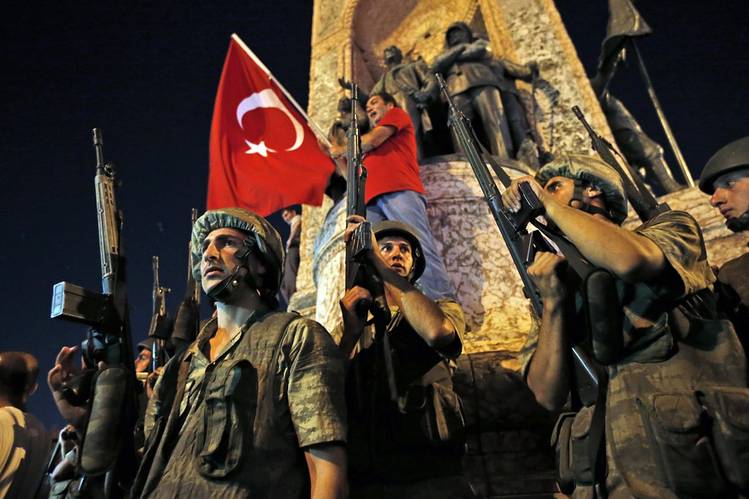
    People in Turkey are no strangers to military coups. Following more than twenty-five years of single-party rule after the establishment of the Turkish Republic in 1923, a coup in 1960 toppled the government of the Democratic Party. In 1971, 1980, and 1997 the military either overthrew or deposed sitting governments.

    The result of a coup attempt on July 15, 2016, was different—for a variety of reasons. The 1960 takeover was greeted by public demonstrations of support in Istanbul and Ankara; not so in 2016. However much half of the Turkish population may loathe President Recep Tayyip Erdoğan and the ruling Justice and Development Party (AKP), there was little support for yet another antidemocratic military putsch. At Erdoğan’s behest, thousands poured into the streets of the two largest cities, and dramatic images of coup opponents confronting soldiers attest to people’s determination to resist the takeover.

    The military faction leading the coup also proved hesitant in contrast to 1980, which was implemented by head of the military Kenan Evren with brutal determination. In 2016, by contrast, top commanders were taken hostage by plotters and the bulk of the armed forces was uninvolved. An awareness of public opposition as well as the ubiquity of the media in contemporary culture seems to have bypassed the hapless plotters, as well. Though a number of media outlets were occupied by troops, instant reports of an air bombing of the parliament and images of popular protest were broadcast across the world. Even the social media-hating Erdoğan took to FaceTime to encourage followers to publicly defy the military.

    The plotters, calling themselves the “Peace at Home Committee,” emphasized in early public statements its intention to respect human rights and democracy while claiming the government had violated Turkey’s secular traditions. This is a customary stance taken by coup makers that makes clear their commitment to a Kemalist defense of secular government. While many oppose the Islamist tendencies of the government, equally menacing is the increasingly authoritarian and dictatorial aspirations of Erdoğan—and the exchange of one dictator for another failed to obtain mass appeal in 2016.

    Erdoğan immediately accused a “parallel state” under Fethullah Gülen, a conservative cleric residing in Pennsylvania, of being behind the failed putsch. Ironies here abound. Gülen was himself exiled by state forces in 1999, and was for a number of years an ally of Erdoğan and the AKP. While there are ideological differences, both groups share a conservative religious outlook tinged with nationalist Turkish, or neo-Ottomanist, political leanings.

    A power struggle between the AKP and Gülenists emerged in 2012, however. The break climaxed in late 2014, when the government blamed accusations against high-level AKP leaders of corruption on Gülen’s followers. Since then, Gülenists in official positions as well as in civilian organizations like the media and universities have been under attack. Indeed, AKP responses to problems that cannot be blamed on the Kurdistan Workers’ Party (PKK) are now reflexively attributed to the parallel state.

    While followers of Gülen have unarguably been prominent in the military, police, and judiciary for years, the extent to which Gülen’s Hizmet (meaning “Service”) movement can be blamed for AKP problems, and specifically for a military coup, is fanciful. Gülenists may well have been involved in the putsch, but the notion that the coup attempt was orchestrated from a compound in Pennsylvania defies logic and sense.

    Yet the AKP, and Erdoğan in particular, feed off a sense of being besieged, and the idea of traitorous sedition (from foreigners, leftists, Kurds, etc.) has worked to the government’s advantage in the past. Conspiracy theories and the notion of outside forces working to undermine the state have a long tradition in Turkish history, with the current government drawing on fears of internal and external subversion.

    Though the defeat of the attempted coup is a hopeful sign that Turkish society rejects military rule as a solution to the nation's problems, Erdoğan has predictably already begun to use the putsch to further consolidate his power and eliminate opponents. As of July 18, 2,700 judges had been detained, 7,850 police officers were fired, and more than 6,000 were arrested. Threatening to end the death penalty for accused traitors (which would end Turkey’s bid for EU membership), the AKP has demanded the U.S. extradite Gülen and vows to “cleanse” the country of Gülenist traitors.

    In addition to eliminating perceived enemies on a mass scale, the coup also increases the chances Erdoğan’s desire to change Turkey’s constitution to a presidential, rather than parliamentary, system will succeed. The failed putsch has made the president appear for the moment like an advocate for democratic rule, and he has attempted to maintain popular momentum by calling on supporters to remain in the public squares.

    The rapid failure of the coup, and Erdoğan’s dramatic escape from attack while on holiday in Marmaris coupled with his heroic return to Istanbul, will inevitably lead to questions about whether the attempt to overthrow the government was genuine, or whether minor military personnel were tricked into an intentionally doomed escapade. If the AKP can fan paranoid fears of outside subversion, it is only to be expected his opponents will draw similar conclusions in an opposite direction. Gülen himself has vehemently denied involvement and suggested the coup was staged. For many in Turkey, high government and/or military officials provoking chaos and violence for their own personal ends is an old—and not inaccurate—story.

    For the Turkish left, already marginalized in the last two years by severe repression and the attempted silencing of dissent, the coup will serve to further isolate critical voices. Critics will be accused either of membership in the PKK or Hizmet, leading to accusations of treason and support for undermining the state. In an important sense, therefore, the post-coup environment will simply be a continuance of recent trends. More ominous, however, have been a number of mob attacks against Alevi and Kurdish neighborhoods in the wake of the failed putsch.

    Yet while the AKP government has proven itself remarkably adept at turning domestic unrest to its political advantage, no amount of nationalist propaganda can mask an economic slide that began almost a decade ago. Unemployment, rising prices, and precarious employment continues to plague Turkey, and the contradiction between the government’s populist discourse and neoliberal policies can only coexist for so long.

    At the same time, considerable labor militancy has surfaced—and has continued despite the state’s connivance with owners to simply end strikes and force workers back to work. A massive—and successful—wildcat strike by tens of thousands of metal workers against the Renault auto company in the spring of 2015 gave workers a sense of their power at the point of production. After the cosmetics giant Avon fired eight women workers for joining DGD-SEN (the Warehouse, Storehouse, Ship Building and Naval Transportation Workers' Union), workers have been picketing the country with numerous supporters and women’s groups. On June 21, over 900 Nestle workers went on strike—suggestively the labor action is in Bursa, where the wildcat metal workers strike began. Most recently, in the consistently turbulent coal mining industry thousands of miners and their allies have risen in protest against the privatization and possible closure of the Turkish Hard Coal Agency (TTK).

    While labor actions have been sporadic and the vast majority of workers remain unorganized, it is in the workplace and in working-class neighborhoods and communities that the formation of popular opposition to the ruling power must begin. Consensus on the left seems to be that dark days lie ahead in Turkey. Yet it is also the case that the crowds hoped for by Erdoğan in the aftermath of the coup have been relatively small. Though political repression may intensify, daily life will go on. It is here that the left must concentrate and build.

  • What Is The Next Left?

    Image

    At this moment I find myself swinging between optimism fueled by the previously unimaginable appeal of Bernie Sanders’ “socialism,” the energized base of young people attracted to his campaign, this evidence that the neoliberal consensus is dead, and despair about the HUGE gap between this political opening and the organizational capacity of the revolutionary socialist left. Like many others, I’m asking: can anything be done?

    Mainstream forces are already organizing to pivot Bernie supporters to a “STOP TRUMP” campaign (Van Jones). The broadly progressive “left” (e.g. National Nurses United, ex-Occupiers, Grassroots Global Justice Alliance) hope to capture the momentum of the Bernie campaign to build a more permanent national organization around a social-democratic platform (The People’s Summit, Chicago June 17; The People’s Revolution, Philadelphia, July 27).

    While a national network organized around a social-democratic “platform” is appealing — and I would say certainly worthwhile — I am not sure that the social-media and email fueled network that the Sanders campaign has accomplished is sufficient for creating the kind of organizational infrastructure necessary to turn political ideas into on-the-ground movements that can build power.

    In my conflicted state, I am more intrigued by the possibilities of a local electoral political front based in grassroots movement organizations. There is no question that electoral politics is potentially a useful arena of struggle — but the very thing that makes electoral politics attractive is also electoral politics’ weakness.

    The big advantage of an election is of course that there is the possibility of winning and that it is a relatively short-term effort with a clear end. Election campaigns can therefore energize people who otherwise are not already politically active.

    Some people engaged with campaign work do move on into issue-based activism, but they mostly drift away once the election is over. Although Bernie showed that a relatively left set of policies can gather wide and deep support, elections (where the goal is actually to win) also tend to put a certain limit on how radical the messaging can be.

    Even more problematic, in campaign mode there is little time for political education of activists or for engaging activists in thinking through how we can connect demands that immediately resonate with the public (e.g. raise the minimum wage) to longer term and more radical ideas (e.g. basic minimum income).

    Recognizing these limitations, many revolutionaries counterpose electoral work to “building grassroots power.” My experience here in Portland (OR) around legislation (at city and state levels) is that we have built relatively strong movements around particular goals (minimum wage, paid sick leave, defense of the houseless). But once we gain enough traction the campaigns are (to a greater or lesser degree) derailed by big organizations — most notably the unions and NGOs that are so well-connected to the Democratic Party. And this is true even for local organizing in relation to a city government that is putatively nonpartisan.

    Missing Political Instrument

    One of our biggest frustrations is that our grassroots organizations do not have our own political instrument with candidates emerging from our movements and office holders who have gotten into office based on grassroots fundraising and committed volunteer efforts.

    In the long run, only an “on-the-ground” activist organization ready to build and lead movements — organizations that educate, mobilize and disrupt — will shift the political balance of forces. But I’m not convinced that grassroots movements are undermined when they organize their own electoral expression.

    The outcome depends on how that electoral organization works, how it draws its horizon of possibility, and how it seeks to penetrate and open up government once its members are in office. (Consider for instance, participatory budgeting established by the Workers Party in Sao Paulo, Brazil; or the experiments in democratizing governance by radicals engaged in the London Council Government headed up by Ken Livingstone).

    I think it is going to be very difficult to build national organizations that function under the control and as an expression of grassroots movements at this point; however, I think there is some real possibility for accomplishing this at the local level. And if we start locally we could also from the beginning support and call for similar efforts in cities within our region and state, with the longterm goal to leverage the power of multiple city governments at the regional and state level.

    The other advantage of working at the local level is that we have more of an opportunity for committed revolutionaries to collaborate in a project broader than ourselves. No matter how many individuals may be recruited to existing revolutionary groups, the vast majority (and it is growing) of people who are anti-capitalist have not been and will not be attracted to existing left organizations.

    I think the possibilities to build something new for the revolutionary left — whether we think of that as new forms of revolutionary organization and/or new kinds of politics — are much greater at the local level. Certainly working within a local project that is broader than ourselves, we are more likely to create the relationships of respect, trust, and appreciation that I believe are crucial for the left to break free of our baggage and boundaries.

    I think also that at the local level it is more possible to develop the creatively intersectional politics that has been lacking in national campaigns. It is not surprising, for example, that a radical Black activist organization with intersectional politics, like the Black Youth Project 100, was not part of the originating groups for the People’s Summit and the People’s Revolution.

    Organizers say they are committed to bringing organizations like BYP 100 into the planning and hopefully they will. Still, real tensions between discourses of class and race politics have been an ongoing problem. (See for example Sanders’ stumbles on reparations, and struggles at Occupy). Local organizing built on acts of solidarity are necessary to overcome this tension in practice, as in the Chicago Teachers Union’s engaged defense of schools that face closing in Black/Latino communities.

    Positive Examples

    An organization capable of mounting an effective and principled electoral campaign will not be built overnight. It will not be built through immediately going out to run individual candidates for office.

    Instead, we on the left could help to establish urban coalitions that are based in existing grassroots organizing, where activists from the base run for election not as individuals with the right politics but as representatives of a platform that they pledge to implement in office.

    There are several efforts we can learn from. Just two are Richmond Progressive Alliance in Richmond CA, and Guanyem Barcelona in Spain.

    Richmond Progressive Alliance was formed in 2004 as a collaboration between the local Green Party and progressive Latinos from the Democratic Party. Since then, RPA has organized to elect members to the city council and organized many successful issue campaigns that span environmental, social and economic justice. At the moment they are organizing a ballot measure campaign for a rent control/just cause eviction ordinance.

    RPA will not endorse any candidate accepting corporate funding nor do they accept any for their organization. RPA functions with a fairly minimal framework of political agreement; supporters may be members of any party. It draws its strength from members of local grassroots organizations who are part of the Alliance as well as engaging individuals as members of RPA. [1]

    In May, 2015 Barcelona en Comu (Barce­lona in Common) won the mayor and 11 positions on a 41-member city Council. Capturing the energy of both the M15 movement and social justice organizations. It employs a horizontalist organizational model and its original “platform” emerged from a neighborhood-by-neighborhood and sector-by-sector process through which each group outlined its ideas for action based on its arena of organizing. When the 2015 elections rolled around, the radical left party Podemos chose to support the candidates of Barcelona en Comu rather than running.

    The Guanyem Barcelona platform is both practical and visionary. It calls for a transformed city, ecologically sustainable, focused on the needs of the people, and radically democratic in its political structure. The shorter-term urban policies and governmental changes Guanyem Barcelona advocates link to these broader goals.

    In their founding call, Guanyem Barcelona captured some of the optimism and determination that we on the left might draw on to take a leap into heretofore uncharted territory:

    “Our most successful experiences show us that, if we organize around specific objectives and practices, we can reach goals that may have seemed impossible.”

    While the economic crisis has been tough, a historic opportunity has opened up that we can’t and won’t let pass by. We are living in an exceptional time that demands brave, creative initiatives. If we are able to imagine a different city, we will have the power to transform it.

    [1] See www.richmondprogressivealliance.net

    Johanna Brenner is a community activist in Portland, Oregon and an advisory editor of Against the Current. She has also written for New Left Review and Monthly ReviewShe is Professor Emeritus at Portland State University. She also served as director of the University’s Women’s Studies Program. Her books include Women and the Politics of Class (Monthly Review Press, 2000) and Rethinking the Political: Women, Resistance, and the State (University Chicago Press, 1995).

    Originally posted here

  • No To The Military Coup!

    Image

    On the night of July 15, the Turkish society watched a military coup attempt, live on TV. For some it was so difficult to make sense of it that they chose to interpret the whole event as “staged”, being a member of a society inclined towards conspiracy theories. How could one call this a real military coup?

    Let us not forget that Turkey’s history is replete with not only “successful”, but also “failed” military coups. Whether a military intervention succeeds in reaching its objectives or not, will depend on three factors: 1) A social and political crisis conducive to a military coup; 2) domestic and overseas social support; 3) political and military capacity.

    Turkey is undergoing a deep political crisis for a long time. Başlangıç, and the Left in general, have described and analyzed this crisis through different perspectives. It was argued in these analyses that one possible outcome of this crisis, further aggravated by the government’s implementation of a war strategy following the general elections of June 7, 2015, could be a military intervention. Naturally, no one could make any estimation about its timing.

    Tonight, a junta inside the army has attempted a military coup. While doing so, they assumed that the current acute political crisis would readily guarantee them domestic and overseas social support, as well as the required capacity. However, they were wrong. In a short space of time, statements clearly against the attempted military coup were issued from within the army (top commanders of the navy, first land army and special forces), major political parties, capitalists’ professional associations (TÜSİAD, TOBB), as well as international powers -as soon as they got a grasp of what was going on. Spokespeople of the civilian government made calls for resistance via private TV channels -which had continued their broadcast without disruption, not because the coup was “staged” (as argued by some), but because it had a limited capacity.

    The AKP government will most probably turn this attempted coup into a political opportunity for itself, and use it as a pretext to initiate yet another wave of authoritarianism; however, we should not have any scruples about the coup. In this age, where even wars and coups are broadcast live before our eyes, only true democracy can be the antidote to military or civilian authoritarian regimes. And true democracy rests on the people’s own power, and nothing else.

    This attempted coup will do nothing but turn pitch-black the darkness we are currently going through. Tanks can never be the antidote to unbridled authoritarianism, autocratic tendencies, and the suppression of democracy. Without any doubt, we have to stand against this military coup attempt, which, despite targeting an antidemocratic government, is so reckless as to bomb the parliament. We must say no to all attempted military juntas and coups, without “but”s and “maybe”s.

    Başlangıç, July 16, 2016

    Originally posted here

  • Et Tu, Bernie?

    Image

    What an embarrassment for Bernie Sanders and those, myself included, who thought he would not descend so cravenly into the swamp of political sellout.

    It is one thing to hold one’s nose and vote for Hillary Clinton as the lesser evil. It is quite another to suddenly absolve the Clintons and other top Democrats who have, as Sanders repeatedly pointed out during his campaign, contributed so much to the national crisis.

    At one point in his otherwise uniformly obsequious endorsement speech, he sounded like the old populist Sanders, warning of the excesses of unregulated finance: “As a result of the greed, recklessness and illegal behavior on Wall Street, our economy was in the worst economic downturn since the Great Depression.”

    As Sanders repeatedly pointed out during his campaign, it was former President Bill Clinton’s radical deregulation of Wall Street that legalized the new, gilded age of Wall Street theft. But now we have the new Sanders, reinvented as a Democratic Party hack, insisting that this unfettered greed was exclusively enabled by the Republican leadership of the economy under George W. Bush.

    Sanders’ speech made no reference to breaking up the too-big-to-fail banks that packaged and marketed fraudulent collateralized debt obligations (CDOs) in the trillions of dollars to an unsuspecting world. It was Bill Clinton’s signature on the Commodity Futures Modernization Act that prevented the regulation of any of those suspect CDOs and the phony credit default swaps that pretended to insure them.

    It was that legislation that initiated the Great Recession, as Sanders pointed out convincingly in his campaign debates with Hillary Clinton. But suddenly, the very sentences that he formerly used to attack her now are the basis of his endorsement: “This election is about the grotesque level of income and wealth inequality that currently exists, the worst it has been since 1928. Hillary Clinton knows that something is very wrong when the very rich become richer, while many others are working longer hours for lower wages. She knows that it is absurd that middle-class Americans are paying an effective tax rate higher than hedge fund millionaires, and that there are corporations in this country making billions in profit while they pay no federal income tax in a given year because of loopholes their lobbyists created.”

    Really, Bernie, is that something you whispered in her ear during the hug? Or did she glean that wisdom from John Podesta, her campaign manager, who was once one of those lobbyists, or her son-in-law, Marc Mezvinsky, who was set up in the hedge fund business by Goldman Sachs CEO Lloyd Blankfein, who also paid Hillary so handsomely for her speeches?

    Did Bernie suddenly forget all of that Wall Street money that funded Hillary’s campaign? Or is the prospect of Donald Trump as president so staggering that all restraints of fact and logic need now be abandoned?

    Do the bipartisan policies of financial deregulation, lousy trade agreements and tax loopholes that defined the Clinton presidency have nothing to do with the massive resentment in this country over a rigged economy that has fueled both the Sanders and Trump campaigns? Or was the electoral revolt against the establishment of both political parties merely the achievement of particularly effective populists of the right and left?

    That would now seem to be the Sanders message. The progressive protest he led was not much of a political revolution if he believes the Democratic leadership that has held power for two-thirds of the past 24 years could now so easily accommodate it. What he has bought into is that the revolt on the Republican side is so irrationally hardcore that Hillary Clinton is now our only bulwark against an imminent variant of American fascist rule.

    That is the argument that now captivates the mass media, along with the rest of the establishment, and because Trump plays the devil part so well, many voters will feel they have no choice but to heed Bernie’s siren song.

    However, if it is the problems that create the demagogues, as historical example would strongly suggest, then it ill behooves Sanders to uncritically fall in line behind the lesser evil. Four more years of unchecked Wall Street greed will leave us with an even more alienated populace, on which scapegoating buzzards like Trump can feast.

    Critical thinking in this new political season will have to come from alternative candidates, such as the Green Party’s Jill Stein and Libertarian Gary Johnson.

    “I have known Hillary Clinton for 25 years,” the new Bernie gushes. “I remember her as a great first lady who broke precedent in terms of the role that a first lady was supposed to play, as she helped lead the fight for universal health care. I served with her in the United States Senate and know her as a fierce advocate for the rights of children.”

    A regular Eleanor Roosevelt, except that as first lady, Hillary Clinton turned health care over to the insurance companies and supported her husband’s so-called “welfare reform” that gutted the federal Aid to Families with Dependent Children program.

    Bernie, stop with the fawning. It’s not becoming.

    Originally posted here

  • The Arab Winter as "Morbid Symptom"

    Image

    Gilbert Achcar, Morbid Symptoms: Relapse in the Arab UprisingStanford: Stanford Univeristy Press, 2016. 240 pp. $21.95.

    The title of Gilbert Achcar’s latest book is derived from Gramsci’s Prison Notebooks: “The crisis consists precisely in the fact that the old is dying and the new cannot be born, in this interregnum a great variety of morbid symptoms appear”.

    Although written as a sequel to his previous – and more detailed – book, The People Want, Morbid Symptoms qualifies as a stand-alone work of immense importance in its own right. Focusing largely on Syria and Egypt, ‘Morbid Symptoms’ skillfully explains the mutation of the ‘Arab Spring’ – though Achcar prefers the term ‘uprising’ – into an ‘Arab Winter’.

    Contemptuously rejecting the culturalist explanations of the Arab world’s democratic deficit, Achcar foregrounds two key factors to describe the mutation of the ‘Arab Spring’ into an Arab nightmare. First, he highlights the patrimonial and rentier character of the Arab states caught in the whirlwind of ‘Arab Spring’. Achcar argues that not only were the optimistic perspectives projected in 2011 proved to be flawed, a comparison with the fall of Stalinist regimes across eastern Europe in 1990 was equally problematic because these perspectives and analogies ignored, among other factors, the character of the Arab states.

    Historically, the exceptional state system in the East European countries was dominated by bureaucracies instead of propertied classes. Bureaucrats in these states could sense an improvement in their privileges. In fact, top bureaucrats could contemplate “their own transformation into capitalist entrepreneurs” under market capitalism. Hence, a relatively peaceful change.

    In most Arab states, “ruling families ‘own’ the state… to all intents and purposes, they will fight to the last soldier in their praetorian guard in order to preserve their reign”. According to Gilbert, these states are run by an interlocking trilateral ‘power elite’ – consisting of military and political institutions, and the state bourgeoisie – whereby every segment of the power elite is bent upon fiercely defending its access to the state, the main source of privileges and profits.

    This also explains the different trajectory of the Arab Spring in Tunisia/Egypt and Libya/Syria. In the former cases, the states were dominated by institutions. In the latter, the states had become family fiefdoms. In Tunisia/Egypt, institutions let go of individuals (Mubarak and Ben Ali) when they became liabilities in order to preserve institutional integrity.

    The second factor that catalysed the mutation of the ‘Arab Spring’ into an ‘Arab Winter’, claims Achcar, was a situation of: “one revolution: two counter-revolutions’. In this equation, the ancienregimes constituted one counter-revolution while the other was such regional powers as Saudi Arabia, Qatar and Iran. This regional dimension of counter-revolution has translated into the ascendency of Islamic fundamentalism lavishly bankrolled by these three countries. A mutual rivalry between these three patrons of Islamic fundamentalism further complicated the situation leading to “the highly convoluted development of the Arab revolutionary crisis, compared to which most other revolutionary upheavals in history look rather uncomplicated”.

    Syria epitomises these complexities where a ‘secular and socialist’ (at least an original self-designation) Ba’athist regime has been shored up by Iranian Ayatollahs and the Hezbollah, apparently on sectarian grounds.

    The Alawite Assad regime, in turn, has facilitated the rise of Isis, a fanatical, anti-Shia force targeting Iraq – also Tehran’s ally since 2005. In fact, Isis has been Syria’s “preferred enemy”, says Achcar. Ironically, Isis is also a thorn on the side of the Saudis. Consequently, the House of Saud has re-adopted its estranged violent child: Al-Qaeda – at least, in Syria.

    The Kurdish resistance against Isis and their control of Rojava forced Turkey to support Isis, at least tacitly and temporarily. Ankara, along with Doha, has been supporting the Muslim Brotherhood while the Syrian Brotherhood and Isis have been at daggers drawn. However, Erdogan – under US pressure – also facilitated the Kurdish resistance (another complex story) against Isis.

    The irony is that Assad and allies (Russia, Iran, Hezbollah) as well as their rivals (Saudis, France, the US, Turkey) have been pounding Syria in the name of fighting Isis (Achcar explores these paradoxes). However, none of them has seriously engaged Isis. In the process, an unbearably heavy price has been paid by the Syrian people. Achcar describes it as the “abandonment of [the] Syrian people”.

    First, the Syrian people have been abandoned by the superpowers, notably the US. Achcar shows that the Syrian resistance, often ridiculed by knee-jerk ‘anti-imperialists’ as a US proxy, has been abandoned by Washington. The US policy, argues Achcar, has been guided by two concerns: the Iraq experience and Israel.

    In view of its Iraq misadventure, Washington single-mindedly pursued a Yemen-like solution in Syria. The idea was to retain the Ba’athist apparatus minus Assad. This policy not only proved to be counter-productive, but also inflicted a heavy toll on the Syrian masses. Second, Washington did not adequately arm the resistance in view of Israeli security; weapons capable of downing Assad’s jets might tomorrow be deployed to hunt down Israeli jets.

    Achcar also points out the abandonment of the Syrian people by the knee-jerk ‘anti-imperialists’. “When disastrous failures of imperialism happen at the cost of terrible human tragedies, there can be no schadenfreude from a truly humanist anti-imperialist perspective”. Before pointing out the confused silence of these anti-imperialists over US support for Kurdish forces, he wonders why the US arming the Syrian opposition is so harshly judged. Is it that anti-imperialists want US support only when their favourite troops are leading the fight?

    For the attention of puritan ‘anti-imperialists’ in the Muslim world, this reviewer would also suggest they pay keen attention to the role of brotherly Muslim countries (Turkey, Saudi Arabia, Qatar), assiduously documented by Achcar, in destroying Syria (and Libya). Likewise, for the attention of secular supporters of the Assad regime, Achcar has sizeable evidence not only on the murderous character of the Assad regime but also on how the primary responsibility for the Syrian tragedy lies with Bashar. The Ba’athist regime turned a peaceful intifada into a military affair. It also orchestrated inhuman hunger-sieges and massacres. For instance, of 56 sectarian massacres, 49 were conducted by the Ba’athist regime and its allies.

    In comparison, the march from Tahrir Square to the presidential palace in Egypt was a cakewalk. The relatively peaceful overthrow of the Egyptian pharaoh five years ago did not owe to any Gandhian inclinations he espoused. As mentioned above: unlike Syria and Libya, Egypt is not owned by a family. Rather, an institution (the military) dominates the state.

    When Mubarak became a liability, he was sent packing. The military stepped back, only to recuperate and stage a comeback. While Achcar analyses the Morsi government’s disastrous policies as well as the disastrous role of the Egyptian Left in facilitating-by-default the counter-revolution, what might intrigue is the performance of Brother Morsi as president.

    The Brotherhood’s apologists have been casting Morsi as an anti-Zionist and anti-American leader, overthrown unjustly through Washington’s machinations. Here is a brotherly chutzpah: On becoming president, Morsi wrote to his “great and dear friend” Shimon Peres to express his “strong desire to develop the affectionate relations that fortunately bind our two countries”, while wishing Israel “prosperity”.

    Originally posted here

  • Black Lives over Broken Windows

    Image

    When protesters developed a platform to end police violence in the wake of the 2014 police shooting of 18-year-old Michael Brown in Ferguson, Missouri, the first of their 10 demands was to end “broken windows” policing, the law enforcement paradigm marked by aggressive policing of minor offenses and heavy police presence in low-income Black communities.1

    Broken windows policing is what led Ferguson police officer Darren Wilson to approach Michael Brown simply for walking in the middle of the street. It is what motivated police to repeatedly harass Eric Garner, a 43-year-old Staten Island resident who was killed earlier that summer by NYPD officer Daniel Pantaleo, using a banned police chokehold during an encounter initiated over Garner’s alleged sale of loose cigarettes. And in 2015 it was what brought Baltimore police into contact with Freddie Gray, a 25-year-old Baltimore man who was initially stopped while allegedly fleeing from police officers in his low-income Black community—and who died after his spinal cord was severed while he was in police custody.

    The role of broken windows policing in each death quickly became the focus of protesters from the Black Lives Matter movement and other civil rights advocates. Just days after Brown’s death, national president of the NAACP Cornell William Brooks said, “The death of Michael Brown strikes me as the latest, sad chapter in an ongoing national narrative about a form of policing, broken windows policing, that is simply not right for the country.”2 In New York City, This Stops Today—an ad hoc coalition taking its name from Eric Garner’s words on the day he died to the officers who had repeatedly harassed him—made ending broken windows one of their 11 demands. (The 11 demands were issued in honor of the 11 times that Garner was seen on video telling the officers who killed him, “I can’t breathe.”3)

    Regrouping for day 3 of the week of outrage surrounding the denial of justice for Eric Garner on December 10, 2016. Source: hollow sidewalks License: https://creativecommons.org/licenses/by/2.0/

    Regrouping for day 3 of the week of outrage surrounding the denial of justice for Eric Garner on December 10, 2016. Source: hollow sidewalks License: https://creativecommons.org/licenses/by/2.0/

    Broken windows policing is not only all too often lethal, it also contributes to the use of excessive and illegal force in the context of the most mundane police encounters. It led a New York City officer to put Rosan Miller, a seven-months pregnant Black woman initially approached for grilling outside her home, into the same banned chokehold that had led to Garner’s death just a few weeks before.4 It was the excuse for another officer to slam Stephanie Maldonado to the ground in New York City’s West Village for “jaywalking” like Mike Brown.5 It was what led police to arrest Duanna Johnson, a Black transgender woman, for prostitution—one focus of broken windows policing—while walking down a street in Memphis, Tennessee, in 2008, only to beat her bloody with metal handcuffs at the police station in an incident captured on video because she refused to answer to “faggot.”6 Broken windows policing also created opportunities for recently convicted Oklahoma City police officer Daniel Holzclaw to stop women as they walked down the street to inquire as to what they were doing and where they were going, thus facilitating his sexual harassment, assault, and rape of 13 Black women and girls.7

    THE “FOLK” ORIGINS OF BROKEN WINDOWS

    What does broken windows policing have to do with the Right? In part, the answer lies in where it came from: an outgrowth of the conservative “law and order” agendas of the early 1980s. Neoconservatives George Kelling and James Q. Wilson outlined the theory underlying broken windows policing in a 1982 Atlantic Quarterly article.  8 Kelling is a senior fellow at the Manhattan Institute, and Wilson, before his death in 2012, was a board member at the American Enterprise Institute, both right-wing think tanks.9 According to Wilson and his colleagues, liberal concessions to civil rights movements and protest cultures of the 1960s and ‘70s were significant contributing factors to the urban chaos broken windows policing purports to address.10 In 1985 Wilson co-wrote a book, Crime and Human Nature, with Richard J. Herrnstein, a co-author of The Bell Curve, which notoriously advanced a theory of racial differences in intelligence. Wilson’s own 1975 book, Thinking About Crime, argued that crime is the product of individual and social “predispositions,” rather than socioeconomic conditions. 11 His theories echoed those of his mentor, Edward Banfield, who theorized about a “culture of poverty,” which Wilson believed required a punitive response,12 and those of The Bell Curve’s other co-author, Charles Murray, whose arguments suggest that crime is the result of individual mental and moral deficiencies.13 Wilson decried single parenthood, claiming “illegitimacy was eroding the nation’s values,”14 and, as Pam Chamberlain wrote in PRA’s Defending Justice: An Activist Resource Kit, argued for “returning to a path where religion is influential and where families remain intact.”15

    New York City became the first municipality to aggressively implement broken windows policing theories rooted in these right-wing intellectual traditions in the early 1990s. Under the leadership of former Republican Mayor Rudolph Giuliani, and bolstered by right-wing media like the New York Post and right-wing think tanks like the Manhattan Institute, the city put Kelling and Wilson’s theories into practice with an internal police memorandum, “Reclaiming the Public Spaces of New York,” citing both the pair’s Atlantic article and the infamous 1965 Moynihan Report, which blamed social dysfunction on Black families, and particularly, Black mothers.16

    Rally outside of the Manhattan Institute on December 10, 2014. Source: hollow sidewalks License: https://creativecommons.org/licenses/by/2.0/

    Rally outside of the Manhattan Institute on December 10, 2014. Source: hollow sidewalks License: https://creativecommons.org/licenses/by/2.0/

    The broken windows theory, brilliantly summarized in a recent video created by Molly Crabapple,17 goes something like this: if signs of disorder—like broken windows—and minor offenses—like loitering, panhandling, and graffiti—are left unchecked, then it’s only a matter of time before a community descends into chaos and violence. According to Kelling and Wilson, the only way to prevent this from happening is through aggressive enforcement and prosecution of minor offenses. At its core, broken windows relies on fear-mongering, stoked by familiar right-wing themes about the need for increased “security” and a compulsion to root out certain groups of people as embodied threats to a particular way of life.

    But even Kelling and Wilson acknowledged back in 1982 that it is “not inevitable that serious crime will flourish or violent attacks on strangers will occur” if signs of disorder are left unchecked. Indeed, the two wrote that their entire premise is admittedly drawn from what they themselves call “folk wisdom” rather than objective data, based on the belief that perceived disorder somehow renders an area more “vulnerable to criminal invasion” such that “drugs will change hands, prostitutes will solicit, and cars will be stripped.”18 It’s a theory, they implicitly admitted, based more on people’s fears and beliefs than on hard evidence.

    The theory later evolved to advance the premise that individuals who commit minor offenses—like fare evasion in public transit—will, if not caught and punished, eventually commit more serious offenses: a sort of slippery slope of criminality. The new logic of broken windows, according to Tanya Erzen, a scholar of American conservatism, writing in Zero Tolerance: Quality of Life and the New Police Brutality in New York City, is that “graffiti taggers, turnstile jumpers and kids in a public park are either already criminals, or simply criminals in the making.”19

    Even the theory’s biggest proponent, New York City Police Commissioner Bill Bratton—who spearheaded its implementation in New York City under Mayor Giuliani, actively promoted its spread around the country both as a consultant and as Los Angeles Police Commissioner, and pursued it with renewed vigor in his second tenure in New York City under current Mayor Bill de Blasio—concedes that neither premise has ever been conclusively proven.20 In fact, several studies undermine the theory’s claims.21 In a comprehensive review of the literature and a summary of his own research, Columbia law professor Bernard Harcourt concludes that, “Taken together, the wealth of research provides no support for a simple disorder-crime relationship as hypothesized by Wilson and Kelling in their broken-windows theory…. What I have come to believe is that the broken windows theory is really window dressing, and it masks or hides more profound processes of real estate development and wealth redistribution.”22

    Like so many policies of the Right, broken windows policing is rooted in fear: fear of poverty, fear of youth, fear of unregulated sexuality and gender nonconformity, and deeply, at its core, a fear of Blackness.

    Like so many policies of the Right, broken windows policing is rooted in fear: fear of poverty, fear of youth, fear of unregulated sexuality and gender nonconformity, and deeply, at its core, a fear of Blackness. According to George Kelling’s recent defense of the theory in Politico, published a year after Michael Brown’s death, “The goal is to reduce the level of disorder in public spaces so that citizens feel safe, are able to use them, and businesses thrive.”23 Kelling concedes that it is, in essence, an approach based on public perception—that is, on feelings—rather than proof. In the end, fear—of crime, yes, but also, as the original article explains, of “being bothered by disorderly people,” like panhandlers, “addicts” or people living with mental illness—is the moving force behind the theory.24 As Bratton once put it, “Aggressive panhandling, squeegee cleaners, street prostitution, ‘boombox cars,’ public drunkenness, reckless bicyclists, and graffiti have added to the sense that the entire public environment is a threatening place.”25

    Although not explicitly stated, given that the communities described in Kelling and Wilson’s original article and others that followed are Black, it is clear that the “disorderly people,” the people driving “boombox cars,” and the graffiti taggers are also imagined as Black. As gentrification of New York City proceeded through the 1990s, “disorderly people” came to mean those displaced into public spaces in the context of neoliberal devolution and cuts to social programs.26 In other words, broken windows policing isn’t about reducing crime, it’s about assuaging white fear of poor people, Black people, and people of color—no matter how irrational or racialized.*

    FROM BLACK CODES TO BROKEN WINDOWS

    Scratching the surface of broken windows policing reveals that, in the end, the paradigm is simply a repackaged and sanitized version of the ways age-old “vagrancy” laws were enforced. These laws were explicitly created to criminalize and control the movements of people deemed undesirable throughout U.S. history: Indigenous peoples, formerly enslaved people of African descent, immigrants, women, and homeless and poor people. In his recent defense of broken windows, Kelling himself directly acknowledged the lineage, stating in reference to his 1982 essay, “Given the subject of our article, the Black Codes—vague loitering and vagrancy laws passed in the South immediately after the Civil War—were of special concern for us. Under these laws police arrested African Americans for minor offenses and, when they could not pay the fines, courts committed them to involuntary labor on farms—in a sense, extending slavery for many into the 20th century.”27 Without offering a means of distinguishing present-day broken windows policing from these practices, Kelling simply submits that he and Wilson were just arguing for “doing a better job at maintaining order.”28

    The question though, is whose order? In their 1982 article, Kelling and Wilson acknowledge that there are “no universal standards…to settle arguments over disorder…” and that charges of being a “suspicious person” or of vagrancy have “scarcely any legal meaning.”29 Ultimately, they wrote, “These charges exist…because [society] wants an officer to have the legal tools to remove undesirable persons from a neighborhood when informal efforts to preserve order in the streets have failed.”30

    This is to say that, since its inception, broken windows policing has self-consciously been about promoting a particular type of community, maintaining particular structural relations of power, and policing the borders of “desirability.” Delving deeper into its theoretical premise, a desirable community, as described by Wilson and Kelling, is one of “families who care for their homes, mind each other’s children, and confidently frown on intruders.”31 Broken windows policing is posited as the last bulwark against a “frightening jungle”—a term fraught with racial meaning—in which “unattached adults”—that is, single people—replace traditional families, where teenagers gather in front of the corner store, litter abounds, and panhandlers stalk pedestrians.32 In this framework, conservative values with deep racial overtones ultimately drive how an individual’s presence will be perceived and valued,33 and promote disregard for youth, adults living outside of hetero-patriarchal families, and low-income and homeless people who live in this idealized community.34

    WHOSE QUALITY OF LIFE?

    Building in New York City with the words, "stop and frisk. just another quality of life offense" on March 27, 2014. Source: carnagenyc. License: https://creativecommons.org/licenses/by-nc/2.0/

    Building in New York City with the words, “stop and frisk. just another quality of life offense” seen on March 27, 2014. Source: carnagenyc. License: https://creativecommons.org/licenses/by-nc/2.0/

    Key to implementing broken windows policing is the proliferation of “quality of life” regulations, which criminalize an ever-expanding range of activities in public spaces, including standing or walking (recast as “loitering”), sitting, lying down, sleeping, eating, drinking, urinating, making noise, and approaching strangers, as well as a number of vaguer offenses, such as engaging in “disorderly” or “lewd” conduct. This broad range of potential offenses gives police almost unlimited license to stop, ticket, and arrest. According to one researcher, enforcement of such low-level offenses has become the “most common point of contact between the public and the criminal justice system.”35

    Of course, what conduct is deemed “disorderly” or “lewd” is more often than not in the eye of the beholder, informed by deeply racialized and gendered perceptions. Where offenses are more specific, they criminalize activities so common they can’t be enforced at all times against all people. When I speak publicly about broken windows policing, I often ask how many members of the audience have ever fallen asleep on a train or ridden a bicycle on a sidewalk at some point in their lives. Dozens of hands shoot up. When I ask how many have ever been ticketed or arrested for it, almost all hands come down—that is, unless I am at a drop-in center for homeless youth or adults, or in a low-income Black neighborhood. There, many hands remain in the air.

    As former Yale law professor Charles Reich notes, “Laws that are widely violated…especially lend themselves to selective and arbitrary enforcement.”36 As a result, both vague and specific “quality of life” offenses are selectively enforced in particular neighborhoods and communities, or against particular people, by officers wielding an extraordinary amount of discretion, largely unrestrained by constitutional protections. As legal scholar Dorothy Roberts notes in “Race, Vagueness, and the Social Meaning of Order-Maintenance Policing,” over the last several decades, conservative commentators have called for a relaxation of legal doctrines disfavoring vague offenses and reining in police discretion in the name of “law and order” agendas.37

    COMMUNITIES IN THE CROSSHAIRS

    Given all of this, it’s easy to predict who gets targeted by broken windows policing. Despite proponents’ contention that the approach targets specific behaviors, not specific people, the article on which the theory is premised explicitly names particular types of people—youth, homeless people, people perceived to be engaged in prostitution—as embodied signs of disorder.38 According to Pete White of Los Angeles Community Action Network (LA CAN), a community organization that has been fighting the effects of broken windows policing on Los Angeles’ homeless population for decades, the inspirations for Kelling and Wilson’s 1982 article were much more explicit about the racial and gender make up of signs of neighborhood disorder: “young Black men, young women in short shorts hanging out on corners, interracial couples, and gay folks.”39 The result: dramatically increased frequency and intensity of police interactions with Black and Brown youth, low-income and homeless people, public housing residents, people who are—or who are perceived to be—engaged in street-based prostitution, street vendors (many of whom are immigrants), and anyone else who is hyper-visible in public spaces, including lesbian, gay, bisexual, trans and gender nonconforming people.

    The results are striking. Broken windows policing has contributed to widespread criminalization of Black youth in New York City under a range of offenses, including disorderly conduct, unreasonable noise, turnstile jumping, performing on the subway, riding a bike on the sidewalk, and being in a city park after dark. Between 2001 and 2013, 81 percent of the 7.3 million people charged in the city with a violation were Black or Brown. 40  In 2015 the greatest number of arrests—29,198—were for not paying the $2.75 fare on city subways; 92 percent of those arrests were of people of color.41 In Park Slope, a Brooklyn neighborhood heavily populated by white families, police issue an average of eight tickets a year for riding bicycles on the sidewalk. In Bedford-Stuyvesant, a gentrifying but still predominantly Black community, police issue more than 2,000 a year.42 Eighty-five percent of summonses issued for “open container” violations in Brooklyn are issued to Black and Brown people, even as countless white revelers spill onto the sidewalks of the city on any given evening to smoke a cigarette outside a bar or art gallery while sipping on an alcoholic beverage, or pop open a bottle of bubbly to accompany a symphony in the park, without any consequence whatsoever. One judge presiding over summons court in New York City said he had no memory of having ever adjudicated an open container ticket given to a white person.43

    Contrary to Kelling’s recent defense of his broken windows theory, the results of this approach are not an error of application, but rather deeply embedded in the theory itself. In fact, the authors asked themselves in 1982, “how do we ensure that age or skin color or national origin or harmless mannerisms will not also become the basis for distinguishing the undesirable from the desirable?”44 Their answer was that they were not confident that there was one—except that police must understand the outer limits of their discretion to be that their role is “not to maintain racial or ethnic purity of a neighborhood,” only to regulate behavior.45 The statistics above suggest that officers are, in fact, exercising their discretion—just in racially discriminatory ways.

    CONSEQUENCES

    The consequences for those targeted are far from minimal. Broken windows policing not only places Black lives at risk of lethal and excessive force, as well as sexual harassment, assault, and extortion in exchange for avoiding a ticket or arrest, it also subjects Black people to the daily indignity of being stopped and questioned in their own communities, being ordered to put their hands on the wall and spread their legs to be frisked in front of their neighbors, and sometimes spending 24 hours wending their way through police vans, precincts, and central booking pens between arrest and arraignment. Even if they simply receive a summons, they are still required to spend at least one day in court defending themselves against minor charges, to pay exorbitant fines and criminal court fees, and to comply with community service and other mandates imposed on people convicted of offenses as minor as spitting or littering.

    Black people of all genders and sexualities come within the crosshairs of broken windows policing. In fact, one of the less frequently discussed realities is that it facilitates racialized policing of gender and sexuality.46 According to Tanya Erzen, broken windows policing “enables officers to act upon racial and gender biases they may have when they enter the police department—under the guise of enforcement of ‘unified guidelines.’”47 All too often, officers read actual or perceived gender disjuncture as inherently out of order, resulting in stops, harassments, and arrests of transgender, gender nonconforming, and queer people of color—along with anyone perceived to deviate from racialized “rules” of gender or sexuality—for “disorderly” or “lewd” conduct offenses.48 Stereotypes framing gender nonconforming people as inherently violent and deviant also lead gender nonconforming young women to be profiled and targeted in the context of “gang policing.”49

    Broken windows policing is also a driving force behind aggressive policing of street-based prostitution, which has been documented to have racially disparate impacts. These are rooted both in profiling of Black women and women of color—trans and not trans—as being engaged in prostitution based on age-old stereotypes, and also in the makeup of sex work which, like every other industry, concentrates Black women and transgender people in its most visible and risky sectors (such as street-based prostitution, which more Black women are pushed into, versus legal strip clubs, which frequently discriminate against women of color).50 Gay and gender nonconforming men, for their part, are profiled and discriminatorily targeted for enforcement of lewd conduct laws in public bathrooms and public parks. The broad discretion allowed in enforcement is fueled by perceptions of Black and Brown men—and particularly those who are gender nonconforming or perceived to be queer—as hypersexual uncontrolled manifestations of sexual deviance, with predictably racially disparate impacts.51

    BLACK LIVES OVER BROKEN WINDOWS

    Even as the broken windows theory trades in fear of Black people, it claims the mantle of protecting Black communities seeking more safety, and thereby, protecting Black lives.52 Heather MacDonald of the right-wing Manhattan Institute twists the logic of Black Lives Matter to argue that broken windows policing “has saved thousands of black lives, brought lawful commerce and jobs to once drug-infested neighborhoods and allowed millions to go about their daily lives without fear.”53

    Right-wing commentators claiming to be concerned with the welfare of Black communities are not alone. Progressives like David Thacher of the Gerald Ford School of Public Policy in Michigan, writing in a blog for The Marshall Project, have critiqued Campaign Zero’s call for an end to broken windows policing, pointing to Black communities’ right to safety and safe public spaces.54 Thacher, like Kelling, acknowledges the pitfalls of enforcing vague offenses like “disorderly conduct,” as well as more specific ones like bans on skateboarding or public drinking, which are not enforced in white suburbs as they are in Black communities. He acknowledges that, “As long as modern police forces have been around, they have used disorderly conduct statutes and many other public order rules to investigate suspicious and unpopular people in circumstances when doing so overtly would be forbidden,” noting that “the Ferguson Police Department’s intensive use of a city code provision regulating a pedestrian’s ‘manner of walking in the roadway’ to run warrant checks and question suspicious people is only one of many examples.”55 Although he argues for a kinder, gentler form of broken windows in the interests of Black community safety, Thacher’s arguments in fact support the notion that it is bound to produce the same results.56 Unfortunately, that hasn’t stopped some community leaders, legislators, and policymakers from continuing to promote and invest in this flawed approach in the name of safety for Black and Brown communities.

    The Black Youth Project 100's 2014 report "Agenda to Keep us Safe." Source: http://byp100.org

    The Black Youth Project 100’s 2014 report “Agenda to Keep us Safe.” Source: http://byp100.org

    Increasingly though, Black communities across the country are speaking for themselves, loudly and clearly, demanding safety from all forms of violence—including the violence of profiling, discriminatory enforcement, and police violence intrinsic to broken windows policing. They are resisting the false choices presented by broken windows proponents, demanding both authentic safety and an end to police violence, harassment, and surveillance, along with respect for rights and dignity. As the Malcolm X Grassroots Movement of New York City stated in the wake of Eric Garner’s killing, the “’broken windows’ philosophy of policing, which purports that focusing resources on the most minor violations will somehow prevent larger ones, has consistently resulted in our rights being violated.”57 They emphatically state that safety cannot come at the price of daily harassment, violation, and the taking of Black lives.

    Black voices and communities are articulating their own visions of safety through Black Youth Project 100’s Agenda to Keep us Safe 58 and Agenda to Build Black Futures, Campaign Zero, and demands articulated by Black Lives Matter59 and Ferguson Action.60 What ties many of these agendas together is the notion that the best strategy to promote safety in Black communities is to divest from policing and punishment and instead invest in and support Black communities, leaving no one behind.  Together, they issue a clarion call to combat and dismantle systems of structural discrimination that foster violence while limiting opportunities and life chances of Black people—including “broken windows” policing.

    *Editor’s note: PRA’s convention is to capitalize both Black and White, to emphasize that both are constructed categories. At the request of the author, this article departs from that convention.

    1 Campaign Zero, www.joincampaignzero.org (last visited January 18, 2016).

    2 Tierney Sneed, “From Ferguson to Staten Island, Questions about Broken Windows Policing,” U.S. News & World Report, August 14, 2014, http://www.usnews.com/news/articles/2014/08/14/michael-brown-eric-garner-deaths-add-scrutiny-to-broken-windows-policing.

    3 “About #ThisStopsToday,” This Stops Today, http://www.thisstopstoday.org/aboutus/ (last visited April 5, 2016).

    4 Emily Thomas, “Pregnant Woman Allegedly Put in Chokehold by NYPD Officer,” Huffington Post, July 28, 2014, http://www.huffingtonpost.com/2014/07/28/pregnant-woman-chokehold-nypd-rosan-miller_n_5628306.html.

    5 Jim Hoffer, “Investigation: Woman Claims Brutality Against NYPD Officer,” Eyewitness News, ABC 7 NY (New York, NY: WABC – TV, August 1, 2014). Available at: http://abc7ny.com/news/investigation-woman-claims-police-brutality-against-nypd-officer/229978/ (last visited January 18, 2016).

    6 Joey L. Mogul, Andrea J. Ritchie, and Kay Whitlock, Queer (In)Justice: The Criminalization of LGBT People in the United States (Boston: Beacon Press, 2011).

    7 Jessica Testa, “The 13 Black Women Who Accused a Cop of Sexual Assault, In Their Own Words,” BuzzFeed, December 10, 2015, https://www.buzzfeed.com/jtes/daniel-holtzclaw-women-in-their-ow.

    8 George L. Kelling and James Q. Wilson, “Broken Windows: The Police and Neighborhood Safety,” The Atlantic, March 1982, http://www.theatlantic.com/magazine/archive/1982/03/broken-windows/304465/.

    9 Sam Roberts, “Author of ‘Broken Windows’ Policing Defends His Theory,” New York Times, August 10, 2014, http://www.nytimes.com/2014/08/11/nyregion/author-of-broken-windows-policing-defends-his-theory.html; Matt Schudel, “James Q. Wilson, scholar identified with ‘broken-windows’ theory of crime prevention, dies at 80,” Washington Post, March 2, 2012, https://www.washingtonpost.com/national/james-q-wilson-scholar-identified-with-broken-windows-theory-of-crime-prevention-dies-at-80/2012/03/02/gIQA2eHynR_story.html.

    10 Alex Vitale, “The Neoconservative Roots of the Broken Windows Theory,” Gotham Gazette, August 1, 2014, http://www.gothamgazette.com/index.php/opinion/5199-neoconservative-roots-broken-windows-policing-theory-nypd-bratton-vitale.

    11 Matt Schudel, supra note 9.

    12 Alex Vitale, supra note 10.

    13 Jacob Ertel, “Broken Windows, Workfare, and the Battle for Public Space in Giuliani’s New York,” Cyrano’s Journal, January 8, 2015, http://www.cjournal.info/2015/01/08/broken-windows-workfare-and-the-battle-for-public-space-in-giulianis-new-york-2/.

    14 Matt Schudel, supra note 9.

    15 Pam Chamberlain, “James Q. Wilson: A Dominant Figure Among Conservative Crime Theorists,” in Defending Justice: An Activist Resource Kit, ed. Palak Shah, (Political Research Associates, 2005), 62. Available at: http://www.politicalresearch.org/wp-content/uploads/downloads/2012/12/Defending-Justice.pdf (last visited April 4, 2016).

    16 Rudolph W. Giuliani and William J. Bratton, Police Strategy No. 5: Reclaiming the Public Spaces of New York, July 6, 1994. Available at: http://marijuana-arrests.com/docs/Bratton-blueprint-1994–Reclaiming-the-public-spaces-of-NY.pdf (last visited April 4, 2016).

    17 Molly Crabapple, “How Broken Windows Policing Harms People of Color,” YouTube video, posted by Fusion, February 3, 2015, https://www.youtube.com/watch?v=iXI1QJRqPD8, (last visited January 17, 2016).

    18 Kelling and Wilson, supra note 8.

    19 Tanya Erzen, “Turnstile Jumpers and Broken Windows: Policing Disorder in New York City,” in Zero Tolerance: Quality of Life and the New Police Brutality in New York City, 19-49, eds. Andrea McArdle and Tanya Erzen, (New York: NYU Press, 2001).

    20 Ken Auletta, “Fixing Broken Windows,” The New Yorker, September 7, 2015, http://www.newyorker.com/magazine/2015/09/07/fixing-broken-windows.

    21 Randall Shelden, “Assessing ‘Broken Windows’: A Brief Critique,” Center on Juvenile and Criminal Justice, April 2004, http://www.cjcj.org/uploads/cjcj/documents/broken.pdf; Ken Auletta, “Fixing Broken Windows,” The New Yorker, September 7, 2015, http://www.newyorker.com/magazine/2015/09/07/fixing-broken-windows; K. Babe Howell, “Broken Lives from Broken Windows: The Hidden Costs of Aggressive Order-Maintenance Policing,” N.Y.U. Review of Law & Social Change, vol. 33 (2009): 271, 274; William Harms, “Study Conducted in Chicago Neighborhoods Calls ‘Broken Windows’ Theory into Question,” University of Chicago Chronicle, vol. 19, no. 7 (January 6, 2000).

    22 Bernard E. Harcourt, “Punitive Preventive Justice: A Critique” (University of Chicago Public Law & Legal Theory Working Paper No. 386 / Coase-Sandor Institute for Law & Economics Working Paper No. 599, 2012). Available at: http://chicagounbound.uchicago.edu/law_and_economics/401/ (last visited January 15, 2016).

    23 George Kelling, “Don’t Blame My Broken Windows Theory for Poor Policing,” Politico Magazine, August 11, 2015, http://www.politico.com/magazine/story/2015/08/broken-windows-theory-poor-policing-ferguson-kelling-121268.

    24 Kelling and Wilson, supra note 8.

    25 Rudolph W. Giuliani and William J. Bratton, supra note 16.

    26 Jacob Ertel, supra note 13.

    27 George Kelling, supra note 22.

    28 Ibid.

    29 Kelling and Wilson, supra note 8.

    30 Ibid.

    31 Ibid.

    32 Ibid.

    33 Dayo F. Gore, Tamara Jones, Joo-Hyun Kang, “Organizing at the Intersections: A Roundtable Discussion of Police Brutality Through the Lens of Race, Class, and Sexual Identities,” in Zero Tolerance: Quality of Life and the New Police Brutality in New York City, 19-49, eds. Andrea McArdle and Tanya Erzen, (New York: NYU Press, 2001).

    34 Erzen, supra note 19.

    35 K. Babe Howell, supra note 20.

    36 Charles Reich, qtd. in: Phillip Beatty, Amanda Petteruti, and Jason Ziedenberg, The Vortex: The Concentrated Racial Impact of Drug Imprisonment and the Characteristics of Punitive Counties (Washington, D.C.: Justice Policy Institute, 2007), 14.

    37 Dorothy E. Roberts, “Foreword: Race, Vagueness, and the Social Meaning of Order-Maintenance Policing,” Journal of Criminal Law & Criminology 89, no. 3 (1999), 775, 777-78.

    38 George L. Kelling and James Q. Wilson, supra note 8.

    39 Pete White, Los Angeles Community Action Network, presentation at preconference convening held in conjunction with U.C.L.A. Critical Race Studies Symposium, Los Angeles, CA, October 17, 2015.

    40 Sarah Ryley, Laura Bult, Dareh Gregorian, “Daily News analysis finds racial disparities in summonses for minor violations in ‘broken windows’ policing,” New York Daily News, August 4, 2014, http://www.nydailynews.com/new-york/summons-broken-windows-racial-disparity-garner-article-1.1890567.

    41 Jeremy Berke, “REPORT: The NYPD Makes The Most Arrests for a $2.75 Crime,” Business Insider, May 10, 2016, http://www.businessinsider.com/nypd-farebeating-arrests-2016-5.

    42 Christopher Mathias, “This is What Broken Windows Policing Looks Like,” Huffington Post, October 9, 2015, http://www.huffingtonpost.com/entry/broken-windows-policing-new-york_us_5617f428e4b0082030a2573f.

    43 Ibid.

    44 Kelling and Wilson, supra note 8.

    45 Ibid.

    46 Mogul et al., supra n. 6.

    47 Mogul, et al., supra n. 6; Tanya Erzen, supra note 19.

    48 Mogul, et al., supra n. 6.

    49 Amnesty International, Stonewalled: Police Abuse and Misconduct Against LGBT People in the United States, AMR 51/122/2005 (2005).

    50 See e.g., Shana Judge and Mariah Wood, “Racial Disparities in Enforcement of Prostitution Laws,” APPAM, November 6, 2014, https://appam.confex.com/appam/2014/webprogram/Paper11163.html; Noah Berlatsky, “Black Women Profiled as Prostitutes in NYC,” Reason, October 1, 2014, http://reason.com/archives/2014/10/01/nypd-profiles-sex-workers-too.

    51 Mogul, et al., supra n. 6.

    52 Ibid.

    53 Heather Mac Donald, “The New Nationwide Crime Wave,” Wall Street Journal, May 29, 2015, http://www.wsj.com/articles/the-new-nationwide-crime-wave-1432938425.

    54 David Thacher, “Don’t End Broken Windows Policing, Fix It,” The Marshall Project, September 9, 2015, https://www.themarshallproject.org/2015/09/09/don-t-end-broken-windows-policing-fix-it.

    55 Ibid.

    56 Ibid.

    57 Malcolm X Grassroots Movement, “Statement on the Murder of Eric Garner by the NYPD,” July 19, 2014, http://mxgm.org/malcolm-x-grassroots-statement-on-the-murder-of-eric-garner-by-the-nypd/.

    58 Terrance Laney and Janaé Bonsu, Agenda to Keep us Safe, Black Youth Project 100, September 2014,  http://byp100.org/wp-content/uploads/2014/09/BYP100-Agenda-to-Keep-Us-Safe-AKTUS.pdf; Black Youth Project 100, “BYP100 Announces Release of the Agenda to Build Black Futures,” January 15, 2016,  http://byp100.org/bbf/.

    59 Black Lives Matter, Guiding Principleshttp://blacklivesmatter.com/guiding-principles/, (last visited January 18, 2016).

    60 Ferguson Action, Our Vision for a New Americahttp://fergusonaction.com/demands/, (last visited January 18, 2016).

    – See more at: http://www.politicalresearch.org/2016/07/06/black-lives-over-broken-windows-challenging-the-policing-paradigm-rooted-in-right-wing-folk-wisdom/#sthash.PArsDxJ7.In9lBuGP.dpuf

    Originally posted here

  • The Democratic Wager: why the Left must support the Syrian Revolution

    Image

    Jules Alford and Andy Wilson (eds.) Khiyana. Daesh, the Left and the Unmaking of the Syrian Revolution. Essays by Muhhamad Idrees Ahmad, Javaad Alipoor, Leila Al-Shami, Mark Boothroyd, Joseph Daher and Shiar Neyo, Sam Charles Hamad, Bodour Hassan, Michael Karadjis, Louis Proyect, Eyal Zisser. London: Unkant, 2016. 278 pp.

    The title of this book means “betrayal”: this is an angry book, and is designed to provoke. The articles collected set out the case against the majority of the international left for its failure to support the Syrian Revolution at best, and active support for counterrevolution at worst. The authors seek to explain the reasons for this betrayal, and to skewer the myths that have justified it.

    Mark Boothroyd takes on myths about the Syrian armed resistance. When Cameron made the case for British military intervention against Daesh (ISIS) in autumn 2015, he was mocked for claiming there were 70,000 “moderate” fighters on the ground ready to support the intervention. Precisely the wrong part of Cameron’s claim was attacked. Rather than exposing Cameron’s lie that the Syrian rebels welcomed any imperialist carve-up that would leave Assad in place, most critics replicated Putin’s lie that all of the Syrian rebels are al-Qaeda or Daesh. Mark demolishes both lies in forensic detail.

    Equally painstaking is the delineation of the origins, ideology and material basis of Daesh. Contrary to the conspiracy theories, Saudi Arabia does not fund Daesh: Sam Charles Hamad demonstrates why the ideological kinship between the Gulf state and the new proto-state actually underpins their “irreconcilable antagonisms”. The driving force for Daesh is instead located in the sectarian mass murder carried out by the Assad regime, Iran and Russia, while the Syrian rebels are identified as the only force capable of tackling Daesh or its actual cause.

    A series of articles aid understanding of the form the counter-revolution has taken. Javaad Alipoor argues that internal contradictions within Khomeinism have been turned outwards through Iran’s sustained and brutal intervention in Syria. Budour Hassan demonstrates why the international Palestinian solidarity movement must break with any support for Hezbollah or Assad. Michael Karadjis and Eyal Zisser analyse the class dynamics within Syria that have determined the changing composition of the Ba‘athist regime and its antagonists.

    So how did the left manage to get this so wrong? Sam Charles Hamad’s answer invokes Marx: “the ideology of the ruling classes is at all times the ruling ideology”. Critics of US and UK imperialism have often reproduced Islamophobic “war on terror” tropes about the opposition to Assad in Syria.  The obsession with the idea that the US seeks “regime change” in Syria has lined up many “anti-imperialists” on the side of the status quo actively supported by Russian and Iranian imperialists and tacitly supported by US and UK imperialists. Too often the left are impressed by the way regimes or parties describe themselves: Leila al-Shami and Shiar Neyo critique the way the Kurdish Democratic Union Party (PYD) has been romanticised, leading to selective solidarity that obscures the common struggle of Syrian Kurds and Arabs in Kobane.

    Can the left redeem itself? The introduction to this book urge socialists to take the “democratic wager”. The Syrian Revolution is placed in the context of a wave of uprisings for democracy, beginning with the Green Movement in Iran. The authors analyse how neoliberalism has shaped the class dynamics and political character of these uprisings, and follow Neil Davidson in arguing Trotsky’s concept of “permanent revolution” is now obsolete. If the left wishes to be given any hearing, it must “grasp that between democracy and dictatorship it always sides with democracy”: there are harsh words here for those who misinterpreted the 3 July coup that overthrew Morsi’s democratically elected government in Egypt.

    The catalogue of betrayals by left intellectuals, journalists and anti-war organisations itemised here is dispiriting. As Louis Proyect puts it, “It’s a tragedy for the left that so many who came of age in the 1960s like Tariq Ali cannot understand how much the Vietnamese peasant and his Syrian brothers and sisters today have in common.” Through their anger, the authors of this book offer a persuasive account of how this betrayal came about and a demolition of the falsehoods that sustain it.

    Meanwhile, for those provoked to take the democratic wager, Robin Yassin-Kassab and Leila al-Shami’s Burning Country: Syrians in Revolution (2016) is an excellent place to learn more about the inspiring examples of self-organisation from below thrown up by the Syrian Revolution.

    ***

    Khiyana includes a longer version of Mark Boothroyd’s article The Syrian Revolution and the Crisis of the Anti-War Movement, which was originally published at: https://rs21.org.uk/2015/09/10/the-syrian-revolution-and-the-crisis-of-the-anti-war-movement/

    Originally posted here.

  • After Dallas: The Struggle Continues

    ImageStatement of the Steering Committee of Solidarity, July 8, 2016

    Last night, during a Black Lives Matter protest in Dallas called in response to the killings of Alton Sterling and Philandro Castile, one or more snipers shot at least a dozen police officers. As of now, five are dead, as is at least one suspect in the shooting. Before his death in a standoff with police, the suspect indicated that he was upset with police shootings and with Black Lives Matter, and that he wanted to kill white people. He said he was working alone, and has no connection to Black Lives Matter or any other organized group. Our comrades in Dallas report that protesters were just as surprised and frightened as the police when the shooting started, and at least one protester was shot.

    Despite the increasingly clear lack of connection between the vigilante shooter(s) and organized protest activity, this tragedy will almost certainly lead to increased repression against Black Lives Matter and other Black political organizations in Dallas and around the country, as well as popular racist backlash. Right wing pundits are already issuing thinly veiled calls for retaliation. Likely, Dallas will become a popular excuse to call for a hiatus from protest.

    We face a difficult period ahead, and now more than ever must remain vigilant and committed to struggle. We must continue to be in the streets and to demand justice. Black liberation remains central to all liberation, and Black Lives Matter as an organization and a movement needs the support of everyone committed to the fight for a better world. We urge all activists and revolutionaries to maintain or increase our engagement in this fight, and to be prepared to defend those targeted by backlash and repression.


  • The Need for A Democratic Transformation of the Criminal Justice and Police System

    Statement of the DSA National Political Committee Statement on the Killings of Alton Sterling and Philando Castile and the Dallas Police Officers (July 12, 2016)

    Democratic Socialists of America condemns the recent police killings of Alton Sterling and Philando Castile. These are the latest in the endless taking of black lives by the excessive and precipitous use of deadly police force. Despite the increased attention to these arbitrary killings by the militant protest of #BlackLivesMatter, the deaths of Freddie Gray, Michael Brown, Sandra Bland, Eric Garner, Walter Scott and scores of others go unpunished.

    This devaluing of the lives of African Americans derives from a racist criminal justice system that serves to repress and contain low-income communities rather than promote peace and well-being. The close working relationship between prosecutors and police precludes the impartial investigation and prosecution of police violence. Thus, in addition to greater community control of policing and the demilitarization of police, DSA calls for independent investigation of all uses of lethal police force.

    As an organization committed to nonviolent political action to achieve social justice, DSA also condemns the murder of police in Dallas this past week. This senseless loss of life occurred during a peaceful protest against police brutality and in a city where a relatively integrated police force has taken some useful steps towards community and accountable policing.

    The right wing, however, has used the tragic deaths in Dallas to attack #BlackLivesMatter, a movement committed to militant, but peaceful organizing. DSA is committed to working as allies of #BlackLivesMatter and others fighting for racial equality, in part because a divided working class is an already defeated working class. We believe that people of all racial and ethnic backgrounds must understand their role in a white supremacist, capitalist system and build solidarity across their differences, but that white progressives have a particular responsibility to combat nativist and racist political movements that justify current police practices as necessary to protect “blue lives.”

    A truly democratically controlled criminal justice system should promote peace and justice, not arbitrary violence. Many matters now handled by police, such as drug use and community disputes, are best handled by mental health professionals and community-based mediation. When necessary to protect human life, police intervention must be as restrained as possible, with the use of firearms as an absolute last resort. In many societies that have more practical and effective gun policies than our own, most police do not carry firearms. Stronger gun control policies, as well as severe restrictions on police use of firearms, must be part of any restructuring of the role of police in our society.

    The United States can only achieve democratic forms of peacekeeping and dispute resolution if we comprehend the historic role of the police in reinforcing forms of racial and class domination.  Armed and professional police forces arose in the United States to capture fugitive slaves and to repress striking workers. Thus, the struggle for a democratic judicial and criminal justice system is integrally tied to the fight for racial, gender, and class equality. Mass incarceration and repressive policing cannot redress the absence of economic and educational opportunities that beset inner cities and increasingly inner suburbs and deindustrialized small towns. Nothing short of radical democratic change can alter a criminal justice system that works to perpetuate American apartheid.

  • Why Mexico's teachers are fighting: CNTE's program

    An activist/scholar in the Mexican teachers union democratic opposition (CNTE) has asked me to publicize this statement (copied below).  It explains the demands the movement is making on the government and fleshes out the short but excellent update on The Real News about the struggle.  As this statement shows, CNTE and its supporters  are struggling about far more than their jobs. They are risking their lives to demand a democratic, equitable, liberatory system of public education for all of Mexico's people.

    Lois Weiner

    Image

    The National Education Workers Coordinator has always claimed our disposition to an open and frank dialogue for the resolution of our demands. In these hard times for our homeland, it is our conviction to contribute in order to make the government and teachers´ conflict, derived from the Education Reform, find ways of solution.

    The amendments to the 3rd and 73rd articles, which give contents to the Education Reform, counteract other articles of the Mexican United States´ Political Constitution. It is not from stubbornness that the National Education Workers Coordinator rejects this reform –even more needless to say that our political action in the streets is not our way of acting and living.

    For over three years, we have shown the pedagogical inconsistencies of the reform and the assessment it promotes, as well as those of the labor conditions attached to this reform.

    The amendment to the education articles and the enforcement of the related secondary laws flagrantly violate individual and social guarantees[1]. In order to being able to discuss and solve the causes and consequences of the conflict the reform itself must be stopped. The Federal Government has the mechanisms: the Moratorium or Suspension of the Education Reform. This will allow the modification of the articles that violate the workers’ labor rights and the people´s social rights.

    GENERAL CONSIDERATIONS

    1. The National Education System, SEN, from the very nucleus of the education process, must mobilize on its orbit the most important actors and social forces from the inside and the outside of Public Education; above all teachers, students, parents, communities and neighborhoods.
    2. The transformation of the National Education System must be based on a humanistic and integral education that substitutes the values of the market with the practice of such values as those which the very 3rd constitutional article claims: democracy, use and care of natural resources, comprehension of national issues, scientific work, best of human coexistence, strengthening and growth of culture, the society’s general interest, equity, fraternity, solidarity, and respect for diversity and as an integrative part of the Constitution: the right to free speech, to dignity in labor, and all human and labor rights without exclusion.
    3. The National Education System shall be available for all inhabitants of the country, no matter how far or small their community be or how huge the number of appliers to schools and institutions in the cities. And this education –creative and for all– is a responsibility of society that the state assumes through public, free and secular education. Education must be for all, at all levels, and it is necessary as well to recover for the curricula the ancient and modern pedagogical lessons which will allow us to offer children and young men and women an in-depth, broad and high-level education; in consequence, textbooks must be transformed, keeping them free of charge.
    4.  The financial effort of the 12 per cent of the GDP for education, in order to grant the widening of infrastructure, equipment and number of teachers for education at all levels.
    5. The National Education System will turn the students into true conscientious citizens who care for the “general interest of society” (3rd Constitutional article). In this sense, the school must be a community that develops in an environment of freedom, in absence of fear, and regulated by the agreements and principles that, in their respective fields, students and teachers build in the classroom, in the school, and in their relationship to their community. But this cannot be afforded as long as a legal structure prevails which establishes that assessment leads to the layoff or classroom segregation of thousands of teachers, which imposes seven new causes for dismissal and, moreover, which conveys the education authority the faculty to start a process for punishment on the mere suspicion that a teacher has committed an irregularity.
    6. Truly autonomous education in such a way that our schools have freedom to, in the framework of a national education, suggest and define how the curricula, the contents, and the pedagogical practices inside and outside the classroom should be.
    7. Substantial improvement of tenths of thousands of schools, supply of enough teachers to multilevel and unitary schools, school breakfasts, utensils, uniforms and footwear, as well as scholarships and books for all school levels.
    8. In the National Education System assessment is from bottom to top. A horizontal assessment made by teachers and students from the very schools and communities, developed as a dialogic exercise in each zone, region and federal entity. An assessment that, while describing the problems, analyzes the factors that provoke them, the remedies that can suit and that collects on the successful experiences of teachers and schools to improve education. For it to be sincere and really teacher-and-student engaging, this assessment must not be punitive or imply labor or administrative sanctions on the teachers.
    9. An Assessment Council to be formed in each school elected by the community, which considers various elements as education funding, the government responsibility in the main variables of the working of the education system, the material conditions of the school, education programs, teaching training and practice, administrative workload, students attendance, academic results, the performance of education authorities, sociocultural contexts and the assessment methods themselves. This model must repeat at the state and national levels.
    10. A true education transformation must not lay aside the teacher training institutions. We agree to a re-foundation of normal schools[2] to strengthen their historical mission. The discussion must revolve around three aspects: the ethical, the political and the epistemological, to make the Mexican normalism stronger and the automatic position appointment for every graduate of public normal schools in the country, who were credited by a training institution officially acknowledged and who qualify to the profile and the correspondent right. We do not support teacher-position sales or heritage, which are instruments for political patronage established by the “charro”[3] leaderships of the SNTE.[4]
    11. The National Education System must advance on the way of strengthening our pluriculturality, on the basis of our multiple identities and of building, from them, a country of diverse potentialities.
    12. Based on the individual and social guarantees in our Letter Magnus[5], the National Education system will provide stability to the education workers in all three labor, administrative, and pedagogical fields.

    For all hitherto said, we demand from the government:

    1. Absolute suspension of the Education Reform and all its implications, insofar as the 3rd and 73rd constitutional articles and the secondary laws are modified, which pose a risk to the free access to education, and which counteract the vision of a humanistic and integral education; as well as anything that threatens our job and labor stability.
    2. To start at once a social process for education transformation along with all the actors: education workers, parents and students, researchers, pedagogues, intellectuals, lawyers, writers. It means to develop a broad national debate in forums, lectures, work boards, conferences, etc., the results of which shall compulsorily be a part of the new education model. The whole of this process will happen in the framework of an accurate timing, with a wide dissemination campaign and a wide participation.
    3. To resolve the consequences and costs of the Education Reform, as related to victims, political imprisonments, layoffs and layoff processes, arrest warrants, pay suspensions, holding of union dues, etc.
    4. To regularize, in its faculty scope, the union life, as regards the bilateral relationship and the freedom of choice for both national and state union representatives.


    UNITED AND ORGANIZED, WE SHALL WIN

    NATIONAL EDUCATION WORKERS COORDINATOR


    [1] In Mexican Law, a “guarantee” is a law which protects the people from violations to their basic rights against powerful agents, e.g. the state. They are a consequence of social struggle since Mexican Revolution times.

    [2] “Escuelas Normales” is the name for the system of public schools for basic education teacher training across the country.

    [3] A "charro” leader is a government-appointed union boss.

    [4] Short for Sindicato Nacional de Trabajadores de la Educación (SNTE), a yellow union of which CNTE is an independent and democratic branch.

    [5] “Carta Magna” is a common way of naming the country’s Political Constitution.


  • Why Bolivian Workers Are Marching Against Evo Morales

    Image

    Over the past two weeks, thousands of factory workers, miners, teachers, and health care providers have mobilized and blocked roads in La Paz and Bolivia’s other departmental capitals to protest the firing of 1,000 state textile workers. The workers were abruptly dismissed last month, when Bolivian President Evo Morales announced the closure of Enatex, the state-run textile company.

    In response, the Central Obrera Boliviana (COB or Bolivian Workers Central, the national trade union federation) demanded the workers’ reinstatement and called for an escalating national strike— the first in more than three years. Ramping up from 24 to 48 to 72 hours, the mobilizations have intensified along with the predictable police response, with thousands tear-gassed, hundreds arrested, and scores wounded.

    Enatex was created in 2012, when the Morales government took over the failed textile manufacturer Ametex. It was a highly symbolic action, underscoring Morales’  commitment to protect Bolivian workers, nationalize strategic enterprises, and promote industrialization.

    Four years later, the state company’s demise is equally symbolic. It casts doubt on economic choices made by the Morales government and on the viability of Bolivia’s industrial policy in the context of global economic constraints, especially those dictated  by U.S. trade preferences. It also calls into question the tactical alliance between Morales and the COB at a crucial political juncture for Morales and the ruling Movimiento al Socialismo (MAS, or Movement Towards Socialism) party, and at a time when the threat of austerity poses critical new challenges for Bolivia’s popular movements.

    From Ametex to Enatex

    Founded in 1965 by Polish immigrants, Ametex was a successful Bolivian company—perhaps “the most modern private business in Bolivia,” according to the Fundación Milenio—that produced high-quality textiles for U.S. conglomerates like Tommy Hilfiger, Polo Ralph Lauren, and Nautica. At its height, Ametex employed 4,000 skilled workers in seven factories, at an average wage 135% higher than Bolivia’s minimum wage, and produced one million pieces of clothing per month.

    The key to Ametex’s success was the Andean Trade Protection and Drug Enforcement Agreement (ATPDEA), a U.S. treaty that, from 1991-2008, allowed Bolivia to export textiles and other products duty-free to U.S. markets. Originated under the “War on Drugs,” APTDEA was designed to provide Andean producers with alternatives to coca production, and required annual certification of the country’s compliance with coca eradication targets.

    In 2008, after Morales expelled the U.S. Ambassador (followed by the Drug Enforcement Agency) for allegedly assisting efforts by eastern lowlands secessionist elites to destabilize his government, the US retaliated by decertifying Bolivia from continued participation in ATPDEA. Ametex suffered massive losses and teetered on the brink of bankruptcy with substantial debts and liabilities, including to the state pension fund.

    In the new “framework agreement” negotiated with the U.S. in 2011 to provide the basis for renewed diplomatic ties, Morales elected not to negotiate the restoration of tariff protections, in the interest of asserting Bolivia’s national sovereignty. After Ametex workers paralyzed downtown La Paz for several days, the government arranged a $2 million line of credit from the Bank of ALBA in an effort to keep the company afloat (on top of a previous $5 million loan designed to offset the new U.S. tariffs).

    In 2012, after Ametex declared voluntary bankruptcy, the Bolivian government—with much fanfare—took over operation of its five remaining plants, assumed its $17 million pension liability, and ultimately purchased its assets for $15 million (to pay off creditors). Government officials pledged to secure replacement markets for Bolivian textiles in Venezuela and Brazil, and promised that Enatex would sell 30% of its output in the domestic market.

    A Failure Foretold?

    These promises did not come to fruition. Venezuelan and Brazilian markets proved to be unreliable, especially with the decline in commodity prices and resulting shrinkage of these economies. The “Buy Bolivia” campaign orchestrated by the Morales government to encourage consumers to purchase locally-made textiles was largely unsuccessful. Even with a drastic reduction of its workforce (down to the 1,000 remaining today), and a $69 million government investment over the past four years, Enatex, according to Vice President Alvaro García Linera, has never produced a profit and now faces growing debts and pension liabilities.

    For García Linera, Enatex’s failure is largely attributable to structural changes in the global economy. The restructuring of textiles from a labor-intensive, factory-based enterprise to a highly technological computer-driven industry, he argues, has left Bolivia at a severe competitive disadvantage. With low productivity, high costs, and the inability to even produce its own cotton thread, Bolivia has seen its textile exports decline in value by 52% over the past 13 years, while textile imports (principally from China) have grown by 91% since 2008. It would be irresponsible, García Linera has said, for a socialist government to maintain a failed enterprise.

    In response, Enatex workers and their allies blame the Morales government for allowing the domestic market to be undermined by cheap Chinese imports and illegal contraband, especially used clothes smuggled across the Peruvian border. Critics say the government packed the new state company with inexperienced but well-paid, MAS-affiliated administrators, while continuing to hollow out its workforce. According to Bruno Rojas of El Centro de Estudios para el Desarrollo Laboral y Agrario (CEDLA), a highly-respected Bolivian economic research organization, the government from the beginning lacked a vision of how Enatex could be sustainable.

    A true pro-worker industrial policy, critics contend, would aggressively impede contraband, restrict or prohibit textile imports, and create a sustainable domestic market— for example, by commissioning uniforms for the military, police, health workers, and students. In contrast, Enatex workers and COB leaders charge that the shutdown is an anti-worker, anti-popular measure signifying a return to neoliberal austerity politics by an increasingly conservative MAS government, in response to the looming economic downturn. Symbolically, COB Executive Secretary Guido Mitma has characterized Supreme Decree 2765, which authorized the closing of Enatex, as the “evil twin” of Supreme Decree 21060, the infamous 1985 edict that shuttered the state-owned mines, privatized other state enterprises, and dislocated thousands of government workers.

    The government responds that it is not privatizing or even fully closing down the state textile firm, but restructuring it as a technical support center for the industry — albeit with only 200 workers, whose labor will be governed by a regime that provides considerably weaker protections  Now that more than 80% of  Enatex workers have accepted severance pay, officials contend, the issue of reinstatement is moot.

    While Morales insists that the decree will not open the door to further public sector layoffs, he appeared in mid-June to announce the closing of Ecobol, the deficit-ridden state postal service that currently employs 700 workers. Workers say the government has undermined its own enterprise by continuing to use private mail services. The announcement was quickly walked back by cabinet officials, who are meeting with postal workers to discuss restructuring options.

    Defying rumors that the state-owned mining sector, plagued by falling mineral prices, will be next on the chopping block, Morales in mid-June committed a $36 million loan to Huanuni, its flagship tin mine and Bolivia’s largest. Perhaps not coincidentally, this strategic action effectively neutralized a key COB affiliate on the eve of the strike.

    A Looming Austerity Politics?

    Does Enatex represent a unique situation, or does it foreshadow a new era of austerity politics in Bolivia? To date, the impact of the global decline in commodity prices has been blunted by the economy’s continued growth, and the availability of substantial reserves which Morales has diligently accumulated. The official government strategy calls for continued pursuit of the Patriotic Agenda 2025, an ambitious program of accelerated public and private investment in infrastructure, energy, hydrocarbons, and industrialization to diversify the economy and bolster internal demand.

    Still, the warning signs are inescapable. In June, Moody’s derailed a new bond offering for hospital construction, citing Morales’s refusal to cut government spending even as government revenues have declined by $6 billion in the past 2 years.  Budget deficits are expected to reach a 13-year high in 2016. Government debt, at 37% of GDP, is more than double its 2014 levels, causing significant investor concern.

    This past May 1, in keeping with tradition, Morales announced minimum wage and public sector salary increases of 9% and 6% respectively, well ahead of inflation. He also confirmed that the double end-year bonus (doble aguinaldo), which companies have been required to pay since 2013 when economic growth hits 4.5%, will continue. At the same time, for the first time in his ten-year administration, he imposed a freeze on retirement pensions and conditional cash benefits for the elderly, pregnant mothers, and schoolchildren, among the most vulnerable popular sectors.

    The COB and the GOB

    The May 1 compromise package was negotiated with, and fully endorsed by, the COB, which for the past 3 years has supported the Morales government in a strategic alliance. Previous relations between the two sectors were often stormy, with the COB leading popular mobilizations against government fuel subsidy cuts (the 2010 Gasolinazo), limited wage increases (2011), repression of the TIPNIS marchers (2011), and proposed pension reforms (2013). The COB even supported the formation of an independent workers party to challenge Morales’s re-election in 2014. .

    However, at the end of 2013, the COB, under new pro-MAS leadership, agreed to back Morales in exchange for the legally-mandated doble aguinaldo and the Agenda Patriotica, promising continued economic expansion and jobs. In October 2014, 15 COB leaders were elected to the Plurinational Assembly on the MAS ticket. Last February, the COB actively supported Morales’s failed referendum bid for a fourth presidential term in 2019.

    Despite erroneous reports in the western media, the COB has not formally broken with the government. Still, the Enatex controversy has strained its relations with Morales virtually to the breaking point, with escalating rhetoric on both sides. The COB leadership is exploiting the threat of a split to maximum advantage, and has pointedly refused to align itself with the MAS-affiliated social movements’ call for a repeat referendum.

    A rupture with the COB would be highly symbolic and detrimental to Morales at this political juncture. In the wake of his referendum defeat, Morales needs the COB to help restore his credibility, and that of the MAS party, outside of their traditional rural peasant base.

    Still, the COB—once the vanguard of the most combative trade union movement in Latin America, and perhaps the world—is today a shadow of its former self, with only 30% of Bolivia’s labor force engaged in the formal economy.  And while the COB disputes the government’s claims of minimal strike participation, it’s unclear how many of its affiliates have actually joined in the mobilizations.  In its currently weakened state, the COB may be equally in need of maintaining its strong relationship with the government.

    At this writing, the COB leadership is in negotiations with top government officials. Discussions are focusing on additional benefits for laid-off Enatex workers with special needs, a prohibition against the closing of additional state enterprises, and guaranteed retention by Senatex of the 180 workers who have not accepted severance pay, with full labor protections. The outcome could be critical in shaping Bolivia’s post-referendum political landscape, and in prefiguring how Bolivia’s popular movements will fare in responding to the coming austerity challenges.

    Originally posted here

  • Orlando: Making Sense of a Mass Killing

    ImageWhat could have brought Omar Matten, on the night of June 12, 2016, to coldly murder 49 patrons at Pulse, an Orlando Florida nightclub that catered to a mostly Black and Latino, gay and lesbian, bisexual and transgender (LGBT) clientele? Primarily, his hatred of the LGBT people and the people of color he befriended discreetly at night, a hatred fueled by the hyper-masculinity, homophobia, and racism of his day work environment. He was an employee of G4S, a giant private military contractor, infamous for abuses against immigrants.

    A Religious Homophobia

    Homophobia is an inherent aspect of patriarchal societies, thus found in all religions. Every year, thousands of murderers appeal to religion to justify their crimes against LGBT people. The morning after the tragedy, two Baptist ministers called for the execution of the “sodomites.” One regretted the low number of “predators” and “pedophiles” killed. “I wish the government would round them all up, put them up against a firing wall, put the firing squad in front of them and blow their brains out.” The other went on: “The good news is that at least 50 of these pedophiles are not going to be harming children anymore… The bad news is that a lot of the homos in the bar are still alive.” (Washington Post, June 15)

    In the countries dominated by fundamentalist Islam, LGBT people suffer incarceration, corporal punishment, and executions. In less rigid countries, the majority of Imams, including those deemed “liberal,” still condemn homosexuality as a sin, despite often calling for compassion for the sinner. St. Petersburg’s Catholic bishop (responsible for Orlando) spoke accurately when he said, “It is religion, including our own, that targets, mostly verbally, and often breeds contempt for gays, lesbians and transgender people. Attacks today on LGBT men and women often plant the seed of contempt, then hatred, which can ultimately lead to violence.” (Washington Post, June 13).

    From Racism to Queerphobia

    In the United States, religious “tolerance” of homosexuality is a relative matter. A major opinion poll carried out in 2014 shows that only 36% of Evangelicals and Mormons consider homosexuality socially acceptable, compared to 45% of Muslims, 66% of members of other Protestant denominations, 70% of Catholics and 80% of Jews and Buddhists. This variability is more indicative of the different weight of traditionalists within each religious community than of actual doctrinal differences. In the U.S. South, racist and reactionary religious Christian groups have responded to the Supreme Court’s 2015 decision legalizing gay marriage with new homophobic laws, all in the name of “religious freedom.”

    But the greater part of the U.S. establishment has taken a different path, bestowing social respectability on middle-class gays and lesbians—at least those who are white or who put on a “white mask,” in Franz Fanon’s words—and extending to them the right to marry. Some 58% of Americans are in favor, and so, crucially, is the Supreme Court, which legalized gay marriage in June 2015. An important lobby of large corporations has committed to defend this right against the Christian Right. Are these not the assigned standard bearers of a homo-nationalist rampart against a barbaric Global South, a Global South that haunts both the foreign regions dominated by the empire and the non-white inner cities of the United States itself, a Global South cast as intolerantly Muslim and violent and yet also as a vector of suspect and shady (queer) sexual practices?[1] Was not the massacre Omar Mateen committed in an African-American and Latino LGBT nightclub in Florida the product of a hatred that was more Queerphobic than homophobic?

    The Weapons of the US Special Forces

    It was not by chance that the murder weapon in Orlando was the well-known Sig Sauer MCX, developed for the U.S. Special Forces. This shocking act of war drew inspiration from the same sources that feed the admiration for Donald Trump: the morbid fascination with the imperialist “special ops” and their signature light, silent, and lethal firearms.[2] The Orlando killer could identify equally well with, on the one hand, the NYPD—which rejected him—the Green Berets, the agents of the private military contractor G4S, and, on the other hand, the Hezbollah and Da’esh units—in many ways their mirror image. These professionals of violence, often operating in the twilight of both law and ordinary morality, held the same appeal for him, regardless of their professed political allegiance.

    Should that be surprising when we know that Saudi Arabia and the other Wahhabi oil kingdoms are the United States’ largest arms-trading partners, and that the State Department works with Putin’s Russia and the Islamic Republic of Iran—which is Hezbollah’s ally—against Da’esh in Syria and Iraq? Aren’t the repercussions of this endless war felt also in the streets of American cities, where local police departments receive surplus army equipment and deploy it with excessive force, particularly against members of minority groups and people of color? 

    As the ongoing investigation reveals, Omar Mateen was not remote-controlled by Da’esh or any other terrorist organization. He carried inside him the most explosive contradictions of a world in which the war of all against all, and often of each against himself or herself, disarticulates the social body along the fault lines of class, race, nation, gender, sexual orientation, etc. For the most vulnerable and wounded, religion is sometimes no longer capable of expressing even, in Marx’s words, “the sigh of the oppressed creature” and “the soul of a soulless world.” It happens then that one would prefer a horrible death to the horror of everyday life, whatever the cost for oneself and others.

    *Jean Batou is a Professor of International History at the University of Lausanne, Switzerland.


    [1] See Peter Drucker, Warped: Gay Normality and Queer Anti-Capitalism (Chicago, Haymarket Books, December 2015).

    [2] According to one expert, the Sig Sauer MCX is as quiet as an MP5, as deadly as an AK-47, and more modular than anything ever designed.”


  • Mexico's teachers face more repression, win more support

    Support for resistance to the current model of education reform in México continues to grow after the Mexican Secretary of the Interior, , to Oaxacan protesters and members of Section 22 of SNTE, urging them to stop their blockade of highways. Chong said, “time had run out” and that the state would shortly “take measures to allow for transit and provisions to get through.” Indigenous authorities from la Mixteca in the state of Oaxaca jointly affirmed their continued support of protestors resisting the reform, stating they rejected Chong’s ultimatum and the .’ Adriana Marcelina Linares Arroyo, parent leader of Oaxaca’s state Committee of Mothers, Fathers and Guardians in Defense of Public Education (Coordinadora Estatal de Madres, Padres y Tutores en Defensa de la Educación Pública), publicly stated her group’s support for the blockades, arguing that there was no need for transnational food purveyors to deliver food to the area. Linares Arroya pointed out that the Oaxacan people had their own food, such as eggs from chickens raised by families and atole (cornflour drink). She said this food was healthier and safer than the often spoiled milk and other unhealthy foods supplied by Soriana and Aurora, two major food store chains in México. Oaxacans flooded social media with photographs of fully-stocked fruit and vegetable stands and other food items in indigenous markets in the area, further refuting government claims that there were food shortages because of the protestors highway blockades.

    In addition to Chong’s ultimatum, the tragic events of the past weeks, especially the armed attack on civilians in Nochixtlán, Oaxaca that resulted in the death of 9 individuals at the hands of federal and state police, have mobilized more actors in the resistance. Jalisco-based organizations called for a protest of Secretary of Education, Aurelio Nuño’s, visit to their state this past Monday, July 4th. On this same day, the CNTE began a national 72-hour period of struggle that will include highway blockades and a march for the nation’s teachers in México City on Tuesday, July 5th. México City teachers have declared a general strike beginning Tuesday, July 5th that will continue indefinitely, a Wednesday, July 6th national sit-in, and departure of a motorized caravan from México City to Nochixtlán, Oaxaca to denounce the crimes against humanity committed on June 19th as well as to deliver food and other goods. On Thursday, July 7th, the Democratic Movement of Workers in Education of Guanajuato (MDTEG) have called for a 4 pm demonstration; Ciudad de Libres in the state of Puebla will hold a dialogue on education and organizers in the sate of México will hold planning sessions for the July 16th march scheduled there. Mobilizations are scheduled until the end of July; a meeting with the Mexican Attorney General’s Office to demand the presentation with life of the 43 forcibly disappeared education students and protests in the states of Michoacán, Veracruz, and Guerrero are scheduled. In August, there will be a mega-mobilization across the nation. Professor at the National Autonomous University of México (UNAM), author, attorney, and outspoken critic of the education reform, John Ackerman, recently pointed to the limits of using state force in this process, “Miguel Ángel Osorio Chong’s threats…about the imminent use of force to end with the teacher’s movement, are no more than barks of the proverbial dog that cannot bite. A new violent repression against the teachers' movement will not extinguish the flame of the resistance, but instead ignite the prairie of indignation in all México. The only way to resolve this conflict is through dialogue and negotiation.”

    CNTE has been the key node in organizing resistance to this current U.S. style of corporate education reform in México since 2013. Prior to the July 12, 2013 public dissemination of CNTE’s official position of opposition to the reform, the then leader of SNTE, the politically co-opted Elba Esther Gordillo, surprisingly announced in December of 2012 that there would be “a peaceful and civilized resistance” to the reform. . Though the charges of money laundering and diversion of funds were real, her arrest was, nonetheless, the public performance of presidential power—the message was clear: Education reform is a state matter

    By Marta Sanchez, Assistant Professor Social Foundation, Donald R. Watson College of Education, first published at www.teachersolidarity.com

    University of North Carolina,  Wilmington

  • June Surprise: Whole Women’s Health v. Hellerstedt Upholds Abortion Rights Against Restrictive Texas Law

    Image

    Whole Women’s Health v. Hellerstedt is a consequential decision, although far from a decisive victory for abortion defenders. Hellerstedt strikes down a Texas law that would have made legal in-state abortion in practice all but unobtainable for poor and rural women. The decision contains a number of surprises that will hearten supporters of reproductive rights. Surprise number one is that the swing justice, Anthony Kennedy, contributed the fifth vote. Kennedy is hardly a reliable supporter of abortion rights; but with his vote the Hellerstedt majority would have been secure even if Justice Scalia had lived to cast his reliable anti abortion rights vote.

    Justice Stephen Breyer wrote the majority opinion. In it he hugs the 1992 Supreme Court precedent, Planned Parenthood of Pennsylvania v. Casey. That decision “saved” Roe v. Wade, then endangered by the large conservative majority on the Court. Only two justices were prepared to leave Roe untouched. A troika of more moderate conservatives led by Justice O’Connor and backed by Justices Kennedy and Souter (before Souter’s move to the left) wrote the controlling opinion. They came up with the Casey formula that retained the fundamental right to abortion but allowed states more scope to regulate (cut back) abortion. States could regulate even during the first trimester of pregnancy as long as regulation did not unduly burden the right to choose abortion. 

    The surprise in Hellerstedt is that almost nothing had been held to unduly burden the right to abortion despite 25 years in which hundreds of restrictive laws were passed, all designed to stop women from getting abortions. State legislatures hostile to abortion have passed a wide and ever expending assortment of restrictive laws, including informed consent provisions, waiting periods, parental notification, and many laws much like those in Texas House Bill 2 piling onerous requirements on doctors and clinics under the guise of protecting maternal health. H.B.2 was held to unduly burden the right to choose abortion.

    H.B. 2 boasts two aggressive health measures, demanding that doctors providing abortion have admitting privileges at local hospitals and that abortion facilities be equipped and regulated as “ambulatory surgical centers.” When the first of these measures went into effect in 2013, 20 of the 40 abortion clinics in Texas closed. Were the second to be permitted to enter into force, only seven or eight abortion clinics, all in major population centers, would remain in this vast and populous state. Texas is one of at least 20 states with laws similar to H.B.2. All of these laws are now in peril of constitutional challenge. 

    Justice Breyer handed another surprise to Texas and other anti abortion state legislatures: He sided with the district court and against the Fifth Circuit Court of Appeals in holding that federal courts must scrutinize the evidence presented by the contesting parties as the whether the legislation in question burdens the fundamental right to abortion. He rejected simply deferring to the legislature. Texas got caught short. It did not expect this scrutiny and had no evidence that the H.B.2 measures would protect maternal health. (“Trust me”) The petitioning abortion providers had a wealth of evidence that H.B.2 was a catastrophic burden on the ability of women, poor and rural women in particular, to exercise their right to choose. Breyer had no difficulty concluding that when weighed in the balance H.B.2 unduly burdened the right of women to choose with no offsetting gain in maternal health.

    It has been widely noted that Justice Breyer’s opinion is merely workmanlike, no poetry, no ringing phrases, as might be expected to adorn an important opinion repurposing Casey as a bulwark against the worst state legislative assaults on the reproductive rights. Workmanlike it is, but Breyer’s discussion of the evidence of the impact of H.B.2 is a devastating unmasking of what the Texas legislature has done and is prepared to do to poor and rural women.

    Hellerstedt throws the fight over abortion back into the state legislatures where it has largely been since Roe v. Wade. Roe had not prevented anti-abortion forces from pursuing restrictions through state legislatures even before Casey diluted Roe. In 1980, long before Casey, the Supreme Court held that Roe was not violated when congress denied public funding for abortions for poor women. The federal government and a large majority of states do not fund abortions through Medicaid programs. We will know that the fight for reproductive rights is robust when public funding is a seriously contested question.

    Texas and her sister red states will respond to setbacks under Hellerstedt by relentlessly passing new restrictive legislation designed to test the limits of this new Casey-with-teeth, let’s-see-some-evidence approach. Red state legislators have every incentive to keep generating restrictive laws and to defend those already on the books – money, votes, publicity—and in addition to these positive incentives to fear being primary’d from the right. Only popular mass state-by-state campaigns in favor of reproductive rights can defeat these state laws.

    It would be a great thing if Bernie Sanders progressives who heed his call to contest state and local elections were to elevate reproductive rights to the top of their issues list and invigorate state level campaigns to repeal restrictive laws. The Sanders campaign reveals what any reader of polls knows, that public support for abortion rights and so much else has failed to register gains for lack of effective forms of political organizing rather than lack of resonance. Few prospects are more satisfying than would be the sight of red state legislators running for cover from reproductive rights activists with mass support.