Blog

  • Trump’s Nuclear Threats Against North Korea and Iran Pose Existential Crisis for Humanity

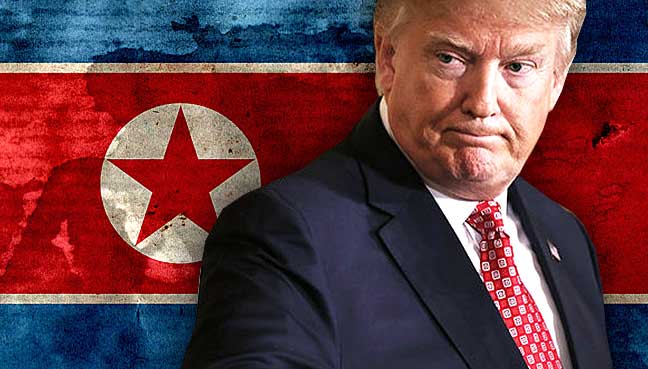
    ImageU.S. President Donald Trump crossed to new stage in the annals of warmongering in his United Nations speech of September 19 when he declared, “The United States has great strength and patience, but if it is forced to defend itself or its allies, we will have no choice but to totally destroy North Korea.” This threat to incinerate an entire nation of 25 million people amounts to nothing less than genocide. At the UN itself, the speech was met with stunned silence, with one major exception, vigorous applause from the militaristic Prime Minister of Israel, Benjamin Netanyahu.
    During these same weeks, Trump has also been threatening to tear up the Iran nuclear agreement by refusing to certify that the Iranian regime is in compliance, even though it is. If he decertifies the agreement in October, as expected, this will open the door for the U.S. Congress to issue new sanctions against Iran.  Congress, which is full of Netanyahu supporters, including virtually all Republicans plus many neocons in the Democratic Party like Senate Minority Leader Chuck Schumer, would likely vote for such sanctions.  This would effectively end the Iran nuclear agreement, setting the stage for a military confrontation between the U.S. and Iran in the Persian Gulf.

    What is noteworthy about this new stage of U.S. imperialism is its utterly degenerate character. The former talk of human rights, freedom, the community of nations, or other ideological fig leafs has vanished, replaced by that of America First and the open threat of genocide.  As Marx wrote at the time of the Bonapartist coup in France of 1852, “it seems that the state has merely reverted to its oldest form, to the shameless, bare-faced rule of sword and cross.”  And while Trumpism shares many features with Bonapartism, not least its contempt for democracy, one key difference is that Trump heads a nuclear superpower that has the capacity to literally destroy the entire world.

    As the U.S. economy continues its long decline since the 1970s, the appearance of Trump as president constitutes a marker in that decline.  At the same time, his bellicose language seems aimed at compensating at a military-political level the ground that the U.S. has lost economically to China and other emerging powers.  Of course, the U.S. remains the world’s largest economy, plus its military power remains by far the strongest in the world, with one major rival, Russia, at least in terms of the number of nuclearly armed missiles at its disposal.

    Still, the wild gyrations of Trump are not a sign of strength, but of fundamental weakness in a U.S. political system where the liberal wing of the ruling classes had so alienated large swaths of the population that a sexist, racist demagogue could squeak out a victory, also made possible by the opportunistic support of the conservative wing of those ruling classes.  And of course, four decades of economic stagnation played a major part in alienating from the ruling elites much of the population, whether those who actually voted for Trump, or those who stayed home rather than vote for more of the same.

    What of North Korea and Iran, their bellicosity and their repression of their citizens? North Korea fits and even exceeds the normal definition of a totalitarian state-capitalism. It is a regime where the working class is ruthlessly exploited, sometimes under direct state compulsion. It also denies even the slightest political or cultural freedom to its population. The Iranian regime is a reactionary theocracy that has been forced to loosen its authoritarian controls somewhat in the face of mass opposition.  Yet it remains essentially a clerical dictatorship where labor activists, feminists, and all form of dissenters are regularly imprisoned, tortured, and subjected to medieval physical punishments like flogging.

    Unlike the U.S., however, neither of these regimes has the capacity to destroy the world, or even its neighbors. Although it is true that North Korean artillery could probably level Seoul, the capital of U.S-supported South Korea, North Korea’s nuclear weapons do not yet have a delivery system, while Iran’s nuclear program had not even been fully weaponized when it was frozen as part of the U.S.-UN nuclear agreement.  Iran has, of course, intervened in Syria and Lebanon in support of some very reactionary forces, but that is not an existential threat to the region, let alone the world.

    Both of these regimes, especially North Korea, have also engaged in incendiary rhetoric against the U.S. and its allies.  However, the main difference between these threats and those of Trump is that neither North Korea nor Iran has the capacity to actually carry out its threats.  Especially in the case of North Korea, the threats are part of the same rhetorical repertoire the regime has been using for decades as a negotiating ploy.

    Another factor that links Iran and North Korea and that makes the situation so dire is that if Trump tears up the agreement with Iran, this would give North Korea little confidence that the U.S. would abide by any agreement it struck with the Trump administration.  This only deepens the danger of war in East Asia.

    Trump’s threats and actions against North Korea and Iran may spin out of control, plunging the world into a conflict that could call our very existence into question.  This is why we need to use all our strength to mobilize against these war threats, to stay the hand of a U.S imperial behemoth that is being led by a demagogue with neofascist inclinations, a man who expresses open admiration for war and violence.

    In so doing, we need to call for the abolition of all nuclear weapons, starting with world and regional powers like the U.S., Russia, Britain, France, and Israel. We need also to abolish the capitalist system that gave rise to these weapons of mass destruction.

    Stop Trump’s War Threats against North Korea and Iran!

    Abolish All Nuclear Weapons and the Capitalist System that Produced Them!

    Approved as a Statement of the Steering Committee of the International Marxist-Humanist Organization

  • Zapatistas Put Forward Indigenous Woman for President

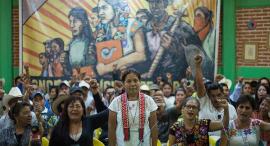
    ImageThe Zapatista Army of National Liberation (EZLN), which led an armed uprising in Mexico’s southern-most state of Chiapas in 1994, and which has since then spent its time organizing autonomous communities in that state, is now putting forward an indigenous woman candidate for president in the 2018 elections. The Zapatistas hold the Mexican government and the country’s political parties in utter disdain, both for their corruption and for their disregard for the people they supposedly represent. The Zapatistas also reject elections and voting on principle. So, while they are putting forward health worker María de Jesús Partricio for president, they are not actually trying to elect her.

    Chosen as candidate by the EZLN and by 1,500 delegates to the National Indigenous Congress (CNI), María de Jesús Partricio of the Nahua people is not a prominent national figure, but rather a traditional healer who workers at La Casa de Salud Calli Tecolhuacateca Tochán, a community health center in Tuxpan, Jalisco.

    Born on December 23, 1963 in the Nahua community of Tuxpan, Jalisco, she is the mother of three children. She was working at a health clinic in Chiapas in January 1994 when the EZLN led its armed uprising in Chiapas and she subsequently became involved in the movement. In 2001, the Zapatistas chose her to speak to the joint houses of the Mexican Congress, her first political speech. Today she speaks out against discrimination against indigenous people and women, and denounces the killing and imprisonment of so many people in the country.

    Even now, however, the EZLN’s candidate says she is not running to win, but to promote the concerns of the country’s underdogs. Marichuy, as she is known, says that she is taking the step of running for president of Mexico in order to defend the lives of the indigenous people and of all Mexicans from a system that it is destroying them. She has told the press, “We are not a political party. We are not going to vote and be election watchers. This is about rebuilding our country.” She is clear: “The objective is not to win. We want to organize ourselves, to organize our communities.”

    Carlos González, a spokesman for the National Indigenous Congress (CNI) says that they have no interest whatsoever in the election, except “to crash the election party and ruin it.” For the last twenty years, Subcomandante Marcos and other EZLN leaders have expressed their contempt for the corrupt Mexican political system and for all of the political parties, including those on the left. Unlike the small parties of the Marxist left in Mexico, the EZLN and the CNI express no interest in political campaigns as a way to build a revolutionary political party.

    Others Are Running to Win

    While the Zapatistas may not care about winning, millions of Mexicans do think that who runs the country is important and they plan to vote. And there are candidates who are running to win.

    Andrés Manuel López Obrador of the left-of-center Movement for National Renovation, or MORENA Party, currently leads in the polls. He ran twice before as candidate of the Party of the Democratic Revolution (PRD) in 2006 and again in 2012. He was probably the actual winner in the 2006 election, but much like Cuauhtémoc Cárdenas, founder of the PRD who probably won the 1998 election, was kept from the presidency through electoral fraud. A populist politician with moderately leftist program, he has matained a hold on about a third of all Mexican voters for a decade.

    The candidate of the National Action Party (PAN) will likely be Margarita Zavala, wife of former PAN president Felipe Calderón (2006-2012) who launched the war on the drug cartels that has taken tens of thousands of lives and led to widespread human rights violations by he military and the police. Were she to win, she would be the country’s first woman president.

    The sitting president, Enrique Peña Nieto of the Institutional Revolutionary Party (PRI), is ineligible to run, because Mexico’s constitution does not permit presidential reelection. The PRI’s likely candidates are Secretary of Foreign Relations Luis Videgaray or Secretary of the Interior Miguel Ángel Osorio Chong.

    Recent polls report that López Obrador has the support of 33 percent of the electorate, Zavala of 27 percent, and Osorio Chong only 13 percent. If he is to win, however, López Obrador will have to overcome not only the other major parties and hostile media, but election fraud. The establishment will do everything it can to keep him from taking office.This campaign seems to be principally a reaffirmation of the EZLN’s rejection of Mexico’s authoritarian political system, its corrupt parties, and of their devious leaders. This campaign may also be another attempt following several past failures to project the EZLN as a political force beyond parts of Chiapas and even to give it a national presence.

    A Propaganda Campaign

    The EZLN’s public statements suggest that it is not so much interested in politics as in propaganda, and not concerned with seizing power, but rather with building its autonomous communities, called caracoles (snails). So far this strategy has led to the creation of about 30 autonomous communities involving several thousand indigenous people in Chiapas, wih a few tenuous communities in other locations. There is no census of how many people actually live in these communities.

    Whatever their success at the local level, which remains unclear, the autonomous communities have not proven very effective in changing the national balance of power or in projecting the EZLN a a force on the national level. The EZLN remains largely isolated both geographically and politically, much as it has been since February 1994 when the armed conflict in Chiapas was halted.

  • Puerto Rico: Belonging To, But Not Part Of

    Image

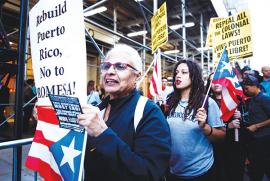
    “We’re American citizens. How can Trump turn his back on us?” This is one of the pleas I’m hearing over and over again about the humanitarian crisis in Puerto Rico caused by Hurricane Maria. While it is a distasteful display of colonialist racism that the Trump administration takes its time to decide how much help Puerto Rico deserves, after pulling out the stops for Miami and Houston, ostensibly because there’s not “a really big ocean” separating them from Washington, it’s kind of par for the course. Our citizenship has always been second-class.

    Going back as far as the 1901 case Downes v. Bidwell, decided by some of the judges who ruled on Plessy v. Ferguson, a new colonial turn of phrase entered the American vocabulary. Puerto Rico should not be considered fit for becoming a state in the Union, but would be instead an “unincorporated territory” “belonging to, but not part of,” the United States. Belonging to, but not part of. Separate, but also not equal. Sort of.

    We were bodies, then, that should not mix with the body of white America, for we were already stained with mixture, through both our fraught tropical sweatbox of consensual and non-consensual unions, and the legacy of our Iberian antecedents, who had been festooned in Moorish veils of uncertain North African origin. Unwashed bodies, unworthy bodies, and like the body of Homer Plessy — the Louisiana Creole passenger booted from the whites-only section of the train — a body marked for destruction, the object of violence, literal and figurative.

    So it is no coincidence that, weeks after Charlottesville, and the many other spectacles of implied and literal violence that have marked the Trump reign, the mainstream media has apoplectically ping-ponged between the Colin Kaepernick-inspired National Anthem kneeling protests and the tragedy of tens of thousands of Puerto Ricans root-shocked and desesperados by a landscape of twigs where Ceiba trees grew, zinc roofs shattered into shards, and a simmering, rising tide of noxious, contaminated water flowing through what were once quaint Caribbean towns. The kneeling protests staged by African American athletes were a silent rejection of internal colonialism, while the Shock Doctrine military-P3 complex that's about to overtake Puerto Rico is the end game of a century or so of external colonialism.

    Even complaints about Trump’s slow-motion doddering on Maria from well-meaning, proud Puerto Ricans who had served in the U.S. military, insisting that their sacrifice deserved respect, seemed to forget that the Civil Rights Movement in the mid-20th century had been significantly motivated by the angry disappointment African American and Mexican-American soldiers endured when they returned home to Jim Crow segregation and dehumanization after having fought in the Good War of Tom Brokaw’s Greatest Generation. This is 2017, we often claim, how can this be? It’s because the language of “belonging to, but not a part of,” and “separate but equal,” has never been formally written out of the narrative that is still America.

    So here we were, vulnerable in our beautiful brown bodies, at the intersection of mainland and island, diaspora and isleñidad, and perhaps the ruling dialectic of the late-capitalist world system, debt and crisis. The debt, all $147 or so billion of it, is of course, a fiction, but the crisis is all too real. The privatization frenzy promised by PROMESA, the congressionally-authorized debt collection agency, is poised to accelerate at unimaginable speed once the spin of the Trump casino government roulette wheel picks out the winning bids. Planeloads of desperate Boricuas will evacuate to Central Florida, Texas, and beyond, while prime beach real estate is gobbled up by billionaires like John Paulson.

    While it is the only possible humanitarian solution, a rescinding of the debt seems highly unlikely, and its nagging accumulated weight will be used to institute a permanent state of crisis. A major motif of this crisis is the infrastructure, which — like our bodies, subjected to violence — was exposed, poorly maintained. Electrical cables ran along haphazardly installed posts crisscrossing the island, constantly failing for years before the storm, and are now lay fallen like the mass casualties of war. Collapsed like the stick-figure balloons that advertise car washes, Puerto Rico’s infrastructure is in a grand mal seizure.

    To perform the crisis mode, the military phase has already begun with the deployment of U.S. Army North deputy commander Richard C. Kim, and under-the-radar DOD private contract firms like Strategic Response Partners, who have already been spotted on San Juan streets. Despite some favorable reports of remote mountain area rescues and deployments to deliver diesel gas for electric generators and restore cell towers, the fragile fabric of this island society has frayed almost completely. And the reality show ethos of the current administration continues to distract: Trump has even invited Jenniffer González, the effervescent Resident Commissioner, or non-voting representative to Congress from Puerto Rico’s right-wing pro-statehood party, on Air Force One to discuss his plans, presumably alongside Omarosa Manigault, if she’s not fired yet.

    While we need to continue to fight for debt relief, the calls for a military presence — more to help restore infrastructure than to stop and frisk looters, imagined and real — and massive federal investment for the rebuild will be made, from my heart at least, reluctantly. The absolute destruction that has been visited on the island has temporarily rendered pro-independence politics untenable. Of course they must reappear in time, but for now we have to insist that the U.S. take economic responsibility for miring Puerto Ricans in debt (with considerable help from the the island's political and banking elites) and putting them in the path of an extreme atmospheric event fueled by the protracted sluggishness to react to climate change and fossil fuel addiction.

    Hurricane Maria has been compared to Katrina because of the extent of the damage and suffering, and its potential to illustrate that Trump, as Kanye West famously suggested about George W., doesn’t care about black and brown people. But New Orleans emerged from the storm with some areas decimated, others intact. Maria has spread its destruction in egalitarian fashion across an entire island about the length and width of Massachusetts, and made it a deforested, barren wasteland, at least for now. It is not so much a disaster area as it is a disaster nation. A nation of bleak, hot, humid, thirsty radio silence.

    Puerto Rico weathered the loss of electric power for months on end after hurricanes in the 80s and 90s, and although arduous, it was not often life-threatening. Most horrific now are the health threats, the homelessness, the months of rationing, potential environmental disasters, and what will most likely continue as a lingering problem in many remote corners of the island: the inability to communicate. Puerto Ricans now send messages to radio stations and social media in the hopes that someone might hear them, like a NASA probe filled with recordings of Louis Armstrong, gamelan music, and Glenn Gould launched into deep space on the remote chance that someone will listen. The lack of communication with hospitals, mountain towns, buried seaside shacks, is also artificially lowering the death count, which hovers between 15 and 20.

    Of course we know, after centuries of colonialism, that we are resilient. AF. And when one hears the peculiar sing-song of the Puerto Rican lilting, consonant-dropping Afro-Caribbean language on the fluttering airwaves, it’s clear that the will to survive is strong. It’s embedded in the mountains, the same ones that have stood for centuries without wavering, against the shearing winds that coalesce off the coast of West Africa and spin chaotically into the Northeastern peaks of the Luquillo Range.

    I can hear those disembodied spirits of Puerto Rico holding a press conference right now, near the damaged radio towers of the El Yunque National Rainforest. They’re saying “We’re doing a great job, an amazing job a tremendous job, for an island in the middle of an ocean.” And no one thinks they’re lying.

    First published on the Verso Books blog.

    *Ed Morales is an author and journalist who has written for The Nation, The New York TimesRolling Stone, the Village Voice, and the Guardian, among many others. He is the author of Living in Spanglish (St. Martins) and The Latin Beat (Da Capo Press), and Latinx: The New Force in American Politics and Culture, forthcoming from Verso. He is currently a lecturer at Columbia University’s Center for the Study of Ethnicity and Race, and a fellow of a new working group studying the Puerto Rico debt crisis at the Center for the Study of Social Difference.

  • On Reforms and Revolutions

    Image

    This August a hundred years ago, Lenin began to pen The State and Revolution in exile once more following a crippling defeat. Just one month prior, workers had risen and laid siege to government posts, but didn’t know what to do beyond that. History didn’t come down from above and give them a revolutionary society. This became obvious after the government sent troops to quell the uprising. The Bolsheviks, for their part, were caught off guard, and the workers’ movement underwent yet another cycle of repression.

    Lenin’s work is no doubt a significant text that lays down an actual material proposal for realizing revolutionary transition that would abolish the state. Lenin developed a concrete theory that traced the history of autonomous worker struggle so as not to fall into the same trap of mysticism as those that conjure idealist utopian fantasies of reformism or spontaneous revolution.

    It was through a critical lens of the working-class’s past that Lenin was able to develop a glimpse of socialism’s revolutionary future.

    Leading up to the Democratic Socialists of America’s historic convention this August, Bhaskar Sunkara wrote in the New York Times that we have three roads before us. We can take the train of history and either get off on Singapore Station and deepen the crippling neoliberalism we know. We can get off at the Budapest Station and deepen the taste of fascism we witnessed in Charlottesville. Or we can get off at Lenin’s Finland Station armed with the a critical understanding of the past, and try our hand at democratic socialism.

    If we want to take Finland Station seriously, it behooves us to take Lenin’s example. The question of strategy is particularly salient in our times, especially given the rise of Democratic Socialists of America. The rise of the DSA marks a critical development in the composition of social forces within the current cycle of struggles. However, if it is to develop into a vehicle that wishes to get us to Finland Station through means of developing a non-reformist reform program, then the question of autonomy must be at the very heart of this strategy.

    That is, non-reformist reforms will hardly be such if they don’t also develop the autonomous power of workers and other structurally oppressed social sectors.

    Autonomy and the Russian Revolution

    Prior to drafting The State and Revolution, Lenin had long been writing about the prefigurative forms that socialism would take. No doubt, the search for these prefigurative forms of self-government were central to the revolutionary socialist tradition. This is why the spontaneous development of worker councils across Western Europe consumed the attention not only of Lenin, but of Antonio Gramsci and Rosa Luxemburg as well. To them, these were the key embryonic organs through which they saw socialism stemming. These were institutions that prefigured the new world in the shell of the old.

    In Russia, the soviets first sprang as a spontaneous development in the failed 1905 revolution. While these organs were ultimately crushed, they were resurrected in the build up to the February Revolution. In the aftermath, these revolutionary organs held so much weight, so much popular power, that these counter-institutions had become vital to the (re)production of everyday life. The bourgeois parliamentary state was thus forced to recognize their legitimacy and share power with them. Lenin recognized this relational state in which counter-power institutions maintained an autonomous position from the state while nonetheless sharing power with it as one of dual power.

    For Lenin, the role of the party was not only to defend these embryonic manifestations of the beginnings of a revolutionary society, but to remove barriers from its path to take full operational control of society as a means to develop self-governance. The autonomy of these institutions could not be threatened by either the state or the revolutionary party. The final moment of revolution then was one in which the stalemate between the two poles of power would break, in which social transformation would give rise to political revolution as a means to deepen social transformation, its limits defined by capitalism and the bourgeois state.

    Developing a Strategy of Non-Reformist Reforms

    DSA’s task today is to help foment and defend the advance of the working-class and other oppressed social sectors in a struggle for democratic socialism. And the conquest of reforms, surely, must be central part of this struggle. As Joseph M. Schwartz and Bhaskar Sunkara argue, these reforms must be of such a character that they move towards a break with the capitalist system. Citing André Gorz, they argue that a strategy should be developed in which one reform after another is conquered such that a total departure from capitalism develops.

    According to their prescription, one would think then that a non-reformist reform program is the sum of its reforms. However, what is excluded from this proposal is the very question of autonomy. If alternative institutions and organs are not developed alongside and in step with this process, then both capital and the state will nonetheless retain operational control of society’s basic (re)productive functions.

    As Gorz reminds us, what is critical is that the reforms develop in “such a way as to build up within the factories and the cities organs of direct popular power, such as workers’ councils and citizens’ councils.” It is through such that the rifts necessary to prefigure the break from capitalism come forth.

    If we want reforms to have revolutionary potential, we have to build a pole of autonomous power that in turn begins to wield operational control of society’s (re)productive power. If this autonomous complex of institutions and organs is not developed, then both capital and the state will simply reconstitute itself through the absorption of autonomous power into its own ordering and logic.

    If we do not keep an eye on the maintenance and development of autonomy, the New Deal of tomorrow will not be defined on the terms struck between the soviets and the provisional government in February of 1917, but rather on the terms delivered by the state’s total reabsorption of autonomous strength to maintain the order of exploitation.

    Franklin Roosevelt’s New Deal was a direct response to the growing power of striking workers. However, this did maneuver worked to decompose rather than to strengthen the autonomy of the working-class. Aside from higher wages – no doubt beneficial to many workers – the family wage was developed as a means to decompose the industrial strength of female wage-earners. The advent of housewife-ization served to disconnect the growing economic strength of women as they increasingly moved into industrial work since the Civil War. The exclusion of people of color from the compromise of the New Deal’s benefits was critical to further dividing the fighting workforce and maintaining a racialized social order. To be sure, the New Deal maintained the racialized division of labor in which people color served as both the reserve army of labor and as an ever useful folk devil to frequently conjure as a public enemy in times of political or economic crisis. All the while, the New Deal developed a series of laws that, while recognizing the rights of organized labor on the one hand, served to also inhibit its autonomous power in a way that allowed labor to be controlled through law and regulation on the other.

    Unlike the February revolution that developed a compromise on the explicit terms of labor, the New Deal developed a compromise on the explicit terms of capital. Whereas the February Revolution allowed the autonomy of the working-class to be maintained, the New Deal functioned to decompose and partition working-class autonomy.

    This lesson from history has to shape our development of a non-reformist reform strategy and push us to reinforce and secure the strength of autonomous organs and institutions.

    Today there are prefigurative forms across the terrain of social struggle. Campuses form worker councils through left union caucuses. Neighborhood assemblies are flourishing in cities like Seattle. Citizens’ initiatives like Cooperation Jackson are redefining the terms of electoral politics. The autonomous security provided by Redneck Revolt reminds us of the defense committees of yesteryear’s Barcelona. Discourses coming out of #BlackLivesMatter and transformative justice collectives provide a glimpse of a world without police.

    Our job should be to bolster these initiatives and organs, defend them, and find a way to weave them together into a common complex that prefigures tomorrow’s socialism today.

    The power to implement non-reformist reforms are generated through counter-institutions, defined by their transformative and democratic character. In turn, these counter-institutions must be brought together to form a common complex, complimenting each other’s work and seizing the (re)productive functions of society. It is through such that autonomous counter-power is not only developed and maintained, but become popularly recognized. It is their ability to have a material consequence in the functions of everyday life that they develop into a legitimate and necessary power.

    What gives a reform actual revolutionary substance then is that the power it generates stays on the outside of the constituted structures of capitalism and the state. No doubt, the ability to develop such autonomy is dependent on the degree of strength it develops, and at a nascent stage of recomposition of militant left forces, the ability to take operational control will be limited. But this must be part of long-game strategy. Eventually, points of conflict will necessarily arise so that these prefigurative structures become threatened by a sudden maneuver of the state. Within such a conjuncture, one of two possibilities remain – autonomous power is crushed and reconstituted, or they enter into a relation of dual-power.

    It is only through developing a genuinely democratic and autonomous counter-power that the tracks we travel do indeed get us to Finland.

    Antje Dieterich and Daniel Gutiérrez are members of DSA, currently living in Berlin. Both are involved in developing a sanctuary city initiative in Berlin called Solidarity City Berlin. Antje holds a PhD from Freie Universität Berlin in Latin American History, and Daniel is a PhD candidate of North American Studies at Freie Universität. Antje has been published in ROAR magazine, while both have been published in Jacobin and Upping the Anti.

    Victor Hertzfeld lives in San Diego and is a member of the Democratic Autonomy Federation. He has been involved in developing a left alliance in San Diego called Collective Resistance San Diego that includes the Party for Socialism and Liberation, Redneck Revolt, Colectivo Zapatista, and the Industrial Workers of the World. He studied political science and law across the University of California. Victor has been published in Upping the Anti.

  • No Trump, No War, No Way!

    Image

    From the Steering Committee of Solidarity

    If it weren’t frightening, it would be funny: “Big Twit Calls Out Rocket Man,” as Donald Trump ramps up his insults and threats of war against North Korea. Let’s look at some of the issues behind the antics and escalating rhetoric.

    It’s really impossible to assess the chances of an actual war on the Korean peninsula, but while it may be a low-probability event its consequences would be utterly catastrophic. All the establishment media, of course, breathlessly consider whether the North Korean regime and its “beloved leader” Kim Jong-un are a direct threat to the United States — as if U.S. imperialism didn’t threaten North Korea and a whole bunch of other countries. It’s simply taken as given that rich and powerful states have an inherent right to self-defense and security, and others don’t.

    Let’s start with the general observation about nuclear weapons. Ultimately they will either be abolished — as a United Nations agreement supported by 120 member nations calls for — or they’ll inevitably proliferate. If anything, it’s rather remarkable that they haven’t spread further already; but in addition to the original nuclear Great Powers, nuclear-armed states now include India and Pakistan as well as Israel, and now DPRK (North Korea). South Africa under apartheid had a secret nuclear weapons program — in collaboration with Israel — but renounced it in the 1990s when the African National Congress took power.

    If Donald Trump carries through on his idiotic threats to blow up the P5+1 (the five permanent UN Security Council members, plus Germany) deal with Iran, that regime might undertake its own rush toward developing nuclear weapons capability. That would likely soon be followed by Saudi Arabia and probably others. Which potential confrontation is really the most dangerous? None of us know, and we don’t want to find out the hard way.

    Moving to today’s immediate crisis, it’s true that the North Korean regime is in the running for the world’s most brutal. It’s a nationalist autarky flying a “Communist” flag of regional convenience, its ruling military-political elite headed by a family dynasty, where much of the population periodically starves and internal purges are carried out by liquidating the victims with anti-aircraft weaponry. But that is not the fundamental reason why North Korea is pursuing what its rulers rather grandly call “strategic nuclear equilibrium” with the world’s greatest superpower. Kim Jong-un’s ego may play a role, but that’s not the decisive factor either — any more than Donald Trump’s serious personality disorders are the driving force of U.S. imperialism.

    We need to remind ourselves that the horrible Korean War of the late 1940s and early ‘50s never formally ended. The truce that ended the fighting in 1953, after much of the country was destroyed and the U.S. and Chinese militaries had fought to a bloody draw, left tens of thousands of U.S. troops stationed in South Korea. The U.S. presence remains a threat both to North Korea and China, and needs to be removed!

    More recently, the North Korean leadership sees the examples of Muammar Qaddafi in Libya and Saddam Hussein Iraq – both of whom had been on friendly terms with Western governments and intelligence services — who gave up their plans to develop nuclear weapons capability, and got whacked when the imperial godfathers found it expedient to dump them. These have been promoted as “victories” for righteous American power. In fact, they are a warning to small countries they’d better develop some kind of “asymmetric” retaliatory capability.

    Since North Korea has always been on the U.S. official enemies list (remember George W. Bush’s “axis of evil“), all the more reason then for its regime to seek strategic deterrence. Its massive artillery has been aimed for decades at Seoul, the capital and heart of South Korea, in a game of Mutual Assured Destruction on the peninsula. But what North Koreans also remember, although Americans long ago forgot, is that during the Korean War the United States bombed the place to smithereens until there were no military targets left, then bombed North Korea’s dikes — so the regime has long sought a strategic balance of terror against the U.S. itself.

    With the protection of its ally China no longer assured, now that China has strong economic relations with South Korea, the United States and the West in general, Pyongyang has gone for the ultimate nuclear option. That might well prove to be a suicidal choice, but it has its own insane logic within the larger massive insanity of a global system on the edge of self-destruction.

    Where does this leave us? In the complex crosscurrents of regional and global geopolitics, the South Korean government (fortunately) opposes the stationing of U.S. nuclear weapons on its territory. The majority of the South Korean population is antiwar — understandably not wishing to be potentially vaporized in a holocaust brought on by outside powers. The newly elected South Korean president Moon Jae-in is looking for openings for de-escalation and dialogue, and has allocated $8 million for aid (to be distributed through UNICEF) to children facing starvation in the North. This is both a humanitarian and political gesture, opposed by the United States whose policy is to draw South Korea into Washington’s increasingly confrontational stance.

    China and Russia are trying to ratchet up economic and diplomatic pressure on North Korea to freeze its bomb and ballistic missile tests, while also calling for the United States and other powers to de-escalate and engage in negotiations with the North. None of these regimes are in any way progressive, but in one way or another, negotiations are the only actual alternative to a slide toward catastrophe. There’s no need to have any illusions about North Korea in order to recognize the importance of demanding “no war” and dismantling the U.S. military presence. We, the people of the United States, have no “place at the table” or any means of shaping the terms of negotiations. We do have our voices, and we need to use them.

    We have to tell the Congress and our fellow Americans that we’re not only sick of Donald Trump’s antics and border walls and white supremacy, but we’re sick of the endless wars that Democrats and Republicans alike are continuing in Afghanistan and Iraq and Syria and Yemen, the ever-growing military budget that’s eating us alive, and climate change denial that threatens to end human civilization even without nuclear war.

    The $700 billion U.S. military budget passed the Senate by a vote of 89-8. (If that’s bipartisanship, can we please have our gridlock back?) Is there a bigger waste of money right now, at a time when Houston, Florida, Puerto Rico and the U.S. Virgin Islands need to be rebuilt — as well as all the Caribbean nations pulverized by nature’s message about what climate chaos is bringing? We need to recognize that among all the retrograde and reactionary regimes at play in this crisis, the government of our own imperialist state is the most dangerous. It’s a threat not only to North Korea but to our survival. No Trump, no war, no way!

    For further reading at International Viewpoint see Tadashi Kinoshita’s Before building peaceful workers’ state in the Korean Peninsula. Among the U.S. groups organizing against the war drive, we recommend the initiatives of CodePink.


  • Concession Fatigue in Connecticut

    Image

    For the third time in eight years, public sector workers in Connecticut have voted for concessions. State employees have sacrificed a total of $7 billion to close budget deficits in 2009, 2011, and now 2017.

    With Connecticut existing in a perpetual state of red ink, the unions’ State Employees Bargaining Agent Coalition (SEBAC) opened its 2011-2022 agreement and negotiated a new deal that will save the state $1.5 billion in the next two years and $24 billion over 20 years.

    SEBAC, made up of 15 unions representing 34 bargaining units and 46,000 employees, was created by statute in 1986 to negotiate pensions and health care. (Connecticut is one of only four states where public sector pensions and health care are collectively bargained; in others the legislature sets terms unilaterally.) Contracts covering all other issues are negotiated separately by each union.

    Last month 83 percent of voting union members agreed to three years of wage freezes, increased pension contributions, higher health care premiums, furlough days, and the creation of a 401 (k)-pension blend for new hires.

    In exchange for these givebacks, the unions received a four-year guarantee of no layoffs and a five-year extension of the structure of the pension and health care system until 2027. And they were assured that each bargaining unit’s local contract would be accepted by the legislature.

    Although the concessions were clear, it’s the politics behind the agreement that are troubling.

    INEQUALITY & AN UNFAIR TAX STRUCTURE

    Public employees were forced to the table because the state budget faced a $5 billion shortfall over two years, conservative forces were resurgent and vocal in their anti-union rhetoric, and the state’s Democratic Party was paralyzed by poor leadership and a fear of raising taxes. With Democratic Governor Dan Malloy (elected by the unions) threatening 4,200 layoffs, concessions were a foregone conclusion.

    How did Connecticut, one of the wealthiest states in the country, get into a budget mess so bad that state workers were forced to solve it? The answer is that Connecticut is one of the most unequal states in the nation.

    Connecticut’s wealth is staggering. Last year, it ranked second in the nation for the number of millionaire households, with 7.4 percent of all the state’s households in that club. This year, the state had 17 billionaires, 12 of whom live in one town, Greenwich.

    Business has also prospered, despite complaints to the contrary. A 2016 survey of Connecticut business reported that profits were at a 10-year high, and in 2017 alone, tax breaks to companies totaled $707 million. Connecticut insurance giant Aetna reported that it made $15.5 billion in profit in its second quarter alone.

    This wealth, however, is not shared by all Connecticut residents.

    In 2013 Connecticut ranked second nationally in income inequality, with average incomes of the top 1 percent an obscene 42.6 times greater than those of the bottom 99 percent. Over the past 30 years, incomes of the top 1 percent grew 290.8 percent, while those in the bottom 99 percent increased by only 14.5 percent.

    Connecticut also has one of the worst school achievement gaps, with black and Latino students scoring much lower than whites on standardized tests.

    Not surprisingly, the state’s tax structure reflects the interests of its wealthy residents. Corporate tax rates are some of the lowest in the country, and the top marginal rate of its income tax is less than in most neighboring states.

    Since the 2008 recession, the state’s job growth has been sluggish and wages have declined. As a result, income and sales tax revenue collected from workers has fallen. This leaves Connecticut reliant on tax receipts from the super-rich. But because of the relatively low tax rate on corporations and the wealthy, when there is volatility in financial markets (as there has been in international hedge funds), the state cannot collect enough revenue to balance the budget, and like clockwork, social services, education, and public sector jobs go on the chopping block.

    The budget also suffers from a huge unfunded liability for state workers’ pensions, a consequence of politicians lowering taxes on the rich. In order to offset tax breaks for corporations and the wealthy in the 1980s and 1990s, lawmakers worked out earlier concession deals with SEBAC, permitting the state to contribute less to pay off the liability than was mandated by a 55-year agreement made in the 1970s.

    PUBLIC EMPLOYEES AS PUBLIC ENEMY

    As in other states, right-wing organizations such as the Yankee Institute, the Connecticut Business and Industry Association, and the State Government Leadership Foundation have pushed an anti-labor agenda that depicts public employees as the public enemy, with state workers painted as the main cause of budget problems.

    These groups have bolstered the GOP in the legislature, reducing the Democratic majority to just seven seats in the House, with an 18-18 tie in the Senate. In the most recent legislative session, emboldened Republicans attacked collective bargaining, introducing more than 100 bills against it and against public employees; 70 of these received a public hearing, though none got out of committee.

    But it is labor’s so-called friends who have hurt it the most. Governor Malloy uses SEBAC concession deals like an ATM, as he refuses to address Connecticut’s unequal tax structure. The Democratic Party does little other than asking that workers “do their part” for the state. Three conservative Democrats, demanding “systemic reform,” threatened to scuttle the recent concessions deal because it was not harsh enough. Progressive voices in the state are too weak and divided to lead change.

    Both Democrats and Republicans argue that raising taxes to solve the state’s budget crises will cause corporations and the wealthy to flee the state, despite no evidence to support this claim. In fact, the number of millionaires and billionaires has increased in the past eight years. GE and Aetna both said that it was not taxes, but access to a highly educated workforce and better lifestyles in Boston and New York, that prompted their moves.

    TOWARD WISCONSIN?

    Compared to other states, Connecticut has high levels of unionization, yet labor is struggling to influence state politics and public opinion. Despite a number of large and progressive unions, there is little evidence of a labor movement in the state.

    Because every SEBAC agreement has been reopened, Connecticut public employees (and their politicians) know that they will pay again in the future. SEBAC did not set out a Plan B, or a political strategy to end this downward spiral.

    SEBAC leaders are very concerned about a Republican takeover of the state in the next electoral cycle. In trying to derail “the express train to Wisconsin” (as SEBAC calls it), labor relies on other entities instead of mobilizing its own members. SEBAC leaders are happy to join in coalitions with other progressive groups to pressure, or elect, politicians, such as the social justice, consumer, and faith-based organizations in the “Due Justice” coalition, and they are thinking of resurrecting the Legislative & Electoral Action Program group. But SEBAC does nothing on its own and does not sufficiently mobilize union members to participate in those coalitions.

    To keep the state from looking like Wisconsin, SEBAC will have to change the way it operates. The political space for concession deal after concession deal is narrowing; the unions cannot kick the can down the road indefinitely. SEBAC needs to change if state workers are to defend their wages, pensions, and health care.

    First, SEBAC is reluctant to fight on its own now as it has at different times in its past when it pushed progressive legislation (pay equity for women) and fought demands for wage freezes (from Republican Governor John Rowland in 2002). SEBAC needs to rediscover its own fighting spirit and voice.

    Second, SEBAC is too far removed from its own rank-and-file members. Workers do not understand how it works or its legal purpose. It is too leadership-driven, with little opportunity for state workers to be involved. Last month’s concessions, for example, were a top-down affair with all the details worked out without membership input.

    Finally, public sector workers in Connecticut are atomized and disconnected from one another, with employees in one bargaining unit having little interaction with those in another. If rank-and-file workers were not so isolated, they could force their respective union leaders to work better together on their behalf.

    Concessionary bargaining will not keep Connecticut from moving toward Wisconsin. Only collective action by union members can accomplish that.

    Originally posted at Labor Notes.

  • Racist Societal Views of The Black Male Body

    Image

    This work is a creative nonfiction work which highlights the imperialist white supremacist capitalist colonial gaze of the Black male body, conventional beauty standards, systemic weightism, and instances of subversion against these oppressive norms in appreciating my body for the way it is.

    Sophomore year in high school, I started exercising in the school gym after school almost seven days a week. I willed myself to motivation to start doing it. I didn’t know how to start, but I knew the schemata to exercise: you spend thirty minutes to two hours running outside, or on a treadmill, and lifting a few dumbbells in repetitions of ten to fifteen. And after two weeks of doing that, I started to see results. I created my own strict routine and discipline. I lowered my food intake. I only drank water. Ritually, I stopped eating at 6:00 PM every day. And that worked for a while.

    Whenever my mom, or my aunts would make food, sometimes they’d ask me if I wanted to eat. I’d militantly say no. I always took account of the time. Say it were thirty minutes past the designated time I decided to stop eating for the day; I’d punished myself with twice as much exercise the following day. So in the gym, men: from freshmen, juniors, some seniors to a few sophomores commended me for my perseverance in keeping up with exercising and losing weight with questions like, “how’d you do it?”

    For a while I was brought to have lost this weight. I even felt like my depression was lifted off my shoulders for a while. Previously, I had the idea that exercise would be what would alleviate my stress. Years later, I soon understood that exercise keep me moving, but in no way did relentless exercising mean the suspension of my mental illnesses.

    At first, I used to believe everything was changed because of volition—sheer individual conscious decision, that ‘willpower’ was center to what ameliorated, destroyed, or abolished all things permanently. I previously thought will was what would allow me to will my mental illness away, that will is what would advance my exertion toward losing weight, but will isn’t everything.

    This logic was horribly flawed, antiquated, rigid, arrogant, and was actually in part of my upbringing, imposing onto myself the expectations of how I thought society and my family, viewed this logic, how I thought they viewed me. It was toxic, untrue. It didn’t make any sense. Sadly, for whatever I didn’t believe did not become a reality, was a result in unmerciful victimized self-blame onto myself.

    “Why isn’t this working? I lost weight? Shouldn’t my depression be gone?” would be the nature of my internal dialogue. This was what my train of thinking was like for a long time, unknowingly did I felt overstressed and worried about not following their expectations. Not feeling that my mental illnesses had gone away made me worry of what, for example, my mother and my aunts would believe of me. Excessively did I make my interpretations of how they would feel about me not feeling ‘happy’ from having lost weight an invented belief that floated over my worries.

    It was long after Monroe Woodbury High School, after SUNY Orange, that I learned that maybe what influenced me to exercise was not what I wanted. Jokingly, Broly the Legendary Super Saiyan was my influence for wanting to be brawny. A former friend or two I had who would slap my arms and yell to me that I was ‘too big.’ I used to laugh and take these sayings with lightheartedness. My aspiration to be so-called ‘big’ wasn’t really a thing to me anymore. I think what it was, was that I thought that if I was this size, I would be attractive.

    I did gain some of the weight back at some point, and lost it nearly as quickly as I gained it back. I read somewhere that losing weight quickly after gaining it is prone to me experiencing severe heart conditions. That wasn’t the main cause of me gaining the weight back the third or fourth time. It was more indifference.

    Little thoughts here and there appreciating my body in the state that it was, and sometimes disliking it, disliking my own body so much that whenever I put underwear or pants on, I’d make sure the sides of my stomach were above the pant line over my the sides of my stomach fat. Other times, I’d leave it right at the pant line. It was never consistent. Even now, while I’ve been away at SUNY New Paltz, I’ve gained a bit of weight, but it wasn’t so much sadness that overcame me.

    It was more indifference again, like, what was wrong with my body? Nothing was wrong with it? I still had muscle from when I used to exercise strenuously as I first started back during my sophomore year in high school. Don’t get me wrong, I think I’m attractive, sometimes in the colloquially bastardized sense of the word, narcissistic, like “shit, I look good.”

    I’d admire how I look when I look my deltoids and my arms, but I guess I’ve learned to start appreciating the all of my Black body, too. And while I should be exercising more often, something affects me differently when I visit the gym than how it did years ago. I’ve learned that when I was appreciated for my arms, my muscularity, by non-Black people, I was being racistly objectified.

    And with time, I guess, I became afraid of having exercised to reach that level of physique again? To avoid looking like a racial archetype? I love my Black body, but I would become disoriented as soon as some covertly or overtly racist white person would objectify me. They would even desexualize me via their white racist imagination with this whitewashed assumption that I am somehow…”not like other Black men.”

    These people are whom I call covert racists, and what I also call white supremacist credentials: morality, virtue, intelligence, accomplishments, and mostly our labor. Whenever a white man or white woman says they love Black men, or praises a Black man, alive and or dead for our accomplishments, academic, artistic, philosophical, linguistic, physical, spiritual, or otherwise, we are worshipped for our service, under their Whiteness, as if we are indebted to it. White people value Black male life insofar as we subject ourselves to their racist credentials.

    They love our Black male bodies and our creations, but look over the fact that we’re human, BLACK HUMANS. Thus in these regards, white people objectify me, whether it be my Black body, my Black dick, or my natural Black hair, making these verbally sexual advances to justify in their minds that I am nothing more than their racist object, and they whitewash and tokenize me to make themselves feel safe, yet, irrefutably, they perceive me as less a ‘danger’ insofar as I am not being unapologetically Black and resistant.

    Digressing back to my experiences in going to the gym, I viewed it differently. It wasn’t just me, a Black man, going to the gym, exercising then leaving. It was weird as well walking in there sometimes. I wasn’t looking at my physique as if it needed to be “corrected.”

    Before, I ascribed self-worth to my muscularity, but I also learned that at the same time, it was dangerous because of the Black and white male symbiotic homosocial activity that took place there. Whether a man lifted two fifty pound dumbbells with ease and he sounded these weird grunts as if he was plummeting toward his death, or a man looming over another man, voyeuristically observing him as he attempted to bench press 145+ pounds in three to four sets of ten, it was all the same. I wasn’t there looking to be better or stronger-looking than the next man exercising. I’d be there to take care of my Black body.

    And it’s so easy to get caught up in long-winded competitive talk about what muscles in my body I’m working out on, or what my technique was, or that I even cared about these things now than I did as an eighteen-year-old teenager. I’m not saying exercise is unimportant, or that a Black man making himself fit is wrong. I’m saying there will always be sociopolitical implications that follow the choices a Black man would make in how his representation might be used against him in imperialist white supremacist capitalist patriarchal culture. It’s important to be aware of what my Black body is getting itself into, whether it be in the gym, at the gas station, in a classroom, everywhere.

    My views changed drastically. I don’t believe that my weight determines my worth, and I’m not saying this to earn SJW points. I’m saying this because it’s wrong, ignorant, and fat-phobic to think in that way. I might be overweight, but over time, I’ve honestly come to like my body in the shape that it is. How muscular or refined my face might look shows only how much effort I’m putting into my exercise and that I’m obviously dedicated to fitness, yes, of course, but it doesn’t define my Black beauty.

    Aestheticism (noun.) — the belief that our main efforts in life should be focused on creating and enjoying beauty, in all its forms.

  • Social Democracy Is Good. But Not Good Enough.

    Image

    We need a socialism that goes beyond capitalism. And not just for moral reasons.

    John Judis has all the right intentions. He’s looking at the resurgence of openly democratic socialist currents in the United States with a mix of excitement and trepidation. Excitement, because he knows how desperately the country’s workers need social reforms. Trepidation, because he worries that the new left might fall into the familiar traps of insularity and sectarianism.

    But while Judis wants us to change society for the better, his response to the failures of twentieth-century state socialism would lead us into the dead end of twentieth-century social democracy.

    In his New Republic essay “The Socialism America Needs Now,” Judis makes a passionate plea for the rebuilding of a social-democratic movement — or what he calls “liberal socialism.” He contends that the welfare state and democratic regulation of a capitalist economy should be the end goal for socialists, as past efforts at top-down nationalization and planning yielded the repressive societies and stagnant economies of the Soviet bloc. In contrast, Judis argues, the Scandinavian states are dynamic capitalist economies that are still far more equitable and humane than the United States.

    For him, socialism — democratic control over workplaces and the economy — consists of “old nostrums” whose days have past.

    Of course, we urgently need the reforms that Judis and the movement around Bernie Sanders advocate for. No democratic socialist could oppose efforts to guarantee public provision of basic needs and take key aspects of economic and social life like education, health care, and housing out of the market. It would, as Judis writes, “bring immeasurable benefit to ordinary Americans.”

    But we have moral reasons to demand something more. After all, we can’t have real political democracy without economic democracy. Corporations are “private governments” that exercise tyrannical power over workers and society writ large. The corporate hierarchy decides how we produce, what we produce, and what we do with the profits that workers collectively make.

    To embrace radical democracy is to believe that any decision that has a binding effect on its members — say, the power to hire or fire or control over one’s work hours — should be made by all those affected by it. What touches all, should be determined by all.

    At minimum, we should demand an economy in which various forms of ownership (worker-owned firms, as well as state-owned natural monopolies and financial institutions) are coordinated by a regulated market — an economy that enables society to be governed democratically. In an undemocratic capitalist economy, managers hire and fire workers; in a democratic socialist economy, workers would hire those managers deemed necessary to build a content and productive firm.

    They Won't Let Us Keep Nice Things

    This, however, isn’t a debate about the contours of the world we would like to see. While Judis rejects the desire of socialists (and the historic goal of social democracy itself) to create a radical democracy after capitalism, he does so largely on pragmatic grounds. The old vision, for him, is “not remotely viable.”

    Yet history shows us that achieving a stable welfare state while leaving capital’s power over the economy largely intact is itself far from viable. Even if we wanted to stop at socialism within capitalism, it’s not clear that we could.

    Since the early 1970s, the height of Western social democracy, corporate elites have abandoned the postwar “class compromise” and sought to radically restrict the scope of economic regulation. What capitalists grudgingly accepted during an exceptional period of postwar growth and rising profits, they would no longer.

    The past forty years have witnessed an ideological and political war against once-powerful labor movements and the welfare states they helped build. This bipartisan class war advocated for the four “d”s of neoliberalism: deregulating the economy, decreasing progressive taxation; decreasing the scope of public goods; and decreasing the power of organized labor.

    Corporations also moved their investment in production to newly industrializing nations or lower-wage regions and automated much of the higher-skilled manufacturing that remained. The focus of corporate profitability shifted to the FIRE economy (finance, insurance, and real estate), an economy based heavily on speculation and a low-wage service economy that mostly serves the richest earners.

    So did it have to end this way? Could the old welfare state not only have survived but been expanded? Yes, but that would have required pushing back against capital’s power to withhold investment. Simply put, that would have required a more radical socialism.

    Many of the last generation’s social democrats knew that capital would disinvest from societies that enjoyed strong social rights. Back in the 1970s and ‘80s there were important attempts to gain greater control over capital to prevent just that.

    Left social democrats in the Swedish labor federation advanced the Meidner Plan, which would have taxed corporate profits over a twenty-five-year period to achieve social ownership of major Swedish corporations. The Socialist-led and Communist-supported government in France under François Mitterrand from 1981 to 1983 nationalized 25 percent of French industry overnight and radically expanded labor rights (mandating collective bargaining in firms of fifty workers or more).

    Of course, these attempts and others were defeated. France faced a real capital strike, whereas the Swedish Social Democrats pulled back from adopting the Meidner Plan out of fears of such a strike. The lag in corporate investment created a recession in France that led to a major conservative victory in the 1985 parliamentary elections. Mitterrand had to denationalize firms and adopt budgetary austerity.

    Judis mentions in passing social democracy’s rightward lurch over the past thirty years. But he fails to mention the extent of its neoliberalization or the historical lesson we must draw: when capital goes on the offensive, either labor must do the same or it will be forced to retreat.

    In short, Judis writes out of history the conscious corporate offensive against constraints on its power.  To sustain even the modest reforms he sees as the horizon of socialism, we need to legitimate a greater role for democratic and state regulation of capital.

    Private capital simply refuses to invest in those goods needed to overcome radical inequality: affordable housing, mass transit, alternative energy, and job retraining. Capital is often reluctant to risk heavy investment in natural monopolies that almost inevitably come under state regulation or ownership (no company would invest in a competing alternative energy grid). Judis does not speak of the climate crisis, yet there is no road to solving it short of massive public investment and control over utilities.

    Of course, the United States is the place where “social democracy in one country” would be the most economically viable. Our domestic market is as large as the European Union’s, and we control our own global currency. We are a wealthy society that could easily afford universal health, elder, and child care, as well as high quality education for all. But on the road to achieving those nice things, corporations would resist and deploy their most powerful tactic: the capital strike.

    Social democrats like Judis refuse to grapple with this, causing them at key moments to sound the retreat and accommodate capitalist forces, eroding the very reforms they hope to preserve.

    To chart a different course, we would need a militant labor movement and a mass socialist presence strengthened by accumulated victories, looking to not merely tame but overcome capitalism. A socialism that refuses to deal with the “old nostrums about ownership and control of the means of production” will not only fall short of our democratic expectations of what a just society would look like — it will doom us to failure.

    *Joseph M. Schwartz is an elected leader of the Democratic Socialists of America, and professor of political science at Temple University.

    *Bhaskar Sunkara is the founding editor of Jacobin.


  • Why we need labor unions and why they need critical friends

    ImageLabor Day 2017 is a sobering moment for people who care about human dignity, social justice, peace, and a life-sustaining environment. While powerful elites who control government so as to safeguard capitalism are driving civilization towards barbarism and the planet to extinction, Trump’s election has spurred widespread protests. Vigorous social movements are challenging Trump’s and the GOP’s retrograde policies and politics: corrupt, xenophobic, racist, misogynist, malevolent. Sparked by Bernie Sanders’ campaign, we’re seeing a new embrace of socialism, especially among younger activists.

    A militant labor movement is essential to sustain and win the hard-fought battles that loom and to create a mass socialist movement that can help create and power an alternative to capitalism’s destruction. Unions can call on the resources of millions of workers, organized at the workplace, in capitalism’s heart. Labor’s potential power, sustained in good part by public employee unions, explains the Right’s stunningly brazen announcement of its plan to destroy government unions and with it, the Left. For the same reasons the Right wants to eliminate the collective voice of workers on the job, we need to defend it: Unionization plants the seeds of democracy on the job, challenging the bosses’ unfettered control.

    Being a friend of unions means “showing up” for struggles unions organize for dignity on the job and in the community. Janus v. AFSCME, coming up to the U.S. Supreme Court, may abolish a union’s right to have everyone who benefits from a union’s representation share the cost. Public employee unions are mounting a campaign against it and need our support. The often invisible  job actions, protests, and boycotts unions organize deserve to be publicized. Read Labor Notes to learn about the many struggles ignored by corporate media. Booking a hotel? Check to be sure it’s socially responsible, paying its workers, often immigrant women, a living wage with benefits. On campus? Help graduate students who are organizing unions to win a contract. The U.S. Chamber of Commerce calls a $15 hourly wage inflated. Unions call it a bottom line for the country that is the richest the world has ever seen. Help the unions fighting for these low-wage workers hyper-exploited by corporations and billionaires who are dismantling legal protections. Inquire when you see workers on a picket line. Ask the workers about the issues, find out what you can do to help – and do it. Every picket line is a chance for us to educate ourselves about what unions do to protect workers’ dignity.

    Labor sorely needs friends now. Kim Moody explains why labor is in big trouble and worse is likely in store: Union membership is down again, having dropped another quarter-million members from 2015 to 2016, to 14.6 million members. The Right’s attacks on collective bargaining for public employees have had their effect. But Moody also proposes what labor can and should do differently to defeat the onslaught against unions and working people. The other part of being a critical friend is frank analysis about what’s not working and why.

    Unions are “thin-skinned” about criticism and often resort to a “circle the wagons” strategy when they should learn from mistakes. Union officials can fire staff and suppress internal dissent, but they can’t so easily dismiss supporters. Union members struggling to democratize their unions need our support, and top-down mergers carried out to preserve union resources will make those internal battles all the more important. A key criticism we should make of and to unions is about organized labor’s initial involvement with Trump. Their at-best ambiguous relationship disoriented members who had worked against Trump and undercut credibility and legitimacy with social justice activists who are labor’s natural allies. Though a group of hardy activists protested their unions’ actions, the  Building Trades should have been called out by other unions for embracing Trump, playing footsy with a President who proudly counts on fascists and White supremacists as his base. The AFL-CIO’s resignation from Trump’s manufacturing council should never have been needed. It should never have joined.

    There’s no way we can develop a program and mass movement to contest capitalism without taking on labor’s complicity with policies it should oppose. Hurricane Harvey highlights the human cost of capitalism’s climate-change denial. Houston should be rebuilt in a way that supports human needs and the environment, rather than what the big money controlling Trump, the GOP, and many Democrats pushed in New Orleans post-Katrina. To their credit, many unions criticize Trump and help organize much-needed resistance on single policies, notably immigration issues. At the same time they also scurry to cut deals privately, as AFT President Weingarten has done with Trump’s Secretary of Education, Betsy DeVos.

    Being a critical friend means being there when you’re needed. The sharper our critique, the stronger should be the support we provide. Step up and speak out! This Labor Day you can help fight capitalism and build socialism by becoming a critical friend to US unions. Help make it the social movement we all need.

  • A Tale Of Many Cities: Potholes in the Road To Municipal Reform

    Image

    Juan Gonzalez. Reclaiming Gotham: Bill de Blasio and The Movement to End America’s Tale of Two Cities.  New York: New Press, 2017.

    There is no better role model for aspiring radical scribes than Juan Gonzalez. The country’s leading Latino journalist is cohost of Democracy Now!, a former columnist for the New York Daily News, and twice winner of the Polk Award for his investigative reporting. Not many veterans of campus and community struggles in the Sixties and workplace organizing in the 1970s later moved into mainstream journalism with such distinction, Gonzalez has managed to combine daily newspapering with continued dedication to the cause of labor and minority communities.

    As a New York Daily News staffer for two decades, Gonzalez broke major stories on city hall corruption, police brutality, and the toxic exposure of cops, firefighters, and construction workers involved in 9/11 attack rescue or cleanup work. When he wasn’t cranking out twice-a-week columns, he helped lead a big Newspaper Guild strike and wrote four books including Harvest of Empire, a history of Latinos in America.

    Gonzalez’s movement background and intimate knowledge of New York City politics makes him an ideal chronicler of the unexpected rise (and near fall) of Bill de Blasio as a city hall reformer. In Reclaiming Gotham: Bill de Blasio and The Movement to End America’s Tale of Two Cities the author situates New York City’s current mayor within a “new generation of municipal leaders” whose election reflects a broader “grassroots urban political revolt” throughout the United States. In that political cohort, however, de Blasio’s personal history as a Central America solidarity activist and, in the 1980s, “an often disheveled admirer of socialist ideas” makes him fairly unique.

    Gonzalez reports that, under de Blasio, poor and working class New Yorkers have received a $21 billion “infusion of income and economic benefits” in the form of “universal free pre-kindergarten and after school programs, long overdue wage increases for municipal workers, paid sick leave for all, and a virtual freezing of tenant rents.” He believes the mayor’s sweeping pre-K initiative — deemed impossible by Governor Andrew Cuomo and other critics—“should be judged one of the truly extraordinary educational accomplishments of any municipal government in modern US history.” 

    Although critics of the mayor, on the left, may disagree, Gonzalez argues that de Blasio has presided over the “most left-leaning government in the history of America’s greatest city.”  Yet, New York remains in thrall to private real estate capital to such a degree that affordable housing for the non-wealthy is still shrinking, rent stabilization offers insufficient protection against displacement, and the mayor’s “build-or-preserve” housing plan, incented by tax breaks for developers and neighborhood rezoning, won’t provide enough below market rate units to meet future need. (For details on this on-going housing crisis, see this.

    Two decades of mayoral rule by Rudy Giuliani and then Michael Bloomberg certainly lowered the bar for judging their unexpected successor. Reclaiming Gotham draws on Gonzalez’s own past Daily News exposes of, their shady insider deals, costly privatization schemes, and condoning of police misconduct. Between 1993 to 2013, conservative, business-friendly policies made it much harder for “the vast majority of longtime city residents in the outer-boroughs” to find “living wage jobs, affordable dwellings, decent public schools, or even city parks they can use.”

    Nevertheless, when de Blasio, a former school board member and city councilor from Brooklyn, announced his candidacy for mayor, “few political experts gave him any chance of victory.” Much union money flowed to two leading rivals: City Council Speaker Christine Quinn, a Bloomberg enabler who watered down paid sick leave legislation, and former city comptroller Bill Thompson.  Both stumbled on the campaign trail while de Blasio, then serving as NYC Public Advocate, tapped into anti-corporate sentiment magnified by Occupy Wall Street, plus mounting concern about “stop and frisk” and other forms of police abuse.

    At the polls in November 2013, a long-overdue backlash against the Bloomberg-Giuliani era had broader impact. As Gonzalez reports: “Voters chose an even more radical African-American woman, Letitia James to replace de Blasio as public advocate…and they propelled nearly twenty candidates into the city council who had been backed by a small yet influential left-oriented third party, the Working Families Party.”

    After this sweeping collective victory, de Blasio told a British Labour Party audience that he “became mayor because everyday New Yorkers were hungry for a clean break from the status quo.” He declared himself uninterested in “policies of timid maintenance” and announced his intention “to take dead aim at the crisis of our time, economic inequality.  

    There were many obstacles in his path. Among them was a nervous Wall Street; its always reliable corporate tool in Albany, Governor Andrew Cuomo (also backed by the WFP); the charter school and landlord lobby; state legislators united in their bi-partisan disdain for any reform emanating from downstate; and the rabid hostility of local media outlets and NYC police union leaders.

    One New York?

    To make local progress, de Blasio relied heavily on a post-campaign “brain trust” of mixed provenance, including “skilled technocrats with decades of experience managing major public agencies” and “a slew of progressive labor and community activists.” Among the latter were close associates of Jonathan Rosen, de Blasio’s friend and campaign policy advisor, whose consulting firm, BerlinRosen, represents “some of the city’s biggest real estate companies, all of which have major business interactions with city government.” (The firm’s co-founder, Valerie Berlin, is a former staffer for ACORN, a past de Blasio ally that became BerlinRosen’s first client.) By styling himself as public relations man, Rosen skirted legal requirements that lobbyists register with the city and file annual reports on their clients and contacts with city agencies.

    De Blasio’s “core group,” as Gonzalez calls it, decided to fight fire with fire. They created “an outside lobbying force to push through and publicize the mayor’s major reforms.”  The Campaign for One New York and United for Affordable NYC both took advantage of the Supreme Court’s Citizens United decision permitting the solicitation of “unlimited donations to indirectly support a candidate’s policies and thus avoid individual restrictions on campaign contributions.” Before Campaign for One New York was shuttered in March 2016, it “raised more than $4 million, much of it from wealthy donors and unions doing business with the city.”

    According to Gonzalez, de Blasio was seriously mistaken in his belief that “he could fight the system while also depending on key figures within the system; that he could seamlessly combine grassroots neighborhood activists and labor leaders of all stripes with a major wing of the Democratic Party’s neoliberal “growth” machine of consultants, lobbyists, and wealthy donors, many of whom typically regard proximity to political power as a way to make money, not matter who is in charge.”

    Blinded by Hack Behavior?

    Reclaiming Gotham, explores whether the mayor, in light of this problematic coalition, should be deemed a “radical outsider, a “political insider,” or some combination of both? De Blasio’s backing of Hillary Clinton’s presidential primary campaign didn’t strengthen his “radical” credentials. In 2016, “the crisis of our time” produced an insurgent candidate who is still a socialist (although less disheveled than he used to be). Bernie Sanders was mayor of his state’s largest city, defended the Sandinistas like de Blasio once did, and, today, is “far closer in viewpoint to the mayor than Hillary.”

    Nevertheless, de Blasio displayed little personal hunger for “a clean break with the status quo.” He briefly delayed endorsing Clinton, and according to the author, that “put unexpected pressure on her to align  more with Sanders program”—a feint to the left more likely motivated by her mounting primary losses. The Working Families Party, which helped elect de Blasio, polled its own rank-and-file supporters and, based on those multi-state results, endorsed Sanders. Few WFP-backed city councilors or allied unions followed its lead. Only three Democrats out of forty-eight on the council supported Bernie. Even seventeen out of nineteen Progressive Caucus members on the council backed Clinton, calling their own anti-establishment credentials, on national issues, into question.

    Of greater concern, from a local public policy standpoint, is de Blasio’s complicity with consultant-driven schemes that triggered “massive year long investigations into pay-to-play corruption in New York’s city hall and allegations of campaign finance law violations.” As one friend of Bill told Gonzalez, “he is blinded about hack behavior and the influence of people who get paid a lot of money to influence him.”

    Although the mayor claimed vindication when state and federal prosecutors decided not to seek indictments, a published summary of the evidence uncovered by Manhattan District Attorney Cyrus Vance reveals “startling details of how de Blasio and those around him had resorted to the same kind of dark money fundraising and skirting of campaign spending limits that Democrats often accuse Republicans of employing.”

    The mayor’s A-team, inside and outside of city hall, undermined his own putative reform agenda by soliciting donations from wealthy favor seekers, then intervening with public agencies on their behalf, and trying to evade campaign fundraising limits in a failed bid to regain Democratic Party control over the New York state senate (via spending on consultants like BerlinRosen). As a result, Gonzalez reports:

    “The mayor was hounded for more than a year by press accounts that depicted him as corrupt, and during that time he was unable to enact the kind of bold reforms that marked his first two years in office. The damage to his reputation among some voters was likely to endure.”

    Gonzalez himself no doubt breathed his own sigh of relief when Vance concluded that de Blasio did not personally profit from any city action on behalf of privileged contributors. The uplifting narrative of Reclaiming Gotham would have become far muddier amid indictments, pending trials, and a 2017 mayoral race full of Democratic primary challengers and general election foes seeking to oust a scandal-scarred incumbent.

    The Consultant Class Survives

    The author expresses some sympathy for mayoral associates who incurred “tens of millions of dollars in legal fees responding to subpoenas” and “sitting through lengthy interviews with investigators form two separate probes.” Yet somehow, amid all this travail, BerlinRosen’s young co-founder Jonathan Rosen and his wife, Debbie, chief of staff to de Blasio’s budget director, plunked down $2.5 million for a summer home in Montauk last June. BerlinRosen now profitably serves corporate clients, labor unions, non-profits, and politicians not just in New York City, but Washington, DC and Los Angeles as well. According to Crain’s New York Business, the firm’s “team of strategists is in the middle of campaigns shaping public policy in the city, the state, and increasingly the country.”

    I expect that other Reclaiming Gotham readers will similarly conclude that real Bernie Sanders-style progressives (or those trying to run even further to the left?) should not employ people with such divided loyalties. If your campaign helpers (and later city hall staff) include members of a “new class” of political consultants as dollar-driven and ethically-challenged as their old-school predecessors, you and they will not be creating a “radical experiment” in “people’s government.” In fact, any policy advice, dispensed by such strategists—particularly on housing and development issues–will reflect the interests of their current business clients far more than any past personal ties to labor or community organizing.

    Under de Blasio, nimble practitioners of “pay to play” were quick to monetize their city hall access and influence — all to advance the “progressive agenda,” of course. Gonzalez’s account of this activity brings to mind the Teamster election scandal twenty years ago that did bring down the most left-leaning administration in that union’s history. Teamster President Ron Carey, a reformer backed by Teamsters for a Democratic Union, made the mistake of employing headquarters staffers and political consultants who decided that illegal campaign fundraising and money-laundering “donor swaps” were necessary for Carey to beat  an election opponent named James Hoffa.  

    The results for Teamster reform were disastrous. They included Carey’s removal from office, Hoffa’s eventual election (and continuing presidency), guilty pleas by the consultants responsible, the conviction and jailing of the union’s political director, and Carey’s own indictment on charges that federal prosecutors failed to prove at trial. Citizen Action, an ACORN-style group implicated in the scandal, collapsed soon afterwards, with its own previously admirable reputation ruined.

    The role of big money in electoral politics–whether it comes from entrenched foes of union reform or corporate interests long dominant in a major city–cannot be overcome by cutting corners.  Corporate influence in government (and related “hack behavior”) will not be reduced anywhere if other progressive candidates are unwilling to follow Bernie Sanders’s example of running “corporate-free” (and groups like the Working Families Party fail to make candidate rejection of business donations a pre-condition for their endorsement).

    In New York City, left-leaning candidates, who can develop a Sanders-style base of small donors, actually have a fighting chance to win. The city’s Campaign Finance Act rewards candidates, who accept spending limits and enhanced disclosure, with public funds, based on a 6 to 1 match, the most generous local formula in the nation and a model for cities or counties, in Oregon and Maryland, now trying to implement something similar. (For more on its salutary effect, see this.)

    Of course, New York remains a place where it’s hard to level the electoral playing field entirely when a billionaire media mogul like Michael Bloomberg can, as Gonzalez reminds us, spend $250 million of his own money to prevail in three straight mayoral elections, over-turning a previous two term-limit in the process. But, as demonstrated over the last decade, on a much smaller scale, in Richmond, California, local campaign finance reform, grassroots organization building, and real people power can still be a winning combination against foes as wealthy and powerful as Big Oil.

    Draining our many local swamps, of corporate influence or outright political corruption, is no easy task in municipalities of any size. Reclaiming Gotham includes thumbnail sketches of urban reformers in Richmond, San Francisco, Seattle, Chicago, Newark, Philadelphia, Austin, Texas and Jackson, Mississippi that illustrate the range of possibilities for bottom-up change in many different settings. The author’s deep understanding of how city hall works and for whom — under proprietors new and old — could not have been put to better and more timely use.

    The strength of Reclaiming Gotham lies in its granular detail about local politics and public policy-making, plus its nuanced assessment of progressive gains and setbacks. In the Trump era, we certainly need more “pockets of urban resistance,” developed, in part, through city hall take-overs. Yet, as the author concludes, “those who attain positions in government will inevitably disappoint a portion of their supporters, will inevitably exhibit human weakness and flaws, and some are bound to betray their followers all together.”

    When rank-and-file “supporters” and “followers” have organizational mechanisms to hold leaders accountable, either in unions or labor-backed political formations, the risk of such outcomes are somewhat reduced. But, when a big city mayoral candidate who progressives have championed gets elected, does much good, but less than expected on some fronts, what exactly is the grassroots mechanism for securing course correction during his second term? Perhaps we’ll find out, after Bill de Blasio, as expected, is re-elected in November and sworn in again next January. Let’s just hope that Bill Clinton won’t be doing the honors again, with Hillary at his side. These friends of the mayor symbolize, better than any other corporate Democrats, the “policies of timid maintenance” which de Blasio so disdained, in 2013, when speaking to a British Labour Party since rallied by a real agent of change (albeit one without a big city to run).

    *Steve Early is a former staff member of the Communications Workers of America, a union client of BerlinRosen. He belongs to the Richmond Progressive Alliance, a municipal reform group profiled in his new book, Refinery Town: Big Oil, Big Money, and the Remaking of An American City (Beacon Press, 2017). He can be reached at Lsupport@aol.com.


  • Why Socialists Shouldn’t Believe In Human Nature

    Image

    Let’s set the scene.

    You just had dinner with your family and argued about the viability of the creation of socialism in the United States while fighting off their tired and false rebuttals of human nature as your uncle Steve got broccoli stuck in his teeth. Exhausted from the argument in a way that only your family can cause, you head to your home and get ready for bed. A notification appears on your phone that a new article from Jacobin.

    Magazine has been published. You open it up and feel your jaw drop. The article title reads Why "Socialists Should Believe In Human Nature." All you can think is, “not them too….”

    On April 12, 2017, Adaner Usmani’s article, “Why socialists should believe in Human Nature” was published by Jacobin Magazine. In the article Usmani puts forth 3 arguments against what he calls the “Blank Slate Thesis” and tries to convince us of why we should adopt a position of determinism.

    Problem 1: The Moral Problem

    Usmani claims, “the thesis that humans have no inherent human nature makes our moral project incoherent.” There are two problems with this claim. 1. Our project is based on some forever-unchanging essence that determines the actions of the human animal. 2. We now have a project that ascribes to some form of moralism. Both of these problems take away what should be the internal power to create a project with our own faculties, and chock them up to external made up ‘laws’ that rob us of our own self-creation. In the words of Sartre, unlike something that is created, “our existence precedes our essence,” and to ascribe to both nature and morality outside of ourselves is to allow our history to define us, instead of allowing us to define our history.

    After making these mistakes, Usmani goes on to misinterpret Marx.

    Using Marx’s demand at the end of the "Communist Manifesto": "Worker’s of the world unite! You have nothing to lose but your chains!"

    Usmani attempts to say that it is human nature that allows the worker’s from all over the world to unite:

    “This belief that these universal interests exist is rooted in a belief that humans universally are everywhere basically the same. You believe that people are meaningfully animated by their human nature whatever the influence of culture or history on them.”

    Marx never stated that it was because of human nature that the workers of the world would unite, if he truly believed in some liberal leveling of people towards a universal human nature, why did he only emphasize the workers of the world? Why didn’t he say, "Bourgeoisie, peasants, and proletariat unite! You have nothing to lose but your chains!" What is it about the workers of the world that deserved this distinction? Could it be that perhaps with the development of industrial capitalism a new class emerged in society that had the Revolutionary potential to overthrow the capitalist class? Could it be instead of a universality that existed before our creation, universality among workers was created through the development of the Proletariat class in societies where industrial capitalism began to take root, and this is what brought Marx to make the demand for the workers of the world to unite? To Marx, it was not because humans are all the same that brought him to this conclusion of worldwide revolution, but instead, it was capitalism’s leveling of peoples into an oppressed class to fuel the fires of industry across the world that created this universality for a worldwide revolution. To believe Usmani’s major distortion of Marx is to eliminate the class struggle in its entirety and to level what remains into a universal Liberalism.

    Problem 2: The Analytical Problem

    Usmani’s next problem with the blank slate thesis is that it is too hard for him to think dialectically.

    “If humans were blank slates, it would be very difficult to make much sense of the laws of motion of human societies. It would lead to an analytical impasse.”

    What impasse is Usmani speaking of? If we are to believe in human evolution and possibilities for another society, then why would we adopt a position that contradicts the very ideas of change? Is Usmani going to make the claim that the bacteria we evolved from had a human nature that is similar to ours? Or perhaps is he going to claim not only do we have a human nature, but also a bacteria nature? How many natures do we have Usmani? This position attempts to put humanity’ history in stasis. At this point, we could say that Usmani’s position regarding humanity is closer to having a creationist stance than any semblance of an evolutionary one. Thus making his version of historical materialism independent of human’s interactions with the world and its ever changing conditions. This faux materialism is indeed nothing more than the old spiritualism of liberal humanism and makes a person incapable of accounting for any evolutionary changes or adaptations. Which makes his addition to Marx’s "Theses on Feuerbach" all the more wrongheaded. 

    When Marx says, “Philosophers have only interpreted the world, the point is to change it.”

    Usmani shouts back, “If you want to change the world, you have to make sense of it first.” The Blank Slate Thesis makes that impossible.”

    But as we know it is actually Usmani’s belief in human nature that makes him incapable of understanding or changing the world. 

    So if there were to be a new thesis added to Marx’s it would be:

    “If you want to change the world, you have to make sense of it first.” Human nature (determinism) makes that impossible.”

    Problem 3: The Political Problem

    Usmani’s final problem with the Blank Slate Thesis is that it makes people incapable of being able to put themselves in others' shoes and instead allows prejudices of elitism to emerge from other members of the working class who have adopted bourgeoisie politics.  

    “People aren’t with us because they aren’t woke. And why aren’t they woke? Because they’re bigoted, they’re stupid, they’re ignorant, they’re sexist, they’re racist, they’re nationalist, they’re xenophobes, and on and on.”

    But I would argue it is exactly Usmani’s determinist position that allows this prejudiced elitism in the left to emerge, because this view does not allow for any other possibilities. Usmani’s position dictates that there is a specific way humans are that is independent and outside of them. The possibilities for change are completely eradicated under this position, and allow this bad blood between those who are "woke" and those who are not to brew.

    Also the capabilities of putting ourselves in someone else’s shoes are not eliminated under the Blank Slate Thesis, but are in fact just as viable as a person who holds a position of belief in human nature. As Sartre taught, we have the radical freedom to become whomever we want, and because of this we have the capability to be able to imagine ourselves in other people’s positions and understand what they are going through. But let it be noted that neither position will allow someone to experience the same things as someone else has, but will be able to create empathy.

    So if we’re going to win people to our side, we have to take these concerns seriously. We have to take their blank slate seriously.

    In conclusion

    We cannot allow determinism to infiltrate our politics. Determinist arguments no matter the intent put behind them or popularity will always be reactionary. We must not sell short the minds of the future of our movements by moving towards ideas that take the radical power of change out of our hands, and give it to the apparition of some nature that pre-dates our births and determines the way we act. We must unshackle ourselves from determinism and move towards the radical rreedom’ of anti-determinism. We must take upon the view as Sartre did, that our essence does not determine our existence, but instead our existence determines our essence, and then and only then can we argue about the nature of humanity in a revolutionary way.

    [The photo is Jean-Paul Sartre, the French philosopher.]


  • On the Conditions of Ignorance

    ImageIn a recent article from Politico, a new poll was discussed that suggests that nearly half, 49 percent, of Trump supporters believe that he won the popular vote in the 2016 election. (He didn’t; he lost by nearly three million votes.) Spurred on by Trump’s claims that millions (!) of people voted illegally in the election, this portion of Trump’s base have been lied to and misled by a politician they think they can trust. What are we to make of this?

    The standard liberal response to news such as this seems to be a mixture of ridicule and rage-fueled contempt. Trump supporters are dehumanized by Liberals who make them out to be a seething mass of ignorance and who write them off as hopelessly malevolent. Adding insult to injury, when tragedy strikes areas of the country that are composed of a majority of Trump supporters, it is not compassion by callous disregard that is voiced by far too many members of the liberal commentariat.

    An Alternet opinion piece from last month is indicative of this kind of scorn. Speaking of Trump supports, the piece says that they “have evolved into a breed of ill-informed, willfully ignorant yokels whose devotion to their Orange Julius Caesar borders on cult worship.”

    There’s a lot to unpack there.  

    Perhaps the most dangerous notion in that quote is that Trump supporters are somehow personally responsible for their ignorance. To believe that is, ironically, ignorant; it displays an ignorance of the ideological, educational, and material conditions that govern the lives of Trump supporters (and, really, us all). Trump supporters, after all, are people who live in a country that has media outlets–like Fox News and Breitbart–that feed them skewed/perverted perspectives and that showcase “news” that warp their worldviews through outright lies and misinformation. Furthermore, Trump supporters are also very often people who fear economic downturns and job loss; they followed, and continue to follow, Donald Trump because he promised them economic security and jobs during a campaign where his main political rival bragged about putting coal miners out of work and offered little but cheap platitudes about America’s greatness.

    If a person lives in a misinformation bubble of right-wing conspiracy media and has daily anxiety about the opportunities available for themselves and/or their children, of course they are going to be in a position to be taken advantage of. Donald Trump, conman that he is, preys on the misinformed and disadvantaged because he knows he can manipulate them and get them to believe in him. When a group of people is desperate, they will turn to a person who says the things they want to hear. Trump knew that during the campaign, and he knows that now. While he is certainly not a clever person in a lot of ways, he is an idiot savant at manipulating the uninformed.

    This is why Trump said he loves the “poorly educated;” he knows he can exploit them. And this is why he named Betsy DeVos–a woman who has no experience with, and has an antipathy toward, public education–as the head of the Department of Education; he wants to keep his base, and everyone else for that matter, uneducated, ignorant, and easily exploitable.

    Rather than train all of their venom on the man who exploits the ignorant, liberals, as we have seen, direct at least some of their scorn and hatred towards the exploited. That the ignorant are not ignorant by choice but rather by manipulation is not something these liberals seem to understand. If people are ignorant about certain matters–such as the results of the popular vote–it is not because they want to be; it is because the systems and people they look to for guidance, such as their schools, their news sources, and their elected leaders, want to keep them misinformed and exploitable.    

    Of course, not all ignorances are created equal, and there are important caveats that need to be mentioned in this discussion. A skewed notion about the results of the 2016 election is not the same, for example, as racism, homophobia/transphobia, or xenophobia. Certainly, there are many Trump supporters who display such vile bigotries, and these cannot be as easily forgiven or forgotten. Furthermore, the violent racism on display in the White Supremacist/Neo-Nazi segment of Trump supporters (such as the repulsive bigots who rioted in Charlottesville) is not merely the result of being misinformed. The Trump supporters in this category transcend mere ignorance and are, instead, quite purposefully malevolent and hateful. They do not have a predilection for distrusting minorities because of an economic anxiety manipulated and twisted by propaganda (like many in the Trump camp). Instead, they hate minorities because they deem them to be genetically inferior human beings, which is a view that deserves absolutely no attempt at understanding and must be stamped out.

    The garden variety Trump supporter, however, is not the rage-fueled Neo-Nazi hell-bent on ethnic cleansing but, rather, a person with ignorances, and all ignorances ultimately stem, or are at least greatly fostered by, material and ideological conditions. These conditions, such as the exploitative economic system of capitalism and manipulative news sources, are devious in their ubiquity, which can make them hard to recognize as the reason for misinformation and ignorance. Still, they create the conditions of ignorance that make persons exploitable, and blaming the victims of these conditions for their exploitation is deeply disturbing.

    Plus, it doesn’t help anything.

    Every time a liberal writes off a Trump supporter as a hopeless degenerate, all that happens is that those Trump supporters get more entrenched in their worldview that everyone who isn’t with them is their enemy. And they become more and more likely to view Trump as the only person they can trust. In their scathing attacks on Trump supporters’ for their ignorance, liberals are playing right into Trump’s hands.

    Which means that, as Leftists and progressives, we have a lot of slack to pick up. We have to reject the bigotries to be found amongst Trump supporters while, at the same time, never losing sight of the fact that those bigotries don’t grow out of nowhere; they are fermented and allowed to grow because they serve the interests of the ruling class. When the working class voting bloc is divided into smaller groups, when we are fed misinformation and lies by our media and political officials, and when we are manipulated into hating each other, we are that much more easily exploitable.

    Trump voters don’t know it, but their true enemy is Donald Trump, and we need to fight for the material and educational conditions that will allow them to realize that. We need to fight for universal healthcare, universal higher education, and increased job security and wages both because all of those things are good in and of themselves and because they will, ultimately, battle the conditions and sources of the ignorance that the political ruling class so maliciously uses to manipulate people. When people are provided with healthcare, when they don’t have to work themselves to death just to scrape by, and when they have higher educational opportunities to help foster critical thinking and learning, then they are all the more equipped to see through and reject the divisive propaganda of the ruling class. (This is not to say that a college education is the only way to combat ignorance. I certainly think, however, that some of the opportunities provided by universities–such as the in-depth interrogations of historical events offered by history courses or the eye opening experience of a really good philosophy course that inspires the student to let nothing go unexamined–can be tools to combat propaganda and received biases/bigotries).  

    No one chooses to be ignorant. No one chooses to be misinformed or lied to. We should hate ignorance, and we should hate the conditions and persons who help to create and spread ignorance, but hating the ignorant only means further cementing divisions that ultimately make us weaker. Fighting for a better world means fighting for people with views that we may find abhorrent. While we cannot force someone out of ignorance, we can push for the material and ideological conditions wherein ignorance is much harder to foster and people are much harder to exploit. Fighting to improve material conditions and raising class-consciousness, ultimately, are mutually reinforcing tactics.


  • From Russia With Love: Lenin's Letter to American Workers

    Image

    Just before Christmas, on December 21, 1917, a strange freighter pulled into Elliott Bay in Seattle. This vessel bore an unfamiliar flag—a red flag. This was a Russian ship, the Shilka, out of Vladivostok, Russia. Only a few weeks before, on November 7, the Bolshevik Revolution had taken place in Russia and its leader, Vladimir Lenin, proclaimed a workers' and farmers' state.
     
    The Seattle city fathers were disturbed by this sight. After all, they had just gone through a tumultuous lumber strike. Several local issues were stirring the AFL Central Labor Council. What was the purpose of this ship? Rumors circulated that it carried weapons and gold to foster a revolution in Seattle and the U.S.
     
    The U.S. had just entered WWI, the “Great War,” back in April and patriotic fervor was at a high pitch. And the new revolutionary government had declared peace with our German enemy. This ship could be a potential threat.
     
    Given these fears, port authorities refused to allow the Russian ship “Shilka” to land, and it sat stranded in the harbor. But the ever resourceful Bolshevik sailors managed to sneak ashore and make contact with the Industrial Workers of the World (IWW) and the labor movement. (Some of the socialist sailors had lived in the U.S. and spoke English.)
     
    Eventually the ship docked at Pier 5. Rather than guns and gold, investigators found the cargo to be beans, peas and licorice root—destined for Baltimore. And, oh yes, some suspicious Russian vodka laced with red peppers.
     
    By this time, of course, newspaper headlines around the country screamed about the “Bolshevik ship of mystery” and IWW plots. Socialist leader Eugene V. Debs commented, “everything that happens nowadays that the ruling classes do not like is laid at the feet of the IWW.”
     
    Seattle's socialist daily newspaper, the Socialist Daily Call, regularly carried articles about the Shilka by journalist Anna Louise Strong. Although the AFL Central Labor Council was critical of the IWW, the Seattle Union Record also expressed concern for the Russian sailors and how they were being treated. The Central Labor Council also drafted a letter to Russian workers expressing their fraternal greetings and best wishes to all who wish to “establish a true and free industrial democracy” in Russia. The Tacoma IWW wrote a message cheering the revolution and declaring their support for a “worldwide industrial commonwealth based on the brotherhood of man.”
     
    Nicolai Kryukov, a Bolshevik from the sailors' committee, met with IWW members a number of times and spoke at their meetings about the revolution and what it hoped to achieve. The members, probably led by lumberjack Roy Brown, wrote a congratulatory message to Russian workers: “To Nicholai Lenin and the Representatives of the Bolshevik Government and Through Them to the Workers of Russia.” The sailors carefully secreted the letter on their ship.
     
    As the ship left port on January 5, a crowd of over 200 well-wishers cheered. A band played “La Marseillaise”—virtually the anthem of the Russian workers.  The sailors also carefully secreted messages from the IWW and the Seattle Central Labor Council, to be delivered in Vladivostok. 
     
    Following the ship's departure, there was a right-wing backlash in which the offices of the Socialist Daily Call were burned to the ground and several local radicals were arrested.
     
    The Shilka docked in Vladivostok, and the newspaper Red Banner printed the IWW letter on March 20, 1918. The message from the Seattle Central Labor Council had been entrusted to the non-Bolshevik captain, who apparently jumped ship during refueling in Japan. Nothing more was heard from him, and the letter never reached Russia, but was reprinted in the Seattle Union Record.
              
    In November 1920, Kryukov met Lenin at a conference. Lenin told him that he had read the letter and answered it. When he learned that Kryukov and his comrades had been on the ship, Lenin warmly embraced him.
     
    Lenin had written his reply on August 26, 1918. It was a very dark and dangerous time for the Revolution. Armies from the US, Britain, France and Japan had invaded Russia attempting to crush the revolution. Insurgent generals Kolchak, Wrangel, Denikin, Yudenich and others initiated civil war aimed at restoring the Tsarist autocracy. U.S. troops had landed in Murmansk and later, beginning in August 1918, in Vladivostok. By the end of September, there were 7,500 US troops operating out of Vladivostok. About 3,000 Canadian and Australian troops were sent by Britain. Kolchak ran a hideously brutal “government” which appalled the allied troops. A Canadian soldier wrote, “However much one may deprecate the Bolshevik methods, we Canadians in Siberia could neither hear or see anything which inspire in us any confidence in the Kolchak government…there came to our ears stories of the workings of that government which savored more of Caesar Borgia that any democratic government.”
     
    The main contingent of troops in Siberia, however, came from Japan. Estimates of the Japanese forces ran as high as 70,000 troops. It became obvious that the Japanese were interested in reclaiming Siberian lands lost in previous wars with Russia.
     
    When the Germans signed the Armistice on November 11, 1918, U.S. and other occupying troops remained in Russia, not leaving until January 1920. The Japanese remained until 1922—and continued to occupy Sakhalin Island, which the Russians recaptured in 1945.
     
    But what of Lenin's letter to American Workers?
     
    What Lenin desperately needed was for U.S. troops to be removed from Siberia and for aid to counterrevolutionaries to be stopped. He recognized the importance of the U.S. in the Allied Coalition—and as a future trading partner.
     
    When Lenin finished his letter, the question became—how to deliver it? Again, it was a Russian seaman who was called upon to sail to America and see that the letter was published. He was also given a secret letter to President Woodrow Wilson from Lenin, who called for peaceful and friendly relations. (Wilson never revealed the contents of this letter.)
     
    Lenin's letter to American Workers was handed to John Reed, who had just returned from Russia, and who set about getting the letter printed in socialist newspapers far and wide.
     
    So what did Lenin have to say?
     
    First, he sought to make connections between the American Revolution of 1776 and the Russian Revolution of 1917:
    The history of modern, civilized America opened with one of those great, really liberating, really revolutionary wars of which there have been so few compared to the vast number of wars of conquest which, like the present imperialist war, were caused by squabbles among kings, landowners or capitalists over the division of usurped lands or ill-gotten gains. That was the war the American people waged against the British robbers who oppressed America and held her in colonial slavery, in the same way as these “civilized” bloodsuckers are still oppressing and holding in colonial slavery hundreds of millions of people in India, Egypt, and all parts of the world.
    Lenin also commented on the U.S. Civil War:
    The American people have a revolutionary tradition which has been adopted by the best representatives of the American proletariat, who have repeatedly expressed their complete solidarity with us Bolsheviks. That tradition is the war of liberation against the British in the eighteenth century and the Civil War in the nineteenth century. In some respects, if we only take into consideration the “destruction” of some branches of industry and of the national economy, America in 1870 was behind 1860. But what a pedant, what an idiot would anyone be to deny on these grounds the immense, world-historic, progressive and revolutionary significance of the American Civil War of 1863-65!
              
    The representatives of the bourgeoisie understand that for the sake of overthrowing Negro slavery, of overthrowing the rule of the slave owners, it was worth letting the country go through long years of civil war, through the abysmal ruin, destruction and terror that accompany every war. But now, when we are confronted with the vastly greater task of overthrowing capitalist wage-slavery, of overthrowing the rule of the bourgeoisie—now, the representatives and defenders of the bourgeoisie, and also the reformist socialists who have been frightened by the bourgeoisie and are shunning the revolution, cannot and do not want to understand that civil war is necessary and legitimate.
    Lenin, pointing to the revolutionary and socialist traditions of American workers, added:         
    The American workers will not follow the bourgeoisie. They will be with us, for civil war against the bourgeoisie. The whole history of the world and of the American labor movement strengthens my conviction that this is so. I also recall the words of one of the most beloved leaders of the American proletariat, Eugene Debs, who wrote in the Appeal to Reason, I believe towards the end of 1915, in the article “What Shall I Fight For” (I quoted this article at the beginning of 1916 at a public meeting of workers in Berne, Switzerland)—that he, Debs, would rather be shot than vote credits for the present criminal and reactionary war; that he, Debs, knows of only one holy and, from the proletarian standpoint, legitimate war, namely: the war against the capitalists, the war to liberate mankind from wage-slavery.
    Lenin knew, of course, that help was not on the way and that it would require a world-wide effort to guarantee the success of the Russian Socialists:
    We know that help from you will probably not come soon, comrade American workers, for the revolution is developing in different countries in different forms and at different tempos (and it cannot be otherwise). We know that although the European proletarian revolution has been maturing very rapidly lately, it may, after all, not flare up within the next few weeks. We are banking on the inevitability of the world revolution, but this does not mean that we are such fools as to bank on the revolution inevitably coming on a definite and early date. We have seen two great revolutions in our country, 1905 and 1917, and we know revolutions are not made to order, or by agreement. We know that circumstances brought our Russian detachment of the socialist proletariat to the fore not because of our merits, but because of the exceptional backwardness of Russia, and that before the world revolution breaks out a number of separate revolutions may be defeated.
     
    Did Lenin's article ever reach the Seattle workers? Did it somehow play a role in the General Strike of 1919? This is a yet-unsettled question and we will leave it for another time—but one has hopes.
     
    Bibliography
     
    Lenin, V. I. (1920). Written August 20, 1918. First Published: Pravda No. 178, August 22, 1918. Published according to the Pravda text checked with the manuscript. Source: Lenin’s Collected Works, Progress Publishers, Moscow, Volume 28, 1965, pp. 62-75.
     
    LeWarne, C. (2000). "The Russian Steamer Shilka." The Seattle Times Magazine, February 16, 1975; Arizona and the West, Spring 1978.
     
    Richard, Carl J. (2013). When the United States Invaded Russia. Lanham, MD. Rowman & Littlefield Publishers, Inc.
     
    Shields, A. (1970). The Story Behind Lenin's Letter to American Workers. New York. New Outlook Publishers.
     
    Presented at the Pacific North West Labor History Association 2017 conference, May 28, 2017, University of British Columbia, Vancouver, BC, Canada.
     
  • Theodore W. Allen’s Work on the Centrality of the Struggle Against White Supremacy

    Image

    Theodore W. “Ted” Allen (1919-2005) was an anti-white supremacist, working class intellectual and activist. He developed his pioneering class struggle-based analysis of “white skin privilege” beginning in the mid-1960s; authored the seminal two-volume The Invention of the White Race in the 1990s; and consistently maintained that the struggle against white supremacy was central to efforts at radical social change in the United States.  Born on August 23, 1919, in Indianapolis, Indiana, he grew up in Paintsville, Kentucky and Huntington, West Virginia and, after moving to New York City, lived his last fifty-plus years in the Crown Heights section of Brooklyn.

    Allen's two-volume The Invention of the White Race (1994, 1997: Verso Books, new expanded edition 2012) with its focus on racial oppression and social control is one of the twentieth-century's major contributions to historical understanding. It presents a full-scale challenge to what he refers to as "The Great White Assumption" — the unquestioning acceptance of the "white race" and "white" identity as skin color-based and natural attributes rather than as social and political constructions. Its thesis on the origin, nature, and maintenance of the "white race" and its understanding that slavery in the Anglo-American plantation colonies was capitalist and enslaved Black laborers were proletarians, contain the basis of a revolutionary approach to United States labor history.

    On the back cover of the 1994 edition of Volume 1, subtitled Racial Oppression and Social Control, Allen boldly asserted "When the first Africans arrived in Virginia in 1619, there were no 'white' people there; nor, according to the colonial records, would there be for another sixty years." That statement, based on 20-plus years of primary research in Virginia's colonial records, reflected the fact that Allen found no instance of the official use of the word "white" as a token of social status prior to its appearance in a Virginia law passed in 1691. As he later explained, "Others living in the colony at that time were English; they had been English when they left England, and naturally they and their Virginia-born children were English, they were not 'white.' White identity had to be carefully taught, and it would be only after the passage of some six crucial decades" that the word "would appear as a synonym for European-American."

    In this context he offers his major thesis — that the "white race" was invented as a ruling class social control formation in response to labor solidarity as manifested in the latter (civil war) stages of Bacon's Rebellion (1676-77). To this he adds two important corollaries: 1) the ruling elite deliberately instituted a system of racial privileges to define and maintain the "white race" and to implement a system of racial oppression, and 2) the consequence was not only ruinous to the interest of African Americans, it was also disastrous for European-American workers.

    In Volume II, on The Origin of Racial Oppression in Anglo-America, Allen tells the story of the invention of the “white race” and the development of the system of racial oppression in the late seventeenth- and early eighteenth-century Anglo-American plantation colonies. His primary focus is on the pattern-setting Virginia colony, and he pays special attention to the reduction of tenants and wage-laborers in the majority English labor force to chattel bond-servants in the 1620s. In so doing, he emphasizes that this was a qualitative break from the condition of laborers in England and from long established English labor law, that it was not a feudal carryover, that it was imposed under capitalism, and that it was an essential precondition of the emergence of the lifetime hereditary chattel bond-servitude imposed upon African-American laborers under the system of racial slavery.

    Allen describes how, throughout much of the seventeenth century, the status of African-Americans was indeterminate (because it was still being fought out) and he details the similarity of conditions for African-American and European-American laborers and bond-servants. He also documents many significant instances of labor solidarity and unrest, especially during the 1660s and 1670s. Of great significance is his analysis of the civil war stage of Bacon’s Rebellion when thousands of laboring people took up arms against the ruling plantation elite, the capital (Jamestown) was burned to the ground, rebels controlled six-sevenths of the Virginia colony, and Afro- and Euro-American bond-servants fought side-by-side demanding an end to their bondage.

    It was in the period after Bacon's Rebellion that the “white race” was invented as a ruling-class social control formation. Allen describes systematic ruling-class policies, which conferred “white race” privileges on European-Americans while imposing harsher disabilities on African-Americans resulting in a system of racial slavery, a form of racial oppression that also imposed severe racial proscriptions on free African-Americans. He emphasizes that when free African-Americans were deprived of their long-held right to vote in Virginia and Governor William Gooch explained in 1735 that the Virginia Assembly had decided upon this curtailment of the franchise in order "to fix a perpetual Brand upon Free Negros & Mulattos," it was not an "unthinking decision." Rather, it was a deliberate act by the plantation bourgeoisie and was a conscious decision in the process of establishing a system of racial oppression, even though it entailed repealing an electoral principle that had existed in Virginia for more than a century.

    Key to understanding the virulent racial oppression that develops in Virginia, Allen argues, is the formation of the intermediate social control buffer stratum, which serves the interests of the ruling class. In Virginia, any persons of discernible non-European ancestry after Bacon's Rebellion were denied a role in the social control buffer group, the bulk of which was made up of laboring-class "whites." In the Anglo-Caribbean, by contrast, under a similar Anglo- ruling elite, "mulattos" were included in the social control stratum and were promoted into middle-class status. This difference was rooted in a number of social control-related factors, one of the most important of which was that in the Anglo-Caribbean there were “too few” poor and laboring-class Europeans to embody an adequate petit bourgeoisie, while in the continental colonies there were '’too many’' to be accommodated in the ranks of that class.

    In The Invention of the White Race Allen challenges what he considers to be two main ideological props of white supremacy — the argument that "racism" is innate (and it is therefore useless to challenge it) and the argument that European-American workers “benefit” from "white race" privileges and white supremacy (and that it is therefore not in their interest to oppose them). These two arguments, opposed by Allen, are related to two master historical narratives rooted in writings on the colonial period. The first argument is associated with the “unthinking decision” explanation for the development of racial slavery offered by historian Winthrop D. Jordan in his influential White Over Black: American Attitudes Toward the Negro, 1550-1812. The second argument is associated with historian Edmund S. Morgan’s influential American Slavery, American Freedom: The Ordeal of Colonial Virginia, which maintains that in Virginia, as slavery developed in the eighteenth century, “there were too few free poor [European-Americans] on hand to matter.” Allen points out that what Morgan said about “too few” free poor was true in the eighteenth century Anglo-Caribbean, but not in Virginia.

    "The Developing Conjuncture and Some Insights From Hubert Harrison and Theodore W. Allen on the Centrality of the Fight Against White Supremacy" (Cultural Logic, 2010) describes key components of Allen's analysis of "white race" privilege. The article explains that as he developed the "white race" privilege concept, Allen emphasized that these privileges were a "poison bait" (like a shot of “heroin”) and he explained that they "do not permit" the masses of European American workers nor their children "to escape" from that class. "It is not that the ordinary white worker gets more than he must have to support himself," but "the Black worker gets less than the white worker." By, thus "inducing, reinforcing and perpetuating racist attitudes on the part of the white workers, the present-day power masters get the political support of the rank-and-file of the white workers in critical situations, and without having to share with them their super profits in the slightest measure."

    As one example, to support his position, Allen provided statistics showing that in the South where race privilege "has always been most emphasized . . . the white workers have fared worse than the white workers in the rest of the country."

    Probing more deeply, Allen offered additional important insights into why these race privileges are conferred by the ruling class. He pointed out that "the ideology of white racism" is "not appropriate to the white workers" because it is "contrary to their class interests." Because of this "the bourgeoisie could not long have maintained this ideological influence over the white proletarians by mere racist ideology." Under these circumstances white supremacist thought is "given a material basis in the form of the deliberately contrived system of race privileges for white workers." Thus, writes Allen, "history has shown that the white-skin privilege does not serve the real interests of the white workers, it also shows that the concomitant racist ideology has blinded them to that fact."

    Allen added, "the white supremacist system that had originally been designed in around 1700 by the plantation bourgeoisie to protect the base, the chattel bond labor relation of production" also served "as a part of the 'legal and political' superstructure of the United States government that, until the Civil War, was dominated by the slaveholders with the complicity of the majority of the European-American workers." Then, after emancipation, "the industrial and financial bourgeoisie found that it could be serviceable to their program of social control, anachronistic as it was, and incorporated it into their own 'legal and political' superstructure."

    Allen felt that two essential points must be kept in mind. First, "the race-privilege policy is deliberate bourgeois class policy." Second, "the race-privilege policy is, contrary to surface appearance, contrary to the interests, short range as well as long range interests of not only the Black workers but of the white workers as well." He repeatedly emphasized that "the day-to-day real interests" of the European-American worker "is not the white skin privileges, but in the development of an ever-expanding union of class conscious workers." He emphasized, "'Solidarity forever!' means 'Privileges never!'" He elsewhere pointed out, "The Wobblies [the Industrial Workers of the World] caught the essence of it in their slogan: 'An injury to one is an injury to all.'"

    Throughout his work Allen stresses that "the initiator and the ultimate guarantor of the white skin privileges of the white worker is not the white worker, but the white worker's masters" and the masters do this because it is "an indispensable necessity for their continued class rule." He describes how "an all-pervasive system of racial privileges was conferred on laboring-class European-Americans, rural and urban, exploited and insecure though they themselves were" and how "its threads, woven into the fabric of every aspect of daily life, of family, church, and state, have constituted the main historical guarantee of the rule of the 'Titans,' damping down anti-capitalist pressures, by making 'race, and not class, the distinction in social life.'" That, "more than any other factor," he argues, "has shaped the contours of American history — from the Constitutional Convention of 1787 to the Civil War, to the overthrow of Reconstruction, to the Populist Revolt of the 1890s, to the Great Depression, to the civil rights struggle and 'white backlash' of our own day."

    Allen also addressed the issue of strategy for social change. He emphasized, “The most vulnerable point at which a decisive blow can be struck against bourgeois rule in the United States is white supremacy.” He considered “white supremacy” to be “both the keystone and the Achilles heel of U.S. bourgeois democracy.” Based on this analysis Allen maintained, “the first main strategic blow must be aimed at the most vulnerable point at which a decisive blow can be struck, namely, white supremacism.” This, he argued, was the conclusion to be drawn from a study of three great social crises in U.S. history – “the Civil War and Reconstruction, the Populist Revolt of the 1890s, and the Great Depression of the 1930s.” In each of these cases “the prospects for a stable broad front against capital has foundered on the shoals of white supremacism, most specifically on the corruption of the European-American workers by racial privilege.”

    Ted Allen died on January 19, 2005, and a memorial service was held for him at the Brooklyn Public Library where he had worked. Then on October 8, 2005, his ashes, as per his request, were spread in the York River (near West Point, Virginia) close to its convergence with the Pamunkey and Mattaponi Rivers – the location where the final armed holdouts, "Eighty Negroes and Twenty English," refused to surrender in the last stages of Bacon’s Rebellion.

    Allen’s historical work has profound implications for American History, African-American History, Labor History, Left History, American Studies, and “Whiteness” Studies and it offers important insights in the areas of Caribbean History, Irish History, and African Diaspora Studies. With its meticulous primary research, equalitarian motif, emphasis on the class struggle dimension of history, and groundbreaking analysis his work continues to grow in influence and importance.

    For writings, audios, and videos by and about Theodore W. Allen and his work see http://www.jeffreybperry.net/_center__font_size__3__font_color__sepia___b_4__theodore_w__allen_br___font_size_86151.htm

    For information on The Invention of the White Race Vol. I: Racial Oppression and Social Control [Verso Books] (including comments from scholars and activists and Table of Contents) see http://www.jeffreybperry.net/_center__i__font_size__3__font_color__sepia___b_5__the_invention_of_the_br_white_116386.htm

    For information on The Invention of the White Race Vol. II: The Origin of Racial Oppression in Anglo America (including comments from scholars and activists and Table of Contents) see http://www.jeffreybperry.net/_center__i__font_size__3__font_color__sepia___b_6__the_invention_of_the_br_white_116387.htm

    For the fullest treatment of the development of Theodore W. Allen’s thought see “The Developing Conjuncture and Some Insights from Hubert Harrison and Theodore W. Allen on the Centrality of the Fight Against White Supremacy” at

    http://www.jeffreybperry.net/files/Perry.pdf


  • Racism — North and South

    Image

    A well-researched article by John Eligan in the Aug. 18  N.Y. Times goes beyond denouncing the symbolic racism of Charlotteville’s Confederate statues to expose the more pernicious structural racism embedded in the separate-but-unequal physical segregation of the city. (See “In Charlottesville, Some Say Statue Debate Obscures a Deep Racial Split.”) [1]

    Ironically, this segregation was imposed, not during the rise of the KKK in the 1920s, but during the 1960s under the progressive guise of ‘urban renewal.” It was then that the vibrant, relatively prosperous, historical black neighborhoods like Charlotteville’s Vinegar Hill were deliberately razed, left long vacant, and ultimately replaced by soulless public housing and institutional projects.

    Same Policies in the North

    As a proud fourth-generation Connecticut Yankee and longtime resident, I feel compelled to testify that in the '60s the same divisive policies were applied in our prosperous northern, liberal state with the same predictable racist outcomes.

    In New Haven, where I was a student in 1961, progressive Mayor Dick Lee, under JFK’s “model cities” program, razed the Black, middle-class Dixwell Ave. neighborhood adjacent to the Yale campus, and plunged a monstrous, unnecessary six-lane interchange highway (the Oak St Connector) like a dagger into the heart of the city, dividing it in two separate and unequal parts.

    Not without resistance. Protests included a “Sit-Out” in which residents moved their furniture out onto Dixwell Ave. and sat down in the path of the bulldozers. My fellow-student Eleanor Holmes Norton (later D.C. Representative) and I participated as members of CORE. But our protests were bulldozed, and New Haven never recovered, destroyed by racial segregation that keeps generating new social problems today.

    The same pattern holds for Hartford, the state capitol and one of the richest cities (per capita) in the US – now on the verge of bankruptcy with crumbling schools and parks for the inner-city poor (See NYT Aug. 15). [2] I taught at the University of Hartford for thirty years, and watched Hartford decline from the beautiful, livable city I had known as a child into a sort of graveyard of high-rise office buildings, empty at night, where rare pedestrians, late commuters and office-workers, huddle fearfully against the constant gusts of wind under the highway overpasses, to get to their cars, parked in vast empty lots that have never been reconstructed.

    The reasons? In the late 1950s the city fathers invited the planners of Interstates I-84 and I-91 to intersect in the very heart of downtown (instead of circumventing the city center), thus creating a permanent traffic jam known locally as “the Mixmaster.” The planners and their local patrons knowingly destroyed the traditional downtown commercial, working-class and mixed neighborhoods, cutting the city off from the Connecticut River and dividing off the predominantly Black North End from the rest of the city with a highway eight-lanes wide – a permanent barrier to inter-racial pedestrian traffic.    

    Hartford, surrounded by luxurious mainly-white suburbs, is famously dominated by the vastly profitable insurance and arms industries as well as  by universities, hospitals and administrations that don’t pay taxes. So are New Haven and Bridgeport, also among the “poorest” and most racially divided U.S. cities. This is because in the “progressive” 60s the powerful institutions of the super-rich also succeeded in shifting the tax burden for education and social services from the State to the municipalities, who were expected to pay the bill through property taxes on poor and middle-class homeowners. Previously, Connecticut cities, like New York, had had top-flight public schools 80% paid for by corporate takes.

    Thus “progressive” Democratic legislatures and city fathers, by dividing the races with permanent concrete barriers and withdrawing support from the poor, white, black and brown, neighborhoods, effectively assassinated what was once a community, and they know it. Every decade the city fathers (they call themselves “angels”) decide to spend millions on grandiose “Renewal” projects like conference centers, stadiums, and pedestrian malls – of no use to the residents – with the idea of attracting motorists to come to Hartford for events. Mega-corporations like Aetna and United Technology also buy full-page prestige ads in the Hartford Courant (America’s oldest newspaper) praising themselves for their “efforts” in the field of education, spending money that could have bought thousands of books for the kids or kept the public libraries open longer.

    Conclusion: institutional racism is a national problem. So, fellow Yankees, while we criticize the vestiges of institutional racism in Charlottesville, let us focus on injustice in our own cities, which in my lifetime have been knowingly segregated and ultimately dehumanized by the same powerful, business-friendly social forces north and south, today epitomized by a New York real estate mogul named Donald Trump.


    [1] https://www.nytimes.com/2017/08/18/us/charlottesville-racial-disparity-vinegar-hill.html?ref=todayspaper

    [2] https://www.nytimes.com/2017/08/15/nyregion/hartford-with-its-finances-in-disarray-veers-toward-bankruptcy.html


  • The End of Islamic Liberalism?

    Image

    Cihan Tuğal, The Fall of the Turkish Model: How the Arab Uprisings Brought Down Islamic Liberalism (Verso, 2016).

    In the short time since the 2016 publication of Cihan Tuğal’s The Fall of the Turkish Model: How the Arab Uprisings Brought Down Islamic Liberalism, Turkey has endured an attempted coup, nearly a year of rule under a state of emergency, the widespread repression of dissent through imprisonment and mass firings of teachers and civil servants, and a (likely fraudulent) referendum that has institutionalized the autocratic rule of President Tayyip Recep Erdoǧan. Yet, unbelievable as it may seem, these developments are part of a continuum rather than a rupture, and Tuğal’s book is essential—if not unproblematic—reading for understanding contemporary politics in Turkey, the Middle East and North Africa.

    The Fall of the Turkish Model (hereafter FTM) can be read as a sequel to Tuğal’s 2009 book, Passive Revolution: Absorbing the Islamic Challenge to Capitalism. In this earlier work Tuğal analyzed the rise of the Justice and Development Party (AKP) in Turkey through a Gramscian lens, arguing that in the early twenty-first century the AKP successfully absorbed a populist, anticapitalist Islamic ideology prominent in Turkey (and elsewhere) in the 1990s. In this war of position the neoliberal AKP was able to establish its hegemony in part through the appropriation of revolutionary discourses and strategies that in practice reinforced existing patterns of domination—hence a passive revolution. The party’s ostensible commitment to liberal democratic norms, free markets, and “moderate Islam” turned Turkey into a Middle Eastern poster child for mainstream Western commentators and policymakers—hence the “Turkish model.”

    As its title suggests, FTM analyzes the failure of the Turkish model (or “Islamic liberalism”). Deploying a comparative sociological method that discusses Turkey, Egypt, Tunisia, and Iran, Tuğal claims the “Arab revolts of 2011-13…pulled the rug from under the feet of the Turkish regime,” as hopes for the creation of liberal Islamic regimes throughout the region failed to materialize after 2011. In the wake of the Arab Spring’s implosion, the Turkish state’s suppression of the Gezi uprising in the summer of 2013 revealed the authoritarian underpinnings of the AKP government, and exposed the undemocratic tendencies of “Islamic actors” when they are undermined or challenged.

    A key argument of FTM is that, contrary to most mainstream accounts, the failure of the Turkish model and the growth of authoritarianism in Turkey has not been a result of Erdoğan’s dictatorial ambitions or an essentialist “Turkish culture.” Rather, the emergence of the increasingly authoritarian state is attributable to the process of liberalization itself. A virtue of such an orientation according to Tuǧal is that it points to the “structural and conjunctural (as well as cultural) dynamics” behind the crisis in Islamic liberalism. FTM claims—somewhat confusingly—that the “neoliberal-liberal democratic model” was the central cause of Turkey’s crisis, and it was therefore the Turkish model itself that “allowed Erdoğan’s authoritarianism to pass as democratic during the last ten years.”

    To explain the rise and fall of the Turkish model Tuğal deploys what he calls a “Political Society-Based Explanation,” the key theoretical contribution of FTM. According to this conception civil society groups cannot bring about substantial social transformation without the aid of “political society”—defined in FTM as “a field of actors and organizations that have comprehensive social visions.” These are often political parties, but they can also be groups and organizations more difficult to classify, especially in “dynamic situations.” Civil society actors pursue sectional interests or specific issues, whereas political society actors seek to regulate the totality of social life—even if this regulation leans in an ostensibly liberal direction, as with the early AKP. In Tuğal’s view, a primary virtue of an approach that stresses the contingencies involved in a passive revolution effected by political society is that in it the “lines between state and society, the elite and the people, are drawn and redrawn continuously.”

    FTM argues that in the context of the Middle East, Turkey was uniquely situated for liberalization; the Turkish model was therefore never a realistically exportable product. In the 1960s and 1970s Islamists across the Middle East and North Africa held similar religious and political views, while neoliberal reforms were enacted throughout the region in the 1980s and 1990s. Economic liberalization was most pronounced in Turkey, however, and the phenomenal growth of the Turkish economy in the early 2000s under the AKP was a primary reason for Western pundits’ enthusiastic support for the Turkish model. By contrast, liberalization in Egypt and Iran was uneven and sporadic, and both countries have been unable to completely break with a corporatist past. Tunisia’s initial turn toward liberalism was thwarted by an increasingly authoritarian state, made possible in large part by the relative political weakness of Tunisian Islamists.

    Only in Turkey did a unified and professionalized political society, along with relatively democratic political structures, exist. A military coup in 1980 crushed the left, while in the coup’s aftermath concessions to religious groups (historically repressed by the Kemalist security state) allowed an opening to Islamists in order to defuse the appeal of revolutionary Iran. As the state was slowly reformed along neoliberal lines the Welfare Party (RP), heir to Islamist parties previously shut down by the Turkish military, increased its popularity in the 1980s and 1990s with an anticapitalist and anti-Western discourse rooted in a corporatist religious doctrine.

    After the RP was forced out of power in 1997 and dissolved the following year, the AKP was created by former RP member Tayyip Recep Erdoğan. More socially and culturally flexible than the austere RP, the new Islamist AKP took a softer stance toward Islamic law, the rights of women, alcohol, and abandoned the RP’s anticapitalist orientation. Thus the stage was set for a hegemonic project that appropriated the radical language of the anti-Western party and movement while adopting neoliberal economic policies—a liberalized Islamism with broad popular support.

    FTM’s comparative discussion of the impacts of economic reform in Iran, Egypt, Tunisia, and Turkey are enlightening. Turkey’s more thorough embrace of a capitalist model of growth made it possible for the country to surpass others in the region in GDP—yet these policies also made  Turkey more vulnerable to the global recession of 2008. While absolute poverty has declined inequality has increased along with unemployment and precarious work. And though the expansion of social welfare to include previously excluded groups has been a major contributor to the AKP’s popular appeal, workers have suffered as union density has plummeted while work deaths have skyrocketed. Moreover, in many indicators of development—unemployment, education expenditure, expected years of schooling—Turkey has fared worse than others. In short, the Turkish economic model “has led to a phenomenal increase in wealth, but not to a better life for the citizenry at large.”

    Tuǧal also provides an insightful comparison of the Arab Spring in North Africa (though readers interested in the impact of workers’ movements on the revolts in Tunisia and Egypt should read Joel Beinin’s Workers and Thieves). While according to Tuǧal militants in Egypt and Tunisia shared four central slogans—bread, social justice, freedom, and dignity—the left in both countries was ultimately unable to lead the revolutionary movements, and as we know the result was failure and conservative reaction. The absence of an organized left capable of taking the lead in the revolutionary institution-building process opened the field for passive revolutionaries and others with conservative or narrow agendas.

    In Turkey, it was the Gezi uprising in the summer of 2013 that led to the ultimate breakdown of Islamic liberalism as the state’s suppression of the anti-government movement revealed the AKP’s authoritarian tendencies. Yet while FTM’s conceptualization of the AKP’s passive revolution in the early 2000s is convincing, the book’s analysis of Gezi and what it portends for leftist strategy is problematic.

    The Gezi movement began as a protest against the destruction of Gezi Park in Istanbul, which Tuǧal sees as resistance to the neoliberal commodification of urban space. After a violent police response to park occupiers the revolt spread across the nation and incorporated a wide variety of groups and political orientations. While the revolt was certainly multiclass, FTM points to evidence protesters tended to be relatively well-educated while general support for the movement came disproportionately from the middle and upper classes. In fact, the “new middle class” conspicuous in the movement was in fact the same group that benefited from economic liberalization over the previous decade.

    Since FTM’s primary argument is that the AKP’s version of neoliberalism directly led to Gezi, evidence that the movement was largely led by those who profited from liberalization’s effects creates logical problems. How does FTM explain this paradox? Tuǧal attempts to resolve the problem by pointing to the “contradictions at the heart of neoliberalism: it leads to a socially stifling world even for the groups it enriches.” If the Turkish model was at least temporarily successful in appeasing large sections of the urban poor through welfare distribution, the dissatisfaction of the new middle classes is fatal to Islamic liberalism, since “their boring life is what the model holds in store for the imagined future of these strata across the region.”

    For a work as analytically sophisticated as FTM, to say nothing of its materialist orientation, the claim that what ultimately brought down Islamic liberalism was a nebulous lack of social fulfillment among a new middle class is unsatisfying. Tuğal might have drawn on Marx’s theorization of capital’s tendency to constantly produce new, unsatisfied needs among workers (even the relatively privileged)—a concept usefully developed in a number of recent works by Michael Lebowitz. He could also have discussed high levels of unemployment among newly-educated groups with new social aspirations across the region in conjunction with Pierre Bourdieu’s invaluable theories of economic, social, and cultural capital. In any case, while Tuǧal provides fascinating information regarding the revolt’s development, the causes of Gezi remain undertheorized.

    More concretely, a deeper discussion of the inextricable relationship between economic and sociocultural issues (the AKP’s obsessive focus on the nuclear family and women’s subordination, a paternalist/corporatist evisceration of organized labor, attacks on “non-Turkish” cultural spaces and institutions, and the general limiting of democratic freedoms) would have made for a richer, and ultimately more convincing, explanation of the revolt. While Tuǧal is clearly knowledgeable about the “cultural” conflicts that have infused Turkish society in recent years, he unconvincingly marginalizes them in favor of an economistic interpretation of Gezi.

    A second, and related, problem concerns what the analysis portends for leftist strategy in Turkey, the region, and the world. FTM is not a work of socialist strategy, and it may seem unfair to criticize a book for not doing what its author never intended to do. Nevertheless, it is disconcerting that a Gramscian analysis of the failure of a major rightist movement is largely lacking in ideas for a new war of position. Tuǧal seems to imply that what is needed on the left is its own “political society,” an organization (or party?) that transcends mere civil society groups. How this is supposed to come about is not seriously addressed, other than to suggest “A slow process of political maturation and ideological co-education (an interactive education, where intellectuals and masses are simultaneously transformed),” along with the building of cooperatives and other post-capitalist institutions.

    This vagueness regarding strategy is at odds with Tuǧal’s frustration with anarchist tendencies prominent among the left in recent decades. The concept of “leaderless revolutions,” Michael Hardt and Antonio Negri’s notion of the “multitude,” and the “beautification of unorganized masses, a romanticization now in high fashion,” all contributed to the left’s failure to seize revolutionary initiative in Tuǧal’s view. While it is certainly the case that organization and the need to confront state power are essential in the present—truly frightening—political conjuncture, ridiculing the straw man of postmodern anarchism will not take us very far.  

    As a dense and scholarly work, FTM is a book for academics, and Tuǧal’s prescriptions are directed towards leftist intellectuals. Yet as Erdoǧan and the AKP intensify the repression of journalists and academics while at the same time concentrating political power, the notion of “political maturation and ideological co-education” seems increasingly distant and disconnected from reality. By contrast, grassroots political mobilization guided by demands for elemental democratic freedoms are the immediate essential organizational tasks for the left.

    These criticisms aside, FTM is a major work of Marxist sociopolitical analysis that deserves attention and further discussion. This review, with its disproportionate focus on Turkey, has not done justice to the comparative expertise Tuǧal brings, and readers will learn much from the book about recent political history and revolutionary movements in Egypt, Iran, Tunisia, and especially Turkey. By analyzing in fascinating detail the failure of Islamic liberalism Tuğal helps create a framework in which a new, more just, social and political vision can be articulated. Just as in the 1990s the RP in Turkey appropriated leftist methods of organization and an anticapitalist ideology, so might the left learn from the mistakes and failures of the pseudo-populist right.       

  • Trump Set Them Free

    ImageAmidst so much to read and digest about events in Charlottesville and Trump’s response to them, and what seems (but is not) a new, highly violent emergence of neo-Nazis, the KKK, and white supremacist organizations, this blog by Adam Shatz on the website of the London Review of Books seems to me one of the more eloquent, insightful analyses. I share it with NP readers.  Lois Weiner

    Trump set them free

                In late July, HBO unveiled plans for a new show set in an alternative reality, in which the Confederate South, led by General Robert E. Lee, has successfully seceded from the Union. D.B. Weiss, one of the producers of Confederate, explained the thinking behind the series: ‘What would the world have looked like if Lee had sacked DC, if the South had won – that just always fascinated me.’ 

                Last weekend in Charlottesville, Virginia, Weiss got his answer, with the ‘Unite the Right’ demonstration against the planned removal of Lee’s statue in Emancipation Park (formerly known as Lee Park). This ‘gallant scene of the pastoral South’, as Billie Holiday might have described it, was open to anyone who hated black people and Jews (‘Jews will not replace us’ was one of the cries), from members of the Ku Klux Klan to neo-Nazis. Emboldened by having an ally in the highest office in the land, they came with Confederate flags, swastikas, medieval-looking wooden shields, torches and, of course, guns. They came to fight. One young woman in the counter-demonstration was murdered by a man who rammed his car into her, weaponising his vehicle just as jihadists have done in Nice and London. A helicopter surveilling the event crashed, killing the two officers inside. Dozens were injured. 

                For the next two days, the world waited for Trump to denounce those responsible for the pogrom. The week before, he threatened North Korea with nuclear incineration (‘fire and fury’). Trump is so hollow a person, so impulsive a leader, that it’s easy to miss the great paradox of his presidency: that a cipher of a man has revealed the hidden depths, the ugly unmastered history, of the country he claims to lead.

                The ‘Unite the Right’ protest was a reminder that the dream of the Confederacy has never died: the vision of Herrenvolk democracy has continued to smoulder since Union troops left the vanquished but still defiant South, scarcely a decade after the end of the war. Eric Foner has described the Reconstruction era, when ex-slaves became citizens and the first biracial southern governments were elected to power, as America’s ‘unfinished revolution’. The battle over Reconstruction never ended; it has simply changed forms. And the struggle to achieve full enfranchisement for black people in the South has produced many martyrs: Medgar Evers and Martin Luther King; James Chaney, Michael Schwerner and Andrew Goodman. And now Heather Heyer, the 32-year-old paralegal killed in Emancipation Park. 

                It is true, as some have sanctimoniously pointed out on Twitter, that even in her death, Heyer was a beneficiary of white privilege, remembered as a ‘strong woman’, rather than subjected to the invasive background check typically meted out to unarmed black people killed by the police. But her biography suggests that she would have been the first to object to any special treatment. ‘If you’re not outraged, you’re not paying attention,’ she wrote in her last Facebook post. She broke up with a boyfriend who expressed unease over her friendship with a black man, her manager at work. White supremacists have reserved a particular loathing for white women in the civil rights struggle: ‘nigger lovers’, they call them. One white woman at the counter-demonstration reported a jeering fascist as saying to her: ‘I hope you are raped by a nigger’; Heyer is likely to have heard similar things. For white supremacists, the end of white rule has always meant the conquest of white women by men of colour, from the rapacious emancipated slaves in Birth of a Nation to Trump’s immigrant ‘rapists’.

                The man charged with Heyer’s murder, James Alex Fields Jr, a 20-year-old from Ohio, fits the usual terrorist profile: a radical loser without a father, intelligent but semi-educated and isolated, drunk on visions of grandeur on the stage of history. His murder weapon was a car, rather than a gun, but he was cut from the same cloth as Dylann Roof, who shot dead nine worshippers at a church in Charleston two years ago. Fields wrote school papers celebrating the Third Reich and shouted racist curses at home, but neither his teacher nor his mother thought to report on his ‘radicalisation’. Even if they had, the government is unlikely to have cared. In February, the Trump administration announced that it would no longer investigate white nationalists, who have been responsible for a large share of violent hate crimes in the United States; the focus of the ‘countering violent extremism’ programme would be limited to Islamist radicals. White nationalists were exultant. ‘Donald Trump is setting us free,’ the Daily Stormer website crowed.

                When Fields set off for Charlottesville, he told his mother he would be attending a rally for Trump, which wasn’t entirely a fib. David Duke, the former Imperial Wizard of the Klan and a former Louisiana state representative, whose endorsement Trump could hardly bring himself to disavow, said that Unite the Right was intended to ‘fulfill the promise of Donald Trump’.

                The fascists in Charlottesville are a fringe, not a mass movement, but they are a coddled fringe: hence Trump’s initial attempt to blame ‘many sides’ for the violence, as if victims and perpetrators inhabited the same moral plane. The fascists represent the hard edge of the coalition that brought him to power, and they express, though in a cruder form, the ideology of his advisers Steve Bannon and Sebastian Gorka. When – under apparently intense pressure from his aides – Trump finally denounced white supremacists as ‘evil’ in a speech read off a teleprompter, he sounded like a little boy forced to eat his spinach, or to rat on his friends. No president has been so easily flattered, so thrilled by the sight of his own name, which his advisers include in policy memos in order to hold his attention. To repudiate a follower is not only to threaten his electoral base, as Bannon surely counselled him; it is to threaten the supply of adulation that is Trump’s lifeline, and the only thing, aside from loyalty to Trump, that he has raised to a principle. 

    James Comey discovered the costs of betraying this ‘loyalty’; and so has Kenneth Frazier, the head of the pharmaceutical company Merck. On Monday, Frazier – one of America’s most prominent black executives, the son of a janitor who, unlike Trump, can reasonably claim to be a self-made man – resigned from a presidential business council in protest at Trump’s response to Charlottesville. Within less than an hour, even as he continued to withhold any condemnation of the perpetrators, Trump was on Twitter: ‘Now that Ken Frazier of Merck Pharma has resigned from President’s Manufacturing Council, he will have more time to LOWER RIPOFF DRUG PRICES!’

                Trump’s Republican allies have scrambled to denounce the violence, in ever more pious tones, while falling far short of withdrawing their support for Trump. Listening to Paul Ryan, John McCain, Marco Rubio, Ted Cruz and Orrin Hatch inveigh against the evil of white supremacy, you might have thought they’d just dusted off their copies of Between the World and Me. They can hardly claim to have been shocked by Trump’s response, however. As erratic as Trump has been, he has been remarkably consistent on the question of race. He cut his teeth in a real estate firm – his father’s – that was investigated by the FBI for not renting to blacks. In 1989 he took out an ad in four newspapers, calling for the execution of five young black and Latino men charged with raping a jogger in Central Park; even when the ‘Central Park Five’ were exonerated 25 years later, he insisted on their guilt. He built a campaign on the claim that Obama was not American, appealing to the oldest prejudices about black American rights to citizenship. He has revelled in the idea of police brutality. 

                What, then, explains the florid paroxysms of Republican anti-racism in the face of Charlottesville? The purpose is not to expunge white supremacy from American life, but to expunge its naked expression, which Trump, to their embarrassment, has been reckless enough to encourage. Since the Nixon era, Republicans have understood that the party’s plans to favour the white ‘silent majority’ depend on coded language that everyone understands but which can be plausibly denied. Cruz and Hatch may be distressed by Trump’s response to Charlottesville, but neither of them objects to his policies on race, which amount to the most far-reaching assault on civil rights since the Voting Rights Act was signed into law in 1965. His attorney general, Jeff Sessions, whom the New York Times has hailed as a ‘forceful figure’ for his comparatively forthright condemnation of the violence, has led these efforts. He has reduced the civil rights division of the Justice Department, promised to end oversight of police departments, and proposed relaunching the drug war that helped lead to the scandal of mass incarceration. His idea of a ‘civil rights investigation’ is to investigate cases of discrimination against white students in universities, or – Trump’s favourite – claims of ‘voter fraud’ in the 2016 presidential election, a flagrant attempt to suppress the vote among blacks and Latinos who supported Hillary Clinton. 

                During the election, Trump’s attacks on Muslims, undocumented immigrants and other non-white people were portrayed by some members of the press as a kind of rhetorical extravagance: the lurid expression, like his tower and his casinos, of a tabloid clown. The implicit suggestion was that his racism needn’t be taken too seriously, and that it wasn’t, in any case, the major reason for his popularity. A number of prominent liberal intellectuals – in a move that suggested self-flagellation but was closer to racial blindness – claimed that if Trump was popular, it was because of liberal condescension to the fabled white working class. The identity politics of the left, they suggested, was driving misunderstood and maligned blue-collar workers into Trump’s arms. As it turned out, Trump’s support among whites ranged across class lines, and was particularly strong among middle and upper-middle-class whites. They were driven into his arms by identity politics – their own. They understood, and welcomed, Trump’s promise to make America great again, for what it really meant: to make it white again, and to take back the White House from a black president. 

                Yet the spectre of a black president continues to haunt the White House, not least in Trump’s imagination. In his most revealing, because least rehearsed, response to Charlottesville, Trump said that racism ‘has been going on for a long time in our country – not Donald Trump, not Barack Obama. It has been going on for a long, long time.’ Trump often invokes Obama, not least when he is trying to dismantle national healthcare: like a security blanket, the name ‘Obama’ seems to provide Trump with a sense of mooring. Still, this was a curious remark, coming from someone who has had little patience for history or the longue durée, and who had rather strongly implied that if America had a race problem, it was Obama’s doing. One possible interpretation of this cryptic (and typically ungrammatical) statement is that Trump could hardly be expected to end racism, when the country’s first black president, of all people, could not: a back-handed, and racist, compliment to his predecessor. Another is that Trump remains perversely fixated on the figure of Obama, aware that without him, and without the anti-Obama backlash he spearheaded, he would not be president.

    Adam Shatz

    August 15, 2017

  • A Split at the Top: The Bourgeoisie Begins to Abandon Trump

    Image

    President Donald Trump’s failure for two days to condemn the violent Ku Klux Klan, neo-Nazis, and "alt-right" white supremacists, one of whom murdered a woman in Charlottesville, has led to a major development as sections of the capitalist class have begun to abandon him. While some top Republican leaders have taken a stronger stand against Trump in recent days, several major corporate leaders have deserted him. They have done in part because of his flirtation with fascism, but also because Trump and his administration—his embarrassing tweets, the constant circus, the Korea war scare, the Russian imbroglio—makes it impossible for the Republicans to advance their pro-business agenda. If the relationship between Trump and corporate leaders continues to unravel, this could lead to a more rapid collapse of the Trump presidency than had previously seemed possible.

    After the Charlottesville events, many Republican Party leaders criticized the president and some condemned him. Virtually every Republican leader issued a statement against white supremacy, from speaker Paul Ryan of Wisconsin to former presidential candidate Mitt Romney.

    Others spoke out against Trump himself. Senators Ben Sasse of Nebraska, Jeff Flake of Arizona and Marco Rubio of Florida often disagree with Trump, but the critics also included prominent conservatives such as Sens. Orrin Hatch of Utah and Cory Gardner of Colorado. Hatch said, “We should call evil by its name. My brother didn't give his life fighting Hitler for Nazi ideas to go unchallenged here at home.”

    At about the same time, a number of major business leaders broke with the president. Four CEOs resigned from presidents Manufacturing Advisory Council. The first to do so was Kenneth Frazier, CEO of Merck Pharmaceuticals and one of America’s most prominent black executives. Three others joined him: the CEO of Intel, Brian Krzanich, the CEO of Under Armour, Kevin Plank, and the president of the Alliance for American Manufacturing, Scott Paul.

    Frazier wrote on Twitter, “Our country’s strength stems from its diversity and the contributions made by men and women of different faiths, races, sexual orientations, and political beliefs. America’s leaders must honor our fundamental values by clearly rejecting expressions of hatred, bigotry, and group supremacy.” The following day, Inge Thulin, CEO of 3M resigned, and so too did Campbell Soup CEO Denise Morrison. Some CEOs who stayed on the council expressed fear of reprisal should they resign.

    Trump’s other business group, the Strategy and Policy Forum began to discuss the possibility of disbanding, and Stephen Schwarzman of Blackstone Group LP planned to inform Trump, but before he had the opportunity, Trump announced on Aug. 16 that he was abolishing both of his business councils.

    Other businesspeople were also critical of the president. Javier Palomarez, the president and CEO of the US Hispanic Chamber of Commerce, and a member of Trump’s Diversity Council, criticized Trump, calling his response to Charlottesville “shallow, belated and feckless.” “Denouncing white supremacy without equivocation and without reservation should have been a no-brainer for President Trump.” 

    As the New York Times noted:

    Many more chief executives spoke out against racial discrimination and white supremacy, including Timothy Cook of Apple, Lloyd C. Blankfein of Goldman Sachs (neither of whom sits on a presidential advisory council) and Jamie Dimon of JPMorgan Chase (who does).

    General Electric issued a statement saying that it had “no tolerance for hate, bigotry or racism,” but said that its chairman, Jeffrey R. Immelt, would remain a presidential adviser.

    All of this is reflected within the White House in the struggle between Chief of Staff John Kelly, a former Marine Corps general, who is allied with the president’s daughter Ivanka Trump and her husband Jared Kushner, and another former general H.R. McMaster, who is Trump’s National Security Advisor, against Steven Bannon and other "alt-right" advisors to the president.

    There have been renewed calls for Trump to fire White House aides Steven Bannon, Stephen Miller, and Sebastian Gorka. The Hispanic Chamber of Commerce issued a statement saying,  ”If the president wishes to maintain any credibility with the Hispanic community and other minority communities, he needs to purge his administration of all those who disparage diversity and inclusivity. Firing Steve Bannon is the first step—and a needed step to begin the process of healing the bad feelings this administration has engendered.” Rupert Murdoch, the acting head of the conservative Fox News, also called upon Trump to fire Bannon.

    The big banks’ abandonment of Trump—Blankfein of Goldman Sachs and Dimon of JPMorgan Chase—may signal the beginning of the end of the president’s tenure. JP Morgan Chase’s advertising slogan is “So you can…” And when Chase turns on a politicians, the slogan might be rephrased as “So you can’t…” With Goldman and Chase giving up on him, Trump may be all washed up.

  • Building Resistance on Trump Island

    Image

    In Staten Island, one union local is propelling a growing labor-community alliance deep in New York’s Republican recesses.

    Staten Island, the whitest and most suburban of New York’s five boroughs, has a reputation as the most right-wing part of the city. Its voters provided the margins that put Rudolph Giuliani and Michael Bloomberg in office as mayor. Last November, Donald Trump won 57 percent of the borough’s vote, while he was getting barely 15 percent in the rest of the city. It was Staten Island cops who killed Eric Garner in 2014, and a Staten Island grand jury that wouldn’t indict the one who choked him, sparking weeks of Black Lives Matter protests across the city.

    Since the 45-day Verizon strike in the spring of 2016, however, progressive labor unions and community organizations on the island have united in a coalition called Sustainable Staten Island. The coalition’s participants include Communications Workers of America Local 1102, the New York State Nurses Association, Amalgamated Transit Union Local 726, the Professional Staff Congress, the American Postal Workers Union, and grassroots groups such as Staten Island Peace Action and Move Forward Staten Island.

    The strike, in which 40,000 Verizon workers on the East Coast walked out to demand better pay and to stop the company’s plans to outsource work to low-paying overseas contractors, succeeded with a combination of worker solidarity and community support. The office of Local 1102, which represents Verizon technicians on Staten Island, is now one of the hot spots of community organizing in the borough. Its meeting room is covered with hand-drawn posters from picket lines, marches and rallies. The centerpiece is the “Wall of Honor” banner. It features dates and notches — each one marking a day of the strike — and photos of customers who picketers convinced to turn away from entering a Verizon store. It also shows red-shirted strikers marching to a hotel that was letting strikebreakers convene in its parking lot, standing silently outside while a CWA delegation met with the hotel’s management, and walking back to the local triumphant after the scabs were sent packing.

    ‘We Don’t Have to Take This’

    Local 1102 President Steve Lawton says his experience with Occupy Wall Street expanded his vision of how things could be different. A native of New Jersey, Lawton moved to Staten Island 20 years ago for a job at Verizon. He has been a shop steward, business agent, organizer, and executive board member of the 412-member local. Now he is serving his first term as its president. His road to union activism began when he saw his co-workers being mistreated and his rebel instincts kicked in. The stoicism of working people who have to cope with abuse every day frustrates and motivates him.

    “The real message is — we don’t have to take this,” he says.

    Local 1102, after a seven-year struggle, also represents workers at the E-Z Pass customer-service call center in Staten Island. E-Z Pass workers asked it for help in late 2008, and voted narrowly in 2009 to join Local 1102, but the Xerox subsidiary that had taken over the contract challenged the election results and refused to bargain. It brought in Jackson Lewis, one of the nation’s most notorious union-busting law firms; fired 14 union supporters; and switched the workers’ pay from hourly wages to per-call rates. Xerox eventually recognized the union in 2010 and signed a first contract in 2011, but continued its anti-union campaign. Before it signed a second contract in 2015, it held captive-audience meetings with workers and tried to get Local 1102 decertified.

    “It’s a hard fight and we are still up against it,” Lawton says. “But this is their first experience of working with union folks and good leadership is now showing up.”

    Community Voices

    The union realized it needed to connect with people outside its own members on broader issues. “Our educational system doesn’t teach things like redlining of neighborhoods by banks and insurance companies, or about systematic racism and inequality,” CWA shop steward Joe Tarulli said at a Sustainable Staten Island public forum on economic inequality on June 22. “The main goal … is to get people out of their silos and to develop empathy. Sustainable SI helps to open peoples’ eyes to see the issues that need to be addressed and then get to work.”

    “I wanted to lift up my brothers,” John McBeth of Occupy the Block said after speaking about growing up in the West Brighton projects and returning to Staten Island after a tour of duty in the Navy. Occupy the Block is a volunteer group whose members come from the North Shore neighborhoods and turn out two nights a week during the summer to provide a calming presence in the streets, offering support and guidance to troubled youth. “The idea behind Occupy the Block, is that you continue working with your organization, but also work with others — with us,” says McBeth, who is also a deacon at local St. Philip’s Baptist Church. “We use our bodies — we do it ourselves. This is our community. Do the work and the resources will come.”

    Gonzalo Mercado, executive director of La Colmena, a community organization that works with day laborers and other low-wage workers, described how immigrant workers fleeing economic devastation in their homelands find themselves toiling as many as 80 hours a week, enduring high rates of injury and death on the job while struggling to support themselves. “There are no legal ways for people to come to the United States and employers like it like this, since it makes it easier to exploit these workers,” he told the forum.

    Members of Staten Island Peace Action described a flurry of recent actions they had been involved in — an April 29 climate-change march down the boardwalk from South Beach to Midland Beach that drew more than 500 people, handing out flyers at the Staten Island Ferry Terminal about how federal tax dollars are disproportionately used for military expenditures and a rally at the United Nations for a treaty to ban nuclear weapons.

    “It’s tricky to get people involved in these global issues,” said Ashley Santangelo. The group also gives talks at local high schools about alternatives to entering the military.

    “It’s important for labor to be involved and to come together with our community partners. In this way, our impact is broader,” Steve Lawton says. “Economic, workplace rights, human rights and environmental rights are all connected. The same principles of liberty and freedom apply and we can’t limit our fight for these rights to the halls of our legislatures.”

    Originally posted at The Indypendent.

  • How Did We Go from the Arab Spring and the Occupy Movement to the Destruction of the Syrian Revolution and the Global Rise of Racist Authoritarianism?

    ImageComments presented at the July 14 launch of the Coalition for Peace, Revolution and Social Justice at a public meeting at the Westside Peace Center, Culver City.

    In 2011, the world was abuzz with the spirit of the Arab Spring, a revolutionary movement for social justice, freedom and human dignity which aimed to overthrow authoritarian states in the Middle East. This movement seemed to come out of nowhere but was actually the result of decades of deep mass dissatisfaction with worsening poverty and political repression under authoritarian regimes such as those of Tunisia, Egypt, Libya and Syria.

    The revolts in Tunisia and in Egypt involved the participation of youth and women as well as large labor unions. They led to the overthrow of the dictators, Ben Ali in Tunisia and Mubarak in Egypt. The uprising in Syria against the regime of Bashar al-Assad had the most diverse composition, involving youth, workers, women, and not only the Sunni Arab majority but also the Kurds, an oppressed national minority, as well as members of the Alawite Muslim minority, Christians, Assyrians and the Druze Shia community. The Arab Spring was really a Middle Eastern Spring that involved non-Arabs and even extended to protests against poverty and corruption in Israel. It was also preceded by the Iranian Green movement, a mass protest movement against the fraudulent presidential election in 2009 which lasted several months before it was brutally crushed by the Iranian government.

    It was the spirit of the Middle Eastern Spring that many consider to have been the inspiration for the Occupy Movement which was also a response to the 2008 global economic crisis. The first Occupy protest to receive widespread attention was Occupy Wall Street in New York City’s Zuccotti Park in September, 2011. It became a global movement which spread to 30 countries and all the continents, and stated that it was anti-capitalist. It focused on opposing the influence of corporations in politics, called for a more equitable distribution of income and for tax reform. Its defining slogan became: “We are the 99%.”

    Now let’s return to the Middle East today in 2017. The masses of both Tunisia and Egypt are worse off economically, face greater corruption and higher unemployment than they did before 2011. In Egypt, after the election of Mohammad Morsi of the Muslim Brotherhood as president, and after the ensuing mass dissatisfaction, a military coup by General Al-Sisi restored the old regime.

    In Syria, the diverse and powerful mass protests for social justice, democracy and human dignity were brutally repressed by the Assad regime. Between 2011 and 2016 the majority of the Syrian people continued to resist Assad’s death machine which directly or indirectly killed over 500,000 innocent people and caused the displacement of 12 million or half the population, close to six million of which have become refugees in other countries. The Syrian revolutionaries under siege mostly by the regime faced counter-revolutionary religious fundamentalist forces, including Al-Qaida and ISIS, which had been let out of prison or let in the country by the Assad regime. The revolutionaries were also assaulted by military intervention from Iran and Russia which supported the Assad regime. The Gulf states intervened to promote religious fundamentalism and to destroy revolution. Turkey intervened to crush the Kurdish struggle for self-determination in the Rojava region and to promote religious fundamentalism. Although the U.S. and European governments offered some initial help to the secular anti-Assad opposition, they really wanted the regime to stay to maintain “stability” in the region. Their imperialist logic would have never allowed them to support the genuine revolutionaries. The U.S. intervened in 2014 under Obama to destroy ISIS.

    Today, although there are still expressions of mass resistance to both the Assad regime and the religious fundamentalists in Syria, the Syrian revolution has been destroyed. One million people are still under siege mostly by the Assad regime. Over 300,000 political prisoners are in Assad’s dungeons, and over 12 million people are still internally displaced or refugees in other countries.

    Now let’s return to the United States in 2017.  Six years after the rise of the Occupy Movement, we have seen the electoral victory of Donald Trump, the epitome of capitalism, an outright racist and misogynist. Trump received almost 63 million votes or 3 million votes short of Hillary Clinton’s almost 66 million. But thanks to the rules of the Electoral College, he was able to declare victory. Trump’s victory has marked a regression from liberal democracy toward racist authoritarianism. His administration has openly included Alt-Right white supremacists and has appointed outright racists to key judicial posts, hence lifting the veneer of democracy that has hidden the reality of racism and white supremacy in this country. Furthermore, this administration is systematically assaulting laws that are supposed to defend civil rights, consumers, immigrants and the environment.  It makes openly arbitrary and personal decisions. Its nepotism casts aside claims to democracy or meritocracy.

    As far as foreign policy is concerned, U.S. intervention in Iraq and Syria has led to indiscriminate bombings of civilian areas in the name of the war against ISIS. Trump is attempting to start a wider war between Saudi Arabia and Iran, threatening to attack Iran, threatening to start a war against the insane and hawkish regime of North Korea, using a hawkish language toward China, and taking steps to build a wall on the Mexican border to prevent the entry of Latino immigrants. His administration has also succeeded in imposing a travel ban which severely restricts the entry into the U.S. of people from six majority-Muslim nations.

    So, how did we get from the Arab Spring and the Occupy Movement to this suffocating reality of counter-revolution and the rise of racist authoritarianism? Why couldn’t the global Occupy Movement forge alliances with revolutionaries in the Middle East on the basis of a thorough challenge to the capitalist system?

    First, it has to be acknowledge that the revolutionary movements that became known as the Arab Spring had many internal contradictions, namely class bias, sexism, various forms of ethnic and religious prejudice, homophobia and the lack of an alternative to capitalism. Although the uprising in Syria involved the participation of Kurds and religious minorities, it wasn’t able to offer a banner that was truly inclusive. Most Arab leaders of the Syrian revolution did not welcome any talk of Kurdish self-determination or federalism. Hence the Assad regime was able to take advantage of the class and ethnic divisions that already existed in Syrian society. The Kurdish Rojava region in northern Syria has been able to offer a model which includes secularism and women’s rights. But its leadership, the Democratic Union Party, PYD or YPG embodies certain authoritarian practices and views, and has engaged in off and on non-aggression pacts with the Assad regime.

    What about the Occupy Movement? What were its defects? I would argue that its main defect was that it reduced anti-capitalism to simply being against income inequality, big corporations, Wall Street and neoliberalism.

    If we return to Marx’s Capital, and Marx’s Economic and Philosophical Manuscripts or Humanist Essays, we will learn that capitalism is not simply an unjust mode of distribution. It is a mode of production based on alienated labor, an extreme mental/manual division of labor that turns work into a meaningless, undifferentiated, monotonous activity, and turns the human being into a cog in a machine. It alienates us not only from our products but also from our potential for free and conscious activity and from other human beings. Since labor under capitalism is alienated and mechanical, it is expressed in a uniform and undifferentiated symbol such as value or money.  Hence, capitalism as a system based on alienated labor and value production is not limited to the private property of the means of production and a market economy or neoliberalism. It can also exist as state-capitalism, a form of which I would argue existed in the former Soviet Union, Maoist China and their satellite countries. Another form of it existed in Nazi Germany. More democratic forms of it have existed in welfare states.

    Unfortunately, the Occupy Movement’s limited understanding of capitalism as free markets and neoliberalism allowed people like Trump and other nationalist populists like him around the world to use the language of anti-globalization to appeal to many opponents of globalization and to promote an authoritarian state capitalism as an alternative.

    Another major defect of the Occupy Movement was that it limited imperialism to simply Western imperialism. Hence, many of those on the Left who claim to be anti-imperialists have supported the Assad regime in Syria because it has claimed to be against U.S. imperialism and its regional imperialist backers, Israel and Saudi Arabia. Some leftists have openly supported Russian imperialist intervention in the Middle East and Ukraine, as well as Iranian regional imperialist or sub-imperialist intervention in Syria and Iraq. This unprincipled and inhuman attitude, this failure of those who claim to be against capitalism to see the connection between capitalism and the rise of imperialist powers other than those in the West, was another one of the factors that led to the destruction of the Syrian revolution.

    I began this presentation by asking how we went from the Arab Spring and the Occupy Movement to the destruction of the Syrian Revolution and the rise of racist authoritarianism.

    I would argue that in 2011 humanity had an unprecedented chance to launch a global anti-capitalist movement. That chance was lost however both because of counter-revolutionary forces such as repressive regimes, imperialist intervention and religious fundamentalism in the Middle East, and because of defects within the revolutionary movements in the Arab Spring and within the Occupy Movement in the West. The Occupy Movement that did claim to be anti-capitalist, reduced anti-capitalism to being merely against income inequality and neoliberalism. The movement did not address the issue of how to overcome the alienation arising from the capitalist mode of production and how that alienation related to racism, sexism, misogyny and homophobia. The movements in the East and the West failed to connect because of the lack of an affirmative humanist alternative to capitalism. As a result, the capitalist drive for profitability which had encountered a major crisis in 2008 was able to use the language of anti-globalization, and appeal to racism, sexism and homophobia to win over parts of the global working class. Thus authoritarian state capitalist regimes such as those in China and Russia which were treated as exceptions to capitalism have now become the image of the future of the rest of humanity.

    Any effort to challenge this ominous reality has to begin by asking what is capitalism? What is imperialism? Why are they intertwined with racism, sexism, heterosexism, militarism?   Where do we begin to develop an affirmative humanist alternative to capitalism? How do we create international solidarity with struggles for social justice around the world? These are questions that the Coalition for Peace, Revolution and Social Justice will be addressing in its future panels and actions.

    Frieda Afary produces the blog Iranian Progressives in Translation (https://www.iranianprogressives.org) and is a member of The Alliance of Syrian and Iranian Socialists (https://www.allianceofmesocialists.org/latest-additions).

    Originally posted here.


  • How Should the Left Respond in Venezuela?

    Image

    Following recent elections that were widely boycotted, a Constituent Assembly charged with rewriting the Venezuelan constitution met in early August. Venezuelan President Nicolás Maduro called for the Constituent Assembly in May, proposing it as a solution to the crisis that Venezuela has faced in recent years. The U.S., the right-wing opposition in Venezuela and the Washington's European and Latin American allies denounced the Constituent Assembly as an undemocratic power grab. When the "Constituent" convened, the Trump administration announced new sanctions against Venezuela.

    While Trump and the U.S. have no business lecturing the Venezuelan government on democracy, the Constituent Assembly has also caused controversy in the Latin American and international left. This debate is only one part of a broader discussion about what attitude to take to the Maduro government in its confrontation with the right-wing opposition and its imperialist backers–see articles by Mike Gonzalez, author of Hugo Chávez: Socialist for the 21st Centuryreprinted at SocialistWorker.org; and George Ciccarello-Maher, author of We Created Chávez: A People's History of the Venezuelan Revolution.

    This interview with Carlos Carcione, a leading member of the socialist organization Marea Socialista, provides a perspective on events from the vantage point of the Venezuelan opposition to the left of the government. Originally published in June at Aporrea, the Venezuelan site for news and commentary from a left perspective, it provides some essential background for understanding the dynamics in Venezuela today. Carcione also addresses the debate in the international left about the nature and direction of the Maduro government.

    Carcione refers to the government of "Maduro, Diosdado and Padrino"–that is, the government whose main leaders are a troika of President Nicolás Maduro; Diosdado Cabello, the first vice president of the ruling United Socialist Party of Venezuela (PSUV) and PSUV leader in the now-dissolved National Assembly; and Vladimir Padrino, the defense minister and chief of the armed forces.

    Carcione criticizes government plans, announced in 2016, to encourage foreign investment for mining of diamonds and other minerals in Arco Minero in Orinoco, a large zone in the south-central part of the country. Environmentalists and Indigenous rights activists have protested this decision. He makes that case that the left must develop a project independent of both the government and the right-wing opposition. This interview was translated for Socialist Worker by Lance Selfa.

    THE COMPLICATED and uncertain situation in Venezuela has opened up a debate in what we might generically call the Latin American and international left. As the situation in the country has gotten more serious, it seems that that two more or less clearly articulated groups have arisen. One defends the government of Nicolás Maduro and the other questions it. How do you see this argument?

    WHAT WE see in the press is, to me, a simplification that stems from a deeper argument. I want to make clear that our stance is from a position of being part of the Bolivarian process and not just against the Maduro government, a government that a dear friend, Santiago Arconada, correctly labeled as the government of Maduro, Diosdado, Padrino.

    Because from my point of view, what's at stake in that debate is your stance on the policies of the government/PSUV: its orientation, what social sectors it expresses, what interests it represents, and what are the consequences of these for the country and the population. It's not only about the leading figures in the government or speeches or the demagogic appeals to the geopolitical conflict.

    Speaking from what's generally called the "left," if we analyze those elements, noting what I said earlier and in light of the Maduro's proposed Constituent Assembly, we see that there are two broad sectors on the left in Venezuela today. One is on the side of the PSUV-government-Polo Patriótico, and the other is the ensemble of broad and varied platforms of social and political struggle–like the Citizens Platform in Defense of the Constitution, which fights against the Arco Minero in Orinoco; newly formed regroupments of the labor and social movements; of the Platform for a Public and Citizen Audit; Marea Socialista as a political organization; and Bolivarian political parties like Unidad Política Popular 89; as well as some well-known personalities.

    The current of that left that I'm describing advances proposals that grapple with the collapse of Venezuela's oil-based rentier economy. If we understand this, if we understand what these differences are and that they are radical, we can understand the controversy more clearly. It shows more clearly where each side on the left stands.

    This vantage point, from inside the Bolivarian process, has additional importance. Take, for example, Marea Socialista, which recently left the PSUV and since has said that its politics aren't represented either by the PSUV or the MUD. It is an opposition from the left to the Maduro government, and it should go without saying that we have nothing to do with the right-wing opposition or MUD.

    Marea Socialista doesn't repudiate its membership in the Bolivarian process, unlike a group of ex-ministers in the Chávez government–such as Héctor Navarro, the ex-minister of Education and Electric Energy or Ana Elisa Osorio, the ex-minister of the Environment, among others–or the heterogeneous movement known in the media as "critical Chavismo."

    On the contrary, the criticisms, warnings, proposals and policies that Marea and like-minded others take as their starting point the conscientious defense of the economic, social and political gains of the Bolivarian process, including the 1999 Constitution–gains that are under ferocious attack from this government.

    As long as the pro-government left and those who support them internationally–with automatic and unconditional support for the president–don't look critically at government policies nor at the Constituent Assembly, they are either tacitly or explicitly expressing support for those policies.

    COULD YOU clarify the differences between those two parts of the Venezuelan and international left that you've identified?

    IN SCHEMATIC terms, those differences revolve around the brutal economic crash that we're living through, the pronounced regression in the political system into an authoritarian model that they're trying to consolidate and deepen with the Constituent Assembly, and the tremendously regressive counter-reforms to the social policies. I will try to synthesize these briefly.

    Regarding economic policy, we can see two distinct periods under the Maduro government. First, there is a period of gradual macroeconomic adjustment that failed spectacularly. We can specify the time between the February 2013 currency devaluation, a month before Chávez died, and the second half of 2014 when the government approved the first packet of Enabling Acts, as an attempt to cut spending and social investment in the social Missions, to reduce imports and to cut real wages through inflation. This policy has a clear regressive outcome, because the adjustment falls heavily on income and access to basic goods for working families and the poorest sectors. It fails.

    And it fails because, among other reasons, not only does it not attack, but it actually deepens, the mafia-like pattern of rentier accumulation that is rooted in the illegal capital flight stemming from two fraudulent financial mechanisms: first, illegal diversions of petro dollars designated for imports to large construction projects or big contracts or international agreements; and secondly, illegal speculation with the sovereign national debt or the debt of the national oil company PDVSA, including domestic debt that has been shown to be outsourced.

    These maneuvers have driven the nation's debt to somewhere around 80 percent of the GDP, according to a thorough study by Oly Millán Campos and Paulino Núñez, who work with me on the Platform for a Public and Citizens' Audit. These illicit maneuvers make this debt illegitimate and odious, as Paulino says every time he gets the chance.

    Despite all the warnings about this, despite all of the documentation, despite all of demands we've made, the government punctually makes every payment on this debt, while reducing imports, precipitating the sharp crisis of shortages of food and medicine that is putting us on the verge of a humanitarian crisis. It is seriously compromising the nation's patrimony.

    Instead of accepting the Public and Citizens' Audit proposals that he take the same attitude to the debt that [former President Rafael] Correa took to the Ecuadorian debt, Maduro has continued to pay while refusing any type of investigation or independent audit. [Translator's note: In 2008, Ecuador defaulted on $3.2 billion in foreign debt. At the time, Correa said the debt was "illegitimate" and called bondholders "real monsters."]

    As a result, Maduro has frittered away $60 billion in three years. And we never tire of insisting that this debt is paid for with the Venezuelan people's hunger, literally, because complying with these debt obligations means eliminating essential imports.

    The second period that we point to begins at the end of 2014 with the passage of a new Enabling Act that allows the government to rule by decree. These laws make possible the creation of Special Economic Zones where Venezuelan law doesn't apply. These take full force as the price of oil was falling. Above all, from the beginning of 2016 when the government presented the so-called "15 motors of the productive economy" as a plan to overcome dependence on oil, what is really happening is a colossal extension of extractive industry and making the country even more dependent on raw materials exports. From the "Mining Motor" with the Arco Minero mines in Orinoco, to the "Energy Motor" with the opening of offshore drilling, to the "Timber Motor" to the "Tourism Motor," they are saddling us with a ferocious opening to transnational capital.

    The international left that supports Nicolás Maduro unconditionally says nothing about any of this. They don't explain why this plan would be necessary, nor if it's beneficial, nor have they heard or read any of the criticism of it, nor have they proposed alternatives. On these grounds they're silent, a complicit silence.

    It's as if all of this didn't happen, as if reality was frozen in the year 2012. All they talk about is economic blackmail, extortion and imperialism's economic way–none of which we deny–but these would have about one-tenth of the impact they do, if they weren't bolstered by these policies of selling out the country, and this mafia-like pattern of accumulation that, while existing long before, has been boosted exponentially by the Maduro government to today's levels of looting of the country.

    As Oly Millán writes in his article "It's the Economy, Stupid," the Constituent Assembly has, among other goals, providing the legal framework to sustain this model.

    WHAT ARE the counter-reforms to social policy that you mentioned?

    IN THIS respect, the left that gives the government knee-jerk support continues to cite statistics from 2012-2013, the last full and complete figures the government published. Those statistics describe a country that doesn't exist anymore. Yet the left holds onto those numbers because, if they acknowledged today's reality, most of their argument in support of the government would collapse.

    What in reality happened is this: Where there had been popular markets like Mercal or PDVDAL where a large part of the population could get good quality food at subsidized prices, today there exists, barely, a door-to-door system of state-run distribution, the Local Committees of Supply and Production [known by its initials in Spanish, CLAP], that still has only managed to reach a very small number of families, who can just access these boxes or bags every month and a half.

    Where there was a national system of primary medical care, for everyone–the Barrio Adentro program–where people could receive treatment, basic and some more advanced medical tests, and free medicines if needed. Today there is a wasteland, where equipment doesn't work, medicine isn't available, the ability to perform basic medical tests is lacking, and neglected infrastructure is decaying. Staffing of medical professionals has declined dramatically.

    There were communal kitchens [casas de alimentación] in the poorest areas, organized so that those who needed them received free meals, operated by volunteers and housewives in the neighborhoods. But after months, going into years, of shortages of cooking supplies, a phenomenon unknown in Bolivarian Venezuela began to take place: more and more people "dumpster-diving" to eat. This is just one of the long list of successful social policies that are today disappearing.

    The same is happening will progressive legislation, like, for example, the Law of Labor Rights [Ley Orgánica del Trabajo]. These laws remain on paper, but that's about it, because they don't really apply. And let's not even talk about wages that are some of the first in Latin America that have fallen to the levels of those in Haiti. Meanwhile, big business–both domestic and foreign–receives outrageous handouts of all types.

    In the face of all of this, the pro-government left doesn't want to look at reality, so it looks elsewhere and repeats outdated statistics, and talks about old social advances, that have long been refuted by Venezuelans' lost weight from what the people call "Maduro's diet."

    Because of mistreatment, persecution of the most oppressed sectors and the criminal hiding of all official information, we don't even know what the real budget of the country is. It's been converted into a secret under lock-and-key.

    WHAT DO you mean by the strong authoritarian tendency in the political system?

    ABOUT TWO years ago, the government began developing, I would say, as a state policy, a process of dismantling the rights and guarantees established in the Constitution of 1999. Suppression of political and social rights. Elimination of economic rights and sovereignty in much of the national territory. Suspension, obstruction and elimination of union and student elections, from autonomous institutions like universities and from political positions such as regional governors, elimination of the right to the recall.

    As professor and activist Edgardo Lander points out in a recent interview, "I think that after the parliamentary elections of 2015 the government seems to assume that its continuity in power is not possible if it appeals to the popular vote or if it respects the Constitution."

    Here I will not describe the growth, also exponential, of state police violence outside the protests, in relation to, for example, the "People's Liberation Operation" [Operación de liberación del Pueblo] policy of clean-up operations and extermination of what the press calls "common crimes" against all legal and human standards. [Translator's note: The original interview describes this operation as a "police policy that consists of patrols in the poorest parts of major cities to arrest, raid, repress, and even use deadly force without any respect for constitutional rights or minimum standards of legality."]

    This trend started earlier. Its major milestone was the Supreme Court's failed Resolutions 155 and 156, abolishing the National Assembly, in late March 2017. These decisions amounted to a mini-coup, led Attorney General Luisa Ortega Díaz, to denounce them as "breaking the constitutional thread." They had to be "reviewed" and revoked because of the national and international outcry they provoked.

    The trend has accelerated since the start of the protests in April 2017. There are two recent studies that correctly describe and assess the situation in which there have already been 60 killed in the course of demonstrations. [Translator's note: Since this interview, the figure of those killed in demonstrations has increased to more than 100.]

    But perhaps the most striking symbol of the deepening of this tendency is the deployment, against all legal principle, of military tribunals for the summary trial of civilians, and the use of military facilities for the detention of civilians condemned by the military courts. The Constituent Assembly is designed, according to the objectives assigned to it by all the official spokespeople, to consolidate this authoritarian tendency.

    We are going to insist on this point that it's clear that there are those on the side of MUD sectors that are taking advantage of the climate of protest to launch guerrilla attacks. No doubt, these groups are no doubt financed, and some of them are trained by the United States or by the Colombian right, followers of ex-President Álvaro Uribe and his paramilitary supporters, do not seek a democratic or electoral exit from the crisis but seek the liquidation of chavismo. But this, which we repudiate, can in no way justify the de facto elimination of the right to protest and other elementary human rights, let alone the disproportionate and indiscriminate state repression of the protests.

    In this case, the same thing happens in the previous ones. The pro-government left automatically lines up the government of Maduro, exaggerating "terrorist" role of the guerrilla actions, and lets the state off the hook from its responsibility for how it is handling the protests and repression.

    This brings us to the extreme case of [left intellectual] Atilio Boron who advises President Maduro in a recent article to crush some unidentified "terrorists." In the context of the article, the word "crush" can be read as "exterminate."

    Therefore, that old left demands that we unconditionally close ranks with an alleged "revolutionary leadership" in the face of imperialist threats. We demand the application of clear policies to break with the domination of finance capital, beginning with the suspension of payments of the debt. And we denounce all those policies that compound dependence on this system of capital, that ruin the environment, that eliminate national sovereignty, that dismantle the social, economic and political achievements of the Bolivarian process, that consolidate the government's capitulation to imperialism and that open the door to foreign interference or intervention.

    Four years into this period, we can no longer speak of mistakes. On the contrary, for us the government of Maduro, Cabello, Padrino is following a planned policy, hoping to placate these concentrated sectors of big capital.

    Similarly, because, unlike the confusion spread by sectors of the left who unconditionally support Maduro, or who timidly demand a partial and limited policy change, we do not trust the leadership of the PSUV/government. That is that we are engaged in the construction of a new alternative that is anti-capitalist, environmentalist, feminist, and that recovers the democratic, anti-imperialist and Bolivarian keys of the process, fighting to deepen them.

    BUT WOULDN'T the Constituent Assembly be a way out of the crisis? Could it not stop the escalation of violence and open a dialogue to establish rules of the game that everyone accepts?

    BEFORE ANSWERING your question it's necessary to establish a characterization of the current moment. And why, from my point of view, the resolution to the crisis can only be one that is favorable to the country and working people, with more democracy and not with more authoritarianism. And more democracy means at this moment, making the Constitution of 1999 work again.

    Today we are moving between Maduro's fraudulent Constituent Assembly and the civil war/crushing [of the protests] that Borón proposes, knowing that these two options seek the establishment of an authoritarian system to consolidate the sellout of the country that I have been pointing out.

    Or, on the other hand, we can reinvigorate the Constitution of 1999, hold regional and municipal elections and specify a clear timetable for the presidential election. This would include full guarantees of political participation for all expressions of national political thought, without exclusions or proscriptions.

    I think it is also important to make another distinction. The characterization of the current confrontation between the two leading political forces (i.e. the government and the right-wing opposition), is–unlike the one in 2002-03, and against what the government's side spills rivers of ink maintaining and what pro-government intellectuals internationally argue–not a fight between the popular sectors against the oligarchs. On the contrary, it is a struggle to define which of these two leading groups guarantees itself, in the next period, control of the state so as to manage and distribute the oil wealth.

    They are two sectors of the elite, both subordinated to the international financial capital, a traditional one and an emergent one. And neither sector is democratic. Both have made clear that they need a completely authoritarian political system to successfully implement the ongoing economic counterrevolution and the counter-reforms to the political and social achievements, which, with all their shortcomings, were gained in the best years of the Chávez period.

    As comrade Oly Millán says in the article I quoted earlier: "But also, the history of the oil industry has another characteristic very sui generis and that is, in each process of oil boom, there is a rearrangement of the groups in power, i.e., some fall by the wayside, while others are strengthened and emerge anew." Today, on the downside of the oil boom and at a time of collapse of the rentier model, there is a predatory war between these two sectors of the Elites.

    In this context, another goal of the Constituent Assembly is this: The leadership that today has control of state power but is threatened with losing its privileges, as punishment for the anti-popular and anti-national policy that has been applied in the last four years, is trying to retain it by means of a Constituent Assembly. The calling of this assembly is spurious and its electoral underpinnings are, without a doubt, dishonest.

    On this point, many left-wing militants and intellectuals, chavista or not, agree. On Aporrea.org you can read interviews with Héctor Navarro, Edgardo Lander or Gonzalo Gómez and read articles by Nicmer Evans, Jesús Puerta, Sergio Sánchez, Felipe Pachano Azuaje and Javier Biardeau, among many others, who make this point. The government is taking the route of the Constituent Assembly so that it doesn't have to renew its mandate in a universal election, in which, undoubtedly, according to all the polls, it would be defeated.

    In these conditions, the Constituent Assembly is not a "weapon for peace," as the PSUV/government leadership says. On the contrary, it is the weapon with which it will try to construct an authoritarian regime. The regional elections promised for December or the plebiscite for the new Constitution that Maduro will call, are just the mask to dress up this process with a false "democratic" breadth, a ruse. And since it is not a weapon of peace, the enormous danger that it entails is that it ends up turning into an instrument which, in the current escalation of violence between the new elite that controls the state and the old elite that believes that it's time to regain that control has arrived, opens the door to a civil confrontation with unpredictable consequences.

    However, the calling of the Constituent Assembly has opened another door, unexpected by the leadership of the PSUV, through which has begun to seep dissent from a significant part of chavismo. Militants, deputies and middle leaders of the party, current officials, former officials, intellectuals and academics, and according to many reports even a substantive part of the armed forces, strongly reject the antidemocratic maneuver.

    With this sector we agree on an essential point: the only democratic road, which cannot be captured by either of the two elites that are instigating violence, is the struggle to renew the Constitution of 1999. We are part of that effort, while the old left, in its decline, with its allegiance to a government that has broken with the process that carried it here, continues to show the world its poverty.

    First published at Aporrea.org. Translated into English by Lance Selfa.