Blog

  • Where Do We Stand? Reasons for Optimism

    Where Do We Stand? Reasons for Optimism

    The Corona Crisis has been compared to the Great Depression in economic terms. As of May 21, the official unemployment rate was nearly 15%. This is the highest official rate since 1939—surpassing all the economic crises since then including the Great Recession of 2008-9. Since March, almost 40 milion people have applied for Unemployment Insurance. This of course goes along with the highest death rates of any disease since the “Spanish” Flu of 1918-19, with 94,000 plus as of mid-day May 22.

    There are of course many differences between the current economic crisis and the Great Depression. One is that the economic crisis has come on much quicker. It took years for the unemployment rate to reach its height during the Great Depression. Today, the unemployment rate hit its current high in less than three months.

    There is another important difference as well. Going into the Great Depression, the public had very little expectation of action by the Federal government. Roosevelt won the presidency in 1932 on vague promises but also on a conservative platform of cutting the Federal budget! Laissez faire dominated economic thinking even at the grass roots level.

    Why was this? U.S. politics before the 1930s was dominated by ruling class anti-reformism. The U.S. ruling class was committed to the pursuit of profit to the exclusion of everything else. Its response to the class struggle was repression. The U.S. has one of the most violent histories of labor strife among Northern industrial countries. Between the carrot and the stick, the U.S. rulers chose the stick.

    There was some private reformism. The National Civic Federation tried to negotiate with the AFL on the basis of some gains for craft workers. The AFL itself was largely against social programs. Part of its logic was that workers would not join unions if the government provided benefits to them.

    There were some reforms at the local and state level. Many were struck down by the courts, which generally followed the laissez-faire line.

    Class struggle was vigorous. However, given the stance of the ruling class, the most militant struggle tended to be sectional. The Industrial Workers of the World waged militant strikes, but generally not for political ends. Instead the goals were economic. There was often significant solidarity, but for the most part with other economic sectional struggles.

    The laissez faire approach to economics even applied at the state and local level. The general idea was that economic distress should be handled by private charity. There was some local economic relief but this was very limited.

    World War I moderated this picture a bit. For nearly two years, 1917-18, the Federal Government intervened heavily in the economy to win the war. It allowed maintenance of membership agreements with the AFL unions to be sure production continued. Wages increased, but after World War I ended, so did these agreements.

    As a result of war time inflation, and the strong position workers were in, 1919 was a year of massive class struggle. In Seattle, workers had a general solidarity strike. The massive steel strike led by William Z. Foster nearly succeeded in unionizing the steel industry. Overall, 1919 was one of the biggest strike years in U.S. history.

    But these strikes did not break through. The Seattle General strike ended in a stalemate. The unionization of steel failed. Employers instituted the open shop. The Federal Government organized a massive Red Scare, driving out radicals, communists, anarchists and socialists. Many were deported.

    This successful campaign laid the basis for the full return of laissez faire economics. By 1929, the expectation of no general economic support from the Federal government had fully returned.

    From 1929 on, communists, socialists and anarchists campaigned on the idea that it was the responsibility of the capitalist class and its government to ensure the maintenance of the working class. They demanded economic relief, ending evictions, jobs programs, and social benefits. This at first cut against the dominant political grain. These fights often became violent in the face of intransigence by the ruling class.

    What finally broke the log jam was the rise in labor struggles in 1934 led by various radical tendencies: Trotskyists in Minneapolis, Musteites in Toledo, Communists in San Francisco. These, along with earlier struggles for relief and against eviction, triggered further labor organizing resulting in the rise of the CIO.

    The high level of struggle and the continued economic collapse led Roosevelt to create the National Recovery Administration. This in turn gave a small opening for union organizing, further raising the level of class struggle. This pushed the Roosevelt administration to implement the New Deal. The Federal Government for the first time implemented the 40 hour work week with overtime pay, unemployment compensation, aid to families with dependent children, and Social Security for the old and disabled along with jobs programs such as the Works Progress Administration. The racism of the time was reflected in the limitations of these programs, but they still constituted a break through.

    The Federal programs broke the back of laissez faire economics. From that point on, people expected Federal intervention in the economy and support for reforms. There was of course conservative ruling class opposition, but the dominant ruling class position was a form of liberal reformism.

    This was so strong that Republican President Dwight Eisenhower in the 1950s accepted the New Deal programs and noted that any party that opposed them would be consigned to irrelevance. He presided over a top marginal income tax rate of 90+% . The struggles of the 60s and 70s brought yet new reforms both economically and on issues of oppression: The Civil Rights Act, Affirmative Action, Abortion Rights, Medicare etc.

    Several factors began to undermine this consensus. In the early ’70s, the U.S. faced renewed economic competition from Germany, Japan and other powers; the rate of profit fell; the level of working class struggle that forced the New Deal reforms had declined. This was due to McCarthyism, bureaucratization of unions and rising living standards.

    In the face of these changes, the ruling class groped toward a new strategy. It felt it could get away with attacks on social programs. By the late 70s, initially under Gerald Ford and Jimmy Carter, it pushed neo-liberalism. It cut tax rates on the rich, de-regulated parts of the economy, increased privatization and cut social programs.

    Along with this political program came a strong ideological offensive. In Britain, Margaret Thatcher said “There is no society” and “There is no alternative” to capitalist economics. Reagan said “Government is the problem.” A new precarity in employment was packaged as everyone becoming their own entrepreneur. We were entering the “ownership society”.

    The ideological offensive worked to a degree. Support for unions declined, though it has recently come back. Conservatism which was smashed in the defeat of Barry Goldwater in 1964 rebounded with the Moral Majority, the New Right and even the rise of militia movements from the ’80s on. All of these were based on petit-bourgeois mentality, and often the petit bourgeoisie itself. They identified the domination of the large corporations with the domination of the government over the economy. This supposed Federal domination included liberal programs which raised labor costs and increased regulations which cut into profit.

    However, these ideological shifts never reversed the popular support for New Deal programs and government intervention in the economy. Social Security and Medicare for example remain tremendously popular. Even during the height of Reaganism, the public opposed key aspects of Reagan’s program—including increased militarism. The Democratic Party’s shift to the Right was due to its accommodation to capital, not to public opinion shifting rightward.

    Because no major political party was willing to forthrightly challenge the ruling class shift to the Right, many in the public thought they had no choice but to go along with it. Yet from the demise of Reaganism, there has been a marked polarization in U.S. politics. This has intensified after the Great Recession, with the rise of Occupy, Black Lives Matter, Standing Rock, the Climate Justice movement etc.

    Ruling class open and soft support for conservative and even right-wing politics has not won over a majority. As Michael Moore often says “We live in a liberal country.” Since the Great Recession, a majority of those under 30 have supported “socialism” with significant portions of older people agreeing.

    This is explained by Marx’s analysis of working class consciousness. Marx said “the ruling ideas of any age are the ideas of the ruling class.” Yet, he also said that “social being determines consciousness.”

    The first statement often leads radicals to pessimistic conclusions. Marx did not say that the only ideas of an age are the ideas of the ruling class. Social being is contradictory. Workers must accept ruling class ideas to a degree just to get along in society. However, the oppression and exploitation they face compels opposition. Often this opposition breaks out in struggle. Class struggle in turn can push ideas to the left. One aspect of today’s social being is the long term existence of federal social programs, which most people now see as part of the permanent fabric of life in the U.S.

    Finally, there was another important factor in current popular consciousness. The ruling class found that it could at least temporarily get out of severe economic crisis by “Keynesian” methods. In 2008-9, it bailed out the banks that were “too big to fail.” The Federal Reserve used quantitative easing to flood the economy with liquidity. This method was repeated on an even more massive scale at the start of the Corona Crisis. This shift away from neoliberal orthodoxy in both cases undermined arguments against Federal economic intervention and support for social programs.

    People wanted to know why they couldn’t be supported if the government supported big business with the tax payers’ money. In 2008-9 a common slogan was “The banks got bailed out. We got sold out!” This populist attitude has persisted since then and re-emerged even more strongly in this Crisis.

    This was the situation we faced as the Corona Crisis broke. Unlike the 1930s, the vast majority of the public expected the Federal Government to step in to address the resulting economic crisis. The fact that Congress voted $1,200 to each U.S. citizen adult shows this clearly. So does the enhanced unemployment compensation it also passed. Even conservatives understood that without Federal economic aid, they would face de-legitimization and unrest.

    Obviously, this stimulus program is completely inadequate. It was slow. It excluded non-citizens. The bail out bill mainly helps large corporations. The paucity of the relief will create tragic choices for millions — work and risk dying or stay home and risk starving. It will also increase support for the right wing pseudo-solution of “re-opening.”

    The genie cannot be put back in the bottle. A full economic re-opening will still leave the economy in severe crisis. We will never “return to normal.” In fact a dialectical understanding of history shows that there have never been a full return to normal in any period. History is one of constant change. As Marx said “All that’s solid melts into air.”

    Further, we should not want to return to the normal of institutional racism and sexism, ecological destruction, concentration of wealth, military intervention around the world, inadequate medical care and extreme exploitation and homelessness. We should not normalize capitalist depravity.

    However, in spite of set-backs, in spite of the recent rise of the Right, in spite of Trump’s daily tantrums of incompetence and cruelty, we have ground for hope!

    Our historical comrades in the 1930s were fighting against a stronger tide of public opinion than we are. Ironically, they started out in a better organizational position than we do. We need to make good that organizational difference as quickly as possible. To do that, we need to build coalitions around specific demands, just as they did while clearly explaining the revolutionary socialist alternative to this crisis. We need to stress both a united front approach and the need to build revolutionary organization.

    We need to soberly assess the current political situation. As Antonio Gramsci said, we need “optimism of the will.” However, in this situation, a sober evaluation says that a dash of optimism of the intellect is also useful!

  • Debating Green Electoral Strategy

    Debating Green Electoral Strategy

    [This is a verbatim transcript of Episode 73 of the podcast titled RevolutionZ.]

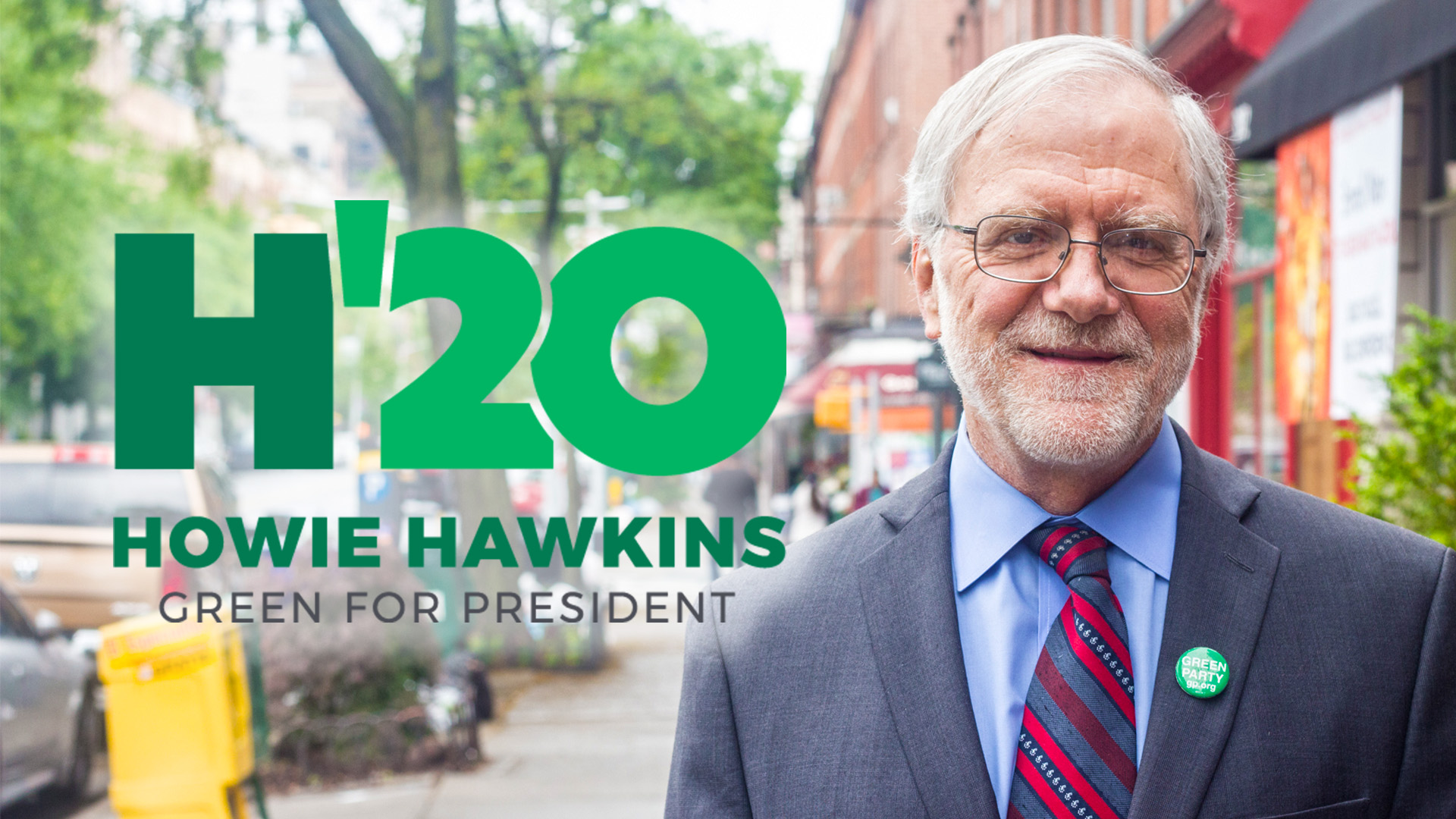
    Hello, this is Michael Albert and I’m the host of the podcast titled RevolutionZ. This is Episode 73 and today we have as our guest, Howie Hawkins to discuss Green Election Strategy.

    Howie was the first US electoral candidate to campaign for a Green New Deal. He was one of the original Greens in the United States, having participated in the first national meeting to organize a US Green Party in St. Paul, Minnesota in 1984. Howie became active in the movement for civil rights and against the war in Vietnam in the 1960s as a teenager in San Francisco.

    Since then, Howie has been a constant organizer and peace, justice, union and environmental campaigns, and has in fact been involved in organizations, campaigns and movements literally too numerous to list. From the start, Howie was committed to independent working class politics for a democratic socialist and ecological society. Howie has been the Green Party’s candidate for governor of New York among other posts and is currently seeking to become Green Party candidate for President in 2020.

    Albert: So, Howie, welcome to the podcast RevolutionZ.

    Hawkins: Thank you. It’s good to be here.

    Albert: Before we get into the current situation we now all face, perhaps you could tell us your view of the Green Party writ large. For example, how would you summarize its long term aims?

    Hawkins: Well, I think our long term aim is to become a major force in American politics. And with this Coronavirus, health, and economic crisis, with an inept President Trump and invisible Biden who does have a megaphone, I think we have an opportunity to really advance in this election. And the way we’re going to do it, though, really is not out of a presidential campaign. We have got to build it from the bottom up. We’ve got to elect thousands of greens to local office or local districts of state legislators in Congress as we go into the 2020s. And that’s how we get the credibility in the minds of the people that ‘Yeah, the greens can actually be elected.’

    We do have 129 elected officials around the country, hardly anybody knows that. And while that’s just a drop in the bucket, because there’s about 500,000 elected officers in this country, it’s more than any party on the left has had since the heyday of the Socialist Party, you know, going back to the 30s. And before that.

    Albert: How then would you say that Greens view, again writ sort of large, the relative importance of winning elections, as compared to running in elections they’re obviously not yet ready to win? And in each case, what are the hoped for benefits?

    Hawkins: Well, in every case, it’s advancing issues that the major parties won’t deal with. And that’s been the historic role of third parties going back to the working men’s party in 1830, and the Liberty Party against slavery in the 1840s, and so forth, and without taking power except the Republicans which was a descendant of Liberty Party, Free Soil party, then the Republican Party come into power in the late 1850s. And then Lincoln got elected president. The third parties haven’t taken power, but they have put issues that became policy, like the Socialist Party’s reforms regarding social insurance were picked up by Roosevelt in the New Deal. So we always do that. And I can give you examples where, you know, we’ve succeeded in doing that. I’ll give you one example.

    I ran for governor in 2014. In New York, I got 5% of the vote. And Governor Cuomo had wanted to run up the vote to get ready to run for president. He wanted to get more than his father Mario Cuomo ever got, get more than he got in 2010 when he was first elected, but he got less. And he had to look at what we were saying. He couldn’t take us for granted. And he came around on three key demands that he hadn’t supported before, after he was elected, a ban on fracking, paid family leave, and a $15 minimum wage. So we always want to influence the process by putting these issues forward and not being taken for granted. But that’s what we can do in every election. Now, every election, it depends on what you’re running for and what the circumstances are. I mean, I’m running for president, you know, and I’m in the six figures financially. And, you know, Biden, and Trump are in the seven or eight figures. I mean, right there, there’s a big disadvantage. So I know I’m a long shot. But when you get down to the local level, we’re knocking on doors and getting to know people and having a record in the community as an activist that people know and trust. We have a good chance of getting elected in local races and actually you look at the the percentage of races Greens run in and win at the local level and it’s pretty high. And we just have to get more people who are socialists and progressives running for these local offices. So we can begin to build a counter force from the bottom up.

    Albert: That makes perfectly good sense to me. I’m fine with the idea that running to raise consciousness is good, running to put pressure on others is good, and running to win is good. Where a question arises for me, however, which you and I have discussed in print a bit, is in the details of presidential elections, in particular the one that you’re about to, hopefully from your point of view and mine too, actually run in as the Green Party candidate. So I think your running in 2020 and advocating a program way to the left of the Democrats, and even well to the left of Sanders is fine and even excellent to raise consciousness and to raise issues and put on pressure, in, I guess in about 40 safe states where there is simply no doubt that Trump or Biden, supposing Biden runs, will win. I live in one of those safe states, Massachusetts, and I could and would vote for you there. But I think it is not good in swing states and this is what I’d like to discuss with you. That is in states where it is unclear who will win, like Ohio, Wisconsin, Pennsylvania, and so on, you perhaps should tell – in my view, you should tell – your supporters that since humanity’s future, and thus also, of course, Green politics and Green program would be most benefited by Trump losing, and would be most obstructed by Trump winning, each far, far more so than by you getting more or less votes in those swing states, to vote for Biden for the 10 minutes that it takes and then return to their Green and other activism.

    Now instead, and please correct me if I have this wrong, I think you feel you should urge them to vote Green, for you or for whoever might be running if it isn’t you, in swing states just like in safe states, because your getting their votes will be more beneficial for what they and you and I believe in and desire then if those votes went to Biden, even if the number of votes you get would have won for Biden, whereas without those votes for Biden Trump would win. So if that’s your view, can you please tell us the essence of the supporting logic? And if it isn’t your view, of course, please correct me.

    Hawkins: No, we’re running in every state to get votes in every state. And I’m not scolding people who make the calculation that they want to vote for the lesser evil in a battleground state. But for the Greens, every state is a battleground. One thing we got to get out of the election is ballot lines. And in about 40 of the states, how many votes we get determines whether we have a ballot line going forward, which enables us to run local candidates. In most states it’s, well it runs between a half a percent like in New Mexico, most states are 1, 2, or 3%, a few are 5%, Alabama is 20% so that’s going to be tough. But that’s, you know, one crucial objective of our campaign and then you know, if we don’t support ourselves in some states I mean, why should anybody else, so I think that just creates the wrong message. But like I said, I’m not gonna scold or shame people that, you know, make that lesser evil calculation, but I will say in some of these battleground states, I mean, the Democrats are on the other side. Just take the, you know, one of those existential issues, the climate crisis and the need to stop fracking and new fossil fuel infrastructure. So in Pennsylvania, they’re fracking the hell out of the state. They’re building pipelines that funnel toward either gas fired plants in the northeast, or this petrochemical plastics complex they’re building in the Ohio Valley Appalachia area, which you know, is going to produce massive amounts of non biodegradable plastic so a huge environmental problem in itself. And even the elected officials in Pennsylvania that supported Bernie Sanders won’t touch that issue. Or go up to Michigan. You know, the Democrats won’t take…

    Albert: Howie, I don’t disagree with you about any of this. You’re pushing an open door here. I just want to make clear that I have nothing good to say about the Democratic Party, but the issue isn’t are they bad, either in specific instances like those you mention, or across the board. The issue is what to do in certain circumstances. So I’m trying to understand your reason for not foreswearing running in contested states, which is what I would suggest, or to run there, and literally, say vote for Biden as lesser evil and vote for Greens all up and down the rest of the ballot and then go home and fight against Biden when he’s president. Your reason for not doing that is to build the Green Party, to not send the wrong message and cause people to feel Greens are irrelevant or not worth supporting. But I think the approach might be having the opposite effect.

    I know that’s weird for me to say to somebody who’s in the Greens and is as prominently active as you are. But in 2000 Ralph Nader got 2.7% of the vote on the Green Party line, and 16 years later, Jill Stein got 1% of the vote. In 2004, there were a total about 230, Green Party members in local offices around the country. But now I heard a quote from you saying there are 130 in office. So it doesn’t seem to me that this strategy of, you know, voting in contested states when it becomes contentious and when later there’s a sense of blame, is actually in fact building the Green Party. Do you think it is?

    Hawkins: Yeah, because we’ve got ballot lines where we’ve been able to run. You mentioned we’ve declined in the number of local elected officials. I didn’t get the year but, you know, movements ebb and flow and we’re in a situation where people are scared to death of Trump. I mean, I had people saying they had to vote for Andrew Cuomo when I ran for governor in 2018, who had gave me money and made phone calls for me, because they wanted to send a message to Trump. You know, I guess support the Democratic Party. Which I think was, you know, Trump wasn’t even on the ballot. It just didn’t make a lot of sense. But that’s what the mentality is. So, you know, I understand we’re in a difficult situation. But, you know, it’s not a time for us to fold up our tents.

    I was, you know, about to talk to Michigan, I was invited to speak up there against this oil pipeline that they want to expand, which the environmentalists and American Indians up there want to shut down. And I was invited by the Democratic caucus of the Anishinaabe Indians, and they invited me up there because they said, we can’t get the Democrats, maybe you can help us get their attention. So that’s the kind of thing we can do, by you know, being in every state and, you know, the Democrats aren’t being any help in stopping that pipeline up there in Michigan. And we can go through all kinds of issues, affordable housing everywhere, because the Democratic machines are totally tied up with real estate. And the Greens always find themselves fighting the Democrats when they’re fighting for affordable housing. So like I said, we’re getting ballot lines so we can continue these fights.

    Albert: But you can get the ballot lines other ways also, right? You can get them by doing petitions. Is that right?

    Hawkins: Well, yeah, you can do a petition, which is huge. And if you don’t have a ballot line, the numbers we got to get are much higher than for major party candidates in their primaries.

    Albert: Yeah, but that’s a reality. And Jill Stein got only 1% of the vote. So there’s a lot of states that you have to get petitions in.

    Hawkins: Like in New York having a ballot line meant our statewide candidates were automatically on the ballot.

    Albert: You could work to be on the ballot as compared to being automatically on the ballot.

    Hawkins: You can always be working on that for six weeks in July and August when you should be doing other things for the campaign. Then you file your petition and the Democrats challenge it even if it’s frivolous, and they delay it until October and then they say we can’t have you in debate because you’re not on a ballot. And finally, you know, the board of election or the court says, no, they should be on the ballot and it’s like, you know, four weeks till the election. It’s a lot of nonsense. If we’re on the ballot, we can…

    Albert: I don’t doubt it…

    Hawkins: And they just made it worse. The Democrats just made it worse in New York, they tripled the number of signatures. Instead of 15,000 in six weeks, we have to get 45,000 so we got to triple the number of votes to get in this coming election to keep our ballot line. And that was done by the Governor under the cover of the Coronavirus crisis.

    Albert: I’m not surprised…

    Hawkins: So that’s, that’s what we’re up against. And you know, the Greens in those battleground states. They don’t want us to abandon them. They got fights going on…

    Albert: Why is it abandoning? That’s the thing I don’t get. Explain this to me. So in 40 states, there’s no issue. So in a swing state, you go in and you say, I’m going to campaign up and down, same as I would in a safe state for Green candidates in the state. I’m also going to campaign for the Green program. But I’m going to say to folks, I think people should vote for Biden in this swing state for president, but the rest of the Green Party slate down the whole ticket, because of the undeniable fact that I see — I being you in this case, I would hope — that Trump winning again would usher in hellish days well beyond those already endured, if not worse, still. So, Trump winning is a very, very, very serious problem. And as annoying and damaging as it is for us not to get votes for president in this swing state, it’s much more annoying for Trump to win here, win the electoral college here, and win the election as a result, and I won’t risk that. So I’m campaigning for the Green program. I’m campaigning for socialism. I’m campaigning for the Green Party up and down the line, but I’m campaigning to stop Trump at the presidential level. Why is your saying that selling out the Green Party? Why is it folding up your tent. I don’t get that.

    Hawkins: Well, I mean, how do you campaign for a Green New Deal and socialism and say vote for Biden? I mean, he’s not gonna do those things. He’s opposed to those things. If we got life or death issues, you know, the climate crisis, the Coronavirus crisis, inequality is killing us, working class living standards are going down…

    Albert: All true…

    Hawkins: And we got a new nuclear arms race too, and they’re not talking about it. And so for us to fold up our tents in the battleground states takes the pressure off Biden, if he’s going to move at all. And look Biden should landslide Trump. Trump is so damn inept, his own people are seeing it. And you know, they got the money. They got the lead in enrollment and to blame us for not beating Trump, Trump is like the most unpopular unfavorably, you know, the polls say he’s the highest unfavorable for anybody ever running for president. I mean, why put it on us to beat Trump when the Democrats ought the landslide them?

    Albert: I don’t get the argument. The issue isn’t what should happen ideally. Ideally, of course, Trump should get annihilated. Ideally, Sanders should have destroyed him. All true. The issue is what happens if it comes down to it, and it’s close in the contested or swing or I think you called them battleground states. If it comes to that situation, then there’s a real issue. It shouldn’t be an issue. I agree with you. But there is an issue. And if there’s an issue, again, well, here’s a different version of it.

    Why not advocate voting for Biden in swing states and the rest of the Green Party’s slate down the ticket and supporting the party program and supporting the Green New Deal, not based on Biden’s non existent merits, there are none. But because Trump winning would accelerate the race to destroy the environment that sustains organized life. It might even reach irreversible tipping points in one four year span. And there would be mounting and hideous catastrophes along the way primarily for the poor, abroad and at home. So why not say to your constituency we need to stop that, and the way to stop that, given how close it is, is to hold our nose and vote for Biden and after the 10 minutes of voting for Biden to put on our working shoes and oppose his administration, hopefully on all the grounds that you know, you know, so well. I don’t see how that’s folding up tents. And the word isn’t pragmatic here. The word isn’t conservative. The word is aggressive about accomplishing the most possible for the constituencies that are at stake. How is that wrong?

    Hawkins: Well, Trump may call climate change a hoax. But Biden acts as if it’s a hoax. The status quo is not going to advance. And for us to not, you know, compete for that vote is to take away our political leverage. And these are the people that you look, the Democrats, we talked about voter suppression. And the Republicans do a lot of it. We know how they do it, you know, voter ID and not enough polling places in certain communities and all that nonsense. The Democrats suppressed the vote by keeping the Green Party off the vote. I mean, I go back to New York. We had our congressional candidates file petitions right before the lockdown, and then the DNC with that law firm that’s close to Clinton. I forget their name. They filed in court saying we’re filing challenges to the signatures. But we don’t want the board of election to review the challenges because of the Coronavirus and therefore just keep the Green Party off the ballot. I mean, that’s the kind of nonsense we get from them.

    Albert: I am not surprised.

    Hawkins: Yeah. And so look, there’s another issue here, this spoiler problem, which we’re talking about right now. There’s a solution to that, which the Green Party has been giving to the democrats for 20 years. It’s a non partisan, proven solution. And that’s get rid of the electoral college and have a rank choice national popular vote for president.

    Albert: Absolutely.

    Hawkins: And if we aren’t in the race, and putting that pressure on Biden to maybe get behind it, it’s not even gonna be raised.

    Albert: Howie, you can’t really believe that. I agree with you and I think it’s worse than you’re even saying because you’re a really nice guy. I can see Democrats sitting around and saying, fuck the Greens, screw the Greens. Who cares about the Greens? I can easily understand that. Okay, so we don’t have to keep repeating that they have problems? Of course they do. The issue is, is there a gap a very, very substantial human, just humanly destructive gap between them and Trump, between them and the emergence of fascist movements in the United States. That’s something I’ve never said in my whole life, but it is real now. Right? These things are real. And to, you know, make believe that as bad as he is, Biden and given the constituencies he appeals to, isn’t better than Trump, less dangerous than Trump, less of a possibility of terminal nuclear war and global warming and all the rest of it than Trump, makes no sense to me. But there’s another thing. Leverage? Howie, you don’t have any leverage at the national level. No one does with Trump. With Biden, there is real leverage. It’s not as big as we want by any means. Because we don’t even want the system. But it’s there. Trump, if Trump wins, your leverage is zero. The leverage of the global warming, you know, the climate change movement is zero. The amount of activism that would be necessary to accomplish the most meager thing given the Supreme Court and all of the other courts, if Trump wins, is enormous, but the potential for pushing Biden is real. The leverage argument doesn’t doesn’t do much for me either. You know, maybe I’m dense here, but I don’t get it.

    Hawkins: Well, we’ll definitely have more leverage over Biden, if we get a substantial vote, than over Trump, no doubt about that. But look, whoever’s in there, we got to have mass movements that aren’t tied to either party. I mean, I go back to the anti Vietnam War movement, and contrast it with the anti Iraq war movement. In the 60s, we were saying out now, we are saying that to Kennedy and McCarthy who were talking about negotiations, we said it to Humphrey and Nixon. And we later learned that, you know, the massive demonstrations in the fall of 69 convinced Nixon and Kissinger that their secret plan to end the war, which involved tactical nukes in North Vietnam, would lead to, if not only his, he couldn’t get reelected, maybe even a revolution. That’s what they were afraid of, because they saw so many people out in the streets.

    Albert: I agree.

    Hawkins: So that’s what we got a mount now. What the mistake I think was made in the anti Iraq war movement is, you know, the broad coalition United for Peace and Justice came out with a slogan that year of against the Bush agenda, which was implicitly saying get behind Kerry, who was pro war. Kerry was saying I can fight it better than Bush. The movement lost its independent message. And then, you know, when Obama got elected, they figured, well, the Democrats are in there so we can go home. And Obama continued all these wars.

    Albert: I don’t have any argument with any of that. I agree with you. But I’m not saying that, and neither are the people who, you know, Chomsky isn’t saying that, people who are for fundamental change in the United States, for the same kinds of changes that you’re for, are able to say, and we don’t understand why some others aren’t, that there is a circumstance under which it makes sense to vote Biden, or to vote for the Democrat against the Republican.

    So let me ask you a different kind of question and maybe we’ll move this off the spot we’re on. Suppose Trump, this is not gonna happen. But suppose for the sake of discussion, that Trump said the first thing I’m going to do in my second term is declare war on Iran. And the second thing I’m going to do is declare war on any country that in any way, aids or trades with or deals with Iran. Now, under those circumstances, I assume that you would vote for Biden or anybody. Am I right?

    Hawkins: Well, you’re assuming the Democrats would fight Trump on that. I mean, look at Venezuela. You know, Trump is trying to take them out. And you know, Biden is with him. Schumer’s with him. I think we can’t rely on the democrats to fight for our right.

    Albert: Why is it relying on them to say I’d rather have Biden in office than Trump, by a ton, BUT, I have to devote myself to fighting Biden if he’s in office. That’s not relying on them.

    Hawkins: Yeah, I would rather have Biden than Trump, but, as the Green Party presidential candidate it’s not my role to campaign for Biden. You know, the people that nominate me want me to campaign for our party, get our ballot lines, fight for our issues, they want to advance the Green Party, to advance our issues and make whoever’s in office have to deal with, you know, our movement.

    Albert: And I agree with that as an agenda. But what I’m trying to suggest is that a lot of people think that advancing Green Party issues, advancing Green Party program, even advancing the Green Party itself, right, depends upon beating Trump far more than it depends upon getting some more votes in 10 battleground states. I’m saying I think it doesn’t make sense not just from the point of view of the future of the country, but even from the point of view of the future of the Green Party. I don’t see why you can’t go into a state and say, fight, fight, fight for the Green program, right, and part of that fight is stopping Trump, and the next part of that fight is going to be pushing as hard as we can with those mass movements, like from the 60s that you mentioned, against Biden. How is that selling out the Green Party?

    Hawkins: Well, if you’re fighting for the Green program and saying vote for Biden, you’re contradicting yourself. So just…

    Albert: No you are not.

    Hawkins: Biden said he would veto Medicare For All if it came across his desk.

    Albert: Okay.

    Hawkins: You got so many people that can’t get treatment when they needed a to make a choice between rent and going to the doctor.

    Albert: Exactly.

    Hawkins: The guy that lived downstairs from me had to pay his utility built into March last year. He’s on Medicaid. He’s supposed to get kidney medicine. He didn’t get it that month. And his kidneys failed. He died. That’s happening all over the place.

    Albert: Exactly.

    Hawkins: And the Democrats oppose a public healthcare system that everybody has access to, and for us to say vote for the guy that is opposed to that is a total hypocrisy on our part. How can we go around saying that?

    Albert: Why? Why can’t you say — I’m really trying to understand Howie — why can’t you say Biden is a criminal. Biden is a supporter and a maintainer of and then you can list all the things that we agree on, right? But stopping Trump is absolutely essential to moving forward as a first step. And so in 40 states, I’m running for Green Party votes, Howie Hawkins votes, etc. But in 10 states, or whatever it turns out to be, I’m running for Green Party advance. I’m running for the Green Party candidates. I’m running for the Green Party program. But I think people no matter how much we hate the Democratic Party and Biden should vote for them, but with the intent of, after the 10 minutes voting going out in the street, and demonstrating for four years against their administration to get as much as we can possibly win. There is nothing confusing about it. Nobody would see that and say, ah, Howie is for Biden. Who’s gonna say that? When Howie is in the street opposing Biden…

    Hawkins: But saying in that state vote for him?

    Albert: Yes….

    Hawkins: Yeah…

    Albert: In order to stop Trump from winning…

    Hawkins: There are lots of people like you that are going to be making that argument and voters on the left are going to know what the arguments are. It’s not my role as the Green Party candidate, a nominee, the people that nominated me to go out and say vote for the Democratic candidate where whether we have a ballot line going forward depends on the vote we get.

    Albert: So you’re saying the ballot line is more important – and I agree that it’s important – but you’re saying it’s more important than Biden beating Trump in the election because in that state not beating him might swing the election, and so my getting the ballot line for the Greens is more important than our all together stopping Trump. I can’t — do you, do you really feel that?

    Hawkins: Yeah, because you’re assuming we are the margin of difference, which is a big assumption. In the meantime, we got issues. We got issues with the Democrats that we’re fighting as well as the Republicans in these States. And people want a ballot line so they can run against them in the next election. And that’s what the people in those states are focused on. You know, whether it’s fighting pipelines, affordable housing, the regressive, I mean, we got a tax system now where labor income gets taxed higher than capital income. And the Democrats, you know, they voted enthusiastically for the Reagan tax cuts and started the whole thing back in 86. That was bipartisan. I mean, everywhere we turn, it’s bipartisan. It is bipartisan foreign policy, bipartisan economic neoliberalism that’s killing us.

    Albert: I agree. In other words, you’re arguing a position and points which I agree with, right? And which Chomsky agrees with, you know, everybody who takes the view that in swing states, one should vote for the lesser evil in this case, with a gigantic evilness gap, so to speak. Everybody who, who, who is saying that, that I respect and agree with, agrees with you about all this other stuff, we just don’t understand how it leads to an act which could, could, just could elect Trump. I mean, last time around the reality is that in a few swing states, if Jill Stein had done what I’m suggesting, and if, and these are all ifs, I agree with you, and if the people who voted for Jill Stein, as a result voted for Hillary Clinton, holding their nose, furious, nauseous, going home and vomiting, nonetheless, it would have meant that Trump lost. It was enough votes. It’s just a fact. The numbers are there, right?

    Hawkins: But you’re assuming her voters would have voted for Clinton in the absence of Stein? If they did, okay, but the fact is, we bring people to the polls who won’t vote for either party. 61% of Stein’s voters according to the exit polls would have stayed home if she wasn’t on the ballot. Others would have voted for somebody besides Clinton or Trump.

    Albert: And if Howie Hawkins in those states, right, was using his considerable talents to explain, to consciousness raise, to explain to those Green Party supporters and Howie Hawkins supporters, that the current context is one in which doing that, doing what you’re saying Stein’s voters would have done, is a mistake, is a horrible, horrible mistake that would lead to tremendous dislocation and harm, if not total disaster, if Howie Hawkins was making that point, and Stein certainly wasn’t, I think he would be heard by those voters. The whole point is you, you’re able to bring them out. In other words, they respect you. They’re listening. They’re hearing. You can communicate with them. Howie, it seems to me, honestly, that in your life, there’s never going to be a moment at which you have more capacity, personally, as an individual, to impact history, then in this election in the manner I’m talking about. That’s how big the choice seems to me to be. Now it might be that we get to August and there’s no choice at all. It’s obvious, because Biden is destroying Trump or because vice versa. But if it’s close Your potential for doing something historic is immense. And you’re saying you don’t want to do that because you’ll lose a ballot line for the Green Party which you can get by a petition anyway. I can’t follow it.

    Hawkins: Well, to the extent people have, you know, respect for what I’m saying it’s because I’m saying we need an alternative to these two capitalist parties.

    Albert: Agreed.

    Hawkins: So, if I stopped saying that, I lose some respect, I won’t have the influence I had.

    Albert: But you don’t need to stop saying that.

    Hawkins: Yeah. But if I’m saying vote for one of those parties, that’s an obvious contradiction.

    Albert: Is it? Do you think Noam Chomsky lost the respect of leftists who don’t support either party because he said, you know…

    Hawkins: Some people, yes.

    Albert: They’re crazy. You know, somebody who would, who would lose their respect for you on these grounds. Good, Lord.

    Hawkins: Well, you know, I think he’s lost some influence with some people. People who think, you know, going with that lesser evil strategy is wrong. And, you know…

    Albert: And that’s why they quote him when they explain why they don’t support either of the two parties, which they do.

    Hawkins: The people against the lesser evil quote him on that question.

    Albert: Yeah, they quote him on, you know, Tweedledum and Tweedledee. The two parties are two branches of one corporate party. Sure they would. I guess the bottom line is we have to agree to disagree, although I continue to have trouble understanding why, I really do.

    Hawkins: Yeah, well, I know, no loss of friendship or disrespect. I mean, we’ve been debating this since 2004. So, you know, the thing I keep emphasizing when this comes up is we are going to demand that, and this is a demand on the Democratic Party because they could make this an issue. Get rid of the Electoral College, and go to a national popular vote…

    Albert: Couldn’t agree more.

    Hawkins: And, you know, the only time it came up a little bit was when Elizabeth Warren said we should abolish the electoral college about a year ago. And, you know, nobody’s picked it up. Not even Bernie Sanders. So, you know, the fact that people are focused on me, like you are on this question, gives me an opportunity to say, Well, okay, you want to solve this problem for good? Let’s have a national popular vote using ranked choice voting. That that’s something that, you know, Biden can avoid.

    Albert: I agree. I mean, I absolutely agree. I just don’t think that what I’m suggesting, prevents that. I don’t even think it reduces …

    Hawkins: I’ll grant you that a lot of people, if it is close in November, are going to accept your argument in swing states. And, but that’s not my role as candidate of the Green Party. You know, That’s not why they nominated me. So I’m not going to shame or scold people that make that choice when it comes to that. Although right now, I mean, Trump is hanging himself with this inept response to the Coronavirus crisis.

    Albert: Have you seen his most recent polls?

    Hawkins: The last ones I’ve seen is he’s losing the battleground states to Biden. And his favorables went up for a minute like people rallied around the president and then they saw what he was doing, and he went back down.

    Albert: And it went back up yesterday or the day before it was back up to high forties again. It’s incredible. But I think there’s a reason for it. I mean, maybe we can talk about something different because I wonder how you think about this. I think that Trump is not an idiot. He’s almost a genius at the limited thing that he does, which is to lie and you know, all the rest of it in order to win. Just to win. And I think what he’s doing now, and I wonder what you think about this, because you travel around and you know, is that the reality is lots and lots of people are much more scared of unemployment, of hunger, of other diseases, of literally starvation, of the indignity of it all, than they are of the virus. And understandably, so I have a lot of sympathy for that. And Trump is trying to take advantage of that. And to put himself on the side of that. Of course, later, if it leads to a gigantic fiasco, he’ll say that he never supported it at all. But you know, he’s doing a reasonably good job of that. You pointed out a lot of things that the liberals should be saying, would you agree that they should be emphasizing really strongly that the economy collapsing is a serious issue, that the economy denying people income is a serious issue, it’s a world, you know, an incredibly important issue and therefore, the demand for raising unemployment insurance, the demand for giving people income while they’re out of work and all the other good demands have to be elevated far more strongly than they are. And that they should be appealing to those exact same crowds of people who are now asking, you know, to go back, to shut off the shut off, to open up the country. They should be appealing to those people saying you shouldn’t have to risk your life to get an income, you shouldn’t have to risk your life, you know, to get health care, those things should be provided and the obstacle is Donald Trump.

    Hawkins: Well, where’s Biden? I mean, he’s not making those demands that there’s such an opportunity. I mean, Trump is telling people to go out and die for the Dow. And you know, the progressive Democrats have some good bills in there like cancel rent and mortgage payments. Cancel utility shut offs. Have the federal government pay those so that the small business sector doesn’t all go bankrupt, which is where half the jobs are, just like they’re doing that in Europe, where the hell is Biden? I mean, you got the platform. And he’s not saying that. He’s not supporting Sanders, you know, $2,000 per adult, and $500 per child. He’s not saying everybody needs COVID treatment, get covered by Medicare. That treatment is $35,000 If you go to hospital and up to $85,000, if you get on one of those ventilators. Where the hell is Biden? I mean, that’s – you are right – Trump, if that’s why he got a rebound, it’s because there’s no counter narrative.

    Albert: I agree, and and therefore pushing on this, you, me, everybody, makes sense as well as on other things. I agree. But I am really scared that the left liberal and radical left is making almost exactly the same mistake as in 2016 when it says Trump should get annihilated, you know, Trumps should get annihilated, he’s gonna lose easily. It’s just not recognizing what he is appealing to, and how effectively he manages to do it. I know that sounds weird, but it is true.

    Hawkins: Well, he lost the popular vote by 3 million in 2016. Let’s not forget that. And he had a unique situation with the electoral college which gave him the victory. There are a whole lot of factors. Black voter suppression was huge. And the Democrats haven’t been all that vigorous on that. And the electoral college. Those are the things – you know, to say we gotta support Biden in the swing states when they haven’t even fought for their own interests on those questions, you know, it’s not my responsibility.

    Albert: Well I guess we are going to have to agree to disagree. I think your role is to advance the well being of the population and the world. I think we would agree on that. And your role is to, in that context, since you believe in the Green Party, which seems perfectly reasonable to me, to also advance Green Party policy and Green Party aims. I agree on that. What we disagree on is that I think stopping Trump is central to all those agendas. Far more so than your getting some more votes in swing states.

    Hawkins: Yes, well, I have been saying the Democrats should impeach Trump a long time ago – and he has a mile long rap sheet – and they finally at the end chose the Ukraine extortion, abuse of power, and obstruction of Congress. But then when they presented the case it was more a national security issue about the proxy war in the Ukraine then Trump’s obstruction, and abuse of power. They gave him a get out of jail card.

    Albert: Yes, it is insane. And now what’s Biden doing. He’s making believe that he is tougher on China than Trump. Okay. All insane. All disgusting. I mean how much worse can it be? How much more hypocritical, how much more decrepit – I mean I agree with you. I do Howie. But there is still a gigantic gap between a Trump second term in which he is just totally empowered, and we can see what he is willing to do to get a third term – and a Biden first term.

    I guess one thing we have to hope for is that maybe Biden will pick Warren as Vice President, or maybe someone will impose on Biden Warren as Vice Presidential choice. I doubt it, but it is possible. She now leads all the polls. She very substantially leads all the other potential Vice Presidential candidates.

    Hawkins: Yeah, that’s not surprising. The base of the Democratic Party is way more progressive than the leadership. That’s why Bernie Sanders,you know, people say he created this movement and in a way he gave voice to sentiments that were already there, like Medicare for all. I mean the polls have shown the people have wanted that in a majority going back to Truman. And Bernie was able to give voice to that and scare the hell out of the Democratic establishment, twice.

    Albert: Yes, and its an incredible loss that he’s not the nominee. And it is very disturbing how that happened. I agree with you. Alright, well Howie, unless there is something else you want to add, something that we haven’t addressed or covered, and I admit, I apologize for focusing in on one main issue – but if there is something else you’d like to talk about now before we close it out, go right ahead.

    Hawkins: I would just say, you know this Coronavirus – people don’t realize what a dangerous situation we are in. This is out of a family of viruses that includes the common cold for which we have never developed long-term immunity. So you can get infected but it is not clear you will have immunity for the long term, and we have no vaccine for. So we are in for a whole new world which means we gotta change how we work. OSHA should have personal protection equipment standard, emergency and then long term, so people can go back to work with some safety. And what that means for the economy – I mean this is a much more serious crisis than I think some people realize because they kind of think this is going to pass. That’s Trump’s gamble. He is sending people back to work and if this thing ramps up again – and it really hasn’t ramped down – it could blow up in his face. Worst is the number of people that are going to be made sick and die. And so, you know, I think we need to really think about how we are going to get out of this situation, or what it means for the way we gotta change not just how we live, but the system. I think we can’t go with the system we got where with the virus SARS 1, they stopped working on the vaccine when they suppressed that epidemic – and had they continued, that would have helped with developing a vaccine here. So, I am just saying we are in a very serious situation.

    Albert: I think you are absolutely right. I have been far more afraid of this, I guess you might say, I don’t know what words to use – than a lot of folks. And I think you pinpoint the issue. The issue is the extent to which when you get the virus and you overcome it, you then have immunity. And we don’t know that that is the case, so that is a huge issue. And then the idea that we are going to have a vaccine in a year or a year and a half – I think the last successful vaccine took many many years – I heard forty. AIDS still doesn’t have a vaccine. So it’s not obvious that this won’t be with us in the same way the seasonal flu is with us, except that it is more virulent, it spreads faster, and it obviously is more damaging in the sense of killing people. So, I agree with you that it is worrisome, and then just ask yourself what it would be like, or I ask the audience to ask yourself, what it would be like to have Trump in office again, plus Corona returning, and him ridiculing science, ridiculing public safety, and, I don’t know, hunkering down in the basement of the White House or whatever he is going to do.

    Hawkins: Yeah, and pitting every state against the rest instead of having a unified response. And pitting our nation against every other nation. I mean you couldn’t have a worse response.

    Albert: Yes, it’s hard to imagine. Alright, Howie, thank you a whole lot for coming on. I really appreciate it and maybe we can do it again sometime later in the summer when things, I don’t know, hopefully shake out for the better. I guess we will see.

    Hawkins: Yes, we will see and I would love to come back on and talk about it all some more.

    Albert: Okay. That said, then, this is Mike Albert signing off until next time for RevolutionZ.

    [Originally posted on ZNet. RevolutionZ is available on all the usual podcast hosting venues – Stitcher, Apple Podcasts, etc. It is also featured on ZNet where there is an archive of all past episodes as well as instructions for diverse means of access. RevolutionZ is also on Patreon and on its Patreon Page one can not only access episodes, but also contribute much needed support to the project. RevolutionZ focuses on vision for a new society and on strategies for winning change, so the archive’s early entries are just as relevant now as when initially recorded. Please give RevolutionZ a listen, make it known, and if you can, give us some support.]


  • “The situation is very disgraceful for all” – An Interview with Omar Vázquez Heredia

    “The situation is very disgraceful for all” – An Interview with Omar Vázquez Heredia

    Omar Vázquez Heredia is a member of the Partido Socialismo y Libertad in Venezuela, and a professor at the Central University of Venezuela. He is the author of the book ‘La Cuestión Chavista. Estado Extractivista y Nación Petrolera’, the result of his PhD studies, where he presents a critical historical account of Chavismo regarding labor, agrarian, gender, settler-colonial and international relations issues.

    This interview by members of Venezuelan Workers Solidarity was carried out in writing in the week of April 27th. An abridged version was requested by Momentum UK, but ultimately its leadership decided not to publish it.

    What is happening with the quarantine in Venezuela? 

    Social distancing and home confinement measures were established as a collective national quarantine on March 17th. At the beginning they were applied with great levels of precision and strictness. However, because a majority of the Venezuelan population depends on informal sources of income, the government had to de facto, progressively, relax the quarantine and allow people to carry out commercial activities.

    The quarantine has been a military and police rather than public health measure. Military and police presence had already taken on a much greater dimension over the last few years in Venezuela, but it increased even more with the declaration of a state of alert on March 17th. For instance, military and police agents on loudspeakers are the ones giving out day-to-day information in the streets and public spaces about the need to respect the rules and recommendations of social distancing and confinement at home, and who go around demanding the closure of businesses at 2 PM. This generates tension, because the Venezuelan military and police bodies, like the greater part of Latin American repressive bodies, have a long tally of violations of democratic freedoms and human rights.

    On March 22nd, the government announced a set of compensative economic measures to accompany the national quarantine [that revolved around coverage of wages, cancellation of rents due, and direct assistance funds], but these are mostly rhetorical and insufficient, given their non-enforcement and the absence of funding for them.

    The government’s payment of wages for workers in the private sector only guarantees coverage of the minimum wage; the prohibition on lay-offs is not enforced, and firings continue; rent is still charged; hyper-inflation had already put an end to financial credits so there are no banking debts due; the cancellation of public service charges is meaningless because these are already enormously subsidized; and finally, the distribution of direct aid funds and of CLAP food boxes is still arbitrary, sporadic and rationed.

    How can we understand the intense precarity Venezuelans are living?

    Well, the acute day-to-day Venezuelan precarity can be explained by the destruction of wages, the insufficient provision of public services, and the difficulties to buy imported medicines. For example, today, the minimum monthly wage and the food supplement decreed by the Maduro government amount to US $4.57 per the official exchange rate. However, the government also set the prices for 27 food staples that are part of the basic food basket, and those add up to $32.65. This is shameless. Even more obscenely, the monthly basic food basket as a whole is really priced at $199, as per the black market exchange rate that most Venezuelans actually employ.

    [The destruction of the wage] is the reason for mass emigration and for the daily resignations of workers from their jobs, since working for wages in Bolívares does not allow one to afford the basic food basket. Many are abandoning formal employment for informal jobs that pay directly in US dollars. Some bosses are now handing out bonuses in dollars, sometimes of $20, $50 a week to keep those employees essential to their businesses. But these bonuses do not factor into the calculation of the legally required benefits beyond the wage, such as paid leaves and vacations, payments to social security, among others.

    The Maduro government, under the Memorandum 2792 of October of 2018, has furthermore created a commission of control and tracking of collective bargaining agreements, to re-calculate the wages bargained between unions and bosses according to the State-decreed minimum wage.

    At the same time, the government has legitimized the use of dollars for the sale of products and services between private agents in the market. And through the Petro [a crypto-currency used for State benefits schemes], it is now effectively valuing in dollars the fees required for State administrative services, such as the issuing of passports or fiscal registration of companies.

    The situation of public services is very serious throughout the country, but it is much worse in regions more distant from Caracas. This is due to lack of maintenance, corruption, and the pauperized labor conditions that have emptied the public sector of qualified workforce.

    I live in Caracas, and we only get running water at home two days a week. We store it because it sometimes comes with little or no pressure and does not go into or fill the water tank, and we ration it by using the water that comes from the washing machine to flush the toilet. We also have to save on using domestic gas from the cylinder, because when it runs out we have to wait until the next delivery from the local communal council. Garbage trucks no longer pass by our home as they used to, and trash piles up for days on the streets since there are less trucks circulating and their schedules and routes have been cut. Sometimes there are unscheduled rationing of electricity for several hours, especially outside the capital––alternating four hours with and without power.

    The lack of access to medical treatments, imported medicines and surgical operations is very grave and despair-inducing. On social media, we constantly see fund-raising campaigns to ask for help for ill relatives who cannot cover medicines, or medical or surgical treatment. The situation is extremely exhausting, particularly for people with chronic ailments, and it is very disgraceful for all.

    About two weeks ago [April 23], we saw the looting of food stores in cities in the peripheries of the country, such as Cumanacoa in Sucre state, and Upata in Bolívar, along with protests over food and gasoline throughout different regions. These events have not surprised me, but they do worry me. The quarantine has sharpened the hunger ailing the Venezuelan people, as evidenced by the latest report of the UN World Food Program, and this has produced food riots. This is troubling because it further shows the despair of the working class over the level of misery it is enduring.

    Tuberculosis clinic at the Hospital Dr. José Ignacio Baldó, Caracas. Credit: Meridith Kohut for The New York Times, 2018

    How and why did the public health system collapse in Venezuela, after so many years of praise to its reform and expansion of access to it through the famed Misiones? How does this collapse manifest?

    The Chávez government established free healthcare initiatives by buying medical services from the Cuban state and creating a network of institutions that ran parallel to the public health system. But the State investment on the Misiones was never matched for the pre-existent system and hospitals, creating disparities and a discoordinated public healthcare system, which was left exposed to corruption due to the rise of clientelistic networks that distributed resources based on loyalty, without planning criteria based on empirical data on needs.

    In the past few years, the Maduro government has de-funded the entire public health system, and reduced the number of Cuban medical doctors in the country. Those left have been concentrated in the Integral Diagnoses Centers [primary care], thus closing down the vast majority of the Barrio Adentro [medical outreach and community care] modules or reducing the activity of those left open.

    We hear government spokespeople claiming budget increases for healthcare, but these are always tailing the enormous inflation rates. So in real and per capita terms, there has been a gigantic contraction of public investment in healthcare. We see hospitals without access to basic public services like water and electricity, with disabled surgery rooms and intensive care units, with broken medical equipment, without basic sanitary material or cleaning products. On top of this, there is a scarcity of qualified medical personnel; many of them have migrated because of the destroyed wages.

    With a public health system in these conditions, the State has responded to the appearance of COVID cases in the country by subsuming healthcare centers into its national security, military and police politics. The government has arrested doctors, nurses and bioanalysts for whistle-blowing on the precarious situation of their workplaces. We can list a few cases: Rubén Duarte, nurse in Táchira stateJosé Molino, doctor in MonagasAndrea Sayago, bio-analyst in TrujilloEmily Márquez, nurse in Miranda state; and Yolimar and Carolina Alemán in Carabobo. The government has presented itself as the only agent authorized to present information on the COVID epidemic in the country, and its spokespeople have given out data that is not transparent.

    How is it possible to undergo a quarantine in a setting of scarcities of water, electricity, gasoline, and medical materials and personnel?

    The fulfillment of the so-called national collective quarantine as decreed by the Maduro government is unsustainable. The precarious state of public services forces people to crowd around irregular water sources, and in stores where drinking water is sold. Faced with the insufficient supply of water, people have enormous difficulties in maintaining personal hygiene and that of their homes.

    The scarcity of sanitary equipment, such as face-masks, forces people to use their items well beyond their actual protective capacities; for instance, to use a disposable mask several times. Cotton and fabric materials are not washed with the needed frequency because of the water shortages; in many areas, water also runs with irregular smells and coloration.

    The destroyed wages and the lack of efficient distribution of food and basic supplies make the quarantine unfulfillable. Members of the popular classes do not have savings or incomes to stay at home; they have to work in informal commerce or end up carrying out protests and riots for food, because they cannot cover their most basic needs with the minimum wage, which is the only wage being paid given the economic paralysis and the end of the system of dollar bonuses in private businesses.

    April 24th Protests over food in Cumanacoa, Sucre State. Photo: Robert Alcalá

    How do you characterize the crisis that began in 2014? How exactly do the sanctions of 2017 and 2019 worsen this crisis?

    When he died, Chávez bequeathed his successor an economy with a foreign debt of over $250 billion, if we add the debts of the Government to those of the state oil company PDVSA. This amount would not include debts over the Joint Funds with China, or Russian financing for military weaponry and advisors. This foreign debt was mostly acquired between 2006 to 2012, and originates from several factors: financing capital flight [through uncontrolled subsidies to capital, mostly through the State currency exchange system], corruption, unsustainable or unplanned universal social policies, and high levels of private and State imports.

    Pressed by this financial situation, Maduro took as his main priority the repayment of debt maturities and interests, cutting down the funding in dollars assigned to cover imports, and directing funds to pay foreign creditors. This, of course, is aggravated by the collapse of oil prices in 2015. The abrupt, unilateral reduction in imports, both of material for production, and of finished goods, created the ideal conditions for a contraction of the GDP, and, beginning in 2014, an inflationary spiral that eroded and destroyed the purchasing power of working class wages, becoming a hyper-inflation vortex in November of 2017.

    After paying over $80 billion in foreign debt between 2013 and 2018, the Maduro government began an attempt to carry out a macro-economic adjustment program in August of 2018, the so-called Program of Economic Recovery, Growth and Prosperity, that involved tax exemptions for the [state and private capital] oil industry, waivers of customs’ taxes for imports, officializing the massive devaluation of the currency by pegging it again closer to the dollar, and a de facto elimination of price controls.

    In the field of labor relations, it imposed the above-mentioned Memorandum 2792, which destroyed collective bargaining agreements and imposed new wage-scales, further intensifying the destruction of the purchasing power of working-class wages.

    Sanctions have worsened the economic crisis, and amplified the negative effects of the austerity adjustments applied by the Maduro government. The financial sanctions of August of 2017 blocked any chance of restructuring foreign debt maturities or payment schedules, but they also increased the financial costs of State imports by limiting its access to international markets. To carry out purchases abroad, the State must carry out triangulations and assign contracts to the few agents still willing to do business with it despite possible sanctions.

    The oil sanctions closed off the most important oil market for Venezuela, that of the U.S., and confiscated properties abroad that were sources of income to the State, such as the U.S. based CITGO oil refinery and distribution subsidiary of PDVSA. While exports to the U.S. were paid in cash, China takes exports as payment in kind of old debt acquired by Venezuela.

    The oil embargo also pushes the State to export oil through Russia as an intermediary, which charges a commission for assuming the risk of sanctions. Costs of production also increase, since to access Asian markets, it is lighter oil, with a greater API gravity, that must be exported [meaning that the extra-heavy crude must be further refined].

    Both types of sanctions increase the murkiness of financial and oil operations, facilitating greater corruption of the military and bureaucratic hierarchs of Chavismo.

    How does the situation in Caracas differ from other regions in the country?

    Unlike Chávez, Maduro and his government have not been able to build an active consensus around the dominant order and the State apparatus. Maduro and the military high command hold on to State power through repression exercised by military and police bodies, while shoring up social contention through the sporadic and rationed distribution of boxes of food through the Local Committees of Production and Supply, the CLAP.

    They have organized their rule of the country as a series of concentric rings of security that have as their center the Presidential Palace in Miraflores and extend to the regions of the country. The closest you are to the center in Caracas, where the central offices of State institutions are located, the higher possibilities you have of accessing public services and CLAP boxes, although you are also subject to a more aggressive repression and permanent political control, because protests there are more dangerous in the government’s eyes.

    On the other hand, when you live far from Caracas you have lower chances of accessing public services and CLAP boxes. In Margarita island, many receive running water once a month, experience daily power cuts, and only get one CLAP box every three months.

    This has aggravated the internal colonialism characteristic of Venezuela, where Caracas has always consumed much more of the State oil income to the detriment of actual oil regions such as Zulia, Anzoátegui and Monagas. Maduro and the military high command, with their vision of national security and their parcelling of the country into strategic operations theaters, have deepened the historical breach between the caraqueño center and the regions understood as peripheries.

    How is the crisis affecting the most oppressed sectors of Venezuelan society? Does it have any differential effect by gender, race, or ethnic origin?

    This question would take up an entire interview, but trying to be brief, I can say that the most affected are the working class following the destruction of their wages and working conditions, along with the indigenous peoples that suffer the expansion of the extractive frontier with mega-projects such as the Orinoco Mining Arc and the exploitation of coal in the Perijá highlands, in which transnational capitals, irregular armed organizations, and military and civilian chavista hierarchs are entwined . These mining mega-projects seek to generate income in foreign currency to repay foreign debts and to purchase the loyalty of internal and international allies.

    However, within the working class, it is the working woman in the popular sectors who is most affected. This is because of the immense increase in free labor she must provide for her family and home. Women are cutting down their food intake to keep the men and children fed. They migrate in precarious conditions to help their nuclear and extended families with remittances. The economic precarity facilitates the sexual commodification of their bodies. At the same time, their capacity to exercise choice over their bodies is lost, as contraceptives are inaccessible out of scarcity and high prices.

    Economic difficulties deteriorate women’s’ right to education, and consolidate motherhood as the only life-horizon. The crisis intensifies the role of men as providers of material goods that reaffirm their patriarchal power over sexualized, maternalized female bodies. The decay of public services forces women to labor much harder to carry out caregiving at their homes and jobs.

    How are capitalists and bureaucrats living the crisis?

    I don’t live in an area close to capitalists and bureaucrats, but I am sure that they saved up dollars to buy and consume basic necessity goods, in quantity and quality, and in an opportune and adequate way. Capitalists can pay for electric generators or water trucks, live in neighborhoods with direct provision of cooking gas, and can bribe National Guards to get their gasoline tanks filled.

    Bureaucrats have the State machinery at their disposal and enjoy it to access public services, gasoline, and food, along with dollars from import businesses and resource extraction. I think the bureaucrats only suffer from a fear of popular mobilization and protest whenever there are food riots and hunger protests. They only care if their continued control over the State is affected.

    A nurse holds a placard reading “Worthy Salary” during a protest for the lack of medicines, medical supplies and poor conditions in hospitals, in Caracas on June 26, 2018. Credit: Federico Parra

    What public policies are the main political poles proposing to confront the crisis?

    At the beginning of the national collective quarantine, the government tried to acquire more foreign debt to cover the necessary investments and expenses to combat the pandemic, requesting $5,000 million from the International Monetary Fund. This was blocked by the United States and the right-wing Opposition.

    Now, backed into a corner, it goes back to rehashing measures from before 2018, applying price controls for 27 basic necessities ––even though for the first time, it set prices in dollars–– in an attempt to distract and decompress the pressure of the food riots and protests. This is headed straight to failure, because without increases in the supply of products, reducing inflation is impossible.

    The right-wing Opposition, subordinated to the U.S., follows the directions of the Trump government, and promotes the transition plans presented by State Secretary Mike Pompeo. It proposes a transition government without Maduro or Guaidó that, once legitimized, can request more foreign debt to supposedly cover investments and expenses of combating the pandemic, conserving social distancing, and staying at home.

    From the left opposition, where the Socialism and Freedom Party [Partido Socialismo y Libertad, PSL] locates itself, we propose a national plan of imports of inputs of production and finished goods to increase the supply of products and achieve increases on the real wage, so that it really covers the basic basket. At the same time, we demand that State resources be directed to the public health system for purchasing basic sanitary material, as well as tests, ventilators, and other  equipment necessary to confront the pandemic, along with the rehabilitation of ICUs and wage increases for healthcare workers.

    The program we propose would be financed by confiscating the capital and wealth of corrupt bureaucrats and capitalists, eliminating the State’s expenses on repression and privileges, fully taking over the oil industry, applying a progressive tax reform, and suspending and repudiating re-payment of the foreign debt.

  • Class Struggle and Social Protest in the Coronavirus Pandemic

    Class Struggle and Social Protest in the Coronavirus Pandemic

    This article was written for L’Anticapitaliste, the weekly newspaper of the New Anticapitalist Party (NPA) of France. 

    The United States has during the shutdown of the last two months suffered 90,000 deaths while 36 million workers have filed for unemployment, nearly 25 percent of the workforce. President Donald Trump now wants to restart the economy because he fears losing the November election if this Second Great Depression continues. Businesses are also anxious to make profits, and many unemployed workers want to earn wages—but they fear putting themselves and their families in danger. The fight for safe workplaces will become the driving force of activism in the coming weeks.

    Throughout the pandemic, federal and state governments and public and private employers failed to protect workers’ health and their income. Essential workers who were forced to continue working without adequate safety and health protection either protested or walked off the job in hundred of mostly small, brief, and localized wildcat strikes. Some of these, like a small walkout at Amazon warehouse in New York, garnered publicity but failed to find a mass following. Others had a bigger impact.

    Nurses and other hospital workers organized demonstrations to demand masks, gowns, and ventilators. Many nurses protested at their hospitals, but some from the National Nurses United went to the White House to demand that Trump invoke the Defense Production Act (DPA) to order the production of masks, ventilators and coronavirus test kits. While there, in a moving tribute, they read the names of their coworkers killed by the virus. Federal and state governments and hospital managers responded by making greater efforts to provide supplies for workers.

    Nurses were not alone. In mid March teachers threatened a sickout to force the closure of the New York Public Schools when Mayor de Blasio and and their own union, the United Federation of Teachers failed to do so,. In late April about 50 workers walked off the job at the Smithfield meatpacking plant in Nebraska over health and safety issues. The governor promised to bring testing and contact tracing to the plant. In Washington where there is a long history of worker strikes, hundreds of fruit packers struck for safer working conditions and hazardous duty pay.

    Some unions have provided leadership. The Amalgamated Transit Union has supported bus drivers who have struck over health in Detroit, Birmingham, Richmond, and Greensboro. The Carpenters Union, which represents about 10,000 workers in Massachusetts, ordered its members to strike on April 5 over concerns about Covid-19 and did not end the strike until April 20.

    Many unions issued statements calling for employers and government to protect their members and provided helpful information. And unions have also lobbied Congress. But in general they have not attempted to raise the level of class struggle as might be possible.

    Some unions capitulated to reopening factories and resuming production, even though it is clear that it may put their members’ health at risk. As early as May 5 the United Auto Workers conceded that the company had the contractual authority to resume production in May in the GM, Ford, and Fiat-Chrysler plants, without strong guarantees of health protections.

    The largest left organization, the Democratic Socialist of America, already active among nurses and teachers unions, joined forces with the United Electrical Workers Union known as the UE, and together they have created the Emergency Workplace Organizing Committee. EWOC is training hundreds of volunteer organizers to help workplace activists organize. DSA has also begun to organize a network of restaurant workers in several cities.

    The pandemic and the shutdown have taken a toll, but they now provide an opportunity to rebuild the American labor movement from the bottom up. While the challenges will be great, working class resistance is growing and socialists with a rank-and-file strategy and class struggle perspective are involved in the fight.


  • A Mon Valley Memoir: Lessons From The Last Stand Of Steelworkers in Homestead

    A Mon Valley Memoir: Lessons From The Last Stand Of Steelworkers in Homestead

    Many younger radicals today are trying to figure out how to relate, personally and collectively, to the labor movement.

    Should they seek union staff jobs and become agents of workplace change that way? Or should they organize “on the shop-floor” itself— as a teacher, nurse, or UPS driver—and then seek elected, rather than appointed, union leadership roles? Members of the Democratic Socialists of America (DSA) discussed this latter strategy at DSA’s 2019 convention, narrowly passing a resolution in favor of it.

    Other progressives, further down the rank-and-file road, are debating how they can hold union reformers accountable to the insurgent members who elected them. In some affiliates of the American Federation of Teachers and National Education Association, left-led reform caucuses have continued to function, even after they helped oust old guard officials and replace them with new leaders more committed to membership mobilization and strike activity.

    Fifty years ago, campus and community radicals who came of age in the 1960s grappled with the same strategy questions during their initial challenges to the labor bureaucracy. Some had the foresight to transition into rank-and-file activism in the education, healthcare, and service sectors, where college backgrounds were useful and job security good.

    Under the guidance of left-wing parties and sects, other student radicals got jobs in steel mills, auto plants or coal mines, at the phone company or in the trucking industry. Unfortunately, in the late 1970s and 1980s, de-regulation, de-industrialization, and global capitalist restructuring produced enormous job losses. Many who made a “turn toward industry” lost any blue-collar union foothold they had briefly been able to attain.

    As we learn in Homestead Steel Mill—the Final Ten Years (PM Press, 2020), ex-steel worker Mike Stout journeyed down the same path but it didn’t become a personal or political dead end. The author transitioned from labor to community organizing and then operated a cooperative print shop for more than twenty-five years.

    He remains an active Pittsburgh-area environmentalist and, as a singer-songwriter with eighteen albums, has often used his music to promote social and economic justice. In his lively new memoir, Stout argues that younger activists still have much to learn from past rank-and-file struggles in blue-collar industries even if they are now entering workplaces in “a neo-liberal world where technology, globalization, and deregulation have fundamentally changed and reduced our industrial and manufacturing base.”

    A Known Troublemaker

    Stout found his way to the shop floor at a time when few unions were adding known trouble-makers to their payroll. He dropped out of the University of Kentucky in 1968 and joined anti-war protests at the Democratic National Convention in Chicago later that year. He then become a singer-song-writer in Greenwich Village and a peace movement organizer. His brief “flirtation with a U.S. communist organization” turned out to be “short and sour,” but it did produce a solid job lead in western Pennsylvania.

    In 1977, U.S. Steel was on a hiring spree at its massive Homestead Works, a hallowed labor history site ever since Andrew Carnegie deployed the Pinkertons to violently crush a strike there by the Amalgamated Association of Iron and Steel Workers in 1892. Ignoring Stout’s unusual (and probably sanitized) resume, the company made him a utility crane operator and dues payer in United Steel Workers Local 1397, already one of the most restive USW affiliates in the Monongahela Valley.

    It was a decision that Homestead Works managers would later regret. Over the next decade, Stout helped turn his 7,000-member local into a key regional center for working-class resistance against the abuses of corporate power, by U.S. Steel and other firms. Through non-stop agitation, education and membership mobilization, Local 1397 also became a thorn in the side of top USW officials, located just a few miles away in the union’s national headquarters in downtown Pittsburgh.

    As Stout’s memoir makes clear, the Homestead Works was not full of like-minded activists, all sharing the same high level of “working class consciousness.” His fellow “mill hunks” could be ornery, suspicious of outsiders, and, by contemporary standards, quite politically incorrect. Yet Stout was able to build lasting personal relationships with many of his co-workers that enabled him, over time, to earn their confidence, respect, and much-needed votes when he ran for union office.

    Steel Workers FightBack

    The reform struggle in Local 1397 got a big boost, even before Stout was hired at Homestead, from Ed Sadlowski’s national campaign for the USW presidency in 1976-77. Based in Chicago, Sadlowski was the reform-minded leader of USW District 31, which then represented about one tenth of the union’s 1.4 million members. Only thirty-nine years old at the time, Sadlowski broke with his older, more conservative colleagues on the USW executive board because of their overly-cozy relationships with the steel industry.

    Sadlowski’s Steel Workers Fightback platform called for greater union democracy, shop floor militancy, protection of black workers’ rights, and the right to strike. Stout recalls how Local 1397 dissidents favored much of this program—and wanted to rid themselves of local officials “who took our dues money, refused to file legitimate grievances, and were nothing but lackey yes-man for management.” After Sadlowski’s defeat in February, 1977, his Homestead supporters formed a “Rank-and-File Caucus” to win control over the USW’s third largest “basic steel” local.

    According to Pittsburgh labor educator Charlie McCollester, their shop floor newsletter (which is well illustrated in Stout’s book) became “a powerful expression of workplace democracy.” With poetry, songs, satirical cartoons, and muck-raking news articles, the dissident rag “unleashed the intellectual and artistic side of those who got their hands dirty” working around the open hearths of Homestead.

    Homestead reformers were led by Ronnie Weisen, an always combative former boxer. In 1979, they won a landslide victory over long-time incumbents, overcoming vicious red-baiting and other international union efforts to discredit them. Under Weisen’s colorful but volatile leadership, the Homestead local became “a fighting organization on behalf of the members,” with much help from Stout.

    Enforcing the Contract

    Local 1397’s more combative stance took multiple forms. Inside the mill, Stout reports, “workers demonstrated a hundred different ways you could oppose unsafe working conditions and unjust management treatment on the shop floor, with or without a grievance procedure.” In the past, Local 1397 officials had not been aggressive enforcers of the contract. In fact, when “workers filed hundreds of grievances and complaints, mainly about local working conditions and discipline, most grievances would make it to the third step…and then just disappear.”

    After Stout became an elected “griever,” that quickly changed, thanks in no small part to work by members themselves. Much to the chagrin of Homestead supervisors, rank-and-filers were welcomed into labor-management meetings for the first time. They played an active role in gathering evidence necessary to win grievance and arbitration cases—and they were empowered to argue these cases on their own behalf. More than anything else, Stout’s creative use of the grievance system restored confidence in the union and produced concrete results, in the form of back pay and other financial settlements worth hundreds of thousands of dollars.

    But such militancy from below could only go so far. Just as 1397 was flexing its new union muscles, U.S. Steel’s corporate re-structuring and downsizing put enormous pressure on USW headquarters to save jobs by making industry-wide contract concessions. In contrast, Local 1397  leaders felt that job cuts and give-backs could only be countered by building new community-labor alliances away from the shop-floor.

    Steelworkers from Homestead helped form the Tri-State Conference on Steel, an “ecumenical coalition” that spawned the Mon Valley Unemployed Committee, which provided direct aid to displaced workers. They also backed the Steel Valley Authority (SVA), which tried to get municipalities, in Ohio and Pennsylvania, to use their power of eminent domain to arrest capital flight and maintain local manufacturing under public ownership.

    Community-Labor Campaign

    The ensuing campaign utilized not only litigation, but also militant protests, press conferences, grassroots fund-raising, bank boycotts, and political action, which included Stout’s own nearly successful run for the state legislature. But it was no easy task trying to work effectively with a sprawling and often contentious network of community leaders, state and local elected officials, sympathetic academics, clergy members and laid off workers.

    In the end, Stout and his comrades were up against external forces too powerful to overcome. Nearly a century after Andrew Carnegie broke the original craft union at Homestead, the same mill closed for good, putting its industrial union successor out of business. “In the Mon Valley alone,” Stout writes, “over 27,000 U.S. Steel employees lost their jobs.” While the company was scaling down at home, it ramped up steel production abroad. It also shifted investment into oil extraction and real estate.

    Mill modernization under “worker-community ownership” would only have become more economically viable, as an alternative, with large scale federal funding, as part of a comprehensive national industrial policy.  As Youngstown labor lawyer Staughton Lynd notes in his Afterword to Homestead Steel Mill, this was definitely not part of President Jimmy Carter’s agenda. It was even less likely to happen after Carter was defeated by conservative Republican Ronald Reagan in 1980, with the help of votes from more than a few disillusioned USW members.

    Instead, Mon Valley towns like Homestead got decimated, and many steel worker families were uprooted or impoverished.  According to Charlie McCollester, this experience of “collective suffering and governmental failure engendered a deep working-class bitterness that haunts our politics to this day,” particularly during a 2020 presidential election in which the “rust belt” remains contested terrain.

    Stout concludes his memoir with an important message for younger activists about the need to “radically restructure unions to meet the challenges of today.” He warns that, “without democracy and the direct day to day involvement of their members, unions will not survive the current right-wing, corporate onslaught that aims to dismantle and destroy them.”

    The dynamics of late-twentieth century capitalism may have rendered the project of labor radicals like Mike Stout impossible at the time, but their socialist vision remains highly relevant to modern-day efforts to re-build working class power. Hopefully, readers of Stout’s book who have picked up that torch will be able to write a happier ending to their own generation’s labor organizing story.


  • Socialist Organizing in the Era of COVID-19

    Socialist Organizing in the Era of COVID-19

    This is the transcript of a talk originally given on April 4, 2020 as part of an online meeting titled “Coronavirus, Crisis and Class Struggle,” co-sponsored by New Politics.

    I work in public health in San Francisco, providing specialty mental healthcare to people living in public housing. My employer is UCSF, which is the largest healthcare provider in the Bay Area and is currently the primary provider for COVID-19 patients in the city. The people that I work with are among the most vulnerable to COVID-19 and survive on Social Security and disability benefits in what is the most expensive city for rent.

    I want to start by talking a bit about the mental health impacts of the pandemic and the economic crisis by saying, first, that we should expect a rapid increase in people experiencing depression and anxiety and trauma. More than ten million people filed for unemployment in the last two weeks of March in the United States. This figure will continue to grow and we will see a whole set of public sector layoffs coming after the new budgets are passed. Not knowing how you will pay rent or how you will afford food is very traumatic, and we’re having to cope with this new normal while physically distancing ourselves from the people we care most about.

    Human connection is just as important as food, water, and shelter, and when people are increasingly living alone, and now sheltering in place, this lack of connection contributes to a variety of potential diseases and mental-health conditions. Depression is the leading cause of disability globally, and we should expect this trend to continue as more people’s lives are spent alone and afraid. I think that what is required is physical distancing, not social isolation, and I think you really have to find ways to reach out and stay connected to people.

    Those of us deemed essential workers must go through a daily risk assessment every time we leave our homes. Many of us will already have had coworkers die, family members infected and sick, and have little time to mourn their losses before we have to get back to work.

    All of these factors are likely to increase suicide rates that were already at a high point in the United States before the pandemic. With no clear end point in sight, we’re trapped in a state of hyper-vigilance, trying to prepare for the worst while not knowing what is going to happen next. Needless to say, this is all very bad for our health, and we will all have to work very hard to take care of our mental health.

    While it is certainly true that COVID-19 as a virus does not discriminate, the impacts of COVID-19 do, as other speakers have said. Those who are most vulnerable, marginalized, and oppressed, will bear the greatest burden of disease. People who experience systematic racism, poverty, and mental illness, are more likely to have compromised immune systems, be exposed to air pollution, and find themselves in institutions due to the lack of a social safety-net that has left them isolated, marginalized, and disenfranchised.

    Right-wing politicians have suggested that either we save the economy, or we save human beings. Under capitalism, people who aren’t able to sell their labor power are considered surplus because capitalists cannot find a way to exploit them profitably. Millions of people fall into this category, whether it’s due to aging, disability, incarceration, etc. And these institutional sites are now hotspots for COVID-19 mortality and spread.

    Just as an example, my aunt is an occupational therapist at a skilled-nursing facility here in the Bay Area, where ten other occupational therapists have tested positive. At many of these sites, the infection rates are upward of 50 percent among patients, and her employer actually asked her and others to return to work within a week of testing positive. So, there’s very little regulation and poor workplace safety requirements.

    The pandemic is putting a magnifying glass on how incompatible the capitalist system is with providing for human needs. The U.S. government has shown that it is capable of printing trillions of dollars out of thin air to bail out corporations, yet for the past 50 years we’ve been told that funding for social welfare, public housing, and public education must be cut because they’re a drain on our resources. As long as healthcare, housing, and food are commodities rather than universal rights, social inequality will continue to define who lives and who dies.

    Even countries with more robust social-welfare states have struggled to respond to COVID-19, largely due to neoliberal cuts to welfare spending and a basic lack of planning or preparation for a pandemic. The manufactured scarcity of ventilators, safety equipment, and testing has led to nightmare situations across the globe, where overwhelmed doctors are tasked with the ethics of rationing life-saving care.

    The Italian College of Anesthesia, Analgesia, Resuscitation and Intensive Care developed formal guidelines on the ethics of rationing care. Informed by the principle of maximizing benefits for the largest number, the authors suggest “the allocation criteria need to guarantee that those patients with the highest chance of therapeutic success will retain access to intensive care.” This means that those who need the most care will receive the least, and those who have experienced more hardship in their lives are deemed less likely to respond well to treatment.

    Disability rights groups have challenged rationing guidelines in states like Alabama, Kansas, Tennessee, and Washington that actually allow doctors to withhold care from people with disabilities. Alabama’s emergency operation plan, for example, says that “persons with severe or profound mental retardation … are unlikely candidates” for life-saving care if there is a shortage of supplies like ventilators.

    As some of the other speakers have said, it’s going to be a very, very hard crisis. The silver lining to all this is that without struggle there is no progress. People are being forced into struggle by this crisis. People are organizing rent strikes for the first time. We have already seen a number of successful wildcat strikes. People are finding creative ways to maintain their humanity amidst the pandemic by reclaiming their labor power to fight for demands like sick leave, hazard pay, workplace safety, which are demands that strengthen the entire working class.

    Class tensions have been sharpened since the last economic crisis, and I think we can say that we’re in a better position as a left today that we were in 2008-9. The subsequent mass revolts have radicalized and organized millions of people, so we’re not starting from scratch. A socialist movement is being revived, and people are watching in real time how the capitalist system drives their lives into chaos again and again. Not to mention that there is an entire generation of zoomers—Generation Z—who will be further radicalized by the way capitalism is shaping their horizons.

    So, what are some of the immediate questions and demands that are presented by this pandemic? Obviously, what people mentioned, there are immediate demands around redistribution of resources that need to be implemented to stem the spread of COVID and hopefully prevent the deaths of hundreds of thousands of people.

    People may have seen General Electric workers walked out and protested to demand that their idle factories be used to produce ventilators.

    In San Francisco, socialist supervisor Dean Preston started housing homeless people in vacant hotel rooms out of his own pocket, but then put pressure on the Board of Supervisors to now contract with hotels to house healthcare workers and homeless people who have tested positive and need to quarantine. We should be demanding that local governments expand this and house all people who need to shelter in place.

    There are a ton of important legislative reforms that we need to win that people have mentioned, including sick leave; moratoriums on evictions, foreclosures, utility cutoffs; debt forgiveness; the suspension of ICE and CBP enforcement; permanent protections for Medicare and Social Security.

    All of this, I think, puts the question of labor strategy at the forefront. Many of these reforms will be won within unionized workforces that can push for class-wide demands like hazard pay, sick leave, workplace protections.

    But our labor organizing is going to have to be focused also on organizing the unorganized. As we’ve seen with Amazon and Instacart workers, there is a genuine desire to fight and to get organized. Many of these workers will want to form unions. Many of them will need to continue to break the rules, challenge the authoritarianism of their bosses, and many of them will want to join a socialist movement.

    With shelter-in-place orders and physical-distancing enforcement, we have to get creative in our tactics. But that doesn’t mean that we can abandon in-person protests altogether. We have seen the successful press conferences organized by nurses and hospital workers, who are able to get their voices out into national news and put pressure on politicians to respond. We’ve seen neighborhoods around hospitals showing solidarity with nurses and hospital workers.

    I think we have to think about if there’s a way to connect the car-honking protest with the workplace actions, with neighborhood support. What happens when schools start in the fall? How do we build solidarity between those on the frontlines and those who are staying home?

    There’s also the question of who will pay for the pandemic. Unfortunately, the stimulus bill—dubbed by Jeremy Scahill as a “Reverse Robin Hood”—provides very little for the 99 percent and gives trillions to corporations, which will contribute to greater inequality. So, we’re going to have to fight for a people’s bailout in opposition to this corporate giveaway, focusing on providing relief to those who need it most.

    As I mentioned, in July we’re likely to see a lot of layoffs in the public sector. Budgets will be looking to reduce their workforces to only the most essential and productive, so we’ll continue to see austerity in many cities.

    And we also have a presidential election in November. I think most people have accepted that the DNC has been successful in making sure that Bernie will not be the presidential nominee, and I think the pandemic will contribute to demoralization and lesser-evilism, as Bernie will likely support Biden against Trump, like the rest of the Democratic Party. However, we should still demand safe voting practices to allow the greatest participation possible. And we should not let lesser-evilism undermine the independent organizing efforts that will be necessary to survive this pandemic.

    In the Bay Area, some of the local election campaigns have shown a real opening for left politics. These are opportunities to get explicitly socialist programs into mass politics and build a link between formal politics and the social struggles and movements. I think the DSA is positioned to be able to take advantage of these opportunities in many cities.

    I think we also have to say that social reproduction will be a key site of struggle for the future. In California, Gavin Newsom is pumping public funds into recruiting nurses and med students into a statewide health corps. As people have mentioned, the struggle around healthcare will have lasting effects on our ability to get Medicare For All and determine how prepared we are for the next crisis.

    The restaurant industry has been effectively shut down and forced to transform itself to survive COVID. And, just an example, in San Francisco there’s been what’s called a San Francisco New Deal, where the tech industry is funding restaurants to provide free meals to the most vulnerable in San Francisco. Again, this shows what is possible—that it’s possible to organize food differently to meet human needs.

    We’re already seeing drastic cuts in public transit due to shelter-in-place orders, and politicians will use this as an excuse to lay off workers, no doubt. And we have to continue to fight for the right to the city.

    In the fall, families and students are going to have to fight around the normalization of distance learning and online education as replacements for social pedagogy. We’ve already seen the impact that teachers have had on mass consciousness and we’re likely to see that wave continue through the healthcare and other public sectors.

    Capitalism has been exposed once again as a system that benefits the one percent at the expense of the rest of us and the planet. There are many links between climate change and the pandemic. State-subsidized agribusiness and factory farms, and the encroachment of urbanization and industry into the wild, create greater opportunities for viruses to develop and spread from animals to humans.

    Rosa Luxemburg popularized the slogan “Socialism or Barbarism” to describe the challenge for revolutionaries in a period of world war, colonization, and expansion of the extractive industries. Today this slogan is still relevant for those who believe another world is possible and who want to be a part of dismantling the capitalist system.

    Lastly, I would just say that the first step right now is to get organized, whether that’s in your local DSA chapters, unions, neighborhood councils. I just joined the DSA in San Francisco because of the national response that DSA had around COVID-19. The DSA is a national organization but it needs to be democratized, diversified, and to expand the bulk of its activities beyond the ballot box. But I think we have a real chance to get serious about mobilizing the people that are organized, organizing the unorganized, and fighting for a better future.

  • Men in the (Indian) Sun

    Men in the (Indian) Sun

    On 1 May 2020, which was International Worker’s Day, 18 Indian migrant workers boarded and hid in a cement mixer which was carrying them from Mumbai to Uttar Pradesh. In the nationwide lockdown imposed by the Indian government, migrant workers have found themselves to be forsaken by the capitalist ventures which employ them for minimal wages and by the government which has not done enough to ensure their safety in the time of Coronavirus.

    This scene of migrant workers traveling in a cement mixer is reminiscent of the renowned Palestinian writer Ghassan Kanafani’s short story Men in the Sun (1963). Three Palestinian refugees were trying to escape from Iraq to Kuwait without the requisite paperwork and found themselves stranded. Their desperate search for livelihood makes them agree to hide in a water tanker in order to cross a border unnoticed. The background of the story, although not mentioned, is the dispossession of Palestinians at the hands of Israeli settlers which created the event that is now commemorated as the ‘Nakba’ or the ‘Great Catastrophe’ of 1948.

    The three Palestinians collaborate with a Palestinian driver who tells them they will have to hide in a water tanker in order to escape surveillance at a checkpoint. Their driver gets delayed at the checkpoint because of bureaucratic and administrative hurdles, only to discover that the three men have suffocated to death in the water tanker. The driver cries and asks “Why didn’t you knock on the sides of the tank”, forgetting that these men had no agency. Their lives had little value while they were alive, and no value once they were dead as their driver dumped their bodies on garbage heap in the desert.

    Both, the migrant workers in India and Kanafani’s Palestinian refugees, had been rendered superfluous by states which should have been protecting them. Superfluous means excessive but also unnecessary—while the underpaid, migrant labour is essential in a developing, capitalist economy like India, the Indian government has shown that their lives mean little. In three weeks of the nation-wide lockdown, no measures were made for the rehabilitation or safe transport migrant labourers who form the backbone of the Indian economy. They are the first to be considered as expendable, while the bourgeois and elite sit in the safe comfort of their homes.

    The act of hiding in a cement mixer or a water tanker shows us that we are often made to deliberately hide certain people from plain sight. The Indian state in the case of the Indian migrant labourers and the Israeli state in the case of Palestinian refugees has deliberately made certain people invisible to ensure the state’s smooth functioning. The American Jewish philosopher Hannah Arendt reflected on refugees and the problem of their assimilation within society. She notes that refugees were expected to lose any previous identity and assimilate in the nation which gave them refuge. Their own community, however, often berated them for giving up their religious or other identity and assimilating too quickly.

    Refugees and migrants are expected to invisibly mix within their host society. As soon as the national lockdown was declared, no governmental thought or deliberation was given to the plight of migrant labourers: could they live somewhere they could follow social distancing, what could they eat in the absence of daily wages, could they return home in the absence of buses and trains? The ignorance of these problems shows that these people had long become superfluous and it only took a lockdown to reveal their status in society.

    In The Human Condition (1958), Hannah Arendt theorises that it is our ability to labour, work and act that makes us human. While labour corresponds to daily needs and sustenance, work refers to fabrication at the hands of the human and the creation of atemporal objects at the hands of a temporal being. To act (and speak) refers to the human’s ability to create a shared public realm where a person’s unique identity is revealed. To become superfluous means to be robbed of the human condition, as the Indian migrant labourers have. They have been dehumanised by structures that profit from their existence, and have now relinquished them at their time of need.

    By no longer viewing migrants and refugees as human, the state and capitalist structures which employ them absolve themselves of any responsibility towards them. The process of dehumanisation starts by creating superfluous beings who seem beyond the pale of pity and empathy. It stops seeming bizarre that people would resort to traveling in cement mixers or water tankers to reach destinations undetected. Their dehumanisation performs a perverse catharsis: there is no purge of emotions as the state has set a precedent of not viewing the labourers or refugees as humans who deserve our empathy. The final achievement of the project of dehumanisation is the creation of the apathetic viewer: one who cannot see and therefore cannot empathise with men in the harsh, Indian sun.

  • Planet of the Capitalists

    Planet of the Capitalists

    Planet of the Humans, the new documentary from Michael Moore and Jeff Gibbs, seeks to expose the false promises of renewable energy.  It also warns against the bad leadership on climate issues from liberal environmental groups like the Sierra Club and Bill McKibben at 350.org.

    As many readers will know, the film faces a firestorm of condemnation from the broad left, a favorable review on Breitbart for exposing the “hypocrisy” of the environmental left, and a handful of favorable reviews from radicals. It also has over 7.5 million views and climbing on YouTube as of this writing.

    Critics correctly say that Planet of the Humans makes outdated and inaccurate assertions about renewable energy, which underplay its capacity to replace fossil fuels. It uses gotcha-style journalism toward critics of the fossil-fuel industry such as McKibben, which is puzzling given Moore’s claim of wanting to engage in serious debate about the way forward in confronting the climate emergency.

    The film projects a drama of collusion of liberal climate groups and Wall Street. There is truth around collaboration of environmental groups and big business, but it’s also not breaking news. At the same time, the documentary’s popularity likely reflects another conclusion of the film: temperatures continue to rise and decades of climate organizing hasn’t lowered emissions. It is worth stepping back, and seeing what can be salvaged.

    Here is what Moore says about the film and controversy:

    “Wall Street requires that every business grow from year-to-year. If a business does really good this year, it’s not good enough that they do the same thing next year. They have to do more. Which means we have to consume more, buy more. We have to make bigger profits…. ‘Enough’ is the dirtiest word in capitalism because there is not supposed to be any such thing as enough. Because we are told we need more, and companies are punished by Wall Street if they don’t do more and grow more. Growth is really the death of us…. The failure of the movement has been to address this serious flaw which is we are not going to save the planet or ourselves by allowing Wall Street, hedge funds, corporate American to be anywhere near us as we try to fix…we are in desperate shape.”

    If only the documentary followed this line of analysis.

    Planet of the Humans instead follows a sensationalist path toward the needed debate over climate and capitalism. Worse, it takes an utterly wrong and dangerous position on population. George Monbiot writes in The Guardian that the film only offers one concrete solution in an interview: “We really have got to start dealing with the issue of population … without seeing some sort of major die-off in population, there’s no turning back.”

    But what about the wealthiest fraction of the planet that is responsible for the vast majority of the damage? There is no way to assess, determine, and rationally argue for what population level is desirable or achievable in a perpetually growing economy that structurally cannot recognize any material limits. Capitalism with ten million people would destroy the planet eventually.

    Takeaways for Climate Radicals

    For the climate justice struggle and ecosocialists, there are several important takeaways in all of this.

    For reducing emissions, several forms of renewable electric power are indeed far better than fossil fuels. At the same time, they also have substantial ecological impacts. Renewable energy like wind and solar do produce net energy—that is, there is more energy produced than the fossils fuels used in producing the turbines and the panels.

    The key metric, however, for the climate emergency is life-cycle CO2 emissions. In research presented by Stanford’s Mark Jacobson in the forthcoming 100% Clean, Renewable Energy and Storage for Everything, Jacobson looks at the life-cycle, opportunity cost, and other factors of green house gas emissions of electric power sources. Life cycle would include construction, operation, and decommissioning. The result is a calculation of 100-year total CO2 equivalent emissions. Solar and wind are best, followed by wave and tidal. Hydroelectric and nuclear are mid-range. Climate writers advocating nuclear power should take note of this. The worst are biomass, natural gas, and coal.

    The 100-year time frame is crucial for reducing atmospheric carbon levels. What is introduced to the atmosphere has to be more than removed by natural processes. Net CO2 emissions of the entire energy system must be the way we think about things. This means minimizing emissions with the best energy technology available, combined with structural economic transformations that reduce overall consumption and prioritize carbon removal from the atmosphere.

    There is other ecological damage from the renewable energy economy. One example is the mining of lithium for batteries and electric vehicles. There are countless other rare metals and materials for solar panels, electrical components, steel production, concrete—and on and on.

    The film is more overwhelming than revealing in this area. It is not much of an exaggeration to say that there is no capitalist production process that doesn’t damage the planet. Given the driving core of competitive exploitation of workers to gain profits and accumulate capital, human needs, health, and survival of life itself is not a priority for capitalism, and never will be.

    It cannot be the plan to incorporate new technologies into the existing capitalist world. Replacing internal-combustion engines with electric ones, powering the internet with solar panels, fueling skyscrapers with wind turbines, and biofuel air travel, will do little to slow emissions, and won’t matter in the end with endless economic expansion. When consumption of the system is growing exponentially and doubling every 20 years, whether cars, planes, or factory production, the more efficient use of fossil fuels or any other natural resources, doesn’t change the end result.

    A serious political look at Bill McKibben’s role in the climate fight would be useful. Planet of the Humans is more of an attempt at character assassination than productive disagreement. The film mischaracterizes about his support for biomass energy (he changed his position to opposing it long ago) and seeks to catch him in embarrassing gotcha moments—like referring to the unremarkable foundation money that funds 350.

    As explained and defended in his recent book, Falter: Has the Human Game Begun to Play Itself Out?, McKibben is a green capitalist. He doesn’t hide this. He believes that capitalism is destroying the planet and unable to alter course because of bad ideas, such as the influence of Ayn Rand and the neoliberal ideology held by the U.S. rulers, but he also believes democratic control of the economy (socialism) is not possible. As a result, he thinks the engine of change must be driven by progressive entrepreneurs (solar panel developers) and investors (which is one reason why he prioritizes convincing capital fund managers to divest from fossil fuels and the Stop the Money Pipeline campaign). Such green-capitalist type proposals strike one as utopian, given that they depend on unwilling and hostile agents, capitalists, changing both their own behavior and the functioning of the entire system. Stopping climate warming will not be good for business.

    To McKibben’s credit he does promote mobilization, protest and struggle, most notably struggle against the Keystone XL pipeline and Standing Rock in the U.S.  But he sees struggle as secondary, an important pressure strategy, but not itself the lifeblood and potential agent of remaking society and curbing the climate emergency. Politically, this fits with his support for the Democratic Party and attempted partnership with capital.

    Looking Forward

    The ecological and social consequences of renewable energy, how capitalism incorporates these technologies, the horizons of what we believe can be changed, and the social and class struggle required to win are the crucial considerations for an ecosocialist future and a livable planet. Planet of the Humans has no idea how to put these together.

    The global climate strikes in 2019 along with the years of climate justice and indigenous fights around extreme extraction, pipelines, and urban climate issues are necessary starting points. As one reviewer has pointed out, many of the participants in 350.org activist groups are to the left of McKibben and green capitalism.

    Labor organizations have also joined coalitions with 350.org and other climate NGOs adding a class dimension and continuing to raise the power and necessity of strikes. Without exaggerating the current power of these groups to influence policies and development priorities, we can say that all debate on the way forward for addressing the climate emergency must seek out and engage with the leading edges of this struggle.

    Before the current global pandemic and economic crisis, climate justice struggle in the United States coalesced around a combination of Bernie Sanders, proposals for a Green New Deal, a Red Deal, and climate strikes. There is an important political contest for socialists to engage in around defining the political character of the Green New Deal and how to get there.

    One contribution from DSA authors is A Planet to Win: Why We Need a Green New Deal, which points to the need for public ownership of utilities and transportation systems, radical changes in work and urban development, placing needs over profits, internationalism, and working class power, especially through strikes. There are questions to debate around reform or revolution, but there is a socialist climate struggle developing and thousands of activists are engaging with the question of goals and strategies.

    We can’t just be about calling for people to reduce consumption in society as it currently exists. This is especially the case as capitalism lurches toward or beyond Great Depression levels of unemployment and misery. We do, however, need a radical reduction of energy and resource use as a result of the restructuring of society. There is a limit to how many more capitalist expansion cycles the planet can survive.

    The struggle we are engaged with for a Green New Deal can either be a fake deal toward green capitalism, or it can be a steppingstone toward revolutionary transformation. Which way it goes depends on serious and clarifying debates. We have to sort through the challenges and facts of the climate emergency which Planet of the Humans fails to do.

    More importantly, the transformation depends on larger social forces, such as the class struggle, strikes, and industrial unionization that extracted liberal reforms from capital and the state in the original New Deal. But the fight this time can’t be aimed at re-booting capitalist expansion and resource extraction. It has to include and expand the indigenous, anti-racist, gender liberation, and anti-capitalist elements present in the international climate protests over the last decade.

  • Anticapitalist strategy and the question of organization

    Anticapitalist strategy and the question of organization

    —–

    No matter how much times passes, or how often history is declared to have ended, the debate over socialist strategy and organization always returns. This foundational question appeared in embryo at the very start of the workers movement in the nineteenth century and was raised explicitly by Lenin when he described his perspective as “tactics-as-plan” and when revolutionaries split with social-democracy during World War I.

    Organizational and strategic questions can be considered separately, but in reality (and inevitably at the theoretical level), they present themselves as mutually related. Therefore, it is necessary to address both in order to systematically explain either. Over the course of the twentieth century, diverse combinations and conjunctural implications have given rise to many debates and concrete formulas, such as what defines revolutionary organization, the much-discussed reform or revolution, Popular Front and United Front formations, vanguard versus mass parties, entryism as a tactic, and the great strategic hypotheses that dominated the past century, of which the Insurrectional General Strike and the Prolonged Peoples’ War are only two. Rather than attempt to review each of these, this text offers some basic tools by which we can orient ourselves theoretically and in our political practice.

    In these confusing times, when the political horizon has become blurry, we must bring it into focus and consider how to organize ourselves to achieve some clarity of purpose.

    Some basic concepts

    Our strategic understanding can be strengthened by considering several concepts developed through hard-won experience that may provide a theoretical base upon which other ideas can be arranged.

    In 1915, in the “Collapse of the Second International,” Lenin began to develop the notion of a revolutionary crisis. Lenin’s conception has been popularized as “when those above cannot, and those below will not, tolerate the situation, while those in the middle hesitate and lean towards those below,” such a situation supposes a conjunctural crisis of social relations occurring at the same time as a national political crisis. This notion emphasizes that there are particular and relatively exceptional circumstances in which the State and the system as a whole become vulnerable and, thus, can be overturned. Such a constellation of factors does not take place at just any moment and, therefore, there is a rhythm to the class struggle, one that includes ruptures and discontinuities that must be considered in terms of an understanding of crisis as a political phenomena.

    Lenin’s second concept is the political event. Lenin grasped that a crisis may be detonated by any number of events, that is, the totality of contradictions inherent in the capitalist system may express themselves, in a condensed manner, in what at first glance may appear to be minor conflicts. For instance, we have seen student revolts, democratic demands, women’s mobilizations, and national conflicts set off crises. These moments of compression and eruption define what Lenin calls political events. Knowing how to detect such events, how to exploit contradictions and resolve a crisis victoriously, requires conscious intervention, that is, it requires political organization. Because when we start to discuss strategy, this already implies initiative, decision-making, a clear project, implantation in the working classes, and a certain balance of forces.

    Political time, accordingly, does not march in linear fashion towards progress, rather, it is broken time, marked by crisis and interruptions of normality, opening possibilities for those who are prepared and know how to approach it. French revolutionary socialist Daniel Bensaïd spoke of empty, homogenous time and dense time, which is to say that there are periods when nothing happens and periods when, all of a sudden, time accelerates and many things happen all at once. Revolutionary politics implies the mastery of this kind of political time, of knowing how to react in the face of rapidly changing events. To prepare, as Trotsky put it, for the “forcible entrance of the masses into the realm of rulership over their own destiny.”

    Concerning strategy

    One of the recurring debates on the radical left revolves around whether we need a political party or mass movement? Or what is the relationship between political organization (the party) and the social movement?… what a century ago was called the workers’ movement.

    What is clear – despite bureaucratic and populist attempts to push real-world problems to the margins of political struggle, and the pretensions of the post-autonomy theorists who claim politics can be dissolved into social struggle – is that social and political struggles form two profoundly interrelated aspects of the same endeavor, although they have their own particular rhythms, characteristics, and reality.

    Political struggle, conceived properly, is not reducible to a prolongation or intensification of social struggle. Political struggle is, strictly speaking, the struggle for power. Not in a crude or “politicking” sense, but in its most profound dimension. Constructing an anticapitalist and revolutionary strategy requires the conviction that the conquest of power by the working class is possible. Otherwise, socialist politics ends up inevitably moving in another direction, limiting itself to the promotion of day-to-day resistance (in the best-case scenario) where all transformative goals are abandoned.

    A revolutionary strategy implies the actuality of revolution. Not in the sense that the revolution will take place tomorrow, but only that it is possible in our epoch. The actuality of revolution carries with it a sense of anticipation, of an attempt to bring the revolution into present time and to bring present to the revolution. In this sense, the revolution functions like a regulating horizon for our present-day actions, if the revolution does not form part of our political horizon from the beginning, we are unlikely to approach it. Here we enter the field of politics as a strategic art where we must put our collective capacity to develop strategic hypotheses to the test. Political struggle does not operate through imaginaries, nor through improvisations, rather, it must be based on a strong hypothesis, in other words, on a well-founded bet. Yet no matter how vigorously researched and prepared, any hypothesis remains nonetheless a bet. Thus, approaching reality strategically is a precondition for victory, even if it is not a guarantee.

    Understanding political struggle in this manner (the actuality of revolution, revolution as a regulating horizon, the elaboration of strategic hypotheses checked against reality) brings with it two interrelated virtues. The first is to break free from a stagist view of political struggle, one inherited from a conception of historical time belonging to classical social-democracy that fails, as we have seen, to correspond to the reality of broken political time. The second is that it allows us to respond successfully to the specific rhythms of this broken time, to anticipate crises, and to prepare for forks in the road and sharp turns.

    Seen in these terms, the future is not simply the inevitable result of a chain of causes. Rather, the future is itself a cause that makes us choose one or the other decision in the present, it is the regulatory horizon of our political practice. And in turn, our ability to imagine the present is conditioned (not determined) by our understanding of the past. Escaping teleological politics – where everything happens inevitably and nothing could have been otherwise, escaping the mechanical rigidity that mistakes conditioning with determination and eliminates the subjective factor of history – is a necessary precondition for strategic thinking. Bensaïd expressed this sense with a phrase that I have always liked: “the past is full of presents that never came to fruition.”

    In opposition to those who write History as an inevitability after it has already come to pass, we should follow Bensaïd’s suggestion that there is always (and always has been) a range of real possibilities. Whether or not one of them finally ends up being realized depends, fundamentally, on the correlation of forces and the level of class struggle. Typical accounts of the Spanish transition to democracy after the end of the Franco fascist regime and the often-praised Pactos de la Moncloa present a good example of how the discourse of what happened happened because it was the only thing that could possibly have happened to obscure political decisions and actions that contributed to the short-circuiting other outcomes which, at a specific moment, were also possible.

    Here, by organizing to push one way or the other, we enter the field of strategy. Whether or not any hypothesis is correct will depend, among other things, on accumulated historical experience, the correlation of forces, the capacity for analyzing the national situation, the strength of the State, and a socialist organization’s implantation in and connection with the mass movement. And after accounting for all that, it is always possible to err.

    In the traditions of the revolutionary left, strategy is the basis upon which to gather, organize, and educate militants, it is a project aiming to overthrow bourgeois political power. And if politics is the struggle for power, this implies working to build a majority. In other words, having the will to join in the mass, not just differentiate from it. Breaking with the minoritarian fatalism of always being different (and lamenting that nobody understands us) in order to build, in Gramscian terms, a counter-hegemonic project and not merely an alternative political expression. Trying to reverse the correlation of forces is one of the underlying questions of all strategic thinking, and the only possible method is trial and error infused with the spirit of accumulating experience and correcting mistakes. Here the role of the organization comes into play.

    Concerning organization

    Returning to Lenin, another of his principle contributions was the delimitation between class and party. Starting with What is to be Done?, Lenin clarified the typical confusion between the two: the party does not equal the class itself, but only a group of individuals with a certain level of consciousness and broadly agreed-upon strategies. Two questions flow from this that have sparked recurring debates on the left over the last century, namely, the debate concerning conceptions of a vanguard party and whether or not there are models for such a party that are more useful than others. We’ll return to this later. The fact is that Lenin never argued that revolutionary organization embodied the class as a whole. Rather, such organization represents a class-based project that may serve as an instrument for the optimization of the working class’ transformative power.

    One important conclusion that flows from this is that, if the party is delimited with respect to the class, there must be space for more than one party. The defense of pluralism has been a bedrock principle for all revolutionary Marxist movements during the difficult twentieth century. This is true in the first place because socialist democracy can only be learned by practicing it. Secondly, and this is no minor question, pluralism is not inevitable. I’ll try to explain what I mean.

    Trotsky suggested that parties, besides their well-known ambition to embody particular classes or sections of classes, are also bearers of ideology and strategic orientations. This is necessarily so because working-class ideological homogeneity is impossible – capitalism itself makes certain of this. This reality is not, in the first instance, based on conscious and massive manipulation by the ruling class, but is the direct result of economic and social mechanisms acting on the consciousness of the oppressed. The achievement of a general class consciousness among the masses – and even then not without contradictions – can only occur during a revolutionary process. Pluralism, therefore, is not only desirable in democratic terms, it is also inevitable. If revolutionary organizations, understood as such, express ideological-strategic wagers, then the existence of multiple organizations (and competition between them) is to be expected.

    With respect to the notion of the vanguard, the Leninist delimitation of the party with respect to the class has often been misunderstood as a total separation, thus isolating the supposed vanguard group of enlightened individuals from the real mass movement. The history of the Bolshevik Party itself demonstrates that there can be no self-proclaimed vanguard. Instead, the historic right to act as such, as Ernest Mandel put it, must be won. And this right can only be won through participation in the heart of mass struggle. No one gets to be a leader, or to play a leading role, unless this position arises from within the struggle of the mass of the working class.

    In the history of the revolutionary left, the best theoreticians have always been leaders, and many of the best leaders have made important theoretical contributions, for instance, Lenin, Gramsci, and Bensaïd himself, to name a few. The same holds true when consider people known for their practical leadership, such as Che Guevara, where we find that his theoretical production is greater than is often considered. This demonstrates how the party, the political organization, acts as a mediation between theory and praxis.

    The party is the vehicle through which strategic hypotheses are elaborated, not out of thin air, but based on the combined, accumulated historical experience of its members. This accumulated experience – and its assimilation by party activists who are themselves implanted in, and learning from, different struggles – transforms the organization into a transmission belt in a double sense. The party is, in this way, as much a producer as a product of mass revolutionary action.

    The second critical aspect in our conception of political organization (after properly conceiving of the party as a mediating force between theory and practice) is political strategy. A strategic party is one that not only educates and accompanies the masses, it is also capable of organizing advances and retreats, making course corrections based on rhythms and moments arising from the struggle. That is, a party that understands how to move in broken, political time.

    Lastly, the party must play a leading role in an historic bloc composed of a galaxy of diverse forms of organization based on the subaltern classes in what Gramsci called civil society, this operation takes place at the social level that we spoke of earlier, a level that is distinct from the political sphere. When referring to this historic bloc, we use the term coordination (articulación in Spanish) to describe the formation of a collective will that transcends particular interests, one that becomes self-aware and counterposes itself to the dominant powers. The party’s task is to facilitate this process of coordination, generating organizing hubs (centros de anudamiento) that offer a common vision and strategic hypothesis.

    This does not mean, and this is important to emphasize, establishing a political leadership the realizes a project that is external to the struggle. Remember, Mandel’s affirmation that a vanguard must with the right to lead, that is, it must be recognized as such by the masses. And as there is a plurality of political organizations, we must also understand that ideological debates and competing strategic hypotheses can only be proven in reality, something that is not possible if the contending organizations are not rooted in the mass movements. The party, then, appears as the political leadership of an historic bloc, but it achieves this position because its objective is accepted by the masses, who recognize it as their own.

    Having arrived at this point, let’s review. We have been talking as if party and political organization are at all times synonymous, however, there are clearly other forms of political organization besides a party.

    1) In the debate over party form, what we often find instead are political groups, which also organized on the basis of ideological boundaries and strategic hypotheses, but which do not function as parties but as lobbies. These organizations often lack democracy – both internally (who and how to makes decisions, participation and structures for debate, etc.) and externally – and transparency as no one knows who is a member based on what criteria, many times they even hide their existence, etc.

    2) On the other hand, the party (or parties) should not be confused with institutions designed for the political struggle that, at specific historical moments, the workers’ movement as a whole creates. When the class as a whole identifies itself as a revolutionary alternative (when a new historical bloc arises and is articulated) the need for autonomous and unitary forms of organization appears, such institutions take on the dual roles of acting as counter-power organs within capitalist society and as instruments for the training of the masses in socialist self-management. The most recurrent historical example of these sorts of institutions are soviets, which are nothing more than the Russian word for councils. When soviet-like institutions arise, the parties (based on an inevitable and desirable pluralism) intervene in the soviets, but soviets are much more than the sum of these parties: they are the instrument that the class empowers for its own emancipation. They are, at that point, the form of political organization that mediates between the class itself and its own conscience.

    Taking from Gramsci’s interpretation of Lenin, we might say that the accent should be placed on the direct social agent, on the working class. Only in this way can a dialectic be established between the class and a political leadership that prevents the party from converting itself into a body that is not only delimited with respect to the class, but separated and alien to it.

    Two caveats must be added here. First, pluralism and democracy are confronted by the constant danger of bureaucratism. Both external pluralism and democracy (that is, a recognition of the legitimacy of class institutions and a commitment to participate honestly and loyally in the movement of the masses) and internal (democratic centralism understood as outlined above, featuring rank-and-file control, the permanent training of activists who are capable of understanding and intervening in debates and in the elaboration of strategy, term limits, publishing organs that are open and comradely, the right to form tendencies, and the absence of leadership by fiat, etc.) are necessary to confront this ever-present danger. Second, strong links and real implantation in living movements – in both the social field and in civil society – can act as a safeguard against bureaucratization, integration into the state apparatus, and capitalist cooptation.

    Outlines of a proposal

    So far, I hope it is clear how debates regarding strategy and organization intersect and interlock, in other words, it is not possible to think about what kind of organization we want without thinking at the same time about why we want it. Bensaïd posed the question like this: Is a revolution possible and do you want to fight for it. And, if so, you must determine what political instrument is necessary because, with respect to revolutionary organization, the form is part of the content.

    The party form is always historically conditioned, but this raises a question about whether there are better, or more revolutionary, models as such, an idea into which many supposedly Marxist groups have repeatedly fallen and which is deeply anti-Leninist at heart. However, if there are no set forms, there are useful criteria, references, and guides as long as we keep in mind that the type of party that we must build today arises from our own concrete global situation and the balance of forces between the classes, the specifics of the crisis in which we find ourselves, and the evolution of the working-class and social movements.

    The greatest challenge facing the social revolution is that it is the first in history that necessarily implies the prior awareness of one’s goal. Thus, political struggle is essential to make a revolution since it can shape class consciousness, it is a means by which to accumulate experience, and when a revolutionary crisis opens, it can act to alter the balance of forces. Conscious leadership is, therefore, at the center of the conditions of possibility for the success of the social revolution.

    And in this sense, the main criteria for building the kind of party we need were provided by Lenin are still valid and correct today as long as we keep in mind that they are criteria, not models.

    1) A delimited and active party, one which acts as an element of continuity amidst fluctuating collective conscience. This will not always mean the same thing for party members, and it is clear today that it is necessary to allow for a diversity of compromises that fit our lives under late capitalism. But it is essential to maintain a militant nucleus, and not resign ourselves to the dissolution of ties between revolutionaries or to rely on plebiscitary formulas.

    2) A party committed to political action across the whole society. The party must not remain passive in the face of injustices, however small they may seem, it must participate in all local and sectoral battles, not merely shutting itself up on the margins of concrete conflicts. And this is true in all areas of work, be it the economic/union struggle or work in elected or other institutions.

    3) A nimble party, capable of responding to unforeseen events. One with an internal political culture trained in and accustomed to the democratic debate that is capable of making sharp turns while remaining cohesive.

    4) A party capable of presenting an overall vision. In other words, capable of acting with a strategic vision, formulating strategic hypotheses, and contributing to the coordination of the historical bloc through its implantation and work in social movements.

    5) Finally, a party capable of thinking about concrete mediations and temporary forms of organization. That is, one that is capable of developing specific tactics so as to not be paralyzed in the absence of a pre-ordained script that brings the revolutionary horizon into focus.

    The great challenge we face today, the question that must guide our political action, is how to advance towards the coordination of a new historical bloc that, as such, is not a simple sum of its parts but is capable of thinking of itself as a totality, one capable of opposing the dominant classes. For this to be possible, it is essential to build class structures and institutions, not in a merely economistic sense, but to go much further and establish contact and collaboration between them. We must strengthen not only combative unionism (very important in this period of crisis) but also social unionism, housing assemblies, mutual support networks in neighborhoods, social centers, the feminist movement, and all those spaces of self-organization where community ties are built, struggles that expose the system’s contradictions and promote processes of class self-awareness and self-activity.

    But we must also encourage a pro-party spirit of organization. The party is not simply a participatory space or one more identity on a list, rather, it is the organization through which the political struggle takes place. It is where we come together and organize politically to create organizing and social hubs as we try to construct a new correlation of forces.

    Originally published in Viento Sur, translated by No Borders News.

  • Coronavirus and Racism

    Coronavirus and Racism

    This is the transcript of a talk originally given on April 4, 2020 as part of an online meeting titled “Coronavirus, Crisis and Class Struggle,” co-sponsored by New Politics.

    The history of racism in this country is as long as it is outrageous—it is, after all, a country founded upon land stolen from indigenous people and built with the enslaved labor of African people. Racism is embroidered into the very fabric of this country. To use a healthcare analogy, it is not a diseased limb one can simply cut off and be done with. Removing racism from our society will take deep and deliberate work.

    It should not surprise us that any crisis which befalls this society will particularly affect those who are already marginalized and mainly forgotten. We see this in how Hurricane Katrina was particularly devastating to the poor and Black areas of New Orleans, and we are seeing it again with this pandemic.

    African-Americans are already disproportionately represented when it comes to chronic diseases such as asthma, high blood pressure, and diabetes. There is not a gene which predisposes those with greater amounts melanin to have higher rates of these conditions. We live in a racist society where one’s health is directly impacted by the neighborhood one lives in, the kind of jobs they have, the quality of the house they live in, their access to healthy foods, primary care doctors, and their access to adequate medication. This is to say nothing about the high amount of daily stress people of color must endure to survive in this deeply racist society.

    Chicago is one of the most unequal cites when it comes to the death gap, one measure of inequality as a function of average life expectancy. Differences are starkly seen when race and class are factors. In Englewood, a poor and African American neighborhood in Chicago, the average life experience is 60. In rich and white Streeterville, it is 90. Only 8 miles apart and there is a 30-year difference.

    There’s already damning data coming in about how COVID-19 is disproportionately affecting African Americans. Bio-tech data firm Rubix Life Sciences reviewed billing data and African Americans with the standard symptoms of COVID-19 are less likely than others to receive testing—despite having the exact same symptoms.

    In Nashville, they set up three drive through testing centers in diverse neighborhoods, but they never started testing because they didn’t have the tests or protective equipment. In Memphis most screening is occurring in white and well-off suburbs, not in majority Black and lower-income neighborhoods.

    In Milwaukee, African Americans only make up 26% of the population, but already represent half of all the cases and 80% of the deaths.

    It is this same racism that dismissed in many politician’s mind the seriousness of this—“it’s just Chinese people dying in China,“ they thought, and they don’t care about those deaths. Racism also informed their response—close the border with China (which just caused US passport holders to rush back home) and Trump calling it a “Chinese Virus.”

    It’s completely ridiculous to racialize a virus—its literally RNA encased in protein—but it happens all the time.

    I’m part of a Facebook group of 12,000 nurses where I made a similar point and the Trump trolls got very excited—“what, I can’t say Chinese food anymore? Is that racist?” In one of my responses, I asked how they would view it if every time a mass shooting took place, the media referred to the “white male shooter?” Someone responded, “but that would only be allowed if they all fit that description.” I didn’t respond with statistics, because the point was: why are negative things such as viruses, killer bees, plagues, so often associated with some race?

    There is continuing ongoing blame of China for COVID-19: China covered it up, they are under reporting deaths, they were sent PPE by the US and now this country is in short supply, they are withholding PPE, the list goes on.

    No one has to be a fan of the Chinese government to understand there is a difference between a government and the people who live there. We shouldn’t conflate the two and hold people who live under a government accountable for every action of that government. By that same logic, anyone with a US passport should never travel outside of the country, due to the decades of crimes the US government has committed worldwide.

    As horrible as the racism on both ends of this equation is, it is not unexpected—but it is disgusting, and it must shape our response.

    Racism and xenophobia are consistently reached for by those who run this country—for those who remember, the 9/11 attacks were immediately exploited to stoke racism against Muslims and Arabs.

    The ugly part of racism, what makes it useful, is that it is a simple answer, it provides an easy scapegoat—replacing reason with fear, solidarity with division. The Chinese Virus, the Muslim terrorist, it rolls off the tongue so easily. We must aggressively counter this narrative in every arena. We must redirect people’s fears towards the actual cause of this crisis domestically—privatized healthcare. Making profit from managing health is the root of the problem, and that practice must end.

    As the incidences and death rate from COVID-19 climbs, we should expect a rise in racism.

    There has been a spike in racist attacks on anyone appearing Asian—a family of three in Texas, two of them young children, was recently attacked by someone using a knife. They all, thankfully, survived—but they will be physically and mentally scarred for life.

    The attacker, who admits that he did it because “they were Chinese and appeared to be infecting others with COVID-19,” may get charged with a hate crime—but that’s not the solution we need. The purveyors of these ideas will go unpunished.

    Andrew Yang, former Democratic Party presidential candidate, wrote an opinion piece for the Washington Post. He stated that “Asian Americans need to embrace and show our American-ness in ways we never had before. We should show without a shadow of a doubt that we are Americans.” Tell that to Donald Trump; tell that to FDR who imprisoned 120,000 Japanese people during World War 2; tell that to the politicians and so-called labor leaders who wrote and supported the Chinese Exclusion act, which banned Chinese people from coming to the US for eight decades.

    Andrew Yang is also leading us down a dead-end path—you don’t fight racism by wearing a big American flag t-shirt everywhere.

    We must recognize and fight the racism on both ends of this equation—we cannot separate it from what is happening.

    We have to raise this as an issue wherever we are active. I am fortunate to be part of a union which takes fighting racism seriously, and the Chicago Teachers Union published a short piece I wrote on the intersection of racism and COVID-19.

    I have a nurse co-worker who posted a meme on social media which shows various heads of state and their accomplishments, with the final picture being of China’s Xi Jinping and the caption stating, “I have destroyed your economy.” I messaged her, and she took it down and wrote back that she didn’t consider the “ingrained ignorance of most people in this country.” I’m sure a big part of her sympathy to my response was due to being an African-American woman herself, and knowing exactly what racism looks and feels like. We can have productive conversations within our communities.

    We must highlight the disproportionate effect that COVID-19 is having upon the poor, upon people of color, upon the undocumented. We must disrupt the scapegoating of Chinese people. This crisis is exposing all the problems of capitalism—especially racism. In our fights for personal protective equipment, unemployment benefits, healthcare for all, safe work environments, rent relief, etc., we should link these issues together with the systems which produced it.

    The silver lining of the pandemic is that many doors have been cracked open for many people, and as socialists we should continue to kick them down.

  • Trump Will Sacrifice Tens of Thousands to Reopen Economy, Win Reelection

    Trump Will Sacrifice Tens of Thousands to Reopen Economy, Win Reelection

    This article was written for L’Anticapitaliste, the weekly newspaper of the New Anticapitalist Party (NPA) of France.

    President Donald Trump is driving the United States toward complete loss of control of the coronavirus pandemic, a development that will lead to tens or even hundreds of thousands of deaths and further devastation of the economy. Today the United States has 1.3 million known cases and 78,763 official deaths while 40 million people or 24.9% of the workforce are unemployed. With Trump’s plan for reopening next month’s death toll will continue to rise and the economy could virtually collapse.

    Trump ended federal guidelines for dealing with the coronavirus such as social distancing and turned responsibility over to state governors, suggesting that they could reopen if their states meet certain preconditions, above all a decline in new cases. Already more than half of the states plan to lift many restrictions and begin reopening the economy, even though they do not meet the criteria.

    Health experts predict reopening now will lead to a surge in cases and deaths. With states reopening, the University of Washington’s Institute for Health Metrics and Evaluation has doubled its estimate and now predicts that there will be nearly 135,000 deaths in the United States by the beginning of August. One distinguished researcher believes that the U.S. death toll could reach 350,000 to 1.2 million.

    The U.S. Centers for Disease Control prepared detailed guidelines for reopening, including recommendations for child care programs, schools, religious groups, employers with vulnerable workers, restaurants and bars, and mass transit. But, as The New York Times reported, “White House and other administration officials rejected the recommendations over concerns that they were overly prescriptive, infringed on religious rights and risked further damaging an economy…”

    The alternative—more testing, more contact tracing, a more gradual approach—would mean fewer deaths, and is preferable, but also unlikely to revive the economy and certainly not before November. So Trump is not interested.

    Reopening is Trump’s reelection campaign. He needs a strong economy to win reelection in November, and to win he is willing to sacrifice hundreds of thousands of lives. Yet it is clear that his reopening strategy is likely to lead within a month to a second wave of infections, increased cases and more deaths, which will force more business closings. Trump may not only take hundreds of thousands of lives, he could also destroy the economy in the process, and, ironically, lose the reelection.

    Mark Zandi of Moody Analytics writes, “A serious second wave of the virus would be fodder for a cataclysmic double-dip recession and what would likely be considered an economic depression.” He believes that with the best of conditions, that is the development of a vaccine in mid-2021, “the economy won’t be in full swing and fully recovered until mid-decade.” The vaccine is key, but based on comparison with development of other vaccines such as SARS and HIV, it has been suggested that we might have a vaccine as early as August 2021 or as late 2036!

    The Second Great Depression is already here. Some 30 percent of small businesses have shut down and most others are operating at far less than capacity. The $3 trillion relief packages—too small, poorly managed, and full of inequities—cannot save Main Street. Annie Lowry of The Atlantic magazine writes, “Across the United States, millions of small businesses are struggling, and millions are failing. The great small-business die-off is here, and it will change the landscape of American commerce, auguring slower growth and less innovation in the future.”

    While Trump’s presidency becomes more authoritarian every day. All of this means that there will be no return to normal and that the struggle between capital and labor will take place on a completely new terrain. (We turn to that in our next article.) What we need is an economic restructuring for people, not profits.


  • Still Facing Reality: A Reply to Our Critics

    Still Facing Reality: A Reply to Our Critics

    Our article, “Facing Reality: The Socialist Left, the Sanders Campaign and Our Future,” provoked a variety of responses. Some of our critics have pointed to factual inaccuracies. Most have challenged our assessment of the strengths and weaknesses of the 2020 Sanders Presidential campaign, while others challenge us to elaborate a strategic alternative. In general, these criticisms have been offered in the same spirit as our original piece—comradely debate aimed not at scoring points but clarifying key challenges for the new socialist left in the US. We hope that this reply will be taken in the same spirit and will advance this process of political clarification.[1]

    Let us start by correcting two factual inaccuracies in our article. First, we were mistaken when we claimed that Dustin Guastella had ever been an advocate of the strategy of the “dirty break”—where socialists participate in Democratic Party primary campaigns in order to garner the forces for an independent working class party in the future. We mistakenly believed that Guastella’s participation in the now defunct “Spring Caucus” of DSA indicated his agreement with this strategy, and that the eventual schism between him and others that led to the formation of the Bread and Roses caucus was restricted to how socialists relate to struggles against racial and gender oppression. We were clearly in error, because Guastella never supported the “dirty break” strategy.

    The second factual error, based on what turned out to be a false internet rumor, was that Sanders had liquidated his campaign (including handing over email lists) into Biden’s. That said, Sanders has endorsed Biden and set up joint task forces with the presumptive nominee’s campaign. Despite these errors, we believe that the main thrust of our argument remains valid.

    The Sanders Campaign and Building Struggle

    Todd Chretien in “An Appeal for Dialectical Polemics” throws down the gauntlet to us by posing a series of stark questions:

    Did Bernie’s 2016 and 2020 campaigns build the left? Did his popularization of socialism and class politics help shift consciousness to the left? Did a socialist winning over the plurality of a whole new generation to anti-capitalist ideas and language make strikes more likely and contribute to the wildcat strike wave we see today? Yes or no?

    Chretien lumps together a number of questions, not all of which are easily answered “yes or no”—they require, dare we say, a more “dialectical” response.

    Contrary to Chretien’s claim that we did not recognize Sanders’ contributions to the radicalization, we noted at the start of our article that he “ran a heroic campaign” and championed “key demands from Medicare for All to the Green New Deal.” Similarly, we argued that the successful campaigns of Alexandria Ocasio-Cortez and the “Squad” “should be celebrated, and they have dramatically helped project socialist ideas.”

    These electoral efforts, and Sanders in particular, gave a national political profile to waves of non-electoral organizing and struggle. Sanders’ 2016 campaign built upon the struggles that emerged in the aftermath of the 2008 global capitalist crisis—the Wisconsin Uprising, Occupy Wall Street, Black Lives Matter, organizing against the Obama era deportations, and the 2012 Chicago Teachers’ Strike.

    The 2018 elections of the Squad and Sanders’ 2020 campaign gave voice to the renewed wave of struggles since Trump’s ascension to the White House—#MeToo and organizing against sexual harassment on the job, the Red State teachers’ revolt of 2018, the teachers’ strikes in Los Angeles and Chicago, and the strikes in health care, hotels and hospitality and at General Motors.

    Just as Jesse Jackson’s two presidential runs in the 1980s attempted to cohere the fights against Reagan and George Bush Sr., these campaigns have given expression to extra-electoral struggles inside the Democratic Party. More radically than Jackson, they have also given a name to the inchoate revulsion of an entire generation of young people to forty years of neo-liberal austerity—socialism.

    However, we do not agree with Chretien and others who downplay the contradictions of these campaigns and the trap of the Democratic Party, which has historically derailed attempts to form an independent workers’ party. Moreover, we argue that Chretien and others get the dynamic between electoral politics and struggle backwards, exaggerating the role of Sanders’ campaigns in driving the radicalization and lessening the role of class and social struggles. We think the comrades from the Emerge Caucus of DSA capture the dynamic more accurately:

    It was the rising tide of class struggle in the US and beyond that made the strength of Bernie’s campaign possible. Instead of being the one to push the working class to motion, Bernie was a vehicle for parts of the working class to mount a complex and sometimes contradictory campaign against the ruling class.

    Our key point was that it was the limits of this wave of class struggle and the solidity of the Democratic Party, not the coronavirus, as Chretien and others argue, that led to the defeat of Sanders at the hands of the establishment early in the 2020 Presidential race. The hard facts are that before the virus the Sanders’ campaign was underperforming compared to 2016 and it ended as soon as the establishment united behind Biden.

    For us, it is the vibrancy of extra-electoral struggle that determines the appeal of left-wing electoral activity and decisively shapes the capacity of elected representatives to deliver promised reforms. Mass struggles require larger and larger numbers of people acting together against the employers, landlords and the capitalist state. To succeed, broader and broader layers must be brought into confrontation with the powers that be in mass strikes, demonstrations, occupations and other forms of, often, illegal actions. To build this solidarity, working people will need to confront the ways in which capitalism “pulls them apart” along the lines of race and gender—which requires taking up the demands of the oppressed. Put simply, mass struggles are the matrix in which working people develop a radical consciousness and experience their collective power in the class war.

    By contrast, an electoral campaign that limits their goal to winning office—which is the aim of all campaigns within the Democratic Party—merely needs to mobilize 50 percent plus one for victory in elections. This often leads campaign organizers to distance themselves from more radical policies, which are often presented as “divisive,” and from militant actions which could alienate moderate voters. That’s why Dustin Guastella’s call to shed “fringe parts of our platform” is not a regrettable mistake, but a Freudian slip that exposes the moderating logic of electoral runs inside the Democratic Party.

    Even worse, those who participate in such campaigns and vote for their candidates can be quickly pulled into the logic of “lesser-evilism.” Because they have come to believe that winning elections is the main way to exercise power, they can easily be swept up into the campaigns of (neo)liberal capitalist politicians like Biden as the lesser evil to defeat the greater evil of right-wing capitalist politicians like Trump.

    Thus, instead of fostering political independence and struggle—again the key to scoring victories in society and at the ballot box—such campaigns can, as they have done historically, bring the left into the fold of a capitalist party, diverting activists from organizing resistance and into electoral campaigns for candidates they would otherwise oppose. Again, the comrades from the Emerge Caucus capture this dynamic:

    Electoral campaigns can also provide opportunities for deepening working class organization, but this does not happen automatically, with the rhythms of the campaign calendar often serving to demobilize us between election cycles. Bernie’s campaign was a vehicle that brought many working class supporters into conflict with many levels of ruling class power. But now that Bernie has handed his operation over to Biden, there’s a real danger that his working class supporters will stand down.

    Some of our critics have challenged this assessment, claiming that it was the Sanders 2016 campaign that caused the exponential growth of DSA in late 2016 and early 2017. It is difficult to determine whether or not this was the case given the lack of public data on DSA’s membership growth. However, it appears that the birth of the “new DSA” did not take place during or immediately after the end of the Sanders 2016 campaign in the early Summer of 2016. Instead, the big jump in membership came in late 2016 and early 2017—in reaction to the election of Trump and renewed social struggles like the first Women’s Marches and the airport occupations against the Muslim ban.

    Moreover, while we should celebrate the few thousand new members that have joined DSA in the last month, we must recognize that these numbers are small compared to the millions that voted for Sanders. Far from precipitating a big red wave into DSA in 2020, Sanders dropping out of the campaign and endorsing Biden has sowed significant demoralization and confusion among his supporters.

    It’s worth exploring the relationship between electoral campaigns and struggle in greater detail. Eric Blanc, in his Red State Revolt: The Teachers’ Strike Wave and Working-Class Politics, argues that many of the key organizers of the successful teachers’ strikes in West Virginia and Arizona came to identify as socialists through the 2016 Sanders campaign. While that is clearly the case, the organizing and strategic skill set they learned in that Democratic Party election campaign did little to prepare them to initiate, build and lead these struggles.

    As Blanc shows, it was the extra-electoral organizing of a “militant minority” in workplaces over the past forty years by publications like Labor Notes, and the experience of the Caucus of Rank and File Educators (CORE)  in the Chicago Teachers Union (CTU) and the Union Power caucus in the United Teachers of Los Angeles (UTLA), that provided these young socialists with the political vision and organizing tools required to lead successful strikes in 2018.

    Today, it is not clear to what extent the young militant workers at Amazon and Target, bus drivers in Madison and Detroit, nurses and other health care workers at hospitals across the US, or the mostly immigrant meat packing workers staging work actions and demonstrations for safe working places, were inspired by the Sanders 2020 campaign. Even if some were, they—like the leaders of the Red State teachers’ revolt—are drawing on a very different “skill set” to build their struggles than those learned in even the most left leaning Democratic Party campaign.

    Whither the “Dirty Break?”

    A number of comrades insist that DSA’s independent campaign in support of Sanders in 2020 avoided many of these pitfalls and educated new layers about the need for an eventual “dirty break” with the Democrats. We find neither of these arguments convincing. So far, there has only been one attempt to answer Andrew Sernatinger’s claim that since last year’s DSA convention, the organization essentially prioritized electoral activity, in particular Sanders’ campaign, over non-electoral organizing.

    Emma Caterine’s “Auditing Campaigns: Bernie 2020 and the Future of DSA” in Medium, refers to how New York and Chicago DSA combined electoral and non-electoral organizing, without giving specific examples of the latter. She cites only four specific examples of smaller DSA chapters continuing organizing alongside election campaigns. What DSA needs is a systematic assessment of the relative weight of election campaigns and non-electoral organizing in our work in the last period, which has yet to be produced. But it seems obvious that DSA, as well as most of the left, ploughed the vast majority of its time, money and energy into the Sanders campaign over the past six to eight months.

    Now while most of these forces got behind the Sanders campaign with the hope of his winning the nomination and taking over the party, some advocates of the “dirty-break” strategy did raise this strategy in public. Neal Meyer’s defense of AOC’s brilliant observation that she and Joe Biden should not be in the same political party implied the need for an eventual break with the Democrats. Megan Svoboda was more explicit, endorsing the “dirty break” in her interview on The Hill. Meagan Day and Micah Uetricht make a more substantive argument in their book, Bigger Than Bernie: How We Go From the Sanders Campaign to Democratic Socialism, which unfortunately appeared just as Sanders left the race.

    However, there was no discussion of the concrete steps socialists need to take today to prepare for an independent party. Moreover, few to none of the actual candidates, including Sanders and AOC, actually advocated a dirty break strategy before, during or after their campaigns.

    Thus, the “dirty break” remains a “distant” goal that is not linked to DSA’s actual participation in Democratic primary elections. This fact is in stark contrast to the original “dirty break” that purportedly led to the Minnesota Farmer-Labor Party in the 1920s. In that case, radicals running in established party primaries explicitly stated that they would not support mainstream candidates if they were defeated. Where is the commitment of DSA members and DSA-endorsed candidates to not support centrist Democrats under any circumstance? We believe the silence of many advocates of the “dirty break” on this key issue is not a matter of “bad faith.” Instead it reflects the objective difficulties and contradictions of this strategy.

    Once socialists enter Democratic primaries, they face enormous pressures to drop all discussion of breaking with the party in order to be perceived as “serious candidates” rather than “ideologically driven spoilers.” These pressures are particularly sharp in periods, like the one we are living through, when mass struggles have yet to produce a substantive layer of working people willing to “waste” their vote on a candidate who represents their interests but is likely to lose the election. This leaves those who contest Democratic primaries open to a drift into a new version of the “realignment strategy” by continuing the “fight” within the Democratic Party.

    We believe this is a point missed by Andrew Sernatinger’s sympathetic critique of our arguments in his “Wading Through Contradictions.” He correctly points out that Sanders, AOC and the “Squad’ were not “movement candidates—they don’t arise from social movements and they aren’t part of organizations that present them as our candidate in an election; they have no real accountability to anyone.” Sernatinger again points out that DSA did not build a “party within a party” through the Sanders or other DSA backed Democratic primary campaigns. However, he seems to view the failure to implement a rigorous “dirty break” strategy as the result of a lack of political will on the part of its supporters in DSA.

    We would argue that the entire strategy greatly over-estimates the degree of “permeability” of the Democrats. The representatives of working and oppressed people have always been “junior partners” in the Democratic coalition, whose demands are often incorporated rhetorically but ignored in practice, except during periods of mass struggle like the 1930s and 1960s/1970s. Today, there is even less space for the left, union officials, and the mainstream leaders of people of color, women and queer folks to advance their agenda in the Democratic Party. In fact, after the exceptional success of AOC and a handful of others, the establishment will be more prepared to head off socialist challengers on their ballot line. They will not be surprised next time, as they demonstrated in their defeat of Sanders.

    Thus, it remains the case that the party bureaucracy and its capitalist backers overwhelmingly determine the outcome of elections, not voters. And rather than diminishing, their control has only grown greater even with the collapse of the old party machines. Contrary to the claims of the advocates of the dirty break, the contemporary party does not provide us a ready-made ballot line that socialists can wield for our own purposes. As Kim Moody analyzes in detail, the radical centralization of the Democratic Party since the early 1990s, with unelected and unaccountable fundraising committees essentially controlling the electoral apparatus, has all but closed off any possibility of the socialist left building a “party within a party.”

    The drift into a deeper electoral orientation with a de facto realignment strategy is evident with many in DSA. Even some advocates of the  “dirty break” call on us to “elect working class fighters to local and state offices across the country” on Democratic Party ballot lines. Others in and around DSA are even more explicit about their goal of “reforming” the Democratic Party. David Duhalde puts forward a medium to long term strategy to transform the Democrats from “the bottom up.” His version of a “new mass organization” offers political action committees (PACs) and non-governmental organizations (NGOs) to replace the now defunct “Our Revolution” in yet another attempt to transform the Democratic party into a social-democratic or “working people’s” party.

    This continues the drift of much of the left into what some have labelled the “non-profit industrial complex.” As working class organizations from unions to tenant organizations have declined in the face of the neo-liberal offensive, NGOs and PACS have filled the vacuum. As the comrades in the Emerge Caucus observed, “board-driven nonprofits… have donors and endless e-mail lists but little in the way of membership organization or internal democracy. These top-down organizations have further demobilized and disorganized our class, making solidarity and class power a memory more than a lived experience.”

    Alternatives to the Democratic Party

    Peter Drucker’s response to our article, “Left Politics after Sanders: Think Internationally, Historically and Dialectically” raises a very different set of criticisms. Drucker agrees with our assessment of the Democratic Party and the Sanders campaign, but points to our failure to integrate the experiences of building new left parties internationally into our alternative strategy. He is correct that we did not elaborate a strategy that effectively integrates the problem of political representation of working class and social struggles in light of the international experience. However, we do believe that integrating those experiences requires a slightly more critical balance sheet on the experiences of these parties than Drucker offers.

    First, we have to acknowledge that the most successful new left parties were built upon a foundation of independent class organization that does not exist in the US. Over a century of working class struggle produced mass, independent working class parties in most of the capitalist world. These mass upsurges helped crystallize significant minorities of working people willing to “waste their vote” on parties that had little chance of short-term electoral success. It was the capitulation of social-democratic and ex-Communist parties to neo-liberalism in many parts of the world that led a segment of the old party apparatus and militants from the revolutionary left and social movements to break away and launch these new left parties.

    As we are all aware, the US is almost unique in the capitalist world in not having a mass, independent, albeit reformist, workers party. This poses particular challenges for the revolutionary left in its attempts to educate for, and in the appropriate circumstances, to participate in, the organization of such a party. Just as periods of mass upsurge were the necessary precondition for the emergence of independent working class parties in the rest of the world, it was waves of strikes in the 1930s and 1940s that last made an independent workers’ party a possibility in the US—one that was tragically foreclosed by the Communist Party’s shift to support of the Democratic Party.

    The fact that many of today’s new left parties emerged in periods of low class struggle and organization has not only limited their electoral appeal, but has led many of them into impasses similar to those of the classic reformist parties from which they broke. The limited electoral successes of PSOL in Brazil, the pull of parliamentary coalitions on the Party of Communist Refoundation in Italy, and Syriza’s capitulation to the EU in Greece, all point to the limits of parties that prioritize electoral activity—even parties that are independent of capital. Clearly, revolutionaries should not remain outside of these broad parties and attempt to hot-house new revolutionary “parties” with no roots in the working class.

    Instead, revolutionaries should join the broad parties and participate in shaping their formal demands/program, and where it makes sense run for leadership positions. But, more importantly, our priority should be trying to transform these parties into ones that organize and contest for the leadership of workplace struggle and social movements. Only through becoming parties of struggle, that use elections to give voice to our movements and organizations, will these parties be able to stabilize a mass voter base and resist attempts to compromise with capital.

    In the US, we will be supporting Howie Hawkins’ candidacy through the Green Party. Whatever its limitations, a Hawkins campaign for President in 2020 will not only continue to promote radical political policies like a Green New Deal and Medicare For All, but will help educate radicals about the need for organizational independence from the Democratic Party.

    However, we agree with Sernatinger that the existing third party organizations, including the Greens, will not be the basis for a mass, independent working class party in the US. But this is not primarily the result of the structure of the US electoral system—“winner-take-all” elections, no proportional representation, a strong Executive elected independently of the legislature, etc. While these factors present obstacles to a successful independent party, they are not insurmountable. Instead, the main challenge is the low level of class struggle, which limits the appeal of electoral campaigns and prevents them, at least for now, from having the chance of victory. Put simply, even higher levels of class combativity have been—and remain—the necessary (but not sufficient) condition for the emergence of an independent labor or socialist party in the US.

    Two other conjunctural factors limit the impact of a Hawkins Green Party campaign in 2020. First, the growing revulsion with the Trump administration and widespread belief that there is no alternative to centrist Democrats like Biden will lead most voters to prioritize Trump’s removal from office. They will do so even at the cost of ignoring, excusing and even apologizing for the sexual assault charge against Biden by Tara Reade. Thus, widespread “lesser-evilism” will sharply limit the audience for a Hawkins campaign in 2020, even compared to the Nader campaigns of 2000 and 2004.

    Second, the Greens themselves are sharply divided between radical anti-capitalists like Hawkins, advocates of “fusion” with the Democrats and other “progressive candidates,” and campists who believe that despots like Assad in Syria are anti-imperialists. Certainly, Hawkins and his allies will be a part of forging a new socialist party, but the Green Party itself will not be the basis of its formation.

    What’s Next?

    Today we are at the beginning of an economic and political crisis that is eerily similar to the 1930s. The COVID-19 pandemic has sharply deepened an economic downturn that had been in the making for several years and had already begun in late 2019 and early 2020. As Michael Roberts and others have argued, the end of the pandemic will not lead to a quick economic “bounce back”—entire sectors of the economy may experience massive bankruptcies, mergers and acquisitions; unemployment is likely to remain above 15 percent.

    Employers will press for lower wages, longer hours, and more intense work to restore their competitive position and profitability. Contrary to the dreams of many left-liberals that the pandemic will usher in a new era of New Deal reforms, we will see bipartisan support for a renewed wave of education and social service austerity. This 1930s-style crisis will require a 1930s-style response from the socialist left—organizing working class resistance in all spheres of life, educating an emergent militant minority in socialist politics, and cohering a new workers’ party to advance the fight for socialism.

    The left and the working class enter this crisis severely weakened by four decades of neo-liberal offensive, a condition that we are only just starting to overcome. Almost all forms of working class organization, from unions to tenants’ associations to anti-racist and feminist campaigns, have declined; they have often been replaced by staff and donor run “advocacy” groups and NGOs.

    The “militant minority”—the layer of activists who keep alive the traditions and institutions of working class resistance, and can act independently of the official leadership of unions, community, anti-racist and feminist organizations—is still quite weak. However, the experience of the 2018-19 strike wave, the emergence of strikes during the current crisis and pandemic, and the growth of DSA and other socialist organizations, give us hope.

    Especially encouraging is DSA collaboration with the United Electrical Workers on the Emergency Workplace Organizing Committee and DSA’s Restaurant Organizing Project. These are key initiatives that can help build working class resistance in the face of the pandemic and crisis. We hope that most DSA members will put their time and energy into renewed workplace organizing rather than down-ballot electoral contests on the Democratic Party ballot line.

    In the face of massive and persistent unemployment, we also need to help initiate the organization of the unemployed– opposing evictions and foreclosures and demanding full unemployment benefits for all. Finally, we need to mobilize against the reemergence of the fascist gangs, who draw support from among the growing ranks of small businesses facing bankruptcy and poverty, and who are now demanding the “reopening of the economy.”

    The 1930s provides us with plenty of lessons—both positive and negative—of how to prepare for and build these movements. DSA members and other socialists will again have to grapple with the questions that confronted our political forebears then:  How do we build independent and militant rank and file organizations? How do we act together with, and when necessary against, the official leadership of the unions and movement organizations, including those who are ostensibly more “left” and “militant”? How do we maintain our independence from elected officials and politicians who will encourage moderation when militancy and law-breaking is necessary to win? And, most importantly, how do we lay the foundation for an independent working class party and not again be sucked into the “graveyard of the social movements”—the Democratic Party.

    We are encouraged by the resistance to any support for Biden and the Democratic centrists among many DSA comrades who supported Sanders.  We want to join them arguing against those who peddle the “lesser-evil” nonsense that has led the left, time and again, to fold its tents, support centrists and leave the far-right as the only opposition when the centrists attack popular living standards. While we know many will not join us in supporting and voting for Howie Hawkins as the Green Party candidate for President, we believe there is space for independent socialist campaigns in 2020 and beyond.

    We must challenge the defeatism implicit in the dirty break strategy that presupposes that elections at every level can only be contested and won on the Democratic Party ballot line. Especially on the local level where the Democrats run essentially single party cities and towns, socialists can and should establish their own independent ballot line. There is no reason, especially at this local level, to use a “dirty break” or “clean dirty break” strategy. If we ran our own candidates on our own ballot line, that would be far more effective in building the infrastructure for a new socialist party than getting more and more entangled in a capitalist one.

    And while we should celebrate those socialists elected on the Democratic Party line, we should hold them accountable to DSA, call for them to support independent socialist campaigns, and aid that project by using their infrastructure to run for reelection on those new ballot lines. It is not hard to imagine socialists challenging and winning against Democrats in some Congressional, state legislative, mayoral and city council elections in cities like New York, Chicago, Los Angeles and San Francisco. That would indeed be a political revolution.

    DSA, together with workplace and community militants, independent leftists and others should be exploring such independent campaigns that can promote our struggles and educate for the need for independent working class political organization in the US. But we should do so without electoralist illusions that winning office automatically translates into victories for reforms. Remember, we are entering a period where the capitalist class and its parties from the federal to the municipal level will be imposing vicious austerity measures against us.

    In such conditions, it will take an enormous rise of class and social struggle we have yet to see to defend even past gains, let alone win new ones. Our primary efforts should therefore remain focused on building struggles and organizing a new militant minority especially in DSA and other socialist groups.

    __________________________________________________________________________

    [1] Marianela D’Aprile’s “Reality Check: We Need Class Struggle Elections” appeared in The Call (published by the Bread and Roses caucus in DSA) after we submitted this response to our critics to New Politics. However, we believe that we have anticipated and addressed her criticisms here. In this article, we also explain more fully the problems with Bread and Roses’s strategy of “class struggle elections” on the Democratic Party’s ballot line. We look forward to continuing the debate.

  • Neoliberal Healthcare Fails the COVID Test

    Neoliberal Healthcare Fails the COVID Test

    This is the transcript of a talk originally given on April 4, 2020 as part of an online meeting titled “Coronavirus, Crisis and Class Struggle,” co-sponsored by New Politics.

    As David kicked us off by elaborating, we’re marching right into a world-historic moment, predicated on what can easily be called a world-historic failure of the largest and strongest capitalist economy to do, really, anything approaching the well-known ABCs of fighting a virus of this virulence and of this magnitude. We had examples and images and very clear-cut science coming out of places like China and South Korea and Hong Kong and Singapore about how to do this right, or how to do this effectively.

    So, we had going into this, as healthcare workers and as regular people watching this unfold, a basis for comparison already, about what could have been done and what wasn’t. And, I think, that fact—that we’re the richest economy in the world and we couldn’t figure that out—has massive political implications, and opens up questions for people, and creates an unprecedented political moment for us in terms of our organizing and our strategies.

    How these questions get interpreted and how they get turned into political action is really the key task for the socialist movement right now. Because, as we are well aware, there will be other explanations and distractions and scapegoating waiting in the wings, both from the current establishment debate around it and also from more nefarious forces of the far right. So, in this moment I think we really need to figure out how to strike the right balance, as a socialist movement, of intervening with our concrete but large-in-scale, big-picture political conclusions, and articulating those for people.

    As David succinctly summed up, people are literally understanding and crystallizing this idea that it’s capitalism versus their lives. And [our job is] reinforcing that, elaborating on that, making the connections politically and otherwise—and balancing that task with the task of developing drilled-down, specific and effective concrete strategies for organizing and fighting for what we need in the here and now.

    It hasn’t been mentioned yet, but I think in the last week what we’ve really seen is a significant turn from the initial shock, the initial grappling with the social isolation, grappling with the incapacitation of dealing with this crisis and dealing with the social-distancing measures, etc., and a turn towards figuring out how to organize—organize publicly, organize on the job.

    And we’re seeing mini strike-waves—strike ripples, you might want to call them—in essential services, in the private sector. I was part of organizing actions, along with others around the country, on the healthcare front, in terms of politicizing what our critical needs are.

    Just to take a brief couple of minutes, building on what Sherry said[1], to talk about how the failures of this moment relate to the healthcare sector. I think you can break it down into four main categories.

    The first and foremost was the failure around widespread testing. The CDC and the FDA, and the Trump administration overall, completely fell on their faces in terms of figuring out how to create and develop a basic test on the scale necessary to do what South Korea was able to do, what China was able to do later on, which was to test what was necessary here in the hundreds of thousands right away. That was the key initial failure.

    Of course, the big fight that I’ve been involved in is around N-95 masks and other personal protective equipment for healthcare workers. It has been widely understood among healthcare workers that this is going to kill us in an unprecedented way, it’s going to sicken us and incapacitate the healthcare system in an unprecedented way, and it’s a hugely radicalizing factor for healthcare workers.

    And then, the third would be the abject failure in the system as a whole to have any ability to centralize information and resource allocation in this crisis, in terms of hospital capacity, in terms of information, in terms of getting things from where they are right now to where they need to be.

    And then there’s what Sherry also began to touch on, which is the actual physical hospital capacities and actual physical equipment that exists, to be able to deal with the curve. The number of beds, the number of ICU beds, the number of ventilators, which is often talked about, and the number of staff—all of that being conditioned by the financial priorities of the healthcare system in the last couple of decades in particular.

    Then layered upon the specific public health failings and the structural failures of our system, you have the other elements of inequality under capitalism that, again, Sherry touched on—homelessness, mass incarceration, undocumented immigrants not having access to healthcare, the housing crisis, and the general racialized apartheid system that we have in healthcare in this country. I’ll give a shout out to Keeanga-Yamahtta Taylor’s article in The New Yorker for putting those things together in a really brilliant piece.

    I’m not going to go too deeply into all of those areas, there’s lots to read about them. But obviously one of the key features with PPE is the collapse in the global supply chain. China produces 90 percent of N-95 masks. Trump failed two months ago to invoke the Defense Production Act to domestically scale up N-95 mask and other PPE production.

    A key recognition of this—that it killed healthcare workers and was going to kill way more healthcare workers—is the CDC changing its guidelines from COVID-19 being an airborne and contact precaution disease to a droplet precaution disease. That then gave license to healthcare departments and hospitals to overnight, and in a widespread way, change their recommendations and their PPE preparation.

    What that meant for us, in practice, was that the N-95 mask was no longer necessary to have with every patient interaction. The hospitals were allowed to only give surgical masks to healthcare workers and a scaled-down version of PPE to treat this virus. That in and of itself was the basis for widespread healthcare-worker contamination. So, that’s a huge thing that we’re fighting, the CDC guidelines and the Defense Production Act.

    Capacity—Sherry touched on Cuomo. There’s a really good Nation article that touches on it. Just to put a fine point on it, not only has there been two decades of systematic hospital closures where we’ve lost 20,000 beds in New York state alone (that’s compared to needing to triple the number of beds we need to deal with this crisis—we’re already starting 20,000 beds behind and we need a total of about 100,000 to 150,000 beds to deal with the crisis), Cuomo has the gumption—from a capitalist perspective he has the foresight, but from a working-class perspective he has the gumption—to cut $2.5 billion from Medicaid in the middle of this crisis.

    So, the contradictions that this is exposing about how both parties are dealing with this are, I think, fairly profound. Having no national healthcare system, I think that’s a pretty obvious one. To be able to produce, to distribute, to collate information, I think has profound implications. All the other countries that did, were able to deal with this in a much better way—even the countries that really also failed, like Italy and the UK.

    But the fact that we have such a hodge-podge system you can see in Cuomo and DeBlasio’s response—they’re dealing with seven layers of public hospitals versus private hospitals. We’re at the point now where even a neoliberal like Cuomo is sending New York state’s National Guard to private businesses to collect N-95 masks and PPE, and to commandeer equipment, because they had no mechanism for collecting those resources for the last couple of months. So, those are things we need to be pointing out and drawing conclusions around.

    The decades of neoliberal restructuring, combined with this specific, Trump-led incompetence and just profound callousness towards the lives of working people, is going to lead to upwards of a quarter-of-a-million people dying from this overall—that’s the potential of this by the time that this is said and done. There of course can be mitigating factors, but we’re talking about—along with the economic implications, again—an unprecedented crisis.

    Shifting gears to what this means for our political and strategic conclusions—what this meant for me when I was trying to figure out how to navigate this terrain, and what I was going through as a healthcare worker and my coworkers were, what I noticed at the micro-level was that these political ideas and this visceral anger, visceral fear, and the developing political consciousness was developing at such a rapid pace, more rapid than I’ve ever seen before.

    Some of us recognized that this could be the basis for developing some actions that we wouldn’t have thought previously possible. In a time when the pressure to socially distance and the pressure to stay away from the public eye was so severe, that pressure was rubbing right up against, and was at loggerheads with, the need to politically act, the need to actually speak out.

    And so that compelled us—compelled me and my close collaborators in my union, namely Kelley Cabrera, another one of my nurses that I work with closely—to really reach out and say we really need to do something. Let’s do this right, let’s do this safe, let’s figure it out within the union, whatever we can do, but let’s not wait, let’s get this done.

    We built in 48 hours a very modest action with very modest expectations. We said if we can get a couple of dozen people., maybe a couple of news cameras will come. We can at least break the ice, we can at least hopefully allow other people to feel that this thing is possible, and the message can get out—this specific thing around the N-95 masks and the dire needs can get out there, because it hadn’t broken through at that level.

    And we were sort of blown away. We were blown away by how quickly people wanted to be a part of it and how quickly there was an echo chamber within the mainstream media. We got more press, I think, from a single action than any action in the history of our union. We were on all the local news stations and national news stations throughout that day and throughout that weekend.

    We were then on the front page of one of the New York tabloids, The New York Daily News, and the following week we were deluged with press calls all week long, from international sources, the BBC, Al Jazeera, the full nine, and then culminating this weekend, Kelley is going to be on 60 Minutes along with another doctor from Jacobi [Medical Center].

    So, it worked is the short conclusion, and it also spurred other actions. It gave confidence to other people in the union—it gave confidence to the union that this was something that could be realized without risking everything politically. So, we were very happy with the results. But obviously the lesson for us, and I think for the socialist movement, is that public action is possible. People are very ready. Eyes are on frontline workers. Media access is unprecedented.

    But also, the lesson for us is that it’s not enough. We did get responses from our hospital system that were both good and bad. We got responses from DeBlasio and Cuomo that were both good and bad. And we got even the Trump administration’s attention—him having invoked, in a very nationalistic way. the Defense Production Act around N-95 masks for the very first time. So, there’s way more to fight for around that, but the fact that we helped get federal action from the Trump administration is, I think, significant.

    So, just to wrap up, I think our method has to be we aim nationally and then apply locally. We need to expect unprecedented urgency and boldness amongst the people who are around us, but we can’t leap ahead of the people around us at the same time. We have to bring people with us. And then, finally, we have to be political. We have to draw these big picture political conclusions as we’re organizing with people and draw out the political lessons, both historically and what people are experiencing right now.

    And then a few key demands that are healthcare specific. Reversing the CDC guidelines around COVID-19—they need to advise hospitals to go back to airborne and contact precautions. We need the Defense Production Act to mobilize around production, not just what they’re doing now, which is basically starting a trade war between Canada and Latin America by curtailing exports—that’s what Trump did last week, but we need to fight for the Defense Production Act to be aimed at production, not just distribution.

    We need to fight for reorganizing employment around the public-health response, given the mass unemployment crisis that’s brewing. And then, of course, Medicare for All. I think we can be looking at national actions, national marches, for Medicare for All, and even going beyond Medicare for All and arguing, as they did in Spain, for nationalization of certain aspects of the healthcare system.

    So, I think those are all on the table. We need to start where we’re at, but so many things are possible. Healthcare workers have the most leverage politically and organizationally right now. We need to get creative about how we’re involving the community under social distancing. And I think we need to broaden our demands to unite with other sectors who are involved in these strike waves and these strike ripples around the country. A little can go a long way. Political projection of ideas, building organization, is just as important as organizing around demands, and the art of our politics right now is going to be getting that balance right.

    _______________________________________________________________________

    [1] We have not posted Sherry Baron’s presentation, because she believes that the health information in it is now dated. Those who are interested, can listen to it here.

  • A Therapist’s Perspective On Rape, Trauma, Tara Reade, and Credibility

    A Therapist’s Perspective On Rape, Trauma, Tara Reade, and Credibility

    Photo by T. Chick McClure on Unsplash

    Introductory Note

    After Bernie Sanders dropped out of the 2020 Presidential Election, many on the left have been assessing next steps. Of course, many rightfully focus on decisive pandemic-economy related struggles led by nurses, Amazon workers, renters and the unemployed. These struggles are critically important. That said, many on the left are unresolved about whether and how to engage the electoral arena, now that Joe Biden has taken a decisive delegate lead in the Democratic primaries and has been endorsed by most members of the Party establishment. Until Tara Reade came forward with her allegations of digital rape, many felt quite certain that no matter what, they would vote against Trump, even if that meant a vote for Joe Biden.

    After hearing Reade’s allegations, however, many people who call themselves “feminists” or otherwise support the #MeToo movement, struggled to resolve their own cognitive dissonance and feelings of hypocrisy. In doing so, they often resurrected deeply sexist, pre-#MeToo conceptions of rape, sexual assault and women’s credibility. Sounding very much like the GOP in its defense of Brett Kavanaugh, ordinary voters and reputable journalists attacked Reade’s credibility, scoured her social media track record and otherwise undermined the legitimacy of her allegation—all while making very few demands upon Joe Biden.

    Whether or not one decides to participate in “lesser evil” politics, it is vital that we counter such regressive attacks on Tara Reade. In such attacks, the Democratic Party not only squanders one issue on which it once held the moral high ground, it sets back the feminist struggle by decades. A profound harm on its own, the so-called “private” issue of sexual assault—and the social relations from which it gets generated —is linked to the broader political and economic oppression that women face in every other part of their lives: unequal pay, domestic violence, unpaid child care, discriminatory hiring. If the left seeks to build a collective struggle against authoritarian neo-liberalism, it must take seriously Tara Reade, support her calls for justice, and take a stand in defense of #MeToo, regardless of how it impacts Biden.

    *************

    Like many of us, I have been disturbed and deeply troubled by the story of Tara Reade. Perhaps I was naive, but as a psychotherapist and expert witness in the field of rape and sexual abuse, I was incredibly moved by #MeToo. In particular, after Christine Blasey Ford bravely came forward and after Harvey Weinstein was prosecuted, I felt hopeful that millions of people could identify with and understood the nuances of rape, disclosure, and memory.

    So I have been surprised, and more than a little disheartened, when the media did not offer the same benefit of the doubt to Tara Reade as recent history had led me to expect. But more than that, I have been deeply discouraged by the degree to which friends — all of whom call themselves feminists — have rubber band-snapped back to pre-#MeToo understandings about the dynamics of sexism, sexual harassment and sexual assault. And to me, that is tragic.

    In particular, many friends have circulated an opinion piece written by Michael Stern, published in USA Today on April 30th, 2020. For many, this piece felt neutral, authoritative and trustworthy. It helped many well-intentioned friends try to resolve their own internal dissonance: how can they support Joe Biden (or more accurately, support the anybody-but-Trump candidate), support #MeToo and still not believe Tara Reade.

    I get it. The dissonance is loud.

    Unfortunately, for those who are informed about these matters, Stern’s piece does nothing to resolve that dissonance. And I want to tell you why.

    But before I do, some key points.

    • First: I obviously do not know what happened between Joe Biden and Tara Reade. I am not certain, either way. That said, my instinct and my experience has led me to believe her. Perhaps more importantly, nothing in the media accounts convinces me that it didn’t happen. Quite the opposite.
    • However, I understand why there are doubts and I don’t fault people for having doubts. I do, however, have a problem with the vitriolic and strident certitude that Reade is lying. Indeed, in my opinion, such certitude flies in the face of all we know about the dynamics of rape and trauma. Certitude, in this context, can only be based on stereotypes that I had hoped we’d move past after #MeToo.
    • Second: I am not taking the perspective of prosecutor, whose job is to convince a jury “beyond a reasonable doubt” — a high evidentiary bar. Instead, I take the perspective of a psychotherapist who has worked with rape victims as they navigate the court system and as an expert witness in trials involving sexual abuse and rape. Even when we are viewing things from the perspective of trauma-informed, feminist sex crime prosecutors, it is nevertheless true that the vast majority of rapes do not get prosecuted.
    • This is precisely because rules of evidence, the nature of rape, privacy and societal attitudes about sex and sexual assault make that forum notoriously clunky and unresponsive to the lived reality of such situations. Some of the best prosecutors I know are deeply troubled by the frequency with which they must turn down factually true cases for “lack of evidence” or anticipated “jury bias.”

    Successful prosecution is one thing. Truth is another.

    With those two points in mind, from my perspective as an advocate for rape survivors , I’ll address Stern’s concerns in the order in which they appear.

    This is not at all unusual. Stern’s experience is already dealing with a very rare group of rape victims: those that report at all. And of those that report, a much smaller subset of cases even makes it to a prosecutor’s desk. This is after alleged victims go through the incredibly painful process of being interviewed repeatedly by police, asked to turn over endless records, exposing one’s entire relationship history, scouring and accounting for one’s social media posts, telephone records, texts and tweets.

    The group of alleged victims that get to the prosecutor’s desk already have a different profile — they have already crossed huge thresholds of stamina, social support, clarity of memory, and so on. And while the vast majority of rape survivors don’t file reports, I have known many other survivors who get up the courage only years or decades later. And among those survivors, many began the process, sized up the risk and backed off. Then they tried again. That is not at all uncommon.

    This is even more true when the alleged victim has complex feelings of loyalty, support, reverence, dependency, concern, shared ideas or shared lives with the alleged offender. Sadly, that is actually the majority of rape scenarios.

    One of the key factors in whether or how someone comes forward is how they feel they are being perceived — whether they feel blamed or believed. Already filled with self-doubt about the right course of action, already feeling guilt — yes, guilt (nearly every survivor I know initially felt guilt) — about naming the person that assaulted them, survivors are often exquisitely sensitive to verbal and nonverbal clues about whether they will be believed.

    For that reason, I literally have no idea why the Stern is so incredulous that a journalist could be off-putting as he interviewed Reade about rape allegations against Biden. Unless we are to assume a journalist is trauma informed, why is it remotely hard to imagine that a reporter could intimidate a victim of rape? Or have a demeanor that suggested her story would not be fairly told?

    Indeed, through #MeToo, we’ve learned precisely the lengths to which the journalism industry has gone to cover up sexual assault and harassment. Remember how long Donald Trump has managed to silence reports, how Harvey Weinstein got endless free passes, how Matt Lauer was overlooked, how Chris Matthews just confessed, and how Roger Ailes earned himself a movie about his sexual assault empire.

    Given this reality, it is not at all surprising that Reade finally felt comfortable talking with a female reporter who had no vested conscious or unconscious interest in protecting her alleged assailant.

    Indeed, the entire ideology of Biden prepares journalists to be skeptical of Reade. The image of Biden as that of the family man. The man with empathy. The man who cares about violence against women. Again, for many, the entire process of disclosure is a constant evaluation of whether or not they are safe. Whether they are in “good hands.” I have no reason to doubt that Reade felt that she was not in safe hands when she first came forward to a journalist.

    First, I am not at all sure why such denials by invested non-witnesses are deemed more trustworthy or less “coached” than the witnesses who have come forward corroborating Tara Reade’s story. Indeed, more than Reade’s supporting witnesses, they have enormous vested interest in covering for Biden and for themselves. Biden staff members were part of a whole culture that believed and absorbed the dominant line on Biden and his status as “one of the good guys.”

    Second, it is entirely possible that when Reade made a complaint, she minimized the events for the reasons I said above. It is also entirely possible that Biden’s staff didn’t remember such a complaint — particularly because it did not involve the larger claims of assault. It is quite possible that her complaint was not perceived as a big deal — as worth remembering.

    But more importantly, such denials are contradicted by what we do know about Biden and about the volume of sexual harassment on the Hill. Not only do we know that many women have complained about Biden’s touching and boundary crossing, we also know that in the mid-1990s, sexual harassment was rampant. Ultimately, the fact that Biden staff members “don’t remember” Reade’s complaint does not mean that it didn’t happen.

    For example, I know a young woman who was assaulted by a beloved teacher. Her community could not fathom that this teacher could do such a thing. He was a key, respected member of the community. So certain of his innocence, the entire town rallied against the young woman.

    Her family had to move, she began doubting her own story, started using drugs, felt guilt towards the community and, eventually, she became suicidal. Later, when push came to shove, the teacher confessed. Vehement denials and perceptions of innocence by non-witnesses are not dispositive.

    Business Insider has shed light on the complaint process that existed at the time Reade filed. Far from being an orderly process in which a complaint is filed, copies made, and procedures are handled in an clear and traceable fashion, the process at the time was murky and confusing. Furthermore, it is becoming more obvious that no one is certain where such a complaint is now stored and whether it is accessible. One scenario I’ve read suggests that after she was told to submit the form, it somehow got channeled into the void of administrative bureaucracy.

    Under these circumstances, it is not clear to me what people are expecting her to have done at the time. For Reade to have a copy of the complaint, before smartphone cameras, means that she would have had the presence of mind to fill out the complaint, ask the office to make a copy and demand accountability, even as she was confused about the process.

    Yes, it would have been helpful to make a copy. But far from proving she isn’t credible, I find her dissembling even more realistic, more credible. Even heart-breaking. I recognize that person.

    Indeed, I think about the women I know who go to the police, only to find out that a process they thought was casual becomes formal; off-record becomes on-the-record, voluntary forms suddenly become mandatory. Only in hindsight are most of the procedures obvious.

    So why do I think it makes her more credible, rather than less? It’s actually more logical. On the one hand, Reade has stated that she filled out a complaint but didn’t have a copy. Many people see that as reason to suspect she never even filed a complaint.

    But then: if she actually “never filed” why would Reade admit to filing an incomplete or inaccurate complaint, one that didn’t specifically name “harassment,” much less, assault? Indeed, if Reade was making up the entire complaint process, why would she make up a story suggesting that she filed a less-than-perfect complaint?

    What is far more logical is what she actually says. She provides absolutely credible and vivid memories of a confusing process. She provides credible descriptions of what she did write on the complaint: about discomfort when asked about drinks and about comments about her legs. Without using legal terms of “hostile work environment” or “harassment,” she described the actual experience.

    Finally, the fact that Reade did not disclose the assault itself is not conclusive. Her disclosure could be considered a “partial disclosure” which is so common in the trauma field that entire books have been written about the psychology of partial disclosures. I can easily imagine a scenario where Reade mustered courage, disclosed easier parts of the story and hoped that would be enough to settle the complex feelings and choices in her mind.

    One very plausible take: she was caught off guard by the process (like many clients), did not think to make a copy at the time and wrote out what she felt safe talking about. Am I right? I don’t know. But it is far more realistic in my mind than Stern’s notion that she both never wrote a complaint and pretended to write an incomplete version that made her look bad.

    Honestly, I am stunned that this is one Stern’s chief concerns. For any of us, when we think back on any non-scheduled emotionally troubling event — do we first remember the specific date? Even after experiencing emotionally disturbing events, we remember many things — but the exact date is not always one of them. Even more so for traumatic events.

    Traumatic memory is sequenced and stored differently — what is remembered are sensory aspects, feeling states, bodily sensations. Survivors of trauma may remember seasons, textures, colors of clothing, images on the wall, whether it is day or night. Indeed, any trauma informed forensic interviewer or detective knows that traumatic memory is complicated. While it would of course be helpful if Reade remembered dates and times, it tells us nothing that she cannot.

    In fact, trauma survivors are not usually able to narrate their own trauma as it is happening. They are too busy managing their feelings. As a result, every single trauma victim I know tries very hard to fill in memory gaps — primarily for their own sanity. Some survivors construct bridge memories to reconcile what they remember with what they don’t. Far from manufacturing helpful but untrue memories, Reade allows her memory to be realistically incomplete: she doesn’t pretend more than she remembers. As one who knows about rape and trauma, that makes Reade more compelling, not less.

    I am gathering that the “lie” here is that once, Reade said she felt ‘“pushed out” after complaining and another time, she stated that she was “fired” for making a complaint. We are talking about the difference between feeling pressure to leave and overt firing. That is fair enough — those aren’t exactly the same thing.

    But as any employment lawyer can tell you, bosses can create enough pressure to compel an employee to leave under circumstances that hardly feel like “free choice.” Indeed, that is a well-worn trick of private employers to avoid lawsuits. Technically, Stern is correct: being pushed is not the same thing as being overtly fired.

    But the gist — which no one actually disputes — is the same. Reade felt that the environment substantially changed after she made a complaint and that her departure was not freely chosen, was sudden and was not on her own terms. “Fired” versus “pushed out”? In my view, there is not enough of a difference there to doubt her overall credibility.

    I’m not convinced by this one, either. It is true that some rape victims despise their perpetrators. On the other hand, I know some who don’t. And as we have learned from the Weinstein prosecution, many rape victims continue relating to the person who raped them. As do domestic violence survivors. Do we deem them incredible?

    From what I can tell, Reade was somewhat enamored by the entire process of working for a Senator and working on the Hill. She believed in the Senate. Given that Reade held both Biden and the Senate in high esteem, it does not surprise me that at the time, she did not want to draw bad publicity to Biden.

    It does not surprise me that in her call to Larry King, Reade’s mother mentioned “respect” for Biden. I can easily imagine that pre-#MeToo — she had not yet traveled that far in her mind that she could publically call out Biden. Instead, I can imagine that she just wanted things to stop.

    Regarding Biden’s work on the Violence Against Women Act, it was in fact praiseworthy. But Stern is basically saying that Reade is a liar because she didn’t tweet: “My old boss is a fucking hypocrite who raped me even as he passed a really good law ….” While I can certainly imagine someone writing just that, I can also easily imagine that she wouldn’t. It is not a deal breaker. Nor is it “bizarre.”

    On the one hand, Stern suggests that Reade is lying because she once praised Biden. On the other, he suggests she is lying because she shifted to supporting first Warren and then Sanders. Other than drawing a specious link between Sanders and Tara Reade, Stern seems to be applying a political litmus test to whether or not a rape occurred twenty-seven years earlier.

    Yes, Reade’s political positions have changed. That is hardly unusual: these last several years have been profoundly polarizing and post #MeToo, many women have drawn more radical conclusions about the direction in which our country is going. Changing political opinions do not de facto indicate that someone is not credible. If it were, we’d have to examine the credibility of a wide range of current political figures.

    Much has been said about Reade’s political positions. And yes, they appear to shift and, at times, seem bizarre. That said, I can imagine that in reaction to the onslaught of anti-Russian stories appearing in the media, Reade took a somewhat contrarian stance about Russian society. Silly? Perhaps. Over-the-top? Quite possibly. Substantially different from other politicians who hold other non-adversarial dictators in high regard? No. Evidence that rape didn’t occur twenty years earlier, when she told corroborating witnesses? Hardly.

    With respect to Stern’s concern about Reade’s timing, it is impossible to ignore the fact that she was/is aware of the power of her allegation. That seems irrefutable. Many may not like her timing. Many may feel that she should have waited. Under present political circumstances, that is understandable. It is also understandable that Reade believed her story was relevant to the question of whether Biden should be the Democratic Party nominee.

    But questioning an alleged survivor’s motives for disclosing an assault does not mean that the assault did not happen. Frequently, survivors finally come forward at critical or decisive moments in their lives — where pressure builds and a tipping point emerges in favor of speaking up, rather than remaining silent. In fact, that appears to be exactly what happened when Dr. Ford came forward in her allegations against Kavanaugh. As we may recall, the GOP endlessly questioned Dr. Ford’s decision to come forward just at the moment of his nomination to the Supreme Court. Like Reade, Dr Ford’s choice had profound impact on the nomination process.

    Reade’s timing has impact. Without a doubt. It is causing upheaval. That too, is beyond doubt. Does that mean the assault itself didn’t happen? That does not follow.

    As can be inferred from what I have written above, I do not believe that the call her mother made to Larry King detracts from Reade’s credibility. Instead, to my mind, it adds to it. When Reade first stated that she had spoken to her mother at the time, skeptics doubted that she had even told her mother that anything occurred — because she was “lying.” Once the video was released, it became clear that Reade was not lying about having told her mother.

    Stern then appears to move the credibility goal post and suggests that it is not enough that evidence indicates Reade was not, in fact, lying about telling her mother. Instead, he now suggests Reade’s credibility hinges on whether her mother disclosed all the sordid details of her daughter’s experience to the television personality host.

    Her mother did not give full details to Larry King. Yes, I can certainly imagine an irate and protective parent choosing to offer such full details in an anonymous context. However, I can just as easily imagine that same protective parent choosing to keep such highly explosive details out of her call, limiting herself to factual questions about how to move forward.

    Indeed, there is some indication that Reade was not happy that her mother made the call — which suggests that her mother was both trying to get helpful advice, while also honoring some degree of privacy or discretion sought by Reade. She was not calling Larry King to expose Biden and she was not calling Larry King to tell Reade’s full story. She was calling Larry King for advice about how she can support her daughter in making progress in resolving concerns.

    That either scenario is plausible is precisely the point. It is a motivated stretch to speculate about Reade’s own credibility on the basis of unsubstantiated inferences about her mother’s disclosure decisions — anonymous or not.

    Regarding her mother’s use of the word “respect” in explaining Reade’s reluctance to go to the press, I am equally not surprised. As I have mentioned above, it appears that Reade was enamored with and generally very eager to participate in the Senate process. She acknowledged that she liked Biden’s politics and supported his work.

    While some assault survivors do feel hatred towards their perpetrators, it is equally common for survivors to want to protect perpetrators from further unnecessary harm while also getting behavior to stop. In fact, had Reade decided to go to the newspapers at the time, it’s easy to imagine that such a decision would have been viewed as manipulative, radical and brash.

    Damned if she does and damned if she doesn’t.

    Ultimately, Stern is engaged in circular reasoning on this question. Since Reade is not trustworthy, anything others say on her behalf is necessarily a lie or coached. That is logical — if one believes her to be untrustworthy. The same is true, of course, for Biden, whose witnesses have a great deal at stake.

    However, the reverse is also true: if Reade is trustworthy, by definition, those who verify her story are also trustworthy. And if those statements are trustworthy, they clearly indicate that Reade disclosed details of her assault to other people far earlier than during this election season.

    In this regard, the sensational nature of #MeToo has led to very misleading analysis. While data does indicate that perpetrators often commit more than one assault (just as data indicates that women rarely make false reports), that does not in fact mean that all perpetrators always commit more than one assault.

    One problem with the way #MeToo has played out is that it has made it very difficult for individual women to speak their story: if they don’t have a line up of multiple victims, they can’t be telling the truth. Setting aside the possibility that there could in fact be other silent survivors of assault from Biden, it is profoundly unfair to use abstract data to discredit the story of an individual.

    That is akin to suggesting that because most people die from a certain type of cancer, no single individual can survive. Abstract data does not tell us anything about a specific case. If it did, people would believe Reade insofar as abstract data indicates that women rarely make false reports.

    What remains is the same as what often remains in cases involving sexual assault: no video tapes, no witnesses, contradictory statements. That is precisely the point: in many ways, Reade’s allegation is not substantially different from most sexual assault allegations. That is why many women choose not to report. And many cases, once reported, do not go to prosecution. And if prosecuted, many cases of assault do not result in conviction.

    Ultimately, as we can see — how one assesses Reade’s credibility is a matter of perspective. A matter of choice.

    If one starts from the premise that she is lying, the facts line up in the way that Stern suggests.

    However, if one starts from the premise that she is telling the truth, the facts look very different.

    And if there is a lesson in #MeToo, it is this: the pervasive realities of sexual assault and harassment mean that we must start with the premise that women are telling the truth. We investigate with a trauma-informed eye. While we don’t end there, we absolutely must start with “believing women.” From that premise, everything else flows.

    This is an updated version of an article first posted on Medium.com.

  • Reimagining the Frontline from Heaven’s Edge

    Reimagining the Frontline from Heaven’s Edge

    “I hated unions,” says Sathya Vani, now Joint-President of Sri Lanka’s Domestic Workers’ Union (DWU). “My parents were part of a union, who did nothing for them. So for a long time I avoided trade unions.”

    Vani’s parents work in a tea plantation in the Kandyian hill country. “We saw how our parents suffered,” she continues matter-of-factly. “We wanted a better life.” A better life is not always easier.

    What’s a typical day like for you, I ask. It begins, she tells me, at 4am when Vani cooks for her husband and three children. By 6.30 she has the kids ready and sends them off to school. She will do the laundry and housework, leaving for work at around 7.30. If there’s time, she can change her clothes and have a drink of water. The agreed time to finish her day as a domestic worker is 5pm. But this is rare. It can be 6 or later before she’s allowed to go home where more cooking and housework are waiting.

    The journey from the plantation to domestic work is becoming more common in Sri Lanka. Informal workers account for 70 percent of the island’s workforce. They work without employment protection or paid leave. Menaha Kandasamy, founder of the DWU and the first woman General Secretary of the plantation Red Flag Union, describes plantations as social wombs for domestic workers. Kandasamy estimates that around 75% of domestic workers are from plantations.

    Women-led trade unions, mobilizing across the formal and informal sectors, are proving to be fierce advocates during the pandemic. Their holistic campaigns have refused to cordon off the on-going challenges of diet, housing, housework and domestic violence from struggles for just wages and adequate pandemic protections. The unions stand out in a male dominated movement, rife with longstanding allegations that plantation unions have been prioritizing party politics and clandestine deals with employers over workers’ rights.

    The DWU was the first union to do relief work, delivering rice, flour, sugar and spices to members during the pandemic curfew, which began on 20 March.

    “Our number one priority is our livelihood. Health is number two,” Vani says. Why this way around? Because for the poor there are two pandemics. Vani believes that many domestic workers will die, not because of the coronavirus, but from the slow violence of food insecurity and starvation. Already they are skipping meals so there is more food to go around, and several are sick with other health conditions like asthma. A consuming dread is whether they will still have jobs when the curfew is lifted.

    Malnutrition was identified by a 2017 World Bank study as a pervasive problem for women and children on plantations, findings include relatively high rates of conditions such as stunted growth and anaemia. With schools now closed and children at home during the day, women are struggling more than ever to work and maintain the health of their households.

    Life Support

    The two unions’ different yet interconnected struggles animate discussions in social reproduction theory. Social reproduction is the work that is needed to create and sustain life. I think of it as a distributed machinery of life support. Day-to-day struggles around family relationships, care and sexual violence are seen as crucial to understanding capitalist accumulation as are traditional Marxist concepts like the economy, labour and exploitation. “The most important insight of social reproduction theory is that capitalism is a unitary system that can successfully, if unevenly, integrate the sphere of reproduction and the sphere of production,” Tithi Bhattacharya has explained. “Changes in one sphere thus create ripples in another. Low wages and neoliberal cost-cutting at work can produce foreclosures and domestic violence at home.”

    COVID-19 and the subsequent restrictions on legal, care and advocacy services have had an impact on social reproduction on local and global scales.  A report by the United Nations Populations Fund, published on 27th April, predicts that the pandemic will have catastrophic effects on efforts to counter gender-based violence, including female genital mutilation, child marriage and domestic violence. If lockdowns continue for 6 months, we can expect to see 31 million additional cases of gender-based violence.

    From its work in the heart of domestic life, the Domestic Workers Union has felt the cascading impacts of pandemic restrictions on social reproduction across class divides. In Sri Lanka, the richest 20 per cent of the population holds more than half the total household income of the country, with the poorest 20 per cent getting 5 per cent. Elite households of inherited wealth and business owners, such as those in the capital city Colombo, are isolating with their domestic workers. Middle class families, with relatively more insecure portfolio careers, have been hit harder. With fewer reserves, they are cutting-costs by dismissing domestic staff. The union has been campaigning for those who can afford it to continue to pay at least 50% of their domestic worker’s monthly salary and to take them back once pandemic measures ease. The International Labour Organization forecasts that the sharp decrease in working hours globally due to the pandemic will mean 1.6 billion workers in the informal economy “stand in immediate danger of having their livelihoods destroyed.”

    Applying social reproduction theory across global chains of production provokes questions about how we might reimagine social justice alliances and responsibilities in the pandemic. As we have been seeing, not everyone is in lockdown. “Frontline” workers, from care professionals to those in supermarkets, factories and transport have had to continue working. Faced with their increased vulnerability to COVID-19 infection, we have had to re-examine the distribution of occupational esteem, value and risk. In Sri Lanka, plantations, rice farming and fishing were among the trades exempted from curfew restrictions, bringing them into the frontline.

    I have reservations about how the military vocabulary of the “frontline” has become naturalised in the pandemic, how it blurs willingness, duty, coercion, vulnerability and protection. If, as Arundhati Roy imagines, the pandemic is a portal, the frontline is a timepiece. The rate and extent of its casualties tell us how care services  and workers’ lives have been invested in and are valued. It stands between us and premature death. It gives time. But what if we reimagine the frontline? What if we allow it to unfurl in time and space, to include the histories and contemporary conditions of those lives that are a part of the everyday materials that sustain us?

    Let’s begin this reimagining with what is in your cup. It could be coffee or cocoa. Because it is my favourite, and because after water, it is the world’s most popular drink, my case example is tea.

    Colonial dregs

    Tea is one of several plantation crops grown in Sri Lanka. Along with rubber and coconut, it is a leading export. Large-scale plantation agriculture was a crucial foundation of the British colonization of the island, beginning with coffee in the 1820s and diversifying to include tea, rubber and coconut estates.

    Writing in a 1984 special issue of Race and Class on Sri Lanka, Rachel Kurian, Jenny Bourne and Hazel Waters pointed out that plantation regimes are violently hierarchical, extractive and totalising. Under the British, the authors observed, “Every aspect of the working and domestic life of the plantation worker was subsumed to the need for profit.” By the end of the nineteenth century, the machinery of late Victorian imperialism had produced what Mike Davis describes as “a huge global class of immiserated semi-peasants and farm laborers lacking existential security of subsistence.”

    Plantations were also a crucial laboratory for modern race-making — inventing and imposing what Lisa Tilley sees as “a racially stratified order, with granular evidence on the ‘planting’ of whiteness in the top layer of the labor regime.” The Middle Passage and the plantocracies, defining elements of transatlantic slavery, performed an ungendering (Hortense Spillers), or a trans or regendering (Stefano Harney and Fred Moten) of enslaved peoples — reducing them, irrespective of gender, to exploitable, dehumanized “flesh.” And feminist philosopher Donna Haraway has coined the neologism “plantationocene” to characterize the era of plantation regimes as enclosures built on forced multi-species labour. For Haraway, “the capacity to love and care for place is radically incompatible with the plantation.”

    Ecological degradation continues in soil depletion and misuse of fertilisers and economic exploitation still runs through plantation life in Sri Lanka. The work is inescapably physical, most often done by poor women from the “plantation” or “estate” Tamil communities. They are the descendants of an indentured labour force originally uprooted, with few legal rights, from Tamil Nadu in the opening decades of the nineteenth century. They are still regarded as outsiders, differentiated from “indigenous” Tamils who live in the north and east of the island. Many who work on plantations, do not own the land and houses their families have been in for generations, with poverty and debt bondage weighing heavily on estate communities. Plantation Tamil workers have a long, if ambivalent history of trade union struggles for better pay, working conditions and race equality.

    Demonstrations by plantation workers as recently as January 2019 called for a doubling of the minimum wage — raising it to 1000 rupees a day (USD 5.61). The demand was not met. Buying ethically does not always lift us out of these circuits of exploitation. A 2019 investigation by the Thomson Reuters Foundation found the take-home wages in some tea estates certified by Rainforest Alliance and Fairtrade came to as little as 26 rupees a day (USD 0.34) after the deduction of debt repayments, salary advances and other fees was made.

    There are differences in pay, rights and conditions between state-owned and privately run estates, but control over the socially reproductive labour of women reaches across the sectors. Successive “Family Background Reports” (FBR) are one example. The reports, vigorously opposed by feminist activists, were introduced in 2013, supposedly to protect women. The FBR required endorsement by an estate superintendent before women were allowed to work abroad. For the past twenty years plantations have faced labour shortages as more women look for work elsewhere. The FBRs tried to keep them within the plantation economy, “because if labor can escape, it will escape the plantation” (Haraway).

    The plantation labor force in Sri Lanka has always been locked-down. With COVID-19 there is the risk of intensifying vulnerability that demands a new activism centered on dismantling gender, class and racialized inequalities within struggles for collective wellbeing.

    Plantation Unions

    The women-led Red Flag Union, one of the few plantation unions publicly raising concerns about the impact of the coronavirus, says that pandemic public health measures are a paradox on estates, for they promise the arrival of something alien to the regime: care. Red Flag have been campaigning for toilet breaks and a designated space for women to wash their hands with soap and eat their lunch since 2010. Women often urinate, change their sanitary protection or eat lunch squatting under the tea bushes. Some companies did provide a hut for women to eat in, but when these became rundown they did not restore them. The union has grown accustomed to how a concession so often reverts into a withholding.

    The withholding is architecture as well as infrastructure. Estate accommodation bears the shape of its colonialist past, with workers most often housed in small barrack-type “line rooms.” Each room, at around 30 metres square, is a household. Social distancing is impossible. Despite more household bathrooms on estates, the 2017 World Bank study found that more than 92 percent of the estate sector water supplies were contaminated by fecal E. coli. An outbreak of COVID-19 on a plantation would be a lit fuse.

    Red Flag is using Whatsapp and Skype to keep in daily contact with local representatives. They have set up a 24-hour emergency hotline so they can respond quickly if needed. Both unions feel that workers are able to see more clearly the value of being organized. In a statement for International Workers Day on May 1, the unions declared: “Regardless of religion, ethnicity, or gender, it is important that workers come together to challenge and demand their rights to necessary health and safety, job security and freedom from exploitation. This is the only way workers’ rights can be safeguarded.” 

    Collective Protective Equipment

    In the global North, and largely because of trade union advocacy, we have become more alert to the increased exposure of some of our workers to COVID-19. The global extensiveness of the “frontline”—from the production of rubber in the personal protective equipment we have been demanding so passionately, to the residues of exploitation in the cups of tea providing comfort in locked-down homes—seems to have passed us by. Yet, in a very real sense these distant lives are on and in our hands.

    These chains of production and reproduction are also “underlying conditions.” They attenuate vulnerability to COVID-19. The most far-reaching change will come, as trade unions like the Domestic Workers Union and Red Flag have shown, when we reframe personal protection into a more collectivized and global equipping.

    Rather than the belatedness of a politics of mourning for lives lost, global equipping is of the now. It means supporting distant grassroots and trade union activism, caring about and investigating global production chains, livable wages and debt cancellation.

    Recognising and valuing our interdependent vulnerability is perhaps the best and most long-lasting protection.


    Yasmin Gunaratnam teaches in the sociology department of Goldsmith College, University of London.


  • Wading Through Contradictions

    Wading Through Contradictions

    The Bernie Sanders campaign is over – now what? For a socialist left that has largely orbited Sanders since 2015, figuring out life without a rallying figure might be harder than we think. In their piece, “Facing Reality: The Socialist Left, the Sanders Campaign and Our Future,” Charlie Post and Ashley Smith argue that if we’re going to find a way forward, we need to start with a sober assessment of the Sanders campaign.

    Facing Reality takes no prisoners in its evaluations: “…we need to face the fact that Sanders was more decisively defeated this time than in 2016.” In objective terms, Sanders did worse in 2020 than in 2016: he took a smaller share of the votes in the 2020 primaries than when he faced off against Clinton in 2016; turnout was lower in general, but in South Carolina where turnout was higher those votes benefited Sanders’s opponents (namely Biden) rather than boost his early lead. “Facing Reality offers these assessments without trying to sand the edges about what the subjective benefits of the Sanders’ campaign could have been, and in that way its both valuable and brutal.

    Post and Smith offer some insightful explanations about why this happened – if we evaluate the campaign over two elections and see its lower returns the second time around, why did it turn out this way and why did we expect a better performance in 2020? The major takeaways here is that in 2016, the Democratic Primary was presented more as a coronation for Hillary Clinton, and Sanders emerged as the alternative to the status quo.

    The socialist left ascribed meaning onto Sanders, believing that votes for Sanders implied an affirmation of Sanders’ democratic socialist politics, but in fact “Sanders benefited from the widespread hatred of Hillary Clinton’s record of right-wing neoliberal policies, especially in the rust belt, as well as from the fact that he was the only serious candidate running against her.” In either/or contests, its difficult to make heads or tails of the situation, and “Facing Reality suggests that in the enthusiasm that the form a political challenger took (Sanders) many missed the more basic point that in 2016 Sanders was the meeting point of anger at Clinton and the Obama years, rejection of neoliberalism, and, yes, aspirational social democratic politics.

    Importantly, they cite Mark Fisher’s concept of “capitalist realism” to explain why it is that even as polls show people prefer the political program of a Sanders or a Corbyn, these insurgent figures have been defeated in essentially every one of these contests: “The bulk of workers and oppressed people were convinced that however much they liked Sanders’ program, it was “unrealistic”– and that the tepid neo-liberalism of Biden is the only alternative to Trumpism…Sanders was unable to mobilize new young and working-class voters.” Without a higher level of class struggle that gives the experience of fighting and winning, the general sense is that even though we agree that these are better policies we do not have confidence that it can be achieved.

    When You Come to a Fork in the Road

    It’s at this point that “Facing Reality” takes a turn to a more generalized discussion about electoral politics and the Democratic Party. This comes in two waves: the first is a counterattack against figures from the Jacobin milieu like Dustin Guastella, Seth Ackerman, Eric Blanc, Connor Kilpatrick, Paul Heideman, and so on. The second is when “Facing Reality uses this crew of writers to argue that any attempt to interact with the Democratic Party inevitably leads to co-optation and the result is policing anyone to their left questioning the strategy. Their takeaway is to trot out the tired old warhorse of building a third-party alternative in the here and now.

    This is where “Facing Reality” starts to break down. The thing is, Post and Smith aren’t wrong per se – the Democratic Party is a capitalist party, it cannot be reformed, and we do need a new party. But that understanding alone does not help us to navigate the troubled waters of politics in the United States.

    There is a guiding tension for the new socialist movement that “Facing Reality misses entirely – many who have come into the Democratic Socialists of America (DSA) or are interested in figures like Bernie Sanders or Alexandria Ocasio-Cortez (AOC) actually agree that the Democratic Party is a garbage institution that needs to be replaced. I would argue that the tendencies among many new socialists is this:

    • Elections matter, we know this because bad things keep happening whenever some new Republican comes into power
    • Democrats are shitty, and continually disappoint, but that seems to be the only option
    • There should be an alternative, but third parties don’t seem to work

    This is the starting point for understanding the electoral objectives of new socialists – how do we manage this contradiction? What Ackerman and his co-thinkers were able to do was present a third way: maybe we could run on the Democratic Party ballot line and use that to build something new. It seemingly gave theoretical voice to the activity of ‘insurgent’ Democrats, acknowledging the reality of third-party barriers and offering a way to present a left electoral front. This was encapsulated in the concept of a dirty break, that you build a party within the party and when your forces are capable you “break off” into your own independent formation.

    That perspective became hegemonic among new socialists. How else could it be when you see Bernie Sanders and AOC able to reach so many people while running as a Democrat? Even on the revolutionary left, for whom it had been drilled that Democratic Party is the “the graveyard of social movements” and, besides, the Party would never allow a real challenger, the example of the Sanders campaign had incredible sway and pulled many into this electoral facing.

    This presents new contradictions: to the degree you’re successful in winning campaigns in the Democratic Party, aren’t you in fact legitimizing the capitalist party, raising the expectation of what the Party is able to do? If electoral success becomes an important measure, how far can you take your radical politics before you start to see them as an obstacle to “winning”? These kinds of questions were seemingly suppressed in the heat of the Sanders moment, and gave way to an electoral primacy.

    Them’s the Breaks

    “Facing Reality” focuses its fire on those who have seemed to slide at an alarming pace from break to realignment – namely Guastella and Heideman. Post and Smith are correct in their criticisms, but they quickly jump from identifying the accommodation their opponents make to dismissing the dirty break question entirely; for them, the dirty break must and will always end in opportunism and corrupt the aims of the movement.

    There are numerous problems with this approach. It rejects the central question many new socialists have about how to relate to elections. If we take the movement seriously, we understand that the calculation happening here is that based off perceptions of the experiments with third parties in the last forty years, and they do not appear to present a viable alternative. “Facing Reality” offers nothing here.

    Any serious discussion about forming a third party needs to have a structural understanding of the way parties function in the US electoral system and contain an evaluation of the very poor performance of third parties. The Green Party peaked with Nader and has not proved capable of posing a viable alternative; Kshama Sawant was able to win a City Council seat in Seattle, but that experiment has not been reproducible and it has taken the support of the entirety of Socialist Alternative to maintain; local third-party formations like Progressive Dane here in Wisconsin (itself a retreat from the end of the Labor-Farmer Party) only function in nonpartisan races, and with limited success.

    If we don’t engage with this, we actually cede that ground to the kinds of arguments “Facing Reality is so concerned with debunking. The irony is that in counterposing mass struggles to elections as the alternative, Post and Smith actually play into the hands of their opponents by “bolding” the line between elections and organizing, rather than reincorporating electoral activity as a tool for movements.

    This brings me to my last point, which is that neither the Jacobin crowd nor “Facing Reality recognize that Bernie Sanders and most of the democratic socialist electeds are not “movement candidates” – they don’t arise from social movements and they aren’t part of organizations that then present them as our candidate in an election; they have no real accountability to anyone. Sanders is a professional politician (much the same as Jeremy Corbyn in the UK and Jean-Luc Mélenchon in France), and other socialist candidates put forward their own initiative as individuals.

    What tends to happen is that these candidates come forward, mirroring the language of movements, and we hitch our wagon to their star. But movements are not driving – this has consequences when Sanders chooses to drop out and endorse Biden, or AOC campaigns for a centrist Democrat. The stature of these professional politicians and the effect they’ve had in promoting similar perspectives has meant that we’ve kept a discussion of our relationship fairly muted, but in reality, we are not advancing the same project.

    In these cases, most of these politicians are ideologically committed to realignment, if they have an ideology at all. There hasn’t been any “party within a party” infrastructure built, no fusion voting, no candidates brought up from the ranks, and no collective sense of how we want to relate to an election. Negotiations happen in all kinds of ways, but the Sanders campaign cannot meaningfully be used as evidence of the insufficiency of a dirty break. Otherwise all we’re doing is grafting Sanders onto a strategy he never promoted and certainly never followed to say it doesn’t work.

    Back to the Beginning

    This takes us back to the question that animated socialists in 2015: can the Democratic Party be used by the Left to build a new working-class party? Post and Smith say “no,” and their opponents slither away from the question. I can’t help but feel like there’s something left to be desired here.

    Let’s position ourselves clearly: the Democrats are a capitalist party, the machinery of that party (both formally and through its complex of media and interest groups) is designed to serve corporate interests, and while there may be a degree to which the Democratic Party is “permeable” (as part of its function of mediating interests within its own class bloc) this is limited and ultimately an independent party of the working class and the oppressed is necessary for building socialism. This should capture the reality of the situation and our current experiences and situate us for the tasks ahead.

    With that in mind, can we formulate some rules of engagement so that we are not sucked into the black hole of the Democratic Party? A local comrade Joe Evica, writing in 2018 for Socialist Worker, put out a particularly useful guide, in what he called the “clean dirty break”:

    “1. The candidate calls themselves a socialist and openly says they aren’t a Democrat

    1. The candidate is explicit about using the Democratic Party ballot line because of barriers to third party entry. They use their electoral platform (and position, if they win) to make third party entry more possible.
    2. The candidate argues that the Democratic Party is a capitalist party and the working class needs its own party.
    3. If the candidate loses the primary, they agree not to endorse the Democrat against the Republican and are willing to run in the general election as an independent, in direct opposition to the argument they are “spoiling” the race.
    4. The candidate agrees not to accept electoral funds from corporations, super PACs or other Democratic Party mechanisms.
    5. The candidate doesn’t endorse candidates using the Democratic Party ballot line which don’t meet the same criteria in points one through five.”

    Obviously, there is much more to say about how this might work, but this is a useful starting point to guide on how to serve the dual purpose of presenting a viable left candidate while also preparing the ground for a new formation. What Evica presents here is the idea that you can engage in independent politics while tactically using the Democratic Party ballot line, but only if there is a commitment from both the candidate and the movement to pursuing this strategy. This is a somewhat uniquely American problem, and something that I think that Ackerman and Heideman originally offered some insight into, and Evica astutely picks up what’s of use, drops what isn’t, and tries to take it to a logical conclusion. “Facing Realitygets it right on so many of the descriptive elements but misses the thrust of the political problem we face.

  • May Day in Olympia!

    May Day in Olympia!

    For May Day, 2020, three car caravans converged at Washington’s State Capitol, yesterday, Friday, in our car caravan for Excluded and Essential workers. Our demands included full benefits, health care, unemployment benefits and the $1200 stimulus payment for all, no matter what a person’s immigrant status, to be paid for by the State of Washington if not paid for by the Federal Government. We also demanded the closing of the Northwest Detention Center in Tacoma (NWDC) so crossing the border seeking work wouldn’t be a possible death sentence from Covid-19.

    One car caravan began in Bellingham and was led by Familias Unidas por la Justicia (FUJ) a social-movement-oriented union of farmworkers. A second caravan began in south Seattle, and was led by El Comité, a group committed to immigrant and worker justice, which has organized many May Day marches in Seattle. The Olympia contingent was led by Economics for Everyone and we met the FUJ-led group in Lacey, adjacent to Olympia. We all converged at the State Capitol about 1:30. The State Police had blocked all entrances to the State Capitol grounds and were hostile to us. In addition, there were 50 to 100 right-wing supporters of Trump, opposed to Governor Inslee, and demanding the end of restrictions on businesses and recreation in Washington State. A few of these protesters were carrying assault rifles. Our caravan drove up and down Capitol Way a few times and then went to the nearby parking lot of United Churches who welcomed us.

    We had a rally there practicing social distancing and wearing masks  of 120 people where various speakers from the groups organizing the caravan powerfully connected past and present May Day actions to immigrant, worker, and economic justice concerns across borders in the Time of the Coronavirus. There was also a moving symbolic funeral of farmworkers around the casket built by FUJ.

    The caravans and the rally brought together 300 people for this May Day Action.  The participants and organizers of this May Day event were proud to continue the tradition of International Workers Day and to highlight the demands of immigrant workers for immigrant justice.

  • The Sanders Campaign: A Balance Sheet and the Way Forward

    The Sanders Campaign: A Balance Sheet and the Way Forward

    On April 8, Bernie Sanders ended his presidential campaign, but said that the movement around him must continue. Then on April 13, he went “all in” for Joe Biden, endorsing Biden’s candidacy and setting up joint policy committees linking the two campaign staffs. Many who had been activated by Sanders’s campaign, including many young people and others who had never been engaged in politics before, are disappointed. But being discouraged doesn’t provide a political direction. What is the balance sheet of the campaign and what conclusions can we begin to draw?

    Sanders was right when he said that we need a movement, but his campaign demonstrated that any movement that is channeled into the Democratic Party will severely limit its possibilities.  And the scope of the problems we face—from economic collapse to catastrophic climate change, the rise of authoritarian and xenophobic, racist politics, and more—cannot be seriously addressed in the formal two-year and four-year cycles of electoral politics, let alone the “pass the buck” structures of the existing political system.

    What Sanders Did That Was Important

    We should acknowledge his intransigence, honesty, and energy, and the impact that his campaign has made. We need to respect Sanders’s willingness to stand against the vast majority of politicians. He didn’t shift his policies to gather votes.  His four-year campaign gave validity to the sense that many had that we don’t have to accept watching our lives disintegrate while a small segment of the population gets phenomenally rich.

    He shifted the focus of the Democratic Party primary campaign and forced other candidates to address real policy issues in the debates.  He reinforced the idea that working people are deserving of a living wage and a decent quality of life.  He promoted the idea that health care should be a right.  He challenged the idea that the rich and their institutions – Wall Street, Big Pharma, and the like – should control our entire society.  He argued that education is a right that should be accessible to all, and that student debt should be abolished. Young people shouldn’t have to enter adulthood burdened by debt that prevents them from exercising their creativity and passions. He acknowledged the fundamental importance of the climate crisis.  He challenged the discrimination and racism of this society and championed women’s right to control their bodies.

    To reform the Democratic Party or change the system?

    The Sanders campaign, and the ideas he stood for, provided many who were new to politics a framework to begin to understand the deep problems of this society, but not their source.  His “Not Me, Us” perspective rang true and is true, but only if our political perspective rejects the Democratic Party and looks beyond elections to the self-organization of working people and oppressed people everywhere.

    Sanders’s primary aim was to build a strong left populist wing of the Democratic Party and use it to reform U.S. capitalism. Other progressive activists followed Sanders’s lead and ran for Congress. A few were successful. Alexandria Ocasio-Cortez, Rashida Tlaib, Ayanna Pressley, and Ilhan Omar, all women of color, became stars of the progressive wing of the Democratic Party.  Their media visibility has energized those who propose to continue the electoral strategy for change.

    Yes, the problem is the control that the big corporations and the rich exert over society.  But it isn’t just the influence that “big money” has in the politics of the two-party system. It is the fact that those who control the wealth and productive capacity of society, control the society. The Democratic Party was originally the party of slaveowners and has always represented a section of the ruling class. Today as well, the Democratic Party continues to be the party of a section of the ruling, capitalist class—in the same way the Republicans represent the interests of other sections of that class.  The two parties represent different policies for managing society for the bourgeoisie.

    The idea that a movement can use the Democratic Party as a vehicle to implement the kind of changes that Sanders advocated was a failed policy to begin with. Sanders maintained that it was possible to change significant aspects of capitalism while leaving the system in place.

    The Sanders campaign faced many challenges. It was clear that the Democratic leadership did not want a repeat of the 2016 election, where Sanders posed a real threat to Democratic Party insider Hillary Clinton. In 2019, the party leadership threw open the primary doors to a wide range of candidates, 29 in all. Before the first primary caucuses in Iowa, the debates, polling, and fundraising competitions dropped the number to eleven. Sanders also faced criticism and name-calling in the mass media, particularly during the debates among Democratic candidates leading up to the primary elections. The Washington Post, owned by Amazon’s owner Jeff Bezos, criticized Sanders’s proposal to raise taxes on Amazon. Others mocked him for being a millionaire after his book on the 2016 election sold well.  Politico, an inside-the-beltway political journalism company, called Sanders “rich” and “cheap.“ Others emphasized that clinging to his socialist ideas meant that Sanders was impractical, not being a “team player“ with the rest of the Democratic Party, and un-American. The more Joe Biden, the candidate most favored by the Party machine, faltered in the debates, the more the anti-Sanders media stepped up their attacks.

    Sanders’s consistency and early strong polling meant that all the other candidates had to respond to his program to some degree. Elizabeth Warren attracted a significant number of voters with her more moderate defenses of some of Sanders’s ideas. When there was no clear candidate for the Party establishment, Michael Bloomberg, the billionaire former mayor of New York, stepped into the race ready to spend hundreds of millions of dollars on his campaign. The Democratic Party granted special considerations to him, waiving previous conditions for participating in the primary debates. He was allowed to participate in the last two televised debates before all the candidates except Biden and Sanders had withdrawn. The presence of so many candidates divided the vote. When Sanders dropped out of the race, he had 31 percent of the primary votes cast to Biden’s 41.5 percent. Warren had close to 10 percent, as did Bloomberg.  Sanders was no longer the insurgent candidate of 2016. He had substantial popular support, reflected in the amount of financial backing that his campaign drew from a large number of individuals giving small donations and the large number of people who attended his rallies. But there wasn’t the same momentum as in 2016.  And while the Sanders campaign had a strong appeal to young people, it failed to turn out their vote in the numbers needed to win in the primaries against the Democratic Party machine and traditional base.

    Another important factor was that most labor union bureaucracies wanted to stay in bed with the Democratic Party apparatus in both 2016 and 2020.  In 2016, seven national unions, representing 1,391,000 workers, had endorsed Sanders, including the American Postal Workers Union, Amalgamated Transit Union, Communication Workers of America, International Longshore and Warehouse Union, National Nurses United, National Union of Healthcare Workers, and United Electrical, Radio and Machine Workers of America. But, compared to 2016, the labor union leadership hedged their bets with so many Democratic candidates running in the early stages of the 2020 primary campaign. In 2020, only four of these—American Postal Workers Union, National Nurses United, National Union of Healthcare Workers, and United Electrical, Radio and Machine Workers of America, representing 401,000 workers—endorsed Sanders. A number of regional, state, and local union organizations also endorsed Sanders in both 2016 and 2020.

    Meanwhile, the Democratic Party establishment’s efforts to defeat Trump shifted from the electoral field to the failed attempt to impeach Trump. The distraction of the impeachment proceedings took the focus off the issues that Sanders had been championing. The election was reframed as a question of who had the best chance to beat Trump, instead of candidates’ positions on the issues. The Democratic leadership openly embraced Biden.  This became obvious when South Carolina Representative Jim Clyburn endorsed Biden on February 26, four days before the South Carolina primary. Clyburn is the “majority whip” in the House of Representatives, the highest-ranking African American in Congress, and a leader in the Democratic Party establishment.  He said “We know Joe. But most importantly, Joe knows us,” implying that African-Americans who identify as Democrats, especially in the South, could trust Biden more than Sanders.

    Biden’s victory in the South Carolina primary launched him back into frontrunner status. With other candidates—notably Amy Klobuchar, Pete Buttigieg, and Kamala Harris—dropping out of the race and casting their support to Biden, and Biden then winning the next round of primaries, Sanders’s likelihood of becoming the Democratic Party’s presidential candidate was greatly diminished. There seemed to be less and less of a possibility of Sanders having enough delegates to make a strong fight in the convention on the content of the party platform. The Democratic Party bosses had strengthened their control.  Finally, COVID-19 effectively undercut the Sanders campaign that was so dependent on door-to-door organizing and big public rallies. The campaign was now practically invisible. So the pandemic sealed the deal for Biden, and Sanders dropped out.

    What to Do

    Our main concern is not just to understand the limitations of the Sanders campaign or the pros and cons of electoral strategy for socialists. The COVID-19 pandemic has created a major crisis in the day-to-day lives of ordinary people. It raises immediate questions about the functioning of government and—despite Trump’s daily posturing—moves away from just a narrow focus on the personalities running for president.

    This new situation should challenge the perspective of those with a focus on elections as a central pathway to bringing about significant social change.  If they give up on fighting for real social change because of this failed Sanders strategy, they will have missed the most important lesson of the campaign.  Sanders spoke to people’s hopes, but not to what it would take to turn those hopes into real change. Whether change can be won today doesn’t depend on which candidate wins the election, but on the strength and breadth of the movement that is fighting for change.

    A movement powerful enough—to not just get Sanders elected, but actually implement the program he championed—would be powerful enough to contest for control over society. So why would we settle for anything less? It is possible, although very unlikely, that a Sanders presidency could have led to some forms of a national health program, student debt relief, and perhaps other reforms addressing the climate crisis. But challenging the domination and profits of the insurance and pharmaceutical industries as well as defeating the power of the big oil companies, could only occur through a mass mobilization on a scale that this country has never seen before. And such a mobilization could launch a movement, a revolutionary movement, to eliminate the source of all the problems—capitalism itself. Elections appeal to people as they are—often scared, pragmatic, isolated, and with old assumptions and ideas. A movement changes minds collectively as people go through an experience together, see their collective strength and power, and learn to rely on themselves.

    It is certainly understandable that people would want to vote for Biden in order to get rid of Trump. But it would be tragic if those inspired by Sanders limit their hopes and our prospects to simply defeating Trump and settling for placing their hopes in Biden. Yes, the COVID-19 pandemic has undoubtedly shown Trump’s total incompetence, narcissism, and contempt for the lives of ordinary people.  But it certainly wasn’t a simple question of Trump’s venality and shortcomings. The pandemic has also revealed that the overall functioning of this capitalist system at all governmental levels is unwilling and unable to address the real problems that the majority of people confront.  If we recognize capitalism’s responsibility for this pandemic, as well as for the climate catastrophe and the full range of chronic social and economic horrors that we face—could it be any clearer that we need total systemic change?

    The challenges that we confront today are enormous. Even before the COVID-19 pandemic, the amount of debt in the world was enormous and growing. The inevitability of a severe economic crisis coupled with the threat of major climate catastrophes rules out placing hopes in or focusing on elections as the means to social transformation.

    Scientists are constantly warning us that we probably have less than 10 years to radically change our economic behavior. And this necessitates fundamental changes in the economic, political and social organization of society. It is unsustainable and deadly to continue to run a system based on profit at the expense of our lives and the health of the planet. The Earth is our home. There is no Planet B. We don’t have the time for electoral hope and detours and other half measures.  We have to mobilize our forces to address the real challenges we face and address them quickly.

    Socialists, and all those who want to fundamentally change the society, must direct all of our energies into organizing movements against exploitation and oppression, and responding to the existential climate crisis.  We need to engage with the working class as our top priority. We can’t sit around and wait for a social movement to begin that work. We need to work with other popular movements against all forms of oppression, and we have to build revolutionary organizations on an international scale that can lead the struggle to overthrow capitalism and build a new socialist world.

    Originally posted at Speak Out Now.

  • People’s Kitchens of Puerto Rico: Feed the People, Not the Debt!

    People’s Kitchens of Puerto Rico: Feed the People, Not the Debt!

    As of May 4, Puerto Rico is reporting 1,806 confirmed coronavirus infections and 97 Covid-19 deaths. Compounding the public health crisis, recent natural disasters (hurricanes and earthquakes) and long-term neoliberal austerity have pushed the island’s people to the brink. But social and labor movement activists have responded with determined struggles, placing the blame for the island’s crises squarely on the shoulders of Puerto Rico’s political elite and their colonial overseers in Washington, D.C., even while the powers that be push austerity and school vouchers.

    The following statement was written by Comedores Sociales de Puerto Rico (People’s Kitchens of Puerto Rico) in response to the April 30 arrest of Giovanni Roberto who is one of the group’s leading organizers. Under intense pressure from local activists and the public, authorities released Giovanni. Translated by No Borders News as part of our international coronavirus coverage and in solidarity with the people of Puerto Rico. 

    On Thursday, April 30, motivated by the hundreds of stories of hunger and driven by the needs of so many people, Comedores Sociales de Puerto Rico (People’s Kitchens of Puerto Rico) organized a demonstration we called the Caravan for Life. In the middle of the action, our compañero Giovanni Roberto was illegally arrested.

    Giovanni, like the rest of us who work with Comedores Sociales, had spent weeks delivering solidarity packages to hundreds of people in the Caguas area of ​​Puerto Rico, where they are experiencing hunger and lack basic necessities.

    Forty-five days after the start of a strict curfew imposed in Puerto Rico due to the COVID-19 crisis, basic social aid – unemployment benefits, the Food Assistance Program (PAN), and stimulus checks promised from the government – still has not reached thousands of people who are now starving. All this shows that it is up to us to defend our lives in the midst of this pandemic.

    We call on all the people who have been outraged by Giovanni’s arrest to join us today in demanding:

    *Testing and Tracking in order to control the pandemic.

    *Automatic approval of PAN requests for anyone who has already requested assistance.

    *Reopening of all school cafeterias in the 78 municipalities of Puerto Rico for curbside pickup.

    *Unemployment benefits for all those families with incomes less than $50,000.

    *Establish a 24/7 hotline in the Department of Labor to attend more quickly to people who are applying for unemployment.

    *Freezing of prices for food and essential products during the pandemic because our poorest people now have to pay higher prices than ever.

    *Grant of $1,200 to all people without waiting for federal approval. Our government has this money on hand in Puerto Rico and could have made the deposits into people’s accounts weeks ago.

    *Defend pensions because they are essential. Pensions guarantee economic security of our most vulnerable population and allow them to stay at home to support their relatives.

    There is the money in Puerto Rico to fulfill our people’s needs. The government of Puerto Rico has $8 billion in the general fund that it has earmarked to pay the debt. This money must be allocated in its entirety to guarantee people’s health. The government’s priority must be the implementation of the necessary and immediate preventive measures for protection against coronavirus and social security by providing aid to the people.

    Poverty and hunger are not new. They are the result of public policies adopted by all previous governments, including decisions promoted by the Fiscal Control Board, and the politicians who today use hunger and poverty to advance their own petty economic and electoral interests. These policies include austerity, privatization, cuts to services, and school closings. These are the public policy decisions that compel us to demonstrate today.

    This government, like previous governments, does not listen to people. They only pay attention when people protest, when hundreds or thousands move, when protesters are persistent, and when the people push and push by any and all means until the force the government to respond.

    Today more than ever we need a decent government, one that is humane, focused on social needs, and responsive to the economic well-being of the people.

    Sign and share this petition to join our demands and build the fight for food security and a good life for all our people.

    Originally posted at No Borders News.

  • Revolution in the Twenty-First Century: A Reconsideration of Marxism

    Revolution in the Twenty-First Century: A Reconsideration of Marxism

    In the age of COVID-19, it’s even more obvious than it’s been for at least a couple of decades that capitalism is entering a long, drawn-out period of unprecedented global crisis. The Great Depression and World War II will likely, in retrospect, seem rather minor—and temporally condensed—compared to the many decades of ecological, economic, social, and political crises humanity is embarking on now. In fact, it’s probable that we’re in the early stages of the protracted collapse of a civilization, which is to say of a particular set of economic relations underpinning certain social, political, and cultural relations. One can predict that the mass popular resistance, worldwide, engendered by cascading crises will gradually transform a decrepit ancien régime, although in what direction it is too early to tell. But left-wing resistance is already spreading and even gaining the glimmers of momentum in certain regions of the world, including—despite the ending of Bernie Sanders’ presidential campaign—the reactionary United States. Over decades, the international left will grow in strength, even as the right, in all likelihood, does as well.

    Activism of various practical and ideological orientations is increasingly in a state of ferment—and yet, compared to the scale it will surely attain in a couple of decades, it is still in its infancy. In the U.S., for example, “democratic socialism” has many adherents, notably in the DSA and in the circles around Jacobin magazine. There are also organizations, and networks of organizations, that consciously repudiate the “reformism” of social democracy, such as the Marxist Center, which disavows the strategy of electing progressive Democratic politicians as abject “class collaboration.” Actually, many democratic socialists would agree that it’s necessary, sooner or later, to construct a workers’ party, that the Democratic Party is ineluctably and permanently fused with the capitalist class. But the Marxist Center rejects the very idea of prioritizing electoral work, emphasizing instead “base-building” and other modes of non-electoral activism.

    Meanwhile, there are activists in the solidarity economy, who are convinced it’s necessary to plant the institutional seeds of the new world in the fertile soil of the old, as the old slowly decays and collapses. These activists take their inspiration from the recognition, as Rudolf Rocker put it in his classic Anarcho-Syndicalism, that “every new social structure makes organs for itself in the body of the old organism. Without this preliminary any social evolution is unthinkable. Even revolutions can only develop and mature the germs which already exist and have made their way into the consciousness of men; they cannot themselves create these germs or generate new worlds out of nothing.” The Libertarian Socialist Caucus of the DSA is one group that identifies with this type of thinking, but there are many others, including the Democracy Collaborative, the Democracy at Work Institute (also this one), Shareable, and more broadly the New Economy Coalition. Cooperation Jackson has had some success building a solidarity economy in Jackson, Mississippi.

    The numbers and varieties of activists struggling to build a new society are uncountable, from Leninists to anarchists to left-liberals and organizers not committed to ideological labels. Amidst all this ferment, however, one thing seems lacking: a compelling theoretical framework to explain how corporate capitalism can possibly give way to an economically democratic, ecologically sustainable society. How, precisely, is that supposed to happen? Which strategies are better and which worse for achieving this end—an end that may well, indeed, seem utopian, given the miserable state of the world? What role, for instance, does the venerable tradition of Marxism play in understanding how we might realize our goals? Marx, after all, had a conception of revolution, which he bequeathed to subsequent generations. Should it be embraced, rejected, or modified?

    Where, in short, can we look for some strategic and theoretical guidance?

    In this article I’ll address these questions, drawing on some of the arguments in my book Worker Cooperatives and Revolution: History and Possibilities in the United States (specifically chapters 4 and 6).[1] As I’ve argued elsewhere, historical materialism is an essential tool to understand society and how a transition to some sort of post-capitalism may occur. Social relations are grounded in production relations, and so to make a revolution it is production relations that have to be transformed. But the way to do so isn’t the way proposed by Marx in the Communist Manifesto, or by Engels and Lenin and innumerable other Marxists later: that, to quote Engels’ Anti-Dühring, “The proletariat seizes state power, and then transforms the means of production into state property.” Or, as the Manifesto states, “The proletariat will use its political supremacy to wrest, by degree, all capital from the bourgeoisie, to centralize all instruments of production in the hands of the State, i.e., of the proletariat organized as the ruling class.”

    Instead, the revolution has to be a gradual and partially “unconscious” process, as social contradictions are tortuously resolved “dialectically,” not through a unitary political will that seizes the state (every state!) and then consciously, semi-omnisciently reconstructs the economy from the top down, magically transforming authoritarian relations into democratic ones through the exercise of state bureaucracy. In retrospect, this idea that a “dictatorship of the proletariat” will plan and direct the social revolution, and that the latter will, in effect, happen after the political revolution, seems incredibly idealistic, unrealistic, and thus un-Marxist.

    I can’t rehearse here all the arguments in my book, but I’ve sketched some of them in this article. In the following I’ll briefly restate a few of the main points, after which I’ll argue that on the basis of my revision of Marxism we can see there is value in the many varieties of activism leftists are currently pursuing. No school of thought has a monopoly on the truth, and all have limitations. Leftists must tolerate disagreements and work together—must even work with left-liberals—because a worldwide transition between modes of production takes an inordinately long time and takes place on many different levels.

    I’ll also offer some criticisms of each of the three broad “schools of thought” I mentioned above, namely the Jacobin social democratic one, the more self-consciously far-left one that rejects every hint of “reformism,” and the anarchistic one that places its faith in things like cooperatives, community land trusts, mutual aid, “libertarian municipalism,” all sorts of decentralized participatory democracy. At the end I’ll briefly consider the overwhelming challenge of ecological collapse, which is so urgent it would seem to render absurd, or utterly defeatist, my insistence that “the revolution” will take at least a hundred years to wend its way across the globe and unseat all the old social relations.

    Correcting Marx

    Karl Marx was a great genius, but even geniuses are products of their environment and are fallible. We can hardly expect Marx to have gotten absolutely everything right. He couldn’t foresee the welfare state or Keynesian stimulation of demand, which is to say he got the timeline for revolution wrong. One might even say he mistook the birth pangs of industrial capitalism for its death throes: a global transition to socialism never could have happened in the nineteenth century, nor even in the twentieth, which was the era of “monopoly capitalism,” state capitalism, entrenched imperialism, the mature capitalist nation-state. It wasn’t even until the last thirty years that capitalist relations of production fully conquered vast swathes of the world, including the so-called Communist bloc and much of the Global South. And the logic of historical materialism suggests that capitalist globalization is a prerequisite to socialism (or communism).

    All of which is to say that only now are we finally entering the era when socialist revolution is possible. The earlier victories, in 1917, 1949, 1959, and so on, did not achieve socialism—workers’ democratic control of the economy—and, in the long run, could not have. They occurred in a predominantly capitalist world—capitalism was in the ascendancy—and were constrained by the limits of that world, the restricted range of possibilities. Which is doubtless why all those popular victories ended up in one or another form of oppressive statism (or else were soon crushed by imperialist powers).

    If Marx was wrong about the timeline, he was also wrong about his abstract conceptualization of how the socialist revolution would transpire. As he put it in the Preface to A Contribution to the Critique of Political Economy, “At a certain stage of development, the material productive forces of society come into conflict with the existing relations of production… From forms of development of the productive forces these relations turn into their fetters. Then begins an era of social revolution.” The notion of fettering, despite its criticism by exponents of Analytical Marxism as being functionalist and not truly explanatory, is useful, but not in the form it’s presented here. For to say that relations of production fetter productive forces (or, more precisely, fetter their socially rational use and development) is not to say very much. How much fettering is required for a revolution to happen? Surely capitalism has placed substantial fetters on the productive forces for a long time—and yet here we all are, still stuck in this old, fettered world.

    To salvage Marx’s intuition, and in fact to make it quite useful, it’s necessary to tweak his formulation. Rather than some sort of “absolute” fettering of productive forces by capitalist relations, there is a relative fettering—relative to an emergent mode of production, a more democratic and socialized mode, that is producing and distributing resources more equitably and rationally than the capitalist.[2]

    A parallel (albeit an imperfect one) is the transition from feudalism to capitalism. Feudal relations certainly obstructed economic growth, but it wasn’t until a “competing” economy—of commercial, financial, agrarian, and finally industrial capitalism—had made great progress in Western Europe that the classical epoch of revolution between the seventeenth and nineteenth centuries burst onto the scene. Relative to capitalism, feudalism was hopelessly stagnant, and therefore, once capitalism had reached a certain level of development, doomed.

    Crucially, the bourgeoisie’s conquest of political power wasn’t possible until capitalist economic relations had already, over centuries, spread across much of Europe. There had to be a material foundation for the capitalist class’s ultimate political victories: without economic power—the accumulation of material resources through institutions they controlled—capitalists could never have achieved political power. That is to say, much of the enormously protracted social revolution occurred before the final “seizure of the state.”

    If historical materialism is right, as it surely is, the same paradigm must apply to the transition from capitalism to socialism. The working class can never complete its conquest of the state until it commands considerable economic power—not only the power to go on strike and shut down the economy but actual command over resources, resources sufficient to compete with the ruling class. The power to strike, while an important tool, is not enough. Nor are mere numbers, however many millions, enough, as history has shown. The working class needs its own institutional bases from which to wage a very prolonged struggle, and these institutions have to be directly involved in the production and accumulation of resources. Only after some such “alternative economy,” or socialized economy, has emerged throughout much of the world alongside the rotting capitalist economy will the popular classes be in a position to finally complete their takeover of states. For they will have the resources to politically defeat the—by then—weak, attenuated remnants of the capitalist class.

    Marx, in short, was wrong to think there would be a radical disanalogy between the transition to capitalism and the transition to socialism. Doubtless the latter process (if it happens) will take far less time than the earlier did, and will be significantly different in many other respects. But social revolutions on the scale we’re discussing—between vastly different modes of production—are always very gradual, never a product of a single great moment (or several moments) of historical “rupture” but rather of many decades of continual ruptures.[3] Why? Simply because ruling classes are incredibly tenacious, they have incredible powers of repression, and it requires colossal material resources to defeat them—especially in the age of globalized capitalism.

    Building a new mode of production

    What we must do, then, is to laboriously construct new relations of production as the old capitalist relations fall victim to their contradictions. But how is this to be done? At this early date, it is, admittedly, hard to imagine how it can be accomplished. Famously, it’s easier to imagine the end of the world than the end of capitalism.

    But two things are clear. First, a significant amount of grassroots initiative is necessary. The long transition will not take place only on one plane, the plane of the state; there will be a tumult of creative energy on sub-state levels, as there was during Europe’s transition into capitalism. (Of course, in the latter case it was typically to establish predatory and exploitative relations, not democratic or communal ones, but the point holds.) The many forms of such energy can hardly be anticipated, but they will certainly involve practices that have come to be called the “solidarity economy,” including the formation of cooperatives of all types, public banks, municipal enterprises, participatory budgeting, mutual aid networks, and so on. In a capitalist context it is inconceivable that states will respond to crisis by dramatically improving the circumstances of entire populations; as a result, large numbers of people will be compelled to build new institutions to survive and to share and accumulate resources. Again, this process, which will occur all over the world and to some degree will be organized and coordinated internationally, will play out over generations, not just two or three decades.

    In the long run, moreover, this solidarity economy will not prove to be some sort of innocuous, apolitical, compatible-with-capitalism development; it will foster anti-capitalist ways of thinking and acting, anti-capitalist institutions, and anti-capitalist resistance. It will facilitate the accumulation of resources among organizations committed to cooperative, democratic, socialized production and distribution, a rebuilding of “the commons,” a democratization of the state. It will amount to an entire sphere of what has been called “dual power” opposed to a still-capitalist state, a working-class base of power to complement the power of workers and unions to strike.

    The second point is that, contrary to anarchism, it will be necessary to use the state to help construct a new mode of production. Governments are instruments of massive social power and they cannot simply be ignored or overthrown in a general strike. However unpleasant or morally odious it may be to participate in hierarchical structures of political power, it has to be a part of any strategy to combat the ruling class.

    Activists and organizations will pressure the state at all levels, from municipal to national, to increase funding for the solidarity economy. In fact, they already are, and have had success in many countries and municipalities, including in the U.S. The election of more socialists to office will encourage these trends and ensure greater successes. Pressure will also build to fund larger worker cooperatives, to convert corporations to worker-owned businesses, and to nationalize sectors of the economy. And sooner or later, many states will start to give in.

    Why? One possible state response to crisis, after all, is fascism. And fascism of some form or other is indeed being pursued by many countries right now, from Brazil to Hungary to India to the U.S. But there’s a problem with fascism: by its murderous and ultra-nationalistic nature, it can be neither permanent nor continuously enforced worldwide. Even just in the United States, the governmental structure is too vast and federated, there are too many thousands of relatively independent political jurisdictions, for a fascist regime to be consolidated in every region of the country. Fascism is only a temporary and partial solution for the ruling class. It doesn’t last.

    The other solution, which doubtless will always be accompanied by repression, is to grant concessions to the masses. Here, it’s necessary to observe that the state isn’t monolithically an instrument of capital. While capital dominates it, it is a terrain of struggle, “contestations,” “negotiations,” of different groups—classes, class subgroups, interest groups, even individual entities—advocating for their interests. Marxists from Engels, Kautsky, and Lenin to Miliband and Poulantzas to more recent writers have felled forests writing about the nature of the capitalist state, but for the purposes of revolutionary strategy all you need is some critical common sense (as Noam Chomsky, dismissive of self-indulgent “theorizing,” likes to point out). It is possible for popular movements to exert such pressure on the state that they slowly change its character, thereby helping to change the character of capitalist society.

    In particular, popular organizations and activists can take advantage of splits within the ruling class to push agendas that benefit the populace. The political scientist Thomas Ferguson, among others, has shown how the New Deal, including the epoch-making Wagner Act and Social Security Act, was made possible by just such divisions in the ranks of business. On a grander scale, Western Europe’s long transition from feudalism to capitalism was accompanied by divisions within the ruling class, between more forward-thinking and more hidebound elements. (As is well known, a number of landed aristocrats and clergymen even supported the French Revolution, at least in its early phases.) Marx was therefore wrong to imply that it’s the working class vs. the capitalist class, monolithically. This totally Manichean thinking suggested that the only way to make a revolution is for the proletariat to overthrow the ruling class in one blow, so to speak, to smash a united reactionary opposition that, moreover, is in complete control of the state (so the state has to be seized all at once).

    On the contrary, we can expect the past to repeat itself: as crises intensify and popular resistance escalates, liberal factions of the ruling class will split off from the more reactionary elements in order to grant concessions. In our epoch of growing social fragmentation, environmental crisis, and an increasingly dysfunctional nation-state, many of these concessions will have the character not of resurrecting the centralized welfare state but of encouraging phenomena that seem rather “interstitial” and less challenging to capitalist power than full-fledged social democracy is. But, however innocent it might seem to support new “decentralized” solutions to problems of unemployment, housing, consumption, and general economic dysfunction, in the long run, as I’ve said, these sorts of reforms will facilitate the rise of a more democratic and socialized political economy within the shell of the decadent capitalist one.

    At the same time, to tackle the immense crises of ecological destruction and economic dysfunction, more dramatic and visible state interventions will be necessary. They may involve nationalizations of the fossil fuel industry, enforced changes to the polluting practices of many industries, partial reintroductions of social-democratic policies, pro-worker reforms of the sort that Bernie Sanders’ campaign categorized under “workplace democracy,” etc. Pure, unending repression will simply not be sustainable. These more “centralized,” “statist” reforms, just like the promotion of the solidarity economy, will in the long run only add to the momentum for continued change, because the political, economic, and ecological context will remain that of severe worldwide crisis.

    Much of the ruling class will of course oppose and undermine progressive policies—especially of the more statist variety—every step of the way, thus deepening the crisis and doing its own part to accelerate the momentum for change. But by the time it becomes clear to even the liberal sectors of the business class that its reforms are undermining the long-term viability and hegemony of capitalism, it will be too late. They won’t be able to turn back the clock: there will be too many worker-owned businesses, too many public banks, too many state-subsidized networks of mutual aid, altogether too many reforms to the old type of neoliberal capitalism (reforms that will have been granted, as always, for the sake of maintaining social order). The slow-moving revolution will feed on itself and will prove unstoppable, however much the more reactionary states try to clamp down, murder dissidents, prohibit protests, and bust unions. Besides, as Marx predicted, the revolutionary project will be facilitated by the thinning of the ranks of the capitalist elite due to repeated economic collapses and the consequent destruction of wealth.

    Just as the European absolutist state of the sixteenth to nineteenth centuries was compelled to empower—for the sake of accumulating wealth—the capitalist classes that created the conditions of its demise, so the late-capitalist state will be compelled, for the purposes of internal order, to acquiesce in the construction of non-capitalist institutions that correct some of the “market failures” of the capitalist mode of production. The capitalist state will, of necessity, be a participant in its own demise. Its highly reluctant sponsorship of new practices of production, distribution, and social life as a whole—many of them “interstitial” at first—will be undertaken on the belief that it’s the lesser of two evils, the greater evil being the complete dissolution of capitalist power resulting from the dissolution of society.

    It is impossible to predict this long process in detail, or to say how and when the working class’s gradual takeover of the state (through socialist representatives and the construction of new institutions on local and eventually national levels) will be consummated. Nor can we predict what the nation-state itself will look like then, what political forms it will have, how many of its powers will have devolved to municipal and regional levels and how many will have been lost to supra-national bodies of world governance. Needless to say, it is also hopeless to speculate on the future of the market, or whether various kinds of economic planning will, after generations, mostly take the place of the market.

    As for “the dictatorship of the proletariat,” this entity, like the previous “dictatorship of the bourgeoisie,” won’t exist until near the end of the long process of transformation. Marxists, victims of impatience as well as the statist precedents of twentieth-century “Communist” countries, have traditionally gotten the order wrong, forgetting the lesson of Marxism itself that the state is a function of existing social relations and can’t simply be taken over by workers in the context of a still-wholly-capitalist economy. Nor is it at all “dialectical” to think that a group of workers’ representatives can will a new economy into existence, overcoming the authoritarian, bureaucratic, inefficient, exploitative institutional legacies of capitalism by a few acts of statist will. Historical materialism makes clear the state isn’t so radically socially creative![4]

    Instead, the contrast that will appear between the stagnant, “fettering” old forms of capitalism and the more rational and democratic forms of the emergent economy is what will guarantee, in the end, the victory of the latter.

    An ecumenical activism

    In a necessarily speculative and highly abstract way I’ve tried to sketch the logic of how a new economy might emerge from the wreckage of capitalism, and how activists with an eye toward the distant future might orient their thinking. It should be evident from what I’ve said that there isn’t only one way to make a revolution; rather, in a time of world-historic crisis, simply fighting to humanize society will generate anti-capitalist momentum. And there are many ways to make society more humane.

    Consider the social democratic path, the path of electing socialists and pressuring government to expand “welfare state” measures. Far-leftists often deride this approach as merely reformist; in the U.S., it’s also common to dismiss the idea of electing progressive Democrats such as Alexandria Ocasio-Cortez because supposedly the Democratic Party is hopelessly capitalist and corrupt. It can’t be moved left, and it will certainly never be a socialist party.

    According to Regeneration Magazine, for instance, a voice of the Marxist Center network, “Reformism accepts as a given the necessity of class collaboration, and attempts to spin class compromise as a necessary good. One of the more popular strategic proposals of the reformist camp is the promotion of candidates for elected office running in a capitalist party; a clear instance of encouraging class collaboration.”

    There are a number of possible responses to such objections. One might observe that if the left insists on absolute purity and refuses to work with anyone who can be seen as somehow “compromised,” it’s doomed to irrelevance—or, worse, it ends up fracturing the forces of opposition and thus benefits the reactionaries. It is a commonplace of historiography on fascism that the refusal of Communist parties in the early 1930s to cooperate with socialists and social democrats only empowered the Nazis and other such elements—which is why the Stalinist line changed in 1934, when the period of the Popular Front began. Then, in the U.S., began Communist efforts to build the Democrat-supported CIO (among other instances of “collaboration” with Democrats), which was highly beneficial to the working class. Leftists, more than anyone else, should be willing and able to learn from history.

    Or one might state the truism that social democracy helps people, and so if you care about helping people, you shouldn’t be opposed to social democracy. It may be true that the Democratic Party is irredeemably corrupt and capitalist, but the more left-wing policymakers we have, the better. Democrats have moved to the left in the past, e.g. during the New Deal and the Great Society, and they may be able to move (somewhat) to the left in the future. One of the goals of socialists should be to fracture the ruling class, to provoke splits that provide opportunities for socialist organizing and policymaking.

    At the same time, the strategy of electing left-wing Democrats or “reformists” should, of course, be complemented by an effort to build a working-class party, not only for the sake of having such a party but also to put pressure on the mainstream “left.” Anyway, the broader point is just that the state is an essential terrain of struggle, and all means of getting leftists elected have to be pursued.

    Personally, I’m skeptical that full-fledged social democracy, including an expansion of it compared to its traditional form, is possible any longer, least of all on an international or global scale. Thus, I don’t have much hope for a realization of the Jacobin vision, that societies can pass straight into socialism by resurrecting and continuously broadening and deepening social democracy (on the basis of popular mobilization to combat capitalist reaction). Surely Marxism teaches us that we can’t resuscitate previous social formations after they have passed from the scene, particularly not institutional forms that have succumbed (or are in the process of succumbing) to the atomizing, disintegrating logic of capital. The expansive welfare state was appropriate to an age of industrial unionism and limited mobility of capital. Given the monumental crises that will afflict civilization in the near future, the social stability and coherence required to sustain genuine social democracy will not exist.

    But that doesn’t mean limited social-democratic victories aren’t still possible. They surely are. And in the long run, they may facilitate the emergence of new democratic, cooperative, ecologically viable modes of production, insofar as they empower the left. Even something like a Green New Deal, or at least a partial realization of it, isn’t out of the question.

    On the other hand, while mass politics is necessary, that doesn’t mean we should completely reject non-electoral “movementism.” As I’ve argued, the project of building a new society doesn’t happen only on the level of the state; it also involves other types of popular organizing and mobilizing, including in the solidarity economy. The latter will likely, indeed, be a necessity for people’s survival in the coming era of state incapacity to deal with catastrophe.

    Not all types of anarchist activism are fruitful or even truly leftist, but the anarchist intuition to organize at the grassroots and create horizontal networks of popular power is sound. Even in the ultra-left contempt for reformism there is the sound intuition that reforms are not enough, and we must always press forward towards greater radicalism and revolution.

    Ecological apocalypse?

    An obvious objection to the conception and timeframe of revolution I’ve proposed is that it disregards the distinct possibility that civilization will have disappeared a hundred years from now if we don’t take decisive action immediately. For one thing, nuclear war remains a dire threat. But even more ominously, capitalism is turbocharged to destroy the natural bases of human life.

    There’s no need to run through the litany of crimes capitalism is committing against nature. Humanity is obviously teetering on the edge of a precipice, peering down into a black hole below. Our most urgent task is to, at the very least, take a few steps back from the precipice.

    The unfortunate fact, however, is that global capitalism will not be overcome within the next few decades. It isn’t “defeatist” to say this; it’s realistic. The inveterate over-optimism of many leftists, even in the face of a dismal history, is quite remarkable. Transitions between modes of production aren’t accomplished in a couple of decades: they take generations, and involve many setbacks, then further victories, then more defeats, etc. The long march of reactionaries to their current power in the U.S. took fifty years, and they existed in a sympathetic political economy and had enormous resources. It’s hard to believe socialists will be able to revolutionize the West and even the entire world in less time.

    Fortunately, it is possible to combat ecological collapse even in the framework of capitalism, for example by accelerating the rollout of renewable energy. It is far from hopeless, also, to try to force governments to impose burdensome regulations and taxes on polluting industries, or even, ideally, to shut down the fossil fuel industry altogether. Capitalism itself is indeed, ultimately, the culprit, but reforms can have a major effect, at the very least buying us some time.

    Climate change and other environmental disasters may, nevertheless, prove to be the undoing of civilization, in which case the social logic of a post-capitalist revolution that I’ve outlined here won’t have time to unfold. Nothing certain can be said at this point—except that the left has to stop squabbling and get its act together. And it has to be prepared for things to get worse before they get better. As Marx understood, that’s how systemic change tends to work: the worse things get—the more unstable the system becomes—the more people organize to demand change, and in the end the likelier it is that such change will happen.

    The old apothegm “socialism or barbarism” has to be updated: it’s now socialism or apocalypse.

    But the strategic lesson of the “purifications” I’ve suggested of Marxist theory remains: the path to socialism is not doctrinaire, not sectarian, not wedded to a single narrow ideological strain; it is catholic, inclusive, open-ended—both “reformist” and non-reformist, statist and non-statist, Marxist and anarchist, Democrat-cooperating and -non-cooperating. Loath as we might be to admit it, it is even important that we support lesser-evil voting, for instance electing Biden rather than Trump. Not only does it change people’s lives to have a centrist instead of a fascist in power; it also gives the left more room to operate, to influence policy, to advocate “radical reforms” that help lay the groundwork for new economic relations.

    It’s time for creative and flexible thinking. The urgency of our situation demands it.

    [1] Being an outgrowth of my Master’s thesis, the book over-emphasizes worker cooperatives. It does, however, answer the usual Marxist objections to cooperatives as a component of social revolution.

    [2] The state’s official censorship may have required Marx to censor himself in the Preface, but I know of nowhere else that he expresses his theory in causal, as opposed to functionalist, terms. That is, he doesn’t provide a mechanism by which fettering leads to successful revolution. My restatement of his conception in terms of relative fettering—relative to an emergent mode of production—is an attempt to provide such a mechanism.

    [3] If someone will counterpose here the example of Russia, which didn’t require “many decades” to go from capitalism and late-feudalism to a “Stalinist mode of production,” I’d reply that the latter was in fact like a kind of state capitalism (as Richard Wolff, for example, has argued), and therefore wasn’t so very different in relevant respects from the authoritarian, exploitative, surplus-extracting, capital-accumulating economy that dominated in the West.

    [4] This is why I claim in the above-linked book that my “revisions” of Marxism are really purifications of it, eliminations of mistakes that finally make the properly understood Marxist conception of revolution consistent with the premises of historical materialism.

  • Coronavirus and Capitalist Crisis

    Coronavirus and Capitalist Crisis

    This is the transcript of a talk originally given on April 4, 2020 as part of an online meeting titled “Coronavirus, Crisis and Class Struggle,” co-sponsored by New Politics.

    Many of you know that I’m someone who has avoided using the d-word—‘depression’—even around 2008-9. I felt that comparisons to the 1930s were not always appropriate, even when we’re looking at a huge global crisis. And so I called 2008-9 a global slump but did not use the d-word. Well, now radicals like myself are being completely bypassed in the mainstream. The Washington Post ran an article yesterday in which a mainstream economist used the word ‘depression.’ The Guardian has a similar article today. There’s a growing recognition that this is a massive contraction in the global system and I just want to really share with you a few thoughts and observations about that.

    The downturn of 2008-9 was the fourth great contraction in the history of capitalism. And by that I mean a period of a decade to three decades of stagnation, slump, recurring recessions, and so on. So, the first one came at the end of the nineteenth century, 1873-96, and that was the original Great Depression. Then we had the catastrophic slump of the 1930s. We then had the decade-long crisis 1971-82 and we entered the fourth great contraction in 2008-9. But that one looked and felt different in all kinds of ways, because central banks around the world intervened massively to prevent a collapse of the banking system. In the United States, they pumped something between $19 trillion and $29 trillion into the financial system to rescue the banks. Unprecedented—and it did prevent a 1930s-style crash with 25 percent unemployment and so on.

    The problem is it also meant that capitalism couldn’t destructively restructure itself. And that’s because by pumping trillions into the financial system, by pushing interest rates down effectively to zero, it meant that companies that were in essence bankrupt could stay alive with free money. And that’s why you’ve heard recurrently over the last decade the term ‘zombie firms.’ Because there were companies that were completely inefficient and unprofitable in capitalist terms, who could keep borrowing money for free to stay alive. Estimates are that 16 percent of all the firms in the United States are zombie firms. They’re on life support through the Federal Reserve Bank.

    Well, what that meant is that we got a so-called recovery from 2010 on with almost no growth—growth rates were a quarter to a half of what you would normally expect in a recovery—very low investment, and no recovery in wages and living standards. We got the so-called low-growth recovery, the precarious-worker recovery, and so on. And even that pathetic little recovery was coming to a halt in 2016 as profits started to collapse, when it was rescued by Trump’s huge tax cuts to U.S. businesses. And that essentially bought the system two years.

    But by the fall of last year, by the fall of 2019, a new recession had started. And it’s important to emphasize this. The recession did not begin with the pandemic. In October of last year, industrial production in China dropped 20 percent. We went through nine straight months in which business investment was declining. The Canadian economy saw job loss in both October and November of last year. And as early as September—and I want to underline this—as early as September of last year, the Federal Reserve began to intervene in financial markets, because it could see they were going into crisis.

    So, I give you all that to emphasize that the second recession in the slump that began in 2008 had already begun, and that’s the point at which it was hit by two huge shocks. The first was an oil shock, and it’s important to emphasize this. Although the pandemic had started in China, it was not rattling markets in the West. They did not see this as anything more than a threat to China’s growth for a short period of time. But the pandemic and the downturn in China was putting a big dent into demand for oil.

    Saudi Arabia then called on oil producers to cut output in order to prevent prices from dropping. But as happens in a period of recession, rivalries intensify, and Russia refused to go along with the Saudi price cut. At which point the Saudis said, fine, we know how to play this game better than anyone else—we will flood the market with the cheapest oil on the planet, because the production costs in Saudi Arabia are lower than China, Venezuela, the United States, Canada, etc.

    So, the Saudis started in January to flood the market and they did it more as we moved into February. That’s when oil-stock panic triggered the stock-market crash. Stocks started absolutely plummeting at that point. Then the reality of the pandemic hit. And so what we had was a recessionary economy, now experiencing an oil price war, which was hugely destabilizing—and then you get that overlain with the pandemic.

    A reminder to everybody: the pandemic itself grows out of capitalist contradictions, and I want to emphasize again the importance of the work of people like Mike Davis, and in particular Rob Wallace and his book Big Farms Make Big Flu. This is a capitalist pandemic and it’s manifesting itself in that way across the board.

    Now, what does it mean for us? It means that a pretty severe slump is now hugely magnified. Goldman Sachs says that output in the United States is going to drop by 24 percent. That may be optimistic. The stock market is already down 25 percent and it’s going to fall more. As most of you know, job loss in two weeks in the U.S.—official job loss, if you could actually get through and record your unemployment—has been 10 million, and that’s going to rise again next week. Probably over 20 million in a four-week period is what we’re looking at.

    In addition, keep in mind that unlike any other crisis in the history of capitalism, the Federal Reserve and other central banks started bailouts before any banks collapsed. In 2008, they were already going down—some of them, like Bears Stearns, had already folded up shop before the Fed started any intervention. This time they realized how bad this was going to be, or at least had some intimation, and they started the bailouts in advance. Nevertheless, that simply stopped the stock-market collapse for four days. A $2 trillion fiscal rescue package gave them a four-day reprieve in the stock markets. And, not surprisingly, yesterday an economist at Bloomberg came out with an article headlined, “Turns out $2 Trillion in Stimulus Isn’t Nearly Enough Stimulus.”

    So, they’ve pumped probably $6 trillion into financial markets, they’ve put a $2 trillion stimulus package out there, and it’s not working. That’s why all the talk of a so-called v-shaped recession—you go down really fast and you bounce back really fast—is nonsense. This is going to be deep and prolonged, even though it’s going to have waves and cycles within it—it’s going to look like the beginning of faltering recoveries, then they’re going to get short circuited, and so on.

    So, let me give you a few thoughts about where we go from here. It’s going to be a crisis across the board. The United States is getting hit harder, because the U.S. healthcare system and its government responded so ineffectively to the outbreak of the pandemic. But it’s a huge threat to China’s growth model, which is export driven. Who are they going to export to in a slump like this?

    But also, we need to bring into the story how catastrophic this is going to be throughout the global south, because this is something that doesn’t have enough attention. Prior to this crisis, there were 48 nations on the planet spending more on debt relief—debt repayments—than on healthcare. Forty-eight countries.  If you take a nation that is about to get devastated, Haiti—Haiti has 11 million people and something between 30 and 120 intensive-care unit beds. Haiti has 64 ventilators for 11 million people, and the odds are that half of them don’t work. Predictions from within Haiti are that 800,000 may die through this pandemic.

    And so, we’ve got to globalize our understanding. There are countries that were broke before this hit—Zambia, Ecuador, Lebanon. Some of you may have read the reports of bodies in the streets for days in Ecuador, that are not even being retrieved at this point. And then, of course, we’ve got all the dimensions of racial inequality in the way New York, for instance, is being hit by the pandemic.

    And so, I want to really end with two kind of broad stroke points that I hope will frame and set up some of the presentations that are coming. This is overwhelming to all of us. It’s also the case that, as someone who has been a Marxist since I was a teenager, I honestly feel that it is the biggest affirmation of radical socialist politics in my lifetime—that everything we have said about the nature of capitalism and what it does to working-class people around the globe is being affirmed in a frightening way but also one which tells us how important our analysis, our politics, and our organizing is.

    The simple slogan “Capitalism versus Life” is literally resonating with huge numbers of people, whether you’re talking about healthcare, whether you’re talking about housing, income protection, emptying the jails, migrant rights, global debt relief—because that what we have to be calling for, a global debt jubilee—free wifi. Listen, wages for housework resonates right now as a demand. That’s right—pay people for the labor they do at home, and so on. None of this stuff, which sounded marginal two months ago, doesn’t resonate today with millions of people. And so, yes, it’s overwhelming, but it’s also overwhelming in the sense that we’ve probably never been more right in our basic convictions, and so now we have to figure out what it means to operationalize all that.