Blog

  • In Memoriam: Neil Davidson (1957-2020)

    In Memoriam: Neil Davidson (1957-2020)

    Neil Davidson

    It is with great regret that we report the death earlier today of the Marxist writer and activist Neil Davidson at the age of 62.

    Neil was a formidable scholar. He won the Issaac Deutscher Memorial Prize in 2003 for his book Discovering the Scottish Revolution 1692–1746 (Pluto Press), and he published many other books and articles, including the widely-acclaimed How Revolutionary Were the Bourgeois Revolutions? (Haymarket Books).

    Neil’s writings were scholarly but never narrowly academic—they were always linked to the goal of building a movement to challenge the capitalist system, and Neil remained an active revolutionary socialist for most of his adult life.

    The New Politics editorial board sends its condolences to Neil’s family and friends. We are re-posting here an interview with Neil that we originally published last summer.


    The Endless Brexit Crisis: Interview with Neil Davidson

    The British political system has been thrown into turmoil since the summer of 2016, when a narrow majority of voters supported a referendum in favor of Britain leaving the European Union (EU). The Conservative Party government headed by Prime Minister Theresa May has been negotiating with the EU over the terms of “Brexit” since March 2017, when Article 50 of the Lisbon Treaty was triggered, giving the UK two years to leave.

    While May reached an agreement with the EU, she failed to get it approved by her fellow Tories, let alone Parliament, despite three attempts. After a couple of short extensions on the deadline for getting it passed, the EU has now granted a delay until October 31. But it is not at all clear that May will be able to reach a deal with her party and the Democratic Unionist Party—the Northern Irish loyalists whose support she relies on to stay in office.

    This crisis has thrown Britain’s major political parties into deep turmoil. May is, for all intents and purposes, a zombie prime minister who faces a revolt from within the Conservatives and who could easily be toppled and replaced with a new party leader. The Labour Party has also been deeply divided by Brexit; its Eurosceptic leader Jeremy Corbyn has tried to balance between those who support remaining in the EU, both in Parliament and among Labour’s membership, and others who support leaving.

    As a result, British politics and indeed the British state and capitalism are trapped in a deep crisis with no end in sight. Ashley Smith here interviews Neil Davidson about the roots, politics, and trajectory of the battle over Brexit. Davidson is a member of Revolutionary Socialism in the Twenty-first Century across the UK, and RISE — Scotland’s Left Alliance, and is the author of numerous books, including How Revolutionary Were the Bourgeois Revolutions? (Haymarket, 2012) and We Cannot Escape History: States and Revolutions (Haymarket, 2015).

    Ashley Smith: The EU just gave a long extension to Brexit negotiations until Halloween to give the British government time to come up with an agreement and pass it in Parliament. Why did this happen and what will be the impact of the long delay?

    Neil Davidson: The first reason for the delay is the failure of Theresa May and Parliament to vote in favor of any plan. The EU is itself divided between hards and softs. The six-month extension is a compromise between the two—between Germany’s leader Angela Merkel, who is willing to allow an even longer time to negotiate some kind of resolution and France’s leader Emanuel Macron, who is much more impatient to force a conclusion to the crisis over Brexit.

    No one in the EU wants a hard Brexit or no-deal Brexit. At the same time Germany and France, who really run the EU, want to make sure that Britain does not set a precedent that leads other countries to leave. So, they want a deal that is painful but not so painful as to damage the economies of EU members themselves.

    They hope to sort out a deal like “Norway Plus,” which would allow Britain to remain in the Customs Union but have no power in decision-making over the EU. Basically, they gave Britain the extension time to sort themselves out, agree on a deal, and pass it through Parliament. But, because of the deep divisions within both the Tory and Labour parties, I don’t think that they will be able to resolve the crisis by Halloween.

    AS: A lot of people, even on the left, think the EU is a progressive formation. What was the EU set up to do, and what is its nature?

    ND: The EU developed over many decades since the end of World War II. (I’m just going to call it the EU regardless of earlier forms and names it took.) It was set up for four reasons. First, France wanted to avoid another war with Germany like the three they had fought over the previous seventy years. They wanted to establish rules that would separate economic competition from geopolitical and military competition. That’s the element of truth in the idea that the EU has kept peace since 1945.

    Second, the United States wanted the EU established as a political and economic complement to the NATO military alliance. This fact should demonstrate that the EU was never an alternative to the United States. In fact, Washington helped set it up to bind Europe together economically and to integrate it with the United States as opposed to with Russia and its satellites in Eastern Europe. It was part of Washington’s Cold War imperial project.

    Third, the EU was designed to avoid protectionism within Europe. The United States, Germany, and France thought such limitations on trade were one of the causes of the Great Depression. So, from the very beginning, free trade and globalization were immanent dynamics in the EU.

    Fourth, the EU took shape during the postwar boom—the greatest boom in capitalist history—when capital needed outlets for investment beyond the boundaries of individual states at a time when de-colonization meant that this was no longer possible across the Global South in the way it had been before 1945. The EU provided a mechanism for that to take place within Western Europe itself.

    Given the illusions many on the left have about the EU, it’s ironic that its structure corresponds quite closely to the model of “interstate federalism” devised by Frederick Von Hayek in 1939. Hayek, in many ways the intellectual forerunner of neoliberalism, proposed that economic activity in a federal Europe should be governed by a set of nonnegotiable rules presided over by a group of unelected bureaucrats, without any elected governments and irrational voters getting in the way.

    That’s how the EU is actually structured. The institutions that are least democratic—like the European Commission, the European Council, the Central Bank, and the Court of Justice—have the most power, while those that are at least nominally democratic—like the European Parliament—have the least.

    Thus, at its core, it’s a totally undemocratic institution. It’s more undemocratic than any of the nation-states that compose it, including Britain. It was designed to prevent social democrats from infringing on the logic of capital in Europe. Its structures make it almost impossible for left-wing reformists like Jeremy Corbyn to implement his program in the EU.

    Over time the EU has also become a thoroughly neoliberal institution. After the end of the postwar boom in the 1970s, it eliminated whatever space was open for Keynesian policies, adopted neoliberalism, and enshrined it in the 1992 Maastricht Treaty. This makes a program of “reform from within” all but impossible today.

    With the EU expansion after the end of the Cold War, it went on to establish a highly unequal set of relations between member states. Germany stands at the top, with France, Britain, and Italy below it and in that order. These states dominate the weaker ones like Greece, Portugal, and all those in Eastern Europe. The crisis exposed these structural inequalities. Germany imposed austerity measures on weaker states and their economies, throwing countries like Greece into depressions.

    There are many other features of the EU that prove its reactionary nature. It is a deeply racist formation. Just look at how it bars refugees from entry, leaving them to drown by the thousands in the Mediterranean. And in many ways, especially in its economic relationship with the Global South, it is an imperialist power in its own right.

    Thus, the EU is a capitalist institution that’s neither democratic nor progressive. It has some basic rules like workers’ rights and environmental rights, but they are usually minimal and often weaker than those of individual member states. And its weaker rules on these questions are used to erode stronger ones in more social democratic member states.

    AS: What has been the majority viewpoint among the British capitalist class on membership in the EU?

    ND: British capitalists on the whole have always been in favor of the EU. They saw it as a replacement for their colonies, which they had used as key sites for investment. After they lost those, they turned to the EU as a new site for investment and trade. British capital remains in favor of remaining in the EU today.

    There are two exceptions to this rule at the opposite extremes of that capitalist class. First, many among the smaller capitalists, shading into the petty bourgeoisie proper, support Brexit. They do so because they are negatively impacted by the EU regulations on health and safety, maternity leave, and so on, which they can least afford. These form part of the base of the United Kingdom Independence Party (UKIP) and the Tory Brexiteers.

    Second, some large financial capitalists also support Brexit. They tend not to be based in the City of London nor are they oriented toward investment in the EU. Instead they are oriented toward Asia, the United States, and the Middle East and don’t see the importance of the EU. But these two extremes are dissident wings of the capitalist class. Most of the core of British capital in finance, manufacturing, and service want to remain in the EU.

    AS: Why then did the Tory Party, the traditional party of capital in Britain, opt for Brexit? How have Labour and its party leader, Jeremy Corbyn, positioned themselves on the issue?

    ND: The Tory Party is not acting in the interests of British capital in pushing through Brexit. This dereliction of its duty is the result of how ruling-class parties have evolved in the neoliberal era. Usually capitalist parties at least try to run states in the interests of capital as a whole.

    They are supposed to come up with a program not in the interests of this or that section of capital. As Adam Smith argues in The Wealth of Nations, at the very dawn of the system, capitalist parties and not capitalists should run the state, because individual capitalists tend to pursue their own selfish interests. They don’t think about capital’s collective interests.

    That’s why, as Marx and many others argued, capitalist classes, their parties, and their states tend to be semiautonomous. This changed under neoliberalism in Britain. During Thatcher’s reign, the Tory Party and a particular section of capital—financial capital—became ever closer, and that began to distort the capacity of the party to represent British capital as a whole.

    Moreover, ever since Thatcher the Tory leadership has progressively degenerated in their capacity to think about developing a program to solve problems. They have been recycling the same ideas for four decades. On top of that, since the Poll Tax revolt of the late 1980s, they’ve not faced real opposition from organized labor, social movements, or even the Labour Party, which fully accepted and implemented neoliberalism until Corbyn took leadership.

    The Great Recession changed all of this. Neoliberalism has stopped delivering for a capitalist class that desperately needs solutions to restore growth and profits. But the Tories have not been able to come up with any. As a result, three things have happened.

    First, as I mentioned earlier, the capitalist class has splintered, with the petty bourgeois and a small section of finance capital deciding to call for leaving the EU, even though it’s not in the general interests of the class.

    Second, the leadership of the Tory Party started denouncing the EU to fend off a challenge from their right by the nationalist and bigoted UKIP. This party had gained in polls and seats in Parliament based on a call for Brexit and attacks on immigrants and Muslims. The standing Tory Prime Minister David Cameron adopted much of the rhetoric of UKIP for narrow electoral gain.

    But he did not think through the impact of bad-mouthing the EU and denouncing immigrants, which they were doing just to rally their base and get them to vote Conservative. It led Cameron into a total contradiction when it came to the vote on Brexit. After having denounced the EU, he then advocated a referendum vote to remain.

    Third, a lot of Tory politicians are incompetent, ideologically driven, and incapable of thinking through the consequences of their rhetoric and policy proposals. This is a symptom of the decline of the quality of the ruling class—a global phenomenon, but one which for historical reasons is particularly acute in the UK. So, you have a perfect storm of divisions in the capitalist class over the EU, deep discontent in British society with neoliberal austerity, and ideological madness and political incompetence in the Tory Party.

    In this context, Cameron made an idiotic decision. After nearly losing a referendum on Scottish independence, which terrified British capital, he then foolishly decided to stage yet another referendum on Brexit. Unbelievably, he thought he could win the vote to remain and sideline UKIP, even though he’d been bad-mouthing the EU for years as responsible for Britain’s problems.

    We know the results. People angry over conditions in Britain narrowly voted to leave. The petty bourgeoisie voted to do so for narrow self-interest, racist contempt for immigrants, and British nationalist fantasies. Some working-class people fell for such rhetoric as well. At the same time a section of workers voted to leave as way of expressing their opposition to neoliberalism and austerity, which they associate with the EU.

    On the other side, the capitalist class on the whole backed Remain. Other sections of the professional middle class and well-paid workers in places like London, Edinburgh, and Manchester voted to remain for good anti-racist reasons. But they also fell for ideological fantasies that the EU is progressive, anti-racist, and pro-migrant.

    Corbyn and the Labour Party were caught in a contradiction. Corbyn stands in the tradition of Tony Benn and others, who long opposed the EU as a capitalist club. But he knows that the bulk of MPs supported Remain, and his base was divided between Leavers and Remainers. As a result, the party mildly supported Remain.

    AS: May’s failure to get a deal over Brexit and the long delay are likely to precipitate both a general election and a leadership fight in the Tory Party, right? What will happen to them in an election? What will happen in Labour, where Corbyn seems to be under massive pressure from Remainers and Leavers at the same time?

    ND: Most of the sane elements of the Tory Party did not want a delay for Brexit, because they were worried it would trigger a general election, in which they know they would suffer one of the biggest defeats in their history. There will be a fight over party leadership in the run up to the elections.

    A bunch of buffoons like Boris Johnson will stand for party leader. Four or five hardcore Brexiteers will run, while some soft-Brexit MPs will throw their hat in the ring. It’s not clear who will win, partly because of the procedure for elections. First, the party will organize an election among the MPs to narrow it down to two people, and then they put it to the Tory Party membership.

    Many of those members are in the extreme wing of the Tory Party; most of them are over 60 and will probably vote for the most right-wing candidate possible. The more rational elements know that would be a disaster because they know that a right-wing leader would be totally unpopular in the general election.

    It has often been noted that this is the worst crisis the Tory Party has suffered since the repeal of the Corn Laws in 1846, which struck down tariffs on imported grain. In fact, it’s worse. At least in 1846 it was clear what the two positions were; a minority of Tories were for repeal, against the party majority. In this case, there are no clear-sighted leaders in the party who have even a clue about how to get the bourgeoisie out of the mess they caused.

    A lot of Tories are now saying that they are not just a Brexit party, that they stand for many other things. That is a sign that they realize that their position on Brexit is deeply damaging. Their absolute crisis over Brexit should be good news for us.

    But the main electoral opposition to them, Labour, is also deeply divided. The Blairites, who are for remaining in the EU, have launched unrelenting attacks on Corbyn for months. They charged him with being an anti-Semite, and they have denounced him for his reluctance to aggressively campaign for Remain.

    Their attempt to portray Corbyn as anti-Semitic and their assertion that anti-Semitism is rampant in the Labour Party are of course absurd. They are intentionally confusing Corbyn’s support for Palestinian rights with anti-Semitism. In reality, he has a long record of combining opposition to anti-Semitism with support for Palestine.

    The charge that Labour is swamped with anti-Semites is just as dishonest. There are of course some anti-Semites in the party, but very few. There have been 673 allegations of anti-Semitism since April last year. Now, even if all of these were upheld—and 227 have already been thrown out for lack of evidence or because the accused were exonerated—that amounts to around 0.36 percent of the party’s current membership of 525,000. That should not surprise anyone; anti-Semites don’t tend to join left-wing social democratic parties.

    Nevertheless, the Blairites, who are the majority of the MPs, weakened Corbyn with these attacks. They will do anything to get rid of Corbyn. So, Labour is deeply divided and it will be very difficult for the party to come up with a manifesto for either the upcoming EU election or a general election.

    While the two main parties are deeply divided, other parties are in a better position politically. There are two anti-EU parties, UKIP and Nigel Farage’s new Brexit Party, with clear platforms. On the other hand, there are a range of parties supporting Remain, including the Scottish National Party (SNP), the Greens, and the Liberal Democrats, and as a result they too stand to gain in any future general election.

    AS: What are the dynamics behind the push for a new vote on Brexit? What are the class and social forces behind it? Will it happen, and what would be the likely result of a new vote?

    ND: The main backers of Remain and a new vote on Brexit come from the big capitalists, the professional middle class, and sections of the well-paid working class. Each has different visions of the EU. The bourgeoisie wants to stay in the EU or secure a soft Brexit for their class interests and neoliberal project.

    They have drawn behind them sections of middle- and working-class people who have illusions in the EU as a progressive and anti-racist institution. These forces came together in a mass march of hundreds of thousands of people—a million according to the organizers—on March 23 in London. Unfortunately, it was initiated and led by Blairites like Alistair Campbell and Tories like Michael Heseltine, who are on the side of capital.

    In reaction to this push for a new vote to remain, Corbyn is trying to maintain a studied ambiguity about where exactly he stands. He supports the least bad Brexit possible, while all the time saying we need a general election, but has so far been silent on the question of a second referendum.

    Opinion on the left is divided about a new referendum on whether to stay in the EU. Most people on the radical left think this would be disastrous. It would simply consolidate divisions and open the whole situation to charges from the right of betrayal of the original vote. I could see the case for a vote on the terms of departure from the EU.

    But there has not been a serious proposal that could even come to a referendum. May’s proposal has gone down to defeat three times already and now has no hope of passage. Corbyn clearly wants a Norway Plus deal, which is the softest Brexit possible. But even on that he’s been quite evasive about whether he would put it to a popular vote.

    The left liberal press like The Guardian support a new vote and claim that there’s a majority for Remain. That may be true, but if there is, it is only a small majority for Remain. If another referendum manages only a narrow reversal, it would be catastrophic. It would not resolve anything and would only deepen the polarization and harden it on each side.

    AS: What impact will the European elections have on all of this?

    ND: The Tory Party is panicking about these elections because they are deeply afraid of losing them just as they would a general election. So, it may concentrate their minds and compel them to resolve Brexit to stop the European elections from taking place. But they have no proposal and no prospects of cutting a deal amongst themselves and their governmental partners.

    So, barring some deus ex machina that helps them cut a deal over Brexit, they will have to participate in the elections, which they will lose and lose very badly. The most likely beneficiaries of these will be the smaller parties with clear positions on the EU. The SNP will do well, the Greens will do well, and so will the far-right parties, all at the expense of the Tories. Labour too will likely make some gains.

    Labour is polling higher than the Tories in general. But Corbyn’s individual popularity is relatively low, lower even than that of May. If there were a general election, Labour would win, but it’s foolish to make predictions because things are so chaotic.

    I think if Labour won it would still have to rely on the support of the Greens and especially the SNP to form a government. And that will produce divisions over the questions of the EU. There is, in other words, no simple political way out of the organic crisis Brexit has caused for the British state, its capitalist class, the Tory Party, and its various rival parties.

    AS: How will the fight over Brexit affect the EU?

    ND: As I said earlier, the EU is of two minds on Brexit. On the one hand, they want to punish the British sufficiently scare anyone else away from doing an exit of their own. And they are succeeding in this; even right-wing governments and parties, who are mainly opposed to migrants, have dropped plans for leaving the EU because they do not want to suffer Britain’s fate.

    On the other hand, the EU doesn’t want to be so punitive as to force a hard no-deal Brexit that would affect their economies. So, it is trying to get Britain to accept a Norway Plus deal. They would prefer this result because a no-deal Brexit would cause all sorts of problems, particularly in France where customs would hold up trucks trying to make deliveries in and out of Britain in long waiting lines.

    Nevertheless, they don’t want to concede too much to Britain that would in any way compromise their neoliberal project. This is accentuated by the long history of EU frustration with Britain, based on the long time it took for British politicians to agree to join in the first place. Some European states, especially France, which under de Gaul criticized Britain for being too close to the United States, are particularly hard on Britain.

    So, they will let Britain leave but on terms that preserve the project of the EU and intimidate any other member states from following them. But ironically, they might miss Britain, which the EU used to enact right-wing neoliberal policies particularly during the 1980s. Thatcher would make hard neoliberal demands, the EU would concede to her, implement the policies, and then turn around and blame Britain for them. But this was all a smokescreen. In reality, of course, the EU wanted these policies all along and used Britain as a Trojan horse to get them implemented.

    AS: What does this all mean for the neoliberal program of free trade globalization?

    ND: Brexit is a sign that neoliberalism is weakening as a regime of accumulation or possibly coming to an end, not just in Europe but around the world. Protectionism is beginning to revive. Some of this is just rhetorical, but the conflict between the United States and China is a harbinger of things to come. I think we are probably in a transition to a new phase of capitalism.

    This transition is going to last a long time. Think about the crisis of 1929; it took until after World War II for state capitalism and embedded social democracy to emerge out of the Great Depression. Or think about the transition to neoliberalism itself. The ruling class first articulated this strategy in the late 1970s, but it took a decade or two for it to be consolidated throughout the world system. So, it will take some time for a new strategy to replace neoliberalism.

    I’m not sure what that new regime of accumulation will be, nor am I clear what range of options capitalism has now. We won’t know the real form of its replacement for a decade or two. At the moment, you’re seeing the ruling classes reviving old strategies from the 1930s, like tariffs.

    The process of globalization, which began in 1945 and eventually led to neoliberalism, is now in retreat into regional blocs. The EU is one. China is trying to do similar things. So, the patterns are just beginning to emerge.

    We also may see a movement toward protectionism by the economically less developed states in Europe. They may try and do this without leaving the EU through things like nationalization, which can be done at least temporarily. If they try to go further, they will face strong resistance by the top-tier powers like Germany and France.

    But this is all speculative. The main point is that Brexit is a signal that neoliberalism is played out as a strategy of accumulation. Capitalists and their states will have to come up with an alternative in the coming years.

    AS: Finally, the radical left seems to have been divided, confused, and unable to impact the crisis over Brexit. Are there any signs of this changing? How should the revolutionary left position itself today?

    ND: British politics is highly contradictory right now. On the one hand, there is the unending crisis around Brexit, which frankly the radical left has yet to figure out how to intervene in with any degree of coherence and influence. On the other hand, there are signs of hope, especially the Extinction Rebellion, which has essentially closed down the centers of London and Edinburgh for days, with hundreds of young people arrested.

    This action has come on the heels of the massive protests and school strikes against climate change. These have been some of the biggest actions since the anti-war protests in the 2000s. But they are different from those protests and earlier ones. Young people, largely from outside the traditional parties and organizations of the left, are initiating these demonstrations.

    The anti-war protests would not have happened without the British Socialist Workers Party initiating them through Stop the War. The anti-Poll Tax campaign of the late 1980s in Scotland would not have happened without the old Militant tendency. Today, these struggles are not being initiated and led by left-wing groups.

    That indicates that we’re coming to an end of a particular way of building revolutionary organization and its relationship with social and labor movements. We’ve tested that method for half a century but have not managed to succeed. That’s one reason why Kautskyism is making a bit of a comeback, and, although that’s not the answer, it’s clear that we have to do something differently, because it’s not going to happen like 1917 in Russia.

    Now, how to do that is a question. We need intellectual clarity about what we’re doing, first and foremost. The approach of the British International Socialists back in the early 1960s is more like what we need to do today. It was about 500 people, it had real analysis of the dynamics of the system, and it was open and fluid and really more “Luxemburgist” than Leninist. So, we need revolutionary organization of that sort.

    In the movements we need to gather together people who agree and want to collaborate, regardless of organizational affiliation, around shared viewpoints to push demands on a left government if it comes to power. This is classic united-front tactics, and it might be easier in Scotland than Britain as a whole. But we have to work together on what we agree on, like anti-austerity, freedom of movement, more democracy, defense and expansion of the welfare state, and so on.

    We have come to the end of the process of party building that began in the 1960s. We are in a new phase and there are new movements. Of course, there are similarities with the past, and there will always be as long as capitalism exists; but the left should stop expecting tomorrow to be like yesterday and the day before that.

    There are new things happening, like the struggle over climate change. And the most interesting thing today is how these new movements are adopting working-class methods of struggle. Just look at how climate activists, the International Women’s Strike, and immigrants’ rights groups have all turned to striking as the way to advance their demands.

    That’s interesting because it means that working-class methods of organizing are developing within the movement, but not as a result of initiatives from the unions or left organizations. It’s coming up organically, with people realizing that if you want to have an impact you have to shut down institutions and workplaces by striking. Out of this dynamic, we have to find our way to build new forms of revolutionary organization and parties to fight for transformation of the system into socialism.

  • Trump Puts Business before Health as Country Reopens

    Trump Puts Business before Health as Country Reopens

    This article was written for L’Anticapitaliste, the weekly newspaper of the New Anticapitalist Party (NPA) of France.
    President Donald Trump has now announced a three-phase plan for reopening the country, though many medical experts have expressed doubts and 81 percent of Americans believe we should not reopen until it is safe to do so. Putting profits ahead of people, Trump puts the entire country at risk.

    As of May 3, we have more than 1.1 million cases of Covid-19 and 66,445 dead. How many more will we have in a month with this dangerous reopening? Trump has, for example ordered the opening of meatpacking plants, where there have been 5,000 cases and 20 deaths so far. This will surely mean more deaths.

    In Trump’s phase one, states with a two-week downward trend in the number of cases can reopen many businesses, movie theaters, places of worship, sporting venues and gyms if they observe strict social distancing. Eighteen state governors have announced partial reopening; even though some of them, like Georgia, Tennessee and Colorado do not show a clear downward trend. Six additional states may also reopen soon. Some health experts believe there is still not enough testing and contact tracing, and they fear that reopening could lead to a second wave of contagion.

    The Far Right Protests with Arms

    Far right groups have held protest demonstrations in about half of the states, some displaying swastikas and Confederate flags (the flag of the pre-Civil War South and slavery) and often carrying high-powered firearms. In Michigan, where Governor Gretchen Whitmer has refused to reopen the state, an “American Patriot Rally” drew several hundred protestors, some of them heavily armed, who invaded the state capitol. The demonstrators say the government has “enslaved” them by forcing them to stay home and keeping them from working.

    Trump, encouraged rightwing demonstrators by tweeting support for “liberating” various states, called the protestors “very good people,” reiterating the words he had used at the time of the time of the Charlottesville protests in 2017 when he called white supremacists “very fine people.” The far right, getting a lot of attention, remains small in numbers, but it is acting boldly and attracting a following.

    A Second Great Depression

    The economic situation is catastrophic, despite nearly three trillion dollars in federal aid to business, hospitals, and workers. Since March 30 million workers have filed for unemployment, but millions have been unable to do so because of problems with the state unemployment systems, because they are precarious workers, or because they are undocumented immigrants. Some estimate the current unemployment rate as high as 22 percent, something not seen since the Great Depression of the 1930s. Many workers get their health insurance through their employers, consequently 12.7 million workers are estimated to have lost their health coverage.

    While the situation has improved, nurses and health workers continue to protest over lack of protective equipment. Other workers from shipyards to restaurants have engaged in 150 short wildcat strikes. A call for May Day strikes at Amazon, Whole Foods, Target, FedEx and other companies failed to materialize, though there were small protests. The Democratic Socialists of America is organizing with groups like Labor Notes and the United Electrical Workers Union.

    Politics

    Trump blames China for the coronavirus and his followers believe him. His popularity remains at 43%. One poll now shows Biden defeating Trump 45% to 39% in the race for president in the November election.

    Biden appeared on TV to refute a charge of sexual assault by a former aide, but women leaders of the Democratic Party stand by him. In an attempt to win over Bernie Sanders’ supporters, Biden agreed to let Bernie keep hundreds of delegates to the Democratic Party Convention that he should have had to forfeit because he dropped out of the race. The ploy is intended to get Sanders’ supporters to work and vote for Biden. Most will, believing Trump must go.

  • Autonomous Equality: A Review of Thomas Piketty

    Autonomous Equality: A Review of Thomas Piketty

    Thomas Piketty, Capital and Ideology. Cambridge: Harvard University Press, 2020. 1104pp. $39.95.

    Thomas Piketty’s Capital in the 21st Century (2009) convinced many, largely by its scale, that rising inequality is bedded in our economics. Now he’s followed with a tome on how we embed inequality in our politics.

    Piketty contends that decades of rising wealth inequality have allowed the top quintile to dominate everything from education to elections, and—more importantly—to disseminate a social theory that justifies it. To compound it, the working class spent those decades retreating to the Right, both from the heartbreak of Communism and the fear of rising global competition. But with inequality, crises (‘ruptures’ in Piketty-speak) are certain, allowing for change if there is different thinking to guide it.

    Paul Krugman reckons Capital and Ideology “stands Marx on his head.” But it’s fairer to say it elides him, taking cues from Hegel, instead. In Piketty’s revision, “the history of all hitherto existing societies is the history of the struggle of ideologies and the quest for justice.”

    Capital and Ideology proffers not only a theory of inequality, but a program—of sorts—to combat it, sans class struggle.

    According to Piketty inequality is “neither economic nor technological. Rather, it is ideological and political.” (It is unjust because it stunts our socio-political thinking.) “So, in contrast to relations of production determining a society’s ideological ‘superstructure’, the realm of ideas—the political-ideological sphere—is truly autonomous.”

    Ergo, because inequality is not determined, every society must develop an ideology (a plausible discourse on class, race, or merit, etc.) to justify—and make real—its latent (or coming) injustices.

    How? ‘Ideologies’ both dictate and rest upon ‘a theory of borders (who belongs and who doesn’t) and property (what belongs—and what can’t belong—to whom).’ Combined they form inequality regimes, a set of discourses and institutional arrangements that shore the inequities of a given society.

    While never exempt from hypocrisy, each regime contains plausible and sincere elements for us to derive useful lessons. So Piketty walks us through more than twenty quasi-stadial examples from across much, much time and space, from Ternary Societies, which had to convince, not only labor of its position but dual ruling classes of their limits, to Proprietarian Societies—from slave to ‘hypercapitalist’—which transferred corporate powers to the state but left property regimes intact.

    Their histories are dialectical: “change occurs when evolving ideas confront the logic of events.” Regimes fail when historic ‘ruptures’ void their premises and, sooner or later, they implode. Then, relative advantage, political expediency, (lack of) political imagination, and fear of further rupture engender new ideologies which inform new regimes.

    Take the French Revolution: “Because political time was accelerated, although certain ideas were ripe for application, there was no time to put them to the test in concrete experiments. Events- rather than knowledge- dictated their law to France’s new leaders. Thus, patrimonial holdings remained extremely concentrated and inequality rose between 1789-1914.”

    The best of these in Piketty’s eyes, the post-war welfare states of Europe and New Deal America, succumbed to neo-proprietarian regimes—a mix of libertarian-anarchism, classical liberalism, hyper-meritocracy, and poor shaming, much-derived from the collapse of Communism. And this is where, despite it running in many directions, Capital and Ideology begs we focus.

    Piketty hints at how the neo-proprietarian regime might implode. He argues that proprietarianism is a politico-ideological regime for ‘absolute protection’ and ‘sanctification’ of private property in order to preserve it. Capitalism rests on the same regime, yet, contradictorily, it seeks constantly to expand private property and asset accumulation beyond accepted boundaries, inviting rupture.

    That said, Piketty’s grander schemes mire in battle against the bitter-nationalist backlash against ‘hypercapitalism’. Here, I think he over-credits disillusion with Communism; a shaky point, anyway, since it more informs than stems from the ‘hypercapitalist’ regime.

    What does he suggest? As Capital in the 21st Century demonstrated, inequality has been rising world-over since the 1980s. Left uncurbed, in ideological terms, “without a credible new universalistic and egalitarian narrative” inequality will force a retreat into the nationalist politics of the 1930s.

    Yet if it’s ‘the struggle of ideologies’ that matters, then our fate lies principally with the Brahmins. This is a sizable problem, since Piketty sees today’s hypercapitalism, characterized by the breakdown of Left-Right politics, as well as global and national-identarian camps, largely the result of the “Brahmin-Left” abandoning the working-class.

    More problematic, even if the old narrative is fraying, Piketty’s premise, that every society must justify its inequalities to avoid collapse, is not at all certain. By his own admission, hyper-elite capitalists today do not require much approval. He even laments, in the era of big data, our economic and financial systems, as well as our politics, are getting more opaque, particularly regarding wealth, “complicating any informed debate on inequality”.

    Piketty nearly misses his own (stronger) point; that injustice thrives in marginal tax rates, biased data, and offshore accounts that even the experts have trouble understanding, forget narrating for the public. So why should new narratives be effective?

    Also, Piketty concedes, from the First World War to 1980, despite integrating social goods like employment security into the capitalist project, wage inequality did not significantly decrease. Nor did “top marginal rates above 80 percent for nearly half a century harm capitalism in the US—but the opposite, productivity growth was higher between 1950-1990 than in 1990-2020.” Rather, most of the Golden Age increase in equality was from the collapse of rents, primarily by the matrices of two wars, which (in Europe) cut the top centiles share of wealth by two-thirds.

    In other words, while Piketty offers some plausible—if not probable—ways to reduce ‘inequality’ (foremost, by reinstating those taxes), he does not foresee it gelding the owner class. Instead, “we must see class as profoundly multidimensional… (for) only through the widest possible deliberation will we supersede Capitalism.” Which, Piketty figures, takes a sizable governing body and lot of expertise.

    There is, however, no corollary bellow. For a thousand pages bent on equality, we the people are nearly absent from Piketty’s analysis. Piketty calls for more ‘participatory socialism.’ But participate how?

    In sum, Piketty’s schema, the struggle of ideologies in lieu of class struggle, put’s in mind Marx response to the young Hegelians in The German Ideology: “there weren’t ideas until there were people to think them.”

    Otherwise, Piketty’s model applies more than a touch of presentism, including to recent events, and two-dozen such histories, I doubt, will convince most readers that ‘inequality’ is itself a strong enough lens to find answers to our present crisis. Worse still, in taking such a broad view of inequality, capital, which most present generation readers look to Piketty to explain, sort of gets a pass.

    Furthermore, it’s odd to read a book at once so timid and not timid regarding grand narratives, and this strikes me as one of its more important facets. These days, we are all expected to synthesize narratives of Enlightened Capitalism with narratives about capital-driven human extinction. I wonder what contemporary historiography will bear.

    Piketty has done a laudable amount of research, worthy of examination. Too much to address in a book review and, I suspect, too much to address (legibly) in one book. But if there is a takeaway, for anyone wishing to halt extinction—instead of “supersede” it—it’s not from Piketty that we should take our cues; Marx’s class analysis must return to the fore.


  • Bernie, Biden, and Hegemony

    Bernie, Biden, and Hegemony

    Biden’s recent electoral success, with each day placing him closer and closer to officially winning the Democrat nomination for president, brings to mind places like Amsterdam, a small city in upstate New York, where abandoned buildings are as common as weeds sticking out from cracks in the sidewalk.

    Like many cities upstate and around the country, Amsterdam had once been a manufacturing hub, offering stable work for working people, including migrants from Puerto Rico. But over time, due to the needs of global capital, the factories have been shut down, left to loom over homes and empty streets, like remnants from an ancient civilization that were just dug up.

    As a reporter working in Amsterdam a few years ago, I recognized that the problems people were facing there echoed what I’d seen in other places like Southeast D.C. and even areas closer to home such as New Brunswick, New Jersey. These are communities that have been gutted by neoliberalism, where working people, especially Black and Brown, have witnessed their communities buckle under deindustrialization and neoliberal policies that have been enacted by politicians like Joe Biden.

    Lester K. Spence, political scientist at Johns Hopkins University and author of Knocking the Hustler: Against the Neoliberal Turn in Black Politics, defines neoliberalism as the “general idea that society works best when the people and the institutions within it work or are shaped to work according to market principles,” adding,

    We see this idea in public policy—in government attempts to privatize public resources (either by explicitly selling them off or by treating them as if they were privately rather than publicly owned). We see this idea in common sense accounts that routinely suggest businesses are better than governments at providing a range of services. We see this idea in seemingly non-political techniques designed to make individuals, populations, and institutions more entrepreneurial. What I haven’t done is define what I mean by “the neoliberal turn”. There was a time, decades ago, when the ideas, policies, and techniques associated with neoliberalism were viewed as radical. Now? Domestically and internationally we’ve got something close to a neoliberal consensus with political parties that are often on the opposite ends of the spectrum agreeing on the necessity of neoliberal policies, ideas, and techniques of government.

    Joe Biden’s career is the epitome of such destructive policies, from enacting unfair bankruptcy laws to supporting global trade deals that have disempowered workers across the world. Yet, Biden is projected to be the nominee with Bernie Sanders having suspended his campaign.

    Despite this, we must remember that the fight for economic liberation was never solely about winning an election. Our fight for economic liberation was always bigger than Bernie. The primaries should, therefore, be a reminder that building a counterhegemonic force is necessary if we hope to sustain support for Left-wing politics at a mass level and if we want to prevent another Biden or a Trump from emerging ever again.

    Ultimately, a counterhegemonic project, which means shifting the country from a right-wing agenda, must prioritize developing our own Left-wing institutions as well as developing campaigns that provide the space for groups of ordinary people to begin breaking away from neoliberal and capitalist dogma.

    NEOLIBERALISM & INSTITUTIONAL DEBRIS

    Regardless, the Sanders campaign has been a unique and inspiring electioneering model. Powered by grassroots movements, the campaign has been fighting on critical issues for the Left, from universal healthcare to abolishing ICE. The campaign has inspired countless young people to fighting for labor and economic justice and rights, thus setting the stage for a burgeoning Left movement for decades to come.

    Unfortunately, the Sanders campaign hasn’t been as successful as it needed to be in overcoming the hurdles placed before it by the neoliberal political and economic order. The obstacles the campaign has experienced and the rise of Biden reveal the power of neoliberal hegemony in the U.S.

    Hegemony, a concept developed by the Italian Marxist Antonio Gramsci, is the idea that there are ruling ideologies that permeate entire societies. In the U.S., one of the ruling ideologies has been neoliberal capitalism, the notion that protecting the “free market” and economic development are natural and positive for everyone. Not only is this belief system accepted by Republicans and conservatives, it is accepted by those claiming to provide a different political and economic vision for workers. Most Democrat party leaders, even those who desire some social safety net, believe in neoliberalism’s core tenets that more government is cumbersome and that people need to work for everything.

    Ruling ideologies don’t become ruling ideologies out of thin air or by chance. Neoliberalism’s rise was achieved through a combination of strategic institution-building and coalition-building as well as missed opportunities by labor.

    When neoliberalism as a concept was beginning to emerge by the years following WWII, mainly among academics, the dominant economic system was Keynesianism, the belief that government has a role in fixing market failures, which includes investing in schools and infrastructure, and supporting civil institutions like unions. Keynesianism, which provided the intellectual blueprint for the New Deal, helped stabilize economies across the world. It allowed for working people, especially white, to recover from the Great Depression and to gain important workers’ rights and protections.

    Still, Jim Crow and forms of white supremacy and sexism remained rampant at Keynesianism’ peak. In the post-WWII era, as historian Nelson Lichtenstein reveals in State of the Union: A Century of American Labor, the labor movement had become bureaucratized and complacent. The prevailing discourse among labor leaders and their political allies was to integrate Black and Brown workers and white women into the New Deal, extending them some benefits that mostly white male workers had already been receiving, while ignoring the necessity of class struggle.

    “Most labor leaders were Kennedy-Johnson liberals, but in the 1960s that was just the problem,” Lichtenstein stated, “They stood in an increasingly stolid and unresponsive center, not on the dynamic frontier where they had once defined, and stretched the limits of conventional politics.”

    At the same time, the most right-wing among the corporate elite were planning their ascent to power. They provided a platform to neoliberal academics like James Buchanan, helping him and others in spreading the neoliberal gospel by having them dress up biased neoliberal conclusions about the economy as “scholarly” research. Gradually, an intellectual infrastructure was built, ready to swoop in as another economic crisis emerged in the form of a recession by the mid-1970s.

    Given that the influence of the Left on major civil institutions, especially unions, had been gutted through red-baiting and that the major unions themselves had stopped educating their members on the need for class struggle, conditions were ripe for a new ideology to take root. Exploiting the crisis, neoliberal think tanks continued to form and disseminated so-called “research” to the media about how deregulation and tax cuts were the solution and how unions and government spending were the main problems behind the country’s economic woes.

    Nancy MacLean explains in Democracy in Chains,

    It is hard to imagine such a clan upending the known world within a few decades, but chance won them a wider hearing. It came with the troubling economic events of the mid-1970s, which undercut the credibility of the prevailing approach to political economy. The worst and longest recession since the Great Depression, followed by a mystifying period of stagflation and compounded by new competition from abroad, enabled the wider right to draw more and more corporate leaders into action. They wanted not just to rein in regulation and taxation, but also to dethrone the dominant paradigm of Keynesian economics that was at the core of the midcentury social contract.

    A constellation of think tanks and corporate funders was organized, consistently elevating the neoliberal discourse into the mainstream press and creating the conditions for figures like Ronald Reagan to gather momentum for their own electoral campaigns. Reagan himself was a cunning political observer and the perfect vehicle for the neoliberal agenda. Reagan was skilled at smuggling in neoliberal politics to a broader audience, especially as he ran for president, by directing white worker animus against Black Americans and by attaching the neoliberal agenda of deregulation and tax cuts to an existing conservative states’ rights platform. Through Reagan, and figures like him, neoliberalism was able to draw on popular support.

    Simultaneously, the neoliberal network of institutions, from think tanks to billionaire-backed “grassroots” organizations, grew stronger. Think tanks provided the research for the mainstream press to share with their unwitting audiences as they trained a younger generation in the merits of neoliberal thought. Other organizations managed to create and maintain a pipeline between neoliberal-minded policymakers and government, such as judgeships across the country. Soon, neoliberal values, such as the privatization of almost all public goods as being a net-positive, became the norm inside government, with neoliberal organizations learning to reinforce their message and their growing amount of power across major civil and government institutions.

    Political scientist Alexander Hertel-Fernandez explained in State Capture,

    Numbering at around 2,000 state legislators and several hundred large companies, philanthropies, and conservative advocacy groups, ALEC pushes policy ideas, written by politicians, conservative activists, donors, and businesses, on state legislators. Those ideas are supported, in turn, by the research, communications, and media advocacy of the State Policy Network think tanks, as well as the grassroots activists, electoral contributions, and media campaigns provided by Americans for Prosperity, through its federated presence in over 36 states and volunteer rolls numbering over 2 million

    What the Sanders campaign was forced to overcome was not only Biden and other center-right politicians but a neoliberal hegemonic political and economic order that’s been in power over the past few decades, from Reagan through Clinton to Obama. It is a neoliberal hegemonic order expressed through a mainstream press antagonistic and cynical toward any hint of systemic change. It is a neoliberal hegemonic order in which leaders from across the partisan divide are more annoyed and upset about creating a moderate social democratic state rather have four more years of neoliberal and far-right demagoguery.

    Forty years of neoliberal propaganda, seeping into every pore of our political culture, has also produced a population whose political imaginations have been restricted with many alienated from the feeling of hope and change and with others, including workers, buying into the negative propaganda about themselves and about their co-workers. Indeed, there are workers who believe that capitalism is the only way forward and that everyone must simply fight for their own and that if you can’t make ends meet you have no one else but yourself to blame. At times, I’ve even caught myself feeling ashamed for not being able to make enough money.

    The cultural critic Mark Fisher termed this reality “capitalist realism,” a concept he expanded upon from other writers. Due to the neoliberal capture of major institutions, like the media, and what is fed to us by those we elect and trust, our political imaginations of what is possible have been hijacked, that when we close our eyes and try to envision a new world, we still see the vestiges of capital or in times of crisis, we involuntarily believe in hyper-individualism. Fisher explained,

    It is more like a pervasive atmosphere, conditioning not only the production of culture but also the regulation of work and education, and acting as a kind of invisible barrier constraining thought and action.

    Consequently, we cannot expect to generate massive and enduring support for candidates like Sanders at the national level, let alone momentum for radical class struggle, without directly challenging neoliberal hegemony.

    We counteract neoliberalism through building our own constellation of institutions, our own think tanks that saturate the media with reports supporting workers’ rights, our own independent media supporting one another to spread the idea that government can be the solution so long as its major institutions are not controlled by corporate interests, our own intellectual infrastructure that can train and pipeline Left-wing policymakers and advisors into government and of course, through supporting and building up Left-wing unions.

    There are already examples of institutions that can help in building a counterhegemonic force. Such institutions can be found online, from Means TV to Democracy Now!, as well as journals and magazines such as Jacobin, Dissent and In These Times. There are also think tanks like the Progressive Policy Institute that run narratives counter to what ordinary Americans are barraged with on a daily basis from the popular culture and media.

    The purpose of these institutions is to radicalize the broader public. This is more important than ever as most Americans are now forced to navigate the political and economic crisis caused by the COVID-19 pandemic.

    A crisis can open up space for anti-capitalist and socialist ideas to take root. Yet, such ideas and values can only spread across the broader public when the Left continues to strengthen their counterhegemonic institutions. Otherwise, a crisis can instead lead to an even worse form of oppression and capitalist exploitation.

    Gramsci understood this dynamic, having stated,

    The crisis creates situations which are dangerous in the short run, since the various strata of the population are not capable of orienting themselves equally swiftly, or of reorganizing with the same rhythm. The traditional ruling class, which has numerous trained cadres, changes men and programmes and, with greater speed than is achieved by the subordinate classes, reabsorbs the control that was slipping from its grasp. Perhaps it may make sacrifices, and expose itself to an uncertain future by demagogic promises; but it retains power, reinforces it for the time being, and uses it to crush its adversary and disperse his leading cadres, who cannot be very numerous or highly trained.

    To beat back neoliberalism and all other right-wing political and economic forces, we must remain determined in establishing and maintaining a robust Left-wing intellectual infrastructure.

    NEOLIBERALISM & POWER FROM BELOW

    Building an intellectual infrastructure among those invested in creating policy and media institutions is only half of what is required to sustain a counterhegemonic force against the status quo. The other half is the art of organizing within communities that can shift peoples’ thinking and can empower ordinary people into once more recognizing what they deserve and that they can fight for it.

    Since 2016, I myself have been learning to organize as a member organizer at my faculty and grad worker union, the AAUP-AFT at Rutgers, as well as an organizer at the Central Jersey Democratic Socialists of America. Aside from learning more about the communities I’m in across the central New Jersey region at a deeper level, the experience of being an organizer has also introduced me to so many amazing and determined organizers, who have been doing this a lot longer than I have, and whose insights and experiences I believe can aid in developing power for the Left, for movements seeking racial, gender and economic liberation.

    Anna Barcy is a labor organizer in the city of New Brunswick, which is at the heart of Middlesex County and the main hub for Rutgers University. New Brunswick is also a city that has a growing concentration of Latinx immigrants and Latinx Americans, many of whom are working-poor and working-class. Like most cities in New Jersey, New Brunswick has seen its gap between those who have the least — mostly immigrants and Latinx Americans — and those who have the most, which now include young professionals, continue to widen, with the city’s officials and property developers investing in the construction of luxury housing and restaurants that cater to high-end consumers while basic needs and services for working people have been left to deteriorate..

    Still, Barcy’s goal and the goal of fellow labor organizers in the area has been to continue building collective power since that’s what ordinary people have that the capitalist classes do not. The capitalists have the resources but we, as workers, have sheer numbers on our side.

    “So right now, I am working to bring together folks in the food service industry, specifically to try and create organizing that not only addresses economic concerns but serves as a community building venture,” Barcy explained.

    Barcy, along with other organizers focused on the intersection of labor and immigrant rights, have been helping organize immigrants of color and Latinx American workers inside restaurants, who are often at the back of the restaurant, cooking and cleaning, while those who are most often white and working at the front of the restaurant as servers and greeters. For many Latinx workers, the obstacles and indignities they face are at a higher intensity, from having to face racism from management to enduring other forms of marginalization, especially for those who are undocumented. There is also the pervasiveness of sexual harassment and assault against women in the industry.

    The mission, according to Barcy, is to not explain to workers, whether at the front or the back, what they need to fight over or what to believe in but instead, to listen to them and to build campaigns that elevate their understanding of the experiences they’ve already had.

    “It’s not our job to educate people on what’s wrong with the world, so much as to help contextualize,” they said.

    You don’t change minds by simply telling others what to think or believe in, even if that person would materially benefit from a new line of thinking. The way to break through someone’s fear or sense of alienation is to show them what’s possible, by generating questions that get them thinking through their own experiences as a worker while connecting with other workers who are also sharing a similar ideological journey.

    Mark Hopkins and Jenna Siegal are organizers who also understand the value in tapping into peoples’ capacity in shifting their thinking and inoculating themselves from further neoliberal propaganda.

    Hopkins is a prison abolitionist and researcher in the region. He recognizes the pervasiveness of pro-capitalist thought in society, despite its economic and political contradictions being exposed like faulty computer wiring.

    “People treat the functioning of capitalism as human nature,” Hopkins stated.

    This kind of thinking is also expressed among marginalized groups. It may not be as explicit as what one would expect from someone who’s been raised in an upper class, predominantly Anglo culture, wherein capitalism is explicitly named as a force of good. Still, values that hold up capital can reveal themselves among workers of all backgrounds. One can find workers who believe that they must compete against other workers or believe someone’s inability to become financially stable is that person’s fault.

    Therefore, bringing working people together is radical and necessary when realigning people from the alienation caused by neoliberalism to them sharing feelings of trust and empowerment. People can be integrated into a community of workers by connecting their personal experiences as a worker to what others have faced and finally, to a broader systemic critique.

    “I’m very much a relational organizer,” Jenna Siegal explained, “I get to know someone as a human being and talk through their material circumstances about what’s going on, whether it’s at their job or something outside their employment.”

    Siegal has worked in labor as well, mainly on issues affecting teachers and faculty. Throughout her journey as an organizer, the key to success has been to probe groups of workers about what it is they’re facing and feeling and why. It is a gradualist approach of building trust and nudging people along skillfully.

    “First and foremost, it’s always organic,” said Hopkins, adding, “That being said, I usually talk to people about their personal lives, and I introduce those bigger ideas interchangeably.”

    There is a fine line most organizers must thread when developing class power and community. There is one extreme some term as the vanguard mentality among organizers, wherein one develops parties and party leaders who simply lead. This can include leadership forming organically from among the masses, willing to take the necessary steps to move forward. There is some merit to this. After all, whether among workers or management reactionary ideas abound, such as white workers clinging onto white supremacy or male workers generally disregarding space and autonomy for female workers. These are ideas that can’t simply be conceded to because they emanate from the masses. These are ideas that some form of leadership will have to find ways to address.

    However, purely vanguard politics fail since it’s almost always paternalistic and whatever egalitarian feelings there are among the masses is predicated on who’s leading them rather than everyone sharing a political vision that they themselves understand and accept in a deeper way. Furthermore, this type of organizing belittles the capacity for the masses to change and to recognize their own collective power. This is why organizers like Barcy, Hopkins and Siegal are very much supportive of building up political consciousness as a collective rather than relying only on a few people who could lead. Breaking away from neoliberal thought requires a personal investment in changing oneself and understanding the reasons why and this cannot be achieved by just someone telling a worker what to think or what to feel. This personal investment and belief have to emerge from workers accepting the reasons for doing so and by re-training themselves through campaigns and by changing their habits. Gramsci recognized this potential of hearts and minds changing through collective struggle.

    “But when the individual can associate himself with all the other individuals who want the same changes,” Gramsci wrote, “and if the changes wanted are rational, the individual can be multiplied an impressive number of times and can obtain a change which is far more radical than at first sight ever seemed possible.”

    The educational and anti-capitalist scholar Paolo Freire understood too the value in planting seeds among the people through political education and campaigns rather than telling people what to do. Showing rather telling develops a new kind of behavior which then changes how one thinks about the world around them. For example, creating campaigns in which workers are themselves calling on other workers to join in, or having workers and community members listen to one another and canvass together or organize at their workplace together can open up new ways of relating to one another and new ways of viewing themselves.

    This isn’t to say there is no role for leadership or no role for some to end up doing more of the organizing and strategizing than others. What’s different from a more vanguard type mobilizing is that the distinctions between organic leadership and other workers and community members is more blurred. And that the role of the organizer is not so much to tell others what to believe in but more so, to empower them to make decisions on their own eventually, to create their own campaigns, to fight for their own liberation.

    “The leaders must believe in the potentialities of the people, whom they cannot treat as mere objects of their own action,” Freire wrote, “they must believe that the people are capable of participating in the pursuit of liberation.”

    At our own DSA chapter, we pursue campaigns, such as organizing around tenants rights and a rent suspension or by building power among immigrant communities impacted by the fascistic policies of ICE that intend to bring people together, that try and get people thinking about their material positions and how they can change them as a collective.

    “The thing that’s going to tie you to someone’s politics is an understanding of where they fit in the whole scheme of things,” Barcy explained.

    Tapping into the capacity for people to shift their thinking and actions is about tapping into the person’s experiences and having them connect to other people. For those who are from more marginalized backgrounds, this could mean tapping into a person’s experiences in regards to racism and sexism specifically.

    Hopkins has managed to discuss broader systemic issues such as abolishing prisons by identifying with people on their shared experiences of being Black in the U.S.

    “If you understand your blackness in America, you immediately have to begin unlearning what America has been teaching you,” he said.

    Combining street-level relational organizing with organizing broader institutions at the national and state level will help create spaces for Left-wing insurgency and to shift the country away from our current neoliberal political discourse or from something even worse.

    Whether or not Sanders had won, the goal and the need would still have been been for us organize to end capital and the process of doing so was always bigger than any political campaign. By organizing institutions and organizing workers against neoliberal thought and practice, we continue to seed feelings of empowerment and collective power which can lead to even more worker uprisings like we’ve already seen from teachers and more recently, from workers forced to respond against the extreme cruelty of capital during a pandemic. Building such pressure will take time, however, and will require many of us organizing and adapting as the country reels from crisis after crisis.

    Overall, the struggle against capital has not been defeated, just because Sanders was unsuccessful in his bid for the presidency. Instead, what we’re witnessing is more and more people becoming engaged with the notion of worker struggle. Even in the midst of hardship, people often do what they can to maintain their communities, whether they’re in Amsterdam or Baltimore, Camden or New Brunswick. Right now, in response to the pandemic, many workers are choosing to strike rather than accept the deteriorating conditions they’ve been forced to work in.

    “My underlying belief is that I have so much faith in the working class because I’ve seen them win over and over again and our biggest concern is that we’re not celebrating those wins and not putting those at the forefront,” Siegal exclaimed.

  • A New Period for Immigrant Rights Organizing

    A New Period for Immigrant Rights Organizing

    As immigrant workers face increasingly harsh and dangerous pandemic conditions, activists staged a car protest at Vermont’s Immigration and Customs Enforcement (ICE) data center. Draped with signs reading “Free All Detainees Now,” “Close this ICE Data Center,” and “Abolish ICE,” cars formed a half-mile honking loop in front of the center.  The data center and other Homeland Security operations housed here, brought to the state by Senator Patrick Leahy (D), serves as a deportation nerve center, fielding some 1.5 million requests a year from law enforcement on people’s immigration status and accepting anonymous tips reporting undocumented workers

    Demonstrations across the country have focused on the threats of Covid-19 outbreaks in jails holding detained immigrant workers, and the harsh measures taken by authorities to suppress calls for safer conditions.

    Guards at the Otay Mesa Detention Center in San Diego pepper-sprayed immigrant detainee women on a hunger strike. At this writing, Otay Mesa has the largest Covid-19 outbreak at a U.S. immigrant detention center.

    Protesters have targeted the Heartland Alliance youth detention facility in Chicago.  The facility holds children separated from their parents at the border and 37 children have tested positive for Covid-19.

    The Trump Administration has doubled down on anti-immigrant rhetoric to mask its mismanagement of the pandemic threat, placing restrictions on legal immigration based on conflating the supposed justifications of protecting public health and the jobs of U.S. workers.

    The Vermont protest focused on the regional detention center in Strafford, NH, where many undocumented workers from the region have been imprisoned. Critics of the Strafford facility and the Covid-19 practice of holding immigrant detainees in solitary confinement called it a Covid “tinder box.” Speakers at the Vermont protest, in a rally held in a nearby Home Depot parking lot, called for the immediate release of everyone from the Strafford and other detention centers.

    Thelma, an organizer with Migrant Justice, a farm worker labor rights group, described the long struggle against the U.S. deportation regime and the dire pandemic conditions in many detention centers.  “ICE has been destroying our lives for too long. Covid-19 should not be a death sentence. We have to free all of our people who are suffering…[especially] in a situation that puts their lives in danger from the virus.”

    The protest was organized by Community Voices for Immigrant Rights (CVIR), a Vermont coalition dedicated to immigrant justice, and now turning toward specifically pandemic demands. The group is also calling for the extension of emergency relief benefits to all essential workers, regardless of immigration status.

    Rosi, a Migrant Justice organizer in Vermont’s dairy industry, condemned the aggressive detentions and deportations targeting farm workers and immigrant community leaders. “We are essential now, but before we were not recognized. We are not going to stop struggling until all of our rights are met.”

    The pandemic has highlighted the gross injustices of capitalism’s two-tier labor system. Undocumented workers are central to key essential services, from agricultural field work, dairy and food processing to food delivery in cities like NYC, where undocumented workers comprise the majority of food delivery workers. The pandemic combined with especially oppressive employment situations makes these jobs among the most hazardous. On the other hand, in the wake of pandemic shutdowns, carried out for the benefit of public health and designed to minimize the economic costs to business, undocumented workers are not eligible for federal and state relief payments.  The life-producing activities that are required to feed and reproduce workers and society are disproportionately carried out by immigrant and undocumented labor. It is more clear now why these jobs are essential and how capitalism undervalues them.

    The Background of this Resistance

    The key group driving several years of immigrant labor organizing in the New England region is Migrant Justice. Migrant Justice was formed in 2009 after a dairy farm worker was killed in an avoidable machinery accident on the job. Migrant workers and allies formed a coalition to fight for equal access to human rights for Vermont’s dairy farmworkers. This grassroots organization has succeeded in multiple campaigns, including ensuring access to driver’s licenses, getting undocumented workers included in healthcare legislation, and securing the release of several  community members from ICE detention.

    One of Migrant Justice’s most important initiatives has been the Milk with Dignity campaign, which demands that dairy corporations commit to sourcing from farms that comply with a farmworker-authored code of conduct and pay a premium that goes directly toward ethical treatment of farmworkers. Ben and Jerry’s signed onto a Milk with Dignity agreement with Migrant Justice in 2017. This has markedly improved housing and wage conditions for dairy farm workers who produce milk used by the famous ice cream company. Migrant Justice is now asking Hannaford supermarket, a huge consumer of New England dairy products, to do the same.

    This campaign is part of the nationwide Worker-driven Social Responsibility (WSR) network, based on the belief that rights should be defined by the workers within global supply chains. Corporations and stakeholders have repeatedly failed to protect the vulnerable. Through initiatives such as the Fair Food Program, supply chain workers are working together from the ground up to demand their human rights.

    Community Voices for Immigrant Rights (CVIR) formed in the early summer of 2019, when a group of Vermont activists were motivated to take action after observing the escalation of attacks on immigrant rights in the country. They had followed the news of concentration camps, holding children in cages, and various attempts by the Trump administration to stymie the asylum process. In July, CVIR organized a 750-person protest against the ICE data center in Williston.

    Since then, CVIR has worked to support Migrant Justice on various actions including their No Más Polimigra campaign. While Migrant Justice worked in 2014 to set in place Vermont’s Fair and Impartial Policing Policy, indicating that police were not to collaborate with immigration agents (i.e. ICE and Border Patrol), the inclusion of loopholes at the eleventh hour weakened that policy.

    The No Más Polimigra (No More Collaboration between Police and Immigration Agents) campaign is organizing campaigns at the municipal level to close those loopholes, building momentum for a state-level policy shift. CVIR created materials in order to better educate the public on the issue, while Migrant Justice presented their campaign around the state. Volunteers are trained on how to open the conversation within their towns. In the city of Burlington, both migrant workers and allies bravely testified in front of the City Council, demanding that a new, safer Fair and Impartial Policing ordinance be passed. The City Council passed the resolution over police objections.

    Limiting means for local police to communicate with immigration agents is a huge aspect of being a city or state that can declare itself a sanctuary for immigrants. California, Oregon, Washington, and New Jersey are among states with strong sanctuary laws on the books. Vermont organizers are working to make sure that Vermont will have some of the strongest anti-collaboration laws in the country. Other states must also do their part, at the grassroots and legislative levels, to ensure that their laws do not allow for the continued terrorization of our immigrant neighbors. As it is, immigrants face a dangerous patchwork of unequal laws across state and county lines.

    Looking Forward

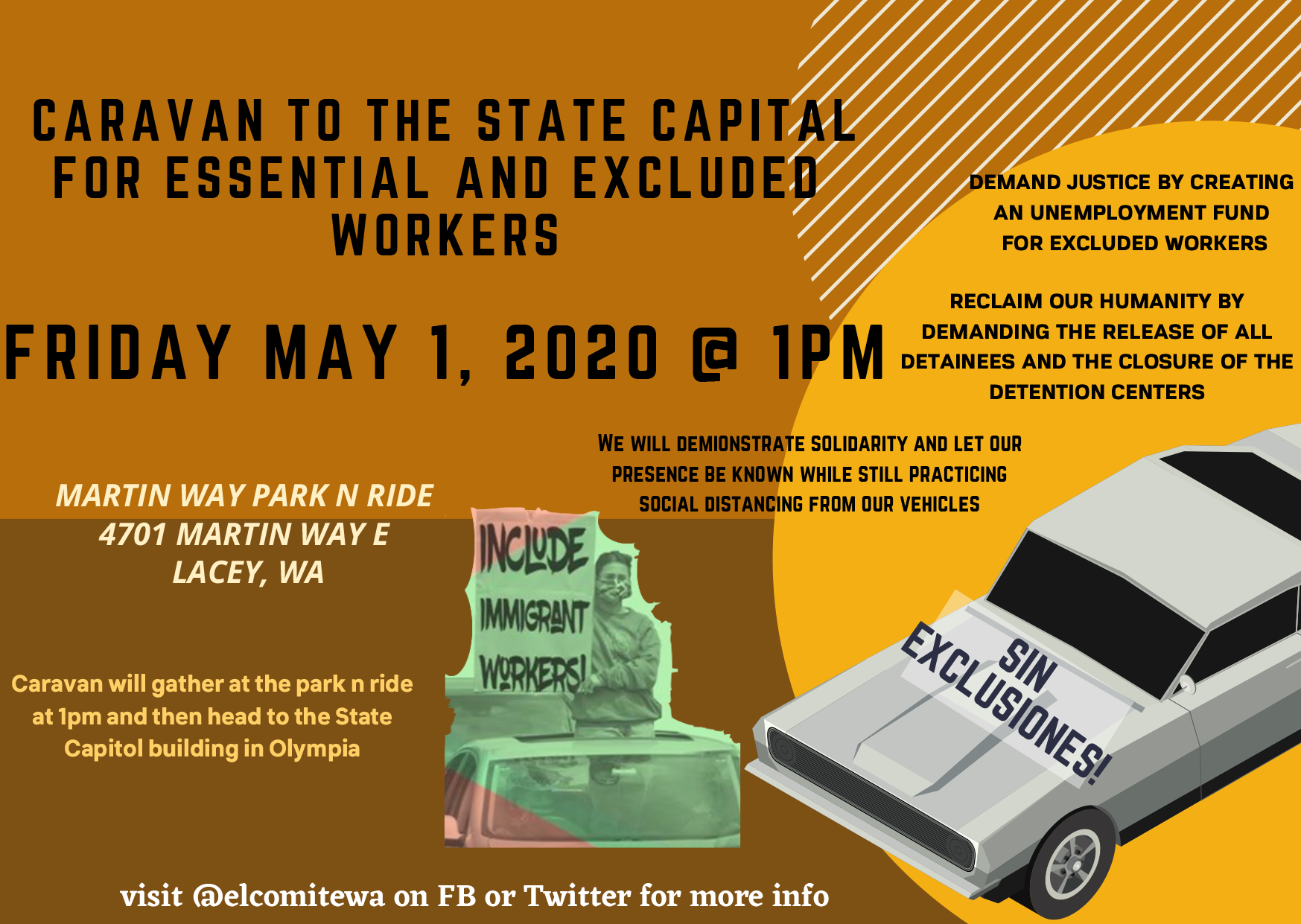
    May 1st is International Workers’ Day, also known as May Day. Migrant Justice and CVIR have joined other immigrant rights groups and unions in protests and job actions across the country. In Vermont, a May Day car rally was called recognizing essential workers for keeping us afloat and supporting demands for universal pandemic relief and safety. While undocumented immigrants work in positions deemed essential, they have not received government stimulus checks.

    May Day originated from the fight of largely immigrant workers for the 8-hour day. As the international workers’ holiday, May Day in the pandemic era takes on new and heightened significance. The coronavirus and the ensuing health and economic crisis flowed quickly out of Wuhan, China following global capitalism’s supply chains, and has rapidly spread to the entire planet. In the United States, rulers have utterly failed to manage the emergency. Workers of all nationalities and immigration statuses must stand united against the nationalist divisions our rulers are eager to promote.

    Through campaigns such as Milk with Dignity or No Más Polimigra, regular people can continue the fight against rightwing nationalists of the Trump Administration and the seeds of fascism in the United States. For every person who would perpetuate the modern-day forms of slavery and the Fugitive Slave Act, there are many more who would work to end them. When everyday people come together to demand better, that is where change is born.

  • In Defense of Bhaskar Sunkara of Jacobin

    In Defense of Bhaskar Sunkara of Jacobin

    Peter Dreier’s vicious attack on Bhaskar Sunkara in The Nation is an embarrassment to that publication. The Nation editors should be ashamed of having allowed Dreier to lambast the editor of Jacobin in such a venomous piece because Sunkara said he would vote for presidential candidate Howie Hawkins of the Green Party in New York, a “safe state” that will go overwhelmingly for the Democratic Party candidate for president.

    In an outburst of bile Dreier wrote that “Sunkara’s stance is self-indulgent—an individual act of virtue signaling rather than part of a collective movement for justice. At its worst, it is a reflection of what one can only view as indifference to real human suffering.”

    Is Dreier so out of touch that he can attribute an individualistic moralism to the person who has built the most important collective voice of the left of his generation? Is Dreier so obtuse that he attributes “an indifference to human suffering” to the publisher and chief editor of the most successful journal on the left today, a publication that relentlessly speaks truth to power and supports the country’s and the world’s underdogs?

    Sunkara’s Jacobin has grown up and come of age with Bernie Sanders’ two campaigns and with the astonishing growth of DSA from 5,000 mostly nominal members to 60,000 young, active members. Many Jacobin writers supported Sanders’ campaign and aligned with those in DSA who said they would not endorse the neoliberal Democrat Joseph Biden. Most DSA members, though they work in the Democratic Party, aim over time to build a new independent political party to the left of the Democrats, so it is not surprising that the Jacobin editor would support a socialist candidate in the Green Party like Hawkins. Nor is it likely to have the disastrous effects that Dreier foresees.

    Sunkara, who is also on the editorial board of New Politics, wrote that he would vote for Hawkins, but he didn’t even suggest that others should. His comment directed to his politically sophisticated Twitter followers, many of them Jacobin readers and DSA members, forms part of the broader discussion of not endorsing Biden, which doesn’t mean that many won’t vote for him. While Sunkara is influential, his admirers are not all fools or blind followers, as Dreier’s diatribe would suggest. Some will agree. some won’t. They’ll consider his remark and they’ll act as they think right.

    Voting for many of us—even those of us who feel it is most important to defeat Trump—is not the only task of the left. As Sunkara wrote quite correctly in my view, “No matter what your individual choice is in November, the political act is to organize on issues like Medicare for All, build orgs, and back downballot candidates supporting the Bernie agenda.” This is the view of most of us in DSA.

    In making such a nasty attack on Sunkara, and then dismissing him so condescendingly—“Sunkara may be a young radical, but he’s old enough to know better.”—Dreier has no doubt alienated many of the most active members of the new generation of leftist activist.

    The Nation should apologize for publishing and Dreier should apologize for writing this uncomradely attack on Sunkara, a mean spirited style of polemic that has no place in either the progressive or the socialist movement.


  • A Zionist State at Any Cost

    A Zionist State at Any Cost

  • Left Politics after Sanders: Think Internationally, Historically and Dialectically

    Left Politics after Sanders: Think Internationally, Historically and Dialectically

    Rally organizes by Brazil’s Party of Socialism & Liberty (PSOL)

    I agree with most of key points in Charlie Post and Ashley Smith’s important New Politics article, “Facing Reality: The Socialist Left, the Sanders Campaign and Our Future.” In the wake of Sanders’ withdrawal from the race, I agree that the left (including DSA) “needs to put most of its energy into rebuilding mass resistance amidst the pandemic and engaging in electoral work when it advances organizing our power from below—something that is impossible within the Democratic Party.”

    As Post and Smith underline, citing Kim Moody’s essential work, “the Democratic Party is a fundraising cabal, run by an unaccountable layer of elected officials who are the conduits for capitalist donations.” As they say, within this framework and in these times, since “the level of class and social struggle, despite the wave of teachers’ strikes, has remained very low,” “Sanders’ program, … while popular, seemed unattainable for the vast majority of working people.”

    I’m afraid however that the article’s diagnosis of the left’s problems is stronger than the alternative they put forward. Yes of course, we should focus on “organizing and supporting the strikes and protests that have ripped out across the country,” and especially “promote the demands and actions of undocumented immigrants, people of color, and people in the global south.” (I would add women, whose organizing around social reproduction issues has been central to the resistance to Trump over the past four years, and trans people and other especially oppressed queers, who are experiencing violence and poverty that Black Lives Matter has insightfully linked to those facing people of color.)

    But social struggles cannot in isolation capture and substitute for the excitement that Sanders’ political campaign generated. Saying that we need to debate “how we can build a new socialist party over the coming years” is too vague. It offers zero guidance about what to do this November, as the frightening prospect looms of Trump’s winning a second term, or more generally about what political action to take. Not many leftists need convincing that Biden is uninspiring; but you can’t effectively fight this year’s lesser evil with some misty vision of a better political alternative in some indefinite future.

    I would argue that the radical left can offer a more credible alternative to lesser-evilism by adding in three dimensions. First, the US left needs to look beyond its own country’s frontiers, at countries where the left has done a better job over the past two decades at building parties to the left of social democracy. Second, it should look critically at the political legacy of past US radical upsurges, particularly at the 1930s/40s and 1960s/70s. Third, it needs to draw on the rich discussions among Marxists over the past half-century about the complex dialectic between social struggle and politics.

    Obviously the US political system poses extreme challenges to the socialist left. On top of the barrier to left third parties posed by the first-past-the-post system (which also exists in, e.g., Britain and Canada), the US has the sad distinction of not having had any even nominally socialist party as a credible electoral contender over the past century. But the US Democratic Party’s complete surrender to neoliberalism and austerity over the past 40 years has not been unique. Not only the British Labour Party under Tony Blair but virtually every mass social democratic party in the world has a comparable sorry record – including responsibility for massive, catastrophic cutbacks to healthcare in the run-up to the Covid-19 pandemic.

    And Sanders’ radical political response to the Democrats’ neoliberal sellout has not been unique either. Several new left parties in different countries have occupied the space opened up by social democracy’s rightward rush. In general, these parties have anti-capitalist programs that are far clearer and more radical than Sanders’ wishful admiration for Denmark as “socialist.” For me, the success of Brazil’s Socialism and Liberty Party (PSOL), Portugal’s Left Bloc, and Denmark’s Red-Green Alliance in growing into major political players have been particularly noteworthy.

    Besides more democratic electoral systems, these new parties may benefit from the historical legacies of their countries’ past struggles, from the Resistance to the Portuguese Revolution to the fight against the Brazilian dictatorship. The US has a different history of struggles. But we should not exaggerate these parties’ continuity with the earlier history of their countries’ workers’ movements. In Portugal, for example, the SP has kept most of its popular base despite its betrayals and the CP despite its sectarianism.

    In many other countries, where the traditional left has massively lost support because of its sellouts, embittered workers have turned more to the far right than the new left. (This is the case in Rotterdam, the city where I live.) The new left parties have much of their base in newer generations that were previously politically unorganized. Something similar might happen in the US.

    Politics has its own dynamic

    I would draw a couple of key lessons from these parties’ experience. First, the Left Bloc and Red-Green Alliance in particular have grown steadily over the years to win about 10% of the electorate without springing from stable, militant, mass social movements. So a period of relative social quiescence doesn’t have to be a period of political impotence for the anti-capitalist left.

    Second, the issues that have catalyzed these parties’ breaks to the left have been diverse and unpredictable. Besides opposition to austerity, the Portuguese Left Bloc, for example, built itself partly through campaigns for abortion rights, immigrants’ rights and drug decriminalization – not exactly the traditional focuses of workers’ movements. In the US, important and inspiring as the Amazon and Target strikes are, the impetus for new political initiatives might come from activism that has more directly apparent political implications, for instance around climate change.

    Third, as Post and Smith would probably expect, these three parties have all felt the tug of institutionalization and had a hard time keeping their centers of gravity outside the electoral arena; but so far they have not played the game of lesser-evil management of capitalism and have not joined capitalist governments.

    Both in Portugal and Denmark, they have had periods when social democratic-led governments were dependent on their parliamentary support, which has enabled them to extract concessions. This has involved some tough tactical choices and compromises (which I would not necessarily always defend) and some fierce internal debates. It has not moved their countries any closer to breaking with capitalism or even with neoliberalism; but so far it has not led to large-scale disillusionment among their voters either, much less turned their parties into graveyards of social movements like the US Democrats.

    The movements in their countries have stayed independent and critical, but at the same time capitalized on victories that these parties have helped wrest from the state by leveraging pressure from the movements. I would argue that this has done more for the movements than just turning their backs on politics would have – and that the US left could learn from these examples.

    So periods without big social upsurges don’t have to be periods of political helplessness for adversaries of capitalism. Are periods with big social upsurges necessarily good for anti-capitalist politics? Unfortunately not. In the US, the 1934 citywide general strikes, the big CIO organizing drives and the 1946 strike wave led to a few promising independent initiatives, but in the end the labor movement was more tightly bound to the Democratic Party than before.

    Again in the 1960s and ‘70s, the big battles against Jim Crow and the Vietnam War led to some promising initiatives like the Peace and Freedom Party, but not to a mass break from the two capitalist parties. Specifically political factors – like the Communist Party’s Popular Front and National Front strategies in the 1930s and ‘40s, and Maoist groups’ sectarianism and rapid rightward shifts in the 1960s and ‘70s – were key to this dismal outcome.

    So building social movements isn’t enough; political arguments and organizing are vital too. The politics of the next upsurge is bound to be marked by an additional half-century of bureaucratization and reformist reflexes, on top of forty-plus years of atomization of the workers’ movement by neoliberalism. In these conditions, the complex organizational and tactical debates of recent decades will have to be dealt with and learned from, in detail and in depth – along with some new ones.

    Luckily socialists can draw on a rich legacy of thinking about politics in the Marxist tradition, going back to Marx and Engels’ time, continuing through the mass and not-so-mass workers’ internationals (Antonio Gramsci’s work especially repays study), and including a period of rich theoretical development from the 1960s into the 1980s.

    In the past, for example, Charlie Post has written about things to be learned from the Greek-French Marxist Nicos Poulantzas’ writings on the state. Poulantzas showed on the one hand that the working class and its allies cannot exercise any power of their own within the capitalist state, but on the other hand that social struggles can fuel conflicts within the state that work out to labor’s advantage. As he wrote in State, Power, Socialism, the state “bathes in struggles that constantly submerge it.”

    Within the state, “various fractions of the power bloc often seek to enlist [the support of the popular masses] against the other fractions,” and these conflicts in the ruling class are “condensed in divisions and contradictions” inside the state. It is a mistake to imagine that the exploited and oppressed can win real power of their own through these conflicts; but equally a mistake to neglect the benefits that the exploited and oppressed can gain from them. New left parties have sometimes shown this in practice.

    Don’t waste your vote!

    Insights like these could be useful to the practice of anti-capitalist politics in the US. Socialists should talk more about how independent politics can be planned and practiced.

    Kim Moody has pointed out that most of the biggest cities in the US are virtual Democratic Party one-party states, where the Republicans are barely serious contenders and the Democrats are the main instrument of local capitalist rule. In San Francisco, the Greens have at times replaced the Republicans as the city’s main opposition party. So why isn’t the radical left mounting more insurgent campaigns in these cities, especially when there are major strikes or other struggles to be built on? This would be a real contribution, now, to building the future socialist party that Post and Smith advocate.

    And what about the national election this November? Leftists are understandably preoccupied with stopping Trump. But Biden is a terribly weak reed to lean on in the fight against the racist far right.

    Particularly in the forty-odd states where either Trump doesn’t stand a chance (California, New York, Massachusetts) or Biden doesn’t stand a chance, a vote by leftists for Biden – up to his knees in the shit of the Iraq war, the destruction of welfare, the growth of mass incarceration, the power plays of Big Pharma and more – is a wasted vote if ever there was one. Especially when there is a clear alternative – presumptive Green candidate Howie Hawkins – who is himself a long-time stalwart of the socialist left.

    Given the groundswell on the left toward a critical vote for Biden, independent-minded socialists may be tempted to soft-pedal this debate. I think that would be a mistake. Of course, we shouldn’t push the debate to the point of alienating our allies in the movements. But neither should we imagine that what people do for a couple of minutes in the privacy of a polling booth is harmless.

    In times of polarization like these, people and especially activists usually don’t keep their voting plans secret. Their declarations that of course they’ll vote for Biden to stop Trump help keep broad social milieus in the Democratic Party’s orbit. Even more serious, movement organizations’ success in delivering votes to Biden will be the currency for years of their quid pro quos with the Democrats: some crumbs for my base, some jobs for my staff, in return for lasting political allegiance.

    For all their imperfections – notably their shallow roots in social movements – the Greens, who explicitly declared themselves anti-capitalist in 2016, offer the clearest possible rebuke to this kind of lesser-evilism. A vote for them is a small but meaningful step in the direction of the future new socialist party. So let’s take and advocate that step.

  • Unity in Israel Means New Low for Palestinians

    Unity in Israel Means New Low for Palestinians

    When the dust settled after the March 2nd Israeli general election, the left found some reason for hope in the fact that once more, Prime Minister Netanyahu’s bloc, led by his Likud party, had fallen just short of a majority with 58 out of 120 seats. While the creation of a government without Netanyahu still seemed unlikely, the COVID-19 epidemic appeared to be shifting the political equation in the Knesset. On March 12, Netanyahu called for the formation of a temporary unity government to respond to the crisis, and opposition leader Benny Gantz of Kahol Lavan responded favorably, endorsing “A government defined as one that fights the virus that does not distinguish between right and left, between religious and secular, and between Jews and Arabs.” Beyond forestalling the disastrous “Deal of the Century,” it looked possible that for the first time ever, the majority-Arab Joint List, the third-largest faction in the Knesset, might be included in government.

    The April 20 announcement of a Zionist-only unity government puts all of those hopes behind us. The Joint List is out. Likud is still in. And after three rounds of elections, the dissolution of three political coalitions, and a veritable constitutional crisis as yet unresolved, the same criminally indicted, authoritarian premier of the last decade will once again maintain his seat.

    The technicalities of who “won” and “lost” the most recent election, however, will be seriously overshadowed by all of the other dramatic ramifications this most recent capitulation of the center is bound to have on the structure of Israeli politics, the legitimacy of Israel’s apartheid “democracy,” and most importantly of all, the lives of Palestinians.

    In regards to the former, the partisan makeup of the Knesset is nearly unrecognizable from before the first round of 2019 elections. Kahol Lavan, a right-wing party masquerading as the representative of the political center, came into being in a meteoric rise to near-power since the beginning of 2019, before dissolving again in a dramatic split when it became clear that Gantz would not keep his promise to refrain from serving in government under an indicted Prime Minister. The far right has shuffled and reshuffled, eventually resulting in 6 seats for the new Yamina coalition without representation of the fascist Otzmah Yehudit in Knesset (though, with Otzmah Yehudit talking points being parotted by Likud members every time an election rolls around, the extent to which this can be considered a victory is limited). But far and away, the greatest impact in this regard will be the transformations on the left.

    On the one hand, The Joint List built on its success in last year’s elections, jumping to 15 seats–an unprecedented representation of non-Zionist parties in the Knesset. Fully 87% of Arab voters cast votes for the Joint List, and Jewish votes for the Joint List more than doubled (though, don’t get too excited–in an Israel where opinion polls show nearly 80% of Jewish residents supporting “preferential treatment” for Jews over Arabs, a doubled Jewish vote for the coalition of Arab parties means around half of one percent of Jewish voters).

    On the other hand, left-wing Zionism, once the hegemonic political force in Israeli politics, is now struggling for any Knesset representation whatsoever in a groundbreakingly right-wing Israel. The liberal and labor Zionist parties, reduced to a single electoral list in the Labor-Gesher-Meretz coalition so as to ensure representation, won only 7 seats in the most recent elections–down from 29 seats prior to 2019. Now, even this paltry showing has dissolved after Labor leader Amir Peretz–who in April 2019 shaved his mustache “so that all of Israel will understand exactly what I’m saying and will be able to read my lips: I won’t sit with Bibi [Netanyahu]”–joined the unity government to promises of a cabinet appointment from Bibi.

    On the right, the institutional changes of this most recent election are largely cosmetic. The replacement of Netanyahu was truly the raison d’etre of the Kahol Lavan coalition; so no doubt, Gantz’s betrayal of that most basic of unifying principles will draw strong condemnations from the segments of his party who have now split off. But the electoral decision between Gantz and Netanyahu was never about choosing between substantively different visions for Israeli society; it was about one segment of an all-Jewish ruling class and its attempt to eject a particularly unseemly, undemocratic leader from another segment of that same ruling class. When all was said and done, a Gantz regime was always going to continue the rightward trajectory of Israeli civil society, deepen the Israeli military stranglehold over the Occupied Territories, and maintain boundaries around political power that disenfranchised Palestinians–in a word, a Gantz regime would fail to break substantively with Netanyahu’s policies. The April agreement on a unity government is simply an absurdist reminder of this fundamental truth: at the end of the day, even allowing for a future breakup of the government, Likud was amenable to trading legislative and administrative appointments to Kahol Lavan in exchange for judicial power (largely over Netanyahu’s trial) because Likud knew they had nothing to fear from a policy standpoint even under a Kahol Lavan-led government.

    On the left, however, this series of elections marks a real turning point. Already, the statements from liberal, US Zionist institutions have begun flying off the presses, pairing optimistic welcoming of the unity government with cautious appeals to maintain the two-state solution by refraining from annexation of settlements. Such appeals are meaningless, however, when the unity agreement has already approved a path toward annexation starting as early as July 1st, and even the more principled anti-annexation forces have begun to defect to the pro-annexation government. Liberal Zionism in Israel is dead; in its place is a fervently pro-apartheid, genocidal center on the one hand, and on the other, the only hope there has ever been for a resolution to the Palestine problem: a progressive and radical grassroots movement led by Palestinians for the protection of their democratic and human rights.

    The prospects of the latter are bleak. Any hope of a far-off, mythical two-state solution is scheduled to vanish on July 1st with the annexation of an unspecified amount of settled Palestinian land. When that happens, the terms that have defined the last 50 years of negotiations in Israel/Palestine will have been officially overturned: the promise of “land for peace” will have lost its basis. The peace process will have failed to make way for a Palestinian state. And the parliamentary route to anything resembling self-determination outside of bantustans has now, once again, been rejected by a Zionist political establishment that maintains an immovable red line around Arab participation in government, knowing that any ground given to independent Palestinian political activity is potential territory lost in the ongoing war on Palestinian lives, livelihoods, and land. In that context–with no hope of either a diplomatic or democratic road to Palestinian self-determination–mass disruption of life across historic Palestine will be not only the last resort for saving a set of politics; it will be the rational course of action for a people being threatened with genocide.

    For some, this will mean a turn to armed resistance; indeed, the first apparent act of retaliation already transpired on Wednesday when a 25-year-old Palestinian man attacked an Israeli checkpoint outside of occupied East Jerusalem and was killed by Israeli police. No doubt, there will be others like him; the Israeli government has burned the proverbial ballot in Palestine, and left only plenty of bullets. The blood that is sure to be spilled in the coming months, both Palestinian and Israeli, will be on that government’s hands.

  • An Evil King Rules an Afflicted Land: Coronavirus and the Depression in America

    An Evil King Rules an Afflicted Land: Coronavirus and the Depression in America

    This article was written for L’Anticapitaliste, la revue, the monthly journal of the New Anticapitalist Party (NPA) of France.

    We in America live in what resembles some medieval fairy tale. An evil and maniacal king rules the plague stricken land. The wicked lords in the corrupt parliament rob the public coffers to enrich their cronies. The tribunes of the people, mostly venal and foolish, are alternately deceived or suborned by the King and the lords. Meanwhile many people are sick and many dying. The bodies pile up. The soothsayers blame it on the foreigners and plan pogroms. The mills have stopped; the inns and taverns have closed. Peasants rebel here and there but the plague prevents a general rebellion. Word has it the situation is the same in neighboring kingdoms all around.

    That’s a fairy tale of course. What’s the reality? The United States now has nearly one million coronavirus cases and 50,000 deaths, more of both than any country in the world. We have an unemployment rate of 20 percent, the highest since the Great Depression of the 1930s. The two together represent what is perhaps the greatest crisis in American history, an absolutely unprecedented event: a catastrophe. And it may only have just begun.

    As the coronavirus has swept across the country bringing illness to hundreds of thousands and killing tens of thousands, Americans have been shocked by the failure of government, business, and the health system. As the number of sick mounted, there were not enough hospitals, not enough hospital beds, not enough ICUs, not enough ventilators. Hospital personnel have lacked gowns, masks, and respirators. As hospital workers fall sick or die there are not enough health workers to replace them. Some seven thousand elderly died in private nursing homes. The disease is now rampant in prisons. It is rife in meat packing plants, with 725 cases at the Smithfield plant in South Dakota. Twenty-six U.S. Navy ships have crews with coronavirus, including 850 sick on the huge 5,000-crewmember U.S.S. Roosevelt. Everywhere essential workers—bus drivers, garbage collectors, grocery cashiers, delivery workers—became sick and many have died, and neither business nor the governments that regulate these companies acted quickly to save them.

    And as the health crisis made it necessary to close businesses, a Second Great Depression has ensued. Twenty-six million lost their jobs in four months. Then the state unemployment services failed. Tens of thousands have found it impossible to get their unemployment payments. And now the state unemployment trust funds are going broke. In cities across the country lines of cars miles long wait to get a box of groceries from a volunteer food bank. One third of renters in the country could not pay their rent last month. Schools closed, but distant learning proved difficult because only some families had computers, so education has also broken down for many. The United States gives the impression of a failing state and society, one that cannot protect or help its people. Anxiety has gripped much of the society and some, either in hazardous jobs or with no jobs and income, have fallen into despair.

    State, county, and city governments, which are no longer getting taxes from the closed businesses, find themselves in a fiscal crisis and they will soon be forced to lay off public employees. Yet so far the federal government has not provided aid to the states. Republican Senate leader Mitch McConnell has suggested that states should file for bankruptcy, a procedure that would be devastating for state workers’ pension plans.

    There is now a widespread perception that the American government has putrefied, like the government’s emergency stores of ventilators that did not work, defective test kits, and rotten masks. Americans have been shocked to learn that other countries, like Taiwan, South Korea, and Vietnam proved more effective than the United States in containing the virus and preventing its spread. Americans were once proud to shout, “We’re number one.” Now we’re number one in coronavirus and economic collapse. The sense of governmental and business failure, still spreading with the virus across the country, must be having a significant impact on the American people’s consciousness, though it is still too early to know what this means for the future.

    Everywhere capitalism and America’s conservative and corrupt political system have made it more difficult to fight the pandemic. In the United States, there is no national health care system and no national health insurance for all. There are federal health agencies, fifty state health departments, 900 health insurance companies, hundreds of pharmaceutical companies, more than 20,000 pharmacies, hundreds of hospital equipment manufacturers and supply companies. There are 6,000 hospitals, some for profit, some not-for-profit, some run by the government. Heads of regulatory agencies, usually former corporate executives, oversee the competition and the search for profits that dominate this vast industry. There is little coordination and consequently, there has been no unified response to the pandemic as the federal government provided only weak recommendations and state governors and hundreds of health corporations did whatever they wished, while individuals struggled with the multiple bureaucracies of the health system.

    Trump: Guilty of Negligent Homicide

    President Donald Trump’s delays, misinformation, and wild ravings contradicting epidemiologists and physicians have contributed to the health disaster and now threaten to unleash a second wave of infection. After coronavirus cases had been identified in China and other countries, Trump failed to take action, with the exception of the limited travel ban on China on January 31. He said at the end of January, “We have it completely under control.” In mid-February Trump said,  “Looks like by April, you know, in theory, when it gets a little warmer, it miraculously goes away.” Even after what was then thought to be the first coronavirus death in the United States on February 17, Trump continued to minimize the epidemic, saying on February 19, “I think the numbers are going to get progressively better as we go along.” He claimed falsely on February 26, “We’re going very substantially down, not up.” In early March he claimed that coronavirus would be much milder than the flu. And in April he continued to give misleading information about the disease, about ventilators, about treatments, and about the development of vaccines. For weeks Trump recommended contrary to medical evidence that hydroxychloroquine, a malaria treatment, could be used to treat Covid-19. Most recently Trump suggested an injection of disinfectant into the lungs, which would be fatal. Trump should be held responsible for manslaughter, for the tens of thousands of deaths that might have been prevented had it not been for his negligent homicide.

    The pandemic was not a bolt out of the blue. U.S. intelligence agencies, the Centers for Disease Control (CDC), the out-going Obama administration, Trump’s own Department of Health and Human Services, and other government agencies had not only predicted that the country would experience a pandemic, they had practiced for it. A report on one pandemic practice described the mock response as “chaotic.” When the coronavirus became a pandemic, the American government was completely unprepared. Trump had cut the budgets of the CDC and of the National Institutes of Health. Most important, for 70 days Trump failed to take the kind of action that had been foreseen and advised: establishing social distancing policies, carrying out testing, and doing contact tracing. Having failed to stop the initial spread, mitigation came too late, leading New York City to become the international epicenter of the disease.

    As the country fell to its knees, Trump’s administration through Secretary of the Treasury Steven Mnuchin, Republican leader of the Senate, Mitch McConnell and the Democratic Party leader of the House of Representatives, Nancy Pelosi, succeeded in getting the U.S. Congress to pass three relief measures totaling almost three trillion dollars offering loans and grants to businesses and hospitals, and payments to workers. The promise to help small businesses proved false as much of that money went to large, financially sound corporations and not to medium and small businesses. The government made the loans available through banks, which helped large companies with credit and connections while harming small, financially weak companies. There were also huge tax breaks for the rich in the relief packages.

    The federal government’s assistance to workers will only tide them over for a few months. Most workers in addition to their unemployment checks are receiving a one-time payment of $1,200, with an additional $500 per child as well as $600 each week until July 31. Many workers will not be eligible, especially undocumented workers who do not quality for federal aid. The state of California is allocating $75 million for the undocumented immigrant who pay $3 billion in California state and local taxes every year.

    The Situation of the Working Class

    American workers have been affected by the coronavirus in quite different ways. It is estimated that about 29 percent of all American workers have been able to work from home; this includes many technical and professional employees, engineers, architects, professors and teachers. About 26 million workers or 20 percent of the American workforce has been laid off. Millions of essential workers continue to perform their duties often risking exposure to coronavirus from coworkers, the public, or passengers on public transportation.

    Economic and racial inequality is also evident. A higher proportion of blacks and Latinos have become sick and died. In Chicago black people make 32 percent of the population, but they make up 72 percent of the coronavirus deaths. In New York both blacks and Latinos are dying at twice the rate of whites. This is largely due to underlying conditions–high blood pressure, diabetes, and respiratory disease–but also to working in essential jobs as well as lack of health care and overcrowded housing.

    Racism appears everywhere in this crisis. Asian Americans have experienced verbal abuse and violent attacks as the bearers of what Trump called the “Chinese virus.” Trump closed the border to asylum seekers and has now ordered that for sixty days the government will issue no green cards, which grant immigrants permanent residency and the right to work in the United States.

    The pandemic also disproportionately affects women. Many are homecare workers, nursing home workers and other low-wage caregivers with less protection. Women make up 87% of registered nurses and 71% of cashiers. There is also concern that under stay-at-home orders women are experiencing more domestic violence. At the same time, conservative officials in Ohio, Mississippi, and Texas have declared abortions to be “non-essential” and have suspended the procedure during the coronavirus pandemic. The courts have overruled some of those orders.

    Workers have engaged in protests and strikes in various industries across the United States. Nurses, demanding better protection, have held both local demonstrations and a coordinated national demonstration organized with the assistance of the labor education center Labor Notes on April 15. There have also been over 100 strikes at various workplaces from shipyards, to warehouses, to grocery stores. In Vermont University workers organized a petition campaign and a car caravan and fought successfully to prevent the closing of three out of four of the state’s college campuses. Amazon workers have organized a series of protests and walkouts.

    The Drive to Reopen the Economy

    While the United States coronavirus outbreak peaked two weeks ago, many states have not yet reached their peaks, yet some are considering ending social distancing and permitting the reopening of businesses. Republican governors in Georgia, South Carolina, and Tennessee have called for reopening their states within days. Public health experts argue that states should not attempt to reopen their economies until there is adequate testing, contact tracing, isolation and monitoring. At present no state has adequate testing and contract tracing is far beyond the capacity of state health departments. If states do reopen their economies, many health experts think that we can expect a second wave of the virus with more illness and deaths. And that would mean closing businesses again. No vaccine is likely to be discovered, tested, mass produced and distributed to tens of millions in less than 18 months. Covid-19 and the flu could wreak havoc in the fall. Some health experts say that social distancing will have to continue until 2022.

    Thunder on the Right and Lightening on the Left

    Far right groups in almost half of the fifty states have organized protests demanding that states reopen business. Those pushing for ending restrictions and reopening the society include businesspeople, Republican politicians, some Evangelical churches, anti-vaccination groups, and right-wing organizations from armed militias to political organizations such as Freedom Works, Tea Party Patriots, and Save Our Country, as well as white nationalists like the Proud Boys and The Patriot Front. Many of these groups have ties to the Republican Party, to the White House, and to the Trump campaign. Trump has tweeted support for the protests. Some of the demonstrations have violated state social distancing orders and others have included men carrying guns. Protesters wear “Make America Great Again” caps, carry American flags, hold up posters Trump’s name, or signs saying things like “Live Free or Die.” Some in these protests believe that the pandemic is a hoax, others think it was a plot by the Chinese, some claim to have the cure. Ironically those in the demonstrations stand close to one another without masks and may be endangering themselves and others. These demonstrations of hundreds or at most a few thousand do not represent more than the small minority of 12 percent of all Americans who, according to polls, want restrictions ended.

    The American left has no political party and therefore little voice and less weight in Congress. The Democratic Party’s Progressive Caucus pushes for more money for small business and workers, but does not have great impact. Alexandria Ocasio-Cortez, a member of that caucus, whose district is in the “epicenter of the epicenter” and who is seen by many as the potential successor to Bernie Sanders, was the only Democrat to vote against the second stimulus bill with its gifts to business, and she is calling for a freeze on rents.

    The Democratic Socialists of America (DSA), the country’s largest socialist organization with 60,000 members, had endorsed Sanders but will not endorse Joe Biden, though many can be expected to vote for him. DSA and others on the left are involved in mutual aid projects and in worker organizing as well as social movements. DSA has formed an alliance with Labor Notes and with the small United Electrical Workers Union (UE) and has been working with nurses, teachers, truck drivers and warehouse workers. The left is also engaged in work around immigrant rights. The struggle goes on.

  • Coronavirus, Crisis, and Socialist Perspectives

    Coronavirus, Crisis, and Socialist Perspectives

    Our world is drifting toward barbarism. We are faced with two interacting crises of the capitalist system—the global pandemic and global recession. The combination will have a devastating impact on the lives of workers and oppressed people, especially in the Global South.

    At the same time, these crises are radicalizing people’s consciousness, splitting an already polarized society more deeply between an emerging socialist left and populist far right. On our side, essential workers have staged a wave of strikes and walkouts amidst the pandemic, and the desperate conditions we have been thrust into is storing up anger that will explode in even more radical struggles in the coming years.

    On the other side, the right has staged a wave of reactionary protests, bankrolled by a small section of capitalists. The combination of these forces could morph into a fascist movement to put down an insurgent working class. Bloomberg News is so afraid of threats from the left and right that they are counseling the ruling classes of the world to grant some limited reforms to fend off both.

    Otherwise, they warn, “behind the doors of quarantined households, in the lengthening lines of soup kitchens, in prisons and slums and refugee camps — wherever people were hungry, sick and worried even before the outbreak — tragedy and trauma are building up. One way or another, these pressures will erupt…. In time, these passions could become new populist or radical movements, intent on sweeping aside whatever ancien regime they define as the enemy.”

    Capitalism has failed humanity. It cannot function today without risking the lives of workers in the short term and, amidst global climate change, threatening the habitability of whole sections of the planet in the long term. Socialist politics and organization are essential now more than ever before. If the socialist left does not build a practical alternative—based on struggle—the far right could be the big beneficiary of the crisis.  We are thus in the fight of our lives and for our lives.

    Mainstream Misdirection

    Many mainstream commentators tell themselves a comforting fable about the crisis. They portray the virus as an “exogenous” cause of tipping an otherwise healthy global economy into recession. They are wrong for two reasons. First, capitalism created the conditions for the pandemic to begin with.

    As Rob Wallace argues in Big Farms Make Big Flu, capitalist states and corporations internationalized agribusiness, establishing industrial farms in closer and closer proximity to previously isolated ecosystems. These farms enable viruses to jump from wild animals to poultry and pig farming and thereby into human society.

    Moreover, as Kim Moody shows, global capitalism has so interconnected the world that it quickly transforms what previously would have been local outbreaks into global pandemics. The viruses travel the circuits of capitalist production, distribution, and consumption into every corner of the world.

    Second, the mainstream commentators are wrong to claim that the pandemic caused the recession. In reality, the global economy was headed for a crisis well before the virus struck. The advanced capitalist economies were all slowing or stagnant from China to the US, EU and Japan. All these states had been intervening with increasing intensity to maintain their sputtering growth at the tail end of a long weak recovery from the Great Recession.

    In the US, for example, Trump had cut taxes in the hopes of sustaining the expansion, and even that was failing to do the job. So, the Federal Reserve intervened at the end of last year, cutting interest rates three times to fend off fears of a new recession. Outside the developed world, the Global South was already in a crisis. Argentina’s economy, for example, was in free fall.

    The giant stock market run of the last decade, which lulled politicians and the media into a false sense of economic security, proved to a be great speculative bubble completely out of all proportion with a stagnant real economy. Many economists even before the pandemic were, therefore, concerned that both US and world economies were at the end of the business cycle and a downturn was coming. The pandemic was thus the trigger, not the cause, of the global recession.

    Roots of Global Slump

    The roots of this crisis lie in the mechanisms used by the ruling class to get out of the last crisis—the financial crash of 2008 and the Great Recession that followed. These were caused by problems built up during the long neoliberal boom from 1982 to 2007 that had tripled the size of the world economy.

    The expansion produced a classic crisis of overproduction—too many factories were producing too many goods that capitalists could not sell at high enough profit rates. In search of more profitable outlets, capitalists turned to increasingly speculative investment, triggering the growth of a sequence of bubbles—most notably the dot com bubble at the end of the 1990s and then the fateful housing bubble in the 2000s.

    When that popped in 2007 it triggered the financial crisis and recession. The ruling classes coordinated an international intervention by governments and state banks to stave off economic collapse. They bailed out the banks and corporations and cut interest rates to zero.

    They poured trillions of dollars into the economy in the process. While they saved the system, their actions stored up new problems. They breathed life into unprofitable so-called “zombie corporations,” which are so in debt that they can only service their loans without any hope of ever paying them off. These comprise a whopping 13 percent of all companies.

    And healthy companies did not use the loans to invest in new plant and machinery, which was not profitable. Instead they bought back their own stocks to drive up their share prices, passing the rewards on to the wealthy. Airlines, for example, spent $45 billion on buybacks—almost the same amount as the $50 billion offered to them in the new bailout from the Trump administration.

    As a result, the real economy has been sluggish, trapped in what David McNally calls a long-term global slump, even as the stock markets soared to stratospheric heights. Even more worrisome, all of this was premised on massive state and corporate debt. Globally it exploded by $72 trillion over the last decade to an almost unbelievable $244 trillion, over three times the size of global GDP, and that was “achieved” before the pandemic, recession, and massive bailout packages.

    Throughout the long weak recovery, the ruling classes imposed deep austerity measures on the working classes, leading in the US to a lost decade for workers of stagnant wages, credit card debt, and student debt. Predictably, the ruling classes and their states turned at the very same time to intense attacks on oppressed groups, from Muslims to women and especially migrants, to keep workers divided each from the other.

    The Contradiction Between Capitalism and Life

    The global economy was thus poised for crisis, but the pandemic has made it an even deeper one. Capitalist states have been forced to shut down their economies to stop the spread of the virus out of fear of sickening their own workforce and overwhelming their dilapidated healthcare systems.

    Capitalism has proved itself incompatible with life. Nowhere is this clearer than in Haiti, a country impoverished by imperialism and where multinational capital exploits desperately poor people in sweatshops. The Haitian state and local bosses initially closed these after the pandemic struck, but under pressure from their global bosses, they have begun to reopen them.

    Why? Because the bosses want their products and also workers are desperate for money to feed themselves, even if that means risking contracting the virus, sickening and dying.  As one local boss put it, “the question was whether to die of hunger or coronavirus.”

    Elsewhere capitalists and their states have been more cautious. They know that if they reopen their economies, they risk killing their own workers. But, if they keep them closed for too long, they risk the collapse of the economy. Their solution to this profound contradiction has been to keep only essential production and services open—some industrial production, agribusiness, logistics, grocery stores, and some private and government services.

    But even this partial closure has devastated global production and consumption. It has also triggered financial crises and stock market crashes throughout the world. Their hope is to return to production carefully and with widespread testing.

    States to the Rescue

    In the meantime, capitalist states have been forced into immediate and dramatic action to confront these two intersecting crises. Most, including China, bungled their initial response to the virus, leading to mass unnecessary deaths throughout the world. The exceptions were a handful of states like South Korea and, of course, Cuba, which has again deployed its doctors and nurses throughout the world to respond to the catastrophe.

    Trump catastrophically mishandled it in the US. Only Jair Bolsonaro in Brazil and Boris Johnson in Britain come even close to his callousness and incompetence. Trump and the CDC are responsible for the wave of infections, hospitalizations, and deaths throughout the country. Trump not only refused to listen to repeated warnings about the likelihood of a pandemic, but he also cut the program to prepare for one.

    When faced with the coronavirus, he initially dismissed it as fake news. The CDC then botched the test which if rushed out properly could have enabled the government to contain its spread as in South Korea. And once the virus started ripping through the country, Trump proved completely incapable of organizing the government to respond coherently, balking at using the Defense Production Act, preferring to rely on corporations themselves to handle it, and when they didn’t, scapegoating everyone from the CDC to governors and the WHO instead of taking responsibility for the disaster and changing course.

    As Trump staged reelection events masquerading as press briefings while over 40,000 bodies piled up in morgues, the Federal Reserve Bank swung into decisive action. They poured trillions of dollars into financial markets to prevent the collapse of the banking system and buoy the stock market. As the scale of the economic collapse and its skyrocketing unemployment became clear, Trump and Congress united behind a $2.2 trillion bailout of corporations with more packages to come.

    While Bernie Sanders and other Democrats did slip in some important concessions for workers, such as emergency checks and increased unemployment, the vast bulk of the bailout was still slated for corporations. Yet again, the banks and corporations got bailed out, while we got sold out.

    Record Debt and Deficit Guarantee Unprecedented Austerity

    Trump, corporate executives, and some mainstream economists are hoping for a sharp recovery once the pandemic is over. There are two problems with their prediction. First, it is not at all clear when the pandemic will end and the states can open up their economies.

    Until scientists come up with a vaccine, restarting business will risk a new round of outbreaks and shutdowns. We are likely therefore to have stops and starts of some distorted kind of “business as usual.”

    Second, they wrongly assume that they had a healthy economy to restart, and they underestimate the damage the recession and shutdown has already done. Remember, the economy was on the precipice of a recession already because of its underlying problems.

    The recession will only compound these problems in several ways. A wave of bankruptcies will wipe out many of the zombie corporations as well as many small businesses, especially restaurants, which survive on the slimmest of margins. Many are likely to go bankrupt and never reopen. Many colleges and universities are likely to shut down less lucrative parts of their operations, or go belly up.

    But, because the advanced capitalist states intervened so decisively to save various big monopolies, they will prevent capitalist crisis from clearing out the over-accumulated means of production and unprofitable surplus production. So even when a recovery comes, which at some point it will, it is unlikely to bounce back sharply to even the weak growth before the crisis.

    As a result, Michael Roberts argues, we are certainly not going to experience a “V” shaped recovery—a sharp drop followed by a quick restoration of growth. Rather, we are likely to see an “L” shaped one, with the economy managing only an extended period of growth even weaker than seen in the last decade.

    And even then, it will be saddled with problems of sovereign and corporate debt. In the US, for example, the federal government will have record debts and deficits, and so will most states and cities, as a result of bailout and decreased tax revenue. That will compel them to ram through vicious austerity measures, guaranteeing high rates of unemployment, lower wages, and therefore weak consumer demand.

    As a result, Edward Luce, argues in The Financial Times, “the US economy is already in depression. Nothing on this scale — and at this speed — has been seen since the Great Depression in the early 1930s. It took the second world war to dig the US out of that. It will take a vaccine, or a miracle prophylactic, to stop America’s first depression in almost a century.”

    All the main centers of capital accumulation will suffer similar problems, including China. Its central government, provinces, banks and corporations were already shackled with debt before the economic crisis. As a result, Beijing will be reluctant to engage in massive deficit spending to invest internally as it did after the Great Recession, and its exports will be hammered by the drop of demand for products from the rest of the world.

    We’re NOT in This Together

    Not everyone will equally suffer the consequences of this global crisis. Contrary to the endless claims recycled by corporations and their media, we are NOT in this together. The ruling class in the US has insulated itself from the impact of the epidemic, fleeing to their second or third homes in the Hamptons, while the rest of us either are forced to continue working and dying, or huddle in overcrowded homes and apartments.

    And within the working class, Black, Latinx, undocumented workers, and women suffer in disproportionate numbers. The disparities are shocking. For example, in Chicago, where African Americans comprise 30 percent of the population, they comprise 70 percent of the deaths from COVID-19.

    The bosses are squeezing essential workers to work longer and harder, and in most cases for no more money and in life risking conditions. They often lack Personal Protective Equipment and do not receive paid overtime or hazard pay, while many lack health insurance.

    The rest of the working class has been furloughed, forced to work from home, or laid off. The numbers are staggering: at latest count over 26 million have applied for unemployment, and some estimate that unemployment stands at 20 percent and could rise to 30 percent this summer.

    Those that have lost their jobs have also lost their health insurance, if they ever had it. And they face bills they can’t afford, from rent to mortgages, homes student loans, and food. In a symbol of the catastrophe in working class life over 10,000 cars recently lined up in San Antonio to pick up groceries from a food bank.

    The Trump checks and the increase in unemployment insurance may soften these blows at least temporarily. But not for undocumented workers, who have been excluded from all these benefits because they are only granted to citizens and documented migrants. That exclusion was upheld by both parties, including the ridiculously overpraised governor of New YorkAndrew Cuomo.

    Such conditions will likely persist if not worsen after the pandemic recedes and the states and corporations impose their austerity measures, shuttering some of their operations, cutting their workforces, ripping up union contracts, and forcing those who have jobs to work longer and harder for less money. We are thus faced with conditions not seen since the 1930s.

    Catastrophe in the Global South

    And that is the richest country in human history. In the Global South, workers and peasants face far more dire prospects. The US, other imperialist powers, and their international financial institutions have created socio-economic conditions that will make the impact of the pandemic and recession apocalyptic.

    Over the last few decades, they imposed structural adjustment programs on underdeveloped states that pried them open to global capitalism while increasing their reliance on extractive and export industries as well as tourism, privatized national industries, flooded their markets with multinational agribusiness produce that undermined peasant farming, cut workers’ wages and benefits, and wrecked their welfare states, especially healthcare systems. All of this made untold numbers of workers and peasants “surplus” to capitalism, forcing them to live in the shantytowns so vividly described by Mike Davis in Planet of Slums.

    The pandemic will devastate these societies. People in slums have no recourse to social distancing, lack basic healthcare, and don’t even have access to clean water to wash their hands. For example, Haiti, which has suffered a whole sequence of US-backed coups, occupations, and structural adjustment programs, has only 64 ventilators for a population of 11 million.

    The recession will do great damage to the lives of those who survive the pandemic. The Global South faces what The Financial Times calls an impending economic calamity. Its export markets for products like textiles and raw materials have already dried up, tourism has ground to an abrupt halt, and international investors have fled in droves for the “safety” of the US markets, bonds, and the dollar.

    Sharpening Conflict and Rivalries in the State System

    As the twin crises wreak havoc within states around the world, it has also stoked up conflict between states, signaling a profound reshaping of the world order. Since the end of the Cold War the US has superintended the state system as an unrivaled power, using its unparalleled economic, military, and geopolitical power to enforce free trade globalization.

    Even before the pandemic and recession hit, that neoliberal order was in jeopardy. The US had suffered relative decline, China had risen as a rival, and globalization had stalled. Now that order seems to have hit a terminal crisis. Unlike after the last Great Recession, faced with a new and even more profound crisis, the US is not compelling other states to implement a unified strategy.

    Instead, we are witnessing spiraling conflicts between states, and corporations considering restructuring their supply chains in accordance with their home state’s alliance structures. Conflicts between imperialist powers, between imperialist powers and regional ones, and between imperialist powers and oppressed nations are multiplying.

    Trump has doubled down on his new Cold War with China, trying to deflect blame for his complete mishandling of the crisis, whipping up anti-Asian racism and encouraging further decoupling of US multinationals from China. His secretary of state Mike Pompeo has dabbled in bizarre conspiracy theories alleging that a Chinese lab created the virus, leading some of Trump’s proto-fascist supporters to accuse China of unleashing the virus to weaken the US.

    For its part, China also bungled its initial response to the virus. It at first suppressed information about the outbreak, but then used authoritarian means to effectively suppress the virus. After that success, it has tried to flip the script about its failure by deploying its massive economic capacity to send tests, masks, and ventilators to countries in need.

    It aims to bolster its soft power in the world, presenting itself as an alternative to the US. All of this has intensified the rivalry between the US and China. In an ominous sign of possible conflicts ahead, Trump just ratcheted up the US naval presence in the South China Sea.

    As The New York Times reports, “The America, an amphibious assault ship, and the Bunker Hill, a guided missile cruiser, entered contested waters off Malaysia. At the same time, a Chinese government ship in the area has for days been tailing a Malaysian state oil company ship carrying out exploratory drilling. Chinese and Australian warships have also powered into nearby waters, according to the defense experts.”

    The economic crisis has similarly sharpened conflicts between other states, each angling to protect their slice of the world system. For example, the US, Saudi Arabia and Russia have been locked in a battle for dominance in the oil and natural gas industry.

    Saudi Arabia took advantage of the crisis to try and bury their American and Russian competition by ramping up production and further driving down already low prices. While the states recently cut a deal, it was too little too late. They had overproduced oil that now amidst the pandemic and recession has no buyers and consumers, leading prices for oil futures in the US to drop below zero for the first time ever.

    Finally, the US as well as other imperialist powers have intensified pressure against regional rivals and doubled down on attacks on oppressed nations and peoples. For instance, Trump has maintained lethal sanctions against Iran, denying the country medical supplies as deaths from COVID-19 spiraled out of control, and maintained similar sanctions against Venezuela. And the US and Israel continue to strangle occupied Palestine even amidst the pandemic.

    Resistance Amidst the Pandemic

    While our rulers scramble to save their system at our expense—including our very lives—workers and oppressed people have started to resist. These new shoots of struggle are developing after a year of mass strikes throughout the world system. People have risen up from the Middle East to Latin America and Hong Kong. Feminist strikes and climate strikes have shaken societies throughout the world.

    In general, these mass actions may retreat during the pandemic, but they will likely surge again when its safe for people to return to protests, and they will grow more intense with any economic recovery. The international pattern will likely be the case in the US.

    At the same time, though, the pandemic has actually triggered an unprecedented wave of workplace actions and strikes among essential workers, whether they are unionized or not. They have been forced to fight to protect their own health and that of their co-workers and families.

    Teachers threatened a sick out in New York City to force Mayor Bill de Blasio to close the schools. Nurses have staged actions throughout the country demanding Personal Protective Equipment (PPE). Workers at grocery stores, Amazon, and meat packing plants have also taken direct action demanding everything from PPE to paid overtime, hazard pay, and temporary closure of their facilities for cleaning.

    Those furloughed or laid off have been stirred to form organizations to threaten rent strikes, demand suspension of their debts, and organize mutual aid to help their fellow workers survive. Already, some are talking about forming unemployed councils similar to those pioneered by the Communist Party in 1930s.

    Oppressed people have also agitated for their rights against the discrimination intensified by the pandemic and recession. Women, who are disproportionately categorized as essential workers, have been at the forefront of on the job actions and have fought to protect their abortion rights threatened with suspension as non-essential healthcare amidst the crisis.

    Undocumented workers have staged protests across for their rights and wages on the job as essential workers, while those who have lost their jobs have challenged their exclusion due to immigration status from unemployment and emergency checks granted other workers. And Black activists have called attention to the vicious racist disparities in contraction of COVID-19.

    Evils at the Ballot Box and Polarization in Society

    Tragically, in the presidential election we will have no one to vote for who represents these struggles and demands. The Democrats blocked the only candidate that would have trumpeted them—Bernie Sanders. The party’s capitalist donors, party establishment, and bourgeois media won the argument that his program was “unrealistic” and that he was “unelectable,” enabling Joe Biden—perhaps the weakest candidate in living memory—to easily defeat him.

    As a result, we now face the classic dilemma of an election between lesser and greater evils—the capitalist establishment’s candidate, Biden, and bigot in chief Trump. Those of us in DSA have to uphold the “Bernie or Bust” resolution passed at the Convention, and, regardless of what anyone does in the ballot box, we should spend no time, money, or energy on campaigning for Biden.

    We are going to have to fight whichever one of them wins the election. Both will be forced to impose austerity measures on workers and will deflect attention for that by scapegoating oppressed peoples. And both will be forced into sharper confrontations with other states in the world system.

    Each evil presents different dangers. If Trump wins, he will double down on his white supremacist nationalist program with even more vicious attacks on workers and the oppressed, and if he enacts any reforms, such as an infrastructure jobs program, they will exclude undocumented workers.

    If Biden wins, the danger is that the left, workers, and oppressed groups, relieved that Trump is gone and mistakenly believing that we have a friend we can rely on in the White House, will grant him a honeymoon. In that case, Biden and the Democrats will adapt to the Republican right, as Obama and Clinton did during their terms in office.

    And if either does propose reforms that address the real problems workers and oppressed people face, instead of just supporting them uncritically, socialists should agitate for funding the expansion by taxing the rich and cutting military budgets. For example, any infrastructure jobs programs should be unionized, should include undocumented workers, and should be in accordance with the stipulations of the Green New Deal and not deepen the hold of fossil capitalism.

    One thing is for certain, regardless of the outcome of the election: the far right will grow. With Trump in office they will get the green light for their bigoted program and organizing. Just as frightening, if Biden wins and the left hesitates to fight him, the right will seize the opening as the only critics of the Democrats in office, just as they did under Obama through the Tea Party mobilizations.

    Amidst this new crisis, the far right could easily morph into a fascist movement in the US and internationally. The petty bourgeoisie of small business owners and middle management, which are the social base of fascism, will be driven into a frenzy by fears of bankruptcy and job losses.

    So, while the initial demonstrations by these forces to open up the economy have been absurd in slogans (e.g. “Don’t Cancel My Golf Season” and “Give Me Liberty or Give Me COVID-19”) and small in size, no one on the left should underestimate their potential to grow, tap into unemployed workers’ fears, and redirect them into racism and xenophobia. The left will have to prepare to engage in more anti-fascist struggles in the coming period, directly confronting them in the streets and providing an alternative program to win people to progressive solutions.

    Reorienting on Struggle and Independent Politics

    Faced with pandemic and global recession, socialists must make a sharp reorientation toward building class and social struggle. As Andy Sernatinger has argued,  DSA and indeed most socialists have subordinated such organizing to electoral campaigns especially Sanders’ run for the Democratic Party nomination.

    Already socialists have begun this reorientation by organizing struggle amidst the pandemic and recession. The entire left—regardless of their positions on the Sanders campaign—should unite in these efforts as our top priority. These struggles are the necessary precondition for winning immediate defensive fights against life threatening conditions in workplaces, and corporate and government austerity measures.

    They alone can provide the social and class power to force governments and corporations, which are shackled with debt and clamoring for austerity, to meet our demands. Without that power, elected officials will have little or no space to enact reforms.

    Socialists should use elections, including down ballot ones, as a compliment to, not substitute for, organizing class and social struggle. When socialists do run for office, they should do so on our own ballot lines with the aim of challenging both parties of capitalist austerity.

    Thus, we have to rebalance our priorities away from an overweening focus on elections toward building class and social struggles. Through this organizing we can expand the infrastructure of resistance—networks of socialist militants embedded in workplaces, unions, and social movement organizations—for the much large struggles to come.

    We have been thrown into 1930s style conditions, and we must adopt mass struggle strategies and tactics that our forebears used during the Great Depression. Socialists should build fights for immediate defensive demands like for personal protective equipment for essential workers, connect those to systemic reforms like Medicare for All and The Green New Deal, and build the base within the struggles for much more radical socialists demands.

    It is time to think big about how we want the economy reopened. We cannot return to the neoliberal status quo; it was already broken. The auto industry must be repurposed to produce Green New Deal infrastructure like high speed rail. We should propose classic socialist reforms, like nationalizing Amazon as a public utility to serve our needs rather than make profits for the parasite Jeff Bezos.

    Throughout, we need to avoid the trap of “national solipsism” that Mike Davis has called attention to, and instead raise a host of internationalist demands. We should call for not only the inclusion of undocumented workers in the benefits package but their immediate and unconditional legalization.

    We must push for an immediate end to US sanctions on Iran and Venezuela as well as the complete cancellation of third world debt. To pay for this, we should agitate for taxes on the rich, deep cuts in military spending, and abolition of boondoggle weapons of mass destruction like the F-35.

    Through this leadership in struggle, we have to build socialist organization and we initiate discussions on the left about building a new socialist party to challenge the Democrats and Republicans and the capitalist class they represent. In the immediate struggles of the moment we have to keep our eyes on the prize—the goal of political and social revolution.

    Capitalism is a failed system that offers more pandemics, more economic crisis, more climate disaster, more oppression, and more war. Our choice, as it was at the dawn of the 20th century, is between such capitalist barbarism and socialism. This is the fight of our lives and for our planet’s future.

  • Thanks, Bernie!

    Thanks, Bernie!

    Photo: Gage Skidmore

    Since Bernie Sanders suspended his presidential campaign, there has been a steady stream of articles assessing it. They range from more mainstream progressive political analysis citing his inability to compromise and soften his message, problems within the staff, etc. to some on the socialist left decrying Bernie’s contesting in the Democratic Party as a breach of principle and misleadership of the working class.

    This discussion will continue for a time. Meanwhile, I suggest closing your eyes and visualizing what U.S. politics, electoral and social movement, would have looked like if Bernie Sanders, democratic socialist, had not launched his campaigns for President.

    At the outset of the primary season, Bernie Sanders’ ratings and his substantial wins in Iowa, Nevada and New Hampshire made his nomination seemed like a surprising, but distinct, possibility. His popularity had moved other progressive candidates to adopt some form of support or lip service for Medicare for all, fixing student debt, a fair tax system which makes the billionaires pay their fair share, an end to corporate and oligarchic campaign financing, ending the immoral income gap between rich and poor, raising the minimum wage to $15, immigration and criminal justice reform, and more.

    Bernie revolutionized funding for campaigns, refused to take billionaire donations or money from corporate super-PACs[i]. He raised over 10 million from millions of small donations at an average $18.50[ii] per donation. This was unprecedented in big-dollar presidential campaigning. Message received: working people are in this and will band together to finance their political message. The wealthy do not monopolize our elections. Candidates will now forever be judged on how they are financed and by whom.

    Centrist alarm

    The popularity of Bernie’s platform alarmed corporate centrist Democratic Party leaders, who launched a campaign known as ABB – anybody but Bernie. Senator Elizabeth Warren was their first weapon – a radical progressive often allied with Sanders and a woman to appease the loss of Hillary Clinton felt so keenly among upper middle class suburban women, the sought after base of the Party. But Warren failed to attract voters away from Bernie. The back-up plan was flooding the contest with a clown car full of candidates, something for everybody, so as to take votes away from Bernie in the primaries.

    And then there was Joe Biden, Obama’s Vice President who had traction among the Party’s Black voters that could deliver victories for a return to life before Trump, the Obama days. The appeal played on the abject fear that Donald Trump might be re-elected and the Democratic candidate had to be someone who could vanquish him. The Democratic leadership insisted the idea that Bernie’s democratic socialist program made him a long shot. That worked, and Bernie’s lead was pushed back, never to return, after a stunning Biden victory in South Carolina. Other candidates dropped out one by one, sheepishly endorsing Joe Biden, knowing that there was a real issue about his diminished capacities.

    Medicare for All

    One attack that backfired was the constant question during the debates and in interviews about Medicare for All: Sanders was accused of not having a plan to pay for Medicare for All. Workers really love the health coverage they get from their employers and they do not want to give it up; the government should not force them.

    Again and again, Bernie explained how Medicare for All would save money, be more efficient and fulfil what is a human right for all. But it never stopped – until Covid 19. The life-threatening chaos of the botched response to this pandemic has made the case for Medicare for All. With 17 million and rising suddenly unemployed, the virtues of employer furnished health care have evaporated. As one author put it; “Reality Has Endorsed Bernie Sanders.” Even before the pandemic, Medicare for All enjoyed majority support in most polling.

    Bernie Is Not Just Running for President

    Bernie ran for President to jumpstart and focus much-needed resistance in this country to the inhumane plunder by billionaires, the oligarchs that create obscene income inequality and exploitation. He railed against corporate greed, the seizure of our government by the corporations, the destruction of anything like a humane society that cares for everyone.

    He gave hope to people ground down by the extreme individualism of neoliberalism, called out the profit system as the cause of this deep inequality and urged a political revolution, a movement to take back our society. To emphasize that he was not a savior candidate, Sanders popularized the phrases ‘Not Me, Us!’ and ‘A Movement, Not a Moment!’

    He explained that even if he were elected, it would take this mass movement to bring about needed change. And it would take time, nothing overnight. This message was heard by millions of young people, anxious to fight for a vision of a just society on a planet that can sustain life.

    Socialism was back in the U.S. lexicon, running ahead of capitalism in poll after poll – even if this was the socialism of post-war Europe, of catch-up with social measures in other capitalist societies our working class had been denied. The special urgency was the need to defeat the most dangerous President in the history of our country – Donald Trump had to go.

    From the beginning, Sanders pledged to support the Democratic nominee and help beat Trump. The pandemic, social distancing and uncertainty about the election calendar, combined with Trump’ s utter inability to lead the  response or even assemble the facts at hand must have been a factor in suspending his campaign and closing the Democratic Party ranks.

    A Democratic Election in the Time of Pandemic?

    April 7 was primary election day for Democrats in the state of Wisconsin. The voting took place the day that a record 1,200 Covid19 deaths occurred in a 24 hour period and 97% of the US population is officially under what is imaginatively called social distancing, or lockdown. The Democratic Governor of Wisconsin tried to postpone the primary but was overruled by Republican-dominated state legislature as well as a US Supreme Court ruling (strict partisan vote of 5 to 4) that will not allow any mail in ballots to be counted if postmarked after April 7.

    The city of Milwaukee managed to open only five of its 180 polling places as poll workers, many elderly, opted not to risk it. Lines were intolerably and undemocratically long and severely dangerous.

    More than 20 states and territories have yet to hold primary elections. Fifteen have already postponed them. And the Democratic Party has optimistically pushed its national nominating convention to mid-August from mid-July. In addition, social distancing severely restricts face to face campaigning, door to door neighborhood canvassing, and the mass rallies that gave the Sanders political revolution its reality and energy as a movement.

    The recently-passed Congressional $2.2 trillion relief package number 3 contains a hard fought for $400 million for states to implement balloting by mail as opposed to in-person voting. But the United States is a federated system, not a federal one. And Republicans control a majority of state legislatures that have the power to accept or reject the “suggestion” of reliance on mail-in balloting. Prior to the pandemic, some Republican-controlled states had removed around one million voters from eligibility under various pretexts to damp down the Democratic voting base. Donald Trump tweeted his opposition to a national mail-in ballot because it would advantage a Democratic victory

    From the beginning, Bernie Sanders has emphasized that in order to beat Trump there must be record-breaking voter turnout. This did not happen in the early primary contests; a disappointing 20 percent of young voters came out. The fight for mail-in balloting and funding to implement it continues in Congress. In the end, the pace and depth of the Covid 19 crisis and the economic collapse are decisive factors in the democratic conduct and timing of the US presidential election and its outcome.

    The Cycle of Rebellion From Within

    The Democratic Party leadership is adept at pushing renegade leftist nomination-seekers off a path to victory. The cycle of these attempts is about every 15 to 20 years, as social unrest rises to a pitch seeking “political”: power but does not look to the near unthinkable strategy of a third political party in an anti-parliamentary system. Thus far, the ruling class has been able to contain deep divisions within the duopoly.

    Eugene McCarthy’s 1968 campaign, under the slogan ‘Clean for Gene’ reflected deep opposition to the war in Vietnam and a general radicalization against the “system.” McCarthy’s nomination was defeated as thousands of young people demonstrating outside the Chicago convention were attacked in a police riot.

    The next defiance came in 1984-88, when the Rev. Jesse Jackson, an aide to Martin Luther King at his side when King was assassinated, twice sought the nomination. Jackson surfaced the deep anger within the working class suffering from the recession of the 1980s, stagnant wages, and unemployment – the full reality of the end of the American dream.

    Jackson ran in the social democratic spirit of Martin Luther King. Broad scale support to his campaign was multiracial and working class. In 1988 he came in second to Michael Dukakis, winning 13 primaries and 7 million votes. This was probably the final offensive struggle the Black civil rights movement waged within the national Democratic Party for equality and political inclusion of an MLK trajectory.

    Jackson’s campaign vehicle, the Rainbow Coalition, basically disappeared after 1988. And the near unanimous loyalty of the Black vote since to the Democratic Party is a defensive one as neoliberalism ravages large sections of Black America.

    The New Socialist Movement

    Unlike the previous radical rebellions in Democratic presidential politics, the Bernie candidacy inspired the growth of the Democratic Socialists of America (DSA). This organization now has some 56,000 members in 170 chapters spread all over the country. They were a boots on the ground army for Bernie, knocking on over one half million doors and making untold phone calls. Over the past several years, DSA has been studying Marxism, history of socialism, and has adopted a firm commitment to a rank and file strategy of building a working class movement from below.  The group is a big tent, open to all radical points of view operating within a democratic framework.

    DSA is overwhelmingly young. At the time of the last rebellion in the national Democratic Party in 1988 some were not yet born and others were in grade school[iii]. It was not surprising that many believed Bernie would win, underestimating the obstacles to his campaign not just in the corporate centrist Party leadership but the actual level of class consciousness and readiness for struggle, particularly with the acute weakening of the organized labor movement in the U.S and its inability to lead resistance as a national movement. Lesson learned.

    A plurality, if not a majority, of the DSA holds a position of opposition to taking over the Democratic Party and supports an eventual building of an independent workers’ party. Various tactics attempt to cope with the failure of any left force to build a durable mass working class third party in this country. Propaganda for such a party combined with abstention from elections or running strictly symbolic campaigns is not an attractive strategy for most new socialists born of the Bernie effort.

    Involvement in local struggles, building coalitions with other organizations fighting for a minimum wage, against police brutality, housing for all, rent control, decarceration[iv], immigrant rights and strike support have deepened the ability of the DSA to play a role in real time in the real world. Close to 100 DSA endorsed candidates, most members of the group, have won election to become tribunes of the people. In Chicago, DSA elected six members of the City Council, the first socialists in that body for over 100 years.

    The eruption of the new socialist DSA and Bernie’s campaign has placed pressures on the small groups that remain from the deep decline of the 20th Century revolutionary left. Even DSA, which voted as its convention not to endorse any Democratic nominee but Bernie, has some further thinking and discussion to conduct. Everyone understands the need to rid this country and the world stage of Donald Trump, the “most dangerous President ever”: as Bernie repeatedly said. (For the flavor, rent the 1990s film “The Madness of King George.”) The discussion of left strategy toward that end in the time of pandemic and looming economic depression is continuing – electronically of course.


    [i] A PAC is an organization formed to contribute funds to influence the outcome of political elections in the United States

    [ii] Around £15

    [iii] Equivalent to Primary school here

    [iv] Campaigning against the prison system – and particularly its disproportionate impact young Black men

    This article first appeared on Socialist Resistance.

  • Self-Extinction of Neoliberalism? Don’t Bet on It.

    Self-Extinction of Neoliberalism? Don’t Bet on It.

    For the second time since the turn of the century, governments in North America and Europe are intervening massively with public funds and in conjunction with central banks to bail out entire sectors of the economy and prevent a general economic collapse. The ongoing rescue operations necessitated by the Covid-19 pandemic has already reached a much higher scale than the one deployed against the 2007–08 financial crisis. These operations clash with the basic tenets of neoliberalism in that they constitute a massive regulatory intervention by the state in reining back the market, whereas deregulation and market “survival of the fittest” are central to neoliberal ideology.

    They also clash with fiscal austerity, but the latter precept is not common to all neoliberal governments. It is a sacrosanct principle in Europe, where British neoclassical neoliberalism blended with German ordo-liberalism. But it is not part of a neoliberal consensus in the United States, where paradoxically the Democrats who used to be accused of Keynesian “tax and spend” by the Republicans have become the champions of fiscal discipline in the neoliberal age, while the latter have developed since Ronald Reagan an original policy of “cut taxes (for the rich) and increase (military) spending” that has resulted in huge federal deficits.

    The fact remains though that Western neoliberal governments violated their own doctrines twice—the second time on a much-expanded scale—on the occasion of two successive crises of a magnitude warranting the label affixed to each of them, in turn, of being “the worst since the Great Depression” that began in the United States in 1929. The ongoing Great Lockdown, the nickname that the IMF adopted to designate the huge economic crisis resulting from the consequences of the Covid-19 pandemic, has already sunk to far lower depths than the Great Recession, the name that the IMF started using in 2009 for the previous crisis. The crucial question is now: when will the current crisis reach its bottom and how long after that will it take the world to recover from it?

    The magnitude of the ongoing economic disaster is such that it has revived and boosted the hope that it will lead to a major global shift in economic policies and priorities. In this connection, Naomi Klein quotes from one of the main enemies of Keynesianism and key contributors to the neoliberal shift: Milton Friedman. At the beginning and end of a video that she recently produced on “Coronavirus Capitalism—and How to Beat It,” she uses the same quote from Friedman’s 1962 book Capitalism and Freedom that she already used twice in her book The Shock Doctrine (pp. 6, 140): “Only a crisis—actual or perceived—produces real change. When that crisis occurs, the actions that are taken depend on the ideas that are lying around.”

    Whereas Klein had used that quote in the book as a clue to what she called the “shock doctrine,” she quotes it approvingly in the video, commenting that “Friedman, one of history’s most extreme free market economists, was wrong about a whole lot, but he was right about that. In times of crisis, seemingly impossible ideas suddenly become possible.” The notion that progressive views such as those advocated by Klein and Bernie Sanders have been vindicated by the crisis has become widespread indeed— even in the Financial Times where associate editor Janan Ganesh wrote a 18 March piece entitled “The Sanders worldview wins even as Bernie loses.” A day before, the British pro-Conservative magazine The Spectator was inviting Boris Johnson to “borrow from Corbyn’s playbook.”

    For anyone who remembers the previous economic crisis, this must trigger a sense of déjà vu. The expectation then was quite stronger actually although the present crisis is much bigger, for the Great Recession was the first major global shock of the neoliberal age and the occasion for the first resort by neoliberal governments to massive state intervention in reining back the crisis. Newsweek came out in February 2009 with a cover proclaiming “We are all socialists now.” Rereading it today is quite amusing: it starts by quoting “Indiana Congressman Mike Pence, the chair of the House Republican Conference and a vociferous foe of President Obama’s nearly $1 trillion stimulus bill” and his host on Fox News, the epitome of truly fake news, who described the bill as “socialist.”

    The Newsweek article commented that this accusation “seems strangely beside the point. The US government has already—under a conservative Republican administration—effectively nationalized the banking and mortgage industries.” It went on cultivating the paradox: “History has a sense of humor, for the man who laid the foundations for the world Obama now rules is George W. Bush, who moved to bail out the financial sector last autumn with $700 billion. Bush brought the Age of Reagan to a close; now Obama has gone further, reversing Bill Clinton’s end of big government.”

    That illusion was based on a confusion between a pragmatic and temporary borrowing from the Keynesian playbook, to paraphrase The Spectator, and a radical change in long-term economic and social policies. It didn’t last long at the time, as the FT’s Ganesh could not fail to note:

    We are in the early stages of one of history’s periodic discontinuities in economic thought. The sharpest, perhaps, since the OPEC oil crises that elevated the free- marketeers in the 1970s. Readers will suggest the crash in 2008, after which a biography of John Maynard Keynes announced the “return of the master”. Well, it was fleeting. Before long, there were fiscal retrenchments around the western world. In the US, there was the Tea Party movement, the neutering of President Barack Obama by a Republican Congress, and his successor’s raid on the administrative state.

    “This time feels different,” added Ganesh. But that itself is a recurrent feeling. The most recent instance occurred shortly before the outburst of the pandemic, when Joseph Stiglitz, the well-known former Chief Economist of the World Bank, heralded (after countless others) the “end of neoliberalism”. This time feels different, Stiglitz too could have written as he asserted that “if the 2008 financial crisis failed to make us realize that unfettered markets don’t work, the climate crisis certainly should: neoliberalism will literally bring an end to our civilization.”

    Understandably, the higher acuteness of the ongoing Covid-19 economic crisis, although it is of much lesser historic significance than the climate crisis, has led to a lot of new obituaries of neoliberalism—all of them, alas, quite premature. A zealous neoliberal contributor to Forbes business magazine confused them with obituaries of capitalism in lamenting that “left-wing intellectuals are thrilled,” thus blaming them for what he believed to be Schadenfreude. He acknowledged nonetheless that the left critique of neoliberalism (capitalism tout court in his understanding) has gained ground over the years, calling fellow neoliberals to be “extra vigilant”:

    Twelve years ago, anti-capitalists succeeded in reframing the financial crisis—wrongly—as a crisis of capitalism. The false narrative that the financial crisis is a result of market failure and deregulation has since become firmly established in the minds of the population at large. And now left-wing intellectuals are again doing their utmost to reframe the corona crisis to justify their calls for the all-powerful state. Unfortunately, the chances that they could succeed are very high indeed.

    Was this fervent neoliberal over-pessimistic about the advent of the “all-powerful state”? Not quite in the view of David Harvey who concluded his long piece posted on Jacobin on 20 March with a rather surprising dystopian prospect—not the prospect of a socialist welfare state, but that of a Trumpian Behemoth:

    the burden of exiting from the current economic crisis now shifts to the United States and here is the ultimate irony: the only policies that will work, both economically and politically, are far more socialistic than anything that Bernie Sanders might propose and these rescue programs will have to be initiated under the aegis of Donald Trump, presumably under the mask of Making America Great Again. All those Republicans who so viscerally opposed the 2008 bailout will have to eat crow or defy Donald Trump.  The latter, if he is wise, will cancel the elections on an emergency basis and declare the origin of an imperial presidency to save capital and the world from “riot and revolution.”

    A week later, Costas Lapavitsas followed in Harvey’s footsteps in contradicting unwarranted left-wing optimism, albeit with a less apocalyptic scenario and no illusions about the end of neoliberalism being in sight:

    The shibboleths of the neoliberal ideology of the last four decades were rapidly swept aside, and the state emerged as the regulator of the economy commanding enormous power. It was not difficult for many on the Left to welcome such state action, thinking that it indicated the “return of Keynesianism” and the death knell of neoliberalism. But it would be rash to come to such conclusions.

    For one thing, the nation-state has always been at the heart of neoliberal capitalism, guaranteeing the class rule of the dominant corporate and financial bloc through selective interventions at critical moments. Moreover, these interventions were accompanied by strongly authoritarian measures, shutting people inside their homes en masse and locking down enormous metropoles. … The colossal power of the state and its ability to intervene in both economy and society could result, for instance, in a more authoritarian form of controlled capitalism in which the interests of the corporate and financial elite would be paramount.

    We stand again facing the two polar opposites of optimism and pessimism, utopia and dystopia, between which the radical left has traditionally swung. The truth is that these are primarily projections onto the future of individual and/or collective dispositions that themselves swing according to shifting political experiences. Thus, the mood among the US left certainly shifted considerably from the eve of Super Tuesday on 3 March to the following day, in the aftermath of Biden’s securement of victory in the Democratic primary—as did the mood among the British left between the eve of 12 December 2019 and the following day, in the aftermath of Boris Johnson’s electoral triumph.

    Both utopia and dystopia are useful components of the left’s worldview, nonetheless, in that they sustain the magnetic poles of pessimism and optimism, caution and voluntarism, the anxiety of a resumption of the fascistic past and the hope of a truly democratic socialistic future, which motivate those who strive to change the world into a better and fairer place. The point at which the cursor eventually stands in the real world on the long range that separates utopia from dystopia is not determined by objective conditions though. These constitute only the parameters within which class and intersectional struggles must proceed. Major shifts in the realm of governmental politics are determined above all by social struggle in the context of the existing circumstances.

    Here is indeed where Milton Friedman got it wrong. When crisis occurs, the actions that are taken do not “depend on the ideas that are lying around”. To be sure, the fight around ideas translated into concrete policy proposals is important. And the political-economic measures that end up being implemented are certainly related to the ideas that prevail—not in society at large, however, but among the social group that steers the helm of government. The analogy between the shift away from the postwar Keynesian consensus into neoliberalism and what Thomas Kuhn called a “paradigm shift” terminates at this point. For, unlike scientific revolutions which are the result of advances in knowledge, paradigm shifts in the economy are not the product of some collective—theoretical or even merely pragmatic—intellectual decision.

    As Ernest Mandel put it in 1980 (1st edition; pp. 77–8 of 2nd edition) at the onset of the neoliberal age, in his Long Waves of Capitalist Development:

    The turnabout of academic economics toward the anti-Keynesian counterrevolution was not so much a belated recognition of the long-term threats of permanent inflation. These threats had been well known long before Keynesianism lost its hegemony among economic advisors of bourgeois and reformist governments. It wasn’t even essentially a product of the unavoidable acceleration of inflation… It was essentially a product of a basic switch in class struggle priorities of the capitalist class.

    The monetarists’ “anti-Keynesian counterrevolution” in the realm of academic economics is nothing but the ideological expression of this changed priority. Without the long-term restoration of chronic structural unemployment, without the restoration of the “sense of individual responsibility” (i.e., without severe cutbacks in social security and social services), without generalized austerity policies (i.e., stagnation or decline in real wages), there can be no sharp rapid restoration of the rate of profit: That is the new economic wisdom. There is nothing very “scientific” about it, but there is a lot that corresponds to the immediate and long-term needs of the capitalist class, all references to objective science notwithstanding.

    The neoliberal paradigm shift was enabled by a steady deterioration in the balance of class forces in Western countries in the course of the 1970s, with unemployment on the rise since the 1973-75 recession and the victorious onslaughts on the labor movement led by Ronald Reagan and Margaret Thatcher in the early 1980s. The degree to which the “anti-Keynesian counterrevolution” has been implemented since then in different countries depends not on intellectual differences, but on the balance of social forces in each country. For a timely illustration with regard to public health, it is sufficient to compare Britain and France, two countries with roughly equal populations and GDPs.

    The range of health costs is similar in both countries, far from the extravagant costs that inflate US health expenditure. If we take average annual physician compensation as an indicator, it is currently in US dollars, 108,000 in France and 138,000 in the UK (compared to 313,000 in the US). Registered nurses in France and the UK get roughly equal annual salaries on average. Successive neoliberal governments in France have been criticized for trying to shift part of health expenditure onto the patients, and yet France remains in a much better position than the UK with regard to public health.

    According to OECD data, health expenditure by government and compulsory schemes has fluctuated, during the past decade, between 8.5 and 9.5% of GDP in France compared to between 6.9 and 7.8% in Britain. From 2010 to 2017, France has dedicated 0.6 to 0.7% of its GDP to investment (gross capital formation) in its healthcare system every year as against 0.3 to 0.4% for the UK. It is thus not surprising that the number of hospitals in 2017 was over 3000 in France as against less than 2000 in the UK, with a total number of hospital beds nearing 400,000 in France compared to close to 168,000 in the UK. This number kept going down in the UK over the last decade under Tory-led governments. As for the number of physicians, it was more than 211,000 in France in 2017 as against 185,700 in the UK. There were 10.8 practicing nurses per one thousand inhabitants across the Channel compared with 7.8 in Britain.

    These figures show how much it was hypocritical and deceitful for Boris Johnson’s Brexit campaign to use the NHS as its central argument and thus lay the blame for the poor state of the British health system at the EU’s door. Yet, the difference in the state of public health between France and the UK is not due to ideological differences between rulers on either side of the Channel. It is the much greater social resistance in France, and nothing else, that has prevented the country’s successive governments from going further down the neoliberal road.

    In the UK, where wholesale privatization of public utilities—such as what the Conservatives managed to do in the sectors of energy and transport—was not possible for electoral or economic reasons, different tactics were used that were met with too little resistance. In public health, it was a reduction of public spending coupled with inducement of the richest layers of the population out of the public service into private health schemes, in order to put progressively in place a two-tier health system, like in the USA. In higher education, this resulted in managerial privatization (corporatization) by way of replacing public funding with a massive increase in tuition fees, thus creating down the road a generation that is entering professional life burdened by significant debt, again like in the USA.

    The outcome of the present pandemic-related economic crisis will likewise be determined in every country by the balance of local social forces in the context of the global balance. The most likely immediate outcome will not be one of the two opposite alternatives of a spontaneous post-Keynesian abandonment of neoliberalism or a Trumpian Behemoth. It will rather be the attempt by neoliberal governments to shift the burden of the huge debt currently incurred onto the workers, as they did in the wake of the Great Recession, depressing the people’s purchasing power and propensity to spend, thus leading the world into a major aggravation of the current secular stagnation, as Adam Tooze warned.

    The historian rightly concluded: “It makes sense to call instead for a more active, more visionary government to lead the way out of the crisis. But the question, of course, is what form that will take and which political forces will control it.” That is the question, indeed. With our lives shattered by the ongoing dual crisis and with the economic crisis likely to long outlast the pandemic, what is most immediately at stake is to determine who is going to pay for the huge human and economic cost of the crisis: those who are responsible in the first place for the amplitude of that cost, through decades of neoliberal dismantlement of public health and the welfare state and prioritization of financial profits, or the rest of us, i.e. the vast majority of the people?

    We can safely predict that neoliberals will be unanimous in increasing public health expenditure, not without making sure to benefit their health-manufacturer friends. They will do so, not because of a sudden conversion to the virtues of the welfare state or because they care for the public, but because they dread the economic consequences of a new pandemic or a second round of the current one. The point is that they will be naturally inclined to do so at the expense of other aspects of the public interest, such as education, pensions, or unemployment benefits, while making the wage-earners pay—by measures such as a pay freeze or even pay cuts—the cost of getting the economies back to business as usual.

    The most urgent struggle is therefore to prevent them from doing so in the way French workers stood against their neoliberal governments’ onslaught on their incomes and pension schemes in 1995 and 2019, i.e. by resorting to the general strike or the threat thereof. This fight will be crucial in preparing the ground for a defeat of the neoliberals at the hands of social and political forces such as those that have been standing behind the trade-union movement in France, the Labour Party in the UK, and the Sanders campaign in the US. It is only then that an enduring termination of neoliberalism will occur.


  • The Curious Case of the “Democratic Road to Socialism” That Wasn’t There

    The Curious Case of the “Democratic Road to Socialism” That Wasn’t There

    In an article last year (“Marxism, the Democratic Republic, and the Undemocratic U. S. Constitution,” New Politics, 7/30/2019) I argued that there are major political and historical blind spots and inconsistencies in current debates over socialist strategy.  The main inconsistency is that all sides in this controversy continue to refer to the United States as a “capitalist democracy” at the same time they also grant that the U. S. has an “extremely undemocratic political system.”  Running along with this equivocation regarding the nature of the U. S. political system is a parallel historical neglect of the central importance of the goal of a democratic republic in the political thinking of Marx, Engels, Lenin, and Luxemburg.  One reinforces the other: the inability to see the place of the democratic republic in the history and theory of Marxism is associated with an underestimation of the ideological and political importance of the struggle to make the U. S. a representative democracy.

    One of the criticisms in this article was directed at Eric Blanc’s proposition that the central strategic question facing socialists today is “How can class rule be overcome in a capitalist democracy?” His answer, purportedly derived from the pre-1910 writings of Karl Kautsky, is that “the path to anticapitalist rupture in conditions of political democracy pass[es] through the election of a workers’ party to government.”[1]  I said that this formulation made no sense because pre-WWI Germany was not a democracy and neither is the U. S. today.  However, I did not question whether Blanc’s version of the pre-1910 Kautsky was accurate or not (I hadn’t read any Kautsky for decades), only that this formulation, whatever its source, was not a useful guide for current political activity in the U. S.  I went on to say that the main problem facing the left today is not how to overcome class rule in a capitalist democracy but how to get democracy in the first place, citing Rosa Luxemburg’s support for the mass demonstrations demanding Prussian electoral reform and a democratic republic in 1910 as an example of a democratic tactic that differed from Kautsky’s opposition to these demonstrations in favor of focusing on the 1912 election within the undemocratic Prusso-German monarchical state.

    Seeking to expand on this theme, I submitted a second article in December that was returned with the following comment by an editor:  “The party that most of the much-derided ‘Jacobin socialists’ advocate building, ASAP, is a party that would follow a strategy essentially laid out by Kautsky in The Road to Power (1909).  This was Lenin’s favorite work by Kautsky.  This was the Kautsky who embraced the mass strike idea as articulated by Luxemburg.  This isn’t the Kautsky who sold out to the German labor bureaucracy and hence the SPD parliamentary leadership.  You are conflating the two Kautskys.”  I found this comment puzzling because my main criticism was still directed at the content of Blanc’s strategy, not at what inspired it, and also because it seemed to imply that Lenin and Luxemburg were associated in some way with a strategy of first winning an electoral majority in the Reichstag.  Clearly, I needed to read The Road to Power in order to sort out this puzzle.

    Blanc says that Kautsky’s strategy of a “democratic road to socialism” means that “Without winning a democratic election, socialists won’t have the popular legitimacy and power necessary to effectively lead an anticapitalist rupture.”[2]  The first problem with this formulation is that it is not in The Road to Power[3]or any of Kautsky’s other pre-1910 writings.  Mike Taber pointed this out back in April,[4] and we will get to Blanc’s response to Taber shortly; but first it would be good to go through what The Road to Power actually says.

    The first chapter of The Road to Power is titled “The Conquest of Political Power.”  Here Kautsky summarizes the “fundamental principles laid down by Marx and Engels in the Communist Manifesto” (p. 6).  These principles are that “the Socialists, as the champions of the class interests of the proletariat, constitute a revolutionary party, because it is impossible to raise this class to a satisfactory existence within capitalist society…” (p. 5).  The Socialists are also revolutionary because “They recognize that the power of the state is an instrument of class domination…and that the social revolution for which the proletariat strives cannot be realized until it shall have captured political power” (pp. 5-6). The strategic objective of conquering state power is what differentiates the political socialism of Marx and Engels from the Utopian Socialism of Owen and Fourier, the antipolitical theories of Proudhon and the anarchists, and the revisionist-reformist theory of a “growing into socialism” without a political transformation (p. 6). These are the ABC’s of orthodox Marxism on which Kautsky, Luxemburg, and Lenin agree.  Then Kautsky meanders for forty pages on the problem of why the revolution hasn’t happened yet before turning to a discussion of current day strategy and tactics.  He repeats that “The social transformation for which we are striving can be attained only through a political revolution, by means of the conquest of political power by the fighting proletariat.  The only form of the state in which Socialism can be realized is that of a republic, and a democratic republic at that” (pp. 49-50).  The democratic republic as the state form of working class rule (also called the dictatorship of the proletariat) was also taken straight from Marx and Engels.[5]  However, Kautsky continues, even though we know that the proletariat’s “victory and the overthrow of capitalism is inevitable,…we are manifestly unable to say whether they will be bloody or not, whether physical force will play a decisive part, or whether they will be fought exclusively by means of economic, legislative and moral pressure” (p. 50). This distinction between the fundamental goals of the socialist movement, which are known with certainty, and the inherent uncertainty regarding the methods required to achieve those goals was standard orthodoxy, too. (Lenin, for example, writing from within Tsarist Russia in 1899, held that “the programme of ‘working-class socialism’ speaks of the winning of political power in general without defining the method, for the choice of method depends on a future which we cannot precisely determine.”[6] [Emphasis in original])  So, Blanc is right in his argument against certain Leninists that Kautsky at this point remained true to the fundamental principles of Marx and Engels[7]; but principles don’t implement themselves.  The next question is what specific tactics did Kautsky propose to realize these fundamental principles.

    Proceeding in his typical methodical style, Kautsky considers several possible political and tactical scenarios, without committing to any one in particular.  Without question, Kautsky’s preference is for the slow, steady, legal, peaceful progress offered by participation in parliament (pp. 46-7, 50-4); and he does envision the possibility that the increasing electoral strength of the Socialists might trigger an attack on the existing political rights of the working class (pp. 47, 96), which would then lead to an escalation of extra-parliamentary conflict up to and including a mass strike (pp. 20, 95, 137).  This hypothetical scenario is the closest approximation to Blanc’s “democratic road to socialism” in The Road to Power.  But Kautsky also goes on to argue that the growth of the Socialists’ electoral strength within the existing German constitutional system has not resulted in any increase in power or influence for the Socialists because the Reichstag has no real power under the monarchy (pp. 97-8).  Acknowledging this dilemma, Kautsky then argues that “Power must first be conquered for it [the Reichstag].  A genuine parliamentary regime must be established.  The imperial government must be a committee of the Reichstag” (p. 98).  Blanc does not mention this distinction between a parliament without legislative power and a genuine parliamentary regime with power, yet the tactics of socialists would have to differ depending on which type of regime they found themselves in.  Kautsky himself gives some hint of how the tactics in a “battle for the ballot” differed from those in a “battle of the ballot” (p. 46).  For example, inspired by the 1905 uprising in Russia, Kautsky relates how the German Socialists threw their “full force into the fight for suffrage, especially in Prussia, where it led to street demonstrations, in January, 1908, something that had not been seen in Berlin since 1848” (p. 20); and he fully expects similar battles for suffrage reform to come with increasing frequency “in which mass-strikes may be used as an effective weapon” (p.95).  These battles for a “genuine parliamentary regime” would not be defensive battles within the existing parliamentary set-up but offensive battles seeking to expand democratic powers and establish a new regime.  In 1909 such an offensive “battle for the ballot” was still a largely hypothetical scenario requiring no immediate practical commitment on Kautsky’s part; but just a year later, with the outbreak of mass demonstrations and strikes in Prussia by local Social Democrats demanding political reform because they had lost patience with the existing regime, a choice had to be made.  Luxemburg chose to support these mass demands for a new parliamentary regime while Kautsky opposed them and followed the SPD leadership down the electoral road to a parliament lacking any real power.

    That, in short, is the story of The Road to Power.  It does not call for winning a majority in the Reichstag as the first step on the road to socialism, and it doesn’t look like such a strategy can be found in any of Kautsky’s other pre-1910 writings.  As noted above, Mike Taber was the first to question Blanc on this issue; and Blanc responded with four citations in defense of his position.[8]  The first is a quotation from Massimo Salvadori’s study of Kautsky; but Salvadori’s account is unreliable, attributing words to Kautsky’s commentary on the Erfurt Programme (“the need to win a majority in parliament,” “the conquest of a majority in parliament”) that are not in Kautsky’s text.[9]  Blanc’s second example refers to a 1909 statement by Kautsky to the effect that if socialist electoral activity threatened the supremacy of the bourgeoisie, then the bourgeoisie would certainly seek to roll back voting rights and restrict the power of parliament.  Like Kautsky’s similar scenario in The Road to Power, this was a statement of hypothetical possibility only.  It was made in the course of a polemic with an advocate of pure-and-simple parliamentary reformism to justify the maintenance of extra-parliamentary working class pressure on the government, but it does not take up the substantive question of whether the existing parliamentary system actually is a threat to the bourgeoisie and does not propose that the primary aim of the Social Democrats should be the winning of an electoral majority under this regime.  The third example is similarly ambiguous, Kautsky quoted as saying [in 1893] that “the hour is approaching where the proletariat…in Germany will conquer parliament with the aid of universal suffrage.”[10]  While this statement could possibly be construed as a call for winning a majority in parliament, Kautsky also says in the same article that the existing parliament in the German bureaucratic-military state is a “mere shadow of a parliament, not a real one” and that the establishment of real democratic legislative power will require the overthrow of military absolutism first.  Whether winning a majority in the existing parliament is a prerequisite to the overthrow of absolutism is not addressed directly. Lastly, Blanc appeals to Darren Rosso’s critique of Kautsky’s parliamentarism[11] as the clinching evidence that Kautsky obviously did advocate winning parliamentary elections.  The problem with this reference is that Rosso doesn’t prove what Blanc thinks he proves because, one, Rosso also relies on Salvadori and, two, he mixes up the tactical question of how to participate in elections under an existing parliamentary regime with the separate question of whether a democratically elected parliament should be the institutional form of working class rule after the conquest of power, classifying both as expressions of a single undifferentiated parliamentarism.   In contrast to these erroneous, hypothetical, ambiguous, confused, and/or obscure citations, we have Kautsky’s unambiguous 1912 statement in his polemic with Pannekoek that “The aim of our political struggle remains, as in the past, the conquest of state power by winning a majority in parliament and by raising parliament to the ranks of the master of the government.”[12]  Why is it so hard to find an equally straightforward statement prior to 1910?  It seems the answer is that it doesn’t exist.  Oddly enough, Blanc himself seems to know this, having written back in 2016 that “in the years before 1910 he [Kautsky] did not generally posit that Marxists had to first win a majority in parliament before socialist transformation could be undertaken.”[13]  What’s going on here?  Why has Blanc reversed his appraisal of the content of Kautsky’s pre-1910 strategic thinking?  The answer is Bernie Sanders.  Blanc freely grants that it was the upsurge in interest in democratic socialism arising from Sanders’ 2016 campaign that has driven his search for a viable contemporary socialist strategy.  But Blanc is too much of a Marxist to think that a straight electoral road to socialism is credible, hence the need to go back through Kautsky’s writings “when he was still a Marxist” to pull out a scenario where a tactic of first winning elections is combined with and backed up by the threat of extra-parliamentary mass action.

    Now, many traditional Marxists have already protested that Blanc’s and Jacobin’s support for Sanders violates Marx’s basic teachings on the state, revolution, and the necessity of working class ideological and organizational independence.  Those are not my criticisms, at least not in the form in which they have been made so far.  My criticism is that Blanc’s narrowing of the full range of Kautsky’s pre-1910 strategic commentary blocks out the distinction Kautsky made between a parliament with power and one without.  It’s not just that the purpose of elections, the level of institutional legitimacy, and the tactics of extra-parliamentary activity have to differ depending on what kind of regime one is confronting, but also that the very meaning of democracy is debased if this distinction is ignored.  Under Blanc’s framework, any kind of electoral system at all qualifies as a democracy, an equation that Kautsky rejected “when he was a Marxist” because German legislative institutions were a transparent mockery of basic democratic representation.  That is why Kautsky envisioned the possibility that a “battle for the ballot” might break out and upset the Party’s desire to confine its activities to a “battle of the ballot.”

    In wanting to talk about the place of the democratic republic in the history of Marxism and its relevance for political strategy today, I did not expect I would first have to defend Kautsky against misrepresentations.  Even though Kautsky at his best isn’t good enough, he couldn’t have played the role of chief custodian of Marxist doctrine for two decades if he had advocated from the beginning the strategy attributed to him by Blanc.  Until 1910 Kautsky was engaged in a balancing act.  On one hand he preserved in his doctrinal writings Marx and Engels’ warning that the German Social Democrats had to find some way to advance the legally forbidden demand for a democratic republic against the semi-absolutist German state and on the other he tolerated the Party’s concentration on elections to a powerless parliament.  In 1910 this balance was upset by the eruption of mass demonstrations for real democracy.  In reaction, Kautsky came down hard both theoretically and tactically on the side of the conservative party leaders while Rosa Luxemburg concluded that the time had finally arrived for the Party to make the long postponed demand for a democratic republic the center of its political activity.  As noted in the first article, Blanc is silent on this 1910 dispute between Kautsky and Luxemburg.  His exclusive focus is on differentiating his conception of a democratic road to socialism from what he calls Leninist insurrectionism.  We can leave aside for now whether Blanc’s characterization of Leninism is accurate or not because Luxemburg’s advocacy of a democratic republic in 1910 is in a different political category altogether. Far from believing that Germany was on the verge of a revolutionary uprising, Luxemburg was merely trying to resurrect the traditional Marxist demand for full democracy that had been conspicuously missing from the SPD’s official Erfurt Programme for almost twenty years.  If Blanc’s sidelining of this central demand of classical Marxism were just a personal idiosyncrasy, it wouldn’t need more comment; but Blanc’s and Jacobin’s promotion of the early Kautsky as the embodiment of the best of classical Marxism is part of a larger current of recent historical interpretation that has its source in the concept of “Erfurtianism” conjured up by Lars Lih in his Lenin Rediscovered: What Is to Be Done? In Context.[14]

    Lih writes that “I have coined the term ‘Erfurtian’ to describe the bundle of beliefs, institutional models and political strategies that constituted orthodox Marx-based Social Democracy….An Erfurtian is someone who accepts the SPD as a model party, accepts the Erfurt Programme as an authoritative statement of the Social-Democratic mission, and accepts Karl Kautsky’s tremendously influential commentary the Erfurt Programme as an authoritative definition of Social Democracy.  On all accounts, Lenin was a passionate Erfurtian.” (p. 6)  Lih, echoing what Neil Harding established more than forty years ago[15], is right that Lenin was an orthodox Marx-based Social Democrat and that What Is to Be Done? has been misunderstood by Marxists and non-Marxists alike for the greater part of a century, but he is wrong to equate orthodox Marxism with Erfurtianism or to claim that Lenin was an Erfurtian.  It is astonishing, first of all, that Lih would write a six hundred page book seeking to equate orthodox Marxism with the Erfurt Programme without once mentioning Engels’ criticism of that programme for failing to call for the overthrow of the Prusso-German military state and the establishment of a democratic republic.  Lih fails to engage with this suppressed issue within German Social Democracy because he defines orthodoxy merely as allegiance to what Kautsky called the “merger formula,” i. e., “Social Democracy is the merger of socialism and the worker movement.”  This formula sets the standard for orthodoxy too low because it does not take into account Marx and Engels’ equally important writings on the programmatic demands and political tactics needed to challenge and ultimately break through the restrictive legal barriers of an undemocratic political order.  On the programmatic demand for the democratic republic, Engels was the voice of Marxist orthodoxy, not the Erfurt Programme.

    On the question of whether Lenin was an Erfurtian, that can be settled by comparing the Erfurt Programme to the programme adopted by the Russian Social Democrats in 1903.  The Russians, following Marx, Engels, and Plekhanov’s draft programmes of the mid-1880’s, declared that the Party “takes as its most immediate political task the overthrow of the Tsarist autocracy and its replacement by a democratic republic, the constitution of which would ensure: 1. Sovereignty of the people—that is, concentration of supreme state power wholly in the hands of a legislative assembly consisting of representatives of the people [elected by universal, equal and direct suffrage] and forming a single chamber.”  Lih doesn’t mention this foremost demand of the Russian programme in his book and argues instead that the goal of the Russian Social Democrats in overthrowing the autocracy was merely to obtain the “freedom” that the Germans enjoyed under their constitutional monarchy. (pp. 4, 6, 8-9)   This definition of “freedom” substitutes the goal of Russian liberalism for that of the Social Democrats.  For Lenin and the newly formed Russian Social Democratic Party, the definition of political freedom was the establishment of a democratic republic because they believed that anything less than full democracy did not constitute real political freedom but only a modified form of tyranny.

    Once Lih gets away from trying to prove that Lenin was an Erfurtian rather than an orthodox follower of Marx, Engels, and Plekhanov, Lenin Rediscovered has some very important things to say about the theory and content of Lenin’s agitational writings, the arguments in What Is to Be Done?, and the difference between what Lih calls Lenin’s concept of a revolutionary democratic party vs. competing theories of a “class” party.  Lih sums up Lenin’s political ideology and strategy with an epigram: “If you were willing to fight for political freedom, you were Lenin’s ally, even if you were hostile to socialism.  If you downgraded the goal of political freedom in any way, you were Lenin’s foe, even if you were a committed socialist.” (p. 9) Lih’s conclusion is similar to Harding’s: “Lenin’s argument was that workers did not have to come to socialist consciousness in order to acquire political consciousness.” (vol. 1, p. 122) Both of these characterizations of Lenin are accurate as far as they go, but both can be made more precise by emphasizing that for Lenin the words “freedom” and “political” were equivalent in meaning to “democratic republic.”

    Both Blanc and Lih are of the opinion that the history of Marxism in Russia isn’t much use in understanding the political dynamics of Western socialist and working class movements because Russia was an absolute monarchy without freedom of speech or parliamentary institutions.  This conclusion also seems to be roughly consistent with Lenin’s own early acceptance of the formula that Russia was only at the stage of a democratic revolution whereas Western Europe had reached the socialist stage.  On the level of the clandestine tactics required to circulate political literature within the Tsarist police state, there is nothing objectionable in this conclusion; but the programmatic demand for a democratic republic is another story. Marx, Engels, Kautsky in words, and then Luxemburg in deeds believed that the establishment of a democratic republic in Germany and in all the other countries of Western Europe was the political precondition for the transition to socialism.  In Russia, Lenin also believed that the democratic republic was the precondition for, if not immediate socialist policies, policies that would lead toward socialism as quickly as possible.  Programmatically, the goal of a democratic republic was a Marxist universal, equally applicable in any country with or without parliamentary institutions and regardless of the level of economic development.  Although neither Harding nor Lih seems to be aware of it, their historical work explaining Lenin’s theory of political agitation and democratic consciousness has brought to light the fundamental elements of a political programme that is still fully applicable to the U. S. today.  Our aim should be the same as Lenin’s: to pull together a political party whose most important immediate objective is to fight for a democratic constitution.

    I’ll end with a few comments on how this analysis differs from the dozen or so other articles on Blanc and/or the Sanders campaign that have been published in New Politics since the beginning of the year.  On the main point, only Lois Weiner raises the idea that “’In the present situation, one person one vote has become a radical demand.’” I agree, with the qualification that “the present situation” has been going on for more than two hundred years.  The only reason we even have to debate whether to support Sanders or work within the Democratic Party is because we don’t have a system of equal proportional representation that would allow us to vote directly for a party that represents our views.  Weiner and many other people recognize this dilemma.  The question is what to do about it.  Weiner jumps from a recognition of the need for one person one vote to the conclusion that our most pressing need is to build a “new electoral vehicle” to carry on Sanders’ policies and principles.  On this I disagree.  I think we should stay focused on the problem of one person one vote and that our most pressing ideological and political need is to form a party around the demand for full democracy.  That party would not be primarily electoral.

    A derivative tactical question about any new left party is whether it makes sense to operate within the Democratic Party. Charles Post and Ashley Smith argue strongly for complete separation. Kit Wainer and Mel Bienenfeld, Andrew Sernatinger, Natalia Tylim, and Daniel Johnson, although they do not argue explicitly for complete separation, all agree with the criticism that participation in the Sanders campaign has sucked energy away from the more important job of building independent mass working class struggles in workplaces and communities. Donna Cartwright, Robert Gabrielsky, Alan Maass, Danny Katch, Sophia in a comment on Post and Smith, and Todd Chretien push back against being lumped together with the winning-is-everything electoralists and hold that the Sanders campaign aided mass movements and helped expand the left.  In this debate, I’m on the side that thinks Sanders did give a positive jolt to the movement and pushed it to think more deeply about the kind of party we need.  Still, the Sanders supporters’ ideas about the program and tactics needed to move toward the formation of a new party can’t seem to get past overly general calls for socialist unity and an ill-defined expectation of a “dirty break” from the Democratic Party sometime in the future.

    As for the advocates of building the mass independent class struggle of the working class in communities and workplaces, their politics verge on syndicalism.  Marx, Engels, Lenin, and Luxemburg’s definition of the highest form of class struggle was the political demand for a democratic republic, not for struggles in workplaces and communities or for general propaganda advocating socialism.  Electoral campaigns that advocate full democracy in an undemocratic political system do not detract from the class struggle of the working class, they are an integral part of the class struggle of the working class for political power.


    [1]     Eric Blanc, “Why Kautsky Was Right (and Why You Should Care),” jacobinmag.com,4/2/2019.

    [2]     Ibid.

    [3]     Karl Kautsky, The Road to Power, (Samuel A. Bloch: Chicago, 1909) searchable at archive.org.

    [4]     Mike Taber, “Kautsky, Lenin, and the transition to socialism: A reply to Eric Blanc,” johnriddell.com/2019/04/06.

    [5]      Hal Draper, “Marx and the Dictatorship of the Proletariat,” New Politics, Vol. 1, No. 4, Summer 1962 (available at marxists.org).

    [6]      V. I. Lenin, “A Retrograde Trend in Russian Social-Democracy,” Collected Works, 4th ed., vol. 4, p.276.

    [7]      In addition to “Why Kautsky Was Right…,” see especially Blanc’s “The roots of 1917: Kautsky, the state, and revolution in Imperial Russia,” 10/13/2016/johnriddell.com

    [8]      Eric Blanc, “The democratic road to socialism: A reply to Mike Taber,” johnriddell.com/2019/04/11.

    [9]      I reread the text of The Class Struggle at marxists.org and did word searches in several PDF’s without finding any such wording.  The passage in question can be found in Massimo Salvadori, Karl Kautsky and the Socialist Revolution: 1880-1938 (Verso Books: Brooklyn, NY, 1990) pp. 35-6.

    [10]     Blanc’s link does not connect with his quotation.  The quotation is from the article, “Kautsky on referenda,” that originally appeared in Weekly Worker, Issue 1100, 03/31/2016.  The link for a PDF of the full issue is at the bottom of the page.

    [11]     Darren Rosso, “Kautsky: the abyss beyond parliament,” Marxist Left Review, No. 14, Winter, 2017.

    [12]     Kautsky quoted by Lenin in The State and Revolution, Chapter VI, “Kautsky’s Controversy with Pannekoek.”

    [13]     See note 7 above, Blanc, “The roots of 1917…,”

    [14]     Lars Lih, Lenin Rediscovered, (Haymarket Books: Chicago, 2008).

    [15]     Neil Harding, Lenin’s Political Thought, 2 vols., (St. Martin’s Press: New York, 1977, 1981).

  • Thinking Out Loud about the End of Social Democracy

    Thinking Out Loud about the End of Social Democracy

    The Sanders challenge is over and the question for socialists is, where do we go from here? Up until recently this debate has ranged along familiar lines: the need for independent political action and the obstacles socialists face in recruiting that base from the Democratic Party. But these debates have been upended by the introduction of a new factor in society, an unmanageable pandemic. Unless this is conquered and the despoliation that capitalism has unleashed, which is the source of this and all future pandemics, is addressed, politics will not return to usual and new questions will need to be posed.

    The challenge for socialists is to accept what modern social democracy actually is, how social democracy is mediated in the American context and why the American social democratic constituency (the liberal-labor alliance) cannot be enticed into independent political action while still retaining a social democratic consciousness.

    But social democracy is also rooted in a specific historical context. And that context may be passing—and with it the viability of social democracy, as pandemia becomes a permanent factor in social life

    I

    It has been our traditional understanding that the mass oppositional forces that we look to as the basis of any future socialist movement reside in the Democratic Party. And yet, socialists have failed time and again to convince significant elements in the

    Democratic Party to break with it and regroup with the fringe forces on their left in an independent party for radical change. We berate ourselves for not having the right message; or being too sectarian, too out of touch, or of employing language and historical references that are foreign and off-putting. If only we had the right formula, the inspiring leader, the correct message we could effectuate a break, a dirty break but a break nonetheless.

    What we have failed to appreciate is that the left-leaning constituencies in the Democratic Party reside there, not as a result of a misunderstanding, but because the Democratic Party is a proper fit for their politics. It is true that they are corralled there by a well-defined legal structure that privileges and protects the two-party system as a public utility of the ruling class by shielding it from electoral competition. We are adept at identifying crucial deficiencies in the structure of the party system: that these two parties are not membership organizations and cannot be directly controlled or held accountable from below and ruled by majority. There is no collective deliberation over the program and priorities of the party. As a result, their programs and priorities are aspirational at best, ornamental at worst. We point out that the DP base, or factions of that base, can only discipline the party indirectly by threatening to withhold its electoral support, through transferring its allegiance outright to the Republicans—which is in a position to capitalize on that defection– or to a third party of the left, which can deprive the Democrats of either absolute victory or of effective governing power even in victory, but which is unlikely empower itself at the expense of the two capitalist parties.

    While breakaway conservative Democratic constituencies such as Strom Thurmond’s Dixiecrats, George Wallace’s American Independence Party, the Reagan Democrats, and the Trump Democrats (Democrats who had previously favored Obama or even Sanders in the primaries) have empowered the Republicans, no DP breakaway constituency to the left has ever proved itself capable of sustained political viability. More important, this dynamic is asymmetric and reinforces a rightwing power drift. The moderate wing of the Republican Party—the Rockefeller wing, so ignobly sent packing by the Goldwater revolution—strengthened the pro-business wing of the Democrats, while the breakaway Democrats—either of the left (e.g., the anti-war Democrats of 1968) or right—only strengthened Republican reactionaries.

    Both parties are coalitions—of their respective bases and their big money donors, party loyalists and those who have a foot in both parties with fluid loyalties that transcend party identity and which act to frame party conflict resolution within narrow parameters. Because the parties are not and cannot be ruled by majority, the constituent elements are organized as pressure groups governed by consensus and the ever-present tensions that the need to preserve consensus imposes.

    In all cases where unanimity cannot be maintained, the DP cannot act decisively for fear of alienating either its base constituencies or its donors. The fear of driving a wedge between the base and corporate power, the unity of which is considered critical for mobilizing electoral advantage and the spoils of patronage that attends such advantages, acts as a brake on the radical aspirations that periodically bubble up from the DP’s base. It also conditions a section of the ruling class to partial accommodation with those aspirations, as long as these concessions do not exceed the capacity for capitalist self-preservation.

    The very architecture of the system reinforces the belief, rooted in experience, that the assertion of class independence through independent political activity is both futile and diversionary. It confers few immediately attainable advantages in the form of actionable reforms that could not otherwise be attained through the DP. The lesson learned is that social importance within the capitalist system means availing constituencies of the given social processes to attain their goals.

    It equally demonstrates precisely why the DP, as a container system for anti-capitalist grievances, can never serve the cause of fundamental social change.

    But not all change is fundamental change. And as long as the DP is effective in keeping the level of system-wide grievances at a rolling simmer without boiling over—through strategic concessions or by playing one group against another and both wings against the middle– it fulfills its task of mollifying or neutralizing the outsized passions of its base.

    The arguably most successful anti-capitalist party effort, such as the late 1920s SP, moved the New Deal DP to the left by forcing it to vie with the SP for votes. The Democratic Party prevailed by poaching, in bowdlerized form, the SP’s schedule of minimal demands for immediately implementable remediation: unemployment relief, social security, etc. But equally important, the DP then resold these same reforms back to the socialist leaning public by marketing itself as the only plausible electoral vehicle capable of enacting them. The DP in effect captured the Socialist Party, convincing significant sections of its activist trade union elements to form the American Labor Party, a tool for providing socialists with a third, nominally independent, ballot line to endorse FDR through the backdoor. The Working Families Party operates along the same lines today.

    Both the ALP and the WFP were launched in the spirit of a “dirty break,” insofar as they also offered left-leaning liberals the nominal opportunity to vote for a noncapitalist party. Their only success was in their failure to never disappoint. Any break, dirty or otherwise, would demonstrate that the labor movement elements we look to as key to any future socialist party no longer wishes to take responsibility for capitalism and therefore are willing to topple the Democratic Party, one of central the pillars of the system. A break cannot be effected from on high by clever socialist engineering; it’s the political consciousness of the labor movement that needs to altered from below before a break presents itself as an organically logical next step.

    But—and here ‘s the rub—there’s no material basis for a socialist consciousness as long as the potential for social democratic reforms still exists. Socialism only presents itself as a real alternative in society when the choice is civilizational: socialism or barbarism. That occurs very rarely in the life of nations. Socialist activity, until then, is always a dress rehearsal, to nourish the spirit of rebellion and to help awaken insurgent forces to their power in society. The role of socialists, in non-revolutionary as in revolutionary times, is in helping to ignite the creative forces in mass action and to integrate its own activities with the independent class struggle of workers. We do that in the clear understanding that, in the absence of possibly revolution-producing conditions, socialism is doomed to remain a “fringe goal.” The class that we seek to help has no use—yet—for our ideology.

    The inescapable truth is this. The public that seeks supplemental social democratic reforms to complete the promise of the New Deal does not need an independent party of the left. Socialists do.

    Social democracy—the impulse behind the modern welfare state—is only made possible by a class coalition in which labor commits itself as the junior partner. It is not reformist, in the historic sense of the term, because it does not seek the ultimate overthrow of capitalism through the steady drip of incremental change. It therefore does not exist on a continuum with revolutionary socialism. It is a separate political current, with roots in trade union politics. While not the enemy of socialism, neither is it socialism’s ally.

    The Democratic Party is, in the American context, social democratic in the modern sense—charting the sort of politics, compromises and right-wing drift characteristic of most European parties. The difference is that European social democratic parties mostly govern in coalition with capitalist parties to preserve welfare-state capitalism. The Democratic Party is a coalition with capitalists committed to the welfare state that seeks to govern. When elements of that junior partnership get rebellious, the DP establishment encourages it to test the waters, knowing full well that it can defuse the insurgency by co-opting its issues, or it can let the insurgency defuse itself by sitting the election out and condemning it to electoral oblivion, as it did with the McGovern movement.

    To fault the Sanders movement for running a social democratic campaign within the Democratic Party is therefore to miss the point.

    Sanders was clear about completing the New Deal/Great Society, with implementable reforms commensurate with the problems and economic capacity of modern capitalism and offered the social democracies of Europe as proof of their feasibility. He raged against greedy billionaires and profiteers, championing the interests of the 99 percent. What he didn’t do and what he had no grassroots activist mandate to do is to challenge the fundamental basis on which society is organized. He raised the class issue in a populist, not a socialist manner; laboring to rectify the rotten bargain facing workers neglected by the Democratic Party, not to upend a system rooted in exploitation. None of his proposals for decommodifying basic public goods, a green jobs program and industrial policy, salutary as they are, challenged capitalist control over the economy. Sanders’ politics were firmly rooted in the outer reaches of mass oppositional consciousness. His political revolution was about renegotiating the class agreement within the Democratic Party. Had his vision prevailed capitalism would have enjoyed a welcome and profound civilizational upgrade. But it still would have been capitalism.

    II

    What neither Sanders, nor anyone else could anticipate, however, is the game changing straightjacket that the novel coronavirus may now quite possibly inflict on capitalism. The maintenance of a private-property system in prolonged shutdown mode will increasingly become incompatible with profit making, the central regulator of capitalist dynamics. This will prove especially so if an ever-morphing virus eludes efforts to discover a universally effective vaccine or treatment and assumes a more permanent feature in social life. The last gasp of the Sanders movement may coincide with the end of welfare-state capitalism as we have come to know it.

    To put it in other words, capitalism without accumulation is unsustainable. If the system is unable to resolve its problems by normal methods because it is unable to quell the viral threat—and this is the big if—it will begin to shutdown and disintegrate from within. The preservation of society will no longer be compatible with the preservation of capitalism. Capitalism has yet to raise against itself the challenge of a revolutionary working class that can put an end to the system. It will nevertheless be compelled to save capitalists by anti-capitalist measures, expedients that, in contrast to socialism, will not permit the working masses themselves any new power or participation in the life of society and may well narrow their already truncated scope of participation.

    Whether the vehicle for this transformation is a section of the capitalist class, or a third force—the state bureaucracy—this much is clear. Should the pandemic resist effective management, and this scenario come fully into play and not merely as a time-limited interregnum, vast sections of private property will be subject to emergency management administered not by shareholder factions but by ad hoc state trusteeships. Economic quarantine will lead to a fragmentation of the global economy and the intensification of nationalist ferment, the raw materials of autarky. At first, economic sectors essential to social reproduction will be reopened by state decree and according to regional plans. No longer reliant on market signals, fundamental economic decisions will increasingly give way to centralized bureaucratic coordination and planning at the federal level, with the states and localities delegated with the details of implementation and enforcement.

    A privileged new social force will be recruited from society for these tasks and raised above it. The structures of bureaucratically nationalized industries—public trusteeships—is such as to give impulse to the merger of the managerial class under capitalism and the elite levels of the civil service. Shares may be transformed into annuities with shareholders pensioned off. While collectivist in form, this new statified property will be anti-socialist, class-driven and reactionary in content. If this time-sensitive emergency endures, the prospect of private business resumption along familiar lines will gradually shed its practicality and these ad hoc organs of coordination will gradually overwhelm capitalism and implant themselves in society.

    What will ensue will be an anti-capitalist revolution, peaceful in all likelihood, for having maintained the privileged position of capitalists and capitalist managers, no longer able to maintain their privileges by traditional capitalist methods. The longer the crisis endures, the deeper these roots will sink and the more difficult it will be for the economy to be returned to private hands, should the health challenge eventually be overcome.

    The re-emergence of bureaucratic collectivism as a social force rests on two central conditions: the degeneration of capitalism and the failure of the working class to mount a successful alternative. The emergence of Stalinism was only one form of this tendency. The Stalinist counterrevolution was conditioned by the fact that it succeeded the revolutionary overthrow and destruction of Russian capitalism, and faced only weak resistance from the revolutionary class whose ranks had been depleted and whose vitality was exhausted by the experience of prolonged war and deprivation.

    But there have been other, disparate, forms of bureaucratic collectivist economies—such as the MAPAI/Histadrut led social democracy in Israel’s first decades with different historical and cultural roots. Because capitalism was too poor in Israel’s early years to develop society, it was dependent on foreign assistance. And because this assistance was distributed by the MAPAI led government and channeled into state and semi-state undertakings, a labor bureaucracy emerged as a pivotal force in society. One small group of leaders controlled the main political party “of the workers,” the trade union federation, the state owned industries and through a coalition government—the state itself. In any workplace grievance, David Ben-Gurion’s party would reliably refuse to authorize strike activity against the industries his government controlled, and would, if need be, call in the army to break all unsanctioned, wildcat, strikes. The trade union bureaucracy would then try striking workers in labor tribunals controlled by MAPAI and ban the errant strikers from employment in the dominant state/semi-state sectors. Were it not for the presence of oppositional parties and freedom for minority opinion, early Israel might be seen as a replica of Stalinist Russia.

    It is true that the state collectivism that Stalinist Russia and social-democratic Israel claimed was under the banner of socialism. That does not mean that state collectivism always needs to shield itself under the noble mantle of socialism—which, in the absence of workers’ power, turns it into socialism’s antithesis. Had fascism proved victorious it too may have developed into bureaucratic collectivism. It would have then touted itself not as the self-proclaimed defender of class interest and international solidarity, but more likely as the defender of national and race interest.

    State collectivism arises when capitalism is too weak to thrive, either at its birth, or at its impending death. In the past it has seemingly solved the contradictions of capitalism insofar as it mobilized and employed the resources—human, technological, industrial and agricultural—that capitalism could not put to profitable use. It then shielded its economy from external disruption. It may not have done these efficiently, but it did it thoroughly. This time is different.

    Unlike other experiences with bureaucratic collectivism, this transformed system will not have at its disposal the prerogative of maintaining social peace through full employment. It will not be able to fully mobilize the existing economic capacity for fear of reigniting pandemic contagion and stressing the system to outright collapse. The working class will remain an exploited class, but the fruits of exploitation will serve the purposes less of accumulation than of securing the infrastructure of a working economy and maintaining society’s new overlords in privilege and comfort. And insofar as the expansion of production and employment will be narrowed in scope, the pressure to intensify the level of exploitation and restrict working class consumption will mount. The system will face unique difficulties in maintaining social equilibrium for having a very narrow latitude to simultaneously raise the living standards of both the exploited and the privileged. But then neither, under autarky, will the working class face international wage competition.

    While the emerging ruling class may offer workers basic forms of economic security such as a minimal universal basic income and health care—necessary for the reproduction of the working class—it will also be moved to curtail the existing, if paltry, rights that make working class resistance legally possible. And more so, since struggles over bureaucratic rationing, including the rationing of jobs will be a constant source of friction. It is for obvious reasons always more acceptable for the purported guardians of society to defend the “public’s” property against the assertion of workers’ power, than it is to defend any private interest (capitalist) against the assertion of another private interest (the employee). This means that independent trade union activity will be under intensified scrutiny.

    The end of the Sanders campaign may, by the evil ruse of history, also be a harbinger of the end of social democracy. For social democracy is the outcome of a class compromise rooted in capitalism. The Republican base, for their part, may welcome the statification of the corporate property of the “globalists,” as long as small business is left in private hands. The Democratic Party, on the other hand, has been the specific conduit through which the social democratic arrangement was negotiated and re-mediated. In a new context, it is most likely that the Democratic Party will act to recruit sections of the old trade union bureaucracy to a national front needed to police and regulate labor relations in the “public interest.” (The old Israeli experience under Ben-Gurion may be suggestive.) If this occurs, new vehicles of working class struggle will be summoned forth—independent of the Democratic Party and the old trade union structures.

    Of course, this is all thinking out loud. Socialism is the “shock therapy” of the left. But it is well to recall that the rise of all previous revolutionary socialist movements was precipitated by profoundly catastrophic, life altering events in the history of nations—the rank barbarism of early industrialization, the ravages of war, social dislocation or total economic collapse.

  • Old SDSers, New DSAers, and Trump vs. Biden

    Old SDSers, New DSAers, and Trump vs. Biden

    In a recent letter a group of old SDSers hoped to engage some young critics of the Democratic Party and Joe Biden. Those critics actually ought to be mightily commended for many of their analyses, insights, actions, intuitions, and feelings.

    For example, the critics are correct that Biden is a tribune of power and wealth and of the current socio-economic system, not a friend of the poor, the disenfranchised, those doing rote and tedious work, those reviled and repressed by police, those living under occupations and bombs, those suffering the many diseases of our times.

    The critics are also correct that Biden, Obama, the Clintons, and the establishment Democratic Party power brokers reject fundamental and even just substantial change and that many feared Sanders reducing their influence more than they feared Trump retaining the Presidency. Masters of war. Masters of impoverishment. Misanthropes of morality.

    They are correct that U.S. elections don’t question underlying social and economic relations, and that the electoral college makes a mockery of democracy.

    They are correct that even when rhetorically caring and humane, Democratic Party elites, like all the many TV ads now celebrating frontline workers to try to sell automobiles, are ultimately about business as usual.

    The critics are also correct that as bad as Covid-19 is, multi-dimensional ecological collapse via global warming as well as death by starvation, inequality, and militarism are even greater threats to human survival. The young militant’s leadership on global warming and their observations that Biden and his overseers offer far, far less than we all ecologically need are also correct.

    The critics would also be right if they pointed out that many old SDSers haven’t been very visibly active in a very long time, save for periodically supporting some Democratic candidate and that Old SDSers haven’t offered much inspiring vision and haven’t fully followed through on delivering a world worthy of young people’s on-going habitation.

    Hell, the Biden critics would also be right to point out that Boomers writ large overwhelmingly exited “our generation” writ radical, and at a crucial historical moment became anything but Sanders supporters. They could reasonably ask those of us still radical why we didn’t do better reaching our own peers and how we could think we ever really knew much less that we still know how to reach out and organize? They could also reasonably wonder how come the old SDSers had barely a word to say about young leftists’ merits or about older leftists’ failings.

    The young left has also been right that while Sanders didn’t voice all their desires and didn’t legitimate all their feelings, his was a brilliant campaign, program, and project that deserved their whole-hearted support. And they have been right to assert that the program, beliefs, and commitments of both DSA and the Green Party are monumentally superior to those of the mainstream Democratic Party.

    Like the letter signers, I was in SDS and the broader left of the sixties but I don’t write this reply to the old SDSers based on my past membership. Like many of them, I have remained active since, in a myriad of ways, but I don’t write this based on that, either. Like many of them, I have been and remain a militant advocate of fundamentally changing the racial, sexual, gender, political, economic, and ecological contours of contemporary life, right down to the roots, and I do hope that maybe that will weigh just a little bit positively on what follows, especially since what follows seeks to be heard not by old-timers like myself, but by young people looking around at crushing chaos and escalating pain and trying to find an effective path forward.

    I write this seeing that because of their above views and many more besides young militants are the hope of the future. And because I want more than anything that they should have the room to pursue their own better world successfully.

    But there is another dimension to address, because for all the many points that young radicals are rightly pursuing, one widely held stance many of them share is understandable but appears to me, as it did to the old SDSers, nonetheless ill-conceived.

    And it isn’t that the young left are speaking from privilege because many aren’t in jail, or in detention camps, or looking up at drones, or starving…that is no more legitimate a criticism now than when my generation’s then elders, fifty years ago, threw such charges at us as we fought for civil rights and Black Power, for Women’s Liberation, for the Vietnamese, for the poor, dispossessed, shackled, and sickened in all lands. We old-timers should remember how we reacted hearing from older leftists – who did have insights worth hearing – that our form of militance was sometimes suicidal, that our analyses were sometimes misguided, that our anger and beliefs were sometimes the folly of immaturity? We wrote them off and didn’t look for the nuggets of wisdom they did indeed have to offer. And now, here we go again, except this time we are the old-timers undercutting our own chance to contribute usefully.

    Here is the thing, young militants. I believe you are wrong about just one set of interrelated beliefs. And while in confused times like these that is a remarkably small debit, the problem is that that one set of interrelated beliefs matters a whole lot.

    Trump winning in 2020 would not be less than a world historic disaster for all else you believe, feel, and think. Biden winning would be vastly better (albeit, of course, abysmally short of) all else you believe, feel, and think. Not voting or voting other than for Biden against Trump, at least in swing states, would not somehow strategically do more to uproot the two party system, to defend Democracy, to expand equity, to reverse racism, or to slay sexism, than would beating Trump while simultaneously working on all those and many other agendas as well. And finally, your choices in these regards do matter. Not only might the election hinge on fewer votes than you can swing, but who is better informed to talk successfully with working class Trump voters from 2016?

    You have acknowledged Sanders’ intelligence, commitment, and courage. How comes it then that you so easily dismiss his choosing to keep fighting for his whole program, which is in large degree your current program, but also, and as part of that, to fight for Trump’s defeat via Biden’s election?

    You believe in fundamental change. Me too. I have spent a lifetime trying to give it wings rooted in clarity. You passionately hate those who purvey business as usual over the bodies of countless corpses and uncountable diminished souls. Me too. “Hey hey LBJ?, how many kids did you kill today?”

    You feel that supporting Biden against Trump is signing on to preserving the existing abominable system with, at most, some modest mitigating policies. And that feels to you like a direct route to being what you oppose. And I understand that feeling too. And to an extent, I think you are right. Slip sliding into being what we hate, or contributing to others doing so, is not only possible, it is oftentimes rather likely – unless we are very clear in our motives and actions.

    But the good news is that the needed clarity is easily in everyone’s reach. Why not advocate voting for Biden in swing states where doing so could matter to beating Trump, on the undeniable grounds that Trump winning again also involves a slip slide – into hellish days well beyond those already endured, if not worse still. Do it not based on Biden’s non existent merits but because Trump winning would accelerate the race to destroy the environment that sustains organized human life, maybe even reaching irreversible tipping points, with mounting and hideous catastrophes along the way primarily among the poor abroad and at home. Why not do it because Trump winning would increase the risk of terminal nuclear war, which is transparent, and because his winning would pack the judiciary with young ultra-right justices who, for at least a generation, would persevere to block any even mildly progressive legislation. And why not do it because Trump winning would mean further gutting the remaining structures of popular participation reducing democracy beneath even its current abysmal state. Of course this litany of reasons could go on, but let me just add why elderly passions are high, even as leftists who oppose supporting Biden and leftists who advocate supporting Biden in swing states agree on so much else.

    As old as sixties SDSers are, we have elders too. And I hear them tell me how the Nazi plague engulfed Germany and ravaged the world in large part because the huge German Communist party refused to join with others to stop Hitler because they saw those others as “social fascists” and, they felt, Hitler wasn’t really all that bad a guy. And so when I and others my age hear them say they came into the world seeing that mistake wreak havoc, and they now fear leaving the world seeing that same mistake wreak havoc again, it adds to my sense of urgency. Do we really want to risk that for our kids, for the planet, for humanity, because we see Biden as bad to the bone and feel Trump isn’t really all that bad a guy?

    So the SDS-ers’ point is, it is indeed possible to urge voting for Biden, and to do so in swing states, and to simultaneously retain radical commitments, beliefs, and integrity because we want to prevent the obvious known ills of Trumpism, not to mention the extrapolated even greater ills of resurgent fascism. It is possible to do it and not become what we hate. And not only will our doing it not contribute to solidifying existing social relations and not contribute to entrenching existing obstacles to change, it will help prevent those two dynamics and prepare for fighting on. Isn’t that what Sanders is doing? And if he can do it, can’t his supporters, and even people to his left also do it — without an iota of compromise, without an iota of hypocrisy?

    But yes, I know some who reject voting for Biden will have followed this line of reasoning to this point but then decided that Sanders is selling out. He seemed good, great even, but he has shown himself a horrible shill for the mainstream power brokers.

    I will admit I don’t know how to address those of you taking that path. Those decrying Sanders, and no doubt jettisoning the views of Chomsky, Ehrehreich and so many folks we have previously appreciated and perhaps even learned from, indeed perhaps even learned the views that we now think require us to reject voting for Biden – for example that the two parties are two wings of one corporate party.

    But we know that Sanders, Chomsky, Ehrenreich and other such advocates of Biden over Trump — hell, of the nearest lamppost over Trump, if need be — including the old SDSers, are not dumb. We know their position isn’t due to their being unable to draw logical conclusions. But we also can’t shake nor should we shake that we feel it is transparently obvious that Biden favors system maintenance. For sure, he does, but the question is, does that recognition mean we can legitimately conclude that anyone smart and informed who favors voting for Biden must also be for system maintenance? That anyone who says we can be radical, revolutionary, and true to our values and aspirations, and simultaneously so realize the necessity to beat Trump that we advocate voting Biden – must want system maintenance? That people wanting Biden to beat Trump and willing to help in that task must actually like Biden’s beliefs and motives? That they must have sold out? Is it warranted for us to decide Sanders is a sellout, and so too for so many others?

    Or, if we call those we disagree with our enemies rather than considering that they might be just as radical, just as revolutionary as they always were, and might differ from us because they see something we are missing, wouldn’t that be doing that which we would ordinarily ridicule and decry — being leftists who accuse everyone who disagrees with us of being an enemy of change despite the fully visible contrary evidence of the their words and deeds?

    So if this debate has to happen — and I have seen it surging up online already — can we all, on every side, at the very least, agree to remove the personal denigrations, and agree to stick to the issues, so that the issues might be resolved and we might in the end agree on what is true and what is not true – on what is doable and what is not doable — and thus on where we can usefully act and where our actions, or lack thereof, may do irreparable harm even against our intentions.


    This article first appeared on ZNet.

  • Where to Begin? Growing Seeds of Liberation in a World Torn Asunder

    Where to Begin? Growing Seeds of Liberation in a World Torn Asunder

    Authored by Peter Hudis, with Kevin B. Anderson, Karel Ludenhoff, Lilia D. Monzo, and Jens Johansson as part of the pre-Convention discussion of the International Marxist-Humanist Organization.

    It never fails that, at momentous world historic turning points, it is very difficult to tell the difference between two types of twilight—whether one is first plunging into utter darkness or whether one has reached the end of a long night and is just at the moment before the dawn of a new day. In either case, the challenge to find the meaning—what Hegel called “the undefined foreboding of something unknown”—becomes a compulsion to dig for new beginnings, for a philosophy that would try to answer the question, “where to begin”?

    —Raya Dunayevskaya, “Why Hegel’s Phenomenology? Why Now?” (May 1987)


    I.

    The shock that has been delivered to global politics and economics by the spread of the coronavirus clearly places us on the edge of a precipice. The economic “recovery” that was touted only months ago in the U.S. and elsewhere has been rendered hollow by a contraction in the global economy greater than in a century, while the political instability that has defined world politics for the last decade is becoming increasingly acute. The Chinese government’s effort to conceal the extent of the virus is matched only by the willful ignorance and inhumanity of the Trump administration, which has shown itself to be more intent on blaming “foreigners”—and everyone but itself—for the illness than providing adequate testing and treatment. The breakdown in commerce, schooling, international travel and social interaction of all kinds in the face of efforts to contain the contagion may prove to be temporary expedients, but they also reveal the fragility of the social and human connections that are supposed to bind us together.

    A striking sign of this is the lack of international coordination in combating the pandemic, despite the fact that fifteen years ago the World Health Organization (WHO) revised its International Health Regulations by creating a series of regulations aimed at responding to exactly the kind of pandemic now facing us. Although almost every country in the world signed onto the new regulations, few have followed them—including the U.S., which ignored the requirement to inform the WHO before imposing quarantines and travel bans. The “globally interconnected world” promised by neoliberal capitalism is increasingly illusory.

    Most importantly, the pandemic is expanding the divide between the “two worlds” within each country, between rulers and ruled, haves and have-nots, the privileged and the dispossessed. Tens of millions who have lost their jobs due to quarantines and physical distancing are without the means to pay rent, purchase food, or obtain the healthcare needed to deal the crisis. In the U.S., the most vulnerable include undocumented immigrants, among them two-and-a-half million agricultural laborers, who are denied access to government assistance; prisoners, whose infection rates are skyrocketing; and those confined to nursing homes and assisted living facilities. The pandemic is amplifying not only the class but also racial divide that has long defined capitalist societies; 70% of those who have so far died from COVID-19 in Chicago are African American.

    U.S. healthcare workers are being subjected to serious risks—both medical and social. Utah’s largest medical provider, Intermountain Health Care, is cutting salaries of doctors and nurses on grounds that it needs “flexibility” in dealing with the crisis. The corporate bottom line always matters more than human life. Meanwhile, hundreds of billions of dollars have been pumped into international financial markets by the Federal Reserve and the European Central Bank to aid corporations that spent the last decade handsomely rewarding their shareholders with stock buybacks. To give but one of many such examples, thousands of workers at airports on the East Coast were told without warning by their employer, OTG, that they were being terminated on the spot in March without severance pay and had to leave the premises immediately. Some had worked for OTG for thirty years. When the workers complained of their callous mistreatment, they were told to ask for assistance from local governments. Yet this very same OTG will be on the receiving end of billions of dollars now being doled out by the federal government’s $2 trillion-plus “economic stabilization plan” that became law on March 26.

    That plan does provide for an extension of unemployment benefits and a modest cash payment of $1,200 for individuals making less than $75,000 a year. But the vast bulk of the money will be used to enable the Federal Reserve to buy up U.S. Treasury and other bonds as a way to prevent a collapse of the international financial system. This sounds like a repeat of 2007-2008, when trillions were spent propping up the banks while virtually nothing was done for homeowners facing foreclosure and workers being laid off. Yet the current bailout is in many respects even more egregious, since “The Fed will effectively lend money directly to large corporations, something it has never done before.”[1]

    Meanwhile, Trump has been reluctant to issue national guidelines requiring social distancing—the only known way of controlling the spread of the virus—since he apparently views the careening stock market as a greater danger than tens of thousands of deaths. Small wonder that on February 10, almost a month after the first case of coronavirus was reported in the U.S., he submitted a 2021 budget that called for a $693 million reduction in funding for the Centers for Disease Control and Prevention—a cut of 9%. Clearly, the crisis surrounding the coronavirus has laid bare the social contradictions that define American and world capitalism.

    This crisis is not only political and economic, but also ideological. And it impacts leftists as well. The Italian philosopher Giorgio Agamben, seen by some as a successor to Michel Foucault, recently criticized what he calls “the frenetic, irrational and entirely unfounded emergency measures adopted against an alleged epidemic of coronavirus.” He asks, “Why do the media and the authorities do their utmost to spread a state of panic, thus provoking an authentic state of exception with serious limitations on movement and a suspension of daily life in entire regions?” He condemns the measures to combat the virus as “once again manifesting the tendency to use a state of exception as a normal paradigm for government…the disproportionate reaction to something not too different from the normal flus that affect us every year is quite blatant. It is almost as if with terrorism exhausted as a cause for exceptional measures, the invention of an epidemic offered the ideal pretext for scaling them up beyond any limitation.”[2] Trump would have us die for the sake of the stock market; Agamben would so do for the sale of his theory of “the state of exemption.” Such is the ideological pollution of our times.


    II.

    Of course, the roots of our current crisis long predate the coronavirus. Thrown into disarray by the 2008 global financial meltdown, neoliberalism is increasingly being disavowed around the world—including by some of the agents of capital, who have decided to drop the veneer of “democracy” and “civil society” by openly embracing xenophobic nationalism, protectionism, and unabashed authoritarianism. This is seen from the rise of the neo-fascist Right in Europe and the fascistic policies of Modi in India, to Russia’s Putin, Turkey’s Erdogan, and China’s Xi Jinping’s grab for permanent one-man rule and the racist and misogynist rule of Brazil’s Bolsonaro. The more social relations become indirect and frayed by capitalist alienation, the greater is the drive by state powers to impose direct social control over recalcitrant parts of the populace. This is becoming even further accentuated by rulers worldwide who are using the restrictions needed to contain COVID-19 to further cement unilateral, authoritarian rule—by closing borders, increasing government surveillance, restricting free expression, etc.

    Yet as dire as all this is, we must not lose sight of the fact that the past year has experienced a remarkable upsurge in mass protests and revolts. They include spontaneous movements in Sudan, Algeria, and Lebanon, the first of which brought down its government; large protests and strikes against economic austerity in France, Chile, Ecuador, Colombia, Iran, Iraq, Zimbabwe, and Indonesia; and a massive pro-democracy movement in Hong Kong that involved up to two million at a time. The movement in Chile typifies what characterizes many of them. It began with high school students jumping turnstiles in response to a hike in subway fares, and was soon followed by hundreds of thousands pouring into the streets to support them. When President Sebastian Piñera tried to suppress the protests, people responded by creating citizen assemblies. Dozens of these decentralized, highly democratic forums have sprung up in Santiago and elsewhere in the country, involving men and women, workers and the unemployed, gays and straights, Mapuche Indians as well as immigrants from Brazil, Haiti, and elsewhere. They have maintained these assemblies for months in pressing for a fundamental change of society.

    One report stated, “Just as during Argentina’s crisis in 2001, neighbors are meeting to comment about their reality and take concrete measures against the repressive model” embodied by the government. One participant in the assemblies explained the moment as follows: “We are living a total break with the everyday life to which we were subjected. That’s why the atmosphere is very special, invigorating and very joyful. We are recovering a sense of humanity from the rebellion, the appropriation of spaces in our communities.”[3] Identical sentiments can be heard from many other movements of the past year. What drives them is anxiety over mounting personal debt, growing social inequality, environmental destruction, and a sense that everyday life is losing any connection to a common space in which to share ideas and values. As Carne Ross, the author of The Leaderless Revolution: How Ordinary People Will Take Power and Change Politics in the 21st Century, states, these revolts “all represent a crisis of agency—of people who feel unrepresented. For that reason, philosophically, they tend to not be top-down movements. If people want their own voice, they’re not happy if someone stands up and says they represent you. ‘We represent ourselves’ is a common feature of these protests.”[4]

    Virtually all of these struggles have been halted for now by the restrictions imposed to stem the spread of the coronavirus. But that does not mean they are ancient history. This crisis is so rapidly tearing the veil from illusions that capitalism is a viable system that it is implausible to believe that things will return to “normal” once the epidemic recede. Consciousness of the need to supplant this system by a totally different one is bound to grow and develop, for which the struggles and movements of the past year have already planted many seeds.

    No such mass revolts have occurred recently in the U.S., although the same seeds of radical self-organized liberation have grown within numerous grassroots movements, from Standing Rock to tenant organizing and mutual-aid during the COVID-19 crisis. Yet something no less important has emerged—growing interest, especially among youth, in the idea of socialism. The roots of this remarkable burst of interest lie in the Occupy Movement of 2011, but it gained a powerful impetus with the presidential campaign of Bernie Sanders. More people in the U.S. today openly identify with socialism than in many decades. To be sure, much of this interest is superficial and undeveloped; when it comes to Sanders, it is largely defined by the call for a “New Deal Workers’ Bill of Rights” that Roosevelt championed in his last inaugural address in 1944.[5] But that is not the crucial issue. The crucial issue is that the idea of socialism is at least becoming part of public discourse, which makes it possible to develop an open, ongoing discussion and debate that takes the idea further than presently articulated.

    This was precisely the development that scared the Democratic Party establishment into rallying around Biden—one of the weakest candidates in the field and much further to the Right than not only Sanders but also Elizabeth Warren. Nothing is more alarming for those who imagine that the neoliberal order that dominated the last 40 years can readily be restored than the growing attraction of socialist ideas. At the same time, the primaries show that there is a long way to go before even the moderate socialism of Sanders is widely accepted, as seen in the lack of a high turnout for him, especially among women and Black voters—due at least in part to Sanders’ lack of a sufficiently close engagement with those sectors.

    Nevertheless, despite his limitations, Sanders won a plurality of the under-35 vote in every demographic—Black, Latinx and white, women and men, working class and middle class. This did not translate into many primary victories, largely because there wasn’t a high turnout of young voters and the over-50 vote went overwhelmingly for Biden. But even the low turnout among youth is reflective in some cases of a radicalized social consciousness: as Deonte Washington, a Black youth who served 18 months in Florida (including part in solitary confinement)—and then had his voting rights restored by the 2018 referendum—put it, “I’m not going to vote, I don’t care about this government and this government doesn’t care about me.”[6]

    Revolutionary opponents of capitalism clearly have their work cut out for them. But as the young Marx wrote, we do not confront today’s realities “in a doctrinaire way with a new principle: Here is the truth, kneel down before it! We develop new principles for the world out of the world’s own principles. We do not say to the world: Cease your struggles, they are foolish; we will give you the true slogan of struggle. We merely show the world what it is really fighting for, and consciousness is something that it has to acquire, even if it does not want to.”[7]

    Marxist-Humanism contains critical historical and theoretical resources that can illuminate both the logic of capital and the content of a socialist alternative that transcends the failed variants which dominated in the past. Integral to this is its view that racism and sexism are not secondary features of class society but are integral to capitalism’s ability to reproduce itself in ever more nefarious forms.


    III.

    The effort to develop an alternative to capitalism always begins with the question, what is the specific nature of capitalism as it presents to us most immediately today?

    The irrational exuberance with which Trump touted the economic “recovery” prior to the coronavirus crisis was expressed in a speech on December 16, 2017 which stated, “The economy now has hit 3% [growth per year]. Nobody thought we’d be anywhere close. I think we can go to 4, 5, and maybe even 6%.” Yet as Michael Roberts writes, “Trump’s boast turned to dust in 2019. U.S. GDP grew by 2.3% in 2019, well below President Trump’s promise of 3% and more growth. The most recent GDP number proved that the tax cuts championed by Trump had no sustained impact on U.S. growth… Actually, cumulative growth under Trump has been lower than under both Obama and Bush Jr.”[8]

    The lack of significant improvement in living standards helps explain the 2019 strikes at General Motors, as well as the Chicago and Los Angeles teachers strikes that won strong community support—which focused not only on stagnant wages, but also conditions of labor and the need for better services for students. The economic growth that occurred prior to COVID-19 clearly was insufficient to reverse growing social inequality. According to recent report by OXFAM, “The world’s richest 1% have more than twice as much wealth as 6.9 billion people. Nearly half of the world’s population—3.4 billion people—is living on less than $5.50 a day. Every year, 100 million people worldwide are pushed into poverty because they have to pay out-of-pocket for healthcare. Today 258 million children—1 out of every 5—will not be allowed to go to school. Globally, women earn 24% less than men and own 50% less wealth.”[9]

    Thomas Piketty’s Capital in the Twenty-First Century and Capital and Ideology confirm this tendency, but a confirmation is not an explanation. To explain it, we have to turn to the mechanism of capitalist production. Profit is generated in the process of production through the creation of surplus value, which must be realized in money. In order to realize more profit, the production process must grow, and this cannot happen unless investment grows. However, long before the coronavirus capital investment was falling in the U.S. and elsewhere. The reason is not “changes in interest rates” or in “business confidence,” as many mainstream economists argue. Those are usually the consequence, not the cause of, low demand. The fundamental cause is profitability and the movement of corporate profits. Evidence for that is in abundance. As Roberts writes, “the U.S. rate of profit on productive capital remains well below where it was in the late 1990s. It was hardly boosted by the depreciation of assets in the 2008-2009 recession.” This also applies to real GDP growth. “Growth is much lower than Trump hoped for because businesses have not invested productively but used the extra cash from tax cuts to pay larger dividends to shareholders; or buy back their own shares to boost the price; or to shift profits abroad into tax havens. They have not invested as much in new structures, equipment etc. in the U.S. because the profitability of such investments is still too low historically; and especially relative to investment in the ‘fictitious capital’ of the stock and bond markets, where prices have reached all-time highs.”[10] Non-financial sector profits have fallen 25% since 2014! Although Trump’s corporate tax cuts boosted post-tax profits, pre-tax profits continue to fall.

    Low profitability in productive investments and the flight to fictitious capital is a global phenomenon. As Angela Klein writes, the global economic situation is akin to “dancing atop the volcano.” She adds, “anything can happen in the current situation of declining production [in terms of] world trade and the financial markets; all it takes is a spark for the hut to burn again. This can easily be triggered by political decisions.” Or by a virus? She writes, “The main problem is: there are no reserves left. This is all the more so since fundamental problems that led to the 2008 financial crisis have not been solved: global debt has reached a historic high—namely $250 trillion, which is three times as much as is produced in the world; according to the IMF, corporate debt, fueled by low interest rate policies, is higher than ever and surpasses the peaks of 2008-2009, 2001 and 1990, all of which were accompanied by recessions. The debts are held in the form of bonds on the capital market. If they have to be repaid at a higher interest rate in coming years, it will be expensive.”[11]

    This afflicts even the most “successful” capitalist enterprises, such as Amazon and Uber, which actually have yet to earn significant profits but get those with excess cash to throw money at them with promises of future rates of return. As Ross Douthat put it, “It has done all this using the awesome power of free money, building a company that would collapse into bankruptcy if that money were withdrawn…The dearth of corporate investment also means that the steady climb of the stock market has boosted the wealth of a rentier class—basically, already rich investors getting richer off of dividends—rather than reflecting rising prosperity in general.”[12] In a word, stagnation rules the day. This did not result from the coronavirus; that was instead its proximate cause. Capitalism has been producing a lot of rotten fruit that was just waiting to fall.

    As a result, a sizeable section of the global ruling class is losing confidence that it can oversee a substantial improvement in the productive power of capital. Faced with internal barriers to increasing the size and rate of growth of capital accumulation, the elites are increasingly interested in looting the system of its assets so as to line their pockets before the next deluge. This is starkly expressed by such personages as Israel’s Netanyahu, Britain’s Boris Johnson, Brazil’s Bolsonaro, and Trump. The lines that separate personal acquisitiveness from government have long been fuzzy, but at no time are they being erased at such a prodigious pace by an array of narcissistic politicians that are often labeled “rightwing populists.”

    Since today’s growing inequality manifests what Marx called the law of the tendential fall of the rate of profit, the only solution is to create a human society that ends production based on value and surplus value. For that reason, the notion shared by both Piketty and socialists who focus on redistributing value can, at best, only bring some temporary improvement in the living conditions of working people but cannot end exploitation, alienation and dehumanization.


    IV.

    Creating a new society requires masses of people aspiring to create one, which involves first of all listening to and learning from new developments coming from below. We are certainly not without such developments in the recent period.

    The Middle East and North Africa have entered a new era in comparison with even a couple of years ago. As the organizers of a recent forum on “The Second Arab Spring” wrote, “in December 2018, a new uprising in Sudan inaugurated what has taken in 2019 the shape of a second revolutionary shockwave engulfing Algeria, Iraq and Lebanon, along with an outburst in Iran and tremors in Egypt. The second wave confirmed that the Arab Spring was but the first ‘season’ in a long-term revolutionary process.”[13] Contrast this to even a couple years ago, when Egypt’s military and the Saudi monarchy were riding high.

    In Algeria, the Hirak movement immobilized the country for over a year, also bringing millions onto the streets. The Hirak put the regime on the defensive, but without achieving any major victories up to now. By the fall of 2019, the mass revolt had spread to Iraq and Lebanon, though not on the scale of Sudan or Algeria, with similar results to those in Algeria. Further east, Iran experienced a serious mass revolt in late 2019, which was ruthlessly repressed, after which the Trump administration threw the regime a lifeline by its illegal and reckless assassination of the popular military leader Qasem Soleimani.

    A progressive development that inspired leftwing movements worldwide concerns the Kurdish forces of the People’s Protection Units (YPG). The gender equality in the Kurdish forces, where women could be officers in mixed-gender units, not only helped defeat ISIS and laid the ground for the creation for the Kurdish Rojava enclave, but also freed thousands of Yazidi women from enslavement by ISIS at a time when the rest of the world stood by and did nothing. In their battle against ISIS, the YPG was backed by limited air support from U.S. forces. This gave Rojava and the Kurds a degree of protection from the Turkish regime, which views all struggles for Kurdish autonomy as “terrorism.” Yet Trump allowed Erdogan to send in troops to push the Kurds out of much of Rojava.

    Although the least discussed, Sudan experienced a most notable revolt with the overthrow Omar al-Bashir, in power since 1989. Bashir is now in prison, some of the most egregious forms of state oppression of women in the name of religion have stopped, and negotiations are underway with the Darfuris and other oppressed African minorities. Given its location at the southern borders of the Arab world, Sudan’s revolt also resonated with unrest outside the Arab world, especially with the ferment in neighboring Ethiopia, underway for several years. Since the Bashir regime combined authoritarian Islamism with nationalist military rule, both military nationalism and Islamism emerged totally discredited, unlike in Egypt after 2011. A space for the left may have opened up. But at the same time, the new civilian leaders, who enjoy considerable popular support, have in no way crossed beyond the horizons of neoliberal capitalism, let alone capitalism itself. This is the agenda of a self-limiting revolution, one that stops at the political sphere. Positive change in the conditions of life and labor will occur only with the development of a radical class politics independent of the current civilian leadership, let alone the holdovers from Bashir who still control a major part of the state.

    We have also witnessed social ferment in Europe, especially in France. A massive and persistent strike wave halted transport and many other state functions for nearly two months in December and January. Hundreds of thousands shut down their workplaces and joined street demonstrations week after week in the face of the neoliberal Macron government’s proposal to cut pensions. France has one of the highest levels of life expectancy in the world, in large part because of the hard-fought struggles by working people after the 1944 liberation from Nazi occupation to make sure that many high-stress jobs allowed for earlier retirement without severe poverty, along with universal healthcare. The mass workers struggle of 2019-20 was preceded the year before by the militant Yellow Vests movement in more rural parts of the country, some of whose energies spilled into the recent strikes. 2019-20 has led in turn to the creation of militant leftwing networks not only among the youth, but also among transport workers. For now, the strike wave of 2019-20 has been defeated in the sense that the government may have outlasted them and has enacted its retrogressive new pension plan. Two possible reasons for this defeat stand out: One is that organized labor has not been able to tap into the vast reservoir of class and anti-racist anger that permeates the African and Arab communities in the big urban areas. A second is that French labor was left to struggle alone, with no other Europeans joining in with mass labor struggles of their own. However, in Ireland, a different sort of opening occurred in February, when the left-of-center Sinn Fein Party came out about even with the two big conservative parties, a breakthrough based upon anger over housing and medical costs.

    The case of India is especially significant, because the Modi government has moved in an openly fascist direction and the resistance movement has been so massive and succeeded in breaking down some religious and caste divisions among the oppressed classes. In the past year, Modi removed all autonomy from Kashmir and placed it under lockdown; enacted an immigration law that excludes Muslims, who are 14% of the population; and developed a draconian law that would remove tens of millions from the citizenship rolls, mostly Muslims and members of the poorest and most oppressed parts of the working classes. At the same time, the resistance of Indian women, workers, students and intellectuals, and elements of the Muslim community has reached proportions not seen in decades. One of the most important actions was the occupation since December 16 of a major road in New Delhi’s Shaheen Bagh neighborhood by women from the local Muslim community, who have received support from many sectors of the population. Significantly, they were joined by the young Dalit leader Chandrashekhar Azad, who underlined, “This is not only a political agitation” but one that gets to the core of what India will be as a country. Elderly Muslim women stood for weeks in the cold at the frontlines of the Shaheen Bagh occupation, with one of them declaring: “Let the police come, let them use their lathis [long batons], we will not budge until we have obtained justice.”[14]

    As our Indian comrades wrote recently, in the face of harsh repression against the protesters, “it is Muslim women who are at the forefront of the protests. They have not only shown extraordinary courage to come out of their houses challenging the extremely patriarchal society to which they belong, but have also shown enough maturity to continue their protest tenaciously as well as peacefully in spite of several provocations. As a consequence, they have succeeded in gaining support from different quarters of society besides students. One shining example is opening of Langars (free kitchens) for the protesting women by poor Sikh peasants from around Delhi… The unique feature of these protests lies in the fact that they are neither led by any political party nor by any charismatic leader but by the collective leadership of the women and students. Similar protests are being held at several other places of Delhi along with the protests at Calcutta, Lucknow, Patna, Gaya, Bhopal, Raipur, Nagpur, Allahabad, Bombay, Jaipur, Chennai and countless other cities as well as villages.”[15] Modi’s total ban on all public gatherings and transport at the end of March is surely seen by him as a way to put an end to all that, but anger at the government’s complete mismanagement of the coronavirus, which it initially ignored for months, may lead to a different result.

    Meanwhile, the global environmental movement is surely not going away. Although it includes tendencies from anti-humanists who advocate drastically reducing the number of people on the planet to those who argue for a green capitalism, a deepening radicalization within it is evident. For example, on her recent trip to the U.S., 17-year old climate activist Greta Thunberg and her friends spoke with Native American activists at the Standing Rock Sioux reservation in North and South Dakota to get inspiration for how a society without emissions could be organized. In the talk delivered to the UN Climate Summit in New York, just after her trip to Standing Rock, she said, “You have stolen my dreams and my childhood with your empty words. And yet I’m one of the lucky ones. People are suffering. People are dying; entire ecosystems are collapsing. We are in the beginning of a mass extinction and all you can talk about is money and fairy tales of eternal economic growth. How dare you!”

    For many, the Trump presidency is not only evidence of a failed democracy but also a frightening indication that the evils we knew existed in the U.S. would intensify and become acceptable. This has led to an increase in hate crimes, misogyny, displays of white supremacy (as in the horrific scenes in Charlottesville), nationalist policies such as the hyper-persecution of the undocumented, Muslim travel bans, and the separation and caging of families seeking asylum at the U.S.-Mexico border.[16] The separation of migrant children from their parents and the conditions under which they were jailed is an especially disturbing display of inhumanity that stands out even amidst a sea of unconscionable acts of violence. It shows once more that some forms of inhumanity cannot be justified for any reason and bring people together to fight across class, gender, race, and other markers of difference.

    A similar example is the growing indignation and resistance of women. The misogyny evidenced by Trump during his campaign led to the Women’s March, which brought women across the country in the hundreds of thousands and was supported by women across the world. In addition, the #MeToo movement gained significant appeal, beginning with the drive to end college rapes, followed by the move to denounce sexual assault and harassment in the workplace and the conviction of powerful, high-profile rapists such as Harvey Weinstein. Yet an important concern that continues to haunt these women’s movements is the lack of attention and incorporation of these issues as they affect women of color.[17] For example, the contradictions that sometimes come between the interests of white women and women of color were evidenced in the Women’s March. Originally organized by Black women, it was subsequently taken up and popularized by white women who proceeded to seek assistance and support of the police to maintain safety and “order.” For women of color these images remind us of the very different ways in which the police interact with us.[18] Similar problems persisted in the #MeToo movement, which was initially organized by Tarana Burke, a Black woman, seeking to develop a project of healing for Women of Color. With little initial attention to this foundation, #MeToo was appropriated by predominantly white professional women and public figures. While there is no doubt that women publicly “coming out” to curtail the power of men who use their status, money, and positions to intimidate, harass, and assault women is not only commendable but necessary to challenge existing patriarchal relations, this does not change the fact that it was done without initial acknowledgment of Burke. Nor did they do enough to seek out the voices and insights – or Reason—of women of color or working-class women.


    V.

    Although a complete breakdown of the global economic and political order cannot be ruled out today, that does not mean a new society will arise to take its place. The truly critical question is this: Once the COVID-19 pandemic recedes, will the social distancing, break-down in fac-to-face communication, and increased atomization that define the current reality become the new norm that defines the future? Or will movements arise that put an end to the abstract and indirect character of human relations under capitalism? For a positive outcome to take place, the system has to be brought down, through a conscious movement of masses of people. Socialism is the first form of society that arises from the conscious, purposeful activity of living subjects of revolution. It is not brought into existence by some blind force operating behind people’s backs.

    The objective, material condition for socialism remains the inherent non-viability of capitalism; the subjective, material condition for socialism is the struggles of masses of people against racism, sexism, class domination, and environmental destruction—of which many new manifestations are bound to emerge. But there is also an immaterial condition for socialism—the availability of a cogent conception of what life can be like without the domination of capital. Ideas matter; there can be no forward movement to freedom without them. And ideas are as immanent in the historical process as any material factor, as we can see by the unexpected resurgence of interest in socialism in the capitalist-imperialist heartland, the U.S. This provides a vital foundation for Marxist-Humanists to engage in today’s discussions of socialism, as part of the effort to develop a viable alternative to capitalism that transcends the dead-ends of the past. To this end, we are working to publish a new edition of Marx’s Critique of the Gotha Program.

    In doing so, it is vital to pay heed to Marx’s notion that “the transcendence of self- alienation follows the course of self- alienation.” It is impossible to get to the absolute like a shot out of a pistol. Subjects of revolution first come to consciousness by battling the most immediate forms of oppression facing them. One of the most important of these is today’s glaring social inequalities, which explains why the default option for most radical theoreticians remains advocating one or another form of “fairly” redistributing value. This should not be simply dismissed out of hand, since there is a need for a thoroughgoing redistribution of wealth. At issue is whether it can be achieved and sustained so long as we remain prisoners of a system based on augmenting value, or wealth in monetary form, as an end in itself.

    As Martin Hägglund puts it in This Life: Secular Faith and Spiritual Freedom, “It does not make much sense to argue that the problem is capitalism and at the same time argue that the solution is the redistribution of capital wealth. Yet this argument is routinely made on the Left today. The form of the argument is a contradiction in terms: it asserts that the problem is capitalism and that the solution is capitalism. The contradictory form of the argument is covered over by a sleight of hand, whereby capitalism is tacitly defined as neoliberalism and redistribution is tacitly defined as an alternative to capitalism…Redistributive reforms can certainly be a helpful means for political change under capitalism. But even in order to understand the substantial challenges that our redistributive reforms will encounter…we need to grasp the contradictions that are inherent in the capitalist production of wealth.”[19]

    Such a perspective is not utopian, since many in today’s movements oppose all sorts of economic inequality without stopping there, since they aim to recover a sense of humanity from the rebellion, the appropriation of spaces in their communities. New organizational forms have arisen that create community and shared responsibility in the face of an increasingly atomized and alienated world. In doing so, they are reaching to reconnect with the essence of what it means to be human—the capacity for conscious, purposeful, collectively driven activity.

    For decades an assortment of theorists of the postmodern mode have held that separation and loss of unity is to be celebrated. Différance was upheld in opposition to abstract universals imposed by racist, sexist, and homophobic attitudes and structures. But lost sight of in this was the notion of a shared human project, without which any of our other projects, be they around class, race, or gender, ultimately fail to realize their potential. Marx referred to this as a “positive humanism”; Frantz Fanon called it a “new humanism.” The quest for a new humanism continues to show itself today, even if many remain under the ideological thrall of the celebration of difference over universality. We must distinguish the abstract, oppressive universals that claim to be emancipatory (such as liberalism) from the concrete universalism expressive of what Marx called our species-being. To be sure, many claims to “universality” continue to exclude those who do not fit the default model of a white, male-dominated world. But we can hardly challenge the increasingly fragmented and alienated character of modern life by assuming away the need to recapture the communal. Only then can what Marx called “the realm of free individuality” arise. Our tasks center on articulating and developing a conception of new human relations opposed to the false universals of capitalism-racism-patriarchy. This is just as important as theorizing the transcendence of the capitalist law of value; in fact, one depends upon the other.

    Footnotes

    [1] Jeanna Smialek, “The Fed Plans to Do Whatever It Takes, and More than It Ever Has,” The New York Times, March 24, 2020, pp. B4-5.

    [2] Giorgio Agamben, “The Invention of an Epidemic,” in Quodlibet, Feb. 26, 2020 (https://www.quodlibet.it/giorgio-agamben-l-invenzione-di-un-epidemia).

    [3] Quoted in Juan Manuel Boccacci, “Citizen Assemblies Are Challenging the Neoliberal Model in Chile,” Orinoco Tribune, Feb. 3, 2020.

    [4] Robin Wright, “The Story of 2019: Protests in Every Corner of the Globe,” The New Yorker, Dec. 30, 2019.

    [5] Sanders addresses his debt to FDR’s speech in “What Democratic Socialism Means Today,” in An Inheritance for Our Times: The Principles and Politics of Democratic Socialism, edited by Gregory Smulewicz-Zucker and Michael J. Thompson (New York and London: OR Books, 2020).

    [6] Richard Casey, “Does Florida Really Want Ex-Felons to Vote?” in The New York Times, March 17, 2020.

    [7] Karl Marx, “Letter to Arnold Ruge” (September 1843), in Marx-Engels Collected Works, Vol. 3 (New York: International Publishers, 1975), p. 144.

    [8] Michael Roberts, https://thenextrecession.wordpress.com/2020/02/04/trumps-trickle-dries-up/

    [9] https://www.oxfam.org/en/what-we-do/issues/extreme-inequality-and-essential-services.

    [10] Roberts, https://thenextrecession.wordpress.com/2020/02/04/trumps-trickle-dries-up.

    [11] See Angela Klein, Sozialistische Zeitung, No. 4, 2019.

    [12] Ross Douthat, “The Age of Decadence,” The New York Times, Feb. 9, 2020.

    [13] See “Special Panel Event: The Second Arab Spring: Seasons of Revolution, University of London,” featuring Janan Aljabiri (Iraq), Rima Majed (Lebanon), and Gilbert Achcar (SOAS University of London) (https://www.soas.ac.uk/development/events/devstudseminars/21jan2020-special-panel-event-the-second-arab-spring-seasons-of-revolution.html).

    [14] Quoted in Le Monde, January 19, 2020.

    [15] https://imhojournal.org/articles/citizenship-amendment-act-caa-and-national-register-for-citizens-nrc-are-violent-attacks-against-the-working-and-oppressed-masses-of-india/

    [16] Monzó, L.D. & McLaren, P. “Red love: Toward racial, economic and social justice,” Truthout, Dec. 18, 2017 (http://www.truth-out.org/opinion/item/28072-red-love-toward-racial-economic-and-social-justice)

    [17] “Women of Color Assess the Impact of The Women’s March,” Here & Now, March 24, 2017 (https://www.wbur.org/hereandnow/2017/01/24/women-of-color-march).

    [18] Chen, Tanya. “People Have Strong Feelings About Cops High-Fiving People in the Women’s March in Atlanta,” BuzzFeed News, Jan. 23, 2017 (https://www.buzzfeednews.com/article/tanyachen/cops-highfived-womens-marchers).

    [19] Martin Hägglund, This Life: Secular Faith and Spiritual Freedom (New York: Pantheon, 2020), p. 383.

    A slightly different version of this essay appeared in The International Marxist-Humanist, April 10, 2020, here: https://imhojournal.org/articles/where-to-begin-growing-seeds-of-liberation-in-a-world-torn-asunder/

  • Political Struggle Amidst the Pandemic in the United States

    Political Struggle Amidst the Pandemic in the United States

    Doctor’s Costume during the Black Plague of the Fourteenth Century. The mask may have helped protect the doctors.

    This article was written for L’Anticapitaliste, the weekly newspaper of the New Anticapitalist Party (NPA) of France.

    Following over a month with large parts of the United States shutdown, the coronavirus hospitalization rate peaked last week, and the principal debate now is over when and how to restart the economy. A fight has broken out between the President and state governors, while rightwing groups have held armed protests demanding a reopening of the economy, and workers have protested and struck over health issues.

    Hospitalizations in the United States peaked last week, but the disease continues to spread. The country had 728,094 cases and 34,726 deaths as of April 19. The disease is rampant in nursing homes, prisons, immigrant detention centers and meat packing plants. In response governments have released some prisoners and immigrants. The country’s biggest cluster—640 cases—appeared in the Smithfield pork processing plant in Sioux Falls, South Dakota with other outbreaks at plants in Iowa and Colorado. All of those plants have been shutdown.

    The national lockdown has continued. There are now officially more than 22 million unemployed; some economists estimate an unemployment rate of 20 percent, indicating that the country is plunging into a Second Great Depression.

    The CARES Act[1] provides for a one-time-only payment of $1,200. Some 80 million should get their government relief checks this week by direct deposit to their bank accounts, but 60 million, mostly low income people who do not used direct deposit, will have to wait longer to get a check in the mail. The Act’s small business loan program is already out of money after spending $349 billion, and many small businesses remain in crisis.

    While some workers are receiving relief, others are coming under attack. The Trump administration has proposed to aid growers by cutting farmworkers’ wages, already among the lowest. Trump has also proposed cutting the United States Postal Service’s worker benefits package. Congress has so far failed to refinance the USPS, which could go broke and be forced to close in June.

    The pandemic has disproportionately affected women. Many are homecare workers, nursing home workers and other low-wage caregivers that have less protection. Women make up 87% of registered nurses and 71% of cashiers. Retail sales has virtually collapsed, throwing many women out of work. There is concern that under stay-at-home orders women are experiencing more domestic violence. At the same time, conservative officials in Ohio, Mississippi, and Texas have declared abortions to be “non-essential” and have suspended the procedure during the coronavirus pandemic. The courts have overruled some of those orders.

    Trump continues to hamper efforts to solve the health crisis by giving false informtion. Last week he declared—contrary to the Constitution–that he had “total authority” to order the nation to return to normal. When several governors said that they would ignore him, Trump backed down. Then, when rightwing organizations such as the Freedom Foundation organized protests—some of them armed—in Michigan, Kentucky, Texas, Oregon and Washington to demand the immediate reopening of those states, Trump tweeted support.

    The central political struggle now is largely between those who want to follow the guidance of health experts to prevent triggering a second wave of Covid cases, and the President, many Republicans, and business owners, who want to reopen the economy as early as May 1. Tens of thousands of lives hang in the balance. Health experts say testing is critical to reopening, but so far the United States has tested only one percent of the population. The experts also say that social distancing may be necessary until 2022.

    Social struggle goes on too with at least 100 wildcat strikes since the pandemic struck. Las week hundreds of workers at McDonald’s, Burger King, Domino’s, and other restaurants walked off the job to demand health protection. The struggle continues.


    [1] Coronavirus Aid, Relief, and Economic Security Act

  • An “All Hands on Deck” Moment: Sixty-Six Old New Leftists Urge Support for Joe Biden

    An “All Hands on Deck” Moment: Sixty-Six Old New Leftists Urge Support for Joe Biden

    Anti-war march on Washington, D.C. on November 27, 1965

    When I heard that a large group of people who had been prominent in Students for a Democratic Society (SDS) had written an open letter about the importance of supporting Joe Biden, I immediately wanted to read it, because long ago that was my organization. SDS, along with the Student Nonviolent Coordinating Committee (SNCC), had been in the vanguard of the new left in the 1960s, and some of these oldsters now want to challenge a position taken by Democratic Socialists of America (DSA), currently the foremost organization on the left today. They tell us “this is an all hands on deck moment,” and that supporting Joe Biden in order to defeat Donald Trump “is our high moral and political responsibility.”

    Some of those who don’t like what is said in the letter accuse the sixty-six of some crime called “shaming” – and I don’t quite get that. When someone disagrees with me and argues urgently for a different course of action than the one I am taking, I think that’s okay. Whether they happen to be older or younger or the same age as me doesn’t matter either (although that may be because I am old). Frank, open, democratic discussion is necessary if we are to build a vibrant Left. And it is clear to me that the sense of urgency to oppose and defeat the vicious policies and dynamics of Donald Trump and his right-wing administration is admirable – and it is shared by both sides in this little flare-up.

    Given that, what explains this confrontation of “old new left” with “new new left”? Part of the answer may be found in differences between SDS and DSA. While many of its members were socialists, SDS was not an explicitly socialist organization. Also, in the last sections of its foundational document, The Port Huron Statement, there was a commitment to working in the Democratic Party to make it a progressive force. Neither of these things is true of DSA as it currently exists.

    DSA is an explicitly socialist organization, and it does not have the kind of commitment to the Democratic Party that was reflected in The Port Huron Statement. It supports certain Democrats sometimes, but its “Where We Stand” statement says something that could never have found its way into the old Port Huron Statement: “Democratic socialists reject an either-or approach to electoral coalition building, focused solely on a new party or on realignment within the Democratic Party. … Electoral tactics are only a means for democratic socialists; the building of a powerful anti-corporate coalition is the end. Where third party or non-partisan candidates mobilize such coalitions, democratic socialists will build such organizations and candidacies.”

    Such differences may contribute to an explanation of the difference that has cropped up between the old SDS veterans and the younger DSA activists.

    Memories of SDS

    The letter of the sixty-six appeals to the lessons of history, which I think is always a good idea. What they do with history, however, strikes me as selective and superficial. The actualities of history undermine the case they make. After following my old friends down the pathways of the past, I will want to return to what seems to me to make sense in the present moment.

    I have never regretted being part of SDS. We were not a perfect organization and never claimed to be, but we did the best we could to struggle for social and economic justice and a genuinely democratic society. We did some good things and learned from our experience. I read the letter with interest. Among the sixty-six signers are people I knew as comrades long ago, when I was a member of SDS from 1965 to 1969. It stirred memories.

    Even before I joined, I was close to the organization, and I was influenced by the support that many of these signers (and SDS as a whole) were giving to liberal Democrat Lyndon Baines Johnson in the 1964 election campaign against conservative Republican Barry Goldwater, with the slogan “Part of the Way With LBJ.” I organized as best I could other students in my high school to campaign for Johnson.

    I was young and naïve (perhaps the same could be said, in those long-ago times, for the signers of the letter). I did not assume that Johnson was preparing the dramatic escalation of an imperialist war in Vietnam. In the face of that escalating horror, many of the signers played important roles in helping to build the anti-war opposition (as did I), going so far as to refuse to support Hubert Humphrey’s pro-war Presidential candidacy in 1968 (as did I) – although now they regret doing that (unlike me).

    One of my most profound educational experiences in SDS was engaging with the incredible speech by Carl Oglesby (at the time the organization’s President) at a 1965 anti-war march on Washington. It contrasted “humanist liberals” and “corporate liberals.” Humanist liberals are those who take to heart the writings of Tom Paine, the opening passages of the Declaration of Independence, the Gettysburg Address. Corporate liberals are those who represent the interests of the powerful business corporations that dominate our economy, our society, our government, our foreign policy – to enhance their profits and power, at the expense of the rest of us in the United States and throughout the world. Oglesby urged humanist liberals to join with radicals in breaking from the corporate liberals, in order to overturn the system they dominate, replacing it with a genuinely democratic and humanistic social, economic, and political order, “in the name of plain human hope.”

    I see the future society that Oglesby was describing, and that I have been fighting for since I joined SDS, as socialism.

    Max Weber or Rosa Luxemburg

    While inclined to touch on aspects of the history of the new left, the open letter leaves out any reference to what at the time was the influential perspective so eloquently articulated by this one-time leader of SDS. It does something similar when it refers to a couple of moments in German history. When I saw the letter mentioning the stormy year of 1919, I thought there would surely be reference to the great socialist Rosa Luxemburg. But no, she never comes up. Instead there is reference to the presumed wisdom of an anti-socialist, the liberal academic Max Weber, who warned left-wing students that “the best politics should be painfully aware of the consequences of action, not just intentions.”

    This political mentor of the letter-writers had enthusiastically supported the German war effort during World War I, which he saw as necessary if Germany was to function as a leading world power. He had denounced revolutionary socialists as engaged in “dirt, muck, dung, and horse-play—nothing else.” He singled out Rosa Luxemburg (who had spent time in prison for opposing the war) as someone who should be confined to a zoo. Soon after, it is true, he expressed regret when she was brutally murdered in early 1919 by right-wing death squads, but he also suggested she had brought this on herself. Her criminal “horseplay” involved believing that humanity’s choices were either going forward to socialism or sliding down into barbarism. (See: https://www.marxists.org/archive/luxemburg/1915/junius/; also Paul Le Blanc and Helen C. Scott, eds., Socialism or Barbarism: Selected Writings of Rosa Luxemburg [London: Pluto Press, 2010].) In the wake of her murder, the moderate leaders of the socialist movement engineered a compromised democracy, with capitalism, militarism, and the fake “populism” of right-wing nationalism intact.

    Barbarism would come, of course, in the form of Adolf Hitler’s Nazi movement that grew through the 1920s (in an atmosphere of corporate liberalism, pragmatic centrism, and growing crises) and took power in 1933. The open letter correctly notes that the moderate Social Democrats and the militant Communists might have prevented this had they joined together in a united front against Hitler. Instead they denounced each other, with the Communists engaging is ultra-left street fighting and the Social Democrats supporting the “lesser evil” in the elections of 1932 by helping to re-elect the old conservative nationalist Paul von Hindenberg as the most practical way to block Hitler. Of course, Hindenberg and those conservatives around him decided it would be most practical for them to adapt to the Nazis, and they brought Hitler into their government in 1933, after which he transformed it into his government. This important information, too, is missing from the open letter.

    The Here-and-Now: Sanders and Biden

    One historical lesson: neither ultra-left street fighting nor settling for a “lesser evil” in the electoral arena will necessarily bring about the results we intend. Instead, it makes sense to build a united front of revolutionary socialists, moderate socialists, and others to fight against lesser and greater evils – in our communities, in our workplaces, in the streets. And where we can elect our own people to public office, backed up by dynamic social movements, that makes sense too.

    Another historical lesson: a failure for the working-class majority to move forward to socialism could result in the dynamics of capitalism generating a downward slide into barbarism.

    A third historical lesson: it makes sense to grasp the difference between humanist liberals (potentially allies of socialists) and corporate liberals (without a doubt, opponents of socialists and humanist liberals).

    I think it makes sense to keep such things in mind as we attempt to navigate the complexities of our own time.

    First of all, although some on the left have argued that Bernie Sanders is more a humanist liberal than an actual socialist (I disagree, seeing him as a moderate socialist), there is certainly no question that Joe Biden’s entire political history is that of a corporate liberal. When push comes to shove, there is no question – Biden is not on our side, he is on the side of the capitalist corporations. One could argue that Donald Trump is no better, and that in fact he is much worse. I think that is true. It doesn’t take away the fact that Joe Biden is a corporate liberal.

    Second, the Sanders campaign helped to advance the cause of socialism. The campaign identified the power structures and policies dominant in the United States as being controlled by the small class of billionaires, designed to preserve their power and expand their wealth at the expense of the rest of us. It put forward radical reform proposals that challenged the perspectives and power of the billionaires while making sense for our diverse working-class majority, including: Medicare for all; a $15 an hour minimum wage; guaranteed employment and income for all; and a Green New Deal that combines protecting the environment with protecting the working conditions and living standards of the working-class. There is also the insistence that to pay for all of these things we need, we must tax billionaires and corporate profits, not the working class. The word “socialism” was positively associated with these understandings and proposals, inserting that into the popular consciousness and mainstream political discourse.

    Third, DSA took a position early on that it would endorse Sanders as a socialist candidate running on the Democratic Party ballot-line, but it would not endorse any other Presidential candidate. This does not prevent any member, or group of members, in DSA from voting for another candidate (such as Biden). One could make a case that people should vote for Biden because he is not Trump, that he has a decent chance to defeat Trump, and that it is very important to defeat Trump. No DSA member who is a voter (and no voter who is not a DSA member) will be prevented in any way from acting on such a conviction.

    Fourth, at the same time, the decision would seem to prevent DSA as an organization from doing what SDS did in regard to another corporate liberal in 1964 – campaigning for Lyndon Baines Johnson. There is a logic to this, given the nature of DSA as an explicitly socialist organization. As a corporate liberal, Biden is an anti-socialist, pro-capitalist, pro-billionaire enemy of what Sanders and his supporters were fighting for. While there was much that DSA could campaign for in supporting Sanders, since Sanders’ program was basically consistent with DSA’s socialist program, the same is far from true in relation to Biden. One might vote for him because he is not Trump, but beyond that, there does not seem to be much an explicitly socialist organization would be able to campaign for in what Biden offers.

    Biden offers a return to “the good old days” of corporate capitalist America, before Donald Trump assumed the Presidency. Of course, those good old days were not so good, were increasingly problematical and crisis-ridden (in part because of the “pragmatic” policies championed by Joe Biden and other corporate liberals), generating the growing discontent that discredited “mainstream” politicians like Biden and paved the way for Donald Trump. A good dose of what Biden and those around him have to offer, should he win the Presidency, will set us up for the “solutions” offered by forces more disciplined and sinister than what Trump represents.

    What Sanders represented was better than that, and in the opinion of many of us, was worth supporting. Sanders has now been defeated, and he – like the sixty-six – is urging us to support Biden in order to defeat Trump. Given who and what he is, Biden may not win, but if he does win, he will offer no solutions, and graver problems will be coming down on us in rapid order.

    I have decided to support eco-socialist Howie Hawkins, Green Party candidate, so that I will be able to campaign for something I believe in during the upcoming electoral season. Others may think other choices make sense. But for me, this divergence is not the “bottom-line.”

    The Bottom Line

    Now more than ever, this definitely is an all hands on deck moment, and for more than one reason. The crises of capitalism are deepening in our country, and an increasingly desperate population is polarizing.

    We all know of the remarkable (and well-financed) phenomenon of right-wing “populism” that has fueled the “Tea Party” movement and worse, and that has provided the base for Trump’s “Make America Great Again” campaigns and policies. Coming out of the shadows are elements prepared to defend old racist monuments of the Confederacy, shoot down young black men wearing hoodies, enter synagogues to slaughter Jews, and rally to state capitals, guns in hand, to push for an end to coronavirus restrictions – in order to “get the economy going again,” so that Big Business can retrieve its profits, even if significant numbers of “lesser people” have to die.

    On the other side of the spectrum, thanks to various mass insurgencies that included the “Occupy Wall Street” and “Black Lives Matter” movements, and that found expression in the Sanders campaigns, there are statistics that offer hope. Those in the United States today inclined to identify positively with the notion of socialism include 43 percent of all U.S. citizens, 51 percent of young people (ages 18-29), and 57 percent of Democrats. There is clearly the basis, in the foreseeable future, for a mass socialist movement in the United States. And with it, there will be the possibility of waging coherent struggles on multiple levels that will be capable of moving our society to a transition from the tyrannies of capitalism to the economic democracy of socialism.

    The urgency goes well beyond the 2020 elections. Now is a time that requires discussion, debate, planning, and the beginnings of efforts to help us prepare for what we must do in the decade that has just begun. How can we build a powerful and effective mass socialist movement? What is the strategic orientation that can help ensure the triumph of such a movement? This is what we need in order to shake the future, and shape the future, as Carl Oglesby once put it, “in the name of plain human hope.”

  • An Appeal for Dialectical Polemics: A Reply to Post and Smith

    An Appeal for Dialectical Polemics: A Reply to Post and Smith

    In their recent article for New Politics, Charlie Post and Ashley Smith lay out what is a serious point of view within the socialist movement. I particularly agree with their insistence that the Democratic Socialists of America (DSA) can play a critical role in supporting strikes and protests against pandemic conditions, even if they phrase it in such a way that one might believe this isn’t already happening. Regardless, what matters most is to identify the point of commonality that can serve to foster joint work among socialist trends and this is one very important area that is an especially salient one at the moment.

    As a polemic, the piece would have been more effective if they had engaged with a wider layer of the really-existing DSA or if they had narrowed their focus to Dustin Guastella’s articles in Jacobin. Instead, they use Dustin as a straw man to paint “many socialists” with a broad brush and counterpose their own point of view to this ill-defined “many.”

    They argue it was a mistake to have endorsed Bernie Sanders, both because he never had any chance of winning (less important in their eyes) and because doing so will drag the socialist movement into a trap within the Democratic Party (more important). Nate Silver aside, their first point is a counterfactual that can’t be proven (what would have happened without the coronavirus?), while there is truth to the danger they point to in their second point. But rather than engaging with potentials, they inappropriately pose absolutes.

    In doing so, they avoid the central questions related to their polemic: Did Bernie’s 2016 and 2020 campaign build the left? Did his popularization of socialism and class politics help shift consciousness to the left? Did a socialist winning over the plurality of a whole new generation to anti-capitalist ideas and language make strikes more likely and contribute to the wildcat strike wave we see today? Yes or no?

    If the answer is yes, then they should concede a point to their opponents. If the answer is no, then they should begin by saying “we did not endorse Sanders and DSA was wrong to do so, as it was wrong to endorse AOC, Tlaib, etc. in 2018. DSA should retract its endorsement for them in 2020.” By ducking that question, they open themselves to obvious lines of attack at the level of polemics.

    Leaving the structure of their argument aside, once those questions are answered, there can be a comradely debate about limitations, unintended consequences, real obstacles, etc. And Charlie and Ashley are not wrong to stress the traps and obstacles facing our movement. But to avoid those questions and dismiss the last few years of socialist electoral challenges as “exceptions” weakens their argument. Of course they are exceptions, given our starting point. But what incredible exceptions they are, and what can we make of them? Those are the live questions we all face.

    They conclude their piece by suggesting that DSA should adopt “the revolutionary left’s call for a working-class party independent of the Democrats.” I agree, but they leave aside the fact that most of the active base of DSA also supports building such a party. Again, they differentiate themselves at the level of self-definition as opposed to assessing the empirical question of what is working and what is not working.

    Dirty Break

    There is a genuine argument about how and when and with whom this party can be built. That is what political organizational questions will be about in the coming 1-5-10 years over a whole range of opinion and strategy. This is a live debate, the conclusions to which really can lead either towards a new party or back into the Democratic Party.

    But rather than seizing on the common goal of building a new party and then offering real proposals for how to lay a basis for it, they dismiss one approach to getting such a party (the dirty break) as “utopian.”  This set ups a polemical sleight of hand in which they argue that the ballot line strategy has “led many back to the old realignment strategy that they initially rejected.” Their evidence? Dustin Guastalla’s articles in Jacobin and a single tweet from Jacobin publisher Bhaskar Sunkara. I will let comrades who are actively building DSA decide for themselves if this is a fair judgement.

    I will concede the point that the dirty break has undoubtedly led some people back to realignment (or to realignment for the first time more likely), if Charlie and Ashley will concede that the dirty break approach (we can argue if it is a strategy or a tactic) has led many more people to see the need for a new party. And if I’m right about the some and the more, shouldn’t we conclude that the more is what we want if we are to accumulate the human material for a new party?

    I respect Charlie and Ashley tremendously and they will continue to play important roles in building a socialist movement capable of winning over millions of workers to fight for their own freedom. However, I would appeal to them to shift the terrain of their arguments (not stifle or hide or soften them) from polarizing a debate over whether one should attempt to build a new party outside the Democratic Party or whether the dirty break is part of the solution (as I believe it is for the conditions we face today). Frankly, that horse has left the barn.

    Why not instead focus on putting forward practical proposals for how their political current can work with others to contribute to getting the party we all want? If I’m not wrong, I believe their answer centers on building struggle from below and exclusively running independent candidates where possible. This outlook provides ample room for joint work and common assessments of successes, failures, and misfires.

    In terms of how to conduct debates, to the degree that there is a polemic to be had over realignment and other questions, they ought to sharpen their focus and more closely define their polemical targets. Setting up straw men (Dustin stands in for “many”) and relying on the “logical conclusion” (“dirty break has led many back”) method rarely win over anyone who isn’t already convinced.

    I know for a fact that I have failed more than once to heed my own advice about carefully and generously approaching polemics among comrades, and no one should get too bent out of shape about a single polemic. However, I believe the movement will benefit from looking for the best in each other’s arguments in this period (a period in which we will all face challenges for which we are not prepared) while raising the theoretical level of our real disagreements to the level of practice.

  • Against False Dichotomies

    Against False Dichotomies

    Bernie Sanders Suspends his Campaign

    In the aftermath of Bernie Sanders’s suspension of his presidential campaign, analysis of what went wrong and possible ways forward will be essential, if painful, for the American Left. Understandably, those who went “all in” for Bernie will feel compelled to defend this position from those who pointed to the limitations of the Democratic Party and the electoral road to social transformation. Sanders laudably moved American political discourse to the left, and the popularity of his progressive agenda among young people should be a source of optimism and hope. At the same time, honest assessments of Sanders’s primary loss will be vital to the advancement of any left political project in the future.

    While defenses of unreserved support for Bernie’s political revolution are understandable, especially from those who worked for his campaign, if they are wrong they must be challenged. A recent piece from Paul Heideman in Jacobin aims to foreclose discussion of left strategy by misleadingly opposing what he calls “mass politics” to “movementism.” While a short piece possibly not given adequate reflection in the wake of Sanders’s campaign suspension, it proposes a false dichotomy that puts the cart before the horse and fails to confront the central issue—why Sanders could not win the Democratic primary.

    Heideman’s argument is that Sanders’s loss in the Democratic primary “has the potential to be one of the most productive defeats the Left has endured in decades, if we learn the right lessons from it.” Well, possibly, but Heideman never explains what these lessons might be. Evidently they have nothing to do with trying to win the Democratic Party nomination, Sanders’s weaknesses as a candidate, or his campaign’s unsuccessful attempt to get traditional nonvoters to the polls. These are issues that have to be confronted head-on for any honest reckoning of what went wrong and where to go from here.

    Instead, Heideman claims that in the wake of the defeat “there is going to be a strong temptation to retreat to the politics that were hegemonic on the Left before Sanders’s first run: anti-electoral movementism and the embrace of left politics as a subculture.” Heideman is correct that the anarchist horizontalism of the 1990s and early 2000s was a dead end; the likelihood of there being a “strong temptation” to return to this kind of politics is more debatable. Leaving that aside, the association between an ill-defined “movementism” and the adoption of some kind of subcultural left identity is deceptive, at best.

    Heideman further claims that without “institutions capable of sustaining and directing mass mobilization,” social movements fade, with participants falling back into an “embrace of marginality.” An historical example of an institution that sustained and directed mass mobilization along the lines Heideman is thinking would have been helpful here.

    What immediately comes to my mind are the Populists of the late nineteenth century and the Congress of Industrial Organizations (CIO) in the 1930s—two successful grassroots organizations coopted and effectively destroyed as radical forces by moderate leaders and the Democratic Party. Instead Heideman points to the Sanders campaign’s mobilization of hundreds of thousands of volunteers who tried to convince people their desire to improve their lives would best be helped by a socialist president. This, he claims, “is the very essence of mass politics.”

    Mass Politics

    One can admire the legions of Sanders supporters who tirelessly canvassed for him while also finding this argument problematic. One could convincingly argue that direct action in the form of strikes, sit-ins, boycotts, and other forms of public demonstration better constitute “mass politics” than large-scale canvassing efforts.

    Also unclear is what Heideman means by the “achievements” of the Sanders campaign. Though lacking a sufficiently internationalist perspective Bernie’s platform was undoubtedly worth fighting for, and as noted mainstream discussions of healthcare, the environment, labor, and education have moved to the left as a result of his visibility. Yet none of our goals have been realized, and shifting the terms of political debate, while important, is not enough.

    But despite not actually winning Heideman insists on the correctness of the electoral approach. While acknowledging that electoral politics in the U.S. are institutionally biased against socialists (or in fact anyone not on a Democratic or Republican ticket), and that the Democratic Party whose nomination Sanders sought is run by an anti-socialist corporate establishment, Heideman writes that “it doesn’t follow from this that electoral politics are uniquely hostile to the Left.” It doesn’t? Then what, one wonders, does follow from it? It is in fact difficult to imagine an electoral system more hostile to fundamental social transformation than that of the U.S.

    Not only is there no logical relationship between mass politics and elections on the one hand, and social movements and marginality on the other, but this conceptualization denies history—what should be an essential guide to left strategy today. Bernie himself repeatedly emphasized that real social change comes from movements, not politicians. For me this recognition was always the most attractive thing about him. Sanders knows that it was movements—abolition, labor, women’s rights, civil rights—that brought about real change in American history.

    At best, politicians implement demands that come from society. Moreover, without the radical transformation of society as well as culture—the way people relate to each other as well as how they see the world—that comes from grassroots social struggle, legislative changes are easily rolled back when reactionary governments come to power.

    I am emphatically not arguing that the Left should refrain from elections and retreat to some fascination with spontaneous direct action. Yet the fundamental question Bernie supporters have to address is why the gamble on traditional nonvoters in Democratic primaries failed. This is a difficult question that will require serious reflection and honest debate—in good faith. It could very well be that despite Bernie’s best efforts most working-class people still do not see elections as a realistic way to improve their lives. And are they wrong?

    Yes, executive orders and the bully pulpit of his office would have been tools Sanders could have wielded as president. But would these really have given us Medicare for All, a Green New Deal, workplace democracy, racial justice, and free education? And if they wouldn’t, we must recognize that strategic rethinking is in order. And we might even conclude that elections can only ever be one part of a much broader strategy that must have roots in our communities and workplaces.