Blog

  • Electoral Action Conference: Building Alternatives to the Two-Party System

    Image

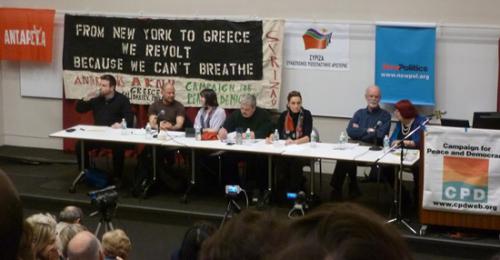
    Activists and candidates from around the country will come together on May 2-3 in Chicago to share their experiences and to launch a network for future cooperation at the Future of Left/Independent Electoral Action Conference.

    The past few years have seen a significant uptick in independent political initiatives on the left, from election campaigns to new local electoral and social movement formations, to referenda campaigns.

    Kshama Sawant’s November 2014 election to the Seattle City Council captured the attention of leftists across the country, but a number of other exciting campaigns have also been path breaking, including the Jackson Plan of the Malcolm X Grassroots Movement and Richmond Progressive Alliance’s David and Goliath fight against Chevron in the East Bay. Many recent political developments have brought organizers building alternatives to the two-party system together with those using direct action and referenda to help win gains against fracking, for a $15 minimum wage, and other important initiatives.

    "There has never been a more critical time in history to come together to discuss independent left political action,” said Gayle McLaughlin of Richmond Progressive Alliance.  “Using my experience in Richmond as a gauge, it is clear people are eager to continue participating in a bold movement for social change.  There have been breakthroughs in other places as well.  Movements are starting to bubble up throughout our nation.  But as long as we remain isolated, the two-party system will continue to weaken our democracy. We need to learn from one another's experiences, and not fear conflicts or differences among us, in order to break through that isolation.  There is no time to lose and this conference offers us an exciting beginning!”

    “So much impressive political work has been done around the country, but not enough people know about it” said conference endorser Dan La Botz. The Future of Left/Independent Electoral Action Conference is intended to encourage dialogue amongst those who are committed to left politics outside of the two-party system, to share experience and reflections of campaigning, to discuss the purpose of running and challenges once in office, and to explore the relationship between social movements and elections.

    This initiative, which was first proposed by Solidarity in the summer of 2014, gained ground after an uptick of left electoral activity throughout fall of 2014. Following the November elections, Socialist Alternative made a public call supporting such conferences in 2015. The conference, which is supported by Solidarity, Socialist Alternative, the International Socialist Organization (ISO), and other left groups, focuses on third-party and independent candidates and grassroots organizers. Over fifty individuals and organizations have endorsed the call or joined to work on organizing the May conference in Chicago.

    The conference will promote independent political action, build issue-based coordination among disparate movements, candidates, and left/progressive parties, and develop and adopt a means for continued networking, conversation, and mutual support. The organizers hope to gather experienced candidates and organizers representing the social movement sectors, people of color, youth, women, LGBTQ, and individuals with disabilities to have strategic dialogue of left electoral strategies and tactics. It will have a mix of plenary sessions, theoretical panels, inspirational talks, and practical workshops. The end goal is to use the conference to build and ongoing support network around electoral issues.

    To endorse the call to the conference and be placed on a low-volume announcement listserv, please send your name and affiliation to leftelect@gmail.com.

    Endorsers of this conference as of Feb. 28, 2015 include: Gayle McLaughin+ (Richmond City Council; former Mayor, Richmond CA ); Tim Meegan (2015 Independent candidate for alderman, 33rd ward, Chicago), Bruce Dixon (Managing editor,  Black Agenda Report and co-chair of the Georgia Green Party),  Kshama Sawant + (Seattle City Council), Howie Hawkins (Candidate for Governor of New York , Green Party*), Jorge Mújica (2015 Socialist candidate for alderman, 25th ward , Chicago), Ellen David Friedman (Vermont Progressive Party*), Dan LaBotz (Co-founder Teamsters for a Democratic Union; Editor, New Politics; Socialist Party* Candidate for U.S. Senate, OH 2010), Mike Parker (Co-author Democracy is Power; Coordinator, Richmond Progressive Alliance*), Gloria Mattera (Co-Chair, Green Party of New York*), Eduardo Martinez + (Richmond City Council), Lance Selfa (author of The Democrats: A Critical History), Bhaskar Sunkara (editor of Jacobin), Angela Walker (Candiate for Milwaukee Sheriff, 2014), Kali Akuno (Cooperation Jackson*, Malcolm X Grassroots Movement*), Jess Spear (Climate scientist and 2014 Socialist Alternative candidate for Washington State House); Jovanka Beckles + (Richmond City Council), Cindy Sheehan (Anti-war activist, 2012 vice-presidential candidate, 2012, Peace and Freedom Party*), Rosa Clemente (Hip hop activist, Vice-Presidential Candiate, 2008, Green Party*), Jill Stein (Presidential Candidate, 2012, Green Party *), David McReynolds (Socialist Party* candidate for President 1980, 2000), Glen Ford (Journalist, Black Agenda Report),Marsha Rummel+ (Madison WI Common Council. Progressive Dane*), Ty Moore (Socialist Alternative candidate for Minneapolis City Council, 2003), Debra Reiger (State Chair, California Peace and Freedom Party), Mimi Soltysik (Socialist Party USA Male Co-Chair, 2014 candidate for CA State Assembly), Joanne Landy (Co-Director, Campaign for Peace and Democracy, Editorial board member, New Politics), Art Kazar (Local Executive Committee Member, Chicago Socialist Party), Robert "Gabe" Gabrielsky (Green Party* candidate, New Jersey Second Congressional District in 2000, for State  Assembly in 2001 and for State Senate in 2003) , Ann Menasche (Disability rights activist and attorney, Green Party* candidate for Secretary of State 2011), Jason West + (Mayor of New Paltz, NY, Green Party*), Todd Chretien (International Socialist Organization; Candidate for U.S. Senate (California), 2006), Ian Schlakman (Green Party candidate  for Congress MD 2014), Linda Thompson (Co-Chair, Green Party of CT), Margaret Kimberley (Journalist, Black Agenda Report), Bill Onasch (kclabor.org; Previously served on the Labor Party’s Interim National Council and Electoral Policy Commission), Isa Infante (2014 Candidate for Governor, Green Party of TN), John Halle (Green Party, previously New Haven Alderman), Nicole Deane (Dan Siegel for Oakland 2014 volunteer coordinator), Carroll Fife (Dan Siegel for Oakland 2014 campaign coordinator),  Mike McCallister (Secretary, Wisconsin Green Party), Ellis Boal (Green Party MI*), Steve Early (author and labor journalist), Joanna Misnik (Treasurer, Chicago Socialist Campaign; Solidarity), Bryan Koulouris (Socialist Alternative), Rick Kissell (past candidate for Milwaukee Treasurer, past president of the AFL-CIO Translators' and Interpreters' Guild), Robert Caldwell (Ebarb Tribal Council, Louisiana 2011-2013), Karl Belin (Socialist Alternative), Thomas Harrison (Co-Director Campaign for Peace and Democracy*), John Strinka (Socialist Party USA Male Vice-Chair, 2012 Socialist Party USA candidate for IN House of Representatives), Leon Bailey, Ph.D. (Department of Sociology, Roosevelt University), Ian Swanson (2014 GP MI candidate for the U. of Michigan Board of Regents and ISO), Mark A. Lause (Board member, The North Star), Marilyn Langlois (Coordinator, Richmond Progressive Alliance)

    Against the Current (http://solidarity-us.org/atc), International Socialist Organization (http://www.internationalsocialist.org/), Campaign for a United Socialist Party, Chicago Socialist Campaign (http://www.chicagosocialistcampaign.org/), Chicago D.S.A., Chicago Socialist Party (http://chicagosocialistparty.org/) eMerge (http://www.emergeleft.com/) Jacobin (www.jabobinmag.com), New Politics (http://newpol.org/_), The North Star (http://www.thenorthstar.info), Ohio Green Party (www.OhioGreens.org), Peace and Freedom Party (http://www.peaceandfreedom.org), Socialist Alternative (http://www.socialistalternative.org/), Red Wedge magazine (redwedgemagazine.com), Socialist Action (http://socialistaction.org/), Socialist Party of Texas, Solidarity (http://solidarity-us.org/)

    Bold+ indicates sitting elected official; * organizational listing for identification purposes of the individual endorsers only


  • Can Greece defy the Troika?

    Image

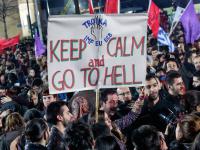
    The agreement signed between Greece and the EU after three weeks of negotiations is widely lamented on the left as a setback, if not a defeat, for Syriza. The two sides emerged from the agreement, if that is an accurate description, with different interpretations of the memorandum, signifying perhaps that no real deal was made after all. Greece obtained brief reprieve. Its banks will remain liquid for the next few months. The next phase will not be about what can be extracted from the troika, as much as what Greece can do despite and in defiance of the troika. That is what will be discussed here.

    The immediate political problem for Syriza and Varoufakis is to create "fiscal space" to generate a countercyclical momentum. They have to increase government spending to more than offset the declines in the nongovernment sectors. But the Greeks are caught in a straightjacket. By agreeing to join the Eurozone, Greece, like all other member states, effectively ceded their fiscal sovereignty. They no longer have a unified central bank and treasury to call upon to support their spending decisions. So if there is to be fiscal expansion, within the confines of the EU's rules, Greece has to find ways to increase state spending without adding to its cumulative debt. It can tax idle savings. But this is only going to take them so far. And that distance is not far enough. In any case, these personal savings have probably been long squirreled away in Switzerland, where they are not touchable anyway. It can, as well, levy a draconian wealth tax, but the well goes dry after these funds are spent.

    So the Greek Finance Minister needs to find work-arounds that allow increased state spending without technically adding to the Greek state's debt. This requires changing the current debt structure by swapping out existing debt for other forms of obligations. Varoufakis is proposing two things: the first is a GDP-linked bond (growth bonds). This is a perpetual bond that comes attached with a variable interest payment obligation pegged to the growth in the economy. This holds the possibility for a modest inflation premium for the Greek state. What is crucial is that Varoufakis is aiming to craft a debt swap by means that no longer oblige the Greek state to repay principal. Because there is no obligation to repay the principal, such bonds do not add to the debt. Greece can, by this artifice, remain in technical compliance with EU rules, while vigorously financing an economic turnaround. Willingness on behalf of EU bankers to put skin in the game would signal a common class commitment to a Greek recovery.

    The second type of bond is technically called "consols." It was created by the British government in the 18th Century and used to pay off the Napoleonic war debt. It too is a perpetual interest bond, paying, in contrast to the growth bonds, a fixed rate of interest, again with no principal repayment. Again, because of the last provision, it doesn't enlarge the Greek deficit, and therefore does not add to the debt..

    What we have seen in the last week is that Greece's creditors are unwilling to go for this. A perpetual period is a long commitment to carry credit risk on banking balance sheets. There is no obligation to repay principal even if Greek socialists eventually turn the economy around. So this is a permanent concession. If forced to service interest payments or pay for health care down the line, socialists are going to opt for the latter (we hope), which is precisely what bankers fear. So in case of failure, bankers get neither principal nor interest. And if the Syriza government is wildly successful in its negotiations and the troika (the European Commission, the European Central Bank (ECB), and the IMF) funds these perpetual bonds, the banking system may be forced to accept returns below the market rate of interest.

    And not just here. For if dispensations can be made to Greece, why not Italy, Portugal and Spain? Why not France? What credibility would Merkel have with German workers who have complacently accepted job rationing in lieu of wage growth for fear of imperiling German industrial competitiveness?

    Syriza was swept to power on a wave of democratic discontent. The future of the government critically hinges on its success in terminating the austerity regime imposed by the troika. But Syriza and the troika are not merely approaching the same problem by differing class methods.

    If European elites were actually interested in jumpstarting Eurozone capitalism in a reactionary way, they could have taken a page out of Obama’s playbook. The massive TARP recapitalization of Wall Street calmed panicky elites and softened their opposition to a modest $800 billion 3-year fiscal stimulus bill. This was far less than what was called for, but sufficient to put a floor under the economic collapse. Flagging capitalist sectors, most notably the automobile industry, were then subsidized and placed into temporary receivership. Union contracts were rewritten; public union contracts shredded. Social welfare provisions were slashed. Corporations and cash-strapped state and local governments were encouraged to ransack pension funds, while the government’s pension fund insurer was deliberately short-changed. What was left of the underperforming pensions was turned over to hedge fund managers with the desperate hope that risky betting could eliminate shortfalls. The Feds obliged this end by stimulating a stock market boom by means of quantitative easing. Toxic housing assets were removed from balance sheets, stimulating a financial asset bubble, which, in turn, prompted an upsurge in consumer spending.

    The Obama recovery took shape, in short, as a painfully protracted economic uptick with weak job growth, stagnating wages, lax labor markets, and burgeoning profits and gains concentrated almost exclusively at the top. Absent a ripple effect in the form of induced private sector investment the Obama recovery remains fragile. But it is nonetheless a recognizable economic stabilization.

    Even this overwhelmingly class-biased recovery has proven to have little attraction for the troika. If for no other reason, Varoufakis was successful in calling them out and exposing the troika for what it actually wants. They are patently uninterested in jumpstarting a recovery, even a reactionary recovery. Rather, they are hell-bent on perpetuating the restructuring of the Eurozone initiated by the Great Recession. They see the social welfare state as a looming hindrance to competition with the US and China that must be decisively removed. Since that cannot be eradicated through the democratic process, it must be imposed on that process by an unelected and unaccountable elite.

    The ECB is a very peculiar institution. A properly functioning central bank spends money into the economy to support financial decisions made by the government it serves. Eurozone governments are, in starkest contrast, subordinate to the ECB. The latter, like any other central bank, has an endless supply of money and is not constrained by the Eurozone’s tax base. Private banks lend money into existence against collateral, both tangible and financial and make money on the spread between what they may need to borrow, in the last resort from the central bank to maintain required reserves, and the interest they get back in return. The private banking system under capitalism is, in either case, always problematic. They are backstopped by the nations’ central banks, which must insure adequate business liquidity, but they are answerable to their shareholders. Without government oversight, private banks are simply—no, literally—given a blank check to engage in whatever reckless behavior they can get away with in full knowledge that the central bank has no alternative but to recapitalize them if they fail.

    The ECB and the Eurozone captures all these frailties. What it is purposely designed not to do, in contrast, is to support the spending decisions of the constituent democracies. These decisions must be made good from taxes and from loans issued by private banks secured against the nation’s public assets. Constituent states must, first of all, demonstrate adequate constraint against inflation lest bank profits be threatened. They must agree to operate in a context in which there is a scandalously inadequate surplus-recycling mechanism. Revenue sharing in the US, for instance runs to 10% of GDP. So, if the South in effect runs a balance of trade deficit with the North, the federal government returns a larger portion of the nation’s taxes to the South in compensation for that which is drained through trade. The European Social Fund and the Common Agricultural Policy recycle, in comparison, about 1% of Eurozone GDP to the entire periphery. The entire Eurozone framework is a prior constraint against democracy and the public interest, both because it effectively will not recycle surpluses (from Germany and the Eurozone north to the "PIIGS"—Portugal, Ireland, Italy, Greece and Spain) except through unsustainable lending arrangements (and foreign investment) because it withholds support for needed public spending decisions, including countercyclical emergency decisions.

    It is therefore entirely wrong to attribute a “debt” problem to Greece. It does not have a debt problem. It has a liquidity problem. It cannot finance the spending decisions needed to put the unemployed to work, to pay pensions, to maintain a public health system, to fix its infrastructure, to offset its current account imbalance and to offset spending cuts in the private sector resulting from the global recession. It has an austerity problem, because it has a liquidity problem.

    It is the banks that lent money to Greece that have a debt problem, as a result of Greece’s illiquidity. Their asset base consisting of sovereign debt is worthless. But because they are fully insulated against failure by the ECB, this debt problem presents a mere technicality, a mere technicality with an immense human price tag. For the ECB could, in principle, simply recapitalize the banks directly, including Greece’s central bank, such as it is. The Greek central bank could, in turn, support the spending decisions of the Greek government up to the inflation barrier of full capacity employment.

    Instead, Greece has been used as a dummy corporation for the laundering of funds to the banks, and the various private and national central banks have been forced to accept a “haircut” as a penalty for their reckless past support for democratic decisions. For its service as a holding corporation, the ECB has “generously “agreed to pay Greece a small service fee sufficient to operate a bare bones government; further payment of which being contingent on Greece surrendering untold public assets and beating its workers into penury.

    Again, it is not the debt that presents a problem. The ECB can always internalize the debt and place toxic assets on its balance sheets in exchange for Euros through quantitative easing. And this is exactly what the ECB is now doing—but not for Greece. It may or may not otherwise be in Greece’s interest to renege on its “debt” and exit the Eurozone, but this so-called nuclear option is, in any case, a hollow threat and provides Syriza with absolutely no negotiating leverage. Any negative economic consequence of default can be readily mopped up—if hasn’t already been—and neutralized by the ECB, before becoming a contagion. The only threat of bank run insolvency in the event of a Grexit, will be against Greek banks.

    The problem remains: an unaccountable ECB monopoly over the creation and mobilization of money that allows it to dictate a social program antithetical to the needs and interests of Europe’s workers.

    What Varoufakis and his ministry have tried to do is to raise the service fees by changing the bond structures. They tried to create wiggle room through negotiations. Having failed, Syriza must find other ways, if Greece is to remain in the Eurozone, to break the stranglehold of the troika and gain fiscal space. In either case, it needs to demonstrate to the workers of Greece and Europe that defiance is not a losing strategy.

    It has become patently obvious that the only measure Greece could carry out and command the full respect and attention of the ECB would be to dissolve itself as a country and reconstitute itself as a bank, declaring its citizenry co-equal shareholders and the former nation’s businesses to be bank assets.

    In the nonparallel universe where Greece actually resides however, there are still some limited stopgap measures and work-arounds that may buy Syriza some time. They have committed themselves to ramping up the intensity and efficiency of tax collection. This is probably the only place where Syriza and the troika agree. When the necessary institutional changes are implemented, the Greek government can begin to generate a parallel currency for internal transactions by securitizing future taxes and issuing scrip based on revenue anticipation. This scrip can be an electronic entry into accounts, personnel and corporate, with which the government has business. Or it can be issued in small denomination bills intended for day-to-day purchases. It is denominated, in either case, in Euros with an exchange rate of parity. Euros will remain the unit of account, but scrip can be introduced as an additional means of payment. This parallel currency should be acceptable for settlement of private sector tax liabilities and must be transferrable within the nation and to foreigners who have business or pay taxes in Greece. It is precisely scrip’s acceptability to extinguish tax liabilities that assures its ability to circulate. It is in effect a short-term loan granted by the citizenry to the government. And because it is perpetual without a defined maturity date requiring repayment of principal, it would not increase the public debt-to-GDP ratio.

    Numerous state governments in the US and elsewhere around the globe have employed this mechanism. It is a form of short-term credit cheaper than that offered by financial markets. The maintenance of parity with the Euro means that it comes with a built-in safeguard against inflation in compliance with EU guidelines.

    Socialist economist Michael Burke has pointed out that Greek business claims the highest share of national income of the entire OECD at 56%. Of this, only 11.3% of the national income is actually invested. There is no reason why the remainder cannot provide a firm platform to securitize taxes for countercyclical activity. With adequate capital controls, Syriza is in a position to present business with a Hobson’s choice: either invest this savings now or it will be confiscated and spent by the state later. In the meantime, these savings will be securitized as scrip for immediate relief.

    Scrip can pay civil servants and support the expansion of public services. With it, Syriza can fund infrastructural improvements and R & D needed to earn additional Euros for Greece through improved trade and import substitution. And, at the same time, it frees Euros for the large-scale import purchases of food, medicine and fuel.

    But neither is this a sufficient plan B. Even if the fiscal restraint imposed by the Eurozone limiting primary deficits to 3% of GDP were not in effect, the Greek economic recovery would still be restrained by its tax base. The advantages to this parallel currency is that it permits a path through which the tax base, once securitized, can pump a self-expanding loop through the system generating additional incomes to tax. Nevertheless, the type of robust recovery needed is still unlikely given these dual limitations. According to one estimate, Greece needs to run a primary deficit of 10% to return it to a full recovery growth path.

    With a socialized European central bank, as has been argued previously, Greece and the other member nations would not be so constrained. A socialized ECB could disregard the deficit position of the collective national treasuries and directly support the spending decisions of the constituent governments up to full economic capacity. And it could do away with government “borrowing” as an unnecessary subsidy to private investors.

    What such stopgap measures can do is to transform the Eurozone from a monetary union to a looser monetary federation. It can chip away at the power of the troika and provide hope and encouragement to similarly-minded insurgencies such as Podemos, and trade union militants eager to break with or move existing mass workers’ parties to the left. By stoking the anti-austerity brushfire, any success by Syriza, no matter how modest, would mobilize an emboldened left to ask larger questions about the structure, design and necessity of this Bankers’ Federation.

    More immediately, it can provide Syriza with the space to properly deliberate over the risks and prospects that await Greece were it to opt out of the Eurozone.

  • American Communism and the Communist International – A Review

    Image

    Jacob A. Zumoff. The Communist International and US Communism, 1919-1929. Leiden / Boston: Brill, 2014. 443 pages. Bibliography. Hard Cover $167.

    Jacob A. Zumoff has written an impressive scholarly tome that is perfectly described by the title: The Communist International and US Communism, 1919-1929. He makes a reasonably convincing case for a novel thesis that attempts to reframe the major question: the relationship between the Soviet and American Communists. Yet, in my view, he fails to address the central question, the Soviet domination of the Communist International, including its domination of the American Communists in the 1920s.

    “Why do we need another book about the Communist International and the Communist Party of the United States,” asked Zumoff when he presented his book recently at the ongoing Seminar on American Communism at the Tamiment Library located in the Bobst Library at New York University. After all, he said, we have Theodore Draper’s two volume history The Roots of American Communism (1957) and American Communism and Soviet Russia: The Formative Period (1960). And in addition we have the writings of the “revisionists” led by Maurice Isserman, author of Which Side Were You On? The American Communist Party during the Second World War (1982). Not only do we have these books, but we have the great debate that resulted from their different views.

    Draper, himself a former Communist who once wrote for the Communist Daily Worker, argued that the Soviet Communist Party tended to dominate the American Communist Party and set the line on all really important questions, while Isserman and other “revisionists” argued that the Communist Party of the United States was a genuine American party whose members reflected the experience of the American working class and who made their own decisions by and large. Draper and Isserman and other revisionists fought out these questions in a brilliant debate in the pages of the New York Review of Books in the 1980s (all still available online, but only to subscribers). Given the way that Draper and his critics seem to have covered the territory, is there really room for a new position and do the sources exist to support it?

    Zumoff replies “Yes.” to both those questions. Zumoff believes that Draper and the revisionists are not so much polar opposites as two sides of the same coin, reflecting the Cold War and New Left environments in which they developed. Zumoff contends that the Communist International (CI) and the American Communist Party (CP) engaged in a dynamic dialogue that had shaped the most important decisions of the party’s early years. Moreover, he insists, the collaboration between the CI and the American CP leaders led to some of the most significant and meaningful work of the young party. The CI, he argues, had a positive impact on the American CP. Zumoff brings to the support of his thesis new sources, most important the archives of the Communist International that resided for years under lock and key in the Soviet Union until they were finally which opened in the 1990s and later copied and made available at research libraries around the world. He also uses other sources, especially memoirs, and has a command of all of the relevant secondary literature.

    Zumoff’s list of the CI’s positive interventions in the American CP in collaboration with its American members includes: unifying the several original Communist Parties into one; convincing early Communists to give up their fetishization of illegal work and also to create a legal party; persuading the party, which had been principally based in the foreign language groups, to build an English-speaking, native-born American working class party; and, finally, to get the Communists to commit to working in the conservative American Federation of Labor. All of these, the author believes, turned the CP in the right direction. (The CI was also instrumental in getting the American CP to take the “Negro Question” seriously, though Zumoff is not happy with the end result of that intervention. By the late 1920s, the CI had convinced the Communists to see American Negroes as a people who in the South might constitute a nation and whose right to self-determination should be respected. Zumoff, however, links this position to the Stalinization of the American CP.)

    With the exception of the CI intervention on the Negro Question, most of these developments had taken place by mid-1920s. The CI’s intervention in the American CP in the second half of the decade was largely a disaster. The CI’s agent Joseph Pogány, or Pepper as he was known in America, pushed the Communists into trying to take over the Farmer-Labor Party, leading to a split in which the Communists in the end found themselves isolated. Then, with Grigory Zinoviev in command, the CI carried out its policy of “Bolshevisation,” which aimed at creating a monolithic, centralized party with no factions, which Zumoff to his credit recognizes was a disaster, laying the basis for the party’s later degeneration into Stalinism.

    The great problem of the later 20s was factionalism, the struggle between CP’s rival leaders and would-be American Lenins, particularly Charles Ruthenberg, Jay Lovestone, and William Z. Foster. Yet the factionalism was magnified many fold by the CI’s constant intervention either in favor of or against one or another of the American leaders. All of this leads us to question the general thrust of Zumoff’s argument, namely, that the CI’s intervention in the 1920s was generally positive. Well, maybe, but not after about 1923. (With the exception of the Negro Question, in my view, but that is a longer discussion than this review can encompass.)

    The problem with Zumoff’s admirably researched and clearly written book is that it fails to engage what seems to me to be the central issue, the issue which made Draper’s books such classics, even if one disagrees with their anti-Communist thrust. That central issue is the question of Soviet domination of the American CP. How did such domination come about? The Russian Revolution of 1917, the first successful (even if only very briefly successful) workers revolution in history. Socialists, anarchists, and syndicalists around the world suddenly wanted to emulate the Russian Communists and their Bolshevik and soviet revolution, though nobody, as Victor Serge has written, had the slightest idea what Bolshevik and soviet meant. Lenin and the Russian Communists had prestige and used their authority to establish the Communist International. The creation of a new revolutionary international after the capitulation of the Socialist International to the war was an absolutely necessary step foward.

    In the Communist conclaves, however, two dynamics took place: the Russian Communists, convinced that they had found the theory, organizational form, and political practice to make revolution, wanted to impress their model on others; while at the same time other socialists wanted to follow the Russian example and also wanted the Soviet imprimatur stamped on their party. While initially, given the reformist character of the European socialist parties, a reformism which in the test of revolution frequently became counter-revolutionary, the Russian Communist role may have been salutary, overtime it became an unhealthy tendency on the party of the Russians to dominate other political parties. The Communist International was theoretically a congress of equals, even if Russia was from the first primus inter pares, but by the mid-1920s the Russians had become the undisputed masters of the International. Zinoviev’s Bolshevization campaign, aimed at turning all of the Communist Parties in Europe and elsewhere into obedient clones of the Russian Communists was the second step in this process. Stalin’s counterrevolution in Russia, which overthrew whatever remained of workers’ power, put a new ruling class in power, and turned the International into an arm of its foreign policy was the final step.

    But where, we might ask was the first step? Was it not in the Communist International’s intervention, sometimes well intentioned but misguided intervention, in the factions in the American CP as well as in other parties? One may argue that the revolutionary situation in Europe from 1918 to 1925 did not permit the Russians the luxury of a more democratic and fraternal engagement with the socialists, syndicalists, and anarchists of Europe and America at the time. Perhaps not, but the end result then was a more authoritarian and hierarchical international. 

    Zumoff’s book belongs in all research libraries and in big city public libraries. Professors who want to use it for a class or leftists who want to look back into our history will do better to wait for the Haymarket paperback edition which will be available at a reasonable price.

  • Debt Forgiveness: Who Owes Whom for What?

    Image

    The lion’s share of indebtedness in this world is invalid and immoral. Forgiveness is not what is called for; it’s liberation.

    Talk of a “debt jubilee” leaves open whether the debts are valid or not, but talking about debt forgiveness raises the question of whether a debt is valid from a moral point of view.

    By definition, calls for forgiveness imply wrongdoing by the one being forgiven. For this reason, forgiveness is seen not as a moral obligation but rather as an act of generosity. The God who forgives sinners is a God of love and compassion, not a vengeful God. But what if nothing wrong has been done? A prisoner who has been wrongfully convicted is exonerated, not forgiven. And if a person has indeed violated a law but the law is unjust, then forgiveness is not the relevant concept. Thus, to ask whether an act should be forgiven inevitably raises the question of whether the act was morally wrong.

    Most debtors in the world today—including those in debt bondage, in medical debt, in education debt, and more—have committed no wrongs, so what is called for is cancellation and liberation, not forgiveness.

    Building consciousness against the validity of debt in the world today is essential to building a movement that can force the powers-that-be to rescind the debt or at least restructure it in more favorable terms. It is also important psychologically for the indebted. We are raised to believe we ought to obey the law, including paying our debts, and hence we feel guilty, ashamed, or embarrassed if we do not. Whole countries are in thrall and made to beg for relief. Rejection of the validity of our debts can at least relieve the psychological burden of those burdened by debt and can help to build a movement against them.

    Immoral Debts

    There are many situations in which debts clearly lack moral validity. One particular egregious case involves debt bondage. Only desperately poor people agree to loans forcing them to work for a lender for extended periods of time. Though recognized as a modern form of slavery, often passed through generations, and illegal in most countries, it is nevertheless pervasive throughout the world, even in the United States. Obviously, debtors in this situation need liberation, not debt forgiveness.

    Whole countries are in similar straits due to exorbitant loans by powerful countries that reap the bounty of these countries’ resources. Through structural adjustment programs (loans from the International Monetary Fund that come with coercive strings attached), debtor nations are required to enact harsh austerity measures to pay their debts to international lending agencies, which have been likened to loan sharks. Again, only desperately poor countries would agree to such conditions. Moreover, the causes of their poverty are in most cases inextricably tied to racism and imperial domination, both historically and in the current period.

    These examples are extreme and may seem irrelevant to most people in the United States who are in debt. But their very extremity helps to bring out the core idea expressed by Ralph Waldo Emerson who said, “A man in debt is so far a slave.”

    The majority of Americans are in debt for two reasons: medical bills and loans to pay for higher education. Even public universities today cannot be financed by most people without loans, and even middle class people are a major illness away from financial disaster. Medical bills are the cause of 60 percent of bankruptcies in the United States, but bankruptcy cannot save those burdened by student debt who can never escape their debt. Are medical and student debt and the suffering they cause simply unfortunate for the individuals? Or should the debts be forgiven? Or, rather, shouldn’t they be seen as invalid in the first place? Every human being ought to have the medical care and education they need as basic rights. Medical care is a matter of life and death, and education at all levels is necessary for a better life both for individuals and for the society as a whole. The development of human capacities is essential for an advanced society and for any democratic one. Our global economy and the global ecological challenges we face make it all the more imperative. 

    Mortgage debt is another huge contributor to Americans’ indebtedness. Due to predatory and fraudulent loans, and harsh loan terms, home foreclosures are often the consequence. The economic downturn, for which workers are hardly responsible, may have made them unable to make their mortgage payments. Or perhaps they could not pay their taxes because they were public employees whose financially strapped municipalities reneged on their contracts. In one case contracts are sacred; in the other, they are not. Home ownership happens to be the most significant financial asset for black women, who are also disproportionately public employees. So who owes whom for what here? Randall Robinson’s The Debt argues powerfully that the United States owes reparations to descendants of slaves whose labor created the wealth in the United States.

    Climate Debt

    One could go further in challenging the moral legitimacy of debt than I have done so far. The act of declaring most debts invalid does not fundamentally challenge capitalism, which rests on the idea that a society based on unlimited private property is the morally best system. (Some defend capitalism in explicitly moral terms, while others claim it is the only possible system, and therefore moral criticisms are otiose.) Reformers of capitalism advocate limits on private property and the provision of basic incomes to everyone so no one need go into debt, but these reforms have not taken hold: indeed, the more capitalism has developed throughout the globe, the more unequal it has become.

    Going further, if we recognize that private property rights by definition are rights of exclusion, then we could advocate common property as the moral norm for a society, but with personal property (that is, property for personal consumption—thus distinguished from private property) as a core element of a good society. All humans are morally equal and should share whatever is shareable, starting with the basic resources of the planet.  

    Establishing universal access to planetary resources as a moral norm leads to a very different understanding of debt. Individuals’ debts pale, exposed as invalid, and instead we begin to countenance a colossal, unpaid, and morally valid debt: climate debt. By this I mean the debt owed by the richest countries (which have stoked climate change with their carbon emissions) to some of the poorest countries in the world, which are suffering the most from global warming, even though they did nothing to cause it. This debt ought to be paid but is rarely even acknowledged by those who owe it.

    From desertification in Africa, to flooding in Bangladesh, to the loss of fresh water in Bolivia due to glacial melt, the damage is staggering. Ecological refugees now outnumber refugees from war and violence. And if countries in Africa, Latin America, and Asia must restrict their development for the sake of the planet, they should be compensated by those who have benefited from the unsustainable economic system that has caused the crisis. Ironically, many of the countries that are owed compensation for ecological damage are “debtor nations,” in thrall to global capitalist institutions. But who really owes whom?

    Changing Consciousness

    The facts are clear. The problem is political: how to build a worldwide movement that can force countries to adopt more sustainable and equitable models of economic life and to reverse the dominant understanding of who owes whom for what. As with all social movements, there are both intellectual and practical tasks. We need to break the hold of the dominant ideas, which justify the status quo—no easy task, given the corporate hold over the media in this country. These dominant ideas are moral but also empirical, in the broadest sense.

    In fact I think there is often more agreement on fundamental moral principles than it seems. For example, regarding poor countries’ indebtedness: if we ask most Americans whether we should give more in foreign aid, probably most would say no. However, I have found throughout my years of teaching, that my students were enormously more generous than United States foreign aid is. Most thought we should be giving around 20 percent of GDP in (non-military) aid, thought we were giving maybe 5 percent and were deeply shocked to know that in fact we give less that 1 percent. Add the historical information as to why certain countries are poor in the first place and the argument is even more compelling that their debt should be exonerated.

    Similarly I think most people in the United States are appalled by the fact that the financial institutions that caused the Great Recession were not punished, while poor people are losing their homes. Hypocrisy is deplored universally. Our religious traditions predate capitalism and have powerful resources to challenge the validity of most contemporary indebtedness. St. Thomas Aquinas, for example, said that if a poor man takes from a rich man to feed his family, then strictly speaking that is not theft.

    But ideas change not primarily by good counter-arguments, but by the sense that other worlds are possible. And this sense develops through political struggle. The history of the labor and poor peoples’ movements in the United States, as documented by Frances Fox Piven and Richard Cloward in Poor People’s Movements, shows that people have to be willing to disrupt the status quo to make changes. Sit-ins to prevent evictions are one strategy; debt refusal is another. But individual refusal is fragmented, complicated, and risky. Instead, we have to figure out how to make this protest collective. Protests against austerity measures enacted to meet debts that were taken on by public bodies, whether in Detroit or Athens, are one kind of collective refusal. The use of eminent domain to acquire houses threatened by foreclosure and then sell them back to their owners at affordable prices is another. People in Richmond, California, have actively considered this creative use of eminent domain.

    In struggle for the recognition of climate debt, the first step to building a movement is to nurture—on the most profound level—an appreciation of what we are losing and what needs to be done to save ourselves. As Evo Morales and others in the developing world have said, we have enough resources for all to live a good life, but not for everyone to lead the rich life of the well-to-do in the developed world. While I do not believe that kind of radical change is possible within capitalism, I believe we must demand support for any measures or experiments that point us in that direction. A revitalized democratic labor movement that fights for the long-term interests of working people is also crucial to both struggles.

    Religion has a vital role to play in this struggle as well. Although indigenous and Eastern religious traditions have the most ecological understanding of humankind’s relationship to the rest of the natural world, adherents of all religious traditions should be outraged by our ecological crisis. To see this beautiful planet of ours as God’s creation, given to humankind, and then to see it trashed should feel sacrilegious as well as self-destructive.

    This piece was first published in Tikkun.

    *Nancy Holmstrom is Professor Emerita of Philosophy at Rutgers University. A lifelong activist, she has written on core political-philosophical topics, including freedom, alienation, rationality, and human/women’s nature. She edited The Socialist Feminist Project and co-authored Capitalism For & Against: A Feminist Debate.

  • On Cafes

    Image

    Cafes bring memories of the unpleasantly bleak days of my undergraduate studies in which I sought my peace of mind in the rough and stormy sea of Jean-Paul Sartre’s world, his philosophy and his novels shining light on the notion of loneliness for me. And I lived inside his books and through the characters he created. However, the more I grew critical, the stranger I found Sartre’s intellectual legacy.

    Agitated, the philosophical underpinnings of Sartre went up in smoke for me in the next few years. However, his charismatic intellectual figure has remained a revered model for my ntellectual roaming, rambling, and gypsy soul that wanders hither and yon to find a safe shelter.. I am beholden to Sartre, for he taught me that philosophy could occur everywhere, especially in cafes, which were sources of many examples for his philosophical discussions in Being and Nothingness. His book coloured my moments of loneliness when I was a fresh-off-the-boat student, and also defined cafes for me, standing out among so many other places in which one can philosophize!

    Sartre teaches us to bridge our thinking to crowded places such as cafes so that we no longer can snub others and learn how to think in the presence of other people; how to think of them and see them as the extensions of our thoughts, selves, and beings. “Hell is other people” is often quoted from Sartre, to prove his philosophy ignores others due to its being overly self-centric. It is true and this is why I have kept my intellectual distance from him for many years. Ironically enough, although Sartre never centred his philosophy on the notion of otherness, how could he have elaborated the concept of bad faith without his examples inspired by cafes in which he spent hours thinking and observing? Imagine reading Being and Nothingness without Pierre, a waiter of a café whose name is repeated over hundred times in the book; what do we get out of the notion of negation? Whether Sartre’s ideas are still tenable or not, his ways of philosophizing in crowded places, where people are socially engaged, can still speak with us and inspire us at best.

    Twenty-five years after Sartre’s demise, I am pondering what Sartre could have possibly thought of franchise branded cafes and their patrons. I really long to obtain some answers to these questions: what could Sartre possibly observe in one of the franchise branded cafes such as Starbucks? How could he add a new chapter to his widely hailed masterpiece while spending time in one of these cafes? Where could he find his Pierre, the beloved woman and her lover, and patrons? In this figment, could Sartre hear the echo of his experience of cafes from years ago? Are cafes still sites of socialization or have they simply become the sites of isolation and forgetfulness?

    Seeing many people in cafes-who keep busying themselves with their laptops, cell phones, or iPads–with their eyes glued to the screens– never ceases to keep me wondering. The more my eyes ramble around to meet with the wandering others aimlessly and curiously observe people, the more I grow dismayed. Cafes used to be sites of the haphazard socialization of people from different backgrounds, to share their insights together. The fact that Sartre, like many pioneer writers of the twentieth century, was tied to the crowded cafes of Paris has taught me that if we cease to see the face of others, we lose our ability to think and write. How can one write when s/he does his/her best not to be exposed to random conversations with strangers, who ever-increasingly are considered potential sources of danger and threat in our age?

    Any writer needs to keep her/himself floating in the surrounding atmosphere to stay current on society, the ways people behave with different characters, the varied stages of laying out details, and generally how things truly are and why. Many in-depth intellectual discussions, which left tremendous impacts on many souls, were triggered in cafes where people like Sartre or Andre Gide submerged themselves, either as curious observers or active participants in discussions. But ever-increasingly, we are losing these socially oriented cafes and stepping towards isolated ones, which are anything but idea-inspiring.

    Cafes are not unique but are typical and reflective of our age in which we are wedging ourselves into our small and thick shelters to avoid seeing and knowing, armouring ourselves against any possible external danger. We are lonely; it saddens me that we delight to be alone not because we are happy in our isolation, or shells, but because we are unable to decide in the spur of the moment to live otherwise. What if our isolated souls can trample our Aristotelian legacy as social animals? If we lose the social aspect of our nature, then we are left alone with the animal part of it. Isolated human beings are not far away from dehumanized animals, which lack any idea of society. Are we losing our humanity then?

    My friend, who is American, once unveiled why he has been living outside the country for more than fourteen years. He told me that in the States, many people believe that they are the happiest people in the world and think that other people from other parts of the planet are longing to enjoy the same happiness. It never occurs to them that happiness could exist in any other places! But when he moved down to Mexico he realized that there are many jubilant people, who are enjoying not-yet-neo-liberalized happiness. Neo-liberalism is devouring our imagination, and in its place, rents out its own perception of happiness to us. The black-and-white dichotomy of happy western people versus non-western “backward,” “miserable,” “resilient,” and unhappy people who are in need of western charity- either humanitarian aids or interventions- to enjoy the same happiness is ubiquitous. Neo-liberalism engineers our happiness through images of McDonald’s, Starbucks, Walmart, Tim Horton’s, and countless other franchises, underneath these images we can only celebrate our isolated happiness.

    I had the same experience towards cafes where I used to spend hours of my days or nights back in Iran. Cafes are smoke-free zones in Iran. I have enjoyed groups of my companions and my intellectual friends in cafes, and was enthralled by their genuine thoughts. I had so many random discussions with people who I barely knew. Cafes were sites of socialization for me and for many of my friends, and we found our resistance against imposed political and social restrictions inside crowded places such as cafes where we read poetry, discussed new philosophical and social ideas, and theorized about almost every single detail of our daily lives. Cafes were sites of resistance against the oppression of everyday life for us. It was not absurd and pointless to me to go to the cafes and spend hours with my friends there. Significant parts of my intellectual life were shaped inside these cafes, among other people. This is why the more time goes by, the less I can go to one of the branded cafes such as Starbucks and bother myself by seeing the ever-increasing isolation.

    Yes! There is a plenty of happiness in the world, as it is much more diverse than we (or neo-liberalism) imagine it to be. Frantz Kafka brilliantly said, “ There is plenty of hope in the world, but not for us”. I am in favour of Gorgio Agamben’s interpretation of this quote (in his book Profanations, written with Martin Rueff) where he maintains that Kafka meant that plenty of hope and happiness in the world exist, but not in places that are already defined as our sites of happiness by capitalism (p. 20). We need to find such places outside of our defined and engineered portion of happiness. In the past couple of decades, happiness was separated from socialization and we are disciplined to individually enjoy our happiness but not collectively. We are losing our social aspect in this isolating system and becoming more and more dehumanized. But we are not turning out to be animals. There is no animal in the world that can live up to such a degree of loneliness. We are the loneliest animals on the earth, as we are dehumanized ones! By the way, who is calling the shots?

  • #Flood11 Collective Statement

    Image

    [Eds.: On Monday, March 2, 2015, in New York City a trial begins for eleven activists who are refusing to plead guilty to disorderly conduct and pay fines for taking part in a climate sit-in in Manhattan's Financial District last September. The Flood Wall Street Eleven plan instead to use their trial to illustrate that the bankers who finance climate change are the real harbingers of disorder. Below is a collective statement from the group. You can sign a petition in their support here.]

    In order to solve a problem, you must first identify its’ source. . . 

    On the day after the Peoples’ Climate March, facing a disaster of planetary proportions, we sat down on Broadway and Wall St. to carve out a space at the source of our destruction, and to highlight the central role that Wall Street plays in fueling climate change. After holding the street for eight hours, police arrested over one hundred people – including a polar bear and two Captain Planets – and charged us with two counts of disorderly conduct. These charges carry maximum penalties of 15 days in jail and $500 in fines.

    We could have taken the State’s usual script for people who engage in civil disobedience – dropping the charges in return for a promise to be quiet and not directly inconvenience capitalism for six months. Given that our “leaders” have failed to seriously address climate change since it was first brought to public attention a quarter-century ago, we collectively decided to continue our action in court by pleading “not guilty” and pursuing a necessity defense. Standing up to those who threaten our existence is not disorderly, but a responsibility as citizens of this planet. The corporations who are perpetuating the climate crisis should be on trial not the people who try to stop them.

    Thanks to the work of scientists, we now know that there have been five mass extinction events in Earth’s history – all but one of which coincided with increases in global temperatures and in the levels of carbon dioxide in the atmosphere. In the two centuries since the beginning of the Industrial Revolution, CO2 levels have spiked by 42 percent and are now at 400 parts per million (ppm), the highest level in more than three million years. If we stay on our present course, CO2 levels could blow past 500 ppm by mid-century and push us further toward a hellishly hot future.

    Despite this, Wall Street continues to bankroll oil, gas and coal companies that pursue increasingly extreme projects for bringing fossil fuels out of the ground. Wall Street also finances politicians from both major parties who refuse to do anything about climate change. When Wall St looks to the future, it sees trillions of dollars in future profits to be reaped from the continued drilling, mining, transporting, refining and burning of fossil fuels. We see our planet put at grave risk of catastrophic rising global temperatures caused by the release of more than 30 billion tons a year in heat-trapping greenhouse gasses. Wall Street’s blind drive for profit leaves us careening toward a world in which we will see more intense droughts and storms, melting ice caps, disappearing island nations, failed crops, the migration of hundreds of millions of displaced peoples and the loss of much of the Earth’s biodiversity due to species extinction.

    Here in New York, we learned from Hurricane Sandy that climate change is not only a future threat to faraway lands, but also a present and growing danger to our own city. When Sandy hit two years ago, it destroyed the homes of tens of thousands of our friends, neighbors and co-workers, left hundreds of thousands without power for weeks and caused tens of billions of dollars in damage. Sandy’s surging waters also came within less than a half-mile of the steps of the very courthouse where we face trial. There’s no reason to think we won’t face similar dangers again.

    If you went Jacob Riis beach this summer, you undoubtedly noticed the view obstructed by an offshore oil rig, part of a Williams Transco project that, once completed, will run a high-pressure liquid natural gas (LNG) pipeline along beaches, and right under Flatbush Ave. in Brooklyn. This oil rig is not only an eyesore, but drilling fluids from the construction are deposited on the ocean floor. The new higher-pressure pipeline threatens Brooklyn residents’ safety, as gas pipelines sometimes explode.

    Our action was justified and we would do it again. The latest news from Lima, Peru where U.N. climate negotiators are currently meeting and once again failing to adequately address the climate crisis reminds us all that we cannot stand idly by when so much is at stake. Meanwhile from Massachusetts to Michigan to Manhattan, climate justice activists have invoked the necessity defense in the past 12 months. We expect this to become an increasingly common practice in the years ahead.

    In our case, we urge the Judge to listen closely to the arguments we are ready to make about the existential threat Wall Street poses to the climate. Beyond what happens in the courtroom, we hope to inspire others to act boldly and take action to ensure our survival.

    Business as usual is no longer acceptable.

    [The image comes from https://flic.kr/p/p5ugKw.]

  • Mexico: Crisis of Human Rights Becomes International Issue as Violence Continues

    Image

    Militant protests by teachers, students, and others, some of them violent, continue in Guerrero on Mexico’s southern Pacific coast where the state government seems to have completely lost control. Since six students were killed, 25 wounded and 43 kidnapped in Iguala, Guerrero on September 26, 2014–with the 43 still remaining still not credibly accounted for—there have been nearly continuous protests. Teacher protests over other issues have also taken place in Mexico City and in other parts of the country and have been militant, but not violent.

    Mexican President Enrique Peña Nieto argues that while most of the country is safe, only three specific areas have problems with violence: Guerrero, Michoacán, and Tamaulipas where there has been a recent spate of drug killings. But the disappearance of the Ayotzinapa students has led to protests throughout the country and abroad, has become a national political crisis, and this month also an international human rights concern at the United Nations and the European Union Parliament leading to much criticism of the Mexican government by international organizations and in the press.

    Guerrero Out of Control

    The continuing protests have been driven by two causes: first, the demand by their families, fellow students, and the public for the return alive of the 43 kidnapped students and second, the State Coordinating Committee of Education Workers of Guerrero (CETEG), a caucus of the Mexican Teachers Union (el SNTE) calling for an end to the government’s education reform. The students of the State Teachers Colleges and the CETEG teachers have been at the center of the protests that have included violent confrontations with the police. But there are several other actors with other agendas.

    In Guerrero, shortly after the 43 Ayotzinapa State Teachers College students were forcibly disappeared last September, protestors burned down the town hall in Iguala and the Party of the Democratic Revolution (PRD) headquarters in Chilpancingo. More recently protestors have seized public buildings, such as the state Secretary of Finance offices, taken over highways and toll booths, and violently attacked a military base. (Many believe the Mexican Army was aware of and possibly involved in the killings and kidnappings of the students.) When three teachers were arrested during recent protests, other teachers kidnapped two Coca-Cola company employees and eventually exchanged them for the teachers being held by the state police.

    While protestors have taken control of the city government in several Guerrero towns, others have been taken over by the Federal Police (PPF). At the same time the drug cartels and other gangsters continue their murders and kidnappings in both small towns and in the resort city of Acapulco where five were recently killed execution style in just one day, February 21. Also operating in Guerrero and in the neighboring state of Michoacán are armed several community self-defense organizations, some of which arose out of indigenous communities and others out of ranchers’ organizations, while yet others are alleged to have ties to the drug cartels, and some which have affiliated with state police organization.

    New Forced Disappearances: Miners

    Meanwhile, as protests over the forced disappearance of the students continue, eleven miners at the Canadian owned Media Luna mine and the mayor of the town of Cocula, Guerrero were kidnapped on February 7. Some sources say that as many as 15 people were kidnapped by an armed group, though there has been no official confirmation. There were suggestions by local townspeople that the kidnapping had been carried out by La Familia Michoacana, a drug cartel. Cocula is the town where according to the Mexican authorities the bodies of the 43 kidnapped students were incinerated. Altogether more than 20,000 people have been forcibly disappeared in Mexico since 2006, while another 100,000 plus have been killed.

    Guerrero’s government has been in disarray since the Iguala killings and kidnappings. The former governor, Ángel Aguirre of the PRD, stepped down a month after the Iguala killings and kidnapping and was replaced by Rogelio Ortega Martínez, also of the PRD, who became interim governor. Now the Mexican government has accused former governor Aguirre of having embezzled US$19 million, but strangely it has not charged him; the government has, however, arrested his brother, his nephew, his former deputy, and five of the deputy’s family members for their alleged involvement in the crime.

    Some Mexican politicians and some in the media have argued that the state has become ungovernable and have called upon President Enrique Peña Nieto of the Institutional Revolutionary Party (PRI) to have the federal government take over administration of the state. Why hasn’t he done so? The reason may be that national elections and several state elections, including that of Guerrero, will be held in June and the president doesn’t want to see them interrupted or stopped. Some media commentators suggest that the deeply troubled PRD which governs Guerrero and Peña Nieto and the PRI which control the national government have arrived at an agreement hoping to perpetuate themselves in power, the PRD in Guerrero and the PRI n the federal government, keep out the conservative National Action Party (PAN). Activists in Guerrero and elsewhere, arguing that the entre political system has become corrupt, have called for a boycott of the coming state and mid-term elections.

    Andrés Manuel López Obrador, leader of the Movement of National Regeneration Party (MORENA), infuriated many Guerrero activists and others when he declared that anyone who called for abstention in the elections was either “naïve or linked to the existing regime.” López Obrador fears that the left-of-center MORENA party, only recently recognized by the government and participating in its first elections this coming June, could be politically damaged by an abstention movement. But he has now antagonized the student activists, teachers, and others involved in the human rights movement in Guerrero and other states, and that could cost him in the end.

    United Nations and European Union Critical of Mexico

    The crisis in Guerrero and in Mexico generally also became an international issue in February as appearances before international bodies undermined the Mexican government’s reputation. In two separate instances, a United Nations hearing and a meeting with parliamentarians of the European Union, representatives of other governments expressed incredulity and astonishment as they asked hard and questions of Mexican government regarding its handling of the killings and disappearances of the Ayotinzapa students. The Mexican government for more than two months has asserted that the local mayor and his wife ordered police to detain the students and that the police then turned them over to a gang called Guerreros Unidos (United Warriors) which killed them an incinerated their bodies and declared the case closed.

    The European parliamentarians appeared to be shocked that the government had so rapidly investigated and closed such a complex case. They expressed their horror and indignation that Mexico could have more than 120,000 cases of deaths or disappeared persons because of a regime of impunity. The EU parliamentarians called upon the Mexican government to carry on an exhaustive investigation, to support the parents, and to establish relations with the Mexican people. Similarly the United Nations Committee on Enforced Disappearances, dealing with the Ayotzinapa and other earlier kidnappings, noted the “context of generalized disappearances” and expressed its “concern” over the government’s lack of exact information about the missing. The rapporteur expressed shock at mass graves found in the state.

    The hearings at the U.N. and the E.U. lifted Mexico’s human rights issues out of their usual North American context, where the United States government is dominant and firmly supports the Mexican government, and placed them on the world stage. President Enrique Peña Nieto’s government, still with a firm grip on the government bureaucracy, the Federal Police, and the Mexican Army, and has the support of the Mexican media, and most Mexicans states do continue to function without disruptive social protest. Still the recent hearings do weaken the Mexican president, his party, and his administration. What exactly the impact will be cannot be foretold.

  • Le Guin Blasts Corporate Publishers

    ImageTo the givers of this beautiful reward, my thanks, from the heart. My family, my agents, my editors, know that my being here is their doing as well as my own, and that the beautiful reward is theirs as much as mine. And I rejoice in accepting it for, and sharing it with, all the writers who’ve been excluded from literature for so long — my fellow authors of fantasy and science fiction, writers of the imagination, who for fifty years have watched the beautiful rewards go to the so-called realists.

    Hard times are coming, when we’ll be wanting the voices of writers who can see alternatives to how we live now, can see through our fear-stricken society and its obsessive technologies to other ways of being, and even imagine real grounds for hope. We’ll need writers who can remember freedom — poets, visionaries — realists of a larger reality.

    Right now, we need writers who know the difference between production of a market commodity and the practice of an art. Developing written material to suit sales strategies in order to maximise corporate profit and advertising revenue is not the same thing as responsible book publishing or authorship.

    Yet I see sales departments given control over editorial. I see my own publishers, in a silly panic of ignorance and greed, charging public libraries for an e-book 6 or 7 times more than they charge customers. We just saw a profiteer try to punish a publisher for disobedience, and writers threatened by corporate fatwa. And I see a lot of us, the producers, who write the books and make the books, accepting this — letting commodity profiteers sell us like deodorant, and tell us what to publish, what to write.

    Books aren’t just commodities; the profit motive is often in conflict with the aims of art. We live in capitalism, its power seems inescapable — but then, so did the divine right of kings. Any human power can be resisted and changed by human beings. Resistance and change often begin in art. Very often in our art, the art of words.

    I’ve had a long career as a writer, and a good one, in good company. Here at the end of it, I don’t want to watch American literature get sold down the river. We who live by writing and publishing want and should demand our fair share of the proceeds; but the name of our beautiful reward isn’t profit. Its name is freedom.

    Thank you.

    Ursula K. Le Guin

    November 19, 2014

    [This text may be quoted without obtaining permission from the author, or copied in full so long as the copyright information is included: Copyright © 2014 Ursula K. Le Guin. The photo is by Marian Wood Kolisch. This text and photo originally appeared on Ursula Le Guin's website.]

    Spiral

  • HUGH MASAKELA PLAYS FREEDOM SONGS, TALKS OF SOUTH AFRICA TODAY

    Image

    Hugh Masakela, the great South African trumpet player was joined by Vusi Mahlasela, the guitarist and singer in a “Twenty Years of Freedom” concert at Queens College on February 19, 2015. They played many of Masakela’s classics of the 1960s and 70s such as the lovely 1968 hit “Grazin’ in the Grass,” the joyful and inspiring“Bring Back Nelson Mandela”, and the sad “Stimela – the Coal Train”, to an audience many of whom had been supporters of the freedom struggles against apartheid in South Africa until its overthrow in 1994. 

    Now 75 years old, Masakela remains one of the world’s great musicians, and Mahlasela’s magnificent voice—he sang his moving “Say Africa”—was the perfect complement. They were backed up by Francis Fuster on the conga drums, Ian Herman on drums, Abednigo Sibongiseni Zulu on bass guitar, and Mongezi Ntaka on guitar, a fabulous team.

    Before the concert, Masakela spoke to an audience of professors, students and community members about the relationship between art and social movements. Asked about the situation in South Africa today, Masakela told the audience, “We fought for freedom and we got democracy—and we’re still trying to understand what that is.”

    While careful not to mention the ruling African National Congress (ANC) government—telling the audience “I hope you have bail money”—he was clearly critical of the current regime. The freedom movement, says Masakela, gave way to administration, and administration became a “private preserve.”

    “We’ve got this democracy, but what is it? The poor of South Africa are still there as they were in apartheid times.”

    Image

    “The views of the artists of the freedom struggle don’t sit well with the new administrators, because these artists still focus on injustice,” he said. And there is still injustice in South Africa, Mandela suggested and alluded to the massacre at Marikana where the South African government’s security forces killed 44 striking miners on August 16, 2012. He compared the situation in South Africa to that in the United States after the civil rights movement, saying that even after great movement that “the police still shoot and kill African people in the streets of America.”

    “Very often after liberation, the liberation movement’s leaders become the new dictators, though we don’t have that in South Africa," he said ironically. "In the underbelly of South Africa, nothing has changed. The rich are still rich and the poor are still poor and little trickles down.”

    Yet, said Masakela, he still had hope for the future, both because the South African people had fought for over three hundred years against the Europeans who tried to take their country and because the government of South Africa is still young.

    Masakela and Mahlasela are continuing a heroic tour, having performed with Dave Mathews in October 2014 at Carnegie Hall while in that same month Masakela give the Steve Biko Foundation Memorial Lecture at the London School of Economics, an edifying and inspiring discussion of the South African freedom struggle that continues today.

  • Newark students seize Cami Anderson’s office

    A small group of Newark high school students Tuesday night seized the office of state-appointed superintendent Cami Anderson in a protest timed to coincide with her imminent re-appointment to another year, her fifth,  as head of the state’s largest school district. The action, which is continuing through the night, stands in stark contrast to the failure of Anderson’s older–and, theoretically, more powerful–critics to do anything to dislodge her from her post.

    Image

    Charlotte Hitchcock, NPS counsel, tried to shoo students from Anderson’s office. The students set up their broadcast center.

    The operation was executed with an efficiency that has eluded Anderson’s control of the district. The dozen students and a few adult advisers pulled off the occupation of the suite of offices on the eighth floor while a public school board meeting droned on two floors above on the tenth floor. The students had attended the meeting and some spoke, hinting broadly they were about to do something, and then left in a group–but they weren’t going home to do their homework.

    Image
    Newark students sprint down long eighth-floor hallway to get to Anderson’s offices ahead of security officers.

    The dozen or so students crammed into an elevator and pushed the 8th floor button, then sprinted to Anderson’s office, expecting all the while to be met with resistance from security officers. Instead, the office site was wide open and empty except for a puzzled janitor who, while mopping the floors, cautioned the students not to slip on the wet tiles. “Be careful,” he said, not quite sure of the intent of the visitors.

    The students–many of them from the city’s vaunted Science Park High School–set to work establishing what amounted to a communications center where they broadcast their demands that Anderson resign immediately–for, among other reasons, her failure for a year  to attend board meetings, including the one the students had just left.

    Within a few hours, the students were live-streaming appeals for support like a band of revolutionaries whose first target was a government-controlled television station.

    At first, top administrators of the Newark schools were not amused–although it did take at least a half-hour before they realized their offices were under the control of their critics.  Charlotte Hitchcock, Anderson’s chief attorney, stormed into the occupied office followed by her security director, Eric Ingold, and demanded the students leave. They were “trespassing” on “private property,” she told the public school students in the leadership suite of New Jersey’s largest public school system.

    Hitchcock testily tried to prevent a photographer from taking her picture at that moment–resulting in a photo that shows the hubris of the Anderson administration with the added benefit of depicting students setting up their live-streaming apparatus and ignoring her and her pomposity.

    “Thank you,” a student said to her after she delivered her warning.

    The angry nature of the initial reaction did cause some concerns among the students, some of whom openly spoke about what might happen if the  Newark police tried to arrest them. At the same time, Hitchcock and her security crew refused demands from Newark school board members to go to the site and meet with the students.

    Something obviously clicked in the minds of Cami’s assistants because, in about 45 minutes, the same Hitchcock reappeared at the offices and sweetly assured the students they would be provided access to bathrooms and food would be delivered.

    (Pizzas later arrived, delivered by none other than assistant superintendent Roger Leon, often thought to be the next superintendent if  Anderson can ever be pried loose from her hold on the $300,000 job. They were, however, purchased by school board member Marques-Aquil Lewis. Sounds like something Leon would do.)

    Image
    A mellower Hitchcock promises food and access to bathrooms.

    “Our main concern is the safety of the students,” Hitchcock told the students, just an hour after she warned the students her main concern was their audacity in trespassing on the inner sanctum of the Newark public school administration.

    Soon, the students were welcoming school board members and others, including Middy Baraka, the chief of staff and brother to Mayor Ras Baraka, who posed for a picture with the occupying students. Thai Cooper, the mayor’s chief policy adviser, called the students and her remarks about “standing in solidarity” with their cause were loud-speakered across the room.

    Image
    Board members were finally allowed in to meet the students after 10:30 pm

    Board members who arrived expressing their support included Antoinette Baskerville-Richardson, Marques-Aquil Lewis,  and Donald Jackson. The board members gave live-streamed interviews endorsing  the students’ demand that  Anderson be fired.

    “Can you imagine that we were not even allowed to enter the school administration’s offices?” said Baskerville-Richardson, whose husband, Essex County Freeholder Wayne Richardson, also came to show support for the students. “This is what it means not to have local control.”

    This was the second sit-in staged by roughly the same group of students in less than a year. Last May, they took over a school board meeting and sat in. On that occasion, then mayor-elect Baraka came personally to support them. As of midnight Wednesday morning, the mayor had not contacted the students directly.

    The student occupation of Anderson’s office was more than just a bold act by some of the city’s most talented students–it also was a reminder that the adults who are supposed to be leaders have been helpless in preventing Anderson from being re-appointed to another year as superintendent.

    The mayor has demanded her resignation and so have a legion of other elected officials. She has been denounced by virtually every member of the Essex County legislative delegation and a slew of union leaders. But Anderson survives–because only one man decides whether she will stay.

    And that is Chris Christie.


    Bob Braun wrote for The Star-Ledger in Newark, NJ, for nearly 50 years. He served as its education editor for almost 30 years and then became its senior news columnist. He now writes the "Bob Braun's Ledger" blog, where this article first appeared.


  • In Mexico: Priests Fill the Political Void on the Left; Call for Constituent Assembly

    Image

    With the left by and large failing to provide political leadership in the critical political situation that has developed in Mexico following the kidnapping of 43 students in Iguala, Guerrero and the “white house” scandal surrounding President Enrique Peña Nieto, Catholic priests have been attempting to fill the void. Several Catholic priests—Padre Gregorio (Goyo) López, Padre Alejandro Solalinde Guerra, and Archbishop Raúl Vera most prominent among them—have in different ways been playing the role of spokespersons for the oppressed. These priests have been speaking out against government corruption and the politicians’ links to the drug cartels, defending local armed self-defense organizations, demanding an investigation into the role of the Mexican Army, and even calling for a constituent assembly to refound the country on a new and more democratic basis.

    The Catholic Church was from the 1500s to the mid-twentieth century among the most reactionary forces in Mexico, always allied with the landlords and the government. There were famous exceptions, such as Father Miguel Hidalgo y Castillo and Father José Manuel Morelos y Robles, both of whom led the radical wing of the Mexican Independence movement of the early 1800s, still by and large the Church and the priests were arch-reactionaries. But after John XXIII called the Second Vatican Council in the mid-1960s, some Mexican prelates and priests moved to the left, embracing not only church reform but also the Theology of Liberation. Today one finds Bishop Raúl Vera calling for overturning and replacing the Mexican government with a new democratic government to be built from the grassroots up.

    One might expect such demands to come from the left—and sometimes one does—but the largest left party, National Regeneration Movement (MORENA), led by Andrés Manuel López Obrador, is focused on winning elections and raising him to the presidency in 2018, and while it has criticized presidential corruption in the “white house” affair, has not attempted to lead the most recent wave of protests over the killing and kidnapping of the Ayotzinapa Teachers College Students on September 26. Though small left political parties, clandestine guerrilla groups, and armed self-defense forces appear to abound in Mexico, none of them has the credibility or the mass following to put itself forward as the leader in the current prolonged political crisis. The National Coordinating Committee (la CNTE) of the Mexican Teachers Union (el SNTE), strong in the southern and western states, has played some role in organizing a mass opposition to government policies, but it is not a political party capable of putting forward a genuine political alternative. Many Mexicans, especially young people, don’t believe in Congress, don’t believe in the election authorities, simply do not trust any political party. So, now the Catholic Church has taken up the task of social and political criticism as well as the proposal of alternatives.

    Padre Goyo

    Image

    Each of the Catholic priests who have taken on the role of defender of the people has his own political roles and has carved out his own political space. The nearly 50-year old Padre Gregorio López, better known as Padre Goyo, heads a parish in Apatzingán, Michoacán, a territory controlled by the Knights Templar drug cartel. (He is not to be confused with another Padre Padre Goyo, Gregorio López Gorostieta, who was found murdered, presumably by one of the cartels in the town of Tlapehuala, Guerrero on December 26, 2014.) Padre Goyo, who at home wears both a clerical collar and a bullet proof vest, has become famous in Mexico for fingering drug cartel figures to the Mexican police, among them the mayor of Apatzingán who was subsequently removed from office. An erstwhile defender of the region’s armed self-defense organizations and of their most prominent leader, Dr. José Manuel Mireles Valverde the community of Tepalcatepec, Goyo also criticizes other self-defense organizations that he believes are fronts for the cartels.

    Goyo has also created the Citizens Council Responsible for Promoting a Healthy Fabric of the Social Order or CCRISTOS, made up of local businesspeople and professionals; with that group and the Federal Police has carried out raids on Knights Templar center in Apatzingán. His method had been to organize the middle class and to seek an alliance with the government and the police authorities. His flamboyant behavior and outspoken manner led the Church to send him to Rome where he is supposed to have met with the Pope who reportedly set limits to his activities, though he continues to be kept at arm’s length by Mexican church authorities.

    Padre Goyo recently traveled to the United States speaking in Mexican communities from Los Angeles to Chicago to New York. When I heard him speak in Queens, a tireless if sometimes rambling speaker whose discourse was filled with anecdotes about the drug lords’ many murder victims and tales of his own struggle for justice; he lashed out against the cartels, promoted his own strategy of organizing middle class reform organizations such as CCRISTOS, and insisted that people had to demand that the political authorities and the police do their job and end corruption. He denied that he had sold out the movement or Dr. Mireles while meeting with the Mexican Minster of the Interior, presenting himself as a necessary broker between society and government. Goyo ended his talk be explaining that he was heading off to South America to speak with prominent leaders, seeking to join forces with others fighting against such violence.

    Padre Solalinde

    Image

    Altogether different is Padre Alejanro Solalinde, a 69-year old priest with a calm manner who runs the Brothers on the Road migrant shelter in Ixtepec, Oaxaca, and who has become a leading human rights spokesperson in the last few years. While still a seminarian in the Carmelite order, Solinde and a group of fellow students left the order over ideological differences and disappointment in their education. Solalinde went off to earn bachelor’s degrees in history and another psychology as well as a master’s in family therapy at the Ecclesiastical Studies Institute of Higher Learning. He subsequently spent 30 years as a parish priest before being asked by the Mexican Bishops’ Council to undertake work as the pastor for migrants in the southern states of Chiapas, Oaxaca, and Guerrero. Now a monsignor, he has been awarded the prize for Peace and Democracy and the Pagés Llergo prize for Democracy and Human Rights. He left Mexico in 2012 because of death threats, but subsequently returned to continue his work.

    Thoroughly disgusted with the Mexican authorities, Padre Solalinde recently said, “Peña Nieto, you should know that your government has reached the point that it is only a question of time, before we carry out a peaceful change, we are going to do what you and the three levels of government—and especially the legislators who represent no one—have failed to do.” In the struggle for peaceful change in Mexico, Monsignor Solalinde has been cooperating with Bishop Raúl Vera López in working to bring about a Citizens Constituent Assembly.

    Bishop Raúl Vera López

    Image

    Bishop Raúl Vera López, today organizing to replace the Mexican government with a better one, has had a distinguished career. Born in 1945, he studied chemistry at the National Autonomous University of Mexico (UNAM) and after graduating in 1968 went off to join the Dominican order, taking his vows in León, Guanajuato in November 1969. From there he went to Bologna, Italy to study theology, later graduating summa cum laude with a degree in theology from the Pontifical University of Saint Thomas Aquinas in Rome. He was ordained in the priesthood in June of 1975 by Pope Paul VI. He served in the most important leadership councils of the Dominican order in Mexico until he was named bishop by John Paul II, serving for a while as auxiliary bishop to Bishop Samuel Ruiz García in Chiapas during the Mexican government’s peace talks with the Zapatista Army of National Liberation (EZLN) in 1995.

    In 2000 he became the Bishop of the city of Saltillo in the State of Coahuila on the U.S.-Mexican border where he put much of his emphasis on human rights work. He has spoken out frequently on the situation of the state’s miners, as well as that of other workers, and established the Border with Justice project to deal with the many human rights issues on the Coahuila-Texas border. He also established the Fray Juan de Larios Human Rights Center to monitor and to denounce human rights problems in the region. He has won many awards for his work and was nominated for the Nobel Peace Prize in 2012. Now he has taken on the struggle to create a new government in Mexico.

    Vera has called for a Citizens Constituent Assembly. A constituent congress is the term used for a national representative assembly that undertakes to create a new government and to write a new constitution. The two most famous such assemblies, also called constituent congresses or constitutional conventions, were the American Federal Constitutional Convention of 1787 following the War of Independence and the National Constituent Assembly of France created at the time of the revolution of 1789. Mexico has had several constitutions and governments created over the years, the most recent adopted in 1917 in the midst of the Mexican Revolution of 1910 to 1920. While that constitution was in many respects one of the most democratic in the world at the time—at least in theory—the government that it established evolved into an authoritarian one-party state, the rule of the Institutional Revolutionary Party (PRI) that held power from 1928 to 2000, followed by a brief conservative government interregnum and the a return to the rule of the PRI, which is where we are today. At the time of the Chiapas Rebellion of January 1, 1994, the EZLN also called for a constituent assembly and in August of that year held a so-called National Democratic Convention in the jungle, though it was neither really a convention or democratic. While left parties have also suggested a constituent assembly, none of them has the authority of Bishop Vera whose recent call has eclipsed the proposals of the far left.

    Taking advantage of the February 5 anniversary of the adoption of the Mexican Constitution of 1917, Vera and his supporters, many of them leading advocates of human rights in Mexico, presented their Citizens’ and Peoples’ Constituent Assembly project to the public. Speaking at the Fray Angélico University Cultural Center near the UNAM in Mexico City, Vera argued that the country’s executive, legislative, and judicial branches had “usurped power,” and he called upon the Mexican people to organize and take it back. The group also published a manifesto (see translation below), together with a similar effort called the National Popular Convention, declaring that they were not any sort of political vanguard but rather that it, “It will be the people of Mexico who together, free and conscious, will achieve the transformation of our country.”

    Joint Declaration of the Citizens’ an Peoples’ Constituent Assembly – Ayotzinapa

    To the People of Mexico

    To the Brother and Sister Peoples of the World

    To the National and International Media

    February 5, 2015 – The dismantling of the country, of the indigenous territories, the destruction of social rights, the curtailment of individual guarantees, and electoral frauds are aspects of the generalized violence exercised against the population, whose cruelest expression is the forced disappearance, torture, and imprisonment of people involved in social struggle. State terrorism imposes itself like a permanent martial law in order to achieve the final sacking of our natural resources in order to sustain the decadence of the most powerful and salvage empire that humanity has known. This violence has turned Mexico into a common grave. While plans for our dispossession and occupation grow and the state announces the generalization of its violence against the population, new and old actors go out into the streets today in massive numbers, moved by the crime of Ayotzinapa, shaking the foundations of a regime that seemed impotent. They unleash hope and put in the center of the struggle the call for justice and a radical questioning of the antinational regime.

    Today the National Popular Convention and the Citizens’ and Peoples’ Constituent Assembly come into the public light, like two streams of the same great river that is the Mexican people in search of a peaceful, popular and civic solution to the crisis as it advances toward the refoundation of Mexico. We recognize both initiatives as part of the process through wich our peoples construct spaces of reflection, analysis, resistance, and common action, and through which they can express all of their voices, wisdom, experiences, spiritualities, and the powerful root of our culture. Both spaces, in addition to our joining in the call for the appearance alive of the 43 Ayotzinapa Teachers College Students, put us in the center of the need for national unity.

    For this reason, we declare that we are walking on parallel, not opposing paths. The objectives of each project lead us to dialogue. In the following days we will continue strengthening the bridges of dialogue, communication, mutual understanding, and action to contribute to liberation from this shameful and unjust neoliberal system.

    We affirm that we are not the vanguard, but rather people making humble efforts to bring together a part of the dissidence that had led to the oppression which this government of lackeys of the transnational, oligarchic capitalist class imposes on us, and for that reason we require dialogue to come together, to speak with different references, but above all those of the unorganized men and women in our citizenry. It will be the peoples of Mexico who together, free and conscious will achieve the transformation of our country.

    Because they were taken from us alive, we want them back alive!

    The people united, will never be defeated!

    Long live the unity of the Mexican people.

    Translation of Declaration by Dan La Botz

  • Why fine teachers are often the best union leaders

               Image I’m struck by how many of the skills and understandings good teachers acquire can also make them fine union activists. Though they may not realize it, teachers have already learned a great deal about organizing – through their work as teachers. Though I never observed Karen Lewis teach, I’ll wager that as CTU President she uses skills that she mastered in her classroom, teaching strategies that empowered her students, making them critical thinkers and active learners. Instructional choices though are only part of what make good union leaders like fine teachers- and vice versa. Another similarity is that union officers pledged to leading “member-driven” unions (again, as Karen Lewis reminds us she is) are elected on programs they help members to realize.  Members have voted on the “curriculum” by electing leaders who are pledged to carry out specific practices and ideals.

                Being a chapter leader/building representative in most schools today is similar to teaching students who have become accustomed to “skill, drill, kill.”  Many teachers, like students, have become socialized to following orders, no matter how counterproductive to real learning. They know what they're being told to do is boring and irrelevant to their lives but as John Dewey notes in “My Pedagogic Creed,"  their chains have become comfortable. Breaking free doesn’t seem worth the effort, especially when the disciplinary apparatus to keep teachers and students in line is so threatening.  What if members don’t want to be empowered? Great chapter leaders draw on the thinking and strategies fine teachers use when faced with a class that wants teachers to “deliver” the lesson rather than supporting them to think, to "own" their learning.

                I think building a democratic culture in the union that supports members to act on their own behalf uses the same strategies as creating a “community of learners” in a classroom. If you know how to do that, you’re more than half-way home to being a stupendous chapter chair/building leader.

    1. We create a culture of community. We try to make sure everyone feels cared for, by making time and space for people to discuss what’s on their minds, their reality.

    2. We find ways to relate students’ reality to the curriculum. That process may be a formal lesson or it may involve pointing out links between what students care deeply about and the curriculum.  If it’s not possible to make those connections, no matter how creative you are, it’s likely the curriculum needs to be adjusted or junked. (We can’t blame the students for a rotten curriculum.)

    3. We make sure the classroom is organized to support the behaviors we want. We have a plan for what we want achieved but we leave space for hearing that what students want doesn’t coincide with our plan.  As for dealing with students who are negative, we’re firm but friendly.  As one classroom management manual puts it, “Be a person but don’t take things personally.”

    4. We try to trust our students. When problems occur we ask them what’s happened, rather than assuming they are at fault. We try not to be defensive.

                Building union democracy in the school requires creating and nurturing a school culture that assumes that when problems occur, members have the right and capacity to organize a response.  They reach out to one another and think through ideas. They understand themselves as being “the union” – often without realizing this is the case.  Not every member is going to want to be empowered, any more than every student in our class will cheerfully greet lessons that require shaking off those chains. Sometimes we have to take a step back and give students direct instruction, to bring those unfamiliar or uncomfortable with active learning a chance to do what they feel is “real learning.”

                Still,  we know we have done our job well as teachers when our students can do challenging work with one another, without our supervision. That same environment defines a democratic, mobilized union chapter: a sense of clear purpose, possibility, and power.

  • Men Explain Things to Me…and I Hardly Care – a review

    Image

    Rebecca Solnit, Men Explain Things to Me. Chicago: Haymarket Press, 2014. 130pp.

    The word “mansplaining” refers to the condescending tendency of men to lecture women, despite the man’s lack of knowledge—or even despite the woman’s own expertise—on the subject at hand. It entered into the popular feminist lexicon sometime around 2009, and although Rebecca Solnit didn’t coin it, her essay, “Men Explain Things to Me,” is largely cited as the inspiration.

    Since then, “Men Explain Things to Me” has been turned into a short, digestible book of the same title, the titular treatise buttressed by six additional feminist essays. While Men Explain Things to Me has been a runaway success, a socialist feminist critique finds that Solnit very much puts the cart before the horse—presuming that male ego or male entitlement is foundational to women’s oppression, rather than the result of the gendered material, economic, and political reality we shorthand as “the patriarchy.”

    Solnit's book includes some cringe-inducing attempts to apply her theory to actual history and politics, including casting France as a “he” and Africa as a “she” in a sweeping metaphor for colonialism (must we gender nations and peoples to understand their sovereignty?). She theorizes that the Bush administration’s disregard of pre-9/11 al-Qaeda warnings could be gendered, noting the FBI agent who issued them was a woman (forgoing the title of “agent,” Solnit curiously refers to her as “the FBI woman”).

    Other essays throughout the book meander tangentially, from rape to gay marriage to the wisdom of Virginia Woolf, all under a vague, interpersonal feminist curriculum. To wit, Solnit talks at great length on the importance of women being heard, being seen, being listened to, etc. Socialists tend to operate under the premise that it’s the economically and politically liberated whose voices are most valued, but Solnit takes a consciousness-raising approach, as if women’s social or cultural capital is the key to a more feminist future.

    Perhaps the most frustrating aspect of the book is Solnit’s conjecture on the universality of a specific gendered social relation. In her very first essay, she begins a meditation on mansplaining with:

    "Every woman knows what I'm talking about. It's the presumption that makes it hard, at times, for any woman in any field; that crushes young women into silence by indicating, the way street harassment does, that this is not their world."

    There is a certain hypocrisy in this position. Solnit’s book is premised on the presumptuousness of men, but she begins this statement with “every woman.” While I’ve never met a woman who hasn’t experienced a patronizing and gendered lecture from a man, I’ve only met a very privileged few who feel the undue confidence of masculinity is their biggest bone to pick with sexism.

    And when she gets to those bigger bones, Solnit outright disdains any materialist analysis:

    “Instead, we hear that American men commit murder-suicides—at the rate of about twelve a week—because the economy is bad, though they also do it when the economy is good; or that those men in India murdered the bus-rider because the poor resent the rich, while other rapes are explained by how the rich exploit the poor.”

    There is a wealth (a surfeit, really) of sociological data that shows that sexual predators of all classes, nationalities, ethnic groups, etc., target marginal victims, and very, very often that means poor women (though sometimes it’s a college student who would violate an “honor-code” by admitting she drank at a frat party, the predator’s wife or girlfriend who hasn’t the resources to leave, and the like). It's either thoughtless or disingenuous that Solnit chose to flatten this information into “because the economy is bad.” In actively dismissing the legitimate economic factors that put women at risk, she portrays class-based explanations of sexual or gendered violence as akin to sympathy for predators who can't find a job.

    The female homicides of Ciudad Juárez—usually referred to as “feminicidios” or “feminicides,” due to the significance of the phenomenon—have been studied extensively by academic feminists. In the brilliant 2010 collection of essays, Making a Killing: Femicide, Free Trade, and La Frontera, the case is made over and over again for an economic foundation to the mass murders of women. For example, in her article “Accountability for Murder in the Maquiladoras: Linking Corporate Indifference to Gender Violence at the U.S.-Mexico Border,” feminist legal theorist Elvia Arriola says,

    “…the Juárez murder phenomenon is a story about systematic abuse and violence against working-class employees; that abuse includes exposure to toxicity in the workplace, sexual harassment, and arbitrary disciplinary methods. This systematic abuse is the result of investor privileges guaranteed under NAFTA and repeated in the Central American Free Trade Agreement (CAFTA), which virtually immunize the transnational investor from accountability for harm to the worker, anticipated or not, when conducting business in Mexico.”

    Given the extensive scholarship connecting the economic welfare and labor rights of women to the violence committed against them, one has to wonder; would Rebecca Solnit accuse Arriola of reducing femicide to 'because the economy is bad'?

    It’s worth noting that my review of Solnit's book was originally slotted for another publication, but was killed when a male editor sent an email to the rest of the board that started with “My serious problem is Frost’s review which IMHO radically misreads Solnit”—yes, he took time to bold and color the text for effect (oh how I long for the freedom to emote so emphatically without fear of being branded “hysterical”!). He included a string of select quotes by Solnit, and attached a separate Solnit article intended to edify my review, though nothing he included was in the book, and my review steered clear of assessing Solnit's career, activist credentials or character.

    The man in question ended his email with “IMHO Frost should read the attached Solnit piece and some of her other writings, adjust her attitude, and start again from scratch.” I’m not entirely sure if he has a solid grasp of what the “H” in “IMHO” (an acronym for “in my humble opinion”) stands for, or why an impersonal, collegial review of a book requires me to “adjust my attitude,” but this is the logic of the very real phenomenon of mansplaining. Did I mention that this particular man had not read the book I was reviewing?

    And herein lies the kernel of truth to Solnit’s work. At this point, the mansplain is such a cliché that stories like this are very nearly redundant in internet-culture-literate circles. The only reason I am recounting this particular incident is to isolate mansplaining from its most predictable context; the irony of his mansplaining feminism to me was apparently lost on him.

    Luckily I have another venue for my writing, one where women are not expected to form a united ideological front, and dissent is not conflated with a bad attitude. I happen to believe women’s intellectual work is deserving of the same robust debate as work by their male counterparts, and Solnit’s widely acclaimed massive hit of a book could stand one little critique.

    My own position as a socialist feminist is not that we should be looking to “convert” men, but that we should be looking to liberate women—the first step toward which is seeing the economic factors that leave women vulnerable to abuse and assault.

    While I find Solnit all too ready to invoke class as an indicator of her progressivism, she collapses the material and the cultural, deriding, misconstruing or outright ignoring the very real work done that argues women are safest when they are financially secure—a position in which they are more likely to have access to the legal system, as well as community resources and emergency services.

    As Solnit attempts to render her argument of ego-oriented consciousness feminism into a political theory that simply holds no water, she acknowledges that only “some men” engage in mansplaining. Yet she seems incapable of considering that other women don’t relate to it as she does.

    I have never once felt “crushed into silence” by something as laughable and ubiquitous as masculine bloviating. In fact, my reactions to sexism (social, economic or otherwise) are quite the opposite of silence; this is hardly rare. Some women just walk away from mansplainers in frustration or boredom, a sort of social walkout strike that denies them your audience. There are also some who gladly debate the mansplainers, relishing an easy win. Many of us have no problem pointing out the sexism of mansplaining as it occurs, sometimes only to stand up for ourselves, but sometimes warmly, in the sincere belief that perhaps this particular man could be sympathetic. There are those of us who simply laugh (whether in their faces or behind their backs), some who tell them to shut the hell up and many—like myself—who simply sashay away to more feminist pastures.

    *Amber A'Lee Frost is a writer and musician in Brooklyn. She is on the National Political Committee of Democratic Socialists of America and a contributor to Rosa Luxemburg: Her Life and Legacy (Palgrave Macmillan, 2013).

  • Mexico: Landmines Everywhere – A Book Review Essay

    Image

    Robert Joe Stout. Hidden Dangers: Mexico on the Brink of Disaster. Sunbury Press: Mechanicsburg, Pennsylvania, 2014. 209 pages. Notes. Bibliography.

    Shannon K. O’Neil. Two Nations Indivisible: Mexico, the United States, and the Road Ahead. A council on Foreign Relations Book. Oxford University Press, 2014 [2013]. 239 page. Notes. Bibliography. Index. Map.

    “Mexico is undergoing economic and political changes that lie like landmines ready to explode beneath the troubled and often discordant impulses of the two countries to satisfy their divergent social and political needs,” writes Robert Joe Stout in Hidden Dangers: Mexico on the Brink of Disaster.

    And he lists the landmines he sees: “Migration, legal and illegal…Intrusion of drug organizations into economic an political activities…Grassroots political movements opposed to globalization, centralized government, and unequal distribution of wealth are being repressed often violently…Government and entrepreneurial corruption…Environmental disaster and the collapse of self-sustaining agriculture.”

    Stout’s subtitle, Brink of Disaster, certainly captures the sense that many have at this moment. Some of the landmines are already exploding. The September 26, 2014 events in Iguala, Guerrero where six were killed, 25 wounded, and 43 disappeared—the kidnapping victims have still not appeared and are believed by many to be dead—led to demonstrations especially in Guerrero, but also throughout all of Mexico. The photos of the 43 students of the Ayotzinapa Teachers College, forcibly disappeared, finally put a face on the tens of thousands of killings and kidnappings that have taken place since 2006. Then came the revelations about the conflict of interest involved in the luxurious homes of Mexican Enrique Peña Nieto and his wife Angélica Rivera and Finance Minister Luis Videgaray which they had acquired from corporations doing business with their Mexican government. All of this as the Mexican economy stagnated, oil prices fell, and the peso lost value. Things in Mexico looked bleak, including the lack of any left movement that might propose a genuine political and economic alternative.

    On the eve of this crisis two authors published books anticipating it. Yet one could hardly imagine two works more different than Stout’s and Shannon K. O’Neil’s. Stout, who lives in Oaxaca, Mexico is a journalist with a critical outlook who closely examines developments in Mexican society, providing detailed accounts of the migration issue, the war on drugs, popular protest, corruption, and environmental issues. He is interested in the nitty-gritty. O’Neil is a policy wonk. She provides broad, sweeping, but also well informed accounts of many of the very same issues, but looking at the political alternatives at the highest level.

    Stout is implicitly critical of the establishment, while O’Neil wants to be one a handmaiden of the powerful. If Stout provides us little reason to hope, O’Neil hopes that contemporary neoliberal capitalism’s reforms—such as those proposed by Peña Nieto and passed by the Mexican Congress will—will bring about peace and prosperity, a possibility, she believes, if only the United States government will work more closely with its Mexican counterparts to achieve the construction of a liberal democracy a functioning justice system, and some sort of immigration reform through new diplomatic efforts. Though O’Neil wants to be optimistic, one is struck frequently by her deeply critical views of the Mexican system (less so of the American) and wonders how she could remain hopeful that diplomacy might bring about significant change.

    Both of these books in their different ways reveal and explain that the immigration problems remain intractable, the border and security issues unresolved, the justice system utterly corrupt, and the situation of ordinary Mexicans increasingly miserable. Popular protest, discussed by Stout but not by O’Neil, is, as he says, being criminalized. The environment, also on Stout’s list but not on O’Neil’s, continues to be devastated because of government’s economic development policies and industry’s lack of concern with anything but profit.

    Unfortunately, Stout, who looks closely as social developments, including popular protest, doesn’t do more than sketch out the recent history of the movements, providing us no sense of their significance, their social goals, their political programs, and their leaderships. O’Neil, whose focus is on the economic and political elites of both nations, for whom she is writing, and from whom she hopes for diplomatic alternatives, has nothing to say about social movements at the base of Mexican society, a serious omission from her otherwise inclusive study. Francisco Goldman, the novelist and writer for the New Yorker suggested in a recent aricle that ,“In December revolution seemed possible in Mexico.” But no revolution was on the agenda then, nor is it now, for there is no left force capable of providing the political or organizational leadership for a revolutionary movement. Nor, has the Mexican state reached its breaking point, the Mexican ruling class exhausted its possibilities, or the Mexican people reached their limit.

    O’Neil, while supporting Peña Nieto’s neoliberal economic reforms and looking with hope toward the Trans-Pacific Partnership (TPP), seems to think that they are compatible with some sort of Keynesian approach, a kind of social liberalism as this has been called in Brazil. She writes;

    “If Mexico can better the lives of its poorest and strengthen its middle class, benefits for all will follow. Its economy will grow faster; its democracy will be stronger. It will boost its international standing, carving out a prominent place for itself as one of the few emerging economies to transform itself into a developed nation. But if no, the country will stagnate economically, politically, and socially, proving the pessimists right while harming the interests of the majority.”

    Yet there is no proposal in Mexico for such economic and political reforms that would lift all boats. The pessimists it seems are right at least for the moment.

    I have no doubt that O’Neil’s book, a product of the Council on Foreign Relations and the Oxford University Press, will end up in all the major academic and big city public libraries, as well as being used in university political science courses. Stout’s Hidden Dangers, published by the small Sunbury Press will have a harder go of it, but it should also find its way into the libraries and would be an excellent book for college courses. If a reader asked me to choose between the two, I would say read Stout, because he has his eye on humble people, their miseries but also their potential, and I believe that that is where change will have to come from, while O’Neil is too close to the men in fine suits and limousines, with their respective flag pins in their lapels, to recognize the road that they and she are on. The road leads to another common grave in the State of Guerrero filled with unidentified human remains.

  • Syriza: “A grain of sand in the machinery”

    Image

    Eric Toussaint, analyses Syriza’s first days at the head of the Greek government for Le Courrier. He was interviewed by Benito Pérez (of the daily Le Courrier, Geneva. 1]

    Eric Toussaint is visibly exhausted at the end of a difficult week. But his mind is clear and his enthusiasm is intact: Syriza’s victory in the Greek legislative election has opened one of those parentheses within which History accelerates and is written as we watch. A political scientist who is experienced in economic matters, founder and spokesman of the Committee for the Abolition of Third World Debt (CADTM), Toussaint is a key observer of the battle now going on between Greece and its creditors—mainly the governments of Northern Europe. That is evident from the interest that was shown in his presentations Saturday, in Geneva, during a day of discussions on the economy organized by Le Courrier. A former adviser to the government of Ecuador and the president of Paraguay (Fernando Lugo), the Belgian native has also been approached by Syriza. Pending his possible involvement, Eric Toussaint is speaking out freely and observing the Greek experiment with a benevolent but critical eye.

    What is your assessment of the first steps taken by the Syriza government in the economic area?

    Eric Toussaint: The first measures they’ve taken have been to end a series of policies that were unjust, unpopular and damaging for the country. Very concretely, the government has granted free electricity to the 300,000 households that were without power; returned the legal minimum wage to its former level (751 euros), re-hired 3,500 employees who had been fired; dissolved the entity created by the Troika to manage privatisations; cancelled the sale of the ports of Piraeus and Thessaloniki, etc. In short, the government has shown that it will fulfil the mandate entrusted to it by Greece’s people. We can only be pleased with that.

    Is the make-up of the government, with the appointment of Yanis Varoufakis to the key post of Finance Minister, in line with that attitude?

    Personally, I’m disappointed that all ten of the “super-ministers” are men, even if several women do hold important vice-ministerial positions. On the economic level, while Varoufakis is in the spotlight, the key man is [vice- Prime Minister] Yannis Dragasakis, who belongs to the more moderate wing of Syriza. The government is the result of a very delicate balancing act. For my part, I would like to point to the very important inclusion of Giorgos Katrougalos, who is in charge of administrative reform; he’s the one who just announced the re-hiring of the employees who had been fired. He is a jurist and is one of the originators in 2011, along with ourselves, of the Initiative for a citizen audit of Greece’s debt!

    The appointment of Panos Kammenos to Defense and Syriza’s alliance with his right-wing AN.EL party, however, will make it more difficult to keep other campaign promises, including making the Church pay its share and reducing the size of the army, which is a sacred cow…

    Yes. Those two concessions are cause for concern. For a year and a half, Alexis Tsipras has made a series of positive statements about the Church, on its role in binding up the social wounds caused by austerity. To the point where he’s forgotten to point out that the Church, which owns large amounts of real estate, needs to contribute more to the public finances.

    As for the presence of Kammenos at Defense, that is of course a message to the army that Syriza won’t touch it. However Greece’s military budget, proportionally, is one of the largest in the European Union. And in fact Germany and France, who are the main suppliers to the Greek army, have made certain that the successive governments in Greece have limited their austerity efforts in that area. Having said that, Kammenos has been surrounded by a “safety rail” in the form of the vice-minister, Costas Ysichos, a Greek-Argentine and a former member of the Montoneros guerillas, who is on the left within Syriza.

    I would also point out that despite the presence of a party with racist tendencies in its coalition, the government immediately announced that he will grant Greek citizenship to children of migrants who were born or grew up in the country. Of course, it should be voted by the Parliament. That’s important in the context of Greece, since the preceding government had played on xenophobia. That’s Syriza’s way of showing that the alliance with AN.EL is limited to economic issues and that it won’t make migrants pay the price.

    On the central issue of the debt, some Syriza members argue for a moratorium on repayments, which would be indexed to growth.

    If that’s the case, it means that the Greek position has already evolved, probably due the very strong and very negative reactions of various key personalities in the Eurozone, since the farthest any of them have gone is to suggest the possibility of rescheduling repayments… Suspension of payment and an audit of the debt are among the weapons Syriza has publicly discussed using, but only as a secondary strategy. The Syriza government’s primary strategy is to call for a negotiation and an international conference to discuss all the debts. It also includes putting the debate at the heart of the European institutions, rejecting the Troika (the Central Bank, the IMF, and the EU) as illegitimate.

    So the battle lines seem to be drawn. Is that simply posturing in order to raise the stakes, or is any dialogue really impossible?

    I tend to lean towards the latter. Syriza proposes two fundamental things: First, maintain budgetary balance—something few European governments can boast of doing—but redistribute the costs differently, lightening the burden on victims of the crisis while increasing it for those who have benefited from it. Second: Negotiate a reduction of the debt. However, for the European leaders, the debt is the instrument used to impose the very neoliberal structural adjustment measures that Syriza has decided to end. Therefore no compromise seems possible. Possibly, if Syriza had said, “We’ll continue following neoliberal model, but you lighten the debt,” the EU might have accepted. But in fact, Europe cannot allow Tsipras to keep his word. He’s probably been told, “Look at Hollande; that’s what he did in your position. So do like he and everyone else have done and get with the program.”…

    The important thing that’s happened this week is that Syriza has already dropped a grain of sand into the machinery, and that’s decisive.

    What weapons do each camp have to use in this inevitable standoff?

    The figures illustrate the challenge we face in 2015. Greece must repay 21 billion euros in several payments, with the main deadlines in March and July-August. The agreement between the former government and the Troika was that the Troika would lend Greece the money necessary for meeting the repayments provided that it continue the privatisations and the rest of the austerity plan.

    In such a situation, Syriza’s weapon is simple: suspend payment. Then, as I see it, the Greek government should create an audit commission to determine which debts are legitimate and must be repaid. The audit can provide legal arguments to support a suspension of repayment, or possibly a repudiation of illegal debts—that is, debts that were contracted without respecting the internal order of the country or international treaties.

    I found an EU regulatory provision adopted in 2013 that requires all countries under structural adjustment to audit their debt in order to explain why it has risen so high and to reveal any possible irregularities. [2]

    How can a debt that was contracted voluntarily by a democratic government be illegitimate?

    Mainly due to the fact that these loans were granted under unjust terms. Greece was forced to conduct policies that amounted to social counter-reform and which violated certain rights, along with a policy of austerity that has destroyed the economy and made repayment impossible. It can also be demonstrated that the government acted illegally for the benefit of private interests, which would make the transaction null and void. An audit of Greece’s debt is easy to conduct—80% of it is in the hands of the Troika and goes back no farther than 2010.

    As you say, the majority of Greece’s debts have been in European public hands since then. Isn’t it unjust to make European taxpayers pay?

    The legislatures of these countries agreed to the loans under deceitful pretexts. We were told, “Greece must be saved”; “Help the poor Greek retired people” when in reality the French, German, and Belgian governments had been appealed to by their banks, who were worried that Greece would no longer be able to repay their high-risk, very high-rate loans. Merkel’s and Sarkozy’s goal was to allow their banks to wriggle out without taking any damages, while taking the opportunity to impose anti-labour measures and privatisations. In reality, the goal was not to save the Greek retirees’ pensions, but to reduce them! Consequently, since the operation served to save the creditor banks, the governments should pay the cost of cancelling the debts via a tax on those institutions.

    In reality, the amounts at stake are not that significant for the EU. The absence of reaction by the international stock exchanges proves that there is no systemic risk. The current impasse is more an ideological question. For the EU, the risk is of creating the precedent of a country remaining within the Union without applying the neoliberal policies. Scuttling Syriza would be a message sent to the Cypriot, Portuguese, Irish and Spanish voters— in particular the latter, who might be tempted to vote Podemos in a few months.

    Concretely, suspending repayment of the debt would mean a halt to the European payments and the explosion of interest rates on the capital markets for Greece. Would the Greek government lack funds?

    No. Nothing indicates that the budget would no longer be balanced, and that means that Greece does not need to borrow funds—which in any case would only be used for debt repayments. As for the share of financing Greece has obtained on the financial markets, it’s minimal. And anyway, the rates have already exploded in the past week, even though the suspension hasn’t take place.

    What weapons can the EU use to strangle Greece?

    The Greek banks are in very bad shape. These banks receive loans from the European Central Bank (ECB) to provide them with cash. I feel that the ECB could block these loans at the risk of seeing the Greek banking system collapse. Faced with that possibility, Greece will have to act quickly, expropriate the owners of the institutions, and turn them into public services. But that would require a radicalisation of Syriza’s program.

    Can the Greek government hope for any real international support?

    From social movements, yes! Over the past weeks, we’ve seen many movements get involved that had never before called for a vote for a political party! That support, in particular in the major EU countries, can be very significant. If major German trade unions like DGB and Verdi openly support Syriza and tell the SPD-CDU government “Keep your hands off Greece,” that could weigh in the balance. As for the governments, outside the EU, it’s also possible that certain ones would support Greece for opportunistic reasons—I’m thinking of Russia, for example. If Russia were to lend Greece a few billion at very low rates without attaching conditions, that could help. Of course, I would prefer that other governments do it. Ten years ago, Hugo Chávez would have surely taken the initiative. But today Venezuela doesn’t have the financial capacity.

    “All that just to regulate capitalism a little?!”

    Economists are intensely discussing one question: Is the break being recommended by Syriza possible or not without Greece’s exiting the euro? What is your opinion on that?

    Well, we’ll see! Syriza has a very good saying: “No sacrifices for the euro,” because it just isn’t worth it. Syriza will only take the initiative of leaving the Eurozone if it is forced to, because a majority of Greeks are still attached to the single currency. And also, leaving the euro would only be advantageous if nationalisation of the banks and strict oversight of movements of capital were put in place, which explains why the less radical wing of Syriza is reticent. More generally, such a decision would exacerbate the conflict with Europe.

    For the government, the advantage would be being able to contract debt with its national bank in a new national currency. Provided, of course, that the population would maintain its trust in this “new drachma.” We could also imagine a redistributive monetary reform, with differentiated exchange rates depending on the size of transactions, in order to provide an advantage to the poorer citizens. That has already been done—for example in Belgium, just after the Second World War—and is also a way of fighting inflation (see text box “Redistributive Monetary Reform”).

    On the other hand, devaluating in order to make Greek exports more attractive would put the purchasing power of the Greek people at risk. And it would remain within the same mindset of competitiveness.

    The Eurozone countries have no interest in expelling Greece.

    No, except perhaps as a kind of political punishment. To teach them what it costs to revolt… But no legal mechanism exists for doing it!

    In the current context, the measures the Syriza government is taking are courageous, but they still mostly amount to a return to an earlier situation that was not really very progressive. There has also been a call for a European New Deal. Ultimately, what is Syriza’s political project?

    Frankly, I’m asking myself the same question. But given the calendar, we’ll know in the next few months. Up to now, the option was to move back a bit towards a social state. We’re still far from having gone back to the earlier situation! Beyond Syriza, my concern is that the radical Left in Europe no longer seems to see an alternative form of power outside the framework of regulated capitalism. Admittedly, the balance of power is not good, and restoring social rights is already progress. But look at the sacrifices that have been made! Capitalism has shown so clearly where it’s leading us that there is the possibility of a real chance of an emancipatory or socialist project—call it whatever you want—if it puts an end to social injustice, and provided that the population participates directly in the political and economic choices made by the society. I would find it regrettable if all the suffering, all these efforts that have been made, lead to nothing more than a slightly regulated capitalism. Obviously, these transformations need to be brought about with the assent of the population, at a pace that is acceptable to the people. Syriza was elected to restore a degree of social justice, and not to conduct a program of emancipation. But for the population to follow along, you have to be able to present them with a project, an outlook. And that’s where there’s a real lack of reflection and concrete action.

    *Éric Toussaint is a Senior Lecturer at the University of Liège, is president of CADTM Belgium (Committee for the Abolition of Third-World Debt), and a member of the Scientific Committee of ATTAC France. He is the author, with Damien Millet, of “AAA. Audit Annulation Autre politique”, Seuil, Paris, 2012 and of “Debt, the IMF, and the World Bank, Sixty Questions, Sixty Answers”, Monthly Review Press, New York, 2010. He has published extensively in this field. He is a member of the Fourth International leadership.

    Translated by Snake Arbusto

    This article originally appeared in International Viewpoint.

    Text box[3] : Redistributive monetary reform

    A redistribution of wealth can also be accomplished via an appropriate monetary reform. Without going into detail here, this could be modelled on the monetary reform carried out after the Second World War by the Belgian government, or, in another part of the world and at another point in time, by the Nicaraguan authorities in 1985. It is aimed at taxing the revenues of those who have enriched themselves at the expense of others. The principle is simple: At the time of a currency change, automatic parity between the old and new currency (one former euro in exchange for one new drachma, for example) would be guaranteed only up to a certain ceiling.

    Above that ceiling, the excess amounts must be placed in an escrow account and their origin justified and authenticated. In principle, any amount above the ceiling is exchanged at a less favourable rate (for example: two former euros in exchange for one new drachma); should the funds prove to be of criminal origin, they can be seized. Such a monetary reform would allow a share of the wealth to be distributed in a way that is more socially equitable. Another goal of such a reform is to reduce the supply of money in circulation so as to fight inflationary tendencies. In order for it to be effective, strict oversight over movements of capital and foreign exchange operations must be put in place.

    Here is an example (of course the rate scales given here can be modified a great deal following a serious study of the distribution of cash savings among households and the adoption of strict criteria):

    1€ would be exchanged for 1 new drachma up to 200,000 € 1€ = 0.7 new drachma between 200,000 and 250,000 € 1€ = 0.6 new drachma between 250,000 and 350,000 € 1€ = 0.5 new drachma between 350,000 and 500,000 € 1€ = 0.4 new drachma between 500,000 and 600,000 € 1€ = 0.2 new drachma above 600,000 € 1€ = 0.1 new drachma above one million euros

    If a household has 200,000 € in cash, it receives 200,000 new drachmas If it has 250,000 €, it receives 200,000 + 35,000 = 235,000 new drachmas (n.d.) If it has 350,000 €, it receives 200,000 + 35,000 + 60,000 = 295,000 n.d. If it has 500,000 €, it receives 200,000 + 35,000 + 60,000 + 75,000 = 370,000 n.d. If it has 600,000 €, it receives 200,000 + 35,000 + 60,000 + 75,000 + 40,000 = 370,000 n.d. If it has one million €, it receives 415,000 + 80,000 = 495,000 new drachmas If it has two million €, it receives 415,000 + 80,000 + 100,000 = 595,000 n.d.

    CADTM

    Footnotes

    [1] Source:http://www.lecourrier.ch/127…

    [2] See: http://cadtm.org/What-if-SYRIZA-too…

    [3] This text box written by Eric Toussaint was added subsequent to the interview published by the daily Le Courrier


  • 2015: A Time for Outrage?

    Image

    Two years have passed since one of the great political and social thinkers of our time departed this world.

    On 26 February 2013 Stephane Hessel died at the age of 95. Hessel enjoyed a long life, from his birth in Berlin to his final breath in Paris, where one of his last works Indignez-Vous! (Time For Outrage) was published.


    The small book holds a large punch and it came to life from a fiery speech Hessel gave in 2008 commemorating the French resistance. The 37 page book was translated into many languages and emerged during a time when the occupy movement was breaking out of social networks and onto the streets, it was a time when the Arab spring was spreading across the middle east, a time when the Sarkozy presidency was coming to an end and Greece was in the throes of social and economic upheaval.

    Indignez-Vous! the short yet fierce little book showed the resilient spirit of Hessel who penned the work at the age of 92. The resistance veteran strived to resurrect the resistance spirit for this generation not only in France but across Europe and further afield.

    Indignez-Vous! warned us of how social rights can fall victim to harsh economic changes. Hessel painted the capitalist machine as the agitator of such harshness, “The power of money which the resistance fought so hard against has never been as great and selfish and shameless as it is now.”

    Hessel used Indignez-Vous! to call the youth out against the social oppression that a recession brings. The small book was his last great call on the current generation to take over, keep going, get angry! Indeed the youth took over when they occupied Wall Street, indeed this generation kept going as the Arab spring spread like wild fire and indeed the modern voter got angry when they dumped Sarkozy from office, but in 2015 the fight continues.

    Hessel came from a generation that stood up against the wrongs done against social freedoms and human rights, he called on the modern youth to follow suit and keep the flame lit, to you who will create the 21stcentury, he writes in Indignez-vous! “we say with affection, to create is to resist, to resist is to create.”

    Across Europe the austere way of living created a harsh reality, especially in countries such as Spain, Ireland and Greece.

    Recently in Greece we have seen the people there pushed to their limits and in its general election they chose left wing values in the form of the anti-austerity party Syriza. In Spain we might see the same trend in it’s forthcoming election as the similar anti austerity party Podemos is rising to become a beacon in the Spanish political landscape. In Ireland, the support of the Labour party which oversaw strict austerity measures in government is being eradicated by anti-austerity left wing parties such as Sinn Fein. A general election in Ireland is a year away, but the rise of Sinn Fein and other left wing parties is inevitable and like Syriza in Greece and Podemos in Spain, Ireland can also display that social courage and left wing values that Stephane Hessel advocated for.

    Hessel’s legacy is a great one, his freedom fighting spirit, his handbook of social revolution Indignez-Vous! and his overall fantastically inspiring life. Stephane Hessel lived life long and rebelliously, it is just a pity he hasn’t lived it just a bit longer to see this generation through these hard times but his words remain with us as a legacy of a permanent revolution.

    To create is to resist, to resist is to create.

    Stephane Frederic Hessel 20 0ctober 1917 – 26 February 2013

  • SYRIZA, Socialists and the Struggles Ahead: A Roundtable

    Image

    Greece's left-wing government is on a collision course with the rulers of Europe over the commitment of the Coalition of the Radical Left, or SYRIZA, to reverse drastic austerity measures imposed under the Memorandums negotiated with the European Union (EU).

    SYRIZA won a tremendous victory in the January 25 elections because it promised an alternative to the catastrophic economic and social crisis that Greece has endured for more than five years. But with the government of Prime Minister Alexis Tsipras only two weeks old, the political and financial elite of Europe, from Germany's Angela Merkel and Wolfgang Schäuble to Mario Draghi, head of the European Central Bank (ECB), have rejected all proposals to negotiate Greece's huge foreign debt or relax the austerity conditions imposed as a condition for the bailout of the country's economic system. With a showdown approaching, all eyes are on the struggle in Greece and the hope it hold for the future.

    Antonis Davanellos and Sotiris Martalis are members of the Greek socialist organization Internationalist Workers Left (DEA), a co-founder of SYRIZA a decade ago and now a leading force in the Left Platform inside SYRIZA. Both are members of SYRIZA's Central Committee. On February 7, Antonis and Sotiris spoke to an audience of socialists in the U.S. via videoconference about SYRIZA's election victory, the first days of the new government and the struggles that lie ahead. After an opening presentation, the two responded to numerous questions from the audience. Here, we publish their comments, edited and supplemented for publication at SocialistWorker.org. [This article originally appeared in Socialist Worker. – Eds.]

    Antonis Davanellos: Opening Presentation

    The first thing to understand is the importance of January 25 as a victory for the left, as well as for SYRIZA. This has happened in a country where, in the past century, there were two dictatorships and a civil war, in which the left suffered terrible defeats. This is the first major political victory for the radical left in the whole period since the 1940s.

    This victory is based on the mass resistance of the working class in Greece over the past five or six years. So you can understand that throughout the population, throughout the country, there is a feeling of joy and celebration.

    This feeling of celebration has been reinforced by what the ministers of the new government have said in just the first weeks after the election. The government will officially be in power on Monday, February 9, but before that, when the new ministers were taking over their ministries, they were already saying and doing important things.

    For example, one was sworn in and immediately announced that the ongoing privatization of the port of Piraeus, the largest seaport in Greece, will end. Another said that as of that day, the privatization of the Public Electricity Co. (DEI) would be reversed. There were announcements that the layoffs in the public sector would end, and 3,500 workers could return to work.

    Also during this time, Tsipras made an agreement with the Independent Greeks [known by the initials ANEL, a right-wing party that is also against the Memorandums] to be a part of the government, going against the position of SYRIZA that it would form a government of the left.

    It seems that some people outside Greece think that SYRIZA has made a deal with a party that is similar to Golden Dawn. This is not the case. The Independent Greeks are a party that comes from the right. They have also taken a clear position against the Memorandums, which has forced them to change their conservative positions on specific questions. For example, ANEL supports privatization in its basic program. Yet over the past five years, it has been against any concrete proposal for privatization because they were carried out under the Memorandums.

    After the agreement with ANEL was announced, our organization produced a statement opposing this alliance with the Independent Greeks. We said that this went against the declarations from the conferences of SYRIZA that rejected alliances with center-left parties–surely this meant the center-right as well. We said that the alliance with ANEL would be a transmission belt for conservative pressures on the government.

    But to be honest, in the days ahead, I think your attention should not be on the Independent Greeks as much as other factors that are much more crucial in determining what the government will or will not do. The threat posed by the Independent Greeks will be an easy problem for us to solve compared to the bigger problems–dealing with the international lenders, with the existing ruling class in Greece, and with the existing state.

    After the formation of the government, the negotiations with Greece's creditors began, and what we have seen is the European Union and European Commission, the European Central Bank, along with the German government, taking a very hard position. They are trying to humiliate the newly elected government in Greece, with a clear aim of isolating and eventually overthrowing that government.

    Facing them is the new Finance Minister Yanis Varoufakis, who is not a member of SYRIZA. He is an ex-social democrat who was selected by the SYRIZA leadership to be a minister. He is trying to maneuver against the pressure exerted by the EU by changing the basic positions of SYRIZA around the question of debt, in the hopes of making a compromise with Wolfgang Schäuble [the finance minister of Germany].

    We don't know what the outcome of this maneuvering will be. This is a new and unpredictable situation. But we do know the importance of the changes in Greece–they are immense, inside the country, and outside it.

    Within Greece, there is a sense that we must support the government, but also that the government must not compromise with the creditors. Two nights ago, on February 5, after a last-minute appeal and very little organization, more than 10,000 people were in Syntagma Square to show their support for the government, but at the same time to demand that the government not retreat.

    This will be a very complicated situation. Even if the leadership of SYRIZA wants to make a compromise, it isn't at all certain it can do so. There is a lot of evidence that the working class movement in Greece is willing to fight, and now that there is hope as a result of the SYRIZA victory, I think it can fight even better.

    But we must also remember the importance of the change internationally. A few days ago, I was in Germany, speaking to a public meeting about the government of the left in Greece, and as people there said, this is the first time in 20 years that there has been a public discussion in Germany about another possible road than neoliberalism. That is very important. You can see the alternative in Spain–the second example of left-wing success in elections after SYRIZA is Podemos. This is a real political threat to the ruling classes of Europe and the EU leadership.

    I don't know exactly what will happen–nobody knows. We may win, and we may be defeated. We don't know the end of the story. The only thing that I can tell you is that we will fight to win. Nobody should forget that SYRIZA is a particular kind of political party–it is a network of activists and militants with a strong left that isn't defeated.

    – – – – – – – – – – – – – – – –
    Antonis Davanellos: First Round of Answers

    We were asked about the reaction of the mass movements to the new government. It is too early to say. The government has not even, at this point, officially presented its program, so we are really at the beginning.

    There was a demonstration several days ago in Syntagma Square in support of the government and against Schäuble's threats. Plus, there are discussions and meetings in unions and at many workplaces, talking about the demands that can be presented to the government, and how to push it for solutions. But that is the point we are at right now.

    It is still early. For example, the workers at ERT [the public radio and TV station closed down by the government in 2013, which led to an occupation of the main production facility] are saying that for now, they will wait for the government to present its solution for reopening the station. We are in discussions with those workers–about the need to mobilize to make this happen quicker. But this shows the feeling is that up until now, the government is doing well.

    As for the Left Platform and the left inside SYRIZA, all the radical currents inside SYRIZA, with the exception of DEA, are participating in the government.

    For example, the Left Current, which together with us forms the Left Platform, has four important ministers in the new government. The radical wing among supporters of the current that Tsipras is part of–the Left Unity current–has five ministers. DEA has elected two members of parliament–one is a member of DEA and one is a supporter from Kalamata. Both are women, and one is the youngest member of parliament in Greece.

    As for the attitude of the ruling class in Greece toward SYRIZA and the conflict there, for the moment, this is secondary, because the principal question is the negotiations with Europe over the debt.

    The Greek ruling class isn't supporting the government, but is asking it to compromise with the EU. For its part, the leadership of SYRIZA is trying to convince the ruling class, through the media and so on, that Tsipras will find a solution without a major crisis. But all of this is speculative, because it is based on the estimation that Schäuble will accept a compromise and also that the social base of SYRIZA and its membership will accept a compromise.

    In reality, that isn't a certainty at all–on either side. I think that Schäuble cannot accept even Yanis Varoufakis' more moderate proposal, which is in conflict with the positions SYRIZA has committed to in its declarations. And at the same time, you can already hear voices inside SYRIZA protesting against the concessions of Varoufakis' plan.

    I think this is just the first chapter of the book. The second chapter will be about taxing the corporations and the rich; stopping the privatizations and reclaiming the major companies and enterprises that have been privatized; and above all, the question of controlling the banks.

    There was a question about Golden Dawn, Islamophobia and the line of SYRIZA toward immigrants in Greece. The showing of Golden Dawn was the only dark spot in the elections that we were unhappy about. Their result was a little bit weaker than the last elections, but they still won over 6 percent of the vote.

    The main thing to say is that Golden Dawn has been forced to change how it operates in order to keep its influence. Up to six months ago, it was organized around armed violence in the streets–attacks by Nazi thugs against immigrants, gays, unionists and left-wing activists.

    After the death of Pavlos Fyssas [a left-wing hip-hop artist murdered by a Golden Dawn member in September 2013] and the mass mobilizations that forced New Democracy and the state to take legal action against Golden Dawn, this orientation collapsed. Now the Nazis are considering whether they should turn toward an electoral strategy and perhaps try to cooperate with Antonis Samaras [the former prime minister and leader of the main center-right party New Democracy].

    This is because a huge crisis has opened up inside New Democracy, following the election defeat. There is a confrontation between Samaras' hard-line right strategy and policies and the traditional center-right positions of people around Kostas Karamanlis. Many of Karamanlis' followers are accusing Samaras that of having transformed New Democracy into a far-right groupuscule.

    On the question of Islamophobia, SYRIZA is a party that has grown up fighting against racism. So for the vast majority of our members and followers, Islamophobia is something they protest. Local branches of SYRIZA are organizing in support of immigrants and fighting against Islamophobia–but this is mainly at the grassroots.

    The new government has appointed Tasia Christodoulopoulou, a radical, anti-racist activist, as the minister responsible for questions of immigration. All the other parties, starting with ANEL and continuing through New Democracy and PASOK, are objecting and asking how a radical activist can be a minister and carry out the laws on immigration.

    In a month's time, there will be a demonstration demanding legalization for immigrants, giving full civil rights to the children of immigrants, accepting refugees who are fleeing war, and eliminating the camps where immigrants are detained. So you can see that this is an ongoing battle, but we are in a much better position now than we were.

    On the relationship of SYRIZA and the other parties in Greece, the first point is that this wasn't just an election victory for SYRIZA, but a major political victory.

    Look at the overall picture. SYRIZA won 36.3 percent of the vote. Then you have New Democracy, the former ruling party, at 27.8 percent, and all the other parties–including PASOK, previously the main party of the center left–are around 6 percent or less. This shows the dominance of SYRIZA in the new parliament, which gives the government many options to strengthen its position–but only if they use them.

    For example, one of the first acts of the new parliament was to elect a speaker, and the candidate put forward by SYRIZA, Zoe Konstantopoulou, got 235 votes out of 300. That means that many more members of parliament than just SYRIZA–the MPs of the Communist Party, the center-left parties–voted for SYRIZA's candidate.

    As for two other parties of the left, the Communist Party and ANTARSYA, the Communist Party has maintained its hostility toward cooperating with SYRIZA, which people call sectarian. In my mind, their attitude is not merely sectarian, but completely abstentionist and passive. They continue to attack SYRIZA first and New Democracy second. The party maintained that it would not support SYRIZA in a vote of tolerance in parliament [which would have allowed SYRIZA to lead a government on its own],

    I will say that I think Tsipras gave a big present to the leadership of the Communist Party by immediately making an agreement to form a government with the support of the Independent Greeks. If he had insisted on going to parliament to present the program of a SYRIZA government and then asked for a vote of tolerance–the course we supported–I think the Communist Party would have been in a very difficult position in maintaining its sectarian position, without losing further support.

    ANTARSYA [a coalition of anti-capitalist organizations that got less than 1 percent of the vote and does not have representation in parliament] is in trouble. Its electoral showing was a little better than in the parliamentary elections in June 2012, but still less than what it got in May 2012. For now, the coalition has many differences within it. One part is rightly supporting the SYRIZA government, while another is continuing its rejection.

    That is where things stand with SYRIZA and the other parties of the left. Given that, I think the question of the balance of forces inside SYRIZA is the more important question.

    On the left inside SYRIZA is the Left Platform, which is made up of DEA and the Left Current. At the conference, the Left Platform had 30 percent of the vote of SYRIZA members, and it is accepted by everyone that after the conference, the Left Platform became stronger.

    The new development was a split among the supporters of Tsipras in his Left Unity current. This split to the left was presented publicly through an open letter signed by 53 cadres of SYRIZA–so we refer to them as "the 53." The important thing is that if you add the support for the Left Platform to the support for the 53, together, they are a strong part of the Central Committee of SYRIZA.

    This explains why Tsipras and the party leadership didn't call meetings of the Central Committee and acted by themselves in the lead-up to the election. They were able to get away with this, but the pressure inside the party about these questions of democracy is strong and building.

    The leadership is apparently planning a reorganization of the party, which would mean a new conference held very soon, and the election of a new Central Committee. With this, Tsipras may hope he can change the balance of forces inside SYRIZA away from the left and back in his favor. Will it work? We will see. It will not be easy. But to be absolutely honest, this new situation after the elections is confusing and chaotic, and nobody knows exactly what will come next.

    I said earlier that the rest of the left inside SYRIZA, other than DEA, has agreed to participate in the government. We have decided not to participate–not just governmental offices, but also in the machinery of the state. We will try to remain a force inside the social movements and in the Left Platform inside SYRIZA.

    I will say a few things about DEA at this point. We are still a small organization, though we are double our size from when we began. The most important thing to say is that we are a very healthy organization, with connections in many unions, social movements and the local organizations of SYRIZA. We have done this openly as members of DEA, representing our organization.

    We have strengthened DEA–for example, with a serious campaign around our newspaper. We are producing a much bigger newspaper, and for the first time, we are selling our paper not only through members, but at newsstands, which is an important step forward for us.

    There are some inside SYRIZA who think that the left is isolated right now. We don't feel this way. We know that our position within SYRIZA is a minority, but we have a very big audience that is in contact with us, and that respects the political positions we are taking.

    I also want to comment on the situation outside of Greece in Europe. The politics of austerity and neoliberalism still dominate, and the gains for the right wing in countries like France and Italy are one part of the picture. But we shouldn't lose sight of the signs of change. SYRIZA's election victory in Greece is one example. The strong support for Podemos in Spain is another. Sinn Fein has made gains in Ireland, and there is good news from Portugal for the first time in some years. And in Germany, there are signs that the situation is shifting.

    Still, having said this, it is absolutely clear that a majority of the governments and all the governing institutions of Europe will attack the agenda that SYRIZA is putting forward. Against this, all the radicals inside SYRIZA have a common slogan: Not one step back. We insist on our program and will work to achieve it–to use a reference from the movement in the United States–by any means necessary.

    And "by any means necessary," that includes understanding that the confrontation with the European Union might mean an exit from the euro and a return to a national currency. We do not support this as a first choice, or worse, as a method to save Greek capitalism from the crisis. This is not a Plan B for an economic revival in Greece, as some economists have put forward. Rather, it is a political position stating that we are determined to overthrow austerity, and we will finish the job by any means necessary.

    – – – – – – – – – – – – – – – –
    Sotiris Martalis: First Round of Answers

    I want to comment on the question about the relationship between SYRIZA, the trade unions and the Communist Party.

    SYRIZA's forces in the unions have increased over the last period, but until now, the majority in most unions are social democrats. On most questions, they win, with the support of more conservative forces. But in the past year, there have been a number of splits, with the forces of SYRIZA in a stronger position–which has led some social democrats to approach us with support or offers of alliances. We believe that this will continue and that SYRIZA will continue to become a stronger force in the trade unions.

    Members of the Communist Party have had a sectarian policy inside the unions as well as in politics. For a long time, the Communist Party and ANTARSYA had similar demands to SYRIZA of stopping the layoffs and rehiring public-sector workers, opening up public services and enterprises that were closed and stopping the wage cuts. Now they talk about demanding that the government immediately increase salaries by 35 percent or more, to the level they were at in 2009. So you can see that this is not a policy of pushing SYRIZA from the left, but of dividing the struggle.

    I agree with Antonis that DEA is not isolated within SYRIZA–we know a large part of the left inside the Party sees DEA as an important part of the Left Platform and will continue to find ways to work with us. I also want to say that in December, DEA had a unity conference with a smaller organization, Kokkino, which has joined forces with DEA so we are now stronger and better able to build inside SYRIZA.

    As far as the attitude of workers and popular forces toward the new government, there were many symbolic steps that won a lot of support for SYRIZA. For example, on the day after the election, Tsipras made a point of going to national resistance monument in Kaisariani, where the Nazis executed 200 people, most of them Communists, on May Day in 1944, during the occupation of Greece in the Second World War. Tsipras laid a wreath in memory of the victims.

    Also on that first day, workers took down the barriers surrounding parliament, which were put up to stop demonstrators. At the same time, the new ministers were announcing that SYRIZA would honor its promises to implement measures like restoring the minimum wage to 751 euros a month from 530 euros, to re-establish collective labor agreements, to go back to not taxing people's first 12,000 euros of income and so on.

    All this gave a lot of momentum to the government, and a lot of hope to people that it will stand up for its commitments. Now, we have to see how the government deals with the international lenders so that it will have money to honor these promises.

    – – – – – – – – – – – – – – – –
    Antonis Davanellos: Second Round of Answers

    I want to first talk about the working class movement before the elections. It's obvious that Greece had a huge resistance movement until 2012. From 2010 to 2012, there were several dozen general strikes and many other major workplace battles, which were the backbone of mass demonstrations involving hundreds of thousands of people.

    This experience was important for the working class in many ways, but most of all, it taught workers that to win even their minimum demands against austerity, they had to defeat the government and reject the Troika. Greek workers tried to do this through their own struggles and demonstrations, but at that point, they encountered the naked force of the state. We have faced not just the police, but military special forces, with all their weapons.

    It was a very difficult experience, and by 2012, workers had turned their hopes toward elections to defeat the Memorandum governments. The conclusion can be summed up as this: We prefer the way of struggle, with the working class in the middle of the political scene, but we can't choose the conditions we face.

    It is important to say that this wasn't a turn to the right since 2012–that is absolutely clear. This is why SYRIZA won–because the mass of the working class is attempting to make changes in their conditions by supporting a left alternative in elections.

    At the same time, of course, there were workers and social struggles that did continue. I think that is an important fact for everybody to remember, because it means the conditions exist for a huge movement to reappear very quickly. That sends a message to the ruling class, but also to the new government.

    I'll also say something about the Movement of the Squares, the rise of the popular assemblies and so on. Looking back, it has not had as much of an impact as many people outside Greece may think. For a period, the occupations of public spaces were very important, but the movement didn't leave much behind.

    I think that here in Greece–though this is not the case in many countries–the central social force of the resistance movement has been the organized working class. By organized, I mean organized in workplaces for the possibility of strikes and struggles. In Greece, we didn't have the same kind of sentiment that people have called "anti-party" or "anti-political." It is important to recognize that the majority of workers felt that to change their lives, they needed to support a left-wing party in the elections.

    In the concrete circumstances of today, various forces on the left, including DEA as well as the Left Current within SYRIZA, support the idea of reconstructing the popular committees–that is, uniting local organizations of resistance. We are at the beginning stages of this–something we are discussing and planning for, but have not yet done.

    In Spain, the development of the resistance was different. There, the occupation movement of the "indignados" was a much stronger ingredient in the resistance. I think this is the basis of the creation of Podemos. Within Podemos, we have a relationship with Izquierda Anticapitalista. We think this is the most serious effort to organize within Podemos against the influence of these anti-politics or anti-left ideas that could seriously damage this movement that has created so many hopes.

    For Greece, the Podemos movement is very important. Maybe the most important event for us after the election was the massive demonstration in Madrid organized by Podemos–with hundreds of thousands of people demonstrating in solidarity with Greece, showing the unity of the resistance across Europe.

    Someone asked about the social democratic parties in Greece and why they have not responded to the crisis by moving to the left. I think the explanation lies in what the social democratic parties have done over the past 20 or 30 years. They have moved so far to the right, and this involved creating relationships with the ruling classes that they can't break now. I think it is impossible for the Social Democratic Party in Germany to return to what the SPD was in the 1970s.

    Given this, I think the only way forward is what we have done in Greece. For the left to grow, it must sweep aside the social democratic parties. In Greece, PASOK, which was once one of the strongest social democratic parties in Europe, basically doesn't exist anymore. It won less than 5 percent of the vote, and it can no longer mobilize people to demonstrations.

    As for the question about the importance of raising the minimum wage to the pre-Memorandum level, this is critical. It is not really about the conditions of the workers who are paid at the minimum wage. More importantly, this measure, along with the restoration of collective labor agreements, sends a political message to the majority of the working class that we starting to make gains, and there is more to come in the future. Our newspaper's front-page headline right now is: "We will take everything back."

    The minimum wage influences income at all levels. If the minimum salary is growing, it will push up all salaries above it. So this is very important, and I'm sure we will see that the ruling class will pressure Tsipras to delay and retreat on this.

    What obstacles does SYRIZA present for mobilizations of the working class? I think the answer is to this question is: It doesn't. We must change our way of thinking, at least with the conditions that exist in Greece. We cannot explain everything wrong by saying the problems are caused by the leadership. There is something else very important, which is the balance of forces inside society.

    That does not mean that the leadership of SYRIZA has no responsibility for what happens. It has serious responsibilities that we demand it live up to. But in reality, there is no magic button that Tsipras can push and the working class will mobilize inside Greece.

    It is very important that our political current has a transitional strategy and tactics. We are starting from the real conditions of the working class movement and trying to put forward concrete steps to make gains and increase the confidence of workers. I want to take this opportunity to again thank Haymarket Books for its help in publishing a book in Greek on the Fourth Congress of the Communist International [Toward the United Front: Proceedings of the Fourth Congress of the Communist International, 1922]. We thought that with our relationship to SYRIZA, we were opening up a new path for socialists, but with these documents, we realized that the path was begun some years ago. To introduce these ideas in a book for the Greek left was a big help for us.

    That leads me to talking about the lessons from the experience of SYRIZA for other countries. Here, I must be very honest. It is not possible to translate these lessons directly for anyone on the left internationally. SYRIZA is the concrete result of the concrete conditions of the concrete class struggle in Greece.

    Nobody can explain the political development of SYRIZA without the massive mobilization of working class three years ago. This was the basis of SYRIZA's rise and its victory in the elections, but that was not the only factor. Ten years ago in Greece, there were huge mobilizations against capitalist globalization, the creation of the Greek Social Forum and a movement against war. These are also part of the roots of SYRIZA.

    After this experience, we tried to continue what we started in the Greek Social Forum with a political formation. Ten years after the founding of SYRIZA, we are happy to say that we have done very well–but that is a period of 10 years of fighting, of specific developments of the Greek left and so on. So we cannot give lessons to anyone.

    But having said that, as I said before, it is very important for any political current to hold some basic strategic ideas, and here, I think the concept of transitional demands and strategies is very important. That's why we make reference to Lenin and Trotsky and Rosa Luxemburg. There are times when we are in a small minority, and there are times when we feel like we are swimming with the stream with these ideas.

    I will talk more about the question of exiting the euro. As I said before, our approach to this question is in the context of what will bring us closer to socialism. So our approach is absolutely not the same as the economists who think that exiting the euro will ease Greece's crisis within the bounds of capitalism.

    That's why we don't feel that we are saying the same thing as Costas Lapavitsas [the left-wing economist and now a member of parliament representing SYRIZA]. Costas is a radical. His proposals for exiting the euro are coming from the left, but we can't agree with the idea that changing the currency will pull Greek society out of the crisis. If the balance of forces between workers and the ruling class remains the same, the shift to a national currency could be a disaster for workers by making them bear the brunt of a huge devaluation.

    Shifting to a national currency based on a permanent devaluation in order for the Greek economy to become more competitive with other countries is not exactly a march toward social liberation. It can be a march toward worse misery and poverty.

    On the other hand, however, we prefer Lapavitsas' economic ideas to those of Yanis Varoufakis. The ideas of Varoufakis are simply social democratic. He believes he has clever mechanisms for negotiations on the debt, where Greece will pay all of the debt, but in a way where nobody loses–not Greek workers, not the creditors, not anybody. He is proposing that Greece be able to issue new bonds, where the payments are tied to growth in the Greek economy, to the Euribor measure of interest rates offered by banks, and to other things.

    I think that Varoufakis' hope to avoid a confrontation with the ruling class and save the Greek economy through his new financial ideas is simply a social democratic fantasy that will lead to a big setback. And I'm not sure at all that Schäuble will accept what Varoufakis is proposing. In just a few days, the finance ministers from the Eurozone will meet to discuss the plan and make a decision. So a moment of truth is coming for the new government.

    As I said before, we don't start from the question of whether Greece should keep the euro or leave. We start from the idea that we must organize our class to confront and reverse austerity, and in this way, we can open the way for exiting the era of neoliberalism and moving toward socialism.

    I will finish with the question of SYRIZA's agreement with ANEL and the discussion inside the Left Platform. We don't agree with making an alliance with ANEL. It isn't mainly because ANEL is tied up with the Greek Orthodox Church or that it is a hard-line Greek nationalist party. All this is true, but the main problem is that the presence of ANEL inside a government of the left will be the transmission belt for the ruling class to put more pressure on the government.

    That's why we opposed the agreement with ANEL from the beginning, and why you can be sure that we will be the first to push for kicking the ANEL founder, Panos Kammenos, out of the government when this becomes possible. Frankly, I think that will be easy when the time comes.

    But there is a different danger that people need to be aware of. Martin Schulz, the president of the European Parliament and leader of the European alliance of center-left parties, visited Athens and said it was a shame for SYRIZA to make an alliance with the Independent Greeks. But his alternative was that SYRIZA should create an alliance with PASOK.

    That is pure hypocrisy. For the past three years, the European social democrats were supporting a government in which PASOK participated under the rule of New Democracy and a hard right prime minister who has connections with Golden Dawn. And now they talk about fighting the right?

    I think that Tsipras made the agreement with the Independent Greeks because he wanted to form a government the next day after the elections. If he was obliged to move in the way we proposed–to wait for two weeks until the new session of parliament opened and seek a vote of tolerance for SYRIZA to govern alone–that would have meant the prime minister from New Democracy, Antonis Samaras, would have remained in place for two weeks, and been in a position to organize some very damaging things, like a bank run or closing some large enterprises in order to create a climate of panic. And that might have created the conditions for parliament not to accept the result of the elections.

    So I think that Tsipras moved so quickly because he was afraid that two weeks is a long and dangerous time in conditions like these. That's why the discussion about ANEL is calmer inside Greece. Everybody knows that this is problem, but it is a problem we can confront. There are more dangerous threats for the left than ANEL's presence in the government.

    So the discussions within the Left Platform are very difficult. In crucial political moments, the political background and education of every part of SYRIZA will come to the surface. So, for example, because of our political tradition, it was easier for DEA to recognize the problems with Varoufakis' ideas–and not as easy for the comrades of the Left Current, who come from a Stalinist background, where the popular front is a prominent legacy.

    So there is confusion among the left in SYRIZA, but with the concrete experiences we are going through now, we can confront this confusion. For example, before the parliament opened, we worked together with other currents in SYRIZA to stop any tendency in the party from undermining the importance of the commitment on the minimum wage and other proposals SYRIZA has made.

    So that is the situation. It is very difficult and complicated, and the only thing we can say is that we will fight as hard as we can within this situation for the goals and strategies of the left.

    – – – – – – – – – – – – – – – –
    Sotiris Martalis: Second Round of Answers

    I have one point to add to the question about whether the ruling class could try to build another social democratic party to counteract the popularity of SYRIZA. In reality, they have tried this, with the creation of a new party named Potami, which means "river." Potami is a creation with a lot of support from the mass media, and it doesn't have a clear line.

    The real problem for the ruling class is not which social democratic party to create or rebuild, but the political defeat of the center-left, which has given SYRIZA political hegemony. On the center-left, there are three parties, one of which didn't reach the 3 percent necessary to get into parliament–so those parties are very weak.

    One question SYRIZA must face now is what happens when former leaders of these social democratic parties try to come to SYRIZA. SYRIZA has problems just based on its size. Its membership is around 35,000 people, and it won 2,250,000 votes–that's a very big gap. So that's another problem that reality has presented to SYRIZA, and that it must solve.

    Transcription by Karen Domínguez Burke

    This article originally appeared in Socialist Worker.


  • After the Fall: An Autopsy of the Midterms

    Surveying the wreckage of his party’s 2014 election campaign, Howard Dean, on the November 9th Meet the Press, was candid, with such sound bytes as, ““Where the hell is the Democratic party …You got to stand for something if you want to win.” The Republicans’ message was, “We’re not Obama.” What was the Democrats’ message? “Oh well, we really aren’t either.”

    Translation: “Get my message; we need a message.”

    No matter how hard the Democrats tried to demonize their Republican rivals—the data in several states show a far higher rate of negative ads from Democrats —they couldn’t match the Death Star ferocity of the GOP message attack: the failed presidency of Barack Obama. That energized the Republican base. Nothing so potent was tendered to bring out the Democratic base vote, especially among white workers.

    In election eve comments, AFL-CIO President Richard Trumka placed the blame on the victors’ having “enough big-money backers to drown out the truth.” He did see hope in a number of ballot issues that directly aid working people, especially raises in the minimum wage (Arkansas, Illinois, Nebraska) but also including mandating open school board meetings (Colorado), a right to vote amendment that proponents say precludes voter ID requirements (Illinois), guaranteed birth-control prescription coverage (Illinois), a millionaires’ tax (Illinois), and repeal of the automatic gas-sales tax increase (Massachusetts). Many passed in the same states that swung to the Republicans.

    “The defining narrative of this election was confirmation, beyond a shadow of a doubt, that Americans are desperate for a new economic life,” Trumka said. “In way too many elections, they got a false choice.  In these very difficult times, they did not a get a genuine economic alternative to their unhappiness and very real fear of the future. But when voters did have a chance to choose their future directly—through ballot measures—their decisions are unmistakable.”

    One such opportunity happened in Richmond, Cal., where the Richmond Progressive Alliance ran candidates for city office against a slate owned, in effect, by Chevron, the city’s main employer. Chevron red-baited the progressives, spending $3 million on a whispering campaign suggesting one of the insurgents was gender-challenged and another was “a dangerous anarchist” because he took part in nearby Oakland’s Occupy action.

    That pricey disinformation gambit didn’t work; the Alliance is a group with a 10-year history of recognized successes, including being instrumental in raising the minimum wage; cleaning the air—largely by wrenching agreements out of Chevron; lowering energy bills; and ending the police practice of driver’s license checkpoints. Among its many campaign issues: saving the local medical center, fighting for teachers’ rights and better schools, and instituting job training for youth and other local residents at the Lawrence Berkeley National Lab. And what is singularly important: it’s a 24/7 operation; they don’t fold up between elections, but serve as the political base for elected officials committed to social change instead of corporate control. As the Alliance’s basic literature says, “It is between elections that corporations and entrenched interests have the most influence in bending government to their way.”

    A giant October rally saw more than 500 attendees pack the Richmond Civic Center—to meet the candidates and hear Vermont Senator Bernie Sanders, who endorsed the slate and predicted the Alliance and its grassroots work would prove a model for other cities. The three council members plus the mayor, a well-known area independent running on their slate, are now Richmond’s elected leadership.

    Few Working-Class Issues Prominent in Campaigns

    It would seem that, in principle,Trumka was right about working people reliably voting their class interests when those interests are starkly drawn. So why weren’t working families’ needs front and center on candidate appeals? Why wasn’t wage stagnation pinned on the GOP? Or Wall Street banking theft? Where were the critical living wage demands? And where was organized labor in making these class issues part of the Democrats’ campaign? Why didn’t it disabuse the Democrats’ notion that keeping their heads down and waiting for the GOP to implode is not a strategy; it’s barely a tactic.

    Weakness in Liberal Election Punditry

    Much of the center-left commentary on the election follows a pattern begun soon after the 2008 election, to wit that President Obama should grow a spine. Writing in Daily Kos, Laurence Lewis advances the incontestable, that “Democrats have to reclaim the mantle of being the people’s party, and they must fight any Republican efforts that will widen the income gap, undermine civil and human rights, or loosen protections on workers, consumers, the environment, and the historically and institutionally disadvantaged.”

    Good sentiment, but as advice it’s like demanding a castrato reproduce. It’s that big-tent mantra that requires at least rhetorically satisfying such disparate agencies as Wall Street hedge funders, donors, labor unions, tenant farmers and tenants, landowners and landlords, feminists and fathers’ rights advocates, and an agglomeration of interests that not only can’t agree on a common agenda, but are in many ways antagonistic. Even the need to battle corporate rapacity in the long-term interest of business itself isn’t shared by many in the party’s higher circles, either for ideological, economic, or opportunistic reasons.

    Add the post- Great Society politics holding that election success comes from courting the always-in-play statistical middle of the electorate—especially when traditional New Deal-like supporters and union leaders have nowhere else to go absent massive changes in constitutional and election law, and the idea of this party moving toward populism in anything but rhetoric is stillborn. Then there’s the baleful electoral notion that you go after existing voters as safe bets instead of new ones who could be wild cards, and you have a lose-lose scenario.

    Unions Stump for Democrats Who Might As Well Be Mainstream Republicans

    Case in point: New York governor Andrew Cuomo is the state’s most business-friendly and worker-bashing top official since Nelson Rockefeller. AFT President Randi Weingarten had it right, if late, when she pointedly assured members in a memo posted on the union’s website days before the election that “I am deeply disappointed and appalled by Gov. Cuomo’s recent statement that public education is a ‘monopoly’ that needs to be busted up. She went on to say that his was language more appropriate for “hedge fund millionaires, right-wing privatizers, and tea partiers,” and it was “heartbreaking to see Cuomo aping them.” She distinguished Cuomo from better “gubernatorial candidates [in other states] who unequivocally support public education, respect teachers, and will fight for the investment our schools need.”

    That’s not how the pro-labor Working Families Party saw it, as it hand-delivered Cuomo its endorsement, despite a revolt by grassroots members backing Fordham University law professor Zephyr Teachout. The neophyte candidate went on to strongly challenge Cuomo in the Democratic primary, garnering some 35 percent of the state primary vote.

    The party endorsed Cuomo because key unions in the party didn’t just agree to differ for the nonce and work together after the election; they made plain that if Cuomo was denied the nomination, they would walk, find a new party, and take their money with them. So the WFP campaigned without mentioning its own candidate. Its ace in the hole was on the order of “never mind the candidate—it’s the party’s ballot status that matters.”

    One high-placed source in the multi-state SEIU 1199 put the best face on what, in any other context, would be blackmail, saying that with healthcare funding in crisis, “the union has to get a seat at the governor’s table” in order to have influence. Assuming it could influence outcomes—never a gimme—the obvious question is why the union simply didn’t take a four-month sabbatical from the party (especially when it was clear Cuomo was unbeatable) without threatening to junk a 16-year party relationship. “Well, you know 1199; we don’t play nice,” the source said, making it clear the comment was not for attribution.

    If there was a protest vote against the neoliberal governor, it went to the Greens, whose statewide total of some 200,000 is impressive, especially for an underfunded campaign and a skeletal party whose major assets were credible top candidates, some facility with new media, and just enough cash to do robocalls.

    Previewing a Congressional GOP Majority

    What can we expect from this new political bestiary? The most obvious things a GOP-dominated Senate will task itself with is a further erosion of, if not full-scale assault on, Obamacare and a trench war over federal appointments, from federal judges to cabinet members to regulatory agencies (including the NLRB). At this writing, the lame duck session in the House is expected to block Obama from permanently filling the remaining vacancy on the District of Columbia Circuit court, which, given its location, frequently rules on federal regulations and enforcement agencies, including those overseeing labor relations, health and safety, and environmental cases.

    But if some mutated bipartisanship emerges, corporate-tax reform (the kind that mean fewer taxes for corporations), deficit reduction, and federal highway funding (but not mass transit) are the future at best. If not, get ready for a brawl over approving the Keystone XL pipeline, an environmental nightmare, or countering the nativist swing against immigrants that fires opposition to the Dream Act.

    Ironically, labor may benefit from a Republican Congress in at least one area: trade policy. Many in the GOP don’t like fast-tracking the Trans-Pacific Partnership agreement either—and labor could find its new best friend in Tea Party loyalists. Proof maybe of Marx’s maxim that history does repeat, “the second time as farce.”

    The Toll

    So it isn’t hard to explain the GOP’s surge. Added to the demonizing of Obama, it was a low-turnout election where just 35 percent of registered voters cast ballots, meaning (for starters) that poor people and students didn’t vote in proportion to their size in the population. Voting was also down among key progressive constituencies: African-Americans, Hispanics, and unmarried women. By contrast, the proportion of voters 65 and over rose from 16 percent in 2012 to 22 percent this time. Then there’s the traditional midterm voter profile—a white male, married, older, no-flies–on-us cohort that trends conservative and votes regularly.

    Sure, voter suppression in some states effectively scaled back Democratic turnout. Two High Court rulings untying campaign contributions meant that ideologically driven corporate heads, such as the Waltons and the Koch Brothers, had a carte blanche to target close races.

    The media played its part too, treating the contests as a grand guignol and the news hook as a series of dog races and campaign blunders. But the big reason Democrats lost was because they campaigned on little more than the lesser evil fallback that “we may be bad, but they are worse.” With wages frozen, working-class homes devalued, a wealth gap that rivals the widest since the Depression, and war news that only makes Obama look weak, it was unlikely Democrats could win on a campaign that implied to voters “you’ve never had it so good.”

    The Quality of the Elected

    Here’s a selected look at what that strategy delivered:

    In Illinois, an epic battle pitted a GOP plutocrat against a Democratic kleptocrat, with equity investor and Chicago business fixture Bruce Rauner ousting incumbent Democrat Gov. Pat Quinn in a race that featured a mountain of mudslinging and some $100 million spent between the two candidates. The Democrats missed targeting one of Rauner’s campaign promises, to “create right-to-work zones: and allow local communities to decide whether workers must join a union in order to get a job.”

    For their part, the unions were slow to mobilize an army of volunteers for Quinn, who was no day at a Lake Michigan beach for working people. AFSCME and the AFT in particular never forgot his 2012 move to cut public pension costs, force government workers to pay more, raise the retirement age, and scale back cost-of-living adjustments. “Bottom line, Quinn was just not well-liked,” one senior union staff member told me, sotto voce.

    And what really is the difference when the 57-year-old Rauner, a longtime grandee of the blue-blood Commercial Club of Chicago, went on to name Democrat Bill Daly to head his transition team. The former JPMorgan Chase investment banker, and Obama and Rahm Emanuel consigliere, was named by must-read Chicago Reader columnist Ben Joravsky, “as much, or more, responsible for our state’s financial woes as anyone else in or around Illinois. Or at least the Chicago part of it.” Joravsky called Daly “a consummate insider whose firm once made millions managing state pensions funds during Governor Blago’s reign.”

    The same can be said about Massachusetts, where voters preferred GOP candidate Charlie Baker over Democrat and incumbent attorney general Martha Coakley. Baker, a former state budget director and health plan executive, was named by the Boston Globe in a 2010 investigation as singularly responsible for immense cost overruns in Boston’s “Big Dig,” a waterfront tunnel and bridge complex that replaced the decaying elevated Central Artery roadway along Boston Harbor. Originally expected to cost $3 billion, the final cost maxed out at nearly $15 billion, with interest alone coming to $7 billion, which will not be paid off until 2038. That exposé was enough to keep Baker out of the governor’s mansion in 2010, but not this time, Nor was it enough to keep him from winning the Boston Globe’s endorsement.

    So What’s the Problem?

    Among the difficulties in divining a future for the main parties is that the United States doesn’t have parties. It has agglomerations of interests and individual operators who make a career out of fashioning connections to national and state candidates. Sociologically, the party is 435 discrete election machines with paid staff and volunteers. You can’t join the Democratic or Republican Parties, but you can enroll in a club or wear a button or throw a party for a candidate. There’s no role for anyone else between elections. These are not mass parties but voting blocks, whose supporters have little capacity outside of money for influencing party directions, though the poorer of us can maybe influence officeholders and promote insurgents on the most local and least powerful of levels. Where does democracy fit?

    That’s a question the late Peter Mair raises in Ruling the Void: The Hollowing of Western Democracy (Verso, 2013). Without reducing his argument to a tweet, his analysis holds that even the mass socialist parties in Europe are no longer democratic in the sense that a Demos decides policy or that the parties are vehicles for voice so that elected officials even hear them, which largely explains the collapsing rates of voter participation across the continent, too, only not yet as extreme as in the U.S. The effect, then, is not just silencing voters but turning elected officials into, at best, quality control monitors of “experts,” read policy analysts and engineers, who administer the state. The parties are left with barely discernable differences over how to manage capitalism in general and an austerity regime in particular.

    Is Mair right? Do politicians have a circumscribed range of choices? Agree or disagree, a better initial question is what is labor doing to make them choose? Look at how much time and money is spent on politicking and how little on organizing, both on the job and in the wider communities over community vs. neighborhood issues, too. The two don’t have to be counterpoised, but for all intents and purposes they are. Another conundrum. David Rolf, the president of a highly successful Seattle-based healthcare affiliate of the SEIU thinks unions on every level are a dead parrot whose handlers can only hope to pass on what resources remain to newer, informal associations not mired in contract unionism. As he told The Washington Post’s Harold Meyerson, “If right-to-work passing in Michigan isn’t Lenin’s statue coming down in Red Square, I don’t know what is.”

    Add that to the changing nature of work, where an entire generation faces the possibility of never holding a full-time job, let alone a career with benefits, and it’s clear that if unions are to survive, they or their successors will have to locate or help build solidarity in a once-more fragmented working class that has no common workplace or even common, steady employer. Unfortunately, like his mentor Andy Stern, Huff (?) doesn’t drop the service model for organizing; he just switches the service model from union functions to organizing. The model is still one of condescending saviors and not working-class self-activity.

    What’s Next?

    We know what labor wants to do in the short run. Trumka announced a Raising Wages Summit set for January, which will formulate plans “to hold all 2016 candidates accountable for improving the lives of working families and will lay the groundwork for state and local legislative campaigns in 2015.” It’s engaged in a campaign against Walmart and the Walton family, gunning up support for a $15 per hour minimum wage and full-time work as the norm. It is also working with the Clinton Global Initiative to “find innovative ways to create good jobs that support workers and their families.” A post-election release reads, “The AFL-CIO is ready to work with anyone—business, government, investors—who wants to create good jobs and help restore America’s middle class and challenge policies that stand in the way of giving America the chance to go back to work.”

    You don’t have to be a Karl Marx aficionado to know that last formulation is problematic. Despite the excellent work of the union-environmental Blue-Green coalition to control for methane gas (a far greater atmospheric danger than is carbon dioxide)—and the unions’ interest in it as a job generator for replacing corroded cast iron pipe is clear and right—that confluence of mind and interest between labor and other social movements is so far the exception. More typical of the union movement’s regimen is backing business, pushing its agenda full throttle if it contains any hint of jobs. Given that the Federation also cooperates with environmental groups, including the Sierra Club, on mutual projects, where does fracking fit in? Or construction jobs, where Class A office towers, coming with bottomless budgets, run against plans for more modest and less profitable affordable housing and schools. How can labor balance the two and still claim unity? What will be prioritized?

    So what to do? Much of the answer lies in recognizing how disparate, and even conflicting, are the needs of the more than 60 national unions. There isn’t much of a common agenda that the Democrats were even obliged to promote, especially in a midterm election where candidates campaign on discrete local issues and personalities. In the best of times, labor’s ability, thus far, in getting the Democrats themselves to run on consistent working-class themes is like herding pre-schoolers, or cats.

    That’s at least unless three things happen—none the shock of the new to New Labor Forum readers. The union movement has to:

    • ratchet up its demands, bring union power out of isolation at the bargaining table or whispered into the ears of legislators and back to the workplace, where it has teeth;
    • make common cause with the entire working class and not simply the organized sector, no matter how generalizable it thinks that what’s good for members is good for all;
    • mobilize new voters not just in seasonal GOTV efforts but regularly. And not just as voters, but as activists.

    Fear of a reactionary specter only gets you so far, especially when the sitting president, and not the party out of power, is widely seen—fairly or not—as a deer in the headlights, and neoliberal Democratic governors are more at home promoting the needs of the privileged .01 percent of the population than with those shared by 99.9 percent of their own voters.

    Then there’s the very real possibility that Hillary Clinton will be the next Democratic candidate for president. That way can’t be the way to build a New Jerusalem.


    Michael Hirsch, a New Politics editorial board member, is a longtime labor activist, former steelworker, recently retired union staffer and a New York-based politics and labor writer. This article originally appeared in the Winter 2015 issue of New Labor Forum.

  • Panel Discussion on Syriza Victory

    The Campaign for Peace and Democracy sponsored a panel discussion Friday evening on "After the Greek Elections: The Future of Austerity in Greece, Europe, and Beyond." A standing-room-only audience heard speakers address the success of the Syriza coalition party in the recent Greek elections and how it is dealing with the austerity crisis.

    Part 1 (part 2 is below)

    Here were my opening remarks:

    Hello. I’m Tom Harrison, co-director of the CPD, which is the sponsor of this forum along with the NYU Radical Film and Lecture Series. The Co-Sponsors are AKNY-Greece Solidarity Movement/Aristeri Kinisi Neas Yorkis, SYRIZA-NY, ANTARSYA-US, Jacobin, New Politics, Against the Current, Logos, the International Socialist Organization (ISO)-NY, Socialist Alternative, and
    Democratic Socialists of America-New York City

    So, welcome to “After the Greek Elections: The Future of Austerity in Greece, Europe and Beyond.” Thanks for braving the chill and for putting up with the several changes of venue.

    Before we get underway, however, a word from one of our sponsors. The Campaign for Peace and Democracy has been around since 1982. Our deep involvement in solidarity work with Greece flows not only from our opposition to the power of financial and corporate elites and their political lackeys – but also our commitment to promoting international solidarity among progressive movements in different parts of the world. That’s the kind of thing the Campaign has been doing for more than 30 years, whether it’s bringing Eastern European dissidents together with Western peace and justice activists, as we did in the 1980s, or trying to foster support for and knowledge of the anti-austerity struggle in Greece, as we are doing today. The Greek struggles are the vanguard of a global resistance, a resistance of which we too are a part.

    This meeting is dedicated to discussing the hard questions that confront Syriza and Greece. Tonight, therefore, you will hear much criticism of Syriza, at least of its leaders, as well as much praise. But I think there is general agreement that the coming to power of a party of the radical left represents an enormous step forward – towards a better world as well as a better Greece.

    We must applaud the Greek peoples' courage in defying the threats and pressure applied by EU leaders and financial circles to influence the election. But we must remember that Syriza's electoral triumph was prepared by six years of grassroots resistance, including dozens of general strikes, the movement of the squares, mobilizations against the neofascist Golden Dawn, and the valiant struggles of teachers, cleaners, transport workers, media workers, and many others. During those six years, Greeks have fought back with great determination, offering an inspiring example to all those, throughout the world, who are being strangled by the neoliberal agenda – the agenda of crippling unions, especially unions of public employees, reducing workers’ living standards, cutting public services, drastic upward redistribution of wealth, and securing the overwhelming domination of corporate and financial elites. This brutal agenda is grinding down the vast majority of the population and fuelling the rise of the far right.

    We hope the election of the Syriza government will have a domino effect across Europe; it has already begun with Spain, where the fast-growing Podemos movement stands to make major gains in elections later this year. On election night, Greek crowds chanted: “First we take Athens, then Madrid, then Berlin!”

    And we hope that its effects will be felt in the United States, where the rich and powerful have had their way for much too long. The experience of the Greek people shows that a massive people's coalition can be built, a powerful movement of the left allied with an independent political party, that can shake the financial citadels and eventually take power.

    Meanwhile, we know that the elites of the EU are determined to crush the Syriza government and nip its radical project in the bud. They desperately want to prevent the “infection” of radical democracy from spreading. So it is our job precisely to do all we can to spread it. That – spreading and intensifying the resistance — is the best hope for the success of Syriza and the future of the Greek people.

    Greeks are courageously standing up to power. They need our support, and this meeting is an early contribution to the forging of that solidarity in the U.S.  Big solidarity meetings have already taken place in London, Paris and other European cities. But they also need us to follow their example. As Syriza’s slogan puts it: “Hope is coming. Greece is going forward. Europe is changing.” We stand with the Greek people. Their battle is also ours.

    The speakers:

    Natassa Romanou is a Research Professor at Columbia University in Climate Studies, a member of SYRIZA and the ecosocialist group System Change Not Climate Change. She is a founding member, SYRIZA-NY and AKNY. Natassa was in Greece for the elections.

    Alan Akrivos is a founding member SYRIZA-NY, a member of Socialist Alternative/(CWI), and among the founders of AKNY. He has been active in the struggle to stop the neo-fascist Golden Dawn in NYC, and speaks frequently across the U.S. on issues of international politics, labor, and socialism.

    Iannis Delatolas is an art photographer, a founding member of AKNY, and a supporter of Antarsya-MARS and of the International Socialist Tendency. He has been involved in the antifascist solidarity movement with Greece and in struggles for LGBTQ rights, abortion rights, anti-war, and other social justice causes.

    Nantina Vgontzas is a Greek-American PhD student in sociology at NYU focusing on political economy and social movements. She is a member of the UAW Graduate Student Organizing Committee and involved in the nationwide Academic Workers for a Democratic Union reform movement. She grew up in the US but has lived in Greece at different points in her life, most recently during the year after the 2012 elections. This summer she will be in Athens to study developments in the labor movement amid the transformation of the party system. 

    Aaron Amaral is a member of the International Socialist Organization (ISO) and a founding member of AKNY. The ISO sister organization in Greece, Internationalist Workers Left (DEA) participated in the formation of the SYRIZA coalition and is part of the Left Platform within SYRIZA.

    The chair is Joanne Landy, the other Co-Director of the Campaign for Peace and Democracy.


    [Note: because of technical difficulties, we are using videos from two different videographers, Joe Friendly and Stopmotionsolo. The opening remarks of the last speaker on the first video are repeated at the beginning of the second video.]

  • Revolution Defended in Rojava–For Now

    Image

    After approximately four and a half months of fighting, Kurdish forces have successfully pushed the Islamic State of Iraq and the Levant (known as ISIS or ISIL) out of Kobanî. The coalition of ground forces most notably included the People’s Defense Units (YPG) , Women’s Defense Units (YPJ) , and the Peshmerga from the Kurdish Regional Government (KRG).At the same time, through the air, a U.S. led-coalition made 700 airstrikes against ISIS. On February 6 it was reported  “fourteen more villages and some strategically important points have been liberated.” In an October 2014 article for Naked Capitalism Claude Salhani noted the strategic importance of the region. Salhani stated “victory for” ISIS in the region “would give the group prestige among the dozens of groups lined up in the fight against Syrian President Bashar Assad. It would also secure the terror organization’s flow of oil to a lucrative market.”

    Yet, great damage was sustained in Kobanî, with thousands killed, over 260,000 refugees having crossed the border into Turkey. For all the attention given to ISIS by mainstream Western media, these events have been tremendously underreported. Recent developments in the area known as Rojava may indicate why. Many report a social revolution is underway in Kurdistan, with the three cantons of Rojava – Efrîn, Kobanî, Cizîre – being at the forefront of this social transformation.

    An academic delegation, including prominent anthropologist and anarchist David Graeber, has not only confirmed, but has expressed support for what is taking place in Rojava. Graeber himself reports participatory democratic alternatives being attempted throughout the core and capillaries of Kurdish society, remarking in an interview that “One of the first places we [the academic delegation] visited was a police academy (Asayiş). Everyone had to take courses in non-violent conflict resolution and feminist theory before they were allowed to touch a gun. The co-directors explained to us their ultimate aim was to give everyone in the country six weeks of police training, so that ultimately, they could eliminate police.”

    This is in addition to schooling being provided and instituted at all levels of education, including an upstart university in Rojava. Janet Biehl, also part of the delegation, stated “The education system in Rojava is non-traditional, rejecting ideas of hierarchy, power and hegemony. Instead of following a teacher-student hierarchy, students teach each other and learn from each other’s experience.”

    The academic delegation as a whole asserts that the people of Rojava seek to not construct a state. Rather, what is sought is system of self-governance that is managed through various neighborhood and citywide councils, assemblies and committees, as well as through thematic councils, such as women’s councils and other assemblies at all levels of society, with cooperatives as the primary and vaunted mode of economic production. Citing Dara Kurdaxi, an economist and participant in the region, Michael Knapp in Peace in Kurdistan writes “the oil industry is under the control of the councils and managed by the workers’ committee.” He also notes that “A great deal of land which was previously nationalized under Assad as part of the anti-Kurdish policies is now managed by free Rojava through agricultural cooperatives” and that there also “doctors’ committees” who are “working to form a free health system.”

    Together these arrangements compose what is otherwise known as Democratic Confederalism and Democratic Autonomy. In an article written for The Guardian, Graeber compares developments and democratic experiments in Rojava to the anarchist- and socialist-led Spanish Revolution of the 1930s. In what can be considered the constitution of the three autonomous cantons, the Charter of the Social Contract stipulates that the peoples of the region “do not accept the concept of state nationalism, military and religious." Instead, it is repeatedly stated that “democratic self-management”is adhered to.

    Despite the attention paid to ISIS, virtually nil has been given by the mainstream media to Kurdistan. Little attention is being paid to the internal dynamics and goals of Rojava, which run counter to capitalism, the state, patriarchy, and the ecocidal tendencies wrought and perpetuated by various overlapping social hierarchical networks and systems. Given the extraordinary and ever-increasing corporate control of mainstream media it is no surprise that examples of system-change are given little to no airtime. Concomitant to the victory in Kobanî, Turkish President Recep Tayyip Erdogan expressed staunch opposition to self-governance in Rojava.

    None of this is to say the Rojava Revolution is without its contradictions. Human Rights Watch notes “the human rights abuses committed by the Democratic Union Party (PYD)  and its security forces are far less egregious and widespread” compared to those of the Assad regime, ISIS and other non-state actors, but “they are nonetheless serious.” Such practices include the recruitment of children under the age of eighteen years old. According to Human Rights Watch much of the activity of the underage recruits includes manning checkpoints and assisting in transferring military supplies and information – activities prohibited by international law for those underage.

    Human Rights Watch also notes that “"one 17-year-old boy said he had participated in military operations.” In addition, many people who were interviewed noted children participating on the frontlines. Human Rights Watch also states that while the YPG has condemned the presence of children in security forces, however, it also notes that “some children had joined on a ‘voluntary basis’ but did not serve on the battlefield.” The YPG has since stated “it would no longer admit new recruits under age 18 and sign Geneva Call’s 'Deed of Commitment' protecting children in armed conflict.”

    Yet, in Syria Freedom Forever Joseph Daher has documented four demonstrations between December 27, 2014 and January 11, 2014 demanding that the PYD return a fifteen-year old girl. The tension here, though, has not been between families and the largely male composed People’s Defense Units (YPG), but rather between families of such children and the Women’s Defense Units (YPJ). Daher writes of a number of other concerning incidents and practices within the region. These include the closure of an independent radio station by the PYD. There have been conflicting reports concerning the PYD's actions and stance in the region.

    Many have noted the free multiculturalism of Rojava. For example, in an interview David Graeber states “the Assyrians we talked to said, after a long difficult relation with the regime, they felt they finally were being allowed free religious and cultural autonomy.” On the other hand, the Anarchist Federation in Britain released a statement in December denoting its suspicion of the PYD. There has been a persistent independent explicit anarchist presence in the region, though, with frequent direct action being taken by the Turkish Revolutionary Anarchist Action (DAF) organization.

    Nevertheless, victory in Kobanî cannot be understated. Participatory democratic institutions in Kurdistan not only puncture false representations of political life and ideology in the Middle East, but also show an alternative to the state and capitalism is possible. These institutions have emerged despite being surrounded by hostile forces as well as having multiple embargos placed upon the region. On the left, it is our job to shine a light on these positive developments, and make sure such societal and structural critiques and projects are sustained. It is also important to document questionable practices, such as the ones mentioned above.

    Solidarity and support should be given, but a critical perspective must be maintained. Given recent comments by Erdogan, the tenuous political situation in the whole of Syria, and the American government’s involvement in the region, we should be weary of those who assert this is the final victory against external threats to the social revolution underway in Rojava.

    *Alexander Kolokotronis is a BA/MA philosophy student at Queens College, City University of New York. He is the founder of Student Organization for Democratic Alternatives, a Worker Cooperative Development Assistant at Make the Road NY, and the Student Coordinator for NYC Network of Worker Cooperatives.


  • Rasmea Odeh Action Alert

    Image[Ed. note: Readers of David Finkel's November article on "The Trials of Rasmea Odeh" will be interested in this alert from the Rasmea Defense Committee.]

    The Rasmea Defense Committee is calling for people across the country to plan educational events, protests, and fundraisers next week to support efforts to defend Palestinian-American community leader Rasmea Odeh ahead of her March 12 sentencing. 

    Rasmea, 67, was tortured by the Israeli government in 1969. On November 10, 2014 in front of supporters in the courtroom, she was found guilty of one count of Unlawful Procurement of Naturalization. She is facing deportation and up to ten years in jail on these trumped up immigration charges. Rasmea's case is part of a larger campaign against Palestinian leaders, institutions, and community members, as well as an example of government repression waged against social justice activists. 

    Though Rasmea has been unjustly convicted, her struggle is far from over as an appeals process will begin after sentencing. Rasmea has made so many contributions to the cause of freedom and now needs your support to help her get justice.

    Plan an event February 9 – February 15 to educate your community or campus about Rasmea's case and raise money for her defense. There are already events happening in Chicago, NYC, and Minneapolis.

    You can find information to help you plan at justice4rasmea.org

    Please share your actions by emailing info@stopfbi.net.

    Join a live stream presentation with Rasmea on Friday, February 13 at 7:30pm EST. Details here.

    Follow defense efforts on Facebook and Twitter to get updates as they become available. Tweet your support for Rasmea using #Justice4Rasmea. 

    Come to Detroit March 12 for the sentencing hearing.

    Email info@stopfbi.net for more information. 

    Thank you for taking action.