Blog

  • Something's Happening in Latin America – A Review Essay

    Image

    Steve Ellner, editor. Latin America’s Radical Left: Challenges and Complexities of Political Power in the Twenty-first Century. Rowman and Littlefield, 2014. Notes. Index. Paper: $29.95.

    George Ciccariello-Maher, We Created Chavez: A People’s History of the Venezuelan Revolution. Duke University Press, 2013. 352 pages. Notes. 17 photos and 1 map. Index.

    “There’s somethin’ happenin’ here, What it is ain’t exactly clear” – Stephen Stills 

    With the Middle East in flames, NATO trying to start World War III in Ukraine while the European Union’s economy stagnates, Africa torn by low-level wars, and China re-entering the world stage in an assertive manner, there’s one region of the world that is relatively quiet:  South America.  (Oops—Obama just blew that by declaring Venezuela a “national security threat” to the US.  But, never mind.)  Yet some of the most interesting and far-reaching changes in the world are taking place in this region.  And these two books are excellent entries into understanding current developments in the region.

    Latin America’s Radical Left, edited by Steve Ellner, is a collection of articles that examine developments especially in Bolivia, Ecuador, and Venezuela.  Is this socialism, is it anti-neo-liberalism, is it social democracy: what is it?  According to Roger Burbach, “Something new is afoot in Latin America.  US hegemony is weakening while a new order is struggling to be born.”  He argues it is the quest for a socialist utopia.

    This group of very experienced Latin Americanists has the tools and knowledge to provide unusually clear understandings of what is going on, and they convey it well.  It is different than efforts to establish socialism in the 20th Century in the Hemisphere, whether in Cuba, Chile or Nicaragua.  It is very complex, with no simple answers.  It varies considerably from the traditional Marxist view of the necessity for leadership by an industrial proletariat, and is very heterogeneous.  It means there are no simple answers.

    One of the things that gets discussed throughout the volume is a rejection of the differentiation among these countries between the “good left” and “bad left,” an argument put forth by conservative Mexican intellectual, Jorge Castañeda.  This is an effort to divide the governments of Bolivia, Ecuador, and Venezuela from those of Brazil and Chile.  First, as shown in numerous articles in this collection, his is much too simplistic to understand what is going on.  And, as the various authors show, it is wrong.

    This collection certainly challenges the idea that there is one common approach to creating social change in the region, or that there are simple answers.  These authors critically examine their respective countries, and seek to explain the complexities being addressed, while both giving credit to innovative initiatives and pointing out where the process of changes is limited or being short-changed.  As Steve Ellner writes in his Introduction, “The chapters in this book focus on the distinguishing features of, and challenges confronting, the twenty-first-century Latin American radical left in power.  The book’s basic thesis is that the obstacles and complexities arising from these experiences are quantitatively and qualitatively different from twentieth-century cases of leftist rule.”

    William I. Robinson, in his Forward, argues the importance of understanding what is currently taking place in Latin America:  “Anyone who wants to understand the prospects for, and complexities of, transformational projects in this age of global capitalism will have to look at the experiences of the twenty-first-century Latin America radical left.”  He talks about global revolt taking place across the planet, but recognizes that “The global revolt has yet to address the matter of political power.”  This weakness is critical:  “There can be no real emancipatory projects without addressing the matter of political power.”  The cases that are looked at in this volume—Venezuela, Bolivia and Ecuador primarily, but Nicaragua, El Salvador and Cuba as well—“while a heterodox group, are precisely those countries where the left exercises political power, or at least attempts to push forward a popular project from within the state.”  Robinson—a very experienced and long-term observer in Latin America himself—writes, “What becomes clear to me from the politics of the new radical left in Latin America is that vanguardism and horizontalism are twin pitfalls,” but then clarifies so as to argue against the dichotomous thinking, the either/or approach being the problem, and that we should approach in an “and/but” manner.  (Ellner, in a previous book, Rethinking Venezuelan Politics, has discussed the interactions both vertically—between the state and society—and horizontally between movements, and their interactions.)

    This volume is an excellent place to begin—and has the added advantage of authors knowing of these other cases taking place at the same, so there is a comparative consciousness that makes most of these contributions even more valuable than just the subject immediately at hand.

    The book begins with Roger Burbach’s “The Radical Left’s Turbulent Transitions,” Diana Raby’s “Brief Hypotheses on the State, Democracy, and Revolution in Latin America Today,” and Marcel Nelson’s “Institutional Conflict and the Bolivarian Revolution:  Venezuela’s Negotiation of the Free Trade Area of the Americas,” in efforts to give a “Theoretical, Historical, and International Background” to the entire volume. 

    Raby argues the importance of control of the state, specifically challenging autonomist theories currently in vogue:  “the state—a revolutionized state … is essential to any genuinely transformative (i.e., socialist) project.  Only a revolutionary state, with the strength derived from mass popular support, control of key economic sectors, and revolutionary armed forces, can reclaim the public sphere and combat the global tyranny of unrestrained mercantilization and protecting sphere of social economy, social justice, and popular power.”

    Nelson makes a contribution that is very important, and for much more than Latin America.  Building off of Nicos Polantzas’ theoretical work on the state, Nelson argues that the state is not a thing, such as something to be captured, but as a field of struggle, that includes many different relationships and forces.  This means that just because one wins the position of head of state, this does not mean that every other part of the state will automatically line up and follow the leader.  (This helps us understand differences between progressive mayors in the US with, for examples, the police.)  What it means that every part of the state apparatus must be won to the progressive side, and it cannot be assumed that each will change automatically just because someone has won an election.

    From there, the book shifts to discussing “The Twenty-First-Century Radical Left in Power in Venezuela, Bolivia and Ecuador.”  This includes a chapter by Steve Ellner on “Social and Political Diversity and the Democratic Road to Change in Venezuela,” Federico Fuentes’ “‘Bad Left Government’ versus ‘Good Left Social Movements’?  Creative Tensions within Bolivia’s Process of Change,” and Marc Becker’s “Rafael Correa and Social Movements in Ecuador.”  Besides being excellent discussions of each of these three countries and their current political struggles, one of the most important things presented in these sections is the necessity for elected progressive leaders to not forsake or turn on the left forces that got their into power—should the leaders be attacked by the right, without the left forces, who will defend them?  In other words, while it is ridiculous to believe all will be sweetness and light between progressive elected officials and progressive social forces once “the left” gets into power, this is an important warning to progressive officials of the need to always remember who are their strategic allies.

    The following section is “Influences of the Twenty-First-Century Radical Left in Nicaragua, El Salvador, and Cuba.”  This includes an article by Héctor Perla, Jr., and Héctor M. Cruz-Feliciano titled “The Twenty-First-Century Road to Socialism in El Salvador and Nicaragua:  Making Sense of Apparent Paradoxes.”  This is followed by a very interesting chapter on “Cuba’s New Socialism:  Different Visions Shaping Current Changes” by Camila Piñeiro Harnecker.” The latter is particularly interesting in light of changes currently taking place in Cuba, and Piñeiro Harnecker knowledgeably discusses different aspects of the range of thinking going on among the Cuban people.

    The final section is on “Economy, Society and Media.”  Thomas Purcell writes on “The Political Economy of Social Production Companies in Venezuela,” which discusses efforts to make the Venezuelan economy less dependent on oil.  George Ciccariello-Maher writes on “Constituent Moments, Constitutional Processes:  Social Movements and the New Latin American Left,” and seeks “to avoid fetishizing either constituent power from below or the constituted power of the state, focusing instead on the dynamic interplay between the two.”  And this is followed by Kevin Young’s article “The Good, the Bad, and the Benevolent Interventionist:  US Press and Intellectual Distortions of the Latin American Left.”

    This is followed by editor Steve Ellner’s “Concluding Observations:  The Twenty-First-Century Radical Left and the Latin American Road to Change.”   In this, Ellner summarizes the changes going on—particularly in Bolivia, Ecuador and Venezuela—noting they are influenced by “identification with Latin American tradition and nationalism, even while the thinking of its leaders is also rooted in Marxism.”

    Having this broader context provided by the Latin America’s Radical Left collection allows us to delve into one case in detail, that of Venezuela.  In We Created Chávez:  A People’s History of the Venezuelan Revolution, George Ciccariello-Maher gets behind the rhetoric—of both the left and the right—to try to understand the developments in Venezuela. 

    So much of recent Venezuelan history has been viewed through the lens of the late president, Hugo Chávez.  Chávez, a progressive, former military leader was democratically elected into the presidency in 1998, taking office the next year.  But the coup attempt in April 2002—where Chávez was removed from office and detained by right wing putschists until he was freed through a revolt of the people of Caracas and military forces that remained loyal—and an amazing film by an Irish film company of the coup, “The Revolution Will Not be Televised,” brought Chávez to world attention. 

    The film company was in Venezuela to try to understand Chávez and what was happening in the country, and found itself inside the National Palace “Miraflores” during the coup and, despite not knowing whether they would even survive, kept the cameras rolling.  Showing Chavez as a very charismatic and popular president, strongly supported by the poor and traditionally disenfranchised of the country before the coup, and then showing the coup from the inside Miraflores—as well as presenting the arrogance of the coup leaders during their brief “moment in the sun”—and then Chávez’ return to Miraflores, the film introduced this revolutionary to the world.

    And Chávez kept progressing, moving from a limited to more a radical vision of what could be done in Venezuela—based on radical ideas of popular, grassroots democracy—eventually putting forth the concept of “socialism for the 21st century” in the mid-2000s.  And his willingness to challenge the US Empire brought him many followers from outside and well as inside the country.

    Ciccariello-Maher seeks to understand what is behind Chávez:  as he explained to one interlocutor, who asked why he was there, “We had come to understand the revolutionary collectives that constitute Venezuelan Hugo Chávez’s most radical support base, to grasp their political vision and their often tense relationship with the processes of political transformation known as the Bolivarian Revolution.”

    To understand this book, then, we have to recognize it is not about Chávez. 

    Then who is the book about?  The book is about “the people,” but that is not just anyone.  Building off of the writings of Argentine-Mexican philosopher of liberation, Enrique Dussel, “the Latin American pueblo is instead a category of both rupture and struggle, a moment of combat in which those oppressed within the prevailing social order and those excluded from it intervene to transform the system, in which a victimized part of the community speaks for and attempts to radically change the whole” (emphasis in original).  In other words, whether included within the system or excluded from it, the author focuses on those who have been oppressed and who have stood up to transform the system:  it honors not those oppressed, but the oppressed who have chosen to fight.

    To understand this, however, Ciccariello-Maher presents a very sophisticated understanding of the Venezuelan “process”:  “the goal here is to avoid the twin dangers that plague contemporary discussions of revolutionary change in Latin America in particular:  the tendency to fetishize the state, official power, and its institutions, and the opposing tendency to fetishize antipower.” 

    Ciccariello-Maher tells the story—actually, it’s many stories—of people’s struggles against oppression, going back to 1958 and the end of the last dictatorship in Venezuela.  He talks about the guerrilla struggle, when people took to the hills and alleys of the cities to fight.  While that failed, people learned from those experiences, and then went back into the barrios and reconnected with the people therein, although some continued military operations.  They survived tremendous police repression over the years—repression is just limited to dictatorships.  He talks of a barrio, 23 de Enero (January 23), on the west side of Caracas, and a center of organizing.

    The author talks about the economic devaluation of the bolivar in 1983.  The government turned to the International Monetary Fund for relief:  “As the macroeconomic crisis deepened, the Venezuelan government would respond in the increasingly strict neoliberal terms of the International Monetary Fund, and with both its capacity and willingness to provide for the population in free fall, the country became a veritable tinderbox of resistance.”  And the government responded to this resistance by widespread repression as compared to the targeted repression it had used against the guerrillas.  Ultimately, however, “this broad offensive against the masses pushed barrio residents toward the new organizational forms oriented around self-government, the elimination of the drug trade, and armed self-defense … which remains central to the Bolivarian Revolution.”

    This gets one to the heart of the Venezuelan revolutionary process as it has developed, the “proceso.”  The fact is that the revolutionaries, and probably most activists, do not trust the state, yet they support Chávez.  How can that be explained? There is a difference, too, between the present and the future:  the distinction between Chávez, as head of state, and the proceso. In the first case, Chávez has won their personal support, although that’s not necessarily true for those around him.  However, that trust is not a blank check:  the proceso is more important than the individual.  So, in other words, when Chávez acts progressively, they support him; when he acts in reactionary manner, they challenge him and the state apparatus in general:  the second position “maintains the possibility of moving decisively beyond the president if conditions warrant it.”

    Yet in trying to understand the development of the proceso, Ciccariello-Maher disorients the “traditional” story of Chávez and his rise to power: instead of focusing on Chávez’ attempted coup attempt in 1992 and then jumping forward to his election to the presidency in 1998, this account focuses first on the “Caracazo,” an urban uprising centered in Caracas that exploded in February 1989. This was the time, “one of the rare and explosive instance in which the force of the people appears as the decisive actor,” and he argues that 1992 and 1998 grew out of events in 1989.  Further, he sees the next crucial moment when the masses of people of Caracas streamed out of their shacks to converge on Miraflores to demand Chávez’ return, overturning the coup attempt, on April 13, 2002.

    And because of the support of the people—as I quickly came to understand during a short trip to Venezuela in 2006 that Chávez didn’t have the organization to get these people out to support the president—Chávez not only became more radical himself personally and escalated the proceso, but the proceso was able to withstand the economic sabotage by the elite in late 2002-early 2003 that threatened to undermine all that had been done.  And that the proceso has continued to advance to this date.

    It is this recognition—that it is el pueblo that is the heart of the revolutionary process, not an elected leader, not even as one as charismatic as Hugo Chavez—that makes Ciccariello-Maher’s account so important.  And this is a tremendously inspiring account, which became even more important upon the death of Chávez in March 2013:  by understanding the role of the mobilized people in the proceso, one would know that the proceso was not dependent on Chávez and would continue, although obviously whoever succeed Chávez would propel or hinder the process.

    There is a limitation that must be commented upon:  despite the excellent account developed by the author, and it seems to be fairly applicable throughout many of the barrios surrounding Caracas, there is simply no way to tell how widespread this phenomena is across the country.  That might be considered “small potatoes” by some, but Venezuela is more than just Caracas, the capital, although it is the largest urban concentration.  Are these projects, so well explicated by Ciccariello-Maher, common throughout the rest of the country, and especially in other major cities? 

    It is important to raise this issue, as the opposition in Venezuela has opposed and challenged “Chavismo,” the ideology officially established by Hugo Chávez, sometimes more effectively and sometimes less, but still fairly consistently.  This opposition is led by members of the elites, but it extends at least somewhat into the higher echelons of the military, and it certainly includes students who have stayed within the traditional, private higher educational system—and as the government has not been able to overcome crime, or the subversion of commercial interests who often limited goods on shelves in the stores, it has won some support among working people and the poor.  Additionally, we know the US Government has long acted to support the opposition, giving them much more power and potential than could be won on their own.

    One of the things learned by Chávez and his allies is the need to use the state apparatus to devolve power downward into the masses.  The project of communal councils and support for radical trade unionism—training “ordinary” people to make decisions and take power over their collective lives—is an extension of the proceso.  Based on what’s been done previously, it is what gives me hope that the opposition can be kept to the margins, and the Eagle from landing in Venezuela.

    In short, two excellent volumes to help us understand what is going on in Latin America, with most attention being paid to South America.  I think they are essential resources, and I think they provide much food for thought for those of us who are politically active—not only about developments “there,” but also “here.”

    *Kim Scipes, Ph.D. is an Associate Professor of Sociology at Purdue University North Central in Westville, IN, and a long-time political activist.  He is also is the author of KMU: Building Genuine Trade Unionism in the Philippines, 1980-1994, and AFL-CIO’s Secret War against Developing Country Workers:  Solidarity or Sabotage? He is currently circulating a proposal to publishers for a book tentatively titled Class Struggle, White Supremacy and Chicago Proletarians in Steel and Meatpacking, 1933-1955. He can be reached through his web site:  http://faculty.pnc.edu/kscipes.


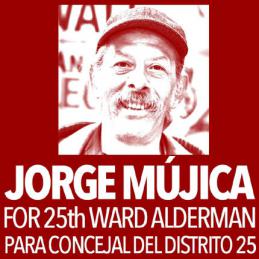
  • Mujica and the Chicago Socialist Campaign: A Small Battle in a Larger War

    Image

    The usual practice for lefties defeated in electoral politics is to claim victory, victory in the sense of having spread the word, victory in the sense of building an organization, victory in the sense of whatever plausible argument comes to hand. In the case of Jorge Mujica's campaign for 25th Ward Alderman, we can safely assert it was a successful proof of concept: The "socialist" label, in some neighborhoods, is not a handicap even if it is not an asset. Begging your pardon but I've been saying as much for years. Through our participation, Chicago DSA did earn a reputation as an organization that delivers on its commitments. But the campaign intended to establish a socialist presence in Chicago government and that requires victory.

    Chicago's 25th Ward is a gerrymandered district that was drawn for the benefit of the incumbent, Danny Solis. Solis is an erstwhile community organizer of the Alinsky school gone over to the dark side. The ward is located just southwest of Chicago's downtown, forming an upside down "U" wrapped around the University of Illinois at Chicago campus. The west wing includes parts of the largely Mexican Pilsen neighborhood. The apogee includes parts of Chicago's well-to-do, professional near west side then swoops down through the Union Station rail yards to include much of the south side's Chinatown. The previous ward boundaries made a district heavily Latino. The current ward has a bare majority of Latinos, Mexican mostly, with some Puerto Ricans and other Latino nationalities.

    The ward ended up with three other candidates in addition to Solis and Mujica. Roberto Montano is a businessman and, in the past, Solis' Chief of Staff. It's hard to say why he was running though it may have had something to do with Mayoral candidate Willie Wilson. Byron Sigcho was the other credible left of center candidate. An immigrant from Ecuador, a doctoral candidate in Education at UIC and very much a student politician, he had done some significant research into charter schools. Sigcho had the endorsement of Reclaim Chicago, the electoral coalition backed by National Nurses United. And finally there was Ed Hershey, a member of a small obscure Trotskyist sect. Was that redundant? In any case, Hershey seemed to feel the campaign needed a real socialist.

    Mujica's campaign grew out of the Chicago Socialist Campaign (CSC). The CSC was organized in response to Kshama Sawant's victory as a socialist in Seattle. Initially there was interest from several possible candidates for alderman. Ultimately, three ran for office. One won. Only Jorge Mujica decided to run as a socialist.

    Meetings of the CSC sometimes were as large as a hundred people, many of whom were not members of any socialist organization. Unfortunately this did not translate into election workers. Those who did volunteer were often totally without experience in election campaigns and most did not live in the district. It's easy to be snide about this, and people have commented about leftists who like to sit and complain about Democrats. But Mujica pointed out that the CSC drew people from across the city. If he had been running for a citywide office, as Sawant did in Seattle, there would have been opportunities to be involved near at hand for everyone. Instead, there were often important contests closer to home.

    And it's not as if Mujica himself was able to put in the time a campaign requires. He's not a rich man and had to work most of the campaign season. Otherwise, Mujica himself is reasonably credible as a candidate for city council. He was one of the organizers of Chicago's huge May Day immigrant rights marches several years ago, and that's just the most visible of the organizing he's done. He's been involved in Mexican electoral politics, and the aldermanic campaign was his second campaign in the U.S. Mujica is a personable fellow with a lively personality, articulate in both Spanish and English, and easy to look at even if he is rather more shaggy than the bourgeois image of an official. Well this is a socialist campaign, yes?

    Money was a problem for the campaign. It did have a paid campaign manager. The campaign did manage two bulk mail drops targeted at voters in the Pilsen neighborhood. And the campaign did have a good social media campaign directed at that same constituency. AFSCME Council 31 endorsed Mujica, as did a council of Chicago area CWA locals, bringing some mainstream credibility and money to the campaign. Chicago DSA raised over $1600 in early money and not all of it from DSA members.

    The mayoral contest also was a problem for the campaign. The Mujica campaign made no endorsement for Mayor. But many election activists in the ward were committed to working for Jesus Garcia's campaign for Mayor. An endorsement of Garcia by Mujica might have attracted some of those campaign workers but then again maybe not because it was clear that Garcia's campaign was not likely to endorse Mujica. The 25th Ward is in the backyard of Bob Fioretti, another a liberal candidate for Mayor, and neutrality left open the possibility of some support from his people. Ultimately though, the CSC, with its commitment to independent electoral politics, mostly felt Garcia was too much of a "Democrat."A great deal has been said about voter turnout. It was considerably less than the municipal election four years ago, but it was actually not much different than the municipal elections eight and twelve years ago. The 25th Ward was near the median for this election. The Board of Election did have its thumb on the scale, though. It set up the Ward's early voting site in Chinatown. Solis escaped a run-off election by only several dozen votes, prompting the Sigcho campaign to file for a recount of several precincts. A few of the items listed in the complaint may have plausibly been voter fraud but most of it sounded like sloppy inattention to procedure. Whatever the case, it made no difference. The official results put Solis at 3811 (51.07%), Sigcho at 1383 (18.53%), Mujica at 907 (12.15%), Montano at 748 (10.02%), and Hershey at 614 (8.23%).

    Of the groups participating in the CSC, the International Socialist Organization, Solidarity, and Chicago DSA came through. DSA raised money, provided opposition research, did issues research, provided mailing services, and had a dedicated handful of members who gathered petition signatures, canvassed voters, blitzed precincts, leafleted L stations, and did election day work. I think we could have done better, particularly with recruiting more people to work, but it's also true that Chicago DSA has no members in the 25th Ward. Will this coalition effort be duplicated in future elections? It would be a good thing if it were, but I'm inclined to be skeptical. Chicago DSA is open to the possibility. We'll see.

    *This article was originally published in New Ground, a publication of the Chicago chapter of the Democratic Socialists of America (DSA). Thanks to New Ground and to editor Bob Roman for permission to republish.


  • Liam O’Flaherty: Leader of a Four Day Revolt

    Image

    Liam O’Flaherty is regarded as one of Ireland’s finest writers of the twentieth century, but before he rose to literary prominence, O’Flaherty led a little known and short lived occupation of the Rotunda Concert Hall in Dublin city just days after the formation of the Irish Free state in 1922.

    Born off the coast of Galway on the Aran Island of Inis Mor in 1896, O’Flaherty served with the Irish Guards during World War I. After experiencing severe shellshock in Flanders he was discharged with a disability pension and led a somewhat nomadic life for the next few years.

    O’Flaherty’s travels took him around the Mediterranean, South America, Canada and North America. O’Flaherty had long held left wing values but, during these travelling years his left wing ideals swelled and he brought such political convictions back home to Ireland with him in Christmas 1921. He became involved in left wing politics in Dublin city and became a fixture on O’Connell street where from a small news stand he gave out political pamphlets and sold The Workers Republic newspaper. It wasn’t long before he gave up that role in order to lead a small working class revolt just a few yards up the street in the Rotunda hall.

    On Monday January 16, 1922, the Provisional Government of the Irish Free State was announced and two days later approximately 200 unemployed men, made up mostly of unemployed dock workers, marched into the Rotunda Concert Hall and Pillar room which is now the Gate Theatre and occupied it. O’Flaherty was at the head of this band as the chairman of the Council of Unemployed in Dublin and ordered garrisons to be divided into companies and red flags to be hung out the windows.

    This act of defiance by O’Flaherty and his army of unemployed happened during a time when Ireland was adjusting to the outcome of the War of Independence. It was a time when society across Ireland was slowly falling into a state of anarchy. Workers strikes no longer had any impact because the social atmosphere in Ireland at the time demanded something more and this is why ordinary strikes transformed into workers flying the red flag and taking over their place of employment through occupations. O’Flaherty admired workers like those in Limerick and Cork who took over workplaces to set up their own soviets and he sought something similar with his occupation of the Rotunda concert hall.

    The Rotunda was a significant point to make a social stand due to its historical link with the era of revolution. It was at the Rotunda where Sinn Fein was founded in 1905 and it was also the location of the formation of the Irish Volunteers in 1913 who would then transform into the Irish Republican Army, and O’Flaherty saw it as a place to establish what he envisioned to be a workers republic.

    O’Flaherty spoke to journalists outside, informing them that if he and his men were apprehended, that they would not recognise a court that was run by a government that does not recognise the unemployed.

    Unemployment in the aftermath of World War I was rife in towns and cities such as Dublin, and for the majority of soldiers returning home from the front, the prospect of employment seemed far off as Irish society was experiencing change amidst political upheaval.

    The occupation of the Rotunda by the unemployed men was not a half hearted affair. A maintenance fund was set up to ensure the occupation could last, while food provisions were organised from Boland’s bakery on Capel Street. Morale was also kept high through lectures, talks and concerts while daily marches and drills kept a military style of discipline within the garrison.

    While a workers republic was on the minds of those inside the Rotunda, outside on the street the mood for left wing politics was not as clean cut.

     A nightly mob would gather outside the Rotunda where attempts were made to remove the red flags flying from the widows. To disperse the angry mob outside, shots were fired over their heads from the occupiers inside the concert hall.

    At one stage the mob tried to storm the Rotunda but O’Flaherty’s unemployed protesters managed to push them back out.

    The occupation which began that Wednesday came to an end four days later at midnight Saturday when O’Flaherty and his band of men left without any incident.

    The growing resentment from those gathered on the street outside the Rotunda pushed the authorities into giving O’Flaherty an ultimatum, either he and his men leave immediately or they would forcefully remove them.

    To avoid any bloodshed O’Flaherty agreed to end the occupation of the Rotunda. With his revolver in his pocket he managed to slip away from the authorities and fled to Cork where he hid out.

    Some six months after O’Flaherty’s occupation of the Rotunda Hall, the mood across the land was drastically changing and social disorder spilled over into all out civil war when pro-treaty forces and IRA anti-treaty forces clashed. This of course enticed O’Flaherty out of hiding in Cork and he travelled back to Dublin to fight alongside the anti-treaty side.

    O’Flaherty wasn’t long in Dublin before he took flight again. He took a ship to Liverpool where his political activism ended and his literary career began.

    In 1925 The Informer was published and 10 years later adapted for the big screen by John Ford, while other notable works O’Flaherty wrote shortly after leaving Ireland include Famine in 1937 and a number of short stories such as The Sniper.

    The four day Rotunda occupation led by Liam O’Flaherty and some 200 unemployed men has now been submerged into the bigger historical picture of that time, while O’Flaherty’s political involvement during that turbulent era has been trumped by his literary success.

    Lily Murphy is a freelance writer from Cork city, Ireland. Email: lilymurphycork@gmail.com

  • Should Chicago Unions Have Backed a Socialist Instead of Chuy García?

    Image

    The “See, we told you so!” reaction by socialists to Rahm Emmanuel's victory over Jesús "Chuy" García in the recent mayoral runoff was as predictable as it was hypocritical. Scott Jay's article in New Politics is but one example of this kind of reaction which combines self-vindication and bravado with an utter lack of awareness of Chicago's political terrain. This know-it-all know-nothingism becomes painfully obvious when Jay writes:

    "[Socialist Tim] Meegan would have lost a substantial number of votes if he ran against Garcia, but if the goal was to create a political organizing space that can fight lesser-evilism, then it would have been more than worth it. However, it would have been extremely unpopular and would have been met with widespread hostility by most of the labor movement."

    So according to Jay, Meegan should not only have refused to endorse García, he should have run against him.

    This seems like a reasonable stand for a socialist to take, until you recognize the following:

    ·         Meegan was already running for alderman in the 33rd ward, making it impossible to run for two positions at once.

    ·         Meegan lost the three-way race in his ward by a hefty margin, 2,779 votes to the incumbent Deborah Mell's 4,103. (Mell narrowly escaped being forced into a runoff by dozens of votes).

    ·         Meegan would have been easily eliminated in the primary just as Emmanuel's and García's opponents were.

    ·         It takes 12,500 petition signatures to get a candidate on the ballot for mayor in the first place. In practice, this means gathering three times that figure (over 36,000) to guarantee that a sufficient number of signatures survive legal challenges by rival campaigns. So even if Chicago's teachers' union leader Karen Lewis decided Scott Jay was absolutely right and ordered her entire membership to sign Meegan petitions, they'd be about 10,000 signatures short since the union has 26,000 members.

    As if if the above weren't bad enough, there's the fact that all of the openly socialist candidates were defeated in every ward they ran in:

    ·         Jorge Mujica lost in the 25th ward after the “about a hundred Chicago socialists from various organizations, inspired by the election victory of Kshama Sawant in Seattle, came together to organize the Chicago Socialist Campaign” went MIA by the time it came time to actually do the hard work of campaigning for votes.

    ·         Eco-socialist Olga Bautista was crushed in the primary, receiving only 208 votes or 2.19% in ward 10 (although the ultimate victor there was Chicago Teachers Union executive board member Susan Garza).

    New Politics, Scott Jayand everyone in the socialist movement ought to take a good long hard look in the mirror and ask what we socialists are doing wrong (and what we can do better) to serve the class we think we are worthy of leading before pointing fingers at everyone else for the failure of the American workers' movement to live up to socialist expectations and conform to socialist principles. Writing that everything would be peachy keen 'if only' we were in charge of the labor movement is the political equivalent of playing fantasy football — entertaining for sure, but inherently irrelevant to real-world developments and struggles 

     *James Cunningham is a socialist blogger.

  • Eduardo Galeano – ¡Presente!

    Image

    Eduardo Galeano, the world-renowned leftist Uruguayan journalist and writer made famous with the publication in 1971 of his book The Open Veins of Latin America: Five Centuries of the Pillage of a Continent, died today at the age of 74 in Montevideo, Uruguay, where he lived. Long admired as a journalist, with his three-volume Memory of Fire in 1982, Galeano also became known as a writer of non-fiction prose who might be compared to writers of fiction such as Gabriel García Márquez, author of the novel One Hundred Years of Solitude or Isabel Allende who wrote House of the Spirits. Like their novels, his trilogy captures the real spirit of Latin America’s magical history.

    Born Eduardo Germán María Hughes Galeano in Montevideo on September 3, 1940, Galeano began his career as a journalist in the early 1960s working as a correspondent for Sol and then as an editor for Marcha, which published such writers as Mario Vargas Llosa and Mario Benedetti. When a rightwing military coup took power in Uruguay in 1973, Galeano was jailed and subsequently went into exile, first in Argentina, where he edited Crisis, and then in Spain where he wrote his trilogy Memory of Fire (Genesis, Faces and Masks, and Century of the Wind). Memory of Fire mixed history and journalism in vignettes and biographical sketches written in a creative prose style that reminded American readers of John Dos Passos’ 1930s classic U.SA. triology (The 42nd Parallel1919, and The Big Money).

    Image

    Open Veins of Latin America was a detailed, systematic, and sustained attack on European and U.S. imperialism in Latin America over five centuries, showing how first Spanish conquistadores, then English bankers and merchants, and finally U.S. corporations had dominated Latin America’s economy and pillaged the country’s natural resources while exploiting its enforced cheap labor. The book became a classic of the Latin American left and of the left around the world. In a famous gesture, Venezuelan President Hugo Chávez gave a copy of Open Veins to U.S. President Barack Obama at the opening of the Fifth Summit of the Americas held in Port of Spain, Trinidad and Tabago, in April of 2009.

    In 1985 Galeano returned from exile to Uruguay, establishing himself in the capital, Montevideo.

    Galeano created a stir in March of last year with his comment made at a book fair in Brazil where he was being honored on the occasion of the forty-third anniversary of the publication of Open Veins. Asked what he thought of his book today, he said, “I wouldn’t be capable of reading this book again; I’d keel over. For me, this prose of the traditional left is extremely leaden, and my physique can’t tolerate it.” Conservatives pounced on his remark as a repudiation of his leftist politics, when in reality it was the judgement of a mature author looking back at a book written in his youth in an altogether different period.

    Galeano remained a leftist until his death. He supported the campaign of Tabaré Vázquez and the leftist Broad Front in the 2004 election and in 2005 he became a member of the board of TeleSur, the pan-American television network based in Caracas, Venezuela. For fifty years, Galeano’s voice spoke truth to power and inspired the oppressed.

  • Blame the Black Political Class For Re-Electing Obama's Mayor Rahm Emanuel in Chicago

    Image

    NOTE:  The original version of this article quoted a claim that no voter registration drive was conducted. Since we did not take the time to fact-check this claim before publication, the article has been altered to omit the claim. – Bruce A. Dixon

    The results are in, and the truth hurts. Rahm Emanuel will sit in the mayor's office on the fifth floor of Chicago's City Hall four more years. Despite fudging police stats to make murders disappear, despite stonewalling on police torture and atrocities, despite deliberately shortening red light camera intervals to raise revenue for his buddies, despite closing and privatizing more than 50 public schools, almost exclusively in black and brown neighborhoods, than anywhere in the country, and despite his facing a solid progressive Democrat challenger, Rahm Emanuel carried every single ward in black Chicago, not by big margins, but by enough.

    It's true that Chuy Garcia was outspent at least six to one in the April runoff and twelve to one in the February election. It's true that Emanuel used that cash to buy an unanswerable deluge of radio and TV commercials. Big money and media are important, but these are advantages the candidates of capital will always possess. Chicago mayor Rahm Emanuel had something else in his pocket.

    Rahm Emanuel's biggest asset was the overwhelming support of Chicago's well-established black political class of preachers, business types, “community leaders” and public officials. President Barack Obama himself came home to Chicago this year and in 2011 to campaign for Rahm and cut commercials for him. Nearly every prominent black elected official in town, Democrats all, came out for Rahm, for privatization, for gentrification, for austerity, for more of the same. This is the state of black politics in 2015, and the reason that Rahm Emanuel carried every single one of Chicago's majority black wards.

    A career Democrat politician himself, Chuy Garcia could talk about the injustice of high stakes testing and privatizing public schools. What Garcia simply could not do was explain to black audiences why almost every black politician in town including the black Chicago Democrat in the White House was riding with Rahm. To do so would have been to directly criticize the regime of black urban politics and the policies of the president himself, something even the most “progressive” career Democrat politicians don't do.

    Soon after taking office in 2011, Rahm Emanuel had dinner with Karen Lewis, president of the Chicago Teachers Union. Rahm told the CTU president that a quarter of Chicago's public school children would never amount to anything and that he refused to “throw money” at it. Lewis promptly took the mayor's remarks public. That's not the kind of thing career Democrats pols do to each other.

    Before being diagnosed with brain cancer last fall, Karen Lewis was the presumptive mayoral candidate and actually leading Rahm Emanuel. As a black woman and not a career Democrat, Lewis might have felt freer than Garcia did to question the extent to which urban black politicians, not just in Chicago but in Atlanta, New York, Philly, and a hundred other cities, and the president himself were in bed with gentrifiers, school privatizers, warmongers and pension cutters. Lewis might have pointed out the close personal and political relationships between Illinois Republican governor Bruce Rauner, who aims to make Illinois a right-to-work state one county at a time, and Mayor Emanuel. She might have seized upon the widespread civic outrage in black Chicago against police immunity and impunity in a way that Chuy was not prepared to do.

    Unlike Garcia, Karen Lewis was on record saying that Rahm Emanuel's policies of privatizing public education were nothing more or less than carrying out President Obama's national policy on public education. But Lewis wasn't the candidate. Garcia was.

    “To win, Chuy needed to carry black wards against Emanuel, to make discouraged voters in those neighborhoods come out,” a campaign staffer told Black Agenda Report.

    “You do that by conducting an intense voter registration drive in those areas, and giving those people compelling reasons to come out. It could have been done. Chuy's campaign was dealt a good hand, but they didn't play it. They failed to emphasize the issues that could have set black Chicago on fire.”

     “This was the winter and spring when Ferguson was on everybody's lips. Chuy could have won wider and deeper support in black Chicago by focusing early and sustained attention on the corrupt and brutal practices of CPD, Chicago's Police Department. He didn't do that. It took weeks to get the Garcia campaign to endorse the drive for reparations for survivors of Chicago police torture. It took weeks more to briefly draw Garcia's attention to CPD's black site at Homan Square, another controversy he declined to make a big sustained stink about. The campaign pissed away these key opportunities to mobilize black support. And the only jobs program they announced with actual numbers was Chuy's proposal to hire a thousand extra cops.”

    There's a nonsense story going around that Chicago's mayoral election was “a fight for the future of liberalism” or “a fight for the soul of the Democratic party.” Both these are pretty much nonsense. Mayor Emanuel and President Obama along with the their supporting constellation of black elected officials, preachers, business types and community leaders are almost all liberals and Democrats. Emanuel's closing of 50 plus public schools, and his drive to privatize education is the national policy of a liberal Democrat president, implemented by liberal Democrat mayors and black elected officials in Philly, Sacramento, Atlanta and hundreds of US cities.

    Sure, big money and big media were important, as were strategic blunders by the Garcia campaign, like not seizing upon issues that could have won them energetic, fired up followers. But the biggest single factor in Rahm Emanuel's win this week was the overwhelming support of the black political class from the president on down.

    Rahm Emanuel is Obama's mayor. This is President Obama's victory, and his legacy to Chicago. It's Bobby Rush's victory and Emanuel's atrocities are on his tab as well. It's the victory of the black misleadership class over the people they ostensibly represent, and we'll all be paying for it in the days and the years to come.

    There's the usual lot of talk about this being the beginning of a long term mobilization, of a permanent movement. We'll see. If the mobilizing energies are poured back into more Democrat candidates, who by habit, nature, and professional courtesy don't disagree too strenuously with other Democrats, it's hard to imagine any different result.

    Here's a link to the New York Times exit polling on the election, and to the ward by ward totals posted at the Chicago Board of Elections.

    *Bruce A. Dixon is an exiled Chicagoan now living in suburban Atlanta, where he's managing editor at Black Agenda Report and a member of the state committee of the Georgia Green Party.

    This article originally appeared in Black Agenda Report. Thanks to Bruce A. Dixon and to Black Agenda Report for permission to reprint.

  • Small Victory for Independent Politics in Chicago, as Rahm Prevails

    Image

    Chicago teachers now have one of their own on the city council. Susan Sadlowski Garza, school counselor and Chicago Teachers Union executive board member, declared victory this week over incumbent John Pope. Absentee ballots are still being counted, but signs indicate she will squeeze past by less than 100 votes.

    While the CTU-led campaign to oust Mayor Rahm Emanuel fell short, Garza’s victory is a boost for the council’s progressive caucus, which before the election included 7 members out of 50. Depending on the outcome of absentee ballot counts in several close races, the progressive caucus could increase to 12.

    Garza was the lone CTU member to win election—a total of five were on the February ballot and two made it to a runoff. CTU member Tara Stamps lost in the runoff to Emma Mitts, another Emanuel ally known for bringing Chicago’s first Walmart store to her ward. Walmart rewarded Mitts with a $1,500 donation last month.

    Several other Emanuel allies on the city council lost their spots to challengers backed by United Working Families, the independent political organization created last year by CTU, the Service Employees' big health care local, and a number of Chicago community groups.

    Garza’s win in her Southeast Side district relied on grassroots volunteers and her family’s roots in the community. Her father Ed Sadlowski was a longtime reform leader in the Steelworkers. On Election Day, Garza had 250 volunteers getting out the vote in her ward.

    The 10th Ward runs along Chicago’s southern lakefront, where steel mills were once the main employers. Community groups complain of toxins and hazards from nearby industry. In her campaign Garza committed to booting the polluters out of the area. One of the main culprits, animal feed producer Agri-Fine, was a major Pope contributor.

    On education, Garza stressed that Emanuel’s education cuts affect everyone in Chicago, not just teachers or public sector workers, because students suffer—for instance, from not having enough counselors.

    United Working Families also backed Jesus “Chuy” Garcia’s campaign for mayor, as did the city’s largest transit union and SEIU’s state council. Garcia made it to a run-off with Emanuel—the first run-off in Chicago's machine-dominated history—but ultimately lost, 44 to 55 percent.
    Emanuel’s fundraising strength allowed him to flood the airwaves with campaign ads. Garcia built support after the runoff and did particularly well in Latino neighborhoods, but ultimately could not compete with Emanuel on visibility.

    Still, in her ward, Garza said, the mayor is unpopular among everyday Chicagoans. “Every single union member I’ve spoken to, whether it’s a laborer, a steelworker, or an auto worker,” she said, “everyone is showing interest in being part of United Working Families.”

    Why They Ran

    For teachers and their supporters who took on the mayor in 2012’s week-long strike, United Working Families represented the logical next step.

    Despite deep public support for teachers, strong organization at the school level, and their ability to mobilize on a massive scale, CTU members found that the mayor and the machine-controlled city council have sway over their workplace: the public schools.

    Specifically, CTU has been limited by the city’s Tax Increment Financing policy, which diverts a big chunk of property taxes to subsidies to developers rather than to schools, and by the mayor’s ability to appoint the school board and fund charter schools at the expense of existing public schools.

    While Garza supporters celebrate her upset in one part of the city, Chicago teachers and United Working Families are strategizing about how to deal with four more years of “Mayor 1%” and his majority on the council.

    “We certainly want to break from the politics of austerity,” said CTU organizer Brandon Johnson. “We want a break from the disinvestment. Whenever you have incumbents that vote 100 percent of the time with the mayor of Chicago and his corporate-interest agenda, there is clearly a need to have a more independent voice.”

    On the immediate horizon is CTU’s fight for a new contract. The current one expires in June. After being bested by CTU in the 2012 contract battle, Emanuel is no doubt eager to inflict a loss on his most visible political enemy.

    An open question is whether the energy generated by the electoral battle will translate into a lasting progressive political organization independent of the Democratic machine. Garza’s win provides at least one ray of hope.

    For more on struggles in Chicago, check out Labor Notes' latest book, How to Jump-Start Your Union: Lessons from the Chicago Teachers.


    This article was first published in Labor Notes. Thanks to Samantha Winslow and Labor Notes for permission to reprint.

  • The Failures of Lesser-Evilism in Chicago

    Image

    Once again, a major election in the US has brought out the specter of lesser-evilism–the call to vote for the least bad option–and once again this strategy has been a complete failure, regardless of which candidate actually wins. Usually it is a Republican against a Democrat, although in Chicago in 2015 it was a neoliberal Democrat, Rahm Emanuel, against a slightly less neoliberal Democrat, Jesus “Chuy” Garcia.

    There will be many analyses of how Garcia failed to beat Emanuel, such as Micah Uetricht’s piece in Jacobin which noted that “Garcia as a candidate was mediocre at best, and was far from the best candidate for Chicago’s current moment.” His campaign promise of putting another 1,000 police on the streets, at the height of the Black Lives Matter movement and in the midst of yet another Chicago police scandal, was unconscionable though not surprising.

    But Uetricht looks on the bright side, commenting that “progressive unions and community organizations have formed a new political organization, United Working Families, that seeks to train and run long-term movement activists as candidates and create a political home for themselves outside of the Democratic Party.” This is an odd conclusion, as the UWF and really the entire labor Left, including many independent local campaigns, were fully behind Garcia, a pro-austerity, pro-police Democrat. Rather than breaking from the Democratic Party, these efforts helped redirect independent political aspirations back into it.

    With the end of the Chicago election season, it is worth reviewing not only Garcia’s weaknesses but also the ongoing inability of even the left-wing of the labor movement to break from the politics of lesser-evilism, and the damage it does to struggles for social change. We need to have an honest and blunt assessment of the damage that has been done, because otherwise there can be no path forward. And while many of those involved have been and will continue to be comrades in struggle, some serious mistakes were made that must be accounted for.

    From social justice unionism to lesser-evilism

    It is hardly possible to promote the lesser-evil without lying about how evil they actually are and, therefore, disarming oneself. What was astonishing to watch were the efforts of the leadership of the Chicago Teachers Union—the people who led a polarizing and powerful strike against austerity just a few years back—taking the lead in Garcia’s campaign. It is nothing less than a disaster that CTU President Karen Lewis, who in years past was a figure who could mobilize the labor movement around broad social issues and against neoliberalism and racism, spent the last few months assuring everybody that a candidate openly in favor of attacking workers was in fact their friend. We should not pretend that this is a minor disagreement among comrades. The once inspiring promise that the current leadership of the CTU might lead a new path for the labor movement lies in tatters after this debacle.

    Karen Lewis and her Caucus of Rank and File Educators (CORE) came to the leadership of CTU in 2010 offering the promise of social justice unionism and, potentially, a new page in the history of US labor struggles. They delivered a popular teachers strike in 2012, but there have been many difficulties since. After the strike, they were unable to stop nearly all of Emmanuel’s school closures, but Lewis and CTU Vice-President Jesse Sharkey are now minor media stars and power brokers in Chicago.

    Karen Lewis nearly ran for mayor herself but, unfortunately, became seriously ill. Instead, she anointed Garcia her successor, and he was introduced at an annual CTU dinner by Sharkey as “the next mayor of Chicago” along with a surprise video from Lewis. The CTU membership had little say in any of this, as the endorsement was rushed through just days later.

    In short, their wheelings and dealings now need not have any direct relation to the needs of their members. Lewis and Sharkey are powers unto themselves. The leadership can make its own decisions and the membership is merely expected to follow, rather than the other way around.

    One of the most cynical moments of the Garcia campaign orchestrated by the CTU leadership took place in late March, with Garcia and Sharkey holding a press conference in support of a fifteen dollar an hour minimum wage for all Chicago Public School workers. Certainly this was a perfectly good demand to raise. The problem is, it was already obvious that Garcia was not committed to it at all and his actions following it made a mockery of the demand.

    The very next day, according to a Chicago Tribune reporter, Garcia described his actual plans for Chicago public sector workers in a televised debate with Emanuel. If he could not get additional funding from the state of Illinois, then “we have to sit down with the teachers’ union and have a difficult discussion with the teachers,” he said. Garcia also responded to a question from Emanuel about whether he was beholden to the public sector unions. Assuring his commitment to austerity, Garcia responded, “Given the state of affairs you have put the city in—the fiscal free-fall—I’m gonna tell the unions a lot of bad news because the situation is so dire.”

    It was a classic lesser-evil moment which earned Garcia high marks. In short, what he was saying is, I will cut wages and benefits, and I am going to blame it on Rahm Emanuel. Unfortunately, the lesser evil—the “nice guy”—is often much better at carrying out the evil than the “bad guy.” In fact, Garcia’s promise was precisely that he would deliver the bad news in a nicer tone of voice. Nonetheless, immediately following these comments in the debate, Garcia was greeted by a rally sponsored by United Working Families.

    “No gravy”

    The next week Garcia reiterated this theme of lean budgets. There will be “some very tough conversations for some tough medicine to be swallowed by all of the partners,” he said. “So there’s no gravy to go around.” The difference between his administration and Emanuel’s is that his “approach will be collaborative.”

    So what was Garcia actually promising–a wage to $15 per hour or budget cuts? Well, this might be shocking to hear, but it looks like this politician may just have been lying about his promises to the workers.

    The CTU leadership should have known better than to believe Garcia was really committed to wage increases and not austerity, and they probably did know, but their prominent position as power brokers in Chicago has now overtaken their better judgement. They no longer need to worry about what their members or any other workers think while they fight for a seat at the political table.

    As representatives of public sector workers, they are literally promoting the person who they hope will be the new employer and who they know will do so as a budget-cutter. As always with this strategy, it is a win-win situation for everybody but the workers, and the fact that many (though certainly not all) rank-and-filers also support Garcia does not make the work of Lewis and Sharkey any less damaging.

    Within hours of the election results, Sharkey announced that the CTU was looking for a quick deal to extend the current teachers’ contract for one year. This is a stark about-face from just two months previous when Lewis insisted that CTU was not going to extend the contract and they were prepared to strike for it and, yes, it would cost the city some money. Having put all their eggs in Garcia’s basket, they are now reeling and they only have themselves and their failed strategy to blame for it.

    It is certainly unconscionable under these circumstances that some unions actually backed Emanuel, the greater evil. Former staffers and volunteers of UNITE HERE in Chicago have signed an open letter criticizing their union’s decision to endorse Emanuel, as they certainly should. But that leaves us with the basic question–what about Garcia? Endorsing Emanuel is a betrayal of working people, but endorsing Garcia would not be much better.

    As for the CTU, there was a fight over the endorsement of Garcia, although much of it was pushed by people who supported Alderman Bob Fioretti, a more liberal and consistent ally of Chicago teachers. In a perfect twist of fate, Fioretti, the lesser of three evils, eventually endorsed the greater evil Emanuel. Even lesser-lesser-evilism is a dead end.

    Which begs another, more important question–what remains of the Left in the CTU? Considering the hopes that many had that the CORE caucus could pave the way for the future of the labor movement, it would seem that there ought to be a group of Chicago teachers who could openly disagree with their leadership’s undemocratic and dishonest promotion of a budget cutter. There is no less of a need to build rank-and-file opposition against the lesser of two evils, in fact this is often the more important task because it is through the lesser evil that evils are often carried out.

    What we are seeing is that social justice unionism, without a clear analysis and strategy around the Democratic Party, will stumble over the same roadblocks that labor has always stumbled over, regardless of how left-wing the elected leaders claim to be.

    Some would argue that mobilizing rank-and-file opposition to Garcia in these circumstances would be premature, or better yet “ultra-left,” but if the unions are going to oppose austerity then they need to do it consistently, or else we will end up in the same morass we currently find ourselves in. When our friends support our enemies, we need to be honest about what dangerous ground we are on.

    Similar problems apply to the various left-wing electoral campaigns that were notable over the past year, and this is especially true in Chicago where a number of rank-and-file teachers ran against pro-Emanuel candidates. The nature of their opposition was sometimes less clear, however. Tim Meegan, for example, is a Chicago teacher who ran an independent campaign for Alderman that came close to forcing a runoff. Nonetheless, Meegan endorsed Garcia. This begs yet another question–what does it mean for an “independent” campaign to endorse an austerity-promoting Democrat?

    A decade ago, there were battles throughout the (now moribund) Green Party, led by the late Peter Camejo, about whether they would endorse Democrats. In other words, for people like Camejo, actual independence was the entire point of the effort. If left-wing electoral campaigns are going to support and promote Democrats, what is the point of the campaign?

    These are difficult questions to ask and are offered in a spirit of solidarity, but they must be asked and the Left needs to have a frank discussion about them, because if this electoral work does not challenge and weaken the status quo and in particular weaken the hold of the Democrats over the Left and the labor movement, then it is not clear what it is attempting to accomplish.

    The labor movement is not going to break with lesser-evilism in one fell swoop all in unison, but rather through a protracted and ugly battle that will be opposed by people who have made their careers negotiating compromises. Those who stick out their necks will be slandered and isolated by the mainstream union apparatus. Meegan would have lost a substantial number of votes if he ran against Garcia, but if the goal was to create a political organizing space that can fight lesser-evilism, then it would have been more than worth it. However, it would have been extremely unpopular and would have been met with widespread hostility by most of the labor movement.

    Independent organizing will not be not easy. There will be a massive pushback from the Democrats and their hangers-on. In other words, there will be an open struggle and many convenient alliances will be broken, but at least we will fight for what we actually want and need, instead of continuing to fight for what we don’t want.

  • Death by Cop March – Los Angeles

    Image

    The protestors marched through the streets of Los Angeles on April 7 carrying 617 coffins representing the death of 617 individuals killed by Los Angeles law enforcement since 2000. Participants convened on the L.A. County Board of Supervisors from the north, south, east, and west, staging die-ins at strategic locations along the way. Family members of those murdered along with individuals who have suffered at the hands of the LAPD delivered powerful messages of anger, hope, and sadness, urging the need for continued and escalated community response to LAPD oppression and brutality.

    ImageThe Youth Justice Coalition, organizers of the event, said that, "At least 617 people have been killed by Los Angeles County law enforcement since 2000 – that’s almost 1 person killed by law enforcement every week in LA. African Americans are 9 percent of LA County’s population but 28% of the people killed by police and sheriffs. Fifty-four percent of those killed are Latino, while the Latino population in LA is 48%. LA County leads the nation BY FAR in law enforcement killings of community members.

    Image

    “Since 2000, according the LA County DA’s Office, there has not been a single prosecution in any of these cases. In addition, the DA has reported to us the their office has had an agreement in place since the Cooley administration to not investigate any use of force until the internal investigation conducted by law enforcement has been completed, 6 months to a year after the incident."  

  • Getting rid of the losers, like teachers who are “old and costly” and kids who are not “champions”

                A headline in a recent news story about Los Angeles teachers, calling the district’s teaching force “old and costly,” is a companion piece to the New York Times front page article about the Success Academy chain headed by Eva Moskowitz.  Taken together these explain why teachers unions are being attacked so viciously and why the unions need to change gears and direction now.  Once again, the Chicago Teachers Union leads the way in its new contract demands.

                The Right and many liberals insist that improving teacher quality is the best way to end poverty. This line of reasoning is based on the assumption that governments are powerless – or ought not – to interfere with the “right” to make profit in any way possible, including or especially in situations of dire emergency and human disaster, as Naomi Klein explains. Having succeeded in firing all of New Orlean’s teachers, mainly African American, after Katrina, to create the first all-charter school district in the nation, education “reformers” in both parties have gone after career teachers elsewhere. The aim, as this news article shows, is to eliminate experienced teachers who cost more. In so doing teaching is destroyed as a career and profession. To make that happen in a way that is seemingly objective, the project to marketize education uses scores from standardized tests to evaluate teachers, tweaked to allow for differences in students’ characteristics in what is called “value added measures.”

                We should have no illusions that these reforms will help all students achieve, the rhetoric that’s used to defend marketization and testing.  In fact, the goal is to “blow up” (Chester Finn’s term) the system of public education created at the turn of the last century. From neoliberalism’s stand point, the system was not sufficiently Darwinian because of increased economic competition. The sorting of those who deserve good jobs and those who don’t has to begin in kindergarten. Parents who are desperate to make sure that their children will be among “the haves” with access to the rapidly diminishing number of good jobs the global economy offers submit their children to many practices that advantaged parents may not be willing to permit.

                I want to caution that how kids learn and should be taught is not universal. I think that some white progressives are too quick to dismiss differences in teaching and learning that are related to cultural expectations, and I urge that we acknowledge that good teachers and parents can disagree about what works for kids, as older kids will disagree among themselves. There are, however, certain ground rules we have to insist upon, like behaviors that show we respect one another. As a teacher and teacher educator I think that respect is clearly missing in Success Academy’s practice of shaming low achievers by posting their scores to be seen by classmates and making their lives “misery.” I would urge parents not to send their children to a school that uses these practices. Respect is also missing in classrooms making poor kids of color obedient to teachers’ control of every bodily function, as occurs in prisons – preparation for what awaits students who don’t respond positively enough to the tactics of “champion” teachers who follow this prescription for good teaching. 

     Image           Older teachers are often not considered “champions” because they have ideas borne of experience and education about how schools should operate, how they and students should be supported. They want wages sufficient to support a family and working conditions that allow them to spend time with their own children. They are “costly” not only in salary but in their potential, in their unions, collectively to challenge the authoritarianism that pervades schools.

                An essential aspect of persuading parents to see alternatives to the dog-eat-dog competition to which they are told they must submit their children is for unions to do as the Chicago Teachers Union has in its latest contract proposals. The union is using the contract talks to challenge the school district and city about conditions in schools, administrative demands that rob kids of teachers' time, class size, as well as broader political issues of funding and fair taxation. In so doing the union supports parents and the public to see – and join with them in fighting for – a different vision of education, one in which we don’t have schools create a select group of “champions” and toss out the rest as disposable. The union has arrived at these demands through a bottom-up process and brings them to negotiations in a representative team of 50 members. In so doing, it models the democratic relations we need in schools and what teachers unions throughout this country need to do, pronto.


    You can follow me on twitter  and  Facebook. If you haven't already, you may want to read my book about The Future of Our Schools.  If you’re in Chicago April 17-20, you can join researchers looking at what’s happening in teacher unionism. Info on the offerings are in the online program at aera.net, including two panels in which I am participating.

  • U.S. Gay Rights Movement Mobilizes, Wins Victory against Discrimination

    ImageThis article was originally written for the Swiss socialist newspaper solidaritéS for which I am a correspondent with the goal of giving activists there some sense of the recent fight for marriage equality in the United States. – DL

    The U.S. gay rights movement won a tremendous victory in early April as governors and the state legislatures in Indiana and Arkansas were forced to back down and revise laws that would have discriminated against gay and lesbian couples.

    The controversy was over religious freedom versus gay rights. With more and more states passing marriage equality laws—37 of 50 states and the District of Columbia now have such laws allowing same-sex couples to marry—some conservative state governments reacted by attempting to pass religious freedom laws, ostensibly to protect religious rights, but actually to allow religious conservatives to discriminate against gays and lesbians.

    The current batch of religious freedom laws are based on a U.S. federal statute called the Religious Freedom Restoration Act of 1993 that was originally intended to protect Native Americans whose religious practices involved sacred lands or using drugs such as peyote.

    Conservatives then decided to pass similar laws at the state level not to protect the indigenous peoples’ right, but to protect Evangelical Christians who oppose same-sex marriage. Under such laws, private individuals or businesses would not have to serve LGBT folks, for example, a baker could refuse to make a cake for a gay wedding. Some 19 states passed such religious freedom laws intended to build an impermeable wall between Evangelicals and the gay movement.

    But it is clear that times have changed. When the Indiana legislature passed and Governor Michael Pence signed a religious freedom law that would have allowed private parties to discriminate, the LGBT movement spoke out and organized against it at once. At about the same time Governor Asa Hutchinson of Arkansas was signing a similar bill passed by the Arkansas legislature, with a similar reaction from gay rights groups.

    Gay organizations called the new laws “a license to discriminate” and immediately organized protests in Indiana and Arkansas as well as turning the issue into a national debate. LGBT organizations, Lambda Legal, the American Civil Liberties Union, and the Human Rights Campaign joined together in legal and lobbying efforts, while many local LGBT organizations and grassroots activists went into motion.

    What was astonishing in this political fight was the enormous amount of public support from around the country for the LGBT movement and for marriage equality. The National Collegiate Athletic Association, which is based in Indiana and organizes all university sports events, expressed its concern about how LGBT athletes might be treated in Indiana. The NCAA was joined by the National Basketball Association, and the Women’s National Basketball Association.

    Many major corporations, under pressure for years now from the threat of LGBT boycotts, came out against the bill and after it passed, demanded that it be revised to ensure no discrimination against gays and lesbians. In Indiana, Apple, Angie’s List, Eli Lilly, and Anthem were among nine major corporations that came out opposing the religious freedom law as originally proposed. In Arkansas Acxiom, Apple, and Wal-Mart—the country’s largest retailer—joined in opposing the religious freedom law for discriminating against gays and lesbians.

    Under pressure from the LGBT movement, the corporations, and the public at large, the governors Pence and Hutchinson and the Indiana and Arkansas legislatures revised the legislation to protect LGBT rights. The strong reaction and rapid retreat by conservatives probably means the end of any similar bills during this legislative season.

    This stunning victory is the latest expression of what has been a decade of successes by the marriage equality movement. It was only in 2004 that the first legal gay marriage in the United States took place; today more than two-thirds of the states permit gay marriage. In 2004 only 30 percent of Americans supported same-sex marriage; today the figure is 59 percent according to a recent poll. Support for gay marriage, though still less than a majority, has even risen significantly among conservatives and Republicans, while some 74% of Democrats support same-sex marriage. About three-quarters of young people (18-35) support same-sex marriage.

    Many on the left in the LGBT movement have criticized the emphasis on marriage equality laws, arguing that they play into the most conservative views about marriage, nuclear families, and religion.

    Still there is no denying that the LGBT marriage-equality movement has had an enormous impact on American society, winning in the last decade legal rights and political influence comparable to the black civil rights movement at high tide in the 1960s and the women’s movement’s accomplishments in the 1970s. Gay marriage rights have now been institutionalized in laws, court decisions, and in changes in public consciousness that will make it difficult to turn back the clock.

  • Baja Farmworkers Strike Stalled; Results Mixed; Struggle Goes On

    Image

    The strike by farmworkers in the San Quintín Valley of Baja California, which began on March 17 stopping production and shipments on 25 farms and costing the companies tens of millions of dollars, has been stalled as the Alliance of National, State, and Municipal Organizations for Social Justice (AONEMJS or Alliance) which leads the movement faces challenges from the state government, the employers, and corrupt labor unions.

    Whether or not the mostly indigenous farmworkers will be able to come out of the struggle with a genuine labor union, a contract, and real gains in wages, benefits, and conditions remains to be seen.

    The Alliance, made up of indigenous groups from several Mexican states, began brilliantly with a strike combined with blockage of 80 kilometers of the Tranpeninsular Highway over which all truck traffic carrying produce to the U.S. border must move. The strike paralyzed production and quickly brought the state government and employers to the bargaining table. The Alliance produced a list of demands, at the top of which was the removal from the equation of the  Confederation of Mexican Workers (CTM) and the Regional Confederation of Workers of Mexico (CROM), both corrupt organizations affiliated with the ruling Institutional Revolutionary Party (PRI). The Alliance also asked for a raise from the miserable US$6.64 dollars per day they have been paid for the last twenty years under the old union contracts to $300 pesos or US$20.25 per day.

    After about 30 hours of strike and highway closing, state and federal police as well as the Mexican Army moved into reopen the highway, establishing checkpoints where vehicles are searched. The state government, the employers, and the old unions first stalled negotiations for several days, ostensibly so that the bosses could come up with a common contract proposal, but effectively starving out the workers who live on their meager wages from day to day. On March 28, the union felt forced to end the strike and workers returned to the fields, but as one of their leaders, Fermín Salazar, said, they did so under duress and under protest.

    At about the same time Governor Francisco “Kiko” Vega de Lamadrid together with his cabinet made a tour of the fields, announcing that production was at between 85 and 90 percent of normal. In a widely distributed press release printed in papers throughout the country, Vega de Lamadrid said that the unions and the companies participating in the Agricultural Council of Baja California had come to an agreement on 64 points among which was a wage increase of 15 percent.

    The Alliance, which had initiated the strike, refused to recognize the agreement because of the involvement of the Regional Confederation of Mexican Workers (CROM) and the Revolutionary Confederation of Workers and Peasants (CROC), both affiliated with the ruling Institutional Revolutionary Party (PRI). Fermín Salazar said that the political parties and their unions were attempting to take control of the movement, and that they workers would not permit it.

    While many workers have returned to work, it was unclear how many had received the 15 percent wage increase or any wage increase for that matter. Driscoll’s of the Americas, recognized as one of the better employers in the region, announced that it had given workers raises of 20 to 40 percent. Berrymex also announced pay increases for its employees.

    So the strike seems to have had mixed results. Workers have won wage gains, but the government and the employers are clearly trying to marginalize the Alliance while supporting the corrupt labor unions affiliated with the PRI.

    Workers have continued to protest, carrying out a march to the state capital of Mexicali and a variety of other protests. As Alliance leader Salazar said, “For us, the struggle goes on.”

  • Treyf Pesach

    Image

    Hilton Obinzenger is a poet and a long-time informed critic of Zionism and Israeli policy toward the Palestinians. His new poem, Treyf Pesach (Dirty Passover), is a blunt speaking and not unhumorous effort to ask fellow Jews how they can celebrate the slave insurrrection in Egypt millennia ago and yet be struck dumb by the Israeli government's dissembling and bloody practices  toward "the stranger in our midst" today. You can read Obinzenger's smart, snappy work here, and visit his website here.

  • What’s Next for Greece? Debating Syriza’s Options

    ImageIn the weeks following its historic victory in the Greek elections on January 25, 2015, Syriza has been engaged in a bitter struggle. Syriza wants to implement the anti-austerity program it proposed to the Greek people during the election campaign; European elites have declared this to be impossible, and have thrown roadblocks in the way of even the most minimal of the party’s promised reforms—going so far as to challenge Syriza’s right to give food and restore electricity to the poorest sector of the population in the midst of the country’s profound humanitarian crisis.

    As the conflict between Greece and the International Monetary Fund, European Commission and European Central Bank (the three formerly known as “the troika,” now renamed “the institutions”) has deepened, Syriza’s popularity within Greece has soared. At the same time, however, an intense debate is emerging among Syriza members and supporters as to what strategy to follow in light of the relentless pressure from European leaders, with no immediate prospect of a positive change. The New York–based Campaign for Peace and Democracy, which has been actively engaged in support for the Greek anti-austerity struggle since 2012, organized a public forum held on February 6, 2015, titled “After the Greek Elections: The Future of Austerity in Greece, Europe and Beyond,” with speakers debating different perspectives.

    CPD now follows the forum with further discussion of Greece’s options, beginning with Syriza’s 2014 Thessaloniki Program, the basis on which the party campaigned for the January 25 elections, and an overview by Sarah Leonard that provides context for the policy debate, plus nine selected articles representing differing viewpoints. The first by Tom Walker is followed by interviews conducted by Sebastian Budgeon with Stathis Kouvelakis and Costas Lapavitsas. Next are articles by Michael Roberts, Kouvelakis, Barry Finger, James K. Galbraith and Maria Margaronis. Each article is preceded by a brief introduction and summary. We are grateful to Barry Finger for preparing this introductory material. The articles are followed by links to the report of the Hellenic League for Human Rights documenting the horrific human rights abuses produced by the austerity crisis, and to an extensive ongoing reference list on the Greek situation provided by the Canadian Socialist Project.

    Readers may find it helpful in understanding the array of technical terms and references to consult a glossary provided here that was featured in The Wall Street Journal.

    * * *

    Syriza’S Thessaloniki Programme (September 2014)

    Both an election platform (statement of priorities) and a governmental action program for national reconstruction by the Coalition of the Radical Left (SYRIZA), the Thessaloniki Program, released in September 2014, is a set of policy proposals designed to reverse austerity, relieve the humanitarian crisis, deepen democracy and revive the Greek economy within the formal context of a balanced budget. The program calls for a European New Deal, a European debt conference to write off part of the existing debt and to restructure remaining debt obligations based on future growth. It calls for expanded public investment financed off-budget (free from the restrictions of the Stability and Growth Pact) by the European Investment Bank. It was declared to be “not negotiable” by Syriza’s party leader, Alexis Tsipras (Greek Reporter, Jan. 12, 2015).

    Sarah Leonard, “How Greece Put an Anti-Austerity, Anti-Capitalist Party in Power

    The author reconstructs the social and economic backdrop behind the rise of the first anti-capitalist party to attain power in postwar Europe. Leonard describes the Greek debt crisis as nothing less than a hostage situation, in which the Greek people are being commanded to submit not only to having their resources appropriated but also to having their futures pulled out from underneath them by the demands of the German banks. The humanitarian crisis is depicted in graphic detail both at the macro and the personal levels. Syriza’s success is analyzed not as a fluke but as the culmination of protracted roiling unrest and resistance rippling throughout society—an atmosphere of pervasive defiance giving rise to a broad Social Solidarity movement. But, Leonard warns, socialism arising from the depths of despair also has a grim doppelgänger. For waiting in the wings, should Syriza falter, will not be the discredited forces of the political center, but neo-fascist reaction. And this dynamic of left-right polarization is being paralleled throughout the eurozone, with much now hinging on Syriza’s success.

    Tom Walker, “No, Syriza has not surrendered

    Walker navigates between opposing assessments of Greece’s agreement with the banking elites: that Syriza has suffered a major defeat against those who celebrate it as a “decisive step, leaving austerity, the bailouts and the troika.” He asserts that the government negotiated an agreement that, most importantly, staved off an imminent economic collapse. It cancelled the previous government’s planned cuts to pensions, scrapped VAT rises on food and medicine and carved out a framework permitting an increase in public spending if paid for by a more vigorous enforcement of taxes. The agreement is, on balance, a compromise rather than a rout. Syriza is unlikely to move forward, however, if left to struggle in national isolation.

    Sebastian Budgeon and Stathis Kouvelakis, “Greece: Phase One

    In interview format, Stathis Kouvelakis, a member of the central committee of Syriza and professor of political theory at King’s College London, acquaints the reader with the meteoric rise and internal complexities of the Greek far left, including the origins and background of the forces that coalesced to form Syriza, as well as those that remain external to it such as the Greek Communist Party (the KKE). This interview took place before the elections, but at a time when the likely results were already apparent. Kouvelakis argues that the strength of Syriza resides in its hybridization of the traditions peculiar to the Greek Communist movement with the novel forms of spontaneous resistance that have emerged in the fight against austerity. Particular emphasis is given to the Left Platform forces within Syriza, which see accessing governmental power not as the culmination of social mobilization but as a means of igniting struggles from below. Kouvelakis foreshadows arguments that rapidly rose to prominence after the latest disappointing rounds of negotiations over the debt memoranda, namely that those not ready to break with the eurozone, tie their hands in advance.

    Sebastian Budgen and Costas Lapavitsas, “Greece: Phase Two

    Costas Lapavitsas, a renowned Marxist economist formerly associated with SOAS (School of Oriental and African Studies, London), currently a member of the Greek parliament elected on the Syriza list (though not a party member), clarifies his differences with the Syriza leadership in this wide-ranging interview. He explains why he is skeptical of the prospects of ending austerity and writing off the Greek debt while remaining within the confines and restrictions of the European monetary union. Political advancement, he argues, requires changing the institutional arrangements that straightjacket the Syriza government. Since a reform path is not possible within the eurozone, control over fiscal policy through rupture (i.e., Grexit, leaving the eurozone) according to Lapavitsas, is the only path forward if socialists are to fulfill their election commitments. He calls for a negotiated, consensual exit and suggests that this should be the focus of the next round of negotiation.

    Michael Roberts, “Greece: Keynes or Marx?

    This is a reply to the Lapavitsas interview, “Greece: Phase Two.” Roberts argues that a Grexit should not begin and end with controls over capital flows, legal in any case under current EU rules, and bank nationalization. He suggests that renewed mastery over fiscal policy resulting from a break with the eurozone will not be sufficient to place Greece on a firm growth path. He notes that Argentina, as a case in point, broke from its dollar denominated currency in 2001 only to find itself with a short-lived recovery made possible by an export-led boom, not applicable to Greece. Roberts suggests that a replacement of big capital, not just banking, with public ownership and workers’ control presents a more dynamic alternative, particularly because Greek capitalism, suffering from a massive over-investment relative to profits, is in no position to turn the economy around.

    Stathis Kouvelakis, “A Reply to the Sophists

    Reposted as “The Reality of Retreat”

    According to Kouvelakis, the sophists in question are Étienne Balibar and Sandro Mezzadra, and their sophistry consists in two propositions. The first is that Syriza has no mandate to quit the eurozone, but instead has two affirmative interlinked mandates—to break with austerity and to do so precisely while remaining in the European Monetary Union. The other sophistry is the contention that any assertion of national sovereignty (Grexit) as a more propitious arena for struggle by Syriza, will also isolate and weaken other progressive forces, such as Podemos, within the eurozone. Kouvelakis argues in answer to these assertions that remaining in the European Monetary Union will only strengthen the troika, while fragmenting the alliance that brought Syriza to power and sapping its power to resist. It is a struggle that remains on enemy territory, in an iron cage as Kouvelakis has elsewhere characterized it. Conversely, an exit from the existing framework which makes a democracy accountable to its citizenry impossible would embolden other forces who already are in or might initiate the process of “hegemonizing” the national terrain as the focus of struggle. Real internationalism cannot be disconnected from the concrete realities of struggle, argues Kouvelakis. It is the troika (the institutions) that has colonized the member nations. By asserting sovereignty and giving expression to the popular mandate to end austerity, Greece will be sustaining the spirit of rebellion and resistance in a “democratic, popular, non-nationalist sense, open to the outside world.”

    Barry Finger, “Can Greece Defy the troika?

    The author acknowledges that efforts by the Greek government to reorient the debt architecture towards supporting economic growth and recovery have failed for lack of a cooperative partner in the troika. If it wished to, the European Central Bank could readily internalize outstanding debt, recapitalize the banks and support the spending decisions of the new government. Instead, the monetary union presently exists as a bankers’ bludgeon to shrink the welfare state and bring the eurozone in line with the far less worker-friendly economic frameworks of the United States and China. There are, nevertheless, stopgap measures that Syriza can pursue that might allow at least part of its program to be realized. It can securitize anticipated taxes and spend them internally as a parallel currency pegged to the euro. With it, Greece can support infrastructural investment, pay public servants and maintain health services. It can jumpstart the economy and reduce the debt to GDP ratio by expanding its tax base. More importantly, it can free euros for the importing of food, fuel and medicine. It can transform the eurozone from a monetary union into a looser monetary federation.

    James K. Galbraith, “Reading the Greek Deal Correctly”

    Galbraith presents a stark assessment of the negotiations prospects. “The only choices were an agreement with conditions, or no agreement with no conditions.” And Greece was under the gun. It had to come to terms with the troika or face a collapse of the Greek banking system, and, by extension, the economy. The final agreement extends the “Master Financial Assistance and Facility Agreement,” which was the framework for past assistance. The bulk of this, argues Galbraith, consists of provisions concerning taxation enforcements and modernization of the public sphere that are not problematic for Syriza. Both sides always understood the commitment to a 4.5 percent primary budget surplus as a nonstarter. And Syriza is in compliance with the International Labor Organization (ILO) with regard to labor reform, which puts it on firmer legal ground than its adversaries. As for privatizations, Syriza does not oppose them per se, but only those that create private price gouging monopolies and/or those whose terms of sale are giveaways that add little to the public coffers. If Greece is to stay in the eurozone, expansion can only come through better tax collection, from private investment or from the European Investment Bank. A large scale Keynesian stimulus was never realistic. The Greek government achieved what it needed to do under the circumstances. It extended its scope of maneuver while building the prospects of its anti-austerity eurozone allies in Spain, Ireland and Portugal.

    Please support our journalism. Get a digital subscription for just $9.50!

    Maria Margaronis, “After Last Week’s Deal with the troika, What Next for Syriza?

    The author sees the four-month agreement that the Greek government signed with the “institutions” as fraught with creative ambiguity. Syriza extracted a crucial reprieve from the requirement to run a 4.5 percent primary surplus (taxes minus spending net of interest payments on the national debt), permitting room for fiscal expansion. It also won the right, subject to approval, to design its own reforms. She nevertheless also acknowledges that neo-liberal labor market revisions and privatizations approved by previous governments, but repudiated at Thessaloniki, remain as points of contention. Margaronis shares the opinion of others that Syriza’s mandate is to end austerity and restore lost rights, while remaining in the eurozone. But she also suggests that the agreement is, on balance, a modest victory for Greek socialists who applied a democratic wedge to pry open doors heretofore locked by the banking autocracy. In so doing, Syriza provided hope to democratic oppositionists and anti-austerity activists throughout Europe.

    For further research and information, check out Downgrading rights: the cost of austerity in Greece published by the Hellenic League for Human Rights, which gives an extensive account of the economic, social, social, cultural, civil and political rights violations caused by the years of Greek austerity, and the Canadian Socialist Project’s very helpful ongoing listing of articles on the situation in Greece and Europe.

    [This article was originally published by The Nation.]

  • My Deeply-Held Religious Convictions

    Dedicated to Indiana’s new Religious Freedom Restoration Act

    prevent me from
    upholding,
    condoning, or
    tacitly tolerating
    any form of
    assholery whatsoever,
    in any way, shape,
    or form.
    Therefore, as a
    Hoosier professing these
    deeply-held
    religious convictions,
    I hereby declare that
    I will
    in no way
    tolerate,
    serve,
    or pander to
    any type of
    asshole
    whatsoever,
    under any
    circumstances,
    while I reside
    in the
    State of Indiana;
    but will
    deliberately
    discriminate against
    any and all
    assholes
    I come into
    contact with!
    No exceptions!
    (And no,
    no exception
    for you,
    Indiana
    Governor Pence—
    or for
    any member
    of the
    Indiana
    General Assembly
    who made
    this legal atrocity
    the law of the
    Hoosier land.)
     

    George Fish is a socialist writer living in Indianapolis. This poem first appeared on his blog.

  • Challenging "labor imperialism" AFT-style

    Image            It’s encouraging that US unions are acknowledging the deep crisis facing labor and even the need for union democracy, as Labor Notes contributor Mark Brenner observes in his March 2015 column about the conference organized and hosted by the Albert Shanker Institute, an arm of the American Federation of Teachers (AFT).  At the same time, the project to destroy unions is global, and to push back successfully our movement needs to learn with and from workers in other countries. Part of that process is our challenging the Shanker Institute’s public, close ties with the National Endowment for Democracy (NED). Though the Shanker Institute makes no secret of its relationship with NED, what it doesn’t explain is how the NED works as a junior partner with the US government to suppress independent workers’ movements throughout the world. The AFT itself sponsors projects that undercut militant, independent unions, as two researchers noted using “teacher training as labor imperialism.” 

                 Workers elsewhere pay dearly for the AFT’s and U.S. labor’s support for U.S. foreign policies that sabotage popular movements challenging control of wealthy elites. A 2014 World Bank report about educational reform in Latin America and the Caribbean (stay tuned for a response Mary Compton and I are writing) urges governments to destroy the power of teachers unions.  This report provides a rationale for the repression of the unions, as is currently underway in Mexico and shows the urgency of our making waves about the Shanker Institute hosting a conference about building the labor movement at home while allowing its suppression abroad.

                Efforts to win gains for U.S. workers at the expense of workers in other countries are doomed for the same reasons it has been suicidal for U.S. unions to cast U.S. workers’ self-interest as being separate from and even at odds with non-union social justice issues at home. A strong, mobilized labor movement at home has to be rooted in ideals of democracy, social justice and equality that we understand and act on as universal.

    A shorter version of this letter appears in the forthcoming print edition of Labor Notes. The print publication contains lots that’s  valuable that does not appear elsewhere.  I subscribe. I hope you do too.

    You can follow me on Twitter and Facebook. Still in the works: a critical analysis of that World Bank report about teachers in Latin America and the Caribbean.

  • First We Take Manhattan…

    ImageSince the pressures of international financial capital and its subservient political elites will continue with the same if not greater intensity, it is also certain that a new cycle of social mobilization in Greece and the rest of Europe will begin again. Today, when social movements are “internationalized” mainly through the internet, what role could the communities of the Greek diaspora play in faraway cities, such as New York, cities of great importance for the flow and concentration of financial capital that are registered in our collective imaginary for every possible reason other than their role in the history of social movements?

    Since the elections of 2012, the meteoric rise of Syriza has generated a wave of enthusiasm – at home and abroad – expressed by the proliferation of grassroots groups and organizations rallying in Syriza’s support, against the rise of fascism in Greece and Europe at large and the authoritarian practices of the Greek government such as the overnight shutdown of ERT (Greece’s public broadcasting network). In what felt almost like a chain reaction, nearly every European capital appeared that it would get its own Syriza branch while smaller Greek radical left parties such as Antarsya (Front of the Greek Anticapitalist Left) followed suit organizing marches, protests, conferences and open public discussions in universities and other forums.

    On the other side of the Atlantic

    The  organizing force behind all these rather small groups has been diaspora Greeks who have either lived and worked abroad for decades or migrated recently as a result of the economic pressures back home. The phenomenon has been repeated even across the Atlantic. In February 2012 a gathering at Zuccotti Park in New York City, in response to what was meant to be an international solidarity action under the cry “We Are All Greeks” gave rise to the establishment of three different groups: AKNY (Left Movement NY) – Greece Solidarity Movement, Syriza-NY and Antarsya-US.

    The impact these groups, as collective subjects, may have in the broader fight for social change is certainly unclear. Yet, it appears as if they work like small centripetal forces around which various fragments of the European and American Left flock, inspired by the historical possibilities the rise of a Left party in power brings. Similar are the effects of the rise of Podemos which, transcending the local and particular circumstances of Spain, has generated trans-national networks and organizations enabled by the presence of Spaniards abroad. Whether these groups – all rather diverse in their practices, organizational structure, ideological orientation and immediate goals and objectives – will be able to galvanize greater movements back home or abroad remains to be seen. Some facets of their particular conditions, however, beg for more attention: the diasporic aspect, already mentioned, as constitutive force of their organization, and a strong urban element which, on various levels, plays an important role in the emergence of a new global political geography.

    In our day, social movements’ actions and radical political changes, thanks to the internet and the social media, rapidly reverberate across large geographical scales. The movement of the squares of 2011, encompassing the indignados in Spain and Greece and Occupy Wall Street in the US, the Egyptian Revolution and the Turkish uprising, the revolts in Tunisia and Syria, the Hong Kong or Sao Paulo protests, the rise of Podemos in Spain and Syriza’s ascendance to power are all closely interconnected in our political imaginary. A global struggle for real democracy is taking place and in the process a global change of consciousness is well under way, extending far beyond the political, geographical and ideological spaces of the cities which first ignited it.

    The urban element and the Global Cities according to S. Sassen

    The historically-proven importance of the urban element in constituting social movements once again appears to play a great role. Global cities – a term largely popularized by sociologist Saskia Sassen in her 1991 book The Global City: New York, London, Tokyo – recognized as such primarily for their importance as nodes in the global economic system, constitute also relational conduits where movements connect and develop. Global are the cities where not only financial capital meets and decision-making institutions are located but also sites where new actual physical social relationships are forged and in which potential protesters, activists and radical scholars are implicated. Athens, Cairo, New York, Istanbul or Madrid set a new global political agenda and for that reason alone can be indexed as ‘global cities.’

    Diasporic communities and social movements

    Global cities occupy a central position in the transnational social, cultural and political networks, networks which are made up of nomadic social actors, various kinds of diasporas – small-minded nationals as well as internationally-minded professionals, workers, scholars, researchers, activists and so forth. Transnational social movements, as well, are enabled by electronic networks and weak-tie connections which facilitate the transmission of information but are enacted by social actors on the ground, individuals in direct contact forging actual relationships and strong ties while connecting and coordinating their actions. Individuals and groups moving within and between large urban centers form nodes in relational networks that can connect struggles over distant lands.

    AKNY, Antarsya-US, and Syriza-NY, organizations with which I am most familiar, are diaspora-based organizations working not only to popularize the struggles of the Greek people back home but to build connections and solidarity with organizations, groups and individuals that fight similar fights in New York City and the US. New York, home to a large Greek diaspora, is also home to various forces of the American radical Left which have been closely following the recent political developments across the Atlantic. Greece has ignited the Left’s political imagination around the world, often to the astonishment of the people of the Greek Left who may be more reserved or more cautious in their optimism at the moment. From New York City, the epicenter of world capitalism and source of tremendous symbolic power, modest diasporic networks can capitalize on the prestige that the city emanates, increasing the visibility of their struggles, expanding their influence and potentially building strong counter-hegemonic organizational structures. If nothing else, the results of the recent negotiations between the Greek government and the Troika suggest that international solidarity and mobilization may be key to not only avoiding further capitulation but to developing a strong front against the continuous onslaughts of finance capital in Greece and beyond.

    New York, for instance, thousands of miles away from any European city, for a long time loomed large in European’s imagination, mostly as a hub of high lifestyle, high culture and conspicuous consumption. Yet, the several hundred people who, in 2011, gathered, rather spontaneously, at the small ‘privately owned public square’ of Zuccotti – formerly called Liberty Plaza Park – reminded us at whose expense that lifestyle was forged and specified exactly how few people it concerned. Symbols, along with changing consciousness, or probably because of it, are subject to change as well. On January 22nd, when Pablo Iglesias, the General Secretary of Podemos addressed Syriza’s supporters at the party’s preelection rally at Omonia Square by opening his speech with Leonard Cohen’s: “First We Take Manhattan, Then We Take Berlin…” might have had in mind something along these lines.


    Note: This article was previously published in Greek in Ενθέματα Αυγής, https://enthemata.wordpress.com, March 15, 2015.

    Despina Lalaki is a Sociologist and Visiting Research Fellow at The Center for the Study of Culture, Technology and Work, CUNY, The Graduate Center.

  • Zen and the Art of Social Movement Maintenance

    Image

    [This article was originally published by Waging Nonviolence.]

    Angela Davis, revolutionary activist and philosopher, is a committed yogi. She began practicing in prison when a doctor working with the Black Panther Party passed along a book on yoga to help her deal with chronic headaches.

    The poses worked, and many years later Davis continues with her sun salutations. She currently practices under the guidance of Oakland-based yoga teacher Naushon Kabat-Zinn, daughter of medical researcher and mindfulness popularizer Jon Kabat-Zinn. Kabat-Zinn, the elder, defines mindfulness as “paying attention in a particular way: on purpose, in the present moment, and nonjudgmentally.” The most common form mindfulness practice takes is sitting meditation. Mindfulness can be applied more broadly, however, as the recent spate of books on everything from mindful sex to mindful politics suggests.

    In January, Angela Davis shared an Oakland stage with Kabat-Zinn as part of a sold-out fundraiser for the East Bay Meditation Center, or EBMC, which is a leader in efforts to integrate mindfulness practices and social justice. Kabat-Zinn is no stranger to social justice, having been an activist in the anti-war movement at MIT in the late 1960s, and being the son-in-law of the late social movement historian Howard Zinn, author of “A People’s History of the United States.” Kabat-Zinn is also a spiritual friend to Silicon Valley giants, regularly giving talks to Google and Facebook. He is on the vanguard of what Time recently called the “Mindful Revolution,” a mainstreaming of mindfulness practices being powered by new research illuminating the health and cognitive benefits. Kabat-Zinn’s “Mindfulnness-based stress reduction,” a secular training program based on Buddhist principles, is currently being taught to school children, U.S. marines and corporate employees.

    Angela Davis’ Marxism, and Kabat-Zinn’s cheerful embrace of corporate America, are not an easy match. Indeed, Kabat-Zinn’s work appears to vindicate Marxist philosopher Slavoj Žižek’s critique of Western Buddhism as a supplement to neoliberal capitalism: “It enables you to fully participate in the frantic pace of the capitalist game while sustaining the perception that you are not really in it.” But Davis has seen the benefits of mind/body practices and is not so swift to dismiss them. How can mindfulness genuinely support social justice? This was the basic question she kept returning to in Oakland.

    “In a racially unjust world,” Davis earnestly asked Kabat-Zinn, “what good is mindfulness?” He responded by noting how the heightened awareness enabled by mindfulness practice can progressively uproot the greed, hatred and delusion that cause so much collective suffering. Davis, however, was not satisfied with his response, emphasizing that racism is not simply a set of personal attitudes, but a whole system. How can practices focused on personal habits of mind generate lasting systemicchange?

    Near the end of the evening, Davis offered an answer to her own question. She noted how mindfulness might become a revolutionary force if embedded in social movements that target oppressive systems. But what forms can that integration take? What does a true mindful revolution look like?

    While the brief discussion between Davis and Kabat-Zinn remained abstract, actually existing experiments at the intersection of mindfulness and social change are blossoming. Several organizations are now focusing their efforts on the fold between subjective and social change: the Center for Transformative ChangeGenerative Somatics and the Movement Strategy Center are three leaders. At the U.S. Social Forum in Detroit in 2010, activists from these groups passed a resolution that read: “We acknowledge that we as agents of change, having been deeply affected by our conditions of oppression, need a deep and abiding commitment to embody the revolutionary change we seek … Revolutionary, systemic change is needed internally, in our relations and in our external conditions.”

    Embodied practices from singing and dancing, along with spiritual forms like prayer and ceremony, have been central to all successful social movements. But the integration of mind/body practices like meditation and yoga into secular and multi-faith movements in the West, is a recent and growing trend. This trend was exemplified during the Occupy Wall Street explosion of 2011. Practices like yoga and meditation were woven throughout Occupy, and were integral to its endurance and impact; they were not a sideshow. This is a part of the Occupy story that remains untold, and yet holds vital lessons for the growing body of activists and mind/body practitioners wondering what good mindfulness can do in an unjust world.

    Strategic meditation

    Meditation and yoga came to Occupy through multiple sources. Meditation Flash Mob, or MedMob, a grassroots organization that began in 2011, had conducted their own public meditations in the financial district in the summer months prior to Occupy. Meditation flash mobs are a form of culture jamming that aim to constructively interrupt daily life in urban centers, and perform the benefits of mindful awareness. Once Occupy began, many MedMob participants joined the encampment, naming a tree in the northwest corner of the park “The Tree of Life,” which quickly became a focal point for spiritual practices of all kinds.

    Along with members from MedMob, the Interdependence Project, or IDP, an organization that offers secular Buddhist study and practice, helped facilitate daily meditations in Zuccotti Park. Adreanna Limbach was coordinating the activism branch of IDP at the time, and was eager to support the new movement. The initial intent of Limbach and IDP was to provide a service to Occupiers, to offer space and time for centering amidst the bustle of the park. But during her engagement with Occupy, Limbach noticed how divisions along the axes of race and class that the movement was seeking to transform were being replicated in the very geography and interactions of the encampment itself. For example, the northeast side of the park was primarily inhabited by middle class white people, and came to be called “The Upper East Side Sacks.” The southwest side, however, was largely black and Latino.

    “About three weeks into my experience at Occupy,” Limbach explained, “I began to think of meditation practice less as a service, and more a strategy, since we are bound to recreate structures of injustice in our daily interactions if we are not working with internal belief systems, and how they are shaped by power, privilege and positionality.”

    Meditation and yoga, however, do not automatically nurture an anti-racist and egalitarian ethos. If they did, Western practice communities would be sanctuaries from what bell hooks calls “imperialist white supremacist capitalist heteropatriarchy.” As hooks has noted, based on her experience as a Buddhist and a woman of color, exclusions along multiple axes of oppression — such as race and class — continue to shape the dissemination of meditation and yoga in the West.

    These exclusions were apparent during Occupy itself. Tashy Endres, who offered training in nonviolent communication during the encampment, told me a troubling story about how a difficult conversation regarding race got railroaded. It happened during a meeting where everyone was asked to join in a collective chant of “Om,” which effectively drowned out a black woman who was sharing her frustrations with the group. Endres remains committed to mind/body practices as supplements to social justice work, and integrates body awareness exercises into her nonviolent communications work. She does not, however, see them as guarantees of compassionate or just action.

    “It is important to combine structural analysis with spiritual practice,” she said. “Otherwise, you are likely to replicate oppressions and exclusions no matter how many hours you meditate.” When embodied practices are combined with social justice work, Endres explained, they can allow for a deeper incorporation of radically egalitarian values than is possible through solely intellectual exercises, like education and debate. “For me, when struggle and mindfulness are combined, both can flourish.”

    In an essay called “Buddhism and the Politics of Domination,” bell hooks provocatively notes how mindful awareness can be skillfully used to “release the attachment to dominator thinking and practice.” Other activists agree that the integration of mind/body practice and anti-oppression work is rich with potential. Joshua Stephens, an activist and author who blogged from Occupy Wall Street for the Buddhist Peace Fellowship, explained, “If you look at the general mechanics of anti-oppression discourse and training, it is observing how socialization and social structure speak through us, and then finding points of intervention so that we can make deliberate decisions about our agency rather than just moving through racist, patriarchal, colonial inertia. It is a form of meditation.”

    Similarly, angel Kyodo williams, author of “Being Black: Zen and the Art of Living with Fearlessness and Grace,” spoke with me about how meditation can help people notice transphobic, racist or sexist thoughts as they may move through our bodies. According to williams, this observing and examination of our own unconscious prejudices, can start to rewrite the oppressive scripts circulating in our cultures and communities. Furthermore, as williams explained, mind/body practices can also help heal the embodied wounds to dignity inflicted by systems of domination. Meditation, yoga and other somatic techniques can nurture self-acceptance from an internal and primal place, untouched by the systems of domination that work to belittle particular humans in the service of privileging others.

    “There is a place that we find when we look deeply into ourselves,” williams writes in “Being Black,” “that allows us to be completely free of our histories, our stories, our hang-ups … We actually have a freedom spot in our brains.” Time spent connecting to this freedom spot through mindfulness practices can be profoundly healing for those of us who have been systematically pushed to doubt our dignity.

    Organizations that do anti-oppressive training to build movement power, like theCatalyst Project based in San Francisco, have begun integrating embodied awareness and mindfulness practices into their organizing work. In general, however, the tactical integration of mind/body and anti-oppression work is underdeveloped; it remains a site of great transformative potential.

    The General Assembly: Touching Occupy’s heart

    Occupy Wall Street’s radically democratic vision was most clearly enacted through the General Assembly decision-making process, a forum in which everyone could participate. Because the assembly operated by consensus, participants needed to work through objections to any proposal until the entire group could agree. The process could become challenging and tedious. During conversations with Occupy activists, I learned that, while short meditations like moments of silence were used by assembly facilitators in the early days of the camp, the practice became more common as the occupation continued, and challenges intensified.

    “As decision-making processes began breaking down,” facilitator Marisa Holmes explained to me, “with more disruption coming from within the camp, from the state, from all angles, we used these practices more and more.”

    Why did facilitators turn to mindfulness-based activities in response to intensifying conflict? I asked Leslie Booker, who explained the transformative potential of these practices in the context of Occupy’s general assemblies. Booker, who had worked with a New York-based group called the Lineage Project to teach yoga and meditation to incarcerated youth, was completing mindful yoga training at Spirit Rock Meditation Center in California when Occupy began. She returned to New York and became a core organizer of the daily meditations. Based on her work organizing daily sits in the park, Booker was invited to a facilitators meeting.

    “I had been to almost every general assembly,” she explained, “and they could be really violent and aggressive.” Booker instructed facilitators on how to start all assemblies with grounding exercises. (She was careful not to call these practices “meditations” because she believed that word might have religious or spiritual connotations that could potentially alienate participants.) These practices were brief — under 10 minutes — and had participants focus attention on their breath prior to setting a collective intention for the meeting.

    “Setting an intention before we started really shifted things,” Booker reflected. She reported how consensus process became less aggressive after regular grounding exercises were introduced. A number of individual working groups — smaller teams of activists focused on aspects of the occupation like facilitation — began incorporating their own grounding practices.

    “It was cool to see people do it in a way that makes sense for them,” Booker noted. “We don’t have to get into dogma or into dharma, it was just as simple as how can I take a moment to ground myself.”

    Occupy Manifest: Retreating to advance

    While grounding exercises helped ease aggression and facilitate communication among Occupiers, they could not stop the violent eviction executed by the New York Police Department in November 2011. They were also unable to transform debilitating internal conflicts that weakened the occupation. At the root of these conflicts, many activists believed, was the fundamental disagreement over whether and how Occupiers should engage with structures of power, including more established institutions on the left, like unions. According to activists I interviewed, this failure to find a place between uncritical engagement, and a blanket refusal to engage more established institutions for fear of cooptation, was a fundamental barrier to the movement’s progress.

    “I think a lot of mistakes resulted from the inability to engage with power, interact with it and build strategies around how to shift it,” said journalist Nathan Schneider, who is an editor-at-large for Waging Nonviolence and the author of “Thank You, Anarchy: Notes from the Occupy Apocalypse.”


    The ability to engage strategically with power structures, some activists came to see, required that they first develop a strong internal set of values. “My hypothesis is that a lot of fears around movement cooptation were actually fears about personal cooptation,” said Brooke Lehman, a veteran in the New York activist scene who offered direct democracy training during the encampment. Many Occupiers were new to political organizing, and had not yet deeply rooted themselves in their values. If Occupiers could gain a firmer sense of their politics and life purpose, Lehman believed, they might reduce their fear of being coopted and therefore feel more comfortable working with people with different political beliefs.

    Lehman’s theory attracted her to work that fellow activists Kobi and Michael Badger were doing to organize leadership trainings for Occupiers called Occupy Manifest. The trainings involved multiple weekend retreats, a number of which were held at theWatershed Center, a retreat space Lehman helped create for activists, located on a farm two hours north of New York City. A key goal of the Occupy Manifest gatherings, which began shortly after the encampment ended, was to provide activists with the space to collectively reflect on their deepest values, and to use tools like meditation to begin embodying those values as fully as possible.

    Many of the participants in Occupy Manifest became leaders in the Occupy Sandy relief effort after the superstorm hit New York on Oct. 29, 2012. Occupy Sandy was tremendously successful in its response, using social media to quickly raise over $1 million and mobilize 60,000 volunteers — four times the number of volunteers engaged by the Red Cross. A key element of Occupy Sandy’s success was participants’ willingness to work across political differences, coordinating activities with churches, FEMA and other relief organizations that didn’t necessarily share Occupy’s values and horizontalist style of organizing. According to Kobi, who was involved in both Occupy Manifest and Occupy Sandy, the training provided activists with the tools needed to cooperate across political differences without giving up non-negotiable principles. For Kobi, the deeper trust in self that the trainings facilitated for activists was integral to Occupy Sandy’s flexibility, openness and overall success.

    Planting seeds for collective liberation

    Occupy Wall Street is not a complete answer to Angela Davis’ question of “What good is mindfulness in a racially unjust world?” But it revealed important ways mind/body practice can support collective struggle: from improving anti-oppression training to facilitating alliance formation across political differences. The intersection of personal and political transformation remains pregnant with potential.

    During their dialogue, Jon Kabat-Zinn noted his original skepticism towards Davis’s radical stance on prison abolition. “But then you gave me your book, ‘Are Prisons Obsolete,’ and I’ve changed my mind. I think it’s a fantastic idea.”

    Mindfulness alone will not spark a political revolution, but when joined by actual revolutionaries, it might expand all of our possibilities for freedom.


  • IMPORTANT STRIKE IN MEXICO; FARM WORKERS PARALYZE BAJA FARMS

    Image

    Thousands of farmworkers in the San Quintín Valley of Baja California, just 185 miles south of the U.S. border, struck some 230 farms, including the twelve largest that dominate production in the region, on March 17 interrupting the picking, packing, and shipping of zucchini, tomatoes, berries and other products to stores and restaurants in the United States. The strikers, acting at the peak of the harvest, were demanding higher wages and other benefits to which they are legally entitled such as membership in the Mexican Institute of Social Security (IMSS), the public health system. While there have over the last two decades been several large scale protests by workers in San Quintín, usually riots over the employers failure to pay their employees on time, this is the first attempt by workers to carry out a such strategic strike.

    The farm workers reportedly succeeded within three days in negotiating with employers and the government an agreement of the existing unions, the Confederation of Mexican Workers (CTM) and the Regional Confederation of Workers of Mexico (CROM), both corrupt organizations affiliated with the ruling Institutional Revolutionary Party (PRI) that had colluded with employers to keep wages low. The agreement reached on March 20 will give the workers the right to create their own union and negotiate directly with the owners. If this agreement holds, it represents a tremendous achievement for these workers and establishes a precedent for other workers throughout Mexico who would like to get rid of their corrupt government- or employer- controlled unions. The strike and negotiations over wages and other issues continue.

    While there is peace in the valley at the moment, the Mexican government has for decades deployed the army and police against miners, electrical workers, telephone workers, and any others, and it is altogether possible that they will send in large forces to break this strike. The ability of these workers to hold their ground will depend upon solidarity from other workers in northern Mexico particularly in Baja California and Sonora.

    Indigenous Organizers

    The strike was organized by the Alliance of National, State, and Municipal Organizations for Social Justice (AONEMJS or Alliance) made up of indigenous groups from Chiapas, Oaxaca, Guerrero, and other areas whose members work in the San Quintín Valley. The Alliance combined a call for a general strike in the valley’s fields with the blocking of the Trans-Peninsular Highway that leads north to San Diego, California. Creating roadblocks and burning tires along a stretch of some 120 kilometers of the highway, they succeeded for 26 hours in stopping the delivery of the ripe produce to markets in the United States, with immediate repercussions for grocery stores and restaurants. Costco, for example, reported that its shipments were down. Strikes also seized government buildings and a police station.

    The Mexican government sent hundreds of federal police and soldiers to open the highway, which they did using tear gas and rubber bullets as well as clubs and curses. Strikers responded by throwing stones at the police. Reportedly 200 were arrested. Baja California Governor Francisco Vega de Lamadrid traveled to San Quintín to begin negotiations with the employers and with the Alliance.

    Image

    San Quintín – The Cornucopia

    The San Quintín Valley has over the past couple of decades been transformed into one of the most productive agricultural regions of Mexico where large scale irrigation systems, modern buildings, and large scale truck transportation have been combined by employers with low wage indigenous workers to produce an abundance of fruit and vegetable for American consumers—hundreds of thousands of tons of berries, tomatoes, and vegetables each year—and to make fortunes for the transnational and Mexican companies that own and manage the farms.

    Many Baja California and Mexican government officials are actually owners or investors in the twelve largest farms as well as in some of the smaller one. Former Mexican President Felipe Calderón, for example, is an investor in one of the companies. The near fusion between corporate executives and the Baja California government has made it difficult for workers to achieve even the minimal wages, benefits and conditions to which they are entitled under the law. Last December The Los Angeles Times published a series of articles and produced video revealing workers’ onerous conditions in San Quintin in December. As a result of those articles, Wal-Mart and the Mexican government announced joint program to improve farm workers lives, but apparently the workers thought they should take matters into their own hands.

    Some estimate that there are as many as 80,000 workers in the valley, though other estimates put the number at closer to the 42,000 registered permanent workers. According to one report only 11,000 of those workers, mostly employed by the transnational companies, have enjoyed IMSS health benefits. BerryMex, for example, which is affiliated with the American Driscoll company, registers 100 percent of its employees.

    Under employer contracts with the CTM and the CROM first negotiated in 1994, most workers are paid only 100 pesos or US$6.64 dollars per day. Wage rates have not improved for years. One of the causes of the strike appears to have been the falling value of the peso vis-à-vis the dollar, while at the same time many basic necessities are rising in price. The negotiators are discussing other demand such as Sundays and holidays either off, overtime pay, seniority, and other benefits. The Alliance demands include:

    1.      Revocation of the agreement signed by the Confederation of Mexican Workers (CTM) and the Regional Confederation of Mexican Workers (CROM) with the Agricultural Association of Baja California, especially regarding “agreed upon wages.”

    2.      Respect for seniority.

    3.      Affiliation with the Mexican Institute of Social Security (IMSS) from the first day of work at a company and medical coverage for both the worker and his or her dependents.

    4.      Payment to workers of all benefits due under the law.

    5.      After eight hours of work, double pay for each addtional hour and tripe pay after more than 10 hours.

    6.      Maternity leave for six weeks during pregnancy and for another six weeks after birth for pregnant workers.

    7.      Five days of paid paternity leave for men.

    8.      Measure against sexual assault by “foremen” or “engineers.”

    9.      Measures against reprisals toward workers involved in protest.

    10.   Payment of all benefits of the law to workers (one day of rest per week, holidays, and other benefits).

    11.  Establishment of a state minimum wage for agricultural workers of 300 pesos per day.

    12.  An increase of pay to 30 pesos for each box of strawberries (since 2001 workers are being paid 10 or 12 pesos per box). Double pay on Sundays and holidays.

    13.  An increase to 17 pesos for bushels of blackberries, double on Sunday.

    14.  An increase to 8 pesos for a bucket of tomatoes.

    Strikes have promised to continue their strike until March 25 when negotiations are scheduled to resume. The spokesmen for the farmworkers—Fidel Sánchez Gabriel, Bonifacio Martínez, Fermín Alejandro Salazar y Justino Herrera Martínez—said that negotiations had stopped because Alberto Muñoz, the representative of the employers had asked for time to speak to consult with the bosses about the workers’ wage demands. The workers said that if the companies suffer a loss of production it the result of the incompetence of the government.

    Dan La Botz is the editor of Mexican Labor News and Analysis as well as a co-editor of New Politics. This article draws from reportage in La Joranada, The Los Angeles Times, Los Ángeles Press, and other publications.

  • Texts and Updates from Greece Panel Discussion Available

    New Politics has previously posted a video version of a Feb. 6 New York City panel discussion sponsored by the Campaign for Peace and Democracy (CPD) entitled “After the Greek Elections: The Future of Austerity in Greece, Europe and Beyond.”

    CPD has now posted text versions of the talks, along with separate updates by each of the speakers.

    Image

    Photo by Despina Lalaki. Speakers from right to left: Joanne Landy and Thomas Harrison (Co-Directors of the Campaign for
    Peace and Democracy, who chaired the forum); Natassa Romanou,Alan Akrivos, Nantina Vgontzas, Iannis Delatolas, and Aaron Amaral

  • Model or Sui Generis? Comrade Kshama Sawant is Likely Both

    ImageI’m still frozen in the moment. Has it really been 15 months since revolutionary socialist Kshama Sawant brought her unique brand of municipal socialism back to a major American city after winning an at-large seat in Seattle’s nonpartisan City Council race? A well-respected activist with a reputation gleaned from her highly visible and capable role in the local Occupy effort and the fight to raise the city’s minimum wage, Sawant didn’t just adeptly mount the bully pulpit—no mean feat—but used her elected position to win palpable things. She didn’t do either alone; she had partners, including Socialist Alternative, her small Trotskyist cadre group with its trademark commitment to electoral politics. She also had the sometime help of SEIU Local 775 President David Rolf who spearheaded the  city’s “$15 living wage ordinance” campaign. Even the mainstream Seattle Times—the city’s sole general print news venue—noticed.

    A recent Times story, “Kshama Sawant: Militant with a Soft Side,” led with this:

    “When a number of City Council members trekked last October to a mountain resort for the Seattle Metropolitan Chamber of Commerce’s annual leadership conference, Kshama Sawant ripped into her colleagues. She accused them of taking their marching orders from corporate executives.

    “But the next month, the council adopted a new budget peppered with Sawant-sponsored amendments—including an immediate wage hike for city employees, money to support tent encampments and a commitment to study a possible excise tax on millionaires—and the opposite seemed just as accurate: Sawant’s colleagues were taking marching orders from her.”

    The Seattle Times is not a proletarian paper. It’s not much of a liberal paper, either. So why the praise? Maybe it’s Gandhi’s saying: “First they ignore you, then they ridicule you, then they fight you, and then you win.”

    Or maybe it’s that there’s no such thing as bad publicity, illustrating what is alleged to be Tammany Hall sachem Big Tim Sullivan’s brag (or P.T. Barnum’s, or Mae West’s—nobody is sure) that “I don’t care what the newspapers say about me as long as they spell my name right.”

    And maybe it’s not all good news. The headline, which changed on-line within days to “Kshama Sawant: Action-Now Approach Gains Influence,” still retains in the body the phrasing about her anomalous “soft side,” as if she were a frisky, two-headed goat or the mystery of the proverbial pig in the bottle (how did that get in there?)  Whatever she is, she’s an atypical radical.  As if to prove the point, the paper cites her as “a fan of the Seahawks,” and one who hosted “a Super Bowl party with vegan cake.” She also “has two pet husky dogs, Ché and Rosa.”

    Imagine, a Marxist with a life!

    Sawant is aware that focusing on her as an avatar (my word, not hers) “serves the establishment agenda to isolate one person and make that person look like a fist-raising robot rather than a human being.” It also serves the establishment’s interest to portray her as an isolated improvement over the rest of us strident, sordid, alienating lefties.

    This November she has to run and win again. If what the Seattle Times says proves true, “she should win again.”

    So far Sawant is polling favorably in both citywide and district surveys. An October 2014 poll by EMC research showed her in a virtual tie among council members for top favorable citywide recognition, and ranked her far and away the highest when considered by voters in her new district. It also found her with the largest unfavorable rating of any council member.

    “That may not be a surprise, considering her loud and proud tax-the-wealthy agenda,” the paper said.

    So how effective has she been, as advocate for the 99% on the council or off? As a spokesperson for social and economic justice and an articulator of real grievances, she seems invaluable. As a mover and shaker on the council, maybe less so. “This is a progressive city and council. They agree with a lot of what she wants,” said Christian Sinderman, a mainstream political consultant. “How much is she driving the dialogue? Less than she thinks.” Certainly more than Sinderman, an operative for other candidates, thinks.

    She’s even taken brickbats from self-styled progressives, with SEIU leader Rolf claiming that rather than being a catalyst she merely piggybacked on his $15-an-hour minimum wage fight, though there’s no question that she was a magnet for attracting support for the proposal.

    The Oakland Socialist, a professionally and thoughtfully done website of undetermined left ideological origin (at least I can’t determine its paternity at this moment), critiques the $15 minimum wage campaign regularly, writing that the proposal as law “opens the door to all sorts of diversions—training wages, exceptions for exactly some of the low price leaders as far as low wages (franchises like McDonald’s), encourages businesses to hire and fire repeatedly, etc.,” but that despite knowing that and saying as much early in the campaign, “Now, however, Sawant is saying this ‘shows leadership for the rest of the country.’”

    In another article, they note “that the ballot initiative was intended as a way to pressure the Democrats, not to actually build an independent movement,” a charge they back up with examples that have more to do with criticisms of Sawant’s and her organization Socialist Alternative‘s alleged thralldom to local labor leaders. 

    There are also miscellaneous criticisms by establishment figures, reports the Seattle Times, that she is not a logroller (so what!) and is less attentive to local issues and more to “jett[ing] to New York and Minneapolis to talk minimum wage and climate change, things that  point to her political reach and ambition.”

    That’s a serious observation about any local official who by definition is judged by district voters first on their constituent services record. Though made in the article by the hardly objective head of the local Chamber of Commerce, it’s the sort of smear that could disenchant supporters, frame the nature of an endorsement and gin up funding for opponents in the November election.

    It’s also a peculiar argument to make about any member of Socialist Alternative, a Trotskyist organization spawned by transplanted British comrades who were once members of a group primarily known by its weekly paper, Militant. The group distinguished itself on the sceptered isle’s radical left by holding the orthodox (“degenerated workers’ state”) view on the USSR and the decidedly unorthodox view that electoral politics necessarily meant “entryism,” or activism and constituent mobilizing in the British Labour Party. They were successful enough to win control of Liverpool’s city council (again, no small feat), elect a handful of supporters to parliament, and by the 1970s win support from a majority of members of the Labour Party Young Socialists. They even had a supporter named to its National Youth Organizer spot in 1976—until expelled by the party leadership in the 1980s. First national attack from outside the party: the Observer’s inelegant 1975 headline “Trot conspirators inside Labour Party.” That was on a par with coverage from the U.S.’s all-time sleaze writer Victor Riesel, who false-alarmed readers about a genuine democratic effort, calling it "a deliberate conspiracy to infiltrate and take over Britain’s second major political party,” and one that “couldn’t have succeeded as swiftly as it has without the support of some British unions.” Brits, hide your kids!

    By 1991, after a nearly two-decades long witch-hunt and a series of expulsions under then-Labour leader Neil Kinnock—this while Maggie Thatcher went effectively unchallenged by Labour—the group exited and soon fragmented, though its progeny are still active in the British left, especially in Scotland. (More than you needed to know, I know.)

    Why this tip-toeing through long-dead Trotskyist tulips? The thing to remember is this—the various incarnations of “entrists” operated as open left-wing socialists in mass organizations. Rather than painting themselves into a corner or acting as Bolsheviks on the wrong bus, they spoke in a language ordinary people could empathize with and which, in the U.S., Sawant is so far doing well. Forget their “line”—an old Maoist friend used to say “lines are like buttholes, everyone’s got one”—and their capacity for frenzied recruiting to their organization. Case in point: Sawant’s insistence at last spring’s Labor Notes conference that not only was it important to campaign as an open socialist but what was crucial was advertising yourself as a promoter of a particular, even parochial organization. In Sawant’s case she ran under the Socialist Alternative Party banner; so much for united fronts in practice.

    Forget her belief that a particular Leninist brand is necessary at this time or that her good work is ineluctably linked to a line on Ukraine or such. Watch what she does. Her voters will, and so far they like what they see.

    Sawant is also one of the key endorsers of the Solidarity-organized May conference in Chicago on building an electoral alternative to the two mainstream corporate-enabling parties.  For the revolutionary left to talk about common goals instead of sanctifying differences and prizing one’s own insular network (read: sect) is a good thing. I’ve endorsed it, I’ll be there, I hope it succeeds, and you should be there too. It’s worth trying again, but it’s still the longest of long shots.


    Michael Hirsch is a New York-based labor and political writer and a New Politics editorial board member.