Blog

  • What is the significance of the Saudi oil decision?

    What is the significance of the Saudi oil decision?

    As usual, given the kingdom’s dominant weight in the global oil market, the Saudi role was decisive in the decision taken a week ago by OPEC+, i.e. the expanded OPEC that includes a number of non-OPEC oil-exporting countries, most notably Russia. This decision, which called for the reduction of oil production in order to maintain the level of prices, caused a major international uproar, especially in the United States, not because of its actual impact on the oil market as much as for its significance regarding the US-Saudi relationship. This is because OPEC production during the months preceding the meeting was already below the previously set ceiling due to the inability of many countries to increase their production for technical reasons, while other countries, including the United Arab Emirates, want to increase their production after having invested in strengthening their extractive capabilities.

    In fact, the biggest consideration in determining oil prices is not OPEC or OPEC+, but rather the fluctuations in supply and demand in the global market. From this angle, OPEC+, by its last decision, contributes to the reduction of global oil consumption by helping to push the global economy towards the recession that threatens it due to a number of factors. Among these are the effects of the great global crisis generated by the Covid-19 pandemic, in particular the contraction of the Chinese economy due to Beijing’s insistence on practicing a policy of zero Covid through lockdowns, a policy whose cost to the Chinese economy has become prohibitive and to which there is no way out in the foreseeable future except by abandoning it. The problem is that the virus is constantly mutating, while the continuous lockdowns prevent the creation of mass immunity in response.

    Of course, the Chinese problem is compounded by the crisis resulting from the Russian invasion of Ukraine, whose economic consequences are worsening, not only at the expense of Russia, but at the expense of the European economies in particular. The Russian economy has benefited from the rise in fuel prices, especially gas, resulting from the escalating European boycott, which has partially compensated for the losses it incurred as a result of the war and other sanctions imposed on it, while Europe is the region primarily affected by that rise in prices. The Russian invasion put Europe in an embarrassing position, as it did not want to appear to be financing the Russian war machine, even though it was aware that Russia would still find customers to buy its fuels by virtue of the nature of the market for those materials.

    The OPEC+ decision serves the Russian interest in that it is in line with Russia’s having to reduce its fuel production for several reasons, including the gradual blockage of European markets and the technical problems caused by the sanctions. But what about the interest of the Saudi Kingdom, which has the upper hand in the decision to reduce output, since it means reducing its production in the first place, given that it has the largest production margin? Evidence indicates that its decision, for which Mohammed bin Salman is fully responsible, contradicts its true interest for several reasons. The decision will exacerbate the tendency of the global economy to stagnate, and thus its outcome in the medium term will be a greater reduction in demand than would have occurred otherwise, by exacerbating consumers’ fear of the economic crisis.

    Moreover, this behavior of the kingdom contradicts the behavior that it used for several decades, after it nationalized its oil industry half a century ago, namely, complicity with the United States, its protector. The latter relied on the kingdom to run the global oil market in line with its interests, a practice that culminated in the oil price war that the kingdom launched against Iran and Russia in 2014. This played an important role in intensifying pressure on Tehran, leading it to sign the nuclear agreement in the following year, and in increasing the weight of Western sanctions on Russia, imposed on it following its annexation of Crimea and its military intervention in eastern Ukraine.

    With the OPEC+ announcement, the kingdom is taking a decision that serves the Russian interest par excellence. Indeed, it appears as if it stemmed from an explicit desire to support the Russian position in the Ukraine war. This has two consequences. The first is that the Saudi decision reinforces the European feeling that the dependence on hydrocarbons is a source of multifaceted harm, including great environmental damage and political harm, since these fuels have become more than ever a political weapon in hands in which Europe no longer has any confidence. This will accelerate European endeavors to dispense with hydrocarbons through the development of alternative energy sources, both renewable and nuclear. Europe’s tendency to eliminate hydrocarbons had begun to grow under the pressure of the environmental issue, and the Russian invasion of Ukraine has given it a strong impetus, which the Saudi decision will only help accelerating.

    In the United States, the Saudi decision was interpreted as a stab in the back and a siding with Russia in the war in Ukraine. US President Joe Biden himself expressed his disappointment with Riyadh’s decision, and is facing pressure within his party from those who call for punishing the kingdom by withdrawing US military protection, including the withdrawal of the Patriot air defense system supervised by the United States inside the kingdom. What increases the impact of the Saudi decision is that the US president had retracted his declared campaign position on the Saudi crown prince, and visited the kingdom and met him a short while ago, placing the strategic interest created by the Ukraine war over the moral stance regarding the assassination of Jamal Khashoggi.

    A conviction has become firmly established among Democrats that Mohammed bin Salman, by his decision to put pressure on oil prices to rise, thus exacerbating the general rise in prices, actually wanted to enhance the chances of the Republicans in next month’s congressional elections. The Republicans are indeed focusing their campaign on high prices, which they attribute to Biden’s economic policy, and they have described the Saudi decision as a sign of the US president’s failure in foreign policy, a broad headline under which they put the Afghan retreat and the inability to deter Vladimir Putin from invading Ukraine. It is no secret to anyone that the current Saudi regime prefers the Republicans and strongly hopes that their friend Donald Trump will return to the White House in two years.


    This article originally appeared in Arabic on Al Quds. Translation by automatic means, with editing.

  • Interview on the War in Ukraine with Noam Chomsky

    Interview on the War in Ukraine with Noam Chomsky

    Noam Chomsky has been a leading voice on the U.S. left for more than half a century and one of the world’s most-cited scholars and public intellectuals. He has published more than 150 books on linguistics, U.S. foreign policy and current affairs, and the media, the most recent of which are The Precipice: Neoliberalism, the Pandemic and the Urgent Need for Social Change (with C.J. Polychroniou; Haymarket, 2021), The Secrets of Words (with Andrea Moro; MIT Press, 2022), and The Withdrawal: Iraq, Libya, Afghanistan, and the Fragility of U.S. Power (with Vijay Prashad; The New Press, 2022). He agreed to respond to some questions on the war in Ukraine posed by Stephen R. Shalom, a member of the New Politics editorial board and editor of Perilous Power: The Middle East and U.S. Foreign Policy, a series of dialogues between Noam Chomsky and Gilbert Achcar (Paradigm, 2009). Shalom sent Chomsky a set of questions by email to which he responded. Shalom then added a brief reply at the end and Chomsky contributed a brief rejoinder.
    Questions

    1. SRS: There are some (like Code Pink or DSA’s International Committee) who argue that the peace movement should oppose weapons deliveries to Ukraine by the U.S. government because the provision of weapons undermines diplomacy. Others say that Ukraine needs to be able to defend itself in order to negotiate an acceptable end to the war (such as the terms that Ukrainian president Zelensky put forward at the war’s beginning) and maintain that denying Ukraine weapons amounts to forcing it to capitulate. What is your view?

    NC: Personally, I don’t accept either of the positions you formulate. Ukraine should receive weapons for self-defense — though this seems to me to have little to do with negotiating an acceptable end to the war, including Zelensky’s proposals. I should add on the side that I’m quite surprised at how few seem to agree with providing military aid: a mere 40% in the US-Europe.

    But my response is misleading. Too much is omitted. First, there is an enormous disparity between the two positions. The latter (“others”) almost totally dominate public discourse. The former are barely heard. We are speaking of a debate between an elephant and a flea. Second, there is a good bit more to be said about these positions.

    The flea calls for “ceasefire and total withdrawal of Russian troops” from Ukraine, and argues that a turn towards diplomacy offers a better hope for ending the horrors of Putin’s criminal aggression than continuing the flow of weapons, which escalates the war. To the very limited extent that its stand even receives notice within public discourse in the US, the reaction is dismissal if not obloquy.

    The position of the elephant, in contrast, is almost universally accepted, and without critical analysis. For these reasons, it merits close attention.

    This position is based on several assumptions. It appears to be assuming that prolonging the war will improve Ukraine’s negotiating position. Maybe. The US stance goes far beyond: US officials and many commentators hold that with western military aid, Ukraine can win the war, driving Russian forces out of all of Ukraine. That stance brings forth a critical assumption: If facing defeat, Mad Vlad — a monster who will do anything to extend his power – will quietly pack his bags and slink away to oblivion.

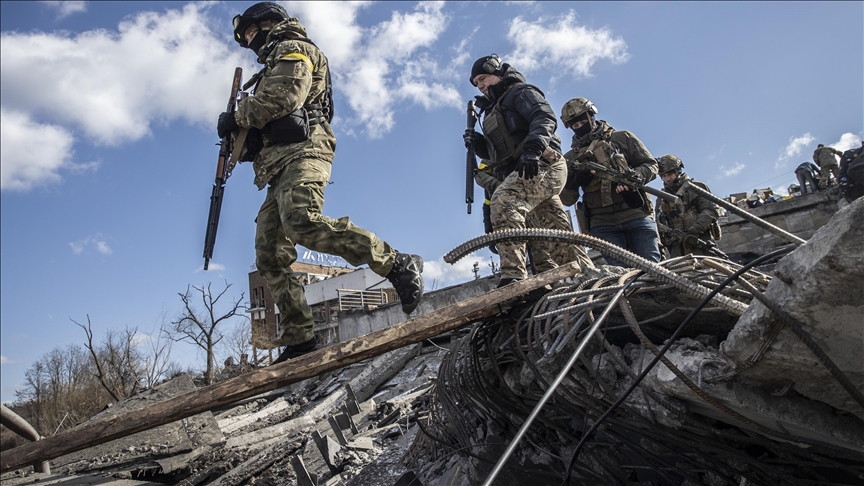
    Perhaps, but there is clearly another possibility, suggested obliquely by US-UK military analysts, including the British official quoted in the Washington Post article cited below. In his words, “We assumed they would invade a country the way we would have invaded a country.” When the US-UK invade a country, they go for the jugular, destroying communications, transportation, energy systems, anything needed to keep the country going. To the surprise of the US-UK planners, Putin didn’t do that. The press reports that “In Kyiv and much of the western part of the country, prewar life has largely returned for civilians. People eat in restaurants, drink in bars, dance and enjoy lazy summer days in parks.”

    There’s little doubt that Putin could adopt the US-UK style of war, even well short of using tactical nuclear weapons. The Ukrainian military understands that very well. Ukrainian commander in chief Gen. Valery Zaluzhny writes that Russian cruise missiles “could strike across the country with `impunity’,” adding that “limited nuclear war cannot be ruled out.”

    As we all know, the escalation ladder from limited to terminal nuclear war is all too easy to climb.

    Western military analysts offer reasons why “Putin’s Bombers Could Devastate Ukraine But He’s Holding Back.” Whatever the reasons, the fact remains.

    Returning to the elephant, it is therefore calling for a remarkable gamble: let’s gamble that Putin will quietly accept total defeat and personal destruction rather than moving on to emulate the US-UK style of war.

    Maybe, but it’s quite a gamble with the fate of Ukrainians, and well beyond. It is, perhaps, surprising that all this passes with almost no comment.

    Turning to what more is omitted, the official US stance is that the war must go on in order to severely weaken Russia, in fact, to weaken it so severely that it will not be able to undertake aggression again – that is, more severely than Germany was weakened at Versailles in 1919. Just what that entails, I’ll leave to the imagination, but we can be confident that adversaries don’t ignore it.

    The policy was made explicit at the US-run Ramstein Air Base meeting in April, often reaffirmed since. But that is only the most recent illustration of a long history of US avoiding diplomacy. This is not the place to review it again (I’ve done so repeatedly, including many interviews in Truthout). The record reveals that the policies of effectively integrating Ukraine into the US-military command have been consistent for years. They were extended last September in an official White House statement calling for further integration of US-Ukrainian forces. The statement also formally designates Ukraine as a “NATO Enhanced Opportunities Partner.” Progress in this program has been such that US military journals have referred to Ukraine as a “de facto” member of NATO. Furthermore, the State Department has acknowledged that the US does not take Russian security concerns into consideration. In this and many other ways, the US has impeded the prospects for a diplomatic settlement – for principled reasons, as made clear at Ramstein and since.

    There’s endless discussion of how we should fight the war, virtually nothing about how we might bring the horrors to an end – horrors that extend far beyond Ukraine. The radical imbalance is striking and instructive.

    The rare calls for moving to a diplomatic settlement regularly elicit bitter condemnation, even when they come from revered warhawks like Kissinger: “Munich,” “Putin lover,” and worse. In this regard, the US differs from the mainstream of world opinion, not only in the Global South but even Europe, where “77 percent of Germans believe that the West should initiate negotiations to end the Ukraine war.”

    It’s worthwhile to digress for a moment on US doctrinal isolation, a background for discussion of these matters that should not be overlooked. To take one of myriad examples, the current issue of the major establishment journal Foreign Affairs – moderate and independent by US standards — has an article on Ukraine and the world by two representatives of the more liberal wing of policy planning and discussion, Fiona Hill and Angela Stent. They find incomprehensible the unwillingness of the Global South – most of the world – to join the US in its obviously noble efforts. The South even sinks so low as to “argue that what Russia is doing in Ukraine is no different from what the United States did in Iraq or Vietnam” – which would indeed be a serious error, but for reasons the authors could not comprehend. The South doesn’t even share our distress “that Russia has violated the UN Charter and international law by unleashing an unprovoked attack on a neighbor’s territory,” an unimaginable crime. The only explanation the authors can think of for this remarkable lack of understanding of the world is Putin’s propaganda machinations.

    It will be interesting to see if there is a word of critical comment.

    1. SRS: Some think the United States should use its leverage (weapons supplies, etc.) to pressure Ukraine into making particular concessions to Russia. What do you think of that idea?

    NC: I haven’t heard of that proposal, but if raised, it should be dismissed. What right does the US have to do anything like that?

    1. SRS: You have said that in any negotiated conclusion to the Ukraine war, “Crimea is off the table.” What is your view of the Russian annexation of Crimea in 2014 and why do you think Crimea is off the table? Is it a matter of right or of might?

    NC: When was “right” an operative concept in world affairs?

    I don’t pretend to be a military expert, but all of them seem to agree that for Ukraine to conquer Crimea would be at best a bloody slaughter, if even imaginable. If so, it’s off the table for now. On the “Russian annexation of Crimea in 2014,” it’s not as simple a matter as in the US propaganda version. There’s a substantial scholarly literature on the complex events of 2014, which I can’t try to review here; historian Richard Sakwa’s work, for example. On Crimea, I can only refer you to what I’ve written, which also discusses a bit of the background as reviewed by John Quigley, the U.S. State Department representative in the OSCE delegation that considered the problem of Ukraine after the collapse of the Soviet Union.

    1. SRS: You have suggested the analogy between a U.S. military alliance with Ukraine and a Chinese military alliance with Mexico, the latter being simply unimaginable. But the left has certainly supported Cuba’s right to receive arms (other than nuclear missiles) from the Soviet Union. More generally, don’t we support the right of the victims of great power bullying to receive defensive weapons from rival great powers, even though the bullies are unhappy and the motives of the weapons providers are of course themselves far from altruistic?

    NC: The abstract right of victims of great power violence to be supplied with defensive weapons – including Ukraine – does not arise, at least for me. The wisdom of doing so, however, constantly arises. How much of the left called for Russian supply of weapons to Iraq to defend itself from the devasting US-UK invasion? How much of the left called for Russia and China to provide advanced weapons to the NLF that would lead the US invaders to escalate their horrendous assault?

    I find the analogy to Cuba rather odd. As scholarship recognizes, Cuba was a “virtual colony” of the US until Castro’s victory. In a few months, it was under attack from Florida bases. Kennedy invaded, and when that failed, launched a murderous terrorist war and imposed harsh sanctions that have crushed the economy, becoming more brutal over the years, opposed by the entire world (US-Israel excluded) though all adhere to the sanctions in fear of US retribution. I don’t see any useful analogy to Ukraine.

    1. SRS: While agreeing with you that NATO’s eastward expansion was provocative and unwarranted, I wonder whether you haven’t overstated the degree to which the United States could have in the preceding months prevented the Russian invasion? For example, you cite the recent Washington Post investigation of the period leading up to the Russian invasion as showing, according to a summary by George Beebe and Anatol Lieven, that Washington eschewed negotiation. But my reading of the Post report suggests a different conclusion. While confirming the U.S. government’s public position that it was unwilling to rule out the possibility of Ukraine eventually joining NATO (impossible in any case as long as Russia’s annexation of Crimea and presence in Donbas stand), the report also shows that Biden assured Putin that there was no immediate prospect of Ukraine joining NATO and that the U.S. was willing to discuss the issue of the placement of U.S. weapons systems in Europe (one of Putin’s “red lines”). In early January, deputy secretary of state Wendy Sherman “offered talks and trust-building measures in a number of security areas, including the deployment of troops and the placement of weapons on NATO’s eastern flank along the border with Russia.” Later in the month, secretary of state Antony Blinken offered to discuss security concerns with Russian foreign minister Sergei Lavrov and made no headway. The British defense minister met with his Russian counterpart with an offer to talk and was told Russia had no intention of invading Ukraine. And French president Macron got a commitment from Putin to meet with Biden, which Putin reneged on. So what do you make of these facts?

    NC: The Beebe-Lieven article gives one example of how the US might have averted the invasion had it had any interest in doing so. That greatly understates “the degree to which the United States could have in the preceding months prevented the Russian invasion.” Above, I barely sampled the rich record of how the US moved systematically towards integration of Ukraine within the US military command, designating Ukraine as a “NATO Enhanced Opportunities Partner.”

    True, there was no “immediate prospect” of Ukraine joining NATO, which is to say that there was a prospect. And, in fact, the US was working towards that end in the months before the invasion within the “Enhanced” program that it announced a year ago. As virtually all high-level US diplomats with any knowledge of the region have pointed out, “trying to bring Georgia and Ukraine into NATO was truly overreaching…recklessly ignoring what the Russians considered their own vital national interests” (W. Bush’s defense secretary Robert Gates, expressing a broad consensus in these circles).

    “The Russians” include US favorites, like Clinton’s friend Boris Yeltsin. And the late Mikhail Gorbachev, who accused the West and NATO of destroying the structure of European security by expanding its alliance. “No head of the Kremlin can ignore such a thing,” he said, adding that the U.S. was unfortunately starting to establish a “mega empire,” words echoed by Putin and other Russian officials.

    To pursue the Mexico analogy, suppose that an immensely more powerful China was integrating Mexico within its military command but assured the US that there was no “immediate prospect” of its joining its global military alliance though it was working towards that end. Would we regard that as a generous offer? And if China went on to express willingness to discuss its deployment of troops and weapons on the US border, would the US thank them for the conciliatory step? Or regard it as an insult.

    I’ve discussed elsewhere what I make of the rest of the facts. Putin’s rejection of Macron’s initiatives was criminal, and also stupid, since he was offering Washington its fondest wish: driving Europe into its pocket and undermining the Gorbachev vision of a common European home that would be a far better outcome than the US-run Atlanticist system, a topic I’ve discussed at length elsewhere and that I think is extremely important.

    1. SRS: You have said that the United States has been unwilling to contemplate a diplomatic settlement of the conflict or to accept the neutralization of Ukraine, drawing an analogy to U.S. policy during the Soviet invasion of Afghanistan. But whatever the U.S. record in Afghanistan, in Ukraine U.S. officials have not ruled out diplomacy or neutralization – if that’s what Ukraine wants. When Zelensky floated the idea of neutralization in March, the U.S. comment was “This is ultimately a question for our Ukrainian partners to decide – to decide the terms of diplomacy, what they are willing to pursue, what they are not willing to pursue.” When asked in late April whether the United States would be open to accepting Ukraine as an unaligned neutral nation, Secretary Blinken declared (at 1:25:02):

    “We … are not going to be more Ukrainian than the Ukrainians. These are decisions for them to make. Our purpose is to make sure that they have within their hands the ability to repel the Russian aggression and indeed to strengthen their hand at an eventual negotiating table. We’ve seen no sign to date that President Putin is serious about meaningful negotiations. If he is, and if the Ukrainians engage, we’ll support that.”

    Now of course we don’t know what is being said in private or what will take place in the future, but my reading of the current evidence leaves me less convinced of the claim that Washington has been blocking negotiations.

    NC: I wouldn’t be so quick to dismiss the Afghan record of the ‘80s, now well-documented. One reason is the close similarity to current policy that I discussed. We can therefore learn a lot from it. Beyond that, without checking, I suppose that while Washington was working hard to undermine diplomatic efforts to end the

    Russian invasion so as to “weaken” Russia, it was also producing banal statements about how everything’s up to the Afghan people.

    In the light of the well-documented record, it seems to me to require quite a leap of faith to take current US government pronouncements on diplomacy seriously. The record seems to me to show convincingly that the US has been impeding meaningful negotiations throughout, by now unequivocally by adopting the official war aims of continuing the war in order to severely weaken Russia.

    These efforts to undermine diplomacy apparently continue. Hill and Stent report that “According to multiple former senior US ‘officials we spoke with, in April 2022, Russian and Ukrainian negotiators appeared to have tentatively agreed on the outlines of a negotiated interim settlement.” The terms of that settlement would have been for Russia to withdraw to the positions it held before launching the invasion on February 24. In exchange, Ukraine would “promise not to seek NATO membership and instead receive security guarantees from a number of countries.”

    Hill-Stent blame the failure of these efforts on the Russians, but do not mention that British Prime Minister Boris Johnson at once flew to Kyiv with the message that Ukraine’s western backers would not support the diplomatic initiative, followed by US Defense Secretary Lloyd Austin, who reiterated the official US position that Washington’s goal in the war is to “weaken” Russia.

    I don’t frankly see the relevance of Blinken’s comments. Yes, Ukrainians have to make their own decisions. And the US has to make its own decisions, with a great deal at stake of enormous global significance that I need not review.

    1. SRS: The Russian antiwar movement has vehemently condemned Putin’s war as imperialist aggression and is supporting desertion as well as sabotage acts. They fully agree with Ukrainian socialists and anarchists who regard their country’s fighting back as legitimate defense and have joined the local popular defense units (Territorial Defense). How do you assess these positions?

    NC: The way I have always done in the past. That’s basically the position that we took in the ‘60s and since, tactical questions aside. Why should there be any change in this case?

    Furthermore, quite rightly, the Russian antiwar movement is focusing its energy and efforts on Russian crimes, scarcely raising, if at all, the misdeeds of official enemies. It is, in short, adhering to the elementary moral principle that all should observe: focus attention and engagement on the factor that is our responsibility and that we can most effectively influence.

    Much to its credit.


    Response by Stephen R. Shalom

    I’m not sure I get the elephant and flea argument. Surely, we don’t take positions based on whether they have a lot or a little support. When some on the left argued against voting for Biden in swing states in 2020, we both spoke out against this view even though the majority of opinion leaders also favored voting for Biden. In the same way, doesn’t the fact that major segments of the left oppose arms to Ukraine warrant response, even though most mainstream opinion supports providing weapons?

    It is true that the left didn’t call for Russian supply of weapons to Iraq to defend itself from the devasting US-UK invasion. But is this the right analogy? Saddam Hussein’s could hardly be regarded as a legitimate government, lacking any democratic legitimacy and responsible for huge massacres, especially against the Kurds. Iraq’s population didn’t support his war. The more relevant analogy to Ukraine would seem to be those governments that were justly resisting great power aggression with undisputed popular support – like Vietnam, or Cuba, or Nicaragua. And in none of these sorts of cases did the left object to the USSR or China (or others) providing weapons to the victims of aggression.

    To be sure, the left didn’t call for aid to the National Liberation Front that “would lead the US invaders to escalate their horrendous assault.” But the Soviet Union and China provided massive amounts of military aid to Vietnam, with no objection from the global left. Indeed, the scale of the weapons provided was often greater than that provided by the United States to Ukraine (Moscow’s aid included jet planes and anti-aircraft missiles along with Soviet crews; Beijing sent tanks, planes, and 150,000 anti-aircraft artillery soldiers).

    Washington, of course, did escalate its horrendous assault, many times. The USSR and China refrained from supplying Vietnam with missiles that could strike the United States, and no one on the left called for that. But almost no one on the left supports delivery to Ukraine of missiles or planes that can strike Russia itself.

    Regarding the Cuba example, Cuba, like Ukraine, was a dependency of a great power that established relations with the other great power. The power that considered the dependency to be within its sphere of influence was furious, but in the Cuban case the left position held that Havana had the right to establish relations with whomever it wanted and, when threatened, to receive defensive weapons from whomever it wanted. The left does not respect imperial spheres of influence. Why wouldn’t the same apply to Ukraine?

    The claim that Boris Johnson scuttled a diplomatic solution seems to me to go beyond the evidence and to minimize Ukrainian agency.

    Finally, we agree on praising the Russian antiwar movement, but what about the position of the Ukrainian socialists and anarchists who, while opposing their government’s neoliberal and xenophobic policies, have taken up arms against the Russian invaders.


    Rejoinder from Noam Chomsky

    On the flea-elephant, the question is not what position to take, but how to distribute energies. The elephant dominates public discourse. The various fleas are barely heard. If one chooses to focus on them, fine, but then let’s be clear what is at stake. The fleas mentioned here differ from the elephant primarily on tactics: expelling the Russian invaders by force or negotiations. The latter (flea) position is either ignored or vilified in the US, but is normal elsewhere: the Global South of course but even much of Europe, ¾ of Germans for example. Another sign of the sharp deviation of the US from most of the world.

    The flea position is also standard on the left. On Vietnam, the main target of the US wars was always South Vietnam. The left called for a negotiated withdrawal of US forces. It did not call for continuing the war to severely weaken the US – the official US government policy on Ukraine.

    The other analogies you suggest, when unraveled, seem to me to lead to similar conclusions. In our discussion, there is no issue over sending arms to Ukraine for defense, Ukrainian agency, supporting Ukrainian leftists who fight against the invaders, opposing spheres of influence, or the rest of what you mention, with one exception. It’s true that we don’t know for sure whether Boris Johnson (and Lloyd Austin) “scuttled a diplomatic solution” (nor did I say so), because such matters are barely even reported in the US. It is, however, a fair surmise that their visits repeated the official policy: continue the war to severely weaken Russia, and gamble that Putin won’t use his conventional weapons to devastate Ukraine in a US-UK style war, puzzling US-UK military analysts, as we’ve already discussed

    There is no question of justifying Putin’s criminal invasion. There are questions about what should be our primary concern: what we can hope to influence, US policy. It is becoming harder and harder to justify US policies. Or to ignore the reluctant conclusion of John Quigley that “It’s reasonable to question whether the U.S. goal is less to force Russia out of Ukraine than to fight Russia to the last Ukrainian”


  • 21st Century Revolution

    21st Century Revolution

    21st Century Revolution: through higher love, racial justice and democratic cooperation, Ted Glick, Bloomfield, NJ: Future Hope Publications, 2021, 114 pp. $10, https://tedglick.com/2021/09/12/21st-century-revolution/.

    Ted Glick has been a champion of radical social change for over five decades, tirelessly working for peace, justice, independent politics, and climate survival. It this short book, he shares some of the conclusions he has drawn from this lifetime of activist experience.

    Two of the book’s five chapters deal with spiritual matters, which may well put off many readers, but he makes a compelling case that these are concerns that the left ignores at its peril. He is well aware of the obscurantist and reactionary role that organized religion has often played in human affairs, but he argues that this is not the full story. While religion has frequently served to divert people from the need to fight injustice, it has sometimes helped to propel freedom struggles. He quotes the Protestant theologian Dietrich Bonhoeffer, who was killed in a Nazi concentration camp after joining the anti-Hitler resistance: “It is not the beyond that we are concerned with, but with this world.” And “We are not to simply bandage the wounds of victims beneath the wheels of injustice, we are to drive a spoke into the wheel itself.”

    Glick reminds us that hard-headed historical materialist Frederick Engels considered that Thomas Muntzer, the leader of the 16th century German peasant wars, was both a religious and a political revolutionary. The kingdom of God that Muntzer demanded be immediately established on Earth was to have no class differences, with all work and property shared in common. Likewise Karl Kautsky, a leading theoretician of social democracy, wrote of the “outspoken proletarian character” of early Christianity, aiming for “communist organization.” Kautsky, however, criticized early Christian support for an equal distribution of wealth, arguing that socialists had to instead push the concentration of wealth to the highest point and then turn it into a state monopoly – not exactly an inspiring vision, remarks Glick, or one likely to lead to the classless and democratic societies found among early Christian communities.

    The Bolsheviks’ official position prohibited discrimination against anyone on the basis of religious beliefs and did not require party members to be atheists. But Lenin’s critique of religion went beyond condemning the reactionary role played by the clergy of the Orthodox Church. “Our morality,” he said, “is entirely subordinated to the interests of the proletariat’s class struggle.” Lenin’s dismissal of religion even extended to the non-theistic humanism promoted by revolution-supporter Maxim Gorky. Under Stalin and under Mao in China the ruling parties were actively atheist.

    Again, Glick does not soft-pedal the way that organized religion has supported the unjust and oppressive status quo. But he describes how small groups (and sometimes even large ones) have found inspiration from religion to speak truth to power, sometimes doing so in response to socialist criticisms. In Belgium, Italy, and France, there were movements of many thousands within the Catholic Church from the 1920s to the 1950s that sided with oppressed working people.  The Cuban revolution, says Glick, had a more tolerant view of religion than did the Soviet Union or China, helping to inspire Liberation theology in Latin America and beyond. However, the fact that the Cuban Communist Party – the country’s only legal party – didn’t allow religious believers to join until 1991 seems much more problematic than Glick allows, and the government’s authoritarianism certainly contradicts our notions of democracy.

    Forty years ago I met radical nuns in the Philippines who worked with the urban poor. When I asked them about birth control, they told me that while the Pope disapproved of it, they did not. Today we have a Pope who has been influenced by liberation theology. Nevertheless Glick acknowledges that the Catholic Church is still a thoroughly patriarchal institution.

    Glick ends his first chapter concluding that the path forward for those who seek social change “must be wide enough to allow secular and spiritually-grounded revolutionaries to walk it together.” He notes that in his experience many groups have fallen apart because of the failure to establish collaborative, respectful, and democratic practice. This, more than the correct line, is critical if groups are going to last.

    Glick’s second chapter is titled “Does God Exist? Does It Matter?” I approached this chapter with a great deal of skepticism, but, admirably, Glick too is skeptical of his own views, as they evolved over time. Although I was unpersuaded by many of his arguments over the course of the chapter, his conclusion – quoting Einstein – is compelling: “A positive aspiration and effort for an ethical-moral configuration of our common life is of overriding importance. Here no science can save us.”

    Chapter three addresses capitalist culture. Marx, Glick argues, had a blind spot regarding the importance of personal change for social change. We need to challenge capitalist culture in our own lives and organizations if we hope to build movements that can achieve a just world. Glick discusses hunter-gatherer societies and their non-acquisitiveness as something to be emulated, but this strikes me as overly romanticizing the primitive, as Glick himself afterwards somewhat concedes. But there is no disagreeing with him when he urges left organizations to stress diversity and cooperation and to create a culture that encourages honest discussions of real differences of opinion. He urges consensus seeking, but without requiring consensus at all times, which can prove undemocratic. One technique he recommends for promoting participation is using breakout groups with reporting back. I think more work needs to be done on developing these participatory methods, because in my experience report-backs rarely result in actionable decisions.

    In chapter four, Glick looks at the U.S. class structure and what this means for our social change organizing. In place of a simplistic view that divides the country into two classes, he identifies seven general class groupings in U.S. society. Each one of these experiences a different life situation and has a different propensity to support a left movement. The suffering of the barely-surviving working class makes them more open to the left, and no left can fail to address their needs. The low-income working class on the other hand is the most numerous group and their support is essential for any successful radical change. The moderate to middle-income working class is often quite conservative and will require serious dialogue and even confrontation over issues of race, sex, and gender before they can be won over to the revolution. The professional and managerial middle class will include a minority who are progressives, but we have to be careful not to let their elitism undermine left efforts.

    In the final chapter, Glick puts forward a strategy for a 21st century revolution, a strategy that he says already enjoys quite a lot of agreement on the left. We need a broad-based popular alliance, a movement of movements. These movements need to be empathetic, use comradely rhetoric, and devote more attention to inter-movement diplomacy. They need deep working-class roots. Redistribution and the climate need to be central demands. Organizing needs to be “dialogic,” that is, listening to people, not just leading them. He calls for a flexible and tactical approach toward election campaigns, sometimes running independent left campaigns, sometimes supporting progressive Democrats or fusion candidates. It is important, he says, to push for reform of undemocratic electoral laws. And he emphasizes the critical role of direct action.

    Glick argues that the movement of movements must also be internationalist, but his discussion here is far too brief. What does internationalist mean? The left is currently very divided over whether internationalism means (a) opposing U.S. imperialism everywhere and supporting all enemies of U.S. imperialism, or (b) opposing all imperialisms anywhere and expressing solidarity with all victims of imperialism.

    Ted Glick believes that we can achieve a better world, one without class oppression, racial injustice, or patriarchy, one inspired by spiritual values that have been part of our species for millennia. The path forward is not easy, but one statistic Glick cites provides reason for optimism: by one count there are some 1-2 million groups worldwide working toward environmental sustainability and social justice. This hopeful book urges us to use this potential to achieve a 21st century revolution.


  • The United States and China in Latin America: Rival Imperialisms

    The United States and China in Latin America: Rival Imperialisms

    The United States has long dominated Latin America, but today—in fact for the last twenty years—it is being challenged by China, which has invested billions and established political and some military relationships with many governments in the region. The U.S. took control of Latin America first through wars and later through economic investment, China has begun with economic investment, but as we know from history, defending such investments often requires war. One can foresee a sharpening of U.S.-Chinese inter-imperialist competition in Latin America today.

    U.S. Imperialism in Latin America

    Let’s begin with the United States’ bloody history in Latin America. The United States’ rise to domination in Latin America took about 100 years, involved two major wars and many military interventions, occupations, and coups d’état. Driven by the Southern states’ desire to expand slavery, the U.S. began to take territory from Mexico between 1836 and 1855, most important the U.S.-Mexico War of 1846-48, following which the United States took half of Mexico’s territory, which became the Southwestern United States (California, Arizona, New Mexico, Nevada, Utah, Colorado). Some 100,000 Mexicans and many indigenous people were forced to become part of the United States; the Mexicans were not granted full rights and many native peoples were exterminated.

    Then in the Spanish-American War of 1898, the United States acquired Puerto Rico and established a protectorate over Cuba. In 1903 the United States backed Panama’s secession from Colombia, and in 1904 the United States took over from France the construction of the Panama Canal that opened in 1914. The canal became strategically significant, allowing the U.S. to move its warships between the Atlantic to the Pacific. So, by the beginning of World War, I the United States dominated all of Central America and the Caribbean, though keeping the region under its control entailed the occupation of Haiti 1915 to 1934 and of Nicaragua 1912-1933. In 1933 U.S. President Franklin Roosevelt announced the “good neighbor policy” and ended the occupations and withdrew the Marines but he left U.S. backed dictators in their place. Still, whenever American interests were threatened, the U.S. intervened, as in the case of the coup it organized in Guatemala in 1954.

    At the end of World War II, the weakened British empire lost its economic hold on Latin America and the United States replaced it to become the principal banker and investor in the mines, oil fields, and plantations. The Cuban Revolution of 1959 finally ended U.S. control of the island, but in response the United States organized the failed the Bay of Pigs invasion. After that fiasco, President John F. Kennedy launched the Alliance for Progress, ostensibly to promote democracy and capitalism, but it gained no traction. President Lyndon B. Johnson sent the U.S. Marines to invade and occupy the Dominican Republic in 1963 in order to remove the left nationalist president, Juan Bosch. At the same time, Cuban revolutionary Che Guevara inspired a wave of guerrilla movements throughout Latin America, but without a mass working class or peasant base, they were tragic failures. And the Latin American elite reacted by organizing military coups aided or by the United States in Brazil (1964), Bolivia (1971), Chile (1973), Uruguay (1973), and Argentina (1976).

    Only at the end of the 1980s did the U.S. and Latin American elites permit democracy to return to Latin America, generally in the form of conservative political institutions and parties accompanied by neoliberal economic policies. So, the United States continued to dominate finance, industry, and trade until the twenty-first century. But then a series of rebellions, social movements and popular uprisings led to elections that brought to power the Pink Tide governments opposed to both U.S. domination and the neoliberal economic system. Hugo Chávez in Venezuela in 1999, Luiz Inácio da Silva (Lula) in Brazil in 2003, Nestor Kirchner in Argentina in 2003, and Evo Morales in 2006. Lula played a central role in the creation of BRICS, and economic alliance of Brazil, Russia, India, China and South Africa. BRICS created a development bank and other financial institutions as an alternative to the International Monetary Fund and the Word Bank. The Pink Tide soon went out, but a new era was beginning.

    The Rise of the Chinese Economy

    Since the new millennium, everything has changed with the rise of China. While the United States is still the world largest economy with a GDP of 23.0 trillion USD, China is in second place with a GDP of still 17,734.1 trillion. The top four of the world’s 15 largest banks are Chinese. China today exports more goods and services than the United States: China $2,723,250.43 millions followed by U.S. with $2,123,410.00 millions. China’s growth in economic power has been accompanied by a growth in ambition as, like other great imperial powers such as the United States, the European Union, and Russia it seeks to expand its economy as well as its political and military influence. Unlike the United States and Europe which are driven by profit maximization. Chinese imperialism is driven by state political interests. China’s hybrid bureaucratic collectivist and capitalist economy, controlled by the Communist Party, has the advantage that the state directs the banks, corporations, and trading companies, making its international economic policies quite effective.

    Chinese involvement in Latin America has been gradual. After Richard Nixon traveled to Beijing to embrace Mao Zedong in 1972, most Latin American governments follow U.S. foreign policy and recognized the People’s Republic of China (PRC). Still there was little economic, political or military involvement until the World Trade Organization accepted China as a member in 2001. In the early 2000s, China established free trade agreements with Chile (2005), Peru (2009), and Costa Rica (2010). Other Latin American nations later followed suit. To establish ties with the PRC often meant having to break ties with Taiwan, as Costa Rica did in 2007, Panama in 2017, El Salvador in 2018 and Nicaragua in 2021. And trade with the PRC has boomed. In 2001, Latin America exported only 1.6% of all its exports to China; today that figure is 26%. According to the World Economic Forum, Chinese-Latin American trade grew 26-fold between 2000 and 2020, from $12 billion to $315 billion. Today China is Latin America’s largest trading partner, followed by the United States. Some countries like Chile, which sends about 39 percent of its exports to China, and Jamaica which is deeply indebted to China, have become economically dependent.

    Chinese trading patterns in Latin America resemble those of the United States and Europe with Latin America in the 19th and 20th centuries. Latin American principally exports commodities such as pork, soybeans, sugar, timber, copper, bauxite, petroleum, oil, and other materials that China wants for its industries and to feed its people. And China sells Latin America higher-value manufactured goods, such as Huawei and Xiaomi smart phones, which Latin Americans desire. The disadvantage for Latin America is that imported Chinese manufactured goods often displace domestic products, so that there may be growth in extractive and agriculture sectors but a stagnation or even a decline in industry.

    China’s relationship with Latin America goes far beyond trade. Chinese corporations, many of them state-owned enterprises, now have vast investment in Latin America. Logically, just as the British and Americans did in an earlier era, the Chinese tend to invest in the processing of the extractive and agricultural products they are buying. For example, from 2000 and 2018, China invested $73 billion in in refineries and processing plants in Latin American countries that provide coal, copper, uranium, natural gas, and oil. Beijing also recently invested about $4.5 billion in lithium production in Mexico, and the “Lithium Triangle” of Argentina, Bolivia, and Chile, believed to have half the world’s store of this valuable mineral.

    China engages in outward direct investment (ODI), that is, establishing subsidiaries of its corporations or acquiring companies in Latin America. Chinese ODI in Brazil amounts to $60 billion, in Peru, $27 billion, and in Chile $15 billion today. Total Chinese ODI in Latin America is $130 billion. Then too there are Chinese bank loans. The China Development Bank and the China Export-Import Bank had made 94 loans in the region amounting to $137 billion in 2020. Chinese loans have benefited some countries, but others, like Bolivia and Ecuador face created excessive debt. Chinese loans typically have adjustable interest rates, so now, with interest rates rising, Latin American nations are finding it harder to make their payments.

    The Chinese Belt and Road Initiative (BRI) has also come to Latin America. Originally launched in September 2013, the BRI was originally intended link Asia, Europe, the Middle East and Africa through the construction of infrastructure: roads, bridges, and then damns, power stations, electrical systems, and electronic communications. The BRI, which is the heart of the Chinese imperial economic system, creates a web for Chinese loans, investments, trade, and military assistance as well. China promotes the BRI as part of its South-South diplomatic initiative, supposedly to unite the Global South to contest the Global North of Europe and the United States. Twenty out of twenty-four Latin American and Caribbean countries had joined the BRI as of December 31, 2021.

    Politics, Soft Power, and the Military

    The Chinese President Xi Jinping has personally taken the lead in promoting Chinese relations with Latin America, having visited the region eleven times since he took office in 2013. Other Chinese leaders frequently visit Latin America either as diplomats to promote closer ties, to oversee the granting of loans, or to make new investments.

    The Chinese government, in addition to economic projects, has also spent $10 billion per year to establish Confucius Institutes in Latin American and Caribbean countries that offer undergraduate and advanced degrees in Chinese language and culture and organize cultural exchanges. Mao Zedong introduced the reactionary Confucian philosophy into the Chinese Communist Party and later into the state after taking power in 1949; together with Stalinism and Maoism it forms part of the society’s authoritarian ideology. China also provides financing to other institutions and universities for research.

    China has also established ties with the Latin American military. China has established a defense forum that promotes discussions with military leaders. China offers military exchanges and training programs in which officers or soldiers’ study in each other’s military academies, visit each other’s bases, and learn each other’s methods. Thus, China learns the strengths and weaknesses of Latin American countries and gain influence among Latin American military officers, just as the United States has done in the past. China has not established military bases in Latin America, which would alarm the United States, but it has created what it calls “strategic strong points” to provide naval access and supply. The Chinese have seven port operations in Mexico, three in Panama, three in the Bahamas and one in Buenos Aires, Argentina, as well as being engaged in port construction projects in Brazil, Peru, Ecuador, and Jamaica.

    China has sold millions of dollars’ worth of aircraft, ground vehicles, aid defense radar systems, assault rifles and other materiel to Bolivia and Ecuador. But some of its closest military ties are with the authoritarian leftist regime in Venezuela, which has been besieged and sanctioned by the United States. Venezuela has purchased $80 million in K-8 fighters and also bought military transport planes.

    Conclusion: Latin America Will See Inter-Imperialist Conflict

    The United States is not about to give up its supremacy in Latin America without a fight, whether economic, political, or military. The American government views the Caribbean and Central America in particular as part of its sphere of influence and considers its involvement in South America to be necessary to maintain its hold on the hemisphere.

    While some progressives, and leftists believe that China is a benign power working to create a fairer world, there is little to justify this view. Consider the case of Tibet. After the Chinese Communists took power in 1949, the PRC annexed Tibet in 1950, but in a negotiation with Tibet’s Dalai Lama promised the Tibetans autonomy. Unhappy with Chinese rule, Tibetans rebelled in 1959, which led China to take direct control and impose the Chinese Communist one-party system, while a few years later the Cultural Revolution carried out the destruction of six thousand Tibetan Buddhist monasteries and caused the deaths of between 200,000 and one million people. Han Chinese military officials and bureaucrats took charge of the government while the PRC promoted Han immigration, carrying out the Sinicization of Tibet.

    Then there is the case of the Uighurs, some twelve million ethnically distinct people who speak a Turkic language and are mostly Muslims living in Xinjiang Uyghur Autonomous Region (XUAR). China has detained and holds over one million Uighurs, adults and their children, in “reeducation camps” where many perform forced labor, are subject to abuse, and some tortured. At the same time, as happened with Tibet, the policy of promoting mass migration of Chinese into Xinjiang has been changing the ethnic character of the region. China has no toleration of ethnic and cultural difference or freedom of conscience, whether of Tibetan Buddhist or Uighur Muslims. Neither, of course, does it permit the establishment of rival political parties, independent labor unions, or any other form of independent social movement.

    Finally, there is the role of China in the South China sea, one of the world’s most important shipping passes with vessels carrying trillions of dollars in goods that sail through each year. The South China Sea islands are claimed by many different nations: China, Taiwan, Philippines, Vietnam, Malaysia, Indonesia, Brunei, and Singapore. There is competition not only over the islands and the trade route but also over oil in the sea. China has staked out its claims to the lion’s share of the South China Sea and has militarized three of the islands with anti-ship and anti-aircraft weapons increasing tensions in the region. China’s behavior in Asia reveals its character and suggests how it would behave if it had more power in the Western Hemisphere.

    Of course, Latin America is far from China and close to the United States, still the world’s greatest military power. China is in no position to take military action in the Western Hemisphere. Yet the two greatest imperial powers of the day now struggle for dominance over the Latin American economy and one can expect that struggle to become more acute.

  • Two Sixties’ Radicals Recall Fighting Times in U.S. Labor

    Two Sixties’ Radicals Recall Fighting Times in U.S. Labor

    A review of Fighting Times: Organizing on the Front Lines of the Class War (PM Press, 2022) by Jon Melrod and Troublemaker: Saying No to Power by Frank Emspak (available at Amazon books).

    The University of Wisconsin at Madison was a hotbed of student radicalism in the 1960s. Unlike some other centers of campus opposition to the Vietnam War, left-wing activists there were among the first of their generation to organize around issues related to their own mistreatment as workers. In 1963, undergraduates employed in campus jobs formed a Wisconsin Student Employees Union to force the administration to raise their wages to the federal minimum (a 50 cent per hour increase). Seven years later, the UW Teaching Assistants Association organized the first TA strike in U.S. history, a 24-day walk-out that won union recognition. UW graduates shaped by that experience went on to play key roles in the labor movement, locally, state-wide, and in others states. Two members of this UW alumni network, Frank Emspak and Jon Melrod, have just published autobiographical accounts of their parallel transition from being Marxist students to blue-collar workers in unionized workplaces in the 1970s and 80s.

    At the time, they and their closest comrades were not exactly the best of friends or workplace allies. As Emspak reports in his memoir, Troublemaker, he came from a distinguished old left labor family. His father Julius, was a key organizer and longtime national officer of the United Electric Workers (UE), a union built with the help of Communist Party (CP) members or sympathizers in the 1930s. Melrod made his personal post-graduate turn toward industry as part of a group affiliated with the Revolutionary Union (RU), a Bay Area formation that later morphed into the Revolutionary Communist Party (RCP). RCP cadre considered the CP to be a case study in Marxist-Leninist “revisionism” and were not fond of its labor work either. Both authors are trying to reach an audience of 21st century socialists who are, in some cases, young enough to be their grand-children. To most (but not all) in that new generational cohort, differences between the CP, the RCP, and other “alphabet soup” groups from the sectarian left of five decades ago will be of minimal interest. What will hopefully draw readers to Troublemaker and Fighting Times are their granular lessons about building left-led union reform caucuses, which can actually oust old guard officials and replace them with rank-and-file militants more committed to membership mobilization and strike activity.

    A Catalytic Role

    Today, that kind of internal struggle is more likely to occur in education, healthcare, or service sector labor organizations, rather than older industrial unions. Younger labor radicals who’ve become 1970s-style “colonizers” are more apt to choose workplaces or firms—like Starbucks or Amazon–without established unions so they can play a catalytic role in new organizing or first contract struggles. However, Melrod’s former union, the United Auto Workers (UAW) is currently in the midst of a first-ever direct election of its top officers, which has created a new political opening for UAW dissidents. And, with a recent national leadership change for the better in the Teamsters, Teamsters for a Democratic Union (TDU)—formed 46 years ago with much socialist help–is now well positioned to shape contract campaigning in the nation’s largest private sector bargaining unit, which covers 230,000 workers at United Parcel Service.

    Melrod and Emspak both describe workplace organizing in an era when national bargaining on that scale was still the norm, rather than the exception, and unionized manufacturing had yet to be decimated by de-industrialization. Even when good-paying factory jobs were far more plentiful, however, management and its labor union partners had a shared interest in barring the door to former campus agitators like the authors. In Fighting Times, Melrod describes how he got hired at American Motors Corporation (AMC), then the nation’s fourth largest auto manufacturer, with a little help from job application falsification (which, when discovered, led to his first contested firing).

    Emspak faced unique challenges landing a job at General Electric in Lynn, Massachusetts, then the largest industrial complex in New England. There was no concealing either his advanced degree (a PhD in labor history from UW) or a family tree, well known to the company, which helped oust the left-led UE from Lynn and other GE factory locations in the early 1950s. Not only was his father Julius a former GE worker, but so were five other members of two previous generations of his union building family. Even after the post-war legal and political assault on the UE, its more compliant replacement, the International Union of Electrical Workers (IUE) still had to contend with “a large group of workers who had a strong sense of what a real union could be” and welcomed the chance to unite with “a new generation of class-conscious troublemakers.” Emspak became one of the latter at GE only due to the fortuitous intervention of two under-cover UE sympathizers. One helper was a foreman who hired him without the knowledge of higher ups in the company, and a second, was a shop steward, who counseled Emspak not to sign an IUE membership card, alerting the union hall of his hiring, until he had completed his probationary period and could only be dismissed for just cause.

    Once on the job, both authors faced the challenge of making friends and fending off enemies, of whom they had many in management and the union officialdom. Both had trusted political comrades they could count on, when faced with heavy red-baiting, often accompanied by physical threats. (On one occasion, Emspak was assaulted by hostile officials from other IUE locals when he attended a national union meeting and spoke out against GE proposals for a two-tier wage system,) Neither Melrod or Emspak would have been effective workplace organizers without joining social networks based on after work partying, sharing meals on the job, or, in the latter’s case, becoming a fellow gardener on a company-provided plot for machinists at a UE shop where he worked before joining the IUE at GE.

    Shop Floor Leadership

    Both memoirists stress the importance of publishing rank-and-file newsletters or revitalizing local union committees as a vehicle for addressing shop floor issues often ignored or downplayed by higher ranking union officials. Melrod’s opposition caucus in UAW Local 72 in Kenosha, Wisconsin published Fighting Times, which highlighted stories about job discrimination and harassment at AMC. As the paper “became known as a voice against racism … at election time, we could rely on many workers of color and women who viewed us as their stalwart defenders.” In IUE Local 201, the “left militant coalition” that Emspak helped to build was heavily represented “on the health and safety committee, the women’s committee and the new technology committee—groups that believed in and tried to implement membership-driven actions for health and safety and against sex bias and the challenges of new technology.” At AMC, as Melrod reports, wildcat strikes were often the weapon of choice against speed up and other abuses of management authority. At GE, the IUE contract included a rare open-ended grievance procedure, which made it possible for workers to strike, legally and during the life of the contract, over unresolved grievances, if the action was approved by the Local 201 executive board. Both Fighting Times and Troublemaker are filled with colorful and instructive accounts of direct action on the job, a tradition currently undergoing a revival in some non-union workplaces.

    Helping to lead shop-floor struggles made both authors viable candidates for local union leadership positions. In Local 72, Melrod first became a steward, then chief steward, UAW convention delegate, and member of the local executive board and bargaining committee. Emspak was elected to the IUE’s national GE conference board and four times as a Local 201 executive board member, representing 1,000 workers at a satellite plant in a GE local with a total membership of 8,000. He mounted a strong local-wide campaign for assistant business manager, losing by a mere 38 votes out of 4,834 cast. In a second bid for the job, he and other militants were defeated after a plant-wide strike over accumulated grievances “lasted a month and achieved almost nothing.” By stonewalling the union and “making its progressive leadership look incompetent,” GE was able to install a “less confrontational group” at the 201 hall. During their union careers, the guidance that both authors received from their outside political organizations was not always helpful or supportive. When Melrod became less of a “polemicist”–and spent more time listening to and learning from his co-workers–fellow revolutionaries safely removed from the factory floor accused him of being a “Menshevik.” Emspak found himself at odds with the Communist Party, on several occasions, when he became part of a “worker-led campaign against a sub-standard national contract” with GE, organized in response to the “absence of leadership at the top of the union and no serious planning for a strike.”

    As the opposition of IUE Local 201 members increased, even the local’s business manager, a member of the national negotiating committee, urged rejection of a 1979 tentative agreement. But, in the middle of this fight, the CP changed its position and supported the GE contract settlement it had previously deemed inadequate. When Emspak continued to campaign for a “No” vote, this had the helpful effect of demonstrating that his “loyalty was to the membership and not the international union or the CP.” Six years later, he reports, history repeated itself “when the Party endorsed union contracts with GE that Party members at GE had been leading the opposition against.” As Emspak recalls, “a top down decision was made, without input from many of us on the ground… At that point, there did not seem to be any benefit from being in the CP and most in the largest shop club in the industry simply left it.”

    Law and Labor Education

    Melrod and Emspak’s experience as rank-and-file activists helped shape their successful later careers in law and labor education respectively. As Melrod explains, even before deciding to go to law school, he had won seven National Labor Relations Board (NLRB) cases “forcing American Motors to reverse decisions punishing me for my organizing efforts.” One termination case dragged on for nearly three years before a federal circuit court of appeals ordered the company to re-instate him with full back pay and seniority rights. In other litigation, widely reported at the time, Melrod and two other rank-and-file newsletter editors were sued for $4 million in damages by AMC supervisors who claimed they had been defamed by Fighting Times. This company-backed effort to intimidate opposition caucus members also backfired. “The NLRB intervened after the civil trial, finding AMC guilty of violating our rights and ordering the company to pay over $300,000 in legal fees and lost wages.” As part of his later law practice, Melrod specialized in “refugee and asylum law, representing clients from all over the world fleeing political, sexual, religious, and ethnic persecution.

    After he left GE and IUE Local 201 in 1987, Emspak transitioned first to state and federal jobs as a valued advisor to unions on the workplace impact of technological change. Then, he returned to his alma mater to teach shop stewards, local officers, and union staff members in labor education courses run by the University of Wisconsin School for Workers. During his career there, he founded Workers Independent News (WIN), which operated for sixteen years and, at its peak, produced pro-labor radio show content airing on 150 stations nationwide, which reached hundreds of thousands of listeners. In this new arena, Emspak found himself walking a familiar tightrope. During its existence, WIN raised several million dollars from twenty-two national unions, and additional donations from over one hundred local unions. But labor radio sponsors from the AFL-CIO and Change to Win affiliates were not always appreciative of “independent” reporting on their own strikes, contract campaigns, or internal politics. As WIN’s founder reports, “we faced pressure to restrict our coverage to conform to the interests and opinions of union leadership…press freedom did not seem to be of particular concern.” The WIN experience leaves the question of how to finance independent labor journalism unanswered—but, in Emspak’s view, “points to developing a funding model that is widespread and not dependent on institutional union support.”

    As writers today, the authors of Troublemaker and Fighting Times have no WIN-type need for self-censorship (and no longer risk being sued for defamation by a factory foreman!). Both Emspak and Melrod have penned candid, illuminating accounts of their past union and political activism, which will be very useful to younger radicals who share their belief that only working class organizing can change the balance of power between capital and labor.

  • Ukraine and Its Language in the Political Imagination of the Russian Nation and Empire

    Ukraine and Its Language in the Political Imagination of the Russian Nation and Empire

    Nikolay Bogdanov-Bel’sky, “New Fairy Tale,” 1891.

    On February 21, 2022, Vladimir Putin gave a long speech whose purpose was to justify the invasion of Ukraine, launched only three days later. According to the Russian president, the Ukrainian state is an illegitimate invention and the Ukrainians’ claim to a distinct identity is nothing more than the product of foreign manipulation. Russians, Ukrainians, and Belarusians constitute for him one and the same nation, while the policy promoting the Ukrainian language and culture would be a proof of the “genocide” against Russian speakers living on Ukrainian territory and thus justify the invasion of the country. The question of language therefore seems to play an important role in the outbreak of the Russian invasion and in the conflict between the two countries that preceded it. In order to understand Putin’s war against Ukraine and its people, one must take a close look at the place that Ukraine, its state, language, and culture occupy in the imperial and national imagination of Russians.

    After the fall of the medieval state of Kievan Rus, dismantled by the Mongol invasion in the thirteenth century, much of the land that makes up present-day Ukraine returned to Poland-Lithuania, and it was not until the seventeenth and eighteenth centuries that it came under Russian control. It was therefore the integration of these new territories that gave birth to the idea of a Russian nation uniting the three peoples, an idea now resurrected by Vladimir Putin. At the time, the objective of this project was to equip itself with a hegemonic group that would make it easier to exercise domination over the non-Orthodox and non-Slavic peoples. The control of Ukraine was therefore a cornerstone in the project of the Russian Empire but also and above all in the project of the  Russian Nation. The assertion of a distinct Ukrainian identity was thus perceived by the Tsarist elites as an existential threat to their state.

    In 1863, publication and teaching in the Ukrainian language were completely banned. This policy led to a situation, probably unique in European history, of a decline in the literacy  rate of the population between the middle of the eighteenth century and the end of the nineteenth century. Inequality in access to education is one of the factors that reproduce social inequalities. In the nineteenth century, Ukrainian society was thus marked by an opposition between a “backward” countryside and the Russified cities, which at the same time served as the centers of imperial domination.

    Under these conditions, how has the Ukrainian language been able to survive and develop despite everything? Indeed, the infrastructures necessary for the emergence of a common national identity, such as the development of cities and communications, generalized schooling, or the development of an efficient centralized administration, remained largely underdeveloped. The Tsarist authorities, with the almost unlimited resources of their vast empire, were reluctant to invest in the costly project of truly Russifying Ukraine, integrating it into the development of the Russian nation. Rather than embark on this policy, they resorted to crude repression against the Ukrainian language. However, it was already too late: at that time, Ukrainian poets and writers, who were fascinated by Romanticism and for them the defense of their mother tongue was an important political marker; they were already conceptualizing their ethnic group as a nation. In short, the predation of the Tsarist elites, state underdevelopment and belated and incoherent pressure prevented the assimilation of Ukrainians to Russia. In general, the desire of the political elites to preserve their multi-ethnic empire while at the same time building a Slavic nation-state is one of the reasons for the the Russian state’s inherent fragility. The resistance of Ukrainians against these projects was perceived as the worst betrayal.

    In 1917, the empire broke up. But a national and class awakening soon developed. The Ukrainian peasants not only claimed their right to their language, but they also demand their subjectivity, that of being political actors in their own right, of being recognized. The arrival on the political scene of this “dark masses” annoyed the urban classes, including the socialists who saw themselves as the representatives of the interests of the working class in the industrial regions of southern and eastern Ukraine. As one of the party members explained, for them, the socialists, “Ukraine as such does not exist, because it does not exist for a worker of the city.” Another wrote that the “tragedy” lies in the fact that the Bolsheviks were trying to gain an advantage over the peasantry “with the help of the Russian or Russified working class, which despises the slightest trace of the Ukrainian language and culture.” The determination with which a large number of Ukrainians fought for their sovereignty with arms in hand, however, convinced the Bolsheviks that special arrangements must be made to ensure the control of this population. So in 1923, Moscow introduced a policy to promote non-Russian languages.

    With Stalin, the return in force of assimilative policies was accompanied by state violence that took extreme forms, going as far as genocidal practices. The latter also struck Ukraine, with the famine of 1932-33 that was knowingly planned by Stalin (an event called Holodomor in Ukraine). The colonial division of labor between the city and the countryside reemerged and strengthening, guaranteeing to Russian Soviet and Russified citizens privileged social positions and access to income, skills, prestige and power in the peripheral republics. After the Stalinist era, one can see the promotion of a Soviet identity that is totally confused with Russianness. Although there is no law prohibiting it, speaking Ukrainian outside the private sphere is then perceived as an expression of hostility towards the system. Speaking Russian is, on the contrary, a way to demonstrate loyalty to the existing order and respect for the hierarchy between “brotherly peoples.” Russian then became the dominant language in all areas of public life: economy, administration, culture, press, education. Thus, more and more Ukrainians abandoned their tongue, which had become a marker of cultural inferiority that hindered social mobility.

    Soviet modernization and urbanization were accompanied by the strengthening of the dominant imperial culture, which perpetuated significant structural inequalities between Russian speakers and Ukrainian speakers. The post-Soviet elite has neither the will nor the means to correct these structural deficiencies, so their opportunist policies largely aimed to preserve the status quo. The law that gave Ukrainian the status of an official language was adopted under the Soviet regime in 1989 and remained in force until 2012. After 1991, the advent of capitalism and the weakness of the state did not work in favor of the Ukrainian language. Suffering from its image of inferiority, deprived of any aid from the state, little known abroad, Ukraine’s media, cultural, and artistic production couldn’t compete with the growing Russian market. Moreover, from 2004 onwards, the various clans of oligarchs in competition for power artificially fed the socio-linguistic divide in order to be able to mobilize their respective electorates around questions of identity.

    In 2012, the pro-Russian political forces passed a law that was supposed to ensure the protection of minority languages, but their campaign in reality aimed solely to “defend the Russian tongue.” When President Yanukovych was impeached in 2014, the parliament tried to repeal the law. Although this decision was never ratified, Russia took this opportunity to express concern about the discrimination against Russians by what it called the “fascist junta” in Ukraine, an argument that was used to justify Russian interference in Crimea and Donbas in order, according to Moscow, to “save our compatriots.”

    In 2018, the parliament adopted the law that requires that Ukrainian be used in most aspects of public life and obliges state officials and those who work in the public sphere to know and use it in their communication with customers. The Ukrainian state is therefore currently playing a major role in the construction of a common identity for the inhabitants of the country. This may seem surprising from Western Europe, in countries where this process took place more than a century ago. The situation of Ukraine, having obtained its independence only thirty years ago and remaining under Russian political and cultural domination until 2014, cannot be compared to that of nations supported by state of their own since at least the nineteenth century.

    Some individuals make the conscious choice to start speaking in Ukrainian in order to distance themselves from the Putin state, which claims absolute monopoly on the Russian language and culture, considering that the use of the Russian language and belonging to its “civilizational space” are one and the same thing. Indeed, since the early 2000s, Russia has embarked on the promotion of the conception of the “Russian world” by relying on the Russian speakers of neighboring countries, who have been given a special mission. This consisted of absolute loyalty to the Russian state, which presupposed unconditional support for all Kremlin decisions. If, in the 2000s, the “Russian world” was above all a tool of soft power and international influence, beginning in 2014 it became the engine of Russian irredentism whose objective is to erase Ukraine from the world map. Presenting himself as the defender of the Russian language and culture, Vladimir Putin denies nothing less than the right of Ukrainians to exist, frequently making statements that can be qualified as incitement to genocide.

    In the face of the Russian invasion and the inhuman treatment of civilians by the occupying army, the inhabitants of the country now feel themselves to be first and foremost Ukrainians, including in areas of the country where Russian remains the dominant language. In these unfavorable conditions, some of those Ukrainians who are engaged in resistance to the occupier nevertheless continue to claim the use of Russian, thus defying Putin’s exclusive privilege of imposing his power over this language spoken by millions of people who do not recognize themselves in his political project. Using the imperial language by investing it with a decolonial content could become a solution for a bilingual Ukrainian society, although it is not easy to defend today, at a time when Ukrainians struggle for their physical existence.

    This article originally appeared in Pages de Gauche, No. 185.

  • Brazil: End of the Nightmare?

    Brazil: End of the Nightmare?

    Bolsonaro and Lula.

    The result of the first round of the Brazilian elections on 2nd October is mixed. Certainly, Lula, the candidate of the Workers’ Party, is in the lead, with 48.4% of the vote. But the hope of a victory in the first round has vanished and, above all, he is closely followed by Jair Bolsonaro, the neo-fascist candidate, with 43.2%–much more than the polls predicted. There will therefore be a second round on October 30, which, barring an unexpected reversal, should be won by Lula. However, Bolsonaro’s supporters appear to be in control of parliament as well as several regional governments. In short, the neo-fascist current will probably lose the presidency, but remains an extremely powerful political force.

    Brazil’s dominant classes have never had a great fondness for democracy.   Inheritors of three centuries of European colonization and four centuries of slavery, they have shown, in the last hundred years, a strong propensity for an authoritarian state from 1930 to 1945 under the personal power of the caudillo Getulio Vargas; 1964-1985, a military dictatorship; in 2016, a pseudo-parliamentary coup against President-elect Dilma Rousseff; from 2018-2022: neo-fascist government of Jair Bolsonaro. The more or less democratic periods seem to be parenthesis between two authoritarian regimes.

    The four years of Bolsonaro’s presidency have been a huge disaster for the Brazilian people. Elected with the support of the bourgeois press, business circles, landowners, banks, and neo-Pentecostal churches, he took advantage of the fact that Lula, the only opponent capable of beating him, had been put in prison, under false accusations. The former captain was unable to fulfil his dream of re-establishing a military dictatorship and shooting “thirty thousand communists.” But he has sabotaged every health policy in the face of Covid, resulting in more than 600 thousand deaths; he has ravaged Brazil’s fragile public services (health, education, etc.); he has reduced tens of millions of Brazilian women to poverty; he has actively supported the destruction of the Amazon by the kings of soybeans and cattle; he has promoted neo-fascist, homophobic, misogynist, and climate-sceptic ideas; he supported the paramilitary militias (responsible for the assassination of Marielle Franco); and he has not ceased to try to set up an authoritarian regime.

    Will the October 2022 elections put an end to this nightmare? Lula is likely to win in the second round on October 30. But Bolsonaro, following the example of his political model, Donald Trump, has already announced that he will not recognize an unfavorable result: “If I lose, it is because the vote has been falsified.” A part of the Army, strongly represented in his government, seems to support him: will it go so far as to take the initiative of a military coup against the elected president, i.e. Lula? This hypothesis cannot be ruled out, even if it does not seem the most likely: the Brazilian Army is not used to moving without the green light from the Pentagon and the State Department. But right now, Biden has no interest in supporting a tropical Trump at the helm of Brazil. Bolsonaro tried to mobilize his supporters—police, militiamen, retired generals, neo-Pentecostal pastors, etc.—to create a crisis situation comparable to that caused by Trump around the Capitol after his electoral defeat. Will he have the same success as his North American idol?

    Despite the highly questionable choice of a reactionary bourgeois politician (Geraldo Alckmin) as his running mate for vice-president, it is clear that Lula—Luis Inacio da Silva, former metalworker, trade union leader of the great strikes of 1979, and founder  of the Workers’ Party—is currently embodying the hope of the Brazilian people to put an end to the neo-fascist episode of the last four years. He is supported by a broad coalition of forces, which includes not only most of the organizations of the left and the social movement—trade unions, the landless movement, the homeless movement—but also the broad sectors of the industrial bourgeoisie, which unlike the land owners, who remain loyal to Bolsonaro, came to the conclusion that the ex-captain was not a good option for business. It must be acknowledged that the electoral battle was not preceded by a rise in popular mobilization as in Colombia.

    The Party of Socialism and Freedom (PSOL), the main force of the radical and/or anti-capitalist left in Brazil—where there are several currents associated, in one form or another, with the Fourth International—decided, after a long internal debate, to support Lula from the first round. A small dissident current, led by the economist Plinio de Aruda Sampaio Jr, who disagreed with this choice, left the party, but the main left currents of the PSOL—such as the Movement of the Socialist Left (MES), whose spokeswoman, Luciana Genro, was the presidential candidate of the PSOL in 2014—have, despite their desire for a PSOL’s own candidacy in the first round, accepted the majority decision and actively participated in the campaign in support of Lula.

    Most PSOL activists have no illusions about what the government led by Lula and the Workers Party (PT) would be: probably an even more unbalanced version of the social-liberal policies of class conciliation of previous experiences under the aegis of the PT. Admittedly, these experiments have allowed some social advances, but it is not certain that this will be the case this time. This will depend, of course, on the ability of the radical left and, above all, of the social movements, of the exploited and the oppressed to move, autonomously and independently. Nevertheless, it is obvious that the vote for Lula is an unavoidable necessity to free the Brazilian people from the sinister nightmare that the regime of Jair Bolsonaro has signified.

    Once elected, Lula will face many difficulties: fierce opposition from sectors of the Army, the kings of cattle and soybeans, neo-Pentecostal churches, fanatical (often armed) supporters of Bolsonaro.  He risks having before him  a hostile Congress, dominated by reactionary forces; the present Chamber is governed by the so-called “4 Bs: beef, banks, Bibles, bullets”, i.e. landowners, finance capital, evangelical sects and paramilitary militias. One of the decisive battles of the future will be the rescue of the Amazon, which is being destroyed by agro-capitalism.

    In addition, Lula will be, like Dilma Rousseff, under the permanent threat of a “parliamentary coup.” This results from a disastrous choice for the vice-presidency: Geraldo Alckmin, former governor of Sâo Paulo, the former right-wing opponent beaten by Dilma Rousseff in 2014. Lula probably chose him to give pledges to the bourgeoisie and disarm the right-wing opposition. But he has thus given a decisive weapon to the ruling classes. If Lula takes any action that does not please the Brazilian oligarchs, who controls the majority of the parliament, he will be the subject of impeachment proceedings, as was the case with Dilma in 2016. In this sad precedent, she was punished under  ridiculous pretexts, and replaced by the vice-president, Temer, a reactionary of the so-called bourgeois “center”.  The same could happen to Lula: impeachment and substitution by Alckmin. The Colombian Gustavo Petro was more skilful, choosing as running mate Francia Marquez, an Afro-Colombian woman, feminist and environmentalist.

    That said, the imperative of the moment, in October 2022, is, without a doubt, the vote for Lula.  As Trotsky explained so well almost a century ago,  the broadest unity of all the forces of the workers’ movement is the necessary condition for defeating fascism.


  • Putin’s Annexation of More Ukrainian Territory is Part of Pattern of Ethnocide and Genocide. Stand with Ukraine.

    Putin’s Annexation of More Ukrainian Territory is Part of Pattern of Ethnocide and Genocide. Stand with Ukraine.

    Bodies exhumed in Ukraine show signs of torture before execution.

    Russian dictator Vladimir Putin in a formal ceremony in St. George’s Hall in the Kremlin yesterday signed papers to formally annex and incorporate into Russia large portions of Ukraine amounting to 20 percent of that country’s territory. That territory and those people thus officially cease to be Ukrainian.

    At Putin’s orders, Russia conducted hastily organized sham referendums in these provinces where hundreds of thousands had fled and where tens of thousands of others lived under occupation, some in ruins. Still other Ukrainians in this region—some reports say as many as a million, including thousands of children—have been rounded up by Russian soldiers and FSB police agents and sent to Russia. Clearly, as the world could see, under these extreme conditions the people of those regions could not freely decide their own fate.

    Yet Putin stood in the hall and made a preposterous speech claiming these territories for Russia “forever.”

    “The people made their choice,” he said. “And that choice won’t be betrayed. I want the authorities in Kyiv and their real overlords in the West to hear me: the residents of Donetsk, Luhansk, Zaporizhzhia, and Kherson are becoming our citizens. Forever.”

    As United Nations Secretary General António Guterres said, however, “Any annexation of a state’s territory by another state resulting from the threat or use of force is a violation of the Principles of the U.N. Charter and international law. Any decision to proceed with the annexation of Donetsk, Luhansk, Kherson, and Zaporizhzhia regions of Ukraine would have no legal value and deserves to be condemned.”

    These phony referendums and Putin’s theatrical performance in the Kremlin surrounded by Russian officials and the puppets he had put in power in the conquered territories constitute the latest episode in an on-going war of ethnocide and genocide against the Ukrainian people. They form part of a hundreds-of-years-long, off and on process of attempts to Russify Ukraine and to erase the Ukrainian people’s identity. Ironically it takes place as the Ukrainian people have come together as one people as never before and have succeeded in frustrating Putin’s military objectives. Putin speech, taking place as he ordered the conscription of hundreds of thousands to fight in Ukraine, was accompanied by the flight abroad of 200,000 Russian men and protests in the streets throughout the country with thousands arrested.

    Russia’s war on Ukraine has, I argue here, had from the beginning a genocidal character, as defined by the United Nations, which I cite in full so that readers can see that all of these elements are present, as I will show.

    In the present Convention, genocide means any of the following acts committed with intent to destroy, in whole or in part, a national, ethnical, racial or religious group, as such:

    1. Killing members of the group;
    2. Causing serious bodily or mental harm to members of the group;
    3. Deliberately inflicting on the group conditions of life calculated to bring about its physical destruction in whole or in part;
    4. Imposing measures intended to prevent births within the group;
    5. Forcibly transferring children of the group to another group.

    All but the fourth of these practices have occurred in Ukraine.

    The U.N.’s definition, does not align with our popular conception of genocide most indelibly imprinted in our minds by the Jewish holocaust. Yet the official definition does grasp that genocide has an intention and a trajectory and that through a process these elements fuse into a horrifying reality.

    How do we on the left, we socialists, look at this worst of all imaginable crimes, the attempt to culturally erase or physically annihilate an entire people? And where do we stand?

    Imperialism and Genocide

    The current campaign of ethnocide, of cultural erasure, is driven by Russian imperialism. Imperialism is one of the frequent causes of ethnocide or genocide. The expansion of a state with the goal of conquering and subjugating another people or nation—whether the state was ancient, medieval, or modern, that is, pre-capitalist, capitalist, bureaucratic collectivist (i.e. Stalinist)—has often come to involve genocide.

    We might take the case of Spain beginning at the end of the fifteenth century as the paradigm. With its ideology of pureza de sangre (pure blood) and its role as defender and propagator of the Catholic faith, Hapsburg Spain began to expand. In pursuit of empire, the Spanish fought the Muslims and the Protestants in Europe and the pagans of the Americas with the intent of extirpating their religious beliefs.

    In 1492, the same year Columbus sailed for Spain and stumbled across the Americas, the Spanish either drove the infidels—Jews and Muslims—out of the Iberian Peninsula or in ethnocidal campaigns forced their conversion at the point of a sword. Arriving in the New World, the Spanish conquistadores vanquished the indigenous empires, the Aztecs and Incas, and many less powerful states and tribes, and imposed their racial dominance, their religion, and their language, as well, of course, as seizing the indigenous peoples’ wealth and lands. In the course of the conquest, in some cases, they practically exterminated entire ethnic groups, such as early on the Tainos of the Caribbean among many others. Under Spanish rule other groups lost their distinctive ethnic character, their religion and language, and were transformed culturally.

    The Spanish, of course, were not alone. At the time, the English, Dutch, French and other European ruling classes held similar notions of their ethnic, religious, and cultural superiority, as did the rulers of the great territorial empires of the Ottoman Empire and Russia. Though, of course, in each case it was their blood that was pure, their religion—Protestant, Eastern Orthodox, or Muslim—that was the true faith, and their civilization that should rule. Long before the arrival of modern capitalism, for example, the Tsarist Russian empire and absorbed Estonia, Latvia, Lithuania, Finland and Poland in the West and Siberia and nearly all of Central Asia in the South and East—in the name of Russian superiority embodied in the Orthodox faith and proven by conquest. While the British North American colonies and then the United States annihilated some indigenous people and forced others off their traditional lands and onto reservations.

    In the late nineteen century, the concept of civilizational superiority became justified by the pseudo-scientific racism of social Darwinism, the notion that the Europeans were the most evolved, had the highest intelligence, and superior morality. The French, for example, told the world and the tens of millions of Africans, Asians, and Pacific island peoples in their colonies that their empire had a mission civilisatrice, a civilizing mission, just as the British, with the largest empire “on which the sun never set” took up, in Rudyard Kipling’s words, “the white man’s burden” of bringing peace and plenty to “the silent sullen peoples.” In Eastern Europe at that time, Tsarist Russia imposed its language and culture on Ukraine, but against a rising Ukrainian national sentiment that became a revolutionary force by World War I.

    In reality, by the end of the nineteenth century not ideals but interests had become predominant; the territorial empires (Ottoman and Russian), the older capitalist, commercial and industrial empires (England, Holland, and France), and the newer ones (the United States, Germany, and Japan) all contended for control of the world’s land masses and seas, for natural resources and labor, leading to two world wars. Throughout this evolution of imperialism, the ideology of ethnic and cultural superiority continued to justify mass murder and genocidal campaigns either in the colonies or in the wars in Europe itself. Under King Leopold of Belgium, who postured as a great humanitarian, some ten million Congolese were killed in the pursuit of land and rubber. The Dutch and the British carried out genocidal wars against the San people (called the Bushmen) in the Cape of Good Hope colony. In Europe, Stalin’s Soviet Union, neither capitalist or socialist, collaborating with Adolf Hitler’s Nazi Germany, also engaged in genocide in Ukraine. Hitler ordered the “final solution” that through starvation, firing squads, and gas chambers killed six million European Jews.

    In the post-World War II period, as the anti-colonial movement grew among the subject peoples of Asia, Africa, and the Caribbean, the United States and Europe continued to engage in imperialist interventions in the name of their superior civilizations based on capitalism, democracy, and human rights, while the Soviet Union did so in the name of Communism, progress, and international solidarity. The French fought wars to keep their colonies in Vietnam and Algeria. The U.S. took up the war in Vietnam that killed two million Southeast Asians and precipitated the greatest contemporary genocide in neighboring Cambodia, killing between 1.5 and 2 million people. The Soviet Union invaded and occupied Afghanistan. China took Tibet. The United States’ “war on terror,” including the wars in Iraq and Afghanistan also killed hundreds of thousands of men, women, and children, one estimate is 890,000.

    Putin’s Arguments for Imperialism, Ethnocide and Genocide

    So, aware of this history, when today we hear Vladimir Putin’s atavistic notions about the role of Russia among the Slavic people and more generally in Europe and Asia, we recognize at once that we are dealing with an imperialist ideology, though his arguments resemble those of sixteenth century Spain more than modern imperialist concepts. Putin laments the collapse of the Soviet Union and the breakup of its empire in Eastern Europe. “As for the Russian people, [the fall of the Soviet Union] became a genuine tragedy. Tens of millions of our fellow citizens and countrymen found themselves beyond the fringes of Russian territory. The epidemic of collapse has spilled over to Russia itself,” he said.

    In reality, Putin’s imperial ideology is a throwback to Tsarist Russia. Putin—influenced by rightwing intellectuals like Lev Gumilev and Alexander Dugin—believes (or claims he believes) in the thousand-year-old Russia. He sees the Russia of the old Tsarist empire, infused by a cosmic force of “passionate power” (Gumilev), inspired by the Russian Orthodox Church, the archetypal Slavic nation, speaking Russian, and leading the other Slavic peoples and the neighboring Asians in the creation of a Eurasian power than can stop and challenge and defeat the West. Such an ethno-nationalist, civilizational ideology has been used by Putin to justify conquest, mass murder, and ethnocide.

    Putin believes then, that the Russian empire must be recreated and those “fellow citizens and countrymen [who] found themselves beyond the fringes of Russian territory,” must be rescued and reincorporated into Russia. Most important of those are the Ukrainians, a nation as large as France with a population of more than forty million people with its own history, language, and culture whose very existence Putin has denied. In 2019, Putin told filmmaker Oliver Stone, “I believe that Russians and Ukrainians are one people … one nation, in fact,” Putin said. “When these lands that are now the core of Ukraine joined Russia … nobody thought of themselves as anything but Russians.”

    Putin rejects the idea of a Ukrainian people and nation, arguing that Ukraine is an artificial creation. “Modern Ukraine was entirely and fully created by Russia, more specifically the Bolshevik, Communist Russia,” Putin said in 2021. “This process began practically immediately after the 1917 revolution, and moreover Lenin and his associates did it in the sloppiest way in relation to Russia — by dividing, tearing from her pieces of her own historical territory.” He has also written an article arguing this position. His position thus denies the Ukrainian people any agency, any ability to decide their own identity. Clearly this position becomes a justification for war against the Ukrainians to force them to become part of Russia. It is an argument for ethnocide and even genocide.

    If one is to commit mas murder or genocide, the aggressors also find it necessary to deny the humanity of those they plan to kill or eliminate altogether. To motivate their people and their soldiers, they must argue that those who will be killed are less than human, either because of their race, their religion, or their political views. As he launched his war against Ukraine in February 2022, Putin declared, “To this end, we will seek to demilitarize and denazify Ukraine and put to justice those that committed numerous bloody crimes against peaceful people, including Russian nationals,” Putin said. Calling the Ukrainians Nazis dehumanizes them, especially given the history of Adolf Hitler’s war on the Soviet Union, launched in 1941, that killed 27 million, not only Russians but many other Soviet ethnic groups and particularly Ukrainians. Ironically, while there are some Nazis in Ukraine—as there are today nearly everywhere—Putin’s military forces include not only the neo-Nazi mercenaries of the notorious Wagner militia but also a regular Russian Army battalion under the self-proclaimed neo-Nazi commander Alexeï Milchakov.

    The War as Evidence of Ethnocide and Genocide

    The Russian war on Ukraine has from the beginning–even if it has not happened everywhere–exemplified what is sometimes called “total war,” that is, it is a war on both the military and civilians involving artillery fire or aerial bombing of cities, destruction of offices and industrial plants and mines as well as agricultural fields and facilities, mass murder of both soldiers and civilians (adults and children), in the course of which  thousands of soldiers and civilians have been killed, torture and rape, all of which is intended to create terror among the population. As a result, 7.4 million Ukrainian fled to other nations in Europe, though perhaps as many as three million have now returned. Another seven million Ukrainians have been displaced from their homes to some other place in their country. Among the displaced who have left and those who remain are about 3 million children. Total war in Ukraine has also destroyed the economy and left millions unemployed. While all of these atrocities have been common in modern wars and do not in themselves constitute either ethnocide or genocide, they may lay the basis for it.

    The concerns about ethnocide and genocide are increased by the finding of hundreds of bodies in mass graves. An Independent International Commission of Inquiry on Ukraine established by the United Nations’ Human Rights Council found that Russian soldiers had committed war crimes, including many cases of torture, executions, rape (including of children), bombing of civilian areas sometimes leading to separation of families from their children. The commission is also looking into the adoption of Ukrainian children by Russian families.

    How does one prove genocide, since as the U.N. convention reads, “intent to destroy, in whole or in part, a national, ethnical, racial or religious group.” I think it is a question of examining, as we have here, all of the elements surrounding the case in question.

    While war always leads to atrocities, in this case the combination of Putin’s ideology, his claims of the non-existence of Ukraine or Ukrainians, his total war on the Ukrainian people, and the record of war crimes makes it clear that we are witnessing both ethnocide and genocide. All of this call us as socialists, and should call others, to stand with Ukraine, to support its war for self-determination and its right to acquire arms, and at the same time lead us to support the anti-war movement and war resisters in Russia.


    .


  • Of Course the Allies Should Have Bombed Auschwitz

    Of Course the Allies Should Have Bombed Auschwitz

    Famous documentary film-maker Ken Burns’s newest production is The U.S. and the Holocaust. It’s quite critical of U.S. conduct during that time and exposes antisemitism in the U.S. during that era. But it falls down in one area on the failure of the Allies to bomb Auschwitz. It wrings its hands and goes back and forth a little, but the final word is given to a historian who says, “I don’t think there’s a right answer in whether we should have bombed Auschwitz … because I don’t think there’s a way to look back and say we did the right thing. It’s one of those tragic questions.”

    Back in 1978 David Wyman wrote a book The Abandonment of the Jews: America and the Holocaust. In it he charged that American and British political leaders during the Holocaust, including President Roosevelt, turned down proposals that could have saved hundreds of thousands of European Jews from death in German concentration camps. Ever since there have been periods of furious historical debate on the subject. It’s time to renew that debate.

    Let’s go deep into the background. Auschwitz was completed in 1940. Activities there were a closely guarded secret. Yet in a series of reports the Polish government-in-exile talked about its horrors in that same year. By 1942 news of the mass slaughter of Jews had directly reached the Allies. For instance the British Daily Telegraph on June 25 printed an article “Germans Murder 700,000 Jews in Poland.” The sub-headline was “Travelling Gas Chambers”. It was based on reports sent to Polish Bund leader Szmul Zygielbojm. In August of 1942 World Jewish Congress representative Gerhart M. Riegner sent reliable information that he had received from a high-placed source revealing Hitler’s plans to annihilate millions of European Jews, to the British Foreign Office who sent it on to the U.S. State Department.

    The Germans had set up a series of concentration camps and other kinds of camps that the U.S. Holocaust Museum calls “killing centers.” Auschwitz was one of them. Historian Rafael Medoff writes, “At a March 24, 1944, press conference, FDR, after first discussing Philippine independence, farm machinery shipments, and war crimes in Asia, acknowledged that Hungary’s Jews are now ‘threatened with annihilation’ because the Germans were planning ‘the deportation of Jews to their death in Poland.’”

    If there was any doubt about what was going on inside Auschwitz, that was erased when two Jewish prisoners, Rudolf Vrba and Alfred Wetzler, escaped in April 1944 and told their stories. They had been Sondercommando, Jewish slaves of the Nazis in the camp. They made it across Poland to Slovakia and testified to a Jewish Council there. In a 33-page report originally written in Slovak they told of the layout of the camp, the tattoos, the “selection process,” and the methods of mass extermination. The report, sometimes called the “Auschwitz Protocols,” was translated into German and Hungarian by the end of the month.

    One of the first people to read the report was Rabbi Dov Weissmandl of Slovakia. He had seen deportations and now he knew what was happening to the deportees. He sent the Protocols to many world leaders along with a passionate letter demanding action, explaining that 10,000 Jews a day were being killed in the camp. He called for the bombing of Auschwitz, full well knowing it was filled with Jewish prisoners. A copy of the Protocols reached Roswell McClelland, agent of the U.S. War Refugee Board. That body had been created by Roosevelt to see what could be done to rescue Jews. McClelland was in Switzerland, but he sent a cable outlining the report to Washington, including the pleas that the rail lines and crematoria be bombed. He wrote that already 1.5 million had been murdered and that plans were underway to exterminate the Hungarian Jews.

    On May 15, 1944, the deportations of the Hungarian Jews began. They went on at a furious rate for two months. Ultimately 437,000 Hungarian Jews were murdered in Auschwitz.

    On June 24, John Pehle, the head of the War Refugee Board, passed along the recommendation to bomb to John McCloy, Assistant Secretary of War. About a week later McCloy wrote back that the request was “impracticable.” He said it could only happen if there was “diversion of considerable air support.”

    In London the request to bomb Auschwitz reached the desk of Anthony Eden, the British Foreign Secretary and a close confidant of Winston Churchill. In a BBC-produced film “1944: Should We Bomb Auschwitz?” Jewish Agency representatives are depicted meeting with Eden on July 6. He told them that Churchill was in favor of an attack on Auschwitz. In a memo to Eden, Churchill had written that the German mass murders were “the greatest and most horrible crime ever committed in the whole history of the world” and wrote “get anything out of the air force you can and invoke me if necessary”.

    The head of the Air Ministry, Archibald Sinclair, and Eden agreed the Americans were better able to study the feasibility of the bombing and so the idea was sent to General Carl Spaatz, Commander of Strategic Air Forces in Europe. He said “Yes, it sounds like something I’d be willing to do.”

    That was a close as any of the Allies ever came to targeting the Auschwitz-Birkenau death camp.

    Before bombing an area, spy planes would fly over it and take pictures. In 1944 spy planes had flown over the area in occupied Poland that included Auschwitz. They were looking for factories to bomb. Bombers were routinely attacking targets deep in Eastern Europe “right in the vicinity of Auschwitz. But apparently, while thousands were being slaughtered each day in the camp, there was never any specific missions to photograph the camp and approaching rail lines.

    Churchill’s enthusiasm to destroy the camp cooled. On September 1, Churchill informed Chaim Weizmann of the Jewish Agency that technical difficulties prevented the bombing.

    Yet on Sept. 13 the allies did bomb Auschwitz-Birkenau! They hit it with 2000 bombs…by accident. The target was a nearby I.G. Farben factory. There’s no report that this raid was extraordinary or that an exceptional number of planes had been shot down. It was just another bombing run. That should totally refute the argument that there were “technical” problems standing in the way of attacking the camp.

    On November 18 Assistant Secretary of War McCloy wrote to the War Refugee Board again telling it that the bombing of Auschwitz was beyond the capacity of the U.S. government since it would require 2,000 miles of travel from British bases. His arguments were completely punctured in a Washington Post article by Mortin Mintz in 1983. Mintz noted that “in all, the 15th’s B17s and B24s flew more than 2,280 sorties to attack targets close to Birkenau.”

    The U.S. in 1944 had bases in Foggia, in southern Italy, from which it was bombing Poland. Early in May, according to historian David S. Wyman, “Lt. Gen. Ira C. Eaker, chief of Allied air forces in Italy, assured Air Force leaders that his heavy bombers could make daylight raids on Blechhammer, an oil plant 47 miles from Auschwitz, and that others at Auschwitz and Odertal ‘might also be attacked simultaneously’.”

    The claim by the historian in Burns film that Nazis could rebuild railroad tracks is true. But that didn’t prevent tracks from being bombed again and again during the war to stop troop transport and replacing bombed crematoriums would be considerably more difficult.

    What about the argument that it would have been wrong for Allied bombs to kill innocent Jews in the camps. It’s easy for us sitting comfortably today to simply say it would have been “worth it.” But consider the opinion of Auschwitz prisoners who survived. One was Elie Wiesel who witnessed an August 20 bombing attack on the Farben factory that was 5 miles away. In a 2019 article Rafael Medoff wrote that “Elie Wiesel, then age 16, was a slave laborer in that section of the huge Auschwitz complex…. Many years later, in his best-selling book Night, Wiesel wrote: ‘If a bomb had fallen on the blocks [the prisoners’ barracks], it alone would have claimed hundreds of victims on the spot. But we were no longer afraid of death; at any rate, not of that death. Every bomb that exploded filled us with joy and gave us new confidence in life. The raid lasted over an hour. If it could only have lasted ten times ten hours!’” Another voice is that of David Blitzer, the father of CNN’s Wolf Blitzer. David Blitzer actually grew up in Oświęcim (Auschwitz is a Germanized name for the city). In an interview in the 1980’s he said inmates of the camp were “praying” for the camp to be bombed.

    With Soviet troops approaching in the fall of 1944, Himmler ordered destruction of parts of Auschwitz at the end of November. Other killing camps had been dismantled and buildings buried in efforts to cover up Nazi crimes. Yet Crematorium V at Auschwitz was still operating until the day the Soviets liberated the camp in January 1945.

    It should be noted that one crematorium was deliberately attacked, but not by the Allies. That honor belongs to Sonderkommando, the slaves of the camp. Crematorium IV was partially burned during the Sonderkommando mutiny on October 7, 1944.

    In total frustration, War Refugee Board head John Pehle leaked copies of the Auschwitz Protocols to the press. It was a sensation and was widely covered. On December 3, the article came out in the Washington Post and the word “genocide” was used in the major media for the first time.

    What about the Soviet Union and Auschwitz? With all the debate about whether the “Allies” should have bombed Auschwitz there’s almost nothing written about the responsibility of that powerful member of the Allies.

    In 1944, Soviet forces were closer to Auschwitz than were the British or U.S. Kyiv, Ukraine, was liberated by the Soviets in November 1943. It was 578 miles from Auschwitz. Ternopil, Ukraine was liberated around May 1, 1944, and was 329 miles to Auschwitz. In July 1944 the Red Army entered the Majdanek death camp. It was less than 250 miles from Auschwitz. So Auschwitz was in range of Soviet bombers. And remember Jews weren’t the only people killed at Auschwitz. 15,000 Soviet troops were murdered there, too.

    In the BBC film, historian William D. Rubinstein dismisses the whole idea saying Stalin was as likely to bomb the camps as he was to stand on his head in Red Square in the middle of winter. But why take that conclusion as a given? Was the question ever raised to the Soviets by Churchill or Roosevelt? Why wouldn’t the Soviets have listened to a U.S.-British request? In those days we were allies and the U.S. was sending weapons to the Soviet Union through Lend Lease. That program didn’t end until September of 1945. Certainly, Churchill or Roosevelt could have made the effort.

    One argument that always comes up is that the Allies’ first responsibility was to win the war and that any humanitarian act could be considered a “diversion.” But did the Allies only use their forces for direct military efforts? No, they diverted a lot of their forces. Consider the “strategic bombing” campaigns. When planes were first used in war it was to attack enemy troops as a sort of super mobile artillery. But soon a new idea was born, to use planes to bomb industry and to bomb civilians “to break their will.” The notion was incorporated into the phrase “strategic bombing, invented by Giulio Douhet, an Italian military theorist. He was later chief of aviation for Mussolini. Strategic bombing was tried out in 1937 in Guernica in the Basque country of Spain to gruesome effect and causing considerable outrage around the world.

    Yet as the war ground on the Allies embraced the tactic. They bombed factory and transportation centers and then targeted the largest German cities. Writing on the site of the U.S. Naval Institute retired Colonel Everest E. Riccioni, U.S. Air Force stated, “Air Marshal [Baronet Arthur] Harris ordered a campaign of terror, inflicting pain by large-scale, indiscriminate destruction of Germany’s industrial cities, euphemistically called ‘de-housing.’ He intended to crack the German population’s will to resist.”

    A euphemism frequently mentioned was the need to break “morale.”  To break morale they used firebombs to obliterate Darmstadt, Würtzburg, and Dresden.  To drop these bombs, they diverted planes that might have bombed Nazi troop positions.

    Yet with all that the war in Europe went on and on until Russian troops pummeled Hitler’s bunker.  So it can’t be claimed that of the 3.4 million tons of bombs dropped during the war none could have been diverted to destroy the death machines of Auschwitz or the railroad tracks leading to the camp or the locomotives that pulled the trains.

    Bombing Auschwitz would not have been “impracticable” and it would not have diverted significantly from the actual war effort.  It would have saved thousands or tens of thousands of lives and would have let the world know that Allied moral outrage was more than feel-good propaganda.


  • Pakistan’s Floods and the Climate Crisis

    The scenes of water torrents running through the fields, mountains, highways and streets in most parts of Balochistan, Sindh, Khyber Pakhtunkhwa and the southern part of Punjab have been circulating on media in the past few weeks, drawing attention to the collapse being experienced by Pakistan. There have been scenes of barrages of water toppling trees like a giant scythe and grounding hotels and houses like an earthquake. There have also been scenes of floods devastating thousands of hectares of agricultural land across the four provinces. Even more horrifying have been the scenes of toddlers and young people struggling to resist the powerful streams with their weak, malnourished bodies.

    So far, the floods have killed 1,481 people, destroyed over 218,000 houses, perished 800,000 livestock, damaged over 2 million acres of crops and orchards, hit 116 districts and affected over 35 million people across the country, with Balochistan and Sindh being two of the most affected provinces. The situation reports published by the National Disaster Management Authority (NDMA) have been an everyday unfolding of the increasing depth and breadth of the calamity. It has now reached a point where the scale of damage (if it can ever be quantified fully) leaves far behind the aggregate damage of some of the most spectacular climate-induced disasters in the ongoing century. The situation is not novel to Pakistan as the country experienced a similarly horrifying set of events in 2010 when unprecedented monsoon rains in the northwest region caused flash floods sweeping both mountainous and plain lands. The difference, however, lies in that the ongoing monsoon season saw an even more extreme weather situation: rainfall this year is 2.87 times higher than the national 30-year average, with some provinces receiving more than five times as much rainfall as their 30-year average,” notes the NDMA report of the 26th of August.

    Worryingly, the flooding took place at a time when the political situation has been in its most chaotic phase lately. This is a situation where the previous ruling party, PTI, now in opposition because of a politically-engineered no-confidence-motion, has been campaigning for the upcoming elections even in the midst of the catastrophe. This is also a situation where the government had to cut subsidies on oil and increase tariffs on electricity to meet IMF’s conditions for the release of the latest tranche.

    The situation in flood-hit areas is even worse. As part of a recent relief trip to the drowned areas of the southern part of Punjab, we saw older people citing this year’s floods as the most devastating event they’ve witnessed in their life. We saw young men on motorbikes chasing our food truck for dozens of miles in the far-fetched hope that the truck wheels would take a miraculous pause to favour the chasing beings over the awaiting ones. We also saw women catching food items being thrown from the top of Mazdas, a relief practice that looks at need divorced from dignity.

    Missing Interventions or Oft-employed Distractions?

    Since extreme weather conditions are not new to countries in the Global South, one obvious critique is that of a range of invisible pre-emptive and managerial measures that can be put in place to decrease the severity of consequences. Correct as that certainly is, there’s little that countries like Pakistan can do to deter rain-induced flooding. This is not to exempt the local agents from responsibility: from the old drainage and sewerage infrastructure to reckless urban planning to the real-estatisation of land to the military-led deforestation to the complete absence of flood-water storage infrastructure, there’s a long list of unattended issues and missing interventions. Clearly, Pakistan has been indifferent to employing flood management strategies that have been effective for, for instance, its neighbouring China.

    While it is absolutely crucial to mobilise effective flood management strategies to mitigate the intensity of the crisis, at one level, such proposals are a distraction, on the one hand, and a trap on the other. They’re crucial because they have to be employed anyway: even if the planet develops a strong resistance to the ecological crisis by virtue of sustained pro-nature policies, the degree of irreversibility of damage that the biosphere has undergone over the past few decades makes adaptation inevitable. That is, radical transformation of the system has to be accompanied by effective climate management policies. They, however, are a distraction and a trap because they’re completely inadequate to avert the flooding crisis on their own. Distraction in that they divert the focus from the most foundational drivers of the crisis. Trap in that they completely block the possibility of alternative imagination.

    Let’s briefly compare the flood management strategies with a similar distraction called technologies for averting climate change. The proponents of technological messianism argue that only technological development can rescue humans from the incumbent climate crisis. There’s no question about the prowess of new technologies, but if technologically-buttressed mitigation measures are perceived as instruments to help go back to making nature available for exploitation again, we are immediately confronted with a dangerous dialectic involving the complicity of science, on one hand, and the unscientific fallacy of infinite growth and consumerism, on the other. Take the example of carbon-removal technology, which can be extremely helpful in overcoming some of the mess caused by infinite growth models, but how exactly? The question again lies in whether we’re seeking the business-as-usual and expecting the carbon-capture technology to meet that end or we’re making radical transformations in the economic systems and using these technologies as an aid to the process.

    The Exhausted Managerial Notion

    Just like the carbon-removal technology does not answer the question of over-production and hyper-consumerism driving up carbon emissions in the first place, effective flood management strategies are inadequate to address the crisis of rain-induced floods. Rather, the rain-induced floods and a variety of other manifestations of the ecological crisis, unlike many previous crises (including the Great Depression of the 1930s and the Financial Crisis of the late 2000s) intrinsically challenge the managerial capacities of the economic and political order. This is not to say that the previous crises did not lay bare the suicidal contradictions of the system: they not only forced the linear progression of growth to take a pause but also exposed the fragility of multi-billion-dollar speculative structures. The capacity of the economic system to continue to manage the crisis could have been exhausted long ago, given the severity and unending continuity of jolts and shocks, but the system has been absorbent enough to continue to survive, albeit in a wounded form. In its managerial pursuit, it has even gone to the point of instrumentalising two diametrically opposed measures: austerity (the 2008 financial crisis) and generosity (the Covid-19 crisis). These tactics, however, may not work in the aftermath of the ecological crisis as the problem fundamentally questions the managerial notion. This is the only crisis in recent history that demands an altogether “new normativity” as philosopher Miguel de Beistegui argues: the crisis can no longer be dealt with within the coordinates of the existing normativity; it demands a total overhaul, a total transformation of the prevalent framework.

    Trans-seasonal Vulnerability

    If the nature of the ecological crisis is such that it challenges the managerial capacities of the system in its entirety, what can we expect of countries like Pakistan in terms of their crisis management abilities? They’re profound examples of geographies that are at the receiving end of some of the most disastrous consequences of climate change, despite having contributed negligibly (less than 1%) to the jeopardy of the biosphere. In their modest aspiration of survival on the planet, millions in Pakistan are bearing the burden of crimes they haven’t even been party to.

    The outpouring of solidarity and donations from states, organisations and individuals from around the world is priceless, but countries like Pakistan cannot be left to the generosity of the global North. Pakistan is one of the foremost examples of geographies where the conspicuousness of climate-induced damage is fast reaching (or, in a certain sense, has already reached) the fullest possible conspicuousness. While the monsoon season drowns more than one-third of the country, winters in Punjab’s urban centres, particularly Lahore, mark a sustained overcast of smog for three months every year, a bizarre combination of fog and toxic smoke making it impossible to breathe without causing some kind of damage to the respiratory system. The country also regularly experiences fatal heat waves with certain cities in Sindh and Balochistan appearing at the top of the hottest cities in the world every year. The situation is equally alarming in much of northern Pakistan where many of the glacial lakes (over 3,000 in total) can experience an outburst any time the rising temperature is followed by increased rainfall, a sequence that has unfolded itself several times during the ongoing century causing large-scale devastation across the mountainous region.

    While Pakistan continues to be one of the most vulnerable geographies, its neighbouring countries are equally susceptible. The rain-induced floods, the heat waves and the smog are not unknown to India. Bangladesh and Sri Lanka are equally, and at a certain level even more, vulnerable because of their coastal situation. Countries in greater Asia, Africa and Latin America are not far behind either. Clearly, the South is not just at the risk of being enormously damaged but has already been damaged to an irreversible degree.

    Heidegger’s Being and the Global South

    The situation reminds me of Martin Heidegger’s “Being,” a concept that has been interpreted in different ways but is one that’s increasingly linked to that which makes the beings interpretable to humans. In Heidegger’s own words, Being may have a remarkably unique relationship to beings in each epoch and space. That is, the essence of Being is not static, but one that may experience transformation from time to time. From the role of ordering the orderable to that of revealing the revealable to that of granting the grantable, Being has been transcendental in character, paving way for major transformations throughout history.

    Important here is to note that while Being might be transcendental to humankind in the Heideggerian sense, for the vast majority of the non-Western world, the experience of being on the planet has been one of being subjected to how Being revealed itself to Western humankind. Billions in global South, by and large, have been at the mercy of how Western humankind since Plato, but more so since René Descartes, stood within the beings of the world and looked at them as objects out there to be brought into the value calculus and commodified to increase Western power.

    Although Heidegger uses the word ‘man’ in a broad sense, in line with his sophisticated understanding of alluding the destruction of nature to modern Western calculative thinking, it is important to liberate man of the onus of ecological devastation and identify the specific actors and systems seeing nature as a gigantic assembly of disposable raw materials. ‘Man,’ therefore, needs to be replaced with some particularity of humankind. And ‘Anthropocene,’ denoting the current geological age of human-caused damage to the environment, needs to give way to a ‘Cene’ truly reflecting the particular character of the epoch causing the damage. This is precisely because, as anthropologist Peter Rudiak-Gould argues,it is not “humans” who are disturbing the planet: it is particular humans (Westerners, consumers, fossil fuel elites, etc.), under particular historical (modern), political (neoliberal), and economic (capitalist) circumstances.” The replacements of Anthropocene that come to the fore as a result of this understanding include the Capitalocene, the Econocene and the Consumocene. Heidegger, however, would perhaps be more intrigued by the Westocene or the Technocene.

    Climate Reparations Not Enough

    The apocalyptic manifestations of climate change urge us to go beyond cosmetic measures, half-hearted political reformism and ill-thought-out environmentalism. Keeping the urgency of the situation in the global South in view, internationalist efforts seeking climate reparations and full cancellation of debt cannot be deprived of crystallisation any further. While this would help the global South to cope with the crisis, the crisis itself demands much deeper intervention: a radical shift in our approach to beings, nature and everything that comprises the planet (and beyond). Ecofeminists in the South have already sought to respect nature as home. There’s an emerging symbiosis taking place between the consciousness of the workings of Capital and creative political action. The indigenous communities in Latin America, Asia and Africa have also been offering non-Western epistemologies fully conducive to the longevity of the planet. We need to look beyond the geographies, systems and thoughts that brought us to where we today are.

    Notes

    1. https://reliefweb.int/report/pakistan/pakistan-2022-monsoon-floods-situation-report-no-03-26-august-2022

    2. https://thediplomat.com/2021/06/glacial-lake-floods-are-costing-pakistan/

    3. Peter Rudiak-Gould, “The Social Life of Blame in the Anthropocene,” Environment and Society 6, no. 1 (2015), 48.

    4. The indigenous concept of sumaq qamaña (meaning ‘living well’ or ‘living in harmony’), for instance, has been incorporated into the respective constitutions of Bolivia and Ecuador.

  • Iran Protests Against Compulsory Hijab and State Violence

    Iran Protests Against Compulsory Hijab and State Violence

    The murder of Mahsa Amini, a young Iranian Kurdish woman, by the Tehran morality police has sparked large protests in various cities inside Iran.  The 22 year old Amini was arrested  on September 13 because of her “improper” hijab and died shortly thereafter  when she went into a coma following  violent beatings by the police.

    Street protests following her death  have taken place in several cities in Kurdistan, as well as in Tehran,  Isfahan, Rasht,  Mashhad and  have involved tens of thousands of women and men,  young and old.  In Tehran,  women protesters courageously took off their headscarves while shouting,  “Our Hijab will be the Noose Around Your Neck”  and “Neither Monarchy,  Nor Clergy”.   Mass protests focusing on defending women’s rights have been unprecedented since the March 8, 1979 women’s demonstrations that opposed the Islamic fundamentalist takeover of the 1979 Revolution against monarchy.

    Nasrin Sotoudeh, Iranian feminist human rights attorney who has been imprisoned for many years and is currently out on furlough,  issued the following statement about the murder of Mahsa Amini:

    “All the officials and agents of the Morality Police involved in her arrest should be put on trial. We will not forget the memory of women who have been the target of state violence for defying the compulsory hijab. From Homa Darabi who was expelled from the university due to compulsory hijab and burned herself in the early seventies {1990s}  to women of Revolution Street who have been subjected to violent assaults and beatings,  to Nastaran Darabi whose beautiful hair was stomped upon under the boots of a hateful and violent man from the Morality Police,  to Sepideh Rashnoo who was heading to her job, to thousands of young girls and women who are subjected to insults and attacks and arrest on a daily basis, all weigh heavily on our memory of yesterday and today.  Stop obsessing over women’s hair, our hair is not more dangerous than your violence. Our children and yours are witnessing this violence. In the not so distant future, these waves of violence will turn on you. I extend my deep condolences to her esteemed mother, who has lost an angel, and to our collective conscience, which is so deeply wounded. We are in mourning.”

    The Context:

    The majority of Iran’s population of 84 million  are currently facing severe unemployment, poverty, hunger,  environmental disasters, COVID and other health problems.  The Iranian government has taken advantage of the current crises to crack down further on women by more strictly enforcing the mandatory hijab and by banning access to basic birth control and even vasectomy for men and tubal ligation for women.

    While the majority of the Iranian public is hungry and ill-housed,  the Iranian government continues to spend billions on its nuclear program,   military interventions and  militias in Syria, Iraq,  Lebanon.  It is building drones for Russia to use for its genocidal invasion of Ukraine.

    Although most Iranians would welcome the lifting of Western economic sanctions on Iran,  they are certain that the bulk of the  funds gained as a result will go toward the government’s militaristic aims and in the pocket of  the  leaders of the Islamic Revolutionary Guard Corps.   Ebrahim Raisi,  Iran’s illegitimate president,  who is currently at the United National General Assembly meeting,   was the former head of Iran’s judiciary and has committed crimes against humanity.

    What To Do

    At this time,  international solidarity with women in Iran is critically important in order to help the continuation of the  current  courageous wave of protests  in defense of women and against state brutality.  Iranian feminists have already begun this outreach for dialogue and solidarity.   A powerful message of international solidarity can be found in Nasrin Sotoudeh’s June 2022 statement in response to the U.S. Supreme Court’s decision to take away U.S. women’s federal constitutional right to abortion.   In a letter to Ms. Magazine, Sotoudeh wrote:

    “In these difficult times, when the women’s movement in the United States is facing assault and the right to abortion has been radically restricted, I wish to stand by you and declare my support from our corner of the world . . After the 1979 Iranian Revolution, new laws that drastically stripped women and girls of their rights were part of an insidious larger effort to limit civil liberties for everyone. As someone who lived through (and campaigned against) this loss of freedom and democracy, I can offer a warning: It will not end with this Supreme Court decision on abortion.  Women in Iran continue to face laws that restrict rights over our bodies, and even over the ability to think for ourselves. We are denied the same opportunities as men in relation to marriage, divorce, child custody, inheritance and travel. This country’s mandatory hijab law forces us to cover our heads whenever we are in public, but it is also a way conservative forces try to exert political control. That control ensnares men, not just women. This may resemble what you experience in the fight for reproductive rights in America.”

    This  dialogue between women’s struggles around the world needs to continue in order for us to stop the global authoritarian wave and retrogression on gender rights.

    September 19, 2022

    Also listen to an Iranian feminist rapper, Bahar,  singing about Mahsa Amini.  Bahar is the daughter of one of the political prisoners executed by the Islamic Republic in the 1980s.

  • Support Ukrainian Resistance and Disempower Fossil Capital

    Support Ukrainian Resistance and Disempower Fossil Capital

    By Ilya Budraitskis, Oksana Dutchak, Harald Etzbach, Bernd Gehrke, Eva Gelinsky, Renate Hürtgen, Zbigniew Marcin Kowalewski, Natalia Lomonosova, Hanna Perekhoda, Denys Pilash, Zakhar Popovych, Philipp Schmid, Christoph Wälz, Przemyslaw Wielgosz and Christian Zeller

    On June 9, Heino Berg, Thies Gleiss, Jakob Schäfer, Matthias Schindler, Winfried Wolf published a detailed statement in Junge Welt in which they advocated an “anti-militarist defeatism” and the abandonment of Ukraine’s military resistance to the Russian war of occupation.[1] We take their  article as an opportunity for a fundamental response about a necessary anti-imperialist ecosocialist perspective committed to global solidarity.

    We are appalled at the way they bend the reality of war in this article and ultimately argue in favor of Putin’s oligarch regime. Paternalistically, they recommend that the Ukrainian population submit to Russian occupation in order to end the war. The authors make not the slightest reference to socialist, feminist, and anarchist forces in Ukraine and Russia. They argue from a distinctly German perspective. They are not alone in this.

    Many statements of the old peace movement turn against the “escalation of the West” and “forget” that Russia has already escalated long ago and wants to systematically destroy Ukrainian society. The statement of the five authors ignores anti-imperialist solidarity to such an extent that we consider it appropriate to set our arguments against it.

    Reversal of Responsibility

    The statement of the authors reads like many contributions from the old peace movement and a one-sided sham anti-imperialist left. Of course, at the beginning of the text they condemn the invasion of Ukraine “without any reservation or relativization.” But afterwards they do exactly that: they relativize the aggression of the Putin oligarchy. Under the title “No Interest in Ceasefire,” they explain in detail why NATO is much worse than Russia and that the West, first and foremost the U.S., does not want an early ceasefire but is primarily using the Ukrainian battlefield to weaken Russia.

    The five authors turn the responsibility for the war around. They say that it is not Putin, who has openly and repeatedly rejected any cease-fire beyond a Ukrainian surrender, who is responsible for the ongoing war, but the “regime” in Kyiv, which had offered negotiations on neutrality just a week before the Russian attack began.

    They write that the “Kyiv regime chose the military response to the invasion from the outset, and it shows no sign of making any effort to reach a cease-fire even in early June.” It is not the Putin regime, which has repeatedly stated that it will continue the war of destruction and attrition until Ukraine surrenders, but Ukraine, which is desperately asking for weapons in self-defense, that is responsible for allowing the destruction of its own country to continue, they say.

    The authors castigate the alleged arming of Ukraine by the West, but they do not mention with a single word that Russia began its campaign of conquest only after a long period of political, economic, logistical and military preparation.

    Behind this reversal of responsibility lies a fundamental misjudgment of the Putin regime, whose character the five authors do not even rudimentarily attempt to define. On the contrary, they equate the proto-fascist Putin dictatorship with the corrupt bourgeois parliamentary democracy in Ukraine. For the authors, they are quite simply “two bourgeois states, both determined by an oligarchic system.”

    Bizarrely, the authors rely on former U.S. Secretary of State Henry Kissinger as a key witness. Because Kissinger explicitly demanded concessions from Ukraine and the cession of parts of the country to Russia, they attribute to him a more responsible position than the current U.S. leadership.

    Yet Kissinger is certainly in continuity with his own positions From 1969, as security advisor to the President, he had the resistance of the Vietnamese population buried under carpet bombing , while in 1973 he orchestrated the coup against President Allende in Chile leading to the establishment of Pinochet’s dictatorship.

    Equally, now in his old age, he is overriding the sovereignty of the Ukrainian people and recommending that they “realistically” give up. In this respect, it is by no means a coincidence that Vladimir Putin, of all people, while still a local politician in St. Petersburg in 1993, chose Pinochet’s dictatorship as a model and thus revealed, just like Kissinger, what he thinks of democratic achievements.[2] Kissinger and Putin are brothers in spirit. When socialists invoke Kissinger, of all people, as a representative of a reasonable position, it indicates quite a shift in the political coordinate system and a questionable level of argumentation.

    The Putin Regime Denies the Existence of a Ukrainian Nation

    The Kremlin wants to prevent any independent development of Ukraine. The Putin leadership considers Ukraine, together with Belarus, to be part of Russia.[3] Ukraine’s independence contradicts Russia’s alleged historical claims.

    The Russian leadership has not reacted to one or another of NATO’s moves; rather, it is pursuing fundamental goals with its war, which it justifies with its Great Russian ideology. Putin and exponents of his regime have repeatedly placed themselves in the historical continuity of the tsarist empire, thereby excluding the existence of an independent Ukrainian national culture and identity. In June, Putin placed the war of conquest against Ukraine on a par with the Great Northern War under Russia’s Tsar Peter I, speaking simply of a reclaiming of Russian soil.[4]

    Thus, the goals of the Russian leadership are fundamental, far-reaching and go far beyond repelling NATO: destroying Ukraine as an independent country and incorporating it as “Little Russia.” The war practice coincides with the war goal. Towns and villages are systematically destroyed, the population terrorized and expelled. In the occupied territories, the Russian state establishes a regime of terror, incorporates the schools into the Russian school system, allows only Russian media and imposes the ruble as a means of payment. By June 20, Russia had brought over 1.9 million Ukrainians to Russia, including 300,000 children. Thousands of Ukrainians are holding out in camps in eastern Siberia, far from Ukraine.[5]

    Ukraine’s resistance to the invading Russian forces, surprising both to the U.S. and European governments and to the Putin regime, prevented a rapid occupation of the country and the installation of a puppet pro-Russian government. It was this popular resistance in Ukraine that presented all actors with a new situation.

    The Ukrainian oligarchs had to get behind the resistance and against Russia. The governments of Europe and the United States had to correct their assessment that Ukraine would quickly collapse. Putin was forced to adapt his war strategy to the new situation.

    At the same time, the Putin regime links the war with a “struggle for values” against the decadent West. It wants to push back democratic rights, achievements of the workers’, women’s and LGBTIQ movements, not only in Russia but also in the areas under its influence. Russia funds and promotes far-right parties throughout Europe and the world. The Putin regime is the admired spearhead of a reactionary and even  fascist movement with Jair Bolsonaro in Brazil, Marine Le Pen in France, and the AfD in Germany.

    Ukrainian Resistance Puts Arms Deliveries on the Agenda

    It was the determined and self-sacrificing resistance of the Ukrainian people against the occupying forces that confronted the NATO countries with the question of comprehensive arms deliveries. Immediately after the war began, the U.S. and U.K. governments advised Ukrainian President Zelensky to leave the country and offered him protection. Like the leadership in the Kremlin, they expected Ukraine to be defeated quickly. They were all mistaken in the Ukrainian people’s will to resist. They assumed that after a wave of outrage and economic sanctions, European and U.S. corporations would return to normal business with Russia.

    The tenacious resistance of Ukraine and the military difficulties of the Russian occupation forces opened the opportunity for the governments of NATO countries to weaken Russia’s military and geopolitical position through massive arms deliveries to Ukraine. Thus, the fighting people in Ukraine are not the executors of an imperialist plan, but  are fighting for their legitimate goals and rights in Ukrainian society; fighting for their existence as Ukrainians.

    Until the outbreak of war, there could be no talk of NATO arming Ukraine. Ukraine received $4 billion in military aid from the United States from 2014 to 2022. Since at least 2015, the U.S. Army also trained Ukrainian troops, albeit on a relatively small scale.[6]

    But much of the military assistance flowed after the war began.[7] From 2014 to 2021, direct military assistance amounted to $2.4 billion. German arms exports to Ukraine have been relatively small to date; German arms exports to Russia have been disproportionately larger since 2014 – despite the embargo – and even into the period immediately before the war began.[8]

    Without the deliveries of militarily usable components by the German (as well as Swiss, Italian Japanese, and U.S.) machine tool industry, the Russian defense industry would not have been able to incorporate complex control systems into its weapons. The Soviet Union’s technological path was exhausted and Russia has had to import key machine tools ever since. The oil boom of the 2000s provided the money. Without these imported machine tools, Russia could not operate a defense industry.[9]

    In mid-April, President Biden announced another $750 million military aid program for Ukraine.[10] Finally, on May 19, the Senate passed a $40 billion program of military and humanitarian assistance to Ukraine, making this the largest foreign aid package in at least two decades. Much of this sum, however, will be spent on infrastructure and replacement investments in the U.S. itself.[11] Thus, U.S. and NATO involvement has taken on a comprehensive dimension. The U.S. government openly states that it wants to substantially weaken Russian military capabilities. Obviously, the same goal is pursued by the Ukrainian government.

    The Interests of the USA and Western Europe

    The governments of Europe and the United States share responsibility for the escalation of geopolitical tensions, but not because of the alleged NATO encirclement of Russia that Russian propaganda painted on the wall and that many on the left in Europe adopted quite cheaply. It is forgotten that the expansion of NATO with the accession of Russia’s neighboring countries was essentially completed by 2004, and above all that numerous countries in Eastern Europe sought NATO membership not out of a desire for military rearmament, but out of fear of a strengthening Russian revanchism.[12]

    The real co-responsibility of the NATO countries for the aggravation of the contradictions lies in their economic interest in the former Soviet republics. Capital in the imperialist countries of Europe and North America was not only looking for new NATO members, but primarily wanted to open up further markets and obtain cheap raw materials. For this, it needed governments that could organize the process of social transformation in an orderly manner and, if necessary, by force.

    The Western imperialist powers, first and foremost the United States and  Britain, recognized in Ukraine’s initially successful resistance to Russian occupation forces the opportunity to substantially weaken Russia’s geopolitical position by strengthening Ukraine’s military capabilities. NATO leaders, however, do not appear interested in either a protracted war or its escalation. NATO Secretary General Stoltenberg explained the balancing process at a meeting in Finland on June 12: At some point, he said, Ukraine will have to announce what territorial losses it is willing to accept and what democratic rights the population is willing to give up.[13]

    At the same time, it is obvious that key countries in Europe, including Germany and France, but also Austria and Switzerland, are giving Ukraine only limited support. They are seeking an understanding with the Russian oligarchy. Neither do they really supply the necessary weapons, nor do they relieve the bled-dry Ukrainian society withby cancelling their debt..

    Major factions of capital in Europe, especially those linked to the fossil industries (Germany, Austria) and to the international commodity trade (Switzerland), have been doing highly profitable business with the Putin oligarchs for years. They would like to quickly return to normality and resume these businesses. Russia is a much more important market for Western European capital than Ukraine.

    The public statements of important representatives  of capital in favour of  ending the war are becoming more frequent. Western governments should make it clear to the Zelensky government that solidarity and patience are limited. After all, they are dependent on Russian gas. An even greater reduction or even a halt in deliveries would inevitably lead to economic catastrophe.

    VW CEO Herbert Diess demanded that the EU negotiate a settlement of the war. The utmost should be done “to reopen the world.”[14] BASF’s management has repeatedly warned against an embargo of Russian oil and gas and sees the geopolitical bloc formation as a major threat to business.[15] Magdalena Martullo-Blocher, the head of EMS-Chemie in Switzerland, calls for a quick negotiated settlement with Putin.

    The sovereignty of Ukraine and the social concerns of the people in Ukraine are naturally indifferent to these representatives of capital.[16] In a survey of 280 companies by KPMG, only just 10 per cent said that they had left the Russian market completely. 37 per cent put their activities on “stand by” to resume business later.[17] These statements show: large parts of capital have no interest in a long war. Sooner or later, governments will try to reach an agreement with Putin on how to reopen the world of markets.

    The Character of the War

    The five authors of the article in Junge Welt want to apply the defeatist position of Rosa Luxemburg, Karl Liebknecht and Vladimir Lenin in World War I to the current Russian war of occupation against the Ukrainian population. This analogy to the debates in the workers’ movement during World War I distorts history .

    More appropriate would be a critical reflection on the justification of anti-colonial struggles. After all, Ukraine is not an imperialist country, nor did it threaten to attack other countries. Rather, Ukraine is a young country whose independence and own nation-building Russia does not accept and therefore has been attacking militarily since 2014. However, the Putin regime wants to integrate Ukraine once again as an internal colony into a Greater Russian Empire, as was the case under the tsars.

    Thus, the Ukrainian population is not waging a NATO “proxy war” against Russia, but is fighting for its own independence and for democratic and social rights, all of which it would lose under Russian occupation. The situation in the so-called People’s Republics in the Donbas is threat enough as a likely prospect under an occupation regime.

    Of course, the war can be understood only in the context of international rivalry between the major imperialist powers. The U.S. and NATO countries, with their rearmament offensive launched even before the Russian attack on Ukraine, are preparing for possible military conflicts with China and the intensified struggle for raw materials and ecological sinks.

    Therefore, it is obvious that the U.S. and the European powers want to use the war in Ukraine strategically for their goals. As long as Ukraine’s resistance meets their goals, they will engage, but of course not unconditionally. Different capital factions of Western imperialisms even see themselves hindered by the war from serving markets in Russia. Moreover, neither the U.S. nor the European countries are belligerents. If they were, we would indeed have a world war.

    Etienne Balibar recently analyzed this war in an inspiring contribution to the discussion.[18] He argues convincingly that this war has four interwoven dimensions: first, a national war of independence similar to Algeria or Vietnam; second, another war as a result of the collapse of the Soviet Union and the state-bureaucratic countries; third, a globalized war, since the warring countries are involved in global alliances and networks and the war has catastrophic effects on the food supply in many poor countries; and fourth, finally, the threat of nuclear war, since Putin is deliberately using this blackmail potential. However, the determining factor in the dynamics of the war is the socially broadly supported war of independence against Russian occupation. Balibar concludes that the defeat of Ukraine is a completely unacceptable prospect.

    Characteristic of the current phase of the war is that there is a temporary and partial alignment of interests between Ukraine and imperialist powers. In a similar situation of temporary alignment of interests, the People’s Defense Forces and the Syrian Democratic Forces in northern Syria have had massive support in their fight against the Islamic State from U.S. air power, without which they would have lost the battle.

    We are seeing right now, in the face of increased Turkish attacks, that this protection does not last. These days, the leadership of the PYD, the strongest party in northeastern Syria, is demanding a no-fly zone from NATO, paradoxically against the NATO country Turkey. This is of course no reason to distance ourselves from the resistance in Rojava, but on the contrary is a reason to strengthen solidarity.

    From our analysis we conclude that Ukraine has the right to obtain weapons wherever it gets them. The U.S. and European governments are supplying arms in limited quantities and for their own motives. It is possible that sooner or later the governments of the Western imperialisms will force Ukraine, as part of a “negotiated settlement”, to relinquish sovereignty over large parts of the country in the east and south and thus accept partial defeat. In this respect, those who are now calling for immediate negotiations are not so far away from “their” imperialist governments.

    Arrogant Recommendation for Capitulation and “Social Resistance”

    In their article in Junge Welt, the authors hardly conceal their recommendation to Ukraine and therefore also to Ukrainian leftists, trade unions and  other emancipatory movements to capitulate. Do they seriously believe that under the conditions of a military occupation dictatorship and mass deportation of potential opposition members, a lively civil society or even militant trade unions can emerge? Are Russian troops to be peacefully persuaded to leave in this way? This idea is grotesque and absurd, and the recommendations to the people of Ukraine derived from it are paternalistic and neocolonial.

    On June 28, Kremlin spokesman Dmitry Peskov once again stated in no uncertain terms what the preconditions for a ceasefire are: “The Ukrainian side can stop everything before the end of today.” For this, he said, “an order to the nationalist units”, to the “Ukrainian soldiers to lay down their weapons” is necessary. Kiev would also have to meet all Russian conditions, he said. “Then everything would be over within a day.”[19] So long as the Ukrainian population does not capitulate bombed out, exhausted, traumatized, and demoralized, the Putin dictatorship will continue its bombing terror.

    The authors do not take seriously the war aims of destroying the Ukrainian society openly formulated by the Putin regime itself. That is why they make misguided historical analogies. Their comparisons with experiences of “peaceful” resistance to the Kapp Putsch in 1920, the Ruhr occupation by French and Belgian forces in 1923, and the peaceful resistance of Czechoslovak democracy movements to Soviet troops in 1968 are absurd.

    They ignore the fact that the Putin regime questions the existence of an independent Ukraine and Ukrainian nation-building. They fail to recognize the systematic warfare of Russian imperialism aimed at ethnic cleansing. The five authors demonstrate with this ignorant arrogance that they do not even want to discuss with the socialist, anarchist and feminist forces in Ukraine, Belarus and Russia. They obviously do not take them seriously.

    Let us recall the beginnings of the Syrian revolution. In April 2011, when the people of Syria took to the streets in an extremely disciplined and peaceful manner, dictator Assad repeatedly ordered troops to fire into the crowd. Eventually, his army bombed entire cities. However, that was not enough to break the people’s will to resist. Putin and his generals razed Aleppo and other cities to the ground starting in 2015. The same personnel are now doing their work of destruction in Ukraine. As is well known, even then a large part of the supposedly anti-imperialist left in Europe remained silent about these crimes.

    Intellectuals, celebrities and leftist groups in Germany repeatedly call for an immediate ceasefire. But as long as the conditions of such a ceasefire are not specified, this perspective amounts to the annexation and colonization of large parts of Ukraine by Russia.

    Those who make such demands ignore that it would be the far right – both in Russia and Ukraine – that would benefit if Russia wins. It already controls the Russian state and would celebrate victory over Ukraine accordingly and prepare further aggression. The extreme right in Ukraine could expand its organizational and military networks in armed resistance to the occupying forces. This scenario, much more than the current war, would lead to a long war with many thousands of dead, imprisoned, deported and tortured.

    Developing a Global Perspective of Solidarity and Ecology Together

    Our solidarity is with the armed and unarmed resistance of the Ukrainian people against the Russian occupation forces, and we especially support the feminists, socialists and anarchists who politically and independently participate in this resistance with both civilian and military means. We stand in solidarity with the trade unions and social movements in Ukraine that oppose neoliberal economic policies and instead stand up for socio-ecological reconstruction. We also, of course, stand with the socialist, feminist and anarchist forces in Russia and Belarus who are courageously resisting their rulers despite grave dangers and risks.

    The withdrawal of all Russian troops from the territory of Ukraine is the condition for a peaceful settlement of the conflict. Only on this basis can a process of understanding be opened up between democratically elected representatives of the regions in eastern Ukraine and the government in Kyiv under international observation. We support the demands of emancipatory leftists in Ukraine and will work for the identification of the Russian and Ukrainian oligarchs’ assets hidden and invested in European countries and their use for humanitarian aid and the reconstruction of Ukraine. Ukraine is heavily in debt. The war makes independent economic development impossible. Therefore, Ukraine’s debts must be cancelled.

    At the same time, we oppose  capital in our countries that continues to do business with the Putin oligarchs and seeks to quickly reach an understanding with the Putin regime at the expense of Ukraine. We reject the recently decided and prepared rearmament programmes in Western Europe and NATO. These serve not the victory of the Ukrainian people in their struggle for existence against Russia, but their own longer-term imperialist goals in the rivalry for resources.

    We advocate the dissolution of NATO and the Russian-dominated military alliance CSTO. Instead, we are in favour of building a democratic and collective security system. The arms industry in the West and East must be continuously dismantled and converted into socially useful and ecologically compatible industries.

    We support the climate movement’s call for an exit from Russian oil and gas as a step toward a complete phase-out of fossil fuels The Putin regime must no longer be allowed  to finance its war and destruction machinery with the help of  revenues from the plundering and export of oil and and mineral resources. The price increases of energy must be countered with a cheap basic social supply of energy forworkers, progressive pricing for high energy consumption and comprehensive energy saving measures.

    In order to enforce this perspective, we want to build a movement for social appropriation and for  ecological conversion and dismantling of the large fossil corporations together with the climate movement and grassroots trade union initiatives. This is the prerequisite for getting out of fossil fuels.

    Those who now tolerate a Russian victory also tolerate a victory for both global and “domestic” fossil and commodity-based capital, which is closely intertwined with the Russian fossil and extractive sectors. Therefore, a new anti-militarist movement must uphold solidarity with the civil as well as armed resistance of the Ukrainian people, and with the Ukrainian, Belarusian and Russian leftists who oppose the Putin regime’s war.

    The text was originally published in German in emanzipation – Zeitschrift für ökosozialistische Strategie.

    Translation: Harald Etzbach

    The authors are a collective of socialist activists from Ukraine, Russia, Poland, Germany, Austria and Switzerland.

    Ilya Budraitskis is a historian and author from Moscow. In January, his book “Dissidents among Dissidents” was published by Verso Books. Together with others, he founded the left-wing Russian media project, Posle, in exile.

    Oksana Dutchak is a sociologist specializing in labor and gender relations and editor of the leftist Ukrainian journal Commons.

    Harald Etzbach is a historian and political scientist, an editor at the Rosa Luxemburg Foundation’s West Asia Dossier and an editorial board member of emanzipation – Zeitschrift für ökosozialistische Strategie.

    Bernd Gehrke is a contemporary historian and is involved in the AK Geschichte sozialer Bewegungen Ost-West (Working Group History of Social Movements East-West). He was active in the left-wing opposition to the SED regime in the GDR.

    Eva Gelinsky is a geographer, agricultural activist and member of the editorial board of emanzipation – Zeitschrift für ökosozialistische Strategie.

    Renate Hürtgen is a historian whose research interests include the work of the “Staatssicherheit” (State Security Service) in everyday life, especially in GDR enterprises. She was active in the left-wing opposition to the SED regime in the GDR.

    Zbigniew Marcin Kowalewski is deputy editor-in-chief of the Polish edition of Le monde diplomatique. He was a member of the regional leadership of the Solidarnosç trade union in Lodz in 1980-81.

    Natalia Lomonosova is a sociologist who researches social policy, employment, and migration. She is a co-editor of Political Criticism Ukraine and a member of the democratic socialist organization Sotsialnyi Rukh (Social Movement) in Ukraine.

    Hanna Perekhoda is a researcher at the Faculty of Political Science at the University of Lausanne and active in the European network for solidarity with Ukraine. She is from Donetsk.

    Denys Pilash is a political scientist, editor of the left-wing Ukrainian journal Commons and member of the democratic socialist organization Sotsialnyi Rukh (Social Movement) in Ukraine.

    Zakhar Popovych is a data scientist and member of the democratic socialist organization Sotsialnyi Rukh (Social Movement) in Ukraine.

    Philipp Schmid is a teacher and active in Bewegung für den Sozialismus (Movement for Socialism) in Switzerland.

    Christoph Wälz is a teacher and active in the Gewerkschaft Erziehung und Wissenschaft (Education and Science Union). He translated numerous texts from the Russian left during the first weeks of the war and reported on the Russian anti-war movement. Documented at linktr.ee/christophwaelz.

    Przemyslaw Wielgosz is an author and journalist. He is currently editor-in-chief of the Polish edition of Le Monde diplomatique.

    Christian Zeller is a professor of economic geography. In 2020, he published the book “Revolution für das Klima. Warum wir eine ökosozialistische Alternative brauchen“ (“Revolution for the Climate. Why we need an eco-socialist alternative”). He is a member of the editorial board of emanzipation – Zeitschrift für ökosozialistische Strategie.

    Notes:

    [1] Heino Berg, Thies Gleiss, Jakob Schäfer, Matthias Schindler, Winfried Wolf: Antimilitaristischer Defätismus. Junge Welt, 9. Juni 2022, S. 12. https://www.jungewelt.de/artikel/428135.krieg-in-der-ukraine-antimilitaristischer-def%C3%A4tismus.html.

    [2] Neues Deutschland 1993: St. Petersburger Politiker [Wladimir Putin] will Diktatur – Pinochet als Vorbild. Neues Deutschland 31.12.1993 https://twitter.com/ndaktuell/status/1496486724570161156.

    [3] Address by the President of the Russian Federation. The Kremlin, Moscow, February 21, 2022 http://en.kremlin.ru/events/president/news/67828.

    [4] Putin vergleicht sich mit Peter dem Großen. Die Zeit, 10. Juni 2022. https://www.zeit.de/politik/ausland/2022-06/wladimir-putin-krieg-ukraine-russland-vergleich-peter-der-grosse.

    [5] Berichte über Verschleppungen häufen sich. ORF, 6. Mai 2022 https://orf.at/stories/3263832/. Moskau: 230.000 ukrainische Kinder nach Russland gebracht. ORF, 19. Mai 2022. https://orf.at/stories/3266884/ Moskau: Fast zwei Millionen Ukrainer nach Russland gebracht. ORF, 18. Juni 2022. https://orf.at/stories/3271870/ 18. Juni. Krieg in der Ukraine: So ist die Lage. Süddeutsche Zeitung, 19. Juni 2022 https://www.sueddeutsche.de/politik/international-krieg-in-der-ukraine-so-ist-die-lage-dpa.urn-newsml-dpa-com-20090101-220618-99-708810.

    [6] Deutsche Welle: USA weiten Ausbildung des ukrainischen Militärs aus. 25.07.2015 https://www.dw.com/de/usa-weiten-ausbildung-des-ukrainischen-milit%C3%A4rs-aus/a-18606785.

    [7] Denys Shmyhal: Ukrainian PM: We need heavy weapons and budget support from the west. Financial Times, April 21, 2022. https://www.ft.com/content/8b6a2b9d-8dad-450d-b830-550ed8f080d1.

    [8] EU-Mitgliedsstaaten haben auch nach dem Embargo von 2014 Waffen nach Russland exportiert. Investigate Europe, 17. März 2022. https://www.investigate-europe.eu/de/2022/eu-staaten-exportierten-waffen-nach-russland/.

    [9] Tomas Malmlöf (2019): The Russian machine tool industry. Prospects for a turnaround? February 2019, FOI-R–4635—SE https://foi.se/report-summary?reportNo=FOI-R–4635–SE. Ben Aris (June 13, 2022): Russia’s sanctions soft underbelly: precision machine tools https://www.intellinews.com/long-read-russia-s-sanctions-soft-underbelly-precision-machine-tools-213024/. Kamil Galeev, June 22, 2022 https://twitter.com/kamilkazani/status/1539642021035487235.

    [10] Anthony Capaccio and Jordan Fabian: U.S: Prepares Massive New Surge of Military Aid to Ukraine. Bloomberg News April 13, 2022 https://www.bloomberg.com/news/articles/2022-04-13/u-s-prepares-massive-new-surge-of-military-aid-to-ukraine.

    [11] [11] Catie Edmondson and Emily Cochrane: The Senate overwhelmingly approves $40 billion in aid to Ukraine, sending it to Biden. The New York Times, May 19, 2022 https://www.nytimes.com/2022/05/19/us/politics/senate-passes-ukraine-aid.html.

    [12] Simon Pirani, March 21, 2022: Ukraine: the sources of danger of a wider war https://peopleandnature.wordpress.com/2022/03/21/ukraine-the-sources-of-danger-of-a-wider-war/.

    [13] Speech by NATO Secretary General Jens Stoltenberg at the Kultaranta talks in Finland, 12 Jun. 2022. “We know that there is a very close link between what you can achieve at the negotiating table and your position at the battlefield. So our military support to them is a way to strengthen their hand at the negotiating table when they, hopefully soon, will sit there and negotiate the peace agreement. So that was ‘peace is possible’ – that’s not the question anyway, the question is: what price are you willing to pay for peace? How much territory? How much independence? How much sovereignty? How much freedom? How much democracy are you willing to sacrifice for peace?” https://www.nato.int/cps/fr/natohq/opinions_196300.htm.

    [14] Hans-Jürgen Jacobs: VW-Chef als Kundschafter des Friedens. Handelsblatt, 10. Mai 2022 https://www.handelsblatt.com/meinung/morningbriefing/morning-briefing-vw-chef-als-kundschafter-desfriedens/28319740.html.

    [15] Ein Interview von Simon Hage und Martin Hesse: „Das Letzte, was wir brauchen, ist eine Lagerbildung in der Welt“ Der Spiegel, 2. Juni 2022. https://www.spiegel.de/wirtschaft/basf-chef-brudermueller-das-letzte-was-wir-brauchen-ist-eine-lagerbildung-in-der-welt-a-7f740f98-3624-4424-9c8e-e4c3f36ffd5a.

    [16] Christina Neuhaus: Ein Deal mit Putin? Magdalena Martullo und der Elefant im Raum. Neue Zürcher Zeitung, 27. Juni 2022 https://www.nzz.ch/ein-deal-mit-putin-magdalena-martullo-und-der-elefant-im-raum-ld.1690932?reduced=true.

    [17] Arno Schütze, Catiana Krapp, Bert Fröndhoff, Anja Müller, Florian Kolf, Maike Telgheder, Stefan Menzel: Warum sich deutsche Firmen nicht mal eben aus Russland zurückziehen können. Handelsblatt, 9. Juni 2022 https://www.handelsblatt.com/unternehmen/management/ukraine-krieg-warum-sich-deutsche-firmen-nicht-mal-eben-aus-russland-zurueckziehen-koennen/28388514.html.

    [18] Etienne Balibar: In the War: Nationalism, Imperialism, Cosmopolitics. Commons Journal, 29.06.2022 https://commons.com.ua/en/etienne-balibar-on-russo-ukrainian-war/.

    [19] ORF, 28. Juni 2022: Kreml: Russland würde bei Kapitulation Offensive stoppen. https://orf.at/stories/3273463/.

  • Unions Strive to Keep Ukraine’s Mines Running, Protect Civilians and Appeal for Solidarity

    Unions Strive to Keep Ukraine’s Mines Running, Protect Civilians and Appeal for Solidarity

    Interview with Nataliya Levytska, Deputy Chairperson of the NGPU (Independent Mineworkers Union of Ukraine), by Christopher Ford, Ukraine Solidarity Campaign.

    Christopher Ford – Please explain your own position in the NGPU. How many workers do you represent; where do they work; and in which areas of Ukraine?

    Nataliya Levytska – The independent trade union of miners of Ukraine (NGPU) represents mine workers in coal, iron and uranium ore, non-ferrous metals, peat and energy. It has representation in the regions of Donetsk, Luhansk, Dnipropetrovsk, Kirovohrad, Chernihiv, Zhytomyr, Rivne, Volyn, Ivano-Frankivsk and Lviv – a total membership, as of January 1, 2022, of 43,500 people. At the 9th NGPU Congress of May 27, 2021 I was elected to the post of first deputy chairperson. I have been working in independent trade unions for more than 20 years. The NGPU, together with members of trade union organizations, fights for the rights of miners, preservation of jobs, prevention of deterioration of labour legislation and social protection of miners and their families.

    CF – What is the NGPU trade unions’ view of Russia’s war on Ukraine?

    NL – The NGPU and our leading organizations consider Russia’s attack to be a cynical attempt by the Russian regime to destroy Ukraine and its people. From the first days of the full-scale invasion, many miners voluntarily went to defend the Ukrainian land in the territorial defenses and the Armed Forces of Ukraine. Most of our members volunteer and help civilians, the military and medics. We consider the Russian-Ukrainian conflict a war against democracy not only in Ukraine, but also in Europe and the world, as well as a genocide of the Ukrainian people.

    CF – There was already war in Donbas since 2014, how has the situation changed there with the full-scale Russian invasion in February?

    NL – In 2014 Russia attacked Ukraine and occupied part of the territories of Donbas. Some of the mines ended up in the occupied territory and actually stopped work. Miners and their families were forced to leave their homes and flee because they were in danger. The activities of the NGPU were banned by the occupation authorities of the so-called ‘DNR’ and ‘LNR’ and In May 2014 our leaders in Novogrodivka were kidnapped and tortured.

    At the same time, mines on Ukrainian-held territory were still working so miners there had jobs and provided for their families. In the territory of Donbas, controlled by the Ukrainian government, local and central authorities invested in the development of local communities, with reconstruction of schools and hospitals. New jobs were created, children’s and sports grounds were built, together with new parks and squares while hospitals and schools received modern equipment. But on February 24 changed everything.

    Lysychansk, Severodonetsk, Popasna, Rubizhne and other cities of Luhansk region were actually destroyed by Russian troops. Almost the entire territory of Luhansk region is occupied. Most of the residents of the region became refugees, while others ended up in Russian filtration camps. All industrial enterprises were destroyed. There is no electricity, gas, or water supply in the cities. Most of the buildings have been destroyed and the housing stock is unusable. Fighting continues in the Luhansk region and the enemy uses air bombs, rockets and prohibited types of weapons.

    Fierce battles continue in the Donetsk region, and our members are heroically defending it as well. Most of the cities of Donetsk region are subjected to bombings and rocket attacks every day in which civilians die. Cities turn into ruins. Mines are subjected to shelling and forced to stop work. The infrastructure of the region is being destroyed by the Russian invaders – schools, hospitals, kindergartens, churches, cultural institutions. With the impossibility of preparing for the cold season, the authorities announced the evacuation of residents of the Donetsk region but the miners have worked on heroically in the mines despite the threat to their lives due to shelling.

    CF – What was the situation of mineworkers before the invasion, were mines and industry functioning?

    NL – Mines and industrial enterprises in the territory of Donetsk and Luhansk regions held by Ukraine were working. The workers had a job and a salary. Even if there were delays in the payment of salaries to the miners.

    CF – Have mines stopped working since the invasion began?

    NL – In Luhansk region, all seven mines stopped working. Some were damaged by shelling, some were flooded, but the full picture is unknown because the territories are occupied by Russia. And what consequences it will have for the region’s ecology is also unknown.

    In the Donetsk region, two mines in Vugledar stopped working because they were destroyed by shelling. Others are operational but are close to the war zone.

    CF – What has been the impact of war on conditions of life in the mining communities, especially in East and Southern Ukraine?

    NL – The war changed the life of every citizen of Ukraine. We live in the conditions of war every day and every night and when we hear the warning sirens we do not know where and when Russia will use its weapons against us. Russia not only kills the population, including children, but also tries to psychologically break the Ukrainian people who are resisting and defending their democratic rights.

    CF – Are civilians and civilian areas being deliberately attacked by Russian forces?

    NL – I am convinced that Russia deliberately attacks civilian targets and the population, destroying all infrastructure and life support facilities. In addition, medical and school equipment, industrial equipment, grain and everything that is left is taken out of the captured territories. For example, even playground equipment was taken from Mariupol.

    The KVPU, of which the NGPU is a member organization, constantly provides assistance to hospitals that have been damaged or looted by Russian troops. We are grateful to our brothers and sisters from other trade unions and partners for their help in this. Also, our local organizations in Donetsk and Dnipropetrovsk regions provide assistance to hospitals – from baby food to equipment and generators.

    CF – Russia appears to be trying to terrorize the population – how have Russian tactics affected the will of Ukrainians to resist?

    NL – Ukrainians have rallied and are trying to defend with all their might. Terror only increases resistance and hatred of enemies. Everyone is doing everything to bring victory closer: the population helps the Armed Forces, collects funds, organizes volunteer units and uses the smallest opportunities to resist the enemy. Even children are active participants in the volunteer movement.

    Imagine that for the seventh month We live with constant alarm signals, destruction of our cities and threats of a nuclear disaster from Russia. Some of our members lose their loved ones to airstrikes and shelling while others who have become soldiers die in combat.

    Despite this, Ukrainians continue to fight. International support helps us in this, because it shows that the whole world is with us.

    CF – Has there been a mobilization within mining communities to organize and assist each other since the invasion?

    Of course, everyone helps each other. A family of miners from Donetsk and Luhansk regions found protection in Lviv and Volyn regions. Miners from Donbas were employed at the mines of the Dnipropetrovsk region.

    As I already mentioned, we also help medical institutions. Moreover, we will provide humanitarian assistance to all those who need it, not only our members. The head of the NGPU, Mykhailo Volynets, often takes essential items to Donbas, Kharkiv, and Chernihiv regions himself.

    CF – Alongside the Ukrainian Army, are the territorial defence forces, and other battalions in mining and industrial areas mostly composed of workers?

    NL – Members of the NGPU take an active part in the fight against the enemy. Some were mobilized into the Armed Forces of Ukraine, others joined the ranks of territorial defence, the rest became participants in voluntary formations for the protection of territories. Until February 24, these people worked in mines, mined coal, and made plans. And today they protect the country. Unfortunately, we also have casualties among the mobilized miners. Yes, more than 20 miners from DC ‘Lvivcoal’ State Enterprise have already died at the front, there are also miners from other state-owned coal mining enterprises who have died.

    In addition, our NGPU members work to ensure the energy independence of Ukraine.

    CF – In the local mobilizations to provide aid and organize defence, is there a significant involvement of women alongside men?

    NL – Women defend the country together with men. According to the Ministry of Defence, 5,000 women are on the first line of defence. In addition, women play a major role in the volunteer movement.

    Our members volunteer in Donbas, Dnipropetrovsk, and Kirovohrad regions. Even those who are currently forced refugees in Europe are trying to help: they collect funds, buy and hand over medicines and supplies for the military, and help to organize support for Ukraine in European cities.

    CF – What has been the role of the NGPU since the invasion began?

    NL – From the first days of the full-scale invasion, the members of the NGPU actively participated in the defence of the country. In addition, NGPU members work extracting coal that the country needs.

    Also, the NGPU immediately began to use its resources to help the affected communities and defenders. We are grateful for the help we receive from our brothers and sisters, because now our work opportunities have decreased due to the destruction of the economy and the growing unemployment. Russia is deliberately destroying our businesses and infrastructure in order to destroy our state, as well as – to get rid of a competitor in global markets.

    CF – Is the NGPU organizing aid and assistance to families in the mining communities?

    NL – The NPGU provides humanitarian assistance to miners and their families, helps them to evacuate to safe cities and provides other necessary assistance.

    CF -Are all trade unions organizing to defend Ukraine from the invasion? 

    NL – Today, all citizens of Ukraine, including members of all trade unions, are making maximum efforts to fight the enemy and bring Victory closer.

    CF – There was previously some division between trade unions in Ukraine. Has the war led to greater solidarity across Ukraine amongst trades unions?

    NL -There may be differences between the unions and beyond, but now we are united in the fight against the enemy.

    CF – Russia claims they are fighting to ‘liberate’ Donbas and other areas from ‘Nazis’? How do you respond to this allegation?

    NL – There have never been Nazis in Ukraine and there are none. There are no right-wing radical parties in the Ukrainian parliament. Both world politicians and celebrities come to Ukraine, and they see it for themselves. We do not need protection and liberation from anyone. Russia used ‘Nazism’ for propaganda purposes and as a pretext for an attack.

    Ukrainians are a friendly, hardworking and free nation. We never attacked anyone. And if we see that the government is doing something wrong, we go to Maidan and resolve all issues. No aggression will stop our European and democratic aspirations.

    CF – Among the Russian forces there appear to be extreme right wing fascist groups. What is the politics of the Russian forces, including the so-called Donetsk Peoples’ Republic?

    NL – All those who fight against Ukraine on our territory are fascists, whom we call racists. What they are doing on our land is worse than what happened during the Second World War. By the way, people who survived the Second World War are surprised by the current atrocities of the Rashists.

    CF – Russia also suggests that there is a threat to the Russian language in Ukraine, and of ‘genocide’ against Russian and Russian speakers?

    DL – This is pure delusion. In Ukraine, people have always been able to speak the language they are comfortable with. There was no oppression of Russian-speaking citizens. As a person who was born and grew up in the Donbass and spoke Russian, I never felt oppressed for my language. But now even Russian-speaking citizens are trying to switch to the Ukrainian language.

    CF – How has the war impacted on how people think about Ukrainian language and national identity?

    NL – We are proud to be Ukrainians and we all try to speak Ukrainian.

    CF – What is the current situation in the occupied areas of Ukraine?

    NL – According to the information of our members who remained in the occupied territory, the situation is difficult. In Donbas, men are afraid to go outside because they are being forcibly mobilized into the Russian army. They catch people with a pro-Ukrainian position, forcing them to get Russian passports. Those who refuse are subjected to torture. All are passed through filtration camps. Also, the Ukrainian language and education in schools in line with the Ukrainian curriculum are prohibited in the occupied territories. Residents of the occupied territories are waiting for the Armed Forces of Ukraine, but they do not talk about it openly. There is also a resistance movement in these territories.

    CF -nIs there a free trade union movement in occupied areas?

    NL – No.

    CF – With a growing economic recession, some people in the UK have argued that there should be a ceasefire and peace now – how do you respond to such a position?

    NL – We want peace, but we are not ready to give up our territories. In 2014, we ceded Crimea, then part of Donbas, without firing a single shot, but this not only did not lead to peace, it led to a full-scale war on Ukrainian soil. We already know that Russia does not adhere to any agreements. Therefore, we will fight to Victory and we really hope that the whole world will support us. Because we are fighting not only for ourselves, but also for every European country.

    CF – Do you think a peace which involves partition of Ukraine is acceptable?

    NL – Ukraine is a free, independent country. We don’t want anyone to divide us, and we won’t allow it.

    CF – There is already discussion about the reconstruction of Ukraine after the war. Do you think the current struggle for national liberation should also have social objectives?

    NL – We must rebuild a social, European Ukraine. Our objective for the social reconstruction of Ukraine should be a decent salary, quality jobs, safe working conditions and social justice. And trade unions must always be an effective tool for protecting the rights of employees.

    CF – The Ukrainian parliament is processing laws which will significantly undermine employment rights and workers conditions, such as Draft Law 5371. What is your view of these new laws?

    NL – New laws must meet international and European standards, protect workers and create new jobs. We are now fighting against Draft Law 5371 and other bills that violate workers’ rights.

    CF – What do you believe is the motive for these changes?

    NL – Perhaps certain representatives of the authorities believe that if they deregulate labour relations, they will increase investments in the country. But it is not so. The deterioration of labour legislation will have a negative impact on the post-war economy of Ukraine.

    CF – Do you think these changes can be reversed?

    NL – We will do our best to make it happen.

    CF – What solidarity can trade unions in the United Kingdom provide for you?

    NL – We will be grateful for any solidarity support and help.

    Should we campaign for the British Government to send more weapons to Ukraine?

    CF – It must be so, because our defence and our Victory depend on the number of weapons.

    CF – We are supporting your appeal for assistance – Can you explain what specific aid is needed to help the mineworkers’ resistance?

    NL – Ukrainians, including miners, need humanitarian and military aid. Any help would be greatly appreciated. For example, the members of the NPGU who defend the country need vehicles, unmanned aerial vehicles, thermal imagers, medical equipment, long-term storage and quick-cooking products. And the mining families who were forced to move to other regions need warm clothes, heaters, generators and food. Together with the support of our trade union brothers and sisters, we will definitely win!


  • The United States in Crisis

    The United States in Crisis

    Homeless Camp
    Photo: Thomas Hawk, flickr. Creative Commons, modified.

    Colin Wilson, website editor for rs21 (revolutionary socialism in the 21st century), interviewed Natalia Tylim and Phil Gasper in July about the upheavals, dangers and opportunities facing socialists in the US today.

    Fifty years ago, US standards of living were ahead of anything in Europe. The American dream delivered for many working people, at least white people – in terms of suburban homes, cars and consumer goods. Now real wages have stayed the same for decades, people work two or three jobs, and you have social problems like mass shootings and opioid addiction. Is there a sense of social crisis?

    Phil I think it plays out in different ways in different places, but it’s pretty universal in both big cities and rural areas. There’s a massive housing crisis. Houses have not been built at nearly the rate that would be needed over the past ten years, and so the cost if you want to buy a house is astronomical, and mortgage rates have gone up as well. That has then led to a huge rental crisis – rents have gone up 50% in many places.

    You’ve got the issue of student loans – trillions of dollars of loans, similar to Britain, but more extreme in the US because almost everybody has to pay a lot of money to go to university and tuition has gone up and up. And with Biden’s support, they changed the bankruptcy laws so that you can’t declare bankruptcy and get out of your student loans. So you’re stuck with them for life. You have people who are now on Social Security and are still paying back student loans. For some people the loans are $75,000 or more. If you went to grad school, they could even be higher than that.

    Student debt only that affects a certain segment of the population. Different segments of the population are impacted by different aspects of the crisis. But particularly now with raging inflation, the crisis is felt by everybody in one way or another. What political conclusions they draw from there is a different question.

    Some of the issues workers faced were masked in the 50s and 60s when unionisation levels were high. You could win in the contract rights that aren’t guaranteed by law, so if you’re in a strong union you would have vacation days and good health care coverage and that kind of stuff. But it’s not guaranteed, and union membership has fallen.

    Natalia There’s a couple of other elements to the sense of crisis just to add on. There’s the baby formula crisis, which was a production issue. In order to maintain profits you have this just-in-time production situation and you only make exactly what you need. But in the context of a pandemic, this creates backlogs in pretty much every single industry.

    Phil Two other aspects of that crisis are relevant. One was deregulation. They had to shut down one of the biggest producers in Michigan, because it had a bacteria problem. Several babies died. Why hadn’t they been inspecting it for years before that? Because neoliberalism has slashed the amount of government oversight. The other issue is that baby formula manufacturing, like many other industries, is highly concentrated. There are four manufacturers in the US responsible for 75% or 80% of production. So you shut down one of the biggest producers and you immediately have a crisis.

    Natalia If you combine that with the school shootings that have been happening – mass shootings happening almost on a weekly basis – in the US people wake up and just have this palpable sense that society is falling apart. It’s visceral.

    Also I don’t think you mentioned the health care crisis: how many people don’t have access to health care. That has been huge in the Covid pandemic. And you’ve had a decline in life expectancy in the last couple of years.

    And there are the natural disasters that are happening more and more frequently.

    Phil Yes, climate change is having a big immediate impact. We get forest fires in California, all along the West Coast and in the Western States – as well as in parts of the South. Heat waves can be devastating and particularly impact people who can’t afford air conditioning – though of course air conditioning just adds to the problem.

    The greenest city in the US is actually New York, because it’s got lots of public transport and people live in a fairly compact area. But much of the rest of the country you have to drive to get anywhere. I live in a city of about a quarter of a million people, but the public transport here is terrible, so you pretty much need a car to get to work or to get to the grocery store. The Democrats have approved $369 billion of funding for climate-related projects over the next 10 years. But their approach is fatally flawed – they are funnelling money to “green capitalism” while at the same time encouraging more fossil fuel extraction and exports.

    Returning to labour struggles for a moment, how does all this affect different parts of the US? The stereotypes are like this: there’s what’s become the Rust Belt, where there were good factory unionised jobs, but the factories closed down. Employers have gone to the South because there was less union organisation in the South. On the coasts you have finance and IT people who are doing fine. Presumably it’s more complicated than those stereotypes.

    Phil The rustbelt area in the Midwest – Ohio, Michigan, Indiana, and parts of Pennsylvania – they’ve been hit very hard by the loss of manufacturing, so that is a big part of the picture and explains why the opioid crisis has been so intense in those areas. It’s a crisis of despair, basically. It’s a manifestation of alienation in the US working class.

    For the loss of many of those manufacturing jobs, people blame the North American Free Trade Agreement (NAFTA) , and it certainly played a role. But many of the jobs moved to the South, which was non-union. The biggest auto manufacturing plants in the US are now in southern states, and there have been attempts to unionise them. But the labour movement, at least in that area – the United Auto Workers (UAW) and the traditional big unions – has been very weak.

    The coasts are the centre of finance, and to a certain extent IT, though information technology has looked for different places to base itself. Then there’s the entertainment industry, which is great for the people at the very top.

    But even traditional professional jobs have really been squeezed in the last 25 years. I’m in higher education, and there’s been a huge squeeze – bigger workloads, less job security. You see that in healthcare. You see it in the airline industry with the pilots, who used to be pretty much the elite.

    Nobody feels particularly secure in those in those jobs now. And then, if you’re further down in the class structure, you’re living paycheck to paycheck if you’re surviving at all.

    Natalia I think that’s right. I think that liberals tend to focus on the experience of upper middle-class people when they talk about the bigger cities, about places like New York or California. But the level of poverty in New York is very high. One in six children is food insecure in New York City. We have the most segregated school system in the country. The minimum wage is $15 an hour, but the cost of living is one of the highest in the US. A lot of people spend 75% of their paycheck on housing. A lot of discussion gets framed by the way the Republicans focus on the Rust Belt and the Liberals focus on the big cities.

    Colin There’s that phrase ‘the fly over states’, implying that these states are full of ignorant right wing Christian homophobes. But you had the teachers’ strike in Virginia, and Virginia is a ‘fly-over state’.

    Phil Virginia has been shifting over the years, it’s become more liberal. But the strikes in 2018 were called the Red State revolt – the states that were involved were the ones where Republicans win the state elections, but there was still this very militant working-class fightback. It doesn’t necessary follow that if you live in a red state, there’s not going to be a class fightback of some kind. The country is very complicated. Stereotypes don’t capture the complexity of what’s going on – and the left can have stereotypes as well, for example about what the Latino community or the black community is going to be like, but there are a lot of complications and contradictions within those groups. A lot of exciting stuff has happened in the US over the past few years and it doesn’t necessarily happen in the places that people would have expected it to.

    The two other big changes since the long boom, and still happening, are the changes regarding first the ethnic mix of the population, and secondly attitudes to gender and sexuality. Non-Hispanic whites will become a minority around the mid-century. Men don’t bring in a family wage now, if they ever did. There’s increasing visibility of LGBTQ people, especially among young people. How far does the right simply want to go back to a fantasy 1950s of the long boom, white supremacy, a rigid gender binary and so on?

    Phil There’s a lot of so-called white anxiety. Certainly Trump used this, with immigrants as the scapegoat. You have to have a really concerted fightback against that. Otherwise it’s very easy for people who are hurting economically to take the bait and think immigrants are the problem. The Democrats are very half-hearted. By and large, the Democrats pursue the same policies as the Republicans.

    Things have changed enormously in terms of gender and sexuality over the past 50 years. Now we’re seeing this massive backlash from the right, such as the recent overturning of Roe v Wade. It’s devastating. That happened even though it’s only supported by a small minority. The vast majority of people in the US want abortion to remain legal everywhere, but the right see this as an issue to rally the troops. And now there’s a huge attack on all forms of queer sexuality, trans people and so on.

    Natalia The far right has built a movement around their anti-abortion worldview and they’ve done a very good job. We’re not just talking about Republicans, we’re talking about proto-fascist elements. They’ve been able to link into a coalition with the Republicans. It’s terrifying the type of money and support that the anti-abortion movement gets, compared to the trans youth movement. You can see how it fits very well into a state project of exclusion and minority rule in a way that a left vision doesn’t.

    There are all these right-wing tropes about the woke people trying to take over – but I think the reality is that our movements are very weak. The remnants of what was built in the 60s and 70s have for the most part been co-opted by more liberal forces and have come very much under the umbrella of the Democratic Party. They give this very facile liberal veneer to gender and racial justice without actually changing anything about the conditions of life. That leaves these movements very open to attack from the right.

    Liberation movements have had such a huge impact on ideas in society – Liberals and the Democrats feel they have to pay lip service to things. But the reality is that the left has not been able to figure out how to organise, to start from where we are and build up our forces in the way that the anti-abortion movement has by being outside every clinic in this country harassing people.

    The right-wing framing also shapes the discussion on the left – some discussions of oppression politics embrace this kind of anti-wokeness, which doesn’t help us.

    Colin Is part of the right wing obsession with abortion about nostalgia for the time when there wasn’t a social crisis, back in the 50s and 60s, a desire just to get back to the kind of gender roles that were accepted then?

    Phil It’s part of it. It’s highly contradictory as well. There’s a sizable minority of people with right-wing Christian background who have taken this on as an issue since the late 70s or early 80s. Before then it wasn’t a big issue even for the evangelicals. It’s a long-term project. They were looking for a political issue they could use to mobilise their base and they hit on abortion, particularly around that time, when Reagan became president – and they’ve built on it relentlessly.

    There was a big pushback, huge mobilizations by the left and to some extent liberals in the late 80s early 90s, because at that point it looked like abortion rights might get overturned. I went to some of those protests in Washington DC. I think the biggest of them was over a million people and we’ve seen nothing like that in the past 30 years.

    BLM Protest
    Photo: Jonny Silvercloud, flickr, Creative Commons.

    The Republicans have been taken over by Trump supporters. What is the far right’s base of support? There seem to be different groups – petty bourgeois people looking to preserve their marginal privileges in the face of the changes described in the last question; workers pulled behind them; the Christian right; and far-right billionaires like Peter Thiel, the Koch brothers and so on. Do these groups have a common agenda? Might their alliance fracture?

    Phil I think it’s very complicated how all the disparate elements fit together, even among the small far right groups like the Oath Keepers and the Proud Boys. There are differences in political positions. But right now, they’re on the ascendancy, so they find ways to work together. The billionaires you’ve mentioned have been financing new hard-right foundations in DC. They’ve been setting up a whole infrastructure preparing for the Republicans taking control in Washington again. It’s almost certain that they’re going to win back the House of Representatives in November – the Senate is still up for grabs. Biden is looking very, very weak for 2024 – if he even runs again. Unlike ten years ago, the Republicans are now prepared to work with these essentially neo-fascist organisations on the ground.

    Now, they’re not that huge. You’re talking about groups with hundreds rather than thousands of active members, but they can have a big impact. One of the far-right groups marched in Boston last weekend. They just showed up with a hundred people. Nobody was expecting this so there was no opposition. The cops backed off. The fascists beat up a black artist. It was just a few yards away from police, who watched and did nothing. It shows they’ve got confidence, but it also shows the limits of what they can do – they had to organise secretly, do it unannounced and just show up. If it had been an announced protest, there would have been some kind of response.

    Will all the right-wing forces stay together? They could very easily fragment. But it’s going to require opposition to what they’re trying to do, and also an alternative. That could create or deepen some of the divisions. It’s pretty scary looking at how far they’ve advanced. Absolutely, they could be pushed back, but the organisation just doesn’t exist at the moment.

    What are the Republican right’s political ideas and political strategy? A big part of this looks like mobilising their voters for the midterms with wedge issues like trans kids, gay people as “groomers”, critical race theory in schools, gun control and so on. How far do they have a strategy for US capitalism? What strategy do the Democrats have?

    Phil Trump did have a kind of strategy. More nationalism, an isolationist role for the US, a more transactional relationship with allies. I don’t think most of the ruling class bought into that – what they liked was the tax cuts, the continuing deregulation, the anti-union policies – they liked all that stuff, and so they were willing to go along with it.

    In terms of a bigger strategy, I think they’re happier with what Biden’s attempted to do, which is to rebuild relationships with traditional allies. So he’s going after China in Asia right now, he’s trying to build new institutions of military, political and economic cooperation. It follows from the shift under Trump – until then China was seen as a growing rival, and they were trying to hold it back, keep it in its place. Now they see that China is no longer a growing rival – it’s a competitor that may displace the US. Overall the US economy is still the biggest and the dollar remains the dominant international currency, but there’s been a slide. They don’t know how to reverse this or how to strengthen their position. So there’s quite a bit of just flapping around trying to find a strategy that will work.

    Above all, the American ruling class probably just want competence. The big bastions of US capitalism will live with anybody. They probably don’t want Trump back because he’s too divisive and too unstable, but if they could have another Republican they would be perfectly happy, even if he came in with an utterly regressive social agenda.

    Natalia The only thing that the Democrats have going for them is that they’re not the Republicans. That is the only thing that they have. The unfortunate reality is that in a two-party system like we have, they are likely to be the recipients of left energy despite their failures.

    They have done a disastrous job. Biden said ‘I’m gonna take on Covid and we’re going to do a better job than Trump did’. And then he’s in office and claiming that Covid’s over, that we’re all good and  everything is open. People can see through the hypocrisy. He’s an especially bad politician in a party that lacks any vision, and that’s still trying to recover from the blows to the neoliberal order in 2007 and 2008.

    The Democrats have gotten a boost from the abortion attacks – which are unpopular overall. There are large numbers of women registering to vote in the next election. When it comes to offering actual solutions to the dismantling of legal abortion, police killings, or gun violence, they don’t have any, and people know it. But until there is a visible and articulated alternative to the failed strategy of the Democrats, they will continue to benefit from people’s anger in moments like these.

    Phil What the Democrats have basically run on is that they’re not the Republicans. That’s the point of the January 6th hearings. Now, there have been some pretty amazing revelations in these hearings. Trump was pulling every string that he could to try and steal the election. That’s important stuff because the left should defend liberal democracies against right-wing attacks of this kind. But the Democrats’ position in the hearings themselves is not going to impress many people.

    It would be different if it proposed policies that actually benefited people, for example if they did something serious about health care or student loans. That’s something that Biden can do by himself, by the way – he’s been sitting on this since he was elected. He could wipe out most of the student loans, because they are held by the US federal government. But he won’t do that.

    And the Democrats look pretty weak for the Presidential election in 2024. Will they find somebody else to run? Kamala Harris has been very unimpressive, particularly around the abortion issue. She could have taken a huge lead on this, but all the Democrats have said is ‘send us money and vote for us’, and they won’t take any action right now. They are clueless.

    Natalia I think the liberals always take a while to admit when something is wrong. When Trump was raising the alarm, or a right wing manifestation of it, Hillary Clinton’s response was ‘America is already great. We’re good. We just gotta keep things as they are’. And then the Biden campaign that followed Trump’s election kept arguing that we’d got to get back to the status quo.

    After World War Two, the US was a global superpower, both militarily and economically. After the collapse of the Soviet Union it was the only superpower. Now you have the humiliating withdrawal from Afghanistan, and China outstrips the US share of global manufacturing by 50 percent and is increasingly influential in Asia and Africa. How far is this driving the current situation?

    Phil The US was dominant at the end of the Cold War and through the 1990s. But sections of the US ruling class became more and more obsessed with the rise of China, and I think their actions are motivated in part by their desire to prevent China from becoming a global peer. Yet it turned out to be a total disaster for them because it really probably just accelerated China’s rise and then the 2008 financial crisis and recession weakened the US further.

    Now China has all kinds of problems and contradictions in its own economy and its own political situation. But the US definitely ended up worse off as a result of their military adventures, and I think that does provide some of the background for political developments over the past decade – the disillusionment with mainstream politics, the rise of the far right, which includes a lot of military veterans who are embittered by the defeats in Iraq and Afghanistan.

    Natalia The one thing I’d add is that the Trump campaign in 2016 was very much centred on this question of the relative decline of US imperial might, and he really campaigned on this idea that the Bush era, the Afghanistan Iraq war, was a failure. He acknowledged things that the left would also say, but he did it in a way that the liberals would not. They weren’t acknowledging that their dominance had been declining in the aftermath of the Middle East project.

    That very much spearheaded this shift towards competition with China since it had become more of a centre of accumulation. The US obviously still maintains this position, but we’re not talking about US sole dominance anymore. At this point Biden has essentially adopted Trump’s policies around China.

    In terms of how it gets understood, just in society at large, there’s not a whole lot of acknowledgement or understanding of these dynamics. On the left, I think you have kind of two main ideas. One is more like tailing liberals – for example on the question of Ukraine, this idea that Biden and the liberals are going to have to intervene to save Ukraine from this evil Russia and that it’s just a proxy war. And then, on the other hand, you have the dominance of what we call campist politics, the idea that the enemy of your enemy is your friend and the argument that this is a proxy war between Russia and the US and we need to support Russia in this endeavour.

    Phil A large segment of Democratic Socialists of America (DSA), or at least the vocal segment of DSA, takes that position.

    What about Bernie, Alexandria Ocasio-Cortez (AOC) and the squad? With a Democrat president they seem to have been captured by the Democratic machine. There was talk of a ‘dirty break’, of people joining the Democrats, pulling people around them and then leaving – but you don’t see that discussed now. What are the DSA doing? Have people got trapped inside the Democratic Party?

    Natalia That’s a fair description, I think. The tactic of joining the Democrats became a strategy, and the strategy now is to be – for an extended period of time – inside this party playing by the party rules. And then, one day down the line that can’t be specified and can’t even really be talked about, they’ll break when the forces are ready.

    The reality is that building the Democratic Party, and doing that at the same time as you’re explaining how you’re independent and criticising that party, has proven very difficult. I think there’s a lot that has to be assessed about how that went. I will say that I was against that strategy at the time. But in retrospect, I think there was a particular moment, where Sanders was on the ascendancy, when something could have been built around the Sanders campaign. But it wasn’t, we can’t rewrite history and that moment is over. People are continuing to feel like that moment can be recreated, instead of acknowledging that something very fundamental has shifted.

    I’m not saying that I have the answer to what the left has to do, but in failing to face the fact that something has shifted, DSA has found itself in a pretty deep crisis. It’s not that the organisation is just going to go away. There’s important work being done. But very deep divisions have become apparent about what a socialist strategy should be in this moment. Is it primarily based on an electoral orientation of having important high level members, and if so, what’s the relationship of those members to a membership organisation and struggle? Or should it be based more on an orientation towards struggle and labour?

    Unfortunately those debates aren’t clearly stated in those ways. DSA is a very bizarre organisation that lacks any fundamental democracy, or any ability to really have these debates amongst members. It’s been a very difficult situation to be a part of.

    Phil The ‘dirty break’ has been all dirty and no break. It was a position that was put forward by the left of the DSA. The DSA’s traditional position was always to transform the Democratic Party into a European-style social democratic party, which they never made any headway on.

    Then, with the Sanders campaign, DSA grew up. They went from a few thousand members in 2015 to last year around 95,000 members. Most of those people aren’t active, they’re just paper members, but it gives you an indication of the growth of left-wing ideas and the numbers of people who want to identify as socialist.

    As regards Sanders and AOC and the other elected representatives – some, like AOC, are members of DSA, and others are supported by DSA but not actually members. Sanders isn’t even officially a Democrat. He runs as an independent, but he caucuses with the Democrats and has got closer and closer to them. So in 2016 he endorsed Clinton after he lost, and in 2020 he endorsed Biden. In the last couple years he’s become one of Biden’s key people in the Senate, and he’s said that if Biden runs in 2024, he won’t. So this just pulls people deeper into the Democratic Party, and the strategy then becomes, ‘if only we can elect a few more people to City Council or the state legislatures or to Congress’. But it just deepens the connection with what is, after all, a capitalist party.

    Over the past year, the DSA membership has started to drop. I think there’s a lot of demoralisation. Important labour organising is happening, but the big picture is that the right is winning and the left is not and nobody is offering a strong lead. I signed up for DSA 2 years ago, but I’m not going to do it again this year – and that’s probably a pretty widespread sentiment.

    But things can change pretty quickly, as they do in US politics. The labour upsurge – focused around organising in Amazon, organising in Starbucks and now in a bunch of other restaurant chains and grocery stores – that was pretty unexpected. It’s very much focused on service workers and logistics, very different from traditional labour organising in the US. So the shift to the left which has happened is still real.

    Two years ago there was a huge movement around Black Lives Matter, with mass involvement, radical politics with calls to defund the police, queer leadership. Now it’s no longer visible, at least from Britain. What’s happening in terms of campaigning/protests to defend queer people, trans people, abortion rights, racialised people etc?

    Natalia I don’t think it’s disappeared. I think it’s actually been on a trajectory over almost a decade, since 2013. Every time it explodes, in terms of its consciousness, it’s developing. So the Black Lives Matter demand in its more recent iteration was ‘defund the police’, ‘abolish the police’. It feels like the radicalization is expanding and deepening rather than closing off. But it does feel like the movement mainly exists on the level of mass, spontaneous protest and consciousness, and there have not yet been ways that different forces have figured out how to coalesce that into national organisations.

    Maybe parts of the movement were co-opted into the Democratic Party, but the Democratic Party itself waged an all-out assault on the most recent Black Lives Matter protests. New York is one example – black mayors overseeing increases in police budgets, pushing back ideologically and materially on the demands of that moment.

    But the reality is that we weren’t going to win the demand to defund the police through one month of spontaneous protest. The challenge is how to build a movement that that doesn’t have illusions in quick fixes, but which also campaigns to build around the next steps.

    I think that’s also true around the Supreme Court. There was a poll last week that showed that American institutions have no credibility among the U.S. public anymore, especially young people. But still people end up looking for answers and solutions from the existing institutions that they are radicalising against.

    Phil Things go up fast in the US and then they often come down very fast as well, and there’s often very little left in terms of organisational continuity. Most of the traditional far left has disappeared, or is tiny and marginal. You’ve got the shift in consciousness, but this vacuum of organisation. People come out in the streets and the protests are huge – but building something which is more long lasting hasn’t happened yet. You tend to see either people disappearing, or the creation of NGOs – they often get quite a bit of money from liberal foundations and so on, and then that creates new tensions and new problems.

    Almost everything that that does happen in the US, there’s some response. There’s been big protests around abortion rights, but people are still flailing around for a strategy.

    There was the chant “No Trump! No KKK! No fascist USA!” There’s a long history of throwing the word fascist around. But when you have white supremacists on the way to attack a Pride march in Idaho, or the Proud Boys attacking a drag queen event in California, you have far-right homophobic Republicans at the top combining with street gangs to scapegoat minorities at a time of social crisis – it does look like 1930s Germany. But the Nazis won the support of German industrialists and the state machine because they could beat the left – and the American left is tiny – so that’s different. Is it useful to ask if the USA is heading for fascism?

    Natalia I think the question has to be framed well. Trump did and does appeal to a fascist base. But the question is, do ground troops exist? Back then there weren’t ground troops, so we weren’t talking about fascism.

    But there are ground troops now and they’re going to keep growing, and they’re going to be emboldened, especially if the left doesn’t confront them and build an alternative. There is polarisation. We’re talking about small forces, not imminent fascism. But I think it is built into the period of crisis that we have talked about, and it is not going away.

    People said repeatedly that electing Biden was the necessary precondition for stopping imminent fascism. But actually those forces have grown stronger under Biden. I really think we need to face the fact that liberal strategy helps a fascist base to develop – especially in the absence of a left alternative. Centrist milquetoast solutions for a society that’s crumbling under your feet are not going to be compelling to people.

    Phil There’s obviously a trend to authoritarian populism, not just in the US but in many countries around the world. Something significant and major is happening. Will it resemble classical fascism and the way that it plays out? No one knows. Certainly it doesn’t have to.

    There are attacks on democratic rights. The Democrats in the US have been involved with that. The surveillance state has been set up and operated by both political parties. But mostly, in terms of democratic rights in the US, the attack has come from the right. They know that they’re a minority, and the way they can win is by making it harder for people to actually vote. So you’re going to see more of these low turnout elections and making it difficult for people to actually cast a ballot. I live in Wisconsin – when I first moved here 15 years ago, it was a slightly Democrat-leaning state. Since then, the Republicans have gerrymandered the voting districts so they have a lock on the state legislature. They get less than 50 percent of the vote, but they get close to two thirds of the seats in the Assembly and the Senate. There is now a Democratic governor who vetoes a lot of their more extreme proposals. But if the voting turnout goes down, they could get a two-thirds majority in the legislature with less than 50 percent of the vote, and that super-majority is enough to override the governor’s veto. That’s part of their strategy – to use these undemocratic methods. That’s different from the way that classical fascism worked. It’s not a one party, totalitarian system. But it does remove some of the weak but important aspects of liberal democracy.

    Is there anything else that either of you want to add?

    Natalia I feel like we’ve painted a fairly cynical view. We actually are quite doggedly optimistic about the openings that exist for the left, and we are very committed to being a part of that development. We focused on giving a snapshot of things being quite difficult right now. But the broader left, ultimately, has to come together, and there’s the potential for that to happen.

    First published by rs21 in two parts. Part 1. Part 2.

  • Italy’s Rising Black Tide, A Creeping Counter-Revolution

    Italy’s Rising Black Tide, A Creeping Counter-Revolution

    The uneasiness and disorientation that can seize the observer in the face of the various crises (economic, political, cultural, social and moral) that Italian society has been going through for the last thirty years are multiplied tenfold by the feeling that the horizon is moving away, while there no longer seems to be any shore to cling to. The image of a ship adrift, or of a boat without a paddle, is one of the most telling in a period where there no longer seems to be any vision of the future. We are on the eve of the Italian election–and the black tide of fascism is still rising.

    On September 25 Italy will hold elections following the resignation of Prime Minister Mario Draghi and the concern is palpable. The Economist wrote that they could hardly come at a less opportune time, in the midst of at least three interconnected crises: the invasion of Ukraine, the energy crisis and inflation, which in late August reached 8.4% in Italy, its highest level since 1986. In addition, Italy’s debt is currently 150% of its GDP, which is “the largest proportion of debt held by residents of any large eurozone country.”[1] Finally, as the Financial Times pointed out, governments and investors are wondering what impact Mario Draghi’s departure will have on the EU’s 800 billion Covid stimulus fund, of which Italy is the main beneficiary.[2]  Economic market fears are also focused on the rise in the spread, i.e. the difference between the yield on Italian government securities and German ten-year bonds, which reached a two-year high in June, a true “political thermometer.”

    The outgoing President of the Council announced on August 5 that he wanted to go to New York to “reassure investors,” a step that could pave the way for a new “technical” government in the unlikely event that there is not a sufficient majority to form an executive after the elections; an option favored not only abroad but also in Italy by a significant part of the bourgeoisie, who stress to anyone who will listen that the economic policy agenda set by Mario Draghi remains the yardstick by which the next government must be measured: “Yet any significant disruption or deviation from the reform and investment programme, laid out in a 664-page annex to Rome’s deal with the commission, would jeopardise Italy’s full access to the funds,” writes Amy Kazmin in Financial Times.[3] An agenda he had already set in 2011 when he was head of the ECB. An agenda based on massive cuts in the system of social insurance and protection for the unemployed, wage earners and pensioners in a country that has brought about a massive increase in poverty in recent years, reaching an all-time high of some 5.6 million people in absolute poverty by 2021.[4]

    The concern is all the more palpable because the coalition of the right and the extreme right has a strong probability of gaining the majority this time: the polls give it more than 45%; with the electoral law, this coalition could obtain 70% of the seats in parliament. The announced victory of Giorgia Meloni, leader of the Fratelli d’Italia (FdI) party, and her possible arrival at the head of the government is a serious threat for a party in whose arteries fascism still circulates and whose logo proudly displays the symbol of the tricolor flame in the center representing the still living spirit of fascism.[5] FdI has its roots in post-war neo-fascism, a direct heir, both in terms of militant personnel and political traditions and cultures, to the fascist experience, such as that of Giorgio Almirante, an enthusiastic fascist, editor in the 1930s of the anti-Semitic magazine La Difesa della razza, who joined the ranks of the Salò Republic in 1943, and after the war founded the Italian Social Movement (MSI), whose legacy Meloni proudly claims. FdI’s support has steadily increased, from 1.96% of the vote in 2013 to 4.35% in 2018 [6] ; today some 25% of voters say they would vote for it. As the centenary of Mussolini’s March on Rome approaches, post-fascism seems to be at the gates of power in Italy. A counter-revolution without a concomitant revolutionary process, a phenomenon described in his time by Antonio Gramsci as “passive revolution.”

    Now, beyond the snapshot offered every day by a wide range of political scientists, philosophers, activists, sociologists, it is important to try to understand how we arrived at this disaster, in order to grasp the contours of a “change of era,” to go back to the source and see where the (ir)resistible rise of the worst possible outcome—embodied by a nationalist, racist, reactionary, patriarchal right—begins.

    More than thirty years of the black tide

    The fear of a “return of fascism” occurs at regular intervals in the country that saw its birth a century ago. The international press has been focusing for some weeks on Giorgia Meloni and her movement, forgetting in passing that she is not a newcomer to the coalition of Silvio Berlusconi, who appointed her Minister of Youth in 2008, and reinforcing the idea that she is the only newcomer in the relatively large field of parties that call themselves “anti-systems;” also failing to highlight the enduring ties of Matteo Salvini’s Lega with the neo-fascists, their “captain,” of the 2018 elections.  At the time, the presence of Matteo Salvini in the ranks of the right-wing coalition, together with Silvio Berlusconi’s party, Forza Italia, and Giorgia Meloni’s Fratelli d’Italia, reactivated the same fears; all the more so as the 80% of Italians polled then affirmed the need for a “strong man” to emerge from the crisis and those who thought that democracy was the best possible form of government reached their lowest level since 2008 (62%, or minus 10 percentage points in ten years).[7] A proportion that has slightly increased today to about 70%, although the demand for a strong leader remains in the majority (some 59% of Italians surveyed).[8]

    Silvio Berlusconi’s party, which had been the driving force of the right-wing coalition before 2018 has been slowly disappearing. But the change in the balance of power within it is a change in the degree, not the nature, of the coalition invented by Silvio Berlusconi more than a quarter of a century ago, uniting the conservative and reactionary right, the “new” far right and neo- or post-fascist organizations. After all, hadn’t Berlusconi himself been “compared” to Benito Mussolini during his various terms as Italian Prime Minister (1994, 2001, 2008)? The arrival in his first government in 1994 of five ministers from the Italian Social Movement was only one of the steps leading to a broadening of the horizon of political legitimacy of a party that was the direct heir of fascism.

    Silvio Berlusconi has been the victorious paladin of a black tide in a country where fascism has never disappeared and because it has been inscribed little by little on the social, political, cultural, mental territory of Italy, so that it has “inserted itself in the brutally selfish entrails” of its society. A miasmatic fascism, in a way, exhaling the stale air (la mal aria) of a culture that survived the regime set up by Mussolini.[9] Dr. Frankenstein-Berlusconi succeeded in bringing together in 1994 Gianfranco Fini’s Italian Social Movement (MSI), the oldest neo-fascist organization in Europe, and Umberto Bossi’s Lega Nord, a movement with a heightened identity-based regionalism that has been growing in influence since the early 1980s; in 2000, to unite all the right-wing parties in the Casa delle Libertà (House of Liberties), and then for a time in 2009 to merge the heirs of the MSI and the conservative right in a single Popolo della libertà (People of Liberty).

    Berlusconi’s style was a successful form of “hybridization” that combined “old traditions with the new modernizing thrusts of the previous decade.”[10] Based on both the search for “active popular consent” and coercion (the subsequent restriction and repression of collective freedoms), berlusconism mobilized a strong cultural apparatus of ideological legitimization that succeeded in imposing its political hegemony. It relied on a particularly effective network of public (the three RAI channels) and private (the three channels owned by Silvio Berlusconi, Canale 5, Rete 4, Italia Uno) television channels, daily newspapers (such as Il Giornale, Il Foglio, Libero) and magazines. These increasingly important instruments were combined with the crisis of legitimacy of traditional political organizations caught up in the turmoil of Tangentopoli bribery scandals, process that was going to accelerate the phenomena of distancing from the social and cultural traditions to which the population was attached until then, but also from the social bonds to which it could lean and refer to.

    Historical revisionism accompanied the Berlusconi regrouping ever more surely. So much so that in 2003, Fabrizio Cicchitto, a former deputy of the Socialist Party, maintained that La Casa delle libertà was “placed in the current of historical revisionism.” Anti-Communism and with it anti-antifascism constituted the ideological cement, but also what Francesco Biscione defined that same year as the “sommerso della Repubblica“, that is, the persistence of a reactionary anti-democratic culture, the real breeding ground of the Berlusconi coalition. To this historiographical offensive were added the repertoires of political action mobilized by the right to erase from memory and history “the misdeeds and infamies of fascism.” In Silvio Berlusconi’s country, the public and political use of history has never been so “unscrupulous/” Constantly seeking to oppose anti-fascism and democracy; where democracy becomes synonymous with liberalism and where the boundaries of anti-democracy extend to everything that cannot be associated with the liberal vision of the world. Thus, as the historian Pier Paolo Poggi pointed out, the “point of connection between revisionism and the dominant political cultures […] is precisely in the judgment on capitalism” and the depoliticization necessary for “the enslavement of billions of human beings.”[11]

    The discourse of this right was and remains poor, but effective. It values civil society as a whole, as the only filter for “protecting the national community,” which it places above and beyond class divisions and, above all, the “defects” imputed to representative democracy.[12]  This political culture was consistent with its own objectives: to overcome the legacy of the Welfare State, to impose anti-social policies, but also to make any prospect of social emancipation infinitely more difficult.[13] The apparent “victory” of this new right cannot be understood without the rift opened by the crisis of the left and the effective support of a part of it to Berlusconi.[14] The reorganization of the political field on the left began the presentation of a governmental “alternative,” at first social-democratic (of the Democratic Party of the Left, from 1991, of the Democrats of the Left, from 1998), and then purely democratic (of the Democratic Party – DP, from 2007, born of the merger of former members of the Democrats of the Left and Romano Prodi’s Catholics). After 2014, Matteo Renzi’s DP closed the cycle; the demolisher embodied in Italy at that moment the “capitalist realism” of which Mark Fisher spoke, that realism that presented neoliberal capitalism as the only possible option.[15]

    Pretending to get rid of the “scoriae,” the dross, of the totalitarianisms of the 20th century, the post-communist intellectuals abandoned to the general condemnation what they considered from now on, at best as “the past of an illusion” (François Furet), at worst as a too cumbersome heritage. This process was accompanied by the blacklisting of Marxist historians. The parliamentary left has thus shown itself to be open to a rereading of the past, in particular of the period of resistance and anti-fascism, calling for the creation of a “shared memory,” which was the basis of the legitimacy of the alternation of governments of the two political poles that competed for power between 1994 and 2018.

    But the so-called radical left too has at least in part, followed these interpretations. Fausto Bertinotti, leader of Rifondazione comunista (Communist Refoundation), the only party of the radical left to have a national audience in the early 2000s, also gave in to this “post-antifascist” ideology in his own way, valuing, in a letter to the editor of Corriere della Sera, “non-violence” as “an essential condition for bringing to life to the end all the radicality of this process of social transformation that we call communism.”[16] The Resistance as well as the revolution were thus returned to a “useful experience in order not to repeat the past mistakes”. The great cultural revision of the plural right has been deeply inscribed in the Italian subsoil, all the more surely because it has been at least partly accompanied by the renunciation of the left to its history. Berlusconism has integrated all spheres of society, even without Berlusconi himself or his party. “I am not afraid of Berlusconi in himself, but of Berlusconi in me,” the singer, composer, actor and playwright Giorgio Gaber summed up in his own way shortly before his death.

    The suicide of the Republic, a daily practice?

    This sense of the crisis of Italian politics is hardly new. It has been repeated at regular intervals since the early 1990s and the collapse of the Italian political system, caught up in the turmoil of the “clean hands” [Mani pulite] judicial machine, against the backdrop of an economic and social crisis. This tsunami gave rise to several new forces, or those presented as such, all of which collaborated, each in their own way, in the deepening of inequalities and the destruction of fundamental social rights. Their legitimacy has been eroded by alternating political administrations, marked by an inability to respond to the most pressing needs and by an almost assumed corruption which, as the Italian Communist Antonio Gramsci wrote, is “characteristic of certain situations in which the exercise of the hegemonic function [the necessary balance to be struck between consent and force] is difficult, the use of force presenting too many dangers;”[17] this is particularly the case for Forza Italia and the PD, the two forces that the ex-communist and former Democratic Council President Massimo D’Alema referred to, on April 10, 2018, as the “pillars of Italian bipolarism” “expression of the two great European political families.”[18]

    This irresistible erosion of the new deal of the early 1990s, the time of a generation, has been coupled with the more general failure of politics, which in Italy has taken radical forms unknown elsewhere.[19] Consider the fact that since the beginning of the 21st centurye, the executive branch has been managed five times by highhanded  “Princes”, as the French say, in this case by the two successive Presidents of the Republic (Giorgio Napolitano and Sergio Mattarella): Mario Monti’s “technical” government in November 2011, replacing a resigned Silvio Berlusconi; Enrico Letta’s, in April 2013, after the February elections in which no clear majority had emerged from the polls; Matteo Renzi, in February 2014, after the latter, who had become secretary of the Democratic Party, had pushed out Enrico Letta; Paolo Gentiloni, replacing Matteo Renzi, on the evening of December 4, 2016, after the resounding failure of the referendum for the revision of the Italian Constitution, for which he had worked hard; and finally Mario Draghi in February 2021. In particular, it is the “technical” governments of Mario Monti and Mario Draghi that have substituted the deliberative function of parliament for that of the choices of their executive, presented as “above” the parties. Parliaments in a state of war which, under the guise of a “financial” and/or “health” emergency, have agreed to abandon most of their prerogatives and to impose real structural shocks on the population.

    As journalist Carlo Formenti notes, the economic and social crisis that had begun in 2008 was becoming an “instrument of capital aimed at disarticulating the subaltern classes and destroying their capacity for resistance.”[20] In 2012, a balanced budget was enshrined in the Italian Constitution (art. 81) with the support of the Democratic Party; Spain had done the same a few months earlier. Stefano Rodotà, professor emeritus of law, ironically stated at the time that this decision sanctioned “Keynes’ unconstitutionality.[21] The working classes bore the brunt of the austerity programs, with cuts to pensions, welfare, health, culture, education and so on. Not to mention the quality of life related to climate change and the demonstrated inability to deal with it with real public catastrophes (fires, floods, earthquakes) as more than 40 million people, two thirds of the total population, now live in dangerous areas.

    The “withdrawal of the working classes from the political exchange” has become an objective in order to impose a “reaggregated bourgeois bloc.”[22] And the increasing abstention is the most convincing indication of this. The number of voters has fallen by 3.7 million in ten years. Abstention rose from 19.5% in 2008, to 24.8% in 2013 and 27.1% in 2018, higher in the South than in the North (in Naples, 60.51% don’t vote).[23] It is estimated that in the next elections only about two of eligible voters will cast a ballot.[24]

    The chain of economic crises has relentlessly worsened the living and working conditions of wage earners, transforming little by little, but no less surely, the political horizon and the social legitimacy of the struggle. The backlash against the simple idea that one can organize to fight injustice, seems all the more essential because it has been accompanied by “a dynamic of constant adaptation to the worst,” linked as much to a kind of “trivialization of injustice” as to a form of deterioration of the relationship of Italians to the state. At the mercy of alienation and exploitation, workers have gone from being a class capable of thinking of themselves as the engine of social change to a “phantom class,” singled out by the Italian political sphere.[25] To paraphrase Princeton political scientist Wendy Brown, neoliberalism has masked and depoliticized the reproduction of inequality, the “deproletarianization” of wage earners to “get them to embrace the ways of thinking and behaving of entrepreneurs;” the concomitant stigmatization of “foreigners” and the unemployed serving as a diversion from the rising anger. [26]

    This dark framework has produced resentment and anger. The Italian population’s relationship of trust with its own political institutions (state, parliament, parties) has been severely shaken. Distrust of politics has been coupled with a crisis of confidence in the state and in the instruments of mediation. Consider the fact that, according to a survey published in La Repubblica in December 2011, trust in the state stood at 29.6%, in the parties at about 3.9% and in parliament at 8.5%.[27] Today, after two years of the pandemic these figures have increased significantly but remain relatively low (State, + 7%; parties + 9%; parliament + 14%).[28] Popular contempt for the “political class” is certainly linked to the latter’s powerlessness to confront the crisis. But it must also, and perhaps above all, be linked to the growing feeling of “disempowerment” and a loss of control by the population over decisions on which it no longer seems able to act, while the parties represented in parliament seem to have been content to raise the white flag by admitting their total incompetence. A clown provided the alternative.

    Que se vayan todos! Away with all of them!

    Beppe Grillo and his 5-Star Movement (M5) will for a time ride this Trojan horse and fill the void of representation in Italy by permanently drying up the potentialities of a left to be rebuilt. The movement that took shape in 2009 under the name of the 5-Star Movement (M5S) was initially built on the extraordinary popularity of the Genoa-based comedian. The son of a small businessman from Genoa was discovered by the star presenter, Pippo Baudo, at the end of the 1970s, who opened the doors of the flagship RAI program, Fantastico. But it was the collaboration with Antonio Ricci that made Grillo popular with the show Te la do io l’America [I’ll give you some of America], broadcast on RAI in 1983. The same Ricci would soon frequent the court of Silvio Berlusconi and create, in 1988, the Berlusconian show par excellence, Striscia la notizia (still on the air), a comedy news show with naked women and a deus ex machina embodied by a large red stuffed animal named Gabibbo, the standard-bearer of what he called “popular feelings” and whom he compared in December 2018 to Matteo Salvini.[29] Antonio Ricci invented the television language of Berlusconism. His objective: to conquer the audience, which he did for more than thirty years with empty phrases: “I don’t give a damn,” he said, “about satire, whether or not it pleases people like me, the intelligent and the cultured. What interests me is to capture the attention of Mrs. Pina at 08:30 PM.”[30]

    Beppe Grillo knew how to surround himself with personalities with a strong cultural capital of sympathy from Michele Serra (journalist and columnist of the Repubblica) to Giorgio Gaber, through Antonio Ricci and Dario Fo; he recovered fragments of collective identity that he rearranged as needed.

    The Genovese comedian turned his satire into a major political lever. In 2005, Time defined him as “seriously funny” and listed him among the 37 “European Heroes” who are “changing the world for the better.” Time noted in particular his role in exposing the Italian food giant Parmalat, the largest bankruptcy in Europe before the 2008 earthquake. Grillo entered hundreds of thousands of Italian homes through Striscia la notizia. The role of “comic vigilante” was made all the easier by the fact that he had constructed and disseminated a deceptive narrative of his own life, evoking a supposed banishment by the media after denouncing, in November 1986, on Fantastico, the corruption of the Socialist Party and of Bettino Craxi as head of the government. In 1988 he was back on RAI and in 1993 he had his own show in two parts, the Beppe Grillo show. In front of an audience disoriented by the Tangentopoli corruption scandals, he would pronounce his catchphrase: “I don’t know what’s happening, reality exceeds fiction”: his audience was the same one that, a few months later, would vote for Silvio Berlusconi for the first time.

    Beppe Grillo can be considered a perfect product of Berlusconism. In the early 2000s, he became the spokesman for the anti-political protest that Silvio Berlusconi had embodied a decade earlier. What changed was his embodiment of the rupture, of a newness that was thought of here and now, without any future or distant horizon of reference. And just like his best enemy, the discourse he carried associated the disarticulation of the social link and expressed the absolute novelty in the Italian political field. He called for an end to professional politicians and all forms of social mediation (as unions), at a time when Sergio Rizzo and Gian Antonio Stella, two journalists from the Corriere della sera, that is, the daily newspaper par excellence of Italian entrepreneurship, were sending back to the whole of Italy the image of a political class that was no longer at the service of the national community and the common good, but of its own interests. Their book, entitled La Casta, would be a landmark; the subtitle is quite telling: “This is how the political class became untouchable[31]

    The book was published on May 2, 2007; four months later, on September 8, Beppe Grillo launched the first V[affanculo] Day [Fuck off-Day], where he announced the death of political parties. Exacerbating the image of the sublimated relationship of the leader with his people, he proposed himself as the “only possibility of reality,” in a period in which the DP was completing its transformation, at the service of “virtuous” economic policies of public debt reduction, becoming the party of the “right-wing,” the other right-wing, the party of the modernist bourgeoisie. The abandonment of its electoral base, especially public sector employees and students, was coupled with a deeper renunciation of the very ideas of justice and equality. This adaptation to the existing order ended up permanently blurring the classic political categorizations in which the new generations no longer recognized themselves. The left has been reduced more and more to the group of those who thought they belonged to it, but without necessarily sharing its fundamental values. Certainly, at about the same time, the metamorphosis affecting the DP was taking place among other parties throughout Europe. However, its precursory status was accompanied here by an unparalleled extremism, the impact of which was particularly devastating, including for the radical left, which has also become disjointed, frayed, decomposed, “evaporated,”, swept away by the ebb tide.

    Faced with the disaster of a left that was incapable of shaping a horizon for the anger that was rising, Beppe Grillo and his movement were to impose themselves as the only “alternative subject.” In fact, the appearance on the Italian political scene of the Genoese comedian has, at the same time, captured to his advantage the social sphere of indignation in the immense void left by the left and blocked the experiences of the type that were to spread all over the world (Indignados, Occupy, Fearless Cities, etc.) and their political incarnations (Podemos, Syriza, etc.).[32] The political, social, economic and moral crises that the Peninsula went through in the 2000s gave the movement the oxygen it needed. In Italy, the formula of the Argentinean demonstrators “que se vayan todos” was stripped of its insurrectionary force.

    The chalice of death

    Umberto Bossi’s Lega had succeeded in disarticulating Christian Democracy, in difficulty in its main strongholds, gaining a lasting foothold in the so-called “white zone” or Catholic and conservative areas of the peninsula, where the Christian Democracy vote was, until the 1980s, a vote “for the Church and against Communism.”[33] In this sense, it played a key role in consolidating the right-wing constellation that emerged in the early 1990s. This is the same path that Beppe Grillo and his movement took. After all, wasn’t it precisely Umberto Bossi’s party that Gianroberto Casaleggio, Grillo’s mentor and creator of the BeppeGrillo.it blog in 2005, had decided to emulate? This time, however, it was the so-called red zones, the former bastions of the Communist Party, that were their favorite terrain, dislocating, dispossessing and finally dismissing what was left of the values, history and memory of the left, in particular that of anti-fascism.

    Thus Beppe Grillo chose September 8, 2007 to launch his first “Vaffanculo Day,” a date with a high symbolic value in the Italian history of the 20th century and in particular in the history of fascism. Indeed, on September 8, 1943, Marshal Pietro Badoglio announced the signing of the armistice with the Allies. On that date, the king and the government fled the capital, leaving behind a disoriented population at the mercy of the German troops that had poured into the country since the dismissal of Benito Mussolini 45 days earlier. “Tutti a casa” [everyone home] seemed to be the confused motto of that day, well rendered by Luigi Comencini’s eponymous film. This Vaffanculo Day (V-Day) is the culmination of the thousands of “Vaffanculo” (Fuck you!) that Grillo had shouted on all the stages, big and small, of Italy. Like the one at the Smeraldo theater in Milan, where in 1992 he announced the birth of “gentocracy”, invoking the seizure of power by the mood of the people and their anger; people who “are no longer afraid to say what they think […]”.[34]La gente“, a singular subject in Italian, whose plural declension in English (the people) renders well the idea of an entity that disintegrates into an “ego-governing” multitude of individuals.[35] “Gentism”, thought of as the “ultimate evolution of the old notion of people” referred to the indistinct and interchangeable public, which in the language of the future M5S will become “one is one,” a horizontality that leads precisely to the opposite of the declared objectives of direct democracy, that is to say, to the denial of the collective through the fragmentation of opinions and to the place ultimately left to the broad prerogatives of the “leader.”

    While the V-Day mobilizations took place in more than 180 Italian cities, including outside the country, it was in Bologna, in the heart of the so-called red zone, that Beppe Grillo chose to take the floor, challenging the left, or better, seeking to erase its memory. In front of tens of thousands of people, Beppe Grillo was going to tell the politicians to go home with a unique cry: “Vaffa…” [Screw you…] to “the caste”: “Italians, September 8 has arrived, the day of our defeat; this September 8 will be the day of their defeat. V-Day, as in Vaffanculo Day.” By making September 8, the day of the defeat of Mussolini’s war, the day of the defeat of the public he was addressing, Beppe Grillo reappropriated the revisionist re-readings of Italian fascism of the 1990s, including the concept of “death of the nation,” applied by revisionism precisely to September 8, 1943, that rendered illegitimate the parties that had emerged from the War of Resistance.

    On that occasion, the comedian announced that he wanted to “take back the country” by organizing a movement of the “bourgeois” and the “conservatives.”[36]  A year later, Beppe Grillo was to take over the 25th of April, the high place of memory of the Italian Resistance, organizing new rallies in more than 400 cities, shouting “we are the real partisans.” And it was in Turin, the flagship city of the workers’ movement, the “Italian Petrograd,” the city of Antonio Gramsci and the Factory Councils, the epicenter of the 1917 and 1945 insurrection, that he decided to speak. This time, it was to promote a referendum on the abolition of public funding for the press; a hard blow in particular for the non-aligned media, those of the radical left, and a welcome boost to those who, like Gianroberto Casaleggio, were making their money on the Web.

    Beppe Grillo has actively sought to erase the memory of the struggles of the oppressed by confiscating space on the left, a left that he defines as “much worse” than the right, while claiming to be “neither left nor right, but on the side of the citizens.”[37] The movement set in motion at the time, which two years later was to become the 5-Star Movement (M5S), was not configured as a movement that promoted awareness of oneself, of others and of the group formed with others through battles fought collectively. For during the V-Days, it was not the square “place of protest and conflict” that was at the center, but Beppe Grillo, and in Bologna as in Turin and other Italian cities, it was not demonstrators who gathered, but spectators. The participation was limited to the “Vaffa…” repeated in chorus accompanied by the gestures of a “multitude” that, instead of the raised fist, symbolizing the collective struggles for human emancipation, raised the middle finger. An unbearable nose-thumbing to this idea, in the heart of the mobilizations of the years 1968, sung in 1972 by Giorgio Gaber: “The freedom, it is not to remain on a tree, it is not either the flight of a fly, the freedom it is not an empty space, the freedom it is the participation.”[38]

    The “Vaffa” will function as a connector that seeks both to arouse emotion and to play on a set of confused feelings, a tangible link between these “diverse elements” in the same way as the graphic of the V of MoVimento, borrowed from the film by James McTeigue, V for Vendetta, with its composite cultural character, or the “courage” of  M5S in choosing the color yellow, a color “carefully avoided in the political world” because it is that of “lies, hypocrisy, betrayal.”[39] With the crisis of 2008, Grillo became the spokesperson for a new form of political organization, “light and powerful.”[40] A movement that combined the energy of the Web to mobilize, which could compare with the political parties of the Golden Years of Capitalism, and the channel of dissemination of the small screen, an instrument favored by Silvio Berlusconi and on which Grillo made his debut.  The Web was the major card of this device.[41] In 2009, the blog BeppeGrillo.it was ranked seventh among the twenty-five most popular in the world by Forbes and, in the same period, it was among the ten most influential on the planet according to The Guardian. At that time, 53% of households in Italy had access to the Internet (compared to 66% at the European level), a rate that would only increase over time to reach 84% ten years later. The success of the blog and the following of it were linked to the almost total monopolization of the television channels by Silvio Berlusconi, who was in government at the time. The blog was meant to be “an alternative to the ‘classic’ information.”[42] “Beppe does a real journalistic job of synthesis,” said one of his followers, “it would be so tiring to go and look for all the information he gives us”[43] .

    The blog became the vector of what Robert Proctor called a “culturally produced ignorance,” using doubt as the privileged weapon of his “agnotology,” that is, his agnosticism, and the construction of parallel realities.[44] Grillo claimed, for example, that AIDS was the “greatest intoxicant of the century” or that cancer prevention campaigns were dangerous. In 2019, he even announced his participation in the congress of those who believe that the earth is flat.[45] The blog made use of fakes (users with false identities who directed the discussion), trolls (users who intervened to provoke the interlocutors) and influencers (users who influenced others).”[46] A practice adopted by groups of the M5S or close to the M5S, some of which promoted campaigns of “media lynching” and threats. Grillo’s blog also spread the themes dear to the Greens, in the wave of the huge mobilization against the privatization of water, by “putting environmental issues at the heart of the indictment against capitalist companies,” while publicizing, for example, the use of Biowashball, a ball produced in Switzerland that would supposedly make detergents superfluous.[47]

    Very quickly, journalists, all journalists, became the object of invective, going so far as to ban them from the meetings of the movement, including that of Piazza San Giovanni in Rome, at the end of the “Tsunami tour” for the national elections of February 2013. In 2017, Beppe Grillo even went so far as to call for the establishment of a “people’s jury” against newspapers and TV newscasts that publish fakenews, in a country that at that time was in 77th place in terms of press freedom.[48]

    Refusing the left-right divide, in the same way as Umberto Bossi before him, Beppe Grillo has been able to constitute a sort of appeal for a growing fringe of the population. He initially drew on the broad opposition to Berlusconi, capturing, rearranging, disarticulating, and emptying a vocabulary proper to the left, attracting to him some of the leading figures of its intellectuals (Erri de Luca, Dario Fo…), and then enlarging his mass base, taking advantage of the decomposition of the Italian political field and blood-sucking of Berlusconism, “an unprecedented form of destruction of democracy.”[49] “We have managed,” Beppe Grillo said during the closing meeting of the national elections of March 2018, “to accelerate and annihilate all the parties, which have dissolved into a kind of nauseating surface […] the only real party that exists today in Italy is ours.” Parties that he described as “zombies,” “the living dead,” and “walking coffins,” to which the M5S was to become, according to Gianroberto Casaleggio, “the amanita phalloides” poison mushroom.

    Winter is coming

    The M5S has long simmered in the bowels of the country, as demonstrated by its rapid electoral victories, inserting itself into the territories and organizing itself at the local level. It has its roots in the depths of the Italian subsoil, in the “sovversivismo” that Antonio Gramsci wrote about, “the ‘subversive’ character [sovversivismo] of these layers has two faces: one turned to the left, the other to the right, but the left figure is just a feint; they always go to the right in decisive moments and their desperate ‘courage’ always prefers to have the carabinieri as allies.” And it is indeed the right and the extreme right (the Lega, Casapound, the southern extreme right) that appeared as the shore to which this ideology of non-ideology had attached itself durably, while actively feeding the lure of an alternative “left” formation. Thus the M5S has on occasion presented itself as a bulwark against the far right. On July 10, 2013, after being received by the President of the Republic Giorgio Napolitano, Beppe Grillo also let it be known in his own way: “[…] I went to the territories, and I’m angry because I’ve gathered the anger of those I met. […] I always try to moderate the spirits, I said it to the President of the Republic, what I say is something I experienced […]; we must moderate the spirits, the spirits of the people who want to arm themselves with guns, with sticks and who say that the revolution is done only like that and I say to them, calm down, let’s try again with the democratic methods […].”[50] But behind the invoked revolution, the suggested eversion and the distant echo of the “Bergamo guns” that the Lega Nord waved in the 1990s with the same rhetoric of an Umberto Bossi who then also claimed to have mastered the ardors of the base.[51] The M5S took also part in the common culture of the right based on the “cult of the leader, the disarticulation of intermediate organizations and an ideological eclecticism” what the historian Paul Ginsborg once called a mixture of charismatic, plebiscitary and traditionalist elements.

    The M5S proved itself adept at “intercepting and interpreting every type of protest and uneasiness” and keeping them together. It has presented itself as a megaphone that gave strength and voice to the “feeling” (or resentment), to the “anger” of a population that, for more than thirty years, has suffered both the consequences of the economic, social and political crises experienced by the whole of Europe and the inversism (radical inversion of values) to which the great cultural revision of Berlusconism and the plural right has led. An inversism that can be seen, for example, in the positioning of the M5S spokespersons on fascism: “an ideology of the past” according to Beppe Grillo, who limited himself to saying that he is not a fascist; Luigi di Maio affirmed that, within the M5S, “there are those who refer to [Enrico] Berlinguer [an italian communist leader in the 1980s], the Christian Democratic Party or Almirante”. He defended the idea that “the categories of fascism and anti-fascism were only used to ‘instrumentalize’ [the debates], because no one deserves to be demonized, and it is possible that mistakes were made on both sides, but also that choices were made in good faith”. Another young leader at the time of the M5S, Alessandro di Battista, sententiously announced that “it is more important to be honest than anti-fascist.” A position that resonates with that of a growing part of the population. Beppe Grillo opened a dialogue with the neo-fascist movement CasaPound, or at least with its activists, and attracted to him men socialized in the Italian Social Movement, such as Luigi di Maio and Alessandro Di Battista, both sons of MSI militants. The father of the current Minister of Foreign Affairs, now outside the M5S, proudly admitted to having worked with Giorgio Almirante and Gianfranco Fini and said he found in the M5S the “values of the old right.”[52]

    The rhetoric used by Beppe Grillo, under cover of humor, is that of the extreme right. The shift of the electoral base of the movement towards the positions of the Lega, in dialogue with the general orientations of the M5S embodied by Beppe Grillo, seems to confirm this. In 2008, didn’t he declare, “I’m not a politician…I could do it only in a small dictatorship where I would have the possibility of using a stadium to put the 80,000-100,000 people who are hurting Italy.” And in 2013, after the February elections, did he not say, “Let those who do not want to adhere to our rules say so immediately. Then we can stone them.”[53] In January 2017, when the European far right, on the rebound of the arrival of Donald Trump to the presidency of the United States, met in Koblenz, announced “the dawn of a New World” (Marine Le Pen) and the dream of a “new Europe” (Geert Wilders) hegemonized by their parties, Beppe Grillo announced in the French Journal du Dimanche: “International politics needs strong statesmen like them [Vladimir Putin and Donald Trump]. I see them as a benefit to humanity.”[54] Steve Bannon’s Alt-right site, Breitbart, was sure to welcome these words. Between 2012 and 2016, the propensity of M5S voters to vote for the right gradually increased. Thus, according to Delia Baldassari and Paolo Segatti, at the exit polls in March 2018, the preferred party of M5S voters after their own was Matteo Salvini’s.[55]

    Beppe Grillo’s repeated attacks on the “self-righteous and angelic left” (buonista) concerning immigration policy or anti-racism was only one of the declensions of a new syncretism mixing indifferently the fight against migrants and the fight against corruption and mafias (“the illegal immigrant is useful,” he wrote, “to criminality”.)[56] Grillo and his M5S became the standard-bearers of the battle against a non-existent foreign invasion, supposedly endangering the security and wages of Italians, riding the racist Trojan horse without hesitation. The “gentism” that Grillo has championed since the distant 1990s referred to an “ethnic” people, as one of the leaders of Podemos, Íñigo Errejón, very ably pointed out,[57] and the M5S voters were not mistaken. Consider the fact that among those who voted for the M5S, the majority believed that “immigration is a threat to Italian cultural identity.”[58] Didn’t Grillo say that the Roma were a “time bomb” adding “before the borders of the Fatherland were sacred, the politicians desecrated them”? The Nation, Italy, the defense of the Homeland and Italians against migrants, occult powers or Europe, have been on the agenda since the structuring of the movement and this rhetoric has not changed since then, at most it has undergone tactical adaptations.

    The M5S-Lega government from June 2018 to August 2019 attests to this. A government that sociologist Domenico Masi defined as the most right-wing in the history of republican Italy, that analyst Ezio Mauro called the “realized right,” and that journalist Claudio Tito described as a “practical laboratory of a new right” based on a “new social block.”[59] This executive passed a number of measures, including the citizenship income, today the “social” flagship of the M5S, which is attacked from all sides, but which is in fact a workfare, putting the most precarious people to work with the prohibition of refusing more than three jobs offered in two years; jobs that could be found within a 100 km radius for the first, 250 for the second and in the whole country for the third. The citizenship income was further restricted to Italians and immigrants with a long-term residence permit who have lived in Italy for more than ten years, leaving at the side of the road all those who arrived in Italy after 2012, at a time when the number of immigrants in Italy has increased by more than 43% compared to 2008, and who constitute the most vulnerable, precarious and poor segment of the population.[60]

    The same government passed the “Decree on Security and Immigration,” defined today as a mistake by Giuseppe Conte, the new leader of the M5S and at the time nevertheless President of the Council, one of the most authoritarian and reactionary provisions in the entire history of republican Italy, amended in 2020. It provided for the abolition of the residence permit for humanitarian reasons, the doubling of the number of days of detention in the administrative centers set up for this purpose (Permanent Return Center (Cpr), the impossibility for asylum seekers to be registered in the civil registry and therefore to have access to the right of residence. In terms of “security”, the decree authorized the use of tasers in municipalities with more than 100,000 inhabitants and heavier penalties, up to two years in prison, for those who promote the occupation of land or buildings. The government led by Matteo Salvini and Luigi di Maio has made the fight against the poor and migrants its political priority. While racially motivated violence has continued to increase throughout the peninsula (an increase that Luigi di Maio loudly denied), the Lega-5-Star government has chosen to criminalize solidarity and facilitate the legal possession of firearms, including Kalashnikovs.

    This governmental experiment lasted 14 months. In August 2019, Matteo Salvini opened a crisis within the government calling for immediate elections; frightened by this prospect after the Lega’s victory in the European elections in May, the 5-Star Movement and the Democratic Party established a new alliance, headed by… the same Giuseppe Conte. Moreover, there was no difference in nature with the neo-liberal policies pursued until then by the DP and the right wing allied with the extreme right, only the degree of difference in terms of job insecurity and restrictions on migration. The establishment of the M5S-PD government in September 2019 and the support of the M5S to the government headed by Mario Draghi in February 2021, in the midst of a health crisis, is the masterful confirmation of this.

    The French sociologist Éric Fassin proposed to interpret what he called the “populist moment” not as a reaction to neoliberalism, but as a way of guaranteeing its popular success.[61] The M5S was a product of neoliberalism, but also of the internalized neoliberal subjectivity that its practice implies. “Users” who asserted their individual “human capital” through a digitized “mass self-communication” that seems to be able to dispense with traditional mediations, while blurring the asymmetry of actors[62] . Where the Web and its tools were not considered as means to reach a digital direct democracy to be built and thought according to the potentialities that Internet effectively opened up, but as a political form already completed. This techno-utopia was based on the economic and cultural determinants of a neo-liberalism integrated by the subjectivity of the subjects, where horizontality and claimed participation are in contradiction with the necessary extreme centralization of a composite movement, on pain of implosion, as the last departures of the movement and the vertiginous losses in the voting intentions for the M5S seem to show.[63]

    The neither “right or left” slogan about the M5S has functioned as a mantra that has prevented serious reflection on this unprecedented political phenomenon that has served as a conveyor belt for the political lexicon of the ultra-right. Grillo and his M5S have played on what Wendy Brown calls “class resentment without class consciousness.”[64] This resentment feeds back into the modalities of action and discourse of the M5S, which has blurred the mechanisms that reproduce, intensify and depoliticize inequalities, and thus has removed the capacity to react. Grillo and his M5S have advocated the disappearance of the instances that existed before to combat the forms of hatred, humiliation and subordination that the oppressed face, without proposing others. Using a novlanguage modelled on the Wikipedian npov (neutral point of view), emptying words of their content, inventing others, inverting or “obliterating their meaning [….] preventing us from thinking in different terms” and minimizing the attacks on the subalterns (the austerity cuts being restricted in Grillo’s language to frattaglie, slaughter/waste), reducing to nothing all possibilities of raising the level of class consciousness, which is the only way to counter them.[65] The M5S would be, in this perspective, a (post)modern right that comes from the war against the elites, from the permanent polemic against the State, from the refusal of political correctness.[66]

    Not only did the M5S and its leaders agitate signifiers that are now hollow (direct democracy, freedom…), but also what the historian Furio Jesi, inspired by Oswald Spengler, called “ideas without words” characteristic of the culture of the right, or to be more precise, “spiritualized words” “that pretend to be able to really say and therefore to say and at the same time to hide in the secret sphere of the symbol”; terms that are supposed to conceal a shared “secret”, but that do not need to be explained and that, through their use, become a vector of ideas without words and thus found the present and future solidity of the community to which they intend to address.[67] The vote for the M5S had no “social roots”; it was carried by “ideas without words.” It wasa base that comes close to what Luigi Salvatorelli, a liberal antifascist, called in 1922, the fifth state, indicating a new category that “does not coincide with the socially and politically defined proletariat”, the fodder of a new form of revolt that seeks ways out.[68]

    The M5S could be identified with a chemical catalyst. Beppe Grillo vouched for the biodegradable nature of his movement, indicating that it could be converted into a simple molecule that could be used by the new politics that it would have helped to create by producing the decomposition of the old[69] .

    The eternal “return” of fascism

    It is not uncommon in recent weeks to see references to a speech given by Umberto Eco at Columbia University on 25 April 1995. Entitled “Eternal Fascism,” it was given in the aftermath of the right-wing bombing that struck Oklahoma City, leaving several hundred people injured and dozens dead. Reflecting afresh on the persistence of fascism, its forms and its evolution over time, it seemed beyond the celebration of the fiftieth anniversary of the Italian liberation, to be an urgent necessity. The text emphasized the still very real risks that the (re)birth of fascism posed to the world: “It would be so much easier, for us,” wrote Umberto Eco, “if there appeared on the world scene somebody saying: ‘I want to reopen Auschwitz, I want the Black Shirts to parade again in the Italian squares’. Life is not that simple. Ur fascism [eternal fascism] can come bac under the most innocent of disguise. Our duty is to uncover it and to point our finger at any of its new instances – every day, in every part of the world.”[70] This same lecture was republished just a few months before the March 2018 elections when the threatening presence of Matteo Salvini in the ranks of the right-wing coalition reactivated fears of a return of fascism. Giorgia Meloni and her party now seem to be closing the cycle of this creeping counter-revolution started some 30 years ago and in the political and cultural acceleration of which the M5S played a crucial role.  n the meantime, Italy has been at the forefront of a global health crisis, counting its tens of thousands of deaths; an exsanguinated, politically unstable, socially torn Italy. One of the most fragile economies of the Eurozone, hit in the heart, where the containment measures have generated a global recession, unprecedented in historical magnitude and spread.

    Fascist? Many terms are used to describe the right wing facing the doors of power today, hypnotizing the public debate, looking for words “to designate the family of dangerous demagogues.”[71] Their very overabundance refers to the difficulty of determining its new contours: fascist or post-fascist, to point out the continuity in its transformation; populist, to mark the novelty of a phenomenon born in the second part of the 20th century, designating (or not) a link of continuity with the fascism of the interwar period.[72] There is no doubt that FdI is the real thing, whatever the international press may have thought after the release of a video in three languages where Giorgia Meloni would have “abjured” fascism, but where however she addressed the problem of the legacy of fascism in one sentence and targeted mainly antifascism, communism and the left. And yet, those who wave the danger of fascism today fail to be heard by the majority of Italians, because it has too often been used to push the population to vote for the “lesser evil”, even while holding their noses, according to the formula used by Matteo Renzi during the 2018 election campaign. Serious mistakes have been made by anti-fascists, who thinking that calling anyone a fascist (Bossi, Salvini, Berlusconi, Grillo himself, etc.) was enough to disqualify them in front of the electorate. While they failed to grasp the new dimensions of fascism and the need to fight them as such.But also because the destruction of the past, that is to say, of the ties that bind contemporaries to previous generations has been here, more than elsewhere, brought forward with special diligence in the last thirty years.

    It is a country that recently saw a journalist from the daily newspaper La Stampa threatened because of a report dedicated to the nostalgia for fascism. A country where on October 9, 2021, the national headquarters of the largest Italian trade union was attacked and devastated by so-called No Vax groups. A country where a daily newspaper like Il Giornale was able to distribute Mein Kampf in the 1938 Italian translation as a gift to its readers.[73] A country that for decades has criminalized anti-fascism, that eternal “troublemaker” of a repressive political and social order, singled out as the only “real danger to Italian democracy.” Ernesto Galli della Loggia, an editorial writer for the daily Corriere della Sera, who often begins his editorials with “those who have read a few books”, which is supposed to give him unquestionable legitimacy, sums up this political position in one sentence: “If fascism is violence, illegality and the suppression of liberty, its antithesis is not anti-fascism, but democracy.”[74] And yet “where the dikes of anti-fascism have broken, racial hatred spreads.”[75] As on February 3, 2018 in Macerata (Marche), Luca Traini, former unsuccessful candidate of the Lega and former member of the order service of its leader, shot six people from sub-Saharan Africa; when, two hours later, the police arrested him, Luca Traini, wrapped in the Italian flag, shouted, “Long live Italy!” while making the fascist salute. After this attack everyone, from the FDI to the DP, accused the migrants of being responsible for this violence.

    “Italy is a circular country,” wrote Pier Paolo Pasolini in his privateer writings, “like the Leopard of Lampedusa, in which everything changes in order to remain as it was before,” because, he continued, “it is a country without memory which, if it had any care for its history, would know that ‘regimes carry ancient poisons, invincible metastases.” [76] This country mired in a complex of economic, political, social, ecological and moral crises, which add up and combine, seems to be living at the time of the return of one of those interregnum in which “arise the most varied morbid phenomena” (Gramsci). All the more so because it has forgotten the meaning of history, of the oppressed and their struggles, because it sinks into a culturally produced ignorance for decades and because it seems to have exhausted all forms of discernment. The irrationality of capitalism has ended up undermining its traditional formations; the elementary democratic principles are eroded and the escape from freedom (Erich Fromm) seems to impose itself. The splintering of the social being is then masked by the appeal to the “people” against the “powerful”, tending to neutralize the capacity to become conscious of oneself, of the others and of the multiple collective dimensions of our humanity, and to reject the phenomena of contestation in a pre-political universe in the manner of what Gramsci defined as apolitism, which is expressed in “phrases of rebellion [ribellismo], of subversivism [sovversivismo], of primitive and elementary anti-statism”[77] Something like the “late fascism” pointed out by the philosopher Alberto Toscano.[78] Whatever the outcome of the next elections, a change of era is underway. Italy year zero…

    Notes:

    [1] Nikou Asgari and Ian Johnston, “Italy long-term borrowing costs stuck near eight-years high”, Financial Times, 28 July 2022.

    [2] Amy Kazmin, “Doubts over Italy’s access to €800bn EU Covid fund after Mario Draghi’s exit”, FT, 6 August 2022

    [3] Amy Kazmin, “Doubts over Italy’s access to €800bn EU Covid fund after Mario Draghi’s exit”, FT, 6 August 2022

    [4] ISTAT, Le statistiche dell’ISTAT sulla povertà. Anno 2021, June 2022 (https://www.istat.it/it/files/2022/06/Report_Povertà_2021_14-06.pdf).

    [5] Lobby nera, Fanpage, September 30, 2021 (https://youmedia.fanpage.it/video/al/YVXPpOSwUXALhewA).

    [6] For 2018 results, Il Sole 24 ore, March 23, 2018; for 2013 results, http://elezionistorico.interno.gov.it/

    [7] Ilvo Diamanti, Gli Italiani e lo Stato. Rapporto 2017 (demos.it).

    [8] Ilvo Diamanti, Rapporto gli Italiani e lo Stato 2021 (demos.it).

    [9] Giovanni Valenti, “Un “Cavaliere nero” per gli orfani del regime”, La Repubblica, 24 November 1993.

    [10] Rino Genovese, Che cos’è il berlusconismo, Rome, Manifestolibri, 2011.

    [11] Pier Paolo Poggi, Nazismo e revisionismo storico, Rome, Manifesto libri, 1997, p. 112.

    [12] Carlo Ruzza, “Italy: the political right and concepts of civil society,” Journal of Political Ideologies, No. 15, 2010, p. 264.

    [13] Geoff, Eley, “Legacies of Antifascism: constructing democracy in Postwar Europe,” New German Critique, No. 67, Winter 1996, pp. 73-100.

    [14] Perry Anderson, “An invertebrate left. Italy’s Squandered Heritage,” London Review of Books, vol. 13, N°5, March 2009.

    [15] Mark Fisher, “How to kill a Zombie: strategizing the end of neoliberalism,” Opendemocracy.net, July 18, 2013.

    [16] Fausto Bertinotti, “Rigettiamo il determinismo, pensiamo ad un processo aperto”, Corriere della Sera, 1e December 2003.

    [17] Antonio Gramsci, “Note sulla vita nazionale francese”, Cahiers N°13, § (37).

    [18] Massimo D’Alema, “Il voto italiano è il punto di rottura della crisi europea,” Il Manifesto, April 10, 2018.

    [19] Marco Revelli, Finale di partito, Turin, Einaudi, 2013, p. IX.

    [20] Carlo Formenti, La variante populista. La lotta di classe nel neoliberalismo, Rome, DeriveApprodi, 2016, p. 7.

    [21] Stefano Rodotà, “Lo scippo della Costituzione,” La Repubblica, June 20, 2012. Adam Tooze, Crashed. How a decade of financial crisis changed the world, Paris, Belles Lettres, 2018 (ebook).

    [22] Bruno Amable, Stefano Palombarini, L’illusion du bloc bourgeois. Alliances sociales et avenir du modèle français, Paris, Raison d’Agir, 2017, Paris, Raison d’Agir, 2017, p. 13.

    [23] Il Manifesto, March 5, 2018

    [24] Alessandra Ghisleri, “Verso il voto: FdI doppia la Lega, Azione supera FI. Un elettore su tre non ha deciso,” La Stampa, August 31, 2022.

    [25] Loris Campetti, Ma come fanno gli operai. Precarietà, solitudine, sfruttamento. Reportage da una classe fantasma, San Cesario, Manni, 2018.

    [26] Wendy Brown, « ”Rien n’est jamais achevé”. Un entretien avec Wendy Brown sur la subjectivité néolibérale », Terrains/Théories, N°6, 2017p. 1.

    [27] Demos, “XIV Rapporto. Gli Italiani e lo Stato,” January 9, 2012 (demos.it).

    [28] Demos, “XXIV. Rapporto. Gli Italiani e lo Stato”, December 2021 (demos.it).

    [29] Aldo Cazzullo, “Antonio Ricci: “Salvini mi riccorda Gabibbo, Masterchef rovina le cene”, Corriere della Sera, December 2, 2018.

    [30] Quoted in Giuliano Santoro, Breaking Beppe. Dal Grillo qualunque alla Guerra civile simulata, Rome, Castelvecchi, 2014.

    [31] Sergio Rizzo, Gian Antonio Stella, La Casta. Così i politici italiani sono diventati intoccabili, Milan, Rizzoli, 2007.

    [32] Benedetta Tobagi, “Queste nostre democrazie fragili,” La Repubblica, February 14, 2017.

    [33] Martina Avanza, Les ” Pure et durs de Padanie “. Ethnographie du militantisme nationaliste de la Ligue du Nord (Italie), PhD thesis, Ecole des Hautes Etudes en Sciences Sociales, Paris, December 2007.

    [34] Camillo Arcuri, “Voglio un pubblico col cartellino”, Corriere della Sera, 13 February 1992.

    [35] Dany-Robert Dufour, “Vivre en troupeau en se pensant libres”, Le Monde diplomatique, N°646, January 2008.

    [36] Giuliano Santoro, Breaking Beppe.

    [37] “Questa sinistra peggio della destra”, La Stampa, 10 September 2007.

    [38] Song from the album, Dialogo tra un impegnato e uno non so (1972).

    [39] Catherine Calvet, « Michel Pastoureau : “Le jaune est la couleur des trompeurs mais aussi des trompés” », Libération, December 5, 2018.

    [40] Paolo Gerbaudo, Il Partito piattaforma. La trasformazione dell’era politica nell’era digitale, Milan, Feltrinelli, 2018.

    [41] John Hooper, “Italy’s web guru tastes power as new political movement goes viral,” The Guardian, January 3, 2013.

    [42] Eurostat, “Households: level of Internet access,” January 31, 2019 (https://ec.europa.eu/eurostat/web/digital-economy-and-society/data/database).

    [43] Federica de Maria, Edoardo Fleischner, Emilio Targia, Chi ha paura di Beppe Grillo, Milan, Selene, 2008, p. 38.

    [44] Robert Proctor, Londa Schiebinger (eds.), Agnotology. The Making and Unmaking of Ignorance, Standford University Press, 2008.

    [45] Francesco Merlo, “C’era una volta Beppe Grillo,” la Repubblica, May 1, 2019.

    [46] Carlo Vulpio, “La Rete è un trucco,” Corriere della Sera, July 1, 2012.

    [47] Nadia Urbinati, “Mobilisations en réseaux, activisme numérique : les nouvelles attentes participatives”, Esprit, N°8, August-September 2013, p. 89.

    [48] Reporters Without Borders ranking for the year 2016 (rsf.org).

    [49] Paolo Flores d’Arcais, “Fascism and Berlusconism”, Le Débat, N°164, 2011, p. 10.

    [50] “Beppe Grillo al Quirinale: conferenza stampa, 10/07/2013” (www.youtube.com); see also Rinaldo Vignati, “Dai comuni al Parlamento: il Movimento entra nelle istituzioni,” in Piergiorgio Corbetta (ed.), M5S. Come cambia il partito di Grillo.

    [51] Stefano Marroni, “Avevo 300 mila ribelli”, La Repubblica, 30 August 1994.

    [52] Corriere della Sera, February 13, 2018.

    [53] Giuliano Santoro, Breaking Beppe.

    [54] “Beppe Grillo: “Le bilan de l’Europe est un échec total” », Journal du Dimanche, January 22, 2017.

    [55] Delia Baldassari, Paolo Segatti, “Ancora Sinistra-Destra”, in Itanes, Vox populi. Il voto ad alta voce del 2018, Bologne, Il Mulino, 2018

    [56] Beppe Grillo, “Un clandestino è per sempre,” beppegrillo.it, May 1, 2011.

    [57] Ludovic Lamant, « Errejón : “Le plus grand perdant des élections italiennes c’est Bruxelles” », Mediapart, March 12, 2018.

    [58] Luca Comodo, Mattia Forni, “Gli elettori del Movimento: atteggiamenti e opinioni”, in Piergiorgio Corbetta (ed.), M5S. Come cambia il partito di Grillo, Bologna, il Mulino, 2017

    [59] Ezio Mauro, “La destra realizzata,” la Repubblica, June 3, 2018; Marco Travaglio, “Senza parole,” il Fatto Quotidiano, June 5, 2018; Claudio Tito, “La alleanza giallo-verde e la nuova destra al potere,” la Repubblica, May 31, 2018.

    [60] Ufficio centrale di statistica, “Dati statistici sull’immigrazione in Italia dal 2008 al 2013 e aggiornamento al 2014,” Ministero dell’Interno, Dipartimento per le politiche del personale dell’amministrazione civile e per le politiche del personale, 2014 (http://ucs.interno.gov.it/files/allegatipag/1263/immigrazione_in_italia.pdf).

    [61] Eric Fassin, , Populisme, le grand ressentiment, Paris, Textuel, 2017,

    [62] Manuel Castells, Communication et pouvoir, Paris, Editions des Sciences de l’Homme, 2013 (ebook 2017).

    [63] Gianluca Passarelli, Filippo Tronconi, Dario Tuorto, “Chi dice organizzazione, dice oligarchia”, in Piergiorgio Corbetta (ed.), M5S. Come cambia il partito di Grillo.

    [64] Wendy Brown, Wendy Brown, Défaire le Démos. Le néolibéralisme, une révolution furtive, Paris, Amsterdam, 2018 ; Owen Jones, The Demonization of the Working Classe, Londres, Verso, 2011.

    [65] Beppe Grillo, “Tagli, ritagli e frattaglie,” beppegrillo.it, May 1, 2012.

    [66] Ezio Mauro, “L’anno zero della politica,” la Repubblica, May 10, 2018.

    [67] Furio Jesi, Cultura di destra, Milan, Figure nottetempo, 2011 (1979) (ebook).

    [68] Luigi Salvatorelli, “La vittoria del Quinto Stato”, La Stampa, 1er November 1922; in Id., Nazionalfascismo, Turin, Einaudi, 1977 [1923].

    [69] Interview with Beppe Grillo by Iann Bremmer, US GZeroWorld, July 27, 2018 (https://www.youtube.com/watch?v=PLLGpCqsyKg); Annalisa Cuzzocrea, “M5S, Grillo avverte Di Maio “Guai a diventare un partito,” la Repubblica, March 3, 2018.

    [70] Umberto Eco,”Ur-Fascism. Freedom and Liberation are an unending task”, New York Review of Books, June 22, 1995.

    [71] Maurie Agulhon, ” Le peuple à l’inconditionnel “, Vingtième siècle. Revue d’histoire, N°56, 1997, p. 225.

    [72] Federico Finchelstein, “Returning Populism to History,” Constellations, No. 4, 2014.

    [73] Simonetta Fiori, “Bocciatura degli storici: Iniziativa inopportuna fanno solo marketing,” la Repubblica, June 12, 2016. All quotes, unless otherwise noted, have been translated by me.

    [74] Ernesto Galli della Loggia, “I violenti e le parole ambigue,” Corriere della Sera, February 24, 2018.

    [75] Alessandro Portelli, “Aperta la diga dell’antifascismo, dilaga l’odio razziale,” Il Manifesto, February 6, 2018.

    [76] Pier Paolo Pasolini, Scritti corsari, Milan, Garzanti, 1975, p. 87.

    [77] A. Gramsci, Quaderni del carcere, edizione critica dell’Istituto Gramsci a cura di V. Gerratana, Torino, Einaudi, 1975, pp. 2108-2109.

    [78] Alberto Toscano, “Notes on Late Fascism,” Historical Materialism, April 2, 2017; Jairus Banaji, “Trajectories of Fascism: Extreme-Right Movements in India and Elsewhere,” The Fifth Walter Sisulu Memorial Lecture, Jamia Millia Islamia, New Delhi, March 18, 2013; David Riesman, The Lonely Crowd : a study of the changing of American Character, New York, Garden city, 1953 (French translation: La foule solitaire, anatomie de la société moderne, Paris, Arthaud, 1965); Dany-Robert Dufour, “Vivre en troupeau en se pensant libre”, Le Monde diplomatique, January 2008.

  • “Cancel Culture” and Its Perils

    “Cancel Culture” and Its Perils

    Cancel culture or “call out culture” has been variously described as a way of holding institutions and people accountable, as the cultural boycott of offensive works and their authors, and as the ostracism of contemporary hated figures. As a form of public denunciation, as I prefer to see it, there is no question that it is a legitimate, and an indispensable tool of a vibrant democratic culture, especially as it allows the powerless to redress the abuses and the offensive behavior directed at them by powerful public figures.

    It is by publicly calling out powerful and influential figures that, when successful, forces them to face the consequences of their denigrating behavior, which may lead to their resigning from their influential jobs in the public or private sectors, and in some cases notably those involving sexual harassment and rape, may subject them to civil and/or criminal charges and lead to their serving time in jail.

    Even a hard-line opponent of “cancel culture” like the retired Harvard law professor Alan Dershowitz, has, in spite of characterizing cancel culture as wrong, bad, dangerous and vicious speech, acknowledged that “[it] is itself an expression of free speech.” (Alan Dershowitz, Cancel Culture, The Latest Attack on Free Speech and Due Process, Hot Books, 2020, 29).

    As free speech, the democratic denunciations of cancel culture must be differentiated, however, from the McCarthyite Cold War vicious attacks whereby the state and a large part of “civil society” organizations repudiated and trampled on the livelihood and individual rights of a  Communist and radical political minority which only a few years earlier had been considered a quasi-legitimate part of American society and which had a significant influence on the country’s cultural and political life. Even less should those denunciations be confused with the “actos de repudio” (repudiation acts) in Cuba, where gangs of people organized by the repressive organs of the one-party state gather in front of the homes of oppositionists throwing stones and screaming insults and slogans to intimidate and prevent those critics from actively opposing the government. Cancel culture provides a public voice to groups in society that normally do not have it, thus widening their right to free expression to redress the balance of power. McCarthyite attacks and accusations and the repudiation acts in Cuba reinforce the state’s power and destroy the right to free expression and association.

    As a mechanism to redress the balance of power, the development of cancel culture has been aided by rapid technological change which has produced an open social media that has provided a public platform for the previously unheard to spread their views. Yet, the most important elements of “cancel culture” are quite old and long preceded the Internet. They are part and parcel of, for example, the militant tradition of the labor movement, like picketing the homes of employers to expose their exploitative practices to neighbors who might not have even known the picketed persons’ occupation or business, or consumer boycotts that have effectively used word of mouth techniques to spread the word.

    Yet, “cancel culture” in present-day United States has emerged as a particular phenomenon on its own right, as a form of ideological and political warfare that has developed especially as a result of the breakdown of the polite exchanges that to a substantial extent dominated U.S. electoral politics for a long time in most parts of the country. For even though open racist name-calling continued to exist for many years in the political life of the southern United States, along with a coded language in the rest of the country that was not any less racist in terms of its intended message, there was a shared understanding among the political players of both parties about what was accepted political language. That understanding did not only apply to language, but also more substantively to overall conduct. Compare Al Gore’s prompt concession to George W. Bush despite the very strong case Gore had to question the validity of Bush’s election in the year 2000, with Donald Trump’s refusal to accept the outcome of the 2020 election without any evidence to support his claim.

    The momentous breakdown of the ostensibly polite party competition and the acceptable language used by Republican and Democratic candidates alike has so far reached one of its highest peaks with Donald Trump’s explicit, profound and very publicly expressed contempt for Mexican undocumented immigrants, women, and even physically challenged journalists. Impacted, and in a sense provoked, by this Trumpian political climate of offensive speech and oppressive behavior, particularly in the areas of gender, race and ethnicity, the victims have been, in turn, reacting and hitting back by calling out and denouncing and boycotting him and his prominent supporters. This new cultural climate extended to include political protests that did not directly involve Trump.

    This new climate has become so intense that, for example, in the face of possible consumer boycotts, major retailers have taken the initiative to stop selling certain products in advance of consumer action. The case of Mike Lindell, the CEO of the My Pillow company offers a clear illustration of this dynamics: As someone who had become a public personality by virtue of his commercials promoting the sale of his product, Lindell openly supported Trump and his false claim that he had won the 2020 presidential election. He then complained that his company had been dropped by almost 20 retailers.

    Lindell went on the warpath to discredit the boycott claiming it violated his right to free speech. This was clearly a specious argument. Mike Lindell has the individual right to speak on behalf of whatever person or causes he chooses. However, his exercise of free speech is, unlike that of many powerless right-wing individuals, inexorably combined with the power and resources he has as the owner of a company to advertise and propagate his Trumpian politics. Therefore, he–along with other individuals with economic and political power–has no right to expect from people who disagree with him (and by extension, with the role that his company plays in furthering his politics) to buy his products and contribute to his wealth which will end up benefitting their political opponents. In any case, if the boycott of Lindell’s products is an example of “cancel culture” as claimed for example by The Washington Times, the right-wing “Moonie” publication. (2/16/2021) that speaks well and enhances rather than detract from the democratic credentials of that culture.

    The Lindell case also illustrates the nature of cancel culture as part of what sociologist James Davison Hunter called, in 1991, the “culture wars” of America. At that time, he used the term to describe the fight that was then occurring throughout the US over abortion, gay rights, and religion in public schools. But then, in a 2021 interview with Politico (‘How the “Culture War” Could Break Democracy,’ May 20, 2021), he argued that the “culture wars” had gone beyond issues of family and culture and had expanded to include all aspects of the public, political life of the country, such as immigration and voting rights.  In that process, the cultural conflict that had been taking place primarily within the middle class had expanded, under the influence of Donald Trump’s presidency and his 2016 and 2020 electoral campaigns, to include sections of the white working class. According to Davison Hunter, the people participating in these culture wars from the right supporting Trump have been increasingly rooting their position on the right-wing white Americans’ fear of extinction. In fact, this seems to be a growing concern among those people as indicated by the growth among them of the white racist and anti-immigrant “great replacement theory” postulating that a supposedly white and Jewish elite is conspiring to replace the white population with Muslims and other immigrants and people of color.

    Cancel culture, however, is not historically limited to the present United States. As a democratic tool it has an indispensable role to play in even the most democratic society. Suppose for a moment that a socialist democracy has been established in the United States with worker control of workplaces as the single most important form of local democracy. Majority rule would determine what, how and when to do in the workplace in the process of carrying out the goals and directives of national democratic planning. But part of the minority who lost the vote, instead of going along with the majority and try to prevail the next time, might try to boycott the majority decision by, for example, refusing to work, thereby endangering the economic welfare of everyone in the workplace. How should a just and solidary majority respond? The behavior involved is certainly not criminal and therefore does not warrant the intervention of the judicial authorities. Another alternative would be to have the workers’ council fire the boycotting workers. But that would endanger not only the latter’s financial security but that of their dependents.  Yet another alternative could be to have them tried by their co-workers for having violated the most elementary norms of democracy, solidarity, and mutual respect for the rest of the workforce by refusing to do work (thus becoming parasites of the rest of the workers) and then sentence them to being ostracized at work.  This “calling out” measure has been part of the labor movement tradition in England where it is known as “being sent to Coventry,” and was historically applied especially to strikebreakers. While the measure may seem harsh it would, in a crucial way, fit the nature of the offending act. As the boycotters ignore the majority, the majority responds radically ignoring and isolating them.

    The limitations of American “cancel culture.”

    While on principle “cancel culture” as a democratic public denunciation is a necessary element of a vibrant and democratic life from below, the way in which it is implemented is affected by the political culture prevailing in various sectors of the American liberal and left milieux. The historical weakness of the American left, partly founded on the absence of a strong left socialist tradition for most of the country’s history, has considerably diminished its ability to think in political terms—like how to get from where people are at, to where they could be, with what allies and social forcesand has led instead, to address political issues in terms of personal and individual shock and indignation.

    Shock and indignation are surely indispensable requisites for engaging in protest, but by themselves do not lead to an effective fight against injustice. To do that, it is necessary to develop protest organizations that act based on a wide and long- range view of the whole society that will inform their political demands, strategy and tactics. This is especially important in non-revolutionary periods, when the crucial question is what demands can help to advance and radicalize the politics and consciousness of people, including those who have already been politically active and acquired some political experience, such as the politicized sections of the Black and other specially oppressed communities.

    The weakness of the political socialist tradition has also contributed to other problems in the political culture of segments of the US liberal and radical milieus that impair, and in fact detract from, the effectivity of cancel culture as a tool for social justice. Some of them are illustrated in the case of the San Francisco Board of Education that decided, in January 2021, to remove Abraham Lincoln’s name from one of its schools as a symbolic way to redress what the Board claimed was his role in the 1862 execution of 38 Dakota men. The removal was part of an overall decision to rename a total of 44 schools for similarly symbolic reasons.

    Nobody would deny that symbolic politics are important, especially when it involves the elimination of offensive terms, such as the disappearance of the deservedly infamous N word, from acceptable public discourse. Shortly afterward (approximately from 1966 to 1968), the term Negro was replaced by the more militant use of the term Black. For the most part this reflected in a very significant way the changing relation of forces between Blacks and whites in the U.S. as a result of the increased mobilization and growing political and cultural power of Black people.

    As important have been symbolic policies involving the removal of monuments honoring outright and clearcut oppressors, which have promoted the dignity, self-confidence, sentiments of vindication and pride among the oppressed, as in the cases of the 202 Confederate monuments and symbols, unambiguously representative of a reactionary racist past, that have been brought down since the murder of George Floyd on May 25, 2020 (as reported by the Southern Poverty Law Center). But removing monuments honoring the Confederacy is very different from removing the name of Abraham Lincoln from a school, whatever the merits of Board’s accusation against him. Unlike the confederate generals whose monuments and symbols were removed, Abraham Lincoln has more than a few things that can be said in his favor. That is why controversy regarding this historical figure is bound to develop, including substantial disagreement even within the Black community itself. The controversy and reexamination of Lincoln’s actions has been taking place for many years: historians have publicly debated his record for a very long time and will undoubtedly continue to do so in the future. But the main question here is whether settling Lincoln’s balance sheet as a matter of public policy in an all-out public fight is the sort of controversy that American social movements should aim for.

    There are times when division and disagreement strain the relationship among potential progressive alliances–like the relationship between Blacks, and people of Asian and Latin American origin in the case of affirmative action policies–may be unavoidable and even welcome. But is such division politically productive on behalf of some symbolic politics? Isn’t there a sense of political proportion missing when we try to remove the name of Lincoln from a school?  Is it the right time to propose or do that when there are other non-symbolic, substantive, and burning issues on the agenda, as the San Francisco Board of Education was facing at that same moment? 

    These are key political considerations that seemed to have been absent from the progressive radical Board political decision-making process. The Board had previously appointed a panel of community leaders to submit its recommendations as to how many of the school names should be changed. However, that panel did not include any historians, an issue that became very important when the media criticized the panel for making several historical errors such as when it claimed that the Paul Revere’s Penobscot expedition had something to do with the colonization of Native lands, the reason given by the panel to propose removing his name from a school. Faced with mounting public criticism, the Board leadership retreated and tried to change the subject away from the elimination of Lincoln and other names because of their alleged crimes and misdeeds, giving instead entirely different and more benign reasons to remove the 44 names. Thus, Gabriela López, the then Board’s President, told Isaac Chotiner, a New Yorker staff writer,

    “Lincoln isn’t going away, but our school district is taking this opportunity to highlight someone else, highlight someone who normally isn’t acknowledged but has contributed to the progress of people of color, or the progress of the community that we are serving in San Francisco.”  (Isaac Chotiner, “How San Francisco Renamed Its Schools,” The New Yorker, February 6, 2021)

    At about the same time, Ms. López, reflecting her change of mind, placed the school renaming plan on hold claiming that the debate over the renaming plan had been “distracting” and that the board would now be focused on reopening the schools safely as the number of coronavirus cases subside, at the same time announcing that “we will not be taking valuable time from our board agenda to discuss this [renaming of the schools], as we need to prioritize reopening.”

    It is clear that the Board was facing much more important and difficult substantive issues than renaming its schools that included not only re-opening them after their closing on account of the COVID pandemic, but also re-defining the academic criteria for entering an elite school, specifically the elite Lowell High School, and dealing with the public response, especially that of the Asian American community, to that change. With the purpose of making Lowell more representative of the communities it served, the Board had proposed to replace the old academic criteria with a lottery, not only gaining the enmity of the many Asian-American parents in the area, but also eliminating the notion of special education for the more academically advanced students (an issue that was not present in New York City, for example, where Mayor De Blasio’s failed proposal to change the admission criteria to the city’s elite public high-schools was to eliminate the very unfair one-day test and replace it with the sort of longer term academic criteria, such as grade point average, that were being discarded in San Francisco).

    It is very hard to imagine how, under then existing political conditions, the San Francisco School Board would have had any political capital and even time to spend in renaming nothing less than 44 schools–especially when it often involved far less than clear cut cases–when it had at the same time to convince parents and the people of San Francisco, particularly those of Asian background, that a meritocratic education, even if it was being conducted in only one high-school, was not compatible with what a democratic public education should be about. Most difficult of all would have been to convince most of the Asian-American community that on balance they had far more to gain than to lose from affirmative action in such areas as employment and housing for example, than what they may have seen as a loss in a reduced admission to one academically advanced high school. In this context, more repeated and emphatic pronouncements, and actions against the growing anti-Asian racism–as well as against the continuing anti-Black and anti-Latin American racism– would have enhanced the Board’s credibility with that community. But all of this would have required clear political thinking, in terms of priorities, including the necessity of principled alliances among oppressed groups, and a sense of proportion that the Board of Education lacked.

    Thus, it did not take long before the frustrations caused by the renaming-the-schools fiasco, the pandemic and by the proposed admission changes for Lowell High School led to a recall election in which López, in addition to two other Board members, were ousted from their positions with more than 70 percent of the voters (but with approximately only a 25 percent turnout) casting their ballots to recall the three board members. Central to the election’s outcome was the unusually large number of Chinese Americans who turned out to vote. (Thomas Fuller, “In Landslide, San Francisco Forces Out 3 Board of Education Members,” The New York Times, February 16, 2022).

    At the beginning of April, 2022, the new board voted to suspend the plan to rename a third of the city’s public schools. In addition, in June of the same year, the new board rescinded, by a narrow margin of 4 to 3, a previous decision by the old Board that had received less national attention, but which nevertheless had very important implications. In the 1930s, a Communist painter named Victor Arnautoff, who had been Diego Rivera’s assistant, painted several murals for George Washington High School as part of the Depression Era Work Progress Administration (WPA). One of those murals, located near the school’s entrance, depicted George Washington and visibly included Black African slaves and one dead native American as an open and clear denunciation of the Founding Fathers shameful politics towards slavery and the white genocide of Native Americans.

    One could have expected the right-wing denouncers of critical race theory to have made a big fuss over the politics of this mural. Yet, the attack on Arnautoff’s WPA painting came instead from some parents who claimed that the mural’s images of death and slavery created a hostile environment in school and that they wanted to protect their high school age sons and daughters from that, and for that reason they wanted the painting eliminated (From the way the complaint sounded, one might have thought that the students to be “protected” were young children instead of the fourteen- to seventeen-year-old adolescents attending that high school.) In fact, the arguments wielded by the complaining parents echoed the tenets of the doctrine of positive thinking that recommends focusing on the positive and avoid negative, critical thoughts with the implicit message that emotional distress is somehow avoidable and unnecessary for personal growth, and of neoliberal thought that sees education, at the high-school and college levels, as an investment of time, effort, and ever increasing amounts of money from which students are to derive a pleasurable experience.(See my “A Socialist Approach to Free Speech,” Jacobin (2/27/2017).

    Opposed to this view, is the position that holds that education, especially after grammar school, is aimed at exposing young people to a wide specter of ideas that challenge their certainties, such as those regarding class, gender and race —the very thing that Arnautoff’s mural sought to do–that might irremediably involve an uncomfortable experience for many of them. Profoundly blind to Arnautoff’s political message, let alone to the implications of the Board’s actions for artistic freedom and free speech, the Board headed by Gabriela López voted to remove the painting in 2019. As indicated above, the old Board’s decision was rescinded by the newly elected Board in 2022. It did so after the Washington High School Alumni Association sued to prevent the painting’s removal and a judge stipulated that according to the law, it was necessary to conduct an “environmental review” before anything was done to the mural. Although the new Board’s decision can still be reverted in the future, this seems to have brought the mural dispute to an end. (Zachary Small, “San Francisco School Board Reverses Vote on Mural Removal,” The New York Times, June 23, 2022).

    The Right-Wing Political Counteroffensive

    Threatened by the increasing left and liberal cultural offensive, which prominently includes the activities of “cancel culture” (although as we shall see by no means limited to it), the American right and extreme right have mounted a political and cultural counteroffensive of their own. To accomplish that, they have taken the road of legal and political coercion through state power, the very entity they have completely rejected and sought to dismantle when it comes to improving the life and welfare of most Americans. It is thus that, according to an Education Week analysis of April 1, 2022, bills have been introduced in nothing less than 42 states since January 2012 to restrict the teaching of critical race theory and limit how teachers can discuss racism and sexism. Fifteen states have already introduced those bans and restrictions either through legislation or other avenues such as executive action. Most of those bills have forbidden the teaching of “divisive concepts” such as white people having an unconscious bias against Black people, or that the United States is a fundamentally racist country. A proposed bill in New Hampshire, for example, would ban teachers from advocating “any doctrine or theory promoting a negative account or representation of the founding and history of the United States of America.” It is striking that the same right-wing politicians that have very publicly decried the teaching of what they call “politically correct” ideas as indoctrination are doing the same thing they so ardently denounced and, even worse, they are doing it by bringing in the coercive power of the state to impose their views on the students and teachers. Unsurprisingly, liberal, and left-wing opponents of these new right-wing laws have already filed lawsuits in states like Oklahoma and New Hampshire on the solid grounds that the laws deprive teachers of free-speech and equal protection rights. (Sarah Schwartz, “Map: Where Critical Race Theory if Under Attack,” Education Week, April 1, 2022).

    Not to be left behind, Florida Governor Ron DeSantis, a potential Republican successor to Donald Trump as Republican leader and presidential candidate, signed in April 2022 the Parental Rights in Education Act, which bans instruction on sexual orientation and gender identity in kindergarten through third grade and stipulates that instructions in older grades must be age appropriate, a law that was branded by its opponents as “Don’t Say Gay.” De Santis has also used his supposed defense of “parental rights” to fight local school mask mandates for students. In addition, his administration has conducted a veritable witch-hunt even against math textbooks that have been rejected for their supposed “indoctrination” of ideas supposedly irrelevant to the teaching of mathematics. Another Florida law, known as the “Stop Woke Act,” limits teaching on race and racism, including prohibiting instruction that would compel students to feel responsibility, guilt or anguish for what other members of their race did in the past. This witch hunt atmosphere has extended even to Florida’s public universities where tenured professors have been subjected to new, unprecedented reviews to further limit their autonomy and job security.  (Patricia Mazzei, “How DeSantis Transformed Florida’s Political Identity,” The New York Times, April 28, 2022 and Sarah Mervosh, “Back to School in De Santis’s Florida, as Teachers Look Over Their Shoulders,” The New York Times, August 27, 2022.)

    The new laws approved by the right-wing legislatures and supported by governors of the same political persuasion clearly pursue an immediate electoral goal: to mobilize, with the help of the right-wing media, their electoral base to reclaim the control of the U.S. Congress, increase even further their control of state legislatures in the 2022 midterm elections, and go on to regain the presidency in the 2024 general elections. At a deeper level, the clearly coercive and anti-democratic nature of the laws approved by so many states confirm that, although that might not have been the explicit purpose of the right-wing legislators, the American right wing sees education, particularly at the primary and secondary levels, not as a process aimed at encouraging rational thought and action and the democratic self-determination of the students, but as indoctrination into the sacred beliefs that ensure the permanence of ideological orthodoxy in the United States as an indispensable tool to reinforce the social and economic status quo.

    It is important to point out that the right-wing offensive has had an impact beyond its own ranks and milieux, and has influenced mainstream Establishment figures, American and non-American. Thus, for example, in early 2022, the “liberal” Pope Francis criticized “cancel culture,” arguing that “under the guise of defending diversity [it] ends up canceling all sense of identity, with the risk of silencing positions that defend a respectful and balanced understanding of various sensibilities.” Later that year, “moderate” Democrat Andrew Cuomo, the former Governor of New York, blamed his forced resignation as Governor of New York on the “cancel culture” that he claimed has taken hold of the Democratic Party and the country as a whole. According to the former governor of New York, “twitter and newspaper headlines have replaced judge and jury.” Since Cuomo could not credibly claim that he was forced to resign because of his political actions as Governor, he defended himself against the many women who accused him of sexual harassment and molestation, by focusing on his own identity as a man who is “old fashioned and out of touch” and consequently unable to keep up with shifting generational norms. (Luis Ferré-Sadurni, “Cuomo Re-emerges and Blames ‘Cancel Culture’ for His Fall,” The New York Times, March 6, 2022).

    But there is one aspect of left and liberal culture that has helped the right-wing offensive. That involves the way in which some segments of the progressive forces conduct their campaigns, namely their smug, self-righteous and morally elitist attitude, and the language they use to be understood only by those “initiated” in their ideology and practices. This has allowed the right to disguise and divert attention from the real problems of oppression and exploitation in the US exposed by the left and progressive world and turn the table on them by labeling their opposition to, for example racism and sexism, as “political correctness” or, more recently, as “wokeness.” This is the way in which the political right has been taking advantage of, and appealing to, the real American realities of extreme individualism, celebration of success, lack of solidarity with the oppressed, and the relative isolation of white protesters from society to bolster and increase their own reactionary political forces particularly among the many who don’t even really know or have even met and conversed with a liberal, much less with a leftist.

    Just as a matter of record: As Lance Selfa pointed out in 2015, the campaign against “political correctness” (PC) was consciously developed by the Right in the late 1980s and early 1990s to more effectively combat liberalism and the left. Before then, the term “political correctness” was part of the language of the left. At that time, Selfa noted, the term took on a number of meanings referring to such things as the adoption of “an ‘orthodox’ position on all political questions, and to conforming one’s personal and interpersonal behavior to one’s political ideals.” But as the New Left movements declined, the term adopted a more ironic tone as more skeptical activists poked fun at what appeared to be their comrades’ overly dogmatic stances. However, Selfa insists, “the term PC was definitely not used, as it is today, to excuse racist or sexist behavior” that is, to poke fun at or ridicule people for being staunch anti-racists or anti-sexists. (Lance Selfa, ‘The Crusade Against “Political Correctness”’ Socialist Worker, December 8, 2015.)

    It would be foolish and bad politics to deny or ignore the above-mentioned flaws just because the Right has used them to discredit the liberal and left causes and their work on that account. For they are real and it is something that is within our purview to understand and to change. Among the many reasons for its existence is the strong American tradition of self-righteous individualism and the moral elitism–i.e we are “better” human beings than you because we “understand” what good and bad is and you don’t–that has also roots in American reform movements.

    Although the American political scene has become significantly more favorable to liberalism and the left since the 1960s, and the forces of American socialism have significantly grown in the last several years, the socialist left, particularly the white socialist left, continue to face, outside of the mostly coastal big cities and university campuses, an indifferent if not hostile political climate. (It is no accident that a right-wing, racist and anti-democratic demagogue such as Donald Trump got 46.9% of the popular vote in the 2020 general elections. In that election, a record two thirds of eligible voters cast ballots, which marked a 7% increase in turnout since 2016.)

    But there are indications that the current political situation may be more open to left-wing possibilities. For example, in 2019, a Gallup Poll found that 43 percent of respondents (and 58 percent among those 18 to 34 years old) thought that socialism would be a good thing for the country. While most of these people probably thought of “socialism” as an expanded and generous welfare state, it does point to the possibility of left change, as seen in the fact that millions of people of color and whites, in the largest demonstrations in U.S. history, marched under the banner of “Black Lives Matter” in hundreds of towns and cities in the spring of 2020.

    It would be comforting to think that Hillary Clinton’s elitist reference to Trump supporters in 2016 as a “basket of deplorables” was an expression of her neoliberal, “moderate” Democratic Party politics. More likely, it was more a social expression of the elitism of a white middle class and highly educated Yale Law School graduate than of her specifically neoliberal political views, although the latter is obviously related to the former.

    The development of a mass base for racist, misogynist, and anti-immigrant Trumpism in white America may have reinforced the understandable perception that most of the American people may be hostile or at least indifferent to the radical message and is not interested in any kind of political dialogue with it. That the latter is precisely the kind of situation in which many young leftists and especially white liberals, may in practice come to agree with Hilary Clinton, however much they dislike her–that millions of Americans are politically hopeless “deplorables”–and have come to see themselves as holding the monopoly of intelligence and moral virtue. Many of these people delude themselves, whether consciously or unconsciously, into assuming that the degree of individual “smartness” and formal education determines peoples’ politics ignoring the enormous weight of social factors such as personal experiences with oppression or the lack of those experiences, racial membership and social class, occupation, and even religious affiliation.  Instead of relying on self-serving illusions, we may start by considering what may be peculiar about us, at least in terms of what we do and how we live, that affects other people’s perception of who we are, and reexamine the content, style, and presentation of our political message.

    Editor’s Note: This article was edited to correct the first name of the former New York governor.
  • Towards the Brown International of the European and Global Far Right?

    Towards the Brown International of the European and Global Far Right?

    Not since the end of the last world war has the threat of a reinvigorated, aggressive and almost universally rising far right been felt as much as today. Why is this so? Because, contrary to what happened during the last six or seven decades, this threat no longer comes from a few small groups or even small parties of nostalgic people from the interwar period, but from a new, unabashed right-wing that governs or is about to govern even countries that are catalogued among the greatest powers in the world!

    Modi’s India, Putin’s Russia, Bolsonaro’s Brazil, Orban’s Hungary, and soon Giorgia Meloni’s Italy and maybe Trump II’s United States, the picture is far from being exhaustive but it still gives an idea of the seriousness of the threat that now hangs over humanity. Far from being all avowed nostalgics or “heirs” of the fascism and nazism of the inter-war period, these leaders are united by their racism, xenophobia, authoritarianism, islamophobia and anti-semitism, their open rejection of parliamentary (bourgeois) democracy, their misogyny, their adoration of fossil fuels and climate skepticism, their militarism, their contempt for democratic rights and freedoms, their police conception of history and their belief in conspiracy theories, their hatred of the LGBTQ community, their obscurantism and their visceral attachment to the triptych “Family-Patriarchy-Religion”.

    To call them “populists”, as all the European media systematically do, is a totally inappropriate euphemism, especially since these same media also call “populist” the left that dares to challenge neoliberal capitalism. So if Bolsonaro, Meloni or Abascal of Spanish Vox are “populists”, why not … Mussolini, Hitler or Franco too? Why not rewrite the whole history of the last 100 years, erasing any reference to the Brown Plague reduced to an almost harmless “populism”? Obviously, in the night of the neoliberal counter-revolution, all racists, misogynists, pogromists, neo-fascists and other right-wing extremists are no longer brown but rather… gray. In short, almost harmless “populists”…

    But far be it from us to label all these people as (neo)fascists or (neo)nazis, without distinction. In reality, not only are they not all the same, but they also have their differences, which explains their rivalries and the struggles for influence in which they traditionally engage. In short, the European (and world) far right is not homogeneous and although it is constantly progressing as a whole, it is its ruthless and most violent wing that is currently rising the most and has the wind in its sails.

    It is precisely from this ruthless and violent wing that the initiatives for the structuring and coordination of this extreme right at the international level come. For example, VOX, strengthened by its spectacular breakthrough in Spain, has launched with some success its “Madrid Forum” to bring together in Latin America all the aspiring fascist putschists as well as parties and personalities of the extreme right. It should be noted that what sets the tone of the “Madrid Charter” signed by the members of this openly fascist Forum is the visceral hatred for the indigenous people, whose genocide (by far the largest in human history) by the Spanish conquistadors is celebrated as an act of… “liberation from the bloody and terrorizing regime of the Aztecs”!

    What is, at first glance, curious about this “Charter of Madrid” addressed to Spanish speakers is that it is also co-signed by parties and personalities of the extreme right that have nothing to do with Latin America or with the Spanish language. Thus, among its adherents we find the Trumpist eminences of the North American Republican party, the Greek Solution party (about 5% in the last elections) of Kyriakos Velopoulos, that TV shopping swindler who became famous when he sold, for months, even “authentic manuscripts” of. …Jesus Christ, or the post-fascist party Fratelli d’Italia of the next Prime Minister of Italy Giorgia Meloni, who has a very privileged relationship with her “camerati” of VOX.

    Here is a first attempt to regroup the forces of the hard right, which could represent a first step towards the constitution of a real Brown International that many far-right parties seem to wish to see. However, the current absence of such an International does not mean that there is not even close collaboration between several of these extremist forces. Their meetings and other “summits” of their leaders are now legion. As are the manifestos and joint declarations that conclude them. Their financial assistance, the most famous of which is that of Putin’s Russian banks to Marine Le Pen’s party, is no longer a secret. And sometimes, this financing even crosses the Atlantic when it is a question of bringing down an enemy that is too troublesome.

    As for example, when this enemy is called Greta Thunberg, the inspirer of the radical movement of the world’s youth against the climate catastrophe. This is how we concluded, three years ago, a text with the more than eloquent title “The hatred against Greta: here are those, with name and address, who finance it” (1), in which we presented those who on the other side of the Atlantic were financing European far-right parties that were campaigning against Greta:

    “First of all, the European far right, or at least some of its heavyweights, have close ties – if not dependencies – with a political and economic center/staff that is in the United States, specifically the White House and the financiers and other supporters of President Trump! Secondly, it is also no coincidence that this “brown international” seems to have come to the conclusion that the issue of climate catastrophe and more precisely, the – increasingly broad and radical – youth movement fighting against it represents the greatest threat to its interests and to the domination of the capitalist system in the years to come. And finally, it is no coincidence that this “Brown International” and more precisely its European “section” is today concentrating its attacks on the person of Greta Thunberg, the undisputed muse, theorist and at the same time coordinator of youth mobilizations almost everywhere in Europe and beyond”.

    In short, the links between the extreme right-wing formations exist, are powerful and are developing as quickly as their electoral influence. So, are we going to see the European and global far right move up a gear and « convert the try » by founding its own ambitious, well-structured and far more dangerous International? There is no lack of desire and it is now being expressed publicly, as Victor Orban did when he received a standing ovation from thousands of Trumpist Republicans at the CPAC convention in Dallas (Texas) on August 4, when he declared: “We must coordinate the movement of our troops, because we face the same challenge… I am here to tell you that we must unite our forces”!

    Without doubt, the most likely victory of the extreme right in the Italian elections of September 25 could significantly alter the political landscape and the political balance of power in our continent. So it is not at all impossible that such an event will accelerate the rise of some and the crisis of others. Moreover, in anticipation of this electoral victory of Fratelli d’Italia and its allies, we can already see leaders such as Orban or Abascal -and even Putin- adopting a much cruder and more offensive language, while on the other side, the European Commission prefers to be “conciliatory”, sending, already in December 2021, even its vice-president, the Greek Margaritis Schinas, to represent it at the annual gathering of the young Italians of the extreme right!

    The conclusion is that the result of the Italian elections combined with the very likely success of the Trumpists in the American mid-term elections next November risks creating a new situation marked by a huge leap forward for this triumphant far right. So the very real prospect that Putin could join forces with a re-installed Trump II in the White House in two years’ time should be taken very seriously by anti-fascists and democrats around the world who need to prepare their fightback as soon as possible. With or without a Brown International, the far right is now an existential threat to us all.

    Note

    1. https://www.cadtm.org/La-haine-contre-Greta-voici-ceux-avec-nom-et-adresse-qui-la-financent

  • White-Collar Hell

    White-Collar Hell


    Editor’s note: Barbara Ehrenreich, a New Politics sponsor, passed away on Thursday. In 2005, she was interviewed by Scott McLemee (who is now a member of the New Politics editorial board).


    Bait and Switch: The (Futile) Pursuit of the American Dream, published this week by Metropolitan Books, is a return to matters that Barbara Ehrenreich has written about in the past. And no, I don’t just mean the world of economic hard knocks.

    In obvious ways, the new book’s narrative of trying to get a white-collar corporate job (say, as a public-relations person) is similar in method and tone to Nickel and Dimed (2001), her account of the lives the working poor. Both are works of first-person reporting a la George Orwell’s Road to Wigan Pier — treading the fine line between investigative journalism and participant-observer ethnography, with the occasional dash of satire thrown in.

    But Ehrenreich’s new book also revisits a world first explored in her early work on “the professional-managerial class” (often abbreviated as PMC). In papers written during the late 1970s with her first husband, John Ehrenreich, she worked out an exacting Marxist analysis of the PMC as “consisting of salaried mental workers who do not own the means of production” (hence aren’t capitalists) but whose “major function in the social division of labor may be broadly described as the reproduction of capitalist culture and capitalist relations.” Ehrenreich revisited the topic, in a more popular vein, with Fear of Falling: The Inner Life of the Middle Class (1989).

    You don’t hear any trace of sociological diction in Ehrenreich’s latest book, in which she goes undercover as “Barbara Alexander,” a homemaker with some work experience in writing and event-planning. (Alexander’s resume is a more modest rewriting of Ehrenreich’s own background as academic and journalist.) Her search for a new job puts her in competition with other casualties of downsizing and midlife unemployment. She spends her time reading Monster.com, not Louis Althusser.

    But some of Ehrenreich’s old theoretical concerns do pop up as she tries to land a gig on the lower rungs of the PMC hierarchy. More than a quarter century ago, she had written that the private life of the middle class “becomes too arduous to be lived in private: the inner life of the PMC must be continuously shaped, updated and revised by … ever mounting numbers of experts.” And so Barbara Alexander finds teams of “career consultants” ready to help her adjust her outlook to fit into the new corporate culture. How? Through the modern science of psychobabble.

    After reviewing Bait and Switch for Newsday, I still had some questions about where the book fit into Ehrenreich’s thinking. Happily, she was willing to answer them by e-mail.

    Q:  Nickel and Dimed has become a standard reading assignment for undergraduates over the past few years, and some of that audience must now be entering the white-collar job market you describe in Bait and Switch. Is there anything in the new book intended as guidance for readers who will be facing that reality?

    A: I’d like to reach undergraduates with Bait and Switch before they decide on a business career. I’m haunted by the kid I met at Siena College, in N.Y., who told me he was really interested in psychology, but since that isn’t “practical,” he was going into marketing, which draws on psychology — though, as this fellow sadly admitted, only for the purpose of manipulating people. Or the gal I met at University of Oregon who wants to be a journalist but is drifting toward PR so she can make a living.

    Right now, business is the most popular undergraduate major in America, largely because young people believe it will lead to wealth or at least security. I want them to rethink that decision, or at least do some hard thinking about what uses they would like apply their business skills to.

    There’s not much by way of individual guidance in Bait and Switch, but I do want to get people thinking more about corporate domination, not only of the economy, but of our psyches. Generally speaking, the corporations have us by the short hairs wherever you look, and of course, one source of their grip is the idea that they are the only or the major source of jobs. I’m asking, what kind of jobs — back-breaking low-wage jobs as in Nickel and Dimed, or transient, better-paid jobs that seem to depend heavily on one’s ability to be a suck-up, as in Bait and Switch?

    Q:The pages in Bait and Switch devoted to New Age-inflected business-speak are quite funny — but in an angry way. How much do you think people really buy into this ideology? Do they take it seriously? Or is it just something you have to repeat, to be part of the tribe?

    A: Well, someone must believe it, or there wouldn’t be any market for all the business advice books spewed out by career coaches and management gurus. I had the impression that the job seekers I was mingling with usually thought they should believe it all, or at least should act as if they believe it all. There certainly seems to be a lot of fear of being different or standing out in any way.

    Q:What’s the relationship between the world you are describing in the new book and that of the professional-managerial class? Are business professionals fully fledged members of the PMC? Or are they clueless and self-deluding mimics of it? All of the above?

    A: Sure, they’re bona fide members of the PMC as John Ehrenreich and I defined it in the 70s; they are college-educated and they command others or at least determine the work that others will do. But your question makes me think that an update on the PMC is long overdue.

    In the late 80s, when I wrote Fear of Falling, it looked like the part of the PMC employed as corporate operatives was doing pretty well compared to the more academic and intellectual end of the PMC, which was beginning to get battered by HMOs (in the case of physicians), budget cuts (in the case of  college professors, social workers, and others), etc.

    Starting in the late 80s, though — and insufficiently noted by me at the time — the corporate operative-types began to lose whatever purchase they had on stability. First there were the mergers and acquisitions of the 80s, which inevitably led to white collar job loss; then there was the downsizing of the 90s; and now of course the outsourcing of many business-professional functions. So no one is safe.

    Q: Do people in this sphere have any way to win a  degree of real control over their economic condition? If they don’t have some regulation of the market for their labor via certification (i.e. real professionalization) and they find it unimaginable to be unionized, does that leave them any options?

    A: No. As a blue collar union friend of mine commented: They bought the line, they never had any concept of solidarity, and now they’re sunk.

    Q: In reporting this book, you created an alter ego, “Barbara Alexander,” who is not the same person as Barbara Ehrenreich. But she’s not totally different, either. There is a degree of overlap in age, background, work experience, etc. The job search proves fairly humiliating for Barbara Alexander. Was it hard to keep some distance from the role? It felt like she might explode a few times. 

    A: Remember, “Barbara Alexander” was just my cover; I only distanced myself enough to be a fairly low-key observer/reporter. Hence no tantrums or crazed rants. So yes, a certain amount of self-control was necessary, and it did take its toll. I often felt extremely soiled, compromised and generally yucky about the whole venture.

    By which I don’t mean I’m too pure to be involved in the great corporate money-making machine (my books, after all, are published by a large corporation and I happily accept my royalties) but that I was trying to act like someone I’m not and that I suspect very few people are, i.e., the endlessly upbeat, compliant, do-with-me-what-you-will corporate employee.

    Q: Some aspects of the labor market you describe in Bait and Switch sound comparable to trends emerging in parts of academe. Any thoughts on that score? Have you considered writing, say, Ivy and Adjunct?

    A: You want me to go undercover as an adjunct? No way. First, I’ve been an adjunct, years ago, at both NYU and the College of New Rochelle, and I understand the pay hasn’t improved since then. So sorry, that option is no more enticing than another stint at Wal-Mart.

    Someone should write about it though. The condition of adjuncts, who provide the bulk of higher ed in this country, is an absolute scandal. I’ve met adjuncts who moonlight as maids and waitresses, and I’ve read about homeless ones. If the right is so worried about the academy being too left wing, they should do something about the treatment of adjuncts (and many junior faculty.) There’s something about hunger that has a way of turning people to the left.

    Reposted from Inside Higher Ed.

  • 25 Truths to Build Campus Power Despite Precarity

    Power Despite Precarity (https://www.plutobooks.com/9780745345529/power-despite-precarity/) is a book to build with.  It arrives just in time, amid campus labor upsurges and the formation of a promising new progressive labor coalition Higher Ed Labor United (HELU), where there is a new chance for strategizing a national movement.1  Drawing from lives of sustained practice, authors Joe Berry and Helena Worthen connect realms usually siloed apart.  They sift through the fine grain of tactics, laws, and contracts, but at the same time offer sweeping analyses of adjunct experience, political strategy, and historical change.2   

    To help people engage the book’s main ideas, below I review some of its key lessons, and seek to develop their implications.  My goal is to encourage broad, deep, constructive discussion of its core insights, especially for those who may not yet have time to read the full book.  As we would expect, Worthen and Berry’s approach is rooted in the interests and needs of contingent faculty—the adjuncts, ‘part‐timers,’ and underpaid double‐timers that make up the core teaching force of most colleges and universities today.  But they do not stop there.  As they make clear, the stakes are high and extend beyond higher ed itself.


    1. The struggle against faculty contingency is a key front in the struggle for a sustainable world. 

    “A living planet needs a sustainable means for producing and passing on knowledge,” the authors write.  And that means “sustainable institutions, providing jobs that can make life sustainable for the people who do the work” (233).  This double call for sustainability—for the sake of knowledge and for workers’ lives—takes on great urgency today, in the face of corporate misinformation campaigns and a spiraling climate crisis, both of which demand the mass democratization of critical and scientific thinking.  Our higher education system could be a bulwark in this global effort.  But the precarity of hundreds of thousands of higher educators at present hinders our ability to unleash the potential that flows through our classrooms every semester.  

    How can students learn to grasp the roots of complex and ‘controversial’ issues if their professors won’t ‘go there’ for fear of retaliation? How can students develop the bonds that might turn mentors into collaborators when that trusted instructor is gone in the Spring? How can that much‐needed climate justice or young socialist group get off the ground when their would‐be faculty advisor faces non‐reappointment?  What adjunct professor will invest the effort such campus organizing requires in the first place when they lack assurance they will be back next semester?    

    While winning job security for professors alone is no guarantee that our classrooms will contribute decisively to the struggle for sustainability, precarity undercuts our pedagogical platforms. Further, I would add, so long as contingency is allowed to corrode the foundation of academic job security, even the ‘lucky’ few who land in the tenure stream have their power undercut, by the fear of falling: heaven forbid they engage in activism that might get their tenure nixed and send them tumbling back into the contingent sea below.


    1. Contingent faculty problems emerged as admin “solutions.” (Beware the call for “flexibility.”) 

    As Worthen & Berry put it, “our insecurity is our employers’ flexibility” (89). Contingent faculty goals of sustainability and administrative goals of “flexibility” are thus fundamentally at odds, but it’s not just because administrators are callous or greedy.  Most often, Berry and Worthen suggest, administrators are passing on to us real problems that they have inherited from elsewhere…but that they are now trying to solve on our backs.     

    How did we come to the present situation, where upwards of 70% of college teaching is now done by faculty on contingent contracts (many without benefits, healthcare, job security, livable salaries, or meaningful academic freedom)?  Growing pressures from the 1970s on— both inside and outside university walls—created new problems for system‐administrators: from budget austerity (in the wake of conservative ‘tax reform’), to changing student demographics (enabled by the victories of the Civil Rights movement), and unpredictable enrollments (a product of both the expansion of first‐generation student applicants and of rising tuition and fees).  In each of these cases, contingency (or ‘casualization’) of the faculty helped ‘solve’ admin problems, bringing ‘just in time’ labor to a financially unstable situation.   

    This historical context drives home the difficulty of the task ahead. It’s not just this or that Dean or Provost we’re up against; it’s a deeper systemic problem.  And the challenge is not getting easier: Over the past two years we have seen how further contingencies around COVID‐19 and public health have further enabled campus administration calls for ‘flexibility’ for ‘uncertain times.’3   

    The movement against faculty contingency thus needs to take seriously the crises of contingency elsewhere (contingencies of state funding, of student enrollment, of working‐class life) as well, as a matter of strategic necessity.  The precarity of these other things, make our precarity appear ‘necessary.’  So long as student enrollments ebb and surge dramatically, and so long as state funding lags (making even public institutions heavily tuition‐dependent and thus driven to invest in marketable amenities over front‐line instruction), the pressures to exploit “flexible” contingent labor will remain.   

    To advance our own campus cause, then, we will likely need a broader reform movement, off‐ campus and on‐.  Building upon what PDP provides, such broader social reforms must include: 1) the return to full state funding for public higher education; 2) substantial reductions in student tuition; 3) the reduction of the erratic uncertainty of student enrollments; and 4), the return to progressive taxation, which can help fund #1‐3.  All this will also need to involve more broadly 5) a shift from a privatized to a public common good mission for higher education.4    

    In short:


    1. There is no solving the faculty contingency crisis without also addressing the larger social situation that gives rise to it. 

    This is not at all a reason to stop resisting the degradation of instructor working conditions, through unions, departments, and other associations.  Recent contracts win by Lecturers in the University of California system and at Howard University show that it is possible to win significant gains, even against the austerity‐tide.5 Nonetheless, to really win what we want, we need to see our local struggles as part of the larger movement for working‐class sustainability— for living wages, union rights, health care, quality education, and democracy for all.6 

    Berry and Worthen make the point forcefully: 

    “Our overarching goal is to abolish contingency and precarious work as a condition of our lives and the lives of all workers.  Socially useful work, including our work, should carry with it security of employment commensurate to the social need for our work.  This includes, for all workers, freedom of association and speech, a living wage, appropriate benefits, and the opportunity to choose to do this work on a full‐ or part‐time basis for all who are qualified and ready to do it, as long as the need for the work (not necessarily the economic demand) exists (89, emphasis added).” 

    It’s a quote worth posting on your office door or union hall.


    1. Faculty precarity represents an organizing challenge, but also a potential bridge to broader social power. 

    Worthen and Berry entitle their book, Power Despite Precarity, and for good reason—precarity is often a barrier to building power.  But they also suggest how we can build power through our precarity.  When organized, Contingent Faculty (CF) can become a bridge to broader working‐class alliances and social transformation.  After all, compared to Tenure‐Track (TT) faculty, aren’t CF, on average: 

    *more familiar with the kind of working conditions experienced by other workers across society? 

    *less prone to identify with our boss (or to aspire to become one)? 

    *less subject to internal institutional enticements? 

    *less prone to elitism? 

    *less burdened with or invested in busy‐body bureaucratic service? 

    *less likely to be indoctrinated into meritocratic acceptance of hierarchy and inequity? *less likely to be persuaded that “professionalism” must involve the suppression of political speech (or that “shared governance” is the only appropriate means for faculty to effect institutional change at work)? 

    *more likely to be seen as ‘approachable’ by our often similarly precarious working‐class student body and non‐faculty co‐workers? 

    *more likely to be non‐male and non‐white? 

    *more likely open to militant or disruptive tactics of struggle? 

    Obviously, precarity entails disadvantages, too.  We should not romanticize, as if increased marginalization automatically leads to heightened class consciousness (“the worse…the better” fallacy).  As millions of us know, the pressures of contingency can paralyze and isolate.  People who lack security often hunker down, clinging tightly to what little they have, afraid to rock the boat, until they…burnout altogether.7    

    Nonetheless, by collectively centering the condition of contingency, the higher ed labor movement can become more in tune with broader working‐class concerns, on campus and beyond.  This can enable our faculty unions to engage and ally more effectively with other ‘gig’ and precarious workers on campus and off, people not usually seen as in the same category as ‘college professors’ but who in fact share many common concerns.   


    1. The Contingent Faculty struggle is a struggle for race and gender justice. 

    Structural racism, sexism, and class bias helped create the contingent cauldron we are now.  As Worthen and Berry review, with a focus on California, the diverse waves of students able to access higher ed for the first time in the wake of the Movements of the ’60s and early ’70s (when tuition was still near zero) fueled a massive expansion of higher ed. But they also made it easier for university and government officials to rationalize staffing practices that expanded adjunctification.  The erosion of student learning conditions that followed from expanded faculty precarity were rendered ‘more acceptable,’ they argue, through race, gender, and class lenses that didn’t tend to see non‐whites, women, or working‐class first‐generation students as requiring top‐quality education in the first place.  A growing share of the new faculty hired during this period were also themselves non‐white, women, or from working‐class backgrounds, as well.  Racism, sexism, and class ideology thus helped to justify and normalize

    increasingly degraded working and learning conditions, disproportionately affecting institutions such as community colleges and urban public universities, where historically marginalized students are the majority. 

    This insight allows us to grasp campaigns for contingent equity, respect, and security as important in the struggle against structural racism and sexism, not only because CF are more likely to be non‐male and non‐white than TT peers, but also because more of our students are, too.  The implications here are worth making more explicit:  improving the working conditions of even ‘only’ a cohort of mostly ‘white’ adjuncts could still be structurally anti‐racist, insofar as it serves to improve the effective learning conditions of a disproportionately non‐white and working‐class student population.8  Note how this approach differs from increasingly popular administration‐led top‐down “diversity, equity, inclusion” initiatives that tend to ignore entirely the massive inequities between CF and TT faculty, while seeking more racial or gender “diversity” near the top.  However well‐intended, such initiatives suffer from a major blind spot.  If we centered BIPOC and first‐generation student learning conditions rather than faculty headcount alone, campus campaigns for racial equity would look quite different than they currently do. They might be more powerful, too.9 

    *** 


    1. ‘Academic freedom’ should be defended for all faculty, as a public & working‐class need, not a special elite privilege. 

    As we have seen, Worthen and Berry frame intellectual and worker sustainability as pressing global needs in the context of corporate‐funded reality‐denialism as well as the climate crisis.  Academic freedom then becomes an essential safeguard for a reason‐based society, allowing faculty to impart knowledge, pursue inquiry, engage in critique, and speak out publicly on relevant social issues, even (and especially) when that involves challenging powerful interests (92).  PDP argues further for reframing academic freedom not as a privileged perk for elite specialists alone, but as one front in a broader struggle for workers’ freedom of speech, on and off the job, especially when that speech is a matter of public safety or safeguarding of the common good (105).  After all, for CF without tenure protections to achieve meaningful freedom of speech requires expanded worker rights and security inside the workplace, just as it would for most other workers elsewhere (167).  CF don’t just need protection from outsiders, but from our own bosses. 

    Framing “academic freedom” (and freedom of speech) as a broad democratic right that belongs to all workers allows us to think and link broadly with tens of millions of other essential workers who similarly work ‘at will,’ under constant threat of ‘non‐renewal’ for any or no reason, and thus are effectively silenced from speaking their minds, both on and off the job.  Such silence creates dangers, the authors remind us, not just for workers themselves but for society as a whole—the increased risk of on‐the‐job & public accidents being perhaps the most obvious example.  How can precarious contract employees working on our vital public infrastructure, transportation, energy, or health systems speak up about matters of public importance when they must fear for their own jobs if they do?  Workers in every profession need the right to speak out when the health, safety, or well‐being of the public is at stake: this must include teachers and scholars, but it is by no means limited to them. 

    In stark contrast with how tenure and academic freedom are usually discussed, this broader approach helps outflank right‐wing faux populist ideologues who like to paint professorial ‘privileges’ as a license to irrelevance (at best) or decadence (at worst).10  Currently faculty often have a hard time getting public sympathy around academic freedom issues, namely because most U.S. workers live without any such protection.  Berry and Worthen propose reframing this academic need in ways that would make its extension conceivable, and its social defense viable.


    1. Contingent faculty need an “Inside/Outside” Strategy: Autonomy + Strategic Unity. 

    Berry and Worthen’s Inside/Outside (I/O) strategy involves two essential moves.11 First, CF need to make use of existing organizational structures, from unions to professional and faculty associations, leveraging these groups, even though they may be dominated by those whose commitment to the cause of faculty equity is uncertain.  Second (not necessarily in this order), CF must organize autonomously, carving out their own ‘safe spaces’ and strategic goals within and alongside the existing structures, to make sure that contingent concerns do not get sidelined or submerged.   

    To be clear, the authors are not endorsing union splits, sectarian antagonism that takes aim at an undifferentiated “union bureaucracy,” or contingent separatism that attempts to separate off from TT faculty altogether.  The “Outside” in the I/O is to be understood as political, not organizational.12  They argue for contingent‐led ‘caucuses’ that operate within the existing organizations, building political clarity and collective confidence so that CF can influence and leverage the power of the larger organizations. As much as we are the ‘new faculty majority,’ the fragmentation and dispersal of contingent faculty ranks requires this strategic focus.   

    In this Inside/Outside effort, Berry and Worthen take the long view, focusing on not just the success or failure of immediate demands, but the cultural and institutional shifts that sustained strategy can bring.  Their account of the struggle to make the California Faculty Association (CFA) a strong advocate for the contingents demonstrates how important persistence on a compromised terrain can be.  Following a contract that betrayed the failings of existing leadership, CF organizers did not abandon the union, writing off TT faculty tout court, but hunkered down and upped their organizing efforts, eventually turning a low‐point into a turning‐point that led to what they call a “revolution” in the union.13    

    A long‐range view, however, is not an argument against building militancy now.


    1. Building a “plausible threat of disruption” is necessary (even if it requires disrupting reigning faculty attitudes). 

    A union’s collective bargaining power is drastically reduced when it lacks a credible strike threat (114).  Some threat to ‘business as usual’ is needed. Without it, what means do we have of compelling an employer to consider demands they would rather ignore?   

    It’s such a basic recognition but taking it to heart can be a challenge for faculty.  We have generally been trained to make change through patient reasoning—or backdoor networking— not through building mass public disruption.  Members of our profession are often conflict averse, having learned to value politeness, internalize obedience, and put the needs of others ahead of ourselves—for better or worse.14  Many faculty look askance at the very notion of public disruption, let alone the possibility of something like a strike—especially where state law may deem strikes “illegal.” 

    On this point, Berry and Worthen are refreshingly clear:


    1. “There is no ‘illegal’ strike. There are only strikes that are not strong enough” (207). 

    Berry and Worthen model an irreverent but practical approach to the law, reminding us that unions and strikes historically preceded the creation of labor law that now ‘allows’ their existence (and defines their ‘limits’).  The earliest unions and strikes were illegal. As Worthen and Berry put it bluntly: “The law generally changes after enough people break it.” The real question, then, is not about legality, but about collective power.   

    In this spirit, Berry and Worthen urge skepticism when dealing with (often risk‐averse) union legal counsel, urging activists to see the law not as some absolute taboo (‘THOU SHALL NOT STRIKE!’), but in political and historical terms, as a terrain and tool of struggle.  Rather than deferring to lawyers or outsiders regarding what ‘can’ or ‘cannot’ be done, Berry and Worthen encourage us to study the actual language of the law for ourselves, and to do so collectively.  “Let’s look at the law,” as they write (208); such collective critical legal study itself can be itself empowering.  The authors’ close reading of the National Labor Relations Act, for instance, reveals it as the only statute in the entire US Code that upholds the rights of collectives of people—not just individuals—to concerted action, making it, in their opinion, “the most radical provision in all of US legislative law” (209), Taft‐Hartley notwithstanding.   

    For Worthen and Berry, the law should neither be bowed to blindly, nor dismissed out of hand.  It is all three:  a product of past historical struggles, a malleable terrain defined by power in the present, and a tool that can be used in our favor, once we grasp it.


    1. Faculty must get more comfortable with direct action (and can! with training and experience).

    Our local, state, and national unions can and must play an active role in helping faculty overcome disempowering institutional inhibitions.  This can’t just be a matter of telling faculty what to do or what to think.  They must be shown, step by step.  (As Marx famously said, “the educators need to be educated!”)  In part this involves learning that disruption and discipline are not incompatible; indeed, the direct action requires at least as much discipline as a classroom lecture—it’s just a different sort of discipline.  Such relearning won’t happen automatically, though, so Berry and Worthen urge unions to provide training and education to help faculty learn these new forms of discipline.15   

    Once more faculty are open to direct action (or even striking), it becomes possible to push for more at the bargaining table.  But what can and should we push for?  Here again Worthen and Berry are refreshingly clear: 


    1. “You can bargain anything you have the power to bargain.It is an issue of power, not law.”   

    We return to the basic political nature of the situation: “The power in question,” the authors write, “is our power to force the employer to the table over anything that they don’t want to bargain over.”   Worthen and Berry cite eye‐opening examples where unions have brought broader community‐based demands to the table, compelling employers to bargain over issues not required by law, but that members cared about. 

    Worthen and Berry offer tactical bargaining advice, as well.  It is important to think strategically about the sequencing of bargaining itself, they emphasize, especially when it comes to the time at which the union plans to settle the contract.  “You wouldn’t pick a time when the trustees are on summer break, for example,” they write. “You don’t bring up your salaries here—where the leverage is low—you bring your salaries up here—where your leverage is close to the maximum. Then you sequence your bargaining according to the plan that you have.”  Again, they return us to strategy basics: “The moment you want to settle will never hit at the time that you want it to hit if you don’t know what time you want it to hit. You have to pick a time and then you put your plan together to make it consistently worse for the other side as time goes on, right up to when you want it to hit” (47).    

    The point seems simple enough, but how many unions put it into practice? 

    Similarly fundamental is the need to insist on binding language (not “employer may” but “employer shall”), as well as language that puts the burden of proof on the employer to assure compliance.    

    Finally, Berry and Worthen drive home the importance of viewing contract negotiation not as a two‐way but as a three‐way struggle—with Faculty v. Admin triangulated to the broader public (128).  This is an especially important point for public institutions, where the budget strings of our campuses are often held by governors and state legislatures. 


    1. Our workplaces are not the same as private sector ones (even if they may increasingly sound that way).   

    Capitalist entities besiege our ‘non‐profit’ campuses. The twin forces of state austerity and privatization compel administrators to run higher ed ‘like a business,’ or else find literal for‐ profit entities to outsource university services: from the cafeteria to the dorm and bookstore.  But these sites of campus commerce are not stand‐ins for the university as a whole, even if the ideologies of consumerism (among students) and neoliberal managerialism (among administration and trustees) give the impression that they are: that the student is a ‘customer’ and the college degree or course a kind of ‘commodity’ for purchase—the college as shopping mall.  In this view, faculty are merely ‘employees’ whose labor happens to take ‘intellectual’ form, variously understood as ‘the degree’ or ‘the transferrable credit hour.’  It might seem   ‘radical’ for our movement to recognize this economic ‘heart’ of the matter, dispelling the mystification of ‘liberal arts’ or ‘humanities’ to focus instead on the exploitative root.   

    But the strategic implications—and dangers—of such a view demand attention. For, as Worthen and Berry point out: 


    13. Universities and colleges are not primarily sites for the immediate production of profit. They are contested sites of social reproduction (however much ‘business’ rhetoric reigns).    


    Sky‐rocketing tuition bills and managerial ‘metrics’ increasingly give education the appearance of a corporate commodity.  But what we, the educators, are in fact producing is something quite different.  We are tasked with (re)producing and transforming human beings—future workers (and managers), and future citizens:  the labor power and polity of the future.16  What our collective work produces, then, are not commodities to be sold for profit, but the people who will produce (or contest and reappropriate!) those commodities (and profits) elsewhere.  Fundamentally, what we produce is not just the ‘diploma’ or the ‘degree, but rather…the transformation of human beings.  We help (re)produce people as subjects of one kind or another—altering their social relations, productive skills, and ideology.17   

    This is not a trivial difference.  As Worthen and Berry suggest, at least two crucial strategic things follow from grasping our workplaces this way.  First, it means that, unlike at a typical factory or store, the withholding of our campus labor during a strike action does not have an immediate impact on the bottom line of our immediate employer.  The tuition has already been paid and the state allocations provided—inadequate as they may be.  A strike at a (not‐for profit) college or university does not translate immediately into financial pressure on our administration to give in to our demands.18   

    It follows that, second: 


    1. The pressure we bring upon campus employers, through strikes or other disruption, need to be primarily socio‐political, not financial.   

    Add to this another complicating factor, implied but not explored in PDP.  The people who are immediately impacted by the cessation of teaching during a strike or work‐stoppage are our own students, who are not able to get refunds or ‘do‐overs’ for the days or weeks of the semester that may be affected by a job action.  Our students are already saddled with tuition bills, and many have been indoctrinated to see their education not as a chance for broad social and intellectual engagement, but as a narrow means to acquire skills and accreditation to lead to higher paid employment, period. Thus, there is the very real danger that an educators’ strike, if it remains isolated from the broader campus and student community, may provoke antagonism among students (and parents), driving them into the arms of our administrative or state opponents, who will of course ‘sympathize’ with their lost classroom time…and seek to take it out of our faculty union hides.  In this way, a premature or isolated strike may not only fail to exert financial pressure on a local administration; it may embolden admin with the support offered by disrupted student or family resentment.   

    Thankfully, this structural liability is balanced by an advantage for our side:


    1. As workers at “common good”‐serving institutions, faculty interests often coincide with those of other workers (including our students). 

    “Our working conditions are student learning conditions!” It’s a mantra that rings true.   Resisting layoffs and program cuts means preserving more course selections and scheduling options for students.  Reducing class‐size means reducing faculty workloads, but also giving students more chance for personalized faculty attention.  Improving faculty pay, benefits, and job security also means that students will have more chances to build relationships with top‐ quality instructors over time, rather than losing them when the semester or year is done.    

    On these fronts and many others, faculty interests coincide with student needs.  

    Further, by serving our students, we also serve the broader population.  Our students return to communities, bringing what they’ve learned.  In this way, our teaching, research, and service pay dividends not to stockholders, but to the broader public.   

    But here we should add an important proviso: though our immediate faculty interests may reflect broader working‐class interests, this identity of interests is seldom obvious to onlookers.   It requires clear explanation, for our students, the public, and even sometimes faculty themselves.   

    The struggle today, then, is not just to mobilize faculty resistance at the point of (re)production, but to transform the consciousness of our students, their families, and the public discourse around higher education more broadly, so that our “common good” function as educators shines through from behind the official fog of grading and accreditation.  Such translation needs to be an ongoing part of our work.19  We must make the social stakes clear.   

    At the same time, Berry and Worthen, emphasize:   


    1. Contingent faculty should assert our own needs, not only those of our students or community.   

    Here the authors challenge the prominent liberal ‘social service’ faculty mindset.  Asserting our own needs, they argue, may resonate more with the working‐class public than we might expect.    

    Traditionally, higher‐education faculty unions have gone out of their way to present their demands as student‐centered, assuming that most people see college professors as an already privileged group and that to present our demands as workers would alienate the majority of the public, even the working‐class public.  In other words, traditionally, we as faculty unions have presented ourselves and our demands not as fellow workers to working‐class public, but as ‘professors,’ professional academic service providers who are ourselves outside the working class and deserve special deference—academic freedom and tenure—because of our special role with regards to students and research. The special academic service that we provide is the basis of our appeal for support.  But the reality is that today, most academics are contingent workers who should not be embarrassed to put forward our own material needs as legitimate and as part of the working class, as well as linking our welfare to the welfare of the students we teach, since ‘our working conditions are their learning conditions,’ as we have said before. The contradiction is between professional elite service and working‐class solidarity: Which do we seek to build? (emphasis added) 

    The authors appear to confront us with a contradiction, and yet, it seems to me that they offer a way out of impasse.  In short:    


    17.  We need not choose between ‘fighting for ourselves’ and ‘fighting for our students (and the common good)’; we can and should do both

    Can community service and working‐class solidarity be synthesized, rather than pit against one another?  Can we make our fights for improved conditions (even those conditions that aren’t expressly student‐ or community‐centered) “teachable moments,” for both our students and the surrounding community?

    Can’t we use our on‐campus struggles to show students what it means to fight back in an organized way against exploitation, precarity, oppression, and marginalization?  Considering that unionization rates inside schools are now far higher than outside of them, our students and community neighbors might learn valuable lessons from our public fightbacks.    

    In this way, the contradiction between fighting for our own interests and fighting for others might be transcended.  To fight for one’s own interests, while publicly clarifying the social and class nature of that fight, is to fight for the interests of all workers.  After all, most of our students are workers, too (or will be soon).  We are not the only ones facing exploitative employers and economic precarity these days.  Far from it. 

    The key is that we carry out our struggles publicly, in a way that helps others learn alongside us how they might better fight for themselves.   

    So then: let’s not just struggle to transform our classrooms.  Let’s also turn our struggles into classrooms of class struggle. 

    Consider for instance faculty demands for vacation time or health care or salary raises, which might not seem so clearly ‘student oriented,’ at least on the surface.  Imagine faculty posing these questions to students: 

    “How many of you currently work for wages outside of school?” 

    “Do you currently get adequate vacation or healthcare from your job?” 

    “Don’t you think that all workers deserve more vacation?  And healthcare coverage?“ “Don’t you want these things for yourselves?”   

    “Do you have a union at work? Have you considered organizing one?” 

    “Do you see how supporting others’ demands for healthcare or vacation time can help make them possible for workers elsewhere, including yourselves?”   

    “In short: do you see how standing up with us now, can allow us to stand with you later?” 

    Imagine a higher education landscape where questions like these are a matter of daily discussion in hundreds and thousands of classrooms around the country—and not just in the lead‐up to a strike, but as a matter of ongoing pedagogical practice.  Not just in Labor Studies courses, but in all disciplines, wherever faculty are found, and where conditions allow. 

    This also means showing up for others when they need us.  It’s crucial that faculty unions maintain good relations with fellow workers, and unions, on campus and off.  (And inside the classroom as well as out of it.)  Cultivating faculty humility, respect, and honest curiosity for non‐academic workers remains critical if larger alliances are going to last.  Faculty elitism remains a real danger.


    18.  Contingent Faculty must shed the “tenured gaze.” 

    Here Worthen and Berry draw upon the contributions of feminist cultural studies, which has long examined how the “male gaze” can structure and distort not just women’s representation in society, but women’s own self‐consciousness and identity (63‐ 66).  Contingent faculty are prone to a similar dynamic.  Our professional training teaches us to defer, please, and aspire to ‘be like’ our TT faculty colleagues—even to see ourselves as ‘failures’ for having not achieved that tenured status.  Further, many TT are authorities in their fields, which sometimes are our fields, too, and they often have more time to articulate their ideas and make their presence felt in union spaces.  This means that, even when TT do not hold direct supervisory power, an internalization of TT superiority often restrains or distorts CF actions and words: whether out of desire for validation ‘from above,’ a fear of being ‘put in our place’ by ‘superiors,’ or a reluctance to be labeled ‘un‐collegial.’ 

    But whatever the expertise or intellect of our better compensated TT colleagues, Worthen and Berry suggest that effective egalitarian intuitional change must be led by those at or near the bottom. The authors’ late contingent comrade John Hess once said that TT faculty “have nothing to teach us.”  That may go too far; undoubtedly there is something somewhere to learn from any group of earnest colleagues.  But there is a danger of CF lowering our horizons, stifling initiative, and suppressing militancy (or simple honesty) so as not to disappoint or alienate TT faculty.    

    We should welcome collaborators and comrades from anywhere.  But we must also remember:    

    We are the higher ed teaching majority. And our very marginalization gives us valuable insights on the institutions that exploit and exclude us. 

    TT faculty sometimes express fear that the prestige aura associated with “the profession” will be tarnished if they fully admit contingents on an equal basis—into faculty unions, senates, or other organs of governance—bringing with us as we do all manner of unsightly ‘issues’ or ‘lesser’ qualifications.  They may also see us as competition for the precious and often shrinking resources to which they currently have privileged access. Berry and Worthen highlight the unsightly history of such “guild” mentality, calling attention to the similarities between this elitist way of viewing CF as and the way that, through the mid‐20th century, non‐whites and women were often formally and informally excluded by labor leaders from crafts and professions (183). 

    Against a more elitist notion of ‘professionalism,’ Berry and Worthen propose grasping teaching as both a “craft” and a fundamentally political act (184).  Calling faculty “community professionals,” they urge us to frame our professional defense in inclusive and cooperative terms—admittedly something that the tiered structure of the profession and institutional austerity makes difficult.  But foregrounding responsibility to the broader community opens an important path to transcending the scarcity mindset.  Imagine all the un‐matriculated millions who could be in our classes if tuition were again returned to near zero, with progressive taxation making up the difference.  Faculty need not be so pit against one another for scarce resources if public funding can expand access and quality alike. 

    To stop acting so small, we need to think big. 


    1. Tenured faculty are not the enemy, though they may sometimes appear to be. 

    Berry and Worthen address the real power many TT faculty wield over contingent lives—and the emotional impact of that power.  But they don’t stop there.  Tenure‐track faculty, though they may be obstacles, or even antagonists, are not our across‐the‐board enemies.  Ultimately, contingency, and the faculty impotence that this divisive tiered system creates, harms TT, too— at least insofar as they are honestly committed to the profession to which they have devoted their lives.  Sure, it’s easy to get angry about immediate insults and indignities, easy to dwell on the department chair who cancels your class last minute or evicts you from an office—even as we may know that their directives come down from higher up.  Meanwhile, the people who really hold the power over us (and our TT colleagues, too) are generally not those we often get the chance to see in‐person.  Thus, Worthen and Berry emphasize, we need activist research that helps define the enemy, focusing attention on the actual power holders, not just those who carry water for them.    

    “We need to trace the power train up” (173), our authors write. By doing so, we may find that even some of those we’ve long seen as complicit with systemic mistreatment don’t like the system any more than we do, and that they share some (if not all) of our concerns and desires for change.  The authors urge unions to do power mapping research to define the enemy concretely, down to specific persons and even residential or business addresses, and to do so regularly and in public (174).  Contingents and TT colleagues alike, as well as our students and the larger community, need to be taught who the real power holders are, and how to get at them—otherwise, they may well assume that we’re the ones holding it, and blame us, just as we might blame our TT colleagues.  When we orient in this way, broader alliances than we’ve previously imagined may become possible, even as important differences may persist. 

    While our organizations must surely harness the energy generated by immediate CF indignities, we must also find ways to channel that energy to where actual policy is set. 

    That said: 


    1. Working with faculty allies across all tiers doesn’t mean we should accept the tiered system as is.

    Who ever said that academic “tracks” can’t converge?  As Berry and Worthen show, unions can and should work to reduce inequality and separation within our own faculty ranks.  They offer many examples, showing how we can use union contract negotiations to reduce the inequities between CF and TT faculty and to allow the “tracks” to touch.    

    They spotlight contract language granting CF rights to “first consideration” for new TT positions (102)—including language which puts a burden of proof on administration to make sure that that consideration actually happens.  They also cite language that requires that a CF member currently doing the work be granted an interview for any new TT position in their field.  Still stronger language exists in some contracts requiring that CF be granted the new TT job unless an outside candidate can be proven to have not just the same but greater qualifications than the person currently doing the work.  As Worthen and Berry argue, “We should fight to make the union prioritize giving current contingents preferential access to tenure‐line jobs on a seniority basis and to increase the number of tenure‐line jobs if contingents have reasonable preference for those jobs” (224).  They also point out myriad ways to “upgrade” existing CF positions so that they can achieve more of the protections and benefits associated with TT positions (101), including full pay parity and job security.20 


    1. Our union contract campaigns should fight to reduce faculty inequality, not increase it. 

    Here, most unions are in for an equity check.  As Berry and Worthen remind us, the standard salary raises negotiated by faculty unions (even those with progressive leadership) increase rather than decrease pay inequity among tiered faculty.  A 3% across the board raise, for example, in a unit containing both CF and TT faculty, means a raise of $3,600 for a full Professor already making $120,000 per year, but only a $1,200 raise for a full‐time CF making $40,000.  This “across the board” raise in fact increases the absolute pay inequality between these two faculty members, by $2,400—a figure twice the total of the CF raise.21  Thus, as Berry and Worthen state: “Percentage across‐the‐board pay raises are not a good way to get to equal pay.  In fact, they increase the split between the bottom and the top.”  It would be less regressive to offer all members in a tiered union a lump sum (in our example above, say $2,000 annually per full‐time equivalent faculty member); though such a lump sum raise would not reduce pay inequity, at least it would not increase it.  Even better would be a progressively tiered raise scheme, where those at the bottom get a deliberately larger absolute sum (not just %) than those at the top.   

    This need not be a zero‐sum game.  As the authors show, it is possible to fight both for the faculty bargaining unit as a whole, so that everyone gets something, while at the same time prioritizing efforts to raise up the bottom and increase equality: to increase the ‘ceiling’ while prioritizing ‘raising the floor.’  But doing so requires a willingness to challenge established norms, norms which, though they may appear neutral, in fact compound (and naturalize) existing inequalities.  One would hope that any faculty member, of whatever rank, who supports the basic principle of progressive taxation, would also be sympathetic to implementing progressive raises in their union.  Such shifts in contract priorities, though ‘small’

    in absolute dollar terms—and not enough to create full pay equity in the short‐run—may nonetheless foster solidarity across ranks in ways that enable larger leaps. 


    1. We need to substantively democratize our union structures. 

    For such changes to occur, internal union representation often needs to shift.  “As contingents,” Berry and Worthen argue, “our interest is in broadly democratizing unions and generating the maximum feasible participation.”  What does that mean?  It means not only “equal access to all elected offices,” but also “reserved seats for contingents on governing and decision‐making bodies.”  Such affirmative action can create substantive, not merely formal, inclusiveness.  “Since our [CF] active participation in the union is more difficult—timewise and financially, and because it involves political risk given that we do not have job security,” they argue, “we need conditions that facilitate our greater participation” (226).  The authors thus argue for stipends specifically for CF union officers as well as contractual course releases from teaching, so that CF faculty can have the time and energy to enable meaningful participation in leadership.  How can a CF member possibly consider taking up the round‐the‐clock job of a union president or bargaining team leader, if they still must teach a full or three‐quarter course‐ load?  And how can our unions expect CF to fully support union actions when they aren’t substantially included in leadership?    

    This question of internal representation intersects with another important reality: 


    1. The emotional turmoil of contingent faculty life is real and demands organizers’ attention. 

    As Berry and Worthen painfully remind us, for CF, the positive feedback loop of a ‘normal job’ is constantly disrupted.  Department colleagues we’ve shared the hall with for a decade may still not recognize us or know our names.  Courses we’ve developed and taught for years may be taken away without notice.  A crucial job benefit we’ve been counting on may turn out not to cover us due to our status.  A stellar round of student evaluations at the end of the semester may nonetheless be followed the next day by a pink slip.  Many CF thus suffer from a kind of ongoing “imposter syndrome,” struggling to reconcile the gap between the high status and low pay and support for our jobs. (‘Are we really faculty?  Am I really a professor?’)  The health impacts of the longtime stress stemming from such bouts of “catastrophic self‐doubt” (190), can be extreme.  As CFA organizer John Hess put it, “No contingent faculty member is ever more than three seconds away from total humiliation” (191).22 It’s a quip to make you quiver.   

    Thus, unions must consciously work to create a climate that can help counter the damage done by such degrading and traumatizing contingent working environments.  Most CF are routinely denied not just security, but respect and recognition—at jobs they may have spent close to a decade training for at considerable personal expense.   We need symbolic and social support within the union.  And beware.  When such support is lacking, CF may react harshly: once again

    our worst suspicions confirmed.  Contingent validation can be generated in all sorts of ways beyond the bargaining table and the picket line: from campus conferences, social events, or union festivals of CF writing and research (171).  But whatever the form, helping contingent faculty to recover our sense of being ‘real faculty’ is itself a key part of the struggle.   

    Here, organizer strategies of deep listening become crucial, as does humor, and even ‘games’ that can help to turn pain into laughter.  As Berry and Worthen show, it is possible to transform private shame into public solidarity by sharing, objectifying, and thus de‐personalizing, mortifying common experiences (192). But this takes deliberate organizing effort and creativity.   And persistence, since just getting CF together as a group can be a challenge.  Yet the atomization of adjunct life makes it even more important for our unions to deliberately construct such collective experiences, wherever we can (189).    

    Worthen and Berry offer organizers the metaphor of a Scale of Hope and Fear, where organizing can be seen as the work of “moving grains of sand from ‘fear and fatalism’ to the ‘hope and courage’ side of the scale.” It’s an incremental image that is also a transformative one, whereby by the small gains can trigger big changes—quantity turning into quality. Successful organizing, as they put it, patiently tips the scales from “fear and fatalism” to “hope and change.” 

    Taking up from where the authors’ leave off: Let us now turn to one of the premiere sites of both hope and of fear for many contingent faculty:  our own classrooms. 


    1. Students can be our best or biggest alliesbut only if we let them know what’s going on. 

    When it comes to academic alienation, few examples loom larger than that of the contingent faculty member who, though struggling to survive, racing from campus to campus, overburdened with grading and prep‐work and maxed out credit cards to supplement poverty wages, nonetheless manages to stuff all that chaos into their tattered briefcase before class begins, hidden (we think!) from the students’ view.  Countless contingent faculty do some version of this: hiding our material realities from our students, thereby maintaining the professional and pedagogical illusion that there is nothing amiss.    

    But what if we stopped doing that and instead let our students in on what’s really going on? What if we unpacked and exposed the contents of our bursting contingent briefcase? 

    Many contingent faculty undoubtedly tell ourselves that we are maintaining such professorial appearances—keeping our ‘merely personal’ issues hidden—’for the sake of the students.’  But who or what is really being protected here?  Is it really the students, whose learning conditions are undoubtedly still affected by our degraded working conditions, however hard faculty work to hide them?  The students, who, chances are, are already quite familiar with the impacts of job precarity and exploitation from their own lives?   

    Perhaps what is being protected is in part… our own wounded self‐image.  Perhaps we dread admitting publicly what we already know deep down: that, notwithstanding our degrees or expertise, we are not at all in control of our working conditions or our careers.  In this context, to focus strictly on the academic material at hand, aside from its educational value, offers exploited CFs a way of escaping—if only for an hour at a time—the material realities of our situation.  After all: aren’t there much ‘bigger’ issues in the world to discuss than our personal exploitation?  How insignificant are our local struggles against such Enduring Issues as found on our Syllabi (all five of them!)? 

    Many contingent faculty also feel afraid to confide in students about our contingency, especially during scheduled class time.23  We may fear a negative political / ‘customer’ backlash if we ‘come out’ as exploited labor, especially on campuses where anonymous student course evaluations are cherry picked and wielded like scythes by admin seeking to cut down dissidents.24 

    In short, the problem is not just internalized shame, but very rational fears.   

    But such fear must be overcome if the transformation we need is to occur.  If we contingent faculty are afraid to be open with our own students in our own classrooms, afraid to share the truth with those whom we are charged to help seek the truth, well then…who will we ever be willing to tell?  How can we ever speak publicly about our conditions, and the struggles to change them, without overcoming this classroom self‐censorship? (Won’t our students read about us in the newspapers eventually?) 

    It is difficult to envision anything like transformative improvement in contingent faculty power and equality so long as this sort of alienation and self‐censorship reigns.  Not only it because indicates that CF themselves are still somewhat in denial or disavowal of our actual conditions—living a kind of schizophrenic life that tries to keep our material realities and psychological identities separate—but also because our students remain potentially a source of great power…but only if we allow them in.    

    In short: To have a chance of unleashing the power of our students, we must remove the gags from our own mouths and let the stuffed contingent briefcase burst. 

    Students, as Worthen and Berry argue, are great potential allies, but only when CF are willing to take a page from the gay liberation movement and “come out” as we are, letting them in on the conditions and struggles we face, so that they can understand, and sympathize with our position.    

    There is of course always some risk—both psychological and institutional—involved in such self‐ exposure.  Might some of our students lose respect for our authority if they knew we are ‘just an adjunct’?  Might an ‘out‐ed’ contingent experience embarrassment or a loss of confidence at the lectern?  Might the publicizing of our precarity increase the likelihood of a hostile student going behind our back to the dean?  Such risks cannot be discounted. But in my own experience, letting students know about the political‐economic conditions that surround our shared classroom has generally inspired curiosity, sympathy, and solidarity—often generating increased interest in the course as well, as students come to see the space we co‐habit as more and more part of the ‘real world’ rather than some mystifying bubble separate from it.   

    Here it helps to remember, as Berry and Worthen remind us, most of our students are fellow workers, who share vital concerns with us, something they can themselves recognize once we make our situation clear (178).  In this context, the widespread faculty attachment to liberal advocacy (fighting “for others” rather than ourselves) becomes a liability when our sense of being ‘above’ our students cuts short conversation that could lead to solidarity.    

    Faculty like to think that we are ‘lucky’ and ‘privileged’ compared to others (including our students); meanwhile our hourly salaries may clock in below a living wage, especially once our student loan debt is deducted from our pay.   “Establishing the legitimacy of fighting for ourselves is not easy,” Berry and Worthen write. “Many of us still see ourselves as members of a privileged elite, floating intellectuals temporarily and unjustly shunted into precarious low‐ wage employment” (188).  But the brute fact is that many of us are making less per hour than many of our students will be—or even than some of them are now—with take home pay that amounts for less than 5% or 10% of the total tuition that students are paying for the classes we are teaching them.  (And what student wouldn’t want to know that!) 

    Nonetheless, contingent fear is real, and based in real dangers.  We can’t just ‘tell’ people to ‘suck it up’ or ‘get over it.’  The situation that holds us back must itself be transformed.    

    How can such fear be overcome?  What structures, relationships, and understandings can we construct together to enable greater and greater numbers of CF to overcome such fear and more fully speak truth, in our own classrooms and beyond?


    1. We need to distinguish between “power we can influence” and “power we can control.”    

    The distinction Berry and Worthen make here is useful, even fundamental.  Yet it warrants reflection: What is the power that we can control?  What are the ways in which that power might be best used?    

    It seems to be implied in Power Despite Precarity that the potential power we control most is to be understood negatively, as the power to withhold our labor.  In short: the power to strike. 

    Without denying this essential point, I would like to supplement it:  Perhaps our most important social leverage is our regular collective access to millions of students.25   

    Where else do we have more power we can control than in our own classrooms?   

    Embracing the social reproductive framework highlighted earlier, we can see our students not as the recipient‐carriers of a depoliticized product known as a ‘course‐credit’ or a ‘degree,’ but rather as fellow future (and often present) workers and residents in the communities that we also inhabit, and that we are trying to transform, defend, and democratize.   Framed in such a way, faculty have not only the right, but the duty to let students know about important events and structures that exert force on their lives.  Our students (and their families and peers) need to know what is really going on, in the world at large—including inside the institutions they presently inhabit.    

    Who better to educate them than us?    

    Asserting our more direct power, then, might mean not just refusing to offer our labor of teaching (via a strike) at a key strategic moment, but redirecting our that labor‐time while at work: liberating the classroom as a space of class struggle. 

    The questions from a union and organizer perspective then become:   

    What are the bridging structures, relations, and actions that can help faculty (especially CF, but also TT) to realize this latent classroom power, and to mobilize it collectively and strategically?    

    What can we do, at various levels—from departments to unions to colleges to professional associations to community networks and pedagogical strategies—to make it more possible (less shameful, less frightening) for faculty to ‘come out’ to our students, and to bring the suppressed ‘background’ of our contingent academic lives into the educational ‘foreground’?    

    How can we help each other unleash the too‐often untapped power of our students, a formidable group once armed with the knowledge that contingent faculty can provide them?    

    These seems to me crucial questions for this moment.    

    As part of this larger process, I believe it would be a great thing if our unions, faculty organizations and associations—in alliance with student and community groups—could come together and issue regular Calls to Teach the University, giving support as well institutional protection for higher educators to devote, say, at a minimum, one full day (or one full week) each semester to critically discussing the state of higher ed, including the place of contingency within it.  (The framework of “sustainability” with which we began could here provide a strategic umbrella with broader popular purchase: “Sustaining Higher Ed in the Face of Rising Contingency”.) Perhaps our major organizations could agree on a national “coming out” day for contingent faculty, stripping isolation from this difficult personal‐pedagogical leap.    

    There are no shortage of openings or tactics that could be pursued once the strategic goal is accepted. 

    We might:

    *organize intramural events, art displays, and “field trips” to provoke discussion; *arrange guest speakers and speakers series, both during class time, and outside of it; *produce and disseminate educational handouts, slide shows, or short videos, for classroom use; 

    *organize roving campus ‘fly squads’ to deliver updates and kick off classroom discussions, perhaps during a class time allotted for ‘community announcements.’  (Such fly squads can be assembled across ranks: including not only faculty or staff visitors, but students themselves, creating a peer‐to‐peer learning dynamic that can prove quite effective.26)   

    *coordinate campus‐ or system‐wide efforts to socialize the educational process, along the lines of ‘Campus Equity Week.’ 

    *push public campus administrators to endorse state‐wide “Higher Ed Advocacy” days, thus giving cover for faculty to broach such matters in the classroom with students, and to take them on collective action field trips. 


    I propose normalizing teaching about the underlying conditions of the college or university in every class—not just Labor Studies or ‘education‐related’ fields: all our fields are education‐ related.  This can be justified in pedagogical terms—as well as political and moral ones—in most if not all fields of study. What academic discipline does not have a clear connection to the material state of the institutional fibers on which it depends?  Certainly, even a Math class could spend time breaking down the implications of university or state budget allocations?   Certainly, a Psychology course could devote time to the mental effects of job precarity or overwork?  Certainly, a Political Science class could spend some time power‐mapping the campus institution in which we all work and live?  Certainly, an English Composition class could take time analyzing the rhetoric embedded in campus emails on labor issues and/or faculty union petitions?    

    Even enlightened public administrators should be with us here: for teaching about the precarious state of higher education ought to be seen as necessary institutional and disciplinary self‐defense—a crucial part of orienting students honestly towards the institutions they inhabit, and of sustaining the institutions, period.  Even our ‘customer’‐students should surely be interested in how their tuition dollars are (not) being spent.  And more working‐class students should find plenty to connect with in our stories.  Who knows, hearing ours may inspire them to tell theirs as well. 

    Our prime leverage, then, may be not just in striking our classrooms but in fully occupying them.  In short: education for liberation.27    

    The coming mass strike against faculty contingency—and for true comprehensive sustainability—the one that will shake our campuses to the core, will be the one where students and faculty join together in the common recognition that, though the alienating institutions we inhabit often try to pit us against one another, our fundamental best interests and human needs are aligned.  Our ‘strike’ then must be conceived as a massive teach‐in, a disruption of business as usual that is at once a repurposing of our educational power, a reshaping of the teacher‐student‐community relationship. 

    Where, I repeat, do we really have power at our fingertips if NOT in our own classrooms?  And why can’t our classrooms include a focus on contingent realities?   

    As the threat of online education and digital administrative surveillance grows, we best utilize our classroom space and power while we still have it.   

    After all, Higher Ed is now going through a major transformation—one whose endpoint is far from certain.  Worthen and Berry remind us that this is far from the first such period of change; in their account there have been Four Transitions to date (encompassing early 20th century Standardization, post‐WW2 Expansion, The Movement of the 1960s, and contemporary Neoliberalism).  We are now entering the beginning of a Fifth.  This latest Transition features the intensification of trends towards online education (accelerated by the COVID pandemic), higher ed globalization, the continued erosion of tenure protections and state funding, an increase in social and economic precarity and inequality more broadly across society, and a growing popular awareness that a college degree in the ‘new economy’ does not necessarily lead to a secure or good‐paying job. 

    “[W]hat remains of higher education,” Worthen and Berry ask,   

    when selling diplomas is no longer a quick way to turn a profit, when no number of credentials can get a graduate a job in an economy where there is between 15 and 30 percent actual unemployment, where universities are stripped of state support and parents are challenging the price charged for online classes?  What does ‘higher education for the public good’ look like in this day and age? (3)   

    These are crucial questions.  And the answers are not clear.  But one thing is certain: 

    What it will look like, and where the present crisis will bring us, will be in part decided by what we, the contingent faculty majority and our TT collaborators do now—or don’t.  For, beyond the well‐worn tales of grievance and victimhood, as I hope the above article makes clear, our contingent legions are not without leverage and potential power, if only we can bring ourselves to use it.    

    This will not happen automatically, just because of the increased pressures of our times.  It will require coming together in new ways, forging alliances with students, workers, and the broader community, in part by unlearning the institutional habits and mentalities that have for too long held us back and kept us silent. (HELU, Higher Ed Labor United, is one such effort deserving of support: https://higheredlaborunited.org/.)  By reflecting on our collective experience, applying its lessons, and shedding forms of internalized alienation, we can come to change that history.   


    ENDNOTES

    1 https://higheredlaborunited.org/ . The Vision Platform of HELU, which has been endorsed as of this writing by 113 local unions and organizations, can be found here: https://higheredlaborunited.org/about/vision‐platform/ . Berry and Worthen are both involved in this new effort. 

    2 While examples discussed often come from the context of California—offering readers the example of CFA CSU contract organizing as a positive model of what can be achieved—the lessons transcend the local.  Most are broadly applicable, and, for this reason, the book demands careful close attention, discussion—and flat‐out application—across our higher ed labor movement.   

    3 We’ve seen hundreds of thousands of layoffs of contingent faculty across the country, often at institutions that in fact experienced no significant loss of student enrollment or state revenue

    4 On the problems with the privatized model and the possibilities for shifting back to a common good approach to higher education, see especially Christopher Newfield’s The Great Mistake: How We Wrecked Public Universities and How We can Fix Them.  (Johns Hopkins UP: 2016). 

    5 On the UC Lecturers reaching agreement, see: https://calmatters.org/education/higher‐education/2021/11/uc‐ lecturer‐strike‐2/.    

    6 Such alliances can include not only fellow campus staff, grad students, and alumni, but current and prospective students and their families, community neighbors, and other public or unionized employees, not to mention the growing army of gig workers and precariously employed, many of whom have recently been—or still are—in our classrooms.  How pervasive “part‐time” work has become in recent years is clear from this recent New York Times article: https://www.nytimes.com/2022/02/02/briefing/labor‐shortage‐part‐time‐workers‐us.html . Much can and must be done at the state and federal level, from winning adjuncts and other “gig” workers eligibility for Unemployment Insurance and Minimum Wage protections, to expanding state funding sources for public education generally through campaigns for progressive income tax. 

    7 For a discussion of this individualist fragmentation of working‐class resistance as a feature of the capitalist class structure, see Vivek Chibber, The Class Matrix: Social Theory after the Cultural Turn (Harvard UP: 2022). 

    8 This is especially true when we consider that the more likely an institution is to be “minority serving,” the more likely it is to deploy a faculty that is largely contingent:  with elite private liberal arts colleges at one end of the spectrum and community colleges at the other.   

    9 Of course, this is not to make light of the continued need to fight for increased representation for historically excluded and marginalized groups at all levels of the university workforce.  Similarly, working to create the conditions for more inclusive and representative leadership for the CF and Higher Ed labor movement also remain important. 

    10 See for instance the campaign against ‘Critical Race Theory.’  While the need right now to counter right‐wing suppression of “CRT” is clear, it also seems clear that the terrain of such a defense could be improved by drawing analogies—and finding allies—from other realms where top‐down suppression of public discussion puts the public at risk. Just as civil engineers or contractors charged with the safety of our bridges must have the right to speak publicly when a project’s foundation is unsafe, we might argue, so to do scholars who exhume the buried structures of our shared social history. 

    11 The Inside/Outside strategy was previously elaborated by Berry in his important earlier book Reclaiming the Ivory Tower.

    12 The related question of the advantages and disadvantages of all‐adjunct unions vs. mixed unions of contingent and TT faculty remains an open one, which Berry & Worthen treat with respectful agnosticism.  Regardless of the nature of a particular union, however, they emphasize that building collaboration and alliance between CF and TT groups is crucial.   

    13 Drawing from other realms to clarify the concept further, Worthen and Berry also cite the 2016 Bernie Sanders campaign as a successful I/O Strategy (146), drawing out how a tactical defeat (Sanders’s loss to Hillary Clinton) nonetheless enabled a strategic gain, shifting the national debate, centering issues of economic inequality, and changing both what could be said or considered ‘realistically’ possible, well beyond the original campaign ranks. One might then ask:  what would be the equivalent of the Sanders 2016 campaign for the CF movement today?  What would be an analogous way of putting contingency front and center, on a nation‐wide basis, in a way that would shift broader understandings and expand possibilities thereafter? 

    14 As my friend and comrade Jim Tarwood put it in conversation about this article: “Most academics began their careers as teacher’s pets.” 

    15 Worthen and Berry offer the fascinating success story of how their own union colleagues trained in nonviolent direct action with the help of the Ruckus Society, showing how direct‐action techniques learned there played an instrumental role in important contract campaigns. 

    16 Faculty also produce research which can then be patented and commodified, often in conjunction with openly for‐profit corporate “partners” of the university.  Moreover, higher education campuses can be seen as a site for the (re)production of ideology not just for students but for society at large, a place where broader hegemony and legitimation is reproduced—or contested.  Whereas the former point may complicate my argument for some sorts of research heavy, corporate‐partnered universities, the latter point tends to amplify it further. I mean “citizen” broadly, without regard to nationality or government documents. 

    17 The “we” here can apply to faculty broadly, but especially to contingent faculty. 

    18 I hasten to add however that the threat of shutting down ‘business as usual’ on higher ed campuses can be a short‐ to medium‐ threat to the plans and profit margins of the local, national, or global capitalist entities that depend on the skilled, disciplined, and certified labor power that universities are charged with producing.  Thus, one could imagine a higher ed strike that is aimed not just at the local campus administration, but at the broader array of capitalist interests who depend on our campuses for their future lifeblood of production and profit. 

    19 As my colleague Jim Tarwood put it after reading a draft of the present article: “”Many students do not see their interests as being the same as CF; they see them as being “on the other side,” and they are not at the university to be transformed, but to get a credential with the minimum of fuss that will enable them to make a living. So not only would consciousness need to be raised among CF, but among students as well.” 

    20 Indeed, PDP contains an entire chapter devoted to what the authors call “Blue Sky Demands,” in which they recount a long list of crucial benefits and rights that faculty in the CFA have won, and which they argue can be achieved through future faculty organizing elsewhere.  The early sections of the book are loaded with specific examples and stories from this California context.   

    21 For those tempted to dismiss such differences as insignificant, consider also how such disparities accumulate compound over time. Indeed, over the span of a 35‐year career, a $30,000 per year salary gap that may separate a TT from a full time CF salary ($70 vs. $40 k starting salary, $100K vs. $70K ceiling salary)—hardly an extreme case— adds up to a lifetime difference of over $1 million. 

    22 For a powerful fictional exploration of this very real adjunct alienation, see the recent novel Life of the Mind, by Christine Smallwood.  For an excellent explication of that novel in terms of this theme, see the forthcoming essay by Linda Ai‐Yun Liu.

    23 My point is not to ‘blame’ CF for their self‐censorship—the pressures to silence institutional critique are real— but to make clear that it is a real problem, so we can get to work collectively uprooting and bypassing the obstacles to its overcoming.    

    24 A related problem, not discussed in PDP but certainly of concern, is the growing tendency among students to look to administration hierarchies, rather than to faculty or to democratic community‐organizing, for solutions to their various social justice related problems. 

    25 For a typical 3‐credit, 15‐week course = our time with students is around 45 hours in a semester (not including meetings outside class‐time).  This is time spent in a place that is relatively stable, equitable, and at least somewhat protected from distraction or interruption. 

    26 The need to cultivate and help sustain student organizing and activism itself remains a crucial one; it is a perennial problem in part caused by student turnover and a (lack of) institutional memory. 

    27 Berry & Worthen tend to imagine this power as a matter of abstract labor power rather than concrete labor, asserting (or assuming) that the most important thing about our labor is that it keeps the institution running, and thus that the “power” of academic labor is most known in its withdrawal, rather than in its strategic repurposing. Yet their analysis earlier in the book registers that higher ed institutions, for the most part, are different from the for‐profit private sector entities from whose vulnerability the logic of the strike as disturbance of production/threat to profit is derived.   

  • DSA Discusses Ukraine—Without an International Socialist Perspective

    DSA Discusses Ukraine—Without an International Socialist Perspective

    The Democratic Socialists of America organized a panel discussion on Ukraine on August 28, but it made no reference to the central issue of Ukraine’s right to self-determination. A few of the of the speakers condemned the Russian invasion rather perfunctorily, and a couple described the atrocities taking place in Ukraine, but there was little or no discussion of Russian imperialism, and no analysis of the current political situation surrounding the war, one that entails analyzing the complex, contentious and dangerous interaction not only Ukraine and Russia, but also NATO, the EU, and the United States. None of the speakers attempted to provide a socialist analysis of the war based on internationalist principles. And they should have.

    What Are We Discussing?

    After all, let’s remember what this is all about. At the orders of the tyrant Vladimir Putin, Russia invaded Ukraine, a former colony of Tsarist Russia, of Soviet Russia, and now a target of contemporary Russian imperialism. Putin justified his attack declaring that Ukraine was not a nation and that the Ukrainians are not a people. One can hear the genocidal implications in such remarks. A racist and nationalist, he calls for the Russians to lead the Slavs to unite Asia and Europe, and wants to begin by uniting the Russians, Belorussians, and the Ukrainians by force. In response to the attack on Ukraine, the government of Volodymyr Zelensky mobilized the army and the home defense forces to resist the Russians, which they have successfully done now for six months, with arms acquired from the United States and Europe. But the Ukrainians have done so at a tremendous cost.

    The Russian war on Ukraine has led to the deaths of an estimated 45,000 Russian soldiers, tens of thousands of Ukrainian soldiers and civilians, thirteen million Ukrainians have been displaced and 6.7 million fled their country, including 500,000 school age children. Russia has taken over 20 percent of Ukrainian land, destroyed much of Ukrainian industry and agriculture. As economist Michael Roberts writes, “If Putin’s forces succeed in annexing Ukrainian land seized during Russia’s invasion, Kyiv would permanently lose almost two-thirds of its deposits. Moscow now controls 63% of Ukraine’s coal deposits, 11% of its oil, 20% of its natural gas, 42% of its metals, and 33% of its rare earths.” Everyone recognizes that achieving peace is imperative and that diplomacy will play a role, though the call for peace and diplomacy now is tantamount to demanding that Ukraine surrender. Only the Ukrainians can decide when they want to negotiate and what the terms will be. So, the real question at issue, the question that was largely ignored in this discussion, is where does one stand: with Russia or with Ukraine?

    A Diverse Panel

    DSA’s discussion of Ukraine presented a highly diverse panel, men and women from six countries, but didn’t invite Ukrainian democratic socialist associated with Sotsialʹnyy Rukh (Social Movement or SR) or from the leftwing Ukrainian journal Commons to participate. Those groups represent the organized democratic socialists and other leftists in Ukraine who are both fighting the Russian invasion and simultaneously organizing to resist Zelensky’s neoliberal policies. Some of SR activists, like Taras Bilous, are well known and have appeared on Democracy Now, but the organizers chose to exclude these Ukrainian socialists who have criticized DSA’s position.

    The panel presented a variety of opinions and views on Ukraine, really a hodgepodge, but the thrust of their remarks taken together tended to downplay or ignore Russia and to focus on the policies of the United States and NATO. While there is certainly much to criticize regarding the United States and NATO, one cannot ignore the Russian aggressor. No one on the panel, even if they condemned Russia’s invasion, criticized Russian imperialism, and when China was taken up, its violations of human rights of the Uighurs and Hong Kong were ignored. At the same time, three of the speakers tended to look back fondly to the era of Soviet and Eastern European Communism.

    The Panelists’ Comments

    Let me say a word about each of the speakers and their contributions.

    Olena Lyubchenko, a Ukrainian studying at York University in Canada, is a prolific writer for LeftEast who calls herself a Marxist humanist. She condemned the Russian invasion, and called for the Russian to go home and deal with their own fascist regime. She then went on to analyze the Ukrainian government’s neoliberal policies—shock therapy, structural adjustments, privatizations—and discussed the ways in which policies had placed an inordinate burden on women and on migrant workers. All that she said was excellent; the problem is what she didn’t say. She did not express solidarity with the struggles of her Ukrainian compatriots who are fighting Russia and need weapons in order to do so.

    The second speaker, Yuri Sheliazhenko, is a Ukrainian pacifist, a member of the board of World Without War and also of the European Bureau for Conscientious Objection. A sincere pacifist who opposes militarism, conscription, and war, he condemned the war and the atrocities committed by all of the forces involved: the Russia and Ukraine, the United States and NATO. He also ignored, however, the important question of whether or not Ukraine has the right to fight for its independence and to resist the destruction of its people and its culture. One felt he was included because his pacifism coincided with DSA’s opposition to providing arms to the Ukrainians. Like DSA, his position calling for immediate diplomacy and an end to the war now is implicitly a call for Ukraine to surrender and submit to Russian domination, a position, horrendous in itself but also one that would encourage the next Russian invasion of one of its neighbors.

    He was followed by Sopra Japaridze, a Georgian who is chair of Georgia Solidarity Network and also a writer for LeftEast. She discussed Russia’s war on Georgia in 2008, condemning both the Georgian president Mikheil Saakashvili and Putin. She described how the Georgian government’s reforms that followed in 2010 had created something like a “libertarian paradise” that destroyed the social safety net and left people in tremendous poverty. She lamented the competition that pitted neighbors against each other. One had to sympathize with the economic and social catastrophe she described. But then, suddenly and surprisingly, she defended the old Communist regime. “They’re trying to criminalize Communism and erase memory of a better life that a lot of people had. Most of the population had their basic needs met. People miss Communism. They miss peace. The miss the time when [under Soviet Communism] different nationalities got together, a time of peace and love.”  As it would turn out, she was not the only one who reminisced warmheartedly about Soviet Communism.

    The next speaker, Pawel Wargan, a Polish member of the Coordinating Collective of the Democracy in Europe Movement (DiEM25), apparently looks to Stalin for political guidance, having recently tweeted, criticizing Finland and Sweden asking to join NATO, “Social democracy, as Stalin warned nearly a century ago, is the moderate wing of fascism,” (He also made other tweets that show his admiration for Stalin.) He discussed Poland, though he did not begin with Solidarność, the Solidarity workers movement of 1980 that contributed to bringing down Soviet Communism.

    He talked instead about the transition from Soviet Communism to capitalism and how President Biden had gone there in the 1990s to tell them to privatize more. He argued that while Poland had done better than other Eastern European countries, it had depended upon Germany, which had made it a kind of economic colony. He too looked back fondly to the Soviet Communist era. “After World War II we were destroyed but we rebuilt in 25 years, and then we went to other countries and them helped them build schools and hospitals.” He was referring to the Soviet Union’s soft-power imperialism during the Cold War, similar to the U.S. Peace Corps. But he didn’t mention helping Ukraine’s left and labor movement today in resisting Zelensky’s neoliberal policies and fighting Russia, as the Polish Party Razem (Left Together) has been doing.

    Richard Wolff, Professor Emeritus of Economics at the University of Massachusetts Amherst, and currently a Visiting Professor in the Graduate Program in International Affairs of the New School in New York, argued in essence that the war in Ukraine is really about China. The United States, he observed, is a failing empire, China a rising economic power, and there is a contest between the two. To win that battle, the United States must reestablish its leading role in Europe. I think he’s right, but he tends to view China as a benign power and to downplay its human rights violations against the Uighurs or Hong Kong. His argument, seeing the United States as the chief military aggressor around the world, might also be seen as exculpating Russia for its invasion of Ukraine. While he talked about the underlying U.S.-China conflict, Wolff did not condemn the Russian invasion and did not indicate any support for Ukraine in its fight for self-determination.

    The final speaker was Vijay Prashad of India, executive-director of Tricontinental: Institute for Social Research, the Chief Editor of LeftWord Books, and a senior non-resident fellow at Chongyang Institute for Financial Studies, Renmin University of China. Prashad, is one of the leading figures in what is called campist politics, the notion that the United States and its allies are and must be opposed by the Global South. Progressives too he believes should back the states of the Global South against the United States. He suggests that the left should stand with the governments of Modi’s India, with Bolsonaro’s or Lula’s Brazil (they will have the same politics on international questions he suggested), and with AMLO’s Mexico. For Prashad, whether these governments are authoritarian or democratic, regardless of their political and social system, one must stand with these governments, with their rulers against the United States.

    Discussing the American failure to get more support for its sanctions, Prashad argued, “The United States couldn’t find support for its sanctions of Russia because most developing countries don’t want to be bullied by the United States anymore. They just don’t see the Western narrative. They understand that this conflict in Ukraine, just like Taiwan, is to further U.S. interests against Russia and China. People want this conflict to come to a close.”

    There is no doubt much truth in the observation that many governments around the world are tired of being bullied by the United States, which has violently intervened in Latin America, the Middle East, Asia and Africa. But that in no way justifies supporting another bully, Russia, and doesn’t excuse the failure to support a former colony battling imperialism: Ukraine. Like several of the others, Prashad had no criticism of Russia—he didn’t even condemn its invasion or call for Russia to leave—and he certainly expressed no solidarity with Ukraine.

    With two hours allotted for the panel and so many speakers, there wasn’t much time for Q and A. But shockingly. in response to one of the few questions, Olena Lyubchenko, the Ukrainian “Marxist humanist” said, “I think we should embrace the nostalgia for the Soviet past.” Sopra Japaridze, the Georgian solidarity activist quickly spokes up and said, “I agree.”

    A Tragic Longing for the Communist Past

    What a tragedy that these young Eastern Europeans looks back to the Stalinist Communist system, to the Soviet Union as something to be desired. Don’t they know or have they forgotten the history? Stalin’s Soviet government killed five or six million of peasants, many of them members of ethnic minorities—a few million of them Ukrainians—and murdered tens of thousands of socialist revolutionaries, the Old Bolsheviks who had overthrown capitalism and led the Russian working class to power. The Soviet state of Stalin and his successors established concentration camps, the gulags, that held 10 or 15 million prisoners.

    After World War II, the Soviet Union simultaneously “liberated” Eastern Europe from the Nazis and conquered it for Communism. In most Eastern European nations (with the exception of Yugoslavia, Albania, and Czechoslovakia) the Red Army imposed new governments that had been hot-housed in the Soviet Union and which modeled themselves on the Soviet Union. The Communists in many countries absorbed the former Nazi administrators and police into the new Communist governments. The Soviet Union initially (in the late 1940s) pillaged the Eastern European countries, packing up entire factories and sending them to Russia. Then in 1949 the Soviet Union established COMECON, subordinating the new Communist states to Soviet Russia’s ruling bureaucracy. There can only be one name for this: Soviet imperialism.

    The Communist system did meet most of its peoples’ most basic needs, but it was an inefficient system that left working people in the Soviet Union and throughout its Eastern European empire standing line to wait for the necessities that gave them a very low standard of living. And this was a system without political democracy or civil liberties where the Communist model of the totalitarian police state was imposed with their secret police to prevent the people from speaking out or taking action. When in the 1950s and 1960s the Hungarians and Czechs fought for a better life, for better conditions and democracy, the Communists sent in the tanks to crush them. And when the Poles did so in 1980, the Soviet Union supported Marshall Wojciech Jaruzelski’s imposition of martial law.

    No, no one should “embrace the nostalgia for the Soviet past.”

    What a tragedy too that the Democratic Socialist of America, once committed to a global vision of democratic socialism, is today expressing campist positions and a nostalgia for Stalinism. DSA leaders and especially the International Committee now appear to take  the side of authoritarian governments that crush labor movements, deny women their rights, and try to obliterate ethnic minorities. Not all DSA members share these campist and neo-Stalinist politics, but the members are not being given a chance to hear a real debate on the issues. DSA’s leadership seems to be in danger of forgetting its first name—and its second too.

  • The sociology and biology of radical hope

    The sociology and biology of radical hope

    Time-out for critical gaze, transnational mutual aid and radical hope.
    Photo credit: Vural Özdemir

    Art and literature that ignite progressive social movements have a secret active ingredient: an enduring hope for change. Hope prevents public lethargy, and keeps critical thinking and political engagement alive. Hope is a form of resistance to cruelties, realpolitik and autocrats of the 21st century.

    But how do we keep hope alive amid multiple crises? Consider, for example, climate emergency, Covid-19 and other zoonotic infectious outbreaks that jump from animals to humans and are fueled by anthropocentrism, the rise of populist autocrats, ossified neoliberal universities weakening critical scholarship, and workplaces that commodify everyone and everything under the sun and the moon, threatening the possibilities for a livable planet. For democracy and freedoms, more than any other time in history, we need radically new ways of thinking about and cultivating hope in the 21st century.

    Cultivating hopeful expectations, through local and transnational mutual aid programs, can make the expectations on radical democracy and social change realizable. Mutual aid is not limited to economic solidarity, however. Sometimes, mutual aid is being a good listener and lending an ear, and breaking bread together. In an interview with Emi Kiyoma, E. Tammy Kim notes that “mutual aid could mean dinner, political debate, sanctuary from an abuser, protests, a glamorous pair of shoes, babysitting, or a warm shower.”.1 Other times, mutual aid means seeking new theory and practices to discover that elusive ingredient of ground up revolutionary politics, radical hope.

    Hope has Biology

    Hope is not merely an abstract positive expectation that sits between our ears. Research in drug development and neurobiology demonstrates that words and our expectations about the future have power over us, and change our brain chemistry and organ functions. If we expect a future better than the present, we may be more likely to achieve exactly that. Conversely, if we expect a dark future, it may well enhance the odds of that gloomy future.

    In other words, not only “we are what we eat”, as nutrition scholars say, but “we are also what we expect and imagine about the future” insofar as brain biology is concerned.

    The biology of hope is akin to a self-fulfilling prophecy whereby positive expectations actually shape our brain chemistry to enable that very future. The biology of hope and positive expectations has been known in the field of drug development for a long time. But it remains an “unknown known” in the field of international affairs and democratic theory. For this, let’s look at the science of drug development.

    Sociology of Everyday Expectations: What Placebo Research Says

    The word ‘placebo’ first appeared in a Latin translation of the Hebrew Bible in the 1300s, with the original meaning of ‘to walk’. Because of a mistranslation, placebo was defined as ‘to please’.

    A placebo is a pill without chemical activity. Placebos are administered to patients assigned to the control group in clinical trials of new drugs. For example, consider 100 patients with depression: half are treated with a new antidepressant, while the remaining 50 patients receive the placebo. If the patients who received the drug improve more than those who received the placebo, this is taken as evidence in support of the effectiveness of the new antidepressant.

    But this is not where the interesting news is. The patients who receive the placebo also show some improvement in their symptoms. In psychiatry, sleep disorders, allergies and immune system function, and a host of other medical conditions, placebo effects are prominent.

    Since the 1970s, research has shown that placebo effects are real, have a genuine biological basis,2 and are distinct from the spontaneous remission of untreated disease. For example, placebo-induced pain relief (analgesia) is related, in part, to release of opioids (e.g., endorphins) in the brain, produced by the body to ease pain and reduce anxiety.

    The placebo response often has a large magnitude. For example, during the years from 1991 to 2015, the average proportion of placebo responders was reported as 35% to 40% in clinical trials of antidepressants in adults with major depression.3

    Placebos cannot cure an illness such as cancer or a broken bone. Placebos do not have a place in medical care. There are implications and lessons to be learned, however, from the use of placebos in clinical trials and drug development, with an eye to radical hope for democracy, and new arts of resistance to oppression.

    The act of placebo or drug administration is enveloped in a social context: rituals, symbolism, communication between patients and physicians, the caring ambience of the clinic, conditioning and associative learning effects, to name but a few factors. It is precisely this larger cultural context of a therapeutic encounter that creates positive expectations and hope, and by extension, changes in biological measures such as blood pressure, mood, fatigue and pain thresholds and improvement in patients’ symptoms. All drugs and therapeutic interventions include a placebo component to varying degrees.

    Imagine how having hope for freedom, progressive social change and democracy could make people feel less fatigued and anxious. Would such hope not empower the struggles by artists, writers, journalists, and prodemocracy workers, and help find creative solutions against tyranny?

    Nocebo: The Bad Cousin of Placebo

    Just like positive expectations have impacts on brain biology, negative expectations and adversarial context that accompany an encounter (e.g., poor physician and patient communication, oppressive social and political setting surrounding an artist, journalist or writer in an autocratic country or in exile) can worsen body functions. These are known as nocebo effects, the opposite of placebo effects.

    Nocebo effects are common. In a study of patients who had discontinued cholesterol-lowering drug therapy because of side effects, 90% of the symptom burden was attributed to nocebo effects from negative expectations.4 In New Zealand, sensationalized television news coverage of a thyroid hormone product formulation was noted as a potential explanation for a surge in the overall rate of reported adverse reactions.5

    Expectations about the future, be they positive or negative, cannot be taken lightly. They affect brain chemistry and body functions, and vice versa.

    New Sociologies of Exile

    A context in which we sorely need radical hope and mutual aid for progressive change is the rise of global populism and ‘elected autocrats’. It is fascism that we have been witnessing under authoritarian consolidation of power by populist rulers in far-flung places like Hungary, Poland, Turkey, India, Philippines, Brazil, not to mention Trumpism. Human rights and free and fair elections are threatened in countries run by populist autocrats. Democracy advocates risk being jailed, continue resistance under very difficult conditions, or go into exile.

    People can also experience a de facto state of exile even without leaving their land or country. The seizure of human rights and freedoms by autocrats can cause alienation and diminish the sense of belonging to places and spaces wherein a person is accustomed to live.

    There is now a critical mass of prodemocracy groups, artists, writers, journalists, and academics, in exile from countries run by populist autocrats. These new communities in exile, and human values and expectations of migrant and refugee communities and prodemocracy actors, are well poised to create new forms and formats of solidarities and mutual aid with people in their homelands who are resisting oppression from inside the fortresses of autocracy.

    A “Time-Out” from Fascism

    If expectations do affect brain biology, an important corollary for radical hope in communities in exile is this: we need to have periodic “time-outs from fascism” to escape the negative social settings and their nocebo effects, and enhance the occasions that elicit positive expectations and radical hope. To this end, placebo and nocebo effects introduced in this article represent a framework to understand the biology of radical hope, and how the brain responds to the sociology of everyday life.

    Writers, prodemocracy workers, journalists, artists and academics, in exile from autocratic countries or residing amid populism and autocracy, need safe spaces to write, think and do work in solidarity to strengthen global democracy.

    I propose a new idea, “crowdfunded planetary mobility programs”, for prodemocracy workers, as a time-out from fascism and to cultivate ground up revolutionary politics, so one can remember to be free once again, and that another life is possible, instead of the echo chambers of despair. To quote Ursula K. Le Guin, we need “writers who can remember freedom. Poets, visionaries — the realists of a larger reality”.6 What we have learned from the biology of hope and sociology of emerging communities in exile tells us that we need ongoing mobility for prodemocracy workers to keep their expectations and hopes high, and stay clear from echo chambers of despair and nocebo effects.

    Crowdfunding is an actionable possibility, to fund new planetary mobility programs, given the critical mass of prodemocracy communities in exile or living within autocracies. Crowdfunding, by virtue of not allowing a single dominant funder, offers prospects for a democratic funding mechanism to support radical hope for democracy and freedoms. Such distributed-sourcing of funds might offer crosscheck mechanisms to prevent travelers from being consumerist tourists as opposed to engaging in solidarity actions. Some of this radical hope and democracy travel could be on bicycle or public transport for solidarity among local groups living in exile, or by train and public transport with the crowdfunded sources, to reduce the ecological impacts of travel.

    A planetary mobility program that allows, for example, a week of travel every six months, could cultivate the much-needed prefigurative politics of direct action, mutual aid, voluntary association, and by extension, new forms and formats of solidarities between prodemocracy workers living within the fortresses of autocracies and those in exile. For example, in March 2022, a two-day conference was held in Berlin for democracy and freedoms in Turkey.7 While the latter conference is not identical to the crowdfunded planetary mobility programs for democracy and freedoms proposed in this article, it speaks to the value and relevance of transnational mutual aid among prodemocracy workers with diverse backgrounds.

    We should integrate the current knowledge on biology of radical and enduring hope with emerging sociologies of expectations for radical democracy and transnational mutual aid. A crowdfunded planetary mobility program for artists, writers and prodemocracy workers living in exile or within the fortresses of autocracy will go a long way to this end.

    Notes

    1. E. Tammy Kim, “Making SpaceLux, Issue 3, November, 2021, (accessed 08/12/2022).

    URL: https://lux-magazine.com/article/aileens-mutual-aid/

    2. Andrea W.M. Evers, Luana Colloca, Charlotte Blease, et al. “Implications of Placebo and Nocebo Effects for Clinical Practice: Expert ConsensusPsychotherapy and Psychosomatics, 2018;87:204-210, (accessed 08/12/2022).

    URL: https://doi.org/10.1159/000490354

    3. Toshi A Furukawa, Andrea Cipriani, Lauren Z Atkinson, et al. “Placebo Response Rates in Antidepressant Trials: A Systematic Review of Published and Unpublished Double-Blind Randomised Controlled StudiesThe Lancet Psychiatry, 2016;3:1059-1066, (accessed 08/12/2022).

    URL: https://www.thelancet.com/journals/lanpsy/article/PIIS2215-0366(16)30307-8/fulltext

    4. Linda Geddes, “‘Nocebo effect’ cause of most statin side-effects, study suggestsThe Guardian, November 15, 2020, (accessed 08/12/2022).

    URL: https://www.theguardian.com/society/2020/nov/15/nocebo-effect-cause-of-most-statin-side-effects-research-suggests

    5. Kate Faasse, Greg Gamble, Tim Cundy, et al. “Impact of television coverage on the number and type of symptoms reported during a health scare: a retrospective pre–post observational studyBritish Medical Journal Open, 2012;2:e001607, (accessed 08/12/2022).

    URL: https://bmjopen.bmj.com/content/2/4/e001607

    6. Jeff Baker, “Ursula K. Le Guin’s fiery speech, and the overwhelming reaction to itThe Oregonian, November 20, 2014, (accessed 08/12/2022).

    URL: https://www.oregonlive.com/movies/2014/11/ursula_k_le_guins_fiery_speech.html

    7. “Democracy and Freedom Conference starts in BerlinMedyanews March 6, 2022, (accessed 08/12/2022).

    URL: https://medyanews.net/democracy-and-freedom-conference-starts-in-berlin/