Blog

  • Ukraine: Between Hope and Fear

    Ukraine: Between Hope and Fear

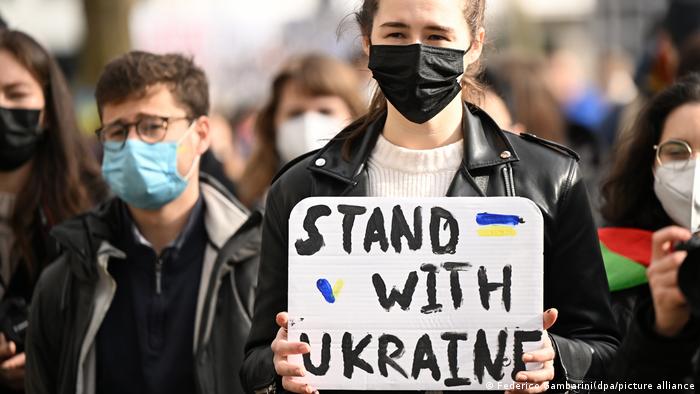
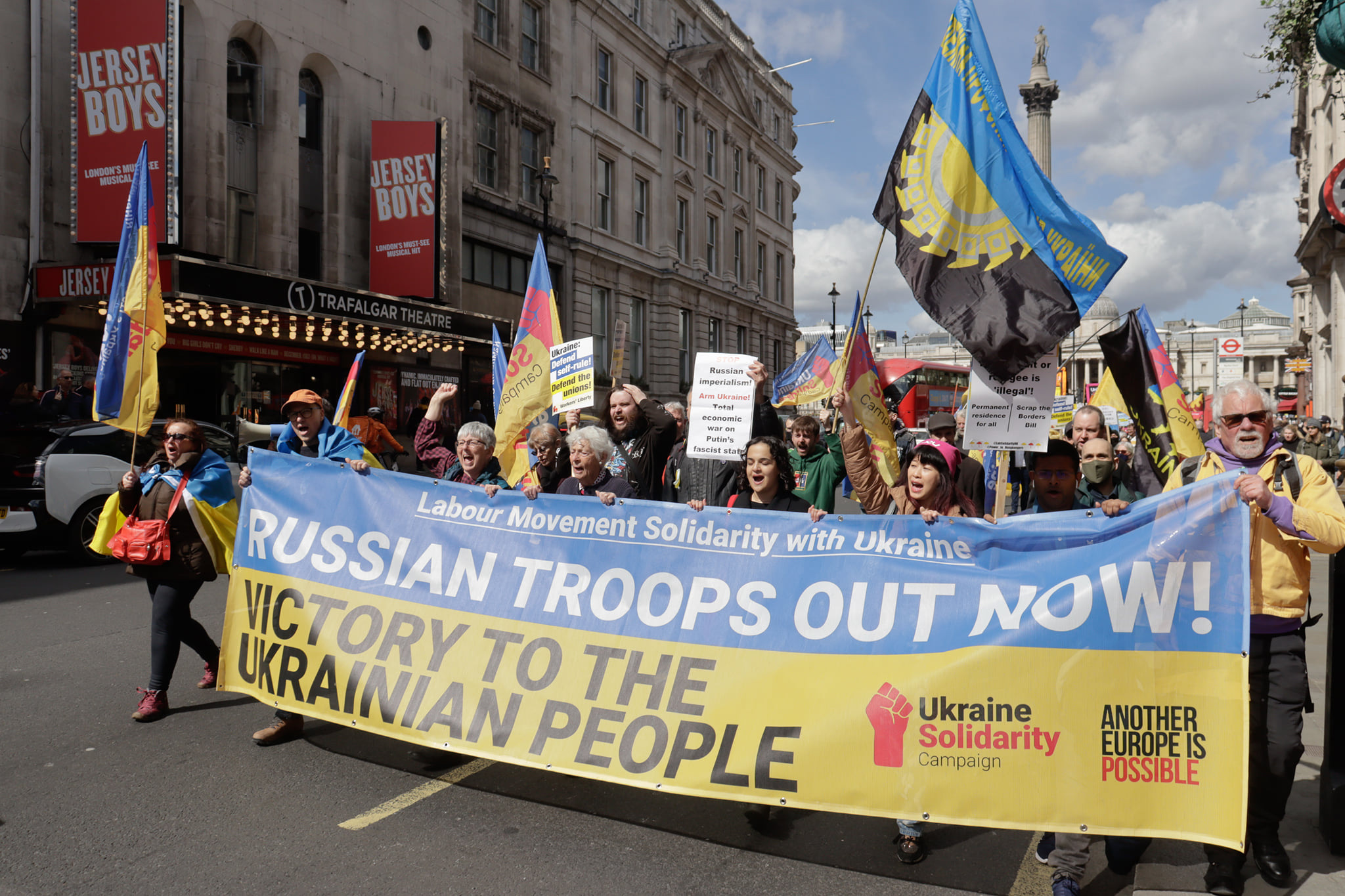
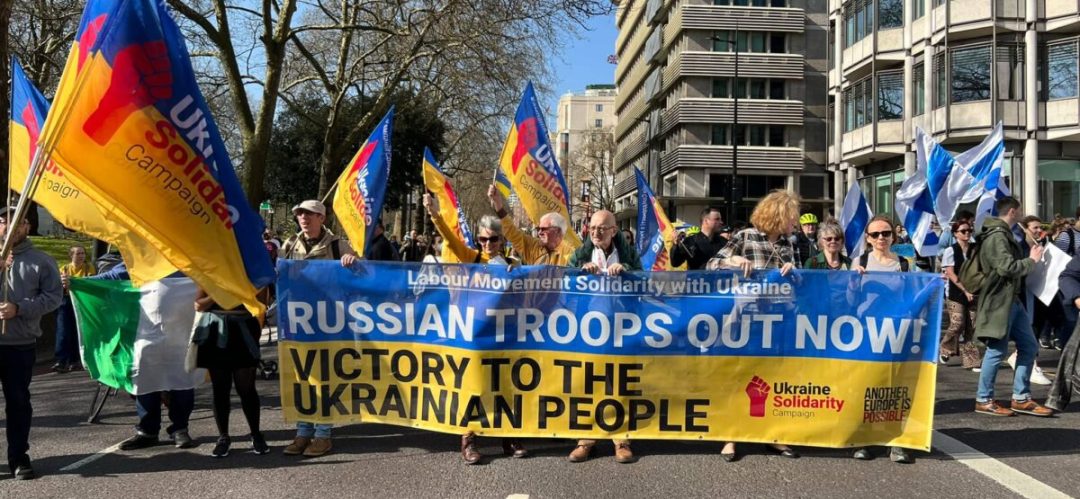
    The Russian war on Ukraine represents the most dangerous development in the world at this moment, more threatening in the short run than climate change or pandemics. The war has raised not only fears but also hopes for millions around the world. While I share the apprehensions of many, those of us on the international socialist left also have hopes that war in Ukraine can lead to making the world a better and safer place.

    Let’s look at those fears and hopes.

    Fear #1

    The current crisis began with an initial fear, which still remains, that Russia, led by Vladimir Putin, would conquer Ukraine. This conquest would obliterate a former colony that had become a sovereign nation, it would impose an authoritarian regime on an imperfect but nevertheless quite real democracy, and it would suppress the civil liberties that had made possible in Ukraine the development of a small but nevertheless significant left as well as genuine independent labor unions. A Russian victory would be a loss for all nations whose sovereignty might be threatened by a great power, and a defeat for democracy in Europe. It was this fear that first rallied many on the independent left to support Ukraine back in February when the war began.

    Fear #2

    There has also been a fear that Putin’s imperialist war on Ukraine could lead to a direct conflict between Russia, on the one hand, and NATO and the United States on the other. Were that to happen, since Russia, the United States, Britain, and France are all nuclear powers, it could trigger a nuclear war that would take the lives of millions or even billions and could end human life on earth. History suggests that even in the most difficult circumstances—the Korean War, the Cuban missile crisis, and the Vietnam War—great power leaders hesitate to turn to nuclear arms, knowing that mutual destruction is likely.

    Ukraine has the right to procure arms for its self-defense from whomever it can get them, including NATO member nations and the United States. The United States and NATO appear to have rather carefully calibrated the kinds of arms they are making available to Ukraine in order to avoid an all-out war with Russia. Despite the general untrustworthiness of Western powers, they seem to be adhering to that reasonable policy.

    Fear #3

    Ukraine’s fight against Russia’s aggression could become a proxy war between two great imperial powers, Russia and the United States. The key factor in determining if this is a proxy war is to ask who calls the shots, that is, does the United States or some other Western power control and direct Ukraine’s political and military policies? Despite its dependency on U.S. and European arms shipments, Volodymyr Zelensky’s government continues to determine Ukraine’s policies and chart its course.

    Fear #4

    By disrupting shipments from one of the world’s great grain growers, Russia’s war on Ukraine could lead to a catastrophic famine in the Global South and particularly in Africa. Fortunately, the United Nations has negotiated an agreement with Russia to permit the shipping of grain from Ukrainian ports on the Black Sea and that grain has started to move. With these shipments the price of grain will fall and it may be possible to avert the feared famine.

    Despite these fears, I continue to support Ukraine’s war and to hold out hope that it could lead to a better and safer world in several respects.

    Hope #1

    Despite the difficulties it faces, Ukraine has a good chance of not only withstanding Russian attacks but also driving the invaders from all of Ukraine. If Ukraine can do so, it would be a great victory for the right of nations to self-determination and for democratic governments over authoritarian states. But it is the Ukrainians’ decision whether or not to negotiate and, if they do so, to decide the terms acceptable to them.

    Hope #2

    Although it’s a long shot, democratic forces in Russia that oppose the war in Ukraine and that challenge Vladimir Putin could become strong enough to bring down his authoritarian government. Within those democratic forces, I support the democratic socialists who wish to replace not only the authoritarian regime but also its klepto-capitalism.

    Hope #3

    Although wars always tend to strengthen authoritarian tendencies in democratic nations, the general mobilization of the population in Ukraine to resist the Russian invasion might create a new sense of democratic politics, something like the mobilization of the popular resistance of the people of Western Europe to the Nazis toward the end of World War II. The Resistance, especially in France and Italy, brought great hopes for a democratic and socialist society, hopes unfortunately quashed by both the Soviet Union and the United States. If such a popular democratic movement develops, it could contribute to making Ukraine a more democratic and less corrupt country. At the same time, it could challenge Ukraine’s far right and its small but dangerous Nazi groups.

    Hope #4 

    The current popular mobilization in Ukraine could also produce a stronger, more militant Ukrainian labor movement. A couple of months ago, a labor conference took place in Lviv, despite the challenges of meeting during wartime, and Ukrainian unions have spoken out against Zelensky’s neoliberal and repressive labor laws that violate European and international labor standards.

    Hope #5

    Finally, Ukraine’s small democratic left has played an important role in the country’s political life through journals such as Commons and by socialist organizations such as Sotsіalniy Rukh (SR; The Social Movement). Activists from SR played a central role in organizing the labor conference in Lviv and have been involved in other Ukrainian social movements, such the feminist movement. There is also a Ukrainian anarchist movement that deserves attention. Small as they are, these organizations play an important role in relating to the broader left in Europe and in raising socialist ideas in Ukraine.

    The fears raised by Russia’s war on Ukraine are great, but my hopes are perhaps even greater. As I carry on a constant reassessment of the situation and listen carefully to the Ukrainian left, I continue to support Ukraine in its war against the Russian aggressor and hope for the latter’s defeat.

    Originally published on August 23, 2022 by Foreign Policy in Focus.

  • Ukraine and the Dangers of Nuclear War

    Ukraine and the Dangers of Nuclear War

    Given the danger of nuclear conflagration, should the peace movement demand – as some have suggested — that the United States and NATO stop providing arms to Ukraine as a way to avoid provoking Russia?

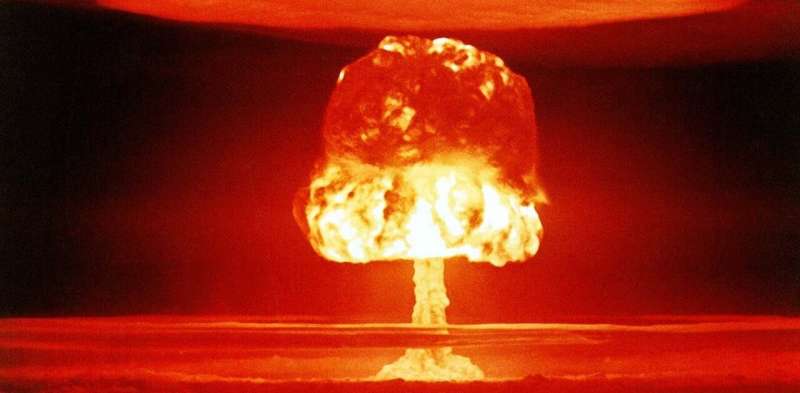
    Nuclear war – along with climate change and pandemics — represents one of the existential threats facing humanity. The very future of our species could be ended in the event of a full-scale nuclear war.

    Given the stakes, it is absolutely essential to prevent an all-out nuclear conflict. Moreover, because a limited nuclear exchange between superpowers has the potential to escalate into all-out war, the avoidance of even a limited exchange must be a major priority.

    When Putin launched his invasion of Ukraine on Feb. 24, 2022, he released a pre-recorded message that warned:

    Whoever tries to interfere with us, and even more so to create threats to our country, to our people, should know that Russia’s response will be immediate and will lead you to such consequences as you have never experienced in your history.

    And then three days later, Putin made his threat more explicit, declaring:

    “I order the defense minister and the chief of the general staff of the Russian armed forces to put the deterrence forces of the Russian army into a special mode of combat service.”

    “Western countries aren’t only taking unfriendly economic actions against our country, but leaders of major NATO countries are making aggressive statements about our country,” Putin said. “So I order to move Russia’s deterrence forces to a special regime of duty.”

    U.S. officials reported that they saw no indications that Moscow was actually planning to use nuclear weapons and that there would be no change to the posture of U.S. nuclear forces. But one can certainly understand why 141 nations in the General Assembly, against only five negative votes, not only deplored the Russian invasion of Ukraine but specifically condemned “the decision of the Russian Federation to increase the readiness of its nuclear forces.”

    A week before the invasion, at a time when Moscow was still insisting that it had no plans to invade Ukraine, the Kremlin announced that that it would carry out drills of its nuclear forces and that Putin would supervise the practice missile launches himself. Two months later, on April 20, Russia tested a new long-range missile, with appropriate notice, but also with Putin’s warning that this should “make those, who in the heat of frantic aggressive rhetoric try to threaten our country, think twice.”

    Russia had issued new guidelines for nuclear weapon use back in June 2020. The Basic Principles of the Russian Federation’s State Policy in the Domain of Nuclear Deterrence declared that Moscow would only use nuclear arms in situations where Russia or its allies were attacked with weapons of mass destruction or where there was a conventional attack against Russia in which “the very existence of the state is put under threat.” This seems quite restrictive, but when Putin charged on the eve of his Ukraine invasion that the policy of the United States and its allies “is not only a very real threat to our interests but to the very existence of our state and to its sovereignty” – one of the situations allowing nuclear weapon use — the implications were unsettling.

    Various Russian officials have since stated that Moscow had no intention of using nuclear weapons in Ukraine and that nuclear weapons were not applicable to the situation in Ukraine. On August 5, a Russian delegate at the United Nations denounced as baseless any allegations that Russia was threatening to use nuclear arms in Ukraine. It was impossible that Russia would do so, he said, because neither of the conditions under which Russian doctrinal guidelines permitted nuclear weapon use applied in the case of Ukraine. He further explained that Putin’s February 27 announcement that he was putting Russian nuclear forces on “special duty” didn’t mean he was putting them on high alert, but only that there would be “increased vigilance.” These were all welcome statements, though given Moscow’s continual prevarication on its actions in Ukraine, the threat and the concerns certainly remain.

    Nuclear Power Plants

    This article is going to focus on the threat of nuclear war, but brief mention should be made here regarding the danger emanating from nuclear power plants. (Recall that the world’s worst nuclear power plant accident took place at Chernobyl in Ukraine in 1986.) The current Russian invasion represents the first time in world history that a war has been waged around nuclear power stations, the first time a nuclear power plant has been seized by force, and the first time workers have been made to run a captured plant at gunpoint.

    On February 24, the Russians seized control of Chernobyl and the exclusion zone surrounding it. The Board of Governors of the International Atomic Energy Agency condemned the seizure and demanded that Russia withdraw immediately. On March 4, the Russians attacked and occupied the Zaporizhzhia nuclear plant complex, half a square mile in area, with a missile hitting a building on the site and starting a fire, but without harming the reactors. Russian forces withdrew from Chernobyl on March 31, as part of their general retreat from the Kyiv area, but they have remained in the Zaporizhzhia plant.

    In July, Russian troops turned the plant into a military base, and used it as a shield as they fired artillery and rockets across the river at Ukrainian-held Nikopol. Some firing at the plant complex has taken place – a drone attack on Russian troops by Ukraine, for example — and some rockets. Russia blames the latter on Ukraine, but plant workers and various independent experts think the fire came from the Russians, carefully aimed to cut the plant’s power lines to Ukrainian territory, part of a highly perilous Russian strategy of cutting off electricity to Ukraine and redirecting it to Russian controlled territory. Clearly any military activity here is extremely dangerous. Ukraine, the United States, the EU, and the UN Secretary General have all called for the establishment of a demilitarized zone around the plant. Russia has rejected the call. But the deputy chair of Russia’s Security Council, former president Dmitry Medvedev, didn’t miss the opportunity to issue another threat: “Let’s not forget that the European Union also has nuclear power plants. And accidents can happen there, too.”

    A nuclear accident at Zaporizhzhia would be horrible, though not nearly as bad as the Chernobyl disaster because of Zaporizhzhia’s more modern design. Neither, however, would compare with the harm from even a small nuclear weapon explosion, to which we now return.

    The History of Nuclear Threats

    Nuclear threats have a long, sordid history in the Cold War. As a study for the non-governmental National Security Archive summarized it,

    During the 1950s and early 1960s, there were a remarkable number of crises during which U.S. leaders made threats, authorized nuclear weapons for use, and put strategic forces in a higher state of readiness.  While the Soviets also made threats, e.g., Suez, in 1956, the U.S. threat posture was comparatively overwhelming.

    In 1953, a top-secret National Security Council directive declared that “In the event of hostilities, the United States will consider nuclear weapons to be as available for use as other munitions.” In 1955, Pres. Eisenhower, in part to encourage the American public to get over its squeamishness regarding nuclear arms, publicly stated that he saw no reason “why they shouldn’t be used just exactly as you would use a bullet or anything else.”

    Eventually, however, and particularly following the Cuban missile crisis of 1962, after the world had peered into the abyss, U.S. presidents came to appreciate that nuclear arms were in an entirely different category from conventional weapons and that their use would, in John Kennedy’s words, “open up a whole new world.” Both U.S. and Soviet leaders became much more restrained in their nuclear threats and pursued arms control agreements to reduce the risks of nuclear war. In recent years, it has been very rare for a national leader to threaten the use of nuclear weapons. Yes, North Korea has warned of preemptive nuclear strikes against the United States (complete with videos showing Washington DC or lower Manhattan going up in flames). And Donald Trump has blustered that: “North Korea best not make any more threats to the United States. They will be met with fire and fury like the world has never seen.” But their schoolyard behavior, with Trump tweeting that his nuclear button was “much bigger & more powerful” than Kim Jong-un’s, while infantile and reckless, was not as worrisome as Putin’s threats, which take place in the context of Europe’s largest war in the past seventy years, when inadvertent escalation presents a real risk.

    Numerous experts have expressed concern that we are today nearer to nuclear war than at any time since the Cuban missile crisis.

    Responding to Nuclear Threats

    Returning to the initial question, should the peace movement demand that the United States and NATO stop arming Ukraine so as to avoid provoking Russia? Sometimes it makes sense to give in to an unjust aggressor if the consequences of not doing so are potential extermination. If a villain points a gun at our heads and demands we drop our weapons, we reluctantly do so.

    Of course, Putin – unlike the hypothetical villain — knows that it is not just his adversary who will suffer the consequences if he pulls the trigger. In June 2021, Putin joined Biden in reaffirming “the principle that a nuclear war cannot be won and must never be fought.” But might Putin be crazy enough to start a nuclear war that would destroy Russia too? And does that mean that even the remote chance of nuclear war requires us to accede to Putin’s demands to stop arming Ukraine or imposing sanctions?

    The problem with succumbing to Putin’s demands is that doing so is not necessarily the best way to minimize the dangers of nuclear war. Because a rational leader would not undertake a policy whose costs outweighed the benefits, sometimes leaders bluff, feigning that they are willing to face costs far greater than warranted in order to intimidate their adversaries into surrender. Surrender here, however, can increase the prospects of nuclear war going forward.

    One of the foremost advocates of this nuclear bluffing strategy was Richard Nixon. As he explained his approach to his White House chief of staff H. R. Haldeman,

    I call it the Madman Theory, Bob. I want the North Vietnamese to believe I’ve reached the point where I might do anything to stop the war. We’ll just slip the word to them that, ‘for God’s sake, you know Nixon is obsessed about Communism. We can’t restrain him when he’s angry — and he has his hand on the nuclear button’ and Ho Chi Minh himself will be in Paris in two days begging for peace.

    Nixon and his national security adviser Henry Kissinger tried to carry out this strategy in October 1969, hoping to frighten the Soviet Union into pressing North Vietnam to accept American terms. On October 6, Kissinger ordered the secretary of defense to conduct a “series of increased alert measures designed to convey to the Soviets an increasing readiness by U.S. strategic forces.” The next week, the Strategic Air Command put on alert 176 bombers and 189 refueling tankers. Nixon met with the Soviet ambassador, displaying, according to an impressed Kissinger, the “guts of a riverboat gambler.” On October 26, the Strategic Air Command flew six armed B-52 bombers over Alaska. But, despite the intimidation, Moscow did not compel Hanoi to surrender – and (fortunately) nor did Soviet leaders panic and launch a preemptive strike on the United States.

    The political science literature shows that the madman strategy generally doesn’t work. The biggest problem with the strategy is, in the words of Stephen Walt, an advocate of realism in international relations:

    When other states deal with a powerful but unpredictable leader, they may tread carefully but they aren’t going to make big concessions.

    After all, if a madman is dangerous now, doing anything that makes them more powerful just makes them more dangerous later. Appeasement is sometimes a smart diplomatic strategy, but only if one believes that making concessions will remove grievances, reduce suspicions, make the other side more benign, and allow mutually beneficial relations to emerge.

    Imagine what would happen if Washington responded to Putin’s nuclear bluster by stopping its weapons supplies to Ukraine or lifting its sanctions.

    The Kremlin, now with a proven method of getting its way, could then demand surrender from Georgia and Moldova, two former Soviet republics where Russian troops currently hold contested territory. And when the United States and NATO refused to provide arms to these governments (because, after all, one doesn’t want to risk nuclear war), the two countries would have little option but to submit. But why stop there? If Russia then demanded (with appropriate rhetoric and missile tests) that NATO troops be removed from the Baltic states, would it be worth risking madman Putin escalating to nuclear war? So best comply. And if it then further demanded that no NATO arms be provided to these former components of the Soviet Union, again, why provoke the Bear? But at some point, either Moscow or Washington will miscalculate – will NATO back down? is Russia bluffing? — and we’ll be in the midst of a nuclear war.

    And Putin wouldn’t be the only one to try to take advantage of this strategy. Would his success encourage other nuclear bullies? Might Israel then make demands of Iran, to which Tehran would have to give in lest it face Armageddon? Might China demand that the United States stop arming and even trading with Taiwan, facilitating a bloodless conquest? Might North Korea demand that South Korea and Japan subsidize its economy?

    But giving in to Putin’s threats wouldn’t only encourage continuing acts of nuclear extortion. It would also provoke the potential victims of this extortion to rush to acquire nuclear arms of their own as a means of self-protection. South Korea, Taiwan, Japan, Iran, Saudi Arabia, UAE, Qatar, Egypt, and others would inevitably seek to become nuclear weapons states (if they are not already doing so). Some experts have claimed that widespread nuclear proliferation would be great, because no one would ever go to war again, fearing nuclear retaliation. But as most analysts understand, the risks of accidental, inadvertent, or escalatory war, or terrorism, or sabotage increases exponentially with the number of nuclear weapons states.

    To be sure, the historical record suggests that nuclear arms have not been very successful as a coercive tool. (Consider that possession of nuclear weapons didn’t allow the United States to prevail in Vietnam or the Soviet Union in Afghanistan.) But if nuclear threats gave the Russians a victory in Ukraine (for that’s what a cut-off of Western military supplies would mean), the calculus would change dramatically. Nuclear weapons expert Todd Sechser has observed:

    Russia has given us a vivid reminder that nuclear weapons are not a magic wand. As the war began, Vladimir Putin made several nuclear threats – both explicit and implied. But the fear of nuclear escalation has not intimidated Ukraine into submission. Nor have these threats dissuaded the West from imposing crippling sanctions on Russia and providing military aid to Ukraine. If anything, Putin’s nuclear bellicosity has only fueled the international backlash against Russia. The war has thrown a spotlight on the political limits of nuclear weapons, and dictators with nuclear ambitions should take note.

    If instead, NATO had given in or gives in to Putin’s demands, the lessons for leaders with nuclear ambitions would be rather different.

    Appeasement, then, has its dangers, setting off dynamics that might increase rather than decrease the risks of nuclear war. But military build-up and the logic of deterrence have their dangers as well, as we know from many historical examples. International relations scholars and peace researchers has long identified the “security dilemma” as a major cause of war: when one country takes steps to increase its own security that in turn decrease the security of its adversaries, the resulting countermoves end up reducing everyone’s security. (The eastward expansion of NATO was a classic example of this dynamic.) So while it would make good sense to call for the scaling back of aid to Ukraine if there were a real danger of nuclear war, giving in to Russian demands if they were a bluff might actually increase the dangers of nuclear war.

    Nuclear threats always have to be taken seriously, and great care taken in responding to them. There are several reasons, however, to regard Putin’s threats as posturing and to treat them as such.

    First, his threats have involved insinuation and bluster, but have not actually involved any corresponding military moves. This might make Putin look tough to his domestic audience, might scare public opinion in Ukraine and in the West, but without actually risking the consequences of military escalation. Were Putin in fact to put his nuclear forces on alert, that might have real consequences. Washington might increase the alert status of its own forces, and, at worst, there would be the risk of a U.S. preemptive strike. But by engaging in dramatic rhetoric while making sure that U.S. intelligence can see that he has not moved his tactical nuclear arms from their storage facilities to military bases, Putin shows that he appreciates the dangers of nuclear weapons. Indeed, in March 2022, the United States and Russia established a “deconfliction hotline” to avoid any inadvertent escalation in Ukraine. In May, the U.S. Secretary of Defense and Chair of the Joint Chiefs of Staff re-established communication with their Russian counterparts for the first time since the war began.

    Second, Putin had a history of trying to use nuclear blackmail. He said he was prepared to put his nuclear forces on alert during the 2014 annexation of Crimea. As in 2022, however, the rhetoric was not matched by actions.

    Third are domestic costs. It is sometimes suggested that there are no forces or institutions in Russian society limiting Putin – the antiwar movement is too weak — and thus the danger of his pushing the button is all too real. But Russia doesn’t have to be a well-functioning democracy for there to be domestic constraints on Putin. Consider that the Russian armed forces do not have the number of troops they need (Russia has been fighting a large conventional war” “at peacetime strength,” in the words of U.S. military analyst Michael Kofman); this deficit could be solved by ordering a general mobilization, but Putin evidently judges that the domestic political costs of doing so would be too great. One can assume that escalating a “special military operation” into a nuclear war would also substantially raise the domestic political costs for Putin and his supporting oligarchs.

    Fourth are international costs. We have seen Russian diplomacy engaged full tilt at trying to win over foreign countries. Europe is united against Putin’s invasion, but in other parts of the world, many countries are trying to avoid taking sides. For Russia to use nuclear weapons would deliver a tremendous blow to Moscow’s international position, especially in Africa and Latin America, where there are nuclear-free zones. Even China, which has given tacit support to Russia, would be hard pressed to support a first use of nuclear arms, contradicting its own declared policy. (China’s military cooperation with Russia since the invasion has been quite limited, and it abstained on the General Assembly resolution condemning the Russian assault.) The prediction that China would support sanctions against Moscow in the event it uses nuclear weapons does not seem unreasonable.

    And fifth, Russia seems to be quite cautious in actually declaring that red lines have been crossed. For example, in April, when a Ukrainian missile struck Russia’s Black Sea Fleet flagship, with the help of U.S. intelligence, Russia insisted that there had been no missile at all, just an onboard fire. And in August, when Ukrainian forces set off explosions at a Russian airbase in Crimea, “Russia’s Defense Ministry moved quickly to play down the extent of the damage, saying no equipment had been destroyed and no casualties reported,” assertions that “were contradicted by a video from the scene and by a tally of the damage by officials in Crimea.” The Kremlin’s interest in hiding its military failures from the Russian people makes it harder to mobilize Russian public opinion to support any escalation.

    Red Lines

    Despite these reasons for believing Putin’s nuclear threats to be more bark than bite, caution requires thinking through different levels and types of aid the United States and NATO might give to Ukraine and when these might be too risky.

    Those policies that would put U.S. military personnel into direct combat with Russian troops are obviously highly dangerous. Yes, it is possible that Russia would back down in the face of a direct challenge from Western military forces, but that seems a risk too serious to take. A no-fly zone – as advocated by Zelensky and various U.S. pundits – would entail similar risks , because shooting down Russian planes or destroying the anti-aircraft weapons that might threaten U.S. planes raises the prospect of direct U.S.-Russian conflict.

    Biden has stated very clearly: “So long as the United States or our allies are not attacked, we will not be directly engaged in this conflict, either by sending American troops to fight in Ukraine or by attacking Russian forces.” But where is the red line in terms of indirect U.S. involvement? This is not a matter of what Putin says – given his incentive and tendency to bluff – but a question of what U.S. actions might provoke Russia to resort to nuclear arms.

    One way to get a sense of actual red lines would be to look at historical precedent: other cases where a great power with nuclear weapons was fighting a non-nuclear-armed opponent that was being supported by another great power. How far did they go? What were the red lines?

    Consider the Korean War. The United States was fighting against (non-nuclear) North Korea. China, which also didn’t yet have nuclear weapons, directly intervened in the fighting on North Korea’s side, sending in two million “volunteers” — without precipitating U.S. attacks on Chinese soil, nuclear or otherwise. (The U.S. general in charge, Douglas MacArthur, called for strikes on China, but Truman fired him.) The Soviet Union had helped prepare Pyongyang’s initial attack on the South, and increased its military aid to North Korea tenfold from 1949 to 1951. It gave China enough arms for 64 infantry divisions and 22 air divisions and provided 90 percent of its munitions. In addition, Soviet pilots directly participated in the war, flying the latest Soviet fighter, the MIG-15 (though with Chinese or North Korean markings, and only over communist-held territory), shooting down many U.S. planes. Some 5,000 Soviet pilots served in the conflict. Even though Moscow went to great length to disguise their direct involvement, the United States was aware of it and decided to keep it secret so as not to lead to a wider war.

    In the Vietnam war, China sent some 100,000 engineering troops to North Vietnam, where they built and repaired military facilities and rail lines, and 150,000 anti-aircraft artillery soldiers, to defend strategic targets north of Hanoi from U.S. planes. In the years that U.S. forces were heavily engaged, 1965-1972, Beijing provided Hanoi with 1.3 million guns, nearly a billion bullets, 43,000 pieces of artillery, 12 million artillery shells, 344 tanks, 141 military vessels, and 82 planes. (Keep in mind that China at this time was a very poor country, in the midst of its own violent and chaotic Cultural Revolution.)

    Soviet aid to North Vietnam was much more substantial. From 1965 to 1972, Moscow provided more than $2 billion in military aid, which would be $12 billion in 2022 dollars. For a country with about a third the GDP of the United States at the time, this was an extraordinary level of support. (For comparison, U.S. military aid to Ukraine under the Biden administration has been about $10 billion.) Soviet aid included surface to air missiles (SAMs), jet planes, and technical advisers. The first SAMs fired at U.S. planes in 1965 were fired by Soviet crews. The CIA reported in 1968 that there seemed to be no limit to the type of aid Moscow was providing “with the possible exception of offensive weapons that would result in a confrontation with the US.”

    The Cuban missile crisis is another interesting example. Kennedy publicly stated that Soviet anti-aircraft missiles in Cuba were not a threat to the United States. Obviously, these could be used against U.S. planes attacking the island, but that was not a problem. If, however, the Russians should place offensive missiles that could hit the American homeland, then “the gravest issues would arise.” Kennedy was being hypocritical here, given that the United States had nuclear missiles in Turkey that could hit the Soviet Union; to Kennedy, Moscow was forbidden to do what Washington was permitted to do. Nevertheless, the distinction between a weapon that can only be used for self-defense and one that can be used to inflict substantial damage on another country’s home territory is a real one.

    And it’s a distinction that applies in Ukraine too. Giving Ukraine weapons that could strike deep into Russia would be much more provocative than providing arms that could be used against the Russians inside Ukraine.

    These historical examples suggest that NATO aid to Ukraine is not more reckless than superpower behavior of the past.

    Research analysts Samuel Charap and Jeremy Shapiro suggest that the search for a specific red line is misguided. While stating that the United States and its allies should continue providing Ukraine with the armaments it needs, they argue that there is no specific red line the crossing of which would cause Russian escalation. Rather, the risk of escalation comes from Russia finding its aims thwarted.

    The problem is not that providing Ukraine with some specific weapon could cause escalation but rather that if the West’s support of Ukraine succeeded in stemming Russia’s advance, that would constitute an unacceptable defeat for the Kremlin.

    They are certainly correct that the United States ought to contribute to a negotiated settlement by spelling out to the Russians which of its economic sanctions it is prepared to lift if and when they reach a settlement acceptable to the Ukrainians. And Washington needs to make very clear to Ukraine the limits of its aid so that Kyiv can make decisions with full information. And NATO certainly ought to declare its readiness to conclude a new, verifiable treaty to eliminate intermediate range nuclear forces from Europe, thereby increasing security for all. But if Russia still hopes to “advance,” it is hard to see how the West could avoid thwarting Russia’s aims.

    Moreover, it is no longer possible for Moscow to avoid an “unacceptable defeat” because it has already lost more than anything it could gain in Ukraine. The mobilization of NATO and the accession of Finland and Sweden have weakened Russia’s security far more than any hypothetical Ukrainian membership might have done; and the economic losses it will suffer from the flight of capital and skilled workers and the loss of access to high tech imports will more than outweigh the value of what it can loot from Ukraine.

    U.S. Policy

    Given the stakes involved, the U.S. response to Russia’s invasion of Ukraine needs to be very carefully calibrated. So far, the Biden administration has shown commendable caution in not responding to Putin’s nuclear bluster with bluster of its own, and without increasing the alert status of its own nuclear forces. Washington even delayed and then cancelled a planned ICBM test to avoid escalating tensions. Moreover, Biden explicitly declared:

    As much as I disagree with Mr. Putin, and find his actions an outrage, the United States will not try to bring about his ouster in Moscow. So long as the United States or our allies are not attacked, we will not be directly engaged in this conflict, either by sending American troops to fight in Ukraine or by attacking Russian forces. We are not encouraging or enabling Ukraine to strike beyond its borders. We do not want to prolong the war just to inflict pain on Russia.

    (There are some statements by U.S. officials that seem to contradict the last sentence, but it is hard to believe that the Biden administration thinks U.S. interests are served by dragging out a war that is taking such an economic toll on Western nations and that is delaying Washington’s strategic pivot to Asia.)

    Does this mean that Washington is adequately addressing the risks of nuclear war? Not at all. There are many ways in which U.S. policy contributes to the continuing danger of nuclear holocaust and where different policies enacted today could make us all safer.

    1. The United States still formally takes the position that it is willing to use nuclear weapons first. It states that it “will not use or threaten to use nuclear weapons against non-nuclear weapons states that are party to the NPT [Nuclear Nonproliferation Treaty] and in compliance with their nuclear nonproliferation obligations,” which covers about 180 countries. This limitation on Washington’s nuclear weapon use is welcome, but it still means that the United States could attack Russia, China, North Korea, or Iran with nuclear arms despite no prior use of nuclear weapons.China, on the other hand, despite some reckless language on party media, has declared that it would never be the first to employ nuclear arms. The Soviet Union had a no-first-use policy from 1982-93, but dropped it for a less restrictive policy after the end of the Cold War. Britain, France, and Pakistan too do not have a no-first-use policy.There are two main benefits of a no-first-use policy. First, the country that makes the declaration will be less likely to use nuclear weapons. And, second, nervous adversaries of the country making the declaration will be less likely to preempt out of fear that in a crisis they will be hit first, which in turn makes the declaring country more inclined to adhere to its commitment.So the first thing the Biden administration could do to reduce the dangers of nuclear war is to issue a no-first-use declaration.
    2. There is disagreement among analysts about whether Putin has the authority on his own to order a nuclear strike. The best guess is that he doesn’t have that authority on paper, but in practice can make sure that only his lackeys hold the relevant checking positions. This seems reckless in the extreme, to put the fate of the world into the hands of three or maybe even one person. But whatever ambiguity exists with regard to Russian authority structures, it is unambiguous that in the United States the president has sole authority to launch a nuclear war. Just think, we had the fate of our species in the exclusive hands of Donald Trump for four years. It is absolutely essential that sole presidential authority be revoked.
    3. Many have lamented the toothlessness of the United Nations in being able to address the aggression of a major power. The Security Council, which under the UN Charter has primary responsibility for international peace and security, is often blocked by the veto, as when Russia cast the lone negative vote on a resolution condemning its aggression in Ukraine. But Washington is in no position to condemn the undemocratic veto power, given its own frequent use of the veto.The United States did co-sponsor the recent General Assembly resolution, adopted by consensus, which calls for the General Assembly to meet whenever a veto is cast in the Security Council. But it has not joined Britain and France and 120 other member states in supporting a code of conduct under which permanent Security Council members pledge not to use their veto on issues relating to genocide, crimes against humanity, or war crimes.
    4. One country beyond the original five nuclear powers that acquired its nuclear arsenal by theft and deception is Israel. (Israel also cooperated on nuclear weapons development with South Africa, before the latter voluntarily gave up its nuclear program.) The pressures for developing nuclear weapons on Iran and then other Middle Eastern powers trace their origins to the Israeli program. U.S. military aid to and diplomatic support for this “rogue” nuclear power continues to undermine global efforts at non-proliferation.


    It is urgent that the war in Ukraine come to an end. Apart from the horrendous devastation in Ukraine, the risks of accidents and inadvertent escalation are quite serious. But to cut off Western arms supplies to Kyiv in response to these risks can only lead to Ukraine’s military defeat and more suffering for its people, along with the victory of an international aggressor and nuclear bully. This would mean the creation of a far more dangerous world.

  • Laurent Schwartz: The Vicissitudes of an Internationalist

    Laurent Schwartz: The Vicissitudes of an Internationalist

    The first of an occasional series of articles on the lives of figures of the French left.

    For more than a decade, from 1936 to 1947, Laurent Schwartz (1915-2002), the famous mathematician, was a Trotskyist in France, though that was only one short period in a long life dedicated to mathematics, butterflies, and politics. In his Trotskyist period he served in the French military during the phony war, lived under the Nazi occupation as a Jew, and participated in the Resistance. Later in his life, he was active in the French anti-colonialist movements, opposing the French government and military while supporting both the Algerian and Vietnamese movements.

    Schwartz always credited the Trotskyist movement with having given him his fundamental political education and above all with having made him an internationalist. Yet, even while he was a member of the Trotskyist organizations—and for several of those years Trotsky himself was alive and leading them—Schwarz often differed with the group’s strategies, its organizational approach, and its political style and sometimes declined to carry out its policies. Still even when he was a dissenter, he continued to put his life at risk for the Trotskyist party to which he belonged that was engaged in the fight against Nazism. I believe we have a lot to learn from both his appreciation of the Trotskyism and from his criticisms of the Trotskyists which are similar to some of those made by others coming out of the Trotskyist movement at that time such as Boris Souvarine and Victor Serge.

    Becoming a Mathematician, A Naturalist, and a Trotskyist

    Schwartz at his family’s country house in Autouillet, France. Family Archives
    With Laurent Schwartz
    Laurent and his wife Marie-Hélène.

    Schwartz grew up in a bourgeois family of Alsatian Jewish origin; his father was a surgeon. The young Laurent attended the highly competitive Lycée Louis-le-Grand. While at the lycée he met and fell in love with Marie-Hélène Lévy, the daughter of the famous mathematician Paul Pierre Lévy who was herself also a mathematician. Both he and his wife went on to study at the École Normale Supérieure but she contracted tuberculosis and had to drop out, though even while convalescing she also continued working on mathematics.

    During the Nazi occupation, Laurent and Marie-Hélène had a child, complicating their clandestine wartime existence, their study of mathematics, and political work. Then too there was his avid interest in studying and breeding butterflies that filled their houses with caterpillars and cocoons.

    How did Laurent become a Trotskyist? The events of 1934, both the right-wing riots of February 6, 1934—interpreted by the left as a fascist attempt at a coup de état—and the attempted Nazi coup in Austria of July1934, turned Schwarz toward politics and toward the left. Apparently he heard someone—one of many at the time—say that it was a crisis of capitalism and the liberal state. Wanting to understand capitalism, he read Karl Marx and Rosa Luxemburg and then undertook a study of the French economy. When the Popular Front arose in 1935, “I willingly let myself be carried away by the broad movement,” he wrote.[1] In May 1936, Schwarz voted for the Socialist Party and was thrilled with the victory of the Popular Front, but soon became disillusioned. When in July 1936, General Francisco Franc rebelled against the Spanish Republican government, leading to the Spanish Civil War, the Popular Front government for which Schwartz had voted adopted a policy of non-intervention, refusing to support the Spanish Republic. “Non-intervention profoundly disappointed me, and constituted in my view a major political mistake.”[2] While depressed by the developments in Spain, Schwartz spirits were lifted by the French general strike of 1936.

    Bourbaki gathering at Dieulefit in 1938. From left, Simone Weil,[a] Charles Pisot, André Weil, Jean Dieudonné (sitting), Claude Chabauty, Charles Ehresmann, and Jean Delsarte.
    We should mention that during the years 1934-35 while becoming a serious leftist, Schwartz also joined with a group of a dozen mathematicians to carry out a fundamental revision of the foundations of mathematical pedagogy. The collective called itself Nikolas Bourbaki, a fictious mathematician, and published Éléments de mathématique (Elements of Mathematics) which dealt with topics such as set theory, abstract algebra, topology, and other matters. Under Bourbaki’s name, they eventually published some 19 books and many articles.[3]

    In October 1936, after talking it over with his wife Marie-Hélène, Schwartz joined the Communist Party, despite what he saw as its sectarianism and its cant and jargon (langue du bois). He writes in his memoir that he was motivated to join by the fact that he felt at the time that what was needed was a large and powerful working-class party. But about the time that he joined, in August of 1936, Stalin’s trials of the Bolshevik leaders Grigory Zinoviev and Lev Kamenev began, with the absent Leon Trotsky depicted as the central organizer of an anti-Soviet conspiracy. As it happens, shortly before the trials a family friend had given Marie-Hélène a copy of Trotsky’s My Life, which Schwartz had also read, and consequently he found it incredible that Trotsky should have turned into a counter-revolutionary. At that time, Schwartz had never heard of either a French Trotskyist party, but an avid reader of all the newspapers and magazines, in Le Petit Parisien, he came across an interview with the Trotskyist Fred Zeller that included the address of the offices of his party. So, a day or two later, Schwartz went to the Trotskyist party offices where he met several of Trotskyist leaders and activists, and was impressed with their “political intelligence.”[4]

    Later in that same month of October 1936 that he had become a Communist, Schwartz became a Trotskyist. There were in fact two Trotskyist organizations in France, the Parti ouvrièr internationaliste (POI or Internationalist Workers Party), which he had joined, and the rival Parti communiste internationaliste (PCI and the Internationalist Communist Party). About that same time, Schwartz read and reread Trotsky’s The Revolution Betrayed, with its analysis of the Soviet Union, but Schwartz rejected what he saw as Trotsky’s pessimistic view that given the circumstance the degeneration of the Soviet Union was inevitable. Schwartz recalls in his memoir that he believed that had Trotsky taken power he might have steered the Soviet Union in a different direction. Schwartz read too and was greatly impressed by Trotsky’s History of the Russian Revolution, and at that time he also read and found useful Victor Serge’s From Lenin to Stalin (1937) and valued Boris Souvarine’s Stalin (1935), though it was condemned by the Trotskyists.

    His Differences with Trotsky

    Trotsky also wrote brilliantly on the situation in Germany, calling for a “united front”[5] between the Communist and Socialist parties in order to block and to defeat Adolf Hitler and his Nazis. But writes Schwartz, “It is remarkable that Trotsky was so clear about the necessity of a united front within Germany before Hitler came to power, and that the Trotskyists of the entire world have been always been so tragically unable to form a united front with anyone.”[6] Schwartz understands that in France in the 1930s or during the war, with the Trotskyists slandered and vilified as agents of Hitler, that it was impossible to form a united front with the Communist or Socialist parties, but he was also critical of the Trotskyists for their inability in that period to form alliances with groups such as Marceau Pivert’s Gauche révolucionnaire (Revolutionary Left) in France and with the Partido Obrero Unificado Marxista (POUM – Workers Party of Marxist Unification) in Spain. Moreover, he criticized Trotsky’s formula of “marching separately and striking together” combined with full “freedom of criticism” of other parties in the united front. That, said Schwartz, completely undermined any united front from the beginning. “One must establish a mutual dialogue, but the Trotskyist party thought it could polemicize in the time of a united Front, just as if it didn’t exist.”[7]

    Schwarz also though that the Trotskyist approach to Spain was “tainted with mistakes.” Schwarz writes that, “The POUM was a revolutionary Marxist and non-Stalinist party, very close to the Trotskyists.” But, “Instead of supporting this strong party, the Fourth International supported the ‘Spanish Trotskyist party,’ a phantom that no one has ever found to have more than two members, Munis and Carlini, rather pale figures compared to the leaders of the POUM. (Calini claimed that the Trotskyists had twelve members in Spain.) This is one of the least glorious moments of Trotskyist sectarianism.”[8]

    Schwarz writes, and the reader can clearly see from his remarks cited above, “While I adopted Trotskyism, I continued to think independently, though my differences with Trotsky’s party were not few.” Schwartz’s mentions that he shared many of Victor Serge’s criticisms. Looking back at Trotsky in the 1920s, Schwartz recalls that he was shocked when he read Trotsky’s pamphlet In Defense of Terrorism, which defended the Bolshevik terror during the Russian Revolution, and felt similarly about Their Morals and Ours, seeing in it the “germs of tyranny.”[9] Schwarz writes that, “The politics of the Trotskyist party in France also provoked doubts.” At the time of the French general strike of June 1936, Trotsky wrote, “The socialist revolution in France has begun.” Yet, says Schwarz, the Trotskyists refused to join the Popular Front because of the participation of the petty-bourgeois Radical Party. Instead, Schwartz observes, they entered the Socialist Party, from which they were soon excluded.

    Schwarz not only differed with Trotsky and some of his own comrades on theoretical and strategic questions, but sometimes on tactics as well. Schwarz recounts how after the Popular Front’s victory, the Communists organized a workers’ demonstration against the Socialist Party, and that the head of his Trotskyist cell told its members to go there, if possible, with a pistol. Schwarz writes, “I disapproved of such an absurd suggestion and didn’t go.”[10] Yet, despite all of his differences, Schwartz stuck with the Trotskyist group that had provided him his political education and had instilled in him a deep commitment to internationalism.

    From Military Service to Nazi Occupation

     When he graduated from the École Normale in July 1937, Schwarz decided to do his obligatory two years of military service immediately and was assigned to an anti-aircraft defense post at a base near Metz, near the German border, and a year later to a base at Laon, also in northern France. He disliked the uncultured lieutenants and preferred the non-commissioned officers who knew more about the weapons. Mostly, having no one to talk to about science or politics, he was bored. “Bored, bored, bored.”[11] Luckily there was a local public library in Laon where he checked out books on physics, chemistry, biology, natural science, geography, economic geography, economic history, and some literature, “to fill up the lacunas” in his education.

    When the Munich agreement was signed on September 30, 1938, Schwarz writes, “I understood immediately what Munich represented and I violently rejected the capitulation.” The Popular Front had collapsed, Franco was on the path to victory in Spain, Munich had given Hitler the Sudetenland, and Schwarz found the French military to be disorganized and unprepared. The situation was extremely discouraging. Shortly before the French declaration of war against Germany in 1939, he was transferred to a garrison near Paris where he was able to reestablish contact both with his family and his Trotskyist comrades. The announcement of the Hitler-Stalin non-aggression pact, he notes “didn’t surprise us. We knew Stalinism.”[12] With the defeat of the Spanish Republic by Franco, Schwarz writes, “I felt like a tiny feather on the immense checkerboard of the world, a drop of water in the middle of an ocean of events completely beyond my influence. My two years of military service [which ended in September 1939] seemed to me to be a complete waste.”[13]

    Still his wife was getting better. While convalescing from tuberculosis, Marie Hélène, studying with Laurent, earned her certificate in rational mechanics (the mathematical study of motions generated from specific forces, as opposed to statics), secured her professional license, and finally felt well enough to return more seriously to the study of mathematics and began to publish articles. Laurent, now a lieutenant, taught the art of firing anti-aircraft guns to reserve officers at a military base at Biscarrosse-Bourg in southwestern France.

    On September 3, 1939, following the German invasion of Poland, France declared war on Germany, but during what is called the drôle du guerre (the phony war) there was little fighting between the declaration and April 1940 when the Battle for France began until May 10 until June 25, 1940 when the French surrendered. As Schwartz observes, the French bourgeoisie and government seemed to have little stomach for fighting the Nazis who had so quickly defeated France and entered Paris. Marshal Phillippe Pétain became the head of state, met with Hitler and shook his hand, and that began the country’s wartime collaboration with Nazi Germany. The armistice signed by Pétain’s Vichy government, at first divided France into a German occupied zone in the north and along the west coast and a Vichy ruled “Free Zone” in the southeast.

    The persecution of Jews began in September 1940 with new laws excluded that excluded Jews from certain occupations and usiness, followed in August 1941 by a ban on Jews using radios or telephone, and shortly thereafter with the banning of all Jews from public places and the bombing of synagogues. In November of 1942, the German Army occupied the Free Zone, carrying their anti-Semitic policies with them. There were some 340,000 Jews living in France, about half of them immigrants from other European countries. The Vichy government collaborated with the Nazis in rounding up and deporting 75,000 to death camps, where about 72,500 were killed.

    Throughout the period from 1940 to 1945, like many Jews in France, Laurent and Marie Hélène relocated to the Free Zone and then moved from one small rural town to another attempting to hide themselves and their new born child. Eventually they went to the small portion of France occupied by the Italian fascists. Laurent worked at various teaching jobs as they struggled to keep food on the table, while they continued to study mathematics, and he as always to raise butterflies. They secured false papers, and led a clandestine life while at the same time Laurent remained active in Trotskyist groups and in the underground resistance.

    Rethinking Revolutionary Theory

    As Schwarz writes, revolutionary theory of the First World War period had been built on the notion of “revolutionary defeatism,” that is calling in the case of war for the defeat of one’s own government. It was that conception that tended to dominate the thinking of the small Trotskyist parties in France that were initially opposed to any support for the Allies—Great Britain and France—and called instead turning the war into a revolution. But Marcel Hic, a young and influential Trotskyist leader argued that occupied France had become an oppressed nation and had to fight together with the Allies for France’s right to self-determination. The problem was, “…how to fight against the Nazis and not submit to the orders of our capitalist adversaries.”[14] Many of the Trotskyists—a majority of the POI agreed—though that position was ultimately defeated in 1942. Schwarz writes,

    I was fundamentally in agreement with the content of [Hic’s position]…but I didn’t dare to say what I really thought, because I would be contradicting myself. I suffered from a kind of schizophrenia, in a certain weak sense of the word. On the one hand, the ten commandments of Trotskyism and of Lenin concerning the previous war clearly stipulated bringing about the defeat of owns own imperialism in a civil war. On the other hand, it was patently obvious that such a development was impossible. Fighting Nazism seemed an absolute necessity, beginning with updating our language which still dated from the last war. The result of this split inside myself was without a doubt, as it was for many Trotskyists, to render our action sterile, ineffective. [15]

    Schwartz believed that Trotsky had in fact radically revised his position in 1940, claiming that Trotsky had written, “We must defend our cities, our towns, our churches, our intellectual life, workers and peasants, against Nazi barbarism.”[16] And, said Schwarz, Trotsky himself had called upon American workers to push Roosevelt to enter the war.[17] The French, he says, were, however, unaware of Trotsky’s latest positions.

    Though he was a Jew, and a husband, with a wife, and a new baby, and though he had many doubts and criticism of the Trotskyists, he continued to work with his organization during the Nazi occupation, his life always in peril. He divides the POI members’ experiences in this period into three groups. One group worked on organizing fraternization with German soldiers to win them to anti-fascism and a fight against the Nazis. Some of those POI members published a newspaper called Arbeiter und Soldat (Worker and Soldier) and actually did succeed in organizing a group of 27 German soldiers, but a spy in their midst turned them. The soldiers were shot, while the Trotskyists were tortured and deported to German concentration camps. A second group worked in the unions in the factories to organize against collaborationist bosses, and a few of them became influential union leaders in the post-war period. The third group was made up of Trotskyists either completely isolated or in very small groups. One of the small groups in which he was involved published pamphlets and newspapers, among them the principal Trotskyist paper La Verité (The Truth). He himself, using his various aliases, was engaged in the dangerous work of distributing the papers and brochures, and he had a few close calls, as did Hélène Marie.

    “The Trotskyist resistance, despite its undeniable courage, remained pretty ineffective,” writes Schwarz. “There were less than 200 of us!” They might have joined the maquis, the French resistance, but not only were many in the group opposed politically because of the role of General Charles de Gaulle, but there was also the danger of being assassinated by the Stalinists. Summing up this period Schwartz writes, “Trotskyism had given me during my years at the Normale a remarkable political education (formation), clearly more advanced and sophisticated than that of most of the young people of my age. But the extremism and the sectarianism of its ideas, and its cant, undermined my commitment during the Occupation.”[18] At the end of the war, Schwarz was also disappointed by the Trotskyist Fourth International’s inability to discuss the holocaust. “No one mentioned the Jews.”[19] Schwartz had, in this period, become a leader of what was referred to by its opponents as the “rightwing” of the Trotskyist movement, together with Albert Demazière, Paul Parisot, and Yvan Craipeau. But by 1947 he had left the Trotskyists and later joined the Socialist Party.

    It was in 1944-45, as Paris was liberated, that Schwartz made his discovery of what in mathematics are called “distributions” or sometimes “generalized functions,” his great contribution to mathematical theory. Though, when in 1950 the International Mathematical Union awarded him the Fields Medal (comparable to the Nobel Prize), the United States refused to admit him to the country for the ceremony. In any case, with the war over, he now pursued his academic career in earnest. He became a professor at Nancy University, then moved to the Sorbonne in 1952, and in 1958 he became a professor as well at the École Polytechnique (EP). He taught there until 1980.

    While no longer a Trotskyist, Laurent remained political, on the left, and an internationalist. In 1956 he joined with Bertrand Russell to protest the Soviet invasion of Hungary to crush the workers’ revolution there. In 1957, together with François Mauriac and Sartre, Schwartz helped to organize the Committee-Maurice-Audin. Schwartz protested French paratroopers’ murder of Audin, a 25-year-old communist and teacher of mathematics in Algiers. He also arranged to award Audin his advanced degree in mathematics posthumously. Perhaps most famously, in1960, Schwartz signed the Manifesto of 121, which encouraged young men to refuse to serve in the French army as long as it was at war in Algeria. That led the EP to suspend him from teaching position from 1962 to 63. His son Marc André, who was also active in that movement opposing France in Algeria, was apparently kidnapped by French right-wingers, an experience that may have led to mental illness and eventually to his suicide.[20]

    Laurent Schwartz in Vietnam Family Archives
    Laurent Schwartz in Vietnam Family Archives

    In 1960 Schwartz and other in the Socialist Party’s left wing who opposed the French war in Algeria split and then joined with other former Socialists and some ex-Communists founded the Unified Socialist Party (PSU). Schwartz stood in solidarity with Algeria’s war of independence, During the late 1960s and 1970s, Schwartz actively opposed the U.S. war in Vietnam, and in the 180s he also opposed what he called the Soviet Union’s “Vietnam war” in Afghanistan, even though he recognized a Soviet colonial government would be more progressive than the Taliban, because any imperialist war was intolerable. Throughout his life, Laurent Schwartz, though he abandoned his earlier commitment to Trotskyism for which he had repeatedly risked his life, remained a humanist, an anti-imperialist, and a socialist.

    The picture that Schwartz paints of French Trotskyism in the Great Depression of the 1930s and during World War II is that of a small band of committed revolutionary socialists, divided into rival groups because of their differences on various questions, heroically resisting the Nazis but failing to have much of an impact because because of the persecution they faced from Nazis and the Communist Party, and because they could not find their place in the French resistance, in part due to their often sectarian in their strategy and tactics, Schwartz faults himself for being unable to voice his views and assert them in the Trotskyist POI, but clearly that was also a reflection of the character of the group with little toleration for differences. One has to admire Schwartz’s loyalty to the Trotskyist group and its dangerous work, as well as his perspicacity in identifying the group’s mistakes and limitations. And one has to admire too the leading role he played an important role on the left, especially in the anti-colonial movement.

    Notes:

    [1] Laurent Schwartz, Un mathématicien aux prises avec le siècle (Paris: Éditions Odile Jacob, 1997), p. 105. All translations are mine.

    [2] Schwartz, Un mathématicien, p. 108.

    [3] Schwartz, Un mathématicien, pp. 158-177. See these two short video about Nikolas Bourbaki “The greatest mathematician that never lived” by Pratik Aghor at

    https://youtu.be/0O_boW9YA7I and “Bourbaki – a Tale of Mathematics, Lions and Espionage” by The Ferret at https://youtu.be/OtZmezLbSIU

    [4] Among those he met in this period were: Paul Parisot, Albert Demazière, Marcel Beaufrère, Marcel Hic, David Rousset, Pierre Naville, Roland et Yvonne Filiatre, Yvan Craipeau, and Gérard Bloch.

    [5] In the Trotskyist tradition, the term “united front” refers to an alliance between working class parties and is different than a “popular front” which is an alliance between working class parties and petty bourgeois or bourgeois parties.

    [6] Schwartz, Un mathématicien, p. 122.

    [7] Schwartz, Un mathématicien, p. 122.

    [8] Schwartz, Un mathématicien, p. 124.

    [9] Schwartz, Un mathématicien, p. 126.

    [10] Schwartz, Un mathématicien, p. 133.

    [11] Schwartz, Un mathématicien, p. 139.

    [12] Schwartz, Un mathématicien, p. 142.

    [13] Schwartz, Un mathématicien, p. 143.

    [14] Schwartz, Un mathématicien, p. 181.

    [15] Schwartz, Un mathématicien, pp. 130-31.

    [16] I have been unable to locate this quotation from Trotsky.

    [17] I am unaware of any article where Trotsky argues that position.

    [18] Schwartz, Un mathématicien, p. 186.

    [19] Schwartz, Un mathématicien, p. 271.

    [20] “The four lives of Laurent Schwartz,” posted in martin’s blog on Sat, 07/02/2015 – 22:54,

    https://www.workersliberty.org/blogs/2017-07-26/four-lives-laurent-schwartz

  • The Woke Capitalist Attack on Breastfeeding

    The Woke Capitalist Attack on Breastfeeding

    At the end of the nineteenth century, family life, feeding practices, and children’s health transformed in the industrializing world as economic and scientific innovation coalesced around the newly emerging needs of capital. Henri Nestlé did what other baby formula inventors had not yet done by making the product easy to prepare, aggressively marketing it, and promoting it to consumers as an alternative to breastfeeding. The low-wage work that drew women out of the home and into the labor force created the demand for human milk substitutes contributing to the success of Nestlé’s commercial efforts and building a food product enterprise that would endure for at least the next century and a half.

    While women increasingly went to work in factories in the industrializing nations of Europe and the United States at the turn of the twentieth century, colonial countries like the Belgian Congo also saw an expansion of women laboring outside of the home, but in agriculture. Wherever women worked away from their families was fertile ground for marketers of human milk substitutes. They utilized the emergent fields of pediatrics and public health to argue that formula provided a solution to infant mortality and childhood illness.

    Formula sellers, employers, and profiteers of women’s labor initiated a war against breastfeeding starting in the Gilded Age that progressed well into the twentieth century and continues on into this one. As industrialization and Western imperialism continued to reshape global economies, captains of industry and colonial governments alike forged a campaign to endorse the consumption of formula, touting it as more sanitary and nutritious than its biological counterpart. A century and a half later, this assault hasn’t ceased despite several waves of discontent—public health advocates, doctors, nurses, environmentalists, leftists, women’s rights activists, and even pro-family right wingers—all contending the undeniable superiority of breastmilk. Today, however, the capitalist opponents of breastfeeding have a new ally: neoliberal feminists.

    Feminism Against Breastfeeding

    The lean-in crowd is working hard to delegitimize breastfeeding’s supporters and to undermine its benefits despite mountains of evidence born out of generations of research. This attack is cloaked in the guise of protecting women from shaming bullies and preserving and prioritizing choice. However, the larger social and economic forces out of which choices are made go ignored by many of these mom bloggers and woke journalists who are maligning breastfeeding advocacy. Additionally, the broader public health impact of breastfeeding disparities on marginalized people is of little interest to a feminist discourse that celebrates choice alone while turning a blind eye to the material conditions shaping working families’ lives.

    Even intersectional feminists are in on the crusade against breastfeeding promotion. With articles like “How the ‘Breast is Best’ Message Can Hurt New Parents” one would think that the most pressing issue surrounding maternal/infant health is that an army of lactation zealots are forcing breastfeeding onto new moms and they must be stopped at all costs.

    This is not to say that anyone should be shamed for choosing not to breastfeed. It is a given that women’s personal healthcare and child rearing decisions are entirely their own—abortion, birthing preferences, childcare, employment, contraception—no woman should have to endure the onslaught of judgment heaped on them by a society that blames them for every aspect of their identities and most private selves. Rather, these choices should not be addressed as though they are floating around in a vacuum, uninfluenced by all the patriarchal and capitalist forces that shape our lives at the macro and micro levels.

    The vast majority of women who formula feed, do so based on the need to return to work soon after childbirth, the inability to express milk at their place of employment, and the logistical difficulty of finding childcare that can properly store, prepare, and administer human milk. It goes without saying that it is wrong to shame women for any reason, but especially when such circumstances decide how their babies will be fed. However, the economic and structural limits of women’s choices go wholly unmentioned in these feminist missives lambasting breastfeeding advocates.

    For any feminist truly invested in the disadvantages faced by women of color and/or low-income mothers, it is worth understanding how the breastfeeding gap between privileged and working-class families makes an enormous impact on the health outcomes of mothers and children. The implications of lactation for both breastfeeding parent and baby are enormous. In addition to virtually cutting the SIDS risk in half, breastfeeding significantly reduces the likelihood of developing a mountain of childhood ailments including diabetes, ear infections, asthma, allergies, gastrointestinal infection, respiratory illness, obesity, eczema and leukemia. Breastfeeding also decreases the chance that the breastfeeding parent will develop breast or ovarian cancer as well as osteoporosis.

    The American Academy of Pediatrics’ (AAP) recent revision of its recommendation on the length of time a baby should breastfeed, and the backlash against it, highlights the flatness of the so-called feminist criticism of breastfeeding promotion. Even though the AAP suggested that the time a parent breastfeeds with supplemental foods be increased from one to two years based on the scientific evidence pointing to the enormous benefits to the health of the mother, publications like Good Housekeeping are attacking the AAP as “tone deaf” and calling on them to “read the room.” According to Elizabeth Skoski of Good Housekeeping, it is wrong to encourage parents to breastfeed for up to two years in a climate of hostility to women and lack of infrastructural support highlighted by the COVID pandemic.

    Rather than take on the policy-makers and purveyors of an economic system that makes it difficult for women to breastfeed, Skoski blames the AAP and denies the scientific evidence on which it is basing its new recommendations. Perhaps to her “reading the room” might entail withholding empirical information on the benefits of breastfeeding while staying silent on the legislative inaction that impedes breastfeeding, especially for those families whose healthcare choices are the most limited by white supremacy and capitalism.

    Breastfeeding Disparities as Public Health Crisis

    The urgency of breastfeeding promotion at a time when the supply chain crisis threatens to starve children, is rooted in the reality that families who are unable to breastfeed face a heightened risk for disease. When considering that African American mothers and babies have the lowest rates of breastfeeding at every stage of infanthood, it is worth emphasizing the horrific disparities afflicting Black families including higher infant and maternal mortality rates. The reasons for lower breastfeeding rates among African Americans, while influenced by lack of access to lactation care and targeted programs, are mostly shaped by the need to return to work earlier than white mothers and by hostile attitudes on the part of employers when it comes to pumping breaks.

    Income is the other major determinant in the likelihood that a parent will be able to breastfeed. Middle and upper-class families have much higher rates of breastfeeding as do those with higher levels of education. In addition to having a greater likelihood of encountering information regarding the risks of not breastfeeding and healthcare that greatly facilitates lactation care, these families have two major resources that low-income parents don’t when it comes to postpartum life, namely, their type of employment and the quality of childcare they can afford.

    Even though the United States remains one of only three countries in the world not to offer any form of paid maternity leave, middle and upper-class families are much more likely to have employment conditions that allow for breastfeeding to be established in the early months of infanthood. The economic ability to take time off as well as the capacity to negotiate with employers for time and space to pump at work are much more difficult to come by for working class women. Additionally, the support structure needed to express, store, and provide milk to infants at daycare is not available to the same degree to low-income parents.

    To live in a society that values breastfeeding and acknowledges its importance to the health of mothers and children, is to, therefore, live in a society that affords women time off in the early months of their children’s lives and provides them sanitary, comfortable, and generous accommodations to express milk when they do return to work. In short, this is not a society that prioritizes capital and profit above all else while treating workers like robots with no human needs or rights.

    The neoliberal feminist campaign against breastfeeding promotion illustrates the limits of an argument for women’s rights that ignores the material conditions that shape life for families. If breastfeeding advocates are cast as the villains in the drama of postpartum life rather than the employers who exploit women’s labor and deny them lactation accommodations and lawmakers who oppose paid maternity leave, then the systemic obstacles to women’s and children’s health will remain unquestioned and thus fundamentally unaltered.

    Until then, the Henri Nestlés of the world will continue to profit from formula supplementation (despite scandals such as the genocide of countless infants in underdeveloped countries as a result of the aggressive marketing of human milk substitutes in the 1970s or, most recently,  Abbott’s recall of tainted formula that caused serious illness in at least four infants), employers will remain the primary power-holders over mothers’ choices, and policy-makers will feel little pressure to enact any form of paid maternity leave. Meanwhile capitalist feminists will continue to piddle around the edges of a power structure that rewards a tiny subset of economically privileged women with the freedom to make their own peripartum choices while the vast majority of working-class families will continue to suffer from preventable diseases.


  • Is America in the Grip of Social Madness?

    Is America in the Grip of Social Madness?

    “This is madness,” said Utah Senator Mitt Romney as President Donald Trump began denying the 2020 election result and claiming that he actually won a second term. A patrician’s judgement, Romney’s use of “madness” was also an assertion of incredulity that many of us have repeated a number of times over the last few years. Endless lies with no repercussions, calling for a 2,000-mile wall at our southern border to be paid for by Mexico, the mania about foreign Muslims, approaching the pandemic magically including rejecting public health mandates about vaccines and wearing masks, the Big Lie about the stolen election followed by the craze about “election security,” the storming of the Capitol to stop the ritual of confirming the election of Biden as President—and then the panic about “Critical Race Theory,” the virtually overnight diffusion of QAnon’s daffy theories, and the spread of The Great Replacement Theory. These recent assaults on reason and reality took root in soil well prepared by other uniquely American insanities, including the widespread rejection of evolution, the denial of climate change, and the dissociation from reality built into the gun culture. Many of these started well before Donald Trump, and all go well beyond simple irrationality.

    They demand that we look beneath the media and political world’s obsession with a “Trumpism” focused on the man himself—his lies, his extravagances, his madness, his brilliance, his domination of his “base.” The fixation on Trump reached its peak as the January 6 hearings unrolled to their climax, focusing on what the man himself was doing during the 187 minutes of the Insurrection. We ended up with a story of a madman in charge, his rational and well-meaning staff opposed but paralyzed, a handful of enablers cheering him on, and the mob, Trump’s “base,” doing his bidding. This picture continues to evade the most important question of all: are millions of Americans in the grip of madness?

    Even when we use it casually, the term “madness” turns on a basic grasp of reality: mad actions go against reality. They are based on systematically distorted perception, or worse, stem from being enclosed in subjectivity to the point of denying decisive aspects of the world. This entails substituting a made-up or fundamentally distorted fantasy-world, and then acting upon that. More than making mistakes about what is “out there,” this is about systematically rejecting facts, evidence, and rational argument and replacing them with an alternate reality. Insofar as people become heavily invested in an alternate reality and belong to a culture where this is widespread, returning to the real world becomes virtually impossible for them.

    Of course, judgements about madness are always historically and socially grounded. And the insanity we are witnessing today takes place within an already irrational society, where almost all human needs have long been given over to the tender mercies of private profit, whose direction and coordination has increasingly relied on the quasi-religious magic of Adam Smith’s “invisible hand,” a “consumer society” where production is tailored to the needs of capital rather than people—in short where the profit system has swallowed up the rest of social functioning. As Michael Lerner argued well before Trump came on the scene, our society’s soulless materialism increasingly creates a spiritual desert where vital needs for deep connection and meaning are starved.1 Also before 2017 it was clear that our society’s unmoored individualism—reflected in boundless consumerism, increasing cynicism, and privatization of hope—were attacking our very (and deeply social) being itself.2 These irrationalities have become part and parcel of American capitalism, built into the system’s very logic. Keyed to the profit system, they are what we might call system-rational. But recently we have been experiencing and undergoing kinds of madness, even more distinctly American, that serve no one’s long-term interest, are fundamentally disruptive, and threaten our society with disaster.

    The best term I have been able to come up with to describe today’s Trump-encouraged processes—not wholly dissimilar from those that unfolded in Nazi Germany—is “social madness.”3 Although it runs the constant risk of being confused with our understanding of individual psychology, this term describes a historical and social process that:

    • goes well beyond being simply nostalgic or even irrational,
    • is marked by decisively rupturing with reality,
    • radically rejects hard-won societal norms and understandings,
    • acts on delusions,
    • has violent or potentially catastrophic consequences, and
    • leaves no space for arguing rationally with those who are participating in it.


    Social not Clinical

    When applied to individuals, “madness” or “insanity” are the old-fashioned terms for what we’re seeing. There is a current clinical term for what I’m talking about: “psychosis.” As the National Institutes of Mental Health describe psychosis, the key is “loss of contact with reality.” “Symptoms of psychosis include delusions (false beliefs) and hallucinations (seeing or hearing things that others do not see or hear).” My concern is not to diagnose individuals medically, and certainly not Donald Trump, but rather to describe our current societal disorder—by focusing on its quality of delusion and denial, the inability or unwillingness of large masses of people to distinguish between reality and fantasy, and their willingness to act politically according to this derangement. This is what has been happening more and more among tens of millions of Americans recently described as Trump’s “base,” and they have reshaped American politics. The Republican party has remade itself to be at their head, just as Trump became their leader by shaping himself in relation to them: their anger, their hatred of the “politically correct” elite, their passion to end abortion, their gun culture, their denial of global warming. And underlying this, on the part of many of them, has been their racism and their embrace of Evangelical Christianity. All of this came together in the cult of Trump and continues to roil our politics.

    A supreme leader, surrounded by those eager to find their way to power by “breaking” the system as historian Timothy Snyder describes it, assisted by others seeking to “game” the system, and cheered on by delusional followers unwilling to listen to reason and eager to resort to violence: this is a recipe for disaster. It was foreshadowed on January 6, and it is being further advanced today. Historian Eli Zaretsky treats it as mass psychological phenomenon, using Freud’s theory of the demagogue to apply to Trump’s supporters, stressing that they have replaced reason with loyalty. In other words, embracing Trump as their leader entailed raising his words, thoughts, and fantasies over the normal perceptions and reasoning process of tens of millions of Americans.

    In contrast with Zaretsky, however, I am not, to repeat, talking about a psychological phenomenon that refers us back to questions of individual mental health. I am making a non-psychological yet social statement about the derangement in our midst. Taking place within societies, such processes are inevitably historical: what is mad at one time may not be seen as such at another time, as Foucault argued in Madness and Civilization, stressing that behaviors may indeed be judged as such by the powers that be for their own purposes. The same is true of shifting historical and social definitions of reality. Thus any statement about a “rupture with reality” is inherently subject to contestation. At the moment I am less concerned to create any kind of general theory of social madness than to understand what is happening today among a huge number of Americans and threatening to upend our central practices and institutions: today’s social madness.


    The Cultural Cognition Project

    Understanding this entails at least some reference to an important new project called Cultural Cognition: people get their cues about what to consider true or false from the communities in which they’re imbedded. For example, if a person “forms the wrong position on climate change relative to the one that people with whom she has a close affinity—and on whose high regard and support she depends on in myriad ways in her daily life—she could suffer extremely unpleasant consequences, from shunning to the loss of employment.” So her individual acceptance of irrationality is in itself rational. In other words because “the cost of being out of synch with her peers [is] potentially catastrophic,” an individual is likely to intellectually conform “to that of others in her cultural group.”

    The Cultural Cognition Project wants to acknowledge that there is much intelligence behind opposing positions in today’s “culture wars,” and to use research rather than informed guessing to understand where opposing positions might meet. It has produced dozens of analyses and papers following this approach.

    But what if a subculture has gone off the rails in a decisive respect, for example denying the pandemic, or ignoring time-tested public health conclusions, or embracing the Big Lie about the 2020 election? Yes, their subculture might be demanding that its members accept these lies, and doing so might be seen as rational in their world, but they are still wholesale distortions, fundamental and dangerous acts of denial. The premises of that particular form of rationality might indeed be becoming so deranged as to cause a danger to the society, or to the planet itself. Moreover, deploying enormous resources to defend it further strengthens people’s commitment to it, its point of view seemingly moving on its own, reshaping reality with potentially disastrous consequences. As the American gun culture, for example, denies the clear link between the easy availability of assault weapons and the proliferation of mass killings, recasting the original rationale behind the Second Amendment along the way, it ever-more-madly explains away the epidemic of slaughter.


    Manipulation or Belief?

    On the other hand, perhaps it can be argued that much of what moves people today is no more than lies and cynical manipulation. According to Snyder, many of these are wielded by those seeking to maintain power by gaming the system through “constitutional obscurities, gerrymandering, and dark money” as well as by patently false claims, aiming to win elections through mobilizing a minority of voters. Just how much of what seems to be outright craziness is really a matter of lies and manipulation—in other words deployed cynically—to stoke specific feelings in order to generate a desired response? The “Critical Race Theory” panic focuses on one or two outlandish examples and mobilizes whites to support repressive legislation limiting what teachers can teach about America’s racial history and present. Its practitioners, such as the Battlefront project at Hillsdale College, have clearly thought out their goals and are highly skilled at whipping up hysteria on behalf of supporting such laws. It is after all a time-honored American political practice.

    Granted, many—Most? All?—Republican operatives today have deliberately bought into the Big Lie for specific reasons, including to continue the age-old practice of anti-Black voter suppression. Their evidence-free complaints about “election integrity” are merely the latest ploy on behalf of minority rule. But seeing this solely as a matter of manipulation ignores asking why the terrain is ripe for such a project today. Why do millions sincerely and sometimes passionately believe its lies? Are they simply manipulated? Falsely informed? Stupid? Where does their belief rank on any scale of derangement? The point, as we see from post-election Trump rallies and repeated polling, is that the delusion contained in Big Lie has become a governing idea: some promote it, many believe in it, and many are willing to act on it. Although false, it has created its own climate of belief, and now moves on its own, beyond control, spawning other delusions such as hysteria over Critical Race Theory and the spread of QAnon and the Great Replacement Theory. Along the way, as psychiatrist Robert Jay Lifton points out, the liars come to believe their lies.4 For all of them, reality becomes lost, remade by fantasy. This is what I mean by social madness.


    Us vs. Them

    There is evidence of belief, and not just manipulation and cynicism, in Trump’s relation to his supporters. Many of them have been following him from rally to rally, and certainly found a meaningful cause in Trumpism’s movement-style energy. Beyond its entertainment and excitement, they have been sharing at least two features that explain why Trumpism is not going away soon. One, the obvious negative one, is often noticed by outside observers: the sense of grievance, resentment, and anger at them. The them starts with terrorists and would-be terrorists. It continues towards America’s Others—Blacks, Muslims, Spanish-speaking immigrants—who are seen as enjoying attention and benefits that they don’t get. And those in the educational, entertainment, political, and media establishment appear to advocate for the Others and arrogantly set the “politically correct” norms for everyone else. These “elites,” along with other activists and advocates for Black Lives Matter, say, or against climate change, casually bandy about the infuriating labels “racist” or “stupid” for those they disagree with, only deepening their opponents’ resentment.

    Less noticed is the positive bond between Trump and his followers. Besieged by and hostile to the same establishment, Trump “gets” them and they “get” him. He defies political correctness and voices what they feel towards women, the elites, Blacks, immigrants, and Others, although within the prevailing dog-whistle conventions against being too explicit. When he comes on the stage at a rally, a superstar yet ordinary like them, Trump and his people greet each other lovingly. They are there for him, and he is there for them, in a way that has simply no parallel in recent American politics.5

    So Trump rallies are group hate rituals aimed at political opponents (“Lock her up!”), the media (“enemies of the people”), and all those in the “elite” who criticize or make fun of Trump and his people. And the rallies are also warnings against Others who are threatening Americans: drug-runners, rapists, killers, and thieves among the would-be Mexican immigrants (“Build the wall!”) and terrorists among Muslim and Central American asylum-seekers. These rallies stoke and direct anger and fear as they develop the “us versus them” that is the driving theme of Trumpism. Trump uses the term “movement” to describe what he has created and what his supporters belong to—not only the t-shirts and caps, the sense of belonging to a common cause, the fellowship the members of his “base” feel for each other as they wait for the rallies to begin, the radio and television personalities they enjoy, sharing hatred of the media at the rallies, the fact that they often drive hundreds of miles to get to the rallies.6 Whatever its lies and manipulations, Trumpism is about community gatherings, entertainment events, and above all love-fests between the man and his followers—a fellowship missing elsewhere in American politics, as Lerner points out, even on the left7: their being together for their shared cause of listening to Trump, loving him, and sharing their common grievances. Crazy? All this is real.


    Becoming Crazy on Purpose

    Even if celebrating his power, then, it is important to stress that the members of this movement are participating actively. If they are delusional, it is not because they somehow “lose” contact with reality, but because they break it off, intentionally. They have become incapable of recognizing reality because for some reason they have made themselves unwilling or unable to do so—by organizing themselves around something else, loyalty to the leader. Factual information doesn’t matter, evidence doesn’t matter. Truth stems from loyalty to Trump.

    I say “for some reason,” but what is the reason? Stressing human self-determination even in the most difficult situations, Jean-Paul Sartre can guide us here. His basic philosophical point from the beginning to the end of his career was that people choose their course no matter what. But as Sartre also said, some situations are impossible. In other words, it may be that no course of action can possibly solve the problems they confront, or that as individuals they lack the wherewithal to deal effectively with the situation, or that the paths to doing so might be blocked. When effective action is difficult or impossible, individuals nevertheless remain self-determining. They might respond by changing their perception of the situation, or by changing themselves. Sartre gives us a sense of this kind of dynamic by noting that, in the case of an individual, a neurosis may be invented by the organism “in order to be able to live an unlivable situation.”8 Indeed, in conditions of severe stress and with few other available options, an individual may well choose a deranged and self-diminishing stance toward reality.


    Unlivable Situations

    Today, in the United States, what have been the “unlivable situations” in which millions of people find themselves? What collective stresses are they experiencing, what dead-end situations, what absence of alternatives, that have led them to surrender their reason to Donald Trump, to believe his lies, and become a negative social force moved by resentment and hostility?

    There are various useful and ultimately connected explanations of what is motivating the people who have become part of Trump’s “base,” beginning with the New York Times discussions in November 2016 of working-class Trump voters,9 and much further discussion everywhere of the Trump supporters in declining areas and industries, especially those hardest hit by neoliberal globalization.10 An unnoticed key to this is the decline of the labor movement, as described by Steve Fraser in The Age of Acquiescence,11 which turns out to be essential background to understanding the “Tyranny of Merit” discussed by Michael Sandel.12 As traditional collective sources of dignity and collective power such as labor unions have faded, college and university degrees have become the society’s highest value and measuring rod. As Sandel asks, what becomes of their sense of dignity among the two-thirds of the population without degrees? Fraser might add, what happens to their sense of power, of belonging and contributing, without unions?

    Trump famously said: “I love the poorly educated.” And what did Democrats say? Obama and Hillary Clinton famously spoke about people clinging to “religion and guns” and being a “basket of deplorables.” These comments fit a political party that had largely left behind its onetime commitment to the dignity and worth of every American and the goal of guaranteeing them decent housing, food, income, and health care. Long after the New Deal and even Lyndon Johnson’s Great Society, by the time Trump came on the scene the Democrats’ major remaining “progressive” goal had become a mirage for most Americans: equal opportunity.

    No wonder Trump’s great strength has been among those who felt most neglected, those living in declining rural areas and deindustrializing towns and cities. The Left Behind, the title of the book by sociologist Robert Wuthnow about rural America, is a common descriptor of the over 2,500 declining counties that have become “Trump Country.”13

    These realities provide much of the socioeconomic, political, and even social-psychological basis for Trumpism. But these are often experienced by people through the lenses of a specific cultural orientation, who see the world and themselves in specific ways. A few commentators noticed Trump’s rock-solid popularity among white Evangelical Christians who provided nearly half of his votes in both elections.14 What is it about their common racial-religious outlook that predisposes them to become, first, Republicans and then Trump’s “base”? As Robert P. Jones explains in “The End of White Christian America” and “White Too Long: The Legacy of White Supremacy in American Christianity”15 those who have embraced Trump are the people most liable to be negatively affected by seeing Blacks in high office, especially the presidency. Remember that the Tea Party exploded on the scene in 2009 with the watchwords: “Take our country back.”

    This of course ties in directly with the looming minority-hood of whites in America, whose children are already a minority in the public schools. And indeed, since the 1960s many white Americans have been undergoing the slowly accumulating experience of living in an extreme situation. To those for whom white identity is especially important—keenest in the American South and in churches with the most stubborn history of white supremacy—a Black man in the White House a dozen years ago could not but be seen as troubling, a Black woman vice-president a year ago as threatening. And it goes without saying that those who are hardest hit have the fewest tools for dealing with these changes, especially Evangelical Christians. Since 2020 that fear can only have been sharpened by being defeated in the election by a broad coalition of whites and nonwhites, including countless non-Christians. Those for whom this election produced an unlivable situation might understandably seek escape in the Big Lie about it being stolen.


    Unable to Cope?

    After what is now a lifetime of listening to frightening sermons about America going to hell, many of Trump’s supporters are deeply conditioned to thinking fearfully and angrily about the changing world.16 But religious dogmatism, for example Biblical literalism, and rejection of evolution and climate science, makes them ill-equipped to deal with the present on its terms. Looking out into the wider world and its emphasis on science, technology, and secular education constantly reminds them of their distance from the mainstream, and constantly stokes resentment about being “disrespected”—whether or not this is coming from any individual or group, it is certainly being given off by the very terms of the prevailing culture. Totally disrespectful in an impersonal way is the default emphasis on secular knowledge, expertise, gender equality, rationality and the authority of science.

    Bernie Sanders created an oppositional movement by using the tools of that culture—critical, analytical systemic thinking—to highlight some of its problems. Listening to him means thinking about what was wrong. Those who followed Trump came to his rallies for a very different experience. From the beginning, Trump expertly manipulated the free-floating resentment about being disrespected as a source of grievance and turned it against not only those prizing critical rationality but also the Others—Muslims, immigrants and, implicitly, Blacks.


    The Future of White Christian America

    In an interview on Pat Robertson’s Christian Broadcasting Network shortly before the 2016 election, Trump explained: “If we don’t win this election, you’ll never see another Republican….” He elaborated: “I think this will be the last election that the Republicans have a chance of winning because you’re going to have people flowing across the border, you’re going to have illegal immigrants coming in and they’re going to be legalized and they’re going to be able to vote, and once that all happens you can forget it.” Translated from the dog-whistle language, “you” means white Christian patriarchal America as understood by Evangelical Christians. “Decline” means that their racial, gender, and religious preeminence is being ended as they become a minority. “You can forget it” means that Trump is the white patriarchal Republican party’s last chance to remain dominant, and that something essential to its people will be lost if they lose power to nonwhites and non-Christians.

    Trump’s dark warning points to the decline of white Evangelical hopes after their spectacular rise in the 1970s and 1980s. As the “Moral Majority” a generation ago, their numbers increased enormously and relatively suddenly, in part a cultural and political response to the uprisings of the 1960s. They entered politics, becoming the largest single bloc in the Republican party. Yet the trends they sought to arrest—at first racial integration and sexualization of the culture, and then the widespread acceptance of abortion, women’s equality, and homosexuality—have only accelerated. Their worst moment came in 2015 when gay marriage became the law of the land. Their joy at the minority-based reversal of Roe v. Wade cannot stop these deep cultural trends.

    White Evangelical Christians are now clearly in relative numerical decline due to immigration trends and because “nones” (those belonging to no religion) have increased significantly, including among their own children. “Evangelical” is now generally seen as a political as much as a religious identity, one that is narrow-minded and dogmatic, and its power to reproduce itself among the young has accordingly diminished. As a result, in strictly religious terms according to the latest surveys Evangelicals are once again outnumbered by mainstream Christians, although paradoxically as a voting block Trump gained many new adherents who for political reasons chose to use that self-description since 2016.17

    Already by the 2016 election, a large majority of them voiced the impression that “things” had changed for the worse since the 1950s, a sizeable majority even claiming to perceive as much discrimination being directed at whites as at Blacks and other minorities.18 In Strangers in Their Own Land, sociologist Arlie Russell Hochschild tellingly presents white southerners’ feelings of being overlooked and neglected after playing by the rules but being passed over by the government’s sympathy and attention shown to Blacks, women, refugees, and other immigrants.19

    So by 2015 the wealthy, flashy star of “The Apprentice,” who had earlier found his racial-political niche by calling for the death penalty for the Central Park Five and then stoking the Birther hoax, became a champion of male sexual prowess and militant whiteness, and the racial and cultural fear of “his” people essential components of Trumpism. White Evangelical church leaders embraced him, and 81% of those so identifying voted for him in 2016 and a nearly equal number in 2020.

    We have lived through the drama of denial on the part of Trump and his acolytes playing out during the pandemic, making his “base” a powerful negative constituency, sometimes taking its cues from him, sometimes moving on its own, crippling their ability to cope effectively with public health issues, the mask drama further fueling their alienation from the mainstream. And although enormous numbers of other whites, and for a moment it seemed America as a whole, were coming to a new reckoning with our racist past and present during the George Floyd uprising, this widespread shift has been met with incomprehension by a majority of white America.20

    Denial on top of denial: Against “Black lives matter,” “All lives matter” shouted from cars at those holding those signs at street corners. Racism against themselves more significant than anti-Black racism. Egged on by Trump before the election, by 2022 nearly ninety percent of Republicans—and a clear majority of nearly every red state—oppose “Black Lives Matter.”


    An American Heritage

    To return to the question, why then are millions of Americans ill-equipped to face the present? Why the turn toward social madness, characterized by collective denial, delusion, and derangement, and perhaps, as some fear, civil war? Journalists and many among the highly educated public seem fixated on the misleading and patronizing question of who has or doesn’t have a four-year degree. In the meritocracy of New York Times readers, it seems that this is their default explanation for everything bad: they are uneducated, indeed, stupid.

    Instead, we see that this increasingly emboldened crowd, belonging to no single social or economic class, had a number of reasons behind the alienation and anger that motivated them to follow Trump. According to recent studies these reasons are more social and cultural than economic.21 Unless those of us who would oppose them face up to these, new waves of furious delusion are inevitable.

    But as we try to understand their motivations, we also must realize that they are often descendants of an earlier history, belonging to an ugly American story going all the way back to slavery and opposing progressive movements ever since. It is a history already filled with waves of resistance, defeat, resentment, and defiance, accumulated over generations. More recently, they are descendants of fifty years of embattled struggle—of those who defended racial segregation, supported the campaigns of Barry Goldwater and George Wallace, belonged to or cheered the anti-busing movement, were for the Vietnam war and against the peace movement of the 1960s, defended school prayer in the 1970s, opposed the Equal Rights Amendment, embraced the Moral Majority and the Christian Coalition. Today they oppose gay marriage, oppose abortion, give endless support for the gun culture, believe in “religious freedom” to discriminate—and many of them still justify police killings of unarmed Black men.

    When a Black president was elected, their representatives in Washington vowed to block him at every turn and make him a one-term president. They joined the Tea Party under the dog-whistle slogan of taking “our country back” and claiming—other dog whistles—to be against “big government” and for the “original” meaning of the Constitution. Encouraged by none other than Donald Trump, the “Birthers” doubted that Obama was born in this country, and “accused” him of being a Muslim. Trump’s presidency absorbed this bitter edge of our racial history and gave it focus in the present: against Muslims, against women, against Mexican and Central American immigrants, against Black foreign countries, and Black-majority American cities.

    This deep story of the people who became Trump’s “base” is also about the sources off today’s Evangelical Christianity in the slaveholding South; how after the Civil War the defeated South restored white rule and overthrew Reconstruction; how its “Redeemers” kept the freed slaves at bay through Jim Crow and terror, including lynching, keeping them as near as possible to their former condition; how achieving this entailed systematic retardation of the South, keeping it as an isolated, impoverished backwater lacking industrialization, cities, education, and immigrants; how the white South felt at home with the kinds of anti-modernist religion that fit its self-chosen backwardness; how its decentralized, Evangelical Christianity spread north and west with millions of white migrants seeking jobs; how as Operation Dixie’s union drive was being defeated in their home states, these migrants and their churches “Southernized” much of American society between the end of World War II and the 1970s; how their religions embraced anti-Communism and foolishly sold themselves to unregulated capitalism during this time; and how new millions joined the faithful of this religious tradition in the process of coming to oppose the transformations being brought about by the Civil Rights movement, the women’s movement, the anti-war and youth rebellions of the 1960s and, soon after, the gay and lesbian struggle for equality.

    As most of them embrace the Big Lie, refuse to wear masks, and rage against “Critical Race Theory” without knowing exactly what it is, as some of them even embrace the weirdnesses of QAnon and the Great Replacement Theory, they reflect back to us how the bitter resistance to modernity, equality, and democracy has spilled over from its starting point, slavery, to poison the rest of American life.


    Notes

    Parts of this essay are adapted from the author’s earlier essay, “Solid Trumpism,” Boston Review, July 25, 2019

    1. Michael Lerner, The Left Hand of God (San Francisco, 2006).
    2. Ronald Aronson, We: Reviving Social Hope (Chicago, 2107).
    3. Aronson, The Dialectics of Disaster (London, 1983); “Social Madness,” Radical Philosophy 040, Summer 1985.
    4. Robert Jay Lifton, Losing Reality: On Cults, Cultism, and the Mindset of Political and Religious Zealotry (New York, 2019), 159-60.
    5. Ronald Aronson, “Revolt Against Democratic Modernity: The Unholy Marriage of Trump and his Base,” Focus: the journal of the Helen Suzman Foundation, 84, June 4, 2019.
    6. Alexander Zaithchik, The Gilded Rage: A Wild Ride Through Donald Trump’s America (New York, 2016).
    7. Michael Lerner, Revolutionary Love: A Political Manifesto to Heal and Transform the World (Univ. of California Press, 2019), 234-5.
    8. Jean-Paul Sartre, foreword to R. D. Laing and D.G. Cooper, Reason and Violence: A Decade of Sartre’s Philosophy 1950-1960 (London, 1964), 7.
    9. Nate Cohn, “Why Trump Won: Working-Class Whites,” New York Times, Nov. 9, 2016.
    10. On the left it has become almost an item of faith needing no explanation that the primary needs are economic and are essential to Trump’s support. For more thoughtful post-election discussions of working-class support for Trump in 2016, see: Mike Davis, “The Great God Trump and the White Working Class,” Jacobin, July 2, 2017, and Kim Moody, “Who Put Trump in the White House,’ Jacobin, January 11. 2017. More recently, Monica Potts points to research showing the centrality of non-economic appeals over economic ones at FiveThirtyEight.
    11. Steve Fraser, The Age of Acquiescence: The Life and Death of American Resistance to Organized Wealth and Power (New York, 2015).
    12. Michael Sandel, The Tyranny of Merit: What’s Become of the Common Good? (New York, 2020).
    13. Robert Wuthnow, The Left Behind: Decline and Rage in Small-Town America (Princeton, 2018).
    14. Ronald Aronson, “Solid Trumpism,” Boston Review, July 25, 2019.
    15. Robert P. Jones, The End of White Christian America (New York, 2017); White Too Long: The Legacy of White Supremacy in American Christianity (New York, 2020).
    16. Frances Fitzgerald, The Evangelicals: The Struggle to Shape America (New York, 2017).
    17. Ryan Burge, “Why ‘Evangelical’ is Becoming Another Word for ‘Republican,’” New York Times, Oct. 26, 2021.
    18. Don Gonyea, “Majority of Whites Say They Believe Whites Face Discrimination,” https://www.npr.org/2017/10/24/559604836/majority-of-white-americans-think-theyre-discriminated-against
    19. Arlie Russell Hochschild, Strangers in Their Own Land: Anger and Mourning on the American Right (New York, 2016).
    20. By July 2022, the Civiqs poll on attitudes towards “Black Lives Matter” reveals 52% of white Americans opposed to the movement, 35% supporting it.
    21. See the Monica Potts article mentioned above.


  • Russia: An Imperialist Power or a “Non-Hegemonic Empire in Gestation”?  A reply to the Argentinean economist Claudio Katz  An Essay (with 8 Tables)

    Russia: An Imperialist Power or a “Non-Hegemonic Empire in Gestation”? A reply to the Argentinean economist Claudio Katz An Essay (with 8 Tables)

    Ukraine military situation as of August 4, 2022.

    Claudio Katz, a progressive professor at the University of Buenos Aires, has published a four-part essay under the title “Is Russia an imperialist power?”.[1] Katz is a member of “Economistas de Izquierda“ (Economists of the Left) and is well-known not only in Argentina but the whole of Latin America. The central thesis of his essay is that Russia is not an imperialist power but rather “a semi-periphery country which is harassed by the United States” and “a non-hegemonic empire in gestation.”

    I consider such a view as wrong. Since the year 2001 I have defended the thesis that Russia is an imperialist power. This was part of my efforts to elaborate the Marxist theory of imperialism against the backdrop of the developments in the early 21st century.[2] As I am one of the few advocates of the Russia is imperialist thesis to whom Katz refers in his essay, I feel obliged to respond to his criticism.

    However, there are more important reasons for such a reply. For many years, the discussion of whether Russia (and China) is imperialist or not was treated by most socialists as a rather abstract-theoretical issue. In fact, it did not provoke much interest. However, this has changed since 24 February when Putin invaded Ukraine. Now many people recognize that this is a theoretical issue with important practical consequences for the political strategy and tactics of socialists!

    A critical discussion of Katz’s essay is particularly important because his concept fails to grasp the essential contradictory dynamic of imperialism today. Furthermore, it objectively serves to whitewash Russian imperialism and to justify refusal to defend oppressed countries (like the Ukraine). This is not accidental since, as a matter of fact, nearly all deniers of Russia’s imperialist character fail to defend the Ukraine against Putin’s invasion!

    At this place, we will limit ourselves to respond to the most important arguments put forward by Claudio Katz. For a more complete presentation of our understanding of the Marxist theory of imperialism as well as of our economic, political and military analysis of Russian imperialism we refer to the literature in the footnote above.

    The “unipolar world order”: a flawed theory of imperialism

    Katz’s refusal to recognize the imperialist class character of Russia is rooted in his flawed theory of imperialism. As it is well-known, Lenin elaborated the classic Marxist theory of imperialism in which characterizes this system as a specific historic stage of capitalism in which a small number of monopolies and Great Powers dominate and exploit the rest of the world.[3]

    Claudio Katz claims that this classic Marxist theory of imperialism is no longer valid. Instead, he advocates an understanding of imperialism as a system which is dominated by a single core (the U.S. with its subordinated allies) to which all other parts of the world are related as periphery or semi-periphery.

    In the 1914-18 war, a plurality of powers with comparable forces clashed in a scenario far removed from the current stratified supremacy exercised by the Pentagon. Contemporary imperialism operates around a structure headed by the United States and supported by alter-imperial and co-imperial partners in Europe, Asia and Oceania. NATO articulates this conglomerate under Washington’s orders in major conflicts with its non-hegemonic rivals in Moscow and Beijing. Neither of these two powers are on the same level as the dominant imperialism. Differences with the situation at the beginning of the 20th century are large.

    The existence of a dominant bloc led by the United States is the main characteristic of the contemporary imperial system. The world’s largest power is the greatest exponent of the new model and the clear manager of the apparatus of international coercion that secures domination by the wealthy. A diagnosis of existing imperialism passes through an evaluation of the United States, which concentrates all the tensions of this apparatus.”[4]

    We could go on and provide many more similar statements, but we think this is sufficient to illustrate Katz’s definition of imperialism today. This concept is very similar to the discourse of the so-called “world-system theory” of Immanuel Wallerstein and others who characterize modern imperialism as a “unipolar world order” dominated by the U.S. A similar analysis is also shared by many Stalinist and Bolivarian parties as well as by ideologues of Russian and Chinese imperialism like the journalist Pepe Escobar or Putin’s long-time adviser Sergey Glazyev.[5] They all advocate that such an “unipolar” imperialist system should be replaced by a ”multipolar world order” which supposedly would not have an imperialist character.

    We shall note in passing that as a doctrine, such a concept is not new. Karl Kautsky elaborated a similar theory already in 1914 – the so-called theory of “ultra-imperialism”. He claimed that all monopolies could unite to a single cartel and, hence, end the inter-imperialist rivalry between the Great Powers without replacing the capitalist mode of production.

    Such a theory of imperialism was wrong in the past and is wrong today. It massively underestimates the fundamental contradictions of capitalism. Capitalism is a political and economic system which rests on private property of means of production as well as on nation states. It has always been characterized by competition between capitalists as well as rivalry between states in general and, in particular, between Great Powers. Lenin, Bukharin and other Marxist theoreticians did show that concentration of capital had reached such a point at the end of the 19th century that capitalism was transformed into a system dominated by monopolies which were related to a few Great Powers. Marxists characterize this stage of capitalism as “imperialism”.

    Of course, the imperialist world system underwent various changes and transformations as Marxists pointed out in the past decades. But its very essence – monopolies and Great Powers and the contradictions between these – remain the characteristic features of the capitalist world system today.

    Hence, Katz’s conception of imperialism is mistaken in its fundamental assumptions. There is no U.S.-dominated or transnational core of all monopolies which would jointly control the world economy. Neither does a U.S.-dominated or transnational core of imperialist states exist which would jointly control the rest of the world.

    Likewise, such a theory underestimates the contradictions between the monopolies and Great Powers of the so-called core. It is true that the imperialist powers were forced to collaborate more closely with each other in the period 1945-91. This was because of the existence of a large bloc of Stalinist states led by the USSR. In this case, the systemic rivalry between the imperialist powers and the Stalinist degenerated workers states superseded or pushed back to a certain degree the contradictions between the imperialists.

    But even at that time, Great Power rivalry continued to exist – just think about the conflict between the U.S., UK and France in the time of the so-called Suez Crisis in 1956 or when de Gaulle decided to withdraw France from NATO’s integrated military command. In any case, since the collapse of the USSR in 1991 and the emergence of Russia and China as new imperialist powers, the Great Power rivalry has become once more a dominant feature of world politics.

    In fact, the U.S. is no longer the absolute hegemon already since some time. As we demonstrated in our works, in all essential areas of the capitalist world economy – in the production of capitalist value, world trade, the top monopolies and billionaires, etc. – the U.S. is either challenged by China or has been even surpassed. In any case, while the U.S. remains a strong power, it is not dominating the world anymore. (In fact, this was the case only during a very short period after 1991!)

    This development of decline of U.S. imperialism and the rise of its Eastern rivals has taken place on the political, economic, and military level as we have demonstrated in our works on the basis of a broad range of actual facts and figures. At this place, we will limit ourselves to provide a small selection. These figures demonstrate that the U.S., while still a strong power, is no longer a dominating force in the world economy. (See Tables 1-4.)

    Table 1: Top 10 Countries by Share of Global Manufacturing Output, 2018 [6]
    China 28.4
    U.S. 16.6
    Japan 7.2
    Germany 5.8
    South Korea 3.3
    India 3.0
    Italy 2.3
    France 1.9
    UK 1.8
    Mexico 1.5


    Table 2: Top Countries by Share of World Exports of Goods in 2020 [7]
    China (incl. Hong Kong) 14.7% (17.8%)
    USA 8.1%
    Germany 7.8%
    Netherlands 3.8%
    Japan 3.6%
    South Korea 2.9%
    France 2.8%
    Italy 2.8%
    Belgium 2.4%


    Table 3: Top 5 Countries with Companies Listed in the Fortune Global 500 Companies (2020) [8]
    Rank Country Companies Share (in%)
    1 China (without Taiwan) 124 24.8%
    2 United States 121 24.2%
    3 Japan 53 10.6%
    4 France 31 6.2%
    5 Germany 27 5.4%


    Table 4. China and U.S. Lead the List of Global Billionaires, 2021 [9]
     Number Share
    China       1,058 32.8%
    U.S.          696 21.6%

    We shall note, in passing, that these figures demonstrate the fact that China plays a leading role in the capitalist world economy in all relevant sectors. This makes Katz’s claim – that “capitalism [in China, MP] is present but does not yet dominate the economy“ – an absurd idea.[10] How can a power play a leading role in the capitalist world economy without being fully capitalist?! However, dealing with this issue would go beyond the limits of this essay and we refer interested readers to our respective works.[11]

    “Non-Hegemonic Empire in Gestation” – a mistaken concept

    This brings us to the new category – “non-hegemonic empire in gestation“ – which Claudio Katz invents in order to character Russia as a rising power. “Russia is not part of the dominant imperialism, nor is it an alter-imperial or co-imperial partner within that network. But it carries out policies of domination through intense military activity. It is globally hostile to the United States, but adopts oppressive behaviours within its own radius. How can we define this contradictory profile? The concept of non-hegemonic empire in gestation synthesises this multiplicity of features. The non-hegemonic component is determined by the country’s positioning in terms of the centres of imperial power. Like China, it is the object of systematic harassment by NATO. This harassment places Russia outside the main circuit of domination in the 21st century. The imperial element is emerging in embryonic form. Capitalist restoration in a power with centuries of oppressive practices has already been consummated, but indications of imperial policies remain solely as possibilities. The term empire-in-formation highlights a status that is incomplete and, at the same time, congruent with the return of capitalism.

    It is certainly correct to point out that Russia is economically weaker than the U.S. as well as China. However, Moscow commands considerable military strength, is a veto-wielding members in the UN Security Council and a key player in world politics. (See Tables 5 and 6.)

    Table 5. World Nuclear Forces, 2020 [12]
    Country Deployed Warheads Other Warheads Total Inventory
    China 350 350
    USA 1800 3750 5550
    Russia 1625 4630 6255
    France 280 10 290
    UK 120 105 225


    Table 6: The World’s 10 Top Exporters of Weapons, 2016-20 [13]
    Rank Exporter Global Share (%)
    1 U.S. 37.0%
    2 Russia 20.0%
    3 France 8.2%
    4 Germany 5.5%
    5 China 5.2%

    The problem with the category of a “non-hegemonic empire in gestation“ is related to Katz’s flawed understanding of the nature of imperialism. Since he does not recognize the contradictions between monopolies and Great Powers as fundamental for modern capitalism, he can only recognize the strongest power in the past historic period (i.e. the U.S.) as imperialist. All other are either not imperialist or only imperialist in so far as they are allied with the U.S. Hence, new Great Powers – like Russia and China – can not be considered as imperialist. It is a tautological logic.

    However, as a matter of fact, modern capitalism was always uneven in its development. Hence, Great Powers have never been equal. There always existed stronger and weaker powers. They were in rivalry against each other, created alliances with some, threatened others and sometimes waged wars – either for the conquest of colonies or against each other. Some have been relatively strong in the economic but weak on the military level (e.g. smaller Western European states, Germany and Japan after 1945). Others were relatively strong in the military but weak on the economic level (e.g. Russia, Austria-Hungary, Japan or Italy before 1917 resp. 1945).

    In addition, these Great Powers had quite different positions in world politics. Britain and France did possess large colonial empires. Germany and the U.S. had only relatively small colonial possessions and Austria-Hungary had none (if we leave aside the internal colonies). Between the years 1919 and 1938 Germany did not posses any colonies. In fact, in 1933 till 1938 Berlin was focused to get back German territories which it lost as a result of its defeat in World War I.

    We have discussed these historical analogies in more details somewhere else and will therefore limit ourselves at this place to demonstrate this argument with a few facts.[14] (See Tables 7 and 8.)

    Table 7: Relative GDP per capita and relative levels of industrialization in 1913 [15]
    Country Relative GDP Per Capita Relative Level of Industriali-zation
    Britain 100 100
    France 81 51
    Germany 77 74
    Austria 62 29
    Italy 52 23
    Spain 48 19
    Russia 29 17


    Table 8: Great Powers’ Share in Industrial Production, Trade, and Capital Export, 1913 [16]
    Industrial Production World Trade Overseas Investment
    Great Britain 14% 15% 41%
    United States 36% 11% 8%
    Germany 16% 13% 13%
    France 6% 8% 20%

    If one accepts the methodology of Claudio Katz, we wonder which Great Power could have been recognized as imperialist before 1914 resp. before 1939? Is it not the case, that if we follow Katz’s theory, Marxists could not have characterized backward Russia, Japan or Austria-Hungary as imperialist at that time?! And would Germany before 1938/39 not have constituted a prime example for a “non-hegemonic empire in gestation“?!

    Katz argues that Russia and China are challenging the dominant forces of imperialism (i.e. the U.S. and its allies). But since they have not replaced the U.S., they are not already “hegemonic” and hence, he argues, they can not be considered as imperialist. But this concept is absurd. It effectively allows to characterize a power as imperialist only in the case that it did already decisively defeat the hegemonic imperialist power. This means only the strongest Great Power – and nobody else – can be considered as imperialist! One wonders, how can a power be able to seriously challenge a hegemon if it is not already imperialist?!

    By defining imperialism as a system which is dominated by a single core (the U.S.), Katz misses the essential features of an imperialist state. Of course, it is important to recognize the changes which have taken place in the political and economic features of the imperialist world system. Most countries which were colonies in the past, have become semi-colonies by now. Hence, the dominance of imperialist powers usually takes rather place indirectly and only in certain cases directly, i.e. via military means. However, what has remained is the essential characteristic of imperialist powers – that they dominate world economy and politics and that they oppress and exploit, directly or indirectly, other nations. Lenin summarized his definition of an imperialist state in one of his writings on imperialism in 1916 in the following way: “… imperialist Great Powers (i.e., powers that oppress a whole number of nations and enmesh them in dependence on finance capital, etc.)…”[17]

    Based on such an understanding, we have developed in past works the following definition: An imperialist state is a capitalist state whose monopolies and state apparatus have a position in the world order where they first and foremost dominate other states and nations. As a result, they gain extra-profits and other economic, political and/or military advantages from such a relationship based on super-exploitation and oppression.

    Imperialism as aggressive-militarist foreign policy?

    Katz’s conception of imperialism results in the fact that it does not consider monopolies, oppression and super-exploitation as the essential features of this system but rather aggressive-militarist foreign policy. (We note in passing that this is another similarity with Karl Kautsky).

    This decisive fact is omitted in evaluations centred on the features extracted from Lenin’s recipe. Assessing the presence of economic ingredients — emphasised in this classic formula — is useless nowadays when it comes to issuing a verdict on whether a country belongs to the imperial circle. To work out this status, foreign interventions, external geopolitical-military actions and tensions with the war apparatus headed by the US must be analysed in greater detail. Such inquiry must privilege facts and not just expansionist statements. Imperialism is not a discourse. It is a policy of systematic external intervention. Using this criterion we have argued that China is not an imperialist power. In the case of Russia, we propose the concept of non-hegemonic empire in gestation.

    Renewed Marxist theory offers the most consistent characterisation of 21st century imperialism. It underlines the pre-eminence of a coercive military apparatus, headed by the United States and cohered through NATO, to ensure domination of the periphery and harass rival non-hegemonic formations such as Russia and China. Those powers feature only embryonic or limited imperial modalities and carry out primarily defensive actions.” [18]

    There are several flaws with such a definition. First, it means that states which do not (or rarely) implement such an aggressive-militarist foreign policy could not be considered as imperialist. This would effectively exclude Germany and Japan from the ranks of imperialist powers (not to speak about smaller Western European states). And did France really make more military interventions abroad in the past decade than Russia?!

    Is it really true that Russia “carries out primarily defensive actions”? What exactly are Russian troops “defending” in Syria, in Libya or Mali? Or in Kazakhstan in January 2022?

    Russia – a semi-periphery country harassed by NATO?

    Since Katz reduces imperialism to the U.S. and its allies, he denies the imperialist character of Russia. Not only this, but he also effectively presents Russia as a victim of imperialism which supposedly is mainly defending itself.

    [Russia] is a semi-periphery country, located in the intermediate link of the global division of labour. (…) Russia is not part of the club of powers that command world capitalism. Structural gaps remain between it and developed countries when it comes to every indicator of living standards, average consumption or size of the middle class. But its distance from the economies of Africa and Eastern Europe is equally significant. It remains in the semi-periphery, as far away from Germany and France as it is from Albania and Cambodia.

    Russia is harassed, with the same brazenness that the Pentagon exhibits towards all countries that ignore its demands. But the United States is confronted in this case with a rival that is not Iraq or Afghanistan, nor one that it can mistreat as it does in Africa or Latin America. Russia is a capitalist country that has rebuilt its international weight, but until the incursion in Ukraine did not have the general features of an imperial aggressor.

    Moreover, an imperial system is now operating in the face of a certain variety of non-hegemonic alliances, which only demonstrate imperial tendencies in gestation. The dominant nucleus attacks and the formations in construction defend themselves. Unlike in the past century, there is no battle between equally offensive counterparts.”[19]

    As a matter of fact, Great Powers always “harass” each other. No doubt, the U.S. and its allies have worked hard to push back Russia’s position in its traditional spheres of influence. But one could equally argue that Russia is “harassing” the U.S. and Western Europe in its traditional spheres of influence. See Moscow’s advance in Syria, Libya, and other Middle East countries. See the replacement of French troops by Russians in Mali. See the Kremlin’s good relations with Nicaragua, Venezuela and Cuba. The category “harassment” is senseless in a Marxist discussion about Great Power rivalry.

    In this context, Katz also suggests some kind of supra-historical relationship between Putin’s Russia and the USSR and he states that the aggressive foreign policy of the U.S. against Russia would be also motivated by this.

    US ruthlessness against Russia includes one touch of inertia and another of historical memory of the experience of the Soviet Union. The goal of demolishing the country that incubated the first socialist revolution of the 20th century is a reactionary one that has survived even after the disappearance of the USSR. (…) the contemporary aggression against Russia includes traces of revenge against the Soviet Union.

    It does not need much explanation among Marxists that there exists a gulf between the USSR – a deformed workers state based on planned property relations – and Putin’s imperialist Russia. Socialists had to defend the former – but not the latter – against NATO.

    Unfortunately, this statement also betrays a reactionary tendency of mixing anti-Americanism with Great Russian or Panslavic chauvinism. Of course, socialists must not support either side in a conflict between the U.S. and Russia. But if the U.S. is “demolished” as a state – as a result of such a conflict – we would certainly not consider this as a “reactionary” event. The same is the case if this would happen with Russia – even more so as the latter is a reactionary Empire where many national minorities are oppressed. As a matter of fact, it is only Great Russian chauvinists as well as many Stalinists and Bolivarians who take such a position as Katz states.

    Our critical interpretation is also supported by another shameful statement in the essay under discussion. “Russia is NATO’s favourite target. The Pentagon is hell bent on undermining all the defensive devices of its great adversary. It seeks the disintegration of Moscow and came close to achieving it in the Yeltsin era. (…) The first step was the destruction of Yugoslavia, with the consequent conversion of an old Serbian province into the ghostly republic of Kosova. This enclave now guards the energy corridors of US multinationals in the vicinity of Russia.

    This statement is outrageous in various ways. The formulation “the disintegration of Moscow” reflects the identification of the state “Russian Federation” with its ethnic Russian core. The formulation “destruction of Yugoslavia” suggests that Katz opposed the desire of the non-Serbian people for national self-determination. And, most outrageously, he characterizes “ghostly (!) republic of Kosova” as an “old Serbian province.” As a political activist who visited Serbia and Kosova several times during the wars in the 1990s, I must say that this is shameful violation of historical truth and a vulgar expression of reactionary Great Russian and Great Serbian chauvinism. As a matter of fact, Kosova is definitely not an “old Serbian province.” It was conquered by the Serbian Kingdom in 1912 against the will of the majority native Albanian population. Throughout the whole period until today it had a majority Albanian population who never wanted to be part of Serbia! It is an “old Serbian province” only in the mystic phantasy world of Great Russian and Great Serbian chauvinism![20]

    Dangerous political consequences

    It is true that Katz expresses clear political criticism against the Putin regime. He also states that he considers the invasion in the Ukraine as unjustified. But it should not go unmentioned that he also does not say a single word of support for the national war of defense of the Ukrainian people – something which is a key duty for socialists today.[21]

    Worse, while he does not explicitly support Russia, he provides theoretical justification for such a position by claiming that it is not Russia but rather the U.S. resp. NATO which is the mainly responsible for Putin’s invasion!

    This approach forgets that the Ukrainian conflict did not have an economic origin. It was provoked by the US, which assigned itself the right to encircle Russia with missiles while negotiating Kyiv’s accession to NATO. Moscow sought to neutralise this harassment and Washington ignored the legitimate security claims of its opponent.

    In another article about the Ukraine War, Katz states: “The U.S. commands the aggressor side and Russia is the side which is affected by the missile siege.”[22]

    This is not far from openly siding with the “victim” of “NATO aggression”, i.e. Russian imperialism. It is hardly necessary to point out to the absurd logic of such statements. Surely, the U.S. and NATO are reactionary imperialist forces. But it was exactly such arguments which the U.S. itself did put forward against the USSR when the latter stationed missiles in Cuba in 1962. And would we call the U.S. a “victim” if Russia stations missiles in Venezuela or Nicaragua in the next years? By the way, a brief look at a world map shows that NATO has not “encircled” Russia but that it has come closer to Moscow’s borders in the West.

    Another statement of Katz which raises our suspicion about his concealed semi-sympathies for Russian imperialism is his positive appraisal of the electoral success of the Stalinist KPRF. „But the promising results of the left in the last elections introduce a quota of hope that there is light at the end of the tunnel. The Communist Party (KPRF) achieved its best result since 1999 and consolidated its position as the second force in the Chamber of Deputies. This organisation has oscillated between supporting and criticising the government, but has started to open up towards radical currents inserted in the social struggle. These currents integrated activists into their lists of candidates, modifying the tone of the last electoral campaign.

    Is it possible that Katz is not aware of the fact that Zyuganov’s party is not so much “oscillating” but that it has been a whip of Great Russian chauvinism and its reactionary wars?! Has he not heard that the KPRF full-heartedly supported the intervention of 3,000 Russian troops in Kazakhstan in January in order to smash the popular uprising? And does Katz really not know that this party has enthusiastically supported Putin’s invasion since the first minute – it even introduced the crucial bill in the State Duma to formally recognize the “People’s Republic” in the Lugansk and Donetsk which served as a pretext for the war![23] As a matter of fact, there are even a number of Stalinist parties (the international network around the Greek KKE) which sharply denounce the KPRF for its support for Great Russian chauvinism! But Katz presents this social-imperialist party as a “light at the end of the tunnel”! This is impermissible for an internationalist and anti-imperialist!

    Conclusion

    We shall summarize our critical discussion of Katz’s theory of imperialism in the form of a few theses.

    1) In our opinion, Katz is wrong to reject Lenin’s theory of imperialism and to replace it with a conception influenced by the so-called “world-system theory”. He divides the world into a core (the U.S. and its allies) which dominates the rest of the world (the semi-periphery and the periphery).

    2) Such a concept ignores the nature of capitalism which rests on private property and national states and which, therefore, is characterized by the domination of the world by a small number of capitalist monopolies and Great Powers. Imperialism is not a single core which dominates the world, but it is a global system which is characterized by the contradictions between the dominating – and, at the same time, rivaling among themselves – monopolies and Great Powers.

    3) Katz’s concept of a “non-hegemonic empire in gestation” is theoretically flawed and its application for Russia is misleading. His refusal to characterize China as imperialist and even more so his statement that “capitalism in China is present but does not yet dominate the economy” – all this has no relation to reality. There have been always stronger and weaker Great Powers, more advanced and more backward, etc. But they must be all considered as imperialist – not only the strongest one! Furthermore, it must be taken into account that China has already surpassed the U.S. on several levels.

    4) We consider it as mistaken to characterize imperialism primarily as aggressive-militarist foreign policy. It is more appropriate to use the following definition: An imperialist state is a capitalist state whose monopolies and state apparatus have a position in the world order where they first and foremost dominate other states and nations. As a result, they gain extra-profits and other economic, political and/or military advantages from such a relationship based on super-exploitation and oppression.

    5) Likewise, we reject Katz’s characterization of Russia as a semi-periphery country harassed by NATO. Effectively, he presents Russia as a victim of imperialism which supposedly is only defending itself. As a matter of fact, Great Power always “harass” each other. Socialists have no sympathy for one or the other.

    6) Katz’s theory of imperialism and his concept of Russia as a semi-periphery and a “non-hegemonic empire in gestation“ has also dangerous political consequences. While he expresses political criticism against the Putin regime, he does not support the Ukraine. In fact, he provides theoretical justification for supporting Moscow by claiming that it is not Russia but rather the U.S. resp. NATO which is mainly responsible for Putin’s invasion!

    We conclude by emphasizing that Marxists consider theory not as a purpose in itself but as a guide to action. The precondition for this is that the theory is capable of explaining the reality and its contradictions. Katz’s theory of the unipolar world order fails to grasp the nature of the inter-imperialist rivalry. As a result, it is misleading as it opens the door for whitewashing of Russian and Chinese imperialism – the main challengers of the Western powers. Translated into the language of politics, such a theory objectively provides cover for social-imperialist support, or at least justification, for the reactionary policy of the Kremlin and Beijing.

    Notes

    [1] Claudio Katz: Is Russia an imperialist power? Part I; Part II; Part III; Part IV. This essay has been reproduced on various websites. The Spanish original can be also viewed on Katz’s website (https://katz.lahaine.org). All quotes are from this essay if not indicated otherwise.

    [2] For my elaboration of the Marxist theory of imperialism (in English language) I refer to two books: Anti-Imperialism in the Age of Great Power Rivalry, RCIT Books, Vienna 2019; The Great Robbery of the South, 2013. Also: “Great Power Rivalry in the Early Twenty-first Century,” New Politics, Vol. XVIII, No. 3, Whole Number 67, Summer 2021. See here for a bibliography of my works on Russian imperialism.

    [3] See e.g. V. I. Lenin: Imperialism and the Split in Socialism (1916); in: CW Vol. 23, pp. 105-106

    [4] Claudio Katz, “The imperial system in crisis,” Links International Journal of Socialist Renewal, 6 June 2022. This essay has been reproduced on various websites.

    [5] See e.g. “Events Like These Only Happen Once Every Century,” Interview with Sergey Glazyev, March 27, 2022; Pepe Escobar, “Russia’s Sergey Glazyev introduces the new global financial system,” April 14 2022; Katharina Bluhm, “Russia’s conservative counter-movement: genesis, actors, and core concepts,” in: Katharina Bluhm and Mihai Varga (Editors), New Conservatives in Russia and East Central Europe, Routledge, New York 2019, pp. 25-53

    [6] Felix Richter: These are the top 10 manufacturing countries in the world, World Economic Forum, 25.2.2020, https://www.weforum.org/agenda/2020/02/countries-manufacturing-trade-exports-economics/; output measured on a value-added basis in current U.S. dollars.

    [7] Alessandro Nicita and Carlos Razo, “China: The rise of a trade titan,” UNCTAD, 27 April 2021.

    [8] Fortune Global 500, August 2020, (the figures for the share is our calculation).

    [9] Hurun Global Rich List 2021, 2.3.2021.

    [10] See Claudio Katz, Deciphering China, Part II.

    [11] For a bibliography of my works on Chinese imperialism, see here.

    [13] Stockholm International Peace Research Institute: SIPRI Yearbook 2021. Armaments, Disarmament and International Security, Summary, p. 15.

    [14] See e.g. pp. 94-101 in the above-mentioned book Anti-Imperialism in the Age of Great Power Rivalry. See also my Lenin’s Theory of Imperialism and the Rise of Russia as a Great Power, Aug. 2014.

    [15] François Crouzet, A History of the European Economy, 1000–2000, University Press of Virginia, 2001, p. 148.

    [16] The column with the figures for industrial production and world trade are taken from Jürgen Kuczynski: Studien zur Geschichte der Weltwirtschaft, Berlin 1952, p. 35 and p. 43. The column with the figures for overseas investment trade is taken from Paul Bairoch and Richard Kozul-Wright: Globalization Myths: Some Historical Reflections on Integration, Industrialization and Growth in the World Economy, UNCTAD Discussion Papers No. 113, 1996, p. 12.

    [17] V. I. Lenin, “A Caricature of Marxism and Imperialist Economism” (1916); in: LCW Vol. 23, p. 34.

    [18] Claudio Katz, The imperial system in crisis.

    [19] Ibid.

    [20] See on this e.g. Michael Pröbsting, “Stalinists Support Serbian Expansionism against Kosovo Albanians,” 13 Dec. 2018.

    [21] See on this e.g. Michael Pröbsting, “The Fundamental Meaning of the Ukraine War. The current events are a key test for revolutionary strategy in the coming period,” 25 May 2022.

    [22] Claudio Katz, Duas confrontações na Ucrânia, 04/03/2022, (our translation).

    [23] See e.g. the pamphlets by Michael Pröbsting, “Putin’s Poodles (Apologies to All Dogs). Putins Pudel. The pro-Russian Stalinist parties and their arguments in the current NATO-Russia Conflict,” 9 Feb. 2022; by the same author: “Servants of Two Masters. Stalinism and the New Cold War between Imperialist Great Powers in East and West,” 10 July 2021; see also: “‘Socialism’ a la Putin and Zyuganov. On a telling dialogue between the Stalinist party leader and the Russian President,” 13 July 2022.

  • Book Review: Two Failures of Vision

    Book Review: Two Failures of Vision

    Doug Greene, A Failure of Vision: Michael Harrington and the Limits of Democratic Socialism. Washington: 2021. 260 pages. Notes. Bibliography. No index.

    Doug Greene has written his critical political biography of Michael Harrington, in large part it seems because he wants to understand the life and the mind of the man who was the grandfather of the Democratic Socialists of America, the largest left organization in America today. After telling the story, Greene suggests that Harrington suffered a “failure of vision” that is practically genetic and inherent in the DNA of DSA. But, if Harrington’s and DSA’s vision isn’t 20/20, the author believes it can be corrected by taking some Trotskyist medication or wearing Trotskyist lenses.

    Greene’s biography, which makes up the first 164 pages of the book, is a pleasure to read. The author, who has read virtually everything that Harrington wrote in his long, productive, political life, recounts Harrington’s trajectory from his days as a young Catholic social activist, through his years in the Socialist Party, to his founding of DSA. Greene explains quite clearly and succinctly Harrington’s political ideas–most important his strategy of “realignment.” Greene writes about Harrington with some sympathy even though he disagrees with him and pauses occasionally to criticize him from the left, criticisms of Harrington’s pragmatic compromises with the labor bureaucracy and the Democratic Party with which I largely agree. While we have other accounts of Harrington’s political life, his own memoir The Long Distance Runner: An Autobiography and Maurice Isserman’s lengthy, thorough biography The Other American: The Life of Michael Harrington, still, if someone new to left politics asked me what to read about Harrington, I would suggest Green’s book–or at least those first 164 pages–despite my reservations.

    Without recapitulating Green’s story of Harrington’s life, let me just point out what the author correctly identifies as the key turning points. An Irish American raised in the Roman Catholic Church, after leaving college the idealistic young Harrington joined the Catholic Worker movement founded and led by Dorothy Day, but after a couple of years left in search of a more satisfying political expression of his ideals. Harrington joined the Independent Socialist League (ISL), an organization led by Max Shachtman. that had come out of the Trotskyist left. Shachtman, a brilliant thinker, writer and speaker, made two significant contributions to Harrington’s intellectual and political life, one the theory of “bureaucratic collectivism” and the other the concept of “realignment” of the Democratic Party.

    Shachtman first developed his theory of bureaucratic collectivism in the late 1930s. He criticized Trotsky’s continued support for the Soviet Union as a “a degenerated workers’ state,” that is, a state with a planned economy and nationalized property–both characteristic of socialism–but controlled by a reactionary “bureaucratic caste.” Shachtman differed. After the Hitler-Stalin non-aggression pact and the Nazi and Soviet invasion and division of Poland, followed by the Soviet war on Finland, Shachtman believed that one could no longer defend the Soviet Union. He believed that, under Stalin, the Communist Party and Soviet state bureaucracy had evolved into a new ruling class, neither capitalist nor socialist–and hostile to both–that oppressed and exploited the peasants and workers. The “bureaucratic collectivist” states, where the ruling party in effect owned and controlled the economy, Shachtman argued, had also become imperialist, as demonstrated by its aggression against Poland and Finland. Against both the capitalist and bureaucratic collectivist states and their economic systems, Shachtman argued that socialists should organize the “third camp,” made up of the world’s workers, peasants, and other oppressed groups under both capitalism and bureaucratic collectivism.

    By the late 1950s and the early 1960s, Shachtman gradually broke with the genuine third camp position and inclined toward support of democratic capitalist states. Harrington, who was in that period Shachtman’s lieutenant, accompanied his mentor as during the Cold War era they drifted from a genuine third camp position to what became a qualified support for the West against the East.

    In 1958, Shachtman took his Independent Socialist League into the Socialist Party where he now moved more rapidly to the right. In this period, Shachtman provided Harrington with another theory called “realignment,” specifically the realignment of the Democratic Party. Historically, the Trotskyists had stood for independent political action, that is, the building of either a socialist party or a labor party, But Shachtman and his protege Harrington, impressed by the Black movement, now called for “realignment,” that is the view that leftists could work with the labor unions and the civil rights movement to transform the Democratic Party, driving out the Southern racists and other conservatives. To carry out this task, the left had to join and work in the Democratic Party to advance those organizations and candidates who shared that strategic goal.

    When he first developed this theory, Shachtman saw the former socialist Walter Reuther and other leaders of the United Auto Workers union as the key to realigning the Democrats, but as time went on Shachtman came to support George Meany, the head of the AFL-CIO who had come out of the racist building trades unions and who supported the U.S. war in Vietnam. Their commitment to the Democratic Party as the vehicle of change in 1964 led both Shachtman and Harrington and their comrade civil rights leader Bayard Rustin, to resist the demands of the Mississippi Freedom Democratic Party, the political expression of the civil rights movement, to seat their full delegation rather than the racist white delegation. They supported a so-called compromise that would have given most seats to the racists and just two to the MFDP.

    It was the Vietnam War eventually drove a wedge between Shachtman and Harrington. The former supported the U.S. war against Vietnam and aligned with the pro-war Meaney and Democratic presidential candidate Senator Henry Martin “Scoop” Jackson, an anti-Communist hawk. Harrington, though he disliked the radicals in the anti-war movement and particularly those who carried Viet Cong flags and chanted, “Ho, Ho, Ho Chi Minh, Vietnam is going to win,” now broke with Shachtman and called for the United States to withdraw from Vietnam. Ultimately in the Democratic Party primaries, when Jackson was eliminated, Shachtman backed Hubert Humphrey while Harrington supported George McGovern. After Shachtman died in 1972, Harrington went on to found the Democratic Socialists of America, still committed to realignment of the Democratic Party; and DSA then joined the Socialist International, the organizing center of social democracy worldwide.

    Having told the story of Michael Harrington’s intellectual and political evolution, and offered his criticisms from the left, one might think that Doug Greene’s job was done. But the author now adds an Appendix titled “The Meaning of Democratic Marxism” in which he argues that Harrington was not a Marxist at all, that he did not believe in historical materialism, that he rejected the Marxist and Leninist conception of revolution, that he identified with the Communist Party in the Popular Front period, and that he didn’t really understand or champion the anti-colonial struggles of the Third World. Greene says Harrington’s failure to grasp Third World struggles was because he failed to apply Trotsky’s theory of permanent revolution which Greene writes, mistakenly, “explains how revolutions were possible not only in Russia, but also in China, Cuba, Vietnam and elsewhere.” At this point, Greene launches into an attack on the theory of bureaucratic collectivism, which he clearly sees as Harrington’s original sin, offering in its stead Trotsky’s theory of the “degenerated workers state.” That is, Greene turns out to be an orthodox Trotskyist.

    Coming to this point, I was shocked, since throughout the book Greene had approvingly cited people like Charlie Post and Kim Moody, who like me, come out of the third camp and hold the bureaucratic collectivist view. Greene, who showed excellent judgment throughout the biographical section of the book makes some odd and unsubstantiated claims in the appendix. He writes that the theory is “completely arbitrary and unable to understand the internal contradiction of the USSR and similar states.” Yet, as perhaps he knows, there are quite substantial, worked out theories—by Shachtman, Anton Ciliga, Yvan Craipeau, David Rousset, Jacek Kuron and Karol Modzelewksi, and several others—that analyze the political economy of the bureaucratic collectivist states. Greene cannot so blithely dismiss the bureaucratic collectivist theory; if he wants to take it on, he has to do so more seriously.

    “Lastly,” Greene writes, “bureaucratic collectivism is based on a profound historical pessimism about the prospects of socialism.” Yet Post and Moody and others whom Greene clearly admires have not given up the fight for socialism in which we have been engaged for decades. The real pessimist is Greene who presents us with the orthodox Trotskyist theory that defends the Stalinists’ Communist states as some sort of “degenerated” ad “deformed” workers states. Greene is unable to bring to bear a socialist critique of those exploitative, oppressive, and imperialist states. Only a pessimist could be satisfied with such a theory and such “workers’ states.”

    Greene also gets Harrington’s “failure of vision” wrong; it was not the theory of bureaucratic collectivism that led Shachtman and Harrington to turn to the right, it was their abandonment of a genuine revolutionary third camp position opposed to both capitalism and bureaucratic collectivism that turned them into social democrats. They became loyal activists in the capitalist Democratic Party, supporters of the capitalist system, and Shachtman also supported the Vietnam War while Harrington took too long to come to oppose it.

    So, there are two failures of vision here. Harrington’s and Greene’s.


  • “We Must Rebuild a Left-wing Student Union in Ukraine”:  Interview with Ukrainian Student Activists

    “We Must Rebuild a Left-wing Student Union in Ukraine”: Interview with Ukrainian Student Activists

    Ukrainian students: Maxim and Katya

    Patrick Le Tréhondat of the Syllepse Publishing House collective conducted an interview with two Ukrainian university students, Katya and Maxim. Katya studies at the Academy of the Arts and Maxim is a computer science student. This was originally published in French by Soutien à l’Ukraine résistante

    PL: In your call for solidarity with Ukrainian students that you launched, you mention the problem of student housing. Can you tell us about that?

    Katya: In Ukraine, students can live in state dormitories near their universities. The accommodation fee is relatively small (150-300 euros for six months), but even in peacetime, it was unbearable for students who received scholarships of no more than 50 euros per month. Most dormitory residents usually came from eastern Ukraine or their families lived in the occupied territories. For some of my friends, studying at a university was the only way to leave the Donetsk People’s Republic or Luhansk People’s Republic because the state could provide them with housing and minimal means of subsistence. Students faced housing problems with the beginning of the full-scale invasion in different regions of Ukraine. Like me, students from Kharkiv were forced to flee their student housing. People from Mariupol and many other bombed cities will never be able to return home again, and their parents obviously cannot help them because they have also lost everything.

    Both the Russian and Ukrainian armies often use dormitories and schools as military bases. Sometimes, like at the Kyiv National University, students have to live in the same building as the Ukrainian military. It is a necessary measure but endangers the lives of students. In Kherson, Putin’s troops did not act so kindly: the army occupied the dormitories and evicted the students, not allowing them to take their things. Such cases occur everywhere in the occupied territories, not taking into account the fact that there are frequent cases of Russian bombs hitting educational buildings and dormitories.

    Maxim: Even though plenty of students are now on the verge of poverty, as well as physically and mentally affected by the war, the state still obliges us to pay for education, which does not always take place, and always lags far behind the pre-war level. And most unfair – we must pay for the rooms in which we cannot live. Yet the dormitories in Ukraine’s relatively peaceful regions continue to function as usual. They even accommodate refugees and students who find themselves without housing. But it is dangerous to live in hot spots, and even when the danger decreases, the administration does not want to be responsible for students’ lives and evicts them. Thus, many students stay in a dangerous city, but now conditions force them to rent housing on top of everything else.

    It is difficult to demand the observance of one’s rights in a country at war, which is also in a deep economic crisis. Whether to pay for a hostel becomes a tough moral choice for students. For non-payment, we face eviction, not being allowed to take exams, neglect of our personal belongings, constant psychological pressure, and, eventually, exclusion. But besides this, unpaid debts may affect the ability of the Ministry of Education to pay salaries and scholarships. Some universities may reduce housing due to unprofitability. The distribution of funds is entirely opaque, so everyone feels guilty that their university is dying from a lack of funds. However, the real reason for this may not be the student but the corrupt administration. This problem is very complex and can hardly be solved with a general strike, and so on. We are in a terrible and unique situation, the solution of which can only be a real revolution in the student movement.

    PL What other daily life problems do students encounter?

    Katya: Since direct physical danger threatens the lives of students and their families who remain in the territory of Ukraine, the opportunity to concentrate on studies is currently a privilege. Psychological exhaustion or debts force them to leave their studies, leading to the risk of a shortage of specialists who could be involved in activities and help develop Ukraine now and after the war.

    Many have gone abroad. Students in such a situation have two options: to continue their studies and live at the expense of the universities that enrolled them, or to try to survive on their own. The second way often leads to the necessity of precarious work for young people without legal protection and complicates the integration process and getting used to a new environment. Some students complain of chauvinistic or contemptuous attitudes from the community and from new teachers and colleagues in the country that shelters them. Such problems have sometimes forced people to return to their homeland. I know many examples of college students who chose a life in danger in Ukraine instead of being bullied in a foreign country. That is why it is worthwhile to promote the creation of comfortable non-violent conditions for refugees in European universities and to distribute materials that will help students adapt to a new environment.

    Maxim: It is also necessary to consider the decrease in teachers’ motivation due to the same psychological exhaustion, the frequency of non-payment of wages, and the disdainful attitude of the state toward the protection of workers. There are many examples when teachers heroically continued their work during active hostilities. It was they who organized the evacuation of students, participated in humanitarian aid, and gave their last strength for the sake of science. However, there are negative examples where students lost contact with the structure of their universities, which could have been their only refuge. Or where teachers became collaborators and imposed on students the opinions dictated by the occupation authorities.

    PL: In the appeal, you mention that students have engaged in territorial defense. Can you tell us more about this?

    Maxim: Young people comprise a considerable part of Ukraine’s armed forces, particularly the territorial defense. Although the state exempts university students from conscription, many students voluntarily participate in armed resistance. Some of our friends signed up for the territorial defense as soon as the war started. Military authorities rejected some, since the number of inexperienced volunteers was sufficient.

    Students work in the army under precisely the same conditions as other people. Usually, to continue studies after the end of their service or after a rotation, many take a gap year. However, cases have become more frequent when, due to problems with the bureaucracy at many universities, students at the front receive letters from educational institutions telling them that they will no longer be able to continue their studies. Fighting students need a lot of help, the closer to the front line, the more difficult it is to get things necessary for the war. Moreover, the territorial defense regiments are now fighting on the front lines on the same basis as the armed forces of Ukraine. Of course, it’s not easy being young in a war.

    PL: I believe that, Katya, you are a member of the student council of your university and a representative of your dormitory. Can you explain to us what this council is, are the student representatives elected, what do they do, and what is your role as a dormitory delegate?

    Katya: All higher education institutions in Ukraine have student self-government bodies. Their members engage in different activities and can interact with students and the administration differently, but primarily they perform purely bureaucratic tasks or cover student life in the media and social networks. There are a number of decisions that the administration of the university cannot make without the consent of the representatives of the student government. Hence, if you are assertive enough, you can achieve some constructive changes, although a corrupt administration will most likely considerably hinder your efforts. To get into student self-government bodies, you need to be elected by students in elections that are held with a certain periodicity (in different universities at different times) or show yourself well and please the administration.

    Frankly speaking, I got into the student parliament by accident. I was invited to the artists’ trade union meeting (a “yellow union,” of course). I went there, and it turned out that I was enrolled in the student council of our academy because my teachers recommended me as a responsible person. It was unexpected and unwanted for me, but now I consider it an excellent and essential experience in my life, which will help me in revolutionary practice. From the first day of working in the student council. I tried to explain the horrible conditions that we students were living in as clearly as possible and tried to protect our rights.

    The most acute issues in our college at that time were material and economic issues. Therefore, I began to work specifically on dormitories and financial problems to solve them. It is difficult to concentrate on creativity when your roof is leaking, the floor is rotting, and cockroaches are eating your last meal. The work of the head of the dormitory is very similar to trade union organizing. All students who lived at the academy had the same problems and were determined to act radically. Before the war, we were going to go to a rally against the increase in student housing prices. We didn’t manage to, because the war had started. However, thanks to my participation in the dormitory management, they managed to completely replace the corrupt personnel of the dormitory and started renovations (for the first time in the last 30 years!), which greatly simplified our lives in the first days of the invasion. They provided an adequate manager, a boiler, a basement with painted walls, and new water pipes. If it weren’t for such simple changes, I’m sure these days would have become a living hell for us. I built communication with students on horizontal leftist principles, which made it possible to quickly mobilize them and prevent unnecessary anxiety due to disorganization. For two weeks during the bombing of Kharkiv, we lived in a friendly commune and survived thanks to mutual aid and solidarity (there was no support from the administration or the goverment).

    PL: And you Maxim, what is the situation in your university ?

    Maxim: The situation with my university is a bit different from the one described by Katya. I study at the Ukrainian Catholic University. It is a reasonably new, private higher education institution that does not depend on state management. All the funds spent on the maintenance of the hostels, the staff, and the payment of the scholarships– issued on a grant basis — come from wealthy people, private companies, and international patrons. Because of this, the services they provide, such as the dormitory, are of a very high-quality for Ukraine. At the same time, this entails, although it is not blatant, the deeply ideologically-conservative line of the administration. In addition, paying for education is beyond the reach of the vast majority of young people in Ukraine. The total cost of education is $3,000 per year, with an average national salary of $400 per month, leading to a year-to-year decrease in the level of entrants as the economic situation worsens. Another important aspect is the neoliberal nature of the university since a large part of the funding comes from companies interested in receiving specialists. Since the main goal of the university is making a profit, the level of knowledge offered is becoming increasingly superficial, so that the graduate can immediately get a job in a company and perform monotonous tasks. It is necessary to understand once and for all that profit-oriented private universities cannot effectively perform the role of academic institutions. Therefore, the reform and restoration of public universities–and not their liberal “optimization” which always means only mass layoffs–should be the primary task for a country that wants to have a high level of education.

    During my studies, I often participated in student volunteer initiatives. At the same time, I learned how to organize administrative work and plan projects. This experience expressed itself fully when I ran for and was elected to the student parliament. For the students of my university, the issues of ecology and individual freedom were acute. So we tried to implement various innovations to promote these ideas and reduce the influence of conservative propaganda of the university clergy on students of other religions or atheists.

    With the beginning of the war, university students, in cooperation with the administration, organized a horizontal security system. Student volunteers alternately patrolled the campus perimeter, wove camouflage nets for the front, and managed the collection and logistics of humanitarian aid. Like me, those in the computer science program have been involved in hacking the sites of the Russian propaganda machine and have started designing and 3D printing tourniquets for the military.

    PL: Finally, a few words about the Ukrainian student movement. Are there student union organizations or youth organizations active? What are the activities of Sotsialniy Rukh among the youth?

    Katya: Some organizations in Ukraine articulate themselves precisely as student movements, but unfortunately, they are all anti-left. The libertarian organization, Ukrainian Students for Freedom, which seems to be the largest student organization now, developed a reasonably active network. For them, freedom is a free market and privatization of universities, which we fundamentally disagree with. The independent trade union Direct Action once united left-wing students of Kyiv and other major cities of Ukraine. Nowadays, most active Ukrainian leftists came out of this trade union, but since 2018 its activity has been frozen. There are no alternatives for students except for openly right-wing, bourgeois, and scout organizations. The youth of left-wing views usually join the activities of broader organizations, as happens in the social movements but does not have a better-known independent network. In our organization, there are quite a lot of young people who work on an equal footing with everyone else and actively engage in revolutionary activity. The youngest member of the Council of the Social Movement is 19 years old and very active. And there are also younger members active. Our activists are determined to renew networks of solidarity between the students of Ukraine, and the help of international students can contribute to this. During the war, the rights of young people who cannot provide even their basic needs are grossly violated. It is now that leftists can show how important social support of students is for them and thus encourage young people to think about the need for radical changes in the social system.

    August 1, 2022

    First published by Soutien à l’Ukraine résistante

    Interview by Patrick Le Tréhondat

  • Ukraine Labor Law Reform Campaign

    Ukraine Labor Law Reform Campaign

    We stand in solidarity with the people of Ukraine, fighting a brutal invasion by Putin’s Russia.  We wish their people’s resistance victory over this criminal aggression.

    However, it is with dismay that we learn–right in the middle of their life-and-death struggle—that Ukraine’s working people have come under attack on a second front: laws attacking their labor rights and working conditions have been passing through the Ukrainian parliament.

    The latest and worst of these, Laws 5371 and 5161, were adopted on July 19.

    This petition explains how the Laws would destroy Ukrainian workers’ rights and working conditions if they were allowed to come into effect.

    They would legalize extremes of exploitation in Ukraine that would also endanger workers’ rights across the whole of Europe.

    One man has the power to stop this disastrous legislation—President of Ukraine Volodymyr Zelenskyy. He can ratify the laws or veto them.

    Since it is vital that Laws 5161 and 5371 not be ratified, this petition calls on President Zelensky to stand with Ukraine’s workers by exercising his presidential veto on both laws.

    They must be replaced with measures which would increase the security of workers and enable them and their families to survive the devastation of war and build a new and stronger Ukraine.

    Demand that President Zelenskyy act! Sign the petition here! Send it to your networks!

    President Zelenskyy must veto anti-worker Laws 5161 and 5371!

    Dear President Zelenskyy,

    Expressing our sincere solidarity with the people of Ukraine in the face of Russian aggression, we members of European and global trade unions call on you to impose your presidential veto on newly adopted controversial Laws 5371 and 5161. Otherwise, millions of workers could lose their protection against abuses by employers.

    Law 5161 (introducing “zero-hour” contracts) and Law 5371 (“On Amendments to Certain Legislative Acts to Simplify the Regulation of Labour Relations in Small and Medium Enterprises and Reduce the Administrative Burden on Entrepreneurship”) were approved in their second reading by the Ukrainian Parliament on July 19.

    We are concerned that the possible implementation of these Laws will result in effective abolition of important labour rights and some of the very last protections safeguarding workers against the arbitrary actions of employers, cases of which have become more frequent in this time of war and economic downturn.

    If Law 5371 is ratified, a new chapter III-B entitled “Simplified regime regulating labour relations” will be added to the Labour Code of Ukraine, allowing employers to “contractually curtail” workers’ rights in enterprises employing up to 250 workers—in other words the rights of the vast majority of employees.

    For workers, the “simplified regime” will mean arbitrary dismissals, overtime work on spurious grounds, or ignoring collective agreements in terms of wage payment. It will also jeopardise workers’ possibilities to unionise and to defend their rights via trade unions.

    Under current circumstances, the adoption of these Laws, which have been strongly criticised by both Ukrainian and international trade unions, would aggravate social inequality and hamper social dialogue. Furthermore, it may also undermine Ukraine’s prospects for European integration.

    The Parliamentary Committee on Ukraine’s Integration into the European Union has found Law 5371 to be inconsistent with the minimal social standards of the European Association Agreement. Nor does it comply with the conventions of the International Labour Organization (ILO).

    It does not meet a number of minimum standards enshrined in the Charter of Fundamental Rights of the European Union, the European Social Charter (revised) and other European Union regulations.

    It also violates standards stipulated by the ILO Conventions No. 132, No. 135, No. 158, and even founding Convention No. 1 (1919), on the limitation of working hours in industrial enterprises to 8 hours a day and 48 hours a week.

    We, the undersigned, therefore respectfully urge you to consider the already precarious situation of workers in Ukraine and use the presidential veto on Laws 5161 and 5371. Rejection of this legislation will ease the burden on millions of Ukrainians already suffering from the brutal Russian invasion, and so help strengthen their resistance to it.

    Sign here.

  • On Contradiction: Mao’s Party-Substitutionist Revolution in Theory and Practice – Part 4

    On Contradiction: Mao’s Party-Substitutionist Revolution in Theory and Practice – Part 4

    “The Reddest Reddest Red Sun in Our Heart, Chairman Mao”
    (Women xinzhong zuihong zuihongde hong taiyang Mao zhuxi he women xin lianxin)

    This is the final part of a four-part article. The other parts can be found here:

    Part 1
    Part 2
    Part 3

    VI. “LIBERATION”: THE SUBSTITUTE PROLETARIAT IN POWER

    When Mao’s Communist “party of the proletariat” swept into the cities from 1947-1949 this would have been the opportune moment for the substitute proletariat to validate its claim to be the “representative” of the proletariat by inviting the actual proletariat to become the “masters of the country” that CCP propaganda claimed they were. After abandoning the urban proletariat in 1927, the returning Party trumpeted extravagent pro-labor rhetoric and widely advertised their “New Democracy” as being under “the leadership of the proletariat.” Official pronouncements hailed the workers as the “masters of the country” (guojia de zhuren), the “leading class” (lingdao jieji), and said that they should rightfully “take charge” (dangjia zuozhu).[107]

    The substitute proletariat confronts the actual proletariat

    Many workers and unions took those pledges seriously. Thus as Mao’s armies approached the cities, here and there workers rose up against their capitalist bosses and took over their factories. A reporter from the Trotskyist journal The Militant described what happened in April 1949 :

    From a worker, just escaped from Jinan (capital of the Shandong province), we learn of this horrible incident: As the ‘liberating army’ approached, the workers in his factory instinctively understood that it was time to liberate themselves. They drove out the boss and set up a factory committee to control production. They were immediately visited by a Stalinist political worker who demanded to know who was responsible for this action. The workers replied that they had decided in common to liberate themselves. He then insisted that the committeemen follow him to headquarters. There they were chained together and led to a courtyard where they were massacred wholesale by a firing squad. The factory was then returned to the frightened owner….

    In another factory where a strike broke out for the simple economic demand of equal treatment, “the strike was brutally crushed by the Stalinists and three strikers stood up before a firing squad…”[108] In a third case,

    An order was issued to the Sun Sun Textile Factory No. 9 to dismantle and move to Manchuria. Workers barricaded themselves in the plant to resist. Troops of the Stalinist “liberating” army were sent to carry out the order. A bloody clash ensued in which 10 workers were killed or wounded and three soldiers killed.[109]

    The workers failed to understand that the Communist Party’s revolution was not for the proletariat. It was a military conquest and capture of the country of, by, and for the substitute proletariat “new class,” the Communist Party. The class that led the revolution and seized power in the name of the proletariat was not interested in sharing power, least of all with the workers. So it took immediate steps to suppress labor militancy while permiting the capitalists to continue running their factories until those were nationalized in 1956.

    Thus in February 1948 as his armies prepared to cross the Yellow River, Mao declared that the party’s policy in the newly liberated cities would be devoted to “developing production, promoting economic prosperity … and benefiting both labor and capital.” As his armies captured the city of Luoyang, Mao telegramed the Luoyang front leaders to give them instruction:

    On entering the city do not lightly advance slogans of raising wages and reducing working hours, . … Do not be in a hurry to organize people of the city to struggle for democratic reforms and improvements in livelihood.[110]

    Before the fall of Shanghai, Tianjin, and other cities, Mao and General Zhu De issued a proclamation stating in part:

    It is hoped that workers and employees in all trades will continue to work and that business will operate as usual … and obey orders of the PLA and People’s Government.”[111]

    In 1949-50 the government issued labor regulations that prohibited strikes and mandated mediation and arbitration by the government-controlled Labor Bureau.[112] Banning strikes violated the principles and propaganda of the CCP in its first decade. The First Manifesto of the CCP (June 1922) included the demand : “Freedom to strike” as did subsequent editions. The Canton Commune of 1927 called for “the right to organize and strike.[113] But that was when the Party was still a majority proletarian party.

    “Our golden age, our age of glory and splendor, lies before us!”

    The program of the substitute proletariat

    Mao did not think in terms of classes but of nations. In his view China was a “proletarian nation” and he, its heroic leader, the “force that will not stop, that cannot be stopped” its Great Savior, Great Helmsman, and Red Sun. Thus his first priority was to secure the dictatorship of the substitute proletariat.

    Construction of the totalitarian police state

    Once the communists seized power, they dispensed with the multi-class New Democracy they had been promising since the 1930s, and installed a police state modeled on Stalin’s, replete with military regimentation of the civilian population, mass brainwashing, secret police, forced labor camps, mass executions of real and imagined “counterrevolutionaries,” invasive state control over private lives including housing, jobs, birth control, children, school curriculums, etc., and decades of crazed political campaigns one after another to crush all real or imagined opponents and to cow the general population into submission.

    First up: “elimination of counterrevolutionaries.” Who were those? Immediately after liberation the entire population were assigned class labels (chengfen), one of roughly 60 in all, based on their family background, education, occupation, prerevolutionary employment, prior employment by the GMD or suspected sympathy with the GMD or Western imperialists, etc. This information was noted in the new dossiers, also copied from Stalin, which would follow a person for the rest of his or her life.[114] “Good” classes included revolutionary cadres, soldiers, industrial workers, and poor peasants. “Middle” (dubious) classes included petty bourgeois, middle peasants, and intellectuals. “Bad” classes included landlords, rich peasants, and capitalists. But these were shortly collapsed into “red” vs. “black”– revolutionaries and counterrevolutionaries. What’s more, the labels were inherited.[115] In this way, the children and their children have suffered discrimination and worse for the alleged crimes of their parents or grandparents – down to this day.[116] The purpose of all this was to “struggle” against the counterrevolutionaries, “remold” those who were salvageable, and imprison or kill the rest.

    The struggle against counterrevolutionaries got underway in the rural base areas occupied by the Communists as the Civil War began in earnest in 1946. Mao directed cadres to launch all-out class war in the countryside. CCP work teams divided villagers into five classes: landlords, rich peasants, middle peasants, poor peasants, and laborers, mirroring Stalin’s system in the USSR. The Party determined that at least 10 percent of the rural population were landlords or rich peasants – hence class enemies, counterrevolutionaries.[117] But village realities defied such crude distinctions. Never mind that there were great regional and even local differences based on climate, ecology, crop patterns, soil fertility, proximity to urban centers, local custom, indebtedness, subsidiary industries, and other factors that contributed to the economic condition of individual farm families. In some provinces such as Shanxi, Shaanxi, Hebei, Shandong, and Henan, peasant proprietors constituted two-thirds of farm families. Around the great urban centers in the Guangdong delta and Yangtze deltas, 85-95 percent of the farmers were tenants – but most to absentee landlords who resided in the cities, and those absentee owners were often collectives: clans, temples, clubs, etc. rather than individuals. So very often there were no landlords in the villages to struggle against. In other areas, seasonal farmwork was almost all done by hired labor — but many laborers were often as not migrants, not local villagers.[118]

    Liu Binyan, the future renowned investigative journalist, was a young Party cadre working in land reform near Harbin in 1947 where he both witnessed and participated in atrocities. “The leader of our team gave orders to tie up a landlord and beat him. They tried to force him to confess that he had ties to local bandits, and had hidden arms and ammunition. The man denied everything and was beaten to a pulp. It was the first time I had witnessed such a scene. I could not interfere; I could only look the other way…. The landlord was just a miserable wretch who owned about an acre of land. But every village had its target of class struggle to arouse class consciousness, and that landlord served the purpose.” He adds “I felt quite ashamed…. I thought it was important to divide the land among the peasants…. But there were also landowners who had, through a lifetime of hard work, scrimped and saved to buy up small plots of land. There were of course also loafers among the landless peasants.”[119]

    None of this mattered to Mao or to Kang Sheng, Liu Shaoqi, and Deng Xiaoping whom he had assigned to oversee the land reform campaigns in different regions. Kang demanded that every villager take a stand. Quotas were set for landlords and rich peasants to be found in every village and punished. The accused were often dragged out onto a stage where they could be ferociously denounced by crowds of villagers, beaten, sometimes gruesomely tortured and often killed in “struggle sessions.” Xi Zhongxun (father of Xi Jingping) reported the cruelties to Mao in January 1948: “People are drowned in vats of salt water. Some have boiling oil poured over their heads and burn to death.” Liu Shaoqi reported that “when the masses fight, they beat, torture and kill people, and right now it is out of control.” “People were buried alive, dismembered, shot, and strangled to death. Sometimes their bodies were hung from trees.”[120] Land reform turned into an orgy of violence across the countryside.

    In preparing to launch land reform in the south in June 1950, Mao declared that land reform is war, “the most hideous class war between peasants and landlords. It is a battle to the death.”[121] The party proceeded accordingly: The reign of terror against local leaders in the south was accompanied by onerous grain requisitions that incited mass protests and rebellions against the Communists. Famished peasants stormed government warehouses and transport boats to retrieve their grain. Some seized arms from local police. Hundreds of villages turned against the government. By March 1950 internal documents reported that dozens of “relatively large rebellions of a mass character” had rocked Hubei.[122] The rebellions were crushed with extensive loss of lives.

    Why all this violence and killings? After all, as Frank Dikötter points out, land reform was carried out peacefully in post-war Japan, South Korea, and even Taiwan under Chiang Kai-shek, and no blood was shed. In Taiwan large landlords were compensated by the government with commodity certificates and stocks in state-owned industries for their farms, which were redistributed to the tillers. Land reform in north China had been carried out in the midst of Civil War so some violence might have been expected. But in the south, where the campaign did not begin until June 1950, the war was over and yet Mao’s campaign was if anything even more violent. Even Stalin, who himself had massacred the kulaks in 1928 and sent two million to Siberia, cautioned Mao in 1950 to pull back, limit the struggle to landlords only, and leave the economy of the rich peasants intact to help China’s post-war recovery.[123]

    Mao wasn’t listening. Dikötter argues that “Mao wanted traditional village leaders overthrown so that nothing would stand between the people and the party … [and] unlike the Soviet Union where the security organs had liquidated the kulaks, Mao wanted the villagers to do the job themselves … [to break the village social bonds of solidarity and reciprocity] by “pitting a majority against a minority. Only by implicating the people in murder could they become permanently linked to the party…. Everybody was to have blood on their hands through participation in mass rallies and denunciation meetings.”[124] Between 1947 and 1952 when land reform was shut down, an estimated 1.5-2 million rural Chinese had been killed.[125] The terror crushed open resistance but depressed agricultural production.

    Engineering human souls

    Mao launched the first of his many terror campaigns in the cities with the Thought Reform campaign launched in October 1950 to “wash the brains” of the entire population. The campaign began with the intellectuals first because of their suspect bourgeois and petty bourgeois backgrounds and their role in education, culture, and social development. The Party applied the same methods as in Yan’an: Teachers, professors, students, scientists, journalists, and writers were all forced to submit to intensive indoctrination classes, public examination of family histories, self-criticism, confessions, and self-abasement to induce guilt and remorse until all resistance was crushed, until they “felt as if they were reborn” and sincerely expressed their gratitude to the Party for their redemption. Students were encouraged to “draw a line between themselves and their parents.” For thousands the only way out was suicide. “Student suicides happen incessantly” internal documents reported.[126] In 1950, Hu Sidu, son of Hu Shi, a liberal leading-light of the May Fourth Movement, denounced his father, calling him “a public enemy of the people and an enemy of myself.” In 1957 Hu Sidu himself was labeled a “rightist” and driven to suicide.[127]

    The government hounded and persecuted non-communist teachers, artists, and musicians, even those who had been sympathetic to the Party. Those who only had their careers destroyed got off easy. Hundreds of thousands were publicly denounced, imprisoned, and sent to labor camps. Teachers were arrested and killed. Professors committed suicide.[128] Chinese and Western books were incinerated. Dikötter writes that “With the literary inquisition came a great burning of books.” In Shanghai some 237 tons of books were reportedly destroyed in 1951. In the former treaty port Shantou in May 1953 a giant bonfire lasting three days consumed 300,000 volumes representing ‘vestiges of the feudal past.’”[129] Western classical music was suppressed. Jazz was banned outright as degenerate, decadent. Popular music was replaced with the “Hymn to Chairman Mao,” “The favors of the Communist Party are too many to be told,” “Brother and sister plough the Wasteland” and similar hit tunes. In the Great Terror of 1951, Buddhism, Taoism, Catholicism, Protestantism, and Islam were suppressed, monks beaten, killed, sent to reeducation camps, and their books and institutions destroyed.[130]

    China’s gulags

    Chiang Kai-shek’s China had nowhere near enough prisons to meet Mao’s needs. So in the late nineteen-forties and early fifties, the government built new ones and established its own gulag archipelago of laodong gaizao or “reform through labor” camps (laogai for short) modeled on Stalin’s gulags There were somewhere between a thousand and fifteen hundred of them situated in every province. Millions were interned and put to forced labor in road building, mining, reservoir excavation, and opening up new farmlands.[131] Many were simply worked to death. As the government explained:

    Except for those who must be exterminated physically due to political considerations, human beings must be utilized as a productive force with submissiveness as the prerequisite. Laogai units force prisoners to labor. The Laogai’s fundamental policy is, “Forced labor is the means, while thought reform is the basic aim.”[132]

    Unsurprisingly, Mao professed enthusiasm for the economic advantages of slave labor and called for more laogai. “The large number of people who are serving their sentences is an enormous source of labor … they [the laogai] should be expanded.”[133]

    Wang Bing’s eight-hour long film Dead Souls walks the viewer through former prison camp fields in Gansu province, turning over the exposed bleached bones and skulls of dead inmates and interviews dozens of elderly survivors of the more than a half-million Chinese intellectuals, teachers, critically thinking cadres and anyone deemed to have an independent mind who were imprisoned in the Anti-Rightist campaign of 1957, most starving to death.[134]

    West North Korea

    Life outside the gulags in China in the 1950s was somewhat freer but day-to-day repression was intense. Every aspect of one’s personal and work life was soon regulated by the state.[135] As capitalist enterprises were taken over, all jobs were assigned by the government. Living quarters were likewise assigned. Free mobility was abolished as workers were tied their work units (danwei ) which also provided housing, food rations, schooling, medical care, and so forth. Peasants were yoked to their farms by the hukou system that tied access to their food and clothing rations, schooling, medical care, and so on to the farmer’s place of residence. The government nationalized all schools and colleges, imposed its own Maoist curriculum. Compulsory political education was introduced in all work units, schools, and government offices. Newspapers and other media were replaced with thought control and propaganda. Loudspeakers were installed indoors and out across the country to blast out orders, propaganda, and patriotic music. Work life and even leisure were regimented and militarized. Political meetings consumed so much time that teachers, workers, and staff suffered from “extreme fatigue.” [136]

    Thought reform campaigns encouraged colleagues to denounce each other, children to denounce their parents, parents to denounce each other, other family members, and friends.[137] Thus the Shanghai Liberation Daily of June 22, 1954, praised workers who “reported suspicious acts amongst friends. This shows that the political consciousness of the masses is being continuously raised.”[138] The despised criticism-self-criticism sessions were extended to workplaces to deflect criticism from the government itself and instill fear and docility before the police state.

    Shortly after liberation, Mao announced his latest brilliant correct idea: “Every mouth comes with two hands.” In other words, the more people the more labor power the faster the economy will grow. So the government’s natalist policy banned abortion and by 1952 “contraceptive devices disappeared from the market.”[139] Predictably, the population exploded, nearly doubling in a decade while industrial and agricultural productivity plummeted, presenting Deng Xiaoping with the need in 1981 to come up with some new correct ideas: capitalism plus forced abortions and the one-child policy.

    In short, “liberation” turned the country into the largest open-air minimum security prison camp on earth, sprinkled with gulags where millions languished in far worse conditions. Think North Korea, which Kim Il-Sung modeled after Mao’s China. That’s what Mao’s China looked like. As the bamboo curtain was drawn around the country in the early fifties, its borders were sealed. In Mao’s day, the only way to get out of China was to swim to Hong Kong, take a row-boat or a secret trail. In the 1950s and 60s more than million refugees did just that.

    Today, after a few decades of comparative relaxation, retro-Maoist Xi Jinping has revived the lockdown nation as well as systematic invasive police-state control and manipulation of every aspect of Chinese lives again. Weibo critics call Xi’s China “West North Korea.” Xi’s repression is driving another generation of Chinese, at least those with means, to flee the country again. They call this runxue or “run philosophy” [a bilingual amalgam of the English “run” with the Chinese “xue”, learning] – researching how to run away from China.[140] Many of those who can’t find a way to escape describe themselves as “the last generation” because they’re refusing to have children. One Weibo user under the hashtag “#thelastgeneration” says “Not bringing children to this country, this land, will be the most charitable deed I could manage.”[141]

    Self-reliant development by means of accumulation and its consequences

    Mao’s second priority was to industrialize China and “overtake the US.” He was motivated to pursue this goal for two reasons: First, national chauvinism: Mao sought to surpass the West to reclaim China’s “rightful place” as the premier civilization and culture of world history, the natural leader of the world, while winning ever-lasting glory for the Communist Party, regardless of the costs to China’s masses. Speaking to the Preparatory Meeting for the CCP’s Eighth Party Congress (1956-58), Mao said:

    We are going to catch up with to the strongest capitalist nation on Earth, America. America has 170 million people, we have several times that number, plentiful resources, and a similar climate; catching up is possible. Should we catch up? Of course we should, or else what are you 600 million people doing? Are you asleep? Should you be sleeping, or working? … If you can’t catch up you don’t deserve any glory, and you don’t deserve to be called mighty…. If in 50 or 60 years you still can’t catch up with America, what’s the matter with you? You deserve to have your membership in the human race revoked![142]

    Second: imperialism. Mao and the Party aimed not merely to industrialize but to do so as self-sufficiently as possible. To some extent self-sufficiency was imposed on them by the trade blockade imposed by the United States in 1950. But it was also the preferred option for Mao as with Stalin and for the same reason: China, and Russia were communist nations in a sea of global capitalism. To maintain their independence and prevent the capitalists from taking over their economies, they needed to be as self-reliant as possible. That’s why Mao pursued a near autarkic development strategy. That’s why Deng Xiaoping invited Western investors to modernize his economy but limited their investments to certain sectors and banned them from the commanding heights of the economy. Further, Mao and Stalin both understood that ultimately, their only guarantee of security was to achieve economic and military superiority over the United States. When the Soviets lost their economic and arms race against the United States in the 1980s, the Soviet Communist Party collapsed in December 1991 and the Soviet Union disintegrated. Deng and his successors, notably Xi Jinping, have been determined to avoid that error. That’s why Xi is suppressing the private sector, pushing back against Western demands to open new sectors for Western investment, and even driving many Western companies out of China.

    The Bolsheviks understood that however fortunate their success in seizing power in 1917, they could not build socialism in largely pre-industrial Russia without massively exploiting the Russian workers and peasants to extract the surpluses to pay for industrialization as the capitalists had exploited the proletariat of England and slaves of the colonies to accumulate the capital to industrialize England. That’s why they tried to help the German revolution in hopes that a socialist revolution in Germany would enable them to hitch the Russian train to the “German locomotive.” As Trotsky put it “We place all our hopes upon the revolution igniting the European revolution. If the rising of the peoples of Europe does not crush imperialism, we will be crushed … that is certain.”[143] When the European revolutions failed the Bolsheviks were not overthrown, but they were thrown back on their own resources with fatal consequences for millions of Russian peasants.

    Whether such an internationalist strategy was feasible in the immediate post-WWII era is an open question. In fact, the great wave of post-war anti-colonial revolutions was only then just beginning so who knows? Yet even if the prospects for world revolution were slim at that moment, Mao’s Party could have sat down with China’s workers and peasants and put the question to them: “Should we pursue high-speed economic development that will necessitate great sacrifices from you, probably for many decades, in order to furnish the surpluses to underwrite high-speed industrialization, or, should we pursue a ‘Bukharinist’ New Economic Policy (NEP) strategy of development with tolerance for markets, that would give us some growth while enabling you to avoid undue exploitation and gradually improve your living standards?”

    But the Great Savior-dictator was a nationalist, fiercely hostile to democracy as we’ve seen, and vaingloriously ambitious. The Great Teacher also knew little about economics. Worse, he ignored and criticized his own economic team of Bo Yibo, Chen Yun, Li Fuchun, and Deng Zihui who knew something about economics and urged him to slow the pace of economic growth and adopt a kind of Bukharinist NEP.[144] Even Joe Stalin warned him in September 1952 not to be “rash.” But Mao was having none of it. He was philosophically an idealist and a voluntarist. On June 15, 1953, he told the Politburo that

    The general line … of the party for the transition period is basically to accomplish the industrialization of the country and the socialist transformation of agriculture, handicrafts, and capitalist industry and commerce in ten to fifteen years, or a little longer. … Do not depart from this general line, otherwise ‘Left’ or ‘Right’ mistakes will occur.[145]

    As always, Mao was full of himself and confident that he alone voiced the “correct line.” But his idealist voluntarist fantasies could not overrule reality: Self-industrialization could only be based on systematic, ruthless, and long-term exploitation of China’s workers and peasants as Stalin had done in Russia. Despite the strong strategic differences with Stalin, the CCP had nowhere else to turn, and so looked to the Soviet Union for aid and modeled its own industrialization strategy after the Russians’. Industrial expansion had been predicated on three sources of finance: Soviet aid, self- accumulation out of industry, and taxation of agriculture. As it turned out, Soviet credits and technical assistance, while critical to certain key industrial projects, were far less than expected. And they were loans, not grants. China’s industrial sector provided roughly 50% of the state’s budget revenues in those years. But the industrial base was tiny so it alone could not provide much. Consequently, Mao’s strategy of industrialization depended crucially on accelerating agricultural output over and above population growth and taxing the surpluses to support industry.

    Peasants resist surplus extraction

    Those expected agricultural surpluses failed to materialize. In the first place, the extremely low productivity of Chinese agriculture meant that, by and large, the massive surpluses needed for industrialization did not exist in the Chinese countryside. For example, Chinese per capita grain production in 1952 stood at less than half that of the Soviets in 1928 (220 vs. 480 kilograms per annum).[146] This meant that there could be no question in China of a purely extractive solution to the grain crisis: the Party could not simply go and seize huge surpluses from rich peasants, as Stalin did In Russia from 1928. Secondly, the new government lacked the industrial capacity to supply tractors and other industrial inputs to boost productivity. Thirdly, it faced peasant resistance to state surplus extraction.

    In short, with respect to the peasantry, the state was caught in a double bind: it aimed to be developmental and extractive at once. To industrialize, to build steel plants, to produce tractors and other machinery, the state needed both to maximize agricultural output to skim off surpluses from agriculture to support industry and an industrial labor force. So agricultural collectivization had a two-fold aim: to boost output through cooperative and economies of scale, and to centralize surplus extraction by preventing peasant hoarding. But taking away the peasants surpluses not only undermined their capacity to reinvest to expand output, it threatened their very subsistence. A policy that demanded sacrifices with little hope of gain in the near future would tend to provoke their resistance. Consequently each attempt by the state to step up taxation and collectivization was met the peasant opposition.

    The First Five-Year Plan set targets for increased grain output of up to 6.5% per year (1953-57). But far from providing a surplus, actual growth rates (of around 1.7% to 2.0%) barely kept pace with population growth.[147] Similarly, cotton production declined by 9.3% in 1954. Low government-set prices for these staples meant that the peasants had little incentive to produce them.[148] Thus they tended to cut back on production and conserve their surpluses. The output of farm subsidiary industries also stagnated or fell. The government reported that between July 1954 and July 1956, 17 million pigs were lost. Again, the peasants preferred to slaughter their pigs rather than market them at low prices or turn them over to the collectives.[149] By the mid-1950’s, the situation had reached crisis proportions. There were increasingly sharp ”grain crises” in 1953, 1955, and 1956 resulting in widespread food shortages in the cities. The lack of agricultural raw materials brought some industries, such as textiles, to a virtual standstill, and undermined accumulation.

    Yet instead of backing off, Mao’s response at every point was to accelerate collectivization to squeeze more surpluses out of the peasants. During the 1950’s, the state sponsored a series of so-called “socialist upsurges” (the 1950-52 land reform, the 1952-53 mutual-aid campaign, the 1954-55 cooperativization campaign, and the 1955-56 collectivization drive). To each, the peasants responded by cutting production, slaughtering or neglecting their livestock, felling orchards, stopping fertilizer collection, and fleeing the land for the cities.[150] Each advance and the reaction forced the state to retreat, at least partially and temporarily. But with each next stage Mao wrenched the screws tighter.

    During the second phase, in November 1953 the government imposed a state monopoly on grain to confiscate peasant surpluses. Whereas previously farmers could sell their surpluses on the market and pocket the profits, under the new “unified purchase and sale” system, farmers were allowed to consume only 13-16 kilos per head per month of their own grain – a bit over half the required amount to provide 1,700 to 1,900 calories per day – i.e. a less than subsistence diet. In response, across the country peasants protested shouting “Down with Mao Zedong!” “Eliminate the People’s Liberation Army,” “Better rebel than die from starvation.” The state responded, as usual, with more violence. In 1954 the government was taking more food from the peasants than ever before and as a result “famine gripped large parts of the countryside” and it was reported that desperate peasants were selling their children. In January 1954 the Central Committee warned that peasants were being driven to starvation. Farmers were destroying their tools, felling trees and slaughtering their livestock. “Some openly rebelled as pitched battles were fought between villagers and the security forces.”[151]

    In the early months of 1955 Deng Zihui, then regional boss of south China who had calculated that the peasants had a third less food than before liberation, starting letting some co-operatives disband. Others in the leadership including Deng Xiaoping supported this relaxation. Mao initially acquiesced to this setback but soon renewed his attacks on “negative attitudes toward collectivization.” In May he declared that “middle peasant claims of hardship are all fake.”[152]

    A common response to collectivization was to flee to the cities and in 1954 farmers were fleeing the countryside en masse. But in June 1955 the Maoists cut off that exit by extending the household registration system used in the cities since 1951 to the countryside. On top of that, food was rationed from 1955 and without a ration card, which was valid only in one’s official place of residence, peasants who fled to the cities were denied food rations. That effectively tied China’s 120 million farm families to their land, virtually as state serfs, just as urban residence permits tied the workers to their danwei. This was the fourth stage of collectivization.[153]

    In July, Mao pushed back at Deng Zili and Deng Xiaoping and called for a new campaign to accelerate the transition to socialism in just three years. In prose reminiscent of his 1926 investigation in Hunan he told the Central Committee

    A hurricane in the new socialist mass movement will soon sweep across the villages throughout the country. But some of our comrades are tottering along like a woman with bound feet, constantly complaining about the others: too fast, too fast! … No! This is not the correct policy, it is a wrong policy.[154]

    Again, the Great Helmsman insisted that he alone had the “correct policy.” But 1957 was not 1927. In the “mighty storm” of the nineteen-twenties the peasants were overthrowing their landlords and seizing the lands they farmed to improve their lot, whereas in the 1950s Mao’s “hurricane” aimed to dispossess them, expropriate the private property they had been granted by the same Mao Zedong in the land reforms of 1947-52, and collectivize not only their land but their means of production and even their housing. Despite his rhetoric, Mao knew very well that the peasants would not accept this dispossession voluntarily. Collectivization would thus require a new “war”– this time against the peasants instead of landlords. On August 15, 1955, speaking before the assembled heads of all provinces and large cities, Mao condemned Deng Zihui’s order to slow the pace of collectivization, reiterating that

    A tottering pace in collectivization suits the rich peasants, it conforms to the capitalist road [they want to take]. Socialism must have a dictatorship, it will not work without it…. This is a war: we are opening fire on peasants with private property…. [They’re] counterrevolutionaries who should be sent to labour camps.”[155]

    Workers and “economism”

    Peasant resistance to state surplus extraction was paralleled by productivity problems in industry and growing discontent from China’s industrial workforce. The development of workers’ opposition can be understood in terms of the revolution’s failure to develop institutions of workers’ self-rule. In contrast to the revolution of 1925-27 when workers’ strike committees—embryonic soviets—took control of Canton, Shanghai and other cities, Mao’s government imposed a top-down hierarchical factory management structure and absolute Party dictatorship over society and the economy. Workers were shut out of decision-making about economic policies—how much for accumulation, how much for improved living standards, etc.

    With no say in wages or conditions, workers had little incentive to contribute. Thus the Party sought to boost productivity by imposing harsh labor discipline and material incentives. After banning independent unions and imposing compulsory arbitration, rigid state labor codes enforced discipline with severe penalties for infractions. A system of police records or “labor books” was instituted to restrict mobility and job entry and to prevent organized opposition. Whereas in the 1920’s, the principal demands of the Communist Party had been the abolition of piecework and the institution of the eight-hour day, in the early 1950’s workdays were lengthened, vacations cut, and piecework expanded to one-third of the workforce in 1952, and 42% by 1956. The state-imposed speedups including “shockwork” campaigns, and instituted sharply graded wage scales in state-owned and private enterprises.[156]

    Workers resisted actively and passively. From the early 1950’s the Chinese press complained repeatedly about “slackened labor discipline,” chronic absenteeism, “go-slow strikes,” and ”counter-revolutionary sabotage” in the factories and mines. These escalated into widespread strike waves in 1955-57.[157] Workers who protested the speedup, productivity drives, or low wages were attacked by the Party leadership for “economism” and “syndicalism” and told that they “spoke merely from the standpoint of individual welfare and did not sufficiently recognize that the state must accumulate capital to strengthen its defense and develop its industry.”[158]

    Cadres and corruption: from “serving the people” to serving themselves

    Finally, by the mid 1950’s, Mao’s socialist construction project was running into difficulties from a third quarter — from a loss of ”communist consciousness,” a loss of commitment to self-discipline and self-denial by the Party cadre itself. As Mao complained in January 1957: “They vie with each other not in plain living, doing more work and having fewer comforts, but for luxuries, rank and status. They scramble for fame and fortune and are interested only in personal gain.”[159] Such “bourgeois” tendencies also undermined production. As he observed, “Our experience is that … the lordly behavior of the cadres makes workers unwilling to consciously observe and implement labour discipline.”[160] Cadre self-interest and careerism also led to mismanagement of the economy. The press complained constantly that many factory and mining managers and provincial cadre “put their own interests above the needs of the state and the people” sabotaging national planning and accumulation by resisting higher output quotas, hoarding funds and supplies, and feeding misinformation to the leadership.[161]

    Back in the Yan’an days of war communism there were few possibilities for cadre self-enrichment. But given their monopoly of political power, once the substitute proletariat assumed state power and gained control of the whole economy, the cadres had access to the receipts from industry, commerce, and agricultural taxation. After years of “plain living and hard struggle” they were looking to relax and consume. Arguably, after decades of hardship and privation they were perhaps entitled to some improvements. But in the midst of the poverty of China’s masses, they had, in Mao’s words, “gone to heaven.”

       VII. POLITICS IN COMMAND  

    With the “transition to socialism” in jeopardy, Mao reasserted his youthful voluntarist faith in subjective consciousness, mind over matter, and the will of dedicated people to “move mountains.” If China’s masses could win the revolution against overwhelming material odds, they could build both socialism and its prerequisites simultaneously. Flattered by the “great success” of the collectivization drive of 1955-56 as reported by his terrified underlings, the Great Teacher penned fatuous “revisions” of Marxism and gave himself up to delusions of imminent communist utopia. Not only was Marx wrong but even Lenin:

    Lenin said ‘The more backward the country, the more difficult its transition from capitalism to socialism.’ Now it seems that this way of speaking is incorrect. As a matter of fact, the more backward the economy, the easier, not the more difficult, the transition from capitalism to socialism.”[162]

    In his most delusional tract, the Russian populist-inspired “poor and blank” essay published in June 1958, he explicitly rejected materialism and affirmed his messianic voluntarism in stark terms:

    China’s 600 million people have two remarkable peculiarities; they are, first of all, poor, and secondly, blank. That may seem like a bad thing, but it is really a good thing. Poor people want change, want to do things, want revolution. A clean sheet of paper has no blotches, and so the newest and most beautiful pictures can be painted on it.[163]

    “Barracks communism” and the militarization of labor

    What a fine model of barracks communism! Everything is here: communal dining halls, communal sleeping quarters, accountants and offices regulating education, production, consumption, in a word, all social activity, and at the head of everything stands, ᴏᴜʀ ᴄᴏᴍᴍɪᴛᴛᴇᴇ, nameless and unknown, as supreme leader. This is indeed the purest anti-authoritarianism.

                                                                                                                 — Karl Marx[164]

    In the fall of winter of 1957-58 Mao launched the Great Leap Forward in a superhuman effort to break through the impasse and hurl the country into modernity in the space of a few years of intense “exertion.” With mass mobilization, intense effort and “proletarian” leadership, Mao asserted, China could “catch up with the industrialized countries in 15 years.”[165] “Our revolutions are like battles. After a victory, we must at once put forward a new task.” And the new task was now “the transition from socialism to communism.”[166]

    On the promise of imminent abundance cadres herded hundreds of millions of peasants into huge “communes” designed to maximize labor and minimize consumption. Whereas in 1950-52, men put in about 119 (and women about 70) full-time labor days in agricultural field work per year (excluding domestic labor and private plot sideline activities), in 1958-59 some communes were requiring more than 330 days from men, and 300 days for women.[167] On the promise that the commune ”free supply” system would guarantee housing, free meals in public mess-halls, provide nurseries and “happiness homes” for the aged, peasants were required to turn over “to the common ownership of the commune all privately-owned plots of farmland and house sites and other means of production such as livestock, tree holdings, etc.”[168] It was said that “[t]he adoption of the combined system of grain or meals supply and wage payment marks the beginning of the gradual transition to the stage of ‘from each according to his ability, to each according to his needs.’ It ensures that everyone in the commune can equally eat his or her fill—a great liberation no doubt….” [169]

    But how could the peasants’ consumption increase when the whole point of the “free supply” system was to maximize accumulation at the expense of consumption? As the People’s Daily of August 18, 1958, described it:

    Grain can be saved … on a planned basis … everyone in the mess halls has a plan for grain consumption, which is less [than would be consumed in their individual homes]. For example, Yin Fu-yuan and his family formerly consumed eight catties and two taels of grain per day, now in the mess hall they consume only seven catties…. Consumption of firewood is also reduced.[170]

    Enormous battalions of peasants were sent into the fields and engaged in round-the-clock ”shock work” in a monumental effort to ”turn labor into capital.” The press reported that tens and hundreds of thousands of peasants “fight for every single minute or second regardless of night or day, rain or shine.” In Hebei some 150,000 commune members ”continued working even on windy and snowy days, eating and sleeping right in the field.” In Henan, “people fought day and night, shifting all the activities of life—eating, sleeping, office, conference and even nursery—to the field.” In the “Battle for Iron and Steel,” peasants and workers in Kirin province “fought round the clock, eating and sleeping beside the furnaces”; and in Beijing too, workers moved their bedding into the shops during the latter half of 1958 under the slogan “not to leave the forefront before accomplishing the task” and ”not to leave even when slightly wounded” and so on.[171]  As a Henan party secretary described it:

    The peasants were not equal to beasts of burden in the past, but are the same as beasts of burden today. Yellow oxen are tied up in the house and human beings are harnessed in the field. Girls and women pull plows and harrows, with their womb hanging down. Cooperation is transformed into the exploitation of human strength.[172]

    “Revolution is not a dinner party”

    It was the same story in industry. The abolition of piecework, wage-differentials, material incentives, and the like was, in principle, ”a step closer to communism.” As the People’s Daily editorialized on November 13, 1958:

    During the Great Leap Forward movement, workers voluntarily abolish the piecework system and the extra-pay for extra-work system. People now work not eight hours but ten hours, even twelve hours. If work requires, they work throughout the night. Each one is not working for himself but for the whole nation and the future. This kind of enthusiasm breaks down capitalist principles, the remuneration system and the strife for personal gains … it gives a big lift to the Communist spirit…. [173]

    The policy of the state was ”to hire five workers on three workers wages.” ”Excessive increase in consumption and elevation of the wage level will run counter to the demand of the Chinese people for fulfilling the prescribed historical task,” a ministry spokesman commented. ”Hence the necessity for austerity….” [174]

    When did China’s workers and peasants “demand” austerity, demand to work throughout the night, and on reduced rations? Who decided they should work themselves to death to fulfill Mao’s “historical task” of overtaking the United States in 15 years? The ministry spokesman didn’t say.

    Without modern industrial inputs, the overdriving of people, machinery, and the land brought the economy to the brink of collapse by the spring of 1959. As grain ran out, communal kitchens shut down, people were forced to eat grass, tree bark, even each other. Cannibalism became widespread.[175] Yet even as peasants starved, “Cadres continued routinely to eat more than their share while people starved around them.” Filling their own bellies gave them the strength to beat thousands of peasants to death in anti-hoarding campaigns.[176] Suicides soared.

    When I read the horrific testimonies and official government reports quoted in Jasper Becker’s Hungry Ghosts, Yang Jisheng’s Tombstone, and Frank Dikötter’s Mao’s Great Famine, even cynical as I am I can’t understand how Party cadres who fancied themselves “communist” revolutionaries could be so cruel, savage, and inhuman toward helpless people under their control during the Great Leap Forward: deliberately starving prisoners to save grain to add to already overfilled party cadre grainaries, savagely beating starving peasants, even skinning them alive for the “crime” of slaughtering livestock after the canteens ran out of grain, burying people alive and deliberately freezing them to death, “smashing cooking pots in every household to prevent them from being used at home to cook grass soup” and worse (Becker, chapter 8). I could understand if this were Genghis Khan or medieval Catholic inquisitors, but “communists?” Yet this is what the “substitute proletariat” morphed into, and not only in China.

    In the end, Mao got neither accumulation nor communism. He got economic collapse, horrific famine and unparalleled barbarism. Somewhere between 30 and 50 million peasants starved to death between 1958 and 1962, either way, by far the largest famine in history.[177] Millions more perished in his gulags. Untold numbers committed suicide.

    The Great Leap Backward was Mao’s penultimate “correct idea.” His ultimate correct idea, the Great Proletarian Cultural Revolution, aka “ten years of madness,” took another two million lives, witnessed even more extreme tortures, even Party-condoned cannibalism in the name of “class struggle,” wrecked the economy, the country, and permanently traumatized the entire population.[178] Instead of overtaking the West, China fell more decades behind.

    Deng Xiaoping came up with new correct ideas. First: sell the 16-hour day labor of hundreds of millions of police state-enforced union-free, EPA-free, OSHA-free, NIOSH-free, civil-rights-free, helpless and vulnerable migrant Chinese workers to the Western capitalists at the world’s lowest wages — the “China price”[179] — in order to squeeze surpluses out of them to modernize China’s industry and catch up with the West. Second: marketize CCP power so that communists, beginning with his own children, could “get rich first.”[180] Third: impose his one-child policy with forced abortions. Fourth: lock up Democracy Wall protestors Wei Jinsheng and others to stop the calls for a Fifth Modernization: democracy. Fifth: shoot the Tiananmen protestors en masse and run them over with tanks à la Stalin in Hungary.

    Today, retro-Maoist Xi Jinping has his own correct ideas: Enslave Xinjiang Muslims and Tibetan Buddhists in prison factories and erase their cultures and languages;[181] crush the Hong Kong democracy movement; obliterate or “partyize” Islam, Christianity, and Buddhism; crush the private economy; drive out Western/foreign liberal/cultural influences in universities and society; and lock up the entire populations of Shanghai and other cities for months on end rather than accept the “humiliation” that his China-made Covid vaccines don’t work very well and import vaccines that do work from the “evil” West. But far and away, his most catastrophic correct idea is his “China Dream” plan to drive his economy at 6-8% per year until China overtakes the United States to become the world’s leading superpower — even if this requires burning enough coal, oil, and gas to doom life on Earth.[182] In October 2019 climate scientists published research predicting that, on present trends, global warming is going to “all but erase” Shanghai, Shenzhen, and “most of the world’s great coastal cities by 2050” – barely 28 years from now.[183] There won’t be any “great rejuvenation,” any “golden age of glory and splendor” for the Communist Party when China’s glaciers evaporate, when its rivers dry up, when farming collapses across the North China Plain, when its coastal cities are flooded. There will be industrial collapse, ecological collapse, famine, and untold human suffering.

    So much for the “proletarian attitudes and values” of the substitute proletariat. Little wonder that Maoists like the Monthly Review editors and the Qiao Collecitve refuse to discuss the nature of China. Even a cursory review of the historical evidence debunks their delusionary Maoist theory. It’s past time to bury Maoism, bury Fidelismo, bury all third-worldist illusions in savior-dictator “substitute proletariats” and reassert the primacy of the working class and the indispensability of mass democracy. Socialism is not about skyscrapers, high-speed trains, blingfrastructure, or Xi’s phony “common prosperity,” let alone the crude barracks communism of Mao Zedong. Socialism is about liberation, freedom, social equality, and working-class self-rule, not repression, slavery, and Orwellian thought control. There are no “great saviors.” The emancipation of the working class must be the act of the working class itself  or it won’t happen at all.


    Notes

    [107] Elizabeth Perry, “Masters of the Country? Shanghai Workers in the Early People’s Republic,” in Jeremy Brown and Paul G. Picowicz, eds., Dilemmas of Victory: The Early Years of the People’s Republic (Cambridge: Harvard UP, 2007), 58.

    [108] RCP (5 April 1949) “Special Report from China on the Civil War,” The Militant, XIII, 18, 2 May 1949: 1-2.

    [109] C.L. Liu (20 October 1949) “China: An Aborted Revolution,” Fourth International, 11, 1 (January-February 1950), 3-7. Thanks to Paul Hammond for these sources from The Militant and the Fourth International.

    [110] Perry, op cit., 12.

    [111] New China News Agency, May 3, 1949, in Gluckstein, Mao’s China, 212-213.

    [112] Gluckstein, Mao’s China, 213-214.

    [113] Gluckstein, Mao’s China, 214-15.

    [114] Dikötter, Tragedy, 50.

    [115] Dikötter, Tragedy, 47-48

    [116] The impact this had on children is movingly described by Ai Weiwei whose father the poet Ai Qing, labeled a “black element,” endured innumerable humiliations, some which nearly killed him, over decades at the hands of Mao. Weiwei suffered many of those along with his father and also after his father died as a “son of a Five Black Category element.” 1000 Years, chapters 6-9.

    [117] Dikötter, Tragedy, 65,74.

    [118] Hsiao-tung Fei, Peasant Life in China (London: Routledge & Kegan Paul, 1962), chapter 11; Hsiao-tung Fei and Chih-I-Chang, Earthbound China (Chicago: University of Chicago: 1945), R.H. Tawney, Land and Labor in China (London: Allen and Unwin, 1932).

    [119] Liu Binyan, A Higher Kind of Loyalty (New York: Pantheon, 1990), 24-25.

    [120] Dikötter, Tragedy, 69, 73-75.

    [121] Dikötter, Tragedy, 76.

    [122] Dikötter, Tragedy, 77

    [123] Dikötter, Tragedy, 74-75.

    [124] Dikötter, Tragedy, 74-75.

    [125] Dikötter, Tragedy, 73-74, 76-77, 80-81, 83.

    [126] Cheng, New Man, 70-75; Dikötter, Tragedy, 183.

    [127] Cheng, New Man, 73-74.

    [128] Dikötter, Tragedy, 182-83.

    [129] Dikötter, Tragedy, 190.

    [130] Dikötter, Tragedy, 190, 193, 196ff.

    [131] Dikötter, Tragedy , chapter 12.

    [132] Laogai Research Foundation, Laogai Handbook (Washington D.C. 2006), 14.

    [133] Laogai Handbook, 8.

    [134] Wang Bing, Dead Souls (Icarus and Grasshopper Films, 2018).

    [135] Liu, Loyalty, chapter 5.

    [136] Gluckstein, Mao’s China, chapters 20 and 21. Liu, Loyalty, chapter 3 and passim.

    [137] Liu, Loyalty, chapter 6; Dikötter, Tragedy, chapter 9.

    [138] Gluckstein, Mao’s China, 327-330

    [139] Liu, Loyalty, 38.

    [140] Alice Su, “Searching for a way out” Alice Su, Twitter, May 5, 2022.

    [141] Li Yuan, “‘The last generation’: disillusionment of young Chinese,” New York Times, May 24, 2022.

    [142] Quoted in Liu, China Dream, Chapter 1.

    [143] In R. Craig Nations, War on War: Lenin, the Zimmerwald Left, and the Origins of Communist Internationalism (Duke: Duke University Press, 1989), 211. (Thanks to John Ridell for the source).

    [144] Dikötter, Tragedy, 227-31.

    [145] Dikötter, Tragedy, 230-31.

    [146] By 1957 Chinese per capita grain availability was still only 256 kilograms per annum: Anthony M. Tang, “Policy and performance in agriculture” in Economic Trends in Communist China, ed. Alexander Eckstein et al. (New York: Aldine Atherton, 1968), 466.

    [147] Nai-Ruenn Chen and Walter Galenson, The Chinese Economy Under Communism (New York: Aldine, 1969), 95; and Anthony M. Tang. “Policy and Performance In Agriculture”, in Eckstein et al., eds., Economic Trends, 504-505.

    [148] On the grain supply crisis of the mid-fifties and peasant resistance to collectivization, see Kenneth R. Walker, “Collectivization in Retrospect: The ‘Socialist High Tide’ of Autumn 1955-Sprlng 1956,” China Quarterly no. 26 (Apr.-June 1966), 1-43; and Thomas P. Bernstein, “Cadre and Peasant Behavior Under Conditions of Insecurity and Deprivation: The Grain Supply Crisis of the Spring of 1955,” in A. Doak Barnet (ed.), Chinese Communist Politics in Action (Seattle: University of Washington Press, 1969), 365-399.

    [149] Kenneth R. Walker, Planning in Chinese Agriculture (London: Routledge, 1965), 66; also Mao, SW 5, 196-7.

    [150] Walker, “Collectivization.”

    [151] Dikötter, Tragedy, 217-220, 222-23, 234-35.

    [152]  Dikötter, Tragedy, 235.

    [153]  Dikötter, Tragedy, 224-25.

    [154] Mao, “On the co-operative transformation of agriculture” (July 31, 1955), SW 5, 184; Dikötter, Tragedy, 236.

    [155] Dikötter, Tragedy, 236-37.

    [156] Gluckstein, Mao’s China, chapters 10-14; and Kenneth Lieberthal, “Mao vs. Liu? Policy Towards Industry and Commerce: 1946-1949,” China Quarterly, no. 47 (July-Sept. 1971), 494-520. no. 859.[what does no. 859 refer to?]

    [157] Gluckstein, Mao’s China, 218-223; Mao’s contradictions speech of February 27, 1957 in SW 5, 414-415; Elisabeth J. Perry, “Shanghai’s strikewave of 1957,” China Quarterly, no. 137 (March 1994), 1-27; Dikötter, Tragedy, 278-79.

    [158] Liberation Daily, June 25, 1952, in Gluckstein, Mao’s China, 235.

    [159] Mao, SW 5, 350-55.

    [160] Mao, Miscellany of Mao Tse-tung Thought 1949-1968 (Arlington, VA: Joint Publications Research Service, 1974) no. 61269-1, 283.

    [161] E.g., “The case of the Shenyang Transformer Plant,” New China News Agency, July 22, 1956: and ”Politics as the guide: ministry of coal industry deals with the ‘under-assessment of capacity’ question,” Political Study, no. 5, May 13, 1958: ECMM no. 139.

    [162] “Reading notes,” (Taipei, 1967), in Meisner, Mao Zedong, 150.

    [163] Hongqi (Red Flag), June 1, 1958, pp.3-4, in Meisner, Mao Zedong, 149.

    [164] Thus wrote Marx in his sarcastic takedown of the forced collectivism and communism of the nihilist-anarchist Sergey Nechayev in his “Fundamentals of the future social society” (1870), K. Marx and F. Engels, Soch, 2nd ed., vol. 18, 414.

    [165] Meisner, Mao Zedong, 143.

    [166] Meisner, Mao Zedong, 140.

    [167] Peter Schran, The Development of Chinese Agriculture 1950-1959 (Urbana: University of Illinois Press, 1969), 69-78.

    [168] “Tentative Regulations of the Weihsing People’s Commune,” August 7, 1958, reprinted in Cheng Chu-yuan, People’s Communes in China (Hong Kong: Union Press, 1959), 61-80.

    [169] “The People’s Commune Movement in Hope,” Red Flag, Oct. 1, 1958, reprinted In People’s Communes in China (Beijing: Foreign Language Press, 1958), 55.

    [170] Quoted in Geoffrey Hudson, et al., The Chinese Communes (New York: 1960), pp. 23-24.

    [171] 34Red Flag no. 11, 1958. This and the following examples of ”shock work” are drawn from Cheng, People’s Communes. See especially chapters 3-6.

    [172] Current Background (CB) no. 515.

    [173] See Hu Shang, “Speaking of the Government Issue System,” Joint Publications Research Service (hereafter JPRS) no. 6230.

    [174] Sung Ping, “Why is it Necessary to Introduce a Rational Low Wage System?” Study (December 3, 1957), ECMM no. 118. See also articles on the abolition of piecework, “bourgeois right,” and “money in command” in CB no. 537.

    [175] Jasper Becker, Hungry Ghosts (New York: Free Press 1996), 118ff.

    [176] Yang Jisheng, Tombstone: The Great Chinese Famine 1958-1962 (New York: Farrar, Straus and Giroux 2008), 45.

    [177] Becker, Ghosts; Yang, Tombstone.

    [178] Zheng Yi, Scarlet Memorial (Boulder: Westview Press, 1996).

    [179] Alexandra Harvey, The China Price (London: Penguin, 2008).

    [180] On this, see my China’s Engine, chapter 6.

    [181] Anthony Galloway and Eryk Bagshaw, “China forces 500,000 Tibetans into labour camps,” Sydney Morning Herald, September 22, 2020, https://www.smh.com.au/world/asia/china-forces-500-000-tibetans-into-labour-camps-20200922-p55xyk.html.

    [182] In 2020, China’s CO2 emissions were 10.67 billion tons (bt), more than twice those of the U.S. (4.71 bt) with a GDP just two-thirds as large, more than the entire OECD. What’s even more concerning are the trends. In 1990 China’s emissions were just 2.48 bt while US emissions were 5.11 bt. While U.S. emissions have fallen slightly from their 1990 level (and dropped significantly from their peak of 6.13bt in 2007), China’s emissions have relentlessly grown, more than quadrupling since 1990, growing by 4-5% p.a. since 2016 with no end in sight. Data from Our world in Data, https://ourworldindata.org/co2/country/china.

    [183] Denise Lu and Christopher Flavelle, “Erased by rising seas by 2050,” New York Times, October 30, 2019; and my China’s Engine, chapter 7 and p. 195.

  • Speaking Fiction to Power

    Speaking Fiction to Power

    No one, of course, knows everything; but if there is one intellectual alive today who purports to come close, it is Yuval Noah Harari. The formerly obscure Oxford-trained Israeli academic historian shot to global prominence in 2014 with the English-language publication of his book Sapiens: A Brief History of Humankind, originally published in Hebrew in 2011. Harari has since written two further global bestsellers: Homo Deus: A Brief History of Tomorrow, published in 2016, and 21 Lessons for the 21st Century, published in 2018. Collectively, Harari’s books have sold more than 35 million copies worldwide, and been translated into 65 different languages. They have received rapturous praise from numerous newspapers, and from figures as diverse as fellow public intellectual Jared Diamond, former US president Barack Obama, billionaire Facebook owner Mark Zuckerberg, Nobel Prize-winning novelist Kazuo Ishiguro, and Academy Award-winning actor Natalie Portman. Harari’s TED talks have been watched by millions online, and he is a regular invitee to the World Economic Forum at Davos. The London Times has even gone as far as to describe him as “the great thinker of our age”.

    Praise for the self-described “historian and philosopher”, however, is far from universal. In a review of Sapiens published in the New English Review, the respected anthropologist C. R. Hallpike dismissed the book as “infotainment”, designed merely to “titillate its readers” rather than offer “a serious contribution to knowledge”. Moreover, in a scathing review of 21 Lessons for the New Statesman, commissioning editor Gavin Jacobsen openly mocked Harari for writing “like an undergraduate struggling to reach the word count”, before remarking that the book mostly consisted of “pointless asides and cringeworthy platitudes of fortune-cookie quality”. And, in a recent extended critique of Harari’s scientific claims published in the leftist journal Current Affairs, behavioral scientist Darshana Narayanan admonished Harari for his “error-riddled” work, and, indeed, went as far as to suggest that Harari is “in many ways … a fraud”.

    So, is Harari “the great thinker of our age”? Or is he an academic charlatan, serving up vacuous infotainment for mass consumption?

    This article will argue that he is the latter – in fact, that he is much worse than the latter. More specifically, I will argue that Harari’s world-view is rife with inconsistencies and confusion, and that, ultimately, his great skill consists in being able to pass off aimless speculative futurology as intellectually serious work. Furthermore, I will attempt to show that Harari is admired by the global neoliberal elite not only because he rarely, if ever, criticizes their core assumptions and values, but also because his vision of the future is one which is fully in tune with their own. Thus, he is not merely a producer of infotainment for the masses, but, rather, a conduit through which the global elite’s own assumptions, desires and dreams are adorned with a veneer of academic respectability.

    1. The Test of Reality

    Let us begin with what is arguably the foundation of Harari’s – or, for that matter, any would-be philosopher’s – world view: ontology, or, in layman’s terms, what does and does not exist. (This topic is apparently so important to Harari that one of the six core “values” of Sapienship, a for-profit organization which Harari and his partner founded in 2019, reads: “Learn to Distinguish Reality from Illusion”.)

    Though this issue is one that has repeatedly perplexed the history’s finest thinkers, Harari, undaunted, nevertheless claims to have solved it outright:

    How do you know if an entity is real? Very simple – just ask yourself, ‘Can it suffer?’ When people burn down the temple of Zeus, Zeus doesn’t suffer. When the euro loses its value, the euro doesn’t suffer. When a bank goes bankrupt, the bank doesn’t suffer. When a country suffers a defeat in war, the country doesn’t really suffer. It’s just a metaphor. In contrast, when a soldier is wounded in battle, he really does suffer. When a famished peasant has nothing to eat, she suffers. When a cow is separated from her newborn calf, she suffers. This is reality. (Homo Deus, 206)

    Harari is apparently so enamored of his solution to this ancient problem that he repeats it almost verbatim in 21 Lessons, and, indeed, even gives it a name: “the test of reality” (356). The test, as Harari suggests, is simple: if a purported entity can suffer, then it is real; if it can’t suffer, then it isn’t real. That is, the ability to suffer is a necessary and sufficient condition for reality.

    The core problem with this criterion is, of course, crushingly obvious: many things exist which cannot suffer. Such entities would include, among other things, physically emergent entities such as trees, rocks, and rivers, as well as physically fundamental entities such as quarks, leptons and gauge bosons. Still, given Harari’s claim that the euro also doesn’t exist – a claim that many economists would likely dispute – one might initially be tempted to believe that, in employing his “test”, Harari is presenting the reader with his own idiosyncratic metaphysics, one which he will later elaborate upon and defend. Unfortunately, however, this is not the case. Indeed, in Deus, Harari unambiguously affirms that “trees, rocks, and rivers” are “objective entities”, and explicitly contrasts them with “stories about money, gods, nations and corporations” (181), while in Sapiens he similarly distinguishes “the objective reality of rivers, trees and lions” from the “imagined reality of gods, nations and corporations” (36). In short: Harari’s own ontology patently fails his own ontological test.

    Nor is this the only inconsistency intrinsic to Harari’s ontology. In particular, given Harari’s repeated assertions that the self is a “mythological chimera”, that “individuality” is a “myth”, and that “your core identity” is nothing but “a complex illusion created by neural networks” (21 Lessons, 348, 254, 288), it is, on reflection, at best extremely unclear how Harari is entitled to believe in soldiers (to use one of his own proffered examples above). For, according to Harari, experiments by the Nobel Prize-winning economist Daniel Kahneman and others have demonstrated that, rather than having a single permanent self, there are “at least two different selves within us: the experiencing self and the narrating self”. The experiencing self, as Harari describes it, consists of “our moment-to-moment consciousness”, while our narrating self is responsible for “retrieving memories, telling stories, and making big decisions” (Deus, 342-3).

    On the obvious way of understanding this conception of selfhood, then, there is never one single soldier: rather, there is the experiencing-soldier and the narrating-soldier. But, if this is true, it would once again appear to contradict Harari’s “test of reality”: for only the soldier’s experiencing self is seemingly capable of suffering; the narrating self, on the other hand, is not capable of experiencing suffering but rather, according to Harari, serves merely to “evaluate” or “average” such experiences (Deus, 343, 345). In other words: if we follow Harari’s “test of reality” to the letter, the narrating self, strictly speaking, does not exist – and hence, to the extent that “the soldier” is understood as the amalgamation of the experiencing and narrating self, neither does the soldier.

    One final incongruity in Harari’s ontology is worth remarking upon, namely, his conception of “myths” – a term which, on Harari’s idiosyncratic construal, refers not merely to ancient gods and legends, but also to modern laws, nations, and corporations. To summarize brutally Harari’s (already brutal) summary of human history as presented in Sapiens: the reason why humans were able to progress from being a small band of hunter-gathers in Africa to dominating the globe – or, as Harari puts it, “insignificant animals with no more impact on their environment than gorillas, fireflies, or jellyfish” to becoming the “masters of creation” (4, 42) – is due to our collective ability to believe in such “myths” (or “fictions”). This is because these myths afford us “the unprecedented ability to cooperate in large numbers” (27), something which no other animal on Earth is capable of doing, including our close relatives (e.g., the chimpanzees).

    Unfortunately, Harari is typically inconsistent when it comes to his construal of the afore-mentioned “myths”. In Deus, for instance, he claims that certain “mythical” institutions, namely the EU and the World Bank, actually “exist”, albeit “only in our shared imagination” (176), while in Sapiens he writes that laws, money, gods and nations are “inter-subjective phenomena” which “exist in a different way from physical phenomena such as radioactivity” (132; emphasis added).

    The claim that social constructs such as laws, nations, and institutions “exist in a different way” to, say, physically fundamental entities such as electrons, quarks, and gauge bosons, or even to physically emergent entities such as tables, chairs and rivers, is not overly controversial. However, the claim that they do not exist at all – that they are ontological “fictions” on a par with, say, Ancient Greek or Viking gods – certainly is. Indeed, as Hallpike points out in the above-cited article, the claim that laws, nations, and corporations are fictional would appear to be “a perverse way of stating the obvious fact” that such entities are not material. As Hallpike goes on to remark, the fact that such entities “are immaterial and cannot be seen, touched or smelled does not make them fiction, like Santa Claus and the Tooth Fairy”; indeed, as he notes, it would seem that Harari is “just in a philosophical muddle that confuses what is material with what is real, and what is immaterial with fiction”.

    Furthermore, the claim that such entities are “fictional” is at odds not only with everyday discourse, but also – troublingly for Harari, given his professed fealty to science – scientific practice. As the cognitive scientist Douglas Hofstadter and philosopher Daniel Dennett pointed out several decades ago:

    Our world is filled with things that are neither mysterious and ghostly nor simply constructed out of the building blocks of physics. Do you believe in voices? How about haircuts? Are there such things? What are they? What, in the language of the physicist, is a hole – not an exotic black hole, but just a hole in a piece of cheese, for instance? Is it a physical thing? What is a symphony? Where in space and time does “The Star-Spangled Banner” exist? Is it nothing but some ink trails in the Library of Congress? Destroy that paper and the anthem would still exist. Latin still exists but it is no longer a living language. The language of the cave people of France no longer exists at all. The game of bridge is less than a hundred years old. What sort of a thing is it? It is not animal, vegetable, or mineral.

    These things are not physical objects with mass, or a chemical composition, but they are not purely abstract objects either – objects like the number pi, which is immutable and cannot be located in space and time. These things have birthplaces and histories. They can change, and things can happen to them. They can move about – much the way a species, a disease, or an epidemic can. We must not suppose that science teaches us that every thing anyone would want to take seriously is identifiable as a collection of particles moving about in space and time. (The Mind’s I, 1981, 6-7)

    Since none of the above-mentioned (putative) entities are capable of suffering, Harari’s ontological criterion would appear to compel him to regard them all as actually non-existent. Such a world-view might, of course, be consistent. But, in the absence of any supporting argumentation – argumentation which, unfortunately, Harari never provides, insofar as he never once gives us a reason to believe that in the validity of his ontological “test” – it is scarcely credible.

    I do not, of course, wish to suggest that understanding the precise metaphysical nature of social constructs or emergent entities is a straightforward affair. But I do think it is fairly obvious that any world-view which equates, without argument, Google or the French language or symphonies (or, for that matter, Harari’s own books) with actual fictions such as Thor, Zeus or the Flying Spaghetti Monster – and which claims, more specifically, that they are on an ontological par – is not to be taken seriously; indeed, if anything, it is worthy only of ridicule.

    1. Predictions & Counterfactuals

    Harari’s ontology is not the only deeply confused, and confusing, aspect of his world-view. Indeed, his epistemology – that is, his construal of the sorts of claims one can justifiably claim to know – is similarly riddled with inconsistencies.

    Take, for instance, what Harari is arguably most known (and liked) for, namely, making wild hypotheses about the near-to-distant future of humanity. Here is a representative example of the sorts of future scenarios that Harari tends to describe:

    [T]he grandchildren of Silicon Valley tycoons and Moscow billionaires might become a superior species to the grandchildren to Appalachian hillbillies and Siberian villagers. In the long run, such a scenario might even de-globalize the world, as the upper caste congregates inside a self-proclaimed ‘civilization’ and builds walls and moats to separate it from hordes of ‘barbarians’ outside. […] Not just entire classes, but entire countries and continents might become irrelevant. Fortifications guarded by drones and robots might separate the self-proclaimed civilized zone, where cyborgs fight one another with logic bombs, from the barbarian lands where feral humans fight one another with machetes and Kalashnikovs. (21 Lessons, 93)

    Epistemologically, there is nothing inherently wrong with this sort of statement: it is, of course, possible that such a scenario might one day occur. Hypothesizing about what is merely possible, however, is not a particularly interesting – or, I would argue, generally worthwhile – academic exercise. The far more substantive issue is whether such scenarios are probable – and, if so, to precisely what extent.

    In his more careful moments, Harari himself notes the effective impossibility of making successful predictions about the future of humanity, as well as the exceedingly poor record of other historians, philosophers and scientists who have dabbled in futurology. As he notes in Sapiens:

    The future is unknown…. History teaches us that what seems to be just around the corner may never materialize due to unforeseen barriers, and that other imagined barriers will in fact come to pass. (462)

    Furthermore, in Deus he remarks that “nobody can predict how the global economy will look in ten years,” let alone hundreds of years from now (59), before adding that when historians “try their hand at prophecy” they typically do so “without notable success” (68). Moreover, in 21 Lessons, when discussing the possibility of automation leading to mass future unemployment, he notes, correctly, that “fears that automation will create massive unemployment go back to the nineteenth century, and so far have never materialized(29), and explicitly states that “today we have no idea how China or the rest of the world will look in 2050. We don’t know what people will do for a living, we don’t know how armies or bureaucracies will function, and we don’t know what gender relations will be like” (302; emphasis added).

    Indeed, in some instances Harari goes beyond simply emphasizing the future’s inherent unknowability. In particular, he occasionally notes that, notwithstanding futurology’s abysmal record, making successful predictions about the future is now harder than it has ever been:

    Of course, humans could never predict the future with accuracy. But today it is more difficult than ever before, because since technology enables us to engineer bodies, brains, and minds, we can no longer be certain about anything – including things that previously seemed fixed and eternal. (21 Lessons, 301-2; emphasis added)

    The natural way of understanding of Harari, then, is that he believes the future is entirely unknowable (“we have no idea how…the world will look in 2050”) – in fact, it is more unknowable than it ever previously been. But this, in turn, raises the obvious question: what, exactly, is the epistemological status of the “predictions” that pepper, indeed largely swamp, Harari’s books? How can we predict a future about which we know precisely nothing?

    Harari is, once again, characteristically inconsistent on this issue. Thus, in Sapiens, he writes that the “nightmares – or fantasies” that he describes in the book “are just stimulants for your imagination” (463), while in 21 Lessons he claims it is “obvious” that “most of” the scenarios he delineates “[are] just speculation” (44). Moreover, in Deus, Harari writes that “[a]ll the predictions that pepper this book are no more than an attempt to discuss present-day dilemmas, and an invitation to change the future” (74-5), before going on to remark, slightly cryptically, that “the future described [in Deus] is merely the future of the past – i.e. a future based on the ideas and hopes that dominated the world for the last 300 years. The real future – i.e. a future born of the new ideas and hopes of the twenty-first century – might be completely different” (76).

    But for all of Harari’s explicit claims that the scenarios he describes are “just stimulants for your imagination” or “just speculation”, it is also unquestionably the case that, at least in his less careful moments, Harari explicitly claims, or heavily implies, that many of the scenarios he describes will, in fact, probably or even definitely occur. Furthermore, although some of his more concrete predictions are likely true purely by virtue of their utter obviousness (e.g., “Russia…does not seem likely [to] embark on a global campaign of physical conquest” [21 Lessons, 207]) or complete vacuity (e.g., “The big challenges of the twenty-first century will be global in nature” [21 Lessons, 128]), this is by no means the case for the majority of them. Thus, for instance, in Sapiens Harari writes that “the future masters of the world will probably be more different from us than we are from Neanderthals. Whereas we and the Neanderthals are at least human, our inheritors will be godlike” (461; emphasis added). Moreover, in parts of Deus and 21 Lessons, Harari appears to gain increasing confidence in his predictive powers. Here is a representative sample of his “predictions”:

    • During the twenty-first century the border between history and biology is likely to blur not because we will discover biological explanations for historical events, but rather because ideological fictions will rewrite DNA strands; political and economic interests will redesign the climate; and the geography of mountains and rivers will give way to cyberspace. As human fictions are translated into genetic and electronic codes, the intersubjective reality will swallow up the objective reality and biology will merge with history. (Deus, 177)
    • In the twenty-first century we will create more powerful fictions and more totalitarian religions than in any previous era. With the help of biotechnology and computer algorithms these religions will not only control our minute-by-minute existence, but will be able to shape our bodies, brains, and minds, and to create entire virtual worlds complete with hells and heavens. (Deus, 207)
    • The revolutions in biotech and infotech will give us control of the world inside us, and will enable us to engineer and manufacture life. We will learn how to design brains, extend lives and kill thoughts at our discretion. (21 Lessons, 15-6)
    • The algorithms are watching you right now. They are watching whether you go, what you buy, and who you meet. Soon they will monitor all your steps, all your breaths, all your heartbeats. They are relying on Big Data and machine learning to get to know you better and better. And once these algorithms know you better than you know yourself, they could control and manipulate you, and you won’t be able to do much about it. You will live in the matrix, or The Truman Show. (21 Lessons, 311)

    Indeed, in the introduction to 21 Lessons, Harari goes even further than this, and implies that our own extinction as a species is imminent:

    In the final chapter [of 21 Lessons] I indulge in a few personal remarks, talking as one Sapiens to another, just before the curtain goes down on our species and a completely different drama begins. (7; emphasis added)

    In short, Harari faces a dilemma. Either he admits the near-impossibility of predicting the future of humanity, in which case his “predictions” are nothing more than (as Harari himself puts it) “speculation” and “stimulants” for the reader’s imagination. Or he must claim that he has special, quasi-oracular knowledge of humanity’s future – in which case, he should disavow his statements about it being effectively impossible, now more than ever before, of making such predictions. In other words: either we should consider Harari’s books to consist largely of nothing more than highly speculative, amateurish science-fiction; or we should take him to be claiming that he is, in a quite literal sense, an oracle.

    Before closing this section, it is worth noting how a similar epistemological inconsistency pervades other aspects of Harari’s world view, in particular his understanding of counterfactual statements (i.e., statements which involve what would have happened in imagined, but non-actual, scenarios). Take, for instance, what Harari writes concerning the suggestion that George W. Bush, Tony Blair, and Barack Obama’s military interventions in the Middle East may have prevented “a nuclear 9/11”:

    George W. Bush, Tony Blair, Barack Obama and their administrations can argue with some justification that by hounding terrorists they forced them to think more about their survival than about acquiring nuclear bombs. They might thereby have saved the world from a nuclear 9/11. Since this is a counterfactual claim – ‘if we hadn’t launched the War on Terror, al-Qaeda would have acquired nuclear weapons’ – it is difficult to judge whether it is true or not. (21 Lessons, 197)

    Harari is, of course, mistaken in his suggestion that the truth value of all counterfactual claims is “difficult to judge”: if I know anything, I know, for instance, that if I drop my phone it will fall to the ground. Moreover, given that there is little, if any, evidence to suggest that this Bush/Blair/Obama argument is correct – Harari, in particular, does not provide any additional supporting argumentation or further references to substantiate this (exceedingly dubious) claim – it is also difficult to discern what “justification” for this claim exists apart from its inherent counterfactuality. Indeed, the obvious way of understanding Harari’s point here would be to see him as suggesting that all counterfactual statements are at least partially justified, purely by virtue of their inherent counterfactuality.

    Putting to one side the manifest implausibility of such a view (is the claim that, e.g., “if I had dropped the salt, Joe Biden would have turned into a cat” really partially justified?), it stands in stark contrast to many other passages in Harari’s work, in which he asserts with apparent certainty numerous other, highly controversial counterfactual claims. To give just a few examples:

    • If the USA had deployed killer robots in Vietnam, the massacre of My Lai would never have occurred. (21 Lessons, 78)
    • If data becomes concentrated in too few hands – humankind will split into different species. (21 Lessons, 94).
    • Without nukes there would have been no Beatles, no Woodstock and no overflowing [Western] supermarkets. (Deus, 309-10)

    Given Harari’s studied agnosticism on the issue of Bush/Blair/Obama’s policies in the Middle East’s preventing terrorists from acquiring nuclear weapons, however, it is far from clear how he could be entitled to make such bold hypothetical statements. Are the alternative counterfactuals – e.g., if data becomes concentrated in too few hands, humankind will not split into different species – equally plausible? If so, whence Harari’s apparent confidence in the truth of the counterfactuals that he mentions? And, if they are not equally plausible, why is he apparently unable to assess the truth value of the Bush/Blair/Obama claim?

    In summary, Harari’s epistemology, much like his metaphysics, is a mess. His repeated admission that he cannot predict the future of humanity is inconsistent with the apparent certainty with which he asserts many of his predictions, and his affected agnosticism when it comes assessing the truth value of some counterfactual statements is at odds with the certainty with which he makes many other counterfactual claims.

    1. Life-Coachism, Morality & Politics

    In addition to recounting the entire history of the human species, predicting a future in which we are all ruled by algorithms or superhuman oligarchs, and engaging in half-baked philosophical theorizing, Harari also frequently ventures into the field of (what one might call) life-coachism – that is, offering faux-deep, semi-aphoristic life advice (or, as Harari puts it, “lessons”) to his readers. In truth, many of the life tips proffered by Harari are almost comically banal (e.g., “If you really care about something – join a relevant organization” [21 Lessons, 364]) or impractically cryptic (e.g., “If you can really observe yourself for the duration of a single breath – you will understand it all” [21 Lessons, 362]). Moreover, those lessons that do not fall into either of these two categories tend to rest on utterly bizarre interpretative assumptions. Take, for instance, Harari’s injunction that humanity “switch from panic mode to bewilderment”:

    Panic is a form of hubris. It comes from the smug feeling that I know exactly where the world is heading – down. Bewilderment is more humble, and therefore more clear-sighted. (21 Lessons, 27)

    Who would have thought that panic is a privilege of the smug – or, for that matter, that it involves knowing exactly “where the world is heading”?

    In addition to life-coachism, however, Harari often enjoys passing extremely dubious moral or political judgements on major historical, moral or political questions. For instance, he suggests – despite voluminous evidence to the contrary – that the US’s dropping nuclear bombs on Japan saved lives and may even have been necessary to end the Second World War (Sapiens, 291); he claims that “empires wielded so much power and changed the world to such an extent that perhaps they cannot perhaps be simply labelled good or evil” – a suggestion which is as morally dubious as it is bizarrely illogical (implying, as it does, that if one wields a sufficient amount of power, and changes the world to a sufficient extent, one thereby transcends the traditional categories of good and evil [Sapiens, 337]); he is a frequent expressor of sympathy for Samuel Huntington’s repeatedly debunked thesis that there is a “clash of civilizations” between the “Western” and “Muslim” worlds (“[The EU] might collapse due to its inability to contain the cultural differences between Europeans and migrants from Africa and the Middle East” [21 Lessons, 165-6; see also, e.g., 183]); he suggests, idiotically, that “The Nobel Peace Prize to end all peace prizes should have been given to Robert Oppenheimer and his fellow architects of the atomic bomb” (Sapiens, 416), despite the mountain of documentary evidence that humanity has repeatedly come within a hair’s breadth of a full-blown nuclear war and consequent possible human extinction; and he has made the truly extraordinary claim that, “Like the USA […], Israel seems to understand that in the twenty-first century the most successful strategy is to sit on the fence and let the others do the fighting for you” (21 Lessons, 203), despite the fact that the US has invaded, occupied or bombed at least half-a-dozen countries this century – including, notably, an 8-year invasion and occupation of Iraq and an only recently-concluded 20-year invasion and occupation of Afghanistan – while Israel has launched four wars on Gaza, and one on Lebanon (and repeatedly bombed Syria) over the same period.

    Surprisingly, these seriously debatable moral and political judgements often receive very little attention among Harari fans and reviewers. Indeed, Harari appears to have been able to cultivate the impression among the public that he, in some sense, stands above or apart from quotidian political and moral debates; that he is, in essence, an apolitical, scientifically literate scholar who is dispassionately describing where humans, taken as a totality, have come from, where they currently are, and where they are going. As Ian Parker of the New Yorker has put it, Harari “claims a space … above the political fray”.

    In truth, however, Harari does no such thing. Rather, his politics is for the most part firmly ensconced within the confines of the neoliberal orthodoxy which is so prevalent among members of the economic and political elite. In particular, he is a firm supporter of “free markets”, and, indeed, often credits them with having led to unprecedented prosperity in the West (despite the inconvenient fact that, among other things, the US was the most protectionist country on Earth until the end of the Second World War [Deus, 361]); he is an unabashed critic of the West’s (so-called) adversaries, namely Russia and China (and has even claimed, bizarrely, that Russian President Vladimir Putin’s “official vision” is to “resurrect the old tsarist empire”; [21 Lessons, 25]); he is critical of both Donald Trump and British Brexiteers (21 Lessons, 18-9); and he is similarly unafraid to criticize other politicians and their supporters who dare to question the global neoliberal order (e.g., in addition to claiming, without evidence, that “socialists discourage self-exploration” [Deus, 295], he has charged Bernie Sanders supporters with hypocrisy for having “a vague belief in the in some future revolution, while also believing in the importance of investing your money wisely” [21 Lessons, 339]).

    Most important of all, however, is Harari’s deferential – some might even call it obsequious – attitude toward the rich and powerful. Thus, not only are Harari’s book jackets typically plastered with acclamation from ex-presidents, billionaire oligarchs and famous actors, but the books themselves typically contain effusive praise, explicit or implicit, for members of the economic elite. Take, for instance, Harari’s discussion of PayPal co-founder Peter Thiel’s comically immodest plans to “live forever”:

    Many people are likely to dismiss such statements as teenage fantasy. Yet Thiel is somebody to be taken very seriously. He is one of the most successful and influential entrepreneurs in Silicon Valley with a private fortune estimated at $2.2 billion. The writing is on the wall: equality is out – immortality is in. (Deus, 28)

    In other words, according to Harari, the mere fact that Thiel is a billionaire businessman is a sufficient basis for taking whatever he says, however outlandish, “very seriously”; indeed, “the writing” that some humans will soon achieve immortality is already “on the wall”. So let it be decreed by a Silicon Valley billionaire; so it shall be done.

    Numerous other examples of Harari’s quasi-glorification of the economic and financial elite could also be given (e.g., “For thousands of years priests, rabbis and muftis explained that humans cannot control famine, plague and war by their own efforts. Then along came the bankers, investors and industrialists, and with 200 years managed to do exactly that” [Deus, 256]). Thus, it would appear that Ian Parker of the New Yorker’s suggestion that “it’s not hard to understand Harari’s appeal to Silicon Valley executives, who would prefer to cast a furrowed gaze toward the distant future than to rewrite their privacy policies or their algorithms” is only, at best, partially correct; for in addition to making wildly flattering predictions about the near-to-distant future – futures, in which, for instance, Silicon Valley elites have upgraded themselves into a new species of world-governing super-humans, or in which allowing “Google and Facebook to read all your emails, monitor all your chats and messages, and keep a record of all your Likes and clicks” has assumed the status of a religious dogma (which Harari labels “Dataism” [Deus, 457]) – Harari is also careful to heap praise on such people in the present.

    Of course, were Harari solely to praise members of the economic or financial elite, it would be difficult for him to retain the kind of mass appeal he currently enjoys. Thus, it is critically important to the maintenance of Harari’s global brand that he provide a veneer of criticism of elites – whilst, at the same time, softening the criticism as much as possible so as not to incur their actual displeasure.

    One classic example of this may be found in Harari’s “criticism” of Facebook’s tax avoidance practices (e.g., the company paid less than 2% corporation tax in the UK in 2018): “We can only hope,” Harari writes, “that Facebook can change its business model, adopt a more offline-friendly tax policy […] and still remain profitable” (21 Lessons, 108). In other words, rather than condemning outright Facebook’s outrageous refusal to pay its taxes, Harari instead opts to gently scold the company for not having a “more offline-friendly” tax policy – while still being careful to note explicitly that he hopes the company will remain profitable for the foreseeable future.

    Similarly, in his discussion of Facebook CEO Mark Zuckerberg’s February 2017 “manifesto on the need to build a global community” following the surprise victory of Donald Trump in the 2016 US Presidential election – a manifesto which, Harari fawningly remarks, took “three months of soul-searching” to write – Harari mentions, in passing, the true but inconvenient fact that “you can hardly build a global community when you make your money from capturing people’s attention and selling it to advertisers”. Nevertheless, this doesn’t prevent Harari from praising Zuckerberg’s “vision” as both “timely” and “audacious”, and even noting that “Zuckerberg’s willingness even to formulate such a vision deserves praise” (21 Lessons, 101-3; emphasis added). Thus, once again, rather than criticizing Zuckerberg for the blatant hypocrisy of his “vision” given that his company’s business model undermines the very possibility of building such a community, we should, in Harari’s view, praise Zuckerberg merely for stating various vague goals (e.g., helping “people join more meaningful communities”) which we have no reason whatsoever to believe he has the will or the incentive to achieve.

    To sum up this section: Harari is by no means as apolitical as many seem to think that he is. For, while he does appear to hold a few opinions which might make some on the more dovish end of the political spectrum squeamish (e.g., his sympathy for the “clash of civilizations” thesis and his apparent love of nuclear bombs), the vast majority of his moral and political views are precisely those that one would expect of any generic member (or supporter) of the global elite: he is pro-“free market”; he is critical of socialism and right-wing populism; and, more than anything, he is an avid admirer of the rich and powerful – perhaps even more so than he is their admiree.

    1. Conclusion

    Despite the incoherence of much of his world view, and the unoriginal neoliberal conformity of much of the rest of it, Harari is certainly no fool. Indeed, what is particularly interesting about Harari qua public intellectual is the fact that within his works he frequently disavows the very possibility of someone like his public persona existing; that is, someone who is alleged to know everything:

    [N]o one is an expert on everything. No one is therefore capable of connecting all the dots and seeing the full picture. […] Nobody can absorb all the latest scientific discoveries, nobody can predict how the global economy will look in ten years, and nobody has a clue where we are heading in such a rush. (Deus, 59; see also, e.g., 21 Lessons, 253, 267)

    Nor is this the only example of Harari making self-aware (or, at least, self-applicable) judgements in his own books. Here are two of what are arguably the most interesting ones:

    If you really want truth, you need to escape the black hole of power, and allow yourself to waste a lot of time on the periphery. Revolutionary knowledge rarely makes it to the center, because the center is built on existing knowledge. The guardians of the old order usually determine who gets to reach the center of power, and they tend to filter out the carriers of disturbing unconventional ideas. (21 Lessons, 258)

    We are all complicit in at least some […] biases, and we just don’t have the time and energy to discover them all. Writing this book brought the lesson home to me on a personal level. When discussing global issues, I am always in danger of privileging the viewpoint of the global elite over that of various disadvantaged groups. (21 Lessons, 264)

    As this article has argued, it is precisely because Harari’s world view is so fully in tune with – indeed, actively supports – the “viewpoint of the global elite” that he is so beloved by them. Moreover, as Harari himself points out, were his views truly “revolutionary” or “disturbing[ly] unconventional”, it would be highly unlikely, if not impossible, that “the guardians of the old order” (i.e., the financial and political elite) would write glowing reviews of his books, invite him to Davos, or pay him as much as $300,000 to give a talk.

    Thus, in summary, Harari is – most likely self-consciously – an intellectual lackey for the rich and powerful, whose books contain just enough of a philosophical or historical veneer of respectability to count as a “serious” or “brainy”, whilst nevertheless indulging people with speculative oracular theories about where humanity is headed centuries from now. He is a public intellectual who, rather than speaking truth to those in power, speaks to them largely in obsequious fictions.

  • UKRAINE AND THE PEACE MOVEMENT

    UKRAINE AND THE PEACE MOVEMENT

    The global peace movement has in general an admirable history of opposing wars that have caused so much suffering over the years. Activists have championed peace and social justice from Vietnam to Central America to Iraq, helping teach the world that in place of death and destruction, xenophobia and intolerance, we can work to resolve conflicts peacefully while devoting our efforts to meeting real human needs. The peace movement has long pointed out the gargantuan waste represented by spending on war. If all the money spent on weapons of death had been redirected towards human needs, poverty and hunger could have been wiped out long ago.

    And so, given our admiration and appreciation for the peace movement, we have been disappointed and a little surprised to find ourselves at odds on the question of Ukraine with people with whom in the past we have frequently marched for peace.

    Here’s where we agree with the peace movement. First, we both oppose Vladmir Putin’s invasion and occupation of regions of Ukraine. We agree that Ukraine is an independent nation and that Russia is the aggressor. Second, we both sympathize with the soldiers and civilians who are dying and being displaced or forced into exile by this war. Third, we both oppose militarism and war and understand that NATO—while not directly responsible for this war—also represents a problem because it is a military alliance. In the early 1990s, with the fall of the Soviet Union, new structures of mutual security should have been built instead of expanding Washington’s Cold War alliance.

    Having this much in common, we should be able to have a fruitful discussion and perhaps find ways to engage in some common actions. Our ability to discuss these matters does not, however, extend to those who have excused or even supported Russia, or who, ignoring Russia’s primary responsibility for the aggression, want to blame the United States or NATO or the European Union for the war. Their support for Russia excludes them both from the peace movement and from the call for international solidarity with the victims of aggression.

    The peace movement, it seems to us, has made three arguments for its demands for diplomacy and peace now. First, U.S. support of weapons for Ukraine prolongs the war. Second, the provision of arms takes money from the U.S. budget that would otherwise be allocated to important social programs in the areas of housing, education, social welfare, and the environment. Third, the Ukraine war threatens to disrupt grain production and distribution and, by reducing supply and causing a rise in prices, will lead to mass hunger in the Middle East, North Africa, and other regions of the Global South. Let’s look at each of these arguments in turn.

    Militarism and War

    In considering the argument that aid to Ukraine promotes militarism and war, the starting point has to be: “Do you believe that a country that has been unjustly attacked has the right to defend itself?” If so, and if the country lacks the means to defend itself, is it entitled to receive arms from outside? Though the peace movement wants a world in which no disputes are settled by war, until such a world exists it cannot deny other peoples, such as the Ukrainians, the right of self-defense.

    Some in the peace movement, of course, are absolute pacifists who believe that war is always wrong and counter-productive, even in cases of self-defense. Much of what pacifists say about war is extremely valuable: they note the long-term costs that are often left out of the cost-benefit analyses of the decision to take up arms, among them the regimentation of societies at war, the inevitable civilian deaths, and the brutalized sensibilities that afflict even the most virtuous warriors. Most of us in the peace movement are not absolute pacifists. We generally believe that, even acknowledging these costs, there are still times when military resistance against an aggressor is justified. Absolute pacifists disagree, but it would be extremely unlikely that even a pacifist who believed in justice would denounce someone for providing arms to a victim of aggression. So, there is no reason why the peace movement should attack the provision of arms to Ukraine.

    Some pacifists call upon victims of aggression to use non-violent civil disobedience or other means to resist. To be sure, civilian resistance and other forms of nonviolent resistance can be much more effective than commonly believed, and it is right for the peace movement to make this point and advocate for such policies. But it seems inappropriate for outsiders to tell Ukrainians as the bombs are falling that they must use only nonviolence or raise the white flag and surrender.

    The peace movement believes in peace, but of course it doesn’t consider peace to be the only value. That’s why many peace organizations list peace and justice as their joint missions. Historically, the great majority of peace forces concluded that, while failing to resist Hitler’s armies might have led to peace, it would not have led to a better world. Likewise, at the time of the U.S. Civil War, acquiescing in the Confederacy’s secession would have secured peace but at the expense of the continuing horrors of slavery. In the case of Ukraine, war causes great harm to social justice along many dimensions. But surrender—for that is what peace at any cost means—also causes terrible harm to social justice. Putin has said he would eliminate Ukraine as a nation and the Ukrainians as a people, arguing that they are part of Russia. He wishes to conquer Ukraine and bring it under his authoritarian rule, in a society without democracy or civil liberties. So we ask, war or surrender? Which causes more harm? Can outsiders really judge that for Ukrainians?

    The peace movement didn’t in the name of peace call for the Soviet Union or China to stop providing arms to North Vietnam, or for Eastern European Communist nations to discontinue the provision of weapons to the Sandinistas in the 1980s. Leftists and liberals didn’t consider the Western denial of weapons to the Spanish Republic in the 1930s an expression of peace but a failure of political will on the part of the democratic nations, if not a disguised sympathy for Franco.

    In the past, of course, we have often opposed arms exports because they prop up human-rights-abusing regimes. But in this case, the weapons are an attempt to assist a people who have been unjustly attacked in defending themselves, just as was the aim of Lend-Lease to Britain and the USSR during World War II.

    Some might argue that Vietnam and Republican Spain were progressive governments, while Ukraine is corrupt or even fascist. We believe that the character of the government is not the key issue, but rather the fact that it is engaged in a justified anti-imperialist struggle of national self-determination. When from 1935 to 1937 Italy made war on Ethiopia, most of the Left supported the latter even though Emperor Haile Selassie’s government was authoritarian and reactionary. The Left did so because it was important to support a sovereign nation against Italian Fascist imperialism, a regime that by 1936 was allied with Nazi Germany. The essence of the position is anti-imperialism and the defense of self-determination.

    The case of Ukraine, however, is much easier to decide. Ukraine, which has had problems with foreign meddling from all sides and entrenched corruption, is fundamentally a democratic country, with leaders who have been replaced in elections. There are civil liberties, though undoubtedly under threat, especially under conditions of war. Like other nations around the world, it has a far right and neo-Nazi organizations, among them the notorious Azov brigade. These forces, however, have fared poorly in elections and do not control President Volodymyr Zelensky’s neoliberal government. Within Ukraine, there is a legal, democratic socialist left that some of us in the U.S. Left have been supporting.

    While we believe Ukraine has the right to get arms wherever it can to defend itself, we recognize that the direct involvement of the United States or NATO could lead either led to a broader European war or to the use of nuclear arms. We should be vigilant and oppose any such development. And, if things get to the point where the Zelensky government is continuing the war contrary to the wishes of the Ukrainian population, then it would right for outsiders to object to shipping further arms. But polls—limited as they are in time of war—suggest that this is not currently the case.

    Many on the Left have suggested that Washington is pursuing a “proxy war” against Russia and that it is pushing the Ukrainians to “fight until the last Ukrainian.” Of course, the United States would like to see a weakened Russia, but it is hardly the case that the Ukrainians are persevering only because of U.S. pressure. The Ukrainians fight of their own volition, and the United States cannot make them fight, though it could force them to surrender by refusing them arms. Indeed, it is clear that the Biden administration and other Western leaders are quite worried about the economic consequences of a long war and the risks to their other geopolitical interests.

    The Arms for Ukraine and Social Spending

    Long before Russia invaded Ukraine, the Biden administration found its congressional support too narrow to pass its social program. Holding a bare majority in the Senate, the Democrats could not overcome the undemocratic filibuster and the defections of one or two rightwing Democrats. Biden’s program has also suffered because of former president Donald Trump’s tax cuts and the failure of the Democrats to restore the higher tax rates on corporations and the wealthy.

    A progressive tax policy could easily fund Build Back Better and arms to Ukraine. Aid to Ukraine would not have affected a single vote in Congress regarding Build Back Better.

    Some U.S. peace movement activists have criticized progressives in Congress for voting for military and economic aid to Ukraine while their social agenda (for a Green New Deal or Medicare for All) has yet to be addressed. But the support for Ukraine from congressional progressives has not led them to abandon their social agenda. Nor is it the case that, but for the Ukraine aid, the Green New Deal and other progressive legislation would have been enacted. U.S. spending on arms for Ukraine has had absolutely no impact on the country’s social budget, though it might if the war continues long enough or expands.

    Hunger in the Global South

    The peace movement is also rightly concerned about the impact of the Ukraine war on the supply of food to Africa and other parts of the global South. As one of the world’s leading grain producers, Ukraine has seen its shipments blocked by fighting in agricultural areas, and Russian troops have burned fields and attacked Ukrainian grain elevators and ports. True, if Ukraine were to surrender tomorrow, grain exports—limited by the damage already done by the war—could be resumed. But of course, if Russia ceased its military onslaught and withdrew its invading forces, grain exports could also be resumed.

    To prevent the horrendous consequences of Russian aggression on the people of the Third World,  should the peace movement call for Ukraine to sue for peace and likely lose its sovereignty? No, it should call for Russia to end the war and withdraw from Ukraine. If it does not, we should pursue other ways of getting food to those in need. For example, we could call upon the United Nations General Assembly to use its power under the Uniting for Peace resolution (which is not subject to veto) to escort grain ships to and from Ukrainian ports. We should not call for unilateral action by the United States to protect grain shipments, which could be seen as a provocation. But a UN-authorized humanitarian escort would be quite different. Insurance carriers might be reluctant to cover vessels sailing into the Black Sea, but the European Union could offer the coverage. The key principle here is this: the peace movement should not demand that Ukraine give up its freedom because Russia is holding the Global South’s food supplies hostage when other less onerous solutions are available.

    The Question of Diplomacy

    The peace movement has a standard position in favor of diplomacy over war. But think about the Vietnam war. While many liberal opponents of the war called for “Negotiations Now,” the demand of the radical anti-war movement—made up of million who marched in the streets—was “Out Now.” Their point was that the United States had no moral rights in Vietnam and therefore there was nothing for it to negotiate. It needed simply to withdraw its troops. The radicals knew, of course, that despite the demands of justice, the United States was unlikely to simply pick up and leave and that there would be negotiations. We also knew that Vietnam would negotiate, and we wouldn’t criticize them for doing so—it was their call—but we also understood that what happened on the battlefield would affect the outcome of any negotiations. So while we wanted peace, we supported Vietnam’s struggle for independence against the United States.

    The same is true in Ukraine today. Justice demands immediate and unconditional Russian withdrawal from all of Ukraine. Russian anti-war activists have also taken this position. We say to Russia as we once said to the United States: “Out Now!”

    In fact, like nearly all wars, this one will almost certainly end in some sort of negotiated agreement. But the nature of that agreement—whether the Ukrainian people will be able to continue to exist as an independent and sovereign nation—will depend on the military situation there. This in turn will depend on the political situation and the degree of solidarity with Ukraine throughout the world. Without foreign arms, Ukraine will be forced to accept a horrible agreement that could dismember the country or even end its independent existence and democratic government. With arms. they can win the war, reclaim all of their territory, and defend their democratic government or, if not, reach a settlement they find acceptable. Is the death and destruction that will ensue worth it? How can that be a decision of anyone but the people of Ukraine?

    We share the peace movement’s desire to end militarism and war and to dismantle military alliances and end the threat of nuclear annihilation. NATO should be dismantled and replaced with treaties guaranteeing respect for national sovereignty and reducing military bases and arms. Wealthy nations like the United States, China, Japan, and the European Union have a responsibility to ensure that the Global South is free from hunger. With all of this in common, let’s open a genuine dialogue on the question of Ukraine’s right to self-determination and self-defense within the context of establishing a world that is more democratic, more equal, and more secure for all.

  • “The simple thing. So hard to achieve.”

    “The simple thing. So hard to achieve.”

    Uri Weltmann, is the national field organiser for Omdim be’Yachad-Naqef Ma’an (Standing Together), and a member of its national leadership. Standing Together is a Jewish-Arab social movement active in Israel, organising against racism and occupation, and for equality and social justice.

    Daniel Randall is a trade unionist and socialist based in London. He is the author of Confronting Antisemitism on the Left: Arguments for Socialists.

    They discussed the political situation in Israel and the prospects for the left.


    DR: Can you give an overview of the political situation in Israel, as it approaches new elections?


    UW: Israel will soon hold its fifth parliamentary elections in four years, which expresses the political crisis in which the Israeli establishment finds itself. The crisis is evidenced by the inability of the existing parties to form a stable government, which is linked to and deepened by the various social and economic crises that followed the Covid pandemic.

    Following 30 years of neoliberal austerity, welfare and public services were not able to meet the needs of the pandemic. Healthcare has been slowly privatised since the mid-1980s, social services are weak. There was a major strike of the social workers’ union, around three months into the pandemic. The education system has been partially privatised. Schools are underfunded, classrooms are overcrowded. [Former prime minister] Netanyahu found himself presiding over a social and economic crisis. Unemployment rose to 1.4m, including people who lost their jobs due to cuts and closures during the pandemic, and people on long-term furlough, who, whilst not formally unemployed, were effectively out of work.


    In comparison to other countries in the world, including those with right-wing governments, such as Boris Johnson’s UK, the Netanyahu government gave very little in terms of benefits to either workers or small businesses during the pandemic. We saw waves of strikes – by doctors, teachers, and others – and growing social unrest. This found a sort of political expression in anti-corruption protests against Netanyahu, which were the political backdrop against which last year’s election took place, in which Netanyahu was unable to form a government and was finally forced to leave office.


    The government that emerged was highly contradictory. It included the anti-Netanyahu right, including Avigdor Lieberman, centrist parties, and the two traditional parties of the left – Labor, which is a traditional social-democratic party, now quite right-wing even in terms of mainstream social democracy, and Meretz, which occupies a position similar to the Greens in many European countries, with a base mostly amongst the liberal middle class and students, with a focus on feminism, LGBT rights, and environmentalism. For the first time, an Arab-Palestinian party participated in a coalition government – the United Arab List (UAL), linked to the Islamic Movement.


    The coalition’s only glue was its opposition to Netanyahu. Its contradictions have ultimately led to downfall. All parties of the coalition, except the UAL, draw their main electoral support from upper-middle-class layers. The popular strata in Jewish-Israeli society, lower-middle-class and working-class layers, largely vote for parties of the right, including the religious right. The only non-right-wing party in the opposition to orient to these popular strata and win some votes from them is the Joint List, a coalition of Arab-Palestinian parties which includes, and is led by, the electoral front of the Communist Party, which is historically a binational party. The Joint List remained in opposition.

    According to polls looking ahead to the next election, the right and far-right, Likud and the Religious Zionist parties, are doing well. The centrist Yesh Atid, led by Yair Lapid, who will serve as Prime Minister until the new elections, is also growing, but by drawing votes away from the left rather than the right.


    What can you say about the participation of Arab-Palestinian citizens of Israel in the formal politics of the country?

    The rate of abstention amongst Arab-Palestinians is expected to be high. There is a growing feeling that, having been through the experience of an Arab party joining a coalition government, Palestinians are not able to influence Israeli politics.

    Arab-Palestinian citizens have been represented in the Knesset ever since formation of state of Israel. Broadly, there have been three main political currents: an Islamic current, an Arab-nationalist current, and a current represented by the Communist Party (CP), which traditionally defines itself as binational, Jewish and Arab. The CP’s Influence amongst Jewish Israelis has declined, and the majority of its voter base and membership is now drawn from Arab-Palestinian minority.

    Prior to the 2015 elections, the electoral threshold required for parties to secure representation in the Knesset was raised from 2% to 3.25%. In response, four existing parties representing Palestinians united in the Joint List. This was seen with some optimism by many Arab-Palestinian citizens of Israel, as, for the first time, all three main political currents were united into a single electoral coalition. After the 2015 elections, the Joint List was the third largest bloc in the Knesset. In the elections of March 2020, it won a record high of 15 seats, out of a total of 120.

    Under the leadership of Palestinian socialist Ayman Odeh, who is from the CP, the Joint List was seen as a real player in Israeli politics because Odeh showed a willingness to support an anti-Netanyahu bloc in the Knesset which could remove Netanyahu from power. This resonated with people from the Arab-Palestinian community who wanted to influence Israeli politics and be part of political life in Israel. The Joint List recommended that Benny Gantz, the then leader of the centrist bloc, form a government. But the centre failed the Arab-Palestinian minority, with some of its MKs refusing to be part of a government that relied on the Joint List for its power, so Netanyahu remained in office at that time.


    In early 2021, the Joint List split, with the UAL breaking away. There are major differences between the UAL and other parties in the Joint List. The UAL is conservative-Islamist, and focuses only on Muslim Palestinians, ignoring the substantial Christian minority as well as the Druze community. The Joint List is eclectic, containing some conservative but also more liberal and progressive elements. A Joint List MK, Aida Touma-Suleiman, from the CP, heads the Knesset’s gender equality commission.


    The UAL approached the last elections saying they’d play the political game and were ready to join a coalition government, even one led by Netanyahu. The Joint List refuses to join a government, but says it might support an anti-Netanyahu, centre-left government on a confidence-and-supply basis.


    What’s your view on the participation of the left parties in the coalition?

    Labor and Meretz had been out of power for a long time. Labor had not participated in a government since 2011; for Meretz it was 2000. So those parties saw joining the coalition as an opportunity to rebuild after a long period of marginalisation.


    However, it became clear very quickly that the left had little power within the coalition and, rather than imposing its policies on the right, it was being dictated to. Political challenges always ended with the left parties capitulating to the right. This was typified by the vote to renew the citizenship law, which has a clause prohibiting Palestinian citizens of Israel who marry Palestinians from the occupied territories from bringing their spouse to live with them. This is a racist law which tears Palestinian families apart. The legislation was up for renewal and, despite longstanding opposition to the law, the parties of the left accepted the discipline of the coalition and voted to renew it, in order to preserve the coalition.


    The left has similarly capitulated when it comes to settlement building. Under the coalition government, several new settlements which are illegal even by the definition the Israeli state itself uses have been built, such as Evyatar, have been built. The government was faced with a clear question: will it take action against these settlements, which are clearly criminal under Israeli law? Although some MKs from the left parties participated in protests against Evyatar, organized by peace organizations, the two left parties in the coalition nonetheless acquiesced to the government’s policy of “legalizing” the settlement, rather than demolishing its buildings.

    The economic policy of the coalition has been one of neoliberal austerity, under the far-right Avigdor Lieberman as minister of finance. It suspended furlough payments, tried to reduce overtime payments, and raised the retirement age for women workers. No left-wing, pro-working-class policy was passed. Labor leader Merav Michaeli has been minister of transport, but her tenure has been marked by a campaign of industrial action by bus workers over wages and working conditions, including safety issues, to which she has been entirely indifferent. In fact she has accused their strikes of being “politically motivated” to target her.

    Similarly, Meretz leader Nitan Horowitz has been health minister in the coalition. His tenure has seen strikes by doctors and other health workers, including the continuation of a campaign by junior doctors for reduced working hours which began under the previous government. He was initially completely indifferent, unwilling to even meet with the junior doctors’ union, which protested outside his Tel Aviv residence. But after ongoing demonstrations and industrial actions, a meeting did take place. He then shifted his position, saying that the problem lay with the ministry of finance. The union was unimpressed, and continued to stage protests against him.

    The left, then, has been incapable of making any impact on politics as part of the coalition — neither on issues of racism and the occupation, or on socio-economic issues. It has been a very negative experience. Despite their formal affinity with social democracy, in practice Labor and Meretz pursue neoliberal policies. Research suggests they draw their electoral support from the uppper 30% of Israeli society. They are not under any pressure from their base to pursue pro-working-class policies.


    Clearly, the situation in terms of the electoral left is bleak. What about the extra-parliamentary left?

    I’m an activist with Standing Together. I see our work as the main source of optimism on the Israeli political scene.

    We’re a relatively young movement, formed around seven years ago. We have grown significantly in the past three years. Prior to the consecutive election cycles from 2019, we had 600 members. Now we have around 3,300. We organise both Jewish and Arab-Palestinian citizens of Israel – against the occupation and for peace, against racism and for equality, and for workers’ rights and social and environmental justice. We have led a number of campaigns from this class perspective.

    Our most recent campaign, which has had some success, has been to increase the minimum wage. Israel has a particularly high percentage of low-paid workers relative to other OECD countries. The minimum wage has not been increased since 2017, and currently stands at ₪29.12 NIS per hour, around ₪5,300 per month. This is insufficient to meet very high rents and a rising cost-of-living. In the last year, food prices went up almost 20%, and housing costs went up more than 15%. Almost half of the salaried workforce in Israel is paid less than ₪40 per hour.

    In August 2021, we launched a campaign called “Minimum 40”, around the simple demand to raise the minimum wage to ₪40 per hour. The demand resonated across diverse layers of the working class in Israel. We saw grassroots action taken as part of this campaign in major urban centres such as Tel Aviv, but also in the periphery, in small towns in the north of Israel, even in ultra-Orthodox towns such as Bnei Brak. This was especially significant because the formal political life in these towns is dominated by the right.

    The campaign was able to do something which we think is key in order to transform Israeli society, which is to bring people together from various communities to struggle around a shared class interest. As a consequence of this campaign, we have had ultra-Orthodox people joining Standing Together. We first engaged with and mobilised them around the issue of the minimum wage, but we have been able to persuade some of them of our broader perspectives and they have now joined the movement. Similarly, we have young Arab-Palestinians, previously anti-political, become politicised through the campaign and join the movement. These are people who are not traditional leftist. This is not to say, of course, that everyone who engaged in the campaign became a socialist, but a certain percentage of those who initially came part of the way with us have been convinced to go more of the way.

    To transform Israel, including in its relationship to the Palestinians, we need a left that is heterogenous and can mobilise workers from across diverse communities within Israel, both in Jewish Israeli society and amongst Arab-Palestinian citizens. This means building a left that is able to mobilise in ultra-Orthodox communities, for example.

    Minimum 40 also had a parliamentary element, and a bill was drafted and cosponsored by 47 MKs, from across the political spectrum, including both Jewish and Palestinian MKs. This is a very high number considering the level of polarisation in the current Knesset. On 8 June, we succeeded in forcing a preliminary vote, and the bill was passed. Three coalition factions defied government discipline on this vote – two by refusing to vote against the bill, and one by voting for it. We saw this as a big victory after 10 months of campaigning — canvassing, petitioning, leafleting — throughout the country. We translated this campaigning energy into pressure on the political establishment. The end result is that a bill was passed that, simply, they did not want to be passed.

    The government has now broken up before we could follow through on this success, and proceed with putting the bill into law. In the last few days before the breakup, some indirect talks took place between finance ministry officials and representatives from Standing Together, to discuss drafting legislation to increase the minimum wage. The Labor party acted as the mediator here, presumably looking to gain political prestige for itself if the minimum wage was eventually raised. Minister of finance Lieberman ultimately blocked this, unwilling to see popular legislation passed in the final days of the government. Despite this, we see this campaign as a tremendous win and a vindication of our approach. It showed people that if you organise and struggle, you can make gains.

    The dominant thinking on much of the far left about Israel is that it is simply a settler society, a reactionary and illegitimate implantation in the region. Some may even see successes over economic struggles in Israel as reactionary, as they entrench the privilege of Jewish Israeli workers over occupied Palestinians. Many international leftists argue that the focus should solely be on supporting Palestinian struggle against Israel, and that any focus on struggle within Israel itself is, at best, a distraction. How would you respond to these views?

    Looking at Israeli society from the outside, it might seem like one homogeneous, reactionary, bloc. But a closer look reveals a more nuanced reality. Like any society, Israel has its progressives and its reactionaries. And, most fundamentally, it is a class society: it has one class of people which lives by selling its labour power, and another which lives principally by exploiting that labour. Ignoring these tensions and contradictions, and writing them off as potential sites of transformative struggle, leads to bad political conclusions.

    Israel is a rich country with poor people. There are huge amounts of wealth in Israel’s tech industry, in its biomedical industry. Why, then, such inequality, such poverty, such a gap between rich and poor? One of the answers I would give is: the occupation. A huge portion of the Israeli state budget goes to maintaining the apparatus of the occupation — buying nuclear submarines from Germany rather than funding hospitals, buying bombs from the US rather than funding schools.

    The funding to maintain a military occupation over Palestine, funding a ritualistic war on Gaza every few years, funding to build up military capacity for a potential future war with Syria or Iran, funding the settlement project in the West Bank and East Jerusalem — all of these are directly linked to why people in Israeli society, both Jewish Israelis and Arab-Palestinians, find themselves living in poverty.

    So Israeli workers have a direct, material interest in ending the occupation. The existing state of affairs greatly undermines the wellbeing and security of Jewish Israelis. So for me, as a Jewish Israeli, as the father of two small children, it would greatly benefit me and my family to end the occupation, to dismantle the settlement project, to prevent future wars. It is in our interest to change that state of affairs. This is not to say class struggle in Israel should only be viewed instrumentally, in terms of its relationship to the occupation. Victories for labour over capital are good things in themselves. But in the Israeli context, there is also a connection to the question of Israel’s policy towards the Palestinians.

    15 years ago, when the UK was an occupying force in Iraq, I could have said to a UK leftist: “Why should we bother talking about a struggle to save the NHS, or the struggle of Tube workers in London, when the UK is pursuing imperialist policies and occupying another country?” That person might reasonably see me as rather narrow-minded for refusing to look at how dynamics and contradictions within UK society could connect with a struggle to end the occupation of Iraq.

    Look at the US: the US is the biggest military power in the world. Does that mean that we, as socialists, are indifferent to the struggles of US workers, and struggles in US society over issues such as reproductive freedom? All of these struggles are schools which teach US workers how to fight and win, how to build power, how to differentiate between their interests and the interests of the ruling class.

    Social struggles are schools for class consciousness. They make us realise we are not in the same boat as our rulers. Israeli workers fighting to raise the minimum wage helps, not hinders, efforts to build a movement against occupation, by sharpening class contradictions within Israel. Of course, this is not an automatic or mechanical process. Raising the minimum wage in Israel won’t lead to the evacuation of the settlements. Making those connections requires the active intervention of socialists into these struggles to draw those links, and persuade workers of a perspective that connects the struggle for social transformation within Israel with the Palestinian struggle for independence and equality.


    How does Standing Together attempt to do that?

    In late March/early April, there was a wave of fatal attacks inside Israel. It began in Be’er Sheva, where an Isis-inspired terrorist attacked Jewish bystanders in the street. This caused shockwaves within Israeli society, as this was the first time there was an Isis-inspired attack inside Israel. This led to an increase in tensions, with right-wing politicians attempting to portray all Palestinians as potential Isis terrorists.

    There were further attacks in the following days and weeks. It created an atmosphere of fear and terror, and an increase in racism against Arab-Palestinian citiziens of Israel. Within the Minimum 40 campaign, we felt it would be detached and abstracted from social reality for the campaign to simply continue with its basic messages without any reference to the mood that was present in the country.


    So in response, we produced campaign materials that brought diverse voices, especially those of Arab-Palestinian workers, to the fore. We produced videos with Arab-Palestinian workers discussing the fear they felt — fear of racist mob attacks from Jewish Israelis, but also their own fears about the growth of Isis-style ideologies, which pose a clear threat to Palestinian society too. We foregrounded voices and stories of minimum-wage earners that reflected the diversity of the campaign: an ultra-Orthodox worker from Bnei Brak, a Palestinian worker from Jerusalem, a Jewish Israeli school worker from Haifa. All spoke about the fears they felt, and their desire for security, meaning both feeling safe to walk the streets, but also economic security, knowing they could make ends meet.


    By emphasising the desire for safety and security as something felt across communities, we were able to counter the racist narratives of the right. By centring the voices of both Jewish and Palestinian workers who were organising around a shared class interest, we cut through the noise in that period and put out an anti-racist message which could be understood by people who were feeling tense and afraid. Of course it’s not easy, and answers aren’t always readymade, but I believe this shows how our approach of organising around shared class interests can create a framework to promote a politics of anti-racism and equality, even at times of tension.

    When I speak with Palestine solidarity activists from abroad, I differentiate between my immediate responsibilities and theirs. I am not relating to Israeli society from outside; I am a part of it. The majority of the people I interact with every day are Jewish Israelis. I have a responsibility to intervene in that society and attempt to change the way my fellow Jewish Israelis think, to ask, “does Palestinian independence threaten us, or could it benefit us? Does settlement construction benefit us, or does it threaten us?”

    Standing Together wants to build a new majority in our society. Our aim is to transform the society in which we live, and we think our vision, which is class-based and rooted in socialism, can provide the basis for doing that.

    What can socialists internationally do to support Standing Together and its work?

    For me, the international movement for solidarity with the Palestinian people, and for a just peace in the Middle East, is not taken for granted. Speaking with veteran peace activists in Israel, who remember the political atmosphere locally and internationally after the 1967 war, I hear stories about how it was seen as common sense that Israel was a liberator, fighting for its self-defense, and not an aggressor. And I listened to hard-learned lessons about how anti-occupation Jewish Israelis and Arab-Palestinians had to swim against the current to make “the Palestinian issue” indeed an issue for the international left.


    So the fact that now, in Europe, in North America, and elsewhere, there are so many partners who support the cause of ending the occupation and achieving independence and justice for the Palestinian people is something that warms the heart.


    However, the particular struggle I am involved in — shifting public opinion within Israeli society itself, building a new majority in Israel that would support an Israeli-Palestinian peace, ending the occupation, and advancing towards equality and social justice — is often neglected when discussing the region, even among left audiences and left media outlets. Indeed, the question of whether a political subject that can be part of a progressive transformation in the region even exists within Israeli society is contested in left circles internationally. I answer this question with a resounding “yes!”. Therefore, I ask that my fellow socialists abroad introduce into their political perspectives the lessons of how we mobilise, organise, and struggle inside Israel around the values that we all share.


    By amplifying, in left circles, as well as in the mainstream media and public discussion in your respective countries, information and analysis about struggles for peace and justice being waged inside Israeli society, you are not only lending a hand to those who struggle here, you also counter the false narrative, which has unfortunately been reinforced in recent years, that criticising the policies of the Israeli government is automatically illegitimate or bigoted. We, Jewish and Palestinian citizens of Israel, are organising on the ground against the policies of our own government, just as socialists in the US or UK are doing against theirs.


    Amplifying the voices of those who struggle for justice here, and educating the general public about the struggles being waged, can be a substantial contribution to our common cause of ending the occupation and achieving peace, justice and freedom for all those who live in this country.

    Many commentators now affirm that “the two state solution is dead”, with the implication that this opens up possibilities to fight for a single-state settlement of some kind. My own view is that the same trends which currently make a two-state framework unlikely also make any genuinely egalitarian single-state framework even less likely, and that the creation of an independent Palestinian state, alongside and with the same rights as Israel, remains the obviously implied “next step” in terms of resolving the inequality of national rights between the two peoples. What is your view on this issue, and does Standing Together have a formal policy on this question?


    Public opinion polls continue to show that the having an independent Palestinian state alongside Israel is the favored solution for both Palestinians and Israelis, although a majority of them remain pessimistic about the possibility of achieving it. The fact that anti-Palestinian racism is rampant inside Israeli society, that hawkish and pro-settlement parties remain powerful inside the Israeli politcal system, and that full support is given by the US administration to the continued occupation of Palestinian territories — all of these are pointed to as reasons why the status quo is supposedly bound to remain in place, and that no real advancement is likely to be made towards ending the occupation and having an Israeli-Palestinian peace.


    This means that one of our main challenges is fighting despair and hopelessness, and showing people that when we organise and fight, we can also win. This is true regarding social, environmental and democratic issues inside Israeli society, but it can also be true vis-a-vis the question of the occupied Palestinian territories.


    The issue of “one state vs two states” might be seen as an issue worthy of discussion in a campus somewhere in Europe or North America, but here in Israel and Palestine it is entirely abstract. We are living in a reality in which Israel is in overall control of the whole territory, with a limited and crippled democracy within the 1967 borders and open military occupation or blockade in the West Bank, Gaza Strip and East Jerusalem. There is already a “one-state solution”: we already have a single state exercising its power over the whole territory. What is now needed is for Palestinians in the territories occupied in the 1967 war to achieve their national independence within a recognized and viable state, as stipulated by numerous UN resolutions.


    I believe such an independent Palestinian state should excersize its soverignty over the whole of the West Bank and Gaza Strip, with the 4 June 1967 border (“The Green Line”) being the internationally recognized border between it and the state of Israel. East Jerusalem should be the capital of the Palestinian state, while West Jerusalem will remain the capital of Israel. All of the settlements should be evacuated, all of the Palestinian prisoners inside Israel should be released, and the so-called “Seperation Wall” built by Israel should be dismantled.


    The problem of the Palestinian refugees should have a just and agreed-upon solution, according to all UN resolutions, including resolution 194, and Israel should strive in integrate in the region, including advancing towards peace with Syria, based on a withdrawl from the occupied Golan Heights, and Lebanon, based on a withdrawl from with the occupied Shebaa Farms. Furthermore, advancing towards a comprehensive peace in the region means Israel should advocate the cause of a Middle East free from nuclear weapons and other weapons of mass destruction, and the Israeli government must respect the international Non-Proliferation Treaty. This peace plan is, of course, bitterly opposed by the political establishment of Israel, bent on “managing the conflict”, that is – trying to maintain the status-quo as long as it’s possible.


    Standing Together, as a movement, stands for an Israeli-Palestinian peace based on justice and independence for both peoples of this country, while knowing full well that the real problem lies with the unwillingness of the Israeli political establishment to advance towards such a solution. Therefore, we set as one of our key tasks to shift public opinion and build a new majority inside our own society, one that would favour the peaceful solution which we think is the bare minimum that is needed to secure the independence, wellbeing and security of both Jews and Palestinans. It is quite a challenge, but we are determined to address it. It can be described best by the words of the German communist poet, Bertold Brecht: “It is the simple thing. So hard to achieve.”


  • The Right to Resist: A Feminist Manifesto

    The Right to Resist: A Feminist Manifesto

    The Feminist Initiative Group

    Sign the manifesto 

    We, feminists from Ukraine, call on feminists around the world to stand in solidarity with the resistance movement of the Ukrainian people against the predatory, imperialist war unleashed by the Russian Federation. War narratives often portray women* as victims. However, in reality, women* also play a key role in resistance movements, both at the frontline and on the home front: from Algeria to Vietnam, from Syria to Palestine, from Kurdistan to Ukraine.

    The authors of the Feminist Resistance Against War manifesto deny Ukrainian women* this right to resistance, which constitutes a basic act of self-defense of the oppressed. In contrast, we view feminist solidarity as a political practice which must listen to the voices of those directly affected by imperialist aggression. Feminist solidarity must defend women’s* right to independently determine their needs, political goals, and strategies for achieving them. Ukrainian feminists were struggling against systemic discrimination, patriarchy, racism, and capitalist exploitation long before the present moment. We conducted and will continue to conduct this struggle both during war and in peacetime. However, the Russian invasion is forcing us to focus on the general defense effort of Ukrainian society: the fight for survival, for basic rights and freedoms, for political self-determination. We call for an informed assessment of a specific situation instead of abstract geopolitical analysis which ignores the historical, social and political context. Abstract pacifism which condemns all sides taking part in the war leads to irresponsible solutions in practice. We insist on the essential difference between violence as a means of oppression and as a legitimate means of self-defense.

    The Russian aggression undermines the achievements of Ukrainian feminists in the struggle against political and social oppression. In the occupied territories, the Russian army uses mass rape and other forms of gender-based violence as a military strategy. The establishment of the Russian regime in these territories poses the threat of criminalizing LGBTIQ+ people and decriminalizing domestic violence. Throughout Ukraine, the problem of domestic violence is becoming more acute. Vast destruction of civilian infrastructure, threats to the environmental, inflation, shortages, and population displacement endanger social reproduction. The war intensifies gendered division of labor, further shifting the work of social reproduction – in especially difficult and precarious conditions – onto women. Rising unemployment and the neoliberal government’s attack on labor rights continue to exacerbate social problems. Fleeing from the war, many women* are forced to leave the country, and find themselves in a vulnerable position due to barriers to housing, social infrastructure, stable income, and medical services (including contraception and abortion). They are also at risk of getting trapped into sex trafficking.

    We call on feminists from around the world to support our struggle. We demand:

    – the right to self-determination, protection of life and fundamental freedoms, and the right to self-defense (including armed) for the Ukrainian people – as well as for other peoples facing imperialist aggression;

    – a just peace, based on the self-determination of the Ukrainian people, both in the territories controlled by Ukraine and its temporarily occupied territories, in which the interests of workers, women, LGBTIQ+ people, ethnic minorities and other oppressed and discriminated groups will be taken into account;

    – international justice for war crimes and crimes against humanity during the imperialist wars of the Russian Federation and other countries;

    – effective security guarantees for Ukraine and effective mechanisms to prevent further wars, aggression, escalation of conflicts in the region and in the world;

    – freedom of movement, protection and social security for all refugees and internally displaced persons irrespective of origin;

    – protection and expansion of labor rights, opposition to exploitation and super exploitation, and democratization of industrial relations;

    – prioritization of the sphere of social reproduction (kindergartens, schools, medical institutions, social support, etc.) in the reconstruction of Ukraine after the war;

    – cancellation of Ukraine’s foreign debt (and that of other countries of the global periphery) for post-war reconstruction and prevention of further austerity policies;

    – protection against gender-based violence and guaranteed effective implementation of the Istanbul Convention;

    – respect for the rights and empowerment of LGBTIQ+ people, national minorities, people with disabilities and other discriminated groups;

    – implementation of the reproductive rights of girls and women, including the universal rights to sex education, medical services, medicine, contraception, and abortion;

    – guaranteed visibility for and recognition of women’s active role in the anti-imperialist struggle;

    – inclusion of women in all social processes and decision-making, both during war and in peacetime, on equal terms with men;

    Today, Russian imperialism threatens the existence of Ukrainian society and affects the entire world. Our common fight against it requires shared principles and global support. We call for feminist solidarity and action to protect human lives as well as rights, social justice, freedom, and security.

    We stand for the right to resist.

    If Ukrainian society lays down its arms, there will be no Ukrainian society.

    If Russia lays down its arms, the war will end.

    Sign the manifesto 

    July 7, 2022

    As of 08.07.2022, 346 people and 31 organizations signed the manifesto.

    Individual signatures

    Victoria Pigul, Feminist, activist of “Social Movement”

    Oksana Dutchak, Feminist, co-editor of Commons: Journal of Social Criticism

    Oksana Potapova, Feminist activist, researcher)

    Anna Khvyl, Feminist, composer, curator

    Daria Saburova, Researcher, member of the “European Network of Solidarity with Ukraine”

    Hanna Manoilenko, Activist at FemSolution collective

    Hanna Perekhoda, Member of the “European Network of Solidarity with Ukraine”, “Comité Ukraine Vaud” and “solidaritéS Vaud”

    Iryna Yuzyk, Human rights activist, journalist

    Ana More, Journalist at “Hromadske radio”, activist human rights activist

    Valerija Zubatenko, Human rights activist

    Marta Guda, IT worker

    Victoria Vidiborets, Feminist blogger and activist

    Olga Kostina, Member of the initiative group “Equals in Kryvyi Rih” promoting and supporting gender equality in the city of Kryvyi Rih

    Natalia L., Co-author of a fanzine about women and trans people in precarious work settings

    Marta Chumalo, Feminist

    Veronika Kanigina, Student, feminist

    Kateryna Mischenko, Publisher

    Anastasia Sereda, Teacher, intersectional feminist

    Oleksandra Manko, Feminist activist

    Oleksandra Lysogor, Feminist activist

    Olga Martynyuk, Senior lecturer at the History Department of the National Technical University of Ukraine “Igor Sikorsky Kyiv Polytechnic Institute”

    Alona Lyasheva, Member of the editorial board of Commons: Journal of Social Criticism 

    Anastasia Grychkowska, Activist, student

    Lilya Badekha, Independent feminist

    Kateryna Semchuk, Queer feminist, journalist, co-editor of Politychna Krytyka

    Nargiza Shkrobotko, Member of the Association of Femencamp graduates

    Yaryna Degtyar, Member of “Feminist Workshop”

    Ksenia Shaloimenko, Journalist

    Mariyana Teklyuk, Member the feminist group “Resistanta”

    Anastasia Chebotaryova, Member of the “Feminist Lodge”, a grassroots initiative of young feminists

    Yustyna Kravchuk, Author, translator, Visual Culture Research Center/Kyiv Biennale

    Daria Gorobets, Member of “Yafa”, a feminist group from Zaporijjia

    Maryna Usmanova, Head of the feminist organization “Insha”

    Maria Kanigina, Student

    Oksana Kis, Researcher, member of the Ukrainian Association of Women’s History Researchers

    Julia Vlaskina, Musician

    Tamara Martseniuk, Assistant professor at the Sociology Department of the National University “Kyiv-Mohyla Academy”

    Hanna Tsyba, Cultural studies scholar, curator of cultural projects, journalist

    Liza Kuzmenko, Head of the NGO “Women in Media”

    Karyna Lazaruk, Media researcher, infographer

    Anastasia Fischenko, Student at the Taras Shevchenko National University of Kyiv, member of the vegan and anarchist organization “Solidarity Kitchen”

    Tamara Khurtsidze, Student, volunteer

    Nadia Parfan, Film director, producer, curator of cultural projects

    Tamara Zlobina, Editor-in-chief of the online media resource “Gender in detail”

    Golovan Marya, Activist of the initiative group “Equals in Kryvyi Rih”, supporting women and defending their rights

    Julia Lutiy-Moroz, Member of the “FemSolution” collective

    Oleksandra Yakovleva, Medical worker, feminist, LGBT+ activist, volunteer at a horizontal organization specialised in humanitarian aid and provision of military personnel with necessary protective equipment and medicine

    Daria Neopochatova, Psychologist

    Oksana Slobodyana, Nurse, medical workers’ labor rights activist, co-founder of the nurses’ union “Be like Nina

    Olena Tarasik, Member of the initiative group “Equals in Kryvyi Rih”

    Svitlana Babenko, Scholar and educational worker, head of the Gender Studies program at the Taras Shevchenko National University

    Oksana Briukhovetska, Artist, art curator

    Hanna Dovgopol, Coordinator of the “Gender Democracy” program at the Heinrich Böll Foundation, Kyiv-Ukraine Office

    Oksana Pavlenko, Editor-in-chief of the divoche.media

    Oksana Popadyuchenko, Business analyst at Ukrnafta

    Iryna Dobrovynska, Freelancer

    Zach Orliva, Psychologist

    Maryna G., Autonomous activist

    Anastasia Shevelyova, Designer

    Victoria Narizhna, Translator, cultural manager

    Maya Bicek, Designer at grouping salt

    Ganna Kasyanova, Artist

    Ninel Strelkovska, Learning experience designer

    Kateryna Pankiv, Psychologist

    Natalka Cheh, Grassroots activist

    Olena Dyachenko, Illustrator

    Katya Chizayeva, Dancer

    Anna Pochtarenko, Feminist

    Maryna Shevtsova, PhD, postdoctoral researcher

    Yulia Yurchenko, Political economist at Political Economy, Governance, Finance and Accountability Institute, University of Greenwich, UK

    Christine Sobko, ECOM

    Svitlana Dubina, Human rights activist

    Yana Dziґa, Grassroots activist, social communicator

    Svitlana Libet, Author and editor

    Anna Litvinova, Feminist, LGBT and lesbian activist

    Olga Papash, Culture researcher, community activist

    Kateryna Tarasyuk, Lecturer in Slavic languages and cultures at the University of Strasbourg

    Olya Fedorova, Artist

    Kateryna Turenko, Activist in the feminist initiative “FemSolution”, editor, artist

    Anastasia Ryabchuk, Associate Professor, Department of Sociology, NaUKMA, member of the editorial board of Commons: Journal of Social Criticism

    Tonya Melnik, Artist, queer feminist activist, member of the ReSew clothing cooperative

    Olga Vesnianka, Co-founder of the campaign against sexism Povaha, women rights defender

    Vita Bazan, Kinesthetics

    Nastya Melnichenko, Community activist

    Victoria Demidova, International organization

    Julia Knyupa, Visual facilitator

    Kateryna Tyaglo, Writer, copywriter, social scientist

    Kateryna Kostrova, Feminist, social activist

    Julia Knyaziuk, Association “Positive Women” in Ivano-Frankivsk, protection of women’s rights

    Lillia Grinyuk, Association “Positive Women”

    Julia Dupeshko-Jus, Community activist, feminist, member of “Steps to the Future” and “One of Us” initiative

    Diana Asadcheva, Activist of the LBTQI+ organization “Insight”

    Natalia Omelchuk, activist, co-organizer of the “One of Us” initiative

    Natalia Titiyova, NGO “ Ukraine – Time to unite”

    Olena Gulenok, Sociologist, researcher

    Viktoria K., FemSolution

    Marta Havryshko, Researcher of sexual violence in war

    Olha Zaiarna, Peacebuilding, women’s cooperation for human security

    Yulia Liutyi-Moroz, Activist of FemSolution

    Nataliya Vyshnevetska, NGO “D.O.M.48.24” (women’s rights, IDPs)

    Olha Kukula, Project manager, NGO “D.O.M.48.24”, trainer on sexual education, tutoress in “Nevhamovni”

    Tetiana Slobodian, Activist

    Yulia Kulish, PhD student of the Department of Literature Studies, NaUKMA

    Valeria Lazarenko, Feminist, academic researcher

    Dmytro Kruhlov, IT

    Svitlana Drozd, Actress, programming teacher

    Ruslana Koziienko, Anthropologist

    Daria Yemtsova, Historian in the Memorials Brandenburg an der Havel

    Yuliia Kishchuk, Researcher

    Hanna Syniavska, Front-end developer

    Anna Nikitina, Feminist

    Lilia Hryhorieva, Member of the Union of communication workers of Ukraine

    Alina Bilokonenko, Editor at a publishing house

    Khrystyna Liakh, Feminist, journalist, volunteer in charity foundation “Patronus”

    Oleksandra Zimko, Editor, translator, feminist and LGBTQ+ activist

    Anastasia Semilutska, Teacher

    Anastasia Rudnitska, Dance trainer

    Ania Kudrinova, Teacher, student

    Masha Lukianova, artist, activist, member of the sewing cooperatives ReSew and Shvemy

    Daria, IT

    Oleksandr Kravchuk, economist, co-editor of Commons: Journal of Social Criticism

    Olha Larina, Artist, designer

    Diana Melnykova, Linguist

    Olena Martynchuk, Anthropologist, curator

    Anna Kovalchuk, Feminist

    Roksolana Vynnyk, NGO “D.O.M.48.24”

    Artur Sumarokov, Playwright and cinema critic

    Maria Holovan, activist of the initiative group “Equals in Kryvyi Rih”

    Yulia Kharchenko, Dance teacher

    Ekaterina Lisovenko, Artist

    Denys Nikula, Programmer

    Iryna Shevchuk, Housewife

    Tetiana Reznikova, Psychologist

    Larysa Opria, Feminist

    Kateryna Khanieva, Feminist

    Kateryna Polevianenko, Product designer

    Tetiana Shymanchuk, Student, feminist

    Daria Siomina, Feminist activist

    Svitlana Vozniak, Housewife

    Maryna Rudnytska, Lawyer

    Liudmyla Tiurnikova, Entrepreneur

    Maria Bakalo, Teacher of modern dance

    Victoria Amelina, Writer, founder of the New York Literature Festival, member of PEN Ukraine

    Olena Zaitseva, Lawyer

    Taisia Fedorova, Editor


    Organizations

    Feministychna Maisternia /Feminist Workshop, Feminist organization

    Rebel Queers, Feminist organization

    Feministychna Loga/Feminist lodge, Grassroots feminist organization currently providing vulnerable women and their families with humanitarian aid

    Sfera/Sphere, Organization representing the LGBT+ community and the women of Eastern Ukraine

    Insha/Different, LGBTQI+ feminist and inclusive organization from city of Kherson

    FemSolution, Grassroots feminist initiative

    Insait/Insight, LGBTQI+ organization

    Center for Social and Gender Studies ”New Life”, Human rights organization specialized in gender mainstreaming and struggle against gender based violence

    Development of Democracy Center, Human rights organization

    Khlib Nasushnyi/Daily Bread, Horizontal freeganic cooperative, engaging in food activism

    QueerLab, Cooperative that provides workplaces and/or necessary services and products to refugees

    Institute of Gender Programs, Organization promoting human rights and gender equality in the defense sector in the context of Russian aggression

    D.O.M.48.24, women’s rights, development of social entrepreneurship, development of culture

    Sotsialnyi Rukh/Social movement, Left organization that stands on the principles of people’s power, anticapitalism, antixenophobia

    Politychna Diya Zhinok/Political action of women, Defending women’s political rights

    Ekolohichna Platforma/Ecological platform, Eco-anarchists


    International support 

    Individual signatures

    Elisa Moros, Feminist and anticapitalist activist, NPA, ENSU Feminist Collective (France)

    Alessandra Mezzadri, Feminist Political Economist, SOAS (UK)

    Stefanie Prezioso, MP-Ensemble à Gauche, Professor of History University of Lausanne (Switzerland)

    Catherine Samary, Economist and political scientist (France)

    Ludivine Bantigny, Historian (France)

    Zofia Malisz, Razem (Poland)

    Kavita Krishnan, Marxist feminist activist (India)

    Riki Van Boeschoten, Professor of Anthropology, University of Thessaly (Greece)

    Geneviève de Rham, Feminist, trade union activist (Switzerland)

    Christine Poupin, Spokesperson NPA (France)

    Paula Kaufmann, Coletivo Juntas! (Brazil)

    Sherry Baron, Public Health Physician and Professor, City University of New York (USA)

    Dawn Marie Paley, Journalist (Mexico/Canada)

    Elea Foster, Copy editor (Greece)

    Joel Beinin, Donald J. McLachlan Professor of History, Emeritus, Stanford University (USA)

    Sonia Mitralia, Feminist Asylum, ENSUFEMINIST (Greece)

    Vivi Reis, Federal Deputy, PSOL (Brazil)

    Nancy Holmstrom, Professor Emerita in Philosophy, Rutgers University, New Politics journal (USA)

    Fernanda Melchionna, Federal Deputy, PSOL (Brazil)

    Céline Cantat, Sociologist (France)

    Nadia Oleszczuk, KP Youth OPZZ / labor union (Poland)

    Laura Esikoff, Psychoanalyst (USA)

    Sâmia Bomfim, Federal Deputy, PSOL (Brazil)

    Luana Alves, Councilor of São Paulo, PSOL (Brazil)

    Marie Fonjallaz, Grève féministe Vaud/Feminist strike Vaud (Swirzerland)

    Frieda Afary, Iranian American Librarian, author of “Socialist Feminism: A New Approach” (USA)

    Ania Deryło, FemFund (Poland)

    Janna Araeva, Bishkek Feminists (Kyrgystan)

    Athena Moss Sypsa, Artist (Greece)

    Penelope Duggan, International Viewpoint (France)

    Nurzhan Estebes, Bishkek Feminist Initiative (Kyrgystan)

    Yuliya Yurchuk, Historian, Södertörn University (Sweden)

    Nino Ugrekhelidze, Feminist activist, Lead on Philanthropic Partnerships at VOICE Amplified (Georgia)

    Rohini Hensman, Writer, researcher and activist (India)

    Gabriele Dietrich, Pennurimai Iyakkam Women’s Movement, Tamil Nadu (India)

    Pamela, Independent journalist (India)

    Meera Sanghamitra, National Alliance of People’s Movements committed to a nuclear and war free world (India)

    Irina Novac, Feminist activism (Romania)

    Shubhra Nagalia, Gender Studies, School of Human Studies, Faculty (India)

    Kelly Shawn Joseph, Aid worker, working on women’s rights (USA)

    Jacline Choulat, Grève féministe Vaud /Feminist strike Vaud (Switzerland)

    Elisabeth Germain, Feminist activist (Canada)

    Shabnam Hashmi, Socialist activist/democracy/gender equality/ANHAD (India)

    Ranjana Padhi, Feminist activist and author (India)

    John Meehan, Activist (Ireland)

    Dawid Zygmunt, Razem (Poland)

    Dan La Botz, Co-Editor, New Politics (USA)

    Sam Farber, Retired Professor (USA)

    Thomas Harrison, Retired teacher (USA)

    Hewson Susie, Bodywise (UK) Ltd – Natracare, menstrual equity (UK)

    Anuradha Banerji, Activist, Saheli Women’s Resource Centre, New Delhi (India)

    Ashima Roy Chowdhury, Saheli women’s resource centre, New Delhi (India)

    Lewis Emmerton, SheDecides (UK)

    Melampianaki Zetta, Editorial team of www. elaliberta.gr (Greece)

    Ema Kurtova, Feminist organization “Aspekt” (Slovakia)

    Vanessa Monney, Grève féministe Suisse/Femist strike Switzerland collective (Switzerland)

    Huayra Llanque, Attac (France)

    Carla Bonfichi (Italy)

    Catherine Bloch-London, Attac (France)

    Jean Batou, Deputy for Ensemble à Gauche, Penser l’Émancipation Network (Switzerland)

    Christiane Marty, member of the Copernic Foundation (France)

    Ferrua, Julie, National secretary at Union Syndicale Solidaires/Solidaires labor union (France)

    Rao Vijay Rukmini, Feminist activist (India)

    Lissy Joseph, Telangana Domestic Workers Union (India)

    Murielle Guilbert, Union Syndicale Solidaires/Solidaires labor union (France)

    Cybèle David, National secretary at Union syndicale Solidaires/Solidaires labor union (France)

    Janick Schaufelbuehl, Historian (Switzerland)

    Nara Cladera, Fédération SUD éducation/Labor union federation in education SUD (France)

    Lucie Hulin, Fédération SUD éducation/Labor union federation in education SUD (France)

    Thomas Weyts, SAP – Antikapitalisten (Belgium)

    Sasha, Feminist Anti-war resistance (Russia)

    Jana Juráňová, Writer, translator (Slovakia)

    Marta Puczyńska, Feminist, anti-repression activist (Poland)

    Maryna Shevtsova, Visiting professor, University of Ljubljana (Slovenia)

    Tereza Hendl, Philosopher, founder of the Central and East-European Feminist Research Network (Czech Republic)

    Liliya Vezhevatova, Feminist activist, member of the Feminist Anti-war Resistance (Russia)

    Sherin Idais, Student (Palestine)

    Elisabetta Michielin, IT/Le Baba Jaga Pordenone (Italy)

    Julia Escalante De Haro, RAÍCES Análisis de Género para el Desarrollo/RAÍCES Gender Analysis for Development (Mexico)

    Daniel James, Philosopher (Germany)

    Mina Baginova, Social anthropologist and activist (Czech Republic)

    Anicet Lossa Londjiringa, Association for Preservation and Protection of Lake Ecosystems and Sustainable Agriculture (DR Congo)

    Francesca Tosto, Retired (Italy)

    Selin Cagatay, Feminist activist, researcher (Austria)

    Anna, Public relations manager (Russia)

    Maria Doroshka, Student (Belarus)

    Valentina, Student at the Rostov State Medical University (Russia)

    Evgeniya, Musician, video blogger (Russia)

    Ulyana Pranevich, Student (Belarus)

    Lena, Russian as a foreign language instructor (Russia)

    Anastasia Goltsman, EN-RU game localization (Russia)

    Nora González Chacón, Agenda Ciudadana por la Educación y UNED/ Citizen’s Agenda for Education and State Distance University (Costa Rica)

    Ekaterina Sokolova, IT, Czech Republic

    Maryann Abbs, herbalist (Canada)

    Kira Znamenskaya, Pediatrician (Russia)

    Anon, Philologist (Russia)

    Kropotkina, Writer (Russia)

    Victoria, Banker (Russia)

    Ekaterina V, VIM specialist, feminist (Montenegro)

    Asya Kolsanova, Feminist, (Russia/Germany)

    Anastasia Liebenstein, Manager (Russia)

    Mikko Lipiäinen, Artist, Fennobahia (Finland)

    Eugenia H., Philologist (Russia)

    Dee Meijer, Artist (Germany)

    Monika Ławnicka, Ukraine’s supporter (Poland)

    Anastasia, Financial sector worker (Russia)

    Juliette Farjat, Philosophy teacher (France)

    Anastasiia Markova, Student (Switzerland)

    Alexis Cukier, Philosopher (France)

    Yana Borisova, Catering worker (Russia)

    Anna Wiatrowska, Queerowyfeminizm/queer feminist education account on Instagram (Poland)

    Adele Kaufman, Feminist opposed to the “Russian world” (Russia)

    Zuzana Uhde, Social and feminist researcher (Czech Republic)

    Magdalena Zolkos, Associate professor in political science (Finland)

    Ksenia, Architect (Russia)

    Nana Kobidze, Researcher (Georgia)

    Iuliia Avramenko, Technical writer, (Georgia)

    Alina Nichikova, Feminist Anti-War Resistance (Russia)

    Amalia, Radfem (Russia)

    Joan McKiernan, Activist (USA)

    Maria Rybina, Designer, feminist, Anti-War Resistance (Russia)

    Svetlana Peshkova, Activist, mother, and anthropologist (USA)

    Miroslava Udina, artist, feminist, volunteer, Feminist Anti-War Resistance (Russia)

    Yana, Radical feminist (Russia)

    Moira Pezzetta, Young Feminist Europe (Austria)

    Meyer Nicolas, Public school teacher (France)

    Dick Nichols, European correspondent, Green Left (Australia/ Spain)

    Anastasia V., Feminist, artist (Russia)

    Victoria Scheyer, Feminist activist (Germany)

    Kristin Halverson, Historian, activist (Sweden)

    Vitalia Potapova, Student, feminist, activist, political convict (Russia)

    Nasturcia, Student (Russia)

    Irina Nemtseva, Freelance artist (Russia)

    Francesco Brusa, Journalist (Italy)

    Viktoriia Iakusheva, Dance instructor (Russia)

    Therese Caherty, Retired (Ireland)

    Olga S., Translator (Russia)

    Ksenia, Feminist (Russia)

    Sophie Lewycky, Student-at-law (Canada)

    Adriana Qubaiova, Academic (Czech Republic/Palestine)

    Martyna Jałoszyńska, Razem (Poland)

    Daria Gvozdeva, IT (Russia)

    Michał Gocałek, Union lawyer/Marxist (Poland)

    Val Graham, Political activist (UK)

    Mario Bianco, Humanitarian aid worker (Italy)

    Karina Tereshenko, Feminist (Russia)

    Sonya, Artist (Georgia)

    Genia Deriabina, Blogger, philologist (Russia/UK)

    Benedicte Mey, Guebwiller citizen collective (France)

    Anastasia, Student (Russia)

    Anda Pleniceanu, Writer, researcher (Spain)

    Marta, Womens’ rights activist (Poland)

    Ian Ross Singleton, Writer, educator, Asymptote Journal (USA)

    Barbara Łomnicka, Telecom (Poland)

    Margaret Elwell, Assistant Professor of Peace Studies, Bethany Seminary (USA)

    Evgenia Bragnikova, Feminist (Netherlands)

    Renier, Teacher, film director (France)

    Elissa Bemporad, Professor of History, City University of New York (USA)

    Mr Jim Monaghan, Retired (Ireland)

    Tamara Krawchenko, Assistant Professor, School of Public Administration, University of Victoria (Canada)

    Sara Szerszeń, Student (Poland)

    Mara Polakova, Translator (Latvia)

    Paulina Kewes, English literature (UK)

    Natalya Sukhonos, Professor (USA)

    Oleksandra Tarhanova, PhD, Assistant Professor and research assistant at University of St Gallen, feminist, social scientist (Switzerland)

    Federico Fuentes, Journalist (Australia)

    Marina Skalova, Writer, literary translator (Switzerland)

    Verena Irrgang, Rebel With Code – Feminist Hacker Collective (Germany)

    Cynthia Lawson, Mental health worker (Australia)

    Eugenia Benigni, International gender and social inclusion expert and activist (Italy)

    Mila, Student (Russia)

    Artem Kotov, Linguistics, English language teaching (Russia/USA)

    Carol Mann, Women in War (France)

    Patrycja Figarska, Human relations manager (Poland)

    Ekaterina Molodec, manager (Russia)

    Natalia Skoczylas, Antiviolence and antidiscrimination activist (Poland)

    Katarzyna Augustynek, Intersectional feminist (Poland)

    Zdravka Todorova, Professor of Economics (USA)

    Connie Zukiwski, Wardhaugh, N/A (Canada)

    Anthony Boynton, Teacher (USA/Colombia)

    Aida A. Hozić, Associate Professor, International Relations (United States)

    Mariya Mykhaylova, Psychotherapist (USA)

    Natalia, Artist (Russia)

    Colleen Payne, IT (Canada)

    Kristen Ali Eglinton, Applied ethnographer and feminist researcher; co-founder and director of the Footage Foundation (USA)

    Hélène Elouard, Feminist, éditrice (France)

    Tanika Sarkar, Historian (India)

    Govinda Rizal (Nepal)

    Karine Berny, Artiste (France)

    Pierre Vanek, Deputy for Ensemble à Gauche, Geneva (Switzerland)

    Meghan Keane, Syria Solidarity NYC and Ukraine Socialist Solidarity Campaign member, New York (USA)

    Maciej Bochajczuk, Journalist (Belgium)

    Francine Sporenda, Révolution féministe (France)

    Inna Ludman, Nurse (Russia/Israel)

    Alena Ivanova, Feminist, migrants rights campaigner and organiser (UK/Bulgaria)

    Birgit Poopuu, International Relations (Estonia)

    Yakubovska Eva, Board member at Vitsche e.V., Berlin (Germany)

    Anna Górska, National Board of Razem (Poland)

    Marianne EBEL, Feminist Asylum, Marche mondiale des Femmes/Global Women’s March, Collectif neuchâtelois de la grève féministe/Feminist strike Neuchâtel collective (Switzerland)

    Tetyana Lokot, Associate Professor, Dublin City University (Ireland)

    Organisations

    Coletivo Juntas! Brazil

    Collectif vaudois de la Grève féministe, Switzerland

    Young Feminist Europe, Pan-European

    Equality Bahamas, The Bahamas

    Love Care Home, Women and child rights activism (India)

    Center for Empowering Refugees and Immigrants, mental health and social services for refugees and immigrants (USA)

    Feminist Fightback, Anticapitalist Feminist Collective (UK)

    Where Are The Women, Gender Sensitisation Training (India)

    Union Syndicale Solidaires (France)

    Fédération SUD éducation (France)

    European Network for Solidarity with Ukraine (Belgium)

    Warszawski Strajk Kobiet/Warsaw Women’s Strike (Poland)

    CLARA International Feminist Collective (Czech Republic)

    Spatium Libertas AC (Mexico)

    Koster/Fire, Feminist initiative group (Russia)

    Vitsche e.V., Civil society movement, Berlin (Germany)


    Sign the manifesto 

    The list of signatures will be gradually updated

    Cover: Kateryna Gritseva

  • Their Values and Ours:  The Debate over Western Values and the Values of the Socialist Left

    Their Values and Ours: The Debate over Western Values and the Values of the Socialist Left

    Declaration of the Rights of Man and Citizen

    Vladimir Putin’s Russian war against Ukraine has raised the question of the meaning of “Western values.” We look here at such values, asking if the socialist left supports them, and if so, to what degree.

    The foreign policy of the United States and of Western European countries is often decided and carried out in the name of the “defense of Western values.” The slogan is used to justify U.S. and European arms buildups, troops deployments, and wars in various parts of the world. At the moment, U.S. and European aid to Ukraine is couched in terms of “Western values.” Spokespeople for Western governments typically talk about defending democracy, the rule of law, and the liberal state, counterposing those to governments that are repressive, authoritarian, or totalitarian.

    These are not new arguments. They were made at the time of World War I to contrast Europe’s democratic states—which were also the great imperial power—Great Britain, France, Holland and Belgium with Prussian militarism. The democratic states, however, were allied with Tsarist Russia, “the prison house of nations” and “land of the knout,” as it was called. Only after Russia’s revolution overthrowing the Tsar in February 1917, did Woodrow Wilson led the United States into that war supposedly fought for democracy.

    During World War II, once again Western European nations were characterized as democracies—ignoring their millions of colonial non-citizens—and contrasted with Adolf Hitler’s Nazi Germany, Benito Mussolini’s Fascist Italy, and the Japanese monarchy and military dictatorship. With the Japanese attack on Pearl Harbor, the United States joined the Allies. Later, however, those democratic states ruling great empires of subjugated colonial peoples allied with Joseph Stalin’s totalitarian Soviet Union.

    Once again, we hear this argument, now from Ukraine’s president Volodymyr Zelenskyy who has repeatedly stated that his country is the frontline in the battle of democracy against the authoritarianism and imperialism represented by Vladimir Putin’s Russia. Zelensky claims to stand for “Western values,” above all democracy. The support for Ukraine from the United States and European nations is predicated upon that claim.

    Where does the Left stand and where should it stand on this question of “Western values”? Some on the Left argue that all the talk of Western values is simply propaganda used to justify Western imperialism. These Leftists not only reject the talk of Western values abroad but often also argue that these values have little significance at home either. The United States and Western European nations, they say, are not really democracies at all; for these leftists, there is not much difference between Trump and Biden or between France and Hungary. And these leftists argue, the claim to defend democracy in other nations is simply a swindle, a ploy often used to depose unfriendly governments and install others more friendly to U.S. business interests and geopolitical designs. There is no doubt a good deal of truth in the latter statement. But is that all there is to it?

    The purpose of this essay is to lay out a clear position of where the Left should stand on the question of the defense of Western values. I will make the case here that: First, there are many Western values worth defending, though clearly others that should be rejected. Second, we also have to acknowledge that some of what historically began as Western values spread around the world and became universal values. Third, we should recognize that there are also other values that arose in other places, equally important themselves, that are also worth defending. Fourth, we examine the Left’s stake in Western, universal values.

    The Left’s Historic Defense of Western Values

    The very notion of the Left itself—that is communities, movements, and institutions committed to the combination of democracy and socialism—is itself, of course, a Western value, so we might start there. We don’t have to recapitulate here the history of the origin of Western democratic institutions in ancient Greece, in the medieval communes, or in the bourgeois revolutions of the seventeenth and eighteenth centuries. Those revolutions in Holland, England, France, and the United States superseded monarchic and aristocratic rule and eventually replaced the divine right of kings with the notion of the bourgeois republic: Government by elected representatives of the wealthy classes, landowners and businessmen—a democratic republic would only come later. The French Revolution of 1789 also gave us The Rights of Man while the American Revolution of 1776 led to The Bill of Rights, both expressing the idea of equality before the law and of fundamental civil liberties. Here, for example, is Article VI of the Rights of Man:

    The law is an expression of the will of the community. All citizens have a right to concur, either personally, or by their representatives, in its formation. It should be the same to all, whether it protects or punishes; and all being equal in its sight, are equally eligible to all honors, places, and employments, according to their different abilities, without any other distinction than that created by their virtues and talents.

    This remarkable statement represented a profound and absolute break with the monarchical, hierarchical governments that had come before.

    The U.S. Constitution’s Bill of Rights established fundamental democratic rights such as freedom of assembly, of speech, and of the press; the right to petition the government; freedom from arbitrary search and seizure; and habeas corpus. Achieved through revolution and breaking with the past of feudalism, these bourgeoise republics represented a significant advance over autocracy and their civil liberties not only protected citizens from arbitrary treatment, but created the legal framework for struggles for extending democracy. The bourgeois republic and its parliament system presupposed the existence of rival political parties that would put forward to the people different political programs. Such a republic, holding periodic elections, would be open to a change of political direction reflecting the voters’ desires.

    We should not overlook an even more basic and foundational right, that is the right of a people to form a nation, a republic, and to protect its independence and sovereignty. Sometimes, as in France, these nations were formed through the overthrow of a monarchy that existed in more or less the same territory. In other cases, in the nineteenth century such as those of the United States and the nations of Latin America, the new countries were formed by separation from an empire that had previously controlled them. The same was true of the nations that in the twentieth century arose from the fall of the Austrian-Hungarian empire, the Ottoman empire, and later those that won independence from the British, French, and Dutch empires. Similarly with the nations freed by the fall of the Soviet empire. The right of national self-determination, the right of a people to create a nation of their own, forms the basis for the creation of a republic and the establishment of civil liberties.

    All of that was part of a broader process. We often talk about a double revolution in the late eighteenth and early nineteenth centuries, because the rise of the bourgeois republics was accompanied by the rise of industrial capitalism. This parallel rise of capitalism within the first European republics, that is, the development, growth, and rise of the bourgeoisie accompanied by the arrival and progress of the working class created the possibility of fighting within those capitalist republics for the right of all men—and later of all women too—for their right to vote for their representatives and to change the course of government. The struggle for popular democracy was based in large measure upon the existence of the bourgeois republics, of equality before the law, and of civil liberties: the right to assemble, to speak, to publish, and to petition the government. At the time, neither republics nor civil liberties existed outside of Western Europe and North America, so those came to be thought of as “Western values.”

    We should note that other regions failed to create democratic institutions with civil liberties from ancient times to the twentieth century. In India the hierarchical and racist Hindu caste system created enormous obstacles to democracy or any sense of equality. In China Confucianism became the philosophical justification for an authoritarian, and hierarchical, bureaucratic state and society. And when the old Chinese empire decayed, it became rife with warlords. In Japan, emperors or shoguns, military rulers, held power; there was no popular democracy. In Africa, kings ruled in many regions, though sometimes their power often restrained by older communal institutions. In pre-Columbian Latin America, military or theocratical leaders—Mayan, Aztec, Incan, and others—ruled throughout the continent. Then the Spanish and Portuguese conquerors imposed their monarchies and aristocracies on the colonies.

    In all of these societies some more egalitarian local communities existed and there were, from time to time, rebellions from below, but the people in those regions never succeeded in creating republics or civil liberties. The rise of democratic values in Europe is not due to anything biologically superior or special about the European peoples as compared to the Asians, Africans, or Latin Americans, but is rather to be explained by the particular geographical and historical conditions that arose in Europe creating higher productivity of agriculture and animal stock, then an accumulation of technology leading to increased commerce and wealth accompanied by new forms of social organization, and finally the rise of new social classes, namely the bourgeoisie and the working class, who created new values. Later, through imperial conquest, capitalist commerce, or imitation, other regions did develop democratic institutions, bourgeois democracy with all of its contradictions and possibilities.

    While bourgeois democracy and capitalism arose at the same time, the two were from the beginning in conflict with each other. The bourgeoisie controlled the state and used it to protect its property and the capitalist system, while the working classes demanded that the state protect their interests, that it give them the right to vote, establish a shorter work day, and provide education for their children. Using their rights won in the course of the bourgeois revolutions—assembling and protesting, speaking, and publishing—by the mid-nineteenth century groups of workers in Europe created labor unions and peasant leagues, founded labor and socialist parties, engaged in strikes, held protest demonstrations, practiced civil disobedience, and eventually succeeded in winning the franchise and electing their representatives to parliament.

    The rise of the labor and socialist movements, frustrated by the capitalist state’s refusal to meet its demands for democracy and for popular power as well as a better life, led to powerful reform movements such as the Chartists in England and to revolutionary outbursts such as the attempted socialist revolution in France in June 1848, struggles that combined the fights for democracy with workers’ demands for political power. In several countries in Western Europe over hundreds of years of struggle working people won both greater democracy and civil liberties. In the United States the Civil War of 1861-65 led to amendments that constituted a new constitution, with Articles 13, 14, and 15, freeing the country’s slaves, giving them citizenship and the right to vote (all later jeopardized by Jim Crow, disfranchisement, and lynching, but a real achievement none the less). The idea of democracy and the greater freedom that working people had won through the exercise of their civil liberties, allowed them in the nineteenth century to conceive of a democratic collectivization of the economy, that is, of democratic socialism. So, at the end of World War I in 1918 there were several attempts at socialist revolutions in Russia, Germany, Bavaria, and Hungary.

    All of this that I’ve described can be called a constituent part of Western values: a democratic republican government made up of elected representatives and a population enjoying civil liberties, making possible social protest, revolts, and even revolution. Every socialist party of the nineteenth and early twentieth century inscribed on its banner the demand for a republic, democracy, and civil liberties. All of the major Marxist thinkers—Marx and Engels, Luxemburg and Lenin, as well as Trotsky—stated their belief in a democratic representative government and civil liberties as essential to the fight for socialism and integral to a future socialist society.

    The Western Values We Do Not Defend

    We on the Left do not, of course, defend all Western values and institutions. The bourgeois republic was from its inception a problematic institution to say the least. The democratically elected government tended to become the “executive committee of the ruling class,” as Marx called it. Parliament and government tended to be dominated by landlords and capitalists, because they had the time and money, controlled the newspapers and later other media. Their chambers of commerce and industry, their banks and stock markets, financed candidates and installed their representatives in Congress who passed laws to protect their financial interests; at the same time, the capitalist class, which tended to have the most influence in government, generally obstructed the passage of laws that would have benefitted peasants, workers, or the poor. The capitalists’ laws and the violence that enforced them protected private property, insured the right of capital to exploit labor, and created the political structures, social organization, and the legal context for the accumulation of capital. These states at the same time enacted laws and established practices that preserved class, gender, ethnic, and other inequalities and deepened them, often virtually eradicating the notion of equality before the law.

    The Western bourgeois republic, that is to say, the capitalist state, evolved by the late nineteenth century into a monstrous institution with large police forces used to suppress the working class, peasantry, and the poor, with armies used to conquer foreign colonies in Latin America, Asia, and Africa, and with navies that controlled the seas and protected the empires and their international commerce. The imperial states beat, imprisoned, and sometimes killed workers at home—sometimes by the scores or even hundreds—and engaged in massacres of millions in the colonies (ten million in the Belgian Congo alone). At the time, much of the Left rejected the capitalist system and sought through parliamentary means to take control of the state for the working class. Socialists and feminists in Europe and America continued to fight for the franchise, for the right of all adults, both men and women, to vote.

    When the opportunity presented itself, working people, acting outside of the parliamentary system, attempted to take power for themselves and to create a workers’ republic. After the most important such attempt in the nineteenth century, the Paris Commune of 1871, Marx had concluded that the state could not be taken over as it was and used by the working class, but that would it would have to be destroyed (“smashed,” he said) and replaced by a workers’ state, believing that the new workers’ state would be some sort of democratic republic. Yet, even in the era of the modern capitalist, imperial state, an era of savage capitalism, in Western Europe until the 1920s and 30s, democratic institutions continued to exist: elected parliaments and constitutions that protected basic civil rights such as free speech, free press, and assembly. The Left, reformist and revolutionary, defended those institutions as central to the fight for socialism and through class struggle, in many countries workers won significant reforms that improved their working and living conditions.

    The Decline of Western Values: Communism, Nazism and the Left

    The great leftist figures of the twentieth century, Lenin, Luxemburg, and Trotsky, argued that a socialist revolution would expand the working class’s power, establish democratic institutions and enhance and augment peoples’ rights. During the Russian Revolution of 1917 led by Lenin’s Bolshevik Party (later the Communist Party), there was briefly an upsurge of the existing labor unions and new political parties, some groups fought for workers direct management of their workplaces and industry, and new democratic institutions were created, such as the soviets or workers’ councils, constituting at first a workers’ republic. Under the early Soviet government women’s rights were recognized and discrimination against Jews and other groups prohibited. And Lenin argued for the right to self-determination for Russia’s colonies and subject peoples.

    Yet for reasons that have often been discussed—economic backwardness, the world war and civil war, foreign invasions, and political isolation, as well as the Bolshevik’s own policies—democracy and civil liberties soon disappeared. In the early 1920s, the Bolsheviks, now called the Communist Party, established a one-party state that took control not only of the government, but of the entire economy, of the soviets, of the labor unions, and of all other popular organizations. Wars fought to defend the new state led to militarization of the society and the creation of a secret police (CHEKA, NKVD, GPU, KGB) that became a powerful force. By the late 1920s, Joseph Stalin emerged not only as the head of the party and the state, but as dictator. In the struggle to impose his domination and to create a new bureaucratic state in the Soviet Union, Stalin carried out a thorough going counterrevolution, killing tens of thousands of political opponents and imposing policies that killed six million or more peasants. Western values—if that meant democracy and civil liberties—were never established in the Soviet Union and what little was achieved was destroyed by Stalin.

    At the same time, the crisis of capital in the early twentieth century, the Great Depression and widespread political instability, led to the increasing decay of republican institutions in Western Europe, the rise of Fascism in Italy and Nazism in Germany, and then to the collapse of vaunted Western values, the destruction of democracy and the abolition of civil liberties. Hitler and Mussolini, as opponents of democracy and socialism, took political power in collaboration with sections of the capitalist class. They did not nationalize the economies of their countries, preferring to use their political power to subordinate finance and industry to their imperial agendas. One-party states were created, other parties were banned, labor unions were transformed into labor fronts with workers subordinated to capital. Opponents of the regime, bourgeois or leftist, both Social Democrats and Communists were imprisoned. Ethnic minorities were ghettoized and terrorized, followed by the Nazi holocaust and the murder of millions of Jews, Roma, Poles, Ukrainians and others who were considered Untermenschen, racially inferior. Needless to say, equality before the law, civil rights, and democracy were utterly eradicated. Over the years, many scholars have pointed to the similarities between the Nazi and Communist states, and some have referred to both Stalinist Russia and Nazi Germany as something like feudal societies and to Stalin and Hitler as the virtual monarchs. Be that as it may, many agree that both were totalitarian societies and both men dictators who abolished democracy and erased civil liberties.

    From Western Values to Universal Values

    The capitalist system—global from its beginnings—had become ever more integrated on a world scale in the nineteenth century. England, France, Holland and other European nations established empires with far-flung colonies in Africa, Asia, and Oceania. These empires not only brutally murdered many of the indigenous peoples but also established virtual enslavement of those they conquered. The spread of capitalism was not accompanied by the spread of parliamentary democracy or civil liberties; in most colonies the people had virtually no rights. But in that imperial era, through colonial schools, newspapers, and books, Western values—including the idea of socialism—reached and inspired many of the leaders and activists of the anti-colonial movements. In some of those colonies, working people recapitulated the history of European working people, creating labor unions, socialist parties, and fighting for democratic republics and civil rights. At the end of World War II, with many of the colonies seething with discontent and others in open rebellion, the European empires gradually collapsed. Many of the newly independent nations established republics and adopted constitutions that guaranteed civil liberties. Western values of democracy and civil liberties had become universal values.

    Bourgeois democracy was on the march in the late 1940s. In Europe, with the victory of the allies and under the pressure of the Allies, the Nazi government of Germany and the Fascist government of Italy were dismantled and bourgeois democracies reestablished. In Asia, the U.S. government dethroned Japan’s emperor, dismantled the country’s military government, and wrote a new constitution that imposed a bourgeois democracy. In 1948 the newly established United Nations adopted the Universal Declaration of Human Rights that included not only the civil liberties that had been proclaimed a century and a half before in the Declaration of the Rights of Man, but also many social rights. For example, it declares:

    Everyone has the right to work, to free choice of employment, to just and favorable conditions of work and to protection against unemployment. Everyone, without any discrimination, has the right to equal pay for equal work. Everyone who works has the right to just and favorable remuneration ensuring for himself and his family an existence worthy of human dignity, and supplemented, if necessary, by other means of social protection. Everyone has the right to form and to join trade unions for the protection of his interests.

    While the United Nations has never had the capacity and its member nations never had the desire to enforce these rights, the U.N. having them adopted established a certain global standard to which we could aspire.

    At the same time most of the newly independent former colonies also adopted these values. When India won its independence in 1947 it established a democratic constitution. Similarly with the former Dutch colony of Indonesia in 1949. In that post-war, post-colonial period democratic institutions were adopted by many nations in Asia and Africa. Western values became enshrined in constitutions and pervaded popular consciousness in much of the East and the Global South. Western values had become universal values. As we know, the reestablishment of bourgeois republicans in Western Europe meant the development once again of the contradictions between capitalism and democracy, often to the detriment of the latter. And in the former colonial world, many new independent nations became economic colonies dominated by the former imperial powers. Many such countries were only nominally democratic and some soon gave up even the appearance, some becoming dictatorships. Nevertheless, their constitutions had established a certain aspirational ideal toward which their people could aspire. When they existed in the Global South, democratic republics and civil liberties made it possible for working people to fight for power and to struggle to improve their lives.

    The big exception to the adoption of these universal values of democracy and civil liberties in the post-war period was China. In China Mao Tse-tung’s Communist Party led a vast peasant army to victory against both Japan and the rightwing nationalist Kuomintang party. The Chinese Communist Party established a one-party state modeled on the Soviet Union of Joseph Stalin and also revived Confucian authoritarianism. Consequently, there was neither political democracy nor civil liberties, so that Mao and his party were able to hold on to power for decades, even as their policies led to disaster, with 45 million starved to death in the Great Famine of 1959-61 and a million more dead in the Great Proletarian Cultural Revolution. When the Chinese Communist elite decided in the twenty-first century to adopt many capitalist practices, workers and peasants at first resisted, but without democratic rights soon succumbed.

    Progressive Values from the Non-Western World

    Our socialist values are not all Western, nor are they static. There is no doubt that other regions of the world with other civilizations and cultures have also contributed to the contemporary Left’s conception of important values. Throughout the world, pre-industrial societies often had at their base communal and collective institutions that we have come to value, though in their own regions and countries they were often subordinated to authoritarian and oppressive states that had in turn become subordinated to various empires and to the world market. One thinks of the democratic communal councils and collective land ownership and management of indigenous societies in Latin America, such as the ejido of Mexico, though one has to recognized these councils often excluded women and were frequently dominated by some clique or individual. Marx in his ethnographic notebooks examined and admired the democratic character of the confederation of the Iroquois. He recognized the potential of such institutions in his writing about the Russian mir and obschchina as a possible model for a transition in such societies to democratic socialism.

    We on the left certainly embrace and defend these sorts of institutions when they are modernized and transformed, as in some cases they have been, to include women, as the Zapatistas claim to have done in Chiapas, Mexico. We can well imagine such institutions and practices forming part of progressive social movements and helping to construct future socialist societies.

    Similarly in industrial societies all over the world, other institutions arose out of working-class experience, such as workers cooperatives that engaged in what is sometime called autogestion or self-management of the workplace. These workers too created councils in which all might participate and make decisions about their workplace democratically. Many conceived of this cooperative, autogestionary work as a contribution toward the establishment of socialism.

    The Contemporary Conception of Universal Rights

    Western values became universal values that today encompass more than parliamentary democracy and civil liberties, civil rights and labor rights. Cooperativists and the workers self-management movements in many parts of the world have enriched our conception of democratic values with the notion of workers’ control of production. People of color, feminists, and the LGBTQ+ movement, all fighting for equality, have enriched our conception of freedom, establishing the notion of the right of each human being to be able to give full expression to their ethnic and gender identity. We have through the women’s, LGBTQ, and trans rights movements come to have a greater appreciation of the importance of personal self-determination and decision making. Today everyone left of center understands that a country where people of color, women or LGBTQ+ people are not fully equal is not a free and democratic. At the same time, the environmental movement, with its concern for the future of the planet and all of the life on it, including human life, has also enriched our conception of human values to include protection of the earth. Environmentalists have also given us a greater understanding and appreciation of the role of indigenous people in protecting nature in all of its variety. All of these have become part of our universal democratic and socialist values.

    While some on the left reject the idea that Western values have any worth, they must surely recognize that countries without these values, such as Russia and China do not be permit their citizens to engage in any of the political activities that those on the left are able to pursue in democratic countries. China doesn’t permit any criticism of the government and Russia doesn’t permit any opposition protests. In Russia human rights activists may be jailed and in China independent labor organizations have been shut down. Russia is engaged in a genocidal war to eliminate Ukraine and to erase the Ukrainian identity, while China has rounded up and put in concentration camps 1.8 million of the 12 million Uyghur and is pursuing cultural genocide against them by eradicating their ethnic identity. What would such Leftists—who here in the United States often fight for Black and Latinx and other minority rights and who work to organize workers into labor unions—do in Russia or China? I fear that they would very likely find themselves arrested, convicted, and sent to prison to sit and wonder how they got things so wrong, how they didn’t recognize that China and Russia have their own repressive state, their own exploitative social systems, and their own imperial agendas.

    There is no doubt that Western values of democracy and civil liberties are in crisis today in the West and throughout the world because of the rise once again of rightwing movements, parties, and politicians in the United States, France and Germany, and of anti-democratic and authoritarian governments not only in Hungary, but also in Turkey and India, and in Nicaragua, Venezuela and Brazil. Then too there are the totalitarian governments—with varying degrees of repression—in Russia, China, North Korea, and Cuba where no opposition parties, no independent unions or social movements, and no expression of political opposition is permitted. The question then arises, are we leftists for the defense of democratic governments and civil rights?

    We recognize, of course, that we are talking about very imperfect democracies, such as the United States where corporations dominate the Congress, rightwing politicians’ control about half of the state houses and legislatures, where the exploitation of workers has become ever more intense, and where Black and Latino people face mounting racism and repeated instances of racist police violence. Still, we know that in our imperfect democracies in the United States and Europe, as well as in some countries in Latin America, Africa, and Asia, we still have the possibility of exercising some influence over our governments—even of changing the political party in power—and of defending our civil rights and liberties, thus giving us the opportunity to organize social movements against racism and sexism and to organize labor movements to fight to improve workers’ conditions and struggle for socialism.

    The Left and the U.S. Government

    What does it mean that some of us on the left coincide with one or another capitalist politician and party on the question of the defense of bourgeois democracy? While we defend the same institutions, the democratic republic, equality before the law, and civil liberties and rights, we have very different interests. They defend those institutions because they wish to use them to perpetuate capitalism, with its banks and corporations, and with the attendant system of exploitation and oppression under which we now live, because the system benefits them. We, on the other hand, defend those democratic institutions and practices for utterly different and absolutely counterposed reasons, because we recognize they are key to the fight for a democratic socialist society. Our Bill of Rights allow us to speak and publish, to criticize and petition, to assemble and to protest, and all of that makes possible our struggle for workers power and socialist revolution. All of this, of course, as long as a reactionary Supreme Court doesn’t take them away.

    When we on the left happen to coincide with the capitalist class or the government, does that mean that we support the U.S government? No. We can see that the U.S. government often doesn’t defend democracy or civil rights here at home, and frequently encroaches on them. The preservation of democracy in the United States and other countries depends on working people’s constant vigilance, mobilization, and confrontation with the state. But the existence of democratic institutions, however flawed, and of civil liberties, however deficient, make it possible for us to fight against the banks and corporations, against the government, and for social justice, workers power, and socialism.

    If it does a poor job of defending democracy at home, the U.S. government’s foreign policy is even more egregious. Since World War II, the United States has puts itself forward as the leader of what it called the Free World, but after 1945 that world included fascist Spain and Portugal and numerous Western-backed dictatorships in Latin America and the Caribbean, Asia, Africa, and the Middle East. In its 75 years as leader of the so-called “Free World” the United States fought the Vietnam War that led to the death of more than two million people in South East Asia and the United States has overthrown democratic governments in Iran, Guatemala, and Chile, just to name a few, replacing them with more pliable regimes. The U.S. wars on Afghanistan and Iraq—for geopolitical supremacy and control of petroleum—took hundreds of thousands of lives. The full list of America’s anti-democratic interventions is too long to go into here. Today the United States is allied with Saudi Arabia, a reactionary theocratic monarchy led by King Salman who was responsible for the murderer of journalist Jamal Khashoggi and accountable for the horrific war and mass civilian deaths in Yemen. European nations such as France have their own long list of coups carried out to keep former colonies under their control. In the Global South, the United State is by no means the defender of the Western values or the universal values of democracy and civil liberties that it claims to be.

    Despite that, one has to recognize that the people of the nations of Western Europe such as Sweden, France, or the Czech Republic enjoy far more democratic governments and more civil liberties than those of Russia, Belorussia, or Kazakhstan. Zelensky is correct when he says that Ukraine is defending Western values. While the Ukrainian government has serious problems—powerful oligarchs, corruption, and far right political movements—still it is far more democratic than Russia. Unlike Russia, Ukraine has rival politicians, competing parties, and alternative political platforms. In Ukraine—at least until Russia’s invasion— the media was largely if not entirely free to print and broadcast. The international working class and the left have every reason to support Ukraine as the frontline in the defense of freedoms that are now threatened in Western Europe.

    At present, with Russian dictator Vladimir Putin waging war on Ukraine, the United States and European governments and capitalist classes by and large support Ukraine, as does and the internationalist, socialist left, but again for different reasons. The United States and the European Union wish to protect and expand the capitalist system, while Eastern Europeans fear Russia and want to stop its imperial expansion, and the Ukrainians fight to defend their country’s imperfect democracy, its leftist parties, and its labor unions. We on the socialist left also back Ukraine, but we support its democratic and social movements, and its labor unions. If we happen to coincide partially and temporarily with Western capitalism in defense of Ukraine, that represents no retreat from opposition to Volodymyr Zelensky’s neoliberal government and its anti-worker policies, nor to struggle against the country’s far right political organizations. Even while Ukraine fights against Russia, the class struggle continues within Ukraine.

    The Question of NATO

    What then about the question of the North Atlantic Treaty Organization (NATO), the alliance of the United States and European nations founded in 1949? Is it a defender of Western values? Certainly, at the time of its establishment as a defensive alliance, NATO claimed to defend those value, the treaty’s preamble stating:

    The Parties to this Treaty reaffirm their faith in the purposes and principles of the Charter of the United Nations and their desire to live in peace with all peoples and all governments. They are determined to safeguard the freedom, common heritage and civilization of their peoples, founded on the principles of democracy, individual liberty and the rule of law. They seek to promote stability and well-being in the North Atlantic area. They are resolved to unite their efforts for collective defense and for the preservation of peace and security. They therefore agree to this North Atlantic Treaty:

    The founding members of NATO (Belgium, Canada, Denmark, France, Iceland, Italy, Luxembourg, Netherlands, Norway, Portugal, the United Kingdom, and the United States), were, with the exception of fascist Portugal, all bourgeois democracies. Several, however, were also imperial powers, colonial or neocolonial. And at the same time, as noted above, the United States was allied in other regions of the world with such autocracies as Saudi Arabia and in the 1950s and also organized coups to put compliant governments in place in Iran and Guatemala.

    NATO was at its foundation clearly a U.S.-led bloc of capitalist governments and just as six years later the Soviet Union established the Warsaw pact, the bloc of Communist states (Albania, Bulgaria, Czechoslovakia, East Germany, Hungary, Poland, Romania, and the Soviet Union), though in that organization the Soviet Union was an imperial power dominating the others and not one of the Communist governments was a democratic republic and none had civil liberties. And when the people of those countries attempted to change their governments, as in Hungary in 1956, in Czechoslovakia in 1968, and in Poland in 1980, the Soviet Union either invaded as in the first two cases or supported a military clampdown as in the third.

    With the fall of Communism and the Soviet Union in 1989-91, NATO might have been dissolved and some other regional security system devised, but the United States and the European nations saw NATO as a vehicle for expanding the West’s influence over former Eastern Bloc Communist nations and in 1995 began plans for expansion. While NATO reached out to Eastern European nations, it was those states that voluntarily decided to join, motivated by their own experiences of Soviet imperial domination for over fifty years. After Putin’s wars in Chechnya (1999-2000), Georgia (2008), and Ukraine (2014) demonstrating his imperial ambitions, the desire for the NATO shield grew stronger, as it has now again after Russia’s invasion of Ukraine in 2022. Today Finland and Sweden have sought NATO membership, an attitude that is perfectly understandable and with which we can sympathize given the Russian war on Ukraine and these Nordic countries fear that they might be next on Putin’s list of future conquests.

    Is NATO a defender of universal democratic values? Nearly all of the thirty NATO nations are democratic republics that recognize their citizens’ civil liberties, with all of the contradictions we have discussed that exist in all capitalist democracies. The two exceptions in NATO are Hungary and Turkey, authoritarian governments with heavily illiberal policies. Just as a matter of fact, on one side of the NATO line are Europe’s democracies, including Ukraine, and on the other the authoritarian governments of Russia, Belarus, and Kazakhstan. One is highly unlikely at this time to get a hearing in Eastern or Western Europe for the abolition of NATO. While NATO is not at war with Russia, NATO member nations are arming Ukraine. A majority of Europeans and many in other countries view NATO at this time as a bulwark against Russian aggression and the expansion of Putin’s authoritarian regime, much as many saw the Western democracies in the 1930s and 40s as they faced Hitler’s Nazi regime.

    Some pacifists and some anti-imperialists, while condemning the Russian invasion, also oppose arming Ukraine and argue that NATO provoked the Russian invasion. Some socialists, looking back to the politics of Lenin and Trotsky at the time of the First World War, call for revolutionary defeatism among the nations of the NATO bloc and in Russia. We do not believe that either the pacifist or the Leninist slogans are appropriate for this moment in history. While we sympathize with the pacifists’ desire to end the violence, we believe the Ukrainians have the right to defend their national sovereignty and that we as socialists should stand by them. Today, with the left so weak, we do not believe that Lenin’s slogan—meant to turn war into revolution—is useful. We believe that we should stand with Ukraine against the Russian aggressor and support its getting arms wherever it can, while at the same time we stand for the eventual dismantlement of NATO. We should strive to replace NATO as soon as possible with an alternative international security structure where all nations in the region would feel secure and none threatened, ideally a system tending toward reducing troops and armaments.

    The Future of Our Values

    We on the left will have to continue to fight for these values that we cherish: democratic republics, civil liberties, racial and gender equality, workers’ rights, and care for the environment. We recognize that whatever democracy and civil liberties we enjoy were won by working people, and that working people will continue to be central to the struggle. We will defend bourgeois democracy, even while we fight the bourgeoisie, because we need democratic governments and civil liberties in order to organize unions, to create working class socialist parties, and to fight for socialism. And once we achieve socialism, we will need some sort of representative government and civil liberties in order to democratically govern a socialist society and ensure the rights of all.


  • On Contradiction: Mao’s Party-Substitutionist Revolution in Theory and Practice – Part 3

    On Contradiction: Mao’s Party-Substitutionist Revolution in Theory and Practice – Part 3

    “The Reddest Reddest Red Sun in Our Heart, Chairman Mao”
    (Women xinzhong zuihong zuihongde hong taiyang Mao zhuxi he women xin lianxin)

    This is the third part of a four-part article. The other parts can be found here:

    Part 1
    Part 2
    Part 4

    V. FORGING THE “SUBSTITUTE PROLETARIAT”

    The petty bourgeois intelligentsia as “substitute proletariat”

    Mao and his comrades gradually, and almost unconsciously at first, began to assume the task of constructing a new subjectively socialist revolutionary social force. While maintaining the fiction of the “leading role of the proletariat” to mollify Stalin’s Comintern and the urban-centric Central Committee in Shanghai, Mao and his seconds Liu Shaoqi, Kang Sheng and others began the task of creating an entirely new communist party out of mostly petit bourgeois elements: students, teachers, patriotic intellectuals, journalists, artists, déclassé sons of the gentry, defecting GMD officers and soldiers, millions of peasants, and even lumpen bandits — converting the Communist Party itself into a mass party, a new social agency, a “new class” – what Paul Sweezy would later term a “substitute proletariat.”[61]

    After losing tens of thousands of veteran communist workers and organizers in the coups of 1926-27, in the white terror that followed, in fighting off GMD attacks on the first rural soviets, and on the Long March, by the 1930s the Party was almost entirely composed of illiterate and semi-literate peasants – very far from proletarian pamphleteers. The Party badly needed educated cadre who could read and write, organize, produce propaganda, administer base-area governments — and eventually administer a future communist national government and economy. Thus in a Central Committee decision in 1939 Mao stressed the need for the party to recruit petty-bourgeois intellectuals: “Without the participation of the intellectuals, victory and the revolution will be impossible.”[62]

    To this end, in 1936 the CCP leadership had launched what turned out to be a brilliant and highly effective propaganda campaign to attract patriotic urban intellectuals to remote Yan’an. In this campaign Edgar Snow’s 1936 bestseller Red Star Over China — systematically edited by Mao himself to ensure that it projected the correct message — played an outsized role not only in mobilizing liberal-left Western cheerleaders but also in mobilizing urban Chinese to join the CCP, as Julia Lovell describes in fascinating detail.[63] “Mao’s aims,” Snow declared, were “to awaken [China’s millions] to a belief in human rights, to combat the timidity, passiveness, and static faiths of Taoism and Confucianism, to educate, to persuade … them … to fight for a life of justice, equality, freedom, and human dignity.”[64]

    The book was a sensation. “Translated into Chinese, it convinced crowds of young, educated liberals and patriots — in the mainland and across the Chinese diaspora — to abandon their urban existences and trek to the northwest to serve Mao’s revolution as organizers, administrators, and propagandists.” Translated into dozens of other languages it became a handbook for Third World revolutionaries around the world.[65]

    After Japan invaded China in 1937, the CCP and GMD negotiated a truce and agreed to form a Second United Front against the invaders, CCP mobilization and recruitment went into overdrive. Mao’s generals Zhu De, Peng Dehuai, He Long, and others led the Eighth Army deep into North China to establish additional base areas. The Red Army grew from fewer than 30,000 men to 250,000 by autumn 1938. Parallel with the military build-up, tens of thousands of patriotic and leftist intellectuals frustrated by Chiang Kai-shek’s crumbling resistance, began trekking out to the Mecca of revolutionary Yan’an to join the Communist “saviors of the nation” and experience for themselves the promised utopia.

    These new intellectual recruits were inspired by the May Fourth movement’s celebration of science and democracy. Before he co-founded the CCP Chen Duxiu had been the leading intellectual light of the May Fourth movement, famously calling for “Mr. Science” and “Mr. Democracy” to replace Mr. Confucius.[66] Thus many volunteers bought the CCP promise of a “new democratic revolution.” In the words of Dai Qing, “Young people searching for a way to rescue the nation had broken through the lines of the KMT and Japanese blockade and had arrived at or were on their way to Yan’an – the barren yellow dirt plateau that in the young people’s passionate aspirations was a holy place without exploitation and suppression, wherein equality, freedom, and democracy reigned.”[67] One young volunteer described his feeling: “At last we saw the heights of Yenan city. We were so excited we wept. We cheered from our truck…. . We started to sing the “Internationale” and Russia’s Motherland March.’”[68]

    “Yan’an spring” 1937-38

    Yet, Yan’an soon turned out to be the opposite of what they had expected. Instead of critical thinking they found dogmatic instruction including rote memorization and recitation of Party texts mimicking Confucian pedagogical methods. Instead of equality and comradely-shared sacrifice, they found a rigid hierarchy in which everything from the quantity and quality of food, to housing, health care, uniforms, and access to information, were all allocated by six categories of rank. Instead of democracy they found authoritarianism, enforced collectivism, enforced subordination of the individual to the Party. Instead of sexual equality they found rampant sexism. The young volunteers were spirited revolutionaries willing to sacrifice for the cause. But their May Fourth-inspired independence, anti-authoritarianism, feminism, critical thinking and pro-democratic political instincts were a threat to the Confucian Stalinized top-down CCP and Mao’s vision.[69]

    In the years before 1939 when Mao was not yet in charge and had not yet seized control of the schools and institutes, the atmosphere in Yan’an was relatively free. Mao, Wang Ming, Zhu De, and other Party leaders wore simple clothes, spoke casually with young people, and were unaccompanied by retinues. Young people addressed Party leaders as “Comrade Wang Ming,” “Comrade Enlai [Zhou Enlai],” or “Comrade Bo Gu” without adding titles such as secretary or director. Relations between men and women were fairly relaxed. Young women felt able to “cast off their chains and feel liberated.” “Taking their cue from Alexandra Kollontai, sexual desire was considered ‘as natural as thirst.’” Revolutionary romantic attachments bloomed. “For a time,” historian Gao Hua writes, “Yan’an rang out with laughter and cheer and it seemed to have become a utopia for the young” in the “idealism-filled days of 1937 and 1938.” [70] 

    But once the Comintern endorsed him as “supreme [political] leader” of the Party in September 1938, Mao “moved forward with full confidence as he seized all Party and military authority from the Soviet faction.”[71] The turning point came at a critical five-day senior cadres Politburo meeting in September 1941 where Mao delivered withering sarcastic and mocking critiques of Wang Ming, Zhang Wentian, Bo Gu, Wang Jiaxiang, and the rest over their history of failed military strategies and their dogmatic adherence to classical Marxist precepts which in Mao’s words were “divorced from reality” in the Chinese context. The Comintern faction capitulated, disintegrated, and lost control over the CCP from then on. Wang Ming bowed to Mao, resigned from the leadership and never again played a leading role.[72] Other opponents criticized themselves and groveled in hopes of forgiveness from the rising Red Sun. Liu Shaoqi, Chen Yun, Ye Jianyang, and others in Mao’s own faction issued their own self-criticisms, extoled Mao to his face with fawning tributes as “the model and exemplar for Marxists,” as “dialectical materialism incarnate,” as the “Greatest Chinese leader ever” and so on.[73] Mao lapped it up and relentlessly promoted this self-glorification, demanding unconditional submission from subordinates.[74] From that point on we can say that the CCP had become effectively a totalitarian Stalinist-Maoist party and the cult of Mao begun in earnest. Minority views or even majority views that did not accord with Mao’s henceforth invited punishment.

    Bureaucratic centralism displaces democratic centralism

    In 1938 Mao assumed command of an already more or less fully Stalinized, bureaucratic-centralized party and he set about in the late 1930s and early 1940s eliminating the last vestiges of independent thinking in Yan’an and the base areas. Mao himself had already become a thoroughgoing Stalinist and wannabe totalitarian as early as 1929 when, addressing the Ninth Congress of the Fourth Red Army in the Kiangsi Soviet, he complained that “ultra-democracy is still deep-rooted in the minds of many comrades.” Comrades persist in making such “erroneous demands as that the Red Army should apply ‘democratic centralism from the bottom to the top’ or should ‘let the lower levels discuss all problems first, and then let the higher levels decide.’ It was imperative, he said, to “destroy the roots of ultra-democracy” and “ensure democracy under guidance” by enforcing the following rules: [paraphrasing: (1) the individual must obey the organization, (2) the minority must obey the majority, (3) lower echelons must obey higher echelons, and (4) the entire Party must obey the Central Committee”].[75] In short: Leaders make decisions, the rank and file carry them out. This is CCP “democracy” from Mao to Xi Jinping.

    Of course one could say that after all this was an army and where is there any democratic army? True, but Mao insisted that the Red Army was not just a fighting force. It was a party-army, a political army:

    [Some comrades] think that the task of the Red Army like that of the White army, is merely to fight. They do not understand that the Chinese Red Army is an armed body for carrying out the political tasks of the revolution…. The Red Army fights not merely for the sake of fighting but in order to conduct propaganda among the masses, organize them, arm them, and help them to establish revolutionary political power. Without these objectives, fighting loses its meaning and the Red Army loses the reason for its existence.

    Besides, Mao didn’t confine his enforcement of top-down bureaucratic centralism to the army. Like Stalin, he generalized it to the entire Party and government. This naturally raises the question, “why shouldn’t rank and file civilian or military cadres have the right to offer input, discuss policy alternatives, and vote on decisions about ‘the political tasks of the revolution?’”

    Origins of terror, torture, and the mass murder of comrades

    At the beginning of Mao’s 1942 “Rectification Campaign” one of the young volunteers in Yan’an, Wang Shi-wei – a famous leftist writer and translator of Marx, Lenin, and Trotsky into Chinese — had the nerve to pose just this question. Wang penned several essays in the Party newspaper Jiefang ribao (Liberation Daily) criticizing Party authoritarianism, sexism, suppression of free speech, and the growing alienation of young people. His essay “Wild Lilies” depicted the rise of a “new privileged authoritarian class” already in the 1930s[76] and appealed for a humane and democratic socialism. He wasn’t criticizing hierarchy and ranks in the military. He understood that armies aren’t democracies. He was criticizing the internal regime of the Party. His essay, “Politicians and Artists” proposed a separation of powers, confining Party power to politics while leaving artists and writers free both to “arouse the revolution’s spiritual forces” and also criticize the “darkness” wherever it was found. [77] His essays were widely popular among the new recruits.

    Mao’s response was “Who’s in charge here, Karl Marx or Wang Shiwei?” In fact Wang and Marx were on the same page with respect to democracy. It was the aspiring dictator Mao Zedong who was contradicting Marx’ democratic ethos. Mao “demanded the editors admit their fault in allowing such a work to be published and pledge to avoid any such error in the future.”[78] Then he put Wang on trial and charged him with leading an alleged “Five Member Anti-Party Gang” — China’s first show trial. The Party’s senior cadre and the new intellectual recruits were compelled to condemn Wang. Artist Ai Weiwei recalls how his father, the poet Ai Qing, caved:

    Under the pressure to conform, everyone sank into an ideological swamp of “criticism” and “self-criticism.” My father repeatedly wrote self-critiques, and when controls on thought and expression rose to the level of threatening his very survival, he, like others wrote an essay denouncing Wang Shiwei, the author of ‘Wild Lilies,’ taking a public stand against his inner convictions.[79]

    Wang’s real offense was that he refused to recant, bow his head, admit errors, grovel and conform to Mao’s authority. So Mao had him locked up in a cave for five years and then on July 1, 1947, a subordinate of Mao’s dragged Wang out of his cave and chopped his head off.[80]

    Yet this gratuitous murder of a Party comrade on trumped-up charges was no aberration on Mao’s part. By the 1940s he was already accomplished in the tools and practices of terror, torture, cruelty, and gruesome mass murder. During the Kiangsi Soviet in 1930-32 Mao purged his opponents with a campaign of red terror against a supposed “Anti-Bolshevik League” (AB League for short). According to Nanjing University historian Gao Hua, Mao’s campaign “encouraged the extortion of confessions under torture and a policy of ‘killing without mercy’” that culminated in mass rallies and the execution of “Party members who came from landlord or rich-peasant families as well as complainers and malcontents.” “In less than one month, more than 4,400 of the Red Army’s 40,000 men, many of them ardent young volunteers, were identified as members of the AB League and … were put to death.”[81]

    Mao not only ordered the slaughters but also approved Li’s torture of comrades to obtain confessions:

    Li Shaojiu used various forms of torture on these comrades until they were “a mass of wounds” and “their fingers were broken and their bodies were burned so badly that they could not move” with some dying on the spot. Whenever torture was employed, Li Shaojiu was always present. According to contemporary records, the tortured comrades “shook the heaven with cries that lingered in ones ears as every available form of torture was applied.” On December 8, wives of Li Baifang, Ma Ming, and Zhou Mian visited their husbands in detention, but they were then also arrested as members of the AB League. They were similarly tortured, with bamboo strips driven under their fingernails, their genitals burned with incense sticks, and their breasts cut with small knives.[82]

    The AB League massacres were, as far as I’m aware, the first mass murders of Communist Party cadres by Mao’s partners in crime. They weren’t his last. In 1937, Mao launched his own campaign of terror against Trotskyists. Again, it was not enough just to shoot them. Mao let loose his Rottweiler Kang Sheng (since 1936 head of the Office for the Elimination of Counterrevolutionaries and trained by Stalin’s NKVD secret police in Moscow where he is said to have “eliminated” hundreds of Chinese Trotskyist students) and his crew who delighted in secret orgies torturing and murdering hundreds more Trotskyists – years before he put Wang Shiwei on trial. I’ll spare the reader details of the “72 methods” of torture employed by Mao’s sadists and their inventive means of mutilating and killing their comrades.[83]

    Social engineering the virtuous communist mandarinate

    Once he had secured monopoly control of the military in 1935 and formal political control of the Party and government in 1938, Mao turned to the task of achieving ideological supremacy: dethroning the last of the Soviet faction, and establishing his own “revision of Marxism” (substituting the peasantry for the urban proletariat, substituting guerilla war for workers’ insurrection, replacing democracy with dictatorship, and replacing materialism with voluntarism) and remolding the Party cadre to instill in them the tenets of Maoism. The “Thought of Mao Zedong” would be enshrined in both the Preamble to the revised Party Constitution of 1945 and in the first rewrite of Party history: “Resolution on Certain Questions in the History of Our Party” (April 1945).[84]

    To this end, Mao reorganized the Party’s training schools, put himself and Kang Sheng in charge and imposed a radically new Confucian-Stalinist curriculum based on 22 short texts, mostly written by Mao and Liu Shaoqi. Gao Hua says that Yan’an became “virtually a college town” with schools disseminating CCP ideology, teaching military arts, and playing a key role in Yan’an’s political life.[85] By 1939, Yan’an City had a population of about 6-7,000 local residents and 30,000 young volunteers, cadres, and soldiers. The eight-year long Second United Front gave Mao the freedom from most fighting to use his schools to as Gao Hua put it, “stockpile and maintain a senior cadre corps” of future government administrators and managers.[86] During the eight years of the United Front with the KMT from 1937 and 1945 Party membership grew from 40,000 to 1,200,000 and its military forces from 30,000 to one million plus another million militia support groups, and they governed nineteen base areas with nearly a hundred million people.[87] By 1949 Party membership would soar to 4.5 million.[88]

    The schools were established to train a new revolutionary-cum-ruling class, to be a politicized party-bureaucracy of competent, disciplined, incorruptible, and obedient organizers, propagandists, managers, and administrators who would govern the base areas and eventually the whole country as beneficent dictators over and above society — not unlike the Mandarin scholar-officials of the ancien regime.

    But the notion of Party cadres as beneficent dictators posed a two-fold problem: First, without democratic elections there was no way to hold those officials accountable to society. Second, without inner-party democracy there was no way to hold the Party leaders accountable to the membership. Without democracy, what was to prevent the substitute proletariat from morphing into a new ruling class, serving themselves instead of the people? This idealist theme of a permanently self-reforming substitute proletariat was the central contradiction that ran through Mao’s thought from Yan’an to the Cultural Revolution. His “solution” at this stage was to try to social engineer his cadre into an upright, self-denying, self-disciplining, self-reforming “virtuous” elite by combining elements of Confucianism and Stalinism.

    Mao’s synthesis of Confucianism and Stalinism

    It’s deeply ironic that while the Chinese Communist Party was born in struggle against the shackles of traditional Confucianism, when Mao set about social engineering his “New Men” and “New Women” in Yan’an, he sourced neither Marx nor Lenin but Confucius and Stalin — prompting the Chinese Trotskyist Wang Fanxi to ask rhetorically “How could an idealist, ‘feudal,’ class-bound Confucianism be an integral part of Mao’s communist ideology?” And “not just a source but an enduring component.”[89] Wang, like many China scholars, tends to see Mao’s “residual” Confucianism as an aberration, a cultural hangover from his pre-Marxist days. But what this approach fails to appreciate is how central and essential Confucianism was to Mao’s whole project of constructing a “substitute proletariat” – his scholar-official like “communist mandarinate” revolutionary-ruling class.

    Mao copied plenty from Stalin: his top-down bureaucratic centralism; his party-state organizational structure that insured party control of all institutions of government, military and civil society; his shameless vilification of veteran Bolsheviks as “opportunists,” and “enemies of the people”; his ruthless use of terror and violence to destroy the so-called “old Bolsheviks”; his mendacious rewriting of official history to glorify himself; his primitive thought reform that Mao systematized and developed, and more.[90]

    But he also copied plenty from Confucianism because it uniquely and conveniently suited his need to engineer his communist mandarinate. Confucianism assumed that human beings were perfectible through instruction, self-cultivation, emulation of virtuous models, and lifelong self-reform. In his book Creating The “New Man” Yinhong Cheng writes that that “[t]he Confucian ideas of ren (benevolence), li (sense of propriety), and xiao (filial piety) were all exalted moral qualities embodied in junzi — an ideal moral person [aka superior man].”[91] In Confucian China ordinary people sought virtue by respecting Confucian ethical principles and “rectifying” their behavior such that each member of the family fulfilled the duties and obligations required of their position and accepted the limits of his/her rank in the patriarchal social order (younger son submits to elder son, wife to husband, family to state, etc.). To the extent that one can discern a coherent political ideology in the fortune cookie maxims and parables attributed in the Analects and other collections to The Sage, Confucius held that the cultivation of virtuous leaders was the key to good governance. A junzi virtuous administrator, Cheng tells us, disciplines himself, refrains from self-indulgence and governs in the interest of society. By contrast, xiaoren, a “small or petty” person or official, is egotistic, self-indulgent, seeks power and fame, and his governance suffers in result.[92] The job of Mao’s schools was to combine Stalinism and Confucianism to train this virtuous communist mandarinate ruling class.

    Speaking at the founding of one of those schools in 1937 Mao emphasized the necessity of building character, moral uprightness, and selflessness in the “vanguard” of the revolution in prose that updated Confucius:

    We must educate … the kind of people who are the vanguard of the Revolution, who have political farsightedness, who are prepared for battle and sacrifice, who are frank, loyal, positive and upright; the kind of people who seek no self-interest, but only national and social emancipation…. [93]

    And again:

    At no time and in no circumstances should a Communist place his personal interests first; he should subordinate them to the interests of the nation and of the masses. Hence, selfishness, slacking, corruption, seeking the limelight, and so on, are most contemptible, while selflessness, working with all one’s energy, whole-hearted devotion to public duty, and quiet hard work will command respect.[94]

    The Confucian moral education of the upright communist official was the foundation of Communist Party schools in Yan’an — and remains so to this day. Thus in June 2020 Xi Jinping’s People’s Daily front page sermon explaining “How to measure up as a party member in the New Era” was all about morality, character, feudal tradition, and emulation of virtuous public servants:

    The country does not prosper without virtue … Party members … should be the practitioners of good moral character, the general public’s moral benchmark…. All party members, especially leading cadres, must talk about cultivation, morality, integrity, cultivate the high moral character of the Communist Party…. Party members and cadres must … consciously draw nutrients from the excellent Chinese traditional culture, always and everywhere … strengthen self-discipline and … carry forward the spirit of Jiao Yulu [touted as a “heroic” 1960s Henan province party secretary].[95]

    Needless to say, none of this moralistic claptrap has any roots in Marx, Lenin, or even Stalin. This is all straight out of Confucius, Mencius and Xunzi.

    Thought reform of the intellectuals

    To enforce this “thought revolution” the first task was to, as the communists themselves called it: xinao, “wash the brains” of the students. Yan’an’s young recruits and older cadres as well were subjected to intense pressure, required to engage in “criticism and self-criticism” (piping yu ziwo piping, or jiantao) to examine their “mistakes and shortcomings,” to express their feelings of guilt regret over their petit bourgeois backgrounds. They were ordered to write running confessions about their personal and family histories and reveal their “bad thoughts.” These became the basis of the first dossiers in Communist China – a record that would follow individuals for the rest of their lives.[96] These confessions were regularly examined and criticized by the teacher and the whole class who then demanded more, deeper self-reflection and longer confessions. Students were made to publicly humiliate themselves often in front of large audiences. They were told to “draw a line” between themselves and their bourgeois parents, renounce their past, renounce individualism, swear unconditional loyalty and obedience to the Party and to Mao, and declare their heartfelt gratitude to the Party for their redemption. Recalcitrants were subjected to “struggle” sessions, sometimes before mass audiences of thousands. Incorrigibles were imprisoned and sometimes executed.[97]

    Mass Mobilization the Yan’an Way

    The Communist Party’s victory was hardly foreordained. Mao’s guerilla road to revolution was novel but had no guarantee of success. The Party had been all but destroyed twice in 1927 and again in 1934. In 1936 the remnant party-army was still no mass popular movement. What saved the CCP this time were the Japanese invasions of 1931 and 1937. In 1931 the Japanese occupied Manchuria. Chiang offered no resistance. When the Japanese invaded in force in 1937 to seize the whole country, Chiang’s armies retreated southward, abandoning the capital and major cities one after another to end up in southwest Sichuan province. Given a choice between the incompetent, corrupt, and dictatorial GMD and the Communists, most Chinese chose the Communists and hoped for the best. That said, to their credit, Mao Zedong and his comrades built a massive popular movement to support the Red Army, a story celebrated by Western authors and scholars from Edgar Snow’s Red Star Over China to Mark Selden’s Yenan Way in Revolutionary China.

    To improve the peasants’ livelihood and mobilize existing resources for the war effort, the communists organized agricultural and industrial cooperatives and sponsored literacy campaigns and medical programs. These relied on primitive technology, “men over machines,” popular initiatives, and local self-reliance. They were designed to overcome the peasants’ fatalism, to give them the confidence in their capacity to win the war and the revolution. It was the Party’s consistent and ever more refined application of these policies that enabled the Party to win the active support of the rural villagers who fed, clothed and hid the Red Army, provided it with spies, informants and recruits, and permitted the party-army to move through village society as “fish in the sea.”[98]

    “From the masses to the masses”? Where do correct ideas come from?

    Through the more than two decades of anti-Japanese war and civil war the Party crucially depended upon voluntary mass support in the rural base areas and it could not force this. Setting a moral example and establishing “clean governments” sharply distinguished the Communists from the corrupt and plunderous Guomindang -governments and military. As Mao wrote in 1928:

    Every Communist engaged in government work should set an example of absolute integrity, of freedom from favouritism in making appointments and of hard work for little remuneration. Every Communist working among the masses should be their friend and not a boss over them, an indefatigable teacher and not a bureaucratic politician.[99]

    The Party sought to elicit active participation of the masses by persuasion rather than diktat, what Mao termed “mass line” (qunzhong luxian) politics. In one of the most famous quotations in all of Mao’s work, from a 1943 Politburo resolution on leadership, he said:

    In all the practical work of our Party, all correct leadership is necessarily “from the masses, to the masses.” This means: take the ideas of the masses (scattered and unsystematic ideas) and concentrate them (through study turn them into concentrated and systematic ideas), then go to the masses and propagate and explain these ideas until the masses embrace them as their own, hold fast to them and translate them into action, and test the correctness of these ideas in such action.[100]

    In the high tide of Western Maoism in the 1960s and 70s Maoist China scholars wrote no end of nonsense about this “fundamental principle” of the Party. They took Mao’s text to mean that the peasants themselves were the source of manifold “correct ideas,” that the Party was merely “learning from the masses,” articulating their ideas, and implementing policies that reflected their wishes – even, some argued, superior to “Western liberal democracy.” Thus Stanford University economist John Gurley told us that “the politically conscious leadership listened to the “largely inarticulate, largely illiterate and politically undeveloped mass of the local community, learns from the community … sums up these ideas … then returns them to the masses in articulate form … and with the agreement of the majority, puts the consequent practices into practice….”[101] Even today, London School of Economics Professor Lin Chun suggests that Mao’s mass line approach is superior to Western democracy: “Instead of competing ‘interest groups’ of liberal democracies, this form of politics and governance seeks to integrate public preference for sound policymaking while minimizing cleavages and mistakes [and resting upon] the premise of the sovereignty of the people.”[102]

    Rubbish. “With the agreement of the majority.” Please. When did Mao ever put any decision up for popular vote? For all the reasons I’ve adduced above — the incapacity of isolated, illiterate, economically backward peasants to lead their own revolution much less conceive of an alternative social order; the need to restrain poor-peasant “left excesses” in order to maintain a multi-class united front; Mao’s own explicitly derisive opinion of backward localist-minded peasants who hadn’t a clue about modern industry or imperialism; and Mao’s own fierce hostility to democracy, imbued by his elitist Confucian schooling, reinforced by the Stalinist culture of the CCP, put into practice with his criminal direction of torture and executions of thousands of comrades who simply differed with him over policy issues – for all his “from the masses to the masses” mumbo jumbo, he knew very well that it was not from the peasant masses that the correct strategy and tactics for successful national liberation war came from; it was not from the peasant masses that Five-Year industrialization plans were developed; it was not from the peasants that the vision of socialism came, but from above, from the Party, especially from the leadership, and especially from the Great Helmsman himself. So while he insisted that the cadre “must listen to” the masses, Mao warned at the same time against ”an erroneous emphasis on “doing everything as the masses want it done and an accommodation to wrong views existing among the masses.”[103]

    Once the CCP had abandoned the urban working class, democracy would no longer be possible. The only way to steer a multi-class mass movement whose basic interests were not in the direction of socialism, was for the substitute proletariat to constitute itself not merely as the political leadership of the struggle but as a proto-ruling class over and above the masses.

    Even Mark Selden, the most sympathetic historian of the Yan’an period, emphasized that while the Party supported local government elections to win popular support, they were designed to elicit mass participation but not democratic control from below. The Party insured that real political power and control remained firmly and exclusively in its hands:

    Although the laws stipulated that all anti-Japanese parties were entitled to campaign, there was at the time but one party, the Communist…. This did not eliminate debate, discussion, or criticism, nor did it assure that all candidates elected were party members. Indeed, party branches had not yet been established in large areas of the border region. But it redefined the grounds for discussion: this focused more often on policy implementation than on formulation of policy guidelines, and on the performance of individual officials and local issues where there was considerable latitude for maneuvering within established policies. Finally, elected government was never the ultimate authority: rather it was but one facet of New Democratic politics in which power was shared by the party, the bureaucracy, the army, and mass organizations…. The party remained the ultimate arbiter in policy matters.[104]

    Unsurprisingly, such built-in elitist practices regularly generated complaints about “commandism” and “bureaucratism” if not yet significant economic corruption – that would come later. But so long as Mao was determined that the substitute proletariat should rule unencumbered, then such tendencies would become endemic and it would be impossible to prevent the party-bureaucracy from morphing into a new ruling class.

    The intelligentsia as a class for itself

    The Red Army, as Liu Shaoqi described it, was the ”crucible” that forged the revolutionary cadre into an independent political force:

    More than twenty years of civil war and national war have steeled our Party…. They have had to undergo a stern ideological and organizational schooling and tempering: as a result, their class-consciousness and collective will have been raised and their sense of organization and discipline strengthened.[105]

    Decades of guerilla warfare and intense Maoist political indoctrination also forged the substitute proletariat into a revolutionary class for itself, imbued with a vision of its own superiority and indispensability since it was the font of all “correct ideas.” Indeed, the party-army-bureaucracy had already become the de facto ruling class in the base areas for more than a decade before 1949. As historian Maurice Meisner described it:

    The Party emerged from the revolutionary years as a highly disciplined and tightly knit organization with a membership of nearly 5,000,000. Two decades of armed struggle had imparted a military-like discipline to its organization…. Its cadres were not only experienced revolutionary organizers but also experienced governmental administrators – and they possessed a strong sense of national consciousness and purpose. Functioning as a quasi-government long before the formal establishment of the People’s Republic, the Party provided the main organizational base, leadership, and methods of mass organization for the new state…. The pattern was repeated down to the lowest levels of the state structure;…. Between 1949 and 1952 the organizational web of the CCP was woven throughout the fabric of Chinese society….

    Although the new political order [the so-called New Democracy] was officially represented as based on an alliance of four social classes and appropriately decorated with “democratic personalities,” the locus of state power resided in the CCP which officially represented itself as the party of the proletariat. Or more accurately, political power rested with the Party’s Central Committee (which had forty-four members in 1949) and more particularly with its 14-member Political Bureau (Politburo); or more precisely still, the levers of state power were in the hands of the five men who made up the latter’s Standing Committee in 1949: Mao Zedong, Liu Shaoqi, Zhou Enlai, Zhu De, and Chen Yun.[106]

    Substitute proletariat or substitute bourgeoisie?

    In the event, for all its internal contradictions, Mao’s revolution was a stunning triumph. With the end of WWII the Guomindang crumbled and as U.S. patience with Chiang Kai-shek wore out and the U.S. aid was reduced, Mao’s peasant armies swept into the cities with relatively little opposition. His party-army overthrew the old regime, kicked out the last of the imperialists, united the country, wiped out the old gentry landed classes, and initiated forced-march industrialization. Simply put, Mao’s revolution succeeded where the bourgeois revolution of 1912 and the workers revolution of 1925-27 both failed. But instead of socialism, the substitute proletariat installed itself as the new ruling class. “Liberation” abolished old forms of exploitation and oppression to replaced them not with freedom but with new forms of exploitation, oppression, and unfreedom.

    Maoism: revision or rejection of Marxism?

    Mao claimed to have “revised” Marxism by substituting the peasants for the proletariat. But this both misrepresents and understates his actual accomplishment. Mao did not revise Marxism, he completed abandoned every tenet of Marxism. He kept the useful vocabulary but he rejected Marxist materialism for idealism and voluntarism, rejected workers’ democracy for a dictatorship of the substitute proletariat, rejected proletarian internationalism for ultra-nationalism and Han chauvinism, and rejected workers’ self-emancipation via insurrection for military conquest. His real accomplishment, and originality, was to provide the theoretical framework and political-military strategy for the post-war wave of party-substitutionist revolutions across the Third World, and the rationale for the dictatorship of the substitute proletariat.

    [continued in part 4]

    Notes

    [61] On the social composition of the revolutionary party in the 1920s and 30s see Philip C.C. Huang, “Mao and the Middle Peasants, 1925-1928”, Modern China (July 1975) pp. 271- 296: and idem, “Intellectuals, lumpenproletarians, workers and peasants in the Communist movement,” in Philip C.C. Huang, Lynda Schafer Bell and Kathy Lemons Walker, Chinese Communists and Rural Society 1927-1934 (Berkeley: Center for Chinese Studies, 1978), pp. 5-28. Also Mao, “The Chinese revolution and the Chinese Communist Party,“ (1939).

    [62] “Decision of the CC on the absorption of intellectual elements (December 1, 1939)”, Conrad Brandt, Benjamin Schwartz, and John K. Fairbank eds., A Documentary History of Chinese Communism (London: Allen and Unwin, 1952), 349; Mao Zedong, “Recruit large numbers of intellectuals.”

    [63] Julia Lovell, Maoism: A Global History (London: The Bodley Head, 2019), chapter 2.

    [64] Lovell, Maoism, 61-62.

    [65] Lovell, Maoism, 62.

    [66] See David Bandurski, “The May 4th Movement: How China buried ‘Mr. Democracy,’” Hong Kong Free Press, May 4, 2020.

    [67] Dai Qing, Wang Shiwei and “Wild Lilies” (London, M.E. Sharpe, 1994), 10.

    [68] Jung Chang and John Halliday, Mao, The Unknown Story (New York: Anchor, 2005), 234-35.

    [69] Gao, Red Sun, 343; Frank Dikötter, The Tragedy of Liberation (New York: 2013), 174.

    [70] Gao, Red Sun, 344-47, 369.

    [71] Gao, Red Sun, 179, 279.

    [72] Gao, Red Sun, 300-301, 318.

    [73] Gao, Red Sun, 240. 303-308,

    [74] Gao, Red Sun, 273-277.

    [75] Mao, “On correcting mistaken ideas in the Party” (December 1929); Compton, Reform Documents, xli.

    [76] Gao, Red Sun, 347.

    [77] Gao, Red Sun, 343; Dai Qing, Wang Shiwei, 15-16; Gregor Benton and Alan Hunter, Wild Lily, Prairie Fire (Princeton: Princeton University Press, 1995), Introduction.

    [78] Ai Weiwei, 1000 Years of Joys and Sorrows (London: Bodley Head, 2021), 79.

    [79] Ai, 1000 Years, 79.

    [80] Dai, Wang Shiwei, 3.

    [81] Gao, Red Sun, 20, and 10-30; and Lovell, Maoism, 76-77.

    [82] Gao, Red Sun, 23-24. Regarding the extraction of those confessions through torture, Gao quotes General Xiao Ke who states in his 1982 memoir that “Even half a century later, one can only sigh in grief. Those of us who experienced this still cannot bear to recall it” (p. 24). In 1982 the Party admitted that the charges were fabricated and that there never was any Anti-Bolshevik League.

    [83] See Gao, Red Sun, 477-482.

    [84] Boyd, Reform Documents; Constitution of the Chinese Communist Party, June 11, 1945, in Conrad Brandt et al., A Documentary History of Chinese Communism (London: Allen and Unwin, 1952) 419-39; “Resolution On Certain Questions In The History Of Our Party,” adopted on April 20, 1945 by the Enlarged Seventh Plenary of the Sixth Central Committee of the Chinese Communist Party.

    [85] David E. Apter and Tony Saich, Revolutionary Discourse in Mao’s Republic (Cambridge: Harvard UP, 1994) Appendix; Gao, Red Sun, 221-25.

    [86] Gao, Red Sun, 224.

    [87] Benjamin Yang, From Revolution to Politics: Chinese Communists on the Long March (New York: Westview 1990), 307. Kenneth Lieberthal, Governing China: From Revolution to Reform (New York: Norton, 2003), 43-48.

    [88] Lian Xi, Blood Letters (New York: Basic Books, 2018), 258-59 footnote 40.

    [89] Wang, Mao Zedong Thought, 73.

    [90] On what Mao learned from Stalin’s History of the CPSU see Gao, Red Sun, 199-203. On copying Stalin’s organization structure see Boyd Compton, Mao’s China Party Reform Documents 1942-1944 (Seattle: University of Washington Press, 1952), xl-xlii.

    [91] Cheng, Creating the “New Man”: From Enlightenment Ideals to Socialist Realities (Univ. of Hawaii Press, 2009), 49.

    [92] Cheng, Creating the “New Man,” 59-70.

    [93] Jerome Chen, Mao Papers (London: Oxford University Press, 1970), 11; Cheng, 61-62.

    [94] Mao, “The role of the Chinese Communist Party in the national war,” (1938).

    [95] Xi Jinping, “How to measure up as a party member in the New Era?” People’s Daily, June 30, 2020, trans. by David Cowhig.

    [96] Peter J. Seybolt, “Terror and conformity,” Modern China, 12.1 (January 1986), 45.

    [97] Seybolt, “Terror,” 46-47. See also the biography of one such student, in Lian Xi, Blood Letters.

    [98] Selden, The Yenan Way in Revolutionary China (Cambridge: Harvard UP, 1971).

    [99] Mao, “The role of the CCP in the national war” (1938).

    [100] Mao, “Some questions concerning methods of leadership,” SW III.

    [101] Jack Gray and Patrick Cavendish, Chinese Communism in Crisis: Maoism and the Cultural Revolution (New York: Praeger, 1968), 49-50. Selden, Yenan Way, 274-276 and passim.

    [102] “Mass Line,” in Christian Sorace et al., Afterlives of Chinese Communism (Verso: 2019), 121-22.

    [103] Mao, Selected Works (Beijing: Foreign Languages Press, 1977) 4, 197.

    [104] Selden, Yenan Way, 135 (italics in original).

    [106] Meisner, Mao’s China and After (New York: Free Press, 1977), 63-64.

  • Weaponizing Antisemitism “Makes Jews of Color Less Safe”

    Weaponizing Antisemitism “Makes Jews of Color Less Safe”

    Death to colonialism means the end of Zionism. It means the destruction of statehood, walls and borders. It means the end of apartheid, police and any other tools of the colonizer.
    An example of the comments that got Anna targeted by right-wing group Stop Antisemitism.

    A 21 year-old Rice University student and Jew of South Asian ethnicity, Anna Rajagopal was recently hired as a social media consultant for the Jewish social justice organization Avodah. Anna, who uses “they” and “she” pronouns, is also a student activist who co-founded their campus’s chapter of Students for Justice in Palestine. This past Saturday, an organization called Stop Antisemitism posted a hit piece criticizing Anna’s anti-Zionist advocacy and even questioning the sincerity of “her alleged conversion to Judaism.” They urged readers to “email Avodah’s CEO Cheryl Cook and demand Avodah cut ties with this rabid antisemite.” A couple days later, Cook indeed informed Anna that the group was letting them go. I spoke with Anna about what Judaism and anti-Zionism mean to them, what it’s like being a Jew of color, and how this controversy has been affecting them. -DF

    Anna Rajagopal

    Anna, why did you convert to Judaism, and what was the conversion process like?

    Sure. So, I’m not entirely sure why my conversion is necessarily relevant to the smear campaign, other than the anti-convert sentiment that Stop Antisemitism and other Zionists pundits have expressed. But I converted when I was a preteen, when I was a child, and I’ve talked about this numerous occasions across my social media platforms because I’m very open and very honest about the conversion process, about what it’s like to be a childhood convert, and about what it’s like to be raised in Judaism through conversion. For me, really, it was the age-old, telltale tug of the heart. Judaism spoke to me as a child in ways that nothing else really did, and it seemed to fill a space that was missing or a hole that was missing in my life in a way that it continues to do so for me and for my family. And so my conversion process was spurred by, really, an introduction to Judaism, by the book All-of-a-Kind Family, which was written in the early 50s, that I picked up from the Dallas Public Library. And I read the book and felt an immediate connection to Judaism and wanted to learn more about it desperately.

    And my conversion process was really formative. I mean, obviously it turned me into a Jew, so to speak, although I would contend that all our souls were at Sinai.1 But my conversion process was a formative part of who I am, not just as a Jewish person, but as just a human being in general. It was beautiful. It was meaningful. It shaped me, it shaped my family, it shaped my community. It’s a story that I am proud and happy to relay, because I think that conversion often faces a lot of stigma, and that converts face a lot of stigma. I think that conversion is actually quite beautiful. From the mikvah2 to the beit din3 to consulting with rabbis, I think that the conversion process is something that for me, was arguably one of the most impactful processes that I’ve ever gone through in my life in a positive light.

    Is there a connection between your Jewish identity and your broader politics which you describe as decolonial and anti imperialist?

    Absolutely. I’m very strongly rooted in the anti-imperialist and decolonialist, anti-Zionist, Jewish movement. I do a lot of work for that movement on campus, through Students for Justice in Palestine Rice, which I helped co-found this past semester. I do a lot of work online for mutual aid and fundraising, and I do a lot of intra-community and inter-community work between Jewish folks and our Palestinian comrades. I would say that being Jewish has definitely influenced that aspect of my identity. Because the reality is Zionism has tried to make Judaism inexorably tied to the settler colonial movement. And so long as that is the case, it is imperative that every Jewish person, including me, has their Judaism connected to anti-imperialism.

    At what point did you feel it was necessary to speak out publicly about Palestine?

    I used to be a Zionist. Regretfully so. The result of a decade of indoctrination, I suppose. Like most young Jews, all of my information was coming from propaganda. So another Jewish anti-Zionist, Jew of color friend, sat me down in a facilitated conversation with someone who is now a dear Palestinian friend of mine. And we just talked and I shut up, and I listened and I thought. And I thought, and I thought, and I recognized the patterns of racism that I experienced as a Jew of color within Zionist places and the same racism that Palestinians experience. And I realized that Zionism is not a tenable mode of living. And so after that, I wrote a public apology of atonement for being a Zionist, and I moved forward with anti-Zionism as a driving force in my work as someone who is also South Asian and Jewish.

    Have you been to Palestine?

    I have not, and I don’t plan to go to Palestine until Palestine is liberated.

    What is Avodah and why did you choose to work with them?

    Avodah is a Jewish non-for-profit that specifically works through the Jewish National Corps Service, which essentially takes young Jewish students and recent grads from ages of 21 to 26, puts them in select cities such as New York, Chicago, San Diego and New Orleans, and engages them in service work in local communities in order to give back in what I assume is form of tikkun olam4 or social change. I chose to work with Avodah because I am deeply rooted and deeply engaged with Judaism and with a sense of tikkun olam in my own practices of Judaism. Initially, I felt that Avodah embodied that, and I was recommended to the position by several Jewish professionals, Jew of color professionals, because my specialty is social media engagement, social media marketing and digital literacy. And I am a Jew of color, so I’m engaged with that community directly because it is my community. This role of social media assistant through recruitment and racial justice was seemingly the perfect position for me. I applied and was told I was overqualified. I was told that I was so overqualified that they were going to raise my pay from $22 to the $23 and was told that my references were immaculate. I chose to apply and be a part of that position because ultimately I wanted to make spaces for Jews of color. A lot of my work was going to focus and began to focus on the Jews of Color Bayit5 program which is a branch of the National Jewish Service Corps but specifically aimed to make Jews of color feel safe.

    My specialty was supposed to be marketing for the JOC Bayit and making Avodah’s social media recruitment more inclusive and more diverse because it is overwhelmingly white and that was my job as one of the only Jews of color on staff, which was a daunting thing to do but I felt I could take it on because again I am and was overqualified. That’s why I chose to do it to create space for people like me who have been alienated by racism in Jewish spaces since we began. I hoped that I could do that and that was my goal.

    So how did it feel when Stop Antisemitism began smearing you?

    It felt horrific. This is not the first time they began smearing me. They began smearing me last August as well when I received another opportunity. I was granted transfer to Rice University which is a prestigious research institute in Houston. I transferred there from a rural college and as soon as Stop Antisemitism found out about that opportunity that was put forth for me, they attempted a smear campaign. That didn’t result in anything because I am a 4.0 GPA student, [on the] Dean’s List, President’s List. I’m going to toot my own horn. I’m a great student. They couldn’t do anything about it.

    The second round was shocking, I suppose. I’m a 21 year old college student from Texas. Why are grown adults, who pay mortgages and have to feed their kids, trying to smear me with racism and misogyny and transphobia and other vitriol? It felt horrific. Because not only did the Stop Antisemitism campaign itself result in direct harassment from them, but it resulted in numerous articles being written about me, engaging in character assassination, racist character assassination. It resulted in highly sexual, inappropriate emails being written to my parents at their place of work, because Stop Antisemitism linked to my parents’ information at their place of work. It resulted in the violation of my privacy, as my conversion statement from 2011, 2012, when I was a child, was dug up by these harassers and has been used as fuel for, again, this anti-convert racist harassment.

    And, yeah, it’s been horrific. I’ve been physically ill for the last 72 hours. Vomiting nonstop, unable to drive, unable to move, busy. It’s caused an inordinate amount of physical trauma as well as emotional trauma for myself and my family.

    What did Avodah say to you when they fired you?

    I got an out-of-the-blue phone call on Monday at the end of my work day. It was Rachel Glicksman with Avodah, and she said, I need five minutes of your time. It was from an unknown New York number. I said, “I’m so sorry. Did I miss a meeting?” And she said, “No, no, don’t worry. The CEO, Cheryl Cook, would like to speak with you. This will only take five minutes.” Cheryl Cook got on the phone and immediately said, “Anna, we’re going to have to let you go.” I said, “Why are you letting me go?” And she said, “Because you incite violence on Twitter in a way that is antithetical to Avodah’s mission statement.” And of course, I responded to that with a reasonable amount of questioning and confusion because I’m very aware that this is the result of a racist targeted harassment campaign.

    I remember when the same group, Stop Antisemitism, attacked Rebecca Pierce of the Jews of Color and Sephardic/Mizrahi Caucus. And I’m wondering how widespread you say is Zionists’ harassment of Jews of color.

    I would say that it is incredibly widespread because Zionism is a form of ethno-nationalist, white supremacist genocide. It’s a colonial ideology. And Jews of color, while we do retain power over Palestinians unequivocally, don’t fit into the white supremacist idealized version of society. And so, of course, the best way to get rid of us is to do this. I think it’s incredibly widespread. They don’t want us in the Jewish community. They don’t want us in any community, period.

    You mentioned that you live in Texas, and I’m wondering if your anti-Zionist advocacy connects to decolonial work having to do with where you’re residing.

    Specifically, I’m living in Houston, so I’m living on the land of the Karankawa people. It is not my land. I’m a settler here, as are any non-Indigenous people. And so, 100 percent, I think all borders have to go, and Land Back is universal. It doesn’t just remain in Palestine. Every colonized people, every Indigenous people, every people that have suffered at the hands of a colonial entity, deserves their land back and reparations. And so I’ve done organizing here with a Karankawa solidarity movement a little bit. Not as much as I should, granted, but yes, all of our struggles are connected.

    You wrote on social media that you felt abandoned by white Jewish leaders who claim to support Jews of color. Could you elaborate?

    I think there’s this term that’s cropped up recently, “social justice rabbi.” Essentially, it’s a Jewish leader who purports to stand for, quote, unquote “progressive” or quote, unquote “liberal” values, but doesn’t actually do any material work to face or acknowledge the reality that Jews of color have to go through at the hands of white supremacist violence within our own communities. You can say all day that you’re a progressive Jew on the Internet or that you’re a progressive Jewish professional. But the reality is that if you’re not saying anything to support us, if you’re not risking anything to support us, what are you doing? The majority of people who came forward for me initially were other Jews of color, who then experienced similar harassment to me following their speaking up for me, similar racist harassment. And so I do not feel supported by white Jewish members of the community, by white Jewish professionals, leaders, writers, because they will always prioritize their whiteness before their Jewishness. And until that changes, I’m not going to feel supported. And I doubt any other Jews of color in similar positions to mine will feel supported either.

    Has this whole experience affected your sense of being Jewish and your connection to Judaism?

    Absolutely. I’d like to sit here and say, “No, I feel more Jewish than ever.” But if hundreds of thousands of people are telling you that you’re not a real Jew or calling you racist names or saying horrifically misogynistic and sexual things to you, are using antisemitism as a weapon against youI’m being called a kapo. It’s detrimental to my mental health, my well-being, my spirituality as a Jewish person. I cried and I cried and I cried. And I wondered, what was the point of going forward in any institutional Jewish organization or community network if this was going to be the reality for me and for the people who are like me. And it’s been really difficult. I’ve been grappling with my spirituality. I’ve been grappling with my identity. The reality is I’m Jewish, and that’s never going to change. But my faith and my belief and myself are, of course, going to be under scrutiny right now by my own brain because this vitriol is impossible to navigate.

    And at a time when real antisemitism has been very violent, very present, in the past few years, this kind of weaponization of the term really cheapens it and makes Jews less safe, wouldn’t you say?

    Not only does it make Jews less safe, but it makes Jews of color less safe because we experience both racism and antisemitism at the same time. Neo-Nazis came to my campus in 2020, and I was terrified because I was the president of the Jewish Students Association at my campus. But when you’re experiencing neo-Nazi violence, and then you turn around and your own community’s calling you an antisemite, who do you have to go to? When you’re experiencing racism and antisemitism at the same time, from warring sides, whose team are you on and who’s on your team? It puts Jews of color in an infinite amount of danger, because we experience two forms of violence, both that intersect and overlap. And it’s a shame that the white Jewish community has allowed this to be the reality for us.

    What can folks do to support you right now?

    That’s a really good question. I would say continue to amplify any media that I endorse on my Twitter or on my Instagram. I would say email Avodah, and communicate to them in a professional and respectful manner that this is not okay and that this is antithetical to tikkun olam and to their own mission statement. Continue to support Jews of color materially. That means with funds, that means with housing, that means with transportation. Give us resources. Words are cheap, especially when they’re in private. DMing saying that you’re standing in solidarity with me means nothing when you have your whiteness to protect you online. You should be the shield right now, not me. I think that those are steps that white Jews can take to ensure that our protection is made.

    1 Jewish tradition says the souls of future Jews, including converts, were present for the mass revelation at Mount Sinai.

    2 A ritual bath that people enter when converting to Judaism

    3 Rabbinic council that approves conversion

    4 Literally: Repair of the world

    5 Hebrew for “house”

  • The Transformations of the Cuban Revolution

    The Transformations of the Cuban Revolution

    Although the Cuban Revolution of 1959 had enormous popular support, especially in its early years, that support did not express itself in any autonomous initiative and control from below. That was not the case in the 1933 Revolution, when the working class played a much more important role than in 1959. As the Foreign Policy Association pointed out in 1935 in its celebrated study Problems of the New Cuba, a great number of strikes took place in the island in August and September of 1933 when at least 36 sugar mills were occupied by its workers who also formed “soviets” in several of them, like those at the Mabay, Jaronú, Senado and Santa Lucía sugar mills.(183) These were autonomous struggles from below similar to those that took place in the Mexican and Bolivian revolutions among others in Latin America, as well as in the Russian Revolution of 1917, and the Hungarian Revolution of 1956.


    It is significant that when in the early days of the 1959 Cuban Revolution, some Cuban Communists members of the Partido Socialista Popular (PSP, Popular Socialist Party), which was still keeping a certain distance from the revolutionary government, encouraged land occupations by the peasants, Fidel Castro energetically and publicly condemned those actions. In a televised interview on February 19, 1959, the Maximum Leader clearly expressed his opposition to any “anarchic” land distribution and warned that the people involved in any kind of land distribution before the new agrarian reform law was decreed would lose their right to obtain any benefit granted by that law. At the same time, he denounced as criminal any independent initiative to distribute land that ignored the revolutionary government and the future agrarian reform law.


    It was during the weeks immediately prior to the law being decreed those other aspects of what would become the modus operandi from above of the revolutionary regime became evident. On one hand, almost all Cubans, without class distinctions, came out in support of the announced, although still unknown, agrarian reform law. That included the great sugar mill owners and the sugar landowners who donated tractors and other agricultural implements with the avowed purpose of supporting the new agrarian order, even though they maintained as a matter of course that it should preserve their huge agricultural properties. On the other hand, nobody knew what would be included in the new law and how radical it would be. When it was finally decreed, on May 17, 1959, it had not even been discussed by the official revolutionary government—much less by any of the revolutionary groups and organizations. In fact, the law was drafted by a small group of leaders of the Communist Party (PSP) and the wing of the 26 of July Movement friendly to the PSP in a series of meetings that took place in Ernesto “Che” Guevara’s home located in Tarará beach. It was undoubtedly a radical law in the sense that it eliminated the latifundia (large landholdings) with one blow. The radicalness of this law was particularly evident when compared with the very modest Law # 3 on agrarian reform that Fidel Castro decreed on October 10, 1958, in the Sierra Maestra. That law was a brief declaration of principles that promised that the future government would confront the agrarian problem that existed in the island, and that its first step would be to grant the peasants their right to permanently stay in their land. Beyond that, every pronouncement in that declaration avoided any kind of specific promise, as well as thorny issues such as whether or not to compensate the owners of the lands expropriated by the government, the same issue that had split the drafters of the 1940 Constitution less than twenty years earlier. That lack of specificity characterized the moderate social policies adopted by the revolutionary leaders in that period – from 1956 to 1958 approximately – in order to avoid disagreements and conflict within the broad coalition opposed to Batista’s dictatorship. It was during that period that Fidel Castro also distanced himself, for the same tactical reasons, from the more radical social and economic pronouncements of his History Will Absolve Me, in order to accommodate the growing Cuban middle-class support, and even the support of some important capitalists, for the movement he led. At the same time, he intensified his political militance against Batista, which resulted in a politics that combined armed militancy with a moderate posture on socioeconomic questions. It is significant that his brief moderate turn in socioeconomic matters was generally accepted by the whole armed opposition. In this context it is worth noting that when the Workers’ Bureau of the supposedly more leftist Second Front led by Raúl Castro in Oriente came out in support of an agrarian reform, it also expressed that support in very general terms.


    The Agrarian Reform law decreed on May of 1959, enjoyed enormous support from a population that had become increasingly radicalized by the measures that the revolutionary government had recently taken, like the notable urban reform law that had substantially reduced rents, and by the growing antiimperialist sentiment engendered by the hostility towards the Cuban revolution in Washington and in most of the US mass media. The enormous popularity of the Agrarian Reform law does not detract, however, from the fact that it was a reform from above exactly like other reforms had been: announced suddenly as a fait accompli, and without any previous open discussion, be it organized by the revolutionary organizations or by the government, about the law’s content. The government also made sure to maintain its control over the implementation of its law, designating the Rebel Army and the National Institute of Agrarian Reform (Instituto Nacional de Reforma Agraria, INRA) to fulfill that role, thus making sure to prevent the autonomous activity of the peasants eager to obtain their own land, even if they followed to the letter what the new law stipulated. The great popularity of the Agrarian Reform, as well as of the other early measures adopted by the revolutionary government, was expressed in the giant demonstrations of a plebiscitarian character that also characterized the revolutionary process. All of this underscores the fact that, while the Cuban revolution counted with a very broad popular support and participation, this did not in any way involve any democratic control of that revolution from below. It was the government that decided each step and made sure to prevent any independent action organized from below; the people supported the decisions of the government but did not participate in the decision-making process.


    The Agrarian Reform of 1959 was a very important step in the consolidation of the modus operandi from above of the revolutionary government. It provided Fidel Castro and his group with enormous power and the freedom to exercise it with a minimum of limiting obligations. The enormous political capital the new regime accumulated since the first months of the revolution not only allowed it to consolidate its agrarian policies, but also to radicalize and to reorient it towards the nationalization of agricultural property with the second agrarian reform law, decreed four years later on October 3, 1963. This new law further limited the amount of land that private farmers could hold from 402 to 67 acres, at the same time that it considerably extended the Peoples’ Farms (state farms) that were soon converted into the principal form of agricultural organization in the country. However, while the agrarian reform law of 1959 responded to the long-standing peasant and popular wishes and dreams, the same cannot be said about the 1963 agrarian reform, a reform that signified, more than anything else, the bureaucratic turn of a regime that had already declared itself  “socialist” and was openly trying to implant a Caribbean version of the Soviet model of a collectivized agriculture.


    This does not mean that the peasants, workers and the people in general were opposed the state monopoly of agriculture and industry. As long as most of them felt that they were benefitting from the actions of the revolutionary government – through social mobility and the urban reform, for example – they continued to identify with the antiimperialist politics of the government and kept on supporting it. Those who opposed the regime ended up paying a high price with penalties such as their exclusion from higher education and being discriminated against in terms of jobs by the main employer, the state. And if these measures were insufficient to silence the discontented, more draconian punishments were used, involving the systematic repression by State Security, prison and the execution wall.


    Transition of the political system towards control from above


    It is true, however, that in 1959, Fidel Castro, along with his close collaborators still had to deal with a series of individuals and groups that did not easily adjust to his political orientations. Skillfully taking advantage of the opportunities as they presented themselves, he proceeded to remove them, one by one, from the political scene. That is what happened in the case of president Manuel Urrutia, who was forced to resign in July of 1959, and of Comandante Huber Matos, accused of having betrayed the revolution for having dared to resign from his position, and condemned, in October of 1959, to twenty years in prison; or as in the case of the press and the independent mass media, which disappeared in mid-1960 as the government took over almost all the newspapers and radio and television stations in the island.


    Even more important was the revolutionary government’s take-over of the union movement. In this case, Fidel Castro personally intervened in the elections for the national union leadership in the X Congress of the CTC (Confederación de Trabajadores de Cuba, the trade union central) that took place in November of 1959, to insure the victory of the procommunist elements in the union movement. The electoral process in the union movement of the island had begun in the spring of 1959 with free elections at the local level, followed by elections at the provincial level. From the very beginning, it was clear that the candidates associated with the 26 of July Movement were the big winners, while the communists only obtained about ten percent of the union posts (although it must be acknowledged that some of the elected 26th of July candidates were sympathetic to the PSP).


    The results of the elections at the national level for delegates for the November congress were very similar. It was clear that the communists would be defeated and excluded from the national union leadership. That was when Fidel Castro intervened to avoid this outcome, imposing his own slate, which did not yet include the best-known communist unionists but placed the control of the CTC in the hands of the so-called “unitarian elements” of the 26th of July Movement favorable to the communists, headed by union leader Jesús Soto.


    After the conclusion of the X Congress, the Ministry of Labor, in collaboration with the communist and “unitarian” unionists now at the head of the CTC, purged about 50 percent of all union leaders who, as it turned out, happened to be those that had opposed the communists. This was not done through the holding of new elections, but through purge commissions and carefully prepared and manipulated union assemblies. This was the first great step to establish a union movement totally controlled by the state.


    The XI Congress of the trade union central (CTC), held in November of 1961, could not have been more different than the one celebrated two years earlier. In the absence of real competition among candidates who represented different autonomous currents in the workers movement, the new leaders, previously approved by those at the top of the government, were elected by acclamation. At the head of them was Lazaro Peña, the old Stalinist union leader, who assumed the position of Secretary General.


    The ideological origin of power exercised from above 


    The politics that Fidel Castro was implementing was coherent with the ideas about power and revolution that he had articulated when he was imprisoned in the Isle of Pines (today the Island of Youth), from 1953 to 1955, after his failed attack on the Moncada Barracks on July 26, 1953. As a probable reaction to what he described as the chaos, disorder and lack of discipline that he witnessed as an activist in the failed expedition of Cayo Confites, organized with the purpose of overthrowing dictator Trujillo in the Dominican Republic in 1947, and in the great social and political explosion (the Bogotazo) in Colombia in 1948, he adopted the opposite organizational extreme that led him to his monolithic vision of what a revolutionary organization should be. Thus, for example, in the diary he maintained in his prison cell in the misnamed Model Prison in the Isle of Pines, he wrote, on August 14, 1954:

    A movement cannot be organized where everyone believes he has the right to issue public statements without consulting anyone else; nor can one expect anything of a movement that will be integrated by anarchic men who at the first disagreement take the road they consider most convenient, tearing apart and destroying the vehicle. The apparatus of propaganda and organization must be such and so powerful that it will implacably destroy him who will create tendencies, cliques, or schisms or will raise against the movement.  


    Years later, Carlos Franqui, a journalist working for Radio Rebelde, reflecting about the undemocratic and individualistic leadership of Fidel Castro that he had experienced through his collaboration with the leader in the Sierra Maestra, wrote, towards the end of 1958:

    I have observed how many of our meetings are rather a kind of consultation. Or a conversation, almost always Fidel’s prodigious conversation, in which a decision is taken for granted, but almost never is an agreement amply discussed by all present. A situation for which we are all responsible because of [his] action and [our] inaction.


    There is no doubt that Fidel Castro’s revolutionary authoritarianism from above was neither original nor limited to his person. In fact, it facilitated the development of a group close to the Cuban leader that shared his politically authoritarian revolutionary vision, a vision whose members had acquired, or at least reinforced as a result of their experiences near or inside the Communist movement. Thus, for example, Raúl Castro had been a member of the Juventud Socialista (the youth wing of the PSP) at the beginning of the fifties; and Che Guevara developed a pro-communist orientation highly favorable to Stalin during his stay in Guatemala, although he never jointed the Communist party during his stay in that country. It is also obvious that there was a kind of “elective affinity” between the Stalinist ideology of the PSP (the Cuban party close to Moscow) and the authoritarian ideas and practices of Fidel Castro and his close collaborators.


    The Socio-Political Context of Fidel Castro’s Power from Above.

    Yet, the great popularity of Fidel Castro and his unquestionable political ability would not have been sufficient to successfully impose his political perspectives and organizational controls in the absence of a series of political conjunctures that ended up working in his favor. To begin with, he came to power enjoying the undisputable hegemony over the revolutionary forces: neither the Revolutionary Directorate nor the PSP—the two main alternative revolutionary groups still functioning on the eve of the victory of the revolution — were in no condition to question, and much less oppose, his decisions and pronouncements, because they did not enjoy his overwhelming popularity.


    For their part, the political parties that had been important on the eve of Batista’s Coup D’Etat on March 10, 1952, like the Ortodoxos and the Auténticos, had collapsed several years before 1959. By way of contrast, let us consider the political revolution that took place in Venezuela exactly a year earlier than in Cuba, in January of 1958, that overthrew the dictatorship of Marcos Pérez Jiménez. Unlike Cuba, Venezuela, on the eve of its political revolution had significant and stable political parties like Acción Democrática (Social Democratic) and Copei (Social Christian), organizations that soon after the victory over Pérez Jiménez reached an agreement at Punto Fijo, in October of 1958, precisely to guarantee the political and economic status quo of the country and avoid a social revolution. Those Venezuelan parties had no equivalent in Cuba of 1959, which meant that Fidel Castro had no political adversaries with sufficient strength to extract from him any concession or force him to negotiate any agreement.


    In addition, until the eve of the revolution, Cuba lacked any oligarchic formation linking the higher levels of the bourgeoisie, the Catholic Church and the high officialdom of the Armed Forces that could have functioned as a bulwark against the revolutionary forces. As it was mentioned earlier, up until the 1959 Agrarian Reform was decreed, the sugar mill owners and the sugar landlords, conscious of their lack of political power to prevent a radical reform, unsuccessfully tried to seduce the revolutionary government. With respect to Batista’s army, it was led by a group of officers of lower- and middle-class origin that had turned into a privileged and corrupt caste without any ideology that could justify their power. When Colonel Ramón Barquín, along with various career officers, denounced the corruption in the army at the 1956 Court Martial to which they were subjected because they had conspired against Batista, they were mockingly labeled as “the pure ones,” which clearly illustrates the cynical attitude prevailing in the armed forces during Batista’s rule.  An army such as this is weak by nature and will only fight as long as the benefits they receive justify the sacrifices that combat entails. That is why Batista’s armed forces collapsed when they confronted the really motivated Rebel Army.


    Another factor that scholars sometimes refuse to consider, is the plain and simple “good luck” that Fidel Castro had, which allowed him to come out unscathed from very difficult and dangerous situations. The “good luck” in this context refers to a series of concrete events that happen outside of the control of the political actors and that have a great impact on their political life and on their society. In the case of Fidel Castro, one example of his good luck was the death in combat of José Antonio Echevarría, the leader of the Directorio Revolucionario, and of Frank País, one of the principal leaders of the 26th of July Movement. Their death removed from the revolutionary political scene two figures that could have competed against him for the leadership of the revolutionary movement. Even more impressive was the fact that, of the 82 combatants that had departed from the Mexican port of Tuxpan on the Granma in late 1956, approximately less than twenty survived the landing in the southwest of the Oriente province in Cuba. That represents a rate of survival of less than twenty five percent compared to, for example, the survival rate of the tens of thousands of troops that invaded Normandie in 1944, which varied from 34 to 50 percent depending on the functions of the fighting units.


    The Two Periods of the Revolutionary Government and the Pressures from Below


    It is important to note that in the case of Cuba there is a significative difference in the way the government has behaved regarding concessions between the period that started in 1959 and ended with the collapse of the Soviet bloc in 1990, and the period that began immediately afterwards.


    During the first period, the Cuban government agreed occasionally to some concessions, like the opening of the peasants’ markets in the eighties. But in general, the material aid provided by the Soviet bloc compensated in great part for the serious damages caused by the U.S. economic blockade, allowing the government to hold on firmly to power and avoid getting into any kind of concessionary mode. The government presided over an austerity that generally satisfied the most basic needs of the population, and allowed for a significant degree of social mobility, in part generated by the emigration of wide sectors of the middle and upper classes. However, since the chronic and profound economic crises began in the island as a result of the disappearance of the USSR and the Soviet bloc, which led to a substantial loss in the popular support and political legitimacy of the regime, the government has been forced to make a series of concessions, some of them quite important  in terms of relinquishing some of its controls, like having significantly relaxed the conditions allowing for the possibility of traveling and emigrating abroad (except for the hundreds of  “regulados,” persons who have openly opposed the government who are not permitted to travel abroad at all).


    It was therefore foreseeable that if on one hand the economic and political crises made the regime more vulnerable to certain types of social and economic pressures, its relative political weakness (accompanied by its great police strength) made the regime decidedly more repressive, as demonstrated by the very long prison sentences given to hundreds of Cubans accused of participating in the mostly peaceful protests of July 11, 2021.


    It must be stressed that Cuba’s social and political structures are very far from the degree of pluralism that is implicit in many of the notions regarding the supposed power of the “pressures from below,” both in the early as well as in the current stage of the revolution. This does not mean that the regime does not care about what people want or think, or that it will not do everything possible to manipulate the population to avoid not only popular explosions, such as the one of July 11, 2021, but also any other public expression of discontent no matter how peaceful it might be. It is precisely because the government wants to influence and control popular opinion, that before the new Constitution was approved by the National Assembly of Popular Power in 2019, it organized discussions so that people could express their opinions and make suggestions about the constitutional text. However, these discussions were characterized by two key features: It was the authorities that decided by themselves, and without any kind of democratic consultation, which suggestions would be adopted, and which would be rejected, a typical feature of bureaucratic cooptation from above. Even more important is the fact that the Cuban people who attended those discussions lacked any possibility and power to coordinate their proposals with that of other Cubans attending those discussions in other places, much less to use the mass media to agitate and propagandize in favor of their proposals or to object to others. We only need to compare this type of cooptation with the wide-ranging public debate that took place in the newspapers, magazines and radio stations, and the free election of delegates among the candidates of all political parties, notably including the Communist Party, that occurred before the Constitutional Convention of 1940, to appreciate the enormous difference between the two constitutional processes.


          The Agrarian Reform of 1959: was it radicalized by pressures from below?


    Perhaps because the Law of Agrarian Reform of 1959 marked a point of inflection in the radicalization of the revolution, some scholars have argued that it was the “pressure from below” that explains the radical direction taken by the revolutionary government. This is the main argument of a study conducted in 1972 by social scientists Juan and Verena Martínez Alier who, based on the archives of the National Institute of Agrarian Reform (INRA), they concluded that it was the rural working-class demand for land and work that created an enormous pressure on the newly established government that led to its radicalization.


    It is important to note that the researchers did not report anything showing impatience, discontent or lack of trust by the peasants regarding the actions and politics of the revolutionary government, which generally happens when a restless and demanding peasantry confronts moderate, cautious or vacillating governments be it of a reformist, liberal or conservative cast. And in any case, the main revolutionary leaders had become radicalized long before they took power, although they largely kept that under wraps in the years prior to their overthrowing Batista. Even more important is the fact that Fidel Castro and his close collaborators counted, especially in those days, with an enormous amount of political credit with the Cuban people, particularly with the most dispossessed, so they had little cause to worry about demands or pressure “from below”, at least then, when there was no significant political force, especially after May of 1959, that could outflank Fidel Castro and his close associates on the left by proposing a more anti-capitalist policy than the new government.


    To be sure, both the revolutionary leaders and the great majority of Cubans were highly conscious of the overwhelmingly popular expectations of being able to achieve an appreciable improvement in their overall standard of living, an improvement that was already occurring to a significant degree in 1959 and the early sixties, before the economic and especially agricultural crises broke out in the country. Those popular expectations could be seen as a kind of pressure on the government, except that it was not exercised as an external force that changed the goals and methods of the revolutionary regime, the key contention of Juan and Verena Martínez Alier in their “ ‘Tierra o trabajo’: Notas sobre el campesinado y la Reforma Agraria, 1959-1960,” in Cuba: Economía y Sociedad, Paris, Ruedo Ibérico, 1972, 109-208).


    Joining that article is a recent publication authored by Sarah Kozameh, that also proposes that popular pressures changed the direction of the revolutionary leadership (“Agrarian Reform and the Radicalization of Revolutionary Cuba,” Cuban Studies, #51, 2022, 128-46.) Kozameh argues that the advances of the Agrarian Reform after it was decreed in May, 1959, were a result of the pressures that the Cuban peasants exerted on the government provoked by, what she calls, the latter’s “moderate” behavior (although she never explains what would have constituted a “radical” behavior.)


    Based on the letters sent to the offices of INRA, Kozameh concludes that the peasants pressured the government to grant the benefits promised by the agrarian reform law, and pressured INRA to act against the interests of the landlords, thereby propelling the radicalization of the revolution. There is no doubt that the author studied the INRA archives. Unfortunately she does not seem to have paid careful attention to the newspapers and magazines of that era, which would have informed her about the government’s radicalism before and after May 1959, and especially of the important role that the Rebel Army played in the process of the agrarian reform, something that she either ignored or gave little importance.(Incidentally, it was the Rebel Army that in 1958, while still in the Sierra, called on the peasants to get organized under the Rebel Army leadership, and not the other way around, as Kozameh maintains.)


    It is clear, as the author affirms, that the landlords and latifundistas tried to obstruct, if not eliminate, the agrarian reform by every available means. But it was INRA, obviously supported by the government and the Rebel Army, that, for example, took the initiative to fire Manuel Artime, a Catholic leader who had tried to “moderate” the agrarian reform from within INRA itself. And as it was pointed out earlier, it was the Rebel Army and INRA functionaries, and not the peasants themselves, who in practice carried out the so-called “intervenciones” of lands that established the fundaments of the revolution in the countryside.


    Finally, the great majority of complaints sent to INRA cannot be considered pressures of a political kind. Complaints about possible corruption, mistaken and poorly implemented decisions, inefficiency, and what surely constituted numerous administrative errors given the absence of experienced agricultural functionaries, cannot in any way be construed as “political pressures” in the sense that Kozameh claims radicalized the revolutionary leaders. In fact, the first example she cites of a protest concerned a farmer in Matanzas called Juan Triana Fernández, whose oxen, that were indispensable to transport his crops, were confiscated by the INRA functionaries who, in addition, allowed a herd of 200 cows to stomp on Triana’s land causing him to lose his entire rice crop.


    Triana was clearly the victim of incredible incompetence, negligence and bureaucratic abuse which would have required at the very least the immediate replacement of the responsible functionaries. But his complaint had nothing to do with the supposed pressure from below that would have radicalized the agrarian legislation. None of this means that there was no real conflict between peasants and landlords. But what is relevant is how did the INRA functionaries and officials of the Rebel Army act in those cases. It is very unlikely that they supported the landlords. But if that would have been the case, a letter from the aggrieved peasant to INRA complaining and protesting the incident and demanding that the government address it would have been a true case of “political pressure.”


    The motivation of these interpretations 


    Several students of the Cuban Revolution have been following the trend of what could be called “History from Below standing on its head.” There are two explanations for this: The first is of an academic nature. The intellectual influence of the relatively new approaches “from below,” which in general have been very positive in enriching and radicalizing the field of history, may have nevertheless created academic pressures on scholars to try to apply them in an uncritical fashion to conjunctures where they are largely not relevant.


    The second is of a political nature. Scholars understandably bring to bear their own standards and political-ideological preferences to their academic and intellectual tasks. That is the case of those scholars sympathetic with the Cuban regime who have tried to demonstrate that the Cuban government has throughout its history submitted to popular control from below. But since that cannot be demonstrated for obvious reasons—there has never been any democratic control from below in Cuba—these scholars now recur to the notion of popular pressure from below as having shaped the political decisions of the government, trying to create in this manner a more positive and apparently more democratic view albeit an unreal one, of the Cuban government.


    This article originally appeared in Spanish in the Cuban left-wing critical blog La Joven Cuba on June 20, 2022.


  • Creating a Future of Radical Democracy

    Creating a Future of Radical Democracy

    Screenshot of Cooperation Tulsa's projects from cooperationtulsa.org: Restoration Garden, Flat Rock, Community Center

    Since 2020, Cooperation Tulsa has been planting seeds of radical democracy in Oklahoma based on Indigenous values and social ecology. Aside from running a community center and gardening projects, they helped start the Symbiosis federation of horizontally-structured organizations aiming to “confront the present system while creating the future that will replace it.” I spoke with Cooperation Tulsa’s member Daniel Baryon and began by asking about his group’s relationship with Mississippi’s Cooperation Jackson, a Black-led network of worker-run cooperatives established in 2014. -DF


    When did Cooperation Tulsa form, and were y’all in touch with Cooperation Jackson?

    Cooperation Tulsa formed during the George Floyd uprisings. At first we were not in contact with Cooperation Jackson, however that changed after an event called Symbiosis Summer, where several of our members traveled to Jackson to help CJ with a few of their projects that required physical labor. There are now open channels between us.


    Describe the local responses to your community center and farming and gardening projects.

    They have been overwhelmingly positive, if somewhat limited in breadth. That is to say, anywhere there is coverage of our projects, people are very excited about it both in the revolutionary milieu and among average people. We have seen how successful a revolutionary prefigurative program is through action. Many of us are long-time organizers and have witnessed the failure of other methods and we can see the enthusiasm Cooperation Tulsa generates. One of the most significant reasons it generates enthusiasm is because it is a demonstration of horizontal values. Whereas other methods place revolutionary organizers outside of the people as superior vanguardists, this method helps THEM develop their power and then trusts them to use it. We wish to act as counsel and catalyst, not as controller of the autonomy of the people.


    What foods are Cooperation Tulsa growing, and how do the methods contribute to food sovereignty and ecological sustainability?

    So we just established our gardens really in the last year or so. We plan to plant summer squash, summer crookneck, Kentucky wonder bean, muncher cucumber, tendergreen cucumber, short & sweet carrot, half long carrot, baxters bush cherry tomato, French breakfast radish, cherry bell radish, and a few tomatillos. We have already planted baby kale, spinach, lettuce, radish, and lamb’s quarters. In the future, we would like to emphasize native species and permaculture, as well as hopefully establishing a food forest. We view our purpose as cultivators as restoring the harmony of the ecosystem and creating food sustainability for the people.


    What is the connection between the organization’s horizontal structure and vision of municipal democracy?

    The phrase ‘municipal democracy’ can mean a great number of things. For us, insofar as we are said to practice it, it is the attempt to democratize the bodies we create and to widen the scope of democratization at the local level to the best of our abilities. Our organization serves as a catalyst to develop democratic bodies which can govern and direct themselves, while also cooperating with the social ecological vision of Cooperation Tulsa.


    Why is it significant that Cooperation Tulsa has Indigenous guidance and collaborates with Cherokee Nation?

    It is significant for several reasons. First of all, Oklahoma is a particularly important site of struggle for Indigenous land sovereignty. Not only was it the destination of many genocidal relocations, it is now one of the most significant examples of tribal autonomy in the US, especially after the McGirt v. Oklahoma ruling. It is also important in that it is a very diverse organization, consisting of both Native American and white organizers. It is a site for coordination on common struggles on that front. We also believe that the social ecological viewpoint of Bookchin has a great deal in common with Indigenous values and that this has been one of the contributors to its success as a coordinating body as well as the success of Bookchin abroad in Indigenous struggles for autonomy. As for our collaboration with the Cherokee Nation, this is tentative. We wish to discover a lane of action wherein the entities we develop and the Cherokee Nation can collaborate without entangling either with the other too thoroughly. That is to say, we want to develop tribal autonomy and also the autonomy of the masses.


    How did the pandemic affect the group’s organizing?

    It definitely made things harder. As the pandemic escalated, it forced us to use digital methods more often, which is often much harder for mediating disputes and discussing complicated topics. It has also meant that we have had to develop mechanisms to reach out to the people digitally instead of utilizing social insertion, as most of our members prefer. This has had ups and downs. The up is that it makes our organization more accessible! The downside is that it hurts community and group engagement. We are still trying to balance all these concerns as we proceed.


    Why did y’all decide to join the Symbiosis confederation, and how has that collaboration been?

    Well first, it must be said, that one of our founding members, Roberto Mendoza, helped draft the points of unity for Symbiosis at their Chicago plenary. His focus on Indigenous values as well as my own focus on the ideas of Murray Bookchin, made this a natural fit. We created the group with a conscious intention to become part of the Symbiosis network and have found the relationship with the federation very productive. Also, we were very inspired by the work of Cooperation Jackson and the projects in Rojava and the philosophy of Neo-Zapatismo, all of which we see as reproductive of the values of Symbiosis.


    How can people support Cooperation Tulsa, and is there anything else you want to share?

    So many ways! If you are here in town and you are a revolutionary anarchist, libertarian socialist, or communalist of some kind, we invite you to apply to become a member. We would be happy to invite you to our Discord server if this is an easy way for you to become more acquainted with the group. Or you may want to attend one of the regular events we hold! Follow our social media to keep yourself up to date.

    Lastly, we are in the middle of a concerted fundraising effort in order to cover overhead for our community space. If we do not meet a goal of around $1800/month of income in the next few months, we may lose the space, which would be a severe blow to our program. The space is used for community meetings, it is a makerspace, it hosts a free store which clothes and feeds people, it hosts movie nights, free dinners every Friday, even meetings and teach-ins among our own group and for other local organizations! This is not even half of how it is used; it is implemental in all our other projects. I ask that, if you can spare any amount that you go become a recurring contributor at our Open Collective. Your contribution, no matter how small, is meaningful and contributes to a real, substantive dual power program in Tulsa, Oklahoma.


  • Why I am not a socialist

    Why I am not a socialist

    Editor’s note: We post this article in the interests of contributing to debate on the left. Responses are welcome.

    Socialists get the main issue right … capitalism has to be scrapped. But they get almost everything else wrong, including the situation we are in, the revolutionary goal and especially the strategy for achieving it. Consequently a great deal of well-intentioned energy is being wasted. Bold claims from a member of the extreme left, so a somewhat lengthy justification is required.

    Historically, socialism has been about the working class taking power from the capitalist class and thus freeing the productive system from the contradictions built into capitalism and enabling it to be run in the interests of all. This has generally been seen as involving taking the state and enabling it to make socially desirable decisions, especially those enabling “living standards” to be raised. It takes for granted centralised control of the economy, usually via a democratically elected government. Until the last few decades this made sense but now our understanding of the global ecological situation has radically changed and this reveals that initial vision to be no longer appropriate. It is important therefore to outline why the situation is now so different as to invalidate the traditional socialist vision, and to explain what its replacement must be.

    The concern underlying this argument is not to persuade people on the radical left to abandon their fundamental principles but to recognise that these now require rethinking of sub-goals and means.

    The sustainability predicament.

    It was not until the middle of the last century that it began to become evident that the biophysical sustainability of the planet was being threatened by the quest for limitless growth and affluence. It is now clear that the basic cause of the multi-faceted global predicament is that there is far too much producing and consuming going on, meaning that we have gone through the limits to growth. For instance the ecosystems of the planet are being destroyed because far too much is being taken out of nature an far too much waste is being dumped back into it, resources are dwindling, causing conflicts and resource wars.

    Unfortunately the magnitude of the overshoot is not generally recognised. The “footprint” measure put forward by the World Wildlife Foundation (2018) indicates that to provide the average Australian with food, settlement area, water and energy takes about 7 ha of productive land. Therefore if the 9.8 billion people expected to be on earth by 2050 were by then to have risen to Australia’s present “living standard” about 70 billion ha would be needed. But there are only about 12 billion ha of productive land on the planet, so if only a quarter of it is left for nature we Australians right now are using an average of almost 10 times the amount it would be possible for all to use.

    Others indicate worse multiples. (Wiedman et al., 2014, Hickel, 2018.) And the difficulty in securing resources is continually increasing. Ore grades are falling, water, soil and food sources are becoming more problematic.

    However this has only been an indication of the present grossly unsustainable situation. We must add the effect of economic growth. If 9.8 billion people were to rise to the GDP per capita Australians would have in 2050 given 3% p.a. economic growth, then total world economic outptut would be approaching 18 times the present amount. But the present amount is grossly unsustainable: the WWF estimates that we’d need 1.7 planet Earths to meet the present global resource demand sustainably.

    Few people, including those of the red or green variety, have any idea of the magnitude of the problem. If we are to achieve a sustainable and just world we in rich countries will have to go down to consuming resources at something like one-tenth of our present per capita rates. (For the detailed numerical argument see Trainer 2021.)

    The commonly held “tech-fix” position denies that there are grounds for concern here, on the assumption that technical advance will enable economic growth to continue indefinitely without growth in resource use or ecological impact. However this faith that economic growth can be “decoupled” from resource demand and ecological impact has now been contradicted by a large amount of evidence.

    Anyone still unaware of this should consult the massive studies by Hickel and Kallis, Parrique et al., and Haberl et al. The second lists over 300 studies and the third refers to over 850. Despite constant effort to improve productivity and efficiency, in general growth of GDP is accompanied by growth in resource use. (Wiedmann et al., 2014.) And in fact the trends are getting worse. The demolition of the decoupling faith has been central in the rise of the Degrowth movement.

    This understanding of our situation rules out the revolutionary goal most socialists have traditionally held, which has been to take control of the industrial system from the capitalist class and to apply it to enabling all to rise to high “living standards”. This “productivist” strand has traditionally been prominent in socialist thinking. Indeed some recent socialists have argued strenuously for the “eco-modernist” quest for increasing output to achieve “fully automated luxury communism”. (Phillips 2012, Scharzar 2012 and Bastani 2019.)

    Various recent “Eco-socialists” recognise that resource scarcity is problematic and that a satisfactory post-capitalist society would need to moderate demand but none of these come to terms with the magnitude of the reductions required. When this is focal it can be seen that the revolutionary goal cannot be “normal” rich word “living standards”. The recently emerging “Eco-socialists” recognise this but most if not all of the prominent advocates including Kovel, (2007), Albert on “Parecon”, (2003), Lowy (2015), Bellamy-Foster (2008), Sarkar (1999), and Smith (2016), do not deal with the crucial, game-changing fact that the good society cannot be an affluent society. Nor does the account of “Inclusive Democracy”, (1997) put forward by Fotopoulos. Few if any refer to any need for very large scale reductions in GDP and per capita “living standards” or to the cultural problem involved in radically simple lifestyles and systems. It is not realized that a thorough going socialism which maintained commitment to economic growth and high “living standards” would still accelerate us towards ecological collapse.

    What then must the goal be?

    It follows from the foregoing account that the goal must be a society in which all the world’s people could live well on a very small fraction of the present rich world average per capita resource consumption and ecological impact. If present rates are far too high and technical advance is not going to cut them down sufficiently then there can be no other option.

    This cannot be done in anything like the present economic system, which has to not only maintain present levels of production and consumption but to constantly increase them. Nor can it be done in a reformed version of the present system as most within the Green New Deal camp assume. It can only be done by transition to a completely different kind of economic system.

    The purpose of The Simpler Way project has been to show that given the nature of the limits to growth situation a sustainable and just society has no option but to be characterised by the following elements:

    • Mostly small, self-sufficient localised communities.
    • Community self-government via participatory democracy.
    • Zero-growth economies, driven by needs and welfare not profit or market forces., and managed and maintained by their citizens.
    • Predominance of values to do with cooperation not competition, collectivism not individualism and above all materially simple lifestyles and systems.

    There could still be (small) cities, modern medicine, universities, professionals, sophisticated technologies and (socially useful) high-tech R and D. But there would be little in the way of trade, travel, tourism, a finance industrialisation, globalisation , factories, urbanism, centralisation or state-level bureaucracy.

    The probability of achieving such a transition must at present be rated as poor, but that is not relevant here. The point is that if the foregoing arguments regarding limits and technical fixes are sound then there is no alternative; a sustainable society capable of providing well for all has to be some kind of Simpler Way.

    This goal contradicts the common socialist vision of post-capitalist society, especially with respect to centralisation. As will be made clearer below, the new communities cannot be established by or run from the centre. The (small, remnant) “state” can only be a facilitating, monitoring, coordinating etc. agency under the control of federated towns and regions. This is because the primary prerequisite for a satisfactory post-affluence society is cultural. It is to do with ideas, values and dispositions, and these can only emerge from grass-roots conditions and experience and cannot be given taught or imposed or enforced by the state no matter how powerful it is.

    This highlights what I see as Marx’s most serious mistake, the failure to grasp the significance of culture. He analysed primarily in terms of economics, politics and power and gave little attention to the significance of culture for the nature of the good society or the means to achieving it. All that was required of the working class for revolutionary purposes was that they become “a class for itself”, meaning little more than being for the overthrow of the system and, in Lenin’s terms, ready to follow the vanguard party. As Avineri (1968) points out, in the immediate post take-over period of the revolution Marx expected there to be only a “crude communism” in which there would still be the old unsatisfactory attitudes and ideas regarding property, work, income, competition and acquisitiveness. Workers would still be in the habit of working for a boss, for wages, would still accept division of labour, put up with alienation, and, most importantly here, would still be focused on the acquisition of property and material wealth. He thought that only in in the later post-revolutionary stage of transition to communism would these dispositions be overcome, via a transformation of mentality or culture.

    That might have been a satisfactory position in times when the goal could be gearing the newly captured industrial system to the welfare of the workers. But as has been explained that cannot now be the defining goal of the revolution. The immediate goal must be to achieve a cultural revolution which establishes the understandings, values and dispositions without which transition from capitalism towards a simpler way is impossible.

    Marx criticised Hegel for not thinking that the economic structure was the fundamental determinant of a society, and therefore he said Hegel should be stood on his head. The foregoing argument means that it is Marx who should now be stood on his head.

    A related but lesser issue is Marx’s insistence that the means of production must not be privately owned. In my firm view most production should be carried out by private firms … in the hands of small family or cooperative groups, functioning within their communities according to strict social guidelines and oversight, and motivated by the new ideas, values and dispositions. As a “homesteader” I know at first hand the profound life satisfaction that comes with getting one’s “oikos” into good shape, the senses of empowerment, autonomy, competence and achievement, the freedom to do it your way, and the enjoyment of the beautiful landscape, devices, systems and gardens it has taken years to establish. The good citizen would obviously be deeply committed to the cooperative pursuit of the public good and the welfare of others, but being able to work/play in one’s own patch is extremely important. And when the purposes of production are a) to pay for the relatively few goods one needs to purchase, and b) to enjoy helping to meet the needs of one’s fellow citizens, then in a community that will not support socially undesirable ventures it is not likely that tycoons will emerge.

    However all large enterprises should be publicly owned; in an economy that has undergone marked degrowth and has no interest payments (interest is not possible in a steady-state economy), there will be no place for private investors and shareholders. (See TSW: The New Economy.)

    Above all the socialist perspective assumes that the revolutionary initiative lies with the centre, with the new rulers of the state. Again that might have been the appropriate orientation in all previous revolutions, but now it is not. Conditions have disqualified it. The limits to growth have determined firstly that the state cannot run millions of sustainable settlements and secondly that it cannot establish them in the first place. These communities can only form and work if they emerge from lived experience at the grassroots level. People must learn from the conditions they live in that the new attitudes and practices are essential. These conditions and experiences will produce motivation by radically new ideas, values and dispositions focused on localism, community autonomy, cooperation, solidarity, citizen self-government and non-material sources of life satisfaction. Again governments cannot create or impose these cultural elements.

    Thus the limits to growth predicament makes this revolution unlike any before because it determines that cultural change is the fundamental prerequisite. The shift in consciousness will have to gather momentum long before capitalism can be swept aside. This aligns with the anarchism of Kropotkin and Tolstoy who prioritized the development of the appropriate vision, not the development of a vanguard party or the taking of state power. (Marshall, 1992, pp. 372.) The latter are important problems and tasks but they cannot be achieved until Stage 2 of the revolution, (… and they will then probably be relatively minor issues, if Stage 1 goes well; see below.)

    “But …” the socialist is likely to protest, “… being in control of the state would enable the new ways to be introduced and facilitated. Control of the state will make it possible to work on that shift in mass consciousness.” But consider the faulty logic here. There are only two ways that the control of the state for Simpler Way purposes could come about. The first is via some kind of coup whereby power is seized by a vanguard party which has the intention of implementing The Simpler Way, and then converting uncomprehending masses to it. That is not plausible. The second path would be via the election to government of a party with a Simpler Way platform. But that could not happen unless the (cultural or ideological) revolution for a Simpler Way had previously been won. A Simpler Way party could not be elected to control of the state until after it had persuaded the majority of people to its ideas and proposals. Thus, that revolution would be essentially constituted by the development of widespread acceptance of the Simpler Way vision. Taking state power would then become conceivable, as a consequence of the revolution.

    So our focal task here and now is to work on the cultural problem, not to try to take state power. In my view the left in general has failed to appreciate any of this (although Gramsci’s discussion of hegemony could be said to have moved in the right direction.)

    Revolutionary strategy: How might the transition be made?

    The preceding section argued that traditional state-centred socialist strategy is quite mistaken, especially at this early stage of the revolution. Certainly radical revision of the (remnant) state will eventually be necessary but effort should not go into attempting to do that at this point in time. Apart from the above cultural argument, there is the strong case that capitalism cannot be defeated; it is far too deeply entrenched. It is not just that the capitalist class owns the media, most wealth, most of the economy, and the major political parties (largely via campaign contributions), it has also firmly established capitalist ideology as the indubitable taken-for-granted world view among people in general, including the deplorables and the excluded. How then can we get rid of it?

    We can’t…but it is in the process of getting rid of itself. As Marx saw its contradictions will eventually destroy it. Numerous analysts argue that the process is well underway. Central in Simpler Way transition theory is the conviction that we are heading for a time of great troubles, a global beakdown that could be terminal for humankind, and that there is no possibility of avoiding this now. The reasons (detailed in Trainer, 2020) include:

    • The enormity and urgency of the changes required (e.g., less than a decade to deal effectively with climate. (Levin, 2018, Steffen, 2020.)
    • The worsening petroleum supply difficulties in the Middle East (Ahmed, 2017) and likely in the fracking arena (Hughes 2016, Cunningham 2019, Whipple 2019, Cobb, 2019), and declining energy return on energy invested values.
    • The many other biophysical difficulties reducing the capacity of economies to deal with the accelerating problems tightening the limits noose, including water scarcity, fisheries decline, deteriorating mineral grades, accelerating costs of ecological disruption including climate change, toxicity of ecosystems, agricultural soil damage and loss, ocean acidification, and sea rise. These will cut into the diminishing resources available to apply to solving system difficulties.
    • The huge and rising global debt figures.
    • The problems interact, compound and positively feedback toward run-away consequences.
    • Existing political institutions are not capable of making changes of the magnitude required. Fierce resistance would flare, especially on the part of the rich since the “degrowth” solution involves eliminating vast quantities of productive capacity and therefore of factories and businesses, investment opportunities, globalisation, trade and finance activity.
    • Ruling elites incapable of questioning growth and market forces have no idea that capitalism is cause of the chaos or what to do to resolve it, other than to shore up capitalism knowing that the goal must be to “get the economy going again”. Thus they will further deprive the masses in order to give capital what it wants, and they will increase repression to contain the dissent thereby generated.

    Many analysts have detailed how the combined effects are likely to lead to catastrophic breakdown in the global economy, including Mason 2003, Korowicz, 2012, Morgan, 2013, Kunstler, 2005, Greer, 2005, Bardi, 2011, Randers 2012, Collins 2021, and Duncan 2013.

    The best outcome would be a Goldilocks depression that is not so savage as to eliminate any hope of reconstruction but severe enough to force people towards the above alternative. That is not the most likely outcome but it is the one to be worked for.

    The implications for strategy contradict socialist assumptions on a number of issues in addition to the concern with centralisation and taking the state there is the belief that the worker is the agent of change. The above perspective is that the unique conditions of this revolution determines that everyone especially neighbours, are the ones who can and must do the job. This also clashes with the assumption is that a vanguard party must lead.

    Perhaps the most heretical implication is, “Do not confront capitalism”. This contradicts the socialist’s fundamental assumption that we must get rid of the old before the new can be built, on the rubble left by the probably violent struggle. However the historically unique situation we have now entered indicates the possibility of a non-confrontational strategy, one that involves turning away and “ignoring capitalism to death”, and as the system self-destructs beginning to build aspects of its replacement. (This does not deny the need to confront over specific threats, such as saving threatened ecosystems.)

    Versions of this turning away strategy are increasingly being endorsed and practiced, for instance among the large scale Andean peasant movements, Zapatistas, Campesinos, Catalans and the Rojavan Kurds. (See also, Appfel-Marglin, 1998, p. 39; Relocalise, 2009; Mies and Shiva, 1993; Benholdt- Thompson and Mies; 1999, Korten, 1999, p. 262; Rude, 1998, p. 53, and Quinn, 1999, pp. 95, 137.)

    What then is to be done?

    The answer is, “prefigure”. This is the term anarchists use to refer to the effort to build here and now within the existing society aspects of the desired alternative society. Many have adopted this outlook of not waiting until the old system has been swept away and not prioritising fighting head-on against it (Rai, 1995, p. 99; Pepper, 1996, pp. 36, 305; Bookchin, 1980, p. 263). (Obviously there are also other things to do as well, including teaching and writing.)

    Socialists have traditionally been very hostile to and scathing of this strategy. They have seen it as naïve and mistaken, incapable of seriously threatening capitalism and guaranteed to be quickly crushed if it ever did. But as has been argued above, since the advent of the limits to growth conditions have changed and consequently goals and appropriate strategies have changed, now making prefiguring the most subversive action that can be undertaken.

    The point of prefiguring can easily be misunderstood. It is not primarily to increase the number of post-revolutionary ways that exist, and the assumption is not that just setting up post-revolutionary arrangements one by one will lead to these eventually having replaced consumer-capitalist ways. The main point is educational/ideological. By becoming involved in the many emerging local initiatives activists are likely to be in the most effective position to acquaint participants and onlookers with the Simpler Way perspective, and with the need to eventually go on from the present localist preoccupations to the more distant Stage 2 problem of dealing with growth, the state, the market and the capitalist system. (See further below.) The point is in other words, cultural and educational. It has been stressed above that the problem is cultural the need to help large numbers to recognise the desirability of the new ways. Establishing small examples of the radical new arrangements is likely to be the best way to help people to see the desirability of those ways, and to see the need to abandon conventional ideas, systems and values. It is not assumed that this will automatically happen; a great deal of effort needs to go into using the prefigured examples as devices to illustrate and drive home the possibility and sense of adopting them.

    This process is in fact well underway. Many groups, agencies, communities and indeed local councils are to some extent involved in establishing post-capitalist ways and illustrating and explaining their virtues. Most notable have been the Eco-village and Transition Towns movements but much more numerous have been the participants in Third World initiatives such as the Campesina, Zapatista, Ubuntu and Swaraj movements. The Senegalese government intends to establish 1400 Eco-villages. (St Ong, 2015.) Leahy’s (2009, 2018) account of the African Chikukwa initiative compares the futility of goading peasants to compete on the international food export markets with the development of highly self-sufficient permaculture villages. The Rojavan Kurds have established remarkable levels of local self government despite intense military harassment. (Trainer, 2018.) The publication ROAR and the Symbiosis organisation are documenting these kinds of initiatives and contributing to the increasing realisation of the possibility and importance of ordinary people taking collective control of their local communities.

    Stage 2 of the revolution.

    The forgoing discussion has only been about the first stage of this revolution, where the focus is primarily on achieving the cultural goal. Only if this is more or less successful then structural change at the macroscopic level would become possible. Following is an indication of the direction the later events in the transition might take.

    As local economies become more widespread and elaborate and as the global economy deteriorates it will become increasingly obvious that scarce national resources must be deliberately and rationally devoted to the production of basic necessities, as distinct from being left for market forces to allocate to the most profitable purposes. There will always be items that towns cannot produce for themselves. In general most of these can come from surrounding regions, including grain and dairy produce, appliances, various materials, and tools and light machinery such as irrigation equipment (…although the Remaking Settlements, Trainer, 2019, study finds that surprisingly little would need to be imported from further afield.) However some will have to come from more distant sources such as steel and cement works. It will therefore be necessary for all towns and regions to be able to import these few but crucial items from the national economy, and to be able to produce some of these to export into it.

    These conditions will generate the pressure that in time will force states to carry out revolutionary change in national economies. People will become acutely aware that scarce national resources must not be wasted but must be devoted to providing settlements and regions with the crucial materials and manufactures they cannot produce for themselves. This will require planning to distribute to all towns the opportunity to produce and export some few items, so that they can pay for their importation of those few they need. There will also be tasks and functions that must be planned and administered from the centre, such as allocating water use throughout a river basin, and facilitating the movement of workers from moribund industries to new ones.

    Thus the survival imperatives emanating from the grass roots will force central governments to greatly increase intervention, planning, regulation and restructuring. It might at first sight seem that this means the emergence of or need for greatly increased state power. On the contrary it is likely to be a process whereby power is taken away from the centre, and whereby citizens exercise increasing control over central governments, via their town assemblies. The tone will shift from making requests on the state to making demands, and then to taking increasing power over the planning and decision making processes.

    It will be increasingly recognized that the local is the only level where the right decisions for self-sufficient communities can be made. Thus the remnant state-level agencies will in time become controlled by and servants of the towns and regions, run via typical anarchist processes involving thoroughly participatory town self-government feeding into federated systems for dealing with wider issues. Eventually all significant decisions including those concerning national policies, will be made by town assemblies voting on options brought down to the town level from conferences of delegates from towns and regions (drawing on professional expertise where appropriate.)

    Needless to say, the chances of the transition proceeding as has been outlined here are not at all promising, but the argument has been that this is the path that must be worked for. One of its merits is that it envisages a transition that could be entirely peaceful and non-authoritarian.

    A major issue that has not been yet addressed in this account is the likely response to the coming breakdown by the capitalist class and its associates. The breakdown will write off vast amounts of debt, investment, corporations and assets, thus eliminating much of the capitalist class. As in Anarchist Spain in the 1930s many bankrupt factory owners will be happy to join community collectives, transferring their assets to them. Many agribusiness farmers unable to access diesel or to export produce will be eager to sell or lease land cheaply to enable the establishment of new settlements. What remains of capitalism will certainly attempt to shift to its fascist form, but resource scarcity along with drastically impoverished “effective demand” will thwart this. Many regions, especially in the Third World will be cut adrift as plantations, sweat shops and mines cease to be profitable, and thus will be liberated to follow the Zapatistas. Attempts to impose savage “austerity” on rich world masses are likely. The outcome will depend on the extent to which people have come to clearly understand that their fate depends on taking collective control of their local economies. If the new vision is not spread widely in the short time there is left to do this, then the longer term trajectory will be towards war lords semi-feudalism and large scale population die-off.

    It should be evident that both the nature of the alternative society that has been sketched here, and the transition path to it, embody classical anarchist principles. In the coming era of limits, scarcity and frugality only communities embracing these can deliver a sustainable and just society. In addition the path to the establishment of those communities cannot be other than via prefiguring whereby ordinary citizens in existing settlements building thoroughly participatory arrangements. Neither the new society nor the strategy for achieving it can involve significant degrees of centralization.

    Further, the new ways must involve “subsidiarity” whereby decisions and arrangements are worked out at the lowest levels possible, not handed down from higher officials and bureaucracies. In addition there is extensive spontaneity whereby ordinary citizens take informal and immediate action where they see the need for it. Above all, hierarchy, officials, status levels, titles, power differences and domination in any form are to be avoided if there is to be a climate of egalitarianism, empowerment, collectivism and camaraderie. These principles and practices are not matters of preference, they are about relationships and attitudes that must prevail if the community is to work well.

    These have been reasons why I am an anarchist not a socialist, and the reasons why the distinction is not trivial.

    ——-

    (Parts of this essay have been adapted from Trainer 2020.)

    Albert, M., (2003), Life after Capitalism, London, Verso.

    Ahmed, N. M. (2017) Failing States, Collapsing Systems. Dordrecht, Springer.

    Appfel-Marglin, F.A. (1998) The Spirit of Regeneration; Andean Culture Confronting Western Notions of Development. London, Zed Books.

    Avineri, S. (1968) The Social and Political Thought of Karl Marx. Cambridge, Cambridge University Press.

    Bardi, U. (2011) “The Seneca effect: why decline is faster than growth.” Cassandra’s Legacy, August 28. https://cassandralegacy.blogspot.com/2011/08/seneca-effect-origins-of-collapse.html.

    Basaini, A., (2019), Fully Automated Luxury Communism, Verso.

    Bellamy Foster, J. (2011), Capitalism and Degrowth: An Impossibility Theorem, Monthly Review, 62, Jan.

    Benholdt-Thomsen, V. and M. Mies (1999) The Subsistence Perspective. London, Zed.

    Bookchin, M. (1980) Towards an Ecological Society. Montreal, Black Rose.

    Cobb, K. (2019) “The wheels come off shale oil.” Resilience. 11th Aug.

    Collins, C. (2018) “Catabolism: Capitalism’s Frightening Future.” Our Place in the World, November.

    Cunningham, N. (2029) “The EIA Is Grossly Overestimating U.S. Shale.” OilPrice.com, 12 November.

    Duncan, R. C. (2013) “Olduvai Theory; Heading into the gorge.” The Social Contract Theory Journal, Winter, (23), 2.

    Fotopoulos, T., (1997), Towards an Inclusive Democracy, London, Cassell.

    Greer, J.M., (2005), “How Civilizations Fall: A Theory of Catabolic Collapse.” https://www.ecoshock.org/transcripts/greer_on_collapse.pdf.

    Haberle, H., et al., (2020), “A systematic review of the evidence on decoupling of GDP, resource use and GHG emissions, part II: synthesizing the insights”, Environmental Research Letters, 15.

    Hickel, J. (2018), “The great challenge of the 21st century is learning to consume less. This is how we can do it.” World Economic Forum, 15th May.

    Hickel J. and G. Kallis, (2019), “Is Green Growth Possible?”, New Political Economy, April. DOI: 10.1080/13563467.2019.1598964

    Hughes, D. (2016), “Tight Oil Reality Check.” Post Carbon Institute. Resilience. Dec. 15.

    Korowicz, D. (2012) Trade: Financial System Supply-Chain Cross-Contagion: A study in global systemic collapse. Metis Risk Consulting & Feasta.

    Korten, D.C. (1999) The Post-Corporate World. West Hartford, Kumarian Press.

    Kovel J., (2007), The Enemy of Nature: The End of Capitalism or the End of the World. London, Zed.

    Kunstler, J. (2005) The Long Emergency; Surviving the Converging Catastrophes of the Twenty-First Century. New York, Grove/Atlantic.

    Leahy, T., (2009), Permaculture Strategy for the South African Villages, Palmwoods, Qld, PI Productions Photography.

    Leahy, T., (2018), Food Security for Rural Africa: Feeding the Farmers First, Routledge.

    Levin, K. (2018) “According to New IPCC Report, the World Is on Track to Exceed its “Carbon Budget” in 12 Years.” World Resources Institute, October 7.

    Lockyer, J. (2017) “Community, commons, and De-growth at Dancing Rabbit Ecovillage.” Political Ecology, 24, 519-542.

    Lowy, M., (2018), (2010), “Why Ecosocialism: For a Red-Green Future”, Great transition Initiative, December. https://greattransition.org/images/Lowy-Why-Ecosocialism.pdf

    Marshall, P. (1992) Demanding the Impossible: The History of Anarchism. London, Harper Collins.

    Mason, C. (2003) The 2030 Spike: Countdown to Catastrophe. London, Earthscan.

    Mies, M. and V. Shiva (1993) Ecofeminism. Melbourne, Spinifex.

    Morgan, T. (2012) Perfect Storm: Energy, Finance and the End of Growth. Tullet Prebon.

    Our World in Data (2019) “Renewable Energy Consumption.” https://ourworldindata.org/.

    Parrique, T. et al., (2019) Decoupling Debunked. European Environmental Bureau. July. https://eeb.org/library/decoupling-debunked/.

    Pepper, D. (1996) Modern Environmentalism. London, Routledge and Kegan Paul.

    Phillips, L. (2014) Austerity Ecology and the Collapse-Porn Addicts; A Defence of Growth, Progress, Industry and Stuff. Winchester, Zero Books.

    Quinn, D. (1999) Beyond Civilization. New York, Three Rivers Press.

    Rai, M. (1995) Chomsky’s Politics. London, Verso.

    Randers, J. (2012) “2052: A Global Forecast for the Next Forty Years”. New York, Chelsea Green.

    Relocalise, (2009) http://www.postcarbon.org/relocalize.

    Rude, C. (1998) “Postmodern Marxism; A critique.” Monthly Review, November, 52-57.

    Sarkar, S., (1999), Eco-Socialism or Eco-Capitalism? – A Critical Analysis of Humanity’s Fundamental Choices. London: Zed Books.

    Sharzer, G., (2012), No Local: Why Small-Scale Alternatives Won’t Change The World, Winchester, Zero Books.

    Smith, R., (2016) Green Capitalism; The God that Failed, London, Institute for Policy Research and Development.

    Steffen, W. (2020) ”Labor’s climate policy is too little, too late. We must run faster to win the race.” The Conversation. February 24.

    St-Onge, E. (2015) “Senegal transforming 14,000 villages into eco-villages!” https://valhallamovement.com/senegal-launches-program-transition-14000-traditional-villages-ecovillages/.

    Trainer, T., (2018), “Kurdist Rojava; A social model for our future”, Resilience, 3 Jan.

    https://www.resilience.org/stories/2020-01-03/kurdist-rojava-a-social-model-for-our-future/

    Trainer, T., (2019), “Remaking settlement for sustainability”; Journal of Political Ecology, 26.1

    Trainer, T., (2020), “Simpler Way transition theory”; Real World Economic Review, 93, 96-112.

    Trainer, T. (2021), Degrowth: How Much is Needed?. Biophys Econ. Sust., 6, 5. https://doi.org/10.1007/s41247-021-00087-6

    Trainer, T., (2018), “The Catalan Integral Cooperative … The Simpler Way revolution is well underway!”, FEASTA Admin, Feb.. 28 https://www.feasta.org/author/admin/, and by Resilience, Jan 17. https://www.resilience.org/stories/2018-01-17/the-catalan-integral-cooperative-the-simpler-way-revolution-is-well-underway/

    TSW, (2016), The New Economy. https://thesimplerway.info/NEW ECONOMY.htm

    TSW, (2017), The Alternative Society. thesimplerway.info/AltSoc.Long.htm

    Whipple, T., (2019) “Peak Oil Review.” 4 November. Peak-Oil.org.

    Wiedmann, T., H. Schandl, and D. Moran (2014) “The footprint of using metals: New metrics of consumption and productivity.” Environmental Economics Policy Studies, Online, 26th June.

    World Wildlife Fund, (2018), Living Planet Report; Aiming Higher. World Wildlife Fund and London Zoological Society https://wwf.panda.org/knowledge_hub/all_publications/living_planet_report_2018/.

  • UFT Contract Negotiations Could Be Contentious

    UFT Contract Negotiations Could Be Contentious

    The New York City United Federation of Teachers (UFT) is currently beginning negotiations over its contracts for its various titles, including teachers, counselors, social workers, paraprofessionals, and more. These contract negotiations come amid one of the most difficult years (and series of years) for educators in NYC’s public schools. Educators, like all Americans, face an economy rife with inflation. They have been forced to work without remote options despite many legitimate concerns about health and safety. They work with students who have struggled to academically and emotionally transition back from online to physical classrooms. Newer educators in the UFT have seen the erosion of protections and benefits for years, while retired members were recently upset with the possibility of increasing costs and difficult choices to make in the newly proposed, semi-private Medicare Advantage healthcare plan. The majority of retirees demanded out of the plan, a judge paused it, and the UFT leadership backtracked its support. Across the union, many rank-and-filers see the UFT as more or less another bureaucratic apparatus above them instead of as a mobilizing force that they can organize with to fight for what they need. The UFT itself has embraced this role as a sort of weak co-manager of the schools and has not engaged members in workplace agitation much during recent decades. Nonetheless, there have been signs that teachers and possibly other titles may not easily approve contracts this fall.

    First, this spring’s UFT leadership election had the highest vote for an opposition slate since the 1960s: 42% among teachers and 34% overall. Turnout was still low (26%, which is about historically average for UFT elections) but will be higher for contracts because members vote on the contracts at their school site, instead of through the convoluted mail-in ballot system the UFT uses for its leadership elections. Moreover, the opposition slate of United For Change did not officially form until November 2021, did not determine and announce its list of executive board candidates until less than three months before the April election, and dealt with a slew of inappropriate and illegal conduct from the ruling Unity Caucus. If the 42% share of teachers who opposed the UFT leadership is a similar or greater share in the contract voting, then the UFT may need to deliver a contract that has substantive gains for members, or at the very least does not have major givebacks, a signature of UFT contracts and bargaining for the past quarter century.

    Further, starting with sick outs during March 2020 to close schools, UFT rank-and-file organizing saw a surge of activity during the pandemic that forced the UFT to show a stronger position against the city. This could manifest against Mayor Adams’ austerity policies as well.

    The most recent UFT contract negotiations with the city were for temporary memorandum of agreements during COVID in 2020. The UFT approached the school reopening negotiations with its characteristic backroom bargaining, without mobilizing or informing members for months about any progress, or lack thereof, being made. But as the summer wore on, the UFT saw grassroots organizing and demands around school health and safety, and other unions in the city and the state also spoke out against school reopening, including the bosses’ union, The Council of School Administrators, which often was more outspoken on health and safety during the pandemic than the UFT.

    Mayor de Blasio threatened layoffs in the spring of 2020 until the UFT agreed to delaying recovery of retro pay that members were owed from almost a decade before and vacation days that were taken away during April 2020. But by the end of the summer, de Blasio was in last minute negotiations to allow schools to reopen with union approval and it was clear he would need every educator he could get. The UFT agreed to memoranda with the city that modified class sizes and teaching formats, created new bureaucracies, and didn’t guarantee universal COVID testing. These agreements were also made without member review or approval.

    In recent months, Mayor Adams has implied there may be staff shifts – known as excessing – based on the enrollment different schools have. In such cases, staff may not be fired from the Department of Education but they may have to find a new school site, very possibly one that is an inconvenient match or location for the educator, based on their respective skills or commute.

    The new mayor’s position on school staffing was further complicated this month when a class size bill overwhelmingly passed in the state legislature that would lower class sizes from 32 to 20 for elementary school, 33 to 23 for middle schools, and 34 to 25 for high schools. The union President Michael Mulgrew immediately applauded this as a win and began a victory lap proclaiming the success of his strategy of backroom negotiating and lobbying. Queens state senator John Liu, who wrote the bill, said funding would be attached and appropriated in the budget to meet new class size mandates. There were, however, mentions of possible exemptions from the class size mandates, such as for economic hardship in a particular district, which immediately brings to mind New York City.

    The school chancellor, David Banks, criticized the bill as an “unfunded mandate.” He and Adams spoke about how the bill could have adverse effects on Black and Brown students and shift money away from high-needs areas like social work and special education. Banks said school nurses would possibly have to be laid off in order for the city to hire more teachers. It is unclear how he can predict this when his own budget projections do not match state projections, but it marks the first reappearance of lay off threats.

    Mulgrew’s response was as follows: “Roughly 5,000 instructors resign or retire every year, fed up with city teaching conditions — including oversized classes. The possibility of dramatically lowering class sizes could help retain many of these veterans.”

    With proper implementation, the class size bill, which passed both chambers of the state legislature with veto-proof majorities and awaits the governor’s approval, could lessen the UFT leadership’s need for expansive, or possibly any, gains in the teacher contract this fall. But class size reductions, if the bill passes, are far from guaranteed. In 2007, the State Supreme Court ruled that students were having their right to an appropriate education violated by excessively large classes and ordered class size caps that are the same as the ones proposed in Senator Liu’s class size bill. The city and state governments both ignored this order for 15 years, claiming funding was not available. The same goes for a state law that mandates that schools have libraries and librarians. Over 700 of the almost 1600 NYC schools still do have functioning libraries or librarians.  Lead is found in the pipes of many NYC school buildings, also violating state and federal law, but the funding for water filters and upgraded construction isn’t always available either. Hopefully this current class size bill won’t face the same disregard if it becomes law, but there are no guarantees, and the city and mayor are obviously already on the offensive against it. Like much else in the UFT’s closed-door negotiations, rank-and-file members will just have to wait and see. The UFT leadership opposed including class size demands in contract negotiations, but in November 2021 opposition members in the UFT were able to get a UFT Delegate Assembly resolution passed that established it as a contract priority for 2022 bargaining. This would force the city to comply with class size caps and was long opposed by both the UFT leadership and city. It is unclear how the UFT will follow through on this now that the class size bill seems close to becoming law.

    Based on questions asked in the UFT’s member survey on contract priorities, the union anticipates the mayor requesting a longer work day during negotiations. This may come true, but it also could very well be a tactic by the UFT leadership to claim it avoided the longer work day but had to compromise on some of its own goals during negotiations.

    Along with class size and staff-student ratios, UFT members care most about wages and benefits and the UFT leadership must at least hold the line in those areas. Retirement benefits are negotiated at the state level, but the UFT leadership has been advocating a reform to the tier system, with a preliminary budget proposal reducing employee vesting requirements from 10 years of service to five years of service for Tiers 5 and 6; and excluding overtime from the calculation when determining the employee contribution payment for Tier 6 members during COVID. This may be something the UFT leadership can tout as a victory to lessen the blow of a weak contract.

    In 2018, the UFT passed a contract before most members had read it and before even the union delegates had a chance to read. It ended up including an appendix that gave the UFT the ability to re-negotiate health benefits to create savings for the government. That contract passed with around 85% support in the fall 2018 and then in the spring 2019 there was a leadership election and UFT President Mulgrew and his caucus won about 85% support. Obviously the support for the leadership is lower in 2022, so it is possible that a contract will also find less support. In 2018, Occupational Therapists and Physical Therapists voted down their contract that the UFT leadership negotiated and have since won their chapter leadership elections. It is unclear how other non-teacher titles will react with their upcoming contracts.

    In 2019 the wage increase in the contract was about 2% but inflation was also just above 2%.  If there is a similar increase in the new contract, it would be nowhere near inflation. This could activate members to vote against such a contract, but it’s equally possible too many members are numb from years of givebacks, broken promises, and declining protections, benefits, and conditions.

    In 2019, the UFT Executive Board was fully controlled by the Unity Caucus of UFT President Mulgrew. This body rubber stamped the contract. While the Executive Board will probably do the same this time, there are at least 7 (out of 102) opposition activists on the Executive Board now, following the 56-44% election victory of the big tent opposition coalition United For Change in the high school division, and it is likely these new high school teacher representatives will at least try to have questions asked and provisions clarified before any potential deal goes to the Delegate Assembly and then the wider membership.

    Most members are not involved in contract discussions at their schools. The UFT leadership has seemed fine with this for years now. The opposition caucuses and activists can continue to organize around contract demands, many of which were in the platform of United for Change. Having a concerted grassroots contract campaign is the only way to ensure that, if the UFT leadership presents a weak contract, members have a vehicle that can give them a voice and a place to organize.

    Whether the UFT and other unions which endorsed Mayor Adams for mayor will continue to prioritize back room deals and negotiations will be largely dependent on the mood of the base of their unions. With Adams openly embracing unfettered capitalism and overseeing the attrition of the city workforce there is a potential for a fightback but that potential is tempered by the fact that most public sector NYC workers are not organizing together. The path forward for contracts which improve workplace safety, preserve and expand health benefits and provide raises tracked to inflation involves building connections and activities with our workplaces, within our unions, and with fellow city workers in other unions.