Category: Teacher unions
Public education is truly at a crossroads in the US, as are both the American Federation of Teachers (AFT) and the National Education Association (NEA).

In this guest blog, Rick Baum, who teaches Political Science at City College of San Francisco and is a member of AFT 2121, reports on the struggle over accreditation and the continued attempts to destroy the institution.
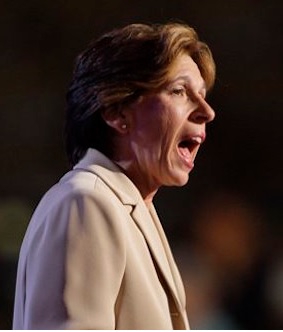 Randi Weingarten, who engineered the 1.6 million member union’s early endorsement of Hillary Clinton has issued a statement about the election, lamenting that voters chose to believe Trump about economic insecurity, rather than hearing the identical message, sent by Clinton and unions.
Support for resistance to the current model of education reform in México continues to grow after the Mexican Secretary of the Interior, Osorio Chong, issued an ultimatum on Friday, July 1st, to Oaxacan protesters and members of Section 22 of SNTE, urging them to stop their blockade of highways.
To show support for Mexico's teachers, demonstrations are being held internationally, as they are in the U.S. In today's blog about the situation in Mexico, Mary Compton provides background to the current repression and information about how readers can support the teachers.

The good news is that the MORE/New Action slate won the seven seats on the UFT Executive Board elected by high school teachers. Furthermore, voter turnout increased across the board from roughly 18% in 2013 to roughly 24% in 2016. Finally, the absolute number of votes for the opposition increased in every division. However, still less than one-quarter of UFT members participated in this election. And the slight increase in voter turnout benefited the ruling Unity caucus at least as much as it benefited MORE/New Action.
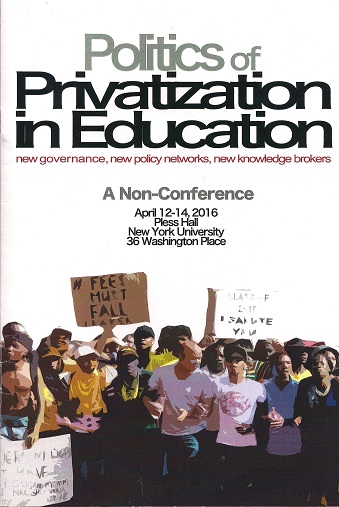
(These are my remarks at an evening panel of what its organizers referred to as a "non-conference" so as to convey the need for participants to interact with one another's ideas, rather than present papers. Sessions spanned two full days. The two evening sessions were videotaped. When they are made available I will post them on New Politics.)
The Chicago Teachers Union (CTU) strike April 1 is not primarily about increased school funding, standardized testing, pensions for teachers, or even just corporate taxation, though the union is fighting for all of these. The strike is about democracy, especially who owns our society’s resources and how decisions about those resources are made.
A new Jacobin piece by Micah Uetricht and Sarah Chambers is a must-read to understand what's at stake in the April 1 walkout of Chicago teachers. (My own thoughts about the political implications of the strike are in a piece in press.) But for now I want to explain to teachers who may be considering crossing the union's picket lines tomorrow why that would be a very big mistake for them personally.

Like many countries trying to wedge their way into economic prosperity Mexico has affirmed an emphasis on education but in practice has negated its importance. Recently passed constitutional reforms relegate educators to temporary employment controlled by the federal government and private investors who have little or no interest in universal coverage or academic excellence. A huge portion of federal money designed for education goes to administrative personnel and is not subject to audit.
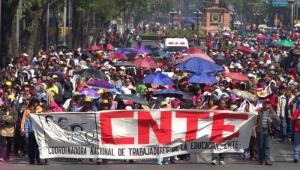
Oaxaca’s education workers build on the struggles of 2006 to fight corporate-driven education reforms.
Ten years ago, one of the most radical unions in the hemisphere, the Sección XXII of Mexico’s National Education Workers’ Union (SNTE), led a vibrant movement against the state governor’s heavy-handed rule in the southern Mexican state of Oaxaca.
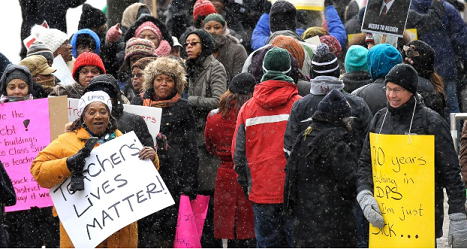 Much has been written about the harm the Supreme Court will wreak on US labor if it overturns the right of public sector unions to charge nonmembers a fee equal to the cost of the union’s expenses in representing them. Pundits on the left and the right have predicted a cataclysm.
Members of the Washington Education Association (WEA), an NEA affiliate in Seattle, are on strike this morning. Picketing has begun outside schools though bargaining has resumed. The demands in this strike show the power of a teachers' union to use the contract to make schools what they should be for all kids. The ones that I think are most significant:
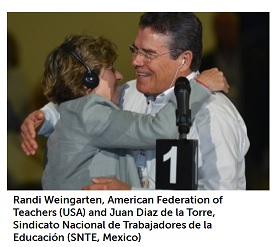 The Education International (EI), the international confederation of teachers unions, held its seventh World Congress in Ottawa over the summer. Though most teachers don’t know this organization exists, and few people write about its activity, what it do
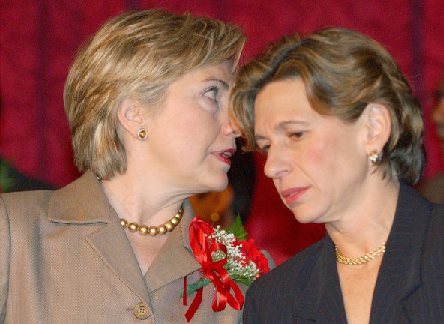 On July 11 the AFT announced its Executive Council “overwhelmingly” endorsed Hillary Clinton for the Democratic nomination for President. It did so, the official announcement reported, on the basis of interviews (not released to members) and the results of a poll.
Despite widespread d isillusionment with the political system, an organized attempt to prevent the election from taking place in a few states, and continuing economic doldrums, President Enrique Peña Nieto and his Institutional Revolutionary Party (PRI) were the big winners in the Mexican election, followed by the conservative National Action Party (PAN).
A headline in a recent news story about Los Angeles teachers, calling the district’s teaching force “old and costly,” is a companion piece to the New York Times front page article about the Success Academy chain headed by Eva Moskowitz.
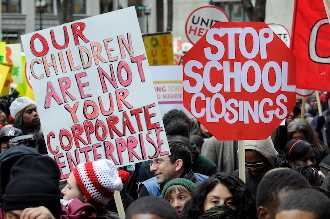 It’s encouraging that US unions are acknowledging the deep crisis facing labor and even the need for union democracy, as Labor Notes contributor Mark Brenner observes in his March 2015 column about the conference organized and hosted by the Albert Shanker Institute, an arm of the American Federation of Teachers (AFT).
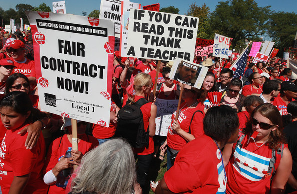 I’m struck by how many of the skills and understandings good teachers acquire can also make them fine union activists. Though they may not realize it, teachers have already learned a great deal about organizing – through their work as teachers.
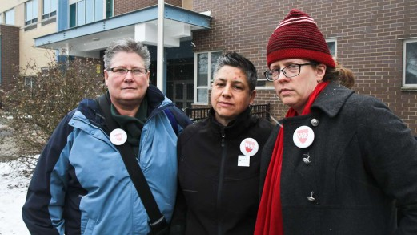 I have a long-time friend who recalls how, as a young teacher, she came to her Brooklyn school on November 7, 1960 to walk the picket line. She was terrified at breaking the law and was only one of a very few teachers in her school to strike. Fearful but also committed, she held hands with a gal pal for mutual support.
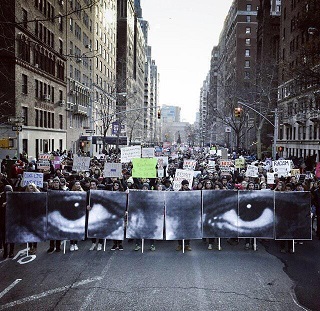 When Rudy Giuliani blamed the deaths of unarmed Black men on teachers unions in appearances on Geraldo Rivera’s show and Fox News’ “Hannity,” Giuliani relied on the same logic that Rod Paige, Secretary of Education, employed in Read more ›
- « Newer Posts
- 1
- 2
- 3
- 4
- 5
- 6
- Older Posts »